State Supplement sponsored by:
ARIZONA STATE EDITION
A Supplement to:
SHIP WITHIN 48 HOURS SAME DAY PARTS AVAILABILITY
®
May 26 2019
24 HOUR TECHNICAL SUPPORT BACKED BY A 75 YEAR BUSINESS Thousands in Service!
Vol. III • No. 11
“The Nation’s Best Read Construction Newspaper… Founded in 1957.” Your Arizona Connection – Debbie Hansen – 1-702-239-0348 – dhansen@cegltd.com
Affordable Price. Premium Service.
CALL 800-367-4937 *On approved credit • Financing Available
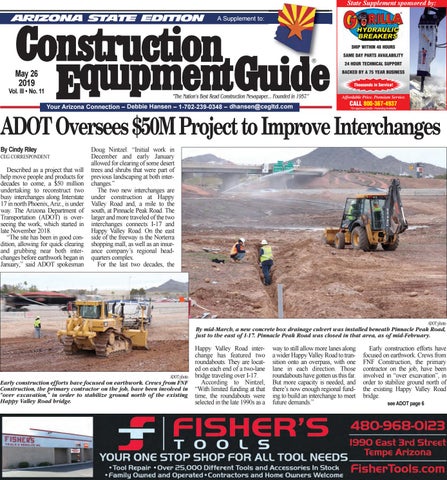
ADOT Oversees $50M Project to Improve Interchanges By Cindy Riley CEG CORRESPONDENT
Described as a project that will help move people and products for decades to come, a $50 million undertaking to reconstruct two busy interchanges along Interstate 17 in north Phoenix, Ariz., is under way. The Arizona Department of Transportation (ADOT) is overseeing the work, which started in late November 2018. “The site has been in good condition, allowing for quick clearing and grubbing near both interchanges before earthwork began in January,” said ADOT spokesman
Doug Nintzel. “Initial work in December and early January allowed for clearing of some desert trees and shrubs that were part of previous landscaping at both interchanges.” The two new interchanges are under construction at Happy Valley Road and, a mile to the south, at Pinnacle Peak Road. The larger and more traveled of the two interchanges connects I-17 and Happy Valley Road. On the east side of the freeway is the Norterra shopping mall, as well as an insurance company’s regional headquarters complex. For the last two decades, the
ADOT photo
By mid-March, a new concrete box drainage culvert was installed beneath Pinnacle Peak Road, just to the east of I-17. Pinnacle Peak Road was closed in that area, as of mid-February.
Happy Valley Road interchange has featured two roundabouts. They are located on each end of a two-lane ADOT photo bridge traveling over I-17. According to Nintzel, Early construction efforts have focused on earthwork. Crews from FNF Construction, the primary contractor on the job, have been involved in “With limited funding at that “over excavation,” in order to stabilize ground north of the existing time, the roundabouts were Happy Valley Road bridge. selected in the late 1990s as a
way to still allow more lanes along a wider Happy Valley Road to transition onto an overpass, with one lane in each direction. Those roundabouts have gotten us this far. But more capacity is needed, and there’s now enough regional funding to build an interchange to meet future demands.”
Early construction efforts have focused on earthwork. Crews from FNF Construction, the primary contractor on the job, have been involved in “over excavation”, in order to stabilize ground north of the existing Happy Valley Road bridge. see ADOT page 6
Page 2 • May 26, 2019 • www.constructionequipmentguide.com • Arizona State Supplement • Construction Equipment Guide
Tried. True. New. How the First Hitachi EX1200-7 in North America Leads the Way for Rango Inc.
The 1200 series of machines are the only excavators that Rango uses to move high volumes,” said Dan McQuade, CEO, Rango.
By Caroline Schweitzer HITACHI BREAKOUT MAGAZINE
When the new EX1200-7 excavator rolled onto a Rango Inc. job site, there was an energy you could feel in the air. Not only had they received a new EX1200-7, but it was the first Dash-7 to be delivered and digging on North American ground. The crew put it to work immediately, breaking through 15 ft. of concrete-like conglomerate to mine aggregates at a job site in Mesa, Ariz. “We’re like a bunch of kids in a candy store,” said Dave Johnson, general production superintendent at Rango. “Especially when the new 1200-7 was delivered. I had multiple operators on other jobs asking when they were going to be able to run it. We all got pretty excited.” Ready, Set, Grow Ready, set, grow — this has been the mentality at Rango, an excavation, haulage and stockpiling service provider for the mining industry headquartered in the Phoenix, Ariz., area. This mentality is also why the company added the brand new EX1200-7 to its fleet. Dan McQuade, CEO of Rango, took the position with the task of meeting the goals of a five-year
growth plan. The expansion and diversification plan were the vision of the leadership team and Rodney George, one of the founders of Rango. With this strategic vision, the company has seen exponential growth in the past couple of years — leaping from 45 employees in 2017 to nearly 200 employees and 225 pieces of heavy machinery today. By expanding its mining, hauling and aggregates service offerings as well as its geographic footprint, the family-based corporation has hands in multiple honey pots, including a sister company, Rango
The EX1200-7 is powerful enough to dig through tough conglomerate, having a huge impact on productivity.
Honey, that specializes in honey and beekeeping. Yes … beekeeping. With the evolution of Rango’s mining business, there’s little patience for equipment that isn’t ready to handle the fast pace. Among all the business changes that have occurred, there’s one thing that has remained the same: the company’s loyalty to Hitachi excavators. Specifically, the 1200 series. “The 1200 series of machines are the only excavators that Rango uses to move high volumes, sometimes 16, 18, 20, 22,000 tons of material a day,” McQuade said.
As a serial purchaser of Hitachi machines, Rango has had several EX1200-5 and EX1200-6 excavators and were impressed with their productivity and speed. When the opportunity came to order the new EX1200-7, it was the clear next step. “Hitachi is our choice as the best excavator on the market,” McQuade said. “The quality, the cycle times, the production levels, the uptime, and just the overall ease for the operators when they’re sitting behind the controls all day, every day. We think they’re the best machines out there, so Rango is really focused to stay with that line.”
When Rango Inc. received the EX1200-7 it was the first Dash-7 to be delivered and put to work on North American ground.
The EX1200-7: Kingpin of the Jobsite McQuade said their Hitachi excavators are key to keeping job sites moving and producing at high volumes. “It’s no secret that the excavator is kind of like the kingpin on your job,” McQuade said. “It’s the most valuable piece of equipment, and sometimes the single piece of equipment that we have on the job. Keeping its efficiencies near 100 percent is what’s going to make the job successful in the long run. It’s as simple as this: if a track hoe or loading truck is waiting, then we’re losing money.” Not only does the combination of uptime and power make this machine a winner for Rango, but the ease of transportation makes a bottom-line difference as well. “We go from job-to-job with our business model. With some competitor machines out there, you might need 12 heavy haul trucks, cranes and multiple people to move a machine,” McQuade said. “That can cost thousands and thousands of dollars. The 1200-7 is easy to move and then put back together, which is a benefit for us as well.” For the growing array of work Rango digs into, the EX1200-7 provides the versatility they need for many job sites. see HITACHI page 7
Construction Equipment Guide • Arizona State Supplement • www.constructionequipmentguide.com • May 26, 2019 • Page 3
Page 4 • May 26, 2019 • www.constructionequipmentguide.com • Arizona State Supplement • Construction Equipment Guide
BLM Signs Record of Decision for Sonoran Valley Parkway The Bureau of Land Management (BLM) has signed a Record of Decision (ROD) that will allow the city of Goodyear to build the proposed Sonoran Valley Parkway in Maricopa County largely on public lands. The Parkway will provide a direct route in southern Goodyear connecting Rainbow Valley Road to the community of Mobile and State Route 238, improving emergency response times in the fastest growing county in the nation. The decision also furthers Trump Administration priorities of modernizing infrastructure, supporting economic development and job growth, and increasing access to recreational opportunities on public lands. “Above all, the federal government’s job is to keep our people safe and respect our neighbors. Today we are proudly fulfilling both of those missions. This project will improve emergency response times, which means lives will be saved. Additionally, the community will enjoy increased access to recreation and position the city of Goodyear for economic success well into the future,” said Assistant Secretary for Land and Minerals Joe Balash. “I appreciate the thoughtful approach of the BLM and the community toward balancing the needs of residents with management of sensitive desert habitat.” The ROD was signed on April 29, 2019, providing the rationale for the BLM’s decision to grant the 250-ft. wide right-of-way for the two-
lane parkway, with potential for future expansion. The ROD and other available project materials can be found on the BLM ePlanning website at go.usa.gov/xP9zF. Once the BLM grants the right-of-way, the city of Goodyear would need to finalize the parkway’s design. Construction of the first two lanes is estimated to take approximately 32 months to complete. Expansion beyond a twolane parkway would require further authorizations from the BLM and would be subject to additional environmental review. The Final Environmental Impact Statement evaluating the potential environmental impacts associated with the construction, operation and maintenance of the right-of-way was published on March 22, 2019. The BLM manages more than 245 million acres of public land located primarily in 12 Western states, including Alaska. The BLM also administers 700 million acres of sub-surface mineral estate throughout the nation. The agency’s mission is to sustain the health, diversity, and productivity of America’s public lands for the use and enjoyment of present and future generations. Diverse activities authorized on these lands generated $96 billion in sales of goods and services throughout the American economy in fiscal year 2017. These activities supported more than 468,000 jobs.
ADOT, Partners Expand Healthy Forest Wide Load Detour Initiative to Reduce Wildfire Risk in Place for ADOT’s I-15 Bridge Project
After the largest wildfire in state history burned more than 538,000 acres of eastern Arizona forest, the Arizona Department of Transportation and other groups launched a partnership in 2014 that included easing weight restrictions on certain state highways to help timber companies remove small trees and other vegetation that could fuel catastrophic fires. Five years later, the Healthy Forest Initiative has expanded the area in which timber companies can haul heavier loads to reduce the risk of wildfires. “Overgrowth in our forests contributes to the destruction from wildfires around the state,” ADOT Director John Halikowski said. “Through this innovative collaboration, ADOT has worked from a transportation perspective to help promote forest health, support commerce and protect infrastructure.” Under the original program, timber industry trucks could haul up to 90,800
pounds on nine state routes between Payson and New Mexico to sawmills, pellet plants and other facilities in the White Mountains. Now the area covered by the Healthy Forest Initiative has been has been extended west to Camp Verde and north to Winslow and Holbrook. Beginning Jan. 1, 2020, trucks can haul up to 91,000 lbs. if they have a sixth axle to distribute the added weight. The six-axle design, known as a Tridem configuration, reduces the impact on roads and bridges to the same as trucks hauling 80,000 lbs., the maximum weight allowed on most state roads. Trucks without the sixth axle will be limited to 80,000 lbs. Other Healthy Forest Initiative partners include the Arizona Commerce Authority, Arizona Department of Forestry and Fire Management, Arizona Eastern Counties Organization, Salt River Project and the timber-hauling industry. “This program will be a great bene-
fit for Arizona’s existing wood products industry and our state’s ability to attract additional large scale wood products manufacturers,” said Keith Watkins, senior vice president of the Arizona Commerce Authority. “These industries are key elements in increasing the pace and scale of Arizona’s forest restoration.” Pascal Berlioux, executive director of the Arizona Eastern Counties Organization in Show Low, said the initiative has had a positive impact on the environment while boosting the region’s economy by $221 million and supporting 190 jobs. “The project has allowed the restoration treatment of 50,378 acres of Ponderosa pine forest and watershed in the White Mountains,” Berlioux said. “More than 1.3 million green tons of small diameter logs were processed to fund forest restoration and more than 1 million green tons of hazardous fuels were removed.”
Motorists using Interstate 15 in far northwestern Arizona will need to budget extra travel time over the next year as the Arizona Department of Transportation improves the decks of three bridges through the Virgin River Gorge between St. George, Utah, and Mesquite, Nev. Starting May 29, crews will resurface the decks of Bridge No. 2 and Bridge No. 5, while Bridge No. 4 will get a new deck. Crews will move all traffic to one side of the freeway while working on the other, allowing one travel lane in each direction. Completing this $6.4 million project, which is scheduled to wrap up in spring 2020, will require reducing the width of travel lanes to 10 ft. during construction. All vehicles and loads wider than 10 ft. will be required to use a 224-mi. detour, with signs directing wide-load traffic to U.S. 93, Nevada State Route 319 and Utah State Route 56 between Las Vegas and Cedar City, Utah. Along with other improvements ADOT has made to I-15 bridges in recent years, this work will extend the lives of bridges along this busy corridor for commercial and passenger travel. For more information, visit azdot.gov/projects.
Construction Equipment Guide • Arizona State Supplement • www.constructionequipmentguide.com • May 26, 2019 • Page 5
NEXT ISSUE CLOSES JUNE 13, 2019
3 3 3 3 3 3 3
empirecat.com/eloy / l | 520-582-2900 520 582 2900
Page 6 • May 26, 2019 • www.constructionequipmentguide.com • Arizona State Supplement • Construction Equipment Guide
ADOT’s I-17 Improvement Project Will Move People, Products ADOT from page 1
There are approximately 30 workers on the job site at this time. The contractor has been using earthmoving equipment, including scrapers, blades, dozers and soil compactors. The current soil stabilization work near Happy Valley Road involves more than 70,000 cu. yds. of material that’s been moved. Plans include one of the first diverging diamonds (DDI) for ADOT at one of its freeway interchanges. Two others are currently under construction as part of the Loop 202 South Mountain Freeway project, scheduled for completion near the end of 2019. “We took note of the increase in diverging diamonds being built around the country,” said Nintzel. “Our design team determined that Happy Valley Road was a good location. Among the benefits of the design is allowing left-turning traffic to enter a freeway on-ramp, without crossing in front of opposing traffic. In a growing area, we’re working to maximize the flow of rush-hour traffic through the interchange.” A DDI is a diamond interchange on which the two directions of traffic on the cross street (above or below the freeway) cross to the opposite side on both sides of the bridge at the freeway. ADOT’s website states that more than 90 DDIs have been built in 29 states in the past decade. The design has
increased in popularity because of safety, operational and cost benefits. DDIs can reduce the number and severity of crashes compared to traditional diamond interchanges, while helping eliminate traffic congestion. They also provide an opportunity to integrate multimodal facilities for pedestrians, cyclists and transit into the interchange. They are often more cost-effective to build, and there are fewer impacts on the local community during construction. During much of the project, the new bridges will be built next to the existing bridges, which will remain open to traffic during the majority of construction. By midMarch, a new concrete box drainage culvert was installed beneath Pinnacle Peak Road, just to the east of I-17. Pinnacle Peak Road was closed in that area, as of mid-February. “Our biggest challenge remains managing local traffic needs, while building the new interchanges,” said David Diekman, ADOT project supervisor. “It’s a big plus to limit closures affecting traffic on the existing bridges over I-17. We will need restrictions down the line to transition traffic from the old structures to the new ones. However, local residents have been pleased with the overall traffic control plans.” The project will widen I-17 by one lane in each direction in an area that will include the recon-
ADOT photo
The Arizona Department of Transportation (ADOT) is overseeing the work, which started in late November 2018.
structed interchanges. The Pinnacle Peak Road interchange will remain a tight diamond, with added turn and through lanes to help manage anticipated traffic demand for decades to come. Nintzel added that keeping the public informed about the project is critical. “It’s very important. We held
public meetings ahead of construction to let people see plans and provide thoughts. The project has received support from local residents, who are looking forward to the upgraded interchanges.” The I-17 Interchanges Reconstruction Project in north Phoenix is funded by the Maricopa Association of Governments’
regional transportation plan, approved by local voters in 2004. Primary revenue sources are a regional half-cent sales tax for transportation projects in the Phoenix area, as well as federal highway funds for the Maricopa County region. The project is scheduled for completion by fall 2020. CEG
ADOT photo
ADOT photo
During much of the project, the new bridges will be built next to the existing bridges, which will remain open to traffic during the majority of construction.
Described as a project that will help move people and products for decades to come, a $50-million undertaking to reconstruct two busy interchanges along Interstate 17 in north Phoenix, Ariz., is under way.
Construction Equipment Guide • Arizona State Supplement • www.constructionequipmentguide.com • May 26, 2019 • Page 7
Pros Kno Pros Kno ow! w!
®
T Those in the know w,, know Takeuchi Take euchi
Takeuchi of o ffers a wide range of compact excavatorss to help you get your tougheest tasks comppleted. PUT A TAKEUCH A HI TO WORK ON O YOUR JOBSITE AN ND EXPERIIENCE THE DIFFEREN NCE!
www.ditchwitchaz.com
4028 S 36th Street Phoenix, AZ 85040 (602) 437-0351 6975 N Camino Martin Tucson, AZ 85741 (520) 579-0261
takeuch hi us.com hi-us.com
Commercial Driver’s License...
Military Truck Drivers: There May Be Simpler Path to CDL Veterans of the U.S. military who operated large vehicles as part of their service may qualify for an Arizona Department of Transportation Motor Vehicle Division military skills test waiver when applying for a commercial driver license. “The waiver is something that deserves more attention because it gives veterans who’ve honorably served this country more opportunities to use those skills once they return to civilian life,” said Mike Cryderman, MVD field operations administrator. “There’s a real need in this country for proficient commercial drivers, and the MVD is committed to assisting veterans with this kind of experience to appropriately get the credentials they need.” The military skills test waiver applies to veterans who operated a military vehicle equivalent to a commercial vehicle within the last year. The waiver requires the applicant to describe what kind of vehicle he or
Hitachi’s EX1200-7 Put to Test HITACHI from page 2
“The 1200-7 is phenomenal and very versatile,” McQuade said. “Whether it’s hard digging or soft digging, you know you can configure the bucket so that the horsepower behind the machine, the hydraulics and every-thing in the design just lets you be the she operated, such as fifth wheel, truck tracbest you can be. That’s why we’ve stayed tor/semi-trailer, truck trailer combination, or with this line and purchased the new Dashsingle vehicles that meet certain commercial 7.” weight specifications. It also requires the Johnson is pleased with the new machine applicant to obtain a commanding officer’s as well and explained that the speed and certification that the applicant has commer- breakout power of the EX1200-7 is what cial driving experience in the military. makes it extraordinary. “I can’t emphasize enough how fast these Tony Bradley, president and CEO for the Arizona Trucking Association said, “The machines are. It’s an EX1200 and it feels like simple fact is that veterans make great you’re running a machine that’s half the employees and we should encourage every size,” Johnson said. “It’s going to run as fast veteran with experience driving heavy as I want it to run, and I’m going to be able equipment to take advantage of the military to get as many loads out in the day as I can with that machine, even through caliche and skills test waiver. By utilizing the skills test the tough stuff.” waiver these veterans can get credit for the Since Rango works heavily in aggregates, skills they learned in the military and start having an excavator powerful enough to dig earning money as a commercial truck driver through tough conglomerate has a huge or heavy equipment operator.” impact on productivity. Potential applicants can find the waiver “The breakout power of the Hitachi is just form (Form 96-0680) at phenomenal,” Johnson said. “With other machines, when you hit tough caliche, it www.azdot.gov/MVD.
feels like they power out. The bucket would stop and sometimes lift the whole machine up off the ground, tracks and all. With the Hitachis, they just keep going.” The Power of People and Equipment McQuade contributes some of the success and growth of their company to the culture Rango has built. He said it’s not only about new machines, but also the operators running them. “Our people and how we treat them is what makes the difference between a good company and just an okay company,” McQuade said. “Everyone can buy the best equipment made in the world, but the difference is your people.” That said, the EX1200 series is now a staple in Rango’s formula for success. “If I was going to give advice to someone out there as far as equipment or model selection,” McQuade said, “I would tell them to not buy any Hitachis at all because Rango is going to need the next dozen they produce.” (Rango Inc. is serviced by Arnold Machinery, Phoenix, Ariz.) This article first appeared in Hitachi’s BREAKOUT magazine, Spring 2019 issue.
Page 8 • May 26, 2019 • www.constructionequipmentguide.com • Arizona State Supplement • Construction Equipment Guide
Public Auction held the 2nd Saturday of every month. Preview Every Monday - Friday 7am - 4pm Consignments Welcome Western Sales Management, Inc 1616 S 67th Ave. Phoenix, AZ 85043
623-936-3300 wsmauctioneers.com wsmauctionbiz@yahoo.com
Next Auction June 8, 2019
File Photo