ARIZONA STATE EDITION
A Supplement to:
®
August 21 2016 Vol. I • No. 17
“The Nation’s Best Read Construction Newspaper… Founded in 1957.” Your Arizona Connection – Dennis Hogeboom – 1-877-7CEGLTD – dennishogeboom@cegltd.com
Stadium Renovation Calls Time Out for Football Season ing installation of new seats and facilities. Heavy equipment on site includes cranes, bulldozers, cement trucks, drilling rigs and hauling trucks. The decision to upgrade the stadium was based on the age of the facility and a need to compete with other teams in football stadium construction and development. Focus is on both fan amenities and investment in better player facilities. Construction is expected to conclude before the 2017 football season. Funding for the project is provided through increased stadium revenue, private contributions, Pac-12 Conference distributions and revenue from a 330-acre athletic facilities district that will be developed along Tempe Town Lake. Donations for the project are expected to reach $70 million by the end of this summer.
By Chuck Harvey CEG CORRESPONDENT
With football season around the corner, second-phase construction pauses on a $256 million renovation project to upgrade Arizona State University’s Sun Devil Stadium in Tempe. The first phase included removal of the upper-deck seats in the northwest and northeast sections of the north end zone. The second phase is under way, but will take a break for the 2016 football season that starts Sept. 3. The project is being done in three out-ofseason phases so the football team can come in and play in the fall. The stadium was built 58 years ago. Since then, the only major change was in the 1980s when crews made adjustments to make the facility more suitable for NFL use by the Arizona Cardinals. Crews have been busy during the spring and summer upgrading the stadium, includ-
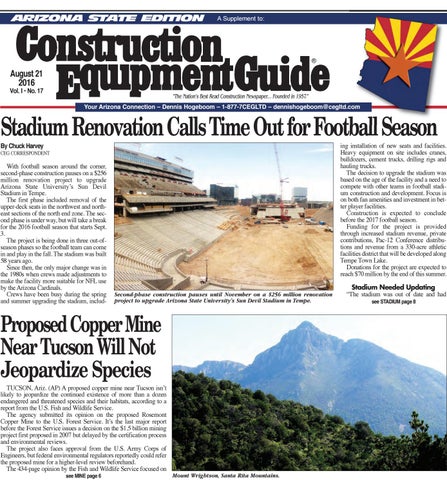
Second-phase construction pauses until November on a $256 million renovation project to upgrade Arizona State University’s Sun Devil Stadium in Tempe.
Proposed Copper Mine Near Tucson Will Not Jeopardize Species TUCSON, Ariz. (AP) A proposed copper mine near Tucson isn’t likely to jeopardize the continued existence of more than a dozen endangered and threatened species and their habitats, according to a report from the U.S. Fish and Wildlife Service. The agency submitted its opinion on the proposed Rosemont Copper Mine to the U.S. Forest Service. It’s the last major report before the Forest Service issues a decision on the $1.5 billion mining project first proposed in 2007 but delayed by the certification process and environmental reviews. The project also faces approval from the U.S. Army Corps of Engineers, but federal environmental regulators reportedly could refer the proposed mine for a higher-level review beforehand. The 434-page opinion by the Fish and Wildlife Service focused on see MINE page 6
Mount Wrightson, Santa Rita Mountains.
Stadium Needed Updating “The stadium was out of date and had see STADIUM page 8
Page 2 • August 21, 2016 • www.constructionequipmentguide.com • Arizona State Supplement • Construction Equipment Guide
Preliminary Work Ramps Up Along Future Loop 202 South
ADOT photo
ADOT photo
The South Mountain Freeway, which will run east and west along Pecos Road and then north and south near 59th Avenue, connecting with Interstate 10 on each end, is expected to open by late 2019.
Archaeologists clean the sides of the trenches, also known as facing, looking for possible pre-historic or historic features.
Loop 202 South Mountain Freeway near Phoenix, Ariz., is the hub for plenty of preconstruction activity along the planned route. ADOT crews are checking soil, rock and underground water conditions, while archaeologists are gathering items and information on the past for future study. Other preliminary work includes acquiring properties and removal of structures on those properties, if necessary. Crews are also relocating utilities as necessary. Assessing Soil, Rock Conditions Using drills and backhoes, ADOT crews are working to assess the condition of soil and rock as well as the depth of groundwater along the freeway alignment. The work, which is scheduled to continue for several months, will help engineers plan the freeway’s pavement, bridges, walls and drainage structures. Understanding the soil, including its type, density, moisture content and strength, is essential prior to building any roadway. For the 45 bridges that will be built for the South Mountain Freeway, the answers will help engineers determine how deep concrete foundations should be. Finding clay rather than hard rock in an area could require engi-
neers to use thicker pavement, build a support base or replace the soil altogether. Workers will drill holes, called borings, and dig test pits up to 10 ft. (3 m) deep along the roadway alignment, and at all future bridge and retaining wall locations. Materials collected will be analyzed to create a profile of what lies beneath much of the 22-mi. (35 km) corridor. This initial work will occur only during the day, and it won’t affect traffic. There may be traffic impacts later along Pecos Road, and ADOT will send out traffic advisories in advance of that work. There are expected to be 720 borings to depths of 5 to 175 ft. (1.5 to 53 m). In all, there will be about 29,000 ft. (8,839 m) of drilling and 800 ft. (244 m) of backhoe pit excavation. Crews have already begun marking locations for testing after receiving environmental clearance and working with Arizona 811 to ensure there are no conflicts beneath the surface, such as water, gas and electrical utility lines. None of the current work will occur within South Mountain Park.
Environmental Stewardship Along the 22-mi. corridor where the South Mountain Freeway will be built over the next few years, archaeologists are working to gather and recover items and information from the past that may have cultural or historic significance. At one point along the freeway footprint, archaeologists are systematically digging 5ft. (1.5 m)-deep trenches looking for signs that ancient people lived or farmed there. At other sites, archaeologists have found pottery pieces and 19th-century shotgun shells, among other items, and also documented historic petroglyphs. The Arizona Department of Transportation is completing this and other work at 16 various sites that have been identified as potentially having cultural or historic significance during the 13-year study phase of the South Mountain Freeway. As a result of these extensive studies, ADOT published an environmental impact statement allowing decision-makers to better understand the potential positive and negative impacts of the project on the environment. Whether they contain evidence of those see LOOP page 4
ADOT photo
Using drills and backhoes, ADOT crews are working to assess the condition of soil and rock as well as the depth of groundwater along the freeway alignment.
Construction Equipment Guide • Arizona State Supplement • www.constructionequipmentguide.com • August 21, 2016 • Page 3
Page 4 • August 21, 2016 • www.constructionequipmentguide.com • Arizona State Supplement • Construction Equipment Guide
ADOT Crews Check Conditions Along Loop 202 South Route LOOP from page 2
who inhabited this area in prehistoric times, artifacts from farms important to the area’s heritage or even an abandoned railroad, these sites must be managed according to federal and state historic preservation laws before freeway construction begins this summer. Since the start of the study phase in 2001, ADOT and the Federal Highway Administration have been carrying out cultural resource studies and consulting tribal leaders, tribal historic preservation officers, state historic preservation offices, land managers and other stakeholders. “Protecting and preserving cultural resources is the law, but it’s also the right and respectful thing to do,” said Linda Davis, who leads ADOT’s historic preservation team. By law, some of this work must remain confidential while it is happening, and sometimes a site will be fenced and monitored by
security for safety reasons and to protect what ADOT’s research and field surveys suggest may be found there. Federal and state regulations require ADOT and the Federal Highway Administration to identify and address any potential environmental impacts that could affect cultural or historic resources, air and water quality, wildlife, noise levels, hazardous waste and more before proceeding with any construction project. This makes the agency one of the largest sponsors of archaeological research in Arizona. As part of its environmental planning process, the agency considers the effects of transportation projects on sensitive cultural resources by consulting with Native American communities, conducting research and limiting impacts from highway construction as much as possible. When a site is determined to have historic or cultural significance, ADOT’s historic preservation team develops a plan, in con-
sultation with tribal leaders, tribal historic preservation officers, state historic preservation offices, land managers and other stakeholders to minimize harm from construction. At a site where construction will occur, archaeologists will gather items and information, a process referred to as data recovery. Work at prehistoric and historic sites may include thorough documentation or excavation and extraction, analysis and preservation of artifacts, which can include sending the identified artifacts to an accredited repository, such as the Arizona State Museum, Museum of Northern Arizona, Pueblo Grande Museum or Huhugam Heritage Center. Historic structures also are documented. “Building any transportation facility has consequences, including cultural and environmental impacts that ADOT is committed to minimizing as much as possible,” said John Halikowski, ADOT director. “In fulfilling its environmental commitments, including how it handles cultural resources, ADOT
has to strike a balance between the need for a modern transportation network and protecting Arizona’s cultural heritage.” The South Mountain Freeway, which will run east and west along Pecos Road and then north and south near 59th Avenue, connecting with Interstate 10 on each end, is expected to open by late 2019. The freeway will provide a long-planned direct link between the East Valley and West Valley and a muchneeded alternative to Interstate 10 through downtown Phoenix. Approved twice by Maricopa County voters, the South Mountain Freeway will complete the Loop 202 and Loop 101 freeway system. For more information, visit azdot.gov/SouthMountainFreeway. (This story also can be found on Construction Equipment Guide’s website at www.constructionequipmentguide.com.)
ADOT photo
ADOT photo
After identifying possible cultural resources sites, archaeologists complete field investigations by digging systematic 5-ft. (1.5 m) deep trenches.
Archaeologists have gathered numerous artifacts, including ceramic pottery and flaked stone, along the future South Mountain Freeway alignment.
Construction Equipment Guide • Arizona State Supplement • www.constructionequipmentguide.com • August 21, 2016 • Page 5
2240 W. Buckeye Rd. • Phoenix, AZ 85009 602-761-2525 • Fax: 602-454-8899 www.flaskajcb.com
Page 6 • August 21, 2016 • www.constructionequipmentguide.com • Arizona State Supplement • Construction Equipment Guide
Rosemont Mine Still Faces Challenges After Agency Report
Save the Santa Ritas photo
If the Fish and Wildlife Service concluded the mine would jeopardize a species’ existence or illegally damage critical habitat, it could stop the project. MINE from page 1
the mine’s projected impact on the threatened Chiricahua leopard frog, northern Mexican garter snake and western yellowbilled cuckoo. It also examined the effect on the endangered jaguar, ocelot, Huachuca water umbel, desert pupfish, Gila chub, Gila topminnow, lesser long-nosed bat, southwestern willow flycatcher, western yellowbilled cuckoo and Pima pineapple cactus. The proposed mine would put an open pit in the Santa Rita Mountains southeast of Tucson and be located on more than 4,400 acres of federal, state and private land. If the Fish and Wildlife Service concluded the mine would jeopardize a species’ existence or illegally damage critical habitat, it could stop the project.
3 3 3 3 3 3 3
empirecat.com/eloy | 520-582-2900
In May 2015, the agency announced it was restarting a review examining the project’s effects on endangered species after an ocelot was discovered in the area. “For years, the Fish and Wildlife Service has issued biological opinions that have been successfully challenged in federal court and we expect that is what will happen here,” said Gayle Hartmann, president of the Save the Scenic Santa Ritas nonprofit group opposed to the mine. “The Rosemont project will destroy the habitat of endangered species with its half-mile deep open pit and mine waste piles stacked 600-800 feet high spread over five square miles of the Coronado National Forest.” (This story also can be found on Construction Equipment Guide’s website at www.constructionequipmentguide.com.)
Arizona Court Upholds Air Permit for Rosemont Mine TUCSON, Ariz. (AP) An Arizona court has ruled in favor of a proposed open-pit copper mine southeast of Tucson. Unless there is a successful appeal, it could become the third-largest copper mine in the country and employ about 400 people. The Arizona Daily Star reports that the Arizona Court of Appeals overturned a lower court that ruled that the state was wrong to issue an air-quality permit to the proposed Rosemont Mine. The appeals court concluded that evidence supports the state’ s determination that the mine won’ t exceed air quality standards. The Rosemont Mine has been delayed for years over concerns that it could harm air and water quality, dry up wells and streams and damage habitat for the endangered jaguar and other species. The mining refutes those concerns. For more information, visit http://www.tucson.com.
Construction Equipment Guide • Arizona State Supplement • www.constructionequipmentguide.com • August 21, 2016 • Page 7
E Every very jjob ob iis su unique. nique. W With ith cclass-leading lass-leading cycle cycle times, times, precision precision control control and and outstanding outstanding efficiency efficiency of of Doosan Doosan crawler crawler excavators, excavators, you'll you'll stay stay p productive roductive no no matter matter what. what. Get Get a closer closer look. look. Stop Stop by by and and visit visit us us today. today.
4 028 S outh 3 6th S treet | P hoenix, A Z 4028 South 36th Street Phoenix, AZ 602.437.0351 | doosan.ditchwitchaz.com doosan.ditchwitchaz.com 602.437.0351
Page 8 • August 21, 2016 • www.constructionequipmentguide.com • Arizona State Supplement • Construction Equipment Guide
Arizona Company Introduces New GPS Phase II Sun Devil Tool to Fight Trailer, Equipment Theft Stadium Renovation Complete for Season STADIUM from page 1
code issues,” said Todd Raven, Arizona State University director of capital programs management. “It is a 1958 facility. The renovation will provide a much better game day experience for students and the athletes.” Raven added that a lot of work is going into modernizing the stadium. That includes seats with more legroom, additional restrooms, WiFi availability, cellular coverage and a large video board on the north end. “Viewing angles from every seat will be great,” Raven said. Also, the stadium, when finished, will be The lower bowl on the west side used, not just in the was completely rebuilt. fall, but on a yearround basis for Tempe community events. With north upper deck end zone seats removed, spectators will be able to see into the stadium from each side, creating a more open feeling. Air flow also will be better, which can be a plus in hot weather.
Easy to install, these devices, which update daily, aggressively track equipment in real-time in the event of theft or recovery.
An Arizona-based company is helping contractors and other equipment owners combat the rise in equipment thefts in the United States. The National Insurance Crime Bureau recently released a report that revealed a 1.2 percent increase of equipment theft — making matters worse, only 23 percent of stolen equipment is recovered. Scottsdale, Ariz.’s GPS & Track.com satellite GPS tracking technology can reveal the location of an asset within a few feet. Users can access this information from any computer, laptop, smartphone or other device connected to the Internet. The Web-based platform also includes detailed history reports, battery alerts, and satellite mapping capabilities. GPS & Track has been an innovator in this market. The company has seen an increasing growth of its sales of Trailer GPS Tracking Devices with a five-year battery life. From large corporations to individuals, the company has been shipping these Trailer GPS Trackers across the United States. These devices, which update daily, aggressively track equipment in realtime in the event of theft or recovery. The tracking devices are durable and
Contractor is Hunt Construction Group Contractor for the project is Indianapolis-based Hunt Construction Group. Founded in 1944, Hunt Construction Group is a major builder specializing in hospitality, performing arts centers, infrastructure, office buildings, sports arenas, sports stadiums (pro and college), convention centers, casinos and educational facilities.
Scottsdale, Ariz.’s GPS & Track.com satellite GPS tracking technology can reveal the location of an asset within a few feet.
designed to handle any weather condition, according to the company. “With the high theft rates of trailers and equipment, our battery-powered GPS units have allowed for recovered stolen assets,” said Michael Fischer of GPSandTrack.com. “This technology is a game changer.” Equipment is a big investment, but according to GPS & Track, it can be protected very affordably with GPS
trackers. The Trailer GPS Tracking devices are priced around $279, which includes three-years of service. After three years, the service is $20 per year. For more information, visit www.GPSandTrack.com or call 800/578-1809. (This story also can be found on Construction Equipment Guide’s website at www.constructionequipmentguide.com.)
Phase II Under Way Phase II construction features upgraded amenities, concessions, additional elevators and the installation of handrails. Most of the Phase II work is being done on the north and west sides of the stadium. The lower bowl on the west side was completely rebuilt. As part of Phase II, crews built the shell for an 115,000sq.-ft. (10,683.8 sq m) student-athlete training facility under the north end zone with a patio deck for fans to congregate during games. The facility includes office and administrative spaces, meeting rooms, support space, study rooms, storage and equipment space, locker rooms, lounge areas, athletic training areas and conference areas. “We are on a very aggressive schedule and Phase II is the biggest challenge,” Raven said. Phase II also includes construction of a kitchen and common center. Existing concourses have been demolished and rebuilt including restrooms and concession stands. More restrooms are being added. Premium seating that includes access to lounge areas between the upper deck and main concourse was added, see STADIUM page 10
Construction Equipment Guide • Arizona State Supplement • www.constructionequipmentguide.com • August 21, 2016 • Page 9
ENJOY FAST, FREE SHIPPING!
Page 10 • August 21, 2016 • www.constructionequipmentguide.com • Arizona State Supplement • Construction Equipment Guide
Pros P Pro ro os s Kn Know! K now! ow!
®
Those in the know w,, know T Takeuchi ake akeuchi
www.ditchwitchaz.com
4028 S 36th Street Phoenix, AZ 85040 (602) 437-0351 6975 N Camino Martin Tucson, AZ 85741 (520) 579-0261
takeuchi-us.com
Phone: 480-907-7433 Cell: 602-295-9645 sales@auequipment.com www.auequipment.com
Crews Wrap Up Stadium Work, Phase III Begins in November STADIUM from page 8
Serving the Entire Southwest from our Gilbert, AZ Location
Arizona’s Crushing & Screening Authority
while regular seating provides more legroom and back support. In addition, a new scoreboard and sound system will enhance the fan experience. The stadium is completely rewired to include WiFi. Also, a new 100- by 50-ft. (30.5- by 15.2 m) video board is being installed on the north end. At the completion of Phase II on the west side, the main concourse will begin to connect the stadium clockwise with the south end zone and west side concourses merging with the north Sun Deck. The new concourses will be 20 ft. (6 m) higher than the previous walkways, allowing better airflow throughout the stadium. The plan is to provide a 360-degree walk around the stadium. Phase III Construction Phase III will start on Nov. 16 and focus mostly on the east side of the stadium. It will include the building the interior of the student-athlete training facility and completion of the concourse. When finished, the stadium will hold
56,232 fans, compared to a maximum 64,248 fans in 2015 and a 71,706-fan maximum before that. Elimination of some seating areas makes it possible to improve views and enhance the overall spectator experience. “We wanted to provide better visibility and focus to the field,” Raven said. “We opened up the stadium and that created more airflow.” Previously, fans could not see much from the concourses. Now they will have views, Raven said. Completion On Schedule After Small Delay Raven said crews found a construction landfill on the north side of the stadium. It included concrete and other materials from past projects. The landfill had to be removed in order to proceed with the stadium project. The site was cleared in about six days, Raven said. (This story also can be found on Construction Equipment Guide’s website at www.constructionequipmentguide.com.) CEG
Construction Equipment Guide • Arizona State Supplement • www.constructionequipmentguide.com • August 21, 2016 • Page 11
Page 12 • August 21, 2016 • www.constructionequipmentguide.com • Arizona State Supplement • Construction Equipment Guide
Public Auction held the 2nd Saturday of every month. Preview Every Monday - Friday 8am - 4pm Consignments Welcome 623-936-3300 wsmauctioneers.com wsmauctionbiz@yahoo.com
Western Sales Management, Inc 1616 S 67th Ave. Phoenix, AZ 85043
Next Auction September 10, 2016
File Photo
File Photo File Photo
File Photo
File Photo
File Photo
File Photo
File Photo
File Photo
File Photo