Huntsville
20 Decatur
State Supplement sponsored by:
231
65
72 Florence
2
72
565 59
43 231
31
5
ALABAMA STATE EDITION
431
Gadsden
78 59
A Supplement to:
Anniston
20
Birmingham Bessemer
82 Tuscaloosa
65 280
20 82 Auburn
80
85
Selma
Phenix City
Montgomery
82 65
231
43 84 431 331
84
84 52
SHIP WITHIN 48 HOURS
Dothan
31
45 65 98
SAME DAY PARTS AVAILABILITY
Mobile
10
®
December 15 2021
24 HOUR TECHNICAL SUPPORT BACKED BY A 75 YEAR BUSINESS Thousands in Service!
Vol. XXIII • No. 25 “The Nation’s Best Read Construction Newspaper… Founded in 1957.”
Affordable Price. Premium Service.
CALL 800-367-4937
Your Alabama Connection • Rich Olivier, Atlanta, GA • 1-800-409-1479
*On approved credit • Financing Available
New Law Due to Birmingham’s Hoar Construction Builds Bring Alabama $76M UAB Science, Engineering Complex More Than $6.8B Alabama could receive more than $6.8 billion in road and transportation funding in President Biden’s recently approved $1.2 trillion Infrastructure, Investment and Jobs Act (IIJA). While broad outlines of how that money will be allocated are now available, more federal direction is needed before specific projects are identified, the Daily News has learned. “We’re still waiting on the federal guidance on what exactly we can do with this money,” Tom Layfield, executive director of the Alabama Road Builders Association (ARBA), told the Montgomery-based news service. According to information from the U.S. Department of Transportation (USDOT), the following approximates what Alabama should expect from the infrastructure law over five years: • $5.8 billion in highway and bridge funds which, USDOT has said, is about 32 percent more per year than current federal funding to the state. • $402 million to improve Alabama’s public transportation options. • $142 million for airport infrastructure. • $128 million to reduce transportationrelated emissions. • $79 million for the expansion of electric vehicle charging networks in the state. • $44 million for commercial motor vehicle safety efforts to reduce crashes. • $32 million for highway safety traffic programs. • $146 million to “increase the resilience of its transportation system,” the USDOT said in a recent statement. “You can read a definition of what resilience means, but you need the guidance to see what the [federal government] says it see IIJA page 2
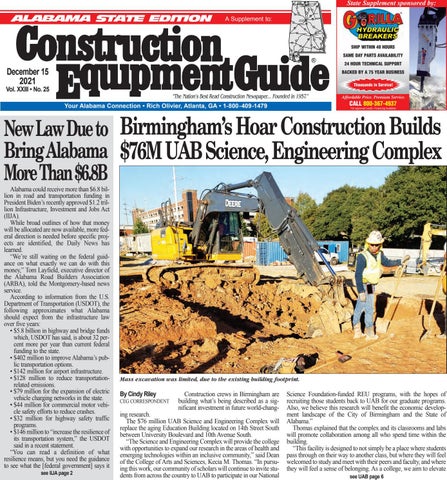
Mass excavation was limited, due to the existing building footprint.
By Cindy Riley CEG CORRESPONDENT
Construction crews in Birmingham are building what’s being described as a significant investment in future world-chang-
ing research. The $76 million UAB Science and Engineering Complex will replace the aging Education Building located on 14th Street South between University Boulevard and 10th Avenue South. “The Science and Engineering Complex will provide the college with opportunities to expand our research in the areas of health and emerging technologies within an inclusive community,” said Dean of the College of Arts and Sciences, Kecia M. Thomas. “In pursuing this work, our community of scholars will continue to invite students from across the country to UAB to participate in our National
Science Foundation-funded REU programs, with the hopes of recruiting those students back to UAB for our graduate programs. Also, we believe this research will benefit the economic development landscape of the City of Birmingham and the State of Alabama.” Thomas explained that the complex and its classrooms and labs will promote collaboration among all who spend time within the building. “This facility is designed to not simply be a place where students pass through on their way to another class, but where they will feel welcomed to study and meet with their peers and faculty, and where they will feel a sense of belonging. As a college, we aim to elevate see UAB page 6
Page 2 • December 15, 2021 • www.constructionequipmentguide.com • Alabama State Supplement • Construction Equipment Guide
Ground Broken on Rural $758M West Alabama Corridor State and local officials came together in mid-November for the groundbreaking on the first phase of the new West Alabama Corridor project, a $758 million four-lane highway that will stretch from Tuscaloosa south to Mobile in a rural part of the state. Gov. Kay Ivey first announced the construction during her 2021 State of the State address on Feb. 2. WVUA 23, a Tuscaloosa TV station, reported that the project’s first phase is to be called the Linden Bypass, where crews will be adding two additional lanes to the existing U.S. Highway 43 to south of the town of Linden in Marengo County. Widening will continue north along U.S. 43 to Linden, and then will bypass on the east side of town following the previous Linden Bypass alignment. North of Linden, the project is designed to add a pair of new lanes to the existing two lanes of U.S. 69, before crossing U.S. 80 and continuing north on U.S. 69 through Greensboro, where it will connect with the existing four lanes of U.S. 69 north of Moundville. The second and third portions of the West Alabama Corridor Project consist of a southern portion beginning at U.S. Highway 43 in Thomasville that runs north to the south intersection with the completed Linden Bypass, and a northern portion beginning from the north intersection with the Linden Bypass to U.S. Highway 69 north of Moundville. Construction on the road project is set to begin in earnest next spring, WVUA 23 reported. Projections are that it will take five years to build. Hopes Are New Road Will Boost Safety, Economy "Today the people of Alabama have come together to make this happen [and] I am certainly proud to be a part of it," Ivey said at the groundbreaking. "Turn some dirt, and then we are going to turn another chapter in the pages of our history and our growth in the black belt." Tuscaloosa Mayor Walt Maddox and Thomasville Mayor Sheldon Day called the corridor a historic move. "I really want to commend the governor for making this happen," Maddox said in his remarks. "Ultimately, it
State and local officials, including Gov. Kay Ivey, came together in mid-November for the groundbreaking on the first phase of the new West Alabama Corridor project, a $758 million four-lane highway that will stretch from Tuscaloosa south to Mobile in a rural part of the state.
required leadership and you saw all the different groups working together. Cities, counties, Republicans, Democrats — this is what it’s about and I’m proud of our state, and I’m very proud of what this project is going to do for Alabama." Day agreed. "We’ve got to be ready," he said. "If this takes 10 years to build, we need to start today, gearing up our communities so we can best take advantage of the opportunities this new corridor will bring us." The West Alabama Corridor Project will provide connectivity to rural counties that lack four-lane access to the interstate system. The effort is part of the Rebuild Alabama Act of 2019, which raised the state’s gas tax 10 cents to repair and expand road and bridge infrastructure. Linden resident Linda Hudson said she has heard talk about the road expansion for a long time.
"I taught school here for years and I have been hearing about this for about 35 years, so it’s about time for it get done," she told the Tuscaloosa TV station. Earnestine Burrell, also from Linden, added that she is excited about the project because U.S. 69, in its current condition, is dangerous. "I’ve known too many people to get killed and this project is going to make that trip to Tuscaloosa a whole lot safer," she said. Others living in and around Linden hope that the West Alabama Corridor Project will be a great economic boost for the area. "Overall, it may help Linden tremendously," said Celena Dunn, another Linden citizen, in her remarks to WVUA 23. "We may even get another mill or two. Economically, we might be in good shape."
IIJA Allows State to Rehabilitate 620 Bridges, 3,000 Miles of Roads IIJA from page 1
means,” Layfield added. The state of Alabama and its local governments also can apply for additional pools of grant dollars, the Daily News noted in its Nov. 29 article. The IIJA also includes billions for ports and railways, though no Alabama-specific funding was mentioned in the recent USDOT breakdown of spending. “It’s absolutely going to be a tremendous benefit,” Layfield told the Montgomery news source. “But from a cautionary standpoint, inflation is going to eat up a good bit of it.” Increased prices of steel and fuel are already impacting projects, he said. The Alabama Daily News reported in October that the state’s Department of Transportation (ALDOT) was monitoring rising supply costs for possible impacts on road
projects. Despite Concerns, Governor Will Take Funds Asked about the increased federal funding and its potential impact on the state, Gina Maiola, spokesperson of Gov. Kay Ivey, said the governor remains concerned with the Biden Administration’s “spending spree.” “However, as the governor has stated on occasion, any of these federal dollars that come down to us...her goal is to [invest the money most wisely], not just spend it on patchwork efforts,” Maiola noted. “The state is still awaiting guidance from the federal government to determine exactly what this may mean for Alabama. Thanks to Rebuild Alabama, our state is making improvements to roads, bridges and our Port.” Rebuild Alabama was the 2019 legislation
that increased the state’s gas tax by 10 cents per gallon. ALDOT’s total appropriation in fiscal year 2021 was $1.6 billion, about 57 percent of which came from state-level funds. Money Sorely Needed to Upgrade Roads, Bridges The USDOT determined that Alabama has 620 bridges and nearly 3,000 mi. of highway in poor condition. “The needs are endless,” Layfield said. He cited an American Road and Transportation Builders Association (ARTBA) report from IHS Markit, a global data analysis firm, that estimates the IIJA’s investment in Alabama will add $1.2 billion in state gross domestic production each year and increase disposable income by an average of $217 per household.
“As projects are completed over time, the overall transportation system will become more reliable for the traveling public,” ARTBA said in a written statement. “Businesses will also be more productive as their costs are lowered.” IHS Markit also projects an increase in state and local tax receipts by about $210 million per year. “This is additional income that can be reinvested in the state without any increase in tax rates,” ARTBA noted. Meanwhile, Alabama road builders are facing the same labor shortages as many other industries in the state, Layfield said. Workforce development has become a primary focus of the association and projects are limited to the number of crews available. “It’s going to take us a while to ramp up,” he said.
Construction Equipment Guide • Alabama State Supplement • www.constructionequipmentguide.com • December 15, 2021 • Page 3
Atlanta, GA 404-696-7210
800-239-2694 | COWIN.COM
Mobile, AL 251-633-4020
Tuscaloosa, AL 205-848-4147
Birmingham, AL Montgomery, AL Pensacola, FL 205-841-6666 334-262-6642 850-479-3004 Madison, AL Oxford, AL 256-350-0006 256-832-5053
Page 4 • December 15, 2021 • www.constructionequipmentguide.com • Alabama State Supplement • Construction Equipment Guide
Construction Equipment Guide • Alabama State Supplement • www.constructionequipmentguide.com • December 15, 2021 • Page 5
Page 6 • December 15, 2021 • www.constructionequipmentguide.com • Alabama State Supplement • Construction Equipment Guide
Abatement, Demolition Complete as UAB Project Proceeds UAB from page 1
Birmingham-based Hoar Construction, which has performed extensive work at UAB, serves as the general contractor.
Interruptions to campus life will be minimal. The work is contained to the site, with no street closures expected.
The $76 million UAB Science and Engineering Complex will replace the aging Education Building located on 14th Street South between University Boulevard and 10th Avenue South.
collaboration across disciplines, because we know that through collaboration, we can create a thriving interdisciplinary community where innovative research emerges, and students can see themselves as scientists, innovators, problem-solvers and leaders. “Placing our leading scientists in the same facility will ensure more opportunities for interdisciplinary research that will bolster economic development here in Alabama and across the globe.” The new construction will provide numerous enhancements to support and grow the STEM instruction and research capabilities at UAB, as well as establish unique environments that will allow the science and engineering disciplines to work and interact in ways that are currently difficult to achieve due to outdated, overburdened or physically remote facilities. According to Susan Thompson, the director of UAB facilities planning, design and construction, “The overall vision for the complex was to provide a state-of-the-art teaching and research facility for the sciences and engineering where faculty and students have the opportunity to collaborate across disciplines.” Birmingham-based Hoar Construction, which has performed extensive work at UAB, serves as the general contractor. Construction currently under way on the 138,842sq.-ft. facility represents the first of three phases. Phase II will house the School of Engineering. Phase III will house the Chemistry Department and balance of Physics, completing the Sciences and Engineering Complex. Work began in February 2021, with a scheduled completion date of May 2023. UAB Project Manager Jason O’Dell said the biggest challenge for crews has involved obtaining materials, due to the ongoing supply chain issues affecting the entire country. In addition, labor shortages and material pricing volatility also have posed problems. The project was bid and awarded September 2020, and crews are just now starting construction of the actual facility. The building pad is complete, and the surrounding site work continues as teams are able to backfill the building walls and start the site retaining walls. The project location has benefited the project with the amount of space available for a downtown project and with the rock elevation being as high as it was to limit the depth of the drilled piers. Mass excavation was limited, due to the existing building footprint. Though the higher rock elevation helped with the depth of the drilled piers, crews have had to remove some rock to install the grade beams and underground utilities. The site contractor has moved approximately 7,000 cu. yds. around the site for the future building. Concrete work also is taking place, along with the installation of underground utilities and work is progressing through the first-floor concrete structure and slab on grade. The building pad sitework, deep foundations and grade beams have already been completed. Time spent on the Education Building involved lengthy asbestos abatement, followed by demolition. The structure was brought down in early 2021 by Meredith Environmental Inc. The abatement of the existing facility began in February and required workers to scaffold the entire exterior of the building to remove the material. Crews had to create an engineered demolition plan to safely take down the structure, using several large track excavators with hydraulic shears and concrete crushers.
A variety of heavy equipment is being used on the project. Right now, crews have a Peiner SK 415 tower crane erected and in use to service the construction of the structure and the setting of the equipment on the roof. Materials required on the job include concrete, brick and metal panels. Interruptions to campus life will be minimal. The work is contained to the site, with no street closures expected. Sidewalks adjacent to the site will remain open until new hardscape and landscaping goes in during spring of 2023. A new exterior plaza will be constructed between the new building and Mervyn Sterne Library. Work will likely occur over summer 2022 to minimize disruption. One of the chief concerns in overseeing a project of this nature involves subcontractor coordination. Building the isolation floor for laser rooms will be one of the sensitive parts of construction, while the most time-consuming part of the work involves mechanical, electrical and plumbing. Construction milestones will include topping out, dry-in, mechanical start-up and the complex’s substantial completion.
Crews have completed the building pad sitework, deep foundations and grade beams.
Goodwyn, Mills & Cawood was selected as the project architect, while Lord Aeck Sargent (LAS) serves as lab and research spaces consultant. “New, modern building projects like this are monuments to the hard work and support of so many who have made our continued growth possible, and they foreshadow greater things to come,” said UAB President Ray Watts. “Chemistry connects the basic sciences with all of the applied sciences, including medicine and engineering,” said Richard Dluhy, Department of Chemistry professor and chair. “The foundation of the world's economy, including advanced materials, energy, nanomaterials, medicines, sensors, biotechnology and genomics all have chemistry at their core. We excel at advancing these scientific frontiers.” UAB Provost Pam Benoit added, “As our programs in science and engineering continue to grow, it’s important that we provide facilities to support their educational and research efforts. The new complex will enhance facilities to support strategic initiatives around education, research, innovation and economic development, as well as community engagement.” CEG
Construction Equipment Guide • Alabama State Supplement • www.constructionequipmentguide.com • December 15, 2021 • Page 7
210 West Blvd Montgomery AL 36108
1797 Fulton Springs Rd Alabaster AL 35007
1-844-786-6373 www.stoneequipmentco.com
Page 8 • December 15, 2021 • www.constructionequipmentguide.com • Alabama State Supplement • Construction Equipment Guide