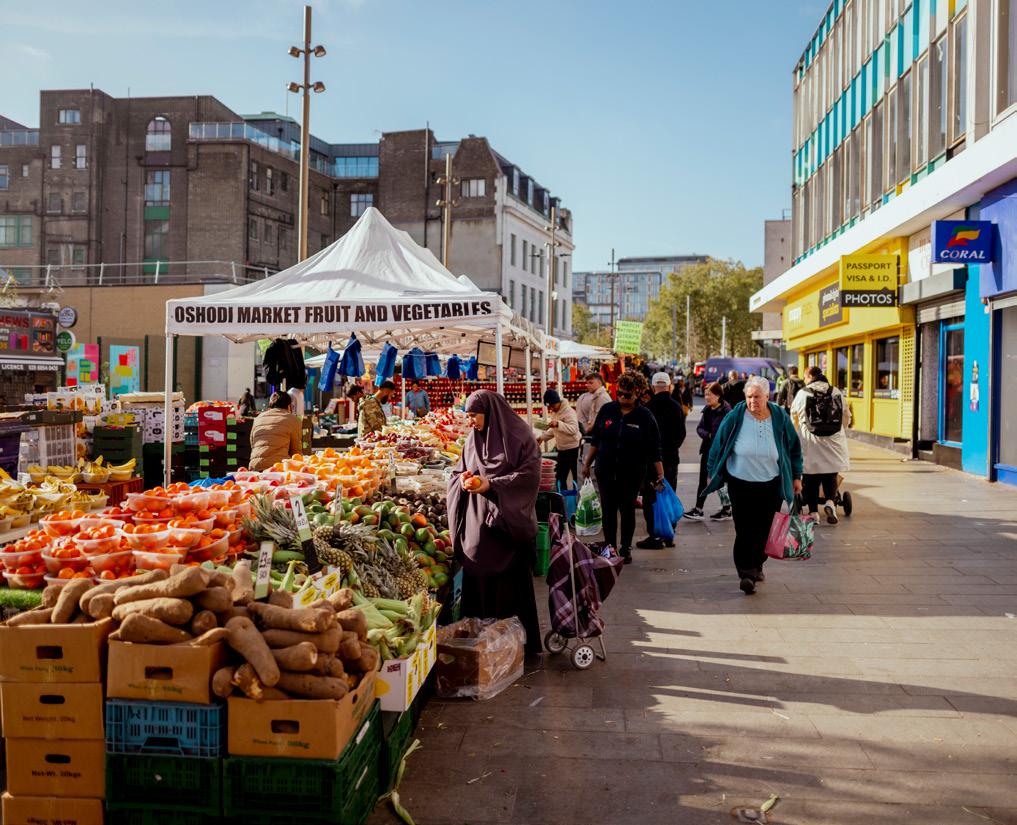
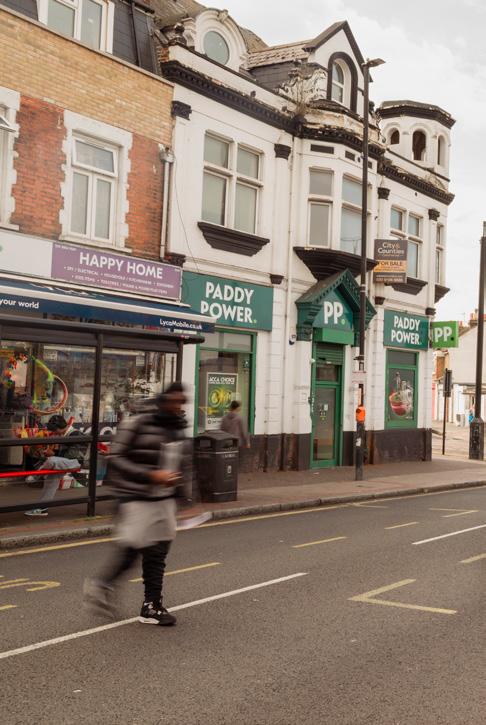
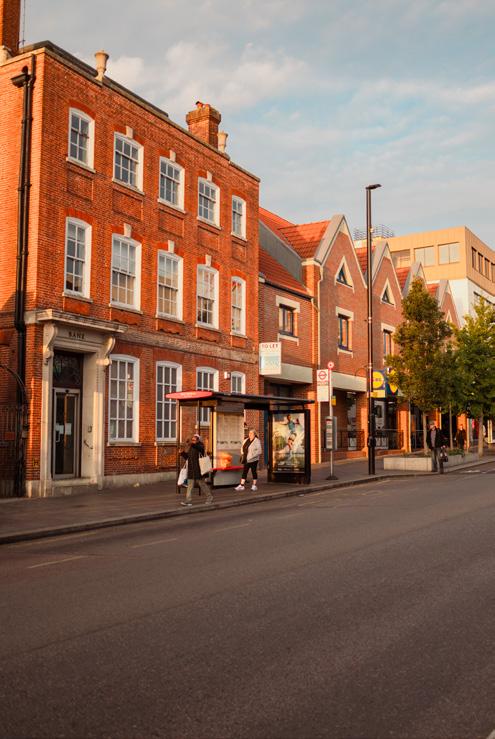
Promote vibrant and diverse town centres: We will support the adaptive reuse and revitalisation of our town centres; by encouraging thriving town centres which provide high-quality new homes and a mix of daytime and evening retail, leisure, community, culture and service uses that meet the evolving needs of residents, businesses, and visitors.
6.1. Town centres are at the heart of community life in Royal Greenwich. They are where people come together to live, work, meet, shop, and experience culture. As the borough grows and changes, our town centres must evolve too—becoming more inclusive, resilient, and responsive to the needs of residents, businesses, and visitors.
6.2. This Local Plan sets out a clear vision to promote vibrant and diverse town centres by supporting their adaptive reuse and revitalisation. We will champion a strong network of centres that offer a rich mix of uses—retail, leisure, culture, community services, and high-quality homes—across both daytime and evening hours. This approach will help ensure our centres remain welcoming, accessible, and economically sustainable, while also supporting the borough’s ambitions for 15-minute neighbourhoods and a thriving night-time economy.
6.3. The Plan recognises the distinct role each centre plays within the borough’s hierarchy— from the Major Centres of Woolwich and Eltham to District Centres, Local Centres and Neighbourhood Parades. Each has a unique identity and function, and our policies are
designed to support their continued success by directing appropriate development to the right locations, encouraging high-quality design, and enabling a flexible mix of uses that reflect local character and community needs.
6.4. We are committed to protecting the vitality and viability of our centres by:
• ensuring new development contributes positively to the centre’s role and function;
• encouraging a mix of uses within our town centres network;
• encouraging active ground floor uses and vibrant public spaces;
• supporting meanwhile uses and pop-up activities that animate vacant sites;
• promoting inclusive cultural and night-time uses that enhance the borough’s identity; and
• managing the location and concentration of uses that may impact health or amenity.
6.5. We aim to create town centres that are economically successful, socially inclusive, environmentally sustainable, and culturally rich, that meet the needs of residents, workers, and visitors – day and night, now and into the future.
Policy TC1: Supporting the Network and Hierarchy of Centres
1. Town centres play a central role in the life and identity of communities across Royal Greenwich, and will continue to operate as key locations for major retail, commercial, leisure, cultural, tourism, office and community activity uses which attract and serve the public.
2. The Council will promote investment in public realm quality, accessibility, and active ground floor frontages. Proposals that enhance each centre’s unique character and heritage through highquality design, public realm improvements, and better pedestrian, cycling, and public transport connections will be supported.
Town Centre Network and Hierarchy
3. The borough’s network and hierarchy of designated centres and neighbourhood parades, as identified below, will be protected and enhanced in order to provide a sustainable distribution of town centre facilities and services to support local communities and deliver 15-minute neighbourhoods. The borough’s designated town centre hierarchy is as follows:
a. Major Centres – Woolwich and Eltham. Major centres are the borough’s principal economic hubs. The Council will support their role as locations for retail, leisure, cultural, office, civic, community services, and residential development. Proposals that enhance the daytime and evening economy through leisure, cultural, and tourism uses are encouraged. The Council will also support ongoing transformation of these centres through public realm improvements, regeneration, and mixed-use developments delivering homes, community spaces, and employment opportunities.
b. District Centres - Thamesmead, Greenwich, Plumstead, East Greenwich, Lee Green, Blackheath and North Greenwich.
Development and investment in district centres will support local catchment needs for retail, leisure, services, and community uses. A mix of daytime and evening economy uses—including markets, independent retailers, and community enterprises—will be encouraged.
c. Local Centres – Abbey Wood, Blackheath Hill, Charlton Village, Herbert Road, Mottingham, New Eltham, Royal Standard, Well Hall Gallions Reach and Kidbrooke. Local Centres will focus on smaller-scale retail, leisure, and town centre services that meet the everyday needs of surrounding communities. The Council will support appropriately scaled retail, service, and social infrastructure, encourage a mix of retail, community, and residential uses.
d. Neighbourhood Parades. Neighbourhood parades represent the lowest tier in the retail hierarchy and typically comprise small clusters or parades of retail units. These retail clusters primarily serve the immediate local catchment, meeting day-to-day convenience shopping needs. Their locations are identified on the Policies Map. The important role these parades play in supporting local communities through accessible shopping and complementary services will be safeguarded.
Policy TC1: Supporting the Network and Hierarchy of Centres
Supporting the diversity, vitality and viability of the town centre network
4. The Council will support the diversity, vitality and viability of the borough’s town centre hierarchy by:
a. directing town centre uses to designated centres and neighbourhood parades as the most appropriate and sustainable locations for such activities;
b. encouraging a mix of uses including retail, food and drink, services, leisure, culture, community facilities, recreation, residential, and mixed-use development to support vibrant daytime and evening economies (in line with Policy TC3 Evening and night-time economy uses);
c. ensuring active frontages, particularly where uses provide a direct service to visiting members of the public;
d. supporting residential development on suitable sites, while ensuring it:
i. is not primarily located at ground floor level fronting the street (except in peripheral locations)
ii. respects the centre’s character and function, and
iii. complies with the agent of change principle;
e. promoting the conversion of underused upper floors for residential use;
f. encouraging affordable retail and startup spaces to support local diversity and community needs;
g. supporting temporary (‘meanwhile’) uses of vacant/underutilised properties where it can be demonstrated that it will enhance vitality and viability and be appropriately managed, in accordance with Policy TC5 Meanwhile uses;
h. enabling adaptable development that responds to changing technologies and consumer habits;
i. mitigating adverse impacts, including the amenity of surrounding occupiers, and managing concentrations of uses, including adverse impacts from noise, odour, and antisocial behaviour; and
j. supporting existing and new markets, pop-up events, and outdoor activations (in line with Policy TC4 Markets and events/pop-up spaces), where they enhance public space without harming residential amenity, accessibility, or transport connectivity.
Primary Shopping Areas
5. Within Primary Shopping Areas, as identified in the Policies Map, proposals must support the area’s core retail function by prioritising Class E uses that contribute to a vibrant and active shopping environment. Development should enhance footfall, maintain continuity of active frontages, and reinforce the area’s role as the principal destination for shopping within the town centre.
6. Residential uses on ground floors within Primary Shopping Areas will not normally be permitted.
Hierarchy of Centres
6.6. Royal Greenwich’s town centres are distinctive, unique and multifunctional spaces that serve residents, workers, and visitors. They provide essential retail, leisure, cultural, civic, community and residential functions, contributing significantly to the borough’s economic, social, and cultural life.
6.7. The Council is committed to maintaining a strong, resilient network of centres that can adapt to changing consumer behaviours, technology, and economic conditions. This aligns with the National Planning Policy Framework (NPPF) and the London Plan (2021), which promote town centres as key locations for sustainable growth, encouraging a mix of uses— including housing—to support long-term vitality and viability.
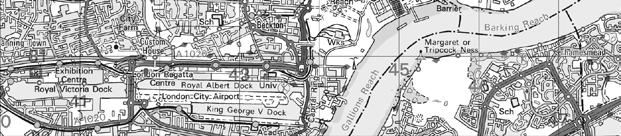
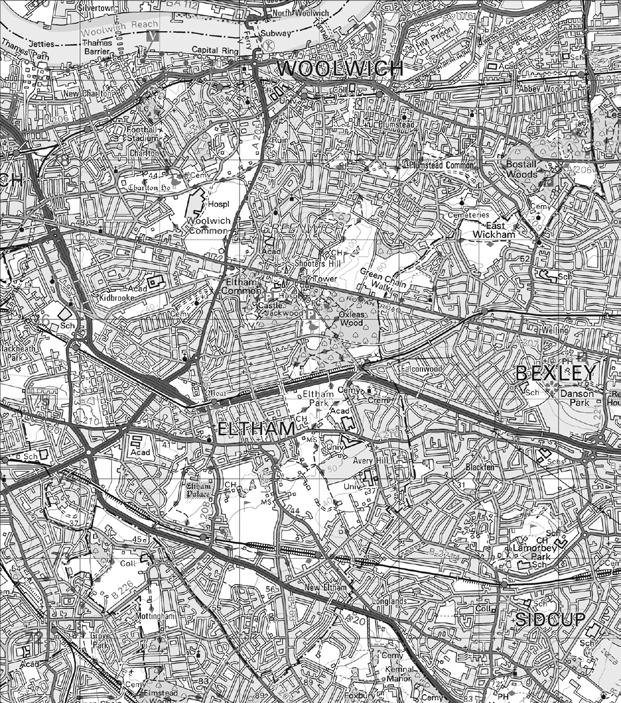
6.8. The location of Greenwich’s centres are shown in Figure TC1. Greenwich’s town centre hierarchy includes:
• 2 Major Centres (Woolwich and Eltham)
• 7 District Centres
• 10 Local Centres
• 35 Neighbourhood Parades.
6.9. This hierarchy guides development and investment to appropriate locations, ensuring each centre fulfils its role effectively.
TC1 Map identifying the designated Centres and Neighbourhood Parades in the borough.
Figure
Town Centre Network
Major Centres, District Centres, Local Centres and Neighbourhood Parades
6.10. The town centre hierarchy and the role and function of each centre is set out in Table TC1. Major and District Centres form the foundation of the hierarchy, offering essential services, employment, cultural activity and community infrastructure, and serving borough-wide catchments. Woolwich is the borough’s principal civic and commercial centre, benefiting from regeneration, the Elizabeth Line, and a growing cultural and evening economy. Eltham serves the south of the borough, with a strong retail and leisure offer and recent public realm improvements.
6.11. District Centres—including Greenwich, Thamesmead, Plumstead, East Greenwich, Blackheath, Lee Green and North Greenwich—serve more localised catchments and provide a vital layer of everyday services, local employment, and community activity. Their development should reflect local needs, heritage, and opportunities. Greenwich District Centre is referred to as Greenwich West in the London Plan. Throughout the Local Plan any reference to Greenwich District Centre concerns Greenwich West.
6.12. Local Centres and Neighbourhood Parades form the most fine-grained layer of Greenwich’s town centre hierarchy, playing
a vital role in creating sustainable, walkable neighbourhoods. They offer everyday goods, services, and social infrastructure—such as shops, cafés, pharmacies, and community facilities—within easy reach of residents, supporting the borough’s ambition 15-minute neighbourhoods.
6.13. Local centres are especially important for older people, families, and those without access to a car. The NPPF supports their role in meeting community needs and reducing travel, and the Local Plan aims to protect and enhance them as inclusive, resilient hubs. Neighbourhood Parades, though smaller, are essential for local character and convenience. They serve distinct communities and contribute to neighbourhood identity. The Council will monitor their health and support their longterm viability.
Supporting the diversity, vitality and viability of Royal Greenwich’s town centre network and active frontages
6.14. The Local Plan supports a town centres first approach, directing appropriate development to major and district centres, encouraging diverse uses, high-quality design, and public realm improvements. It also promotes independent businesses, accessibility, safety, and adaptability. Development proposals must enhance vitality, respect each centre’s identity, and
align with the town centre hierarchy to avoid undermining investment in other centres. The Council will support the ongoing transformation of these centres including public realm improvements, regeneration and the delivery of mixed-use developments which deliver new homes, community spaces and employment opportunities.
6.15. The Council will monitor centre health using indicators like footfall, vacancy rates, and business mix, and work with stakeholders to deliver targeted interventions (which will extend beyond the Council’s planning powers).
6.16. This policy directs development and investment to appropriate locations within the town centre hierarchy, supporting the diversity, vitality, and viability of centres. A mix of uses— including residential above ground floor level— is encouraged to promote footfall and support both daytime and evening economies.
6.17. High quality new developments that respond to their surroundings and are supported by investment in a healthier physical environment will be vital in ensuring key centres in Royal Greenwich remain attractive to a full range of users as places to shop, work, and spend leisure time. Enhancing Royal Greenwich’s town centres is essential to maintain their competitiveness.
6.18. As part of Council’s strategy for protecting centres and neighbourhood parades within the hierarchy, the Council has introduced an Article 4 Direction to remove a permitted development right that allows uses within Class E (Commercial, Business and Service) to change to residential use without planning permission. This means that planning permission is required for such changes of use, and the Council can assess proposals against our planning policies, including consideration of the impact on the centre.
6.19. Councils have much less ability to manage the mix of shopping and some food and drink uses in centres since the introduction of Use
Class E brought together a wide range of uses. Changes between uses within Class E do not constitute development and therefore planning permission is no longer required, and as such Council cannot exercise control of these changes. Where it is feasible to do so (e.g. redevelopment of existing premises), we may seek the provision of a particular type of Class E floorspace, for example where this is necessary to sustain the health of the centre.
6.20. Development must reflect the scale and role of each centre, enhance its character, and mitigate negative impacts. Proposals should maximise active ground floor frontages and minimise dead space such as bin stores and plant rooms.
6.21. Town centre uses must be accessible and of high design quality, complementing their surroundings. The Council supports temporary and meanwhile uses to activate vacant units, promote local enterprise, and enhance centre vibrancy.
Primary Shopping Areas
6.22. Primary Shopping Areas (PSAs) are the core retail areas within Greenwich’s major and district centres, where retail activity is most concentrated, and where the retail function is to be protected and enhanced. They typically include areas where the majority of retail activity takes place, with a high proportion of shops (Use Class E(a)), supported by complementary uses that enhance the vitality and viability of the centre. PSAs help focus investment, guide development, and maintain retail as a central town centre function— aligned with the NPPF and London Plan which promotes the vitality of town centres as the
heart of communities and supports a strong network of town centres with clearly defined roles.
6.23. The Council supports proposals that reinforce the retail character of the PSA, support footfall, and maintain active frontages. While a mix of uses is encouraged, non-retail uses must not dominate or disrupt the continuity of active frontages. Public realm, accessibility, and shopfront improvements are supported to create attractive, inclusive environments, with guidance on shopfronts provided in Policy DH7 and our Urban Design Guide SPD. Development should enhance pedestrian connectivity, encourage dwell time, and support the overall role of the town centre as a destination for shopping, services, and community activity.
6.24. PSAs are shown on the Policies Map and will be reviewed regularly to reflect changing retail patterns, consumer behaviour, technology and economic conditions. This flexible and proactive approach ensures Royal Greenwich’s major and district centres remain resilient, competitive, and responsive to community, business and visitors’ needs.
Major Centre Woolwich
• Principal economic hub with strong public transport links.
• Serves local needs for retail, leisure, office, civic, services, and community uses.
• The Centre’s role will be reinforced by diversifying activities, and focusing investment on major retail (including comparison retail), leisure, commercial, cultural, new employment workspaces and office development, and tourism uses. This will be supported by continuing to invest in and provide for other main town centre uses including residential, education and health care uses.
• Supports transformational change through new employment space and mixed-use development, including residential.
• Identified as a night-time economy area of more than local significance (NT3). Focus going forward on enhancing cultural offer, supporting local business, and improving the experience of residents, workers and visitors after 6pm.
• Principal economic hub with good public transport links.
• Serves borough-wide needs for retail, leisure, services, and community uses.
• Strong comparison retail offer.
• Going forward investment needed in additional and improved retail, cultural, leisure, and public realm facilities and floorspace, to ensure a greater diversity of uses within the centre.
Major Centre Eltham
• The Council will promote the continued regeneration and sustainable growth of the centre by supporting appropriate residential-led mixed-use schemes on underused sites, requiring active ground floor uses and continuing to celebrate Eltham’s heritage and identity.
• Residential development as part of mixed-use schemes supported.
• Eltham’s existing evening and nighttime economy provision will be supported by encouraging complementary retail, leisure and cultural uses that enhance the town centre’s appeal beyond daytime retail hours.
Table TC1: Town Centre Hierarchy
• A historic, multi-functional centre within the Maritime Greenwich World Heritage Site. It serves both local and visitor needs.
• Serves local catchment for retail, leisure, services, cultural and community uses.
• Internationally significant tourist destination and specialist retail area.
• Strong public transport links and identified as a night-time economy area of more than local significance (NT3).
• Focus going forward for investment in a balanced mix of retail, tourism, services, leisure, cultural and community uses, whilst protecting its heritage and managing visitor impacts.
• Currently underperforming in meeting local catchment needs. This can be improved through a strengthened and more diversified retail, cultural and community offer, as well as investment in the environmental quality of the centre.
• A mix of uses including investment in retail, culture, office, residential, and evening/night-time uses will be supported to enhance the vibrancy and vitality of the centre.
• Strong leisure and service offer.
District Centres Greenwich
District Centres East Greenwich
Table TC1: Town Centre Hierarchy
Tier Location Key functions
• Internationally significant retail and leisure destination (anchored by The O2, The Tide and the Design District).
• Serves borough-wide retail and leisure needs as well as wider catchment.
• Focus going forward on sustainable high-density, mixed-use development and growth that integrates residential, employment, cultural and leisure uses, in line with the Greenwich Peninsula Masterplan, whilst maintaining a complementary retail offer to support the local economy and to reinforce the borough’s town centre hierarchy.
• Focus on retaining existing retail provision within North Greenwich and limiting any expansion to outletformat retail only, to ensure that the centre remains complementary and does not undermine investment in the borough’s primary major centres.
• Opportunity to support meanwhile and permanent cultural uses, creative workspaces, and community venues that contribute to a vibrant, inclusive environment.
• Opportunity to expand green space, promote high-quality public realm, active travel infrastructure and greater connectivity between North Greenwich Station, The O2, the riverfront and surrounding development plots to support a walkable, accessible centre.
• Well-connected by public transport.
• Identified as a night-time economy area of international or national significance (NT3).
• Strong convenience retail offer.
• Currently underperforming in meeting local needs. The Council will promote the transformation of Thamesmead including beyond the plan period into a vibrant, well connected district centre by supporting the delivery of new homes, jobs and community, green and blue infrastructure and a mix of uses including residential, employment, retail, leisure, cultural and community uses through a strategic masterplanned approach that aligns with the Thamesmead and Abbey Wood Opportunity Area Planning Framework.
• The Council will advocate for improved public transport links, including the proposed DLR extension, and enhancing active travel routes into and across the centre.
District Centres North Greenwich
District Centres Thamesmead
Table TC1: Town Centre Hierarchy
Tier Location Key functions
• Specialist retail destination with good public transport links.
• Meets the day-to-day needs of its immediate catchment.
District Centres Plumstead
District Centres Lee Green
• Focus going forward on regeneration and investment to improve vitality of the centre, enabling a mix of retail, leisure, cultural, community and service uses, alongside public realm improvements and improvements to pedestrian and cyclists safety.
• Meets local catchment needs for retail, leisure, services and community uses, with strong convenience retail.
• Good public transport links.
• Planned redevelopment of Leegate and surrounding sites to enhance mix of uses and public realm.
• Meets local catchment needs for retail, leisure, services and community uses, with diverse retail offer and strong interest from retailers in the centre.
District Centres Blackheath
• High environmental quality and strong public transport links.
• Identified as a night-time economy area of more than local significance (NT3).
• Focus going forward on continuing to provide a mix of uses that meet the needs of the local community.
Local Centres
Abbey Wood
Blackheath Hill
Charlton Village
Herbert Road
Mottingham
New Eltham
Royal Standard Well Hall
Gallions Reach
• Focus going forward on providing a range of shops and services to meet the needs of the local catchments, with a higher proportion of convenience retail compared to comparison retail.
• Ensure development is appropriate to the nature and scale of each individual centre.
Local Centres Kidbrooke
Neighbourhood Parades
Refer to policies map
• Any proposals for new town centre uses within Kidbrooke Local Centre must remain commensurate in scale, format and function of the uses approved in the original planning consent, whilst reflecting the retail and service needs of the local catchment.
• Small clusters of at least five units serving immediate local convenience needs.
• Ongoing role in providing accessible retail, services, and community uses will be protected.
• Defined on the Policies Map.
Table TC1: Town Centre Hierarchy
Policy TC2: Managing edge-of-centre and out-of-centre uses
1. To safeguard the vitality and viability of Royal Greenwich’s town centres and avoid significant adverse impacts to their role and function, the Council supports a town centre first approach, ensuring that town centres are the preferred location for main town centre uses. There will be a presumption against out-of-centre and edge-ofcentre main town centre uses, in particular retail and leisure uses.
Out-of-Centre and Edge-of-Centre town uses
2. Retail proposals outside of Primary Shopping Areas in major and cistrict centres, and for other main town centre uses outside of the major, district and local centres and neighbourhood parades, will be subject to:
a. a sequential test in accordance with the NPPF; and
b. an impact assessment as outlined in the NPPF for proposed retail and leisure uses (including hotels), to demonstrate that they would not harm the vitality and viability of centres or planned investment in centres, where individual units or extensions exceed the 280 square metres gross floorspace threshold.
3. Car-dependent retail models that fail to promote active travel and public transport access will not be supported. Any proposals which will adversely impact town centres, create unsustainable cardependent retail hubs, or undermine regeneration aspirations will be resisted.
Out-of-Centre Retail and Leisure
Provision at Charlton Riverside
4. There will be a presumption against further expansion of out-of-centre retail and leisure uses within the Charlton Riverside Opportunity Area. Development proposals for main town centre uses must be part of a master-planned approach in accordance with the area’s regeneration strategy.
Reasoned Justification
6.25. Town centres play a vital role in the economic, social, and cultural life of the Royal Borough of Greenwich. They are the preferred locations for major retail, leisure, cultural, and office developments, ensuring accessibility, economic resilience, and sustainable growth. However, pressure for commercial and retail development outside designated centres has increased, necessitating a clear policy framework to safeguard town centre vitality while managing edge-of-centre and out-ofcentre proposals effectively.
6.26. The NPPF establishes a town centre-first approach, requiring the sequential test to assess whether suitable sites exist within established centres before considering alternative locations. Additionally, edge-ofcentre and out-of-centre developments should be subject to a Retail Impact Assessment to ensure that they do not undermine town centres or disrupt planned investment.
6.27. This policy ensures that development proposals align with these principles, supporting economic vibrancy while preventing unsustainable retail and leisure growth outside designated town centres.
Sequential Test and Impact Assessment:
6.28. To manage development effectively, all proposals for edge-of-centre and out-of-centre uses must comply with the following key requirements:
• Sequential Test: Applicants must demonstrate that no suitable or viable sites exist within the town centre (or Primary Shopping Area where applicable) before seeking alternative locations. Proposals failing this test will not be supported.
• Retail Impact Assessment: Retail and leisure proposals (including hotels) exceeding 280sqm gross floorspace must assess their effect on town centre trade, footfall, and consumer activity.
• Proposals should reinforce rather than compete with established town centres, ensuring a balanced retail hierarchy that benefits local communities.
6.29. Planning permissions may be subject to strict conditions to safeguard town centre viability, and support sustainable growth and regeneration. Retail impact assessments and sequential test evidence will be carefully scrutinized to prevent developments that could lead to economic displacement or harm local businesses.
Out-of-Centre Retail and Leisure Provision at Charlton Riverside
6.30. Further expansion of out-of-centre retail and leisure provision, including retail parks and standalone retail and leisure facilities, within the Charlton Riverside Opportunity Area risks harming the vitality and viability of Royal Greenwich’s town centres, as well as planned investment and regeneration within these centres and within the Charlton Riverside area itself.
6.31. Charlton Riverside is designated as an Opportunity Area in the London Plan and is a key regeneration area within the Royal Borough of Greenwich, with a strategic focus on delivering a high-quality, mixed-use development that supports sustainable growth. The borough’s spatial strategy prioritises the revitalization of town centres as the primary locations for retail, leisure, and commercial activities. Consequently, it is essential to resist inappropriate out-of-centre developments that could undermine town centre vitality, compromise planned regeneration efforts, and lead to unsustainable patterns of development.
6.32. The borough’s town centres, including Greenwich, Woolwich, and Eltham, serve as the heart of local economic activity, providing a diverse retail and leisure offer. Encouraging growth in these established areas fosters economic resilience, maintains consumer footfall, and reinforces their function as social and commercial hubs. In contrast, unchecked retail and leisure development at Charlton Riverside has contributed to a fragmented retail landscape, increasing reliance on car-dependent shopping destinations and diverting trade away from existing centres.
6.33. Beyond economic impacts, the borough is committed to achieving environmentally sustainable growth. Car-dominated outof-centre developments conflict with the borough’s ambitions to reduce reliance on private vehicle use, improve air quality, and enhance public transport accessibility. As Charlton Riverside undergoes transformation into a well-connected, mixed-use neighbourhood, it is critical that retail and leisure provision is balanced, supporting local needs without detracting from strategic regeneration goals.
Policy TC3: Culture, Evening and Night-Time Economy Uses
1. Royal Greenwich seeks to foster and support a vibrant, inclusive, and resilient evening and night-time economy within its town centre network, supporting cultural vitality, economic growth, and community wellbeing, while safeguarding residential amenity, public safety, and environmental quality.
Promoting evening and night-time economy destinations
2. The Council will promote its town centres — particularly Woolwich Town Centre, Eltham Town Centre, Greenwich District Centre, North Greenwich District Centre and Blackheath District Centre — as key evening and night-time destinations by:
a. encouraging a broad mix of uses – including food and drink, cultural venues, performance spaces, and community events – that appeal to a wide demographic and promote social inclusion;
b. supporting businesses to extend opening hours and diversify their offer, particularly in hospitality, leisure, and cultural sectors;
c. enhancing the use of key public spaces for evening events, performances, and community gatherings, supported by appropriate lighting, seating, and wayfinding;
d. working with partners to deliver community safety initiatives, including improved lighting and adherence to the Women’s Night Safety Charter, to ensure the borough is welcoming and safe for all at night;
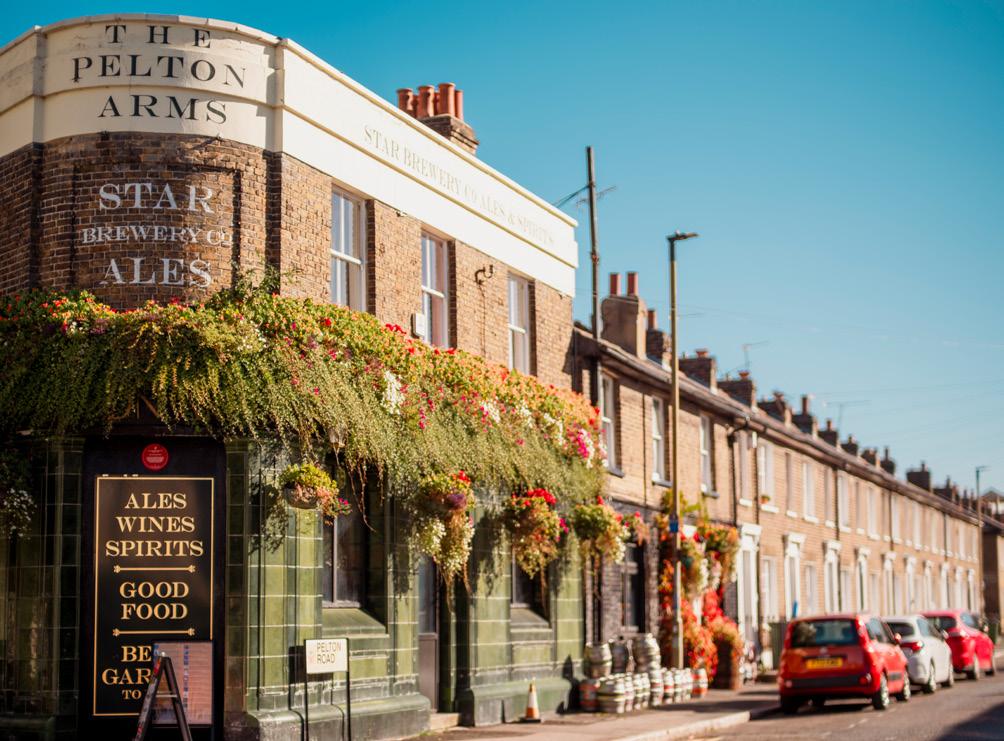
e. supporting existing and proposed cultural facilities, including music venues and pubs that regularly host live music performances;
f. ensuring there are spaces available for local cultural organisations to curate high-quality evening programming that reflects the borough’s diverse communities and enhances its cultural identity; and
g. facilitating meanwhile uses and pop-up events in vacant units and underused spaces to test new ideas, support local entrepreneurs, and animate the town centre in the evening.
3. Evening and nighttime economy uses outside of Royal Greenwich’s designated town centres should be less prominent, with proposals for such uses considered on a case-by-case basis. This will depend on the nature, use and locality of the proposal, as well as whether the location has a high level of night-time public transport accessibility. Proposals should provide:
a. a robust justification demonstrating why the use cannot be located in a major, district or local centre; and
b. an accompanying management plan, setting out mitigation measures for any negative impacts. Development requirements:
4. Development proposals that support and diversify the evening and night-time economy and enhance the vitality and viability of the borough’s designated major centres, district centres and local centres will be supported where they:
a. can demonstrate that, either individually or cumulatively, there is no unacceptable impact on residential amenity and the local environment, taking account of the potential for noise, traffic generation, disturbance, waste and odours arising from the operation of the premises, light pollution, customers arriving at and leaving the premises, and the servicing of the premises.
b. complement the existing mix of uses, is of a size and type that reflects the role and function of the centre and supports the borough’s spatial strategy as identified in Policies P1, P2, P3, P4, P5, P6, P7 and P8
c. contribute to diversifying the range of evening and night-time economy activities, supporting the creation of a balanced provision of evening and night-time uses within centres;
Policy TC3: Culture, Evening and Night-Time Economy Uses
d. will enhance footfall and dwell time during evening and night-time hours and is accessible by a range of sustainable transport modes, including walking, cycling and public transport;
e. contribute to a diverse and balanced evening and night-time economy uses, including cultural, leisure, entertainment, creative, family-friendly and non-alcohol-led activities;
f. prioritise public safety, incorporate measures to prevent crime, and actively discourage anti-social behaviour to contribute to a safe, attractive, and navigable public realm during night-time hours;
g. enhance the character, vitality, and amenity of surrounding shops and services by incorporating active daytime uses to activate the space, including meanwhile uses, and contributing positively to active frontages; and
h. support local talent, creative industries, or community-led initiatives, and demonstrate engagement with local stakeholders, responding to community needs.
Management Plans:
5. Applicants will be required to submit a Management Plan outlining how operational impacts—such as noise, safety, and servicing— will be effectively managed.
Reasoned Justification
Promoting Evening and Night-Time Economy (ENTE):
6.34. The ENTE — economic and cultural activity between 6pm and 6am—is vital to Greenwich’s identity, vibrancy, and economy. It spans theatres, restaurants, music venues, and late-night retail, supporting nearly 49,000 jobs in the borough, particularly in hospitality, leisure, and retail.
6.35. Greenwich’s diverse population and strong creative industries underpin a thriving ENTE, particularly within Greenwich, Woolwich and Eltham Town Centres, and North Greenwich and Blackheath District Centres. North Greenwich is designated as an NT1 centre in the London Plan, and Woolwich, Greenwich, and Blackheath as NT3 centres in the London Plan. The London Plan identifies that different areas of nighttime activity function at different scales and have different catchments, which has informed their classification of night-time economies into three broad categories. NT1 reflects areas of international or national significance and NT3 reflets areas with more than local significance. Additionally, Woolwich’s status as a Night Time Enterprise Zone highlights its potential as a leading, inclusive night-time destination.
6.36. The Council supports a balanced, inclusive ENTE that caters to all—families, young people, older residents, and night workers—by promoting non-alcohol-led venues, cultural programming, and safe, accessible public spaces. Development must enhance the ENTE while protecting residential amenity, public safety, and environmental quality. This includes applying the Agent of Change principle as set out in Policy DH1 ‘Principles for High Quality Design’, ensuring active frontages, high-quality public realm, and requiring Management Plans for new venues. This means that a new residential development built near to an existing night-time entertainment use would be responsible for providing appropriate soundproofing or other mitigation measures to avoid any undue impact, whereas a new nighttime entertainment use opening in a residential area would be responsible for the necessary mitigation measures.
6.37. The Local Plan supports development that enhances the ENTE while incorporating appropriate design, management, and mitigation measures. To avoid overconcentration of alcohol-led venues, the Council promotes a diverse mix of uses— cafés, shops, cultural and leisure venues— to reduce anti-social behaviour and support a seamless transition between day and night-time activity.
6.38. The Council continues to invest in public realm improvements through the Future High Streets Fund—lighting, wayfinding, light-night transport, toilets, seating and accessible facilities—and collaborates with the GLA, police, businesses, and communities to monitor trends and the growth of the ENTE, and encourages innovation to diversify the ENTE contribution across the borough, including piloting initiatives like Woolwich Lates. This approach ensures the ENTE grows safely, sustainably, and in line with the “Our Greenwich” missions and the London Mayor’s 24-hour city vision.
6.39. ENTE proposals are encouraged to contribute to a fair and inclusive night-time and evening economy. This can be achieved through various means including but not limited to:
• The proposed use being accessible to all users;
• Promoting inclusive programming;
• Promoting the well-being of night-time workers;
• Provide employment aligned with the London Living Wage and the Mayor’s Good Work Standard; and
• Offer opportunities for underrepresented groups, including women, young people, and ethnic minorities.
6.40. Given the town centres first approach taken by the Local Plan, the London Plan and the NPPF, this policy requires proposals for night-time uses outside of town centres to robustly demonstrate that they cannot be accommodated in a town centre location. Where night-time uses are proposed outside of the town centre hierarchy, they should demonstrate that the site has good night-time public transport accessibility, meaning that the site is within 400m (roughly a 5-minute walk) of a night bus stop or night tube station.
Management of night-time economy activities:
6.41. The management of night-time entertainment and licensed premises is governed by both the planning and licensing regimes. While planning controls the location, design, and use of premises to protect amenity, licensing regulates specific activities to prevent public nuisance, including the sale or supply of alcohol, provision of entertainment and sale of hot food or drink between 11pm and 5am. Although these regimes operate under separate legal frameworks, Royal Greenwich will ensure a coordinated and complementary approach wherever possible.
6.42. Proposals for new or extended night-time uses, or variations to existing planning conditions, must be accompanied by a Management Plan. This should demonstrate how amenity impacts
will be mitigated through both design and operation, addressing the following:
• Patron dispersal strategies to minimise disturbance;
• Waste storage, handling, and disposal;
• Delivery, collection, and servicing schedules;
• Odour control measures;
• Location and treatment of ventilation ducts and plant.
6.43. Management Plans will be assessed with reference to the Council’s Licensing Policy, and any submitted licensing operating schedule. The Council’s Licensing Policy, which identifies areas affected by negative cumulative impacts of entertainment and similar uses, will be a material consideration in assessing proposals. Where the end-use operator is unknown, applicants must submit an outline Management Statement focusing on physical design measures. In such cases, planning conditions will require submission of a full Management Statement once the occupier is confirmed.
6.44. To safeguard residential amenity and quiet times, Royal Greenwich will apply planning conditions or seek Section 106 obligations to secure compliance with Management
Plans. Planning determinations (including Planning conditions) will have regard to Royal Greenwich’s Licensing Policy in relation to proposed hours of opening, operation and servicing, and measures to mitigate odour and noise from the premises. Planning conditions may restrict hours of operation where there is potential for unacceptable disturbance. Each application will be assessed on a case-by-case basis and will be assessed on its local context, balancing the benefits of night-time activity with the need to protect residents, workers, and other sensitive uses. The Council’s Environmental Protection and Public Health functions are also important considerations for any proposals involving new night-time economy uses.
6.45. The loss of cultural facilities can have a significant detrimental impact on local character and the function of an area. Music venues—including pubs that regularly host live performances—demonstrate the dual economic and social value of cultural uses. These spaces attract a diverse range of people, fostering inclusivity and community cohesion. Economically, they contribute directly through their operations and indirectly by supporting surrounding businesses and enhancing the area’s appeal as a destination. However, across London, music venues are increasingly at risk due to development pressures and the growing proximity of residential uses. This has led to
a notable decline in their numbers. Refer to Policy E6 which notes that existing arts and cultural uses will be protected and proposals for enhancement will be supported in principle, with proposals for new arts and cultural uses being supported in Major and District Centres.
6.46. The Council is committed to safeguarding existing venues and supports the development of new music venues where appropriate, ensuring they continue to play a vital role in the borough’s cultural and economic life. The daytime use (including meanwhile/temporary use) of cultural venues that operate solely or predominantly at night can greatly enhance the cultural offer and economy of town centres. This can increase employment and add to the vibrancy of an area. It also supports the 24hour economy.
6.47. Specific clusters of night-time economy uses contribute more significantly to the nighttime economy, particularly within the night-time economy clusters identified in the London Plan, and therefore the introduction of sensitive uses may threaten the effective operation of night-time uses more acutely in these areas. Development in close proximity to cultural uses is one of the biggest threats these uses face. The ‘agent-of-change’ principle
is addressed in Policy DH1 (Principles for High Quality Urban Design) with regards to a planning application that proposes new residential units near an existing cultural use. Cultural uses are inherently sensitive to the introduction of new uses, given their function can generate noise and significant pedestrian movements.
6.48. The Royal Greenwich Destination Management Plan (2023) sets out a key priority to develop the evening economy in Greenwich and Woolwich. This is supported by Night Time Strategy for Greenwich Town Centre (2023), the first Night-Time strategy for the borough which will guide the development of the Centre’s night-time economy, including diversifying the centre’s night time offer, ensuring wellbeing and safety at night and working with partners. Royal Greenwich is currently in the process of creating a Boroughwide Evening and Night-Time Economy strategy, which will give particular focus to Greenwich, Woolwich and Eltham.
6.49. Applications are encouraged to refer to the various resources, strategies and management plans Royal Greenwich has available to support the evening and nighttime economy including:
• Our People, Culture, Future: A Culture Strategy for the Royal Borough of Greenwich (2024)
• Making Our Heritage Shine: A night time strategy for Greenwich Town Centre (2023)
• Woolwich Destination Management Plan (2018)
• Woolwich Night Time Enterprise Zone Evaluation (2024)
• Visit Greenwich Destination Management Plan (2023)
• Night Worker Handbook Royal Greenwich (2024)
• Royal Greenwich Inclusive Economy Strategy (2024).
Policy TC4: Markets, events and pop-up spaces
Supporting Existing Markets
1. The Council recognises the vital role of markets in shaping the identity, economy, and community life of Royal Greenwich, particularly in Greenwich and Woolwich town centres.
2. Development proposals affecting existing markets must:
a. maintain or increase the number of trading pitches;
b. enhance the quality, visibility, and management of the market and its public realm; and
c. retain or re-provide appropriate storage, servicing, and waste facilities.
New Markets and Pop-Up Spaces
3. Proposals for new markets will be supported where they:
a are located within or adjacent to town centres, or activate underused or vacant sites in appropriate locations;
b. complement the existing retail and cultural offer of the area;
c. are inclusive, accessible, and legible and contribute positively to the public realm;
d. engage local communities in shaping the market offer; and
e. do not undermine the viability or vitality of existing markets within the borough.
4. Proposals for permanent new markets, will be supported where they demonstrate demand or have been tested through temporary use for at least 12 months.
5. Temporary events and pop-up uses will be encouraged in town centres where they:
a. do not result in significant adverse amenity or transport impacts; and
b. promote health and wellbeing, including access to healthy food and active lifestyles.
Management Plans:
6. Applicants will be required to submit a Management Plan outlining how operational impacts—such as noise, safety, and servicing— will be effectively managed.
Reasoned Justification
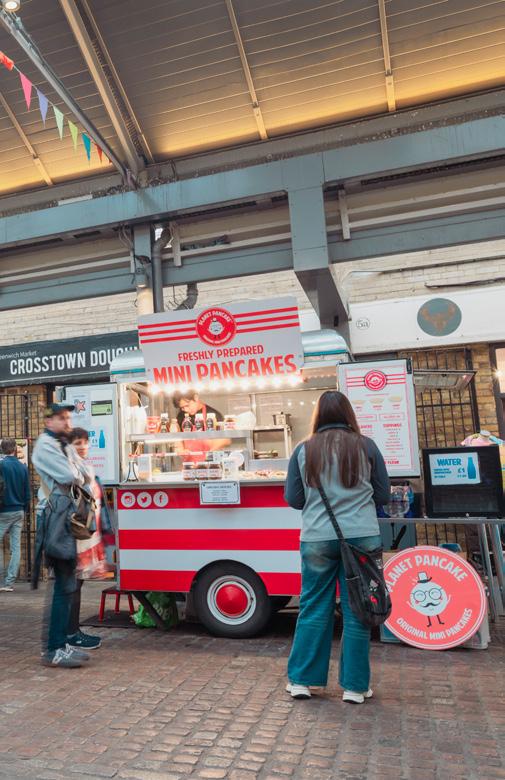
6.50. Markets are a defining feature of Royal Greenwich’s town centres, offering a blend of tradition, enterprise, and community life. As noted in the NPPF, markets play an important role in supporting the vitality and viability of centres and local communities.
6.51. In Woolwich, the Beresford Square Market is a long-standing institution dating back to the 1600s, that supports local shopping needs and adds to the town centre’s vibrancy. In Greenwich, the Greenwich market has been established since the 19th-century and contributes to the area’s unique character and appeal as a leisure and tourism destination.
6.52. Royal Greenwich has a mix of existing markets, including established daily markets as in Woolwich and Greenwich, and other established less frequent markets like the Eltham Producers Market and the Kidbrooke Village Farmers’ Market which both run once a month, the Blackheath Farmers Market (in the London Borough of Lewisham) which runs once a week and the Royal Arsenal Farmers’ Market which is held fortnightly.
6.53. Markets also serve as incubators for small businesses and social enterprises, offering low-cost entry points into the local economy. They support diverse communities, provide access to healthy and affordable food, and help animate public spaces.
6.54. This policy seeks to protect and enhance existing markets while enabling new and temporary markets to flourish in appropriate locations in town centres. As reflected in this policy, it is vital that proposed new markets do not undermine the viability or vitality of existing markets.
6.55. Applicants and developers should engage with the Council’s Business Markets and Town Centres team as early as possible so information can be provided with the planning application to show that sufficient servicing and storage space will be safeguarded to meet the needs of traders.
6.56. While new markets within Town Centres are favoured, the policy recognises that markets outside existing centres can have a positive impact where they reactive underused spaces and do not negatively impact Primary Shopping Areas.
6.57. Temporary markets and events are encouraged as a way to test new ideas, activate underused spaces, and support community engagement.
6.58. Royal Greenwich will work proactively with market operators, community groups, and developers to ensure that markets and events contribute positively to the borough’s economic, social, and cultural life.
Management of markets, events and pop-up spaces:
6.59. Applications for markets, events or pop-up spaces will need to be assessed on a caseby-case basis. Royal Greenwich will require a management plan to be submitted for proposals for markets, events and pop-up spaces to demonstrate how uses do not detract from residential amenity. The management of markets, events and pop-up spaces is governed by both the planning and licensing regimes. While planning controls the location, design, and use of markets, events and pop-up spaces to protect amenity, licensing regulates specific activities to prevent public nuisance. Although these regimes operate under separate legal frameworks, Royal Greenwich will ensure a coordinated and complementary approach wherever possible.
6.60. Proposals for new or extended markets, events and pop-up spaces, or variations to existing planning conditions, must be accompanied by a Management Plan. This should demonstrate how amenity impacts will be mitigated through both design and operation, addressing the following:
• Hours of operation;
• Frequency of the market, event or pop-up space;
• Storage arrangements when a market is not in use;
• Delivery, collection, and servicing schedules; and
• Odour control measures.
6.61. Management Plans will be assessed with reference to the Council’s Licensing Policy, and any submitted licensing operating schedule. The Council’s Licensing Policy, which identifies areas affected by negative cumulative impacts of entertainment and similar uses, will be a material consideration in assessing proposals.
6.62. To safeguard residential amenity and quiet times, Royal Greenwich will apply planning conditions or seek Section 106 obligations to secure compliance with Management Plans. Planning determinations (including Planning conditions) will have regard to Royal Greenwich’s Licensing Policy in relation to proposed hours of opening, operation and servicing, and measures to mitigate odour and noise from the premises. Planning conditions may restrict hours of operation where there is potential for unacceptable disturbance. Each application will be assessed on a case-by-case basis and will be assessed on its local context, balancing the benefits of the proposed activity with the need to protect residents, workers, and other sensitive uses. The Council’s Environmental Protection and Public Health functions are also important considerations for any proposals involving new markets, events and pop-up spaces uses.
Policy TC5: Meanwhile uses
1. The Royal Borough of Greenwich will support proposals for appropriate meanwhile uses on vacant land or in vacant buildings across the borough where such uses:
a. deliver clear community, cultural, economic, or environmental benefits;
b. do not compromise the future redevelopment potential of the site;
c. do not result in unacceptable impacts on residential amenity, safety, or the transport network; and
d. include a clear strategy for transition to permanent use or relocation.
2. Proposals for meanwhile uses will be particularly encouraged where they:
a. activate underused or vacant spaces and contribute to placemaking;
b. support local enterprise, start-ups, and the creative or cultural sectors;
c. provide interim employment, community, or leisure opportunities;
d. enhance the vitality and viability of town centres and regeneration areas.
Reasoned Justification
6.63. Meanwhile uses are temporary uses of land or buildings that are awaiting longerterm development. They offer a valuable opportunity to bring life, activity, and community benefit to otherwise vacant or underutilised spaces across Royal Greenwich.
6.64. The Royal Borough of Greenwich recognises the role of meanwhile uses in supporting early placemaking, testing innovative ideas, and enabling low-cost opportunities for local businesses, artists, and community groups. These uses can help maintain vibrancy in town centres, support regeneration objectives, and reduce the negative impacts of vacancy.
6.65. Proposals should demonstrate how the meanwhile use aligns with the borough’s strategic objectives, including those related to inclusive growth, sustainability, and cultural development. Uses that support the borough’s
identity as a creative and inclusive place— such as pop-up markets, community gardens, cultural venues, and co-working spaces—will be particularly welcomed.
6.66. To ensure that meanwhile uses do not hinder future development, applicants must provide a clear ‘move-on’ strategy. This should outline how the use will be decommissioned or relocated when permanent development commences, and how temporary occupiers may be supported in transitioning to permanent premises.
6.67. Royal Greenwich will expect meanwhile uses to be in place for a minimum of 12 months where feasible, to ensure viability and community impact, but not so long as to delay redevelopment. Proposals for meanwhile uses should not result in an increase in unsustainable travel patterns.
6.68. Where appropriate, the Royal Greenwich may secure meanwhile uses through planning conditions or legal agreements, particularly on large masterplanned or phased development sites. These agreements should include:
• the types of meanwhile uses proposed;
• timescales and phasing;
• engagement with local occupiers and community groups; and
• measures to mitigate any potential adverse impacts.
6.69. Royal Greenwich will work proactively with landowners, developers, and community organisations to identify and promote opportunities for meanwhile uses, especially in areas undergoing regeneration such as Greenwich Peninsula, Woolwich, Charlton Riverside, and Thamesmead.
Policy TC6: Managing Hot Food Takeaways and Gambling Uses
1. The Council seeks to manage the location and concentration of hot-food takeaways and gambling establishments in the Royal Borough of Greenwich in order to protect public health, promote healthier lifestyles, support and protect the vitality, character and function of town centres, and safeguard the amenity and wellbeing of local communities – particularly children and vulnerable groups.
Hot Food Takeaways
2. Proposals for new hot-food takeaways will only be permitted where they:
a. are located within a designated centre or neighbourhood parade;
b. are not located within 400 metres walking distance of the boundary of an existing or permitted primary school, secondary school, a community college, youth facility or park;
c. would not result in more than 5% of units within a designated centre or 10% of a designated neighbourhood parade as a whole being in hot-food takeaway use;
d. would not result in more than two hot food takeaway units being located immediately opposite or adjacent to each other, by maintaining a separation between them of at least two non-hot food takeaway units;
e. will not impede the footway or roadway through their delivery operations, taking into account the needs of people with disabilities, older people, and families with small children.
f. ensure the scale of the operation, locations of delivery collection points, locations for parking of delivery vehicles and hours of operations will not result in negative impacts on the amenity of neighbouring residential dwellings and the operations of neighbouring businesses; and
g. maintain an active frontage and contribute positively to the streetscape and public realm.
3. Proposals for new hot-food takeaways are encouraged to achieve and operate in compliance with the Healthier Catering Commitment scheme.
4. Drive-through takeaways will not be supported and proposals for the redevelopment of existing drive-through takeaways for other uses will be supported.
5. Applications for food and drink uses where home delivery of food is proposed must include a Delivery and Servicing Plan providing details of the scale of operation, delivery collection points, locations for parking of delivery vehicles/bikes and hours of operation, to enable assessment of impacts.
Policy TC6: Managing Hot Food Takeaways and Gambling Uses
Gambling Premises, Betting Shops and Payday Loan Shops
6. Proposals for new gambling premises (including adult gaming facilities or arcades), betting shops, and payday loan shops will be carefully controlled in the borough. New proposals will only be permitted where they:
a. are located within a designated centre;
b. are not located within 400 metres of an existing or permitted primary school, secondary school, community college, youth facility or vulnerable community facilities;
c. would not result in more than 5% of the units in the centre being a gambling premise, betting shop, pawnbrokers adult gaming centre or arcade or payday loan shop;
d. would not result in more than one gambling premise, betting shop, pawnbrokers adult gaming centre or arcade or payday loan shop being within 400m walking distance of the same use;
e. the proposal maintains an active frontage and contributes positively to the streetscape and public realm;
f. are small in scale, will only serve the immediate locality and will not result in unsustainable travel patterns;
g. avoids adverse impacts on neighbouring uses, particularly residential properties, and pedestrian safety; and
h. submit a Management Plan outlining how operational impacts – such as noise and safety – will be effectively managed to ensure the proposal would not have a negative impact on the amenity or character of the area and community safety and wellbeing.
Reasoned Justification
6.70. The Royal Borough of Greenwich is committed to creating healthy, safe, and inclusive communities. The over-concentration of hotfood takeaways and gambling establishments can undermine these goals by contributing to poor health outcomes, social inequality, and the erosion of town centre vitality.
6.71. This policy supports the Council’s commitment to improving public health outcomes, particularly in relation to childhood obesity and gambling-related harm. Evidence shows that the clustering of hot-food takeaways near schools and the over-concentration of gambling premises can negatively impact community wellbeing and the vitality of local centres. The policy aligns with the London Plan, the Council’s Health and Wellbeing Strategy, and national planning guidance on promoting healthy and inclusive communities.
6.72. The policy also supports the Council’s broader town centre strategies by ensuring that high streets remain diverse, vibrant, and welcoming to all. A balanced mix of uses—including retail, leisure, cultural, and community facilities—is essential to maintaining the long-term vitality and viability of Greenwich’s centres and neighbourhood parades.
6.73. By applying clear locational and operational criteria, this policy ensures that hotfood takeaways and gambling uses do not undermine public health, community wellbeing, or the character of Greenwich’s neighbourhoods. It complements other Local Plan policies on town centre uses, design quality, and environmental health, and is informed by local data, community engagement, and best practice from across London.
6.74. All applications for Hot Food Takeaways or gambling premises must provide a Management and Operating Strategy which includes all the standard information needed when the operator applies for a premises licence. Management and Operating Strategies must also consider any other potential impacts on vitality, viability, character, amenity, function, health, and wellbeing.
Hot-Food Takeaways
6.75. Greenwich has some of the highest rates of childhood obesity in London, particularly in areas of deprivation. Research shows a strong correlation between the density of hot-food takeaways and unhealthy eating habits, especially among school-aged children. The Council’s Health and Wellbeing Strategy identifies the need to reduce exposure to unhealthy food environments as a key priority.
Restricting the location and clustering of hotfood takeaways—particularly near schools, parks, and youth facilities—supports this objective and aligns with national planning guidance on promoting healthy communities.
6.76. Hot-Food takeaways often attract a significant number of customers and are also commonly associated with environmental and amenity problems such as litter, waste disposal, fumes, late night noise and traffic. For this reason, they are best located in town centres in accordance with the sequential approach, due to their potential for linked trips to local shops and because background activity levels are usually higher. In areas of high footfall or where there are highway safety or amenity issues, the Council will not permit home delivery services. In other situations, the council will seek to agree a management plan with the applicant.
6.77. The Healthier Catering Commitment is a scheme that recognises businesses in London that demonstrate a commitment to offering healthier options. The scheme promotes a reduction in consumption of fat, salt and sugar and increases in availability of fruit and vegetables and a logo is awarded to those outlets that meet the set criteria. The Healthier Catering Commitment is a voluntary scheme within the borough.
Gambling Uses
6.78. Gambling-related harm is a growing concern, particularly in areas with high levels of deprivation and financial vulnerability. The presence of gambling premises, betting shops, pawnbrokers, adult gaming centres or arcades, or payday loan shops in close proximity can normalise gambling behaviours and increase the risk of addiction, debt, and social isolation. This policy seeks to prevent the over-concentration of such uses and ensure that new proposals are appropriately located and managed.
6.79. These gambling premises can have a variety of adverse impacts on communities including worsening mental health (particularly with incidences of problem gambling) and exacerbating incidences of anti-social behaviour and crime. There is evidence of betting shops clustering in deprived areas, and this will be a key consideration as part of any assessment of overconcentration.
6.80. The “Health on the High Street” report published by The Royal Society for Public Health in 2015 provides a range of sources of evidence about the negative health impact of betting shops, payday loan shops, pawnbrokers, games arcades and fast food takeaways and the positive health impacts of health services, pharmacies, leisure centres/health clubs, libraries, museums and art centres and pubs and bars. There has been a growing concern in recent years about the proliferation and overconcentration of betting shops, pay-day loan shops, pawn brokers and amusement arcades and their impacts on mental health and the vibrancy and vitality of town centres.
6.81. The Council requires that any of these premises must operate in a transparent manner and clearly display information relating to interest rates; fees; charges; and information about debt advice and gambling support.
Policy TC7: Social and community infrastructure
Strategic Planning for Social and Community Infrastructure
1. The Council will plan, deliver, and coordinate social and community infrastructure provision in line with the Infrastructure Delivery Plan (IDP), working collaboratively with service providers, infrastructure partners, and community organisations.
2. New infrastructure provision must align with the Local Plan’s strategic policies and site allocations, and other relevant borough-wide strategies (e.g. Health and Wellbeing Strategy, Schools Strategy, Children and Young People Plan).
Supporting Provision of New and Improved Infrastructure
3. The Council will support the delivery of new, extended, and improved social and community infrastructure to meet the needs of existing and future populations, especially in areas of growth and regeneration. Proposals will be supported where they:
a. respond to an identified current or future need, based on up-to-date evidence including the IDP;
b. are located in places that are highly accessible by sustainable and active travel modes including walking, cycling and public transport, particularly for disadvantaged and mobilityimpaired groups;
c. are designed to be inclusive, flexible, and adaptable, enabling co-location or shared use with other compatible community or public services;
d. are safe, welcoming and accessible to all users regardless of age, disability, gender or other protected characteristics;
e. include appropriate internal and external spaces, where required, for congregation, recreation or delivery of services, and avoid adverse impacts on neighbouring amenity;
f. provide, where practical, free and publicly accessible amenities such as:
i. toilets, including Changing Places facilities;
ii. drinking water;
iii. public Wi-Fi;
g. secure long-term management, maintenance, and funding arrangements, including clarity on responsible parties and opportunities for community involvement.
Providing infrastructure for new developments
4. New residential and mixed-use developments, particularly strategic and major schemes, will be required to contribute towards the provision of social and community infrastructure needed to support increased demand, through:
a. on-site provision, where there is a direct and specific need arising from the scale or nature of the development;
b. planning obligations (S106), where off-site mitigation is necessary; and
c. the Community Infrastructure Levy (CIL).
5. Where specific infrastructure (e.g. a health facility, nursery or youth centre) is required to mitigate development impacts, the use will be secured at the planning stage through conditions or obligations. Delivery of such facilities must be appropriately phased and integrated into the wider scheme.
6. Developers should engage with infrastructure providers (e.g. NHS, education bodies, community groups) at an early stage to determine specific requirements, operational models and space needs.
Policy TC7: Social and community infrastructure
Protection of Existing Infrastructure
7. The Council will protect existing social and community infrastructure, including land and floorspace in community use, unless it can be robustly demonstrated that:
a. a replacement facility of at least equivalent quality, quantity, accessibility and functionality is being provided, either on-site or in a suitable alternative location; or
b. the loss or relocation is necessary to enable service provision in a public body to be reconfigured, consolidated, upgraded, or delivered more effectively as part of a published strategy to improve services and meet identified needs; or
c. the site or facility is no longer required in its current or any other social/community use, as demonstrated by a minimum of 18 months of robust marketing evidence demonstrating that the facility is not viable for any alternative social/ community use, including for co-location with other services; or
d. there is robust evidence that the loss would not result in a shortfall in provision for that specific type of infrastructure in the borough.
8. An Equalities Impact Assessment will be required for any proposed loss of community facilities in predominant use by protected characteristic communities as defined by the Equality Act 2010.
9. Proposals involving a reduction in floorspace will only be permitted where:
a. the reduction takes places as part of a reconfiguration or improvement of services; and
b. the primary social/community use is maintained and overall benefit to the community is demonstrated.
Reasoned Justification
6.82. Community infrastructure and facilities are integral to supporting people’s everyday lives, being used by residents, workers and visitors, and are a vital resource to support successful places and communities.
6.83. The term “social and community infrastructure” in this section refers to a wide range of infrastructure that provides a service to the community. This includes:
• childcare;
• education;
• adult learning and training;
• healthcare;
• emergency services including police stations;
• civic uses;
• youth provision;
• laundrettes;
• community halls and meeting places for the principal use of the local community;
• libraries;
• places of worship;
• play spaces;
• public toilets;
• indoor and outdoor sports and recreation facilities;
• public houses; and,
• cemeteries, crematoria and burial spaces.
6.84. This list of social and community infrastructure types is not exhaustive; other facilities may also be considered as forming part of this infrastructure where they serve community needs. Community infrastructure can be either publicly or privately owned and operated.
6.85. Wherever possible, facilities should be designed and managed for shared or extended use, serving a wider range of community users beyond their primary function. For example, school sports facilities should be made available for public use outside school hours. Promoting shared use not only encourages active lifestyles, but also supports more efficient use of land and resources, reduces ongoing maintenance costs, and facilitates integrated service delivery.
6.86. The Royal Borough of Greenwich will continue to monitor and assess its social and community infrastructure needs, ensuring that provision keeps pace with growth and changing
demographics. This will involve working in partnership with service providers to assess existing provision, identify future demand, and make the best use of land and buildings across the public estate.
6.87. The Infrastructure Delivery Plan (IDP) will be the key tool for coordinating this, informed by a range of relevant strategies such as the Borough’s Schools Strategy, Health and Wellbeing Strategy, and infrastructure plans prepared by partners including the NHS and Thames Water. The IDP identifies existing capacity, anticipated demand, funding mechanisms, and delivery timescales, ensuring infrastructure is provided in the right locations, at the right time, and at the right scale to meet local needs and support sustainable development.
New community infrastructure
6.88. As the Royal Borough grows, new development will place increasing pressure on existing services and facilities. It is essential that new social and community infrastructure is delivered to meet emerging needs and to mitigate the cumulative impact of growth.
However, new facilities should only be provided where there is a clearly identified need, to avoid inefficient use of land. We will take into account the role of the proposed facility beyond just local need – some facilities have a wide range of functions including at a regional, national or even international level, for example, certain educational or medical institutions.
6.89. The co-location of facilities with other uses, such as other forms of social infrastructure or housing, is encouraged to use land more efficiently and to enable a more integrated service delivery.
6.90. All new community infrastructure should be easily and safely accessible by walking, cycling, and public transport, consistent with the principles of the Healthy Streets Approach.
Existing community infrastructure
6.91. The nature and pattern of service delivery evolves over time, and existing community facilities must be adaptable and resilient to changing needs. This may involve the reconfiguration, extension, or co-location of different services on shared sites. Examples include schools offering out-of-hours community access to their facilities, the integration of health and leisure facilities, or
the inclusion of community space within housing schemes. Such arrangements can help to secure long-term viability, improve service accessibility, and make best use of land.
6.92. In some cases, modest commercial uses – such as cafés or meeting spaces for hire – may be appropriate within community facilities, provided they remain ancillary to the primary community function.
6.93. There may be cases where there is no continued need or demand for the provision of community facilities. In this case, the Council strongly encourages early marketing of the site or floorspace for alternative social or community uses. Marketing should assume a public use as the basis for valuation, regardless of whether the previous occupier was from the public or voluntary sector. Where redevelopment for housing is considered appropriate, priority will be given to schemes that maximise the delivery of affordable housing.
6.94. In cases where at a strategic level infrastructure premises may be deemed redundant and a replacement facility is no longer necessary or appropriate, Royal Greenwich supports releasing strategic assets for alternative uses where this is part of a published long-term
strategy. However, as stated above, other forms of social infrastructure should be considered for the site or part of the site to help meet other community needs where possible before alternative uses are pursued.
6.95. Many voluntary and community organisations face challenges in securing premises that meet their needs. The reuse of vacant or underused community facilities should be actively explored to address this demand. Additionally, underutilised places of worship may offer opportunities for shared use, either by accommodating other faiths or serving broader community functions, thereby contributing to more inclusive and efficient provision.
Design and Accessibility of Social and Community Infrastructure
6.96. To ensure social and community infrastructure effectively serves local residents and integrates well into the borough’s built environment, new and improved facilities must be designed to the highest standards of inclusivity, flexibility, and placemaking. Locating infrastructure in or near town centres, or other highly accessible areas is essential to maximise convenience and footfall, particularly for those who rely on sustainable modes of transport.
6.97. Design must be inclusive and barrier-free, complying with relevant space and accessibility standards. Facilities should support equal access for all users, including children, older people, disabled people, and those with sensory or cognitive impairments.
6.98. Flexibility and adaptability are critical for meeting evolving service needs and enabling multi-functional and intergenerational use. Internal layouts should be designed to support collaborative working and the co-location of complementary services. Entrances should be clearly identifiable, welcoming, and accessible, and appropriate provision should be made for drop-off and pick-up, particularly for disabled users. Wayfinding and signage should be easy to understand and reflect the diversity of the community.
Providing infrastructure for new developments
6.98. New residential and mixed-use developments, particularly strategic and major schemes, will be required to contribute towards the provision of social and community infrastructure needed to support increased demand.
6.100. Where specific infrastructure (e.g. a health facility, nursery or youth centre) is required to mitigate development impacts, the use will be secured at the planning stage through conditions or obligations. Delivery of such facilities must be appropriately phased and integrated into the wider scheme. Developers should engage with infrastructure providers (e.g. NHS, education bodies, community groups) at an early stage to determine specific requirements, operational models and space needs.