Earth Matters: Land as Material and Metaphor in the Arts of Africa Extract from the catalogue on the exhibition curated by Dr. Karen Milbourne p. 135 -137
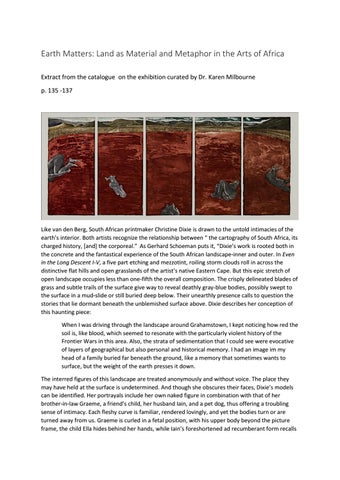
Like van den Berg, South African printmaker Christine Dixie is drawn to the untold intimacies of the earth’s interior. Both artists recognize the relationship between “ the cartography of South Africa, its charged history, [and] the corporeal.” As Gerhard Schoeman puts it, “Dixie’s work is rooted both in the concrete and the fantastical experience of the South African landscape-inner and outer. In Even in the Long Descent I-V, a five part etching and mezzotint, roiling storm clouds roll in across the distinctive flat hills and open grasslands of the artist’s native Eastern Cape. But this epic stretch of open landscape occupies less than one-fifth the overall composition. The crisply delineated blades of grass and subtle trails of the surface give way to reveal deathly gray-blue bodies, possibly swept to the surface in a mud-slide or still buried deep below. Their unearthly presence calls to question the stories that lie dormant beneath the unblemished surface above. Dixie describes her conception of this haunting piece: When I was driving through the landscape around Grahamstown, I kept noticing how red the soil is, like blood, which seemed to resonate with the particularly violent history of the Frontier Wars in this area. Also, the strata of sedimentation that I could see were evocative of layers of geographical but also personal and historical memory. I had an image im my head of a family buried far beneath the ground, like a memory that sometimes wants to surface, but the weight of the earth presses it down. The interred figures of this landscape are treated anonymously and without voice. The place they may have held at the surface is undetermined. And though she obscures their faces, Dixie’s models can be identified. Her portrayals include her own naked figure in combination with that of her brother-in-law Graeme, a friend’s child, her husband Iain, and a pet dog, thus offering a troubling sense of intimacy. Each fleshy curve is familiar, rendered lovingly, and yet the bodies turn or are turned away from us. Graeme is curled in a fetal position, with his upper body beyond the picture frame, the child Ella hides behind her hands, while Iain’s foreshortened ad recumberant form recalls
Andrea Mantegna’s Dead Christ (c.1480) spun 180 degrees. Dixie’s own face is twisted as if in childbirth, her face seemingly turned away in pain. Her meticulous technique of contrasting the mezzotinted figures against an etched background heightens the illusion that these bodies float, detached or forgotten. Recognition does not mediate their isolation. It raises questions. Are their more bodies? What or who else might we find below the full panorama of the Eastern Cape? Should we dig deeper? For Dixie, the land hides untold stories and she does not correct its oversights, she exhumes them. Dixie derived the title of this work from the poem, “Muse,” written by her friend Robert Berold, wind marks the formation of rock which leads downwards now that the shooting has died away the beginning of a dream becomes clear in the distance a continual boiling of dust and pain red pain stinging unploughed fields but I will love you always against you I’ll never struggle even in the long descent into darkness I will be your companion