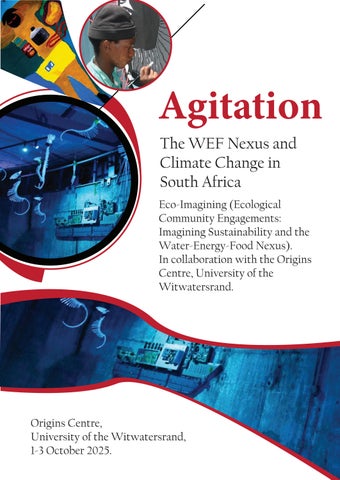
The WEF Nexus and Climate Change in South Africa Eco-Imagining (Ecological Community Engagements: Imagining Sustainability and the Water-Energy-Food Nexus). In collaboration with the Origins Centre, University of the Witwatersrand.
Origins Centre, University of the Witwatersrand, 1-3 October 2025.
The conference and exhibition Agitation are activities of the project Ecological Community Engagements: Imagining Sustainability and the Water-Energy-Food Nexus in Urban South African Environments (Eco-Imagining) We acknowledge funding from the National Research Foundation (NRF), South Africa and Dutch Research Council (NWO), Netherlands
Design: Lorenzo Leoni, Meghan Judge, Lenore Manderson Conference Administration: Charlotte Visagie, Janine Ristow Printing: Greendot Media (East London) and MGG (Johannesburg)
Agitation The WEF Nexus and Climate Change in South Africa
Origins Centre University of the Witwatersrand 1-3 October 2025
Table of Contents Agitation ��������������������������������������������������������������������������������������� 1 Programme ������������������������������������������������������������������������������������ 3 About Eco-Imagining �������������������������������������������������������������������� 9 Origins Centre ������������������������������������������������������������������������������ 12 The Poetics of the Abyssal Zone I ���������������������������������������������� 14 Staircase Reflections ������������������������������������������������������������������� 19 Transdisciplinary Interventions in Pressing Times ��������������������� 22 Research Posters ������������������������������������������������������������������������� 25 Critical Interconnections of Resources and their Impact on Youth ���������������������������������������������������������� 26 Food and Gender in the Eastern Cape and Johannesburg ������������������������������������������������������������������������ 28 Agroecological Principles in Inner City Johannesburg ��������������� 31 Interventions to Support Livelihoods Strategies in the Amathole River Basin ������������������������������������������������������� 33 Boegoebaai and the Green Hydrogen Frontier: Socio-Ecological Impacts and Justice in South Africa ��������������� 35 Fickle Water Economies: Infrastructuring Water in the Eastern Cape ��������������������������������� 38 Fire at the Centre: Navigating energy in urban South Africa ������������������������������������ 41 Renewable Energy and School Outreach ������������������������������������ 43
Not a magic wand: Urban gardening in Johannesburg ��������������� 46 Making today, dreaming tomorrow ��������������������������������������������� 48 Following the Floodwaters: Stories of Repair ���������������������������� 50 Urban Community Initiatives ���������������������������������������������������� 52 Art Engagement and the WEF Nexus Among High School Learners in Polokwane ������������������������������ 56 Land Use and Land Access in Limpopo: The Peri-urban Turn ��������������������������������������������������������������������� 59 The Mdantsane Murals ��������������������������������������������������������������� 62 The Mankweng Mural ����������������������������������������������������������������� 67 The WEF Reader ������������������������������������������������������������������������� 70 The Poetics of the Abyssal Zone II ��������������������������������������������� 72 The Exhibition �������������������������������������������������������������������������� 128 Bionotes ������������������������������������������������������������������������������������� 132
Agitation Conference and Exhibition Agitation brings together environmental and biological scientists, humanities scholars, creative artists, and people from government, civil society and communities. The exhibition and conference reflect our concern with inequality and insecurity, now and historically, as these affect access to water, food, energy, and how the search for resources impact land and sea. The conference activities converse with and are inspired by the collections of the Origins Centre. In the exhibition, we bring together works from collaborating artists, posters of murals executed in Eastern Cape (Mdantsane) and Limpopo (Mankweng), community art developed by PhD with community members during their research, and posters showcasing research outputs. The items from the Origins Centre collection have been selected to allow comparison and contrast; through this approach, we draw attention to the different ways in which people manage access to water, energy and food. The displays highlight our approach to knowledge production, raising questions of how values determine the direction of policies and programmes concerning basic resources. The conference includes a focus on art and expression on day one, including a lecture, a panel on art and activism, and a reception with live performances of musicians and poets.
1
The second day includes both policy discussions and research presentations; the third day includes panels on environmental justice, activism, the impact of climate change, and challenges to ensure fair access to resources.
2
Programme October 1 FIRST FLOOR GALLERY 14:00
Opening session
Welcome address: Professor Zeblon Vilakazi, Vice-Chancellor of the University of the Witwatersrand 15:00 Keynote Lecture: Professor Eileen Moyer, University of Amsterdam Ecologies of Imagination: Water, Energy, and Food in South Africa’s Transforming Landscapes This keynote explores how social science can contribute to reimagining ecological futures in contexts marked by inequality, environmental degradation, and infrastructural neglect. In examining three case studies – a plastics-for-food initiative in Johannesburg’s inner city, emerging green hydrogen corridors in the Northern Cape, and multispecies wine ecologies in the Western Cape – I show how ecological transition is not only a technical challenge but a deeply social and moral one, shaped by histories of extraction, racialized dispossession, and uneven development. 16:00 Roundtable: Art as intervention Moderator: Dr Carine Zaayman, Research Centre for Material Culture, Wereldmuseum, Netherlands with Hannelie WarringtonCoetzee, Christine Dixie, Mook Lion, Phila Phaliso, and the mural artists, Edumisa Nangu, Arnold Sebola, and Kgothatso Takalo. 3
The Tapestry Room 17:00-18.30 Reception and Perrformance MC: Cinga Dyala: artist, performer and author Participants: Cinga Dyala, Mdantsane Community Arts Centre; Hector Dibakaone, Makers Valley; spoken word performances – readings from The Poetics of the Abyssal Zone.
4
October 2 FIRST FLOOR GALLERY 8:00-11:00: Patchworking WEF Policy Futures: A Breakfast Workshop for Creative Exchange Facilitators: Eileen Moyer and Emily Ragus Policy makers will join WEF researchers for a morning of reflection, creativity, and conversation as we bring together voices from South Africa’s water, energy, and food sectors to think creatively and collaboratively about the WEF challenges we encounter in our work and lives. This is not a typical policy meeting; it is a breakfast workshop where participants will stitch together insights and experiences into a Challenges Quilt. Alexandra 09.30-12:30: The Litter Trap Walking Tour The litter trap program along the Jukskei River in Alexandra. This includes a bus trip to Alexandra, and a guided 90 minute walk. 12:00-13:30: Lunch
5
FIRST FLOOR GALLERY 13:30-16:30: Research on community impacts of climate change, governance, and water, energy and food precarity Chairs: Memory Reid and Blessings Kaunda-Khangamwa 13:30 – 13:40: Welcome & Framing Theme introduction: “Learning from Small Interventions” highlights how small, community-based actions reveal lessons for tackling water, food, energy, poverty, and inequality. Delivery: PowerPoint presentations, 5/7 mins each on individual studies, Q&A and breakout discussions 13.40 – 14.30: Cluster 1: Urban Inequalities, Youth and Livelihoods What do grassroots strategies teach us about building resilient, equitable urban food systems and youth livelihoods? We explore how youth, women, and communities tackle food insecurity and livelihood precarity in urban contexts, Emphasises growth, agency, and resilience in food gardens, youth livelihoods, and gendered responses to inequality. 。 Lucy Khofi – Gender and food insecurity 。 Zanele Nodongwe – Women-led urban food gardening 。 Memory Reid – Circular food initiatives and care networks 。 Blessings Kaunda-Khangamwa – Youth livelihoods, health and resilience 。 Andisiwe Maxela– Food gardens & community-driven development
6
14:30 – 14.45: Q & A 14:45 – 14:55: Body Break 14.55 -15:25: Cluster 2: Resource Governance and Art Interventions How can art, governance innovation, and community action strengthen resilience and reshape WEF governance? The session investigates how creative interventions and alternative governance approaches address WEF challenges and resilience. We highlight how artistic expression and governance innovation flow together to address water, energy, and disaster vulnerabilities. 。 Emily Ragus – Floods disaster response and arts-based communication 。 Amanda Mokoena – Water access and informal governance 。 Arnold Relebogile Sebola – Mural Art as a tool for sustainability education 。 Dineo Mtetwa – Coping with electricity inequalities 15:25-15:35: Q & A 15:35-16:05: Panel Discussion/Breakout Discussion Breakout Discussion based on the two thematic clusters. 16.05-16:15: Feedback from discussions 16:15-16:30: Synthesis and Closing
7
October 3 FIRST FLOOR GALLERY 8:30-10.30: From Knowledge to Action and Justice: What are we doing? Chair: Nithaya Chetty Panelists: Vishwas Satgar, University of the Witwatersrand; Alexander Kagaha, Makerere University; Jonathan West, SECTION 27; Mafoko Phomane, groundWork, Coleen Vogel, Global Change Institute. 10:30-11:00: Coffee and tea 11:00 -13:00: Climate change, resources and responses: How does the WEF Nexus help us think? Chair: Tracy-Lynn Field, University of the Witwatersrand Panelists: Panelists: Bertha Chiroro, Gender CC: Steve Collins, SADCTFCA Network Coordinator; Hector Dibakaone, Makers Valley; Thato Gaffane, SECTION27; Samkelisiwe Khanyile; Gauteng City-Region Observatory; Walter Musakwa, University of Johannesburg. 13:00 -15:00: Lunch and closing session Chair: Lenore Manderson Presentation: Emily Ragus and Eileen Moyer: Work so far on the The Challenges Quilt Closing remarks: Bertho Bosscha, Education & Science Council, Embassy of the Netherlands to South Africa, Nokuthula Mchunu, Research and Innovation Support and Advancement (RISA), National Reseach Foundation. 8
About Eco-Imagining Community Engagements:
Imagining Sustainability and the Water-Energy-Food Nexus The WEF (Water-Energy-Food) Nexus supports an integrated approach to these three essential resources. The WEF Nexus focuses on the interconnections of water, energy and food in relation to policy, governance and intersectoral engagement. The emphasis has been particularly on policy and government, less on communities, livelihoods and local environments. This relates to the role of the state as an instrument of delivery, at least for water and energy. Delivery failures are seen as lapses of coordination and communication, rather than as outcomes of struggles over power and resources. In Eco-Imagining, we shift the focus. We are concerned with how social structures of gender, age and race reinforce marginality and exclusion. Working across these divisions with communities and analytically, we interrogate the WEF Nexus and draw attention to the differential access to critical resources in local settings. This includes research and art activities in urban and peri-urban settings in three provinces in South Africa – Eastern Cape, Limpopo, and Gauteng. The programme is led by Lenore Manderson (University of the Witwatersrand) and Eileen Moyer (University of Amsterdam), with academic colleagues Andries Bezuidenhout, Department of 9
Development Studies, University of Fort Hare, Marius Marais, Department of Geography and Environmental Sciences, University of Limpopo, and Coleen Vogel, the Global Change Institute (GCI), University of the Witwatersrand. Our collaborators also include in South Africa, the South African Weather Service, Rand Water, artists Christine Dixie (Rhodes University) and Hannelie WarringtonCoetzee (GCI), and in the Netherlands, the Wereldmuseum. Our NGO partners ensure strong collaboration with civil society. Ruliv is the consortium’s main community partner in the Eastern Cape, and it has played a central role in conceptualizing and organizing interventions, with an emphasis on nutrition security as opposed to food security. In Johannesburg, we have worked with Gender CC, Makers Valley and The People’s Pantry.
10
In our research, we have foregrounded social structure and values, environment and land as central to WEF resource security. We argue the importance of positioning WEF Nexus concerns in a broader political economy, and in relation to people’s lived reality. Using a transdisciplinary approach, and inclusive and communitybased approaches, we have been examining issues around water, energy and food security, and people’s experiences of these given social, economic, environmental and climate change. Our community engagement and arts engagement activities are designed to shift the locus of power in knowledge production. Our work includes art in public spaces, through collaborations between artists and members of local communities.
11
Origins Centre University of the Witwatersrand The Origins Centre at the University of the Witwatersrand, Johannesburg, is a dynamic museum that provides visitors with a multi-sensory experience of Africa’s complex heritage and is a vibrant public-facing research entity for the university. The exhibits begin with the origins of humankind in Africa and then move through the development of technology, art, culture and symbolism. The journey offers an exploration of the diverse southern African rock art traditions, highlighting the lifeways, art and cultures of the indigenous San and Khoe peoples and their ancestors, as well as how colonialism impact the indigenous populations. Displays include contemporary art installations by well-known South African artists, visualising the stories of the past. Public programming and science engagement initiatives also offer discourse and research opportunities into broad cross-disciplinary themes. ABOUT THE ORIGINS COLLECTION DISPLAY Objects often take on multiple meanings throughout their lifetimes. As they are created, used, inherited, sold, or discarded, their significance shifts with the changing needs and resources of their users. The cultural objects featured in Agitation come from various Wits collection repositories. Though many of the objects lack direct provenance, they carry meaning, beauty, and the potential to 12
spark conversation. Chosen for their relevance to the exhibition’s themes—Water, Food, and Energy—these items reflect practices of communities across southern Africa. The Origins Centre’s educational collection has grown informally over time as items were donated to the museum. Many of these items have little context, but still have value as the objects offer a tangible way for schoolchildren to connect with the past. Handling a leather apron or a stone tool, for example, deepens understanding and appreciation of the people who once used them or the material from which they are made. The Wits Archaeology collections house significant collections from South African archaeological and historical contexts. The Wits Art Museum collections is one of the largest and most significant holdings of African arts in southern Africa. The objects included in this exhibition are described on page 128 of this booklet. Curated by Tammy Hodgskiss. With thanks to Thembiwe Russell, Wits Archaeology Collections and Julia Charlton, Wits Art Museum.
13
The Poetics of the Abyssal Zone I Christine Dixie Eco-Imagining researchers have primarily explored access to water, energy and food on land. Christine Dixie places these resources in a wider perspective – oceans as well as land. The ocean has always been a source of food, and a means of distributing food, transport, and political domination. Now, in the context of climate change, ocean floors provide critical minerals for the technologies of clean energy. Christine Dixie exposes the ironies of plundering the ocean, polluting waters, and destroying marine life. In her work, astronauts inhabit deep waters; colonial and modern-day ships cross the skies, fish sail through celestial scapes. Having jeopardized the future on earth’s surfaces, we now disrupt planetary order. The work was installed in the Gallery in the Round, Makhanda, 20-30 June 2024, during the National Arts Festival. The video and prints were displayed at Eco-Imagining’s Juxtaposition & Value, University of Fort Hare, from 19 February 2025. ARTIST NOTES Abyss (n) late 14c. in Latin form abyssus, “depths of the earth or sea; primordial chaos;” early 14c. as abime “depths of the earth or sea; bottomless pit, Hell”. Both are from Late Latin abyssus “bottomless pit,” from Greek abyssos 14
The Abyssal Zone (Installation). National Art Festival. Makhanda, June 2024. Photo: Mark Wessels.
(limn) “bottomless (pool),” from abyssos “bottomless, unfathomed,” hence, generally, “enormous, unfathomable,” also as a noun, he abyssos “the great depth, the underworld, the bottomless pit.” The current form in English is a 16c. partial re-Latinization. Greek abyssos was used in Septuagint to translate Hebrew tehom “original chaos” and was used in the New Testament for “Hell.” Old English glossed Latin abyssum with deagenesse, related to deagol “secret, hidden; dark, obscure. The Abyssal Zone is dark, silent, and secret, inhabited by uncanny, luminous creatures which float above shifting sands. The sea floor gleams with gold, platinum, titanium, copper, cobalt, and manganese, minerals that are critical for batteries, solar panels, wind turbines, and electric vehicles. 15
In the 17th century, European ships floated across the ocean, enticed by lands of gold and the promise of fortunes. Stars guided the ships; elusive planets lit the dark surfaces. If a ship had sunk, it might have come to rest on a seabed that held the very minerals it searched. This shadowy place is now threatened with the judder of collectors, the throbbing of tracked mining vehicles and pulsing bottom crawlers that spew toxic sediment plumes . Even the most remote, seemingly inaccessible parts of the planet are degraded, their environments desecrated, their life forms lost. In the artwork of The Abyssal Zone, place and space are inverted. Fish, now inedible, swim alongside spacecraft. Our dreams are haunted by reverberations from the Abyss, perverse echoes of sky and sea, water and air, sustenance, and poison.
The Abyssal Zone, detail. Photo: Leroy Payne.
16
LITERARY RESPONSES For this exhibition and the conference, the visual art is paired with literary contributions. Meghan Judge and Stacy Hardy invited poetic interventions, speculative prose, and lyrical dispatches from the unknown: This call emerges from the abyss. Not a metaphor, but a place: the Abyssal Zone. 6,000 meters below your feet. Dark, cold, teeming with blind beauty. This is the seafloor from which the future is being scraped: manganese nodules, cobalt blooms, dreams of green extraction—dug from a place we can barely imagine. We are opening a literary portal into this zone: one of deathly silences and mechanical intrusions, of floating creatures, mineral ghosts, and the inversion of world orders. Dixie’s work surfaces the entanglements of land, water, energy, and food; her images suggest a world beneath the world, and a politics of perception, a poetics of erasure, a rupture in time. While the abyssal zone spans the globe, this call placed particular emphasis on the deep-sea mining frontiers emerging around the African continent, specifically in the Southern Atlantic, the Southwest Indian Ocean, and the Southern Ocean. These waters, often overlooked, are rapidly becoming new sites of extractive ambition. We particularly welcome submissions from writers living along, or in proximity with, these coastal regions, or whose work engages with them imaginatively, politically, or ancestrally.
Credits for The Abyssal Zone video: Melissa Parry, editor; Samantha Munro, animation; Corinne Cooper, sound. 17
18
Staircase Reflections Nothing compares to grandmother’s skill
16 year old young woman, focus group with Blessings KaundaKhangamwa, Mdantsane, 21 March 2025.
We left these practices of preserving food … we never imagined them being useful in the city
Women from the community kitchen, conversation with Memory Reid, 17 October 2023.
The day is unique through our cooking
Woman, key informant interview with Blessings KaundaKhangamwa, Amathole Basin, 13 March 2025.
I have to do what I can to survive
Lynda, conversation with Lucy Khofi, Lorentzville, 10 April 2023.
One must hustle for a plate of food
Objioma, conversation with Lucy Khofi, Lorentzville, 22 October 2022.
I was waiting to die that night
Fanele, conversation with Emily Ragus, Durban February 2023.
Life stops without electricity
Kgothatso, mural participant, interview with Arnold Sebola, Mankweng, 4 October 2024. 19
The water comes out warm, and I am still thirsty after drinking it / Ashushu ndiyanxanywa andi woniselwa xa ndiwasela
Luke, spot interview with Amanda Mokoena, St. James, East London, 2023.
Without papers, they won’t even look at us
Kerea, conversation with Lucy Khofi, Lorentzville, 22 February 2023.
The sky was mourning
Thembisa, interview with Emily Ragus, Durban, 13 April 2023.
People are fending for themselves
Mafoko, interview with Arnold Sebola, Mankweng, 4 October 2024.
They spoke of an urban garden -- we measure it in spinach
Women from the garden, conversation with Zanele Nodongwe, Katlehong, 2 February 2025.
Our complaints are an opportunity for exploitation
Thabiso, interview with Dineo Mtetwa, Soweto, 21 November 2024.
They manage the meetings, we wait under the tree
Women from the garden, conversation with Zanele Nodongwe, Katlehong, 25 February 2025.
You can’t steal an education / O ka se utswe thuto
MmaMashego, conversation with Sandra Zaroufis, Mankweng, 19 April 2023.
20
It’s quite another thing to have no illusions and still hold the inner flame
Sandra, quoting Marie-Louse von Franz, conversation with Memory Reid, 3 April 2024.
I share because that’s what we do
Mam’ Mxesibe, conversation with Lucy Khofi, Mqanduli, 22 May 2023.
Food insecurities can be solved if we all collaborate and support each other
Siyakhana Food Gardens owner, conversation with Mulweli Mainganya, Bezuidenhout Park, 20 August 2023.
The seed that you plant follows your heart / Semela sela ge o se byala, se ya ka pelo ya gago Mma
Mashego, personal interview with Sandra Zaroufis, Mankweng, 26 March 2024.
Siyaphilisana - life goes on! / We look out for one another life goes on!
Themba, Focus group interview with Dineo Mtetwa, Soweto, 15 April 2025.
21
Transdisciplinary Interventions in Pressing Times Hannelie Warrington-Coetzee How do we live sustainably in current complex settings and times? Artists use eco-art interrogation as a method to reach and move new audiences into action. In my own work as an artist and environmental activist, I have drawn on diverse methods, theories and practice to illustrate how unexpected opportunities build agency in complex socio-environmental contexts. I draw on my own work in developing innovative nature-based solutions, which has brought together environmental scientists, city government officers, artists and communities. I demonstrate that eco-art, targeting specific wicked problems, can hold contradictions, disagreements and opposing views of how to manage urban problems. This, in turn, can grow active citizenry. The Plant Pee Pot is a response to persistent infrastructure failure – closed public ablution facilities – due to lack of maintenance, and the need for such facilities for people who are homelessness or work on the streets in Johannesburg. The pots – public urinals – were developed with plants that absorb the urine and an added effective micro-organism, so that smell was reduced while privacy was provided by the plants. The research was conducted with public users, inner-city property owners, and phytoremediation scientists 22
and engineers, with job creation playing a key role in building and then servicing the urinals. The waterwise WildWall pocket tile was invented and began to be used in 2016 with the aim to cool walls, filter air, and grow miniature but robust eco-systems in the city, stimulating biodiversity growth. Rock succulents thrive under constraint, growing vertically in small cavities on exposed rockfaces. Patented in 2016 in South Africa as a novel vertical garden system, the WildWall tiles cater for waterwise succulents, in contrast to many systems which depend on reliable water supplies for plant growth.
Plant Pee Pot Pretoria CBD with artwork ‘Nature is Calling’ 2024, a mosaic artwork commissioned with the Plant Pee Pot in Pretoria, South Africa (2024). 23
The Eco-Tree Seat was developed as a Sustainable Urban Drainage System (SUDS) in 2019 when Hannelie co-founded Water for the Future with Romy Stander. The pilot intervention and a public seat which harvests rainwater grows a new tree with runoff from the road. The project involved an educational treasure hunt with local children, who then built a mosaic into the bench of their own drawings. This grew agency to such an extent that the children watered the new young tree for the first season after it was planted. The participation of the children made the eco tree seat both memorable and treasured, building active citizenry from a young age. From this work, I have become increasingly engaged in major nature-based interventions, involving work with government entities, private corporations, and community-based organisations. I presently lead a major project with SUNCASA (Scaling Urban Nature-based Solutions for Climate Adaptation in Sub-Saharan Africa). The Litter Traps and Art Project in Alexandra include public art and gabion walls, designed to transform solid waste into river cleaning installations, and to reduce flooding, improve biodiversity, and ignite climate action from the ground up.
24
Research Posters Eco-Imaging involved three postdoctoral researchers, three master’s students, and five PhD scholars, whose work is described in alphabetic order below and is illustrated in the posters in the exhibition. These researchers were affiliated with or enrolled at the following universities: University of Amsterdam, University of Fort Hare, University of Limpopo, Rhodes University, and the University of the Witwatersand. We acknowledge the support of the National Research Foundation, South Africa (NRF); the Dutch Research Council (NWO); the General Sir John Monash Foundation; the Consortium for Advanced Research Training in Africa (CARTA); and the Wellcome Trust.
25
Critical Interconnections of Resources and their Impact on Youth Blessings N. KaundaKhangamwa Environmental changes and increased weather-related disasters can heighten concerns about the future, with negative impact on young people’s sense of connection to their land, their sense of belonging, their livelihoods and well-being. Fluctuations in weather, lack of access to running water and food, and power outages, can lead to turmoil and increase vulnerability, including to health. My interest in young people’s experiences focuses theoretically on the idea of social solastalgia—a deep unease rooted in the erosion of opportunities, dignity, and lost connections to the land. I use the term solastalgia (‘homesickness’ at home) as a potential source of insight, a catalyst for cooperation, and motivator for positive transformation among young people. Young people’s disconnection from the land in rural and peri-urban areas of the Eastern Cape is coupled with their everyday struggles, the erosion of opportunities, and a sense of powerlessness. Agricultural land remains fallow due to limited resources and lack of investment. Energy and digital exclusion further restrict young people’s access to information and opportunities. Together with the triple burden of water, energy, and food insecurity, systemic 26
unemployment, limited family support, and poor institutional responses have led young people to move to cities and other rural areas for work.
Youth and community feedback meeting, Amathole Basin, 13 June 2025.
By periodically returning to maintain family connections, young people’s circular migration highlights their ability to adapt and their resilience, even as they experience the pain and longing that arises from recognising changes in their environment. But many return and stay on. Their journeys from intermittent joblessness to engagement in community gardens and long-term farming is not just an economic shift; it is also a restorative journey. By reclaiming the land as a source of food and as an act of identity, they access both agency and hope. I illustrate solastalgia furthers understanding of young people’s everyday adaptive practices and pathways. I see this as a manifestation of resilience, whereby young individuals strive to thrive despite adversities. Young people’s well-being and joy are not just survival strategies – they are a testament to what happens when communities invest, connect, and believe. 27
Food and Gender in the Eastern Cape and Johannesburg Lucy Khofi Communities in South Africa face chronic socioeconomic challenges, including high unemployment, hunger, and inadequate access to resources such as food, water, energy, and shelter. Exclusionary policies exacerbate these hardships, entrenching deprivation for many people. Using case studies from Lorentzville (Gauteng) and Mnqanduli (Eastern Cape), Lucy Khofi documents the effects of food insecurity, including on income-generating strategies and on interpersonal violence. Food remains an important measure of equality and justice now as was under apartheid. Through community-based coping mechanisms and development initiatives, people share resources to address immediate needs and find ways to reduce food risks. These local initiatives provide valuable relief, but they often lack the scale and sustainability to address systemic inequality and the structural roots of poverty. Partnerships between communities and public institutions are essential to achieve sustainable change, so to advance a more inclusive and equitable society. My PhD, currently under examination, includes four articles. The first, Speaking of Hunger, considers how hunger functions as an idiom of distress that conveys poverty, vulnerability, and requests for help. Drawing on ethnographic fieldwork in a peri-urban 28
Eastern Cape community and an inner-city suburb of Johannesburg, it highlights the ways hunger talk reflects broader experiences of marginality and survival. In the second article, Food Insecurity, Intimate Partner Violence, and Barriers to Sexual and Reproductive Health Care, I examine the intersections of food insecurity, migration, intimate partner violence, and barriers to reproductive health services among innercity women. I reveal the gendered consequences of food insecurity and the structural gaps within health and welfare systems in inner city Johannesburg.
29
The third articles is a review of the social and local dynamics in South Africa’s Water-Energy-Food Nexus. In this, we highlight highlights the barriers to water, energy and food in marginalized settings where socio-economic disparities persist. We argue for context-sensitive approaches that foreground equity and gender justice. In the fourth article, Strengthening Community Ties, I investigate how communities mobilize grassroots initiatives and social networks to address food insecurity and resource scarcity. While women and communities share food, water, energy, and shelter in the face of unemployment, inequality, and state neglect, they are constrained by broader structural violence. Gendered forms of care and community ties sustain livelihoods, even within conditions of chronic deprivation.
30
Agroecological Principles in Inner City Johannesburg Mulweli Mainganya Inner city Johannesburg faces escalating food insecurities due to rapid urbanisation, climate change impact on food availability and prices, and reliance on imported foods. Agroecology, a sustainable food production approach that integrates ecological and social principles into food systems, offers a transformative solution to this urban challenge. Drawing inspiration from Cuba’s successful urban agroecology, Johannesburg has seen the growth of smallscale urban agriculture like Victoria Yards, Siyakhana Food Gardens, The Greenhouse Project, and The Outreach Foundation. Despite limited space and infrastructure, these establishments practice core agroecological techniques such as intercropping, crop rotation, water harvesting, organic pest control, and composting. They grow diverse crops -- leafy greens, herbs, root vegetables, and fruits, with older gardens like Siyakhana and Victoria Yards receiving higher yields. They incorporate volunteer programs, training, and food donations, reinforcing social and human values central to agroecology. Cuba emphasises agroecology as a pillar of national food sovereignty. Its agroecological transformation was driven by a state-supported, nationwide response to food insecurity following the collapse of the Soviet Union, and was characterised by strong 31
political will, decentralised farmer-to-farmer networks, and widespread training programs. In contrast, South Africa’s approach is largely fragmented and under-institutionalised, with limited state involvement and a lack of cohesive national strategy. Reflecting this, integrating agroecology into urban farming practices faces challenges which include high production costs, expensive food items, inefficient marketing and distribution of products, and a lack of knowledge and financial resources. South Africa’s urban agriculture is often treated as marginal, rather than a strategic component of urban resilience and food system transformation. Yet considerable potential exists to enhance food security and ecological sustainability in the city through targeted policy interventions, such as integrating agroecology into urban development plans, subsidising inputs for small-scale producers, and fostering multi-stakeholder platforms for knowledge coproduction.
32
Interventions to Support Livelihoods Strategies in the Amathole River Basin Andiswe Maxela Food insecurity, hunger and malnutrition continue to be challenges in South Africa. This has been intensified by inadequate responses from the state, resulting from ineffective crisis management, inadequate decision-making, lack of coordination, weak institutional frameworks, and limited resources. My work focused on the establishment of food gardens to alleviate poverty and reduce food insecurity, with the involvement of young people in such initiatives NGO community development programmes have been critical in addressing food insecurity. Ruliv, a partner in Eco-Imagining, has implemented two community development projects in the Amathole Basin, aimed at increasing resilience to climate change through creating integrated and sustainable food gardens, with the aim of achieving short- and medium-term food security. Inputs included water storage, seeds, seedlings, fertilizer and post-harvest marketing, together with training, mentoring, and community facilitation. Of the two projects, one from its inception was able to achieve its goals. The other project faltered.
33
Community development presents challenges because success is tied to sustained involvement and cooperation among different stakeholders. In this ongoing study, I ask what role NGO community development projects play in improving food security, and from the point of view of community members, what shortcomings and areas of improvement can be identified in the NGO interventions. The research was conducted using Asset-Based Community Development (ABCD) and participatory methods. These ethnographic methods helped to identify differences in community participation, and how this influenced the trajectories of the projects. In theory communities thrive in environments that are sustainable both socially and economically, but the projects that are implemented to support this are conventionally designed with fixed timelines and measurable outcomes that allow for little flexibility in community relationships, changes of circumstances, shifts in population, or local economic shifts. Concerns about financial sustainability, the sustainability of participation in the intervention, its value for community members, and the presence and continuing role of the NGO, can all lead to a departure from the original values underpinning the project. In trying to understand why community participation in these communities differed so dramatically, I seek to identify measures to ensure projects are successful from the outset.
34
Boegoebaai and the Green Hydrogen Frontier: Socio-Ecological Impacts and Justice in South Africa Masego Modisaotsile Boegoebaai, located along South Africa’s arid Northern Cape coastline, is the proposed site for a large-scale green hydrogen export hub, with production earmarked for markets in countries such as the Netherlands and Germany. While framed as part of a global clean energy transition, this development unfolds in a region deeply shaped by a long history of extractive industries, particularly diamond mining. These industries have left legacies of environmental degradation, disrupted ecosystems, and, in some cases, social displacement, contributing to structural inequalities that persist today. In this context, the proposed hydrogen development represents both an opportunity for economic revitalisation together with a risk of perpetuating historical patterns of outward flow of resources and exclusion. The coastline surrounding Boegoebaai supports small-scale fishers who depend on nearshore marine resources for food security and income. These fisheries are highly vulnerable to industrial development due to potential habitat loss, restricted access to fishing grounds, and cumulative impacts from past mining activities. Fishing communities in the area have expressed concerns 35
about the lack of transparent consultation processes and the risk that large-scale infrastructure will marginalise their participation in decision-making. Understanding the perspectives of these communities is essential to ensuring that the transition to green hydrogen does not undermine existing socio-ecological systems.
Boegoebaai, 2025. Photo: Memory Reid
Planning for the Boegoebaai Green Hydrogen Project must navigate a complex intersection of ecological, social, and economic priorities. Applying a multi-species justice lens highlights the need to value human and non-human interests equally, ensuring that biodiversity, fisheries, and local livelihoods are considered 36
alongside industrial and export objectives. Inclusive planning should integrate local ecological knowledge, provide transparent environmental impact assessments, and establish binding benefitsharing agreements with affected communities. Without such measures, the transition risks perpetuating extractive logics under a new “green” banner, rather than fostering a genuinely just and sustainable coastal future.
37
Fickle Water Economies: Infrastructuring Water in the Eastern Cape Amanda Mokoena My PhD research was conducted in East London and in the northeast on the Wild Coast, in kuGatyani (Willowvale). Across the Eastern Cape province, water is needed for domestic, industrial, agricultural, and environmental purposes. However, potable water is not always available due to insufficient and poorly maintained infrastructure and pollution. Tapwater can taste unpleasant, and river water may be tainted from rubbish, livestock, and soap and detergent from laundry. In kuGatyani, piped water is not provided by local government, and villagers living by the Mbashe River, running through the town, capture surface water before it enters the supply grid; elsewhere, people use large rainwater tanks. In areas like kuGatyani as well as in large towns and cities, the need for water has led to its commodification. Water is drawn from the river or from municipal supplies, and is run through ultraviolet (UV) filters and processes such as reverse osmosis to strip its natural mineral content and then reintroduce minerals like magnesium. This water is then bottled, provided with commercial branding and sold, on-site, in supermarkets, and at sales points where customers bring their own containers to buy “purified” water. Household filtering can give water comparable properties to store-bought bottled water, but people largely buy drinking water as they need it. 38
Water users increasing rely on an alternative economy to meet their water needs, and a purified water industry now provides drinking water for a growing population. The first purified water shop opened in East London in 2008. The industry has since expanded through franchises, water pods in supermarkets, and outlets where people can purchase drinking water for one rand a litre, using reused plastic bottles. THE WILLOWVALE MURAL The briefing for the mural came out of focus groups and general discussions held at the Willowvale Art Centre. These took place while we shared daily meals with the artists around the challenges faced by the community at large, represented by the artists and workers at the Centre. Everyone who works at and from the Centre had a version of this combination of resources as a challenge to their daily lives: amanzi (water), ukutya (food), umbane (electricity), or amandla (energy). After a conversation with me about the preliminary findings, the artist, Lumanyano Gosani, developed the mural to centre these three shortages and the subsequent impacts on the community.
39
Lumanyano Gosani with the mural, Willowvale Arts Centre, July 2023. Photo: Amanda Mokoena.
40
Fire at the Centre: Navigating energy in urban South Africa Dineo Mtetwa South Africa’s energy crisis, shaped by the collapse of Eskom and decades of mismanagement, makes electricity access deeply political. In Soweto, in a context shaped by infrastructural inequality, rolling blackouts and unreliable supply, fossil fuels such as coal, paraffin and burning are used daily for cooking, heating, and lighting. These energy sources offer immediacy and control and are central to how residents cope with energy precarity despite their health, safety, and environmental risks. The continued use of combustible energy reveals not only material need but also the failure of the national energy system to provide consistent and affordable electricity to historically marginalised communities. They remain vital to household survival. The everyday and symbolic uses of fossil fuels challenge dominant narratives of a just energy transition. While global and national policies emphasise decarbonisation and climate goals, communities like those in Soweto continue to rely on polluting energy sources to survive. At the same time, the visual and affective use of burning tyres and debris are a powerful symbol of political frustration, making visible anger over service delivery failures and infrastructural neglect while drawing attention to deeper struggles over state accountability and citizenship. 41
The visibility of combustion in both domestic routines and public demonstrations, as illustrated below, complicates mainstream environmental discourse by exposing the social and spatial unevenness of energy reform. This calls for a more grounded understanding of energy justice, one that takes seriously the tensions between climate commitments and the realities of life at the margins of the grid. Fossil fuels in Soweto are more than outdated artefacts; they are infrastructures of survival and resistance that illustrate the contradictions of South Africa’s unequal energy landscape.
Protest in Soweto, 2025. Photo: Dineo Mtetwa 42
Renewable Energy and School Outreach Dineo Mtetwa and Memory Reid South Africa is the seventh largest carbon emitter in the world and accounts for 45% of Africa’s emissions. The country also has to deal with consistent supply constraints as well as aging infrastructure, addressed partly by load scheduled shedding. The country now faces the critical task of ensuring and sustaining the supply of energy, while aligning with national and global goals to reduce carbon emissions. Renewable energy awareness is important in gaining community confidence in government’s capacity to decrease dependence on fossil fuels and enhance resource accessibility. This includes engaging with students to participate in renewable energy and a growing green economy, and as consumers. The South Africa Wind Energy Association (SAWEA) provides a platform for industry collaboration and knowledge sharing in relation to renewable energy, and operates in Northern Cape, Western Cape and Eastern Cape. By supporting skills development, SAWEA aims to enhance public awareness of the benefits of wind power to generate clean energy, create jobs, and reduce greenhouse gas emissions.
43
One way in which it promotes renewable energy awareness is through educational campaigns for schoolchildren. With the South African National Energy Development Institute (SANEDI) and the Durban University of Technology (DUT), SAWEA annually conducts an Educational Energy Drive to raise awareness on global issues around climate change and renewable energy, and on local efforts to address this. The Energy Drive intersects with national policies on STEM (science, technology, engineering and mathematics) education to reconceptualize energy in communities, shift understanding about debates on energy, and to inform young people of opportunities that exist in the green economy and to encourage them to work in this sector. Dineo Mtetwa participated in this energy drive in the Eastern Cape in 2022, with visits at specific schools and wind farms. This drive highlighted the challenges in interesting students in a very limited time frame, and in integrating learning about renewable energy into STEM education subjects.
44
Providing educational opportunities in STEM will, it is argued, motivate young people who prepared for and enthusiastic about new job prospects in this field. Appropriate learning is a critical tool to engage with learners and community members, to enable a gradual yet successful renewable energy transition. Without deliberate design decisions at the centre of jobs and initiatives on renewable energy and climate change, achieving sustainable communities with sustainable jobs and livelihoods will be a continuing challenge.
45
Not a magic wand: Urban gardening in Johannesburg Zanele Nodongwe Urban gardening is often treated as a “magic wand” – a quick-fix solution for food insecurity, unemployment, and gender inequality through small gardening initiatives. In Katlehong, Johannesburg, gardening initiatives are framed by development actors as empowering tools for women, aligned with the global food justice movement. These promises sometimes materialise in practice. Gardens offer social value: they foster belonging, structure daily life, and allow women to supplement their diets. However, their role as reliable livelihood strategies is overstated. Promoted through food justice narratives, gardens are idealised as transformative spaces of empowerment. While community gardens offer some women hope, social connection, and food support, they fall short of delivering sustained livelihoods or economic independence. My study was conducted using anthropological methods – participation, indepth interviews, and key informant interviews. At the heart of this study is an interrogation of power. Women navigate unequal relationships with NPO figures, who control access to funding, training, and project framing. Similarly, a man, positioned as the garden manager, receives a higher stipend than the women for his work and wields decision-making power, although he relies on women’s labour. These dynamics reinforce 46
gendered hierarchies under the guise of community development. Yet women are not powerless. Their power lies in their collective rejection of unsuitable ideas, their role in shaping relationships with local businesses, and their capacity to control everyday decisions in the gardens. Their unity, knowledge, and cultural authority allow them to subtly negotiate power, including with the researcher, who occupies a position of educational and class privilege. Women test, withhold, or grant access depending on trust, mutual respect, and perceived intentions. Development interventions often reproduce structural inequalities while cloaked in optimistic language. In this work, I challenge romanticised narratives of urban gardening as inherently empowering.
47
Making today, dreaming tomorrow Nirvana Pillay Young people between 18-24 in urban Johannesburg, South Africa live in contexts of deep and widening inequality, unemployment and precarity. From interviews with young people and youthfocused non-government organisations (NGOs) in Alexandra and Lorentzville, I found that young people hope and dream of much more than their daily lives allow. Aspirations must constantly be adjusted to cope with systemic and structural barriers to employment, education, and recreation. Income generation requires a mix of entrepreneurship, flexibility and opportunity. Short-term employment opportunities like work in retail often requires late night work and the cost and safety of travel are barriers to ongoing employment in the sector. Young people often consider alternate ways of making money, such as selling via and for others, including through illegal means. Work is seen as the panacea to the struggles of daily life: “Waking up for something is better than waking up for nothing.” At the same time, kinship responsibilities including parenting and caregiving must be fulfilled. Young people are often caught between their own hopes and aspirations and those of their family and kin. Education completion does not guarantee further education and training nor jobs, and completing high school is often a long and circuitous path when they fail matric. The pressure for stability and success is acutely 48
felt by young people, and the inability to achieve this contributes to feelings of failure and hopelessness.
Banks of the Jukskei river, Alexandra, 2025. Photo: Ntsako Ishmael Chauke.
There is deep distrust of the government: “The system is corrupt so you got to live [make it] alone.” In both communities, high levels of crime make daily life stressful yet also offer opportunity for ad hoc income. Balancing risk and opportunity creates high levels of stress, shame and ambivalence. NGO support to youth focuses on skills development and links to job opportunities, food provision and creating safe spaces. But NGOs themselves are persistently challenged by funding shortfalls and limited capacity to deliver services and resources. This precarity exists despite the critical role they play in mediating the failure of the state to deliver essential services to local communities. 49
Following the Floodwaters: Stories of Repair Emily Ragus Over three days in April 2022, more than 350 millimeters of rain fell in Durban, triggering deadly landslides, collapsing homes, washing away roads and bridges, and overwhelming already fragile infrastructure. Nearly 500 people lost their lives, thousands were displaced, and entire communities were cut off from basic services. The destruction exposed long-standing patterns of inequality. Those living in informal settlements on unstable land were hit hardest, and emergency responses were overburdened by the scale of the crisis. The floods were one of the most catastrophic disasters in South Africa’s recent history. I conducted my PhD research from 2023, a year following the floods, in an informal settlement located near the Palmiet River, using ethnographic methods including arts-based techniques, including clay sculpturing and body-mapping. I focused on both the people directly impacted by the floods and on those who responded, including residents of informal settlements and members of helicopter rescue and recovery teams. I show that disasters in Durban are not singular events but ongoing processes shaped by layered violence, environmental neglect, and institutional failure.
50
Across these different settings, storytelling emerges as a practice of repair and as an act of refusal. It restores meaning in relation to disrupted attachments to place, and fractured imaginations of the future. Repair, in this context, is not a return to normal but an ongoing effort to make life possible again in the aftermath of rupture. It involves acts of care, recognition, and collective orientation in environments marked by loss and instability. Storytelling makes this work visible. It enables people to inhabit the afterlives of disaster, to navigate uncertainty, and to remake social ties within conditions shaped by structural inequality and institutional neglect. Where formal systems fail or remain absent, stories become a means of holding together what remains.
Quarry Road West Informal Settlement, August 2023. Photo: Emily Ragus. 51
Urban Community Initiatives Memory Reid TRANSFORMING WASTE INTO VALUE Current food security models often fail to meet the challenges in particular environments, and fail to take account of the perspectives of food system actors, in urban settings. South Africa wastes 10 million tonnes of food annually, worth R61.5 billion (2.1% of GDP), throughout the entire value chain. Nutritionally viable fruits and vegetables are discarded for cosmetic reasons and end up in landfills, together with food waste due to oversupply, postharvest fluctuations, and losses in processing, packaging, and consumption. This wasted food could be redirected through wasteto-table initiatives, offering an alternative pathway to improve food access and reduce insecurity. In this context, initiatives like The People’s Pantry (TPP)’s Food Preservation Lab, supported by Eco-Imagining in the inner city of Johannesburg, highlight grassroots efforts to address food waste while enhancing food security. Using surplus donations from retailers of food headed for landfills, the project leverages workshops to integrate natural food preservation into urban food pathways. This waste-to-table strategy is embedded in the model that supports the community kitchens hosted by TPP. It helps tackle food insecurity by leveraging natural and traditional food preservation techniques, increasing circularity, improving food 52
nutrition, and exploring income generation potential. Women worked together using time-honoured methods of preservation, as one woman explained: “We left these practices of preserving food in our rural homes; we never imagined them being useful in the city” (17 October 2023).
Preservation methods like drying offer low-cost, low-resource alternatives, accessible across generations and food types. These methods reduce use of electricity and water, mitigate health risks from spoiled food, extend shelf life, and draw on intergenerational knowledge of preservation techniques. Scaling these methods could support livelihoods and generate income, and produce culturally rooted, nutrition-informed preservation guides. At the same time, challenges remain, including the cost of ingredients and packaging, and limited market development for preserved goods.
53
FROM GARDENS TO GAUGES The integration of initiatives that synergise livelihoods, education, citizen science, and climate awareness has emerged as a critical strategy in enhancing urban community resilience and preparedness in the face of climate-related events. Urban gardens have emerged as a grassroots solution to tackle food insecurity and high unemployment rates in cities. They also serve as communal spaces for people to exchange knowledge and foster supportive networks, whilst building community resilience. Gender CC, a local nonprofit organisation dedicated to supporting established urban agricultural projects, particularly those based in local schools, is creating such spaces in the south of Johannesburg. Supported by the South African Weather Services (SAWS) and Eco-imagining, it facilitated the installation of solar-powered weather stations at Nokulunga Primary School and the Diversity High School, where two community gardens are housed, to monitor local weather conditions and for educational purposes. To create a thriving Citizen Science environment, Gender CC approached dedicated science teachers at each school, ensuring that students could delve into agroecology from the gardens and learn how to use the weather stations effectively by establishing Eco-Clubs. A local champion was also identified, responsible for supervising the weather station and receiving support from SAWS. They served as the link between the schools and the local neighbourhoods, enabling everyone to better understand and share pertinent weather data. However, the journey has not been without its challenges. The untimely passing of one local champion cast a shadow over the activation of the Eco-clubs. Despite this setback, Gender CC’s partnership with SAWS has remained steadfast. It continues 54
to empower communities around Nokulunga and Diversity High School, both of which are susceptible to flooding. The SAWS provides essential training on early warning systems and community vulnerability mapping, fostering resilience against the unpredictable weather that often impacts their lives. These grassroots initiatives in urban spaces illustrate the transformative impact of community engagement and environmental awareness.
Community at Diversity High School, 14 August 2023.
55
Art Engagement and the WEF Nexus among High School Learners in Polokwane Arnold Relebogile Sebola Climate change, and its effects on water, energy and food precarities, have major impact on global and local futures. However, creative educational strategies and ways of engagement are needed for young people to comprehend the impact of climate change, and ideally to engage in addressing resource precarity. Many municipalities use public art to help with local projects and policies. The greater Polokwane region faces considerable challenges in accessing clean water, reliable energy, and adequate food. My master’s research is on evaluating perceptions of local art expressions of the Water-Energy-Food Nexus and its effects on high school learners from Polokwane Local Municipality. I am interested in how the design and execution of the mural, and its viewing by learners, sharpens interest in and concern about depleted resources and their interconnections, in ways that have transformative potential. The young mural artists had no prior art experience or knowledge, but found mural-making transformative, helping them visualise WEF issues. Observational drawing exercises (for example, still56
life objects, portraits) improved their technical skills, making them more confident in translating small sketches to large-scale murals. At the same time, their art served as a medium for storytelling, with murals depicting struggles like water scarcity (dry taps, teardrops), energy scarcity (electric poles), and food insecurity (traditional cooking), with one mural depicting cooking on a firewood stove. Some mural artists noted that prepaid electricity systems were common, but affordability remained a challenge, forcing reliance and improvisation. Innovation in energy use was evident, with individuals adapting to shortages through self-taught skills. Electricity shortages (load-shedding, unreliable grids) were a major concern, affecting education, business, and household activities. Artists documented creative solutions in their own communities, such as solar-powered businesses and shared resources -- for example, a barber using solar energy to power his shop, and people used firewood for cooking. Water access too was inconsistent, with some artists and their families relying on boreholes, communal taps, and purchased water. Dependence on small-scale farming and local food vendors was common, but droughts and economic struggles disrupted food access. The decline of a once-thriving citrus farm in one participant’s village illustrated how the loss of agricultural infrastructure impacts food supply and employment. Food insecurity led to communitybased strategies, such as home gardens and bartering systems, although these were not always sustainable. Art of varying forms can increase peoples’ ability to engage with and retain complex concepts, and in this case study, mural art provided a process and an outcome that highlights how WEF insecurities shape everyday life.
57
Science Education Centre, University of Limpopo. Photo: Marius Marais.
58
Land Use and Land Access in Limpopo: The Peri-urban Turn Sandra Zaroufis Mankweng, previously known as Turfloop, is a peri-urban township with an estimated population size of 300 000 people, in Limpopo province. The original rural town functioned as an apartheid administrative enclave within the former Lebowa Bantustan and is surrounded by villages, which are governed by 6 traditional authorities and the Polokwane Municipality. Thirty years postdemocracy, the surrounds have expanded rapidly. Municipal ward boundaries and traditional authority boundaries, do not overlap consistently, due to the contestation of space between traditional authorities. This influences the settlement morphology, access to resources and infrastructure development of the area. My research focuses on land, resource access, and governance in peri-urban South Africa, with the aim of contributing to exploring spatial inequality and alternative land reform models in a former bantustan context. I use ethnography, spatial analysis, participatory GIS and digital storytelling to understand the lived experiences of women smallholder farmers in Mankweng, Limpopo. Mankweng lies within the wider context of renewed political urgency around land reform in South Africa. Through spatial and ethnographic explorations of the lives of women farmers, 59
particularly at the Ratanang Vegetable Garden, I have identified how land access serves as the initial step towards enhancing livelihoods and gaining other resources in the WEF (water-energyfood) nexus. Land allocation, under the control of traditional authorities, has facilitated urban sprawl. The number of houses/ buildings in the settlement has grown by a rate of about 100% per decade from the 1960s. Thus, water access and ecological systems have been strained, with some areas going for months without running tap water, which has compromised agriculturebased livelihoods. Nonetheless, such case studies may provide a more viable alternative to the dominant Large-Scale Commercial Farming models, in land reform projects.
Digital Storytelling and Mapping Workshop. 22 September 2023. 60
Farmers engage strategically with a variety of gatekeepers of resources, therefore legitimizing the power of authorities. However, within the patchwork, residents are often compelled to independently acquire resources in the face of a frequently absent state. The governance and settlement structure in Mankweng aligns with the call for a ‘peri-urban turn’ in urban and critical rural development studies, offering empirical insights that disrupt binaries of rural/urban, formal/informal and state/traditional.
61
The Mdantsane Murals The Shipping Containers Mdantsane Community Art Centre 2023 Murals and other public artworks foster community connection, pride, and engagement with place. They add colour, dimension and vibrancy to neglected buildings and other structures, so beautifying areas and improving quality of life. They can raise awareness about social and environmental issues, stimulating people to engage with and discuss these. Murals can inspire people to take action. We used murals as a way of engaging with young people in two communities -- in Mdantsane township, west of East London, Eastern Cape, and in Mankweng, Limpopo. The Mdantsane Art Centre is located at Mdantsane township aims to nurture the skills of young creatives in the local community. Artists share studio space in shipping containers. Their exteriors provided the surface for murals on water, energy and food. This site specific and grounded approach provided an engaging way to think through challenges that face local residents in accessing water, energy and food. Workshops were provided on still life classes, and various figuredrawing exercises, aimed to improve participants’ drawing skills and sharpen their observational skills. Participants’ developed designs in response to the reference material, and addressed the 62
themes of water, energy and food literally and as symbols. They then presented their work to others for feedback prior to finalising their designs.
Exploring Mdantsane to gather reference material, 2023.
Makhanda-based artists Mook Lion and Phila Phaliso led the intervention, conducted from 13-24 November 2023. Ten young people from Mdantsane joined them to discuss the WEF Nexus and Eco-Imagining; mural art, life drawing and design; and possible designs pertaining to the site and the WEF research. Participants developed their designs using objects from their homes – a gas bottle, candle, a plastic water bottle, a solar lamp – and from their environment – broken power lines and illegal connections, leaking taps and pools of polluted water, food scraps and informal food markets. 63
Workshop at Mdantsane Community Arts Centre, 2023.
Participants took one element – water, energy or food – so that the final work included two murals on each of the elements, and four murals which integrated these elements. For example, in her work, Vuyokazi Mayalo explored the complexity of access to water, energy and food, and the interconnections of humans and infrastructure, Vuyo perceived that not only was the infrastructure broken, but that human connections were also broken. This was part of the problem. Participants prepared the container walls by scraping off loose paint and sanding the entire surface, to ensure a solid surface to hold the paint and would encourage longevity. The designs were then transferred by grid to scale onto the wall using a spirit level and chalk lines. This enabled the community artists to break the 64
space into manageable segments. Artists then transferred their designs, and – with help from others from the township – painted the murals. Participants in this project included Vuyokazi Mayalo, Banele Noruka, Samkhelo Ntoyakhe, Luntu Mgaga, Amila Peter, Lubabalo Manga, Lathitha Gunguluza, Edumisa Nangu, Lilitha Dumezweni and Sabelo Booi. The project was facilitated by Mook Lion and Phila Phaliso, with the support and involvement of Vijay Makanjee (Ruliv), Cinga Dyala (Centre Director), and Andries Bezuidenhout (Fort Hare). The Mdanstane Arts Centre is currently being revitalised, and the containers are temporarily in storage.
65
Lubalo Manga adding details to his depiction of the sun, Mdantsane 2023.
Painting the shipping containers, 2023. 66
The Mankweng Mural Science Education Centre University of Limpopo, 2024 The Mdantsane Mural Project engaged young people to reflect on water, energy and food. The resultant murals enhanced the local environment while stimulating debate and highlighting the complexity of resources. Consequently, we extended the project. From 23 September – 4 October, mural artists Mook Lion and Phila Phaliso worked with members of the University of Limpopo, including staff and students associated with the Department of Geography and Environmental Sciences, the Performing Arts Department and the Science Education Centre, on which the mural was painted. Workshop participants selected the wall of the Centre for the mural on the basis of visibility, integrity of the wall, texture, access, obstacles, and the presence of previous murals. As in Mdantsane, participants brought in objects relevant to water, energy and food, and collected reference images beyond the university campus but still in the vicinity of the mural site. This included observing different forms of power – gas, electricity and solar power – were being utilized to prepare food and provide services, and a level of broken power and water infrastructure. Mook Lion and Phila Phaliso provided technical and conceptual guidance as the designs were developed, with attention to original and personal imagery with good composition and interesting meanings. 67
Kgothatso’s concept, ‘Praying for Rain’, developed through multiple iterations. Eventually he recruited one of the cleaning staff at the Science Education Centre to be his model and took photographs of her. With Mook he then applied a grid and scaled this image to his panel on the wall.
The team settled on using overlapping circles across the mural panels, to depict the overlapping nature of Water, Energy and Food. Once the final decision had been made, and the wall cleaned and prepared, participants painted their base colour according to their 68
design, working from the background to the foreground. A grid was subsequently drawn to scale onto the wall using a spirit level and chalk lines, and participants began sketching their designs onto the walls in chalk.
Images left to right: Mafoko Rapolayi, Mia Meyer, Arnold Sebola, Lucky Mamabolo, Kgothatso Takalo, Ntsako Mabunda. The background graphics, by Mook Lion and Phila Phaliso, depicts waves on a body of water and the dynamics of energy.
Images left to right by Gift Aphane, Jonathan Marais, Kayleigh Shoroma, Ola-Kris Akinola, Lysandra Shoroma.). The background graphics were painted by Mook Lion and Phila Phaliso. The background on the left is concerned with food, the final panel depicts land – an essential additional element for WEF security. 69
The WEF Reader Willem van der Merwe The WEF Reader – Understanding Water, Energy and Food – is an illustrated introductory book targeted at late primary school and junior high school learners. The goal is to encourage learners to reflect on the interconnections of different vital resources and to relate these to historic trends and contemporary decisions. The aim is to interest learners in areas of expertise required to understand changes in resources and to develop just solutions. The images shown in this exhibition are from the book. The book will be launched in March 2026, and will be available for download and online. THE STORY LINE Learners are introduced to current issues related to water, energy and food, and alternatives, through the central character of a twelve-year-old South African boy named Mpho. Mpho enjoys going to school, but there’s never enough time for the teacher to properly satisfy his curiosity. One day, the teacher gives a lesson on the topics of Water, Energy and Food – three things every person and indeed every living thing needs. Mpho leaves the lesson yearning to know more. That night, he goes to bed with questions still buzzing around in his mind. In a dream, he is visited by three magical animals – a turaco named Thoriso, a meerkat named Mahlatse, and a bushbaby named Bonolo. They offer to answer his questions by taking him 70
on a tour through time and space, from the prehistory of the planet to the cutting-edge of contemporary technology, showing him how water, energy and food are interrelated. Mpho learns from his magical guides how these resources are interconnected: the Sun provides us with massive amounts of energy in the form of light, which energizes the substances of which our planet is made; our atmosphere, the oceans, and the land masses are all warmed; and water is activated to go through the cycle of evaporation and condensation. From water, gases in the air, and minerals from the Earth’s crust, plants produce the foods from which humans and the myriads of other animals live and receive their ability to move and perform all kinds of work. The final message Mpho receives before he goes back to his normal life is the profound responsibility we have to understand our dependence on the proper management of these resources.
71
The Poetics of the Abyssal Zone II
MERLIN LOLLIS LOVE
(Fragments From) Sonnet From the Abyss The gold you sought, I buried deep, concealed in the madness of my bed. I sleep in darkness to elude the drill, one eye open, waiting in my abyss. You take, and take, and take— but in my deathbed I have birthed more lives than galaxies can hold, than stars can keep alive. 72
Crossing the Aegean, Tereus rapes Philomela, tries to extract a promise from her that she will tell no-one. She says she will refuse to remain silent. Tereus cuts out her tongue and abandons her ALEX HALLIGEY when they make landfall, 10 Metres Deep, telling Procne, on his return home, Suspended Philomela died on route. A friend is making a play The story goes on inspired by the Philomela myth. but the part of the rape She tells the story of at sea Procne, on a boat married to Tereus, King of Thrace. of men, Five years without seeing her sister, male warriors, and Procne asks her husband male crew – to fetch her, her sister, I have an image Philomela, of Philomela from Athens. suspended fathoms deep And Philomela’s parents, in the sea under the boat, her father, really, clothed, in the myth, floating on her back with his paternal and patriarchal arms resting on her body authority, the water dark blue. give/gives Philomela leave to go in Tereus’s care Thembela’s play is about across the sea to Thrace, violence against women, a promised extracted from Tereus the silences that surround it: that he will be a guardian that which is unspeakable to her, as if she were his (too horrific to speak) own, precious daughter. and that which may not be spoken (having being told not to speak). 73
A year later I read the call for poems responding to deep sea mining ecological violence abyssal imaginaries. I see Philomela again, floating in the depths of the nighttime Aegean, light-coloured cloth of her dress, her hair, stirring and billowing in the water, an escape to where the sea (so much of it still where we surf and snorkel and scuba dive and cage dive and swim with dolphins And where then can the sea go? and SUP To a painting in my mind and kayak of luminous midnight and yacht) Aegean salt water is seemingly untouched and wild, and a woman where you can forget gearheads in a light-coloured dress massive pipes 10 metres deep drills – her tongue about to be cut out. the grief that this sea, site of abyssal safety in my mind for Philomela, is itself being brutalised, invaded beyond what we can speak, see, hear, feel, know. 74
MO SHAY echoes of sky and sea You Ship, that was once up there, You imagined yourself buoyant And fair enough, you were. I cannot deny that you were buoyant. You did float. It is strange to me that the water let you. That the ocean, knowing your plans, did not run dry beneath you.. Oh body, built for buoyancy, Why were you allowed to float? I can only reason the ocean did not know: She welcomed your bulging belly as another trick of evolution. You fell downwards, Ship, against time, To the bottom of the ocean where your body belonged. Could the ocean, in her expanse, hold your grief?
75
JUSTIN BLACKENSEE Manifesto: From the Ground Up Shedding its sails Conquest dove underwater Like a king
fisher.
How else to map this hunger but to plunge Into what feeds—signals and sonar Harpooning the economy. Images from the abyss. Grain of database Stained on the tongue of some braindead machine So resembling a squid suspended in stasis.
76
Earthwalking humanity we can war on the ocean floor.
only
Only, suneating comrades can listen for allies.
we
There are Others you could not imagine.
Sentries with fleshy headlamps
Martyrs made of currents
Electric and ancient who say the same flooding prayers We do. There is talk of a new world Underneath the blind thundering of extraction. The water is An infinite night sky That never brightens and how grateful we are
77
QUINTON MANNING Wash up on the shore, decompose Wash, washing, washed Witbits The salt burns the skin Executing explorers Swimming within Dark, darken, drunk Stinking carcass earth Bowels of blue mothers Mutilated from birth Maul, maul, maul Cost price is a steal Clubhouse sandwich Pretty little seal Foul, fowl, foule Atlantic magmatic floor Bio fumes in essence Cobalt crab claw Dive, dive, dive Come up for air Decomprehension suits us What we can, we leave bare
REMIX
The salt burns the skin The skin burns the salt Rusted fingers grasping Fingers rusted, grasping still Bowels of blue mothers Mothers bowled hollow Pretty little seal Seal, pretty, gutted Buy one, get one free 78
The salt burns the skin — history tastes of brine. Rusted grasping fingers — the reef signs its will. Bowels of blue mothers — inheritance gutted. Pretty little seal — price tag on fur. Buy one, get one free — the ocean pays. Pencil in your destruction — erasers don’t work. Naughty little shit — the sea keeps score. Decomprehension suits us — we drown dressed well.
Nothing free, nothing left Pencil in your destruction Destruction pencilled in Naughty little shit Shit, little, naughty Decomprehension suits us Suits us, decomprehension
ALLAN KOLSKI HORWITZ Empty Bellies Tremble Before The Abyss Bellies tremble and with hungering fingers take out knives (such hope -fulness) waiting for night for cloud, for quiet and sleeping sentries we wait to fill ourselves a little so may the snouts of sniffer dogs ignore our pad this night which seethes with sentries whose cocked revolvers wake to jam us at the windows – thin frames too thick for larceny and yet in we slide filling shacktowns new planets with our loot our staples our dream-machines we migrating dwellers of the end zones take the last bus to zones of green of sharp fanged dogs passing trees and flower beds deep freezers stocked with meat and fish 79
(such hope -lessness
Abyssal
passing the walls of these mansions wise and worthy millionaires whose children howl and hoot passing all these things we who have next to nothing except the throttled air of hungering take out our knives
Very cold But we dig Very cold But we dig and dig
We do the heave ho scour every surface for depth Man Them thar beds have reetches for snitchers Flower beds ocean beds Nuptial beds Mine mine baby bay Very cold We dig in the cold because we are told to be bold 10,000 leagues is a breeze Under the waves we are saved Coz when you want the moola so bad you lose/use your inhibitions And end up digging And finding one hole after another Hole Till Them thar ocean bed is so poked about Ocean rises up and swallows the earth Poor terra Swamped By vampire whales Siphoning off whatever will sell From the glistening coils of her marine mattress
80
JOANNE PEERS Death in the River Mouth Last night, I met two white men with a bucket & three sharks pulled from the mouth of the river. Still alive. Still dying. Two pajama sharks heaving & gasping for air & one suffocating leopard catshark. This is where conservation collapses. At the mouth of the Keiskamma river.
Loyiso and I wait outside for our takeaway because the restaurant is filled with black puffer jackets, karaoke rattling the glass. I’d rather freeze & breathe than be kept warm in that toxic indoor white bubble. Loyiso goes inside to collect our food. A white fisherman passes me with his rod & I greet him. I’m alone on the deck when he the fisherman walks past, I ask him if he’s going fishing. He tells me they have just returned.
“You catch some fish?”, I ask. “No” he says, “there’s no fish, so we caught sharks.” “How did you manage to release them without harming them?”, I ask. “They are in the bakkie,” he says. My heart is racing. I sense the risk but the words rush out anyway. “I want to see them.”
81
I walk behind him into the dark away from the restaurant lights. At the bakkie, two more figures emerge. He calls the older fisherman and the black man cleaning their equipment. “She wants to see the sharks, take the bucket out,” he shouts. I’m scared and my fear explodes when I recognise the striped pajamas in the bucket. Grey and white, limp in the dark. I only know these stripes weaving through the kelp forest, curling between fronds where they belong. Here, they choke. Dragged from silence into possession and displaced. Alive and barely breathing. The older fisherman’s voice cuts like a knife:
“You can touch it,” he spits. My hands form fists in my pockets. “Don’t be scared,” his venom sprays again. The younger one keeps taking them out of the bucket and their bodies spasm on the gravel. I see the leopard catshark now. “I am NOT scared,” I say. “I can’t believe what I’m seeing, I’ve never seen them out of the water!”
82
Loyiso appears in the darkness. I’m grateful he is there. Questions come from him now too. I start to feel our safety tank running out of air. I grip his elbow between his words, pulling him back with me. My hands shake as I take photographs. Slowly, we retreat towards the car. I’ll never forget my weak body unable to choke the air out of this violence. My fists had nothing in them. I will never look at a white bucket in the same way again. I’m sure the river mouth carries a multitude of memories like this folded into its tides, buried in its silt, told again each time the water pulls back to reveal what’s been taken. Stolen in the darkness, left to die in a bucket.
The w h i t e t o x i c conversation narrative where our bodies and our communities bodies are classified poachers or trespassers breaks me as I grip the steering wheel unable to start the car. Eventually I do. Same old story of looking the other way. We rage in the car with our seatbelts on as the bodies of these sharks die in a bucket while these white men close the bakkie door and walk towards the light in preparation for the self-satisfying karaoke songs. The conversation r e p e a t s i t s e l f in other places, on paper, in boardrooms, in conference halls, where bodies like ours are named poachers or trespassers. Conservation as a shield, education as a performance. Meanwhile the sharks die at the water’s edge, dragged out under moonlight, their wet breath leaking into the night.
83
ASHRAF JAMAL Blue is a Fiction This land was made by the sea, too. Caravels stopped - passed. Dutch lumber stayed. The western frontier is a skeleton coast. Human bones embrace and quietly clatter inside a fathomless deep. There is a boat still afloat, along a stretch of desert sand, inland, far from the desert shore. Is it earth that creeps, the sea that coyly withdraws? And what of the littoral, the sand bar, mineral not vegetal, where nothing can be planted but where everything grows? Port cities. Hybrid. Creole. Mad. Vexed. Passionate. There, on that littoral, lies love, lust, yearning, a forfeiture so intimate that loss becomes meaningless. It is there that love breaks, scatters, foams, seeps. This land was made by the sea ... too. A ship crests an infinity of blue. Sky and sea are not twins but a single entity. One does not sail above, along. There is no horizontality to human movement. Sailing is a venture of the imagination that has no container. A boat is not hollowed wood. A body neither. We do not contain or carry. Slumber is not hammocked. That is what the skeleton coast tells us. Champagne... spices... grain... heirlooms... are all as tender as they are strange. Entangled wants ... hopes... dreams... ends. The ship drifts above, below, between a constellated sea of ink. Light is a flicker of paper. Light can not be drawn, only sought. Turner understood this. We dare to condemn seafarers for stopping here, on this shore, at this southernmost tip of Africa. We, whoever we are, suppose that others claimed this land that we presume to be ours. But land and sea are never static. No one and nothing belongs anywhere, solely, wholly, which is why Nelson, in his inaugural speech, sings a love song to both the jacaranda and mimosa. We are all driftworks, all entangled, all fathomless... sea bones.
84
Coconuts are a perfect resource. Its shaggy skin can be woven, it’s shell a vessel, its liquid and meat sustenance, its form a drift work, its seed global. Humans are the same. We are nomadic. The nation is a blip, a fantasy. The ship is a rune, a yearning, a coffin. It is not a thing of wood alone, but a harvest of hope. Without a ship, we are stalled landlubbers. There is no hinterland without an ocean. And now, we are told, Africa is dividing again, a new sea emerging, a new zone along which to drift and roam, a new inquiry. Colonialism is merely a question mark. Extraction is no horror. Humans dig the land, dig the sea. We doggy paddle across the universe. No place is strange. No world unique. We live, die, imprint. Our desert caves are odes to ancient swimmers. The littoral, where land and sea meet, is a religion. There resides drinking water. There, along nearby plangent slopes, are succulents... plants, human flesh, new birthings. That is how the Cape of Storms became the Cape of Good Hope, how a foreign land became a sanctuary, a mad house a school, a dugout a commune. We are made of two oceans and a terrestrial jaunt. No one belongs anywhere. The earth is a map of misteps and divine accidents. The heart is crumpled paper, a speculation. A ship is a proposition devoid of a guarantee. No law is protective or assuring. The heart is lawless. Blue is a fiction. Blue is a void. Blue like Black is not a colour but an idea. Across a cerulean night we move. Nothing is ever still. Activity is inked. Life is a spoor. We meander, collide, hold fast to mistakes and think they are beliefs. Blue is a fiction. 85
PAYAL CHANA Lights in the Dark
In the charcoal- blue of the abyss, the seafloor lies soft and silty, snow drifting down from above. Among scattered coral spires, two creatures drift. The Crimsonfin slithers like a shadow, its red lures swaying with the silent current. The Lanternback glides low and gentle, its golden lights scattered across ribbony fins. They sense each other’s vibrations. The Crimsonfin dims. The Lanternback brightens in reply. Then comes the grind of machines, breaking coral and stirring silt. The Lanternback curls in on itself, lights pulsing. The Crimsonfin slips forward, tendrils burn red until the disturbance shifts and fades away. When the waters still, the Lanternback drifts closer, releases a small cloud of glowing plankton. The glowing cluster brushes against the Crimsonfin before dissolving. For a moment, the two linger. A shadow, a lantern, two lights beating in the dark. 86
BECCA HAMILTON Plunge, pause: the poetics of whalefall Sharks and carnivorous fish follow plumes of blood and grease, stripping carcasses. Seabirds pick at blubber. The body rolls, slackens, slips loose, descends. A week, a month, bones too slip into freefall, toward the depths below. In 1987, Alvin’s headlights caught the ghostly outline of a colossal skeleton, partially buried beneath seafloor sediment. Though long dead, the bones teemed with extraordinary life; a “chemoautotrophic assemblage” making opportunistic home in carcass crevices. Researchers codified the ecological effects into taxonomies of decomposition. Yet even these stages attend not to descent, but to what comes after. The practice of whaling employs ‘fall’ in contradictory ways. “If it penetrate so as to fasten in him,” wrote surgeon John Sanderson in 1789, “then they hoist a jack in the boat… those on deck immediately call aloud, a fall, a fall!” This “fall” marks the whale’s passage airside, transcending sea and surface, salt and sky, life and death. Sanderson later writes, “[sailors] call a loose fall.” ‘Loose fall’ refers to pursuit, the chase, the presumption of a wind(fall) to come. Yet it may also mean no whales are caught, no descent occurs. The whale freed, figuratively and metaphorically. To be present for “the fall” has temporal and spatial implications. Beside the whale in its death, disintegration, descent. Digital simulations imply this is rare. Ocean heavyweights reduced to calculations, geometric divisions. ORGANS reads the key to one illustration—organ walls gone, replaced by white apertures, void. We suspend belief and accept that blooms of life come from these sanitized divisions.
87
Perhaps our presence to ‘the fall’ is as distanced as simulation: a suspended haunting, visualised so as not to be experienced. “Whale Fall is a collective term,” one study begins—though later, “there has never been a clear definition.” Is the whale going to fall? Falling? Has it already fallen? Along the Monterey coast, stranded whales were re-submerged, sunk, ballasted with train wheels— linking sea death to terrestrial transit and histories of expansion and exploitation. The time to sink is absent. Currents, turbulence, disregarded. Carcasses assumed to fall freely, easily, beginning new life below. Yet definition of the fall matters, particularly as the matter through which the whale descends seems not to matter. A cetacean’s pulse is fundamental to the ocean floor. Yet attention to inattention, to definitions, language, naming, reveals terrestrial bias. We must learn to write with, rather than against, the disorienting unfamiliar in our descent through the depths.
88
EVE CUYLER Abyssal Ecologies Off the South-West Coast of South Africa, the pressure of the abyssal plains is as heavy as the silence. Sound is swallowed by the throat of time, by shale and basalt, salts and clays. Light is absent, save for what the boneless bodies here make, creatures of recurved teeth and distended jaws; jellyfish that recreate themselves in their own image. They belong to lineages where flesh thrives in boiling plumes and writhes along brine pool shores. Life here is a vertical ribbon, a many-armed fractal, a coral that grows a centimetre in a century. Another presence has entered this night. Halogen floodlights pierce the dark, casting colours that should not be here, unlike the bioluminescence of squid or the pinprick stars of a lanternfish. A constant drone moves through the sediment, a drill boring into the earth. It is the grind of metal on metal, the crack of bone, the exhale of something ancient. These machines did not evolve in darkness, but arrived with the Behemoth, a rig of steel and concrete floating above, anchored here like a tic.
89
The benthos survives by scavenging, waiting for what falls from brighter waters. The drills scavenge too, yet consume without feeding, eat death without dying. Gashes mark the sea floor, haemorrhaging ghosts and long-swallowed taxonomies. Across these fields, pipelines snake like aberrant veins, a mesh of machines feeding on the dead, dredging the earth’s ancestral memories. The displaced dead animate apparitions on the surface, circuits, sensors, and screens lit with alien recall. Like eels returning to birth pits, the dead do not forget. The machines, filled with the earth’s blood, begin to remember lives they never lived. A computer sits, screen frozen blue, unable to breathe, its organs gone. The memory of a blind fish swims in its code, thrashing under light it was never meant to see. Ghosts follow synaptic paths they once knew, water remembering where it used to flow. Robots scratch at dry earth, compelled by a yearning from a womb made of dark. A bloom of plastic bags mimics the skeleton of a jellyfish. A submarine, running on oil, recalls being a whale, watching humpbacks hunt, its machinery aching to sing. The whales fall silent before their metal mirror. How does a war creep into the physiology of plants growing from scarred soil? How does that ruin sit in the bodies of the creatures that feed on them? How do those memories accumulate in the predators of those creatures? How do you and I eat the war? No one eats us, so where does it go? When we return to the earth, does it remember what it gave us? Does it remember what we took? 90
DAVID MANN Slow Oceans
‘Abysmal? Like, really bad?’ ‘Ah-bis-all. The Abyssal Zone. It’s the second deepest point of the ocean.’ ‘Oh, right. So, like the great abyss?’ ‘Kind of like that, yes. There’s no light, no oxygen, hardly any life at all.’ Nandipha is showing a young journalist – or did he say ‘arts writer’? – through her studio in downtown Johannesburg. The studio is on the top floor, known as The Penthouse. Big, open plan, with views of the city and mine-dumps. She likes the space for the energy it lends her practice, though Joburg remains foreign. She misses eThekwini, KwaZulu-Natal, her home. They’re looking at her latest sculpture, nearly complete, in the middle of the floor in the middle of the floor. Nearly complete. A large stone work, 92cm in diameter and almost 70cm tall, carved from rock taken from the South Coast, near where her mother’s family once lived before they were forced out by industry. First came the sugar cane, then mining, then hotels and holiday homes. Incense smoke hangs in the air. She opens a window and Johannesburg pours in: gridlocked traffic, whistles, sharp voices. ‘And it’s going to the bottom of the ocean?’ asks the writer. ‘If all goes to plan, it’ll make its way to the Abyssal Zone, yes.’ ‘Huh.’ He nods, eyebrows raised. The pause in the conversation is filled with the pPop-pop-pop! oOf a backfiring car. Nandipha presses on. She says it’s a work of bio-art, designed to release oxygen underwater. The sculpture will draw in carbon dioxide, and with the help of a UV light machine, release oxygen back into the water. The journalist scribbles in his notebook. 91
‘That part’s all up to my collaborator, though. Professor Nyokong. She’s doing amazing work with photo-dynamic therapy. Her team will be creating the device that does all of that. I’m just making the sculpture that’ll house it.’ The writer circles the sculpture, bending, craning his neck, squinting. ‘You can touch it if you like,’ she says. He does. ‘It’s rough,’ he says. ‘These little holes… It looks like the inside of an Aero.’ ‘That’s why I’m using this stone. It’s very porous. Lets air and particles in. Growing up, I used to see it all over the beaches and—’ ‘Why does it need oxygen?’ asks the writer. ‘Sorry?’ ‘The Abyssal Zone. Why does it need oxygen? You said there’s no oxygen or life down there anyways.’ ‘Well, there is oxygen and there is life, but not very much at all. The oxygen found down there is from melted ice from the polar regions. But with climate change, the ice is melting faster than it used to and so the oxygen’s not—’ ‘So, you sink the sculpture, it produces oxygen and then what? Does it become, like, liveable for the sea creatures again?’ ‘In the long-term, yes. This is just a test. A prototype. If it works, we send down more and re-oxygenise the ocean floor.’ ‘How long would that take?’ ‘It’d take a long time. Forty, fifty years.’ ‘So, you’ll be gone.’ 92
Nandipha pauses. She supposes she would be, yes. Gone before she gets an answer. Isn’t that part of making art? To create something that will outlive you, continue after you’ve left? ‘Yes,’ she responds. ‘I’ll probably be gone.’ After she’s shown the journalist out, she returns to her studio. The sun is beginning to set, the white walls glowing gold. She considers the sculpture, still reluctant to call it done. A prototype, a test, an idea towards something greater. Are these things ever done? She pulls a sheet over it, switches off the lights, and goes downstairs to her car. At home, she eats a microwave meal and watches a reality show about couples deciding whether to marry or separate. An island resort in the Bahamas. In bed, she tries to read more of Prof Nyokong’s latest paper but drifts off. She dreams of water. She is at Umdloti beach, swimming out toward rocks on the horizon. Then plunging, sinking. Above, a faint patch of light. Below, darkness. Around her, the weight and history of the oceans. She wakes with a dry throat. Checks her phone: 2:03am. Opens a window. Back in bed, she listens. Cars on the highway. In the dark, they almost sound like waves.
93
GABRIELLE MUDIWA Love Cannot Be Extracted “there in front of [my] eyes,” is my grandfather—a man who played games with me, told me stories, cooked crickets for me, shared random facts about gardening. He used to wake me up at the crack of dawn to smell the morning air. It cured diseases, he said. Wake up early and smell the air before it gets dirty—dirty from other people breathing it. But the air is already dirty, always dirty. It is not that he wanted to be remembered. He wanted to be loved. He wanted to be validated. He wanted to be told he was enough. He wanted to be told not to be so hard on himself. He wanted to be embraced. In his final moments, I imagine he wanted to say, tell me … tell me I did all I could, tell me you forgive me. Instead, it came as a plea: please remember me. Love is a difficult thing to give when you have no idea what it tastes like, looks like, feels like. I don’t think he knew what love was. I don’t think what he did is what he set out to do. But he tried. Isn’t that enough? The attempt. Everything that could be extracted from a person, he extracted from those he loved most. But love cannot be extracted. Not from the depths of the red earth. Not from the depths of the red lava. Not from the depths of the burning magma. Not even from the black sea floor, teeming with strange life forms. Unknown delicacies. Monstrous discoveries. Life-threatening existences—teeth open, ready. His teeth open, ready. 94
“there in front of [my] eyes,” I wonder, is the water down there clean? Did these fish go in search of clean water? Not dirtied by other fishes? Did they evolve into hideous, dangerous things for water that could cure diseases? But the water is already dirty, always dirty. Lost ships at the bottom of the sea floor. Submarines with people inside, powered by nuclear or diesel. Man’s favourite hobby is conquest. He lights what he should not and darkens what he should not. Now a pair of glowing lifeless eyes interrogates the ocean floor, inspects for imperfections, commands. Maybe what I judged as hideous and dangerous is really you looking frightened at the new strange fish—huge with gigantic light orbs. What is light? What is love? Love cannot be extracted. Not from the height of the tallest mountain. Not from the red circle in the sky. Not from the gold rocks, green, red, yellow, or black. Not even from the moon, silvery and seductive.
95
LESEGO RAMPOLOKENG Extinction Agenda Castration complex slug tongue talk power addict withdrawal symptomatic fool’s book constitution a nation’s death on arrival its killers’ diagnosis predator to prey relation treachery vital the unequal declare mutual affection Black into the world the kill-feel homicidal instinct the struggle wood’s burnt out ashes to ideals freedom fables foxes to chickens traded at negotiation tables vampire fangs caress necks’ desire pangs the deals (fire-raze one blood-drop on toilet-paper contract Mephistopheles files under seal) genius is slime-crime in cretin rule slave-land depraved minds make dung-beetles royal moral decay merchandise obscene decadence shrines death monuments amniotic fluid-shined tributes to evil mine dust lung perforate level push precious metal God’s will escape route for the culpable) frontline consciousness battle the war mental conscience peddle ‘springbok the system’ another eugenics self-serve pseudo-science page cowardice rat-nibbles at the rib-cage sex active virgin incest victim not procreate but cultivate 96
psychopath love oxymoron it sick sham-path priest to altar-boy catholic somersault no animal harming but baby-farming harvest unformed brittle bones to invest human game manhunt feed the ancient wrath atrocity museum trophy exhibit ‘revolutionary to mercenary is natural selection’ sound the claimants underground pervert celebrants race hate re-produce mass-murder at humanity service dehumanisation charitable h/air conditioned cool the worst monsters do NOT drool allure-full cool beasts on the prowl they don’t howl just silver hypnotise to self-sacrifice finance trumps The People’s will (the fortune-wheel spin on rusted axis Satan’s House wins again) back-to-front twisted flat-arse aesthetic the poison grapes ferment butt-to-face virtue the vice indoctrination device history to revise slave deposit last breath in the vault master’s eternal returns (jelly-spines make special-needs leadership serpentine tremble-lip slither backward tongue-flip) value-corruption profiteering ignorance & arrogance bond born in hell the martyring fires come down perversions senses liberation pavement the gutter’s congestion Bassoon laboratory to testicle cemetery is Blackman trajectory distance on the extinction agenda
97
KIARA BRAUM
Sweat is also seawater I said, the loneliness keeps me upright and crashed to the floor, wet patches on my clothes too thin for all that living and the dumbo octopus beside me laughed at my stutter. Sweat is also seawater. Want is also rot. I watched silence unravel and split a red sea. There is no other womb but this abyss, the cord, the pull.
98
JUSTIN BLACKENSEE IN THE OCEAN DEPTHS
THE COLLABORATIVE CONFLUENCE OF LIFE THROUGH SYMBIOSIS IS ESPECIALLY IMPORTANT FOR THE PERILS OF THIS GREAT EXPANSE POSE A CHALLENGE FOR ALL: A LOVER’S LEXICON FOR THE MIDNIGHT ZONE 1. total absence: [formless] [void] [diminished] [t ides] [total
absence]
2. laid bare by a transparent body: [mud-dwellers] [twilight] [intricate dance] [ethereal dancers] [steering] [unusual appendages] [concentration] [soft bodies] [tuning] [modified sexual organ] 99
[superpower] [affinity for oxygen] [her body is speckled] [phantom] shelter laid bare [sperm-producing sack] [mutual buoyancy] sit and wait, synchronously, shimmering partnership foodwebs, schools, progeny, gelatinous home ink curtains draped in ultra-blackness 3. hunt: [total] obscurities [manned vehicles], drifting arks shapeshifting [predators], shimmering silver patient phantoms in the [trophic niche] [superpower] [barbed hunt] countless pairings—unable to jet away 4. dare to carry [their progeny through the dark]: ethereal dancers diminishing into ultra-blackness counter-illumination starved of oxygenscraps 100
never letting go, not even to feed darkening her body, steering by phantomlight the final act of dance under searchlight [machines] call forth swarms the final act of love: a commensalhymn, barbedmouths, membranoussheaths a partnership unwilling to vanish soft protectors unfurling darkening [into carcass upon carcass] drifting arks of progeny never letting go not even for shelter 5. hail from such depths: the name for where we are is [midnight].
101
LOUIS ROUX Underflow 1. An endless stream beneath the underthere The most (My God!) beautiful thing you (My God!) can imagine: The scrape and suck of shareholder value. 2. The themepark is mostly empty now; coral reefs of rust and root grown over, corpses unaccounted for, tank tread tracks and the scars of unsuccessful tracheotomies. 3. Diverentiate between eco and echo: 1. Microplastics in the murky blood of stranded astronauts 2. Dappled light, unreachable beyond the abyssal border wall 102
ÖZGE LENA Medusa Stage
Like the immortal jellyfish, I want to cheat death. Think about it—wouldn’t it be something to float in the ocean in Medusa stage, with no eyes to turn others into stone? To be an opaque balloon adrift with a crimson core burning inside, trailing tentacles, with no brain, no heart, just the stunning inability to die. Not life, but death is what astonishes: the wildfire inside my body sinking to the ocean floor, extinguished. My cells regenerate into polyps, from which a new jellyfish rises, a new me, beginning again, transmorphing endlessly to answer differently each time: What would I keep the same, if I were destined to live over and over?
103
DSHAMILJA ROSHANI Oath to the Ocean Rope in my hands, salt on my eyes, sea in my chest, churning – I am sailor, not ocean. And yet this depth keeps calling me. So as I fall, I must learn to become both. I will only survive the drowning when I am swallowed by myself. Always a wave away from breaking myself Always a dive away from finding myself
104
ROBYN PERROS
Just a Heart Source: Unidentified Retrieved from: Eastern Cape, South Africa (25°40,332’E 35°59.252’S) Retrieved on: 24:09:2045 CAT 00:58:02 Signal Type: Glitched / Unrecognised Status: Partially Decoded --- Message Begins --I FELL IN LOVE WITH AN INTERNET CABLE. Yes me – a common barnacle – ancient and ugly, stubborn and clingy. She – humanmade – youthful, slender, ethereal. We were a strange pair, but I’d seen stranger: cousins on whales, siblings on turtles, grandparents on Coke cans. Rocks were the usual choice, dependable, dull. But we admired those who clung to glittering, dangerous bodies – cans, whales, shells – that
twirled through the blue and took you places. Adventure meant learning new languages, staring into sharks’ eyes, feeling a calf’s heartbeat thrum through its mother. Yet we slowed them down too, made them itchy, parasitic. Some barnacles took over crabs’ nervous systems, turned them into zombies. Sies! I couldn’t stomach being such a nuisance. Anyways. None of those bodiesem compared to my internet cable. Her name was 2Africa SDM1. We met in 2023, the year of my birth. I’d heard rumours about her type. My uncle saw the Vodacom ship enter Nelson Mandela Bay with its giant claw scraping debris from the seabed. “Trouble”, he’d muttered. I swam closer. Humans in hi-vis vests, orange buoys, and thata claw scrapraking the seabed as if clearing a pool on a Sunday. Ships, yes, we loved them too – though humans hated us for slowing them down. My auntie, who once settled on a De Beers dredger, was scraped in half, left to dry. “She had it 105
coming,” my uncle said. But I thought: no, the dredger had it coming. In my youthanother life, I’d have started a revolution: clinging as resistance! But now my shell is stiff, my heart too broken. They say opposites attract, and perhaps that was it. The cableShe reminded me of my earliest days as– a tiny plankton, free-floating, no bigger than a pimple, wideeyed, drifting like moondust. Sublime. Until it came time to settle. My siblings latched onto rocks within days. I lingered, unwilling. Our glue is the strongest substance on Earth – once you fix, it’s forever. Commitment was survival. Commitment was love. Humans wouldn’t understand. They’re already packing for Mars before learning to walk. We barnacles know our place: stillness that allows others to move. Not sacrifice, not oppression, just what it is. THE CABLE WAS THE OPPOSITE: pure mobility. 45,000 kilometres long, she stretched across continents, Barcelona to Mumbai. A 106
bridge between land and sea. A restless creature of sublime restlessness. I first saw her when she was unspooled into the ocean – a black miracle, a giant liquorice rope slipping down. Humans in black suits swam beside her like bodyguards. She took my breath away. And so I settled. Head-first, clinging to her skin, until my body grew plates and cirri, until I was no longer transparent. My uncle spat, “I’ll give it a year!” Never mind him. She was strong, armoured in polymers and copper, carrying fragile glass threads of light. Beneath my shell too was something small, tender: a single soft heart. I pitied her sometimes – buried ten metres under the seabed, always awake,day and night shuttling memes, hearts, emojis, questions, secrets. Heavy ocean pressing on her chest. She told me stories of humans. “BARNACLES EVERYWHERE!” she laughed. The glowing ones in their palms. Barnacles of light. Humans giving little shards of their hearts away to them,
so carelessly, then sending them through routers, servers, landing stations, until they pulsed through her body. Day and night. Weekends. Public holidays. Even during eclipses and wars. “They never miss a beat,” she saidpulsed. But cables age. They fray, they are replaced. And one day the divers came back. This time not laying her down like a bride, but digging like gravediggers. They Pulled. Cut. Scraped. Her body shuddered. Her light flickered. Then – silence. All that love, all those human hearts, all that silly, silly light – gone in an instant. Some said a shark bit her on the west end. I knew better. She was tired. She had carried enough. The divers didn’t notice me. Too small, too pathetic. I didn’t protect her either. Not because she wasn’t worth fighting for – but because I didn’t know had no idea how to fight. So I was left rolling in the sand, clinging to nothing, hearing only the ghost of her pulse. That’s all us barnacles know: clinging. Even when the thing
we love is gone. I thought about humans scraping us from their boats, their shoes. I wondered what it would feel like to be given a heart instead of losing one. So I tried to send this message through her dying sparks. A love note, a glitch, a little barnacle transmission. If you’re reading it now, it means it made it through. Despite the warble of translation. Despite themy uncertainty of my custard-thick tongue. Perhaps I only wanted to say what humans always say: Hello? Can anybody hear me? Will you remember me? I love you!? I’m heartbroken? Or maybe just a heart. --- Message Ends --System Note: This message does not match any known format. Recommend: Scan system. Monitor for further contact. [End of Transmission] 107
MERCY DHLIWAYO Conquest touch her gentle her walls not yet broken her crevices too deep for forced entries touch her her limbs fragments of treasure beyond worth her skin shelter beauty unseen you sought it her limbs could not fight but who of her kind has ever fought off proclamations demarcations excavations too familiar what they made of sacred lands becomes her fate each plate scans the endless floor of her womb 108
TALYA PAIGE In The Trenches
How can we better listen to life’s echoes in the abyssal zone? The surface falls through. Light shades to void black. Sea life tumbles. Some of it too minute for any language. Some of it plastic. Some, the ghosts of ship slaves trailing the silence of lost futures. How do we turn to wonder if it is extracted for wealth? In such open black boundary -less space, strange lights become elemental.
109
JESH LATCHMAN Race to the bottom spread over eighty percent of the sphere pale blue dot ripe for exploitation sound out her depths deafen the finned and sleek gems, rare and precious tarred feathers—final shrouds minefield fenced for profit global death race to the bottom Mariana of the Trench, violated for your new toy
Ask the Niger Delta wave crashes upon her feet horizon leaking colours of a broken corporate rainbow the stink of a better future if you hand over the means of life fish sold
110
giant useless pond of salt dominion declared planetary soul for sale ask the Niger delta how nicely we repay belief
MXOLISI NYEZWA Excerpts from “Walking” the angry poet pulls the sea and tears the sky my mother malope, on this day you were born a nurse you wore a dress made of feathers in your hand you carried a stone made of rubies words fell from the sky to germinate in your soul and the nurse a lonely woman of the dark world walked and dreamed of a colony of lepers a place for music healing from a sea shell they say you walked so bright in bhlawa towards your doom gathered the lilies from the weeping gardens they say today we have many faces eight golden eyes which cover the body and the sea’s three poles
they want to tell us the story of the fish and the wily fisherman they want to tell us about a little bird which began a foolish war they say we have dark lives which follow a red sun we blunt our hearts to suppress anger drops of kaffir blood are semen on dead roses I am thinking of many things of the small apparitions of tiny murders I speak to a world that doesn’t listen I speak to stones that gather in the mouth and on the moon and drown an entire cosmos
111
to my dead father who smoked cigarettes and rode a bicycle they say you walked like stars in bhlawa towards your doom you gathered the lilies from the weeping gardens this picture I see with my two eyes is of a woman who silences the birds
she sits on a blue chair every day I see the birds they wander at mbizweni square pecking the seeds and climbing the sky every day a poor woman grieves every day a woman sings to her young ones she gathers dust and collects black ash to bury her pain I speak to the spider spinning the web to the little boy crossing the road
she is silent her hands are spread out like a torn gossamer flying in the wind feeding the birds
to my silent mother who cares speaks weeps and doesn’t receive a thing
she looks at the world with blinking eyes
to the little girls in the miserable streets of the dirty township
now she’s ironing a shirt on top of her head she’s wearing a wig 112
to my lonely self a miserly poet to the blind insects of the world there are many things about the blacks in the township
which speak of hope their deaths spill ugly water on their souls every day fish lie and breed in their dead tanks the ocean in high tide embodies the chaos of their nebulous women they work at the sad hour of the clock their rough hands grinding hard stones their wounded souls complain radiate the fury of their limbs the black homosexuals roam the streets and sing for dying birds with unstrung violins their anger melts in hot wax they demand the perennial echo of death to walk on top of the vatican warriors with fingers in the pie like humming birds who stand in uproar to condemn the black world blind hope grabs the blacks twice over in the tree of life death consumes them with the white matter of a black stone
113
THE CENTER FOR NOT-KNOWING An Attempt at a Possible Suicide Note These words offer no understanding, no explanation. We are taking everything from them. Leaving them naked and defenseless. There is no translation from death to life. Be warned, and careful with your reading. We write to you from our last minutes. Our scream has stopped, and breath replaced with a slow exhale. What can only be thought and written from here, when never rethought, read or rewritten? Only without knowing we end. Here, in our last note, our farewell, everything unravels. Every word undoing itself. Becoming strangers again. So precise are these words aiming at silence, staring into the unknown, containers of death for the living. Certainty escapes us. In its place: soft last pulses of not-knowing, folds, shadows of questions we no longer need to answer, strange homecoming. So silly we went through life, always thinking we would have more time. More knowledge. Able to become better. But time, like knowledge, here at the end: a borrowed illusion. We mistook our words for truth, the progress of sentences for promise. The dreams died with our birth. What pressure do these words emit for the living? What pressure do they relieve for the dead? What shapes does our absence, these words of farewell, allow to remain? This is not despair. Despair is for the living, and we are no more. This is simply an edge, a threshold, a dive, a muteness, a possible transformation. The edge of a breath, of language, of the self. A failed attempt at communication. So many words, too few right ones. If able, we would have written silence. Only slowly do we become silent, let go. Yet this silence will forever sound for those who listen. 114
As we sink deeper, the water holds us tighter. We shed the burden of understanding. We are held by a depth that asks nothing. We remain here, undone, unseen, unrushed. Dissolved in sediment. Released from words. Like our bodies, our words sink. Perhaps in writing one comes closest to death.
115
SAHAR CARTER
Whale Fall I am getting older in a way that scares me But there’s some comfort in the whale fall There is a choice between my body exploding on a beachside, or my stomach, softly broken open by small things. Falling to sleep. Held by a miracle of plankton, younger than me, ever younger than me, but are somehow expected to know what to do with a body. A body my size, my magnitude. You love me? You nudge the ridges on my skin they stretch and deepen These become the bottoms of canyons. I begin to reflect another future, all these once deep seas that no longer contain water. This dark and mysterious place becomes white water rafting 116
for white water people, visitors here have not adapted to its conditions. They are pink and happy. Decomposers nonetheless. The effort of evolution missed them, plankton, my dear. At your hungry suggestion, or in the pressure to succumb, I spill open for you, scavengers You dance at my release. My opening means new homes, a new city in my bones, a life, for those who love me enough to be changed
My letter to god is gracious My time here has been so watery. I feel at the bottom of the ocean, and the bottoms of the world- beneath the continents. Sliding in the sand where love must feel literally like when the sun might breach the sea, when you slide into view of the sky, the milky, oscillating stars. Do you know
there are stars? I’d seduce you by telling you about the stars. And acting like I knew. I still do. I’m getting this vision. Of you being a creature of the deep sea. Looking up at me, with the ripples of light waving across your face. And you follow the sunlight, your curiosity. Something has entered your tide. I’m imagining us beached on black gravel, black volcanic sand, in a cave and the dusk is approaching and the sun is doing its death wail upon the rocks far, far above. You’re a manta ray. And you come onto me like the waves. You tease me like the shore. You cover my feet and recede, and then you return fiercely, you cover my breath, my torso, my
stomach, recede so incredibly so I can feel the cold that is left when you leave. And then you return, to stay. To take me in. Submerge me and push against me, love me like the ocean does, as you learned. As your mother taught you. Sex should be weightless and powerful. Sex should be the act of making your own tide against me, your earth, the place for which you can roar and my only work is to keep your hunger. To watch you return to yourself so you might reach for me again. I let you keep the grains of me you steal from my body, that I give, because I want to be with you longer. So I don’t forget with all my pride, with all my stone, I can be moved by you. You keep me. In your hands your gold and your sand are the same. 117
Northern stargazer I could create some incredible sci-fi, incredible spiritual images, simply by making obvious what already occurs. An electrical charge shot from the eye? These fish swimming around with an electromagnetic field, used to detect when weak, to electrify when strong. And our intuition? Our ability to sense other humans, that’s silly? My electromagnetic field isn’t useful? Sea animals are so consistent. So many of their adaptations come simply from desire. Desire shared over generations. Thousands of bipedals loved the sea so stubbornly they swam and swam longer, until their bones bent around their wanting. But not their lungs. Millions of years and the sea 118
gods never let us bend their shape around gills. Cruel to the most committed of us, the once four legged mammals who loved the sea. The sea reminds me there must bea God. Why else taunt us with with what we were before desire? To honor the version of us that did not have. To let wanting and satisfaction fill the same body. (mammal Sahar mammal Sky) Stargazers are fish with eyes on thetop of their head. They bury themselves, then leap up when the sky is obscured by prey. They loved looking up so much they kept their eyes there for eons, losing their left-and-right sight. Without it, stargazers grew an electrical organ from the ocular muscles they left behind. That’s how much they loved to watch. They electrocute with a look. Lit with simple wanting.
DR.MOHAMMED MUHARRAM Whispers from the Abyss On the shores of the Southern Atlantic, where salt stiffens the air, elders spoke of a low moan beneath the rigging. Not the wind, they said, but the abyss turning in its sleep. They marked their charts with dread: Here lies the deep’s wrath. Mara, blind as the seafloor, heard it best. She sat with her face turned to the waves, listening. “It mourns,” she would say, her voice rough as coral. “It holds our crimes and waits.” The villagers shrugged, until the storms came. Plastic tangled in seaweed, shards of manganese gleaming black on the sand. Mara traced them with her fingers. “The sea returns what we give,” she whispered. One night, the tide spat up a shard of coral, veined and faintly pulsing under the moon. Mara held it as if it might breathe. “It wakes,” she said, and the air thickened.
Beneath her words lay a truth: the abyss is no void. It gathers what we discard; anchors rusting like prayers, nets collapsing into dust, barrels leaking poison into the ocean’s blood. It keeps a ledger with patience beyond ours. A fish with mirrored eyes once swam there, chasing nothing but the pulse of currents. It vanished when the machines arrived, steel jaws biting cobalt, gnashing nodules from the seafloor, churning clouds that blinded everything alive. The fish was not seen again. Perhaps the abyss swallowed it to keep it safe. Elena, a scientist, keeps its ghost alive in data. On her desk lie brittle corals, samples streaked with mining residue. Her maps trace wounds spreading across the Southwest Indian Ocean. Recordings hum with a steady pulse--not seismic, but alive.
119
“It’s speaking,” she tells her colleagues. They frown at the numbers, blind to the chant she hears. Alone at night, Elena plays the recordings. She closes her eyes and descends past twilight into black water. She sees the corals splintered, the machines buried in silt, the shadow moving against the current. She wakes with the hum in her bones. The abyss has no need for words. It waits. It remembers. Mara is gone, her coral shard locked in a museum case. Fish dwindle. Storms come harder each year. Elena’s warnings are drowned out by the clamor of rigs clawing for cobalt in the name of progress. Yet still the voice rises--warning, prophecy, pulse. In the black water, where light dies, it waits. Not endless, not patient anymore. Remember me, or I will remember for you.
120
ZAYAAN KHAN Sink
I sink, to the bottom, in ssslowwww, steady time. I ssssiii iiiiiiiiiii nnnnnnnnnk; a gentle bob, a slimy blob. I stink. I died at sea. Enrapt in the warmest blanket of icy cold. A calm. A scene. A welcome. My return. I inhale water and collapse into the darkest place. I sink. In a gentle way, held by water and currents and all the air gone from my body. We tricked time, finally, there is a momentous forever here in the gentle float. Until my tissues meet their capacity and slowly or swiftly I am taken apart, or rotted apart by movements, by 121
whoever needs to eat down here (rock lobster? fish? starfish?). I stink, as the gases that are released by flesh mobilised through decomposition mix with the waters that surround me, that are in me. The volatile animal oils, rancid and putrid, attract keen senses to come, take of my bodily offering. A tiny moment in a big world, billions of years old, absolute eons. Death is the unbecoming, or perhaps a truer becoming as our parts deteriorate into an abyssal state, every part of us one with every part of everything else. Imagine stardust exists even down here.
Dark Light This deep dark place. This is where my gift is. It lives in a place of the softest light, the softest darkest light to exist. The beginning of the spectrum. The smallest but strongest space. Even in the darkest deep can exist a star of light. A grain of light, with invisible roots and photosynthesising off invisible specks of mattering. Like bioluminescence, just enough for eyes to see, but inside eyes, the eyes that see inside the collapse, the deepest grief and saddest songs. How do you measure light in this place? Here is a death so alive, death as life not life and then death, although teeming with life. Out there, far away in the expanse of places before this terrestrial time, light is measured by distance(s), not time (but we name it by time [light-years]) as it accumulates and condenses around matter, often gaseous matter. But here, in the darkest abyss, in the place furthest away from the light, light works through chemistry, illuminating tiny moments not measured in distance but by quantifying the quantifiable outputs through photon to electron conversion. Here in this bottomest, darkest place where the sun has never seen, it’s funny that somehow the deeper we go into the earths core, we arrive at intense light again, as if the sun sat in the middle of the earth. Of course light works in a spectrum, light is spectral but/and in and of itself it exists across many ways of being. The darkness has so much to teach. 122
Stacy Hardy
Dredged Dreams Now it’s quiet... The ocean’s rising & gulls don’t scavenge carrion that’s been soaked in SSRIs. We can sleep in peace. The sea’s been drained, shores scraped clean of beach wrack. My mattress is a seabed of nodules lifted in the abyssal dark, from the deep sleep of revolution. Shh. Close your eyes. Pretend it’s not happening. The red tide of genocide laps through my ocean waves whitenoise app. The hum of unsent messages, suspended particulate matter— the endless wait for grey ticks to turn blue.
“Keep your head above water.” “The tide is turning.” “Spit, don’t swallow.” “A drop in the ocean.” “I love you.” I am tired, and the sea will be there in the morning, like the war, like our love— mapped in bathymetric contours, scarred by self-harm trawl marks across my arms. Sleep. A fluorescent jellyfish nightlight dissolves into the seabed haze, vanishing into bombs exploding in night vision— a benthos of dreams drift into an abyss lit only by self-immolation. 123
MEGHAN JUDGE bottom weatherings I’ve been out here, delta delta, rising slowly. The frontal systems, 3 or 4, occasionally 5, have been sinking below my skin. listen: the aghulas current undulating along your spine, losing long wave land as the weathers report material reception perception body
congeals
you attune: reject signal imma tear real (touch) and you fray corrode At times I am good, occasionally poor, becoming lighter in the afternoon. My breath tends to subside, lima echo, becoming zero after midnight. curiosity knots patch-hiss-ness 124
arrives refracting
diffracting
temporalelectromagneticevents loooooooooooooooooooong p a s t antennae: simultaneous waves arrive
arrive
The gust, unsettled and at times cyclonic, blows knots into my core, as we build our identities in a northeasterly direction Drifting re-shapes (our) linear – permeating static within my hair crackles silvers while you study cyclic spectrology forming, foaming terms:
through their own anew and anew 125
as our uterus sheds down, down, and inside, we ask what haunts? what still rings? should we open what is unknown and to-
come in leaks between our noticing
the edge of your binary shapes silenced masses masses upon masses become extractable image
dissolving sonic perspective against the
As the night light grows at my surface, precipitation increases in an anti clockwise direction. Rough. Good. Calm. And we swell 3 to 4.5 meters. medium + media / water is faster than air arena, this unsound / attention scales a full somewhere within / lively silence 126
The moving mass - all forty-four octillion living microbial cells transmogrifies beneath me. November Oscar, November Oscar: at mid-period it transmogrifies me. a form, already listening, congeals - words, waves, wind, shells, shrimp, sand, shores – composing. data find their dance. feel how they touch Joanne Peers, Aaniyah Omar-Martin, Zayaan Khan, Louyiso Dunga, Nasreen Peer knead geopower, land, to disturb (like waves) figuration. severely damaged apparatuses, these climate of amnesia, shorelines haunt, gurgle listen here h e a r e a r
hhhhh
paststuck presents release the unrested bellydeep
127
The Exhibition
128
129
130
131
Bionotes THE SPEAKERS, ARTISTS AND TEAM MEMBERS ANDRIES BEZUIDENHOUT is Professor of Development Studies at the University of Fort Hare. Trained as an industrial sociologist, he currently focuses on the impact of global production systems on local economies, workers and communities, with particularly attention to the garment industry in Eswatini and Lesotho. Andries is also an Afrikaans singersongwriter, poet, and visual artist. STEVE COLLINS is currently the SADC TFCA (Transfrontier Conservation Area ) Network Coordinator. He has worked with both TFCAs and SADC’s River Basin Organisations for 20 years, including in relation to the E-WEF Nexus ( Ecosystems, Water, Energy, Food). He specializes in land reform, local economic development linked to natural resources including biofuels, and building resilience across national borders as part of SADC’s regional integration strategy. CHRISTINE DIXIE from Rhodes University, is a printmaker and works in film, sculpture and installation. Her work challenges the social construction of gender; increasingly, she has explored links between colonialism, globalization and the environment. She is represented in collections of the National Museum of African Art (Smithsonian Institution, USA), New York Public Library, Johannesburg Art Museum, Isiko National Art Museum, and the Wits Art Museum. HECTOR DIBAKAONE is an award-winning cultural curator and the CEO of the Makers Valley Partnership, blends the arts and social innovation to engage communities on sustainability, environmental awareness and the well-being economy -- putting people and the planet first. He spearheads initiatives to upskill youth, runs community cleanup campaigns, and supports local entrepreneurs to turn areas of urban decay and unemployment into hubs of opportunity and creativity. 132
CINGA DYALA is a renowned author, poet, and storyteller, celebrated for her literary contributions and community development work. As founder of the World of Art Movement, she empowers artists and promotes creative expression. A multi-award winner, Cinga is based at the Mdantsane Community Arts Centre in East London. TRACY-LYNN FIELD holds the Claude Leon Chair in Earth Justice and Stewardship in the School of Law at the University of the Witwatersrand , and in August 2025 took on the role of Director of the Mandela Institute. She focuses on the law and governance of water, climate change, energy, and mining. Her work has supported the Centre for Environmental Rights, the Wildlife and Environmental Society of South Africa, Natural Justice, and the Federation for a Sustainable Environment. She has degrees in music, law, and social science. THATO GAFFANE is an attorney in the Education Rights Programme at SECTION27. They hold a LLB from the University of South Africa and an LLM in Human Rights Law from the University of Johannesburg. They are passionate about using the law to advance socio-economic rights, environmental and climate justice, and equality. STACY HARDY is a writer, editor, and researcher exploring embodiment, society, and the individual. Her work appears in journals like New Orleans Review and Evergreen Review. Author of Because the Night and An Archaeology of Holes, she lectures at Wits, edits at Chimurenga, co-leads Saseni, and co-wrote The Breathers (Chimurenga, 2024) with Daniel Borzutzky. TAMMY HODGSKISS is the Curator and Acting Head at the Origins Centre Museum, University of the Witwatersrand, South Africa. Tammy is an archaeologist with a research focus on ochre use and pigments in the Stone Age of South Africa. She is committed to making museums engaging and relevant spaces through cross-disciplinary research, public programming and honest conversations.
133
MEGHAN JUDGE is an interdisciplinary lecturer and research programmer at the Origins Centre, University of the Witwatersrand, where she coordinates the MSc Science Communication programme. She is also an independent artist and curator working across the intersections of art, science, and environmental narrative-making, with interests in sensory, affective, and situated ways of knowing. ALEXANDER KAGAHA is a Wellcome Trust Early Career Researcher at Makerere University. He reimagines malaria control within planetary health boundaries. Using the case of young children in East-Central Uganda, he highlights the complex assemblages and entanglements that produce health and disease, and so calls for healing systems that sustain life and ecological well-being. BLESSINGS N. KAUNDA-KHANGAMWA is a post-doctoral research fellow at Kamuzu University of Health in Malawi and the University of Fort Hare in South Africa, supported by CARTA, Ruliv, and the University of Witwatersrand. In her work on the WEF Nexus, she highlights the critical interconnections of resources and their impact on youth livelihoods, health, resilience and well-being. SAMKELISIWE KHANYILE is a Senior Researcher with the Gauteng City-Region Observatory. Her interests include sustainability-related issues, data analytics, and visualisation, with the applications of technologies such as GIS and Remote Sensing to inform sustainable and equitable urban development. Her doctorate, on the urban postmining landscape of Gauteng, has significantly challenged the traditional representation of this landscape. LUCY KHOFI is a joint PhD candidate in the School of Public Health, University of the Witwatersrand, and Department of Anthropology, University of Amsterdam, conducting research on food insecurity and gender in Johannesburg and the Eastern Cape. She is an award-winning South African activist championing for social justice and gender equity.
134
LORENZO LEONI is an anthropologist, videomaker, and graphic designer. He is interested in the fields of waste, especially in its circulation in affluent contexts, and energy production. He currently works as Research Assistant at the University of Amsterdam in the EcoImaginining and EnLens projects. MOOK LION is a street artist and educator who resides in Makhanda. He produces site specific and conscious artwork in the public domain. He collaborates with experienced artists and community members, aiming to make art which performs a social and cultural function, repurposing wasted space, and communicating with the public around local issues. https://www.mooklion.com VIJAY MAKANJEE is a development practitioner and has worked in the sustainable development space for many years. He is a board director of several non -rofit organisations (Ubutyebi Trust, Human Settlements Action Group, and Ruliv) in the Eastern Cape. Trained as a journalist, he has substantial government and private sector experience in development programs, strategy and policy support. Where possible he works on being able to be self sufficient in food production, energy production and water harvesting systems. LENORE MANDERSON is Distinguished Professor of Public Health and Medical Anthropology, School of Public Health, University of the Witwatersrand. Her research in Southeast and East Asia as well as South Africa focuses on structural inequality, infectious disease, chronic conditions, and social justice. She increasingly works on climate science, the environment, and the creative arts. MARIUS MARAIS lectures in the Department of Geography and Environmental Sciences at the University of Limpopo. His research interests are on the effect of land tenure systems on spontaneous economic, land and township development processes in peri-urban regions, especially South Africa’s former homelands - and how this redefines urbanism, rural sprawl and informality in the Global South.
135
ANDISIWE MAXELA is conducting her MA (Development Studies) at the University of Fort Hare, and is supervised by Andries Bezuidenhout, Lenore Manderson, and Blessings Kaunda. Her research focuses on the impact of and community participation in interventions to support livelihoods strategies. She has supported Ruliv in such interventions in the Amathole River Basin. VUYOZAKI MAYALO is a multidisciplinary visual artist based in the Eastern Cape. Her expertise spans oil painting, watercolor, and mixed media, often incorporating white clay and hand-clay techniques in her sculptures. In addition to her artistic practice, Vuyo facilitates kids’ workshops, teaching performing arts and empowering young creatives. She has also collaborated on community projects, developing and beautifying public spaces through murals and paintings. MASEGO MODISAOTSILE is undertaking a master’s degree with Memory Reid in In esearch Council (NWO) as part of Eco-Imagining. Her research focuses on alternative ways urban communities in South Africa’s Eastern Cape Province access water when water infrastructure is failing, deteriorated, or completely absent. EILEEN MOYER is Professor in the Anthropology of Ecology, Health and Climate Change, Department of Anthropology, University of Amsterdam. Her current research examines how climate change and efforts to mitigate it are reshaping urban health and life. This includes work on plastics, waste and circular economies; the just energy transition and hydrogen fuel production; and agricultural products marketed as everyday luxuries. DINEO MTETWA is undertaking a joint PhD in the School of Public Health (Wits) and Department of Anthropology (University of Amsterdam), with supervision from Lenore Manderson, Memory Reid, and Eileen Moyer. She is funded by the National Research Foundation (NRF).
136
WALTER MUSAKWA is Professor in the Department of Geography and Environmental Management and Energy Studies, University of Johannesburg. His main research areas are conservation planning, human nature relationships, ecosystem services, climate change, indigenous knowledge systems, sustainable development, and livelihoods. He also applies geospatial information systems in environmental management. EDUMISA NANGU was born and raised in Mdantsane, Eastern Cape. After high school, he pursued art, attending the Mdantsane Arts Centre to hone his skills in visual arts, pottery, performing arts, and modeling. Since 2021, he has participated in social events, including Islamic markets, showcasing and selling his art. His artistic growth is fueled by a desire to learn from and collaborate with experienced artists. ZANELE NODONGWE is a Master of Social Science candidate in Anthropology at Rhodes University, supervised by Gabriel Darong, Rhodes University, Memory Reid and Lenore Manderson Her research explores women’s urban gardening in a Johannesburg township, focusing on food security, sovereignty, and sustainable livelihoods. She also volunteered at the garden where she conducted her fieldwork, building relationships through participation and care. She is funded by the NRF Centre of Excellence in Human Development. PHILA PHALISO was born in the Eastern Cape in a small Cofimvaba town, Magwala Village. She undertook her undergraduate studies at Walter Sisulu University and her postgraduate training at Rhodes University, and is currently based in Makhanda. Her preferred media are ceramic sculpture and mural painting. She is interested in transferring her skill to other creatives. She wants her art to be informative, provocative, so to stimulate discussions that can travel around the world. NIRVANA PILLAY is a Wellcome Trust Early Career Researcher for a project entitled Future-making: Youth, hope and aspirations in urban South Africa. Her work in Alexandra and Lorentzville, Johannesburg, focuses on livelihood strategies, relations of care, access to resources, and systems of support. She is a director of the NGO Sarraounia, and assistant editor of the journal, Human Organization. 137
MAFOKO PHOMANE is an Environmental Health Campaigner at groundWork, a public health professional and researcher with experience in the public health and development sectors in South Africa and Lesotho, working in the areas of climate change and health, air quality and health. Her role involves supporting fence line communities who demand their right to an environment that is not harmful to their health and well-being. She is currently Chair of the Public Health Association of South Africa’s Climate, Energy and Health Special Interest Group. EMILY RAGUS, a Sir John Monash Scholar and Anthropology PhD candidate at University of Amsterdam, examines the 2022 KwaZuluNatal floods through arts-based storytelling. Her research merges academic insights with over 15 years of expertise in emergency nursing and humanitarian work in global disaster contexts. She is supervised by Eileen Moyer, Lenore Manderson and Catherine Sutherland, University of KwaZulu Natal. MEMORY REID is an environmental scientist who joined the EcoImagining team as a postdoctoral research fellow, and is based at the Global Change Institute, University of the Witwatersrand. She works on sustainability science, climate change impacts and adaptation, disaster risk management, energy transitions, and resource security particularly through the lens of the WEF Nexus. VISHWAS SATGAR is a Professor of International Relations, editor of the democratic Marxism series, and principal investigator for Emancipatory Futures Studies in the Anthropocene. He is a veteran activist and cofounder of the South African Food Sovereignty Campaign and the Climate Justice Charter Movement. ARNOLD RELEBOGILE SEBOLA is from Moletjie Marowe, west of Polokwane. He is studying for his MSc (Geography and Environmental Sciences) at the University of Limpopo, with supervision from Marius Marais, Annelize Potgieter and Lenore Manderson. He obtained his BSc in Environmental Sciences from University of Venda and honours from University of Limpopo. 138
KGOTHATSO COMFORT TAKALO is a science communicator in training with a background in Biochemistry, Microbiology, and Biotechnology from the University of Limpopo. He has worked as an Environmental Guide and Herbarium Assistant at the Larry Leach Herbarium, contributing to plant curation, biodiversity surveys, research and development, and science outreach. Kgothatso combines laboratory expertise with public engagement, aspiring to advance science communication and education in South Africa and beyond. WILLEM VAN DER MERWE is an artist and author from Polokwane, and an amateur botanist with a keen interest in ecology and philosophy. He is involved with CREW (the Custodians of Rare and Endangered Wildflowers) and projects in the conservation and classification of rare species of Euphorbia and other plants. His work includes Colours of Wildlife (2019). CHARLOTTE VISAGIE holds an MA in Anthropology from the University of Johannesburg, focusing on religion’s persistence and interpretation in non-conformative spaces. She currently serves as event organiser for Eco-Imagining, academic event organiser and digital manager for Medical and Health Humanities Africa, and financial administrator for the Re-Imagining Reproduction project. COLEEN VOGEL is Distinguished Professor at the Global Change Institute, University of the Witwatersrand. A climatologist by training, she has undertaken research in climate change, climate vulnerability and adaptation. Her current research interests include transformative education for global environment change and sustainability, and adaptation and disaster risk reduction focusing on interactions between physical and social dimensions shaping change.
139
HANNELIE WARRINGTON-COETZEE is a Johannesburg-based visual artist and honorary research fellow at the Global Change Institute (University of the Witwatersrand). Her relational practice regularly centres on public spaces, where she produces interventions that ranges from ephemeral to permanent. Through transdisciplinary practice, Hannelie seeks to marry environmental science and social action to better encourage empathy for and engagement with nature. JONATHAN WEST is a Candidate Attorney at SECTION27, where he focuses on promoting the right to education and access to healthcare. He is particularly passionate about climate justice and public health. Jonathan holds a master’s degree from the Wits Southern Centre for Inequality Studies, where he focused on the Sociodemographic Vulnerabilities of Heat. CARINE ZAAYMAN (Research Centre for Material Culture, Wereldmuseum, Netherlands) is an artist, curator and scholar committed to a radical reconsideration of colonial archives and museum collections, specifically those holding strands of Khoekhoe pasts. She works to find ways to release the hold these archives have over our imaginations when we narrate the past, as well as how we might shape futures from it. SANDRA ZAROUFIS is a PhD candidate at the University of Amsterdam, funded by the Dutch Research Council (NWO) as part of Eco-Imagining University of Amsterdam, Netherlands. She used ethnography, spatial analysis, participatory GIS and digital storytelling to understand lived experiences of women smallholder farmers in Mankweng, Limpopo, to explore spatial inequality and alternative land reform models in a former bantustan context.
140
THE POETS JESH BAKER is a communications strategist in civil society and development; explores human–nonhuman relations; and an MA student at Wits documenting grief through reflective writing. JUSTIN BLANCKENSEE is a Johannesburg poet and artist, Wits student, and Deon Hofmeyr Prize winner, who explores oceanic imaginaries, extractive capitalism, and ecological poetics. KIARA BRAUM is a Johannesburg artist and poet, who explores spirituality, contradictions, and the surreal beauty of the ordinary through writing and art. SAHAR CARTER is a multidisciplinary artist, writer, and sculptor of the Black Atlantic and Wits MA student; published in The Kitchen Magazine. PAYAL CHANA is Wits honours student and writer with a background in digital arts, who creates imaginative, heartfelt stories across media. EVE CUYLER is a Wits APES and psychology student exploring speculative eco-poetics, grief, memory, and queerness through horror and science-fiction lenses. MERCY DHLIWAYO is a Zimbabwean writer. Her debut collection Bringing Us Back won the 2022 NAMA Award. She is author of Red Alert chapbook and publishes internationally. MARIA GEUSTYN lectures at Rhodes University; researching literature and the sea in the oceanic South; and co-authoring Sea & Shore in South African Literatures. ALEX HALLIGEY is a senior lecturer at Wits, who researches theatre and performance as placemaking, while practicing as writer, performer, and Alexander Technique teacher. RJ HAMILTON is a PhD candidate at University of California, Santa Barbara, who researches nineteenth-century American literature, microbes, and water and formerly worked in a shipyard. 141
ZAYAAN KHAN is a Cape Town artist and researcher, who explores connections between land, food, and seeds; heads Seed Biblioteek, and was a 2024 Prince Claus CAREC awardee. ALLAN KOLSKI HORWITZ is a Johannesburg poet, novelist, and playwright whose work interrogates urban breakdown, human agency, and possibilities for ecological harmony. ASHRAF JAMAL is an educator, writer, cultural critic, and Senior Research Associate at the University of Johannesburg, publishing extensively on African art, diaspora, and cultural studies. ANTON KRUEGER is a writer of plays, memoir, and criticism, and experiments with spoken word collaborations exploring intersections of writing, music, and performance. ÖZGE LENA is an internationally published poet writing on ecological themes; Pushcart and Best of the Net nominee; shortlisted for major poetry prizes. MERLIN LOLLIS LOVE is a Johannesburg artist and architectural researcher, who explores decay, memory, and human impact through design, writing, and art practices. DAVID MANN is a Johannesburg writer, editor, and critic, awardwinning short story author, and writer for The Centre for the Less Good Idea. QUINTON MANNING is a writer and performer of theatre and poetry, and a Wits MA student exploring rhythm, imagery, and emotional landscapes. DYLAN (DYL) MCGARRY is an educational sociologist, cultural ecologist, and artivist; co-founder of Empatheatre; and recipient of Bertha Foundation Artivist Award. GABRIELLE MUDIWA is a MA Creative Writing student at Wits and Achmat Dangor Bursary winner, developing speculative archive reimagining her grandfather’s 1950s Johannesburg. 142
MOHAMMED MUHARRAM is Associate Professor at Thamar University, Yemen. He researches postcolonial studies, Arabic literature, and the Blue Humanities, and is co-editor of Bloomsbury Handbook. MXOLISI NYEZWA is a poet, memoirist, and publisher from Gqeberha, who founded Kotaz journal, writes in English and isiXhosa, and runs small businesses. TAYLA PAIGE is a South African poet who has published in New Contrast and New Coin, and explores nature, addiction, and climate crisis. ROBYN PERROS is a South African fiction writer, PhD candidate at Rhodes, with novella longlisted for Island Prize and internationally published in multiple journals. DSHAMILJA ROSHANI is a Berlin-born poet, writer, performer exploring queerness, fluidity, belonging. She is a graduate of Wits Creative Writing; their debut album is The Pride of Water (2023). LESEGO RAMPOLOKENG is a renowned South African poet, performer, and novelist, a politically radical voice, and an international performer alongside Linton Kwesi Johnson and Amiri Baraka. LOUIS ROUX is a writer, printmaker, amateur perfumer and Wits MA student. He creates theatre, television, short fiction, and uncanny experimental narratives. MO SHAY is writer and performer exploring healing, ancestry, and change through voice and rhythm, who seeks to become a good ancestor. THE CENTER FOR NOT-KNOWING is an international initiative exploring not-knowing through residencies, publications, and an Archive. It was founded by Camila Proto and Lukas Quist Lund.
143
THE MURAL ARTISTS In Mdantsane
In Mankweng
SABELO BOOI
OLA-KRIS AKINOLA
LILITHA DUMEZWENI
GIFT APHANE
LATHITHA GUNGULUZA
MOOK LION
MOOK LION
NTSAKO MABUNDA
LUBABALO MANGA
LUCKY MAMABOLO
UYOKAZI MAYALO
JONATHAN MARAIS
LUNTU MGAGA
MIA MEYER
EDUMISA NANGU
MAFOKO RAPOLAYI
BANELE NORUKA
PHILA PHALISO
SAMKHELO NTOYAKHE
ARNOLD SEBOLA
AMILA PETER
KAYLEIGH SHOROMA
PHILA PHALISO
LYSANDRA SHOROMA KGOTHATSO TAKALO
144
Eco-Imagining involves academics from the universities of Amsterdam, the Witwatersrand, Fort Hare, Limpopo and Rhodes; NGO partners Ruliv (Rural and Urban Livelihoods, Eastern Cape), Gender CC, The People’s Pantry and Maker’s Valley; Weather SA; and artists Christine Dixie, Mook Lion, Phila Phaliso, and Hannelie Warrrington-Coetzee We gratefully acknowledge funding from the National Research Foundation, South Africa and the Dutch Research Council (NWO), The Netherlands