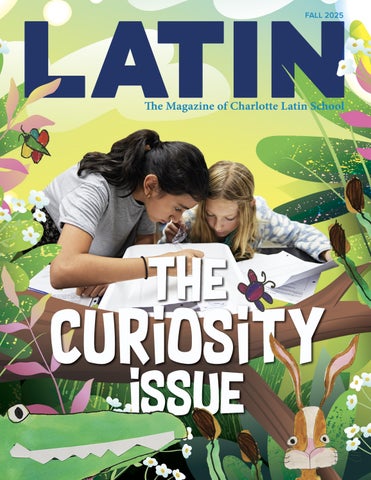
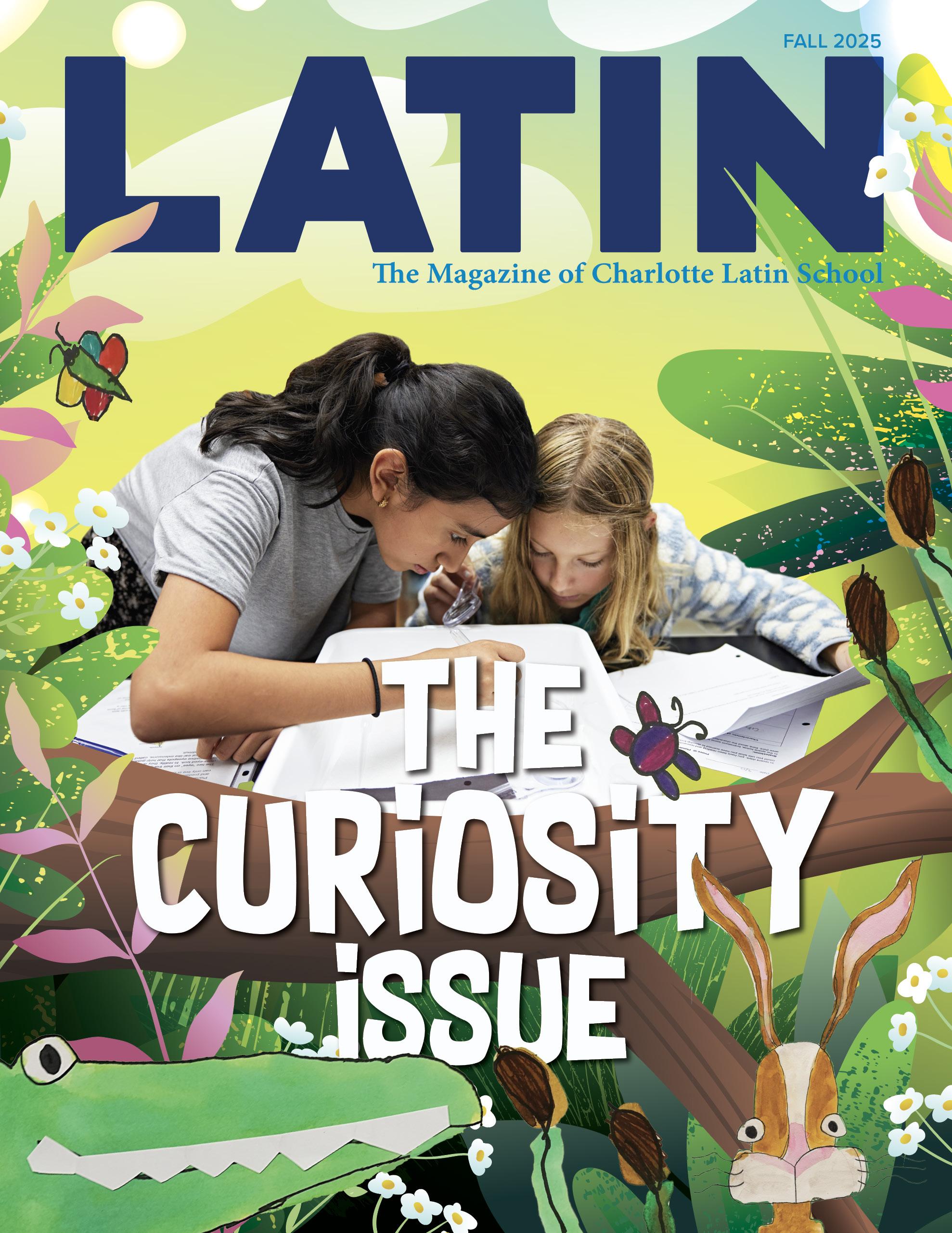
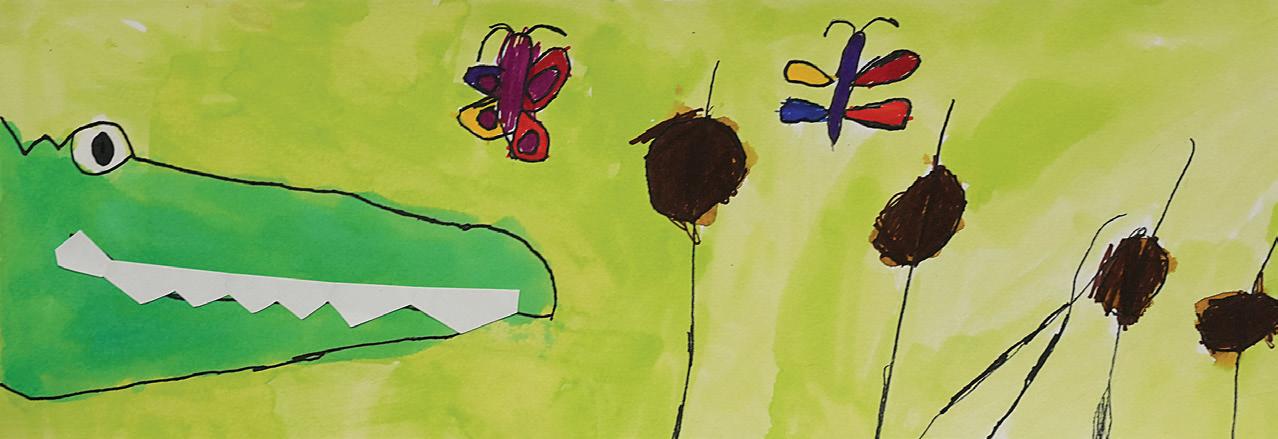
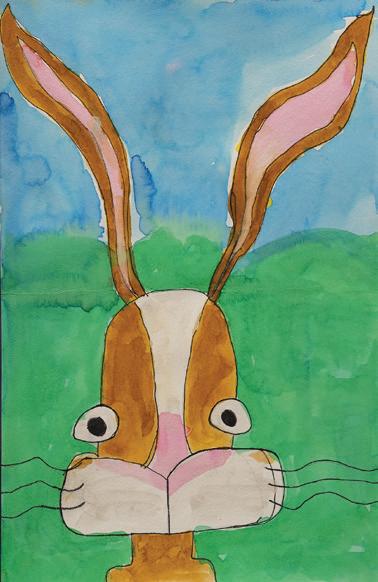
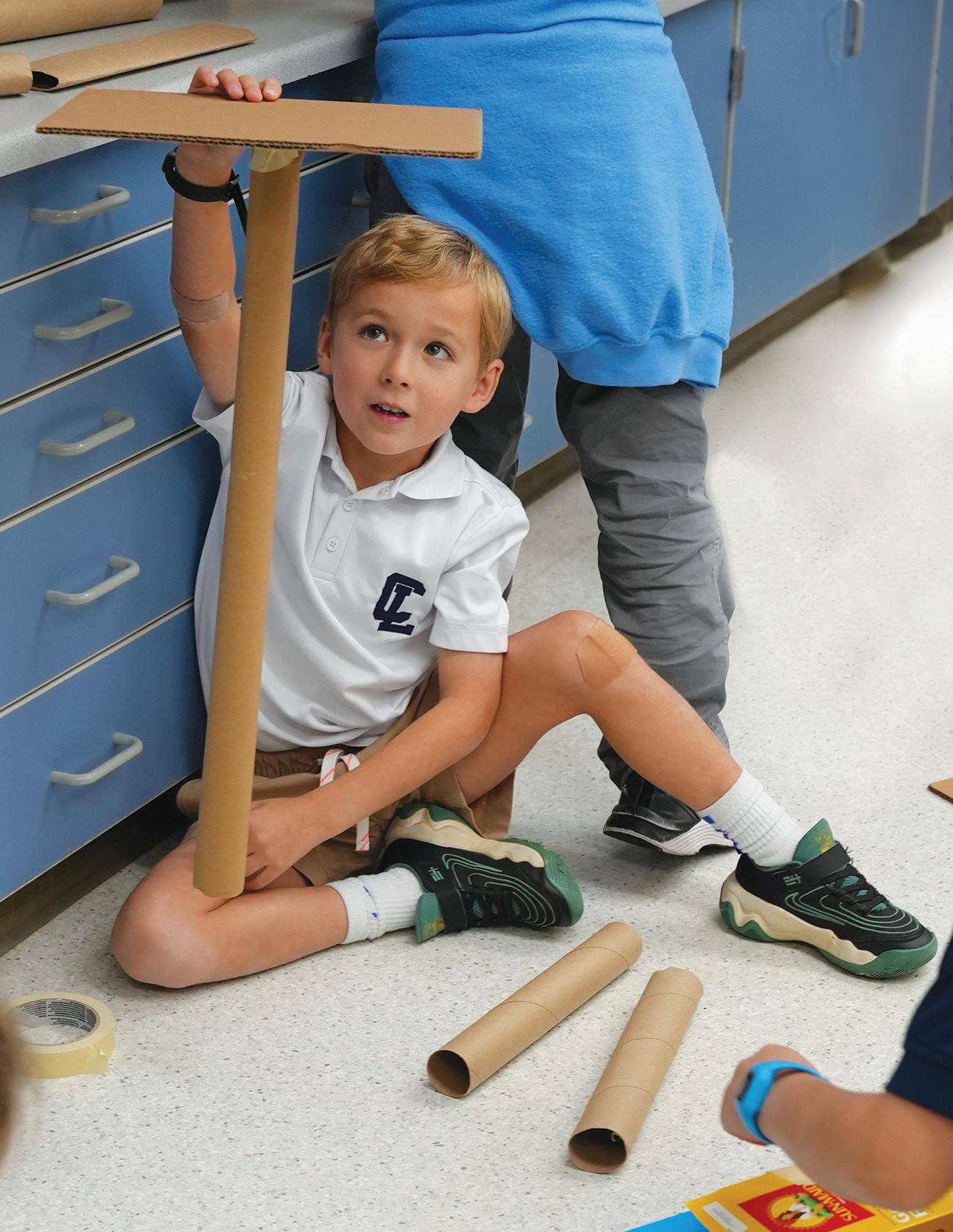
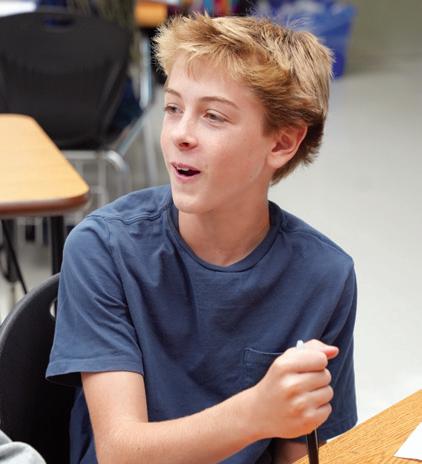
On the Cover: Curiosity — whether it's centered on language, science, or art — leads to creativity and discovery. Middle School students Sophia B. and Grace M. are surrounded on our cover by flora and fauna from the artwork of Henry (in first grade) and Charlotte, Jack, Linkyn, and Tessa (in Kindergarten).
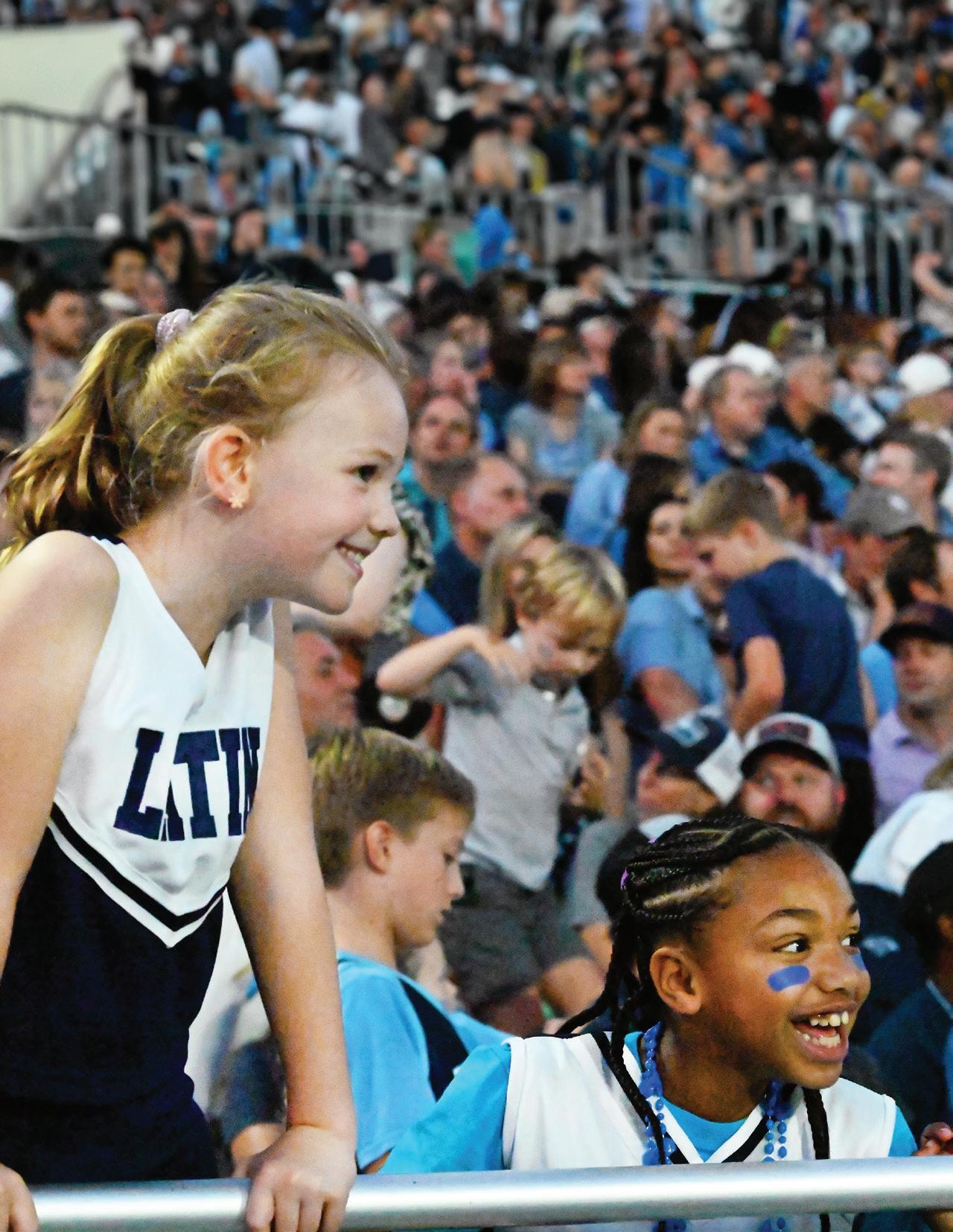
Left: Cheering on the Hawks in Patten Stadium on the night of Touchdown Tailgate.
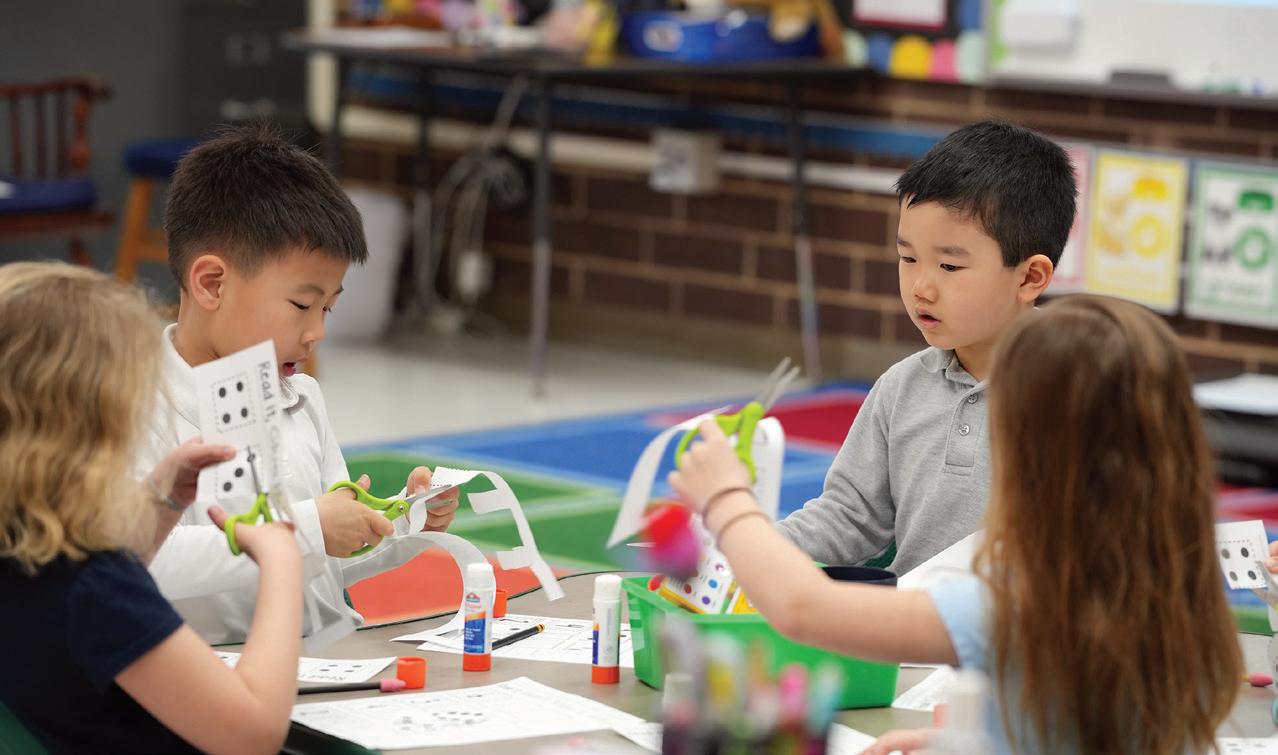
Following pages: the first grade explores shapes; Charlotte Latin celebrates Diwali.
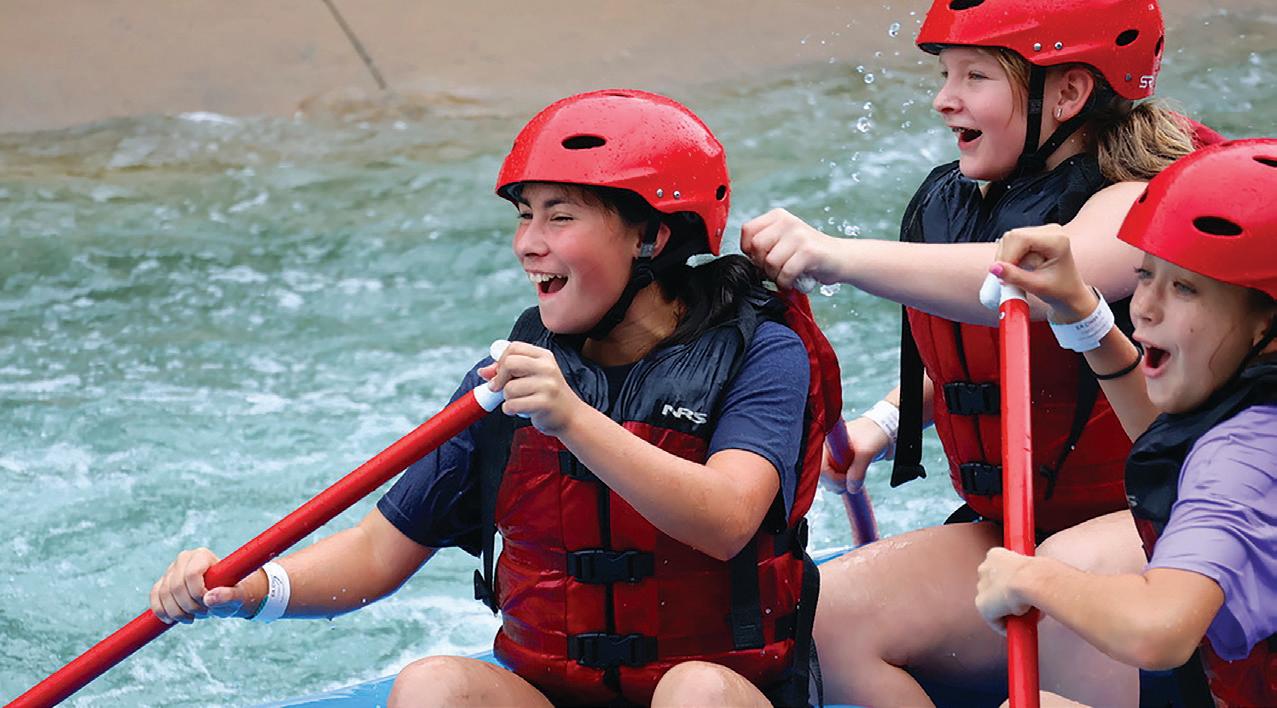
The sixth grade paddles together on a field trip to the U.S. National Whitewater Center.
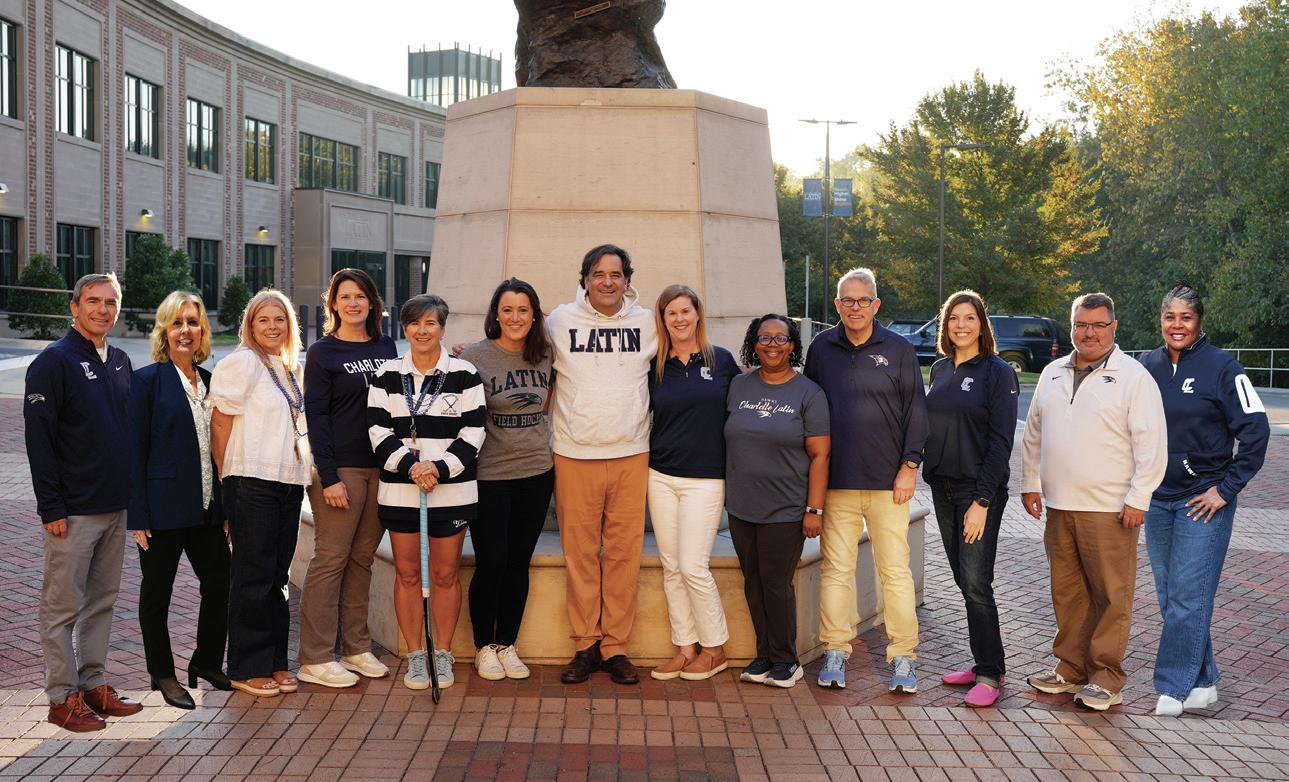
School Leadership
Administrative Team
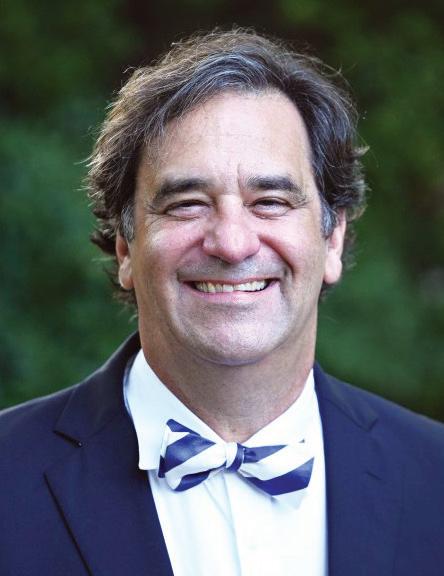
Chuck Baldecchi
Head of School P ’21 ’23 ’25
David Gatoux Director of Athletics
Jim Huffaker Chief Technology Officer
Kerry Johnston Director of Advancement
Beth Lucas Director of Human Resources P ’35
Erica Moore Director of Diversity, Equity, and Inclusion
Karen Moore Chief Financial and Operations Officer
Mary Yorke Oates ’83 Director of Enrollment Management P ’12 ’15 ’18
Louisa Polos Head of Middle School P ’38
Tricia Tam Director of Marketing and Communications
Mark Tayloe Head of Lower School P ’15 ’20
Sonja Taylor Associate Head of School
Tracey Vanneste Interim Head of Upper School
2025–26 Board Of Trustees
*Indicates a new Trustee
Rael Gorelick Chair P ’24 ’26 ’27 ’29
John Comly Vice Chair P ’28 ’30
Phil Colaco Treasurer P ’19 ’22 ’26
Dave Shuford Secretary P ’28 ’30
Mackenzie Alpert P ’30 ’32
Irm Bellavia P ’19 ’20 ’22 ’25
*Susan Bliss P ’25
*Mark Calloway P ’14 ’19 ’25
Paige Ford ’06
Don Gately P ’98 ’04 GP ’30 ’32 ’33 ’35 ’37
Stacy Gee P ’19 ’21 ’22
Anna Stiegel Glass ’01 P ’33, ’35, ’36
Donnie Johnson P ’33 ’33
*Chris Kearney P ’04 GP ’35 ’36 ’38 ’39
Ed McMahan ’93 P ’22 ’24 ’30
Katie Morgan P ’21 ’24
Uma O'Brien P ’29 ’30 ’33
Jack Purcell P ’30 ’32
Christian Robinson P ’32 ’34 ’36
*Margaret Siegel P ’24 ’28 ’29
*Jason Strife P ’28 ’30
Jan Swetenburg P ’98 ’00’07
GP ’32 ’34 ’34 ’37
Charles Thies ’90 P ’32 ’35 ’39
Please send address corrections to Office of Advancement, Charlotte Latin School 9502 Providence Road. Charlotte, NC 28277 or email philanthropy@charlottelatin.org
Ex-Officio
Chuck Baldecchi
Head of School P ’21 ’23 ’25
Karen Moore Chief Financial and Operations Officer
Ken Leonczyk ’96 2025-26 Alumni
Governing Board President
Mandy Hicks 2025-26 Parents’
Council President P ’28 ’29
Editorial Staff
Editorial Director
Gavin Edwards P ’27
Senior Graphic Designer
Monty Todd
Creative Content
Producer
Sacia Matthews
Webmaster
Nikki Williams
Contributors
Ben Goldman ’26
Alex Kern ’11
Director of Marketing and Communications
Tricia Tam
Meredith Kempert Nunn ’98 P ’31 ’33
Katie Sutton
Photography
Jessica Lee
St. John Photography
Joseph Teets
Rusty Williams
FROM THE HEAD OF SCHOOL
Dear Friends of Charlotte Latin School—
When the Latin faculty and staff returned to campus in August, I announced the theme for this school year: curiosity. As I told them, it is our privilege to work at Latin and our joy to fuel curiosity in young students. Curiosity leads to passion and the pursuit of one’s passion leads to excellence!
Curiosity is one of the values in the Portrait of the Latin Leader: the Curious Learner. True learning comes from curiosity, when you care about a subject and you’re not memorizing facts just because you have a test. When you start asking questions, especially ones that begin with “why” and “how” and “what if,” then you learn more about how the world works — and you retain that knowledge. One of the greatest things we strive to do for the students of Charlotte Latin is to encourage their natural curiosity so it becomes a lifelong habit.
The very act of posing questions sharpens the lenses we use to see the world. And curiosity is the spur behind them all. Human beings are always going to want to live an examined life; teachers can help them make that happen. Artificial intelligence may beat you at a game of Trivial Pursuit, but it won’t beat you at the pursuit of finding meaning in life.
Having an annual theme reminds everyone at Charlotte Latin of our highest values. For students, this year’s theme reminds them that no matter what subject or skill they’re studying, they should remain curious. For teachers, it encourages them not only to find ways to foster that curiosity in students, but to be openminded and intellectually hungry about the work of teaching and the world around them.
Among the faculty and staff, we’ve already started sharing some of our stories about where our curiosity has led us. You’ll see some of them in this issue of Latin, but I hope you’ll also have conversations with your children about the things you’re curious about, and the things they’re curious about. Being a Curious Learner is one of the highest priorities of Charlotte Latin — even if sometimes we need to learn to be curious.
With gratitude for a job I love,
Chuck Baldecchi Head of School
What will stoke students’ curiosity in a Middle School English class?
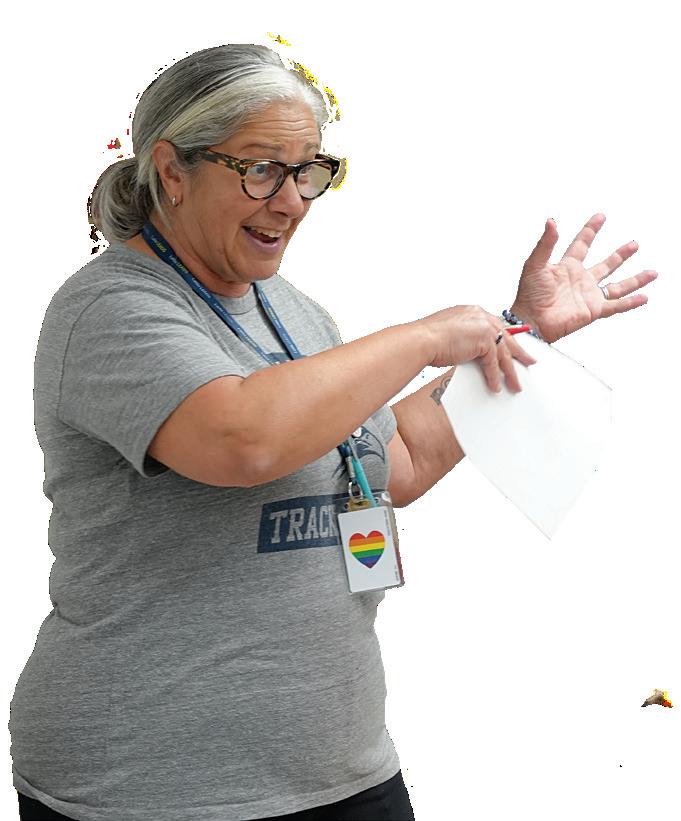
By Dawn DiRoma Middle School English Teacher
Curiosity is probably the single most important trait a reader can have. There’s a certain amount of submission inherent in the act of reading, where you surrender to your own curiosity about what’s unfolding on the page. I often think about Samuel Taylor Coleridge, who was fixated on the reader’s willing suspension of disbelief. And when you’re reading nonfiction, you open a book with the understanding that the author knows the topic in a way that you don’t. You have to read with openness and willingness to learn. So when we foster good reading habits, that’s all built on a foundation of curiosity.
An important thing I’ve learned about curiosity is that you can be intentional about planting seeds that will reap a harvest of curiosity. There are things I’ve always done in the classroom to encourage that, but it wasn’t until I came to Latin and started working with Sallie Caddell, Middle School English Curriculum Lead, who’s so intentional about everything, that I asked really specific questions about my practices: What’s the value of this? How is this going to power someone’s lightbulb?
At the start of the school year, I tell my students, “I’m super-nosy, I’m going to ask you a million questions — I want to know who you are in the classroom and who you are out of the classroom, because that affects our interactions and our learning.” And then I give them a turn to do the same, so they can be nosy about me. I give them five minutes first so they can look around my classroom: What do you see? What does it make you wonder about me? I’m modeling a mindset of questioning everything.
We do a lot of icebreakers, which let them share something personal with their classmates — but not too personal. “If you won a million dollars, how would you spend it?” “What’s the coolest thing you’ve ever tried?” We all share, we all applaud each other, and we build that foundation: we’re a team, speaking and listening together.
To inspire curiosity in the classroom, I believe the most important thing is to create an environment that feels safe. There’s a lot of vulnerability in admitting that you don’t know something, especially in Middle School, so you need to create a safe environment to allow curiosity to flourish. If you start the year by telling students to question everything, then you have to nurture that mindset and celebrate when they make mistakes.
At the start of a new unit, I don’t just stand at the front of the room and dump information on them: “The Outsiders is a novel written by S. E. Hinton in 1967.” Instead, we share some relevant resources, and students can take notes about what they’re wondering and what connections they might be able to make. We give them the opportunity to uncover the information themselves: that’s an important part of activating their curiosity. Later on, we check in again: Of the questions I asked, which ones did I get answers to?
Another important element of fostering curiosity is giving the students choicebased projects. After most of our units, we have a “choice board”: the students have a lot of ways to express their thoughts about what we just read, whether they want to focus on a key scene or on an authorial choice. A choice-based option might be to write another chapter to the book — from a different character’s perspective. I once had a student who chose to write a poem about the book, but then asked if they could make it a song. “Are you asking me if it’s okay to write a song?” I said. “What do you think the answer is?” We take turns sharing with the choice-based projects: half of the class stays with their projects, while the other half walks around and check them out. By the end of that class, everyone was gathered around him, trying to get him to play his song again. And his lyrics were awesome! They were about the importance of minimizing our plastic usage.
With a foundation of curiosity and asking questions, we can teach the importance of academic discussion. I give the students open-ended questions: they should be able to support their answers with evidence, but there are also gray areas in the interpretation of literature. Sometimes they’ll be agreeing and adding on, sometimes respectfully disagreeing, sometimes questioning each other.
But for all of that, your curiosity light needs to be fully flipped on, so you can attend to your fellow students and build the conversation together.
One strategy we employ is “back to back, face to face”: you stand back to back with the person next to you. I’ll put a question up on the board, give them 30 seconds to think about their responses, and then they turn around and have a conversation face to face. The academic conversation isn’t a sprint, it’s a marathon: later in the year, we move into larger discussions and Socratic seminars.
My favorite thing that happens in those Socratic seminars — and it happens all the time — is when someone says “you just totally changed how I think about this.”
That means that the students are participating in the discussion with a curious mind, open to the ideas of others.
We’re planting seeds and hoping they bloom. This all culminates at the end of the year with our interview project, when each student interviews a hero in their own life, somebody they know and love and admire. The spark of curiosity is already lit and the habit of questioning is already there: the learning and the human connection follow naturally.
CURIOSITY CHALLENGE
How can Charlotte Latin implement a classroom on the road, 8,000 miles away from the school’s campus?
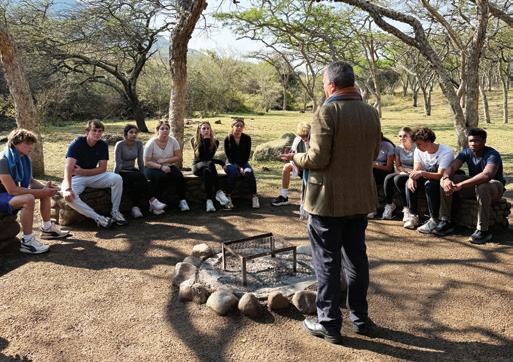
he newest Charlotte Latin summer class, Cultural & Comparative Leadership: South Africa, began in July 2025 with a Harkness discussion next to gate A38 in the HartsfieldJackson Atlanta International Airport, where students pulled the departure lounge’s furniture into a circle so they could talk about Binyavanga Wainaina’s essay “How to Write About Africa.” Unless, of course, it began in 2005, when Charlotte Latin School entered a partnership with its sister school Hilton College, a boarding school in the KwaZulu-Natal Midlands of South Africa.
Or possibly, it began in 2022, when Dr. David-Aaron Roth, Director of Student Leadership Development, asked the question “How might we experience the ideals of leadership in a new place or culture?” He explains, “Leadership happens in many different spaces. My first year here, I went to our Director of Global Studies, Kelly Willis, and asked her about partners who might be interested in having meaningful discussions about leadership, how governments exist in different cultures, and how people flourish in those communities. Working with our Global Studies program, we wanted to create a transformative educational experience.”
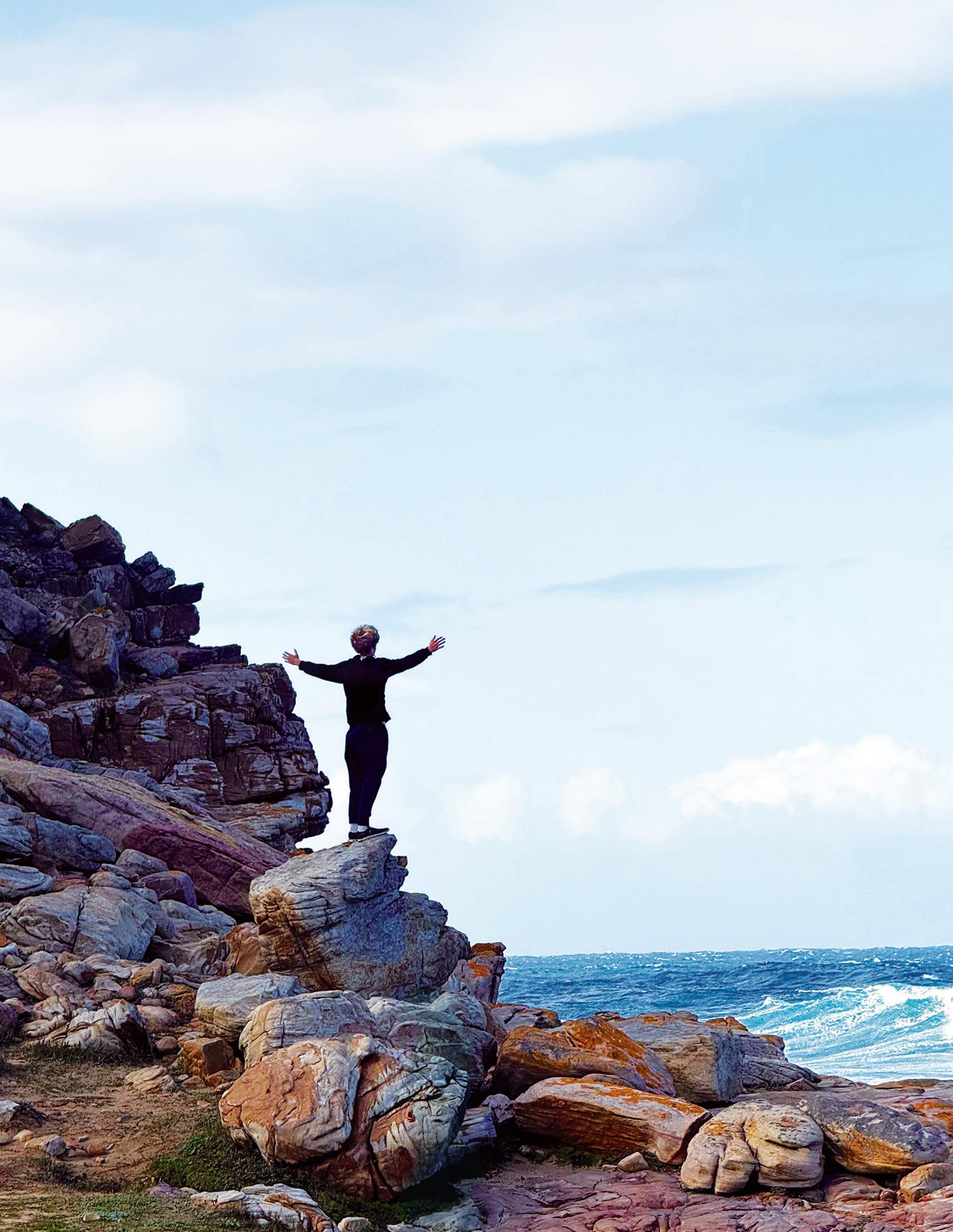
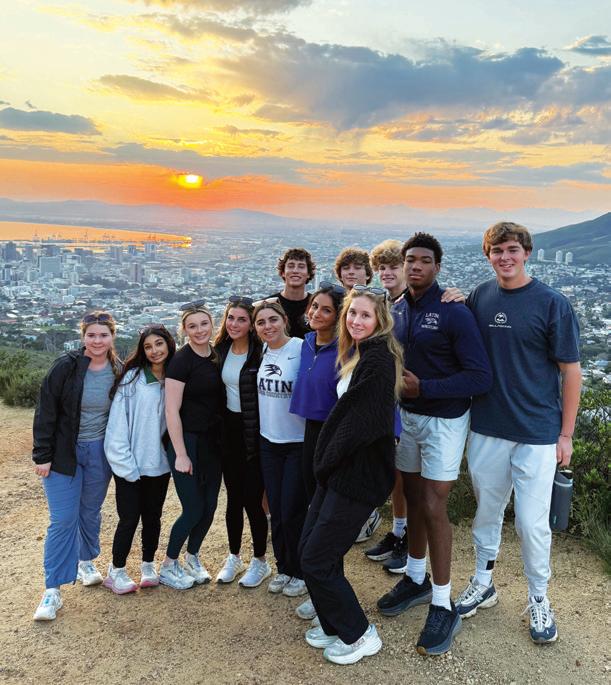
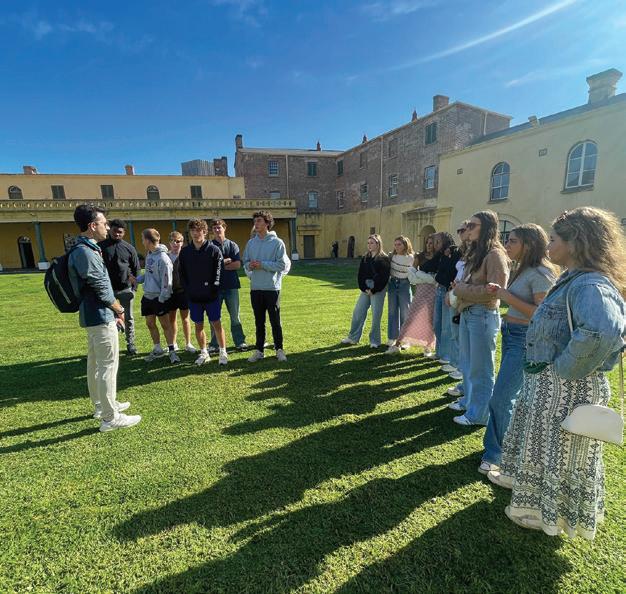
That’s how Roth, Upper School English Teacher Jessica Lee, and a dozen Upper School students spent two and a half weeks this summer in a course of study abroad that provided Charlotte Latin academic credit. Students’ daily readings ranged from a history of Mahatma Gandhi’s time in South Africa to analyses of anti-poverty efforts. They also wrote personal reflections and engaged in regular seminars — and they toured the country, taking no fewer than seven plane flights to visit as many relevant locations as possible. Roth said, “If you’re going to learn about Ubuntu [an African philosophy of interconnectedness], part of your responsibility is to make sure that you meet as many different people as you can.”
Henry Graham ’27 reports, “Dr. Roth and Ms. Lee weaved everything together: we would do a reading on something and then we visited the place where it happened and we could talk about the reading.” For example, the history of Gandhi was paired with a trip to the Phoenix Settlement, a community that he founded in 1904; excerpts from Nelson Mandela’s memoir were enriched by the opportunity to talk with Christo Brand, a prison guard who became friends with Mandela over the decades of his confinement.
Lee says, “It was an absolute revelation to see the students grappling with historical context and the world around them. They were able to make a lot of astute observations and also question their own biases and prejudices in real time — which is something that we always celebrate, but often don’t get to actually see.”
For Mac Fletcher ’26, one day that made him think about the world differently was a visit to a township that is home to people living in extreme poverty: no shoes, no bathrooms,
no doors on sheet-metal sheds. He says the eye-opening experience was summed up by a friend’s comment: “I’m never going to complain about my dinner ever again.”
The trip also gave students the opportunity to contribute: they volunteered at Angel’s Care, an organization that provides after-school care for impoverished children. Lee says that the Latin students jumped in, heedless of language barriers: “One of our students volunteered immediately to lead story time. So he was reading a storybook to about 50 small children, and the interpreter was standing next to him, translating it into three other languages.”
At the beginning of the trip, Latin students formulated six questions about leadership that they asked the people they met throughout their South African journey. While they learned about leadership and community from a new perspective, they also discovered something unexpected: the South Africans they met often had specific and informed opinions about the United States. Since South Africa is a smaller country dependent on its relationship with the world’s superpowers, its citizens are attuned to American policies, from tariffs to immigration to voting laws.
College when he was able to help the teacher solve some problems he was having with his fish tank.
“Students need space and time to think and process and marinate,” Roth says. Part of that practice came through the students’ daily reflections (and their capstone projects), but some of it came through moments of one-on-one coaching. He adds, “This trip is an exemplar of how you can work with sister schools who you have meaningful relationships with, create a cultural experience for students that allows them to get outside of themselves, and allow them to author their leadership identity in tandem with their social identity.”
In the summer of 2024, Sejal Dhiman ’27 went on a Charlotte Latin trip to Argentina, which only whetted her appetite for travel. “I was looking to learn more about the world,” she says. “I had unanswered questions, even if I didn’t know what they all were.” After she returned to Charlotte from the summer class, she was inspired to take on leadership responsibilities in student organizations. “During the trip, I said, I need to do this when I get back,” she remembers. “Being in South Africa, I learned a lot about myself.”
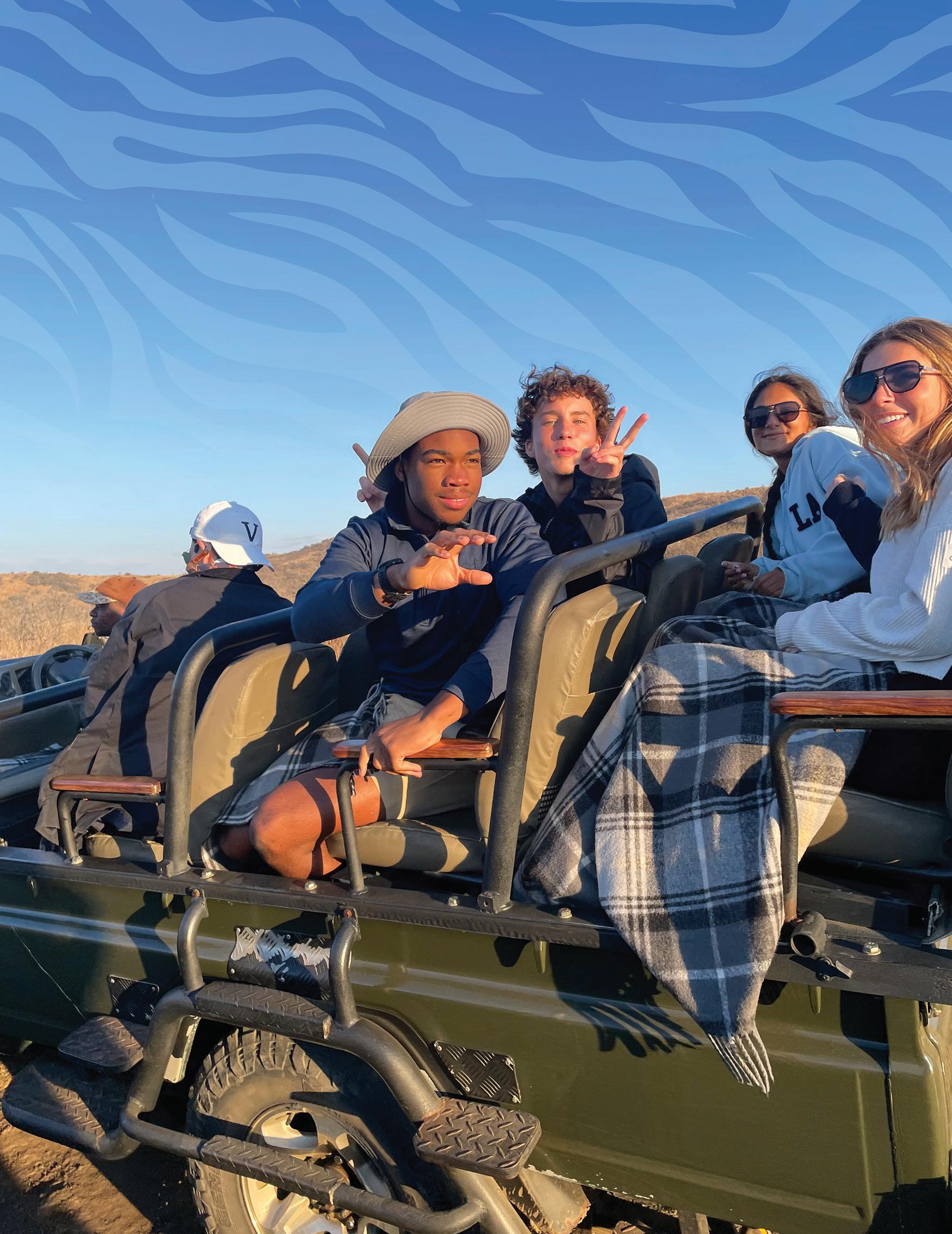
The trip also included cocurricular experiences such as learning to play rugby, eating new foods like oxtail, and going on safari. (Lions and hippos and rhinos, oh my!) Students marveled at the local wildlife — and at the savanna's intense night sky. They became closer friends with their traveling companions and connected with South Africans: Fletcher, an aquarium hobbyist, bonded with a biology teacher at Hilton
At press time, there were a few spots remaining for the 2026 edition of Cultural & Comparative Leadership: South Africa, open to students entering grades 10 through 12.
For more information, contact Kelly Willis (kelly.willis@charlottelatin.org) or apply at
CURIOSITY CHALLENGE
How can Charlotte Latin improve the campus in ways that will endure for years to come?
This summer, the Charlotte Latin campus was filled with work crews doing important projects. Because of our community’s support for the Latin Fund and the Honor & Glory campaign, and the generosity of the Booster Club, we were able to make many improvements in a short amount of time. Some of the work upgraded our facilities, while some of it adjusted old spaces for new needs. Some of it implemented creative solutions to problems: the Quad, for example, had trouble growing grass because every year, the red clay of Carolina soil turned into orange mud. The solution wasn’t more attention from groundskeeping crews, but creatively reimagining the space.
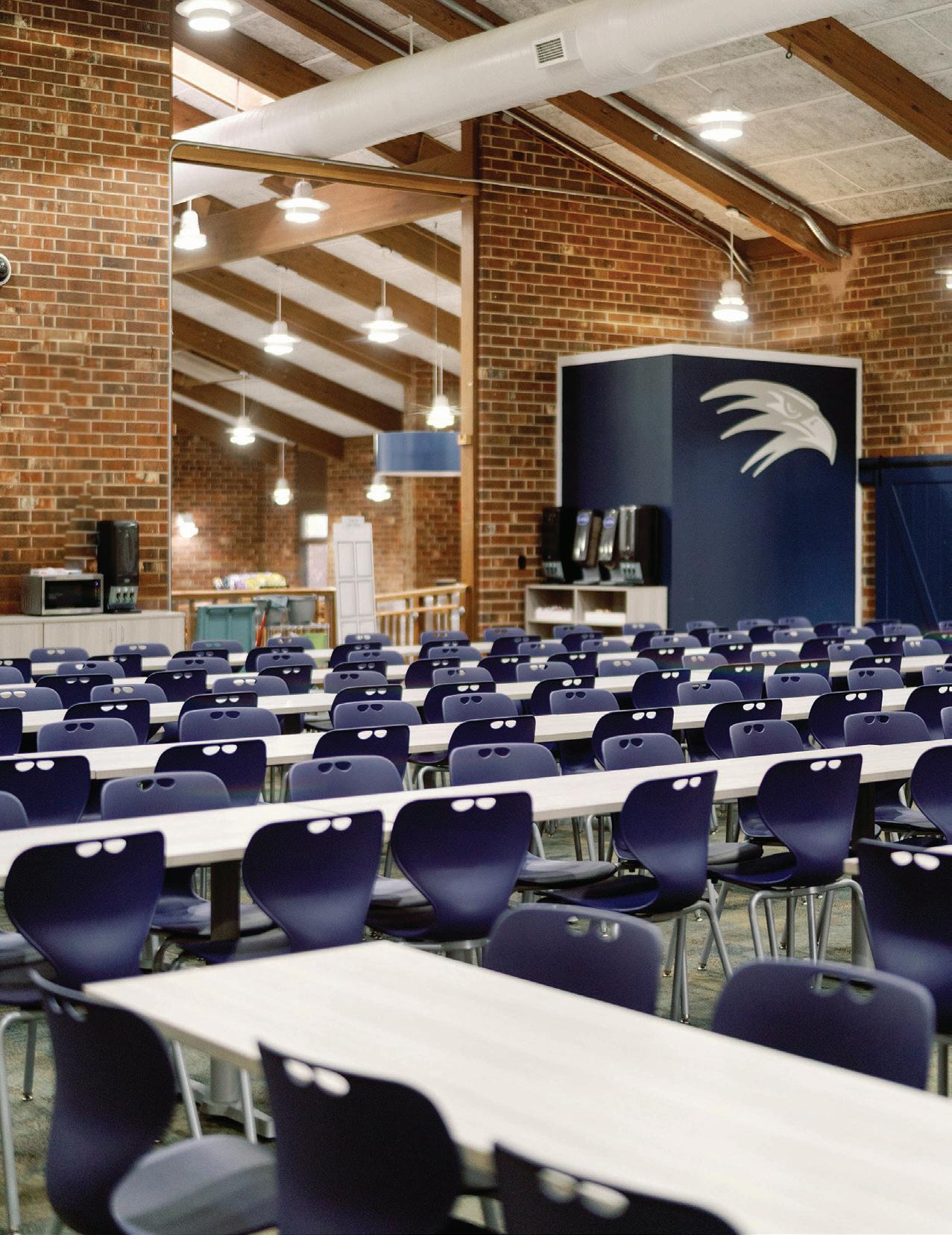
The remodel of Founders’ Hall accommodates the new school schedule, ensuring that we can achieve the school’s long-held goal of feeding students by division and fostering their sense of community. Increasing student capacity, while maintaining flow and efficiency, had many components: adding a new deli and a new bowl station, replacing much of the kitchen equipment, expanding the dish room, ordering new tables and chairs (for Shelton Hall too), installing new plumbing and sewer lines, and converting the old Hawk Shop into “On the Fly,” a grab-and-go food area with coolers and display racks. A new walk-in cooler and freezer was installed behind the elevator shaft at the back of Founders’. In addition, the downstairs Safety & Security office was updated from floor to ceiling, while the large windows in that office have
been replaced with wall space for camera monitors; that made room for a new cold food prep room. Community support of the Latin Fund helped make all this work possible.
“I like change and I like growth,” says Dawn Collier, Director of Dining Services at FLIK. “What normally would be an eight-month build-out, we got done in seven weeks.” The changes didn’t stop with the first day of school: since then, there’s been a new point-of-sale system, new billing software, and the reintroduction of togo meals that can be ordered in advance. “I want to make sure we’ve got something for everyone,” she says of the increased range of lunchtime options. “And we’re keeping that personal touch.”
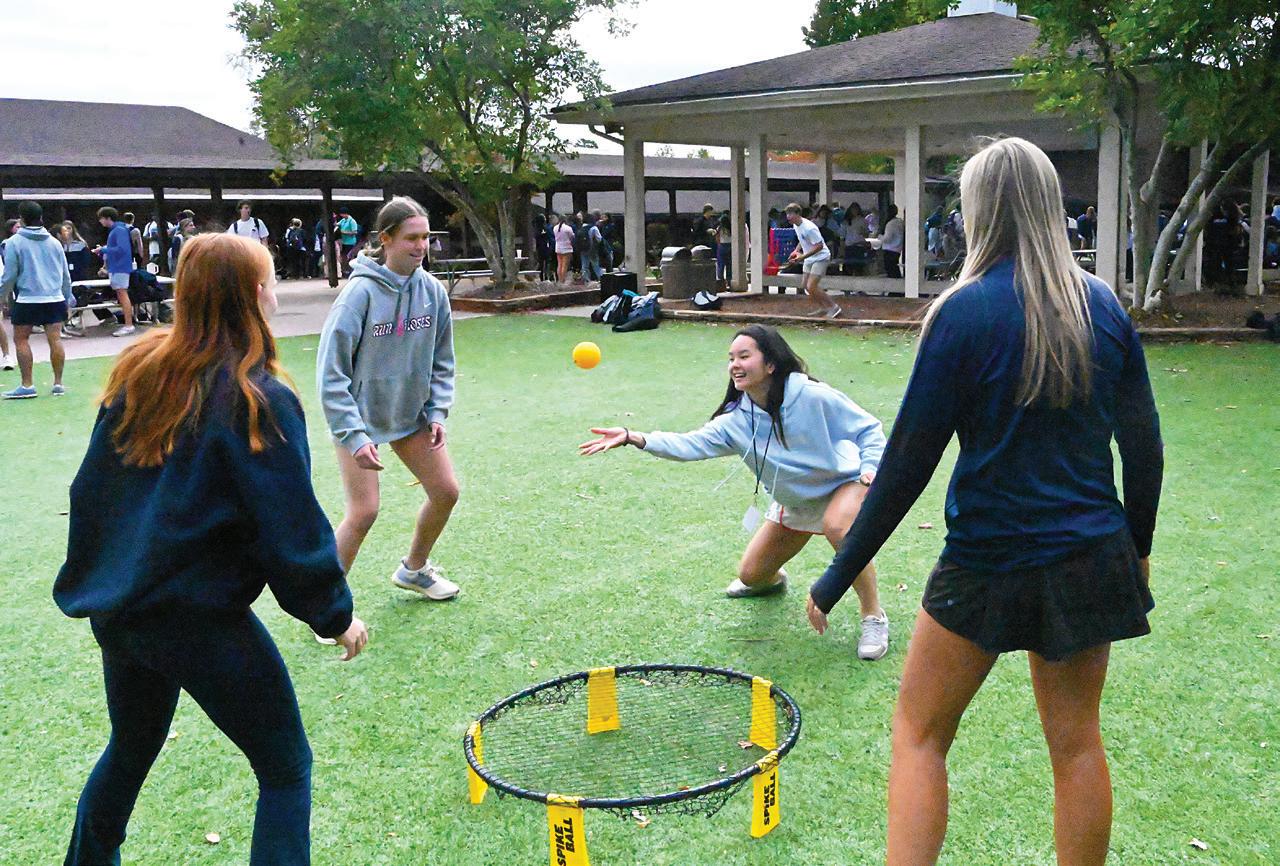
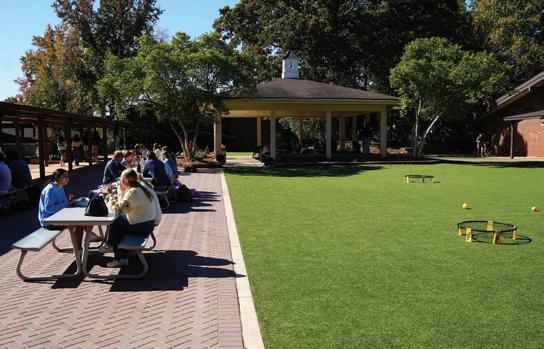
To solve the longstanding issues with drainage and mud, we resurfaced the Quad, spanning the entire outdoor area from the Belk Gym to the Crater Sculpture. We excavated the topsoil, replaced it with a stone base, and then covered it with artificial turf. Brick-paved pathways and benches complement this enduring patch of green. With community support from the Latin Fund, our students now have viable year-round outdoor space. The final touches: adjusting the stormwater covers and reinstalling the canopies over the walkways that connect the Fox Middle School with the McIntosh Leadership Center. With a no-cell-phones policy in effect in the Upper School, students have flocked to the revamped Quad during their free time, connecting with each other and playing games of spikeball, cornhole, and chess.
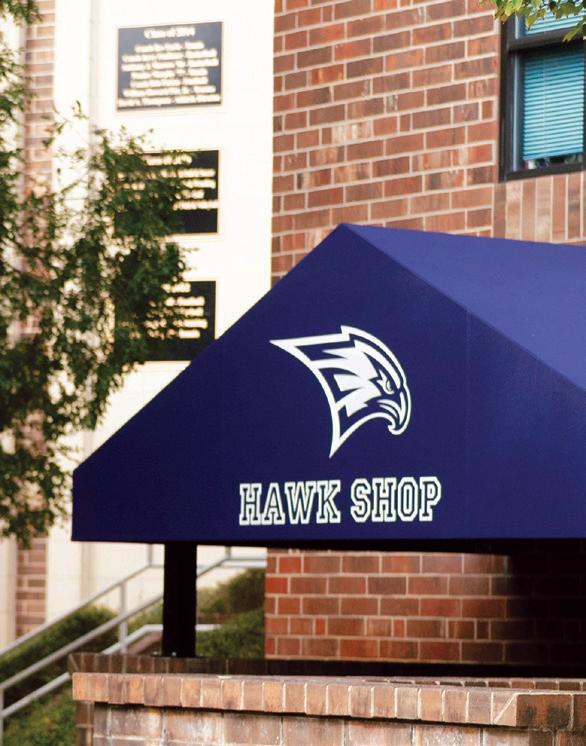
All that work at Founders’ Hall meant that the Hawk Shop needed to move. It’s now under Belk Gym, in what was previously custodial storage space. The final touch for the new location was a canopy over the door, featuring Charlotte Latin’s new hawk logo.
The resodding of Patten Stadium was a longplanned upgrade, covered by the school’s operating budget — the old field lasted nearly twice its expected ten-year lifespan. The stadium now has new goal posts (goose necks only), a removable play clock, a new discus pad, and a new shot put pad. After resodding the field, we prepared Patten Stadium for competition by cutting the grass down to a one-inch height.
We renovated the locker rooms at the Marshall E. Insley Fieldhouse at Patten Stadium, installing new epoxy floors, retiling the bathroom, and updating the plumbing. This work was generously funded by the Booster Club.
Our community’s generous support of the Honor & Glory campaign meant that we could install lights at Field 2 in the spring; in the summer, we converted Field 3 and Field 4 to artificial turf. These fields created much-needed space to increase scheduling flexibility and capacity for team practice and training across all sports, regardless of the weather. After the retaining walls were poured and backfilled, work crews had to lay the turf surface, hang nets, and run a water line around the fields.
The Mat Hawks can’t be contained! True, but this project was actually the removal of the Wrestling Room roof and installation of a durable replacement: a new TPO (thermoplastic polyolefin) roof.
To maximize the use of space in the Inlustrate Orbem Building, we converted what was originally two offices and a conference room into five new offices. The Advancement Team has already moved into their new workspace.
“In a society that often values winning at any cost, we’re building programs that aim to win the Latin way,” says David Gatoux, Director of Athletics. He’s well aware that the landscape of high school sports has changed dramatically in recent years, with modern factors including social media, recruiting, and even NIL (name, image, and likeness) endorsements. In that new environment, Charlotte Latin took a hard look at its own athletics program and how it needed to be updated for the present day. Elevating internal conversations that had been going on for some time, the school commissioned an outside assessment from the Finney Search Group and followed it with an Athletics Task Force, which included representation from administrative liaisons, coaches, parent volunteers, alumni, and members of the Board of Trustees.
After a year of work, the Task Force had suggestions of how to bring Latin athletics into the future, as symbolized by the school’s new hawk logo, but reaffirmed the program’s high level of participation; its alignment with Latin’s mission, Core Values, and Portrait of the Latin Leader; and its high level of success.
Pursue personal growth through service to your team and as a representative of the Charlotte Latin community.
Build relationships and contribute to the collaborative effort.
Compete with passion, purpose, and sportsmanship.
Persevere through individual and collective challenges.
Establishing the underlying principles the athletic program clarified its vertical K-12 alignment. Latin studentathletes have a natural progression in each sport, beginning with afterschool programs in Lower School, progressing to Middle School Navy and White teams, and then to Junior Honor Above All remains a constant, participation and the introduction team goals ultimately transcending
• Two full turf practice fields
• Lights on Field 2
• An auxiliary gym next to the Strength Center
• An indoor multisport training facility (featuring a golf simulator, batting cages, and more)
Lower School
MS Navy & White
Junior Varsity
Varsity
CURIOSITY CHALLENGE
What practices will best foster children’s inquisitive natures?
hildren are naturally curious. Lower School teachers often hear questions such as “Why does smoke come out of my mouth when it’s cold?” or “What happens to the clouds when it stops raining?” or “Why is glue sticky?” These questions often combine wonder, logic, and a dash of the absurd. While it can sometimes be tiring for a teacher to field all of those curiosity questions, at Charlotte Latin we know how important it is for our students to maintain a high level of curiosity. In fact, it’s so important
By Mark Tayloe Head of Lower School
that in our Strategic Plan, our teaching and learning goal is titled “Promoting Intellectual Curiosity.”
“Curiosity is innate,” longtime first-grade teacher Catherine Williams recently told me. “As a teacher, it is so important to me to fuel students’ curiosity. It can be tempting to simply answer their questions, so that you can get on with what you have planned for the day. Sometimes that’s necessary, but it’s much more powerful when you can respond in a way that makes the student more curious.”
She gave an example from last year: “Around election time, one
first grade class was talking about astronauts. A student asked if astronauts in space could vote. Instead of answering the question, the teacher asked her to go find out. The student came back the next day, after her parents helped her research, and let the class know that yes, astronauts can vote in space.”
The school setting can deter children’s innate curiosity — if they’re afraid of getting something wrong. Our teachers emphasize that making mistakes is an essential part of how we learn, but sometimes children have trouble buying in. Happily, our math curriculum, Math in Focus, helps us circumvent those fears.
“In math, we often begin the lesson with an anchor task,” said fourth grade teacher Neil McConaughy. “We give students a problem, initially without offering help or guidance. After they have worked on the problem for a while, I ask a number of them to present their approach on the board. Sometimes there are four or five different ways that students have solved the problem. They might not all be right, but we find that each strategy has merit, and we really celebrate the kids who risk getting the answer wrong.”
Day by day, almost all of our Lower School teachers make intentional efforts to tap into the curiosity of their students. Third grade teacher Laura Balabushka, for example, introduces every new topic by asking her students what they already know about it, launching them on a voyage of discovery.
" The best days are when curiosity takes over, and we lose track of time."
In some classes, like art and STEAM, curiosity and creativity are practically required from the moment when students walk in the door. TK-1 STEAM teacher Nicole Caprio gave this example: “During our simple machines unit, we gave the class the challenge of building a wind-powered car. They needed to attach their axle and wheels — a drinking straw and Life Savers — to a piece of cardboard. Then they added a sail made from paper and a straw. The car needed to move straight when put in front of a fan. One student was particularly focused on this challenge: the first few times, his car didn’t work, but he was determined. He kept finding something else to try. Finally, it
all came together — he was so excited when his car zoomed across the floor. His hard work and curiosity were reinforced when his classmates cheered him on.”
Art teacher Shelly Magno told me that it’s easy to tap into students’ curiosity in her art classes because students have so much choice.
“Inspiration and the desire for self-expression drive curiosity in the art room. For students, curiosity represents the need to know oneself deeper, to create an identity, and in a sense, visualize one’s older self,” she said. “Within each lesson, opportunities for student choice and independent planning promote curiosity and exploration.”
Research has revealed many benefits to students when their curiosity is sparked. Curiosity activates dopamine in the brain, priming it for learning. Curious students transition from external rewards like grades and praise to internal satisfaction — which leads to persistence and resilience. And curious learners embrace ambiguity and develop critical thinking skills faster.
As we examine every aspect of our curriculum and our approach to teaching, developing curious learners remains at the forefront of our thinking and planning. Charlotte Latin is blessed with talented teachers who are open-minded about best practices and hungry for their students to love learning. When they nurture students’ curiosity, they ensure that our students are engaged and eager to find relevance in what they are learning.
Second grade teacher Katherine Evatt uses her morning meeting to pique the curiosity of her classroom: “My assistant, Stacey Little, creates a new and engaging morning message for students to read and think about while settling in each day. It covers a wide range of topics, from influential people to birthstones to National Croissant Day. Then, during our morning meeting, we discuss the
topic, allowing students to ask questions, share what they know, and make connections. The best days are when curiosity takes over, and we lose track of time.”
Lower School is all about building a foundation for a lifelong love of learning. When you tap into children’s curiosity, you are doing exactly that!
129 TH THE ACRE
Rael Gorelick, Chair of the Board of Trustees, announces the purchase of the Head of School House
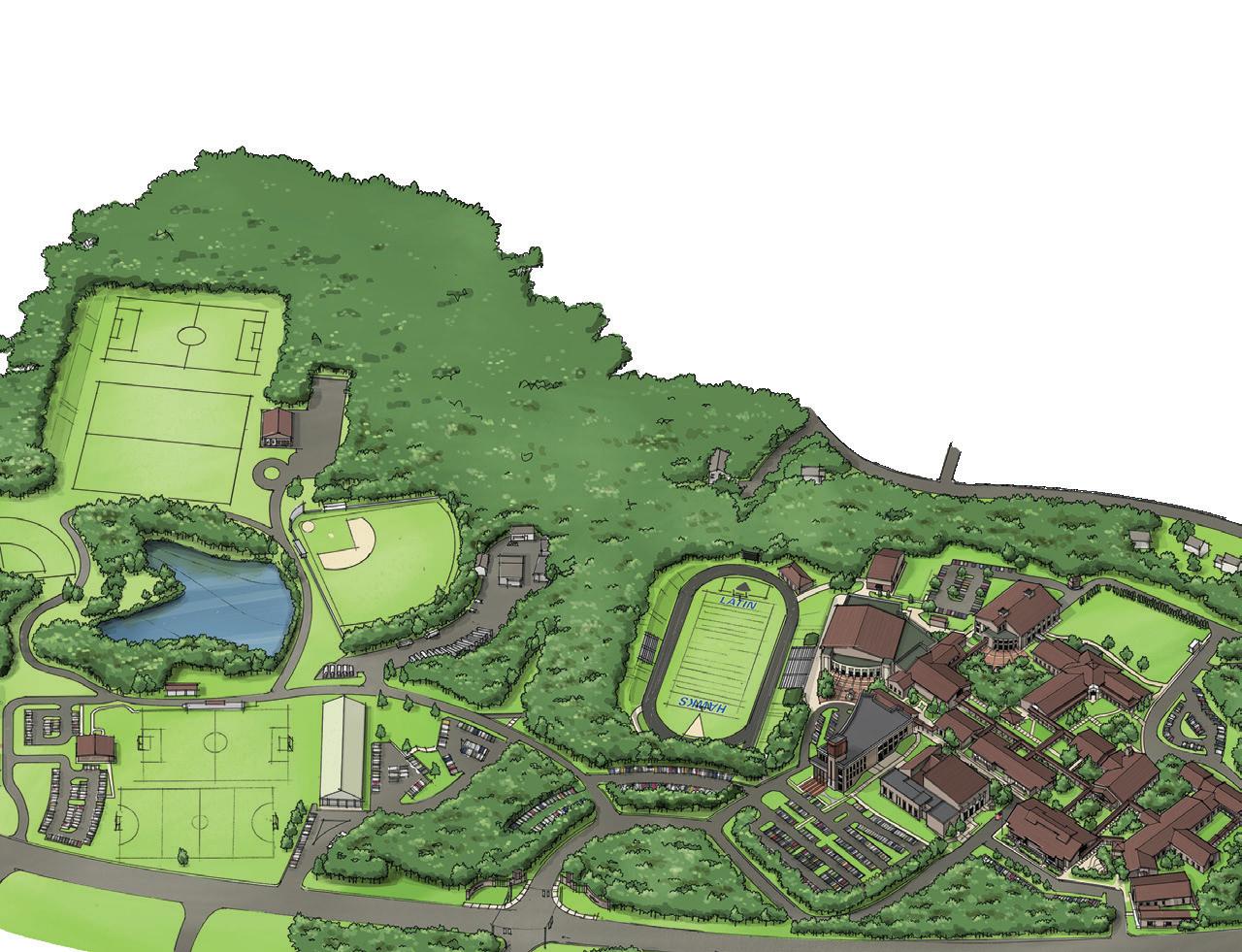
For years, Charlotte Latin School has been trying to buy a house adjacent to our campus that would be owned by the school and occupied by the Head of School. The vast majority of our peer independent schools nationwide have an on-campus residence for their heads of school (including, here in town, both Providence Day School and Charlotte Country Day School); not having one left us at a disadvantage. That’s why I am delighted to tell you that Charlotte Latin has closed the deal to buy a beautiful house on Stonemark Drive — and I’d love to explain why it’s an even better idea for the school than you might realize.
Charlotte Latin has been blessed with a series of Heads of School with long tenures, but no Head stays forever. When we’re recruiting and hiring future Heads, the industry standard for independent schools is that our financial offer will include housing; if we can’t offer top-notch candidates a house on campus, then we need to recoup them in some other way, such as offsetting their housing as part of their compensation package.
Owning a house on campus will thus save the school a significant chunk of money; that would be reason enough to buy it, but the property has strategic advantages. It can be used as a location for social functions, fundraisers, or even seminars. And it’s beneficial for the school to have the Head living on campus. In the event of an after-hours emergency, they’re already on site — and being on campus makes it easier for them to attend evening events like choral concerts and field hockey games, facilitating their participation in the life of the school.
We had particular requirements for the house: we wanted it to have at least four bedrooms, so we could accommodate a Head with a family. The kitchen needed to be well-
equipped for a catering service’s needs, so we could feed guests at an event. And for tax reasons, the house needed to be adjacent to Latin’s existing campus.
Years ago, the board began the search for a suitable property by reaching out to the owners of all the houses abutting Charlotte Latin, to see if any of them were interested in selling — none of them were. As we continued our search, we focused on the houses that better met our needs. There are about 50 houses that border Latin’s 128 acres, although some of them are more conveniently located than others: we wanted a property that would be easy for visitors to walk to after parking in a school lot. While a handful of homes met our specifications, four houses rose above the rest. Unfortunately, none of their owners had any plans to sell anytime soon.
Speaking as someone with experience in real estate investments, I know that when you need one particular property — for example, when you want to buy out the last parcel in an assemblage so you can start a larger project — you will pay more than the market value, especially when you’re the one approaching the seller. We ended up paying more for the house than you might expect, because the property was worth more to Latin as a Head of School House than its current market value as a single-family home. But even paying that premium, we saved money for the school.
The house is gorgeous and it matches all of Latin’s needs without requiring any significant alterations or renovations. Chuck and Erin Baldecchi will be moving in at the beginning of the 2026-27 school year; they’re eager to live on campus and I greatly appreciate their enthusiasm. I’m also grateful to all the other members of the executive committee of the
Board of Trustees who worked on this project, especially Vice Chair John Comly and the past Chair Mike Freno.
Once Latin occupies the property, it will officially become part of the school’s campus. The strategic benefits of owning this house were consequential by themselves, but when it became clear that the house purchase would also save the school money, it was obvious that we had to make the deal. It turns
out to be a significant advantage, both strategically and financially, for the school to expand to 129 acres.
Hawkishly, Rael Gorelick
STONEMARK DRIVE
ADULT SWIM
Our teachers lead by example—demonstrating that curiosity and growth have no off-season
ROBIN SICZEK, UPPER SCHOOL ENGLISH DEPARTMENT HEAD,
attended the Summer Academy at the Folger Shakespeare Library in Washington, DC.
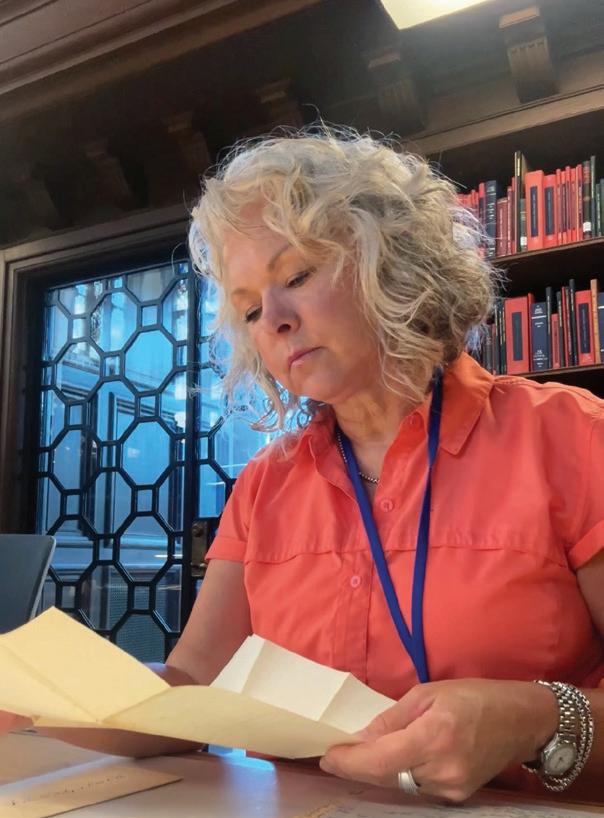
Part of what made me interested in teaching at Charlotte Latin was the school’s commitment to professional development. Previously, a lot of my professional development focused on antisemitism and the Holocaust, but I really wanted to teach a Shakespeare course, and I felt like I needed a refresher. One of the benefits of being at the Folger was that I got to spend research time in their library, studying how Macbeth was performed in different productions over the years. But the highlight might have been an intimate session with an actor and a director, where they discussed their Shakespearean experiences.
The idea behind the Folger method of teaching Shakespeare is that it gets students on their feet — performing, hearing the language, and bringing their own interpretations to the play. I’ve been using it in the course I’m teaching, Shakespeare and the Human Condition: recently we worked on a scene between Desdemona and Othello, where I split them into teams. One team performed the scene with her being confused, while the other performed it with her being indignant. Doing that, they could see how it changed the response of the audience. The students say that it’s fun, and I can see how it helps them dig into the text.
At Charlotte Latin School, learning isn’t just for the students. Every year, the school’s faculty and staff attend seminars, workshops, and classes that enrich their expertise, inspire new plans, and renew their enthusiasm for their jobs. These professional development programs are generously supported by the Latin Fund and the Carol G. Belk and Edward E. Ford Foundation endowments. Some of them require traveling thousands of miles, while others involve a journey of a few hundred yards, but when Latin’s teachers return to their classrooms and share what they’ve learned, the enlightenment ripples out across the whole school.
AMY KEEFER, LOWER SCHOOL SPANISH TEACHER,
attended the Summer Summit workshop sponsored by NNELL, the National Network for Early Language Learners. While her daughter attended Latin Camps, she joined the workshop virtually from the Latin campus — often sitting in the Upper School math office, which was unoccupied and made for a change from her usual environment.
There were six offerings each day over two days: I was able to focus on the ones that were for young learners, like TK, Kindergarten, first grade, and second grade. One of the biggest takeaways for me was that I learned a lot about how to spin a topic into a theme. You don’t just say “we’re learning colors” — you ask essential questions that lead to the theme of colors. That also lets you make connections to other areas of your students’ academics: if they’re learning about the lifecycle of plants, you can talk about what colors they might be seeing in nature.
There were also a lot of workshops about ways to play, because young students learn best when the subject is engaging to them; they all love to play and sing and dance. I didn’t get the personal connections that you would have with an in-person seminar, but the upside is that NNELL runs these programs year-round, so I’ve already been able to attend an additional workshop. This is my first year as a full-time employee at Latin — the school really supported and encouraged me taking these classes.
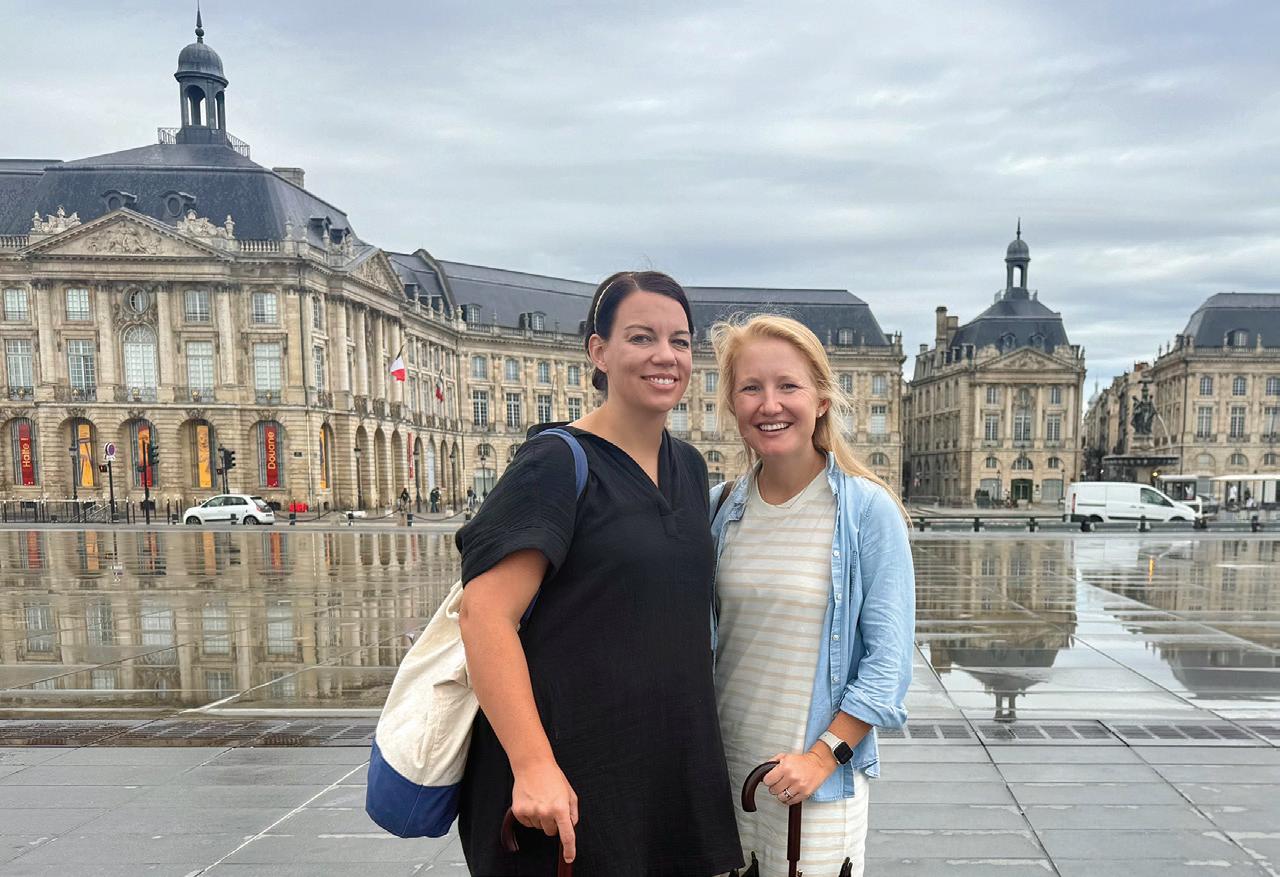
JENNA SINCLAIR, MIDDLE SCHOOL FRENCH TEACHER, AND RACHEL WELLS, LOWER SCHOOL SPANISH TEACHER, traveled to France to
attend the Agen Workshop.
Jenna Sinclair:
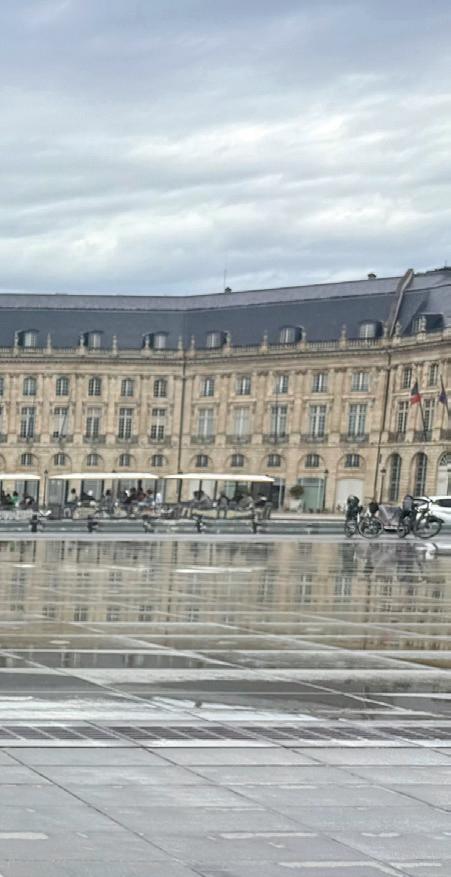
Participating in the Agen Workshop had long been on my professional development bucket list. This trip offered an added bonus: I learned that Agen is located near Bordeaux, where our sister school, L’École Saint-Marie Grande LeBrun, is located. I saw an opportunity to collaborate with my colleague Kate, who I met through the school’s exchange program. Each year, our students participate in a penpal exchange, and this in-person visit allowed us to strengthen that partnership. I flew into Bordeaux the Saturday before the conference, which gave Kate a chance to show me around the city — a place I had never visited — and to deepen our collegial and personal connection, which until then had existed largely through email. After all, world language learning is about cultivating authentic connections across linguistic and cultural lines!
The methods taught at the Workshop are rooted in the research of Dr. Stephen Krashen, a leading
expert in second language acquisition. Krashen’s findings — which have been replicated many times — demonstrate that the most effective way to acquire a language is not through rote memorization or drills, but through exposure to compelling comprehensible input: language that is just slightly beyond students’ proficiency level, delivered through reading and listening. As learners are exposed to this type of input, they build mental representations of the language that eventually lead to confident speaking and writing.
Rachel Wells:
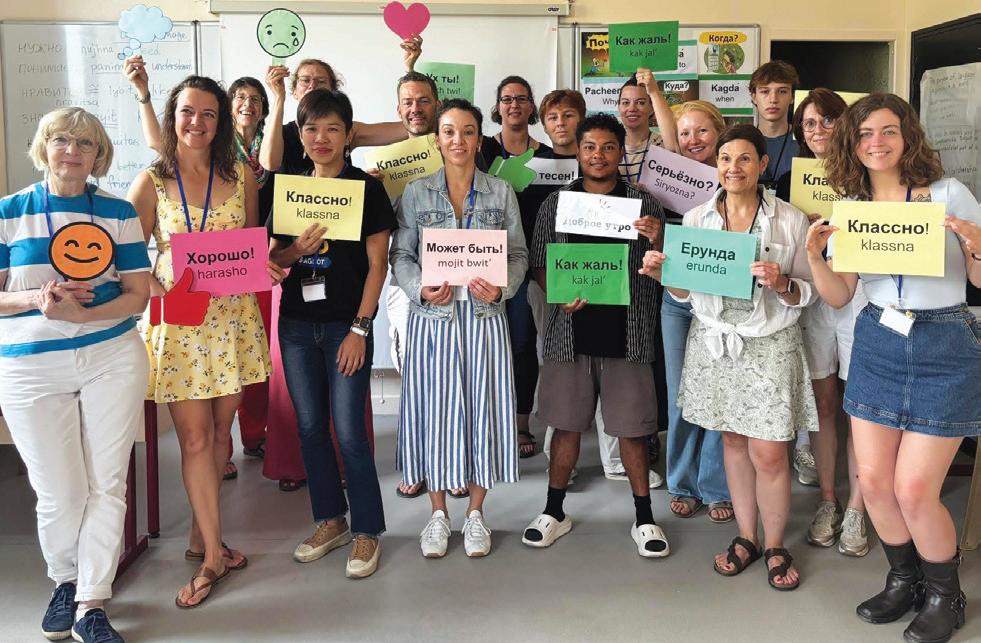
The structure of the conference was divided between morning language labs, collaborative lunches, and afternoon sessions. This provided us with an opportunity to learn with and from international colleagues, often using multiple languages. A lunch conversation might include a Spanish teacher from Belgium, an English teacher from Argentina, and a Russian teacher from Alaska.
Jenna and I were both in a Russian language lab. I know it sounds strange: why would you send a Spanish teacher to France to learn Russian? But the facilitators believe that the most powerful way to understand how to teach with comprehensible input is by experiencing it firsthand in a language that you don’t know. We were with a master teacher, and afterwards, she could debrief us and coach us on the techniques that she used.
Since getting back, I’ve been thinking about ways that I can involve students in the process of learning Spanish to make it more engaging and student-centered. Recently I’ve been working on integrating high-frequency verbs into our thematic units and using stories to deliver new content. As a class, we cocreate stories in Spanish. I provide the framework and the students contribute the details. “There is a boy. What is the boy’s name? The boy goes to school. He forgets something! What does he forget for school? Where does he go?” The students all get to contribute to the narrative and approaching the curriculum with this context has been really, really impactful.
JULIA WALTHALL-EISMAN, MIDDLE SCHOOL
EDUCATIONAL TECHNOLOGIST, SCIENCE TEACHER, AND LEADERSHIP TEACHER,
attended a program run by Leadership + Design in Santa Fe, NM, called What’s Next? Design Your Journey.
I have a quilt of responsibilities at Charlotte Latin: I teach science, I do ed tech, I sit on the admin team in the Middle School, I observe teachers and give feedback. Some people in my career have told me, “You’re saying yes too much.” It’s not that I can’t say no: it’s that I value contribution and it fulfills me. But sometimes it can be hard to explain what the common threads are in that quilt. This program was designed for independent school folks looking to define their path forward. Some of the other people there were women coming back after maternity leave, some were administrators considering retirement, some were heads of school who didn’t know what their next move was.
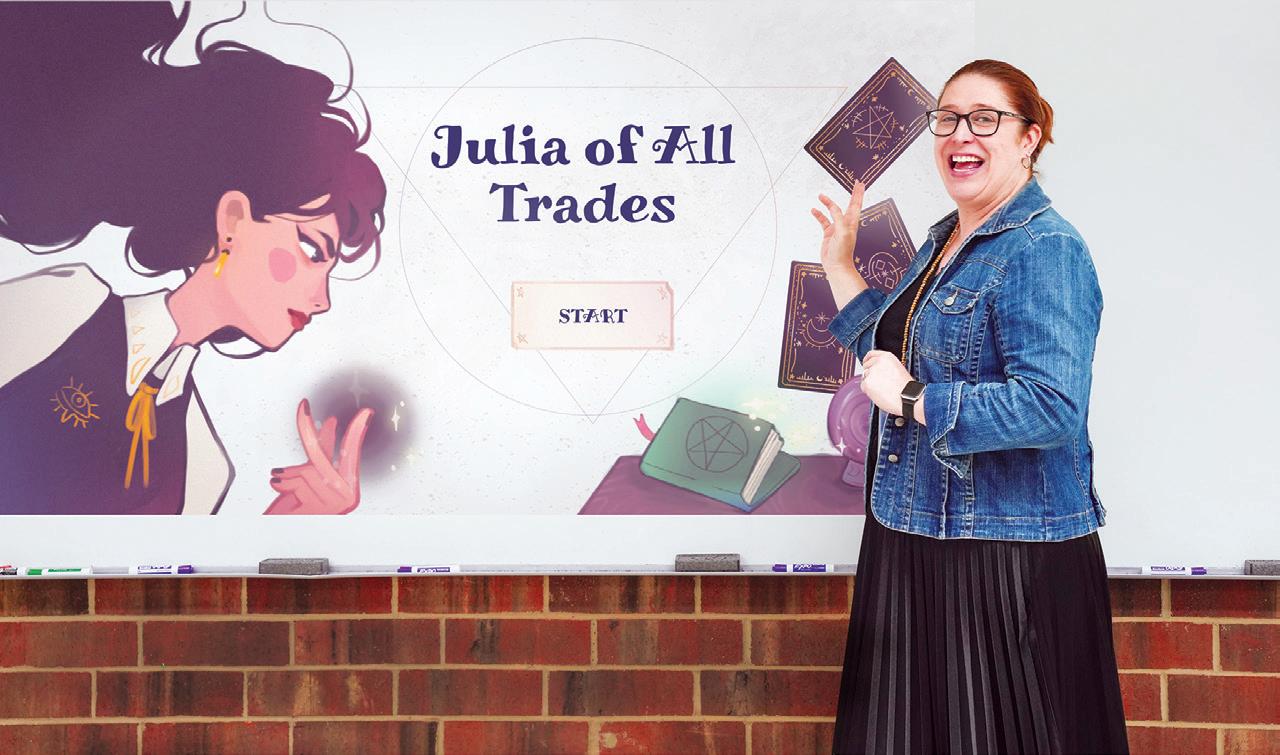
They walked us through these exercises so we could think about what aspects of our roles bring us joy and what other paths would also provide that joy. Part of our self-discovery was being able to story-tell, and so we had lots of work with partners where they reflected back the information that you shared with them. At the end, you presented your takeaways — and because I’m extra and I couldn't help myself, I created a videogame called “Julia of All Trades.” Working on it gave me some action items and revealed some paths forward that I hadn’t seen before. One way of looking at it is that I was identifying where my skills and joy meet Latin’s needs. Because I would love to be at Latin as long as possible — my job is incredibly exciting and I love it here.
RICHARD HARRIS, UPPER SCHOOL ENGLISH TEACHER,
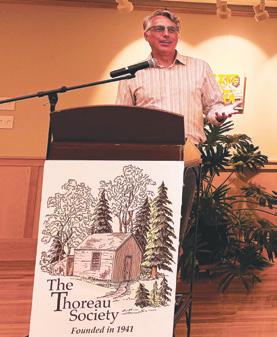
has been teaching Thoreau’s Walden and American Transcendentalism for 26 years at Charlotte Latin but had never visited the famous Walden Pond in Concord, MA, until this summer, when he was invited by the Thoreau Society to present to an audience of fellow scholars.
My topic was the environmental ethos and ethical vision of Edward Abbey, the essayist who’s been called the Thoreau of the American West. I discussed his allusion to Thoreau in a section of his book Down the River about walking through Aravaipa Canyon and realizing the redemptive value of that mysterious place. It’s not an empty desert; it’s full of life. Similarly, when Thoreau visited Walden Pond in the 19th century, his contemporaries would have called it a “desert” because nobody lived there.
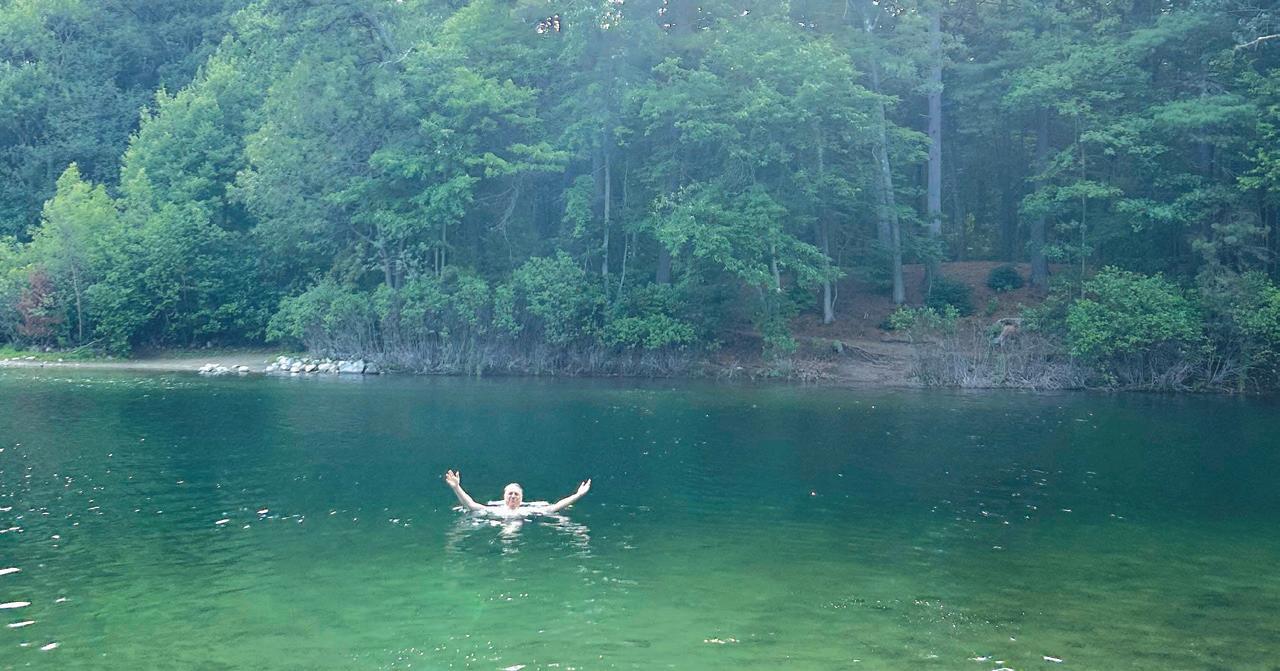
After I gave my presentation, I went down to the pond. Usually it’s pretty busy in the summer, especially at Thoreau’s Cove, but I was able to swim out alone into the sunlit cove. Five small, silver fish circled around me and hovered above the palms of my outstretched hands. The water was probably eight feet deep, but I could see all the way to the bottom. I was able to learn about that emeraldgreen translucent quality firsthand, which is at the heart of what Walden is about.
This year I've already said "Good morning!" to my students in the afternoon and told them it's not a mistake, that Thoreau wrote about greeting each morning by wading into the pond with an optimistic state of mind awakened to the dawning potential
of the day. I've experienced this refreshing truth, and now I can teach the text with a deeper awareness of what the experience was actually all about.
I try to pass on Thoreau’s intuitive sensibility to my students. I love the sublime moments when students make connections on their own, inspired by the sunlight filtering through the leaves over the Outdoor Classroom and the water symbolism of our Zen-oriented gardens on campus. Embracing that intuitive, natural approach to learning means remembering that students need to have those experiences themselves. Clarity of water can lead to clarity of thought, so in a recent lesson on Thoreau's pilgrimage to the peak of inspiration, which he describes as a fountainhead, I had students walk up beside our Calming Cascade. They found the fountainhead of Inlustrate Orbem and realized what our motto of “enlighten the world” means in transcendental terms.
CURIOSITY CHALLENGE
How can technology illuminate Fennebresque Hall?
L IGHT AT THE END OF THE HALLWAY LIGHT
The best art gallery on the south side of Charlotte: the hallways of Charlotte Latin School. Some student works are on permanent display in the school’s public spaces (like the towering giraffe sculpture by Sam Alexander ’23 in the entrance lobby of the Inlustrate Orbem Building), while others are rotated like the collection of a particularly busy collector with an eye for award-winning painting.
Two years ago, when Michelle Godfrey (Executive Assistant to the Head of School) and Nidhie Dhiman (Student Leadership Development Assistant) were looking for a new student work to showcase in the hallway of Fennebresque Hall, next to Latin’s business office, they walked over to the Science, Art, and Technology building — but instead of visiting the Upper School art studios, they stopped in the Fab Lab, just a few yards away.
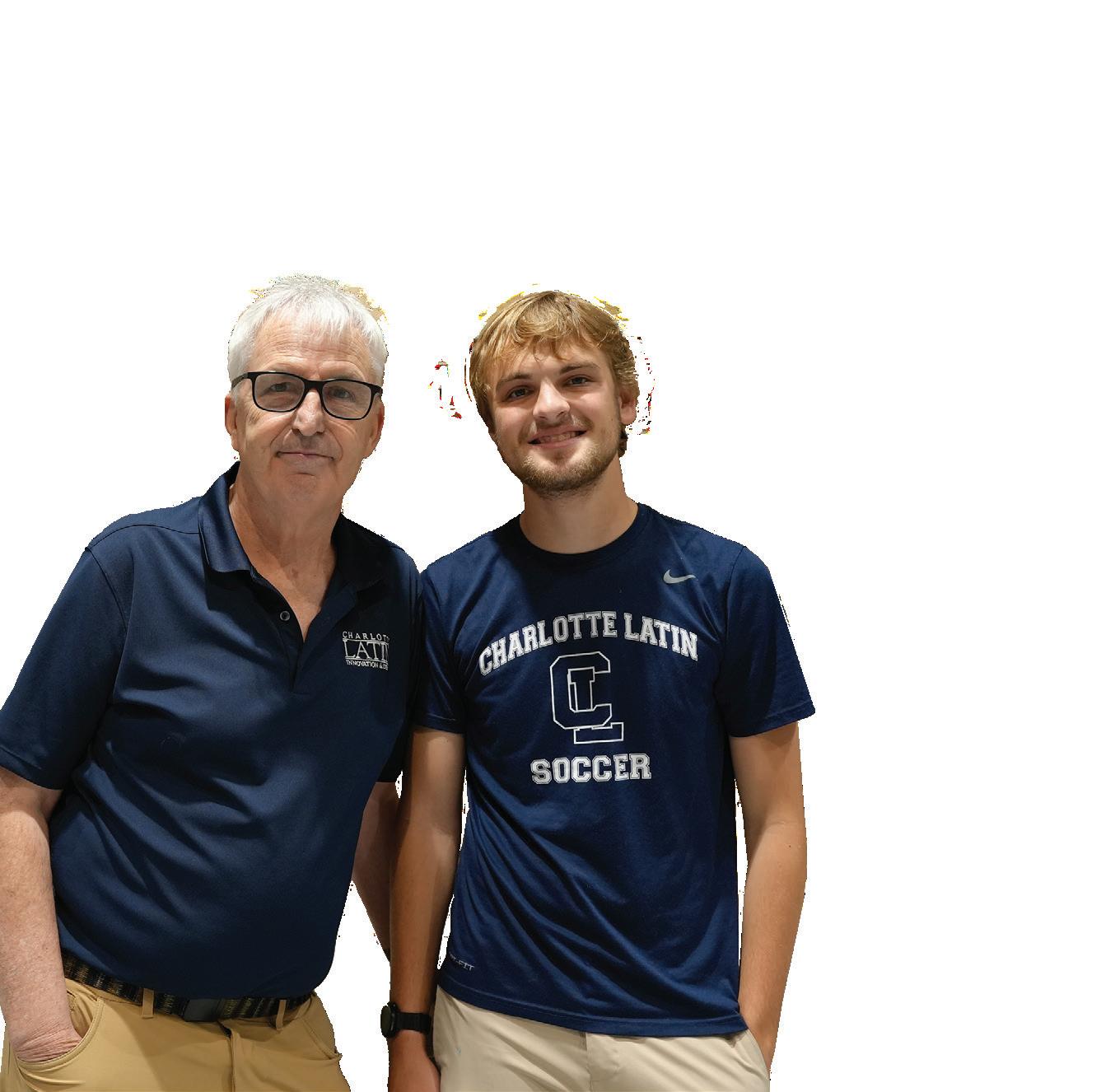
“We were going to see if we could get some students to create something, maybe out of cardboard,” Godfrey said. However, Tom Dubick (Director of the Fab Lab), encouraged them to raise their expectations: he introduced them to Stuart Christhilf ’25, a sophomore who was working on an interactive lightboard.
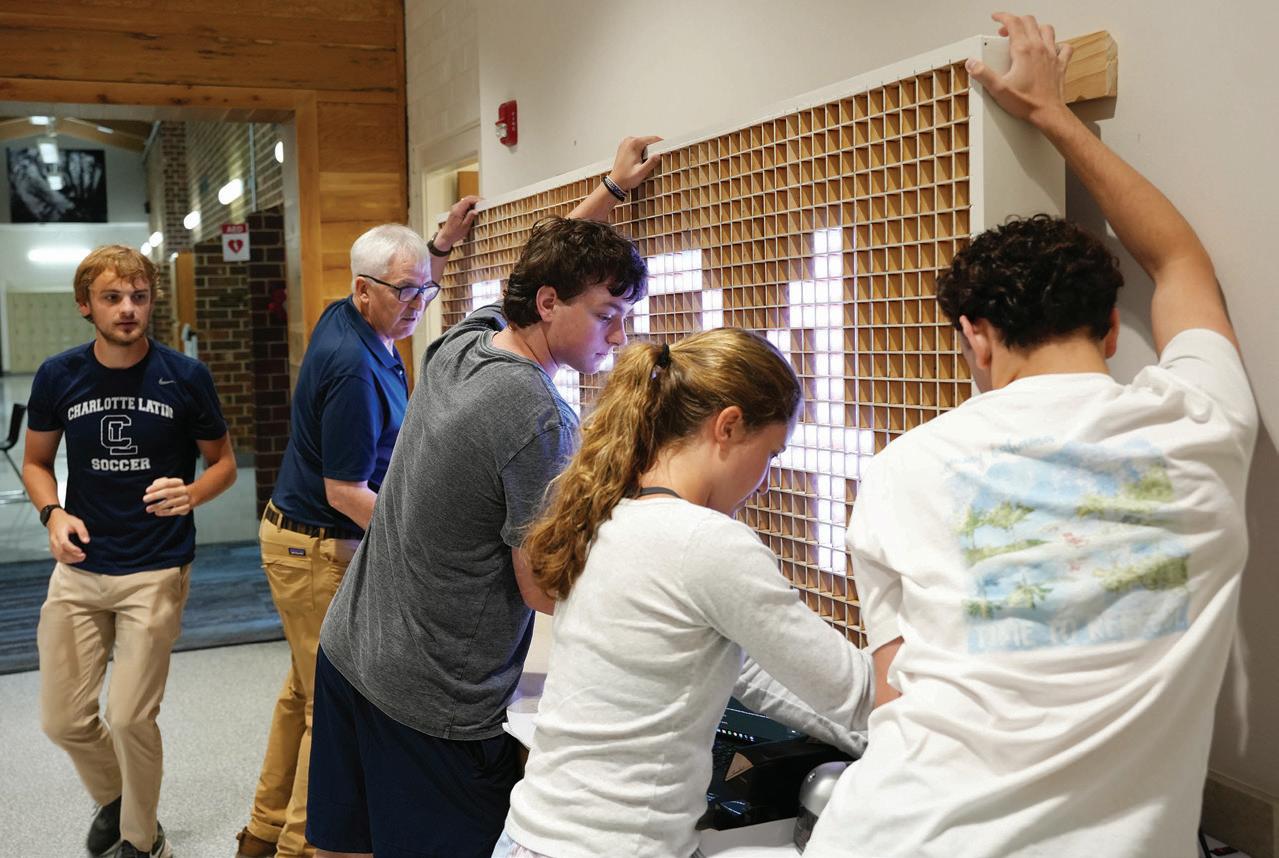
The project took a couple of years to complete, because the scope kept growing and because Christhilf was also completing Fab Academy and Cisco router certification. But this spring, around the time he graduated, he and a team of fellow students hung the lightboard — an array of LEDs three feet high and eight feet wide — on a Fennebresque wall.
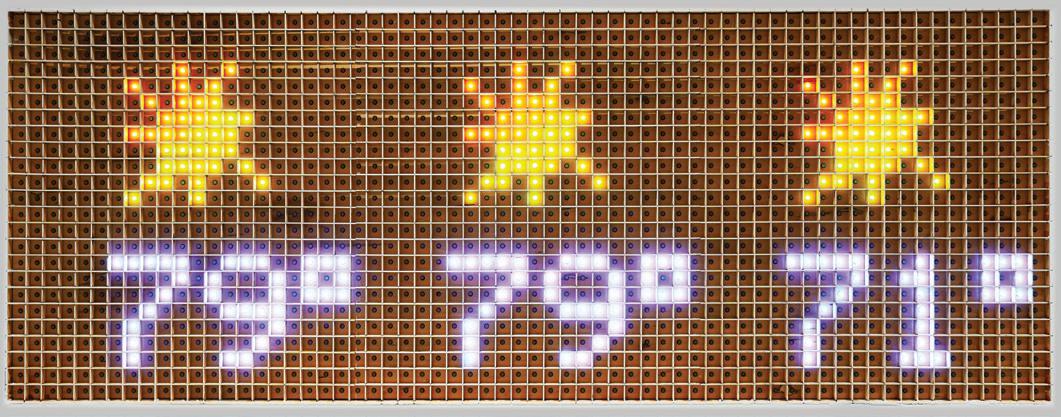
“It started off as an interactive art wall,” Christhilf said. The lightboard is equipped with a camera so it can render any movement in front of it in real time in splashes of brightly colored light. “But as I started developing it, we thought of other things to add. We now have a way that you can paint on it and type messages. And it shows the weather and the time.”
By the end of junior year, Christhilf had a working prototype about a quarter of the final size. Ryan Kim ’25 helped him turn it into a larger version — Christhilf wants to be an electrical engineer, so he focused on those issues while Kim took charge of a lot of the physical manufacturing. “I had never made a product of that size before,” Christhilf said. “Scaling it up comes with a lot of big problems, like current. It takes a lot of trial and error to get something that big to work, and to work continuously. We want it to work for years to come, so I have to document it very well.”
The biggest surprise for Christhilf? “I never imagined that it would run off a tiny chip that’s one inch by one inch,” he said. “I was going to have it run off a computer, so the computer could do all the processing, but because it took me so long, the chips advanced enough that I could use a single chip instead.” He worked with the IT department to establish a subdomain that wouldn’t be blocked by the campus firewall so the lightboard could continuously update its weather information via wifi.
The lightboard displays three days of weather information: high temperature for each day, plus an icon indicating the general weather. The first couple of weeks after the lightboard was installed, it rained constantly, meaning that it kept displaying a trio of raincloud icons. Godfrey said that the first day sun was in the forecast, everyone on the hallway rejoiced in the appearance of a sunshine icon. “Adults visiting the campus, like architects and consultants, have freaked out” over the lightboard, Godfrey reported.
“They’re not used to seeing that kind of work.”
Christhilf made the lightboard customizable by its neighbors; for example, the business office or the human resources department can use it to welcome special visitors to the campus by name. And although Christhilf disabled the interactive-video elements when they proved glitchy just before he installed the lightboard, his code remains accessible to any Latin student interested in tinkering with it and expanding the visual palette of Fennebresque Hall.
Engineering is usually a team effort: Christhilf and Kim were helped by Will Calloway ’25, Carson Clutter ’25, Dylan Ferro ’25, Nathan Niles ’25, Griffin Orsinger ’25, Parker Rubinacci ’25, Tyler Russell ’27, Jed Smith ’25, Noah Smith ’27, Adam Stone ’25, and many other students. In June, a crew of Latin students gathered to help hang the board on the wall, supervised by Dubick. When Christhilf plugged it in, it came to life in a kaleidoscope of colors and everyone applauded.
Dubick told him, “Anything of value takes a while.”
FAB FORWARD
FAB FORWARD
Stuart Christhilf, now an engineering student at Northeastern University, is spending his freshman year on the school’s London campus. While there, he plans to make use of the London Fab Lab — which he has easy access to as a graduate of the Fab Academy.
Charlotte Latin School is the only high school in the United States to offer the Fab Academy: to find out more about that, and the Innovation and Design program, you can attend the Family Fab Lab Day in the spring.
LEADERS Flock
of the
LATIN’S NEW MEMBERS OF THE SENIOR ADMIN TEAM CONNECT WITH THE PORTRAIT OF THE LATIN LEADER
The Portrait of the Latin Leader identifies attributes of leadership that Charlotte Latin School teaches and upholds: Curious Learner, Dynamic Communicator, Conscientious Thinker, Humble Collaborator, Courageous Advocate, and Resilient Navigator. They guide how Charlotte Latin teaches leadership to its students — and they inspire the school’s staff, faculty, and parents.
This summer, Latin’s senior administration welcomed five new members. Some had been part of the school’s community for years, while others moved hundreds of miles to join the Latin team, but they all shared a healthy curiosity about the school’s values. We asked them to share which principles of the Latin Leader particularly resonated in their own lives.
Read the full interviews with the new members of the senior admin team on the School News Center of the Charlotte Latin website:
Tracey Vanneste
Interim Head of Upper School
I’m going to say Resilient Navigator because my path hasn’t been straight. Moving to America [from South Africa] was a rude awakening: I thought it would be easy because English is my first language. Being an immigrant was hard, and I had to become resilient to navigate a new world.
Once I got my green card, Charlotte Latin took a chance on me — that was one of the happiest days of my life. I loved it here right away: I taught English and advised the yearbook staff. I also was the Student Council advisor with Amy Zinn, and one year, every student elected to the student government was male. We were outraged: we’ve got to get these girls to step up and be counted and get out of their comfort zones. And I had a moment of selfreflection: “Well, Tracey, what are you doing to model the kind of behavior you expect in your students?” So I looked for opportunities where I could serve in leadership roles and I got my masters degree to support my pursuit of school leadership.
Tricia Tam
Director of Marketing and Communications
Humble Collaborator and Dynamic Communicator. I love that our department gets to be the ultimate “team player,” collaborating with everyone across the school on our shared mission. It’s challenging and exciting to find the right mix of messaging, packaging, and timing so we can reach people in a way that doesn’t just inform them, but helps build a stronger Latin community.
Kerry Johnston Director of Advancement
Conscientious Thinker and Dynamic Communicator. With philanthropy, and with marketing and communications, it’s important to be strong communicators, which means listening, understanding, having empathy, and paying attention to the needs of others — whether that’s a donor or a reader. That’s how you build a bond with the school that makes a gift or a connection possible. One of the things I’m doing this year is paying very close attention to the work everyone else here is doing, so I can become fluent in the culture of Latin.
Karen
Moore Chief Financial and Operations Officer
I would describe myself as a Humble Collaborator. I’m naturally curious, so I like to learn from others and get their input before making decisions. I want to understand how things are done and respect the culture that’s already in place. I’ll admit, I sometimes underestimate myself — but honestly, that often works in my favor. It pushes me to listen deeply, work harder, and often overdeliver.
Louisa Polos
Head of Middle School
I absolutely identify as a Curious Learner. That’s what I love about being an educator: getting to know people, to know communities, to know how students learn. I think that can be contagious in a school community, hopefully inspiring others to learn and grow as well. In a difficult situation, that can mean caring and extending that curiosity to learn why it’s difficult. I’m passionate about finding the root of the situation and coming up with a solution that’s good for everyone involved.
CURIOSITY CHALLENGE
How can Charlotte Latin raise the profile of its Hawks, keep far-flung families connected, and teach students broadcasting skills at the same time?
WINGS ACROSS AMERICA
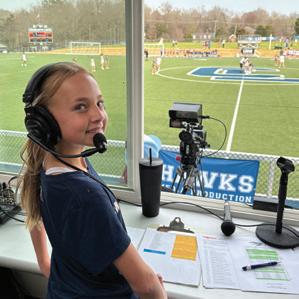
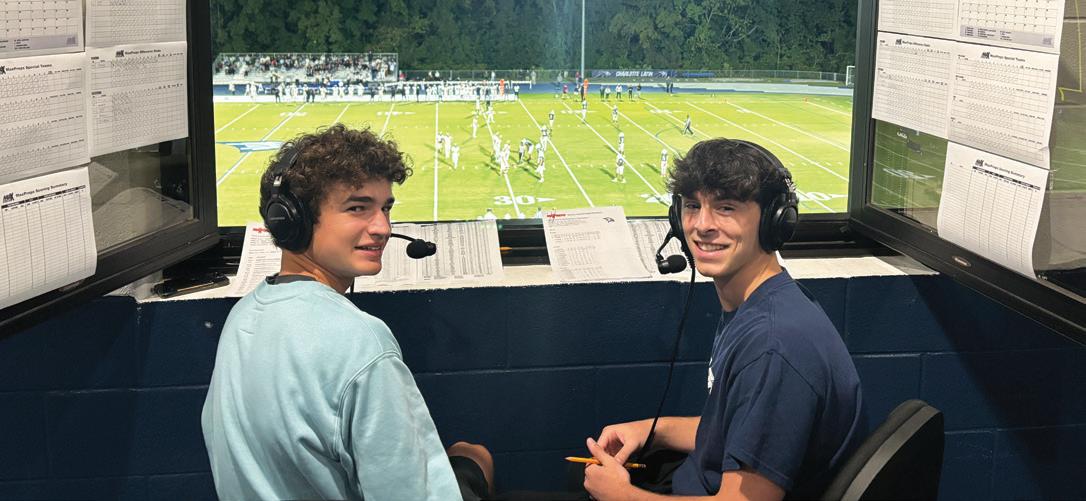
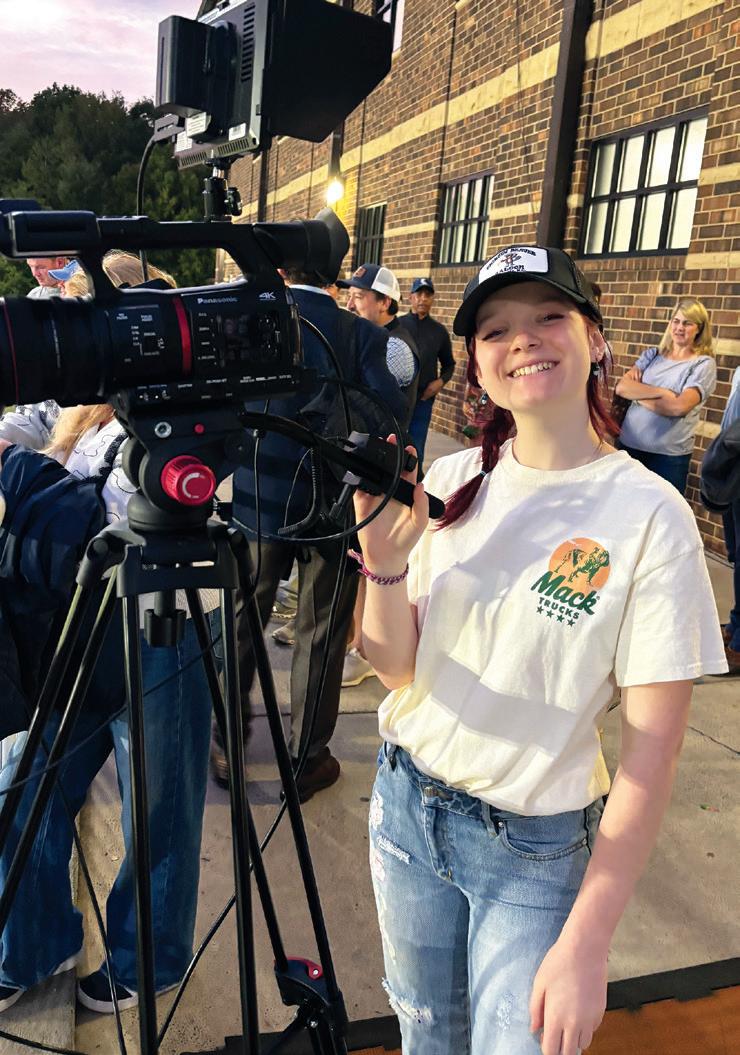
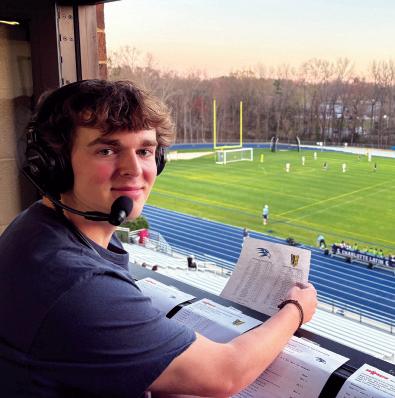
On Friday nights in the fall, Patten Stadium is full of hundreds of students and family members, not to mention musicians, cheerleaders, and dancers. But there’s many more people cheering for the Varsity Football team who can’t be seen at the stadium — because Hawks Media Production is broadcasting the game around the world.
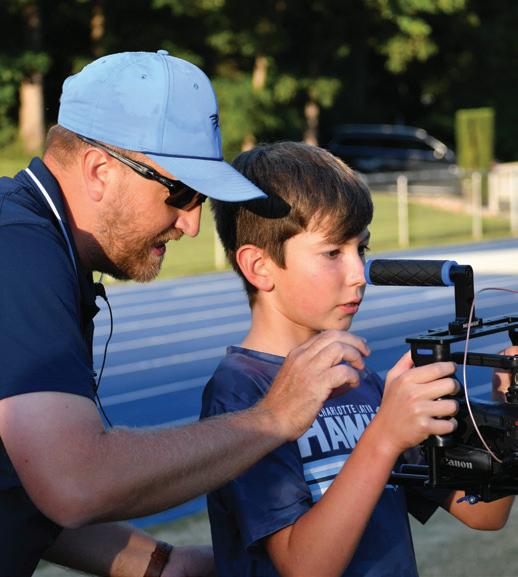
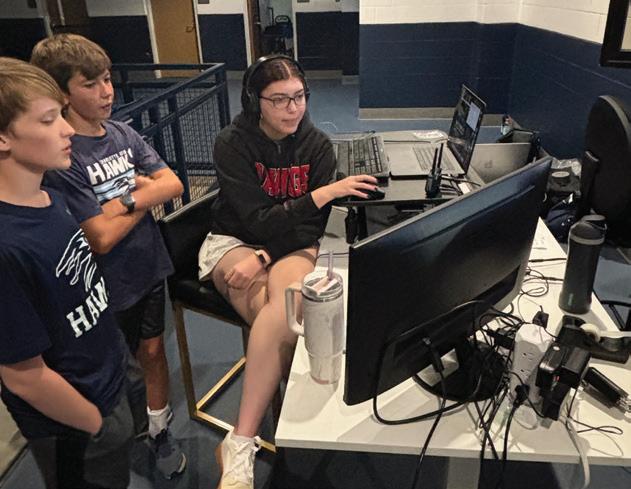
In the past four years, Hawks Media Production has broadcast over 700 sporting events, featuring students doing play-by-play and color analysis, reaching thousands of Hawks fans in 42 states and 23 countries. When Joe Teets, Hawks Media Production Director, arrived at Charlotte Latin School in 2021 as a full-time math teacher, Latin was livestreaming a few games via iPad cameras. Under his guidance since then, dozens of students have gotten involved in all aspects of television production, including camerawork, onscreen graphics, and especially, on-air commentary.
“I’ve had people tell me their relatives watched the game from DC or Miami,” says Will Wood ’28. “It’s great to get that kind of feedback.”
“From the beginning of Hawks Media Production, Mr. Teets has always encouraged me to step out of my comfort zone,” adds Flo Roper ’26. “When I joined the club, I had no intention of ever speaking, and now he has me calling the goals at field hockey games.”
The technological capabilities of Hawks Media Production keep improving: in this past year, students have gained access to more Hudl cameras and a new editing suite, not to mention state-of-the-art microphones and lighting. We checked in with the next generation of sports broadcasters on their favorite Hawks Media memories and life lessons.
Charlotte Beaver ’26:
“I like being involved in school activities, but I’m not a super-sporty person. So I gave it a try last year and I really liked it and just kept doing it. It’s great knowing that Mr. Teets trusts me to produce the broadcasts. He’s been super-helpful — the work he puts into broadcasting is really incredible.”
James Edge ’28:
“I’ve learned you don’t have to be playing the game to have a great time.”
Clifton Gorelick ’27:
“I’ve learned to take both sides into account and not
be super-biased toward the team that I’m favoring. Both sides are just kids going out there and having fun. There’s a lot of dead time in sports, so announcing games has taught me how to carry on a conversation effectively.”
Max Thune ’27:
“It’s helped with my confidence. Even if I make a mistake on the air, I have to keep going.”
Dewey Wrenn ’29:
“In art class, I was taking pictures of the media room, and I saw all these switches and microphones. That inspired me, because I’ve been watching football all my life and listening to broadcasters like Al Michaels, Cris Collinsworth, and Mike Tirico.”
Ben Goldman ’26:
“Mr. Teets is down to try anything. I’ll come to him with an idea for a pregame interview, and he’ll help me flesh it out and make it happen.”
Hadley M. ’31:
“I love broadcasting games when my sister is playing. It’s so much fun watching her grow in her sport that she loves.”
Gavin Hauth ’28:
“We had a big goal in a soccer game we called the other day. It felt really good to get hyped and celebrate with the team, and to feel the energy in the moment.”
Ben Morgan ’27:
“One time when we were calling a field hockey game, my fellow broadcaster and I thought there was a Latin goal and we started screaming. But we didn’t know the rules: it wasn’t a goal. Everyone looked at us weirdly, but it was really funny.”
Will Wood ’28:
“My favorite memory would be the girls’ soccer state championship. We were there 90 minutes before the game, and we interviewed our coach, Coach Searles, and Providence Day’s coach, Coach Dudley. We cut that up and had a proper pregame show: it was all very professional.”
Connor K. ’32:
“What made me curious about Hawks Media production was wanting to know about the cool software that lets you put up the scoreboard when you’re broadcasting.”
Durham Teddy ’28:
“My favorite moment was when the JV Girls’ Basketball team shut out Country Day in the first quarter. Being able to broadcast in a program like this is something that you can’t do at many schools.”
Flo Roper ’26:
“A lot of the feedback I get is about students’ grandparents — I think that’s just so sweet. Parents come up to me at games and say, ‘Thank you so much. My parents, who live in Virginia, watch every weekend and it’s a blessing to have someone do this.’”
Around Campus
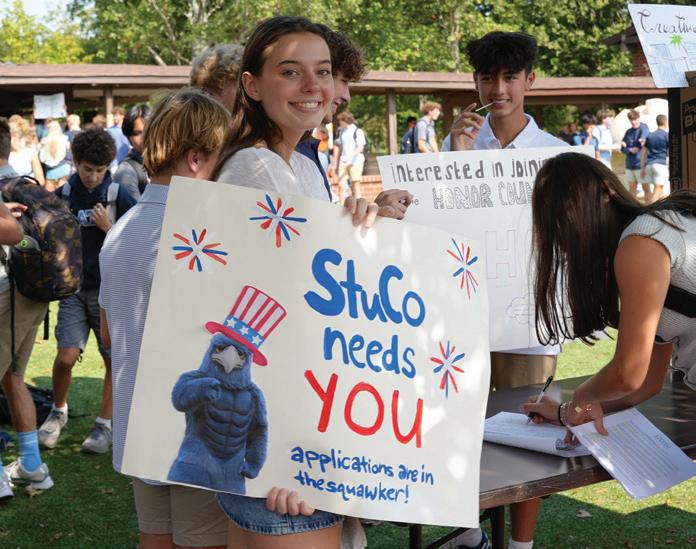
US Club Fair.
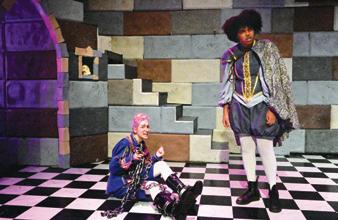
US play Fortinbras.
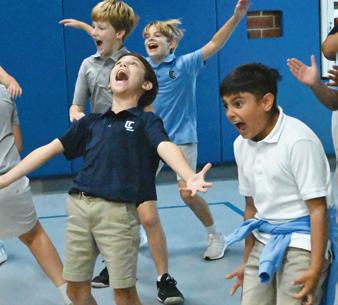
LS students, excited to learn Latin cheers.
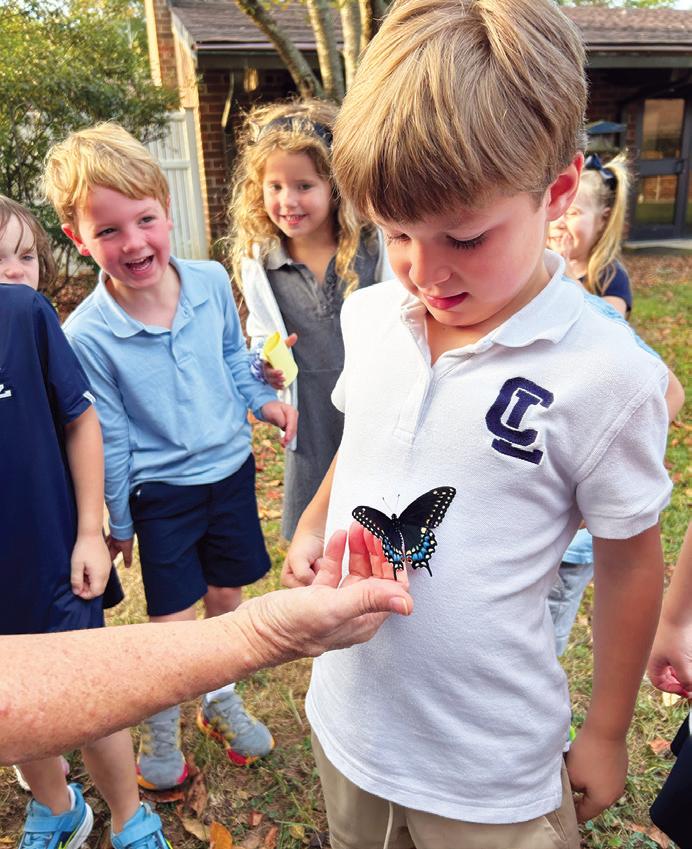
Close encounters of the butterfly kind.
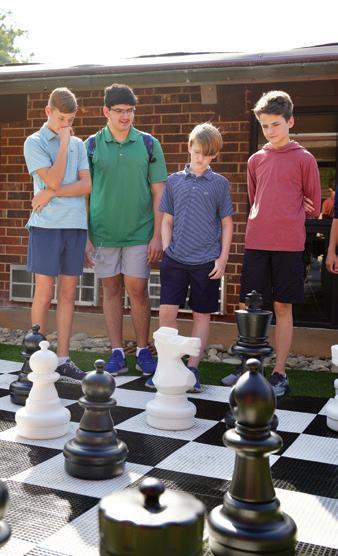
Pondering a chess game on the Quad.
MS students with daily planners.
PHILANTHROPY IN ACTION
QUAD RENOVATION
Last year, when the Upper School went cellphone-free, we soon saw that students needed more places to gather faceto-face. The Latin Fund made it possible to add turf to the Quad — now a joyful hub year-round where students play, study, and build community in the heart of campus.
FURNITURE INSTALLATION
The Latin Fund goes to work each year, enhancing our campus and classrooms to supportevery student. Recently, this included new furniture in Kindergarten classrooms — ensuring our youngest Hawks learn in spaces designed just for them.
98% EMPLOYEE PARTICIPATION
The Latin Fund allows us to say YES to our teachers, students, and our school.
MAKE YOUR
IMPACT:
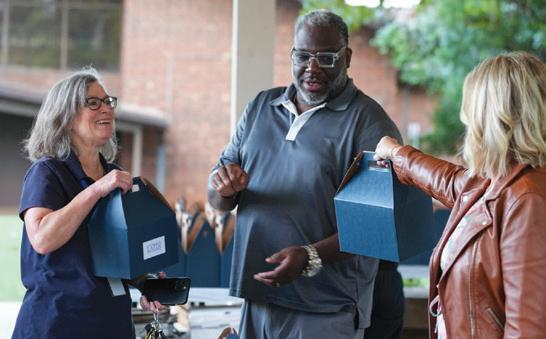
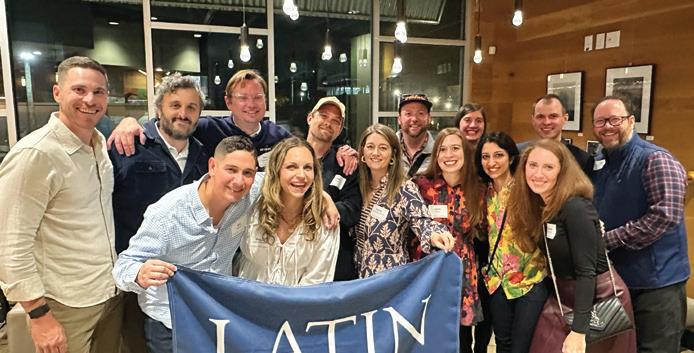
On their first day back this fall, Latin’s faculty and staff launched the 2025–26 Latin Fund through the annual Employee Campaign. Led by cochairs Aneudy Melendez, Lucy Smith, David Taylor, and Joe Teets, our employees showed their Latin spirit by reaching an incredible 98% participation rate with donations to the Latin Fund — which we happily celebrated with fresh-baked biscuits and gratitude.
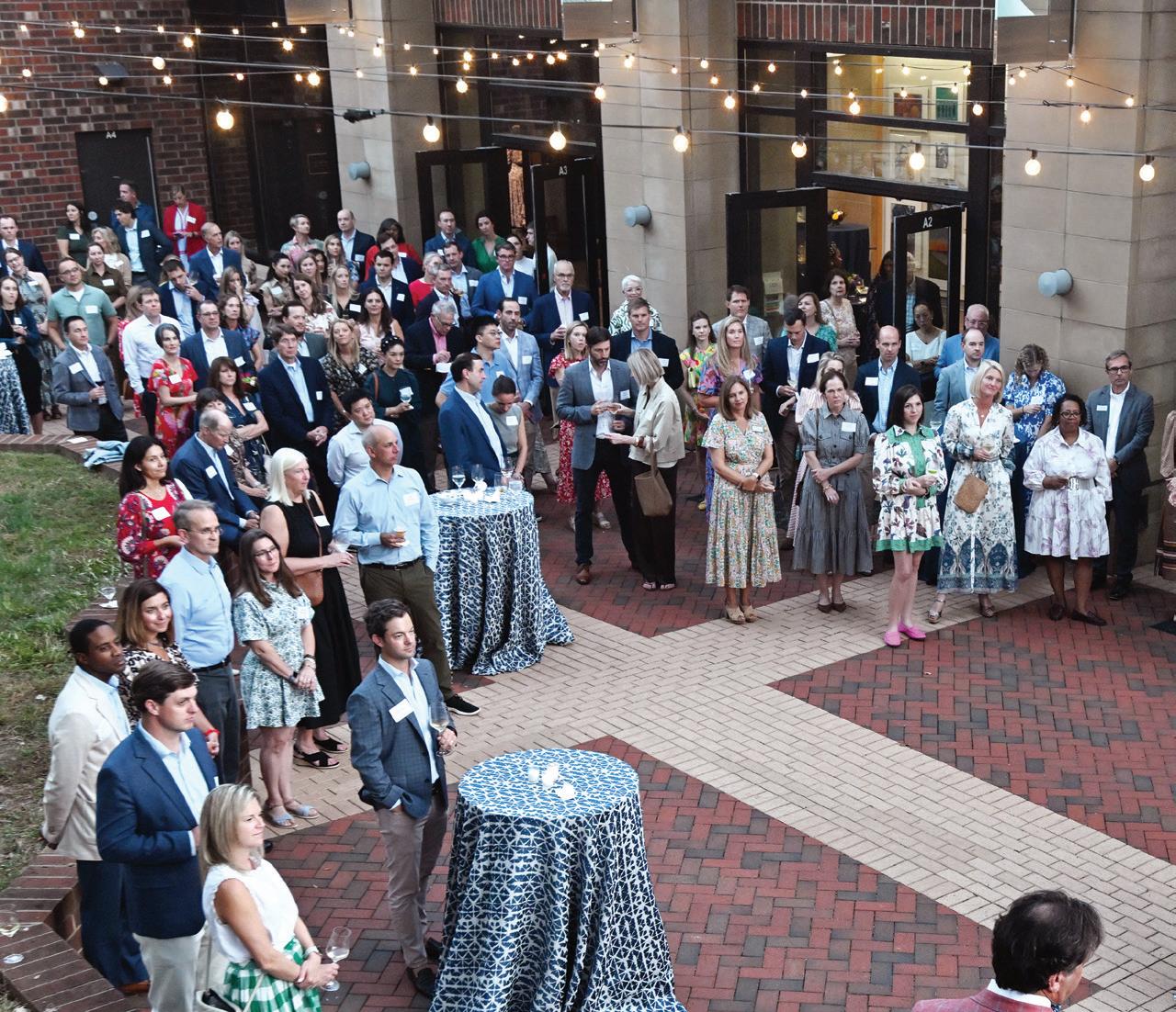
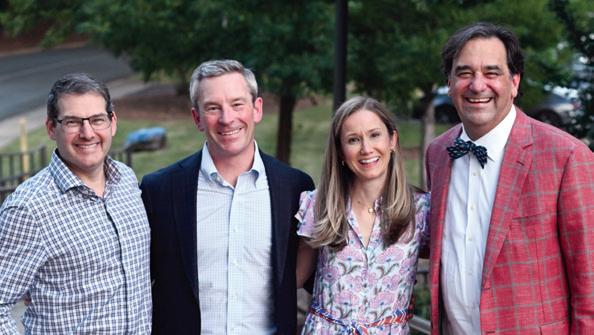
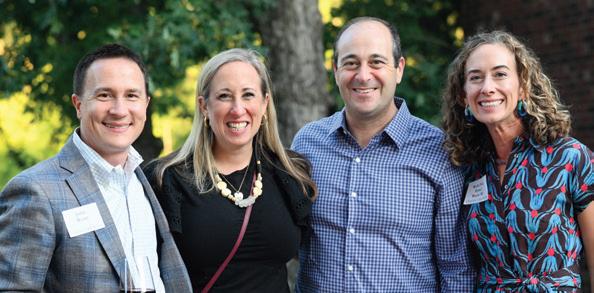
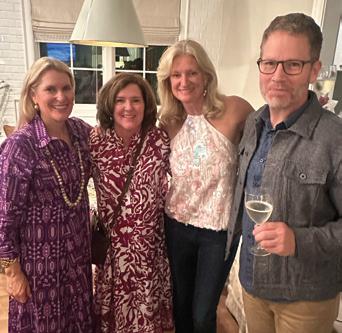
Board Chair Rael Gorelick and Chuck Baldecchi, along with our 2025-26 Latin Fund Chairs C. J. Kearney and Kristen Schneider, welcomed guests to the evening.
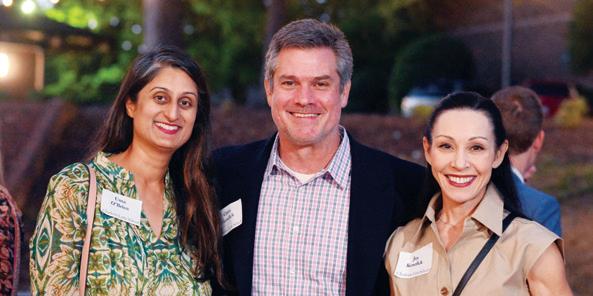
Uma O’Brien with Christian and Joy Kenefick.
2024-25 Latin Fund Chairs John and Ruth (Van Dyke) ’02 Wyatt with Lillian and Nate Negrin.
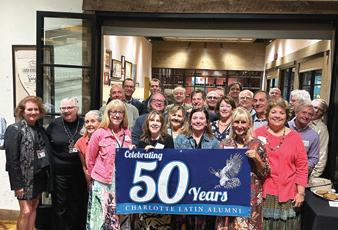
Back to the Nest Reunion Weekend 2025
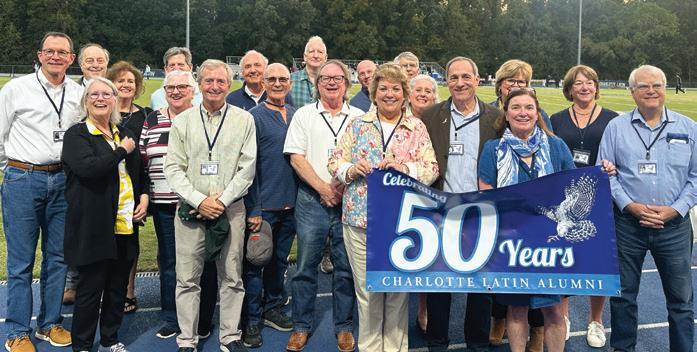
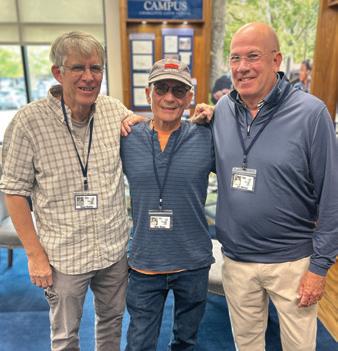
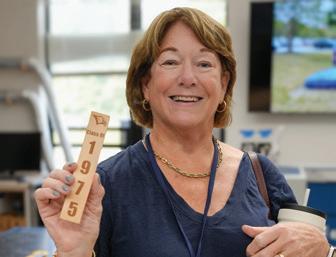
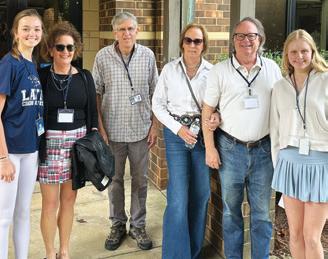
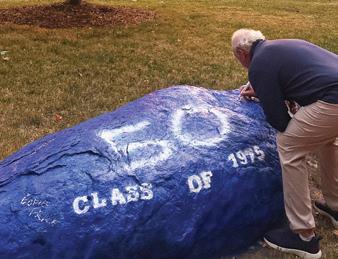
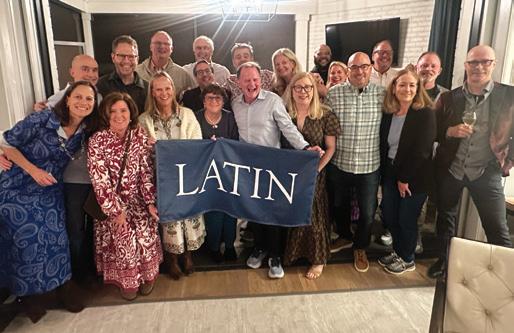
Over 200 Hawks returned to campus for Reunion Weekend in October — fittingly, on the same weekend as Homecoming. The weekend was extra-special for the Class of 1975, who celebrated their 50-year reunion by spending the afternoon “back in class.” Highlights included attending the all-school pep rally, touring campus with members of the Student Admissions Board, and exploring the Fab Lab. After celebrating their Collins Cup win — with a record 76% class participation in the Latin Fund — they cheered on the Varsity Football team in Patten Stadium.
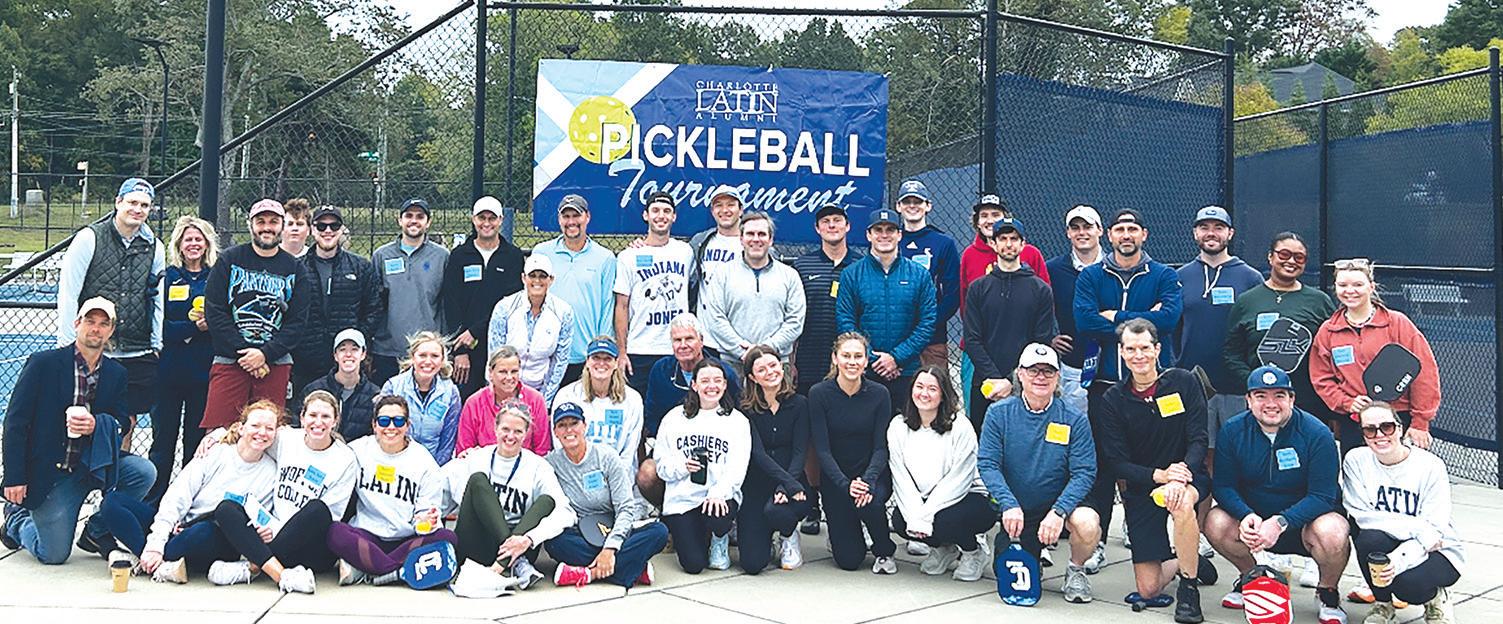
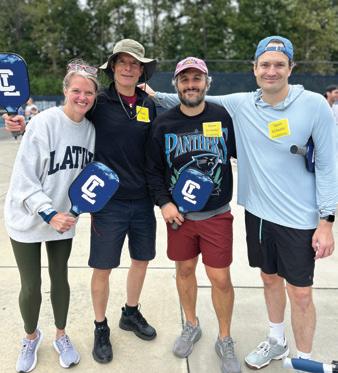
On Saturday, alumni gathered for the Alumni Pickleball Tournament, where friendly competition and school spirit were on full display before the evening’s class parties began, giving Hawks across the decades a chance to reconnect and reminisce about their time at 9502.
Members of the class of 1975 gather in Patten Stadium before being recognized at the start of the Homecoming football game.
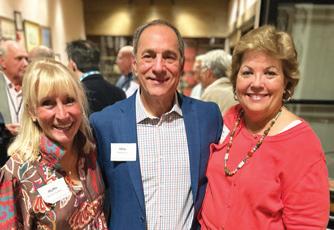
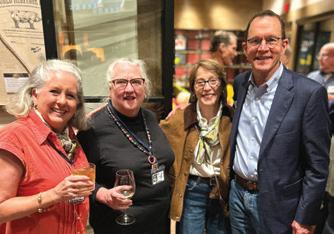
Doug Ausbon, Steve Wilson and Jon Michael.
Sally (Springs) Alston, Lynn Boyette, Meg and Sandy Lee.
Muffin (Skinner) Suttles, Gary Anderson, and Leslie (Latta) Verner.
The class of 1975 at their Saturday night cocktail party.
John Green adds his signature to the rock.
Leigh (Patton) Gillam in the Fab Lab.
Student Admissions Board students with members of the class of 1975 on the campus tours.
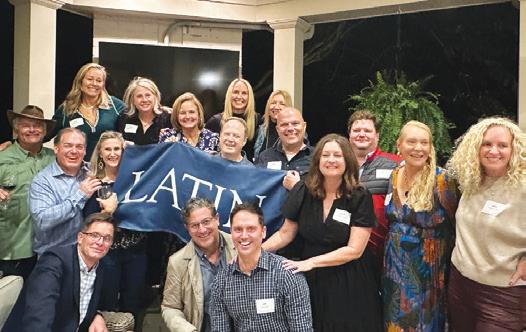
Class of 1990
Class of 1985
Class
Rob Howard ’95 and Erin (Collins) Fleischauer '95. Britt (Boshamer) Yett ’90, Julie (Patton) Evans ’90, and Meredith (McLeod) Van Ryder ’90.
Beth Bryson ’85 and Paisley Gordon ’85.
Fiz (Anderson) Craig '85, Betsy (Plumlee) Parkhurst ’85, Blair (Carriker) Donald ’85 and Kevin Callaghan '85.
Class of 2005
Pickleball Hawks Rally Competition and Connection
On Saturday, October 11, Hawks from graduating classes spanning 1975 to 2025 gathered for our second annual Alumni Pickleball Tournament.
On the Howard Levine Athletic Campus, 23 teams filled the courts, engaging in a day of friendly competition and reconnecting with classmates, faculty, and staff. This year’s champions included Alec Hanff ’15 and Ben Olmstead ’15 in the Advanced Division and Chase Estep ’03 and Matt Yagey ’03 in the Social Division.
We are grateful to our generous presenting sponsor, Whittington Builders (Zack Whittington ’00), and to all of our court sponsors for making the event possible. We’re already looking forward to next year’s tournament!
Hawks and friends gathered for the Alumni Pickleball Tournament on October 11.
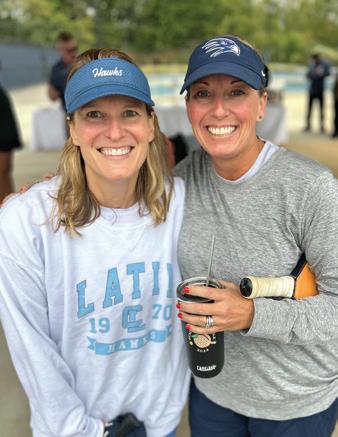
Megan (Lew) Myers ’96 and Heather (Massengale) Shaw ’95.
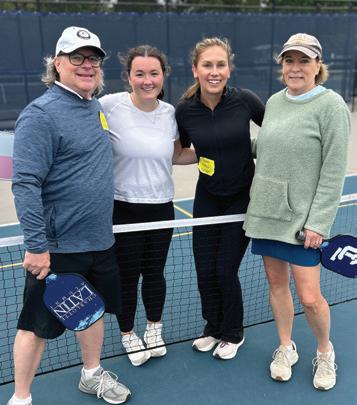
Ed Price ’75, Ashley Foley ’18, Caroline Balogh ’18, and Sharon Price.
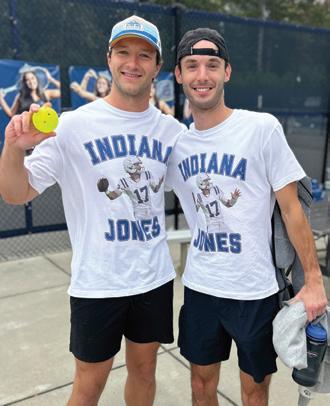
Advanced Division tournament champions Alec Hanff ’15 and Ben Olmstead ’15.
Meredith (Kempert) Nunn ’98, Scott Lee ’75, Matt Andolino ’05, and Beau Schwab ’02.
Passing the Torch Class of 2025 Legacy Hawks
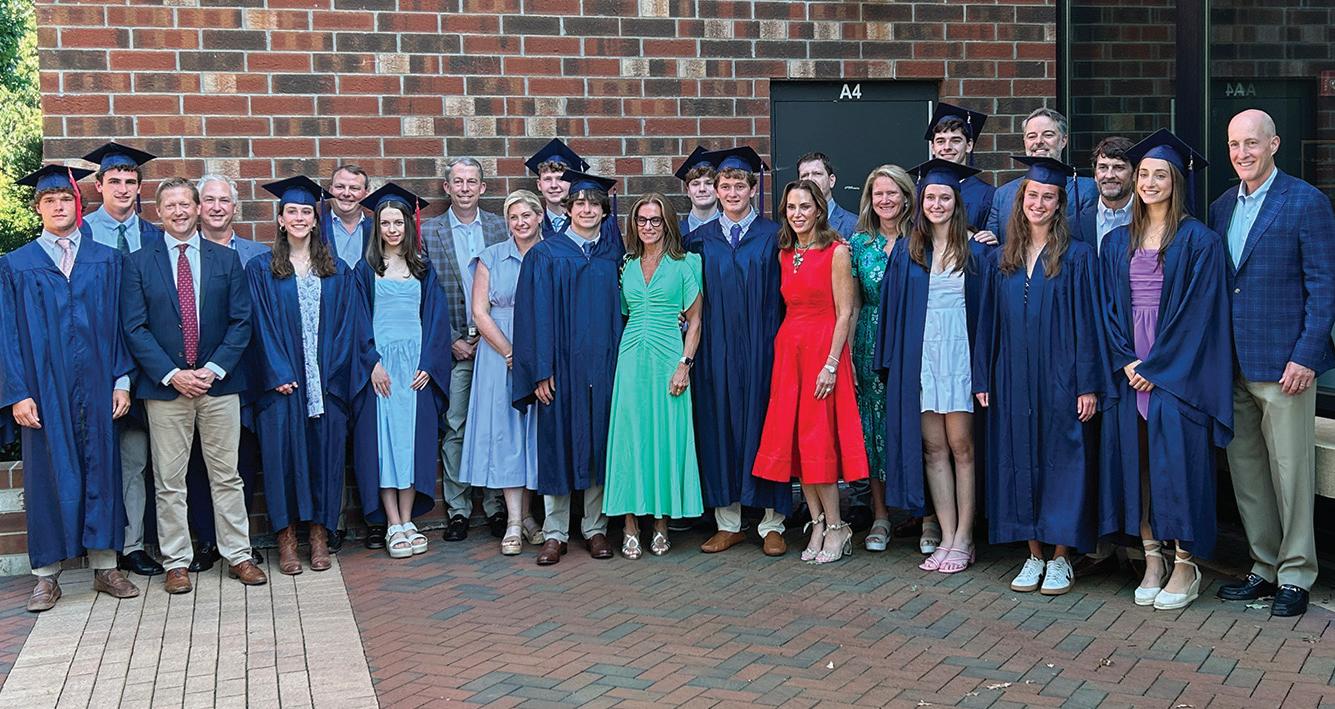
When Hawk families have young Hawks, they pass the torch of the Latin tradition to the next generation. Of the 144 members of the class of 2025, 12 were Legacy Hawks.
Congratulations to our Legacy Hawks from the class of 2025: Brian Babcock ’95 and his son Graham (Wake Forest University), Keith Brunnemer ’93 and his son Keith (University of Miami), Laura (Austin) Clark ’87 and her son Grant (University of Miami), Deb (Locke) Denny ’89 and her son Burke (University of Kentucky), Chuck Edwards ’94 and his son Chuck (Wofford College), Carl Fisher ’88 and his daughter Eleanor (University of North Carolina at Chapel Hill), John Linker ’93 and his daughter Evy (Boston College), Doug Lowry ’93 and his daughter Molly Schnyder (Texas Christian University), Matt McGirt ’94 and his son Joe (University of North Carolina at Chapel Hill), Houston Roberts ’92 and his daughter Wallace (Virginia Tech), Katie (Ivanoff) Smith ’93 and her daughter Annie (East Carolina University), and Brooke (Shantz-White) Spangler ’97 and her son, Bryce (Denison University).
LIFE AT LATIN IN 2000
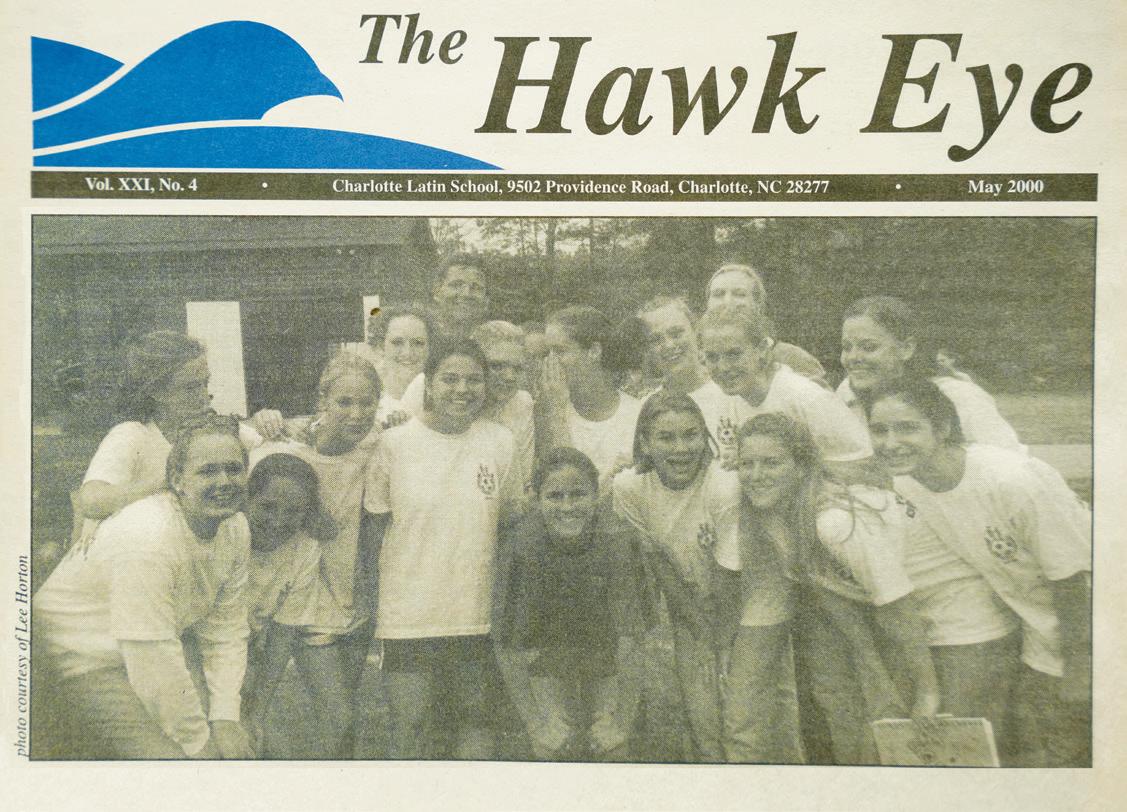
As Charlotte Latin School entered the 21st century, the Science, Art, and Technology Building opened, adding 30,000 square feet of classrooms, studios, and other essential space to the school’s campus. (The Beck Student Activities Center, under construction in 2000, opened early in 2001.) A poll of Latin students revealed that their favorite musical act was the Dave Matthews Band. And the United States women’s national soccer team, riding high after winning the 1999 World Cup, visited the Charlotte Latin campus for a practice session. The team was warming up for a match against Iceland’s
national team at Ericsson Stadium (as the Bank of America Stadium was then called) — a game that proved to be a thrilling but scoreless tie. The practice attracted about 100 spectators, including the Latin girls’ soccer teams. Afterwards, World Cup star Brandi Chastain — a future Soccer Hall of Famer, possibly most famous for her midfield celebration after she made the gamewinning penalty kick in the championship match against China — posed for a photo with the Varsity Girls’ Soccer team.
From left: Erin (Beatty) Baker ’03, Casey (Roche) Proescher ’02, Crystal Christeler ’00, Kim (Limentani) Strickland ’03, Jennifer (Andresen) Lamba ’02, Jackie (Andolino) Fogartie ’01, Coach Lee Horton, Michelle Breyer ’00, Leighton (Britton) Fogan ’01, Amy Buchanan ’03, Kalle (Kunkle) Stinson ’01, Elizabeth (Murray) Bauer ’03, Coach Meredith Nelson, Carmen (Schmitt) Leyton ’03, Debra Owens ’01, Marjorie Rickertsen, and Jenny (Atlas) Cook ’02.
9502 Providence Road
Charlotte, NC 28277-8695
704.846.1100
www.charlottelatin.org
Student Concert Series
December 8
Grades 6-12 Band Concert
December 10
Grades 6-12 Orchestra Concert
December 15
Grades 6-12 Choir Concert
December 17, 11:00 a.m.
Grade 4 Holiday Concert
December 18, 6:30 p.m.
Community Chorale
CHARLOTTE LATIN 2025
SHOWCASE WINTER
Wings Up for Winter Sports SPORTS
7:30 p.m. Varsity Wrestling @ Beck Student Activities Center Friday, December 12