THE STRONGMAN & THE SECURITY BLOC #2
AUTHOR
Maj Rocco P. Santurri III Assigned to the U.S. Army Civil Affairs and Psychological Operations Command and currently based in Wachernheim, Germany


Maj Rocco P. Santurri III Assigned to the U.S. Army Civil Affairs and Psychological Operations Command and currently based in Wachernheim, Germany
AS NATO collective (but not unanimous) assistance continues to Ukraine and stalemate looms in the Donbas, internal matters continue to pester the Alliance – with no end in sight.
The Centre for Historical Analysis and Conflict Research is the British Army’s think tank and tasked with enhancing the conceptual component of its fighting power. The views expressed in this In Depth Briefing are those of the author, and not of the CHACR, Royal Military Academy Sandhurst, Ministry of Defence or the British Army. The aim of the briefing is to provide a neutral platform for external researchers and experts to offer their views on critical issues. This document cannot be reproduced or used in part or whole without the permission of the CHACR. www.chacr.org.uk
There is no shortage of commentaries about the tumultuous relations between NATO and Turkiye, which span from military juntas in the past to Ankara’s increasingly close relations with Moscow present. However, by no means are Turkiye and its shrewd strongman, President Erdogan, unique in their tense, complex, and erratic relations with Brussels. Seemingly committed to not being outdone by President Erdogan, Prime Minister Viktor Orbán, Hungary’s brash and authoritarian leader, has transformed his country into an internal conundrum for Brussels. Most disturbing
is the level of democratic backsliding in Hungary, pointedly against NATO ideals of democracy. Orbán has cultivated an authoritarian regime that has eroded democracy in Hungarian society. Following the strongman-hiding-inplain-sight playbook, Orbán’s methods, while predictable, have been exceedingly effective. Freedom of the press is nearly absent, replaced by State-run
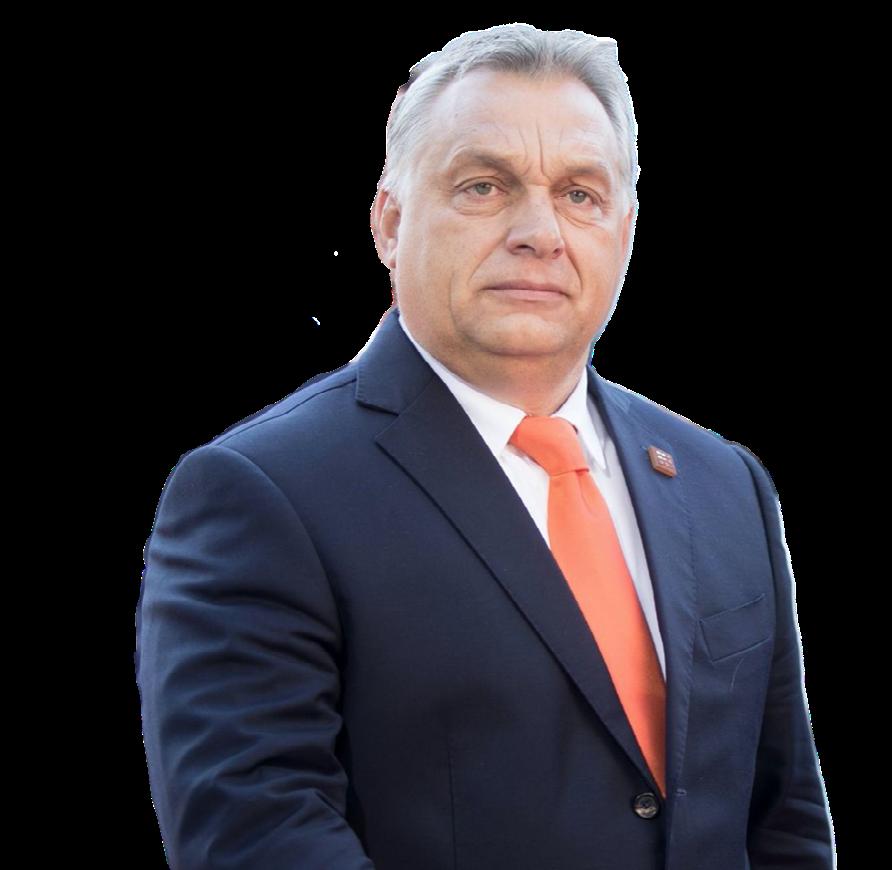
media, while judges must show political loyalty to remain in their positions. Election laws, financial regulations, and primary education have all been revised to support Orbán’s rule of a nation committed to Christian ideals in which the traditional notion of family reigns supreme. To date, the results are difficult to dismiss. The national elections in May 2022 resulted in another landslide win for Orbán and a super-majority for his Fidesz party in Parliament. Walking the streets of Budapest pre- and postelection, it was difficult to ignore the general feeling of indifference amongst the populace, who grudgingly accepted the results as a foregone conclusion, a disturbing development in the liberal-leaning capital city Many hoped the unification of opposition parties would finally unseat Orbán, but quickly and quietly, that dream disappeared. However, there are signs of dissent; many have
braved recriminations to launch accusations that this recent election was not free and fair. Some assert that Hungarians living outside its post-World War I borders were bussed into Hungary to vote in favour of Fidesz, while other accusations of foul play have been levied. Nevertheless, little has changed.
“The future is certain, it is only the past that is unpredictable.”
– An old Soviet joke
While NATO might look to the recent past and present to understand the Hungarian issue, reviewing the much more distant past would be more apt. Orbán’s ability to recast history and mould the collective memory of the populace has been a critical contributor to his positive perception amongst Hungarians, especially those outside of Budapest (and outside of Hungary). Government narratives trace back to the end of World War I and the despised Treaty of Trianon, in which Hungary lost millions of citizens and square miles of territory
From this nationally perceived injustice, he portrays himself as a protector of Hungarians against foreign actors who have historically meddled in the internal affairs of Hungary. Government narratives often cast NATO as a malign foreign influence that does not always
have Hungary’s best interests in mind. These narratives and the accompanying messaging have frequently led to disagreements between Hungary and NATO over the latter’s efforts to station more NATO troops in Hungary, admit Ukraine into the Alliance, and NATO requests to send arms shipments through Hungary to aid Ukraine’s fight against Russia. These developments are unsurprising to many observers who claim that Orbán has modelled his regime after Putin’s in Russia while enjoying warm relations with the Russia leader.
Nevertheless, history has a voice in the debate as well. As one Hungarian army officer said to me, “we do not pick sides well”, in reference to World War I and II. Those painful historical experiences compel Budapest to keep NATO at arm’s length and are clearly reflected in the small NATO troop levels in Hungary. Budapest also cannot ignore the giant bear to its near east; wise perhaps to placate all sides and avoid another disastrous choice in allies, minus Hungary’s membership in the divided and relatively benign Visegrad 4 The Hungarian Ambassador to
the UK echoed this sentiment during an event at King’s College London in 2022, commenting on the inescapable realities of Hungary’s geopolitical state of affairs and the need to placate those east and west. Regardless of these considerations, Hungary’s contributions to NATO are undeniable. Hungary has been a reliable partner both past and present, providing critical assistance to the ill-fated NATO mission in Afghanistan and in the current fight against Russia in Ukraine. Such actions highlight a frequent disconnect between the words emanating from Budapest and the actions Hungary has taken in support of NATO.
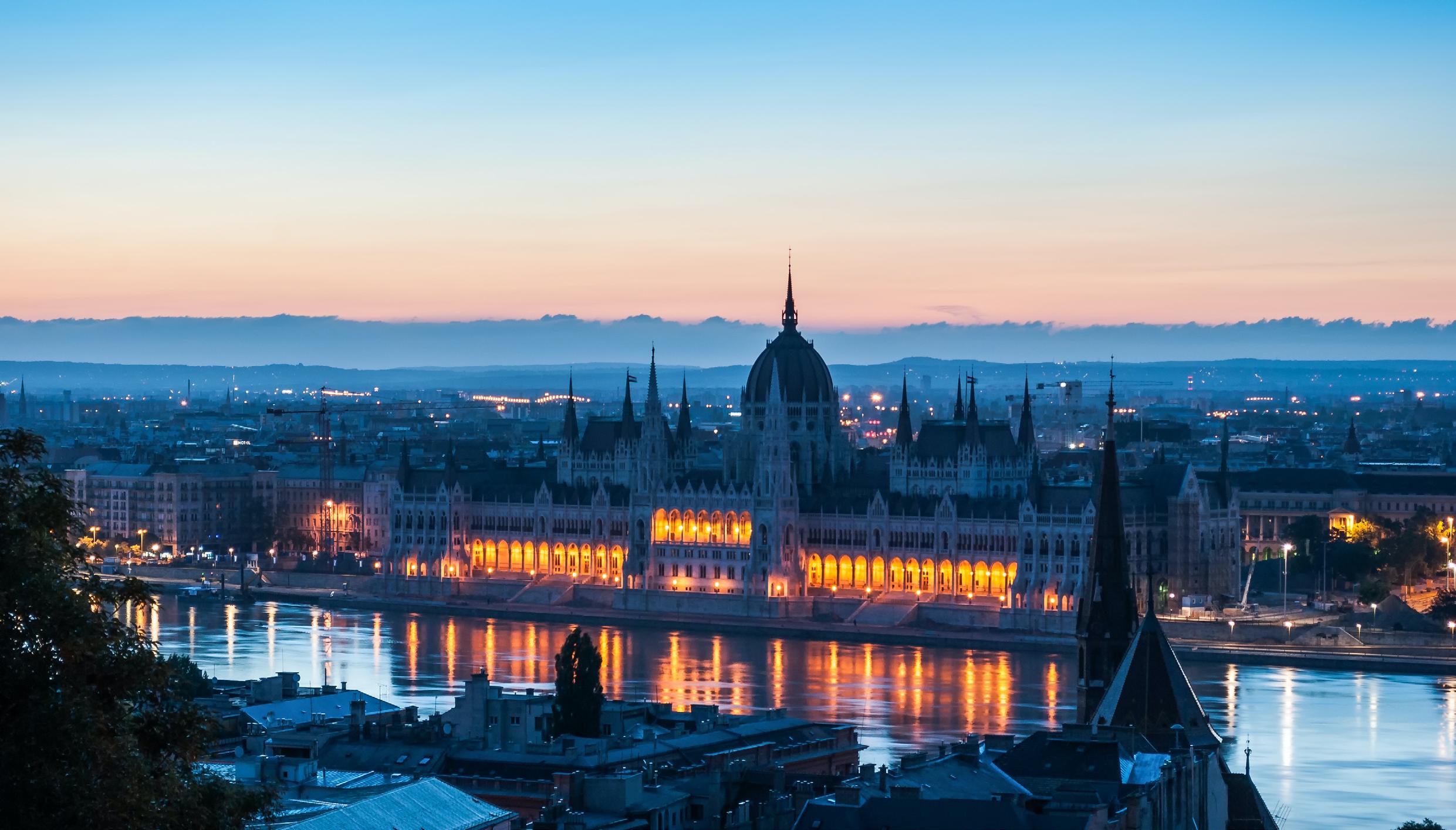
An examination of this body of evidence begs the question: does Hungary pose a threat to NATO collective security? Much like the Turkiye question, Brussels, Washington, and other NATO capitals warily consider these concerning inquiries about Hungary. Should NATO turn a blind eye to democratic backsliding and focus only on Hungary’s commitment to collective security? Are the words, actions, images, and
symbols directed from Budapest to Brussels an uncomfortable but insignificant reality geared toward domestic audiences or do they constitute a threat to Article 5? Perhaps most important, what should NATO do if it is determined action is required? Should NATO defer matters outside of considerations for collective security to the European Union, which has already punished Hungary for political and economic concerns it shares with NATO?
“I fear the Greeks, even when bearing gifts.”
– From Aeneid by
VirgilIgnoring the width and scope of anti-NATO sentiment in Hungary is difficult. These sentiments, embedded in collective memory and narratives, concern many in Brussels who worry about Hungary’s commitment to NATO. Recent events in Ukraine have not alleviated previous fears, as NATO capitals throughout the Alliance observe anti-NATO words, actions, images, and symbols from Budapest. Before the conflict in Ukraine, many speculated that Hungary was Russia’s “Trojan horse” within
“PAINFUL HISTORICAL EXPERIENCES COMPEL BUDAPEST TO KEEP NATO AT ARM’S LENGTH AND ARE CLEARLY REFLECTED IN THE SMALL NATO TROOP LEVELS IN HUNGARY. BUDAPEST ALSO CANNOT IGNORE THE GIANT BEAR TO ITS NEAR EAST; WISE PERHAPS TO PLACATE ALL SIDES.”
IN-DEPTH BRIEFING // THE STRONGMAN & THE SECURITY BLOC #2Picture: Karol Czinege
NATO. Others accused Hungary of acting in the interests of China. Hungarian messaging and policies have been a tale of two extremes during the current conflict.
Orbán baulked at EU requests to admit refugees fleeing the Middle East and despite a fiercely anti-immigrant policy stance throughout his tenure permitted more than one million refugees from Ukraine to pass through Hungary. These actions contrast with standard anti-immigration Hungarian messaging, in which the slogan “Fortress Hungary” is a consistent mantra of Fidesz supporters. That sentiment was evident in the conflict in Syria, in which Orbán fiercely opposed the resettlement of “Muslim invaders” in Hungary. Budapest refused to bow to external pressure, making the current concessions all the more laudable for Orbán, Fidesz, and the country of Hungary. These actions created a competing narrative of Hungary being a team player within NATO, despite other words and actions that rightfully raised severe concerns about its NATO allegiance. Recently, Hungary also approved membership applications for Finland and Sweden after months in which Budapest and Ankara raised objections. This, too, should enter into the decisionmaking calculus in Brussels.
However, Orbán, who maintains strong relations with Putin, rejected requests by NATO to transport urgently needed arms to Ukraine over Hungarian soil. Orbán and his influential Minister of Foreign Affairs, Peter Szijjarto, have repeatedly stated that Hungary has no role in the war on its eastern border, despite widespread NATO support of Ukraine. These statements aligned with Hungary’s repeated attempts to block Ukraine’s accession to NATO before the Russian invasion. Hungary has also clashed with the EU in the past and recently with Ukraine, and is unafraid to rail publicly against its leadership. Budapest
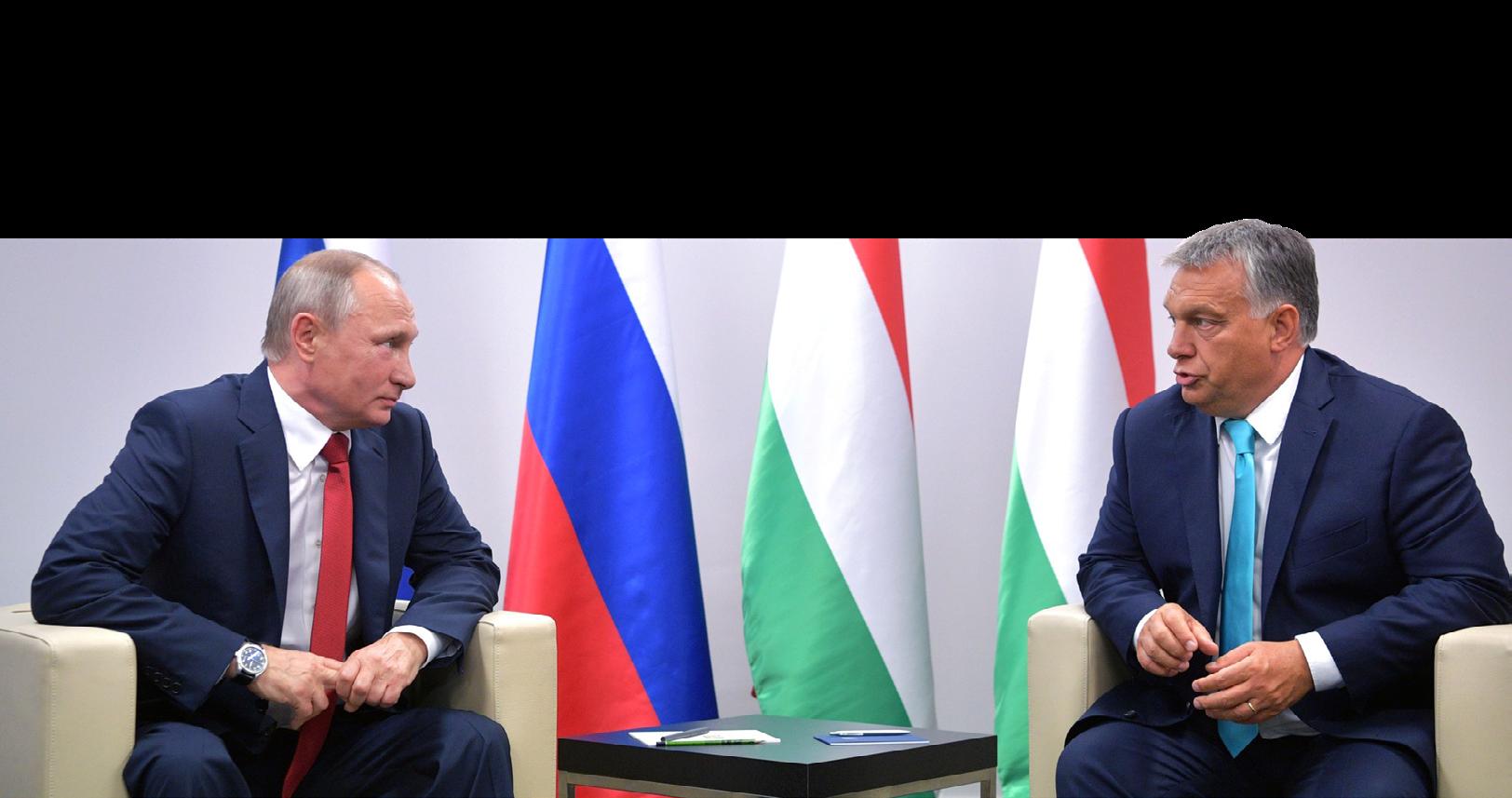
has blocked attempts by the EU to ban Russian gas and oil exports. Heavily dependent upon both, Orbán sharply criticised the EU for being unsympathetic to Hungarian families relying on Russian exports to stay warm during the winter months. Budapest was able to strike a compromise with the EU which enforced the embargo, except for Russian exports to Hungary. With the excessive overlap of EU and NATO aims and members, this action, while not directed against NATO, indeed ran counter to current NATO objectives in the conflict between Ukraine and Russia. This pattern of contradiction from Budapest has become the norm for Hungary toward NATO under Orbán. However, while the rhetoric has been fierce and relations with Ukraine long frayed, especially over the rights of ethnic Hungarians within Ukrainian borders, Hungary’s acceptance of Ukrainian refugees should not be understated.
Furthermore, Hungary is not the only transit point for NATO arms into Ukraine. Despite the refusal of Hungary to allow weapons shipments over its soil, Brussels and Budapest were well aware of other routes to ship billions of dollars of military assistance into Ukraine. Lastly, the approval by Budapest of NATO membership for Finland and Sweden is in direct opposition to Putin, who claims that NATO
“expansion” threatens Russia and has contributed to the current conflict in Ukraine. Even the most ardent critic of Orbán and Hungary would struggle to criticise these actions as anything less than strongly pro-NATO.
“A nagy hal megeszi a kishalat.” (Big fish eat the small fish) – Hungarian proverb
With the war in Ukraine coinciding with national elections in Hungary, Orbán may have felt compelled to strike a delicate balance in word and deed that appealed to a domestic audience while balancing relations with Russia and NATO; the proximity and history between Russia and Hungary are inescapable. Pockets of mixed Hungarian/ Russian families live in Hungary, especially near former Soviet bases in the countryside; one village, Gyulaháza, has a statue of Soviet cosmonaut Yuri Gargarin in the town square. Whether during peace or war, some level of relations must be maintained with the Kremlin, whether Budapest prefers it or not. Hence, Budapest has employed a nuanced approach that has formed a consistent but complex standard operating procedure; it often employs its messaging to satiate the domestic audience and other partners while supporting NATO interests. Managing domestic pressures and loyalty to NATO has become a necessary
balancing act for Orbán. In his efforts to win another term in May 2022, Orbán splurged on funding for domestic efforts that would influence voters. With the election over, the financial realities of what many perceived as politically motivated spending have detrimentally affected the Hungarian economy, as predicted pre-election. To deflect from these and other domestic issues, Orbán has stoked nationalist support by publicly opposing NATO on specific issues while maintaining assistance with the refugee crisis, the war effort, and the applications of new members. Anti-NATO messaging strengthens a collective memory and narrative that has political capital domestically for Orbán, which rallies popular support and strengthens the public perception of him as the protector of Hungary. Conversely, actions in support of Ukraine let Budapest publicly show its loyalty to Brussels and broadcast optics that portray a cohesive and amicable relationship, not limited to the past; in addition to the war in Ukraine, Hungary provided ground forces and logistical support for the war effort in Afghanistan. Through this progression of Hungary’s history in NATO, Orbán is well aware of his leverage and liabilities. He may anger Brussels, but he consistently pulls back from the point of no return. Conversely, he ensures his domestic audience
“ORBÁN MAY HAVE FELT COMPELLED TO STRIKE A DELICATE BALANCE IN WORD AND DEED THAT APPEALED TO A DOMESTIC AUDIENCE WHILE BALANCING RELATIONS WITH RUSSIA AND NATO; THE PROXIMITY AND HISTORY BETWEEN RUSSIA AND HUNGARY ARE INESCAPABLE.”
(with considerable support from state-run media) knows of his defiance toward Brussels. Like Erdogan, his conflicting considerations demand a vacillating and sometimes perplexing modus operandi that Brussels and capitals throughout NATO can easily misconstrue. In response, as with Turkiye and any other NATO member, NATO has few options to deal with Hungary. This notable lack of options complicates the matter and presents the current formation as fait accompli. There is no formal mechanism in NATO to ex-communicate a member from the religion of collective security. While many observers believe that codification could serve as a deterrent, Secretary-General Jens Stoltenberg certainly does not. As recently as last year, he has maintained that no such codification will happen. Looking past what is not and what will not be, given Stoltenberg’s emphatic responses, NATO could look internally. NATO was founded as a security bloc; throughout its history, many members have flirted with or embraced antidemocratic governments. Given the current points of emphasis for NATO, can it be argued that the Alliance has strayed too far from a security focus with its demands for democracy and free markets? Highlighting the perennial interplay between politics and economics, the recent suggestion by former SecretaryGeneral Anders Rasmussen of a NATO “economics Article 5” could be viewed as further proof that the Alliance stands to stray even further from its collective security-based origins.
Concurrently, the EU has taken steps to punish Hungary for the policies of Orbán and Fidesz; Brussels withheld funding to Budapest that was equivalent to 8.5 per cent of its GDP. One could view the punishment as political in theory but economic in application while supporting
the concerns from NATO about democratic backsliding in Budapest. With the EU penalising Hungary for political and economic transgressions, the case could be made that NATO should defer on such matters and focus on security, especially with the increasingly close relations between the EU and NATO. This relationship goes beyond media-friendly photo ops and joint statements. According to the NATO website, several declarations and formal agreements have been established that link the two entities within a wide range of strategic and operations applications. In 2002, the NATO-EU Declaration on a European Security and Defence Policy assured the EU of access to NATO planning. The following year, the “Berlin Plus” arrangements set conditions for NATO to support EU-led operations country by country. Following the 2010 Lisbon Summit, the EU and NATO emphasised their commitment to improving the partnership, most notably avoiding duplicity and maximising a complementary and comprehensive approach; this culminated in the third Joint Declaration on EUNATO Cooperation earlier this year, which built on previous declarations in 2016 and marked “unprecedented progress in cooperation”.
With such a robust partnership between the EU and NATO, an argument can be put forth that addressing growing authoritarianism should be considered outside of NATO’s purview at minimum, if not outright mission creep. There is a recency to accusations of mission creep by NATO; General-Secretary Stoltenberg himself pointed to it as a major reason why the NATO effort in Afghanistan failed. In an eerie similarity, efforts to promote pro-democracy and free markets in addition to supporting security operations were identified as the culprit. Furthermore, a case can be made that it is hypocritical and potentially duplicitous for NATO to go beyond vocal support of EU pro-democracy policies. Historically speaking, this matter has not been kind to NATO. From Athens to Ankara to Lisbon, NATO has seen within its ranks its fair share of authoritarianism and flat-out totalitarianism There is also the matter of Ukraine itself; even the most committed supporter of collective assistance would be hard pressed to describe Kyiv as a bastion of thriving democracy with minimal corruption. Based on such evidence, one could offer that NATO should restrict its focus to
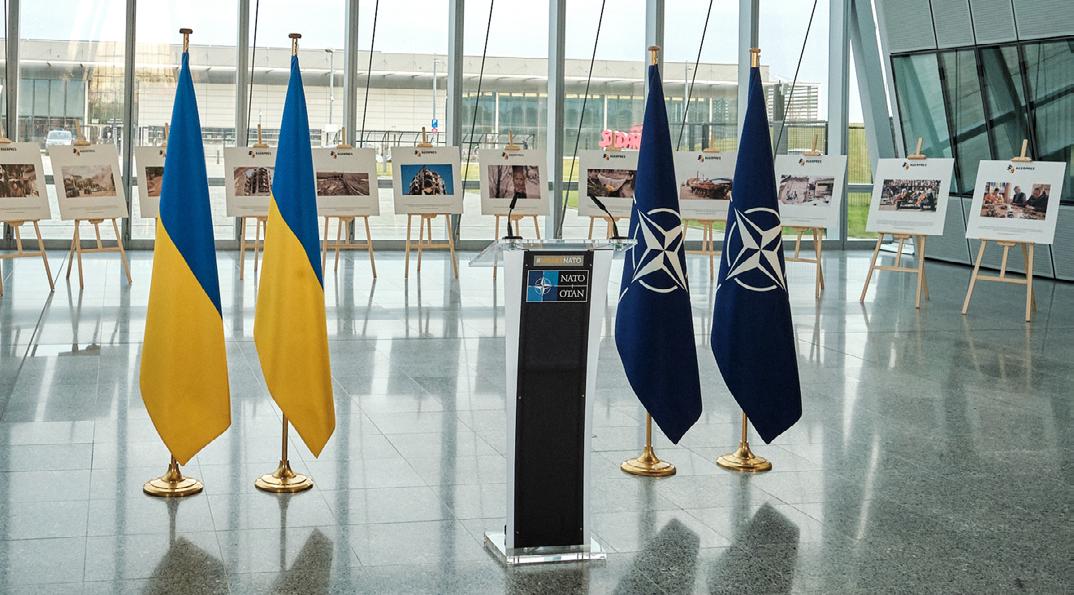
member commitment to collective assistance and collective security; by those parameters, Hungary’s pro-NATO bona fides score well, ever more so when some level of empathy is applied to Hungary’s difficult geopolitical realities and need to balance considerations from both east and west. Given the ongoing events in Ukraine and the potential for escalation, collective assistance and collective security should be paramount; for an organisation that is built to provide security, matters outside of this focus should rightfully remain a distant priority for brighter days when the winds of war are not ripping at the flags.
As war rages on in Ukraine and weapons from the West flood in, NATO’s future is an uncertain one. Some see the vitality and longevity of the Alliance hinging on the outcome of the current conflict in Ukraine. While Article 5 is not in play, the inability of NATO to maintain a united front and provide collective assistance against Russian aggression would be viewed by many on both sides as proof of the fragility and unreliability of the Alliance. Putin is counting on this development; whether he is hoping for this resolution, or is sure of it, is unknown. Nevertheless, most agree that the Alliance is at a crucial point in its history. Clarifying its focus for today and its vision for tomorrow is paramount for its survival; needless delays in addressing fundamental and existential questions are a recipe for disintegration and disaster. In an increasingly multi-polar world where the lines of war and peace are more blurred than ever, the answers to these inquiries have never been more consequential. When the mortal and historic enemy, the country that provided the rationale for the creation of NATO, is not at the gates, perhaps then a thorough inquiry can be launched into this matter with the appropriate level of consideration, empathy, resolve, and rigour.
“History doesn’t repeat itself, but it rhymes.”
–
Author Mark Twain
“FOR AN ORGANISATION THAT IS BUILT TO PROVIDE SECURITY, MATTERS OUTSIDE OF THIS FOCUS SHOULD RIGHTFULLY REMAIN A DISTANT PRIORITY FOR WHEN THE WINDS OF WAR ARE NOT RIPPING AT THE FLAGS.”Picture: NATO