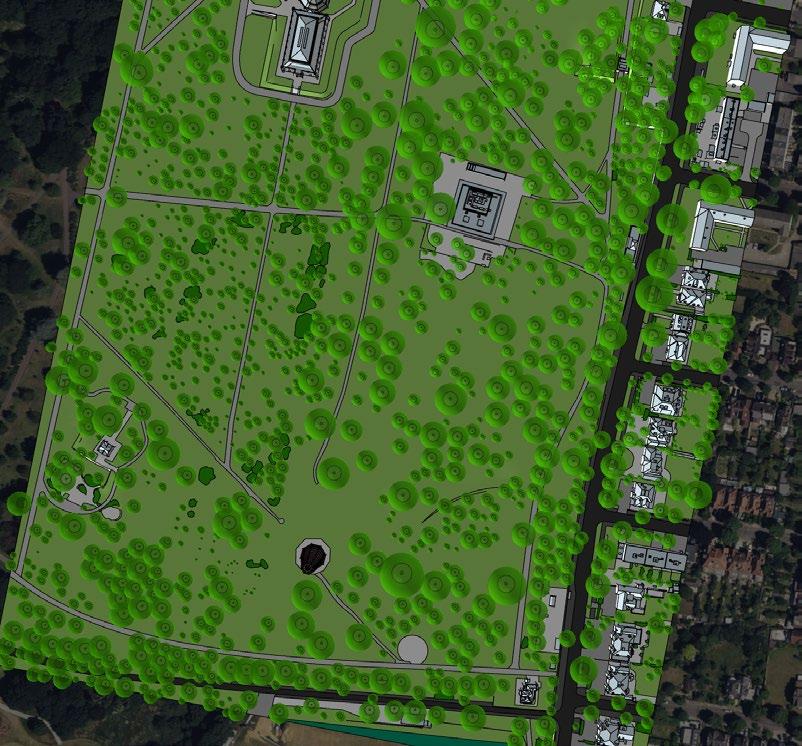
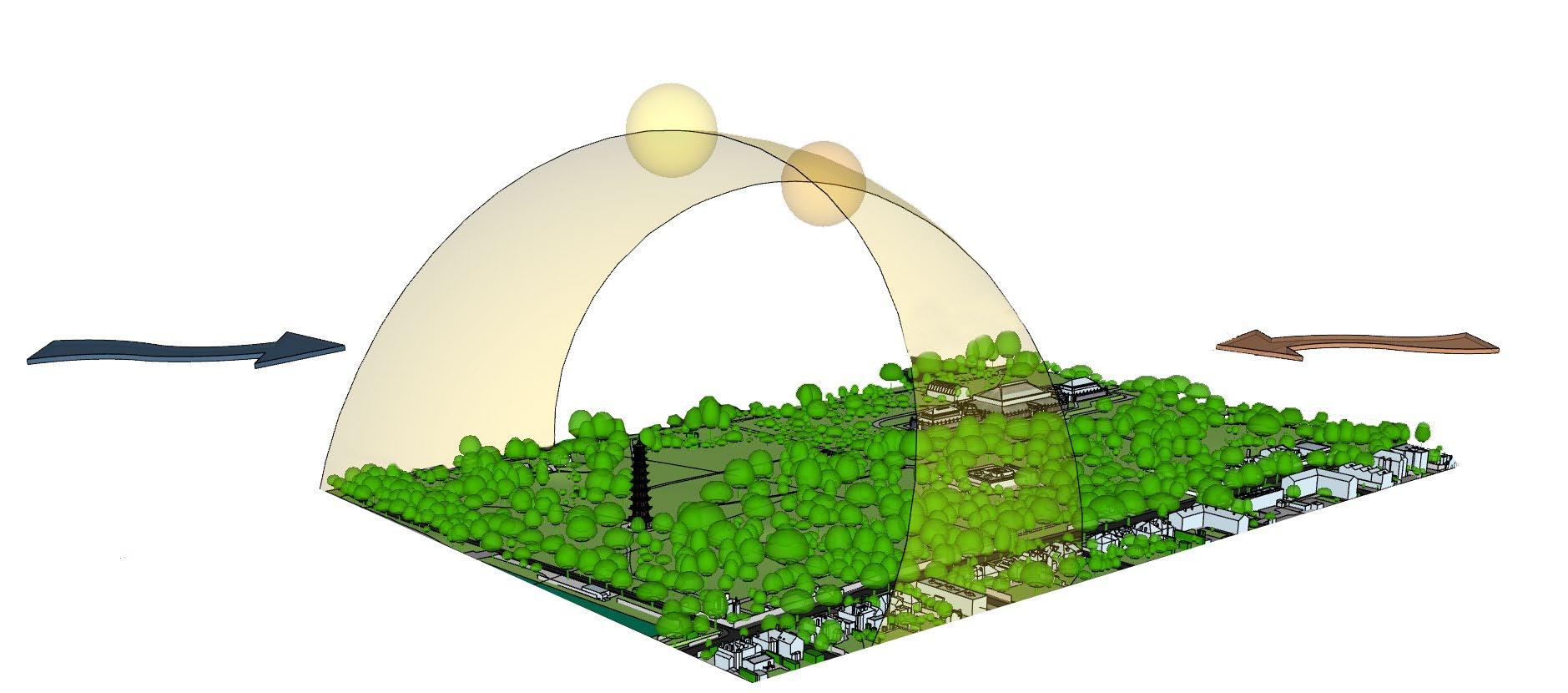
application of Urban Horticulture in
practice
Abstract
The purpose of this study is to explore and interpret China's architectural Feng Shui theory from the perspective of environmental psychology, and then conduct practical design based on the concept of sustainable architecture and urban horticulture. The article first explores the concepts of Feng Shui theory, environmental psychology, urban horticulture, and sustainable architecture. Then it conducts case studies on the Palace Museum in Beijing, the HSBC Building in Hong Kong, the Apple Store in London, and the Bank of China Tower in Hong Kong. Extract the principles and methods of Feng Shui theory application and practice from these cases, and explain them from the perspective of environmental psychology. Finally, summarize and apply these principles and methods to the renovation of the Bini Art and Knowledge House, as well as the design of a Chinesestyle garden at Kew Gardens in London, integrating Feng Shui theory, environmental psychology, urban horticulture, and sustainable architecture concepts for practical design.
Key words: Feng Shui; environmental psychology; urban horticulture; sustainable
1. Introduction
Feng Shui has a very long history in China, the emperors, nobles, and common people attach great importance to Feng Shui in their lives. Emperors and nobles strictly followed the Feng Shui theory in their lifetime from the construction of palaces and noble residences to the tombs after death. The common people also strictly followed the Feng Shui theory in their home construction, spatial layout, and surrounding environment. Feng Shui is the Chinese philosophy of life and allows them to live within the laws of nature. They believe that following the Feng Shui theory is helpful for family harmony, career prosperity, good official luck, and national peace and security. Feng Shui is a philosophy that embodies environmental science and cosmic laws. Feng is the wind which refers to vitality and energy, while Shui is water which refers to flow and change.
The study of Feng Shui in Western countries began in the late 19th century. Feng Shui theory faced resistance and opposition from scholars in various countries because it contradicted scientific concepts at that time and lacked scientific explanations and verification methods Afterward, Joseph Needham researched the Feng Shui theory. In his book "Science and Civilisation in China," he referred to Chinese Feng Shui theory as a "pseudo-science" and "landscape architecture of ancient China". He does not believe that Feng Shui theory is scientific, but he believes that Feng Shui theory contains aesthetic elements (Needham and Ling, 1956). Needham believed the Chinese would struggle to accept the mechanical worldview underlying the European scientific revolution. Over time, Joseph Needham's views on Feng Shui philosophy have been challenged. Feng Shui has existed and developed in non-scientific environments for centuries, and it is the default worldview in China and Southeast Asia (Matthews, 2019), and naturally has its significance and rationality. For over half a century since Joseph Needham, not only Chinese and Southeast Asian scholars but also Western scholars have begun to study Feng Shui theory from a scientific perspective.
At present, architects have adopted Feng Shui theory in architecture and interior design (Cho, 2024). Designers use Feng Shui theory in home design and overall life to create balanced and flowing spaces, using arranged pieces in living spaces to maintain balance with the natural world and establish harmony between individuals and the environment They use clear and clean windows to allow more sunlight to enter the interior, making the space appear more spacious, vibrant, and energetic. Sunlight can also vividly render all the colors and objects that residents see. Then designers plant green plants and fill the room with the life energy brought by plants. Green and vibrant plants are one of the key elements in home feng shui (Cho & Khare, 2024).
Modern neuroscience's development has provided new insights into how architecture affects human psychology and behaviour (Robinson & Pallasmaa, 2015). In the process of

continuous development, humans constantly explore, understand, and reflect on the environment, and then this knowledge forms the theory of environmental psychology. Psychologists divide the processing and evaluation of environmental perception information by humans into the domain of environmental cognitive level, and the adaptive response to environmental cognitive information into the domain of emotional level. Humans will respond to the built environment cognitively and emotionally. (Higuera-Trujillo et al. 2021) According to research in environmental psychology, environmental noise causes human stress (Glass & Singer, 1972), and stress related to the built environment can even damage life expectancy (Glaser & Kiecolt-Glaser, 2005). There is evidence to suggest that green coverage near home can alleviate the adverse effects of perceived stress on sleep quality (Yang et al. 2020).
By chance, I touch on the concept of "Lu Chong (Road Conflict)" in Feng Shui. "Lu Chong" refers to the direct frontal or sloping direction of a road towards the main entrance of a building (as shown in Figures 1a and b), which is said to direct strong destructive energy onto the building, affecting the comfort and mental health of residents The solution in Feng Shui is to place a "Shi Gandang (large stone)" between buildings and roads. If the buffer zone is large enough, green vegetation can be planted around the "Shi Gandang" or a small pool can be built behind it. In the pool, the fish can be raised and some aquatic plants can be placed.
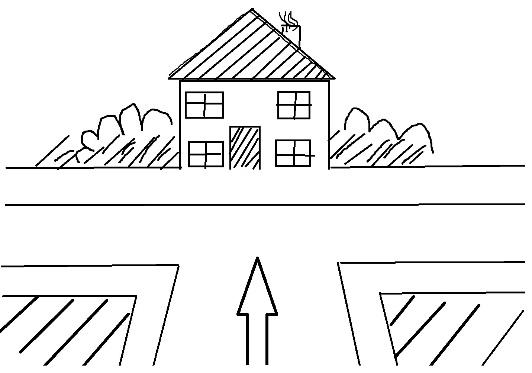
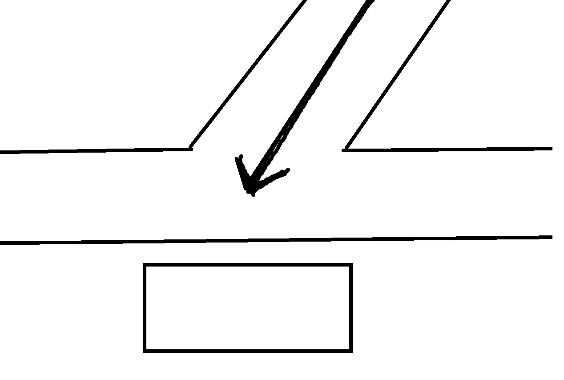
These concepts and methods have sparked my thinking. When a building faces a "Lu Chong", people living in the building will feel pressure, which comes from the noise of vehicles driving, the panic and anxiety caused by residents seeing cars rushing towards them, and a deep sense of insecurity, worrying about whether vehicles will lose control and crash into the building. In the solution of Feng Shui theory, the "Shi Gandang" forms a safety buffer barrier between buildings and vehicles driving on the road, giving residents a sense of security. At least the "Shi Gandang (large stone)" blocks the out-of-control vehicles first, and then blocks the residents' line of sight such that residents will not directly look at vehicles coming towards them on the road, reducing anxiety. The small pool forms a second layer of safety barrier, even if an out-of-control vehicle rushes over the "Shi Gandang", it
Figures 1(a) The direct frontal "Lu Chong" (b) The sloping direction "Lu Chong"
will still get stuck in the small pool. Green vegetation around "Shi Gandang" and aquatic plants in small pools can soothe residents' moods and reduce stress. At the same time, green vegetation can help drivers restore their tired vision and clearly distinguish roads and buildings based on green vegetation. These seem to be explained by the environmental psychology of architecture. Therefore, these concepts and methods gave me the idea of using environmental psychology to think and explain Feng Shui.
The "Shi Gandang" to solve the problem of "Lu Chong" is a big stone, which can be replaced by a stone or a wall that has been demolished by other buildings. The construction of small pool should also use sustainable building materials, and green vegetation should be able to plant green vegetables or fruit trees. I believe that the concept of feng shui can be combined with the concept of sustainable building materials and urban gardens (urban farms) to achieve this. Therefore, this project will attempt to interpret China's architectural Feng Shui theory from the perspective of environmental psychology and conduct practical design based on the concept of sustainable architecture.
2. Literature Review
2.1 The philosophical foundation of the formation of Chinese Feng Shui theory
Feng Shui in China is an applied discipline that has gradually developed under the background of traditional Chinese philosophy. To truly understand Feng Shui, one must understand what problems Feng Shui is meant to solve and what the ultimate goal is. Only then can we understand the ideological origins of Feng Shui and the philosophical basis of solving methods.
2.1.1 The philosophical origin of Feng Shui: Tao, Yi, and Chi (Dao, Yi, and Qi)
In Chinese philosophy, "Tao" is regarded as truth. Chapter 25 of the “ Tao Te Ching ” , written by the ancient Chinese philosopher Laozi, mentions that "There was something undefined and complete, coming into existence before everything (contain heaven and earth). Void and vast, independent and changeless, moving in cycle. It may be regarded as the mother of everything. I do not know its name, and I give it the designation of the Tao (the Way or Course) or perfunctorily style it the great". That is to say, "Tao" is a rule that existed before the creation of everything and is the truth of the world (Mair, 1990).
In Chinese philosophy, it is believed that "Tao" is the entire real world that transcends the perceptible experiential world and the imperceptible transcendent world. The "Tao" is popular between everything, gathering into form and dispersing into Chi. Form is the surface, and "Chi" is the interior. The "Tao" is manifested through form and returns through "Chi". Form and "Chi" construct the entire world of experience and transcendence together - the "Tao"
"Yi "comes from the "I Ching (or Yi Jing) (Book of Changes)", which is the oldest, most profound, and famous classic in China. It is the crystallization of wisdom and culture and is known as the "head of the group of classics and the source of the great Tao" (Wilhelm, 2010). "Yi" is a way to understand the surroundings and guide our behavior through a symbol system of divination and prediction, and further to perceive the world and understand the "Tao" (Yijing, 2019). Every object or phenomenon has a "Tao" hidden within it, which is not only the essence of the object or phenomenon but also includes its future evolution and the laws of its change. Because the "Tao" is indescribable and difficult to understand and recognize, we can only use "Yi" to predict and perceive objects or phenomena, and further understand the world and the "Tao" through "Yi".
"Chi" is the vital life force or energy that enables objects or phenomena to exist, operate, and even change (Lu, 1998). Organisms balance their body, mind, and surrounding environment by understanding and mastering "Chi", and recognizing objects or phenomena through "Yi" to approach the "Tao" and achieve the highest level of Chinese philosophy, "unity of heaven and humanity" (He, 2022).
2.1.2 The philosophical foundation of Feng Shui theory (1) Yin-Yang
In the "I Ching (or Yi Jing) (Book of Changes)", it is recorded that "Tai Chi emerged from the chaotic changes, and then two elementary parts began to generate from Tai Chi". These two elementary parts are "Yin (means gloomy, moon, night, die)" and "Yang (means bright, sun, day, living)". Yin and Yang alternate in space and time, they are the harmonious interaction of all opposing main bodies, objects, or pairs in the universe, just like two complementary and interdependent phases (Seidel & Ames, 2024).
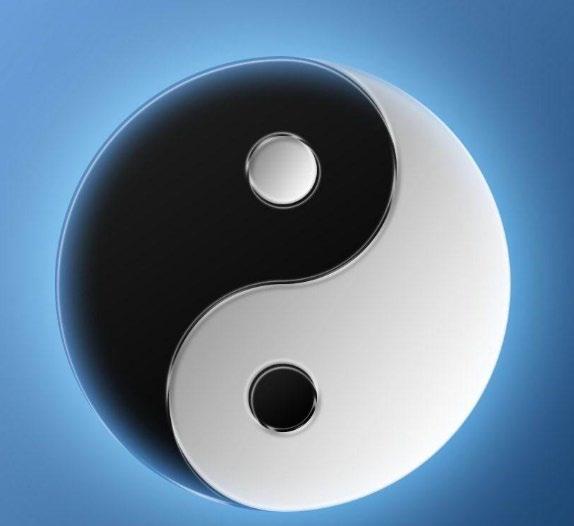
In Feng Shui theory, "Yin" and "Yang" represent the corresponding geographical environment. The north of the mountain and the south of the river are called “ Yin”, and the south of the mountain and the north of the river are called “ Yang ”. In ancient China, people observed that in the south of the mountains, the sun's rays were relatively easy to reach, and the slopes here were sunny, giving people a bright and energetic feeling, thus belonging to the “ Yang ”. The north side of the mountain is shrouded in shadow all year round due to the difficulty of sunlight shining on it, giving people a deep and mysterious feeling, therefore it belongs to the “ Yin”. The sunlight on the north side of the water is relatively easy to shine on, and these water bodies are usually shallow and have clear colors, so they belong to the “ Yang ”. The sunlight on the south side of the water is difficult to reach, and these bodies of water are usually darker and have a deep blue color, hence they belong to the “ Yin”.
(2) Five Elements (Wu Xing) or Five Phases
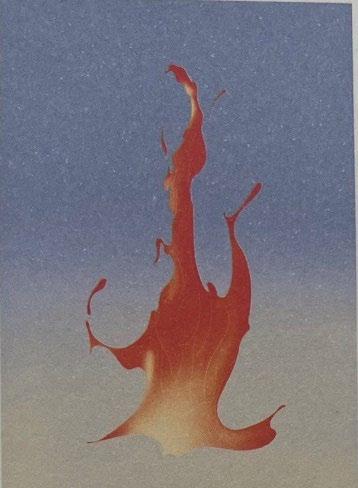
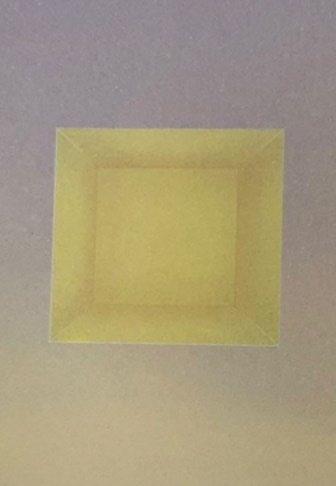
The Five Elements are metal, wood, water, fire, and earth (soil) Their images are shown in Figure 3 (a)- (e). It first appeared in the ancient Chinese classic book "Book of Documents". It is a simple classification of all things in the world by ancient Chinese people, who believed that all things in the world are infinitely changed by the interaction
Figure 2 Yin-Yang Tai Chi diagram
of these five different substances (Wang et al. 2020).
3 The Five Elements
In the Five Elements, Metal represents the energy or phenomena of cleanliness, purification, change, austerity, and convergence; Wood refers to all plants, representing the energy or phenomena of growth, development, life, and relaxation; Water refers to all liquids, representing the energy or phenomena of infiltration, nourishment, moisturization, coldness, seclusion, and downward movement; Fire refers to all thermal energy, representing energy or phenomena of heat, warmth, ascension, and take off; Soil refers to all sand and gravel soils, representing energy or phenomena of load-bearing, fertility, and acceptance (Tan, 2022). The meanings and symbols of the Five Elements are as Table 1.
(a) metal (b) wood (c) water
(d) fire
(e) earth
Figures
(a) metal (b) wood (c) water (d) fire (e) earth
Table 1. The meanings and symbols of the Five Elements
Five Elements Metal Wood Water Fire Earth (Soil)
Energy or phenomena cleanliness, purification, change, austerity, convergence, malleable, and condensed growth, development, life, relaxation infiltration, nourishment, moisturization, coldness, soft, seclusion, downward movement heat, warmth, ascension, take off loadbearing, fertility, acceptance
Symbolizing hard, decisiveness, fortitude, shiny, and smooth Vitality life energy Wisdom, flow, transformation hot, passion, brightness thick, sturdy, stability, inclusiveness
Season autumn spring winter summer the transitional season of the four seasons
Colour White Green, blue black red, orange Yellow, brown
Direction West East North South Centre
Taste spicy sourness salty bitterness sweet
Shape evenly pressured circle vertically growing rectangle fluid and indeterminate sharply pointed triangle perfect square
(i) The generating, inter-promoting, or enhancing cycle of the Five Elements
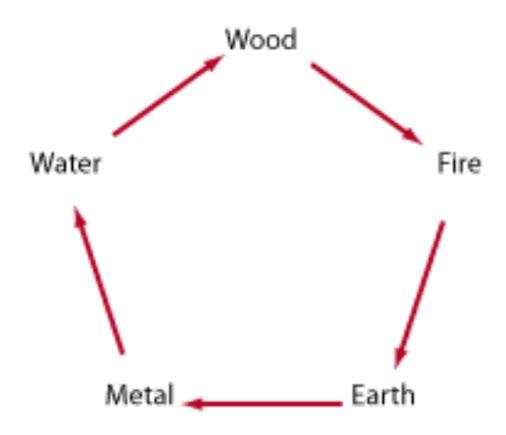
One of the five elements can enrich, nourish, promote, and generate another element, ultimately forming a cycle. Wood element can promote the fire element, the fire which eventually turns into ashes to form the earth (soil) element. The earth element nourishes and buries the metal element, which melts into a liquid state at a high temperature to form the water element. The water element nourishes the wood elements, including plants and wood. This forms a cycle, as shown in Figure 4 (a).
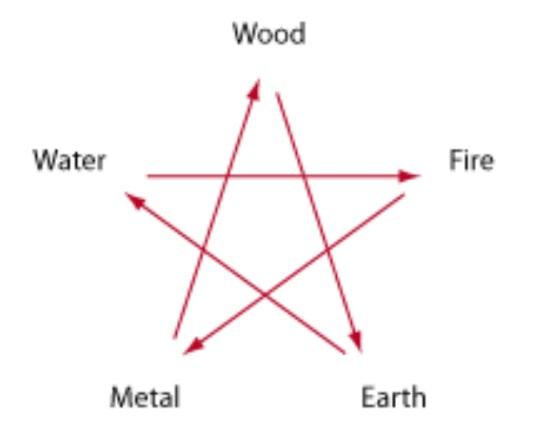
Figure 4. The Five Elements’ (a) generating cycle (b) suppressing cycle (ii) The controlling, destructing, or inter-restraining and the weakening cycle of the Five Elements
One of the five elements can suppress, overcome, or weaken another element, ultimately forming a cycle. Metal is harder or sharper than wood, and a metal knife can cut wood, so the metal element can suppress and overcome the wood element. Trees break through the earth and grow, so the wood element can suppress and overcome the earth element. The earth can absorb water and form embankments to hinder its flow, so the earth element can suppress and overcome the water element. Water can extinguish fires, so the water element can suppress and overcome the fire element. Fire can melt metals, so the fire element can suppress and overcome the metal element. This forms a cycle, as shown in Figure 4 (b). (3) The Eight Trigrams (Bagua)
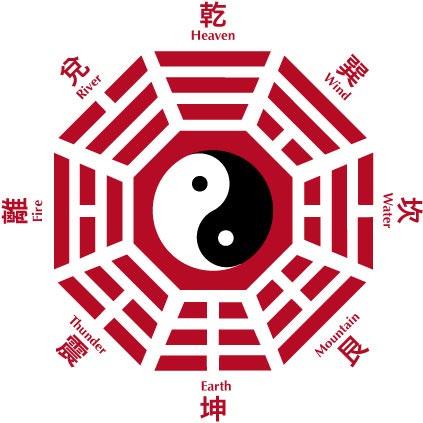
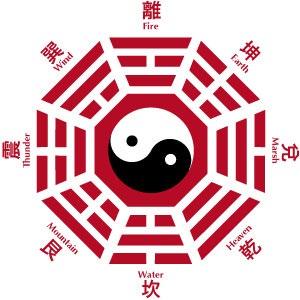
The Eight Trigrams are eight symbols, each symbol represents a certain thing, attribute, or orientation, it is composed of two basic symbols, the Yang line (-) and the Yin line (⚋), and three lines form a symbol. The Eight Trigrams include Qian (☰), Kan (☵), Gen (☶), Zhen (☳), Xun (☴), Li (☲), Kun (☷), and Dui (☱). The orientation of the Eight Trigrams is divided into the Early Heaven Sequence (Figure 5 (a)) and the Later Heaven Sequences (Figure 5 (b)).
The Eight Trigrams in the early heaven sequence symbolize the primitive state of the universe. The Eight Trigrams in later heaven sequences represent the universe's changes and development. In Feng Shui architecture theory, the Eight Trigrams in later heaven sequences are generally adopted. The imageries of the Eight Trigrams are as follows. The directions and elements represented by Bagua are shown in Figure 5.
Figure 5. The Eight Trigrams Diagrams (a) in Early Heaven Sequence (b) in Later Heaven Sequences
(i) Qian (☰) is Yang Trigram representing heaven. To the northwest direction, the Five Elements belong to the metal element, representing the father in the family, 45 years old and above;
(ii) Kan (☵) is Yang Trigram representing water. To the north direction, also known as the Xuanwu position, the Five Elements belong to the water element, representing the second son in the family, aged 25-35;
(iii) Gen (☶) is Yang Trigram representing mountain, To the northeast direction, the Five Elements belong to the earth (soil) element, representing the young son in the family, aged 15-25;
(ix) Zhen (☳) is Yang Trigram representing thunder. To the east direction, also known as the Green Dragon position, the Five Elements belong to the wood element, representing the eldest son in the family, aged 35-45;
(x) Xun (☴) is Yin Trigram representing wind. To the southeast direction, the Five Elements belong to wood element, representing the eldest daughter in the family, aged 35-45.
(xi) Li (☲) is Yin Trigram representing fire. To the south direction, also known as the Vermilion Bird position, the Five Elements belong to fire element, representing the second daughter in the family, aged 25-35;
(xii) Kun (☷) is Yin Trigram representing earth. To the southwest direction, the Five Elements belong to earth, representing the mother in the family, aged 45 and above;
(xiii) Dui (☱) is Yin Trigram representing marsh, To the west direction, also known as the White Tiger position, the Five Elements belong to the metal element, representing the young girl in the family, aged 15-25.
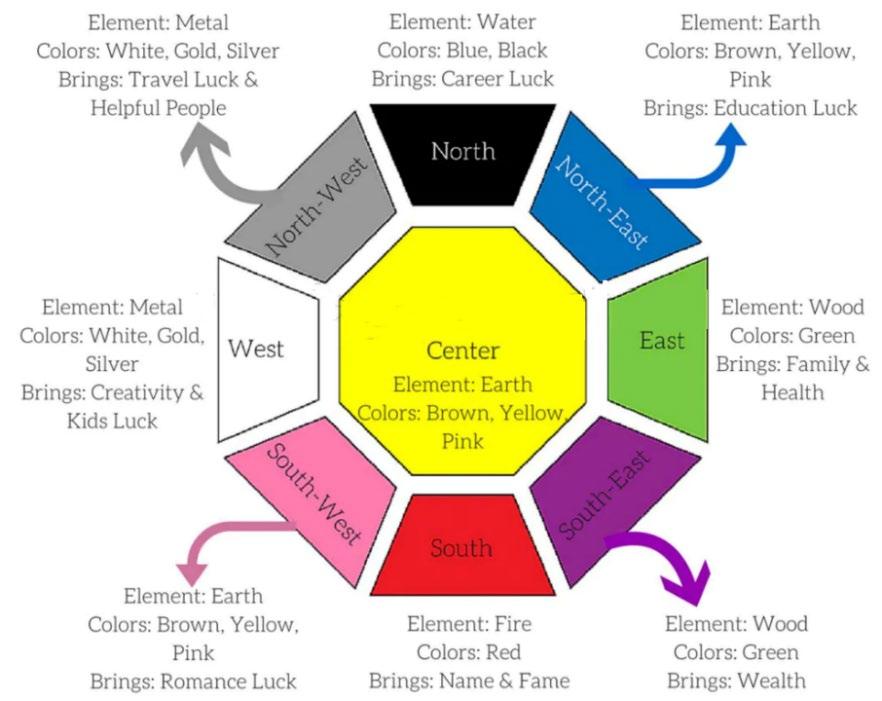
The orientation position and color represented by each Hexagram (Trigram) in the Eight Trigrams (Bagua) from the perspective of Feng Shui are shown in Figure 6.
Figure 6. Orientation position according to Feng Shui
2.1.3 The Ultimate Goal of Feng Shui: Gathering Chi
The important classic book of Taoism, "Chuang Tzu: Outer Chapters- Knowledge Rambling in the North" says "A human being is a gathering of Chi; the gathering of Chi leads to life, while the dispersal of Chi leads to death" (Chuang Tzu). Taoism talks about 'Chi', aiming to refine 'Chi'. Traditional Chinese medicine takes "Chi" as the general principle and believes that evil Chi causes human illness. Therefore, for people to be healthy and families to be safe, they must gather Chi.
2.2 The Application of Feng Shui in Architecture
Integrating Feng Shui into modern architecture involves spatial arrangement, orientation position, material selection, and the fusion of ancient Feng Shui principles with contemporary architectural practices. The application of Feng Shui in modern architecture includes the following aspects (Clarkson, 2023):
(1) Spatial arrangement: Designers consider the flow of energy or "qi" in the layout of the buildings to ensure that energy circulates smoothly and evenly throughout the entire space.
(2) Orientation position: The positioning of buildings is carefully planned to maximize the use of natural light and ventilation while maintaining consistency with the surrounding environment and its energy patterns.
(3) Material selection: Emphasize the use of natural materials such as wood and stone to create a sense of grounding and connection with nature.
(4) Colour and Symbols: Colours and symbols are chosen purposefully to enhance the desired energy and ambiance of the space.
Anjie Cho is a certified Feng Shui consultant, professional architect, and author, who has compiled some applications and precautions of Feng Shui in home architecture and
space design. Organized as follows (Cho, 2024).
1. Brighten up entry
The entry is the "mouth of Chi". It lets energy enter your home and your life. We should be uncluttered, need to sweep and clean up the area, and make sure this space is well-lit and bright.
2. Clean windows
Clear and clean windows allow more sunlight to enter. Sunshine will energize and wake you up, and can also render all the colors and objects you see. Light can make your home wider and more vibrant, helping you see the world around you more clearly.
3. The house doors work correctly and smooth entry and exit
Ensure that there is no bunch of clutter behind the door and that the hinges are not squeaking. The house doors represent your voice and communication, its smooth entry and exit represent opportunities that can come into your life, and your voice and communication are smooth, and no interference.
4. Commanding position
The commanding position refers to the farthest position of the room from the door (but not in a straight line with the door). It determines how you position yourself in life and is the location where you want to spend the most time in this space. Placing the desk and bed in these positions is the most ideal choice.
5. Remove obstacles on your path of walking or moving in the house
Obstacles affect the smoothness of your movements and the flow of "Chi" in the house. Over time, these obstacles will accumulate and cause problems for you.
6. Keep the space spacious and items tidy
De-cluttering your items such that tidy will create an open and new space, then make your space and your life more spacious.
7. Space clearing
Clean up the space and repair damaged items, such as lights. To fill the space with bright sunlight and let the sunlight clean your entire home. Let the sweet orange essential oil spread throughout the space.
8. Plants Bring Life Energy
Living green plants connect you with nature, embodying the energy of life and bringing freshness and vitality to your home. Green and vibrant plants are one of the key elements of Feng Shui in the house.
9. Express gratitude with a humble heart
Home is your refuge, a place for you to rest, nourish, celebrate, etc. Always be humble and grateful for your home.
2.3 Environmental Psychology
Our brain or body's absorption and secretion of neurochemicals or hormones may be the biological factors that affect our behaviors. Our unique cultural, religious, social, or personal experiences may be the social factors that influence our actions. Environmental psychologists combine these biological and sociological influences with the environmental factors from our surroundings, establishing a school of psychology that studies how people interact and participate in their environment. The core of the research is to explore how the environment affects us. Environmental psychology can address issues related to learning, attitude formation, motivation, perception, and the social interaction (LAMPS) principle. In certain environments, humans may adopt specific behaviors influenced by their surroundings. Environmental psychology can help us understand why these behaviors occur. Understanding the consequences of environmental changes through environmental psychology can benefit design disciplines such as architecture, interior design, and landscape design (Kopec, 2012).
In 1984, Roger Ulrich surveyed the recovery records of patients after cholecystectomy. He found that 23 surgical patients assigned to rooms with windows facing natural scenes had shorter hospital stays, fewer negative reviews in nurse records, and fewer use of potent analgesics (Ulrich, 1984). This sparked the medical community's first consideration of the economic benefits of exposure to nature. A carefully designed garden with a home-like appearance can create an aesthetic placebo, evoking people's familiarity and sense of belonging to a 'home away from home'. This landscape design has therapeutic and restorative effects (Sachs & Marcus, 2014). As a natural environment, hospital gardens are important in balancing high-stress levels, improving happiness, and supporting rehabilitation. After the investigation, it was found that the highest score was in rehabilitation. Participants used semantic difference (SD) factor analysis to reveal six factors related to design: emotion, happiness, nature, mysticism, tranquility, and touch (Cervinka et al., 2014). For the public, long-term exposure to residential green spaces can reduce physiological stress, improve human health, and alleviate depression and anxiety. Reducing air pollution is an important medium for linking green environments with depression and anxiety (Wang et al., 2024). The Natural environment with plants can alleviate physical and mental stress and negative emotions in the human body, while significantly increasing vitality (Yao et al., 2024). Exposure to the natural environment has a protective effect on mental health and cognitive function (Jimenez et al., 2021).
Vartanian et al. (2015) found that ceiling height and perceived enclosure (defined as perceived visual and locomotive permeability) have an impact on aesthetic judgments and approach-avoidance decisions in architectural design. Rooms with higher ceilings and open rooms are more likely to be considered beautiful and activate the structures involved in visual space exploration and attention in the dorsal stream. The decrease in visual and
motorcycle penetration characteristics perceived in enclosed rooms is more likely to trigger emotional reactions to exit decisions.
Environmental psychology has been applied not only in the medical and architectural design of hospitals but also in the architectural and spatial design of schools. According to research, classroom lighting can affect cognition and has been proven to affect academic achievement, attention rates, working speed, productivity, and accuracy, among other reported effects. LED lighting is most suitable for improving psychological and cognitive processes in the classroom, and more importantly, using higher correlated color temperature (CCT) and balancing between daylight and artificial light (Mogas-Recalde & Palau, 2021)
2.4 Urban Horticulture (Urban Farm)
Since entering the 21st century, human civilization has undergone earth-shattering changes on a global scale. The population is concentrated in cities, where they enjoy diverse facilities, better lifestyles, and employment sources. More than 50% of the world's population lives in cities. Although the area of all cities worldwide only accounts for 3% of the Earth's land, there are now over 3.5 billion people living in cities, and the number is constantly increasing (Sustainable Development Goals). The trend of population concentration in urban areas has caused problems such as reduced arable land, worsening malnutrition, and increased distance from cities to traditional food production sites.
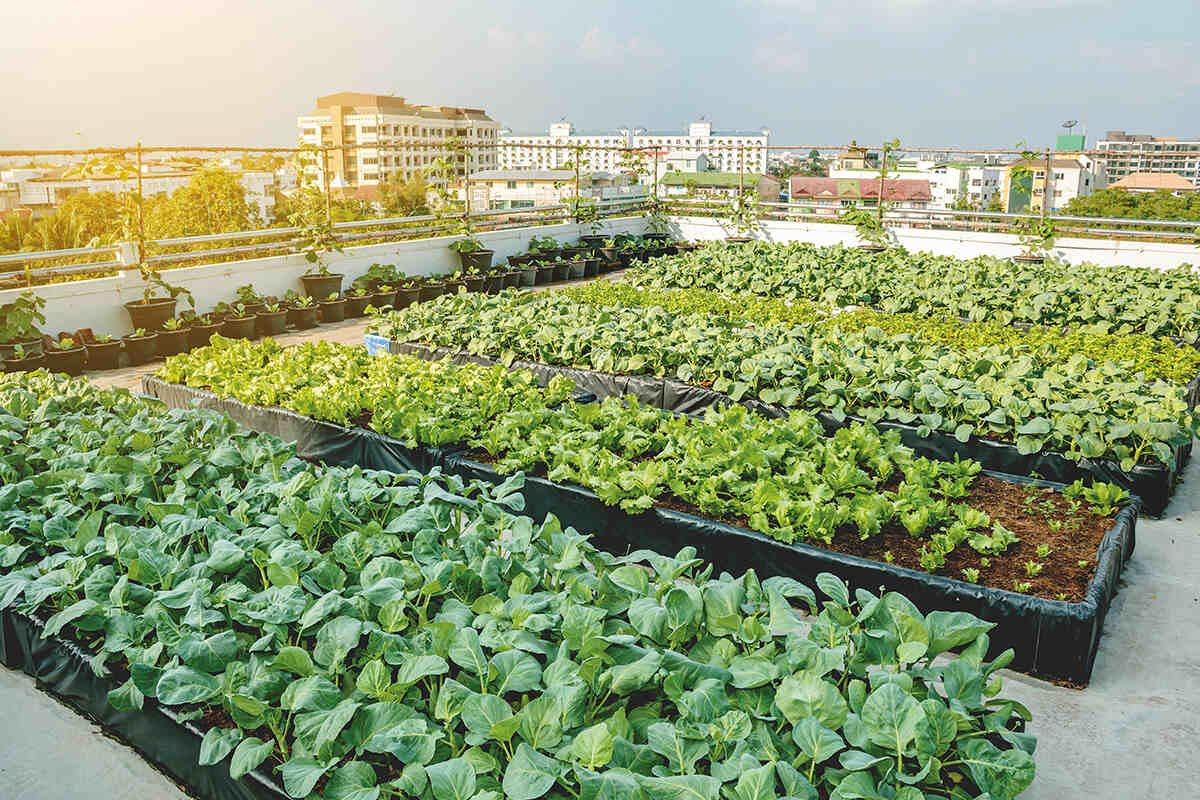
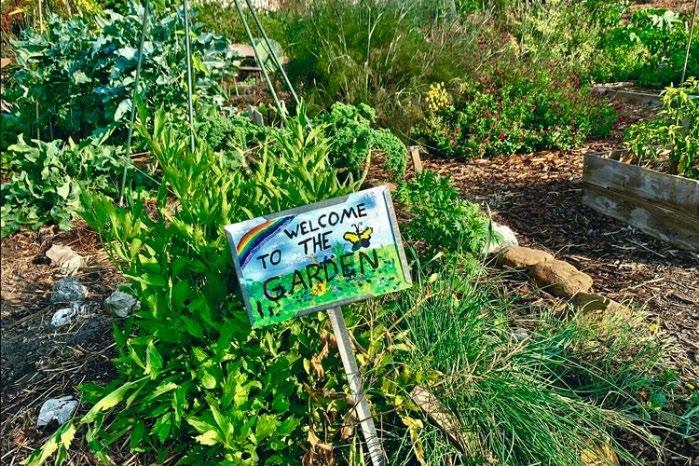
In the past decade, the participation of communities in urban food production has steadily emerged. Urban horticulture and urban farms are beginning to rise. Utilize vacant land in the city, building rooftops (Figure 7), or balcony spaces to plant flowers, plants, and vegetables. Urban horticulture and urban farms can add green spaces to achieve sustainability, aesthetics, and offer fresh produce to residents (Cottam, 2022).
Figure 7. A rooftop farm in Thailand. Frango & Imbesi (2015) explore how design activism is expressed through urban horticulture and how citizens seek to change and challenge the quality of urban space
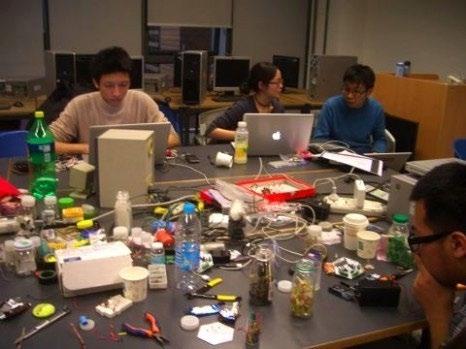
through two examples: LA Green Grounds (Figure 8) and Re: farm the City (Figure 9). By incorporating urban horticulture into design, urban horticulture proposes a new platform for designers to participate and considers a more inclusive design practice model. Although increasing evidence suggests that urban horticulture can further support more sustainable and resilient cities, significant scientific, engineering, and socio-cultural challenges must still be overcome to successfully integrate food cultivation more widely into cities (Edmondson, 2024)
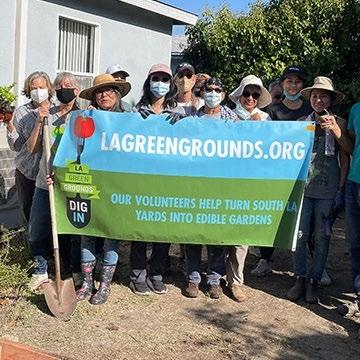
Urban horticulture is becoming increasingly important for cities as it can become a source of income generation, ensuring our food security, guaranteeing food supply and sustainability, becoming a source of recreation and reduction of gender inequality, and even contributing to self-reliance and land management of cities. It impacts cities through increasingly diverse methods, including community gardens, terrace gardening, window gardens, indoor planting systems, container planting, and vertical gardening (Pal et al., 2022).
2.5 Sustainable Architecture
The World Commission on Environment and Development defines sustainability as
Figure 8 (a). LA Green Grounds (b) Turning food deserts into triumphs (LA Green Grounds).
Figure 9. Re:farm the city workshop.
development that meets current needs without compromising the ability of future generations to meet their own needs (Thomsen, 2013) When sustainability is applied to architecture, it refers to minimizing negative impacts on the environment, energy consumption, and human resource use, thereby design that creating a healthy living environment.
Sustainable architecture is also known as green architecture or environmental architecture. It is often understood as architecture with minimal impact on the environment while meeting the needs of users (Harań, 2025). Sustainable architecture is reflected in the materials, construction methods, resource utilization, and overall design. Architects must conduct intelligent design and use existing technologies to minimize the amount of resources consumed during construction, use, and operation, as well as reduce the harmful impacts on the environment, ecosystems, and communities caused by emissions, pollution, and waste of their components (Ragheb et al., 2016).
At present, new building technologies provide increasing opportunities for creating an infrastructure that can respond to and adapt to the needs of all users (Ferdous & Bell, 2020) Therefore, a sustainable building design that reduces the amount of resources consumed during construction, use, and operation, minimizes environmental impact, and meets user needs is indeed feasible in terms of technology, materials, and construction methods. For the sake of future generations, it should be promoted and implemented.
3. Research Methods and Case Study
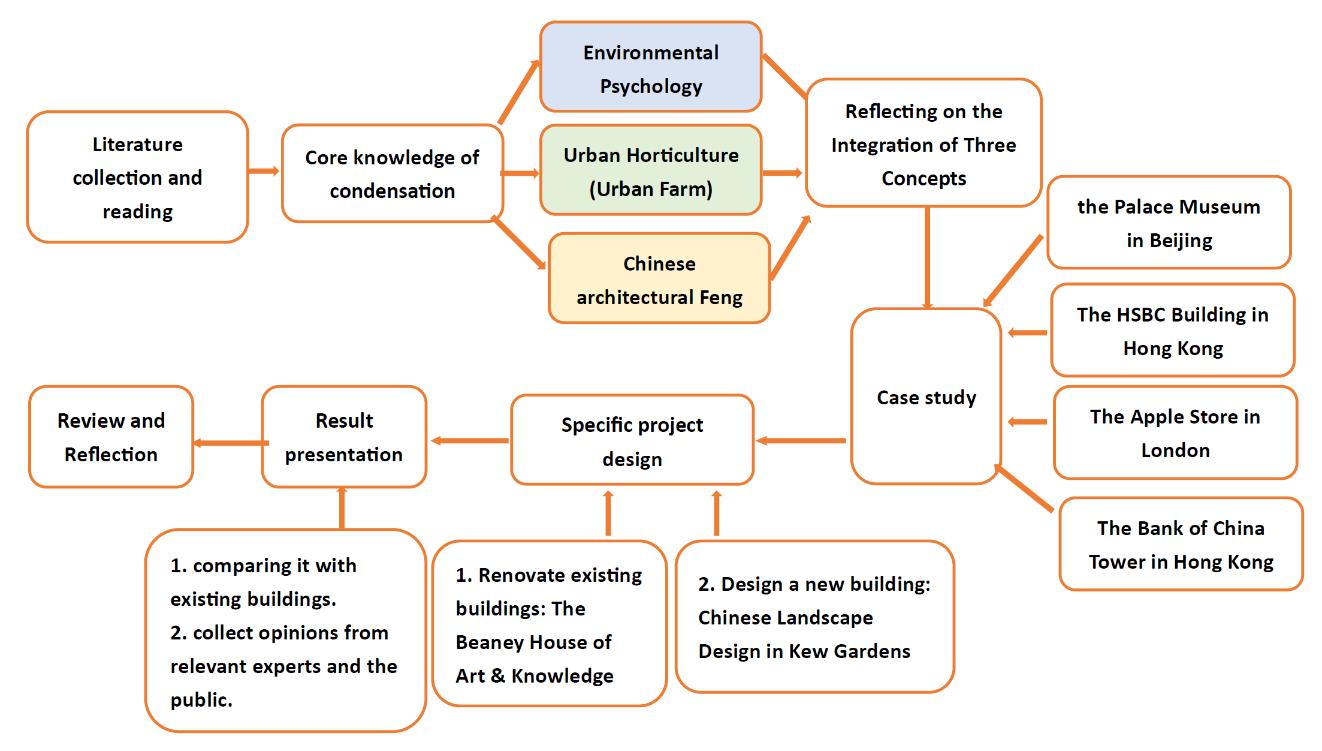
In this article, I want to explore how traditional Chinese spatial philosophy Feng Shui can influence contemporary architecture through the lens of environmental psychology and sustainable design.
Feng Shui is often seen as a cultural belief, but I see it as a system of spatial logic with real potential for enhancing mental well-being, energy efficiency, and ecological harmony in built environments.
My proposed research takes a mixed-methods approach, combining interviews, case studies, environmental data, and spatial analysis. I hope to build an evidence-based framework that connects ancient wisdom with modern design thinking, contributing to sustainable urban planning and human-centred architecture. My research technology roadmap is shown in Figure 10
10. My research technology roadmap
3.1. Case Studies on Feng Shui Architecture
This article first selects an ancient Chinese feng shui architecture, the Palace Museum in Beijing in China, as a case study to gain a deeper understanding of the application of feng shui theory in architectural design. Then choose three modern Feng Shui buildings and extract the principles and practices of Feng Shui theory applied to contemporary architecture. These three modern feng shui buildings are the HSBC Building in Hong Kong, the Apple Store in London, and the Bank of China Tower in Hong Kong.
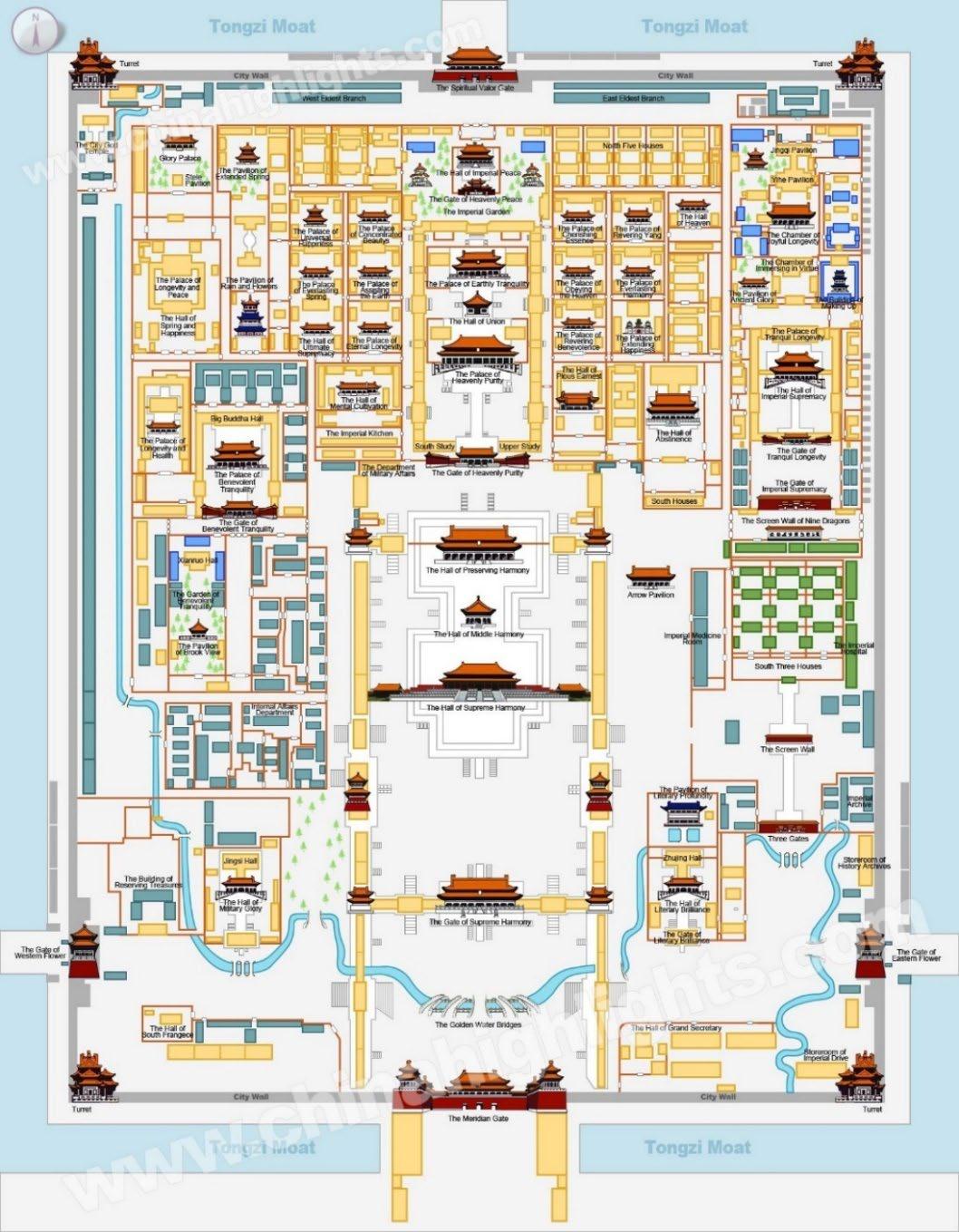
3.1.1 Feng Shui Research at the Palace Museum in Beijing (China Highlights, 2021)
The Palace Museum in Beijing is the largest medieval palace in the world, also known as the Forbidden City. It has a history of over 600 years and was the main imperial palace
Figure
of the last two dynasties in China: the Ming Dynasty (1368-1644) and the Qing Dynasty (1644-1912). The Palace Museum covers a vast area of about 150000 square meters, including approximately 980 buildings. Most of its buildings are constructed based on traditional Chinese culture and the application of Feng Shui theory, mainly including:
Figure 11 The Forbidden City was symmetrically on the north-south central axis of old Beijing.
(1) Layout: North-South Power Axis, the main entrance faces south
The layout of the Forbidden City runs from the main south entrance through its majestic halls to its northern emperors' quarters, with the north-south axis being one of
the most important features of the Forbidden City's layout. The main entrance of the Forbidden City faces south, and the main road leading to the palace extends along the north-south axis. The imperial palace must be built in the center of the capital city on its north-south axis. The important buildings must be located on the north-south 'power axis'. In Chinese culture, the North Star is the only seemingly stationary star in the northern sky, believed to be heaven, while the emperor is considered to represent heaven and is therefore placed in the north.
The imperial palace is in the middle, facing south, and the north-south axis divides the Forbidden City into two halves. The left is east, belonging to Yang, where the sun rises. The right is west, belonging to Yin, where the sun sets. In addition, according to traditional Chinese culture, the status of the left side is much higher than that of the right side. Therefore, the Royal Ancestral Hall is built on the left side of the north-south axis, with the earthen altar and harvesting platform located on the right side. The basic principle of the architecture of the Forbidden City is Heaven central, mankind left, and nature right.
(2) Three auspicious colours
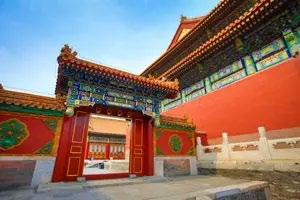
The main colour of the Forbidden City is yellow, which has been the exclusive colour of the royal family in China since the Sui Dynasty (581-618) until the Qing Dynasty, because the emperor is the ruler of the country and resides in the center. According to the Five Elements theory, the center belongs to the earth element, and its colour is yellow. The glazed tiles on the roofs of buildings in the Forbidden City and the bricks on the ground in many places are yellow, and many decorations in the buildings are also painted yellow.
Most of the pillars in the Forbidden City are painted red, which is an auspicious and festive colour associated with happiness, wealth, and power. The walls and window frames of buildings painted red not only appear festive but also eye-catching. Green symbolizes growth and is a very important colour that can be found in wall decorations and on the roof tiles of buildings such as the princes' quarters.
Figure 12. The main Forbidden City colours (Red walls, yellow roofs and green/blue decorations decorations)
(3) Stone and Bronze Lions
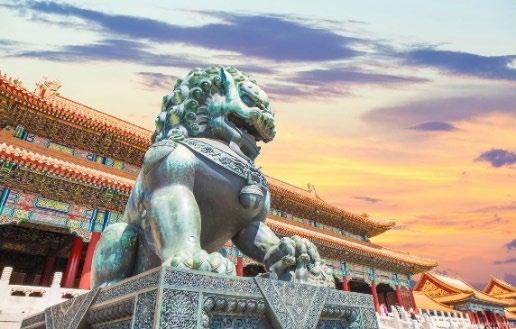
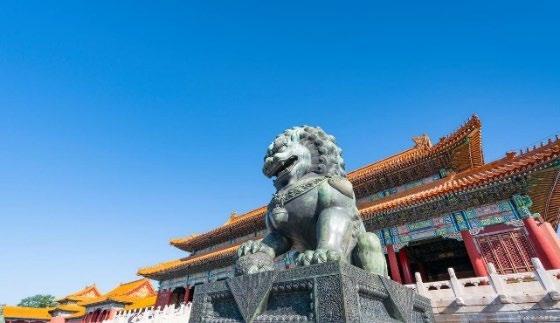
Many buildings have stone lions or bronze lions (like Shi Gandang) next to their gates that symbolize guardians and have anti-evil effects. Lions always appear in pairs, standing outside the door, facing inside the door, with females on the left and males on the right. The male lion's right paw is placed on a ball, this ball symbolizes the rights, status, friendship, and emotions guarded by males. The female lion's left paw holds a cub, representing the female guarding the home and children, ensuring the continuity of offspring and the prosperity of the family. When they appear in pairs, they represent the happiness and prosperity of a family or institution.
13. Stone Lions (a) the female lion (b) the male lion
3.1.2 Three modern Feng Shui architectures study
The three selected modern Feng Shui buildings are the HSBC Building in Hong Kong, the Apple Store in London, and the Bank of China Tower in Hong Kong. Their design concepts, ideas, construction processes, and results are summarized in Table 2
Table 2. Introduction to three selected modern Feng Shui buildings Case Study Architect Concepts Processes Outcomes
The HSBC Building (Hong Kong) Norman Foster + Partners
The Apple Store (London) Norman Foster + Partners
1. The tall and hollow atrium gathers "Chi".
2. Trees and vegetation block negative energy.
The Bank of China Tower (Hong Kong)
I.M. Pei
1. Flexible "city square" design, increasing transparency and natural light.
2. The banyan tree and glowing ceiling create a warm atmosphere.
1. The appearance of bamboo symbolizes growth and strength.
2. Sharp building edges pose a challenge to feng shui harmony.
1. The atrium design introduces natural ventilation and emphasizes a sense of grandeur.
2. Convert the land in front of the building into a public park.
1. The double-height indoor space creates a comfortable social environment.
2. The clockwise energy flow design stimulates spontaneous purchasing behavior.
1. Reflective glass maximizes natural lighting requirements.
2. The sharp 'blade' shape creates negative feng shui effects (later resolved by HSBC using the 'cannon' on the roof ).
1. Iconic energy-saving design with reflective sunlight characteristics.
2. Consolidating HSBC's global position (HSBC has always been the largest bank in Hong Kong)
Becoming one of the stores with the highest annual sales per square foot in London retail.
Despite controversy in feng shui, it has become a globally iconic skyscraper.
Figure
(1) The HSBC Building in Hong Kong
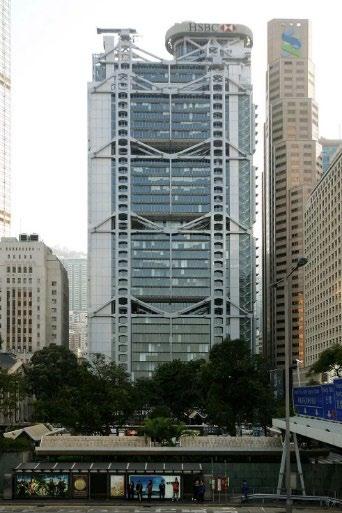
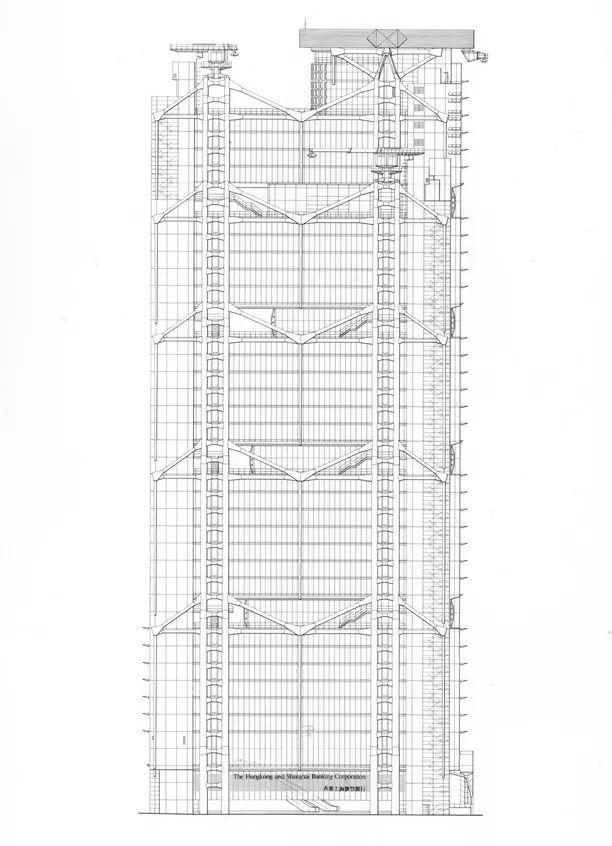
After Norman Partners in the UK consulted several Feng Shui masters, the architect, Norman Foster, designed the HSBC building in Hong Kong in 1986. It took 6 years from conception to completion. The architectural form is expressed in a stepped profile of three individual towers. The three towers are respectively 29, 36, and 44 stories high, create floors of varying width and depth, and allow for garden terraces (Pagnotta, 2011). The main building (Figure 14) includes 4 underground floors, totaling 46 floors, and a total height of 180 meters. It is constructed from 30000 tons of steel and 4500 tons of aluminum.
Figure 14. (a) Front facade (b) Facade design of the HSBC Building in Hong Kong.
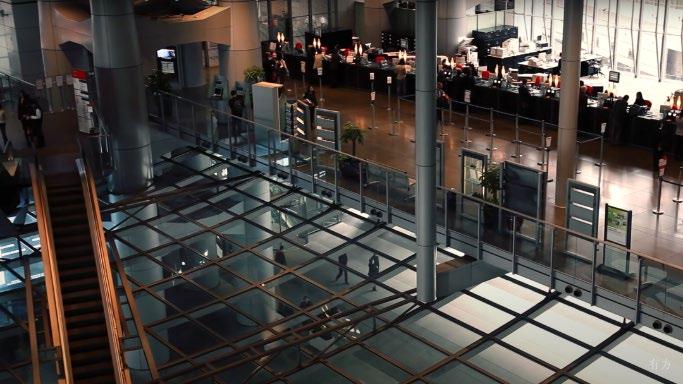
Figure 15. The tall and hollow atrium in HSBC building.
Figure 16 Two free-standing escalators on the square
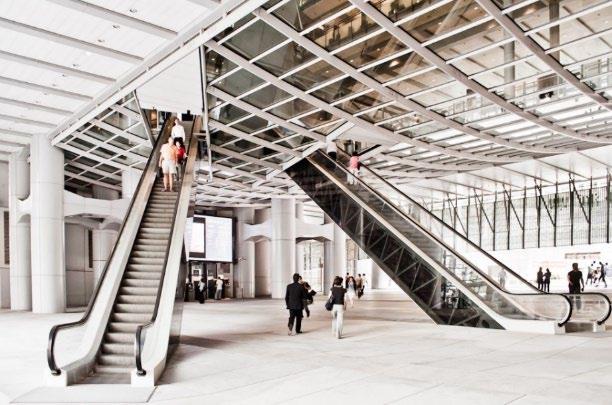
The building has a total of 8 masts, each consisting of 4 columns, supporting 5 independent double-layer high steel suspension structures. The span between the masts is 33.5 meters, and the cantilever distance is 10.7 meters. The system carries all structural loads, allowing the building to create a spectacular column-free bottom layer. The first floor of HSBC Bank is a tall and hollow atrium (Figure 15). There are two supposedly world's longest free-standing escalators on the square (Figure 16), stretching upwards at strange angles for feng shui reasons, they symbolize a dragon's beard sucking wealth into its belly.
The application of Feng Shui in the HSBC Building is summarized in Table 3, and the explanation from the perspective of environmental psychology is shown in Table 4.
Table 3 The application of Feng Shui in the HSBC Building in Hong Kong
The application of Feng Shui
Spatial arrangement
Orientation position
The HSBC Building in Hong Kong
1. The tall and hollow atrium gathers "Chi".
2. The inclined design of escalators also helps guide energy inside buildings. They aim to deflect harmful energy, ensuring that it does not reach the upper floors.
1. Convert the land in front of the building into a public park to balance energy flow The trees and vegetation can block negative energy.
2. The atrium design introduces natural ventilation and emphasizes a sense of grandeur.
3. In feng shui, the orientation of buildings and their relationship with the surrounding environment are crucial for utilizing positive energy. The HSBC building faces the open Victoria Harbour, unobstructed by other buildings, and is considered auspicious, bringing prosperity to the bank.
Material selection steel and aluminum
Colour and Symbols
To address the negative energy caused by the building's appearance with sharp, knife-like edges in the nearby Bank of China Tower, HSBC has installed two "cannons" on the roof of its building. These two 'cannons' are aimed directly at the Bank of China Tower, using the imagery of "cannons" to suppress the knife-like and neutralize harmful energy.
Table 4. Explanation HSBC Building from the Perspective of Environmental Psychology
The application of Feng Shui Perspective of Environmental Psychology
1. The tall and hollow atrium gathers "Chi".
2.The atrium design introduces natural ventilation and emphasizes a sense of grandeur.
3. In feng shui, the orientation of buildings and their relationship with the surrounding environment are
A broad perspective and range of activities affect a person's psychological state and personality development. A high and hollow atrium is more likely to be considered beautiful and makes people less likely to make evasive decisions, making them more proactive (Vartanian et al., 2015).
crucial for utilizing positive energy.
The HSBC building faces the open Victoria Harbour, unobstructed by other buildings, and is considered auspicious, bringing prosperity to the bank.
Convert the land in front of the building into a public park to balance energy
flow The trees and vegetation can block negative energy.
Windows facing natural landscapes or nearby green coverage can create an aesthetic placebo with therapeutic and restorative effects (Sachs & Marcus, 2014), as well as reduce physiological stress, improve human health, and alleviate depression and anxiety (Yang et al. 2020; Wang et al., 2024).
The Natural environment with plants can alleviate physical and mental stress and negative emotions in the human body, while significantly increasing vitality (Yao et al., 2024). Exposure to the natural environment has a protective effect on mental health and cognitive function (Jimenez et al., 2021)
Before the HSBC building was built, the management of HSBC bought the building land, not only the HSBC building site, but also the land in front of it was purchased and handed over to the government for management. The government was required to build a park here and plant trees inside. In Feng Shui theory, trees can ward off negative energy. In environmental psychology, personnel working in HSBC buildings can see the trees and green vegetation in the opposite park through the windows, reducing work pressure and improving work performance.
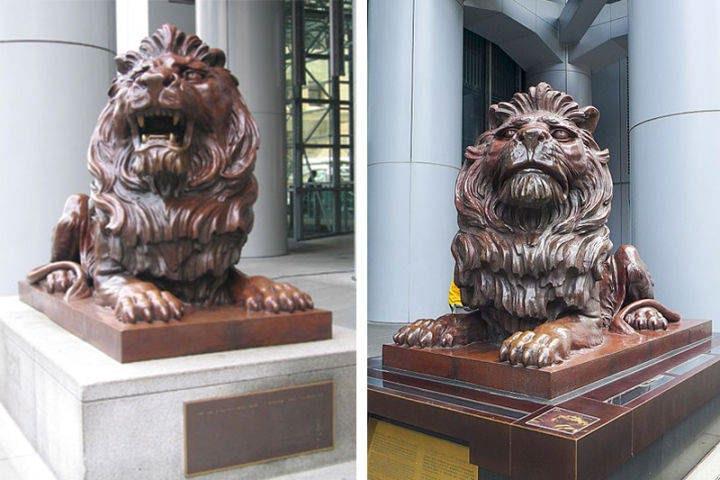
Then they placed a pair of lion sculptures on both sides of the gate (Figure 17), using the fierce energy of beasts in Feng Shui theory to ward off negative energy. In traditional Chinese culture, it is customary to place a pair of lion sculptures at the entrance of buildings, including the ancient and modern governments, armies, and some enterprises, hotels, especially larger financial institutions, to appear noble and dignified, and can evoke respect from passersby.
Figure 17. A pair of lion sculptures placed on both sides of the HSBC gate.
The first floor of the building is designed as an open space, consisting of a tall and hollow atrium. In architectural ecology, this narrow and high atrium space creates a chimney effect, which drives natural ventilation inside the building. According to the Feng Shui theory, this design can introduce more "Chi".
According to environmental psychology, I believe that a tall atrium can make customers feel that the building is magnificent and grand, and then respect and trust the owner of the building, thereby facilitating successful transactions.
(2) The Apple
Store in London
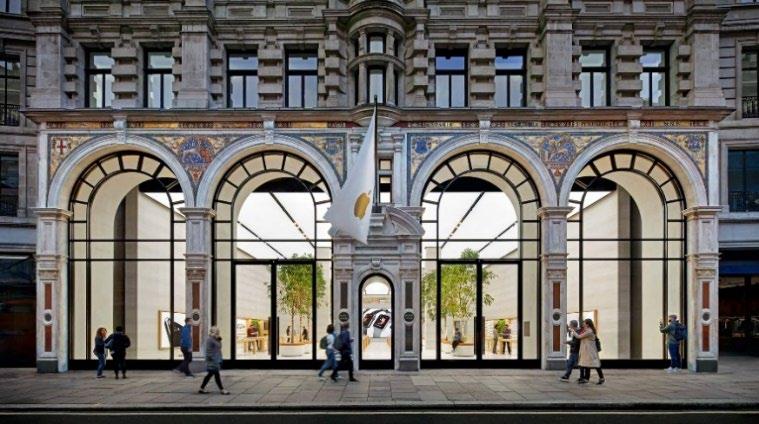
The Apple Regent Street (Figure 18) was designed in 2016 in close collaboration between Apple’s teams led by Jonathan Ive, chief design officer, and Angela Ahrendts, senior vice president of Retail, and Foster + Partners. It creates a relaxed environment and incorporates Apple's new features and services.
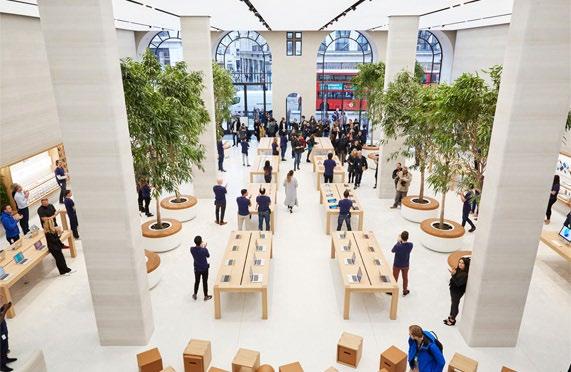
The interior space of the Apple Store in London is a 7.2-meter-high double-decker hall, creating a flexible and welcoming 'town square' style space. The design fills the store with natural light by enhancing the transparency from the street and floods, greatly improving the visual connection between the two levels (Figure 19).
The Apple Store in London is in the "prime location" of Regent Street. It is located at a
Figure 18 The appearance of Apple stores in London
Figure 19. Indoor Open Design of Apple Store in London.
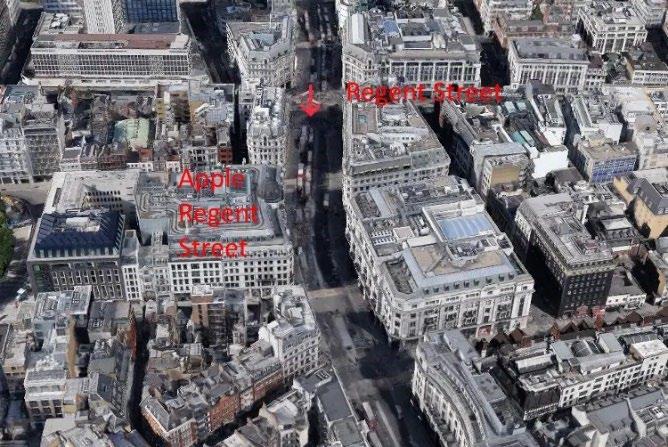
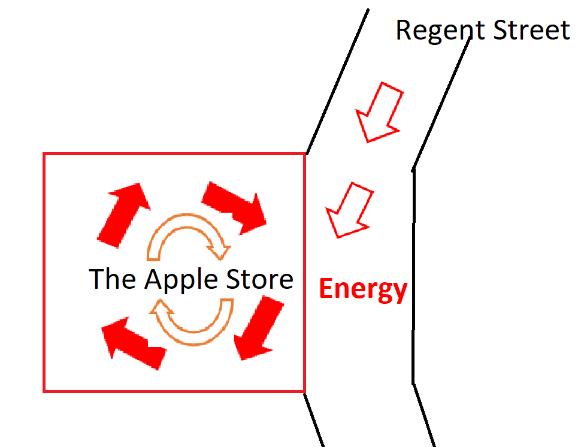
slight turn and can receive more energy. This energy comes from Regent Park and flows down Portland Square and Regent Street. Due to a slight tilt, energy enters the store directly at a certain angle. Once entering the store, energy is forced to move in a clockwise circular manner (Figure 20) In the northern hemisphere, people will feel comfortable when the energy moves in an anti-clockwise direction. We can see that when water flows down into a plughole, the water flows move into a plughole in an anti-clockwise direction. This phenomenon is well-known as the Coriolis effect. However, when energy flows in a clockwise direction in the northern hemisphere, people will feel uncomfortable and confused. It's just like the confused atmosphere in “End of Season Sales” or “Black Friday” sales. People are rushing to buy "bargains" in the crowd. In this chaotic environment, people lack logical thinking and make impulsive purchases. The ultimate result is that people buy more (Oon, 2024) The application of Feng Shui in the Apple Store in London is summarized in Table 5, and the explanation from the perspective of environmental psychology is shown in Table 6.
The
Spatial arrangement
Orientation position
The
1. Flexible "city square" design, increasing transparency and natural light.
2. The double-height indoor space creates a comfortable social environment.
1. The twelve Ficus Ali trees on the ground level and the glowing ceiling create a warm atmosphere.
2. The clockwise energy flow design stimulates spontaneous purchasing behavior.
3. The Apple Store in London is in the "prime location" of Regent Street
Material selection stone, wood and terrazzo
Colour and Symbols
Grey-white (stone), and the original color of wood
The signature Apple display tables
Figure 20. (a) The Google Earth Image (b) The energy moves of the Apple Store in London.
Table 5 The application of Feng Shui in the Apple Store in London
application of Feng Shui
Apple Store in London
Table 6. Explanation Apple Store in London from the Perspective of Environmental Psychology
The application of Feng Shui Perspective of Environmental Psychology
1. Flexible "city square" design, increasing transparency and natural light.
2. The double-height indoor space creates a comfortable social environment.
The twelve Ficus Ali trees on the ground level and the glowing ceiling create a warm atmosphere.
A broad perspective and range of activities affect a person's psychological state and personality development. A high and hollow atrium is more likely to be considered beautiful and makes people less likely to make evasive decisions, making them more proactive (Vartanian et al., 2015).
The Natural environment with plants can alleviate physical and mental stress and negative emotions in the human body, while significantly increasing vitality (Yao et al., 2024).
Exposure to the natural environment has a protective effect on mental health and cognitive function (Jimenez et al., 2021).
The clockwise energy flow design stimulates spontaneous purchasing behavior.
This may be because clockwise energy drives people to move in a clockwise direction, which is inconsistent with people's habit of moving in a counterclockwise direction in sports fields and causes anxiety.
(3) The Bank of China Tower in Hong Kong
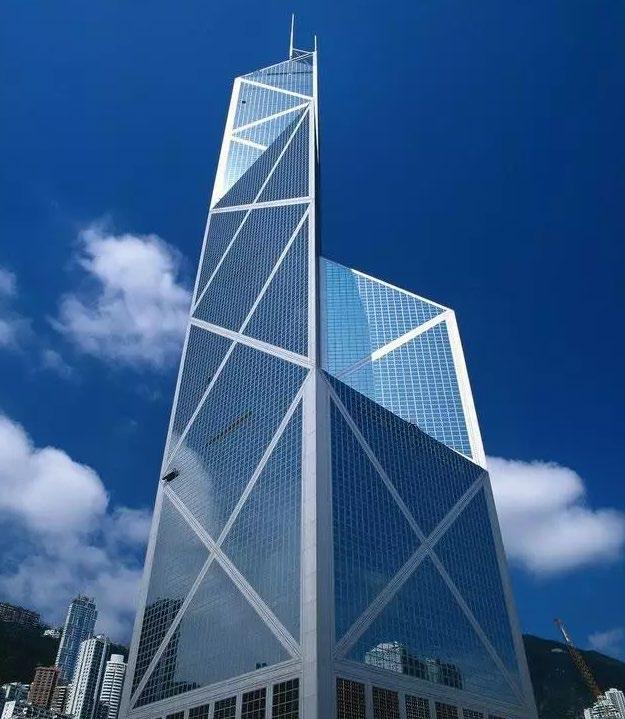
The Bank of China Tower was planned and designed by renowned architect I.M. Pei in 1982. Construction began in April 1985 and was completed in 1989. The building has a sharp and angular structure with three sharp edges. The design of this building adopts structural expressionism. It resembles growing bamboo shoots, symbolising livelihood and prosperity (Figure 21).
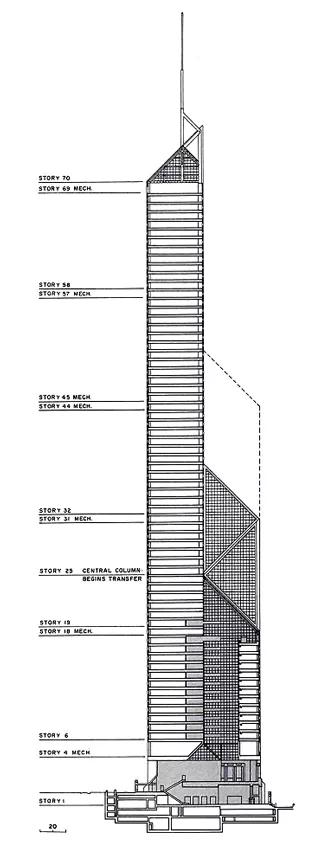
The Bank of China Tower is located near the Central MTR station. The building consists of four triangular towers made of glass and aluminum, all varying heights, the base of the four towers is granite, rising from a triumphal podium of beautiful granite. The geometric changes that occur as the building rises into the sky are the most interesting aspect of this tower. The sharp angles and points of interest create an appearance that contrasts with the dominant flat buildings in the city. The silver-blue reflective glass used in the tower creates objects that reflect light on sunny days and nights (Figure 22).
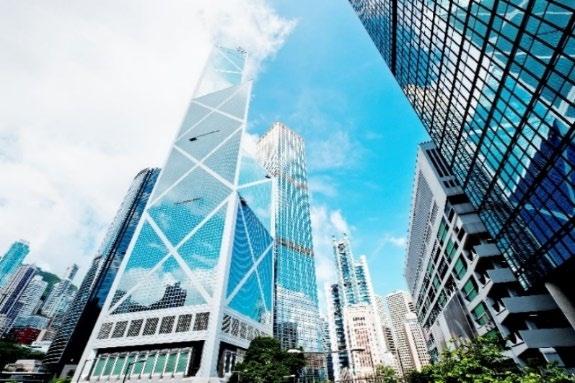
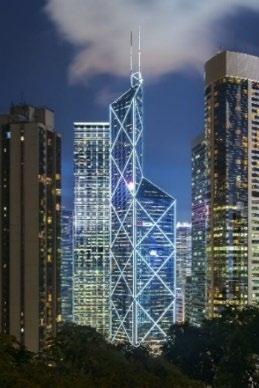
The silver-blue reflective glass as the building's skin not only reflects the constantly changing images of the sky and city, but also absorbs sunlight, thereby reducing energy consumption for lighting and heating costs (WikiArquitectura, 2020; RTF, 2022) The application of Feng Shui in the Bank of China Tower in Hong Kong is summarized in Table 7, and the explanation from the perspective of environmental psychology is shown in Table 8.
Table 7. The application of Feng Shui in the Bank of China Tower
The application of Feng Shui
Spatial arrangement
The Bank of China Tower in Hong Kong
1. The Bank of China Tower primarily serves as the headquarters of the Bank of China, featuring high-end office spaces, retail stores,
Figure 21 (a) Front facade (b) Facade design of the Bank of China Tower in Hong Kong
Figure 22. The silver-blue reflective glass reflect light on (a) sunny day and (b) night
and a stunning observation deck that offers panoramic views of the city below.
2. Internally, flexible space and offices are provided for the bank.
3. The observation deck on the 43rd floor is continuously open to the public, but a reservation is required to enter the observation deck on the 70th floor.
Orientation position
1. Sharp angles and reflective glass maximize energy efficiency, but challenge feng shui harmony.
2. The sharp "blade" shape has a negative feng shui effect on the surrounding buildings.
Material selection vertical and horizontal steel members, reinforced concrete, granite, and silver-blue reflective glass framed in aluminum.
Colour and Symbols
1. silver-blue reflective glass building
2. The design inspiration comes from bamboo, symbolizing strength and vitality.
Table 8. Explanation Bank of China Tower from the Perspective of Environmental Psychology
The application of Feng Shui Perspective of Environmental Psychology In terms of feng shui, the Bank of China Tower is considered the "most aggressive building in the world" because the edge of its front triangle at the front point to its competitors. This is what the Chinese call "direct attack" in the language of Feng Shui. Later, the neighbor HSBC used the "cannon" on the roof to resolve the feng shui issue.
People in the surrounding buildings of the Bank of China Tower, when they face the sharp edges of the Bank of China Tower, will have a psychological anxiety like facing knives, which affects their physical and mental health. HSBC has built two "cannons" on the top floor facing the Bank of China Tower, which will give people working at the Bank of China Tower a sense of relief and even superiority, because the power of cannons is far greater than knives.
The Bank of China Tower has won the "Excellent" rating award in the 2002 Hong Kong Building Environmental Assessment, the Top 10 Best Buildings in Hong Kong by the Hong Kong Institute of Architects in 1999, the Marble Building Award in 1992, the AIA Reynolds Memorial Award in 1991, the Outstanding Engineering Award in 1989, and the Outstanding Engineering Certificate in 1989.
From the perspective of Feng Shui theory, the Bank of China Tower is a terrible example of Feng Shui architecture. The sharp-shaped Bank of China Tower is like a threebladed knife. The first side of the blade points towards the "Governor's Mansion", and coincidentally, in December 1986, Duke Youde died suddenly of a heart attack in Beijing, becoming the only Governor to pass away while in office. The second side of the blade pointed towards the military camp of the stationed troops in Hong Kong at that time (British army). The third side of the blade points to HSBC, where HSBC's performance
suddenly regressed and its stock price plummeted at that time.
Later, after consulting a Feng Shui master, HSBC's management creatively erected two "cannons" on the rooftop to engage in a "knife cannon battle" with the Bank of China to defuse the bank's "killing Chi". Coincidentally, the stock price rebounded as a result.
In the late 1990s, the location of the Yangtze River Group Center was awkwardly sandwiched between the Bank of China and HSBC. With the advice of feng shui masters, the Yangtze River Center was built in a shield-like shape on all sides, with an impenetrable appearance resembling a fortress, and cleverly avoiding the relative position of "knives and cannons" in height. Although it was repeatedly criticized for not being aesthetically pleasing, but has been safe and sound since its completion.
3.1.3 Summary of Case Studies
Based on the case studies, relevant practices of Feng Shui theory application, environmental psychology, urban horticulture, and sustainability were extracted, as shown in Table 9.
Table 9. Summary of Case Studies
Feng Shui Environmental Psychology
1. Introduce natural elements such as trees and water to balance ‘Chi’. The trees and vegetation can block negative energy.
2. Design tall spaces to enhance grandeur and harmony.
3. Facing a broad environment with wide views.
4. The direction of water flow in the northern hemisphere is counterclockwise. A comfortable atmosphere is created when the energy of "Chi" reflects this flow.
1. Tall space earns respect and trust (HSBC).
2. Flexible layout stimulates participation and creativity (Apple Store).
3. The vegetation outside can be seen from the window, which helps to reduce stress (HSBC). The Natural environment with plants can alleviate physical and mental stress and negative emotions in the human body (Apple Store).
4. Indoor plants bring nature and comfort to indoor spaces (Apple store).
Urban Horticulture Sustainability
1. The park in front of the building can be planted with fruit trees. (HSBC).
2. Indoor plants bring nature and comfort to indoor spaces (Apple store).
1. Use reflective glass and natural ventilation to achieve energy savings.
3.1.4 Challenges and Opportunities of Feng Shui Architecture
The challenges and opportunities faced by Feng Shui architecture are summarized in Table 10
Table 10. The challenges and opportunities of Feng Shui architecture Challenges Opportunities
1. Feng Shui theory lacks scientific explanations and verification methods.
1. Feng Shui has existed and developed in non-scientific environments for
2. Joseph Needham believes that Feng Shui theory is pseudo-science, but he believes that Feng Shui theory contains aesthetic elements.
3. The scientific mechanical worldview of Western scholars makes it difficult to accept the Feng Shui theory.
4. The research applying Feng Shui theory to architecture mainly focused on China and Southeast Asian countries, and most research papers are published in local languages. There are not many studies that apply Feng Shui theory to architecture and have been published in English.
3.2.
Methods of experimental practice
centuries, and it is the default worldview in China and Southeast Asia, and naturally has its significance and rationality.
2. Feng Shui theory has a vast market in Southeast Asia, especially in China.
3. For over half a century since Joseph Needham, not only Chinese and Southeast Asian scholars but also Western scholars have begun to study Feng Shui theory from a scientific perspective.
4. The English literature on the application of Feng Shui theory to architecture needs further development.
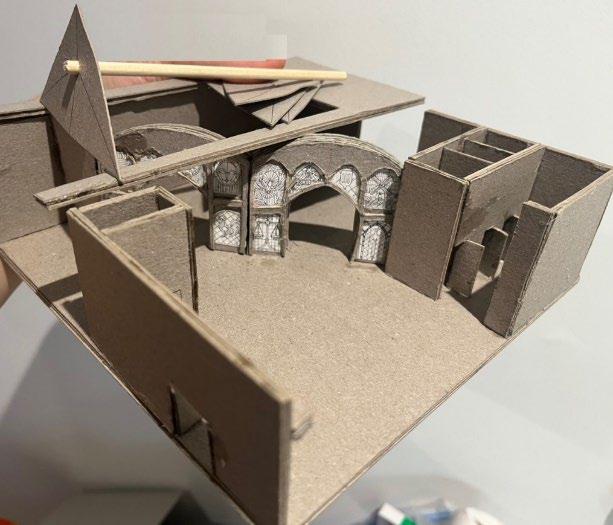
This study aims to conduct in-depth research on environmental psychology and Chinese architectural Feng Shui theory and attempt to interpret Chinese architectural Feng Shui theory from the perspective of environmental psychology. Then, through case studies, the application principles of Feng Shui theory in architectural design are extracted, and the extracted application principles are explained through environmental psychology. Finally, taking the renovation of existing buildings and the design of new ones as practical projects, Feng Shui theory is applied to architectural design and achieved through sustainable building materials. I will select an existing building to improve the design and a site to design a new architecture based on Feng Shui theory, and explain the support of scientific theories in environmental psychology, combined with the concepts of urban horticulture and sustainable architecture for practical design. Present the designed floor plans, renderings, and models for exhibition, collect opinions from relevant experts and the public, and reflect on and summarize them.
3.2.1 Renovate existing buildings
My first attempt is to design and renovate the "Beaney House of Art and Knowledge". I will visit and conduct a site survey to find areas that can be renovated and improved in existing architecture, including structure, materials, interior design, and exhibition hall design. I will attempt to use feng shui theory as a guide for design and implement sustainable building materials.
(1) History of the Beaney House of Art and Knowledge
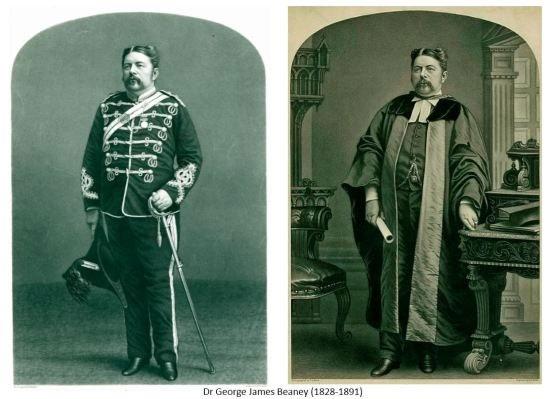
The Beaney House of Art and Knowledge building takes its name from its benefactor, Dr. James George Beaney (Figure 23). He was born in Canterbury and studied medicine in Edinburgh and Paris. Then he emigrated to Australia and achieved success there. He
became Honorary Surgeon at the Melbourne Hospital and a pioneer in children's health, family planning, and the treatment of sexually transmitted diseases in Australia. After his death in 1891, Dr. Beaney left money in his will to the city of Canterbury to build an "Institute for Working Men". The Canterbury Corporation convinced the Charity Commission to use this money to build a new museum and library. On 16 September 1897, Canterbury Mayor George Collard laid the foundation stone for the Beaney Institute. The architect is A H. Campbell, the building was officially opened on 11 September 1899 (Canterbury Museums & Galleries, 2015).
(2) Architectural Features
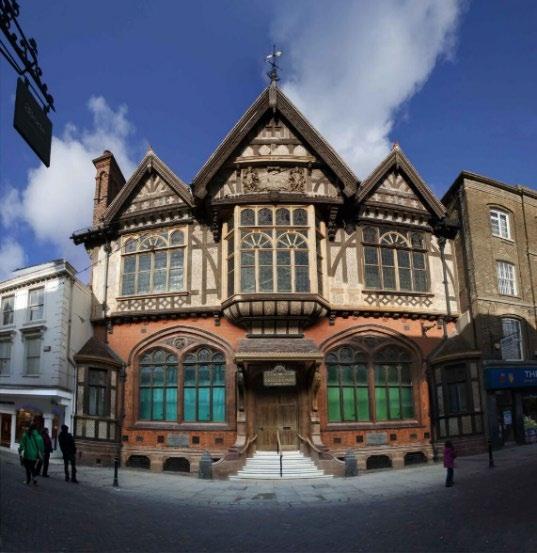
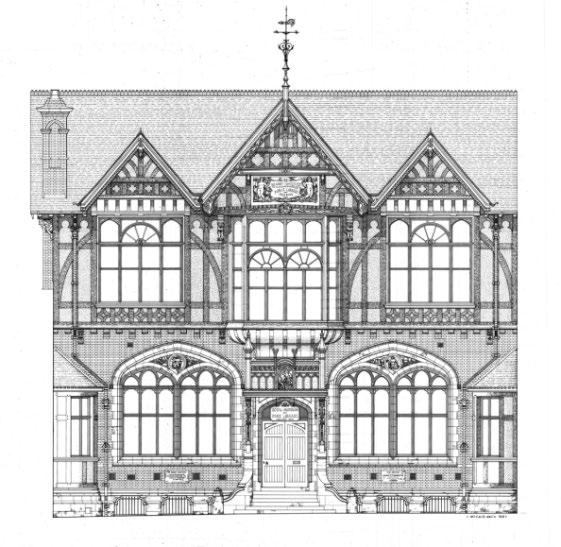
The Beaney House of Art and Knowledge was designed by architect A H Campbell and built in 1897-99. The building has two floors and a basement. The entrance of the steps has two wooden griffins that guard on each side. There are three gables on the roof, with the largest one in the middle (Figure 24). Its facade facing the High Street has undergone the terra-cotta ceramic mosaics re-bedding and renewal of all lead-work.
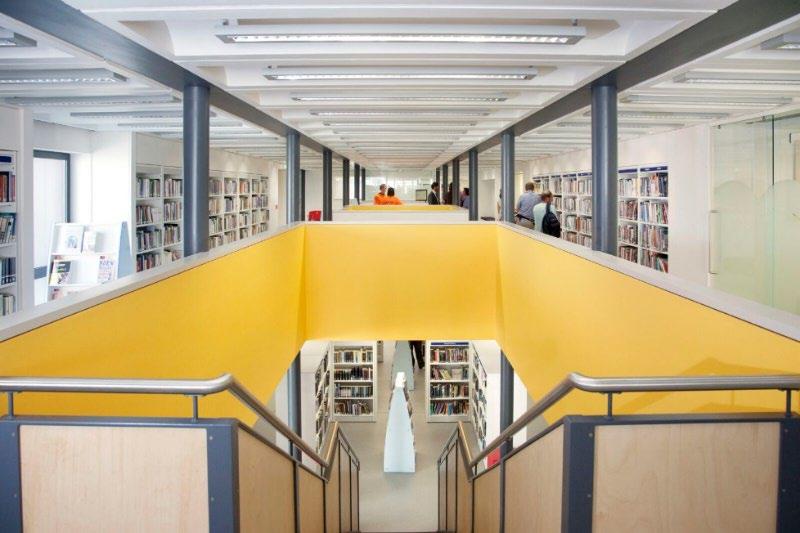
The Beaney House has created a new accessible public entrance for the expanded building footprint. This entrance leads to a dramatic top-illuminated foyer space that
Figure 23. Dr. James George Beaney.
Figure 24. (a) Front facade (b) Facade design of the Beaney House
progresses sequentially, ultimately forming a new library and gallery (Figure 25). The Beaney Museum has a large collection of animal specimens from the Victorian era, including specimens of Chinese pangolin, Brazilian three-banded armadillos, and Australian duck-billed platypus. There are also cultural relics from ancient civilizations of Egypt, Rome, and Greece in the exhibition hall. Other interesting details include an iron weather vane, stained glass windows, and a range of decorations such as grotesques and animal designs made in wood and terracotta (Canterbury Museums & Galleries, 2025)
25. Library facilities have been moved to two-storey accommodation.
3.2.2 Design a new building
My second attempt is to design a Chinese-inspired garden and art gallery in the UK, exploring the balance between rules and creativity. A Chinese-inspired garden harmonizes traditional elements with modern needs, promoting cultural understanding. The Art gallery integrates Feng Shui principles with modern design to create a Chinese cultural hub in the UK.
(1) Site Comparison: Evaluating Potential Locations
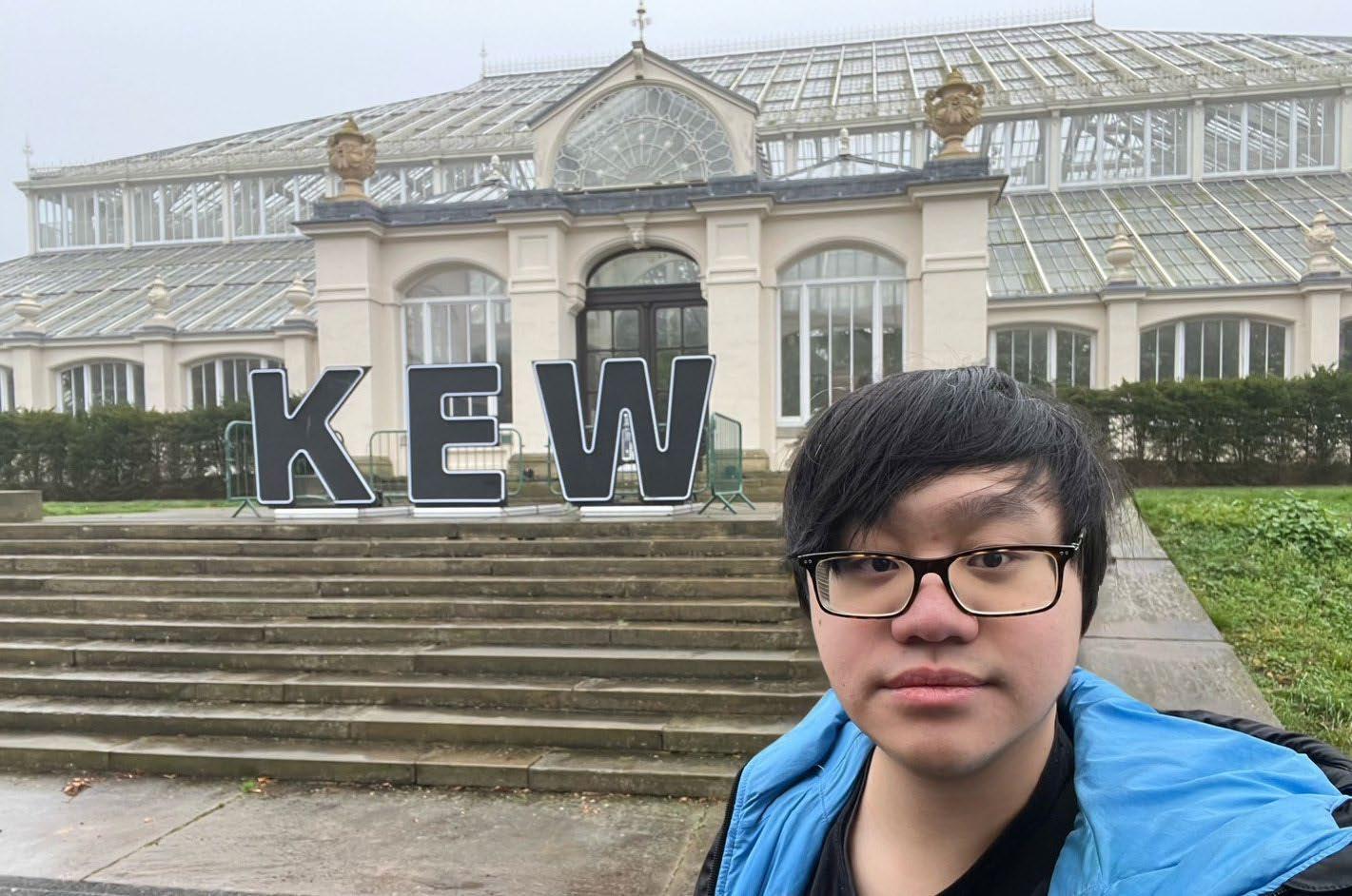
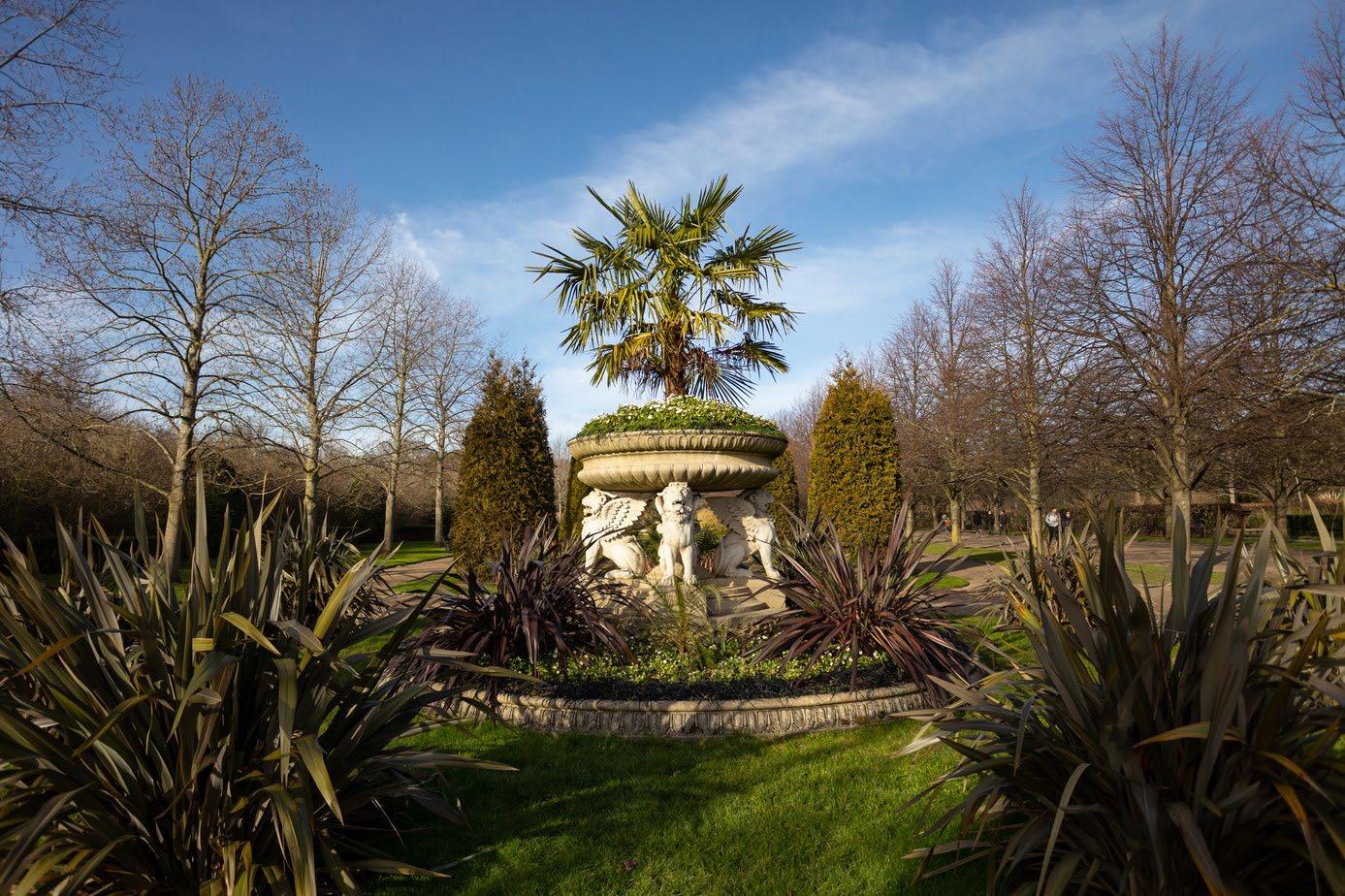
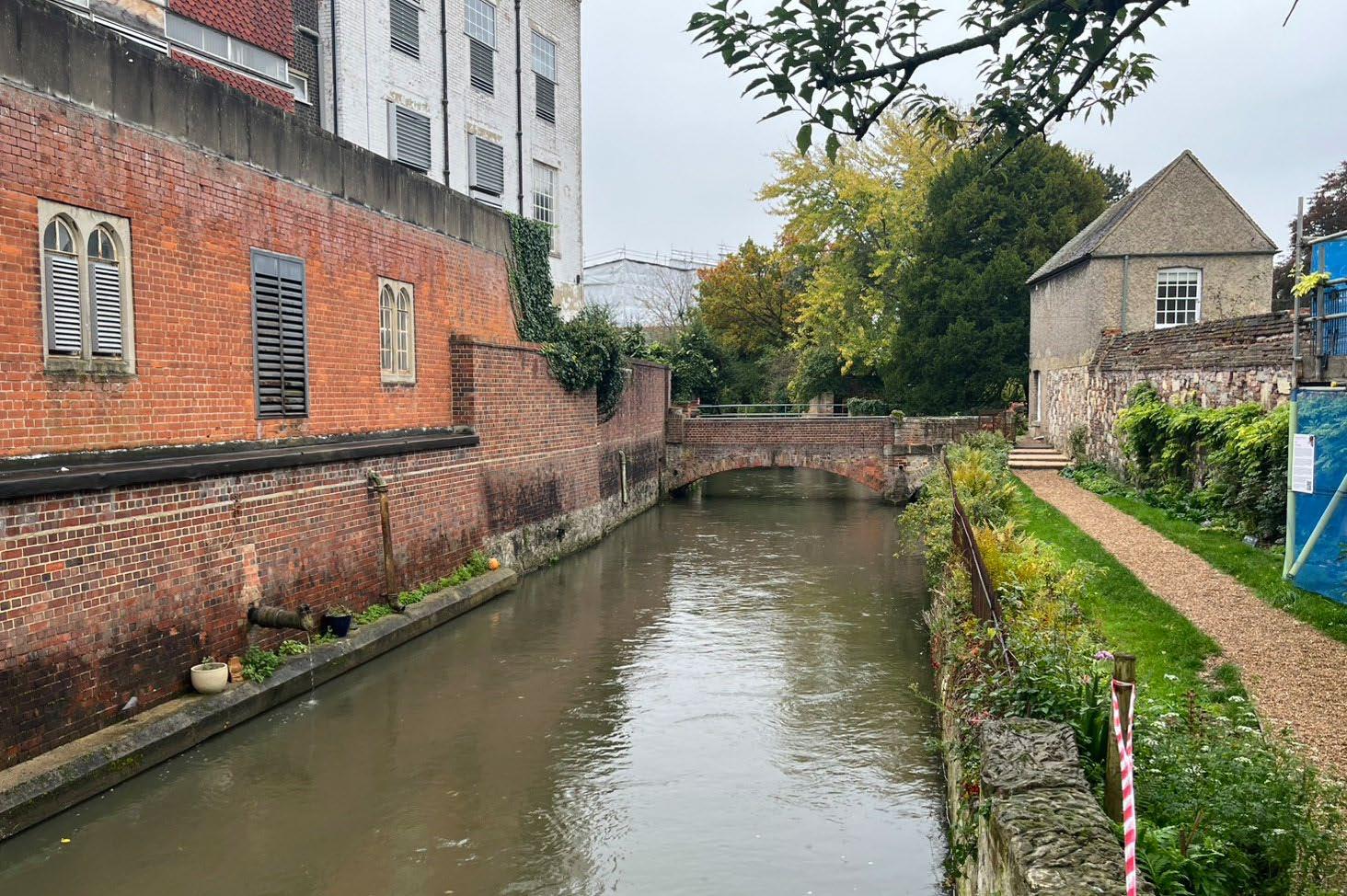
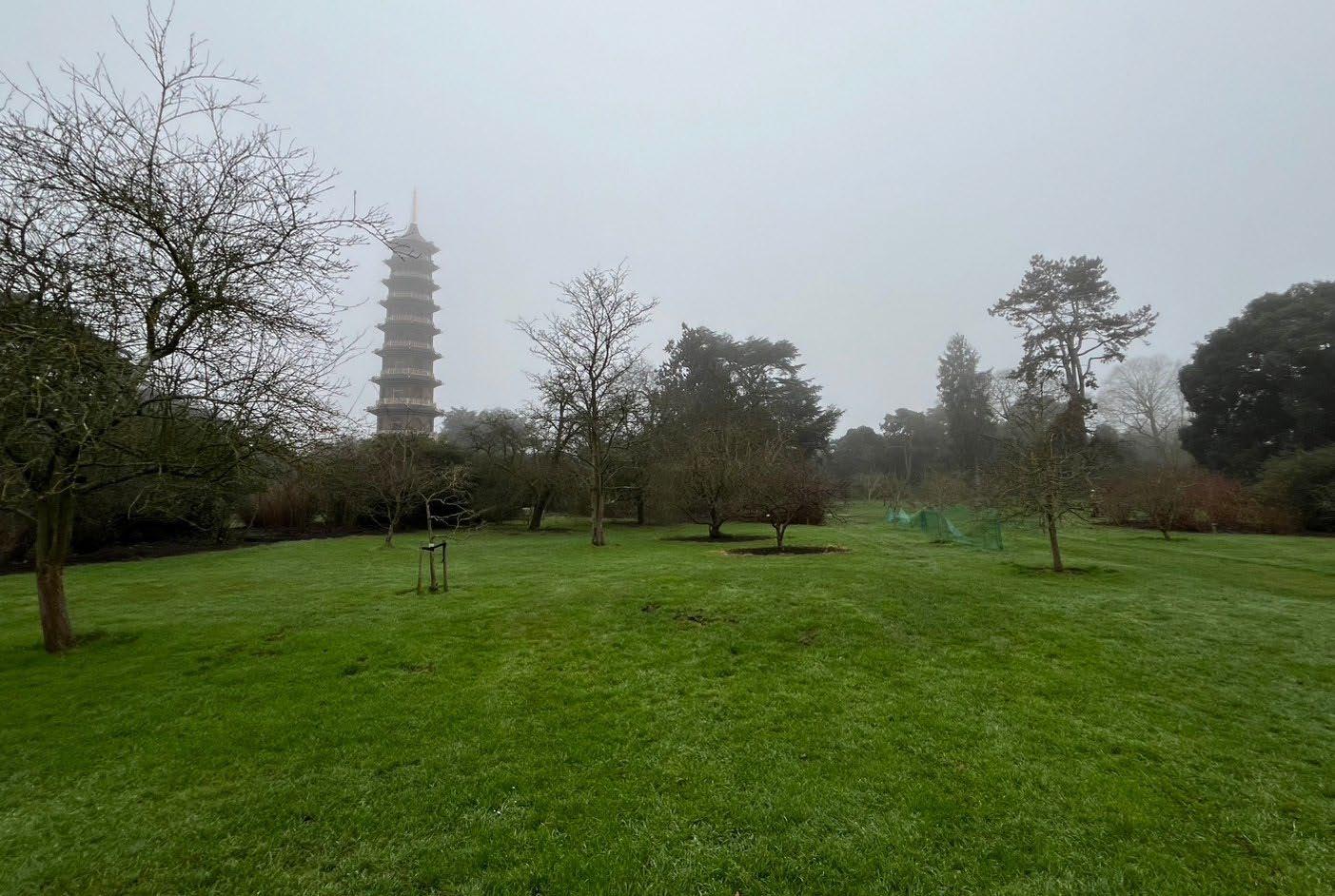
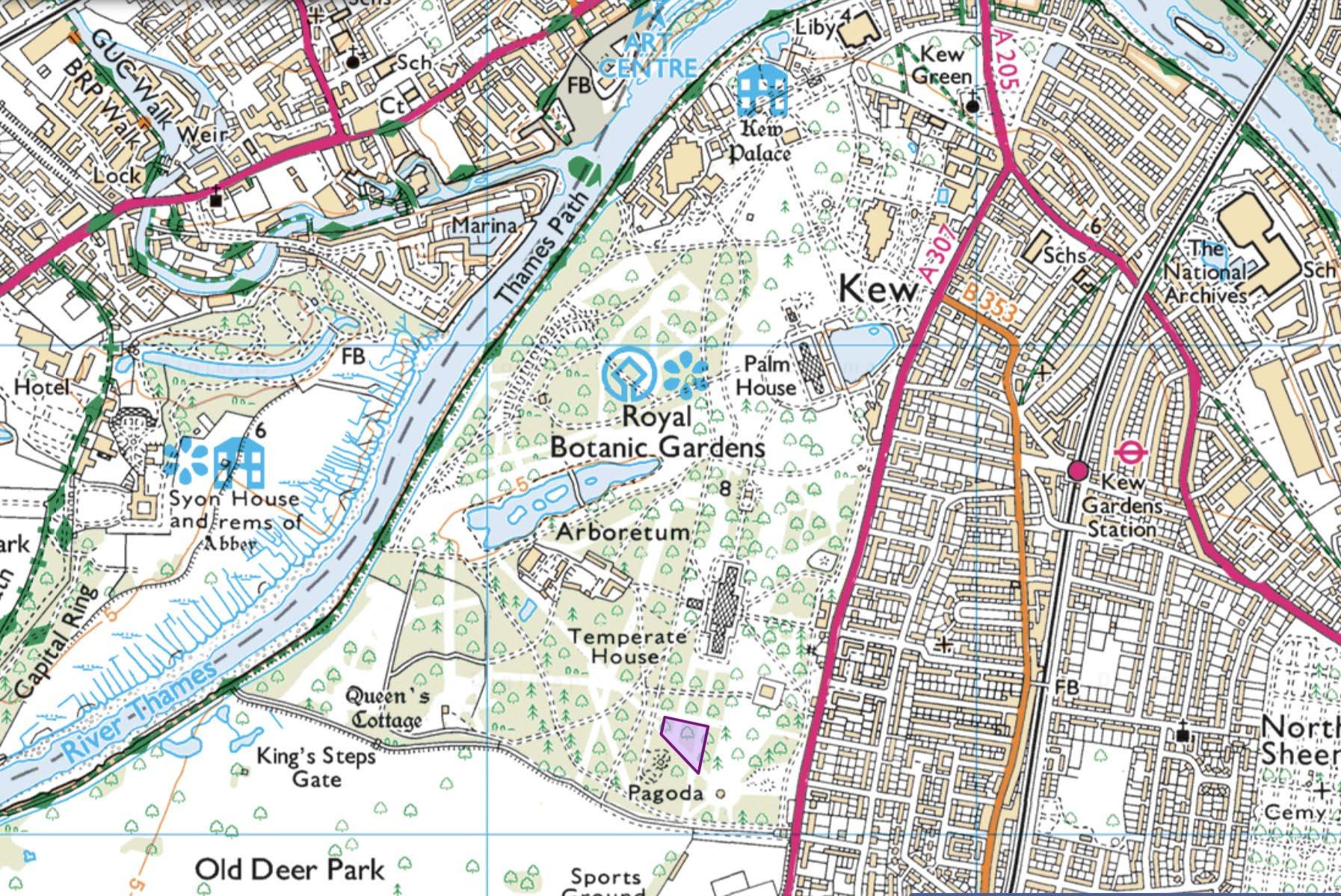
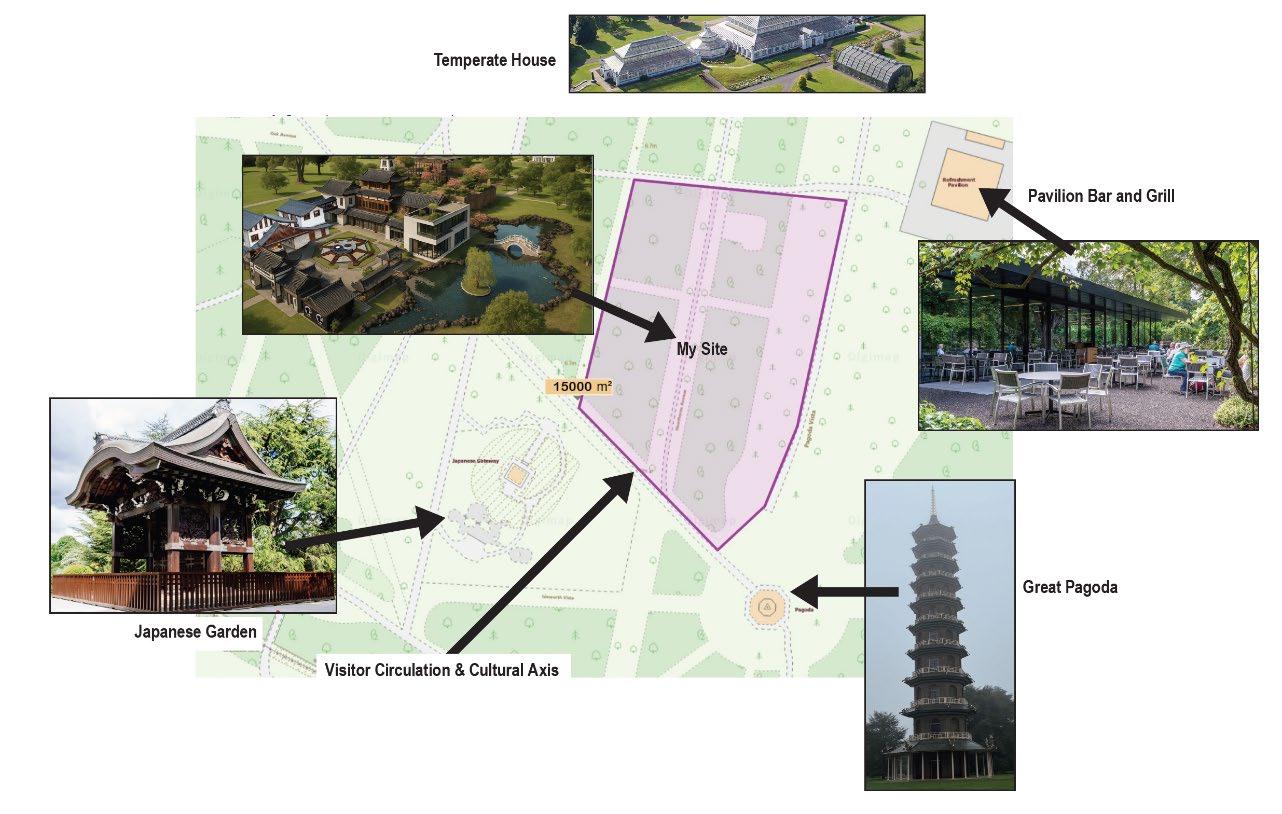
As the site for this project, I carefully evaluated three locations: "Kew Gardens (London)" (Figure 26), "Regent’s Park (London)" (Figure 27), and "Eastbridge Hospital (Canterbury)" (Figure 28). The comparison considered factors such as cultural relevance, environmental quality (sunlight, wind, botanical potential), and compatibility with Feng Shui principles.
Figure
Regent’s Park lacks Chinese context; it has no architectural or historical Chinese element presence. Regent’s Park is leisure-oriented, the functions primarily as a recreational park rather than a cultural site. So Regent’s Park is weak cultural justification, a new Chinese structure would feel disconnected from the park’s identity and history.
Eastbridge Hospital is dominated by medieval and Christian architectural elements, influenced by Gothic and Norman styles. It represents a strong religious identity, and its solemn spiritual setting is difficult to reconcile with Chinese garden principles, resulting in some cultural incompatibility issues. The contrast between Chinese architecture and the surrounding churches will create visual and symbolic dissonance, leading to architectural contextual conflicts.
Figure 26. Kew Gardens (London)
Figure 27. Regent’s Park (London)
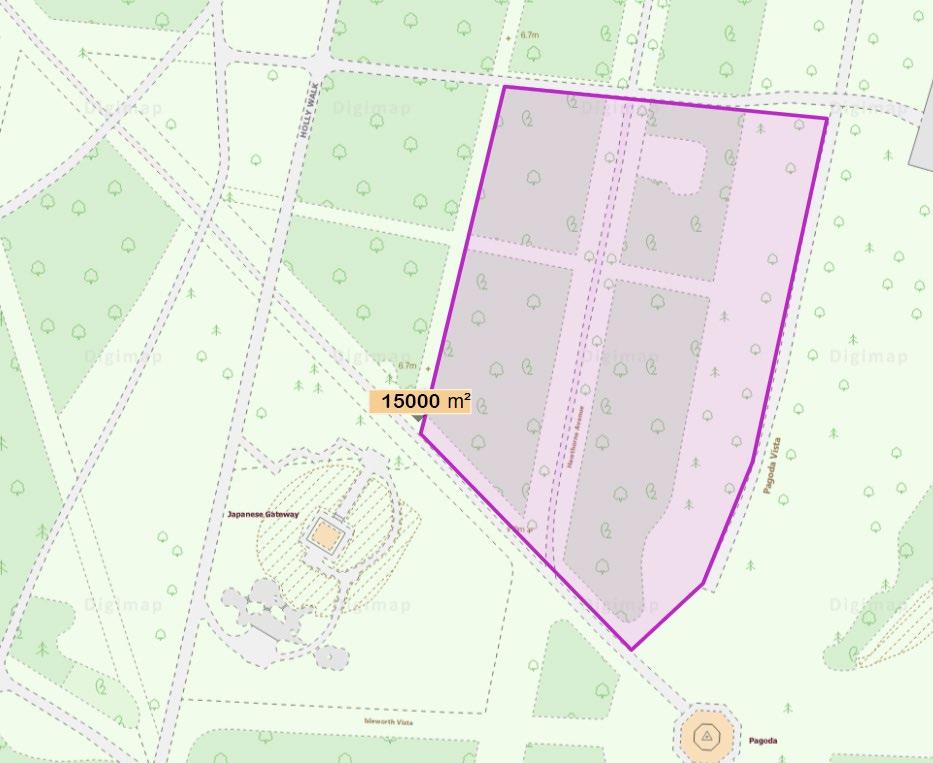
The Great Pagoda (Figure 29) in Kew Gardens, built in 1762, provides a direct visual and symbolic connection to Chinese influence in British history and becomes a cultural anchor. As a world-leading and excellent botanical garden, Kew Gardens provides an ideal setting for showcasing Chinese plants and seasonal symbolism. Kew Gardens' mission supports cultural learning and ecological awareness, aligning perfectly with the goals of my project in terms of educational coordination. Finally, Kew Gardens was selected for its strong historical resonance, botanical richness, and alignment with both ecological and cultural objectives. It offers the clearest opportunity for a meaningful architectural dialogue between imagined and authentic Chineseness.
(2) History of the Kew Gardens
Kew Gardens originated in the exotic garden of Lord Capel of Tewkesbury. Its development began in the 16th and 17th centuries, when Henry VII built Richmond Palace and moved his court to Kew during the summer. Kew Gardens is located along the banks of the River Thames. The entry of the royal family, nobles, and courtiers led to the rapid
Figure 28. Eastbridge Hospital (Canterbury)
Figure 29. The Great Pagoda in Kew Gardens.
development of Qiu Village. Frederick, Prince of Wales, rented the Kew farm in 1731. He redesigned and built the house, adding a white Palladian facade expansion on both sides, and earned the name "White House". Frederick and his wife, Princess Augusta, are both garden enthusiasts. They took on landscaping the area around the house with trees, large lawns, lakes with large islands, and the mound. Frederick passed away in 1751, and Princess Augusta continued to expand with the help of the Earl of Bute. Bute dreamed of having a garden containing all the plants known on Earth, and with the help of Princess Augusta, they founded the Botanic Gardens at Kew.
Richmond Gardens and Kew Gardens merged in 1802, and the "White House" was demolished. The botanist Banks initiated collection activities in South Africa, India, Abyssinia, China, and Australia, bringing back plants, including over 800 species of trees and shrubs. In 1840, Kew Gardens was established as a world-leading botanical garden and was adopted as the National Botanical Garden, with William Hook as its director. Under his leadership, buildings and structures were redeveloped, including the construction of palm houses, an increase in site to 75 acres, and an expansion of amusement parks or botanical gardens to 270 acres, later expanding to the current 300 acres.
Today, Kew Gardens is a leading plant research center, a professional gardener training center, and a tourist attraction. Its seed bank contains approximately 7 million specimens. The library and archives have over 500000 collections, including books, plant illustrations, photographs, letters, manuscripts, journals, and maps.
(3) Project Overview
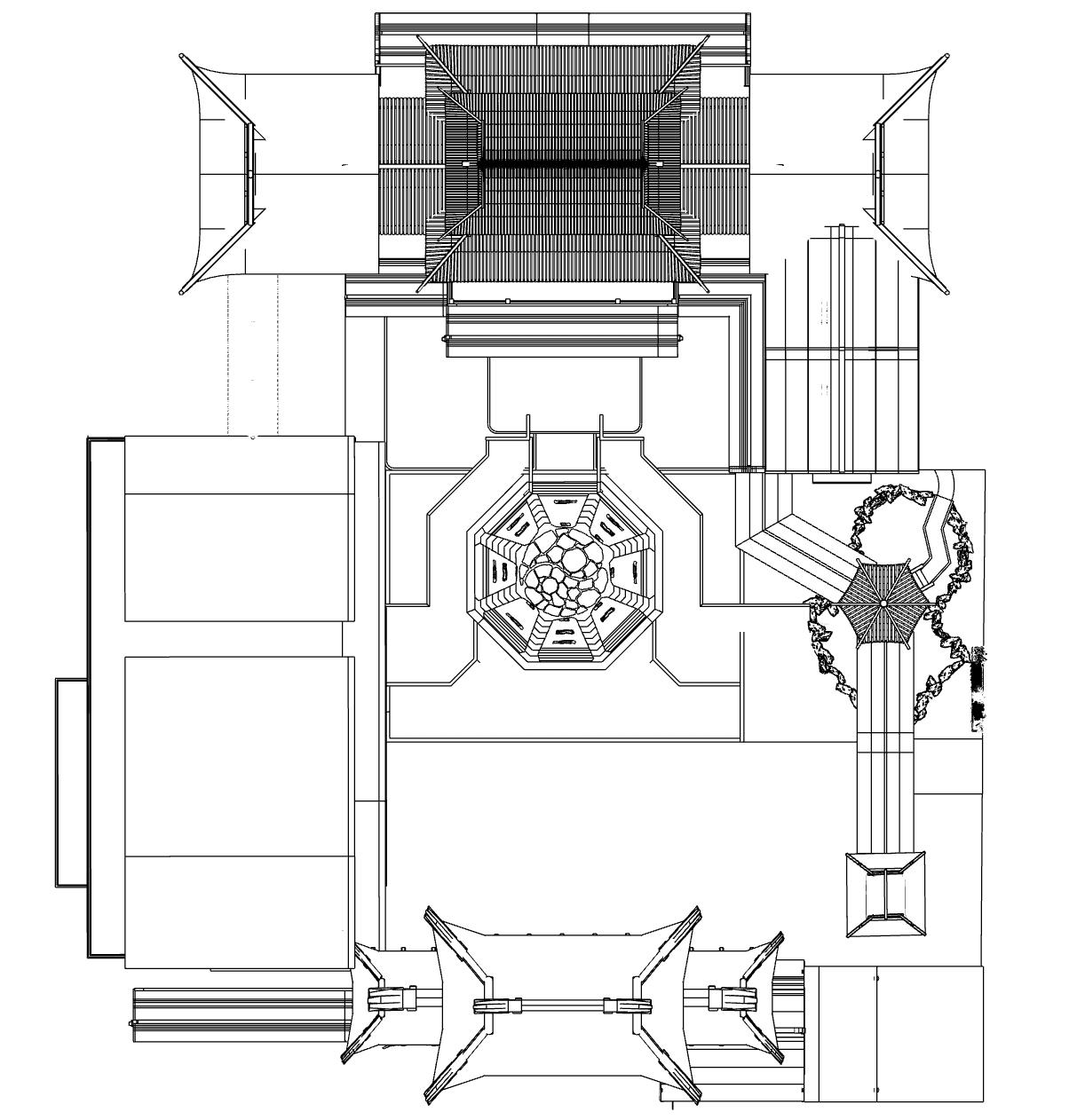
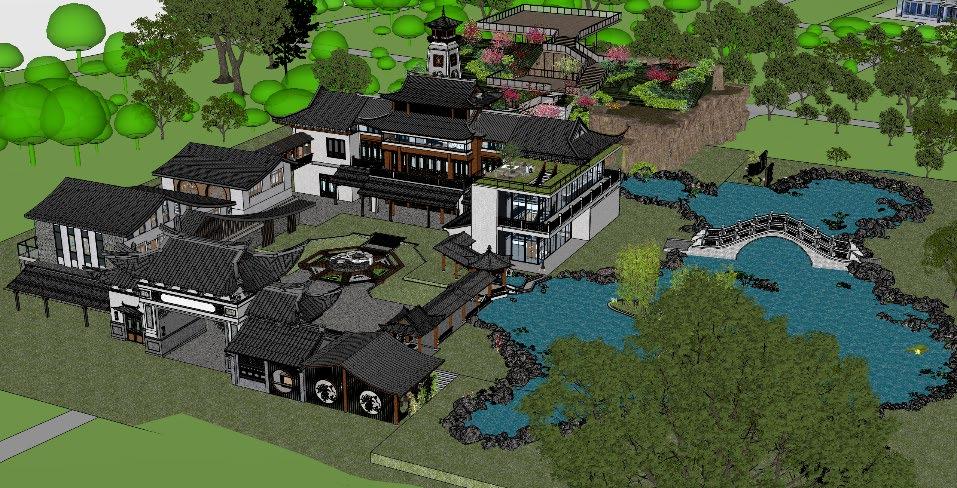
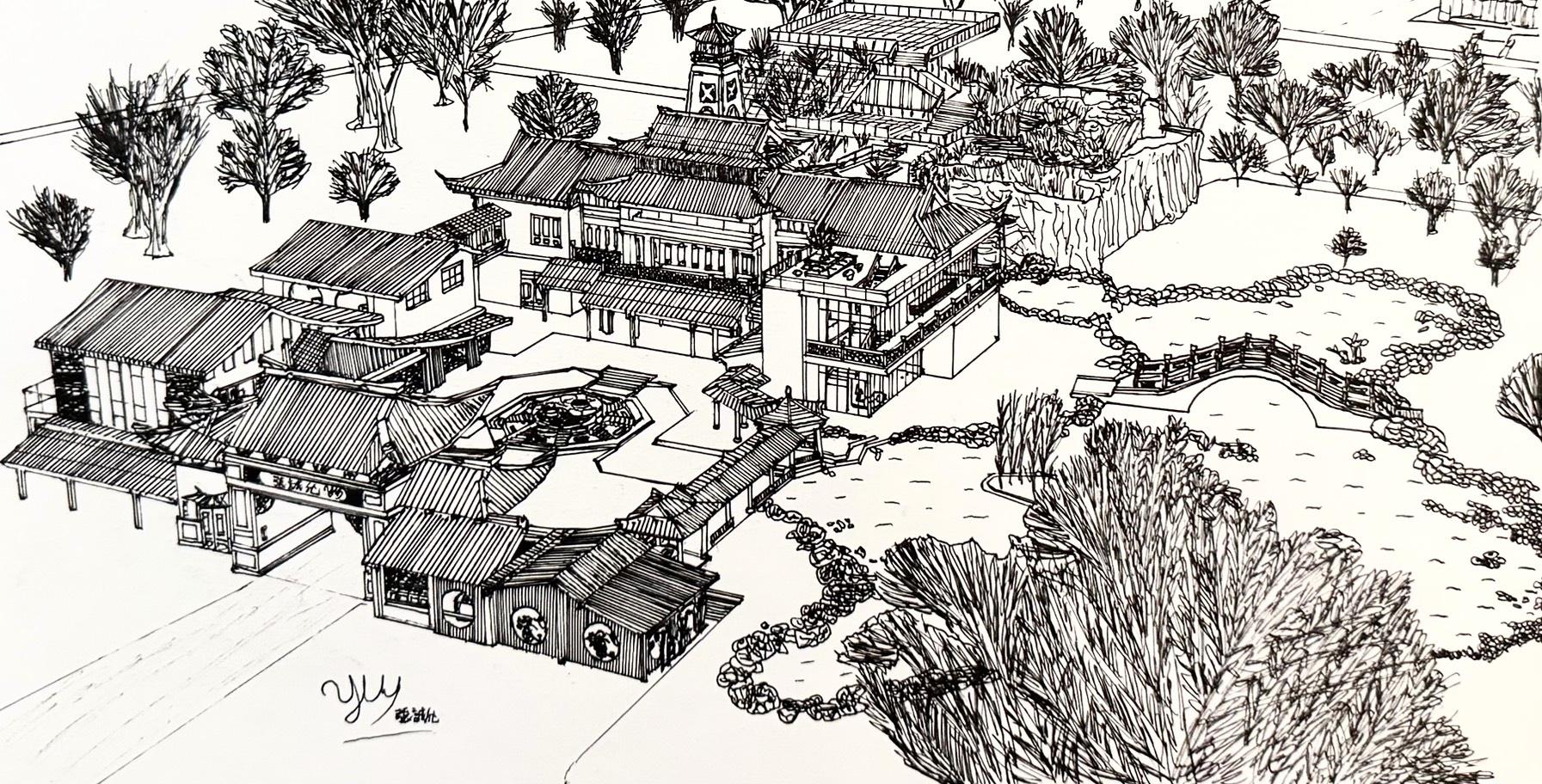
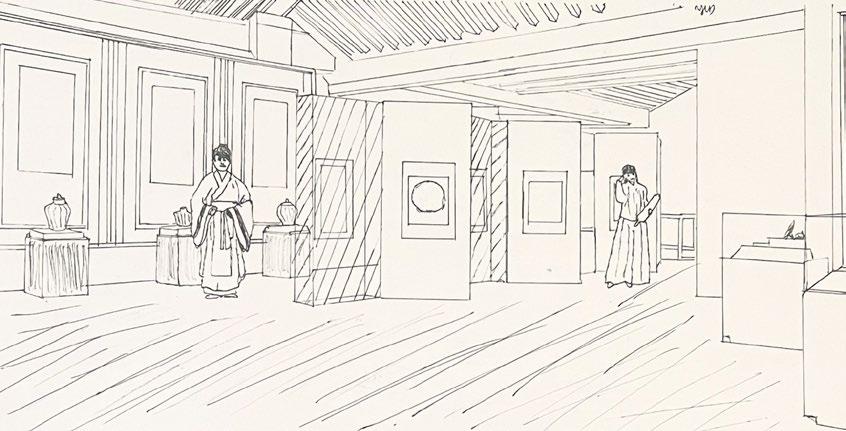
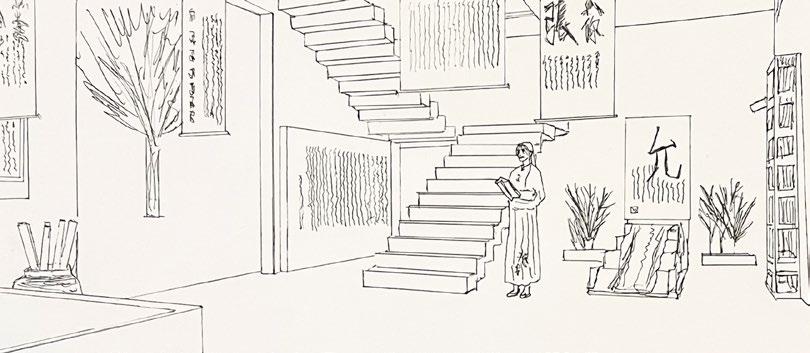
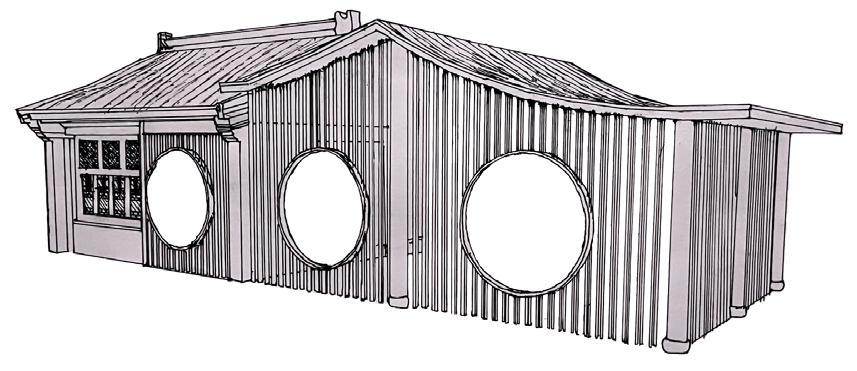
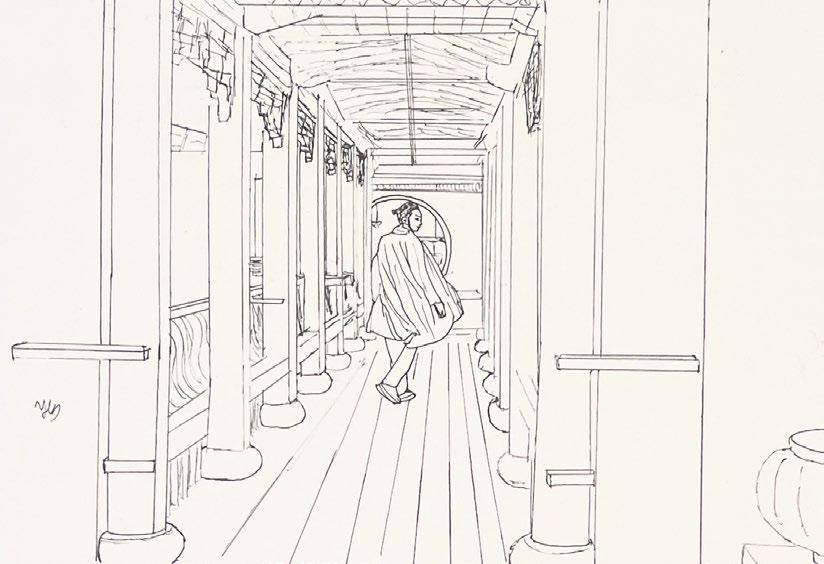
The project combines Chinese architectural feng shui theory with ecological architecture concepts to construct a Chinese garden centered around a museum. The building materials used are sustainable, conveying the artistic and aesthetic beauty of Chinese gardens and the concept of sustainability to more people. The museum's exhibition area will showcase Chinese calligraphy, painting, carving, jade, porcelain, embroidery, clothing, architecture, and garden design, among other artistic works (Kerr, 1997), and hold courses on Chinese culture, calligraphy, painting, embroidery, and feng shui design.
The whole park will hold propaganda and experience activities of Chinese folk culture (such as the Chinese New Year dragon dance, lion dance, and Yuanxiao Festival lantern making), horticultural planting, urban gardening, environmental protection, and sustainability. Therefore, my partners include government agencies, urban horticulturists and botanists, artists and art institutions, educational institutions, community organizations, media, suppliers, sponsors, and donors. The main sources of funding are government agencies, sponsors, and donors. We conduct marketing and promotion through online and offline channels, including media, community networks, and educational networks. We manage customer relationships through the following methods. Personnel service of the tourist service center, organizing learning activities and educational seminars to establish
study groups, designing projects and experiential activities for the local community to enhance community participation, providing digital interaction for online virtual reality visits, and establishing a membership system.
This project can promote sustainable concepts, raise people's awareness of environmental protection, introduce Chinese culture, art, and philosophical ideas, establish relevant learning communities and courses, unite the centripetal force of the community, help the local economy, and make positive and good contributions to society. After the evaluation of cost structure and revenue streams, it is indeed feasible and profitable.
4. Design Practice
In this section, I will renovate the "Beaney House of Art and Knowledge" and design a Chinese-inspired garden and art gallery in Kew Gardens to explore the experimental practice of Feng Shui theory, and connect it with environmental psychology, urban gardens, and sustainability.
4.1. Renovate Beaney House of Art and Knowledge
4.1.1
Analysis of Improvement Areas for Beaney House of Art and Knowledge
People enter from the public entrance of the existing 19th-century facade of Beaney House of Art and Knowledge facing the High Street, the reception area is located at the focal point of the entrance, opposite a glass curtain wall elevator shaft and open staircase. The reception area serves as a pin interlocking that combines old and new building designs, bringing design coherence. The space of the library has doubled compared to before, and a temporary gallery and related educational space have been built near the original gallery. All exhibition spaces provide good professional lighting and environmental control to meet international standards.
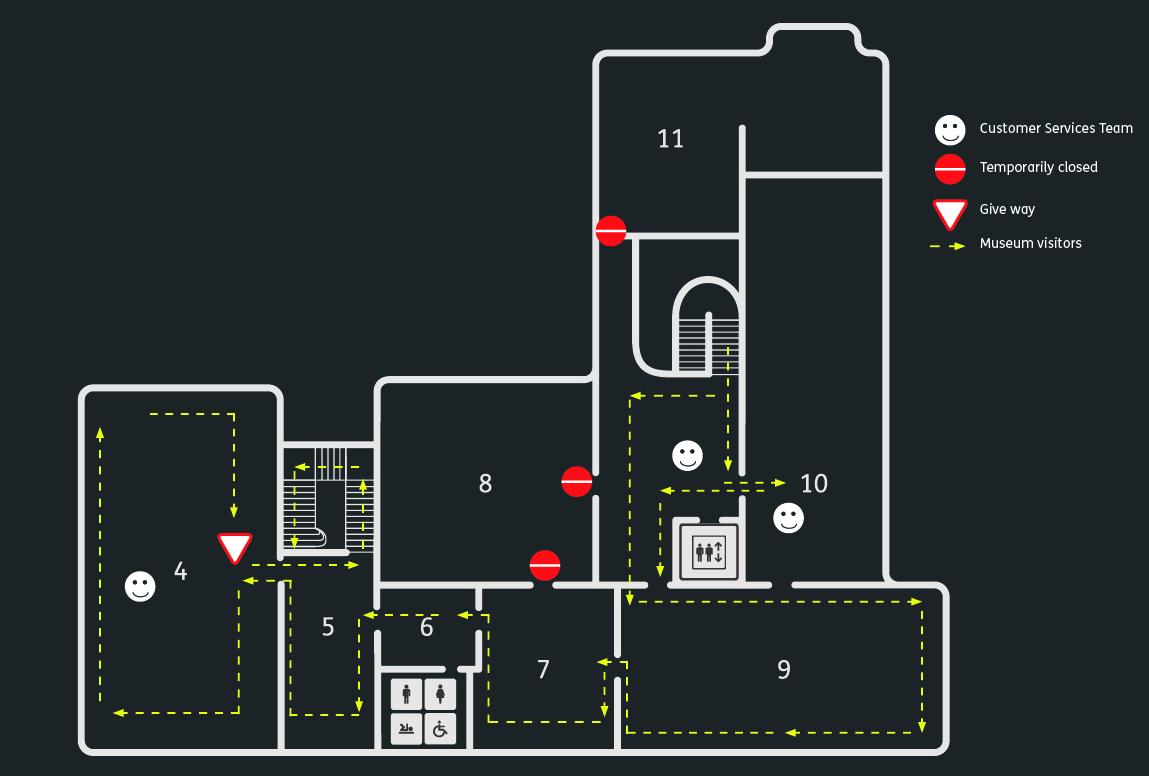
The on-site terrazzo and wood mosaic flooring, colored glass screens, ceilings, stairs, railings, and frequently renovated finishes inside enhance the safety of museum and art gallery spaces. The ceramic tiles in the public atrium space, solid oak flooring in the gallery space, and rubber sound-absorbing flooring in the library space all make the entire building more perfect. So, it was difficult for me to find areas for improvement in the architectural design of Beaney House of Art and Knowledge, until I noticed that the exhibition hall on the first floor (Figure 30) appeared smaller in the crowded visitor crowd, and the move flow design was not smooth enough. Therefore, making the exhibition hall more open, providing visitors with a better view, and having a smoother move flow became my entry point.
Figure 30. The Beaney House of Art and Knowledge first floor plan
4.1.2 Thoughts on Design Architectural design thoughts and outcome
(1) Navigation Challenges
The original layout of The Beaney posed significant challenges for visitors. The interconnected rooms, ambiguous pathways, and the overwhelming number of possible routes often led to confusion and disorientation. Visitors didn’t have a clear sense of where to go, which disrupted their ability to fully engage with the exhibitions.
To address this, I analyzed the existing floor plan, identifying areas where walls and doors created unnecessary complexity. I proposed a new layout that simplifies the spatial flow. By removing these barriers, I introduced a clear circulation route that guides visitors from the entry point, through the exhibitions in a cohesive loop, and back to the exit seamlessly. This reimagined design enhances accessibility and ensures a more intuitive visitor journey.
(2) The Arch Design
One of the key features of my redesign is the addition of navigation-enhancing arches. Initially, I explored using a Gothic-style arch to align with The Beaney’s Victorian Gothic architecture. This was intended to harmonize with the existing interiors. However, during the process, I realized that this approach blended too closely with the original structure and was similar to the original design. It failed to serve as a distinct navigational marker that would stand out for visitors.
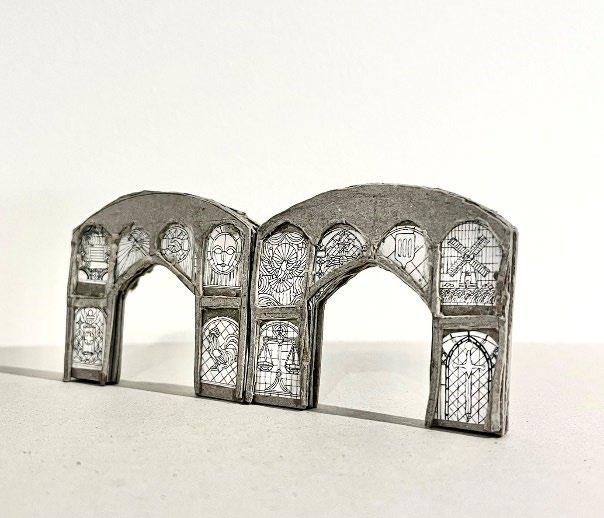
In response, I shifted to a modern arch design. This new design introduces clean, contemporary lines that provide the necessary contrast to the existing elements while maintaining a subtle connection to the building’s historical context. The arches are designed not just as functional elements but also as aesthetic features that guide visitors through the space. These arches include placeholders for stained glass panels, inspired by Canterbury’s local architecture, to further enhance their cultural resonance
(3) Incorporating Canterbury’s Heritage
To deepen the connection with Canterbury’s identity, I incorporated elements from The Canterbury Tales into the stained glass panels. Each arch includes six panels on one side, and with two arches in total, there are 24 panels, each representing one of Chaucer’s tales. These panels serve as a storytelling medium, transforming the arch into a bridge between history and modernity.
The stained-glass panels are backlit with integrated lighting, allowing vibrant colors to illuminate the space. This not only adds visual appeal but also enhances the narrative experience for visitors, creating a dynamic interplay between light, color, and storytelling. By combining a modern arch structure with traditional stained glass elements, the design strikes a balance between functionality and cultural significance.
(4) Application of Feng Shui Theory
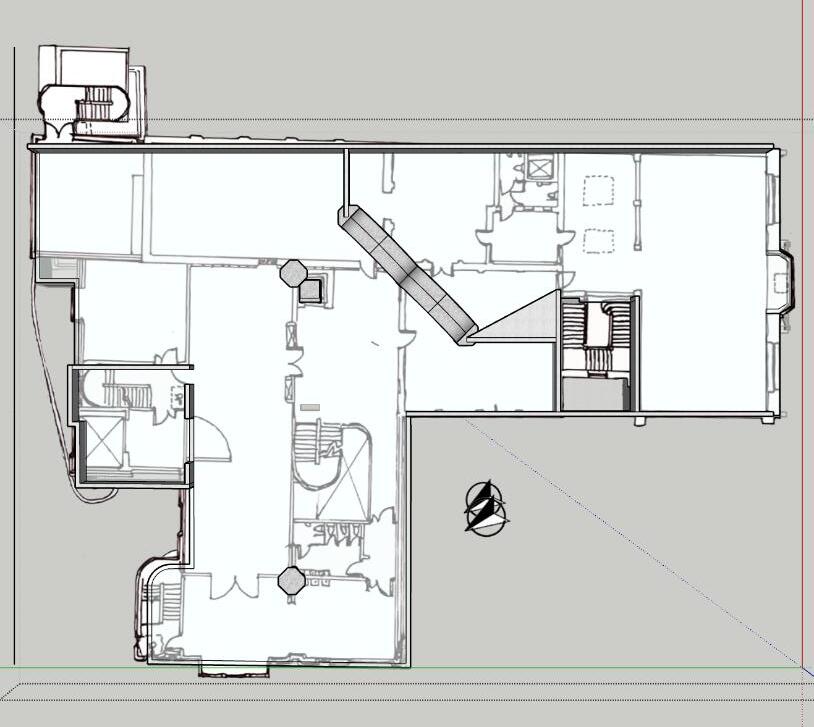
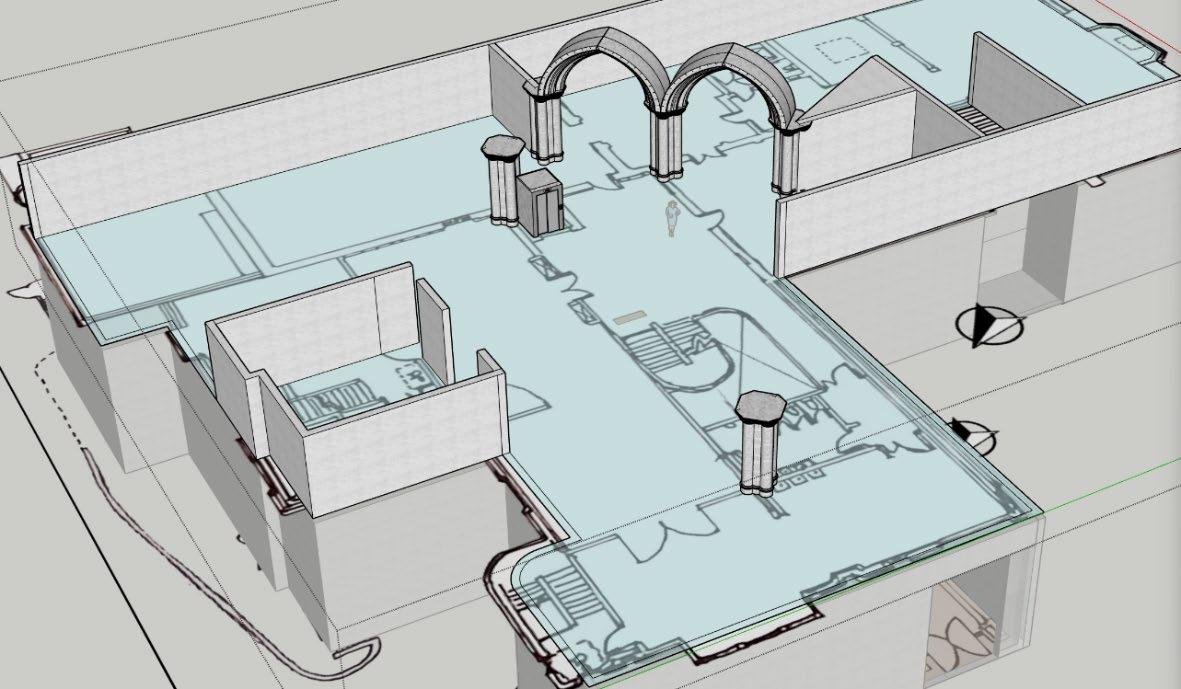
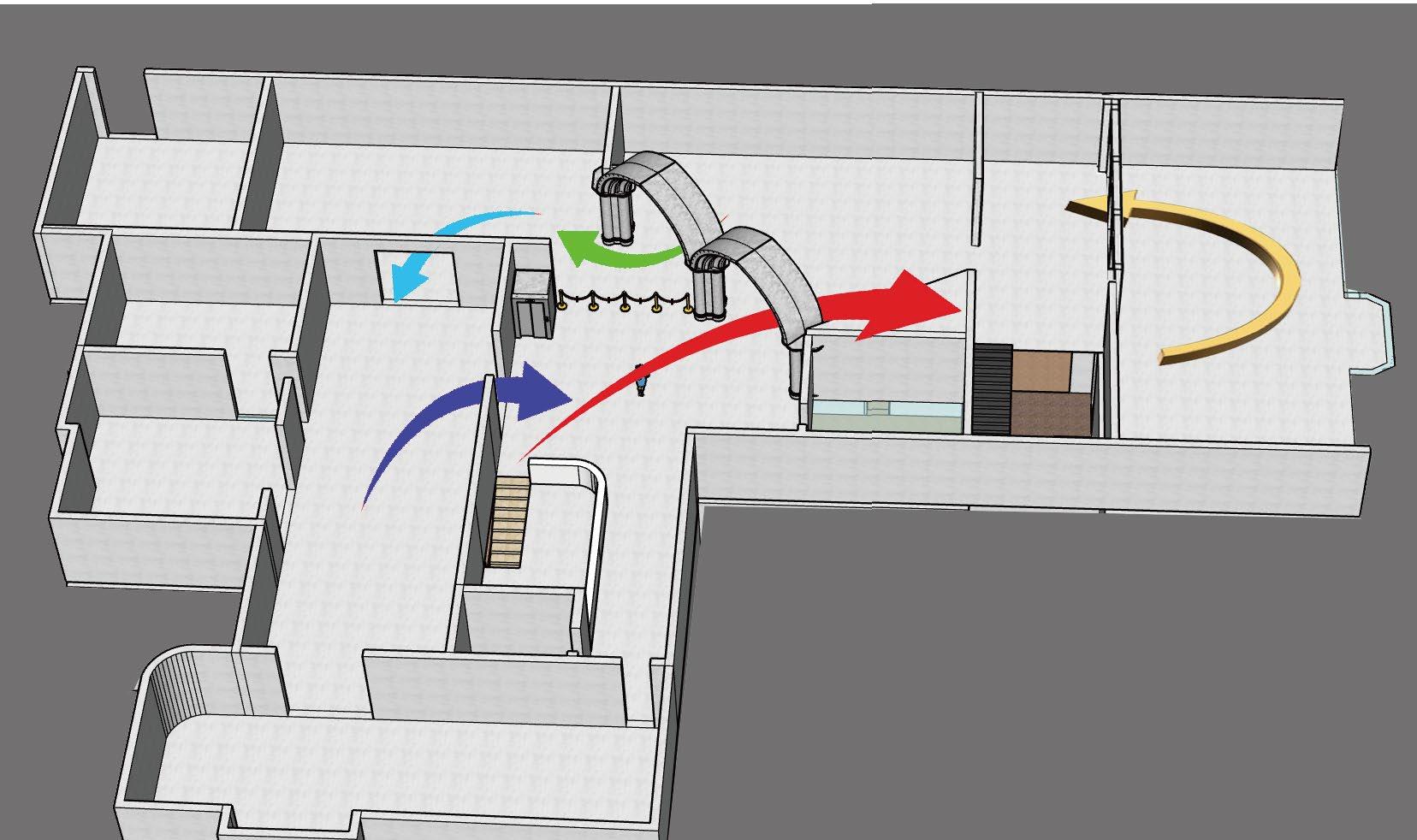
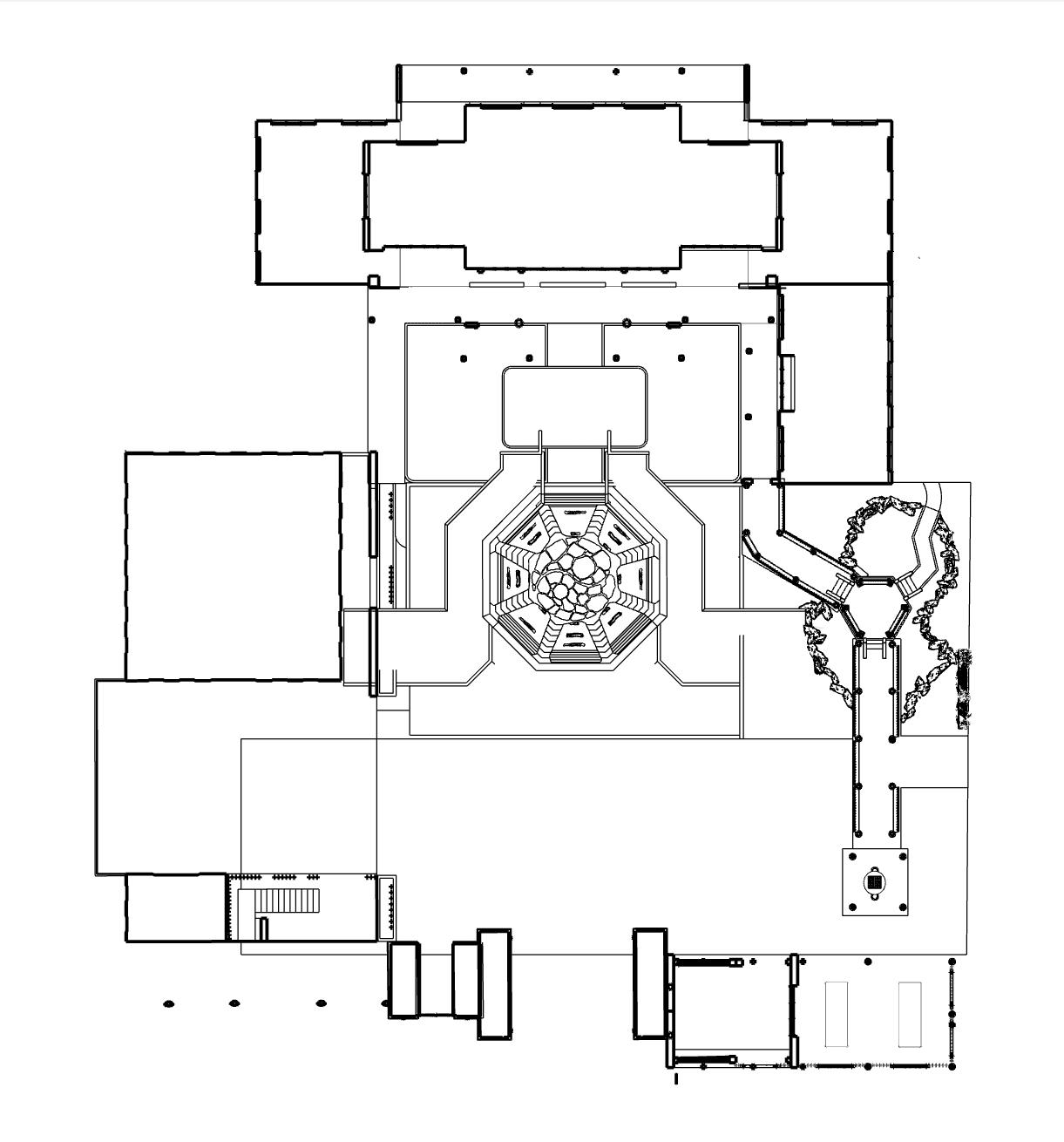
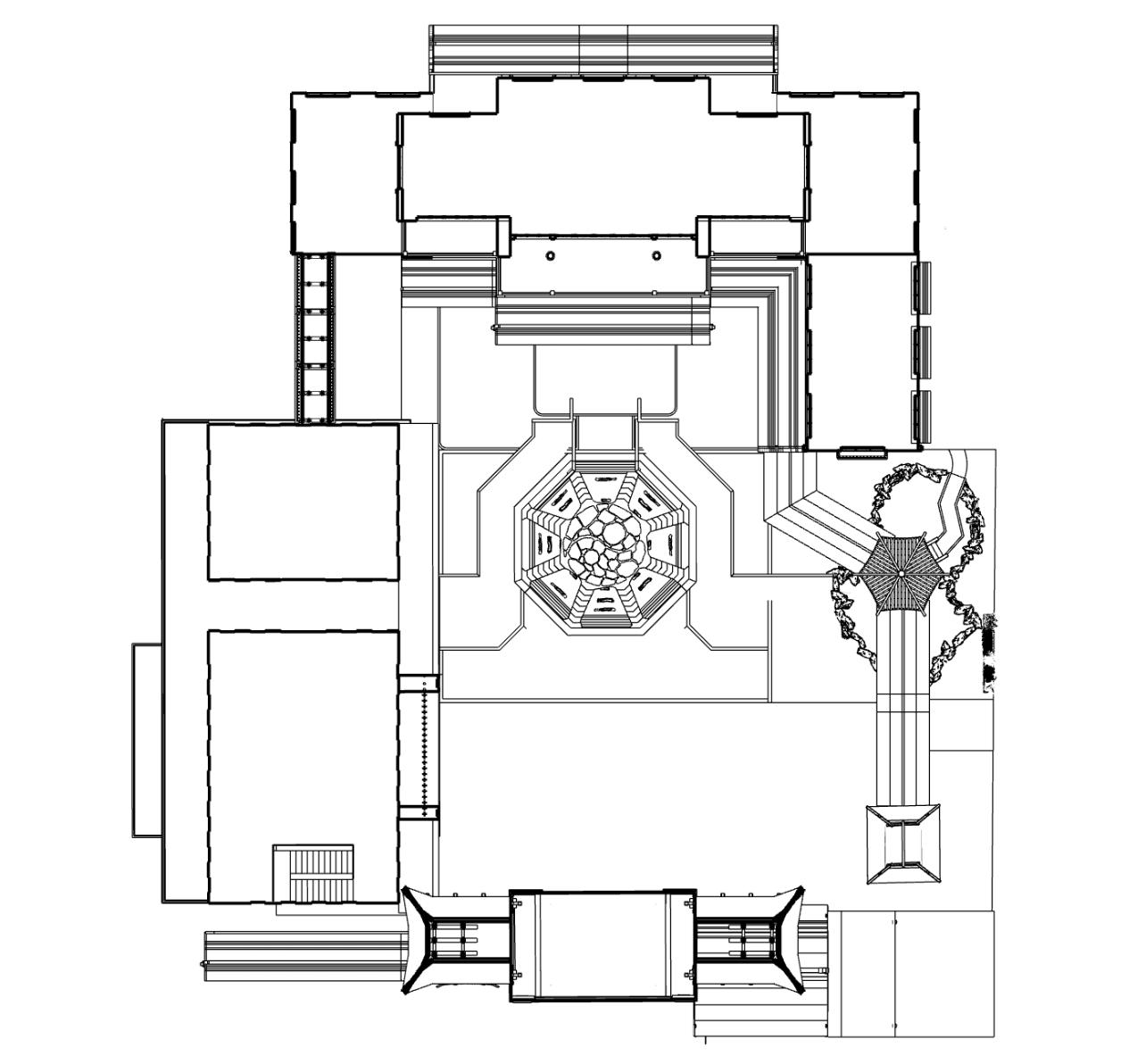
The plan and Stereoscopic drawing of the first-floor renovation are shown as Figure 31
and Figure 32. My method to renovate Beaney House of Art and Knowledge based on Feng Shui theory is as follows.
(i) Using the method of Five Elements Creation, the flowing energy of water element is created through the elements of gold, wood, fire, and earth. My design idea is to demolish the partition wall on the first floor and create a double
Figure 31. Plan of the first-floor renovation
Figure 32. Stereoscopic drawing of the first-floor renovation
arch to guide people in and out, making the flow of people like water and making the route planning more reasonable. In Chinese feng shui theory, the five basic elements of metal, wood, water, fire, and earth (or soil) can mutually stimulate or generate each other. I want to design an arch with the four elements of metal, wood, fire, and earth to stimulate the flow characteristics of water elements so that the flow of people is like the flow of water, smooth, unobstructed, fast, and beautiful. So in addition to using stone (earth element) and wood (wood element) for the columns in the design of the arch, I hope to add stained glass because the basic materials of glass is the sand, soda ash, and limestone (earth element) mixed in a certain proportion, then various additives such as aluminum, lithium, magnesium, potassium (gold element), etc. will also be added. The mixed raw materials are heated to a very high temperature (fire element), usually reaching 1300 ° C to 1500 ° C for firing. Therefore, glass has the characteristics of three elements: gold, earth, and fire. The entire arch and stained-glass combine the four elements of gold, wood, fire, and earth. According to Feng Shui theory, they can drive and create the water elements, thereby generating a flowing energy that allows visitors to receive the propulsion of flowing energy and move more orderly and smoothly.
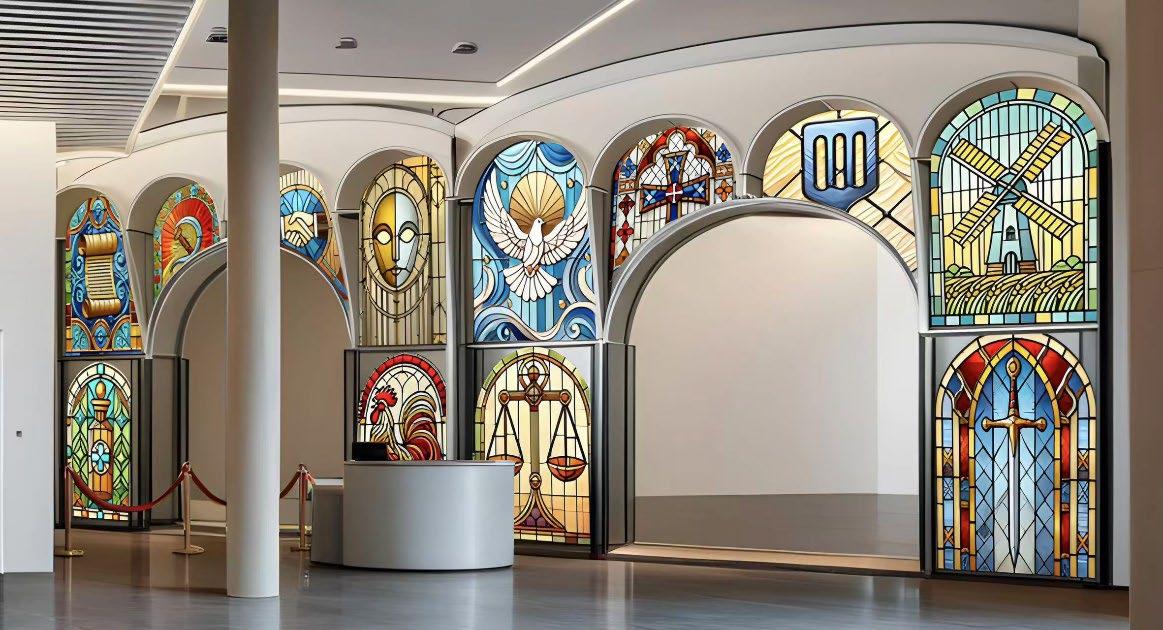
(ii) Adopting a counterclockwise movement design to obtain stable and orderly energy. I adopt a counterclockwise design for the entrance and exit direction of the arch and the entire movement line. According to Feng Shui theory, energy moving counterclockwise can make people feel more comfortable and their minds clearer. In environmental psychology, most people have a habit of moving counterclockwise, which is a historical and cultural imprint formed by people's activities or running on the sports field. Most people's hearts are on the left side, resulting in a slightly heavier body weight on the left side, which is suitable as the axis (center of gravity) for rotation. In addition, most people's right foot
Figure 33. The arch design based on Feng Shui theory.
has more strength and is suitable as a pushing role for changing direction when moving, so they are more accustomed to moving in a counterclockwise direction.
4.2. Design a Chinese-inspired garden in Kew Gardens
4.2.1 Thoughts on the Kew Gardens Project
Before starting this design project, I first thought about and explored the answers to the following questions
Q1: Why Kew Gardens?
Choosing Kew Gardens is based on four reasons.
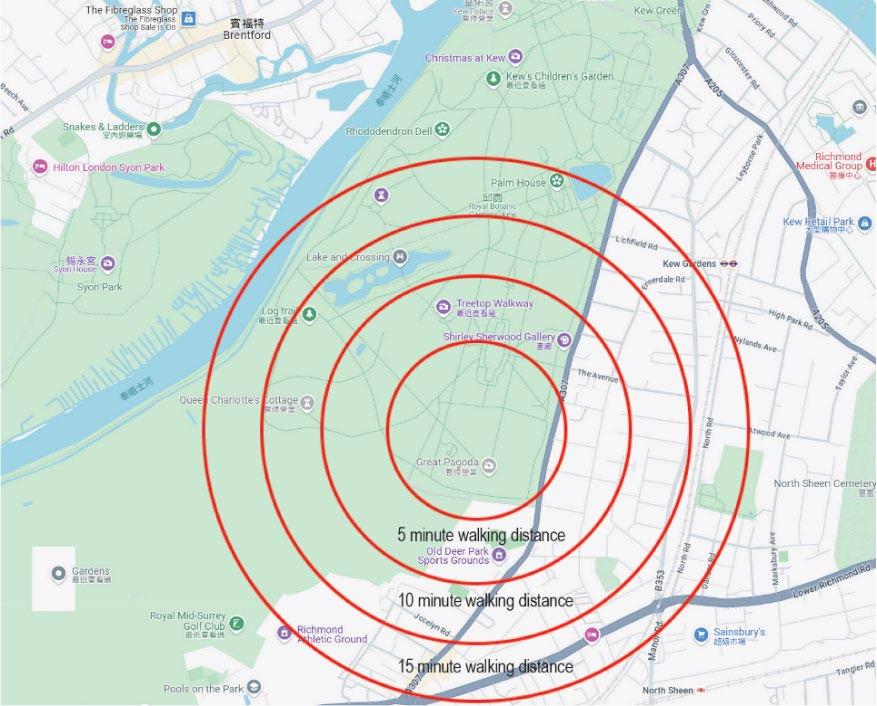
(1) Occupying a strategic location: Kew Gardens' convenient access, either overground or underground. Over 2 million annual visitors, located in the Greater London area with high visibility.
(2) High cultural and historical value: Kew Gardens is a UNESCO World Heritage site with iconic architecture and Chinese-style architecture that can engage in dialogue between Chinoiserie and authentic Chinese architectural design.
(3) Environmental opportunity: Kew Gardens has a flat terrain suitable for traditional
Figure 34. The counterclockwise movement line is based on Feng Shui theory.
Figure 35 Models of (a) the arch and (b) the renovation of the first floor.
courtyards and new structures. It has over 50000 plants, making it a suitable location for Chinese-style garden architecture.
(4) Great potential for cultural integration: Kew Gardens has strong British-Chinese historical ties (via the Great Pagoda), making it an ideal site for applying feng shui principles to showcase Chinese gardens and culture.
Q2: Why does London need this project?
London needs this project because “This is more than a building it is London’s response to culture, nature, and its evolving identity”. There are four reasons for segmentation.
(1) Cultural and urban necessity: This project can fill a cultural gap and strengthen multicultural identity. London, despite being multicultural, lacks public spaces that reflect authentic Chinese architectural and garden philosophy. This project can fill the cultural gap and address this absence. This project includes a Chinese garden and museum, where the gallery and exhibition halls can serve as places for engagement, participation, and cultural expression, aligned with London’s ethos of inclusion and cross-cultural dialogue, strengthening multicultural identity.
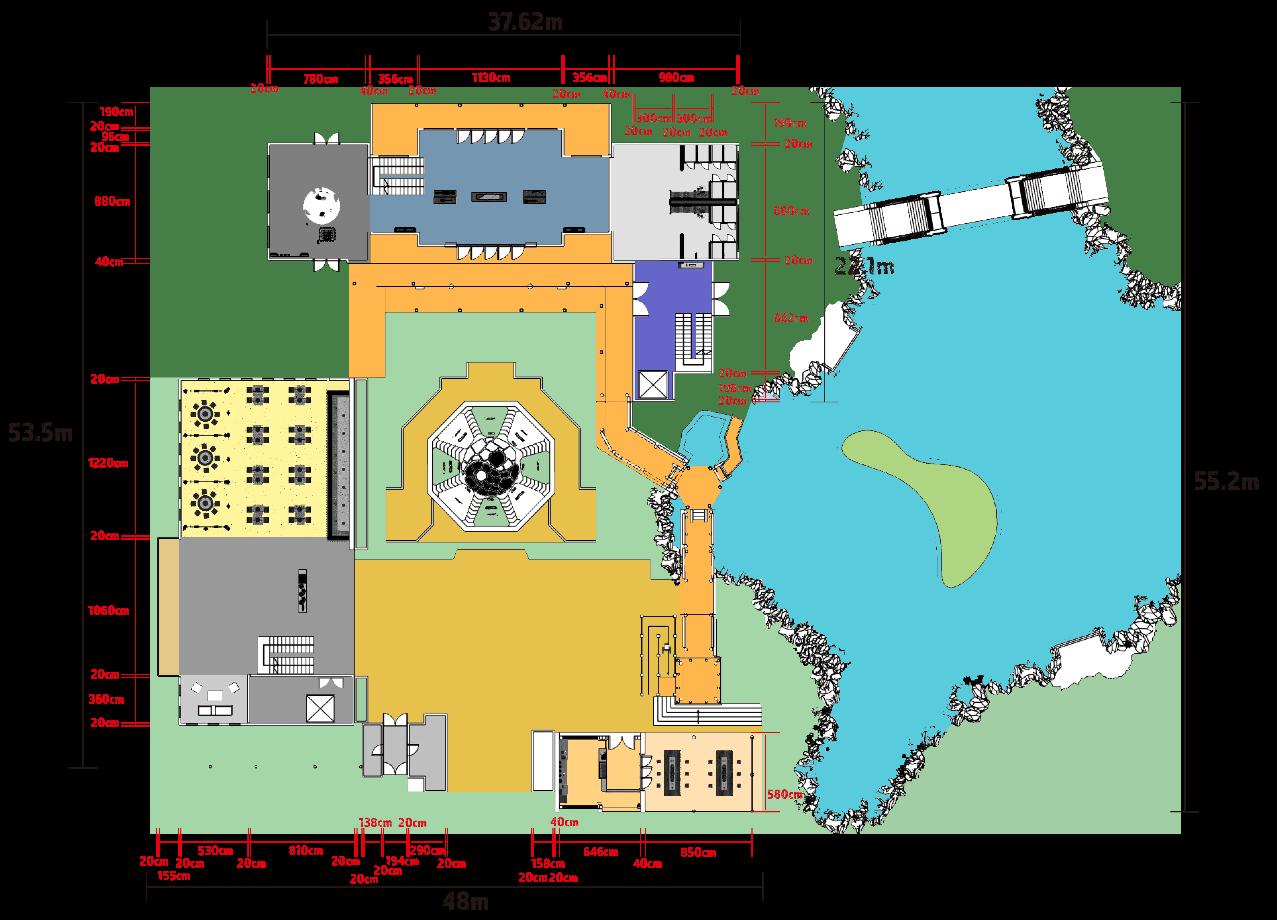
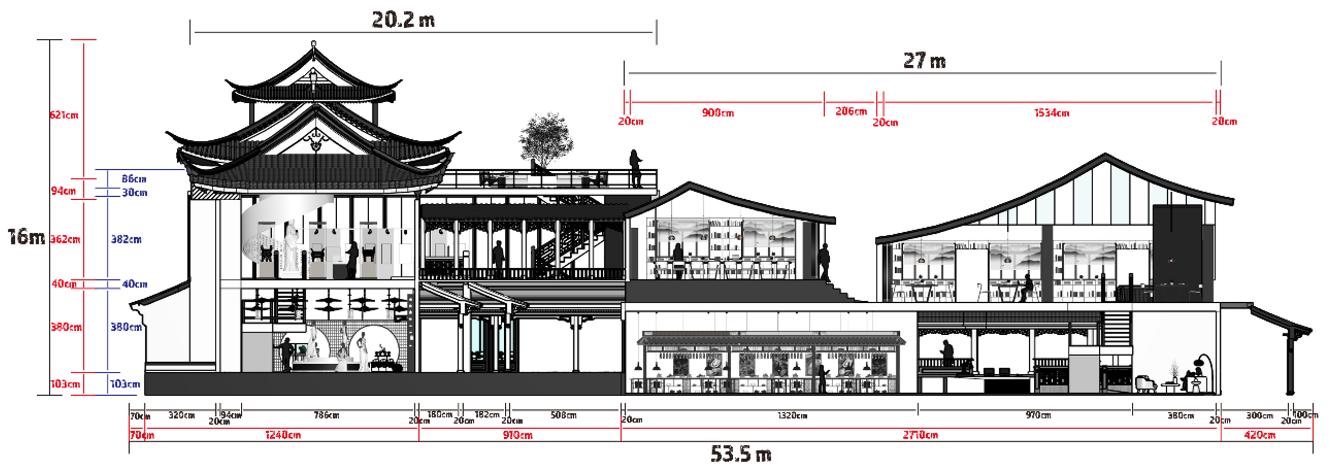
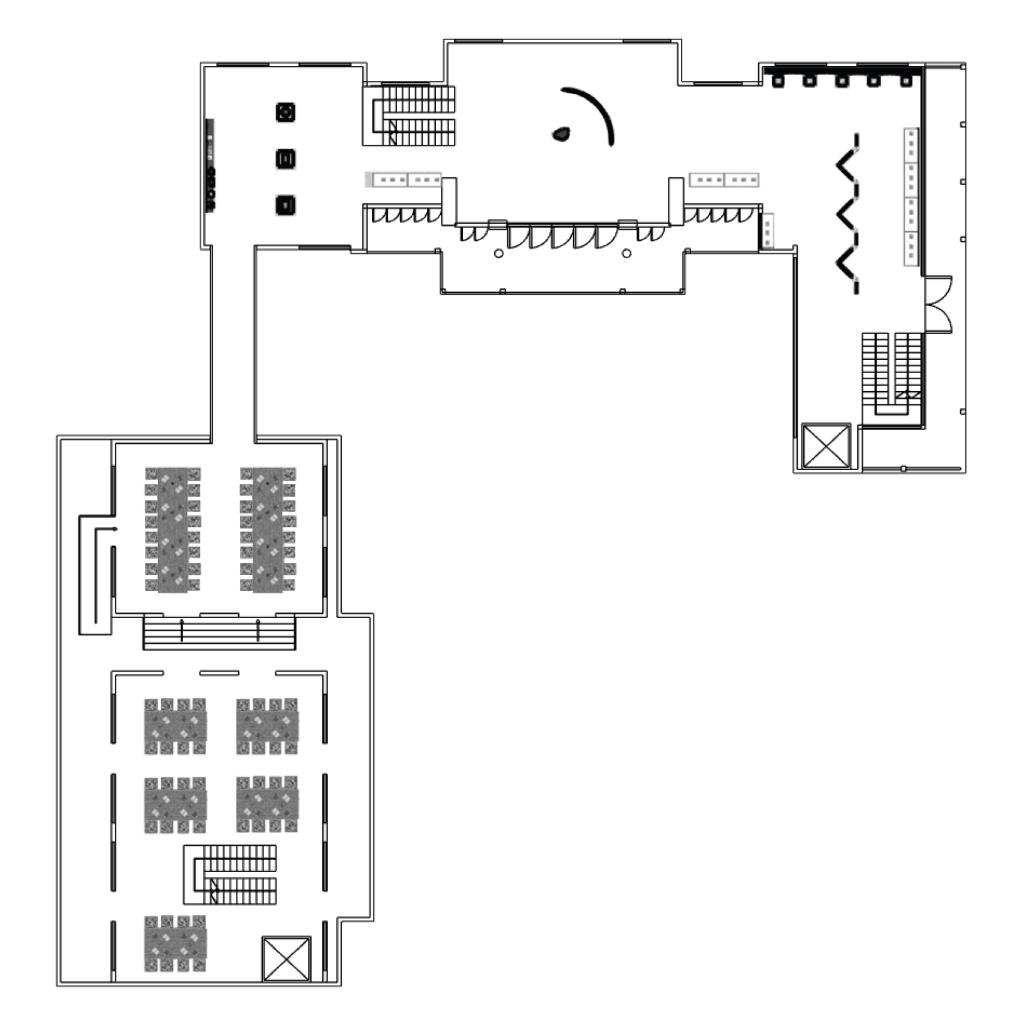
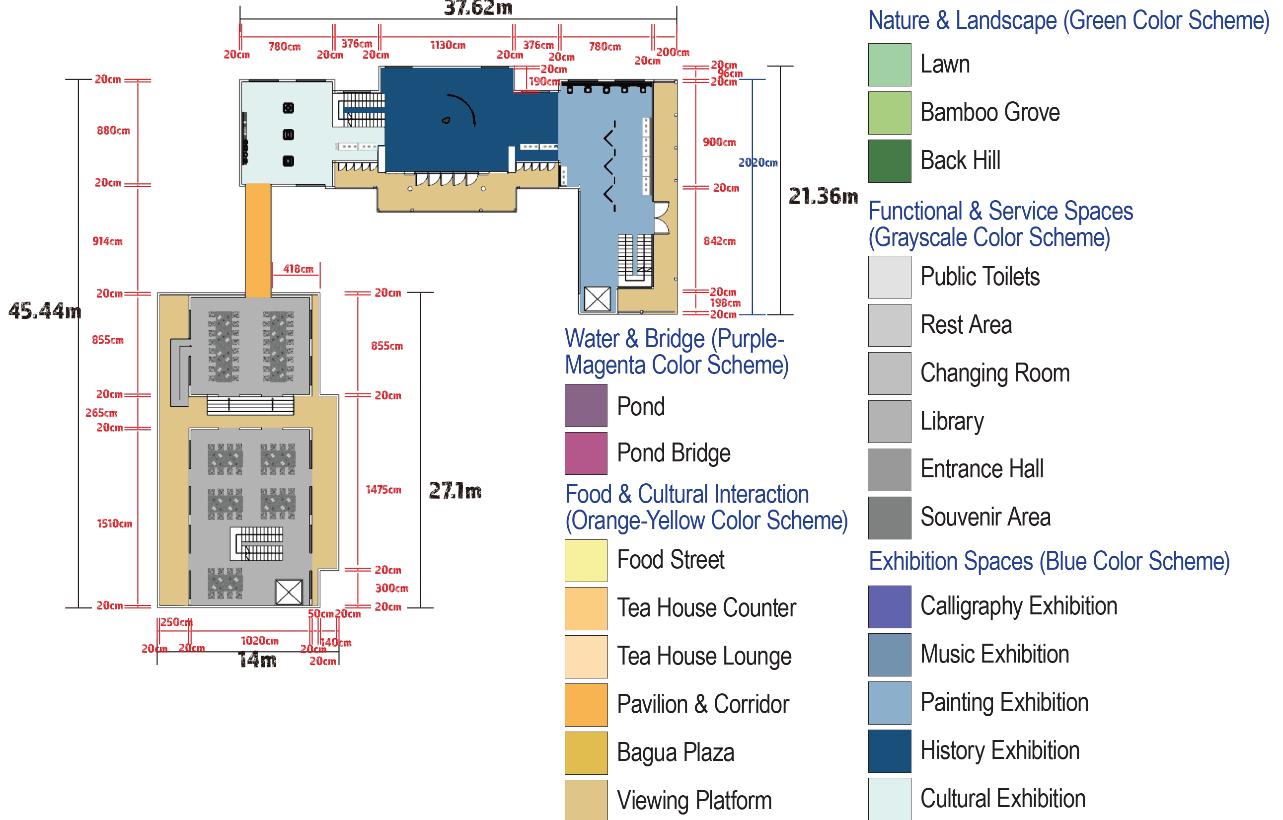
(2) Enhancing global cultural role: This project can reinforce London as a global cultural capital and boost cultural tourism. The design and establishment of the Chinese garden and museum demonstrate the city’s willingness to embrace and translate nonWestern cultural forms into its built environment. It can reinforce London as a global cultural capital. A destination that combines contemporary design, sustainability, and cultural depth can appeal to global architecture and culture-focused visitors, boosting cultural tourism.
(3) Sustainability & urban wellbeing: This project can support London’s green goals and improve mental health and urban relief The Chinese Garden emphasizes ecological integration and biodiversity, aligning with the city’s green infrastructure strategy. The project is designed with Feng Shui and sensory balance, the space offers a peaceful urban retreat that addresses rising urban stress and anxiety, improving mental health and urban relief.
(4) Educational and cross-cultural value: This project can facilitate East-West dialogue and become an interactive educational platform. The design and establishment of the Chinese garden and museum can merge Chinese spatial philosophy with British modernism, making the architecture a living site of cultural exchange. The gallery and exhibition halls are places for learning about Chinese horticulture, sustainability, and design, through exhibitions and workshops, becoming an interactive educational platform.
Q3: How does this project support Kew Gardens’ cultural, ecological, and educational mission?
This project is not just an addition to Kew it is a renewal of its role as a cultural,
ecological, and educational beacon. There are five reasons for segmentation.
(1) Enhancing Cultural Representation: This project can enhance the cultural heritage of Kew Gardens with Chinese gardens and expand global cultural depth. While Kew Gardens is famous for biodiversity, its representation of traditional garden cultures is limited. This project complements Kew Gardens and the Great Pagoda with a new Chinese layer. Incorporates Feng Shui, symbolic plants, and seasonal rhythms, enriching Kew with authentic Chinese architectural language and Eastern spatial values, enhancing the cultural representation of Kew Gardens.
(2) Ecological & sustainable contribution: This project can achieve climate resilience strategies and biodiversity enhancement. Rainwater harvesting, shade-oriented planting, and native vegetation integration in Chinese gardens reduce the carbon footprint and increase site resilience. Introducing other Chinese species compatible with the local climate can enrich the ecological level. These practices contribute to ecology and sustainability.
(3) Supporting education & learning: This project can establish an immersive educational platform and facilitate cross-cultural understanding. The gallery, exhibition halls, and garden are interactive spaces to explore Chinese horticulture, Feng Shui, and sustainable design thinking. They can become an immersive educational platform. Presents Chinese design philosophy within a British context, enabling exploration of shared values in spatial harmony and environmental care, facilitating cross-cultural understanding.
(4) Reinforcing Kew’s global role: With the help of this project, Kew Gardens can strengthen its position as a symbol of cross-cultural innovation and enrich the tourist experience. Continuing Kew’s legacy as a place of science and cultural exchange, this project blends ancient Chinese spatial logic with contemporary design. Chinese cultural exhibits enhance the status of Kew Gardens as a symbol of cross-cultural innovation. Chinese-style gardens and exhibition halls rich in Chinese cultural exhibits activate underused spaces and offer multi-sensory, story-driven exploration, expanding how visitors interact with the landscape and meaning.
(5) Aligning with Kew’s core mission: This project can strengthen the role of Kew Gardens as a bridge between the past and the future and promote environmental management in Kew Gardens. Kew Gardens is a bridge between the past and the future, connecting the architecture, plants, history, and culture of the past and the future This project serves as a spatial link between the historic 1762 Great Pagoda and future-forward, ecological design values giving Kew a timeless narrative arc, connecting the architecture, plants, history, and culture of the past and the future Chinese-style gardens and museums designed based on Feng Shui theory demonstrate the harmony between architectural form and nature. They reinforce Kew’s goal of fostering awareness of biodiversity and
sustainability, and promote environmental maintenance and management.
4.2.2
Site Analysis
I briefly list the history, terrain, vegetation, views, characteristics, and relationship with Chinese culture of Kew Gardens discussed earlier in this article. Then, briefly introduce the site, location, area size, and transportation of this project to begin my site analysis.
4.2.2.1 Kew Gardens Site Analysis
(1) About Kew Gardens:
- Founded in the 18th century, designated a UNESCO World Heritage Site in 2003
- Home to over 50,000 plant species; a global hub for botanical research and garden education
- Attracts over 2.5 million visitors annually.
(2) Chinese Cultural Elements:
- The Great Pagoda (built in 1762) as a Chinoiserie architectural symbol
- Many Chinese plants scattered across the gardens (bamboo, ginkgo, dawn redwood, peony, etc.)
- Historically reflected a European imagination of China rather than authentic representation.
(3) Current Site Condition
- Flat terrain with sparse vegetation and open views.
- Proximity to water features offers ecological context and aesthetic richness.
(4) Design Opportunities:
- The site aligns with the Great Pagoda along a visual axis, allowing for cultural dialogue
- Suitable for incorporating Feng Shui and Five Elements spatial logic.
- High potential to extend the narrative of Chinese horticultural aesthetics in Kew.
(5) Project Site: Located in the southeastern corner of Kew Gardens
- Location: Richmond, London, UK
- Site Area: Approx. 6000 m²
- Position: Southeastern edge of Kew Gardens, adjacent to the Aquatic Garden, Bamboo Garden, and Pagoda Vista.
(6) Accessibility:
5–10 minutes’ walk from Kew Gardens Underground Station.
- Directly connected to major visitor circulation routes and entry flows. The digital map of Kew Gardens and the site of this project are shown in Figures 36 and 37.
37. Enlarged map of my site
4.2.2.2 Sunlight and wind
“Sun and wind are the architecture’s original language; design is the act of listening to them.” So, my site analysis will start with the sun and wind. The sun path is shown in Figure 38. I will shape the ecological and cultural design strategy for the site based on the sun path, prevailing winds, and microclimate.
Figure 36. My Site in Digimap
Figure
38. Sun Path Analysis
(1) Sunlight Overview- Summer vs. Winter Solstice:
(i) Summer Solstice (June 21): High sun angle, long daylight hours, short shadows. Even light distribution enables vibrant outdoor events and immersive cultural experiences
(ii) Winter Solstice (Dec 22): Low sun angle, long shadows, limited daylight Design strategies must focus on southern orientation and light-maximizing features
(iii) Shadow Observation: Between 9:30–11:30 AM, the shadow of the Great Pagoda partially covers the site. This becomes a symbolic and functional opportunity a “mountain” in Feng Shui, or a setting for reflective water features or contemplative pavilions
(2) Wind & Microclimate Conditions:
(i) Prevailing winds come from the west and southwest, typical of the UK’s westerly wind belt.
(ii) Surrounded by trees and aquatic zones, the site benefits from natural wind buffering
(iii) Moderate air flow prevents stagnation and supports a pleasant visitor. environment
(3) Natural Conditions & Five Elements Mapping:
Figure
(i) The site is north-facing to south, aligning with ideal Feng Shui orientation.
(ii) Sunlight + wind data can be aligned with Wu Xing (Five Elements) for symbolic and spatial logic.
→ South (strong light) → Fire → Main entrance & tea pavilion
→ Southeast (humid, warm) → Wood → Bamboo grove, painting gallery
→ North (cool, shaded) → Water → Music Hall, contemplation court
Sunlight and wind are “not just environmental data”, but narrative tools for spatial storytelling. This project design embraces “site-specific observation and simulation”, crafting a response that is both sustainable and symbolic. The summer solstice light observation and related design ideas based on observation are shown in Table 11. The winter solstice light observation and related design ideas based on observation are shown in Table 12. Prevailing wind and surrounding vegetation can create a comfortable and sustainable microclimate, and the related design ideas are shown in Table 13.
Table 11. Summer Solstice Light Observation - June 21, 2024
(1) 8:00 AM: Sunrise from the Northeast- Morning Activation
Figure 39. Sun Path Analysis-Summer Solstice 8am
- The sun rises at a low angle from the northeast
- Eastern paths and entrances are illuminated early.
- Long, crisp shadows form ideal for morning energy and visual drama.
Design Implications:
- The eastern entrance area can feature a tea pavilion or bamboo walkway to greet morning light
- Use of “wooden lattice” or “semitransparent shading” to filter soft sunlight and create dynamic textures
(2) 12:00 PM: High Noon- Balanced and Bright
- Sun is almost directly overhead; minimal shadows
- The entire site is evenly lit, with strong visibility of architectural and landscape elements.
- Perfect for exhibitions, open-air programming, or central gathering spaces
Figure 40 Sun Path Analysis-Summer Solstice 12pm
Design Implications:
- Courtyard or central open space ideal for “calligraphy or painting exhibitions”.
- Reflective surfaces (e.g. water or stone) can enhance spatial atmosphere and highlight “light and shadow poetry.
(3) 4:00 PM: Sunset from the Northwest- Warm Afternoon Glow
Figure 41 Sun Path Analysis-Summer Solstice 4pm
- Sun shifts to the northwest, casting gentle and warm light.
- Shadows lengthen, creating a calm, atmospheric environment.
- Ideal for meditative or contemplative spatial experiences.
Design Implications:
- Western pathways may include “wisteria trellises, benches, or reflective pools”
- The soft afternoon light becomes a “natural backdrop for slow movement and quiet reflection.
Table 12. Winter Solstice Light Observation - December 22, 2024
8:00 AM: Sunrise from the Southeast- Subtle Beginnings
Figure 42 Sun Path Analysis-Winter Solstice 8am
- The sun rises at a very low angle from the southeast.
- Long, diffused shadows dominate the landscape.
- Ideal for quiet programs such as meditation gardens, water features, or tea pavilions.
Design Implications:
- Introduce “reflective water surfaces” or angled walls to enhance morning light
- Design curved paths in southeast corners to gently guide visitors through early light zones
(2) 12:00 PM: Low-Angle Noon- Southern Focus
43. Sun Path Analysis-Winter
- Even at midday, the sun remains low; shadows remain long and angled
- South-facing areas receive the most direct light and warmth.
Design Implications:
- Concentrate main circulation and exhibition programs along the “southern zone”.
- Use large “south-facing windows, glazed walls”, and thermal massing to absorb and retain heat
(3) 4:00 PM: Sunset from the Southwest- Quick Dimming
Figure 44. Sun Path Analysis-Winter
- The light becomes golden and soft, but fades quickly.
- Shadows cover most of the site; supplemental lighting or reflective design becomes necessary.
Design Implications:
- Create ambient lighting zones or use “uplighting in gardens” for seasonal evening programs.
- Consider installations that use “light and shadow as poetic time-markers” seasonal sundials or winter projections
Table 13. Prevailing wind and surrounding vegetation create a comfortable and sustainable microclimate.
Wind Direction & Velocity Characteristics (1) “Prevailing wind”: From the “west and southwest”, typical of the UK’s westerly wind belt (2) “Moderate speed”, offering good airflow without discomfort
(3) Surrounded by tree belts and architectural edges forming a “natural wind buffering”
(4) Helps reduce humidity, prevent stagnation, and improve visitor comfort
Design Applications of Wind (1) Airflow & Circulation
(i) Align main circulation axis with prevailing winds can creates passive ventilation corridors
(ii) Place openings on “southwest and northeast
Figure
Solstice 12pm
Solstice 4pm
Feng Shui & Five Elements Integration
sides” to enhance cross-ventilation
(2) Functional Zoning
(i) Build Pavilions and tea houses placed at wind corridor ends can enjoy ventilation without wind disturbance
(ii) Tree and plant massing buffer strong winds and maintain comfort
(3) Microclimate Zoning
(i) South: sun + breeze
(ii) North: use wind-blocking design + thermal retention strategies
(1) Wind plays a central role in Feng Shui as the carrier of Qi (energy):
(i) Southwest wind = symbolic flow from “Metal to Fire” in Five Elements, it represents vitality, wealth, and popularity.
(ii) Setting up "tea house, reception, and gift shop" in cultural zones near the wind entry points can encourage gathering and energy flow
Climate Comfort & Sustainability Strategy
(1) Passive ventilation reduces dependence on mechanical systems
(2) Enhances “thermal comfort” and improves indoor-outdoor air quality
(3) Stabilized microclimate supports plant health and visitor experience
4.2.2.3 Site Constraints and Opportunities
(1) Physical Constraints
(i) Proximity to Historic Landmarks
Figure 45. Sun Path and Wind Analysis in SketchUp
The site is adjacent to the “Great Pagoda”, requiring architectural scale and massing to preserve visual hierarchy
(ii) Compact Area with Defined Boundaries
The site spans approximately. 6000 m², requiring efficient programming of both the gallery and the garden without overcrowding
(2) Environmental Constraints
(i) Tree Preservation
Mature trees surround and frame the site. Construction must avoid root zones and canopy interference
(ii) Seasonal Sensitivity
Significant changes in light quality and vegetation across seasons affect spatial atmosphere, thermal comfort, and user experience
(3) Conservation & Planning Regulations
(i) UNESCO World Heritage Guidelines
All design must respect historical continuity and ecological balance, avoiding intrusion into protected view corridors
(ii) Planning Approval Required
Any intervention must follow Kew Gardens’ and local authority regulations, particularly regarding form, materiality, and ecological sensitivity
Figure 46 Walking range and time
4.2.3 Design proposal
4.2.3.1 Narration based on Feng Shui theory
In traditional Chinese architectural philosophy, “Feng Shui” is not superstition. It’s a system that integrates geography, climate, circulation, and human psychology. First, I introduce a “Bagua grid analysis” combined with the “Five Elements” to examine whether
the current design aligns with the natural flow of energy (Qi) and cultural spatial logic. The aim is not to mystify the design, but to “draw on the wisdom of Feng Shui” to enrich cultural depth and enhance user experience through spatial harmony. Table 14 shows the five elements, their energy, and their architectural expression. Table 15 shows the relationship between Bagua orientation and the Five Elements' energy.
Table 14. Five Elements and their architectural expression Five Elements Fire Wood Water Metal Earth
energy Energy, illumination Growth, expansion Stillness, flow Precision, refinement
Stability, grounding
Architectural expression Entrances, gathering spaces Learning, culture, libraries Music, poetry, contemplation Exhibitions, craftsmanship Plazas, central nodes
Table 15. Bagua Orientation and Five Elements Energy
Northwest: Water + Metal (conclusion, clarity)
West: Metal (structure, refinement)
Southwest: Metal + Fire (craftsmanship, sharing)
North: Water (reflection, flow) North: Water (reflection, flow)
Center: Earth (balance, stability)
South: Fire (vitality, openness)
Northeast: Wood + Water (transition, introspection)
East: Wood (growth, culture)
Southeast: Wood + Fire (creativity, expression)
My overall plan for this project is based on the Feng Shui theories in Tables 14 and 15, planning the rhythm and spatial sequence of the tourism experience from the entrance to the exit in the following way (Figure 47).
(1) Entry Sequence (Welcoming Rhythm)
(i) The main entrance is located on the south, where sunlight is strongest, which can create a welcoming and vibrant first impression.
(ii) Entering from the entrance will face the Great Pagoda, allowing visitors to immediately establish a visual and symbolic connection with Kew’s heritage.
(iii) There are features a reception area and costume rental (e.g., traditional Hanfu) can enhances immersive experience and ceremonial entry.
(2) Counterclockwise Flow Design (South → East → North → West)
(i) A counterclockwise route contrasts with the clockwise instinct (right-hand dominant), slowing down the pace and encouraging contemplation.
(ii) Setting up tea house and reception in cultural zones near the wind entry points. The route starts with the tea house and water garden, offering sensory immersion and slow entry into cultural narrative.
(iii) Visitors then move into the main exhibition spaces, transitioning from body-
focused experiences to intellectual engagement.
(iv) Morning sunlight enters from the east (ideal for exhibitions), while afternoon shade falls on the western garden (perfect for quiet rest).
(3) Exit Sequence & Closure Design
(i) The gift shop, donation zone, and costume return area are placed near the main exit (west side), it is taking advantage of the emotional peak after the tour to provide gifts for tourists to choose.
(ii) Gift shop offers curated items linked to the gallery experience: tea, poetry, plant symbolism.
(iii) Costume return at the end completes the immersion cycle, returning visitors to their daily identity.
Overall, my plan is from the early stage of providing visitors with sensory and emotional regulation through tea pavilions, water gardens, and bamboo corridor, to the middle stage of providing visitors with intellectual and artistic immersion through gallery rooms for calligraphy, painting, music, poetry, and then to the later stage of offering extended learning for slow-paced visitors without disrupting the main loop through library and reading space (located in the southwest and separated from the main route). Finally, the tourist ends their trip at the gift shop by selecting gifts.
Figure 47 Narration based on Feng Shui theory
4.2.3.2 Design response to tourist needs
The design of this project must understand key visitor groups and consider the needs of different tourists. The design responses given to different tourists are shown in Table 16.
International Tourists
Cultural & Art Enthusiasts
Table 16. The design responses given to different tourists.
Characteristics & Needs:
(1) Visitors from around the world, including those curious about East Asian culture
(2) Prefer visual and immersive cultural experiences
(3) Often time-limited and drawn to photogenic or “Instagrammable” locations
Design Responses:
(1) Clear signage with multilingual options
(2) Dedicated “photo zones” and culturally rich backdrops
(3) Spatial narrative and circulation enhanced through symbolic visuals and storytelling
Characteristics & Needs:
(1) Interested in deep cultural narratives and guided interpretation.
(2) Appreciate fine details, historical backgrounds, and aesthetic depth.
(3) Often study Chinese aesthetics, architecture, or art history.
Design Responses:
(1) Exhibition design focused on detail, narrative layering, and materiality.
(2) QR codes and in-depth interpretive tools for extended learning.
(3) Host public talks, forums, or thematic tours.
Families & Educational Groups
Characteristics & Needs:
(1) Parents with children or school groups visiting for outdoor learning.
(2) Seek a balance of educational value and playful discovery.
(3) Prefer exploratory, hands-on environments.
Design Responses:
(1) Include interactive workshops (e.g., calligraphy practice, botanical rubbing). So, the Chinese culture museum and exhibition halls showcasing calligraphy, painting, and textiles are essential.
(2) Child-friendly paths and shaded resting areas (e.g., under pavilions or tea house corners).
(3) Provide educational booklets and teacher-friendly resources. Therefore, it is necessary to establish a learning center with diverse educational resources.
Botanists & Horticultural Scholars
Characteristics & Needs:
(1) Often in collaboration with Kew, focusing on plant origin and cultural symbolism.
(2) Read the space through ecology, seasonal cycles, and planting
strategies.
(3) Interested in scientific as well as cultural interpretation of landscape.
Design Responses:
(1) Botanical labels include scientific names, Five Element correspondences, and symbolic meanings. So, a Chinese-style garden design which distinctive and full of Chinese plants is essential.
(2) Exhibit plant migration history (e.g., Wilson’s expeditions and East-West botanical exchanges). An exhibition hall or learning center. An exhibition hall or learning center about the fundamental knowledge and migration history of plants is essential.
(3) Seasonal tours and lectures on Chinese horticultural philosophy and phenology.
4.3 Design Project
Project Name: Reinterpreting Chinese Architecture in Dialogue with London’s Past
SWOT analysis of the project
My SWOT analysis of the project is summarized in Table 17.
Table 17 SWOT analysis
Strengths:
Strong Cultural and Historical Context
- Proximity to the Great Pagoda (Chinoiserie symbol) opens a chance for architectural dialogue.
- Existing cultural diversity on site supports multicultural interpretation
Flat Terrain and Stable Environment
- Gently sloped and flat terrain enables effective courtyard and path-based spatial planning
- Mature vegetation provides natural shade and microclimate regulation
High Visitor Potential
- Over 2.5 million annual visitors to Kew Gardens
- Site is located along “major pedestrian routes”, allowing easy access and extended visitor engagement
Ideal for Feng Shui and Five Elements Layout
- Open southeast exposure, northern “back support,” and full seasonal sunlight.
- Site conditions allow clear implementation of directional, symbolic, and material Feng Shui logic.
Opportunities:
Weaknesses:
Limited Site Size (approx. 15000 m²)
- Requires compact yet efficient layout of gallery, garden, circulation, and rest areas
- Only low-rise construction is feasible massing must remain subtle and respectful
Visual Pressure from Adjacent Landmarks
- Nearby landmarks like the Great Pagoda and Temperate House dominate the visual hierarchy
- New structures must maintain low profile, restrained materiality, and subtle integration
Strict Conservation Restrictions
- Located within a UNESCO World Heritage zone, subject to multiple layers of approval and ecological constraints.
- Existing mature trees must be preserved, affecting structural layout flexibility
Threats:
New Model for Cross-Cultural Integration
- A chance to respond to 18th-century “Chinoiserie imagination” with a “contemporary Chinese architectural voice”
- Creates one of London’s few true public spaces dedicated to Chinese cultural heritage.
Platform for Education and Exhibition
- Can host workshops, exhibitions, and interactive zones for calligraphy, painting, music, and horticulture
- Provides opportunities for art-based education and cultural appreciation
Showcase for Ecological and Passive Design
- Incorporates “green roofs, rainwater harvesting, native + Chinese flora”
- Seasonal Five Elements layout encourages climate-resilient, culturally expressive design
4.3.1 Thinking about the site
Complex Administrative Approval Process
- Requires approval from Kew Gardens, local planning authority, and possibly UNESCO.
- May result in longer design development and approval cycles
Climate Limitations on Outdoor Use
- Frequent rain and overcast skies may limit outdoor program use and reduce sunlight-based experience
- Requires “weather-adaptive strategies” for circulation, shelter, lighting, and drainage.
Risk of Cultural Misinterpretation
- “Chinese architecture” may be misunderstood as decorative “Chinoiserie”
- Design must emphasize authenticity, contextual integrity, and contemporary reinterpretation.
I consider and plan for the site and surrounding environment of the building, as shown in Figure 48. There are four important buildings around the site I have chosen, and their characteristics, representative meanings, and my thinking are as follows.
A. Great Pagoda
The Great Pagoda (1762) is a symbolic yet superficial imitation of Chinese culture. My design, titled “Reinterpreting Chinese Architecture in Dialogue with London’s Past”, directly responds to this historical misunderstanding. By aligning the new cultural gallery’s
Figure 48 Thinking about the site based on Feng Shui theory
visual and symbolic axis with the pagoda, the project will transform fantasy into authentic cultural dialogue.
B. Pavilion Bar and Grill
Located directly adjacent to my site, Pavilion Bar and Grill serves as a major resting and dining area for Kew Gardens visitors. Its buildings are low and its views are vast. Architecturally, my project responds to its horizontal volume and low-rise roofline, ensuring visual harmony and avoiding scale competition.
C. Temperate House
The Temperate House showcases the Victorian-era ambition of collecting and classifying exotic plants from across the empire. Various rich plants complement my Chinese garden, creating a charming atmosphere. Moreover, my Chinese-style architecture is largely distinct from that of the Temperate House, presenting a fusion and mutual achievement for each other of cultures.
Japanese Garden
The Japanese Landscape Garden at Kew reflects an early attempt at cross-cultural garden-making. My Chinese-style Garden will offer a “contrast in cultural logic” and become a “cross-Asian architectural conversation” within the same garden. Placing these two gardens adjacent highlights my clever selection of building locations.
4.3.2 Spatial Programming, Symbolism and Practice
The spatial planning of this project, shown in Figure 49. The detailed spatial planning and semiotic organization are described as follows.
1. South - Main Entrance & Reception Plaza / Traditional Costume Rental
Placement Rationale:
(
i) This area directly faces Kew’s main pedestrian path and is highly visible and accessible, making it the natural point of arrival for most visitors.
(ii) It benefits from good sunlight and a spacious layout, ideal for serving as a gathering point and a psychological transition space.
(
iii) The traditional costume rental is placed here, allowing visitors to symbolically shift roles and atmosphere right from the beginning, deepening cultural immersion.
Spatial Symbolism:
Creates a sense of ritual a “gateway” transitioning visitors from modern London into a journey through Eastern cultural landscapes.
2. (1) Southeast Area - Tea House / Pond / Pavilion
(2) Southeast Garden - Bamboo Corridor / Pavilion / Chess Hall
(1) Southeast Area - Tea House / Pond / Pavilion
Placement Rationale:
(i) This area receives ample sunlight from the east, symbolizing a fresh beginning ideal for the start of a cultural journey.
(ii) It is close to the entrance, calm and secluded, making it a perfect setting for tranquil tea ceremonies and scenic views.
(iii) The pond and pavilion create a “stillness within movement” atmosphere, inviting pause, contemplation, and sensory immersion.
Spatial Meaning:
A space for “slow immersion into cultural narrative,” guiding visitors from the urban tempo to a garden rhythm.
(2) Southeast Garden - Bamboo Corridor / Pavilion / Chess Hall
Placement Rationale:
(i) Located adjacent to the tea area, this garden segment extends the immersive landscape experience with small architectural features.
(ii) The bamboo corridor creates a “passage-like” space experience, supporting a fluid spatial transition.
(iii) The chess hall offers a place for quiet cultural interaction (e.g., Chinese chess or Go), enriching visitor engagement.
Spatial Meaning:
A multi-layered spatial rhythm that blends nature and microarchitecture, designed for both movement and contemplation.
3. (1) East Exhibition Hall - Ground Floor – Calligraphy Exhibition
(2) East Wing - First Floor: Painting Exhibition
(1) East Exhibition Hall - Ground Floor – Calligraphy Exhibition
Placement Rationale:
(i) Positioned near the garden, allowing a natural transition from outdoor scenery into the world of written art.
(ii) As a quiet and detail-focused exhibit, the calligraphy hall is placed on the ground floor for better accessibility for elderly visitors and families.
(iii) Lighting is soft and controlled ideal for preserving calligraphy scrolls while creating a peaceful exhibition environment.
Spatial Meaning:
A cultural core where bodily movement transforms into intellectual stillness and appreciation of written forms.
(2) East Wing - First Floor: Painting Exhibition
Placement Rationale:
(i) Positioned above the calligraphy gallery, continuing the narrative layering of the eastern cultural wing.
(ii) The first-floor elevation provides spacious wall height for large-scale artworks and contemporary interpretations.
(iii) Gentle natural light filters through side windows, enhancing the visual interplay of light and shadow on the artworks.
Spatial Meaning:
Calligraphy represents form, painting expresses meaning their vertical dialogue embodies dual dimensions of Chinese aesthetics.
4. Northeast - Public Restroom Zone
Placement Rationale:
(i) Located mid-way along the east-side gallery on the ground floor, easily accessible whether entering from the south or the northern exhibition hall.
(ii) Positioned near the circulation loop, it allows for natural transitions and convenient rest breaks.
(iii) The exterior can incorporate green walls or landscaped screening to help the utility function blend into the broader spatial atmosphere.
Spatial Symbolism:
Balances practicality and discretion meeting physical needs while preserving the immersive experience.
5. (1) North | Main Hall – Ground Floor: Music Exhibition (Guqin, Pipa, Bianzhong, Erhu, etc.)
(2) North | Main Hall – First Floor: Poetry Exhibition (Tang/Song poetry, literary scrolls, calligraphy, etc.)
(3) North Hill Area | Artificial Mountain (Kao Shan) and Plum Grove
(1) North | Main Hall – Ground Floor: Music Exhibition (Guqin, Pipa, Bianzhong, Erhu, etc.)
Placement Rationale:
(i) The northern zone receives softer lighting, suitable for the tranquil atmosphere needed in sound-based exhibitions
(ii) The ground floor allows spacious layouts for installations, performance zones, and sound-based interaction.
(iii) This is the climax of the cultural experience, engaging visitors in a multisensory realm of sound and memory.
Spatial Symbolism:
Music embodies intangible cultural memory, transforming the visual journey into an emotional, auditory encounter.
(2) North | Main Hall – First Floor: Poetry Exhibition (Tang/Song poetry, literary scrolls, calligraphy, etc.)
Placement Rationale:
(i) The upper level ensures a quiet space for reading, contemplation, and introspection.
(ii) Gentle lighting conditions are ideal for displaying fragile literary artifacts and scrolls.
(iii) Echoes the music exhibition below: sound and words, movement and stillness together forming layers of Chinese aesthetics.
Spatial Symbolism:
Poetry is a vessel of cultural memory, guiding visitors into imagined landscapes and historical narratives.
(3) North Hill Area | Artificial Mountain (Kao Shan) and Plum Grove
Placement Rationale:
(i) An artificial mountain is constructed at the northern edge, symbolizing a “supportive mountain” at the rear of the site. It enriches the spatial layers and embodies cultural meanings of protection and closure.
(ii) A plum grove is planted nearby, representing resilience, solitude, and the spiritual essence of East Asian winter.
(iii) As the final spatial segment, it leads visitors from a humanistic peak into a quieter, introspective natural transition.
Spatial Symbolism:
The artificial mountain acts as a structural conclusion, while the plum trees offer emotional closure together forming a poetic end to the journey.
6. Northwest | Gift Shop, Donation Area, Costume Return, Exit Placement Rationale:
(i) Positioned at the final node of the visitor journey the transition back to everyday life.
(ii) Returning costumes and purchasing souvenirs here reflects the rhythm of “entering culture → experiencing → re-entering the world.”
(iii) The donation area invites visitors to contribute to cultural preservation and future education.
Spatial Symbolism:
The end is not just departure, but a space for reflection, contribution, and new beginnings.
7. (1) West Wing | Ground Floor: Brewing Culture & Chinese Restaurant
(2) West Wing | First Floor: Traditional Crafts Exhibition (Incense, Ceramics, Embroidery, Papercutting, Jade Carving)
(1) West Wing | Ground Floor: Brewing Culture & Chinese Restaurant
Placement Rationale:
(i) Located in the west to benefit from warm afternoon light ideal for dining, gathering, and relaxed interaction
(ii) Merges exhibit of traditional brewing culture with a functioning restaurant, fusing culture and taste.
(iii) Near the exit path, offering a destination for visitors to rest, reflect, and extend their visit duration.
Spatial Meaning:
Taste serves as a cultural memory trigger, transforming the space into a vessel for multisensory experiences.
(2) West Wing | First Floor: Traditional Crafts Exhibition (Incense, Ceramics, Embroidery, Papercutting, Jade Carving)
Placement Rationale:
(i) The first floor accommodates interactive craft demonstrations and tactile learning activities.
(ii) Afternoon light gently illuminates fine craft details, highlighting textures and materials.
(iii) In dialogue with the ground floor’s culinary exhibits forming a cultural “duet” of hand and taste, craft and flavor.
Spatial Meaning:
Traditional crafts here are not static displays, but immersive experiences to be touched and engaged with.
8. Southwest Zone-Library & Reading Pavilion (Independent Structure)
9.
Placement Rationale:
(i) Positioned in the southwestern corner, the library is separated from the main exhibition route to create a quiet and contemplative environment.
(ii) As a standalone structure, it offers a relatively peaceful, introspective space for visitors to explore ideas beyond the exhibitions.
(iii) Close to main circulation paths yet intentionally set apart, it acts as a “buffer zone” for reflection and extended engagement.
Spatial Meaning:
A cultural island of knowledge within the garden where exhibitions inspire, and reading deepens the experience.
Central Area - Central Plaza and Facilities (Bagua-Inspired Layout)
Placement Rationale:
(i) Located at the geographic and spatial center of the site, connecting all four directions and acting as a key transitional node.
(ii) The open space allows for small events, seasonal rituals, and communal gatherings.
(iii) It offers framed views toward the Great Pagoda, establishing a strong visual axis and cultural connection.
Spatial Symbolism:
Acts as the spiritual core of the site, a moment for pause and rhythm adjustment before entering the main exhibitions.
4.3.3 Design Practice Results
4.3.3.1 Overview of Architectural Design Drawings
My concept drawing of the entire architecture and Chinese-style garden design is shown in Figure 50: design panoramic overview –ground floor plan, and the rendered drawing of the concept is shown in Figure 51 Figure 52 is the overview and dimensions of the sectional view. Figure 53 and Figure 54 are the overview and the floor plan of the firstfloor plan.
The final spatial programming, based on Feng Shui, combines initial spatial reasoning with Five Elements principles to affirm the final positioning of key zones. After determining the functions and buildings at key locations, each building is designed using imagery related to feng shui or typical Chinese style architecture, with sustainable building materials.
50. Design panoramic overview –ground floor plan
Figure 51 Design panoramic overview and dimensions
This overall ground floor plan establishes the full layout strategy of the project.
Figure
Organised along a counterclockwise cultural journey, it connects indoor and outdoor spaces through Feng Shui principles, Five Elements zoning, and narrative progression. Each programmatic area from the Tea Pavilion to the Cultural Food Court and Calligraphy Gallery is spatially embedded in symbolic and environmental logic
Figure 52 Overview and dimensions of the sectional view
Figure 53 first floor
The first-floor layout completes the cultural journey by offering elevated experiences from the Library and Art Galleries to the Bridge Pavilion. This level connects the two main buildings and provides spatial continuity through visual openness and thematic programming. The upper level continues the Five Elements logic, emphasizing introspection, knowledge, and cultural depth. Materials, views, and transitions were carefully designed to enhance the poetic quality of movement.
4.3.3.2 Detailed Decomposition of Design
(1) South Zone - Main Entrance & Reception Plaza / Traditional Costume Rental
Original Spatial Rationale:
(i) Aligned with Kew Gardens’ main pedestrian route, receiving ample sunlight and offering strong visual prominence.
(ii) Serves as a transitional space where visitors begin their cultural journey and shift into an immersive experience.
Feng Shui Interpretation:
(i)The South is associated with the element “Fire”, represents sunlight, welcomes energy, and dynamic movement.
(ii) A “south-facing entrance” aligns with the ideal “Yang House” orientation, maximizing beneficial Qi (energy) flow and visibility.
Figure 54. Floor plan – first floor
Enhancement Strategies:
(i) Use red or warm-toned materials at the entrance to reinforce the Fire element and create a sense of welcome.
(ii) Integrate symbolic patterns into the flooring, such as sunrays or upward motifs, to suggest rising Yang energy and dynamic flow.
(2) Southeast Zone - Tea House / Pond / Bamboo Corridor / Pavilion / Chess Hall
Original Spatial Rationale:
(i) Receives warm morning sunlight, ideal for early-to-midday activities and serene engagement.
(ii) Water features and greenery help cultivate a calm, reflective garden atmosphere.
Feng Shui Interpretation:
(i) The “Southeast” combines “Wood + Fire” elements: Wood symbolizes growth and culture, while Fire represents activity and inspiration.
(ii) Tea ceremonies, water landscapes, and chess-playing spaces reflect cultural depth and contemplative leisure, well-suited to this orientation (Figure 55)
Enhancement Strategies:
(i) Introduce bamboo, wooden flooring, or rattan furnishings to strengthen the Wood element.
(ii) Maintain water movement and reflections in the pond to symbolize Qi circulation and the fluid expansion of cultural energy.
Figure 55. Southeast Zone - Overall Design of Tea House / Pond / Bamboo Corridor / Pavilion / Chess Hall
Figure 56 Design of Tea House
Design presentation
Figure 58. Design presentation in the Southeast Zone
The teahouse is in the southeast corner of the site a direction symbolically governed by Wood and Fire in the Five Elements system. This spatial positioning encourages cultural growth, inspiration, and social exchange.
Inspired by traditional Chinese pavilions but abstracted through contemporary detailing, the structure employs wooden columns, open eaves, and layered shadows. The semi-outdoor setting invites seasonal interaction with nature, offering a serene space for resting, reflection, and cultural immersion.
Visitors enter the teahouse and are welcomed by a reception counter made from locally sourced timber and rammed earth. Here, guests can register for tea-tasting sessions, borrow Hanfu costumes, or learn about traditional tea rituals.
Figure 57. Chinese style window frame design
Surrounding the teahouse is a carefully arranged bamboo grove acting as both a spatial filter and a symbolic enclosure. In Chinese culture, bamboo symbolizes resilience, humility, and cultural refinement. It sways with the wind, creating a meditative soundscape that enhances the sensorial quality of tea rituals.
From a Feng Shui perspective, bamboo strengthens Wood energy in the southeast, while the rustling sound promotes the circulation of Qi. Visitors walk through a narrow bamboo corridor before entering the tea area, transitioning from movement to stillness
(3) East Zone - Ground Floor: Calligraphy Gallery / First Floor: Painting Gallery
Original Spatial Rationale:
Captures soft early sunlight, providing stable lighting conditions for delicate artworks and enhancing cultural immersion.
Feng Shui Interpretation:
(i) The “East” corresponds to the “Wood” element, which governs education, learning, and creative growth.
(ii) Calligraphy and painting are introspective and spiritual forms of expression, aligning with Wood’s symbolism of intellectual and cultural development.
Enhancement Strategies:
(i) Incorporate green design elements such as vertical gardens, moss panels, or carved bamboo motifs to reinforce the growth symbolism.
(ii) Display pieces in wooden frames or use natural paper materials to amplify the Woodbased energy.
Design presentation
Figure 59. Design presentation in the East Zone-Ground Floor: Calligraphy Gallery
The Calligraphy Gallery is in the east wing of the building. East a direction aligned with the element “Wood”, symbolizing growth, education, and spiritual cultivation in traditional Feng Shui. This quiet, contemplative space is designed to slow down the visitor’s pace. High ceilings, soft diffused lighting, and whitewashed walls create a serene environment where brushstrokes speak louder than words. The gallery aims to reflect the discipline and poetry of calligraphy through spatial restraint and elegant proportions.
As visitors walk along the rectangular route, they pass through thematic zones: “Structure”, “Emotion”, “Abstraction”, and “Seal Script”. Each stage corresponds to the growth of inner stillness a choreography of space and meaning. The eastern light enters softly through screened apertures in the morning, reinforcing the symbolism of renewal and intellectual clarity associated with the Wood element.
The painting gallery is designed as a bright and contemplative space that invites slow viewing and appreciation. Large vertical scroll paintings and detailed brushwork pieces are displayed on floating white panels, inspired by the format of traditional Chinese hanging scrolls (zhang) and handscrolls (juan). Natural light filters in from the floor-to-ceiling windows on one side, creating a serene dialogue between art and nature with the historic Temperate House subtly visible in the distance, anchoring the setting in Kew Gardens.
Minimalist white walls and neutral flooring ensure visual focus remains on the
Figure 60. Design presentation in the East Zone- First Floor: Painting Gallery
artworks, while strategically placed lighting highlights fine details and brush techniques. A Hanfu-clad figure with a scroll adds narrative depth, reinforcing the immersive and poetic atmosphere of the exhibition.
(4) Northeast Zone - Public Toilets
Original Spatial Rationale:
Strategically located at the midpoint of the eastern circulation route, easily accessible from both the entrance and main exhibition areas, providing convenience for transitions and brief breaks.
Feng Shui Interpretation:
(i) The “Northeast” is associated with “Wood + Water”. Water governs flow and elimination, making this an appropriate direction for restroom facilities.
(ii) The presence of Wood helps balance and purify excess Water energy, supporting hygiene and comfort.
Enhancement Strategies:
(i) Add screen planting, vertical greenery, or landscaped walls to buffer views and control odor dispersion.
(ii) Use light wood grain textures and natural materials inside and out to moderate dampness and elevate spatial comfort.
Design presentation
Figure 61
Design presentation in the Northeast Zone- Public Toilets
The public restroom area is designed not only for function and hygiene but also to reflect the spatial dignity of Chinese aesthetics. Inspired by traditional courtyard homes, the use of framed lattice screens, warm wood tones, and natural stone textures brings a serene and respectful tone to a normally overlooked space. It transforms a transitional necessity into a moment of quiet elegance an extension of the architectural narrative rather than an interruption.
The washbasins are carved from natural stone, sitting atop a polished stone countertop supported by a hardwood frame. Hand-carved timber lattice panels provide visual softness and privacy without full enclosure, referencing Ming-style interior screens. A living plant placed near the handwashing zone brings life and softness, while concealed strip lighting and wall-mounted bronze fixtures complete the material palette blending tradition and contemporary clarity.
Located in the “northeast ” zone of the site, the restroom aligns with the element “Water + Wood” in the Five Elements system — a suitable metaphor for cleansing, purification, and flow. The indirect placement allows it to serve its function without disrupting the core spatial energy of the exhibition and gathering areas.
(5) North Zone - Ground Floor: Music Exhibition / First Floor: Poetry & Literature Exhibition.
Original Spatial Rationale:
(i) Located near the original shaded tree zone of Kew Gardens, this area receives soft and serene light, ideal for hosting emotionally resonant and introspective content.
(ii) Music and poetry represent core elements of Eastern aesthetics and serve as the emotional climax of the entire exhibition sequence.
Feng Shui Interpretation:
(i) The “North” corresponds to the “Water” element, which governs stillness, reflection, emotion, and fluidity perfectly aligned with the themes of music and poetry.
(ii) If Water energy is too dominant, it should be balanced with Wood elements. Introducing wood materials can stabilize and harmonize the space.
Enhancement Strategies:
(i) Use wooden floors and décor, sound-guiding architectural forms, and brushstroke or ink-wash visual walls.
(ii) Incorporate water ripple lighting effects and soft, low-intensity illumination to guide visitors into a meditative atmosphere.
Figure 62 Music, Poetry and Literature Exhibitions
Design presentation
Figure 63. Design presentation in the North Zone- Ground Floor: Music Exhibition.
Located at the northernmost end of the gallery route, this zone symbolizes the element “Water” quietness, introspection, and emotional resonance. As the final climax of the cultural experience, it invites visitors into a state of stillness and reflection through sound.
Here showcases traditional instruments such as guqin, se, xiao, drums, and bianzhong (chime bells). Integrates multimedia projections and video recordings of live performances, bridging classical heritage with contemporary expression. Here includes a small performance platform and immersive listening zone where visitors can sit quietly and experience music spatially.
Music, as the most intangible yet penetrating cultural form, brings visitors to a poetic closure. This zone transforms sonic tradition into an emotional spatial finale from materiality to spirit, from rhythm to stillness.
This gallery on the upper floor is dedicated to showcasing the enduring legacy of Chinese culture through a curated display of calligraphy, bronzeware, classical furniture, and historic scripts. The space adopts a more enclosed, contemplative tone compared to the bright ground-floor galleries, reflecting a sense of reverence for the weight of history.
Dark timber screens, lattice detailing, and warm lighting create a dignified atmosphere rooted in traditional Chinese architectural vocabulary. Exhibits are arranged symmetrically, drawing influence from Confucian values of order and harmony. The calligraphy panels, bronze ritual vessels (ding, gui), and inscribed stone rubbings communicate the intellectual and philosophical heritage of ancient China.
This space is not only a museum display but a cultural vessel a spatial expression of historical continuity and identity preservation. It bridges the past and the present, inviting
Figure 64. Design presentation in the North Zone- First Floor: Poetry & Literature Exhibition.
modern visitors to encounter living echoes of tradition within a contemporary setting at Kew Gardens.
(6) Northern Hill - Artificial Rockery (“Back Mountain”) & Plum Grove
Original Spatial Rationale:
(i) The artificial rockery is intentionally constructed to represent the symbolic “back mountain” in traditional Chinese gardens, creating a visual terminus and cultural conclusion.
(ii) Plum trees are planted to symbolize winter resilience and solitary strength, serving as a poetic transition from exhibition to personal reflection.
Feng Shui Interpretation:
(i) Although the northern hill does not belong to the eight cardinal sectors, it holds great importance in Feng Shui as the “Black Tortoise” (Northern mythical beast) or spiritual backing.
(ii) Plum blossoms belong to the Wood element and interact harmoniously with the North’s Water energy signifying inner vitality and perseverance in winter
Enhancement Strategies:
(i) Design the rockery with layered, meandering, and asymmetrical forms to echo the natural landscape and support energy accumulation.
(ii) Include winding paths, stepping stones, and a plum-viewing platform to help visitors transition from dynamic cultural immersion to personal contemplation.
Design presentation
Figure 65. Design presentation in the North Zone- Artificial Rockery & Plum Grove
Located at the northernmost end of the site, the Back Mountain (Hou Shan, 靠山) serves as the symbolic and spatial conclusion of the journey. In Feng Shui, the “Back Mountain” represents protection, support, and grounding energy providing a solid foundation behind the site to stabilize the flow of Qi (energy) throughout the space. It is the “Gen” position (艮卦) in the Bagua, corresponding to stillness, contemplation, and the mountain element itself.
Here, plum trees (梅花) one of the most cherished plants in Chinese culture are planted across the layered stone terraces. Blooming in the coldest season, they symbolize resilience, endurance, and quiet strength. In Feng Shui, plum blossoms also enhance the Water element in the north, embodying clarity, purification, and emotional depth.
Visitors ascend through a gently rising path framed by boulders and natural slopes, reaching a peaceful overlook where the Great Pagoda re-emerges in view. This moment marks a spatial and emotional closure: a return to inner self after the sensory and cultural experiences of the gallery.
The Back Mountain is not only a landscape feature, but a Feng Shui anchor. It stabilizes the entire site, harmonizes natural energy, and completes the narrative rhythm from dynamic entry (Fire, South) to tranquil ending (Water, North).
(7) Northwest Zone - Gift Shop, Donation Corner, Costume Return, Exit Original Spatial Rationale:
(i) Strategically placed at the final stage of the tour, offering visitors a chance to re-enter everyday life through purchasing, donating, or symbolically closing their cultural journey.
(ii) As a “departure node,” it complements the process of re-entry after immersive cultural experiences.
Feng Shui Interpretation:
(i) The “Northwest” carries “Water + Metal” energies, symbolizing closure, transition, gratitude, and circulation
(ii) The gift shop serves as a cultural translator and output point; Metal expresses value exchange, while Water facilitates flow and emotional connection.
Enhancement Strategies:
(i) Use curvilinear pathways, metallic display tables, soft water sounds, or directional lighting to guide visitors smoothly through the space.
(ii) Consider a “Cultural Seeds” donation wall or message area to symbolize the cycle of giving and the transmission of heritage.
Design presentation
Figure 66. Design presentation in the Northwest Zone
Located in the northwest of the site, this zone represents the Metal + Water elements in Feng Shui, symbolizing gratitude, transformation, and return. It marks the final step of the visitor journey a gentle emotional descent from the cultural climax.
Offers Chinese cultural souvenirs: traditional tea sets, silk accessories, paper fans, calligraphy scrolls, and ceramic crafts. Features Hanfu costume return area and a donation desk near the exit, encouraging continued cultural engagement. Curved display counters and golden-red tones echo festive richness and emotional warmth. Lanterns, lattice panels, and painted motifs create a cohesive aesthetic closure with the rest of the gallery. Flow design ensures smooth circulation while encouraging visitors to pause, reflect, and take home a piece of the experience.
Here symbolic meaning is that this zone extends the narrative beyond the physical journey. It transforms cultural learning into lifestyle appreciation a bridge between memory and reality, where the dialogue continues through objects, emotions, and intention.
Original Spatial Rationale:
(i) Located in an area with warm afternoon sunlight, making it ideal for rest, dining, and concluding the spatial journey.
(8) West Zone - Ground Floor: Restaurant & Food Stalls / First Floor: Traditional Crafts Exhibition
(ii) The first floor extends the cultural narrative by exhibiting traditional crafts such as incense, ceramics, embroidery, paper-cutting, and jade carving.
Feng Shui Interpretation:
(i) The “West” corresponds to the “Metal” element, symbolizing precision, refinement, and containment.
(ii) Dining represents energy restoration and containment, while craftsmanship echoes the meticulousness and cultural legacy of Metal.
Enhancement Strategies:
(i) Introduce metallic fixtures such as golden frames, metal-accented lighting, and a white/gold color palette to enhance the Metal energy.
(ii) Incorporate circular patterns and symmetrical layouts to reflect the formal and cohesive nature of Metal.
Design presentation
The restaurant design blends modern dining comfort with traditional Chinese ambiance. Wooden tables and chairs with clean lines are arranged to encourage both individual and group seating. Hanging pendant lights create a warm, intimate atmosphere, while the backdrop of grey stone walls with wave-patterned textures echoes the materiality of traditional Chinese masonry. Wooden window frames and partitions subtly separate the space while maintaining visual continuity.
Figure 67. Design presentation in the West Zone- Ground Floor: Restaurant & Food Stalls
The commercial food street draws inspiration from ancient Chinese street markets. The stalls are framed with traditional wooden structures, tiled eaves, and intricately carved wooden panels that depict auspicious motifs such as dragons and phoenixes. This not only enhances cultural immersion but also creates a festive environment for food display. Contemporary lighting and functional counter arrangements ensure smooth service flow while maintaining an authentic spatial narrative.
(9) Southwest Zone - Library & Reading Pavilion (Standalone Building)
Southwest Zone - Connecting Corridor – Passage of Cultural Dialogue
Southwest Zone - Resting Lounge
Original Spatial Rationale:
(i) Positioned in the southwest corner, separate from the main exhibition route to offer a quiet and autonomous space for reading.
(ii) Its openness welcomes researchers, students, or casual visitors for deeper engagement or short stays.
Feng Shui Interpretation:
(i) The “Southwest” is governed by a combination of “Fire + Metal”: Fire symbolizes passion and inspiration, while Metal represents refinement and structure.
(ii) Books embody the crystallization of cultural memory placing them here metaphorically expresses the transformation of inspiration into structured knowledge. Enhancement Strategies:
(i) Integrate skylights or clerestory windows to increase daylight penetration and foster mental clarity.
(ii) Use a mix of wooden and metallic materials in bookshelves and furniture to visually and energetically express the Fire-to-Metal transition.
Design presentation
Located in the tranquil southwest corner of the site, the Library Pavilion is conceived as an introspective retreat, inviting visitors to slow down, read, reflect, and connect with the deeper essence of Chinese culture.
Inspired by the literati tradition, the space integrates traditional elements such as circular moon gates, timber lattice screens, and poetic ink landscape panels. Natural wood textures, filtered light, and views of the garden create a warm, meditative atmosphere. The circular doorways echo the cyclical nature of knowledge and life, while also subtly referencing the shape of ancient Chinese scrolls. Bookshelves are integrated into seating zones and window alcoves, encouraging casual discovery and quiet moments. Visitors may engage with texts on Chinese philosophy, poetry, art, and garden design extending their spatial journey into the realm of thought.
Symbolically, the Library represents the Metal and Fire elements within the Five Elements system: where intellectual clarity (Metal) meets the inner spark of inspiration (Fire). It serves not only as a resting point but as a transformative node of cultural continuity.
Figure 68. Design presentation in the Southwest Zone - Library & Reading Pavilion.
Figure 69. Design presentation in the Southwest Zone - Connecting Corridor
This transitional space bridges the upper Cultural Continuity Exhibition Hall with the southwestern Library Pavilion. Architecturally inspired by traditional Chinese lang (廊) corridors, it creates a moment of pause and narrative shift as visitors journey between knowledge and reflection.
Symbolically, this corridor acts as a bridge between past and present, between collective memory and personal introspection. It invites visitors to step away from exhibition consumption and into a space of embodied thought transitioning from historical observation to literary immersion.
Located strategically between major exhibition areas, this resting lounge serves as a quiet transitional buffer offering physical relaxation and emotional reflection.
Natural daylight filters through tall windows, softening the atmosphere and creating a calm, contemplative tone. Modern lounge sofas blend with traditional floral arrangements and minimalist teaware. Visitors are encouraged to sit, read, sketch, or simply observe fostering an unhurried engagement with the space. Ideal for individuals or families to pause before continuing their journey.
This space embodies the Yin of the spatial rhythm balancing the Yang of exhibitions, movement, and stimulation. It allows the architecture to breathe, and the visitor to reconnect with silence and self.
(11) Central Zone - Eight-Trigram Courtyard (Bagua Plaza)
Original Spatial Rationale:
(i) Sits at the intersection of all circulation paths; visually aligned with the Great Pagoda, it
Figure 70. Design presentation in the Southwest Zone - Resting Lounge
serves as both a symbolic and spatial anchor.
(ii) Functions as a gathering space for seasonal rituals, events, and collective orientation.
Feng Shui Interpretation:
(i) The center corresponds to the element “Earth”, symbolizing stability, grounding, and harmonizing energy from all directions.
(ii) Featuring a “Bagua diagram” in the center reflects the heart of the Taiji (Supreme Polarity), fostering spatial balance and symbolic resonance.
Enhancement Strategies:
(i) Pave the plaza with Bagua or Lo Shu Nine Grid patterns to symbolize directionality and energy convergence.
(ii) Use natural stone, earthen tiles, or terracotta materials to strengthen the grounding energy of the central space.
Figure 71 Tai Chi images laid on the square
Design presentation
Figure 72 Design presentation in the Central Zone
Located at the heart of the project, the Bagua Plaza serves as a spiritual and spatial anchor that unites all directional flows and elemental energies. Inspired by the traditional Feng Shui Bagua diagram, the plaza reflects balance, harmony, and interconnection between architecture, nature, and people.
4.3.3.3 Overall design presentation
Partial hand drawn drawings and computer-aided drawings of the entire project design process are shown in Appendix 1 and Appendix 2. The design and rendering of the overall design are presented in Figure 73- Figure 77.
Figure 73. The ground floor plan of the project.
Figure 74. The first-floor plan of the project.
Figure 75 The plan with the roof of the project
Figure 76 The rendering drawing of the project
Figure 77. The hand-drawn drawing of the project.
5 Conclusion
The purpose of this study is to explore and interpret China's architectural Feng Shui theory from the perspective of environmental psychology, and then conduct practical design based on the concept of sustainable architecture and urban horticulture. The article first explores the concepts of Feng Shui theory, environmental psychology, urban horticulture, and sustainable architecture. Then it conducts case studies on the Palace Museum in Beijing, the HSBC Building in Hong Kong, the Apple Store in London, and the Bank of China Tower in Hong Kong. Extract the principles and methods of Feng Shui theory application and practice from these cases, and explain them from the perspective of environmental psychology. Finally, summarize and apply these principles and methods to the renovation of the Bini Art and Knowledge House, as well as the design of a Chinesestyle garden at Kew Gardens in London, integrating Feng Shui theory, environmental psychology, urban horticulture, and sustainable architecture concepts for practical design. After combining theory and practical design in this study, it was found that Feng Shui theory can be explained using environmental psychology, and Chinese-style garden design that integrates Feng Shui theory can present unique design aesthetics, driving the exchange and integration of Eastern and Western architectural cultures.
Reference
Canterbury Museums & Galleries. (2015). The Beaney House of Art & Knowledge >Laying the first Beaney stone. [online]. Available at: https://canterburymuseums.co.uk/layingthe-first-beaney-stone/ (Accesses: 22 April 2025).
Canterbury Museums & Galleries. (2025). The Beaney House of Art & Knowledge > About The Beaney House of Art & Knowledge. [online]. Available at: https://canterburymuseums.co.uk/the-beaney/about-the-beaney/ (Accesses: 22 April 2025).
Cervinka, R., Röderer, K and Hämmerle, I. (2014). Evalution of Hospital Gardens and Implications for Design: Benefits from Environmental Psychology for Architecture and Landscape Planning. Journal of Architectural and Planning Research, Vol. 31, No. 1 (Spring, 2014), pp. 43-56 https://www.jstor.org/stable/43031023
China Highlights (2021). Home>Destinations>Beijing>The Forbidden City>Forbidden City Architecture (The Top 10 Features) [online]. Available at: https://www.chinahighlights.com/beijing/ (Accesses: 15 April 2025).
Cho, Anjie (2024). How to Create Good Feng Shui in Your Home. The spruce > Home Design & Decorating > Feng Shui > How to Create Good Feng Shui in Your Home [online]. Available at: https://www.thespruce.com/create-good-feng-shui-in-yourhome-1275057 (Accesses: 8 November 2024).
Cho, Anjie & Khare, Shagun (2024). The Basic Principles of Feng Shui The spruce > Home Design & Decorating > Feng Shui > The Basic Principles of Feng Shui [online]. Available at: https://www.thespruce.com/what-is-feng-shui-1275060 (Accesses: 8 November 2024).
Chuang Tzu. English translation: James Legge. Chinese Text Project. Pre-Qin and Han > Daoism > Zhuangzi > Outer Chapters > Knowledge Rambling in the North [online]. Available at: https://ctext.org/zhuangzi/knowledge-rambling-in-the-north (Accesses: 21 November 2024).
Clarkson, Amanda (2023). Feng Shui and Modern Architecture: A Symbiotic Relationship Navigation: Home » Fundamentals » Principles » Feng Shui and Modern Architecture: A Symbiotic Relationship [online]. Available at: https://fengshuimood.com/feng-shuiand-modern-architecture-a-symbiotic-relationship/ (Accesses: 1 April 2025).
Cottam, B. (2022). The rise and benefits of urban farming- Geographical. [online].
Available at: https://geographical.co.uk/science-environment/the-rise-and-benefits-ofurban-farming
Edmondson, Jill L. (2024). Urban horticulture: Building the evidence base to supportintegration into cities and towns Plants, People, Plant, Vol 6, Issue 4, 775-991
Available at: https://nph.onlinelibrary.wiley.com/doi/epdf/10.1002/ppp3.10516
Ferdous, F., & Bell, B. (2020). All-Inclusive Engagement in Architecture: Towards the Future of Social Change. Taylor and Francis
Frangos, M. & Imbesi, L. (2015). Urban Gardening as Disruptive Design Practice. The International Journal of Design in Society (2), 1-12.
https://cgscholar.com/bookstore/works/urban-gardening-as-disruptive-design-practice
Glass D.C., Singer J.E. (1972). Urban Stress: Experiments on Noise and Social stressors. Academic Press; New York, NY, USA: 1972.
Glaser R., Kiecolt-Glaser J.K. (2005). Stress-induced immune dysfunction: Implications for health. Nat. Rev. Immunol. 2005, 5, 243–251.
https://www.nature.com/articles/nri1571
Harań, Anna Wojtas (2025). Sustainable Architecture Principles in Sports Facilities: A Case Study in the Karkonosze Mountains. Buildings, 15 (6), 927-927.
https://doi.org/10.3390/BUILDINGS15060927
He, Fan (2022). How heaven and humanity are united as one: Tong as an alternative to tianren heyi. The Philosophical Forum (1), 47-61.
https://onlinelibrary.wiley.com/doi/10.1111/phil.12308
Higuera-Trujillo J L , Llinares C , Macagno E. (2021). The Cognitive-Emotional Design and Study of Architectural Space: A Scoping Review of Neuroarchitecture and Its Precursor Approaches. Sensors (Basel). 2021 Mar 21;21(6):2193. https://www.mdpi.com/1424-8220/21/6/2193
Jimenez, M. P., DeVille, N. V., Elliott, E. G., Schiff, J. E., Wilt, G. E., Hart, J. E., James, P. (2021). Associations between Nature Exposure and Health: A Review of the Evidence. Int J Environ Res Public Health. 2021 Apr 30;18(9):4790. https://doi.org/10.3390/ijerph18094790
Kerr, Rose (1997). Chinese Art and Design Penguin USA ISBN: 9780879518004
Kopec, D. A. (2012). Environmental psychology for design, 2nd edition. Fairchild Pubns. Lu, D. P. (1998). Qi (chi) in Chinese medicine, its origin, types, distributions and manifestation. International Journal of Acupuncture Andelectro Therapeutics Research, vol. 23 (3/4). https://scholarlyworks.lvhn.org/dental-medicine/31/
Mair, V. H. (1990). Tao te ching: the classic book of integrity and the way. ISBN: 9780553349351
Matthews, M. R. (2019). Joseph Needham on Feng Shui and traditional Chinese science. DOI:10.1007/978-3-030-18822-1_10.
Mogas-Recalde, J., Palau, R. (2021). Classroom Lighting and Its Effect on Student Learning and Performance: Towards Smarter Conditions. In: Mealha, Ó., Rehm, M., Rebedea, T. (eds) Ludic, Co-design and Tools Supporting Smart Learning Ecosystems and Smart Education. Smart Innovation, Systems and Technologies, vol 197. Springer, Singapore. https://doi.org/10.1007/978-981-15-7383-5_1
Needham, J., & Ling, W. (1956). Science and civilisation in China, Vol. 2, History of scientific thought. Cambridge: Cambridge University Press.
Oon, Michael. (2024). Feng Shui Buildings In London (9 Surprisingly Successful Buildings) [online]. Available at: https://michaeloon.com/blog/feng-shui-buildings-london/ (Accesses: 17 April 2025).
Pagnotta, B. (2011). AD Classics: Hong Kong and Shanghai Bank / Foster + Partners. ArchDaily >Projects >Services >United States >AD Classics: Hong Kong and Shanghai Bank / Foster + Partners [online]. Available at: https://www.archdaily.com/152495/adclassics-hong-kong-and-shanghai-bank-foster-partners (Accesses: 17 April 2025).
Pal, K., Khanna, R & Saini, A. (2022). Urban Horticulture: An Overview. In book: Current Approaches for Smart Agriculture (pp.411-418), Akinik Publication. https://www.researchgate.net/publication/363055987_URBAN_HORTICULTURE_AN_O VERVIEW
Ragheb, A., El-Shimy, H., Ragheb, G. (2016). Green Architecture: A Concept of Sustainability. Procedia - Social and Behavioral Sciences, 2016, 216 778-787. https://doi.org/10.1016/j.sbspro.2015.12.075
RTF. (2022) The Bank of China Tower, China: A Marvel of Architectural Ingenuity - RTF | Rethinking The Future [online]. Available at: https://www.archdaily.com/152495/adclassics-hong-kong-and-shanghai-bank-foster-partners (Accesses: 20 April 2025).
Robinson, Sarah & Pallasmaa, Juhani (2015). Mind in Architecture: Neuroscience, Embodiment, and the Future of Design The MIT Press https://www.jstor.org/stable/j.ctt17kk8bm
Sachs, N., & Marcus, C. C. (2014). Therapeutic Landscapes: An Evidence-Based Approach to Designing Healing Gardens and Restorative Outdoor Spaces. ISBN:978-1-11842110-9
Seidel, A. K. & Ames, R. T. (2024) The idea of yin and yang. Taoism - Chinese Philosophy, Yin-Yang, Taoism | Britannica [online]. Available at: https://www.thespruce.com/whatis-feng-shui-1275060 (Accesses: 21 November 2024).
Sustainable Development Goals. Goal 11: Sustainable Cities and Communities. [online]. Available at: <https://www.un.org/sustainabledevelopment/sdgbookclub-11-archive/#> Tan, C. (2022). Feng Shui Modern. Dura Lee (Illustrator), Bloomsbury Publishing. Thomsen, C. (2013). Sustainability (World Commission on Environment and Development Definition). In: Idowu, S.O., Capaldi, N., Zu, L., Gupta, A.D. (eds) Encyclopedia of Corporate Social Responsibility. Springer, Berlin, Heidelberg. https://doi.org/10.1007/978-3-642-28036-8_531
Ulrich, R. (1984). View through a window may influence recovery from surgery. Science, 1984, 224(4647): 420-421. DOI:10.1126/science.6143402. Vartanian, O., Navarrete, G., Chatterjee, A., Fich, L. B., J Gonzalez-Mora, J. L., Helmut
Leder, H., Modroño, C., Nadal, M., Rostrup, N., Skov, M. (2015). Architectural design and the brain: Effects of ceiling height and perceived enclosure on beauty judgments and approach-avoidance decisions. Journal of Environmental Psychology, 41, 10-18. https://doi.org/10.1016/j.jenvp.2014.11.006
Wang, J., Ma, Y., Tang, L., Li, D., Xie, J., Hu, Y. & Tian, Y. (2024). Long-term exposure to residential greenness and decreased risk of depression and anxiety. Nature Mental Health (5), 525-534. https://www.nature.com/articles/s44220-024-00227-z
Wang, Y., Bao, Q., Guan, G. (2020). The Five Phases (wuxing, 五行). In: History of Chinese Philosophy Through Its Key Terms. Springer, Singapore. https://doi.org/10.1007/978981-15-2572-8_17
WikiArquitectura. (2020). Bank of China Tower - Data, Photos & Plans – WikiArquitectura. [online]. Available at: https://en.wikiarquitectura.com/building/bank-of-china-tower/ Wilhelm, H. (2010). I Ching or Book of Changes. published for Bollingen Foundation Inc. by Pantheon Books. ISBN: 9781400837083
Yang, L , Janice Y.S. Ho, Frances K.Y. et al. (2020). Neighbourhood green space, perceived stress and sleep quality in an urban population. Urban Forestry & Urban Greening, Vol. 54, October 2020, 126763 https://doi.org/10.1016/j.ufug.2020.126763
Yao, W., Luo, Q., Zhang, X. Zhuo, C. & Mi, L. (2024) Exploring the effect of different typical plant community on human stress reduction: a field experiment. Scientific Reports, 14, 5600. https://doi.org/10.1038/s41598-024-56243-7
Yijing (2019). Chinese Philosophy of Change (Yijing), Stanford Encyclopedia of Philosophy [online]. Available at: https://plato.stanford.edu/entries/chinese-change/ (Accesses: 9 November 2024).
Figures
[1] Figures 1(a) The direct frontal "Lu Chong" (b) The sloping direction "Lu Chong" selfdrawn.
[2] Figure 2 Yin-Yang Tai Chi diagram. Tai Chi Wallpapers | WallpaperSafari. [image] Available at: <https://wallpapersafari.com/tai-chi-wallpaper/> [Accessed 30 March 2025]
[3] Figure 3. The Five Elements (a) metal (b) wood (c) water (d) fire (e) earth, Dura Lee, Feng Shui Modern Tan, C. (2022), Bloomsbury Publishing
[4] Figure 4. The Five Elements’ (a) generating cycle (b) suppressing cycle. Five ElementsChinese Customs. [image] Available at: <https://www.nationsonline.org/oneworld/Chinese_Customs/five_elements.htm > [Accessed 1 April 2025]
[5] Figure 5. The Eight Trigrams Diagrams (a) in Early Heaven Sequence (b) in Later Heaven Sequences Bagua, Early Heaven Sequence, Later Heaven sequence - Chinese Customs
[image] Available at: <https://www.nationsonline.org/oneworld/Chinese_Customs/bagua.htm> [Accessed 21 November 2024]
[6] Figure 6. Orientation position according to Feng Shui. Theory in Architecture: Feng Shui. [image] Available at: <https://www.re-thinkingthefuture.com/rtf-architecturalreviews/a3324-theory-in-architecture-feng-shui/#google_vignette> [Accessed 30 March 2025]
[7] Figure 7. A rooftop farm in Thailand. Image: Shutterstock The rise and benefits of urban farming. [image] Available at: <The rise and benefits of urban farmingGeographical> [Accessed 2 November 2024]
[8] Figure 8 (a) LA Green Grounds CNN Call to Earth (2021). LA Green Grounds [image] Available at: <https://www.lagreengrounds.org/gallery> [Accessed 2 November 2024]
Figure 8 (b). Turning food deserts into triumphs (LA Green Grounds) Joe Littenberg (2021). LA Green Grounds makes the world more edible one garden at a time, and in doing so turns urban food deserts into healthier, more vibrant and more self-sufficient communities. [image] Available at: < LA Green Grounds: fighting against urban food deserts Atlas of the Future> [Accessed 2 November 2024]
[9] Figure 9. Re:farm the city workshop Re:farm the city workshop (2011). HomeShop farm moving up. image] Available at: <http://www.homeshopbeijing.org/blog/?tag=refarm> [Accessed 30 March 2025]
[10] Figure 10 My research technology roadmap self-drawn
[11] Figure 11. The Forbidden City was symmetrically on the north-south central axis of old Beijing. [image] Available at: <Forbidden City Architectures: 10 Fascinating Architectural Features> [Accessed 15 April 2025]
[12] Figure 12. The main Forbidden City colours (Red walls, yellow roofs and green decorations) [image] Available at: <Forbidden City Architectures: 10 Fascinating Architectural Features> [Accessed 15 April 2025]
[13] Figure 13 Stone Lions (a) the female lion (b) the male lion. [image] Available at: <https://baijiahao.baidu.com/s?id=1829092275806104974&wfr=spider&for=pc> [Accessed 15 April 2025]
[14] Figure 14 (a) Front facade (b) Facade design of the HSBC Building in Hong Kong. [image] Available at: <https://www.archiposition.com/items/6c0f429955> [Accessed 4 December 2024]
[15] Figure 15. The tall and hollow atrium in HSBC building [image] Available at: <https://www.archiposition.com/items/6c0f429955> [Accessed 4 December 2024]
[16] Figure 16. Two free-standing escalators on the square [image] Available at: <https://www.archdaily.com/152495/ad-classics-hong-kong-and-shanghai-bank-fosterpartners> [Accessed 15 April 2025]
[17] Figure 17. A pair of lion sculptures placed on both sides of the HSBC gate. [image] Available at: <https://www.sohu.com/a/402413812_133961> [Accessed 4 December 2024]
[18] Figure 18. The appearance of Apple stores in London. [image] Available at: <https://www.apple.com/uk/retail/regentstreet/> [Accessed 4 December 2024]
[19] Figure 19. Indoor Open Design of Apple Store in London [image] Available at: <https://www.apple.com/uk/retail/regentstreet/> [Accessed 4 December 2024]
[20] Figure 20 (a) The Google Earth Image of the Apple Store in London [image] Available at: <https://michaeloon.com/blog/feng-shui-buildings-london/> [Accessed 18
April 2025] Figure 20 (b) The energy moves of the Apple Store in London. [Reference URL"https://michaeloon.com/blog/feng-shui-buildings-london/" self-drawn
[21] Figure 21. (a) Front facade of the Bank of China Tower in Hong Kong. [image]
Available at: <https://en.wikiarquitectura.com/building/bank-of-china-tower/> [Accessed 11 December 2024] Figure 21 (b) Facade design of the Bank of China Tower in Hong Kong. [image] Available at: <https://en.wikiarquitectura.com/building/bank-of-chinatower/> [Accessed 11 December 2024]
[22] Figure 22. The silver-blue reflective glass reflect light on (a) sunny day and (b) night. [image] Available at: < https://www.bodwinthecity.com/en/design-spots/bank-of-chinatower > [Accessed 20 April 2025]
[23] Figure 23. Dr. James George Beaney. [image] Available at: <https://canterburymuseums.co.uk/laying-the-first-beaney-stone/> [Accessed 22 April 2025]
[24] Figure 24. (a) Front facade (b) Facade design of the Beaney House. [image] Available at: <https://canterburymuseums.co.uk/the-beaney/about-the-beaney/> [Accessed 22 April 2025]
[25] Figure 25 Library facilities have been moved to two-storey accommodation [image] Available at: <https://www.architectsjournal.co.uk/specification/the-beaney-house-of-artknowledge> [Accessed 22 April 2025]
[26] Figure 26. Kew Gardens (London) [image] Photos taken by myself [Photted 27 February 2025]
[27] Figure 27. Regent’s Park (London). [image]: [Accessed 27 February 2025]
[28] Figure 28. Eastbridge Hospital (Canterbury) [image]: [Accessed 27 February 2025]
[29] Figure 29. The Great Pagoda in Kew Gardens. [image] Photos taken by myself. [Photted 27 February 2025]
[30] Figure 30. Eastbridge Hospital (Canterbury). [image]: [Accessed 27 February 2025]
[31] Figure 31. Plan of the first-floor renovation [image] self-drawn
[32] Figure 32. Stereoscopic drawing of the first-floor renovation. [image] self-drawn.
[33] Figure 33. The arch design based on Feng Shui theory [image] self-drawn
[34] Figure 34. The counterclockwise movement line is based on Feng Shui theory. selfdrawn.
[35] Figure 35. Models of (a) the arch and (b) the renovation of the first floor [image] Make the model and take photos by myself.
[36] Figure 36. My Site in Digimap [image] : [Accessed 27 February 2025]
[37] Figure 37. Enlarged map of my site. [image: [Accessed 27 February 2025]
[38] Figure 38. Sun Path Analysis. [image]:[Accessed 27 February 2025]
[39] Figure 39. Sun Path Analysis-Summer Solstice 8am [image]: [Accessed 27 February]
[40] Figure 40. Sun Path Analysis-Summer Solstice 12pm. [image]: [Accessed 27 February 2025]
[41] Figure 41. Sun Path Analysis-Summer Solstice 4pm [image] [Accessed 27 Februar]
[42] Figure 42. Sun Path Analysis-Winter Solstice 8am. [image] [Accessed 27 February]
[43] Figure 43. Sun Path Analysis-Winter Solstice 12pm [image] [Accessed 27 February]
[44] Figure 44. Sun Path Analysis-Winter Solstice 4pm. [image] [Accessed 27 February]
[45] Figure 45. Sun Path and Wind Analysis in SketchUp. [image] [Accessed 27 February]
[46] Figure 46 Walking range and time [image] [Accessed 27 February 2025]
[47] Figure 47. Narration based on Feng Shui theory. self-drawn.
[48] Figure 48 Thinking about the site based on Feng Shui theory self-drawn
[49] Figure 49 The spatial planning [image] self-drawn
[50] Figure 50. Design panoramic overview. [image] self-drawn.
[50] Figure 51 Design panoramic overview and dimensions self-drawn
[52] Figure 52. Overview and Dimensions of Sectional View. [image] self-drawn.
[53] Figure 53. First floor. [image] self-drawn.
[54] Figure 54 Floor plan – first floor [image] self-drawn
[55] Figure 55. Southeast Zone - Overall Design of Tea House / Pond / Bamboo Corridor / Pavilion / Chess Hall [image] self-drawn
[56] Figure 56. Design of Tea House [image] self-drawn
[57] Figure 57. Chinese style window frame design. [image] self-drawn.
[58] Figure 58. Design presentation in the Southeast Zone [image] self-drawn
[59] Figure 59. Design presentation in the East Zone-Ground Floor: Calligraphy Gallery. [image] self-drawn.
[60] Figure 60. Design presentation in the East Zone- First Floor: Painting Gallery [image] self-drawn.
[61] Figure 61. Design presentation in the Northeast Zone- Public Toilets [image] selfdrawn.
[62] Figure 62. Music, Poetry and Literature Exhibitions [image] self-drawn
[63] Figure 63. Design presentation in the North Zone- Ground Floor: Music Exhibition. [image] self-drawn
[64] Figure 64. Design presentation in the North Zone- First Floor: Poetry & Literature Exhibition. [image] self-drawn.
[65] Figure 65. Design presentation in the North Zone- Artificial Rockery & Plum Grove. [image] self-drawn.
[66] Figure 66. Design presentation in the Northwest Zone [image] self-drawn
[67] Figure 67. Design presentation in the West Zone- Ground Floor: Restaurant & Food Stalls. [image] self-drawn.
[68] Figure 68. Design presentation in the Southwest Zone - Library & Reading Pavilion [image] self-drawn.
[69] Figure 69. Design presentation in the Southwest Zone - Connecting Corridor. [image] self-drawn
[70] Figure 70. Design presentation in the Southwest Zone - Resting Lounge. [image] selfdrawn
[71] Figure 71. Tai Chi images laid on the square. [image] self-drawn.
[72] Figure 72. Design presentation in the Central Zone. [image] self-drawn.
[73] Figure 73. The ground floor plan of the project [image] self-drawn
[74] Figure 74. The first-floor plan of the project. [image] self-drawn.
[75] Figure 75. The plan with the roof of the project [image] self-drawn
[76] Figure 76. The rendering drawing of the project [image] self-drawn
[77] Figure 77. The hand-drawn drawing of the project. [image] self-drawn.
Appendix 1: Hand-drawn development sketches
Appendix 2: Rendering graphs by using the laptop