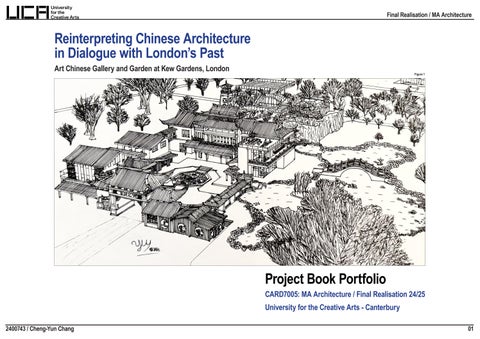

Reinterpreting Chinese Architecture in Dialogue with London’s Past
Art Chinese Gallery and Garden at Kew Gardens, London

Project Book Portfolio
CARD7005: MA Architecture / Final Realisation 24/25
University for the Creative Arts - Canterbury
Reinterpreting Chinese Architecture in Dialogue with London’s


Abstract


Understanding the historical misinterpretation of Chinese architecture through Chinoiserie, this project presents a contemporary spatial response situated within Kew Gardens, London. Rather than imitating traditional forms, it re-engages with authentic Chinese principles — Feng Shui, the Five Elements, poetic rhythm, and symbolic planting reinterpreted through contemporary architectural language to restore the spiritual essence of Chinese space.
It aims to re-establish a meaningful dialogue between past and present, East and West, imagination and authenticity.
Key Words
Ernest Henry Wilson black plaque Pagoda in Kew Gardens (2024 December 27)
Application of Feng Shui The direct frontal “Lu Chong”路沖
Use of “Que(闕)” Structures Ningbo Museum Materials_©Pintrest.com
The Great Pagoda was designed by Sir William Chambers and completed in 1762.
Feng Shui
Chinoiserie Spatial Narrative Architectural Poetics Museum
Contemporary China Kew Gardens
Design Programme
01. 03. 04. 02.
MISREADING CHINESE ARCHITECTURE AS VISUAL SYMBOLISM
Western imagination reduces Chinese design to decorative forms like the Great Pagoda. Symbolic visuals replace deeper spatial logic or philosophical meaning.


LACK OF AUTHENTIC CHINESE SPATIAL LOGIC
Existing “Chinese” elements lack rhythm, Feng Shui alignment, and layered narrative found in real Chinese architecture.


GREAT PAGODA (KEW GARDENS) HSBC BUILDING (HONG KONG)
18th-century Chinoiserie structure - beautiful but based on Western imagination of “China”. Symbolic in form but lacks authentic spatial rhythm or philosophical grounding. This project responds through Feng Shui, Five Elements, and true Chinese spatial traditions.
Cultural Reframing of
Chinoiserie
Norman Foster’s tower applies “Feng Shui” logic in planning, views, and energy flow — showing how Chinese principles can shape modern architecture without surface mimicry.
DISCONNECT BETWEEN FANTASY AND CONTEMPORARY IDENTITY
Historical misinterpretations persist today, creating tension between poetic heritage and modern expectations.
CHALLENGES IN EMBEDDING TRADITIONAL PHILOSOPHY
How to express principles like Five Elements or spatial balance within contemporary structures and materials?


APPLE STORE (LONDON) NINGBO MUSEUM (2008)
A study in minimalist clarity and spatial openness. Its “public interface and contemporary language” help explore how modern materials can carry cultural identity with dignity.
Use true Chinese spatial logic (e.g., Feng Shui orientation, Five Elements) to transform the superficial symbolism of the Great Pagoda into a dialogue of authenticity.
Wang Shu’s architecture expresses poetic memory through “recycled materials, layered rhythm, and spatial narration”, showing how tradition can be “reinterpreted” in a “contemporary voice”.
Memory Materialized Minimal Form, Cultural Depth Invisible Energy: Feng Shui for Modern Typologies
Integrate directional energy, light, and openness in planning — learning from the HSBC Building’s Feng Shui logic within a contemporary framework.
Adopt clarity, material honesty, and public engagement like the Apple Store, but embed poetic transitions and narrative layering from Chinese philosophy.
Inspired by the Ningbo Museum, use recycled and natural materials, layered spatial rhythm, and site-responsive construction to express cultural memory and time.
LITERATURE & HISTORICAL REVIEW
RESEARCH FOUNDATION & CULTURAL LOGIC
Review of Chinoiserie debates, ChineseEnglish garden misreadings, and 18th-century design translations.
SPATIAL PROGRAMME & CULTURAL LOGIC


Kew Gardens, a UNESCO heritage site, holds layers of botanical and cultural memory. This project reinterprets Chinese architectural principles - Feng Shui, Five Elements, and poetic spatial rhythm - to craft a garden-gallery complex that moves from ritual entrance to emotional climax. Through symbolic planting, directional logic, and contemporary expression, the design weaves historical misreadings into a cross-cultural narrative of renewal.


Sun path, prevailing winds, terrain slope, plant ecology, World Heritage constraints.
Five Elements, Bagua layout, spatial rhythm, and symbolic plant placement logic.
Ningbo Museum (Contemporary Chinese Architects:Wang Shu), HSBC Building, Apple Store, Great Pagoda — spatial logic, cultural narrative, material use.
Design Development


Hand-drawn development sketches
Explore the poetic rhythm between traditional Chinese architecture and (Traditional Principles & Feng Shui)+ (Cultural Heritage & Chinese Spatial Logic) +(Contemporary Reinterpretation)


Area)”
hundreds of plant species from China into Britain
Figure 40
Figure 39
Sunlight & Shadow Movement
> The site enjoys full southern exposure, with sunlight entering from the “southeast to southwest” throughout the day.
> Morning sunlight (East) activates the tea garden and bamboo pavilion.
> Noon sunlight (South) illuminates the Bagua plaza and central courtyard.
> Evening light (West) gently bathes the library and exit route, offering a moment of reflection.
Temperate House
> The Temperate House showcases the Victorian-era ambition of collecting and classifying exotic plants from across the empire.


Japanese Garden
> The Japanese Landscape Garden at Kew reflects an early attempt at cross-cultural garden-making.
> The two spaces offer a “contrast in cultural logic” and become a “cross-Asian architectural conversation” within the same garden.

Visitor Circulation & Cultural Axis
> The site is positioned along a “major visitor route” between the Great Pagoda and the Temperate House.
> It becomes a “pause point and transition node”, where visitors shift from visual spectacle to immersive cultural experience.
> The circulation gently follows a “counter-clockwise path” — starting in the south (entrance), passing through galleries and gardens, and culminating in the north (emotional climax) before exiting westward.
> This path echoes both “Feng Shui movement of Qi” and “Chinese garden’s winding narrative logic”.
> Located directly adjacent to my site, Pavilion Bar and Grill serves as a major resting and dining area for Kew Gardens visitors.
> Architecturally, my project responds to its horizontal volume and low-rise roofline, ensuring visual harmony and avoiding competition in scale.


Great Pagoda Pavilion Bar and Grill
> The Great Pagoda (1762), a symbolic yet superficial imitation of Chinese culture.
> My design, titled “Reinterpreting Chinese Architecture in Dialogue with London’s Past”, directly responds to this historical misunderstanding.
> By aligning the new cultural gallery’s visual and symbolic axis with the pagoda, the project transforms fantasy into authentic cultural dialogue.
Figure 42
Figure 41
Central Taiji Plaza
> A spiritual gathering node based on the cosmology of Yin and Yang.

Traditional Architectural Zone
> Wood, tiles, courtyard layout; a reimagining of Song/Ming architectural poetics.

12.
Cultural Complex
> Lower floor invites social interaction through food; upper floor offers knowledge and retreat. Wall materials inspired by Ningbo Museum (Wang Shu).

Back Mountain Viewpoint
> A symbolic ‘north mountain’ with plum blossoms – grounding the design in Feng Shui protection.


Contemporary Zone
> Echoing modernist clarity while responding to site topography.


Outdoor Tea Pavilion (Bamboo Grove)
> A poetic retreat — surrounded by Chinese bamboo, this semi-open structure anchors ritual, rest, and rhythm. 09.


Feng Shui
Origins of Feng Shui
Core Theories & Applications of Feng Shui
Ancient Feng Shui Development
Ba Gua & Spatial Directions Prehistoric Site Selection Yin-Yang Balance
Theoretical Evolution of Feng Shui Theory of Qi Plants Five Elements
Han Dynasty (206 BCE-220 CE): The concepts of Yin Feng Shui (for tombs) and Yang Feng Shui (for residences) emerged.
Tang & Song Dynasties (6181279 CE): The two major Feng Shui schools, Form School (Xing
Pai) and Compass School (Li Qi Pai), emerged.
Ming & Qing Dynasties (1368-1912 CE): Feng Shui became widespread in royal palaces, residential homes, and commercial buildings.
Spring and Autumn Period (770 BCE): Feng Shui integrated Yin-Yang, Five Elements, and the Heavenly Stems and Earthly Branches.
Feng Shui dates back over 6,000 years to the Neolithic period when humans began selecting ideal settlement locations.
1.Resilience & Endurance
Feng Shui Symbolism: Resilience, Purity, and Prosperity
& Auspiciousness
1.Plum blossoms bloom in the heart of winter, even flourishing under snow-covered conditions. Their ability to withstand harsh cold represents “determination and perseverance in adversity”.
2.Plum blossoms have a refined and elegant appearance, with colors ranging from white and pink to red. They grow independently without relying on other trees or supports.
3.In Chinese culture, plum blossoms symbolize “Five Blessings”
Feng Shui Symbolism: Resilience, Continuous Growth, and Humility
& Strength
& Harmony
1.Bamboo thrives even in harsh conditions, bending without breaking under strong winds and enduring heavy rain.
2.Bamboo grows in “distinct segments”, with each node marking an upward expansion.
3.Bamboo’s hollow interior symbolizes “humility, openness, and a receptive mindset”.


Feng Shui Symbolism: Wealth and Prosperity Feng Shui Symbolism: Prosperity and Reputation
& Nobility
1.Peonies have long been regarded as the “King of Flowers” due to their large, lush, and vibrant blossoms.
2.When peonies bloom, their full and colorful flowers signify “abundance, career success, and financial growth”.
Qi is the fundamental energy of the universe, influencing all things.
Human Qi and environmental Qi interact, meaning spatial adjustments can enhance fortune.
Yin and Yang represent opposing yet complementary forces, such as light and darkness, motion and stillness
Feng Shui emphasizes dynamic balance in spaces, such as contrasting light and shadow, and balancing open and closed areas.


golden flowers are linked to gold (wealth) in Feng Shui, symbolizing financial success and abundance.
2.The Chinese phrase

Feng Shui Symbolism: Elegance, Nobility, Balance, and Resilience
1.Camellia has long been regarded as a symbol of nobility and elegance, cherished by scholars and aristocrats.
2.In Chinese tradition, the layered and symmetrical petals represent harmony and balance, which align with Feng Shui principles of equilibrium.
Shui Symbolism: Longevity and Everlasting Bonds
is a long-lived plant, capable of surviving for decades or even centuries.
2.The cascading wisteria flowers resemble bonds of deep connections.
- The temperature is higher, and sunlight is strong.
- Spring winds come from the east, making it suitable for plant growth.
- Winter is severely cold, with snowfall, and rivers flow from the north.
- Autumn is dry, and metal symbolizes harvest and craftsmanship.
- The center represents Earth and the interseason period, symbolizing stability and balance.
Fire governs the South, representing fame and recognition.
Setting up the main entrance here can symbolize a busy area.
Wood represents growth, creativity, making the East an ideal spot for an “art exhibition featuring nature, and traditional Chinese paintings”.
Water represents fluidity. symbolize an open flow of visitors and knowledge exchange.
Metal represents refinement, communication, and elegance, making the “ displaying artworks, ceramics, and calligraphy”. Earth governs the Center, representing balance and stability. Keeping this area open ensures harmony and free energy circulation throughout the space.
Southwest is linked to the calm energy.
Wood generates Fire, and the kitchen represents Fire.
Since Water nourishes Wood, and the toilet is associated with Water, this placement is considered harmonious.
Metal symbolizes prestige and authority, while Water represents communication and flow.
mume)
1.Its
“桂冠” (Guìguān, Laurel Crown) is derived from osmanthus, symbolizing academic achievement, fame, and social prestige.
1.Wisteria
Shi
Shang Dynasty (1600 BCE): Site selection for buildings and burials through divination.
Early Heaven vs. Later Heaven Ba Gua: Different interpretations of spatial directions.
Zhou Dynasty (1046 BCE): Developed “Tu Gui Method,” using shadow length to determine cardinal directions.
Ba Gua Symbols: Qian (Heaven), Kun (Earth), Zhen (Thunder), Xun (Wind), Kan (Water), Li (Fire), Gen (Mountain), Dui (Lake).
White Circle Blue Wavy Red Triangle Yellow Square
Figure 84 Prunus mume
Figure 83 Phyllostachys
Figure 82 Paeonia suffruticosa Figure 81 Osmanthus fragrans Figure 80 Wisteria sinensis
Figure 79 Camellia japonica
76
78
Phyllostachys
Paeonia suffruticosa
Osmanthus fragrans
Wisteria sinensis
Camellia japonica
Floor Plan – Ground Floor

This overall ground floor plan establishes the full layout strategy of the project. Organised along a counterclockwise cultural journey, it connects indoor and outdoor spaces through Feng Shui principles, Five Elements zoning, and narrative progression.
Each programmatic area from the Tea Pavilion to the Cultural Food Court and Calligraphy Gallery is spatially embedded in symbolic and environmental logic.
4�.�4�
3�.�2�

2�.�m
The first-floor layout completes the cultural journey by offering elevated experiences from the Library and Art Galleries to the Bridge Pavilion. This level connects the two main buildings and provides spatial continuity through visual openness and thematic programming.
The upper level continues the Five Elements logic, emphasizing introspection, knowledge, and cultural depth. Materials, views, and transitions were carefully designed to enhance the poetic quality of movement.


Located at the heart of the project, the Bagua Plaza serves as a spiritual and spatial anchor that unites all directional flows and elemental energies.
Inspired by the traditional Feng Shui Bagua diagram, the plaza reflects balance, harmony, and interconnection between architecture, nature, and people.
Figure 92
Figure 91
Figure 90
Teahouse Experience – Ritual, Materiality, and Bamboo Culture
The teahouse is located in the southeast corner of the site — a direction symbolically governed by Wood and Fire in the Five Elements system. This spatial positioning encourages cultural growth, inspiration, and social exchange.
Inspired by traditional Chinese pavilions but abstracted through contemporary detailing, the structure employs wooden columns, open eaves, and layered shadows. The semi-outdoor setting invites seasonal interaction with nature, offering a serene space for resting, reflection, and cultural immersion.
Visitors enter the teahouse and are welcomed by a reception counter made from locally sourced timber and rammed earth. Here, guests can register for tea-tasting sessions, borrow Hanfu costumes, or learn about traditional tea rituals.
Surrounding the teahouse is a carefully arranged bamboo grove — acting as both a spatial filter and a symbolic enclosure. In Chinese culture, bamboo symbolizes resilience, humility, and cultural refinement. It sways with the wind, creating a meditative soundscape that enhances the sensorial quality of tea rituals.
From a Feng Shui perspective, bamboo strengthens Wood energy in the southeast, while the rustling sound promotes the circulation of Qi. Visitors walk through a narrow bamboo corridor before entering the tea area, transitioning from movement to stillness.


Figure 95
Figure 94
Figure 93
Figure 96


The Calligraphy Gallery is located in the east wing of the building — a direction aligned with the element “Wood”, symbolizing growth, education, and spiritual cultivation in traditional Feng Shui.
This quiet, contemplative space is designed to slow down the visitor’s pace. High ceilings, soft diffused lighting, and whitewashed walls create a serene environment where brushstrokes speak louder than words. The gallery aims to reflect the discipline and poetry of calligraphy through spatial restraint and elegant proportions.
As visitors walk along the rectangular route, they pass through thematic zones: “Structure”, “Emotion”, “Abstraction”, and “Seal Script”. Each stage corresponds to the growth of inner stillness — a choreography of space and meaning.
The eastern light enters softly through screened apertures in the morning, reinforcing the symbolism of renewal and intellectual clarity associated with the Wood element.
Figure
Public Toilet Zone


ThePublic Toilet Zone area is designed not only for function and hygiene but also to reflect the spatial dignity of Chinese aesthetics. Inspired by traditional courtyard homes, the use of framed lattice screens, warm wood tones, and natural stone textures brings a serene and respectful tone to a normally overlooked space.
It transforms a transitional necessity into a moment of quiet elegance — an extension of the architectural narrative rather than an interruption.
The washbasins are carved from natural stone, sitting atop a polished stone countertop supported by a hardwood frame. Hand-carved timber lattice panels provide visual softness and privacy without full enclosure, referencing Ming-style interior screens.
A living plant placed near the handwashing zone brings life and softness, while concealed strip lighting and wall-mounted bronze fixtures complete the material palette — blending tradition and contemporary clarity.
Located in the **northeast** zone of the site, the restroom aligns with the element **Water + Wood** in the Five Elements system — a suitable metaphor for cleansing, purification, and flow. The indirect placement allows it to serve its function without disrupting the core spatial energy of the exhibition and gathering areas.

Figure 102
Figure 101
Figure 100


Located at the northernmost end of the gallery route, this zone symbolizes the element “Water” — quietness, introspection, and emotional resonance. As the final climax of the cultural experience, it invites visitors into a state of stillness and reflection through sound.
Showcases traditional instruments such as guqin, se, xiao, drums, and bianzhong (chime bells).
Integrates multimedia projections and video recordings of live performances, bridging classical heritage with contemporary expression.
Includes a small performance platform and immersive listening zone where visitors can sit quietly and experience music spatially.
Music, as the most intangible yet penetrating cultural form, brings visitors to a poetic closure. This zone transforms sonic tradition into an emotional spatial finale — from materiality to spirit, from rhythm to stillness.
Figure 105
Figure 104
Figure 103
Gift Shop & Exit Area


Located in the northwest of the site, this zone represents the Metal + Water elements in Feng Shui, symbolizing gratitude, transformation, and return. It marks the final step of the visitor journey — a gentle emotional descent from the cultural climax.
Offers Chinese cultural souvenirs: traditional tea sets, silk accessories, paper fans, calligraphy scrolls, and ceramic crafts.
Features Hanfu costume return area and a donation desk near the exit, encouraging continued cultural engagement.
Curved display counters and golden-red tones echo festive richness and emotional warmth.
Lanterns, lattice panels, and painted motifs create a cohesive aesthetic closure with the rest of the gallery.
Flow design ensures smooth circulation while encouraging visitors to pause, reflect, and take home a piece of the experience.
Symbolic Meaning:
This zone extends the narrative beyond the physical journey. It transforms cultural learning into lifestyle appreciation — a bridge between memory and reality, where the dialogue continues through objects, emotions, and intention.
Figure 108
Figure 107
Figure 106


Located strategically between major exhibition areas, this resting lounge serves as a quiet transitional buffer — offering physical relaxation and emotional reflection.
Natural daylight filters through tall windows, softening the atmosphere and creating a calm, contemplative tone.
Modern lounge sofas blend with traditional floral arrangements and minimalist teaware.
Visitors are encouraged to sit, read, sketch, or simply observe — fostering an unhurried engagement with the space.
Ideal for individuals or families to pause before continuing their journey.
This space embodies the Yin of the spatial rhythm — balancing the Yang of exhibitions, movement, and stimulation. It allows the architecture to breathe, and the visitor to reconnect with silence and self.
Figure 111
Figure 110
Figure 109
Restaurant & Food Stalls
The restaurant design blends modern dining comfort with traditional Chinese ambiance. Wooden tables and chairs with clean lines are arranged to encourage both individual and group seating. Hanging pendant lights create a warm, intimate atmosphere, while the backdrop of grey stone walls with wave-patterned textures echoes the materiality of traditional Chinese masonry. Wooden window frames and partitions subtly separate the space while maintaining visual continuity.
The commercial food street draws inspiration from ancient Chinese street markets. The stalls are framed with traditional wooden structures, tiled eaves, and intricately carved wooden panels that depict auspicious motifs such as dragons and phoenixes. This not only enhances cultural immersion but also creates a festive environment for food display. Contemporary lighting and functional counter arrangements ensure smooth service flow while maintaining an authentic spatial narrative.


Figure 115
Figure 114
Figure 113
Figure 112


The painting gallery is designed as a bright and contemplative space that invites slow viewing and appreciation. Large vertical scroll paintings and detailed brushwork pieces are displayed on floating white panels, inspired by the format of traditional Chinese hanging scrolls (zhang) and handscrolls (juan). Natural light filters in from the floor-to-ceiling windows on one side, creating a serene dialogue between art and nature — with the historic Temperate House subtly visible in the distance, anchoring the setting in Kew Gardens.
Minimalist white walls and neutral flooring ensure visual focus remains on the artworks, while strategically placed lighting highlights fine details and brush techniques. A Hanfu-clad figure with a scroll adds narrative depth, reinforcing the immersive and poetic atmosphere of the exhibition.
Figure 118
Figure 117
Figure 116
Upper Exhibition Hall – Cultural Continuity
This gallery on the upper floor is dedicated to showcasing the enduring legacy of Chinese culture through a curated display of calligraphy, bronzeware, classical furniture, and historic scripts. The space adopts a more enclosed, contemplative tone compared to the bright ground-floor galleries, reflecting a sense of reverence for the weight of history.
Dark timber screens, lattice detailing, and warm lighting create a dignified atmosphere rooted in traditional Chinese architectural vocabulary. Exhibits are arranged symmetrically, drawing influence from Confucian values of order and harmony. The calligraphy panels, bronze ritual vessels (ding, gui), and inscribed stone rubbings communicate the intellectual and philosophical heritage of ancient China.
This space is not only a museum display but a cultural vessel — a spatial expression of historical continuity and identity preservation. It bridges the past and the present, inviting modern visitors to encounter living echoes of tradition within a contemporary setting at Kew Gardens.

Figure 121
Figure 120
Figure 119
Connecting Corridor – Passage of Cultural Dialogue


This transitional space bridges the upper Cultural Continuity Exhibition Hall with the southwestern Library Pavilion. Architecturally inspired by traditional Chinese lang (廊) corridors, it creates a moment of pause and narrative shift as visitors journey between knowledge and reflection.
Symbolically, this corridor acts as a bridge between past and present, between collective memory and personal introspection. It invites visitors to step away from exhibition consumption and into a space of embodied thought — transitioning from historical observation to literary immersion.
Figure 124
Figure 123
Figure 122

Located in the tranquil southwest corner of the site, the Library Pavilion is conceived as an introspective retreat, inviting visitors to slow down, read, reflect, and connect with the deeper essence of Chinese culture.
Inspired by the literati tradition, the space integrates traditional elements such as circular moon gates, timber lattice screens, and poetic ink landscape panels. Natural wood textures, filtered light, and views of the garden create a warm, meditative atmosphere. The circular doorways echo the cyclical nature of knowledge and life, while also subtly referencing the shape of ancient Chinese scrolls.
Bookshelves are integrated into seating zones and window alcoves, encouraging casual discovery and quiet moments. Visitors may engage with texts on Chinese philosophy, poetry, art, and garden design — extending their spatial journey into the realm of thought.
Symbolically, the Library represents the Metal and Fire elements within the Five Elements system: where intellectual clarity (Metal) meets the inner spark of inspiration (Fire). It serves not only as a resting point but as a transformative node of cultural continuity.

Figure 127 Figure 126
Figure 125
The Back Mountain


Located at the northernmost end of the site, the Back Mountain (Hou Shan, 靠山) serves as the symbolic and spatial conclusion of the journey. In Feng Shui, the “Back Mountain” represents protection, support, and grounding energy — providing a solid foundation behind the site to stabilize the flow of Qi (energy) throughout the space. It is the “Gen” position (艮卦) in the Bagua, corresponding to stillness, contemplation, and the mountain element itself.
Here, plum trees (梅花) — one of the most cherished plants in Chinese culture — are planted across the layered stone terraces. Blooming in the coldest season, they symbolize resilience, endurance, and quiet strength. In Feng Shui, plum blossoms also enhance the Water element in the north, embodying clarity, purification, and emotional depth.
Visitors ascend through a gently rising path framed by boulders and natural slopes, reaching a peaceful overlook where the Great Pagoda re-emerges in view. This moment marks a spatial and emotional closure: a return to inner self after the sensory and cultural experiences of the gallery.
The Back Mountain is not only a landscape feature, but a Feng Shui anchor. It stabilizes the entire site, harmonizes natural energy, and completes the narrative rhythm — from dynamic entry (Fire, South) to tranquil ending (Water, North).
Narrative Sequence and Spatial Rhythm

From Immersion to Reflection – A Cultural Journey Through Architecture and Landscape
This project is designed as a poetic spatial journey rooted in Feng Shui principles, Five Elements theory, and Chinese architectural rhythm. The circulation follows a counterclockwise path, starting from the South entrance (Fire) and returning full circle. Each spatial section corresponds not only to function, but to emotion, element, and cultural metaphor.
1. Spatial Flow (Red Line Indicates Circulation Path)
South Entrance (Fire):
The journey begins under bright sunlight. Visitors pass through a ceremonial gateway, changing into Hanfu to symbolically step into another cultural dimension.
Southeast Garden – Tea House, Bamboo Path (Wood + Fire):
A gentle, sensory introduction. Sound of water, rustling bamboo, and fragrance of tea invite calmness and openness.
East Wing – Calligraphy & Painting Gallery (Wood):
Spaces for intellectual and visual engagement. The long corridor sequences mimic scroll reading – a slow unfolding of thought and vision.
Northeast & North – Music & Poetry Hall (Water):
Emotional climax. Low light, quiet tones, and acoustics create an immersive environment of reflection. This zone symbolizes deep emotion, stillness, and the soul of Chinese culture.
Northwest – Gift Shop and Costume Return (Water + Metal):
A transitional zone, softening the departure. Visitors reflect, donate, or take away symbolic objects – extending the cultural memory beyond the site.
West – Restaurant and Crafts Market (Metal):
Tactile and social experience. Visitors engage through food, objects, and conversation. Afternoon light enhances the richness of materials and detail.
Southwest – Library (Fire + Metal):
A quiet retreat for learning and internalization. Slightly off the main path, it invites those seeking depth and solitude.
Back Mountain – Plum Grove and Rockery (Water + Wood):
Final symbolic layer. The mountain behind offers a sense of protection and spiritual closure. In Feng Shui, this is the “Black Tortoise” – the guardian of stability and memory.
2. Layered Experiences for Different Visitors
Cultural Tourists:
Full loop experience: tea, art, music, landscape – a visual and symbolic immersion.
Families & Schools:
Flexible route: dynamic activities in the garden, exhibitions, and hands-on workshops.
Researchers & Enthusiasts:
Focused time in the library, calligraphy halls, and planting records.
Casual Visitors:
Can enjoy tea, the central plaza, and outdoor scenery without completing the loop.
3. Design Strategy: From Movement to Emotion
The journey is choreographed as a ritual of movement:
Entry → Exploration → Climax → Closure
Each element supports an emotional and cultural arc:
Architecture here is not just spatial, but temporal – offering a rhythmic flow of cultural memory and embodied meaning.
Details & Material Strategy - Roof Tiles
Reinterpreting Traditional Chinese Roofs with Local British Craft:


Traditional Chinese Reference


Material Source & Specification
Aspect Detail
Material Type:Clay Roof Tile

Supplier Marley Ltd. (UK) / Dreadnought Tiles – specialists in British clay roof tiles
Finish:Matte, frost-resistant, eco-fired
Dimensions:Interlocking modular type, adjustable to pitched or curved roofs
Installation:Traditional timber batten + breathable membrane system
Design Adaptation in My Proposal
In this project, I reinterpret the traditional Chinese roof tile using materials and fabrication processes suitable for the UK climate and supply chain. The tiles are:
Material: Produced with local English clay, traditionally used for slate tiles and terracotta.
Format: Modular flat interlocking tiles with subtle curvature, compatible with British construction methods but still echoing the rhythm of Chinese eaves.


In classical Chinese architecture, especially from the Ming and Qing Dynasties, roof tiles (瓦) play a critical symbolic and functional role. They are often glazed in dark green or black, representing shelter, authority, and social hierarchy. The curvature of the eaves—flying rooflines—is both poetic and practical, designed to guide rainwater and elevate the spirit of the building. These tiles are typically made of fired clay, arranged in interlocking formats with intricate end-caps (瓦當), and appear prominently in palaces, temples, and scholar gardens.
Symbolic Continuity
In Feng Shui, roofs symbolize protection of Qi, and a well-shaped roof ensures energy is “contained yet uplifted.” By incorporating rhythmic lines, shadow play, and subtle eave curves.
Figure
Details & Material Strategy - Timber Elements
Material Breakdown with Traditional Reference and Innovation Logic:


Traditional Timber Species vs. Local Substitutes

Traditional Chinese Reference
Traditional Chinese Timber Selection
Nanmu Chinese Fir Elm


UK-Available Substitution
Douglas Fir Larch


Traditional Chinese Timber Selection
Historically, Chinese architecture used a hierarchy of hardwoods based on durability, texture, and symbolism:
Nanmu (楠木): High-end timber used in temples and palaces for its resistance to decay and elegant grain.
Chinese Fir (杉木): Common for structural beams and columns; lightweight and easy to work with.
Phoebe zhennan and elm (榆木): Used in traditional residential buildings and furniture. These timbers were often sourced from central and southern China, and selected not only for strength but also their aesthetic tone and ritual meaning in Confucian architecture.
UK-Available Substitution & Selection Logic
Due to sourcing limitations and sustainability concerns, this project uses locally available softwoods that best mimic the performance and visual tone of traditional Chinese timbers:
Douglas Fir (Pseudotsuga menziesii)
Locally grown in the UK (e.g., Scotland, Wales)
Straight-grained, structurally strong, warm reddish hue similar to Nanmu
Larch (Larix decidua)
Durable and rot-resistant, often used in cladding and exposed wood structures
Slightly lighter tone; suitable for planed finishes or stained surfaces
All timbers used are FSC-certified and sourced from British sawmills, ensuring low carbon footprint and ethical forestry. This approach maintains the visual and material logic of Chinese timber architecture while embracing local material economy and climate resilience.
Chinese architecture uses timber as the primary structural and decorative material, often in exposed form. Typical elements include: Dougong (bracket sets): interlocking joinery without nails
Column-beam systems: supporting the tiled roof
Lattices and railings: richly carved and painted
Surface treatment: oiled or lacquered to enhance color, prevent decay
Color tone: deep brown, reddish brown, or black.
Symbolism: wood represents growth and East in the Five Elements; exposed timber shows craftsmanship and humility.
Design Adaptation in This Project
Form: Traditional proportions and modules are retained — rectangular columns, horizontal beams, continuous railing rhythm
Structure: Timber is used as both structure and finish, echoing Chinese tectonics
Detail: Vertical and horizontal members reference Ming-style simplicity — fewer carvings, more rhythm
Surface Finish: Natural oiled finish or stained to match deep reddish-brown tone
Material Source and Innovation (UK Context)
Species Used: UK-grown Douglas Fir (Pseudotsuga menziesii) or Larch (Larix decidua)
Both are durable, straight-grained, locally available
FSC-certified, low-carbon footprint
Treatment: Thermally treated or linseed oil–coated for weather resistance
Joinery: Adapted to modern CNC + timber frame system; interlocking elements reinterpret dougong logic
Innovation Logic
This timber system is readable to both Chinese and Western audiences: familiar yet layered with cultural meaning
Sustainability: Using UK native timber avoids import dependency and supports local forestry
Figure
Figure 138 Figure 144
Details & Material Strategy - Glass Curtain Walls
Contemporary Transparency within a Chinese Spatial Logic:

Integration into My Design
In this project, the glass curtain wall is reinterpreted through a Chinese lens:
Proportional Rhythm Echoes Lattices
→ Timber mullions and panels reflect the rhythm of traditional Chinese ge shan (格扇)
Framing Views Like Chinese Gardens
→ Transparent façades allow for “borrowed scenery” (借景) of the sky
Southeast and East Orientation
→ Aligns with Feng Shui: Wood + Fire directions for vitality and growth
Contrast and Balance
→ Light glass contrasts with heavy tiled roofs, creating a dialogue between yin (shadow) and yang (light)

Glass curtain walls are widely adopted in modern architecture to achieve:Transparency and visual openness&Strong indooroutdoor connection&Clean, minimal aesthetics suited for cultural or civic spaces
Rolex Learning Center, EPFL
Location: Lausanne, Switzerland
Architects: SANAA (Kazuyo Sejima + Ryue Nishizawa)
Completed: 2010
→ Known for its continuous glass façade and fluid interior space
→ Demonstrates transparency, lightness, and openness in modern architecture
Just as Rolex Learning Center uses glass to dissolve architectural boundaries, my design uses glass to create “borrowed views” (借 景) and soft thresholds, inspired by Chinese garden poetics.
Material Specification & Environmental Strategy Cultural Reinterpretation
Glass Type: Low-E, double-glazed safety glass
Frame: Thermally broken aluminum + exposed timber for warmth and texture
Performance:
→ KHigh insulation (U < 1.2 W/m²K)
→ KUV-filtering & solar control coating
→ KReduces glare, retains heat in winter, reflects excess solar gain in summer
This glass wall is not just a modern material, but a contemporary interpretation of Chinese spatial philosophy.
It enables:
→ KA visual dialogue with nature
→ KPoetic reflection and openness, in place of solid symbolic walls
→ KA soft boundary that connects people, landscape, and time

Figure 147
Details & Material Strategy - Exposed Concrete Wall & Recycled Brick-Tile Wall

In My project:
The concrete wall replaces the traditional blank garden wall or white-painted masonry, serving as a silent backdrop for timber, glass, and bamboo.
Surface is natural grey, smooth or lightly board-formed to maintain texture.
Contrasts with timber and glass to express the balance of yin and yang — hard vs. soft, solid vs. transparent.
Acts as a stabilizing spine, echoing traditional courtyard enclosures in a new material language.
Contemporary Architectural Reference
Exposed concrete walls are widely used in contemporary minimalist architecture, especially since the modernist era. The material is celebrated for its honest expression, monolithic presence, and textural quality without additional cladding or finishes.

Notable Contemporary Reference:
Ningbo History Museum, Wang Shu, Amateur Architecture Studio (2008)
Wang Shu’s Ningbo History Museum features the iconic “wa pian qiang” (瓦片牆 – recycled tile wall) technique. The outer walls were built using salvaged grey bricks, tiles, and stone fragments collected from demolished local houses. This method, combining traditional hand-laying craftsmanship with contemporary composition, transforms construction debris into poetic architectural surfaces.
Rather than polishing materials into uniformity, the wall celebrates randomness, memory, and the passage of time. The museum thus becomes a narrative object — not only containing history but also built of history.


Inspired by vernacular wall-building techniques found in Jiangnan regions, where leftover tiles and bricks were reused in boundary walls and garden enclosures.
Reflects the Chinese concept of material continuity, circular use, and the layering of time through construction.
Notable Example: Tadao Ando – Church of the Light (1989, Osaka, Japan)
A globally renowned work by Tadao Ando, master of exposed concrete. The wall becomes both structure and spiritual symbol, using light and texture. Smooth, hand-crafted concrete surfaces with subtle joint lines. Demonstrates how concrete can create silence, restraint, and atmosphere.
& Construction Summary:
Surface Finish: Recycled grey bricks, clay roof tiles, natural stone fragments
Construction: Manual masonry fixed to concrete backing; non-load-bearing expressive layer
Base Structure: Reinforced concrete wall with external anchoring mesh
Environmental Benefit: Low embodied energy, local sourcing, and cultural
Visual Character: Non-uniform, layered, and textured — expressing
Figure 149
Traditional Chinese Reference:
Ningbo History Museum: Material
Details & Material Strategy — Pavilion and Corridor
Traditional Pavilion and Corridor — Spatial Fragmentation and Framing:


Notable Example:
Humble Administrator’s Garden, Suzhou (16th century, Ming Dynasty)
The garden features a continuous series of covered corridors (lang) that thread through buildings and landscapes, connecting pavilions and framing ponds, rocks, and trees. Pavilions such as the “Fragrant Snow Pavilion” or “Lotus Pavilion” are set at visual focal points, offering moments of rest and contemplation. The interplay between movement and stillness, openness and enclosure, is a key spatial quality I carry into my design.
Traditional Chinese Reference:
Pavilions (亭) and corridors (廊) are essential spatial elements in Chinese classical gardens, serving not only as shelters and connectors but also as visual framing devices and pause points in spatial narratives.
I reinterpret the traditional corridor as a structural and narrative spine that links programmatic elements throughout the site — tea house, gallery, and poetry hall — while providing shaded, contemplative walkways.
The pavilion is repositioned not only as a resting point but as a visual climax node, placed at key Feng Shui intersections or at terminus views.
Ornamentation is translated through laser-cut metal screens or timber latticework, inspired by Ming-style motifs.
The sloped roof profile and structural rhythm are directly referenced in my corridor elevation, while the roof detail draws from the multi-eave model shown in traditional pavilions.
They embody the principle of “movement within stillness” (動中有靜) and are carefully placed to guide the visitor’s gaze, orchestrate rhythms, and frame landscape views.
These architectural fragments are modular, open to nature, and often richly ornamented with lattice work, painted beams, and intricate roof forms.

Design Response:
Figure 157
Figure 158
Final Rendering - Panoramic Bird’s eye view

Final Rendering - Architectural Harmony in Context
Final Rendering - Main Building Exterior View
Final Rendering - Side Building Exterior View

Final Rendering - Tea House (Bamboo as Symbol and Setting)


Final Rendering - Calligraphy Exhibition
Final Rendering - Public Toilet Zone
Final Rendering - Upper Floor Painting Exhibition

Final Rendering - Rooftop Viewing Terrace – Facing the Pagoda

Final Rendering - Upper Floor Painting Exhibition
Final Rendering - Upper Floor Connecting Corridor

Final Rendering - Upper Floor Library Lounge


Final Rendering - Culinary Street With Winemaking


Final Rendering - Plum Blossom Path and Backhill
Workshop: Time Based Media - Plan


Figure 177
Figure 178
Figure 179
Figure 180
Workshop: Time Based Media - Plan


Notable Example:
This design film begins with a time-lapse animation made from over 200 sequential photographs, capturing the hand-drawing process of my site plan. The sound of pen on paper enhances the tactile and meditative quality of the drawing.
The second half of the film features a fly-through of the final design. It takes viewers on a visual journey through different spaces: from the tea house and bamboo corridor to the main gallery, commercial area, library, rooftop pagoda view, calligraphy hall, music zone, and the final plum blossom hill.
The route is carefully planned based on Feng Shui and Five Elements spatial logic, with each moment designed to express symbolic meaning and narrative rhythm.
Chinese-influenced background music, partly AIgenerated, supports the atmospheric tone of the journey.

Figure
Figure
Figure 190
Figure 191
Workshop: Time Based Media - Visual Research Pages


The primary architectural colors were red and black, giving buildings a solemn and austere appearance.

One of the most distinctive features of Han architecture was the use of “que”—ceremonial gate towers—at the entrances of significant buildings such as palaces, gardens, and tombs. These towers had a symbolic function, representing imperial power and dignity. A “闕que” typically consisted of three parts: the roof (闕檐), the body (闕身), and the base (闕基).
As a period of great prosperity in Chinese history, the Han Dynasty laid the foundation for classical Chinese architectural traditions. Representative architectural works include the city of Chang’an, Weiyang Palace, Jianzhang Palace, and the imperial Shanglin Garden.
The Tang Dynasty represents the golden age of traditional Chinese architecture and cultural development. During this period, building techniques and forms experienced remarkable advancements.
Roofs were generally low in height with gentle, straight slopes. The ridgelines were predominantly straight, with minimal upturned eaves or curved forms, emphasizing simplicity and structural clarity.
and Ridge Design Chiwen (Decorative Roof Ridge Ornaments)
One of the most iconic elements of Tang architecture is the “chiwen”—mythical fish or bird-like ornaments placed at both ends of the main roof ridge. Typically simplified and rugged in form, they symbolized protection against fire and lightning while serving decorative purposes. Though they first appeared during the Han Dynasty, the design became standardized and widely adopted during the Tang period, especially in palaces and temples.
Roof Design and Bracketing System:
The eaves of Tang buildings featured slightly curved slopes—more curved than Han structures but gentler than those of the Ming and Qing periods. The “dougong” (bracket system) was more prominent, supporting wide overhanging eaves. These expansive and elegant rooflines can still be observed in contemporary Neo-Tang architecture, such as the modern Xi’an North Railway Station.
Han architecture prominently features large raised platforms, known as “台基“, constructed using rammed earth and stone. These bases were often decorated with patterned bricks. In the early Western Han period, these platforms could reach heights of several dozen meters, creating an overwhelming sense of grandeur as one approached the buildings.
Roof Design
Song roofs featured slightly upturned corners and softer, more elegant eave lines compared to earlier dynasties.
Increased attention was given to daylighting and decoration. Lattice doors and windows, along with decorative patterns such as coin motifs and ball ornaments, were widely used to enhance both functionality and beauty.
Han Dynasty : Grand and majestic in scale.
Song Dynasty : Intricate and refined in craftsmanship.
4 key periods in the development of ancient Chinese architecture.
Tang Dynasty : Monumental and expansive in size.
Ming Dynasty : Stylistically mature and well-developed.
The overall structure was straightforward and unadorned. Columns were robust, typically designed with a tapering profile—thicker at the base and thinner at the top. Column bases often featured lotus motifs or low plinths.

Design:
Windows in the Tang era were generally non-operable and designed with vertical wooden slats arranged in a grid pattern. These slats had square cross-sections, forming fixed lattice-like panels that balanced aesthetics and function.
The Song Dynasty marked a transformative period in Chinese architectural history. Unlike the grand and imposing structures of the Tang Dynasty, Song architecture embraced a more delicate and refined aesthetic while simultaneously becoming more systematized and standardized.
Bridge Construction:
The Song Dynasty was a golden age for bridge engineering, achieving unprecedented levels of length, complexity, and technical sophistication.
Bracket Sets (Dougong):
As brick walls became more common, eaves became shorter, and the structural role of “dougong” diminished. However, these brackets remained in use, becoming more elaborate and decorative to convey a sense of grandeur.

Brick Walls: Roofs and Glazed Tiles:
Unlike earlier periods dominated by rammed earth walls, the Ming Dynasty fully adopted brick construction. Bricks were extensively used for paving, platforms, and foundational structures.

The widespread use of glazed roof tiles (made from refined white clay, water-resistant and durable) became a hallmark of Ming architecture. Yellow glazed tiles, considered the highest grade, were reserved for imperial buildings such as pagodas, gates, and screen walls.
Decorative and Interior Design:
- Palatial Decorative Systems: A hierarchical system of decorative painting was established. The “Xuanzi” style (玄子彩畫), also known as the “centipede motif”, featured swirling floral patterns within decorative medallions, and became a visual signature of Ming architecture.
- Interior Color Palette: Warm tones—particularly vermilion— dominated interior spaces. Shaded areas were balanced using cool colors like green and blue to create visual contrast.
Figure 195
Figure 196
Workshop: Time Based Media - Visual Research Book


Figure 197
Figure 198
Figure 199
Figure 200
Figure 201
Figure 202
Figure 203
Figure 204
Figure 205
Figure References & Bibliography
Figure 1: Concept sketch of the Chinese cultural complex, hand-drawn by Cheng Yun Chang on June 21, 2025.
Figure 2: The Great Pagoda by Sir William Chambers (Completed in 1762) — Early representation of the iconic pagoda, pivotal to the site’s Chinoiserie heritage.
Image source: Royal Botanic Gardens, Kew. https://www.kew.org/
Figure 3: The Great Pagoda in Kew Gardens, photographed by Cheng Yun Chang during a site visit on December 27, 2024.
Figure 4: Commemorative black plaque of Ernest Henry Wilson at Kew Gardens, photographed by Cheng Yun Chang on December 27, 2024.
Figure 4: Commemorative black plaque of Ernest Henry Wilson at Kew Gardens, photographed by Cheng Yun Chang on December 27, 2024.
Figure 5: Material detail of Ningbo Museum by Wang Shu. Image source: © Pinterest.com, downloaded on May 1, 2025.
Figure 6: Application of Feng Shui: The direct frontal “Lu Chong” (路沖), hand-drawn by Cheng Yun Chang on November 3, 2024.
Figure 7: Use of “Que” (闕) structures in traditional Chinese architecture, hand-drawn by Cheng Yun Chang on March 28, 2025.
Figure 8: The Great Pagoda in Kew Gardens, photographed by Cheng Yun Chang during a site visit on December 27, 2024.
Figure 9: The Great Pagoda by Sir William Chambers (Completed in 1762) — Early representation of the iconic pagoda, pivotal to the site’s Chinoiserie heritage.
Image source: Royal Botanic Gardens, Kew. https://www.kew.org/
Figure 10: Front facade of HSBC Building in Hong Kong.
Figure 11: Section of HSBC Headquarters Building in Hong Kong.
Figure 12: The Apple Store, London — external view.
Figure 13: Indoor open-space design of the Apple Store, London.
Figure 14: Ningbo Museum by Wang Shu, completed in 2008, China.
Figure 15: Material detail of Ningbo Museum by Wang Shu. Image source: © Pinterest.com.
Figure 16: Diagram representing Feng Shui orientation strategy in the design.
Figure 17: Five Elements zoning diagram illustrating spatial and elemental correspondences.
Figure 18: Seasonal planting rhythm diagram, linking flora with symbolic and temporal cycles.
Figure 19: Spatial storytelling diagram showing experiential sequence and narrative flow.
Figure 20: Material and craft philosophy diagram, integrating tradition with contemporary expression.
Figure 21: Conceptual diagram of cultural dialogue between the new design and the historic Pagoda.
Figure 27 - 38: Hand-drawn design sketches by Cheng Yun Chang
Figure 39: Plant map and Chinese plant route diagram, illustrating the botanical and cultural connections within Kew Gardens.
Figure 40: Portrait of Ernest Henry Wilson — renowned plant hunter who introduced numerous Chinese species to British gardens.
Figure 41: The Great Pagoda in Kew Gardens, photographed by Cheng Yun Chang during a site visit on December 27, 2024.
Figure 42: Pavilion Bar and Grill in Kew Gardens, photographed by Cheng Yun Chang on December 27, 2024.
Figure 43: The Temperate House in Kew Gardens. Image source: Royal Botanic Gardens, Kew. https://www.kew.org/
Figure 44: Overall architectural rendering of the Chinese cultural complex by Cheng Yun Chang.
Figure 45: Japanese Garden in Kew Gardens, showing early cross-cultural landscape expressions.
Figure 46: Site map of Kew Gardens highlighting the project location. Source: Digimap, with my site. https://digimap.edina.ac.uk/
Figure 47–53: Outdoor renderings of the Chinese cultural complex by Cheng Yun Chang, illustrating landscape design, circulation, and seasonal atmosphere.
Figure 54: Site base map from Digimap overlaid with the ground floor plan of the proposed design by Cheng Yun Chang.
Figure 55–62: Interior ground floor renderings of the Chinese cultural complex by Cheng Yun Chang, depicting spatial atmosphere and functional layout.
Figure 63: Site base map from Digimap overlaid with the ground floor plan of the proposed design by Cheng Yun Chang.
Figure 64–68: Interior first-floor renderings of the Chinese cultural complex by Cheng Yun Chang, showcasing upper-level spatial programs.
Figure 69: Site base map from Digimap overlaid with the first-floor plan of the proposed design by Cheng Yun Chang.
Figure 70: Feng Shui planning diagram integrating orientation, Five Elements, and spatial programming.
Figure 71–75: Icons of the Five Elements. Source: Feng Shui Modern by Cliff Tan.
Figure 76–78: Bagua and Taiji diagrams. Source: Wikipedia (accessed in 2025).
Figure 79–84: Botanical images of symbolic plants used in the design: Prunus mume, Phyllostachys, Paeonia suffruticosa, Osmanthus, Wisteria, and Camellia. Compiled from Kew Gardens observations, the author’s plant map, and open-source references.
Figure 85: Ground floor plan with functional color-coded zoning.
Figure 86: First floor plan with functional color-coded zoning.
Figure 87: Overall ground floor plan (monochrome drawing).
Figure 88: Overall first floor plan (monochrome drawing).
Figure 89: Section drawings of the Chinese cultural complex, illustrating spatial relationships and vertical layering.
Figure 90: Site base map with red boundary highlighting the Bagua Plaza area.
Figure 91: Enlarged view of the Bagua Plaza zone extracted from Figure 90.
Figure 92: Rendering of the Bagua Plaza, illustrating central spatial symbolism and public gathering.
Figure 93: Site base map with red boundary highlighting the Teahouse area.
Figure 94–96: Renderings of the Teahouse, depicting its architectural form and garden integration.
Figure 97: Site base map with red boundary highlighting the Calligraphy Exhibition area.
Figure 98: Enlarged view of the Calligraphy Exhibition zone extracted from Figure 97.
Figure 99: Rendering of the Calligraphy Exhibition space, showing interior atmosphere and spatial detailing.
Figure 100: Site base map with red boundary highlighting the Public Toilet zone.
Figure 101: Enlarged view of the Public Toilet zone extracted from Figure 100.
Figure 102: Rendering of the Public Toilet area, integrated discreetly within the landscape.
Figure 103: Site base map with red boundary highlighting the Music Exhibition zone.
Figure 104: Enlarged view of the Music Exhibition zone extracted from Figure 103.
Figure 105: Rendering of the Music Exhibition space, showing interior ambiance and artistic focus.
Figure 106: Site base map with red boundary highlighting the Gift Shop and Exit zone.
Figure 107: Enlarged view of the Gift Shop and Exit zone extracted from Figure 106.
Figure 108: Rendering of the Gift Shop and Exit area, illustrating the closure sequence of the experience.
Figure 109: Site base map with red boundary highlighting the Resting Lounge.
Figure 111: Rendering of the Resting Lounge, emphasizing contemplative and shaded space.
Figure 112: Site base map with red boundary highlighting the Restaurant and Food Stalls zone.
Figure 115: Rendering of the Food Stalls area, expressing spatial vitality and cultural flavor.
Figure 116: First-floor plan with red boundary highlighting the Painting Exhibition area.
Figure 119: First-floor plan with red boundary highlighting the Cultural Continuity area.
Figure 122: First-floor plan with red boundary highlighting the Connecting Corridor – Passage of Cultural Dialogue.
Figure 124: Rendering of the Connecting Corridor, symbolizing spatial narrative linkage.
Figure 133:Three Fish and Lion Cultural Village by SecondNature:https://www.gooood.cn/three-fish-and-lion-cultural-village-by-secondnature.htm
Figure 134:Clay Roof Tile / Supplier:Marley Ltd. (UK) / Dreadnought Tiles – specialists in British clay roof tiles:https://www.dreadnought-tiles.co.uk/
Figure 138:Dougong://zh.wikipedia.org/zh-tw/%E6%96%97%E6%A0%B1
Figure 139:Nanmu:https://www.sohu.com/a/668805030_121252035
Figure 140:Chinese Fir:https://034790300.web66.com.tw/web/SEC?postId=1202034
Figure 141:Elm:http://www.qdbaiyigroup.com/show/product/1484
Figure 142:Douglas Fir (Pseudotsuga menziesii):https://www.wooduchoose.com/wood-database/douglas-fir/
Figure 143:Larch (Larix decidua):https://www.wooduchoose.com/wood-database/larch-siberian/
Figure 146:Rolex Learning Center,):https://ct.org.tw/html/news/3-3.php?cat=48&article=1386070&article_type=new&fontsize=
Figure 150:Contemporary Architectural Reference Notable Example: Tadao Ando – Church of the Light (1989, Osaka, Japan)):https://www.archdaily. com/101260/ad-classics-church-of-the-light-tadao-ando
Figure 151,152:Ningbo History Museum):http://xn--xmqx4i4si2wl2zhu2fmldez9a948c.xn--ses554g/
Figure 155:Humble Administrator’s Garden, Suzhou (16th century, Ming Dynasty):https://www.gardendestinations.com/suzhou-china-a-garden-story-2500years-in-the-making/


https://www.chengyun0218.com/


