FALL 2 014
what’s inside: 2
| Building blocks of better cycling
6-8 | Meet our supporters 9
| Our expanding education programs
10
| Stopping and safe passing
Colorado communities innovate to increase biking and walking
T
en communities in Colorado are participating in a Kaiser Permanente grant program to encourage more walking and biking, and Bicycle Colorado is one group providing technical assistance for these projects. Walk and Wheel grants issued to these cities and towns are enabling them to improve infrastructure, develop plans and promote programs to encourage residents and employees to walk and bike more. No two communities are using the funds in quite the same way, allowing each to craft a program that works best for them. Here, we highlight three communities—ones you won’t yet find topping lists of bicycle-friendly cities—that are making great strides.
City of Greeley Greeley is the perfect example of how a person with a vision can help change an entire community. Eric Bracke, head traffic engineer for the city, has begun proactively working to right-size streets throughout his community. Right-sizing is generally defined as adjusting roadway capacity to be more aligned with actual demand. “As an avid cyclist I found getting around Greeley to be difficult,” says Eric. “As the traffic engineer, I have the ability to affect change to make Greeley a better biking community.” Under his leadership, the city of Greeley has transformed approximately 15 miles of streets with excess capacity into streets that better accommodate bikes and cars. According to Eric, “The founding fathers of Greeley did an exceptional job of providing very wide roadways within the city.” However, many of these four-lane roadways carry less than 8,000 automobiles per day—making them perfect candidates for retrofitted streets that can accommodate people who bike as well as people who drive.
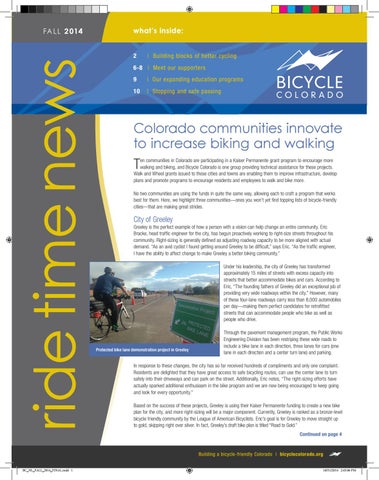
Protected bike lane demonstration project in Greeley
Through the pavement management program, the Public Works Engineering Division has been restriping these wide roads to include a bike lane in each direction, three lanes for cars (one lane in each direction and a center turn lane) and parking.
In response to these changes, the city has so far received hundreds of compliments and only one complaint. Residents are delighted that they have great access to safe bicycling routes, can use the center lane to turn safely into their driveways and can park on the street. Additionally, Eric notes, “The right-sizing efforts have actually sparked additional enthusiasm in the bike program and we are now being encouraged to keep going and look for every opportunity.” Based on the success of these projects, Greeley is using their Kaiser Permanente funding to create a new bike plan for the city, and more right-sizing will be a major component. Currently, Greeley is ranked as a bronze-level bicycle friendly community by the League of American Bicyclists. Eric’s goal is for Greeley to move straight up to gold, skipping right over silver. In fact, Greeley’s draft bike plan is titled “Road to Gold.” Continued on page 4
Building a bicycle-friendly Colorado | bicyclecolorado.org BC_NL_FALL_2014_FINAL.indd 1
10/31/2014 2:45:06 PM
Bicycle Colorado’s mission is to encourage and promote bicycling, increase safety, improve conditions and provide a voice for cyclists in Colorado.
Bike Shorts New board members elected
USA Pro Challenge showcases interest in all types of bicycling
In July, we welcomed two new board members, Alex Gillett and Russ Shaw. Current board member Scot Harris was elected secretary. Copyright 2014 Bicycle Colorado, Inc. All rights reserved.
1525 Market Street, Suite 100 Denver, CO 80202-1661 303.417.1544 info@bicyclecolorado.org PUBLISHER Bicycle Colorado EDITOR Katie Bonomo
BOARD OF DIRECTORS PRESIDENT Ella Lyons VICE PRESIDENT Brad Tucker SECRETARY Scot Harris TREASURER Erik Esborg Bill & Sheri Barr Karl Friedman Alex Gillett Lee Herndon Mike Lee Terry Malouf & Dave Walker Greg & Mary Seebart Russ Shaw Bill Shenkin Rudy Verner
Letter from Dan and Ella We are all building a better Colorado for bicyclists We have so many exciting stories to share in this issue—cities and towns making incredible improvements for bicycling, workplaces encouraging employees to bike and walk, keeping the Colorado Safe Routes to School program funded. These are the building blocks of better cycling in Colorado. Soon, the residents of eastern plains communities Milliken and Johnstown will have a new, safe transportation option via a planned bicycle and pedestrian connector path. And the continued funding for Safe Routes to School is ensuring that more students will learn how to bike and walk to school safely. The programs and projects we highlight in this issue are bringing change to the lives of people they impact directly. The truth is, though, the residents of these towns and families with school-age children are not the only ones who benefit. We all do. When small communities in our state find a way to build a bike path to connect to one another, it can inspire other towns and cities to build better bike infrastructure, too. When school children learn safe bicycling skills, it leads not only to safer and healthier communities, but a future where many more cyclists and drivers in Colorado will understand the importance of sharing the road. Changing transportation systems and priorities is complicated. It is not something that happens overnight. But we celebrate what we have achieved with the help of our members and supporters, and we continue to build on each success to work toward making bicycling in our state the best that it can be.
ADVISORY BOARD Bob Moore Ned Overend Andy Pruitt Bill Ritter
We know that there are many ways to support better bicycling, and we thank you for choosing to support your statewide organization, Bicycle Colorado.
The week of the USA Pro Challenge race, August 18-24, provided a great opportunity for Bicycle Colorado staff to meet and reconnect with over 1,000 members and others across the state who love cycling. The race and associated events also showcased interest in many different aspects of bicycling, from racing to riding for transportation to recreational riding.
Alex Gillett’s background is in finance and he is currently a senior executive for several family-owned companies. He is an avid cyclist and racer and also enjoys riding with his family, including his 70+ year-old parents. Russ Shaw brings extensive nonprofit experience to our board of directors. He has worked with the Denver chapter of the National Multiple Sclerosis Society and for Regis University, where he taught Nonprofit Management. Today he is a Philanthropy Specialist with Wells Fargo. Russ is a passionate cyclist and a longtime supporter of Bicycle Colorado.
Bicycle Colorado hosted bike valets at each stage for those who chose to travel to the race by bike. The valets were provided by Lexus, official vehicle of the USA Pro Challenge. We also partnered with the City of Golden to put on a bike rodeo as part of their Pro Challenge weekend festivities. More than 100 children participated, and participants also received a free helmet.
We give warm thanks to former board members Michele Ames and Amber Blake for their contributions while serving on the Bicycle Colorado board. Michele also helped as a board officer and Amber provided great input on local issues.
Member fundraisers support regional policy work In June, Sue and Dave Aspenson hosted a fundraising event at the USA Cycling facility in Colorado Springs. Our own Scott Christopher and Ted Heyd attended and enjoyed the company of members, local advocates and donors for a short ride, followed by dinner and refreshments. The evening included brief presentations about our advocacy work in the Pikes Peak Region. We were also joined by special guest, 2001 World Champion Alison Dunlap, a longtime Bicycle Colorado member. In August, Greg and Jenny Baldwin hosted a social fundraiser at their home in Parker. The event was attended by many of their friends, as well as Bicycle Colorado executive director Dan Grunig and development & outreach director Scott Christopher. Guests included people meeting Bicycle Colorado for the first time and longtime members and supporters.
Regional and state government updates In October, the Colorado Department of Transportation (CDOT) endorsed the National Association of City Transportation Officials (NACTO) Urban Street Design Guides, making Colorado the seventh state to endorse the guides. Using the guides gives road designers and engineers the opportunity to apply the newest proven bikeway designs. We’re also seeing results from our regional focus. The Denver Regional Council of Governments recently added points for bicycle-related improvements to the scoring system of the Transportation Improvement Program in the roadway capacity, reconstruction and operational improvement categories. Effectively, this means that including on-street improvements for bicyclists makes it more likely that a roadway project will be funded through this program. Not only that, but the number of bicycle and pedestrian projects submitted this year was more than double the amount submitted for any roadway category.
Jenny Baldwin (center) and guests at fundraiser.
The generous donations from both of these events are being put to work as matching funds that are needed for our regional policy work. Thanks to these and other events, we have raised almost $50,000 of the $80,000 needed in matching funds.
STAFF EXECUTIVE DIRECTOR Dan Grunig DEPUTY DIRECTOR Amy Morfas BOOKKEEPER Justin Millar
A record year at the 2014 Gala
COMMUNICATIONS SPECIALIST Katie Bonomo
Nearly 300 enthusiastic bicycling supporters joined us at the 2014 Bicycle Colorado Gala in April. We were blown away by the energy in the room this year.
DEVELOPMENT & OUTREACH DIRECTOR Scott Christopher EDUCATION DIRECTOR Jenna Berman
Dan Grunig Executive Director
Ella Lyons Board President
EDUCATION PROGRAM MANAGER Julia Davenport MEMBERSHIP MANAGER Mark Erickson REGIONAL POLICY DIRECTOR Ted Heyd 2 ride time news Fall 2014 BC_NL_FALL_2014_FINAL.indd 2-3
“We hear from our supporters through the year about things they appreciate we’re doing, but there’s nothing quite like having a big group of people together in one room, rooting for a single cause,” Dan Grunig, our executive director, says. “I think that’s what makes our gala a celebration and not just another auction for a good cause.” Thank you to our generous sponsors including the Gala presenting sponsor, Friedman Family Foundation. We are so grateful for everyone’s generosity in helping us reach a record of $70,000 in donations this year.
eNews Keep current on Colorado bicycling news by signing up for eNews at bicyclecolorado.org
The live auction was action-packed, with fierce bidding wars over the Giant, Spot Brand, Specialized and New Belgium bikes. The “paddle raiser” got an extra boost with a challenge match from board members Sheri and Bill Barr. Thirty people met their challenge and took us over our goal.
All smiles at the 2014 Gala auction
Building a bicycle-friendly Colorado | bicyclecolorado.org
3
10/31/2014 2:45:10 PM
Programs
Programs
Colorado communities innovate to increase biking and walking Continued from page 1
Pueblo has multiple efforts underway with their Walk and Wheel grant funding, including both infrastructure projects and programs to encourage more walking and biking. Bicycle Colorado’s Ted Heyd and Jenna Berman, along with Carlos Hernandez from Fox Tuttle Hernandez, conducted a technical assistance session with Pueblo staff in July. They offered design support for bike lane striping projects—several of which were completed this September—and gave a presentation of Walk and Wheel models in peer communities.
The Greeley city council has been supportive of the bike improvements, and Eric says that biking improvements have been an amazing team effort between the city manager’s office, the parks department, the planning department and others. The draft plan calls for continuing to address infrastructure as well as looking at program and policy changes that could encourage biking.
Town of Milliken The town of Milliken is still coming back from last year’s floods. Though fairly overwhelmed from this recovery work, they are moving Tour de Taco ride in Pueblo ahead in making their small community of approximately 5,800 residents more bicycle and pedestrian friendly by connecting their community with neighboring Johnstown, population 11,000. To those who live elsewhere, it may not be intuitive how connecting to another community can make the town more bicycle and pedestrian friendly, but it makes sense when you learn more about the two towns. In Milliken there is no grocery store, doctor, dentist, library or place to buy clothing. Milliken residents must regularly make trips to Johnstown to fill these needs. Additionally, Milliken and Johnstown share middle and high schools, one located in Milliken and the other in Johnstown. The towns are a mere two miles apart, but there are currently no dedicated bicycle or pedestrian facilities connecting the two of them. In an effort to expand residents’ options, Milliken’s Walk and Wheel funds are being used for the planning and design of the Milliken portion of an intercommunity trail between Milliken and Johnstown, which will parallel State Highway 60. The town has already secured a grant from the Colorado Department of Transportation that will cover most of the construction cost of the Milliken section of the trail. Carlos Hernandez and Bill Fox of Fox Tuttle Hernandez transportation planners and Jenna Berman of Bicycle Colorado have been working with the town’s engineering staff on the ongoing trail design effort. Anne Johnson, planning manager at the time the grant was obtained, has said, “I attribute where we are now to the assistance you all provided. So thank you very, very much!”
The city recently received additional funding from Kaiser Permanente to implement a protected bikeway demonstration project to connect neighborhoods east of I-25 to the downtown area. Carlos, Jenna and Ted met with traffic engineer Pepper Whittleff, bicycle/pedestrian coordinator Stephanie Chambers and others to provide input on the demonstration project.
4 ride time news Fall 2014 BC_NL_FALL_2014_FINAL.indd 4-5
Milliken
I
n addition to supporting 10 Colorado communities in encouraging more walking and biking through their Walk and Wheel program, Kaiser Permanente has also granted funds to 10 workplaces to create programs that will encourage their employees to walk and bike more. One of those workplaces is the city of Littleton. Julie Lanier is spearheading Walk and Wheel efforts at the city. She worked closely with Jenna Berman of Bicycle Colorado to shape encouragement programs for both walking and biking that would stand out from some of the existing wellness challenges. One of the big differences this time, according to Julie, is that, “employees were allowed to set their own goals so they were able to be in charge of their own destiny.” Together, the programs have had more than double the participation rate of past challenges. For the walking challenge, Julie planned for 40 participants, but 80 signed up and more joined a waiting list. For the biking challenge, 26 employees participated,
In addition to the infrastructure improvements that Pueblo is undertaking, Stephanie is leading programs to encourage more people to walk and bike. She organized a community ride in early September called the “Tour de Taco” to promote nine miles of recently installed bike lanes and the many businesses that are easily accessible from the new lanes. The ride attracted more than 70 people. She is also working with local doctors to prescribe walking and biking. Doctors can issue specialized prescriptions that give details on local opportunities to walk and bike. In addition, earlier this year, the city promoted Bike to Work Day and hosted a Bike Safety Jam. “It’s critical to have a lot of options so people have plenty of opportunities to participate,” Stephanie says. It is also critical that infrastructure improvements and programming to encourage walking and biking go hand in hand, and in Pueblo that is exactly what is happening.
Looking to the future
Greeley, Milliken and Pueblo are each improving the bikeability and walkability of their communities in their own ways with the financial support of Kaiser Permanente and the strategic and motivational support from the technical assistance providers. In the process they are making their communities more City of Pueblo vibrant and healthy places to live and invest. Their efforts show that there are Pueblo County is ranked 56th out of the 59 counties in Colorado when it many ways to make a community more bicycle-friendly, and regardless of comes to health behaviors according to the where your community may be on the spectrum, Robert Wood Johnson Foundation’s County it’s never too late to set the wheels in motion to Health Rankings. The county has high Walk and Wheel Communities: improve conditions for biking. levels of both obesity and diabetes. But the city is working to combat these issues and • Aurora • Weld County Learn more about all 10 communities and encourage citizens to work their way toward • Colorado Springs • Lafayette Bicycle Colorado’s technical assistance role at better health, and they are using biking and • Englewood • Greeley bicyclecolorado.org/walk-and-wheel. walking to do it. • Fort Collins • Lone Tree •
Employees of the city of Littleton walk and bike to better health
•
HOW TO MAKE YOUR OFFICE MORE BIKE-FRIENDLY Active employees are happier, healthier and more productive. Here are a few ways to make your workplace more bicycle-friendly: Add bike parking: Adding bike parking in a visible, secure, covered location or dedicating an indoor space for employees to park their bikes mitigates concerns about theft and wear and tear. Appoint a bicycle coordinator: A bicycle coordinator can spearhead events like Bike to Work Day and be a point of contact for new cyclists. Provide a place to change (or even showers if they’re in the budget): Having a convenient place to change allows people who choose to ride in cyclingspecific clothing to quickly change into workappropriate attire. Extend driving benefits to cyclists: Extending mileage compensation or paying out parking stipends to those who bike instead of driving encourages biking without costing your company any more than it would if those employees were driving.
Bicycle Colorado staff train Littleton employees
representing all departments. Biking challenge participants averaged an impressive 245 miles over the 14 weeks of the challenge. Asked about the success of the program, Julie said, “I believe this challenge was more popular than previous challenges because it was so different in that we provided, via Bicycle Colorado, tangible skills—changing flats, rules of the road—and removed barriers up front by providing helmets, bike tune ups, tubes, CO2 inflators and more in order for employees to have all of the tools they need to be successful.” Based on the early success of the Walk and Wheel program, Julie was invited to apply for additional funding from the Kaiser Permanente Fund to grow the program. With this additional funding she created a program called “Discover Littleton,” in which teams of employees walked and biked to locations around the city and took photos, raising awareness of the many places in Littleton that are within walking or biking distance.
Relax the dress code: Instituting a more relaxed dress code (to be clear: we’re not talking about allowing spandex in the office!) can make it easier for people to bike more often. Provide a company-owned pool of bikes: While it may not be feasible for everyone to bike to work, providing a company-owned pool of bikes (or bike library) can allow people to bike to meetings or lunch, potentially increasing productivity. Buy a set of tools and a pump for the office: Having tools and a pump at the office—whether installed outside or kept in the care of a bicycle coordinator—can give potential bike commuters peace of mind. Offer Bicycle Colorado’s Bicycle Commuter Services Program: Check out bicyclecolorado.org/learn/adultbike-safety for information about commuter classes that we can offer to your employees.
So why is Littleton doing so much to encourage walking and biking? It’s simple, Julie says. “We want employees to be healthy and active.”
Pueblo Building a bicycle-friendly Colorado | bicyclecolorado.org
5
10/31/2014 2:45:12 PM
Business Member
Individual Member
Rocky Mountain Events: dedicated to improving Colorado cycling
Longtime members advocate in urban and rural settings
ocky Mountain Events has been organizing some of Colorado’s best-loved cycling events for more than 28 years. Their events include the Subaru Elephant Rock cycling festival, Colorado Cyclist Copper Triangle and, with partner Mike Heaston, the Icon LASIK Tour of the Moon ride. Scot Harris, the owner of Rocky Mountain Events, has generously elected to make a monetary donation per rider to Bicycle Colorado for all three events. Through Tour of the Moon, Scot and Mike have contributed almost $30,000 to Bicycle Colorado.
B
R
Scot also serves on our board of directors and was recently elected to an officer position. Here we sit down with him to learn more about why the company continues to be one of Bicycle Colorado’s strongest business supporters.
icycle Colorado members Steve and Pam Williams have been cycling in Colorado for decades. They bought a ranch in Routt County 16 years ago, but previously lived in Lakewood for over 30 years, so they have plenty of experience with both urban and rural bicycling. Scot Harris
RTN: When did Rocky Mountain Events first get involved with Bicycle Colorado?
RTN: What is the most important thing Bicycle Colorado has done to make hosting bike events better in Colorado?
Scot Harris: We were aware of Bicycle Colorado and the important work the organization was doing for Colorado cyclists since the mid-nineties, but it wasn’t until 2005 that we began to work closely with Bicycle Colorado on a cycling event participant limit issue that really concerned us. At that point, we realized how effective and important Bicycle Colorado was in influencing state policy. Fortunately for cyclists, event organizers, nonprofit organizations and businesses, Bicycle Colorado was able to reverse a state decision to limit the number of bike event participants to 2,500. That experience made me think, Wow! There is no other group in the state that could have protected cycling like that.
Scot Harris: Reversing the 2,500 rider cap was huge, but there are many other things that Bicycle Colorado does that make hosting cycling events possible. Bicycle Colorado has always done a great job working with CDOT and the Colorado State Patrol. Their work with both of these state agencies laid the groundwork for the amazingly cooperative partnership that all Colorado cycling events have with both groups.
RTN: Rocky Mountain Events makes several generous financial contributions to Bicycle Colorado every year. Why does investing in Bicycle Colorado make sense for Rocky Mountain Events?
I also think Bicycle Colorado’s work researching and reinforcing all of the financial benefits of the cycling industry in our state is very important. Between bicycle tourism, bicycle-related manufacturers, importers, retailers and the amount of funds raised by nonprofit organizations, the bicycle business is a big deal for our economy. Bicycling creates over a billion dollars of economic impact in our state each year, and it’s important to publicize that information.
Scot Harris: Oh, it’s a simple decision for us. We all love to ride bikes, and I’m thankful that I’ve been able to make a living doing what I love for almost 30 years. The work Bicycle Colorado does has a direct benefit to my recreational life and my business. Bicycle Colorado does so much to help create a bicycle-friendly environment that it’s a natural place to direct our nonprofit support.
Beyond that, introducing biking to the next generation of cyclists through the Safe Routes to School program is another big contribution by Bicycle Colorado. Through that program, Bicycle Colorado is helping Colorado’s kids become healthier and happier, and it’s an added benefit that some of those kids will grow up to be participants in cycling events.
RTN: Why is Bicycle Colorado an important community asset, especially for a bicycling business? Scot Harris: I was pretty naive about politics when I first began working with Bicycle Colorado. Okay, I still am! But one thing I have discovered is that the only way to really have a big impact—to improve roads, increase the number of bike paths and gain bicycle-friendly laws—is through well-organized advocacy. Numerous studies have shown that when you make bicycling infrastructure safer and more enjoyable, more people ride. And when more people decide to take up bicycling, everyone in the cycling industry benefits.
When Steve participated in the first Ride The Rockies in 1986, Pam, a teacher, talked about the ride with some of her students. “They got excited,” she says. “So, I hosted a meeting or two and trained with them, and we all did the ride the next year.” The experience really had a positive influence on her students’ lives and so she kept doing it for ten years. “None of the kids were very serious cyclists, but they all completed the ride,” she says. Steve and Pam have been members of Bicycle Colorado since 1995 when Steve met Martha Roskowski, the second executive director of Bicycle Colorado, at a Bike to Work Day table. “My member number was 16,” he says. “I think that’s because the board members were numbers one through 15. I joined because Pam and I did a lot of long rides and tours, and I commuted to work by bike, and it just seemed like something I wanted to be a part of.” While living in Lakewood, Steve and Pam witnessed a radical transformation of bike infrastructure, from virtually nothing to a network of bike lanes and paths. When Steve began biking to work, the only way into downtown from the west was over one of the old viaducts. They remember, “Years ago, if there was road construction, most of the equipment would be stored in a bike lane—if one existed—and there would be no indication of a safe way for bikes to get around the construction. Now, many times bikes get a detour just as cars do.”
BC_NL_FALL_2014_FINAL.indd 6-7
When the Williamses talk about Bicycle Colorado to their friends, they always emphasize the tangible things that Bicycle Colorado has worked to achieve—rebuilds of state highways to include good shoulders and cyclist-friendly rumble strip placement, programs that promote a return to children walking and biking to school, rider and driver education, commuter programs, thoughtful legislation to reinforce cyclists’ rights on the road and “share the road” license plates. They believe all these things make the biking experience better and cut down on the barriers to entry into cycling. In 2000, Pam made the permanent move to Routt County, followed by Steve in 2005, to live on the ranch where they now raise Scottish Highland cattle full time. There they can step out the door and enjoy world-class road and mountain biking any time. Except when they are haying or calving, ranching makes it easier to ride when conditions are great rather than waiting for a day off. In the fall of 2009, Steve was selected by county commissioners to be part of the Routt County Multi-Modal Road Use Advisory Board, made up of people representing all different types of road users, as well as the road and bridge director and Steamboat’s city engineer.
RTN: Why should other event organizers sponsor Bicycle Colorado? Scot Harris: There is strength in numbers. The more individuals and companies that support Bicycle Colorado, the more we can get done. Bicycle Colorado has accomplished a huge amount over the last 10 or 15 years and has proven itself to be highly effective, but there is so much more that can be done to make Colorado the best place in the country to ride bikes. Beyond that, I know that without Bicycle Colorado my business would not have been able to grow to what it is today. A “share the road” sign on private property in Routt County
Examples like this are an indication that the Colorado Department of Transportation (CDOT) and local planners are considering all forms of transportation, beyond just cars. “There’s been so much improvement, and we attribute that to CDOT’s hiring of a bicycle and pedestrian coordinator and to advocacy groups like Bicycle Colorado working with transportation planners,” say the Williamses. “When a group like Bicycle Colorado represents a huge group of members at a meeting of decision makers, that’s really powerful.” 6 ride time news Fall 2014
Pam and Steve with one of their Scottish Highlanders
According to Steve, all the advisory board members listen to each other to find common ground, and they have been able to make a lot of positive changes for cycling in Routt County. “What the advisory board always tries to publicize is that making roads safer for cyclists makes them safer for everyone,” says Steve. Members of the advisory board and local landowners also post “share the road” signs along county roads each spring. Reflecting on the changes that have taken place over their many years of cycling, the Williamses note, “Bicycle Colorado does important work with the legislature to pass substantive laws and with CDOT to be sure that roads are built to a safe standard for all user groups. At the end of the day though, it’s up to all of us to pay attention to the road and its conditions on any given day. The road itself and conditions determine how people should interact to be safe, courteous and enjoy their trip, whether it’s for business or pleasure. Ride and drive your best at all times and we’ll all get where we’re going safely.”
Building a bicycle-friendly Colorado | bicyclecolorado.org
7
10/31/2014 2:45:13 PM
Supporters
Education Programs Expanding
Colorado Bicycle Summit 2014 Champion Sponsors
Safe Routes to School bill passes
W
e are proud to welcome AAA Colorado to our team of supporters working to improve bicycling across the state. While traditionally providing roadside assistance solely to automobiles, AAA Colorado recently introduced their bicycle roadside assistance program in Colorado. “We think it’s important for all road users to have peace of mind,” says Kevin Hobbs, Vice President of Marketing and Communications. “That’s why we introduced roadside assistance for bicyclists in May, 2014.” The club now provides transportation service if your bicycle is rendered inoperable, with no increase in membership dues.
P
eopleForBikes, a national advocacy group based in Boulder, is the movement to make riding better for everyone. PeopleForBikes awards community grants to improve bicycling at the local level, provides a voice in Washington, D.C. for people who ride and is the organization behind the Green Lane Project. “PeopleForBikes partners with Bicycle Colorado because we know that we can do more together,” says Tim Blumenthal, president of PeopleForBikes. “Improving conditions for biking happens more quickly when it’s a team effort.”
For 10 years, students around the state have benefited from the Safe Routes to School (SRTS) program created by the 2005 General Assembly, administered by the Colorado Department of Transportation and funded with federal dollars. Designated federal funding for this important program runs out at the end of this school year, but Bicycle Colorado and a broad coalition of groups worked tirelessly to put together a legislative bill to fund the program for the 2015-16 school year. State Representative Diane Mitsch Bush introduced the bill, joined by 13 bipartisan cosponsors in the House and three in the Senate, led by Senate sponsor Andy Kerr. Many Bicycle Colorado members called or wrote to their state senators and representatives to encourage passage of the bill. House Bill 14-1301 was signed into law by Governor Hickenlooper on June 3, 2014, allocating $700,000 to fund the Colorado SRTS program for another year. This year, Bicycle Colorado is advocating for a bill to ensure funding for the
Safe Rides at Denver Public Schools
Campus Cycles partners with Bicycle Colorado to accelerate change
A
full-service bike shop with locations in Denver and Lakewood, Campus Cycles has been a strong supporter of Bicycle Colorado since the days when it was owned by Greg and Mary Seebart, current Bicycle Colorado board members. The shop has an interesting model for their support. Since 2011, when you buy a road bike for $1,200 or more at either location, they will give you a Bicycle Colorado membership. “Giving folks a membership to Bicycle Colorado starts them on a path to being active members of this great cycling community that we have here in Colorado,” says co-owner Mark Velat. These memberships help Bicycle Colorado work for passage of more bicycle-friendly laws, teach children how to bike safely and facilitate regional collaboration on bike issues. Members also receive our newsletters, which help keep the bicycling community aware of events, new infrastructure and changes to laws that affect cyclists. Ask co-owner Bobby Verenna why it makes business sense to support Bicycle Colorado and he will tell you, “Bicycle Colorado is making bicycling better for Coloradans. Better biking means more cyclists. And more cyclists mean more bike shop customers.” Additionally, when more people become
members, it gives Bicycle Colorado a stronger voice as the representative of the state’s bicycling community.
If you visit the Denver Public Schools (DPS) transportation website today, you will find a wealth of information about big yellow buses. Very little of the information pertains to walking or biking to school, which have not traditionally been a focus for school transportation departments. But things are changing. With more and more evidence showing that children who walk and bike to school show up more ready to learn than those who take inactive modes of transportation, and with Safe Routes to School (SRTS) programs taking hold in many schools, more students are beginning to walk and bike to school. In DPS, active transportation changes are possible in part because the
In the interest of promoting a more bicycle-friendly community locally and worldwide, Campus Cycles also partners with BikeDenver, PeopleForBikes, and the Colorado and International Mountain Bicycling Associations, and they encourage their customers to back these groups as well.
Expanding our reach with education trainings
Beyond encouraging their customers to support cycling groups, Bobby and Mark want to encourage other bike businesses to put a program like this in place to help expedite the improvement of conditions for everyone who rides bikes in Colorado.
Although Bicycle Colorado teaches safe bicycling and walking skills to thousands of children across the state each year, there are many more who could benefit from this education. That’s why Bicycle Colorado education staff will be traveling to Crested Butte, Gunnison, Montrose and Englewood to offer train-the-trainer events to give other adults the skills to teach bicycle education. MONTROSE We will be training educators with our bicycle and pedestrian education curriculum. In addition, we will help them design encouragement programs to motivate kids and families to continue biking and walking. Following the training, the 21st Century Community Learning Centers and Montrose elementary schools after-school programs will teach weekly Safe Routes to School (SRTS) sessions. At two middle school sites, they also plan to pilot a bicycle maintenance program with community partners. GUNNISON AND CRESTED BUTTE Bicycle Colorado will be providing on-site training for physical education teachers and community members. We will also help with Ana’s Pledge Bike
8 ride time news Fall 2014 BC_NL_FALL_2014_FINAL.indd 8-9
Gov. Hickenlooper signs Safe Routes to School bill
2016-17 school year and beyond. Over the summer, the bill was approved by the Transportation Legislation Review Committee to be one of five that will be forwarded to the Legislative Council. If the bill passes, this funding will help build the next generation of cyclists and lead to healthier communities. director of the transportation department, Nicole Portee, understands the value of SRTS and is ready to encourage her department to help get the word out about other modes to school, not just traditional yellow school buses. As our SRTS program works to educate students about safe biking and walking behavior, encouraging biking and walking from the “bottom up,” it is also important to look at communication and policies that can encourage biking and walking from the “top down.” That is why Bicycle Colorado, in partnership with BikeDenver, will be working closely over the next two years with Denver Health, the City and County of Denver and DPS to promote walking and bicycling as viable transportation options for students traveling to school through the Safe Rides program, funded by Kaiser Permanente and led by Denver Health.
Rodeo, a popular annual event in Gunnison, and will teach volunteers how to teach kids to ride, leaving behind curriculum and parent communication templates for future use. This training will allow Gunnison and Crested Butte physical education teachers to educate students on how to safely navigate the busy roads that they must cross on the way to school. With SRTS grant funding, they will also be creating a bicycle buddy program and bike pool program to encourage biking to school. ENGLEWOOD In the Denver area, Bicycle Colorado is working with Englewood schools to train physical education teachers to lead group rides for after-school clubs, teach advanced bicycle skills and maintain the schools’ fleets of bicycles. In addition, Bicycle Colorado will facilitate the district’s purchasing of two adaptive bikes for their severe special needs students and help teachers incorporate these bikes and students into their existing bike programs and clubs. As more Colorado children have the opportunity to learn how to bike safely, these children will have the knowledge and the confidence to choose biking for recreation and transportation.
Building a bicycle-friendly Colorado | bicyclecolorado.org
9
10/31/2014 2:45:15 PM
SAFETY QUIZ
BIKE LAW Q&A
On stopping and safe passing Brad Tucker is an avid cyclist, vice president of Bicycle Colorado’s board of directors and an attorney with a specialty in bicycle liability and insurance issues with ColoBikeLaw.com. If you have questions concerning legal issues affecting cyclists, you can contact him at brad@colobikelaw.com.
GIFTS FOR EVERY CYCLIST IN THE BICYCLE COLORADO STORE
ow does Colorado law define a complete stop? Do I have to put my foot on the H ground or just stop the movement of my wheels?
Why I support Bicycle Colorado We’ve been supporters of Bicycle Colorado and the Share the Road Campaign since 2009 because of the tremendous effort Bicycle Colorado puts towards advocating cycling from the state level down to our local communities. Young and old alike, novice to expert, cyclists in Colorado have benefitted from more cycling friendly legislation in the last five years than in the history of the state, all thanks to Bicycle Colorado. Their dedication and determination makes it easy to support their endeavors. – Brian and Cheryl Poteet
We all learn at a young age that we must stop at stop signs. This is true whether we are riding a bike, a motorcycle or driving a car. In Colorado, the duty to stop is prescribed by a statute* that generally states:
We moved to Colorado in 2011 from New Mexico. After suffering the loss of a dear friend in an auto-related bike accident, our desire to further support cyclists’ rights and awareness led us to join Bicycle Colorado. We feel that Bicycle Colorado does an outstanding job of advocating for our rights as cyclists through state policies and working within communities. Keep up the great work, Bicycle Colorado!
Every driver of a vehicle approaching a stop sign shall stop: at a clearly marked stop line, • or if no stop line exists, before entering the crosswalk on the near side of the intersection, • o r if no stop line or crosswalk exists, then at the point closest to the cross street where the driver • has a view of approaching traffic but has not yet entered the intersection.
– Megan Snow and Jenny Snell
No statute or reported case law defines what is required to make “a stop,” but another state statute** provides definitions for “stop” and “stopping” in the context of stopping when an action is prohibited.
What is the correct way to go straight through an intersection where there is a dedicated right turn lane? A. Look, signal, enter travel lane to the left and proceed straight through. B. L ook, signal, move to the left side of the dedicated right turn lane and proceed straight through. C. Stay as far to the right as possible at all times. Only move left when you have to. D. A and B are acceptable. Answer: D. Both A and B are legal and signal to drivers that the cyclist intends to proceed straight, rather than turning right. Staying as far to the right as possible (answer C) indicates to drivers that the cyclist will be turning right. If the cyclist proceeds straight from that position, a righthook collision is possible.
In that context, those words are described as “any halting, even momentarily.” There is no specific requirement within state statutes that defines the length of time that a person must be stopped or whether a cyclist must put a foot down during the stop. Unless there is a local ordinance that states otherwise, it would seem reasonable that if you are able to fully stop the forward momentum of your wheels long enough to be certain that there is not another vehicle in the intersection or close enough to present a hazard when you enter the intersection, you would appear to be compliant with the law.
My family and I have been longtime supporters of Bicycle Colorado because of their commitment to everything related to cycling in our bike-crazed state. Now that I am retired from professional racing, I coach and run camps and clinics for both road and mountain bikers. My husband and I also have a four-year-old that rides all over our local trails and roads. We have a huge appreciation for what Bicycle Colorado does not only for my family and friends, but everyone that rides a bike in Colorado. Thanks for your incredible work!
The driver of a motor vehicle must allow at least a three-foot separation between the right side of the vehicle, including all mirrors or other projections, and the left side of the bicyclist at all times when passing a cyclist, according to state statute†. Additionally, our state statutes were amended in order to allow the driver of a motor vehicle passing a bicyclist to briefly cross a double yellow line when doing so can be done safely and without interfering with, impeding or endangering other traffic††. This exception to the general rule was a practical and common sense approach taken by our state lawmakers. The difference in speed between a person in a car overtaking a person on a bike—as compared to a person in a car overtaking another motorist—is much greater, meaning the amount of time needed to safely pass is significantly smaller. For this reason, our state lawmakers acknowledged that there are clearly circumstances that would allow for a brief and safe crossing of a double yellow in order to accommodate the minimum three feet needed to safely pass a bicyclist.
The information in this column is provided as a public service. It is not legal advice and should not be interpreted as such. Bicycle Colorado does not provide legal counsel nor endorse any legal counselor.
BC_NL_FALL_2014_FINAL.indd 10-11
– Keith Strand and Rachel Holloway
I know that Colorado has a “three feet to pass” law, but I don’t fully understand what is required of a passing motorist. Also, what is a driver supposed to do on a two-lane road with lanes separated by a double yellow line?
* C.R.S. § 42-4-703(3) ** C.R.S. § 42-1-102(100) † C.R.S. § 42-4-1003(b) †† C.R.S. § 42-4-1005(4)(d)
10 ride time news Fall 2014
We became members of Bicycle Colorado last year. Whether we are racing, commuting to work or enjoying a weekend cruise to the farmers market, bikes are an integral part of our lives. We love biking so much that a large portion of our home décor consists of bicycles leaned at jaunty angles against the walls. We strongly support Bicycle Colorado’s mission and believe that their advocacy efforts are important in making cycling in Colorado safer, more accessible and especially more fun!
– Alison, Greg, and Emmett Frozley
T-shirts • Jerseys • Bike Wallet • Necklace • Maps • Memberships •
SHOP NOW!
Thank you for your continued support. Please renew, donate and tell a friend about the benefits of becoming a Bicycle Colorado member today.
SHARE THE ROAD LICENSE PLATES MAKE A GREAT GIFT All proceeds benefit Bicycle Colorado Share the Road education activities. More information and online orders: bicyclecolorado.org
bicyclecolorado.org Building a bicycle-friendly Colorado | bicyclecolorado.org
11
10/31/2014 2:45:20 PM
Bicycle Colorado 1701 Wynkoop Bicycle Colorado Street Suite 236 1525 Market Street, Suite 100 Denver, CO 80202-5924 Denver, CO 80202-1661
SAVE THESE DATES
P R E S E N TE D B Y
Support us on Colorado Gives Day! Tuesday, December 9th Schedule your donation today at ColoradoGives.org.
Colorado Bicycle Summit Monday and Tuesday, February 9-10
2015
Give where you live. Support your statewide bicycling organization. Bicycle Colorado Gala Friday, April 24
Building a bicycle-friendly Colorado | bicyclecolorado.org BC_NL_FALL_2014_FINAL.indd 12
10/31/2014 2:45:21 PM