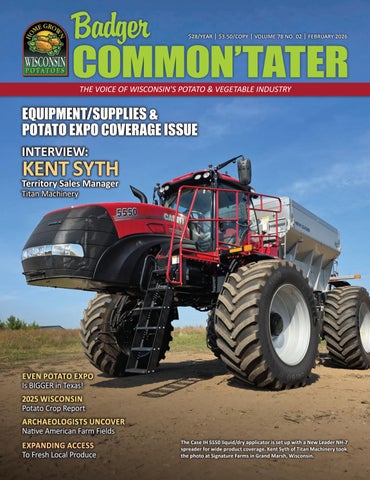
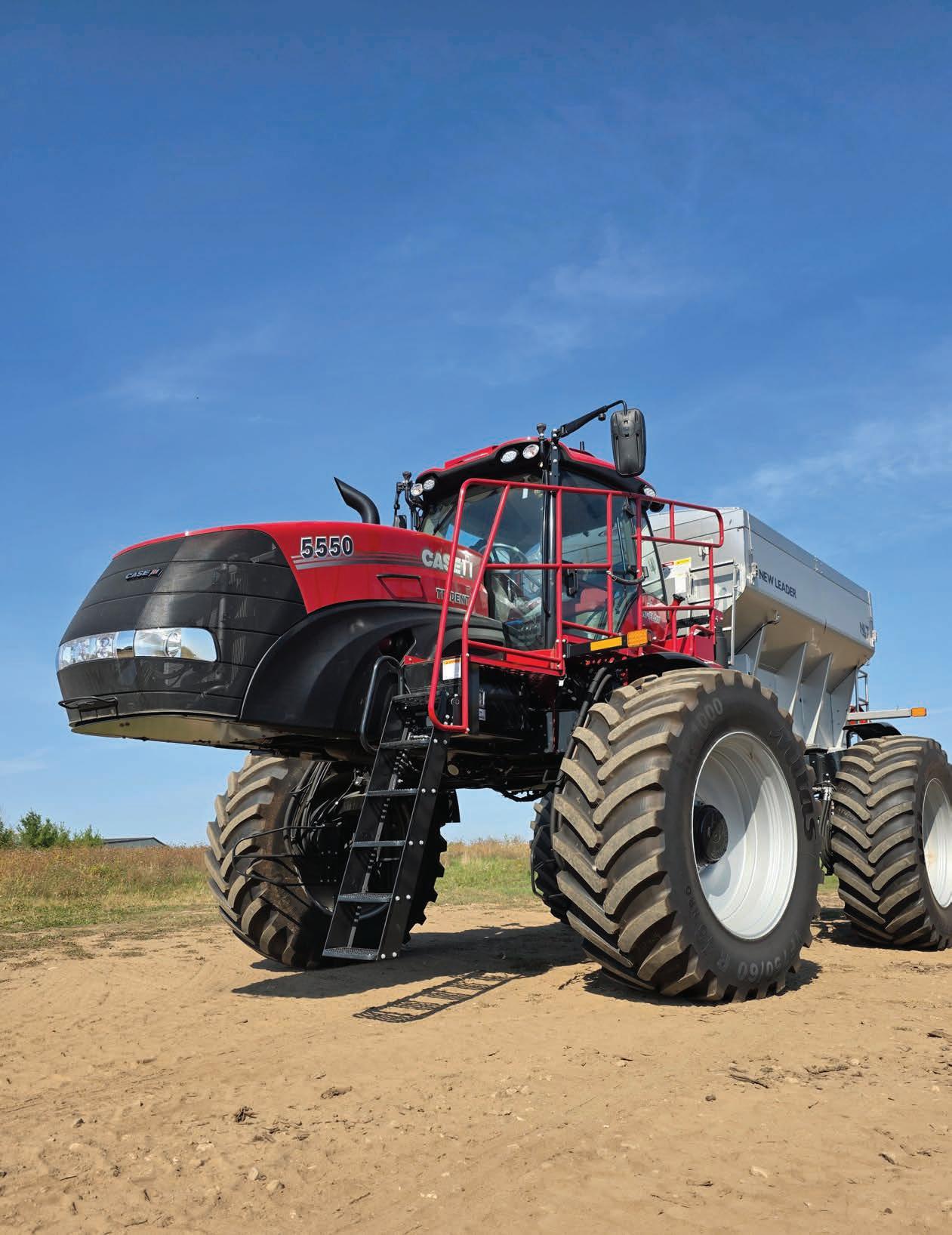
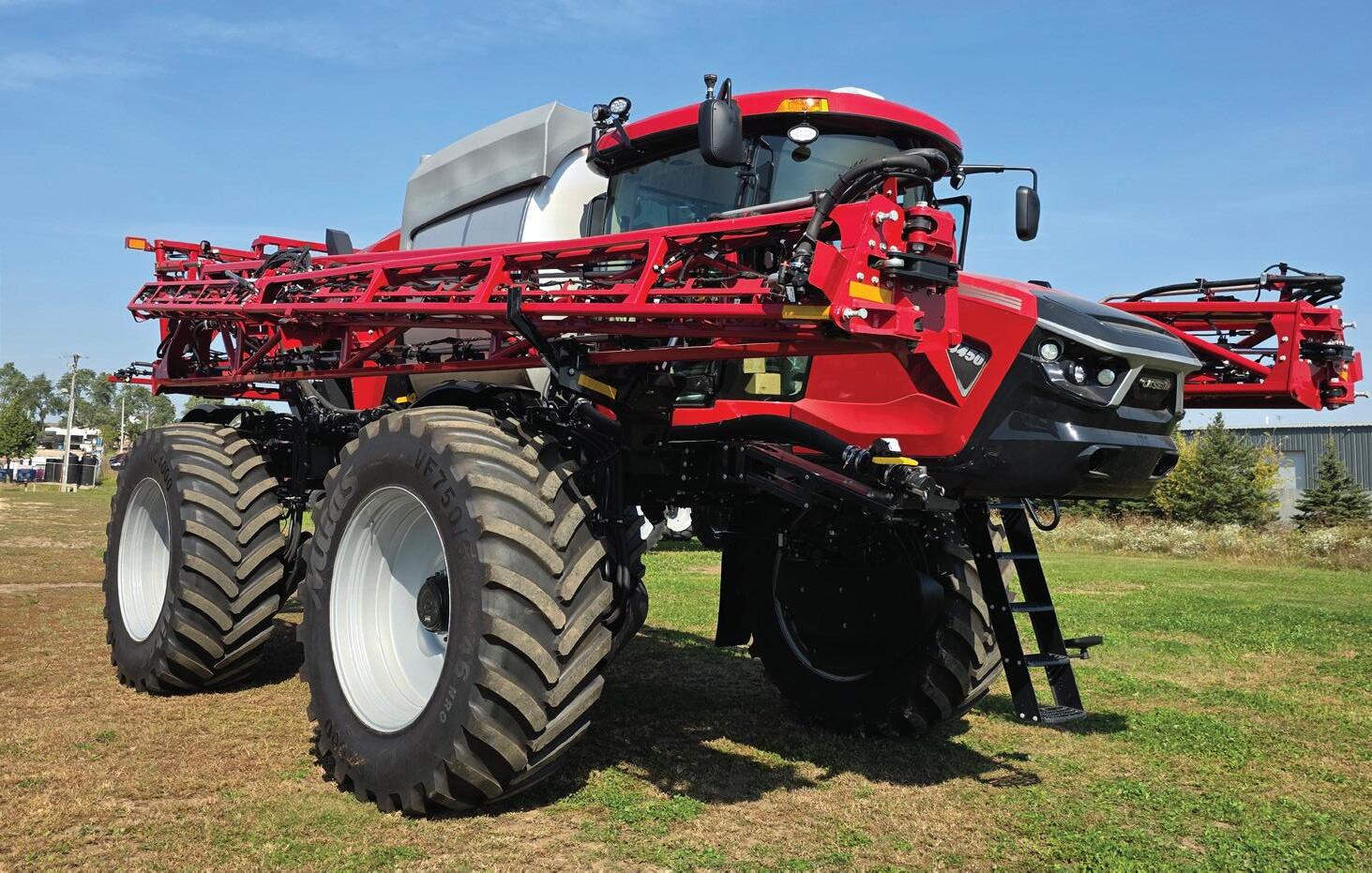
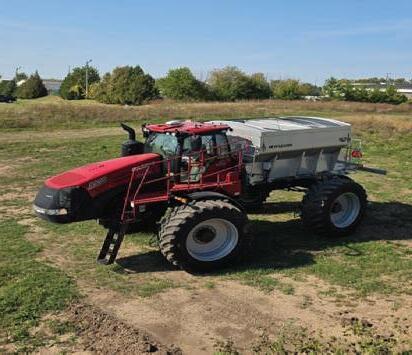
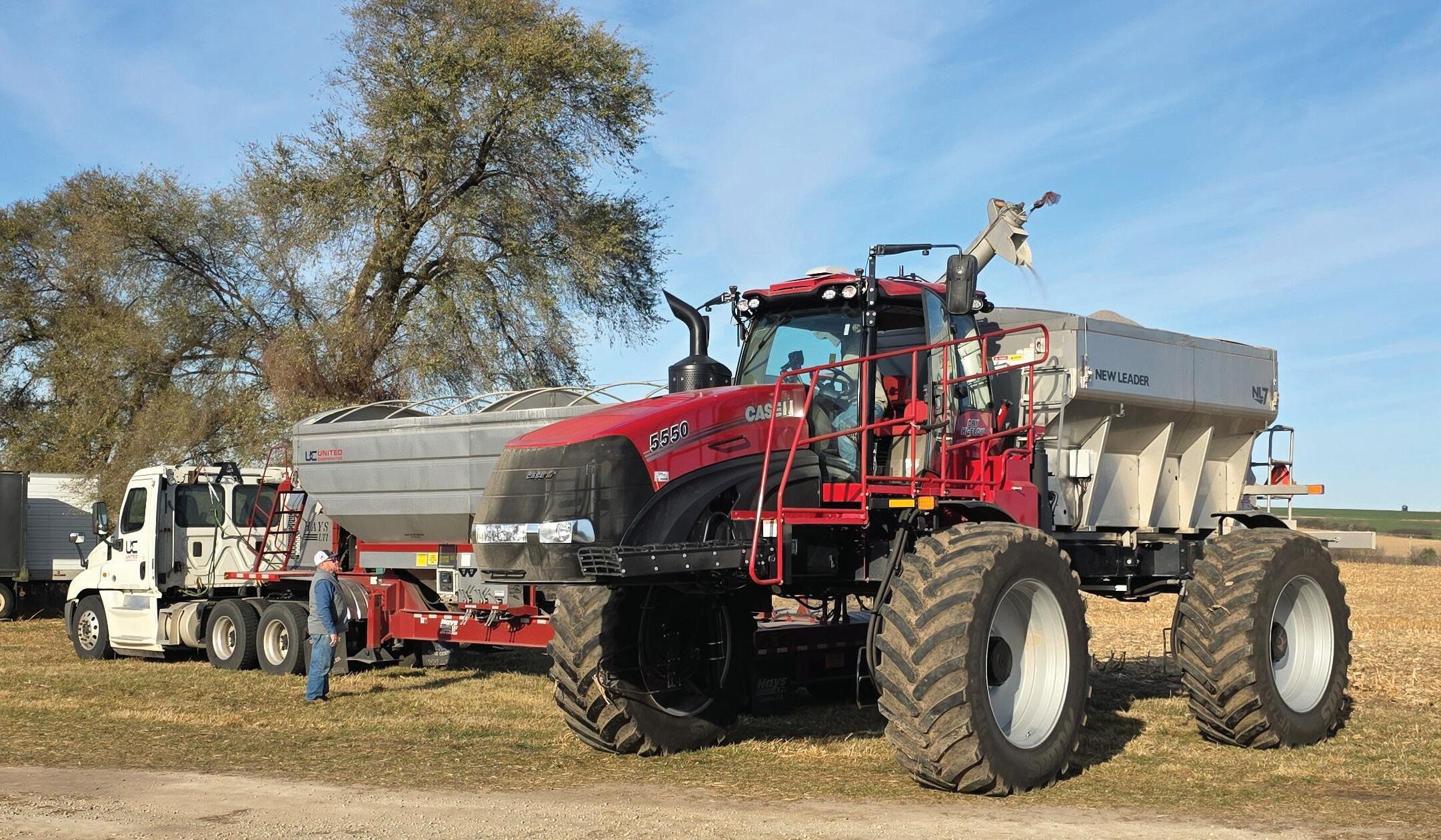
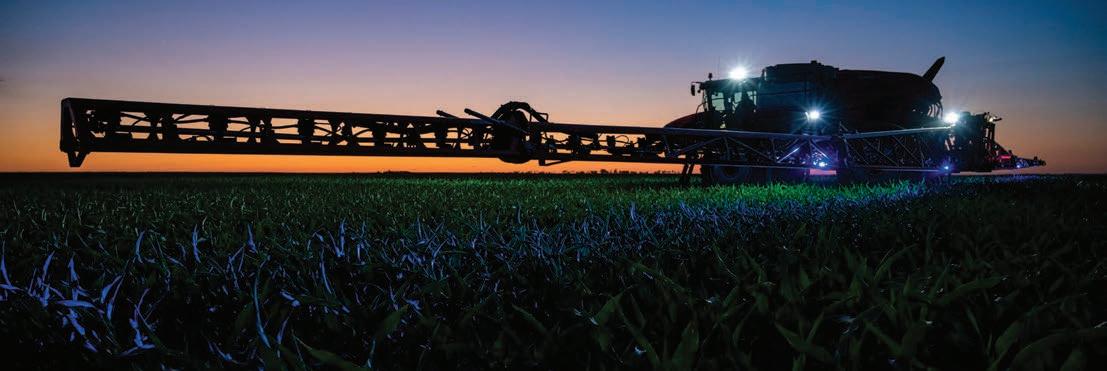
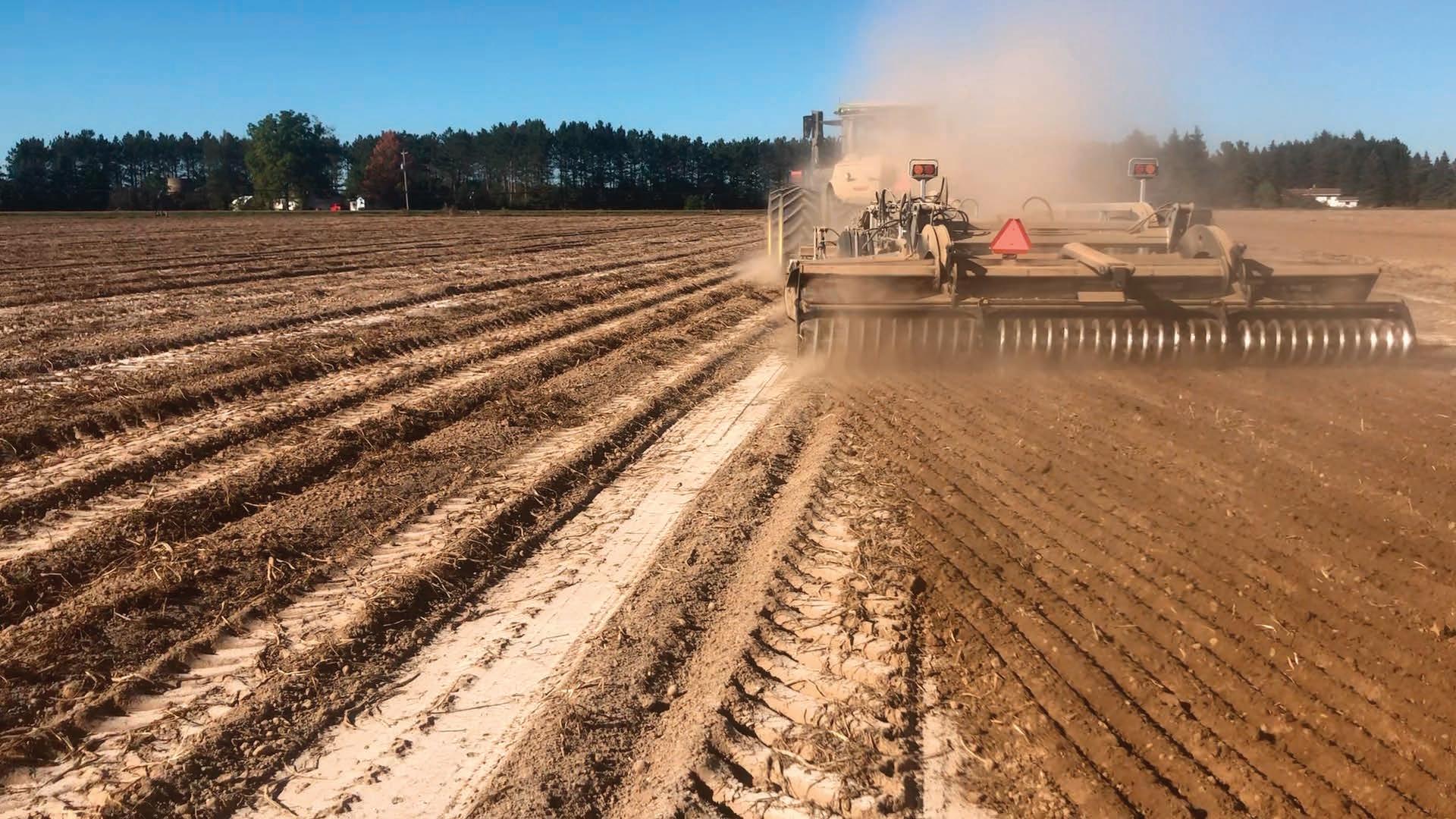
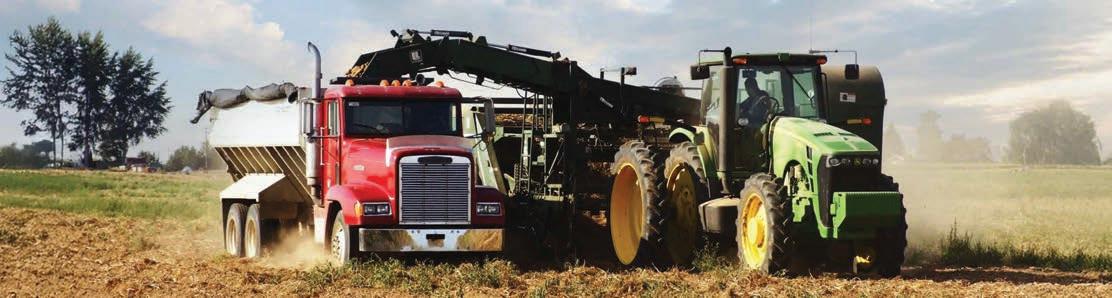
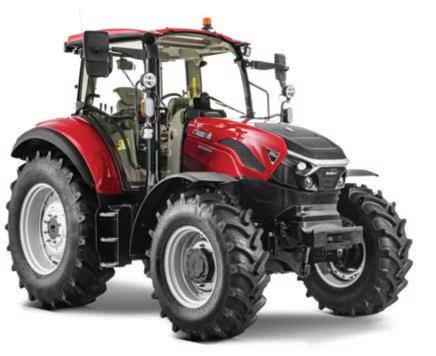
The Case IH 5550 liquid/dry applicator is set up with a New Leader NH-7 spreader for wide product coverage. Kent Syth of Titan Machinery took the photo at Signature Farms in Grand Marsh, Wisconsin.
On the Cover: According to Kent Syth, territory sales manager for Titan Machinery, the New Leader NL720 combination liquid/dry fertilizer spreader features a 120-foot spread area, reducing passes, minimizing crop damage and boosting productivity. Kent took the cover photo of a Case IH 5550 liquid/dry applicator set up with a New Leader NH-7 series spreader at Signature Farms in Grand Marsh, Wisconsin.
8 BADGER COMMON’TATER INTERVIEW:
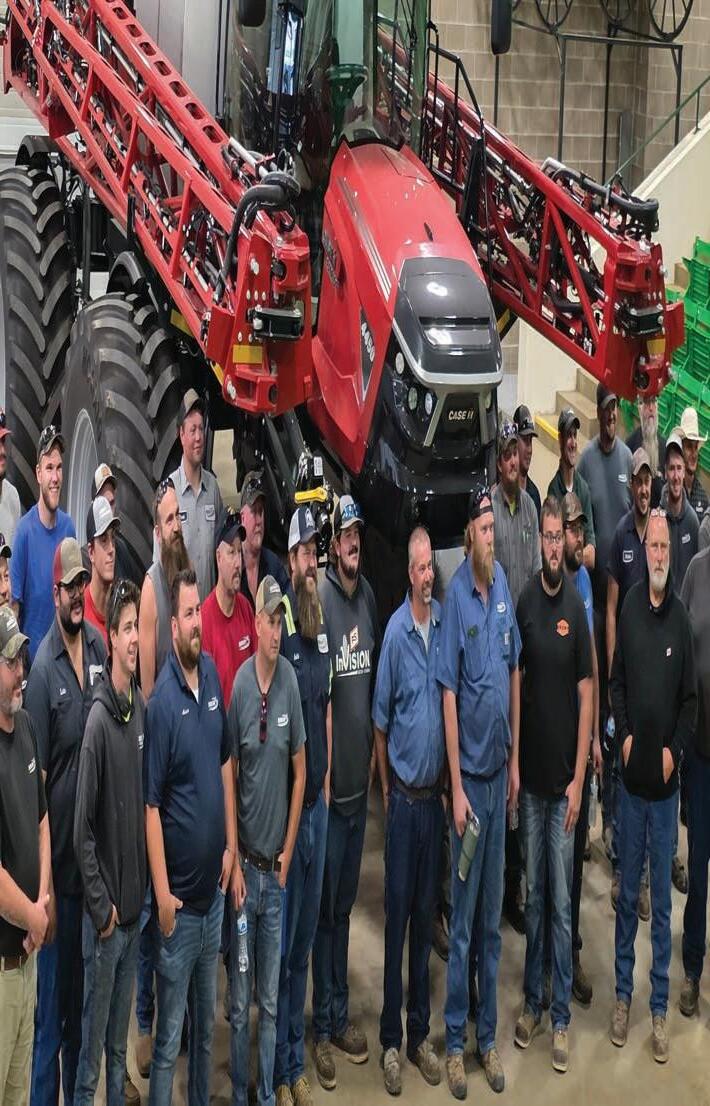
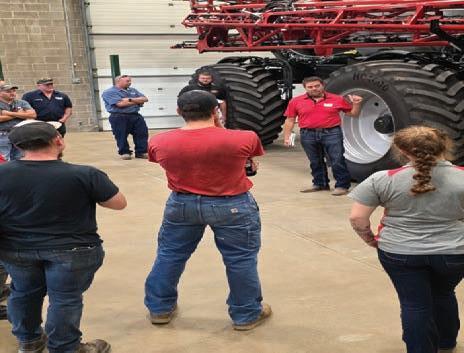
Participants of Insight FS operator training pose in front of a Case IH Patriot 4450 self-propelled sprayer at the Arlington Agricultural Research Station in Arlington, Wisconsin. The Patriot 4450 features a 1,600-gallon tank and 390-horsepower engine for high-performance application across large acreages. Kent Syth, territory sales manager for Titan Machinery, says the company offers a full line of farming, application and construction equipment.
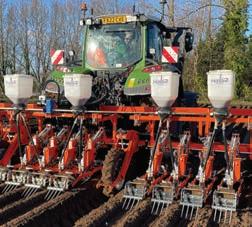
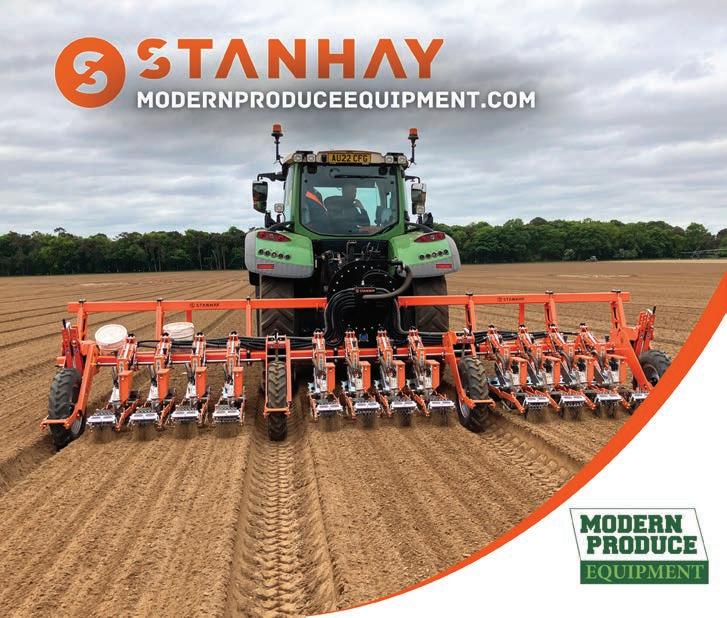
Modern Produce Equip. is now offering Stanhay seed drills in Great Lakes region
PROTECT YOUR BATTLEFIELD
Falcondor™ SC, formulated with spinosad, delivers broad-spectrum control of pests including thrips and leafminers. Falcondor SC offers fast-acting performance and is an ideal partner in resistance management programs. ATTICUSLLC.COM
WPVGA Board of Directors:
PresideNt: JohN Bustama Nt e
Vice PresideNt: WeNdy Dykstra
Secretary: Josh KNights
Treasurer: JohN HopFeNsperger
Directors: Mike BagiNski, Ra Ndy Fleishauer, Bria N Lee, J.D. Schroeder & JeFF SuchoN
Wisconsin Potato Industry Board:
PresideNt: Heidi Alsum-Ra Ndall
Vice PresideNt: ANdy Diercks
Secretary: Nicola Carey
Treasurer: Keith Wolter
Directors: Rod Gumz, Jim Okray, Eric Schroeder, Joe Seis & Tom Wild
WPVGA Associate Division Board of Directors:
PresideNt: Matt SeleNske
Vice PresideNt: Etha N OlsoN
Secretary: Melissa Heise
Treasurer: Paul Salm
Directors: Brady Patoka, Scott Scheer, Morga N Smolarek, Sally Suprise & Bra NdoN Taylor
Wisconsin Seed Potato Improvement
Association Board of Directors:
PresideNt: Charlie HusNick
Vice PresideNt: ANdy Schroeder
Secretary/Treasurer: Markus Sha Fel
Directors: Mitch Mattek & CloVer Spacek
Wisconsin Potato Growers
Auxiliary Board of Directors: PresideNt: Heidi Schleicher
Vice PresideNt: Dakotah Smiley
Secretary/Treasurer: Sama Nt ha Cypher
Directors: Jody BagiNski, Misti KiNNisoN, JeNN a SuchoN & EriN Meister
Mission Statement of the WPVGA: To advance the interests of WPVGA members through education, information, environmentally sound research, promotion, governmental action and involvement.
Mission Statement of the WPVGA Associate Division: To work in partnership with the WPVGA as product and service providers to promote mutual industry viability by providing technology and information resources.
Badger Common’Tater is published monthly at 700 Fifth Avenue, Antigo, Wisconsin 54409
WPVGA Staff
ExecutiVe Director: Tamas Houliha N Ma N agiNg Editor: Joe Kertzma N Director oF PromotioNs & CoNsumer
EducatioN: Da N a R ady
FiN a Ncial OFFicer: KareN RasmusseN E xecutiVe Assista Nt: Julie BrauN
Program Assista Nt: MadisoN HoFFma N -Taylor
WPVGA Office
(715) 623-7683 • FAX: (715) 623-3176
E-mail: wpvga@wisconsinpotatoes.com
WeB site: www.wisconsinpotatoes.com
LIKE US ON FACEBOOK: www.facebook.com/WPVGA
Subscription rates: $3.50/copy, $28/year; $45/2 years. Foreign subscription rates: $35/year; $55/2 years. Telephone: (715) 623-7683
ADVERTISING: To advertise your service or product in this magazine, call (715) 630-6213, or email: Joe Kertzman: jkertzman@wisconsinpotatoes.com. The editor welcomes manuscripts and pictures but accepts no responsibility for such material while in our hands.
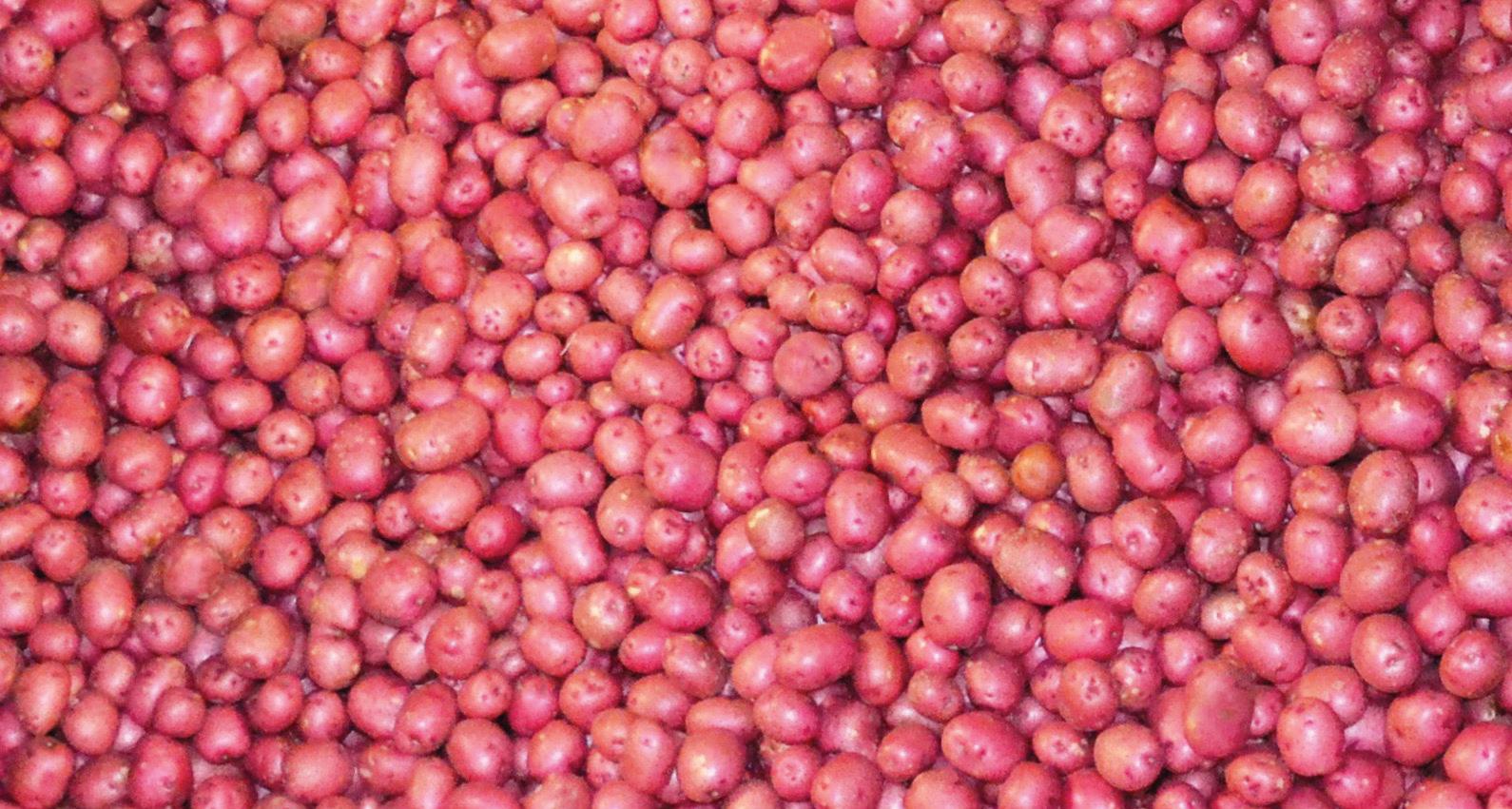
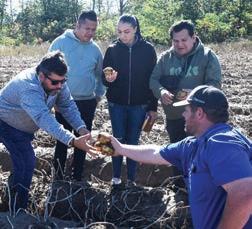
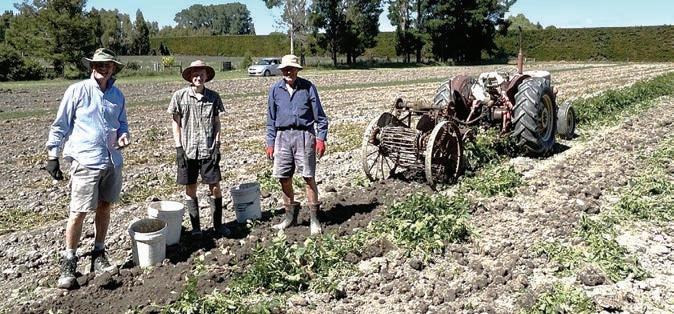
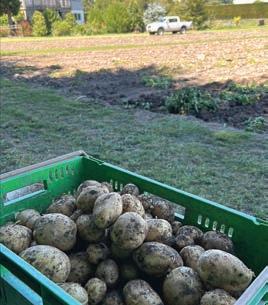
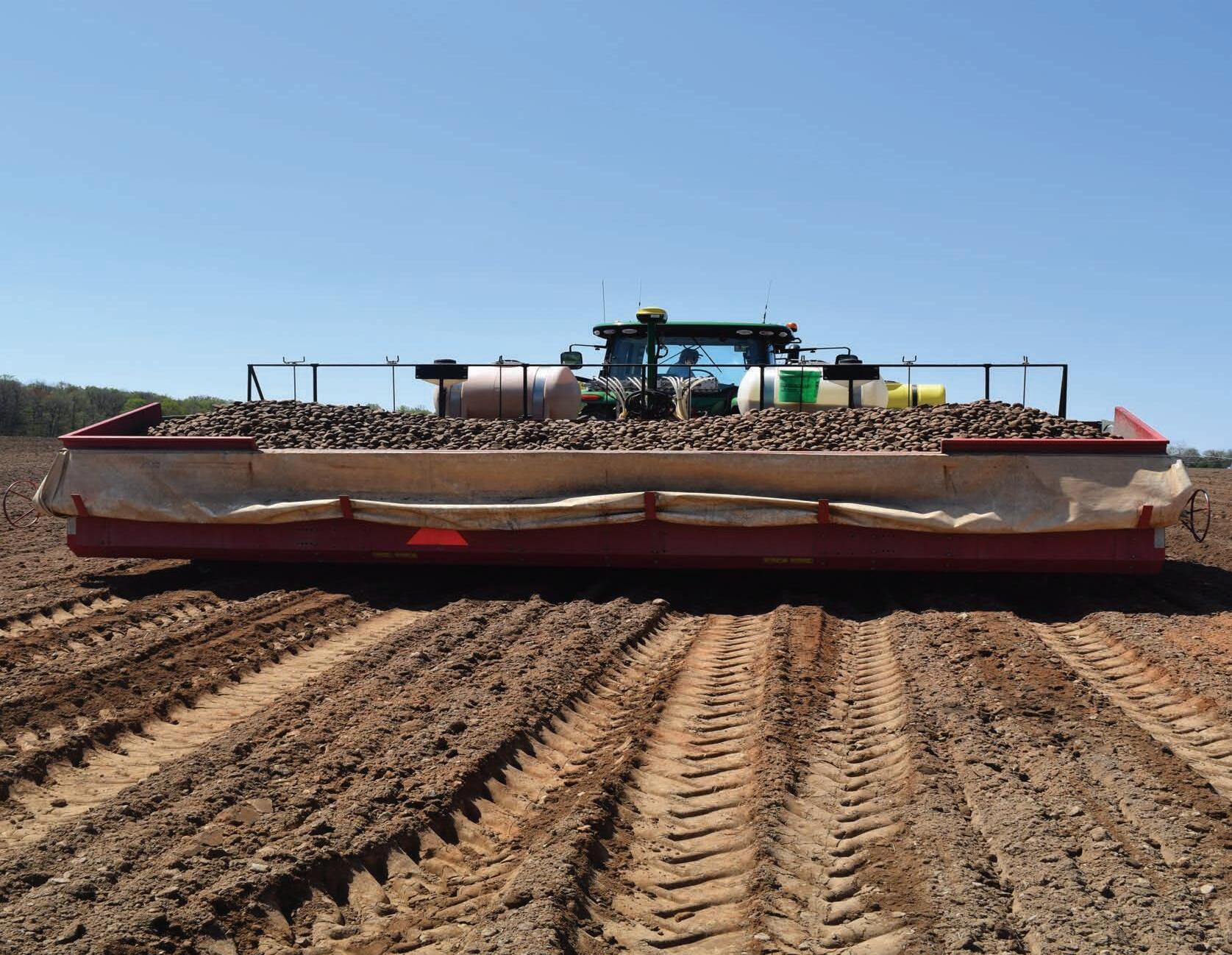
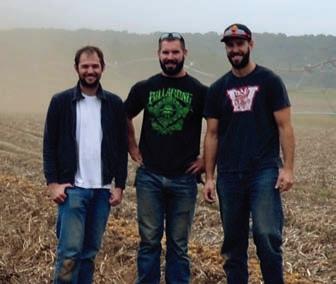
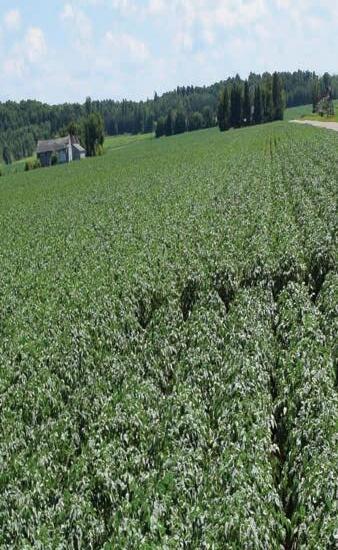
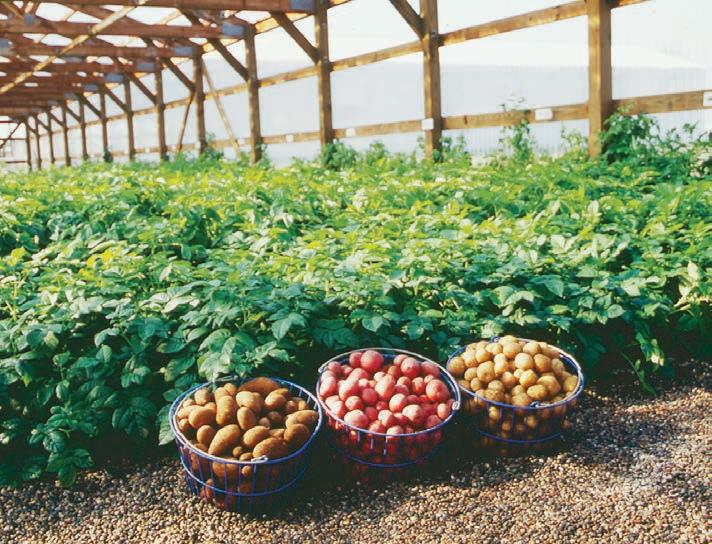
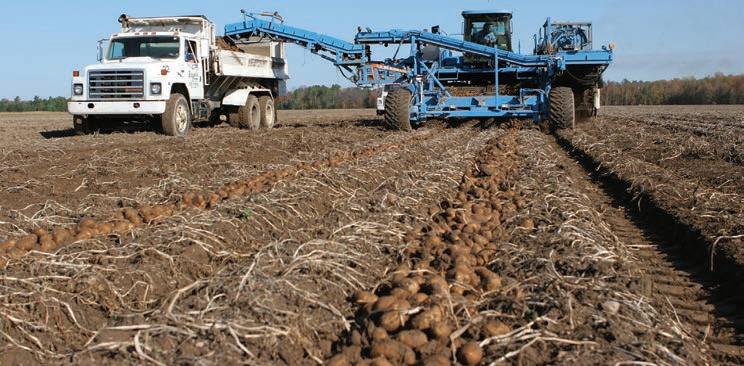
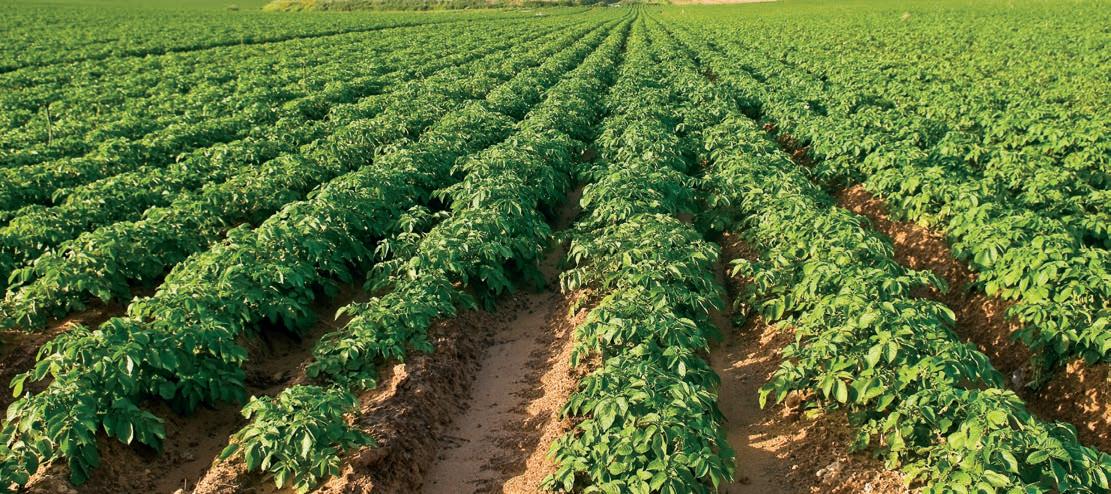
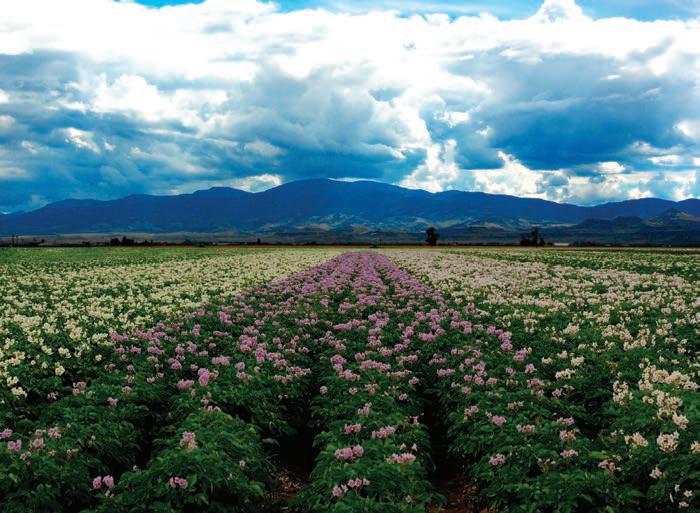
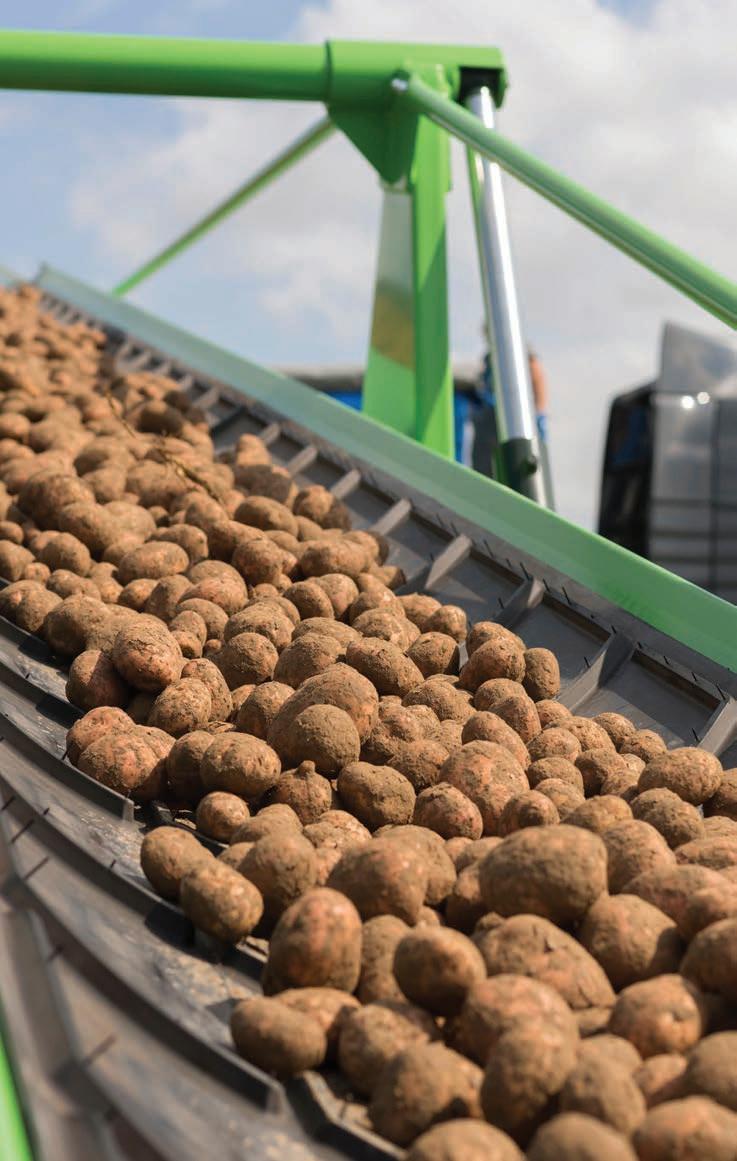
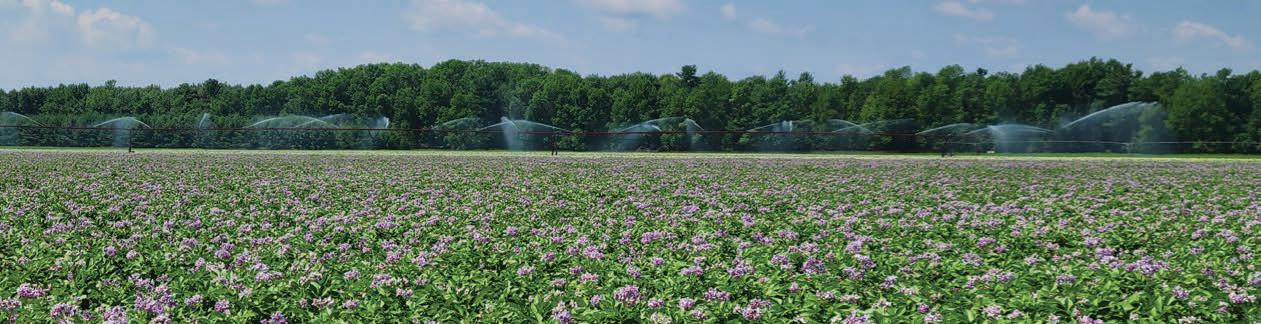
I received more than just confirmation from Mike Coker, senior marketing specialist for Wyma Solutions, that the company wanted to run its ad in the upcoming 2026 Buyer’s Guide. He also emailed me the two images above and right, saying, “Here are some potato farming pictures from my family farm today. They show how small growers in Canterbury, New Zealand, are doing it, including the 1880s harvesting equipment modified by my great-uncle. The picture shows three generations of Coker’s—my father, brother and my son.” Thank you for sharing, Mike.
The strategic partnership between Volm Companies, headquartered in Antigo, Wisconsin, and Wyma Solutions, manufacturer of postharvest vegetable and fruit handling equipment, was evident at the 2026 Potato Expo, January 6-8, in Dallas. Forming a partnership in 2017, Volm and Wyma shared booth space at Potato Expo, offering not only produce packaging equipment and materials, but also post-harvest equipment and handling solutions to meet the evolving needs of growers and packers.
More than 30 countries were represented at the 18th Annual Potato Expo, the largest conference and trade show for the potato industry in North America, where 2,100 attendees visited the booths of 196 exhibitors. Organized by the National Potato Council, Potato Expo 2026 was one of the top three largest such events in the show’s history. See the complete feature article covering the show and the 20-plus images inside this issue.
Wisconsin potato growers overcame the challenge of a hot harvest season with good yields and quality in 2025. Wisconsin Potato & Vegetable Growers Association Executive Director Tamas Houlihan and Director of Promotions & Consumer Education Dana Rady team up on a full crop report herein that includes acreage and yield, and potato crop usage broken down by area in the state, potato varieties, and market segments.
Please email me with your thoughts and questions. If you wish to be notified when our free online magazine is available monthly, here is the subscriber link: http://wisconsinpotatoes.com/blog-news/ subscribe.
Joe Kertzman Managing Editor
N1435 Cty Rd D Antigo, WI (715) 623-2689 farm@sbfi.biz johnt@sbfi.biz
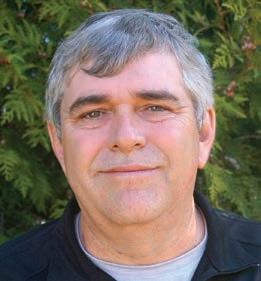
NAME: Kent Syth
TITLE: Territory sales manager
COMPANY: Titan Machinery
LOCATION: DeForest, WI
HOMETOWN: Greenwood, WI
YEARS IN PRESENT POSITION: Twenty-eight
PREVIOUS EMPLOYMENT: Pavelski Enterprises, Wilbur-Ellis, Heartland Farms, Ag-Chem Equipment, AG Systems, Heartland Ag, and Titan Machinery
SCHOOLING: Bachelor of Science, University of Wisconsin (UW)-River Falls, and Master of Business Administration, UW-Oshkosh
ACTIVITIES/ORGANIZATIONS: Wisconsin Agri-Business Association (WABA) past president
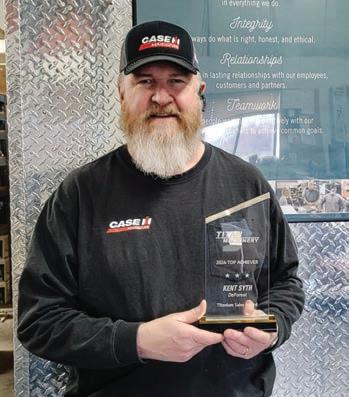
AWARDS/HONORS: WABA Outstanding Service to the Industry, and 2024 Titan Machinery Top Achiever Sales AwardApplication Division
Above: Territory Sales Manager
Kent Syth won the 2024 Titan Machinery “Top Achiever Titanium Sales Award” for his dedication to customers, passion for the industry, and consistent sales results.
Interview KENT SYTH,
Territory Sales Manager, Titan Machinery
By Joe Kertzman, managing editor, Badger Common’Tater
Founded in 1980, Titan Machinery owns and operates a network of over 100 full-service agriculture and construction equipment dealerships across the United States, Europe, and Australia.
The dealer network includes U.S. locations in North and South Dakota, Iowa, Minnesota, Nebraska, Wyoming, Idaho, Wisconsin, Kansas, and Colorado, with overseas operations in Romania, Bulgaria, Ukraine, and Australia.
Each of the locations represents one or more of the CNH Industrial brands such as Case IH, New Holland Agriculture, CASE Construction, New Holland Construction, and CNH Capital.
The company offers a full line of farming, application and construction equipment, as well as parts and service support to keep it running. Titan Machinery also partners with specialty equipment and technology companies to help provide comprehensive farm-level agriculture solutions.
Having been in agriculture for his entire career, Kent Syth, territory sales manager for Titan Machinery in DeForest, Wisconsin, is a familiar
name and face in the Wisconsin potato and vegetable industry and has serviced many agriculture customers in the state and beyond.
Kent, what is your own agriculture background, and how did you end up as the territory sales manager for Titan Machinery out of DeForest? I grew up on a 25-cow dairy farm west of Marshfield. After attending UW-River Falls, I began my career working with application equipment and supporting growers in Wisconsin.
In 1997, I joined the DeForest-based application business, where I have continued in a similar role ever since, supporting Case IH application equipment and systems.
While the organization evolved and ultimately became part of Titan Machinery, the focus on local support, customer-first relationships, and doing the job right never changed.
As application technology advanced, my knowledge and expertise evolved
as well, which has kept me in this role supporting growers for nearly three decades.
Have you always had a passion for agriculture, and what has your progression been in your career? Working on the farm taught me early what hard work really means, and that’s where my passion for agriculture comes from.
I explored other industries but found none with the breadth and opportunity that production agriculture offers. It’s an exciting, ever-changing industry, and my progression has come from working alongside growers as equipment, technology, and application demands
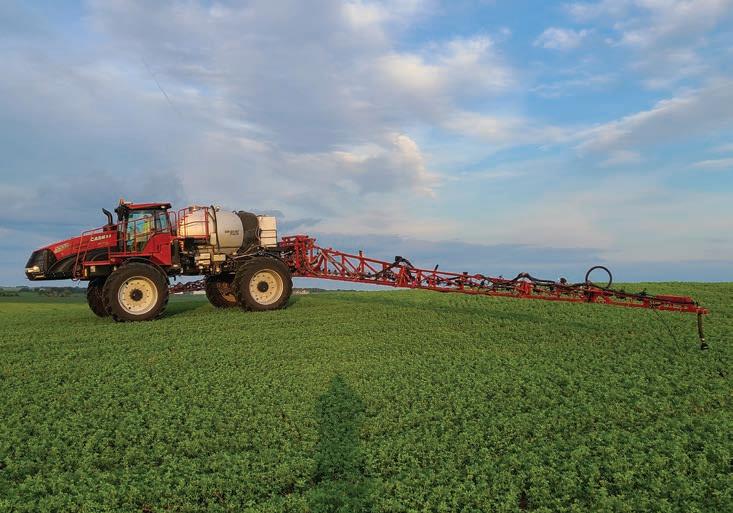
Left: For the Wisconsin market, Titan Machinery specializes in all things “application-related”—sprayers, applicators, floaters, spreaders, and associated products and parts like tanks, valves, pumps, and tips. The Case IH Patriot 4450 self-propelled sprayer features a 1,600-gallon tank and a 390-horsepower engine for high-performance application across large acreages.
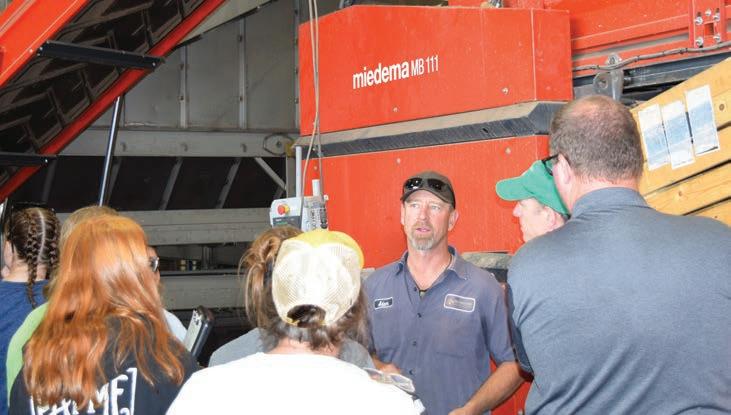
Right: During an Insight FS operator training seminar at the University of Wisconsin (UW) Arlington Agricultural Research Station, in the Public Events Facility, Brent Bast, CNH Global Crop Protection Product & Portfolio Manager, highlights new innovations in Case IH sprayer and fertilizer application technologies.
continue to evolve.
Titan Machinery was founded in 1980. Tell me about the history of the company and why you take pride in working there. After it was founded in 1980, Titan Machinery grew by expanding its dealership footprint across the Midwest. Over time, the company expanded by focusing on parts availability, equipment solutions, and service capability at the store level.
Many of the Titan team members come from farming backgrounds
themselves, so they understand the realities of the field and the importance of strengthening local communities.
As customer needs evolved, Titan continued to add specialized support, including application-focused expertise through the addition of Heartland Ag Systems, now Titan Application.
I take pride in working for a company that invests in its people and longterm customer relationships.
continued on pg. 10
I believe you work mostly with Case IH applicators for crop protection products but expand on what you provide for potato and vegetable growers. For the Wisconsin market, we specialize in all things “application-related”—sprayers, applicators, floaters, spreaders, and associated products and parts like tanks, valves, pumps, and tips.
We also have access to a wide range of used agricultural and construction equipment through our large network of Titan Machinery locations throughout the Midwest.
A big part of my role is supporting application equipment and systems. Potato and vegetable growers work within tight application windows, so accuracy and consistency are critical.
Through Titan Application, we help with equipment selection, setup, rate control, and system support so growers can apply confidently and
stay on schedule.
Do you also deal in New Holland and CASE Equipment, and what machines are useful to potato and vegetable growers? Yes, our location in DeForest deals exclusively with Case IH, RBR Enterprise, and Salford application equipment.
Other Titan locations across the Midwest carry a broader range of Case IH, New Holland, and Case Construction products, though those lines are not supported directly through our DeForest location.
For potato and vegetable growers, this often includes tractors, loaders, and other equipment that supports planting, spraying, hauling, and daily farm operations.
Why do you feel Titan Machinery and Titan Application offer proven equipment and solutions? We work with equipment that growers know
Above: After it was founded in 1980, Titan Machinery grew by expanding its dealership footprint across the Midwest. As customer needs evolved, Titan continued to add specialized support, including applicationfocused expertise through the addition of Heartland Ag Systems, now Titan Application.
and trust, but the real strength is the local support behind it.
At our Wisconsin location, the team has decades of combined experience working with potato growers and commercial applicators. We know the crops, the timing, and the conditions because we have been here and grown alongside our customers.
Titan Application adds another layer of application-focused knowledge to that local foundation, helping growers set up systems that fit their operation and perform consistently throughout the season. Nobody knows application better than the
The Case IH Trident 5550 is a high-clearance row crop liquid/dry combination applicator delivering 42-minute changeover times to help growers cover more acres.
team we have here in DeForest.
Do you work with many potato and vegetable growers in Central and Northcentral Wisconsin? Yes, I work with a number of potato and vegetable growers across Central and Northcentral Wisconsin. These operations are highly specialized, and many of our conversations revolve around timing, application windows, and keeping systems matched to their acres and crop mix.
Because we work in this area every season, we understand the pace and expectations that come with potato and vegetable production.
Where in the area are Titan Machinery dealerships located, and do they all offer parts and service? Titan has locations in DeForest and La Crosse, along with many more dealerships across the Midwest.
Potato and vegetable growers
“In covering the southern half of Wisconsin, I have never seen a group of growers more willing to try new things. If something doesn’t work, they move on and keep improving.”
– Kent Syth
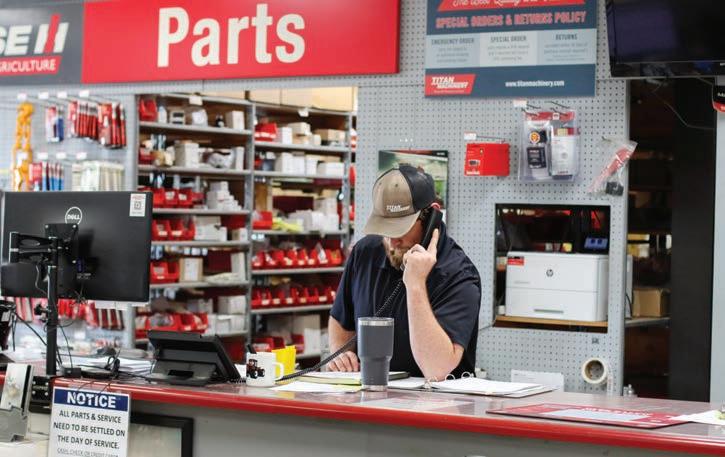
value parts availability and skilled service support, which is why our stores invest in well-stocked parts departments, trained technicians, and the tools needed to support application equipment.
Our teams receive ongoing training on both equipment and application systems, so when growers need us, they are working with people who understand their machines and the demands of the season.
These local teams are backed by the
broader Titan network, which adds depth in inventory, training, and technical support.
Walk me through a typical sales call with a potato grower and how support works after delivery. Most of my work with potato growers is built on long-term relationships. I get to know their acres, rotations, and spray schedules, which helps me understand how application fits into the bigger picture of their operation.
continued on pg. 12
Teaming with growers to make more money and take less risk
At Progressive Ag, we understand your concerns. We are Risk Management Specialists focusing on potato and vegetable crops. Being prepared means not only avoiding and/or minimizing negative events, but also being able to take advantage of profit opportunities. You see, at Progressive Ag we make it our business to know your farm operation. We are committed to help you
“Make more money and take less risk” To find out more, talk with one of our agents or call 1-800-450-1404 • www.progressiveag.com “This institution is an equal opportunity provider and employer.”
Penney Hammer
Ray Grabanski
Many conversations focus on planning ahead and anticipating needs as the season approaches. When equipment is delivered, I am involved in the setup and training, so the grower and operators are comfortable before things get busy. After that, support stays local through our parts, service, and application teams who continue working closely with the grower throughout the season.
Company-wide, how many locations does Titan Machinery have and how many people does it employ? Titan Machinery operates more than 90 dealerships across the United States and has international locations.
The company supports agriculture and construction customers with several thousand employees. That scale allows Titan to invest in training, service and parts availability, and technical support, while customers continue working directly with their trusted local store teams.
Was Heartland Ag Systems brought under the Titan Machinery umbrella, and how has that helped customers? Yes, Heartland Ag Systems became
long been known for its hands-on experience with application systems and support equipment.
Bringing that team into Titan strengthened our ability to help growers build application setups that truly fit their operations.
For customers, it means working with people who understand liquid and dry systems, product flow, and field logistics, and who stay involved
Do you enjoy working with potato and vegetable growers? Absolutely. Potato and vegetable growers run some of the most disciplined operations we work with. Their days
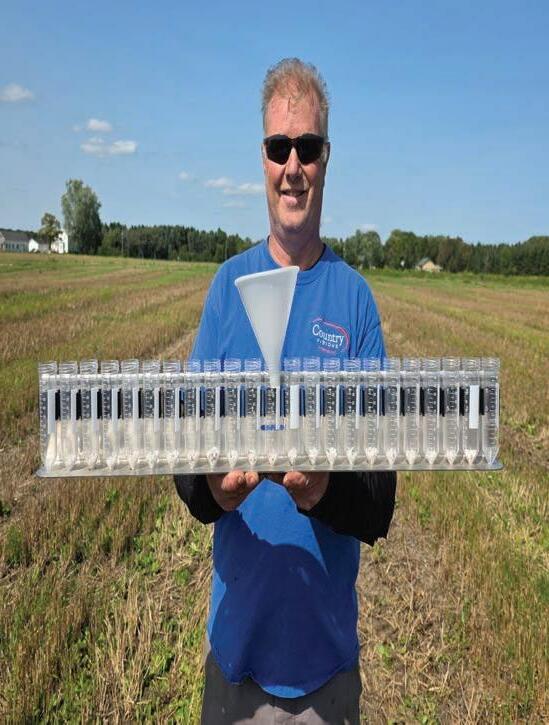
Above: Troy Neumeyer, equipment operator at Country Visions Coop, Rockwood, Wisconsin, holds a fertilizer spread-pattern calibration unit showing the even application of dry fertilizer this past October.
With potato and vegetable growers valuing parts availability and skilled service support, Titan Machinery stores invest in well-stocked parts departments, trained technicians, and the tools needed to support application equipment.
and they expect equipment and support to match that pace.
What I enjoy most is helping them dial in a system that fits their operation and then seeing it work smoothly when things get busy.
So how do you help growers become more efficient and save time or money? For potato growers, efficiency often comes down to timing and flow. We look at how application fits into their day, from refill time to product changes to field transitions.
That can mean adjusting plumbing layouts, improving tender setups, or dialing in rate control so operators spend less time making adjustments and more time covering acres.
These improvements add up by saving time during tight spray windows and helping inputs go where they are intended.
Do you also support construction equipment for potato and vegetable growers? Yes. The Titan Machinery dealership network supports CASE and New Holland construction equipment in many of the markets we serve.
In Wisconsin, we have a sister Titan Machinery location in La Crosse that is primarily a Case Construction dealer, allowing us to sell new Case
Construction equipment in the surrounding area.
For much of Wisconsin, we also provide used construction equipment such as wheel loaders and skid steers/compact track loaders sourced through the broader Titan network.
What specialty equipment and technology companies do you partner with? On the application side, we work closely with companies such as Case IH, Salford, RBR, New Leader, and Heartland Ag Systems.
Titan Application helps bring these
systems together, so they function as a complete solution.
Talk about sustainability and how you help growers be more sustainable? Much of sustainability comes from precision. Applying the right rate in the right place helps reduce excess input use while maintaining yield.
Application technology helps growers make better decisions in the field. I have seen potato growers adjust rates and timing as crop growth
varies across a field, often reducing product use while still protecting yield and improving overall sustainability throughout the season.
Why do you feel good about your role in helping growers at the farm level? I like being involved beyond
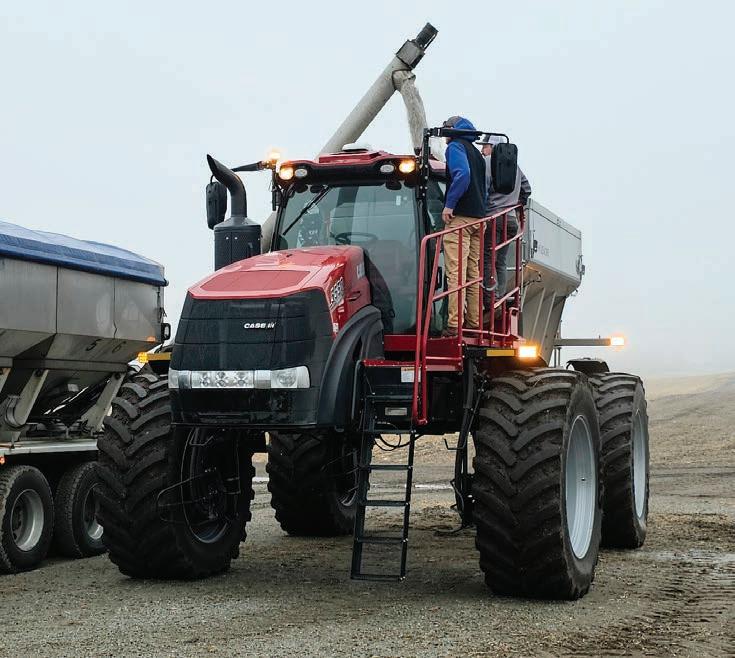
Above: A crew from United Coop of Beaver Dam, Wisconsin, operates a Case IH Trident with a New Leader NL720 fertilizer spreader at DHN Farms, in Markesan, spreading dry granular fertilizer at a 120-foot effective spread width.
the sale. Helping with setup, training, and fine-tuning gives growers confidence in their equipment. Seeing systems perform well throughout the season is rewarding. I may not have known all the answers throughout my career, but through real conversations, ideas shared back and forth have often turned into solutions.
Having worked in the Central Sands for nearly 15 years, I was fortunate to form real friendships.
In covering the southern half of Wisconsin, I have never seen a group of growers more willing to try new things. If something doesn’t work, they move on and keep improving. That mindset drives progress across the grower base.
What new technologies are helping growers today? One example is Case IH SenseApply. It uses a single camera to adjust application rates in real time. It is easy to use, has no annual subscription or per-acre fees, and helps growers respond to changing field conditions while they work.
I have seen growers use it to make simple in-field adjustments such as crop color and density change, improving consistency without adding complexity for the operator. What do you see coming next for Titan Machinery and new technologies or services? Titan will continue working closely with OEM/ manufacturing partners to bring realworld application challenges from the field back into equipment and technology development.
Feedback from growers and applicators helps shape practical improvements that matter day to day.
As operations continue to move faster and become more complex, Titan will evolve by strengthening application expertise, improving support, and anticipating solutions that help growers stay efficient and on schedule.
Contact: Jim or John
United Coop of Beaver Dam operates a Case IH Trident with New Leader NL720 to apply dry granular fertilizer at Harlan Cupery Farms, Randolph, Wisconsin, in December.
SNOWDEN • ATLANTIC • LAMOKA MANISTEE • LADY LIBERTY MACKINAW • PETOSKEY • BLISS
Even Potato Expo Is Bigger in Texas
More than 30 countries were represented at the 18th Annual Potato Expo in Dallas
By Joe Kertzman, managing editor, Badger Common’Tater
As the largest conference and trade show for the potato industry in North America, Potato Expo 2026,
January 6-8 at the Gaylord Texan, in Dallas, brought together growers, manufacturers, suppliers, value
chain partners, and industry leaders from the United States and 30 other countries.
More than 2,100 attendees visited the booths of 196 exhibitors, placing Potato Expo 2026, organized by the National Potato Council, in the top three largest such events in the show’s history.
Many potato associations and organizations support the show and take advantage of the business opportunities it presents, with Potatoes USA holding its Winter Meeting for three days leading
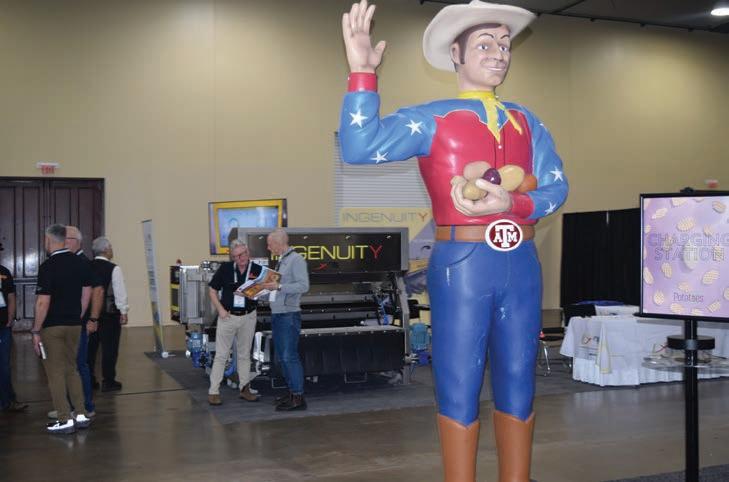
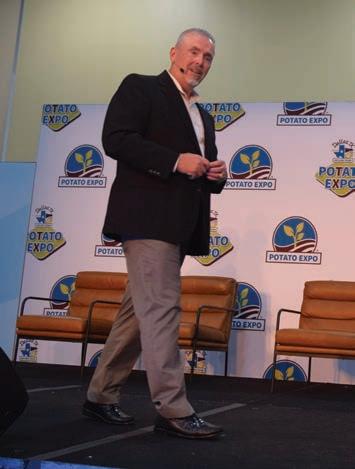
Above & Left: With more than 2,100 attendees and 196 exhibitors, Potato Expo 2026 in Dallas was proof positive that everything really is bigger in Texas, including the oversize cowboy at the Potatoes USA booth.
up to Potato Expo, this year in the Gaylord Texan.
Affiliated organizational gatherings include the United Potato Growers of Canada Board meeting, Potato Sustainability Alliance General Meeting and Reception, United Potato Growers of America Board Meeting, the National Potato Council Past Presidents and Executive Committee Dinner, the Annual Meeting of the Potato Leadership, Education, and Advancement Foundation (Potato LEAF), and more.
The Wisconsin Potato & Vegetable Growers Association (WPVGA) teams up with the University of Wisconsin Division of Extension and the Wisconsin Seed Potato Improvement Association to host a Wisconsin Certified Seed Potatoes booth at Potato Expo.
Providing full Potatoes USA reports during the Winter Meeting were the Consumer; Retail; Market
Development; Culinary; Finance & Policy; Production Research; Foodservice; Communications; and Nutrition & Health committees; as well as the Seed Task Force.
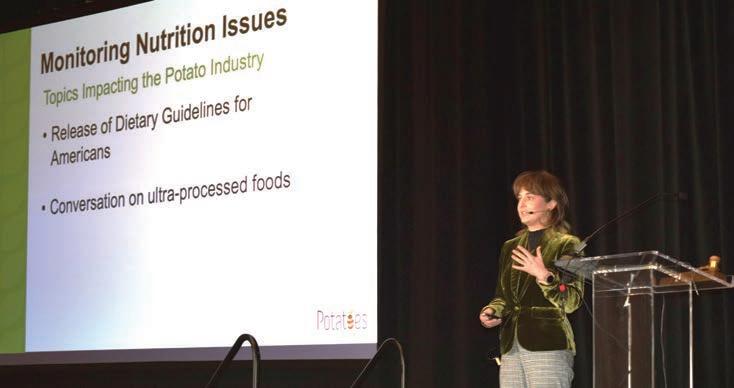
The Potatoes USA Nutrition & Health Committee anticipated the release of the Dietary Guidelines for Americans (2026-2030) the day after the Winter Meeting, January 7, with the
Above: Potatoes USA Director of Nutrition Riley Peterson gives a Nutrition and Health Committee Report at the organization’s Winter Meeting, Tuesday, January 6, prior to the start of the Potato Expo trade show, January 7.
guidelines providing science-based advice on meeting nutrient needs, promoting health and preventing disease.
continued on pg. 18
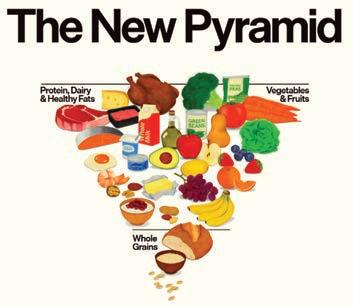
Fresh potatoes were included in the new guidelines, which prioritize protein and vegetables. At the top of the USDA’s new food pyramid are protein, dairy, healthy fats, vegetables and fruits.
MONITORING MEDIA COVERAGE
The outlook for processed potatoes in the new Dietary Guidelines is less clear, but Potatoes USA is monitoring media coverage and responding to misinformation, stressing that potatoes are a nutrient-rich vegetable.
Aiding in scientific messaging is the Alliance for Potato Research
and Education (APRE), which is dedicated to advancing the scientific understanding of potatoes’ role in promoting health. APRE conducts research on potatoes that generally fuels positive media coverage.
APRE supports research in areas such as cardiometabolic health, healthy dietary patterns, and healthy lifestyles, and focuses on the nutritional value of potatoes. The alliance aims to debunk negative stereotypes about potatoes and promote their inclusion in a healthy diet.
Positive messaging from Potatoes
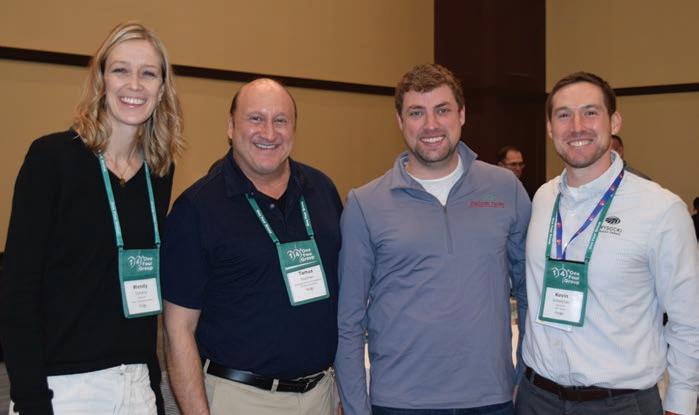
Left: WPVGA Executive Director Tamas Houlihan (second from left) poses with three of Wisconsin’s Potatoes USA Board members, from left to right, Wendy Dykstra, Charlie Husnick, and Kevin Schleicher. RIght: Lyla Hathaway (center) of the Colorado Certified Potato Growers Association, and WPVGA Director of Promotions & Consumer Education Dana Rady (right) scanned barcodes at the door of the Potato Business Summit for which Victoria Stamper (left), general manager of the United Potato Growers of Canada, acted as master of ceremonies.
USA and APRE is working, with one example being that potatoes are now the primary energy source among athletic men.
The Potatoes USA Culinary Committee reported on recent Chef Lab collaborations, Campus Foodservice Takeover events at universities, Teaching Kitchen symposiums, and an International Chef Reverse Trade Mission held in 2025.
International trade is a topical subject, with China and India establishing themselves as big players in the potato processing markets, and India being a volume producer of potatoes destined for processing.
Cedric Porter, Editor of World Potato Market, gave a Global Market Review
Even Potato Expo Is Bigger in Texas. . .
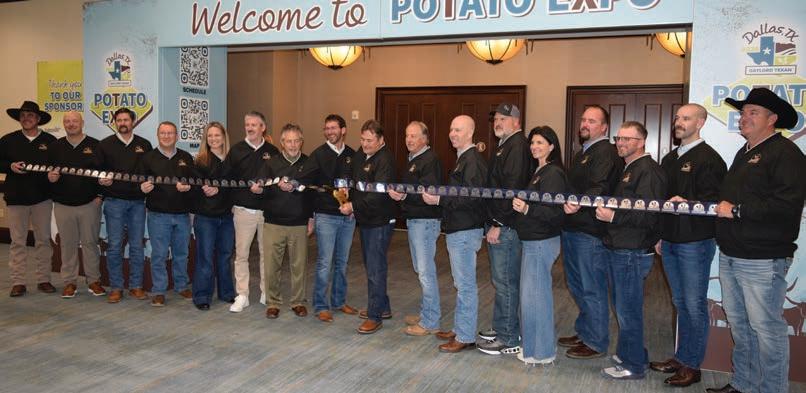
Potato Expo Steering Committee members cut the ribbon to open the 18th Annual Potato Expo in Dallas.
during the Winter Meeting, noting that U.S. tariffs are having a negative effect on international potato trade and that overall potato production is historically high, though down slightly for the United States and Canada in 2025.
Potatoes USA Chief Executive Officer
Blair Richardson said, “Right now we’re in a critical place, not just for potatoes, but all of agriculture. There are so many outside disruptions that we really need to get our head out of today and look to where we need to be in the future.”
NEW COMPETITORS
“We have new competitors in the global potato industry, shifting alliances, general uncertainty and unpredictable governments. There is a global race for new and improved potato varieties. We are not leading in this area,” Richardson emphasized. “We need to defend the U.S. marketplace and expand our culinary
“We need to defend the U.S. marketplace and expand our culinary influence, enhance digital media projects, and energize the retail and foodservice sectors. We need better potato varieties faster.”
– Blair Richardson, Potatoes USA CEO
influence, enhance digital media projects, and energize the retail and foodservice sectors. We need better potato varieties faster,” he continued.
Richardson unveiled a bold new Potatoes USA vision, “From Seed to Table, a New Path to Potato Innovation,” with the organization approving a feasibility study in 2026 to gauge its viability.
The Potato Business Summit, a joint effort between the United Potato Growers of America (UPGA), United Potato Growers of Canada, and Potato Marketing Association of North America (PMANA), takes place annually the morning before the opening of Potato Expo and in the same venue.
Even Potato Expo Is Bigger in Texas. . . continued from pg. 19
Lucas Wysocki, chairman of the UPGA, welcomed a packed hall for the Summit where representatives from 20 U.S. states, seven Canadian provinces and several European countries gathered.
The Potato Business Summit agenda included an Economic Outlook from Stephen Nicholson of Rabobank, a European Market Update by Porter, a Consumer Market Overview from Kim Breshears of Potatoes USA, a Frozen Market Update by Daniel Metheringham of McCain Foods, “Potato Storage Solutions” from Steve Elfering of 1,4GROUP and NAPSO, and a Fresh Potato Market
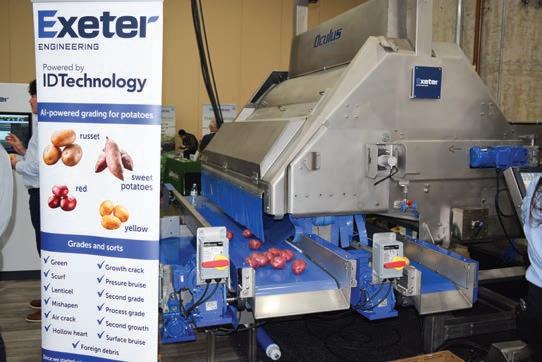
Above Left: Exeter Engineering displayed an Oculus Sorter at Potato Expo, a three-drop sorter with a unique roller design that yields superior sorting and grading results.
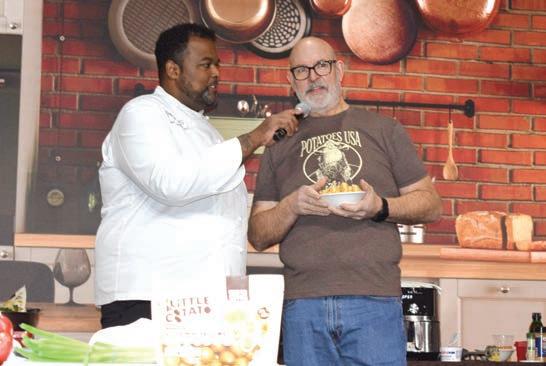
Above RIght: Potatoes USA Culinary Director Chef R.J. Harvey (left) interviews Mike Carter of Bushmans’ Inc., Rosholt, Wisconsin, during the “Snack Wars: Little Minis Edition” cooking competition on Wednesday, January 7, at Potato Expo. Sponsored by The Little Potato Company, 2024 and 2025 “Top Spuds” Mike Carter and Shelley Olsen of LJ Olsen Inc., Othello, Washington, defended their title against two other teams. The first was composed of Dean Gibson, Magic Valley Produce, and T.J. Hall, Hall’s G4, and the second team included Natalie Nesburg, Potato Sustainability Alliance, and Michael Rainis of Friehe Farms. At the end of a thrilling competition, Gibson and Hall emerged victorious.
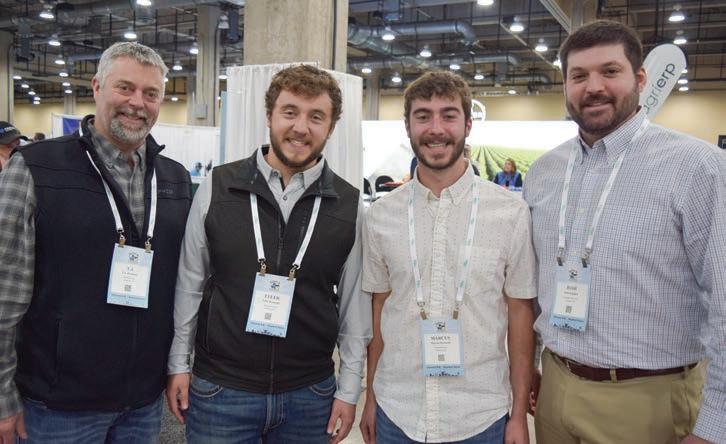
From left to right, T.J. Kennedy and his sons, Tyler and Marcus, and WPVGA Board member Josh Knights represented Heartland Farms of Hancock, Wisconsin, at Potato Expo.
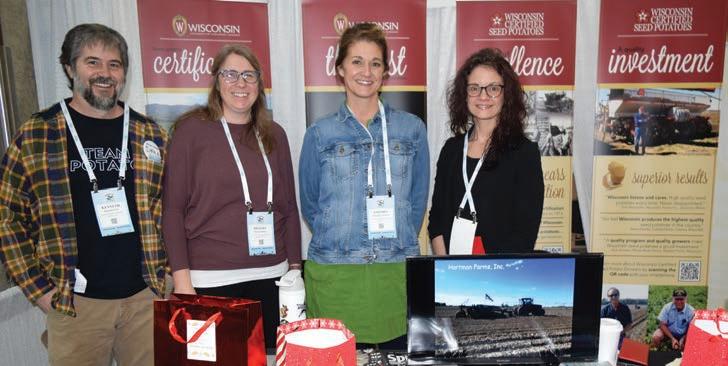
From left to right, Oregon State University Plant Pathologist Kenneth Frost; Wisconsin Seed Potato Certification Program (WSPCP) Associate Research Program Director Brooke Babler; UW-Madison Department of Plant Pathology Professor and Extension Specialist Amanda Gevens; and WPVGA Director of Promotions & Consumer Education Dana Rady pose in front of the “Wisconsin Certified Seed Potatoes” booth at Potato Expo.
Outlook given by Mark Klompien, UPGA.
The trade show officially opened at 11 a.m. on Wednesday, and one hour later the “Snack Wars: Little Minis Edition” cooking competition commenced on the Expo Stage, hosted by Potatoes USA Culinary Director Chef R.J. Harvey and Executive Sous Chef Aurora Hollenbeck.
Sponsored by The Little Potato Company, the 2024 and 2025 “Top Spuds” Mike Carter of Bushmans’ Inc., in Rosholt, Wisconsin, and continued on pg. 22
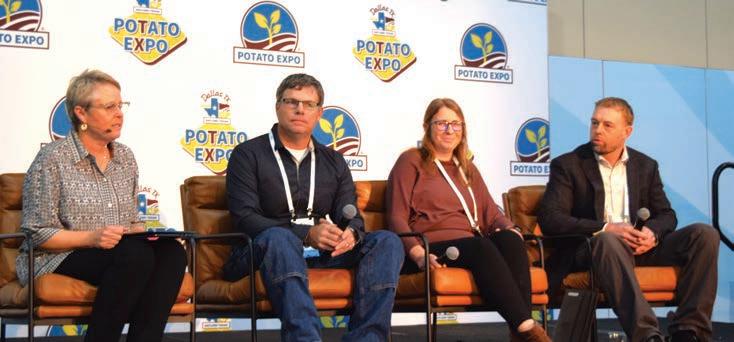
Above Left: Leading a panel discussion on “Potato Certification: Advancing Direct Tuber Testing” on Wednesday of Potato Expo are, from left to right, moderator Nina Zidack, Ph.D. and former director of Montana Seed Potato Certification; Andrew Houser, Ph.D., manager of the Colorado Potato Certification Service; Brooke Babler, associate research program director for the Wisconsin Seed Potato Certification Program; and Jason Kimm, Montana Potato Improvement Association Board member and owner/operator of Kimm Seed Potatoes.
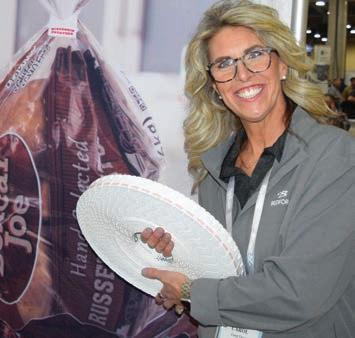
Above RIght: Carol Tweet of Bedford Industries shows off the CloseIt® “Wisconsin Potatoes” produce bag clips that the company makes for Warner & Warner Inc. and Okray Family Farms, of Plover, among others.
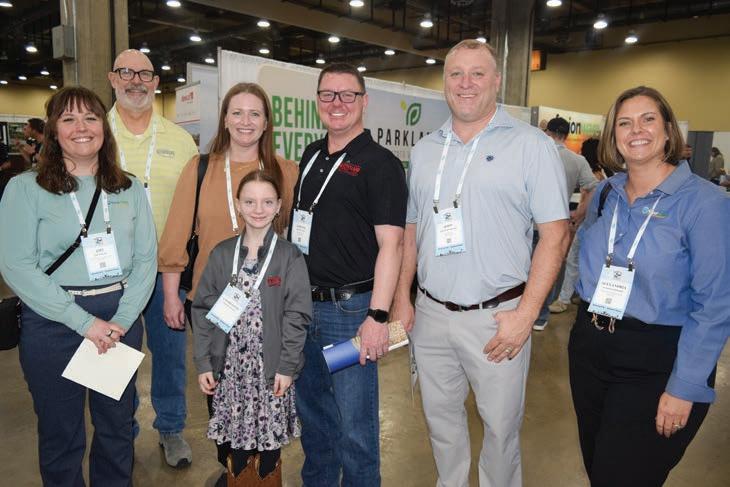
This good-looking group from Wisconsin attending Potato Expo includes, from left to right, Amy Wiernik of the Food + Farm Exploration Center; Mike Carter, Bushmans’ Inc.; Alicia, Charlotte and Jeremie Pavelski, Heartland Farms; John Hopfensperger, Bushmans’ Inc.; and Alexandria Behrend, Food + Farm Exploration Center.
Even Potato Expo Is Bigger in Texas.
Shelley Olsen of LJ Olsen Inc., Othello, Washington, defended their title against two other teams.
OPPOSING TEAMS
The first opposing team was composed of Dean Gibson of Magic Valley Produce, and T.J. Hall from Hall’s G4, and the second team included Natalie Nesburg, Potato Sustainability Alliance, and Michael Rainis of Friehe Farms. At the end of
a thrilling competition, Gibson and Hall emerged victorious.
Breakout sessions and Potato Talks touched on subjects such as international opportunities for the U.S. potato industry, management of invasive potato nematodes, using artificial intelligence (AI) for potato production, understanding disruptive weather patterns, mental health, and tracking potato canopy metrics.
Left: U.S. Marine Corps Col. (Ret.) Rob Abbott presents “Mental Health—Lessons from the Gettysburg Battlefield” on the Cultivation Stage at Potato Expo. For the past couple of years, the Potato Leadership, Education, and Advancement Foundation (Potato LEAF) has developed a new leadership program titled “Leadership in the Field: From Battlefield to Potato Field.”
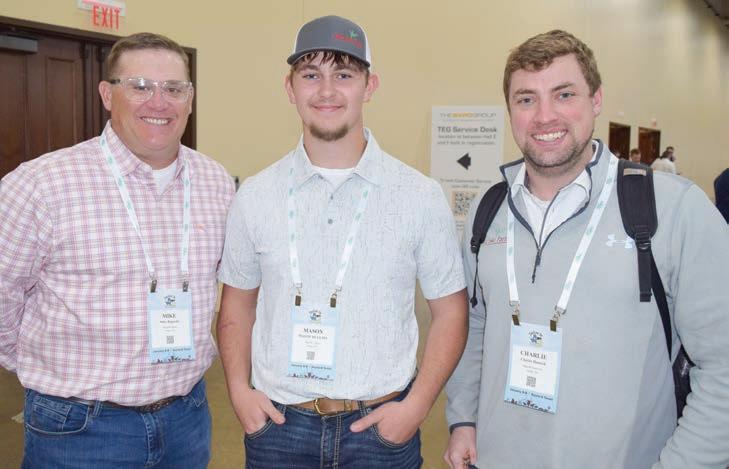
Right: Baginski Farms of Antigo, Wisconsin, was well represented at Potato Expo by, from left to right, Mike Baginski, Mason Mullins, and Charlie Husnick.
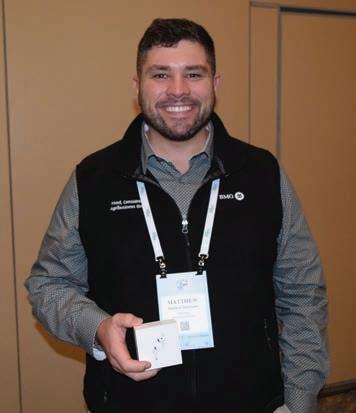
Apple AirPods were the door prize of choice when Matthew Hartmann of BMO Bank had his name drawn during the Wisconsin Seed Potato Improvement Association (WSPIA) & WPVGA Chip Committee Annual Reception, Wednesday evening of Potato Expo.
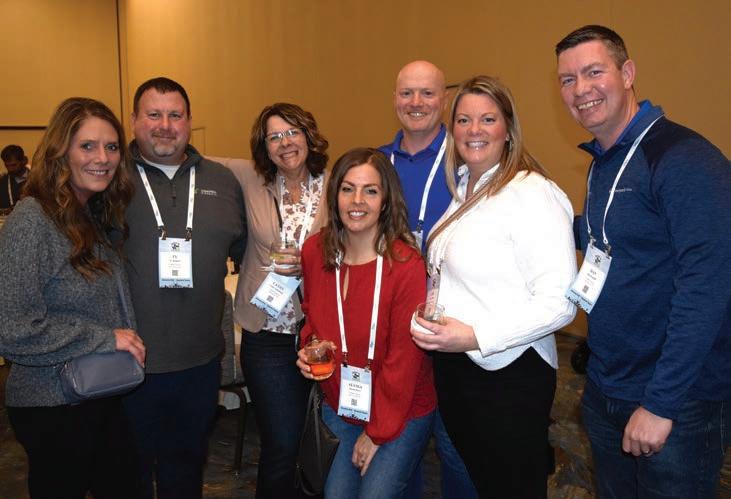
Enjoying the WSPIA & Chip Committee Annual Reception are, from left to right, Leigha and Ty Rohloff, Cathy Schommer, Alyssa Perry, John Huss, Ann Urbik, and Dan Kendall.
Direct tuber testing was discussed as a viable option for seed certification, as were topics such as succession planning, the U.S. ag labor policy, and the AIM Act and its impact on potato storage.
The 2026 Potato Expo included numerous social events and
networking opportunities, including a welcome reception, beer garden, on-site potato-centric lunches, and a Potato LEAF Auction, which raised more than $200,000 to support leadership development within the U.S. potato industry.
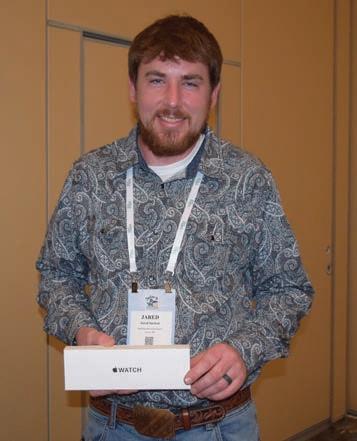
Left: Jared Suchon of Bushman Riverside Ranch won an Apple Watch in a door prize drawing during the Wisconsin Seed Potato Improvement Association (WSPIA) & WPVGA Chip Committee Annual Reception, Wednesday evening of Potato Expo.
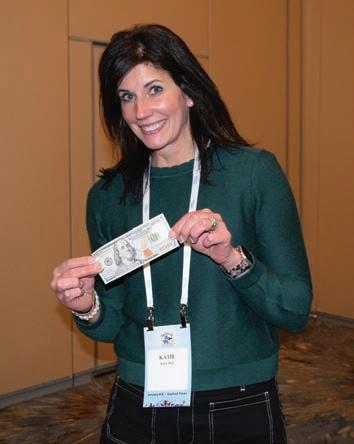
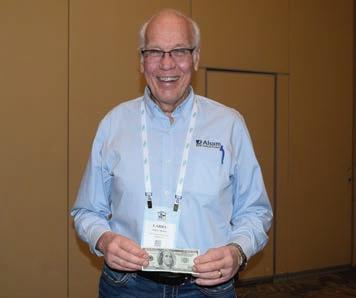
Middle and Right: Katie Hall of Hall’s G4 and Larry Alsum, Alsum Farms & Produce, each won a crisp $100 bill in door prize drawings during the WSPIA and WPVGA Chip Committee Annual Reception. Earlier in the day, T.J. Hall and Dean Gibson, Magic Valley Produce, won the “Snack Wars: Little Minis Edition” cooking competition. Hall’s G4 is a fourth-generation family farm in Hoople, North Dakota, with a long history of growing potatoes in the Red River Valley.
Even Potato Expo Is Bigger in Texas. . . continued from pg. 23
Above: Discussing “The Impact of BioControls and Bio-Stimulants in Potato Production” Thursday afternoon of Potato Expo are, from left to right, Chris Thrasher, vice president of product development and innovation at Meristem, Alex Cochran, chief technology officer for DPH Biologicals, and Jeff Sommers, general manager of Wysocki Farms.
Other social events included a KickOff Reception, “Mash-ter Minds Team Trivia,” and an “It’s a Wrap-Up Party” following the closing of Potato Expo on Thursday evening and featuring dueling pianos for an immersive piano bar experience.
The Wisconsin Seed Potato Improvement Association & WPVGA Chip Committee held their annual reception at the Gaylord Texan Convention Center following Potato Expo, Wednesday evening, with refreshments, door prizes, appetizers, networking and fun.
University of Wisconsin (UW) Professor and Extension Specialist Russell Groves, Department of Entomology, did the honors
of emceeing the event and announcing winners of door prizes.
Potato Expo focuses on innovation, education and networking. The event facilitates collaboration and partnerships, offering opportunities for industry professionals to share insights and explore the latest developments in potato production, processing, and sustainability.
Potato Expo 2027 will be held January 5-7 at the Gaylord Rockies in Aurora, Colorado. More information is available by visiting https://www. nationalpotatocouncil.org/potatoexpo/.
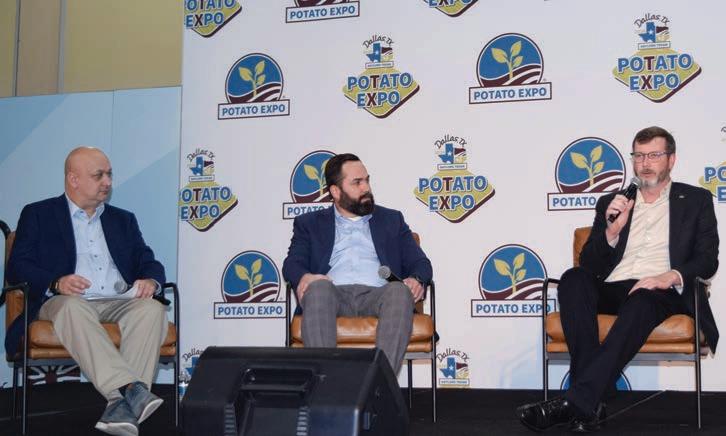
On Thursday of Potato Expo, National Potato Council Chief Operating Officer Mike Wenkel (left) moderated a U.S. Agriculture Labor Policy Update panel with Jonathan Sarager (center), senior federal government affairs director for Western Growers, and John Walt Boatright (right), director, government affairs, for the American Farm Bureau Federation.
2025 Wisconsin Potato Crop Report
Growers overcome the challenge of a hot harvest season with good yields and quality
By Tamas Houlihan and Dana Rady
General Report/Acreage and Yield
The Wisconsin potato planting season began in early April in the central and southern regions and wrapped up by late May in northern areas. It was a good planting season with most growers finishing ahead of schedule. Growing conditions were nearly ideal during the month of June. Reports indicated that crop emergence was exceptional.
Some areas received a little rain in late June and early July, but in general the state was relatively dry, which growers prefer. Last spring, Wisconsin received a significant amount of rain in May and early June, which caused crop damage and drown-outs in lowlying areas.
By early September, close to one-third of this year’s crop was harvested. Yields for early red and
yellow potatoes were close to average. The quality for early russet varieties was good to excellent, but the size profile was smaller than usual.
As growers were getting ready to dig storage potatoes, the temperatures were well above average. As a result, there was a lot of very early
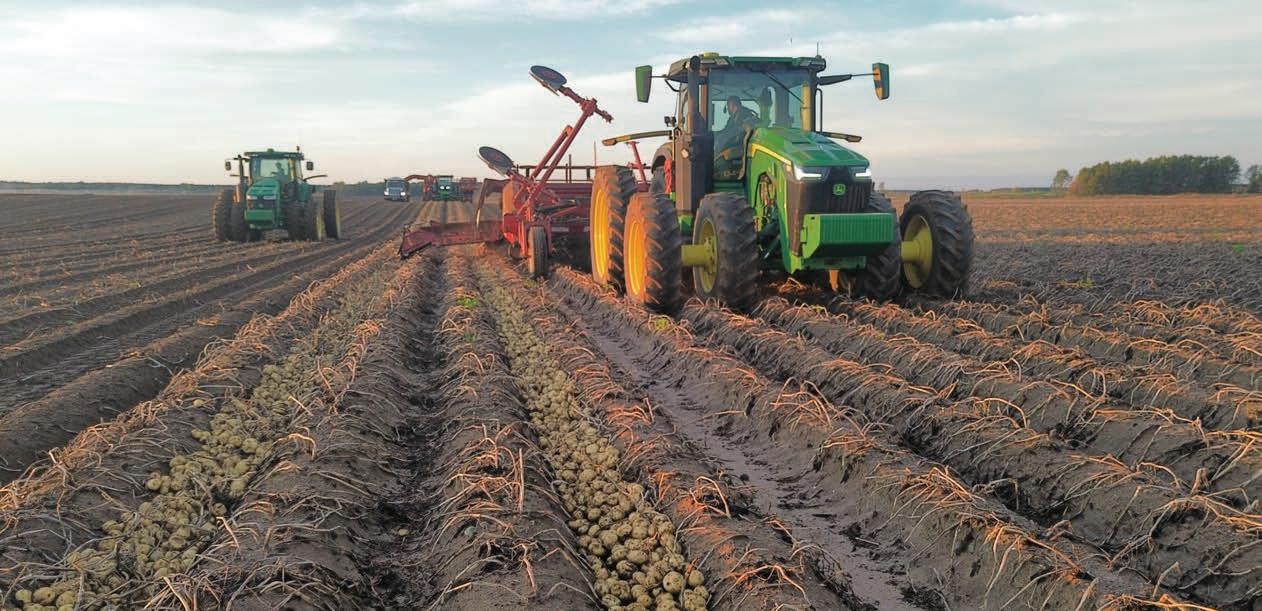
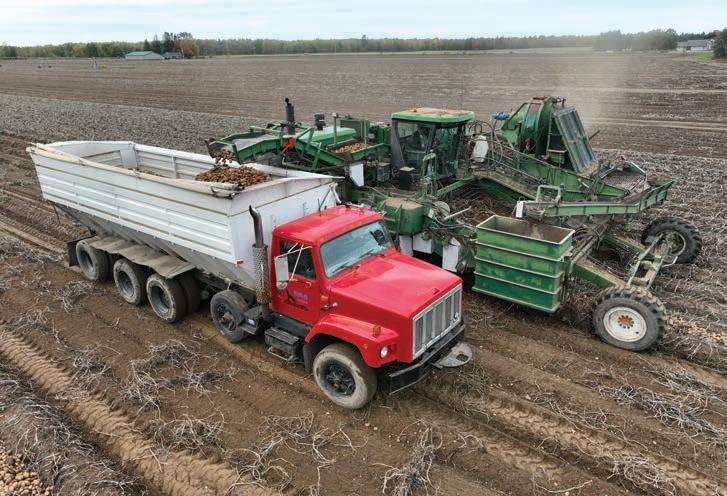
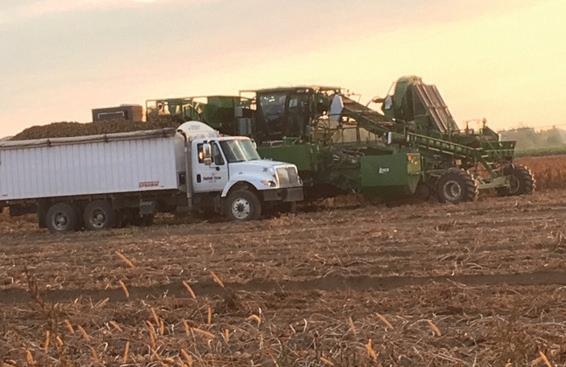
Above: Pierce Johnson took this image of 2025 potato harvest at Wysocki Produce Farm in Bancroft, Wisconsin.
2025 Wisconsin Potato Crop Report. . .
continued from pg. 25
morning and night digging this year, which slowed the harvest progress significantly. Most growers couldn’t dig a full day throughout September.
Fresh and chip stock growers are pleased with this year’s crop. They report that both quality and yields have been good.
Yields for frozen processing potatoes have been better than expected.
Potato storage facilities are full, and some growers were looking for extra storage space due to slow earlyseason movement.
PACKOUT RATES
Packout rates for the 2025 table potato crop are improved and relative to last year’s crop.
For crop year 2025, Wisconsin growers planted 66,753 acres of potatoes, a 2.3% increase over the 2024 crop. Some frozen processing potato growers received contract volume reductions of up to 7%. It is
likely that some of those acres were planted to table potato varieties.
Certified seed potato acreage is 9,215 acres, down 4.2%.
The average yield estimate for the state is 430 hundredweight (cwt.) per acre. The harvested acreage estimate is 66,000 acres (up 4,000 acres over last year), which provides the crop production estimate for Wisconsin at
Janelle West supervises storage of a Frito-Lay potato variety at Eagle River Seed Farm in Eagle River, Wisconsin.
28.38 million cwt., an increase of 9% over 2024.
The U.S. Department of Agriculture (USDA) reported that Wisconsin growers planted 68,000 acres of potatoes in 2025, but USDA also estimates that growers abandoned 1,000 acres of potatoes this year.
The average yield reported by USDA is 420 cwt. per acre, which puts Wisconsin’s 2025 production at 28.14 million cwt., very close to our estimate.
Overall, Wisconsin’s potato crop is in good condition. Quality is very good, although there are some reports of hollow heart in oversize tubers. There was no late blight or frost damage.
AREA REPORTS
West and Northwest Wisconsin Planting season was on time, and this region had a good growing season. There were timely rains and irrigation filled in the gaps. Yields are up 5-15% and quality is reported as very good for all varieties.
The harvest season was very warm, and growers dug a lot of half-days. Harvest continued well into October, about two weeks longer than last year.
Average yields on russets were reported to be between 500 and 550 cwt./acre. Size profile is average, similar to last year. There are no issues with disease and no storage concerns.
Antigo, Rhinelander, Eagle River
Growers reported an excellent planting and growing season in northcentral Wisconsin. The harvest season was similar to other regions with very warm temperatures slowing down harvest in September.
All told, growers (mostly seed) report above average yields with good size and excellent quality. Some of the yield numbers reported by growers include Russet Norkotah (400 cwt./ acre); Goldrush (390-400); Snowden (400); Manistee (375); Caribou (370); Reveille (370-390); Dark Red Norland (370-380); Silverton (360); Atlantic (360); Lamoka (340-350); Frito-Lay varieties (330-350); and Bliss (320).
Wisconsin seed authorities certified 9,215 acres of potatoes from the 2025 crop. That is 401 acres less than they certified a year ago, a 4.2% reduction.
The seed area for major chip potato varieties increased by 111 acres, to 5,956 acres. That included a 110-acre increase in the state’s Frito-Lay seed area and a small increase in other chip potato varieties. The Atlantic seed area fell by 30 acres, while the Lamoka seed area increased by 51
acres. The seed area also dropped for Snowden, Manistee, Lady Liberty, Superior, and Mackinaw. Acreage for Petoskey seed potatoes increased by 170 acres, to 229 acres.
Wisconsin’s seed area for major russet table potato varieties increased by 22 acres, to 1,393 acres. That included a 46-acre increase in the Reveille seed area and a 100-acre increase in Norkotah acreage.
2025 Wisconsin Potato Crop Report. . . continued from pg. 27
At 539 acres, the seed area for Silverton, the top russet table potato variety, dropped by 85 acres. The Goldrush seed area fell by 71 acres, to 266 acres. The dual-purpose Caribou Russet certified area fell by 34 acres, to 441 acres.
Wisconsin’s certified seed area for major red potato varieties fell by 9.3%, to 750 acres. Three of the top four red potato varieties saw acreage reductions, including Dark Red Norland (-71 acres), Red Norland (-47 acres), and Red LaSoda (-67 acres). The acreage for Blushing Belle increased by 108 acres.
Colomba is Wisconsin’s only major yellow potato variety with 144 acres, up 5.4% over last year.
Frito-Lay varieties represent the highest number of certified seed acres in Wisconsin (2,884), followed by Atlantic (836), Lamoka (807), Silverton (539), Snowden (480),
Seed
Frozen/Fry
Caribou Russet (441), Dark Red Norland (339), Norkotah (288), Goldrush (266) and Manistee (259).
Central Wisconsin -
Stevens Point/Plover/Amherst
Planting started on time with most growers beginning early- to mid-April. Planting season went well overall. The summer brought cooler than usual temperatures but was followed by a beautiful harvest season.
Hot temperatures were a big challenge in September and greatly slowed down the harvest, which continued well into October for many farms. But the last week
of September and the first two weeks of October produced nearly ideal harvest conditions.
The Colorado Potato Beetle pressure was high but did not impact yields. Overall, growers reported average to above-average yields and good quality with nice even sets and a very good size profile.
Yield numbers for russets included averages of: Caribou (as low as 410 and as high as 600 cwt./acre), Plover Russet (485), Reveille (as low as 380 and as high as 480), Silverton (some fields 380, others 410-420 and some 470), Russet Burbank (450-475 and as high as 600), Russet Norkotah (410) and Goldrush (390-400).
Yellow variety Columba averaged around 425 on the low end and 450470 cwt./acre on average, with some fields hitting 650 on the high end. Jelli averaged about 420. Red Norlands averaged 425 cwt./acre, very close to average over the years.
Central WisconsinPlainfield/Bancroft/Nekoosa
Planting started on time around April 10. It was a good planting season with nice weather. The summer was cooler than usual, with a lack of heat and sun, which slowed bulking.
The abnormally high heat in September extended harvest by at least one week and allowed the crop to catch up with late bulking. Most growers said it was a decent growing season overall. Yields are reported to be up 5% over average and 20% above last year. The size profile varies by grower, with some reporting that size is smaller than last year by about 5%, while others say it is average in size, but larger than last year.
Quality is excellent, especially compared to 2024. Average yields for russets are reported to be 450460 cwt./acre. Chip potato yields are higher than last year, averaging close to 500 cwt./acre compared to 430 in 2024.
Central Wisconsin - Hancock
Planting started on time around April 10 and was completed on time. It was a good growing season followed by warm temperatures at harvest, causing a lot of night and early morning digging.
Harvest was extended by at least 10 days. Yields on chipping varieties averaged between 495 and 515 cwt./ acre, considerably higher than last year. Yields on russets averaged 525530 cwt./acre, up about 10% over last year.
Size profile is good, with some of the biggest tubers they’ve seen in several years and 25% larger than last year. Growers report that this year’s crop has some of the best quality in a long time. There was little disease pressure and no storage concerns at this time.
Central WisconsinColoma/Grand Marsh
Planting season started on time in mid-April. The growing season went well, with average rainfall, although insect pressure was high. Most growers finished harvest 10 days later than normal due to the high heat in September.
Yields were reported to be up over last year, but smaller in size profile. One grower reported russets averaged 550 cwt./acre and yellows averaged 650.
A few acres were left in the field due to internal defects. Major varieties and yields are as follows: Reveille (525 cwt./acre); Goldrush (475); Caribou (465); Columba (585); Atlantic (440); Superior (390) and Red Norland (360). Storage is reported to be going well overall.
and a good growing season, with timely rainfall reducing the need for irrigation. The heat made harvest a challenge in September. Some fields were not done with harvest until October 29, but they were still finished before the freeze.
Yields and quality are reported to be very good, with one grower saying it’s one of the nicest crops the farm has seen in a while. Overall, yields are above average, and in some fields,
they are up by at least 30%. Reds are averaging over 350 cwt./acre and yellows are at 450 cwt./acre.
Size profile is larger than normal and above average, with most varieties having an 80/20 split, with 80% size A and 20% size B. Russets have a slightly smaller size profile with yields in the 425-450 range.
Growers feel good about the quality of the crop in storage.
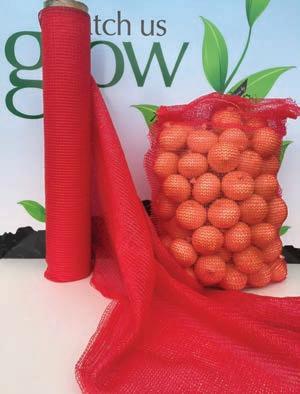
Description: Available in both 30# and 50# in all color s. 2000/bags per roll.
Stock Color: Red
Other colors available: Orange, White, Blue, Purple, Tan, Green, etc...
Ask about our stocking program.
Mesh Rollstock material is less expensive than premade bags. As Labor costs continue to increase, automation is in high demand on all packing lines. With the investment of mesh rollstock baggers, Thorpack strives to meet packing house needs with the best mesh rollstock available. No need for pack off tables and hand packing labor. Move forward into automation and reduce packing cost with this mesh rollstock material. Your cost savings on your material and less labor will generally pay for this machine within a short period of time.
20# Sewing thread available for all mesh rollstock material
Equipment:
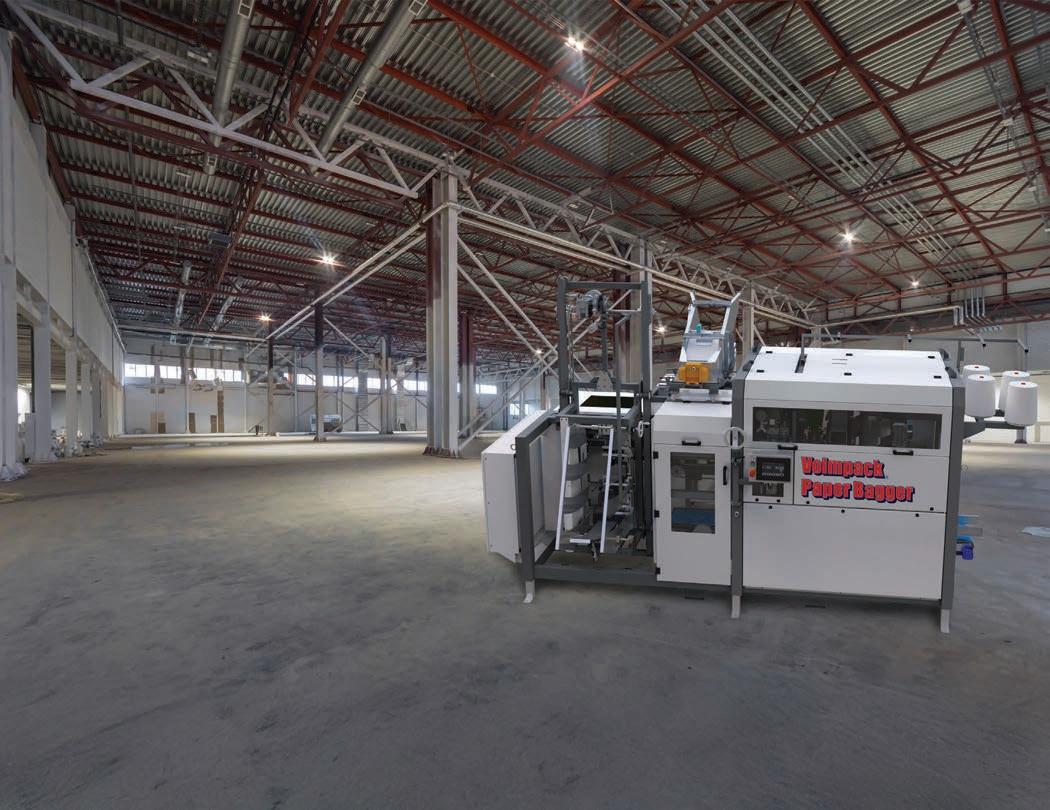
Mesh rollstock functions excellent on the following equipment: Upmatic, Ilapack, Gillen Kirch, H-Tech, Saclark, Volmpack, plus more.
People WFBF Annouces Top “35 Under 35” Individuals
Alsum Farms & Produce Agronomy Manager Jeff Huber recognized as land steward
By Rachel LaCount, Wisconsin Farm Bureau Federation
Five individuals have been selected to receive top honors in the Wisconsin Farm Bureau Federation (WFBF) “35 Under 35 Awards” program. The awards are presented by WFBF’s Young Farmer and Agriculturist (YFA) program in partnership with Insight FS.
The 35 Under 35 program recognizes the creativity and innovation of young farmers and agriculturists who are preserving agriculture through leadership in environmental, social and economic activities.
Applications were evaluated for their involvement in one of five
Finalists were recognized at WFBF’s Annual Meeting and YFA Conference in Wisconsin Dells on December 6, 2025. Each finalist received a $100 cash prize and apparel item. The top individual in each category received a $500 cash prize.
“We’re thrilled to recognize and celebrate each of these outstanding individuals for their commitment to sustainability and the positive impact they’re making in their communities,” says WFBF YFA Chair Kendall Riskedal. “From large-scale initiatives to everyday efforts, each finalist is helping drive meaningful progress
toward a more sustainable future.”
The Sustainable Environment category recognizes individuals who are good stewards of the land and their resources. The top individual in the Sustainable Environment category is Jeff Huber from Adams County. Jeff is the agronomy manager at Alsum Farms & Produce, Inc.
GENERATIONAL SUCCESS
The Sustainable Future category recognizes individuals who are preserving generational success on the farm. The top individuals in the Sustainable Future category are Justin and Kristyn Jensen from Dunn County. Justin and Kristyn operate a crop and beef farm in Menomonie.
The Sustainable Self category recognizes individuals who are
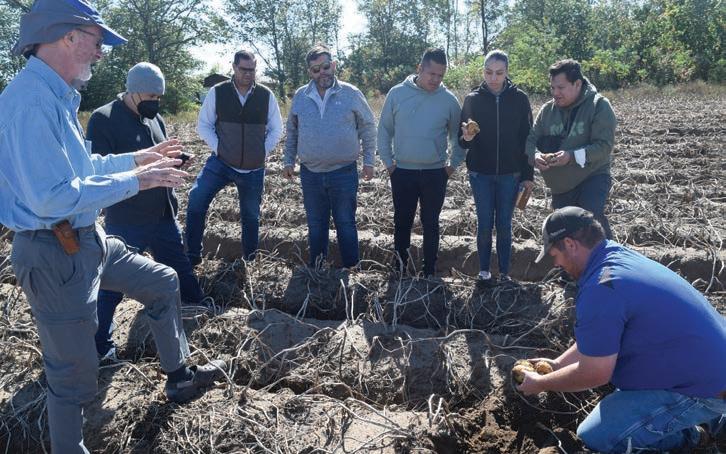
Alsum Farms & Produce Agronomy Manager Jeff Huber (right) digs potatoes to show to members of a Mexico Reverse Trade Mission hosted by the Wisconsin Potato & Vegetable Growers Association (WPVGA), October 1, 2024. Peter Joyce (left) is a consultant and multi-lingual interpreter contracted by the WPVGA for the Reverse Trade Mission. Huber was recently named as the top individual in the Sustainable Environment category by the Wisconsin Farm Bureau as part of its “35 Under 35 Awards” program.
serving their community through leadership, mentorship and mental health advocacy. The top individual in the Sustainable Self category is Andrew Dal Santo from Grant County. Andrew is the precision agronomy instructor at Southwest Wisconsin Technical College in Fennimore. The Sustainable Service category recognizes individuals who are serving agriculture through trade skills or advisory roles. The top individual in the Sustainable Service category is Isaac Christenson from Polk Burnett Farm Bureau. Isaac is an agriculture and commercial loan officer at Pillar Bank in Amery.
The Sustainable Storytelling category recognizes individuals who use their platform to share agriculture’s sustainability successes. The top individual in the Sustainable Storytelling category is Sarah Hetke from Sauk County. Sarah is the director of farmer outreach for Dairy Management, Inc.
“We are proud to partner with Wisconsin Farm Bureau to amplify the leadership of young farmers while promoting activities that protect the future of agriculture now and for generations to come,” says Insight FS General Manager Ben Huber. “Congratulations to these impressive individuals.”
The complete list of all 35 Under 35 finalists is available at https://wfbf. com/wisconsin-farm-bureau-annualmeeting/.
Insight FS, headquartered in Jefferson, Wisconsin, and part of the GROWMARK System, serves patrons in Wisconsin and Michigan’s Upper Peninsula. Insight FS is an agricultural cooperative providing agronomy, energy, feed, turf and agri-finance products and services, as well as grain marketing. More information is available at https://fscooperatives. com/insightfs.
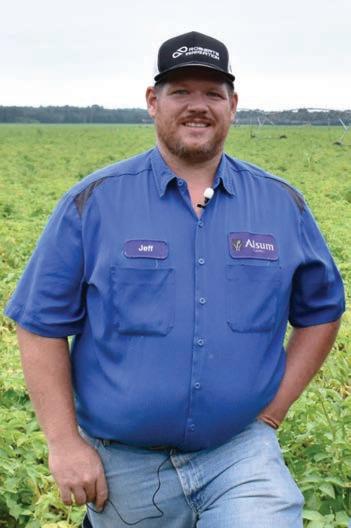
Jeff Huber, Alsum Farms & Produce agronomy manager, was named top individual in Wisconsin Farm Bureau’s Sustainable Environment category as part of its “35 Under 35 Awards” program.
American Agri-Women Announces New Officer Team
American Agri-Women (AAW) has announced its newly elected national officers.
Kim Bremmer of Wisconsin is the new president, Maggie Howley of Montana has been elected first vice president, Vikkie Becker of Illinois will serve as vice president of communications, and Sheila Currie of Maine has been named treasurer.
Rose Tryon of California will serve as past president. Debbie Bacigalupi of California is continuing her term as vice president of education, and Alex Henderson of Texas will continue as secretary.
American Agri-Women, founded in 1974, is the nation’s largest coalition of farmers, ranchers, producers
and agribusiness women across the country. The organization advocates for sound agricultural policy, provides leadership development
opportunities and works to support strong rural communities.
For more information, visit https:// www.americanagriwomen.org.
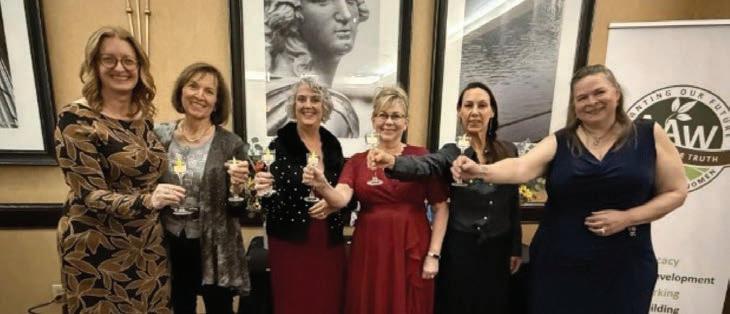
The new American Agri-Women officer team includes, from left to right, Kim Bremmer, Maggie Howley, Vikkie Becker, Sheila Currie, Debbie Bacigalupi, and Rose Tryon. Not pictured is Alex Henderson.
Marketplace
by Dana Rady, WPVGA Director of Promotions & Consumer Education
When thousands of runners laced up their shoes for the Madison Marathon November 9, 2025, they weren’t just powered by training miles and determination—they were fueled by Wisconsin potatoes.
The Wisconsin potato industry, represented by the Wisconsin Potato & Vegetable Growers Association (WPVGA), brought energy, flavor, and a whole lot of spud pride to marathon weekend. From crunchy snacks to comfort-food classics, potatoes played a starring role in helping participants stay fueled and to celebrate their success.
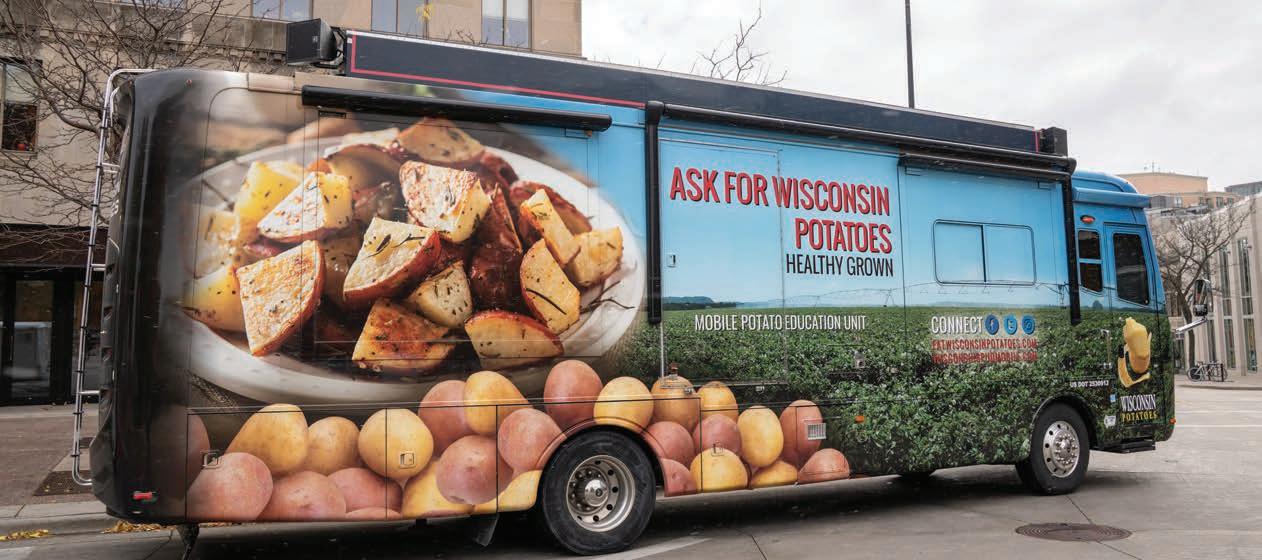
Above: The iconic Spudmobile was also on site, drawing attention and smiles as it rolled into Madison to share the story of Wisconsin potatoes with the running community. The mobile education vehicle quickly became a popular stop for photos and conversation, reinforcing the connection between real food, local agriculture, and athletic performance.
The WPVGA staff greeted runners and spectators with bags of potato chips, offering a salty, satisfying snack that hit the spot after race time.
RUSSETS
• AO8433-4STO
• Caribou
• Lakeview Russet
• Reveille
• Silverton
YELLOW FLESHED
• Yukon Gold
WHITES
• Mackinaw
REDS
• Dark Red Norland
The iconic Spudmobile was also on site, drawing attention and smiles as it rolled into Madison to share the
Contact us now to place your Spring orders or for more details!
Bula Potato Farms, Inc. • W11957 Highland Road • Antigo, WI 54409 Call Dennis or Adam: Work: (715) 275-3430
Email: bulaseed@frontiernet.net or dennis@certifiedseedpotatoes.com www.certifiedseedpotatoes.com
stopped to pose for a picture wearing his “Powered by Wisconsin Potatoes” T-shirt.
story of Wisconsin potatoes with the running community.
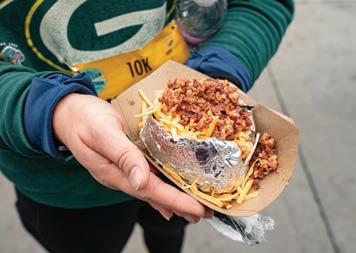
The Spudmobile quickly became a popular stop for photos and conversation, reinforcing the connection between real food, local agriculture, and athletic performance. The Madison Marathon team added to the potato-powered experience by serving loaded baked potatoes to participants. Warm, hearty, and packed with nutrients, the potatoes were a welcome post-race treat for runners looking to refuel after
crossing the finish line.
CROWD PLEASER
The crowd-pleasing dish highlighted what athletes have long known: potatoes are a natural source of complex carbohydrates and potassium, making them an ideal recovery food.
Together, the WPVGA and Madison Marathon showcased how Wisconsin potatoes fit seamlessly into active lifestyles, whether participants are chasing a personal record or cheering from the sidelines.
Above and Below: Spudly strutted his stuff at the Madison Marathon as he not only marched toward the Capitol on November 9, 2025, but also engaged runners and spectators with his infectious personality.
The partnership also celebrated the state’s growers, whose commitment to producing high-quality potatoes supports both everyday meals and memorable community events. As runners headed home with tired legs and full stomachs, one thing was clear: at the Madison Marathon, Wisconsin potatoes went the distance.
Above and RIght: The Madison Marathon team added to the potato-powered experience by serving loaded baked potatoes to participants. Warm, hearty, and packed with nutrients, the potatoes were a welcome post-race treat for runners looking to refuel after crossing the finish line.
Badger Beat
What’s the Value of Nitrogen Fertilizer Applied in July?
There is limited evidence that additional nitrogen applications in July provide an economic return for the grower
By Matt Ruark, professor and Extension specialist, University of Wisconsin-Madison Department of Soil and Environmental Sciences
As producers work with their nitrogen (N) management practices to improve yield and efficiency, they might seek to increase the number of split applications and push N applications later into the season.
Here, we revisit previous research funded by the Wisconsin Potato & Vegetable Growers Association to assess the benefit of late season applied N.
A three-year study was conducted at the Hancock Agricultural Research Station in 2015, 2016, and 2017 to assess the benefit of N applied in July. All plots of Russett Burbank potatoes received 270 lb. N/acre applied as 90 lb. N/acre each time at: hilling, tuber initiation, and two weeks post-tuber initiation. An additional 34 lb. N/acre was applied in early July, with an additional 34 lb. N/acre applied
75
emergence
having received
additional
of additional N (second bar), or 68 lb N/acre of additional N (split application 34 lbs.). All treatments received a base application of 270 lb. N/acre
Figure 1: Nitrogen uptake in the vines is recorded 75 days after emergence after having received no additional N (first bar in each trio), 34 lb. N/acre of additional N (second bar), or 68 lb. N/acre of additional N (split application of 34 lbs. + 34 lbs.). All treatments received a base application of 270 lb. N/acre.
However, 17 to 25 days following the first application of N in July, the N was not yet reallocated to the tubers, difference in tuber N uptake occurred in any year (Figure 2). The story is less promising when looking at final numbers, with the additional N applications leading to no yield differences, or in one case a yield decline (Figure
Figure 1. Nitrogen uptake in the vines is recorded 75 days after emergence after having received no additional N (first bar in each trio), 34 lb N/acre of additional N (second bar), or 68 lb N/acre of additional N (split application of 34 lbs. + 34 lbs.). All treatments received a base application of 270 lb. N/acre.
in mid-July. The exact dates of application in each year were July 2 and 15 in 2015 (50 and 63 days after emergence), July 12 and 18 in 2016 (58 and 64 days after emergence), and July 5 and 17 in 2017 (51 and 63 days after emergence).
However, 17 to 25 days following the first application of N in July, the N was not yet reallocated to the tubers, as no difference in tuber N uptake occurred in any year (Figure 2). The story is less promising when looking at final yield numbers, with the additional N applications leading to no yield differences, or in one case a yield decline (Figure 3).
We collected vine and tuber samples 75 days after emergence each year. Figure 1 clearly demonstrates that the additional N in July led to an increase in N uptake through the vines, although the exact effects varied by year. This provides somewhat good news as it indicates the potato plant is utilizing the applied N.
However, 17 to 25 days following the first application of N in July, the N was not yet reallocated to the tubers, as no difference in tuber N uptake occurred in any year (Figure 2). The
Figure 2. The bar graph shows nitrogen uptake in the tuber at 75 days after emergence after receiving no additional 34 lb N/acre of additional N, and 68 lb N/acre of additional N (split applied 34+34). All treatments received application of 270 lb N/acre
Figure 2: The bar graph shows nitrogen uptake in the tuber at 75 days after emergence after receiving no additional N, 34 lb. N/acre of additional N, and 68 lb. N/ acre of additional N (split applied 34+34). All treatments received a base application of 270 lb. N/acre.
Figure 1. Nitrogen uptake in the vines is recorded
days after
after
no
bar in each trio), 34 lb N/acre
Figure 2. The bar graph shows nitrogen uptake in the tuber at 75 days after emergence after receiving no additional N, 34 lb N/acre of additional N, and 68 lb N/acre of additional N (split applied 34+34).
story is less promising when looking at final yield numbers, with the additional N applications leading to no yield differences, or in one case a yield decline (Figure 3).
On-farm research trials supported by Wisconsin Department of Agriculture, Trade, and Consumer Protection’s Nitrogen Optimization Pilot Program (NOPP) have also showed limited benefit to July fertilizer applications to Caribou potatoes.
At one location, yield declines occurred when fertigation of N was applied in July (application of two applications of 34 lb. N/acre each). It also appeared that the yield declines were greater when more N was applied earlier in the season, essentially confirming the results of the Hancock study.
When the potato crop has already been properly fertilized through June, and no deficiencies are present, the additional N does not appear to increase tuber development and potentially slows tuber development.
At a second location, fertigation of N in July also led to reduced yields, although primarily when early season N applications were below 200 lb. N/acre, suggesting limited value of July applied N as a rescue application.
However, at this location, the most efficient use of fertilizer occurred when N was split applied throughout the growing season and into July, where yields were maximized with only 240 lb. N/acre. So perhaps the value of July applications occurs when the plan is to dole out N evenly from mid-May through mid-July across eight or more applications.
Sufficient N applications at hilling and tuber initiation are critical for setting the crop up for success. However, there remains limited evidence that additional N applications in July are providing an economic return for the grower.
34 34 + 34
Figure 3: Total potato yield at harvest is indicated after receiving no additional N, 34 lb. N/ acre of additional N, and 68 lb. N/acre of additional N (split applied 34+34). All treatments received a base application of 270 lb. N/acre.
3. Total potato yield at harvest is indicated after receiving no additional N, 34 lb N/acre
additional lb N/acre of additional N (split applied 34+34). All treatments received a base application of
On-farm research trials supported by Wisconsin Department of Agriculture, Trade, and Consumer Protection’s Optimization Pilot Program (NOPP) have also showed limited benefit to July fertilizer applications to Caribou
There are, of course, several caveats to all of this. In most of the test cases, excessive rainfall did not occur, nor were petiole-nitrates below sufficiency levels. Plus, it may be likely that the effect of July nitrogen is variety specific.
At one location, yield declines occurred when fertigation of N was applied in July (application of two applications lb. N/acre each). It also appeared that the yield declines were greater when more N was applied earlier essentially confirming the results of the Hancock study.
But as folks strive to improve their overall nitrogen use efficiency, the benefits would likely come through efficient management of N earlier in the season, or through more frequent
When the potato crop has already been properly fertilized through June, and no deficiencies are present, tuber development.
At a second location, fertigation of N in July also led to reduced yields, although primarily when early season , suggesting limited value of July applied N as a rescue application.
However, at this location, the most efficient use of fertilizer occurred when N was split applied throughout . So perhaps the value of July or more applications.
Sufficient N applications at hilling and tuber initiation are critical for setting the crop up for success. However, an economic return for the
several caveats to all of this. In most of the test cases, excessive rainfall did not occur nitrates below sufficiency levels. Plus, it may be likely that the effect of July nitrogen is variety specific.
But as folks strive to improve their overall nitrogen use efficiency, the benefits would likely come through management of N earlier in the season, or through more frequent planned split applications through July.
Figure
of
270 lb N/ac
Area is the most complete ancient agricultural site in the eastern half of the United States
By Amy Olson, senior media relations officer, Dartmouth Office of Communications
Text and
images
provided by Dartmouth Office of Communications
With its cold climate, short growing season, and dense forests, Michigan’s Upper Peninsula is known as a challenging place for farming.
But a new Dartmouth-led study provides evidence of intensive
farming by ancestral Native Americans at the Sixty Islands archaeological site along the Menominee River, making it the most complete ancient agricultural site in the eastern half of the United States.
The site features a raised-ridge field system that dates to around the 10th century to 1600 A.D., and much of it is still intact today.
The raised fields are comprised of clustered ridged garden beds that each range from 4-12 inches in height and were used to grow corn, beans, squash, and other plants by ancestors of the Menominee Indian Tribe of Wisconsin.
To see the findings published in “Science,” visit https://www.science. org/doi/10.1126/science.ads1643.
“The scale of this agricultural system by ancestral Menominee communities is 10 times larger than what was previously estimated,” says lead author Madeleine McLeester, an assistant professor of anthropology at Dartmouth.
Above: Raised agricultural beds cover an estimated 70% of the lidar survey area at Sixty Islands archaeological site along the Menominee River in Michigan’s Upper Peninsula. Photo courtesy of Madeleine McLeester
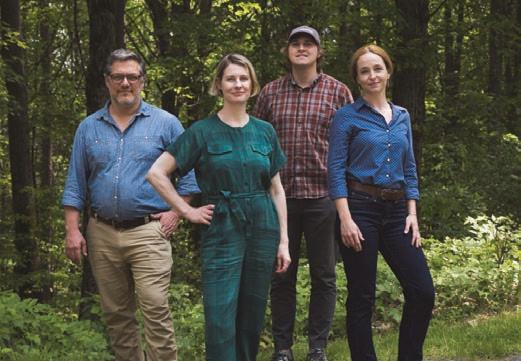
Above: The researchers, from left to right, Jesse Casana, Madeleine McLeester, Jonathan Alperstein, and Carolin Ferwerda, estimate that they surveyed about 40% of the site. Photo courtesy of Katie Lenhart
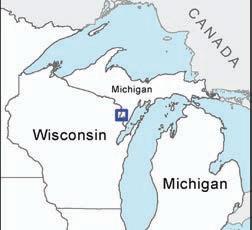
Right: The square red box (upper left in the inset photo) shows the site in the Upper Peninsula of Michigan where the 1,000-year-old Native American farm fields were discovered. The detailed blowup of the area along the Menominee River indicates the lidar survey area, archaeological sites, and the state border, among other points of interest.
“That forces us to reconsider a number of preconceived ideas we have about agriculture,” she adds, “not only in the region, but globally.”
330-ACRE SURVEY
The researchers surveyed approximately 330 acres. However, they have yet to map the entire site because it extends beyond the edge of that which was surveyed. The researchers estimate that they surveyed approximately 40% percent of the site.
“When you look at the scale of farming, this would require the kind of labor organization that is typically associated with a much larger, statelevel hierarchical society,” McLeester explains.
“Yet, everything we know about this area suggests smaller egalitarian societies lived in this region,” she notes. “But, in fact, this may have been a rather large settlement.”
The site is part of Anaem Omot, which stands for the “Dog’s Belly” in Menominee. Anaem Omot is a cluster of significant ancestral Menominee archaeological sites that includes several burial mounds and a village
Wisconsin (WI)
CANADA
Michigan (MI)
Service
Layer
Credits: Sources: Esri, Airbus DS, USGS, NGA, NASA, CGIAR, N Robinson, NCEAS, NLS, OS, NMA, Geodatastyrelsen, Rijkswaterstaat, GSA, Geoland, FEMA, Intermap and the GIS user community
WISCONSIN
that were excavated from the 1950s through the 1970s.
It was initially mapped in the 1990s by Marla Buckmaster, an archaeologist at Northern Michigan University, and excavated by Jan Brashler, an archaeologist at Grand Valley State University, who found and radiocarbon dated a corn cupule
00.51Km
MICHIGAN
Lidar Survey Area
Archaeological Sites
Sixty Islands (ME-61) Anaem Omot State Border
(the cup-shaped structure on the cob that holds a kernel in place) during excavations.
Given the site’s cultural significance with its burial mounds, dance rings, and agricultural ridges, it is listed on the U.S. National Register of Historic Places.
Building on earlier work and upon the request of the Menominee tribal authorities, archaeologists from Dartmouth were invited to survey and document the area using new technologies that were previously unavailable.
Through this partnership, the team collaborated with David Grignon, tribal historic preservation officer for the Menominee Indian Tribe of Wisconsin, and the late David Overstreet, a consulting archaeologist for the College of the Menominee Nation.
DRONE-BASED SURVEY
In May 2023, after the snow had melted but before the leaves were out, the team conducted an innovative, drone-based survey of a 330-acre area using lidar, a remote sensing technology that uses pulses of light from a laser to map objects on the Earth’s surface.
Lidar provides a dataset that’s like a giant cloud of points with the locations of the trees and rocks, which can be filtered out to see the ground.
“Lidar is a really powerful tool in any kind of forested or heavily vegetated region where the archaeology is hidden below trees—where no kind of optical imagery can see what’s underneath the tree canopy,” says senior author Jesse Casana,
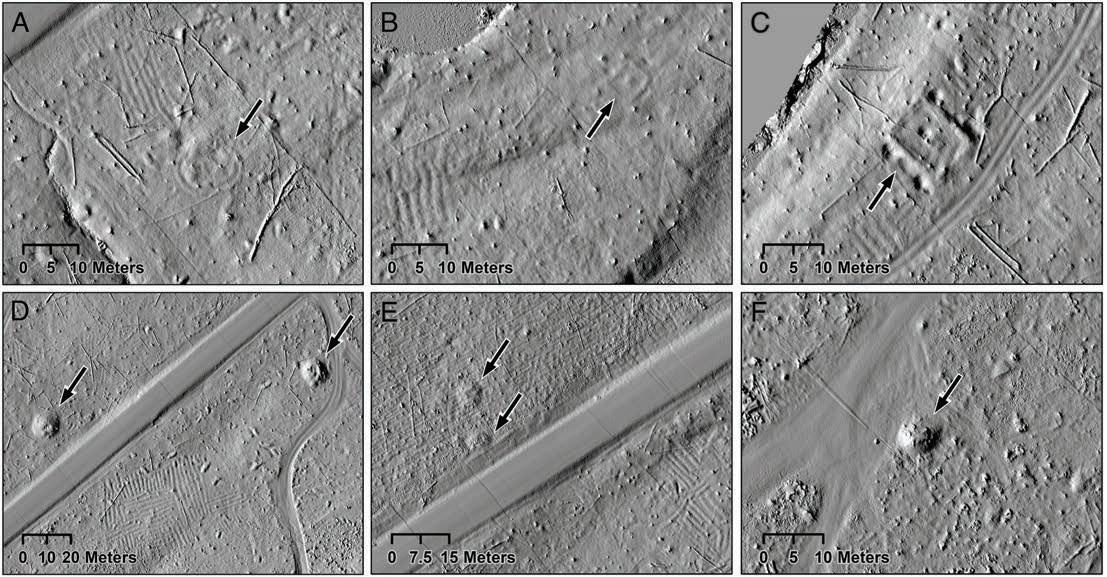
Above: Lidar data shows, from left to right in the top row, a dance ring, a historic building foundation, and a 19th-century logging camp; and in the second row, left to right, looted burial mounds, remains of unknown burial mounds, and an intact burial mound. Images courtesy of Carolin Ferwerda and Jesse Casana
a professor of anthropology who uses remote sensing technologies regularly in his work.
“Forests are really confounding to archaeology in a lot of ways, so a lot of archaeologists rely on publicly available lidar that has often been obtained from a plane that flies very high,” Casana relates.
“But the resolution of the data is usually too low to see many archaeological features,” he says. “Drone lidar enables us to collect the same kind of data but at a much higher resolution.”
The lidar uncovered sets of parallel ridges at the site that create quiltlike patterns stretched across the landscape.
INDIVIDUAL FARMERS
The ridges were constructed in various directions, illustrating that their locations may have been determined by individual farmers rather than the direction of the sun or other environmental factors.
The results also revealed a circular dance ring, a rectangular building foundation that may have been a colonial trading post, two 19thcentury logging camps, looted burial mounds, previously unknown burial mounds that were thought to be destroyed in the 1970s, and a burial mound on privately owned land that is currently owned by a mining company.
In August 2023, the team excavated three raised agricultural ridges at various distances from the Menominee River.
Through radiocarbon dating of charcoal samples obtained during excavation, they found that the ridges had been rebuilt over a 600-year period, with construction initially around the year 1000, which was during the Late Woodland period.
“All three ridges showed a similar picture in terms of their construction, history and reconstruction,” Casana says.
“The scale of this agricultural system by ancestral Menominee communities is 10 times larger than what was previously estimated.”
– Madeleine McLeester, assistant professor of anthropology, Dartmouth
CUSTOMIZED FINANCING
Unique operations need unique solutions.
Get the customized financing, insurance, and business services from a team focused on agriculture. Our tailored solutions will meet the unique financial needs of any size farm, ranch, or agribusiness.
AgCountry.com
Archaeologists Uncover Huge 1,000-Year-Old Native American Farm Fields . . . continued from pg. 41
“Most field systems have been either lost or destroyed due to intensive land use across most of North America,” he adds, “through farming, including pastures, and the cutting down of trees for urban development.”
“Through this research, we get a little window of preservation into pre-Colonial farming in the Upper Peninsula of Michigan,” Casana remarks.
ENRICHING THE SOIL
Through the excavations, charcoal, broken pieces of ceramics known as sherds, and artifacts were recovered, suggesting that remains from fires and household refuse were likely used as compost in the fields. The results also show that wetland soils were used to enrich the earth.
“Our work shows that the ancestral
Menominee communities were modifying the soil to completely rework the topography in order to plant and harvest corn at the near northern extent of where this crop can grow,” McLeester says.
“This farming system was a massive undertaking,” she adds, “requiring a lot of organization, labor, and know-how to maximize agricultural productivity. We're seeing this kind of landscape alteration in a place where we wouldn't expect it.”
“This may be just a little remnant of what must have been a much larger system,” Casana suggests.
The findings have made the researchers consider if perhaps the majority of eastern North America was once covered with agricultural ridges. Findings also challenge existing forest history of the Upper
Peninsula, since Sixty Islands would have been deforested during this 600-year period.
The team is continuing its work with the Menominee Indian Tribe of Wisconsin at the Menominee Sixty Islands site, with upcoming plans to survey the site and locate ancestral Menominee villages.
Carolin Ferwerda, a research scientist in the Department of Anthropology, and Jonathan Alperstein, a graduate student in the Ecology, Evolution, Environment & Society program in the Department of Anthropology at Dartmouth, also contributed to the study.
McLeester (madeleine.mcleester @dartmouth.edu) and Casana (jesse.j.casana@dartmouth.edu) are available for comment.
Eyes on Associates
By WPVGA Associate Div. President Matt Selenske, Allied Coop’s Pest Pros Division
Hello, everyone. I hope your winter is going well. I am writing this from Dauphin Island, Alabama, where I’m visiting family, and it is beautiful down here! Getting away from it all this time of year always reminds me it is important to step outside of our day-to-day routine to get a fresh perspective and recharge.
The Grower Education Conference & Industry Show is behind us, and I hope everyone acquired useful information and ideas while there to help solve some production issues. While preparing this article, I had a list of Grower Education Conference presentations to attend that promised to be informative.
The University of Wisconsin Extension staff always works hard for the industry, and there will be more coverage of the conference in the March issue.
The WPVGA Associate Division Board did not meet in December, but we had been working on collecting silent auction items for the Industry Show, as well as finalizing details for the Student Education & Career Development Program.
This Student Education & Career Development Program entails inviting 25-30 high school, college and technical college students to attend the first day of the Grower Education Conference & Industry Show free of
charge to learn about careers in our industry. Again, there will be more coverage of it in the March issue.
I’m keeping it short and sweet this month and am off to do some
touristy things today with my family. Have a good month!
Matt Selenske
WPVGA Associate Division President
Adam Flyte (facing camera) of Flyte Family Farms in Coloma, Wisconsin, addresses students during the 2025 Career Fall Harvest Day, part of the Student Education & Career Development Program, which continues in 2026 and was kicked off at the Grower Education Conference & Industry Show.
Now News
Growers: Apply Now for Leadership in the Field!
The Potato Leadership, Education, and Advancement Foundation (Potato LEAF) is an organization focused on developing leadership skills within the potato industry. Potato LEAF offers various programs, including the Potato Industry Leadership Institute (PILI) and events such as “Leadership in the Field: From
Battlefield to Potato Field.”
The Leadership in the Field: From Battlefield to Potato Field experience is a unique opportunity for potato growers and industry professionals to utilize the resources of America’s most revered battlefield— Gettysburg—to help facilitate experiential teaching and support
effective leadership development.
At Gettysburg, ordinary people were asked to do extraordinary things. During the summer of 1863, America faced a turning point in its history. The very survival of our young country was in question. Its fate was determined by the actions of those who led 165,000 Confederate and
Union soldiers during the costliest, most decisive struggle in American history.
The Battle of Gettysburg offers a robust case for the study of leadership: the complexity of battle, the size of the opposing armies, and the wide spectrum of personalities represented by the military leadership and civilians offer a wide range of perspectives.
Character, communication, team building, humility, flexibility, resilience, strategic or visionary thinking, problem-solving under pressure, and accountability are just a few of the many lessons for which experiential learning at Gettysburg is effective.
The Leadership in the Field program will be held on the Gettysburg
Battlefield, in cooperation with the Gettysburg Foundation, July 13-16, 2026.
The Wisconsin Potato & Vegetable Growers Association (WPVGA) Board will consider paying the $2,100 registration fee for selected candidates.
Participation is open to all the industry. In selecting participants, the following considerations will be made by the selection committee:
• Diverse representation across the U.S. potato production areas.
• Diverse representation of industry sectors, with most of the participants being potato growers.
• Preference will be given to individuals who have participated
in leadership programs and are currently serving or have served in industry leadership roles.
Potato LEAF formally began promotion at Potato Expo 2026. The application deadline is March 6.
Potential participants can access the application and details at https:// pleaf.org/leadership-in-the-field.
Alsum’s Announces Scholarship Program
One-thousand-dollar scholarships to be awarded to 10 high school seniors
Alsum Farms & Produce of Friesland, Wisconsin, is proud to announce the grower, packer, shipper’s high school senior scholarship program to be awarding 10 scholarships for $1,000 each to deserving students for furthering their education and investing in the future of agriculture.
Graduating high school seniors who have an agriculture or rural background, or plan to major in an agriculture-related field at a community college, university or technical school are encouraged to apply between now and March 15, 2026.
Each scholarship recipient will receive $1,000 for educational tuition expenses. Qualified applicants must
be graduating seniors who reside in the Alsum Farms & Produce growing or packing region. Recipients will be selected based on a combination of academic achievement; agricultural, community and youth organization involvement; and essays.
“We are proud to be able to invest in future leaders in agriculture and our rural communities through the Alsum Farms & Produce scholarship program,” says Alsum Farms & Produce Chief Operating Officer Heidi Alsum-Randall. “We believe in supporting these young adults and are optimistic the students will seek careers in Wisconsin agriculture and the businesses that support agriculture.”
Students can find more information and link to the scholarship application at https://alsum.com/scholarship/. All applications must be submitted through the online platform. No paper or email copies will be accepted. The application deadline is March 15.
To learn more about Alsum Farms & Produce and the full line of products available, and how Alsum farm-fresh and sustainably grown potatoes make their way from field to fork, visit https://alsum.com.
TITAN XC Reaches 100-Million Acres Treated
Milestone is fueled by the success and support of North American farms
Loveland Products, Inc. announces that TITAN® XC, its leading fertilizer biocatalyst, has now been applied to more than 100 million acres across North America since its introduction in 2013.
The achievement marks a significant milestone, underscoring TITAN XC’s longstanding role in helping farmers maximize nutrient efficiency, improve fertilizer performance, and achieve consistent, field-proven results year after year.
“Reaching 100 million acres isn’t just about scale, it’s about the success stories behind every acre,” says Ron Calhoun, senior plant nutrition portfolio manager of Loveland Products. “From early adopters to first-time users, farmers continue to tell us how TITAN XC helps them get more out of every ton of fertilizer, every acre, and every season.”
TITAN XC is specifically formulated for dry fertilizer blends and leverages concentrated biochemistry to improve nutrient availability and uptake.
By accelerating the mineralization of treated dry fertilizers and converting organic nutrients into plant-available inorganic states, TITAN XC enhances early root growth and maximizes the value of phosphorus and potassium applications.
TITAN XC Agronomic Benefits
• Accelerates nutrient availability from applied dry fertilizers
• Improves nutrient uptake by enhancing soil-fertilizer interaction for greater efficiency
• Promotes stronger root development through improved nutrient uptake and utilization
• Optimizes yield potential for a higher return on fertilizer investment
“TITAN XC changes the way that dry fertilizer responds to soil,” Calhoun explains. “The unique and concentrated biochemistry in TITAN XC provides the broadest
range of activity across phosphorus, potassium, sulfur, and other nutrients to maximize the return on your fertilizer investment.”
TITAN XC integrates seamlessly into both fall and spring dry-fertilizer programs and works effectively across a wide range of soils and cropping systems without requiring special equipment or additional field passes.
“With TITAN XC, farmers can stay in their normal fertility rhythm and still enhance fertilizer performance,” Calhoun notes.
TITAN XC has built a track record of reliability and consistent
performance. “TITAN XC unlocks applied nutrients more quickly, supporting steady growth and dependable results,” he says. “That reliability is why farmers continue to choose it year after year.”
“Its proven consistency and broadspectrum activity make it an ideal choice for growers looking to protect their fertilizer investment and achieve more predictable outcomes across variable soils and conditions,” Calhoun concludes.
With 100 million acres treated and counting, TITAN XC remains one of the most trusted and widely adopted fertilizer enhancement technologies in agriculture today.
Loveland Products is proud to support Nutrien Ag Solutions farmer customers with innovations like
Compeer Financial Sets
Grant Application Schedule
TITAN XC that deliver consistent performance, measurable value, and long-term soil health benefits.
For more information on TITAN XC, reach out to your local Nutrien Ag Solutions crop consultant, or go to https://info.lovelandproducts.com/ titan-xc.
Philanthropic program reflects deep commitment to a thriving rural America
TOUGH JOBS LIKE THESE REQUIRE THE ULTIMATE FARMHAND.
Compeer Financial has refreshed its corporate philanthropic program under Compeer Giving. The program refocuses its investments in the future of rural communities under three core efforts: grants, scholarships and community partnerships.
The application schedule for this year’s scholarships and grants is:
• Dec. 14, 2025 – Feb. 15, 2026: High School Scholarships. Available to high school seniors pursuing a
degree or career in an agricultural field.
• Feb. 1 – March 15, 2026: Farmers Market Grant. Supports marketing, technology, education and engagement designed to drive economic impact and foster community spirit through farmers markets.
• April 15 – May 31, 2026: Emergency Response Equipment Grant. Funds equipment needed to effectively respond to incidents, as well as that necessary for protecting and supporting responders.
• July 1 – Aug. 15, 2026: Next ACRE (Agriculture Classrooms, Resources and Equipment) Grant. Provides funding to support agricultural education, including new tools, technology or upgrades to equipment, as well as renovations, improvements or building projects for non-traditional classrooms.
• Sept. 1 – Oct. 15, 2026: County Fair Facility Upgrade Grant. Supports renovations, updates and improvements to agricultural buildings and facilities on county fairgrounds, as well as new building
or barn construction projects for agricultural needs.
• Open All Year: Beginning with Compeer Grant. Available to parttime or full-time farmers who have been farming less than 10 years to fund a variety of farm businessrelated expenses.
“The Compeer Giving program breathes new life into our strategic giving and supports Compeer’s vision of creating a world where agriculture and rural communities are dynamic, collaborative and thriving,” says Karen Schieler, manager of Compeer Giving at Compeer Financial.
“Our giving empowers farmers, equips rural first responders, inspires youth, enhances education and nurtures community well-being,” she states.
Compeer Giving is dedicated to strengthening agriculture and rural communities across its 144-county territory in Illinois, Minnesota and Wisconsin. Since 2018, Compeer has invested nearly $40 million in rural community support, partnering with organizations, schools, first responders and youth who shape the future of agriculture.
Moving forward, Compeer Giving will support programs and partners aligned with three philanthropic focus areas:
• Inspiring Youth: Supporting youth through scholarships, leadership development and hands-on agricultural experiences helps to cultivate the next generation of thinkers and doers who will guide rural communities forward.
• Enhancing Agriculture and the Rural Workforce: Investing in ag classrooms, technical training, hands-on learning and workforce development helps cultivate the future of farming operations and the industry.
• Empowering Rural Communities: Enabling community organizations
to expand their impact, improve facilities, and enhance resources helps ensure rural life remains vibrant, resilient and sustainable.
“The refreshed program positions Compeer to expand strategic giving and partnerships regionally, as well as collaborative investments with other Farm Credit institutions,” Schieler explains. “Unifying our separate
giving efforts under one identity further enhances our ability to deliver meaningful local impact.”
Additional information about Compeer Giving and the 2026 grant and scholarship programs can be found at https://compeer.com/ investing-in-rural-communities/ giving-back.
New Products Case IH Introduces Farmall M Series Tractors
Case IH debuts the Farmall® M series of tractors, designed to deliver power and performance in everyday applications through to the most demanding tasks. With seamlessly integrated technology and heightened operator comfort, the Farmall M series delivers superior productivity and execution, regardless of the operation size or terrain.
The Farmall M, available in 100M, 110M and 120M models, was created to handle an operator’s busiest days, continuing the Farmall legacy of dependability.
The new tractor series features a 4-cylinder, 3.6L (liter) Stage V engine, delivering 100-120
horsepower. Positioned at the top of the Farmall range, the Farmall M has a generous 11,465-pound rear lift capacity and 8-ton gross vehicle weight, with top speeds of 25 miles per hour at 1,970 rpm (revolutions per minute).
The series provides operators with a more comfortable drive and is designed for farmers who demand strength, simplicity and smart functionality in a versatile utility tractor. The Farmall M has an engine after-treatment system that meets stage V emission requirements. Its convenient location under the hood also offers improved visibility.
Built to be an operator’s most durable, multi-purpose machine, the Farmall M is built for versatility and ideal for the varied needs of municipalities, and row crop or livestock operations.
Rear Wheel
New North American Dewulf Piler
Enduro Harvester
The ActiveDrive 4 16×16 semipowershift transmission provides precise speed control with up to eight automatic gear shifts, and the optional front axle suspension increases traction and stability across varying terrains.
“The Farmall M more than lives up to its reputation as a highperforming, dependable tractor, and our new models deliver the most exceptional power and experience yet,” says Federico Condini, global leader for small tractors, Case IH.
“As our premium option in the Farmall line,” Condini adds, “the Farmall M well exceeds utility tractor standards, allowing operators to accomplish more each day and to do so comfortably.”
SMOOTH RIDE
The tractor’s cab and front axle suspension provide a smooth ride, while the front hood design,
one-piece front windscreen, aftertreatment system under the hood, and new LED lighting deliver bestin-class forward visibility.
Driving aids like clutch-less shuttle, auto shift and the electronic midmount joystick offer operators greater precision, control and ease, increasing productivity.
The Farmall comes in two distinct packages to suit different customer requirements. The Selection Package provides a simple, durable, and costeffective solution for essential utility while the Advanced Package provides enhanced comfort with a suspended cab, suspended front axle, and a low frequency suspended seat with fore and aft isolation.
Operators can further optimize their machine’s daily work through integrated precision technology, such as FieldOpsTM, which provides indepth, real-time machine analytics.
The Farmall M can be equipped with subscription-free, entrylevel telematics, enabling fleet management capabilities through FieldOps. It also features ISOBUS implement compatibility, and offers high performance guidance with Directsteer steering solution, available with a Pro 700 Plus guidance kit.
To learn more about the new Farmall M series of tractors, along with other Case IH equipment and precision technology solutions, visit https:// www.caseih.com or connect with your local Case IH dealer.
For more information, contact Silvia Kaltofen, Case IH and STEYR Brand communications and press relations manager, mobile: +43 676 88086652, silvia.kaltofen@cnh.com, www. caseih.com.
continued on pg. 52
Modern Produce Equipment & Stanhay Seed Drills Partner
Modern Produce Equipment (MPE) is pleased to announce a new partnership with Stanhay, the global leader in precision seed drill design and manufacturing. MPE will now represent Stanhay across the Great Lakes region, providing complete sales, parts, and after-sales support. Stanhay is trusted by growers worldwide for producing the most accurate and consistent precision seed drills in the industry.
The United Kingdom-based Stanhay headquarters houses design, engineering, testing, and manufacturing, including advanced CNC (computer numerical controlled) machining, robotic welding, and 3D CAD (computer-aided design) engineering.
With a strong international dealer network, Stanhay ensures growers have access to the right drills, parts, and technical expertise.
TRUSTED PROVIDER
Founded in 2015 by brothers Tom and Kent Karnemaat, Modern Produce Equipment has grown into a trusted provider of vegetable handling and processing equipment for carrot,
onion, and potato producers.
With experience as growers themselves, the MPE team offers hands-on guidance, installation support, and reliable service. MPE has built a reputation for high-quality equipment and responsive customer care.
“We are excited to add Stanhay to the MPE lineup,” says Tom Karnemaat, owner of Modern Produce Equipment. “Their precision technology aligns perfectly with our mission to bring growers the most reliable and advanced equipment available.”
This partnership combines Stanhay’s proven precision with MPE’s strong customer support. Growers in the Great Lakes region will benefit from better access to equipment, parts, and service.
For more information, contact Modern Produce Equipment, 5118 W. 72nd St., Fremont, MI 49412, phone: 800-663-8640, info@ modernproduceequipment.com, https://modernproduceequipment. com.
Potatoes USA News
Bringing the Harvest to the Headlines
Potatoes USA uses fall potato harvest to spotlight growers and their journeys
Since 2023, Potatoes USA has used the fall potato harvest as an opportunity to spotlight potato growers and the journey of the spud from farm to fork, earning media coverage across the country.
In the run-up to Thanksgiving in 2025, growers from Idaho, North Carolina, Washington State, and Wisconsin were featured in Potatoes USA’s press release — The Heart of the Harvest: Meet the Farmers Bringing Potatoes to Your Table.
Coverage of potato growers around harvest time helps consumers connect with where their food comes from and reinforces that potatoes are a nutrient-dense vegetable.
For example, the press release promoted potato nutrition, like the fact that a medium, skin-on potato is an excellent source of vitamin C, has more potassium than a banana, and delivers carbs to provide fuel for the brain and muscles.
The 2025 press release featured:
• Shelley Olsen of LJ Olsen and Two O’s, Inc., in Othello, Washington
• Trever Belnap of Hamer Farm and Ball Brothers Produce in Dubois, Idaho
• Hunter Gibbs of Pamlico Shores Produce in Swanquarter, North Carolina
• Wendy Alsum-Dykstra and Heidi Alsum-Randall of Alsum Farms & Produce in Friesland, Wisconsin Results: The press release was placed
on 468 media websites, including the Associated Press, Yahoo! Finance, and KDVR-TV in Denver.
Local media also came out to visit Alsum Farms & Produce to feature the Alsum family, including sisters Wendy and Heidi and their dad, Larry.
WMTV (The CW) of Madison, Wisconsin, aired the same segment twice with this prompt: “Wisconsin potato growers work around the clock ahead of Thanksgiving.”
Wisconsin State Farmer prompted: “The Alsum family of Friesland, Wisconsin, sells potatoes across the Midwest and beyond.”
In Washington State, KEPR-TV and its sister station KIMA-TV interviewed Brandy Tucker from the Washington State Potato Commission to discuss the resilience of the potato. Their episodes ran on:
• KIMA-TV (CBS): Action News at 6 a.m.
• KEPR-TV (CBS): Action News at 11 a.m.
Thank you to Shelley, Trever, Hunter, Wendy, and Heidi for sharing your stories to help consumers understand how potatoes get from a farm to their plate.
The 2025 press release featured Shelley Olsen (second from left in upper-left image) of LJ Olsen and Two O’s, Inc., in Othello, Washington; Trever Belnap (left in the top-right image) of Hamer Farm and Ball Brothers Produce in Dubois, Idaho; Hunter Gibbs (left in bottomleft image) of Pamlico Shores Produce in Swanquarter, North Carolina; and Wendy AlsumDykstra (left in the last photo) and Heidi Alsum-Randall (right in the last image) of Alsum Farms & Produce in Friesland, Wisconsin.
The Wisconsin Spud Run
Expanding access to fresh local produce in Northeast Wisconsin
Article courtesy of Laura Apfelbeck, Outreach Specialist in the University of Wisconsin-Madison Division of Extension’s Health & Well Being Institute
As a University of Wisconsin (UW)Madison Extension staff member working to strengthen food security and access in Door, Kewaunee, and Manitowoc counties, Laura Apfelbeck has been connecting food pantries with local producers so that they can procure foods through the U.S. Department of Agriculture (USDA)-funded Wisconsin Local Food Purchase Assistance Program.
Unfortunately, that program lost funding in January 2025, and many rural pantries were left without a reliable source of fresh, local foods.
Undeterred, with a mini grant from The West Foundation, Apfelbeck started coordinating last summer with The Big Apple Project, collectively purchasing and delivering apples harvested in Door County and
delivered across four counties in southeast Wisconsin.
About 13 food pantries, three lowincome schools, and five nonprofit organizations participated in the last effort, distributing 14,000 pounds of apples!
Rural pantries are often overlooked in food distribution systems. Few have loading docks, even fewer have
Above: Mark Janiak of the Kewaunee County Food Pantry in Algoma, Wisconsin, unloads bags of potatoes into the pantry storage area. The potatoes were delivered from Alsum Farms & Produce to the Salvation Army in Manitowoc, where the nonprofit Grow It Forward provided transport to the Kewaunee County Food Pantry.
refrigerated trucks, and many are open only one or two days a week.
Staffing is limited, often relying on one or two part-time employees who may not be able to manage heavy deliveries.
Yet, the benefits of local procurement are significant. Growers earn needed income, and pantries receive fresh, local produce that families want and need.
HOUSEHOLD STAPLE
In many communities across Door, Kewaunee, and Manitowoc counties, fresh potatoes are a household staple. Yet most food pantries do not have a consistent supply.
“We’re a largely Germanic community, so potatoes are always appreciated,” Apfelbeck says. “Growers earn a little more, and pantries receive fresh, local produce. It’s a win-win!”
continued on pg. 56
Staff from Peters Pantry in Manitowoc unload bags of russets from Alsum Farms & Produce.
The Wisconsin Spud Run . . . continued from pg. 55
With a few targeted phone calls, Apfelbeck identified a Wisconsinbased grower with the capacity to deliver potatoes at an affordable price.
Through a partnership with Alsum Farms & Produce, in Friesland, participants could purchase a 50-pound bag of russet potatoes for nine dollars, including delivery to Manitowoc with a minimum order of 30 bags. With a supplier secured at a sustainable price point, The Spud Run was launched.
On November 4, the pilot Spud Run delivered 46 bags of potatoes (2,300 pounds) to four food pantries and two community meal sites in Manitowoc and Kewaunee Counties.
The Big Apple Project offered a helpful model for logistics and partnerships. Because Alsum Farms
Eric Weidner and Dan Balch load potatoes from Alsum Farms & Produce destined for folks at Lakeshore Community Pantry, in Kewaunee.
& Produce does not deliver directly to Kewaunee or Door Counties, the Manitowoc nonprofit Grow It Forward provided transport from Manitowoc, just as in its role of distributing apples.
Connections built through The Big Apple Project also supported expansion. After learning about the effort, Larry Peterson of Resurrection Church Food Pantry in Green Bay reached out to Alsum for pricing information.
THANKS FOR THE INFO
Afterward, Peterson said, “Thanks for the info! I called Dave at Alsum this afternoon and he is going to send me a price list of lots of different products. This is the info I have been hoping to get to the Coalition all year but didn’t know where to find it. You’re just the resource I have been praying for.”
The December Spud Run included the
Curezin®
“You’re just the resource I have been praying for.”
– Larry Peterson, co-chair, Brown County Hunger Coalition
original partners plus the Manitowoc Boys & Girls Club, United Ministries (serving pantries in St. Nazianz and Two Rivers), and the Kewaunee County Food Pantry in Algoma.
The January Spud Run expanded to include seven pantries in Door County.
January’s Spud Run involved potatoes and onions, with onions purchased from Gumz Farms of Endeavor, Wisconsin, and delivered by Alsum Farms & Produce. That delivery included 66 of Alsum’s 50-pound
bags of potatoes and 42 bales of Gumz onions.
February’s delivery will include carrots and green cabbage. The pilot program is working beautifully, as it allows pantry managers to pay local farmers and procure fresh produce at an affordable price.
Community partners are enthusiastic. By collaborating, pantries can increase buying power and reduce transportation costs.
continued on pg. 58
Disease Control & Micronutrients
Easy to use
Soluble copper and zinc liquid formula. No clogged nozzles, no visible residue.
Resistance smart, soil friendly
Multisite contact, broad-spectrum disease control that protects soil biodiversity.
Low-load, longer control
Single application is 95–99% below EPA annual copper limits. keeping potatoes healthy from planting throughout harvest.
Pink Rot 100 Days After Harvest
The Wisconsin Spud Run . . . continued from pg. 57
Still, most rural pantry managers do not have the capacity to design and pilot new multi-county distribution systems while meeting the immediate needs of the households waiting at their doors.
CONNECTOR & FACILITATOR
UW-Madison Division of Extension plays a key role as connector and facilitator, helping create a sustainable model for long-term, mutually beneficial partnerships. Once established, these systems can continue to strengthen local food access well into the future.
The collaborations allow pantries to meet minimum requirements for delivery and wholesale pricing, acutely needed at this time when pantry use is soaring due to the high cost of food and changes to the federal SNAP program.
UW-Madison Division of Extension’s nutrition education and coordination position in Manitowoc, Kewaunee, and Door Counties is unfunded beyond September 2026 when current grant funding ends.
Similarly, the Wisconsin Harvest of
2,300 pounds of potatoes delivered in the pilot program
46 bags distributed
6 organizations received potatoes in the first run
the Month project is a five-month pilot with a mini-grant of $3,000 from Corteva Agriscience. The January Harvest of the Month featured potatoes, but the project ends in March without additional funds.
All the pantries and nonprofits are delighted to be involved in these programs, but they do not have
the time or staff to organize them. Apfelbeck is looking for partners to continue this work.
For more information about these programs and for opportunities to help support them and ensure continuation, please contact Laura Apfelbeck at llapfelbeck@wisc.edu.
Renowned political analyst offers insight into the legislative environment
Registration is now open for the 2026 NPC Washington Summit, February 23-26. Join fellow growers and industry partners in Washington, D.C., to help shape policy, strengthen advocacy efforts, and Stand Up for Potatoes on Capitol Hill in 2026.
The National Potato Council (NPC) is pleased to welcome Charlie Cook, renowned political analyst and founder of the Cook Political Report, who will return to the Washington Summit to serve as keynote speaker.
Cook will share his expert perspective on the current political landscape and offer insights into the legislative environment facing the agriculture industry.
Why Attend? Throughout the week, participants will:
• Hear from the nation’s top
political and policy experts
• Welcome NPC’s new officers and grower leaders at the NPC Annual Meeting
• Meet with members of U.S. Congress representing potatogrowing states and districts
• Unite as an industry in Standing Up for Potatoes on Capitol Hill
During the 2026 NPC Washinton Summit, attendees will advocate for issues such as keeping potatoes in federal nutrition programs, promoting free and fair-trade agreements, and protecting tax policies that support the long-term health of family-owned farming operations.
Amplify the potato industry’s voice where it matters most. Register today to ensure you are at the table when critical decisions are made
in Washington. Visit https://www. nationalpotatocouncil.org/2026npc-washington-summit/.
NPC Sees “Amazing Progress” in Dietary Guidelines
The National Potato Council released the following statement regarding the new 2025-2030 Dietary Guidelines released by the Trump Administration on January 7, 2026:
“The National Potato Council’s initial review of the new dietary guidelines finds them encouraging. It is positive to see the new consumer graphic feature a whole, fresh potato front and center, identifying it as a nutrient-rich vegetable Americans should eat as part of a healthy diet. We welcome this recognition.
“We are currently analyzing how specific references to processed
potato products integrate with the broader guidance in support of potato consumption. We continue to evaluate how these elements align.
“Overall, this marks a significant shift from the challenges the industry faced 10-15 years ago regarding federal nutrition policy, when, during the Obama Administration, there was an attempt to remove potatoes in any
form from school meal programs. To see the dietary guidelines now celebrate America’s favorite vegetable represents amazing progress.”
Charlie Cook, renowned political analyst and founder of the Cook Political Report, will return to the Washington Summit to serve as the keynote speaker.
DISHING IT UP WITH DANA
Cookies like Grandma Made, but with Potatoes
America’s favorite vegetable pairs perfectly with chocolate-topped “Peanut Butter Blossoms”
Column
and photos by
Dana Rady, Wisconsin Potato & Vegetable Growers Association
My maternal grandmother was a phenomenal cook and baker. She was notorious for making casseroles, bread, coffee cakes, pies, cookies, and desserts.
And the best part about her was she didn’t just keep the food she made within the family. Doris Miller regularly shared her creations with other families and friends.
Every Christmas, she would make several different kinds of Christmas cookies, package them up in containers and take them to people at the nursing home. Among those she visited was her mother, the one who had passed on her cooking/ baking talents to my grandma.
My grandmother used to take me with her to the nursing home to visit
When you need goods or services, please consider asking our Associate Division Members for quotes or explore what they have to offer. Together, we make a strong organization and appreciate how wonderful we are as a group.
PEANUT BUTTER BLOSSOMS
INGREDIENTS:
1-3/4 cup all-purpose flour
1/2 cup plain dehydrated potato flakes
1 tsp baking soda
1/2 tsp baking powder
1/2 tsp salt
1/2 cup unsalted butter, softened
1/2 cup granulated sugar (plus more for rolling cookie balls in)
1/2 cup packed light brown sugar
1/2 cup creamy peanut butter
1 large egg
2 Tbsp milk
1 tsp vanilla extract
About 28 milk chocolate Hershey’s Kisses unwrapped
her mom and elderly friends. And around Christmas, we’d deliver the cookies she so lovingly made and packaged.
Honestly, nursing home visits with my grandma are the only way that I have any memories of my greatgrandmother. I can still recall the joy on her and her roommate’s faces as we’d enter the room.
Among the lineup of cookies Doris made were “Peanut Butter Blossoms.” They’re a peanut butter cookie with Hershey’s kisses pressed into the top. So, with this sweet treat, you can have your chocolate peanut butter, and eat it, too!
While this recipe is nostalgic for me for many reasons, I was ecstatic to be able to add potatoes to it, which makes this cookie the perfect one to make for your sweetheart on Valentine’s Day! I mean, does it get any better than being able to add America’s favorite vegetable to chocolate and peanut butter?
DIRECTIONS
Preheat oven to 375° Fahrenheit (190° Celsius), and line baking sheets with parchment.
Whisk together flour, potato flakes, baking soda, baking powder, and salt in a bowl.
In a stand mixer or in a bowl using a hand mixer, beat butter, granulated sugar, and brown sugar until fluffy. Add peanut butter, then egg, milk, and vanilla. Stir in dry ingredients until dough forms. It should be soft but not sticky; if tacky, chill 30 minutes.
Roll dough into 1-inch (2.5 centimeter) balls. Roll each ball in granulated sugar and place on baking sheet, spacing them 2 inches apart. Bake for 8-9 minutes until edges are set but centers are still soft.
Immediately press a chocolate Kiss into the center of each cookie. The cookie will crack charmingly around
the edges. Let cool on tray for 2 minutes, then transfer to rack.
Serve and enjoy!
Story continues:
One year, when my sisters were little and before I was born, they were helping my grandma bake these “Peanut Butter Blossoms.” After the Hershey’s Kisses were placed on top and the cookies were laid out to cool, my grandma left the room, and my sisters tried pulling a fast one.
They decided to bite the tips off each of the Hershey’s Kisses on all the cookies. And they didn’t think my grandmother would notice!
But when my grandma came back into the kitchen, she saw telltale little teeth marks on the top of the Hershey’s Kisses. I guess that was one way to ensure my sisters got to take the cookies home!
Including PureGrade® Liquid Fertilizers in your program will ensure your crop has the nutrients to reach its full potential. PureGrade Liquid Fertilizers include both Low-Salt Starters and Low-Salt Foliars, and are compatible with MicroSolutions EDTA Chelated Micronutrients. Contact Nutrien-Great Lakes, leaders in high leverage crop fertility programs, to learn more about PureGrade Liquid Fertilizers and MicroSolutions Micronutrients.