Erection
Architecture and Queer Space Through the Lens of Louis Sullivan’s Work
Cecilia Bartter May 7th, 2024
Frank Lloyd Wright // Professor Rugare
Table of Contents
I. Introduction
II. Queer Theory and Space
III Louis Sullivan as a Case Study
IV. Louis Sullivan as a Human
V. Bibliography
Introduction
For as long as architecture has been canonized as the practice of modernity, it has been the playing field of cis straight white men. This should not come as any surprise, it is just a conscience of architecture being an art that requires such massive scale and fiscal resource. Architecture (with a capital A, or monumental architecture) has long been an inherently colonial practice that establishes dominance over space by a select few who can fund the conquest. For better or worse, Architecture typically reinforces personal and cultural views that are significant to the time in an effort to cement power and subtle control. One only has to look at fascist architecture of the war period, or how modern architecture acts as a beacon of commercial and capital space, to see how this propaganda plays out in daily life. All this to say, there have not been many openly queer architects.
A quick aside to say that yes, a google search will bring up countless “8 gay architects you should know right now” or “10 leading LGBT architects” articles, which is a step in the right direction. However, in a historical context most queer people remained in the closet which applied to architects as well Additionally, it is important to note the intersectionality of these architects, most of whom are still white men. The white queer experience is very different to the black or poc queer experience. Not to mention how masculinity is valued as a man within the patriarchy, adding another layer of normativity to the queer body, creating a version of someone who is more digestible in culture.
Famous American architect and father of the modern skyscraper, Louis Sullivan, was pretty openly gay He did not, however, refer to himself, nor did anyone else, as a homosexual. Back in the 1850s, to say someone was a homosexual was to invoke a sense of the feminine, something Sullivan was extremely against. This is part of what makes his impact so fascinating – how historians have critiqued his work. Being gay is a very large part of most people who identify as such’s life. The experience of queer existence and the closet provides a unique view of art and experience that so often shapes the expression of such in the artist’s life Historians have continuously and carefully ignored Sullivan’s sexuality and experience with gender and the nuclear ideal when considering and evaluating his work. Though some may say this is a positive to remove bias, it is in actuality a massive disservice to both Sullivan and queer architects today, as well as removes significance and context for his work. Sullivan’s sexuality influenced much of his design, especially his view of ornament, which has had a massive and lasting impact on modern architecture as we know it
II. Queer Theory and Space
Before making a careful analysis of Sullivan's work through a queer lens, that lens must be established. It is a fun coincidence to note the terminology used for queer people who make an effort for their non-heteroconformist nature to be hidden in daily life is that they are “still in the closet”, an architectural space, but also a very hostile environment. In fact, there are many similarities between architecture, gender, and sex, leading for many close connections and influences. From a surface-level reading, architecture, gender, and sex are all non-things, where discussion questions essentialized notions of what a thing
“is” or is assumed to be[1] . All also come with lingering ties of colonialism and essentialism, the reliance on European architecture as canon and true architectural history fits with the nuclear family ideal and European opposition to native or ethnic gender identity and roles. Architecture also exists as the exemplary, standing out monumentally from everyday life or the mundane, yet it is only in context with the mundane that it can be read as different, read as queer. Similarly the only reason the terms queer and trans are used to describe people are because they stand out from heteronormativity.
Queer architecture is in part described as a transing of space, radically different from hybridity as categories of space and purpose are left fully intact but are the after effect of the mixture of categories in an assemblage[1] . In their analysis of heterotopic space by way of bath houses, David Holmes, Patrick O’Byrne, and Stuart J. Murray describe these assemblages and connections.
“Bodies… form connections with each other. THese preliminary connections, which may operate initially though the gaze, create intensities that lie at the core of desire – a result of it as well as its cause. Further connections between bodies, though touch, oral sex etc. – or even between parts of bodies or inanimate things – create connections that can be multiple and intense. Suffice to say here that assemblages between persons-persons, persons-things, and things-things are legion and constitute important aspects of our daily existence.”[2] .
From these observations the definition of a queer space or a queer aspect of architecture starts to arise. An architecture that does not keep interactions of people and things separate, but regards as a necessary heterotopic interplay, is key in understanding the transness of space. Object, subject, and action become muddied categories, mixing together in a cacophonous sensory experience, a polyphony of sensation and experience. It is by using this lens to view Sullivan’s architecture and specifically his ornament that conclusions can be drawn about just how much his own queerness affected his process and method of design.
II. Louis Sullivan as a Case Study
Sullivan never publicly “came out” per say, yet it can be inferred from his own writings and those of other architects of the time, particularly those of Frank Lloyd Wright, that Sullivan had a bit more pep in his step than the average straight man. In his autobiography, Sullivan starts out by recounting a story from his childhood in which he constructed a dam in a small creek. Many historians read this excerpt and focus on his attention to power, something ever present in his work, highlighting when child power and water power clash and how that affects the environment and nature of the water. However I think there is something even more interesting to note, and that is his word choice when recounting this story As the water stops he describes the situation as “the grand climax – the meaning of all this toil… With all his strength he tore out the upper center of the wall, stepped back quickly and screamed with delight, as the torrent started, and, with one great roar, tore though in a huge flood, leaving his dam a wreck… He laughed and screamed… Wasn’t he a strong boy for his age?”[2] . There is undoubtedly a certain subtext present in all of Sullivan's writing, one borderline erotic in nature and at times flat out sexual The climax of the flood, liquid pouring out leaving something a wreck, screams of joy. One may wish to take a shower after reading any of Sullivan’s work. This can be extended to his architecture as well, in particular the ornament of Sullivan takes on borderline perverse qualities that both promote a queer space to be formed as well as create a uniquely culturally queer piece.
Sullivan’s ornament has been described as not acts of creativity or “imagination, but erotically, in fellatio”[4] Design that is quick, mystical, and breathless, as well as, at least in that time period, by way of unconventional process. The invitation of the soul as a multi-faceted experience of self, other, and thing creates a unique queer design language many have picked up on. Sullivan’s physical and written work offers a theory of design where categories dissolve and are eroticised.
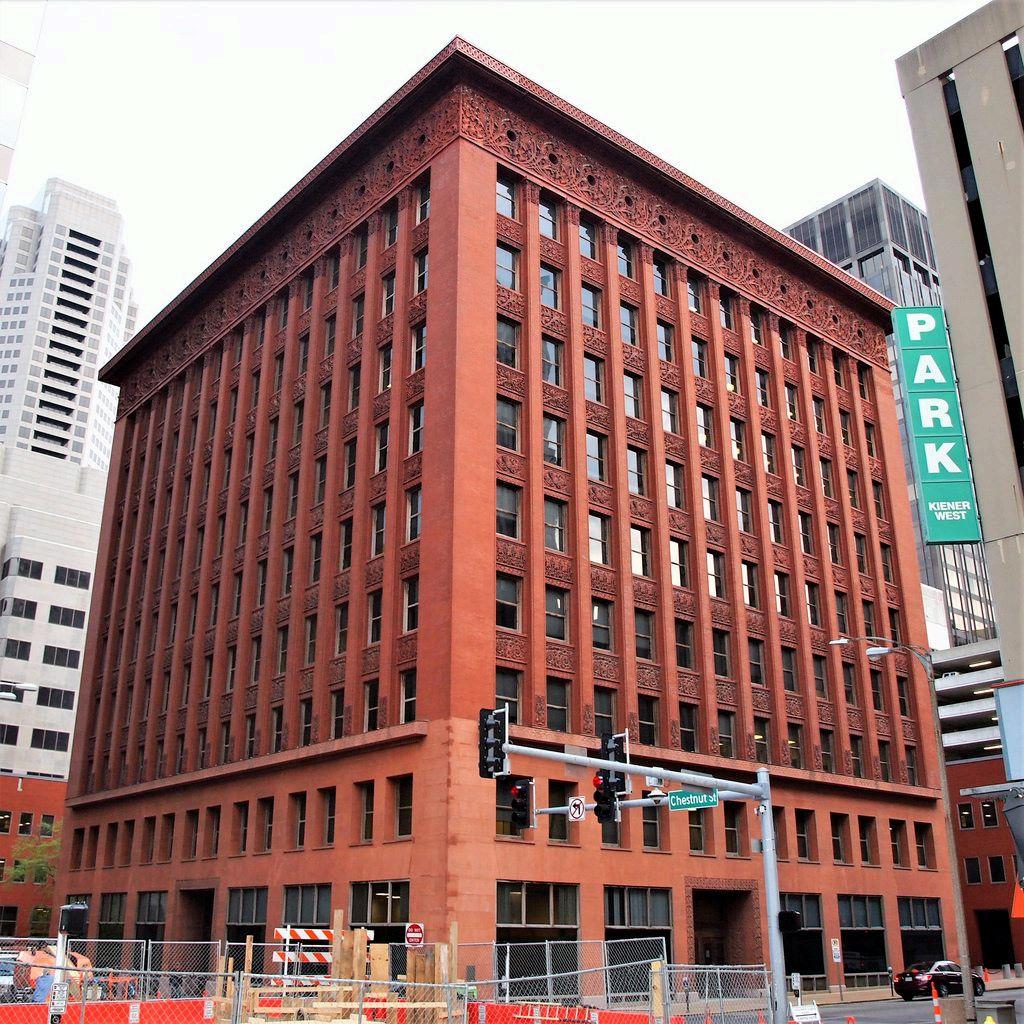
The Wainwright building, one of Sullivan’s most known works, is key to analyzing his ornamental style, as well as starting to see how erotic it becomes. Sullivan describes this building very similarly to how he describes men in his autobiography, mentioning how dominant it is, strong and powerful – able to command the landscape and stand erect on the street. Much of the ornament on the exterior is subtle, a sort of blink and you will miss it moment, yet, once it is perceived it cannot be hidden again.
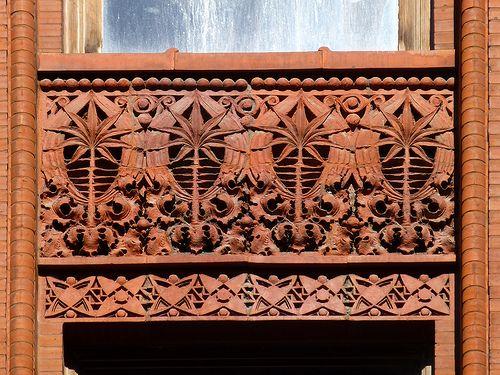
While seemingly just an intricate design, it is entirely possible there is more to these terracotta ornament panels than meets the eye Taking the 4-panel arrangement as its own scene, an image starts to take shape. Two circular designs at the base of the panel with an erect shaft between them, bursting open into a display at the tip, with two hand-like shapes on either side.
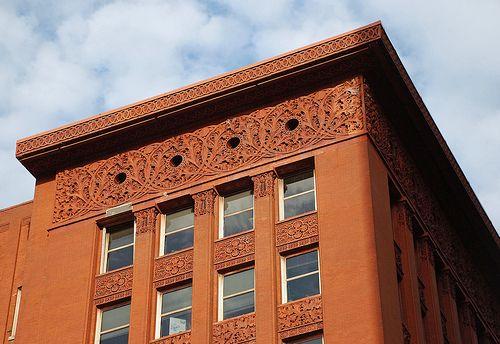
T p e seemingly infinite darkened recesses surviving no purpose beyond that purely aesthetic. Even the void nature of the ornament almost invites the same sexual anonymity and experience, looking uninhabited and dysfunctional to the untrained eye “You worship the dick and not the man”[8] Surprisingly, this aligns with architecture, where people praise the design or structure as opposed to the creator. While obviously not one, it is an example of those who know, know, these little secrets seen in much of Sullivan’s ornament that are only meant to be glimpsed out of the corner of the eye, similar to hanky code in cruising. In fact, many of Sullivan’s ornaments and overarching designs seem to tease at secluded public hookup spots, poking fun at the heteronormative domesticity that Sullivan continually shared his distaste for
III. Louis Sullivan as a Human
Sullivan was, of course, more than a collection of buildings and designs. More than bricks and plaster, more than drawings and sketches. When thinking and analyzing the work of historical architects, and historical figures in general, it is important to remember that they were living breathing people with hopes, dreams, feelings, thoughts, emotions, and love. Too often in the modern age people can get caught up with how quickly time moves on, relegating a full life to text on a page, text that often does not paint the full picture. Sullivan had a great reverence for life, seen through his adoration of Walt Whitman (another queer man with a similar metaphysical understanding of the human experience) Specifically, Whitman’s poem, “There Was a Child Went Forth” which was often quoted in Sullivan’s autobiography.
THERE was a child went forth every day,
And the first object he looked upon and received with wonder, pity, love or dread, that object he became,
And that object became part of him for the day, or a certain day, or for many years, or stretching cycles of years.[7]
Sullivan sees this poem as a sense of sympathy Not sympathy in the modern context where one can feel bad for another person, but a more spiritual, artistic view of the world around him. Sullivan idealized living not in a world with objects, but to be relating to objects emotionally and subjectively, rewriting the binary of self and other. Sullivan lived his life as a queer space, a cacophony of experience, where the self and the other are both left fully intact, but produce a
mixture of categories in an assemblage. Just because someone is queer and an architect, does not mean they inherently make queer architecture Like any space for a minority group, it must be chiseled out of oppression actively and radically. Louis Sullivan was a queer architect who made queer architecture and remains one of the most influential American architects to ever live. It is extremely important to include his queerness in historical context when talking about his work, not just justify or explain it, but to let young queer architects know that they can build this world to – they do not have to just exist in heteronormative space but can work to better their own lives as well as the lives of other queer people. Architecture, though reliant on resources and capital, is for the public, all the public, and it is time to start designing it as such.
Bibliography
1. Gough, Tim. 2017. Trans-Architecture. FOOTPRINT, Trans-Bodies / Queering Spaces
2 Holmes, et al 2010 Faceless Sex: Gloryholes and Sexual Assemblages Nursing Philosophy.
3. Sullivan, Louis H.. 1924. The Autobiography Of An Idea. Press of The American Institute of Architects
4. Snyder, Daniel. 2017. Louis H. Sullivan: That Object He Became. FOOTPRINT, Trans-Bodies / Queering Spaces
5. Sedgwick, Eve Kosofsky. 1990. Epistemology of the Closet. University of California Press
6. Wright, Frank Lloyd. 1924. Louis Henry Sullivan: His Work. The Architectural Record
7. Whitman, Walt. 1860. Leaves of Grass. Thayer and Eldridge
8. Lucero, Karisha. 2018. Exploring the history of glory holes after my bizarre encounter with one. Rooster Magazine.
V. Afterword
The original title of this essay was “Was Louis Sullivan A Bottom?” I felt it apt with the subject of the paper being how his sexuality affected his design as well as his own internalized homophobia and disgust of the feminine At that time in history, homosexual meant a submissive, feminine man, and Sullivan seemed almost hyper-concerned with his own masculinity (as well as the other men he viewed), refusing himself to be homosexual. I scrapped this title for the architectural double entrenda, both being a male sexual term as well as a construction term. I think the new title fits a bit better, but I still wanted to answer the question I originally posed – yes, undoubtedly so I would say. Reading through his description of his own ornament, as well as his own autobiography, I constantly had to pause to laugh at how abhorrent down bad Sullivan was for literally any man he came across. His hyper-concern with masculinity presented itself as erotica and fetishization, paralleling many of Whitman’s more risque writings. There were many references to men and man and his ability to overpower and dominate, Sullivan went into great detail when describing their physique as well, paralleling his architecture. They were very well written and truly fascinating, but would also give a dirty romance author a run for their money. As odd as it was at times, it also really helped to humanize his work and I think I understand it a great deal more.