EDITED BY H.K.
chaplains
in khaki: Methodist Soldiers in Camp, on the Field, and on the March
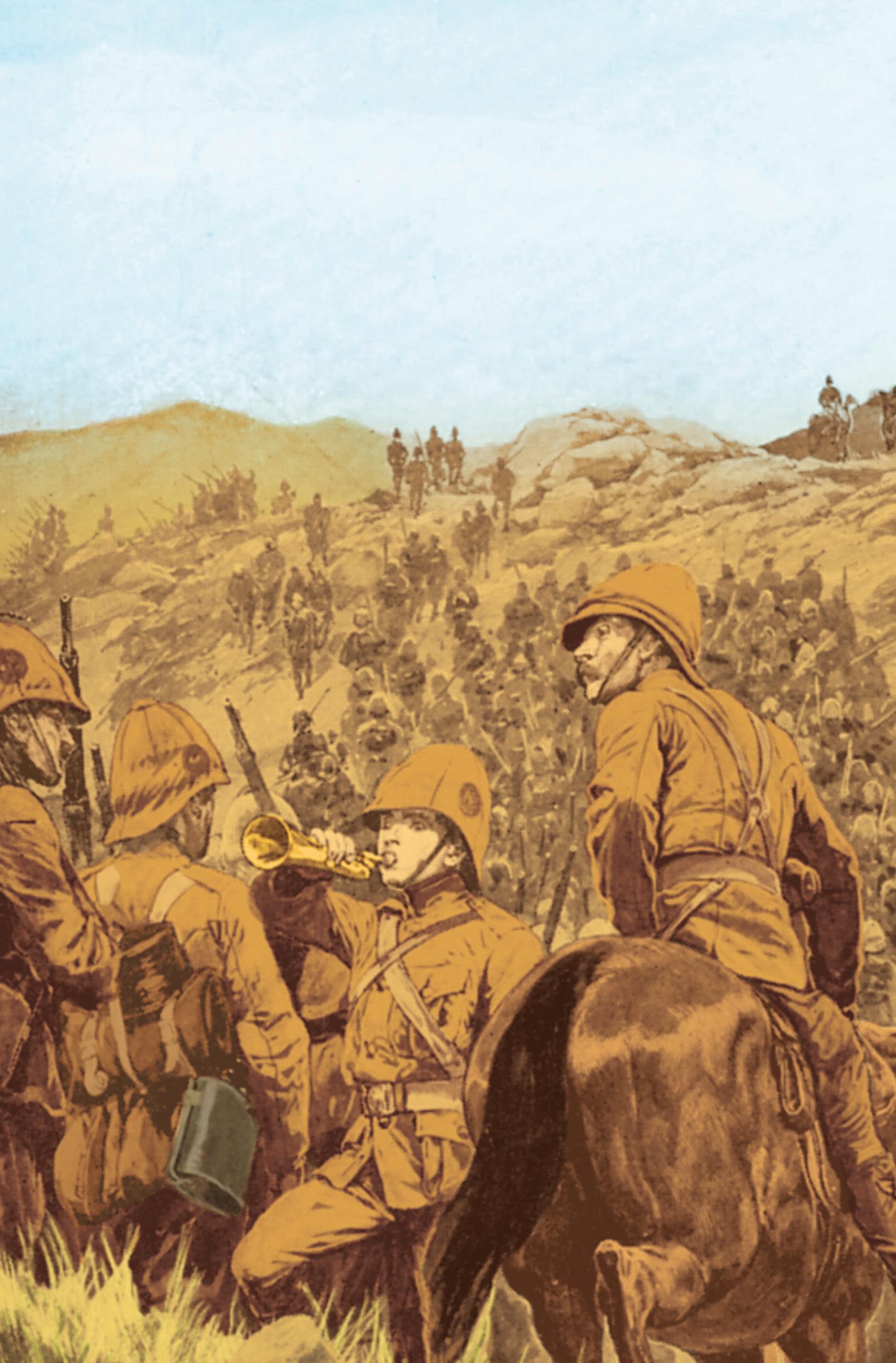


EDITED BY H.K.
in khaki: Methodist Soldiers in Camp, on the Field, and on the March
METHODIST SOLDIERS IN CAMP, ON THE FIELD, AND ON THE MARCH
EDITED
BY
H. K.
First Fruits Press Wilmore, KY
c2025
ISBN: 9781648173554
Chaplains in khaki: Methodist soldiers in camp, on the field, and on the march
Edited by: H. K.
First Fruits Press, ©2025
Digital version at http://place.asburyseminary.edu/firstfruitsheritagematerial/5/
First Fruits Press is a digital imprint of the Asbury Theological Seminary, B.L. Fisher Library. Asbury Theological Seminary is the legal owner of the material previously published by the Pentecostal Publishing Co. and reserves the right to release new editions of this material as well as new material produced by Asbury Theological Seminary. Its publications are available for noncommercial and educational uses, such as research, teaching and private study. First Fruits Press has licensed the digital version of this work under the Creative Commons Attribution Noncommercial 3.0 United States License. To view a copy of this license, visit http://creativecommons.org/licenses/by-nc/3.0/us/.
For all other uses, contact:
First Fruits Press
B.L. Fisher Library
Asbury Theological Seminary 204 N. Lexington Ave. Wilmore, KY 40390
http://place.asburyseminary.edu/firstfruits
Chaplains in khaki : Methodist soldiers in camp, on the field, and on the march [electronic resource] / edited by H.K. – Wilmore, Kentucky : First Fruits Press, ©2025.
Reprint. Previously published: London : Charles H. Kelly, 1900. 1 Online resource 361 pages: port.) : digital.
ISBN: 9781648173554 (paperback)
ISBN: 9781648173561 (epub)
ISBN: 9781648173578 (Mobi)
OCLC: 1552763166
1. Wesleyan Methodist Church--Missions. 2. Military chaplains--Wesleyan Methodist Church. 3. Military chaplains--Great Britain. I. Title. II. H. K., editor.
UH25.G7 C5 2025eb 968
Cover design by Amanda Kessinger

First Fruits Press
Te Academic Open Press of Asbury Teological Seminary 204 N. Lexington Ave., Wilmore, KY 40390 859-858-2236
frst.fruits@asburyseminary.edu asbury.to/frstfruits
EDITED BY H. K.
lfllUbllU:
and Eastney, at Devonport and the Curragh j also in Malta, Gibraltar, and India. From all these Homes Methodist soldiers have gone to the front.
The letters written by our chaplains are also incomplete. Those which appear have been selected from the columns of the Methodist Recorder and the Methodist Times. We had hoped to include all the communications to the English Methodist newspapers. A difficulty, however, presented itself. To have included a larger number of letters would have increased the size, and therefore the cost, of the volume to an undesirable extent. We have therefore been compelled to make a selection. Mr. Lowry's letters are complete, and the whole series will be found to give a fairly consecutive view of the experiences of our chaplains over nearly the whole field. At the date of publication no letters had arrived from relieved Mafeking.
The chapters, like the Acts of the Apostles, are unfinished. As we write, new letters are appearing in the Methodist press. Some may think it would have been better to wait until the close of the war before publishing, and thus to have secured completeness, and also the great advantage of revision by the writers. This, however, could not be done. At present there is an urgent demand for republication. When the war ends, interest now keen will rapidly fade. If the volume is to have a wide circulation, which in the interests of our soldiers and sailors, and of the work their chaplains are doing, is most desirable, it must be published at once.
Five V\T esleyan chaplains on the field are represented in these pages. Many others, however, from Australia, Canada, and South African Colonies have also served, it may be with equal distinction, during the present war. Noble work has also been contributed by Scripture Readers like Mr. Pearce, by officers, commissioned and non-commissioned, and by private soldiers. In camp, on the field and in hospital,
THISvolume consists of letters written by Wesleyan ministers who, as chaplains appointed under the authority of the War Office, are attached to various Divisions of the British and Colonial Army now serving in Cape Colony, Natal, the Orange River Colony, and the Transvaal. It includes stories, told by an ex-chaplain, of our Wesleyan Methodist soldiers who, having served the Lord Christ in connection with Soldiers' Homes in England, have gone to the front, and in some instances have laid down their lives for their Queen and country. There will also be found communications from well- known ministers in Cape Town, Durban, and Kimberley j from one of the Wesley Deaconesses, whose name for some years past, especially in Johannesburg, has been as ointment poured forth j from a young officer-an old Kingswood boy, now attached to the Imperial Medical Staff Corps j from a local preacher who passed through the terrible experiences of Spion Kop j and finally, from Mr. Rudyard Kipling. The record is necessarily incomplete. Equally interesting stories might have been told concerning the Christian training soldiers have received in Methodist Soldiers' Homes other than the two here selected, in particular at Chatham and Sheerness, at Woolwich and Shorncliffe, at Portsmouth
IFever Methodism had cause to be thankful for the work it has been led to do during recent years for the Soldiers of the Queen, it is now. Its Homes at Aldershot, Pirbright, Chatham, Portsmouth, Shorncliffe, Woolwich, and elsewhere have been centres of blessing to thousands of men now in South Africa, or on the way there, and centres of comfort and help to wives and children and mothers. It is not merely that the sons of Methodist parents, brought up in our Sunday schools and dear to us by kinship, are cared for, but many who belong to other Churches come, and are made welcome, and are never made to feel that they must desert the Church of their fathers in order to share the social and religious privileges enjoyed by "Wesleyans." There are two or three men whose characters are sketched here who are Methodists in precisely the same sense in which my ancestors in the last century were Methodists. They are "members of Society" among the people called Methodists,
but staunch members also of the Church of England or the Church of Scotland; in one instance, the man, as will be seen, is a captain in the Salvation Army, or was, until his Queen called, and the King of all kings and queens said, "Go," and he went.
The Methodists have suffered too much from bigotry to like it, and nowhere is it less present than in our Soldiers' Homes.
It may be thought that now the Homes are deserted. On the contrary, they are crowded. At Aldershot, the Reservists, the Militia, and the new levies appreciate them greatly. The other day the Rev. R. 'V. Allen gave me a glowing account of the work, both in the Homes and the churches at Aldershot. The great church at the South Camp, which ordinarily has one of the largest congregations in Methodism, was never fuller. There, and in London and Chatham and Sandgate, the provision of beds has been a most fortunate and gracious stroke of policy, Not only do the beds help to defray the cost of the Home, but they save many a man from being driven into far less desirable quarters, and married people also. In London it is quite customary for men who have no home of their own, to spend their furlough in the Buckingham Palace Road Home. In that way it comes into contact with men of all branches of the service, including the Colonial troops and men of the Royal Marines. Sometimes very pretty episodes occur, and the Home has the opportunity of fully and literally justifying its name.
It was a fortnight before Christmas, and the child was not higher than his own kit bag.
"Where have you come from, my boy 1" said Miss Morphew, the lady-superintendent.
"I'm a man," said he, drawing himself up to his full
height, "and I've come from Portsmouth. Can I have a bed for the night � "
" Yes, you can have a bed. But are you going home to-morrow 1 "
" No," said he, "I'm on furlough."
"What are you going to do while you are on furlough 1 Are you staying in London all the time 1 Because, if you will excuse me saying so, it would be cheaper to take a bed by the week."
" No," said the little fellow thoughtfully, "I'll only take it for one night."
" But why not for the week �" she urged.
"Well, you see," said he, "I may not like it."
So she pressed him no further.
Would he like to see his room 1
No, thanks," he replied, "I'm going to the gaff."
She tried gently, in her own wise and motherly way, to dissuade him. Failing, she persuasively suggested that she might be allowed to take care of his money a service she often renders when soldiers come on furlough.
" No, thank you," he said, quite politely; and with a proud lift of his chin added, "I'm quite capable of taking care of it myself."
So she left him to follow his own devices, knowing by experience that if she worried him he would go clean away, and possibly fall into worse hands.
Two days later he came to her room, and, knocking at the door, asked, "May I come in, please 1 "
His face was quite pathetic; his voice low and gentle. " May I ask a favour � "
" Certainly."
Well," said he, "I think that you are the jolliest lady I've ever met."
She looked at him a little anxiously, not being quite sure
whether his intentions might not be matrimonial. But he added, speaking with a sadness very touching, "Would you mind if I call you' Mother' �"
"Well, I'm not quite sure whether it would be right for you to do so. Y our own mother must be considered, and she might not like it. 'Mother,' you know, is a very sacred name."
" Oh, Miss Morphew," said the child, "I've never had a mother, or a father either."
It was only too true. He had never known either mother or father.
She consented. But still he did not seem to be quite satisfied. After a moment's thought, he added, looking at her wistfully, "Would you very much mind, now and then, saying 'My son' �
She agreed, and they sat down to enjoy the new-found relationship. Looking straight into her eyes, he asked"Mother, have you ever had a mother � " Yes, and thank God I've a mother still."
Looking up sharply, he said, "Mother, you're taking a 'mike' out of me."
Oh no, I'm thankful to say she's still living."
"But," said he, "however old is she, then 1"
"Not very old. Perhaps sixty-eight or sixty-nine at most."
He looked reproachfully at her, and said, "Oh no, Mother dear, you know you're that yourself."
He was a lad with all his wits about him. Wanting very much to go to the Crystal Palace, he begged Mother to go with him. She on her part wished, without grieving him, to get out of it. So she confided in a visitor at the bar downstairs, and begged him to dissuade the boy. The visitor told him that he didn't think it was worth his while going to the Palace. He had been there himself two or three times, and he didn't think so much of it. In an instant the lad replied-
"But it must be worth while, or you wouldn't have been two or three times."
The lad had principles from which he never swerved. One was never to be late; another, never to let anybody pay for him; another, never to borrow so much as a halfpenny. His pecuniary resources were limited, and he had to plan his expenditure so that his money might last to the end of the furlough. Two or three mornings a-week he would have eggs and bacon for breakfast; on the alternate mornings he was content with plain bread and butter. Mother suggested that he should have an egg one morning and bacon the next, and so always have something nice for breakfast.
" No," said he, with a knowing shake of his dear little head; "I like a good' bust up' when I have it."
Sandford, in the bar downstairs, who is an ex-Guardsman, tender, like most soldiers, in proportion to his strength, conceived the idea when Christmas came of giving the Bugler Boy and another lad, who was staying in the Home, a visit from Santa Claus. On Christmas Eve they went to bed in good time. When all was quiet, "Santa Claus" crept upstairs and filled the boys' stockings with presents-pocketknives, writing-pads, oranges, and a new shilling in each. You may imagine the joy of the boys on Christmas morning. When the Bugler went back to his regiment, then lying at Aldershot, he sent "Mother dear" a portrait of himself in a handsome frame. It has the place of honour over the mantelpiece in the sacred little room dear to many a British soldier.
When his regiment was going to South Africa, he came up from Aldershot, paying his own fare, that he might bid Mother" good-bye.
At this point in the story, Miss Morphew brought from her inner room a small white cardboard box, containing two bank-books, an Army Temperance medal, a little keepsake, and a number of letters-often opened. The Bugler Boy
left the box in "Mother's" charge, telling her that it contained his most precious treasures. She found that he had £4 or £5 in the Savings Bank.
They 'were all very anxious that he might become a Christian. Without worrying him, they often talked together on the subject. At last he said-
"Mother, whenever I 'write and tell you that I am a Christian, you'll know that I'm a real one."
A bandsman, himself a foundling, and a frequent visitor at the Home, had a great love for the boy, and watched over him during the perilous furlough weeks with a sort of fatherly tenderness. Just before the lad went to the war, on that last visit, Miss Morphew took him into her own room and asked the bandsman to come also. They talked together for a little, and then knelt in prayer. When Mother had commended her "son" to God, the bandsman, though not a Christian, broke out into prayer also. And when the last good-bye was said, the great bandsman kissed the child.
I must not let you imagine that the Bugler Boy was a sentimental little milksop, unfit for the rough-and-tumble life of barrack-room or camp. On the contrary, he is strong and sturdy, with a mind of his own, a perfect bugler, and none more popular in his regiment.
It was a bitter day, and the fog wrapped London in darkness. No cosier place in 'Vest London could have been found than the chimney corner of Miss Morphew's little room at the Soldiers' Home.
On the table by the fireside stood the likeness of a sergeant in a floral mount.
"I must tell you," said my hostess, "about Staff. He came to us about four years ago, looking wobegone. It was
Mr. Cundy (at that time resident chaplain) who brought him. He was striving to be a Christian, without the joy of the Lord-hovering about the borderland, saved one day and lost the next. It was at the Home in Buckingham Palace Road he entered into the fulness of peace. Once entered, however, he became the sunniest man about the Home-our right hand in all work, and the friend of everybody. Religion fully enjoyed set free his natural and racial qualities. He had more than his share of Irish wit, and used to say -the most original things without knowing that they were original. Like little children in their first prayers, and in their interpretations of truth and questionings about the deep things of God, he would often startle us by the strange things he said. His prayers were very real. He talked with God, face to face, as a man talketh with his friend. One night during the Egyptian campaign, when the Guards had gone to the front, he said-
" 'Dear Lord, take care of our fellows. They've gone to the Soudan. The Evening News, dear Lord, says there are five hundred of them;' and then, true to his always keen desire for accuracy, he paused, correcting himself, 'No, Lord, it's four hundred and fifty.' And he prayed for them as though they had been his own sons.
" Another night he startled us by asking that he might be made a 'corpse,' but immediately relieved our apprehensions by quoting something he had heard Mr. Hocken say about being crucified with Christ and dead to the world.
"He had his own way of looking at everything, and sometimes gave the most extraordinary renderings of Bible stories. 'What is thy name?' he cried one night, 'J aco b. Horrible name I-supplanter, deceiver, cheat! Thy name shall be no more J aco b, but Israel. Dear Lord, make me Israel, an Israelite indeed, in whom is no guile-Is-real.'
" Staff never let slip an opportunity of usefulness. If he met a young fellow, he would tempt him to the Home, take
him upstairs, give him a cup of coffee, and from that day never rest until he had led him to Christ. There was an old pensioner in the hospital whom he never failed to visit once a week. When the old man died, he bought a wreath to lay upon his coffin, and constituted himself chief mourner, seeing to all the arrangements, and relieving the widow from all anxiety. Those who saw it will never forget the walk from the station to Woking Cemetery. For threequarters of a mile he slowly followed the pensioner's coffin with the old woman on his arm. He was very anxious about the service-anxious most of all that the Rev. R. W. Allen should conduct it. If he were not able, then he thought that the Archbishop alone was worthy to commit the body of so venerable a soldier-saint to its last restingplace. Pensioner Bywater lay sick unto death at the very time when the whole country hung around the deathbed of Gladstone. Staff, sharing the national excitement, conceived the idea that if his dear old pensioner could die on the same day he would be able to help Gladstone in the Valley, and would see him safely through the gates into the City. Ceaselessly Staff prayed to his dear Lord that this might happen j and, strange as it may appear, the saintly old pensioner actually did die not only on the day, but at the very hour when the great statesman entered the Valley. Until he went away to the war, Staff paid the widow of his old friend three shillings every week that he might brighten her last days.
"He was a very earnest Christian. His favourite saying, so well known in the Home, was' Launch out!' If he met a comrade, his greeting would be, 'Well, have you launched out?' He himself was always launching out on some service for his 1Vf aster. One nigh t he and a few comrades were going on the top of an omnibus to a mission in Great Queen Street Chapel. They passed the doors of a theatre. Staff saw the crowd on the pavement outside.
To the astonishment of everybody on the top of the omnibus, he broke out-
MyoId companions, fare ye well, I will not go with you to hell.
"Dismounting, they came upon a group of rough men. Staff wore his medals.
" , Where are you going �' said one of the men.
" , We are going to the fountain,' replied Staff. ' Will you come with us �
"He was irresistible, and brought the lot to the mission.
"When the Guards came back from Omdurman, many were sick in hospital. Staff diligently visited every man of them. Many were very sick. He knew they could not recover, and never ceased tenderly ministering to their comforts. He saw about twenty of those brave Guardsmen safely through the Valley, and we had good reason to believe that before the end came every man of them was soundly converted.
"His life has been a life of adventure. For seven years he was in Zululand, living a hard, rough life among the natives before he entered the service. He was converted, or at least convinced, at the Curragh. Mrs. Perry, at her Soldiers' Home, brought him to his senses. He used to tell in his experience how far he had gone in sin, when the dear old lady-' Ah, she's gone now,' he would say, 'to the big Soldiers' Home yonder '-laid a hand of love upon him. She was seventy years of age-a big, comfortable old lady with corkscrew curls-and he 'fell in love with her,' to use his own expression.
"Last April Staff finished his twenty-one years' service. But when the war broke out he heard his country's call, and, though under no obligation to do so, he volunteered for Queen and country, but most of all that he might serve his dear Lord and the 'Soldiers of the Queen' in the land
he knew so well. They made him staff-sergeant on one of the hospital ships. When he went away a farewell meeting was held at the Home. It was to be a surprise meeting. The men determined to make Staff a little present. So they bought a beautiful walking-stick, and had a gold band put round the handle, with the words engraved, 'Launch out.' But Staff was more than a match for them. They had been very secret, but he also had his secret. When he returned thanks for the present, he said how much he owed to the Home, and how Miss Morphew had been like a mother to him, and how everybody had been kind, and he would like to leave something in memory of the happy times he had spent there, so he had bought a clock. And it stands to-day on the mantelpiece in the beautiful room upstairs which is the Soldiers' Parlour."
I am not allowed to give Staff's name, or the name of his ship, for most of the good he does is done by stealth. But the name is written in the Lamb's Book of Life, and before leaving he wrote it on the Historic Roll, and paid his guinea, which, he said, was to be only a first instalment. His last act in bidding farewell was to hand over twenty-five pounds to Miss Morphew that she might take care of it whilst he was away. And he asked for no acknowledgment any more than if he had been handing it over to his mother.
He came to London a professing Christian, but fell into sin-fell horribly. At his coming he was a fine, freshlooking young fellow, hut when sin had put its mark upon him he became a mere wreck of his former self. One night he drifted into the Home, with his greatcoat hanging loosely about his shrunken frame. It "was the Bugler Boy who first noticed him. The boy asked if he might speak to that "poor, miserable -looking man." Miss Morphew spoke a
kind word, and invited him to the meeting then being held. It was in that meeting that he took his turn for the better. He became one of the most helpful of the men coming to the Home, and so continued until the war broke out, and he went with his regiment to the front. He sailed on board the Nubia, the transport on which, it will be remembered, the Rev. E. P. Lowry sailed. He was a great help to the chaplain in his work during the voyage, and" Major Lowry," as he calls him in his letters-giving him his military rank-was a great help to him in return. Writing home from Cape Town, he told of the glorious time they had together on board ship. His beautiful voice was very helpful in the ship-board singing. One man at least in the little company that used to meet for fellowship and prayer on board the Nubia found rest and peace. In later letters he tells how Mr. Lowry went in and out among the tents up-country, beloved by all the men.
He was a man of sterling principle, and one of the finest soldiers in Her Majesty's Guards. His father, who had a business in the Midlands, wished him to take to it, but the lad longed to be a soldier. It had been his ambition from childhood. When the crisis of his life came, he told his father plainly that he must go into the army. On enlistment he was simply an honest, self-respecting, and well-conducted young fellow, with no thought save for soldiering. In less than four months he was truly converted. From that day he lived a consistent, manly Christian life, respected by his comrades in the battalion, and valued by his friends.
A man with so much force of character and natural intelligence, who had deliberately chosen the army as the profession and enthusiasm of his life, was bound early in
his career to win the stripes. Then came the great perilthe peril inseparable from success. At the Home they watched with some anxiety, wondering whether, as he rose step by step, he would retain his blameless Christian character. It is often easier to be a Christian in the ranks than as a non-commissioned officer. But through all this time of severe temptation he stood firm as a rock. At twenty-one he was a full sergeant and a true Christian. The quality of his religion may be gathered from an incident that occurred immediately after his conversion. In order to enlist he had added one year to his age. When he enlisted in the service of Christ, he went straight to his commanding officer and confessed the lie he had told, and took the consequent discipline like a man, losing a year and a year's pay. He refused to murmur at the penalty of wrong-doing. "It is necessary," he said j "it's discipline."
Many a love - story is told in the Soldiers' Home, and sometimes letters are there written that affect the destiny of human lives. Our friend the Sergeant loved a girl in the town of his birth-loved her in an old-world, courtly fashion. But he had never dared to tell his love. One day he made up his mind to go home and speak to the girl. He went, and came back with his mission unfulfilled. Another day he came to the Home, asking Miss Morphew if he might write a letter of great importance in her room, where he could be alone. After a while, returning to the room, she found him on his knees in prayer, and hastily retreated. The letter was written, but, alas! the girl had no eyes to see the chivalry and devotion laid at her feet. She did not love him, and told him so with such cold plainness that he at once accepted his fate, regarding it as the will of Providence that he should give his undivided attention to the duties of his calling. He forthwith put all thoughts of marriage away, and became from that time
in all simplicity, and absolutely, a soldier of the Queen and a soldier of the Cross.
Seven years ago he enlisted in the Guards. He belonged to a good Methodist family in the North of England, and was a Christian when he enlisted. Men who under such circumstances enter the army as a rule stand well. From the beginning he was strong and manly, a witness for Christ in the barrack-room, loyal to duty, fearing no evil, and apparently without consciousness that he had the making of a hero. Once, when on service at Pirbright in charge of the transport, he was out on duty near the canal one very dark night. In the intense darkness a comrade missed his footing, and fell into the deep canal lock. The Corporal at once climbed down the slimy gates of the lock, and, at the risk of his own life, saved the life of his comrade. His friends were anxious to report so brave a deed to the Royal Humane Society, but the Corporal peremptorily refused to let the story be told. He had only" clone what any other fellow would have done under similar circumstances." He was one of the best athletes in the battalion, and won many prizes in the military sports. At the end of his service he returned to Yorkshire, and became a policeman. He was just on the point of making a home for the girl he had loved all through the years of his soldiering, when the call came for him to rejoin the battalion. On the eve of his journey he married the girl. Little wonder if many a prayer rises to heaven in the Soldiers' Home that the brave good Corporal and his young wife may be reunited for a long and happy life.
He entered the service simply because he was out of work. The spare hours of the first six months of his soldiering he spent in the canteen. He was swiftly going down the hill to the drunkard's doom, when, one snowy night at Wiudsor, a comrade asked him to go to a temperance meeting. He had nowhere else to go, so he accepted the invitation. In the course of the meeting the young soldier was impressed, and he signed the pledge. Going back to the barrack-room, he singled out the biggest drunkard,
"Old chap," said he, "I've signed the pledge."
Said the other, "I'll sign it too, and keep it as long as you keep yours; or the one that breaks it first shall pay five shillings."
" Done," said the Scotchman.
The next evening both men were at the meeting. It was more than a temperance meeting, for they both from that night became earnest Christians. Coming away, the comrade said, "I've given up serving the old man without the music."
Finishing his term of service, "Mac" returned to his own city, and married a refined Christian girl to whom he had been engaged for some years. They had one little boy, to whom the father was devotedly attached. The call to war one morning broke up one of the happiest homes in England. As the Reservist looked upon his little home, and upon his frail wife, for whom he had worked with never-failing tenderness and devotion, and upon the little child whom God had given them, there came an overmastering temptation to shirk the call of duty. It was the stronger because, unlike many of those whose story is told in these pages, he never had any enthusiasm for soldiering, and never felt that it was his true calling in life.
Shall we," said he, "go right away to some place where no one knows us, and begin our life afresh � "
"N 0," said his brave little wife; "I love you too much for that."
And at the bidding of her love, he turned, and rejoined his regiment.
The Sergeant was an energetic young fellow, who always looked on the bright side, and over whom troubles passed lightly. He spent seven happy years in. his regiment. When a little baby in long clothes, his mother took him to a temperance meeting and put down his name as a total abstainer, and he kept the pledge. He was a sergeant of transport, a splendid horseman, a clever bicyclist, a great athlete, and, take him all in all, as good a specimen of muscular Christianity as you would meet in a day's march. His father and mother were good old Methodist people in Devonshire. It was a soldiering family. He and his twin brother married sisters. He had left the service, and with his wife had settled in Cornwall, where they were getting on well in business, when the call came, and. he left all and followed.
He also was the son of godly parents, and lived as a Christian soldier should do through all his time of service. A quiet, earnest worker for Christ, he was respected in his battalion and everywhere else. On leaving the service, he went to Dr. Guinness's Home to be trained as a missionary. In the midst of the evangelistic work which he loved so dearly, he was called to rejoin the regiment, and he went with a clear conscience to do his duty-a good, solid, steady, Christian man.
A man who will deliberately sacrifice rank and pay that he may the more successfully serve Christ, and by any means save some, is "a fool for Christ's sake "-and therefore worth thinking about.
He enlisted eight years ago in a battalion of the Guards, and was converted in another London Soldiers' Home. Not satisfied with the religious teaching he there received, he joined himself to the Plymouth Brethren. Still dissatisfied, he wandered away, not into the world, but into a nomadic wilderness, and finally entered the Salvation Army. There, and in the Buckingham Palace Road Home, he found rest to his soul. " Wesleyan" would doubtless be his Army " religious persuasion." He was intensely earnest and spiritually minded. His comrades lay upon his soul as a burden from God; he pleaded ceaselessly for their conversion, and never wearied in trying to bring them to Christ. A man of more than ordinary intelligence, and a highly capable soldier, he rose to be a sergeant in the battalion. But, conscientiously believing that as a non-commissioned officer he had not equal liberty in working for Christ among the men, he deliberately resigned his stripes and pay, and returned to the ranks as a private soldier. His friends at the Home did not approve of this step, but it shone clearly before the soldier's conscience as duty, and he did it. He lived in one of the roughest of rough barrack-rooms, and, "with a cheerful mind," lived a life which was a continual witness for Christ. As you may imagine, there was a certain vein of eccentricity in the man, which sometimes showed itself in the strangeness of his evangelistic efforts. For instance, he procured a flag with the one word REPENT printed in large letters across it; this he used as a coverlet to his bed. It won for him a nickname, or perhaps I should
say a pet name; what it won for Christ the Day will declare.
When the time came for him to leave the regiment, the men in the room claimed the fulfilment of a custom. A man leaving stands beer all round. But" Repent" firmly refused to do this. Determined, however, that religion should not be branded as stingy, he invited all the men in the room to a tea-drinking at the Soldiers' Home. They promised to come. Miss Morphew was commissioned to provide for thirty or forty Guardsmen on such and such a night, and "Repent" would pay the bill. She was incredulous. Experience told her that these rollicking comrades were not likely to come to a tea-drinking. But " Repent" quietly insisted. " Yes, they're sure to come. I've asked it of God."
He talked the matter over with the Scripture Reader, who was also incredulous. But" Repent" remained unmoved, and preparations were made. The tables were set out in style, with ample provisions and plants and flowers. Miss Morphew made it all as pretty as she possibly could. A quarter to seven came, not a man had arrived. Ten minutes to seven; they went to the door and looked out, but not a man was to be seen. Fearing that the generous host might be discouraged, they essayed to cheer him up; but he cheered them. His faith never wavered; of course they would come; had he not prayed? God would surely bring them. Presently, at a little after seven o'clock, a young fellow who had been posted outside to watch, like the lad in the Mount Carmel story, ran in, crying, "Here they comethe whole lot!" Not a man was absent. They came in their long greatcoats. N ever imagining that George meant to do more than give them a cup of tea at the bar, they were prepared for an evening out farther afield. Great was their amazement when a pioneer, who had explored as far as the hall, returned with the news that the tables were set out 2
in state. The men took off their greatcoats and sat down in altered mood. They were full of fun and frolic, laughing, telling stories, and cracking jokes to their hearts' content, and to the content of Miss Morphew, who, sensible mother as she is, likes to see" Tommy enjoying himself. Experience tells her that it is only when he makes himself at home that the more gracious influences of the Home can touch all that is best in his nature. So they had a real good time, and stayed till ten o'clock, no one dreaming of leaving earlier.
It was George's meeting, and he conducted it in his own way. They sang popular hymns, and Miss Morphew, Mr. Hocken, the Scripture Reader, and others made speeches. The most touching speech was the one with which George closed the meeting.
"For seven years," said he, "I have lived among you night and day. You have seen my manner of life. You know the witness I have tried to bear, and you know that it has been the one desire of my heart, all these years, to win everyone of my comrades for Christ."
Then he appealed to them in simple words that went to their hearts, and. many a man that night wept as he heard his old comrade pleading with more than a brother's love.
It was one of the most extraordinary meetings ever held in the Soldiers' Home. Many a man to-day on the tented field, or storming the kopjes, or at rest in the Homeland, will remember the words of "Old. Repent" spoken on that memorable night. Their last word before going back to the barrack-room was this: "Look here, George, you'd better take on again, and then you can give us another tea."
From the old barrack-room George went to Scotland, where as a captain in the Salvation Army he did loyal service for his Master, until the day when the Reserves were called out. They wondered at the Home whether he would regard his enlistment in the Salvation Army as the
primary duty of his present life. They knew that he would never run away or play the coward. But he was just the sort of man to say quietly, "I can't now obey the call; I've taken service with a higher Master," and, like an old Quaker, witness by going to prison. But George had not so learned Christ. His religion had gradually become more and more practical. He had shed off much of the eccentricity and one-sidedness and narrow-mindedness of earlier days. He took the larger view, and proved that an out - and - out Christian, whose all was on the altar, and who had sacrificed pay and comfort and rank, and all that an English soldier counts dearest, for Christ, could not but be, in the hour of his country's need, a true patriot. To him the call of the Queen was the call of Christ.
Theirs not to reason why, Theirs but to do and die.
He had gone into the Salvation Army at the bidding of his Lord, and he simply said, "This, now, is the Lord's call, and I must go." And he took up his cross, still with a cheerful mind, and followed Christ.
There are many other stories which might be told about the brave soldiers whose voices were once familiar to our friends in the Soldiers' Home, and who are now in South Africa.
Many of their number have passed beyond these voices, where there is everlasting peace.
The other day Mr. Allen was telling me that one of them who, before his enlistment, was a prize-fighter, having found Christ, became a gentle and beautiful Christian character, with a sure faith and a very bright hope beyond. He fell ill a while ago, and became so much worse that the doctor said an operation must be performed. He told him candidly that the risk would be serious. But the Christian soldier
at once replied, "Let the operation be performed, doctor j I'm not afraid to die." Probably. his perfect calmness helped to save his life.
Another in the group was converted some time ago at the Soldiers' Horne. ·When our own Sunday School Union required a trustworthy man, who with his wife and family might occupy the rooms at the top of the building in Ludgate Circus, Mr. Allen recommended this man as in all respects suitable. When the Reserves were called out he was summoned to rejoin the battalion. The Committee of the Sunday School Union, in token of their great appreciation of his services, resolved at once to permit his wife and children to continue their occupancy of the rooms. They pay her a salary for such work as she can do, and have agreed to keep the place open for her husband when he shall return. He has a brother also in the Guards.
Noone can come into close contact with the work of our Soldiers' Homes without realising their immense importance. It will, I feel sure, be a comfort to many who are thinking anxiously about our soldiers, and especially about those of them who have children, to know that the Twentieth Century Fund will help our work for the Army and Navy in more ways than one. Not only may grants be made towards the erection of Soldiers' Homes, but the Children's Home has made special arrangements to take the orphan children of soldiers or seamen who fall in battle.
The Rev. J. H. Hocken writes :-" As Miss Morphew was reading the proof-sheets of the earlier part of this article, she received a letter from the Bugler Boy, written just after landing in South Africa, assuring her of his continued love, and telling her that if he got shot, and so never came home, she was to spend the money in his bank-book for the benefit of the Home."
H. K.
Aldershot swathed in trodden snow, drenched with rain, and bombarded by great gusts of wind, is not an ideal place for a picnic. On such a day a stranger wandering about town and camp sees about as many English soldiers as Tommy says he can see Boers at the Modder River. Like their friends the enemy, they develop the gift of lying low. But they are there-battalions and batteries in full strength, regulars, militia, and volunteers, and they are to be found by those who know where to seek them,
Mr. Weaver, the chaplain in charge since Mr. Lowry went to the front, with a superb indifference to the pitiless wind and rain, proposes a visit to H Block in the South Camp. It is one of the new brick-built blocks substituted for the wooden huts familiar to me years ago. If you are a soldier, and wish to find it, make for the headquarters, where the general's flag is flying, turn sharp to the left, and mount the stone staircase under the guidance of that ill-treated letter H. On the right of the stone landing you will see barrack-rooms; on the left the hum of voices will draw you into a room much more home-like. At a bar inside the door presides a busy man, who, for a small consideration, will supply you with hot coffee and delicate eatables, dear to Tommy's taste. There is a cheerful fire, and tables with games, and comfortable seats, and pictures on the walls. In an inner room another fire blazes, with other seats, and illustrated papers and magazines, everyone of which, I note, is well worn. If you penetrate still farther, you will find a little "upper room," with Bibles and hymnbooks-a clean, quiet, cosy corner in a bustling world, where prayer is wont to be made. You take off your hat there, and think a moment, and send a prayer silently heavenward for lads you know far away, and then come out into
the pleasant reading-room. There are bright pictures everywhere, and a piano, at which a soldier is making out a tune. You have to elbow your way through the men. The whole building is occupied, as it always is, and little wonder. When night falls there will not be room for all the men living in the adjacent blocks who will want to avail themselves of this sensible provision for their comfort and wellbeing.
I have no head for figures, and those who read these lines would, most of them probably, say that statistics convey only faint ideas of actual facts. But there is one figure which it might be worth while to extend in open order by help of your little boy's slate. Set down £1000. Multiply by 20, and again by 12. You will then be able to realise how many men come to the bar to spend their pennies in the course of a year. More than £1000 was taken over the bar at H Block in small sums last year. Nor does this sum represent anything like the total number of visits paid by South Camp soldiers to this one Home in the course of the year. And this is only one of three Homes established by our people at Aldershot. There are many other Soldiers' Homes, as for instance the one built by the late Mrs. Daniells, which for a long time was the only home in the place; the Church of England Homes, also doing excellent work, the Salvation Army Homes, and others. But not the least popular is the beautiful building in Grosvenor Road forming part of the great block of buildings consisting of the high-towered church, and the more recently built Wesley Hall. In the latter building, it should be remembered, the civilian church of the Aldershot Circuit lives right vigorously, and is therefore in the highest degree helpful to the military work in the Home on the other side of the church. A way at the extreme end of the North Camp, not far from the Wesleyan Church, and the newly-established
Industrial Branch of the Children's Home, there is a third of these excellent institutions. All three Homes-H Block, Grosvenor Road, and North Camp-are going "full steam ahead," and are doing a work for the army and the nation the value of which is incalculable.
When I pushed open the swing door of the Soldiers' Home in Grosvenor Road, there stood before me, on the door-mat, equipped for a journey through the storm, my old friend Sergeant-Major Moss. He is older than when I saw him last, but strong and sturdy as ever, and with a certain something in face and voice that goes straight to your heart, and tells of friendship and homeliness. He is "Mr." Moss now, having fulfilled his service in the army. Yet his days and nights are spent among the men he loves so well. As Army Scripture Reader he is rendering a service to Her Majesty not less effective than that which he rendered in the old days, when he won all the stripes possible to a non-commissioned officer. How Moss loves the Home! He does not need to tell you of his love. You see it-feel it-hear it in the ring of every story he tells you.
"This is not a toy place," said he. "You can see, sir, that it is well used."
We went into a room where a class-meeting is held.
"The other night, through a blinding snowstorm, twentysix men came to class in this room, and three of them tramped all the way from the North Camp."
The Devotional Room at the rear of the Hall, where services and prayer-meetings are held, is supposed to seat thirty men, but sixty came in last Sunday night. The room is dear to the men. There are hundreds now in South Africa whose eyes turn to the sacred place, where they have prayed and wept, and have been loved and taught.
The carpet is patched and threadbare, the chairs are worn, many of the Bibles are in ribbons. The harmonium
-it is the instrument that goes out to the maneeuvres, and gets used indoors and out of doors more, perhaps, than any other Methodist harmonium in the world-is falling into sore dilapidation. The bellows are tied up with string, and the keys, yellow with age, bear the wearing marks of generations of hard fingers. I do not know when I have more longed for a bit of money to buy a good, strong, sweettoned, serviceable harmonium, a new carpet, a few big Bibles, and some new beautiful pictures, than when I sat in that "holy and beautiful house," which has witnessed the conversion of scores and hundreds of soldiers, and in which so many have been trained for magnificent service in the Master's Kingdom.
"Tell me about the men, Mr. Moss, who have gone to the front."
"You have the picture of a trooper in the 6th Dragoon Guards. He is armed to the teeth, and stands by the head of his horse. A letter from him was printed the other day. He was the only Christian man in the regiment, so far as we knew. He said that he had four weapons-lance, sword, carbine, revolver-and a fifth, which lay near to his heart, inside his tunic-the Sword of the Spirit, which is the Word of God. He came to us with strong inclinations towards godliness. It was the Home which developed his religion. Here in this room he came out into fulness of liberty.
"Once, after his conversion, he was severely tested. One day, sitting on his cot bed, he began to read his Bible. A man in the room, possessed, as some men are, with an almost insane hatred of religion, told him to shut up the Bible, and, using rough language, swore they would not have anything of the kind there in that room. The Christian man quietly but firmly refused to close his Bible.
" , If you don't put it down I'll shoot you.'
"The man went to the rack, took down his carbine,
loaded it with ball cartridge, and raised it to the present. But the Christian looked him full in the face without a quiver of hesitation, dared him to fire, and clung to his Bible. The man's eyes dropped, he lowered the carbine, restored it to its place, and the next morning came to his Christian comrade and asked his pardon. The man had' been drinking, and there is never any telling what a halfdrunken man will do. This good man is now with General French's column."
Wickens is one of the Methodist soldiers who have been wounded in the war. He also was with General French, a gunner in one of the batteries of the Royal Horse Artillery. He was brought to Christ in this Devotional Room at Aldershot. The story is exactly similar to scores that might be told. It illustrates the way in which our men are dealt with, wisely and lovingly, one by one, the immediate agent in their conversion being a comrade-soldier.
At the Eastney Soldiers' Home, Portsmouth, the manager in charge is Mr. Dawson, late quartermaster - sergeant. When the sergeant was at Aldershot with his regiment, he noted in the congregation a young fellow of the R. H.A. with a nice face. He asked Mr. Moss who he was, and suggested that he should follow him up. The two friends, working together, followed the young fellow until they drew him into the charmed circle of the Devotional Room, where he found Christ. He became an energetic worker in the Home, and will long be remembered as the man who was always ready for any service, no matter how small or difficult. His day-by-day life said, "Let me be a door-keeper in the house of my God." When he went to South Africa he was regretted as a great loss to the Soldiers' Home.
A corporal in the Royal Engineers was besieged in Ladysmith. He is a married man, and his wife is still living in Aldershot, greatly honoured, and watched over with tender solicitude as a daughter of the Church of Jesus Christ. The.
Lord called the corporal through the sorrow of life. One of his children died. Then another was called home. Mr. Moss visited him and his wife in their quarters, comforting them as stroke after stroke fell, and always trying to make them hear the voice of the Father, when, in His mysterious providence, He called the little ones to Himself. One Sunday night, during the service in the Military Church, the Holy Spirit convinced the stricken man of sin.
"In this room," said Moss, "in that corner where the chair stands," pointing to the spot, "the Royal Engineer found peace to his troubled heart."
The other day his good wife called. She wished to pay her husband's class-money.
" No," said Moss, "we really cannot take the money. You need it yourself, and it is not in the least necessary."
"But," said she, "it must be paid. It would grieve him dreadfully there in Ladysmith if he thought I had not paid his class-money."
There are no more generous or high-principled givers in the Methodist Church than the soldiers and the soldiers' wives.
A letter in one of the Methodist newspapers was written by a bandsman in the 12th Lancers, a regiment that formed part of the Cavalry Brigade that relieved Kimberley. He came to the services casually, and was interested and graciously influenced by the good Spirit until he became a member of Mr. Lowry'S class, a very acceptable addition to the choir, and an earnest worker in the church. He met with an accident in the field soon after reaching the Modder, dislocating his collar-bone. His wife was a member of Mrs. Lowry's class, and a woman of great saintliness. A child was born after the father sailed, and was born only to die. Then the mother died. There is deep sympathy in the class with the stricken husband and father, for the soldiers are comrades to one another in a
very true sense, and often one sees in the Methodist classmeeting singularly beautiful examples of this comradeship.
In the same regiment a sergeant was also brought to God. His wife gave herself to Christ in this same Devotional Room whilst she was still engaged to the sergeant. It was a touching case of conversion, and the two are remembered as beautiful Christians. The sergeant in particular was distinguished for his evangelistic zeal amongst the men of his own regiment; and indeed everywhere, if the opportunity offered, he always had a word for the Master. How much the Military Church in Aldershot, and, I believe, on every other military station, is indebted to the loyal and loving work of Christian soldiers, the Day alone will reveal. N or should it be forgotten that these men, who have been so much blessed in Christian service at home, are bearing their testimony in South African camps. If hundreds of men, as we hear, are being converted, they are largely, and often exclusively, indebted to their Christian comrades. It is a first principle in the Aldershot Homes that as S00n as a man is converted he must be trained to work.
One Sunday night there came to the Military Church a corporal of the King's Own Light Infantry. The Rev. W. E. Sellers was preaching. I believe he has never heard this story, and perhaps never would have done so had it not thus come to my knowledge. Mr. Sellers announced Hymn 152-
Ah, whither should I go 1
The congregation sang the first verse. Then Mr. Sellers -why, probably, he did not clearly know-was moved to say, "We will not sing the second verse. I will read it to you:-
What is it keeps me back, From which I cannot part, Which will not let my Saviour take Possession of my heart 1
Some cursed thing unknown Must surely lurk within, Some idol, which I will not own, Some secret bosom-sin."
It was this verse which wounded the King's Own corporal. As the preacher read the words, the Spirit of God strove with him. At the close of the service he left the church, and found his way into this Devotional Room, in which we were sitting when Moss told me the story. He there wept and prayed, and found the Saviour.
A sergeant in the West Yorks was in the habit of attending the services with some constancy. He made, however, no profession of religion until the last VI atchnight Service, when he was mightily impressed, and went home to pray, resolving to be a Christian. Mr. Moss called on him, and asked when he intended deciding for Christ.
"It's done," said the sergeant. "I made up my mind at the Watch-night Service, and was converted in my own bunk that night."
A recruit came one day from Crewe. He was a Christian lad when he entered the service, but the temptations of a soldier's life, and the atmosphere of the barrack-room, threatened to destroy his religion. Happily he was induced to attend some of the meetings at the Soldiers' Home. Just in the nick of time the lad's drifting tendency was arrested. He developed into a singularly bright Christian, and formed a close friendship with Mr. Packham, the chapel-keeper, with whom he maintained a close Christian correspondence, until he was locked up in Ladysmith. One can picture him, and many others known to our friends in Aldershot, singing and praying in the great prayer-meeting which they hold in besieged Ladysmith.
There is a man ill the 17th Lancers, probably now in South Africa. He is only a young soldier, but his case
is full of instruction. It illustrates the influence which godly men exert in a regiment by the mere consistency and blamelessness of their lives. He had good impressions, but was coming to the conclusion that it was impossible for a man to be a Christian in the army, and especially in a crack regiment. But there are about twelve men in the 17th Lancers who fear God, and pray, and are not ashamed to be known as the disciples of Jesus Christ. The young soldier noted them, he saw their daily walk and conversation, and it came home to his heart, "If these men can serve God, I can." He began forthwith the Christian course, and is to-day a godly man.
In the afternoon Mr. Moss brought a great register of all the men who have passed through the Soldiers' Home -a volume filled with the notes of stories. He brought also a pile of letters, written for the most part from the front. But one had come from the senior Circuit Steward of a London suburban Circuit, thanking our friends at the Home for their kindness to his son, and enclosing a cheque as a token of gratitude. The lad has been soundly converted at Aldershot ; he is a member of the class, and is, out of his own money, and not by the help of his father, gradually paying his guinea to the Twentieth Century Fund.
"Of course," said Mr. Moss, "we've seen to it that his name is on the Historic Roll, and he'll soon have paid his guinea."
It is wonderful how much interest the soldiers take in the Twentieth Century Fund. Mr. Weaver was in the military prison the other day, and found a lad who had committed some military offence, and who hailed from Louth. He was very anxious to know how the Twentieth Century Fund was getting on, and made particular inquiries about Mr. Perks' meeting in Louth. Mr. Moss showed
me also the letter of thanksgiving for her husband's wonderful escape, written by a soldier's wife.
One of the men of the Devon Regiment, wounded, if I remember rightly, at Ladysmith, was a backslider when he first came to the Soldiers' Home. They brought him back to the Saviour here, and he went to do a soldier's duty in South Africa as a happy Christian man.
Private Capon, of the 9th Lancers, is believed to be m Ladysmith, though I see that the regiment is named as forming part of General French's Cavalry Brigade. But whether in Kimberley or Ladysmith, he is a very earnest worker for Christ in his own regiment. His name will be familiar to many of our Methodist people in India as a willing worker for the Church.
Private Bowie, of the Manchester Regiment, was also a member of Mr. Lowry's class. He was first reported as "missing," but information has since been received that he is beyond the toil and peril of life.
Troop-Sergeant-l\fajor C. B. Foote belongs to the Telegraph Battalion of the Royal Engineers. He was a greatly respected local preacher in the Aldershot Circuit, and is missed not only in that capacity, but also as a member of the Management Committee of the Soldiers' Homes.
In the Black Watch there are eight Wesleyans. Two of them are brothers, and both sergeants in the regiment. I saw a letter from one of the brothers, in which he told how, at the Modder River, the seed sown at the Soldiers' Home had brought forth fruit. The two brothers had given their hearts to God. Of the eight Wesleyans, up to the date when Sergeant Hall wrote, none had been lost in battle except Lance - Corporal Rootes, who was missing after Magersfontein,
There is a lad of the Northamptons, who in his letter home tells how he is with Mr. Lowry. He has been in three battles, but God, as he says, has kept him safe. " I
am trusting," he adds, "in God's rich promises;" and then he goes on to tell, as do so many, of the gracious work Mr. Lowry is doing amongst the soldiers, and of the happy services that are being held.
Colour-Sergeant Pearce, of the Gloucesters, is the leader of the band, nearly the whole of which march to the Wesleyan services. When the regiment embarked for South Africa, the colour-sergeant, with the approval of Mr. Lowry, received permission from the officer in command to conduct religious worship for the men of his own Church. He also was a member of the Management Committee of the Homes. On the day when the regiment left Aldershot for the front, the men clave to the Home until the last moment possible. The following extract from one of his letters will be read with interest :-
"The first evening on board the troopship we looked out a little place under the poop, and read a chapter, and had prayer. By the next day many were sick. However, I went along to see who would turn up, but found the devil had taken up position outside our trenches. The third clay I was rather sick, but went up, and found the devil still in possession
On the fourth day (Thursday), being better, Brother Evans and I went from stem to stern, downstairs and up, searching for a place to meet for prayer and reading. We were just giving up our search to go to our quarters and pray about it, when we lighted upon about eight of our dear brothers on one of the hatchways, waiting. They had sent two of their number to look for Evans and me. So we got round a port-hole light and read Romans v., had a few words, a word of prayer; Evans read 604, 'Soldiers' Home Above,' and we went home to pray that the Lord would open a way. We were to meet to-night at the same place, to report progress. I was in the meantime to ask for the use of the orderly room. The Lord heard,
IN KHAKI and answered. The officer commanding the troops met Mr. Cochrane this morning, asked him if he were the Scripture Reader, and told him he would give any place on board the vessel we liked to ask for. The Lord is here in wonderful power. We had a conversion last night on the hatchway. A man came along and listened, and in the dark we did not detect him till he spoke. So we have to report progress.
There is no other way To be happy in Jesus, But to trust and obey.
Happy, did I say 1 Why, it would melt a heart of cast steel to have been in our little meeting to-night, as one after another of the dear fellows simply poured out his heart to the Lord in prayer and praise. Pray that this war may be speedily brought to a close. Pray that our army may be victorious. Pray that thousands may be saved. Pray that the Christians may be faithful. Letters called for suddenly. Glorious times yesterday. About seventy or eighty at parade service. I took John i. 29, 'Behold the Lamb of God.' Afternoon, Bible reading. Evening, out-door meeting. About 400 or 500 men listening. Then indoor Glory meeting. A dear fellow of our regiment gloriously converted Saturday night; took his place with us in the open air ring. The devil is being cast out here. Praise the dear Lord!
" Yours, in our risen and coming Lord, "J.
H. PEARCE, C.S."
" In haste, but' 494.' 1
1 "Four-Nine-Four" has become the Christian Soldiers' password in South Africa. On sentry men meet and whisper "Four-NineFour." They write it in letters, and shout it as they or their comrades go to battle. They murmer it dying on the veldt. It is the well-known hymn in Sankey's collection, "God be with you till we meet again."
Pri vate W. Ash worth, of the 2nd West Yorks, is reported as among the wounded. Many prayers will be offered for him, as for others, at Aldershot. He was groom to the Adjutant. One day, in the solitude of the stable, he seized a moment's leisure for prayer. Unexpectedly his master came into the stable, and saw the man on his knees praying The officer considerately stole away, leaving the man at prayer, and returning when he judged that his devotions were ended.
It was impressed upon me in the Home that all the men who joined the Society were trained to be active Christians, and, in the words of Sergeant-Major Moss, "Barrack-room Christians." Those who know anything of the life of a barrack-room will understand what that means.
In one of the class-rooms was a soldier of the Somerset Light Infantry. He fell under Christian influence at the Home, and was greatly exercised in mind. At last, one day, when all the men were in the room at the hour of noon, he could endure the burden no longer, but fell on his knees in prayer. He there and then found peace to his soul, and has turned out a good Christian.
I have already said something as to the needs of this Soldiers' Home. They are obvious needs, and impressed themselves upon me the more, perhaps, because at my last visit there had been a great renovation and refurnishing. Much of that which looked new and good then is now worn. You cannot go into any part of the Home, or up any staircase, or into any room, without seeing evidences of wear and tear. The place is kept clean and tidy, and there is an air of homely comfort about it, but every mother reading these lines would say with me, "They 'want new carpets, and doormats, and hearthrugs." The walls would be the brighter for some new pictures. l\1any of the beautiful coloured pictures brought out with Christmas numbers, neatly framed, would he a real boon to the Aldershot Homes. 3
They need also complete bound volumes of illustrated journals and magazines - they have plenty of Methodist magazines. The Strand, Quiver, Leisure Hour, Windsor, Good Words, Sunday Magazine, Sunday at Home, are always welcome. I noted on the table of the Reading-Room in H Block the Boys' Own Paper. Dr. Fitchett's books, Fights for the Flag, How England Saved Europe, are much wanted. Remembering that Dr. Fitchett is an Australian Wesleyan minister, it is only fitting that these brilliantly written books should be in the library of every Wesleyan Soldiers' Home. There ought to be a complete set for each of the three Homes. Many of the games, such as draughts and chess, are almost worn out. The bagatelle board is literally on its last legs, and is of a very ancient type. Will not somebody send a good big board with pockets, and a substantial stand for it � It must be remembered that every soldier in the Camp is free to come to the Soldiers' Home. Thousands come there every year. In the Reading-Room at Grosvenor Road -a very large, bright room-there is another harmonium, known as "Tommy's Machine." Moss told me of pitiful attempts now made by the men to get a tune out of this worn-out instrument. We would like to hear that two new harmoniums had been sent to the Home - one to the Devotional Room, and one to the Reading-Room. I am asked specially to acknowledge the kindness of two ladies in Luton, who have sent a welcome parcel of Tam-o'-Shanters and Balaclava nightcaps. The Earlstown Senior School has sent two packages of Tam-o'-Shanters and scarves direct to 1\1r. Lowry. These gifts are most welcome. Everywhere in the Homes you see arrangements made for the writing of letters. N otepa per for this purpose is given away. The name and address of the Home is printed on each sheet. A soldier came quite recently, and wrote a letter to a friend on one of these sheets of paper. Providentially this friend knew where the man's
sister was, and that she had lost all trace of her brother. The letter, with the address, was sent to the sister in Sevenoaks. One day she turned up at the Home, asking for her brother, and was taken to his quarters. The meeting between brother and sister was very touching. Until the war broke out the sister sent flowers regularly for the vases in the Reading-Room of the Home.
I ought not to conclude without naming the profitable series of meetings which the Rev. T. J. M'Clelland has been conducting this winter in the H Block Soldiers' Home.
H. K.
[P.S.-N 0 sooner had this letter appeared in print than Mr. Shillington of Wandsworth sent a good harmonium, and many other friends contributed gifts for the Homes. ]
THE full story of how Methodism equipped her brave sons when they left England to serve their Queen in South Africa, could only be told by the Rev. R. W. Allen, the Rev. Dennis Kemp, and the indefatigable Mr. Punter. Mr. Allen organised the work. He collected stores and sinews of war. The extent of his operations may be inferred from the fact that he has sent out quite six tons weight of comforts and literature from Southampton-the gifts of our Methodist people to our soldiers and sailors. The following is a condensed account of what was done up to January 1st:-
It is impossible to give any adequate idea of the intense interest taken by our people at home in the soldiers. Sometimes this interest has not been shown in the wisest way imaginable. People mean well, but they do not think. It is doubtful kindness to give men that which will get them into trouble, and possibly cast a still darker shade over the final parting with kinsfolk. Our friends will ha ve noted from time to time that the officers and agents of the Army and Navy Committee, and especially those connected with Soldiers' and Sailors' Homes, have been doing their utmost for the men. 1\1r. Punter, from Ports-
mouth, has had a very busy time at Southampton. From September to the close of the year, 67 ships have left -some for India, but chiefly for South Africa. They had taken about 70,000 men. So many of these men have been drawn from the Reserves that it is not possible to say how many are ,,y esleyans; but the number must be large. 1\'[1'. Punter has himself distributed 8000 Gospels and Psalms, 7000 marked Testaments, and three tons of good and new gospel books and booklets. They have all been received most thankfully. During the distribution many pathetic incidents have occurred. Among the Life Guards, nearly every man of whom received a marked Testament, an old Sunday-school teacher and local preacher took the book, confessing his sin and turning again to his forsaken Lord. In another troop, two men on the book vowed themselves to a new life in Christ Jesus. On the Tantallon Castle, before the ship sailed, the marked text, Luke xvii. 19, brought a gunner out of darkness into light. Among the Northumberland Fusiliers a corporal declined a Testament. "N 0, thank you," he said, "I have one you ga ve me five years ago. It has been a good friend to me, and is well marked. I do not need another."
Mr. Punter is astonished that, considering the frightful temptations offered by the people, there have been so few cases of drunkenness. "England," he adds, "never in her history had a more sober army or a larger proportion of Christian men on active service." A regiment coming from the North chanced to have eight abstainers in one compartment of the train. These men took all the liquor offered along the journey. At Southampton they emptied twentyfive small and large bottles; they did it to save their comrades from getting drunk.
It was the Rev. Dennis Kemp who secured the principal
grants of books for distribution. The British and Foreign Bible Society gave him 5000 Gospels; the Religious Tract Society, five hundred-weight of books, booklets, and tracts; the Drummond Tract Depot, in Stirling, thirty-four hundred-weight, and the Wesleyan Book - Room, three hundred-weight, including 10,000 booklets. The utmost care, consistent with the brief time at disposal owing to the rapidity of embarkation, was taken to prevent overlapping or omission. The work was done in consultation with the Army Scripture Reader and Miss Robinson's agents. The authorities gave every facility. In addition to all this " Gospel" distribution, immense quantities of general literature came from all parts of the country for the use of the men during the long sea-voyage. Never," says Mr. Punter in his letters to Mr. Allen, "were gifts of various kinds so plentifully bestowed; never was pure literature more bountifully supplied or thankfully received by the men." He says elsewhere: "It has been very inspiring to meet so many Christian men among the Reservists, many of whom have been Sunday - school teachers, some superintendents, and not a few local preachers." He frequently was able to gather a few Christian men in the ship's empty guard-room for prayer.
U The gist of the prayers has been, 'Lord, help me as a man and a Christian to do my duty as a good soldier without animosity or spirit of revenge.' Time upon time I have just stood and listened to those dear men in their pleading with God. All I could say was: 'I thank Thee, dear Lord Jesus.' I have often been helped far more than I could help the men."
These are days of thronging duties with Mr. Allen. His correspondence is immense, and often most interesting. Here, for instance, is a letter from an old soldier, now a police inspector, who was converted under 1\11'. Allen at Aldershot years ago. He realises the fact that the expense
of the work his old chaplain is doing for the men at the front, or 011 their way there, is great, and sends a gift from himself and another from his wife. And here is a telegram sent by the Rev. 'V. Wynne, President of the South African Conference, to Mr. N uttall, one of our bestknown ministers in Cape Town, and forwarded to Mr. Allen: "Just returned from the camp at Frere, where I spent three days; interviewed General Buller, and made satisfactory arrangements for Chaplains Wainman and Burgess. I preached at open-air service for soldiers, Sunday evening ; large crowd, glorious testimonies; deeply solemn occasion. Have been received with marked courtesy by General and officers."
The following selection from a large correspondence will give some idea of the work done for our soldiers and the refugees at the ports of disembarkation. The Rev. George Lowe represents a large number of ministers who both at Durban and Cape Town have devoted themselves to this noble work. Sister Evelyn Oats, of the Wesley Deaconess Institute, is only one of a host of Christian women who have worked with unfailing diligence and self-sacrifice in the same cause.
The Rev. George Lowe writes from Durban :-
I have very great pleasure in sending you a copy of the Report of our Soldiers' Welcome Committee, read this morning at our meeting. This band .of workers, which has rendered such acceptable service to our soldiers and their friends, is a sub-committee of the Transvaal Ministers' Refugee Relief Committee, composed of ministers of all denominations from the Transvaal. When we unexpectedly found ourselves churchless exiles ill Durban,
our first thought was to help our fellow-refugees. We accordingly waited upon the local representatives of the Mansion House Fund, and asked to be in some way incorporated with them in assisting the thousands of refugees in Durban.
The Central Committee at once recognised us as a subcommittee, and authorised us to deal with cases among our own people, promising us to supply the necessary funds. Whilst we, as W esleyan ministers, have gladly taken our share in the work, I am most anxious to recognise the part taken by ministers of other denominations, exiled like ourselves, who have equally shared with us the burden. We further invited the Durban Ministers' Association to appoint one representative for each of the local Evangelical Churches; and, with the addition of several Transvaal laymen, we were able to form a strong committee. At first we confined ourselves to the relief of refugees, but when the soldiers began to arrive, we undertook the work set forth in the Report. In this work also we invited the co-operation of the local clergy, and the Rev. J. Laing, Presbyterian, rendered most ungrudging service in our commissariat. The Rev. C. K. Hodges, of the Durban Circuit, also took a very effective part in the work.
There are several other departments of which I hope to give you a fuller account before long, all of which have been most interesting, and have enabled us to feel that the period of our exile has not been wasted.
Your Committee was appointed in November last to take up the work of meeting troops on landing, and giving them a welcome to South Africa.
N early the whole of the Army Corps was met at the
Point, also many subsequent detachments, probably from 20,000 to 25,000 men.
Permits to work inside the barriers were obtained from the authorities. In all cases in which sufficient notice was received prior to landing, your Committee gave every soldier a supply of the following: - Bread (two loaves to every five men), fruit (chiefly bananas and granadillas), tobacco, matches, newspapers (occasionally).
These gifts were highly appreciated, and in most cases seemed much needed, owing to the very long time which usually elapses between the last meal on board and the arrival at the first stopping-place for food. Even the officers in many cases were glad to ha ve a share of the supply.
Your Committee have also undertaken the important work of advising wives, mothers, and other friends of the men of their safe arrival, adding often such messages and remarks as were appropriate. The men eagerly gave the addresses of relatives, and in numerous cases entrusted money for remittance to them. These sums have been carefully dealt with, having been remitted in the first instance to the Secretary of the Wesleyan Army and Navy Committee, who was instructed as to the disposal in detail.
It will be readily understood that the despatch of so many advices and remittances has involved a great amount of labour. This has been lightened by the willing services of many helpers, whose aid your Committee gratefully acknowledges. The total number of letters sent to England, Scotland, and Ireland, IS about 7000. The remittances (including some sent by Post Office Orders) total about £1900.
Many gratifying expressions of appreciation have been received from both officers and men in respect to the work done by your Committee. The funds disbursed by your Committee have been contributed specially for it by the
public, in response to appeals made from time to time in the press and privately.
The ladies of the Patriotic League have recently sent a liberal contribution to enable the work to be continued on arrival of further troops. The work of the Committee has been one of great interest, and the opportunity of friendly talk and personal welcome to the brave fellows has been highly appreciated by us all.
DURnAN, 16th January 1900.
Amateur photographers are precluded from the camps, nevertheless we, a little party of Methodist ministers and a deaconess, had the good fortune to secure a permit which brought us within working range of "Tommy." The bay was full of transports; close by, the splendidlyequipped hospital-ship Spartan, several of the wounded clearly visible on her deck. A cheer of welcome greeted the Armenian and Oriental as they steamed slowly in. A moment of waiting, while with monotonous chant a troop of natives fixed the gangway; then, the signal given, the men swarmed on to the landing-stage. " Khaki, khaki everywhere." Discipline speedily produced order out of seeming chaos. And now, with permission from the commanding officer, our work began. We had "COlllmandeered" 350 great loaves of bread, hot from the oven, with fruit, tobacco, and matches. Unfortunately, a drizzling rain was falling, but, nothing daunted, we fell to, and with requisitioned clasp-knives and others, cut the bread into generous hunks, and dispensed it along with
the bananas, etc. The rations on board had been none too liberal, biscuit taking the place of bread, and" Tommy" remarked that he had tasted nothing so good since he left home. "\Vhat's to pay 1" said an Irish lad, and, getting a smile and a "Help yourself" for answer, he exclaimed, "Begorra, but this is foine !" One tall soldier came for a piece for his little brother, a drummer boy in tiny helmet, who was "on duty." The" scof" despatched, a Welsh Fusilier stepped forward, letter in hand, producing a gold coin, which he begged might be transmitted to his wife. Evidently the kindness of welcome, slight though it was, had unlocked their hearts. For they came and came, and the scene was one of beauty and pathos. We wrote for dear life (for the bugles were sounding and the ranks forming). Messages must fly to Bristol, Birmingham, Crewe, Rhyl, Plymouth, Accrington, Liverpool, Chester, etc., and sums of money, varying from 5s. to several pounds, were handed to our care. It was evident the men had realised that within twenty-four hours they would be in the thick of the fight, laid prone by a bullet-wound, or maybe staring death in the face. They knew that the enemy is actually within our borders, and this might be the last chance to remember "loved ones far away."
Hurriedly and briefly we see what they see. "I'd been married just ten days," says one, "and she's only a bit of a girl-seventeen maybe I'll not see her again," with a catch in his voice that was almost a sob. Others have not yet held their firstborn in their arms. This beardless lad was remembering his sweetheart, and was glad of a woman's quick understanding of the situation. Another explained that "if anything happened, his box, containing a bank-book, was to go to his mother." But the trucks are alongside, and soon full to overflowing. And now outsiders share, and fun waxes fast and furious. Seas of heads are at every coign of vantage, and from amongst
them come flying buns, sweets, cigars, fruit, papers, etc. All is wild excitement as the men dodge and catch or miss. A sharp bugle call, a shrill whistle from the engine, and the train moves slowly off to the accompaniment of really magnificent cheering, in which the men themselves join with gusto.
We rejoice to have had a peep at the" inner sanctuary" of our soldiers, for this is the very same "Tommy" whose deeds of prowess and daring will ring through every land. The man who only this week, in the face of a perfect rain of bullets, laid his musket on a kopje and danced the Highland fling in the enemy's face, then shouldered and continued firing, is the same man who, in a pause of the conflict, will think of the little Highland glen, and whose eyes will grow dim at the lllemory of an old woman's face. That brave sergeant who, lying wounded, cheered on his men with a "Go it, boys-give 'em beans!" is the one who feels again in the darkness clinging arms in a last embrace j and yon blood - bespattered warrior sinks into unconsciousness, his hand clasping his wife's photo, his last thought a prayer for her.
You're a credit to your country. God bless you, Tommy Atkins, Here's your country's love to you."
SISTER EVELYN OATS.
559 SMITH STREET, DURBAN, Dec. 1889.
I am finding very little time for letter-writing, as soldiers, volunteers, refugees, all claim my pen, but perhaps in sending an occasional circular letter home you will feel yourselves included, as indeed you are. We find the Deaconess'
Foreign Missionary Circle a delightful, helpful, and stimulating pleasure. It brings us into touch with many of you, and the letters are as welcome as sunshine in storm, or rain in drought. Such interesting, loving epistles they are too; evidently with heart and care have they been penned. I note, too, joyfully the faithfulness shown by our Sisters in this, one of the "least" things. Rest assured our keen association and affectionate thanks are with those who plan and perform.
It is raining to-night; I have just come in from the prayer -meeting, where I joined you at Victoria Park Church. I had the "hump" very badly when I started, but it disappeared.
No music's like Thy charming Name.
This sort of life tests the reality of one's religion; bubbles burst, and gilt comes off, but" on Christ the solid Rock I stand." I must confess, however,
Whatever I was going to say is gone from me as I sit down again days after. I have been at the Old Clothes Depot; Saturday morning is devoted to the coloured races. Weare greatly concerned about the silence at the front. Everything is too quiet, and we are dreading the entering in of 1900 for its promise of shot and shell expenditure.
Still waiting, eating our hearts out in suspense and longing. Another reverse, too. It seems most amazing. I have met thousands of troops. They disappear up-country, and we seem to hear nothing more of them. To-day brings news of many deaths from enteric and dysentery, far more than by wounds. We are holding another week of special prayer; one detects the tension in the almost agonised pleadings, such as, "Lord, hear us for this stricken land;" "0 God, where art Thou �" "Lord, save' this distracted country." The buoyancy of the prayers of the November meetings is gone; it is, "Out of the depths have I cried unto Thee, 0
Lord." There is a tendency towards self-examination, for which I praise God. "If Thou, Lord, shouldst mark iniquity, 0 Lord, who shall stand �" To some of us peace steals as we sing, with altogether new meaning-
All my trust on Thee is stayed, All my help from Thee I bring; Cover my defenceless head With the shadow of Thy wing.
Don't expect me to write brightly just now; it would be hypocrisy. I saw Sister Miriam this morning j she is anxious. Has had nothing to do for a month on Monday, but expects some cases soon.
(Sister Miriam is attached to the Maternity Department of this refugee work.)
It is so hard to see some of our Christian people, members, preachers, leaders, etc., brought down so low. In one instance this week a man possessing £20,000 was thankful to receive Is. per day. Another was getting formerly £60 a month. A poor woman owning a house worth £1000 came with tears, bringing deeds and begging an advance of £50 that she might not have to beg relief. Noone will accept the deeds, though the land is valuable. No bank will take scrip or transfer; they ask, "What guarantee can you give that there will be any Johannesburg in a month's time �"
There is one comfort, that I am here to share and bear as far I can. Sometimes I get such beautiful little exprossions of appreciation and gratitude (not in kind) as repay all the giving. I have to pray hard to be kept sweet-tempered, and that I am not, always, by a long way. Some days are nothing short of exasperating. Of course we have come down unasked, and the good Durban people will never forget us. Everything bad that happens (and we did bring some scum, I fear, with the tide) is of
Johannesburg origin. Our people are amazingly good and patient, I think; but now and again, what with the heat, and mosquitoes, and being hardly fed, and huddled in one room, they don't show their best side. I am getting a veritable turkey-cock, always fighting somebody. Just because they are "refugees" many people take them in, charging exorbitant rents, or offering situations at starvation wages. I had a letter to-day from a lady: "Send me a good girl to take entire charge of house and children One of your refugees will be glad of a home at £1 a month." In ordinary times such a paragon would fetch at least £4-; Kaffir kitchen boys get £3. One pound a month would not find a girl in clothes in this climate. I send many out so, but under protest, unmasking the deed and showing it as a boon first to themselves. In some quarters the word " refugee" is as a red rag to a bull. "I wouldn't engage a refugee for the world." I made an address on the word "refugee," having discovered one day, in a storm of pain and tears, that Christ was Himself a Refugee. N ow I love the word.
And now a few words on "Tommy Atkins." The Patriotic League has asked to join us, esteeming our work at the Point and Docks very highly. The last two Saturdays stand out as memorable days-" Lancasters," "Hussars," and a few odd corps came.
One man gave me a brooch woven in gold wire-" Bob to Martha." He had it sewed up in his coat in a marble box, and hacked away with a huge knife to release it. Another brought me £15, and was soon back, "Here's another £1for my baby;" and then, of course, I heard of the sleepy golden-haired darling held up in his little nightdress to say " Good-bye" to father in the dim morning light.
A tall fellow held a parcel. " Can you keep this for me? " " What is it � " Gold wire; I work on it, but it is no good at the front." Quickly thinking, I said, "But you must
give me the name of your friends in case you don't come back." His face shadowed. I saw it, and quickly answered, " I mean you might go round by Cape Town, you know, and then I should miss you." He smiled again, and gave the address. A bright-faced boy brought up several sheepishlooking lads with "He's shy, Sister." Mid pauses of conversation, he sat on a sack chattering away of home and friends. Said he, "Of course we'll not all come back, but I shall." The beautiful picture, with its lights and shadows, was blurred at the end by an ugly sight. A boy of nineteen helplessly drunk-he had managed to get out of the sheds, and had no doubt been" treated "-was led in with tottering limbs and falling head, to be put in irons under a guard.
N ow I must cease-to each and all my love.- Yours for ever and aye, SISTER EVELYN.
This letter from Sister Evelyn Oats was written to a circle" of praying friends, and was read with many tears. This noble woman, it will be remembered, was at home on leave when the war broke out. She at once returned, that she might be as near to her own dearly loved Methodist people of Johannesburg as possible. She would die at her post in weakness and want and suffering rather than complain.
ADENSE fog, followed by brilliant sunshine, and almost summer warmth, was a singularly fit send-off for those who go forth to win by war permanent peace and smiling prosperity. The immense popularity of the soldiers, if not of the war, was clearly proved at almost every point, at least between Aldershot and Southampton. The school children in every town and village seized the opportunity their Saturday holiday gave them to line the railroad at every accessible place, to cheer the troops as they passed, to wave flags, and every possible apology for flags, including pockethandkerchiefs of a quality and colour only a schoolboy would venture to parade.
At Southampton we found a scene of almost unexampled animation. The Briton had just arrived, loaded with refugees from South Africa, who frantically cheered the troops just leaving to remedy their wrongs. The Nubia, on which it is my lot to be, carries the unusually large number of 1606 men, in addition to officers, crew, and horses, and is a remarkably fine boat. My own cabin is simply charming, and I shall long remember the little service of devotion held in it on the eve of sailing, when, with several members of my own family, the Rev. R W. Allen commended us to the
safe-keeping of the Eternal. At that service the Rev. Rutland Spooner was also present.
Among the thousands who came to see the troops away, the most notable was H.R.H. the Duke of Connaught, who came on board the Nubia to say" Good-luck and good-bye" to the Scots Guards, and, to my great delight, he not only recognised Mr. Pearce, who accompanies me as Army Scripture Reader, but also warmly shcok him by the hand.
When at last the great ship began to move, the cheering of the vast crowds was almost overpowering, and it was made abundantly clear to the men that the goodwill and approbation of, apparently, the whole nation attended them. Especially to the Reservists, leaving situation and wife and family, did this revelation of such widespread kindly sentiment bring comfort; for of necessity this war business is regarded by them, not indeed with unsoldierly sadness, but with a seriousness that well befits men bound by so many ties to business and domestic life. Let all who can deal considerately with the wives and children these men have left behind.
There are no civilians on board, except those belonging to the boat. Soldiers are they all; and among them familiar faces not a few. There are here men belonging to my own class for Christian fellowship at Aldershot, and hosts of others who know well our Soldiers' Homes at Pirbright and Buckingham Palace Road. Here I have found Mr. Screech, who was my Army Scripture Reader during the recent autumn maneeuvres on Salisbury Plain, and who was then in training at Dr. Grattan Guinness's Home for mission work in China, but is now a Reservist in the Scots Guards; he and I met to our mutual surprise on board the Nubia, both bound for Kruger-land. Another Reservist whose name I find on my list has, since he left the Queen's service, been labouring successfully in Scotland as a Salvation Army
Captain. He also will gladly help me in my work among the men during this memorable voyage.
There is no other chaplain on board, and, so far as I have yet discovered, no canteen. The men during this first stage of the voyage are astonishingly quiet and orderly. I have not yet heard a single oath or even a song, except our own songs of salvation, and the brief snatch with which the men sung themselves off at Southampton Docks. As a whole, they are an exceedingly fine body of troops, and bid fair to give a splendid account of themselves wherever they go, but are mortally afraid they may arrive at the Cape too late to show the metal they are made of. It is, however, only now beginning to dawn upon me with any real clearness of vision, what a useful opportunity for homely mission work the next fortnight presents to any who have "understanding of the times," and, like the sons of Issachar, know what ought to be done. The lads, fresh-severed from home and friends and country, and awaiting they know not what, seem in specially tender and thoughtful mood. Unless in the early morning, there will be little to do, and less to see, and the Gospel songs with which we are arranging to enliven their dulness, bid fair to be welcomed by them as a veritable godsend. Oh for power to sing many of the men straight to Jesus!
As the men only embarked late on Saturday, it was found impossible to arrange for any formal parade service on Sunday morning, but the day did not pass without both prayer and praise, though amid difficulties of the most decided type. As soon as a sacred song was started, the fog-horn began a melancholy and masterful solo, immediately after followed by an equally piercing bugle - call. Then came the first snatch of secular song since we lost sight of the home-land. It is such a blending of the serious and serio-comic as I have never experienced before; but the "one by one" work, or quiet chat, now with this man, then with that, is the type
of toil for Christ for which the occasion affords amplest opportunity, and which is likeliest to yield satisfactory results. To crown and complete the holy oddities of this singular day-my first Sabbath afloat-my Scripture Reader has just brought to me the earnest request of our praying men that I will endeavour to procure for them the use of the Lunatic Ward, in which to hold their daily devotional meetings. Fortunately it is at present without an inmate, and, brave fellows as they are, they assure me they do not in the least mind being called" lunatics," as they are sure to be, so long as the lunacy assumes no worse form than the love of God shed abroad in their hearts.
So ends the first day, of about twenty, in which nearly 1600 beer -loving Englishmen have gone to bed without having so much as seen a glass of that life - sustaining beverage, and yet have survived to tell the tale. N or has one complained to me on that account, though some of them have hinted that the tea was horribly strong, and both beef and potatoes were beneath contempt-perchance because it ,,\ '''; unwonted liquor that washed them down. There is no submissiveness like the submissiveness of British soldiers on active service, and it seems to me they mutely claim unstinted praise.
Among the many duties which devolved upon me at Aldershot, by no means the least interesting was the visitation of the Military Prison, in which, however, I sometimes found not a single Wesleyan, even when there were over a thousand Wesleyans included in the Aldershot command. On board this troopship, too, a set of cells has been provided for purposes of military discipline. In them some few men will spend almost the whole period covered by the voyage,
except an hour each day devoted to exercise on the deck. It has become part of my duty here to visit these unfortunates day by day, in order to minister to their solace, if not to their spiritual good. Their offences are in each case such as the civil law would either ignore or else deal with far more leniently than martial law possibly can. One lad was found asleep on the deck at four o'clock in the morning when on sentry duty, and was extremely lucky in getting for it only forty-eight hours in the cells. Another lad had not shaved as promptly as he should have done when ordered so to do, and accordingly he also, like the men of Succoth, is being "taught with thorns and briers," and the cells are for four-and-twenty hours his school. Four others are doing ten and fourteen days respectively for being drunk, and perhaps incapable, on the eve of embarkation. They are supposed to have brought disgrace on their regiment thereby. The drink, however, was not only given them, but unfortunately pressed upon them by the eager kindness of misguided friends. Such so-called kindness is killingly cruel, and I much wish some of those who supplied the drink were here sharing the solitary confinement of the drinker. It is, however, some sort of satisfaction to note that these victims of the drink craze are not in the least degree suffering in health from this sudden and absolute sobriety now enforced upon them. Indeed, there is not a solitary case of ill-health or insubordination on board, though every man is for the time being a total abstainer. Yet it is a week to-day since we left home; and we have nearly another fortnight before us on similar lines, for though we call at St. Vincent to-morrow, the officers, including the principal medical officer, have made the most elaborate arrangements to prevent any man going ashore or any intoxicants being smuggled aboard.
Partly as the result of this ruling out of all intoxicating liquor, cheerful goodwill seems to be the prevailing note
among the iueu, Every evening they extemporise a deck concert, which invariably finishes with the vociferous singing of "God Save the Queen"; and yet in spite of a tranquil sea and chirpy troops, we are never allowed to forget even for an hour that it is no mere pleasure trip on which we have set out. Every afternoon the whole length of the ship is lined with up-to-date rifles and revolvers; then a lavish supply of bottles, boxes, or barrels, is thrown overboard in quick succession, and at these every man is directed to take independent aim, as though they were the heads and shoulders of so many Boers bobbing up and down. To Kruger, were he on board, the result would be decidedly disquieting, for much of this shooting is superbly good.
In the forepart of the ship, but down below, there is a queer-looking quarter which serves as a kind of guard-room, for around it are ranged the prisoners' cells and the lunatic wards referred to in my earlier notes. Here a group of godly men meet Mr. Pearce and myself for Bible-reading and prayer, among them to-day (October 28) being two sergeants of the Scots Guards - one of them the Rev. Edward Weaver's helper in his Lantern Lectures at Pirbright. It was pathetic to hear these servants of the Queen praying that to Her Majesty's Government may be given much godly wisdom, and praying also, as the Scriptures bid, for " our enemies, the Boers"; but it was still more pathetic to see the prisoners watching through the bars of their cages these strange devotions in this strange place. Nevertheless, when "Paul and Silas prayed, and the prisoners heard them," it was to blessedly good purpose. So may it be again!
The men seemed as little concerned about what the Boers may have in store for them, as though they were merely on their way to some remoter Salisbury manceuvres, where only blank cartridge would be fired. There is no faintest misgiving as to the final result of the coming "tug-of-war";
and no slightest fear as to what their own personal fate may be. Nevertheless, as I move in and out among these men, there comes upon me day by day a growing pitifulness which makes me deplore still more intensely the long delay in substituting arbitration for war. N early half the men on board are Reservists, who speak to me freely of the tenderest family ties, which make them eager to see this grim business through as speedily as possible; and some of the officers who have spoken to me in the same confidential strain are making unmurmuring sacrifices of which the "man in the street" seldom thinks in this connection. One talks to me proudly of his two-year-old, his only son, whose winsomenesses draw his heart homeward almost all day long. Another, whose recent wedding was described in glowing paragraphs by almost every illustrated paper in the kingdom, spoke to me of the breaking up, at least for the time being, of his new-formed home. Yet another was married only three weeks ago, and was actually called back from his honeymoon to set out instantly for Kruger-land. It is when war is thus looked at in the light of the family life it so disjoints, if not destroys, that its true significance appears. These servants of the Queen, by their silent heroism and cheerful self-sacrifice, set an example which many a servant of Christ would be all the nobler for seeking to emulate.
I have also learned on board this ship a lesson on timeliness in doing good. All that was possible at first was to go in and out among the men in friendly fashion, making one's-self known, and winning their confidence, which I have been able to do all the more effectually because I have not yet put on my chaplain's uniform. N ow, however, nearly everybody on board knows the rank 1 the War Office has graciously assigned me, and all seem glad to chat with me as freely as I please. At our starting a prodigious quantity of literature was dumped on board, including large parcels 1 The rank of Major.
of Baxter's prophecies, illustrated with hideous coloured pictures of "Death on the white-horse," and kindred delights. All this, however, soon got hopelessly soiled, and was cast overboard. Now, when the men are hungry for something fresh, we are able to bring out the huge bales of wholesome literature Mr. Punter put on board for us at Southampton. These Drummond publications are eagerly accepted by the men; they have now practically nothing else to read-not even an evening newspaper - and they will serve us splendidly to the very end of the voyage. Mr. Pearce, who, as ever, is proving himself a trusty worker, is making good use of the booklets Miss Reef of Croydon supplied for the soldiers' use.
ST. VINCENT, 29th October.
The first few days at sea have proved singularly instructive and quite unexpectedly enjoyable. There are on board this good ship Nubia nearly 1900 souls-soldiers of almost all ranks, sailors or serving men from almost all climes, and our stewardess, apparently the only lady within some hundreds of miles of us. Yet every man among us crossed the dreaded Bay with as little discomfort as though we had set out on a pleasure trip from London Bridge to Gravesend.
One of the first wonders borne in upon us is the way in which the Reservists have responded to the call of duty. The Scots Guards are with us, over 1100 strong. In connection with that one regiment, 618 Reservists were called up, and all but one responded to the call. In the case of the N ortharnptons, 680 were called, and only five failed to put in an appearance within the time specified. Clearly enough our Reserve forces are a real force and absolutely reliable.
The cheerfulness of their response is no less notable. For these Reservists, even more than for those long severed
from civilian life, this going forth to war is a grimly serious business. It means in many cases the surrender of a good situation, the severance - in any case for months, and possibly for ever-from wife and children, or other kindred; and for many a godly Methodist it means being cut off' in a large measure from long-loved forms of Christian work and worship. Yet when the Nubia steamed slowly out of Southampton Docks, these men actually broke out into ringing song-
For "old times' sake,"
Don't let enmity live; For "old times' sake,"
Say you'll forget and forgive. Life is too short to quarrel, Hearts are too precious to break; Shake hands and let us be friends For "old times' sake."
Surely a notable song at such an hour for such men called to such dread service! These men and their families are well entitled to no common consideration on the part of all who have to do with them; and I confidently appeal to our Methodist people, but especially to Methodist employers, to show all possible kindness to the wives and children of those who are thus devoting their lives to the defence of the Empire.
It is not easy to arrange for religious meetings day by day in a ship so densely crowded, but there is little difficulty in dealing one by one with the men, who just now respond readily to any brotherly touch, and seem really grateful when taken notice of in friendly instead of merely official fashion. I, at any rate, hope to make myself known to, if not esteemed by, every soldier in the ship before the voyage ends, as the best possible preparation for whatever forms of Christian work may await me later on in this expedition. Although the ship is closely packed, a convenient place
has been found, and courteously set at my disposal, in which the praying men, of whom there are several on board, may meet for daily devotion; and where perchance some who now are far from God may be brought nigh through the Blood of the Lamb.
\Y e also manage night by night in the gloaming to hold a brief service of sacred song on deck; and to me it was ail; almost overpowering thing to find myself in the midst of a group of magnificent men-the finest soldiers I ever saw are these Scots Guards-while we sang in mid-ocean-
Hide me, oh, my Saviour, hide, Till the storm of life be past; Safe into the haven guide; Oh, receive my soul at last!
This is now our fifth day at sea, and so far we have had not a single rough hour; and scarcely a single man has as yet been laid aside for an hour, except through inoculation against enteric, to which many of the men and their officers have voluntarily submitted. It has thus been possible to give them a vigorous course of physical drill as a part of each day's proceedings, including hopping drill, first on the right foot and then on the left. It is literally correct to say that, in part, they hopped across the Bay of Biscay; and this very morning, to the sound of fife and drum, or of the bagpipes, they went doubling" round the deck as eagerly as though they were chasing Kruger, and even confident of catching him just round the corner.
Among the many bales of literature placed on deck, there was a pile of illustrated pamphlets on "Beer Sellers and Beer Cellars," in which it is maintained that Burtonon-Trent is the true citadel of England's strength; and that not even "the roast beef of old England" is so essential to the upkeep of England's greatness as a good glass of Burton beer. Yet on board this ship we have what is perhaps the
finest battalion in the British Army, and every man in it a total abstainer,-at least since he left Southampton nearly a week ago,-and every man bound to remain an abstainer for weeks to come. We have no beer on board, but neither have we any sickness, not a solitary case even among those who once drank to excess. Stranger still, on that score I hear of no masterful craving and no complaining. Please publish that fact in Burton.
S.S. NUBIA, fh�'nday, 5th November 1899.
Although this is the third Sunday this admirable boat has been at sea with her priceless cargo of living souls, it is the first Sabbath we have found it possible to observe. Leaving Southampton late on a Saturday afternoon, the next morning was necessarily spent in appointing to every man his place, and in guarding, as far as possible, against confusion or disaster. The second Sunday found us at St. Vincent, when coaling operations, fruit - selling, and diving for coin made it impossible for any of us to recognise that this was our accustomed" day of rest and gladness."
But this day has really in large measure been given up to the feelings and exercises of devotion. There has been no physical drill and regimental "doubling" round the deck to the accompaniment first of the bagpipes and then of the fifes and drums; no medical inspection of the men's feet; no lectures to officers on first aid to the wounded; no rifle practice at the Boers in the shape of bottles and boxes thrown overboard to be fired at by scores of eager marksmen and speedily sent to the bottom. Early came an inspection of the ship's crew, stewards, and
stokers, numbering about 180 in all, and including Africans and Lascars, of almost every imaginable hue, all dressed in their Sunday best. Then came the muster, at ten o'clock, of all our soldier lads, in red tunic and forage cap, for Church Parade. Nearly the whole 1600 answered to their names, were divided into groups according to their various denominations, and marched to their various rendezvous for worship. The Presbyterians and "'.,. esleyans numbered nearly 500, which would make a very full parade at Grosvenor Road Church. The place assigned to us was down below on what is called the first and second decks, where the men usually have their meals, and sleep in hammocks, or on the tables, forms, and floor, as the case may be. All the tinware and other impedimenta had been carefully cleared away, and so the men at once filed in between the tables. A special form was provided for the two officers who attended, and another for Mr. Pearce, who acted as my precentor, and myself. The 200 ha'penny hymn-books sent in by the thoughtful kindness of Rev. R. W. Allen rendered invaluable aid in the brightening of the service, for they made it possible for every man to join in the singing, which was touchingly hearty and tender. Only favourite hymns would be in place in an assembly so strangely mixed, so we began with, "Jesu, lover of my soul," followed by "·What can wash away my sin �" "Just as I am," and "Oh, what a Saviour! that He died for me." N early half the men on board are Reservists, fresh from home and home-ties, though now 4000 miles at sea, and to them the singing of snch hymns would inevitably be wakeful of all hallowed memories, and more helpful than any sermon.
Nevertheless I ventured to speak to them solemnly, yet cheerily, of the mobilisation order that Joshua issued to the Hebrew host on the eve of battle, when he commanded them as the one supremely essential thing to sanctify them-
selves. The men were reminded that character tells above all on the field of battle, as Cromwell's troopers proved, and that, since of all work war is the most appallingly responsible and perilous, every soldier is doubly called to be a saint. Snch was "Stonewall " Jackson, America's most victorious general; and as in his case, so in theirs, grace would not rob them of grit, but increase their store. That grace they all might find in Christ.
'Ye also all seemed to feel it a consoling thing to bow in prayer OIl that rolling lower deck for Queen and country, for comrades already at the seat of war, and for" the old folk at home," so in our humble measure making ourselves one with that innumerable host who thus seek "to bind the whole round earth by golden chains about the feet of God." Not a man seemed unmoved, and the memory of that first full and official parade will be helpful to me for many days to come.
The Roman Catholics were also mustered, but as there was no priest on board, associated worship was for them quite impossible, and they were accordingly at once dismissed.
In the absence of an Anglican chaplain, Surgeon-Colonel M''Gill, the principal medical officer, read prayers with the men of the Royal Army Medical Corps. The captains of the various regimental companies did the same for their Church of England men; while in the main saloon the ship's captain conducted worship with as many of the naval and military officers as found it convenient to attend. At the harmonium presided Bandsman Harrison, of the N orthamptons, who for the last two years has helped ever so well at the Sunday afternoon services of sacred song in Aldershot.
After church there was an excellent gathering in the guardroom for prayer and Bible reading, when we refreshed our hearts with the thought of the glories of the
ascended Saviour who is indeed "The Almighty"; and although in this singular meeting-place we have never before ventured to indulge in song, to-day we could not refrain from an exultant voicing of the Doxology.
At 6.30, just when loved ones at Aldershot were assembling for worship, our praying men met once more; this time on the upper deck, where there soon assembled a large and interesting congregation, sitting on the bulwarks, or lying about in every imaginable attitude on the deck. Close by there were half a dozen strong horses that had not felt their feet for over a fortnight j every now and then piercing bugle calls broke in upon us, and the restless feet of many a man hurrying to and fro j but none of these things moved us, and the service was vigorously maintained for nearly an hour and a half. Mr. Pearce, the Army Scripture Reader, gave out the hymns; I read a chapter and gave an address as brightly tender and practical as I could make; sundry soldiers also spoke and prayed j and a manifestly gracious impression was produced on all present. The men are eager to listen when sanctified common-sense is talked, and are just as ready good-naturedly to note anything that in the slightest degree is odd. One of our godliest helpers has a powerful voice, but sometimes inserts a sort of sentimental tremolo into his singing, which makes it distinctly suggestive of the bleating of a sheep. I was sitting in my cabin close by when this preliminary singing was started, and was not left many moments in doubt as to its unmistakable sheepishness, or lamb-likeness, for almost immediately I heard some of the young rascals sitting round put in a subdued accompaniment of "Baa-a-a." Yet none the less the song moved on to its triumphant close. And th us, amid tears and harmless mirth, we are sowing on board this ship the seeds of eternal life, humbly trusting that the Lord of the harvest will not suffer our labour to be wholly in vain.
14th November 1899.
The last few days of our voyage brought winds so high and weather so cold, that the men persistently declared our captain had missed his way, and was taking us, not to the Cape, but to Klondyke.
When at last Cape Town was reached, we were unable to land till next day; and then the very first person to whom I spoke on landing, inquiring the way to the Rev. Ezra Nuttall's 1 residence, proved to be a friendly hearted Wesleyan-an incident which, with devoutest gratitude, I accepted as a specially good omen.
From Mr. and Mrs. Nuttall I soon after received a welcome as genial as the reported climate of the Cape. At his house I met the Rev. Elijah Mdolomba, the native pastor in charge of our native work in Cape Town, concerning whose services to our Church I heard an excellent report.
Soon after, returning with Mr. Nuttall to the Nubia, to look after the baggage, I found there waiting to greet me, my dear old friend and late Aldershot colleague, the Rev. )\1. F. Crewdson, who, together with his wife, is now a Transvaal refugee. He tells me that all our ministers, with one exception, although they signed a formal pledge of neutrality, which was officially accepted by the Boer Government, were at the last moment compelled to leave the country. N ow, tarrying wearily at Cape Town, a new version of the sad old song is theirs-
All the way from Manchester, And got no work to do.
Among others of these refugees I met the Rev. Edwin Bottrill, who was engaged in Army and Navy work at Malta
1 Mr. Nuttall is Chairman of the Cape of Good Hope District Synod.
a few years ago. Any of these brethren would be delighted to undertake chaplain's duties in connection with the third expeditionary force that is moving up-country from Port Elizabeth, though whether such an arrangement is now possible seems more than doubtful. I am, however, deeply grateful to them all for their gracious offer to help me in any conceivable way to the utmost limit of their power. The Rev. B. E. Elderkin I also made a special point of interviewing, as he is specially appointed to care for the Wesleyans in the Army. There are about 1500 British soldiers at Cape Town, and among these a varying average of about 90 declared Wesleyans
.A similar number is located at Wynberg, where the great Military Hospital is planted. This I visited in the afternoon, under the guidance of the Rev. Richard Jenkin, our local Chaplain to the Forces. A batch of wounded Boers had just arrived, and among our British lads, now wounded, I found several who had come within the last few weeks from Aldershot, or had been there in recent years, and so knew well Sergeant-Major Moss, Mr. Pearce, or myself. It seemed like a benediction to these men to get the grasp of a hand fresh from the home-land, and to be assured that the heart of the whole nation yearned tenderly for them in their rough service and suffering. Every man among them seemed eager as soon as possible to return to the fray, and finish it once for all.
It was, however, a touchingly significant fact that during the few minutes I was able to remain, a military funeral procession passed out of the hospital grounds, bearing some British mother's son to his last resting-place, this side the lonesome sea.
I also secured an interview with the Secretary of the Cape Town Y.M.C.A., to consult with him as to a possible provision of Tent Soldiers' Homes at various points; and finally I finished this busy but most helpful day by taking
the evening mail train for the Orange River, accom panied still by my devoted helper, Mr. Pearce.
Among these who saw me off was the Rev. H. Cotton, the Financial Secretary of the Cape of Good Hope Synod. The arrangements for this long journey I found were being made for me by our dear friend and excellent Methodist helper, Lieut. English, A.S.C., of Shorncliffe, who was at the railway station to sign my warrant and see me off. Thus, as this memorable day began with the providential help of some unknown Wesleyan layman, so it closed with the equally unlocked-for assistance of a devout and kindly-hearted Wesleyan officer.
I also find that, by some unaccountable fiuke, part of my baggage, which I expected compulsorily to leave behind, got put into one train, and the rest into another; so that there is actually on its way to the front for me more than double my regulation allowance of thirty-five pounds of personal luggage. I therefore begin to wonder whether Providence does not graciously intermeddle even in such homely matters as weights and measures.
This mail train is a corridor train with four sleepingberths in each compartment, and ample bedding is supplied at a charge of 2s. 6d. per night. Just now, however, in consequence of the war, very few civilians can travel far up the line; and so my compartment was shared only by two refugees from Kimberley-a doctor and his friendwho were actually coming some way up-country to start on a long cycling tour till they can get back to business again. I had expected to be closely packed in a troop train, and, behold, at the time of writing (I have just caught sight of my first African ostrich on the veldt), I am actually on the war-path, with soldiers frequently in sight, but am travelling in a first-class saloon, with a whole compartment containing four bed-berths entirely to myself. I am utterly confounded and at a loss to choose on which of my four beds to take 5
my coming night's rest. This, too, while passing for hundreds of miles through the most barren, peopleless, and horrible desolate-looking country one can well imagine. It is to me almost as bewildering, if not as unreal, as the adventures of Alice in Wonderland. Yet it cannot be all a dream, for I have just lunched satisfyingly, if not sumptuously, on soup, fish, and meat with green peas, at a solitary railway station that seems to be about two hundred miles from anywhere. This morning at day break I awoke to find myself about 130 miles from Cape Town, in the midst of the wildest mountain country I have ever seen, and travelling on a single line of rails where the favourite gradient was one in forty. A little way ahead of us was a train-engine before, engine behind-containing some of my fellow-voyagers, the Scots Guards. Immediately behind them, similarly engined, came a train loaded with mules; and then came my train, doubly enginecl, as near to the mules as it well could be. Dotted along the line, apparently only a few yards apart, were English soldiers with fixed bayonets and loaded rifles, carefully guarding every bridge or culvert, a duty which farther up the line is being undertaken by the" Cape Boys."
At Touw's River we found in a siding the N orthamptons, who were our companions in the Nubia, and here I managed to get an early cup of coffee, which I gladly shared, together with a hard biscuit or two (brought as my only rations), with a Wesleyan lad, who seemed pining for something to line a tunic of quite unusual length.
We have later in the day reached Beaufort West, 340 miles from Cape Town, and it is the only approach to a town we have yet seen since leaving the coast. Here we found a contingent of the Highland Light Infantry in possession, but playing a cricket match with an English team resident in the place. So blend the light and shade of life. This town in the heart of the wilderness contains 3000 people, including blacks; and here I pause.
Beyond DE AAR, 16th November 1899.
Only a few minutes after I had reached Rev. Ezra Nuttall's parsonage, the following charming letter from a godly sergeant, whom I had met in Christian fellowship at Aldershot about two months ago, came to hand :-
RIVER CAMP, 11th November.
"To REV. C. NUTTALL.
"REV. Sm,-On behalf of the Wesleyans in my regiment I write to ask you if you can help us. We have no Wesleyan chaplain here, nor have we had one since we left England for South Africa. During the voyage out we had (by the kind permission of our Colonel, who was in command on board) three very helpful parade services, which I had the honour of conducting. On arriving in South Africa we had to pack our spare kit away, and consequently all our Sankey's books were packed away. We therefore have had only two parade services since we came ashore, and we were then indebted to the Railway Missionary for the loan of his books and also for the address one day. Since then the Railway Mission coach has left here, and we are left without books sufficient for the carrying out of our service. The Christian lads (and we have some fourteen or fifteen of them, thank God) met in the stationmaster's house on two occasions, and we had helpful times together, the kind stationmaster, Mr. Yeary, lending us his organ, as well as his house. N ow, to return to my appeal: we need hymnbooks (Sankey's if possible to get them). We had one service in the Carnarvon Hall, De Aar, but had no books, and but for the Doxology at the close we had no singing. When you think, dear sir, of your own bright services,
with the grand old hymns of praise, and the blessing derived from them, you can no doubt feel for us in our isolation (so to speak). I consider it is a sin on our part (we who have tasted of the joys of pardoned sin and peace with God) to neglect the welfare of the precious souls of our dear comrades, and selfish in the uttermost. I am laying this matter before God, and I feel led to write you on the subject, and I feel sure that you who feel the burden of souls continually upon your heart will help us if you can. N ow at this time, when we are daily face to face almost with death, our men in the bottom of their hearts think deeply and seriously of their souls' welfare, therefore each opportunity missed means souls lost. Oh, how I long to get them together, and tell them over and over again of Jesus and His love! My heart aches each Sunday as I see the Church of England men and Roman Catholics at divine service, and we, the Wesleyans, unable to hold a service for want of books. "r e could hold a service, but soldiers delight in singing, and they grow restless and uneasy if there is none. If I could get books I would apply to headquarters, and get all the Wesleyans of the brigade together, and they will muster very strong then. Will you help us, dear sir, and pray for us, that we may be kept meek and lowly, and just as God would have us to be �
"If there is any difficulty about the financial part of the question, I shall make a collection each Sunday until it is clear. To supply the lot with books it would take about two hundred, but to supply our regiment only, about fifty.
" Now, sir, praying that God will lead you aright in this matter, I close; and may God be to you just what He is to yours in His great love,
"JOSEPH OATES, Sergeant."
My glad reply to Mr. Nuttall, who handed me the letter, was, "I will answer it in person. I am off to-night to the
Orange River, and am carrying with me the supply of hymnbooks asked for."
Almost immediately after, a stranger called, who stated that he was stationmaster at Belmont, a little beyond the Orange River, and had just escaped capture by the Boers; he called to deliver by word of mouth precisely the same request from Sergeant Oates and his associates. We are now both of us in this train, and within about fifty miles of the men who are so longing for the sight of a Wesleyan chaplain's face, though without any conception that what they seek they will see before the day is out.
At De Aar I had to stay from midnight till morning, and in the early hours strolled into the camp, which adjoins the railway station. Here I found, among other troops, the New South Wales Lancers, who two or three days ago arrived here from Aldershot. The very first man I greeted was Trooper Rankin, who, the night before we left Aldershot, brought me a splendidly enlarged and framed photographic group of all his comrades, which he asked me to accept for the benefit of the Soldiers' Home that had proved such a boon to them while in Aldershot. Two months later, we two, who had thus parted, apparently to meet again no more for ever, stood face to face in the heart of a vast wilderness, 7000 miles from Aldershot.
Here, also, I found a Soldiers' Tent Home, erected through the zeal and generosity of Mr. and Mrs. Osborn Howe, who are the founders of the South African Undenominational Mission, and who are now resident at De Aar. From Mr. Howe I received the warmest possible welcome, together with a gracious promise that his marquee and Home should always be at my disposal for purposes of personal hospitality, as also for parade and other services. An ever kind Providence has thus once again made clear my course, and in unlooked-for fashion provided for the prosecution of my work in this sand-stricken, but most important, military centre.
On returning to the station, I found that the N orthamptons, my fellowvoyagers on the Nubia, had just arrived, and with them also I was privileged once again to interchange greetings by the way.
In another hour we are due at the Orange River, and there I expect to find the stationmaster referred to in the letter of Sergeant Oates. Thus even there I shall, from the first, not be without a civilian friend, in addition to the many Christian workers I am sure to find in the camp itself. The Lord reigneth. Let His saints be glad.
In connection with the usual Sunday morning parade in this expedition, an experimental arrangement was made on the suggestion of the General Commanding this Division. Instead of the ordinary parade service, at which all the troops not on duty are, as a matter of course, present, it was decided that the parade should be absolutely voluntary, the men attending, if they so chose, in shirt sleeves. I accordingly arranged with the Brigade majors of the 9th and 1st Brigades, which included all the men in this camp, for such a service to be held at 9.30 at a selected point within easy reach of both Brigades. But all the men in the early hours of the morning were sent out on a long exercise march. Breakfast followed. The voluntary parade was imperfectly understood, and still desired by men already tired; and accordingly, out of the hundreds of Wesleyans in this camp, so few attended that the service was actually held in my tent. My own opportunity of introducing myself to all my men was thus irretrievably lost, and it may now be many days before what I long for will actually come to pass. I was, however, able to arrange later in the morning to hold a sacramental service, which was well attended, and
proved to be of a most gracious type. We hoped to have a large open-air service in the evening, but a similar fate to that of the morning befell us, and crowned the disappointments of the day. Some hospital visitation, however, was done; and this morning, after an all-night thunderstorm, I found the men enjoying a comparatively quiet hour - in some cases playing football and cricket, as a preparation for a night march towards the foe; and this brief interval I used to visit the men one by one in their tents-a labour of love in which I was greatly assisted by the nominal rolls supplied by the thoughtful zeal of the Rev. R. W. Allen.
The Church of England parades suffered very seriously as the result of the experiment. An open-air parade service for the Guards was fixed for 6 p.m. Lord Methuen made a point of being present, and many of the principal officers; the captains of companies invited the sergeants to come, and to urge their men to do the same. The drum-major was present, and marched all the drummers to assist in the singing. The Rev. Colonel Faulkner gave an altogether admirable Gospel address, which was attentively listened to by about two hundred officers and men; but at a regular parade more than two thousand would have heard the message of mercy, and my regret is great that it is not so. Still, all is well.
It was only when we left the Orange River that the real privations and perils of the campaign began. From that point all farther progress was on foot, over a horribly dry and rough country, without roads of any sort, and in the face of a sun so scorching that it has literally blistered the legs of our kilted men, as though boiling water had been poured over them. Thus far I have been able, like the other chaplains, to walk nearly every step of the way, but all the same it has been the wearisomest walking I ever remember or can well imagine.
On the afternoon of Tuesday, November 20, we reached Witteput, where to our delight we found a bountiful supply of delicious water drawn from a deep well, and it is said that throughout all this arid region similar enterprise would yield similar results. The wealth and worth of "the Dark Continent" certainly does not lie upon the surface. They are discovered only by those who are content to delve for them.
Our next march brought us to ever-memorable Belmont, which we reached only after dark. We had neither overcoats nor blankets, so, after a hasty meal of the most roughand-ready type, we lay down, just as we were, in a friendly ditch for shelter-the nights in these parts being as bitingly cold as the days are blisteringly hot. All around me thus lay unmurmuringly the SOIlS of England's proudest aristocracy, including a cousin of the Queen and the son of our Secretary of State for War. That these gentlemen would at any time face bravely a hurricane of bullets in the service of their country, I never doubted; but it came to me as a revelation to see these same men eating food and drinking water which, as their own Colonel said to me, at home they would scarcely have given to their dogs.
That brief sleep in the ditch, or near it, was many a gallant Guardsman's last slumber. At two o'clock in the morning we marched out of camp, grimly silent, to attack the adjoining stronghold of the Boers at the precise moment of earliest dawn-a stronghold, however, which is situated in British territory, for the three battles of this week have all been fought on English soil, and have had for their primal aim the driving out of Boer invaders. The officers had left behind them both swords and pistols. Some carried a rifle precisely like their men; and the Colonel, who invited me to go with him as far as the railway line, was content with a simple stick.
When, however, the line was reached, I found it a thing
impossible to return through the darkness, and alone, to the camp we had recently left, so there was really no choice but to go on; and presently, joining the Bearer Company, dodging as they dodged behind here and there a friendly rock, to find shelter from the bullets that made music all around us, I found myself, as soon as the heaviest of the fighting on the left was over, among the wounded Guardsmen, giving them water from my bottle, or a bit of biscuit; helping the Bearer Company with my own knife to cut away the straps from the wounded, and assisting as best I could in first aid work, or whispering words of Christian consolation. A few minutes had sufficed to work serious havoc among our men. The Colonel had received two wounds, and on the disfigured face of the dead Adjutant, who had shared my ditch a few hours before, I sorrowfully gazed on the field of battle. About this same time I heard the cheer of our British boys, as on some other part of that hilly range they drove back the Boers at the point of the bayonet, and I also saw the guns of the Naval Brigade arrive and open fire about a hundred yards from where I stood.
It even now was only seven o'clock, but the sun had already attained a scorching heat, and there seemed no more for me to do save to return to camp as quickly as I could. A friendly officer directed me, but told me afterwards he had sent me a little too far to the left-a mistake perfectly easy to make by one imperfectly acquainted with the country -but as the result I failed to find any trace of the camp to 'which the night before I had come in the dark, and that same morning had left in the dark; nor, though I wandered for hours, did I catch sight of any living thing, or light on any track of any kind that might guide me to a restingplace. My thirst consumed me. My strength rapidly failed me. I seemed hopelessly lost in the heart of an African wilderness.
The farther I wandered the worse I fared, till, utterly exhausted, I sat down under a thorn bush, and made this entry in my pocket-book: "Am now without water, without bread, and almost without hope, save in Jesus Christ my Saviour, in whom now as ever I trust for everlasting life."
I then knelt down and prayed what might have been my last prayer, whether for speedy death or speedy deliverance. Rising from my knees, I was strongly and hopefully lured, though by appearances that proved delusive, in a precisely opposite direction to that which I had feebly intended to take. Within an hour I caught sight in the dim distance of what seemed a rapidly moving cart, and hailed it with all my remaining might, Presently I saw the cart stop and a man dismount, who came slowly to meet me, covering me with his rifle. He thought I was a Boer, he said. He too might have been a Boer for all I then cared. Even bullets had lost their terror in presence of the yet greater terror of being lost in the wilderness. Finally, when within recognising distance, I learned that he and his companion were two friendly" Rimington Scouts," one hailing from Ayrshire, the other from Lincoln. To these two men, H. Gunnell and Henry Vincent Ludlow, under God, lowe my life. They were in charge of a load of battlefield loot, which they were taking to a Dutchman's house, of which they held temporary possession. Here I was offered a wonderful feather-bed, which had for me no charm, and was given coffee and hardboiled eggs, which had for me a special charm. Then carne a sudden order for the scouts to hasten to Belmont, and so that same night, just as the dead were being buried, I reached the same camp from which so many hours before I had silently set out.
Two days later came the battle of Graspan; and to me it was a most suggestive thing to see the natives watching with eager interest this contest for the mastery
between Boer and Briton. Among the wounded was one of our lads who took the sacrament with me the previous Sunday at Orange River; but to me it is a matter of grateful astonishment that so few Wesleyans have thus far been wounded, and so far as I know only one mortally.
The further fight that followed yet two days later on, for possession of the Modder River and railway bridge, must surely be one of the most notable in modern history. The men who won at Dargai, like those who won at Omdurman, all with one consent declare that those campaigns were a mere walk-over compared to this. After a fairly long march, we were all expecting a good breakfast at the Modder River, but for our hungry men the breakfast took the form of a twelve hours' battle of the most unnerving type possible. Artillery, N ordenfeldts, Maxims, and rifles kept up such an incessant fire from dawn to dark, that when our men had expended all their ammunition, in many cases they could obtain no fresh supply, yet could neither advance or retire, but had for six hours at a stretch to lie with their heads in the dust, while the bullets flew like hail a few inches above them. Many a godless lad has since confessed to me that during those awful hours he prayed as he had never prayed before, and we can but hope that impressions then made may not soon fade. It seemed inevitable that there would be an appalling list of casualties, but the actual list proved astonishingly small, though it included Lord Methuen, who was wounded, happily not fatally, and Colonel Stopford in command of the Coldstreams, whom it fell to my lot to inter almost close to the spot where he met his fate.
The Boers planted their guns close to what I am told is a native Wesleyan Church, and so effectually drew the British fire that way that the whole building is riddled and ruined. In the vestry I found a handsome travelling-trunk, through
which a big shot had smashed its way, and on the trunk was painted the following address :-
G. M. LAWSON, Bloemfontein, vi£t Port Elizabeth.
I have come into possession of a Kaffir New Testament, picked up on the battlefield, and much Dutch literature of a similar type may easily be found. I have been able to hold a homely evensong service on the battlefield, at which twenty Guardsmen were present; and I also there met among the Rimington Scouts a son of Captain Phillips of South Crofty, well known to my brother, the late manager of the bank at Camborne.
As further illustrating the difficulties of Christian work at the front, I may add that on the Friday following the battle all the chaplains consulted together, and made most satisfactory arrangements for the voluntary parade services of the following Sunday, yet nearly all those services never came off, for late on Saturday the whole camp was shifted, and every man found himself in some other place than that originally intended. I could only, early on Sunday morning, pass the word along to my own faithful few, that we would meet at eight, but to get less than two score in place of over two hundred is far from satisfying. The sick and wounded are with us only for a day or two, and then are sent to the base, whilst the rest are so constantly on the move it seems scarcely possible to keep in touch with them. Nevertheless the mere presence in the camp of a chaplain of their own Church seems to be a solace to our men, and helps them to realise that they are really loved and cared for by their own people. Moreover, many of the men told me yesterday that they had just received letters from the Rev. J. H. Hocken, of the Buckingham Palace Road Soldiers' Home,
which admirably served to deepen and confirm this impresSIOn. I am therefore personally grateful to him for sending them.
MODDER RIVER, S. AFRICA, .Monday, 18th Dec. 1899.
A week ago we had confidently expected to have spent yesterday in or near Kimberley, but now it seems questionable whether even Christmas Day will find us there; for the road is barred by a natural stronghold that almost defies assault, and apparently cannot easily be outflanked by the forces at present here. So we have returned to the excellent camping-ground we took possession of three weeks ago, where the river yields abundance of good water, and the rail way brings us exhaustless supplies. Meanwhile I am taking advantage of this pause in our progress to have a much-needed washing day. I was able to bring with me to the front only one of my two khaki suits, which I have worn ever since almost continuously, night and day; sometimes sleeping in it on the bare ground, and sometimes trying to swallow soup in it in the teeth of a storm of wind and sand, with the result that it has got into a disreputably dirty condition, and I am just now patiently awaiting the return of my belungings from the wash at the river side. It has, however, unluckily just begun to rain, and I may perchance have to wait an awkwardly long time. Be that as it may, it was Wesley who first declared cleanliness to be next to godliness, and I, as a Wesleyan chaplain, must needs justify that adage.
A few days ago, my friend Sergeant Oates, of the Northumberland Fusiliers, picked up close to the Modder River railway station a ticket of membership in our South African Wesleyan Methodist Native Church. It was for the June quarter of the present year, the name of the
member was duly filled in, and it was initialed 1. I. I. This set me thinking of and inquiring among the hundreds of native mule-drivers who throng this camp. I therefore showed it to one group after another, and was assured it was in the Basuto tongue; but not one amongst them all could read, much less interpret, the text of Scripture printed on it. One dim-eyed and elderly "boy" caused much amusement by holding my nippers upside down upon his nose while he vainly strove to "read the writing and make known to us the interpretation thereof."
The ticket, however, served as an excellent introduction to the "boys," several of whom I found were either Wesleyans or members of some other Church. They showed me both Bible and hymn-book, which they had brought with them, and gladly fell in with my suggestion that we should meet on the following Sunday morning at 9 for native worship. Specially true is it, however, in camp life, that it is the unexpected that happens. At 8 o'clock on Sunday morning one of these "boys" went to bathe in the river, which during the night had swollen greatly; he sank, and though search parties were at once employed, nothing has been seen of him since. So, instead of a service, we had this sad sensation.
At 6.30 on that Sunday morning we had a sacramental service for soldiers in the day school, now utilised as a Soldiers' Home; and this was followed by a voluntary service, which filled the place, and was to me, as I trust to all, a" time of refreshing from the presence of the Lord."
At the close of the service, Mr. Westerman, who occupies an important position on the Government railway line, introduced himself to me as the" Steward of the Wesleyan Church at Modder River." He and his wife originally came from the neighbourhood of Nottingham. His house had been for years the Sunday home of the Kimberley preachers who came to conduct the services here. He
pointed out to me the room in which a congregation of forty or fifty were wont to worship, and showed me, in his own house for safe keeping, a beautiful American organ purchased by the Society just before the war broke out. There, also, I saw a most admirable portrait of the Rev. Mark Guy Pearse.
Mr. Westerman told me he had for six weeks been in the hands of the Boers, who said it might become their painful duty to shoot him as a spy, but who nevertheless neither injured him nor a solitary thing pertaining to his house; though the British troops, when they arrived, must have mistaken it for the house of a Boer, and unfortunately did no little wanton damage. An order, however, has since been issued forbidding all such wantonness.
During the period of Boer occupation, he and a Scotch Presbyterian named Fraser had regularly met each Sunday morning for worship-a congregation of two. The house of this Mr. Fraser I find I had entered a fortnight before, wrecked as it then was by the bombardment, and picked up from among the debris on the floor a Dutch pamphlet on "Christ the Son of Man, and Christ the Son of God." His wife, as well as his theology, I am told, was Dutch; and in that ruined home many a Methodist preacher has at various times found welcome.
I also learned from Mr. Westerman that the day school now used as a Soldiers' Home was, before the war, the worship room for the Wesleyan natives, who formed a congregation of about 150. Many of those have been scattered far and wide; and though I tried to get the rest together for evening worship, when I arrived rations were being distributed, and so once again my goodly purpose came to naught.
The rain has ceased, and my belongings have returned to their rightful owner. My imprisonment, and this epistle may therefore well both here end.
MODDER RIVER, 21st January.
The last few weeks of comparative inactivity in this camp have proved a specially favourable opportunity for a closer observation and juster estimate of the character of the soldiers that compose it. The resulting impression produced on my mind has in the main been most satisfactory. At such a time, and in snch a place as this, our soldiers are seen at their very best, and, in my deliberate opinion, they here amply justify their own favourite's complimentary salute-
You're a credit to your country; God bless you, Tommy Atkins, Here's your country's love to you.
In the first place, we have no raw recruits among us; no awkward, half-drilled, larkish lads. All such, the necessarily weak elements in every battalion, have been left behind. With the exception of a few trumpeters, there is scarcely a boy, properly so called, in all the camp. Wellington is said to have made it a matter of complaint that even at Waterloo he had only boys under his command-boys, nevertheless, who managed to hold their own against the sturdiest veterans martial France could bring to that fateful field j and the Boers are said to have anticipated that it would be only an army of boys that in the present contest they would be required to oppose. If so, the mere size and shapeliness of some of the prisoners they have managed to secure must have greatly undeceived them. There are among those captives some of the shapeliest men God ever made j and in this whole camp there is no solitary company of weaklings and wasters such as Falstaff led through Coventry. They are not the leavings, but the pickings, of a strong nation--the finest sample of British manhood ever
set in battle array. On almost everyone of them" DrillSergeant What's-his-name" has set his final and approving seal. A few of the junior officers still impress one with a sense of their exceeding youthfulness, and it would be well if some still vigorous half-pay officers could be sent out to take the places of their fallen comrades; but, speaking broadly, this camp is filled with men who are old enough and solid enough to have said good-bye to all that is gassy in young life, and yet virile enough to enjoy a game of football even after a heavy march. What a set of men for a chaplain to work among! What a superb Home Mission field!
This favourable impression owes less than nothing to the uniform here worn. It is the dullest uniform ever devised by the wit of man. Dust colour is the only colour here endured-and more fitly than any of us could ever have foreseen, for we eat dust, we drink dust, we breathe dust almost all day long, and sleep thick in dust almost every night, as well as lie down flat in the dust when called on to fire at the foe. There is less of the radiant hue than in a Quaker meeting-house; and even a Puritan's dress was quaintly picturesque compared with the dirty drab, the soil-stained sackcloth we are all required to wear. We look much more like a grim gang of navvies than young Soldiers of the Queen. The uniform is a uniform in a double sense; fur the once radiant officers of the Guards are arrayed precisely like their men. There are no clanking swords, nor even a revolver, in the camp.
The Colonel of the Grenadiers at Belmont carried only a walking-stick; all brilliant buttons are deliberately dulled, and all distinctive badges laid aside. As the result the men put on no "side," there is no swagger, no Piccadilly airs, no bounce. We are all here not as showmen but as workmen-workmen who have sadly serious work to do and mean to do it. Their sober-coloured garb seems to beget in the men a correspondingly sober-sided
bearing, and they are all the more accessible for Christian purposes because on the actual warpath they have laid aside every lingering trace of war-paint.
"The beloved physician," the Surgeon-Colonel, who so tenderly ministers to my health, assured me only this morning that, in spite of many local drawbacks, the actual percentage of sickness among the men is considerably less than when they were in London j and there is scarcely any crime. The men occasionally have served out to them a "tot" of rum, and are allowed once in a while to purchase a pint of ale, for which they pay sixpence; but I have not yet seen a single soldier the worse for liquor since I left England, and I have not yet heard of any womanthough many native girls live within the wide area of this camp-who has in any way been molested by one of our lads. The absence of any canteen is mainly responsible for these remarkable results, and its presence here as elsewhere would soon prove a deadly peril both to health and morals. The expletives and superlatives still heard in our tents are often very superlative indeed, and singularly inappropriate in their dull monotony; there is also a good deal of card-playing for small coin j but the good order of the camp, the excellent behaviour of the men, is, as a whole, beyond all praise j and though definite religious meetings are difficult to arrange beforehand, there seems no real reluctance on the part of the men to attend them when at all able so to do. At least one or two nights in the week a goodly group of the Guards meet in the open for an informal evensong service. Only to-day, Sergeant Oates, of the N orthumberlands, told me a few of his men have constructed a kind of bower for their meeting-place, and gather there for worship every night in the week. The Soldiers' Home is full every evening j and Private Rumble, of the N orthamptons, assures me his men seldom fail to rally round him night by nigh t.
Amid, however, all such attempts at united worship, we are never allowed to forget that war is our prime purpose, and war to the death. When, a few days ago, I last saw Rumble, he was busy cutting down trees for firewood from the banks of the Riet, near where it joins the Modder. Here the Boers had made their resolute stand against our advancing troops six weeks before, and still their empty cartridge-cases strewed the ground thick as grain when a sower has gone forth to sow. As I walked, every few paces I could have swept them up literally by the sackful. For thirteen consecutive hours I had listened to that frightful rifle fire, but never realised what it was till I gazed on that huge litter of empty cases, everyone of which had winged its defiant bullet against the dauntless defenders of our Empire. It was the most sadly significant sight on which I had ever gazed, and as I thought of those who had faced it all and never flinched, my heart swelled with mingled pride and pity, and I found myself involuntarily exclaiming, "Oh, my lads, my lads!"
Yesterday afternoon, while some of our men were unconcernedly playing football, I stood beside my tent and watched a fierce artillery duel, which resulted in the blowing up of a Boer magazine; and at three o'clock this morning I was awaked, and walked out into the moonlight to watch a renewal of the strife. Amid such surroundings it is that I am called to preach, as best I can, the Gospel of peace.
MODDER RIVER, 27th December 1899.
Christmas Day and Boxing Day brought to us, among other delights, an almost uninterrupted succession of duststorms, of a richness and all-pervasiveness that this African Continent, I judge, is alone capable of producing. It got
into the iron mugs out of which we drank, and lay thick on the iron plates off which we ate. It covered everything with layer upon layer of unwholesomeness, and took possession of one's lips and ears and nose and mouth, with a masterfulness only surpassed by that of the innumerable flies, which claim the camp and all therein as their own special perquisite. One such Christmas in South Africa would serve and satisfy them for a lifetime, said some of the men to me. Yet ringing cheers were given for the Queen by these, her much-suffering soldiers, though her chocolatelike the London plum-puddings-has not yet arrived. As night closed in the camp was brightened with fife and drum and song. In one tent I even found an attempt at Christmas decorations. A solitary Christmas card was nailed to the tent-pole j another larger card, on which the men had printed the pathetically appropriate sentiment, "Success to our Generals j" and some tissue paper ornamentation hung festooned in tremulous peril between the pole and the canvas. It was the one solitary and unmistakable touch of home-life I saw that day j and the associations it suggested, the emotions awakened by that bit of tissue paper fluttering in the midst of an African dust-storm, need no describing here. " Ah, sir," said the decorator-in-chief, "our company used to carry off the prize for barrack-room decorations when we were at home!"
The Grenadiers, to whom I am officially attached, were on outpost duty all Christmas Day and the following night, face to face with the Boers j though, to the credit of both sides be it said, not a single shot was fired on the day which, of all others, is sacred to the Prince of Peace.
The Colonel generously arranged that on Boxing Day, which we were thus compelled to keep as Christmas, the men should have some Christmas puddings made for them Oil the spot, for which they cheered him up the lines and down the lines and all around the camp. Nevertheless the
puddings I heard described as "duff," which is not the most complimentary of terms, and the call, "Three cheers for the cook," evoked a response that was also not quite of the most complimentary type. But then the best of cooks can scarcely excel himself when he has to make his pudding in the teeth of a terrific sand-storm, and to boil it in water brought from" the Modder," which is Dutch for" the Mud River."
The officers succeeded in securing, by legitimate purchase, a fine turkey and some pine-apples for their own Boxing Day dinner, $0 that for once we had quite a dainty spread in this desert land. There was no speech-making, but the Colonel gave as a toast, "The Queen," when every man in the mess rose to his feet, and said, "God bless her," then stood in throbbing silence while the fifes and drums, in defiance of the listening Boers, played the National Anthem.
Then followed our only other toast, "Absent Friends," when again every man was on his feet, this time singing, " Should auld acquaintance be forgot � " Among the absent were some who would return no more. I thought of the shattered face of our dead Adjutant, on which I had sadly gazed on the battlefield at Belmont, and of many another brave man who had fallen to rise no more.
I glanced round that mess, and noted not a few who had been seriously wounded, but had already returned to duty, ready if needs be to face death once more upon the morrow. At our head was our Colonel, twice wounded at Belmont, and still bearing in his body one of the bullets, but resolutely refusing to be relieved of any of his responsibilities. At the table where I sat were four, and only four other officers, chosen at random. One had been caught in the arm by a bullet, which in that arm had made four ugly holes. Next was one who had been struck by a bullet on the side of the head. In the case of the third a bullet had gone through

his hand, and the fourth had been hurled to the ground by sunstroke on that terrible day when the Modder River battle was fought. Yet everyone insists on saying that his injuries were a mere nothing; and they all hold themselves ready to resume the fray the moment the bugle calls. Surely this was a notable Christmas dinner-my proudest, and my most pitiful.
ALTHOUGH this volume does not profess to he a history of the war, but only the record, more or less fragmentary, of the ad ventures and work of our Wesleyan Chaplains at the Front, it will be convenient if the letters are arranged with some regard to the chronological sequence of events. We have followed Mr. Lowry to the Modder River, and have seen him enjoying his Christmas dinner. At this point it will be convenient to let his assistant chaplains tell their story. Two were appointed, the Rev. \V. C. Burgess, a refugee minister from the Lindley Circuit in the Orange Free State, and the Rev. F. 1\1. Crewdson of J ohanneshurg. Mr. Burgess has written frequently to the Methodist Churchman of Cape Town. He also communicated, as opportunity served, with his chief, the Rev. Eo P. Lowry, and with the President of the South African Conference, who has forwarded these and other letters to the Rev. R oW. Allen.
STERKSTROOl\1 l\[ILITAIlY CAMP, 20th December 1899.
In my last letter I mentioned that the General allowed me a warrant to proceed to Queenstown in order to procure my " kit." I returned from Queenstown the following afternoon by the armoured train. In the evening I "went with one of our senior Captains on his" visiting round." \Ye left 87
the camp about ten o'clock, visited all the" inlying pickets," and returned to our tents after midnight, having walked a distance of six miles. The Captain said to me, "Why, chaplain, you will be quite an authority on pickets now."
Of course, to every military man the words are familiar, "Halt, who goes there �" "Visiting Round! Advance one, Visiting Round, and give the countersign." This having been done, the Visiting Round Officer leaves instructions with the picket as to their further duties.
A Scripture Reader, Mr. Anderson, is attached to the Northumberland Fusiliers. On Saturday last I attended the open-air service which he was conducting at the end of A Company's lines. Between two and three hundred men sat in a complete circle around us. They listened most attentively, and sang Sankey's hymns heartily. At the close of the service two of the men came up and told me they had both decided to serve God. To God be all the praise.
Sunday, 17th December.-The sounding of the" Reveille" awoke me at four o'clock a.m. This is a beautiful call, and is the summons for the British soldier to a wake from his slumber and bravely face the stern duties of the day. At seven o'clock a.m. there was a heavy Church Parade-the whole Brigade taking up their position on the field, and then marching under their respective officers to the different positions allotted by the Camp Adjutant to the Anglican, Roman Catholic, and Wesleyan groups. The men were drawn up on three sides of a square, the chaplain standing in the centre at the drumhead. The men sit down on the grass when the sermon is delivered.
There are many true - hearted, thoroughly consecrated Christian men amongst our brave fellows. All N onconformists worship with us. At 2.30 p.m. we had the first prayer and fellowship meeting in my tent. Nine Christian lads were present, and the stammering tongues were unloosed,
as one after another told of the saving and keeping power of God. One dear fellow said, "I gave my heart to the Lord last Sunday on the line of march, before we met the enemy."
At 6.30 p.m. we were to have had a voluntary open-air service opposite the 'Field Hospital, but the rain prevented us from doing so, and instead a few of us again met for prayer in my tent just after the" Retreat" sounded. 'We formed ourselves into a mission band, and decided to have open-air meetings every night in one or other of the campR.
If any of our friends could Rend me a small portable Mason and Hamlin's Baby Organ it would wonderfully assist us in leading the singing, for several of us can play, and if sent to me it will be allowed to come O.H.M.S. free of charge, as it is for the special benefit of the troops.l \Ve are going to have all our services put in Orders," so that they may be well known throughout the whole Brigade. An infantry regiment, the" Derbys," with a full complement of men, nearly one thousand strong, has arrived from the base (East London).
At the close of the Church Parade the whole Brigade again met together, when they were addressed by General Gatacre.
Monday, 18th December.-The Northumberland Fusiliers have been ordered to the base. After tents were struck they went on parade, when the General addressed them.
The Rev. Mr. Nuttall, Secretary of the British and Foreign Bible Society, has very kindly and thoughtfully sent me a case of Testaments and the Gospels separately, in very portable form, for distribution amongst "Our l\Ien," and it gives me great pleasure to distribute them amongst
1 In a subsequent letter Mr. Burgess acknowledges the receipt of a Baby Organ." It was sent by Mrs. P. Waunell and her pupils of the School of Telegraphy, 41 Camden Road, London. With it came two hundred hymn-books, a tune book, and a small Union Jack.
the lads, and they are eager to get them. Our sick and wounded are doing well, and are being sent by the Medical Staff to the base as soon as they can bear the journey. The wounded gunner, who was considered to be in a very critical state, is so far improved as to be able to leave to-morrow. The health of the camp is good. The heat is severe during the day; the thermometer registered 102° in our mess tent the other day. Now that the Northumberland Fusiliers have left, I have been attached to the Derbyshire Regiment. The officers are all exceedingly gentlemanly and kind. The Royal Scots have pitched their camp next to ours, and their band plays beautiful selections every evening which" soothe the savage breast." "Ve are having an open-air meeting on their ground as soon as they have finished to-night. Their band will attract the crowd, and we hope to keep them. Last night we had a good time there.
I must now close. I am writing this, lying on the waterproof sheet, in my tent.
Thursday, 21st December.-"Reveille" sounded at 4 o'clock a.m. The whole of the Infantry Brigade turned out at 5 a.m. for practice, and returned into camp about 9.30 a.m., when we were all ready for breakfast.
At 7.30 p.m., eight of us went a little distance from the tents into the veldt, and read 15th chapter of St. John together, and knelt down on the grass, and had a happy time in prayer. The lads got back to their tents in time for First Post, when the roll is called.
Friday, 22nd Decernber.-I went with the Derbyshire Regiment at 5 a.m. to attack an imaginary enemy in a strongly fortified position. We returned into camp at 9.30, quite ready for breakfast.
At 7 p.m. held an open-air meeting with the Royal Scots, distributed copies of the Gospel to the men, who gladly received them. At the close of the meeting held a prayermeeting with our lads in the veldt. Mr. and Mrs. Osborn
Howe arrived in camp, and also two colleagues of theirs, Mr. Stewart and Mr. Denman, who belong to the Soldiers' Christian Association.
Saturday, 23rd Dece11'l,ber.-The "Derbys" again went out for practice.
In the evening, at the close of the band concerts given by the Royal Scots, we had an open-air service, when between three and four hundred sat around us on the ground and listened to the different speakers. Lance-Corporal Berry and Mr. Stewart spoke, and we had a good time. At the close of this service we went over to the Royal Irish Rifles, who were under orders to leave us the next morning at 3 o'clock for Bushman's Hoek; we spoke to about 200 men, and distributed literature and Gospels amongst our lads. First Post sounded at 8 p.m., and we sang "494," and closed with the benediction.
Sunday, 24th December.-Church Parade at 7 a.m. Visited the Field Hospital. Took some oranges to the sick, who seemed much to enjoy them. Held a voluntary service in the cool of the evening at 6.30 with our friends of the Soldiers' Christian Association, who have come to establish a Soldiers' Home amongst our men of the 3rd Division.
Monday, 25th December, Christmas Day.-" A peaceful, happy Christmas to all." Five of us met together for prayer in Mr. Osborn Howe's tent at 6 o'clock a.m. At 7 a.m. Church Parade. Breakfast at 8. Visited hospital. The bands of the" Royal Scots" and "Derbys," as well as the pipers, playa varied selections, and several hymns, such as "Hark the Herald Angels sing" and "For ever with the Lord," etc. The camp is very quiet. Sent in a requisition to the Ordnance Officer for a large tent or marquee in which to hold services, as one is much needed to secure privacy for Communion, as well as a protection from the inclement weather. Visited the supply depot, or commissariat com-
pound, known as N uzl, There are two sections of ten ovens and twenty men each. Forty bakers in all, who bake for the entire Brigade-they can bake for 10,000 troops. There are thousands of bags of flour. There is also an issuing department, where preserved meats, biscuits, huge stocks of flour, grain, mealies, compressed forage for horses, etc., can be obtained ad libitum. All these stores are under the Army Service Corps. There are about thirty sick patients in our Field Hospital, all of whom are doing well. Thirty convalescents were sent to the Trojan at the base last week. The sanitary arrangements of the camp are well attended to, and the health of the camp is good. The heat is somewhat trying in the daytime, but the great redeeming feature of this climate is that, however hot and sultry the days may be, the mornings and evenings are delightfully cool.
At 6.30 p.m. had a voluntary service in the open air. A slight shower of rain somewhat interfered with the attendance, but we had fully one hundred present. From the sounding of the "First Post" to "Lights Out" the men were all in their tents, and seemed as merry as sand-boys. I walked up and down the lines of the different companies, and heard them singing hymns and songs and chatting together in a most lively manner, and talking about the old and young folks at home. Many of the men preferred to sleep outside their tents, in their waterproof valises, on the ground, as the evening was mild and all appearance of rain had disappeared. Christmas with our 3rd Division has been peaceful and quiet, and not one case of drunkenness was to be seen.
Tuesday, 26th December.-Heavy fatigue parties out first thing this morning, digging trenches and striking the tents of the Field Hospital, in order to place it in a more eligible position. At about midday all work in the camp was suspended, and sports were indulged in by the men, such as tent-pegging, mounted infantry galloping and firing ball
cartridge at targets in sections, driving mule waggons between pegs, horsemanship, and sword exercise. It rained in the evening; still we had about eighty persons at our open-air service. The Rev. H. J. M. Withers, our Wesleyan minister from Molteno, came over to visit the camp.
Wednesday, 27th December.- Weather cool and cloudy, slight showers of rain having fallen during the night and throughout the morning. Baptized Mr. Cyrus' child in his private house at Sterkstroom. Mr. Charles Herbert Cyrus is from the Grahamstown district, but has lived in the Bethulie district, O.F.S., for the past four years. He was obliged to flee from the country or take up arms against his own kith and kin, which he refused to do. He left behind him forty ostriches, many of them on nests, lands with crops of corn and forage, etc., valued at £500. All the furniture he left on three different farms. He came with his family to Burghersdorp, in the Cape Colony. When the rebels took possession of that town, he fled with his wife and seven children to Sterkstroom, and left behind three waggons, four thousand sheep and goats, fifty milch cows, and £150 worth of shop goods. Mr. and Mrs. Cyrus are living here for the time being, in a small house with two other families: 7 p.m.-Held a very short open-air service, the weather being most unfavourable.
Thursday, 28th December.-Clouc1y day. The men of different regiments on heavy fatigue duty, digging trenches and casting up redoubts. The Rev. H. J. 1\1. Withers of Molteno wrote me that the advance camp of our column stationed at Bushman's Hoek, seven miles from here, contains many Methodists, nearly all the Frontier Mounted Rifles being connected with his church at Molteno, as well as many of the Kaffrarian Rifles, and several of our Imperial troops. He asked me to have a parade service in their camp next Sunday afternoon, which I have promised to do.
One of the men of the Army Service Corps died suddenly to-day, supposed to be suffering from heart disease. The funeral takes place to-morrow. At 7 p.m. held an open-air service at the bottom of H Company's lines of the" Derby" Regiment. At 2.30 p.m. the "Assembly" sounded, and five companies of the "Derbys" were ordered to be ready within half an hour to proceed to Dordrecht, each man to carry with him two days' rations and 150 rounds of ammunition. The question was being asked by many, "What's the order �" "Don't know! Have got to get ready!" It was surprising how quickly the order was carried into execution, the men being ready at the appointed time, when, to the disappointment of many, the order was cancelled, and the men returned to their tents.
Friday, 29th December.-At 2.30 a.m. a most terrific storm of rain passed over the camp, lasting for about a quarter of an hour; it continued to rain steadily all through the day.
It is very dreary under can vas in wet, cold weather, with nothing to lie upon but a waterproof sheet, and in some instances the water pouring over the floor of the tent. The men on picket were drenched through. Not one word of complaint fell from the lips of any, for hardship, which one is exhorted to endure, is part of the discipline of the soldier's life. During the raging of the storm, many of our fellows, drenched through, were laughing heartily. At 6.30 p.m. the rain ceased, but we thought it useless to hold a service, as the ground was so damp and the air so keen. However, about half a dozen of us formed a ring and began singing, when, to our surprise, fully one hundred of the "Derbys" were standing around us. At the dose of the service one of the men said, "Can we sing 'Love Divine, all loves exceIling' 1" And as soon as the hymn was started they sang it most heartily. After the benediction had been pronounced, one and another came up and spoke to me
about the Christian life, and expressed their determination to live wholly for God: One brother said, "I have a wife and four children who are praying for me." Another said, "My aged mother is praying for me, but you don't know what a lot I have to put up with from my godless companions." "We'll come to the meeting again to-morrow night, sir. 494." Let all who read these lines never cease to pray for our dear British lads, and for the friends whom they have left behind. Soldiers have souls and spirits as well as bodies, in common with other people, though some people seem to think that "Tommy" has no soul. We have a local preacher in the Derbys, a sergeant of H Company, who helps us very considerably in our meetings, but unfortunately he is often on duty, and therefore absent from the meetings.
Saturday, 30th December.s=Cnse company of the Derbys marched out to occupy a redoubt which our men have just built about two miles from the camp. At 1.30 p.m. all tents were struck, and we removed nearer the breastworks, it being considered we were too far from the main body in case of an attack. At 3 p.m. all our tents were re-erected. Held service in the evening, when a goodly number assembled.
Sunday, 31st Decemher.-Military Church Parade at 7 a.m. At 8.15 a.m. rode over to Bushman's Hoek, in company with Mr. Armitage, the Anglican chaplain, an orderly accompanying us. Reached the Hock at 9.30. Held Church Parade at 10 a.m. At 3 p.m. five of our dear British lads went a short distance from the camp, under the cover of some huge rocks, and sang Sankey'S hymns, and held a happy little prayer-meeting. In the evening at 6 o'clock we held an open-air voluntary service, when fully 200 gathered round us to join in singing and to listen to the gospel message.
The officers of the Kaffrarian Rifles were all exceedingly
kind. The men of this corps come from the best families in East London, Queenstown, and King William's Town, and are a fine and fit body of men. One of the officers took me into a tent in the evening, where there were about twenty men, mostly Welshmen, who sang several pieces most beautifully; the part singing was grand, and was a fitting close to the remaining hours of the Old Year. Of course it was impossible to have a Watch-night Service, as Lights Out is sounded at 8.45 every night, and no exception can be made in time of war.

11th January 1900.
Thursday, 4th January.-A quiet day on the whole. The Royal Scots and Artillery returned from Cyphergat, as the enemy had retreated.
A number of native men, women, and children came into camp from the Cyphergat coal mines, having been compelled to leave on account of the enemy shelling the place. I spoke to a group of them, who said they were Christians, and members of the Wesleyan Methodist Church of South Africa, and knew the Rev. P. Tearle, the Chairman of the District, very well. They left for Queenstown by the 3.30 p.m. train. They seemed pleased when they knew that I was one of their" Umfundisi." Held an open-air service in the evening, although the ground was damp with the recent rains. About 150 stood round in a ring, and sang heartily and listened most attentively to the few words addressed to them.
Friday, 5th January.-Raining heavily. A few of the enemy were brought in as prisoners and lodged in the local gaol. Had a happy time with the men in the open-air service at 7 p.m.
Saturday, 6th January.-After breakfast, G Company (Derbys) struck tents and went to the redoubt, two miles
from camp, to relieve D Company, who had been there a week. A few more prisoners were again brought in, together with cattle and horses captured from the enemy.
The "Derbyshire" Regiment was under orders to strike tents early to-morrow morning, and march out bag and baggage, with transport. As the lads were busy packing their kits for an early start, it was impossible to hold a service, but we had an informal friendly talk with about twenty or thirty until First Post sounded. 'Ye wore encouraged to believe that it was not in vain.
Sunday, 7th January.-Had breakfast at 5 a.m., when the battalion marched out for a parade. Held Military Church Parade at 7 a.m. At 8.15 a.m. rode over to Bushman's Hoek, where Chnrch Parade was again held at 10 a.m. Owing to heavy fatigue duty, there were not 1"0 many present, and some of those on fatigue sang ironically, "0 day of rest and gladness." At 3 p.m. walked over with SOIne of the Kaffrarian Rifles to Mr. Phillips' farm, a quarter of an hour's walk from the camp, where we held a service. There were twenty-five present, including ladies and children. One of onr lads played the harmonium, and we had a happy little time together. No sooner was the service over, than a special messenger was despatched from the camp to say that important news hall ber-n received, and we were to return at onco. On our return we found the K.R.R had struck tents and were under orders to proceed to Cyphergat, so that, instend of staying for the night, I at once saddled up and rode hack to Stcrkstroom, to find that the "DerbyshireR" were under orders to start for Cyphergat the next morning at 1 a.Ill. It was reported that the enemy intended bombarding that place and Molteno at daybreak. Corporal Clongh, of the K.R.s, succumbed to an attack of enteric fever at 6 p.m. His mother and sister from East London had been nursing him 7
during the latter part of his illness. Great sympathy is expressed with his relatives and friends in their severe bereavement. He is to be buried with military honours at the base.
Monday, 8th January.-The Derbyshires were all up at one o'clock a.m. All the tents remained standing, and a few officers and men were left behind to do duty. Had breakfast at 1.30 a.m., and entrained for Cyphergat, where we met the mounted infantry and two batteries of artillery. It was a pretty sight to see the mounted infantry and artillery move over the field in skirmishing order in the grey of the morning, supported by our infantry. We detrained at the colliery for breakfast. Our scouts were out in all directions, and signallers kept us well posted in regard to news of any kind. Our main column was left behind at the Cyphergat Colliery, while the M.I., R.A., and three companies of the Derbys went on to Molteno. The friends of Molteno were exceedingly kind to "our boys," supplying them with tea and cakes. The lads have been much impressed with this token of practical sympathy. We brought back with us several truck-loads of grain from the Kaffrarian Milling Company (which is one of the finest, if not the finest, grain mill in South Africa, being several storeys high), as well as some of the most important parts of the machinery. I had the pleasure of dining with our friends Mr. and Mrs. ]'elgate and Mrs. Westerman, whose husband, permanent way inspector of Modder River, was for some time detained as prisoner at Bloemfontein, but has since been released. We left Molteno at 3.30 p.m.) and picked up the remaining portion of our column at the colliery. Reached Cyphergat at 4.20 p.m., in the pouring rain. Here a message was received to the effect that the enemy were in advance of us. Our train containing infantry was accordingly run on to a siding, to enable the armoured train, which was following us, to precede us. The report,
however, was incorrect, and we reached the camp without having had any exciting adventure.
The men were too tired with the day's outing, and the weather was too unfavourable, to permit any service.
Tuesday, 9th January. - Received a large parcel of assorted papers from Mrs. Chapman, sen., of Queenstown, and also a box containing three dozen fresh eggs, two large pats butter, fresh figs, apples and pears, from Mr. Clem Brown of Waku, district of Cathcart, both of which gifts were much appreciated by our men.
6 p.m.-It rained too heavily to have a service, but I took my haversack, well filled with Gospels and literature, which were distributed amongst the men of A Company's lines, and had a friendly chat with the boys in each tent. We want more literature badly. Our fellows are most eager to get it.
Wednesday, 10th January.-Onr native evangelist, Colben S. Nyawo, whom I brought with me from Lindley, O.F.S., to Natal, has arrived, vi(l East London. I have succeeded in getting him a situation as general servant to Mr. Swallow, the correspondent to the Central News Agency, London, with the distinct understanding that when he is off duty he shall be allowed to hold services amongst the natives of the 3rd Division, of whom there are between two and three hundred, altogether unprovided for as regards religious work of any kind. The correspondents very kindly said that not only would they not put any obstacle in his v,ray, but would rather encourage and help him in every possible way. I take this as an answer to prayer, and bless God for it.
17th January 1900.
Thursday, 11th January.-Held our first service in the new marquee this evening at six o'clock. An A.T.A. (Army Temperance Association) has been started in the" Derby"
Regiment by Captain England, of A Company. He has also had a shelter erected for the men, where they can buy coffee at a penny per cup. It is well patronised by the men.
Friday, 12th January.- 'Vent out with the "Derbys" for seven hours' practice, returning to the camp at 1.30 p.m.
Accepted a kind invitation from Mr. and Mrs. Osborn Howe to tea at 5 p.m. in their saloon carriage. It has been kindly placed at their disposal by Mr. Price, traffic manager of railways. There were nine of our dear British lads present, and after tea we had a sweet time of fellowship together as one after another recorded the goodness and mercy of God. In fact, you might call the meeting an oldfashioned Wesleyan Methodist lovefeast.
At 6.30 p.m. held an open-air meeting in front of the marquee, when C. S. Nyawo, our native evangelist (of whom I wrote you in my last letter), addressed the natives in their own mother-tongue. A good number of soldiers stood round in a circle and listened most attentively. Mr. Howe kindly spoke-his address being interpreted into the native tongue.
Saturday, 13th January.-The Derbyshire Regiment and Royal Scots paraded for about six hours. Our Colonel evidently believes in keeping the battalion "fit" by giving the men plenty of work.
Mr. Howe very kindly gave me a cheque for £3 with which to purchase lamps, etc., for our marquee.
Sunday, 14th January.-Church Parade at 7 a.m. The largest attendance we have had. Held a prayer and fellowship meeting in marquee at 10 a.m. At noon addressed a meeting on the Market Square, under cover of the market shed. Messrs. Stewart and Denman, of the Soldiers' Christian Association, led the meeting. Had a profitable conversation with an anxious inquirer after salvation. Held service in marquee at 6.30 p.m.
Monday, 15th January. - Rose with the troops at 1 o'clock a.m. After a cup of cocoa and some biscuits, en-
trained and made a reconnaissance in force, reaching Cyphergat coal mines at about daybreak - detrained and breakfasted. Entrained again an hour after, as no enemy were to be seen, and returned to camp at Sterkstroom about 11 o'clock a.m. Held service in the marquee in the evening at 6.30, when Sergeant-Major Foote gave a most impressive address.
Tuesday, 16th January.-A large swarm of locusts passed over the camp. It was "Tommy's" first experience of the kind, and it was amusing to see the British soldiers chasing them with sticks, and charging right into their ranks, only to find that they were like men beating the air, and doing very little execution, but every now and then you would hear an exulting cry, "Ah, I've got one," and from another, "Here he is." One of the lads shouted out as he held up the poor mangled form of a locust in his hand in high glee, Look here, men, this is the first locust I've killed, and I never saw a swarm of locusts in my life before." They are likely to see many such swarms before leaving our South African shores, for such sights have ceased to be a novelty to us.
Mr. Plessis, a loyal British subject, kindly allowed us the use of his harmonium for a few days, which considerably helps us in the choral part of our services. The Rev. Mr. Joubert kindly lent us forms from the Dutch Reformed Church. Held service in the evening at 6.30 o'clock.
Wednesday, 17th January. - Three companies of the Derbyshire Regiment with a Maxim went out firing with ball cartridge, and made excellent practice. Locusts again made their appearance, much to the amusement of the troops. Heavy storm of rain in the afternoon. We have a valuable worker in the person of Sergeant-Major C. B. Foote, R.E., who is a Wesleyan local preacher of twelve years' standing. He is well known to our senior Wesleyan chaplain, the Rev. E. P. Lowry. Brother Foote has en-
couraged and helped us not a little in our work amongst the soldiers. He is from Aklershot and Farnham Circuit, and we are thankful to God for having sent him to our 3rd Division column. He is a man of Go(l, an excellent speaker, and much respected by his comrades. He belongs to the 1st Telegraph Division RE. The strength of the Division is 226, including six officers. This Division is divided into five sections; each section is fully equipped, and can work independently of others. The work of the Division is to erect and maintain telegraph lines, and also run cables, keeping up with the artillery ana cavalry at whatever rate they may travel. The cable rune off from drums, which are carried on a cart drawn by six mules, the rate of work done depending on the speed of the animals. With the cable working, a telegraph instrument is fixed to the cart, so that the clerk is always in communication with the base of' operations, or with the General if marching. In this way communication can he kept up with all points, including the outposts, and the General can command the whole army by telegraph. Telegraph instruments are also carried for permanent work while in camp; military, postal, and press work being performed, Each section is complete, with detachments for erecting two or three wires in different directions at the same time; it also provides line-men to maintain the lines in good condition. Clerks for working any of the telegraph instruments are also provided from the section. All commanding officers speak highly of the work of the Telegraph Battalion. Their services are practically indispensable in modern warfare, the working being both rapid and at the same time strictly secret. The military telegraphists now in South Africa number nearly 400. Captain Godfrey Faussett, RE., is in command of the Telegraph Division, whose headquarters are at De Aar, the whole of the telegraphs being under Lieutenant-Colonel Hippisley, RE. This officer is officially known as D.A.T., or Director of
REV. W. C. BURGESS W1THGATACRE'S FORCE 103
Army Telegraphs, with headquarters at present in Cape Town.
The Good Templars asked for the use of our marquee in which to hold their meetings. We were only too glad to oblige them. They held their first meeting in it last night, and had a fairly good attendance.
The Rev. P. Tearle has kindly sent a parcel of magazines and papers for our men, which is most acceptable. Received the following letter, which speaks for itself, and is another instance of answer to prayer. Some may say, "It is merely a coincidence." Very well. All we want is coincidences of this sort:-
"LADY
FRERE, GLEN GUAY, " 12th January 1900.
"DEAR MR. BURGESS, - Please accept £2 2s. from one who appreciates your work, and devote it as you think fit. I am a lover of soldiers, as I was once thirteen years a 'Soldier of the Queen.' I am also a lVIethodist.- Yours truly, J. W. GARRETT.
(" Late Sergeant 67th Regiment, now 2nd Hampshire.")
We expect to advance in a day or two. 25th Jamuaru 1900.
Thursday, 18th January. - Two companies of the " Derbys" went out for field firing to-day, together with the Maxim, which made excellent practice. Had lunch with some of the officers at the redoubt two miles from the camp.
The Derbyshire Regiment received orders to advance as far as Bushman's Hoek and Phillips' Farm, and as I am appointed as chaplain to the Srd Division as a whole, and not to a single regiment in particular, the General has attached me to the 1st Royal Scots.
Our brother, Sergeant-Major Foote, R.E., led the meeting in the marquee at 7 p.m., and we had a good time.
Friday, 19th January.-5.30 a.m. Had breakfast. The whole battalion of the Derbys got ready for striking tents. At 9 a.m. the regimental call sounded, when the men stood to the ropes of their tents, and when the Colonel said to the bugler, "Now sound the -," in an instant down went all the tents at once. They were soon packed away on the different waggons, and at 10 a.m. the battalion marched away to the lively strains of the band.
At 11 a.m. a fatigue party was sent to take my tent and effects to the 1st Royal Scots lines.
The Royal Irish Rifles arrived at noon from Bushman's Hoek, and we gladly welcomed them back again, as there are some fine Christian men amongst them, who have proved a great help to us in holding Brigade prayer-meetings. Had a blessed meeting in the marquee at night, the largest attendance we have had, and the Spirit of God was manifestly present to apply the truth as it is in Jesus to the hearts and consciences of all.
Saturday, 20th January.-5 a.m. Half the battalion of the Royal Scots are just marching out to parade, headed by the band playing martial-like music.
Visited our sick lads in the town. The most dangerous cases have now been taken to the schoolroom, which has been fitted up as a hospital, and they have a lady nurse. Held service in the marquee in the evening as it was far too boisterous to think of having an open-air meeting.
Sunday, 21st January.-Held Church Parade at 7 a.m. as usual. Had some singing with our men in marquee at 10 a.m.
At 2.15 p.m. rode over to Brabant's Horse, stationed at Pen Hoek, a distance of about fifteen miles, accompanied by a mounted orderly belonging to the Shropshire Regiment. I had an interesting conversation with him, and ascertained
that he was a Methodist. Four days after his marriage he received orders to leave his young bride, as well as father and mother, to join the forces in South Africa. When asked if he knew our senior chaplain, the Rev. E. P. Lowry, who is with Lord Methuen's column, he replied, "Oh yes, I know the Soldiers' Friend from Aldershot, and so do all our men, and only the night before I left England he said to me, 'We shall most likely meet in South Africa.'"
Sergeant-Major Foote kindly took the evening service for me at Sterkstroom Camp during my absence, and had a blessed meeting.
We reached Pen Hoek at 4.45, and had a happy little openair service at 6.30 p.m., with the men of Brabant's Horse.
This camp is situated on a high range of mountains about five thousand feet above the level of the sea, to the northeast of Sterkstroom. It is a most healthy spot. The air is delightfully cool, in fact quite cold towards evening, when damp dense mists envelope the country, which very soon wet one through unless you are provided with a mackintosh. The grass here is looking beautifully green, and the whole appearance of the country is wonderfully different. It presents quite a contrast to the camp at Sterkstroom, which is very dry and bare for the want of rain.
There are three squadrons, B, C, and D, of Brabant's Horse stationed at Pen Hoek, numbering about 320 officers and men. Half a squadron of 50 officers and men are away from the camp on special patrol.
I occupied Captain H. Fielden's tent; he together with all the other officers were exceedingly kind to me.
Monday, 22nd Janual'Y.- Went out before breakfast and visited one of our inlying pickets, which consisted of three men and one non-commissioned officer, Corporal Young, who went on duty at 5 a.m. to relieve the night picket, which consisted of ten men and one "non com." Singularly enough I found two W esleyans on this day picket, Trooper
W. Battiss from Cradock, and Trooper R. H. Thomas, an earnest worker in our Mission Band at Queenstown, and late of East London. We had a happy little chat together.
These lads need all our sympathy, for they are bravely serving their Queen and country. It is no easy matter, no " soft" position to be in. Picture to yourself a patrol of men wet through with the mist and feeling bitterly cold, listening for the tramp of horses' hoofs, or waiting to catch sight of the enemy, while all the time a strong wind is blowing and cutting against their cheeks, already wet and cold with the heavy mist which is falling, when all at once the order is given, "Stand to your arms," and the challenge rings out with no uncertain sound, "Halt! Who goes there 1" and the only reply is a fresh gust of wind, which tells the tale that it was a false alarm, and the next moment our boys breathe a little more freely, and again wait patiently for the next little bit of excitement, until just after daybreak, when they are relieved from their unenviable position by a fresh picket. Such is one aspect of military life during a campaign. Again we say, "Friends, when you gather, as all Christians should do, around the family altar, to invoke the Almighty's blessing upon you and yours, don't forget those who are defending your hearths and homes at the front."
Met for the first time Mr. Mullins from Komgha, the Anglican chaplain to Brabant's Horse. Many of the volunteers of this corps are his parishioners.
In connection with Brabant's Horse we have a number of Christian workers, who promised me they would form themselves into a band of helpers and hold services whenever convenient.
The following is a list of their names :- Trooper Thomas, from Queenstown; Corporal Forsyth, from East London ;
Trooper Hicks, from Kroonstad, O.F.S.; Trooper J. Holmes, from Monmouthshire, England; Corporal Preedy, from Johannesburg; Trooper Lloyd (Baptist), from United Band Mission, East London; Sergeant Shaw. I have promised to visit them as often as possible. Returned to Sterkstroom in time for lunch. Had a happy little Bible reading with the men in the evening, conducted by our friend Mr. Humphries from East London, who is one of Mr. Osborn Howe's colleagues; and at the close of the meeting, our brother, Sergeant-Major Foote, had the joy of leading a seeking soul into the light, for which we all praised God and took courage.
Received a box from Mrs. W. Forrester, "Riverside," Cathcart, for our sick and wounded, containing pears, apples, peaches, plums, eggs (two dozen), and three large pats of beautiful fresh butter, for which we are most grateful.
Tuesday, 23rd January.-Another visit from our friends the locusts. Held open-air service at 7 p.m. Mr. Howe and Mr. Humphries both spoke, and the few who gathered together listened most attentively.
Wednesday, 24th January. - A terrific dust - storm is passing over the camp. Had a happy little meeting in a friend's tent at 3.30 p.m., when an anxious soul found peace through believing in Jesus.
At 4.30 p.m. went with Mr. Stewart of the S.C.A. to pray for the recovery of a child who is afflicted with fits. Small attendance in marquee at night owing to the fact that the men had been on heavy fatigue all day. Mr. Humphries gave a Bible reading which was most helpful.
Mr. Clem Brown of Waku, district of Cathcart, has again very kindly sent us forty eggs, seventy-five peaches, anti thirty-two fine large apples; and in the tin was a small egg neatly wrapped up all by itself and labelled, "For a little soldier from little Ethel." We have a little soldier in
our Brigade, he is only fifteen years old, and is a little drummer-boy, and a good boy too. He neither drinks, nor swears, nor gambles, nor smokes, and it makes one's heart glad to see our little Johnnie at every Church Parade. He is not only a little" Soldier of the Queen," but, better still, he is a soldier of the Lord Jesus Christ. I think we'll give him the egg. 13th February 1900.
The locusts are paying us rather too frequent visits now, and are a great pest to the country. At first the novelty of seeing large swarms of locusts, which look like clouds in the distance, rather delighted and amused our troops, but now that the novelty has worn off we should be perfectly satisfied with less frequent visits.
A terrific dust-storm is sweeping over the camp. Whilst writing these few lines on my knee in the tent, the wind, blowing in gusts, is flapping the canvas about most mercilessly. Every now and then I have to stop and blow away the fine dust from the paper, otherwise there would be railroads through the desert, and you would tear up the paper in disgust. The flies here are about the worst enemies we have-there is no getting rid of them, not even by flycatchers or tanglefoot. They remind one of the flies of Egypt which were sent in Moses' time to soften Pharaoh's heart, but which had the opposite effect. These little creatures are no respecters of persons or places. You find them everywhere. They creep over one's food on the messtable, get imprisoned in the tin of jam or condensed milk, which they seem to have a peculiar liking for, and, in attempting to get a sip of tea or coffee, overbalance themselves and are scalded to death in the burning liquid. The survivors wreak vengeance upon you by impertinently settling upon nose, ears, eyebrows, or even entering your
mouth just as you are about to enjoy your food. Really this is too disgusting, and one gives up in blank despair of ever being able to tame these restless wanderers, and wonders why they were ever created. And yet no doubt they have their purpose in life, or they would not be here. Perhaps it may be to teach men not to be impatient, for patience is a virtue which is much needed in a campaign, and which we could all do with a little more of.
The First Royal Scots have been ordered to proceed to Pen Hoek, so that I am now attached to the Royal Irish Rifles.
The Northumberland Fusiliers, or the" Fighting Fifth," as they are called, have returned from the base, having brought up their battalion to war strength. They are a fine, fit body of men, and will give a good account of themselves when called upon to do so. The other day it was my mournful duty to bury No. 26230 Sapper A. Smith, 12th Co. R.E., who died in the hospital at Sterkstroom, on the 24th ultimo, of enteric fever. The deceased was twentynine years of age, a Reservist, and leaves a wife and three children to mourn his loss. The funeral took place in the pouring rain, the men being drenched to the skin. The Colonel of the regiment, as well as the Major and other officers, were present to show their respect for the deceased. His superior officer said to me, "The late Sapper A. Smith had an absolutely clear defaulter's sheet; no entry against him," which is saying something for any British soldier.
The friends in all parts of the colony are very kind in sending me literature, fruit, comforts, etc. etc., for our men. The other day the Wesleyan ladies of Lady Frere, Glen Gray, sent me eight boxes of fruit for our soldiers, including apples, peaches, pears, plums, and pine-apples. These were thankfully received. by our men.
An amusing incident is reported to have taken place the other day at one of our outposts. Two or three of our
pickets met two or three of the enemy's pickets, and neither party being sure as to the other's identity, the enemy shouted out, "vVho are you 1 " "'Vho are you 1 was the reply. Are you the enemy?" asked the strangers. "That depends," replied our men; "Who are you �" "We are the Boers," came the answer. "Then you'd better clear," said our fellows, and, as if by mutual consent, no sooner were the words uttered than both parties, evidently animated by the same spirit and sense of self-preservation, wheeled round and galloped away in opposite directions as hard as they could, and, falling back upon their supports, recounted their narrow and exciting escape to their comrades, who took in the situation at a glance, and enjoyed the fun which the recital of the incident caused.
The other night I had evidently been stung by some insect or another, probably a scorpion, for the ear was considera bly swollen, and I was feeling very ill, with feverish symptoms and acute pain. However, it soon passed a wa y.
On 5th February, seven of our Wesleyan ministers came to our camp, at the close of their Synod, from Queenstown. We had a happy time together, and had the pleasure of showing them over the camp. We had a united meeting of Christian workers in the afternoon in our marquee, when tea and cakes were handed round. We had our photograph taken. These brethren left by the afternoon train for their respective Circuits, via Queenstown.
On Wednesday, 7th February, we heard that the enemy were shelling our camp at Birds' River Siding. The Royal Irish Rifles entrained at about 9 a.m. The men were as happy as "sand-boys," and as keen as mustard. After an hour and a half's run by train, we detrained, and the men went out in skirmishing order over the veldt, first the outposts, then the connecting files, followed by the first, second, and third firing lines, but, as the signallers kept signalling
from time to time, "No enemy in sight,'; all returned to the train, which all the time kept up with the men, and we proceeded on our journey, preceded by the armoured train. Again we detrained, and the train was sent back to take cover in a cutting, while our men scoured the country, with the aid of our artillery and Montmorency's Mounted Scouts, until at last we got in sight of Birds' River Camp, just in time to be too late for the battle, but our artillery opened fire upon the enemy, who were retreating in fine style, as fast as their horses could carry them, over the precipitous sides of the mountains. We reached our camp at 1.30 p.m., and found Colonel Dalgety in command of the column, which consisted of Headquarters Company, Hand E Companies of Cape Mounted Riflemen, a detachment of C.l\LR. Artillery, with two 2.5 guns and two Maxims, and a troop of Cape Police, together with the Xalanga Volunteers, and 220 First Royal Scots, numbering in all 600 men.
The enemy started shelling our position at 5.45 a.m. that day (Wednesday, 7th), firing with their 15-pounders at 6600 yards range. Their first shell fell right over our camp, the second still over, but much nearer, while with the third shot they got the range, striking a tent within the redoubt and killing a man. Our casualties for this particular camp were one killed and four wounded. The enemy placed twentynine shells right into our camp. They got the range to a nicety, and their shooting was remarkably good. If our men had not taken cover in the trenches and elsewhere, our bill would have been a much heavier one.
One of the special war correspondents to the Central News Agency, London, told me that there was no one to bury the young man who had been killed early in the action, and suggested that my services might be of use. I at once went over, saw Colonel Dalgety, and offered my services, but found that there was an Anglican chaplain, and as our train with troops had returned, I took the armoured
train, and returned to camp (Sterkstroom) with the four wounded men.
I went out with the Royal Irish Rifles on parade for instruction in making chupatties, or dampers, in case the Brigade advances and is not able to get fresh bread. It was a most interesting sight. After the men had made their chupatties they sat down on the grass to eat them, regular picnic fashion, and the cooks of the regiment supplied them with afternoon tea.
Sergeant-Major Foote, R.E., went to Cyphergat the other day, and put the Hew camp at the Wellsend Colliery in telegraph communication with the Looperberg, Cyphergat Station, Bushman's Hoek, Sterkstroom, and Queenstown stations direct, and through them to any part of the Colony, or, in fact, the world. He also severed the telegraph wires north of Molteno, by direction of the O. C. Troops, so as to make sure of nothing leaking through to Stormberg; the wires till then were left intact. He was mounted, and provided with an escort of one officer and six troopers of C.M.R.s, "who went beyond Molteno and took up a "lookout" position almost within range of the enemy's guns. Our friend took off his coat, and was soon "up a pole," monkey fashion, and cut the five wires, cutting pieces out, and coiled them up, and returned to Molteno with his escort, without any adventure, arriving at Cyphergat about 8 p.m.
We have an Anglican and Roman Catholic chaplain, as well as a Presbyterian chaplain, now attached to this 3rd Division, in addition to two Anglican chaplains for the outposts. Mr. and Mrs. Osborn Howe and some five or six colleagues are doing a good work in the Soldiers' Home. Mr. Stewart, from Egypt, and Mr. Denman, from England, represent the Soldiers' Christian Association, which is altogether undenominational. It is doing a grand work. Last, but not least, Captain Anderson and Lieut. Warriker, of the Salvation Army, are doing valiant service for their
Lord and Master. We get on well with all the different Christian workers now in the field. 'Ye are greatly blessed in connection with the services, most of which are held in the open air, and the Lord is adding to us clay by clay those that are being saved. If we had a large marquee that would seat about four hundred men, with a corresponding number of American folding-chairs, it would be a great boon to us. We have a marquee, which is kindly lent to us by the Qrdnance Department, which will accommodate about eighty, but this will have to be left behind when we advance.
'Ve have five Wesleyan local preachers in this Division-sSergt.-Major Foote, R.E.; Sergt.-Major T .•Jones, R.A.l\[.C., of the 16th Field Hospital; Mr. Blevin, from King Williamstown, and late of Johannesburg, one of l\I r. Howe's workers in the S.C.A.; Corpl. A. Knight, of H Company, the Derbyshire Regiment. The men of his company, who know him best, have the greatest respect for him. One of them said to me: "Corporal Knight is one of the few noncommissioned officers who have no favourites." There is also Trooper w. "V. Buuth, of BralJaut's Hurse, now at Dordrecht,
Mr. Burgess asks for Bibles. They must he small and fiat, so as to go into the pocket of Tommy's tunic, He says: \Ve had some specially got up fur this South African campaign, and bound in khaki-the very thing. But our lads, instead of using them, packed them up carefully and sent them to their wives and sweethearts in England, Scotland, and Ireland, as mementoes of the war, instead of keeping them here, and feeding on the wonderful 'words of life. N ow we have none to give our new converts, and they are crying out for them. Can any of our friends in England send us a fresh supply? They 'will be most acceptable, and we shall be ever grateful."
THE CAMP, N AAUWPOORT, 6TH DIVISION FIELD FORCE, SOUTH AFRICA, 29th January.
THERev. E. P. Lowry, our Senior Chaplain at Modder River, in conjunction with the Rev. E. N uttaU, Chairman of the Cape District, secured my appointment as Acting "Wesleyan Chaplain at De Aar, N aauwpoort, and on to Colesberg. I began my duties on the 23rd inst.
The journey from Cape Town to De Aar was dreary, hot, and dusty. African scenery in dry weather presents no feature of attraction. Everything is one uniform drab colour, unrelieved for weary miles by house, or man, or beast, or tree.
Here and there is a railway man's house, a Hottentot's shanty, a flock of sheep, or an odd ostrich. Suddenly there emerges a farmhouse, square-built, of one storey, a long series of rooms, end to end, unplastered and unbeautiful. But there is the garden, and the inevitable willow tree, dripping green, that makes a gladdening oasis in the midst of the desert.
In wet weather all this is changed. Verdant grass clothes hill and plain, broken into abundant colours by the most bewildering variety of wild flowers the world produces. But the soldier sees nothing of this. To him, I fear, Africa is a wilderness.
"I don't want to stay here."
"Oh, but it is a great, rich country."
They can keep their riches, sir, if I can get back to Old England," said a soldier to me the other day.
De Aar is the distributing centre of stores for the forces along the way to Kimberley, and on the way to Colesberg. The accumulated stores there are of fabulous value and quantity. But they are well out of the reach of the Boers. The Service Corps naturally are very strong, and in addition there are always two or three infantry and two or three cavalry regiments, with details of other corps. The tramp of thousands of feet - men's and horses' -has pulverised the crust of the earth to a depth of three inches, and when a wind blows the discomfort from dust cannot be described. Ears, eyes, mouth, get full of it. I discovered that many men are suffering from sickness following on this condition. The hospital was disagreeably full. People in England cannot imagine what an African dust-storm is. Hot and almost suffocated, you eat it, you breathe it, and it covers you with confusion. I judge that to the ordinary soldier the risks to health from dust and bad water are greater than the risks of the battlefield.
Between De Aar and Naauwpoort I found myself in more interesting territory. Here, for instance, is the farm of a progressive and educated Dutchman. He has the largest stretch of cultivated ground T have seen for 500 miles. Orchards and vineyards adjoin. On the veldt are browsing large herds of sheep and cattle. He owns, I am told, at least one thousand ostriches. This man, though Dutch, is ardently loyal; says he used to be proud of being a Dutchman, but since this war is ashamed of his nationality. He has put his intimate knowledge of the country at the service of our army, and when pay was offered disdained to take reward for a patriotic duty. The farm before him, however, was that of a rebel Dutchman, who is now a prisoner for
rendering active assistance to the enemy. His cattle and sheep have fallen confiscate, for the present, to the Imperial authorities, and he awaits his just punishment. Two of his brothers-one at Colesberg and one in Natal-have already fallen in battle against their own country-their treachery avenged by the hazard of the battlefield.
Then I pass the homestead of another Dutch rebel. He was caught red-handed in the act of blowing up Carolus Railway bridge, but though his deadly purpose was partly frustrated, he succeeded in destroying one of the stone piers. As I passed over the bridge, now guarded by Colonial Volunteers, I saw the pile of wooden logs which does temporary duty as a pier, so as to enable our supplies to go forward to N aauwpoort and Rensburg.
N aauwpoort is the base camp of the 6th Division operating around Colesberg. The dust here is bad enough, but not nearly so thick as at De Aar. The Gloucesters and West Ridings, with two batteries of artillery, form the force at N aauwpoort, The Boers were seen within six miles of this place some weeks ago. As one looks at the natural configuration of the country, one cannot but be thankful they were thwarted by the timely advent of a British force.
Hills form a complete horseshoe round Naauwpoort, with the open end facing south, whence the British had to come. Had the Boers entrenched themselves on the hills, the vast railway plant of one of the most important junctions in South Africa would have been completely in their hands, and the work of displacing them almost an impossible task.
The difficulties and disappointments of this war would be better understood in England if the people could get a grance at the hills found everywhere. Most of them are shaped like those about N aauwpoort - a long, flat-topped ridge, with a small round hillock at one end or even at both, just like an artificial fortress. Here the resemblance to a
fort with bastions is simply wonderful. Along the whole top it would be quite easy to run guns, and no force could climb the hills if guns were placed on the bastions at each end. As I saw this phenomenon for the first time I was filled with amazement. A friend with me exclaimed, " Why, it is perfectly wonderful! It seems as if the country had been built to take care of itself."
It was my good fortune to meet General French on Friday last. Short, thick-set, with ruddy, healthy face, clean-shaven but for a grizzled, short moustache, penetrating eyes, high forehead, crowned with hair just turning grey; his face, wearing an expression of mingled firmness and kindness, at the moment shadowed as if by long thought and present anxiety-he made a notable figure. I dared not detain him long, but was with him long enough to be assured of his kindly interest in all good work for his men, and in my special work as a Soldiers' Chaplain.
And here let me put in a word as to the courtesy and kindness that I have everywhere found amongst British officers. Though but few of them belong to our Church, and by tradition and conviction alike they as a body have no predilections for our denominational peculiarities, they willingly afford every facility, and are most agreeable socially. Even-handed justice to the religious preferences of the soldier seems at length to have become the guiding principle of the British Army, and the officers carryon their work in that spirit.
At De Aar I met a Highlander who fought at Magersfontein. He assures me that for ten hours he and his comrades of the Seaforths lay upon their stomachs unable so much as to raise their heads twelve inches from the ground. He could never see anything to shoot at, and it was not till toward the end of the day that he found a living target for the only two rounds of ammunition that he fired in the whole battle. No wonder an enemy always invisible was hard to
beat, or that they inflicted deadly loss on our men, who had to lie amid a hail of lead for ten hours on end.
To-morrow I go to Rensburg, and as near to the fighting line as I can get.
Everywhere I go, I am encountered by evidences of kindly forethought and provision for the comfort of the soldier. At De Aar and Naauwpoort alike there are Soldiers' Homes, where refreshments are sold at cost price, and reading matter and material for writing letters provided free. In one place a marquee shelters the men from dust or occasional rain; in the other there is nothing but a wooden framework covered with flapping tarpaulins. In the daytime this is a club and in the evening a centre of gospel preaching. I have no direct connection with these institutions, but cannot withhold admiration for the work they are doing. It is pleasant to know that the selfsacrifice of the workers is everywhere spoken of with gratitude by the men. And South Africa is pouring out her charity upon the British soldier within her gates. No day passes but brings even to these outpost stations some gifts of comforts, especially fruit. This morning the Soldiers' Home already mentioned received four sacks of oranges from a loyal farmer near Cradock.
At De Aar I found a fine body of Christian men from the different corps; and at our evening meeting these were reinforced by 200 of their comrades, who completely filled the marquee. The power of God came down upon the gathering, and in such an atmosphere it was impossible but to believe that men were moved to prayer and faith. They listened breathlessly to the word of warning and hope. After the address came a number of soldier-testimonies. One man was speaking of the necessity of learning the Christian life from experience.
"I never knew a man learn his drill by looking through the gate of a parade ground," was his way of putting it.
Smart sayings and similes of this kind were flying all round one in delightful profusion.
My first parade service was conducted at N aauwpoort yesterday, on the slopes of a hill crowned by a redoubt. Three-fourths of the men in camp were on fatigue duty, unloading and loading waggons. The attendance, therefore, was but small, though in the West Riding, Gloucester, and Welsh Regiments there are a large number of Wesleyans and other Nonconformists. Those present sang heartily, and when it came to the sermon, our position made it possible for the men to sit and still be seen-and see. A quarter of an hour's address on the causes of spiritual failure as set out in the Parable of the Sower, was listened to with eager interest. One cannot but be struck with the higher intelligence and higher morale of the soldier of to-day as compared with the soldier with whom I worked fifteen years ago in India.
In the evening the shanty called a Soldiers' Home was packed with men, though they had unloaded one hundred and ten trucks between one and six o'clock, and had hardly time for a wash and tea before the hour for service struck.
N ow there was an earnest putting of the great theme of Ruin and Redemption, based on " As I live I have no pleasure in the death of the wicked." I have been preaching for twenty years, but never have I known a more gracious influence accompanying the word of God.
The sermon done, the men engaged in prayer, and every petition was centred towards securing the instant surrender of souls to the claims of the Saviour. Prayer was followed by an appeal. The preacher told his hearers that he gave himself wholly to God, and asked. who would join him in this unconditional surrender to Christ j when a memorable incident took place. One man cried, "I will," and another and another, till a score of men had audibly, and ill the presence of hundreds of their fellows and of God, vowed
fealty to Jesus. This was accompanied by a deep solemnity, and followed by an impressive silence, in which one could not but feel that the soul was meeting its God. I shall not soon forget the influence present in that service. DE AAR, 19th February 1900.
Last week silence was imposed upon me by expediency and patriotism alike. I have to remember that it is my business to follow, not to go before, the military authorities. The seal, however, is now broken, and the events following on the weakening of our forces in the neighbourhood of Rensburg in order to strengthen them in the Free State, are now known to all the world. The relief of Kimberley, however, and the advantages already gained in the Free State, are compensation for the reverses at Rensburg. It was inevitable that the Boers should take advantage of our weakness to inflict serious damage upon us. It has been my great privilege to spend many hours with the wounded heroes of Slingersfontein and Hobkirk's Farm.
Though they hear in their broken limbs and mauled bodies marks of .Boer superiority in power, their stories, told so simply, show that they maintained and even enhanced the glorious traditions of our Army.
Here is a man with twenty-two wounds in his shoulder, front and back, received through the splinters of a shell, which first hit a rock hard by him, and then burst.
"I was one of seven, sir," he said, "entrenched on a little sangar on our hill. Hundreds of Boers and blacks came up against us. One of our men disappeared, four others were killed, when I said to the lance-corporal inside, 'Look here, corporal, we'll stick this out till one of us is wounded, then the other must look after him.'"
Then came the shell mentioned above, inflicting twentytwo wounds on my friend, and blowing off the side of the
lance-corporal's face and dislocating his jaw. England surely need never fear while her soldier sons can defy death and danger so resolutely. I went into the ward to shake hands with and give a word of cheer to the lance-corporal. By this time his jaw was set, and he could say a word or two, but of course I did not trouble him to talk.
From conversation with the men, I found that one company of the Worcesters, broken up into little bands of sixes and sevens over a fortified hillside, kept at bay hordes of Kaffirs and Boers all the day long, and though every man but about sixteen in the company was hit, the hill remained in their possession till darkness gave them the opportunity of safely evacuating it.
My readers will notice my phrase "Kuffirs and Boers," for I greatly regret to record, on the testimony of at least a dozen of the men who were present, who had never seen one another since the fight, who had occupied different positions on the hillsides, and who solemnly and unhesitatingly asserted that the Boers drove up the hill hundreds of armed Kaffirs, and then crept up on hands and knees under the cover of this living, moving wall. My responsibility in making this statement is measured. I warned the men who gave it to me of the terrible charge they were bringing, but all, without exception, asserted it, and said they saw the Kaffirs, they spoke to them, they shot them dead in scores and hundreds. For confirmation I sought to find the officers of the ,V- orcesters, only to learn that the Major and one Lieutenant were killed, and the two other officers wounded were not at De Aar. It was with regret and shame for humanity that I was compelled to believe the men's unanimous statement. This organised piece of savagery is one for which the Boer army must take responsibility. For it was not the barbarous action of an individual, but a piece of devilish strategy used on a considerable scale in an action of historic importance.
On my rounds in hospital I came across an Australian whose leg was broken by an explosive bullet. He relates an incident which shows how some Boers, however, are humane and even chivalrous. He was lying between two rocks, unable to move with his broken leg. A young, welldressed Boer came up to him, and in faultless English said, " Are you much hurt, old fellow? " The Australian trembled and blanched, for he expected treachery, and prepared his mind for a pistol shot.
"Oh, don't be afraid of me. I won't hurt you. Y au are hurt enough already. Shall I get you a drink of water?"
If you please."
No sooner was it said than done.
Now, I have two peaches in my pocket; will you have those? "
"I thank you very much"; and a further benison was bestowed.
" You must be very faint there with this sun pouring down on you."
And the young Doer sat on the rock that the shadow of his body might fall on his wounded foe, and sat so for an hour and a half. Meanwhile the two discussed politics, the Boer declaring that in the long-run the English would overwhelm the Boers, but in the meantime the price they would pay for victory would be appalling; and the Australian, under the mesmerism of sympathetic succour, almost regretted that he had left Australia to fight against a foe so noble as the young Boer beside him had proved himself to be.
An ambulance came along, and the chivalrous Burgher completed his service by gently lifting his companion on to the stretcher, hoping he would soon be quite well again. Individual instances of this kind rebuke a general condemnation of the Boer race. But we have to put over against this instances like the following :-
A poor fellow, badly wounded, lies in the hospital at
N aau wpoort. He declares that he was sixteen hours lying on the veldt before our ambulance came across him. He had been visited by Boers, who pitied him with complacent words, while at the same time they rifled his pockets. Whilst they turned away for a moment, he had presence of mind to slip eleven pounds from his pocket into the lining of his hat, where they never thought to look. The staffsergeant of the hospital found it there after the man's arrival in N aauwpoort. Here is a strange blending of pity and pillage. Someone else must solve the psychological problem. I record the facts.
Nor can we forget the explosive bullet, because the result of it was softened by charity, while the wholesale placing of Raffirs between two fires, and their use against a people who, by one word, which they refrain from uttering, could let loose thousands of native war-dogs, Basutos and Zulus, against the Boers, can only be described as diabolical.
N ext the Australian was a lance-corporal of the Wiltshires, who had been badly wounded through the arm and leg in the fight at Hobkirk's Farm. His leg was in a cage and his arm in splints. My Australian friend said-
"This is the man for you, sir. He's always cheerful. He's got a hole as hig as my hand in his leg, and another big hole in his arm, but he won't say a word of grumble." I have nothing to grumble at," said the man; "I am quite comfortable."
" Show the gentleman the pieces of steel from the shrapnel that hit you," said the Australian. Out from under his pillow came three square pieces of steel about an inch long by three-quarters of an inch broad and thick, slightly tapering to a point. Two were extracted from his leg and one from his arm above the wrist. These he prized beyond money, and declared he'd give two to his wife and one to his mother, who would keep them as long as they lived. The man said he had no pain, to which the Australian retorted-
"He exasperates me; he never has any pain."
Another man had his shoulder shattered by an explosive bullet, the shell of which he showed me. Another had a Mauser bullet clean through his lung, and was breathing like a wheezing bellows. Another was shot through both hands and both legs, and was hot with inflammation. Another was shot through the side of his head, the two marks of entry and exit being clearly visible. Another man was grazed on the side, his water-bottle, bayonet handle, and haversack being hit in addition. These men and their companions were quite cheerful. Owing to the skill of the Army surgeons, it is a great joy to relate that of twentyfive men I saw wounded in the recent fighting about Rensburg, only two will suffer any permanent disability; one may lose a leg, and one an arm.
I came from this most interesting visit to the hospital, where I had done what I could to encourage the men to fortitude and cheerfulness, reminding them of the religious bearing of their experiences, to find two batteries of artillery temporarily stopped at De Aar station, drawn up on the platform, while the Station Commandant announced to them the ten-times welcome Hews of the relief of Kimberley. Artillerists fresh from England cheered, but Colonials and English Transvaalers, myself included, felt big lumps in our throats, caused by an unspeakable gratitude that at length a blow had been struck which must be potent in its influence for peace.
The Queen, Lord Roberts, General French, Colonel Kekewich, all came in for three times three. Flags mounted every staff, everybody walked with a freer air, the world was brighter, and life had new inspirations because of the news of that moment.
Day by day I have come across the very flower of youth in our Transvaal and Colonial homes going forth to war in their country's cause. The taunt of cowardice which has
been levelled at the Uitlander and Colonial must hereafter be a coward's taunt. We have given our best, and we have given it without stint. Here are two young fellows, the sons of Wesleyan ministers, and another, a dapper young draper from Johannesburg, all coatless and unshaven, as was inevitable on a dusty railway journey, and a corporal seeing to the comfort of his men and horses, and that done, teaching his men a ditty, one line of which was--
Life is too short to quarrel.
Another is a business man in Johannesburg, the leader of my choir and secretary of my Sunday school. The whole of them represent the best South Africa has. They are going forward to join Lord Roberts' march into the Free State, with boundless enthusiasm and full conviction of the justice of their cause. Everyone of them can ride and everyone shoot. They are animated by a spirit of good comradeship delightful to witness, and are grateful, in a gentlemanly way, for some fruit and cakes bestowed upon them by the people of Cradock, through the Soldiers' Home workers. These lads will give a good account of themselves, and make their Motherland additionally proud of her African sons.
General Pretorius was at N aauwpoort yesterday. The first effort to deliver him to his own people was frustrated by General Cronje's sudden flight from Magersfontein, but he has now gone to Arundel, where he may rejoin his comrades. In hospital he expressed his appreciation of the uniform kindness he has received while a prisoner and an invalid, and remarked that he would see to it that his own people knew about it.
My work as chaplain has been a good deal restricted lately by the removal of many of the men to whom I can minister, but this deficiency has now been rectified by the concentration of some forces in one place, and the arrival
of the Argyle and Sutherland Highlanders, 4th Battalion, who are nearly all Presbyterians. In the absence of a Presbyterian chaplain, I have to minister to Presbyterians as well as Methodists. But the week has not been without delightful incident. More than one man has come to me for spiritual counsel. In the crisis of a soul, when it is smitten with its guilt and need, one has been permitted to be counsellor and guide. The frankness with which the men treat one who commends himself to them as a friend is delightful. There have been nightly meetings for preaching the gospel, in which I have taken a share, and in tent and hospital one has been able to speak a timely word.
Especially the men are open to good impression after a battle. One man who had been through Belmont, Graspan, Modder River, and Magersfontein, told me that after Modder River hundreds of men prayed who had never prayed for years. Indeed, in their bewilderment, caused by the excitement of battle and thirst, they beeame oblivious of the restraint usually felt in another's presence, and were crying audibly to God. He said some of them were almost frantic with thirst, and called upon God to show them where water was. Presently they heard the chirping of a bird, and moving in the direction of the sound, they found it sitting on a bush by the riverside. Some may deride, but I will put myself alongside that mall, and declare that there we have a wonderful answer to prayer. "Sir," said my informant, "I have believed in prayer ever since, and I wish I knew how to pray properly."
The other morning I was privileged to spend four hours at De Aar with my senior chaplain, the Rev. E. P. Lowry. He was returning from sick furlough at Cape Town, and I was glad to find him looking the picture of health again. We took counsel about our work; and even so short a stay together gave me the key as to how Mr. Lowry has ingratiated himself so strongly in the affection of our soldiers.
"Where do you come from �" said a friend of mine to a soldier the other day.
"Modder River."
Then do you know Mr. Lowry 1 "Oh yes, I know the Soldiers' Friend," was the man's reply.
And so I find it everywhere. Mr. Lowry has not laboured ten years with soldiers for nothing; he has an exceeding great reward.
ARUNDEL CAMP, CAPE COLONY, 26th February 1900.
The retreat of our forces from Rensbnrg and its outposts has been followed by a period of unusual activity and watchfulness. Encouraged by their apparent success, the Boers became very venturesome and aggressive. A week ago they occupied hills on three sides of Arundel, the hills from which a few weeks previously General French had driven them so steadily. But they seem to have forgotten that a force totally inadequate to protect thirty-five miles of front at Rensburg was abundantly adequate, when concentrated at one place, to defend Arundel, and to drive them back. Their objective in pressing south was the vast accumulation of stores at Naauwpoort Junction. But they have been taught that it is dangerous work to come to close quarters with a concentrated British force. Day by day they have been compelled to retreat, until one flank is quite clear, and we are within measurable distance of being able to advance again. Reinforcements in men, and especially in armaments, give a substantial guarantee that points won will never again be abandoned.
The strain of work, however, is beginning to tell upon the spirit and physique of our men. For there is little time to rest either for man or beast, some men not getting more than
three or four hours' sleep a day, and in some cases horses being saddled for forty-eight hours on end.
The week has furnished further evidence of the charity of our Colonial towns to the men who are fighting England's battles. Cradock has discharged its privilege with preeminent generosity. It seems impossible to exhaust the kindness of that small country town. Middleburg begins to emulate its neighbour, and I have had the joy of welcoming its Mayor and its Wesleyan minister, sent on a tour of inquiry as to how bounty could be most usefully bestowed.
Mr. Alfred Palmer, of the Soldiers' Home, N aau wpoort, is simply indefatigable in pushing the interests of the troops, especially of the sick and wounded. The services he has rendered are beyond praise.
My first duty on arrival at Arundel was to conduct the funeral service of an Australian- VV. E. Smith, who was shot through the brain on returning from outpost duty on Monday last. Our men, in going and coming to their posts, have been constantly subject to the sniping of Boer sharpshooters, with immediately fatal results in the case of poor Smith. I learn that he belonged to Petersburg, in South Australia, a fine athletic fellow, of high religious character He was laid in a soldier's tent, shrouded in his own simple brown blanket, covered with the Union .Iack, the emblem of all for which he had freely offered his life. He was lifted and carried by four comrades, and followed to his grave by a goodly number of the officers and men of his own contingent. With slow and measured tread we bore him to a quiet corner of the farm garden, where, with solemn exhortation and prayer for the living, we left him to his long sleep. Around his grave we prayed that his blood, and his fellows' blood already shed, might be accepted by God as the price of a new free Commonwealth to extend throughout South Africa. We prayed for peace as we thought of the cost
of .war, but for a peace which should secure equal and righteous government to every inhabitant of this land.
Latterly our Australian forces have suffered rather heavily. Officers and men alike feel acutely these losses. They render magnificently devoted service, but, being citizens of a young country, unaccustomed to losses in war, they seem to have some difficulty in adjusting themselves to the sternest necessities of their new soldier -life. Still, they do not falter, and day by day one hears of excellent work they have done. Being mounted men, their work is very arduous and very risky. But they persist in it with unwavering fealty.
On Friday last I witnessed a day's fight from the friendly shelter of a hill overlooking the field of operations. Our objective was a long, irregular hill, which would give great advantages of position for our guns when once secured. From early morning to noon this hill had an incessant rain of shell, shrapnel, and lyddite poured into it. Front and back, and end to end, it was pelted with death-dealing shells. We could discern no Boers on the hill, but if any unhappily were there, they must have been annihilated. But Boers were much in evidence about a farmhouse two miles beyond. Here tall trees and garden walls, with houses and sheds, gave them shelter and accommodation, and until the hill already mentioned was in our possession, they were safely out of range. Beyond them, to the north, we could see a large force of British cavalry, and as the Boers were also in occupation of Vaalkop, to the east, it seemed likely this force would be cut off, and stand an excellent chance of being captured. Suddenly there was a dash at full gallop, and from the farmhouse on the west and Vaalkop on the east, as well as from a trench in the intervening plain, there was the crack of hundreds of rifles. The cavalry force was running the gauntlet, and for ten minutes one's blood ran cold as we witnessed their desperate rifle for life. It is 9
incredible, if it were not true, that only three were hit, but eight others, becoming slightly detached, were taken prisoners. This force turned out to be the Prince Alfred Guard, a troop of Colonial Volunteers. Many of them were under fire for the first time, and I am assured by the officer in command-not one of themselves-that they behaved with great coolness and courage.
The Boers having disclosed their position by this fusilade, they were subjected to a heavy bombardment of lyddite by our big gun. The accuracy of aim, at a distance from the target of nearly five miles, was simply marvellous. Beyond the range of our observation, it was evident, from booms we heard, that another fight was proceeding. And next day the hospital furnished ghastly proof that we had not gone unscathed. The West Riding's Mounted Infantry Company, in taking a kopje-the last of four they had captured that day-were confronted by a host of Boers, who hit ten out of a small band of about twenty men. Two they killed j one, a lieutenant, was shot through the head at the base of the skull, and when I saw him yesterday, after an operation, he lay a helpless mass of human flesh, oblivious of all around him, but not, the doctor said, beyond hope of recovery. Another, a sergeant, while engaged in bandaging the wound of his companion just mentioned, was shot through the bridge of the nose, and his eye so damaged that it had to be taken out. Another poor fellow was shot through both hips, the bullet passing clean through his body. He was comfortable, and only felt pain when he moved. Another had his arm broken, and others received slighter wounds, which, when dressed, did not seriously inconvenience them, and certainly did not decrease their abounding cheerfulness. " Oh, it's nothing, sir. I'll be at it again in a week," said one man, shot through the shoulder; and this man's expression is fairly typical of the dauntless way in which our men take their wounds.
The necessary horrors of the battlefield were again ruthlessly increased by the Boers. On three successive occasions they turned their Vickers- N ordenfeldt upon our ambulance waggons when they essayed to venture out on their errand of mercy. I saw this with my own eyes, and as it was done three times at intervals, no excuse can avail. And so our wounded had to lie on the field till after nightfall. The day's fighting was ended by heavy rain, which continued pitilessly through the night. So heavy was the rain, that the ambulances could not return to camp till morning broke. And then they brought in their burden of woe, made the more woful by the discomfort of undressed wounds in an ambulance cart through a black, dripping, weary night.
In contradistinction to the action of the Boers was the conduct of our side towards the Boer ambulances. Two crossed the plain, close to our guns, in perfect security. Let it be so. Vv'" e had better lose a hundred men, and our pains be doubled, than that we stain our national honour.
There ha ve been mighty evangelistic services in the marquees of the Soldiers' Home, in many of which I have taken part. Most encouraging testimony to the good that has been accomplished by this work has reached me and the other workers at the Home.
How long have you been a Christian?" said a worker to a lad in the Lancaster Militia.
" Since last Sunday night, sir."
And. this young recruit in the Lord's army was directed how to use his weapons of defence and offence. Last night the marquee was crowded, and we had a memorable service. Two soldiers led in prayer, with marvellous simplicity and power. Mr. Campbell, of the Soldiers' Home, gave an earnest and searching exhortation, and the men sang with, I think, unmatchable heartiness five or six well-known
hymns. I preached a short sermon. At the end I had the joy of a straight personal talk with a well-educated lad in the Royal Engineers-the son of a Church of England clergyman at home. He was under deep conviction of sin, but could not understand the simplicity of the gospel offer, "without money and. without price." But he was earnestly seeking God, and "the kingdom of heaven suffereth violence, and the violent take it by force." He comes to see me again to-day, when I hope to be a guide to him into the way of faith.
Yesterday morning the parade service was cancelled at the last moment. But fifteen men came down of their own accord, an evidence of real interest which greatly encouraged me. I have come across two officers who take a keen interest in the spiritual welfare of their men-one of them is a member of the Wesleyan Church. Three afternoons have been spent in hospital. After being wounded, and almost miraculously having escaped death, the men are peculiarly open to impression, and I have found my appeal to consecrate to God the remainder of the life so wonderfully preserved met by a glistening eye and a quiet but definite" Yes, sir."
Asour march to Kimberley is at present decisively blocked, and there seemed no prospect of any farther advance, at least during the Christmas week, I applied for and obtained an official permit to visit the Orange River, where Mr. Pearce is still in labours more abundant, and to traverse by rail the long line of conflict lying between the Orange and the Modder, over which some weeks ago I had tramped mostly in the dark, on foot.
The change a few weeks had wrought was startling in the extreme. The railway is now in excellent working order for the whole distance, and near every station is a camp of occupation for the guarding of the line. In these camps, to my great delight, I found our Colonial Forces largely represented; so that already the Boers must have discovered they are contending, not with England alone, but with the whole might, if need be, of the whole Empire.
Travelling in the same compartment with me were four other officers, one from Canada, one from Tasmania, one from South Australia, and one from Western Australia. So are the sons of the Empire rallying in South Africa to the defence of the Empire, and so, not without bitter tears and blood, are the various parts of that vast Empire being welded together by martial comradeship and mortal peril
133
bravely shared under our common flag. At Graspan and Enslin, where our Naval Brigade suffered so heavily, I found the Gordons and the Australians in charge.
At Belmont, where I witnessed my first actual battle, I was delighted to see a thousand Canadians mounting guard over our line of communication, and among them Howard G. Barri, M.D., who is the official representative of the Canadian Y.M.C.A. and a Wesleyan. He tells me, when he was first chosen it was intended to send no chaplains, but that at the last moment this matter was rushed upon the authorities, with the result that an Anglican, a Roman Catholic, and a Presbyterian were hastily selected and sent -but no Wesleyan. Three chaplains to a thousand troops seems a large order; and one can but hope that when a second contingent is enrolled it will be made a point of honour to attach to that the most capable Wesleyan chaplain Canada can produce.
At the Orange River I met, in addition to the Shropshires recently arrived from Aldershot, the men I more especially travelled so far to see-the Duke of Cornwall's Light Infantry. As a Cornishman among supposed Cornishmen, I received a hearty welcome as I went from tent to tent, wishing" one and all" a bright New Year. They told me what an ovation they received when lately they marched from one end of the old county to the other, especially at St. Austell and Penzance; and what a still more astonishing send-off they had when they left Plymouth for the seat of war. They also showed me with pleasure a pretty Christmas card that every man among them had received from "The Truro High School," wishing "The Cornish Regiment" "A Happy Christmas and Good Luck to you; " but they also told me, to my great surprise, that they were scarcely a Cornish regiment at all, except in name; that the men nearly all came from Bristol or Birmingham; and that certainly not twenty per cent. could claim to be Cornish
LETTERS FROM THE REV. E. P. LOWRY 135
born. They all, however, confessed to knowing the flavour of Cornish cream and the shape of a Cornish pasty j so the shock to my feelings was somewhat softened by that discovery j and I did my best to speak to them all in as cousinly a way as I possibly could.
In the hospital I found nearly 300 sick or wounded soldiers, including a score or two of wounded Boers and Scandinavians. With these I had an interesting chat, one of their number, when needs be, translating to the others what I said. With utmost sincerity I wished them also a bright New Year, which might bring this war to an early end, and so restore them and us speedily to our respective homes. That they desired as ardently as 1.
Mr. Pearce, whose tent I shared, was in excellent health, and seems to have won universal favour alike among men and officers. He showed me a note he had received from General Wauchope, who, with his Highland Brigade, met with such a tragic fate a few days after, when leading that Brigade to the great disaster at Magersfontein. It was a note of introduction to the General's successor in authority at Modder River, and simply says: "Army Scripture Reader Pearce is the minister's designation, and the A.S.C. lines his address. He always seems eager to do any work." That saying is true.
Here also I met Mr. Wheeler, of the S.C.A., immediately on his arrival from the Cape; and was glad to find him prepared to plant a Soldiers' Home in almost all the larger permanent camps in South Africa, including this Guards' Camp. I am just now in' hospital for a brief course of milk diet, though there is nothing much the matter j and I have to-day received most friendly visits both from the Roman Catholic and the Church of England senior chaplains.
A series of four formidable battles, all fought within considerably less than a month, has been followed for us by yet another month almost absolutely free from strife. A very few days may see us once more on the move, and find us face to face with further battle-storms; but meanwhile we are digging trenches and playing football. N early every morning we awake to hear "Long Tom" salute the Boers; and every evening we retire to rest in full expectation of being attacked by the Boers before the coming dawn, in which case a good many of us would never survive to see that dawn.
Even the desultory interchange of shots which now takes place is not of a quite absolutely harmless type, though nobody takes any notice of it, except the man that's hit. A few days ago such an one was brought into the Guards' hospital, hit by fragments of a Boer shell in both legs, both arms, and his hand. A spent bullet also landed in his trousers pocket, and so split up and smashed the indelible ink pencil it found there, as to make his thigh look as though it had been tatooed. Even he, brave fellow, will have it that it is nothing much, and seems to regard it as simply a regular part, or irregular, of his ordinary everyday work. The doctor in this case, with the help of the X rays, picked out of the patient some other tiny fragments of that same shell, and showed them to me.
Meanwhile nothing very sensational happens in this humdrum kind of life, even to a chaplain who is well to the front; though, while the Boers are thus letting us alone, snakes and scorpions and kindred curios haunt our camp night and day, and seem much more keen to attack us than are the gentlemen on the neighbouring kopje. A few mornings ago I awoke to find a venomous night-adder presuming to share my hut with me, and crawling across
within a few feet of my face. Many a night I have slept on the bare ground, without even a blanket to cover me, but have thus far been mercifully preserved amid perils of this and almost every other imaginable type.
Some of my Parade services are held in the open air, and some in the schoolroom for native children, the erection of which Mr. Westerman did so much to promote, and which is now used as a Soldiers' Home, under the direction of Mr. Huskisson, of the South African General Mission.
The outbreak of war not only broke up this school, but also scattered the native Church, though now, through the kindness and personal influence of Mr. Westerman, I have been able to start a Sunday evening service for these natives in the open air at the back of his house.
Apart, however, from such services, and from our regular hospital work, I find ready access to the men in their tents, and often long for a readier and a racier tongue to speak aptly on highest themes to men now eager to listen to anything and everything worth saying. An opportunity is worth only what we are wise enough to make of it.
In the tents, too, one may pick up many an interesting battle incident that otherwise would never be reported. When visiting the Highland Brigade a little while ago, I was shown a really beautiful Boer rifle, of which its present owner was very proud. That owner happened to be a Highlander who took part in the deplorable battle at Magersfontein. In the dim light of the early dawn which more than decimated that Brigade, he flung himse1f on the ground to escape as far as might be the deadly hail of bullets. Presently he noticed that he had close beside him a strange bedfellow, equally bent on keeping quiet, equally anxious to keep as far as possible out of harm's way. N ext he discovered that his neighbour was not a brother Highlander; but a real live Boer, who probably had been on outpost duty, and was just too
late to reach the shelter of the trenches. So on the Boer the Highlander fell and finished him, seizing his rifle as a trophy of his triumph. But meanwhile the Boer seized the Highlander's kilt, and, living or dead, held on to it like grim death. That kilt its owner never saw again; and kiltless returned to camp, amid the smiles of comrades too sad and disheartened to laugh. So do comedy and tragedy join hands even amid the horrors of the modern battlefield.
Our unenviable lot is greatly brightened not only by the overflowing kindness of old friends in the home-land, but also of new friends in the Colony itself; and I hasten, in my own name and that of many a comrade, to acknowledge a debt of gratitude it is quite beyond our power to pay. From the Rev. W. Wynne I have received a letterfull of kindliest greetings; from the Rev. Ezra Nuttall, Mr. Pearce received a box of most welcome Christmas dainties; from Mr. W. K. Glover of Woodstock has come the announcement that he and his friends have raised over £5 from a concert at the Cape, and that this amount he is anxious to layout, in whatever way I may suggest, for the benefit of the sick and wounded under my care. The following day the Rev. "V. W. Rider arrived in my tent, commissioned to inquire what gifts from the people at Port Elizabeth would be most welcome to the soldiers, whether in sickness or in health. His visit was to me a specially pleasant surprise, as also it was to some of the King Williamstown Volunteers, who caught sight of him passing through the camp. The bringing to light of the enthusiastic unity of the Empire is the one superb triumph thus far achieved by this sad war.
MODDER RIVER CAMP, S1mday, 5th February.
We have now sat so long beside this famous river, that we are all heartily sick of a life comparatively so inactive
and monotonous; whilst a considerable number of us are literally sick as the result of this seeming stagnation, which yet has witnessed the effectual entrenching of our position and the accumulating of prodigious supplies. As long as an Army Corps keeps on the move it keeps in comparatively good health, in spite of occasional battles and abounding hardships of every imaginable kind; but as soon as it sits down for any serious length of time, the pestilence that walketh in darkness and the destruction that wasteth at noonday begin to haunt it with a new type of terror, and scarcely a single day draws to a close without some valuable life also ebbing out. N ow for many weeks about ten thousand men and as many mules or horses have been rooted to this one spot, and though the most scrupulous attention possible is paid to all matters pertaining to sanitation, the gruesome fact remains that the only main drain for this whole vast area, occupied by Boer and Briton alike, is the River Modder, N ow be it known that Mod del' is merely the Dutch for mud. From that stream we draw our whole water supply. Thither mules and horses are led by the thousand twice a day. There the men by hundreds daily bathe; and thence, though, of course, a little higher up the stream, we fill our camp-kettles and water-bottles; but w hat the Boers may have done with the water before it reaches that point we scarcely care to inquire. In that matter ignorance is possibly our only chance of so-called bliss. Wells are now being sunk in quest of a less questionable supply; but if I may be permitted so to put it, we are at present all of us most literally Modderaie drinkers, with the result that almost every man among us suffers more or less from a familiar form of bowel trouble, for which "the Modders is, through all this camp, the fit and appropriate name. Just now I am under orders to go to the Cape for a few days that I may shake off more completely" the Modders'" enfeebling grip 1
Still more perilous to health and peace are the almost incessant dust-storms which assail us here. Long ago I was taught to confess, "Dust and ashes is my name," but I had not the faintest conception how literally true that is till I pitched my tent" where Afric's sunny fountains roll down their golden sand."
In this particular region, since our arrival, the golden sand of the poet's fancy has grown rich in quite another sense, which it would be undesirable further to describe; but vile as it is in quality, it becomes yet more villainous in our eyes (that also literally), by reason of the merciless frequency of its assaults. In the Guards Camp we churn up an abundantly lavish supply, yet almost every day, on the wings of the wind, the men and mules encamped on the other side of the river send us theirs also when they have done with it, so that many a time we feel utterly overwhelmed. Every day of my life I find in my tent far more dust than in any sense of the word I know how to swallow, and sometimes it almost swallows me.
This persistent tormentor visits us in two totally different forms. "The Joker" comes twirling into the camp like a dancing dervish. With arms outstretched and with its head soaring over a hundred feet into the clear sky, it spins round and round, seeking to uplift into its own loftiness all things light and loose that it chances to lay hold of. The men watch its fantastic tricks with a hearty laugh; and if it happens to visit an officers' mess precisely at mess time, the joke is so much the more enjoyed. But "the Broadsider " scorns all such playful tricks. It is grimly in earnest. It includes the whole camp in its cloudy embrace. For perhaps an hour at a stretch it hides and enters every tent. No work can be done, no service held, till it is content to go farther afield, and till then the sick and the hale alike feel as though life were scarcely worth living. There was no sickness on
the march, but now it multiplies apace; and who need marvel ?
It is therefore with unfeigned satisfaction the men now note the stir of a new life all around. We awake to find a whole Brigade has silently left us in the dead of night, taking with it a lavish supply of rations; and that, mostly under cover of darkness, two other Brigades have joined us, with big guns more than we can count. The biggest of them all had just arrived, and was still on the railway line close to Mr. Westerman's garden, in which we held this morning's Parade. We all felt, rightly or wrongly, that the dread thundercloud was about to break once more on the adjoining hill, so I took for my appropriate topic young David's heroic declaration: "The battle is the Lord's." Such was the boldly expressed opinion of a raw recruit who had not yet been formally enrolled in the army of the Hebrews, and as a rule the opinions of mere recruits on matters military are seldom of supreme value; but this recruit in a few months became a general, and in a few years a king; one of the most famous kings, and one of the most successful generals, He therefore was no common recruit who ventured to assert that "the battle is the Lord's"; and the strong conviction of such a man is fairly entitled to our frankest consideration. But is it really true that this King of Glory concerns Himself about the quarrels of the sons of men; that He watches over assembled warriors as well as over assembled worshippers; that by His own interposing He turns the tide of battle whichever way He pleases; and if so, is it as true to-day in South Africa as in David's day in Palestine 1 I want you with all your hearts to believe that the battle is still the Lord's, even when that battle is a battle between Boers and Britons. The great heathen powers of long ago never went forth to war without first offering costly sacrifices to their gods; and when
they returned victorious it was to the temples of their gods they carried their choicest spoils. Weare worse than heathens if when we go forth to battle we forget God. Young David, as a Hebrew of the Hebrews, knew by heart the oldest of all Hebrew songs, which daringly declares, ".J ehovah is a man of war," that is, "God is a soldier." Every Hebrew, therefore, was taught to believe that" the Lord of Hosts," the God of armies, is specially interested in soldiers; "He calleth them all by name; not one of them is forgotten before Him." So is it with the starry host of the midnight sky; and so is it with His warrior host in this great camp. God knows the name of every man among you, where yon come from, and what awaits you. This day put your trust under the shadow of His wing. Jewish history is little else but one long record of battle following battle; but whatever the size of their armies or the personal valour of their leaders, they were plainly taught that victory was the gift of God, and that their very defeats were in some sense His doing. So is it still! From this very garden we can see the tents of our newly-arrived reinforcements, and close beside us lies the biggest of our big guns, which has reached us during the past night. This increase of our strength delights us, and we anticipate the speedy renewal of hostilities with exultant hope, but God is greater than our greatest guns. That" the battle is the Lord's" still holds good; therefore let every soldier now here bend the knee before Him and humbly implore His aid. South Africa belongs to God; and when He gives it, whether to Boer or Briton, who can say to Him, "What doest Thou 7" Let us fear God, and then a world in arms shall not make us flinch. It is not enough, if God is to fight for us, that our cause is a righteous one. About that we must have no remote misgiving. The Boers on yonder kopje at this moment staring us in the face, are invaders of the Queen's territory,
and most righteously, at all costs, may, and must be, driven out. But a righteous cause should be championed by personally righteous men. Every soldier should be a saint, but especially those who are fighting England's battles, for the God of David is our God, and through Christ Jesus we may all this day make our peace with Him. Then will our very reverses prove blessings in disguise, driving a whole nation to its knees, kindling our patriotism to a flame, and uniting the whole Empire in bonds that naught shall break.
We then sang, "Oh, what a Saviour, that He died for me "; and so closed what may possibly prove the last Sabbath service for some, at least, of the sons of the Empire that participated in it.
CAPE TOWN, 13th FebT1laTY. Come ye aside and rest awhile."
It is this tenderly thoughtful command of the Master that I have recently been compelled most reluctantly to heed; and I have been singularly fortunate in finding so delightsome a resting-place as the ever hospitable home of the Rev. Ezra and Mrs. Nuttall.
I arrived here on Wednesday last, journeying from the Modder River in the admirably-appointed Ambulance Train, which flies the Red Cross flag, and carries only sick or wounded soldiers in its ninety-two cosy beds or berths. In this particular train every berth was occupied by sick men sent down from the Modder, and each of these patients, through the lavish kindness of Colonial friends, was presented with a pretty bag containing a pair of pyjamas, a towel, soap, brush and comb, and I know not what else in the way of comforts and conveniences. Moreover, at one station after another large supplies of fruit, of fresh milk, and other delicacies, were handed in by groups of loyal-hearted ladies,
for free distribution among the sufferers. There were also in the train two Nursing Sisters, two doctors, and a large staff of Medical Corps orderlies, who had charge, among other things, of the excellent travelling kitchen attached to this particular train. There are compensations in every lot, even that of a sick soldier here in South Africa. Indeed, this I realised yet more vividly when two days later I visited the great Military Hospital at Rondebosch, together with Mr. Elderkin, our Cape Chaplain, and Mr. Flint, our Connexional Editor, whose guest I that day was.
Here, in addition to the almost innumerable marquees planted at Government expense among the pine trees in this lovely spot, another set of hospital tents, equally large and complete in itself, has been provided at the Role expense of one of England's most aristocratic families; and among those who personally' ministered to the suffering sons of the Empire was the fair young Duchess who, officially represented that illustrious House after which this particular hospital is named. Through the kindness of this same Duchess, I was last night entrusted with three large boxes of melons, peaches, pine - apples, etc., for distribution among the hospitals at Modder ; and one of our Methodist friends brought me a hamper of grapes for the same purpose. For the bullet-riddled defenders of the Empire to-day, tinned beef and hard biscuit are not the only dainties a grateful people provides.
Nor will anyone who even imperfectly understands what these men have done and endured as our substitutes and servants amid the roar and ruin of real war, begrudge them these kindly and costly consolations when they find themselves driven, wounded, perchance dying, from the fray. At Wynberg I found one of our Christian men. Mr. Allen had forwarded to me a special letter written concerning him. This man at the battle of Magersfontein was shot in the nose-in one side, out the other-s-and then through the
cheek. Soon after he was again badly hit in the hip by an explosive bullet, which opened out with a flash of flame and smoke as next it smashed the bones or tore open the flesh of one of his hands. Thus horribly wounded and covered with blood, he lay for twenty-four hours on the battlefield, through blistering heat and biting cold, before any helping hand could reach him. Yet those hours of awful anguish were to him, he tells me, hours of indescribable solace, and ever and anon there sprang to his lips the familiar refrain, "If ever I loved Thee, my Jesus, 'tis now."
Among the Wesleyans at W ynberg I found men from Canada, Tasmania, and Western Australia, true comrades, as in service so in suffering, for the defence of our common heritage; Empire Builders and Empire Binders of the most heroic type are they. There, too, I saw Boer prisoners, sufferers on the other side; including the now famous Pretorius, with his one remaining leg. Hopelessly maimed as he thus is, to him Lord Roberts has graciously promised immediate freedom; it is after him, or rather his" forebears," that Pretoria is so named.
Since my arrival at the Cape I have been able to ascertain the opinion of our people here with respect to this disastrous war; and so far as I can learn, every Methodist in South Africa to-day endorses the sentiments expressed in the resolution recently passed by the Cape Synod, and in the covering letter by the Rev. Ezra Nuttall which accompanied a copy of it sent to Sir Alfred Milner. These same views are expressed with equal force and clearness in this week's Methodist Churchman, which is our official organ for all South Africa. Were all our ministers at home equally well informed, even those who now go out of their way to preach in defence of the Boers would perchance be ready, like those on the spot, to give their own sons, their best beloved, or even their own lives, for the defence of the Empire against its wanton invasion by the 10
Boers. What was their ultimate intent the Boers who are here make no pretence at concealing. Their watchword is "Africa for the Africander," and their openly avowed purpose was to plant their Republican flag on Table Mountain. In that they have more nearly succeeded than any of their opponents thought possible. The stupendousness of their preparations has astounded us all, and for the time being baffled us all. Had the Cape Dutch but risen too, as the Transvaal Dutch confidently expected, our British forces would for a while have been in almost hopeless plight. Now, neither men nor nations invest in sledge-hammers merely to drive home tinned tacks; and it is equally clear that the numberless up-to-date guns which face us on every strong point just inside our own territory were not purchased to prevent a second Jameson Raid.
Mr. Nuttall's eldest son is at present devoting his young life to the quelling of the Boer invasion j and as I write an interesting letter from him has arrived from Zululand.
During these few days of comparative rest, in which, under the guidance of our local chaplains, I have been able to visit the local camps and hospitals, I have been greatly cheered by evidences of the way in which our work is appreciated by the soldiers themselves.
At Rondebosch I found one of our local preachers who was about to be invalided home from the front, where we met only a few weeks ago; he put into my hand the following letter, which he was about to post to me at the Modder, and which tells its own tale :-
"PORTLAND HOSPITAL, RONDEBOSCH, " 1st January 1900.
"DEAR MR. LOWRY,-I suppose you have heard of my whereabouts ere now. I regret to say I am to be invalided home with sunstroke (not serious). I should like to have rejoined my company at Modder, but maybe the Lord is not
willing that I should participate in the destruction of my fellow-man.
" I was glad to meet you at Modder, and to hear your voice again. I assure you our men love you very much. I can appreciate a word of cheer and encouragement, and I don't think you are above this either. My Christian comrades at Modder unanimously agree that you are the man, the chaplain, and the friend and brother to us all. God bless you, dear sir, and dear Mrs. Lowry. I trust ere long this conflict will be over and you will return to your work and home in Aldershot.
"Private Fletcher, R.A.M.C., is here, and much better. Private Shepherd, A.S.C., has been dangerously ill (typhoid). Getting on better now. Both send Christian regards. Several of our brethren here join them. Amos of Aldershot also invalided.
"God bless you in your good work at Modder. Yours sincerely, in Him, H. R. HOLCOMBE.
"P.S.-I have a brother in my company (15 Western). Give him a look up, please, some time, won't you?"
From some of my assistant chaplains I receive most cheering reports. Mr. Crewdson writes that he is immensely enjoying his work at De Aar and Naauwpoort, while from Mr. Burgess there has come a full and breezy statement."
So also from myoid colleagues and helpers at Aldershot I receive continually tidings that make me more and more glad in God. Mr. Weaver tells me that, in spite of all chance and change, our Soldiers' Homes' business takings at Aldershot are for the year recently ended some hundreds of pounds in advance of any previous year, and that the spiritual work is proportionately prosperous, though all our well-known military members are now at the seat of war.
1 This letter is practically identical with the Diary which follows.
Sergeant-Major Moss sends me a similar assurance j and Mr. Higgins, our manager at H Block Home, sends me an epistle as amusing as it is encouraging.
I had hoped to start for the front once more by last night's mail train, but could not get my permit in time, which I regret all the more because by that train there travelled to the front all the Foreign Military Attaches - German, American, Japanese, French, Austrian, and sundry otherswhom I had the satisfaction of seeing entrained. Their departure for the field of operations is a sure sign of stirring events being close at hand. "Where the carcase is, there will the eagles be gathered together." I follow by to-night's mail, and hope to be in time to join our men in any important forward movement they may be about to make.
Ora pro Nobis.
MODDER RIVER CAMP, 19th February 1900.
My five days at the Cape proved a genuine refreshment alike for mind and body; but most of all they brought to me the heart-solace of sympathetic intercourse with many friends, both old and new. Among others connected with the service, I had the pleasure of meeting Lieutenant M'Farlane, from Aldershot, now one of the busiest men to be found in all Cape Town j Lieutenant English, who has long been a warm-hearted helper of our work j and Lieutenant-Colonel Hipwell. The civilian Methodists at the Cape also wished me God-speed no less earnestly, and a hamper of grapes for the return journey was not the only token of their goodwill which served to make me glad. They are all with one consent intensely interested in the war, and in our Wesleyan work in connection with it. Some of them were almost tearful over our much-magnified "reverses," and strove, not quite successfully, to combat
their own depression by reminding their equally-depressed neigh bour of the characteristic Boer adage, " Wait a while." The best informed among them declared themselves astounded at the vast extent of the Boer preparedness for aggressive war; but never for a moment questioned the righteousness and absolute necessity of taking up arms to repel such audacious invasion of their own territory. Though perplexed in presence of a Providence which denies instant and uniform success to a just cause, they yet schooled themselves prayerfully to "wait a while."
At Beaufort West, our resident minister, the Rev. George Moon, met me on the platform, and placed beside the hamper of grapes a parcel of delicious figs and other delights, besides a large box of equally delicious apples, which later on officers and men alike greatly enjoyed when at last the box reached the Modder. The utter brotherliness of my brethren has greatly helped me to bear, without any approach to a breakdown, the peculiar burden of responsibility which the Church of my choice and of my affection has recently laid upon me.
At De Aar, Mr. Crewdson was awaiting my arrival. He described to me the excellent work he is doing in that important centre, in spite of the incessant movements of the troops, and the surprising depletion for a brief while of the camps that claim his service. He also told me that, a few days before, he and his companion had a fatal fight with as big and as savage an ostrich as South Africa produces. Fortunately, it was fatal only to the ostrich, which in this case was the unprovoked aggressor. With cunning strategy it steadily circled round these gentle innocents, just as though it were a sniping Boer seeking to circumvent a couple of unwary Britishers. Then came an ugly rush, with its ripping claw menacingly stretched out, and a still more ugly struggle, at the end of which the ostrich lay with its throat slit, dead on the veldt. I guess that particular
ostrich was a poor, misguided Boer ostrich, bent on defending its personal, if not its political, freedom, which no man wanted to assail. It will certainly prove by no means the only misled fighter in South Africa that will lose some feathers before this present struggle ends; whereof let our old friend" Oom Paul" make note betimes. His bringing about will it be if presently two dead Republics are found upon the veldt, drained of their best blood, stripped of their finest feathers, and with no more fight left in them than in Mr. Crewdson's dead ostrich.
At Orange River I found Mr. Pearce in distress, having just received tidings of his aged father's death. Mr. Glover, an earnest Methodist local preacher, now in charge of the C.S.A. Tent in that camp, also gave me a hearty greeting, and provided me with some welcome refreshment. But more refreshing still was it to be told, as here I was, that Jacobsdal had actually been taken possession of by our troops. From the very day following the battle of Magersfontein, the Guards' officers set their hearts on seizing that important source of Boer supplies; but for them also it was a case of "wait a while"; and patient waiting has at last brought its recompense. I was assured by reliable witnesses at Orange River that they plainly saw the flames rising from the doomed village, which our troops, they told me, had burned to the· ground! Nevertheless, not so much as a hayrick was burned, not even a barn-door fowl was " commandeered" without payment, nor was a solitary stick of private furniture looted. With us camp news has become no news till officially confirmed j and whenever any discreditable tidings concerning the doings of our troops are put into circulation, a little wholesome incredulity will never come amiss. Even all that appears in the papers is not to be absolutely sworn by; for here it is more frequently sworn at!
Soon after I reached this Modder River Cam p a still
more welcome surprise was sprung upon me. Only the evening before, the Doers had used their big guns on the adjoining kopjes to send us a further consignment of "German sausages," in the shape of heavy shot, but they were the last of their kind ever likely to reach us here. Early next morning it was persistently rumoured that during the night the Boers had precipitately fled, leaving almost all their belongings behind them. The military balloon was sent up, but saw no trace of them. So troops were at once sent out to inspect the nose of the kopje, but with all due precautions, lest once more that horrid nose should begin to sneeze, to the undoing of all who approached. Fortunately, no sneeze was left in it. No Boers, but, what we much preferred, only their belongings, were there. Late on Friday this great discovery was confirmed, and on Saturday afternoon, in the company of Mr. Westerman (whose guest at this moment I happen to be) and several officers, I got into a coal truck and rode up the line as far as it had been repaired; then struck across the veldt, and came at last to the mighty stronghold just vacated by our frightened foes. They had evidently just heard of the relief of Kimberley, and had been scared out of their senses by it. Their entrenchments on this long range-a double range-of hills extend for very many miles, and, though all points were not equally unapproachable, the position was one of almost unrivalled defensive strength. Assuming it to be held by a reasonably adequate number of determined men, armed with magazine rifles, supplemented by machine and long-range guns, as we knew too well was really the case, no army in Christendom could have forced its way over those hills by mere frontal attack except at an appalling sacrifice of human life. This we suspected on the day of the Highland Brigade disaster, but now "we believe and are sure." Yet, without the loss of an additional life, this invaluable stronghold has passed into our hands; and the
whole complexion of the campaign has changed for the better as in the twinkling of an eye. It is for us what the fall of Jericho was to the Hebrew host. It calls for Hallelujahs. It speaks to us of hope, and is an inspiring pledge of comparatively speedy triumph all along the line.
Of course I did not go to those trenches and laagers for purposes of loot. That is scarcely in my line, though naturally I picked up a few curios, as in duty bound. But the professional looters, who were there betimes, were in some cases well repaid for their trouble. Weare told that in the tents of Boer officers diamond rings and gold watches, and portmanteaus full of various valuables, were found. The retreat must have been hurried enough to justify its being called a rout; and the line of retirement was for a long way littered with abandoned spoils.
Large supplies of sundry .kinds of food and clothing were left in the trenches or beside them, and I was astonished to note how large a portion of the Boer belongings had originally come from England. One of our poets tells us that
Sympathy without relief Is like mustard without beef.
I saw no beef in the Boer trenches except in the, to us, repulsive form of stale biltong. Of that there must have been tons left; but the mustard was there - good old English, with the famous Bull's Head on the tin; English "golden syrup" in tins; English baking powder in tins; and almost every other kind of dainty that English makers encase in tin. There was real English "Scotch Whisky" and real English "J amaica Rum," or, rather, there had been; for while the tin of mustard was scarcely half empty, and the tin of baking powder had not yet been opened, the aforesaid bottles of rum and whisky the pious Boers had emptied to the very last drop.
Almost all the literature was English, except the Bibles; and English illustrated magazines, including Harper's, were specially abundant. I picked up and brought away a handsomely bound copy of Christie's Old Organ-also in English.
Much of the Boer ammunition seems to have been of English make; and no little of the clothing which in their haste they left behind them looked as though it had come from aristocratic Houndsditch. But the strangest thing of all, in this connection, is now in the possession of Quartermaster May, of the Grenadier Guards, whose tent I share. It is a Boer rug of first-class quality. On one side it is a glossy black, but, to my amazement, on the other side I saw a life-sized tawny-coloured lion !-the British Lion, of course; and all around it, for its glorification, great crimson and golden stars! Covered by that lion and enwrapped among those stars, I lay down to sleep last night, but how any Boer could so do, especially on a field of battle ranged against the British, I cannot at all imagine. That rug I should like to buy at almost any price, but regret to find it is not for sale.
Yesterday we had our usual parade service in Mr. Westerman's garden, and a little devotional meeting in his dining-room at night, Corporal Underwood and Sergeant Clarke of Aldershot being among those present. Then followed the mess dinner, at which the Colonel assured us we should not leave the Modder, at any rate, till Wednesday. Nevertheless, in a few minutes an urgent telegram was handed in, with the result that shortly after midnight the whole Brigade of Guards, nearly 4000 strong, marched out of camp, leaving tents and overcoats and blankets behind them, but taking 150 rounds of ammunition per man, the usual emergency rations, and bearing also the usual supply of stretchers, which, in the weirdness of that silent procession at that strange hour, looked horribly
suggestive of men carrying their own coffins. Many of those bravo fellows had already done a hard day's work, and some of their officers have quite recently been heavily fever-haunted; yet it was whispered that they had a twenty-three mile forced march before them, with possibly a hard fight at the end of it. My heart went out in almost more than fatherly tenderness towards them, as I softly said good-night to one and another, flitting like shadows past me, and then, heavy-hearted, I turned to my tent, and on bended knees commended them to Him whose mercy endureth for ever.
To-night the Rev. T. F. Falkner, senior Church of England chaplain, and myself, follow-we know not where or to what.
KLIP DRIFT CAMI', 20th February 1900.
After a quiet Sunday evening service in the dining-room of Mr. and Mrs. Westerman, I returned to the mess shelter of the Grenadier officers to dine, and there was positively assured that we should make no further move at earliest till Wednesday, Days and dates sometimes seem most uncertain items in our calculations here on the veldt, but to the best of my knowledge and belief this is Wednesday; and since that prediction concerning that day was uttered much has happened that justifies its being recorded. Within two hours nearly the whole Brigade of Guards, suddenly roused from sleep or caUed in from outpost duty, had actually set out on a long night-march of about twenty miles across the hostile frontier, carrying with them neither blanket nor overcoat, but only an ample store of pluck and smokeless powder. Scarcely a man of them, the Colonel tells me, fell out. The chaplains were not permitted to take part in this forced march, lest perchance they in their feebleness should fall out, and so fall into the hands of the
Boers. The place assigned us is with the baggage, not, of course, because we are deemed a part of it, but because that usually includes the field hospital, around which our doctors largely centre. Accordingly, soon after two o'clock on Monday morning, I was on the move, marching beside a string of waggons, and accompanied by my "guide, philosopher, and friend," the senior Church of England chaplain. Before sunrise we at last set foot on hostile soil for the first time since we landed in South Africa. A few miles farther on we passed by a small deserted Boer camp, the huts of which had been left still standing; and among the debris strewing the floor of the farmhouse adjoining I found two English Bibles.
Just as Jacobsdal appeared in sight, a violent explosion, a little beyond the ridge on our left, alarmed us all. Instantly the few men among us who carried rifles got ready to repel as best they could a surprise attack on the part of the Boers; one of our mounted scouts came running back from that same direction with a scared look, but without his horse, and holding his arm like one badly wounded. His startled horse had fallen, flung him, and run away. Whether it was a Boer gun or a British gun nobody could tell. Next we watched the colour and dimensions of the great smokecloud-whether it was a gun at all nobody could tell; perhaps a mine had been stumbled on, perhaps some big blasting operations had come off. Be that as it may, there were no Boers in sight, and there was no repetition of the shock, so we resumed our march, and at nine o'clock reached Jacobsdal, which is the first town I have seen since leaving the Cape. In England it would be called a village, and would be regarded as ill-built, but I am told it contains a population of 700, and its principal buildings are places of worship belonging to the Dutch Reformed Church, but now devoted to hospital purposes, as are also several private houses. Indeed, the many Red Cross flags flying
gave the place the appearance of a hospital city; and I spent what time I could in visiting these Dutch sufferers from sickness and wounds, among whom I found an English officer picked up wounded at Magersfontein. A few days ago he was still the prisoner of these Dutchmen. To-day they are our prisoners, together with their German doctors, and their prisoner at last is free. Indeed, the place seemed full of British troops, of Boer prisoners, and the piled-up spoils of war. No unarmed person had, however, been molested, and no private property, so that, with some thirty other officers, I was able to obtain a fairly satisfactory breakfast and dinner at the only Dutch inn the town contained. I felt a better man when I left J acobsdal than when I entered it.
In addition to considerable numbers of our regular troops, including some of our Household Cavalry, I found here the first batch of the City of London Imperial Volunteers, full of enthusiastic pride at being allowed to reach the front within a month of their send-off at the Mansion House. It was, if possible, a still greater gratification to meet in obscure Jacobsdal a contingent of the splendidly-equipped Medical Corps raised and sent by the loyal-hearted city of Sydney. They have brought with them a special war correspondent, all their own; and they told me with evident pride that he is a gifted poet, as well as a gifted many things besides. If so, this meeting on a remote war-path of the valiant sons of Sydney, the metropolis of the South Pacific, with the Volunteer sons of the mother Metropolis, all ready to lay down their life in defence of their common Imperial heritage, is a sight of so rare significance as might well kindle to a flame the passion of that poet's soul; and I shall expect from his pen a war-song that will prove no unworthy companion of our own Dr. Fitchett's warlike prose. Kitchener's Horse, chiefly recruited from Capetown, and Brabant's Horse from Grahamstown, which includes seven
Wesleyans, all bearing the name of Helmsey, were hurriedly sought out by me, and greeted in the name of the Church of their choice.
After dinner, to escape extreme heat, I climbed into a captured Boer ambulance, and found lying on the floor of it a cultured Dutch Reformed minister named Rev. T. N. Fick, who told me he was General Cronje's chaplain, and who only on Friday morning last had joined in the general flight from Magersfontein, and with all their sick and wounded had just been taken prisoner. So we two, who for months had lived face to face, he behind the famous kopje, and I in front of it, he praying for Boer success as I for British, now found ourselves lying side by side on the floor of the same waggon, and in friendliest fashion talking over together the strange experiences which had recently befallen us both.
Toward evening, as part of a convoy five miles long, I set out on a further march of twelve miles to this fresh haltingplace beside the Modder, which we reached about midnight. There were about 150 waggons in the long procession, most of them drawn by a team of sixteen bullocks each j and of those, over half a dozen,' before the march was finished, dropped by the wayside and died. I was, however, during this long day enabled to walk the whole one-and-twenty miles without excessive fatigue; though, as we were astir again this morning soon after five, I am not surprised to find that I have repeatedly dropped asleep while trying to write this brief note in time to catch the midday mail. We hear the boom of battle not far away, and know not how soon we shall be on the tramp once more; but the Lord of Hosts is with us, the God of Israel is our refuge.
KLIP DRIFT CAMP, Friday, 23rd February.
This drift is rather more than twenty miles farther up the Modder than our last long resting-place, and across this drift Cronje retreated on his way from Magersfontein; here his rear-guard was caught and cut up by our troops. The farmhouse adjoining the drift is a picture of uttermost desolation, having been completely riddled and ruined by our guns. The river at certain points, and not the river only, was horribly stenchful, for war quickly defiles the wholesomest streams of which men ever drank, and the sweetest air men ever breathed. Close by is the great laager which Cronje in his haste was compelled to abandon, and in which we found not only large supplies of ammunition, since destroyed by us, but also some scores of waggons loaded with provisions, since devoured by us, a welcome seizure that, for most of our men are even now on half rations; there is, of course, not a crumb of bread in all the camp, nor any vegetables; and at our officers' mess dinner last night, though food enough for all was found, not a solitary ration biscuit was forthcoming. That dinner was spread during the partial lull of a heavy rain- and thunder - storm, which completely washed out the rough-and-ready shelter which the officers had erected for themselves in a neighbouring gully in lieu of a tent, for that is a luxury denied even to the honoured Colonel of the Grenadier Guards, however wild the weather. The night before I had been fortunate enough to be permitted to sleep under a cart, which still affords me its friendly shelter while I write this letter, sitting on the ground and resting my back against a wheel. The table around which, sitting or standing, as weather permits, we take our meals is a neat contrivance. A rectangular ditch about 18 inches wide and as many deep has been dug in the sandy soil so as to enclose an oblong piece of ground about 16 feet by 8, which, properly flattened, constitutes
the table; the outer edge of the ditch, similarly flattened, serves for a seat, while the ditch itself serves as a restingplace for the feet. Amid frequent splashes of rain, and with feet in that muddy ditch, some of the sons and representatives of our English nobility cheerily dined. The bearing alike of officers and men amid the perils and privations of this campaign has won my almost boundless admiration. For the latter, life here is necessarily still more rough than for the former; yet yesterday, when wind and wet were doing their worst to rival the fury of the Boers, these irrepressibles wrapped a waterproof sheet around their shoulders and sang defiantly till the storm was over. As, a night or two ago, I trudged through the darkness from Jacobsdal by the side of what seemed an interminable procession of ox-waggons, I learned how rightly men speak of the patient ox. That night many an ox toiled on, neck in yoke, and gave no sign of suffering, till from very weariness it fell by the wayside and died. But, as I behold it day by day, the patient endurance of the soldier surpasses the patience of the ox.
This seems specially true of those who are sorely wounded. Fighting of the fiercest type has been going on for days only a few miles from here. Cronje, they tell us, has been caught like a rat in a trap a little farther up this river bed, and on Monday last actually offered to surrender with all his force, if only he might so do on his own terms,-a condition that could not be consented to,-so day by day since then he has forced us to renew the wanton strife; and many a precious life is being flung away to satisfy this stubborn soldier's so-called sense of honour. Yesterday a long convoy arrived bearing over 700 sick and wounded men. They were brought for the most part over the rough roads in open waggons (captured from the Boers) from the fatal front, where days before they had been stricken more or less severely. They still had a long journey before them,
and it so happened that they set out from here in the midst of a thunderstorm; but as I passed from one waggon to another I found them bearing their miseries as only brave men could. About 300 of them belonged to the unfortunate Highland Brigade. One of these had been shot through the wrist of his left hand at Magersfontein, and he was now returning shot through the wrist of his right hand. The next, said he, with gruesome playfulness, will be through the head. Corporal Evans of the Gloucesters -one of two brothers whose name is much honoured at Aldershot - I found in the midst of this huge convoy stricken with dysentery. The Cornwalls seemed to have suffered almost as heavily in proportion as the Highlanders, and it was to me no small privilege to be permitted to speak a word of Christian solace and good cheer to men from my own county. But I was struck most of all by the number of noble-looking Canadians among this big batch of wounded soldiers, all of them proudly glorying in being permitted to serve and suffer in the name of so great a Queen, and in defence of so glorious an Empire. Among them I found Colour-Sergeant Thompson, the son of one of our American Methodist ministers, Rev. J ames Thompson. Resting against the inner side of a waggon wheel was a most gentlemanly Canadian, shot through the throat, and quite unable to swallow any solids. To him, as to several others, I was privileged to carry a large cup of life-renewing milk. Lying on another waggon was a middle-aged Canadian, shot through the mouth, and apparently unable at present to swallow anything without pain; but he begged me, if possible, to buy for him some cigarettes that he might have the solace of a smoke; but there is nothing of any kind on sale within miles of this camp, and cigarettes of my own I have not yet begun to carry, though I always have with me the silver matchbox thoughtfully given me by an Aldershot jeweller, that I might now and then light a weary soldier on
his way. The cigarette, however, was not long sought in vain, and a word of Christian greeting was made none the less welcome by the gift. Lying by this man's side was a wounded French Canadian, who could scarcely speak in English, but had come from far to defend the Empire which claimed him also as its loyal son; and yet another sufferer told me that he had come from Vancouver, a distance of 11,000 miles, to risk, or, if needs be, to lay down his life for her who is his Queen as well as ours. As in the name of the Motherland I thanked these men for thus rallying around our common flag in the hour of peril, and tenderly urged them to be as loyal to the Christ as to their Queen, the meaning look and hearty hand-grip spoke more eloquently to me than any words. In almost every case the responsive heart was there. Of these Canadians-the first contingent -our Generals speak in terms of highest praise; but already some twenty have been killed and nearly seventy severely wounded. The Dominion mourns to-day her heroic dead as we mourn ours. They sleep side by side beneath these burning sands; but thus are forged the more than golden chains which bind the hearts of a widely-sundered race to the common throne around which we all are rallying.
The day closed with another rainstorm, which turned the camp into a horrid swamp, and with the incoming of ninetyfour more Boer prisoners.
By THE REV JOSEPH WARD
KRUGER issued his historic ultimatum on 9th October 1899. Three days were given for the British Government to comply with the Transvaal demands. A refusal was to be regarded as a declaration of war. The result is well known.
That the Boers would make Kimberley and district a centre of military operations was little dreamed of. Many refugees came here from the Transvaal and the Free State for safety. The town, on the whole, was free from excitement or fear. Whatever action the Boers might take, it was not thought that they would invade British territory. However, the unexpected happened. On Saturday, 14th October, telegraphic communication was cut off north and south, and on Sunday, 15th October, Kimberley was declared to be in a state of siege.
Kimberley and Beaconsfield, though separate corporations, are one township. Whenever the term "Kimberley" IS used, it is meant to include "Beaconsfield."
The greatest defence to Kimberley has been the open plain surrounding it. This extends to a distance of six 162
miles. Beyond are bush, hills, and the debris heaps of Kamfersdam and Otto's Kopje, which were utilised by the Boers. The Boer objects to fight in the open. Ensconced in the fastnesses of his native hills, he is dangerous j under the cover of bush, rocks, hills, or fortifications, he is difficult to cope with j but in the open plain he soon becomes demoralised. All through the siege we felt perfectly safe from any storming party. We possessed further advantages that strengthened our natural position. Around Kimberley and Beaconsfield are huge debris heaps-the results of the working of the diamond mines for the last quarter of a century. These heaps, varying from 200 feet to 300 feet in height, form an excellent coign of vantage for defensive purposes. The scheme of fortifications was planned by the late Colonel Scott-Turner, Captain M'Tnnes, and Major O'Meara. Forts and redoubts were made, and manned principally by our citizens, who were armed with the Lee - Metford rifle. If the enemy had approached from any quarter they would have met with a storm of lead. The defence of Kimberley has been made principally by our citizens, under the command of Imperial officers. Persistent efforts were made before the siege by the local authorities to obtain a military force. The only response was a small detachment of 500 men of the Loyal Lancashire Regiment, Royal Artillery, and Royal Engineers, under the command of Lieut.-Colonel Kekewich, which arrived on 21st September. In addition, we had the local Volunteers (composed of the Kimberley Rifles, Diamond Fields Horse, and Diamond Fields Artillery), and about 400 of the Cape Mounted Police. This comprised our armed forces when the Boers invaded our territory. The military authorities, heartily supported by De Beers Company, invited the citizens to join in the defence of the town. This was nobly responded to, and a Town Guard, consisting of 2500 men, was organised. Many of these
men had never before handled a rifle. They were from all ranks and conditions-the directors of De Beers and their working men, merchants and their assistants, millionaires, refugees, and adventurers. Varying in position, ability, and experience, they were all animated with a determination to preserve the honour of "the U nion Jack of Old England."
The great weakness of our defence forces was the scarcity of mounted men. With his usual insight and decision, Mr. Rhodes purchased 800 horses, and assisted the military authorities in creating the Kimberley Light Horse, the command of which was given to Colonel Scott-Turner. Many of these men were what is known as "hard cases." The only qualifications required were a sound body and ability to ride and shoot. In conjunction with the Cape Police and Diamond Fields Horse, they did splendid work, many of the poor fellows laying down their lives in the defence of Kimberley.
Our citizen-soldiers, undisciplined and untrained, exposed to danger and fatigue, amidst conditions entirely new, and, for part of the time, very insufficiently fed, during four weary months sustained the siege with cheerfulness and courage. The Colony and the Empire owe a debt of gratitude to the defenders of Kimberley, who not only saved their own homes, but kept the enemy from sweeping down into the Colony.
Another important factor in our defences was the use of De Beers' search-lights. By these a broad, dazzling stream of light was thrown on the outskirts of the town, extending to a distance of thirty miles, the whole night long. The enemy could not make a single movement without it being detected and reported to the Conning Tower, where the military staff were always on the watch.
The signal of alarm by which the men were called to duty, and the women and children warned to proceed to
their homes, was the sounding of the hooters and whistles of the mines. In those days, before we had become inured to danger and alarm, the sound of the hooters struck terror to the hearts of the women and children. The first sounded in the middle of the night of 14th October. Men tumbled out of their beds and into their clothes, and were seen rushing along the streets, with bandolier and rifle, to their respective redoubts. Women and children, half clothed, were standing about their doors in small groups, watching with alarm the departure of husbands, fathers, and brothers, wondering what would be their experience before morning. Fortunately the night passed, and no attack was made upon the city.
The hooters were again sounded on the first day of the siege-Sunday, 15th October. It was during the morning service. The effect upon the worshippers can be better imagined than described. The services were brought to an abrupt close, and the congregations dispersed. The town was a scene of great excitement. Rumours of the wildest character were rife among the people. The Boers were closing round us, and many expected an attack upon the town. Horsemen were seen galloping along the streets; men, women, and children hurrying to their homes. Carts and waggons were coming into the town, with families and a few household effects, from the surrounding district. Again the alarm subsided, and the day passed without any aggressive action. Fortunately, as the days of the siege advanced, the use of the hooters was suspended, and less exciting methods were adopted for calling the men to the post of duty.
During the siege the order and discipline of the town has been excellent. When it is remembered that the population is between 45,000 and 50,000, that this population is composed of all colours and all nationalities-for there is scarcely a native tribe or a white race unrepresented-and that the
Diamond Mines attract some of the worst characters of every nation, it speaks highly for the wisdom and firmness of the military authorities on the one hand, and the commonsense and restraint of the people on the other. Fortunately there are great powers of adaptation in human nature. We soon learned to settle down with some degree of comfort and contentment in our new circumstances. Proclamations were issued, requiring all arms (except those used for military purposes) to be given up. The drink trade was limited, with most salutary results; prices and quantities of provisions regulated, the hours fixed for people to be home and for lights to be out. No person was allowed to go beyond certain town limits without a special pass. No person was allowed to kill an ox, sheep, goat, or pig, and if one died it was to be reported immediately. Many other provisions were made for the safety and well-being of the population. In this connection it is fitting to mention the services of Colonel Kekewich. His fairness, justice, and courtesy were manifested at all times, in the consideration shown for the safety, health, and comfort of the public. What the price of provisions would have been had it not been for the action of Colonel Kekewich, it is difficult to say. His regulation of the prices and quantities of foodstuffs prevented dire want and probable starvation to hundreds. His measures were democratic; they provided especially for the needs of the poorer classes. At no time was there any thought of surrender, even when the alarm and dismay reached their highest pitch. And this may be credited to the wise administration, strong judgment, and cool courage of Colonel Kekewich and his staff.
One of the greatest problems of any siege is that of food, especially with a considerable population. Very few dreamed
that it was possible to hold out for four months. It has been a revelation to know the vast quantities of stocks required to meet the wants of a town like Kimberley. There was practically no provision made for a siege. It came as a surprise to most people when the Boers invaded our territory and invested Kimberley. Fortunately for us, the De Beers Company stock enormous quantities of foodstuff's for the natives in their compounds. Then there are several large firms in the town that always keep large stocks on hand for the trade in the north. Still, as time passed on, there was uneasiness in the hearts of the people, as to the power to hold out. Regulations were made during the early part of the siege fixing the prices to be charged by the merchants, and limiting the quantities of the necessaries of life to be purchased by the public. As weeks and months passed, and no relief column appeared in sight, it became necessary to restrict still more the purchase of foodstuff's. The military authorities took over all the foodstuff's in December, and, through the shops, supplied the people with rations. Every householder was required to make a declaration of the number of individuals and the quantities of provisions on hand, and permits were issued for the purchase of food. The rations for Europeans were as follows:-
6 pounds of Boer meal and 4 pounds of flour; or 14 ounces of bread (this was afterwards reduced to 10! ounces).
2 ounces of mealie meal (ground maize).
1 ounce of samp (crushed maize).
2 ounces of sugar.
-! ounce of tea.
l ounce of coffee.
! pound of meat (afterwards reduced to -! lb.).
This was the daily ration for all individuals over twelve years of age. Permits for a week's supply were issued at the Town Hall, where all had to apply for them, and the goods were purchased at the various shops. Everything
was splendidly organised, and these elaborate and extensive arrangements were carried through without confusion. Towards the end of the siege many articles became scarce, and at last unobtainable. Paraffin oil, soap, condensed milk, matches, jam, butter, all tinned meats and fish, sweets, which were eagerly purchased for cooking purposes, and many other things that had been regarded as the necessaries of life, now were not to be obtained for love or money. Fowls were sold at 21s. each, and eggs at 30s. per dozen. Fortunately, the military authorities reserved a stock of delicacies, and took over the fresh milk for the use of infants and invalids. These things were supplied on a doctor's certificate. The greatest care was exercised in order to prevent mis-representation. Fuel became very scarce towards the end, and small as the rations were, it was a greater difficulty to know how to cook them. The supply of wood was three pounds per week per individual.
The meat ration was the greatest problem of all. The town is divided into six municipal wards. Two days' rations were issued. Two of the largest wards applied on one day, and the remaining four on the other. The meat was served out at the Market House. As the supply of meat was seldom sufficient for all the applicants, there was always a great crowd eager to get the first opportunity. The market opened at 6 a.m., and long before that hour crowds of people thronged the market-place, with baskets, bags, and satchels, waiting to be served. The people stood in a row, two and three abreast, each going in turn into the Market House. It was no uncommon occurrence to wait three and four hours. Mothers, with infants in their arms; delicate people, who sometimes fainted; children and adults; la wyers, ministers, merchants, doctors-in fact, "all sorts and conditions of men" and women, driven by necessity, in all weathers, congregated on the Market Square and took their place in the procession.
January 8th was the first day of horse-flesh, and from that day, with a few pleasing exceptions, until the end of the siege, horse-flesh became our supply of meat. On the whole, the people took to it kindly, recognising the" needs must" of the situation. Some professed to enjoy it, and discussed the richness of the flavour of horse-steak. Others took it from a sense of duty. Others, again, would not touch it, and others could not. The writer is not prepared to give his opinion upon the value of horse-flesh as a food supply. His advice to those who are very anxious to know, is to try it. One thing, it relieved the strain on the morning market, and the people did not have to wait for hours before getting their supply.
At this stage a soup kitchen was started. This economised fuel, meat, and vegetables, and provided the people with good nutritious food. One pint for each person was issued daily. This institution became very popular, and as much as 15,000 pints were distributed daily. It was specially a boon to our soldiers and the men of the forts and redoubts.
Doubtless many people suffered severely from the small supply of provisions, especially delicate people and little children. Our death-rate increased more than threefold, and few of the infants born during the siege have survived it.
When Mr. Rhodes came into Kimberley, just before the siege, it was a debated question whether his presence would be a help or a hindrance. It was well known that the Boers were prepared to pay a big price for his head. We all knew his presence would make the Boers more determined to take Kimberley. However, it was not long before the population came to see and to recognise the invaluable assistance of Mr. Rhodes during the long and painful siege. When a large number of Europeans, coloured and native men, were thrown out of work, he came forward and organised relief works at
a cost of £2000 per week. He was a most generous contributor to the local funds for the widows and orphans of those who had fallen during the siege, the Honoured Dead Memorial, and the Refugee Relief. There was no object too great or too small for his active interest. Many a time, when affairs in town came to a deadlock, and local committees did not know which way to turn, it was Mr. Rhodes who came forward and relieved the situation.
As the head of that great and powerful company, the De Beers Consolidated, and in co-operation with the other directors, great assistance was rendered to the civil and military authorities. There are 2000 workmen connected with De Beers, and dependent upon these are 4000 women and children. The men went on to the redoubts and assisted in the town defence. During the whole of the four months these men received their full wages from the Company. When the Boers cut off our water supply, De Beers pumped water from their own mines, and kept Kimberley and Beaconsfield supplied. When the mules and oxen of our sanitary contractors were raided by the Boers, and the sanitary arrangements of the town completely paralysed, it was De Beers who came forward and supplied the necessary equipment. When it was seen that the mounted forces were insufficient, it was De Beers that bought up 800 horses and assisted the military authorities to create the Kimberley Light Horse. The greatest service was in the manufacture of shells for the small artillery guns; without this our ammunition would not have held out. The construction of the gun known as "Long Cecil," throwing a 30-pounder projectile, is an achievement unparalleled in the annals of war. With this piece of ordnance we were able to keep the enemy at a respectful distance. The gun was commenced on 26th December 1899, proved on 19th January, and it went into action on 23rd January. It has a range of 10,000 yards. The
engineer was Mr. George La bram, chief engineer of De Beers. It is a sad and tragic fact that Mr. Labram was one of the unhappy victims struck down by a 100-pound shell from the Boer gun.
It is true that De Beers had an enormous amount of wealth at stake in the siege, but they could have secured protection at much less cost. In every way they devoted their vast energies and wealth to the safety and comfort of the inhabitants of the Diamond Fields. The public of Kimberley have decided to erect a statue of Mr. Rhodes in grateful appreciation of his great services during this memorable siege.
Previous to the siege a considerable number of refugees came to Kimberley from the Transvaal, Free State, Bechuanaland, and the surrounding districts. Many of these people were practically stranded. The men joined the Town Guard or the relief works; but there were a large number of women and children who had no means of support. A fund was started by the ex-Mayor (Mr. R. H. Henderson), and £3000 was raised. A committee, consisting of all the ministers of the town, was formed, to administer this fund, and to investigate the cases. This was divided into small subcommittees, who sat every day during the whole of the siege. In the Labour Department of this work the Revs. Wm. Pescod (Wesleyan) and H. Isaacs (Jewish Rabbi) rendered splendid service; while at Beaconsfield, Canon Woodman and the Rev. J. S. Morris (Wesleyan) were untiring in their energies in the relief of suffering and poverty.
It may here be mentioned that the ex-Mayor (Mr. R. H. Henderson) and the Mayor (Mr. H. A. Oliver) have rendered splendid service to this and all other kinds of
work during this critical period of our history. It was singularly fortunate that at a time when such great demands were made upon the resources of our Town Council, two men of such wide experience, broad sympathies, and mental calibre were found standing at the head of town affairs. Both are connected with our Church. Mr. R. H. Henderson is a member of Trinity Church Trust, and Mr. H. A. Oliver is Circuit Steward and a Lay Treasurer of the Conference.
The Diamond Fields is an important centre of Church work. We have eight churches, and the following are the ministers who were in Kimberley during the siege :-The Revs. James Scott (Chairman of the District), Wm. Pescod, J. S. Morris, Joseph Ward, D. Msikinya, and J. J. Jabavu; Messrs. 'V. H. Irving and W. G. T. Laverack (hired local preachers). All the ordinary services, with one or two exceptions, were continued. Though the majority of men were on the redoubts, and only a certain proportion of them could obtain leave of absence, yet the congregations, on the whole, were well sustained. The religious work and life of the town has been an important factor in the maintenance of discipline, order, cheerfulness, and contentment. The Rev. F. J. Briscoe-with Mrs. Briscoe and family-who had to leave Mafeking on the ground of health, broke their journey at Kimberley, and were shut up with us during the siege. Their health has much improved, and 1\1r. Briscoe has rendered us valued service during his residence here.
As soon as the troops came, and military camps were formed, the Rev. James Scott organised services. The work grew until we conducted camp services at eleven centres every Sunday. The work fell specially to the lot of the ministers of the Kimberley (English) Circuit, namely, the Revs. James Scott, Joseph Ward, and Mr W. H. Irving. Valuable assistance was given in this department of our work by the Revs. W. Pescod and F. J. Briscoe. The Rev. W. H. Richards (Presbyterian) co-operated with us, and we held
united Wesleyan and Presbyterian services. They were held in a variety of places-some in the open air, under a burning sun, often with clouds of dust swirling around, One service was held every Sunday under the verandah of the Sanatorium, where Mr. Cecil Rhodes was staying. He did not join us, but he had the benefit of the hearty singing of the men. The redoubt services were held in a canvas building. All the services were much appreciated by the men, and they possessed a charm of their own. Many of the men had wives and families, and all had friends in the home-land. As the old familiar hymns were sung, thoughts would travel to friends, whose prayers were ascending with ours to the Mercy-seat for Divine protection and guidance. The result of this work cannot be estimated. We trust impressions were made that will be felt and realised throughout eternity.
The hospital was another important branch of our work, The Kimberley Public Hospital is a most excellent institution. Miss Gordon (the matron), assisted by a devoted ban (I of nurses, rendered splendid service to the wounded and dying. Many a lad's last moments were cheered and soothed by the ministrations of these nurses, who (lay and night were found cheerfully performing their arduous duties.
In addition to the wounded, many of our men suffered from dysentery and enteric fever. As the numbers increased, the Nazareth Home, and latterly the Drill Hall and Public School, have been turned into temporary hospitals. Our patients in the hospitals were visited three and four times every week. Many an interesting and profitable conversation was held with these men. When the Relief Column came, and military operations extended around Kimberley, there were men from all parts of the British Empire. We realised, as never before, how Methodism had followed her sons into the most distant parts of the earth, and how all her children were bound together by the threefold cord of
sympathy, love, and service. It was touching to see these men when communication was opened, and they received news from home. In the heart of the British soldier there is a sincere love of the home-land, and wherever he may wander he never forgets "the old folks at home."
The usual Christmas Day services were held. Christmas of 1899 was a unique one. Never will it be forgotten. At a time when the heart of the world longs for peace and good will, we' were taking part in a desperate struggle, in which thousands lost their lives. In Kimberley Christmas passed quietly. Increased rations were issued, so that we were not without the good cheer of that festive season. Our thoughts travelled to the distant scene, and we talked of those loved ones whose hearts we knew were anxious on our account.
During the siege (13th November 1899) the Rev. J. Thompson (ex-President of the Conference) passed away, after a long and painful illness, which was borne with remarkable Christian fortitude and patience. His soul passed peacefully and triumphantly home amidst the sound of shot and shell. He will be greatly missed in South Africa. As an administrator and ecclesiastical statesman, he had few equals in this Colony. His strong intellect, calm judgment, and wide sympathies made him a great power in public life. By his contributions to the Press he was able to guide public opinion to a considerable extent. He rendered most valuable service to the cause of education, while as a preacher he will be long remembered for the beauty of his diction and his clear and forceful presentation of Divine truth.
The funeral was largely attended, and would have been more so but for the fact that the Boers were shelling the town within an hour of the time fixed for the funeral. The representative character of the funeral was a fine tribute to the respect and affection in which Mr. Thompson was held by the public of Kimberley.
During the siege several engagements took place between our men and the Boers. On every occasion we were the attacking party. Sometimes the armoured train would go out a short distance to draw the fire of the enemy, or to attract his attention from operations in another quarter.
The first serious engagement was at Dronfield (24th October), which is about six miles from Kimberley. The Boers were heavily repulsed, losing, among others, Commandant Botha. We lost three killed and nineteen wounded. It was an affecting sight when the killed and wounded were brought in by train. Hundreds of people were at the station to see if any of their friends were among the wounded and slain.
On 25th November, our mounted troops, under the brave leadership of Colonel Scott-Turner, made a brilliant sortie. The Boer pickets were surprised, and the enemy's redoubts on the ridge above Schmidt's Drift Road were stormed. Between fifty and sixty of the enemy were killed, and thirty-three Boers taken prisoners. Colonel Scott-Turner was slightly wounded, but he continued in command. Our losses were six killed and nineteen wounded, On the following Tuesday (November 28th), finding that the enemy had again occupied the redoubt, another attempt to take it was made by our mounted men. Three of the enemy's forts were taken, but the Boers made a determined stand in the fourth. Colonel Scott-Turner stormed this redoubt, with some seventy men. They were met by a deadly hail of bullets, but in'the teeth of this fearful fire our men pressed forward. One after another fell, until only twenty were left unscathed; fifty were killed or wounded. U nfortunately, Colonel Scott-Turner was shot through the head. How the remaining men escaped it is difficult to say. They
were practically under the very muzzles of the Boer rifles. It was about sunset, so the men lay on the ground until it was dark, and then crawled back to their own lines.
The news soon reached the town. The whole of Kimberley went into mourning over our brave fellows who had fallen. The funeral next day was attended by thousands. It was a most affecting sight. All the military men who could be spared were off duty. The long military procession, the stately music, the thousands of silent spectators, the setting sun behind the dark clouds, as, one by one, the brave men were carried to their last resting-place, made it a scene never to be forgotten.
Our most painful experiences were under the fire of the enemy's artillery. From 5th November to 15th February, with intervals of rest, the Boers shelled us. At first they used 9-pounders and 12-pounders. It is estimated that between 3000 and 4000 shells fell into Kimberley. At Kenilworth and ,Vest End, people were advised to leave their homes and take refuge in safer parts of the town. As can be imagined, great suffering and discomfort were borne by the people under these trying experiences. At one time we had no less than nine guns firing on us, and some 500 shells fell into the town on that day. A young woman was killed while dressing; a shell came crashing through the house and fell into her room. At another time a whole family was shockingly mutilated by a shell bursting in the house. The mother's leg was so badly wounded that it had to be amputated; two of her children were hurt, and one killed. The house where the Rev. F. J. Briscoe was staying was constantly in the line of fire, and part of the building was struck. The outbuildings of the Rev. James Scott's house were also hit. One shell burst just in front of our Trinity Church, taking a piece out of a gum-tree and injuring the fence in front. Another fell just at the corner of the Gladstone Church, the stones, as they flew up, breaking
In
some of the windows. Fortunately the shell rose again, and continued its terrific flight, and burst near the Rock Shaft, a distance of 500 yards. Shells also fell around our church at the 'Vest End. St. Cyprian's Church (Anglican) was riddled, while all around St. Alban's (Anglican) the shells fell without any damage being sustained by the building. The escape of this church is one of the wonders of the siege. Several shells also fell in the hospital grounds, a large splinter from one smashing into a ward full of patients. Shelling sometimes continued through the night, and the people went to bed amidst the roar of artillery and the crashing of shells as they burst in different parts of the town. Men were killed while carrying on their ordinary business. When concerts were arranged, the proceeds of which were devoted to the widows' and orphans' fund, the building would be fired upon by the Boers. There were traitors in the camp, who managed to get news through to the enemy. Many buildings were seriously damaged. N otwithstanding these trying and painful experiences, the population remained calm and steadfast, without any sign of panic.
The climax was reached during the last week of the siege, when the enemy fired upon us with their 6-inch gun, throwing a 100-pound projectile. These shells stand 19 inches high, and are 6 inches across the base. It requires a strong man to lift one. 'When these shells began to fall in om midst they made fearful havoc and destruction. The effect was indescribable. There was the roar of the big gun as she belched forth death and destruction. The shell made a fearful hurtling sound as it whirled through the atmosphere at a terrific speed. Then came the crash as it fell on some unfortunate building. Many of the people made underground retreats, in which they took shelter. When the firing ceased people would steal from their homes, but as soon as it commenced again there would be a race for 12
cover as if for life, which in reality it was. All business houses were closed. Our men rendered splendid service by going out during the night, and taking up a position in a sluit ( dry water-course) about 600 yards from the enemy's gun. They were too near for the enemy to bring his gun to bear upon them, and their cover prevented the Boer rifles doing any damage. Here they waited until daybreak, and whenever the gun, "Long Tom," was loaded, they poured a volley of fire into them. In this way several of the gunners were killed, and their operations hindered.
Friday, 9th February, was a most trying day. Mr. Labram, the chief engineer, was killed while dressing for dinner. A lady and her child were killed while coming from their underground retreat, the shell completely smashing the house; and others were injured during the day. Early the following morning the gun again opened fire. People hastily dressed, and sought the safest place they could find, and throughout the day shells came with terrific force into our midst. The military staff on the Conning Tower, as they saw the smoke rise from the gun in the distance, waved a red flag and sounded a bugle. Men were also stationed at different posts in the town, and whistles were blown. This gave about fifteen seconds' warning, and instantly the people ran for shelter. Right through the day, up to half-past eleven at night, this terrible fire was kept up on the town.
There was something awful and impressive as the people waited for the stroke of midnight on that memorable Saturday night, for we knew by experience that the Boers would not fire on Sunday. It was a clear moonlight night. Every eye was open, and every heart full of anxious fears and forebodings. There was no sound except the kind warning notes of the bugle from the watch-tower, and the terrific roar of cannon, and the sound of destruction of property. Prayers rose from thousands of hearts for protec-
tion, and we were comforted by the thought that 1" He that keepeth Israel shall neither slumber nor sleep." After twelve o'clock the people stole away to snatch a few hours of sleep.
The following day (Sunday) services were held in the morning. It was with gratitude that friend greeted friend, as we thought, in the lines of the well-known hymn,
And are we yet alive, And see each other's face?
The position was considered serious. Mr. Rhodes and the De Beers Company arranged to take the women and children down the mines for safety. A notice went round the town recommending those who wished to take shelter to go into the mines. About 7 p.m. hundreds of people were to be seen wending their way to the mine shafts, carrying their bedding and food for twenty-four hours. The suppressed excitement in the town was a wful, The work of lowering the women and children into the mines occupied five or six hours, and then a great many had to return, unable to get in. Over 2000 women and children were taken into the mine tunnels, at a depth varying from 8000 feet to 1200 feet. They were kept there for five days. During that time they were supplied with food and cared for as well as possible under those trying and singular conditions. But it was impossible for them to be placed in those circumstances without much suffering. Many people who did not go into the mines went into shell-proofs made in the debris heaps, railway embankments, and other places. During the next few days the town was practically deserted, and the one object was how to get out of the way of shells and splinters, some of which were thrown a distance of 500 yards after bursting. One place of business was set on fire by the shells, and four houses in Kenilworth. How long we could have continued under these conditions it is impossible to say. Fortunately
for us, on Thursday, 15th February, the Relief Column appeared in sight. Clouds of dust arose on the horizon. The news spread rapidly that the Relief Column was coming. Crowds of people ran to any elevation that afforded a sight of the British troops. It was almost too good to be true. We had so long expected relief that when it came we could not realise it. Needless to say, the troops met with a hearty reception, and never were the British soldiers more eagerly welcomed than when they dashed into Kimberley with General French at their head. The story of that brilliant march, with its still more brilliant results, is well known to your readers. As the day passed, the inhabitants of the Diamond Fields began to breathe freely, and they realised that the siege was at last at an end.
KIMBERLEY, 2nd JJfarch 1900.
By '],HE REV. GEORGE LOWE 1
DurtBAN, January 11, 1900.
IHAVE hitherto been too busy to write to you at large touching the general facts of the crisis or its probable effects upon our work in the Transvaal. Mr. Rogers has promised to give you his views on the English work, and I will not stop to deal with that part in this letter. In regard to the Witwatersrand Native Mission, there is no reason to anticipate any prolonged" set-back" to the work. So soon as the mines get into working order, the natives will flock to the labour market, and probably before very long our returns will be as high as ever. It is painful, at present, to think of a church and Circuit organised and equipped as this Mission undoubtedly was, being scattered and apparently destroyed. Of the thousands who gathered in our churches along the reef, possibly some 200 remain in J ohannesburg. These are for the greater part engaged by the burghers in Johannesburg in the capacity of drivers and household servants. Boksburg, Germiston, New Primrose, Spes Bona, Langlaagte, Roodeport, Randfontein, and the new
1 During the war the Rev. George Lowe acted as Chairman of the Transvaal and Swaziland District. This letter was written to the Rev. Marshall Hartley.
church for Cape Dutch, had all been emptied before I left. As there was nothing for the native ministers and evangelists to do, I advised them to leave the country without delay. All our schools had been closed for more than a month, and the teachers left when they found their employment gone. Some of us can never forget the scenes we witnessed. The exodus, with its overcrowded trains of human freight, seemed like a long-drawn-out nightmare, for we retired at night to dream of the anxious crowds we had helped to get away during the day. The motley crowds of black and white hurrying forth for safety seemed to repeat themselves as the days wore along, and but for the pall of darkness that surrounded the night departures, they seemed the same again as those we had witnessed in the early morn and under the noonday sun. On the stations, weeping friends and joking sympathisers mingled with Boer onlookers, some of whom jeered as women and children passed out in open trucks. Returning from Pretoria to Johannesburg on the 7th of October, I passed eight heavily loaded trains carrying natives who were leaving for their homes. Within four hours I saw something like 12,000 natives hurrying away. Some were on foot, thousands were packed in coal and cattle trucks, and two or three thousand were waiting to be entrained. On the following morning I saw one train of 25 open trucks, packed to their utmost capacity, and most of the passengers English people, passing through Park station. In some of the trucks there was scarcely standing room, and it was but a specimen of what had been going on for weeks. As the probability of war became more like a certainty, the tension became more acute, the anxiety of the crowds became greater, white faces grew more serious, but the natives waxed more animated and boisterous. The Relief Committee issued thousands of free tickets, and distributed food to those who remained. None asked where the funds
came from, no subscription list was opened, but the money came, and the people were sent away or fed. The Rev. W. E. Kelly, an ex-Baptist minister, was the presiding spirit, and he told me the other day, when I met him in Durban, that when the bank balance was exhausted, he had only to mention the matter to the representatives of certain financial houses, and the next (lay he was sure to receive an intimation that £2000 or £3000 had been placed to his credit. Whatever charge may be laid against the Rand capitalists, no one can say that they have been indifferent to the poor in any crisis which has arisen.
It is difficult to say with anything like certainty what number of people have left the Transvaal, but what I should regard as a moderate computation puts the figures at over 250,000.
It would seem, from an editorial note in the Methodist Recorder of 14th December, defending the Transvaal ministers in leaving the country, that the full significance of this exodus has not been realised by our people at home. If our congregations had remained, we should have stuck to our posts, but we did not consider it our duty to expose ourselves to danger to minister in empty churches. I have given a list of churches that were absolutely emptied in my own Circuit; and whilst our members ,living on farms have remained, it would have been impossible for me to visit them during the period of martial law.
Most of us remained until war had been declared, and as we had not obtained" permits" it was impossible for us to remain longer. It is perhaps just for me to add that my own name was in the list to receive a "permit," and my intention was to have remained as long as a few of my people could gather together, notwithstanding that my family was already in Natal. The Chairman strongly advised to the contrary, but it was not until the Government organ published a translation of the oath that I should have
to take that I decided to leave. This oath contained a promise that we would submit to the authorities, do what we were ordered, and neither do or allow anything to be done that was against the Government or people. To my mind that might be read as an oath to take up arms against an invading foe-in other words, against my own nation. Subsequently we were told that the word translated" allow" should have been" cause," but on careful inquiry I learned that the Dutch word was capable of both interpretations, and I did not feel that I could remain.
But with the rapid march of events all this seems ancient history. In spite of the barrier that war has placed between ourselves and our beloved churches, we are living in the hope of a bright and prosperous future. The question sometimes arises, "V\Till these thousands of people return � Given a satisfactory settlement, and an established peace, the population of the Transvaal will soon be doubled. Where one Methodist Church exists we shall soon have need for two. My colleague, Brother Eacott, writes urging me to submit plans for extension, and I am sure that he is not too previous in his suggestion. There are at least four new churches or enlargements that must be carried out without delay, but I will forego further schemes for the present, and content myself with a simple notice that when we return you will have large demands for our work. Methodism will have enlarged responsibilities. The settlement that we think in the end is inevitable will open out new opportunities for native missions, and under more just administration we may hope for better results. V{ e must be prepared to hold our own as the premier Missionary Church in the Transvaal, determined that we will be content with no second place in the evangelisation of the native races. Where we have touched the outskirts we must be prepared to take fuller possession. Our educational and training establishments must be reorganised on a more adequate scale,

our churches must be multiplied, and our ministers increased in numbers. There is a glorious future for the Transvaal, and Methodism must see that her advance keeps pace with the growth and development of the country. In this work we cannot succeed without the help of the Mother Church.
By THE REv. E. P. LOWRY
KLIP DRIFT,
J ACOBSDAL, Feb. 26th, 1900.
THIS camp is about twenty miles farther up the Modder than our last camp, and is the scene of the earliest of the many fights which have taken place in this neighbourhood during the last ten days.
The heavy rain has not only brought into the river a flood of unwholesome water, but it has, for the time being, turned this camp into an ugly swamp. On Saturday the usual arrangements for Sunday Parade services were made, but at night there came a tropical downpour, which drenched almost everybody and everything. The men have no tents, but create for themselves rough - and - ready shelters with their waterproof sheets or blankets; and they have no greatcoats with them, so enormous is the difficulty of transport. Some of them dug for themselves a shallow trough in the heavy soil with a sort of rim around it, which served in some cases to keep out the running water, though others found their trough turned into a veritable water-trough, so that their bed became their bath. Some sat on a tiny bank enwrapped in their sheets all night, while others walked to and fro till morn-
ing light appeared. That same evening I saw officers, sons of England's ancient aristocracy, who had scarcely a dry thread upon them, but who seemed cheerfully prepared to face the night's duties in that, as it appeared to me, dangerous condition. Of their heroic deeds we have heard much; of their heroic endurance the half has not been told.
The Sunday morning dawned, so dull and damp, on men so lamentably limp, that it was impossible for any Parade service of any sort to be held. As, however, later in the day, the sun deigned to brighten and bless us all, we hoped the evening might witness a voluntary service, on however small a scale j but about that time the English mail arrived, bringing heavy consignments of papers and letters from wives and sweethearts, and kindred of all degrees. The men know scarcely any delight equal to that thus given, and it was vain to think of holding any service while this most welcome distribution was taking place.
Among the pile loving hands had penned for me was a most interesting epistle from my assistant chaplain at Sterkstroom, the Rev. W. C. Burgess.
A day which brought to so many welcome tidings from near and far, became in some sense a day of rest and gladness, though the element of public worship was so lamentably lacking. We hope when another Sunday comes to be far away from this riverside camp, and are not without hope that the most signal triumph of the whole campaign, thus far, will have been wrought out by our troops.
Meanwhile we are paying a heavy price for what has already been accomplished, as was further illustrated this morning by the arrival from the front of another convoy conveying about two hundred additional sick and wounded to the base. Some of these had been wounded more than a week ago, and in some cases had lain for days on the veldt before they could be brought in and tended. From
the tip of the helmet to the toe of the boot no part of their person or belongings but had become, in one case or another, a mark for some mischief-making Boer bullet. One man had been shot behind the right ear, and the bullet came out at the left eye. Yet he had survived the anguish of a week at the front thus horribly wounded, and seemed not unlikely to recover. But he was travelling on a Boer waggon that had no cover, and complained that the light and heat of the sun beating on him all day long was almost more than he could bear j so I gladly gave him my own-happily not my only-pocket-handkerchief to shade his sadly disfigured face.
In another waggon I found a brave lad both whose hands were in splints, having been badly shattered by an explosive bullet. As, therefore, he could not feed himself, a wounded comrade, with a shattered leg, was feeding him with" bully beef" and biscuit. It was one of the most pathetic sights I ever saw.
These long-suffering men had been able to obtain scarcely any nourishment of any sort during their weary, jolting journey of over twelve hours from the front; so that they were faint and parched and weary when they arrived among us. The indefatigable staff of the Royal Army Medical Corps, which had received no notice of their coming, hastened to prepare supplies of hot milk and beef-tea j but meanwhile I was able, through the kindness of Quartermaster May, of the Grenadiers, to distribute among the worst cases a goodly supply of Brand's Meat Lozenges and of patent "Thirst Quenchers," which the men received with quite touching gratefulness, and none the less because; accompanied by a brief word of Christian counselor consolation.
Among these two hundred war victims were nine wounded Boers, who had come from Ladysmith, with many a comrade, in hope of relieving Cronje, who is
said to be hemmed in by Lord Roberts' men like a rat in a trap. These were fine-built fellows, and intelligent withal; well able to converse in English, and glad to have a chat with "a father" attached to the English troops. They professed to deplore this strife as much as we do, and sought to justify their declaration of war against England and their invasion of our territory, followed by proclamations annexing large tracts of it, by saying that" the two Republics are sisters, and must needs stand by each other."
One of them had his Bible fastened in his belt. Another, who was talking with me, happened to hear one of our soldiers use the soldier's favourite expletive or superlative. No one can be long in camp without hearing the" B--," which serves to describe everything good and bad alike, precisely as our feminine friends use the word" awfully." This expression the Boer heard, and, turning to me with a look of pain, said, "It's that that hurts me." This man had been badly hit by a British bullet, but that, apparently, was nothing. It was all in the day's work, but this other British "B--" was more than he could bear without complaint. The day may perhaps come when all English ears will become as sensitive in such matters as this singular pair of Dutch ears.
Thursday Morning.
Meanwhile, whatever their privations or perils, the men maintain a stolid and invincible cheerfulness. As I passed through the lines just now, on my way to breakfast, amid other snatches of song, I heard one lad vigorously rendering this new version of an ancient ditty-
Where is my wandering boy to-night ! Oh! where is my boy to-day � Eating hard biscuits and drinking cold tea, Is my wandering boy to-day,
At the mess-table, if table it may be called, the talk was of Majuba Hill, this being Majuba Day, when suddenly there came a burst of cheering from the ranks close by. Someone profanely suggested that Kruger's wife had presented him with twins, but the Colonel, who hurried away to ascertain the real cause, presently returned with a beaming face, ordered the whole battalion to be instantly paraded, and then announced that Cronje, with all his men, had unconditionally surrendered, and would start for the base to-day.
Three cheers for Lord Roberts and our brave comrades at the front were then called for, and given ringingly. The Coldstream Battalion has this morning followed suit, whilst I write. Nowhere do I hear a word about l\Iajuba having been avenged, but everybody realises that a great deliverance has been wrought out, which becomes doubly significant because wrought out on Majuba Day. As I joined in the cheering my lips quivered, my eyes filled with tears of grateful joy, and, looking up, I called to remembrance the saying that is written, "Thine is the victory." To the God of our fathers, and our God, let us ascribe the praise!
BRAND V ALTIE DRIFT, Monday, 6th March.
Our last Sunday at Klip Drift began with a sprinkle of rain sufficiently pronounced to compel me to cut short my Parade service, just as the Sunday before a similar cause necessitated the giving up the service altogether. An interval of delusive brightness followed, but as evening approached the heavens gathered blackness, and just as the officers sat down around their earthen table for dinner a terrific storm of wind and rain and lightning broke upon us. Over one end of their long table (which is only a bank of levelled earth with a narrow ditch on each side of it in
which to put our feet), the arched top of a captured Boer waggon with a tarpaulin over it served as a rough shelter for a few of the diners; but the rest had no protection whatever, except a mackintosh or military overcoat, as they sat on their earthen seat around the earthen table. We began with some soup made with something in the Bovrilline, and of that soup the rain that splashed into our enamelled iron plates increased the quantity without in the least improving the quality. N ext a great gust of wind blew out all our lights save one, and defiantly forbade all attempts at rekindling them. Fortunately our caterers had secured some fresh meat and potatoes, out of which a homely and wholesome stew was made. This, at my end of the table, we ate in utter darkness, except as one flash of lightning revealed the whereabouts of a piece of potato my fork was fishing for, and another flash soon after showed up a bit of meat I longingly sought. It was the first time I had ever dined by electric light of. that particular type, and I have no wish to repeat the experiment. Presently my feet informed me that the trench in which I sat was beginning to fill with rain-water, and another part of my person conveyed similar information concerning the seat on which I sat. The hurried residue of this memorable meal was thus perforce made into a standing feast. At this time there appeared in the heavens the very finest, if not the only specimen of a complete lunar rainbow I have ever seen; the thunder seemed to shake both the heavens and the earth; and from three or four opposing points at one and the same time vivid lightnings flashed. It was a raging battle in which east and west, north and south, hurled their fiery darts, and swelled the deafening din. No evening service could of course be held j and how or where we were to sleep seemed a problem that almost defied solution. As we were to march before break of day several miles nearer the front, even our few hospital tents had been struck and packed.
Our commanding officers have for the last fortnight been content with a rough shelter fashioned out of a blanket rug above and waterproof sheet, but that is an unsatisfying sort of ark when a deluge walks abroad and looks in upon us all. Some of the officers were wet through before the night began, and many were even in similar plight when darkness gave place to dawn.
As for the men, most of them abandoned from the very first all pretence at obtaining a night's rest. Their camping ground quickly became a swamp, with here and there a hillock of comparatively less muddy earth on which they huddled as best they could. Some stood nearly all the night, because they could find no place in which to lie or sit. Many made a seat of their haversack, and, wrapped in their white waterproofs, looked like groups of consciencestricken men sitting on their stool of repentance. Their mood, however, was rather that of cheerful defiance.
As a rule the heavier the rain the heartier the singing with which the soldiers seek to while away the weary hours; but that night the terrific storm scorned to permit any such musical heroics. It resolutely refused to be sung at. It seemed for a while as though it would have to be endured in disheartened and ignominious silence, but presently someone, sorely wishing for the day, sought to herald, if not hasten, its dawn by a bit of vigorous cockcrowing. Immediately the whole camp caught the idea. Cock-crow replied to cock-crow. Every man seemed eager to take part in this ingenious pastime. N ever did the beststocked farmyard give birth to such a chorus or listen to such a clatter; but still the day-dawn lingered interminably, and after a while it occurred to some soldierly genius that they all felt very much more like ducks in a pond than like fighting cocks; he therefore ventured on a timid imitation of the familiar quack-quack-quack. This new idea quickly caught everybody's fancy, and out of the darkness, amid
deafening peals of thunder, came such a full-bodied chorus of duck music as was never heard before. Then pussy in the wet was remembered; so yet another new note was struck, suggestive of a whole colony of cats pleading at one door to be let in out of the rain. Finally, when there came a slight lull, a group of devout-minded men started the Doxology. The very first line went well, the second with yet more of a swing; but the third line got wrong, and the fourth collapsed altogether, whereat there came to me out of the darkness a great burst of laughter, proclaiming how heartily the men had enjoyed their own failure. I fear that in camps-Boer camps possibly excepted-doxologies are not such familiar music that every body can sing them without a book, even at midnight.
Soon after three o'clock we managed to get a sloppy breakfast, the rain having ceased, and about four o'clockthat is, before daybreak-we were all on the move to our next halting-place, where the first part of this epistle was penned. Fortunately, if Sunday was our washing-day Monday proved our drying-day; but though the men's tunics and trousers (in many cases wofully tattered and torn) greatly profited when the sun appeared, the road at several points was still a veritable bog, making convoy work and transport almost impossible. The track was lined by dead horses and dead oxen that had dropped broken-winded or broken-hearted by the way, and so were left to he come food for vultures. At one place I counted four horses and two oxen thus lying side by side like peas in a pod, minus the pod. Waggon after waggon that we brought with us hopelessly broke down, delaying our march a whole day, and placing our supply of provisions in gravest peril, and necessitating the abandonment for the time being of nearly all our other belongings. l\fy cabin-box and its contents I long ago left at the Cape, and my valise at Orange River. My kit-bag I surrendered at Modder River. My little 13
portmanteau, in which I placed what most I needed, is, I fear, now lying somewhere on the veldt between here and Klip Drift, and even my mackintosh and waterproof sheet are still in the rear, I know not where. Last night I slept on the bare ground with my helmet for a pillow, and a borrowed regimental blanket as my only covering from the cold and the heavy dew.
Resuming our march on Tuesday afternoon, we passed close to the spot where Cronje conducted his last fight, and made his unconditional surrender. The whole area was littered with dead horses or empty biscuit-tins, and for a moment I paused-myself a Cornishman, with uncovered head-beside the new-made graves of the men of the Duke of Cornwall's Own Light Infantry who had fallen in this fatal fray.
Wednesday.
I am now writing this on a stone at the Le Gallais Kopje, for which we set out by starlight this morning, and here Lord Roberts is directing or watching a battle that is just beginning.
POPLAR GROVE DRIFT, Th1tTsday.
Yesterday's famous fight at and beyond Legallar's Farm proved rather a fiasco. Around the scene of operations was gathered by far the largest fighting force South Africa has ever seen. The Guards' officers, in the midst of whom I spent the early hours of the morning, watched the commencement of the fray from amid the boulders of Signal Hill. Close by stood Lord Roberts and his Staff, who were soon joined by the whole of the foreign military attaches. At five minutes to six came the first tap of the war-drum in the shape of a big shot from one of the naval guns on our hill, which landed plump in the Boer position. We all expected
the dread concert would at once in all its fulness follow this noisy prelude, but instead of that over an hour elapsed before another shot was fired. We learned afterwards that in the darkness of the early morning the cavalry had seriously missed its way. Almost immediately the bombarding began in earnest, we saw the Boers scampering a way from their enormously strong position, and soon after we saw shells sent from the opposite side of our huge arch plump down on precisely the same spot. Almost at the outset the fight turned itself into a precipitate flight. U nfortunately, the cavalry miscarriage, which prevented our circle being made complete, presented the Boers with an effectual loophole of escape. The Guards Brigade, with others, set off in hot pursuit, and through the heat of the day we tramped, of course on foot, an additional dozen miles. We passed ten abandoned tents and laagers of the Boers, but on reaching this drift we had the mortification of learning that these skilled, well-mounted horsemen had all managed to escape, except their Russian military attache, who now finds himself an unwelcome visitor in our own camp. We have thus far heard of only one casualty on either side in this strangest of fights, wherein 50,000 men took part; but so far as we can see it has effectually opened the way to Bloemfontein, which we hope to reach betimes next week.
Meanwhile last night all our men went supperless and almost fireless to bed. We had left all our ,vaggons hopelessly far behind, and there was neither blanket, waterproof sheet, nor overcoat in all the camp, though the night proved to be the coldest we have had since Magersfontein. One tent, looted from the Boer laager, served to imperfectly shelter from the severe night chill about a dozen officers. Close beside this looted tent was placed the looted top of a Boer waggon, minus the tarpaulin, so that it resembled a roof without the slates; and on the ground, covered by this
grotesque shelter, was laid a looted mattress, which was courteously assigned to me. The much-beloved Church of England chaplain I invited to share the shelter of my slateless roof, and as thus I lay me down, with weary limbs and grateful heart, to rest, the stars staring at me through my queer coverlet, I laughed an inward laugh; for the day, which bade fair to be rich in war tragedies, ended in what was near akin to a comedy.
Mr. Harold Spencer is an old Kingswood boy, son of the Rev. J. Smith Spencer. His journal has, we understand, been lost in part, and was then interrupted by the chances of war. The extracts here printed give so graphic a picture of a young officer's life on the march, that, though a fragment only, they are worth preservation :-
25th February, Sunday.-Have received orders to be ready to go forward to Kimberley any time to-morrow.
26th, Monday.-All were up betimes this morning in order to be ready as soon as possible. We waited listlessly about until late in the afternoon awaiting our orders. Finally we learned that we are to wait until to-morrow.
27th, Tuesday.-Cronje has surrendered unconditionally. Busy packing this morning. The transport waggons began to remove our luggage this afternoon. As only two were available, the progress made was slow, and the last waggonload was not packed until about 2 a.m. In order to have light after nightfall, bonfires were made of empty boxes, and during the intervals in loading up the waggons the men sat or lay around these singing.
28th, TVednesday.-Everyone was up again at 4.30, after
about a couple of hours' sleep. We, i.e. the four officers in the camp, had a hurried breakfast of coffee, sardines, and bread at half-past five, or thereabouts, and all were at the station before seven. Here we had to wait until twelve. Travelling in the same compartment with myself were three war correspondents, amongst them Rene Bull, of Black and White. At Belmont we heard that Ladysmith had been relieved. No evidences of the engagement here were to be seen from the railway. At Modder River we found that Cronje was awaiting a train in the Camp Commandant's office. In looking round for a place at which to get something to eat, I ran across Mack ern, war correspondent for Scribner's Magazine, who, by the way, had photographed the Field Hospital Staff at De Aar. He asked Dr. Harwood and myself to come over to his cart, where he produced biscuits, sardines, jam, lime juice, etc. In the midst of our meal the engine of our train whistled, and shouting a hurried good-bye, Harwood and I bolted across the 150 yards we had to cover, only to find that some shunting was going on, and that we still had half an hour. We went back for more lunch. There was a huge camp at the Modder. Some indications of the battle at this spot we saw in the ruined houses and the bent girders of the railway bridge, getting a good view of the last from the temporary bridge over which the railway now runs. The Magersfontein kopjes were the next places of interest. Between these and the river is a perfectly level plain, over which the disastrous frontal attack was made. Except for the broken fencing alongside the railway, there was no trace of the battle, and hundreds of cattle were grazing peacefully upon the stretches which a few weeks ago had proved so deadly to our forces. As we got nearer the kopjes, however, we could see the trenches quite distinctly, and paths on the side of the hills up which the guns were dragged. Kimberley was reached at 5.15. Harwood wanted some afternoon tea,
so we went to a temperance hotel which we espied across the way. We got the tea-poor stuff, unhappily-and while drinking it took some note of our surroundings. We were waited on by a young woman of fresh looks and pleasing rotundity, which seemed to indicate that horseflesh and mealies were a wholesome and sustaining diet. When we got back to the station we found Lieutenant Pringle, the officer in charge of the small detachment of Roberts' Horse left in Kimberley, had come down to meet us, and after arrangements had been made for guarding the luggage, Rene Bull, Harwood, Pringle, and I rode off to the Cavalry Camp for dinner, as Pringle's guests. The mess-room was a shelter made of a wooden framework, with canvas covering, and a long table ran down the middle, with forms on either side. Here we found officers of the Diamond Fields Horse, Kimberley Light Horse, and Cape Mounted Police. After dinner it was arranged that we should join the mess while we were in Kimberley. That matter settled, Pringle piloted us down to his, and now our, camp, and we shared his tent for that night.
March 1st, Thursday.- Went into town to look round. Sa ve for the damaged fronts of the Grand Hotel and St. Cyprian's Church, we saw no traces of the bombardment. Inspected" Long Cecil," the De Beers big gun, which now ornaments the gardens.
2nd, F1·iday.-Found a bag of mine which had been missing since we left Orange River, minus two sponges, a razor, tooth-brush, nail-brush, hat, looking-glass, and dust glasses. Have told two men whom I can trust to keep a look-out for these articles.
3rd, Saturday.-Lieutenant Molyneux informed me this morning that he had arranged for the hospital to proceed to the front with some baggage waggons, which would leave with a small escort at 4 p.m. Later the time was changed to six, and the column left the Market Square, where we
rendezvoused, at 6.30. Having no horse yet, I rode in one of the ambulance carts. Just before we got to the Halfway House (between Kimberley and Beaconsfield), a corporal rode up and asked if I would let an officer travel in the ambulance until we reached his regiment, which was somewhere near Paardeberg, our destination. I assented, of course, and the officer in question proved to be a Major of the Royal Irish Rifles, and an agreeable enough old fellow. The column proceeded but very slowly, and with frequent stoppages, and our road was illumined from time to time by the Wesselton search-light. At 10.15 we halted for the night, having covered about five miles. Our stopping-place was a dismantled farmhouse, at which the Boers had mounted one of their big guns. A fire was soon kindled, and its blaze threw a bright, flickering light upon the door- and window-less house, and the troopers standing round waiting for the water in their patrol tins (kettles) to boil, in order to make tea, coffee, or cocoa, according to taste or commissariat. Our men made tea for us, and after a meal off that and dry bread, we stretched ourselves out for the night. At times a fearful stench was wafted towards us from a dead horse lying outside the stable at the back.
4th, Sunday.-U p at 3 a.m., breakfast of tea and dry bread, and off at four. I was now mounted, the Lieutenant in charge having given me a spare horse which he had picked up on the veldt, and Dr. Harwood his spare saddle and bridle. Marched steadily until near nine, when the waggons outspanned for breakfast. The Major had provided himself with a small larder, and he and I had a very good second breakfast off dry biscuits (we were no longer to have bread), potted meat, and jam. Harwood found his way down to a house where the officers' mess was. Had to wait here until about 4 o'clock in order to allow laggard waggons to catch up. Spent some of the time in wandering about the homesteads, of which there were three.
The largest was evidently that of the father, and the two smaller those of his sons who had married, and, as is not unusual, had apportioned to them undivided shares of the paternal estate. The owners were manifestly well-to-do men, as evidenced by the size and finish of the houses, the extent of cultivated ground, and the wells. The condition of one house was representative of the others. All green stuff, such as mealies and vegetables, had been taken to feed horses and men, but otherwise the "lands" were untouched; the flower garden in the immediate vicinity of the house was in full bloom; the stoep was just as it might be at any time; benches with backs stood on either side of the door, and tins full of flowers on their stands at both ends. All the windows were closed and fastened, but every door was open. Within, however, was litter and confusion. All movable articles of furniture had been taken away by the former occupants in their flight, and only the heaviest or useless left behind. A double bedstead, a Singer's sewing-machine, one or two wardrobes, and a kitchen dresser had been left behind. In one of the rooms were strewn several schoolbooks and some letters from the children at school, together with one or two religious books.
At four o'clock or thereabouts we set out again to cover the five miles between us and the place where we were to camp for the night. vVe had picked up a stray mule in the course of the morning's march, and this was tethered to the waggon until we should find another to raise our span of mules to six. Just as it began to get dark we reached the foot of a long incline, at the top of which we were to bivouac. A big thunderstorm was steadily approaching us on the right, and by its flashes we were able to keep the road, strange even to our drivers. The hospital corporal and I rode ahead to act as pilots, and our services were much needed, for the road was terribly cut up by the heavy
traffic of the preceding days, and ran alongside a shallow sluit, which needed great carefulness to keep clear of. However, we reached our destination without mishap, having marched five miles in rather over the same number of hours. The mules had just been outspanned and fires lighted, when down came the rain. It fell in sheets for about half an hour, and by the light of the moon we could see that the basin we had just crossed was become a shallow lake, in which, as we learned from men sent hack to inquire, the other waggons had stuck for the night. Harwood, the Major, and I slept in the small ambulance waggon, and in the arrangement of our bed I profited by acting like the guest at the feast who took a back seat, and was afterwards promoted to a more honourable position. The waggon was only broad enough for two to lie side by side, so Harwood had a stretcher brought out and fixed up, so as to be supported by the driver's seat and the swing board at the end of the waggon. Under the stretcher was room for one to lie, the two positions being just like those of upper and lower berths. Being the junior of the party, I elected to take what appeared the least comfortable, and certainly the least commodious berth; the Major occupied the stretcher, and Harwood took the other half of the floor of the ambulance. After a couple of hours' sleep I was awakened by movements, and learned from these and from the comments of my companions that it had been raining again, that the water had penetrated the roof of the waggon, and that the Major and Harwood were, the one wholly and the other partially, drenched; while I, protected partly by my waterproof valise into which I had stowed myself, and partly by the stretcher, with the Major in it, above me, had lain quite dry. I lay silent, in a measure enjoying the discomfort of the others, and as I could do nothing to help them, said nothing, and was soon asleep again. In the morning I blandly inquired how they had slept, heard the
details of their discomforts, and assured them, with satisfied emphasis, that I had slept soundly and dry.
5th March, Monday.- Up at daybreak; a very good breakfast of fried kidneys from a sheep which had been caught the day before; our cook securing a leg of mutton to take along for dinner in the evening. We had just such a basin as we had crossed last night to get over this morning, and the rain had turned the ordinary tracks into quagmires. The big waggon stuck, and to get it across I had to have the four mules pulling the light ambulance taken out and harnessed on to the ten of the heavy ambulance. By leaving the road and making a big detour we got through without much loss of time. There was nothing of particular interest in this day's march. I caught a horse and a mule and tied them up to one of the waggons. We saw a crowd of natives apparently busy looting a deserted farmhouse, and I saw the most awful sore back-the cavalry horses are suffering from this in hundreds-that has come to my notice; raw flesh for some eighteen inches along the spine and at least three inches down the withers on either side.
Towards the close of the afternoon the smell, or rather stench, warned us that we were approaching Cronje's old laager, and ox-waggons standing amongst the trees which lined the river were the next indication. I left the convoy to ride through the now entirely deserted laager. I found that it ran alongside the river for about a mile and a half, stretching out from it on an average some 600 yards. Guiding my horse in and out amongst the trees, I passed a waggon with empty boxes strewn around it, then a rug, next some harness, here cooking utensils, tins, sacks, there more boxes, harness, and clothing. And so on right through
the whole dreadful mile and a half stood all around the waggons, boxes, rugs, debris, starving horses, wounded horses, lamed mules and oxen, while lying on every side were the decaying carcases of those which had been shot by bullets or shattered by shells. The last quarter mile had constituted the headquarters. Here the waggons had been drawn up in some sort of order, and for the most part was to be seen nothing but the blackened ironwork of their frames, for the shell fire directed on this spot had more than once set scores of waggons on fire. Here the debris was thickest, and mattresses, pillows, blankets, skins, Bibles, letters, religious books and furniture, were strewn everywhere. What struck me most at this point was the number of letters lying about.
After we had outspanned a little farther along, I returned, and went over some of the ground on foot. I glanced through some of the letters, all in Dutch. One was from a brother in some country town to a married brother here at the front. It was full of domestic intelligence, but not easily decipherable by reason of the running of the ink after rain had fallen, and the crabbiness of the writing. It told how the family was quite well except the receiver's little Polly."
Another was from a youth at Magersfontein to his brother, saying that their commissariat was good with the exception of coffee and sugar, which were" duur." A third was also from Magersfontein, and written just before French's ride past that position. The writer described how the English forces were being kept back from Kimberley, and appeared to be making some fresh move. A postscript was added to the effect that our forces were making for Jacobsdal, but confidence was expressed that the way would be blocked there, and the postscript ended with the pious hope, "May the Lord deliver them into our hands."
I stood for a few minutes looking at the trenches which the Canadians had occupied the night and morning before
the surrender. Firing had been heard across the river before we arrived. This evening we had a tent pitched, so slept under cover.
6th, Tuesday.-As we had to wait until three o'clock before resuming our march, I wandered about Cronje's laager again. On the other side of the river is a huge commissariat camp. A range of kopjes runs parallel with the river at a distance of two miles or so, and on the broad green plain lying between, thousands of cattle taken from Cronje were grazing. At the base of the kopjes lay a tented camp of some hundreds of men. A pontoon had been constructed at the drift close to which our bivouac lay, and men were busy transporting to the other side the biscuits and bully beef which convoys from Kimberley were daily bringing to this depot. Our Major left us here, having heard that his regiment was on the other side. At four o'clock we moved off, by the wrong road as it happened, and had to cut across country to recover the right one. In a couple of hours we were passing through one of the prettiest bits of country I have ever seen. Far away on our left stretched the open veldt, green with summer rains; on the right was the Modder River, about half a mile away, with the double line of trees, trees which did not, as usual, cling to the river banks, but stood out in clumps and twos and singles over the ground, giving it the appearance of an English park. In fact, one enthusiastic newspaper correspondent has, I believe, compared this particular bit of country to the Thames at Richmond. I can't go so far.
A range of bush-covered kopjes lay in front of us, forming, with the river, the two sides of an angle to the head of which we were travelling. I frequently left the convoy to ride in amongst the trees, which were full of birds, some of them songsters, in so far as that name can be applied to the birds of South Africa. Flowers bloomed on all sides, and from time to time I caught sight through the foliage of the
white walls and chimneys of a couple of farmhouses on the opposite bank. It was difficult to realise the turmoil of war amidst that rural serenity. Night w as falling as we arrived at the junction of the kopjes and the river, and we found this particular spot pervaded with a strong smell of iodoform. Probably a medical case had been upset and broken. Here we had the choice of following the road around the base of the kopjes or crossing the drift. Accordingly I halted the waggons for orders.
While waiting, two men rode up out of the drift, and said we were to cross to-night and join the main column on the other side, which was to march at three the next morning. N ext arrived a Lieutenant with written instructions for us to join two squadrons of our regiment who were on this side, attached to the Highland Brigade, which would move on Bloemfontein in the course of a day or two. Accordingly we went round the kopjes till we found a convenient camping ground outside a ruined house. Here we had dinner -commandeered mutton-and H-- and I slept in one of the rooms of the house.
Besides having the beauty of the country to look on during our afternoon march, we could watch the movements of some thousands of troops on the other side of the river, all directing their various courses eastwards like ourselves, i.e. towards Bloemfontein. It was said that the Boers had entrenched themselves at the foot of two big kopjes, which stood up box-like out of the plain on our right, and heavy fighting was expected on the morrow.
7th, lVednesday.-Gossip or rumour had it this morning that our small column was not to go to Bloemfontein at all, but to march north. Some hazarded l\Iafeking, others Kroonstad. Dr. S-- joined us just before breakfast 011 his way back to the regiment from Kimberley, whither he had gone in charge of wounded. He had breakfast with us, and then crossed the river, 'Ye started about seven with
three waggons and an escort of twenty-five men. For about an hour we traversed just such country as we had passed through yesterday afternoon. Up in the sky on our right, soon to become our rear, was a great golden ball, the captive balloon with French's column. Under a kopje, also on our right, and distant a mile and half away, were pitched a couple of Field Hospitals, with their Red Cross flags flying. Leaving the road, we made across country, men scouting about half a mile on either side, for fighting had taken place here yesterday.
About one o'clock we halted at a deserted farm for dinner and a couple of hours' rest; our mules were turned into the mealie lands to graze, and our men foraged round in the vegetable garden and orchard for edibles. They found some potatoes and carrots.
Resuming our march between three and four, we reached the two squadrons about five, outspanned right in amongst the top of some hills. Here the officers' mess gave us some afternoon tea. 'Ve learned that the orders had been changed. The Boers had abandoned their entrenchments and cleared at French's approach without firing a shot, consequently we were to retrace our steps and join the main column on the south side of the Modder. Going back by the same route that we had come, we outspanned again where we had dinner. The horses had been picketed and fires lighted, when it was discovered that we should have to march a couple more miles before camping. Accordingly fires had to be left, horses saddled, and mules inspanned, and an hour later we joined a large camp of various mounted infantry corps, evidently under the same orders as ourselves. H-- and I dined with C Squadron-fried steak, and not too much of it, biscuits, jam, and tea; an hour later, coffee. About ten I threaded my way back to our waggons, men lying all round on the damp ground with no covering besides their uniform, but their overcoats.
8th, Thursday.-Up at three; breakfast soon after of Quaker oats and coffee, without sugar or milk. Marched at daybreak, a mixed column of mounted infantry about 600 strong. Kept along this side of the river, passing one of the kopjes which the Boers had entrenched, and near enough to see the trenches quite distinctly. At eleven o'clock found ourselves at a large camp of detachments of various regiments-amongst them some of our own-and joined them to await further orders. This was the first time we and the regiment had been together since the advance on Kimberley. They had left Orange River with uniforms certainly soiled and dirty, but still whole, boots sound, putties untorn, and equipment generally complete. Here uniforms were in tatters, often boots broken, putties of various lengths, and saddles and bridles lacking something or other.
One scene is typical. About twenty yards from where I lay in the shade of a waggon smoking after dinner, were five troopers grouped round a fire of twigs and cow-dung (our men soon learned the use of this extraordinary fuel). One was sitting down beside a mackintosh-sheet, upon which he was kneading dough to make bread, a large quantity of flour and mealie meal having been discovered in a farmhouse near, and served out as rations this morning. The knees of his breeches were literally in ribbons, and his bare legs were visible through a lattice-work of dirty corduroy. Another stood with his back towards me; there was absolutely no seat to his trousers. A third had no putties, his riding breeches, however, being happily long enough to cover his legs down to the top of his boots. A fourth had the side of his tunic ripped up, and a big patch burnt out of the back of his helmet. The fifth was in a fair state of preservation.
9th, Friday.-As we were not starting, I took the opportunity of the morning's leisure to have a good wash and
shave, the first time since leaving Kimberley. Fulford came up in the course of the morning for a chat. He had been one of a party out scouting yesterday, and towards evening they had ridden up to a farmhouse from which the occupants had only just cleared. The table was standing laid and the dinner on the fire, so the party sat down and enjoyed a hearty meal. They found a lot of flour and tobacco, which they brought away. F-- gave me some of the last later.
Orders to saddle-up came about eleven, and by twelve we were off. We had to cross a drift, the banks of which were so steep, that in addition to brakes, ropes had to be fastened to the waggons for men to haul on to behind as the waggons descended. About two miles past the drift a halt was called for watering the horses and mules, as we were leaving the river. I found the drivers had not watered our mules in the early morning, for which I gave them a strongly seasoned piece of my mind. They undertook, however, to water them here with their harness on, as there was no time to outspan. Accordingly the teams of four and fourteen mules were taken down to the drift. The four were watered without mishap, but, owing to the objection of the boy leading the big team to wet his feet, the leaders floundered into a hole, and at once indescribable kicking and confusion arose. I rode down to push the boy into the water, but just before I reached him my horse plunged breast deep into a mud hole. I was flung off, my head among the mules' hoofs. Both of us were up almost immediately, however, none the worse, excepting that we were thickly clad with mud. After much struggling, whipping, unharnessing and reharnessing, the whole team was got out. One mule was so deeply sunk in the mud that it had to be pulled out by fastening a trace to the chain round its neck. The animal was almost strangled, but pulled all right afterwards. We lost an hour by this mishap, took the wrong road, recovered the right one, and
arrived at the main camp eventually about four in the afternoon.
[A portion of the �IS. at this point appears to be missing.]
lOth, Saturday.-Accordingly I got all my baggage on one of the waggons. Finding that rations were being served out, I drew mine, seven biscuits to last two (lays. At 6.30 the column moved off with the waggons in three lines, mounted infantry on the flanks and infantry in centre. I may say here that I could hear nothing of the sound of the firing, as the wind was blowing from behind us. The column had crossed a stretch of level ground, and was breasting a long billow of land, when puffs of smoke began to rise on the crest, The Doers, hidden from my view by the rise, were shelling the ad vance guard. A halt was sounded, and while the artillery was busy shelling the Boers from their position, those of us with the waggons had a hurried dinner. Mine consisted of two biscuits flavoured with potted meat and washed down with water. Then between ten and eleven, half an hour having sufficed to drive the Boers back, the march was resumed. On reaching the top of the rise, there were no Doers to be seen anywhere. After going down the other side, we commenced a very gradual ascent to a line of kopjes which stretched across our line of march, which was due east, irrespective of roads, scouts riding ahead to cut all wire fencing, of which there was plenty.
Progress was uninterrupted for two or three hours, and without evidence of the enemy's presence, until about two o'clock I saw a cloud of smoke on the extreme left of the liue of kopjes in front. Smoke and dust continued to appear, dissipate, and fall on this spot, but we continued our march until about a mile and. a half from the kopjes, when the infantry moved up, opened. out in skirmishing order, and advanced to carry them, the waggons following 14
about a quarter of a mile in the rear, and the battle of Driefontein was in full swing.
There was no enemy to be seen, no crack of rifle to be heard, no smoke. The brown kopjes were dotted with yellow spots, which moved slowly forward, one stopping still here, another there, while black waggons with white hoods, bearing huge Red Crosses, were slowly drawn by their teams of eight mules along the rear of the last line of yellow specks. Then later, after our men had carried the position, and were on the tops of the kopjes, clouds of smoke and dust again burst forth. The Boers, having retired, were shelling us.
But to return to the waggons. We had followed about a quarter of a mile in the rear of the fighting line, when suddenly a puff of smoke appeared on a high hill some four miles on our left, and a few seconds after a shell dropped amongst the foremost waggons, but without exploding. ",r e still kept 011 our way, however, and the shells kept on coming in amongst us, but never exploding, happily. After half a dozen or so had fallen in, the order was given to right wheel.
Meanwhile the artillery had come up and unlimbered a gun. There was a small, bright flash, and ten seconds later a huge cloud of dust on the distant hill, just where the smoke had appeared j a second flash and a second cloud, and the Boer gun was silenced.
Following a course at right angles to our previous direction, and along the base of the kopjes, we reached a small dam. Here the order was given to outspan and water the mules. The men rushed to the dam to be there first. I gave my water-bottle to a trooper to fill. He brought it back with the remark, "Green and thick, sir." ·1 took a pull, and felt a big, soft something sliding into my mouth. I took it out-a lump of mud as large as the end of my thumb. Finding that a fire had been made close to my
waggon-the men were taking advantage of the halt to take a meal-I boiled the water and made some tea.
After an hour's halt the order to ins pan was issued, and the various waggons and columns having been sorted out and rearranged, we again advanced; resuming our eastward direction by wheeling to the left. We ascended the kopjes, passing through a gap at the summit which the Boers had recently evacuated, leaving traces of their occupation in smouldering embers of fires and heaps of mealie - stalk leaves. On the other side of the ridge lay a huge basin with a half dry vlei at the bottom. Around this basin our forces encamped. Night had fallen before we found our station. All round in a circle of several miles camp-fires twinkled like stars. It was as if a bit of the night sky with all its stars had fallen on the spot.
The following was received by mail from Winburg, Orange Free State, dated 6th May 1900:-
We left Bloemfontein unexpectedly on Monday last under orders to go to Bloemspruit, five miles eastward. The general ad vance had begun, and we were to join General Hamilton's Brigade. We reached Bloemspruit at 7.30; left at six on Tuesday j marched till 12 o'clock, when we reached Modder River, and camped for the rest of the day. Left at 2 a.m. on Wednesday, reaching Holthuisfontein about seven, where we remained until 2 o'clock in the afternoon, and then marched on until we reached the camp of Hamilton's Division about eight. N ext day (Thursday) the whole division (nominal strength 10,000) moved out of camp soon after sunrise, and continued until 4.30, with one halt of half an hour to water mules. Off again the next day about the usual time. At eight the naval guns were shelling a kopje some three miles distant, and we halted for a couple of hours till the way was clear. I could see the
MR. VVATKINS EN ROUTE TO LADYSMl'l'H
Durban, Natal, under date 26th October 1899, the Rev. R. W. Allen, senior Wesleyan chaplain, received the following letter from the Rev. Owen Spencer Watkins, who was then en route to Ladysmith:-
We arrived here early this morning, but up to the present I have not been able to get ashore, for the weather is so bad that all attempt at landing troops has had to be given up. But it is expected that to-morrow the sea will have gone down sufficiently for us to cross the bar. I am informed that almost immediately on landing I shall proceed by train direct to Ladysmith.
The 2nd Battalion Rifle Brigade, who are on board, and who were for the Cape, have just received orders to land here and proceed to the front. This in view of the great casualties of the recent engagements and a probable big fight early next week. Should this event come off, I hope to be present and do what I can for our men.
It is a source of great regret to me that I was not here in time to be present at the previous engagements, but of course it could not be.
Our voyage out has been a long one-four weeks from Malta-for we had to call at Crete for the Rifles and for 213
shells bursting; the rest of the day passed without incident. Saturday was a repetition of the previous day's experiences, but there was no fighting, and we reached Winburg in the evening. The weather has been perfect and food abundant, though meals have been very irregular, the only one to be depended on being that had after the day's march was over. Insufficient sleep has been the chief hardship during these stages of the advance We rest to-day, Sunday, and march again to-morrow.
coal at Port Said, Aden, and Zanzibar, also three times our engines broke down, on two of which occasions we drifted helplessly for a whole day. Fortunately on the last occasion, in the Gulf of Aden, a passing ship saw our signals of distress, and came to our help. With their assistance our engines were successfully repaired, and we continued on our way without further adventure.
During the voyage my opportunities have been limited; we were so crowded, that to hold meetings was impossible, so during the week I had to content myself with personal conversation with the men, and visiting the sick in hospital. On Sundays I held Parade service in the morning, which was attended by all officers and men in the ship, and in the evening I held a voluntary service. These meetings were to me a great pleasure, and I have reason to hope not without profit to those who attended.
From Ladysmith I will write you as soon as ever I may have material of interest. More at present you would not expect could you see how violently the ship rolls. Yours ever.
LETTERS FROM THE REV. THOMAS H. W AIRMAN
WEST YORKS.', CHIEVELEY CAMP, 3rd January 1900.
The cable announcing my appointment as Acting Chaplain to the Forces under General Buller was a great surprise to me. I thought my experience of military campaign had ended years ago in Bechuanaland. However, I no sooner got the appointment than off I started for the camp lying between Chieveley Railway station and Colenso, and overlooking the Boer position on the Tugela Hills. My wife and children I left in the care of friends at Isipingo, neal' Durban.
I arrived just at the close of the Tugela battle, and witnessed the long line of stretcher-bearers bringing in the wounded. To attempt a description of the scene is beyond me, for to my mind the scene was too harrowing, too tragic, and withal so sad, that it beggars description. And yet everywhere around the soldiers of the various regiments were busily engaged cleaning their accoutrements, and generally putting things in order, and seemingly as bright and hopeful as though a great victory had been won-many of them singing and laughing as though heedless of the terrible deaths to which they and their fellows had been exposed the previous day.
The bravery and heroism of the British soldier is the talk and the admiration of all who witnessed the battle, both of officers and civilians. As one of the young officers put it to me the day following: "I have never been on active service before, and could not have believed what I saw, though I have looked at pictures of the battlefield, but always regarded them as overdrawn, but yesterday puts into the shade any picture I have seen. Fort Wylie, one of the Boer positions, looked like a cauldron of fire, shell after shell from our cannon exploding right inside it. All around and over us rained a perfect storm of lead from the trenches occupied by the enemy; shells were dropping and bursting all about us; and yet Oll, straight on, marched our men, not one of them turning a hair or even so much as looking round to see where the shells were falling, but I looked, my head was continually on the move; I could not keep it still. I never thought of the British soldier in the way I do now; but to me, sir, now he is a grand and a brave fellow."
Weare now anxiously awaiting the next move, everyone keen to get on to Ladysmith to relieve the brave Generals and soldiers and people locked up there, and who by this time must be in sore straits through fever, etc. We too have many of our people there, including three of our
ministers-Spencer Watkins, of Soudan fame, and son of our late Transvaal Chairman, the Rev. Owen Watkins; the Rev. Barrett Cawood, who was in sore straits in Potchefstroom during the English-Boer War of '81; and the Rev. Samuel H. Hardy of Roodepoorte, Transvaal, who was there on a visit. Yesterday I met Father Matthews, the Roman Catholic chaplain who was taken prisoner at Nicolson's N ek with the Irish regiment, conveyed to Pretoria, and afterwards released. He knows Spencer Watkins well, and spoke in high terms of him and his work, having known him in the Soudan and elsewhere. We are anxious, too, about Kimberley. My sister, Mrs. Briscoe, with her husband, were sent away from Mafeking -Mr. Briscoe, I believe, in ill- health. They reached Kimberley in safety, but I have heard nothing of them since. Weare hoping for news of Kimberley being relieved every day.
I went to Estcourt yesterday, and called on myoId commander, General Warren. He was very pleased to meet me again, and we had a good talk of the Bechuanaland times of fifteen years ago. He looks well and vigorous, though older, and is hopeful of a change in our fortunes. I am attached at present to the West Yorkshire Regiment, under the command of Col. Kitchener, so that I am a Y orkshireman among Y orkshiremen. Weare in the 2nd Brigade, under General Hildyard, and the Brigade consists of the Queen's East Surreys, "\tV est Yorks, and Devons. Our position is facing the Boer stronghold; not far from us, on rising ground, are the naval guns, which now and then send forth their destructive shells into the enemy's trenches. With this exception everything is quiet, but we can hear the dull thud of the shells bursting twenty miles away amongst our poor fellows in Ladysmith, and the sound creates a sad feeling in our hearts.
The Rev. John Longden, one of our oldest Colonial
ministers, has had a sad loss. His son, a young solicitor from Johannesburg, joined the Imperial Light Horse, a Volunteer regiment chiefly made up of refugee Transvaalers. He was too venturesome, and a Boer bullet went clean through his head, coming out between the shoulders. He was a fine young fellow, his Captain speaking of him in glowing terms as a man and a soldier. May God in His mercy comfort the old father, to whom this must be a sad blow.
I am doing what I can, holding services, visiting hospitals, looking up the men, getting information for friends regarding their relatives here, and any practical work which may come to hand. I am well known by our Volunteer regiments, having met most of them in my travels in the Cape Colony, Bechuanaland, or Transvaal. Amongst the Regulars are many who speak in highest terms of Mr. and Mrs. Lowry and their work at Aldershot. I met a bright young lad the other day, and saw him again at Parade service on Sunday, by the name of H. S. Osborne; he is a private, I think, in the Royal Fusiliers. He spoke of his father and Mr. Olphert at Brentford, also Mr. Lowry and Mr. Pearce of Aldershot. He looked well and happy.
W" ell, this is enough just now. May God bring this terrible war to a speedy and satisfactory conclusion is the prayer of,- Yours in sincere affection.
SPRINGFIELD vic'/, FRERE, 30th Januars],
When I last wrote, two weeks back, we were packing away our things, as orders were out for a night march, tents and baggage to be left behind, the only transport being food and ammunition; so practically I had nothing but what I stood in, making correspondence impossible. The column, which extended for miles, started between five and six
o'clock in the evening, made a halt about eight for two hours, and then travelled until one. It was one of the most weird things I have ever known. Everything was done with the utmost quietness, and there was nothing to indicate that twelve thousand soldiers were moving around the slopes of the hills bordering on the Tugela, with the Drakensberg Mountains looming a few miles to the left and Acton Homes in front, excepting now and again the rattle of a cart-wheel over the rocky ridges which we encountered now and again.
After a couple of hours' rest, some sleeping, others too excited to sleep, a survey of the river bank lying some 200 feet below was made by some mounted scouts. Then the troops moved in open column down towards a farm on the banks of the river, and whilst pontoon bridges were being taken off waggons, three men and a Lieutenant, I think of the Imperial Light Horse, swam their horses to the other side, and began reconnoitring along the bend of the river in the direction of a large fruit garden and farmhouse situated a thousand yards the other side.
I watched the proceedings with excited interest, as these four brave fellows quietly walked their horses in the direction of the farm. Then suddenly crack, crack went the Boer rifles; the horsemen as suddenly wheeled, and went full speed back toward the river, with bent heads, whilst the bullets whizzed over and around them.
Immediately the West Yorks, who were hidden in a field of maize (mealies), poured volley after volley in the direction of the Boer fire, whilst their Maxims showered bullets in every direction. Our artillery soon got into position, and shelled every bit of cover on the other side, until it was evident that the Boer scouts had fled up the gulleys into the hills, and carried the news of our approach to the Boer commandoes a few miles away.
Fortunately our mounted men reached the cover of the river bank unhurt, and our only casualty was one of the
Devons, who was bending with others to lift a pontoon boat, when a Boer, hiding in a gulley, fired a shot into them, and hit this poor fellow, causing almost instantaneous death.
The Engineers at once set to work fixing the pontoon bridge, and simultaneously companies of the West Yorks were rowed over the river in pontoon boats. As soon as half a battalion reached the other side, they quietly stalked along in open file towards the ridges where we supposed the Boers might be in hiding. On they. went, quietly and doggedly, and I stood watching and fearing lest any moment they should become the victims of Boer bullets fired from the ridges above them. However, all went well, and the way was clear for sending over the main body of the troops, with the waggons and artillery. To describe this feat of a British army crossing a river on a bridge erected in two hours, would need a scribe more skilled than myself j but for hours I watched the scene with intense interest. General Warren personally conducted the arrangements, and, I hear, remained on the river bank the whole night, sleeping only for a short time under a tree
The general attack on Spion Kop (or hill) and its adjacent ranges began on Saturday the 20th inst., and I, along with other chaplains, took up my position at the nearest hospital on Coventry's homestead, just under the hill and close to the firing line-so close that now and again shells from Boer guns dropped dangerously near. In the meantime our men were scaling the hills under a hot fire, so that ere long the wounded were brought down by the stretcherbearers in large numbers. After our men secured the front range of the hills, the casualties diminished considerably. Most of the wounds were slight, and for the first four days there were only about forty deaths.
On the Wednesday night Spion Hill was attacked and taken by our men. This was the highest range, and commanded a view of the surrounding positions right on
to Ladysmith; but our artillery failed to silence the Boer guns, which poured shell after shell into our men, making the position untenable, with the result that on Thursday night our men had to retire. On Friday, in company with other chaplains, I scaled the mountain, and a terrible sight it was. The dead were lying everywhere, and the enemy in numbers taking from them anything worth carrying away. To get graves dug 011 such rocky soil took more than one day, and was a task I hope may never have to be repeated in the annals of this terrible war. There was no armistice, and we could hear the artillery duel going on among the surrounding hills; yet the enemy permitted us to go on with our solemn work unmolested. Being so well known to the Boers, I mounted the hill in fear and trembling, as they are most bitter against any English Transvaalers they meet with on our side.
I got into conversation with a very good fellow from the Free State, and he pointed out the surrounding country. I saw the Ladysmith tents and our signallers there heliographing ; also Umbulwane Hill, where General Joubert has his commando guarding Ladysmith. We had three hospitals to visit, and without questioning the men, Mr. Gedge, the Church of England chaplain, and myself, attended to the wounded of either Church, and dropped our "isms" for the sake of the dear fellows who were suffering and had fought so bravely for their Queen and country. At the funerals, too, we both took part in the service. We slept in a hay-loft-s-Father Matthew, Roman Catholic priest, on one side, Mr. Gedge, Church of England, the other, and myself in the middle. May God in mercy soon bring this terrible war to a satisfactory close, is our united and earnest prayer.
Irwell Street Mission, Salford, has six lads at the front, fighting for Queen and country. The Church still con-
tinues to do its duty to their mothers and wives, and the little things they have left behind them. The following letter, received from one of these soldiers, is of interest. The writer is Private Crawford, of the Middlesex Regiment, which behaved so gallantly at the battle of Spion Kop. Mr. Crawford is a member of the Rev. H. M. Nield's Society Class at lrwell Street:-
You will have read in the papers of the terrible battle at Spion Kop. It was a most terrible day, and one never to be forgotten. On the 24th of January we marched from a place where we had bivouacked for the night, and no one had any idea we were going to fight until we came opposite this hill and heard the firing of the Boers. We were ordered to ascend the hill, and some of the most awful sights one could see met our gaze as we were going up. One of the first was a poor chap of the Lancashire Fusiliers with both feet blown off by a shell, then another poor chap with both legs. You can just fancy how this made us feel. As soon as we reached the top of the hill, our Captain Saville formed us up amid a hail of bullets, and gave us a few words of encouragement, which were, "Now, boys, I may not have the chance of speaking to you again, but all you have to do is to fear God and go straight on." It made everyone feel more keenly the position he was in. We advanced under an awful heavy fire from the Boers, and a lot of poor chaps of my company fell wounded and killed. Till we got to a trench held by the Lancashire Fusiliers we kept on firing, till all of a sudden one of the Boers came up to the trench where we were, and threw up his hands, which is a sign they want to surrender. My dear mother, this is where an awful mistake was made. Our poor chaps, led to believe they did want to surrender, stood up and stopped firing. As soon as they did the Boers opened fire, and our gallant
chaps fell around us killed and wounded in dozens. As soon as they saw it was only a ruse of the Boers, they retired to the trench and poured a deadly fire into the Boers, which must have killed dozens of them. We hung on from about eight o'clock in the morning till about nine o'clock at night-some disembowelled, some with arms and legs off, some were very nearly blown to pieces. Two of our poor chaps met an awful death. -One poor fellow had a shell burst right on top of him and set him ablaze, and another tried to put the fire out, when a shell burst on him, and they were both roasted. It was a day one can never forget. It cast quite a gloom over our regiment when the roll was called next day. We lost 180 killed and wounded, my company losing most of all-39. My darling mother, it was God who pulled me through all, as I put my trust in Him. I had a most lucky escape. As I was getting into the trench, a bullet went right through the top of my helmet. It made me feel funny, but I am thankful to God to say I got through safe after that.
BARRACKS HOSPITAL, FORT NAPIER, PIETERMARl TZ BURG, 30th Januaru 1900.
DEAR JIl\I,-I suppose my name will have appeared in the paper among the list of wounded, and you'll have had a fine time with the mater, so I am taking the first chance of letting you see how slight my wound is. If you put up your hands as if firing a gun, and imagine that a bullet struck the top of your right fore-arm, just under the deltoid muscles, glanced over the bone, slid down the shoulderblade, and came out about level with the bottom of the arm, you'll have it. It has been very painful, but a week's
rest has almost healed it, and another week will see me up at the front again, I hope. It is wonderful how soon these wounds heal when no bones are broken.
How did I get it � Well, on Tuesday night (the 23rd or thereabout), we marched away up the highest hill in the Colenso group. Spion Kop, or Spying Mountain, called so because the V oor Trekkers spied out the land from it in the old days. We left our horses safely hid behind a ridge in front .of the base of Spion Kop, then, after a stirring speech from Colonel Thorneycroft, we started. The march was splendidly conducted; there was never a sound or accident. There would have been a moon, but the thick clouds and heavy mountain mist made it almost impossible for moonlight to give us away.
vVe halted on the first ledge until the Lancashire men came up, then we started on the toughest bit of climbing I've ever done. It was simply hauling yourself up from one big stone to another, or helping your neighbour to get his foot out of your eye or mouth, or extricating it from between two rocks. vVe rested again on th e second ridge, and then "full steam ahead" stormed the third and last height. We halted just under the brow, and waited for the Lancasters and King's Royal Rifles. vVe formed up here as well as we could in silence that could be felt-a feather would have knocked me over-but suddenly "Charge!" roared down the line, and with a hurrah that would have done for a fair-sized explosion, we dashed across the level hilltop. Here my recollection is only of a feeling of the greatest strength and speed. A few horses and men dashed past me, but whether they were Boers or not I cannot say. My bayonet is covered with blood, and there were none of our fellows bayoneted, so I suppose it was all right.
Then the Boers fired on us, and we were ordered to lie down. I had fallen down, and simply lay in the
background panting as though I should never get my breath again. I felt sick with excitement; but it was no time for childishness. The Boer fire ceased, and in the intense darkness we started to build a laager, and entrench the hilltop. Here the great mistake was made; the companies had become a jumble in the charge, and instead of sorting them now under their proper leaders, the General let them stay in disorder. We worked hard till about five, piling up stones and digging trenches; then Squires and I and a few chums lay down to have our breakfast. We didn't have long for "scoff," for as soon as we started the Boers commenced a wild and desultory fire.
As the mist rose it revealed the weakness of our position; the laager was far too small. Out to the north the hilltop rose; above it and to the east and west the level hilltop was so strewn with huge boulders that I soon decided one was safer outside than in. Just then they called for twenty volunteers to scout on the north side, so I followed our Captain Bettington out, and soon we were under a heavy fire, and firing as quickly as we could load at a kopje on our right front.
Then, as the mist lifted more and more, we came under another heavy cross - fire from a kopje at our left front. Above my head as I fired the bullets sang ping-ping, and now and then one struck on the rock behind which I knelt and burst with a loud report. Either the Boers were in great numbers, or they were more daring than I have ever seen before, for one could see them plainly. My rifle jammed horribly; I had to stop and blow into the breach times without number.
We were being constantly reinforced from behind, till soon there was a sergeant and five of the Lancasters lying beside me. The sergeant and I fired from behind the one stone. Suddenly he turned round and said, "My God,
there's thirty Boers firing at us behind." I turned round, and there, sure enough, were a large party of Boers storming the side of the hill behind us, but away to our right. There was no cover save the long grass, so I lay down and blazed away at them.
As we fired they dropped into cover, but still I could make out three fellows laid together, and at them I fired till when just going to fire I felt a smart twinge of pain run from my collar-bone down the shoulder-blade. It made me feel sick for the moment. I turned to tell the sergeant, but as I did so I heard a soft crushing noise, and a hole, through which I clearly saw the blue sky above us, opened in his forehead; the blood gushed forth, and he fell forward. I found I could use my arm, so blazed away at the Boers, who had retreated about a hundred yards. The kick of the gun gave me great pain though, so I changed over and fired with my left. As the Boers advanced again I got many a good shot, but got weaker and weaker, till, having caught sight of the pool of blood in front of me, I lost heart entirely, and lay down crying. I never felt afraid, I cried because we were losing, and because so many of our chaps were dead. Three lay wounded at my right, and their sorrowful, repentant cries made me almost hate religion, till a happier thought came to me--it was the want of it that freed such cowardice at such a time.
Then I slept a while, and woke with a sharp pain in my leg. A shell had just burst over me, for my trousers were cut, and a piece of shell lay by my side. A tiny piece had cut my leg and woke me. A little away to my left came sorrowful calls for water. "'Vater, water, for the love of God, water!" till my heart was wrung with pain. I loosened my water-bottle and crawled over to them. Surely I was protected on that slow, painful journey, for the bullets broke with loud reports on the stones by my side, and the cut grass fell on my head as I crawled through. "'Vater, 15
water!" again and again came the heartrending cry, and I loosed the dead men's bottles and threw them to the wounded, or slowly poured the precious fluid into their swollen mouths.
At last I reached a place where our Captain lay against a rock. His head was bandaged up, and he looked sick indeed. I lay here half asleep and half awake under surely the heaviest fire a man could come through. Sometimes the air was filled with the screeching of the shells, the ping of the bullets, and the reports of firing. The laager was too small for the men, and the Dutch on us too soon for us to find good cover outside. Anyway cover was no use, for I think they dropped a shell behind every stone. When we came down we looked like miners returning from work, for the shells blew clouds of dust over you if they did nothing worse.
I forgot to tell you how near I came to being taken prisoner. As I crept away with my water-bottle, I heard voices in front of me slightly to the right, so stopped to listen. I had been wriggling on my stomach, for my arm hurt too much for me to creep, and the fire was too hot for me to walk through, so I lay flat. Three Boers rose up from the grass in front, and slowly dragged something towards me, creeping on their hands and knees. I raised up my head to see what it was, and two more rushed out. A volley from our fellows hastened their retreat, and they passed away to my right, near enough for me to spot them as Spring's Burghers. One is a chap father detests-a secret-service man, a bar loafer, and a blackguard generally. Oh! that was the longest day in my life. How I longed for the night to come, for then I thought the firing would cease. Slowly it fell, but the firing never diminished. The Boer gunners had so thoroughly got the range, they never ceased firing until they knew we were retreating. About ten this order was given, and I got helped down that long
slope. How I perspired, yet there seemed not a drop of perspiration in me, for I had never had a drink that day. At last we came to a stream! Surely water is the finest drink in the world. The doctor dressed my arm and shoulder, and gave me a blanket. I slept under the ambulance that night, and next morning was taken to the Field Hospital.
I have too many horrors in this letter, so I will not attempt to describe the journey. Its hideous darkness is lit up with such brilliant flashes of the purest human lovingkindness, that I shall ever regard it as the greatest lesson in my life. I saw men whose lives and mouths were cruel and vicious, as gentle and kind as women, and never in my life have I seen so much self-sacrifice and tenderness to others.
N ext morning we were put into an ox-waggon and sent down to Frere Hospital. It took us all day, and had it not been for the pains around me, I should have thought it a picnic, but so often the weary said, "Is it far yet 7" and the broken-limbed, "Will the road be any smoother 7" that I rejoiced to find at sundown we were arrived at the end of torturing ambulances and roadless veldt.
Well, there is the end of my paper. War must have its dark side, but oh, it is beautifully relieved by the devoted kindness of the doctors and Army Nursing Sisters. Some of the hospital orderlies, too, deserve a richer reward than their paltry pay, and doubtless at the Great Day they'll get it. Give me Tommy Atkins for a messmate. He's generosity, kindness, and unselfishness in a heap.
We were moved from Frere next day by train. I think the journey might well-nigh be mistaken for a triumphal march. At every station there were crowds of people waiting, and they showered cigarettes, fruit, and cakes on us, as though each were their brother or dearest friend. At Mooi River we were taken to a beautiful Field Hospital, and for the first time for three months I slept on a spring
mattress. Here my wounds were dressed again. I was given a warm suit of thick flannel (cotton lined), two clean shirts, etc., and felt as though I was in heaven. Alas! it didn't last long. N ext day we were sent here, and here in the barracks among fleas and bugs I'll soon be well, I'll assure you.- With kindest love, your affectionate brother, WILL.
By THE REV. OWEN S. WATKINS
30th October to 7th December 1899.
Simultaneous with the engagement at Lombard's Kop on 30th October commenced the bombardment of Ladysmith, and it has been maintained with more or less energy ever smce. And much would we give to know when om woes are to cease.
Considering the number of shells that have dropped into the place, our casualties have been very small, the official numbers, published to-day (7th December), being only 28 killed and 140 wounded-not a great number when you remember that on some days as many as 127 large shells have been fired into us, not to mention projectiles from smaller guns.
The town of Ladysmith is situated in a hollow through which the Klip River runs; around it is a ring of rocky kopjes. These are occupied by our garrison; and beyond these again are more and higher kopjes, in which are situated the guns of the enemy, with whose bark we have become so familiar that they are now distinguished by names such as "Sighing Susan," " Jangling Jim," ""Teary Willie," and" Long Tom."
During the early days of my stay in Ladysmith, the
8th Brigade, commanded by Brigadier - General Howard, to which I am attached, occupied the permanent camp about a mile and a half out of town, which before the war had been the home of the garrison. Here we lived in comfortable huts built of galvanised iron, and thought ourselves well off indeed for "active service." But such luxury was not to be enjoyed by us for long. The gleaming iron roofs and walls of our dwellings formed far too tempting a target for the enemy to ignore, and one day, upon returning from my hospital rounds, it was to find the camp evacuated, wicked-sounding shells bursting in every direction, and the troops taking shelter on the rocky sides of the neighbouring kopje. Here we have lived ever since, no tents-only rude shelters built of stones, with tarpaulins for roof, scorching heat and pouring rain alternating, and often at night bitter, biting cold; the men on perpetual duty night and day, "patrol," "picket," "support," and "reserve" being the tale of their days. Only when in reserve can they remove their equipment, and even then none can leave their posts, and at night all have to sleep in accoutrements and armed.
Personally, I have not fared so badly, for just within our "lines" is a farmhouse, the verandah of which we use as officers' mess, and the owner has kindly placed at the disposal of those whose duty does not demand that they spend the night on the kopje, an empty room, and here on the floor the doctor and myself make our bed in dry comfort, envied of all who nightly sleep on the rocky and often wet kopje side.
Tuesday, 1st November, the day following the battle of Lombard's Kop, was a day of quietness and truce, for on the previous evening the sad news had reached us that six companies of the Irish Fusiliers, four companies of the Gloucester Regiment, and a section of the Mountain Battery had been captured, and in order to enable us to gather in
our wounded and bury our dead, an armistice had been arranged with the enemy.
As soon as I heard of this, in company with the Rev. S. H. Hardy, the minister of our church at Krugersdorp, who has been deprived of his charge by these troublous times, and has been staying in Ladysmith, and there jn hospital and field using his energy, I rode out to the scene of the fight, about five miles from the town, far to the left of where we of the main column had fought on the previous day. Here, at the foot of the kopje, on top of which the fight had taken place, a sad sight awaited us-ambulance waggons and dhoolies, borne by Indian bearers, filled with wounded and maimed men, who since the previous day had been lying in the open. The Boers had done what they could for them, and all spoke highly of the treatment they had received, but many were in a pitiable condition95 wounded men, six of them officers, and on the kopje above the dead were lyill� everywhere-so said the Boers with whom we had conversation. But for the present our duty was with the living, and not the dead; so the long procession started on its way to town, where the waiting surgeons made ready to do their ghastly but merciful work.
Just as we entered the town we were met by another and more sorrowful procession. Ten men, who since the previous day had died from their wounds, were being carried by their comrades to the cemetery. Learning that they had with them no chaplain, I too followed after, and there, amongst the trees, as the evening shadows lengthened, we committed our comrades to the ground.
Next morning daylight found the Rev. Mr. Macpherson (Church of England chaplain) and myself riding once more in the direction of Hyde's Farm, holding aloft the Red Cross flag, and behind us a band of sixty Kaffirs. We were going forth to bury the dead, and the Kaffirs were the grave-diggers. On arrival at our destination, we were
promptly taken charge of by a party of Boers, and a fieldcornet, who seemed far from amiable, wished to send us back to town with our errand unfulfilled. But a note to General Joubert brought the permission we craved, and after an hour or two's delay we were escorted to the top of the kopje, where our friends the enemy pointed out to us the places where the bodies lay. A sad sight to see so many fine fellows laid low, and it was evident, without the testimony of the Boers, which was willingly given, that it had been a brave fight; for by each man was a heap of spent cartridges, that told of ammunition finished ere they surrendered. From daylight until two o'clock in the afternoon they fought, all their reserve ammunition and signalling apparatus lost, for the mules had stampeded early in the day, and when pouches were empty, and all chance of communicating with the main body was at an end, they surrendered. Who can blame them 1 Not we, at any rate, who did for them the last sad offices, and heard from their enemies' lips words of praise for their gallant stand. Forty-five men we found lying amongst the rocks, and, having obtained from their clothing and description cards their names, two long trenches were dug, and side by side those who had fought and died together were committed to their last earthly resting-place, Mr. Macpherson reading the service over one grave and myself over the other, whilst a crowd of armed burghers gathered round with heads uncovered and reverently bowed.
The following day (Thursday, 2nd November) the railway and telegraph wire were cut, and Ladysmith thoroughly invested-the siege had begun. Two trains that attempted to get through were captured, and the cavalry who went out to reconnoitre had not gone far before they were involved in a sharp brush with the enemy. Then in real earnest the shells began to fall, bursting in every direction through the town, and causing such consternation amongst the
women, children, and sick, that on the next day we entered into communication with General J ou bert with a view to removing the hospitals, and the non-combatants who wished to go, to a place out of range of the guns. Eventually it was arranged for a camp to be formed at Intombi Spruit, four miles out of town on the railway, just at the foot of 'Mbulwana Kop, where is situated one of the principal Boer guns. Each day one train is permitted to go there and back, conveying stores and carrying out fresh patients. Only wearers of the Red Cross are permitted to visit the place, and the camp is regarded as strictly neutral ground. With the sick a certain proportion of the chaplains had to go, but by arrangement with my old friend of Cretan days, the Rev. T. Murray (Presbyterian chaplain), I was enabled still to remain in town with the lads, whilst he did duty for me at Iritombi, only an occasional visit being paid by me. This arrangement has worked well, for, as the siege has prolonged itself, so numerous have been the sick that only the worst cases have been sent to Intombi ; hence there has been much in the way of hospital visitation to be done here.
Of course the conditions of our life in Ladysmith have made anything like regular work amongst the troops impossible. Several Sundays even to hold Parade services has been out of the question, and I have had to content myself with walking the hospitals and visiting the men on their posts. Still, upon most occasions the Boers have respected the Day of Rest, and have left us in peace, and it has been possible to get small congregations together in different parts of the camp. Usually I hold four services in the morning, and at night preach in town, where we get a large mixed congregation of civilians, soldiers, and volunteers. The Rev. S. B. Cawood makes himself responsible for the volunteers, and thus most of the Methodists in the garrison have an opportunity of attending, at any rate, one service a week.
Some of these services have been seasons of peculiar blessing, and will, I believe, never be forgotten by any of those who have taken part in them.
The early days were quiet (if you omit the noise of exploding shells) and uneventful. Daily we were shelled, occasionally there would be a deserter from the enemy, more frequently a spy was discovered in our midst; and as the weeks passed the list of our killed, wounded, and sick grew larger and larger, until at last we had over 1000 patients at Intombi Spruit, and the four Field Hospitals in town were full to overcrowding. Although, comparatively speaking, the casualties have been few, yet there have been more than enough of horrible sights. One such I shall never forget. A shell burst in the Leicester Regiment, hitting four men, and just as we were sitting down to lunch the wounded were brought down the kopje and laid in the garden below the verandah where our mess is, in order that the doctor might attend to their hurts. One man was nearly knocked into a pulp, and so horrible was he to look upon, and so terrible were his cries of agony, that not a man in the mess could finish the meal, though all have long since become used to horrible sights and sounds. Poor fellow, I talked and prayed with him before he died, but so awful was his pain, that, although quite conscious, he was incapable of thinking of anything else. Other dreadful sights have I witnessed, but they are not a pleasant topic on which to write, so enough. As the days passed by, to our other woes the Boers added an occasional night bombardment, but, though unpleasant, it did not do any damage. Then they commenced shelling our hospitals, on the plea that we had no right to have a hospital in town; all should be sent to Intombi Spruit. The Town Hall was hit repeatedly. One sick man was killed in his bed, and nine men of the Medical Corps were wounded. Now we fly the Red Cross no longer, and the hospitals are unmolested save for an occasional stray shell.
But with it all everybody's spirits have kept up well. The townspeople who are not at Intombi, and who live in bombproof holes during the day, come forth at night, and visit and entertain as though all were peace. There have been open-air concerts and athletic sports for the men. In this, of course, the poor infantry could not take part, as they were holding the defences, and as they extend for about fifteen miles none can be spared. The shops have carried on business as usual; two flourishing comic newspapers have been published from time to time-The Ladysmith Liar, and The Bombshell. In short, except for a house here and there in ruins, and the constant boom of the guns, the general aspect of the place is much the same as usual, and it is hard to believe that we are besieged.
Recently we have heard much of a Relief Column, under General Buller, that is on its way to us, and this news was received with enthusiasm by all. Later we heard his guns in the far distance, and our hopes grew high. Then a "Flying Column" was formed-the Leicester Regiment, to which I am attached, is part of it-to go out to help the column when it should come, and daily we look for orders to march, with kits packed ready for short notice, and at night say, "To-morrow will be the day." But, alas! we still wait and cry, "How long, 0 Lord, how long 1 "
8th December 1889 to 27th January 1900.
On the 7th of December the weary monotony of our waiting was varied by a raid upon our part. At 10 p.m. we paraded in the darkness-that is, the Leicester Regiment did-and stole out silently to surround two farms beyond the line of our defences, where many of the Boers were accustomed to spend the night. The movement was well carried out. In perfect silence the farms were encompassed, and the line
closed in upon them. But, alas for our hopes, warning had evidently been conveyed, the birds were flown, and the night march and all our trouble were in vain. But though we failed to achieve anything, others there were who that night did great things. A picked company of men, to the number of 600, drawn from the Volunteer Corps (Natal Carbineere, Border Mounted Rifles, Natal Mounted Rifles, and the Imperial Light Horse), led by General Sir Archibald Hunter in person, marched out OIl foot to Gun Hill, hard by Lombard's Kop. At the foot of the hill the bulk of the force were left to guard the rear, whilst a chosen body of 200 men started to scramble up the rocks as quietly as possible, and succeeded in completely surprising the enemy, putting them to flight, and capturing three guns. Two of these were blown up by the Royal Engineers, the third, which was a small machinegun, being brought back to camp in triumph. This brilliant attack, made by men without side-arms, and whose proper profession is not that of war, was carried out with the small loss of only one man killed and seven wounded. Well did they earn the words of high commendation which were spoken to them on parade by General Sir George White the following day.
At daylight the next morning the cavalry were out, resolved to strike yet another disheartening blow to the besiegers. Their work was to cut the telegraph wires and tear up the railway which brought the Boer supplies, but though the attempt was a gallant one, they were doomed to failure. The enemy were ready for them, and poured into their midst such a murderous fire, that if it had not been for the large naval gun situated in Cove Redoubt (within the Leicester Regiment's lines), which silenced them for the time, the 18th Hussars would never more have returned to Ladysmith. As it was, they suffered severely, and I shall always remember the sight of the returning regiment, their horses covered with blood and foam, many saddles empty,
and not a few men being supported on their horses by their comrades.
Hearing that there were wounded still lying on the field, I hastened off to see if I could be of any use, and had not gone far before I met a young medical officer, who had galloped in under a heavy fire. He told me that out in the open Captain Hardy (Medical Officer of the 18th Hussars) was lying in a hole with a severely wounded man, whom he could not get in because the firing was so hot. So, having with me a Red Cross flag, we turned our horses' heads and rode out to their assistance. For the first few seconds the bullets flew fast around us, but as soon as our flag was seen the firing ceased; we released our friends from the uncomfortable predicament, and sent back the wounded man in a dhooli.
We were then met by two armed burghers carrying a white flag, who told us of yet other wounded lying in their lines, and offered to guide us to them. Under their care we penetrated right behind the firing line of the enemy, who were holding the ridge now between us and the town, and firing heavily. Here we found two of our gallant fellows dead-shot through the head-and several wounded men, and it was not long before the dhoolies we had brought with us were full. The burghers had shown every kindness to the wounded; each man had been provided with food and drink, and nothing could exceed the courtesy shown towards ourselves by these men, who were in the very act of firing on our comrades. A queer thing war!
Having started the dhoolie-bearers with their heavy loads on their way to town, Captain Hardy and myself continued our search along the ridge for wounded and dead, but were thankful to find there were no more. So once again we turned our faces to beleaguered Ladysmith, having collected in all two killed and fifteen wounded men, many of them badly hurt, poor fellows.
The two following days were unusually quiet, and on the Sunday I was enabled to hold four services, which were very well attended, and to us all seasons of rich blessing. But on Sunday night the Rifle Brigade made an attack upon Surprise Hill, capturing a gun that for weeks past had been worrying us considerably, and blowing it into fragments in the air. The attack was well planned, and would have resulted in very small loss to us, only in blowing up the gun the first fuse used proved defective, and another train had to be laid, thus causing a delay of over ten valuable minutes. The result was that the Boers had time to turn out in force from a neighbouring laager, and were waiting to receive our men as they came down the hill. Then ensued a scene of indescribable confusion; ill the darkness it was impossible to distinguish friend from foe, and the shouts of our men were answered in English by the enemy, thus making the confusion a hundred times worse. One who was present told me that it was the most terrible experience of his life. They came down the hill between a lane of blazing rifles, sometimes the flash not being more than five yards from them. Few ever expected to get out alive, but the men behaved splendidly, charging with the bayonet again and again, and when at last the foot of the hill was reached, asking their Colonel (Lieut.-Colonel Metcalfe) for permission to charge again.
Of course, as soon as ever it was light the doctors of the Bearer Company, with dhoolies, were out to seek amongst the rocks for the wounded and the slain, and it was not long before I was on my way to join them. But, on reaching our outpost on Observation Hill, I was told that the Boers were so infuriated at the loss of another gun, that they had taken the doctors prisoners and were going to send them to Pretoria. But just at that moment a native came in with a note from the Senior Medical Officer, asking that surgical necessaries be sent at once, for many of the wounded were
seriously hurt. After much parley through the telephone with "Headquarters," it was at last decided that the things be sent at once, and if I were willing that I should be the bearer, for the Boers were more likely to respect" the cloth" than anything else j also by previous visits I had become known to many of the burghers. So forth with I started upon what many said was my way to Pretoria, and on reaching the enemy, truth to say, it looked very much like it. They were furiously angry, and I was made to join the little group of doctors, bearers, and wounded, who, under a strong guard, were sitting and lying under the shade of a tree. But before very long we were at liberty again. A flag of truce had been sent out by General White expostulating with the Boer General, and resulted in the General in question-General Erasmus-galloping up to tell us we were at liberty to continue our work, only we must be as quick about it as possible. Fifty-one wounded men we found, three of them officers, and nine killed, of whom one was an officer. At the foot of the hill that they had won we buried them, marking the place where they lay with stones heaped over the grave in the form of a cross. Then we wearily returned to camp, for by then the day was far spent, and we had had nothing to eat since dawn. That night I was again called to perform the sad ceremony of burial. Four men had died of their wounds during the day, and in darkness it had to be done, for the cemetery is within reach of the enemy's guns, and we feared to show a light lest it should "draw fire." So I recited as much of the Burial Service as I could remember, and offered an extemporary prayer. It was a strange experience thus to bury our comrades by stealth, but, alas! during these latter days it has ceased to seem strange because of its frequency. After these stirring events we settled down once more to the weary monotony of waiting for relief, one day hardly to be distinguished from another save that occasionally some
startling casualty would occur, and make a day stand out as momentous. Once it was a shell into the camp of the Carbineers, which killed five men and wounded six others and thirteen horses. Then it was a projectile into the lines of the 5th Lancers, wounding in one fell shot the Colonel, Adjutant, Second in Command, two other officers, and a Troop Sergeant-Major. Later it was a shell that fell into the officers' mess of the Devonshire Regiment as they sat at breakfast, killing one outright and disabling seven others, one of whom afterwards expired. But, depressing as were these events, and others almost as bad, that which came to us as the hardest blow of all was the news, published on Sunday, 17th December, that General Buller had failed to effect a crossing of the Tugela River, and the relief of Ladysmith was indefinitely postponed. The Flying Column that had been standing ready at a moment's notice to go forth and meet him were returned to their duty, and strengthened the" line of defence," and the daily ration of food was reduced to ! lb. of meat, 1 lb. of bread, and i lb. of mealie meal, not very fat living for men who were doing hard work and enduring constant hardship and exposure.
Still, we got along somehow or other, and kept as cheerful as might be, considering that the men were on perpetual duty, sometimes for as much as four days together, not knowing what it was to be dry or obtain shelter from the pouring rain, and every day saw the long list of sick growing longer, until at last there were 1800 in hospital at Intombi Spruit, and the Field Hospitals in town were overcrowded. When these things are remembered, I say, it is a wonder that they even made a pretence of cheerfulness. It was positively pathetic, as one made the rounds of the hospitals, to be greeted in every tent by the eager question, "When is Buller coming, sir 1 " "Is there any news to-day?" And so the weary days dragged on till Christmas, when everybody
roused himself and tried to assume a festive air. Extra rations were served out, everybody got "plum-duff," and there was a general atmosphere of gaiety over the whole camp. The Boers also seemed to give themselves over to have a happy time, and hardly shelled us at all j so services were held by the chaplains of every Church. The enemy, indeed, seemed in quite a hnmorous mood that day, for one shell was fired into the town, on which was inscribed: "The Compliments of the Season," and inside, instead of an explosive, was found plum-pudding!
But after one day of attempted festivity we returned to the old humdrum life, and still men went sick with dysentery and enteric. In the regiment to which I am attached, alone, seven officers were sent to Intombi with enteric fever, and one of them has since died, whilst daily the men in large numbers were admitted to hospital. It was a dreary, monotonous time, but eventually the cloud lifted somewhat. Heliographed messages from the Relief Column arrived daily, telling of their active efforts to reach us; and Buller's guns, long heard in the distance, began to sound more near. But that which above all things raised our spirits, and put new life into the men, was, strange to say, a determined effort on the part of the besiegers to gain an entrance into the town.
On the morning of 6th January, those of us who slept were roused about 2.30 by a terrific rifle and artillery fire, and learned that the Boers were attacking Ceasar's Camp and Waggon Hill, positions on the opposite side of the town to those which we of the 8th Brigade hold. All "stood by" until daylight, but on our outposts nothing happened, though, from the unabated fire, we could tell that our comrades of the 7th Brigade were still hard at it; and at last the Rifle Brigade, cavalry, and mounted infantry were sent off to support the attacked posts, and of the former many there were who never returned.
Eventually I also found my way to Czesar's Camp, where I was met by a continual stream of stretchers coming down the hill, and, on reaching the top, found that the bullets hummed around one's head like bees. Here, from the officers of the Manchester Regiment, I heard the story of what had taken place. During the night the enemy had crept up amongst the rocks and grass, and actually pene� trated between the inner and outer line of our defences before they were discovered. One officer was taken prisoner within our own lines, whilst on his way to visit a patrol, but was eventually rescued by a party of Gordon Highlanders, though he nearly lost his life at the hands of his friends, a bullet from one of their rifles passing through his forage cap. Another officer went to visit a post, and found it held by the enemy, and the men either prisoners or killed. Indeed, in the darkness, to distinguish friend from foe was impossible, for the enemy answered all challenges in English, and often were within a few yards of our men before discovered to be Boers. By this time the whole camp was roused, and close and deadly strife was on every side-no plan of resistance, each man fighting for his life, and to none seeming to occur the idea of seeking safety in flight.
Day dawned to find friend and foe in such close proximity to each other that neither could move. So deadly was the fire, men who exposed themselves on either side were instantly shot. At first nobody knew which positions were held by ourselves and which by the Boers, for in the darkness it had been impossible to note the progress of the fight. The Rifle Brigade went to reinforce a position supposed to be held by our men, and found it held by the enemy, and before they made it their own six officers and some fifty men had been laid low. All day long the battle raged, the men lying in the " san gars " in the blazing sun, without food or water, constantly firing, unable to be 16
relieved, and in many cases ammunition almost spent. Just before sunset a heavy thunder-shower dropped a veil of rain over the fight, and movement then became possible. Now our men rose with a shout, charged with the bayonet, and thus, though with heavy loss, the heights were cleared.
With me the day was busily spent riding from point to point, where I could be of use to the wounded and dying; and later, as the hospitals began to fill, amongst the sufferers there I found my work to do; sad and trying labour, but with abundant present reward.
On returning to my own camp at the end of the day, I learned that here also there had been a brave effort on the part of the enemy to gain an entrance; but though the Boer leaders were of the bravest, their followers lost heart when they saw them fall, and the attempt was soon relinquished, the enemy retiring, leaving dead on the kopje-side their Commandant and nine other brave fellows, whilst our loss was only two men killed and four wounded.
Early the next morning (Sunday) saw the chaplains of the four Churches riding out to the scene of the battle to bury the dead. On reaching Waggon Hill we found that here the fight had, if anything, raged more fiercely than at Cresar's Camp.
Our loss was terrible, and on every side lay our own gallant lads killed in the fight, side by side with their no loss gallant foemen. The King's Royal Rifles, who had, with the Imperial Light Horse, held the position until reinforcements arrived, and who already during the campaign had suffered unusual loss, were so terribly cut up, that, as one officer said to me with faltering voice, "we are no longer a regiment, but merely a remnant."
A working party. of Royal Engineers, who were engaged fixing a big naval gun on the hill, were nearly exterminated. The Devonshire Regiment, who at the close of the day struck the final victorious blow in a brilliant bayonet charge, lost only less heavily; whilst the Imperial
Light Horse were almost disorganised, having all three officers laid low, and the men just blindly and doggedly fought on until darkness came, and there was peace. Nineteen hours' severe fighting without food or drink, by men already weakened by many days of exposure and short rations! Was there ever such a fight � Afterwards we learned that the Boers hoped there would be a repetition of Majuba Hill-panic and an easy victory resulting from complete surprise. But though the surprise was complete, panic there was none. With heavy loss they were driven back, and many a greybeard who at Majuba had seen the British soldier run, learned to his cost that it is not their custom so to do, and himself was left dead on the hillside.
N ow we began to number our loss, and found it to be 14 officers and 129 men killed; 25 officers and 230 men wounded. A heavy bill to pay, but we knew that our enemies' loss was more, and were satisfied. Hard by the place where they fell we buried them, the chaplains of all denominations uniting in the service, members of the various corps and the General Officers with their Staffs being present to do honour to our glorious dead. And when on Csesar's Camp, Waggon Hill, and the cemetery all was done, and at nightfall we returned to our camps, we each felt that this had been one of the most memorable Sabbath days of our lives.
After such a successful repulse to the enemy, the spirits of all seemed to rise wonderfully. N ow, men realised that they had taken part in that which was glorious; before, it was hard to persuade them that there was anything very creditable in the patient bearing of the weary monotony of manning the defences. N ow all was different, and with cheerfulness the following days passed by. These days were blank and uneventful. The Boer shells troubled us but little, for they had other work to do in preparing to meet the Relief Column, which now was not far away. As we listened
to the heavy cannonade of guns that seemed so near, and watched shells bursting in the enemy's position which we knew to come from English guns, hope grew high once more, and we waited in daily expectation of seeing a victorious army march into our town.
But once again we were doomed to bitter, disheartening disappointment. On Wednesday, 24th January, the firing of the Relief Column, which for the last five days had been as music to our ears, ceased; and after an anxious waiting-time news came to us by the heliograph that, though victories had been gained and positions won, yet in part their brave efforts had been checked, and again we must settle ourselves down to wait. How keen is our disappointment it would be impossible to say, and what will be the result of a yet further reduction of the "ration" upon our already weakened men, we tremble to think. We simply sit and wait, and pray that it may not be for long.
28th January to 4th .March 1900.
The days immediately following General Buller's attack on Spion Kop were days of intolerable anxiety to poor beleaguered Ladysmith. We knew that our men had gained the hill, for we had seen them fighting there, but the uncanny quiet of the following days, and the absence of all news-no heliograph could be used, for the clays were dull ana cloudy-filled us with the greatest forebodings. On Saturday, 28th January, our worst fears were realised-a message was flashed through that the positions gained had been evacuated, and our relief indefinitely postponed. Promptly our rations were again reduced, the daily portion per man being fr oz. of tea, It oz. of sugar, ! lb. of meat, and t lb. of biscuit-enough to sustain life, but for men living in the open air and doing hard work scarcely sufficient to satisfy the appetite.
With the announcement of the ill news and the reduction of rations, the sick list and death-rate went up amazingly. The hospital camp at Intombi Spruit became overwhelmingly full, and the Field Hospitals in town could not find accommodation for the patients that were sent to them, and instructions were issued to the regiments informing them that only the serious cases were now to be sent to hospital. N ow also our poor horses, which for some time had been on a reduced ration, had their food stopped altogether, and had to pick up as best they could amongst the kopjes within" the lines" sufficient to sustain life. By this time the question of meat was becoming a serious one: all the slaughter oxen had long since been consumed, a great number of trek oxen had also gone the same way, and on 31st January we had issued to us for the first time horseflesh. The first day we were a little doubtful as to whether we liked it or not, but before long we had almost persuaded ourselves that we preferred it to beef; but this may have been due to the fact that our appetites were much larger than our rations. The smallness of the bread ration, and the absence of all vegetable foods, was, I think, the chief privation of the siege; also everybody was almost overcome by an absurd craving for something sweet. I heard men who had for long been accustomed to their" glass" declare emphatically that they would give more for a pot of jam than for a bottle of whisky. The absence of vegetables was in part overcome by a weed which we found growing wild, and which, when well boiled, was not unlike spinach. But even then scurvy was by no means unknown amongst us, and some few men died of that dreadful disease.
Considering the resources at its command, the Commissariat Department was a marvellous organisation, reflecting tremendous credit upon Colonel Ward, A.A.G., and Colonel Stoneman, A.S.C., who together -regulated supplies, Nothing was wasted, and almost unheard - of
things were used and made comparatively palatable. The railway station was turned into a factory for making meat extract, named amongst us "Chevril"; potted meat and sausages were also manufactured here, and all from horses that were too weak to seek longer for their own food, and had to be killed in order to save them from dying. For the sick, all the milk, cornflour, rice, etc., in the town was requisitioned, and in later days the remainder of our store of flour was devoted to their use. But even with the greatest of care and foresight, the hardships of the sick could not but be terrible. For, after so prolonged a siege, stimulants and other things necessary to men in their condition simply had to be dispensed with, and the result was that many died who otherwise might have been saved.
The story of the Intombi Spruit Hospital Camp is one that has yet to be written; it is a tale of suffering bravely borne, and heroic self-sacrifice such as has never been surpassed in the history of war. Several of the medical officers served at the cost of their lives; at one time there were fifteen of them down dangerously ill, and not a man amongst them but felt himself to be on his last legs. Of the Nursing Sisters I cannot write; no words could describe all that they did and all that they endured. For gentlewomen to live in a camp exposed to wind and rain, heat and cold, duty almost perpetual, each with some sixty patients under her care, and most of them in a dying condition; their food unpalatable and barely sufficient to sustain lifewas a marvel of heroic endurance. Small wonder that it almost cost many of them their lives, and that when the end came, and the strain was lifted, many collapsed entirely. For, in their noble devotion, with their own hands they ripped years out of their lives, in order that they might add to the comfort of "Tommy." To my certain knowledge, Sisters continued at their duty with a temperature on them
of 103 degs., and with their own hands tried to concoct dainty dishes out of the small material at their command in order to tempt their patients' appetites, whilst they themselves were faint and dizzy from lack of the food which their weariness caused them to turn from with nausea. Truly, without exception, they are heroines deserving of the Royal Red Cross.
The Chaplain's Department also did yeoman service, and at no light cost. At one time or the other all of them were ill, and some will have to be sent to England at the earliest opportunity. Especially would I like to mention the work done by the Rev. Thomas Murray, Presbyterian chaplain, who looked after the men of our Church at Iritombi, as well as after the men of his own, thus setting me freer to remain with our lads in the trenches. "r e as a Church owe him a debt of gratitude, for his labours were indefatigable. Always cheery, though ofttimes faint in body and sad at heart, he brought light into the hospital tents, and joy to many hearts. And though at one time there were about 2000 patients in the camp, and men were dying at the rate of between twenty and thirty a day, he never complained of overwork, and bade me God-speed in my pleasanter and more various work in town. We hear that he has received special mention in Sir George White's despatch, and we rejoice, for he deserves it all and more.
Early in February once again our hearts were lightened by the sound of General Buller's guns. On Doorn Kloof we could see the shells bursting, and with enthusiasm we viewed a 130er magazine go sky high, and wondered if at last relief had really come. But once more we had to possess our hearts in patience, for our friends came not, and yet again the ration was reduced. Now we were on i lb. of bread, and such bread-a concoction of mealie meal, ground rice, and attar, which gave the men such severe colic that it had to be stopped, and our diminished store of biscuit once more
drawn upon. We still daily drew our! lb. of horse or mule, but anxiously we watched the fast diminishing number of animals - seventy were consumed per day - and gloomily calculated how much longer they would last. Such luxuries as puddings (1), made of boiled starch or violet powder, were dreams of the happy past-of the days of mid-siege, which now seemed days of plenty and feasting. In the market hardly anything was to be bought, and that little at exorbitant prices. A small rock rabbit sold for £4, eggs went up to 50s. per dozen, tobacco sold at £3 for a -t lb. tin, and jam of a very, very inferior quality fetched 15s. a pound. One and all seemed incapable of any thought except of what we should like to eat, and such thoughts meant madness. I was much amused one day to see an officer reading one of the illustrated magazines, with an expression of deep disgust upon his face. On my inquiring the cause of his discontent, he burst out: " Upon my word it's too bad! I'm reading an article 011 British prisons, and do you know a convict doing time lives better than we do. Listen to the scale of rations, and see if it doesn't make your mouth water."
But although we were conscious of our inner man as never before, and the hardship of our lot had been increased a hundredfold, yet there was no grumbling, and if we talked of the future, it was not of surrender, but of how we could best cut our way out and join our friends. In the 8th Brigade, to which I was attached, we had no tents, and slept on the hillside in rude shelters built of stones and galvanised iron (the comfortable verandah of early days was a thing of the past, for the house had been taken as a hospital). When it rained, nearly as much water came inside as remained outside, and we had to sleep on sheets of corrugated iron, so that most of the flood could run underneath us as we slept. The condition of the men was pitiable; almost too weak to carry their rifles, they had to do double duty, for by wounds, sickness, and death our fighting strength was
reduced. by half. Their clothes were in tatters, and for boots in many cases rough sandals made of horse hide had to be resorted to. But although they were reduced to a state of dogged cheerlessness, they did not complain, and. though one missed in the lines" the chaff," jokes, and snatches of song, yet there were no signs of discontent,
During those days of dreary waiting the Christian workers in the town were by no means idle. No meetings could be held except the Sunday services, but in hospitals, and, alas! in cemetery too, there was much to do. We had, scattered. about town and camp in the various Field Hospitals, about 1000 patients, some of them too bad to be moved to Intombi, others not bad enough, and to comfort and visit these was our daily task. For the remainder of the garrison we could do little except speak words of cheer, and strive to brighten them up to take a cheerful view of things. But it was difficult; for though, measured by siege standards, they were reckoned as "efficients," most would, in times of peace, have been regarded as "unfit for duty."
In our work we found much joy and blessing, but were greatly saddened as, one by one, our fellow-workers were stricken down. The Rev. E. G. Macpherson (Church of England chaplain) ere long went to Intoinbi dangerously illenteric had claimed him. Then our brother the Rev. S. H. Hardy, who had devoted himself to nursing in the civil hospital, went down with enteric and dysentery, awl at one time we thought that we had come to the parting, and our brother could almost see the shores of the other world. The next to drop out of line were two devoted lay-workers, Messrs. Taylor and Smyth, both beloved of all for their abundant labours; the latter is still, I regret to say, not out of danger. We who were left did our best to fill the vacant places, good Mr. Cawood labouring amongst the Volunteers with unabated vigour, and myself having to record only a
few days of fever, which, by the side of the sufferings of others, seem unworthy of mention.
And then, at the darkest hour, when the most sanguine had ceased to prophesy good things, when we had learned to regard shells, bullets, and short rations as amongst the ordinary events of life, good news came-General French had done great things in the Free State; Kimberley was relieved (that was almost as good as hearing of our own relief); Lord Roberts had surrounded and captured Cronje ; and to crown all, Buller's guns were speaking louder than ever before. Then, on the morning of 28th February, came a message from General Buller telling of a great victory and the enemy in full retreat. All day we watched from our hills the exodus of the Boer army-hundreds of waggons and horsemen blocking the drifts-and our dismounted cavalry chafed, like dogs held in leash, longing to be at them, but powerless, for their horses were eaten.
During the day Sir George White sent a circular round to the regiments, calling for volunteers who were able to march twelve miles with a fight at the end of it. Practically the whole garrison volunteered, men who could hardly stand upright trying to convince their officers that they were "fit." But wofully few were selected, and, fortunately, none were wanted, for just at nightfall our incredulous eyes saw riding into Ladysmith two squadrons of British Horse. Then we all went mad; in town there went up the roar of a mighty shout, which was caught up from post to post, and passed from kopje to kopje, until the city was encompassed by one great volume of sound; and as we gripped hands, many a husky "Thank God! " was heard.
The days following are like a dream, and life seemed unreal without the overhead screech of the shells. The following morning we marched out to attack the Boer positions, but they were evacuated with hardly the firing of a shot; as we entered the enemy's camp, they fled for their
lives, leaving everything standing, food on the tables or cooking on the fire, and one burgher asleep in his tent. So we spoiled the camp of our enemy, and that night there was feasting and song in Ladysmith.
After we were relieved, many of the mounted troops, also General Buller himself, came into the town, but the official entry was postponed until the infantry were rested and could march in, which was the morning of Saturday, 3rcl March. That was a great day. vVe of the garrison lined the roads to cheer our deliverers. Dirty and war-worn they looked, but proud and happy, and as they passed they threw to their comrades treasured plugs of tobacco, which had long been laid by for "the poor beggars in Ladysmith." With enthusiasm we cheered the men who had saved us, and for the moment one forgot the weakness of the men; but afterwards not a few were so done up that walking was out of the question, and some fainted in the ranks.
Sunday morning, 4th March, saw us, at an early hour, acknowledging the Power that had been behind it all, "the God of battles" who had given us the victory. In the presence of General Buller, Lieutenant-General White, their Staffs and the garrison of Ladysmith, the Protestant chaplains of the garrison united in thanksgiving. It was a memorable time, and upon all there fell a spirit of deep emotion as we listened to the words of solemn thanksgiving and joined in singing the Te Deum.
So ended the siege of Ladysmith. God be thanked for a merciful deliverance; for a few more days and we should have been on starvation rations, which means that our sick would have died for certain, and of the remainder many would have gone under. As it is we leave to mark the place where our hospital camp once stood nearly 700 graves; whilst on the hills around the town, and in the cemetery hard by, lie hundreds more brave sons of the Empire who have given her their all.
Here we are, at the end of the siege of Ladysmith. Four long months have found us still alive, though very weak, and many have been extremely bad-to wit, Hardy (brother of Bellair Hardy), who has acted as my assistant. The properties are still intact, although fences and walls have been broken down, and the garden turned into somewhat of a Field Hospital and Coolie Location. Still, we have managed to conserve most of the trees. The buildings have not a single perforation from shrapnel or from shell, although eight have fallen in the grounds and dozens in the streets and grounds about us. The nearest was about eight yards from my front door, and another just a yard farther, at the side of the church. But the" good hand of God has been upon us for good," and we "have seen His goings forth." To-day the Boers about Ladysmith have fled in wild panic, for the scouts and cavalry are after them. At Surprise Hill to-day the whole standing camp was deserted -rifles, ammunition, pots and pans, jams and tinned meats, onions and flour, bread, etc., hats, coats, and equipment of all kinds, bandoliers, boots, etc. And one "Dopper" was found asleep in his tent, and looked dazed and surprised at his novel surroundings. Ah, well! "All's well that ends well." I have kept very well, with the exception of a couple of weeks during the early part of the siege. Our work here will have to start from the very foundation again.
The native cause has been at a standstill. Matebula has been on the verge of the grave with fever; his wife died last Sunday morning, and was buried on Monday; and a child (the youngest) succumbed during the siege. Motembu has stuck to his post among the Boers, and, though hard pressed at times, has done his work nobly and well, even attending at times to work at J onono's Kop, in the Ladysmith Circuit, which he could reach and we could not,
Enoch Sigude I can hear nothing about, but expect to find him all right.
B. H. CAWOOD.
DURBAN, 2nd �lI1arch 1900.
The Rev. George Lowe, writing to the Rev. Marshall Hartley, describes the excitement of the fortnight which closed the month of February:-
On the 27th Amajuba Day opened amidst depression. Whilst we hoped that Amajuba would be wiped from the calendar, some feared lest the humiliation of the past would be increased. It is all very well for those who think they possess a monopoly of the spirit of forgiveness to chide us for keeping this sad event so long in memory. If they had lived in the Transvaal during the last nineteen years, and been compelled by law to keep holiday in commemoration of their own nation's humiliation, if they had been subjected to taunts as we have, they would have been equally anxious to have Amajuba Day crossed out from the number of legally prescribed days of national rejoicing. The fact is the victors of 27th February 1881, who scaled the rugged sides of that mountain and defeated Colley, have not allowed us to forget it. Theil' subsequent acts, their annual boastings, have burned the memory of Amajuba into our souls. What surprise, then, if to the English people of Natal and Cape Colony, and to the refugees from the Transvaal, the satisfaction occasioned by Cronje's surrender on the 27th of February 1900 should have been doubly satisfactory because of the day on which it was made 1
The first sign that something specially gratifying to our national spirit had taken place was seen about half-past two,
when from our balcony we saw an unusual display of flags at the Bluff signal-station. Then the ships in the harbour began hoisting flags, and the Terrible was seen to be covered with one mass of bunting and flags. I hastened down to town to learn what had taken place, and soon heard the news. It was most interesting to note the sudden change that had taken place in the crowd. The faces of most of the people seemed transformed, and, of course, there were the usual shouts of gladness and the singing of patriotic songs by the "young bloods" of the town. We could not help noticing, at the same time, a lack of enthusiasm on the part of many, and what wonder? Again and again our hopes had been cast down by General Buller's failure to relieve Ladysmith. N early every family in Durban had some relative still locked up in the besieged city, and many were beginning to despair of their relief. We hoped against every unfavourable appearance, but our hope was well-nigh bordering on a feeling that we should have to give it up. Tuesday brought no good tidings from Ladysmith, but. Wednesday, the 28th, brought to us the news that Pieters Hill had been occupied, and General Buller's official statement closed with the assurance that the relief was practically accomplished.
On Thursday morning we were looking out towards the sea, and saw once more the significant hoisting of flags at the Bluff signal-station, the same transformation of the ships in the harbour, whilst flags went up from the Town Hall, and the booming of guns and the hooting of steam-whistles convinced us that the long-hoped-for relief had come, and, that after 119 long, weary days the encircling foe had been driven from the beleaguered town, and Buller's task was closed in victory. I could hardly shout the joy I felt, but went to my room and wept before God a gratitude too deep and intense for words. In the afternoon thousands gathered around the statue of our noble Queen and sang the
National Anthem. It was a sight to be long remembered. The enthusiasm was complete, and Natal could share with the sister colony the feeling of a brilliant victory within her own borders, and knew that the invader was turned back. In many ways, in almost every way, Buller's success is more brilliant than that of Lord Roberts. The difficulties have been all but insuperable, and, rather than dwell upon his reverses, we cannot admire too much the man who, having failed three times, tried and, tried again. One beautiful motto in town expresses the feeling of the whole community, "Thank God and General Buller." As soon as the news was received, one poor mother went to her minister, and, with heart brimful of joy, exclaimed, "Have you heard the news 1 Oh, I shall see my two lads now!
To-day has been recognised as a day of thanksgiving, and a day of thanksgiving to God it has been. We have had two grand services in the Town Hall. We had no speaking, for all thought that the people wanted most to communicate with God. At both services the hall was packed to its utmost capacity, and hundreds were unable to find a place. I never heard
Before Jehovah's awful throne, or
All hail the power of Jesu's name
sung as they were sung this morning. It made us feel something of the power of God and the glory of His Kingdom. A programme was arranged, and I was called upon to offer the second prayer, and I feel that it is one of the honours of a lifetime for a Methodist preacher to be asked to take part in such a service.
On Sunday, services of a similar character are to be held in the churches, and the President of the South African Conference has asked me to preach and Mr. Rogers to take part in the more devotional portion of the services.
These events seem to bring us nearer to our Transvaal home and our proper work, but how long hostilities will drag on we cannot say. We long for peace, but before that peace can rest upon the Transvaal we must have a healthy political life, and this can only come by cutting off the dead and rotten branches.
HEADQUARTERS STAF.F, 5TH DIVISION, NATAL, 26th April 1900.
Since last I wrote to you things have gone very quietly with us in the Natal Field Force; there has happened little that would interest, and our lives have known few exci tern en ts.
The first event worthy of being recorded was the arrival of the Service Companies of Volunteers for the various regiments, and a right hearty reception they got from their comrades of the Regulars. The keenness of the new-comers was most amusing. One lad, who hailed from Yorkshire, as soon as the train stopped, was heard asking eagerly, "Where are the Boers � Is there likely to be a fight soon 1" To which a bearded private, who had been in many a fight, and had crossed and re-crossed the Tugela during the weary weeks when General Buller was striving to reach Ladysmith, responded-
"There ain't no Boers 'ere, young feller, and don't you be too anxious for to meet 'em; yer'll see enough of 'em afore yer finished."
Amongst these lads I found many from Methodist homes in Yorkshire and Lancashire, and some few that I had known myself as boys in Sunday school.
I was much pleased to note the pride with which two who came from Warrington showed me the Bible presented to
them by their school on their leaving for the front. From all the invitation to attend the meetings held in their Brigade met with the glad response, Ay, we'll be there, sir; we haven't had a service for long enough, and will be glad of the chance."
Our stay in the neighbourhood of Ladysmith was not a prolonged one. Within a few days of the arrival of the Volunteers we received orders to proceed to Elandslaagte, and the daylight of Wednesday, 4th April, saw the camp astir, tents being struck, and ere long the whole Division moving off. Early on the march we met the 4th Division, under General Hunter, marching into Ladysmith en route for the Cape, and amongst them I saw the faces of many old friends, especially amongst the Welsh Fusiliers, with whom I served in Crete in '97. But there was no time for more than a shouted greeting, a hurried handshake, or an earnest "God bless you," and then the friends who had not met for years were lost to each other in the dust-cloud and the unheeding march of men.
The march was uneventful, but for the men who had just arrived from England it was a very trying one, for the day was hot, owing to some mistake rations were not served, and the road was very dusty. So one was not surprised to see the" new drafts" lying about the road in rear of our march thoroughly exhausted, and none of us, I think, were sorry when our halting-place at Modder Spruit was reached, rations were served out, and we pitched camp for the night.
N ext morning we were again on the move at an early hour, but our march was not a long one, five miles or so, and we were at Elandslaagte and pitching our camp on the edge of the battlefield where, in October last, Sir George White's force fought so well. Not far away, at Sunday's River, was General Clery's Division, which, with us, had 17
been ordered to hold the Boers in the Biggarsberg in check, and beyond him again were the towering lengths of the Biggarsberg, where we were told our enemy was entrenched.
And now we settled down to a peaceful life, holding meetings as regularly as if we were in a garrison town, paying visits to the neighbouring regiments, playing polo and cricket, getting our newspapers every morning at breakfast, and going for rides in the country j but with it all keeping a sharp eye on the neighbouring hills, and a sleepless watch in the trenches at our front.
Holding meetings as if in garrison, I said. But in my experience I never had such congregations as I have had in camp here, and never saw such a wonderful manifestation of God's Spirit working in men's hearts. The same story is told by all, by my good friend and tent companion the Rev. F. W. Sorsbie (Church of England chaplain), and by the lay-workers of the S.C.A. and the Y.M.C.A. j men crowd upon us seeking for light and guidance, and hardly a meeting is held without some deciding for Christ. In General Clery's Division-with which Mr. 'Wainman is our chaplain-it is the same, I understand, for only the other day one of the lay-workers-Mr. James Taylor-said to me, "Why, Mr. Watkins, I can hardly sleep at nights j men come and pull me out, saying, 'tTimmie, tell us how to be saved j I'm too miserable to sleep.'"
Almost as soon as I arrived at Elandslaagte, Lwent, of conrse, to visit Mr. Wainman, and was pleased to note the crown on his shoulder denoting Major's rank, given to him by the authorities as some recognition of his services on the field at Spion Kop. "The right man in the right place" is what all say of our brother, and so it seemed to me, as I noted the pleasant greeting he had for all and received from all.
But our pleasant days at Elandslaagte were not for long. On the morning of Tuesday, 10th April, the enemy notified
their presence in our near neighbourhood by shelling our camp, and doing it to some considerable effect. Instantly 'twas as though someone had disturbed a nest of hornets. There was a general scramble; tents disappeared, troops took up position on the hills and in the trenches, and with an angry roar our 5-inch guns spoke. I expect before all was finished the Boers wished they had left us alone. During the whole morning our guns talked to the foe, and from time to time heavy bursts of rifle fire told of the outposts engaged. Then all was peace, and as evening drew on the tents once more appeared on the veldt. Our loss was about three killed and four or five wounded; the Boer loss we do not know. No great battle, merely a demonstration on the part of the enemy. But it meant a general move for us all on the next day, taking up fresh positions, showing a new front, and, alas! interrupting sadly the meetings we so much enjoyed.
N ow, most of General Clery's Division has gone elsewhere, whilst the troops of this command are sadly scattered, and Lord Dundonald's Brigade of Irregular Cavalry, who had just joined us, are now five miles away. All of which means that I have to expend much energy in the saddle in order to reach the various members of my flock. My usual Sunday work is one mile's ride to conduct Parade service in the 11 th Brigade at 7 a.m., then five miles' gallop to the 10th Brigade for service at 8.30 a.m., after which another six miles to Lord Dundonald's Brigade for service at 10 a.m., then a walk round the hospital tents, luncheon with my friends of the "Carbineers" or " Natal Mounted Rifles," and back for an evening service in one or other of the Infantry Brigades at 6 p.m., after which I find my way to my own camp, and generally almost immediately to my bed on the ground.
Amongst the Irregular Cavalry are representatives of many Methodist families well known in South Africa, and
in some cases represented by the heads of the family, and not by younger sons, as in the case of 1\11'. Groom of X ottingham Road, who is in the Natal Carbineers. There are also names very familiar to the Church at home, amongst these being two ministers' sons-Trooper F. J. Thomas, of the Border Mounted Rifles, and Trooper E. Nuttall, of the Natal l\1ounted Rifles, both worthy sons of their fathers. The former, who was slightly wounded during the siege of Ladysmith, is an old Kingswood boy, being there at the same time as myself.
But although the general movement of troops has made "work more difficult, and for a time checked it, yet, on the whole, it has not suffered, thanks to the labours of the S.C.A. and Y.1\I.C.A. agents-Messrs. Taylor, Clamber, and Kendal-and to the generous help of Captain Tapp, Royal Artillery-a devoted Christian officer and local preacher. Meetings are being held at all the posts almost nightly, souls are being brought into the light daily, and whenever I visit the different Brigades I always have a large and attentive congregation. To my personal comfort the move has added considerably, for instead of being camped on the open veldt, under the blazing sun, the Staff are now established in a beautiful farm on the slopes of Jonono's Kop- Woodcote Farm by name-where, amidst the roses of the garden, our tents are pitched under the grateful shade of spreading trees. The particular corner of the garden in which the "Padres "-Roman Catholic, Church of England, and Wcsleyan-c-dwcll, has been dubbed" Amen Corner"; and here, amid the cooing of doves and the perfume of flowers, we dream that we are at peace. Occasionally the Boers rudely remind us that we are not, by shelling the collieries below us in the plain, or by "sniping" our patrols; but on the whole we have once more fallen upon days without strife.
Quite recently our satisfaction has been disturbed by
having taken from us our Chief-Sir Charles Warren-for duty in Cape Colony. All regretted his loss, and I not least, for he has shown much appreciation of our Church's work, and has ever done his best to forward and help all efforts for the good of the troops. N ow General Hildyard commands the Division, and proud we are to be led by such a fine soldier, but we forget not our love for our departed Chief in our admiration for his younger successor.
From time to time I have received letters from the friends "at home," telling of 'sympathy with and prayers for our work at the front; also presents not a few for the troops have reached me. To all these friends, many of whom have not revealed their names, and all of whom understand that my duties do not permit of my keeping up an extensive correspondence, I ask you to convey my thanks and the thanks of our lads; may they still pray for us, for at such a time as this prayers are valued as never before.
By THE REV. E. P. LOWRY
AAS VOGEL KOPJE, .Monday, 12th lIIarch 1900.
AT daybreak on Saturday our whole remaining force moved away from Poplar Grove Farm, and, with occasional intervals for rest, remained on the march for about eleven hours. The heat of the midday sun was, as usual, terrific, and even when the men halted for a while it was in the full glare of a semi-tropical noon. I was informed that, according to map measurement, we marched that day about twenty-one miles as the crow flies, but, unfortunately for us, armies cannot imitate crows either in the directness of their course or the ease and swiftness of their flight. Crows do not cumber themselves with haversacks, rations, rifles, and 150 rounds of ammunition, as a British soldier needs must do. To the crow it matters nothing whether the veldt is rough or smooth, but to the footsore and weary it makes an enormous difference. At one point we came to a huge "pan" or stretch of low-lying ground, which in the rainy season would be covered with water. "We found only damp, muddy sand, and half a mile of that took more out of us than three miles on the firm veldt, in spite of the rough 262
pathlessness and abundant heathery .bushes which make veldt-walking at all times difficult. As we neared the end of our long tramp, we came to another vast" pan," which was perfectly dry and hard and level. Walking on that was almost like walking on a pavement, and seemed a perfect treat. "If it were all like this," said a sorely fatigued soldier, "I could go another ten miles." As usual, I found myself able, through God's mercy, to travel the whole distance on foot, though more than once offered the loan of a horse or a lift in one of the ambulances. Nearly every officer, however, goes on foot, and even the Colonel walks more than half the way at the head of his men, and lets somebody lead his horse or mount it. My honest endeavour thus to "endure hardness as a good soldier" is not without its influence for good on the men by whose side I march. They courteously tell me that my example in this respect may well make younger men "buck up." But then I have not so many straps about me as they have, and do not so nearly resemble a Christmas tree in the variety of items hung all round them from head to foot. Moreover, I am better shod than many of them. My most damaged pair of boots is still in good usable condition, but one of the brave Canadian boys I saw stop to cut off the flopping sole off his boot, and then resume his march with only the soft inner sole to protect his foot from the manifold sharpnesses of the veldt. Another American showed me how he had met a similar difficulty by fastening the toe of the sole to the welt with a bit of twisted wire. A Canadian Major told me that one of his men, whose boots had come to utter grief, had wrapped his putties around his feet in lieu of boots, and thus poorly protected bravely marched on. He was not going to fall out for such a trifle as that j not he! The tunics and trousers of these magnificent men are rapidly lapsing into an equally deplorable plight. In spite of all patching, their clothes hung in rags about them, and
their bare legs were visible through the gaping holes. Indeed, my own once excellent unmentionables are already in an alarming condition, and what they may become like in another week or two I dare not let myself surmise. I have, of course, another suit still in first-class condition, but it is nearly a hundred miles in rear of us, and when it will reach me nobody knows. So, too, the Canadians tell me they have £500 with them to spend on luxuries, and are at liberty to exceed that figure to almost any extent they please. Yet they are in rags, notwithstanding. The difficulty is not in procuring what you want at the Cape, but in getting what you purchase from the Cape to the camp. For that same reason many a time the order of the day has been long marches and short rations; only halfration biscuits, with frequent fights, has been the portion of some of our men for a fortnight at a stretch, while some were actually on quarter rations.
Towards the close of this long march we saw some shrapnel shells bursting on our right, but had no idea that at the same time a heavy fight was taking place on our left; a fight in which we are now told the Welsh lost as heavily as the Grenadiers did at Belmont, but a fight which served still further to clear our way to Bloemfontein. At the close of this exhausting march the Grenadier Guards were ordered to hold themselves ready for a possible fight; but were finally sent two miles farther afield on outpost duty, where they remained all night, and found the midnight cold too intense to permit even tired men to sleep at all soundly, if at all.
The day following was a Sabbathless Sunday. Before there was a streak of daylight we were on the move preparing for another march, and possibly for another fight. Fortunately no contest came off, though we had to linger long on the shot-strewn track to make quite sure the way was clear. The march, however, was, in consequence of
the extreme heat, the most exhausting I remember. I have had occasionally a heavy Sabbath day's duties at Aldershot, but this Sabbath, which was all walking and watching, without any attempt at united worship, was immeasurably more wearisome. Recalling the days that are fled, it was almost with tears I whispered to myself, "I was glad when they said unto me, Let us go up unto the house of the Lord." I have learnt at last the true worth of associated worship.
Late in the afternoon we reached this resting-place near Aas Vogel Kopje, where we found an abundant supply of water and of food. Here, also, my lost portmanteau turned up, and I was able, the first time for some days, to get a thoroughly good wash and to enjoy the luxury once more of combing and brushing my hair. Lord Roberts arrived soon after the Guards, and took possession of this house in which I am now writing, and under the shady verandah of which I was then resting. The vanished owner of the house is evidently a scholarly man. Lying on the table at which I am now writing is a copy of the Cape of Good Hope University Calendar, of Cicero's Orations, of Todhunter's Algebra, with this inscription inside :-
and on the shelves in the adjoining room are many similar works, including Greek and Latin Lexicons; but, alas! war has already made this winsome home, with its well-stocked gardens, almost a wilderness.
As on the first day of this new march, I was in touch with the Canadians, so on the second I crossed the path of the New Zealand Horse, and, having greeted them, telling them who I was, passed on; but presently one of them came running after me to ask if I knew a Wesleyan minister in
England called Harrowell. I replied, " 'We were at Richmond College together." "He is my uncle," added this fine young fellow. Our ministers' families are largely represented among the sons of the Empire who, here in South Africa, are giving their lives for the defence of the Empire.
Early this morning (Monday) Lord Roberts set out with almost all his troops for another advance toward Bloemfontein, which we hope to reach in a day or two; and the Guards were arranging to start at the same time; but suddenly the order was countermanded j and we are now here till three o'clock this afternoon, presumably as the General's Reserve Force; and so I seize the chance thus unexpectedly given to write this letter. Where we shall be by nightfall, or what we shall then find forthcoming, I cannot even surmise j but "the Lord reigneth. Let the earth rejoice and the multitude of the isles be glad."
Tuesday, 13th March. 1900.
We left the neighbourhood of Aas Vogel Hill and the schoolmaster's house of which I spoke (for a schoolmaster's I found out later it really was) about three o'clock on Monday afternoon; and then the Guards Brigade began one of the most famous marches in all its annals, if not in the annals of the British Army. We have actually tramped over forty miles through African heat and cold in less than twenty-two consecutive hours. Marching steadily from 3 a.m. to 10 p.m., we reached what in the darkness appeared to be a vast cavalry camp, and we hailed the prospect of a good night's rest with more than usual delight. The men seemed utterly exhausted. A thunderstorm played round us most of the time, making the air unbearably sultry. The ground was unusually full of holes of all sorts and sizes-
large holes, little holes, and middle-sized holes, wash-out holes, rabbit holes, ant-eaters' holes, porcupines' holes (so I was told), and I know not what holes besides. There was also many a cut fence of barbed wire lying on the ground, whereby our Brigade-Major and his horse were flung to the ground and both badly hurt. So for a while we walked along the dim, starlit veldt to a perpetual chorus of " 'Ware wire"; "Mind holes." But that was our only music. The Canadians, though badly booted as above described, yet made the veldt ring with their "Glory, Hallelujah" chorus, which is apparently their favourite marching music; but our lads were too dead tired even to whistle a tune, much less to sing one; and scarcely a man was heard to utter a word. In dogged silence we tramped on mile after mile, learning as we went that tired men like tired mules can still trudge far.
When, however, our halting-place was reached, we were horrified to hear that after an hour's rest and some rations, which we ate in the wayside darkness, we were to tramp five miles more before we could be allowed to rest for the night. It was nearly 2 o'clock in the morning when the men who had set out at 5 o'clock the previous afternoon completed their day's march and sat down to the hot dinner that was waiting for them. By 3 a.m. they had got out their blankets and were beginning their night's rest. In an hour and a half, however, reveille went, and they were all on the move once more. Through the darkness I heard the voice of a sergeant rating some still drowsy private: "Get up! Do you want to lie here for ever 1" An hour and a half seemed a short" for ever"; but it was about as long as any of us got. We were again on the march at 5.30, and since then have covered another twenty miles, making forty since this time yesterday. Yet on arriving I find myself, through God's mercy, free even from headache; my foot has not swelled, and I have not so much as a blistered heel,
though I have walked the whole forty miles in less than four-and-twenty hours. I am now writing these hasty notes in a Dutch gentleman's delightful garden, about four miles out of Bloemfontein. A few miles back we heard our cavalry had already got there and secured possession, but that Lord Roberts wished the Brigade of Guards to march into the city in the stateliest style our rags and tatters will permit. vVe are therefore now awaiting the arrival of his lordship, who is to ride at our head, and meanwhile the Scots Guards pipers are practising some fearsome melodies, and our Grenadiers are getting ready to rouse the startled and vanquished natives with Rule Britannia," "The British Grenadiers," and" God Save the Queen." BLOEMFONTEIN.
On arnvmg within a mile of this city, we again halted, and waited for over an hour for Lord Roberts' appearing, which, through some misunderstanding, we waited for in vain. The men, however, accomplished this last mile of their forty-four mile march in magnificent style. With their massed fifes and drums at their head, the men straightened their backs, held up their heads smartly, and stepped out almost as freshly as at an Aldershot review. The Colonel of one of the battalions declared to me that the bearing of his men was simply superb, and that probably no other infantry in the world could have finished such a march in such a style. The next day Lord Roberts congratulated the Guards on their record march, and declared that they had actually arrived twenty-four hours sooner than he expected them.
This is, in some respects, a very fine little metropolis, with a white population of under 10,000 all told; but containing also many governmental buildings, which bear witness to the wealth and enterprise of this specially prosperous little
Republic. A large proportion of the population is of British descent, and the Union Jack is fluttering all over the place. It was my privilege to witness the informal hoisting of that most famous of flags on the tower of the Government Offices here-a foreshadowing of coming events, when, as the result of its own suicidal rashness, the Orange Free State will be an independent State no longer. All are thankful that no bombardment of the little city took place; but many even of the British who are resident here regard with sincere regret the extinction of the independence of this self-governed and well-governed Republic.
I am for a few days the guest of the Rev. Stuart and Mrs. Franklin, whose kindness to me has been great with an exceeding greatness. In the hospital here I found several wounded English soldiers, some of whom were Wesleyans ; and many sick or wounded Boers. Two days ago these English soldiers were all prisoners-as many as 700 of our men being held as prisoners here at one time. N ow these are all free once more, and the Boers in their turn are all prisoners, but promised by Lord Roberts early freedom. So do the wheels of war and fortune go whirling round.
·WESLEYAN PARSONAGE, BLOEMFONTEIN, O.F.S., 26th lIIarch.
When one of our soldier lads at the Modder River for the first time in his life caught sight of a swarm of locusts, he looked at them in amazement, and then wonderingly exclaimed, as he noted their peculiar colour, "I'm blessed if the butterflies out here haven't put on khaki 1 Bloemfontein has done the same,-khaki, now of various shades and various degrees of dirtiness, is every where ; and khaki men swarm in all directions, many of them disreputably ragged withal, so that they must needs tarry here till fresh
supplies of clothing come. Meanwhile, more and yet more of the same sort and in the same condition continue to arrive. At the beginning of last week there were already more troops here than we could well count; yet in the middle of the week, in one single morning, I saw another 8000 march in. No wonder the townspeople have taken to calling the soldiers "locusts," not merely out of compliment to the peculiar colour of their costume, but also with reference to the fashion in which they swarm about the place. In yet another respect, however, the resemblance holds good. These soldiers are insatiably hungry, and eagerly eat up whatever in the way of provisions they can lay their hands on. There has been no looting, no la w lessness of any sort; and the tariff prices fixed by the military authorities are almost alarmingly high, as for instance a shilling for a pound of sugar; but double the price would be gladly paid if only the goods could be got. But five months of war and commandeering reduced supplies in this little town to a very low ebb, and no fresh supplies from a distance can yet be imported by the tradesmen of the town for many days; for military claims on the rail come first, and the railway bridges both north and south of us have been blown up. I believe all the bakeries of the town have been commandeered by the new Government for the benefit of the troops; but I have seen the men, like swarms of bees, clustering around the doors and clambering on to the window-sills of these establishments; enjoying apparently the smell of the baking bread, and cherishing, what I fear was vain, the hope of being able to purchase a loaf when at last the ovens were emptied. So, also, they may be daily seen forming "tail" outside a grocer's door, which cautiously opens to let a few in, who presently retire by the back door, laden, more or less, with such articles as happened to be still in store. Failing at the shops, the men scour the whole town, and try their
luck at the private houses; accounting themselves happy indeed if they succeed in purchasing, here or there, a solitary loaf. Two days ago the mess president of a newlyarrived regiment called here at the parsonage on some such errand, and, while earnestly protesting that he would on no account consent to rob my hostess of any portion of her scantstoree, yet with evident satisfaction handed over to his attendant corporal a large tin of Quaker oats which he had been invited to accept in token. of sympathetic goodwill. The tradesmen, however, who laid in large and semi-secret stores before the war began, are now reaping a magnificent harvest. One provision merchant is reported to have sold £700 worth of goods last Saturday before breakfast, in which case he would reckon that his breakfast had that day been well earned. That, of course, must have meant wholesale Army orders. A single-handed but nimble-fingered barber claims to have made £100 in one week out of the invading British. At that rate he would soon cut and clip his way to fortune; but his victims declare that Bloemfontein prices just now are a shilling for a shave and two shillings for each case of hair-cutting! At those prices the seemingly impossible comes to pass - when customers are plentiful enough!
There is no intoxicating liquor of any sort to be had in the town, except at altogether exorbitant figures; and so we remain the most absolutely sober army Europe ever put in the field. For many a month I have seen only one slightly intoxicated soldier, and the civilians seem equally sober. Prior to our coming, no liquor might at any price be sold to a native; and there are in the whole country no beershops, but only hotels, which are bound to supply bed and board when required, and not liquor only, with the result that this fair land is almost as sober as it is sunny. Here the sun is the only road-maker, as the brief-lived rain is chiefly responsible for the marring of those roads; and
that marring is often distressingly pronounced, as I painfully proved when a few days ago I was driven fifteen miles out of town to visit a family of country Methodists. N ever was physic so well shaken in process of being taken. The gentleman farmer whom it was my privilege thus to visit owns some 15,000 acres. He showed me 2400 acres now under corn cultivation of various kinds, and has since arranged with the military authorities to supply them with 1000 bottles of milk a day. When war was declared, the law of the Orange Free State authorised the commandeering of every available man and every available thing, without payment, within thirty days of the declaration. After that payment must be made at market rates; though, to the very close of the war, no Free State soldier receives any pay, and has largely to provide for himself and his horse into the bargain. My friend was thus "commandeered" to the extent of about £300-the value of the oxen, waggons, and produce he was required gratuitously to supply to the Government; and I hear of a prosperous tradesman of this town who was required to find nearly £600 worth of stores for the Federal troops. Even in the Free State war cannot be made without cost, and some of the burghers have already discovered that it is a ruinously expensive luxury. Every man between sixteen and sixty is required in addition to render personal service in defence of the Republic, or, with rare exceptions, leave it, which latter not many were allowed to do. My farmer friend was exempt by reason of advanced age, but his two splendidly capable sons, though of British descent and British "Sympathies, were both called to arms, and were expressly forbidden to procure substitutes. For an acceptable substitute £1 a day and rations has in some cases been paid. So, failing that method of escape, some British Free Staters were permitted to join the Boer Ambulance Corps, and one of these tells us that at Magersfontein he found among
the dead an English officer in whose cold hand lay an open locket, and in the locket two portraits, one of a fair English lady, the other of a still fairer English child. So before the eyes of one dying on the bloodstained veldt did visions of home and loved ones flit. Life's last look turned thither! Some of these commandeered Britishers secured employment as despatch riders; but others strove in vain to evade the dread duties of the fighting line, and found themselves forced to level reluctant rifles against foes whom yet they felt to be their friends, who spoke the same mother-tongue, and in whose veins flowed kindred blood. To many of these it was an immense relief when our arrival here made possible a laying down of their. arms and a speedy return to their much-loved farms. This opportunity the two sons of my host had seized; and appositely enough, as I was that evening being driven back in a buggy and four, a little maiden sitting by my side wonderingly exclaimed, as she watched the sun sink in radiance behind a neighbouring kopje, "Why, just look! the sky is English!" "How so?" asked her father. "Can't you see?" said the child; "it is all red, white, and blue!" which indeed it was.
But our title to the newly conquered land is not yet quite so unchallenged as such a complaisant and complimentary sky might lead one to suppose. The Boers are still massing their forces a little farther north, in hope of being able even now effectually to dispute our possession; and the Boers who have surrendered live in deadly peril of being vengefully sniped by their brother Boers, who resent such so-called cowardice. Only two days after my visit to this pleasant homestead, there occurred, just a few miles away, one of the most distressing tragedies of this whole sad campaign. The Colonel of my own battalion, his Adjutant, and his transport officer, together with the Colonel of another Guards battalion, rode out of camp, seeking to purchase supplies for their men from the neighbouring farmers. But hiding in 18
a kopje hard by was a tiny group of Boers watching to snipe a seceding Boer; and, alas! this tiny group of British officers they sniped instead. The two Colonels are put hots de combat for the rest of the campaign, if not for ever; the transport officer, who is the son of a famous General, has lost his arm; and the Adjutant, the younger brother of a noted earl, has lost his life. It is the most serious disaster which has yet befallen our officers' mess, or indeed the Guards Brigade; and this not in some decisive battle, but when on a kindly quest for milk!
On Sunday last it was necessary to hold two Parade services for our Wesleyan troops. That at 9.30 a.m. filled the body of our church and overflowed into the gallery; but at 11 p.m. every part was crowded to its utmost capacity. There must therefore have been not less than 700 soldiers actually with us that morning. As only a comparatively small percentage from each battalion was sent, and many battalions not represented at all, it is a reasonable conclusion that there are over 2000 "declared Wesleyans " at this present moment in or around Bloemfontein, and I hear that yet another Brigade is expected to arrive to-morrow. In the afternoon a delightful Bible class and testimony meeting was held, at which about forty were present; and at its close, thanks to the kindness of Mr. and Mrs. Franklin, a capital tea, though not a fruit tea of the Aldershot type, was provided for all. For my own evening meal I was indebted to the hospitality of the senior Circuit steward, who, like myself, happens to be a Cornishman, and hails from the Scilly Islands; but from his table there smiled upon me quite familiarly a bowl of real Cornish cream. Whole volumes would not suffice to express the emotions aroused in my Cornish breast by that sight of sights in a strange land! The evening service, conducted by Mr. Franklin, was well attended by the military, and as the clock struck nine those that remained
to the after-meeting bethought us of Sergt.-Major Moss and his men, and made ourselves one with them by singing at the self-same moment their unfailing song, "God be with you till we meet again." Weare arranging to open tomorrow a Wesleyan Soldiers' Home in our schoolroom here; but more of that anon.
It would probably be difficult to find anywhere under the sun a more prosperous and promising little city than this, or one better governed. There is not a scrap of cultivated land anywhere around it. It is very literally a child of the veldt, and still clings strangely to its nursing mother. Indeed, the veldt is not only round about it on every side, but still asserts its presence in many an unfinished street. You are on the veldt in the very city; and the characteristic kopje is in full view here, there, and everywhere. On one side of the city is the old fort built by the British more than fifty years ago, and soon after vacated by them; but it is erected on a kopje on one slope of which part of the city now stands. On the opposite side of the city is a new fort, but that also crowns a kopje. This metropolis of the Orange Free State is thus intensely African in its situation and surroundings, but is nevertheless an every way worthy metropolis of a worthy State. Many of its public buildings are notably fine, as for instance the Post Office, and the Government Offices (over which it "vas my memorable privilege to see the Union Jack unceremoniously hoisted), and the Parliament Hall, on the opposite side of the same road, which was erected about ten years ago at a cost of £80,000. The Grey College, which accommodates 100 boy-boarders, and of which one of our most devoted Methodist workers is the much-beloved "House-father," is
a building of which almost any city would be proud, and of which few cities in England of similar size possess the equal. Till the war is over it will now be used as an English Military Hospital, where about a hundred of our sick and wounded will be sumptuously housed and cared for. The Girls' School is a scarcely less fine building. "The V olk's Hospital," that is "the People's Hospital," has recently been greatly enlarged, and is altogether an admirable institution. Since the commencement of the war this hospital has been used exclusively for the benefit of sick and wounded British prisoners, or Boers. This hospital our Wesleyan minister here has regularly visited j among the patients were many English officers, who all bear witness to the kind and skilful treatment they have received from the hospital authorities. When the Boer forces hurried away from Bloemfontein, they left the sick and wounded ones behind, with the result that the English patients at once ceased to be prisoners, while the Boer patients at once became prisoners j but to these men Lord Roberts magnanimously gave liberty to return, as soon as they are able, to their homes. Our other prisoners, as long as they were few in number, were accommodated in the Town Jail j and these also Mr. Franklin was permitted to visit, though on the express condition that he refrained from talking politics when with them j but when as many as 700 British prisoners had to be housed in Bloemfontein at one time, they were penned, almost like sheep, in the stock yard of the town.
The ecclesiastical buildings of the town are, however, by no means of corresponding merit. The finest is the property of the Dutch Reformed Church j and, though not a handsome, is a fine and well-situated building. It will accommodate over 1000 worshippers, and on sacramental occasions the overflow congregation is accommodated in the adjoining schoolroom. The original Anglican Cathedral is now the
chancel of the enlarged building; but the whole pile is a piece of unsatisfactory patchwork; and even now only a congregation of about 400 can be accommodated. Probably in the near future a no bler sanctuary will arise in its stead. There is, however, here no Established Church; and the Anglican clergy therefore freely join with our own in one common "Fraternal." The Roman Catholics, Baptists, Presbyterians, and Lutherans are also here, but are at present housed in conspicuously unpretentious buildings. Here, as throughout all South Africa, the Wesleyan Church is the only form of Methodism to be found; and as a rule it is a distinctly influential form. The Mayor of Kimberley is our Senior Circuit Steward; and it is an equally typical fact that the present Prime Minister of the Cape was born in a Wesleyan parsonage; as also, of qourse, was his famous sister, Olive Schreiner. So in Bloemfontein we have an influential congregation, now sadly thinned by the war; and our church, though scarcely a handsome building, occupies an excellent position facing the Town Hall. The site on which that Hall stands was once ours; and our original church, now incorporated as a part of the Town Hall, serves the purpose of a public library. In earlier years we have here, as elsewhere, lightly parted with one piece of land after another, which if now in our possession would ensure for us a splendid financial position, and make possible many a scheme of godly aggression which at present seems equally desirable and impracticable. A site 1500 feet square has recently been given us by the Municipality, that we may build on it a new set of day schools; and another site has been purchased by us, in what bids fair to become an important residential neighbourhood, with a view to the ultimate erection of a new church; but war pays scant regard to purposes such as these, and necessitates the indefinite postponement of many a gracious intent. Meanwhile our work is being carried on as vigorously as circum-
stances permit; and our services are made specially bright and attractive by one of the finest choirs all South Africa has yet produced.
Our native work is singularly prosperous, and specially important. I send a photograph of one of the native kraals near here, which are now giving place to well-built houses in the native" locations." Our native church in this neighbourhood numbers two thousand members; employs, and pays, four native evangelists; has twenty-nine local preachers, seven exhorters, and twenty-three preaching places. That in the town itself is day school, Sunday school, and church in one; though a capital site has just been secured on which the natives intend to build new schools with the least possible delay. This church not only pays all its own expenses, but contributes £50 a year to our Foreign Missionary Society, and usually has a balance of nearly £200 in hand at the end of the year in connection with its own work. Few English Circuits can show so good a financial record. On Sunday afternoon I attended their public service, and gave a brief address, which was translated into Basuto by the native schoolmaster, and into Zosa by the native evangelist. On sacramental Sundays as many as 700 communicants attend to unite in this sacred rite; nor, as far as I can gather, is their moral tone perceptibly lower than that of saints of another hue. In this church, a passing visitor like myself, I met a fine young Canadian Volunteer, who was a graduate of Harvard University, and is partner with his father in a Canadian firm of solicitors, but is now serving as a private in this most notable of expeditions. His khaki was even more dilapidated and dirty than mine; and on his feet were boots which some other fighting man had contemptuously thrown away when on the march, but which he had been glad to pick up and put on, fit or no fit, as at least better than tramping barefooted across the veldt. To such extremities are men of culture and position content
to be reduced in the defence of our common Empire, and in the service of our common Queen.
The most interesting service of the day, however, was the Sunday morning Parade service, which packed our church with khaki in every part. The gallery, as well as the body, was filled to overflowing; chairs were placed in all the aisles j the choir squeezed themselves within the communion rail; and the choir seats were occupied by men in khaki, for the most part deplorably travel-stained and tattered. Soldiers sat on the pulpit stairs, and into the pulpit itself khaki intruded, for I was there, of course in uniform. It was a most impressive sight, this coming together into the house of God of comrades in arms, fresh from many a hardfought fight and toilsome march. No such service had they been able to attend till now since they had left the dear home-land; nor in many a case had they received any tidings one of the other since they had set foot on this long path of perpetual peril.
Sergeant Robertson, of the 12th Lancers, was one of the many present at this memorable service, and his was just a typical case. It was at the battle of Magersfontein we last met. That morning he with his troop rode past me to the fight; we grasped hands, whispered one to the other "494," and then parted, to meet months after, unharmed amid all peril, in our Father's house in Bloemfontein. The thrill of such a meeting, which represents cases of that kind by the score, no one can fully understand till it becomes enwoven in their own experience. So we met, and, remembering the way our God had led us, we sang, as few men couldPraise ye the Lord! 'tis good to raise Your hearts and voices in His praise!
How good I have no words to tell !
Another photo shows the general position of our church at the right-hand corner of the Market Square, and shows the oxen used for army transport.
Just before sunset we had an open-air service in General Kelly-Kenny's camp, close beside the Gloucester lines; and this also was a season of refreshing. As the darkness deepened, the thunders rolled around us on every side, and vivid lightnings played about us; but none of these things moved us. We sang of the "blessed assurance," and prayed for loved ones far away, and pleaded for the coming of speedy peace to this war-wasted land; and know our prayers were heard. Then followed the 7.30 service in the church, which Mr. Franklin conducted, and which a large number of soldiers attended. Finally, we closed the day with a soldiers' testimony meeting in the church, and thought, as well we might, of Sergeant-Major Moss and his men, who at the same hour were met for the same purpose in the" Hallelujah Room" at Aldershot, I need only add that the first military funeral since the re-occupation of Bloemfontein by the British it fell to my lot to conduct two days after our arrival. A Guardsman who had taken part in each of our four battles, and in our record march, just saw this goal of all our hopes, and died. So today he lies in the self-same cemetery where lies many a British soldier who fell near here in the fights of fifty years ago. It was British soil in those days, and at so great cost is British soil once more. Such may it never cease to be!
At this point it will be convenient to insert another letter from Mr. Lowry's assistant in the Wesleyan Chaplaincy, the Rev. M. F. Crewdson:-
Nonvxr/s PONT, CAPE COLONY, 19th jJlarch 1900.
Even in war there are periods when striking incident fails, and humdrum reigns supreme. Such was the week before last. But the last seven days have been exciting
enough, and if there have not been fighting and bloodshed, there has been keen expectation and solid if peaceable progress. A week ago our force advanced to within five miles of this place, and prepared resolutely and strongly to force a passage across the Orange River into the Free State. True, there were persistent rumours that the Boers had fled from the Pont, but the crack of a Boer rifle and the whizz of a bullet near our scouts told us the rumour was not wholly true. Every precaution, therefore, was taken against surprise. A place for crossing was chosen where trees formed an admirable screen; and an open, dry watercourse - a donga-running its winding way to the edge of the river suggested the making of its bed into a road along which men, horses, and material might reach the river's edge in perfect cover from either rifle or artillery fire. The sides of the donga were dug regular as a wall-where narrow it was widened, dips in the floor were filled up by the earth from the sides-and in two nights the Engineers, with the assistance of the Royal Irish as a fatigue party, constructed a road 900 yards long, dropping steadily to the edge of the river. When General Clements inspected the completed work, he expressed pleasure in no stinted way, and all who saw it felt that this achievement was a truly remarkable one.
The night before the pontoon bridge was built, word was passed round that at dawn next morning the Worcesters and the Berks were to be rowed to the farther side in pontoon boats under cover of artillery fire. They were to plant the Union Jack and hold it at all hazards. When day broke, strong reinforcements were at hand. Batteries of artillery and heavy position guns were at their appointed place on our side. Shrapnel and lyddite shells were ready on and near the guns-a grim, death-dealing regiment. Every kopje by the river edge was manned with riflemen. The cavalry stood near the guns, but out of sight of the
enemy, ready to cross the moment the pontoon bridge was finished. Huge piles of joists, planks, and pontoons were by the edge of the river, hidden in the trees.
At dawn the Berks and Worcesters manned their boats, every man with rifle in hand ready for emergencies. But all was silent. Noone was seen opposite, and not so much as one rifle shot was heard. In intense, if subdued excitement, progress was made in the race between the two regiments, each striving with giants' energy for the proud privilege of being the first to set foot and to hoist the "Old Flag" on the enemy's country. With a tumultous cheer a man of the Worcesters jumped ashore, and General Clement's vanguard were in the Orange Free State. Up went the flag, and then bang went hammers as piles were driven into the river bed. Pontoons were launched, joists thrown in rigid order from pontoon to pontoon, followed by the bang of planks laid as quickly as the men could stoop and rise, across the joists. Every man knew his place and his work, and in one hour upwards of one hundred yards of bridge projected into the stream-a veritable triumph of mechanical skill and organisation.
Then came a hitch for which the South African climate was responsible. In this dry atmosphere the pontoons had sprung a joint here and there, and some of them leaked badly. It was not till five o'clock in the afternoon that the work, which now involved the repair of some pontoons, the lashing together of huge barrels to act as floats, and the fitting of rafters across their ungrooved, unprepared tops, was completed. But the passing hours had established it beyond doubt that the Boers had all fled, and that our passage was to be uncontested. At five began a spectacle that none who witnessed it can ever forget. The Inniskilling Dragoons-who in the well-merited praise that has been bestowed upon the various Colonial troops in this column, have received far less than their meed of praise and honour
for ceaseless service willingly and most efficiently renderedwere allowed to lead across the stream. Each man dismounted and led his steed across. The tramp of at least seventy horses on the bridge at once-for the bridge was 264 yards wide-reverberated from the steep banks of the river and among the kopjes beyond. Each man looked his proudest, and the horses were greatly refreshed by their ten days' rest. Then followed Australians and South African mounted men, the English mounted infantry, and the 2nd Bedfordshire Regiment of infantry. These latter walked four abreast, breaking step to save weight for the bridge. N early all reserve men, bronzed, bearded, but broad-shouldered, tall, and upright, they were in the very pink of health and condition, and produced the impression that no soldiery in the world could outrnatch them. I never saw a finer body of men. The teetotal, outdoor, vigorous life of "Tommy Atkins" certainly agreed with his health, whether it fits in with his likes or not.
The happiness of the day was marred by a fatal accident to a young Lieutenant, who ventured into the torrent to bathe. How it happened no one will ever know, but though a swimmer, he sank never to rise again, and help willingly proffered was of no a vail.
On another day I visited the old Boer position at Skitberg, just above Colesberg town. Three miles away across a plain is Coleskop, the master position of all the country round. Our artillery fired at Skitberg from Coleskop, and the Boer artillery fired at Coleskop from Skitberg. As we stood in the deserted gun emplacement on Skitberg, we could make no mistake as to the precision of our artillery fire and the destruction wrought by it. The front of the sand-bag and stone fortification had been blown clean out. A wall three feet thick had yielded to the might of a lyddite shell-an opening clean through it. Huge rocks had been smashed into hundreds of fragments, and carried in a deadly hail for
a hundred yards all round. The Boers may pretend not to dread lyddite, but after what I have seen of its work I declare it to be dreadful, and though in these rock-strewn hills it is possible to get much shelter from even the heaviest bombardment, one can hardly imagine an explosive more dangerous than lyddite.
An amusing scene took place in the streets of Colesberg one evening. Mounted on a cart, with a mixed lot of furniture and odds and ends, surrounded by a motley crowd of white, yellow, and black people, men, women, and children, was Surgeon-Major Cunningham, a dear friend of mine. Eighteen years he served his country in the Navy. Then he was gold-digger in Australia, then Coolie Protector in the 'Vest Indies, then Missionary to South America, then Surgeon to the Ashantee Expedition, then country gentleman, now Correspondent to the Daily Telegraph and the Lancet. He was at the moment serving his country as auctioneer of rebel property. He seemed to enjoy his new distinction, and when jocularly remonstrated with, justified his eagerness by the scripture which says the law shall be "a terror to evildoers." It was the property of men who had thrown off all pretence of loyalty and taken up arms against their own Queen. With many a joke, and much coaxing, the old gentleman was able to hand over £200 to his country's exchequer as the result of his night's work.
Speaking of rebels reminds me that great satisfaction has been felt among the loyalists of this district that a leader among the rebels-a former Justice of the Peace of the Queen's Government-has at length been brought to earth, and will take his chance shortly at a court-martial. One cannot affect sympathy for men of this character. Their education, their social position, their wealth, and their high office combine to demand a just retribution. Let the ignorant and the lowly, who yielded in many cases to the compulsion of their betters, be forgiven by and by j but if
the bad tradition firmly rooted in Africa, that it pays to be disloyal, is to be destroyed, leaders such as this man must be severely punished. And yet that must be done in full view of the fact that when the war and its adjuncts are over we have to live alongside our Dutch fellow-colonists. Justice need not be merciless in order to be adequate. Nor is it likely that England will forget this. The "magnanimity" of our military authorities was strikingly illustrated yesterday. Three Germans who have fought with the Boers, having fallen into our hands, were taken to Cape Town. En route, they, though ex-private soldiers, were taken into the dining-room at the railway station and regaled to a luncheon for the like of which I had to pay half -a-crown.
I have also visited "Suffolk Hill," at the foot of which thirty-four of the officers and men of the Suffolk Regiment lie buried in one huge grave. The hill above is easy of access, its sides comparatively free from boulders, and it rises very gradually to an eminence that commands every other hill but Coleskop. But if on the night of 6th January last, when Colonel Watson and his men tried to capture it, it was fortified as it was when I saw it-that is, fortified by stone ramparts that barred and barred again every approach to its summit-then the attempt to take it with four companies of infantry without the help of artillery was the boldest, not to say the most reckless, of all the exploits of this campaign. The wonder is that a single man escaped alive. And yet had the hill been won it would have given us immense advantage, as it commands from one side or another every road into Colesberg. Guns could easily have been mounted on its crests and sides. Here and elsewhere in old Boer laagers and entrenchments I have picked up many spent cartridges. It is an ugly fact that most of those I saw were not Mauser, but the old, big Martini-Henry cartridges. The result is that the men wounded at Hobkirk's
and Slingersfontein are not recovering as speedily as usual, and even when wounds do heal, they seem to have an awkward propensity to break out again, as if the lead had left some poison in the blood. Two such cases I saw yesterday. The men had been convalescent, but had relapsed, their hands stiffening and swelling, until, in some cases, it is feared amputation will become necessary.
N or has the toil for Christ among the men been in any degree remitted by all the sight-seeing referred to in this letter. Rather the opposite. I have been reinforced by the presence and help of my colleague, the Rev. E. Bottrill, who has generously put his services at the disposal of the Colesberg Church, that its own minister, the Rev. A. W. Cragg, may have the chance of recuperation after his cruel imprisonment by the Boers. We have done work in hospital, church, and on the tented field. The open-air service of last Sunday week merits particular mention. Half an hour was first spent in going from tent to tent with an invitation to the service. Artificial light had to be provided, and in an active-service camp lamps are very scarce. \\r e got three, however, which just sufficed to enable men with good sight to read their hymn-book. Singing we must have - for a soldiers' service without singing is like food without salt. The first row of men lay on the ground, the next knelt, the next stood, that the light might spread as far as possible. And how they listened, and how they sang. A local preacher, who worthily represents all the principal news agencies here, spoke first, and spoke very well. Then I gave a twenty minutes' address, in which I "besought men in Christ's stead to be reconciled to God."
Appreciation of that service was shown by hearty requests for another, and I am compelled to pay ungrudging tribute to the religious earnestness of not a few men in Her Majesty's Army. There has also been personal dealing with individual souls in hospital and
church. It is work that may not be dragged into the light. Unobtrusive it must be if it shall be successful. Christians at home may rest assured that we seek to redeem the time, using up our opportunities as they arise, "if by all means we may save some."
"We now return to Mr. Lowry:-
After our recent race to Bloemfontein, there has followed a longer interval of comparative rest than most of us anticipated. \Ve scarcely realised at first how extremely urgent was the need for all-round remounting and refit. All along the line, in every part of this vast field of operations, supplies were running short, men and horses were alike exhausted; and, indeed, of the latter comparatively few were left. Sir George White took with him into Ladysmith over 10,000 mules and horses, but brought away, at the close of the siege, less than 1100. Most of the rest had meanwhile been transformed into "beefsteak" and sausages. Of the physical condition of the brave men so fed, or so famished, for weary and wearying months, there can be no need to add another word. Many a week must needs elapse before they can again become fit for further campaigning. Here, too, a kindred state of things has existed. A cavalryman told me that out of the 540 horses belonging to his regiment, only 50 were left; and in that case the sausage-making machine is in no degree responsible for the diminished numbers. A cavalryman without a horse is as helpless as a cripple without a crutch; and it is therefore quite clear that most of our cavalry regiments must remain rooted to this spot till their remounts arrive.
The infantry were in almost equally helpless plight. If
our march had been much further prolonged, we should have degenerated into a literally bootless expedition, for some of the men arrived here with absolutely bare, if not bleeding, feet, while their nether garments were in a condition that beggars and baffles all description. Once in a while smart Guardsmen had patched their trousers with odd bits of sacking, and in one case the words "Lime Juice Cordial" were still plainly visible on the sacking. So came the" Cordial" and its victorious wearer into this vanquished capital. Others had despairingly given up all further attempts at patching, having repeatedly proved, as the Scriptures say, that the rent is thereby made worse. So they have perforce been content to go about in such a condition of deplorable dilapidation as anywhere else would inevitably result in their being "run in" for so flagrant disregard of public decorum. The Canadians now rank as among the very finest troops in all the field; and they have recently adopted as their own the following marching song:-
We will follow Roberts, Follow, follow, follow, Anywhere, everywhere, We will follow on.
Brave fellows that they are, they mean it absolutely, utterly, even unto death; but then, without boots and other yet more essential belongings, how can they 1 So here they and we are compelled to rest till our refit and remount arrangements are reasonably complete. Meanwhile this pause in our progress is proving a veritable harvest time to the various Christian workers who have crowded to the front. There is absolutely no rival agency at work, no counter attraction of any kind in town or camp. There are, it is true, sundry hotels in the town, but no liquor can be had except as a special favour. The Quartermaster, whose tent I share, was compelled to pay 4s. a few days ago
for a single" whisky and soda" ; and, on asking the price of a bottle of whisky, was told 35s. A friend of mine, who compassionately took a sick soldier into his own home to nurse, was urged by the doctor to procure a bottle of brandy for his use, and as an altogether special favour was charged only 16s. for it. No civilian without a special pass is permitted to appear in the streets after eight o'clock at night, when, as in old Norman times, the Curfew bell uplifts its noisy tongue. And absolutely the only public meeting or concert yet held in the town since we arrived was in connection with the Army Temperance Association, Lord Roberts himself presiding. vVe are all as sober as saints; and the soldiers' own pet Laureate is reported to have declared, whether delightedly or disgustedly I cannot say, that this South African Army outing is none other than a huge Sunday-school treat; we are all so incomprehensibly proper, and so inconceivably unlike the Tommy Atkins described in his own" BarrackRoom Ballads." He has in South Africa discovered quite a new type of T. A., and, as I think, a much more satisfactory type. Nevertheless, in one small detail the Laureate's simile seems gravely at fault. At home I never yet saw a Sunday-school treat at which the girls did not greatly outnumber the boys; but here on the African veldt the only girl of whom we even seem to gain an occasional glimpse is "The girl I left behind me."
In Bloemfontein itself, the only door open every afternoon and evening to all soldiers of all ranks is the door of the Wesleyan Soldiers' Home, which I have been permitted to open on our excellent Sunday-school premises. Here the men are welcome to sing and play, read, and write letters to their hearts' content. Here, also, each afternoon, over 200 soldiers are supplied with a cup of tea and a slice of bread and butter for 3d., the town price for a single cup being 6d. Indeed, all prices here seem fancy prices. A working printer claims £1 a day; and a working tailor, a 19
crippled Scandinavian, in whose shop, like many more, I meekly sat while my nether garment was repaired, told me his uniform price, whether working for niggers or nobles, was 2s. an hour. His solitary needle, he thought, served him badly if it did not bring him in £6 a week. A threepenny piece is here called "a tickey," and, till we arrived, it was the lowest coin in use. An Orange Free Stater scorned to look at a penny; but a British soldier's pay is constructed on other lines, and what he thinks of our tickey" cup of tea the following unsolicited testimonal laughingly proves. It is an unfinished letter picked up in the street, and was probably dropped as the result of a specially hurried departure, when at eight o'clock some passing officer looked in and shouted, "Lights out!"-
"DEAR
MOTHER,-I can't say that I care much for this place. Nothing to see except kopjes all round; and if you want to buy anything, by Jove, you have to pay a pretty price; for instance, cup of tea, 6d.; bottle of ginger beer, 6d.; cigarettes, Is. packet. But at the Soldiers' Home tea is only 3d. per cup. Thanks to those in authority, the S. H. is what I call our 'haven of rest.' I shan't be sorry when I come home to our own haven of rest, as it is impossible to buy any luxuries on our little pay. Just fancy, a small tin of jam 2s. It's simply scandalous, and the inhabitants seem to think Tommy has a mint of money with him."
As in the town, so in the camp, there are no diversions for the men when the day's duties are done. In the rush to this place, footballs and cricket-bats had all to be left behind. There are no canteens and no open-air concerts. Our only pets are pet animals. The "Welsh, of course, have their goat to go before them, and are prouder of it
than ever. The Canadians at Belmont bought a chimpanzee, which grins at them from the top of its pole in front of their lines, and which, with patient perseverance, does all the mischief its limited resources permit; whereat, of course, the men are mightily pleased. If those Canadians have their way, that monkey will in due time see what Rhodes' lion was not allowed to see - the beauties of Pretoria. The adjoining battalion boasts of possessing a still more charming specimen of the monkey tribe-a mite of a monkey, and for a monkey almost a beauty, but as full of mischief as his bigger brother. Strange to tell, our pet is of all things in the world a pet lamb, and the cook of the officers' mess is its kindly custodian. " Mary had a little lamb," says the nursery rhyme. So have we! Its fleece was white as snow; And everywhere that Mary went That lamb was sure to go !
So is it with ours; though walking amid camp-kettles and dwelling among sometimes cruelly hungry men, that lamb has been jokingly called our emergency rations, but it will have to be a very serious emergency indeed that cuts short that pet's career. Yet a lamb thus playing with soldiers, and marching with them from one camping ground to another, is as odd a sight as I have ever yet seen.
Within sight of where I am now sitting are two Christian Soldiers' Association marquees, which, in the absolute absence of all counter attractions, are usually full all day long, and at night are full to overflowing. It is a superb opportunity, which, so far as I can judge, is being supremely well used by Mr. Glover and the many workers here associated with him. I account it a privilege to be permitted to take part in these crowded meetings, and to hold one of my Sunday morning Parade services under the sheltering canvas of either of these admirable marquees.
I am told that sometimes on the march and sometimes
amid actual battle scenes our lads have caught up some popular and more or less appropriate music-hall ditty. One battalion, when sending a specially large consignment of whizzing bullets across to the Boer lines, did so to the accompanying tune of
You have to have 'em, Whether you want 'em or no'.
And another group, when specially hard pressed, began to sing, "Let 'em all come!" but in this camp I seldom hear anything except snatches of sacred song; and a few days ago I was specially touched by hearing a Colonial sing a sweet but unfamiliar song about "the pages that I love in the Bible my mother gave to me." Even here, among men many of whom are married, mother's influence is still a supremely potent thing.
The work in the Soldiers' Hospitals seems even more important, and is certainly even more pathetic, than that in the Soldiers' Homes. Bloemfontein, though it boasts the finest climate in the world, has, through our advent, become emphatically a city of the sick. In spite of the rapid recovery of some, and the as far as possible rapid removal of others to hospitals at the base, our medical men here have a constant average of about 1800 sufferers on their hands. Some of these have been wounded in recent small engagements, but the majority of them, probably over 1000, are fever cases. In all such expeditions enteric usually proves itself a deadlier adversary than any bullets, and is still less inclined to become a respecter of persons. Not only our fighting men, soldiers of high degree and low degree alike, but non-combatants, chaplains, Army Scripture Readers, war correspondents, and conductors, it remorselessly claims and victimises. Two of the chaplains, �ith whom I have had much pleasant intercourse, have gone down with fever. Another, of whom I had no personal knowledge, is now
"asleep"; and one of our most devoted Scripture Readers, whom I saw a few days ago, was delirious from the same cause. At a time and in a place like this, the fighting line is not the only point of peril. Peril haunts us everywhere, and especially when a standing camp creates its own inevitable insanitary conditions. Our Kopje Boolc Maxims tell us that "two horses are enough to shift a camp, provided they are dead enough." Either the camp or the horses must be quickly shifted if a plague is to be avoided j and in spite of all shifting the fever itself shifts not. The men on actual duty seem as a whole superbly fit, but nevertheless their sick comrades are just now so numerous that almost every public building in the town has been requisitioned for hospital purposes; schools and clubs and colleges, the nunnery, the lunatic asylum, and even the stately Parliament Hall, with its marble entrance and sumptuous fittings. The Presidential chair, behind the Presidential desk, still retains its original place on the Presidential platform; but - how are the mighty fallen !-1 have seen it occupied by an obscure hospital orderly, who was busy filling up still more obscure hospital forms. The whole floor of the building is so crowded with beds, that all the Senatorial chairs and desks have been perforce removed. The Orange Free State Senators, sitting in those aforesaid chairs, in secret session, resolved, a few brief months ago, to send an Ultimatum which made war inevitable; and to-day we find those Senators are fugitives, everyone, from the city of their pride; but the actual building in which their lunacy took final shape, and launched itself on an astounded Christendom, is filled to overflowing with the deadly fruit of their doing. In the very presence of the President's chair of state, here a Boer, and there a Briton, it may be of New Zealand birth or Canadian-born, moans out his life j and so makes his last mute protest against
the outrage which rallied a whole Empire in passionate self-defence.
In the Rambler's Club Conan Doyle pursues the healing art, presumably with a skill rivalling that with which he once penned detective tales; and in the forsaken barracks of the O.F.S. soldiery, the Sydney doctors, with their superb batch of ambulance men, and with ambulance appliances surpassing anything else of the same kind now to be found in South Africa, are winning for themselves a golden name. Australia, like her sister Colonies, has sent to us her best, and bravely they bear themselves beside our best.
THE GUARDS CAMP, BLOEMFONTEIN, 17th April 1900.
War, w hich in :';0 many directions proclaims itself no respecter of persons, shows itself equally regardless of times and seasons, especially ecclesiastical seasons. Sunday is frequently with us no Sabbath; and this year even Eastertide has for us had little to distinguish it from other less joyous times. Nevertheless last week I took a long railway journey to the Kaffir River, in order to arrange beforehand for an Easter Sunday service with the Guards, who are stationed there. At the same time I was able to visit a most interesting Methodist family residing a few miles still farther south. For my sole benefit the train to the Cape was stopped at a certain platelayer's hut, and then a walk of about a mile across the veldt brought me to the pleasant country-house of a venerable widow lady and her daughters. Their belongings had, of course, been freely commandeered by the Boers on the outbreak of war. N or had the sons, though loyal Britishers, been able by any means to shirk their liability to bear arms even against their own kinsmen. The two youngest, schoolboys still, though of conscript age,
had been sent down south betimes, and so were well out of harm's way j but the two elder were not suffered to escapeone as a despatch rider, one as a commissariat officer, both were compelled to serve a cause that did violence to their dearest and deepest convictions. On the arrival, however, of the English, both brothers transferred their allegiance to the rightful side, whereupon they have been so ominously threatened with the taste of an avenging bullet by the angry Boers, that they have deemed it wise to take a holiday trip to the Cape, and tarry there till the war is over. Meanwhile their gentle mother is bereft of the presence and sorelyneeded aid of all her sons.
In her home I arranged that an Easter Sunday evening service should be held, and then, returning to the railway, was cheered by the speedy sight of a goods train bound for Bloemfontein, whereupon I scrambled on to the top of a heavily-loaded truck, and there, being a first-class passenger provided with a first-class ticket, travelled in first-class style, sitting astride of I know not what. On the same truck rode a Colonial, an English cavalryman, and a Hindu, who courteously threw over me a handsome rug when the chilly eve closed in upon us. A typically representative group were we, riding through the darkness atop of that truck-load of miscellaneous munitions of war.
On Saturday Mr. Franklin took that same down journey, to make sure my arrangements were confirmed, and to conduct the Easter-day Parade service; but just as the troops were in the very act of assembling on Easter morning, a sudden order arrived for all the men to make a reconnaissance in force just beyond the neighbouring hills j and so once more the chaplains found themselves without even the vestige of a congregation to minister to. When, however, the lads got over the hills and far away, there was, of course, not a solitary Boer to be seen. There seldom is. Still, it seemed possible that the evening service might
redeem the day from utter barrenness; for that all the neighbours round about had been invited to attend, but next door on the veldt usually means at least one mile away, or maybe a long dozen miles; and as the hour for service approached a violent thunderstorm took the arrangements into its own hands, and rigidly forbade any such assembling of the saints. This, alas! was the painful outCOlle of all my elaborate planning; but in war time we treat all such mishaps as mere matters of course, and still endeavour as best we can to "serve God and be cheerful."
Good Friday did for me largely justify its name. It was a graciously good day. My first Parade in a C.S.A. marquee at 9 a.m. was not only well attended, but was also marked by much of hallowed influence. Then followed another Parade service in our town chapel, which was still more largely attended by men, many of whose faces were to me delightfully familiar. It was an Aldershot Parade service held in the heart of South Africa, and in what is supposed to be the hostile capital of a hostile State. In the course of the afternoon over 500 visited our temporary V\T esleyan Soldiers' Home, for letter-writing and the purchase of light refreshments, which the ladies of our congregations here take it in turn to dispense. The men spend in this way about £30 a week on simple tea and bread and butter, which are the only eatables or drinkables we find it possible to provide in this famine-haunted city. The evening we spent most pleasantly in Christian song, and, listening to so many familiar voices singing the old familiar hymns, some of us seemed for the moment to half forget we were not still at Aldershot, till we stepped out into the street once more; and I found no Heather View to give me welcome home when the day's work was done.
On Easter Sunday, on leaving the Guards camp for the Cavalry camp, in order to take a 9 o'clock Parade service there, the first thing I saw was a soldier's funeral wending
its way to the town cemetery, which we have almost monopolised and made our own. As many as fifteen soldiers are sometimes interred there in a single afternoon; and I am now on my way to sprinkle over those soldiers' graves some flower seeds just sent me by a lady at Ilfracombe. That Parade service in the Cavalry camp brought me into welcome touch not only with several of the 9th Lancers, but also with Wickens and Fletcher, of the R.H.A., with whom I gladly interchanged Easter greetings. At the crowded service in the church, which followed about an hour after, the most notable thing was the visible eagerness with which men listened to "the old, old story" of Eastertide, and the overwhelming heartiness with which they sang the old familiar Easter hymns. We have a capital choir in Bloemfontein. But they tell me they might just as well whistle to drown the roar of a whirlwind as attempt to "lead" the singing of the soldiers. That is quite true; but none the less it was good, delightfully good, to be there.
In the afternoon there was a Bible class, which I had arranged to take, but which, at the last moment, when several had arrived to attend it, I placed in the hands of Colour-Sergeant Watkins, of the Gordons. There had come to me, on that Easter Sunday, a sudden summons to conduct another soldier's funeral. For an hour and a half I watched and waited while the digging of a shallow grave in difficult ground was being completed; and then, in the name of Him who is the Resurrection and the Life, we laid our soldier-brother in his lowly resting-place, enwrapped only in his soldier blanket. Meanwhile, in accordance with an annual Anglican custom here, there came into the cemetery a long procession of choir-boys and children singing Easter hymns, joining in Easter Liturgies, and then hastening to lay on the new-made graves an offering of Easter flowers.
At our evening service in the church I was astonished to see even more soldiers present than at the morning Parade
service. Upstairs and down, in centre and sides, from end to end, khaki men had so completely taken possession of the place, that apparently scarcely a civilian could be seen. Every man had been required to procure a separate personal "pass" in order to be present, and the evening was full of threatenings, which presently amply justified themselves by a terrific thunderstorm, which resulted in nearly every man of them being drenched before he reached the shelter of his tent. Yet, in 'spite of such forbiddings, the men came in from the outlying camps literally by hundreds to attend that Easter evening service j and I deem their presence there a notable tribute to the spiritual efficacy of our Wesleyan work among the troops the wide world over.
Easter Monday, as in England, so here also, is a Bank Holiday, usually given up to picnicking at The Glen; but the war has put its foot on all picnics, as well as on much else that is pleasurable. My most important duty that day was the conducting of another military funeral, but in the cemetery I saw a triple sight that was exceeding simple, yet was, indeed, significant of much. At the gate were some soldiers in charge of a mule waggon, in which lay the body of a negro awaiting burial. In the service of our common Queen that representative of the black-skinned race had just laid down his life. Inside the gates two graves were being dug side by side, and only two feet apart j one by a group of Englishmen for an English comrade, the other by a group of Canadians for a comrade, lent to us for kindred service by "Our Lady of the Snows." So now are lying side by side in South African soil these two representatives of the principal sections of the Anglo-Saxon race; their lives freely given, like that of their black brother, in the service and defence of our common heritage-that great Christian Empire which surely God Himself has builded. Here alike camp and cemetery point one common moral, and enforce attention to one vast victorious fact. He that
hath eyes to see let him see ! Next day it was an Australian officer I saw laid in that same treasure-house of dead heroes.
The closing hour of the day I spent at the supper-table of the principal Dutch Reformed minister of this town, in pleasant chat and family worship. He deplored the war even as did I, and had seen something of its horrors when on a visit to Cronje's laagers. By my side at that table sat this devout and cultured minister's eldest son, a fair-faced lad of nearly twenty. He, like all others of his age, had been commandeered, and had fought, though, of course, on the other side, in nearly every battle which I myself had witnessed; and he told me I was quite correct in saying that among those who fought the battles of the Boers were men considerably over eighty years of age. At that Dutch table it was freely avowed that the one acknowledged aim of many a Boer had long been to drive the British into the sea, and to plant the flag of a united Dutch Republic on Table Mountain -a project against the madness of which the minister's whole soul protested, but which he nevertheless believed would have come perilously nigh to accomplishment a few years hence, if the Cape Dutch did but do what was deemed their duty in aiding the revolt.
The eldest son of his had but recently escaped, under cover of the dense darkness, from the hideous death-trap in which Cronje was caught at Paardeberg. He slipped away just before the great surrender, and crept the fifty miles home, bringing with him a bullet hole through his hat and another through his boot, his rifle strap cut in two by a bullet, and his cartridge case also bullet-smashed, yet himself absolutely untouched. Speaking in presence of that wellnigh martyred son and of all his family, that Dutch pastor solemnly declared the one thing that perplexed him most of all in connection with this war was the attitude and action of William Stead, the perverse and passionate English defender of the Dutch, a defender whose championship had
undoubtedly helped to bring about the war. That the reckless Ultimatum of the two Presidents made that war for England not only inevitable, but absolutely just, though deeply to be deplored, he could not understand any wellbalanced Englishman attempting to deny; and he hinted a wish to know if Stead was incontestably sane all round. He rightly denounced the blunders, and worse than blunders, of the British in their long dealings with the Boers, but declared that the Ultimatum was itself a blunder so stupendous that in it all other blunders were swallowed up and lost. It made an end of controversy, and absolutely gave the Boer case away. So declared to me the most prominent and respected Boer now left in Bloemfontein.
25th April 1900.
Late last week the Colonel of my battalion wrote to the Quartermaster, informing him that next day his men would leave Kaffir River, proceed to Springfield, and thence to "worlds unknown." That is precisely where we are now. Noone has yet been able to tell me the name of the place where we rested last night, or of the place where we bivouacked the night before. Weare indeed in worlds unknown, and whither we are going, or what we are all endeavouring to do, nobody at present seems able to announce. It was early on Sunday morning that I wished good-bye to Bloemfontein, where it was my privilege to make many friends, and where I was made the recipient of never-failing kindness. Ferreira siding I reached long after the Guards had left, but fortunately just in time to catch the tail of a long train of transport waggons, a belated one. In this I was permitted to place my little portmanteau, and then commenced my long Sunday march, as I supposed, to Springfield. Presently I was told that was certainly not our destination, but probably we were going to the 'Water-
works, which the Boers had shattered a few weeks ago, and where they were still massed. We continued our march steadily from early morn till afternoon without any incident worth noting, beyond the utter and usual collapse of any elaborate arrangement for Parade services; but while the afternoon was still new we heard on our near left the sound of heavy shell-firing, of which, however, the men took no more notice than if they had been at Salisbury Plain. They marched on as stolidly and cheerily as ever, chatting and laughing as they marched. But presently there broke upon their ears the familiar sound of the Boer "pom-pom," which had once at the Modder so shaken their nerves. Instantly there burst from the whole Brigade a cry of recognition, and every man seemed clearly to recognise that some grim business had begun. Another Sunday battle was raging just over the ridge, and the rest of that day's march had for its accompaniment the music of pom-poms, the rattle of rifle-fire, and the thud of shells; but at the close of the day an officer somewhat discontentedly reported that if our artillery had only reached a certain point in time, something splendid would have happened. Somehow there is generally some such fatal " if" in connection with our many Sunday fights, though we seem still to cling fondly to the belief that for fighting the Lord's battles the Lord's Day is incomparably the best of all days. When dewy eve arrived, we had, of course, neither tents nor shelters, though now the nights are very cold. and wet with heavy dew. Men and officers alike spread their waterproof sheets on the bare ground, and then made the best of one or two blankets as the case may be. That night, through the kindness of my Quartermaster friend, I was permitted to place my head and shoulders under a transport waggon, which sheltered me from wind and wet; and there, in the midst of mules and men, mostly darkies, I slept blissfully. Brief rest, however, of another type I had
found in the course of that weary afternoon tramp already referred to. During a halt by the way, I lay upon my back watching a huge cloud of locusts flying far overhead, and thinking tenderly of the Grosvenor Road Sunday afternoon Service of Song-not forgetting the gentle lady who usually presides at the piano there. Then I took out my pocket Testament and read Romans xii. : "If thine enemy hunger, feed him"; and about that precise moment the adjoining kopje once more said to me "porn-porn!" How to feed one's enemy while he thus speaks with throat of brass is a problem not yet practically solved.
I was greatly touched to-day by the sight of an artillery horse that had fallen from uttermost fatigue, so that it had to be left to its fate on the veldt. It was now separated from the rest of the train, and all its harness had been removed; but when it found itself being deserted by its old companions in distress and strife, it cast after them a pitiful look, struggled and struggled again to get on to its feet, and finally stood like a drunken man striving to steady himself, but unable to go a single foot farther. Oh, the bitterness alike for men and horses of such involuntary falling out from the battle-line of life!
When on Monday we resumed our march, it was still to the sound of the same iron-mouthed music, but now we could not only hear but see some of the shell-fire, and watch a few of the men that were actually taking part in the fight. Far away we could see what looked like a line of beetles, each a good space from his fellow-beetles, creeping towards the top of a ridge. These were some of our mounted men. Lower down the slope, but moving in the same direction, was a similar line of what looked like bees. These were some of our infantry, and on them the altogether invisible Boers were evidently directing their fire. It was about this time I first lighted on the new contingent of Canadian Mounted Infantry, who had arrived in this neighbourhood
only last Saturday. They are splendid men, and worthy compatriots of the earlier arrived Canadians who had rendered such heroic service at Paardeberg. Their Methodist chaplain (Rev. Mr. Lane), who had reported himself to me at Bloemfontein on Saturday, and took part with me in the soldiers' Saturday evening prayer-meeting, is evidently built on the same lines. He is a conspicuously strong man, and delightfully level-headed. He told me how, on the voyage over, he had conducted services for Methodists and Anglicans alike, sometimes using the Liturgy and sometimes not, which is precisely in harmony with Wesley's own flexible habits, and tallies precisely with the age-long customs of English Methodism, though not, he tells me, with those of Canada. Later in the day a beautiful Boer home was set on fire by our men, because the farmer had run up the white flag over his house, and then from under that flag had fired on our Mounted Infantry. Such acts of treachery have been sadly common, and must at all cost be brought to an end. It is now reported that any house which shows the white flag, but is found to hide large stores of ammunition, will also henceforth share a similar fate. The third day of our march through "worlds unknown" witnessed further fighting at arm's-length. But on this the fourth day (Wednesday) we learn at the end of a few miles that the wily Boer has slipped through our fingers. So here we halt, awaiting further orders. Meanwhile let it be noted that our pet lamb has followed us all the way on foot, and is getting quite soldierly in its tastes and tendencies. It will not even look at its brother sheep on the veldt feeding gracefully on veldt grass, but sardines and bacon fat it seems to thrive on; only a few days ago it came into my tent and coolly commandeered both my bread and my sugar. So rapid and complete is camp-life education, even with a lamb for a pupil.
This is our fifth day in worlds unknown. We breakfasted soon after four, by starlight, and before the break of
day were again on the march. The transport steadily, about ten miles out, got our interminable string of waggons across two ugly river drifts; and then we suddenly stopped, ordered to return whence we came; recrossed the drifts, and at four in the afternoon were found camping precisely where four in the morning had left us. Some said something wonderful had been done by somebody somewhere which made our presence in that direction no longer needful; others said the Boers had captured another of our convoys, which of course was only a false and slanderous report.
Then it was a Boer convoy that was captured; but that convoy turns out to be only a solitary ambulance waggon, which as such we are in honour bound to return. Finally, the 15,000 men in this neighbourhood have captured three wounded Boers, who are now our prisoners in a farmhouse close by; but the probability is that some vastly more important results have been secured than we at present have any conception of. Our geographical position in some respects grows clearer, for this morning a distant village we were supposed to see is called Dewetsdorp ; but as to more essential matters, it is quite clear we are still in "worlds unknown."
P.S.-I have received many most kind and interesting letters from friends at home, commending to my pastoral care relatives now in South Africa. To some of these I have not yet been in a position to reply, but my friends may rest assured such requests are not lost sight of. Several parcels sent by post have duly arrived, and I learn that several large boxes are on the way; but these there seems great difficulty in getting to the front. To the senders, especially to Mrs. Burgess, I tender thanks, and will write privately when those costly consignments finally reach me.
5th lIfay 1900.
It was with a feeling of unfeigned delight the men learned May Day was to witness the beginning of another great move toward Pretoria. I have told the Guards over and over again that that is the way to Hyde Park Corner; and although they laughingly declare, "It is a long way round, sir," yet they quite see the idea, and admit that, however long, it is the only way. So on Tuesday morning they set off with a swing for "Hyde Park Corner via Pretoria," and that day tramped two-and-twenty miles to Karee siding.
In this camp, thanks to his advocates in England, the Boer is now playfully called "The Brother," and it was confidently predicted that "Our Brother" would make a stiff stand amid the kopjes which guard this prettily planted little town. So next day and the day after we walked warily, while cannon to right of us and cannon to left of us volleyed and thundered. Little harm was, however, done; and as the second afternoon hastened to its sunset hour, we were gleefully informed that "The Brother had once more' staggered humanity'" by a precipitate retreat from positions of apparently impregnable strength. So Brandfort is now in our hands for all that it is worth; which, however, does not seem to be very much. The white population is said not to exceed three hundred, and there is no Wesleyan Church in the place; though I found there was an interesting and influential family called Kightley, the head of the family having lately been made a prisoner for supposed British sympathies, and sent by the Boers for fifteen days to Kroonstad.
I also sought out our Wesleyan native evangelist, Andrus l\forgaton, with whom I conversed through his bright little daughter-interpreter.. He told me he had no building in which his people could meet for worship, the Dutch having
multiplied difficulties which he hoped the English would speedily remove. His congregation at present worships amid the elegancies of his own back-yard. I also understood him to say that there was no day school of any sort for the education of the children in this large location; and that his own children he had sent to Bloemfontein, over thirty miles away, for that purpose. He held 34s. 4d. class-money, which he was sorely puzzled in these troublous times what to do with, and was still more puzzled when I objected to take charge of it! Happy class-leader!
In the yard of the little Town Jail I saw nine prisoners of war, only two of whom were genuine Boers. Some were Scotch, some were English, some were Hollanders, and one a fiery Irishman, who expressed so fervent a wish to be free in order to fight us once more, that it was deemed desirable to adorn his wrists with a pair of handcuffs, the only case of the kind I have yet seen. In one of the cells it was clear some of our English soldiers had been incarcerated, and were fairly well satisfied with the treatment meted out to them. Written on the wall I found this interesting legend :-No. 28696 T. M'Donald, 4th Reg. M. Inf.: Warwick Comp., taken prisoner 7-3-1900; arrived here 11-3-1900. Also this, by a would-be poet called VY ynne, a scout belonging to Roberts' Horse-
To all who may read, I have been well treated By all who have had me in charge Since I've been a prisoner here.
The poetry is not much, but the peace of mind which could pen such lines in prison is a great deal!
The two best buildings, as it seemed to me, in all the town were the church and the manse belonging to the Dutch Reformed Community. The church seats 600,
though, as already stated, the town contains only 300 white people. But then the worshippers come from near and far. Hence I found here, as at Bloemfontein, the farmers have what they call their "Church Houses," whole rows of them in the latter town; where, with their families, they usually reside from Saturday to Monday, in order to be present at all the services of the Sabbath and the sanctuary. A Dutchman is nothing if he is not devout; though unfortunately his devoutness does not prevent his being exceeding" slim."
The young and intelligent pastor of this important country congregation, on whom I called, is evidently an ardent patriot, who had firmly persuaded himself that the British fist had been thrust menacingly near the Orange Free State nose; and that therefore the owner of that aforesaid nose was perfectly justified in being the first to strike. He told me that he had been for a month at Magersfontein, and that he was out on the hills the day before, when we were fighting our way to Brandfort. Whether as a pastor his patriotism had confined itself to the use of Bunyan's favourite weapon "All prayer," or whether as a burgher he had deemed it his duty to employ smokeless powder to emphasise his patriotism, I was too polite to ask; but he pointed out to me on his verandah two old and useless sporting rifles, which the day before he had handed over to some of our officers, by whom they had been snapped in two and left lying on the floor. There they were pointed out to me by their late owner as part of the ravages of war. They were the only weapons he had in his house, he had said.
Early on the morning I called, however, he recollected that he had a beautiful Mauser carbine, not indeed In his house, but in his garden, and there it got on to his conscience, so he invited a passing officer to take possession of that also, together with a hundred
rounds of ammunition belonging to it. 'When, with a sad smile, he pointed out to me "the ravages of war" on his verandah floor, my politeness again came to my rescue, and I said nothing about that lovely Mauser of his which an hour before I had been curiously examining; nor did I tell him that I had in my own pocket some of the cartridges his conscience that very morning had compelled him to part with. Too much frankness on that point would perhaps have spoiled our pleasant chat.
After one day's rest at Brandfort, we resumed our march, and, aided by some fighting, in which the Australians took a conspicuous part, we reached the Vet River, and encamped near its southern bank for the night. Here our newly appointed Welsh chaplain, Mr. Edwards, overtook me, and till we could decide where he was to go, and what he was to do, he was courteously invited to become my brother guest at the Grenadier Mess.
The next day being Sunday, Mr. Ed wards had an excellent opportunity of learning how little the very best intentioned chaplain can accomplish when at the front in actual war time. It was the sixth Sunday in succession which I was doomed to spend not in doing the work of a preacher but of a pedestrian. All other chaplains were, of course, in the same sad but inevitable case j and though Mr. Edwards has come from far of set purpose to preach Christ in the Welsh tongue to Welshmen, had all the camp been Welsh he would have found himself yesterday absolutely helpless. 'Ve were all on the march, and the only type of Christian work then possible is an occasional word of Christian greeting and exhortation to the men who march beside us; though they are often too tired to talk much, and prefer to tramp on in stolid silence.
The drift we had to cross at the Vet was by far the worst we have yet found in South Africa j and till all the waggons were safely over the whole column was compelled
to linger hard by. I therefore took advantage of this long pause and hurried on to Smaldeel Junction, where the Staff was staying for the day. Here I was privileged to introduce Mr. Ed wards to the ]1 ield Marshal, and was so fortunate as to receive his immediate appointment as Welsh chaplain to General Tucker's Division, with special attachment to the South Wales Borderers. This important and appropriate task successfully accomplished, I retired to sleep under the broken fans of a shattered water windmill. To-day (Monday) bids fair to be a rest day, for noon has now arrived and no order to resume our march has yet reached us.
By THE REV. OWEN S. WATKINS
the past few months we of the Natal Column have enjoyed a time of peace, but now once more we are on the move, and any day may be engaged by the enemy. The advance commenced on Monday, 7th May, when General Clery's Division advanced from near Ladysmith, where for some weeks they had been encamped, in the direction of Helpmakaar, their object being to outflank the Boers, who were entrenched in the Biggersberg.
When the movement commenced, I was on my way to Maritzburg-going to buy warm clothing for the winter campaign-and in Ladysmith I met my senior colleague, good Mr. Wainman. He seemed in splendid health and high spirits, and doubtless ere this has written giving you some account of his experiences during the outflanking movement of the Division to which he is attached.
We of the Fifth Division, to whom had been assigned the duty of advancing through the Biggersberg, did not move until the following Monday, when, hearing that General Buller was in the position he desired, we commenced the passage of the Sunday River, several regiments of infantry crossing and occupying positions commanding the drifts. All that day the Royal Engineers laboured making the 310
drifts - which were very bad - passable for our heavy artillery, and on the morrow we prepared to cross in force. Expectation was high that there would be a battle, but the enemy retreated before us, hardly firing a shot, and casualties we had none. That day we occupied W essel's VeIn, and that night I slept on the ground in the garden of the stationmaster's house; others more fortunate occupied the house itself.
The Railway Pioneer Corps at once started work, and that same evening the line was repaired and trains running as far as our bivouac. The next day was spent in camp, whilst cavalry scoured the country, and the railway ahead was repaired. But next morning we were again on the move, marching this time as far as W asch bank. These marches were very uneventful, and somewhat tedious -nothing to see but dusty, sun-dried veldt; our only excitement the crossing of the drifts, where waggons stuck, traces broke, language unutterable was used, and a veritable pandemonium ensued.
At Wessel's VeIn we heard that General Buller had occupied Dundee; the Boers were outflanked, and in all probability our passage of the Biggersberg would be bloodless. And deeply thankful were most of us, for, as we looked at the mountains towering above us, we knew that to take them by force meant many lives. Some warlike spirits were heard to grumble at the tameness of outflanking movements, which cheated us of what promised to be a good fight. But such, I think, were few.
At Waschbank we bivouacked for the night by the river. Just below us were the ruins of the great bridge that the Boers had destroyed. Already the Engineers were busy erecting a temporary tressel bridge, whilst 'the men of the infantry were working at the embankment. That night I was lulled to sleep by the beat of the dynamo, for the searchlight was in use to enable the work to continue
during the hours of darkness. At this point the railway received a check. Four days at least were required to build the bridge, and we have not heard the whistle of an engine since.
The next morning (Friday, 18th May) the Division moved off at 2 a.m., and in the moonlight commenced to ascend the Biggers berg by the Glencoe Pass. The Lancashire Fusiliers we left behind to help in the repairing of the line. It was a terrible day's marchtwenty miles from Waschbank to Slattin's Spruit-the first twelve miles without a single halt, and climbing all the way. During the early hours the cold was so extreme that I quite envied the men who, marching, could keep themselves warm; but as the sun rose and it got hot, I envied no more my brother man, dusty, tired, and sweating in the ranks. I was thankful that I had a horse.
It was a wonderful sight the sun rising amongst the mountains, and our surroundings were passing beautiful; but again and again the thought rose in our hearts, Thank God the enemy didn't hold these mountain fastnesses, for it would have been a terrible and a fruitless fight."
That the enemy had intended holding the position we had abundant evidence. Here was a deserted camptents still standing; farther on an overturned waggon and live shells lying in the road; and again a blacksmith's forge, with anvil, left as last used. But at last the climb was over, Glencoe was reached; and beneath us, some six miles away, we could see stretched out the fair town of Dundee, and beyond it Talana Hill, where Penn-Symons so bravely fought and died -six months ago.
Glencoe bore every mark of Boer occupation - houses stripped of every stick of furniture, windows broken, and every nameless form of filth abounding. Here we halted
for our midday meal, and the men, quite exhausted, lay on the ground and slept. The bearer companies of the two Brigades had their ambulance waggons laden with the halt and feeble ones, and there was every sign that the march had been a severe one. At 2 p.m. we were moving on once more, the men stepping out as though their day's work was just begun; but our road was not down-hill, as some had fondly hoped. It switch backed ever upwards, and I heard one" Tommy" growl, "Blest if I ever struck such a country as this: it's been up-hill all the way from Durban. I don't believe there's any down-hill in Natal."
Slattin's Spruit, where we were to bivouac for the night, was reached at sunset, and the men came marching in whistling and singing "Soldiers of the Queen" as though they hadn't marched a mile. "Listen to them," said an officer standing near me; "isn't it wonderful � Our' Tommy' is without his match in the world."
Four thousand five hundred feet above the sea level, the beginning of winter, sleeping on the ground, the dew almost as heavy as rain, and no tents-do you wonder that that night we were cold 1 N ow that we are marching, the regiments are entirely without tents, and every night the men sleep so. Mr. Thomas Atkins endures hardships not a few for Queen and country-and that without grumbling overmuch.
Daylight the following morning found us again on the move, and we began to talk of being with Buller in Newcastle by Sunday night-when there came one galloping along the Newcastle road with orders from the Chief. We were halted: "Right about turn"; back to Glencoe. For the message ran that the Boers were now no longer in Natal, and the Fifth Division are not so pressingly needed, so they must repair the line, and bring the railway with them to Newcastle. Since that time all have been busy repairing the railway-so busy, indeed, that on Sunday last
my Church Parade was a very small one, and other meetings I have had none. Rut, alas! after the strain of the past days' marching, many lads have broken down. After three days' halt we had 150 in hospital, and there I found work to do.
During our stay at Glencoe I rode over to Dundee, where General Buller had left a hospital full of sick, and where the Durban Light Infantry, part of this Division, and a large proportion of whom are members of our Church, are guarding the collieries, From these friends I received a warm reception, more than repaying me for my ride. My companion on this expedition was Lieut. Carbutt, of the Natal Mounted Rifles. Together we explored the town, viewed the scene of the Talana Hill fight, and saw the wood hard by where brave Penn-Symons fell. The town itself, beyond being filthy, was none the worse for the Boer occupation; the houses were intact - they apparently left in too great a hurry to do the usual damage. But every house was stripped of everything, even mantelpieces had been wrenched from their places and carried off. In the house of Mr. Ravenscroft - our minister in Dundee - we found nothing left unbroken; but one officer of Volunteers discovered a photograph of our reverend brother, upon which some Boer of artistic tendencies had been operating; he had placed a pipe in his mouth, and given him a black eye! This specimen of art is, I believe, being sent to Mr. Ravenscroft as a reminder of his brother Boer.
In the centre of the town, in the grounds of the English Church, we found the graves of General Penn-Symons and Lieut. Hannah, of the Leicester Regiment - the latter of distinguished Methodist ancestry. Over them was flying the U nion Jack. Later, we learned that on reaching Dundee, General Buller's first act had been to hoist the flag for which he had fought and died over his dead comrade's grave.
Having thoroughly explored Dundee, we betook ourselves to the camp of Captain Henwood's squadron of the N.M.R., who were patrolling the country around the town. Here we were entertained right royally, and our entertainers had much to tell of the things they had seen and heard whilst scouring the district. Many cattle and sheep belonging to the enemy they had driven in, many tales of the Boers' bad treatment of the natives had they to tell, and much evidence against rebels now sitting quietly on their farms, as if they had never left them, had they collected. Rut that which interested me most was the stories that the natives told. Everywhere our men were received with joy, the people crowding around them, shouting "Queen! Queen!" All told of beatings and other ill-treatment by the Boers, But the Christian natives on a large mission station near said, "The Boers came to us, saying, 'Ah! your fathers are gone now, and we are masters here. No more mission Kaffirs; you will have to take off your fine clothes and wear the "moochie" like the rest, and there's no more church for you.' But now," said the chief, "our fathers are returned, and we can go to church once more." "And," added the young officer who was telling me these things, "by Jove, they did go,-last Sunday they simply crowded to church." Would that the ignorant at home would make note of this! These are the men whom the deluded speak of as "the simple, godly, Bible-reading Boers."
lVednesday, ..LlIay 23.- We are on the move once more; the W asch bank bridge is finished, the line repairs are almost completed, so we continue our work higher up. Our camp we made at Dannhauser, and from that place I write.
To-day, the 24th, we have remained stationary, but much work has been done on the line; to-morrow trains will be able to run nearly to Newcastle. This morning we paraded, and gave the royal salute and three cheers for the Queen,
for this is her birthday. Before long we shall be doing more fighting for her; for we can see Majuba Hill, and there, we are told, the Boers intend making a stand. Long before this reaches England you will know if it has proved as we anticipate. You will also know who of us have made Majuba our last earthly halting-place. To-morrow we march again, this time to join hands with General Buller at Newcastle. What is in store for us only the good Lord knows; and for not a few of the brave lads in this Division that is sufficient. The perfect trust and confidence displayed by many of these men is to me a powerful illustration of what religion can do for a man, whatever his surroundings may be.
By THE REV. E. P. LOWRY
KROONSTAD, Alay 14, 1900.
After resting for two days at Smaldeel, we resumed our march towards this place, and covered the intervening sixty-five miles in three days and a half. Smaldeel we left at break of day on Wednesday, and Kroonstad we reached at noon on Saturday. In the course of this notable march we saw, or rather heard, two artillery duels-the Boers half-heartedly opposing our passage, first at the Vet River, and then at the Sand River-long since made famous by the Sand River Convention. While on this wearying tramp I came upon a whole heap of pompom empty cartridge cases, which I took possession of as trophies; and later on learned, with profound thankfulness, that of this and of still larger types of ammunition the Boer supply is running delightfully short. The crossing of the drifts at these two rivers proved
a much more serious task than the chasing of the flying f()p. The rail way bridgp:\ over hoth those streams, with their specially steep banks, had been blown up with dynamite, awl many a mile of transport waggons, provision or ammunition carts, and naval gUliS, each drawn hy thirty-two oxen, had to be got down the dangerous slope on one side, across the stream, and up the no less difficult slope on the other side. It was a Herculean task, at which men and mules and oxen toiled far on into the night. Meanwhile, when the troops reached their camping ground, some miles beyond the river, they found they would have to wait for hours before they could get a scrap of beef or biscuit, and that it would probably he quite as long before their overcoats or blankets could a n-ive. For the hungry and shivering men it scornod an almost interminnble interval, A devoted i\f etho.list non-commissioned officer, perceiving my sorry plight, most nobly procured for me the loan of a capital warm greatcoat. I also found a warm ant-hill, which the Boers earlier in the day had hollowed out and turned into an excellent stove or cooking-place. I stirred up the ashes inside with my walking-stick, but could find no trace of actual fire, so lay down beside the mound for the sake of the slight warmth, and instantly fell fast asleep. In my sleep I must have leaned hard against the ant-hill, for presently the decided warmth at my back awoke me, to discover a hole had been charred in the borrowed coat!
A little earlier ill the evening another glowing ant-hill had been found by some of our officers, and the thought of possible soup suggested itself. A three-legged crock was borrowed from a native; a fire of green mimosa shrub was laboriously coaxed into vigour by an aristocratic young officer. Into the crock full of water one cast a few meat lozenges; another found a few more, which shared the same fate. Somebody else cast into the pot a little tin
of condensed beef-tea; and, with sundry other contributions of the same kind, there was presently produced a delightful cup of soup for all concerned. To mend matters still further, and to improve the no longer shining hours, an officer caught sight of a stray pig upon the veldt, and shot it. A short time after, a portion of that pig took its place among the lozenges in the crock, and in an hour or two there followed another cup of glorious broth, with a dainty morsel of boiled pork for those who desired it.
Oh, ye gods, what a glorious feast!
Soon after, our Cape cart, with its load of iron mugs and cold provisions, reached the scene, and waggon-Ioads of blankets, tinned beef, and biscuits made possible a satisfactory night's rest, even on the frosty veldt, for all our men.
On Friday evening, President Steyn stood in the drift of the Kroonstad stream, sjambok in hand, seeking to drive back the fleeing Boers to their new-made and deserted trenches; but the President's sjambok proved as unavailing as Mrs. Partington's famous broom. The Boer retreat had grown into a rout. Kroonstad that night found itself face to face with Pandemonium let loose. The railway bridge was blown up with a terrific crash. The new goods railway station, built at a cost of £5000, and filled with valuable stores, was drenched with paraffin by the Irish Brigade, and given to the flames; and five hundred sacks of Indian corn shared the same fate. No wonder that, when we marched into the town, we were welcomed with ringing cheers and the waving on every hand of little Union Jacks.
This second capital of the Orange Free State is a very inferior edition of Bloemfontein. There is not a single stately building in the place-the Dutch Reformed Church, now taken for hospital purposes, being the best. Its pastor is just now in serious trouble, having long done his worst to
fan the flame of interracial hate, even from the pulpit, and now he awaits in fear and trembling the decision of "the accursed Britishers" concerning him. The white population is only about seven hundred, and the black a thousand; so that there is no great scope for Methodist extension here at present. The first person to whom I spoke in Kroonstad proved to be the Presbyterian minister, who at once introduced me to the resident Wesleyan minister, from whom ever since I have received the utmost possible kindness. Our old church here, adjoining an excellent parsonage, was several years ago sold. It has been built into and made a part of the principal hotel, but it is the coach-house part, and the sight of it pained me to the very core. The new building seats 150 worshippers, and is exceedingly well situated, but it is only a temporary school-chapel, with ample land, however, for a large permanent sanctuary when the time matures for erecting it.
To my intense delight, after so many Sabbathless Sundays, I was privileged to conduct a well-attended Parade Service for the Guards Brigade at 9 a.m., and for General Stephenson's Brigade at 10 a.m. In the afternoon I paid a visit to our native church, which has connected with it twelve hundred members in and around Kroonstad. The building, which is day school, Sunday school, and chapel all in one, though already of a goodly size, is about to be enlarged, and I found a capital congregation awaiting my appearing, the women sitting on one side, the men on the other. There were three interpreters, who in turn translated what I said into Kaffir, Basuto, and Dutch-an arrangement which gives a preacher ample time to think before he speaks; though once or twice, I fear, I forgot, when number two had finished, that number three had still to follow. I noticed, when the collection was taken, there seemed almost as many coins as worshippers, and all the coins were silver, excepting only two!
At night, assisted by Mr. Lane, our Canadian chaplain, I took the service at our English church, when the singing and the collection were both golden. I fear, however, the same could not be said of the sermon, though it was based on a golden and delightsomely appropriate text-" The Most High ruleth the kingdom of men, and giveth it to whomsoever He will." So ended my first, and probably my last, Sunday in Kroonstad, where I have been the favoured guest of Mr. and Mrs. Thorn, late of Bristol, and still Britishers "to the backbone the thick way through."
The Rev. R. Corlett Cowell has received the following letter from his late colleague, the Rev. Frank Edwards :KROONSTAD, J£ay 16, 1900.
DEAR MR. COWELL,- Y ou will see from this that I am at the front. We had a terrible march here from Bloemfontein. 'N e did our twenty miles per day on the average in the heat and dust. It is very hot in the day and bitterly cold at night, -so cold that the wind penetrates your clothes and almost freezes your face. Yet in forced marching. you cannot get much baggage along. I sleep in one blanket and an overcoat. I have slept out in the open every night since I came here, with the ground for my bed and the starlit sky for my canopy-poetic rather, but you would think me very prosaic if you were to see me now, with an old, dirty, dust-begrimed coat, Tam-o'-Shanter, close-cropped head, long beard, and generally disreputable appearance, sitting on the ground writing a letter with a pencil, using a box for a table. Our day begins at 4 a.m. Rise in the cold darkness, to breakfast on ration biscuit, bully beef, and muddy tea on
an old box; then off long before the sun rises to warm our freezing frames. March all day-march an hour, rest ten minutes. Short rest at midday. Lunch, ration biscuit, and water from the nearest pond. One cannot be scrupulous here. I tried one day, and nearly died of thirst. My throat and mouth were choked with dust, my lips were cracked, and it was drink or die-and drink I do now, mud and all. A filter is of no use; it is choked in a minute. At night we have meat, a stew and some kind of a mess. It is dark at 6. Our mess is divided into small companies. I mess with the Colonel and Major-just three of us. We are doing well now. We get porridge and treacle, chickens, jam, bread, and mille I went foraging to a farm, and actually got an old can of peaches for half a crown-a great capture.
I was sent up to Bloemfontein to join the Seventh Division--Fifteenth Brigade. My regiment (to whose mess I am attached) is the South Wales Borderers, the grand old 24th, of Zululand fame.
I and two others were sent from Bloemfontein to Brandfort with Lord Roberts' and Kitchener's mails. When we were within two miles of that place, we could not proceed farther by train, the Boers having blown up the bridge; so we had to take a short cut across country at midnight to find Lord Roberts. We had an escort, and lost them. After wandering about some time, we heard" Halt 1 Who goes there 1 Forward 1 Advance, friend, and give the countersign," not knowing which (the countersign), we were taken in to the guards, and after explanation were escorted into the presence of Lord Roberts, who rose, and was very pleased to get his mails, as he was to march early in the morning. He was very kind to us-an officer of the C.I.V., another of the Lincolns, and myself. I joined the Guards on Saturday, saw Mr. Lowry (the senior Wesleyan chaplain), and was the guest of their mess for Sunday.
I was at the battle of Vet River (only a spectator), and on Sunday Lord Roberts sent me to the Seventh Division, w here I am sole Nonconformist chaplain. I am very happy out here. It, suits me splendidly. I am as healthy as can be. The first week was very trying. I was a bit seedy with the food and change from heat to cold, and vice 'l:el's(( / but now I am hungry all day, and sleep like a dormouse. I have had my first fight. I was allowed to go up with the battalion right into the battle, and was in the firing line with the water-cart which goes into action. When the first shell screamed over my head I felt a bit cold inside, but soon got over that; another made me feel a bit queer when it burst with a thunder - clap on the very bank under which our company was resting. Soon the word "Advance! was given, and we had to move out into the fire-zone. Some bushes sheltered us for a while, but the shells were flying over, and the bullets touched the branches in a way that was not exactly comfortable. Our battalion lay here a while, but, having by this time got used to it, I went forward to the batteries, and had a look through the telescope at the enemy's position, but the shells were falling fast, almost between every gun. One poor fellow was hit in the stomach. It was an awful thud and a sickening sight. Just then the General and his Staff came galloping up on to the plain between the batteries and the place where our battalion was waiting the order to advance, which was soon given. The East Lancashires moved straight into the deadly shower. Our men came up on their right, as steady as on parade. The General wanted a message taken. All his Staff were off in different directions. Saluting him, I asked that I might go. He looked only at my shoulder, saw I was a captain, and sent me with an order to a halfbattalion. Taking a horse which a servant held close by, I was off like a shot. It was grand. I felt I was doing something in the fight. The bullets spat up most viciously in
the sand around, but I never thought about being hit. It did not seem to matter then. I gave my message, and hurried back to the General. I was quite anxious for another commission. He thanked me, and was about to send me when he saw my chaplain's badge on my collar; and asked me if I had no Red Cross armlet. I said I had left it in camp or lost it. He said he was very sorry he could not make use of me, as it would be infringing the Geneva Convention, and if captured I would be shot to a certainty. However, he was very good, and very cordially gave me permission to follow our line to the front, which was a great concession. The other evening he sent for me, and said he was applying that I should be appointed chaplain to the Division with the emoluments of that office. [Mr. Edwards is a voluntary chaplain without pay.]
The spiritual work among the men is fine. On Sunday for Parade service I had a splendid muster. The men will do anything for me, because I went through the fight with them, and march as they do. So I had a good time, and they asked for a voluntary service in the evening. Hundreds came, and I had a grand season with them. Again they asked for a prayer-meeting, when many broke completely down, and resolved to lead a new life. It was the best service I have ever had, I am sure.
The men are very glad to see me, and I do all I can to make their life bright. To-day we have a day of rest, and I have been arranging a football match between the North Staffords and the C.I.V., which I am to referee. The Colonel asked me to organise to-night a camp concert for the whole battalion, and I am busy getting up a programme. The Colonel and I are great friends. He says he is afraid I shall make all his men Wesleyans; and this he does not want, as he is a High Churchman-and a grand fellow. But he says if I can cheer them up, and help them to keep doing, he will only be too glad to let me do what I please.
I am quite at home here, and like the officers very much, and on the whole I am exceedingly happy. If you have any pro-Boers, send them out here, and they will not be so very long, I can assure you. If I ever had any doubts, they were all dispelled in the first week. I do not know when this will find you. I have not had a single letter from anyone since I landed. They are following up somewhere, but they are not to hand yet. It is so strange out here with no news from home.--Yours very sincerely, FRANK EDWARDS.
By THE REV. 1\1. F. CREWDSON
COLESBERG, 21st May.
White people, black people, people half white and half black, and every other waning degree of blackness, mingled to-day in the Market Square of Colesberg-and of every other Berg throughout South Africa-rejoicing because of the relief of Mafeking. They listened to patriotic speeches, except when they drowned them in hurrahs. They waved flags, they flung their hats into the air; some danced, some wept for very thankfulness.
The exuberant loyalty of the natives and the mixed population was very pronounced. They marched and sang and strummed their autoharps. They shouted and sometimes revelled with a touch of recurring savagery, but there could be no doubt that extreme joy filled every heart. These people know what Boer rule means. They know how they were robbed and harried in the Transvaal.
The second noticeable feature was a negative one. The absence from all this rejoicing of our Dutch fellow-citizens.
The Dutch clergyman refused to ring his church bell, and not so much as a Chinese lantern flared at night from any Dutch home. To them the relief of Mafeking was a misfortune, not an ecstasy. Their own Government in the Cape Houses of Legislature" saves its face" before the gaze of the Empire, by proclaiming a general holiday, but in these parts at least, if the Dutch electorate do not protest, they sullenly abstain from the joy without which a public holiday is a mockery. This fact must be faced: "r e have failed to assimilate to our ideals the overwhelming majority of the Dutch population of this British colony. But justice, as strict in preserving the privileges of the Dutch people as in asserting equality between English and Dutch, and humanity for the native, will, I believe, work the union of the two peoples when a generation shall have passed away. Let right be steadily done, and men will come to love the right. Let us steadily refuse either to make Uitlanders of the Dutch, or to turn one hair's-breadth from the great principles of freedom and equality and justice upon which our Empire is founded.
Rounds of hospitals, where I have met representatives from Ceylon, Australia, Canada, India, New Zealand, South Africa, and the United Kingdom-an omnium gatherum of sufferers-have filled much of my time during the past fortnight. Death is less victorious than three weeks ago, but fever, pain, weariness, and anxiety have not released their grasp. I cannot tell of the sweet brave things I have heard from tongues that had almost lost their power to speak. But every man declares he is getting better. One, a Canadian lad, who has passed through his course as a student for the ministry, and, being refused as a chaplain, volunteered as a trooper, gasped out to me yesterday in answer to my question, "How are you, old man? " "Trusting Jesus." Another, nearly well, said, "I have been a Christian for twenty years, but the weeks spent in this
hospital have taught me more of God and of the wonders of His grace than years of health. I want to say-and his voice faltered, and his eye glistened and then climmed-I want to say, it was good for me that I was afflicted."
Almost every night I have been present or preached at services in one or other of the Soldiers' Homes in the places where I work. The meetings are uniformly well attended, and especially in De Aar great spiritual results are being achieved. I thank God for the change wrought in the life of not a few. If the steady ruck of Christian respectability in Cape Town and elsewhere could be broken for a while by the hearty evangelistic, soul-saving energy which permeates these soldiers' meetings, great spiritual advantage would ensue. Formality would die-it would be killed. Spiritual life and effort for the ingathering of unsaved men and women would be quickened. To use an expressive phrase, the soldier's religion is "out and out," but it is of a very genuine stamp.
Take this instance of last Saturday evening's testimony meeting, and imagine the like in crowded congregations elsewhere. First, all classes are represented among the testimony bearers, ministers, workers, both men and women. An Army Ordnance man goes before an Artilleryman, both in their own informal way speaking of the power of Christ to change their lives. Then a Militiaman inspires a sergeant of the Wilts to tell his tale. And a tale of strange elements it is-bewildering blending of the lingo of the racecourse and the sanctuary--" take my tip" was his exhortation to believe his testimony and come to his Saviour. Then a man of the siege-train, gifted with a chaste gift of song, elects to sing his testimony, "Hallelujah, what a Saviour! I) It was most sweetly and accurately rendered, and produced a marked impression. A Canadian's testimony that he came to De Aar to be saved is followed by the sound sense, cold but sincere, of a canny Scot. All this is interspersed with
bright songs from Sankey's book, and with an occasional prayer.
And what is the result of this kind of thing? Manifold. One result is that a scrupulous High Anglican, a sergeantmajor, who has hardly ever heard of "a change of heart," is drawn towards these meetings. He cannot stay away. He knows nothing of Evangelicalism, but he knows the men in his regiment-what they were and what they are; and, sensible man, he cannot resist an impression that, however eccentric or irregular this agency may seem to his predilections, there is an indisputable moral and spiritual reality about it. One night he finds his heart alarmed and grieved in the vision of his sinfulness, and he declares himself a seeker for the grace of God's pardon. He finds w hat he seeks, and is now rejoicing in God.
Since writing I have conducted a service for the Dutchmen under arrest as rebels in the gaol at N aauwpoort. Eighteen of them were kept under guard there, and eighteen attended my service. \Ve had it in the open-air in a corner of the gaol yard. It was a strange sight-faces betraying stupidity or intelligence, anxiety or unconcern, frankness in two or three cases, wolfish savagery and cunning, but all controlled, solemnised, reverent, as they sat to sing or stood to pray, or listened to the preached word. When I thought of these men's crime, their general protestation of innocence and opposition to the rebel movement, and their undeniable reverence for the forms of religion, I was puzzled to reconcile the elements of the moral problem; but carne away hopeful that the remedy would be patient persistence in methods of enlightenment, and more religion, not less. I determined, therefore, to take another and another service as opportunity occurred.
By THE REV. HENRY W. GOODWIN
When the declaration of war, which we hoped and prayed would never come, was actually made, we had to face the possibility of leaving our work and our home for British territory. But the conviction was strong upon us that God wanted us to remain. We therefore made application to the Government of the Republic for a permit to reside in the State during the period of hostilities. This was readily granted to us, and we have been increasingly thankful. Our own Church work has been vigorously maintained in all its departments. The regular congregations were reduced by more than three-fourths through the departure of British subjects, but others have come to us on account of the services in one or the other churches being partially suspended; so that we have had an average Sunday congregation of about 120, and the services have been marked by spiritual influence and power. Both the Sunday and day schools have been successfully carried on, and the week-day services have been beyond all expectation.
Our people that remain have shown their appreciation of the work by most generous financial support, so that we have been able to meet all immediate requirements. There are also very pleasing signs of the Spirit's presence with us, four having been added to the Church during the last quarter. All this has given us cause to thank God that we have been allowed to remain at our post.
But this is not all. War is ever accompanied by suffering, and this war is no exception. The sickness among the inhabitants of the town has been terrible, and the poverty extreme. And the sick and wounded from the battle-fields have required thought and care and effort. The women of Pretoria have undertaken these works of benevolence, and
among them my wife has found a sphere of real usefulness, whilst with the advent of so many British prisoners my own opportunity has come.
This latter branch of work will provide material for an article when peace again reigns. But meanwhile our people at home will be glad to hear the good tidings of what God is doing.
Amongst the first batch of war prisoners there was a detachment of the 18th Hussars, in which was included Sergeant Dudley, who announced to me, with commendable pride, the second time I met him, that he was a Wesleyan Methodist local preacher. Immediately after their arrival in Pretoria this good brother gathered round him all the decided Christians in the camp, and commenced holding regular meetings, which have borne fruit abundantly. On the occasion of my first visit I found them in great need of hymn-books and Bibles, with which I was able to supply them. My visits have been as regular and as frequent as the authorities would allow. As often as our esteemed Chairman's duties would permit him, he has supplied for me in Pretoria, and on one occasion he has visited the prisoners' camp himself. The ministers of other English Churches that have remained in Pretoria have also taken their turn in conducting services. But the work as a whole has been continuous, the ministerial visits being regarded as helps by the way.
With Sergeant Dudley as recognised leader, the earnest Christians of all denominations have been united in conducting a series of evangelistic services extending over a period of six months. For their own mutual benefit they have regular Bible classes, fellowship meetings, and prayer meetings. For these latter meetings they have built for themselves, without either satisfactory tools or materials, a quaint little mud church, a photograph of which I hope to send you later on.
During a conversation with the Sergeant, the idea of a united communion service was suggested and heartily accepted. The Government granted a special permission, and a most memorable service was held on Thursday afternoon, April 26. We gathered inside and outside the church for the preliminary service, which had been announced throughout the camp as being a special service for Christians. About 150 were present, and the sacred and powerful influences will never be forgotten. The sermon was based upon St. Paul's interpretation of his scars, "I bear branded on my body the marks of Jesus." And the application of the idea to our own religious life served as a helpful preparation for the communion.
At the close of the sermon a few departed, but the great majority remained. And the Lord was never more really present with His disciples than on this occasion. Our shapeless hut of mud was indeed the Holy of Holies, and the Shekinah glory illuminated our souls with the light of God. For myself that service will ever be marked as a " red letter" experience. What it meant to others, and what visible result followed, will be seen by the perusal of the following letter, written on the evening of the next day by Sergeant Dudley:-
\Y ATERF ALL, April 27, 1900.
DEAR SIR AND BROTHER,- I feel I must write and let you know of the blessings that God showered upon us yesterday. Yesterday afternoon's service was one that will live in my memory and in the memory of many others for years to come. Indeed, I may say, it will never be forgotten.
Brother Porter (Household Cavalry) compared it to our annual convention at the City Road Chapel, and I venture to say the blessings we received last evening are only the
first-fruits of the great harvest-the seed of which was sown in the afternoon-to be fully reaped, perhaps, by others that shall come after us.
Shall we not record to the glory of God that out of seventy-seven Christian soldiers, seventy-four gladly and gratefully availed themselves of the precious privilege of commemorating their Saviour's dying love, and thus obeying their Lord's command, "This do in remembrance of 1\1e."
What a beautiful spirit everyone manifested! What a realisation and consciousness of the Divine presence! " Did not our hearts burn within us " as we listened to the description of Paul's loyalty and consecration to His Master and King � And how ardently did we desire to bear in our bodies "the marks of the Lord Jesus"! What holy joy pervaded the meeting! As I write, my thoughts fly to the upper room, where all the disciples, in obedience to their Lord's command, continued with one accord in prayer and supplication, and received the promised blessing. And may we not say that, to a great extent, the rich blessing we received was due to the fact that we were
(1) Obeying our Lord's command;
(2) United in true Christian love;
(3) Serving the one Lord and Saviour;
(4) Rejoicing in the one hope.
At six o'clock we went into the open air and had a beautiful service, and a congregation numbering from six hundred to eight hundred. This is our average number of listeners at the open-air services, and we have four such services a week.
At the close of last night's service we proceeded to our little Gospel tabernacle for the after-meeting as usual (for I believe in throwing the net), and I am, indeed, glad to say that no less than eight of our comrades, of their own free will, stood up, one after the other, in rapid succession, and asked us to pray for them.
Comrade said, "Comrades, I am a member of the Anglican Church, and have been confirmed, but I never saw these things" (meaning the Gospel truths we preach) " in such a light before. To-day at the communion service I took the oath of allegiance to Christ, and I want you to pray for me that I may be a true and faithful soldier of the Cross."
Comrade said, "Chums, you know me. I've been a bad 'un, but I believe Jesus will save even me. Pray for me that God may have mercy upon me and forgive me."
Comrade said, "Comrades! I want to be saved! If anyone wants to know the way of salvation, it's me. So please pray for me that my sins may be forgiven me."
Time [will not allow me to quote any further, but all the eight spoke in a similar way. I then requested them to pray, and just repeated and explained a few prayers like Paul's (Acts ix. 6) and the Publican's (Luke xviii. 13). One prayed thus, "Lord Jesus, I bring Thee the broken end of a misspent life. But take me and make of me what Thou wilt. Forgive me for having sinned against Thee all my life. Save me and keep me for Thy Name's sake." Another prayed thus, "God have mercy upon me, a miserable and bad sinner. 0 save me, for Jesus' sake."
Oh! ]\11'. Goodwin, your heart would have rejoiced if you had been there, and if you could have heard the Christians beseeching God to bless you, your dear wife, your church, and your work. Is it not glorious to see eight souls born again 1 I cannot doubt a moment that they are accepted in the Beloved and reconciled to the Father. These bring our converts up to more than fifty since the war began, or rather, since we came to Pretoria as prisonersof-war.
FRIDAY NIGHT, 10 o'clock.
IT is late, but I find I have time to add a few words to what I have already written, and so I should like to say that
these conversions are not the result of any undue excitement or fear of any kind, but they arc, I believe, the result of the constraining love of Christ. There is a deep meaning in the words, "I, if I be lifted up, with draw all men unto Me." And the brothers who stand up to say a word for the Master can, like the man in the 9th of John, say, "One thing I know, that whereas I was blind, now I see"; and like the woman of Samaria, they say, "Come! see a man which told me all that ever I did"; and their testimony, like the woman's, carries a great deal of weight and influence. Four more were converted this evening at our meeting in the little church, and two among the sick in the hospital. Praise God! I trust the War Prisoners Commission will see their way clear to allow you a permanent permit, so that you may come whenever you are able and can find time. From the enclosed letter and cutting you will see some brother (I know not whom) has been writing to his friends with the result that our (or God's) work in this camp has been brought to the notice of Christian people at horne, who are bearing us up before the" throne of grace." No doubt their prayers have had a great deal to do with the six months' continual blessing. What say you � If the making known of these glorious tidings tends to such a much-desired help-viz. the prayers of God's people -you are quite at liberty (in fact, I hope you will use the liberty) to make what use you like of my former letter and this also.- Yours in His service, (Signed) S. DUDLEY, SERGEANT.
P.S.-I feel sure all the friends in your church would rejoice to hear of such blessings amongst us, and I would suggest the reading of this letter to them, with our earnest request, "Brethren, pray for us."
I leave this letter to speak for itself. I gladly acted upon Sergeant Dudley's suggestion, and read the letter to our
people here, and they unite in thanking God for such signs of His presence and in praying for the continuance of His gracious favour.
In this case we have had to speak of this time of trial in the language of the apostle, "These things have fallen out rather unto the furtherance of the Gospel," and therein we thankfully rejoice.
The Rev. Richard Jenkin has acted as chaplain at Wynberg, Cape Colony. His hospital experiences are specially interesting :-
I know that all our Methodist people are anxious to know how "our boys" are getting on. Of one thing you may rest assured-they have the best of attention by both doctors and nurses, and all the service my colleague and I can render them is cheerfully done. It is delightful work ministering to these lads, and three or four days a week we are at the camp doing what we can to cheer and comfort them. We have at present a large number of enteric and dysenteric cases in both No. 1 and No. 2 Hospitals. We have come across Sergeant Oats, of the Northumberland Fusiliers, of Barnard Castle Circuit-a fine Christian man, and as brave as he is good. He was through the fierce fights around Kimberley, and at Magersfontein he was specially mentioned for coolness and bravery under fire. He escaped the Mauser bullet, but the rough kind of life brought on dysentry. I am thankful, however, to tell you he is now doing nicely. He was delighted, through a copy of the Recorder, to get once more iuto touch with English Methodist life.
"Ve have just had a sad case of death in our No. 2 Hospital. Private Willis, of the 1st Essex Regiment, was wounded at Paardeberg on Sunday, 11th March. He must have got far out into the enemy's lines, as after he fell our shells were falling all around him, but none touched him.
After the battle, he was, somehow, not discovered by our stretcher-bearers, and he layout all night with no one to give him even a drop of water. The next day the Boers could see him crawling about, but no one came near. Some time during the day, however, a Boer, passing on horseback, got off his horse and gave him drink, and then passed on, leaving the wounded man with his wound unattended to. On Wednesday he crawled to the river to drink, and in trying to do so fell in, but was caught by a branch of a tree, and he was thirty hours (!) getting out. On Friday Lord Roberts sent to the Boer commandant to exchange six wounded prisoners, and it was only then that the Boers picked him up, took him to their laager, roughly bound his wound, and sent him to the British camp. He was afterwards sent to \Vynberg in a very critical state, and on Saturday, 24th March, he passed away. It seemed a double miracle that he should be alive to reach our camp. During those five days he had no food, and no attention whatever. I saw him the Sunday after his arrival; he was cheerful and full of hope of recovery. I saw him again on Monday, when he seemed to have improved. On Friday, however, after an operation of cleansing the wound in his thigh, he was very weak, but still hopeful. But on Saturday he suddenly collapsed, and soon went home to God. I cannot say much concerning his spiritual state, but I have no doubt about his safety. He was most patient and calm, and assented to all I had to say to him of Goel's love and goodness. I had given him one of those flannel nightshirts our good people at home sent me through you, and he seemed so pleased to get it. Poor fellow! He did not need it. But a comrade in the same tent did so many little acts of kindness for him, that I gave the shirt to him as a memento. W e laid him to rest in our cemetery on Monday, 26th March, with full military honours. Last week I was much touched at seeing one of our
Sunday-school teachers placing some fresh flowers on his grave. You can tell the Methodist Church that her dead soldiers are not forgotten. Every week the graves are kept green by the beautiful flowers of the earth.
Last Saturday we laid to rest poor young Richardson, of the St. John's Ambulance Brigade, by the side of the 1st Essex man. Mr. Richardson was a son of Mr. J. T. Richardson of Hampstead, London, and was organist at our Mission there. He was taken with influenza, which developed into enteric fever and peritonitis, and in a short week passed away. He was a good Christian lad. I frequently saw him, and on 4th March he, with Mr. Redan of Prince of Wales Road, London, was at our Communion. How little did I then think that before another Communion his body would be resting in our cemetery! It was a very large funeral, and he was buried with full military honours. As I stood at the grave, the thoughts of his last Communion filled my mind, and the words of the Saviour to His disciples came forcibly before me-" I will not drink henceforth of this fruit of the vine, until that day when I drink it new with you in l\Iy Father's kingdom." Thank God, he knows something now of that "new wine"! During his illness his mind was kept in perfect peace. I have just written his friends, with whom I deeply mourn.
\Ye meet here with Methodists from all parts of our Empire. l\Ir. C. Finch, a Canadian, a bright Christian l\Iethodist from London, Ontario, is down with enteric fever, but I am glad to say he is now rapidly improving. "\Ye have a Methodist from Victoria, wounded in one of the fights. He knew well a college friend of mine, the Rev. Geo. E. Rowe, when in Perth, Australia. Sergeant Hallam, of the N ewtown Circuit, Tasmania, was also down with fever, but has now gone back to the front. He spent two evenings at the Parsonage before leaving. So we are brought into touch with Imperial Methodism in this great Imperial war.
The Wesleyan chaplain with the Canadian Contingent, the Rev. -W. G. Lane, writes from Bloemfontein :-
Yon have no idea of the difficulty of the campaign. At a recent action I ranged the country with powerful glasses, and although I knew that thousands of fighting men were on the veldt, and the direction they were in, yet they seemed to disappear into the veldt as effectually as a rainstorm into Bermuda limestone.
I am writing at the Wesleyan Parsonage at Bloemfontein, in company with the Rev. Charles Franklin, a worthy Burgher, but loyal-s-a member of the South African Conference, a busy man, visiting the sick, distributing goods among the sick and wounded.
We have just held a meeting in the schoolroom of Trinity Church, which I led, at the request of the pastor. Thirteen soldiers were present. I wish you could have heard them sing and pray, and testify. The Spirit was with us. So things go on, bringing us comfort and hardship, long journeys on horseback (I have already used up one horse, and now have another, which means heavy outlay, but we must keep up with our work at any cost), sleeping on the veldt with blanket only, chilled to the bone just as others are, and then scorched by day, till we look like bronzed and scarred veterans. Sometimes wet through, sometimes with a biscuit to eat and at other times a good meal, our fortunes varying, but through it all hope, trust, confidence that the future will unfold the justice of our cause and bring all this struggling under the protecting and prospering folds of the Union Jack.
Private Herbert Rochfort McCullagh, who is with the 5th Battalion Imperial Yeomanry, K orthumberland Hussars, at the front, writes to his brother. Private McCullagh is the second son of Dr. T. A. McCullagh, J.P., of Bishop Auckland, and grandson of the Rev. T. McCullagh, of Grassendale, near Liverpool :-
WARRENTON CAMP, 8th j}£ay 1900.
DEAR CECIL, - I suppose you will be going back to school in a few days. I hope you have had. a good time these holidays. We were encamped at Spytfontein. We suddenly marched to Kimberley, and next day we marched to Barkly West, stayed the night near Klip Dam, and next morning we engaged with the enemy. We were sent out to scout and to "draw their fire." We got within 200 yards of their entrenchments, and then we couldn't see anything; but we didn't get much farther before they opened fire on us. We then retired on the main body, and the artillery carne up and opened fire, and then the infantry came up; but the Boers had a very strong position, and could not be turned out except by a flank attack. We, under Colonel Meyrick, were sent off to cut them off in the rear. We galloped right across the line of fire, and one shell burst about fifty yards on our right. Then we got round some kopjes, and next time we came in sight they turned on a porn-porn and a Maxim. However, none of our men were hit, but the shells simply whistled over our heads. "When they saw we intended to cut off their retreat they simply bolted for their lives, and we nearly captured their big gun. 'Ve must have covered about eight miles in our gallop, and we never stopped once, and to say the ground was dangerous is a very mild way of putting it. One horse dropped down dead from the effects of it. Then night came on, and we couldn't get back to the main body, and we had to sleep without our blankets, and nothing to eat, and we were all about frozen. N ext day we shelled the enemy with lyddite, but they didn't make any stand. Next morning we went out to discover their movements, and we came across the tail end of their column, which was retreating. The fight on the first day lasted seven hours and a half. We are now on our way to join Methuen at Boshof.-Your affectionate brothel', HERBERT R. l\[CCULLAGH.
The Rev. M. F. Crewdson writes from De Aar, Cape Colony:-
The tide of British success which lately has been rolling over the South African battlefield has set all men wondering what form the settlement of the country shall take when the war shall end. So-called" Conciliation" Committees have been formed among the supporters of the present Dutch Government in Cape Colony, whose view of "Conciliation" is that it may be effected by a policy of retrocession, which, if carried out, would certainly leave the whole of the British section of South Africa in implacable resentment. True conciliation must contain at least the germs from which unity may spring in the future, if not in the immediate present. As by universal consent the government of the Transvaal left much to be desired, it is difficult to see what guarantee of a better government can be afforded by a policy which would hand back power to the very men who have so greatly abused it in the near past. But a British Administration will guarantee liberty, justice, and popular government, without distinction between English and Dutch. It would doubtless greatly influence the policy of the settlement if it could be established that the Boer ideal in entering on this war was aggressive, including the spreading of a Dutch supremacy, such as existed in the Transvaal and Free State, throughout the whole of South Africa: It is often asserted that there is no evidence that such a plan ever existed. But what are some of the facts?
l. British colonists who have grown up side by side with the Dutch of Cape Colony universally allege it. They also allege the widespread distribution of Transvaal arms in the Cape Colony. That many rifles were distributed is now proved incontestably by the fact that Colonial rebels have surrendered them in large numbers, and large numbers have
been disinterred within the last week or two in the neighbourhood of Burghersdorp and Dordrecht.
2. It has been my privilege to converse closely with Boer prisoners in hospital, and with burghers of the Free State, who, being English or Scotch by birth, and having escaped the taking up of arms against the British, have, since Lord Roberts' occupation of Bloemfontein, been allowed on parole in Cape Colony. One of these-a leading citizen of Bloemfontein, and a prominent member of the Wesleyan Churchspoke very bitterly of what he styled the betrayal by the Cape Dutch of the Africander cause. These men allege that the Republics expected fully 40,000 Colonial allies.
The following fact also is significant. Among the Boer prisoners at Simon's Town is a lawyer of British descent, who, having lived in the Transvaal for many years, had thrown in his lot with the Transvaal. He is a man of high intelligence, and prominent among the burghers of the Witwatersrand. His father is an honoured minister of the Wesleyan Methodist Church, and there is every reason to rely on his testimony. He refused to shake hands with some Colonial Dutch who went to see him, accusing them roundly of cowardice in first encouraging the Republics to believe that their assistance would be forthcoming, and then leaving them to their utter ruin. He alleges that 30,000 to 40,000 Colonial recruits were promised. Too wise ever to approve this war, he alleges that the Transvaal would never have- ventured so hopeless a hazard unless encouraged by heavy pledges from Colonial Dutch.
3. In the districts of Cape Colony where war has raged, the Dutch population has almost universally joined the Republics.
(a) The Members of Parliament for Vrybnrg, Colesberg, and Aliwal are at this moment fugitives within the Free State, after having played a most prominent part in welcoming the invaders to the Queen's territory.
(b) In Colesberg there are but few Dutchmen who either are not on commando in the Free State or at this moment under arrest for treason. These men include lawyers, doctors, ministers of religion, magistrates, field - cornets, and many members of Her Majesty's Civil Service. Half the Colesberg houses at this moment are closed, their inhabitants having fled to escape retribution. I am personal witness to these things.
(c) Many hundreds of Colonial rebels have confessed their rebellion by laying down their arms; 300 in one day, and 600 on another, in the neighbourhood of Dordrecht.
4. A rebellion is now being quelled in the districts of Kenhardt, Calvinia, and Prieska, Cape Colony.
5. President Steyn, in an interview the other day, spoke bitterly of the desertion of the Cape Colonists from the " Federal" cause, but added significantly, "vV e can do without them."
6. President Kruger declared in his speech attempting to rally the burghers near Bloemfontein the other day, that the Dutch throughout South Africa were "one nation."
7. Dr. Leyds, a few weeks ago, announced to the world that the lowest terms of peace would include the retention by the Republics of the territory they then occupied in Cape Colony and Natal.
8. The invasion of British territory proves beyond doubt that the Boers were not fighting only to defend their independence.
It is generally believed that after the war the Republicans will "give away" much evidence incriminating Illany leading Cape Colonists. This has been threatened by influential men, and the future would seem to hold some startling revelations in its hand. Time alone will show. But we know enough surely to preclude our taking any further risks. Indeed, there must be no Government in South
Africa around which it shall be possible for intrigue or division ever again to centre. Let us have one foundation for Liberty, Justice, and Righteous Government-and that one foundation" The Old Flag."
Mr. Rudyard Kipling brought to England a letter from the Rev. E. Nuttall, Chairman of the Cape of Good Hope District, addressed to the President of the Wesleyan Methodist Conference, the Rev. F. W. Macdonald, containing a message about the war from the Weslcyans of South Africa to their co-religionists at home. Mr. Kipling, in sending on the letter, wrote himself to Mr. Macdonald :-
"I think the enclosed speaks for itself. As Mr. Nuttall says, the Baptists, Congregationalists, Methodists, Presbyterians, and Lutherans throughout the Colony have delivered their views as congregations in a manner which should leave no possible doubt among the home Churches. If, through any intellectual lasciviousness, we in England prefer to tickle our emotions by being generous once again at other people's expense when the settlement comes, all this weary, bloody work will have to be done anew from the beginning five or ten years hence. I assume that- you have full knowledge of the situation in the south, but I do not think you can realise how passionately and eagerly the loyalists look to England for a sign that the mother country will neither desert nor betray them to the Dutch."
CAPE TOWN, 10th April 1900.
DEAR MR. PRESIDENT,-1fr. Rudyard Kipling has, on the spot, satisfied himself as to the practical unanimity of the English-speaking Churches with regard to the Imperial question which lies at the root of the present war; but I agree with him that you may reasonably expect, and
are entitled to have, an independent expression of opinion as to the attitude of our own communion in this colossal affair. I cannot call to mind any occasion on which there has been such perfect agreement amongst our people-of all ranks, classes, awl conditions-c-concerning any public question. There is very little surface agitation, but there is a deep and strong conviction as to the absolute righteousness of the British cause. The racial animosity about which so much is said is all on one side, The wonder is that, under the great provocation to which we have been subjected, our passions have not got the mastery of our judgment, but I am hold to affirm that our opinions have been formed under the influence of the light- and not by the action of heat.
By this time our people at horne have been disillusioned concerning the Boer characteristics. It was a marvel to us when leading men in England denounced in passionate tones our intrusion upon the patriarchal quietude of the Boer peasantry, whom they likened to the freedom-loving Puritans who emigrated to New England. Latterly you have heard enough of their dirty ha hits, which make their camps reek with filth, of their treacherous use of the flag of truce and of that of the Red Cross, and of the outrageous lies which are circulated throughout their commandoes with a view to sustain the courage of the mixed multitude.
The all- important question, however, is that of the settlement when the campaign closes. "\Ye are not anxious concerning the particular word that may be used, although, after our experience of the fateful word "suzerainty," we cannot affect indifference as to the terms that may be employed. You may call it "annexation" or "incorporation" or "inclusion," or any such name, but there must be no rem nan t or semblance of independence left to the late Republics. The sovereignty of the Queen must be indisputable, and when that fnct is accomplished a sound
policy will dictate the bestowment of free institutions upon the people who now inhabit, or who may come to reside in, those territories. The establishment of British government therein will mean the well-being of all classes, without distinction of race or language. In a very few years the Boers of the country districts will recognise the blessings which accompany British rule, and their pecuniary interests, which are exclusively pastoral and agricultural, will develop at a rapid rate. The native population will have a freedom and a security to which they have hitherto been strangers. In this connection I ought to add that the natives must be safeguarded against the drink curse to the utmost possibility. The educational claims of the people will receive the attention that has all along been denied them, and there will be altogether new possibilities for the Christian Churches of the land. I scarcely need to say that the industries and commerce of the country will receive a new, healthy, and powerful impulse.
We cannot believe that the people of Great Britain will shirk the duty they owe to South Africa and to the other provinces of the Empire, or that they will not assert and maintain the right that has been won by the heroic sacrifice and service of their sons and ours. "\Ye confidently rely upon you, Mr. President, and such leaders as Mr. Watkinson and ]\[1'. Hughes, to enlighten our people as to the real and vital issues that are involved in this struggle. You and we are alike concerned in the final answer that must be given to the world as to the forfeited independence of the Republics, and the benign sovereignty of our gracious Queen in South Africa.-I am, dear Mr. President, yours sincerely,
E. NUTTALL.
Under the auspices of B.L. Fisher Library, First Fruits Press is an online publishing arm of Asbury Theological Seminary. The goal is to make academic material freely available to scholars worldwide, and to share rare and valuable resources that would not otherwise be available for research. First Fruits publishes in fve distinct areas: heritage materials, academic books, papers, books, and journals.
In the Journals section, back issues of The Asbury Journal will be digitized and so made available to a global audience. At the same time, we are excited to be working with several faculty members on developing professional, peerreviewed, online journals that would be made freely available.
Much of this endeavor is made possible by the recent gift of the Kabis III scanner, one of the best available. The scanner can produce more than 2,900 pages an hour and features a special book cradle that is specifcally designed to protect rare and fragile materials. The materials it produces will be available in ebook format, easy to download and search.
First Fruits Press will enable the library to share scholarly resources throughout the world, provide faculty with a platform to share their own work and engage scholars without the diffculties often encountered by print publishing. All the material will be freely available for online users, while those who wish to purchase a print copy for their libraries will be able to do so. First Fruits Press is just one way the B. L. Fisher Library is fulflling the global vision of Asbury Theological Seminary to spread scriptural holiness throughout the world.