his protagonists’ personalities whilst effacing his artistry — it is a denial of the possibility of mental autonomy, a message written out explicitly in the stream of letters ‘FREEMNDNOCHANCEFREE MINDNOCHANCE…’ that repeat and repeat themselves in bands that fill the bottom of the canvas.
PARTNERS STUDY 5
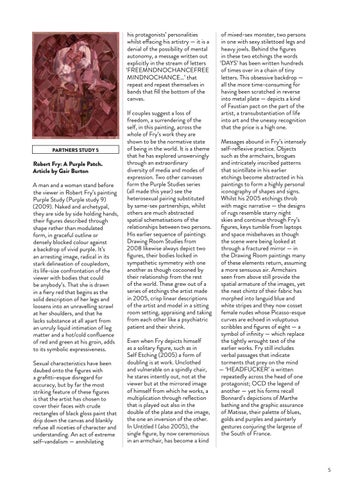
Robert Fry: A Purple Patch. Article by Gair Burton A man and a woman stand before the viewer in Robert Fry’s painting Purple Study (Purple study 9) (2009). Naked and archetypal, they are side by side holding hands, their figures described through shape rather than modulated form, in graceful outline or densely blocked colour against a backdrop of vivid purple. It’s an arresting image, radical in its stark delineation of coupledom, its life-size confrontation of the viewer with bodies that could be anybody’s. That she is drawn in a fiery red that begins as the solid description of her legs and loosens into an unravelling scrawl at her shoulders, and that he lacks substance at all apart from an unruly liquid intimation of leg matter and a hot/cold confluence of red and green at his groin, adds to its symbolic expressiveness. Sexual characteristics have been daubed onto the figures with a grafitti-esque disregard for accuracy, but by far the most striking feature of these figures is that the artist has chosen to cover their faces with crude rectangles of black gloss paint that drip down the canvas and blankly refuse all niceties of character and understanding. An act of extreme self-vandalism — annihilating
If couples suggest a loss of freedom, a surrendering of the self, in this painting, across the whole of Fry’s work they are shown to be the normative state of being in the world. It is a theme that he has explored unswervingly through an extraordinary diversity of media and modes of expression. Two other canvases form the Purple Studies series (all made this year) see the heterosexual pairing substituted by same-sex partnerships, whilst others are much abstracted spatial schematisations of the relationships between two persons. His earlier sequence of paintings Drawing Room Studies from 2008 likewise always depict two figures, their bodies locked in sympathetic symmetry with one another as though cocooned by their relationship from the rest of the world. These grew out of a series of etchings the artist made in 2005, crisp linear descriptions of the artist and model in a sitting room setting, appraising and taking from each other like a psychiatric patient and their shrink. Even when Fry depicts himself as a solitary figure, such as in Self Etching (2005) a form of doubling is at work. Unclothed and vulnerable on a spindly chair, he stares intently out, not at the viewer but at the mirrored image of himself from which he works, a multiplication through reflection that is played out also in the double of the plate and the image, the one an inversion of the other. In Untitled I (also 2005), the single figure, by now ceremonious in an armchair, has become a kind
of mixed-sex monster, two persons in one with sexy stilettoed legs and heavy jowls. Behind the figures in these two etchings the words ‘DAYS’ has been written hundreds of times over in a chain of tiny letters. This obsessive backdrop — all the more time-consuming for having been scratched in reverse into metal plate — depicts a kind of Faustian pact on the part of the artist, a transubstantiation of life into art and the uneasy recognition that the price is a high one. Messages abound in Fry’s intensely self-reflexive practice. Objects such as the armchairs, brogues and intricately inscribed patterns that scintillate in his earlier etchings become abstracted in his paintings to form a highly personal iconography of shapes and signs. Whilst his 2005 etchings throb with magic narrative — the designs of rugs resemble starry night skies and continue through Fry’s figures, keys tumble from laptops and space misbehaves as though the scene were being looked at through a fractured mirror — in the Drawing Room paintings many of these elements return, assuming a more sensuous air. Armchairs seen from above still provide the spatial armature of the images, yet the neat chintz of their fabric has morphed into languid blue and white stripes and they now cosset female nudes whose Picasso-esque curves are echoed in voluptuous scribbles and figures of eight — a symbol of infinity — which replace the tightly wrought text of the earlier works. Fry still includes verbal passages that indicate torments that prey on the mind — ‘HEADFUCKER’ is written repeatedly across the head of one protagonist; OCD the legend of another — yet his forms recall Bonnard’s depictions of Marthe bathing and the graphic assurance of Matisse, their palette of blues, golds and purples and painterly gestures conjuring the largesse of the South of France.
5