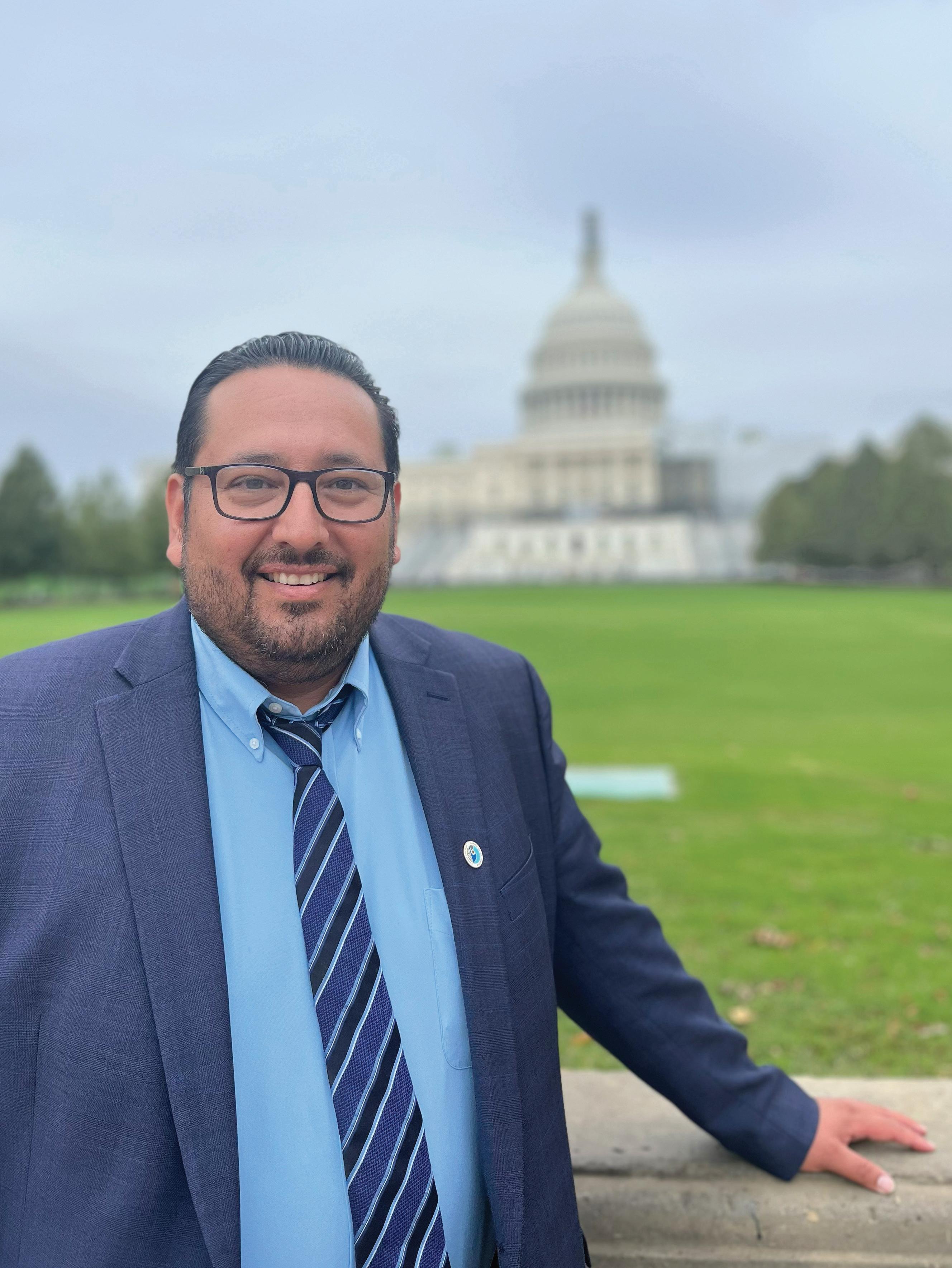
STEERING THROUGH POLITICAL STORMS
Making Education Priorities
Stick Amid Shifting Winds
CONFIDENTLY LEAD HIGH-STAKES CONVERSATIONS
Leverage 3 Principles to Master Difficult Discussions




Making Education Priorities
Stick Amid Shifting Winds
Leverage 3 Principles to Master Difficult Discussions



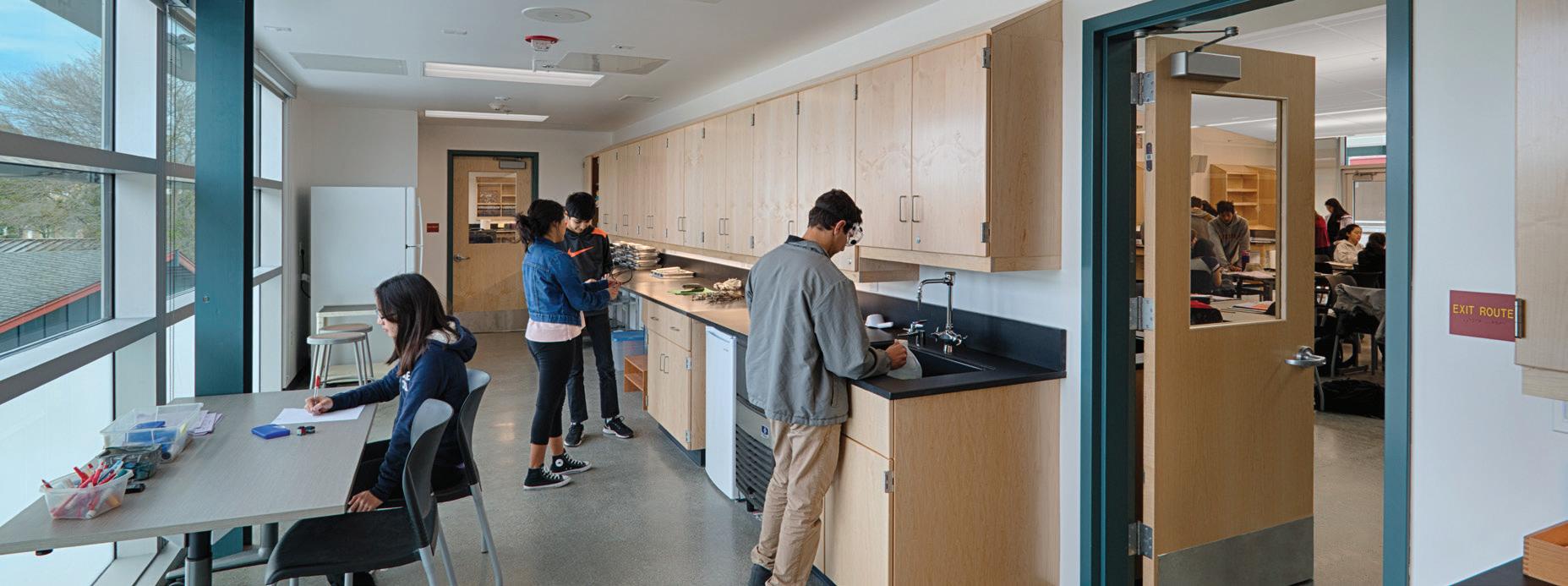
Today’s students are tomorrow’s leaders. Exactly why Blach Construction is proud to partner with California’s educators to deliver state-of-the-art facilities where learners of all ages thrive.
Whether you’re looking to modernize existing spaces or create all-new learning environments, look to Blach. Together, we will build futures – for everyone.
Trust your next education project to Blach Construction.
Over 475 California public school districts have joined together to make SISC what it is today.
We have a 45 year history of providing our members with coverage for workers’ compensation, property and liability and health benefits. Districts join SISC for our consistently low rates, but the reason they stay for decades is because of our people and the great service they provide. We’d love to serve you, too.






















Your annual enrollment doesn’t have to take so much time.

Customized Enrollment Communication

Employee Benefits Education
Benefits Admin System


Guided Enrollment Support



You spend a lot of time preparing for and executing your annual benefits enrollment. American Fidelity brings representatives to your organization to handle all aspects of your enrollment. We’ll service your entire open enrollment at no additional cost*, and we’ll be there year-round for new hires and life status changes.
*Provided at no additional cost as permitted by law.
We can help! Contact me today.
nancy.damuro-olszeski@americanfidelity.com 800-365-9180
SB-33213-0421






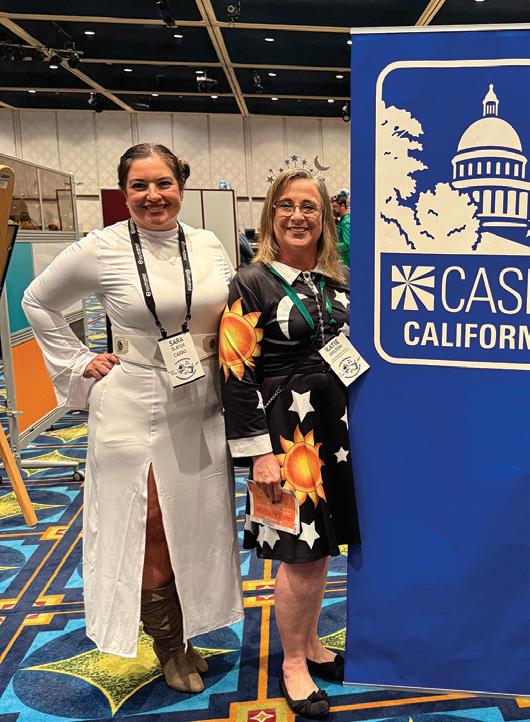

The California Association of School Business Officials is the premier resource for professional development in all aspects of school business. Founded in 1928, CASBO serves more than 30,000 members by providing certifications and training, promoting business best practices, and creating opportunities for professional collaboration. CASBO members represent every facet of school business management and operations. The association offers public school leaders an entire career’s worth of growth opportunities.
As the recognized authority in California school business, CASBO is a member-driven association that promotes ethical values; develops exceptional leaders; advocates for, and supports the needs of, members; and sets the standard for excellence through top-quality professional development and mentorship, meaningful collaboration and communication, and unparalleled innovation.
Stay connected at casbo.org
Publisher Tatia Davenport
Features Editor
Julie Phillips Randles
Contributors
Jennifer Fink
Nicole Krueger
Jennifer Snelling
Art Director
Sharon Adlis
Ad Production
Tracy Brown
Advertising Sales Manager
Cici Trino
Association Outsource Services, Inc.
P.O. Box 39 Fair Oaks, CA 95628 (916) 961-9999
President
Aaron Heinz
Colusa County Office of Education
President-Elect
Katie Hylton
San Bernardino County Superintendent of Schools
Vice President
Kristi Blandford
San Juan Unified School District
Immediate Past President
Eric Dill
Poway Unified School District
Published December 2025
Piper Sandler is a leader in providing financial services to California public schools. We guide school districts across the state on the financial tools for construction and modernization of school facilities, solar equipment projects, school site acquisitions and upgrading of technology equipment. Our team assists school districts on navigating the complex general obligation bond process from start to finish. We are committed to providing access for communities to participate in their local bond offerings.
General obligation bonds | Certificates of participation | Mello-Roos/CFD bonds Interim project financing | Bond anticipation notes | Tax & revenue anticipation notes
Rich Calabro MANAGING DIRECTOR +1 310 297-6013 richard.calabro@psc.com
Celina Zhao ASSISTANT VICE PRESIDENT +1 310 297-6019 celina.zhao@psc.com
Ivory Li MANAGING DIRECTOR +1 415 616-1614 ivory.li@psc.com
Dennis McGuire MANAGING DIRECTOR +1 916 361-6520 dennis.mcguire@psc.com
Christen Gair MANAGING DIRECTOR +1 310 297-6018 christen.gair@psc.com
Pam Morris-Hammer OFFICE SUPERVISOR +1 310 297-6023 pamela.hammer@psc.com
Halina De La Rosa ASSISTANT VICE PRESIDENT +1 310-297-6033 halina.delarosa@psc.com

As a Third-Party Administrator (TPA), SchoolsFirst Plan Administration expertly manages the day-to-day responsibilities of California school employee retirement plans.
• We process your employee contributions securely with a remittance turnaround of 24 hours — fastest in the industry.
• As a local and not-for-profit organization, we’re committed to delivering personalized service to you at all times.
• We provide complimentary financial education through workshops, programs, articles and consultations.
We ensure a smooth transition by managing the entire process from start to finish.
CALL (800) 462-8328, ext. 4727
EMAIL rpa@schoolsfirstfcu.org
VISIT schoolsfirstfcu.org/tpa

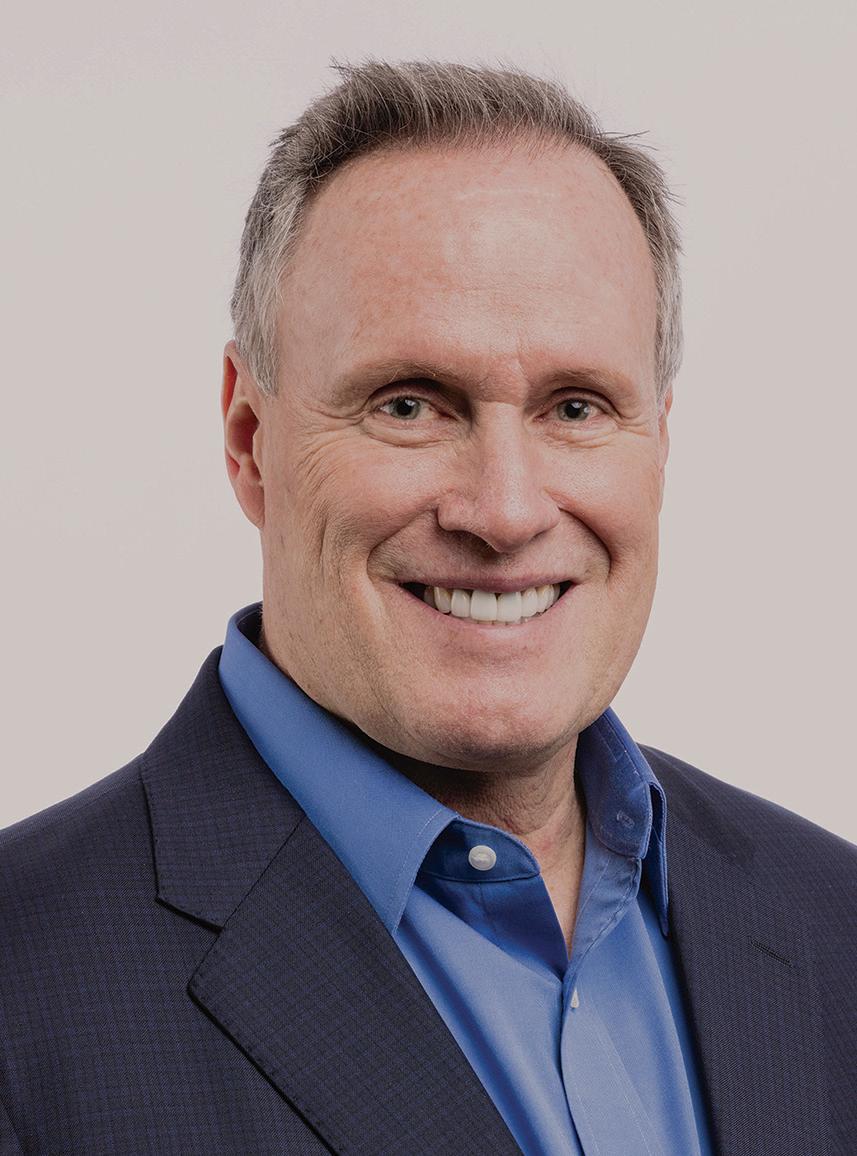
Perhaps it’s time we also talk about being ‘trust-worthy’ –being worthy of the trust others give not because it benefits us, but because we honor the sacred responsibility that comes with being believed in.
We often talk about trust as if it’s a currency that can be regained through apologies or rebuilt through consistency. Stephen M.R. Covey reminds us that trust is both character and a competence that we earn through our actions, our intent and our results. But there’s another kind of trust crisis quietly eroding the fabric of our relationships, teams and institutions – a type that doesn’t make headlines because it’s harder to name.
It’s the loss of trust that happens not when someone misses a deadline or forgets a promise, but when they reveal that their motives were never aligned with yours to begin with. It’s when a person smiles at you in the meeting and competes with you in the hallway. When their words speak of collaboration, but their actions protect ego or power. When the story they tell about their values and the way they live those values no longer match.
That’s the kind of trust you can’t fix with better communication or a welltimed “thank you.” Because at its core, it’s about misalignment. It’s the recognition that someone was never actually acting with your best interest in mind, that the connection was conditional on
convenience or advantage. And once that realization hits, no amount of transparency training or a “trust-fall” exercise will bridge the gap.
Rebuilding from that kind of fracture requires something far deeper than performance. It asks for genuine selfreflection and the courage to examine intent, to recalibrate motives and to choose integrity even when it costs us comfort.
We talk a lot about being trustworthy. Perhaps it’s time we also talk about being “trust-worthy” – being worthy of the trust others give not because it benefits us, but because we honor the sacred responsibility that comes with being believed in.
That’s where the quiet crisis of trust ends – and authentic leadership begins. z z z

Tatia Davenport CEO

• Pooled Solutions for Better Savings: By pooling resources, we create economies of scale that help reduce costs and reduce risk, making it easier for your district to stay financially secure.
• Proactive Risk Management: We help you identify potential risks and implement strategies to mitigate them, ensuring your district remains resilient in the face of challenges.
• Financial Security: Our solutions are designed to protect your budget, allowing you to allocate resources effectively and maintain essential services without compromise.
• Trusted Partner: With a proven track record of success, Keenan is a name you can rely on for dependable support and guidance.
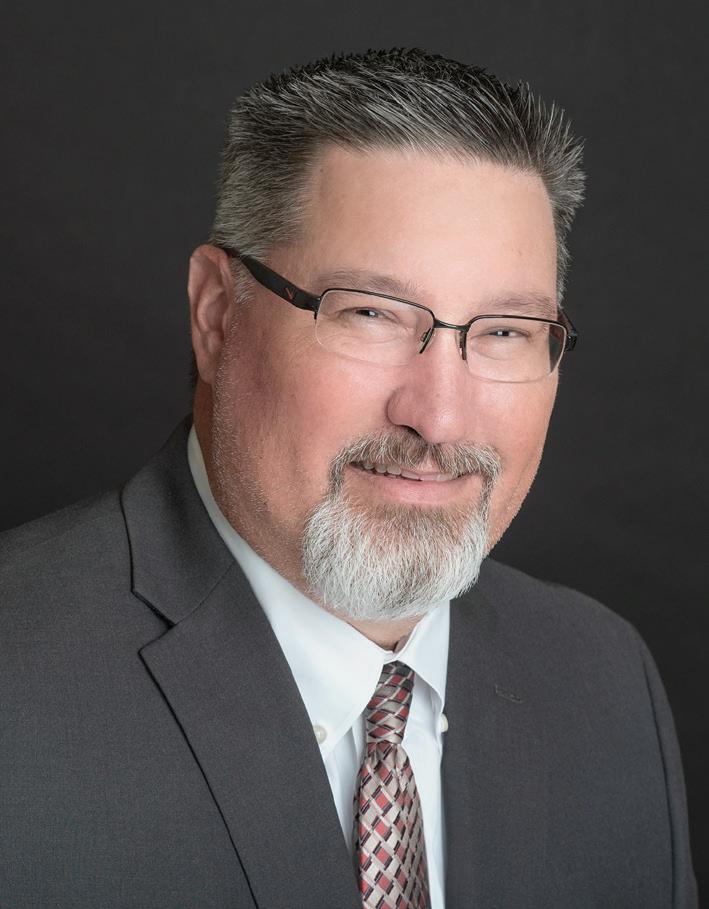
“It’s fine. I’m fine. Everything’s fine.”
If you’re unfamiliar with this quote, a quick search will pull up a meme with the image of a dumpster fire and these thoughts surrounding it. Sometimes, a little humor goes a long way. And, sometimes, what we need is focus to see us through.
When everything as a whole is too much, break it down into bite-sized pieces and only concentrate on that small next piece. Get the little things right and the big things will take care of themselves.
Focus on the next pitch –that’s all you can control.
We’re just getting through a crazybusy time in school business. In my office, we’ve been working in two fiscal years – closing out last year and setting up the current year. Then, we had auditors here going over everything with a fine-tooth comb; and we barely got first interim buttoned up as we dove headfirst into the holidays.
And this is just what’s been happening on the regular.
No day is the same in our world, and that’s both exciting and incredibly challenging. Problems pop up literally out of nowhere, sometimes two, three or more at a time. People unexpectedly leave while new faces appear, and everyone needs your attention right now.
We’ve got all of these plates spinning around us, and it’s during this time of chaos that our ability to focus matters the most. Finding a moment of zen, of clarity, is how we achieve that inner focus.
I learned this lesson as a 12-year-old pitcher in Little League when the bases were loaded, I couldn’t get anyone out and it felt like the sky was falling all around me. It’s a desperate feeling. My coach always came out and had one thing to say.
“Focus on the next pitch – that’s all you can control.”
That’s good advice, at any time. Thanks for that, Dad.
I hope everyone has quality time with their loved ones this holiday season and recharges that work-life balance we always hear so much about.
Be good to yourself and come back stronger than ever in 2026 with laser-like focus. We have goals to achieve, and everything’s just fine. z z z

Aaron Heinz CASBO President
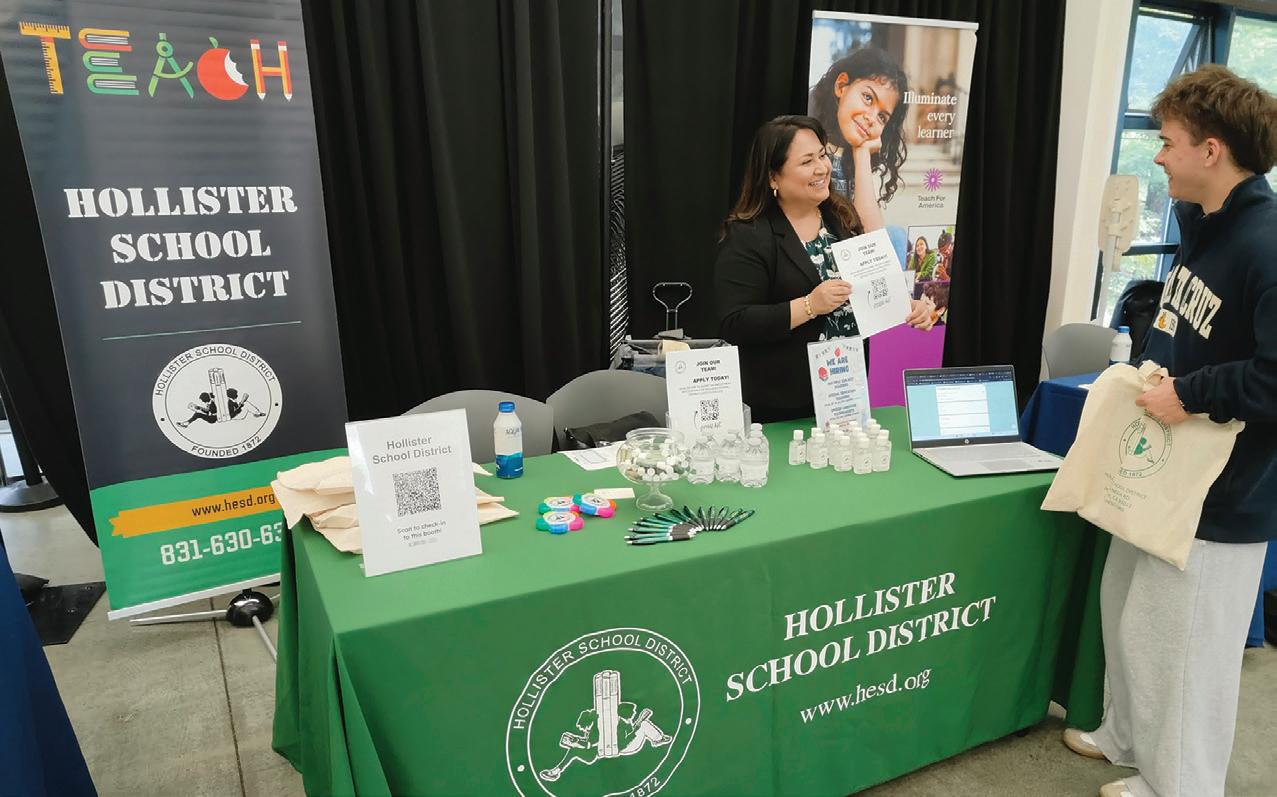
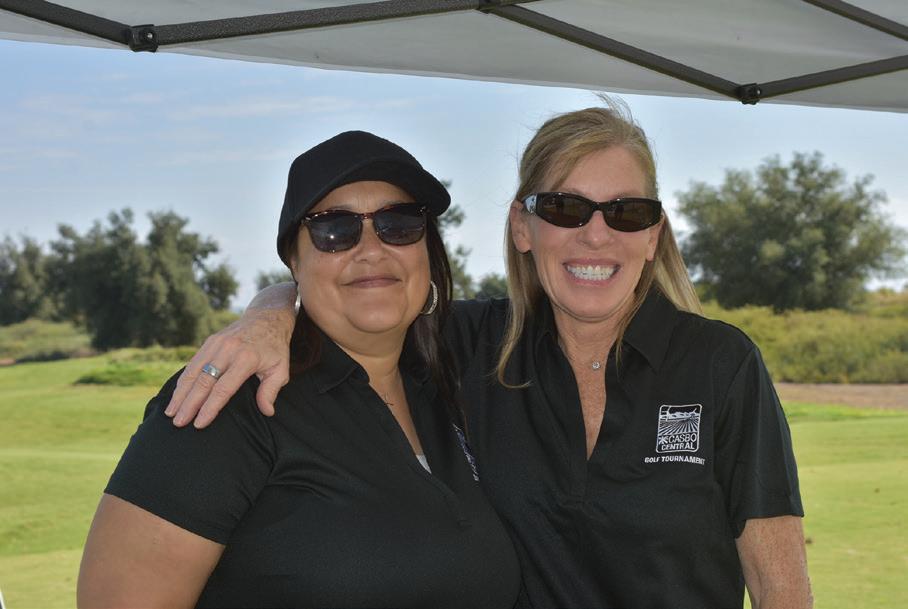
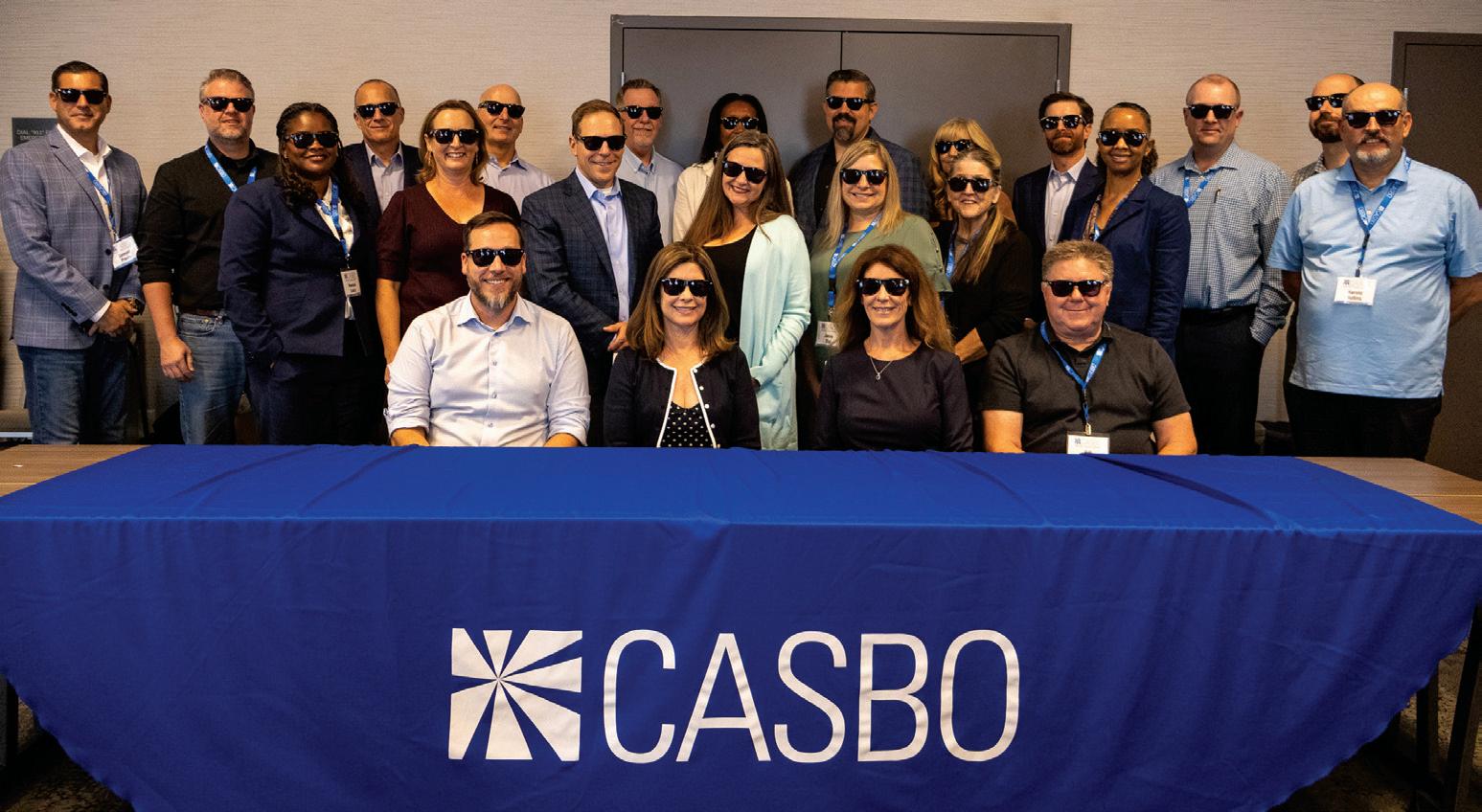
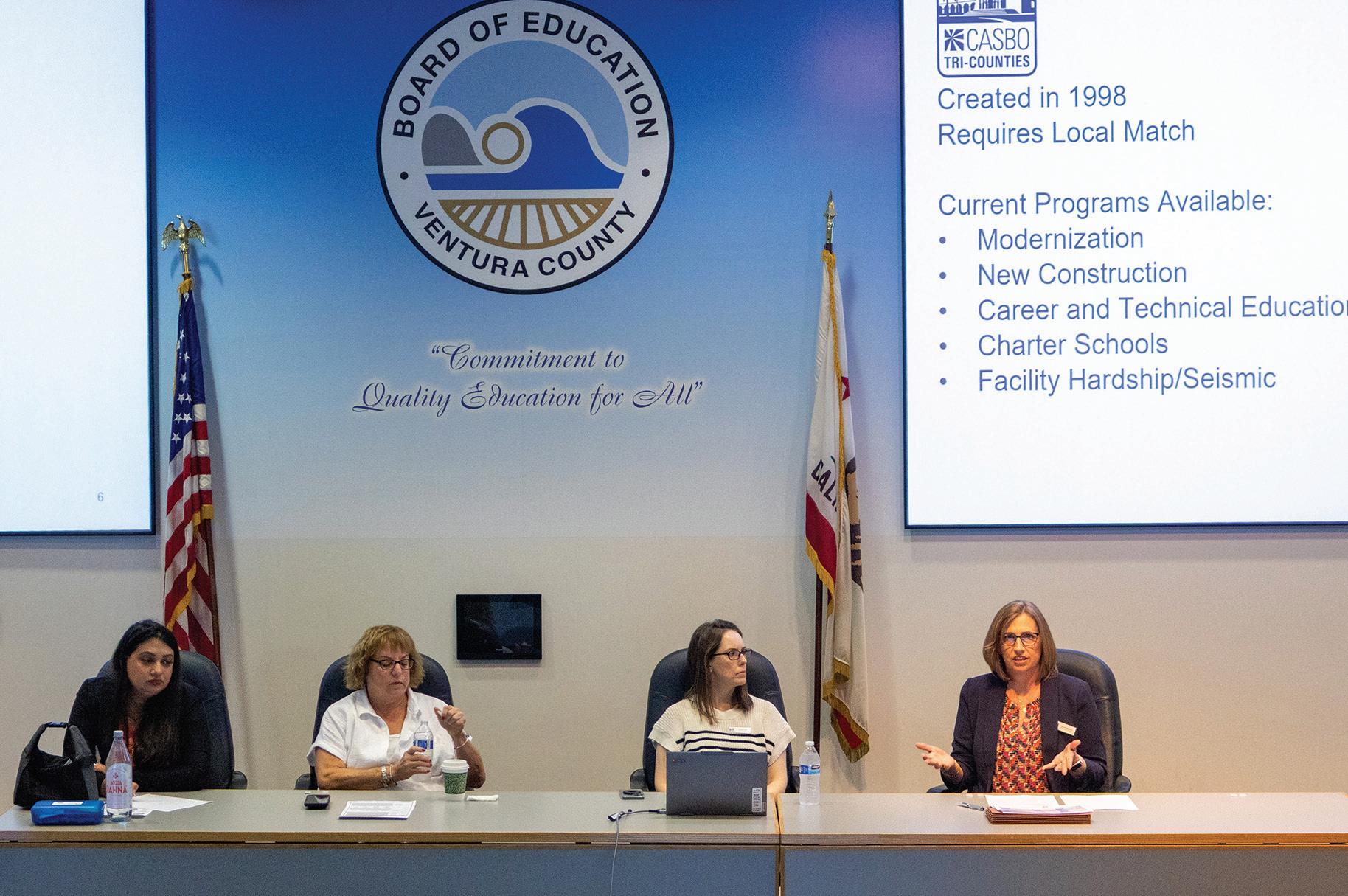
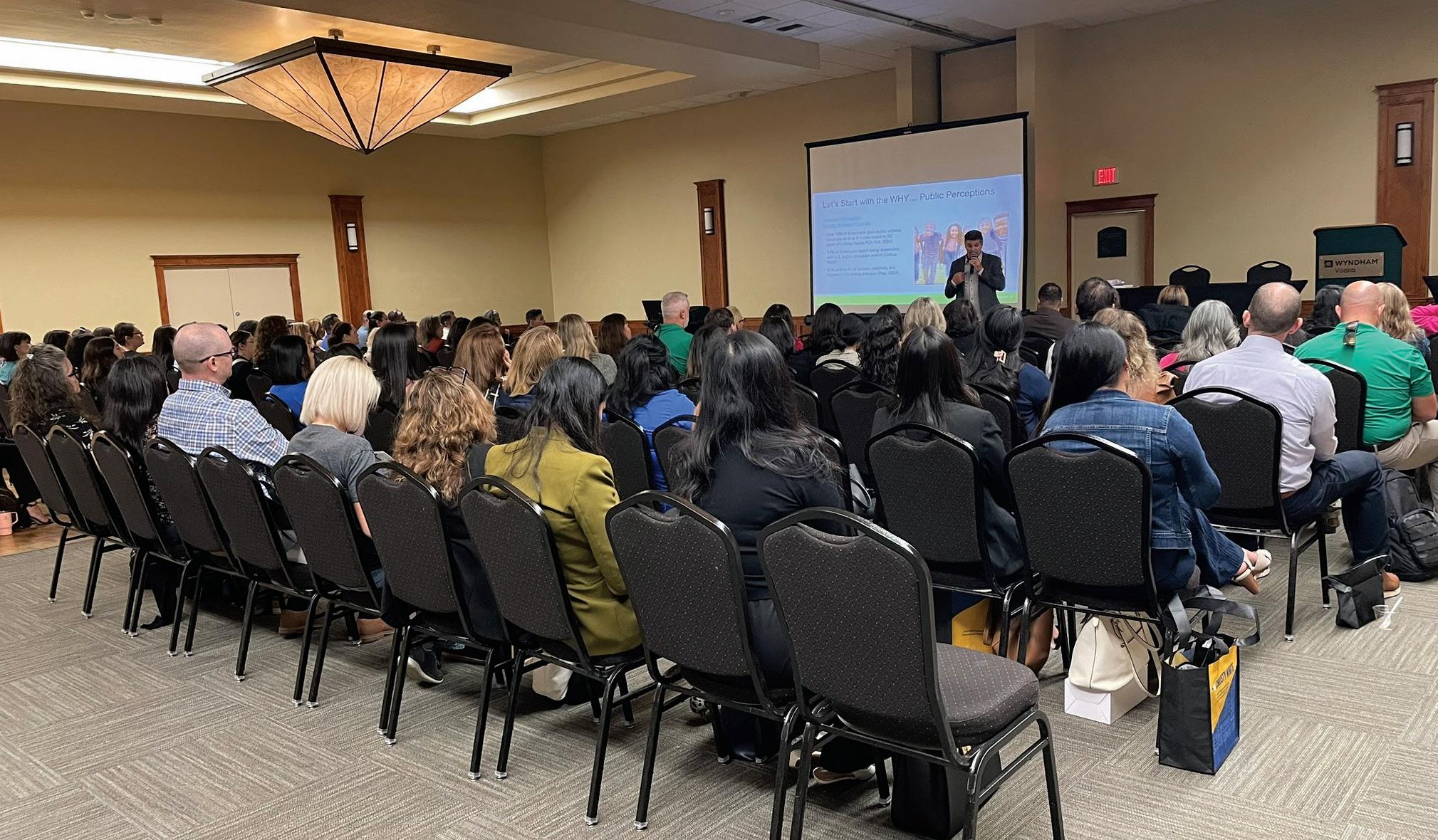
This fall, CASBO members participated across all 10 sections to educate, advocate and network, strengthening the future of school business.
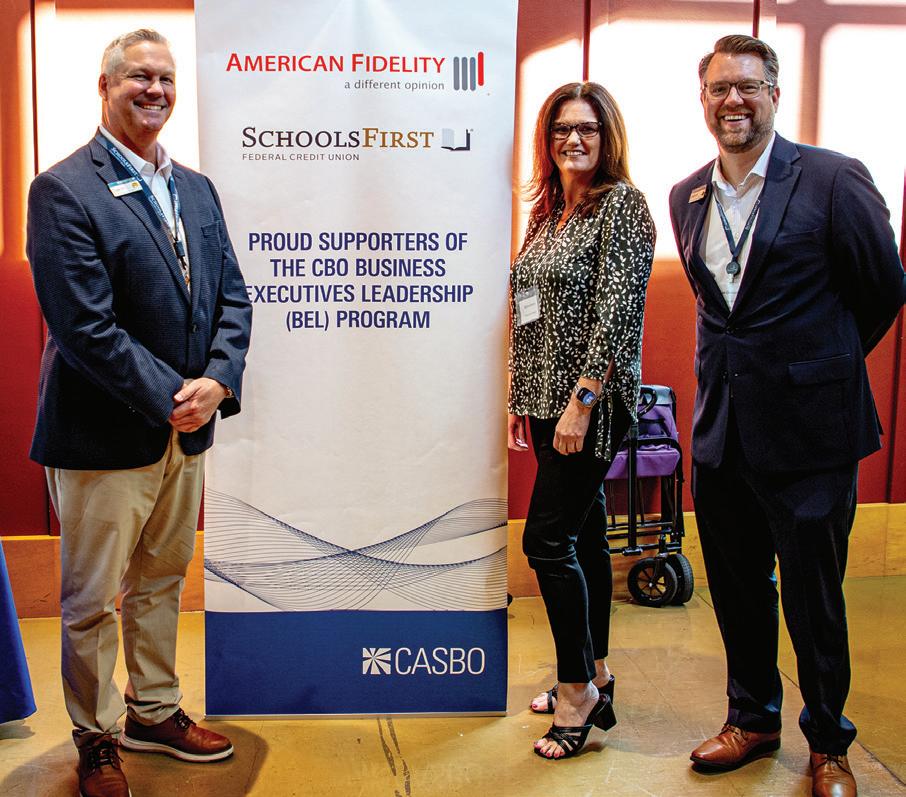
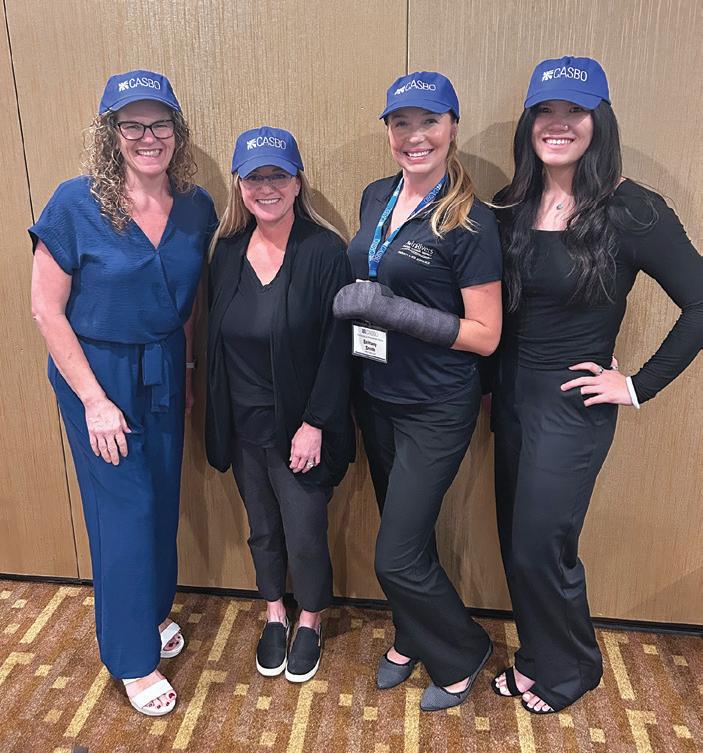
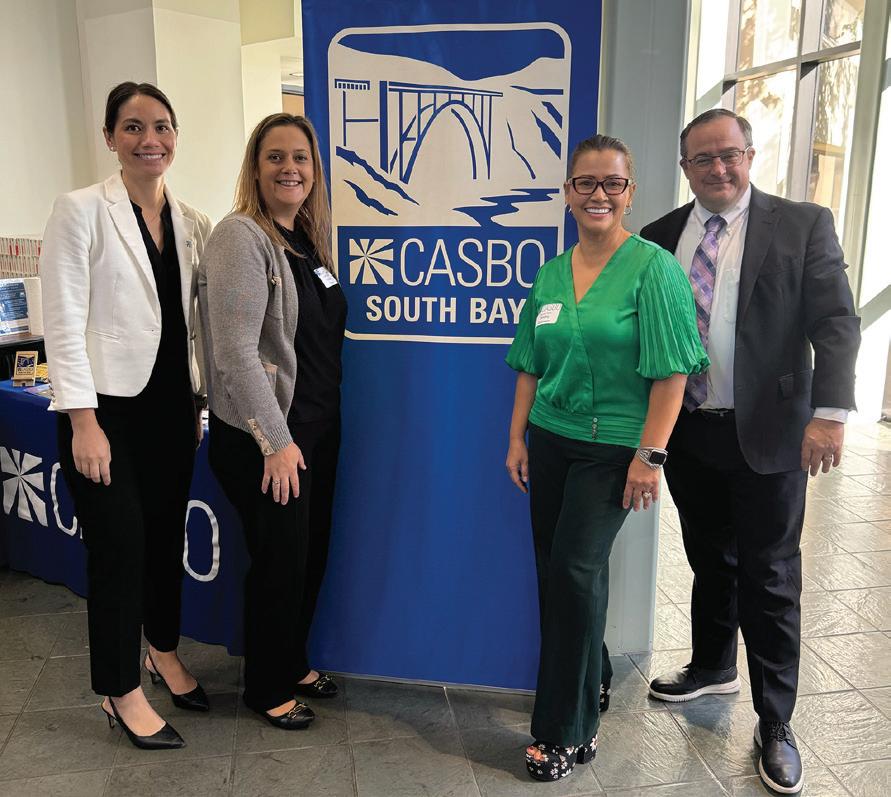
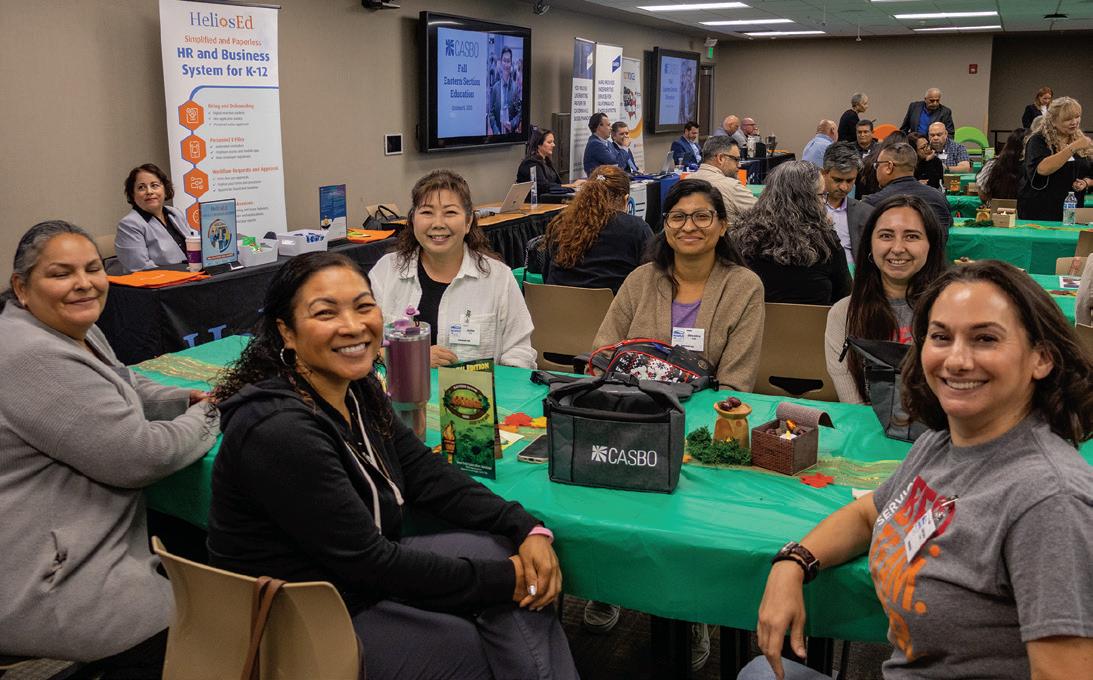
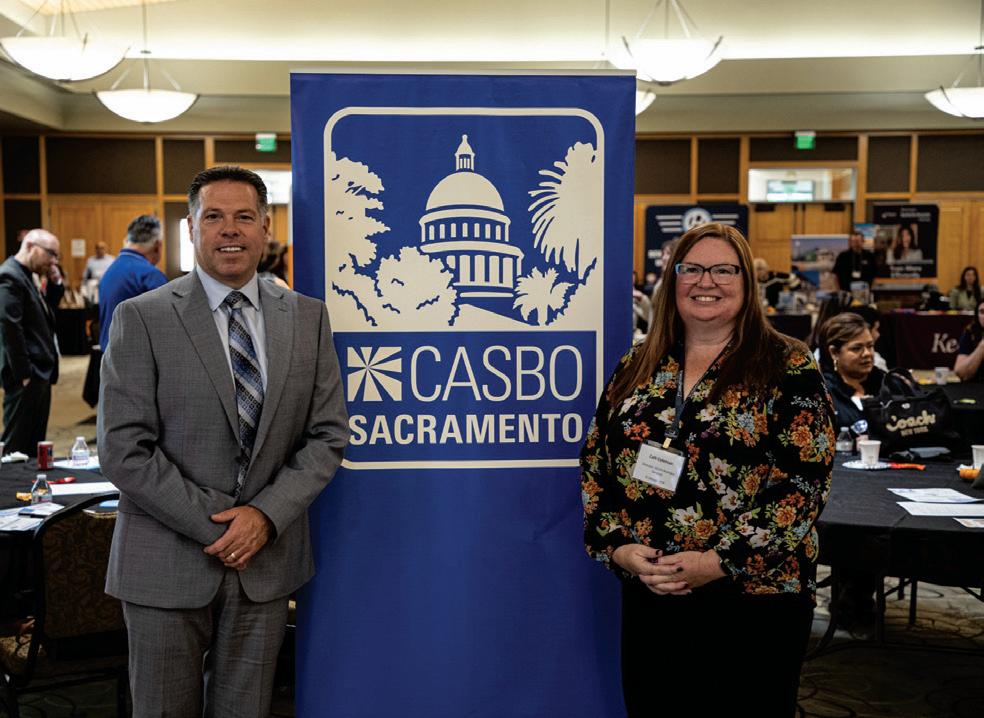
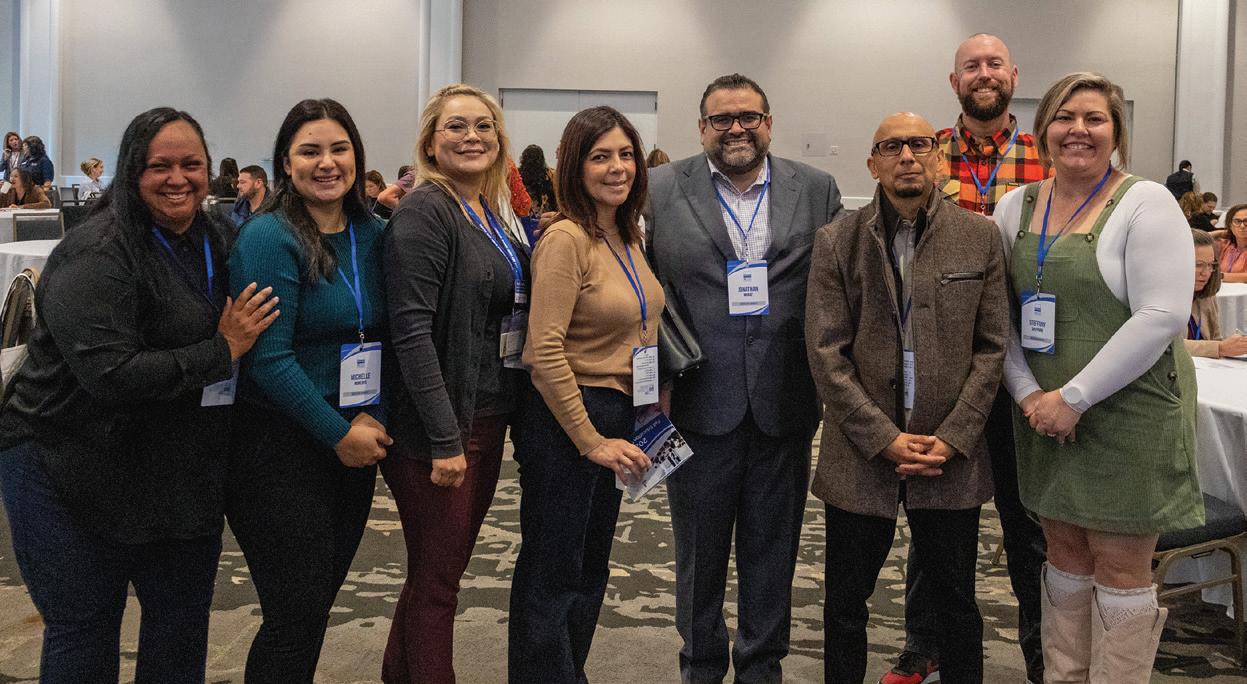

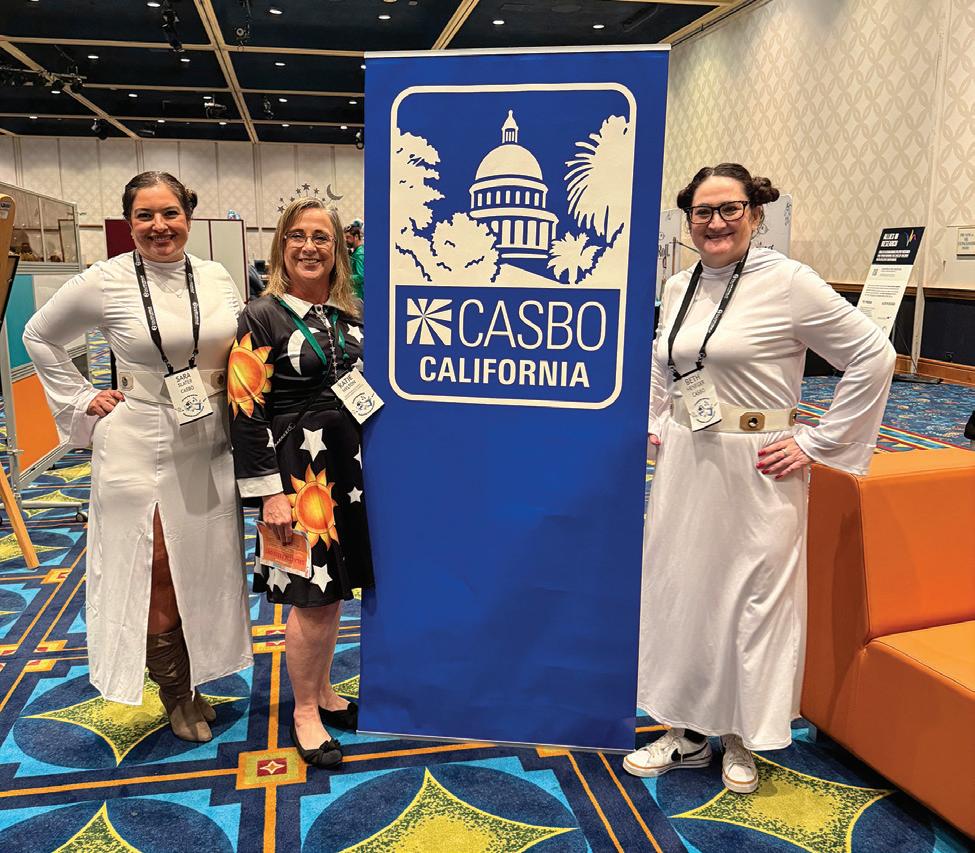
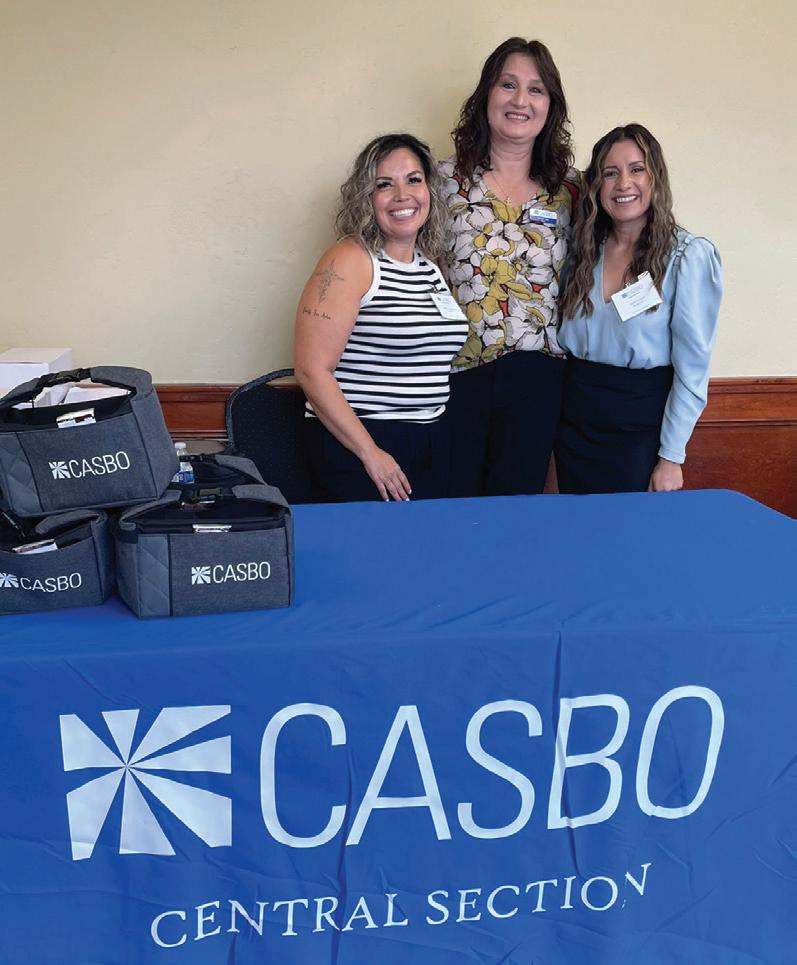

By Nicole Krueger

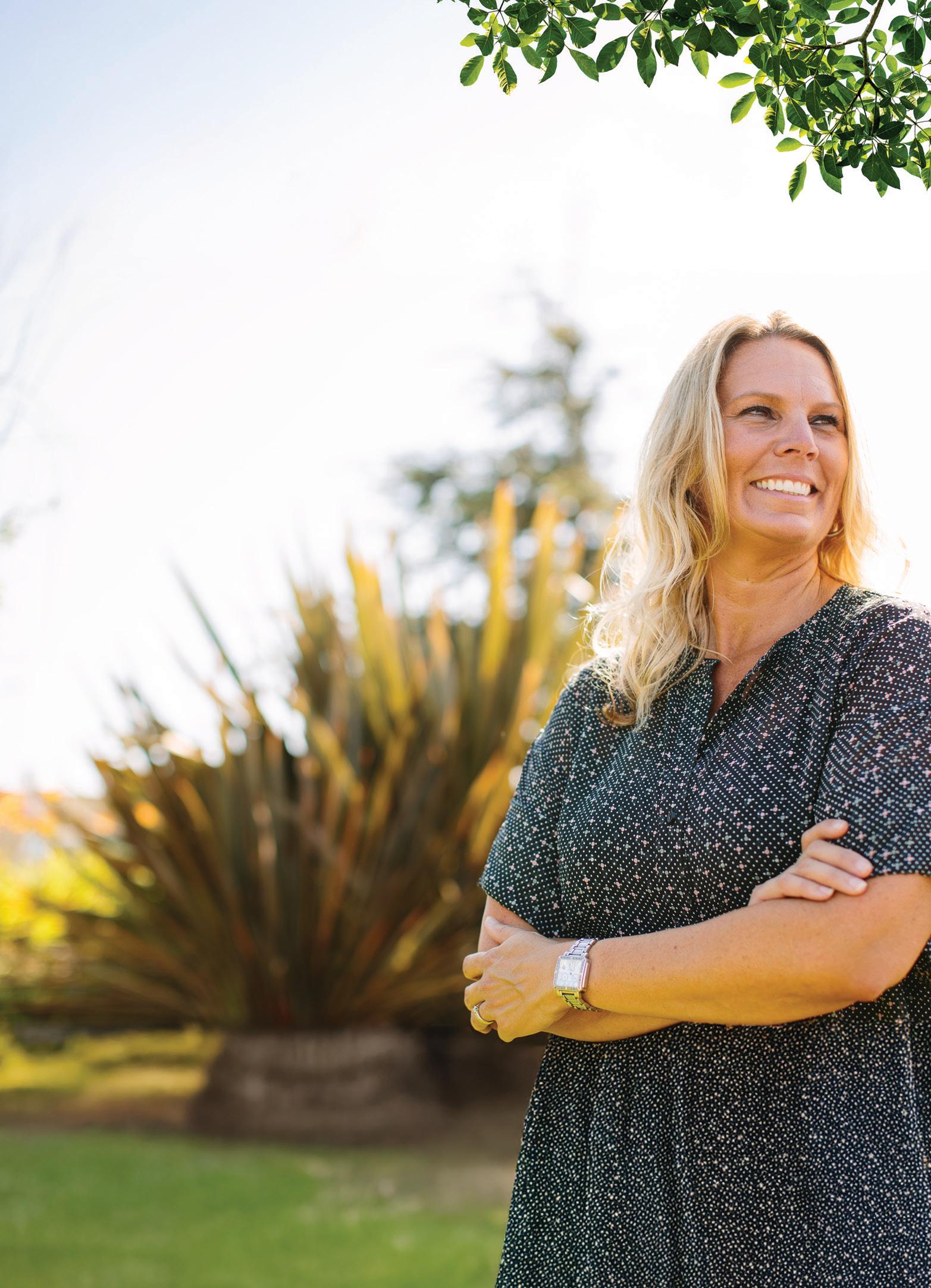
Kay Pugh is the type of leader who writes a 140-page manual detailing how she does her job – then shares it freely with others so they can adapt it to their own needs.
“What good would it do me to hold onto it?” says Pugh, who is preparing for retirement after 15 years working with San Diego schools. “I don’t hoard the knowledge. I share the knowledge.”
It’s a philosophy that has served her well as San Diego County Office of Education’s special education financial analyst – especially when she’s explaining the nuances of a special education budget to people without a finance background.
“Special education is such an interesting animal,” she says. “Everyone knows it’s complicated. It’s not the biggest part of anyone’s budget, but it’s the one that can get you in the most trouble.”
Pugh credits her career success to a knack for explaining complex accounting concepts to people who don’t have a finance background.
When meeting with special education directors, superintendents and other leaders, she tailors each presentation to her audience and comes equipped with a variety of specialized visuals, terminology
sheets and mini tutorials to help them gain capacity in their budgets and understand how finance works.
Instead of including finance-related jargon and cyphers, she focuses on dollar amounts – something everyone is familiar with.
As state director for CASBO’s San Diego/Imperial Section, her big soapbox is helping people understand account codes.
“It’s so foundational, so important,” she says. “The biggest reaction I hear from people is that they wish they’d known the information sooner.”
The first time she delivered her “Account Codes 101” presentation, the chief business officials sitting in asked for a recording so they could have their new finance staff watch it. After reprising the talk at a few local and state conferences, her presentation will become one of the first courses offered through CASBO School Business University’s new online learning format.
Pugh began developing her teaching skills as a business owner, preparing personal income taxes for clients and fielding their questions about complicated tax concepts. After getting her master’s degree in
finance and tax planning from San Diego State University, she taught at MiraCosta College for several years – until she left to raise her two daughters.
A decade later, when re-entering the workforce, she discovered she’d been gone too long to resume teaching. Instead, she got a part-time accounting job with Oceanside Unified School District and worked her way up to the county level eight years ago.
“I figured if get any job at a school district, I’m helping students learn. Even if I’m working in the background, I know what I’m doing is making a difference and helping a kid learn something.”
For Pugh, who once dreamed of becoming a math teacher, her work with both CASBO and San Diego school districts has been a perfect fit.
“Sharing knowledge is the essence of CASBO,” she says. “It allows me to play with numbers and do the things I like, but I get to teach people how to do stuff, too.” z z z



By Nicole Krueger

During the pandemic, an image went viral: Two young girls sitting outside an East Salinas Taco Bell, doing their homework on borrowed Wi-Fi.
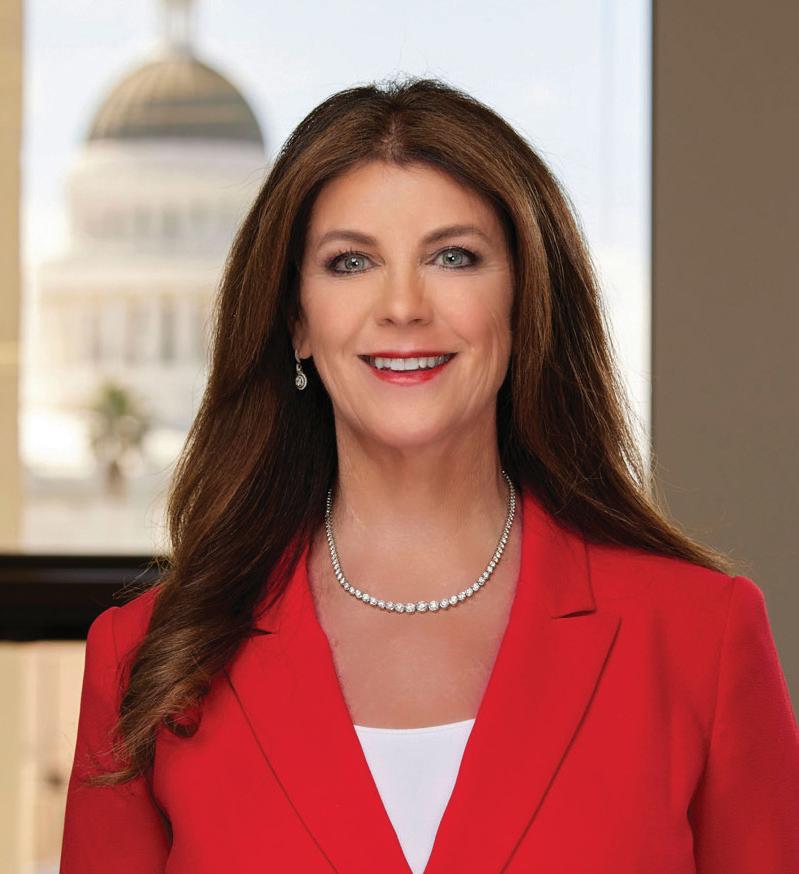
“That image haunted me,” says Brown, a partner at F3 Law in Oakland and a CASBO associate member. “A student struggling with access, the poverty experience, that drive to be better – that’s what drives me.”
Known for her depth of knowledge in collective bargaining, Brown has built her career around expanding opportunities for students, while helping California’s public schools navigate the complexities of modern learning. “I’ve always believed education is the great equalizer,” she says. “My work is about removing obstacles so every student can have that chance.” That conviction is rooted in a global childhood that shaped her sense of justice and purpose. Born in India and raised in Nairobi and London, she grew up watching students her age drop out of school after third grade.
“I come from a lens where public education is not guaranteed,” she says. “Education for all is my vision, and that’s the I problem I’m always solving for.”
Initially headed toward medical school, Brown pivoted after a civil rights class lit
a spark. “It was the first time I saw how law could shape policy and people’s lives,” she says.
From there, she built a law career spanning over 25 years, beginning in Atlanta as a city attorney focused on civil rights and employment issues before joining a national education law firm with a strong California presence and finding “the perfect confluence” of her passions – public policy, administration and education.
Over the next two decades, Brown became a trailblazer in education law. She co-founded F3 Law’s eMatters practice group, one of the first dedicated education technology legal practices in the country.
“In the early 2000s, I was negotiating whether email could be part of a teacher’s workday,” she recalls. “Now we’re working with county offices of education to be on the forefront of ethical and responsible use of artificial intelligence. Technology is the biggest change agent in California, in U.S. schools and in the civil rights world today.”
At the collective bargaining table, Brown’s willingness to look outside the box for solutions has made her a soughtafter partner for school districts navigating the rapidly evolving digital landscape. Her work as a CASBO presenter and adviser for
more than 20 years has focused on helping school business officials present budgets transparently, build trust with unions and balance fiscal realities with shared purpose.
“One of the most difficult aspects of a CBO’s job is to build trust with the union so that they have faith in the numbers and budgets that the CBO presents,” says Brown, whose goal is always to help both sides see they’re working toward the same mission – supporting students.
She credits much of her career success to her bold, collaborative approach to leadership.
"My approach to collective bargaining – particularly when it comes to technology – is grounded in the belief that decisionmaking sometimes must be iterative," she explains. "Technology evolves rapidly, so we need to act based on the best information available at the moment to keep our schools moving forward. That means some decisions will need to be revisited and adjusted as the landscape changes. In the end, it helps ensure the best outcomes for students.” z z z
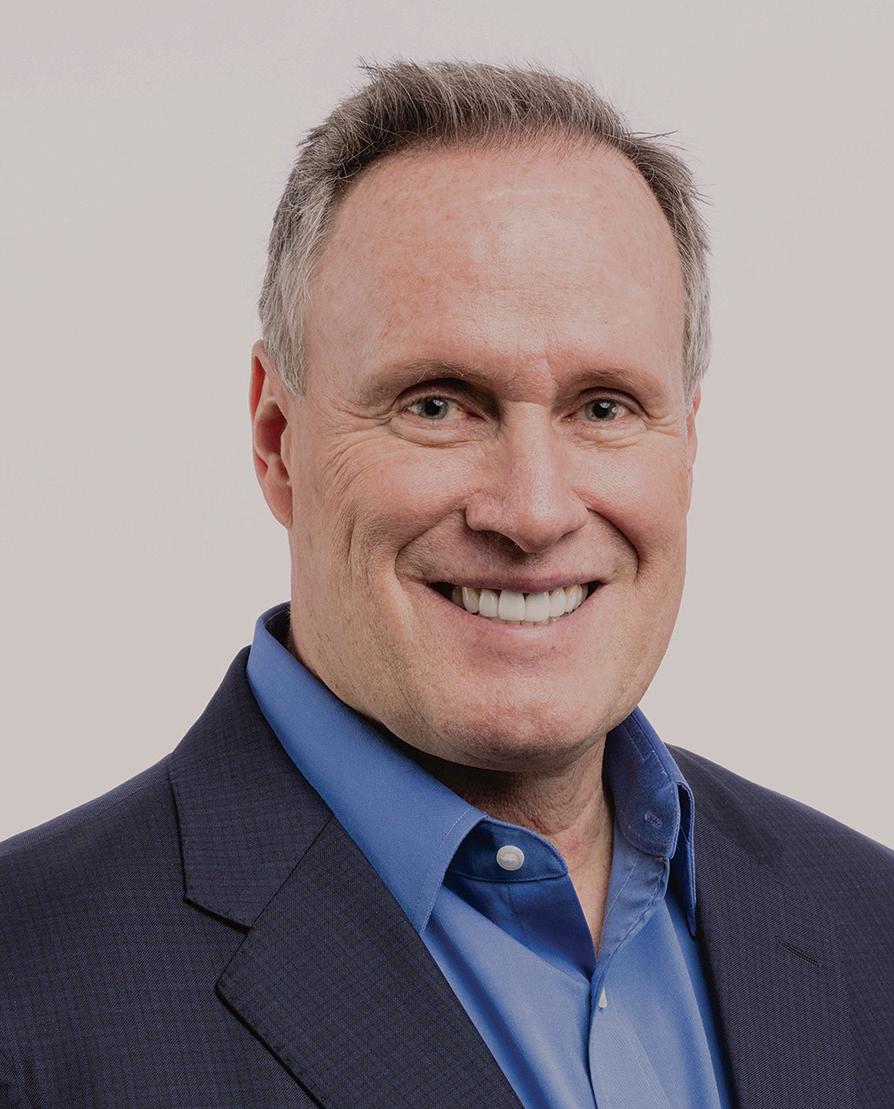
By Julie Phillips Randles
Chances are, at some point in your life, you’ve used a FranklinCovey planner. Most of us have read The 7 Habits of Highly Effective People , too. After all, the Covey name is synonymous with business leadership.
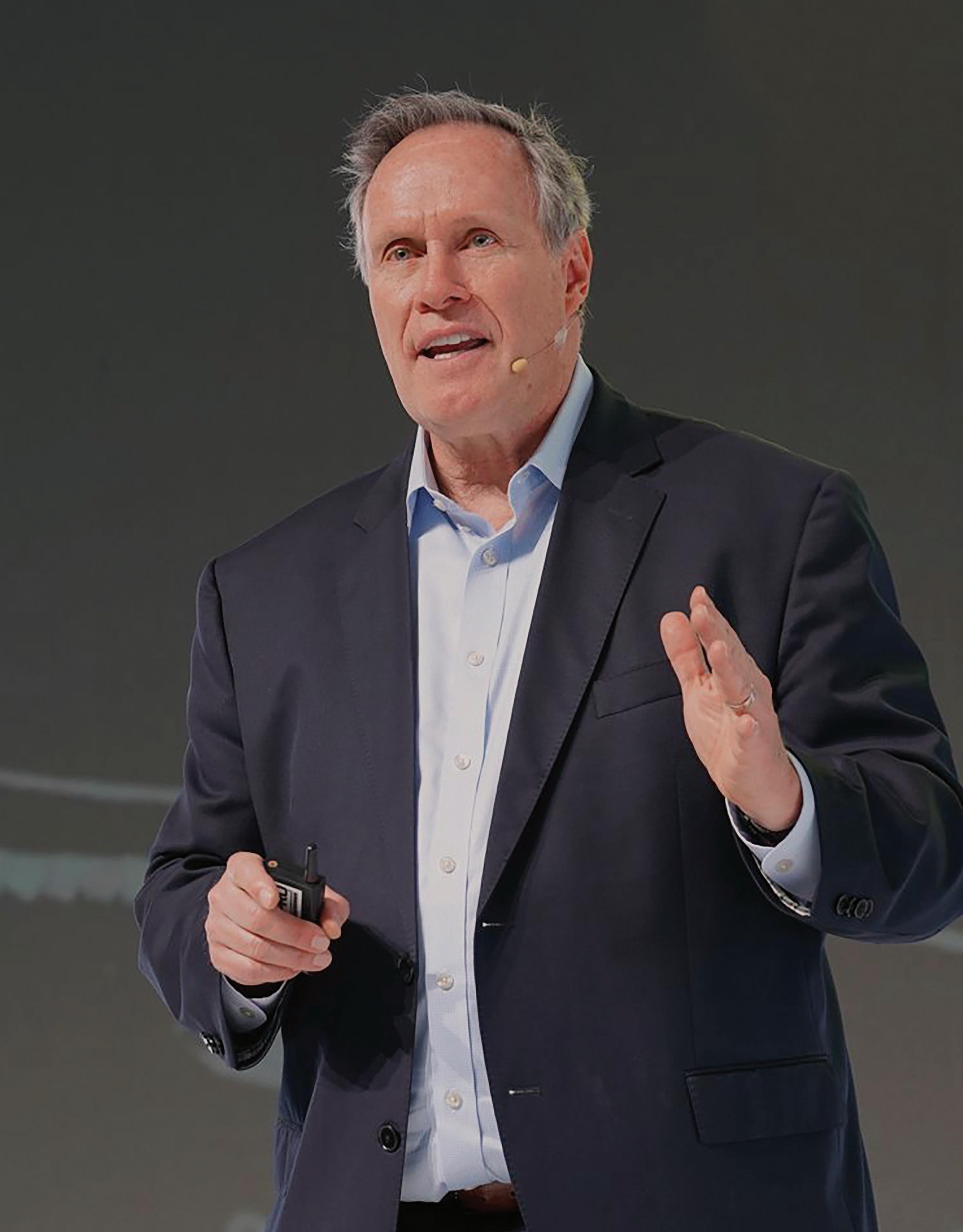
And while the initial success belonged to Stephen R. Covey, it’s his son, Stephen M. R. Covey, who took over as president and CEO of Covey Leadership Center and led the company into a new era of excellence.
Stephen M. R. Covey is focused on new ways of leading that start with the belief that people are creative, collaborative and full of potential. His first book, The Speed of Trust: The One Thing That Changes Everything, focused on trust as
not just a social virtue but a measurable economic driver that accelerates or drags down everything in life and organizations. That work led to his most recent book: Trust & Inspire: How Truly Great Leaders Unleash Greatness in Others. He contrasts this new way to lead with the more traditional “Command & Control” way of leading, prevalent in 92% of organizations today.
“Operating today with Command & Control as your leadership style is like playing tennis with a golf club,” he’s said. “The tool is completely illsuited to the new reality.” When trust is high, communication is faster, costs are lower and relationships become far more effective.
Stephen M.R. Covey doesn’t concentrate on being “nice” – he’s all about being credible and consistent – but he didn’t throw out being nice to achieve that.
After growing up in a family that was all about business leadership, he used that mental leg up to earn an MBA from Harvard Business School. His first “real” job was with real estate developer Trammell Crow Company as a stepping stone to joining the family business. It wasn’t the first time the two had worked together. As a grade-schooler, Stephen M.R. Covey was given the responsibility to keep their family lawn green and clean – green meaning it matched their neighbor’s yard and clean meaning time behind the
People don’t want to be managed, they want to be led, trusted and inspired. People respond to those things –and it becomes like a talent magnet!
lawn mower. It was his job to figure out watering schedules and weed control – a tall task for a first-grader.
Stephen M. R. began at Covey Leadership Center in client development –sales, to be exact – building both theory and practice on his résumé. He eventually parlayed a national sales manager position to to become president and CEO – determined to not only honor his father’s legacy but to expand it. To that end, he co-founded CoveyLink Worldwide to focus on trust as a business and leadership leader. He eventually merged CoveyLink with FranklinCovey to form The Global Trust Practice, where he serves as global practice leader today.
FranklinCovey is now in more than 140 countries and is one of the largest leadership development companies in the world. And it was the son who personally led the strategy that propelled his father’s book to become one of the two most influential business books of the 20th century.
It’s a picture-perfect example of how to forge your own niche. Or, as Stephen M.R. Covey himself would say, why you need to deliver under trust, not just credentials.
We sat down with him ahead of his keynote address on Trust & Inspire leadership at the CASBO Annual Conference & California School Business Expo 2026 in San Diego to discuss the ins and outs of courageous leadership.
If you had an unscheduled hour in your day, what would you use it for?
If I get uninterrupted time that comes as a surprise, the first thing I do is call my wife and say, “Hey, I got some time, want to go to lunch?” If she’s not available, I would try to do something with one of my kids. Relationships are the
most important thing in my life, and I travel a lot, so I prioritize family. As the philosophy goes, don’t just prioritize your schedule, schedule your priorities.
What’s your favorite piece of advice from your father that’s still relevant for today’s leaders?
One piece of advice that he gave me we actually turned into the book Live Life in Crescendo. It’s the idea that your most important work is always ahead of you.
My father wrote The 7 Habits of Highly Effective People, and yet he always felt like his best book was still in front of him. He had a mentality that there are always more contributions to make. To have that mindset is a beautiful thing because you’re always thinking “I can go to another level, there’s room for continuous improvement, for getting better.”
And it’s framed around contribution, not accumulation – because after you satisfy your basic hierarchy of needs, in the end, it’s about a belief that your most important contributions are still ahead of you.
Given workforce shifts like talent shortages and remote work, what’s the most courageous but necessary change a district business leader must make right now to attract and retain top talent?
The courageous step is to shift your leadership style from the traditional, hierarchical Command & Control style to a more people-centric approach – what I call Trust & Inspire style. So, you’re moving from control to inspiration, and it doesn’t mean you lose control, you just change the nature of how you go about leading.
People don’t want to be managed, they want to be led, trusted and inspired. People respond to those things – and it becomes like a talent magnet! When people are trusted, they want to stay, and they do their best work. When they’re not trusted, they’re going to go find a place where they are. And it’s the same with inspiration. People want that in their lives.
If we can shift the paradigm of how we lead from the traditional model to the more forward-thinking Trust & Inspire model, that creates a different culture and climate that’s compelling, exciting and attractive to people, particularly for top talent that has many options.
For some, this will be a complete shift in style, and for others it might just be a tweak, but it’s a courageous and bold move.
Being the type of leader that just tells people what to do might have worked in the past, but as executive coach Marshall Goldsmith said, “What got us here won’t get us there.” Maybe Command & Control brought us where we are today, but in the new world, with all the shifts in the workforce and younger generations that are coming up that have different expectations about how they want to be led, there’s a need for more collaboration and more innovation.
Today, Trust & Inspire is a far more relevant approach to leadership. Yes, it’s a paradigm shift; yes, it’s a leap. But it’s courageous and necessary.
What can leaders expect after they make the shift to the Trust & Inspire model?
The hardest part of that shift is the question as to whether moving from the Command & Control model to Trust & Inspire still allows you to get the job done.
School business leaders have to get results, they have to perform – and you will get results as a Trust & Inspire leader. It doesn’t mean that you’re just nice and trust everyone. Instead, you build an agreement with people around the job to be done that includes outcomes and expectations, as well as accountability for those expectations. So, you’re building an agreement, and the control is within that agreement, as opposed to hovering and micromanaging.
If you involve people in the process of building this agreement, you’ll build greater commitment, greater engagement, and you’ll actually get greater outcomes. Done well, Trust & Inspire will produce better results than Command & Control ever did.
Today, Trust & Inspire is a far more relevant approach to leadership.





When trust increases, speed goes up and the cost goes down because we can do everything much faster and at a lower cost.
It feels like a leap for people – I get it. And I’ve had a lot of people say, “I love this Trust & Inspire idea, but I’ve got to get the work done.” And I say, you will, because you’ll build the agreement with expectations, with accountability – and you’ll actually get the job done better Your team will be more creative and innovative, and they’ll also grow and develop. So, you haven’t lost control, you’ve just shifted it from micromanagement to the agreement that you built together with the person, and there’s more commitment to it.
The research shows that often people will perform as much as three times better when there’s trust with expectations and accountability versus when they’re just told what to do.
Bold decisions come with risk. How should school district leaders who manage public funds and are under intense scrutiny frame the concept of risk and the potential for failure to their boards and communities to make room for a culture of courageous innovation?
It’s a balancing act. We need innovation to stay relevant and current in a changing world, but you won’t innovate very well if you’re not willing to take a risk, and you won’t take a risk if there’s not a sense of trust. But risk has to be calculated and within restraints.
It’s not about just saying, “Hey, I trust you; go take some risks out there.” That could be too risky, or it could be something that could sink the district or hurt the district’s reputation. It has to be within boundaries. And we have to reframe “failing” as “learning” and be willing to take that risk – and even fail sometimes. That’s how you learn and innovate.
There’s research to prove this. In a high-trust culture, people are 32 times more likely to take a responsible, calculated, smart risk, and as a result, they’re 11 times more likely to innovate. In this scenario, people are more willing to take a responsible risk and maybe even fail, but they learn from it, and they get better and risk-taking is reframed as part of innovation and learning. That’s how we’re going to stay current and relevant – by reframing it.
Leaders should talk about risk within the context of saying, “Here’s the type of judgments we’re going to make, and sometimes we’re going to take a risk, try something new. It may not work, but we’re going to learn from it. If it doesn’t work, we’ll try something new again and we’ll get better.”
If trust in an organization is low, no one will take a risk because it feels unsafe and maybe even career-ending. So, we have to reframe it for employees, the public and stakeholders, letting them know we’re innovating so we stay relevant. That we strive to fail well and within constraints, so it’s not seen as out of control. But that reframing of risk is vital to innovation.
Your book, The Speed of Trust, treats trust as an economic multiplier. Can you share specific examples or metrics that demonstrate how hightrust cultures, established by courageous leaders, have positively impacted results of education organizations?
The basic premise is that trust always impacts two measurable outcomes: speed and cost. When trust goes down in a district, in the community, with stakeholders or on a team, speed will go down with it. Everything’s going to
take you longer to do, and the cost will go up, because now you’ve got to take all these steps to compensate for that lack of trust, whether it be checking or verifying or validating or building in more redundancies.
In low-trust environments, you can expect what I call a “low-trust tax,” and it’s a wasted tax that doesn’t add value. Things take longer, cost more and cause distrust – making things very expensive. The good news is the converse is equally true. When trust increases, speed goes up and the cost goes down because we can do everything much faster and at a lower cost.
I worked with a district that was really focused on building internal trust in their schools and with their people, so they could build external trust with the
community and stakeholders – and they were really able to move the needle by doing just that. Thanks to the high-trust relationship they built, people understood the schools in the community were great, and when they put a school bond on the ballot their credibility and trust were so high that the bond passed with flying colors. Five years earlier, when they didn’t have that relationship of trust in the community and were not seen as credible, a similar bond failed. But they refocused and built those relationships –first internally and then externally – and the bond campaign passed.
I worked with another school district in an area that had experienced a hurricane that wreaked havoc on 21 schools, making eight of them unusable. The first thing the district’s leadership did was
If trust in an organization is low, no one will take a risk because it feels unsafe and maybe even career-ending.

Stephen M.R. Covey
If you lay out what you’re going to do to regain trust but don’t do it, you’re worse off. But if you do what you committed to, you’ll build trust faster and you’ll be behaving yourself back into trust.
focus on caring and concern for people. The district administrator called a meeting for district leaders and included two union presidents. He made it clear that the district’s top priority was to make sure everybody got paid as soon as possible – even though they wouldn’t be working. Then, teams of union and administrative representatives went out together and made sure those paychecks got delivered.
As damage assessments came in, leaders realized they were going to lose six schools permanently and that two were repairable. At that point, the district waived parts of the union contract, set up a memorandum of understanding to address the critical changes that had to be made, and created a plan for double school sessions. Within two weeks of the hurricane, children were back in school, and teachers and administrators were back at work. Within three months, they were able to bring in relocatable buildings, rebuild temporary campuses and back off the double sessions.
This district demonstrated such care that people understood the concern was not about getting back to work but rather how they and their families were doing. It was heartfelt and modeled from the top, and it built a deep connection during the crisis.
As a result of their efforts, the district built an incredible sense of trust with employees, and the community began to see the school system as a focal point of recovery.
Later, when it was time for labor negotiations with the unions – which usually takes months – the chief business official put all the numbers on the screen and said, “Here’s what we have available, and here’s how that might look over a three-year implementation.” From that point, the negotiation
took only two hours. There was no caucusing. There were no threats. There was no question that the data on the screen was correct.
This whole thing happened with greater speed and at a lower cost than the usual prolonged negotiation process. The district’s response to a disaster enabled them to accelerate building trust better, faster and intentionally. It’s really a remarkable example.
When a courageous decision in a school district fails, resulting in a crisis of trust with staff, the school board or families, what’s the most effective and courageous way for school business leaders to restore trust?
There’s a key principle in play in a situation like this: You can’t talk your way out of a problem that you behaved your way into. If we’ve lost people’s trust through our behavior, words alone won’t get it back. What can get it back is if we’re willing to behave our way back into trust, just like you behaved your way out of it.
First, you have to confront the reality that you’ve lost trust. Sometimes, people are in denial and just can’t go there. But you have to confront the fact that you’ve lost trust and then implement behaviors that will help you restore it. You’ve got to practice accountability by owning it and taking responsibility versus pointing the finger and blaming everyone else.
The more you say, “Look, we know we lost trust, and we own this, and we’re going to take responsibility for it,” the more apt I am to say, “OK, tell me more.”
The next behavior is to right the wrong. That might include an apology, restitution or making up for the consequences or costs of the decision that went badly. You right the wrong so you’re back to a more level place.
Then, if you can move forward, you clarify expectations around what you’re going to do to regain trust. You tell people what you’re going to do, and you signal your behavior so they’re looking for it.
The most important step is the last one. You keep commitments – you do what you said you’d do. And because you told people in advance, they’re looking for it and they will credit you for it more than if you never said anything, but they’ll also hold you more accountable if you don’t do it – and it will cause them to become more cynical, and trust will not be restored.
If you lay out what you’re going to do to regain trust but don’t do it, you’re worse off. But if you do what you committed to, you’ll build trust faster and you’ll be behaving yourself back into trust.
If you’re sincere about it and work hard at it, it is possible to restore trust. There might be some situations where the nature of the loss of trust was so egregious that people move on. But in most situations, you have a chance to restore trust if you’re willing to behave your way back into it using that five-step process. z z z
Julie Phillips Randles is a freelance writer based in California.
Scan the code below to access additional leadership resources from FranklinCovey.

Don’t miss Stephen M.R. Covey’s keynote at CASBO Con 26 on March 31.

HP AI PCs are built for the future of learning — combining smart performance, security, and sustainability for every grade level.
BOOST TEACHER PRODUCTIVITY with Windows Copilot & AI-powered tools
ENHANCE STUDENT LEARNING with accessibility & language support
SIMPLIFY IT with built-in HP Wolf Security & fleet manageability
STRETCH YOUR BUDGET with durable, energy-efficient devices
HP AI PCs bring intelligent computing to your classrooms — responsibility, affordability, and at scale. See how HP AI PCs can benefit your school district.
Let us help you! 800.346.6315 SalesCA@Sehi.com
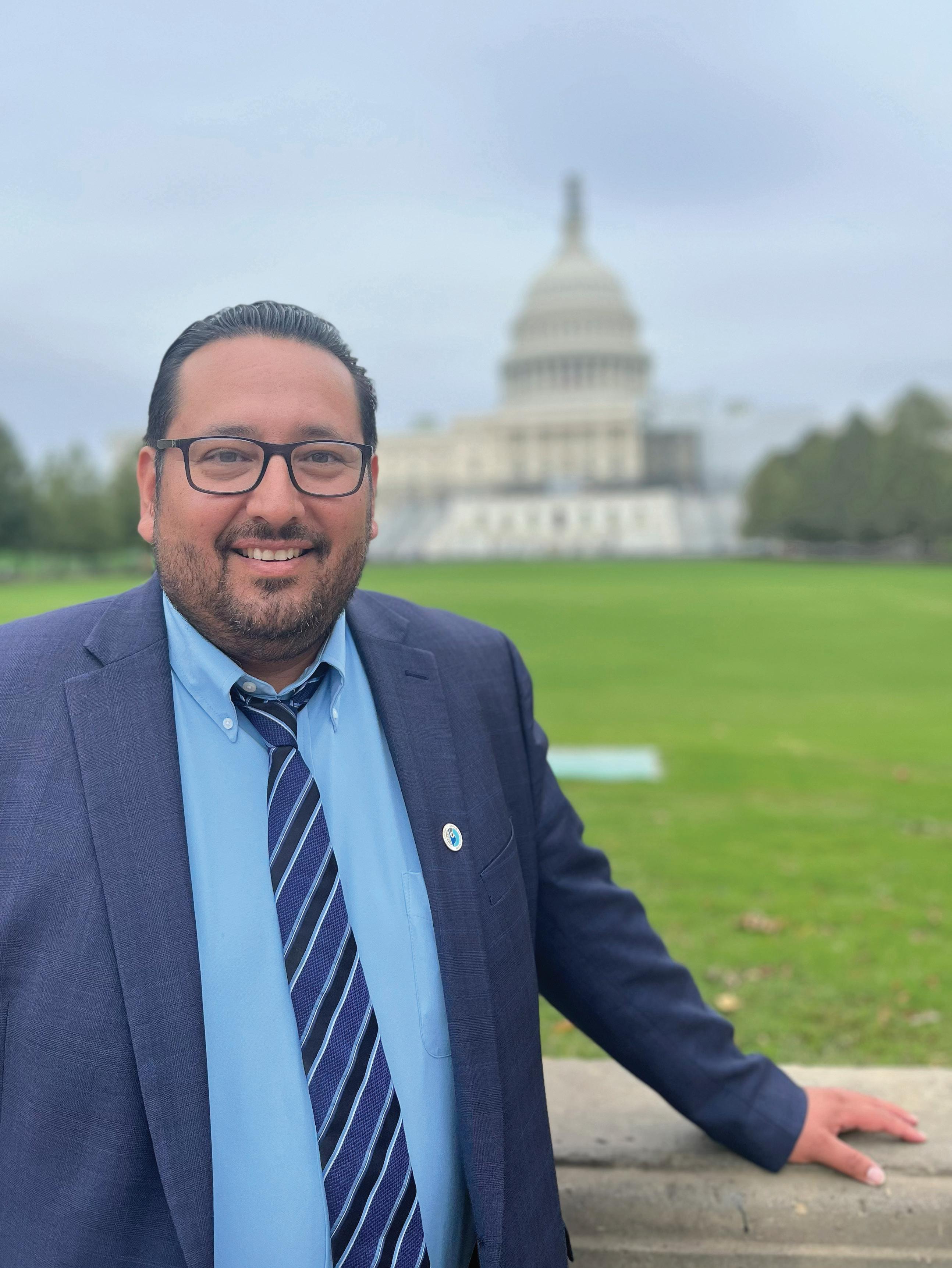
By Jennifer Fink
“Education is our only political safety. Outside of this ark, all is deluge.” – Horace Mann
Navigating tight budgets and declining enrollment has always been challenging. Doing so amid increased political acrimony – and reports that the Department of Education will be abolished – requires astute leadership.
As you well know, some now view schools as agents or targets of ideological agendas, rather than as neutral civic organizations that exist to serve the common good. School board meetings have become increasingly politicized, with shouting matches erupting over health and safety protocols, curricular choices and who’s allowed to compete in sports or use a particular restroom.
This increased discord both reflects and feeds public discontent with K-12 ed-
ucation. According to a September 2025 Gallup poll, almost three-quarters (73%) of U.S. adults believe that K-12 schools are heading in the wrong direction. Just 35% of Americans – a record low – are satisfied with the quality of education that K-12 students receive in the U.S. today. More than one-third of U.S. adults (34%) express no to “very little” confidence in public schools.
Unsurprisingly, school professionals are feeling the strain. In 2022, 48% of U.S. principals and 40% of teachers said that “the intrusion of political issues and opinions into their professions was a jobrelated stressor.” Uncertainty regarding the federal government’s involvement in education adds another layer of complexity – as does the tone and content of educational and societal debates.
“The undercurrent in our time is ambiguity within the context of hate
and political divisiveness,” says César Morales, Ed.D., Ventura County Superintendent of Schools. “Political vitriol is dividing communities and friendships.”
Horace Mann’s 19th century notion of education as an arena of political safety may seem quaint today, but it’s worth remembering that past educational leaders steered their schools and communities through times of intense social and political division as well. You already possess many of the skills required to shepherd your school or district through this turbulent time.
(and Always Has Been)
At its core, politics is about collective decision-making, resource distribution and governance. School superintendents and business leaders have been dealing
“Make sure you stay communityfocused and try to tune out any excess noise that is not relevant to your community.”
with these issues since the advent of public schools – and these issues have always unfolded amid larger societal issues and debates regarding whose needs (and wants) to prioritize.
“Our leaders in school districts deal with small ‘p’ politics every day,” says Sara Pietrowski, CASBO’s chief governmental relations officer.
Additionally, school leaders have always kept an eye on local, state and national politics because school funding is affected by the decisions of voters and legislators. Superintendents and school business officers have also always built and nurtured relationships with key stakeholders and collaborated with community members to find solutions that best address the community’s needs.
“Topics like declining enrollment and school consolidations have always been difficult topics,” says Megan Reilly,
chief administrative officer of the Fiscal Crisis and Management Assistance Team (FCMAT) and former CBO of the Santa Clara County Office of Education. “I don’t know that I would view them as politicized. They’ve always been difficult to grapple with because it really comes down to the community and people.”
Maintaining a focus on the needs and desires of your community – and ignoring, to the best of your ability, any political rancor or efforts to define local issues as Red or Blue – can help you navigate the current moment.
“Make sure you stay communityfocused and try to tune out any excess noise that is not relevant to your community,” Pietrowski says. “I think it’s helpful to remember that California is a local control state. In California, parents and community members have a larger role in determining how money gets spent.”

Reilly echoes the value of local control of funding, noting that it’s easier for locally elected boards and schools to accurately represent a community’s values.
So, while politics (with a capital P) appears to be everywhere these days, the job of school leaders hasn’t changed. As stated by the recently established Collaborative on Political Leadership in the Superintendency (CPLS), “No matter the political landscape … the superintendent’s job is largely about keeping the organization’s focus on children and youth while strategically navigating the interests of adults.”
Don’t get distracted by divisiveness. When the political temperature rises, it’s important to orient yourself (and your team) around core values. These can then direct decisions and actions.
“At Los Angeles Unified, our guiding principle is simple yet profound: Every decision must center on what is best for students,” says Alberto M. Carvalho, district superintendent. “District leaders have a responsibility to remain steadfast in institutional values – equity, access and opportunity – even when external pressures, including those from political or federal sources, may run counter to them.”
LAUSD has long affirmed that schools must be safe havens for every child. Centering that core value has led the administration to craft policies which uphold that principle, including the district’s policy to only allow federal immigration enforcement on school campuses if officers possess a valid judicial warrant. The district has also created protocols outlining how staff can protect student privacy and rights.
Carvalho’s advice to other school leaders: “Stay rooted in purpose. When the focus remains on students – on their safety, their learning and their potential – it becomes easier to navigate political headwinds without losing sight of why we serve.”
The COVID-19 pandemic and recent string of natural disasters underscored the value of regular, ongoing communication with members of your community. During times of confusion, clear communication that cuts through the noise and addresses the who, what, when, where, why and how of school operations and district








decisions not only dispels rumors but builds trust.
“Descriptive stories can help community members understand the real-world impact of policy decisions better than datapacked charts.”
In many cases, descriptive stories can help community members understand the real-world impact of policy decisions better than data-packed charts. As always, though, it’s important to tailor your communications to the needs and preferences of your audience.
The Collaborative on Political Leadership in the Superintendency recommends using unifying language whenever possible – and “avoiding trigger words or phrases that can be easily misinterpreted given the national context.”
Don’t attempt to hide or sugarcoat unpleasant facts. “Our parent and staff communities need understand what’s at stake in this moment,” Morales says. “Administrations and school boards will need to make decisions regarding the
prioritization of resources and may need to do eliminate some services or operate some programs differently. All of that is tough enough to execute, but tougher when it’s a surprise.”
Make time for community feedback. It is important to hear community concerns – and to create an environment in which all community members can safely share their perspectives. You can (and should) model and insist upon respectful conversation. Reorienting heated conversations to student needs is one way to turn down the temperature.
In some cases, you may need to find alternate venues to share important information. Community members absolutely deserve information about school and district finances but may not be able to digest that information during a school board meeting that’s already lasted two
hours and featured angry comments about library books. Similarly, lengthy school board meetings may not be the best time to share detailed budgetary information with board members either.
“If a school board meeting has already gone on for hours or has been commandeered by something going on locally, I think sometimes the best thing to do is just let that happen,” says Joe Landon, associate superintendent of business at Roseville Joint High School District. Tabling your presentation for another time is preferable to extending the meeting and giving members information they may not have the capacity to handle at that time, he says.
To counteract the sometimes-chaotic nature of board meetings, Landon adopted alternative communication strategies, including one-on-one briefings and detailed weekly written updates, to keep board members informed.
Education and school business have always been collaborative endeavors. During politically charged times, it may take extra effort to establish and maintain collaborative relationships.
In many communities, for instance, turnover among school boards and staff has been higher than usual. CBOs and superintendents must take the time to get to know new personnel, setting aside any preconceived notions based on political ads or campaigns. One-on-one meetings take time but can help you better understand another’s priorities and point of view – and that understanding can streamline future conversations.
Begin by identifying common ground. Landon suggests focusing on the objective, data-driven aspects of school operations to bridge ideological divides, if necessary.



CASBO's Government Relations Team is your front line for advocacy, policy insights, and legislative impact.
By Jennifer Fink
Will the U.S. Department of Education exist next year?
Probably. It will likely exist in some form after that as well. But the uncertainty regarding the Department of Education – ignited when President Trump signed an executive order directing the Secretary of Education to take “all necessary steps to facilitate the closure of the Department of Education” – is creating new challenges for school districts.
“Local governing boards, administrative teams, teachers and staff are used to coming together in times of crises; we’ve done that many times in the past. The difference right now is that we’re digesting messages that demonstrate the federal government is not interested in public education,” says César Morales, Ed.D., Ventura County Superintendent of Schools.
School leaders are also attempting to mitigate the impact of federal policies and political discourse. “Right now, we’re all part of “big P” politics – debates about federal funding, the curriculum, immigration,” says Sara Pietrowski, CASBO’s chief governmental relations officer. “We have district leaders who are thinking about how to navigate the politics of immigration as it applies to any students who are of mixed status from a documentation perspective.”
In Ventura County – and elsewhere in California – immigration enforcement actions ordered by the federal government have created fear, uncertainty and economic hardship.
“Thiry-two percent of the students in our county have a parent or grandparent who’s undocumented. Ninety-two percent of those students are U.S.-born,” Morales states. Some students are picking up jobs to contribute economically to their households, covering for adults who may be too fearful to go to work (or who may have been detained or deported). Local tax revenue is down, and some families are moving away, accelerating alreadydeclining enrollment and affecting future local tax receipts.
Federal tariffs are increasing the cost of goods and may eventually necessitate tough decisions about school programs. Welding programs are popular in the state’s Career and Technical Education (CTE) centers, but the price of steel fluctuates up to 300% depending on the week, Morales says. “At some point, that could become cost-prohibitive,” he says.
Potential cuts to Medicaid and other social support programs may also end up costing California districts more money.
“What I’m most fearful of is cuts to Medicaid,” Morales says, noting that the program allows families of young children to access developmental screenings, speech therapy and other essential health care services. “Should all that become inaccessible, children entering our school system may come with a lot of gaps in service, and parents are going to be looking to the school system to meet their needs.
“We’re creating a scenario where we may not have enough resources to tolerate the gaps in funding that are dominoing into our system.”
No one knows exactly what the future of federal support for public education will be, nor which federal actions will be overturned or upheld by the courts. That’s why it’s imperative to consider and plan for a variety of possible scenarios.
Significant cuts to Title 1 funding may be ahead, so model that out. Work through worst-case scenarios, as well as “likely” and “best-case” scenarios. The sooner you envision and confront possible impacts, the better prepared you’ll be to respond.
Share your scenarios with your school leadership team and your school community. Cuts and consolidation will likely be necessary in many districts, so be sure to explain both fiscal reality and how any proposed changes will forward the mission of your school or districts.

“We have to think not just for the moment, but also set ourselves up for the long-term,” Morales explains. “We have to pay close attention to our multiyear projections and look at the overall health and vitality of our districts.”
Uncertainty breeds chaos and fear, and some federal policies directly threaten the safety and well-being of students, staff and families.
“One thing we want to do is to try and insulate children from fear,” says Megan Reilly, chief administrative officer of the Fiscal Crisis and Management Assistance Team (FCMAT) and former CBO of the Santa Clara County Office of Education.
Some districts are now using virtual learning and independent study models to support students and families who may be afraid to come to school because of immigration enforcement efforts, says CASBO’s Pietrowski. Many districts are also training staff on protocols to protect student privacy and rights.
Los Angeles Unified School District (and others) are also partnering with community organizations to provide legal resources,
family workshops and mental health supports to those affected by immigration uncertainty. Many districts also launched similar efforts to meet families’ need for food during the government shutdown and resulting uncertainty regarding SNAP benefits.
Centering policy decisions on core values will help you navigate shifting pressures, while staying true to your district’s mission. Figuring out how to do so, however, can be a challenge. The Collaboration on Political Leadership in the Superintendency recommends that school leaders “deepen their understanding of state and national politics” so they have a better knowledge of the history and intent of education laws and policies. Legal counsel can help you implement necessary changes and, perhaps, advise you on strategies you can use to advocate for or against certain measures. z z z
“By focusing on facts, you can find common ground with anyone.”
By focusing on facts, you can find common ground with anyone, he says. “It doesn’t matter if they’re far left or far right or somewhere in between.”
Relationships outside of the educational ecosystem are also important. Know what local resources are available to you, and work with governmental, business and nonprofit entities to proactively address needs. Understanding each agency’s role and responsibilities allows you to effectively coordinate efforts.
“In my community, nonprofit and community-based organizations have been stepping up in an immense way,” Ventura County Superintendent Morales says. “We’ve developed a

Neighbors Support Fund that raised half a million dollars in a month and is helping address food insecurities in the community.”
CBOs and superintendents should also regularly connect with legal counsel who can help them interpret and implement laws, regulations and policies at the local level, according to The Superintendent’s Political Leadership Field Book
Calm and compassion can be contagious. You may well experience anger, frustration and sadness in response to certain actions; all school leaders do. Those emotions can inspire useful action, but only if you take time to process your emotions and respond thoughtfully instead of reactively.
Self-care and adequate sleep are essential. While it may seem tempting (or even desirable) to scroll headlines and social media at night to stay abreast of community conversations regarding hot-button issues, doing so is likely detrimental to your health, well-being and ability to lead effectively. You need rest to slow your swirling thoughts and gain perspective. Adequate rest also makes it easier for you to respond to others in a calm, compassionate manner.
When you consistently act in a steady, measured, caring manner, others are more likely to do the same. School leaders “need to create a generative social field of compassion where everyone is seen, valued, heard, cared for, loved and has the ability to express their voice,” Morales says.
Political power comes and goes. The mission of public education remains the
same: To ensure that every child in our country has access to a free, appropriate education.
It takes time and continued effort to achieve meaningful changes. It always has. If you (or your team) ever feel dispirited or discouraged, remember why you are doing the work. Visit an elementary school and spend some time with the students. Their curiosity and enthusiasm can reenergize you – and remind you that your work directly impacts their lives.
“The kids are watching us and how we’re responding to this crisis. And I hope what they learn is that we’re going to be resilient and gritty, that we’ll get through this time,” Morales says. “Despite the vitriol on the news or in social media, we can act with kindness, compassion and love.”
Keep your core values at the center of everything you do. As LAUSD Carvalho says, “when decisions are rooted in equity, inclusion and student success, even the most complex political landscapes become navigable with integrity and purpose.” z z z
Jennifer Fink is a freelance writer based in Mayville, Wisconsin.
How do you help your team stay focused on your organization’s mission and meeting students’ needs? Share your advice at casbo.org/linkedin.


















John
Baracy
Managing
Director
California K-12 Market Lead 310-492-8110
rwbaird.com/californiak12








By Jennifer Snelling
Conflict is an integral part of being human. For school business leaders charged with interacting with teams from many business disciplines and various backgrounds, that means the need for difficult – and even high-stakes – conversations arises regularly.
Whether the situation is a superintendent caught in the middle of a collective bargaining battle, an employee who needs to change their behavior or a principal dealing with upset parents, some conversations are bound to be uncomfortable. Left to fester, hurt feelings or misunderstood intentions become bigger and can spread ill will among employees, co-workers or community members.
The good news is that, with intention and practice, embracing the discomfort can make us better at handling difficult
conversations. At La Mesa-Spring Valley Schools, the ethos of embracing conflict comes from the top.
When Tina Douglas became assistant superintendent of business services at La Mesa-Spring Valley Schools she was tasked with a tough assignment. The district had a campus security program that allowed a long-time employee to live in a mobile home on campus. The district received a large Community Schools Grant and needed the site as a Community Schools resource center. Unfortunately, this meant the employee would need to find a new place to live. Douglas faced the sad task of letting the employee know.
When Douglas called him into the office to tell him, she wasn’t sure how to say it. The employee reminded her of the motto often cited by district Superintendent David Feliciano: Clear is kind,
Getting comfortable with the discomfort of difficult conversations is important for organizational success.
unclear is unkind. She took a deep breath and said what she needed to say, compassionately, but clearly. In the end, while difficult to digest after living on campus for 24 years, the employee appreciated her honesty and directness.
“I love when I hear people say they aren’t sure how to word something because it means they want to be honest about something difficult,” says Feliciano. “I’d err on the side of just saying it, even if it hits hard, then we can unpack it. If we are going to get better as an organization, as a person, as a team, we have to be constantly open with each other.”
Getting comfortable with the discomfort of difficult conversations is important for organizational success. Practicing three steps can help you get there: normalize conflict, prepare yourself, and practice inquiry and empathy.
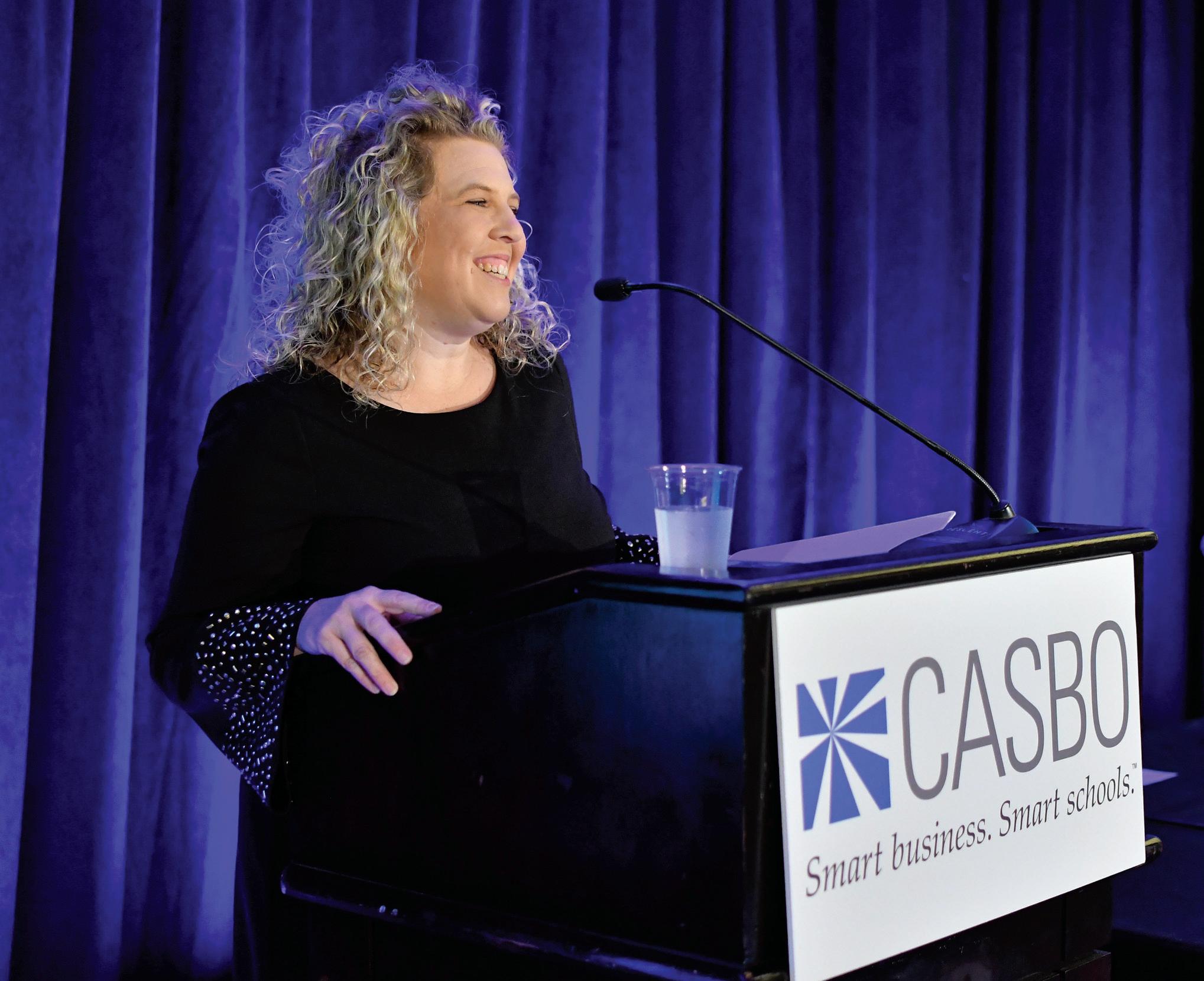
Conflict is an unavoidable part of the human experience. Many people believe that conflict is inevitably negative and that discussing contentious issues only makes things worse. Many of us want to make a tough conversation easier on ourselves and the other person.
“Ultimately, that is not a very peoplecentered approach, Feliciano says. “The aim is that we are clear about what our concerns and critiques are.”
Feliciano attributes his “Clear is kind” motto to leadership author Brene Brown. Those comfortable with conflict understand how to listen to each other and talk about their differences. They see conflict as an opportunity to improve through collaboration.
Douglas’ first cabinet meeting in La Mesa-Spring Valley seemed normal. People expressed differing opinions without getting angry. At the second cabinet meeting, Feliciano wanted to revisit the prior meeting’s conversation and apologize for how he pushed back against differing opinions.
Douglas felt like she had landed on another planet. The fact that Feliciano wanted to revisit areas of conflict rather than ignore them differed from how things were handled in her previous work experience.
“He embraced conflict and said we need to make sure we all bring all our voices to the table,” she says. “Conflict is the way you can actually get to a better outcome. When I came here, I saw that David demonstrates that conflict is healthy and positive.”
Feliciano uses several strategies to infuse this ethos throughout the district. It starts with being strategic about who is being hired. Feliciano looks for people who are hungry, humble, smart and have heart.
“We can teach the technical, we are really looking for these key traits in the organization. Everyone knows clear is kind.”
He also leads by example, debriefing any public meeting or presentation with the cabinet, discussing what went well and what could have been better.
As a cabinet, they also assess personality types and discuss how each person processes conflict and feedback. Feliciano and Douglas have opposite personalities, but that doesn’t keep them from trusting each other.
“If there’s anything that either of us does that rubs us the wrong way, we bring it to each other,” says Feliciano. “We are committed to saying those things. You don’t want people talking about you, but to you.”
Finally, leadership teams and unions read books together and then discuss them, so they can grow their understanding of the ways conflict can keep the organization growing.
Feliciano started his career in district IT. There, he heard site- and districtlevel staff complain about each other. He brings that experience to La Mesa-Spring Valley where they practice intrastate bargaining. Both parties emphasize that they are there for the same purpose and approach with an open mind, assuming positive intent on both sides. La MesaSpring Valley uses a facilitator who holds each team accountable for those values.
At the end of each session, they debrief together. This is often the most difficult conversation of the day. It offers an opportunity for clarification and repair – a place to clear up misconceptions or feelings that were hurt when the conversation got heated.
“The work we do in schools is the most heart-oriented work there is,” says Feliciano. “Yet, sometimes, we act like it’s a corporate environment. In an elemen-

THE INSIGHTS YOU NEED. THE SOLUTIONS THEY DESERVE.
Our focus is guiding California school districts in achieving their financial goals with innovative yet practical solutions.
CALIFORNIA K–14 MUNICIPAL ADVISOR
DALESCOTT.COM | 415.956.1030

What has happened along the way to get to this point?
tary school district like ours, our work with each other should be a reflection of our work with students.”
Tim Stowe, Ed.D., superintendent of the Torrance Unified School District, learned his first lesson in difficult conversations while serving as an assistant principal early in his career. He often had to meet with parents who were upset about a discipline issue. He would listen and try to say all the right things. But, often, the parents would still go to the principal.
The principal listened, said the same things Stowe had, and the parents walked away satisfied. The principal reminded him that it wasn’t that he hadn’t said the right things, but that the parents just needed someone else to listen to what had happened.
Rule No. 1 for Stowe is to be ready to listen. He also prepares for tough conversations by doing a little research, like reviewing the history of the situation. What has happened along the way to get to this point? He reviews the education code, collective bargaining agreement and whatever legal principles that might be applicable.

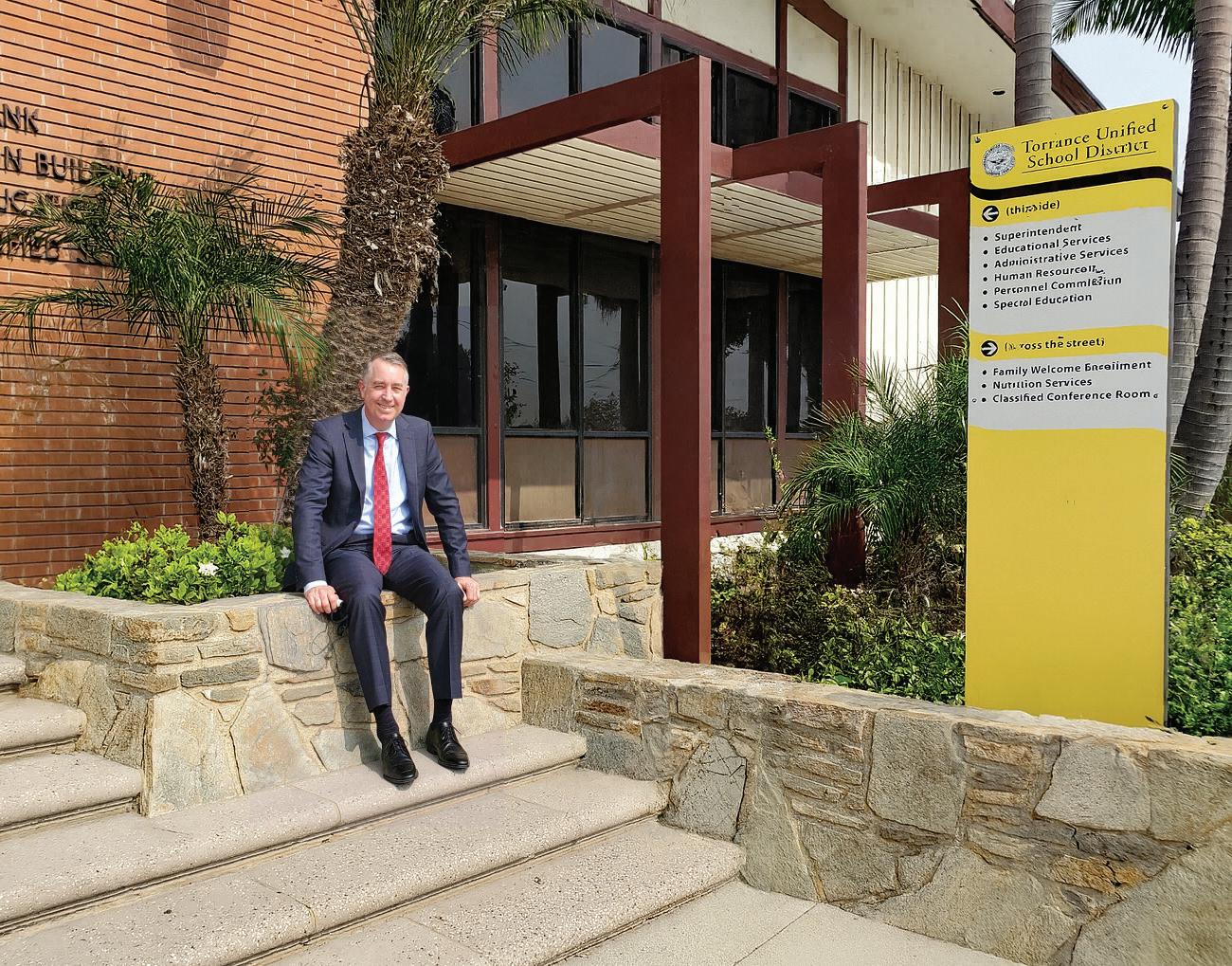
By doing his research, Stowe ensures he understands the main point of contention or primary goal of the conversation. He’s also prepared with relevant information and able to respond to potential reactions. And when he does sit down with for a tough conversation, he always chooses a time and place that ensures privacy.
For Feliciano, a 5-minute mindfulness meditation allows his emotions and the voice in his head to die down.
“When I practice like that, it’s a reminder that the ongoing narrative that is circling in my head and the feelings of stress are not what I want to have happen,” he says. “I don’t want to have a lot of anxiety or feel insecure that someone will be mad at me. That is a physical conditioned thing that happens to all of us. The best way to break out of it is to be intentional about your thoughts for a short period of time.”
Douglas recommends establishing common ground, core values or identify-
Prepare yourself to be honest and frank.

Everyone processes difficult conversations differently.
ing where the interests of the two parties align. In addition, understand the consequences of the conversation. What does a successful outcome look like?
Above all, prepare yourself to be honest and frank. Doing so will build trust over time. As a principal, Stowe had many meetings with parents whose students had to be suspended. He always knew he had done a good job if the student and parent were able to shake his hand and thank him at the end of the meeting.
“If you can smile and have a laugh about something, you’ve built a connection and trust. Trust is one of my pillars,” says Stowe. “It’s important that people know you care about the work and that, regardless of the issues, you care about them, the students and the outcome.”
Preparation is not always possible. Sometimes difficult conversations arise out of nowhere. Douglas once had an employee who had been written up on a disciplinary matter reach out to her. The employee was hoping Douglas would keep the matter out of his employee file.
Douglas was caught by surprise, but didn’t immediately say no. Neither did she make any false promises. She took a deep breath and listened to his case, so he felt heard. In the end, she reminded him that she could not go above his manager since she was not his day-to-day supervisor.
“If I feel myself getting agitated, I ask for a minute to reframe that in my
head,” says Douglas. “If the other person is getting agitated, I ask for a minute to just breathe and suggest we move on to that topic later. The biggest thing is to listen, allowing space where there needs to be space.”
Other tips include:
• Pausing before responding to avoid a knee-jerk reaction.
• Acknowledging your surprise at new information.
• Asking clarifying questions to understand the other person’s perspective.
• Practicing active listening by repeating your understanding of what the other person said.
• Using “I” statements to avoid sounding accusatory.
• Seeking follow-up when needed. Keeping your voice and body language calm.
It’s good to keep some of these conversational tools in your back pocket for unexpected conversations or meetings that start to go off the rails.
“When I expect a conversation to get really heated, I start by acknowledging the conversation will be uncomfortable,” says Douglas. “If either of us needs a time-out, we should respect that. Most importantly, don’t forget they are a person who may have things happening in their life that we don’t know about.”
Everyone processes difficult conversations differently. Feliciano acknowledges that he’s comfortable processing all his emotions in the moment, but that many people are not instant processors. These folks may need to take a break and come back to the conversation later.
Stowe says the key for him is to keep an open mind so he can really hear what the other person is saying. “We often
Looking for additional advice on how to successfully lead difficult conversations? These resources can help!
• Crucial Conversations®, CASBO Live Workshop (virtual or in-person) led by CASBO CEO Tatia Davenport
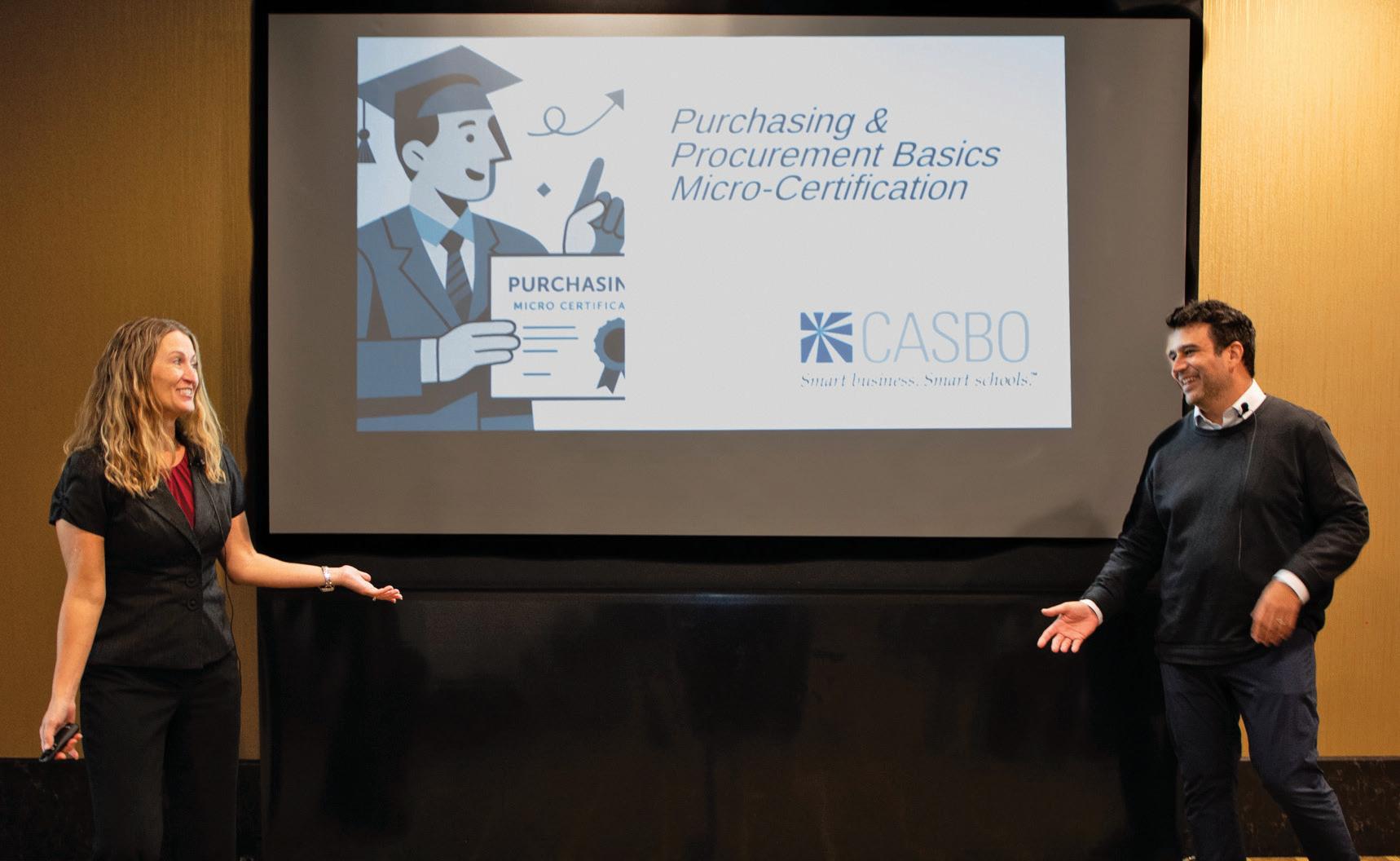
• Mastering Resilient Communication, CASBO SBU course led by Lorraine K. Lee
• Dare to Lead: Brave Work. Tough Conversations. Whole Hearts, by Brene Brown
• The Five Dysfunctions of a Team, by Patrick Lencioni
• The Great Engagement: How CEOs Create Exceptional Cultures, by Tom Willis and Brad Zimmerman
• Radical Candor, by Kim Scott

It’s important to keep the conversation on topic.
think our way is the best way. It might be,” he says. “But we don’t get there without an opportunity to explore other options and think divergently. One of my favorite quotes is by Zen master Shunryu Suzuki, ‘In the beginner’s mind there are many possibilities, but in the expert’s there are few.’”
At the same time, it’s important to keep the conversation on topic. Stowe has a couple of tricks to achieve that goal.
When someone brings up an issue unrelated to the issue at hand, Stowe will say, “I hear and understand that, but it doesn’t sound related to the topic at hand. Let’s make a note of it and we’ll come back to it.”



He also keeps the focus on how to move beyond whatever has happened. He may ask the individual what they
want to see happen, then restate it to make sure they feel heard.
“The work we all do is tough. There are going to be conflicts,” says Stowe. “Whatever the conflict is, a change in the district, the political climate, budgetary constraints or curriculum issues, align around a shared vision for what we want our district to be and approach it with a growth mindset. This is how we build the skills in our students to work through difficult things.” z z z
Jennifer Snelling is a freelance writer based in Eugene, Oregon
What are your pro tips for navigating difficult conversations with your team? Email us at insight @ casbo.org.

February 3-4
Women in Leadership Conference
Hyatt Regency Long Beach
Navigate your leadership path with purpose and confidence.
March 31-April 2
CASBO Con 26
San Diego Convention Center
Connect, learn and grow.
January 27
Accounts Payable Essentials
In-Person at Orange CDE
Reduce errors, avoid late payments and streamline your payables workflow with practical, actionable strategies.
January 28
Procurement Strategies: Bids, RFPs & Compliance
Confidently manage bid law, write effective RFPs and reduce protest risk, while maximizing value. (Also offered March 26)
January 29
Legal Aspects & Hands-On Accounting for Student Body Orgs
Stay compliant and audit-ready with ASB finance best practices, especially in gray-area scenarios.
February 3
Advanced Principles of School Law
Go deeper into education statutes and due process. Ideal for business officials needing sharper legal insight.
February 3-March 17
Executive Assistant
Micro-Certificate
Build skills in scheduling, record-keeping, finance support, professional communication and cross-departmental coordination.
February 3-March 17
Performance Management
Micro-Certificate
Gain coaching tools and employee growth strategies to reduce turnover and support your team’s success with feedback that works.
February 10
CalSTRS/CalPERS:
Retirement Concepts
Clarify retirement systems and costs so you can better advise staff and avoid budget surprises.
February 11-13
Payroll Essentials
Certificate
Live or Online
Dive deep into the laws, timelines and tasks for computation, audits, deductions, CalSTRS/CalPERS and calendar-year-end closeout.
February 12
Leaves of Absence Master leave laws, procedures and protections for your employees and your district.
February 24-April 7
Charter Authorization & Oversight Micro-Certificate
Build strategies to confidently navigate audits, detect fraud and foster positive working relationships with your charters.
Learn more or register: casbo.org/calendar





Stifel is the leading underwriter of California K-12 school district bonds.* We assist local districts in providing financing for facility projects and cash flow borrowing, including new construction, modernization, renovation, and technology improvements. Our work with California school districts includes:
■ General Obligation Bonds
■ Mello-Roos Bonds
■ Certificates of Participation/Leases
■ Short-Term Notes and TRANs
■ Refinancing or Restructuring of Previously Issued Bonds
We give back to the communities we serve by providing college scholarships to graduating high school seniors through Stifel’s annual Fabric of Society essay competition and by supporting school-related foundations and functions with charitable contributions.
* Source: LSEG, negotiated transactions ranked by number of issues for 2024 as of January 7, 2025 Stifel, Nicolaus & Company, Incorporated
Visit www.stifel.com/publicfinance or contact
School Finance Group:
(415) 364-6839 bkerns@stifel.com
Director (415) 364-6841 egonzalez@stifel.com
Bartolotta Vice President (415) 364-6879 bartolottae@stifel.com
(213) 443-5006 dvincent@stifel.com Robert Barna Managing Director (213) 443-5205 rbarna@stifel.com
Frank Vega Managing Director (213) 443-5077 vegaf@stifel.com