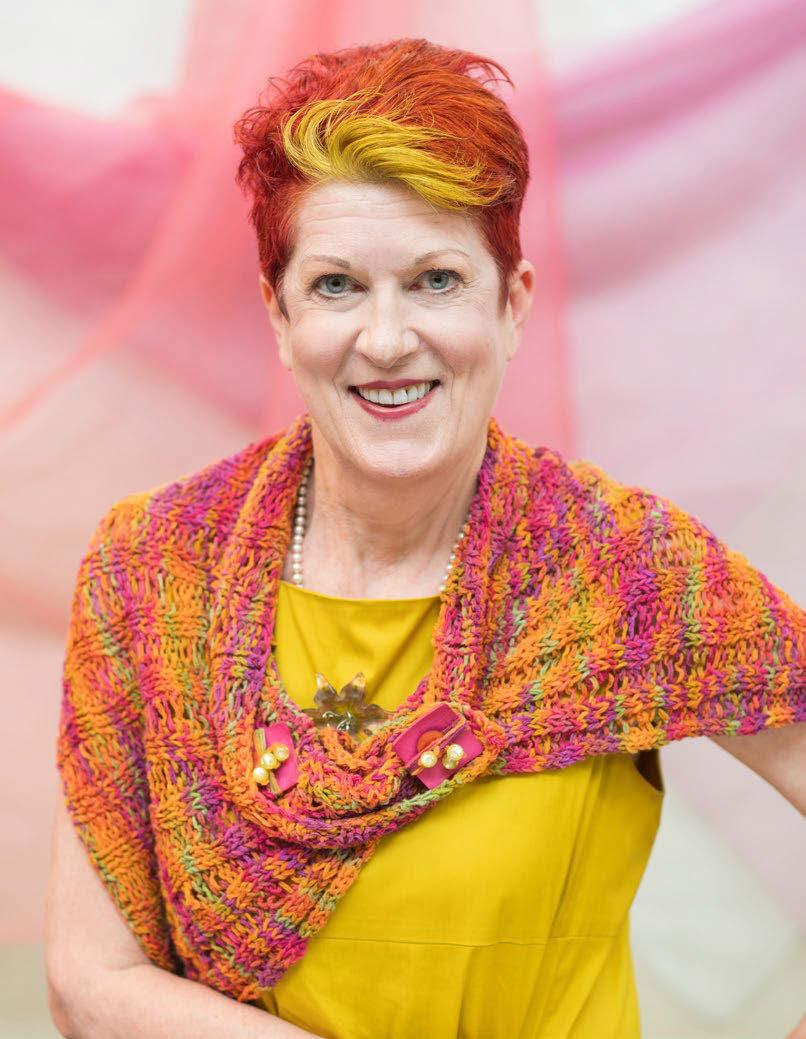
Linen Stitch SCARVES Understanding color dominance in stranded colorwork knitting
...to K, is to
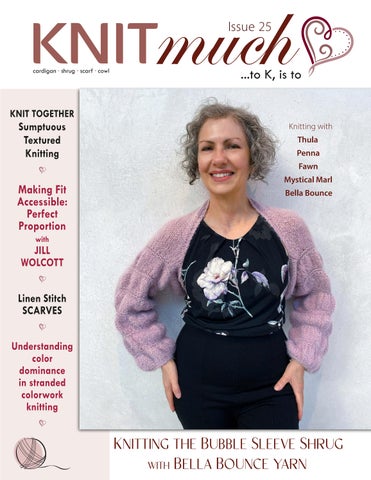
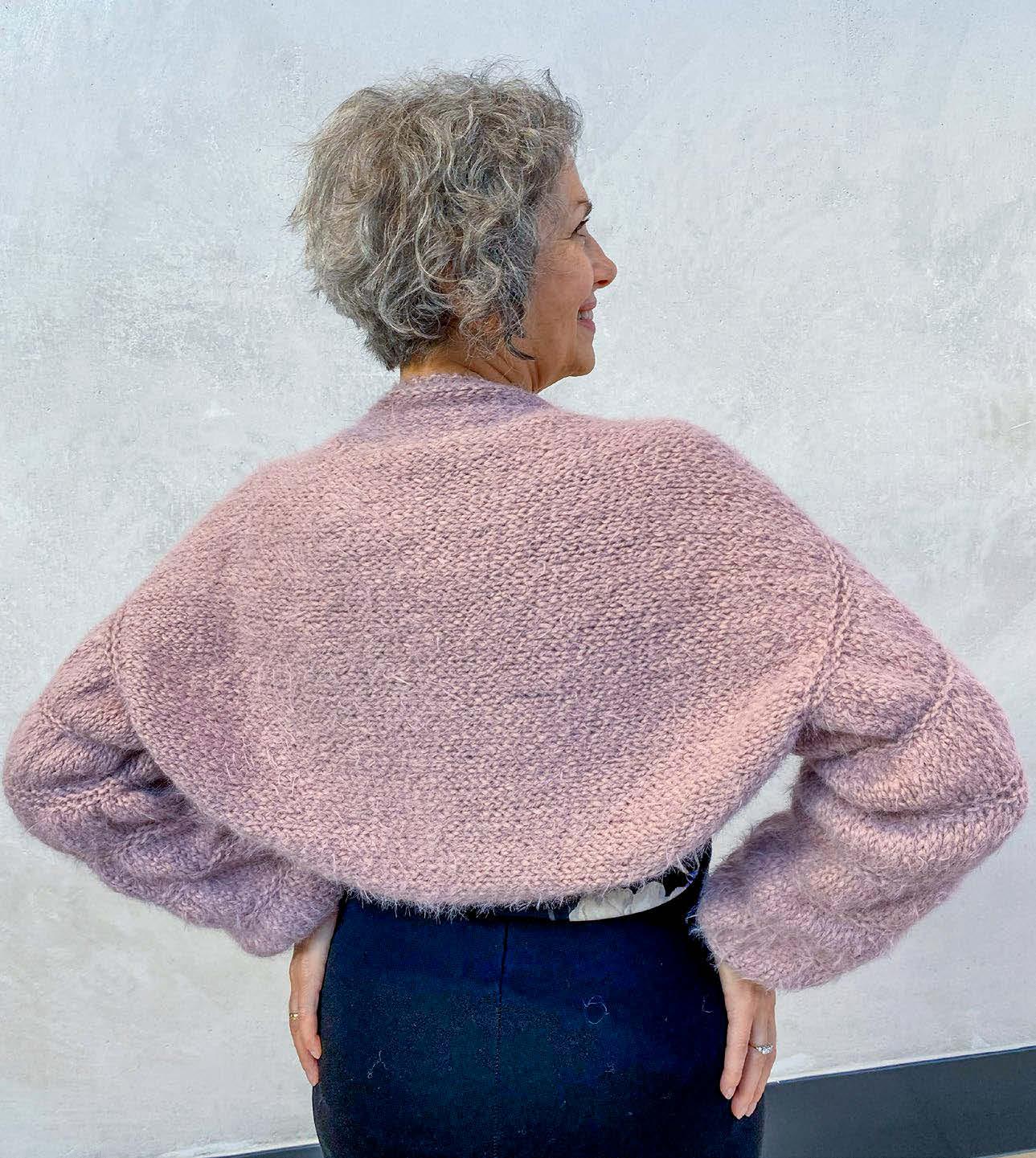
Knitting the Bubble Sleeve Shrug with Bella Bounce yarn
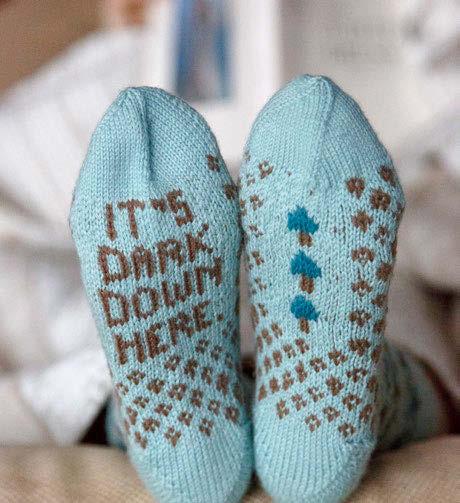
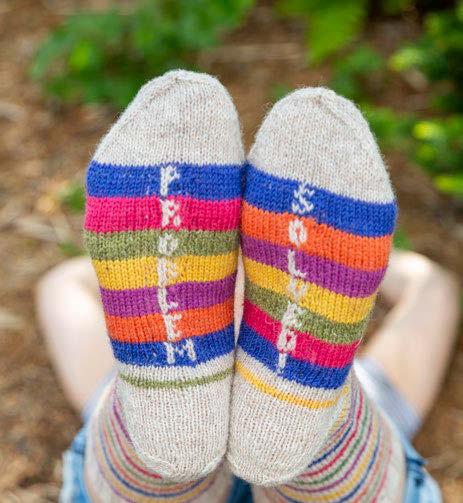
Knitting with Thula Penna Fawn Mystical
KNITmuch
EDITOR-IN-CHIEF, ART DIRECTOR
Carla A. Canonico Carla@KNITmuch.com
ADVERTISING SALES
John De Fusco John@KNITmuch.com
PUBLISHER
A Needle Pulling Thread
PHOTOGRAPHERS
Carla A. Canonico, John De Fusco, Contributors
BLOGGERS/CONTRIBUTORS
Cynthia MacDougall ktogdesign@gmail.com
Sue Sindrey suesindrey@me.com
Sarah Dawn Adams sarahdawnsdesigns.com
GRAPHIC DESIGN
Carla A. Canonico Carla@KNITmuch.com Sondra Armas Sondra@KNITmuch.com
SOCIAL MEDIA and WEB
Maria Corina Guillen
Joaquin Rojas
WEBSITE / BLOG : KNITmuch.com Facebook : KNITmuch
Pinterest : knitmuch Twitter : @KNITmuchmag
WHERE TO GET YOUR COPY
KNITmuch is a quarterly eMagazine published by A Needle Pulling Thread. It is available free for personal use online at KNITmuch.com
A limited number of printed copies of KNITmuch are available for purchase at select yarn shops and specialty stores. Ask for it at your local shop. KNITmuch is not available by subscription.
EDITORIAL Bloggers, designers, and other contributors who would like to be considered for future issues please email Carla@KNITmuch.com with a brief description of your work and your proposed project.
No part of this publication may be reproduced without written permission from the publisher.
All designs, patterns, and information in this magazine are for private, non-commercial use only, and are copyrighted material owned by their respective creators or owners.
KNITmuch
K nit Together Sumptuous Textured Knitting
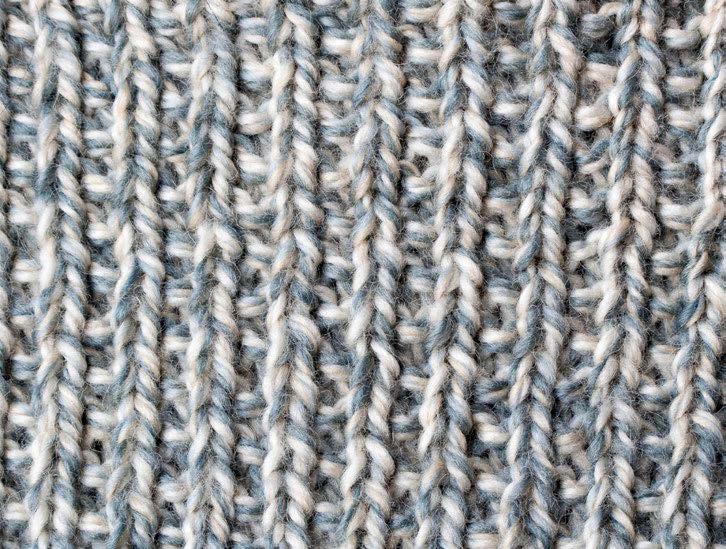
8 The luxurious knitted Linen Stitch
10 Discovering the soft luxury of Bella Bounce yarn
12 The Mindful knitting needles that elevate every stitch
13 Creating texture with knitting needle changes: the Bubble Sleeves take shape
15 K nitting the Body of the Bubble Sleeve Shrug: Cuff to Cuff Comfort
17 Finishing the Bubble Sleeve Shrug: Bringing Out the Bounce!
20 Exploring Thula yarn’s texture and shine in the Lace Tipped Cardigan
21 Thula Yarn | A unique trim and lace pattern for the Lace Tipped Cardigan
24 More Lace Repeats & Style Twists for the Lace Tipped Cardigan? Yes Please!
25 Box Pleat & V-Neck mods for the Lace Tipped Cardigan knitting pattern
26 Finishing the Lace Tipped Cardigan with Thula & custom trim details
28 First Impressions of Mystical Marl Yarn in the Holland Cowl Project
30 Slipped-Stitch colorwork in the Holland Cowl with Mystical Marl yarn
31 Understanding color dominance in stranded color work knitting
33 How to catch floats in stranded knitting
34 How to block the Holland Cowl in Mystical Marl Acrylic yarn blend
36 Making Fit Accessible: Perfect Proportion ...to K, is to
editor's letter
follow me
Dear Knitting Enthusiasts,
If there were ever a time to indulge your hands in texture and your mind in mindfulness, it’s now! In this Issue, KNITmuch Issue 25, we celebrate the tactile luxury of knitting.
We open with “ Knit Together : Sumptuous Textured Knitting,” a meditation on texture in both yarn and technique. This issue explores the linen stitch, simple knitting stitch pattern, yet so lush under the fingers, then dives into yarns that make you feel, like Bella Bounce, soft as a cloud, or the shimmering Thula, with its standout shine and stitch definition.
You’ll love the Bubble Sleeve Shrug journey from experimenting with mindful needle changes for textural contrast, to working the body from cuff to cuff, to finishing and blocking for optimal bounce. The thoughtful design process in these posts truly brings out the best in both Bella Bounce yarn and your knitting know-how.
In parallel, we explore the graceful Lace Tipped Cardigan in Thula yarn, with unique trim mods, lace patterning, and shaping options like box pleats and V-necks to help you personalize your project while highlighting the yarn’s beauty.
Rounding out the issue is the cozy Holland Cowl, where Mystical Marl yarn plays host to tutorials on slipped-stitch colorwork, float catching, color dominance, and blocking, essentials for elevating your stranded knitting.
And don’t miss our practical feature on knitwear fit, Making Fit Accessible: Perfect Proportion by Jill Wocott! A reflection on how proportion and intention lead to garments that actually feel good to wear.
Whether you’re craving rich textures or looking to finesse your finishing, Issue 25 is here to warm your needles and your spirit.
This issue is packed with practical tips, inspiring yarns, and cozy projects to carry you into cooler months.
Happy knitting,
Cheerfully,
Photo by Mike Guilbault.
Knit Together
with Cynthia MacDougall
Sumptuous Textured Knitting
Fall is a season full of sumptuous colours and texture. The landscape turns into a palette of deep, rich colours, due in part to the change of light caused by the sun's aspect in the sky. We also get the textural sensations of crisp morning air, heavy, damp dew, and the crunch of falling leaves under our feet.
Knitting, too, offers wonderful textures, either in the choices of our yarns or in the way we form our stitches. The knitting projects in this issue echo the sumptuous textures of fall.
Apart from choosing a yarn that has a texture of its own – from soft, light mohair to funky, lumpy novelty yarns – knitters can add dimension to their fabrics by choosing certain types of stitches.
Simple stitches, such as garter stitch and ribbing, can create tremendous texture. By its natural construction, garter stitch creates high ridges and deep valleys which makes the fabric somewhat elastic. The valleys also trap lots of air for warmth. Denise Powell's Art Deco wrap, also in this issue, is a great example of this.
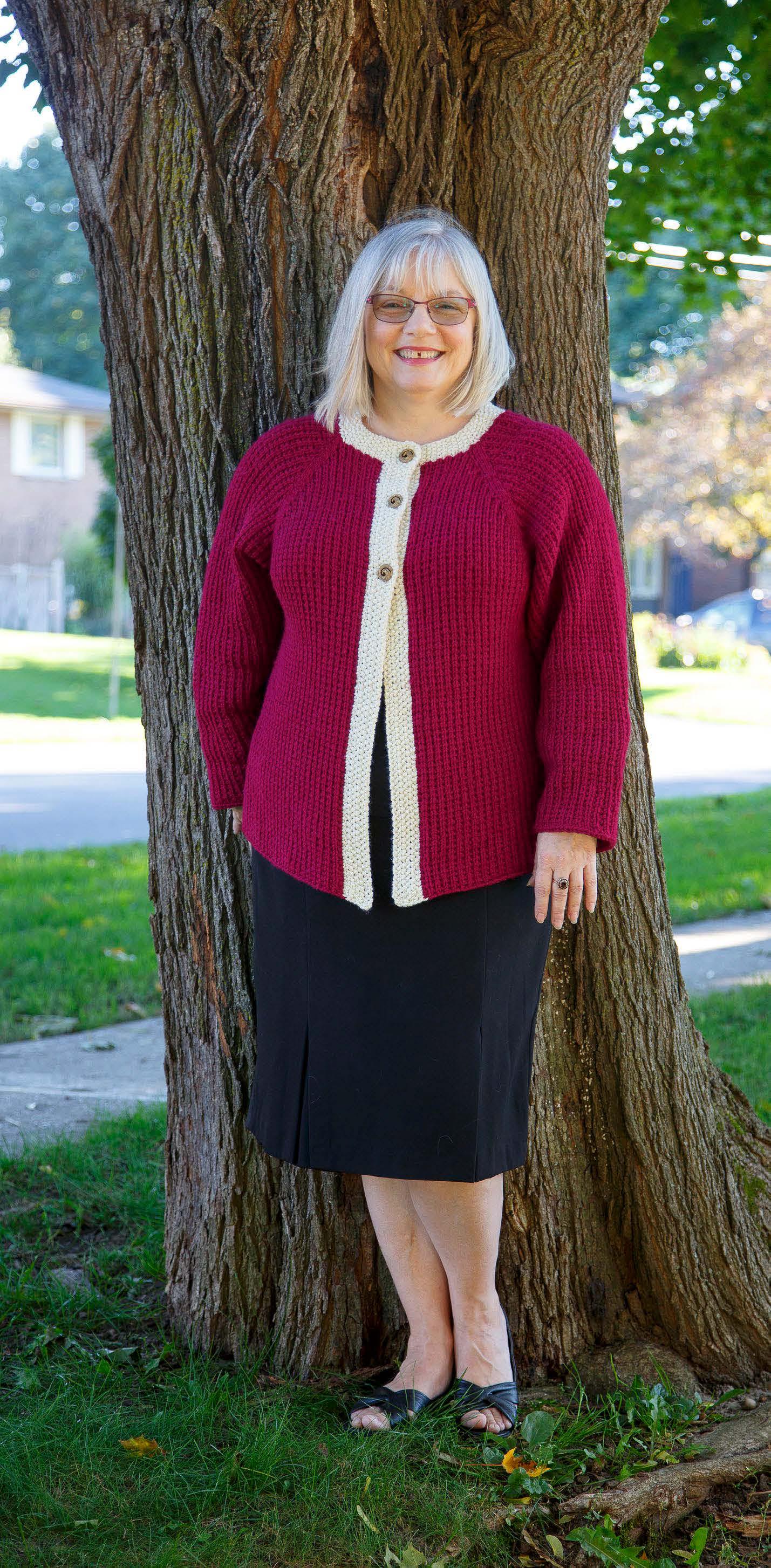
The vest in the photo of me at the top of this article offers an example of ribbing. It was knitted in an all-over k2 p2 rib, which gives the fabric surface some relief, and visibly vertical lines.
Although few of us have probably done so, a k1 p1 rib worked on large needles in a stretchy wool yarn can make an optically skinny garment that stretches to fit a surprisingly large frame. K1 p1 rib can be given an even deeper texture by knitting every knit stitch through the stitch below the one on the needle. This creates "fisherman's rib" – a stitch pattern that was popular in sweaters in the early to mid-1980s and one which is used in the Mountain Climb sweater, also in this issue.
Other knit/purl combination patterns can be used to create designs and textures. Chevrons, diamonds, ladders and even pictorial representations such as hearts and anchors can be made using nothing but knit and purl stitches. In fact, the number of possibilities from using just knit and purl stitches, without adding color or other techniques are so numerous they could keep a knitter busy for years. There are entire volumes of stitch dictionaries devoted solely to knit and purl stitch combinations.
Rice Cakes, the jacket project in this issue, is an example of a knit/purl combination pattern. It has a two-row pattern repeat: one row is worked "k1, p1", and the next row is purled all the way across. This creates a pattern that looks like many small cells, each of which contains a grain of rice.
For a slightly deeper texture, try cables. For years, relatives discouraged me from trying them, but, when I attempted them and learned that all I was doing was changing the order of the stitches on the needles, I practiced them with gusto. The bigger the cable, the more dramatic the texture. Panels of 2 x 2 "rope" style cables are less dramatic than an Aran "honeycomb" worked with 3 x 3 ribs. Again, the deeper texture of the honeycomb rib traps more air, keeping the wearer extra warm.
There are other ways to add texture to knitting projects. Slipping stitches with the yarn at the front of the work can create a woven effect on a stocking stitch background. Slip stitches are also used to create "mosaic knitting" a style of knitting worked on a garter stitch ground.
Of course, adding "holes" to the fabric gives us open, airy lace. Not the type of texture one is looking for in the fall, but, nonetheless, a shawl made with thick yarn in a lace design can be particularly warm, especially if fibres such as mohair or alpaca are used to make it.
Knitters of any skill level can add texture to their knitting projects, whether it’s done with the yarn, or by manipulating stitches to create various designs.
Cynthia MacDougall
Knit Together Design Studio
Orillia, ON L3V 6K2
ktogdesign@gmail.com
ravelry name: macknitnow
Instruction photos courtesy of Cynthia MacDougall.
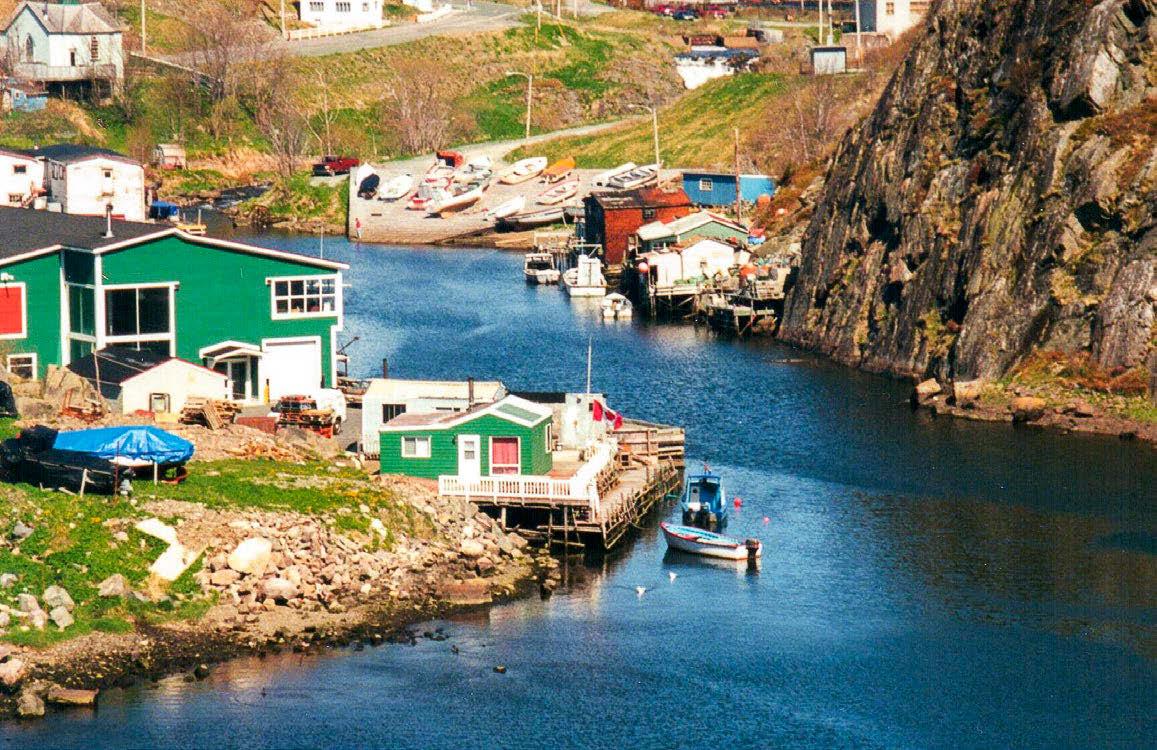
I find inspiration for knitting in many places. My favorite knitting memory is one of sitting high atop a cliff in Quidi Vidi, Newfoundland, as a "bergy bit" floated by in the sea below. Another, more recent memory is from last year when I took my knitting to the park on English Bay, Vancouver, while the shores spoke to me with the lapping of water and the cargo ships sat out in the bay. Yet another knitting memory is sitting on the boat beside a government dock on Georgian Bay knitting as the sun presented an amazing sunset. Canada has millions of scenic venues such as these where one can knit and still enjoy the great outdoors!
Quidi Vidi, Newfoundland
English Bay, Vancouver
The luxurious knitted Linen Stitch
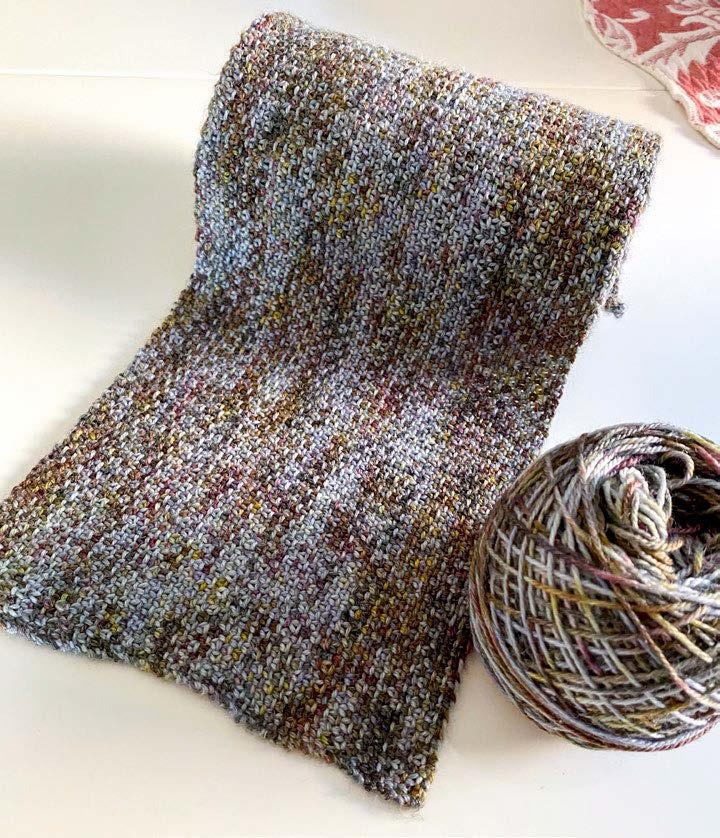
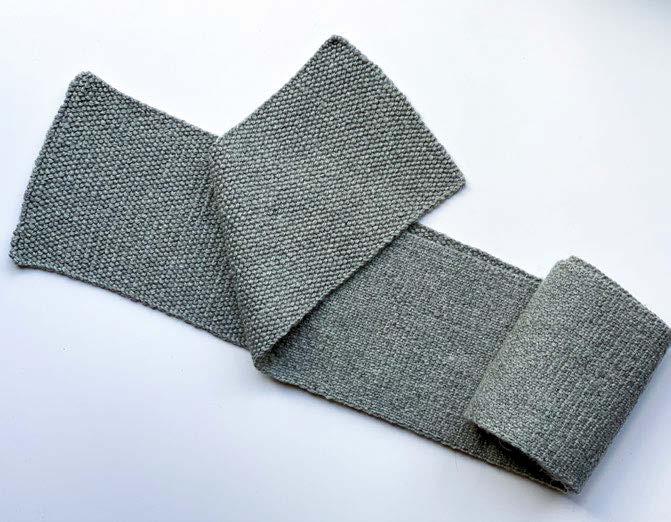
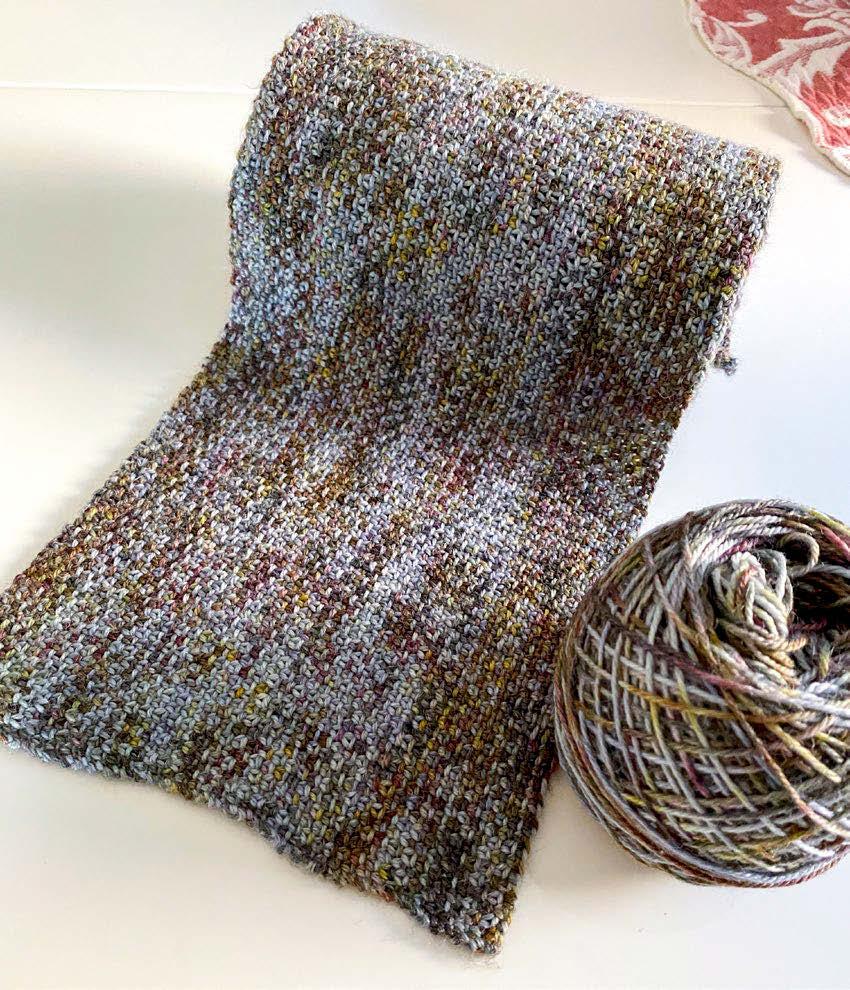
As I blocked the linen stitch scarf I knitted for my friend Steve this summer, I contemplated how luxurious this knitted stitch pattern can look, yet it’s not a common one. The linen stitch is best highlighted in rectangular or square knits using variegated yarn. So think of scarves, placemats, and blankets.
In knitting, the linen stitch is a very meditative stitch, where the first and second rows will seem awkward, almost like you’re fighting the instinct to knit or purl. But before you know it, it too becomes natural and mindless. So perfect for unwinding together with your ball of yarn at the end of the day.
In all, I’ve knitted four scarves in linen stitch over ten years, using the free pattern Cerus Scarf by Hilary Smith Callis, which I had come across by chance. It’s knitted lengthwise for maximum appeal.
The first linen stitch scarf I knitted was for my son when he was off to university in 2014. Notice the smoother transition of shade variation throughout the scarf as the yarn isn’t heavily variegated, but rather lightly so. Thankfully, he loved it too. As you may know, I always let the recipient choose the yarn color so it’s their favorite. Thumbs up to that! Next time, I will use a larger needle size when knitting with similar 100% pure wool, as this yarn tended to pull the stitches together after washing. Still, it’s gorgeous.
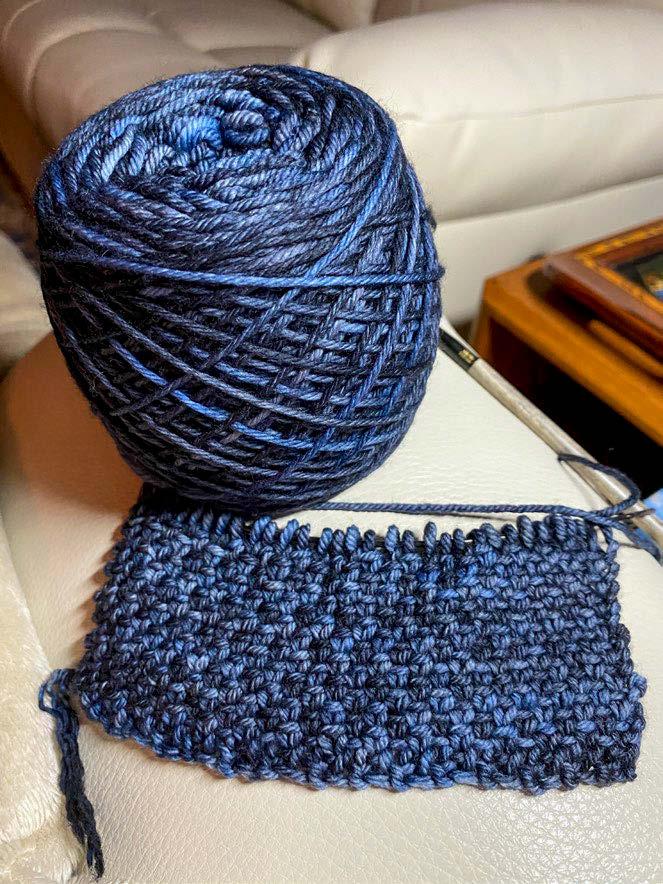
The thing to remember with the linen stitch is that it will always require at least 2 and sometimes 3 needle sizes larger than what is recommended for the yarn weight. So swatching first is paramount!
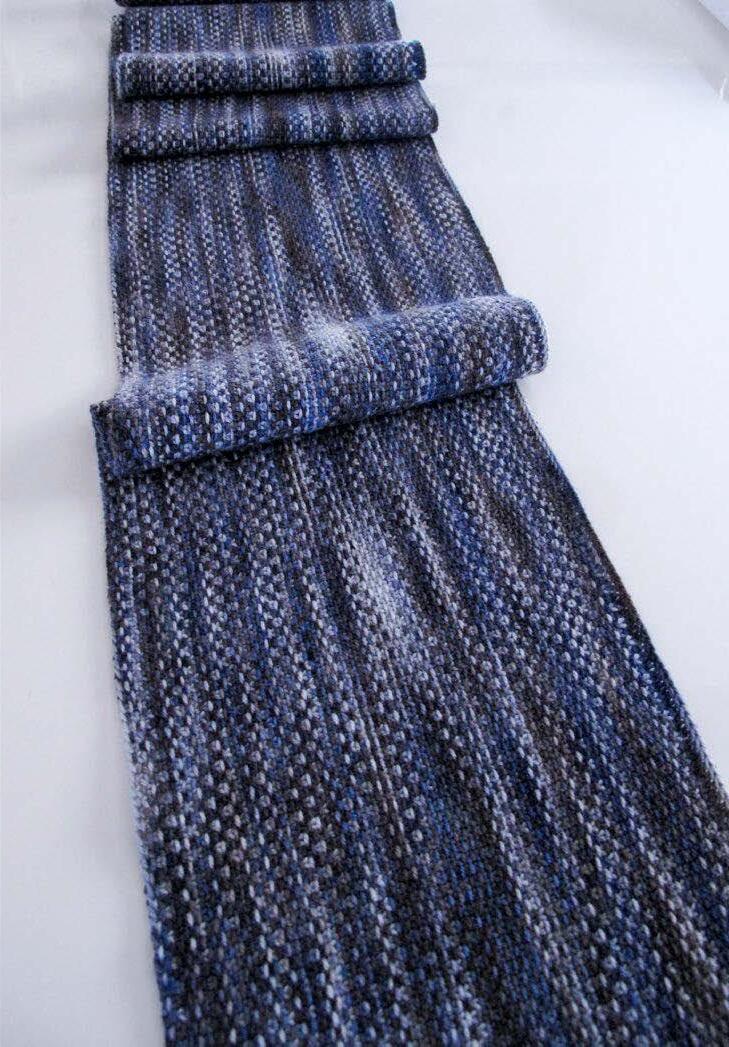
The second linen stitch scarf I knitted was for Steve, using a sock yarn with more variegation. The greater the color variation, the more interesting the overall look.
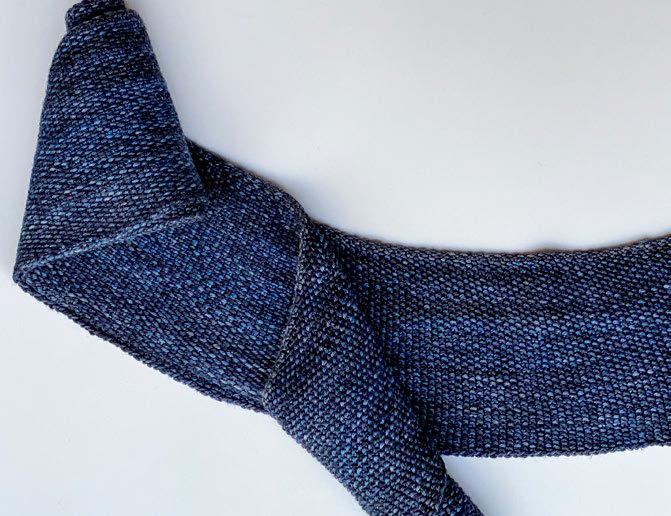
The third one I knitted was for my DH in a variegated sock yarn of only one color, which varied in shade, not color. Yet another ‘look’ to the overall scarf.
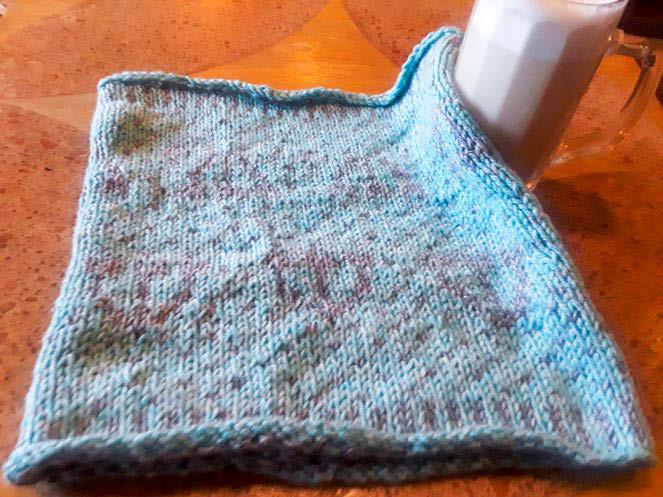
My swatch for checking how the color variegation will play out.
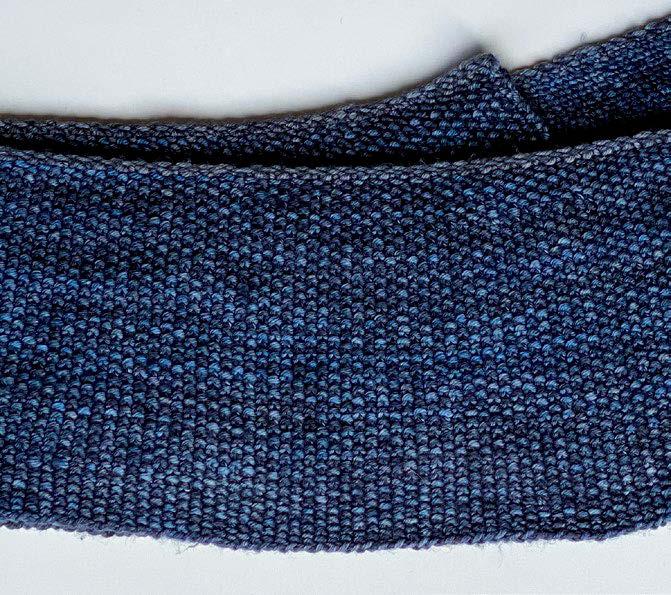
The slight color variation offers a smoother, more uniform look to the finished scarf.
Steve’s first scarf measures 69” x 7”, casting on 355 sts.
Dear Hubby’s scarf was made with yarn in a light-to-deep blue colorway.
Here’s a photo of the back of the linen stitch. I also love that it’s reversible, with an equally interesting look, making the back of the work as interesting–or might I say more interesting–than the front! Oh joy!
Fast forward to the winter of 2024-25, and I noticed how well-used Steve’s scarf had been since 2015. He was well overdue for a new one. And again, I had him choose the colorway from a selection of colors I knew he could be interested in. This sock yarn was a fingering-weight blend of 32% nettle fiber and merino wool. So soft. I’m in heaven the whole time I’m knitting up the scarf.
Fun Fact: when I packaged Steve’s scarf to gift to him, I wrote a little note that included the part of the yarn label for fiber content, care instructions, and on the blank side of the label, I wrote: 499 stitches across each row x 88 rows = 43,912 loving stitches, (remember, this is fingering weight yarn); not to make him feel bad about it, but it’s an interesting fact where every stitch was knitted with joy. This scarf measured 76” x 7”.
Another idea for using the linen stitch is in a project we featured in A Needle Pulling Thread magazine, the Friendship Blanket Shrug The wonderful Jacqueline Grice created it. The bonus of this project is that it uses leftover yarn. Can you imagine diving into your leftover stash of the same weight yarn?! Depending on the stash, completing it could take longer unless you have a large amount. It’s one of those knits-up-as-youaccumulate-leftover-yarn projects…
Eventually, I’d like to try knitting placemats in a fingering-weight cotton yarn using the linen stitch. And perhaps if I find the right worsted-weight yarn, a throw. So many possibilities! I hope you’ll give it a try. Until next time, happy knitting.
Carla A. Canonico
Editor-in-Chief at
Friendship Blanket Shrug from A Needle Pulling Thread Magazine Issue Spring 2016, worked up in Linen Stitch using leftover yarn of the same weight.
Here’s what the back of the linen stitch scarf looks like. The back is just as interesting as the front.
Steve’s second linen stitch scarf: 499 stitches across each row x 88 rows = 43,912 loving sts
Discovering the soft luxury of Bella Bounce yarn
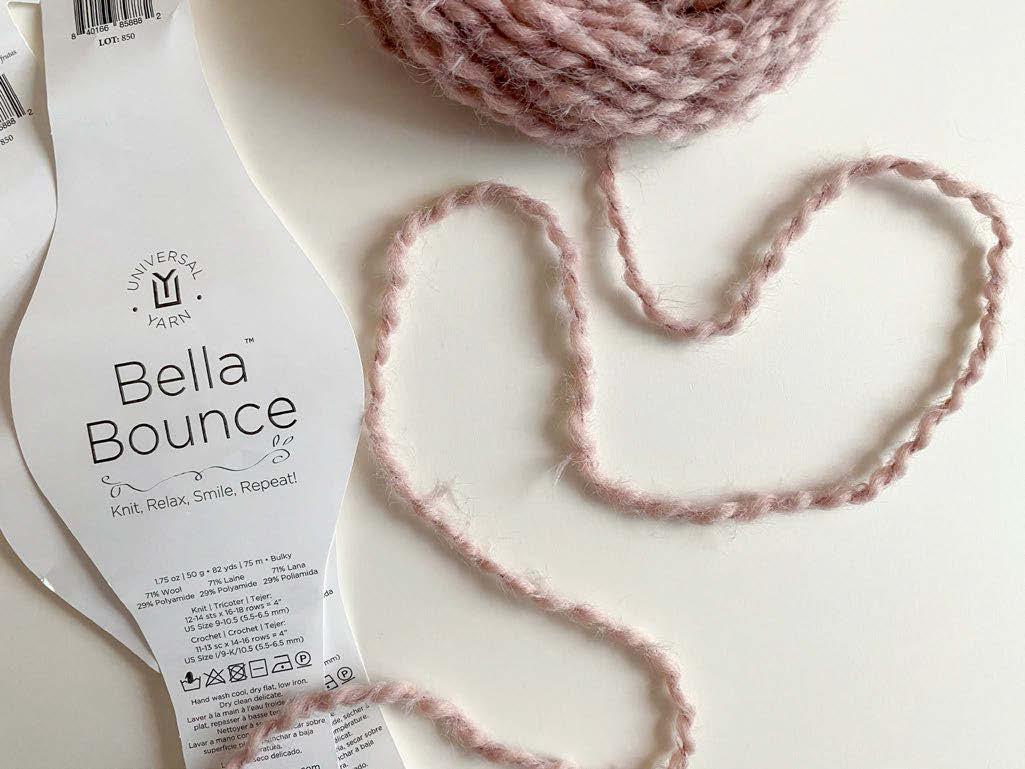
When I first saw UNIVERSAL YARN Bella Bounce, I was immediately drawn to its soft, bouncy texture and cozy halo. It’s a blend of 71% wool and 29% polyamide, offering the perfect balance of warmth, elasticity, and durability. The polyamide lends resilience, while the wool provides that touchable softness and spring.
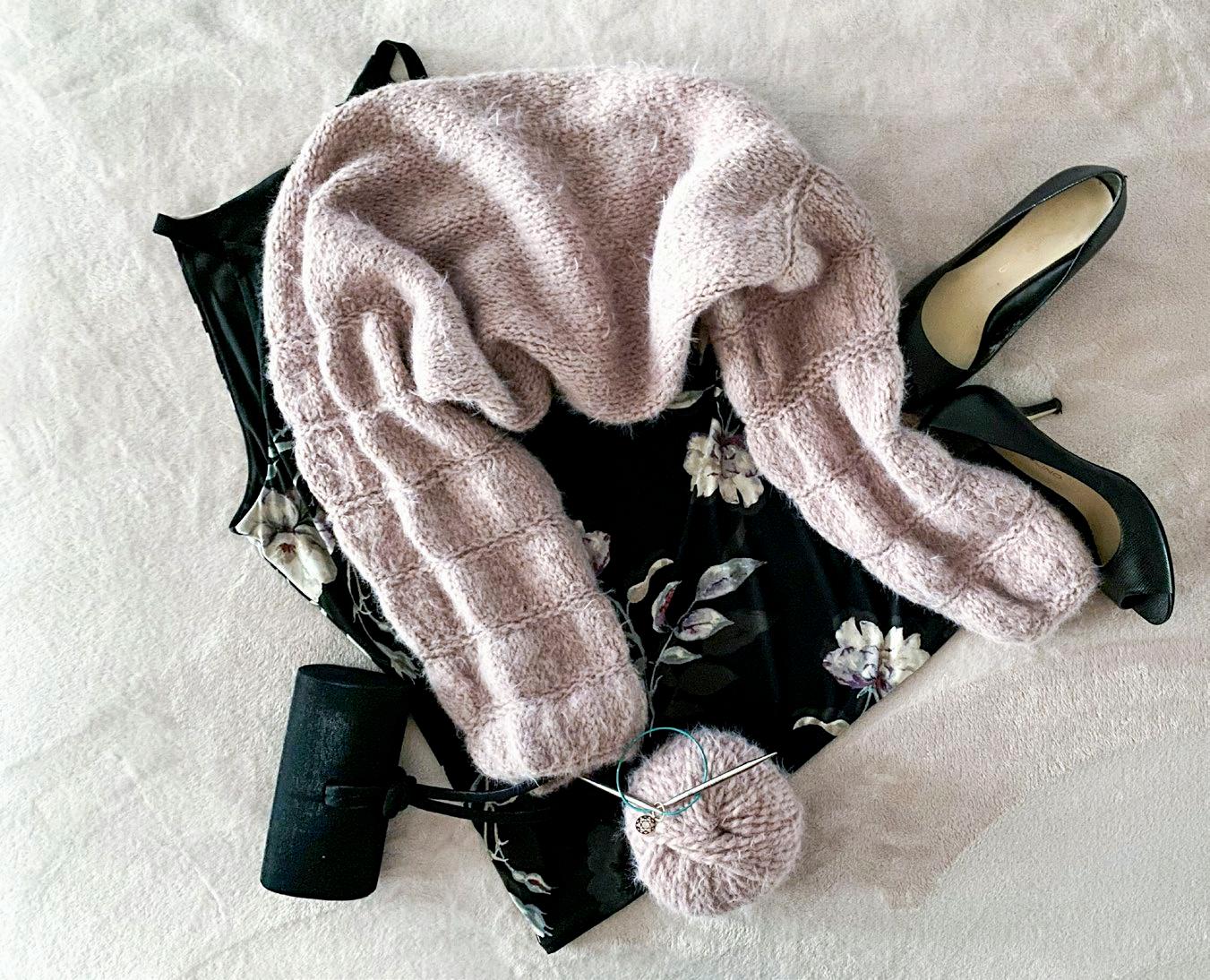
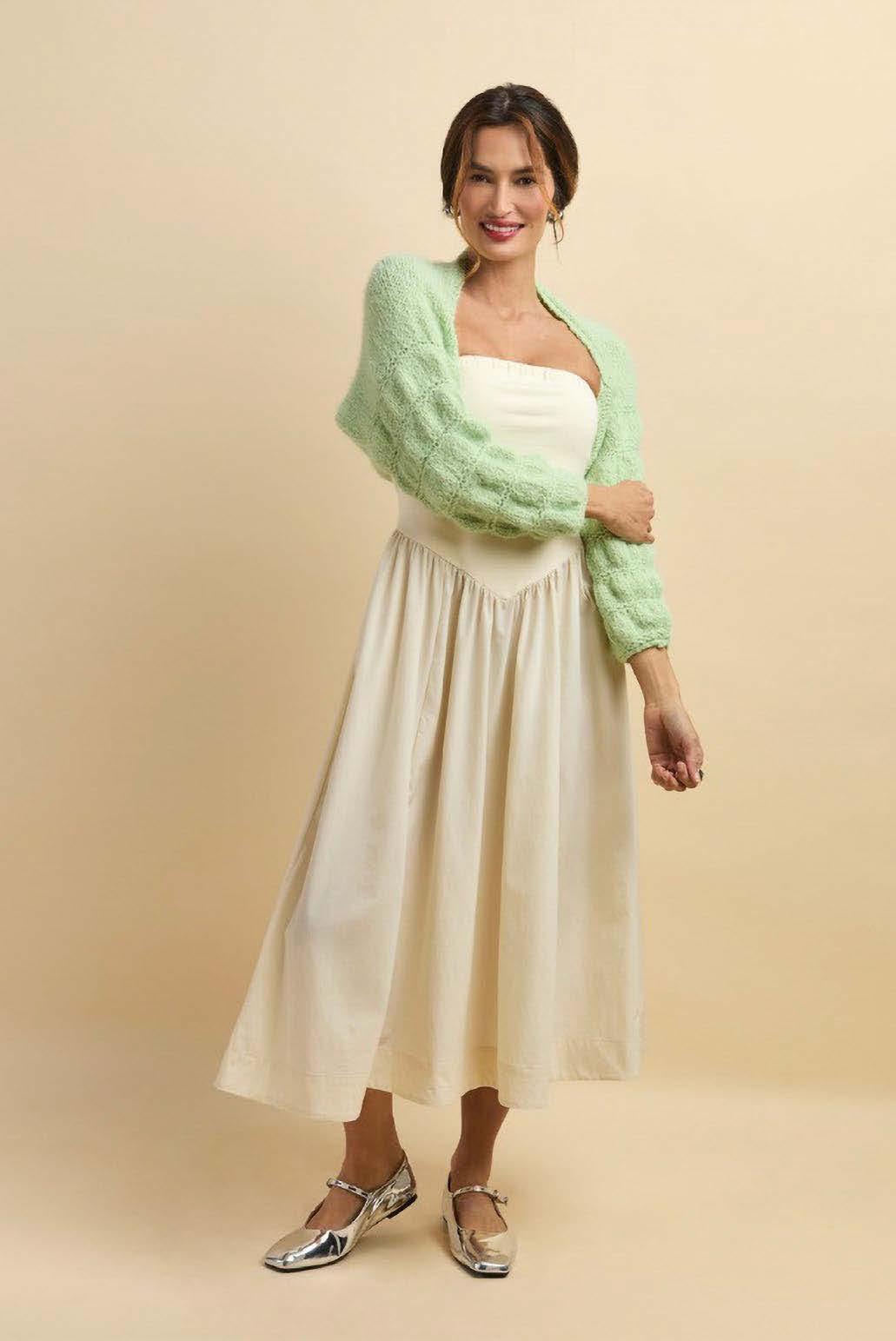
At first sight, I thought the Bubble Sleeve Shrug knitting pattern by Afifa Sayeed, a playful, cropped layering piece, would be perfect for layering over a holiday outfit. The Shortcake colorway will go well with a comfortable outfit I have planned for the holidays…I’m thinking ... New Year’s Eve…
The pattern highlights the plush quality of this yarn. With its rhythmic increases and ruching, this shrug really lets Bella Bounce’s texture shine. The shrug is a very quick knit! It took roughly four evenings to complete. It’s the benefit of knitting with thick yarn!
UY Bella Bounce is so bouncy soft! I chose the Shortcake colorway
The Bubble Sleeve Shrug knitting pattern by Afifa Sayeed
This photo courtesy of UNIVERSAL YARN
The Perfect Match: needles that bring out the best in Bella Bounce
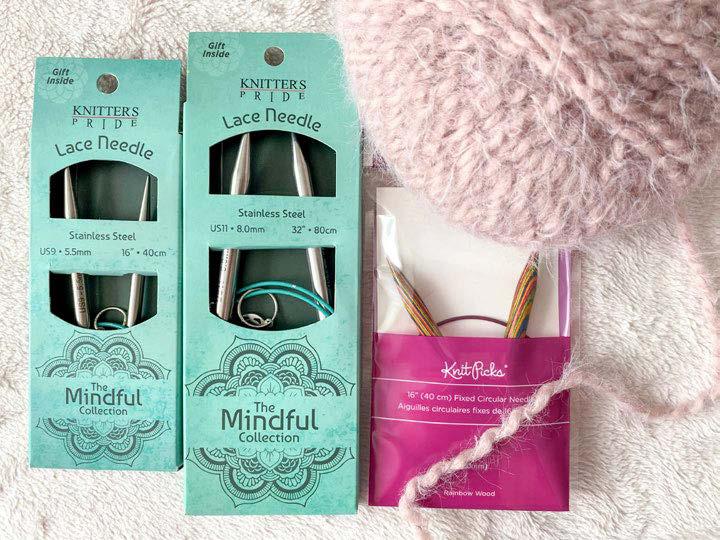
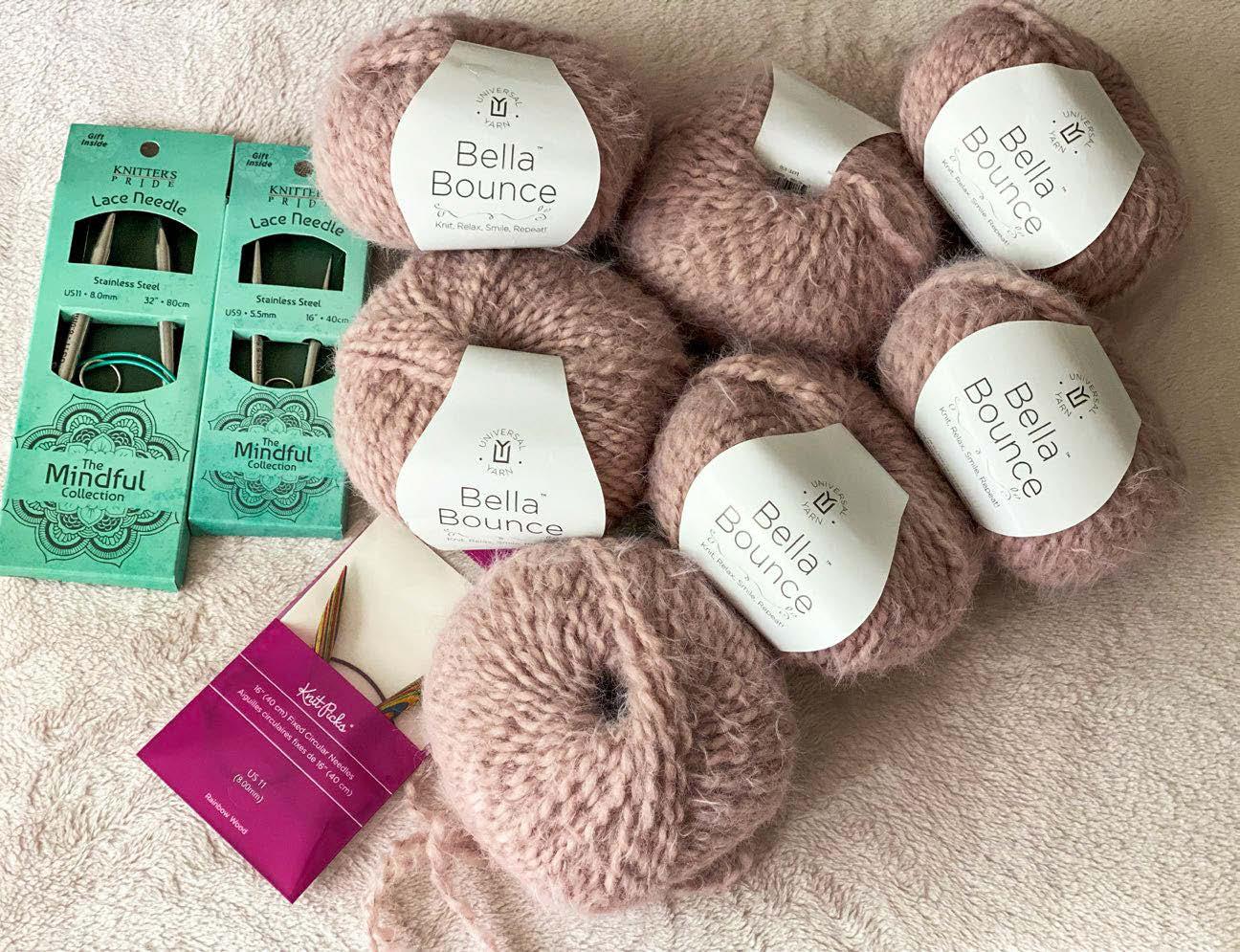
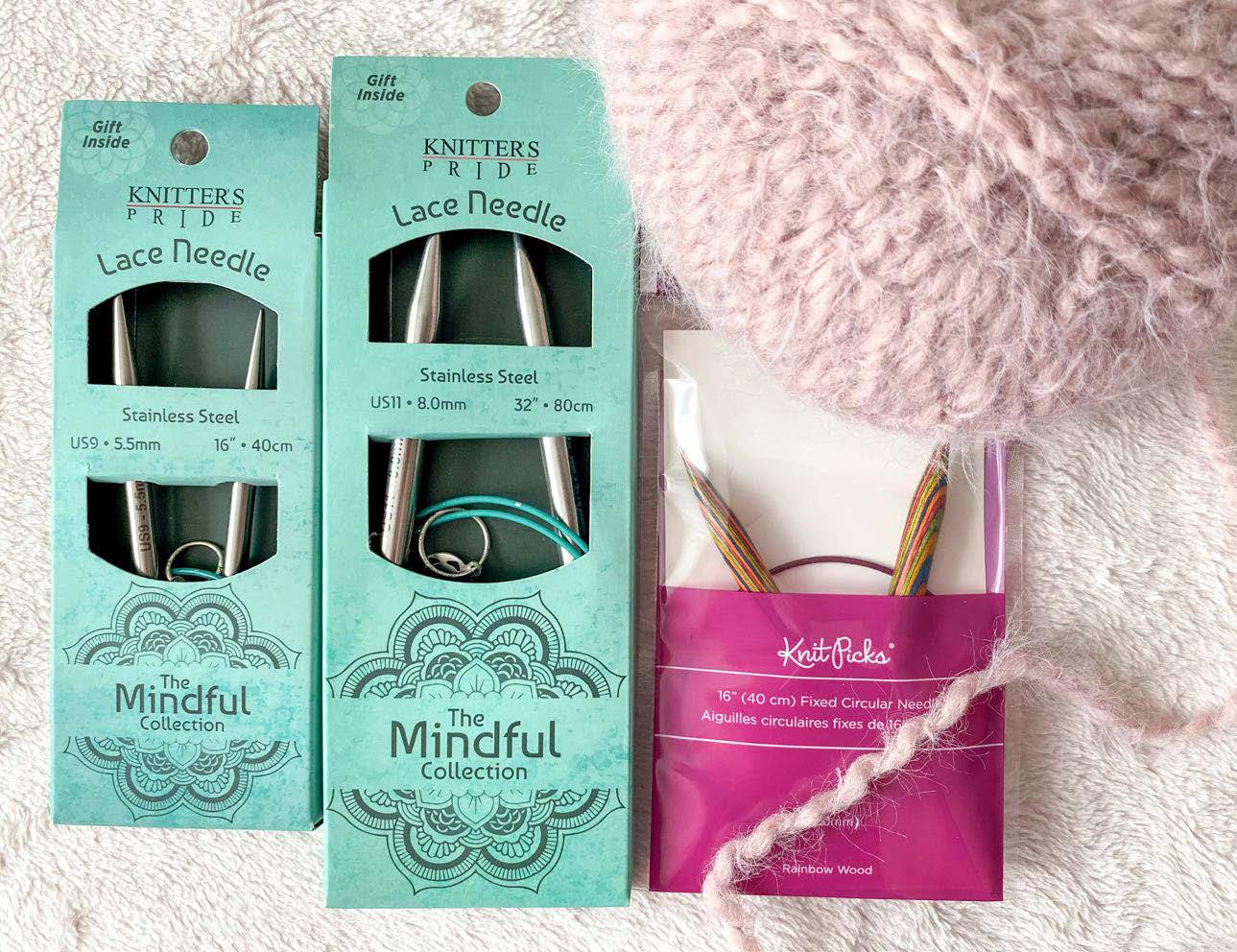
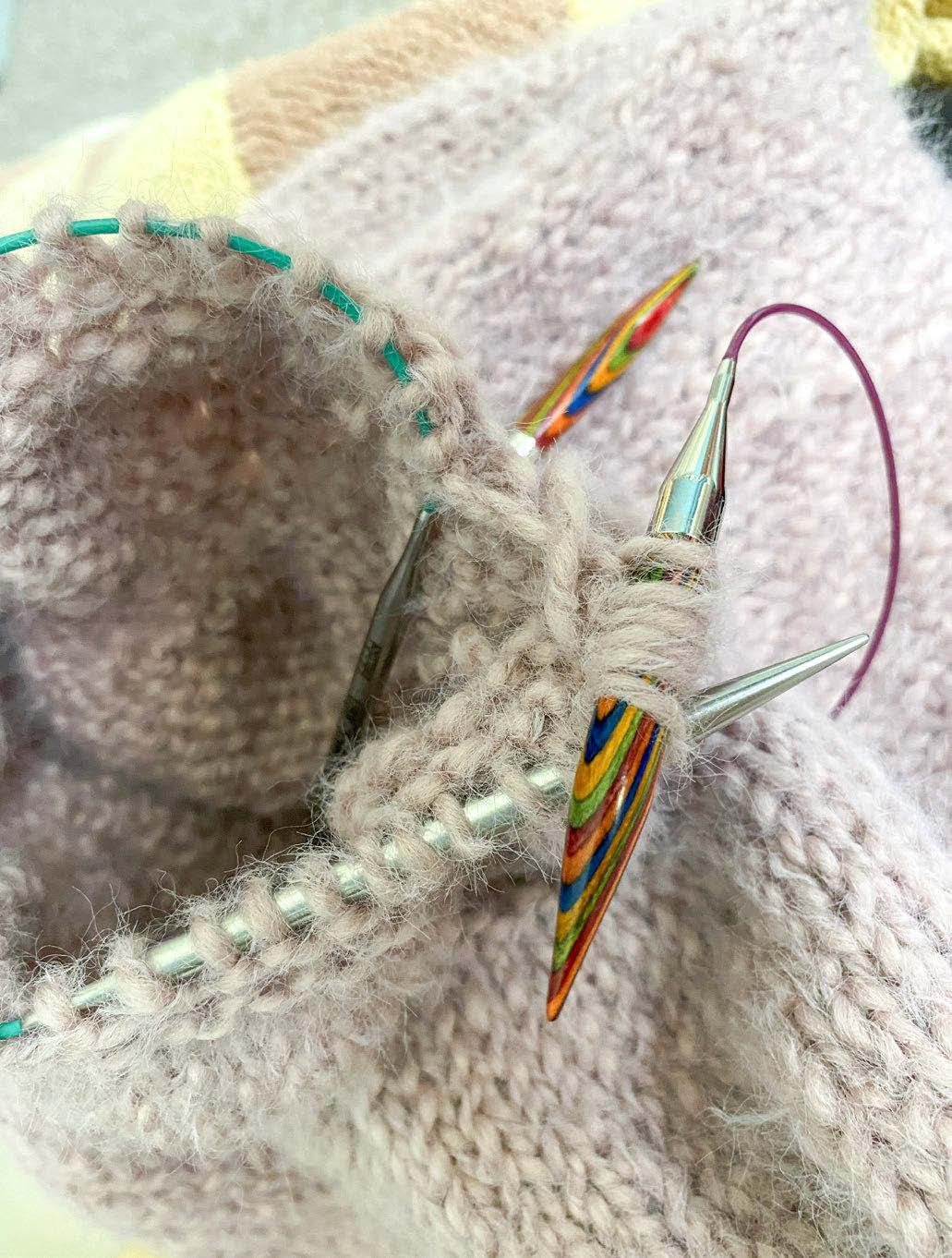
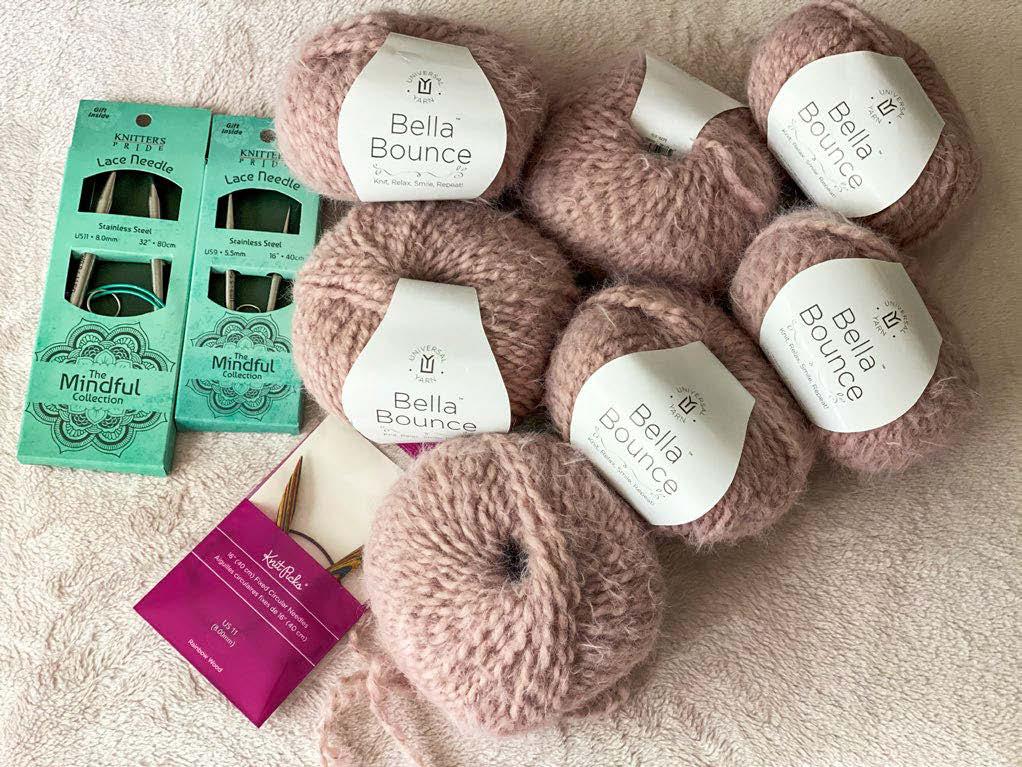
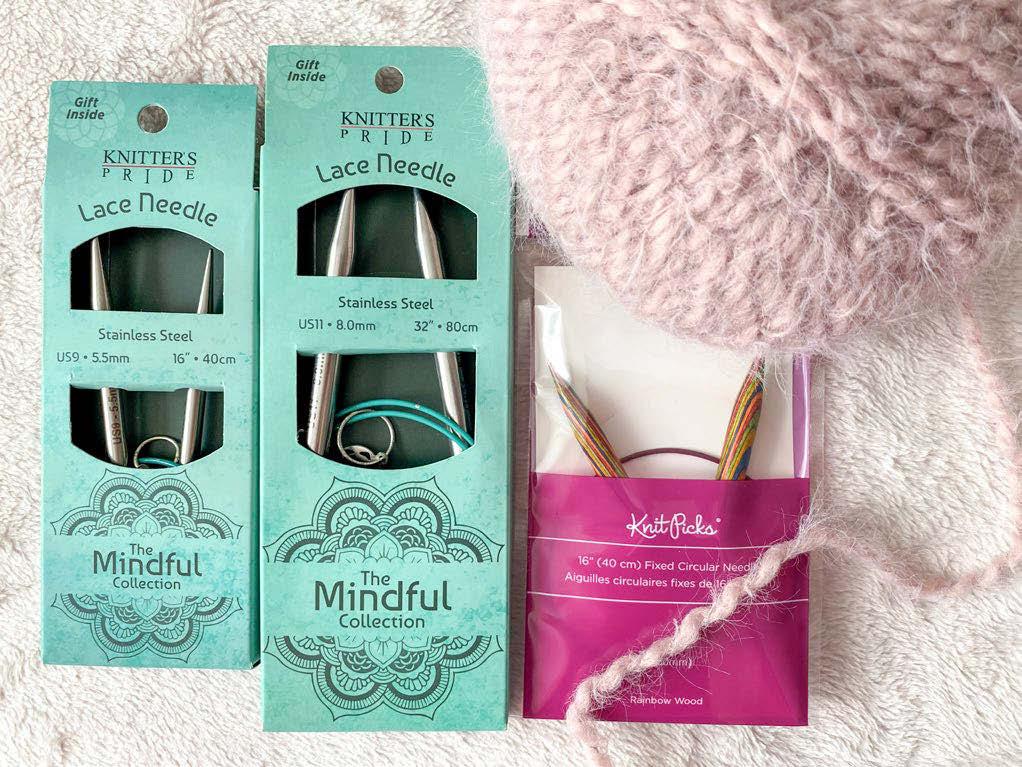
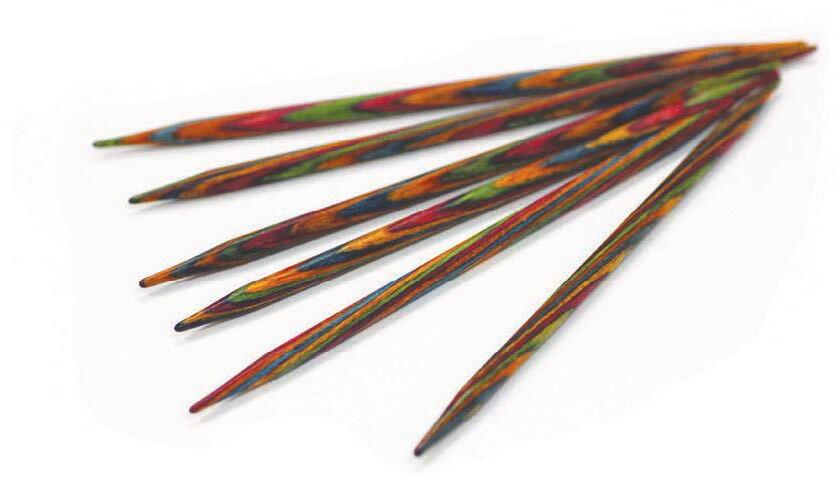
I decided to knit this project using two of my favorite needle sets: KNITTER’S PRIDE The Mindful Collection and Knit Picks Rainbow Wood needles
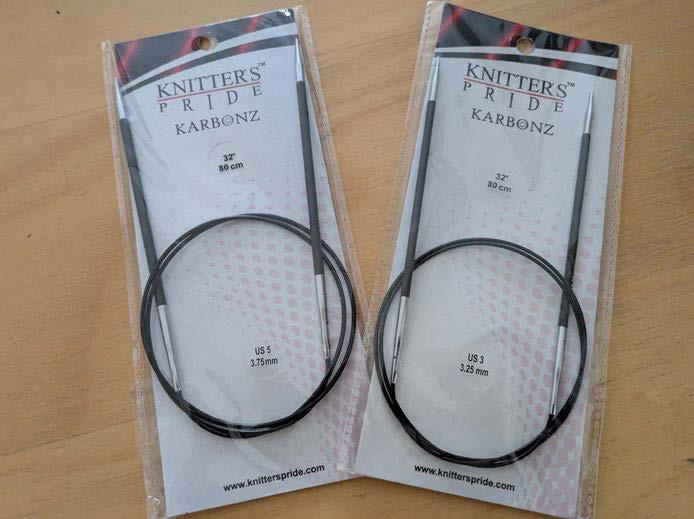
The Mindful Collection offers a smooth stainless-steel glide, ideal for even stitches and quick knitting, while the Rainbow needles add a touch of warmth and gentle friction to keep this bouncy yarn perfectly under control. Switching between them gave me a real feel for how Bella Bounce behaves, slightly stretchy, but incredibly cooperative.
Swatching for success
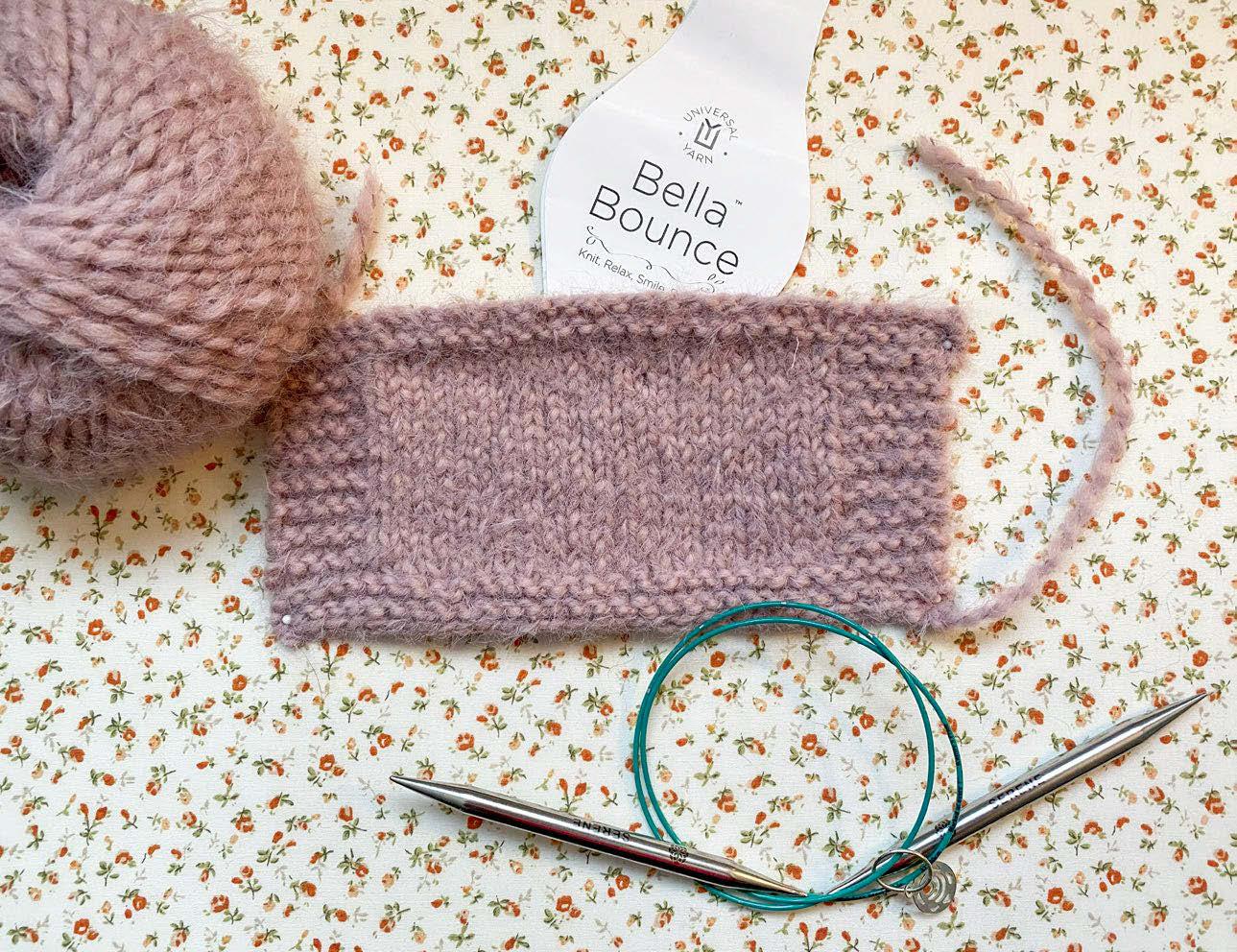
Before casting on for the shrug, I worked up a swatch to test both gauge and stitch definition. The pattern calls for a gauge of 14 stitches and 18 rows = 4" in stockinette on US 11 (8 mm) needles, after blocking. I wasn’t too concerned about the rows.
My Bella Bounce swatch bloomed beautifully after washing and blocking; the fibers relaxed, and the stitches filled out evenly. I also tested, but not pictured here, the smaller US 9 (5.5 mm) needles, used for the cuff portions of the shrug, to see how the fabric structure would change. The smaller needle created a tighter texture, which will contrast nicely against the airy sleeves when knit in garter stitch, creating the ruching.
The Joy of the First Rows
With my swatch complete and needles ready, I can already tell this project is going to be pure knitting comfort. Bella Bounce yarn glides effortlessly and springs back with each stitch, genuinely living up to its name. It’s soft enough to wear against the skin, yet firm enough to hold the dramatic bubble shape of the sleeves.
Using knitting needles from KNITTER’S PRIDE The Mindful Collection and Knit Picks Rainbow Wood to knit the Bubble Sleeve Shrug
My swatch with the larger needles
Photos by Carla A. Canonico
elevate every stitch knitting needles that The Mindful
I wanted to take a moment to talk a little about the knitting needles I’m using, in particular, the KNITTER’S PRIDE The Mindful Collection and how they enhance the knitting experience.
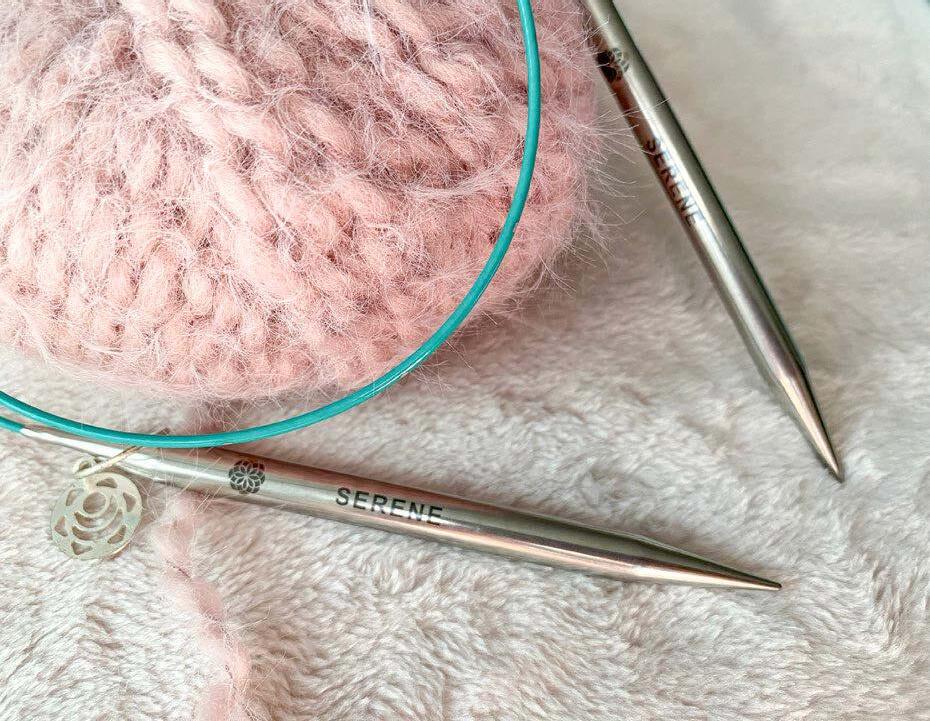
They are lightweight stainless steel with a very soft, just enough grit to hold your stitches on the needle so they don’t slip off, and the cord is solid. These are so comfortable to knit with. But what really takes my experience with The Mindful Collection to another level are four things.
Words of Comfort
When I sit to knit, mainly at the end of the day, it’s for unwinding from a day full of tasks, responsibilities, meetings, or chores or a mix of these in one day. You know as well as I do that these are inevitable in life. My knitting time is a sitting time to unwind, at the same time, my ball of yarn does.
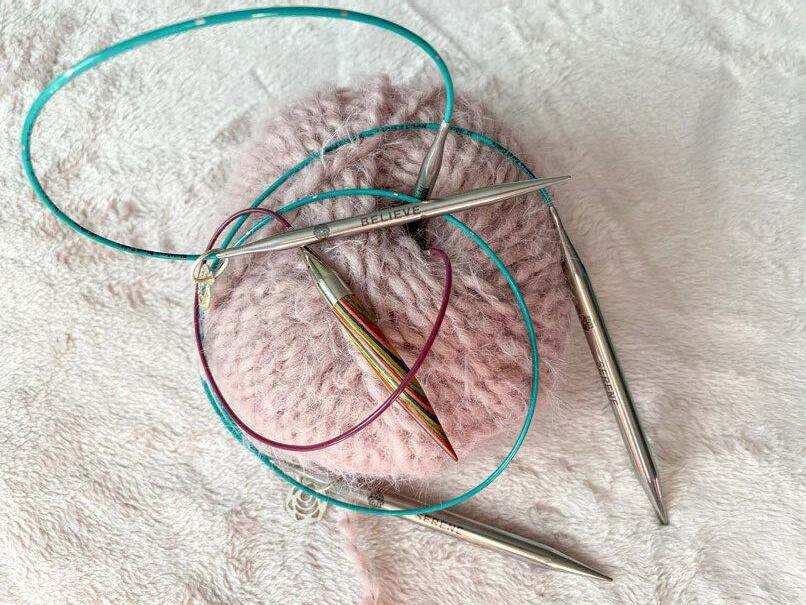
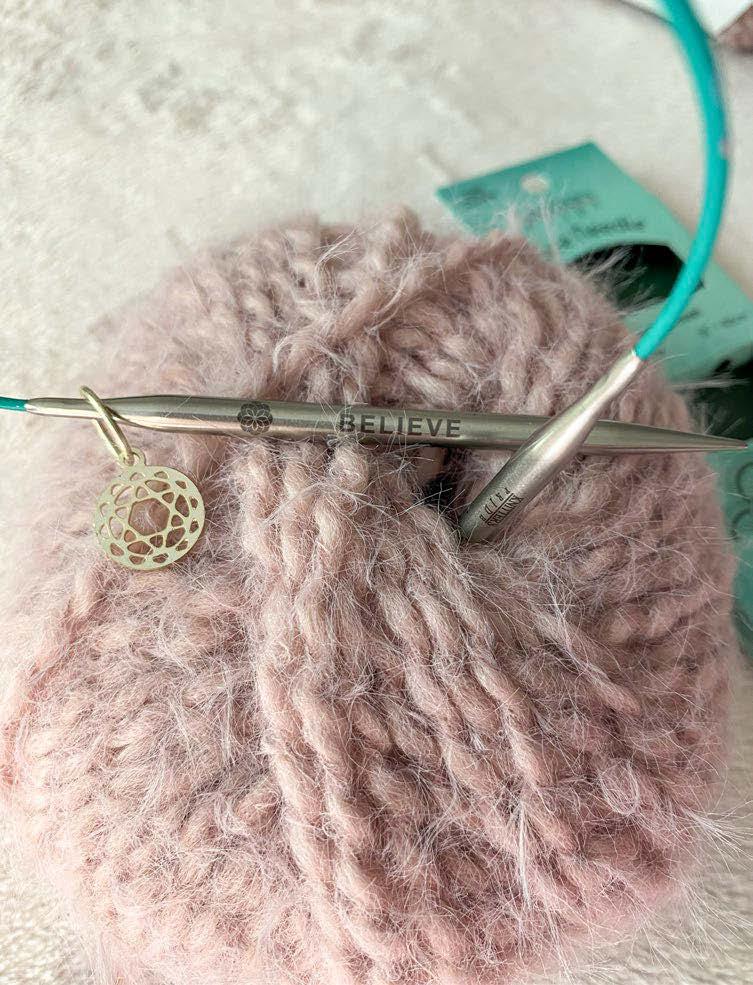
You’ll find words like serene, imagine, and believe on the needle tips of The Mindful Collection. It’s that extra pampering we could all use at the end of a very busy day.
Fine Tips
I love to knit with fine tips, as they help pick up stitches when increasing or decreasing, and when working cables and lace, especially in this case, where I’m using 5.5 and 8mm. In the case of the Bubble Sleeve Shrug, there are moments when these fine tips are handy in the ruching process, making the task that much easier! More on this process in the next article.
Mindful Stitch Marker
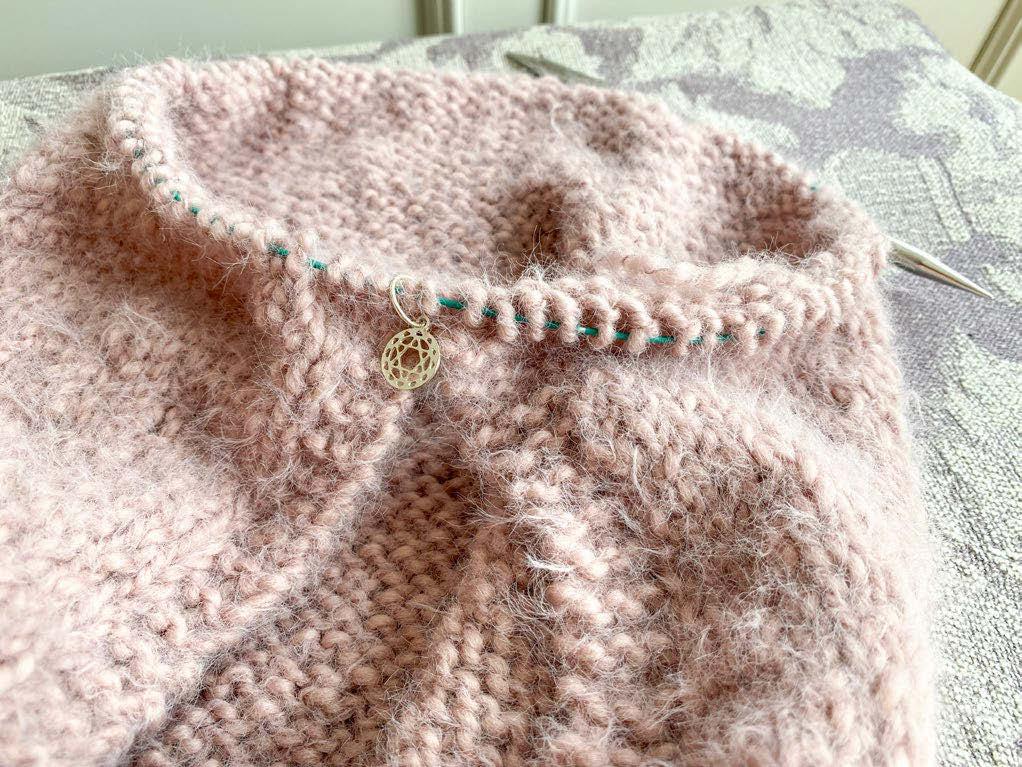
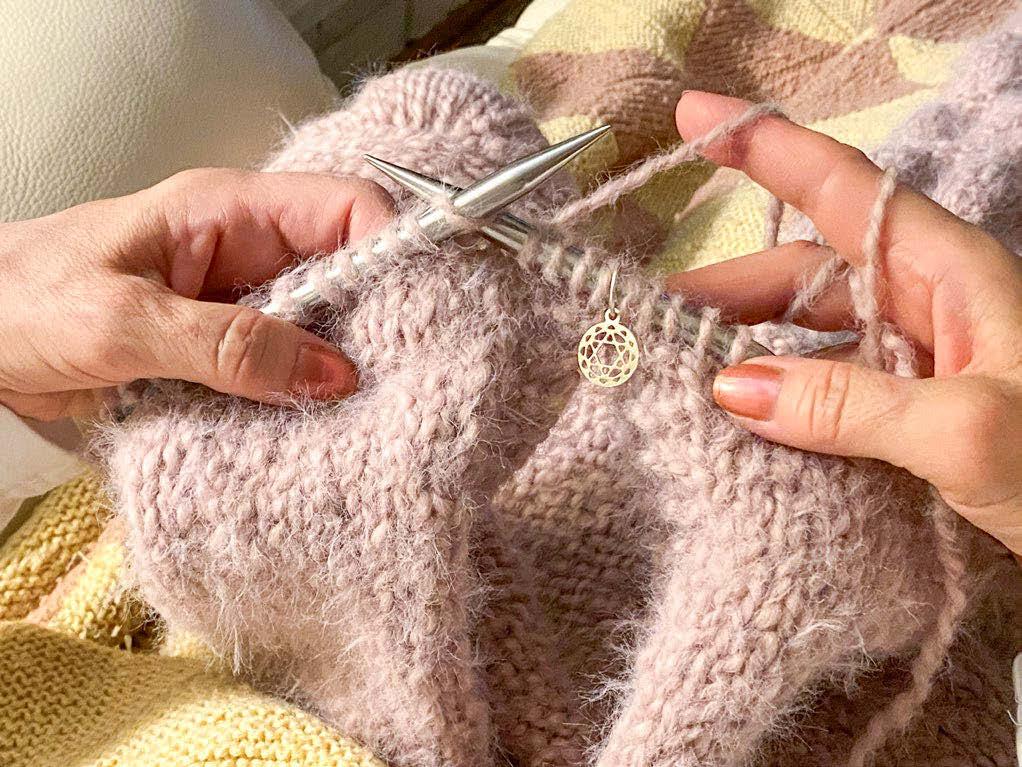
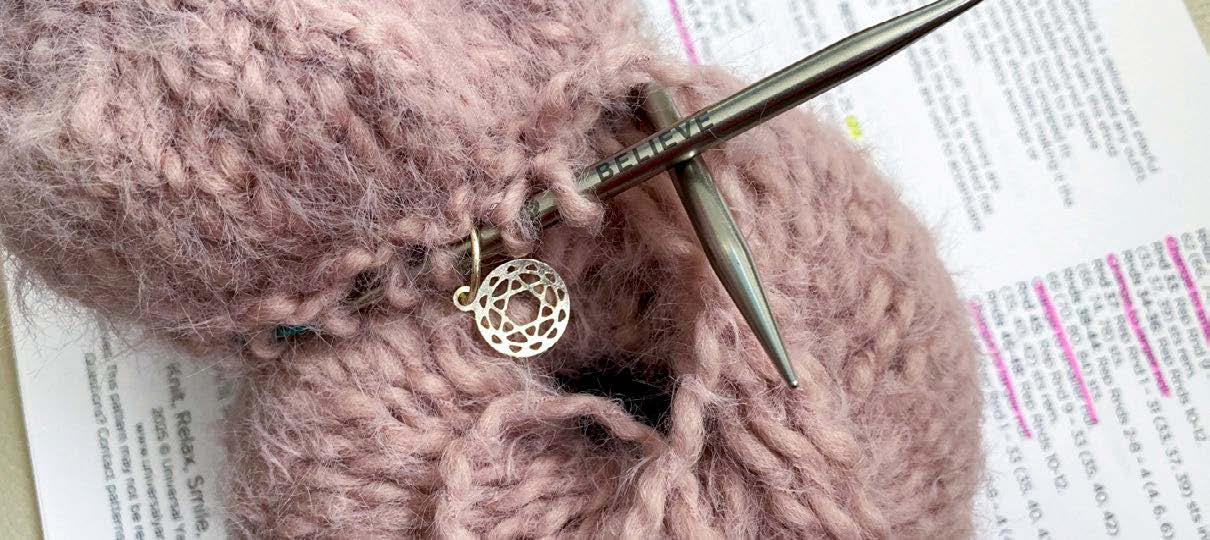
Well, don’t this beat all! The Mindful Collection needles come with their own stitch marker! Each circular needle includes a sterling silver-plated metal marker. Love!
The Flexible Cord
And finally, the flexible memory-free cord in teal with 1″ interval markings for a no-twist glide… handy and comfortable. Choosing the right tools for knitting projects is very important; they should be useful, easy to work with, and conducive to a Zen state of mind.
Bella Bounce in Shortcake colorway, The Mindful Collection and Knit Picks Rainbow Wood knitting needles
Mindful words of The Mindful Collection knitting needles in 5.5mm and 8mm for knitting the Bubble Sleeve Shrug
Creating texture with knitting needle changes: the Bubble Sleeves take shape
In this knitting step for the Bubble Sleeve Shrug, we finally dive into the part that gives this design its whimsical charm: the bubble sleeves. I was struck by how dramatic the sleeves look, yet how simple the technique really is once you understand how it’s done. And knitted with UNIVERSAL YARN Bella Bounce, the texture is plush, springy, and full of personality.
These sleeves are worked in the round, starting at the cuff and expanding outward using a combination of strategic increases and alternating needle sizes. The magic is in the contrast: tighter fabric gathers into soft ruching, while the larger-needle sections bloom into rounded, airy “bubbles.”
How Alternating Needle Sizes Creates
Dimensional Texture
One of the reasons this pattern is so clever is the use of two needle sizes:
• US 9 [5.5mm] to gather and tighten the fabric
• US 11 [8mm] to open the stitches and create volume
Switching between the two mimics a gentle puff-and-gather effect. After a few rounds on the smaller needle, the fabric naturally pulls in. When you return to the larger needle, the stitches expand again, creating the signature Bubble Sleeve texture.
TIP I find it helpful to place the non-working end of the smaller needle inside the sleeve when transferring over stitches to the larger needle. Bella Bounce really shines here. Its soft wool/ polyamide blend gives you:
• elasticity (so the bubbles pop!)
• bounce (living up to its name!)
• smooth definition without sharp ridges
Increasing for Shape: Watching the Sleeve Expand
You begin by casting on at the cuff and immediately doubling your stitches with kfb increases. This sets up the first “bloom.”
Then, throughout the sleeve, you'll see sequences like:
• K1, m1L... knit to last stitch, m1R, K1
• Alternating rounds of increases and plainknitting rounds
• Occasional K2tog decrease rounds when you switch back to the smaller needles
The bubble sleeve is created by alternating needle size.
These controlled increases and decreases shape the sleeve without creating hard seams or ridges.
I found that Bella Bounce’s smooth elasticity made the increases seamless and the decreases neat, no gaps, no tugging.
TIPS for Keeping Your Bubbles Even
A few small things make a big difference:
1. Use ring markers
Ever y shaping repeat is easier to manage when you mark your increase points.
2. Keep your tension relaxed on the larger needles.
Bella Bounce opens beautifully, let the yarn do the work.
3. Don’t skip the plain knit rounds. These rounds help the bubbles “settle” instead of turning into accidental cones.
4. Check length as you go.
The sleeve looks deceptively shor t until it’s relaxed and blocked.
Seeing the Texture Come to Life
I love this stage of the project. The moment I switched from the smaller needles to the US 11s for the first time, the fabric began rounding outward in the loveliest way. This is where UNIVERSAL YARN Bella Bounce truly lives up to its name; every stitch seems to spring back with a little joyful energy.
Next, I’ll take you into the cuff-to-cuff construction as we move from the sleeves into the back section of the shrug. Once the sleeves are done, it’s smooth sailing across the body.
Until then, happy stitching. The bubbles are just beginning to bloom!
UY Bella Bounce is so bouncy soft! I chose the Shortcake colorway
Knitting the Body of the Bubble Sleeve
Shrug: Cuff to Cuff Comfort
After watching the bubble sleeves bloom into shape, we move into the next exciting stage of the Bubble Sleeve Shrug: the cuff-to-cuff construction. This is where the project truly begins to feel like a wearable garment. I love this section of the pattern because it is rhythmic, mindful, and incredibly satisfying, especially with UNIVERSAL YARN Bella Bounce gliding through my fingers in a soft ripple effect in the Shortcake colorway.
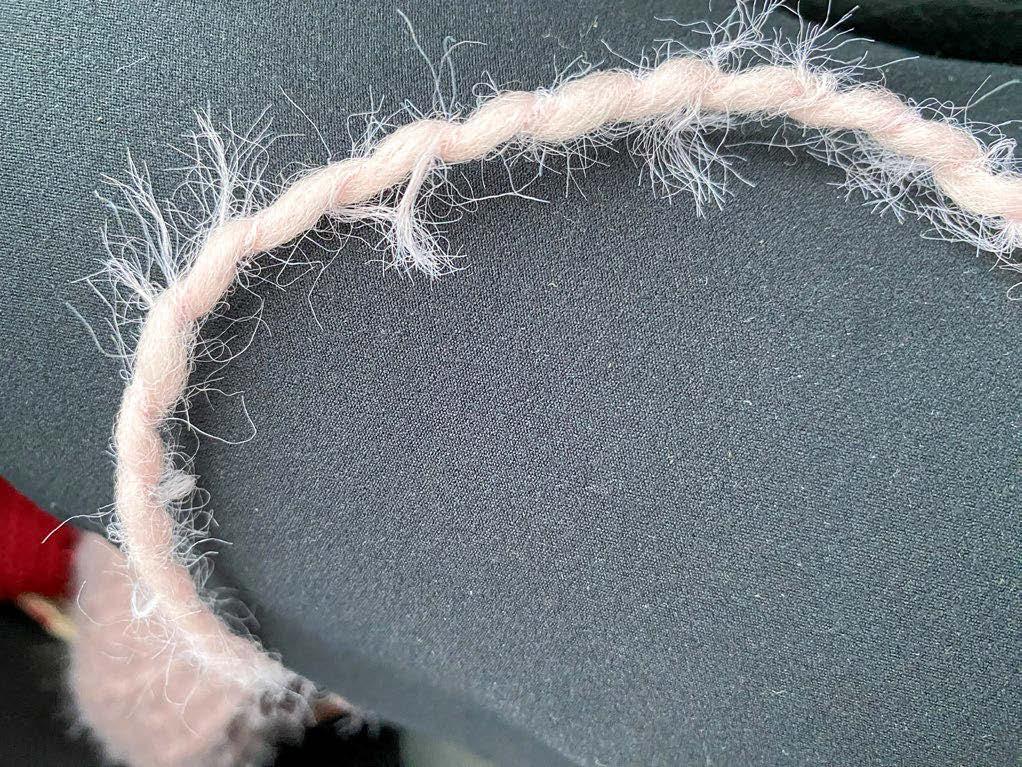
Here’s an up-close view of the Bella Bounce yarn on a dark surface. You can see how furry the yarn is!
From Circular to Flat: The Transition to the Back Panel
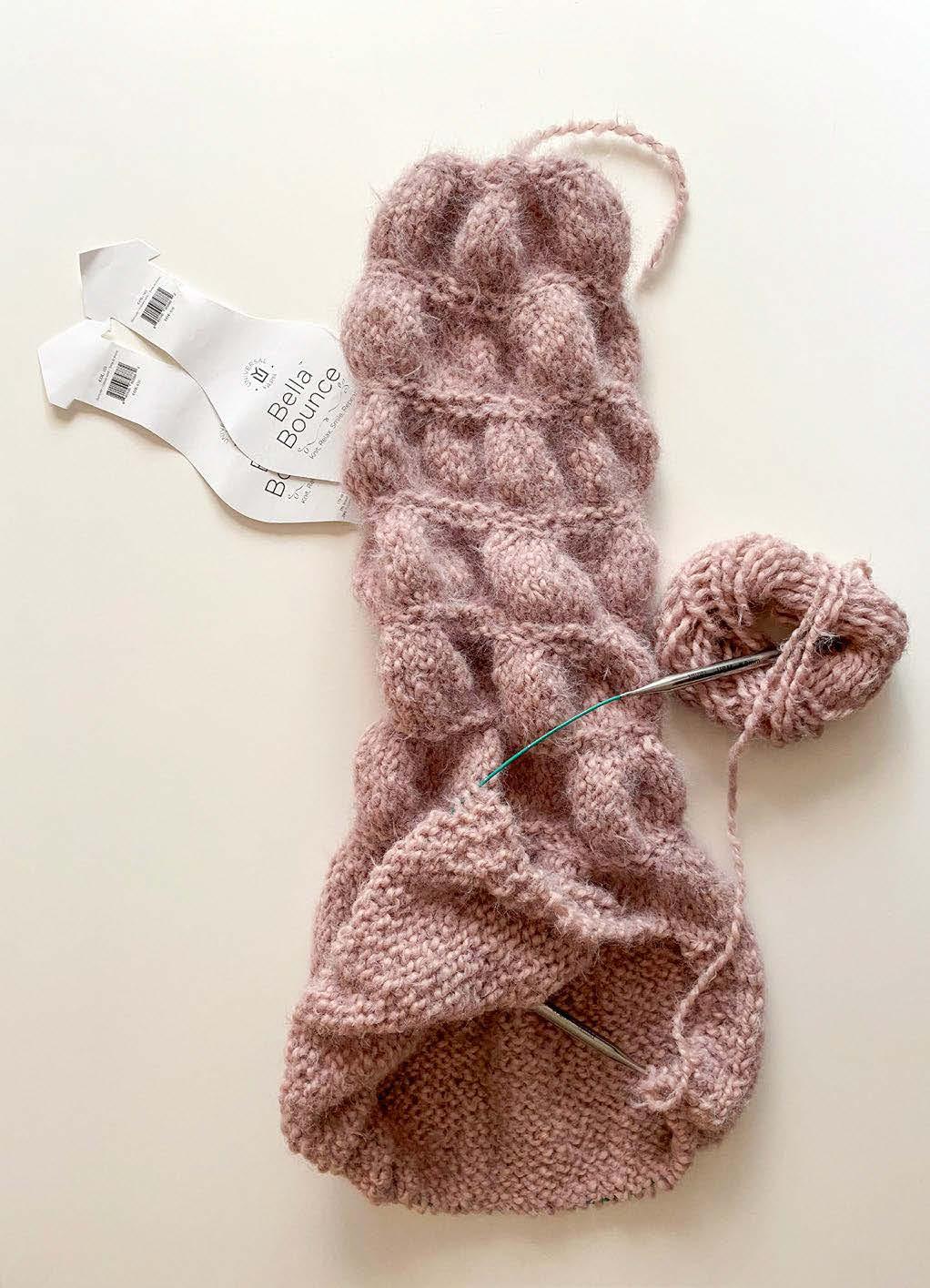
Once the right sleeve is complete and the bubbles have taken their gorgeous shape, the pattern leads you into an interesting transition. You set aside the round knitting, remove your marker, and begin working flat to create the back panel of the shrug.
This shift from circular knitting to flat knitting is seamless and intuitive. The back is worked in simple stockinette, framed with garter stitch edges that keep the fabric flat and polished.
After all the lively shaping in the sleeves, this section feels wonderfully soothing. It’s the perfect stretch of knitting for evenings when you want to relax, no counting, no changing needle size.
Why Cuff to Cuff Construction Works So Beautifully
One of the smartest features of this pattern is its built-in symmetry. By knitting from one cuff across the back and out to the second cuff, you guarantee:
• per fectly matching sleeves
• mirrored increases and decreases
• consistent bubble shaping
Ever ything flows from a single cast-on edge, making the shrug feel cohesive as it grows. You can see the structure forming in your hands, which is one of my favorite parts of garment knitting.
UY Bella Bounce is so bouncy soft! I chose the Shortcake colorway
A close-up of Bella Bounce yarn
The Comfort of Knitting with Bella Bounce
This middle section of the shrug lets you truly appreciate Bella Bounce’s personality. The yarn feels lightweight yet substantial in your hands, creating a fabric that is both cozy and breathable. As I knit across the back panel, I noticed:
• how smoothly the stitches glide in a soft ripple effect
• how springy the fabric feels
• how evenly the stockinette settles with almost no effor t
It’s comfort knitting at its best, the kind of knitting you can sink into as the piece grows quietly row by row.
The Shrug Takes Shape
Before long, the back panel is complete, and we’re ready to transition back to the left sleeve, working in the round. The marker is placed for the beginning of the round, ready to knit in the round for the second sleeve.
One of my favorite things is knitting in the evening while watching a series of some kind, or should I say listening…how about you? Oh, and… also… on my lap is a knitted blanket my grandmother made for my mom decades ago.
In the next step of this adventure, we’ll move into finishing, blocking, and unveiling the completed Bubble Sleeve Shrug. If you love seeing a garment come together, you’ll enjoy this final stretch.
The marker is placed, ready to knit in the round for the second sleeve.
Knitting in the evenings is one of my favorite things.
UY Bella Bounce + The Mindful Collection Stainless Steel = blissful knitting
Finishing the Bubble Sleeve Shrug: Bringing Out the Bounce!
Before revealing what the finished Bubble Sleeve Shrug looks like on me, I want to talk about one of the most transformative parts of any knitting project: blocking!
Blocking is the moment the fabric truly comes alive. It smooths, shapes, and settles the stitches, and with UNIVERSAL YARN Bella Bounce, the effect is especially beautiful. This yarn responds so well to gentle blocking that the fibers relax, open, and bloom in the softest way.
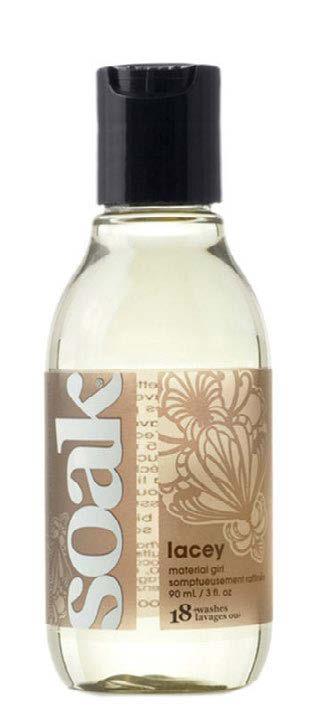
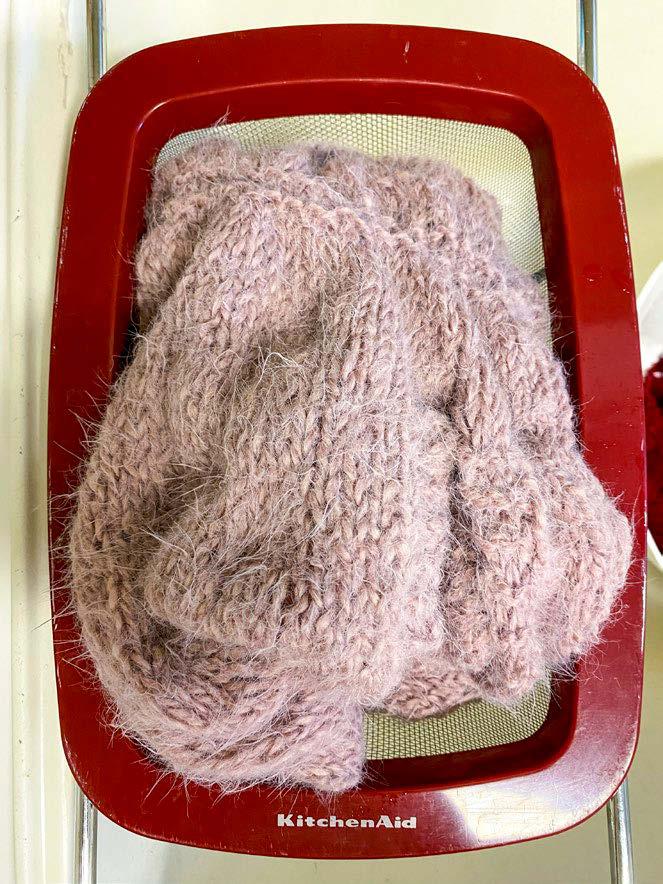
To block the shrug, I begin with a simple soak in lukewarm water using Soak, a modern rinse-free laundry care product, which is enough to relax Bella Bounce's stitches. Once the piece is fully saturated, I lift it carefully, supporting its weight, and squeeze out the extra moisture without wringing it, then leave it for an afternoon or so in a colander. This is a colander designated for my blocking process.
When most of the water has gone, I lay it flat on a clean towel, roll it up, and press lightly to draw out even more.
On my blocking mats, I shape the shrug to its finished measurements, smoothing the back panel and arranging the bubble sleeves so that each puff sits naturally. Pinning is very minimal here. Bella Bounce already has such lovely elasticity that it finds its shape easily. As it dries, the fabric regains its energy. This is when the yarn truly earns its name. Once dry, it feels bouncy, soft, and perfectly balanced between structure and drape.
The Finished Shrug and the Joy of the Final Stitch
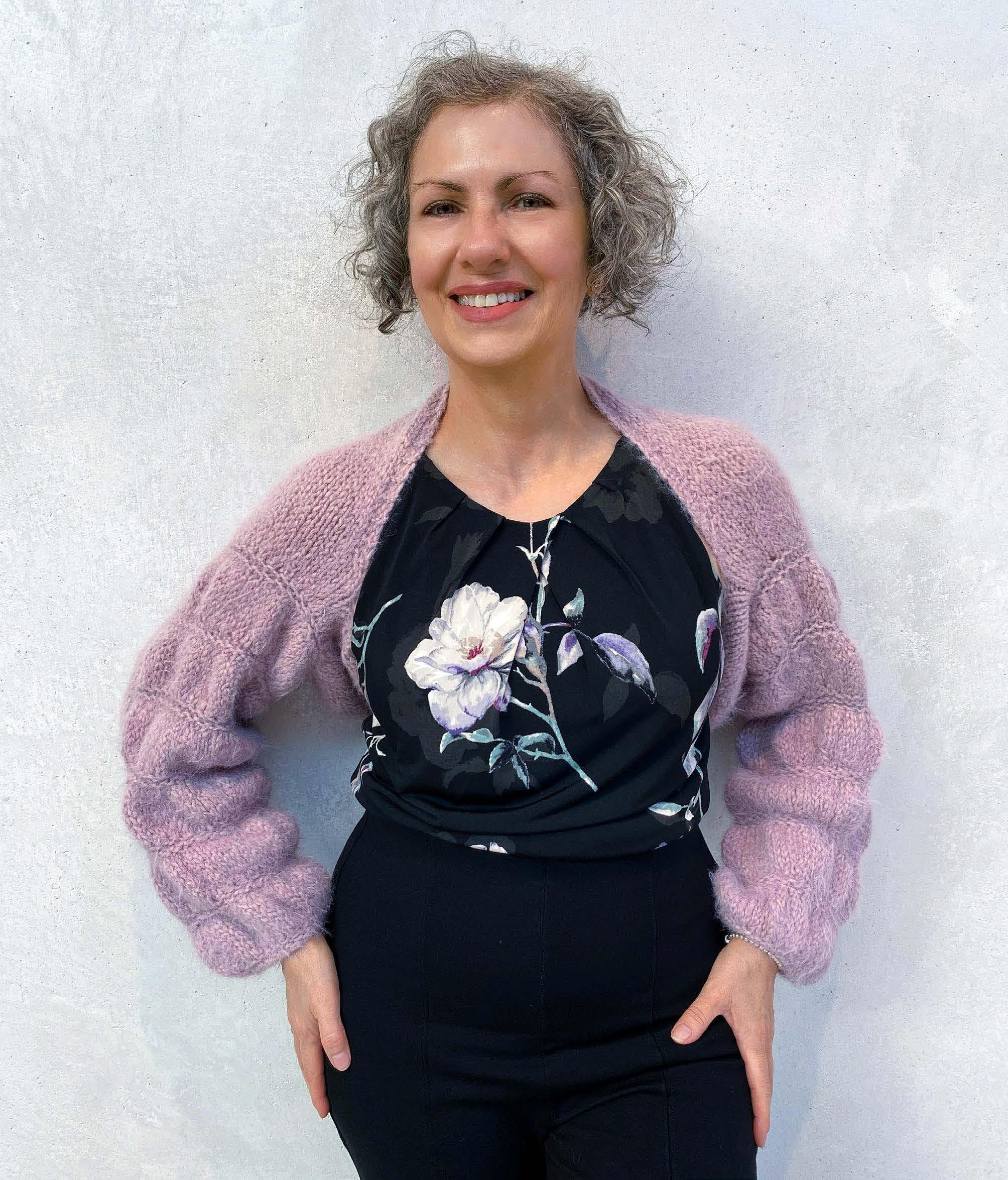
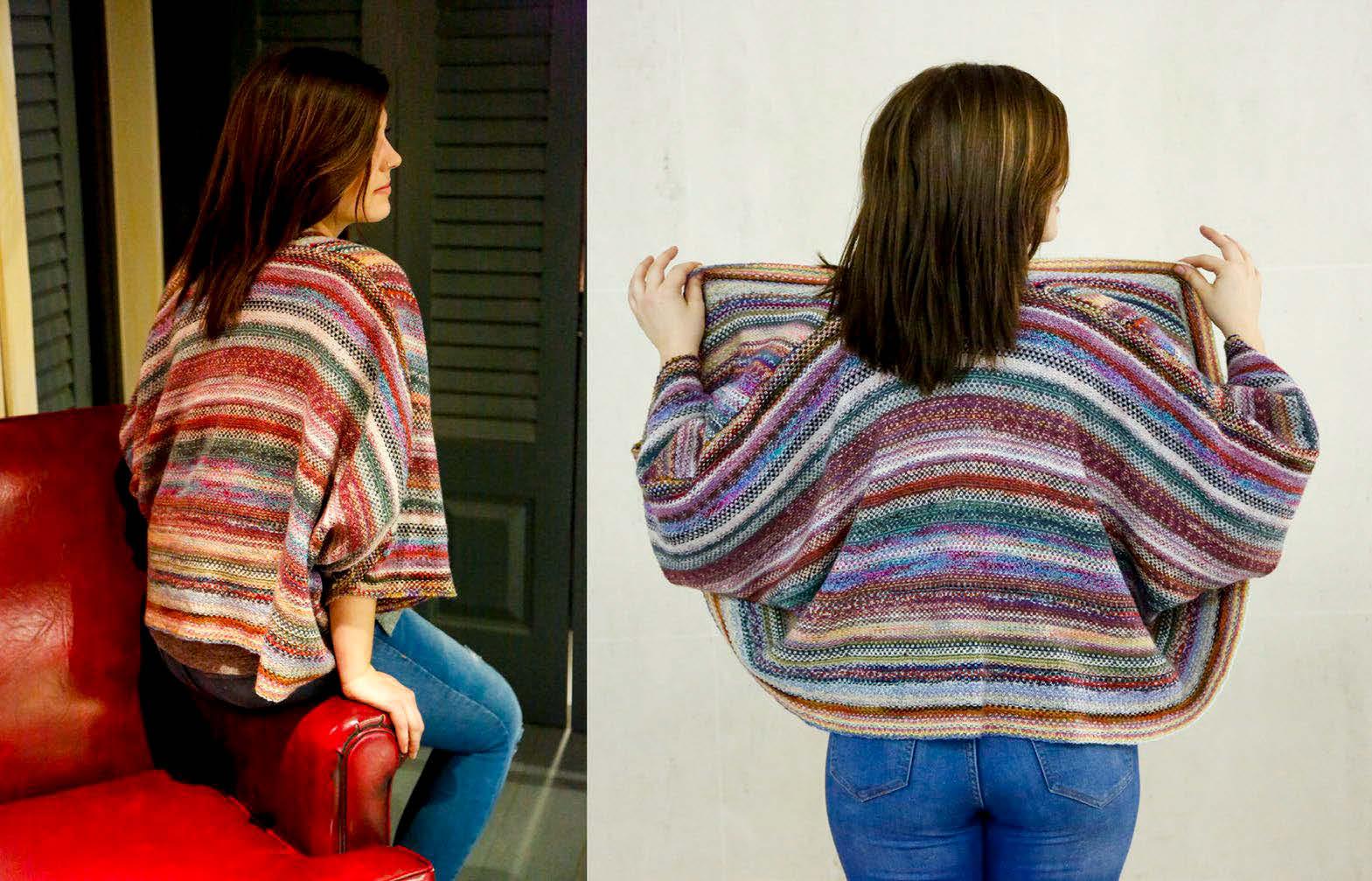
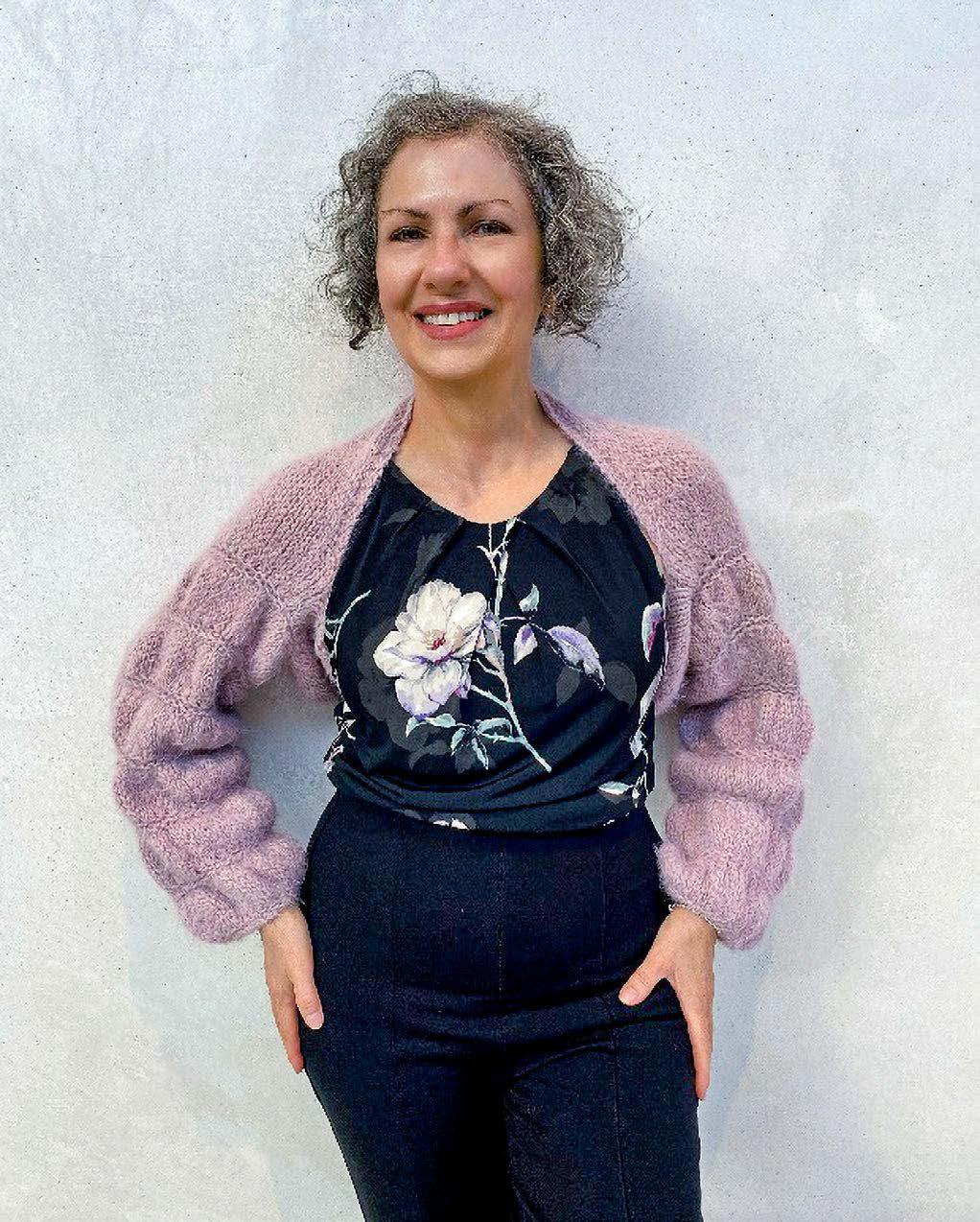
And here it is. The moment that always brings a little flutter of excitement. The Bubble Sleeve Shrug is complete and everything I hoped for. The bubble sleeves are plush and expressive, the back panel is smooth and comforting, and the entire piece feels effortlessly wearable.
Bella Bounce in the Shortcake colorway gives the shrug a soft glow. The color shifts look delicate across the sleeves, especially where the texture catches the light. The bubbles are round and airy, just as the designer intended, and the transitions between needle sizes are gentle and seamless.
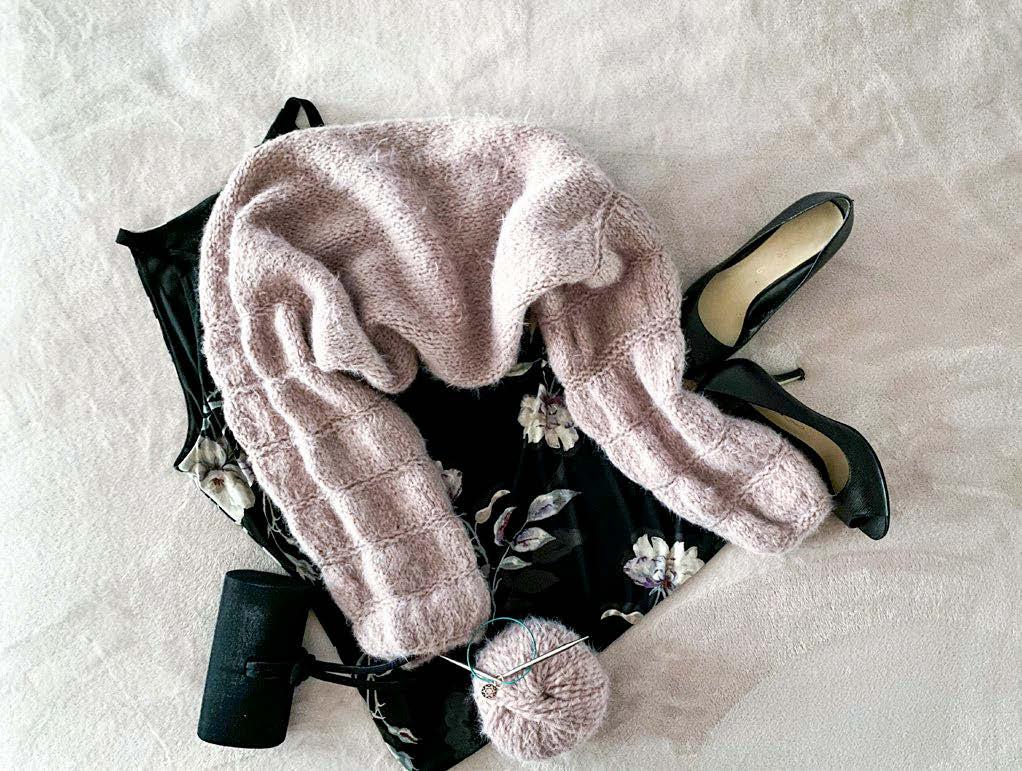
My Bubble Sleeves Shrug is ready for the holidays!
Soak, a modern rinse-free laundry care, is enough for Bella Bounce to relax its stitches.
Waiting for most of the water to drip through the colander
Carla A. Canonico
Editor-in-Chief at KNITmuch
I tried on the shrug the moment it finished drying. It rests across the shoulders with a lovely drape, and the sleeves feel cozy without weighing anything down. The structure created by knitting from cuff to cuff pays off beautifully here. Both sleeves match perfectly, and the garment wraps like a warm hug.
Reflections on Knitting with Bella Bounce
This yarn is a dream to work with. Its woolblend creates softness without sacrificing stitch definition, and the polyamide adds just enough resilience to handle the increases and decreases that form the bubbles. Throughout this project, I noticed how forgiving and lively the yarn felt. It encourages a relaxed mindset, which fits perfectly with KNITTER’S PRIDE The Mindful Collection needles.
This project reminded me how satisfying it is to knit a wearable piece that feels both playful and elegant. The bubble sleeves bring drama. The back panel brings comfort. And the finishing brings that final breath of life that only blocking can give!
Thank You for Following Along
I hope you enjoyed this five-part journey into the Bubble Sleeve Shrug using UNIVERSAL YARN Bella Bounce and KNITTER’S PRIDE The Mindful Collection and Knit Picks Rainbow Wood needles. It has been such a pleasure to share the process, the yarn, the tools, and the little discoveries that make knitting so personal and joyful. Whether you’re considering making your own shrug or love learning new techniques, I hope this series has inspired you.
Remember that in knitting, nothing is out of reach, nothing is too hard; it’s just a matter of knitting one stitch at a time.
Until next time, happy knitting.
The back of the Bubble Sleeves Shrug
In knitting, nothing is too complicated or out of reach. Knit it one stitch at a time.
The finished Bubble Sleeves Shrug, I’m ready for the holidays! Are you?
These photos by Alessia Pelletier
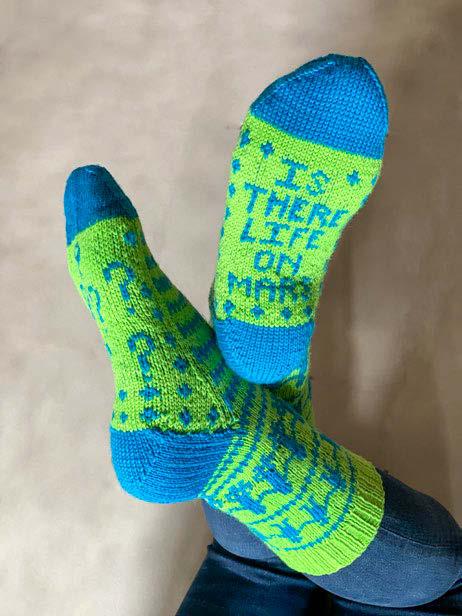
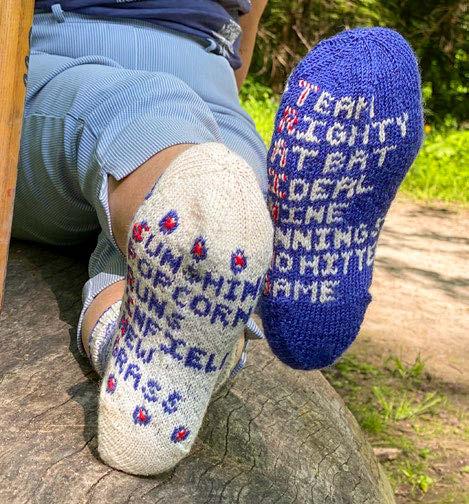
SUNFLOWER
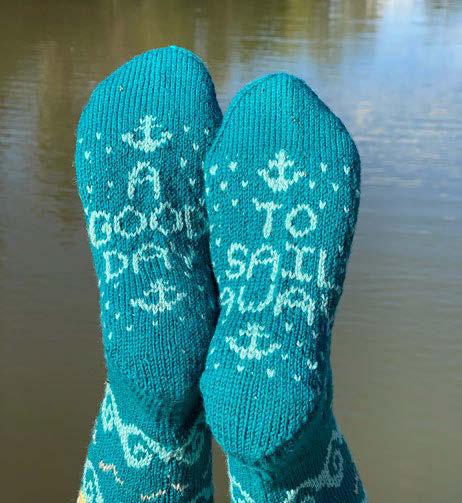
SMOOTH SAILING
MARS JARS
RED LEGS
BASEBALL FAN
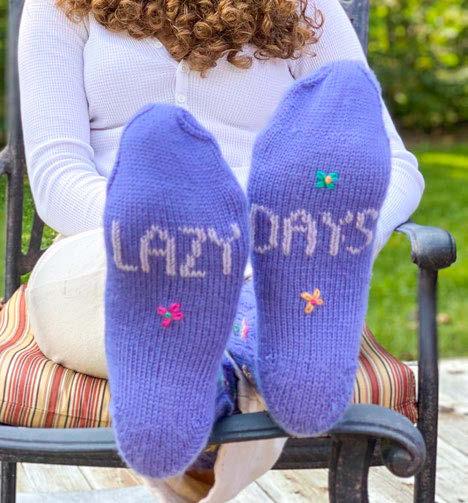
LAZY DAYS
WOOL STEW
HIGH FIBRE
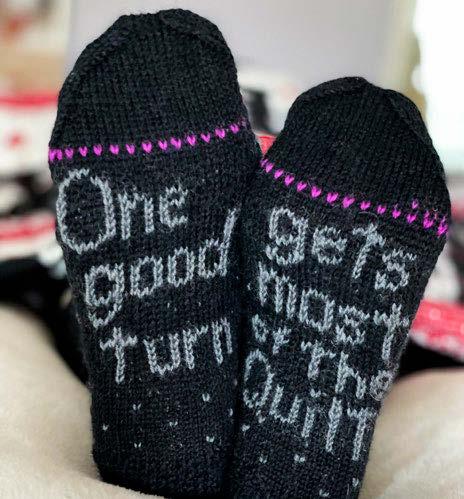
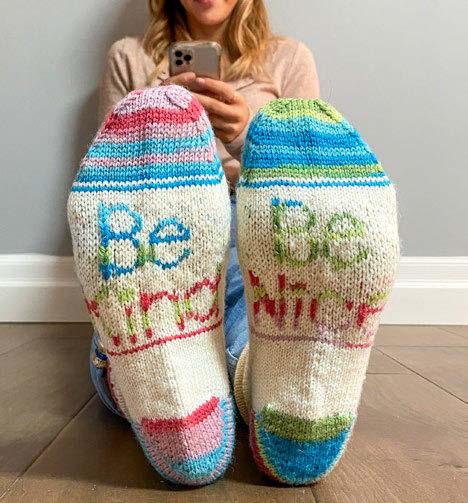
BUMPS IN THE ROAD T IS FOR TURN
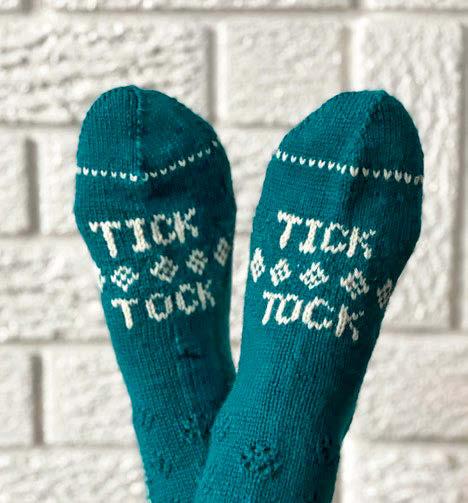
TICK TOCK
GINGHAM APPLES
BALI POP
SIMPLY PUT
Exploring Thula yarn’s texture and shine in the Lace Tipped Cardigan
Sue Sindrey
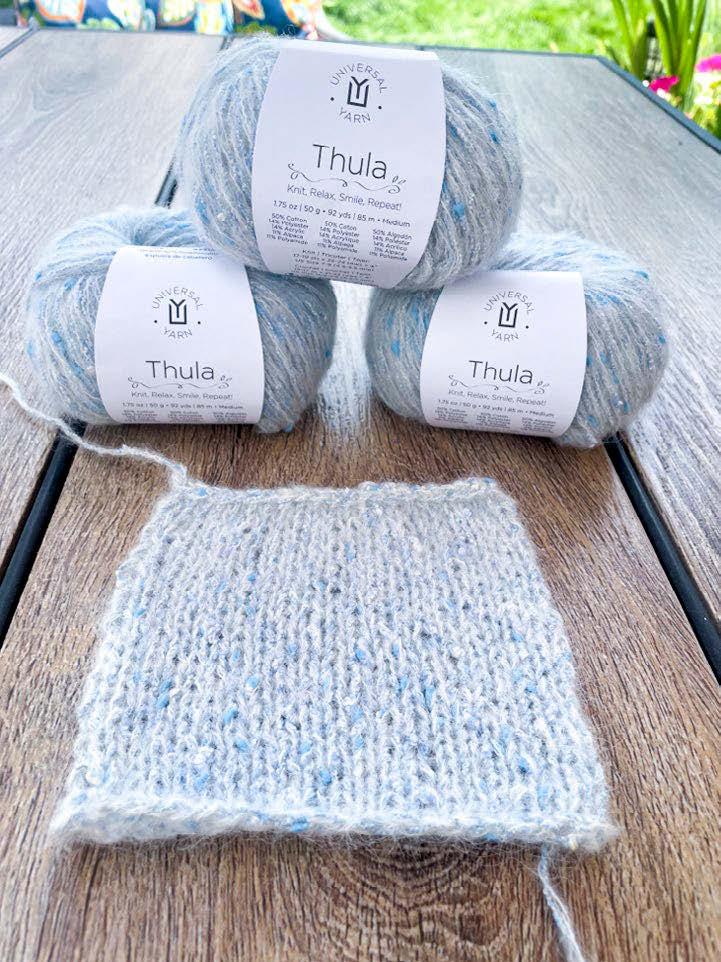
As someone who enjoys exploring yarns with various colors and textures, I was immediately drawn to UNIVERSAL YARN Thula. Its white base with iridescent splashes reminds me of fresh snow with a bit of an icy crust on it. The pale blue nubs in the Delphinium colorway give me all those wintery feels of cozying up in a warm sweater on a cold day. Its texture is reminiscent of boucle-style fabrics.
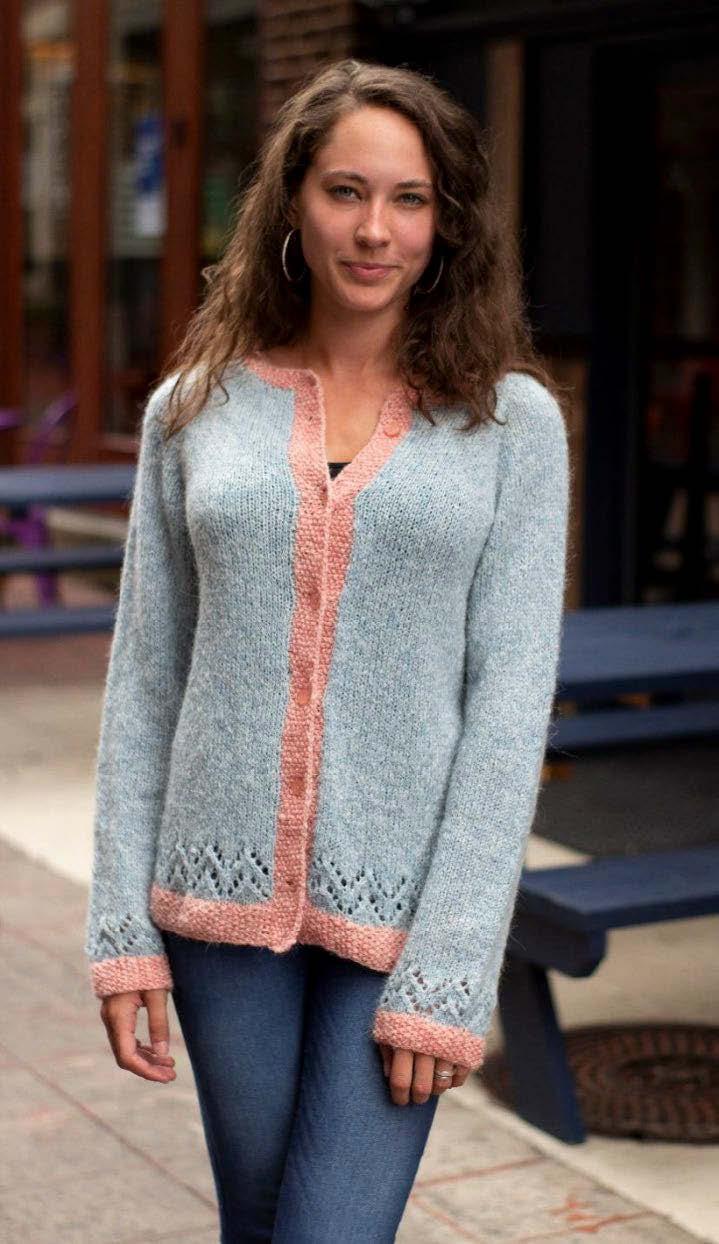
To really let the texture of this yarn shine, I needed a simple pattern with minimal design details. And so, I thought the Lace Tipped Cardigan designed by Rachel Brockman would be perfect for this yarn.
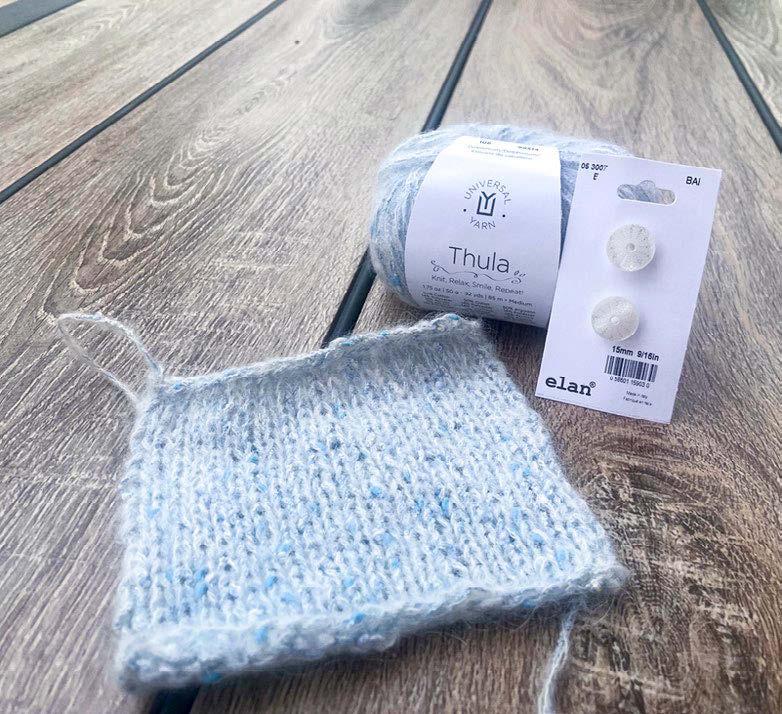
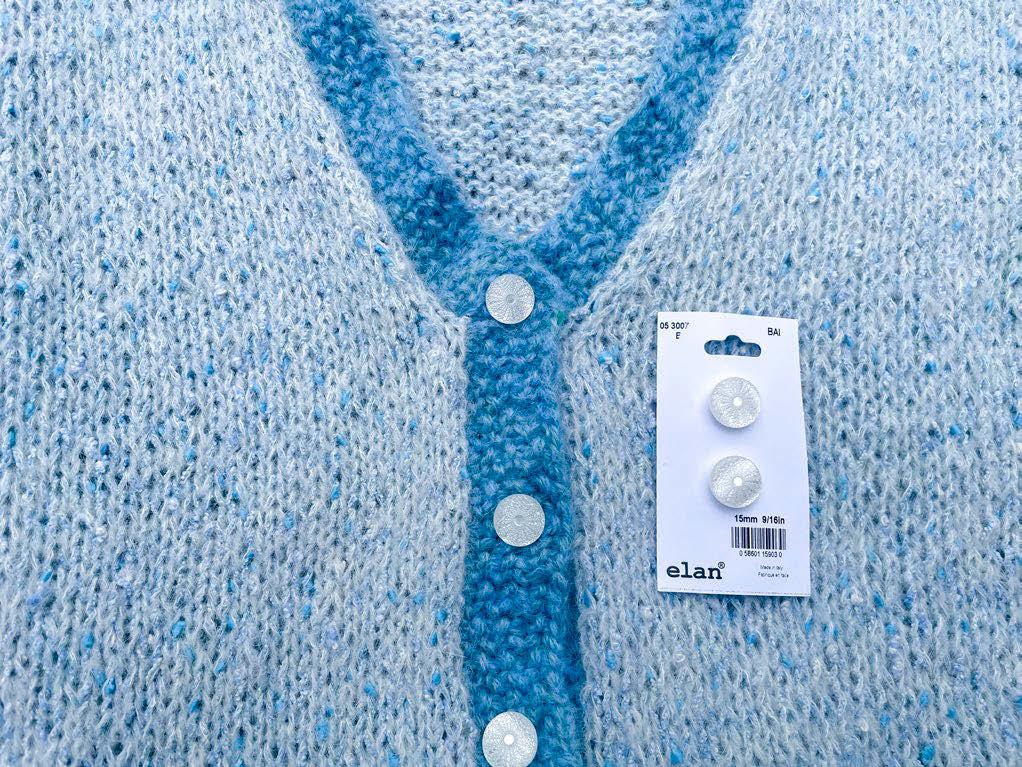
I found these white Elan 15 mm buttons that have a similar iridescence as Thula and thought they would complement each other perfectly. Now I must find just the right contrasting color for the trim in the pattern!
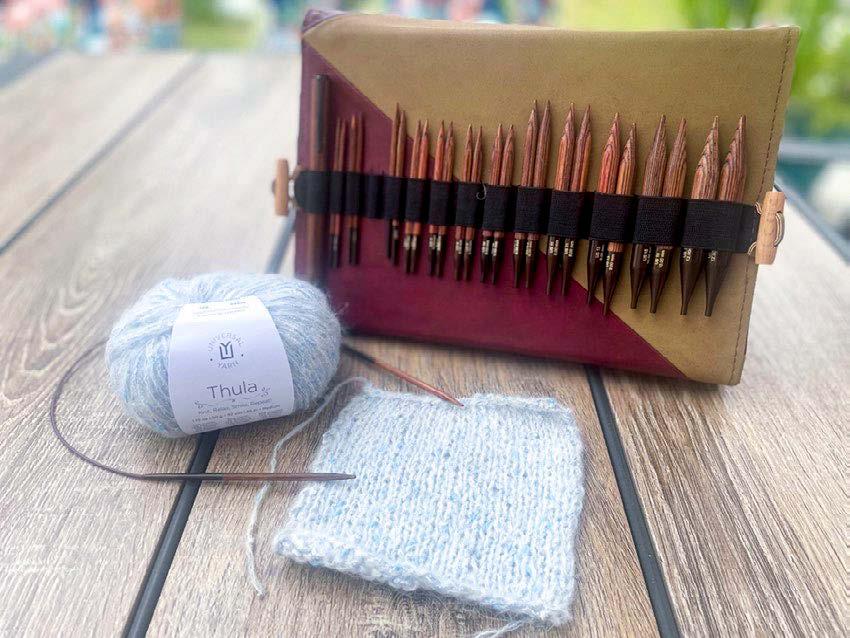
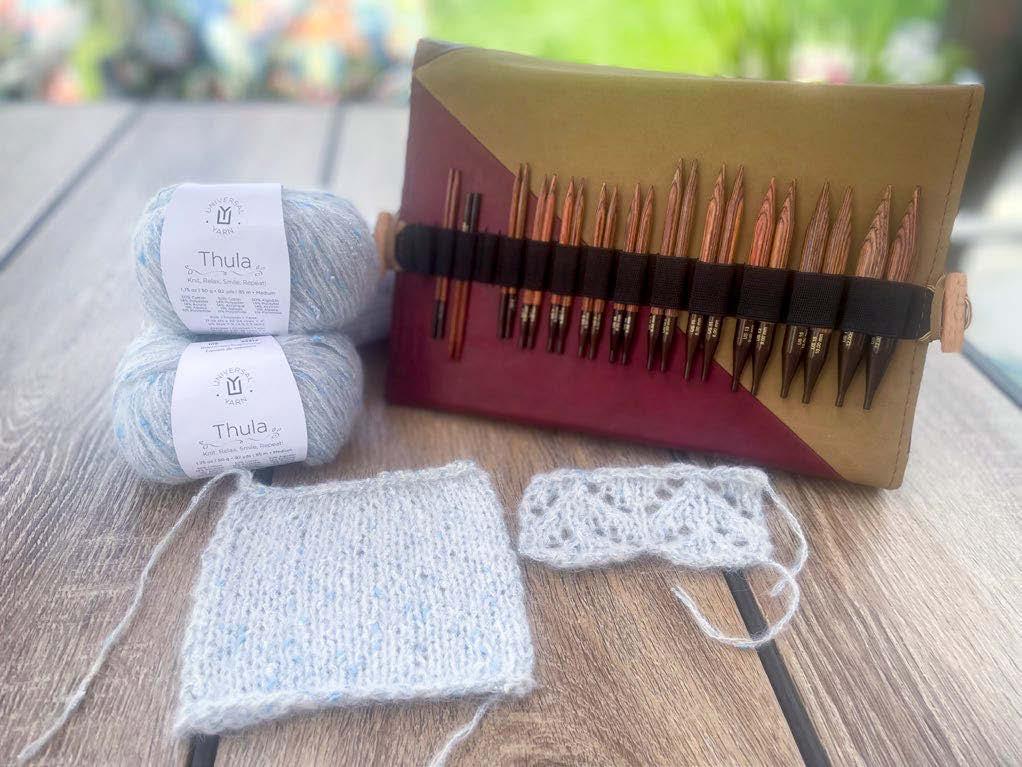
To knit Lace Tipped Cardigan in Thula, I’m using the KnitPro Ginger Special Deluxe Interchangeable Needle Kit. It includes needles of 13 different sizes and are beautifully crafted.
Standard gauge for Thula is 17-19 stitches for 4 inches on US size 7-9 needles. I decided to use a smaller size than recommended and this set allowed me to choose the right needle size for the tighter texture of the knitted fabric that I preferred.
I really love the texture of UNIVERSAL YARN Thula in the Delphinium colorway.
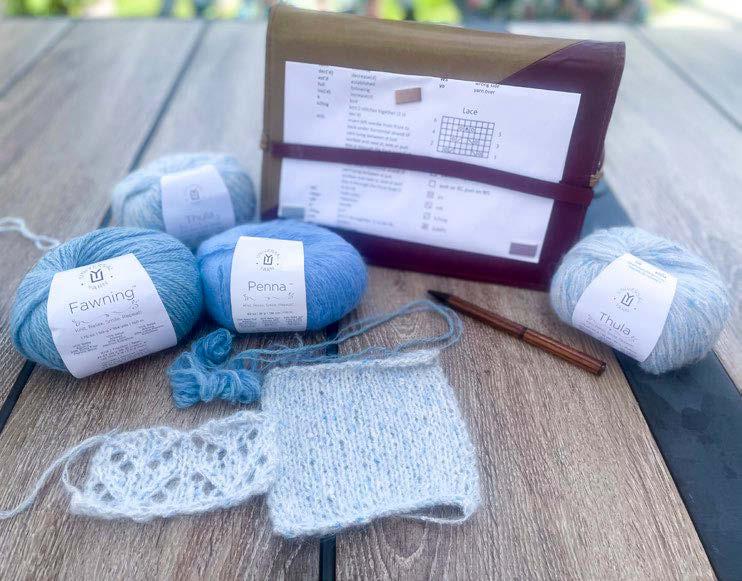
Thula in the Delphinium colorway and a knitted swatch in stockinette for the Lace Tipped Cardigan pattern.
Lace Tipped Cardigan designed by Rachel Brockman
Thula yarn in the Delphinium colorway and Elan 15mm white iridescent buttons to knit the Lace Tipped Cardigan.
Thula in the Delphinium colorway and Knitpro Ginger Special Deluxe Interchangeable Needle Set
This photo courtesy of UNIVERSAL YARN
Thula yarn, unique trim and lace pattern for the Lace Tipped Cardigan
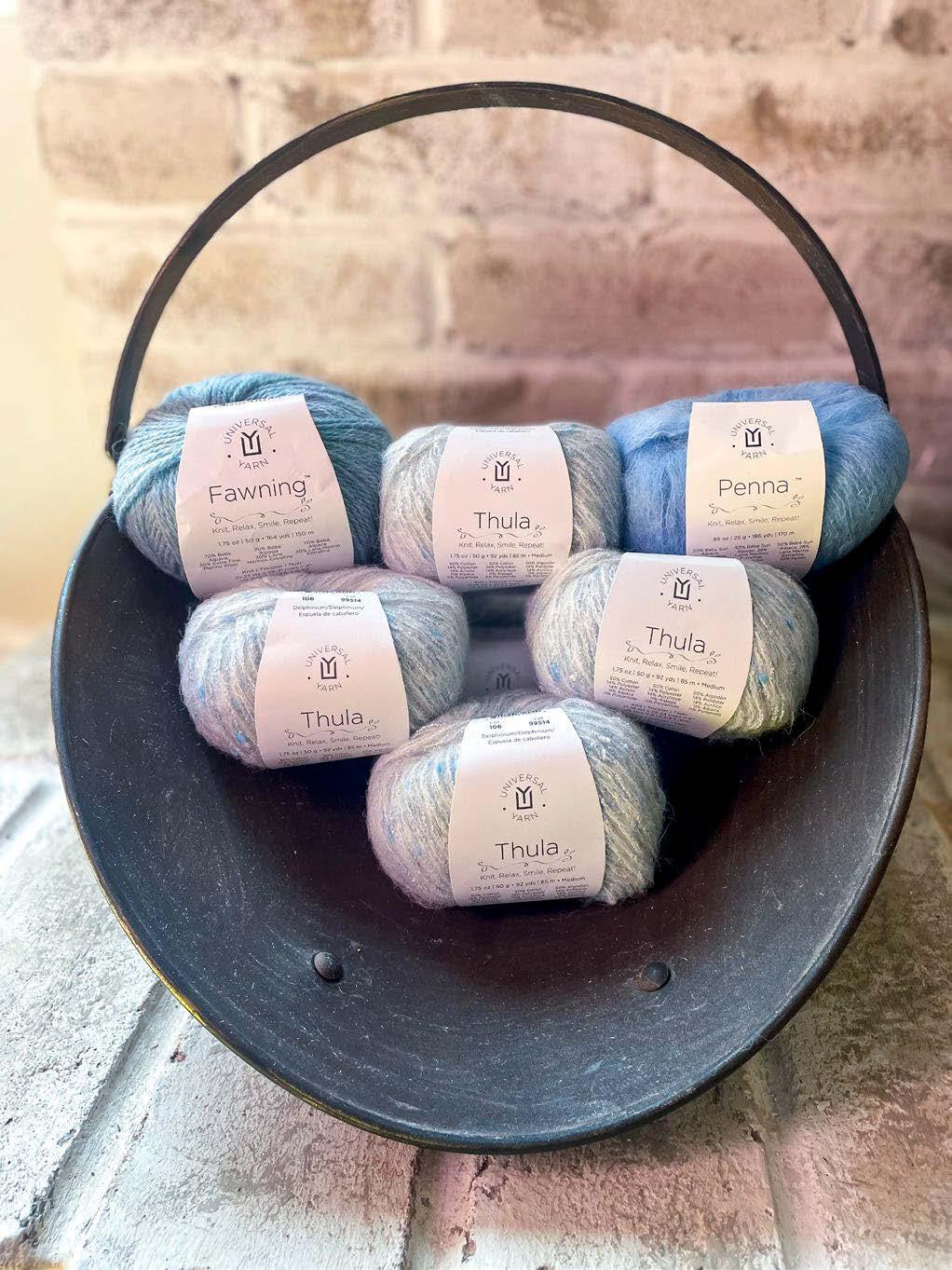
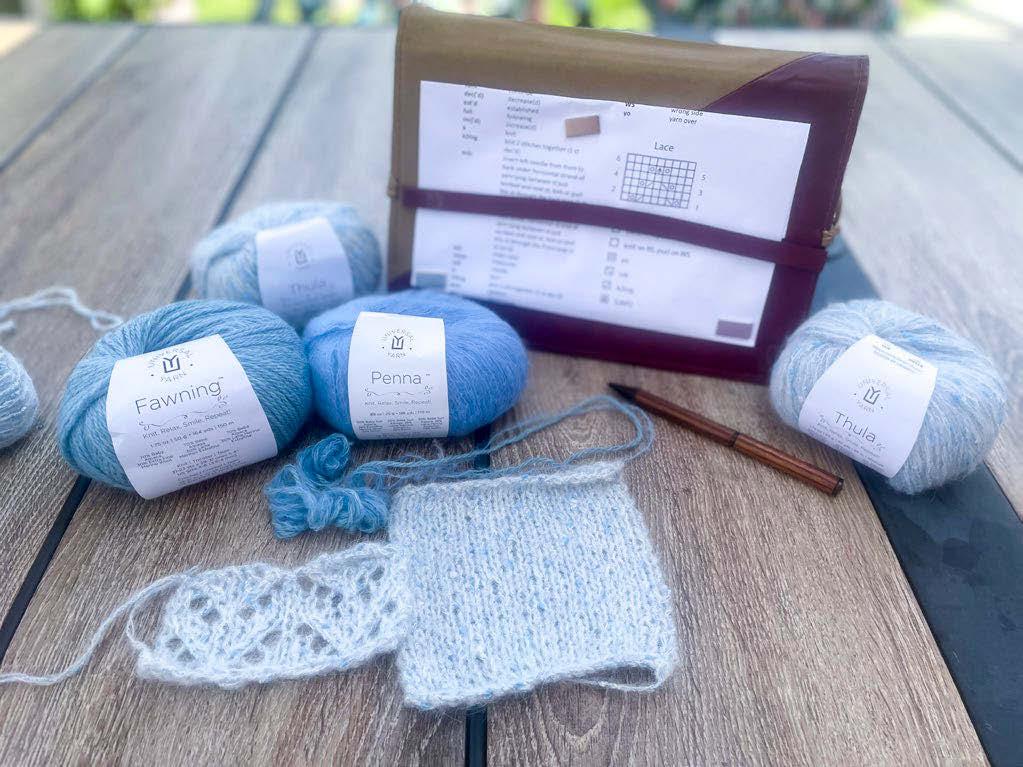
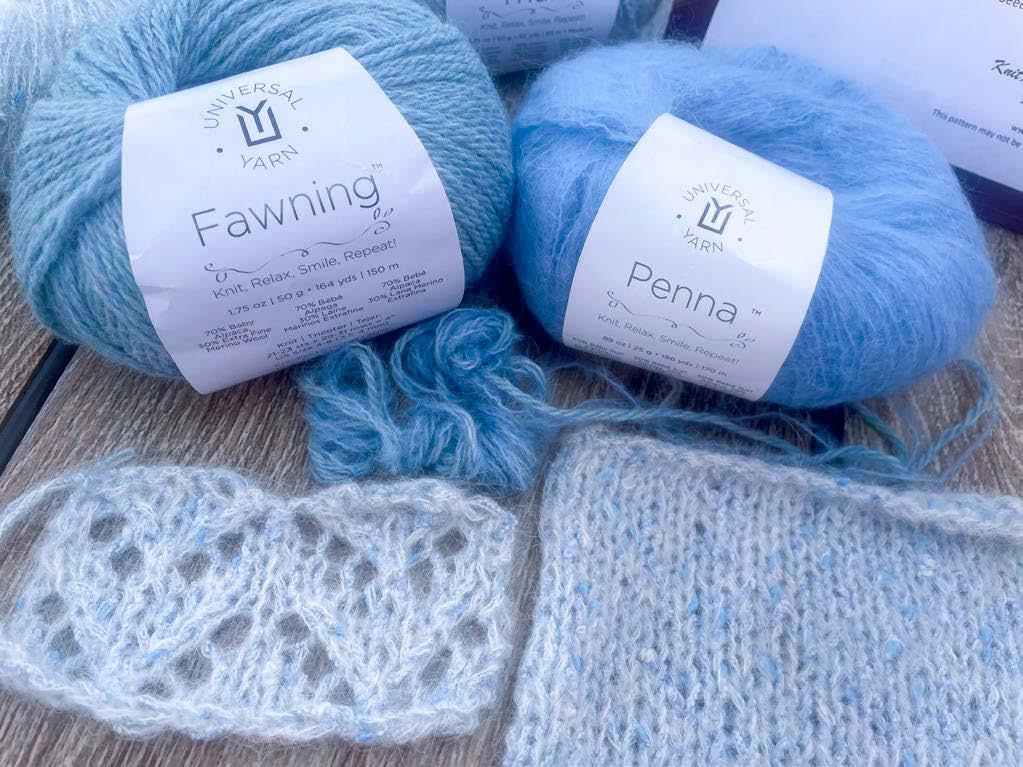
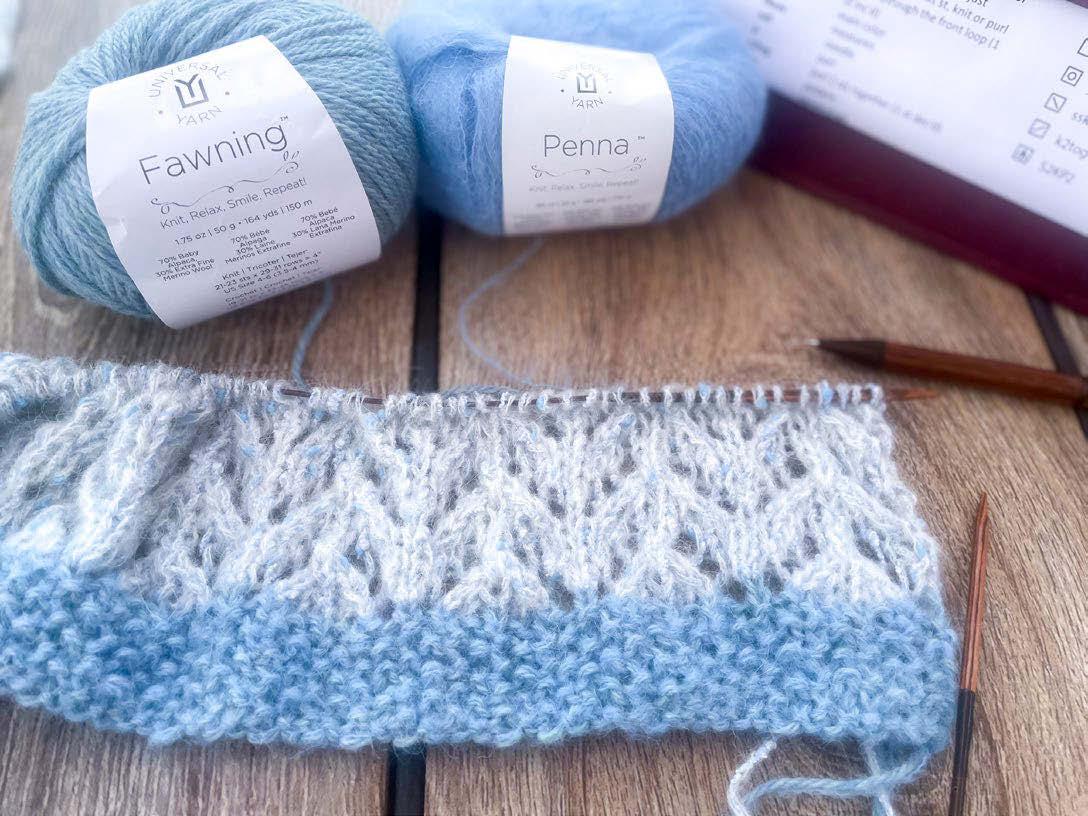
I was curious about UNIVERSAL YARN Thula’s stitch definition in the lace portion of the Lace Tipped Cardigan , so I made a separate swatch to find out how it would look. I like it so much, I wonder how many lace repeats I will include! The pattern calls for two repeats, but I will include more. First, however, I need to consider the overall proportions of the final piece. I also left off in search of the right contrast color to complement UNIVERSAL YARN Thula in the Delphinium colorway. While I could not find an exact match, I decided to resort to a little bit of trickery when I came across Fawning in Moonstone and Penna in Clouded.
While neither Fawning in Moonstone nor Penna in Clouded is an exact match to the blue nubs in Thula’s Delphinium, the tonal variation when stranded together should trick the eye into picking up the shade of blue in Delphinium. Both yarns are notably soft, but when held together, the combination results in a luxurious and buttery softness that exceeds either one alone. Penna’s halo also complements the subtle halo in Thula, so this pairing works very well! To knit this project, I’m using the KnitPro Ginger
Photos by Sue Sindrey
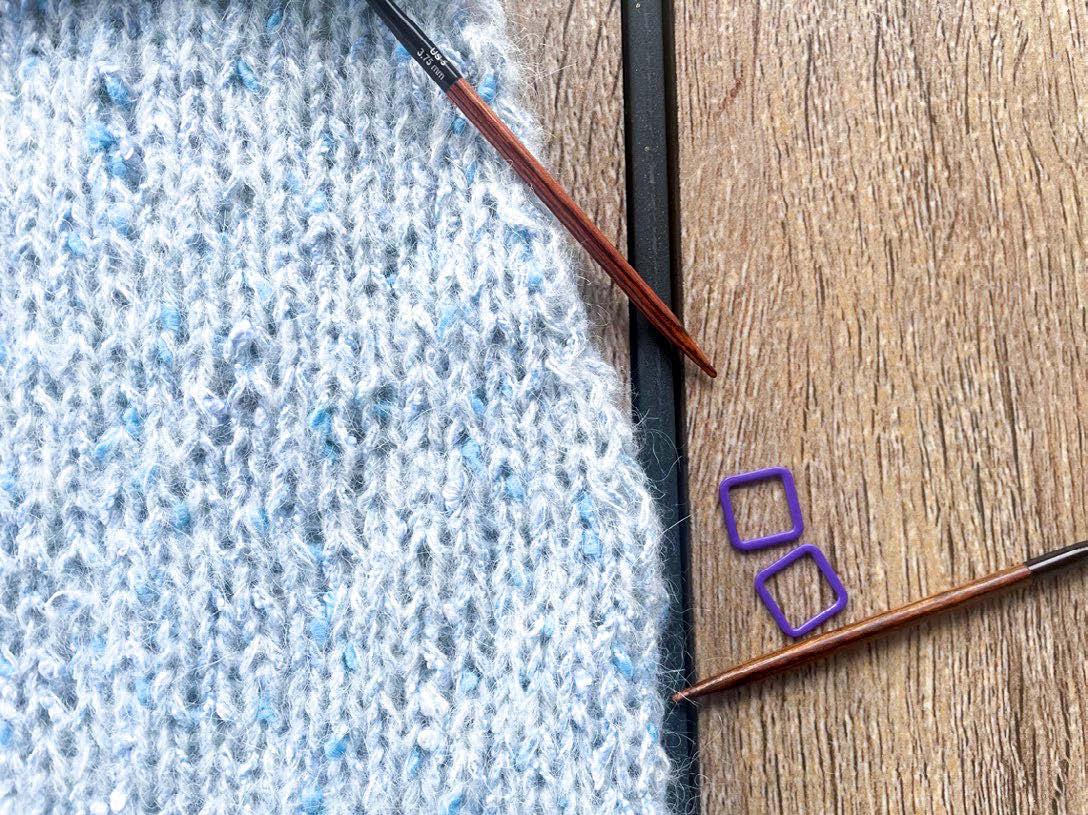
A swatch in stockinette and a swatch in lace knitted with Thula in the Delphinium colorway, using needles from the KnitPro Ginger Special Deluxe Interchangeable Needle Kit for the Lace Tipped Cardigan pattern.
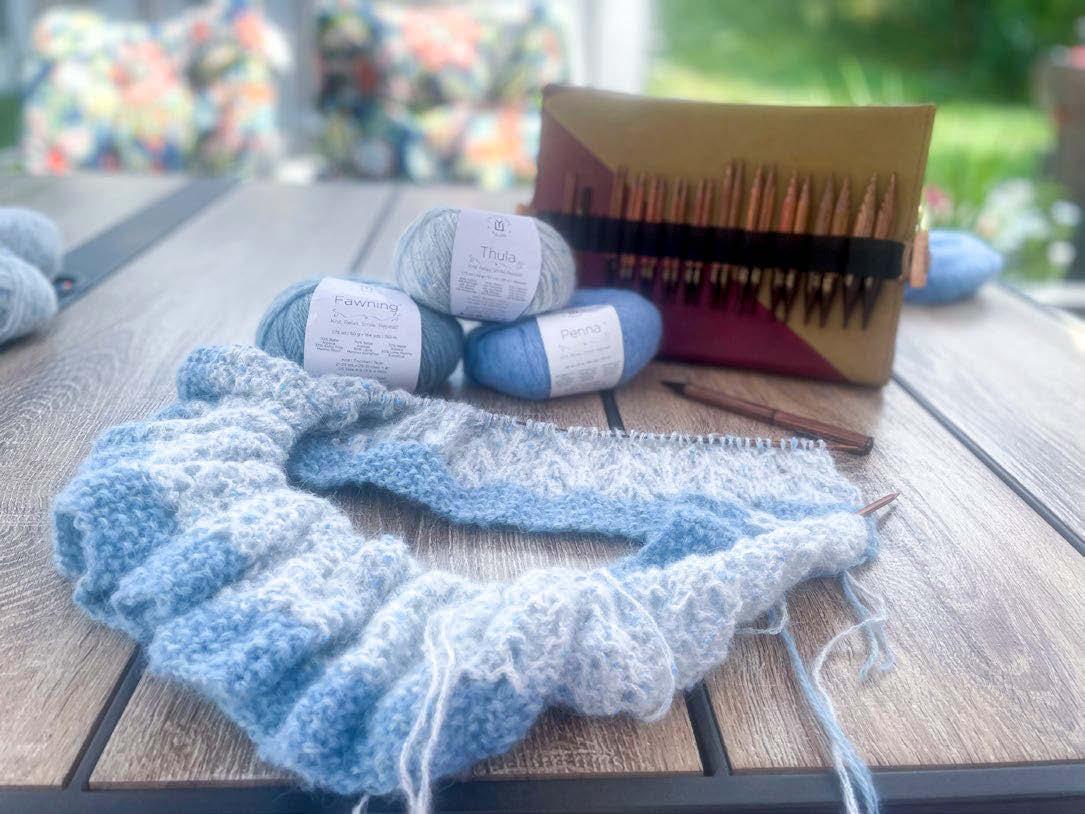
Thula in Delphinium for the main color paired with Fawning in Moonstone and Penna in Clouded for the trim to make the Lace Tipped Cardigan pattern.
Special Deluxe Interchangeable Needle Kit. My favorite thing about this set is that it includes a magnetic pattern holder in its case. I don’t know about you, but knitting is my time to disconnect. Accessing digital patterns on my device usually means I get into the doomscroll before I even start to knit. This set allows me to knit in my happy place without electronic distractions. The matching pen conveniently allows me to include notes on my patterns as I go. One thing to note is that it only comes with shorter cables, so a compatible cable connector or longer compatible cables may be useful to you for larger projects.
I’m so happy with both the stitch definition in the lace swatch and my unique trim color choice using Thula in Delphinium, Fawning in Moonstone and Penna in Clouded. Now I’m ready to cast on! I can’t wait to snuggle up in my Lace Tipped Cardigan!
Stranding Fawning in Moonstone and Penna in Clouded together for the trim complement the blue tones in Thula in Delphinium to make the Lace Tipped Cardigan.
Swatches of Thula in the Delphinium colorway made with needles from the KnitPro Ginger Special Deluxe Interchangeable Needle Kit for the Lace Tipped Cardigan. Seeing Fawning in Moonstone and Penna in Clouded stranded together helped me to confirm this choice for the trim.
More Lace Repeats & Style Twists for the Lace Tipped Cardigan?
Yes Please!
I have completed the bottom band and started the lace section. The seed stitch of the bottom band showcases the multi-tonal result of the Fawning in Moonstone and Penna in Clouded combination. The resulting tones in these two yarns stranded together pull out the blue nubs of Thula in Delphinium
Customizing the Lace Tipped Cardigan: Pleats & Neckline Tweaks
When it comes to patterns, I typically see them as suggestions and use a few simple tricks to suit my body and my style. The bodice of the Lace Tipped Cardigan is straight, and I prefer more movement in the back and an A-line silhouette. If I would like to change a pattern that has a straight bodice to an A-line silhouette, I generally use the stitch count provided for one size higher at the bottom cast-on. However, if I want a pleat as well, I use the stitch count for two sizes higher. This seems like it may be too many stitches. However, when you consider that a box pleat results in a 14-stitch reduction, going up one size may not be sufficient; any remaining stitches can be reduced evenly under the arm as I work towards the bust. So going up two sizes from the bottom should give me the movement and the A-line shape I prefer. I chose to do a box pleat because the number of stitches required nicely lines up with the number of stitches in the lace pattern repeats. Each of the two back center lace repeats has 8 stitches, and the box pleat has two seven stitch folds, which are close enough to allow the lace to drape properly along the folds of the pleat.
One other change I’m considering is regarding the neck shape. My personal preference is not to have a collar that sits on or near my collarbone. Lace Tipped Cardigan has a high crew neck shape, and I think I’ll change it to a V-neck to suit me better.
The seed stitch trim made with Fawning in Moonstone and Penna in Clouded together complements the blue tones in Thula in Delphinium for the Lace Tipped Cardigan pattern.
Seeing the texture of the seed pattern made with Fawning and Penna next to the lace made with Thula allows me to see how a pleat might look in the Lace Tipped Cardigan.
Box Pleat & V-Neck mods for the Lace
Tipped Cardigan knitting
pattern
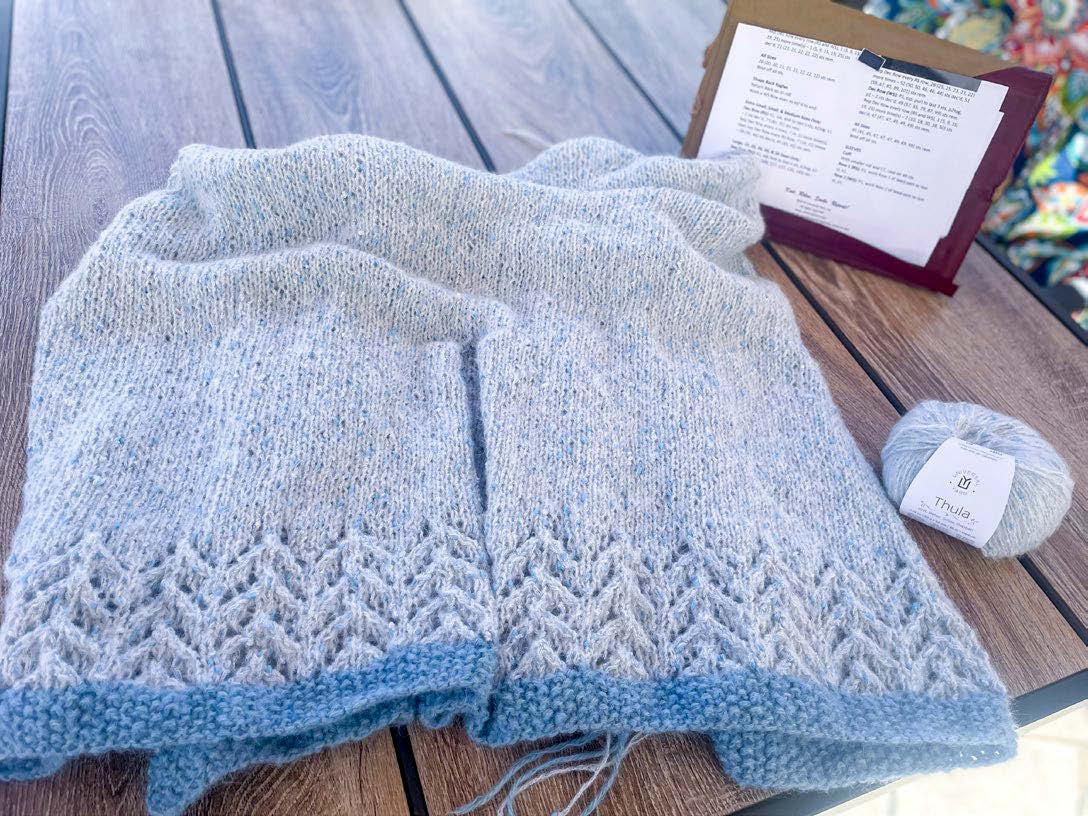
To have enough extra stitches, I cast on the number of stitches for two sizes higher. When I reached about 10 inches from the bottom in the back center, I made two 7-stitch folds, and this resulted in a 14-stitch reduction. I worked stitch reductions evenly further up the bodice under the arms so that I have the right number of stitches for the intended bust size. As you can see, the pleat does not disturb the lace pattern and folds along the edge of each repeat, so I know I chose the right kind and size of pleat.
So now I’ll explain how to do it. As I worked further up the bodice and arrived at the bottom of the arm cast off, I began stitch reductions every fourth right side row of each front edge until there were the right number of shoulder stitches for my size. The bottom of the arm opening is generally where I like to start V-neck reductions. Considering there will be trim for the button band, the actual V will sit a bit higher than the bottom of the arm opening. To provide the same slant of the V opening for each front side, I used ssk on the right front side and k2tog on the left front side.
This change in neck shape will, however, affect the construction of the neck trim and button band. While the Lace Tipped Cardigan calls for separate neck and button bands, I will create one continuous button and neck band from the bottom corner of one side, up and around the neck, down to the other side. This way, I can also incorporate the opening of the V-neck in one continuous band of trim.
The box pleat I added in the back.
The opening of the V-neck on the front right side.
Finishing the Lace Tipped Cardigan with Thula
& custom trim details
As the V-neck creates a bend on each front side, extra stitches are required in the trim at these points to prevent any unwanted puckering. This is easily achieved with yarn overs on either side of the stitch in the trim where the V opens. Now I’ll show you how to do it.
We’ll begin where I left off, with the right front side at the bend created by the opening of the V. I have my needles and markers from my Knitpro Ginger Special Deluxe Interchangeable Needle Set ready.
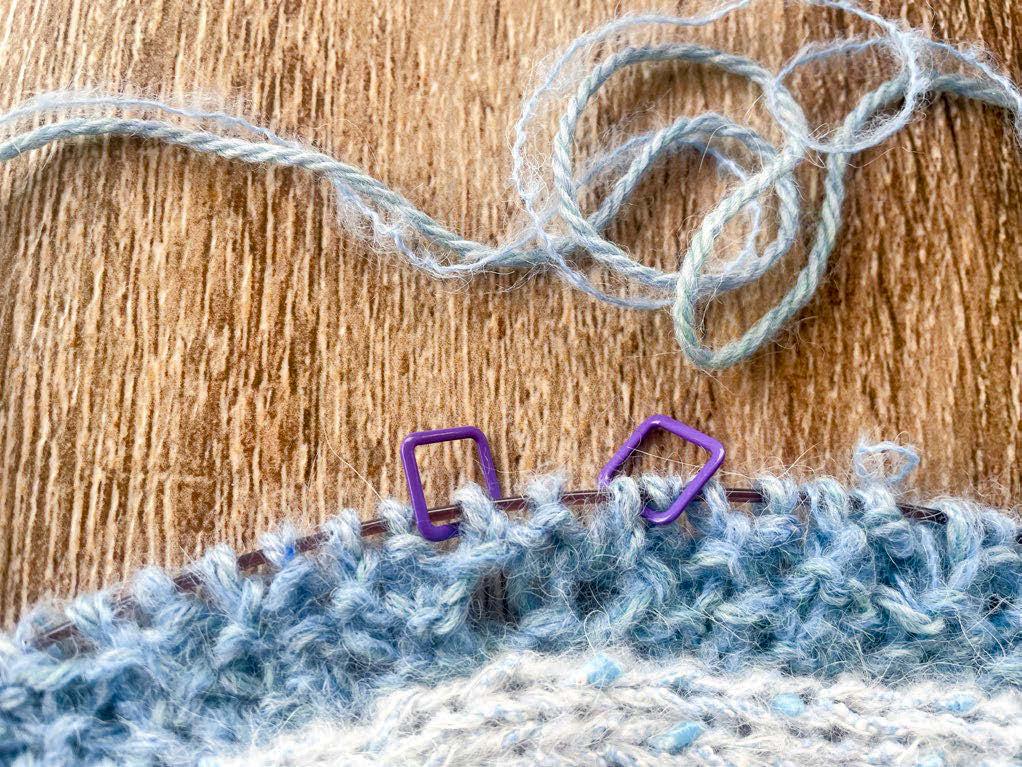
First, I find the first stitch of each bend and mark it with a knitting marker on either side. These can be harder to find once they are on the needle cable, so it’s best to start with it marked. Then I pick up and knit all of the trim stitches for the first row using Fawning in Moonstone and Penna in Clouded stranded together. As you can see, the first decreased stitch is between the markers where the bend occurs.
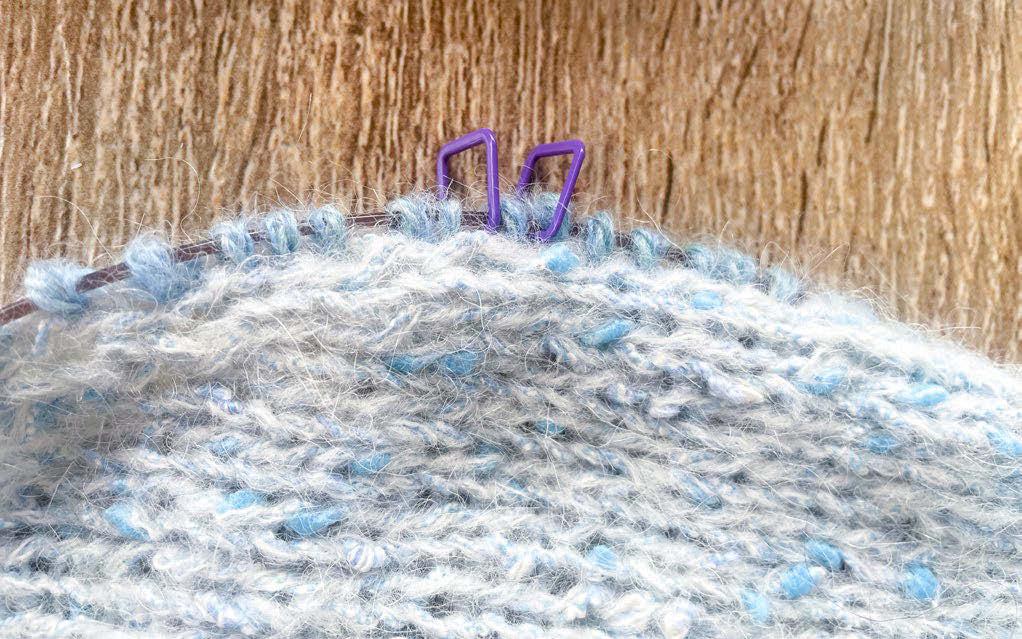
Next, I work the wrong side even with no stitch increases. On the second right side row (the third row of the trim), I add one yarn over on each side of the marked stitch. You can see there are now three stitches between the markers.
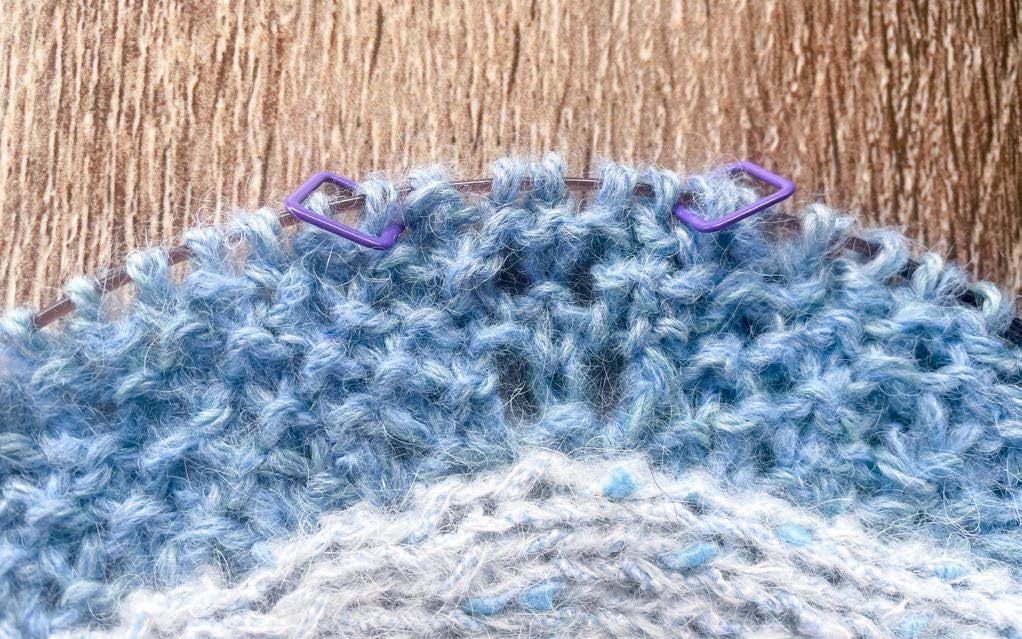
I continue to work the trim, keeping the wrong sides even with no stitch increases and adding yarn overs each right-side row. With each rightside row, the number of stitches between the markers increases by two stitches.
The stitch at the opening of the V is marked with a marker on either side.
There are now three stitches between the markers.
There are now five stitches between the markers.
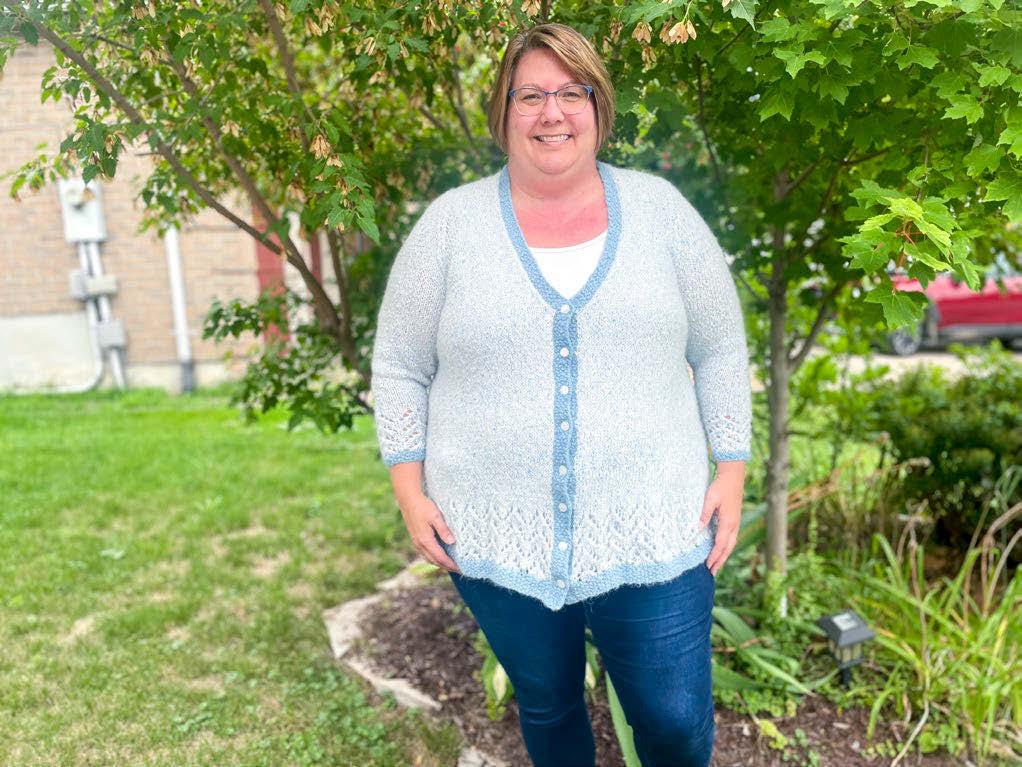
And voilà! Here is the completed neck with trim that accommodates the opening of the V-neck with those Elan 15mm white iridescent buttons you might remember from our first day together. They really bring out Thula’s shine.
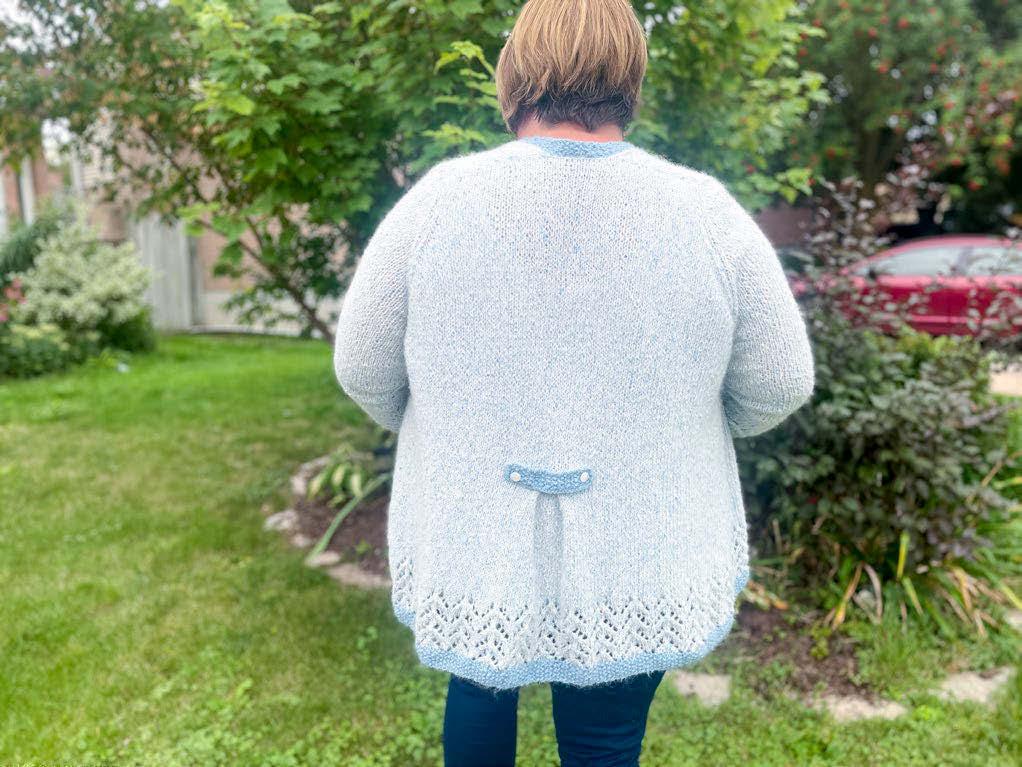
Here is my finished cardigan! As an extra finishing touch, I added a small band to match the trim across the box pleat, topped with two more Elan 15mm buttons. This decorative detail adds interest to the back by adding color and shine.
I really enjoyed exploring the texture of Thula while making the Lace Tipped Cardigan. I increased the lace repeats from two to four for more suitable proportions on a taller body. Double stranding Fawning in Moonstone and Penna in Clouded created a unique multi-tonal contrasting trim that pulled out the light blue nubs in Thula. I began with the stitch count for two sizes larger to accommodate A-line shaping and a box pleat in the back. I topped the pleat with a matching seed stitch accent band with the same Elan 15 mm buttons that were used down the front button band. My Knitpro Ginger Special Deluxe Interchangeable Needle Set allowed me to easily change needle size, and its built-in pattern holder meant that I could unwind without electronic distraction. The markers included in this set helped me keep track of lace repeats and the placement of stitch increases in the neck trim to avoid unwanted puckering at the V-neck. I was so pleasantly surprised by how great Thula looked in lace that I just have to wonder what it might look like in cables! Thanks for joining me! See you next time.
Sue Sindrey suesindrey@me.com
The finished Lace Tipped Cardigan using UY Thula with a contrasting button band made using Fawning in Moonstone and Penna in Clouded stranded together and Elan 15 mm white iridescent buttons.
The finished V-neck of the Lace Tipped Cardigan. As you can see, the trim bends with the shape of the V without any unwanted puckering.
The finished back of Lace Tipped Cardigan
First Impressions of Mystical Marl yarn in the Holland Cowl Project
Sarah Dawn Adams
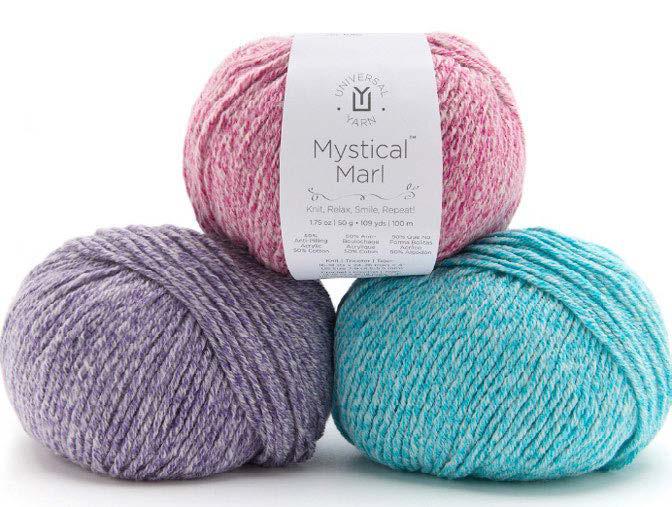
When I first saw the Mystical Marl yarn from UNIVERSAL YARN, I admit, I was skeptical. As a blend of cotton and acrylic, it’s a more uncommon blend in the yarn world, and, honestly, I wasn’t sure how well it would work up. But I was still intrigued enough to give it a try and test it as the recommended yarn for the Holland Cowl designed by Afifa Sayeed.
My skepticism was utterly unfounded. To start, even when I picked it up out of the box, it had absolutely none of the roughness you can sometimes get with acrylic. It was actually far softer than I expected–very promising for something that will be next to skin! I may have just sat there squishing yarn for a few minutes because I absolutely love the feel of it. It reminds me of some of the microfiber fabrics, and I think that’s due to the anti-pilling acrylic.
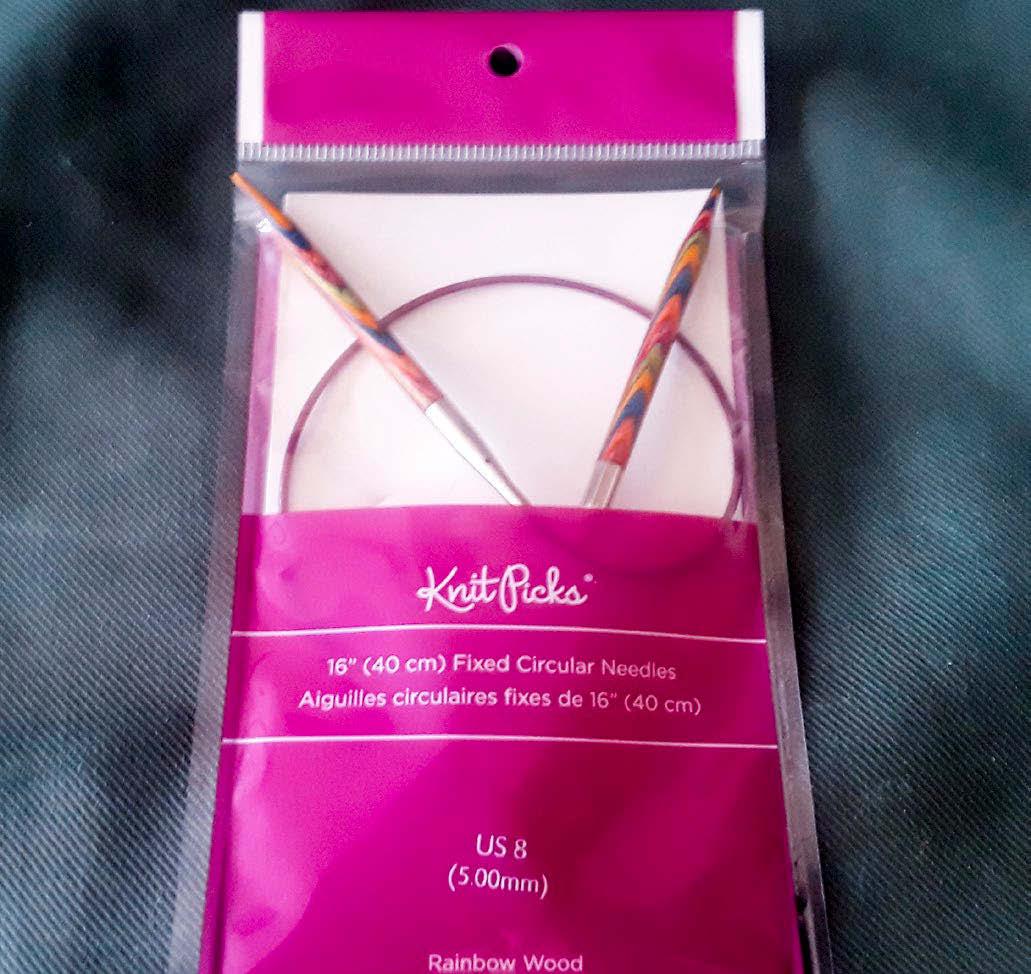
That said, I did eventually have to stop squishing the yarn and give it a proper test, so I cast on the Holland Cowl using a set of 5mm Knit Picks Rainbow Wood Circular Needles. The Holland Cowl pattern suggests a cord length of 16 inches, which is what I used, and yes, the cowl is a bit scrunched up, but I’m still glad I went with this rather than the 24-inch cord.
If I’d put this on the 24-inch cord, it would have stretched out the cowl, which is generally not a good thing to do to your knitting. Eventually, your knitting will stay stretched out, like a rubber band that you’ve overstretched - it won’t bounce back to its original shape, which is something you very much do not want to happen. It’s better to have your stitches bunched up rather than stretched out.
Photos by Sarah Dawn Adams
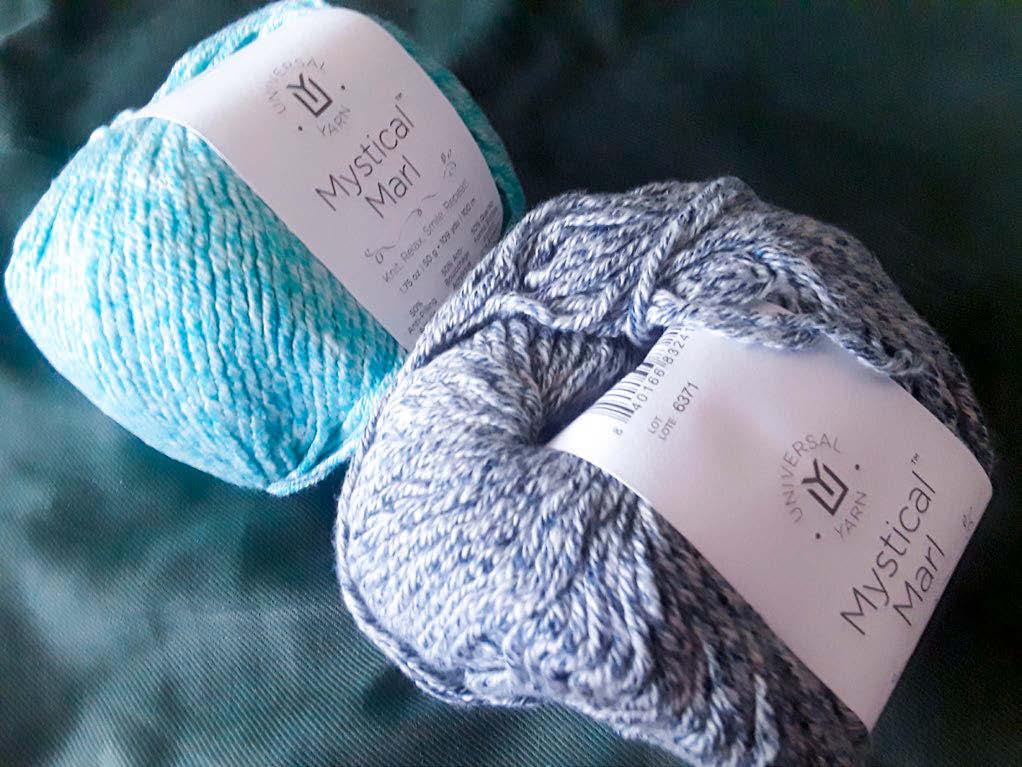
Two balls of Mystical Marl yarn in Lagoon and Midnight, waiting to be knitted into the Holland Cowl!
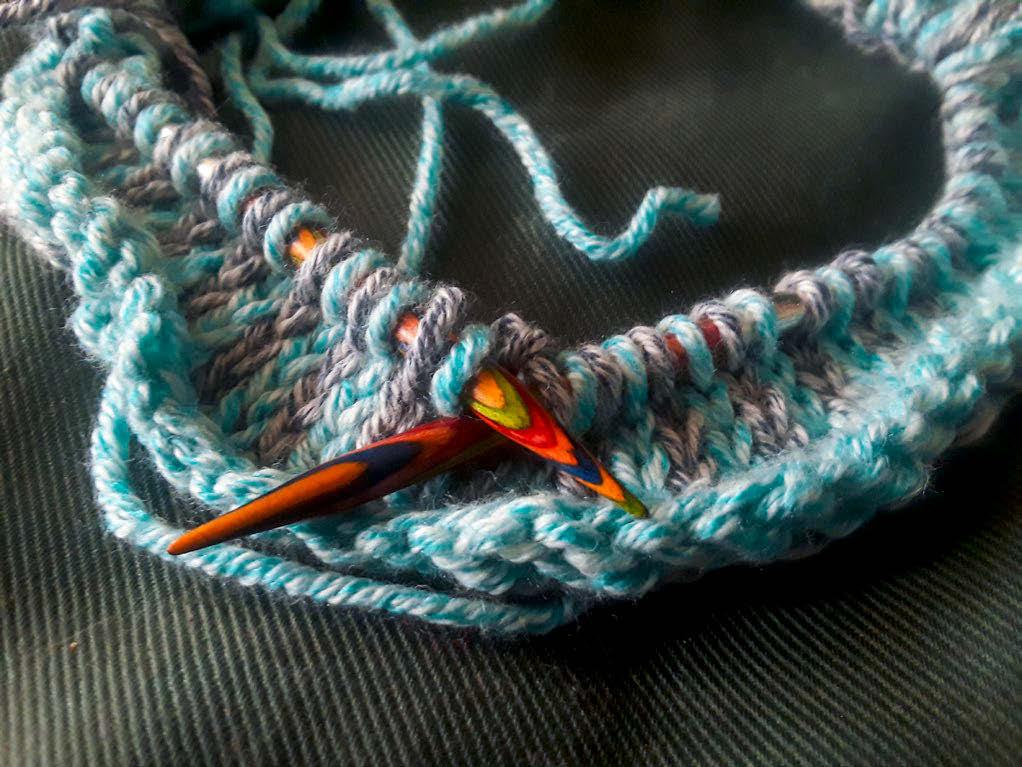
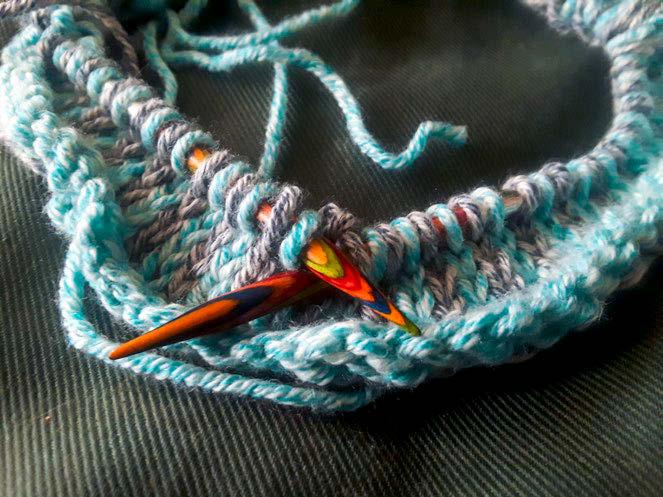
The start of a Holland Cowl knit in UNIVERSAL YARN Mystical Marl in Lagoon and Midnight
A set of Knit Picks 5mm Rainbow Wood Circular Needles, ready to start a Holland Cowl!
I’m usually not a fan of shorter circulars because the needle tips are often shorter, but, for this cowl, I think it was a better choice. Since there are no decreases in the pattern, I don’t need any slack in the circular cord for the Magic Loop technique, unlike when knitting a hat. All in all, it works out just fine!
I was worried about the warmth of this yarn, too. Acrylic and cotton aren’t known for being superbly warm, and this cowl has to stand up to a Canadian winter! But that too was a completely unfounded worry. The cotton keeps the yarn soft and adds breathability, while the acrylic is the warmer fiber, and also helps with durability. And because the fabric is more breathable, thanks to the cotton, it means that you’re not at nearly as much risk of sweating under your cowl like you would be in a 100% acrylic blend. I suspect I’ll be wearing this quite a bit this winter!
My other concern was my color choices. I don’t always have the best eye for color; more than a few people over the course of my life have side-eyed my fashion choices when it comes to color! That said, I’ve stuck to my traditional favorite color families. From the Mystical Marl color line, I’ve chosen a bright blue-teal in the color Lagoon and a much darker blue-gray in the color Midnight. But, it’s always hard to tell online just how well two yarns will contrast with each other, especially in stranded colorwork.
The Holland Cowl is finished and ready to be worn!
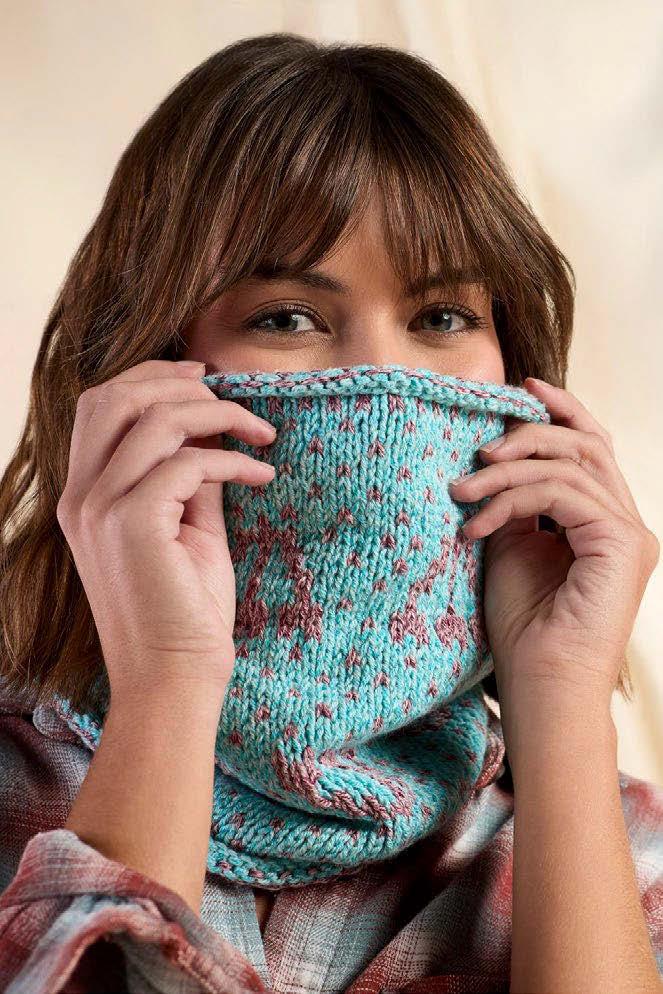
Afifa Sayeed designs the Holland Cowl for Mystical Marl yarn.
This photo courtesy of UNIVERSAL YARN
Slipped-Stitch colorwork in the Holland Cowl with Mystical Marl yarn
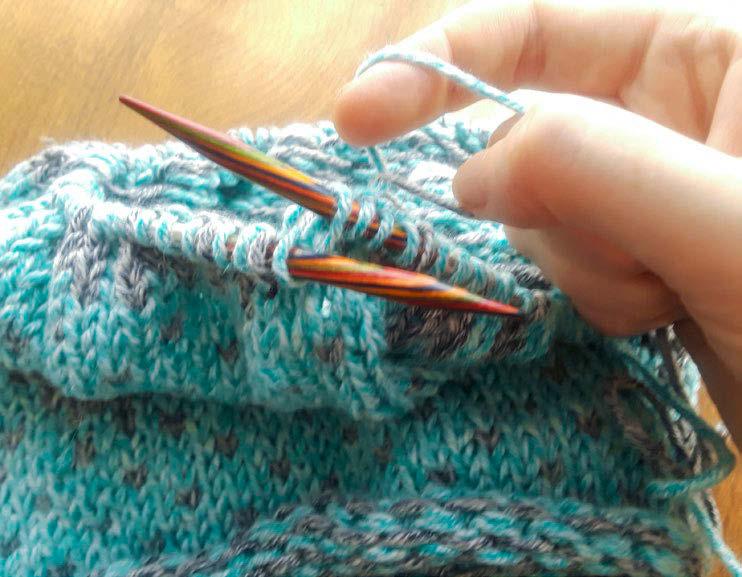
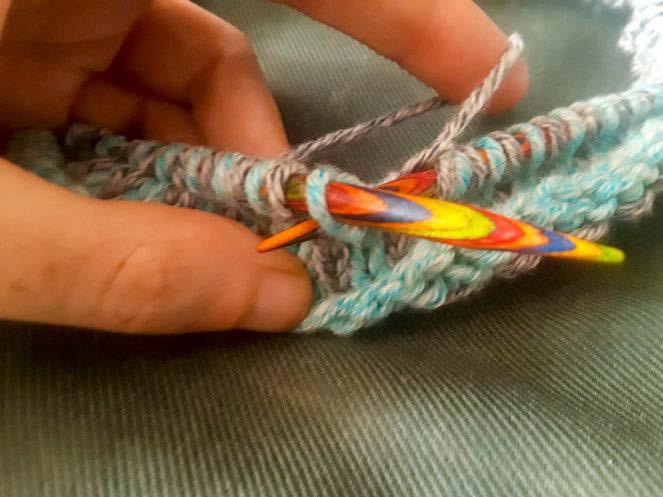
After you cast on, you work 20 rounds of slipped-stitch colorwork. This is very similar to Mosaic Knitting, though, unlike in Mosaic Knitting, your current yarn changes with every round instead of every other round.
This meant that the Holland Cowl made for an absolutely amazing train trip knitting, because I only have to think of one color at a time! Whatever color you’re working with, you simply slip the stitches of the other color purlwise. No fuss, no having to look at the pattern, it was great!
However, I did have one bad habit that started to creep in. Because I was in that meditative zone where I can knit without needing to pay too much attention, sometimes, I’d start to knit the next stitch in the round, only to find out that it was a stitch I should have been slipping. I’d have to catch myself -before- I accidentally twisted the stitch in question or remember to make sure they were untwisted when I tinked back a stitch or two!
Slipped Stitch colorwork and Mosaic Knitting are something I very much enjoy because it’s a lot easier to knit when you only have to wrangle one strand of yarn per round. Who’d have thought! And this particular set up of slipped stitch color work makes for a great edge to the cowl - it reminded me of ribbing, without the color distortions that can happen if you try to do colorwork in ribbing.
The other concern I had here was my color choices. Because the Mystical Marl in Lagoon was my background color, one of the concerns I had was how well it would contrast with the Midnight colorway for the foreground.
It’s always a bit of a guess when you’re ordering yarn online. Every computer display handles color a little bit differently, so what you’re seeing on your laptop display might be slightly different than on your phone, which might be slightly different, yet again, when it comes to the actual color of the yarn, and I was a tiny bit worried the Lagoon might be more gray than it looked on my screen. But, once I had a few rounds of slip stitch colorwork knit up, that worry was completely abated.
Easy Slip Stitch Colorwork for the Holland Cowl using Mystical Marl yarn
Mystical Marl yarn in Lagoon and Midnight - both colors contrast well in the slip stitch colorwork of the Holland Cowl pattern
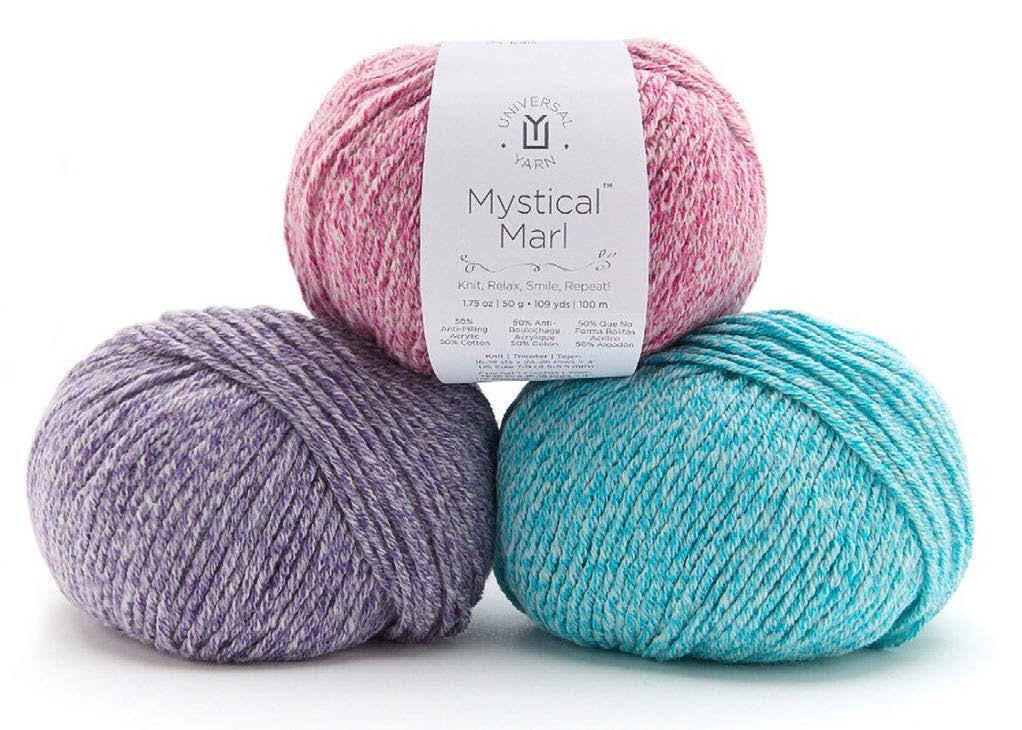
There are so many more lovely colors to explore in UY Mystical Marl.
Understanding color dominance in stranded colorwork knitting
I suspect many knitters know what stranded colorwork is, but a quick reminder - it’s where you work with two (or more) colors and strand them along the back of your knitted work, creating a very distinct Right Side and Wrong Side. That part is relatively simple (and there are oodles of excellent tutorials out there to help you with stranded colorwork, if you’re ever lost!) What’s not so simple is something called color dominance.
What is color dominance?
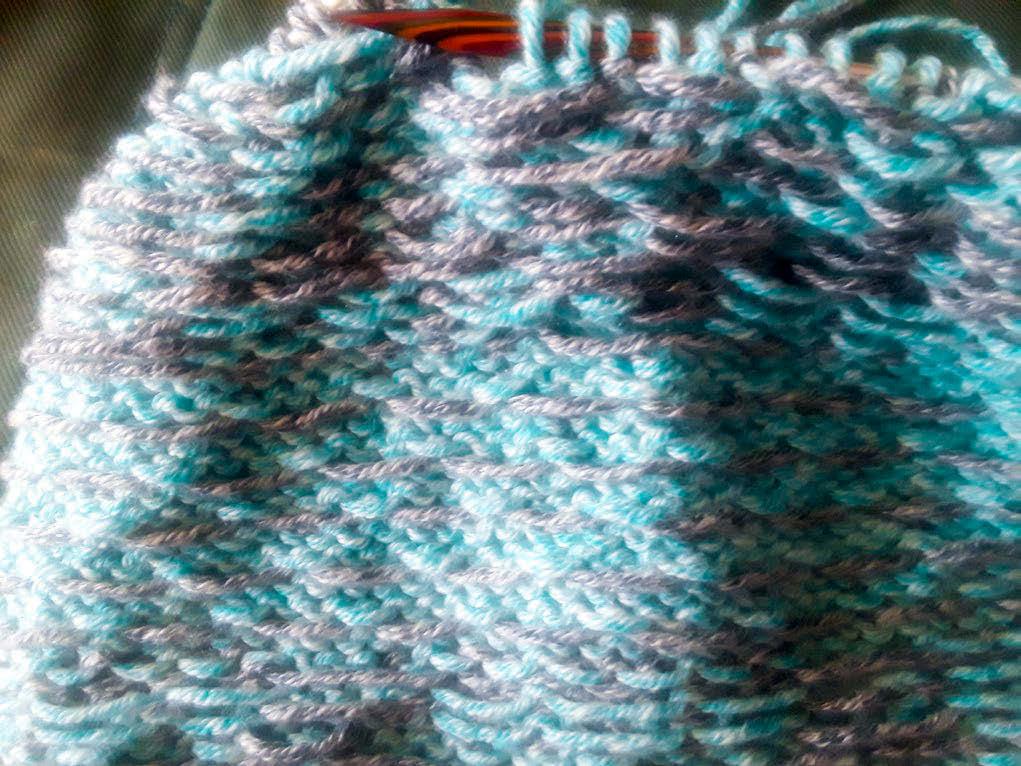
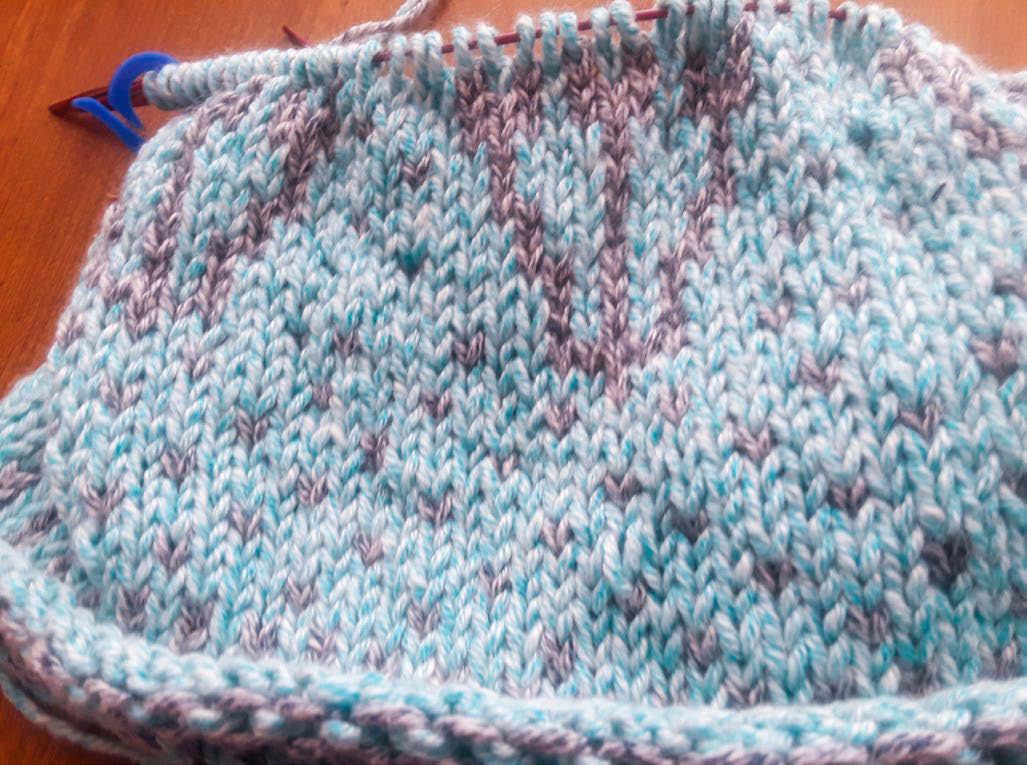
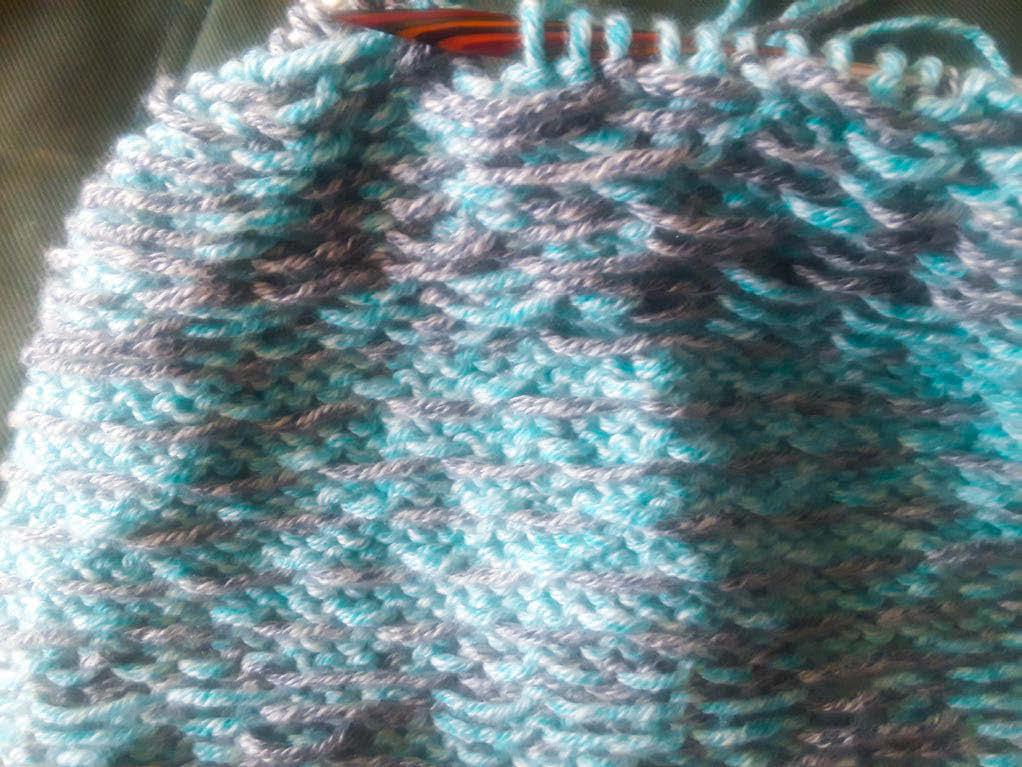
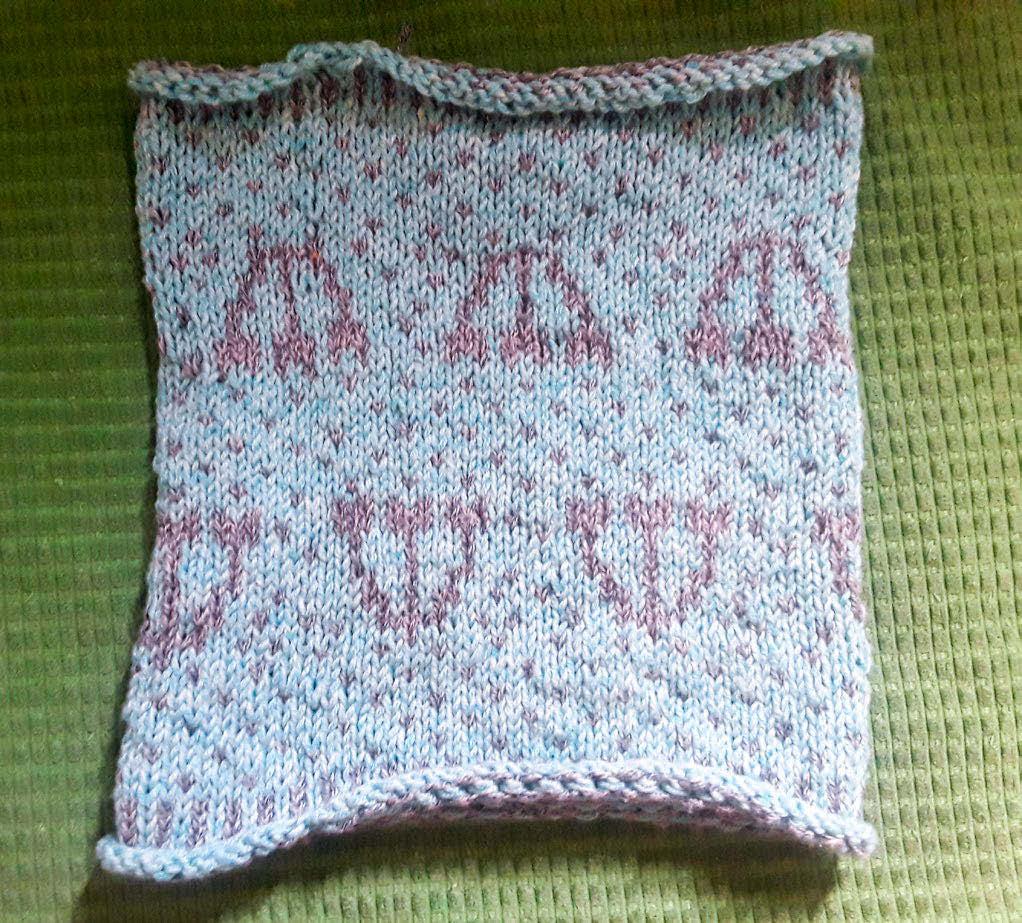
When you carry your yarns across the back of your colorwork knitting, you may notice that one yarn sits above the other (in the above picture, the best place to see this is in the vertical center - that’s where the speckles are on the Right Side of the work). This is color dominance. What it means in this case is that the Mystical Marl in Midnight sits below the Mystical Marl in Lagoon. This is important because Midnight is the foreground color, and I want it to stand out. In this example, the Lagoon - the background color - has to travel a little further since it has to go over the Midnight, so those stitches are very slightly tighter. If the reverse were true, the stitches in Midnight would be slightly smaller and thus seem to recede into the background.
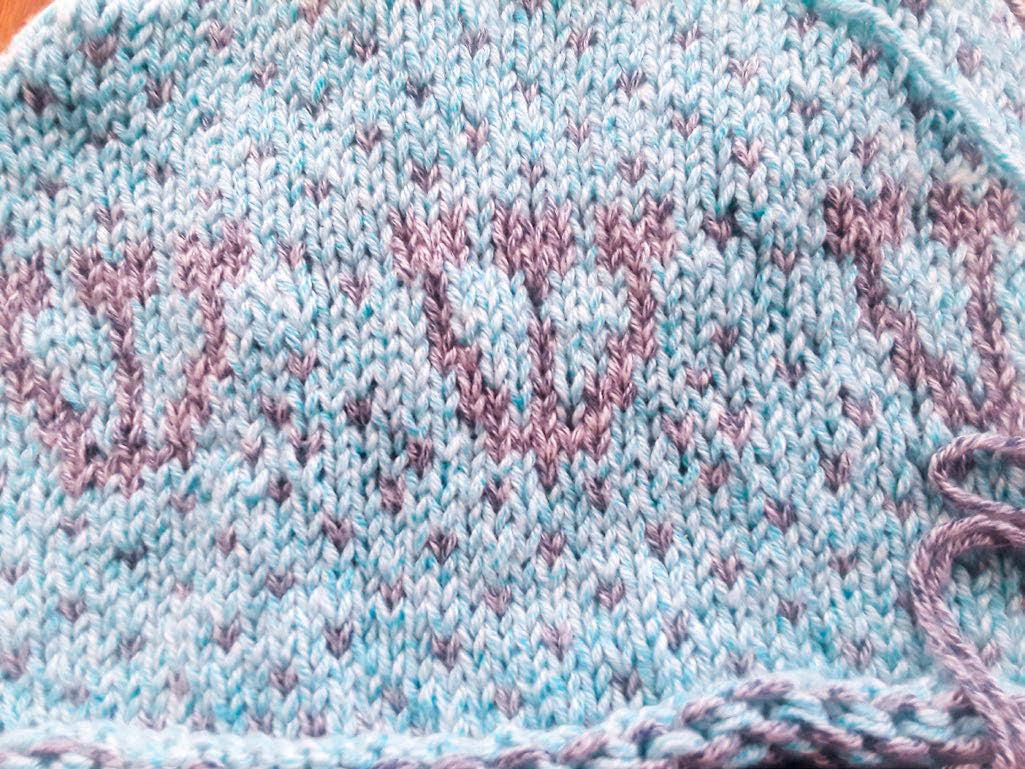
This is the tulip motif of the Holland Cowl with the Midnight held dominant, as I want it to be.
Color dominance means that your background color goes over your foreground color when you’re carrying the yarn on the wrong side of the work. See this in action using Mystical Marl Yarn!
Color dominance is so important in colorwork patterns like the Holland Cowl!
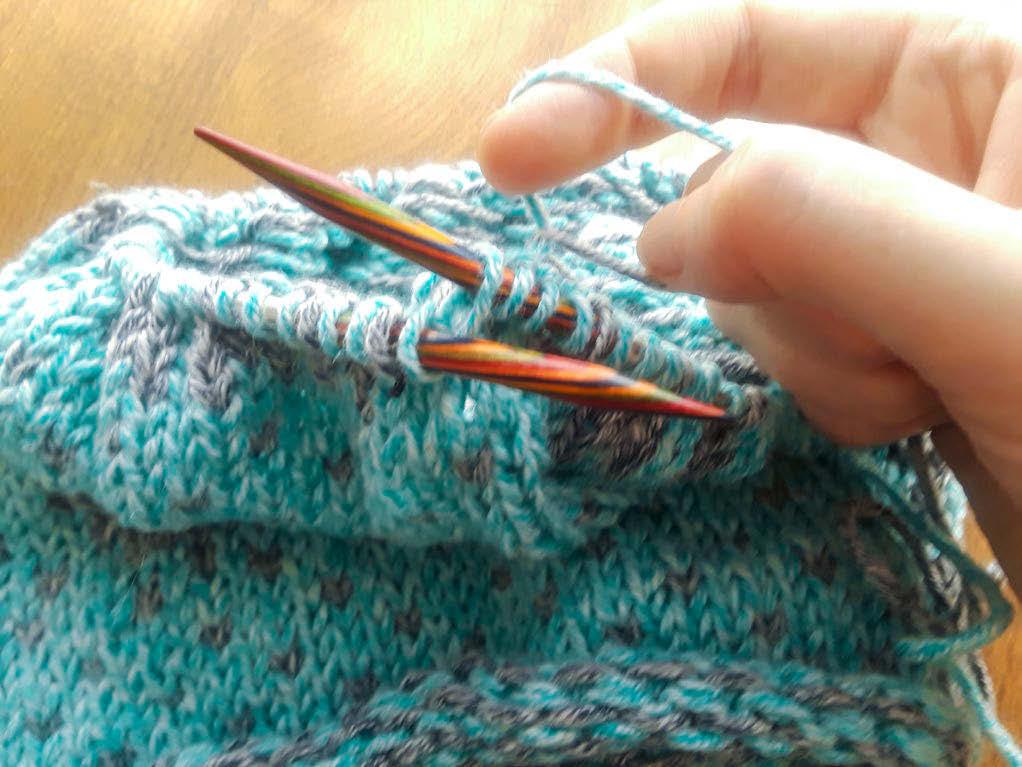
But, this is an alternate version of the tulip motif where I tested it out with the Mystical Marl in Lagoon held dominant. You may even be able to see where I switched dominance. The speckles at the bottom of the cowl, where I switched my color dominance, stand out more than the ones between the tulips for this example. The stems of the tulip motif appear thinner than those in the example above. It’s subtle, but it’s there, and it definitely matters!
Get your color dominance wrong, and it can drastically change the look of your finished project – for a more dramatic visual of this in action, check out this post from the Paper Tiger Blog – especially if you accidentally change dominance midproject.
But that’s not the only thing that can trip up stranded colorwork. How you strand your yarn behind your work can also cause all sorts of problems, especially if you have long stretches of only one colorand the Holland Cowl has a few examples of this. But don’t worry, that is an easy fix!
Color dominance is so vital in colorwork patterns like the Holland Cowl!
There are so many more lovely colors to explore in UY Mystical Marl.
How to catch floats in stranded knitting
First, what is a float? It’s the strand of yarn that’s carried across the wrong side of the work when you’re not working that color. Sounds simple enough, right? But you can’t carry a strand of yarn indefinitely. Three stitches, even five stitches? Usually, no problem. But 10 stitches, 20 stitches? You’ll just end up with a loose loop of yarn on the backside of your work, ready and waiting to snag on things - even a yarn as smooth as the Mystical Marl Yarn could easily catch on fingers or hair clips if your floats are too long. Leave your floats too long or too loose, and you’re in for a bad time with your knitting.
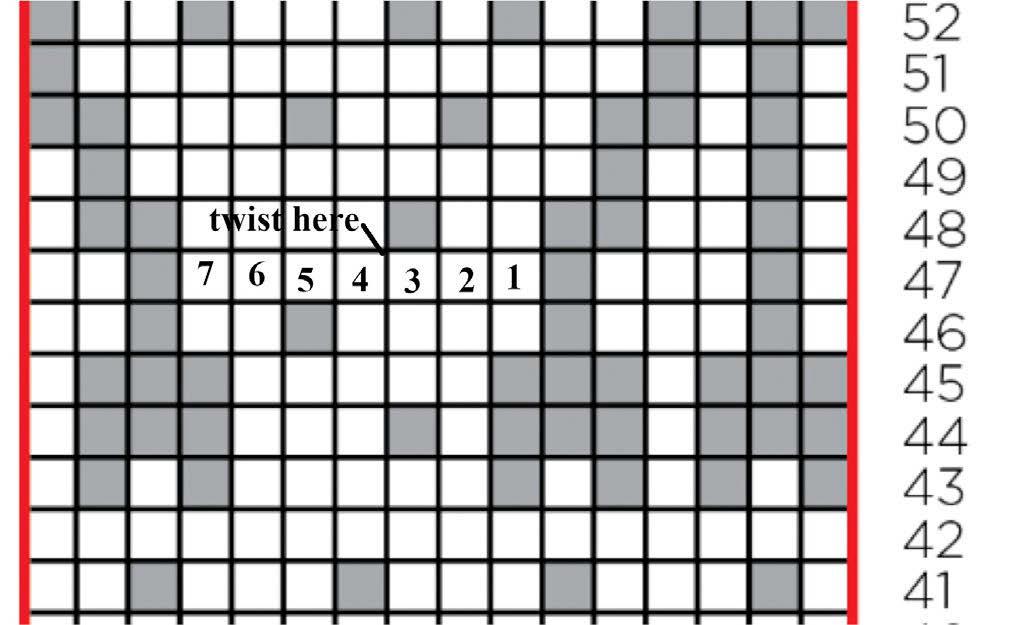
So what can you do? The answer is very simple: Knit 3 to 4 stitches, then twist your yarns together once, then keep knitting. The twist will lock the color you’re carrying in place. A good example of this is in row 47 of the Holland Cowl pattern
In row 47, we have a stretch of 7 stitches in Mystical Marl Yarn in Lagoon, that is, the background color of the pattern. The Holland Cowl pattern itself suggests catching your floats approximately every five stitches, but I prefer to aim between 3 and 4 stitches, depending on the size of the gap I’m facing.
So, somewhere in the middle of the gap is where you twist your yarn. This gives you a stretch of 3 stitches and a stretch of 4 stitches, both of which are perfectly reasonable!
You’ll use this technique on many rounds of the Holland Cowl pattern, and it’s the same each time. Work 3 to 5 stitches, twist your yarns together, and keep working with the same color of yarn.
What does this do? Well, it keeps the strands on the wrong side of the work from sagging all over the place. Not only does this mean there are no loops to snag on fingers, glasses, or hairpins, but it also means your tension will be neater, since there are no big loose loops at the back to throw it off. Don’t pull too hard while you’re twisting, though, or you can end up with puckering in your work since you’ve pulled your yarn too tight!
That said, getting perfect tension in stranded colorwork can be a bit of a trick. But there are a couple of tricks after the fact that can help if you spot a tension mishap in your finished object.
Taming your floats in stranded knitting is a useful skill when knitting the Holland Cowl!
Catching your floats in stranded knitting is super important! The Holland Cowl pattern is a great pattern to learn on!
Where do you catch your floats in stranded knitting? Here’s a look at the Holland Cowl pattern to help find out!
How to block the Holland Cowl in Mystical Marl acrylic yarn blend
Knit with UNIVERSAL YARN Mystical Marl, a soft and durable cotton-acrylic blend, this cowl holds its shape beautifully – but like most stockinetteheavy projects, it’s prone to curling at the edges. In this article, I’ll show you how to block an acrylic blend properly to reduce curl, even out tension, and give your cowl a polished finish that lasts.
What is blocking? Blocking is the final step in finishing your knitting - it’s basically stretching your knits out to help even out your tension across the entire finished object. It’s especially important in lace to take your lace from a crumpled mass to beautiful lacework. With the Holland Cowl, however, it’s something a little different.
In most cases, blocking is done by getting the object wet, either by steaming it or by immersing it in water. For anything knit in acrylic, or a majority acrylic blend like the Mystical Marl yarn, the process is a little different, however. If you take an acrylic yarn and try to wet-block it, it won’t work. Acrylic is basically a form of plastic, and doesn’t really care too much about getting wet.
For acrylic yarns, you need heat to block thembut too much heat and you’ll quite literally melt the acrylic! This is called ‘killing’ the acrylic, and, if done on purpose, can produce an incredibly beautiful and drapey fabric! It’s great for lace shawls, but that’s not what we’re doing.
So, how do you block acrylic?
There are three ways.
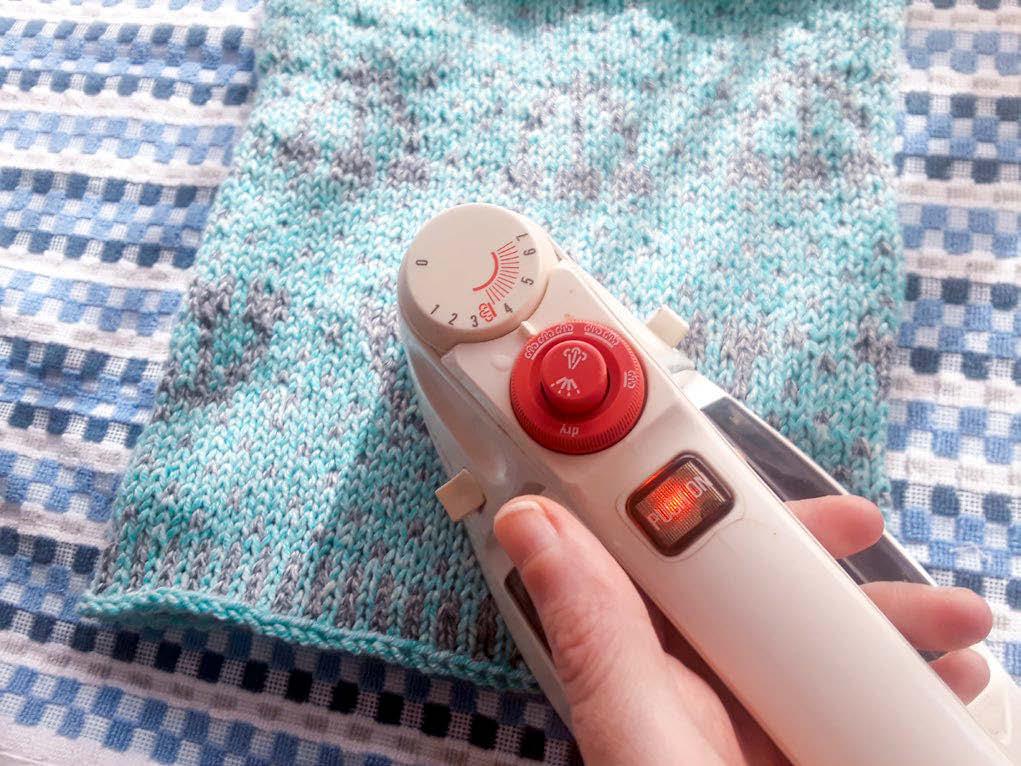
If you have a garment steamer, you can use that. I don’t own one, so onto the next option. You can block acrylic with a steam iron - make sure it’s at the lowest possible steam setting. If your iron has an ‘acrylic’ setting, even better! Get your finished knitwear damp, then give it a gentle press–or, for a highly textured pattern that you don’t want to squish, like cables, textured knits, and purls, hold the iron just above the surface of the knit.
For the Holland Cowl, since it had no textured stitches to worry about, I went and pressed it. Not only does that help with evening out any spots of tension weirdness, but pressing it also really helped with that pesky curl at the top and bottom!
The nice thing about blocking acrylic and acrylic blends is that once you’ve blocked it once, it’s done. You’ll never have to block it again. The downside of blocking acrylic and acrylic blends is that once you’ve done it, it’s done! So if you over-block your finished knit, you can’t undo it!
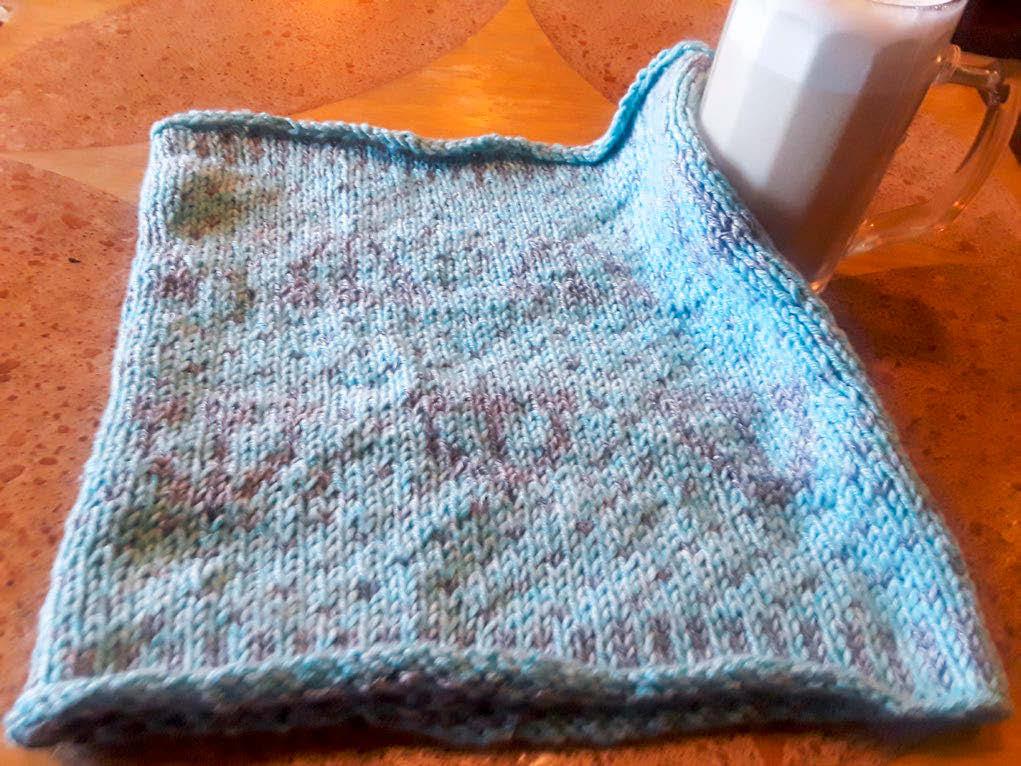
The Holland Cowl curls at the top and bottom because the stocking stitch, by nature, curls!
Start slowly, and always stay on the lowest heat possible. Don’t crank the heat to speed up the process - you can’t undo this! If you’re worried about too much heat, you can put a damp towel on top of your knit to help slow down the heat transfer, but this is one of those things where you want to err on the side of caution.
Blocking the cowl this way took me about 20 minutes, but it made the bottom and top edges so much neater! They do still curl a tiny bit, but that may be the pattern - or I may try and block it a bit more later - I have not yet decided!
After that? Now it’s done, and I’m really happy with the results. I took it out to a local coffee shop and got some compliments on it, so I definitely consider that a job well done! Plus, it’s already served me well during the recent cool fall nights. Despite my initial skepticism around the UNIVERSAL YARN Mystical Marl, I was absolutely disproven, and now I have a new favorite cowl! Until next time!
Sarah Dawn Adams sarahdawnsdesigns.com
The Holland Cowl is blocked, finished and ready to be worn!
Blocking the Holland Cowl with a steam iron, so that the Mystical Marl yarn is blocked and the top and bottom edges no longer curl!
Perfect proportion
Are you Short? Tall? Large? Small? Willowy? Solid? Long-waisted? Shortwaisted? Balanced? Busty? Hippy? Large waist? Small waist? Leggy? Shortlegged? Boney? Well-padded? The list is endless.
Accessory Shapes
Whichever descriptors you might use -- and none of us is a single thing-- they create the framework on which you will hang your clothes and accessories. Rather than trying to change your physical self, start by looking at yourself, accepting what is, and considering how to use garment shape to improve it. Usually, when we talk about fit, it is all about measurements, ease, and suitability. I want to start by looking at proportion and its partner, volume. These can be easily overlooked in the fit equation. This is a place to experiment, have some fun, consider what works, and over time develop what you find suits your shape, face, and dressing preferences. Note: Our eyes like what they know, so it will take some time to develop a new way of seeing Words to consider (definitions from Merriam-Webster, online):
proportion
(noun): harmonious relation of parts to each other or to the whole (verb): to adjust (a part or thing) in size relative to other parts or things balance
(noun): an aesthetically pleasing integration of elements (verb): to bring into harmony or proportion symmetry (noun): balanced proportions volume
(noun): the amount of space occupied by a three-dimensional object
I've created figure blocks using proportion (how they are divided horizontally) and volume (how much space they take up vertically). These are meant to illustrate what our first visual is when we see ourselves or someone else. We don't immediately get to the details.
The space taken up is shown as:
y shade: light, dark, monochrome (dark and light)
- light - relative to other colours
- dark - relative to other colours
- monochrome - a single shade (light or dark) that may be close but not match.
y horizontal division: top and bottom, divided by half, quarters, and fifths (proportion)
y ver tical: the shapes take up space differently (volume).
Not all figures may be shown in this article. A full PDF of the figures I’ve created may be downloaded here. The password is ANPT:P&V. Each set of figures shows three shapes, each split horizontally. They have a head but no limbs, so they only represent the space we are taking up. They are all the same height, but I have three sizes to illustrate the use of different proportion, volume, and shade.
There are also sets of figures with an accessory added to enhance the visuals. Shown here are several examples, but not all are available in the download.
How to balance fit, volume & style in your knits
Figure 1a is monochrome dark, and figure 1b is monochrome light: each body is split in half horizontally. The volume top and bottom are the same.
Figure 2a has a dark top, and Figure 2b has a light top: when horizontally split with the same volume, the shade is reversed.
Figures 3a and 3b show a shift in volume to the bottom, initially in dark, then light.
Your eye may observe some difference between how the shapes appear in the three figures. Clearly, the shade placement also plays a role in how our eye perceives volume and proportion. A look at figures 4a and 4b shows the volume moved to the top in monochrome dark and light. In 5a and 5b, the shades are different top to bottom, and in 6a and 6b, the volume is at the bottom with the shade moving.
The second set of figures adds a neckline accessory (or it could be a neckline), going through all the colour and volume shifts in figures 7a through 9b. These figures all have an accessory scaled to the figure size.
To see how the size of the accessory impacts the perception of the shapes, along with the shade and volume, I have figure sets (10a and 10b) with each figure wearing a small triangleshaped accessory. The small triangle is on figures 11a and 11b, showing the change in volume. Figures 12a and 12b show the medium-sized triangle on a larger volume top.
Diagrams by Jill Wolcott
Audit Your Outfit: Separates
Colour(s)
Balance (how is it dividing your body)
Fabrications
Sillhouette
Volume
Shoes / Boots
Audit Your Outfit: Dress / One Piece
Colour(s)
Balance (how is it dividing your body)
Fabrications
Sillhouette
Volume
Legs (bare, tights, patters)
Shoes / Boots
Audit Your Outfit: Layered
Balance (how is it dividing your body)
Fabrications
Sillhouette
Volume
Shoes / Boots
In figure 9, I have adjusted the size of the triangle to fit the shape, showing the body in monochrome. Figure 10 has the small-size accessory on each shape, followed by the middle size on each, and the large triangle on the three shapes in figure 12
Without changing fit, but rebalancing how you balance the top and bottom, and where you place the shade/colours can change how you appear to yourself and to others.
y Does the outfit cr y for a large or small accessory?
y Do you need to rebalance volume?
y What about shade?
y Could a French tuck or other styling trick shift the balance and give more shape to your silhouette?
There was an online photo recently showing an oversized top pulled in with a pin at the waist. A knot or twist can achieve the same effect when placed at the desired level, allowing you to adjust the volume as you wish.
Once you begin to apply volume, you will need to start thinking about ease. Ease is the space between the body and the garment. The fibre/fabric of the garment will impact whether it stands away from the body or folds against it. Think of an oversized mohair sweater and an oversized cabled sweater. Volume is created differently, but the fabric and ease have changed the volume in both.
You can adjust the volume, proportion, ease, and fit to meet your long-term needs, but experiencing the difference before altering the actual fit of a garment is informative.
Since you may find great combinations, I’ve created a form you can download (see below) to Audit Your Outfits. Make adjustments to it as you need. You can also Catalog Your Outfits by taking a selfie. Hold the phone in front of your face.
Similar changes in proportion and volume can be done with colour blocking, draping a shawl, or using dramatic jewelry. Accessories, as the French know, can be your best investment as they can be used with many outfits.
Only once you have discovered what you like, and what works for you, should you dive into tackling changing garments!
Fit isn't fair, but it can be accessible. I have more to say about each of these topics, and I would appreciate your input on what you would like to know and how I can assist you.
Categories of yarn, gauge ranges, and recommended needle and hook sizes
Yarn Weight Symbol & Category Names Type of Yarns
Knit Gauge Range* in Stockinette Stitch
Recommended Hook U.S. Size Range Steel*** 6, 7, 8 Regular hook B–1
* GUIDELINES ONLY: The above reflect the most commonly used gauges and needle or hook sizes for specific yarn categories. ** Lace weight yarns are usually knitted or crocheted on larger needles and hooks to create lacy, openwork patterns. Accordingly, a gauge range is difficult to determine. Always follow the gauge stated in your pattern. *** Steel crochet hooks are sized differently from regular hooks--the higher the number, the smaller the hook, which is the reverse of regular hook sizing. This Standards & Guidelines booklet and downloadable symbol artwork are available at: YarnStandards.com
* GUIDELINES ONLY: The above reflect the most commonly used gauges and needle or hook sizes for specific yarn categories.
** Lace weight yarns are usually knitted or crocheted on larger needles and hooks to create lacy, openwork patterns. Accordingly, a gauge range is difficult to determine. Always follow the gauge stated in your pattern.
Standard abbreviations & terms
alt = alternate
approx = approximately
beg = begin(ning)
BO= bind off
CC = contrast color
ch = chain
cm = centimetre(s)
cn = cable needle
co = cast on cont = continue, continuing
dc = double crochet
dec = decrease(s), decreasing dpn = double-pointed needle(s)
foll = following
g = gram(s)
hdc = half double crochet
inc = increase(s), increasing
in(s) = inch(es)
k = knit
kf&b or kfb = knit into front and back of st (increase)
ktbl = knit through the back loop
k2tog = knit 2 sts tog (right-leaning decrease)
k3tog = knit 3 sts together (double right-leaning decrease)
m = marker
m = meter(s)
m1 = Make 1 stitch: pick up the horizontal strand between 2 stitches from front to back and knit it tbl (lifted increase)
MC = main color
mm = millimetre(s)
oz = ounce(s)
p = purl
p2tog = purl 2 sts tog (decrease)
patt = pattern
pfb = purl into front and back of stitch (increase)
pm = place marker
psso = pass slipped stitch over
RS = right side
rem = remain(ing)
rep = repeat
rev = reverse
rnd = round
sc = single crochet
sl = slip
skp = slip one st, knit next st, pass slipped st over knit st (dec)
ssk = slip, slip, knit: slip 2 sts knitwise, 1 at a time, insert left-hand needle into front of both sts and knit them tog (left-leaning decrease)
* GUIDELINES ONLY: The above reflect the most commonly used gauges and needle or hook sizes for specific yarn categories. ** Lace weight yarns are usually knitted or crocheted on larger needles and hooks to create lacy, openwork patterns. Accordingly, a gauge range is difficult to determine. Always follow the gauge stated in your pattern. *** Steel crochet hooks are sized differently from regular hooks--the
*** Steel crochet hooks are sized differently from regular hooks--the higher the number, the smaller the hook, which is the reverse of regular hook sizing.
This Standards & Guidelines booklet and downloadable symbol artwork are available at: YarnStandards.com
sssk = slip next three stitches individually, knitwise. Insert tip of left needle from front to back into the fronts of these three stitches and knit them together (double left-leaning decrease)