“We went through the process of evaluating the traditional ERP solutions out there, and concluded that Quickbooks for our needs, was going to perfectly serve as the heart of our technology ecosystem.”
Discover how to scale your business with confidence. Download our Scaling Up eBook for practical strategies for managing growth, improving cash flow, and scaling your team.
Maxwell Gallop, Menatwork - Toronto
Promises
CCA
Building smart and strong
As we look ahead to 2026, one theme echoes across every conversation, report and jobsite walk-through - Canada’s construction industry is being pushed harder than at any point in recent memory. The pressure to build more, faster and smarter is unmistakable. Yet the opportunities in front of us are equally extraordinary, offering a rare chance to redefine how our sector delivers the infrastructure and communities Canadians rely on every day.
Across the country, civil and infrastructure construction continues to gain strength, supported by record investments. At the same time, technological adoption is accelerating and reshaping how work gets done on every type of project. And construction professionals are operating at the heart of this transformation, requiring adaptability to integrate new tools into their time-tested craft.
But the challenges confronting the industry are equally real and immediate. Labour shortages remain a defining constraint, placing strain on project schedules and forcing companies to rethink workforce strategies. Supply chains continue to evolve under global pressures. And digital tools, ranging from robotics and AI-assisted planning to advanced BIM, modularization and data-rich quality control, are no longer optional add-ons. They are becoming essential capabilities for maintaining productivity, safety and competitiveness.
www.on-sitemag.com
READER SERVICE
Print and digital subscription inquiries or changes, please contact Angelita Potal
Email: apotal@annexbusinessmedia.com
Tel: (416) 510-5113
Fax: (416) 510-6875
Mail: 111 Gordon Baker Road, Suite 400, Toronto, ON M2H 3R1
PUBLISHER | Peter Leonard (416) 510-6847 pleonard@on-sitemag.com
EDITOR | Sean Tarry (416) 410-0600 starry@on-sitemag.com
MEDIA DESIGNER | Alison Keba akeba@annexbusinessmedia.com
GROUP PUBLISHER | Danielle Labrie (226) 931-0375 dlabrie@annexbusinessmedia.com
ASSOCIATE PUBLISHER | David Skene (416) 510-6884 dskene@on-sitemag.com
ACCOUNT COORDINATOR | Kim Rossiter (416) 510-6794 krossiter@on-sitemag.com
AUDIENCE DEVELOPMENT MANAGER | Urszula Grzyb (416) 510-5180 ugrzyb@annexbusinessmedia.com
CEO | Scott Jamieson sjamieson@annexbusinessmedia.com
Established in 1957, On-Site is published by Annex Business Media 111 Gordon Baker Road, Suite 400, Toronto, ON M2H 3R1 Publications Mail Agreement No. 40065710
ISSN: 1910-118X (Print) ISSN 2371-8544 (Online)
Get the latest construction news!
Follow us on @OnSiteMag
Considering these factors, the year ahead promises both tests and breakthroughs for professionals operating within the Canadian construction industry - tests and breakthroughs that will require contractors and project teams to rethink old assumptions, build new capabilities and deepen collaboration across the construction ecosystem.
Those willing to innovate, diversify and invest in people, processes and technology will be positioned to seize the opportunities. The firms that adapt, embracing digital workflows, strengthening training programs and modernizing operations, will set the pace for the next era of construction.
So, as we quickly approach the end of 2025 and prepare to enter 2026, here’s to building what comes next - stronger, smarter and together.
Sean Tarry / Editor starry@on-sitemag.com
SUBSCRIPTION RATES Canada $50.49 CAD per year, United States $115.26 CAD per year, Other foreign $139.23 CAD, Single Copy Canada $13.50 CAD. On-Site is published 5 times per year except for occasional combined, expanded or premium issues, which count as two subscription issues. Occasionally, On-Site will mail information on behalf of industry-related groups whose products and services we believe may be of interest to you. If you prefer not to receive this information, please contact our circulation department in any of the four ways listed above.
Annex Business Media Privacy Officer privacy@annexbusinessmedia.com Tel: 800-668-2374
On-Site receives unsolicited materials (including letters to the editor, press releases, promotional items and images) from time to time. On-Site, its affiliates and assignees may use, reproduce, publish, re-publish, distribute, store and archive such unsolicited submissions in whole or in part in any form or medium whatsoever, without compensation of any sort.
DISCLAIMER This publication is for informational purposes only The content and “expert” advice presented are not intended as a substitute for informed professional engineering advice. You should not act on information contained in this publication without seeking specific advice from qualified engineering professionals.
MEMBER OF
“Wishing
you joy, peace, and prosperity this holiday season.”
INDUSTRY>NEWS
University of Windsor launches concrete-intensive, 3D-printed residence
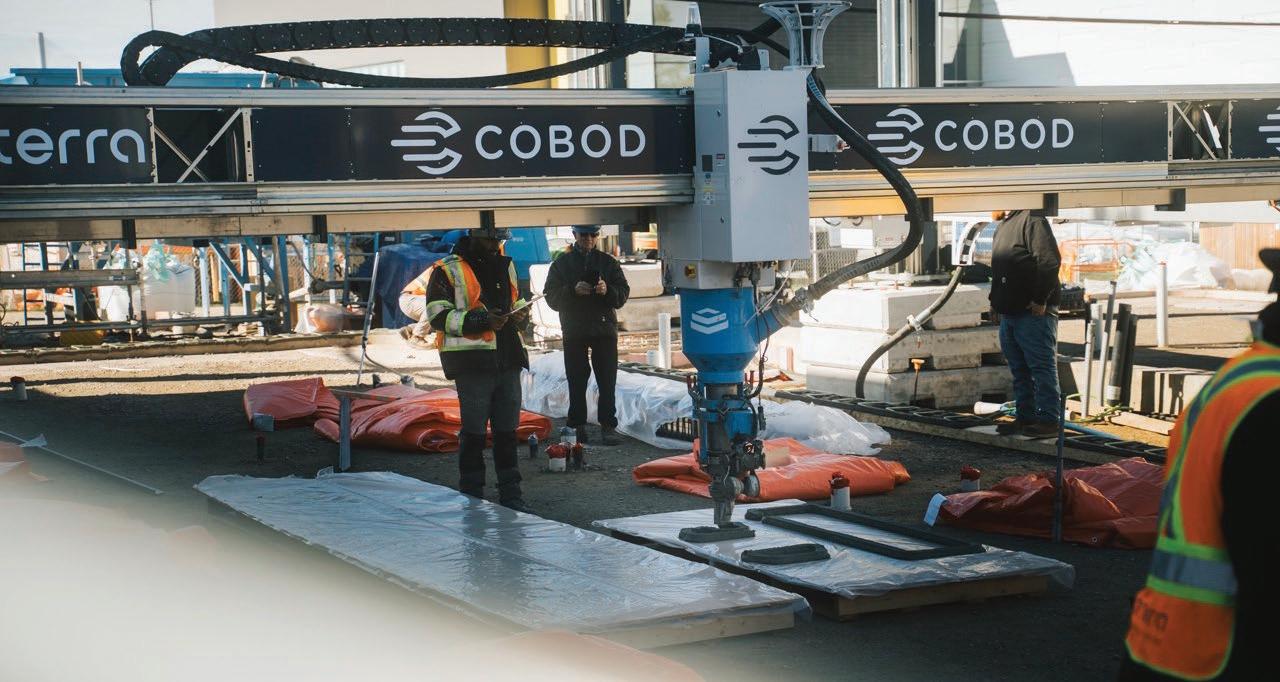
The University of Windsor has begun printing Canada’s first net-zero, multi-storey 3D-printed student residence - a project closely watched by builders exploring alternatives to conventional cast-in-place concrete for structural and envelope systems. Supported by a $2 million FedDev Ontario investment, the build is underway at 1025 California Ave., where a large-format gantry printer is depositing precision-formed concrete mix designs that have been engineered to perform under accelerated placement rates and a range of outdoor conditions. For contractors and material suppliers, the project offers a real-time demonstration of how additive manufacturing can complement traditional concrete construction for low-rise and mid-rise housing, infrastructure-adjacent buildings and future transpor-
tation sector facilities.
University president Dr. J.J. McMurtry said the initiative reinforces how government–industry–academic collaboration can expand the construction sector’s toolkit, noting that printed structural walls have the potential to lower material waste, reduce formwork requirements and shorten project schedules. Led by engineering professor Dr. Sreekanta Das, the research team is using the residence as a living lab to study mix rheology, interlayer bonding, curing behaviour and the long-term durability of printed elements - performance metrics that are becoming increasingly relevant for contractors evaluating 3D printing for road-adjacent service buildings, bridge-maintenance shelters and municipal operations facilities.
The seven-unit residence will also serve as a training hub for students entering construction, civil engineering and materials technology programs, offering exposure to additive manufacturing workflows that could eventually integrate with conventional ready-mix supply chains. Industry partners Desjardins Ontario Credit Union and Printerra Inc. are backing the initiative, with Desjardins contributing $250,000 and Printerra providing technology leadership aimed at scaling additive construction across Canada.
Federal Minister Evan Solomon said the project demonstrates how innovation can advance affordability and manufacturing efficiency, emphasizing Ottawa’s interest in concrete-based additive solutions as part of a broader housing and sustainability strategy.
Calgary inks five-year deal with Northstar, boosting recycled asphalt supply
Northstar Clean Technologies has secured a five-year contract with the City of Calgary to receive and reprocess all asphalt shingles collected at three municipal waste facilities, representing a move that significantly expands the region’s recycled asphalt feedstock for roadbuilding and non-commercial construction.
Beginning April 2026, shingles from Spy Hill, East Calgary and Shepard will be diverted to Northstar’s newly opened Empower Calgary facility, one of North America’s first commercial-scale shingle recovery operations.
Using its patented Bitumen Extraction & Separation Technology, the plant is able to process up to 80,000 tonnes annually
on a two-shift schedule, yielding recovered liquid asphalt, aggregate, fibre and limestone that can be reincorporated into hot-mix asphalt and other civil construction materials.
For contractors, the agreement signals growing municipal confidence in circular material streams that can reduce procurement volatility, cut lifecycle CO2 emissions and support higher recycled content in pavements, bridge approaches and utility structures.
Northstar says Calgary’s volume, combined with existing supply agreements with IKO Industries and Ecco Recycling, ensures more than enough feedstock to sustain 40,000 tonnes per year on a single shift. Company CEO Aidan Mills called the partnership a model for other municipalities seeking landfill diversion and cost-effective, lower-carbon materials for infrastructure delivery.
Workers operate a large-scale 3D printer on site as the University of Windsor begins construction on Canada’s first net-zero, multi-storey 3D-printed student residence.
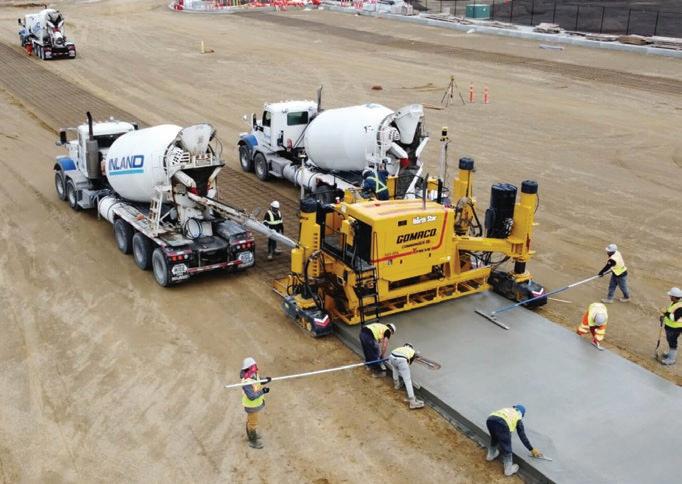
Paving the way for Northstar’s Empower Calgary facility.
Ontario’s SMR build at Darlington signals demand for concrete-intensive energy infrastructure
Ontario’s $1 billion commitment to build the G7’s first small modular reactors (SMRs) at Darlington is set to trigger years of concrete-heavy civil works as crews prepare foundations, intake and outflow structures, containment buildings and ancillary facilities essential to nuclear generation.
The province says construction of the four-unit SMR project, which began on the first unit in May 2025, will create 18,000 jobs and inject $38.5 billion into Canada’s GDP over the next 65 years, and is backed by an additional $2 billion through the Canada Growth Fund.
For contractors focused on transportation and public-sector infrastructure, the project signals a sustained pipeline of demand for structural concrete, nucle-
ar-grade cementitious materials, and mass-placement expertise similar to large hydro, bridge and dam works. Premier Doug Ford and federal officials framed the build as central to securing Ontario’s clean-energy capacity, with the 1,200-MW output expected to power 1.2 million homes.
The government has also ensured that 80 per cent of project spending flows to
Correction
Quebec data shows half of women leave construction within five years
New data from the Commission de la construction du Québec shows that 52 per cent of women leave the industry within five years of entering it, representing an attrition rate far higher than the 32 per cent recorded for men.
Although 7,885 women worked in Quebec construction in 2024 – an estimated four per cent of the workforce – retention remains the challenge, especially in trades critical to civil works, including carpentry, electrical and finishing roles that interface closely with forming, placement and curing operations on structural concrete jobs.
The province saw 1,594 female entrants in 2024, an increase over 2023 but still below earlier peaks. Industry leaders warn that without stronger retention strategies, which include addressing site culture, training access and career progression, labour shortages will continue to pressure project schedules and costs for non-commercial buildings, transportation assets and public works.
Ontario suppliers, reinforcing opportunities for local ready-mix producers, precast manufacturers and heavy civil firms. With Ontario also advancing new nuclear opportunities at Wesleyville and in partnership with Bruce Power, the SMR program is poised to anchor a decade of concrete-intensive energy construction across the province.
Within the September 2025 edition of On-Site magazine’s Top 40 Under 40 feature article, Mohammed Kamal (Kemoo) El Sayed was cited as Infrastructure United Inc.’s Co-Founder & Chief Executive Officer. He is, in fact, the company’s Senior Director, Transportation & Expansion.
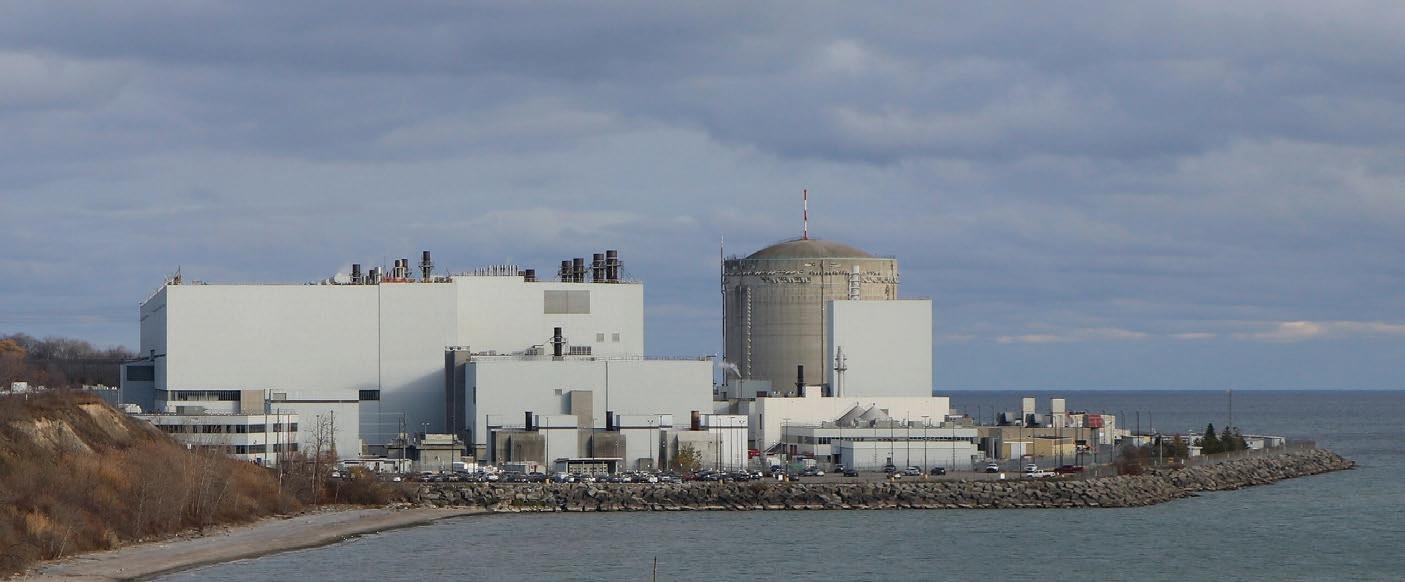
Darlington Nuclear Generating Station in Bowmanville, Ontario.
It was a logical choice with Acumatica we can communicate and integrate with other tools easily which is a big plus as we use tools like Procore, Excel, ProEst and Building Connected.
GLOBAL HEAVY EQUIPMENT MARKET CLIMBS TO US$222.5 BILLION
Global demand for heavy construction equipment continues to surge, with a new Research and Markets report showing revenues rising from US$209 billion in 2024 to US$222.5 billion in 2025 - momentum that directly affects contractors building Canada’s concrete roads, bridges and non-commercial structures.
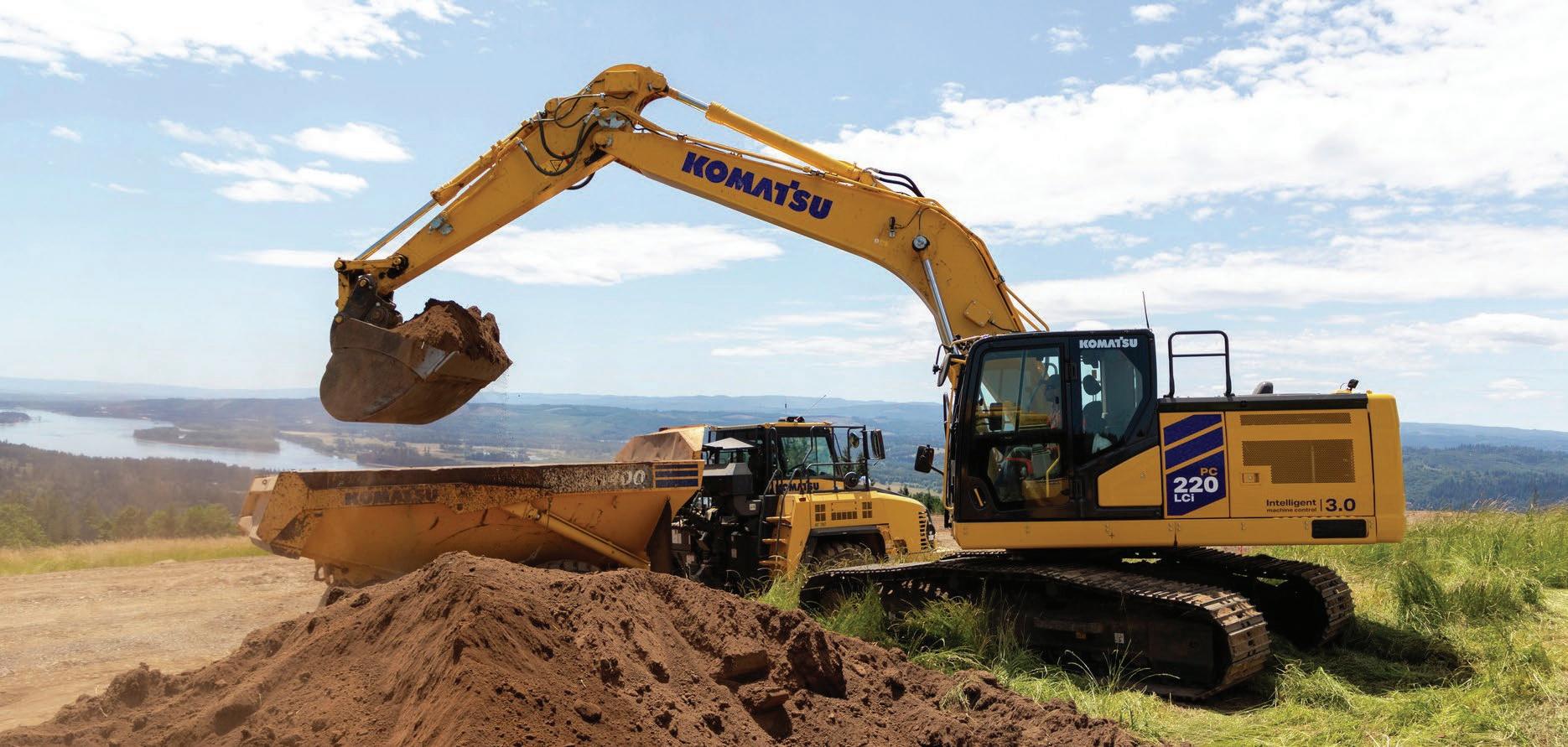
The report cites infrastructure spending, electrification and telematics-driven productivity as key growth drivers, especially for cement mixers, excavators, graders and cranes central to civil works.
For Canadian builders facing tight schedules and complex pours, advances in automation, predictive maintenance and zero-emission powertrains promise greater up-time and lower operating costs. Analysts warn, however, that U.S. tariff measures continue to reshape supply chains and may push equipment procurement costs higher
for fleets serving transportation and institutional projects.
With market value projected to reach US$357.57 billion by 2032, manufacturers are accelerating investment in digital integration and alternative-fuel platforms to meet regulatory and sustainability demands across concrete-intensive job sites.
Continued growth: (prices in billions) Market size 2025 US$222.5
KPMG REPORT SHOWS CANADIAN BUILDERS TURNING TO DIGITAL TOOLS
A recently released report developed by KPMG in collaboration with CCA finds that Canadian construction leaders are rapidly adopting digital tools in an effort to boost productivity on concrete-intensive work such as bridges, roads and public buildings, with 9 in 10 executives saying advanced technology is now essential to meet demand. Firms report gains from BIM, modularization and robotics - tools that help streamline concrete scheduling, reduce waste and tighten coordination on large pours. But leaders warn labour shortages and procurement barriers still threaten progress as workloads grow across national infrastructure programs.
Identified benefits of digital tools include:
• 90% say digital tools boost efficiency
• 87% say tech is needed to meet housing demand
• 81% report productivity gains from tech investments
• 78% see procurement shifting toward innovation
• 73% expect meeting demand will get harder in 5–10 years
GLOBAL CEMENT SECTOR REPORTS
MAJOR CO2 CUTS
GCCA recently released a report that shows the global cement industry has cut CO2 intensity by 25 per cent since 1990 - a shift that directly affects Canada’s concrete supply for roads, bridges and public buildings. With more than 60 decarbonization projects underway, from alternative fuels to CCUS, the sector says stronger government policies are urgently needed in order to accelerate progress and stabilize low-carbon material availability for infrastructure builders.
LEVERAGING MODULAR CONSTRUCTION IN HIGH-RISE PROJECTS
Accelerate delivery, reduce labour risk and improve efficiency.
BY ANTONIO MANCHISI, VICE PRESIDENT OF CONSTRUCTION AT
SAPPHIRE BALCONIES
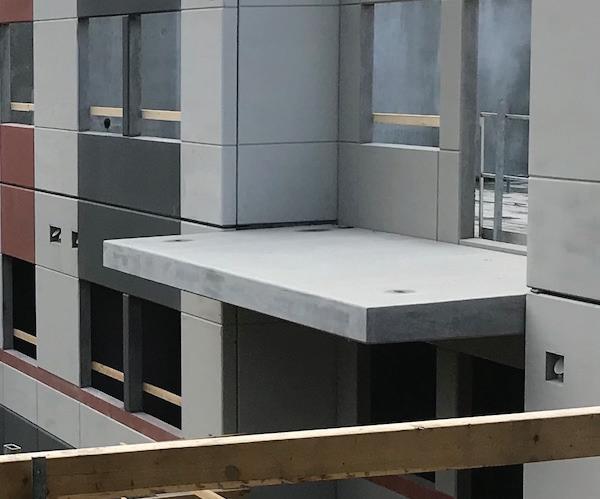
Modular construction is emerging as one of the most effective responses to Canada’s intensifying construction pressures. As demand for faster project delivery, tighter cost control and consistent quality continues to rise, general contractors are increasingly looking to offsite fabrication as a practical alternative to traditional methods. The model addresses many of the industry’s most persistent challenges, from labour shortages and unpredictable schedules to congested urban sites and rising safety risks. And with government investment accelerating adoption and technology improving precision, modular construction is no longer a niche strategy but a critical tool reshaping how complex buildings are delivered across the country.
OFFERING SOLUTIONS TO CHALLENGES
Offering clear advantages in speed, cost control, quality assurance and workforce safety, modular construction practices also enable more predictable delivery timelines, which is critical in a market grappling with labour shortages and supply chain volatility.
While modular isn’t new, its adoption is growing as urban expansion and the demand for efficiency push general
Factory-controlled production helps mitigate risk related to trade shortages, weather delays and fluctuating labour rates.
contractors (GCs) to rethink traditional methods. However, the shift is as much cultural as it is technological. It requires reimagining how projects are designed, procured and delivered. Nearly any build can incorporate modular techniques, whether through curtain walls, pod-style bathrooms or balconies. For GCs tackling complex builds, modular methodologies offer solutions to challenges that have become pervasive in traditional project delivery.
VALUE PROPOSITION OF MODULAR CONSTRUCTION FOR GENERAL CONTRACTORS
One of the most compelling arguments for modular construction is its ability to compress project schedules. Unlike traditional methods, modular allows offsite fabrication to occur simultaneously with early site work, such as excavation and foundations. This concurrency removes weeks, or even months, from the critical path. A GC can begin site work while much of the
building’s superstructure and fit-out are being fabricated in a factory. This parallel workflow means modules can then arrive ready for rapid installation as soon as the foundation is complete.
From a contractor’s perspective, this not only accelerates the client’s revenue streams, but also shortens exposure to variable site conditions, such as weather delays and trade scheduling conflicts.
Labour risk is one of the most significant challenges facing GCs over the next decade. By using modular fabrication, GCs can mitigate labour risks by engaging with manufacturing facilities that have stable, year-round workforces. This reduces dependency on last-minute trade procurement in overheated markets, where labour costs can spike unexpectedly.
Another advantage is reduced site congestion and improved safety. In 2023, Canada recorded 1,057 workplace fatalities. High-rise urban sites often face crowded jobsites and limited laydown space. Modular systems require fewer workers and materials on-site, simplifying logistics while reducing congestion and risk.
ADAPTING PROJECT MANAGEMENT AND SCHEDULING
Integrating modular construction requires general contractors to rethink design, procurement and project management. Early collaboration with consultants and suppliers, especially during design development, is essential to finalize modular-compatible designs. Components require front-loaded decision-making, with procurement schedules locked in far earlier than traditional methods.
Critical design choices that might normally be deferred until later must be made early, often before site mobilization. For GCs, this shifts risk from the end of the project to the beginning, requiring robust design coordination, earlier sign-offs, and greater emphasis on clash detection in BIM.
A key challenge in modular integration lies in defining the boundaries between modular suppliers and site trades, particularly for fire stopping, envelope tie-ins and MEP connections. GCs must actively manage interface risks and, when neces-
sary, create new scopes or subcontractor packages. When roles are clearly defined, disruptions are minimized, ensuring smoother execution.
Modular construction also demands a different approach to quality assurance. QA must be continuous, starting with the first production run. Staged inspections in the factory, supported by digital records and defect-tracking tools, ensure deficiencies are corrected before shipping, reducing costly on-site fixes.
The introduction of modular elements also shifts traditional construction processes. For instance, the delivery, craning and stacking of modules become high-risk milestones. Installation relies heavily on tower or mobile cranes, requiring updated lift plans and tightly coordinated logistics for just-in-time deliveries. Effective logistics planning is critical to avoid delays and ensure smooth execution.
COMMERCIAL AND CONTRACTUAL CONSIDERATIONS
Contractual obligations require special attention. In modular projects, late design changes can be far more expensive and disruptive than in traditional construction. To mitigate these risks, GCs should implement strict design freeze dates and robust change management protocols. Clearly defining the modular scope in contracts prevents scope creep and minimizes disputes.
Detailed contractual scoping can actually be a relationship-builder with modular suppliers and site trades, as it creates a transparent framework that supports collaboration rather than conflict. Interface matrices, milestone definitions and joint review workshops can make scope alignment an engaging and constructive process.
Equally important is thoroughly vetting modular suppliers with the same diligence as core trades. This includes evaluating factory capacity, QA programs, financial stability and logistics experience. Backup plans or phased procurement can further protect project continuity.
EXECUTION
Shifting to modular construction is more than an operational change - it’s a cultural
WHY MODULAR CONSTRUCTION MATTERS MORE THAN EVER
Modular construction is rapidly gaining traction across Canada as general contractors search for faster, safer and more predictable ways to deliver buildings. With Ottawa committing $25 billion to accelerate modular housing, the approach is poised to reshape how complex projects, especially concrete-intensive mid-rise housing, institutional buildings and public infrastructure, are planned and executed. By shifting work offsite, tightening coordination and reducing dependence on volatile labour markets, modular construction offers clear advantages for GCs navigating today’s schedule pressures and supply-chain constraints.
Key benefits of modular construction for general contractors
Compressed Schedules: Offsite fabrication runs in parallel with foundation work, shaving weeks or months off project timelines and reducing downtime on concrete-critical paths.
Greater Cost Certainty: Factory-controlled production reduces exposure to trade shortages, weather delays and fluctuating labour rates.
Improved Safety & Reduced Congestion: Fewer workers and materials on-site lower safety risks, which is critical on dense urban projects with limited laydown space.
Higher Quality Assurance: Rigorous, repeatable factory QA processes reduce rework and ensure modules arrive installation-ready with tighter tolerances.
Reduced Labour Risk: Year-round manufacturing workforces lessen reliance on scarce skilled trades and stabilize workforce planning.
Stronger Early Coordination: Modular requires earlier design lock-in, improving constructability, minimizing RFIs and supporting smoother concrete and MEP integration.
Enhanced Logistics Efficiency: Just-in-time delivery and streamlined craning operations create predictable sequencing and faster enclosure of the structure.
Reputational Advantage: Early adopters demonstrate innovation, win repeat clients and build strategic partnerships with fabricators and technology providers.
MODULAR CONSTRUCTION
transformation. Project managers and supervisors must be trained to oversee installation and manage interfaces. Appointing a dedicated Modular Integration Coordinator can streamline processes and ensure smoother workflows.
Establishing early design certainty reduces risk, accelerates decision-making and builds stronger trust with clients. Well-managed change control demonstrates leadership in protecting both schedule and budget – the two metrics that clients value most.
With modular construction’s tighter
tolerances, precision in survey control and base building alignment is critical. Contractors must also plan for follow-up trades and inspections immediately after installation to address unfinished components such as exterior cladding or corridor MEP connections.
THE ROAD AHEAD
What’s perhaps the most exciting thing about modular construction isn’t just the product - it’s the potential that it presents to transform the entire construction value chain. It forces earlier collaboration
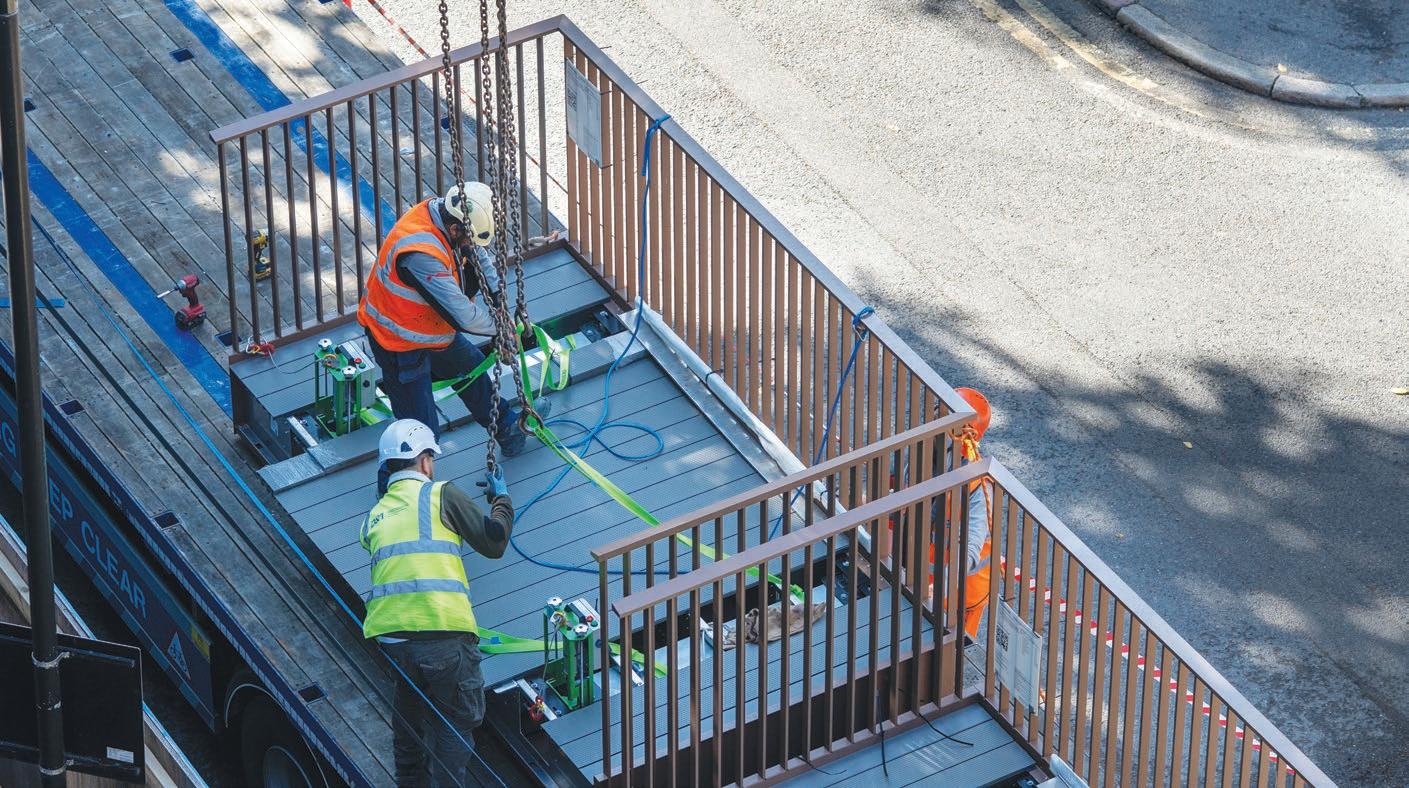
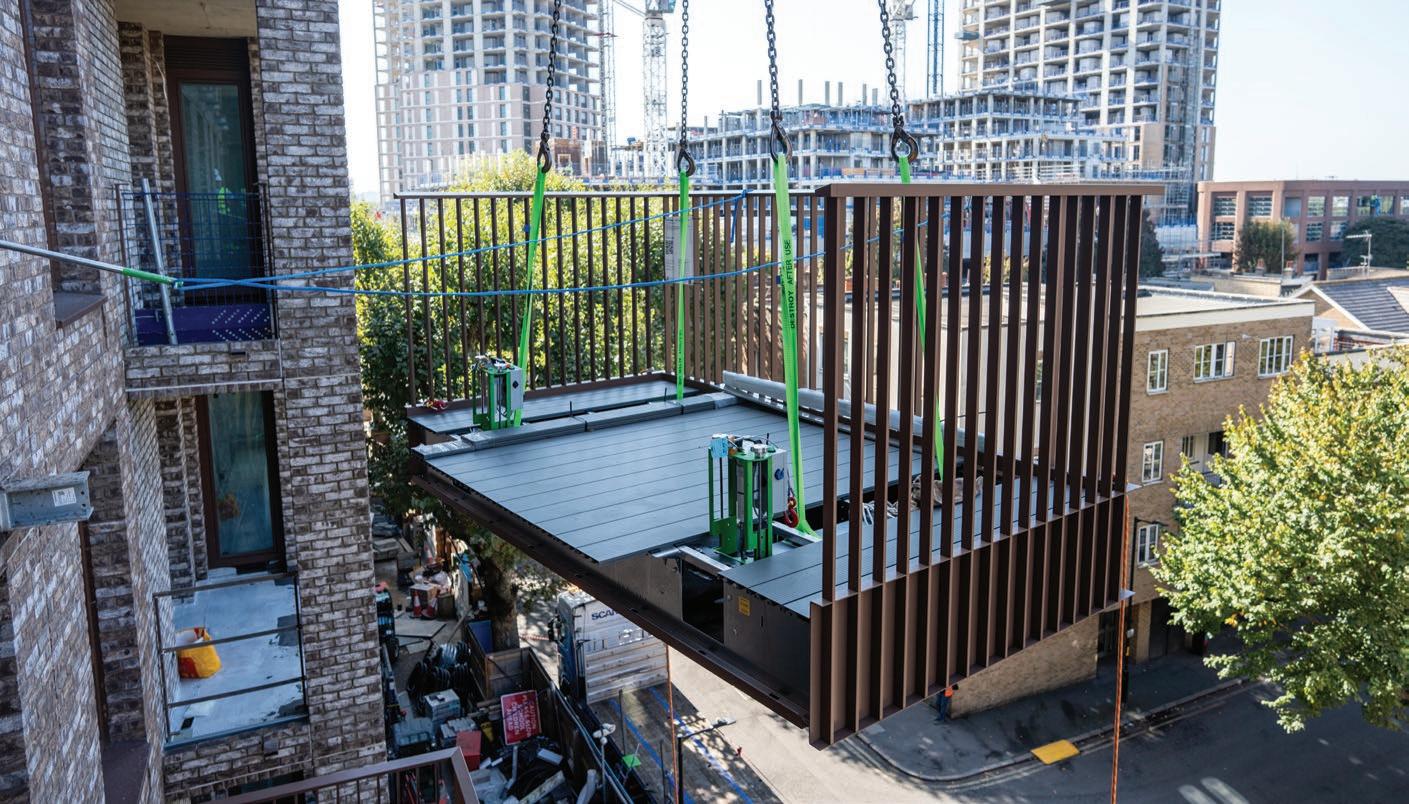
A modular approach to construction helps compress schedules, shrink project timelines and reduce downtime.
between designers, engineers, fabricators and contractors, leading to significantly smarter, more integrated solutions.
This collaboration can break down traditional siloes in the industry, allowing GCs to influence design for constructability, improve cost certainty and ensure logistics considerations are embedded from the outset. As a result, it transforms the contractor’s role from a late-stage problem-solver to an early-stage solution-maker.
Early adopters often gain reputational advantages as forward-thinking leaders.
Demonstrating successful modular delivery can secure repeat business, attract progressive clients and build strategic partnerships with fabricators and technology providers. This positions GCs not only to deliver projects more effectively today but also to shape the future standards of Canadian construction.
Building a Smarter Tomorrow, Together
Since its inception, Procore’s vision has been to improve the lives of everyone in construction. As we prepare to enter 2026, I feel immense optimism concerning Canada’s construction sector - optimism that’s rooted in the resilience, innovation and ownership our industry continues to show in both challenge and change.
Across Canada, we’re seeing momentum in heavy infrastructure builds, new nuclear and renewable projects and the growth of hyperscale data centre builds. Yet, this growth is currently constrained by persistent labour shortages, resource limitations and rising delivery complexity. The result is a collective imperative: we must grow by building smarter.
This shift is already underway. In Canada’s evolving construction landscape, technology is no longer a luxury; it has become essential for builders, owners and governments striving to meet increasing demand with a limited workforce. From modular construction to predictive analytics and AI, we’re seeing the digital transformation of construction accelerate, and with it, a renewed focus on productivity and safety.
At Procore, we’re encouraged by the long-term certainty created through major public investments in the infrastructure that connects and strengthens Canada. We see this commitment in projects like the Darlington New Nuclear Project in Ontario, the Alto High-Speed Rail connecting Quebec and Toronto and the Contrecœur Terminal Container Project in Quebec. Modernizing ports, transit, energy infrastructure and interprovincial trade corridors is key to unlocking the country’s economic potential. And their success increasingly depends on the effective use of technology.
There is a sense of cautious optimism across Canada’s construction industry, as 2026 will demand greater discipline, deeper collaboration and more sophisticated digital practices for builders and owners to achieve their goals. Procore is proud to work alongside Canadian construction leaders to deliver the digital infrastructure that unifies teams, data and workflows, empowering their organizations to innovate, adapt and lead.
On behalf of Procore, thank you to our partners across Canada for your continued trust and collaboration. Together, we can build a smarter, safer and more connected tomorrow.
Sincerely,
Nolan Frazier Head of Sales, Canada, Procore
Canada’s construction crossroads
Canada’s construction sector is set to undergo transformative change in 2026.
BY ON-SITE EDITORIAL STAFF
As Canada’s construction sector enters 2026, it stands at a pivotal moment when rising infrastructure demand, rapid technological adoption, generational labour turnover and macro-economic uncertainty converge. It’s a moment in time that represents more than another cyclical shift. For many firms, 2026 may be the year that determines who adapts and thrives, and who struggles to remain competitive in a market defined by accelerating change.
The fundamentals are unmistakable. BuildForce Canada’s latest national outlook
points to a tightening labour force that will continue to shape the industry’s trajectory into the foreseeable future. Over the next decade, Canada is expected to lose 270,000 experienced tradespeople to retirement, while total demand will require more than 380,000 new workers by 2034 to maintain the pace of construction. The labour force, currently hovering around 1.73 million with roughly 1.65 million actively employed, is already stretched thin, and the national unemployment rate of 4.6 per cent reflects a market in which demand for skilled workers continues to exceed supply.
CIVIL INFRASTRUCTURE THE DEFINING ENGINE OF 2026
While labour remains challenging, the activity outlook for 2026 is generally optimistic, particularly for civil and infrastructure work. Provincial data shows strong regional demand. In Ontario, BuildForce forecasts that the province will require roughly 154,100 new construction workers by 2034 to meet planned infrastructure and housing needs. And Alberta’s non-residential construction employment is projected to rise eight per cent above 2024 levels by 2026, even as the province prepares to replace more than 43,000 retiring workers. These figures align with what industry leaders see on the ground: momentum is building in public infrastructure, energy transition projects, hydroelectric upgrades, data centre development and large civil works.
Rod Elliott, District Manager for Civil Engineering at Trimble, describes a pipeline dominated by heavy power and digital infrastructure projects.
“We see a lot around power, power generation, data centres and hydroelectric,” he says. “That’s where we see the biggest growth. AI is a growing area too, and we’re getting deeper into autonomy. The biggest barrier is safety, but we’re making big advancements. One of the highest-growth areas is training on the tech. There’s huge demand for it.”
2026 set to be transformative year for Canadian construction industry.
For contractors - those supporting major road, bridge, water, energy and structural projects - this represents a significant opportunity. Civil work is increasingly complex, schedule-driven and technology-enabled, making accurate pouring, forming, layout, validation and quality control more important than ever.
TECHNOLOGY MOVES FROM SUPPORT TOOL TO CORE STRATEGY
The recently released report titled ‘Canadian construction: Doing more with less’, which was developed by KPMG in collaboration with the Canadian Construction Association (CCA), confirms that construction’s pivot toward technology has reached a tipping point. Among other things, the report reveals that ninety per cent of construction leaders now see tools such as AI, BIM, digital twins, analytics and automation as essential to increasing efficiency and closing labour gaps. Importantly, these investments are paying off. The report also notes that 81 per cent of respondents say recent tech investments have already boosted productivity, and a majority expect digital tools to become central to how they manage labour shortages in the years ahead.
In the concrete sector, this shift is serving to reshape how crews work. Robotic layout systems have replaced much of the manual survey work that has traditionallty dominated sites for decades. Automated rebar-tying tools are making high-density placements faster and safer. Digital pour tracking, concrete scanning and real-time QA/QC workflows are helping project teams avoid rework and compress schedules. And precast and modular concrete solutions, once considered niche, are gaining traction as builders seek predictable timelines that reduce labour intensity. In fact, according to Nolan Frazier, Sales Leader at Procore Technologies, the acceleration is no longer theoretical.
“We’re seeing steady growth across infrastructure, energy transition and digital infrastructure, delivering more capital than ever and doing it with fewer people,” he explains. “Contractors are trying to find any sort of operational leverage through things like technology, workflows and automation. Growth doesn’t just mean building more.
It’s about building smarter.”
on that note, Frazier expects an eight to ten per cent increase in project activity across key segments in 2026 but cautions that the benefits that are yielded may not be evenly distributed.
“There’s a tone of the haves and havenots,” he notes. “Larger players benefit from scale and diversification, while some smaller companies struggle if they don’t modernize or diversify.”
ECONOMIC UNCERTAINTY AND TRADE VOLATILITY
Beyond most other issues, the current global economic environment remains volatile and unpredictable. Interest rates have pushed many residential and commercial developers here at home to postpone or cancel projects altogether, resulting in the creation of a split market in which publicly funded infrastructure moves ahead while private-sector activity lags. Leor Margulies, Partner at Robins Appleby, warns that without decisive action by the Bank of Canada (BOC), significant portions of the market may continue to struggle.
“The BOC is finally waking up to the fact that the economy is in serious trouble,” he asserts. “The huge downturn in the new home market along with this real estate recession is even worse than the period between 1990 and 1995. The BOC needs to take dramatic steps to cut interest rates if there’s to be any hope of restarting the moribund new home construction industry or the impact will be severe.”
EQUIPMENT: A QUIET COST DRIVER
Contractors who rely on critical fleets of excavators, telehandlers, compaction equipment, pumps and finishing tools, are facing another subtle but important challenge in the way of fleet inflation and emissions-compliance costs. Darryl Cooper, President of Cooper Equipment Rentals, explains that as a result, rental rates have not kept pace with rising operating expenses.
“Equipment rental rates haven’t kept pace with inflation,” Cooper asserts. “New emissions-compliance standards have driven operating expenses up, while rental rates have remained relatively flat. In this environment, a dependable equipment
partner is more important than ever.”
He goes on to explain that a predictable and healthy public infrastructure pipeline is essential toward stabilizing Canada’s rental market, especially as the impacts of U.S. economic pressures continue to ripple northward.
A NEW ERA OF PROCUREMENT
One of the most transformative forces shaping 2026 may be procurement reform. For decades, the lowest-bid model has dominated Canadian construction, often at the expense of collaboration, innovation and risk sharing. But that system is showing its limits. Developers increasingly recognize that complex infrastructure projects require different delivery models that reward efficiency, enhance communication and leverage the expertise of contractors earlier in the design process.
This is especially relevant in heavy civil and concrete-intensive projects, where everything from formwork staging to pour sequencing to weather windows carries risk. Progressive design-build, construction management and integrated project delivery models allow contractors to influence constructability at earlier stages, improving both cost certainty and schedule performance.
A DEFINING YEAR FOR CANADIAN CONCRETE CONSTRUCTION
Viewed holistically, the signals are clear. Canada’s construction industry is heading into 2026 with a healthy mix of strong public-sector demand, transformative technological adoption and significant workforce pressures. For contractors, the path forward will favour those who adapt, embracing digital tools, investing in training, preparing for sustainability mandates and positioning themselves strategically within the booming civil and infrastructure markets.
Those who adapt will help build the next generation of Canada’s infrastructure - bridges, highways, power systems, water networks and resilient communities shaped, poured and reinforced through concrete. Those who lag behind will risk being outpaced in a market where efficiency, innovation and expertise will matter more than ever.
CANADIAN CONSTRUCTION:
DOING MORE WITH LESS
A new national study reveals that technology adoption is redefining how Canadian contractors confront rising demand.
BY SEAN TARRY
Canada’s construction sector is entering one of the most consequential periods in its history. With a federal “build” agenda directing more than $140 billion toward infrastructure and housing, the industry faces mounting pressure to deliver more, faster, despite labour shortages, rising material complexity and escalating project risk. That central theme framed a recent webinar hosted by On-Site Magazine, featuring Jordan Thomson, Managing Director in KPMG’s Global Infrastructure Advisory group, and Kenny Leon, Vice-President of Marketing Innovation and Industry Collaboration at the Canadian Construction Association (CCA). The discussion examined the findings of KPMG and CCA’s latest technology and digital maturity study and explored what it means for Canadian contractors today.
DIGITAL TRANSFORMATION
Thomson traced the study’s origins to the early stages of construction’s digital shift, which accelerated dramatically during the pandemic. While the sector has long lagged other industries in digital maturity, momentum is building. In 2019, spending focused on cybersecurity and ERP systems; today, investment has moved decisively toward “workforce technologies” that influence on-site execution. Prefabrication, modularization, AI, machine learning and robotics rank among the fastest-growing areas of interest.
Technology poised to play critical role in meeting increased construction demand.
More than 78 per cent of survey respondents report skilled labour shortages, and 70 per cent say workforce gaps limit their ability to bid and deliver work. With an estimated 380,000 additional workers needed by 2034, the industry cannot hire its way out of the challenge. Digital tools are helping contractors maintain productivity: automation reduces physical strain, BIM improves coordination and digital project management platforms optimize scheduling and documentation. According to the study, 86 per cent of firms report labour efficiency gains from digital tools, while 81 per cent see productivity improvements.
TARIFFS AND OTHER DISRUPTIONS
Tariffs and supply chain volatility continue to influence project planning. While concerns about a broader trade war have softened, steel and aluminum tariffs remain
an ongoing risk. Leon added that shifting tariff policies have increased costs by 3 to 15 per cent on some projects, forcing contractors to diversify suppliers and rethink procurement strategies.
Both speakers stressed the need for cultural change, particularly among small and mid-sized firms. Many construction technologies are no longer prohibitively expensive; robust project management and estimating platforms are now available “out of the box.” Thomson argued that organizations should focus on strengthening internal processes and data discipline rather than tailoring software to fit outdated workflows. AI may accelerate this transition by generating insights from unstructured data and allowing contractors to bypass traditional digital hurdles.
BUDGET 2025 AND THE ROAD AHEAD
The federal budget adds urgency with initiatives, including the Major Projects Office and the Department of Housing, Infrastructure and Communities, aimed at untangling approvals, coordinating stakeholders and scaling up national construction capacity. Investments in critical minerals, pipelines, trade infrastructure and municipal supports will generate extensive downstream demand for concrete and civil work. The challenge, Thomson noted, is not whether Canada should build, but whether the industry can evolve fast enough to meet national objectives. And Leon emphasized that funding alone cannot resolve the industry’s current labour constraint. The CCA continues to advocate for a long-term national infrastructure plan, modernized procurement and stronger workforce development strategies. Technology may lessen labour pressure, but it cannot replace skilled workers.
The discussion consluded by identifying the need for an ecosystem approach in which owners, contractors, engineers, suppliers and technology partners work toward best-for-project outcomes.
As Canada embarks on one of its most significant building eras in generations, it’s clear that the contractors who adapt will be among those that realize the opportunities for success and help shape the country’s future.
TOP 10 CANADIAN CONSTRUCTION TRENDS TO WATCH IN 2026
Canada’s construction sector enters 2026 amid labour shortages, trade uncertainty and rising innovation, setting the stage for transformative change across the industry.
BY RODRIGUE GILBERT, PRESIDENT, CANADIAN CONSTRUCTION ASSOCIATION
As we prepare to enter 2026, the Canadian construction industry is beginning a period of profound transition - one shaped by economic uncertainty, shifting trade dynamics and an urgent need for modern infrastructure. The past year exposed the pressures facing builders, from volatile supply chains and labour shortages to rising expectations for sustainability, innovation and digital integration. Yet 2025 also delivered key milestones: new federal initiatives, technological breakthroughs and a renewed focus on professional excellence, safety and workforce development. Together, these forces are redefining how projects are planned, procured and delivered, while challenging industry leaders to adapt rapidly to an evolving landscape. Here are the top 10 trends poised to shape the industry in 2026, and what they mean for builders nationwide.
1
RESILIENT INFRASTRUCTURE AND SUPPLY CHAINS
Canada’s construction sector is on the front lines of global trade volatility. From steel tariffs to material shortages, every disruption adds costs and delays to projects Canadians are counting on. As a result, building resilient infrastructure also means building resilient supply chains in order to ensure stable access to the essential materials and equipment needed to keep projects moving. Diversification, trade alignment and forward-looking procurement policies are critical to safeguarding delivery. Resilience is about planning for the unexpected. Whether it’s geopolitical instability, climate events or shifting trade rules, predictability matters. Governments must work with industry to strengthen supply chains, modernize procurement and reduce regulatory bottlenecks. When
supply chains are stable, Canada can deliver infrastructure that not only meets today’s needs but endures for generations.
2
CANADA-U.S. TRADE AND CUSMA RENEGOTIATIONS
It’s no surprise that the current state of Canada-United States (U.S.) trade and the renegotiation of the Canada-United States-Mexico Agreement (CUSMA) will be top of mind for our industry. 2025 brought significant challenges for our industry due to the uncertainty of Canada-U.S. trade, caused by President Donald Trump’s senseless tariffs and isolationist mentality.
As a result, Canada responded with targeted retaliatory tariffs on U.S. goods. But without a construction exemption under the United States Surtax Remission Order, our industry was hit hard. As an importing sector, construction bears the brunt of these trade disputes. In 2026, our industry hopes to see a return to complete free trade throughout North America. CCA has always advocated for open, free trade and will continue to do so. Our industry depends on it.
3
LABOUR SHORTAGES: BOLD GOVERNMENT ACTIONS ARE STILL NEEDED
In our 2025 submission to the government’s consultations on the federal budget, we sounded the alarm, yet again, on the construction workforce shortage. Canada’s construction industry is projected to face a shortfall of 108,000 workers over the next decade, with 21 per cent of the current workforce set to retire. It’s time for bold action. We need targeted efforts from the federal government to help correct those shortages and attract new workers into the skilled workforce. And it’s also time for industry stakeholders and government to work together to find better solutions to promote careers in construction. We all need to work together to inspire and incentivize new generations of workers to join the Canadian construction industry and reform our federal immigration policies so that immigrants and temporary foreign workers can help to alleviate retirements and address skills shortages.
CONSTRUCTION EXCELLENCE
4
In 2025, our team achieved several exciting milestones in our promotion of professional excellence in construction. Our Gold Seal Certification team launched their new portal to make it easier for more professionals to become Gold Seal certified. And our Best Practices Services team organized the first-ever Best Practices in Construction Symposium which was attended by many of construction’s operational leaders. We believe that professional excellence will, and ought to, be a priority for construction professionals in 2026. These excellence programs are a great way for professionals to distinguish themselves and demonstrate a commitment to professional development and standards of excellence.
5
HOUSING ACCELERATION AND HOUSING-ENABLING INFRASTRUCTURE
Canada’s housing crisis remains a defining challenge for Canada in 2026. Hitting ambitious housing targets isn’t just about building more homes - it’s about delivering the enabling infrastructure that makes
communities livable: roads, transit, utilities, schools and health facilities. Without these supports, housing supply cannot keep pace with population growth or meet the needs of Canadians. The construction sector is ready to deliver, but success depends on removing bottlenecks and aligning investment. Governments must streamline approvals, commit to predictable funding and partner with builders early in the process to ensure housing projects are supported by the infrastructure that sustains them. Done right, housing acceleration is nation-building in its purest form, laying the foundations for thriving communities across the country.
6
MAJOR PROJECTS OFFICE TAKES SHAPE
Announced in September, Prime Minister Mark Carney’s Major Projects Office (MPO) is something that the entire construction industry is closely watching. We were encouraged to see the federal government’s prioritization of “shovel-worthy” projects, not just shovel-ready projects. In our industry, there’s no shortage of potential projects. The real value lies in carefully selecting those that will deliver the
greatest economic impact, especially in light of recent global trade disruptions. The MPO is a major win for the Canadian Construction Association (CCA), which has long advocated for the Canadian Trade Infrastructure Plan (CTIP) - a long-term strategy aimed at driving the next generation of economic growth in Canada through investment in road, rail, air, port and marine assets. The prioritization of several trade infrastructure projects by the MPO is a step in the right direction towards that reality.
7
INNOVATION IN CONSTRUCTION: FROM TOP TO BOTTOM
Technology and innovation are hot topics for Canada’s construction industry. In June, our team released a report with KPMG, which noted that 9 in 10 construction leaders say digital tools are needed to boost productivity to build more, faster. The fact is that technology doesn’t take away jobs - it helps workers operate at a higher level of efficiency, productivity and safety. Many construction companies are already seeing the benefits of leveraging new and emerging technologies, and this is definitely something we will be watching in 2026.
Delivering the infrastructure that enables liveable communities will be key.
8
THE GREEN IMPERATIVE
Canada’s path to net zero runs directly through construction. From low-carbon materials like mass timber to energy-efficient building systems and carbon capture integration, the industry is advancing solutions that reduce emissions while delivering the infrastructure Canadians need. The green imperative isn’t a trend - it’s now a baseline expectation for how we design, build and operate. But ambition requires alignment.
Builders are ready to innovate, yet success depends on supportive policy, consistent standards and investment in research and new technologies. With the right partnerships, Canada’s construction sector can help achieve climate goals while strengthening communities and ensuring our infrastructure stands the test of time.
innovation. By putting data at the core of how we build, Canada’s construction industry can deliver smarter, safer and more sustainable infrastructure - laying not just foundations, but foresight.
10
PUBLIC PROCUREMENT OVERHAUL
MACK / CONSTRUCTION / ON-SITE CANADA—DEC 2025
9
DATA-DRIVEN DECISION-MAKING
Client: Mack
Project: Q4 2025 Advertising
Date Modified: November 11, 2025
Data is becoming as essential to construction as concrete and steel. From
Date Due: November 11, 2025
predictive analytics and digital twins to real-time site monitoring, data-driven tools are improving safety, boosting productivity and helping projects stay on time and on budget. These technologies allow decision-makers to see risks before they materialize and optimize how resources are deployed across projects of every scale. But technology is only as powerful as the policies that support its adoption. Governments and owners must embrace data transparency, set consistent standards and create procurement models that reward
Trim: 4.6875″ x 4.75″
Live: 4.6875″ x 4.75″
Bleed: none
The Office of Experience – 125 S. Wacker Drive, Suite 3000 – Chicago, IL 60606
Mack Granite® delivers the unstoppable comfort and legendary durability that keeps your operations moving forward.
The way Canada procures infrastructure is as important as the projects themselves. Outdated lowest-bid models too often lead to cost overruns, delays and adversarial relationships that undermine value for taxpayers. A modern procurement approach means focusing on value, not just price. Collaborative delivery models, fair risk-sharing and contracts that reward innovation will enable projects to be built right the first time. By overhauling public procurement, governments can unlock efficiency, strengthen industry partnerships and deliver infrastructure that truly serves Canadians for the long term. In 2026, procurement reform is no longer optional - it is central to ensuring that ambitious infrastructure plans succeed.
With 2026 just around the corner, Canada’s construction industry stands at an important juncture - facing real pressures but also unprecedented opportunities to lead national progress. The trends shaping the year ahead demand collaboration, adaptability and a renewed commitment to innovation and excellence. Whether strengthening supply chains, modernizing procurement or embracing technology and sustainability, the choices made now will define the sector’s future resilience. By working together, industry and government can build an environment where construction thrives - supporting economic growth, enabling housing and infrastructure delivery and ensuring Canada is prepared for the challenges and possibilities in the decade ahead.
Rodrigue Gilbert is the President of the Canadian Construction Association, the national voice for Canada’s construction industry, representing more than 18,000 member firms in an integrated structure of 57 local and provincial construction associations.
LEARN MORE
Ensuring resilient supply chains will be a focus in 2026.
Unravelling the labour data puzzle
Managing labour, which can represent as much as 60 per cent of the cost of a large infrastructure project, presents perhaps construction’s greatest data management challenge. The technology is improving, but the problem will not be solved overnight.
Major construction projects are among the most complex commitments a business can undertake. With that comes enormous exposure to risk that is spread out in small increments, making trouble spots difficult to identify, let alone control.
Perhaps the most prominent source of complexity is the presence on the jobsite of significant numbers of subcontracted trade workers. Even the basics of getting everybody paid represent a significant task.
“Tracking the time of tradespeople who are paid by the hour is an everyday challenge,” says Thomas Strong, Senior Vice President, Construction Technology and Innovation at NFP - a Toronto-based insurance brokerage firm. “But some of the added complexity involved is that workers are in unions with various jurisdictions and different rates and requirements. And all that has to be connected with change management so that when workers are being directed to work on something that is classified as a change, that can be broken out and tracked.”
Compliance requirements add another layer of complexity.
“General contractors are often the Prime Contractor on site, which carries significant OH&S responsibility,” says Steve Grue, Vice President Health, Safety and Environment, EllisDon. “The tracking of people is important for emergency response, statistics, training and competency - just to name a few! Multiple subcontractors on site, some short-term and some long-term, often with high turnover is a challenge just on volume alone.”
ACHIEVING CONSISTENCY
What’s emerging from all of this is a larger data ecosystem.
“You’re using software to track your time, but it’s also interconnected with a bunch of other data sources, such as geofencing and access control,” says Strong. “So, this is essential not only to payroll, but also site security, safety and productivity tracking.”
The key is to avoid siloed data.
“At EllisDon, consistency across platforms is achieved through a unified data strategy and a strong emphasis on interoperability,” says Brandon Milner, Senior Vice President, CIO, EllisDon. “We’ve invested heavily in modernizing our data infrastructure to ensure that systems - whether for safety, scheduling or payroll - can communicate seamlessly.”
However, the task in creating such cohesiveness among data is often extremely difficult when stakeholders are using different data systems.
“Subcontractors each use their own software, and some don’t use software at all,” says Grue. “It’s difficult to consolidate all of the data or audit it as a Prime Contractor.”
A COLLABORATIVE APPROACH TOWARD ACHIEVING COMMON OBJECTIVES
One trend that promises to make this easier is the growing adoption of the Alliance Project approach, in which designers, engineers and construction teams are contractually mandated to work together towards common objectives. The largest Canadian project to date using this approach is the Union Station Enhancement Project (USEP) in Toronto.
“It’s no longer ‘It’s your contract and you have to deal with it,’” says Arta Momtazi, Co-Founder of Canadian construction software firm BenchMarx. “It’s ‘These are our guides. We’re all on the same team here. I want to see you being productive, and there’s a joint incentive to ensure that everyone not only finishes on time, but also within budget.’”
BenchMarx, which is software that’s widely used on the USEP project, consists of a cloud-based time and material (T&M) platform. Its core workflow revolves around a mobile field app that allows project managers, supervisors and workers to capture project data in real time. The program integrates with standard payroll, accounting and ERP systems, creating a single platform for managing areas such as change-order workflows, equipment utilization, budget tracking and productivity management.
“We’re a really simple and easy-to-use system that the general contractor is able to leverage to enforce the conditions of the contract,” says Momtazi, noting that in his previous life as a project manager, he spent many hours each week dealing with multipart paper forms.
DIGITALLY EVOLVING
One of the biggest advantages of mobile reporting systems is that they match the expectations of younger workers who grew up in a digital world.
“The younger workers that are coming into construction don’t want to fill out a paper form – they just want to have something on their phone that works,” says Strong.
They also expect to have access to key information about the project as it pertains to them, says Strong.
“I think giving the worker on the jobsite as much information as possible about what they’re supposed to be doing, and how their work contributes to the overall objective, makes them feel connected with the project, and gives them motivation to be as productive as they can be.”
Jacob Stoller is Principal of StollerStrategies. Send comments to editor@on-sitemag.com
Aktion Associates is a leading North American Value-Added Reseller (VAR) and trusted technology partner. We help construction businesses modernize their operations with ERP, managed IT services, and secure cloud hosting. With decades of experience in the construction industry, we deliver solutions that reduce delays, improve forecasting, and connect field to office.
BUILD ON DEMAND SKILLS.
SHAPE THE FUTURE OF CONSTRUCTION.
Designed for you
Join Canada’s green buildings transformation.
The construction landscape is evolving rapidly, and with it comes exciting opportunities for skilled tradespeople. The Canadian Colleges for a Resilient Recovery (C2R2), a coalition of 15 accredited colleges, is partnering with 13 of its members to deliver national training programs that equip you for in-demand roles in green construction and low-carbon retrofits.
Why short-cycle offerings matter for you.
Short-cycle training programs provide you with the opportunity to explore job-ready skills and specialized knowledge in weeks, not years It helps you stay competitive and ready for what’s next in a rapidly changing economy. Offering training through Quick Train Canada, C2R2 members deliver opportunities developed in collaboration with industry experts who know the skills that matter most.
The nationwide green building skills training initiative, Advancing Access and Skills Training for Green Buildings and Retrofits, is supported by an $11.3 million investment from the Government of Canada’s Sectoral Workforce Solutions Program (SWSP). This project will provide 5,400 learners across Canada with access to short, partly-funded training aligned with in-demand areas such as HVAC, carpentry, GIS, clean construction, project management, and more. That means you’ll be learning the skills that help you thrive today—and tomorrow.
Whether you are a mid-career worker looking to upskill, or stepping into a new role in construction, this partly-funded training is built with you in mind:
• Delivered by accredited colleges across Canada, offering industry-informed learning.
• Formatted to be accessible, with online, hybrid, or in-person learning options.
• Designed to build practical skills in weeks, not years.
Power Your Career with Green Skills
You’ll gain real-world, employer-driven skills in green building practices, including energy-efficient systems, retrofit techniques, and emerging low-carbon technologies. When you complete your training, you will have skills employers are actively looking for.
Build Your Future in Green Buildings and Retorts
Now’s the time to take action. As Canada moves toward a more sustainable construction industry, skilled tradespeople with green expertise are leading the way. Strengthen your skills today and future-proof your career.
Visit QuickTrainCanada.ca or scan below and begin exploring the next step of your career today!
SOLVING THE SAFETY RISKS OF GAS AND CORDS ON THE JOBSITE
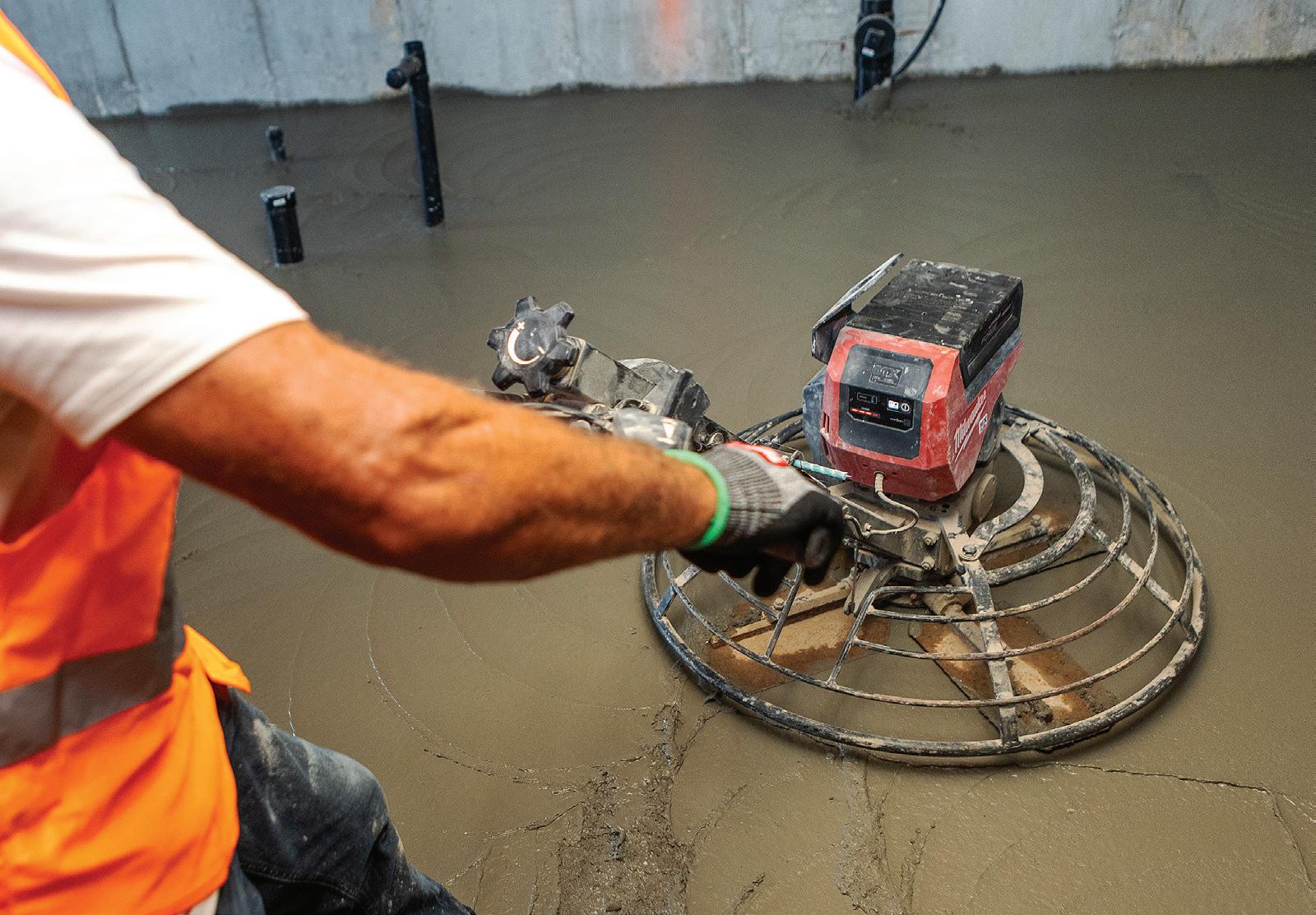
HOW MILWAUKEE TOOL HELPED BASECRETE GO CORDLESS
When Basecrete first launched in 1998, the Toronto-based company focused on serving the concrete drain market. As the business grew, so did the company’s ambitions. In 2012, Basecrete expanded into low-rise concrete forming. With both divisions experiencing steady growth over the following years, the company expanded again in 2023 adding excavation services to its portfolio.
“The reason we did that is because the three are combined on site and builders like having one company overseeing all three aspects of this part of residential construction,” explains Tony Smeriglio, president of Basecrete Inc.
Facing Health and Safety Challenges Head-On
The company performs a great deal of concrete forming work for basements and other underground walls and floors, primarily for residential, commercial, and industrial construction contractors. While the growth of the business has been substantial, it hasn’t come without its challenges. One of those challenges is ensuring all occupational health and safety measures are meeting Ministry of Labour requirements.
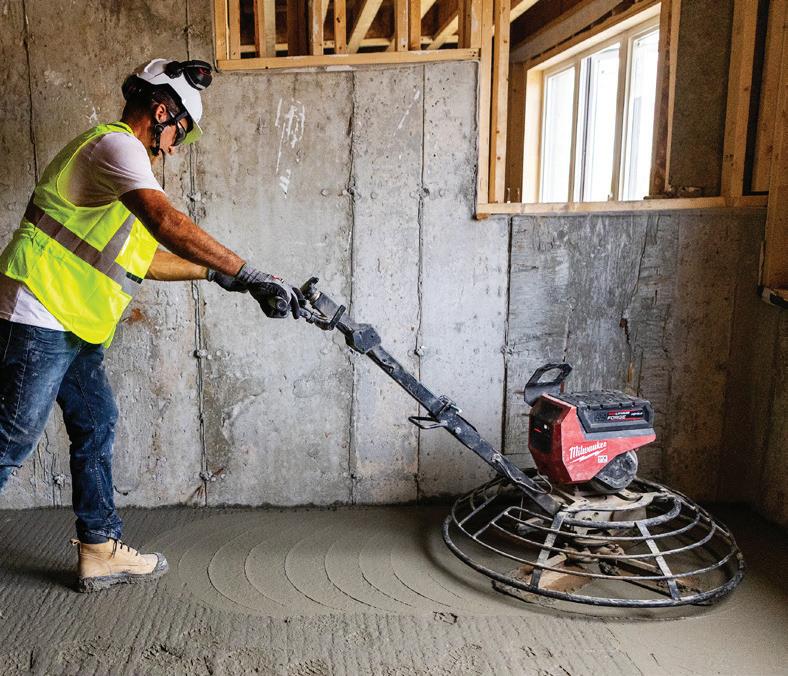
In basements and other confined spaces, air flow can be restricted, making gas-powered trowels less than ideal.
“Fumes in confined places like basements have become a big issue with the Ministry. It's been one of the topics that they've been looking at, and it's really grown over the last four or five years,” Smeriglio explains.
While operating gas-powered equipment in these spaces, employees needed to carry around carbon monoxide detectors and often reported headaches during long shifts. Since carbon monoxide is invisible and odourless, it strikes without warning, mimicking other illnesses as it silently replaces oxygen in the blood. Basecrete sought a solution and considered electric-powered equipment, but corded tools presented their own challenges.
With corded equipment, workers need to have power on site to operate the trowels. However, laying out extension cords across jobsites often leads to accidental damage, creating unnecessary headaches. “Running extension cords back and forth is very hectic. Cords get broken, they get cut, and then the guys patch them up with tape. We're always replacing those cords because they get damaged. The lifetime of a cord is maybe a month and a half,” says Smeriglio, adding that his company used to get written up regularly by occupational health and safety officers for damaged extension cords.
I don’t think we will be using anything that’s electric or gas anymore on sites “ ”
The High Price of Trips and Falls
According to Ontario’s Workplace Safety & Prevention Services’ “Slips, Trips and Falls” article published in 2023, there are approximately 17,000 lost-time injuries due to falls in the workplace. About twothirds of those injuries are same-level falls, typically caused by tripping hazards, slippery or uneven surfaces, debris, dark or obstructed pathways, and unsuitable footwear.
In Ontario, about 80 workers are injured by falls every day. The cost of these claims is incredibly high.
In 2023, an average Workplace Safety and Insurance Board (WSIB) claim was $11,771, and this doesn’t include the added costs of lost productivity and staff replacement. According to WSIB data referenced within the article, that can cause the costs to rise to approximately $59,000 per injury.1
Many contractors are trying to reduce the number of extension cords being used on active jobsites, as they create additional tripping hazards for workers.
Fortunately for Basecrete, these types of trips and fall injuries have not been common to date, but the company remains committed to removing as many extension cords from its jobsites as possible.
Finding a Cordless, Emission-Free Solution
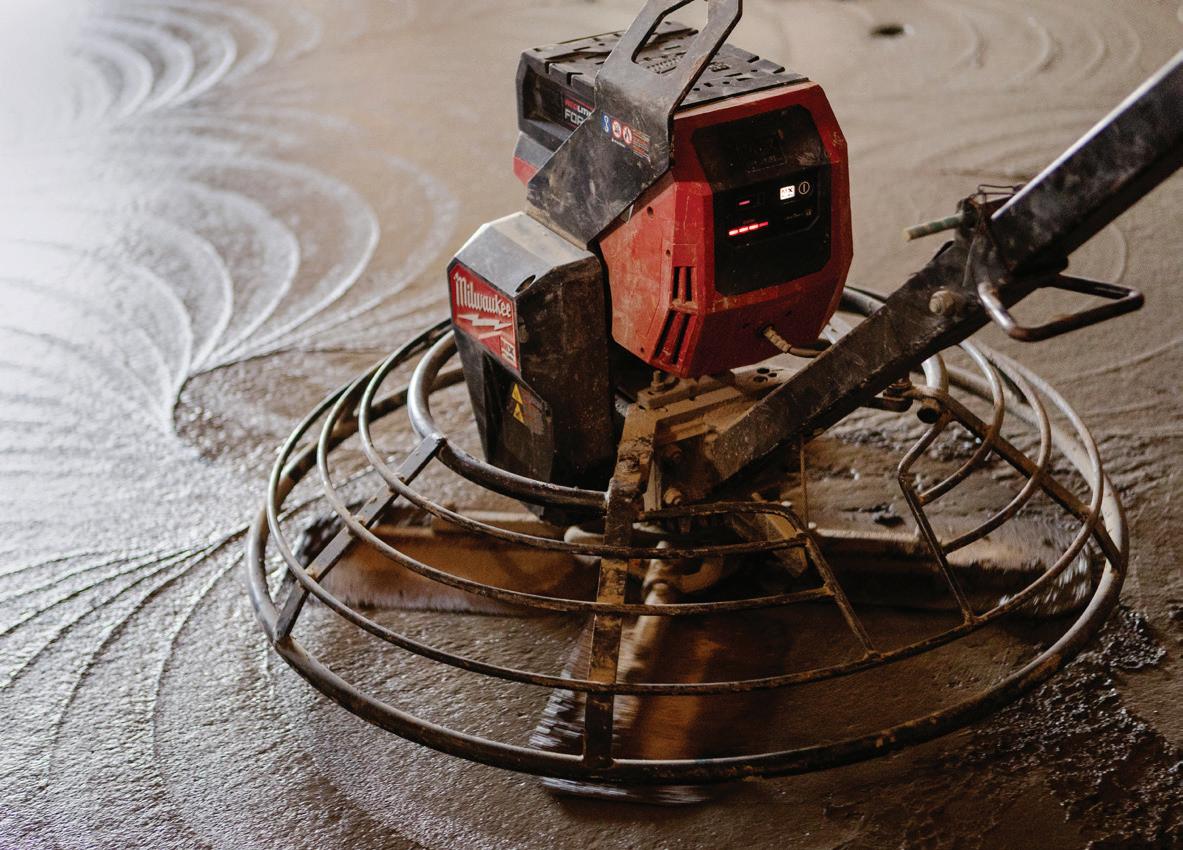
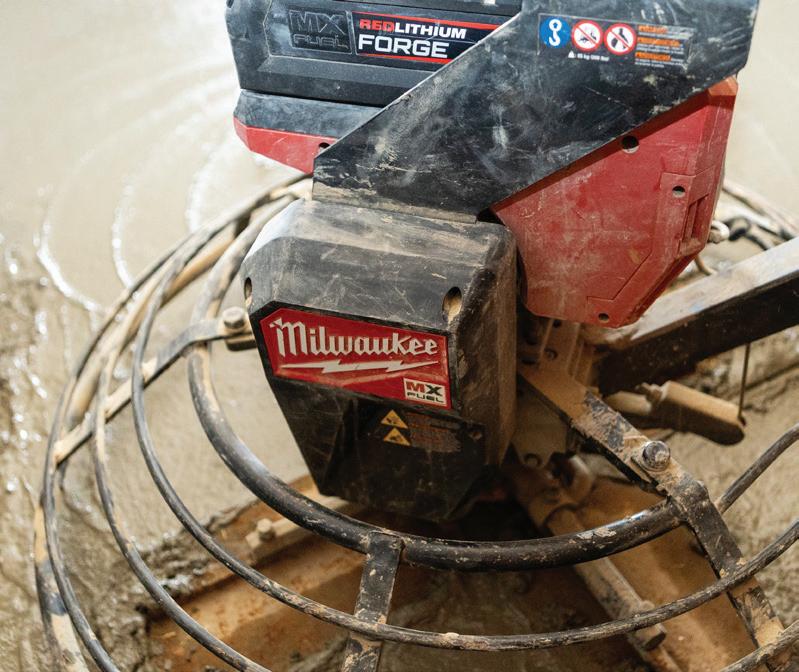
While attending World of Concrete in Las Vegas, Smeriglio found a promising solution to this issue – Milwaukee® Tool’s MX FUEL™ 36" Walk-Behind Trowel Kit. “Contractors who have adopted the MX FUEL™ 36" Trowel consistently point to lower operating costs, reduced downtime, and improved crew comfort. Beyond those benefits, eliminating carbon monoxide exposure addresses one of the greatest ongoing health hazards in concrete finishing, proving that innovation in equipment can drive both business impact and worker safety,” says James Mitchell, director of product marketing, Milwaukee® Tool Canada.
The potential for having cordless, emission-less trowels on jobsites was enough for Basecrete to invest in one machine to see how it would perform on their projects in comparison to the company’s gas-powered models. Smeriglio was impressed with the results.
“Surprisingly, you could not tell the difference. It's been excellent in that sense,” he says. “It works the same. It's just as good as a gas-powered machine.”
In addition to matching the performance of gas-powered machines, the cordless Milwaukee® unit has offered additional benefits such as cost savings from no longer needing carbon monoxide detectors, fewer extension cords on site, and some efficiency gains.
“You're saving time by not pulling out the extension cords and you don’t need to have power. That solves a lot of problems on sites that don’t have power when we start, so they have multiple generators. That always becomes an issue,” Smeriglio says. “Now the guys go to work, and the tools are charged. So, everything's fine.”
Building a Sustainable Future
Over the past several years, Basecrete has invested significantly in Milwaukee®’s various lines of cordless tools. The biggest drivers for brand loyalty have been excellent service, responsiveness to feedback offered, and reliable, interchangeable batteries.
“Having the same batteries has been the best thing ever,” Smeriglio says. “Our trucks carry six or seven pieces of equipment, a lot of different items. If you must have six or seven chargers, it's terrible.”
He adds that investing in battery-powered solutions aligns with the company's sustainability and OH&S goals.
“I'm switching all my equipment slowly. There's a handful of things that we have that are gas or electric. We're just waiting for Milwaukee® to come up with cordless versions, and we'll be switching over.”
In the future, Smeriglio believes all the tools his crews operate will be battery powered.
“I don't think we will be using anything that's electric or gas anymore on sites,” he says. “The equipment is getting better. It's either better than gas or equivalent to it.” 1 (Source:
SUSTAINABILITY AND RESILIENCE
Balancing carbon reduction with long-term durability, construction is turning to advanced concrete admixtures to build safer, stronger and more sustainable infrastructure.
BY JAFAR RASHIDI, CHRYSO CANADA
SENIOR TECHNICAL SERVICES SPECIALIST & LISA BARNARD, LEED AP, WELL AP, CHRYSO NORTH AMERICA
Sustainability has become the construction industry’s defining challenge. From embodied carbon accounting to net-zero targets, contractors, designers and material suppliers are all grappling with ways to lower emissions while keeping projects on budget and on schedule. Concrete, as the world’s most widely used building material, sits at the centre of this conversation.
Cement, concrete’s binding ingredient, is responsible for roughly seven per cent of global CO2 emissions. For many stakeholders, it’s “the elephant in the room.” But the path forward is not about eliminating concrete, it’s about producing, specifying and using it smarter. That’s where admixtures deliver new solutions, helping to reduce cement content, improve performance and integrate new supplementary cementitious materials (SCM).
Yet, there’s a missing dimension in today’s sustainability dialogue: resilience. It’s not enough to focus only on reducing environmental harm. We must also ensure our structures can withstand hazards of fire, flood, wind and seismic events. In short, true sustainability requires resilience.
RESILIENCE: THE MISSING HALF OF SUSTAINABILITY
In 2015, three landmark frameworks emerged from the United Nations: The Sustainable Development Goals, the Paris Agreement
and the Sendai Framework for Disaster Risk Reduction. While the first two frameworks have managed to capture widespread attention, the Sendai Framework, despite its direct relevance to our built environment, remains underutilized in mainstream construction dialogue.
Why does resilience matter? Because a “green” building that fails during the impacts of a wildfire or hurricane is not sustainable at all.
Rebuilding doubles the carbon footprint, displaces communities and disrupts economies. Data from Saint-Gobain’s Sustainable Construction Barometer underscores the shift: resilience is gaining traction globally, particularly in regions exposed to natural hazards. The percentage of respondents prioritizing resilience to
climatic events jumped to 21 per cent, the largest increase recorded to date.
Concrete plays a central role here. Its inherent fire resistance, structural integrity under seismic stress and durability in waterand wind-prone regions make it indispensable for resilient construction. From seismic-resistant foundations in Mexico City to hurricane-rated walls in Florida, concrete continues to prove itself as one of the most hazard-resilient materials available.
The Canadian Climate Institute reports that every dollar spent today on climate adaptation can return $13 to $15 in direct and indirect benefits over time. For the construction industry, investing in resilient infrastructure isn’t just smart planning - it’s a long-term gain for both communities and the economy.
Advances in admixtures are enhancing sustainability efforts.
A LEVER FOR CARBON REDUCTION
In practice, a sustainable concrete mix should look and perform just like a conventional one. The difference lies in how it is optimized behind the scenes. The goal is to minimize the carbon footprint by reducing cement, maximizing SCMs and using local resources. Admixtures are the enablers of this shift, unlocking multiple pathways to cut carbon without compromising performance. Four strategies illustrate how:
1
CEMENT REDUCTION THROUGH STRENGTH ENHANCERS
Admixtures like strength enhancers enable producers to achieve equal or greater performance with less cement. High-range water reducers and like EnviroMix SE deliver early and late strength gains of 2.4–4.0 MPa, allowing up to 10 per cent cement reduction without compromising quality.
2 MAXIMIZING SCM USE
Supplementary cementitious materials, including metakaolin and waste-stream products, are increasingly used. Admixtures offset challenges like slower strength gain or higher water demand, enabling greater cement replacement while maintaining performance.
3 OPTIMIZING LOCAL MATERIALS
Declining access to high-quality sand drives the use of manufactured and marginal local sands. Admixtures, such as the ChrysoQuad line, improve workability, reduce variability and lower transport emissions.
4 ENABLING CIRCULAR ECONOMY PRACTICES
Products like ChrysoConvert C recycle returned concrete into usable aggregates. Together, these strategies lower carbon while maintaining performance.
PERFORMANCE UNDER EXTREME CONDITIONS
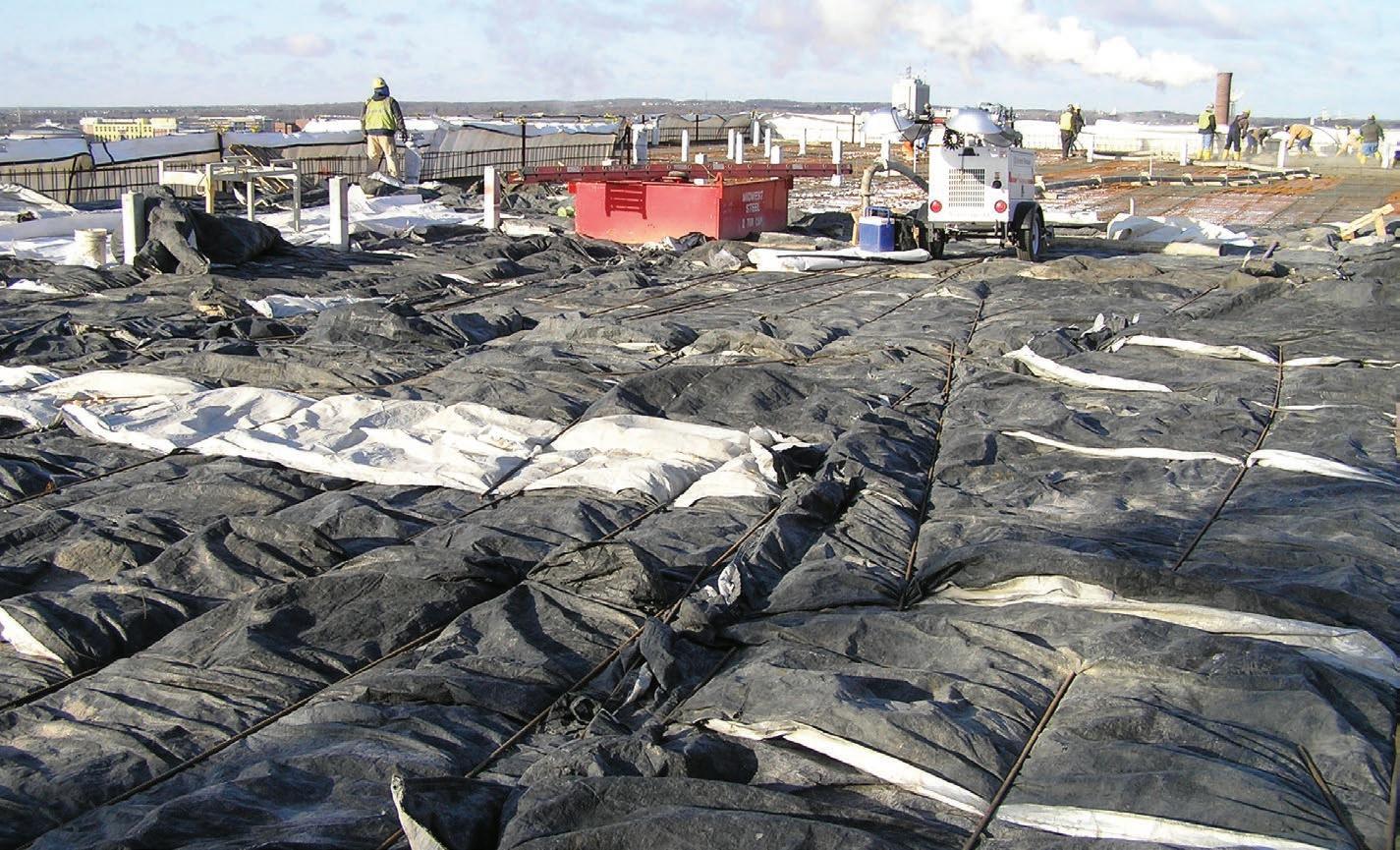
In Canada, sustainability solutions cannot be divorced from performance. Alberta illustrates this reality vividly. With temperatures swinging from -30°C in the winter to +30°C in the summer, producers face
unique challenges: hot, dry and windy conditions in summer lead to plastic shrinkage cracking and rapid slump loss, while extreme cold creates curing difficulties. Effective curing has long been a challenge in this region, and concrete mixes must be designed to maintain durability across these extremes.
Canadian standards provide clear guidance on these challenges. The National Building Code of Canada (NBCC) requires that concrete structures are designed for expected temperature ranges, wind loads and snow/water loads over their intended service life. Additionally, CSA A23.1 cold weather and hot weather concreting guidelines set limits on concrete placement, curing methods and admixture use to maintain performance in extreme climates.
Admixtures are essential to meeting these demands. They extend slump life, improve finishability and support mixes that achieve reliable strength gain even under punishing conditions. In addition to workability control, durability remains a central requirement in the Canadian climate.
Air-entraining agents play a critical role by creating an engineered air-void system with proper spacing factor and distribution. This controlled microstructure allows internal pressure relief during freeze–thaw cycles and improves resistance to salt scaling - a major durability concern in regions where de-icing salts are widely used. Crucially, sustainable concrete must look and act like conventional concrete. Contractors should not have to compromise workability or strength in exchange for carbon savings. By tailoring mixes with advanced admixtures, we can ensure that sustainability and
performance are aligned, even in one of the world’s most demanding climates.
RESILIENCE TOOLS:
BUILDING RESILIENCE INDEX
Material science, however, is only half the picture. Measuring resilience in a systematic way is equally important if we are to balance carbon reduction with long-term durability. This is where tools like the Building Resilience Index (BRI), developed by the International Finance Corporation, come in.
Unlike green certifications that focus mainly on mitigation, BRI evaluates a building’s ability to withstand four major hazards: wind, water, fire and geoseismic activity. A sustainable concrete mix must never mean weaker concrete. With advanced admixtures - strength enhancers, water reducers and SCM-enabling technologies - we can lower carbon while ensuring structures perform under extreme conditions.
While BRI provides a useful global framework, the concept of resilience takes on a unique urgency in Canada. The country already faces some of the most aggressive climate stressors in the developed world: record wildfire seasons in British Columbia and Alberta, catastrophic flooding in Quebec and New Brunswick, coastal erosion in Atlantic Canada and accelerated freeze-thaw deterioration in the Prairie provinces due to increasing temperature variability. These events have triggered a national shift from reactive repair to proactive resilience engineering, not only for buildings, but also for highways, water systems, transit networks and energy infrastructure.
Unlike many countries that rely solely on voluntary sustainability programs, Canada is
Sustainability and resilience are transforming concrete construction.
IMAGES COURTESY OF CHRYSO NORTH AMERICA.
formalizing resilience in codes, policy and public procurement. The Climate Resilient Buildings and Core Public Infrastructure (CRBCPI) initiative, led by the National Research Council of Canada (NRC), has introduced engineering guidance that goes beyond historical weather data by using future climate models that project performance over a 50 to 75-year service life. The goal is to design for evolving climate loads, more severe freeze–thaw cycles, higher rainfall intensity, wildfire heat exposure and longer durability expectations, all of which have direct implications for concrete specification and mix design.
As a practical outcome, resilience is now embedded in Canadian construction standards. The CSA S6:25 Canadian Highway Bridge Design Code requires climate resilience assessments and hydrological risk modeling. CSA A23.1/A23.2 concrete standards emphasize exposure class–based durability, stable air-void structure and resistance to chloride penetration and sulphate attack, critical for marine,
transportation and northern construction environments. Provinces like Ontario and British Columbia now include resilience criteria in public infrastructure tenders, meaning ready-mix producers and specifiers must demonstrate durability performance, not just compressive strength.
Canada also recognizes that resilience is not only a materials issue - it’s a societal and economic priority. Through the federal Disaster Mitigation and Adaptation Fund (DMAF), resilience metrics are now tied to eligibility for major infrastructure funding. In Northern Canada and Indigenous communities, climate resilience strategies prioritize reliable performance in extreme environments where permafrost movement, remoteness and short construction windows present unique engineering challenges. In these regions, the durability of concrete relies heavily on technology-enabled mix designs, including low-temperature accelerators, shrinkage-reducing admixtures and engineered air-entrainment systems that improve resistance to freeze-thaw damage and surface scaling.
A HOLISTIC VIEW: SUSTAINABILITY + RESILIENCE
The conversation should not pit carbon reduction against resilience. In fact, they reinforce each other. Durable structures mean fewer rebuilds, avoiding the “hidden carbon” of reconstruction. Concrete, properly designed with admixtures, can meet both mandates: lowering embodied carbon while delivering superior resilience.
The construction sector is entering a new era. Net-zero goals remain urgent, but they must be paired with resilience benchmarks to ensure buildings can withstand tomorrow’s hazards. Tools like BRI, combined with admixture-driven low-carbon solutions, offer a way forward.
For the Canadian construction industry, success will depend on collaboration between engineers, producers and policymakers. And with the right technologies and mindset, we can build a future that is not only lower carbon but also stronger, safer and more resilient.
Building Momentum
LEARNING AND LEADERSHIP
CCE 2026 will host 40 sessions covering technical and business topics, including formwork design, admixture innovation, curing technologies, recruitment, succession planning and attracting Generation Z to skilled trades. “Labour shortages are a major challenge, so we’ve added practical sessions on hiring, retention and workforce planning,” Galloway notes. “The combination of education and hands-on demos keeps attendees returning.”
BUILT FOR NETWORKING
CCE’s Canadian focus creates a tightknit, productive networking environment. “Canadian contractors often feel out of place at Vegas shows,” says Galloway. “Here, they know the suppliers and competitors. Connections happen organically on the floor, in sessions and in demo areas.”
A ONE-STOP SHOP
The Canadian Concrete Expo continues its remarkable growth.
BY SEAN TARRY
Since its launch in 2018, the Canadian Concrete Expo (CCE) has grown from a niche gathering into Canada’s largest dedicated event for the concrete, aggregates and construction sectors. Preparing for its 2026 edition, the show remains a key meeting place for contractors, suppliers and design professionals nationwide.
For Stuart Galloway, CCE’s President, the rapid growth demonstrates Canada’s need for a home-grown alternative to U.S. trade shows. “The show grows about 20 per cent each year. Canadian companies want an event that speaks to their needs without heading to Las Vegas,” he says.
EXPANDING IN EVERY DIRECTION
The 2026 Expo will expand by 100,000 square feet, bringing total exhibit space to nearly 400 exhibitors. Attendees will see heavy equipment, formwork systems, software, materials and emerging technologies. International companies, including French firm Selfbeton with its automated concrete dispensing system, are debuting at the show.
THE ONLY INDOOR EQUIPMENT DEMO AREA IN CANADA
A hallmark of CCE is its indoor demo space. For 2026, it quadruples from 25,000 to 100,000 square feet, letting visitors operate telehandlers, concrete pump trucks, material handling gear and power tools. Major brands such as Milwaukee and DeWalt will showcase cordless tools and new safety features. “People can put equipment in their hands, touch and feel the tools, and that makes all the difference,” says Galloway.
The Expo caters to both newcomers and veterans, offering opportunities to learn, network, and grow. “If you’re serious about Canada’s concrete and construction industry, you’ll find value here - whether it’s new equipment, services, partnerships or knowledge,” Galloway emphasizes.
LOOKING AHEAD
As the Canadian construction industry navigates shifting tariffs, the federal government’s “Buy Canadian” policies, and global economic uncertainty, Galloway remains optimistic that the Expo’s continued growth mirrors the strength and resilience of the industry it serves.
“Despite the challenges, we’re seeing companies refocus on Canada and invest here,” he says. “That’s exactly what the Canadian Concrete Expo is about - supporting Canadian business, innovation and community.”
The 2026 Canadian Concrete Expo promises to be the show’s biggest and most dynamic edition yet - a true showcase of where Canada’s concrete and construction sectors are heading.
Building through THE FREEZE
THE SCIENCE BEHIND WINTER CONCRETING IN CANADA
Cold-weather concreting demands science-driven techniques, advanced admixtures and strict temperature control to maintain strength, durability and productivity throughout Canada’s increasingly harsh winter conditions.
BY MICHAEL MAHONEY, CENTRAL REGION MANAGER OF THE
As Canada’s construction season stretches deeper into the winter months, concrete contractors face one of the industry’s oldest challenges: balancing productivity with performance when temperatures fall below freezing. From Ontario’s lake-effect snow to the subarctic conditions of Alberta and the Maritimes, working through the cold requires an understanding of material science.
Cold-weather concreting is often viewed as risky, expensive or simply impractical. But the reality is that low-temperature work, when approached scientifically, can actually yield concrete with equal, or even superior, durability to summer placements. The real obstacles are not the conditions themselves, but misconceptions about how concrete behaves when the mercury drops.
UNDERSTANDING THE CHEMISTRY OF COLD
The performance of concrete during the winter months is governed by hydration - the exothermic reaction between cement and water that produces calcium-silicate-hydrate (C-S-H), which is the microscopic glue that gives concrete its strength. As ambient temperatures fall, the rate of this reaction slows dramatically. Below about 10°C, hydration proceeds sluggishly. And below 5°C, it can nearly stop. If the pore water inside the concrete freezes before sufficient C-S-H forms, ice crystals expand and rupture the paste matrix, permanently compromising the material’s integrity.
This is why cold-weather concreting is less about avoiding freezing and more about controlling temperature and time. Maintaining the internal temperature above critical thresholds - typically 10°C for the first 48 hours - allows early-age strength to develop before freezing becomes a threat.
MYTH #1: “JUST ADD MORE CEMENT”
It’s tempting to think that increasing cement content will compensate for slower hydration. While cement does release heat during hydration, it is short-lived and insufficient to offset environmental losses. Moreover, adding excess cement without adjusting water content or admixture
dosage can disrupt the water-to-cementitious ratio, leading to excessive shrinkage, cracking and permeability.
Canadian producers are increasingly turning to non-chloride accelerating admixtures, such as those based on calcium nitrate or triethanolamine chemistry, to promote early hydration without compromising durability or corroding embedded reinforcement. These accelerators stimulate the tricalcium silicate and dicalcium silicate phases that drive early strength development, helping contractors meet schedule demands even when temperatures hover near freezing.
MYTH #2: “CONCRETE ONLY FREEZES BELOW 0°C”
In practice, freezing damage begins long before the point when temperatures reach zero. In fact, when temperatures dip below 5°C, hydration has already started to slow so much that set times can double or triple. If concrete cools below freezing before reaching 3.5 MPa (500 psi), internal water can freeze, expand and generate microcracking that may remain invisible until weeks later, when the surface scales or delaminates under traffic or deicing salts.
In provinces like Quebec and Manitoba, where freeze-thaw cycles are extremely common, early-age protection must be treated as a non-negotiable. Using insulated curing blankets or heated enclosures ensures consistent curing and prevents the stop-start reaction cycles that can weaken
long-term performance.
MYTH #3: “DAYLIGHT IS ENOUGH TO KEEP CONCRETE WARM”
Even under direct sunlight, concrete placed on a frozen subgrade can lose heat faster than it can even generate it. The subgrade acts as a heat sink, drawing thermal energy away from the mix and slowing strength gain. Once temperatures fall overnight, the concrete slab can then develop thermal gradients that cause curling, surface cracking or differential strength.
As such, subgrades should be fully thawed and dry prior to placement. Heating the mix water to around 60°C (140°F) and aggregates to 38°C (100°F) produces a discharge temperature between 13°C and 18°C - ideal for maintaining hydration momentum. Hydronic heating systems, insulated formwork and maturity sensors can further ensure uniform temperature profiles through the curing period.
MYTH #4: “CALCIUM CHLORIDE IS THE BEST ACCELERATOR”
Calcium chloride is still widely used for unreinforced concrete, but its use introduces serious risks in structural or exposed applications.
Chloride ions can corrode reinforcing steel, compromise bond strength and cause surface discoloration - problems that are only magnified by Canada’s frequent freezethaw and deicing salt exposure.
Non-chloride accelerators now offer
Canada’s harsh climate range presents cold-weather concreting challenges.
COLD WEATHER CONCRETING
comparable set acceleration and early strength gains without the corrosion hazard. Many Canadian ready-mix producers have adopted calcium nitrate or formate-based admixtures, which are compatible with air-entraining agents and water reducers that are essential for freeze-thaw durability. These chemistries not only accelerate early hydration but also improve long-term microstructure density, resulting in significantly reduced permeability and enhanced resistance to scaling.
MYTH #5: “COLD-WEATHER MEASURES ARE TOO EXPENSIVE”
While heating, insulation and protection systems add cost and logistical complexity, their value is undeniable.
In fact, rework that’s required as a result of early-age freezing or surface scaling can be exponentially more expensive than proper temperature control. In fact, maintaining adequate curing conditions during the first 72 hours of a job can
increase ultimate compressive strength by up to 30 per cent.
Many Canadian contractors have found that by extending their working season through proper winter procedures, they’ve been able to offset seasonal shutdown costs. Steady productivity, better resource utilization and fewer springtime backlogs all contribute to a stronger bottom line and a reputation for reliability.
ADMIXTURE TECHNOLOGY
Current advances in admixture chemistry have redefined what’s possible in coldweather concreting.
Non-chloride accelerators allow faster setting without corrosion risk. Shrinkage-reducing admixtures minimize thermal stress during temperature swings. And air-entraining agents, which are crucial for freeze-thaw resistance, create microscopic air voids that relieve internal pressure as ice forms.
In addition, supplementary cementitious materials (SCMs) such as slag
cement, fly ash and silica fume play an important role in cold-weather concreting. While SCMs can slow early hydration, adjusting their dosage in winter helps balance strength gain and durability. Optimizing the ratio of SCMs to cement allows mixes to achieve both sustainability goals and performance targets in harsh climates.
THE IMPORTANCE OF QUALITY CONTROL AND FIELD MONITORING
Modern cold-weather concreting in Canada increasingly relies on digital tools. Maturity meters, infrared thermography and embedded sensors enable real-time tracking of in-place temperature and strength development. This data-driven approach allows crews to make more informed decisions about when to remove blankets, apply loads or proceed with form stripping.
These technologies are particularly valuable when used on public infrastructure projects where compliance with CSA A23.1 and A23.2 standards requires documentation of curing conditions and early strength attainment. By integrating field monitoring with proper mix design and protection planning, contractors can ensure that winter placements meet both structural and durability specifications.
ADAPTING COLD-WEATHER CONCRETING TO CANADA’S REGIONS
Canada’s geography presents a broad spectrum of winter concreting challenges. In coastal British Columbia, mild but wet conditions demand strict control of moisture and surface protection. Across the Prairies, low humidity and high winds increase the risk of plastic shrinkage cracking. In the North, permafrost and temperature swings impose unique logistical demands for heating, staging and curing.
Despite these variables, the principles remain consistent: maintain temperature, manage moisture and monitor performance. And collaboration among ready-mix producers, admixture suppliers and contractors is vital. The most successful projects are those where material design, delivery and placement are synchronized under a shared understanding of the science driving hydration and durability.
The Worldwide Leader in Concrete Paving Technology
GOMACO offers the full range of concrete slipform pavers, curb and gutter machines, trimmers, placer/spreaders, texture/ cure machines and bridge/canal finishing equipment. GOMACO equipment features our exclusive and proprietary G+® control system, created in-house by our software engineers from the wants and needs of contractors paving in the field. At the heart of GOMACO equipment is our passion for concrete and our commitment to our customers. We look forward to visiting with you about your upcoming paving projects and your concrete paving equipment needs. Our worldwide distributor network and our corporate team always stand ready to serve and assist you.
WORLD OF CONCRETE BUILDING THE FUTURE
International event in Las Vegas set to explore the future of concrete and masonry construction.
BY ADAM FREILL
Live demonstrations and networking opportunities help professionals stay ahead of the curve.
Featuring thousands of exhibitors across the Las Vegas Convention Center’s indoor and outdoor spaces, World of Concrete 2026 (WOC) is set to deliver another major check on the pulse of the concrete and masonry industries. Now entering its 52nd year, the show returns January 20–22, with education programming beginning January 19.
MUST-SEE EVENT
Organizers expect WOC 2026 to build on the momentum of last year’s strong turnout. “WOC 2025 drew nearly 58,000 registered professionals and more than 1,500 exhibitors across over three-quarters of a million square feet,” says show manager Steven Pomerantz. “For 2026, we’re promising an even bigger stage for innovation, training and connection - reinforcing WOC as the must-attend global gathering for
the trades that build the world around us.”
LIVE DEMONSTRATIONS
Attendees will find the latest products, equipment and services spanning material han-dling, trucks, software, robotics, grinding and cutting tools, surface protection, and more. Outdoor exhibits will highlight live equipment demos, heavy machinery displays and hands-on experiences with decorative concrete products. The outdoor lots will also host international competitions, including the quest for the title of World’s Best Bricklayer, alongside apprentice and tender events. Drivers with commercial licenses can test their skills for prizes in Western Star’s Get Tough Challenge.
EDUCATION AND LEARNING
WOC’s education program remains one of its biggest draws. Participants can begin their day at Breakfast with the Experts, where industry leaders address technical challenges in an interactive setting. Specialized luncheons and forums will cover concrete polishing, slab treatment best practices and emerging technologies such as 3D construction printing.
The 2026 edition features more than 160 education sessions, offering in-depth training for every experience level. Topics include concrete applications, business management, project delivery and safety - designed for both newcomers and seasoned professionals seeking to sharpen their skills.
World of Concrete 2026 will occupy the North, Central and South Halls of the Las Vegas Convention Center for indoor exhibits, with outdoor events in the Silver and Bronze Lots. The show runs from January 20 to 22, 2026, with education sessions available from the 19th to the 22nd. For more information, and to register, visit www. worldofconcrete.com.
EXHIBITS: JANUARY 20-22, 2026
EDUCATION: JANUARY 19-22, 2026
LAS VEGAS CONVENTION CENTER
Push limits. Smash barriers. Break boundaries. And when you’ve conquered all those obstacles? You discover your full capacity for greatness. World of Concrete delivers all the real-world solutions that will crush your challenges and take your expertise to new heights. Growth opportunities are everywhere, whether you’re getting hands-on with game-changing tools and tech or shaking hands with your future partners. Ready for maximum success? Nothing’s standing in your way.
ACHIEVE PEAK PERFORMANCE VIEW GLOBAL EVENTS
Big iron comfort, convenience and safety take priority
Operator-first heavy equipment design.
BY NATE HENDLEY
Operator comfort, convenience and safety is of paramount importance in big iron machines such as dozers, excavators, wheel loaders and motor graders, say industry experts. High-tech solutions matched with cab design enhancements can improve productivity, reduce accidents, and bridge the skilled labour gap.
“Many of our customers have difficulties finding, training and retaining a skilled workforce to operate heavy equipment and machinery today,” notes S.S. Kim, Product Manager – Mid-Size Excavators, Volvo Construction Equipment. “So, making the machines more comfortable makes them more desirable for potential operators,” adds Frank Stadelmann, Senior Market Professional at Caterpillar.
PERFORMANCE BOOSTING COMFORT
Comfortable, user-friendly cabs and controls can go a long way toward boosting operator performance, which has major bottom-line benefits.
“When you’re working long hours and operating heavy machinery where you have to concentrate on what you’re doing, being uncomfortable in those conditions can be a distraction and slow down progress. More breaks may be needed if ergonomic controls are lacking, or the cab isn’t climate
controlled,” states Neil Detra, Product Manager, CASE Construction Equipment.
Further to this point, comfort and convenience can decrease operator error.
“When operators are more comfortable, they are usually more focused, more productive and more aware of their surroundings,” says Eric Yeomans, Product Manager – Wheel Loaders, Volvo Construction Equipment.
“For many of our operators, the cab is their office for the workday. With many operators spending long durations of time in the cab, improving their comfort ultimately helps enhance their experience, making for more productive, focused operators,” adds Justin Steger, Product Marketing Manager at John Deere.
ADVANCED TECHNOLOGY
Going forward, it’s safe to say that big iron machines will continue to feature increasingly advanced technology.
“A trend I see is the integration of more tech-enhanced controls and advanced camera systems. They’re no longer futuristic concepts - they’re becoming more common on today’s worksites. These systems can automate repetitive tasks like digging a trench or grading a slope with a high degree of precision,” states Kim.
Much of this advanced technology will be aimed at further enhancing safety, which has become a top priority.
“Our customers and dealers are constantly asking for more features that enable safer operations and jobsite visibility,” notes Katie Voelliger, Product Marketing Manager at John Deere.
“Incorporating advanced camera systems is a trend that we are seeing. Grade control on larger equipment has [also] seen an elevated customer interest in recent years. Operators are looking for ways to make their equipment more efficient and grade control is a key solution that enables operator productivity on the job,” echoes Steger.
Safety-focused designs are “starting to become a selling point” in big iron machines rather than just add-on features, notes Daniel Prochaska, Komatsu Product Specialist.
With this in mind, here’s a look at what’s new and noteworthy in operator comfort, convenience and safety in big iron machines:
Volvo’s L260 wheel loader. IMAGE COURTESY OF VOLVO.
EQUIPMENT
VOLVO
Volvo recently launched five new-generation wheel loaders (the L150, L180, 200 High Lift, L220 and L260) with redesigned cabs among other enhancements.
These loaders are equipped with an enlarged Volvo Co-Pilot touchscreen, climate control, Comfort Drive Control (which enables steering with a single ergonomic lever) and an updated collision mitigation system. The latter includes an Inhibit Launch feature that prevents the machine from reversing should radar detect a nearby object.
The new-gen wheel loaders can be fitted with Operator Coaching, a unique solution that’s akin to having “a virtual coach built into the machine that observes the operator’s performance and suggests adjustments they could make,” states Yeomans.
Improvements on the wheel loaders range from improved cupholders and armrests, to USB ports, storage and seat options.
In May 2024, Volvo introduced its new ECR145 short swing, EC210, EC230, EC370, EC400 and EC500 crawler excavators which also combine high-tech solutions with design tweaks for safe, simple operation.
These excavators are fitted with an enlarged Volvo CoPilot high-definition display, Volvo Active Control (a solution that automates bucket and boom movements), and Volvo Smart View with Obstacle Detection, which gives operators 360-degree visibility.
“Our system combines camera technology and a new radar detection system that can distinguish between objects and humans. Combined with real-time feedback displayed on the cab’s digital screen, the system gives the operator a heightened level of awareness so they can make quick decisions and avoid potential accidents,” says Kim.
The machines also boast an improved Human-Machine Interface (HMI) which is user-friendly, and navigable via a keypad or by touching the screen.
“Excavator operators’ experience levels vary quite a bit, and our updated HMI can prevent newer operators from feeling overwhelmed and simplify tasks for seasoned pros. We also gave it a more modern look with bold colours and clearer text,” says Kim.
Design enhancements include a keyless
start, simple to manage joysticks, added safety railings, a wireless phone charger, a built-in storage compartment for snacks and drinks and a new footrest (handy for working on slopes).
CASE
CASE’s new CX380E large crawler excavator offers heated air-suspension seats, more legroom and a suspended operator station.
Advanced controls and customizable sensitivity settings let operators “dial in responses exactly to their preferences for easier operation. There’s also less vibration when tracking, which makes for a nicer ride around the jobsite,” says Detra.
As for safety, the CX380E has selectable free swing functionality (boosting load stability and operator confidence when placing and lifting swinging loads, loading trucks or working on even ground), a 270-degree camera and a Scale Feature (minimizing the risk of overloading trucks during hauling applications). In addition, Dynamic Stability Assist helps control arm and boom speed on heavy loads, further enhancing stability, while a brand-new Digital Level feature enables operators to track the machine’s angle.
The cab of CASE’s new 421G compact wheel loader has Electro-Hydraulic (EH) controls, a mounted monitor display, phone holder, rear-view camera, adjustable arm rests, comfortable operator seat and double-sided doors.
“The cab structure of the 421G compact wheel loader comes with seatmounted controls and more glass for
improved all-around visibility. This gives operators great sightlines across the jobsite, improving safety overall,” adds Detra.
CASE’s new CL36EV electric compact wheel loader, meanwhile, gives off zero emissions, making for a safer operator experience in confined spaces. The company’s M Series dozers now have EH controls while CASE D Series Motor Graders sport intuitive joystick controls and a re-designed cab with built-in telematics and an eight-inch touchscreen.
CATERPILLAR
Caterpillar’s next-generation 140 LVR Motor Grader has a new cab with top-mounted heating, ventilation and A/C systems, touch screen displays, a quieter work environment and extra leg room.
Scheduled to be launched in early 2026, the 140 LVR also features a standard rearview camera and a comfort/productivity enhancing solution called stable blade.
Stable blade is “an industry exclusive technology” that automatically detects and then corrects blade bounce without the operator having to intervene, explains Eric Kohout, Product Application Specialist at Caterpillar.
Other safety-focused features on the 140 LVR include floor to ceiling side glass for improved visibility, backup alarms, optional 360-degree camera detect set-up and hydraulic brakes on the tandem wheels. LED light options, secondary steering and optional drop-down rear lights, will also be available.
This spring, Caterpillar announced that its next-generation medium motor graders from the 950 to the 982 XE models can
CASE’s 421G compact wheel loader.
now be equipped with the company’s new sensor/camera/radar-based collision warning system. This system includes a Motion Inhibit function that “prevents engagement of reverse gear and apply brakes when the machine is stationary for a certain time, or if our sensors detect an object or person in the critical warning zone,” states Stadelmann.
Caterpillar has also introduced a new heavy-duty 980 GC wheel loader that boasts a fatigue-reducing dual-steering system, Cat Detect rear-view camera, hand and guardrails, simple user interface, intuitive controls and an inclined ladder for easier cab access.
“Upgrades like a window cleaning platform, a warning beacon and reversing strobes can be added as options or retrofits,” says Stadelmann.
JOHN DEERE
John Deere’s new excavator and next-generation wheel loaders all sport safety, performance and comfort-enhancing features.
The hood contour of the new 510 P-Tier excavator has been redesigned to improve sight lines while the spacious cab offers optional air suspension seats that can be ventilated or heated, maintaining operator comfort in any kind of weather.
Enhanced camera systems, including rear-view cameras and LED front work lights augment visibility and jobsite awareness. And an optional “OEM-exclusive bucket camera system provides operators with visibility where sight is obstructed, such as down inside a trench box,” adds Steger.
John Deere’s updated next-generation 524, 544 and 624 P-Tier wheel loaders feature JDLink wireless communications, EH controls, keyless start (with a selection
of security modes) and a next-generation primary display consisting of a seven-inch touchscreen with intuitive navigation.
Updated P-Tier wheel loaders can be equipped with an exclusive QuadCool Cooling System (redesigned cab roofs, grilles and rear hoods mean operators don’t have to climb on the machine for maintenance purposes) and factory-fitted with SmartDetect. The latter is an optional camera system that issues alerts when it senses nearby objects or people.
In this manner, SmartDetect helps “improve situational awareness and productivity on the jobsite,” states Kerber.
KOMATSU
Komatsu released two new wheel loaders earlier this year and two new excavators in September. All four machines are packed with safety and comfort features.
The PC220LC-12 excavator comes with a new high-resolution, eight-inch touch-panel monitor and 2D boundary control that “allows the operator to intuitively set virtual walls that act as a restricted zone,” says Prochaska.
The PC220LCi-12 excavator includes Komatsu’sIntelligent Machine Control solution (IMC 3.0), and an industry-first, factory-integrated 3D boundary control set-up that offers an enhanced version of
the 2D program.
Both excavators have a larger cab and more legroom than previous models, heated air suspension seats, additional glass surface for enhanced visibility, KomVision (a 360-degree monitoring solution) and a Rollover Avoidance system that determines the machine’s center of gravity and alerts the operator if a rollover is imminent.
Komatsu’s new WA475-11 and WA48511 wheel loaders have increased glass surface area for better visibility, large, four-pillar cabs, high-quality comfy seats and Angle Feedback Joystick Steering (AFJS) - a solution that uses electrical signals to make steering smoother.
These wheel loaders come standard with an enhanced load meter system that simplifies loading as well as Komatsu’s rear object detection system. If the system senses a possible obstacle, “a warning buzzer and indicator light alert the operator,” says Komatsu Product Marketing Manager, Kwanju Cho.
CONTINUED ADVANCEMENTS
As heavy equipment continues its rapid evolution, one theme is undeniable: comfort, convenience and safety are no longer optional - they are integral to machine design, operator satisfaction and overall jobsite performance. From advanced camera and radar systems to intuitive HMIs, ergonomic cabs and automation that reduces fatigue and error, manufacturers are pushing innovation to help crews work smarter, faster and more confidently. With labour shortages and growing project demands across Canada, these advancements not only enhance productivity but also help attract and retain skilled operators. The next generation of big iron is clearly being built around the people who run it, ensuring safer, more efficient worksites for years to come.
Caterpillar’s new heavy-duty 980 GC wheel loader.
John Deere’s 524 P-Tier wheel loader.
Komatsu’s PC220LCi-12 excavator.
IMAGE COURTESY OF CATERPILLAR.
IMAGE COURTESY OF JOHN DEERE. IMAGE COURTESY OF KOMATSU.
Active Risk Management
Active risk management helps contractors turn fragmented data into real-time signals, improving decisions, cutting losses and strengthening performance across every project.
Construction organizations are awash in data yet make many risk decisions with lagging indicators and intuition. Active risk management is a practical operating model that turns data into day-to-day steering. It rests on three pillars: (1) a rigorous Risk Data Architecture anchored by a RMIS; (2) project level Operational Risk Scores generated from field technologies; and (3) Risk Retention Decision Making that blends historical loss experience with forward-looking risk signals to optimize insurance terms, captive success and project behaviours.
1) RISK DATA ARCHITECTURE: THE FOUNDATION
Active Risk Management starts with a single, governed source of truth for incidents and claims - your Risk Management Information System (RMIS) - and a schema that makes analysis trivial. Core data model. The RMIS captures all incidents and claims with standardized root cause descriptors and links every record to enterprise data tags.
WHY THIS MATTERS
With these tags, an Active Risk Manager can instantly pivot: where are losses emerging by project type? Which branches drive severity? Do certain delivery models correlate with specific root causes? Answers move from anecdote to evidence. Implementation essentials:
• Taxonomy first. Define and enforce root cause vocabulary and data tags before ingestion. Make completion mandatory in workflows.
• Interoperability. Connect RMIS to project systems (PM platforms, IoT, reality capture) via APIs to prepopulate tags and minimize manual entry.
• Data quality & governance. Establish owners, validation rules and monthly data quality scorecards. Dirty data is the silent risk.
• Company-wide adoption. The technology you utilize to capture risk data needs an intuitive interface to ensure data is captured consistently and companywide. Full view versus partial view is essential.
• Usability. Provide self-serve dashboards with saved views by tag (e.g., “Hospitals - Wrap Up Liability – Ontario - 2023–2025”). This foundation turns incidents/claims into an operational signal - fast enough to act, structured enough to learn.
2) OPERATIONAL RISK SCORES: FORWARD-LOOKING PROJECT SIGNAL
Lagging data tells you what happened. Operational Risk Scores (a Construction Risk Score) tell you what is likely to happen next, using live project telemetry.
Inputs. The score is computed from specific data points that reflect adherence to risk reducing practices captured by field technologies. Start with proven statistical/ML models that predict risk from a standard set of KPIs; evolve toward a broader custom set of KPIs that reflect your company’s unique tech stack. Critically, weights are context aware: the data points driving operational risk and insurance risk are related but unique; the model assesses every KPI for its impact to several context specific risks (Schedule, Cost, General Liability, Workers Comp, etc.) - safety inspection rigour may correlate most strongly with Workers Comp and Wrap Up Liability performance. Filtering and comparability. Use the same data tags as the RMIS (project number/description, project type, delivery model, region/division/branch, project manager, insurance policy type) to slice scores consistently across the enterprise. It allows leadership to ask, “What is our risk score for hospital projects in the Prairies under IPD?” and get an answer on demand.
Closed-loop action:
• Drill-down diagnostics. Every score decomposes into its drivers. If a project’s score is dragged down by weak RFI performance, the risk manager sees it, calls the PM and fixes the behaviour.
• Thresholds & alerts. Define red/amber/green bands and automatic nudges when a driver metric breaches a key risk threshold.
• Learning system. Postmortems provide end-to-end assessment of risk and operational performance to identify KPIs to improve. Operational Risk Scores convert technology into a control knob for execution, making risk prevention measurable and manageable.
3) RISK-RETENTION DECISION-MAKING: WHERE TO KEEP RISK AND WHERE TO TRANSFER IT
With RMIS (the past) and Operational Risk Scores (the near future), the organization can finally align risk finance with risk performance. Principle. Retain the good risks, transfer the untenable ones. Projects, branches, delivery models and policy types with consistently high Operational Risk Scores - and clean RMIS histories - are candidates for higher retentions or a single parent captive; low scoring segments warrant lower retentions and more transfer. How it works:
• Segment by tags. Build loss triangles and severity/frequency distributions by project type, de-livery model, branch and policy type. Overlay each segment’s current Operational Risk Score.
• Optimize retentions. Use stochastic models (or pragmatic stress tests) to set captive layers/retentions where expected loss cost and volatility are attractive - for that segment.
• Dynamic purchasing. Adjust insurance buying (limits, deductibles, wrap structures) annually or even quarterly, guided by
scores and emerging loss signals.
• Value feedback loop. Share captive “dividends” or budget credits with high-scoring segments; tie PM incentives to sustained score improvement and loss avoidance.
Result. Risk capital follows demonstrated performance, lowering total cost of risk (TCOR) while rewarding the behaviours that prevent losses.
MAKE RISK A MANAGED PROFIT CENTRE
Active Risk Management reframes risk from an insurance procurement cycle to a daily operating system. With a robust Risk Data Architecture, you see where and why incidents occur. With Operational Risk Scores, you see problems early enough to change them. With score-informed retention, you profit from superior execution by keeping the risks you manage well and transferring the ones you don’t, yet.
For the construction risk community and the C-suite, the mandate is clear: build the data backbone, instrument the work and let forward-looking scores steer both field behaviour and risk finance. The payoff is lower TCOR, fewer claims, safer jobsites and a durable competitive edge. In a market where margins are thin and volatility punishes the unprepared, Active Risk Management is not a future state; it’s the operating model of firms that plan to win.
David Bowcott is the Executive Vice-President of the Construction Industry Group at Platform Insurance Management. Please send comments to editor@on-sitemag.com.
By
ABeyond bad luck
Common-law and statutory penalties for contractors involved in workplace accidents
ccidents which injure workers on a construction site are rarely seen by the courts as mere happenstance unrelated to the conduct of any party. In fact, any injurious accident on a construction site may give rise to liability in negligence, and further regulatory penalties may also be levied in certain circumstances.
FACTORS IN ASSESSING A CONTRACTOR’S NEGLIGENCE
In H2 Canmore Apartments LP v Cormode & Dickson Construction Edmonton Ltd., 2024 ABKB 423, the Court held that in order to assess negligence claims against construction contractors, the courts should apply the same basic principles of negligence as in other areas of the law. In essence, (1) they analyze whether a duty of care was owed by the party who is alleged to have caused the injury, (2) whether this duty was breached through the conduct of that party, and (3) whether that party’s conduct caused the injured party’s damages.
A duty of care is generally owed by contractors to on-site workers, visitors and anyone else who could foreseeably be impacted by said contractor’s negligent acts. Accordingly, the court’s analysis will rarely focused on whether the duty is owed. Rather, the analysis is more often than not focused on whether this duty has been breached.
The question of whether the duty has been breached requires the Court to consider whether the conduct complained of is conduct that a prudent contractor would have engaged in, in similar circumstances. If the conduct of the contractor party who caused the injury falls below the level of care that a prudent contractor would employ in similar circumstances, a breach will be found to have occurred.
In order to determine whether one party caused another’s injury (i.e. part three of the test), the Court will ask: but-for the breach of the party who caused the injury, would the injury at issue have been suffered? If the answer is no, then factual causation is made out. Second, the Court will ask whether the injury suffered by the injured party was a reasonably foreseeable result of the breach committed by the injuring party. If the answer is yes, then legal causation is made out. Both factual and legal causation must be proven in order for the Court to make a finding of negligence.
WHAT KINDS OF EVIDENCE PLAY INTO THE ANALYSIS?
Practically, judges look to various forms of evidence to inform the negligence analysis. As noted in Kudzin v APM Construction Services Inc., 2023 ABKB 425, courts will consider evidence of compliance with relevant statutory and regulatory obligations. They will also consider the level of training given to workers, the level of safety enforcement that takes place on a jobsite, and the extent to which a
contractor worked in accordance with standard industry practice.
Both documentary evidence and witness testimony relating to the above factors are routinely considered in determining whether a contractor has acted negligently.
PENALTIES CAN BE SEVERE
As noted in KB v Guhle, 2025 ABKB 474, a finding of negligence in civil law results in an award of damages to the injured party. The level of damages awarded will typically be aimed at returning the injured party to the state they would have been in but for the negligence of the injuring party. Damages can be significant, with an upper-limit defined only by the amount of damage that could be caused by an accident.
In Alberta, s. 21 of the Workers’ Compensation Act, RSA 2000, c W-15, acts to prevent workers who hold WCB insurance from suing their employer for injuries. Parties, however, are not prevented from suing third parties (such that an employee of a subcontractor could sue the prime contractor on a project for their injuries, for example).
The bigger risk for employees and officers of contractors, however, is regulatory penalties that might be levied in the event of a workplace accident. Stiff penalties can be issued to employees under the Occupational Health and Safety Act, SA 2020, c O-2.2.
In R v Volker Stevin Contracting Ltd., a case involving a worker being fatally struck by a truck on a job site, a fine of $60,000 was issued against the site supervisor for his role in the accident.
PROACTIVE PREVENTION REDUCES LIABILITY
The surest protection against civil liability for a construction contractor is the development and maintenance of a strong safety culture. Employers must have systems in place to ensure that workplaces comply with all OHS requirements and other legislative or industry standards. Workers must follow instructions and use provided safety gear. Contractors should be proactive in assessing risks, and channels should exist for the documented reporting of new risks on the jobsite.
Written procedures and documented evidence of compliance are invaluable in defending allegations of negligence or noncompliance related to workplace accidents.
Erin Cutts is a Partner at the Calgary offices of BLG Law. This article provides an overview and is not intended to be exhaustive of the subject matter contained therein. Although care has been taken to ensure accuracy, this article should not be relied upon as legal advice.
A World of Experience
Per fec ted for North America
CLOSE TO OUR CUSTOMERS
AS THE GLOBAL LEADER IN ROAD CONSTRUCTION TECHNOLOGY, the world is our proving ground, in every climate, condition, and terrain. From mining and milling, to paving, compaction and rehabilitation—our machines are smart, safe, and sustainable, consistently delivering the highest quality and lowest total cost of ownership.