Honey producer sweetens the pot with new beverage co-packing competencies
Page 16
Delivering Results.
With Heat and Control, you have a partner with the scale to support your success, the innovation to advance your operations, and a commitment to quality that will help you offer better products for consumers.
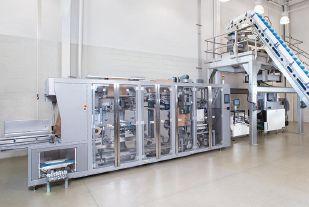
COMPLETE SNACK PACKAGING SOLUTIONS
• Accumulation
• Horizontal motion conveying
• Incline, belt and bucket conveyors
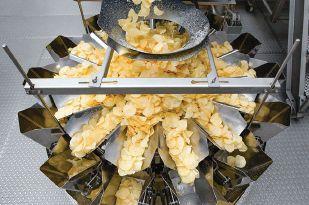
• Filling and multihead weighing
• Bagmaking and casepacking
• Checkweighing and seal checking
• Foreign object and defect inspection
• Controls and information systems
We are successful when you are successful. That’s why we apply creativity, engineering excellence, and determined perseverance to every project to help our customers get the performance their business demands—whether measured by flavor, efficiencies, sustainability, improvement, or innovation.
Nov. 3-6, 2024 Booth N-6106 McCormick Place Chicago, IL, USA
info@heatandcontrol.com | heatandcontrol.com
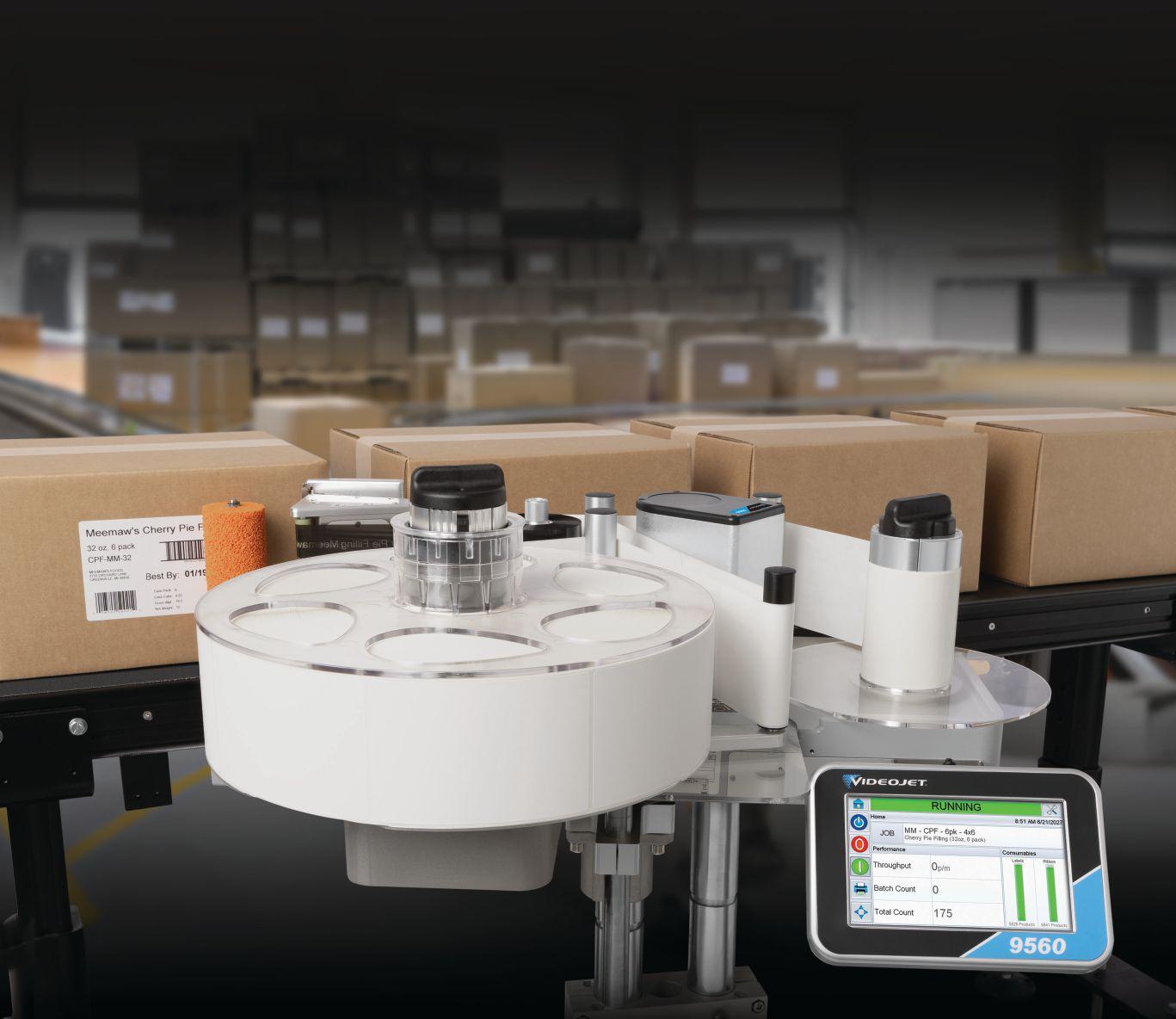
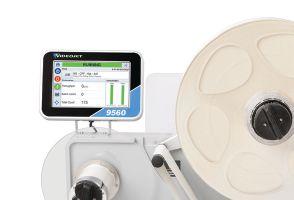
The new Wi-Fi enabled Videojet 9560 with Direct Apply technology keeps pace with your high-speed operations while labeling cases, boxes, and shrink wrap. Streamline your end-of-line processes, elevate your labeling workflow, and experience the evolution of labeling with the Videojet 9560 print and apply labeler.
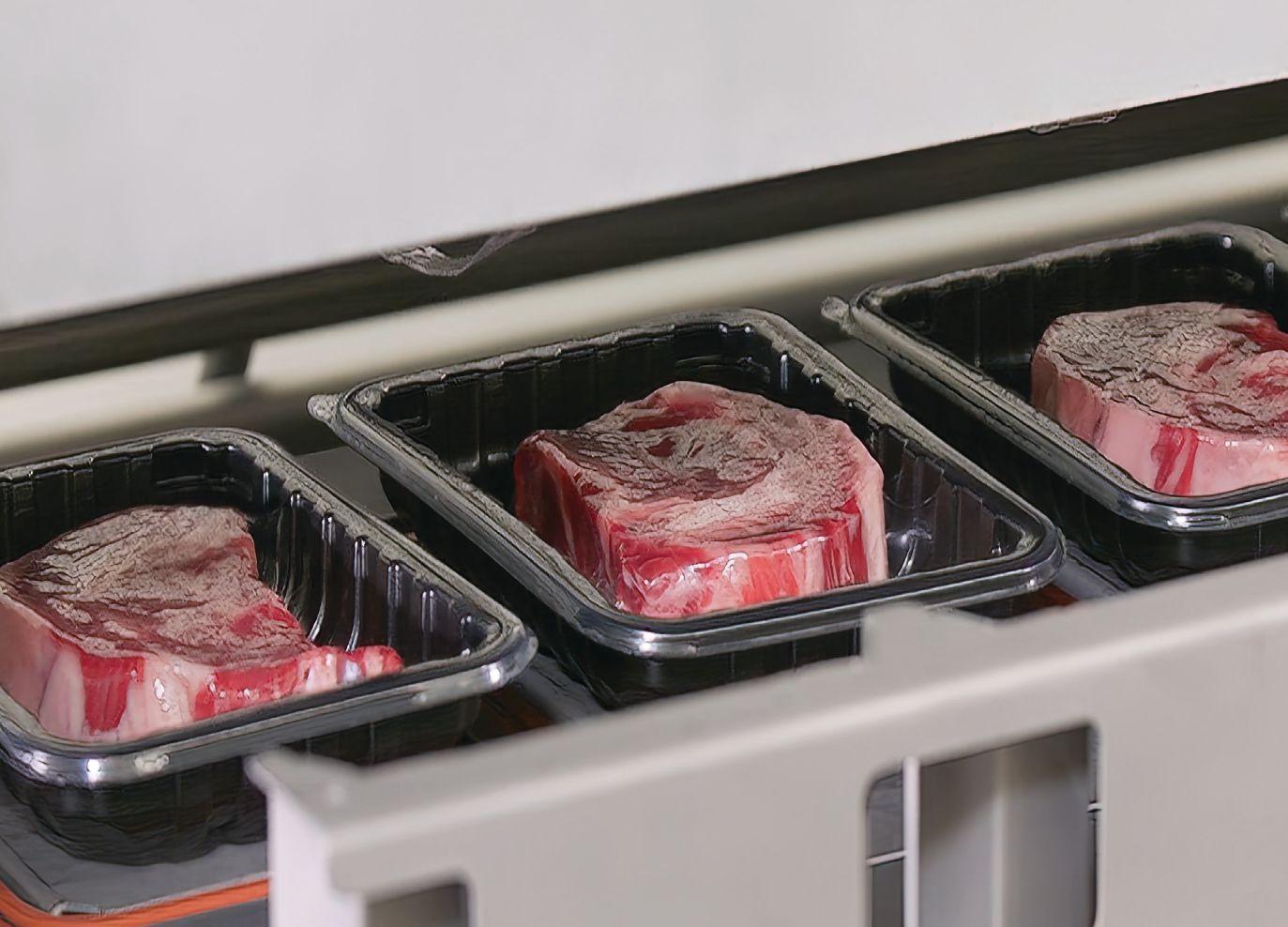
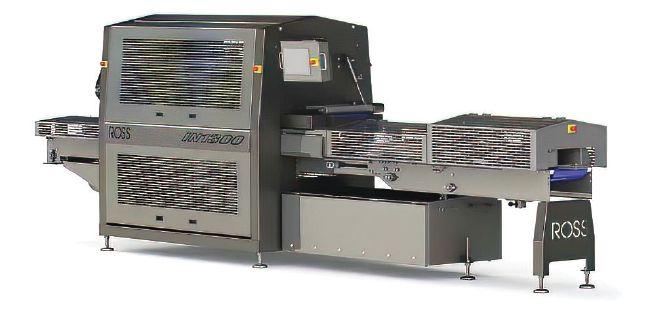
Watch live demonstrations of industry-leading Ross tray seal packaging machines
n Flexible system produces high-quality vacuum skin (VSP), modified atmosphere (MAP), and lid-only packages
n Fully automatic, high-speed production
n Uses preformed trays of almost any size or shape
n Superior package seals eliminate leakers and returns
COLUMNS
FROM THE EDITOR
4 George Guidoni
Skill shortages spell trouble down the road for the agri-food sector.
CHECKOUT
36 Sawyer Lewis
12
13
14
16 THE BEE PLAN
Quebec honey farm operator makes a major investment in automated bottling line equipment to create instant buzz with its new beverage co-packing side venture.
FEATURES
22 Back and Fourth
A friendly acquisition provides Canadian conveying systems stalwart with a much higher platform to continue its impressive growth in the high-speed beverage packaging markets.
28 Global Reach
Canadian packaging machinery distributor looking forward to new global growth opportunities following strategic acquisition by a European packaging OEM powerhouse.
32 An Eggcellent Adventure
Upgraded robotic palletizing cells breathe new life into the leading egg packaging producer’s throughput capabilities.
34 Pack & Forth
The upcoming PACK EXPO International packaging and processing technologies exhibition in Chicago offers unprecedented wealth of educational and networking opportunities.
ON THE COVER
Joe Public speaks out on packaging hits and misses.
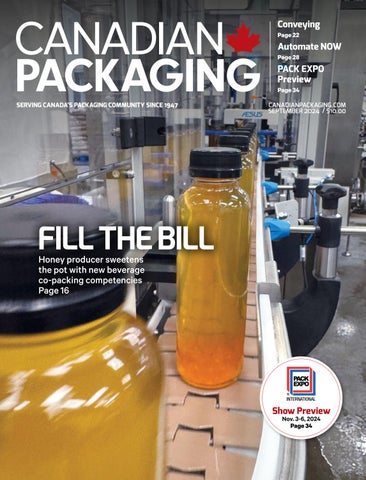
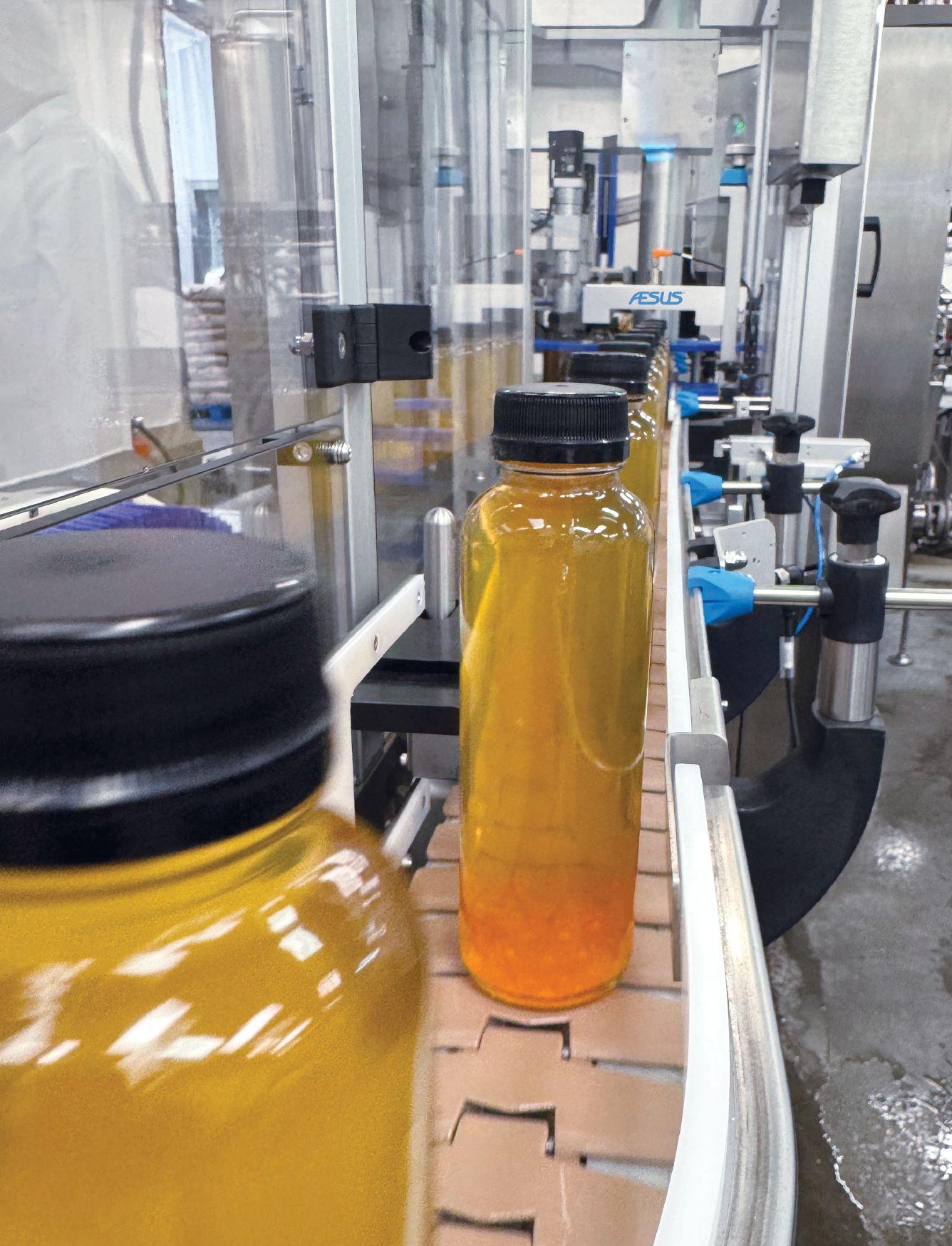
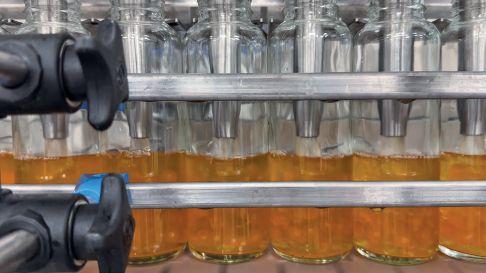
Close-up of the new bottling line delivered by Aesus to venerable Quebec honey farmer Miel Dubreuil as part of the company’s expansion into the beverage co-packing business.
Cover photo by Pierre Longtin.
Skill deficits a growing worry for agri-food biz
As with all transformational megatrends, the impact of automation on employment and work culture in manufacturing industries is a subject that has generated much debate and controversy in recent years, without forming a widespread clear-cut consensus of its ultimate outcome.
Agri-Food sector’s share of Canada’s GDP in 2023 33%
That said, the explosive growth in AI (artificial intelligence) capabilities unfolding on a daily basis today does suggest that in many mature manufacturing industries, packaging included, a lion’s share of manual tasks and jobs still performed by humans today are destined for obsolescence.
The big question is what happens to the people doing those jobs today, with possible scenarios ranging from long-term unemployment to upskilling to higher-value, better-paid jobs that will further enhance the benefits of higher productivity, better quality and faster service enabled by automation.
For that to happen, though, it is critical that large-scale capital investment in automation technologies goes hand-in-hand with robust investment in human capital— both at company and industry-wide level.
There is a significant divide between using automation simply to replace humans on assembly lines and using it to make those production lines more efficient and competitive, which is emphatically underscored in a new report from The Conference Board of Canada examining the impact automation on Canada’s critically important agri-food sector.
Released just over a month ago, The Next Frontier in Canada’s Agri-Food Sector report suggests that the industry as a whole is poorly prepared at the moment to leverage the benefits of automation to the extent that it must to remain a formidable world-class competitor and economic growth driver.
As the study points out, “Canada’s agrifood sector is displaying a lethargic record of technology adoption in the face of several key barriers.
“Perceived insufficient returns on investment, a lack of government support and funding, and a lack of in-house expertise to guide the process are slowing the rate of adoption,” the report notes.
“This underscores a lingering need for targeted support and resources to facilitate workforce transitions.”
The sheer importance of the sector to
Canada’s economic well-being makes addressing those challenges a top priority for business and government.
According to Statistics Canada, the agri-food industry employed 563,000 people in 2023, about 2.8 per cent of total domestic employment, while generating $72.1 billion in revenues.
Accounting for 3.3 per cent of the country’s GDP (gross domestic product)—1.7 per cent for agriculture and 1.6 per cent for the food and beverage manufacturing industry—the industry is a major beneficiary of abundant land and water resources, the study notes, as well as a well-earned global reputation as a reliable supplier of safe and high-quality food.
But such advantages will count for little going forward if the sector does not address its chronic labor shortage problems, especially on the agricultural side, and a growing skills deficit fueled by rapid technological change.
As the report observes, “Canada’s agriculture industry is adopting precision agriculture, which uses advanced technologies such as sensors, robotics, and artificial intelligence to optimize crop yields, reduce waste, and improve overall efficiency.
“Similarly, the food and beverage manufacturing industry is undergoing a renaissance with the implementation of Industry 4.0 technologies (e.g. automation, robotics, data analytics) to enhance productivity, quality control, and supply chain management,” the study states.
“While these technologies hold the potential to optimize production and enable data-driven decision-making, their adoption has led to increased demand for workers with higher levels of education and skills,” the report points out.
Alas, the existing shortage of those required skills—namely cognitive skills, technological literacy and specialized knowledge—that could keep the industry from reaching its full potential. With over 30 per cent of the current agricultural workforce expected to retire over the next decade, the need for action to introduce focused, tech-driven skill training and upgrading programs has never been more urgent and compelling.
GEORGE GUIDONI, editor GGuidoni@canadianpackaging.com
SEPTEMBER 2024 | VOLUME 77, NO.7
Reader Service
Print and digital subscription inquires or changes, please contact
Angelita Potal, Customer Service
Tel: 416-510-5113
apotal@annexbusinessmedia.com
Mail: 111 Gordon Baker Rd., Suite 400, Toronto, ON M2H 3R1
Senior Publisher
Stephen Dean | (416) 510-5198
SDean@canadianpackaging.com
Editor George Guidoni | (416) 510-5227 GGuidoni@canadianpackaging.com
Barbara Adelt | (416) 510-5184 Fax: (416) 510-6875
badelt@annexbusinessmedia.com
Media Designer Emily Sun | (519) 428-3471 esun@annexbusinessmedia.com
CEO Scott Jamieson SJamieson@annexbusinessmedia.com
Annex Business Media
111 Gordon Baker Rd., Suite 400, Toronto, ON M2H 3R1; Tel: 416-442-5600.
Canadian Packaging, established 1947, is published 10 times per year except for occasional combined, expanded or premium issues, which count as two subscription issues.
PRINTED IN CANADA ISSN 008-4654 (PRINT), ISSN 1929-6592 (ONLINE)
PUBLICATIONS MAIL AGREEMENT NO. 40065710
SUBSCRIPTION PRICE PER YEAR (INCLUDING ANNUAL BUYERS’ GUIDE: Canada $80.07 per year,USA $183.09 (CDN) per year, Outside Canada $207.57 (CDN) per year, Single Copy Canada $10.00. From time to time Canadian Packaging will mail information on behalf of industry-related groups whose products and services we believe may be of interest to you. If you prefer not to receive this information, please contact our circulation department in any of the four ways listed above.
We acknowledge the [financial] support of the Government of Canada
Soft-drink and cookie giants team up to offer the best of both worlds
Being second-best is never an option for runaway market leaders like Coca-Cola and OREO, and a bold new marketing and packaging collaboration between the two iconic category giants just may be as good as it gets for the legions of Canadian fans of both global brands.
Developed by the Coca-Cola Creations product development arm of the famed Atlanta-headquartered beverage producer, the new limited-edition OREO Coca-Cola Sandwich Cookie and the Coca-Cola OREO Zero Sugar beverage were launched across Canada earlier this month as part of a multimedia marketing campaign designed to offer unique experiences that celebrate the magic and playfulness of teaming up with a “bestie,” according to the two partners.
“The collaboration between OREO and Coca-Cola is the perfect expression of the playfulness of OREO and the ‘Real
Magic’ at the core of the CocaCola brand, and we couldn’t be prouder to bring these new products and unexpected moments of connection to our Canadian fans,” says Solange Grimard, senior marketing manager for Canada at The Coca-Cola Company.
“We are constantly working to excite our Canadian consumers with unique launches and surprising experiences,” adds Sarah Au, marketing director for cookies at Mondelēz Canada.
“This time, we’re taking it a
step further by celebrating the newfound ‘bestie’ bond that OREO and Coca-Cola share, bringing a twist on two classics to our fan bases across the country.”
Both products feature a captivating design and sleek packaging, created by Bulletproof, adorned with the distinctive OREO cookie embossments and stacked Coca-Cola bottles.
With each sip of the Coca-Cola OREO Zero Sugar, fans can savor a refreshing Coca-Cola taste with flavorful hints inspired by OREO cookies.
For its part, the OREO Coca-Cola Sandwich Cookie boasts a distinctive design with red-andblack color-blocked graphics featuring one signature OREO chocolate Coca-Cola wafer cookie on one side and a red-colored Golden OREO wafer embossed with one of three unique designs on the other.
Created in partnership with Spotify, the OREO and Coca-Cola brands have also unveiled the ‘Bestie Mode Digital Experience,’ an exclusive platform and first-of-its-kind musical experience designed for besties to merge music tastes and enjoy together.
By scanning a QR code on Coca-Cola and the OREO brand products, fans can follow the steps to explore ‘Bestie Mode’ and sync up music preferences with their bestie, after which Spotify Free users will also be invited to access the bestie experience via an online promotion. Once connected to a Spotify account, fans will be prompted with questions to see how their taste in music stacks up against their besties.
McDonald’s serves up compostable coffee pods in recyclable pouches
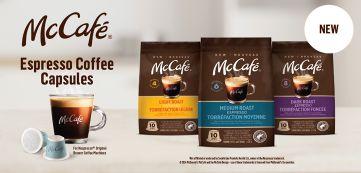
Buoyed by the continuous success and popularity of its signature coffee, fast-food giant McDonald’s has launched a new line of the McCafé brand of compostable Espresso Coffee Capsules for use in the Nespresso range of original coffee machines.
Designed to be commercially compostable compostable through a special program with the recycling and upcycling services provider
TerraCycle, the new compostable pods are made from a blend of Rainforest Alliance-certified Arabica beans crafted to provide a smooth, balanced flavor and luxurious crema on top.
The new McCafé come in a range of intensities to cater to different preferences:
• Medium Roast Espresso, distinguished with a well-balanced flavor with notes of chocolate and hazelnut;
• Dark Roast Flavor, featuring a bold flavor with notes of silky dark chocolate and roasted almonds.
“With the launch of the new commercially compostable Espresso Coffee Capsules, McCafé continues to raise the bar in the Canadian coffee market,” says Jeff Kroll, chief strategy officer and vice-president of sustainability at McDonald’s Canada.
“We are delighted to introduce the delicious taste and quality of McCafé coffee to a broader group of Canadians through an innovative format compatible with Nespresso Original Coffee Machines.”
Clear On-Hol With Suspect Foreign Materia
To participate in the free mail-back program, consumers simply create an account www.terracycle.com, after which they can print a free shipping label, package the used capsules and bags into any empty box just lying around, and send them to TerraCycle for commercial composting and recycling.
Major expansion plans announced for Hartmann’s egg carton plants
The world largest manufacturer of molded fiber egg packaging producer has announced plans to get a whole lot larger still with a significant expansion of its North American manufacturing facilities in Brantford, Ont.,
Headquartered in Denmark, Brødrene Hartmann operates 17 egg carton plants across four continents, and the company also ranks as the biggest producer of fruit packaging in South Africa and India.
According to the company, the extensive expansion at the Brantford and Rolla locations will involve installation of multiple new production lines and building expansions aimed at increasing manufacturing and warehousing capacities by the end of 2025.
“We are thrilled to announce another expansion of our North American operations,” says Karl Broderick, president of Hartmann North America. “This growth reflects the rising demand for environmentally sustainable egg packaging solutions.
“We deeply value the partnerships with our customers and the dedication of our employees, who are the backbone of
success.”
The Hartmann egg carton plant in Rolla, Mo., has already had two expansions since opening in 2016.
German sensor company SICK AG and the Swiss measurement and automation technology specialist Endress+Hauser have agreed on a strategic partnership, under which Endress+Hauser will take over worldwide sales and service of SICK’s process analyzers and gas flowmeters, with a joint venture to be established for their production and further development. Under the terms of the agreement, around 800 specialized sales and service employees in 42 countries will transfer from SICK to Endress+Hauser, which will take over sales and service for process analysis
and gas flow measurement technology starting toward the end of this year. From 2025 on, the production and further development of process analyzers and gas flowmeters will be the responsibility of a joint venture in which each partner will hold a 50-percent stake.
“We are taking this path because by collaborating and networking we can achieve more together in a reasonable amount of time than either side could on its own,” says Peter Selders, chief executive officer of the Endress+Hauser Group. “This is all this for the benefit of our customers, employees and both companies,” says Selders, adding the two companies’ offerings in process technology perfectly complement each other. “Our aspiration is to drive the sustainable transformation of the process industry and to support our customers in leveraging the opportunities presented by decarbonization,” adds Mats Gökstorp, chairman of the executive board at SICK AG. “In the interest of our customers and employees, we look forward to the strategic partnership and to shape the future
of process automation together.”
Italian material handling systems manufacturer Emmepi Group has completed the acquisition of the U.K.-based Avanti Conveyors as part of the company’s strategic repositioning as a complete solutions provider with a comprehensive product range from plant logistics and handling, peripherals, strappers, wrappers, and robotic solutions.
Coding and labeling systems manufacturer Domino Printing Sciences has announced the opening of the company’s new Print and Apply Knowledge Center facility in Malmö, Sweden. Designed to support Domino’s global customer base—comprising manufacturers from the food and beverage, pharma, industrial, and logistics sectors—the state-of-the-art facility is equipped with two modular and adjustable conveyor systems designed to
for both product and pallet labeling, while also housing Domino’s full product range. The center features a diverse range of analytical equipment for use alongside conveyor systems for remote troubleshooting and developing production line upgrades. “The global print-andapply market is experiencing significant growth that is expected to continue in the coming years,” says Jan Lindgren, customer operations and site director at Domino Print and Apply. “To meet the needs of our customers we must show that we can be a sustainable and trustworthy long-term partner,” Lindgren adds. “The best way to do this is to deliver reliable products with great service and support, and Print and Apply Knowledge Center will allow us to do all this and more.”
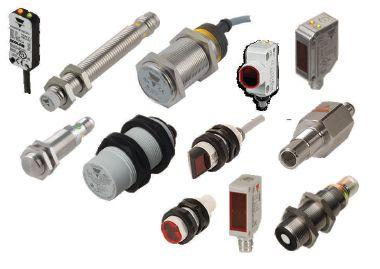
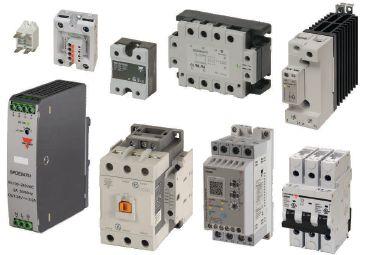
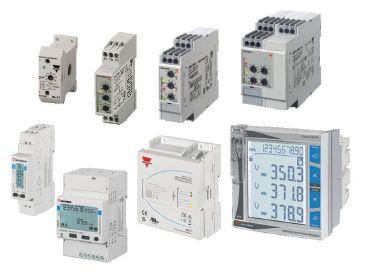
CARLO GAVAZZI has the solution for your application needs, whether it’s our industry leading solid state relays & contactors, energy meters, monitoring relays, soft starters or sensors, available with or without IO-Link.
CONTROLS: AC and DC Energy Meters and Transducers • Universal Web Platform • CurrentVoltage- and 3-Phase Monitoring Relays • Current Transformers • Timers • Panel Meters
Contact us today, and one of our field sales representatives will show you why we are one of the fastest growing automation companies worldwide. We’ll even provide a free evaluation sample to qualified OEMs.
SICK AG executive board chairman Mats Gökstorp (left) and Peter Selders, chief executive officer of the Endress+Hauser Group.
Swiss-based tube packaging specialists Neopac has picked up the prestigious Tube of the Year Award from the European Tube Manufacturers Association (ETMA) for the company’s new Polyfoil tube with a child-resistant closure. Said to be the world’s smallest child-resistant tubse, the new pharma-grade tubes are available in a 10-mm diameter—with capacities of one to three milliliters—to suit a broad range of pharmaceutical liquids and creams, with the long-nozzle applicators ensuring precise dosing.
EXAIR, Cincinnati, Ohioheadquartered manufacturer of air-knives, vortex tubes, vacuum blowers, ionizing systems and other compressed air technologies, has completed the acquisition of BETE, a prominent manufacturer of engineered spray nozzle and spraying systems based in Greenfield, Ma. “For our valued customers and partners, this merger means improved service, new products, and competitive prices,” says EXAIR president Kirk Edward. “They will benefit from the combined expertise of two industry giants coming together to deliver comprehensive solutions that meet their needs.”
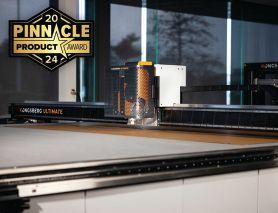
Digital cutting systems supplier Kongsberg PCS has received its second award within one month for
the company’s recently-launched Kongsberg Ultimate cutting system, picking up the 2024 Pinnacle Product Award of the PRINTING United Alliance. Introduced to the market just six months ago, the new Kongsberg Ultimate has been honored in the Lasers/Routers/ Cutters (4x8 feet or larger) category by a panel of judges from across the printing industry. “Following our recent EDP Award for Best WideFormat Cutting Solution at drupa, receiving this Pinnacle further underscores the technical innovation and exceptional work of the entire Kongsberg team in developing new standards in corrugated production,” says Kongsberg PCS president and chief executive officer Stuart Fox.
Leading global packaging machinery manufacturing group Syntegon has completed the acquisition of Azbil Telstar, manufacturer of processing systems for healthcare and life science industries headquartered in Barcelona, Spain, from the Japanese building and industrial automation conglomerate Azbil Corporation With a workforce of approximately 900 employees at production plants in Spain, China and the U.K., Telstar represents a significant addition to Syntegon’s growing portfolio equipment for liquid pharmaceutical processing. “With this acquisition, our customers will benefit from even more comprehensive solutions, seamless processes, and life-cycle services,” says Syntegon’s chief executive officer Torsten Türling.
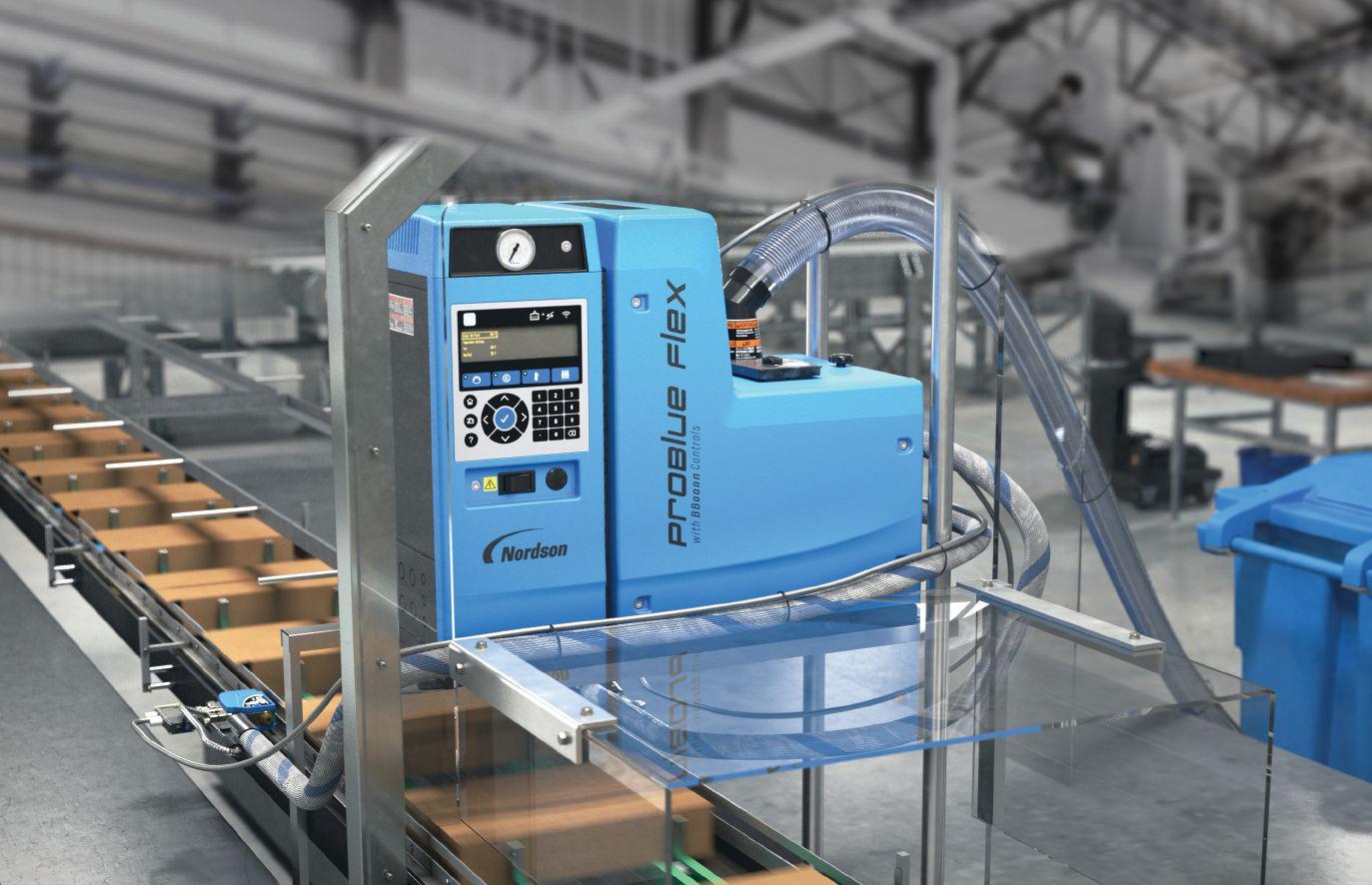
Nordson Packaging
COBOTS AT WORK
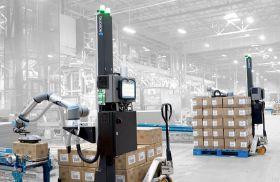
The new AX20 and AX30 cobot palletizers from Robotiq offer increased increased height and payload capabilities to make them practical alternatives to conventional industrial robots, according to the company, at a fraction of the cost and a footprint four times smaller. Capable of building pallets up to 108-inches-high, while handling payloads of up to 60 pounds, the new AX20 and AX30 come equipped with Robotiq’s user-friendly Copilot software, which incorporates a wide range of flexible programming variables that are easily configurable through an intuitive interface to add new SKUs (stock-keepin units) and operate the cell, with assembly line workers capable of mastering it in about 15 minutes of training and instruction. The AX20 and AX30 palletizers are uniquely designed using a “coordinated axis” (or a ball screw servo axis)—making them highly efficient in addition to high trhroughput and a long service life. Unlike telescopic axes, the coordinated axis combined with advanced robot control enables faster and smoother movements, preventing overloading of the robot arm.
Robotiq
CLEAN WATER
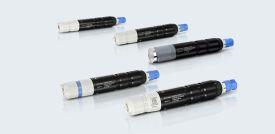
Endress+Hauser has launched a new portfolio of optimized digital sensors with Memosens 2.0 technology that deliver continuous, reliable water disinfection measurement. This new generation of disinfection sensors represents an upgrade opportunity for a wide range of water monitoring applications at water utilities, sewage treatment plants and recreational swimming facilities, in food and pharmaceutical production, and in many other industrial processes requiring proper dosing of chlorine. Whereas other types of chlorine sensors often fail to deliver reliable measurements after lengthy exposure to chlorine, the new Endress+Hauser Memosens 2.0 chlorine sensors remain alert even during periods where there is no chlorine. Therefore, they start to measure immediately once the chlorine is introduced into the water, so there are no gaps in monitoring and no missed surges. These new sensors convert the measured value into a robust digital signal and transmit it inductively—regardless of moisture or other environmental influences—and they can also be easily and quickly replaced with pre-calibrated sensors directly in the field via a plug-in connection.
Endress+Hauser
AIR SUPERIORITY
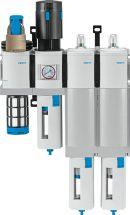
Festo has introduced a new line of pre-configured, assembled, and tested compressed air preparation units that not only makes specification and ordering faster and easier, but also ensure clean air in food and beverage production. Right out of the box, the new units meet the Safe Quality Food (SQF) guidelines of final filtration stage 0.01 micron (µm) and a particulate removal efficiency of 99.999% at the point of food and beverage contact, according to the company. The units also cover most, if not all, requirements of both original equipment manufacturers (OEM) and the maintenance, repair, and operations (MRO) standards for air flow, connection size, and particle class rating. While air preparation units have multiple modules, each assembled unit can be easily ordered with a unique part number. The units include the latest generation modules in price and performance offered by Festo, including filter regulator, filter, lubricator, on/off valve, soft-start valve, and a branching module. The units can also be easily tamper-proofed and feature lockout/tagout functionality for assured safety and performance. An easy-to-read gauge simplifies pressure monitoring, while a visual indicator signifies when a filter cartridge needs to be changed. Festo Inc.
WELL TO DO
Developed specifically for e-commerce shipping applications with zero tolerance for spillage, the newly-upgraded SeaWell active packaging solution from Aptar–Food Protection, part of AptarGroup, Inc. and a leader in active material science food safety solutions, is designed to help maintain seafood freshness, quality and aesthetics for product like filets, whole fish, and various shellfish sproducts like crab legs, scallops and shrimp. In addition to enabling effective frozen-to-thaw distribution, the SeaWell active packaging system’s integrated technology absorbs excess liquids that would otherwise accumulate around seafood, causing potential product breakdown and negatively impacting both freshness and appearance. The SeaWell active packaging utilizes food contact-safe absorbent materials embedded into its proprietary Drip-Lock technology to trap excess fluids inside patented pockets or wells. This separation reduces the rate of seafood microbial growth, chemical degradation and odor accumulation, according to the company.
Aptar– Food Protection
Choose
Brand
Package
Sustainable
*Early bird rates and member discounts
Packaging Circularity Course | Register for one or all
Intro to Packaging Circularity/Sustainability | Sept. 10
Elimination, Food Loss & Waste, Safety, Quality and Compliance | Oct. 1
Golden Design Rules Essentials Course | Sept. 19 OR Dec. 12
Learn about the nine Golden Design Rules for Plastics Packaging, developed by The Consumer Goods Forum.
Complete Plastics Packaging Course | Oct. 22 - 24
Introduction to Polymers, Rigid & Semi-Rigid Plastics, Flexible Packaging, Design basics, and more.
THE PAPER CHASE
How paper cups can turn choppy waters into an ocean of opportunity
By Jeannin Scherzer
In today’s Quick Service Restaurant (QSR) market, every drink served in a plastic cup comes with a side order of uncertainty.
Regardless of Canada’s federal single-use plastic ban, which at the time of writing has been overturned subject to appeal, cities and towns like Montreal and Banff show there is a growing trend of municipal useand-toss plastic restrictions spreading across the nation.
Beyond this, consumer sentiment around plastic and a growing concern around poor plastic recycling rates are combining to create potential risks for businesses that use plastic cups.
But where there’s risk, there’s also an opportunity. And it’s an opportunity QSR brands can seize by serving up cups made from mainly
Crawford Packaging Welcomes Kyle Kuska as Packaging Specialist
London, Ontario, Canada, August 12, 2024 –Crawford Packaging is excited to announce the addition of Kyle Kuska to our team as Packaging Specialist. With nearly 15 years of experience in sales and territory management, Kyle brings a wealth of knowledge and a proven track record to his new role.
In his most recent position as Territory Business Manager at Intertape Polymer Group (“IPG”), Kyle drove significant business growth through distributor partnerships, product line expansion, and sales team trainings across Ontario and Canada.
“We are excited to welcome Kyle to Crawford Packaging,” said Andy Craig, Executive Vice President at Crawford Packaging. “His experience and accomplishments speak for themselves, and we are confident that his contributions will be invaluable as we continue to grow and innovate. We look forward to Kyle becoming a key building block and sales leader for years to come.”
renewable materials that meet consumer preferences and legislator demands, while preserving our planet’s natural resources.
Over the last several decades, plastic production has increased faster than any other material thanks to its light weight, durability, and low cost.
Most of the three million tonnes of plastic Canadians throw away each year ends up in landfill, and around 29,000 tonnes find their way into our natural environment. Despite the fact that over 60 per cent of Canadians have access to a plastic recycling scheme, only nine per cent of it is recycled .
These facts have stirred the Canadian government into action. Finalized in June 2022, the Single-use Plastics Prohibition Regulations (SUPPR) is a comprehensive plan to ban single-use plastics.
The regulations target six categories of problematic plastics, including foodservice containers like cups. The first measures from these new regulations became active in December of 2022, and even though the ban was overturned by the Federal Court in November 2023, it remains in force until the outcome of the government’s appeal is resolved.
This situation is made more complex when municipal plastic restrictions are taken into account.
These can vary by city and even by town. For example, Toronto has implemented a ‘by request’ approach to single use plastic items, while QSRs must allow consumers to use refillable beverage cups if they choose. Meanwhile, British Columbia has banned many different types of plastic cups outright.
This creates a minefield for QSRs, particularly the chain restaurants.
Chains rely on harmonized processes to ensure consumers get a consistent experience at every restaurant, but the uncertainty around plastic cups is hugely disruptive to that harmony for those QSRs using them.
While the future of single-use plastic legislation is yet to be decided in the courts, the court of public opinion has already passed its verdict. Over 90 per cent of Canadian consumers are concerned about the impact food packaging has on the environment, and over half are
concerned with plastic use.
Meanwhile, around 50 per cent of consumers feel that a brand’s values are important, and twothirds would swap to a brand they perceive as more sustainable, if price and quality are the same.
In our view, paperboard is undoubtedly the material that is bestplaced to meet these needs. It has a high recycling access rate in Canada at 96 per cent, and nearly 70 per cent of all paper, paperboard, and cardboard is successfully recycled .
But of course, it’s not all about sustainability. Paper cups must also offer a great user experience.
Recent market research by the Shelton Group found that the vast majority of surveyed consumers prefer the insulation benefits provided by paper cups, namely protecting hands and surfaces from condensation and keeping their cold drink colder for longer. Pointedly, just 11 percent felt it was important to see their drink through a clear plastic cup.
When asked to rate the performance of a paper cups across a number of attributes, consumers responded enthusiastically. In respect to “feels comfortable on the mouth when sipping,” 88 per cent of consumers rated paper cold cups as “excellent” or “good,” rising to 93 percent for hot cups.
And as for the attribute “does not impact the taste of the beverage inside,” 84 per cent responded “excellent” or “great” for cold cups, rising to 95 per cent for hot cups.
Consumers should not have to choose between enjoying a refreshing cold beverage and their desire to minimize their impact on the environment. When that beverage is served in a paper cup, they don’t have to.
Paper cups are an obvious choice for QSRs looking to optimize growth strategies and minimize risk. Canadian consumers are ready to make the switch. Canadian legislators are trying to make the switch. All that remains is for QSR businesses to show they’re listening.
JEANNIN
SCHERZER is marketing director at the leading global paperboard packaging producer Graphic Packaging International.
Email:
Phone:
PLAN BEE
Canadian packaging machinery
stalwart helping venerable honey farmer branch out into the fast-growing RTD co-packing business
By Pierre Deschamps
Photos By Pierre Longtin
Being a busy bee is a long-entrenched part of the work culture at Miel Dubreuil Inc. in St-Dominique, Que.
Founded by Lucien Dubreuil in 1930, the family-owned honey farm is a cross-generational success story built on the time-honored business attributes of quality, service, expertise, consistency and respect, combined with deep passion for making mankind’s first and most reliable source of sweetener dating back thousands of years to ancient Egypt.
Nowadays managed by co-owners Myriam Dubreuil and Patrick Malo, the company produces several types of honey, as governed by the flowering cycles of different plants that the bees forage.
Depending on the season, bees may focus on a field of buckwheat, blueberries or clover, Malo explains, to enable production of distinctively flavored honeys.
If the bees have foraged more than one type of flower, the product is known as wildflower honey, says Malo, who pointedly prefers to use the word “livestock” when describing the hardworking bees responsible for all the hard pollinating and harvesting work preceding the actual honey production process and packaging.
“I prefer to use the word livestock because it better suits our reality, whereby our bees, like animals, can face predators or to contract diseases,” Malo explains.
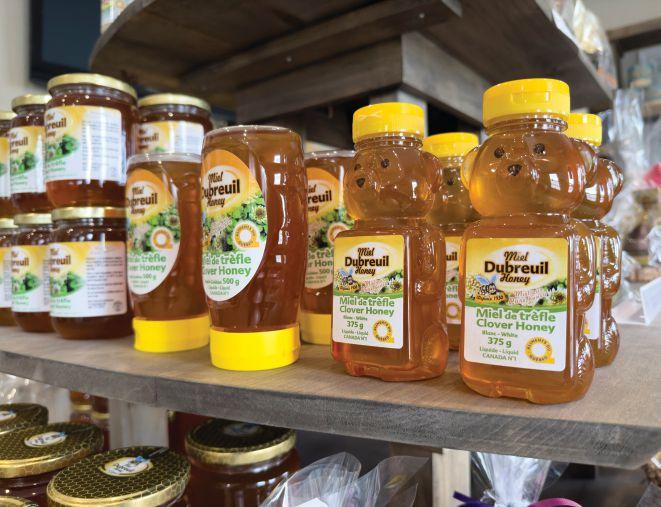
Today, the company produces five different types of honey— clover, buckwheat, blueberry, wildflower and creamy—which are sold at over 400 retail locations across Quebec.
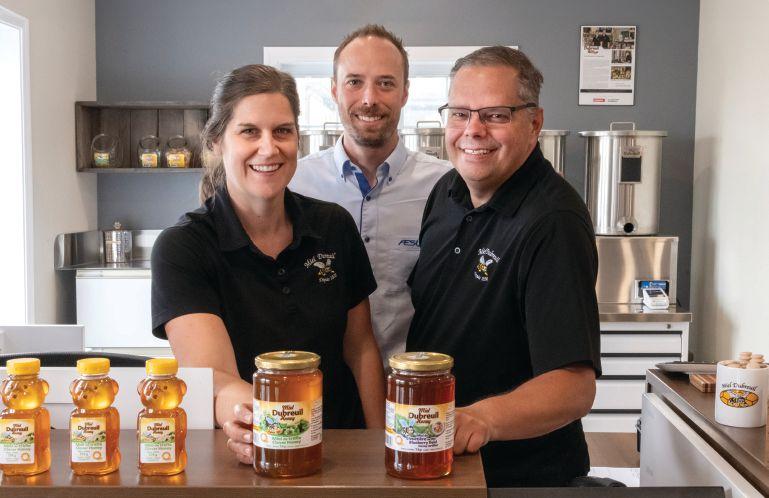
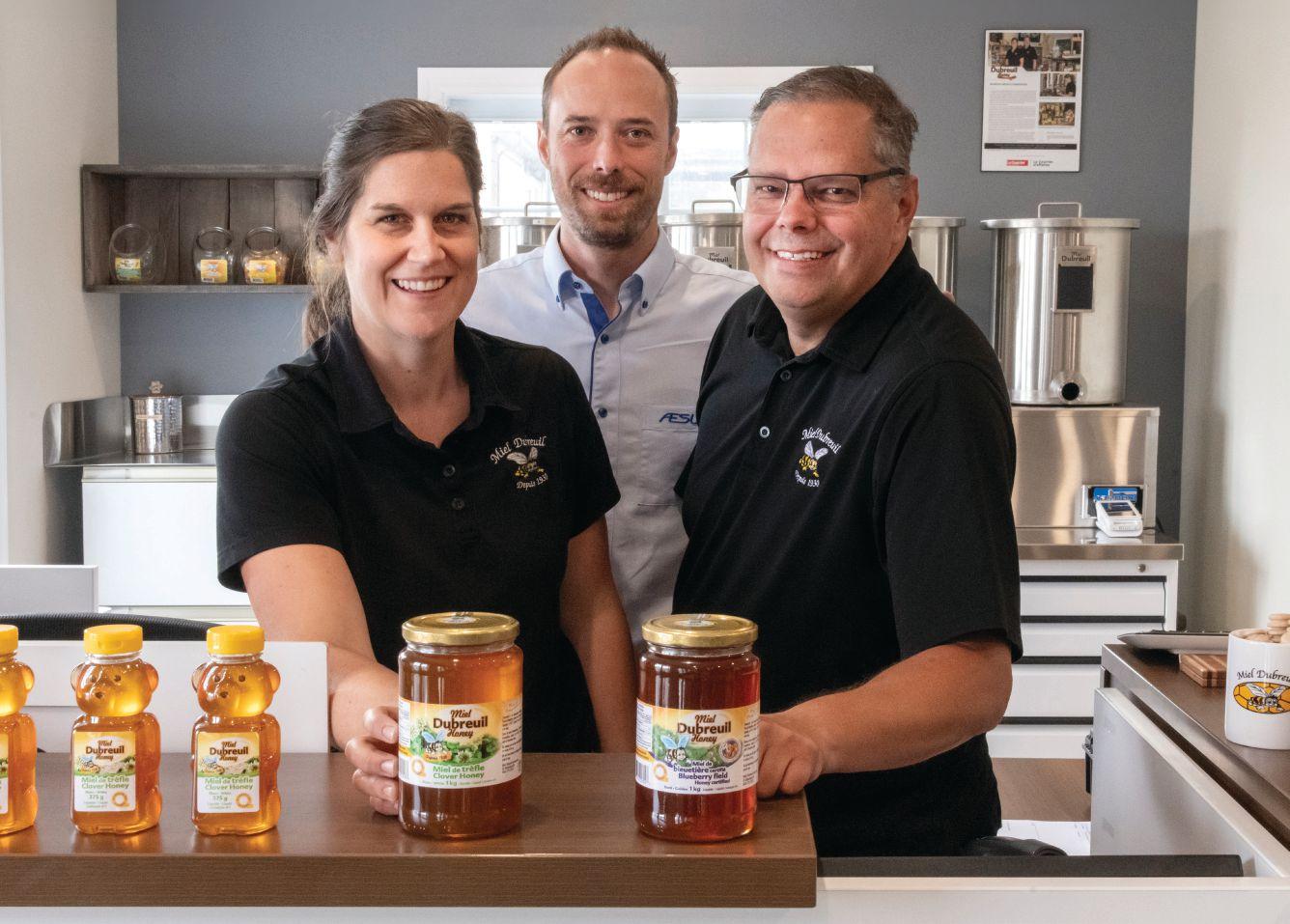
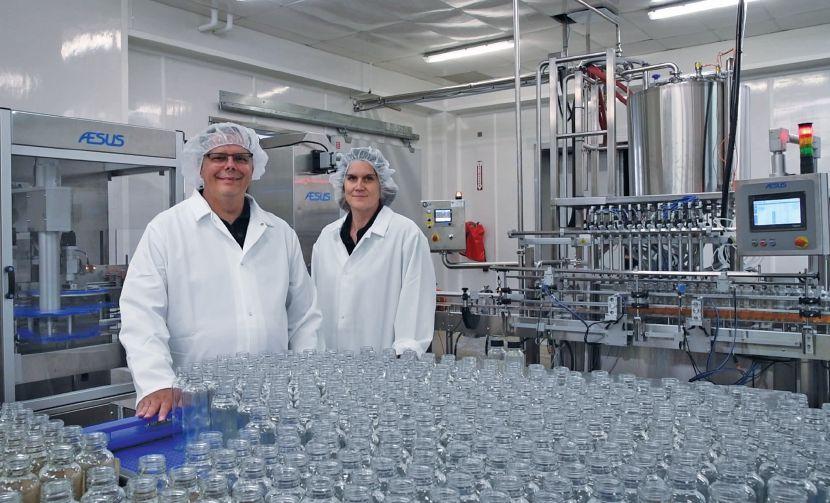
Aesus vice-president of engineering Patrick Wilson (center) is flanked by Miel Dubreuil co-owners Myriam Dubreuil (left) and Patrick Malo at the company’s retail storefront to display its signature premium honey products.
According to Malo, clover and creamy honey are the most popular products, “because many consumers appreciate their easy spreadability.”
Mostly packaged in round 500-gram glass wide-mouth jars capped off with tin lids, the Miel Dubreuil brand honey portfolio is further enhanced with complementary products like beeswax, royal jelly and lozenges—helping the company make sure that none of its delicious, premium-quality product is wasted.
As the market demand for the company’s products continued to grow in recent years, so did the need to automate the packaging process, relates Malo, who embarked on acquiring the company’s very first filling line in 2016.
“We were looking to automate to increase our production volume,” Malo recalls, “and so I started discussions with other beekeepers and people involved in maple syrup production to identify the equipment that best suited our needs.
“That’s when I contacted Aesus, who immediately responded to our market needs and requirement,” Malo states.
“This helped us realize our ambitions and progress.”
Based in Montreal, Aesus Packaging Systems was formed in 2003 through the merger of two local packaging line equipment specialists— D.L. Tech and EDT—orchestrated by a team of private investors previously employed by a once-renowned pharmaceutical packaging machine-builder Kalish DT Industries.
Headed by founder and chairman Daniel Lachapelle, Aesus quickly
evolved into a highly competent and widely respected supplier of a comprehensive range of equipment including bottle unscramblers and cleaners, fillers, inserters, cappers, labelers, tables, conveyors, and all the related subsystems and auxiliary products to support the company’s “one-stop-shop” solutions provider capabilities.
Focusing primarily on the slow to mid-speed segment of the market, Aesus quickly proved to be a perfect choice as a knowledgeable partner to introduce Miel Dubreuil to the wonders of packaging automation.
As Aesus vice-president of engineering Patrick Wilson recalls, “From the beginning, we sat down with our client to determine his needs and identify the line’s speed—not based on the equipment’s capacity but on his industrial reality.
“In fact, we adjusted to his situation to ensure he could get the most out of this line while respecting his production volumes,” says Wilson, who joined the Aesus management team about 10 years ago as an active shareholder.
Still working like a charm today, that first packaging line installation paid off handsomely for Aesus several years later in 2023, when Malo decided to venture into the fast-growing RTD (ready-todrink) beverage market under the trade name La Fabrique à Saveurs
Housed in a purpose-built facility located on Miel Dubreuil property, the second line was a considerably more expansive endeavor involving faster line speed requirements, Malo recalls, but achieving the same outstanding results as the original honey filling line.
“One of Aesus’s strengths is being able to customize its offerings,” Malo states.
“Their technicians visited the site, listened to our needs, and proposed solutions that I had not considered myself, but which helped us meet our requirements in the best possible way.
“So when we recently wanted to further expand our presence in the RTD liquid sector by adding a third filling line, it was only natural that we turned to Aesus again,” Malo states.
Installed this past summer at the company’s new site in nearby Sainte-Madeleine, the new line can handle significantly larger volumes, while running at notably higher speeds, than its two predecessors.
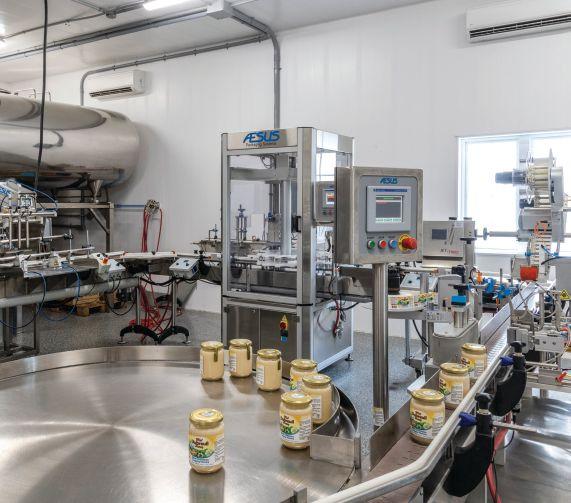
From top Finished jars of Miel Dubreuil creamy honey make their way to the accumulation table for packing.
The Aesus honey line controlled by a user-friendly swing-arm HMI terminal panel.
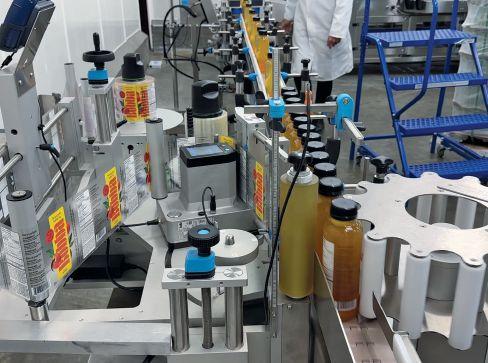
The Aesus labeler swings into action to attach product labels to the jars.
A sampling of some of the retail packaging formats used highlight the purirty and clarity of the premium quality honey harvested from Miel Dubreuil croplands.
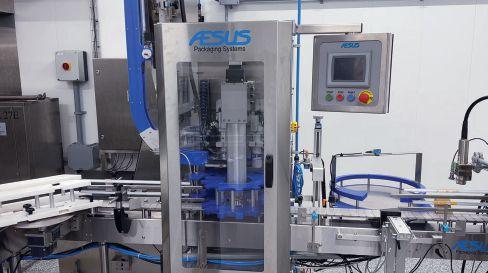
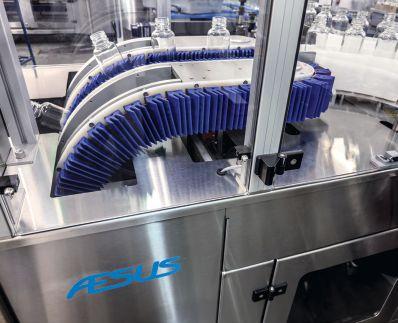
An Aesus bottle inverter used to clean and remove dust and other debris from the glass bottles prior to filling.
Right
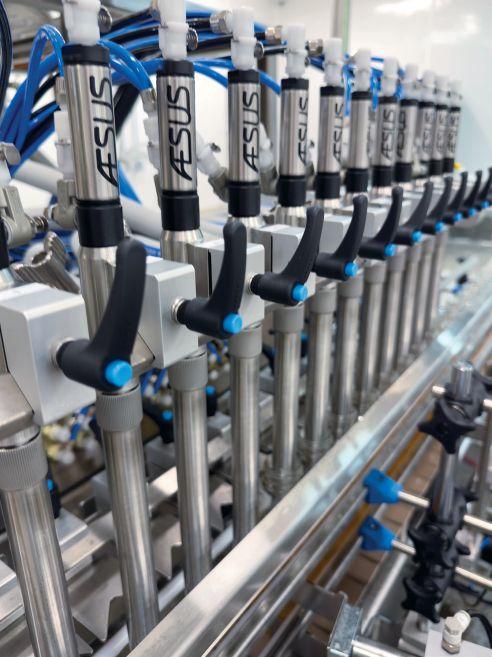
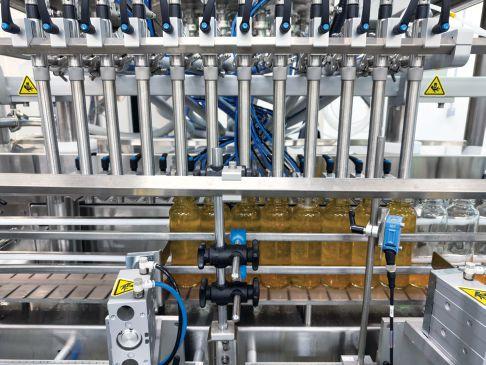
Close-ups of the 12 filling nozzles inside the AESFill AF12 liquid filler dispensing precise quantities of an RTD beverage inside the clear glass containers.
Consisting entirely of Canadian-made equipment manufactured at the Aesus production facility in Pointe-Claire, the new line includes:
• A custom-built dual-feed table;
• An InvertaClean bottle cleaner;
• An AESFill AF12 liquid filler;
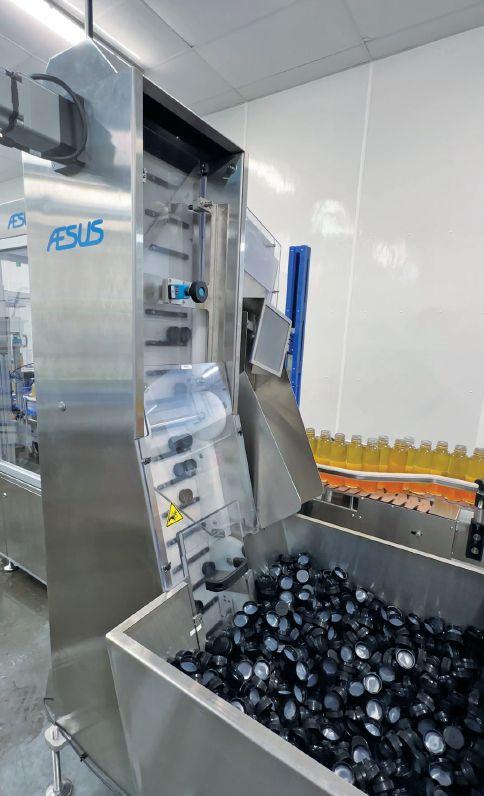
• A Premier StarCap star-wheel capper, linked to a cap sorting elevator, and an inspection and rejection system;
• An InvertaClean bottle inverter for cap sterilization;
• A Delta Star Prism labeler for application of pressure-sensitive labels;
• A 48-inch-diameter accumulation table.
Capable of running up to 60 glass bottles per minute, the new line has been instrumental in enabling Fabrique à Saveurs to secure a substantial co-pack-
ing contract for the popular Bubba Tea line of bubble-infused ice tea beverages, which are packaged at the 10,000-squarefoot Sainte-Madeleine facility at an average speed of 45 bottles per minute.
Expertly installed and commissioned on-site by a team of highly-skilled Aesus technicians, the new equipment quickly met all of Malo’s expectations for another top-class packaging line installation, with its 12-nozzle filler earning special praise.
“The filler’s 12 nozzles can be utilized according to the immediate needs of each filling run,” Malo points out.
“So if we need only eight nozzles for a particular contract volume, we can use just eight,” he says.
“Its simplicity and operational flexibility, along with its ease of cleaning, are truly impressive,” says Malo, while also
complimenting the outstanding performance of the line’s StarCap capper.
“In packaging, capping is always a challenge,” Malo relates, “but with a rejection rate of less than 0.05-percent, it (StarCap) has proved be a fantastic machine.
“With these two machines, Aesus has provided us with technologies that have greatly improved the quality of our work,” Malo extols.
According to Malo, the installation of the third filling line provided a welcome opportunity to implement network connectivity for all the equipment dedicated for RTD beverage packaging.
As Wilson explains, “All the machines are connected to the Internet, which allows us to remotely monitor what’s happening on the machines and perform diagnostics to assist our client
Above left
Miel Dubreuil co-owners Patrick Malo (left) and Myriam Dubreuil pose behind rows of empty glass bottles making their way towards the new Aesus packaging line.
Above right
when problems arise.”
“Moreover, all the screens we provided include statistical pages that allow operators to track their production progress, see how many bottles have been used, and how many have been rejected,” Wilson continues.
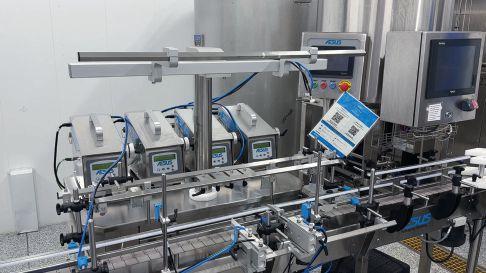
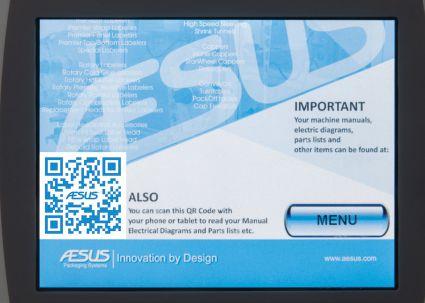
“Our screens also include pages with QR codes, allowing an operator to use their phone to access all the documentation for a machine, along with the electrical diagrams, technical manuals, and help videos.
“This enables an operator to quickly find all the necessary information,” says Wilson, noting that Aesus played a much more involved role in this project than a mere machinery supplier.
“We did more than just sell equipment,” he states. “We accompanied our client at every stage to ensure they could
cap
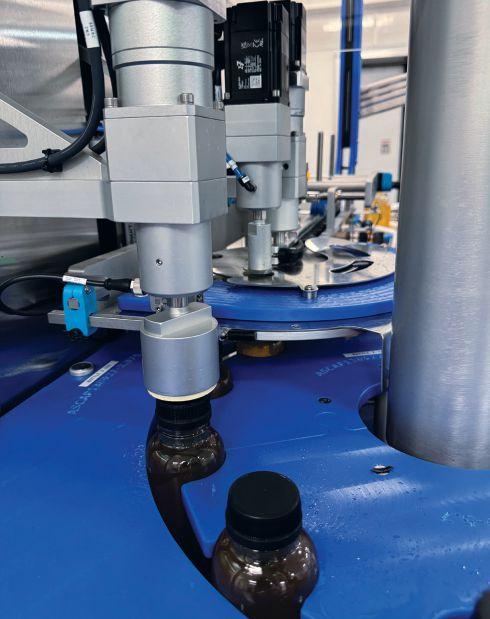
An Aesus capper applying just the right amount of torque to seal the passing containers.
fully master the operation of this third line.”
According to Malo, investing in automated packaging equipment has been instrumental in not only helping Miel Dubreuil refine its honey packaging process, but also to expand into entirely new markets like beverage co-packing, while overcoming the challenge of labor shortages currently affecting many Canadian food-and-beverage producers.
“Thanks to automation, we can double, triple, or quadruple production with less labor,” Malo asserts.
“That’s an important aspect to emphasize,” he says, while also hailing the great strides that the company has made in improving the consistency of its core flagship honey products.
“Previously, we filled our honey containers by hand, so the levels weren’t
always the same from one container to another,” Malo states. “Now, with the fillers we’ve acquired from Aesus, the fill levels are always consistent.”
For his part, Wilson is also happy with how the entire project came together, citing impressive productivity gains achieved in the customer’s RTD operations.
Moreover, the entire project, including on-site integration, was completed under extremely tight deadlines, Wilson recalls.
“Probably the biggest challenge in this project was the fact that our customer had signed the [co-packing] contract even before he gave us the project,” Wilson recalls. “So when we started working on the project, we were squeezed for time from the start.
“That’s why we had to deliver ma-
Aesus line equipment makes innovative use of QR codes to store all critical machine data for optimal preventive maintenance.
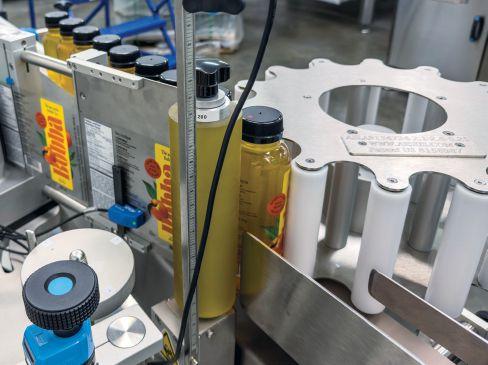
Close-up of the Delta Star Prism labeler attaching wraparound pressure-sensitive labels around the curvature of the passing glass bottles.
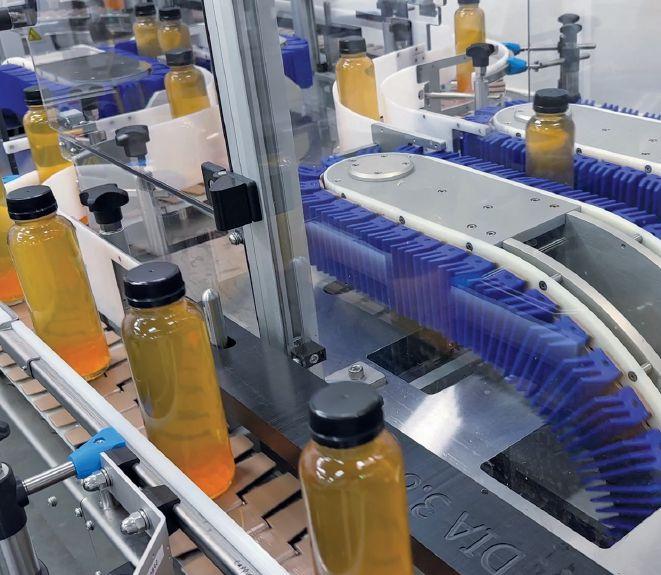
After labeling, the finished containers are directed in a single file towards the final product inspection station prior to packing.
Clockwise from left
An Aesus
elevator directing bottle caps to the line’s capper.
Above left
Aesus vicepresident of engineering
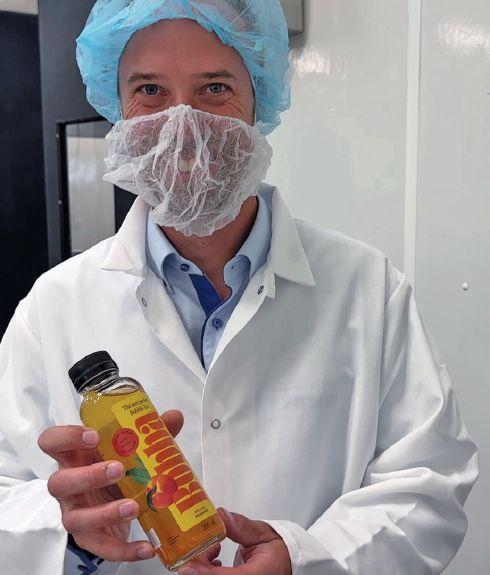
Patrick Wilson holds up a precision-labeled bottle of an RTD beverage coming off the Aesus filling line.
Above right
Installed earlier this summer, the Aesus bottling line at the new La Fabrique à Saveurs bottling facility typically runs at about 45 bottles per minute, with capacity for 60 bottles per minute.
chines one at a time,” he says, “because we could not test and integrate all the machines at our facility.
“But we found creative ways to overcome this challenge,” Wilson relates, “like delivering partial lines, doing the final integration on-site, and doing all the other extra things to get the production started on time.”
As Wilson explains, going the extra mile to ensure smooth equipment installation and commissioning is all part and parcel of Aesus’s business and customer service philosophy that has enabled the company to evolve from a modest labeling systems OEM into a full-fledged manufacturer and integrator of the full range of medium-speed packaging line equipment over a relatively short time period.
Says Wilson: “Aesus started out by supplying labelers, but as our customers grew, we found that we needed to grow with them in order to keep their business.
“So we added, fillers, bottle cleaners, inverters and so on, expanding our product portfolio to the point where we can now provide turnkey primary packaging systems that we can customize and integrate any way that our customers require,” Wilson states.
Nowadays employing about 115 people at its recently-expanded PointeClaire facility, Aesus operates an on-site machine shop equipped with a laser cutter and several high-end CNC machines to machine its own aluminum and stainless-steel machine parts, thereby maintaining full ownership of its manufacturing and quality control process.
“So we build our own parts, we assem-
“As our customers grew, we found that we needed to grow with them in order to keep their business.”
ble our own machines, we test them inhouse, we deliver them to our customers, and we integrate them to make sure they all perform at their maximum efficiency levels,” he states.
Nowadays manufacturing 250 to 300 machines per year, Aesus has also vastly expanded its customer service capabilities to support its fast-growing installation base.
“We have a dedicated internal service team who quickly pick up the phone any time someone has a problem,” Wilson says.
“And although we can solve many of these problems internally or remotely, we also have a team of flying technicians that we can quickly dispatch to custom-
ers requiring immediate assistance.
“We also offer various maintenance packages, including planned preventive maintenance, to help prevent any breakdowns and to make sure the customers’ production always runs smoothly,” Wilson adds.
In addition to attracting new business, being able to provide all these capabilities is essential to securing repeat business from companies like Miel Dubreuil, which has recently expressed an interest in acquiring a fourth Aesus turnkey filling line to be installed in the near future. Be it honey, soft drinks or anything else for that matter, it’s fair to say that there is no new business sweeter than repeat business.
Please see a video of the Aesus turnkey bottling line in action at Miel Dubreuil’s new beverage co-packing facility on Canadian Packaging TV at www.canadianpackaging.com
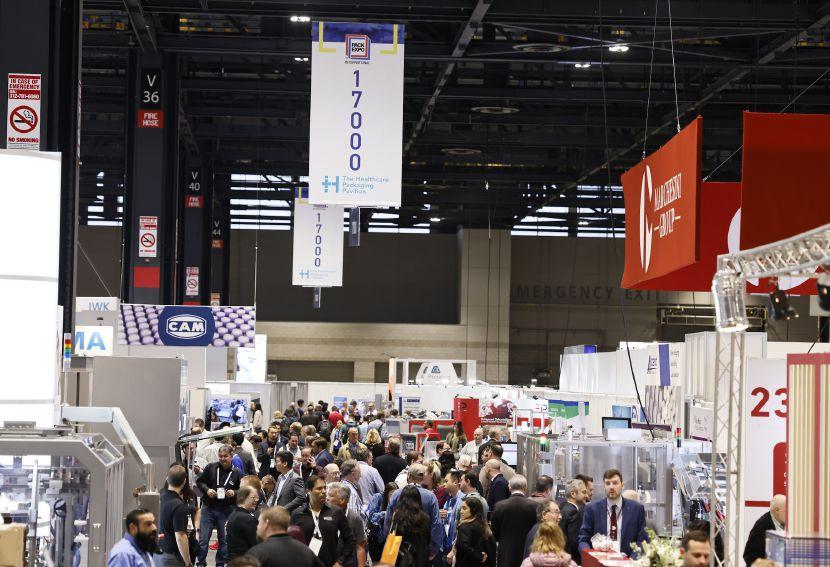
Discover every new packaging and processing trend out there and explore solutions from more than 2,500 exhibitors, all under one roof. PACK EXPO International is where you can discuss real-world problems with experts and land on innovative ideas.
Pacteon Corporation’s chief executive officer Mike Odom brings more than 20 years of experience in senior management positions at leading packaging and manufacturing enterprises to help the company continue rapid growth in the end-of-line packaging machinery markets.
BACK AND FOURTH
Canadian conveying systems stalwart set to reap the market share rewards of joining a fastgrowing packaging OEM powerhouse
By George Guidoni, Editor
Photos By Naomi Hiltz
While it may be true that corporate mergers and acquisitions are often a leap of faith in any growing global and dynamic industry, including packaging equipment manufacturing, it’s also true that the ultimate success of such transactions is rooted in the quality of due diligence, strategic acumen and mutual goodwill at the earliest preliminary stages of the process.
In this light, the recent acquisition of prominent Canadian conveyor manufacturer Descon Integrated Convey-
or Solutions by the U.S.-based Pacteon Corporation already seems like a win-win proposition for all parties concerned, on both sides of the Canada-U.S. border.
Formalized in late June, the smooth and amicable transaction makes the renamed Descon Conveyor Systems the fourth core pillar of a fast-growing end-of-line packaging machinery powerhouse that also includes wellknown industry players such as:
• Schneider Packaging Equipment Company, Inc. , Brewerton, N.Y.based manufacturer of case-packing, robotic palletizing, case sealing, automatic guided vehicles, material handling solutions, and completely integrated lines for customers in the food, beverage, plastics, dairy, manu-
facturing and paper industries.
• ESS Technologies, Inc. , Blacksburg, Va.-based specialists in complete packaging line design, equipment manufacturing, and integration for the pharmaceuticals, nutraceuticals, cosmetics and consumer packaged goods industries, renowned for its integration expertise with cartoners, case-packers, robotic palletizers, integrated track-and-trace, robotic pick-and-place, and other end-ofline robotic equipment.
• Phoenix Wrappers , Laval, Que.based manufacturer of automatic and semi-automatic stretchwrap packaging, pallet wrapping machinery and pallet conveyors.
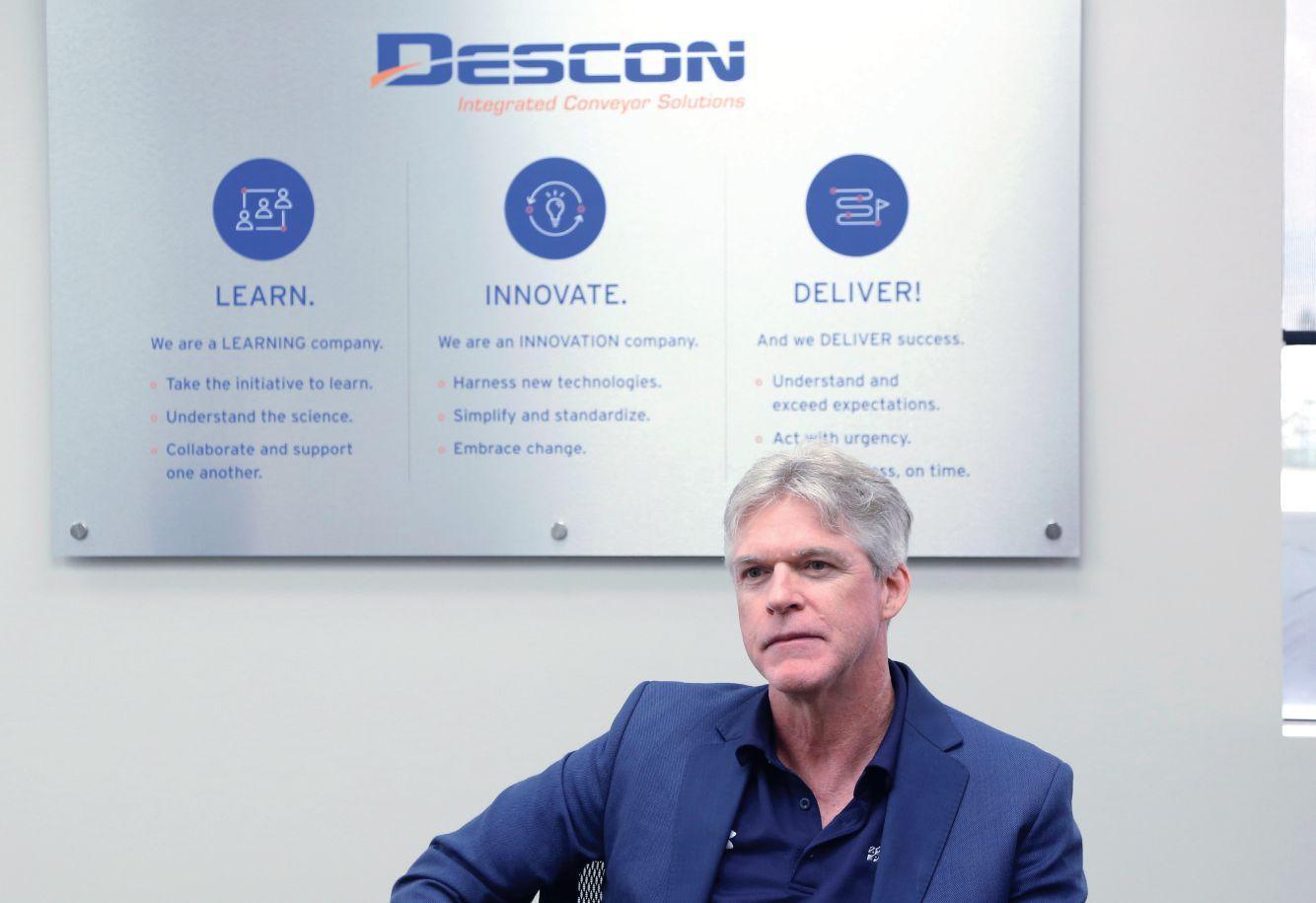
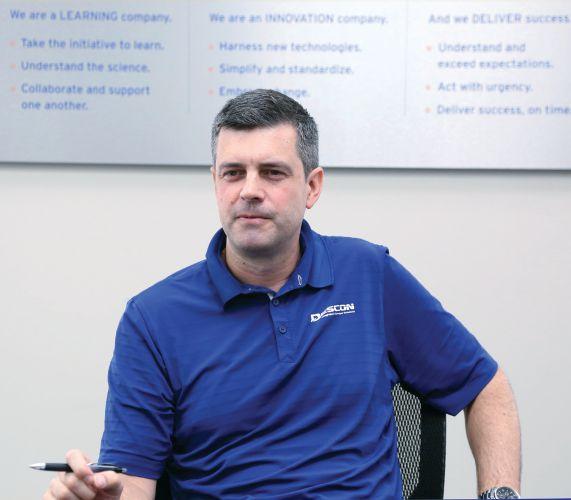
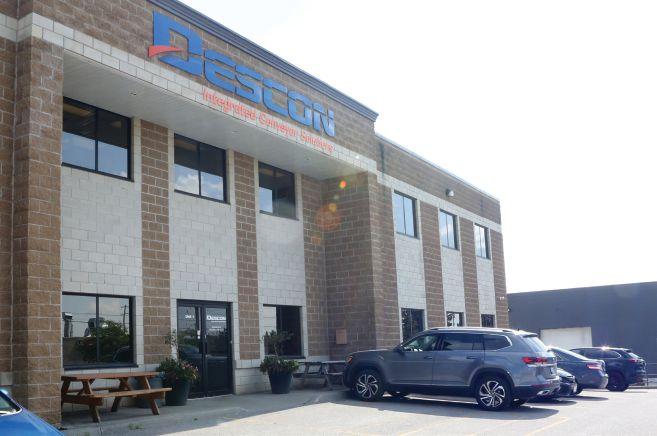
Becoming part of this elite corporate quartet has been keenly welcomed and embraced by Descon’s vice-president and general manager Steve Nixon and vice-president of operations Jeff Philpott, both 25-year Descon veterans who have played key roles in the company’s rise from a fledgling conveyor start-up to a well-respected conveying solutions builder and integrator with a strong presence and profile in the North American beverage industry.
“We both started when there were only 13 people on staff,” recalls Nixon, “and now we’re up to 115 full-time employees, so there has been a lot of growth over the years.”
Started up in 1993 by co-founders David Farquhar and Geoffrey Oliff, Descon decided to focus on the beverage industry almost from the outset, Nixon recalls, specifically on the highspeed end of the market segment.
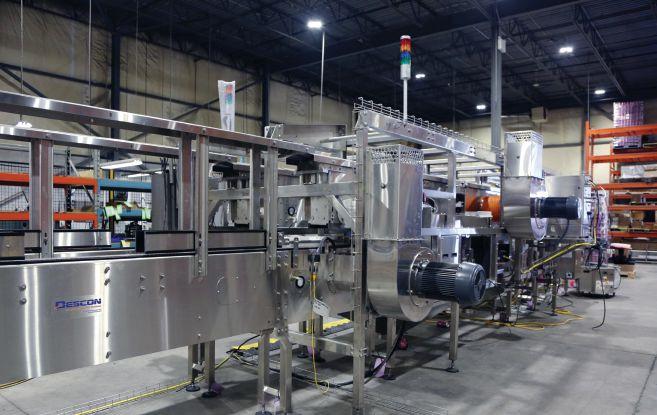
“Our conveyor systems are well suited for a multitude of different products, including soft-drinks, bottled water, beer and cider, wine, dairy and packaged foods, as well as packaged ‘full goods’ such as corrugated cases, shells, cartons and film-wrapped packages of multiple sizes,” Nixon told Canadian
Packaging during a recent visit to one of Descon’s two Newmarket locations totalling 45,000 square feet of production and assembly space.
“Our customers include Coca-Cola, Pepsi-Cola, Blue Triton, Refresco, Unilever, Nestlé and Grupo Bimbo, to name a few,” says Nixon, adding that many Descon-built conveyor systems in service today run at lightning speeds of over 2,000 containers per minute.
“Our wide array of conveyance systems includes neck-ring air conveyors for empty PET (polyethylene terephthalate) plastic containers, bulk style conveyor for preforms and caps, air and vacuum-style conveyor for empty cans, modular belt conveyor for full container, and pack- and case-handling conveyors,” Nixon reveals.
“We also manufacture dry trash removal systems and washers for empty shells, bulk-style depalletizers, side-grip container rinsers, container warming tunnels and drying systems,” says Nixon, estimating the company’s average yearly output at about 50 different installation projects of varying size, scope and complexity.
With over 1,100 successful conveyor system installations to date—about 30 per cent at Canadian-based production facilities—Descon’s stellar track record and reputation for quality craftsmanship is well complemented with highly skilled workforce relentless focus on manufacturing and integration excellence through all phases of a given project from start to finish.
As Nixon points out, “Descon is a UL (Underwriters Laboratories)-certified panel shop that manufactures all the integrated control systems required for the control of all conveyance systems in-house.”
This in-house manufacturing prowess also extends to all the essential conveyor accessories and sub-systems required for superior high-speed con-
veyor performance and operational flexibility.
According to Nixon and Philpott, this extensive knowledge and expertise is a natural byproduct of a multitalented workforce in which trained engineers account for just over half of the total staffing levels.
Says Nixon: “Our team is made up of multiple disciplines, including mechanical and electrical engineers and designers, project management, site supervisors, start-up technicians, and multiple trades required for the assembly of our systems.”
As Philpott explains, each Descon conveyor system assembled in Newmarket is meticulously custom-tailored to meet the clients’ specific application needs to ensure smooth start-up and commissioning on-site, meaning extensive testing and process simulation prior to customer delivery.
As he relates, “Our systems greatly vary in size and complexity depending on the needs of our customers.
“Once their needs are understood, Descon’s team of layout engineers will design the solution in CAD, and our estimating team will prepare the bid.
“Our projects vary from near-turnkey type solutions to packaging line upgrades made necessary by packaging change requirements or needing to replace antiquated systems,” says Philpott, citing Descon staff’s familiarity and comfort with all the latest automation technologies deployed in fast-paced packaging line environments.
“Our packaging solutions are very automated—using the latest in PLC (programmable logic controller), operator interface and motor control technology,” he states.
“It is our responsibility to ensure that each machine center is connected and talking to the overall system to ensure it has the information that it requires to react to line condition changes— there-
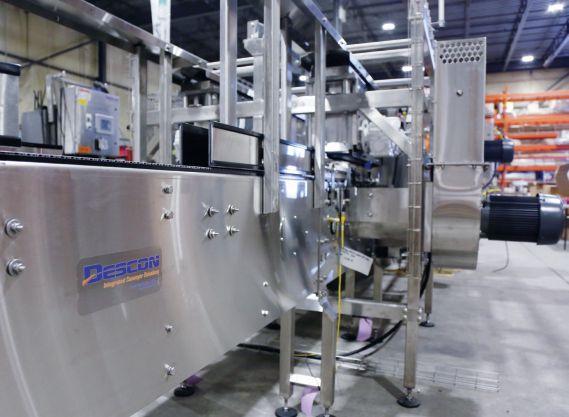
A nearly finished new coneyor being subjected to some extensive testing and troubleshooting at Descon’s central manufacturing facility in Newmarket, Ont.
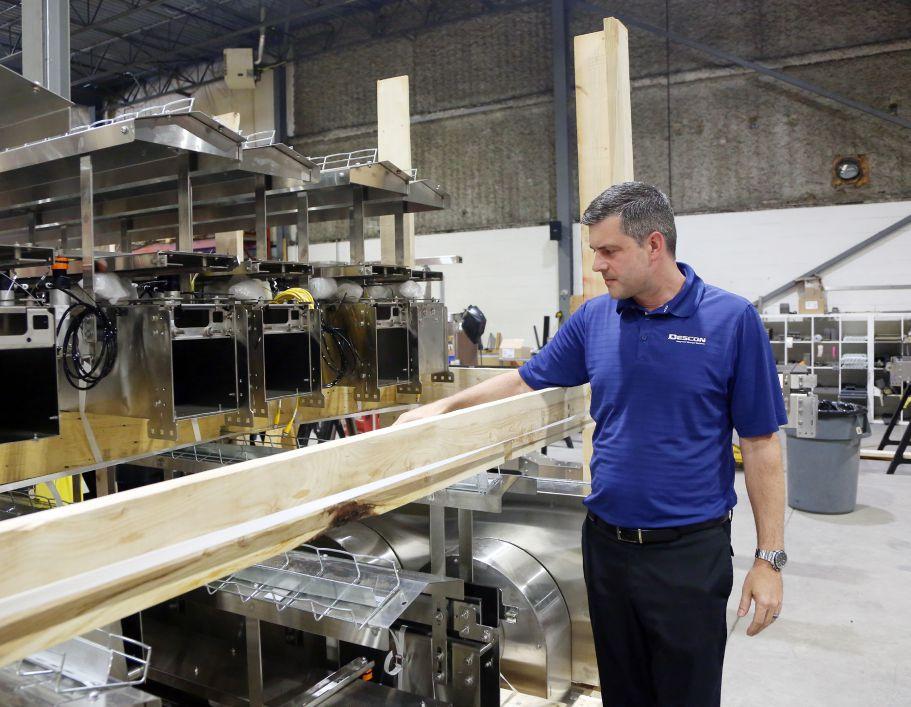
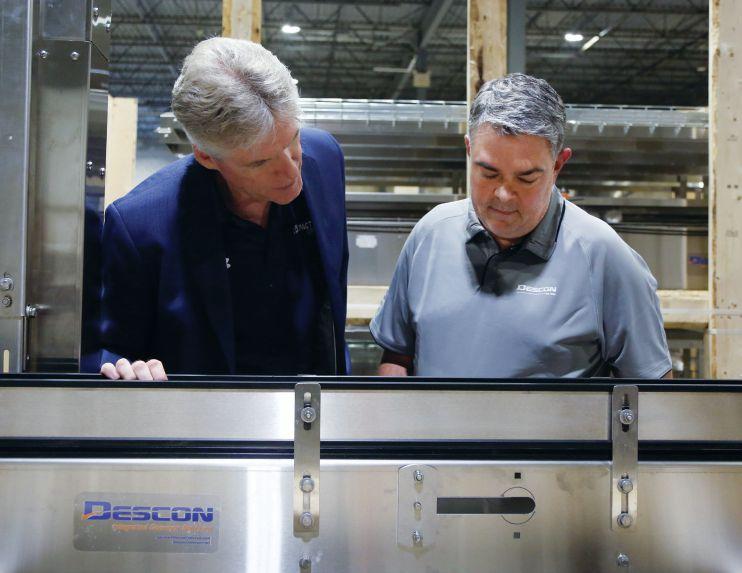
Descon’s vice-president and general manager Steve Nixon conducts a thorough visual examination of key accessories and auxiliary equipment incorporated into the design of a new high-performance conveyor being assembled for a major customer in the beverage industry.
by maximizing overall throughput.”
With eager willingness to take ownership of each phase of the new project, taking care of all the systems integration at the customers’ site is second nature to Descon’s engineers and technical experts, according to Philpott.
“Descon uses in-house technical personnel for all site supervision, startup and commissioning, and project management services, Philpott relates.
“If required, Descon can take responsibility for the entire installation using third-party contracted local installers,” he adds. “Our goal is to make the buying process easy for our customers, so we’ve developed the in-house expertise to excel in these areas.”
Investing in this in-house expertise and all the related R&D (research-and-development) activities over the years has paid off spectacularly for Descon, with most of the company’s
“The wide variety of proven conveyance systems that we have developed and tested here at Descon is of paramount importance to us.”
projects these days comprised of multimillion-dollar installations with worldclass manufacturing capabilities.
“We have many active installations in Canada and our systems can be found in many of the major bottlers throughout the country,” Nixon notes.
“We are currently involved in a major project at a new plant that Coca-Cola is building in California,” adds Philpott, “which will have four massive production lines running at some of the highest processing speeds ever seen in the beverage industry.”
Not surprisingly, the company attaches a great importance to continuous product innovation as a key competitive advantage in a very competitive market, according to Nixon and Philpott.
“We are constantly driving to improve and continually invest in R&D because we feel it’s important to drive change,” Nixon states.
“We recently developed a new lowerator vacuum-style ionized air rinser that can run 2,000 cpm (containers per minute) in a single lane,” he points out, “which is faster than anything currently in the marketplace.
“Up until this development it was necessary to split the flow of cans into two streams—requiring double the capital investment,” Nixon explains.
“We think this will be a game-changer in empty can handling, and we are anxious to demonstrate its capabilities to the market,” says Nixon, stressing the importance of premium craftsmanship and strict quality control in all aspects of Descon’s manufacturing process.
“The majority of our conveyors are manufactured of stainless steel and are suitable for any food or beverage type environment,” Nixon explains.
“We have certain specifications that change depending on the exact environment that our system will operate in so we can tailor our systems to suit most any application,” says Nixon, adding Descon has the required expertise and experience to work with beverage containers of all types, shapes and sizes, as well as all the commonly used secondary packaging formats.
“The wide variety of proven conveyance systems that we have developed and tested here at Descon is of paramount importance to us,” he states.
“These include high-speed pressureless single-filers, vacuum transfers with integrated empty can coding and inspection systems, FIFO (first in first out) and FILO (first in, last out) type accumulation systems, automatic switches and laners for multi-lane feeding of packaging machines, smart changeover systems for various product sizes, and so on.”
Having set the benchmark standards
for excellence in the beverage markets, Nixon says the company is looking forward to extending its footprint into the food processing space, with its newlyforged ties with Schneider, Phoenix and ESS playing a key role in facilitating access to new business opportunities in that sector, as well as in extending Descon’s geographic reach into the U.S., Mexico and Latin American markets.
Says Nixon: “Though Descon is wellknown in the beverage market, we see opportunities for growth in more traditional food spaces and pharmaceuticals, where our sister companies are better known.
“While Descon got its start in beverage production, our systems are completely adaptable to serving multiple industries,” Nixon continues, “including food.
“Descon is known for its unique changeover technologies using DC linear motors—making it an ideal platform for any customer running multiple packaging formats and sizes.
“And even though our systems are tailored specifically to each customer’s needs, our integrated electrical wiring raceways and wiring harnesses provide for a nearly plug-and-play type installation—shortening installation time and accelerating the start-up curve,” Nixon states.
Adds Philpott: “We are also a company that believes in standardization of conveyor designs and processes.
“We have developed our products and methods over many years and have documented them until they became law,” he states.
“This persistence in documenting what works minimizes mistakes and costs on-site.
“We also pride ourselves on driving the start-up curve once the line begins
the commissioning phase,” Philpott proclaims, “which means we have an ‘all-hands-on-deck’ mentality to drive production.
“Because we know that a slow start-up costs our customers money,” he adds, “we want to be known for having the fastest start-up curves.
“This starts with a great layout design, which is supported by great standards and is driven by a great attitude.”
For all the impressive market growth and industry accolades that Descon has earned over the last 30 years, both Nixon and Philpott agree that the best is yet to come for Descon in coming year as an integral part of the Pacteon group of companies.
“We are excited about the role we get to provide to the rest of the Pacteon team,” Nixon asserts. “With Schneider, Phoenix and ESS all being market leaders in their respective categories, Descon aims to pull the team together and help provide truly integrated production lines.
“Our role has always been to integrate the various vendors together by providing the pathways for product between machine centers and ensuring a truly integrated connected packaging line.”
As Philpott concurs, “In the short time we have been together with Pacteon, we can already see how they are building a culture that really believes in sharing best practices.
“Our engineering departments are in constant communication with each other,” he says, “and the coordinated efforts between sales and service centers puts people on the ground closer to our customers, which is a win-win for everyone.”
This buoyant positivity and enthusiasm is naturally warmly endorsed by Pacteon’s chief executive officer Mike Odom, a well-known packaging indus-
“In the short time we have been together with Pacteon, we can already see how they are building a culture that really believes in sharing best practices.”
try veteran with a brilliant career record across various senior management roles at leading industrial and life sciences instrumentation group Thermo Fisher Scientific, HG Weber and Syntegon, and as a board member for Garvey Corporation and PMMI (The Association for Packaging and Processing Technologies).
Having been appointed to Pacteon’s top job over two years ago, Odom says he was quickly impressed by Descon’s core competencies and stellar industry reputation based, in part, on several collaborative projects between Schneider and Descon undertaken over the last few years.
“Descon is well-known for its integration capabilities,” Odom states, “and as Pacteon grew, we knew we had to provide those capabilities because that is what the customers are demanding from companies like Pacteon.
Pacteon’s chief executive officer Mike Odom (left) and Descon’s vice-president of operations Jeff Philpott compare notes on the design and construction of a brand new conveyor line being assembled at Descon’s Newmarket facility.
“Many packaging OEMs (original equipment manufacturers) shy away from line integration because of the huge responsibility that comes with it,” Odom relates, “but with Descon being so good at the integration part of conveying business made it a very attractive growth opportunity, with the added benefit of a lot of synergies with the rest of Pacteon.
“The other big reason that made Descon so attractive is their experience and relationships in the high-speed beverage market, which we see as a great high-growth market that Pacteon should definitely be involved in,” Odom adds.
“And the fact that they are a Canadian
company was icing on the cake,” he quips, citing the overwhelmingly positive earlier experience of integrating the Montreal-based Phoenix Wrappers into the Pacteon family.
While it’s still early days for this Pacteon acquisition in terms for realizing its full potential, both Nixon and Philpott are excited about being a part of a larger, growth-focused organization that will enable Descon to deliver an even better value proposition to its existing and future customers.
“With todays advanced technologies and lighter packaging materials, it has become increasingly challenging for new packaging line investments to get
off to a great start after implementation,” Nixon states.
“That’s why in every little detail we can to ensure that nothing gets missed.
“We don’t like surprises,” he says “and we know our customers don’t either.
“Building momentum from the first day of production is key to earn the trust of the production facility members,” Nixon sums up, “and it all starts with the understanding that our customers’ success is our success.
“As a complete team aligned with the needs of our customers, we are laser-focused on ensuring each project is a success and sustainable for the future.”
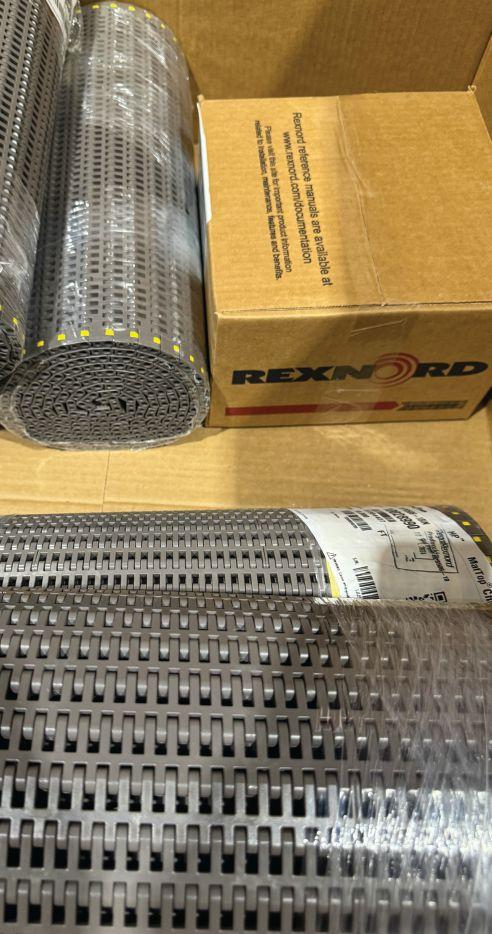
Close-up of the rolls of food-grade plastic conveyor belting supplied to the Descon facility by leading belting manufacturer Regal Rexnord await their turn to be mounted onto a Descon-built conveyor.
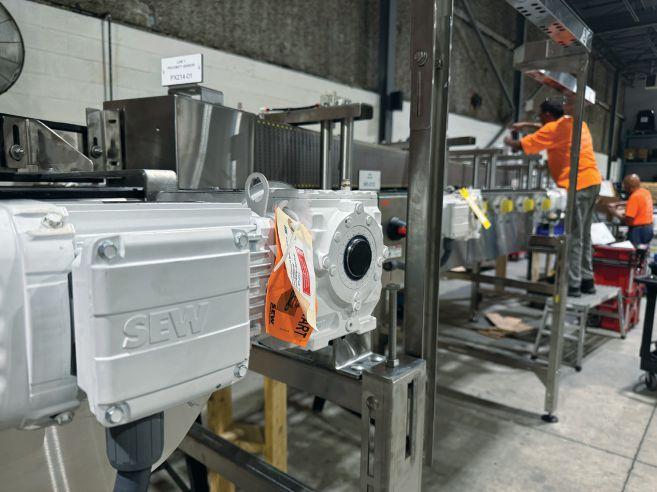
Descon conveyors make extensive use of the heavy-duty SEW-Eurodrive motors to ensure efficient power distribution for the company’s extensive range of high-speed, highperformance conveyors capable of running more than 2,000 containers per minute.
GLOBAL REACH
Major European
packaging powerhouse expanding its North American presence with timely Canadian acquisition
By Andrew Snook
Cyklop International is expanding its footprint in North America. The 112year-old global packaging solutions manufacturer founded in Germany, and now headquartered in The Netherlands, recently acquired Mississauga, Ont.-based Polaris Systems
Started up in 2010, Polaris Systems is a distributor of global packaging solutions offering its clients high-quality products and timely machine servicing and tool repairs. Since 2011, Polaris has been working with Cyklop 2011 as their distributor for the North American marketplace.
“It gives us a broader base of products to deal with and it brings us up to a level equal to our major competitors,” says
Polaris Systems president Don Campbell. “Rather than being a distributor, we are now a manufacturer.
“This puts us on a level playing field with the competition, and now we offer a larger product range than most of them,” Campbell states.
As Campbell notes, Cyklop’s current product portfolio already includes many well-known brand name such as InkJet, Pieri, Marchetti, LigoTech, FlexFill and Campanini. With all of the Cyklop brands now available to Polaris Systems, Campbell says the company will have a broader base of products to offer its clients.
“We’ve been mainly a strapping and wrapping company, but now with the addition of the coding, bundling, taping, and carton erectors, it gives us a whole new position in the marketplace,” he
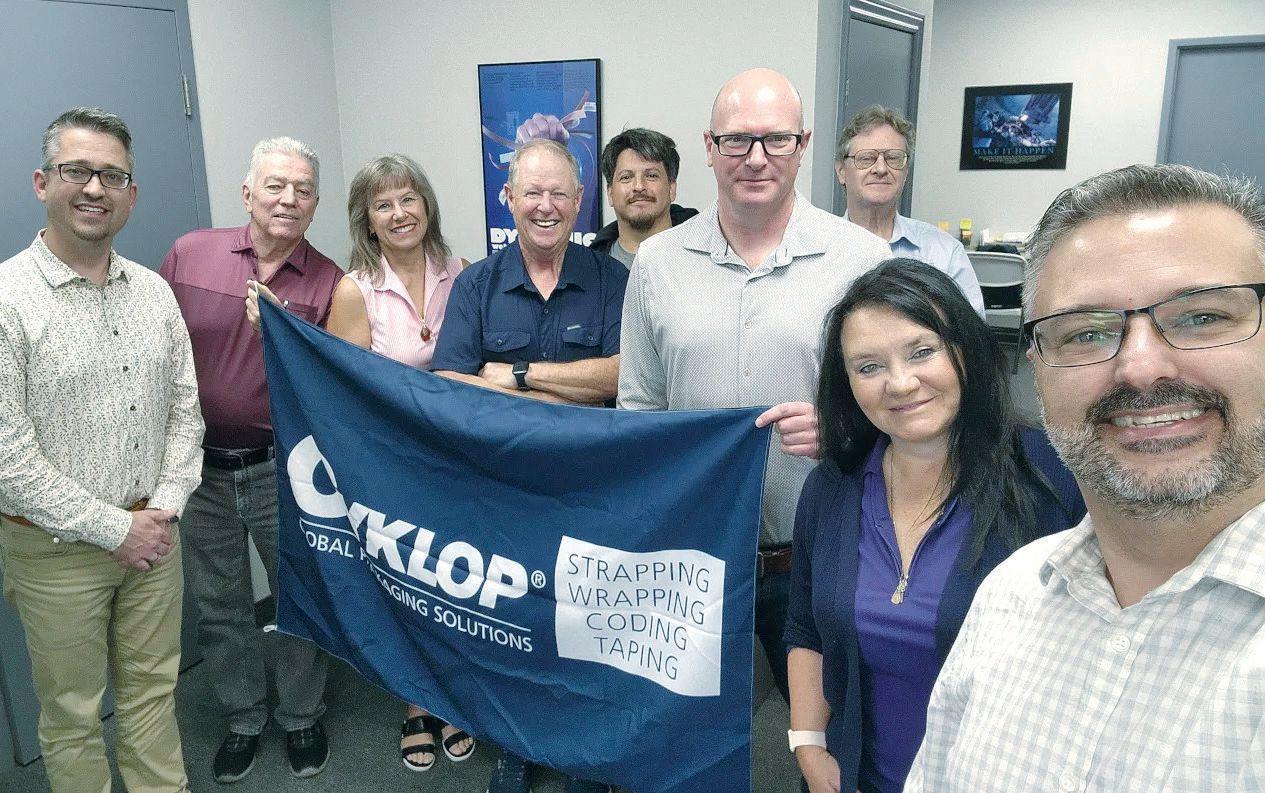
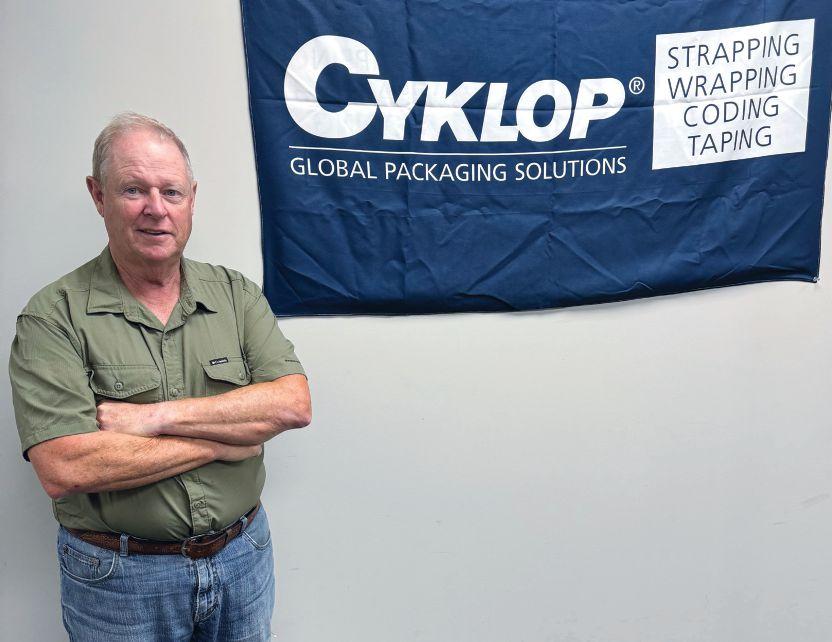
Polaris Systems president Don Campbell (fourth from left) joins the rest of the company’s administrative staff at the company’s head office in Mississauga, Ont., in impromptu celebrations marking the company’s new status as a Canadian subsidiary of the Dutch-owned global packaging machinery powerhouse Cyklop International.
points out.
Campbell adds that moving ahead with the Cyklop acquisition was beneficial for his company’s employees.
“Joining Cyklop was very good for all of them,” he says. “Now we’re into that expansion mode where we want to get our products out across Canada in a bigger way.
“As a distributor, you can’t really go out and resell to another distributor, because nobody’s making any money.
“But now as a manufacturer we can now set up that distribution network, “ he says, “and that’s our plan across Canada.”
Cyklop is very active in a wide range of industries from brick and block manufacturing to meat processing, bottling, printing, food and beverage, and much more.
The company has approximately 1,200 employees in 24 countries and has agents and distribution representation in over 50 countries.
While Cyklop has been active in the packaging industry for more than a century, the company’s most recent activities related to consolidation started about five years ago with the introduction of new chief executive officer Roberto Salemme.
One of the key initiatives that Salemme took on at the time was making Cyklop a global group, rather than a set of companies spread around the world, explains Cyklop’s chief financial officer André J. van Es.
“We formed an international management team by holding our international meetings where we would bring managers from all the different countries, from all the regions, together,” Van Es explains. “From there, we started growing.
“In fact, we have been growing in the last couple of years by anywhere between eight and 12 per cent an annual basis.”
As Van Es relates, that growth has been fueled by three factors: consolidation, growth through acquisition, and
enriching its product portfolio.
“We looked at the map, and we went through a couple of exercises where we tried to check out where there are opportunities for us to grow,” he relates.
“Those would be the regions and countries where there is a big market in packaging,” he says, “but where we do not have a presence.
“The U.S. is a market where we didn’t have presence for the last 15 years,” Van Es notes, “So we set ourselves the targets to find candidates to acquire in the U.S.”
While reviewing its product portfolio, Cyklop decided that building its presence in the coding and marking business made a lot of sense.
“That is a very interesting market for
“The support we can provide to the customer is a key differential that the customers realize as they make their decisions about which supplier will take care of their products.”
a few reasons,” Van Es states. “First of all, there is a lot of growth.
“Secondly, they go very well with the more traditional equipment that we sell,” Van Es continues.
“We are able to sell packaging and coding equipment, together with their consumable and service (maintenance) to basically the same parties, and therefore, become a supplier to our customers that is much more able to deliver a holistic solution, rather than just a packaging machine.”
The company’s desire to re-enter the U.S. marketplace and also to expand into the coding and marking business resulted in the acquisition of Houston, Tex.-based InkJet, Inc. in June 2023.
“Other than being our stepping stone into the U.S. market, they are also a very important pillar in our coding and marking business, where they produce the inks that our customers need to run their printers,” says Van Es.
“By having that in-house, we can just increase the service levels and make sure that we are able to supply whenever and whatever is needed.”
Shortly afterwards, Cyklop reached out to Polaris Systems to discuss a potential acquisition.
“First of all, it gave us access to Canada,” Van Es states. “And secondly, with Don and his team being based in Toronto, we also have a place from where we can easier serve the northeastern U.S.”
Polaris Systems president Don Campbell predicts a bright future for his company as part of the Polaris International group of companies thanks to the extended range of machinery it can offer its customers.
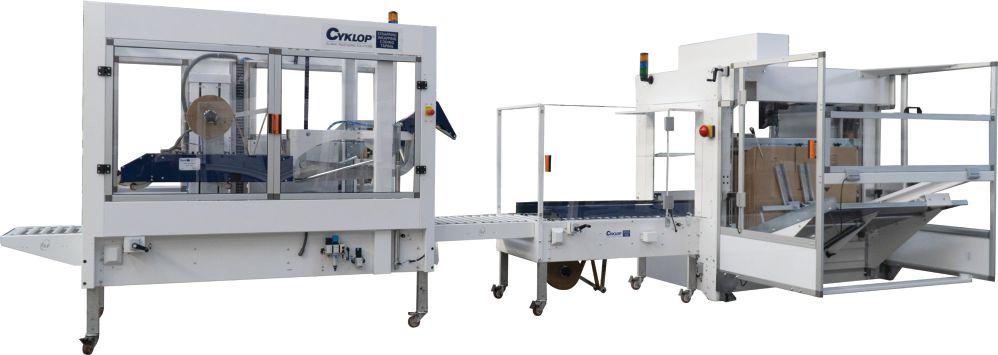
As part of the Cyklop International group of companies, Polaris Systems can now offer customers the full range of case erectors and tapers made in Italy by Marchetti Packaging.
Van Ex says that Cyklop is currently in the process of pursuing other companies to acquire in France, the U.K. and Australia, so the company’s acquisition-driven growth strategy has not yet run its course.
Asked about the current trend of heightened M&A (mergers-and-acquisitions) activity unfolding in the packaging sector globally, Van Es cites two factors in the works: consumables and automation.
“Consumables are becoming more of a commodity,” he states. “ And when I say consumables, I’m talking about the straps, the films that we sell, and also the inks.
“And with those consumables becoming a commodity, that comes with the need to be super-efficient, because margins are shrinking and customers’ needs are more demanding,” he says.
“It is a good market,” he says, “but you have to be smart and you need to make sure that you can deliver your volumes.”
The second factor,according to Van Es, is that the spike in demand for more automated equipment unleashed by the global COVID-19 pandemic remains fundamentally strong.
Prior to the pandemic, global, demand for fully automated equipment
was relatively low demand compared to demand manual and semi-automated equipment, according to Van Es.
However, the lack of available manpower and the spike in economic growth during the post-pandemic recovery saw companies scrambling for automated packaging solutions.
“That really had driven the demand for fully automated equipment upwards,” Van Es says.
As Van Es explains, “Producing fully automated equipment is not easy.
“You need skills and innovations to be able to do that in an efficient way.
“In addition to selling sell fully automated equipment, you also need to be able to service it,” he adds.
“So you need to have a local guy in a van with a box full of tools that is able to install and maintain it at all times.
“So, that’s another reason why I see packaging companies are going through a wave of acquisition: making sure that not only that they we sufficient volume to produce the machines, but also to have global presence to make sure that they can serve the customers with the high level of service they are asking for.”
In addition to expanding to U.S. and Canada, Cyklop also started up the Cyklop Mexico subsidiary about two-
From left
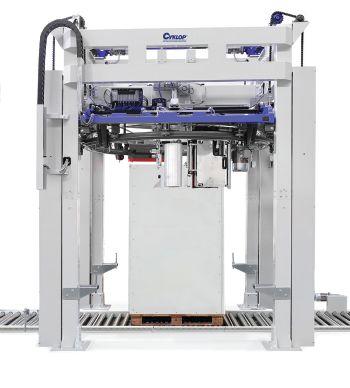
The fully-automatic AVR 400 FLEXA pallet wrapper made by Pieri.
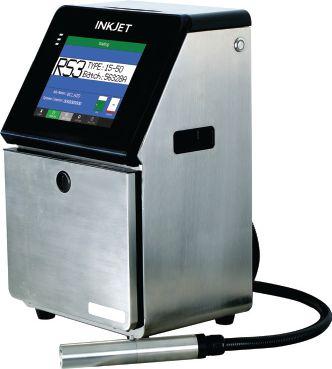
A high-end inkjet coder made by InkJet, Inc., which is now also a Cyklop company.
and-a-half years ago to offer the same product and service solutions across all of North America.
“We followed the same strategy that we did in Canada: to have a local presence and to provide the best service to the customers,” explains Erivelto Gadioli, president of Cyklop’s operations for the Americas region.
“The support that we can provide to the customer is a key differential that the customers realize as they make the decisions about which supplier will take care of their products,” Gadioli states.
While Cyklop is in the process of growing through acquisition, Van Es notes that the company goes to great lengths to keep a relatively small head office, preferring to have local satellites do most of the heavy lifting.
“We have a small head office because some things need to be organized at a central level,” he says, “but we really leave a lot of autonomy in the local countries where we operate.”
Canada is a perfect example,” he states. “Don and his team now have access to a wider range of products—the full product portfolio from Cyklop—but other than that nothing else has really happened in terms of day-to-day operations.
“It’s still the same people driving the company and fulfilling the needs of local customers.”
Cyklop’s central management don’t want to have the same company in every country, Van Es adds.
“We really want to have a local team that knows the local needs, and that is able to work according to local standards,” he says.
“That gives all the different local companies a lot more agility to run the way they need to run,” Van Es concludes.
“It’s a global company with local service expertise.”
SUPPLIERS
Polaris Systems
Join Us for Canada’s Leading Meat Industry Expo!
Friday, October 25, 2024 | 10:00am to 5:00pm
Saturday, October 26, 2024 | 10:00am to 3:00pm
Niagara Falls Convention Centre
Why Attend Meat Industry Expo:
»Exclusive access to the industry’s only dedicated trade show
»Discover the latest innovations shaping the future
»Explore cutting-edge solutions for your business needs
»Network with industry leaders and key decision-makers
»Watch the final round of the Ontario’s Finest Butcher Competition LIVE!
Discover the Latest in Meat Processing: Scan the QR Code to Register Now for Meat Industry Expo!
AN EGG CELLENT ADVENTURE
How gantries help hardworking articulated robots age gracefully to extend their service life
SBut as they age, they can become like a cranky senior—wearing down and needing more attention, often when it’s disruptive to existing routines.
If an aging robot is asked to do more, it might be time to consider alternatives like a Festo gantry-style solution. When a gantry can do what a six-axis robot can, it’s often the more cost- and space-efficient solution.
The adaptability and scalability of gantries—cartesian robots—and their many single- and multi-axis configurations make them ideal for a wide range of applications where the dexterity of an articulated robot isn’t required.
Just consider that:
• There is no dead space or singularities;
• Safety requirements are less stringent;
• Programming doesn’t usually require a specific motion controller;
• The troubleshooting is easier.
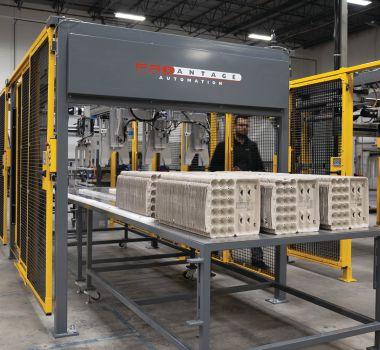
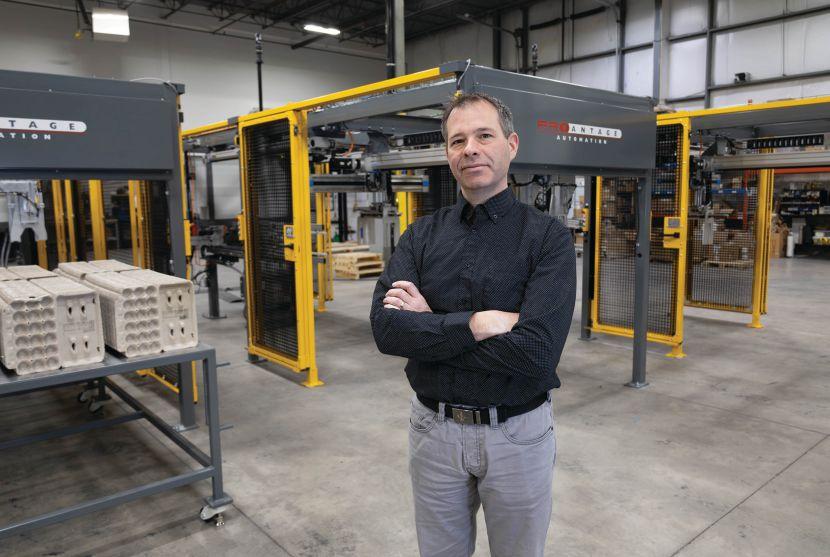
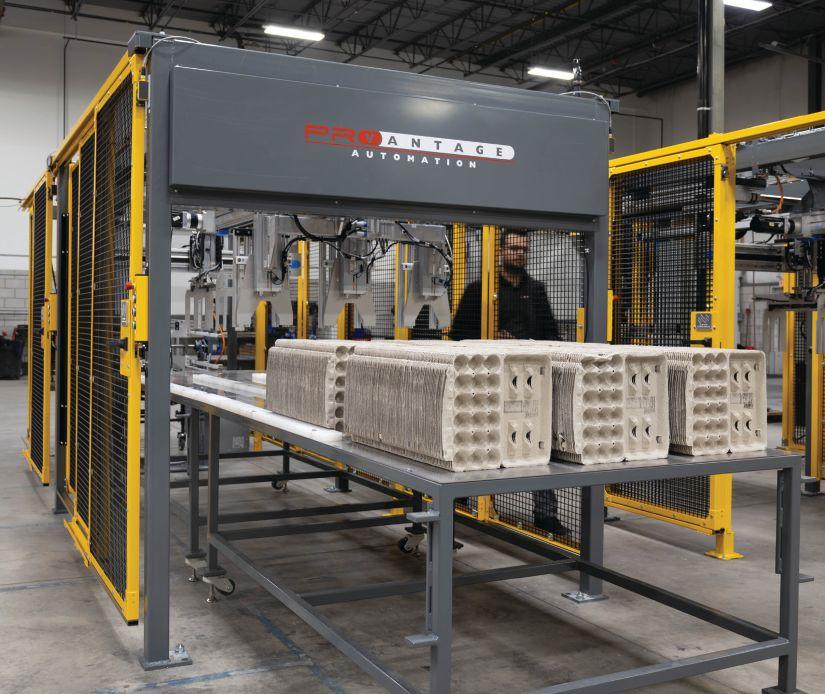
Peter Graham, president and coowner of ProVantage Automation of Brantford, Ont., knew almost from the get-go that his customer, a local plant of a European-based multinational producing egg cartons from recycled cardboard, favored such a changeover.
His team’s initial thought process— substituting a gantry-based cell for articulated robots performing an intermediate staging function on five production lines—just happened to align with the thinking of the engineering department at this customer’s global headquarters.
It was perfect serendipity, according to Graham.
“We didn’t know that they were think-
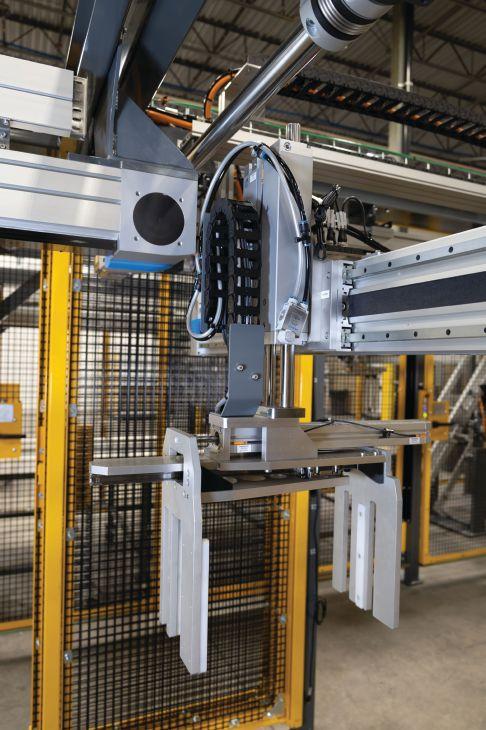
The multi-axis gantry at the heart of ProVantage Automation’s design for an egg-carton staging cell is comprised of two Festo EGC toothed-belt electric linear actuators, including the new EGC-HD-TB, with heavy-duty guide, as well as DFM guided drives.
ProVantage Automation president Peter Graham strikes a pose in front of one of three automated workcells that his company has recently upgraded with Festo’s gantry-style robotics.
ing of something similar,” he recalls.
“We were two companies looking at a common issue and coming up with similar solutions without even knowing the other was working on it in parallel.”
It didn’t hurt, adds Graham, that “this client is very much a proponent of Festo products.”
It’s not as if ProVantage has anything against articulated robots. In fact, as Graham recalls, this assignment involved “revisiting Job #1 at Customer #1,” where ProVantage had installed the sixaxis robots 12 years ago, which was literally the customer’s first PO (purchase order) after opening its doors.
Since then, ProVantage has built up a diversified customer base, particularly in the food and beverage, consumer packing and tissue and paper converting sectors.
Graham recalls that he and some of his colleagues left a major case-packer manufacturer in southern Ontario to start ProVantage.
“We’re a systems integrator and service provider, and with our machine-building background, we still build a lot of custom machinery.”
This triad of roles continues to nourish ProVantage’s growth. For example, being a service provider has led to orders for custom design/builds from the same businesses.
Others, like Customer #1, have given Graham and his partners additional design/build projects. (Graham uses the descriptor “clients” because it more aptly describes the enduring business relationships ProVantage has built up in its relatively short existence.)
As for Job #1, in the intervening years since original commissioning, the robots and motion controllers had become obsolete—becoming a growing reliability and cost concern.
For this customer, says Graham, restoring a high level of reliability was a prime motivator for replacing the old robots.
At the same time, additional functionality was required of the staging cell.
The carton-forming process upstream is changing in a manner that now requires each staging cell to reorient bundles of cartons 180 degrees for further processing downstream.
Space and cost considerations ruled out using larger articulated robots. (With the line speed unchanged, increasing throughput was not an issue.)
The carton-forming process begins with washing and pulping recycled cardboard to create a slurry.
The slurry is pressed and baked, with the resulting cartons then re-moisturized and pressed again to create those familiar smooth cartons. As they emerge from the forming press, just prior to
entering the new staging cells, the cartons are aggregated into bundles of 70. Each 10-meter-long staging cell is fed by three or four lanes from the forming process.
The job of the gantries is to position each bundle for flipping 180degrees by a servo rotator, so upon exiting the cell the cartons can be unbundled facing the right way for printing the various egg producers’ logos, branding and product information.
Each of these new cells is comprised of three Festo long-stroke linear actuators—two EGC electric tooth belt drives and a DGC pneumatic recirculating ball bearing guided drive—positioning the bundles and loading them oneby-one into the rotator.
Rather than bing picked-and-placde by a robot, the gantries slide the bundles through to the rotator, which provides better control, says Graham. (So far, the customer has ordered three such cells, and negotiations are under way for additional units.)
Festo’s EGC linear actuators are noted for their longevity, high dynamic
“We were looking at a common issue and coming up with similar solutions in parallel. We’re a systems integrator and service provider, and with our machine-building background, we still build a lot of custom machinery.”
response and speed, maximum rigidity , and high load bearing capacity.
“One of the reasons for choosing Festo on these actuators is the robustness of the design, their overall quality, fit and finish, the ability to add additional bearing rails through the configurator software, and having the many different sizes available, which makes it easy to customize the machine,” Graham relates.
The modular design of a gantry-style staging cell makes it easier for the operator to maintain high reliability.
Close-up of the Festo gantry used to position bundles of cartons from three to four 3-4 inbound lanes for flipping them 180 degrees so they face the right way for printing of brand and other information for each egg producer or retailer.
If a gantry component, even a main actuator, needs replacement, it’s usually just a matter of swapping in an identical part or appropriate catalogue substitute. All of the critical Festo components on board these staging cells, like EGC and DGC actuators, DFM guided drives, ADN compact cylinders, VTUG valve manifold, MS6 air preparation valves and regulators are part of its Festoo’s core produc range, and hence they are always in stock for quick delivery. Moreover, Festo’s digital design tools like Electric Motion Sizing and the Handling Guide Online allow machine-builders to slash project engineering time.
In addition, Festo’s Customer Solutions team (CS) team can support them in the design and incorporation of gantries into projects, and even pre-assembling and testing them.
As part of a pre-engineering study for Customer #1, says Graham, ProVantage worked with Festo CS on a cycle-time analysis and concept validation, “and that gave us the information to quote a multi-gantry system accurately.”
Not having to wait days for a distributor to come back with pricing accelerates quote-making, he adds, whil those with an account for Festo’s the online shop also can download CAD models, create a parts list, place orders, track shipping, and more.
SUPPLIERS
Festo, Inc.
ProVantage Automation
PACK & FORTH
Upcoming PACK EXPO International 2024 this year’s premier event for packaging and processing innovation
The highly anticipated PACK EXPO International is set to return to Chicago from Nov. 3 to Nov. 6, 2024, at McCormick Place, and this year’s event promises to be bigger and better than eve.r
With an expected 45,000 attendees and 2,500 exhibitors, this year’s event will cover an expansive 1.3 million net square feet, making it the largest showcase for packaging and processing solutions across more than 40 vertical markets.
This year, two new destinations will make their debut at PACK EXPO International: Sustainability Central and Emerging Brands Central.
The Sustainability Central will dive deep into the latest trends and innovations in packaging sustainability, featuring insights from leading experts in manufacturing, materials, design, and more.
With over 20 educational sessions, attendees will hear from top industry players including Amazon, Conagra, Clorox, Dow, Nestlé, and the Consumer Brands Association
In addition, kiosks from leading colleges, universities, and organizations like PMMI Business Intelligence and AMERIPEN will be on display, showcasing the latest research and best practices in sustainable packaging.
For those focused on finding sustainability-driven solutions, the event offers the Sustainability Solutions Finder, an online tool designed to help attendees locate exhibitors with environmentally-friendly products and machinery. This searchable tool, along with a kiosk in Sustainability Central, will guide visitors toward the most sustainable options on the show floor.
Look for the PACK EXPO Green icon to easily identify suppliers and sessions focused on sustainability, and find a comprehensive list of PACK EXPO Green
Green exhibitors in the online directory.
For its part, the Emerging Brands Central is a must-visit for up-and-coming brands looking to scale their operations and expand their market reach.
An evolution of the popular Emerging Brands Summit, this educational stage will offer 30-minute sessions featuring industry experts discussing product development, packaging innovation, and growth strategies. These sessions are designed to provide actionable advice and insights, making them invaluable for any brand aiming to scale.
Also teturning this year are seven popular pavilions, each dedicated to specific packaging and processing needs, featuring an array of solutions to meet every packaging and processing requirement. These pavilions include:
• The Logistics Pavilion,
• The Processing Zone;
• The PACKage Printing Pavilion;
• The Containers and Materials Pavilion;
• The Healthcare Packaging Pavilion;
• The Confectionary Pavilion;
• The Reusable Packaging Pavilion
As always, educational opportunities abound at PACK EXPO International, with stages like the Innovation Stage (see oppostie page for schedule), Processing Innovation Stage , Industry Speaks, and Reusable Packaging Learning Center hosting thought leaders and industry experts.
The upcoming PACK EXPO International 2024 exhibition is expected to draw over 45.000 visitors to Chicago’s beautiful McCormick Place fairgrounds over the course of the four-day event, running Np.3-6, 2024.
These sessions will cover the latest trends, best practices, and hot topics in the packaging and processing industries.
Of course, PACK EXPO International is not just about innovation and education—it is also about connecting with peers and industry leaders.
To that end, networking opportunities include the Pack give Back reception and comedy performance with Nate Bargatze, sponsored by Rockwell Automation, on Nov. 4, at 4:30 p.m., benefiting the PMMI Foundation
In addcition, the Young Professionals Network will host a reception at Flight Club on Nov. 4, at 7:00 p.m., while the Packaging & Processing Women’s Leadership Network (PPWLN) Breakfast on Nov. 5, at 7:15 a.m., will feature Lisa Sun, founder and CEO of GRAVITAS, as the guest speaker.
To ensure attendees make the most of their time at the event, My Show Planner allows attendees to create a personalized list of must-see exhibitors and sessions, which can be synced with the official mobile app for easy access. For its part, the PACK Match program offers free 30-minute virtual consultations with industry experts in October— with sign-up beginning on Sept. 19. Additionally, the Attendee Resource Center will provide handy planning tools such as the Attendee ROI Guide , justification letter templates, and explainer videos.
LIVE AND LEARN
Innovation Stage Presentations Schedule
SUNDAY
Nov. 3, 2024
11:30 AM - 12:00 PM
Innovation Stage 3 (N-4585) Designing for New Capacity in CPG Manufacturing
12:00 PM - 12:30 PM
Innovation Stage 2 (N-4580) Ensuring Food Safety via Optimal Inspection Systems
12:00 PM - 12:30 PM
Innovation Stage 1 (N-4560)
The Future of Labeling: AI-Powered Machine Diagnostics
12:30 PM - 1:00 PM
Innovation Stage 3 (N-4585)
AI & GenAI Application in Industrial and Packing Solutions
1:00 PM - 1:30 PM
Innovation Stage 1 (N-4560)
Analytics Support the Packaging Project Life-cycle
1:30 PM - 2:00 PM
Innovation Stage 3 (N-4585) How Standard Robotic Solutions Revolutionize Food Production
2:00 PM - 2:30 PM
Innovation Stage 2 (N-4580) Safety by Design: Coatings for Safe & Sustainable Packaging
2:00 PM - 2:30 PM
Innovation Stage 1 (N-4560) Unlocking Cost and Sustainability Through Unified Data
Consumers Want Sustainability Clarity: Is Your Data Ready?
1:30 PM - 2:00 PM
Innovation Stage 3 (N-4585)
Portable Automation Addresses Labor and Production Issues
2:00 PM - 2:30 PM
Innovation Stage 2 (N-4580)
Cabinet-Free Machine Designs within Reach for Manufacturers
2:00 PM - 2:30 PM
Innovation Stage 1 (N-4560) The Packaging Playground: Investing for The Future
2:30 PM - 3:00 PM
Innovation Stage 3 (N-4585) Unlocking Growth: Accelerating Digitalization with 3PLs
3:00 PM - 3:30 PM
Innovation Stage 1 (N-4560) Pet Care Packaging: Cutting-Edge Solutions and Strategies
3:00 PM - 3:30 PM
Innovation Stage 2 (N-4580) Your Vacuum System is a Sustainability Hero in Disguise
Budget pricing and pretty packaging a happy win-win / Sawyer Lewis
If you’re anything like me, you want to purchase healthy products you can feel good about without worrying about draining your bank account. Is there truly a happy medium between spending a small fortune at a specialty health-food shop and spending hours combing through lists of ingredients that you can’t even pronounce on household staples? I took a trip to my local Big Box store on the hunt for new products that would support my health from the inside out, while still being generally accessible and affordable. Drawn in by packaging that suggested its products aligned with my health goals, I found a number of exciting things that upgraded my regular shopping list—all priced at $15 or less.
Over the past few years, pure tart cherry juice has been gaining popularity as a perceived “superfood,” notably as a rich of melatonin to improve sleep. With more and more people turning to more whole-food focused diets by avoiding overly processed food and beverage options in favor of those without as many chemicals and additives, the Black River Pure Tart Cherry Juice brand instantly draw attention on the storeshelf with its vibrant color of the product and a elegant see-through label featuring vintage fonts and a hand-drawn-like cherry image that provides dramatic aesthetic contrast to the dark liquid inside the stubby-inspired one-liter glass bottle topped off with a shiny metallic cap. The simple no-fuss packaging perfectly complements the product’s big selling point as a 100-percent natural alternative to artificially sweetened juice blends. Naturally, the use of a glass bottle is also a welcome feature fro the healthand eco-conscious consumers who widely see glass as healthier, non-toxic alternative to plastic packaging, while also being much easier to recycle or reuse in most places.
With Korean scalp treatments recently trending online, dutifully informing everyone of just how gross our scalps may actually be, many people are looking for a more affordable way to rejuvenate
this skin without a trip to the salon. The new Hairitage Scalp Exfoliator, aptly branded as a “restart button,” is packaged in a long squeezable tube featuring an innovative, built-in scrubbing applicator that eliminates the need to purchase a separate tool to use the product effectively. Attractively standing upright on the shelf as a convenient and simplified scalp treatment, this Hairitage product brand proudly asserts its all-natural ingredients which include willow bark extract, witch hazel, marigold, and apricot seed powder, effectively differentiating itself form competing products containing artificial ingredients. The on-pack written reminder that the color of this treatment may vary due to its all-natural formulation is also strong brand messaging that reinforces the contrast between chemical-based products and the all-natural alternatives without being too preachy about it. The sleek tube design and muted colors of this recyclable packaging project a high-end luxurious image, while the product’s clean labeling quickly reassures the health-conscious consumers that the product is free from sulphates, parabens and mineral oils, in
addition to being cruelty-free and vegan.
As a student juggling a full-time job and a full-time class schedule, finding convenient and portable snacks that I can take on-the-go for a quick energy boost is important. The SimplyProtein Dark Chocolate Almond Snack Bars quickly drew my attention with their green-color labels proclaiming the bars to be a trust source of “Plant Powered Fuel.” In line with that claim, the packaging happily trumpets its nutritional profile with the claims of hefty protein content—12 grams per serving—along with only two grams of sugar and seven grams of fiber. The dark, rich color scheme of the box mimics the dark chocolate bars insde— generating a lush adult vibe, and the feelgood factor that comes with choosing a non-GMO verified, gluten- and dairyfree product packed with calcium.
Having sensitive skin can make finding effective, non-irritating skin-care products difficult. Finding products that aren’t filled with pain inducing chemicals often means sifting through fine print on long ingredient lists. Bottled in Canada, Buhbli Organics Rosehip Skin Care Oil comes in a compact folding-carton box boldly advertising that the product within is a 100-percent pure, natural, cruelty-free oil made with safe ingredients. The packaging explains exactly “what’s going on your skin” in easy-toread print—allowing consumers to get all the facts that they’re looking for quickly. The outer packaging uses nature-inspired colors to link the box with the cold-pressed, unrefined, certified-organic, on- ingredient oil within—packaged inside a 60-ml glass bottle fitted with a pump dispenser for convenient, mess-free application. The bottle’s label playfully mimics the box by repeating all the essential product informtion already highlighted on the carboard, but in bigger font size that won’t have you reaching
SAWYER
UNLIMITED MOTION CONTROL
Very small packages? Polybags? Not a problem for ModSort divert and transfer conveyor modules! The ModSort module can do left and right sorting on the fly for a wide range of package types and sizes weighing up to 50 pounds (23 kg). It is safe, quiet, versatile and saves energy.
Retrofitting an existing conveyor with ModSort modules has saved some customers as much as $90k annually in reduced manual labor alone!