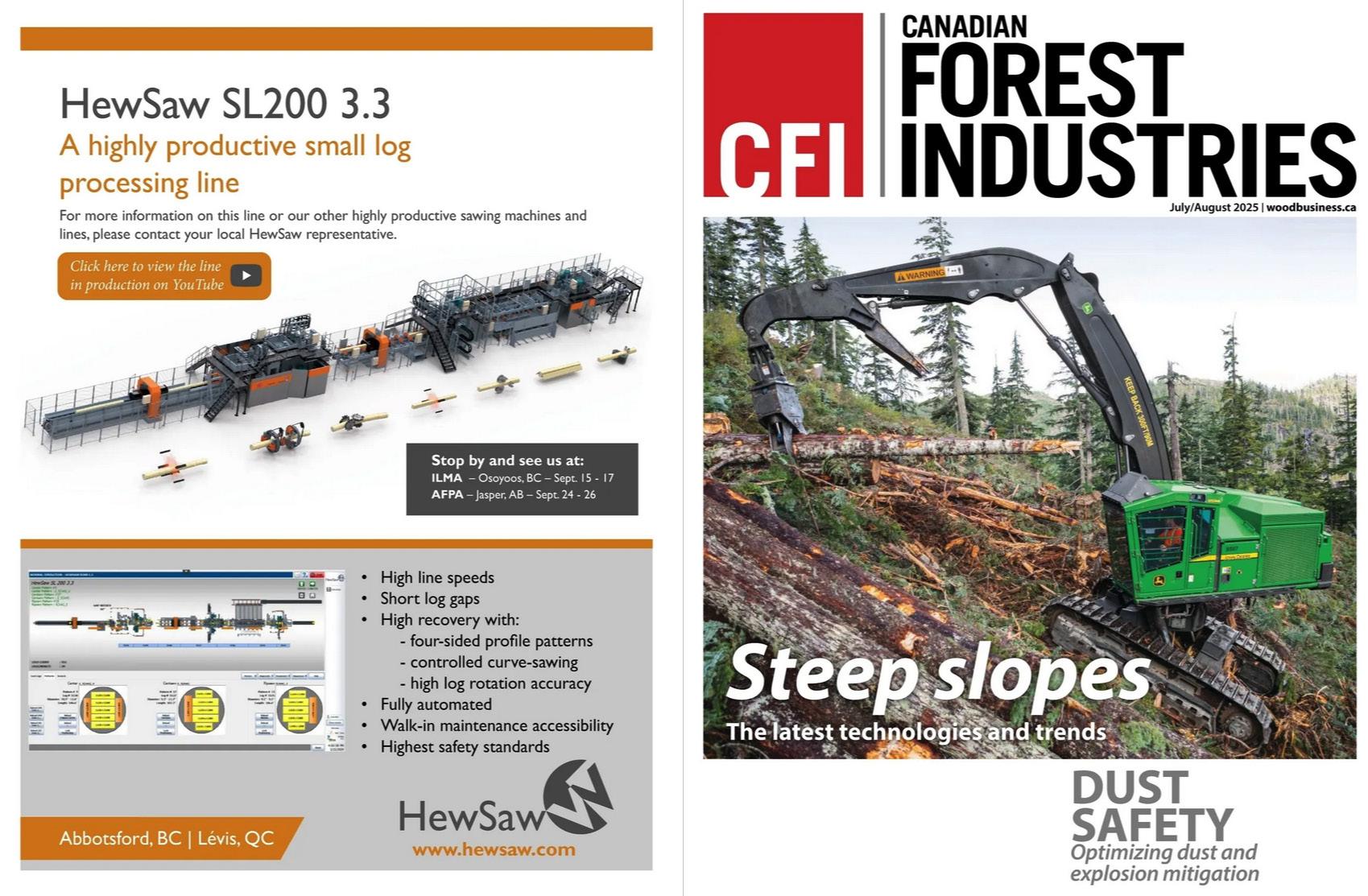
A discussion about technologies and trends for harvesting fibre in steep slope logging.
Always evolving
Wadlegger invests in latest harvesting technologies.
Optimizing dust safety
Dust and explosion mitigation for wood products plants.
Mass timber pioneer
Kalesnikoff makes history with new plant opening.
Keeping connected
Industry experts talk telematics systems.
Coming into its own Ontario’s private land forest sector is evolving.
HPF in Nova Scotia
High Production Forestry: From seedling to success.
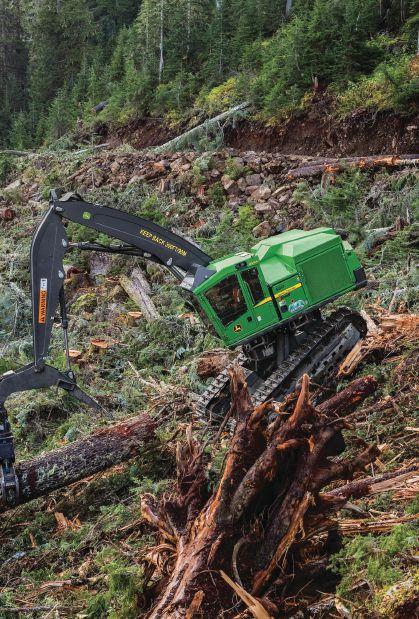
The John Deere 959M Feller Buncher is one of several new machines recently released for tackling steep slope logging. For the full story, turn to page 10. Photo: John Deere.
PlantMax D istributorship
Signed and Seale d
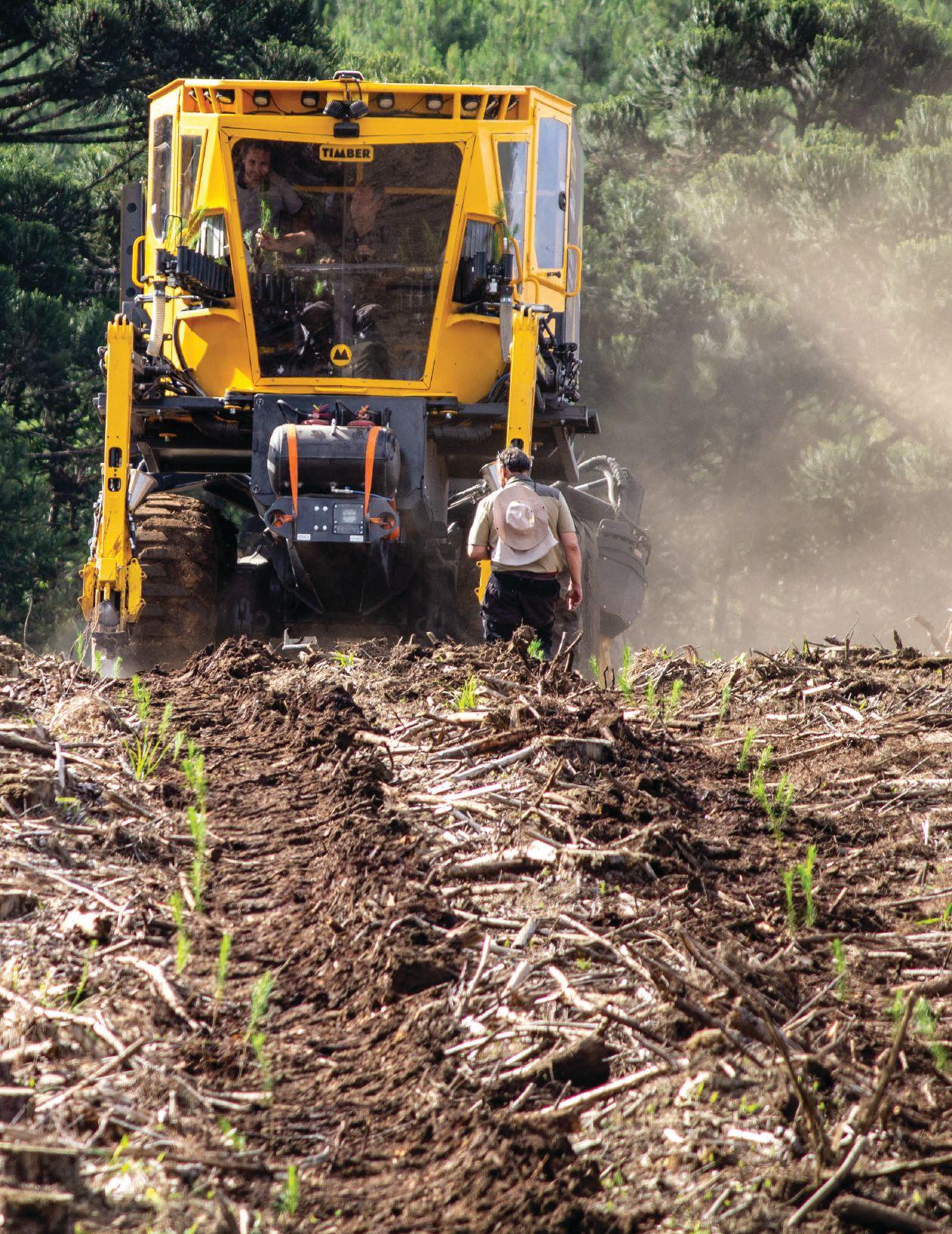
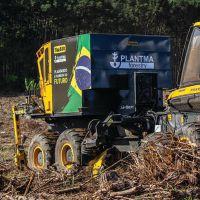
Log Max Forestry Inc., based out of Moncton, New Brunswick are pleased to announce that they have entered into an exclusive Canadian distributorship agreement with Plantma AB, the Swedish manufacturer of the PlantMax X3 planting machine.
The PlantMax X3 unit is typically mounted on a forwarder chassis, 14 ton size class or larger and incorporates a mid-mounted MidiFlex scarifier. Site preparation, soil compaction and seedling planting is completed in one pass! As a bonus, in the planting off-season the carrier can be converted back to a full-time forwarder within 3-5 days.
Consistently high-performance
The PlantMax X3 is performs whether rain or shine, day or night with data collection recorded throughout the process.
For more information on how the PlantMax X3 unit can assist you in your silviculture needs, contact your Log Max Forestry Inc. rep at 506-869-2325 or visit plantmaforestry.com
cut
asnook@annexbusinessmedia.com
A good start
Federal funds help, but big challenges lay ahead
In early August, Canada’s forest products sector received some positive news from Prime Minister Mark Carney to the tune of a new $1.2-billion investment designed to support the industry and increase the use of Canadian wood products in domestic construction. The new funding includes $700 million in loan guarantees and $500 million that will be put towards supporting market diversification, innovations in production, and initiatives supporting Indigenous-led forestry business development and diversification.
“The forest sector is a pillar of Canada’s economy. As we shift from reliance to resilience, Canada’s new government will ensure the industry can transform to seize new opportunities in Canadian and international markets. In the face of a changing global landscape, we are focused on what we can control – building Canada strong with Canadian expertise, using Canadian lumber,” Prime Minister Mark Carney stated as part of the announcement.
One of the highlights of the announcement was that Build Canada Homes (once established) would provide financing to private home builders in Canada that utilize Canadian softwood lumber and mass timber products.
Associations from across Canada voiced their approval of this show of federal support as responses from the BC Council of Forest Industries (COFI), Forest Products Association of Canada (FPAC), Alberta Softwood Trade Council, Ontario Forest Industries Association, Canadian Wood Council, and many others, were released immediately following the news.
“Initiatives aimed at supporting workers, fostering innovation, enhancing liquidity, and promoting export development through organizations like Canada Wood are important steps toward stabilizing the sector and supporting government efforts to build more homes for Canadians. These investments also lay the foundation for long-term competitiveness,” stated Kim Haakstad, president and CEO of COFI.
While the news of new funding was well-re-
ceived, a long-term trade deal with the U.S. that benefits the Canadian forest products sector is still the priority for many industry members.
“Encouraging the federal government to get the best trade deal for Canada with our U.S. neighbours continues to be the most important wish of our sector and forestry communities across Canada,” stated FPAC president Derek Nighbor.
Canada’s forest products sector isn’t alone in wanting a new trade deal secured with the U.S. The National Association of Home Builders (NAHB) expressed its concerns about U.S. housing affordability recently in a press release calling on the Trump administration to consider the impact of additional tariffs on the building products sector, and urged the administration to consider a new softwood lumber agreement:
With housing affordability already near a historic low, NAHB continues to call on the Trump administration to carefully consider how placing additional tariffs on lumber and other building materials will raise housing prices and impact housing supply. We are also urging the administration to move immediately to enter into negotiations with Canada on a new softwood lumber agreement that will provide a fair and equitable solution to all parties and eliminate tariffs altogether.
While a new SLA would provide a certain level of stability, Canada’s forest products sector has other pressing needs that require the attention of federal and provincial governments. A lack of available fibre supply continues to plague regions of the country, creating added uncertainty to companies considering investing in expanding their Canadian operations.
Whether trade stability is restored between Canada and the U.S., or our sector is forced to look towards new markets for Canadian wood products, the issue of fibre supply must be addressed and remedied for our sector to have a healthy chance to grow, and create much-needed jobs across the country.
ANDREWsnook
Georgia-Pacific investing US$140 million in Englehart OSB
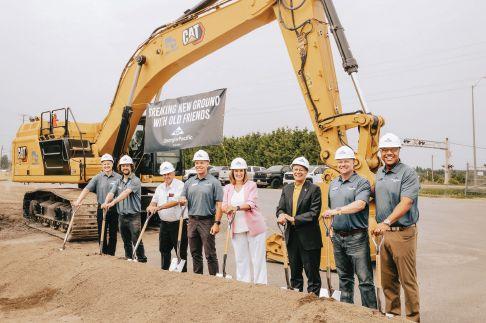
(L to R): Barry Averill, senior vice-president, operations, building products; Troy Richardson, Englehart OSB plant manager; Doug Metson, Englehart Mayor; Toby Elgin, director of OSB operations; Pauline Rochefort, Member of Parliament Nipissing-Timiskaming; Victor Fedeli, MPP Minister of Economic Development, Job Creation and Trade; Cabinet Chair; John Beers, president, structural panels, building products; David Neal, executive vice-president, building products. Photo: Georgia-Pacific.
Georgia-Pacific recently announced it will invest approximately $191 million in a new capital project for the company’s Englehart OSB (Oriented Strand Board) mill in Englehart, Ont. The funds will go towards to the purchase and installation of a new log processing system and include the expansion and construction of a new finished goods warehouse.
“Georgia-Pacific is focused on the future and committed to exceeding the needs of our customers,” said David Neal, executive vice-president, Building Products. “This investment strengthens our operational capabilities and positions the Englehart mill for greater productivity in the years ahead. While we implement these improvements, the dedicated
Comact expands in South Carolina
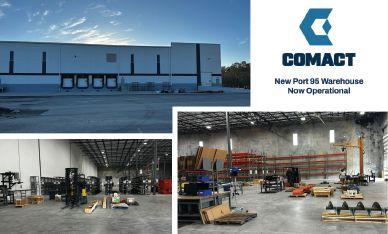
Comact recently announced that it is expanding its operations through the lease of a 48,000-sq.-ft. facility in Building 2 at Port 95 Business Park in St. George, S.C. Comact will be the first tenant of the state-of-the-art industrial park.
“We are excited to expand our operations in St. George,” said Simon Potvin, CEO at Comact. “The new facility at Port 95 will enhance our spare parts service offerings and support our customers with greater efficiency. Its strategic location near Interstate 26 and Interstate 95 benefits our manufacturing and distribution, being close to our plant and our southern USA clientele, in addition to allowing us to ship efficiently across North America. We are proud to support Dorchester
local team will continue operating the facility, ensuring we are able to meet current market demand.”
The announcement of the investment comes as Englehart OSB celebrates its fifteenth anniversary as a Georgia-Pacific facility.
“By enhancing the log processing system and warehouse at the mill, we show our commitment to continuous improvement and our dedication to reinvesting in the mill, the town of Englehart, the surrounding communities, and our preferred partners,” said John Beers, president, structural panels. “These improvements will continue our focus on staying competitive and ensures Englehart is an environmentally conscious, 21st century mill.”
The company stated that the design and engineering work is underway, and the project is expected to be completed by the second quarter of 2027.
County and align this investment with our core values of commitment to our clients.”
“Janko/Peakline’s investment in new speculative buildings at Port 95 is a game changer for economic development in western Dorchester County, much like Comact has proven to be a pivotal asset for the community of St. George,” added John Truluck, director of economic development for Dorchester County.
Nova Scotia making wood products a priority
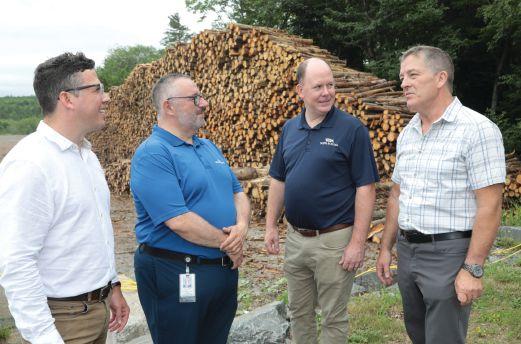
(L to R): Patrick Crabbe, president and CEO, Mass Timber Company; Fred Tilley, Minister of Public Works; Tory Rushton, Minister of Natural Resources; and Doug Ledwidge, president, Ledwidge Lumber. Photo courtesy of Province of Nova Scotia.
The province of Nova Scotia recently stated that it has directed all departments to search for opportunities to use mass timber, wood pellets, biomass, biofuels and other wood products made from residuals related to sustainable harvesting and sawmilling.
“Now more than ever, we want to use local products for building and heating in Nova Scotia,” said Public Works Minister Fred Tilley. “That’s why government is leading by example and using more wood products in our own buildings. It’s one of many steps our government is taking to make Nova Scotia more self-reliant and energy secure and to grow our economy and create jobs through innovation in our forestry sector.”
The Province added that all departments are to prioritize wood products in new construction, renovations and conversions from oil heat, including
projects partially or fully government funded where applicable.
“This will produce economic benefit for Nova Scotian families while we increase the use of local, sustainable products. Building and heating with wood will produce jobs and reduce our carbon footprint. It’s a great way to support our forestry sector and take charge of our low-carbon future,” stated Tory Rushton, Minister of Natural Resources.
The Province added that focusing on using wood products aligns with the Nova Scotia Loyal program, reduces reliance on imports, enhances export markets, supports the province’s forestry sector, reduces greenhouse gas emissions and assists with the province with its transition to a low-carbon economy.
“The Province’s commitment to prioritize using wood in public buildings is an important step that aligns economic prosperity with environmental stewardship. It creates a powerful circular economy supporting sustainable forestry practices and Nova Scotia’s softwood lumber industry by stimulating demand for high-value local wood products. That includes using high-performing, low-carbon mass timber to build the essential infrastructure Nova Scotians rely on. At a time when supply chain security is paramount, this is a clear commitment to investing in our own resources and communities,” stated Patrick Crabbe, president and CEO, Mass Timber Company. Reader
COFI responds to increased duties on softwood lumber
The BC Council of Forest Industries (COFI) condemned the U.S. Department of Commerce’s final determination to more than double countervailing duties on Canadian softwood lumber imports—from 6.74% to 14.63%. This comes on top of the previously announced increase to anti-dumping duties, now set at 20.56%, bringing the combined total to a crippling 35.19%.
“These unjustified actions continue to harm workers, families, and communities on both sides of the border,” said Kim Haakstad, pres-
ident and CEO of COFI. “To mitigate these harms, we must focus on what we can control, which is the competitiveness of the B.C. forestry industry within Canada.”
Haakstad emphasized that B.C. is Canada’s largest producer of softwood lumber, yet the sector faces mounting challenges, including rising costs, declining harvest levels, regulatory delays, and policy uncertainty. “If we don’t take urgent action to improve our business climate, we risk losing more mills, jobs, and economic opportunities,” she said.
subscription inquires or changes, please contact Angelita Potal, Customer Service Tel: 416-510-5113 Email: apotal@annexbusinessmedia.com
Mail: 111 Gordon Baker Rd., Suite 400, Toronto, ON M2H 3R1
EDITOR - Andrew Snook (416) 510-6801 asnook@annexbusinessmedia.com
GROUP PUBLISHER - Anne Beswick (416)510-5248 • Mobile: (416) 277-8428 abeswick@annexbusinessmedia.com
WESTERN SALES Tim Shaddick 1660 West 75th Ave Vancouver, B.C. V6P 6G2 Ph: (604) 264-1158
CEO - Scott Jamieson sjamieson@annexbusinessmedia.com
PUBLICATION MAIL AGREEMENT #40065710 RETURN UNDELIVERABLE CANADIAN ADDRESSES TO CIRCULATON
OPTIMIZING STEEP SLOPE OPERATIONS
The latest technologies and trends
BY ANDREW SNOOK
Tackling steep slopes in the logging sector isn’t for the faint at heart. It takes significant financial investments in top-quality equipment and highly skilled operators to ensure successful harvesting operations. When it comes to the equipment, optimizing efficiencies is the name of the game.
“Efficiency has become more in demand due to increasing costs and the need for specialized equipment,” says Jim O’Halloran, global product marketing manager for tracked feller bunchers and harvesters at John Deere. “Because steep slope logging operations require specialized equipment, operators need to invest in machines that can handle the specific challenges of steep
slopes, and therefore, are seeking to maximize their investments.”
Increasing costs in nearly every aspect of logging operations has made it more important than ever for contractors to get the most out of every asset on the ground. According to Canadian Forest Industries’ 2024 Contractor Survey (sponsored by John Deere and Link-Belt Forestry), which surveyed logging contractors’ operations over the past three years, the majority of contractors reported higher machinery parts and service costs (94 per cent); fuel costs (92 per cent); machinery purchase costs (90 per cent); insurance costs (85 per cent); hauling costs (84 per cent); finance
PONSSE
costs (82 per cent); and labour costs (78 per cent).
“There is now a greater demand for solutions and features to help improve overall productivity,” O’Halloran says.
Chris McMillan, marketing techni-
1 for steep slopes – stability and safety,” McMillan says. “We’ve always heard that with the stability of the Tigercat leveling machines, you really feel like you’re not going anywhere. The geometry of our lower frame, our leveling undercarriage,
cal writer for Tigercat Industries, says demand has significantly increased for steep slope logging equipment in certain regions of the world, including parts of Western Canada, and that his company is always researching ways to innovate their equipment to optimize the two most important things on the jobsite: safety and productivity.
“We’re pushing the envelope on trying to access trees on all different slopes,” he says.
SAFETY DEMANDS
Steep slope equipment manufacturers recognize that safety is a top priority of logging contractors and operators, and each company has outfitted their equipment with a variety of features and designs to enhance safety on jobsites. When it comes to what contractors and operators are looking for in steep slope equipment, one of the most important things is equipment stability.
“I would say stability is probably No.
actually kind of leans into the hill, so it keeps that centre of gravity as low to the ground as possible.”
In addition to a focus on the stability of the equipment, Tigercat has designed several other safety features into its steep slope equipment, including an emergency engine shutdown button, and multiple emergency exits.
“We always have three emergency exits in our cabs. Our engineers try to imagine any way that if that machine was to tip over, that the operator has a way to get out of that machine,” McMillan says.
At John Deere, operator and jobsite safety are also paramount.
“All equipment is designed to support operator comfort and visibility, which can help to reduce fatigue and improve focus,” O’Halloran says. “Having enhanced visibility while operating forestry equipment allows operators to see their surroundings clearly, while minimizing the need for unnecessary machine re-positioning, helping to reduces the risk of
unexpected events, improving overall safety.”
John Deere also incorporated its slope monitoring technology, which is available on the 859 and 959 Tracked Feller Buncher models. The slope monitoring technology helps operators understand the severity of the slope they are working on, O’Halloran explains.
“This information is crucial for ensuring safe and efficient operations on steep slopes,” he says. “By providing real-time data on slope severity, operators can make informed decisions about their work, reducing the risk of accidents and improving productivity.”
NEW GEAR TIGERCAT INDUSTRIES
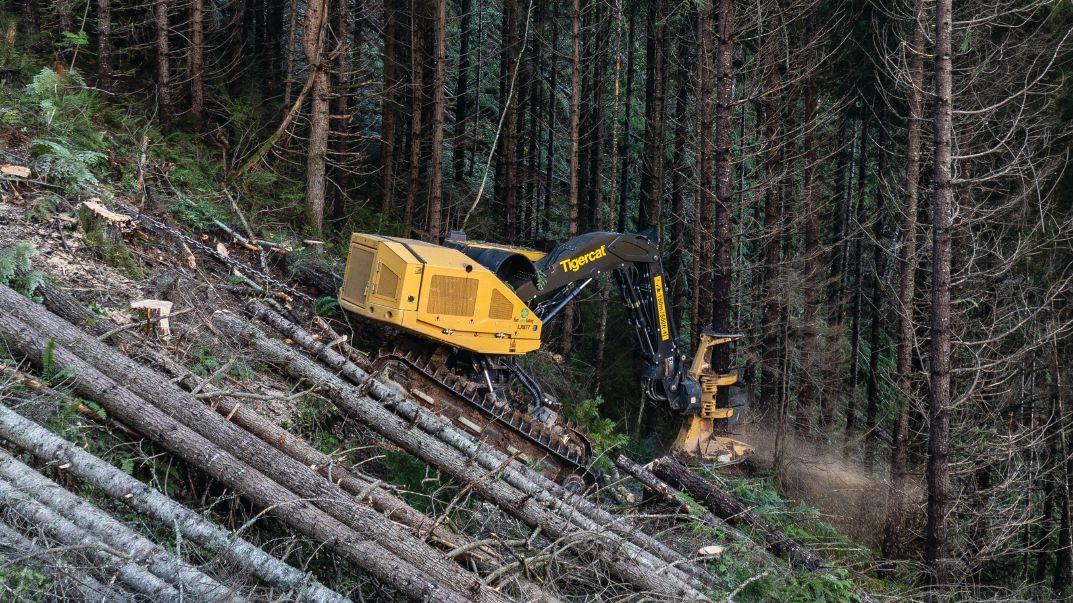
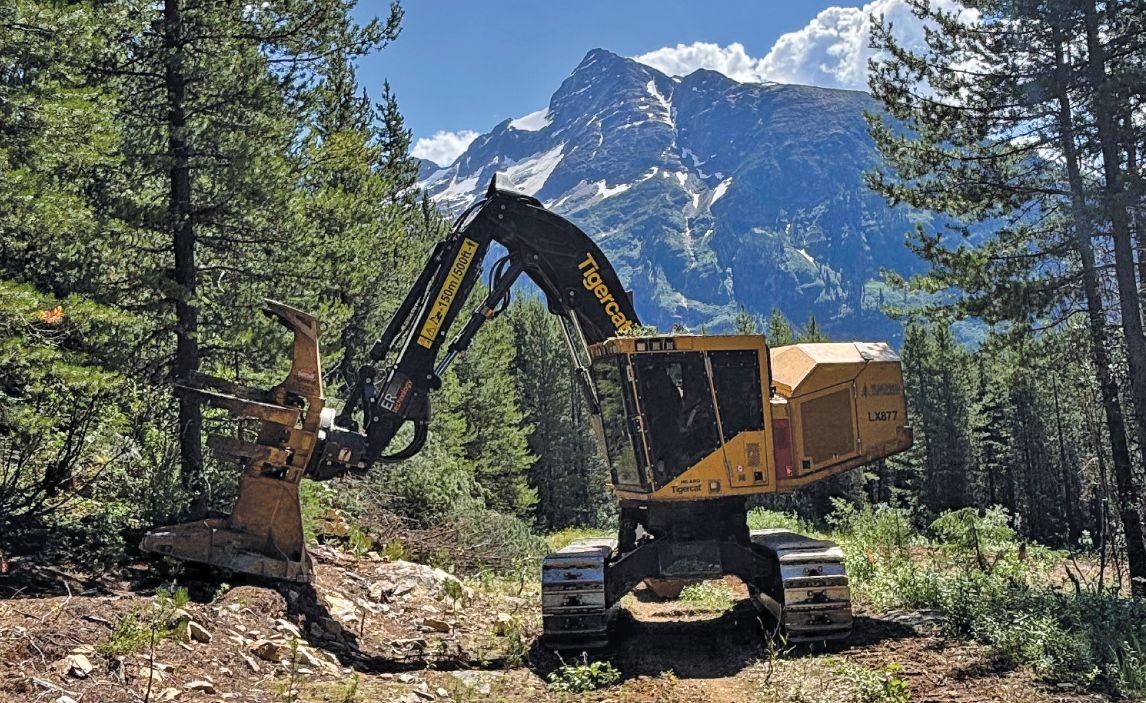
Tigercat recently released its L857 Feller Buncher, replacing its L855 Feller Buncher, and came out with the LX877 Feller Buncher, replacing the company’s LX870D.
“They’re very similar machines in horsepower, almost identical, and have the same undercarriage. The upper frame has a slope on the back of the underside. That’s to increase the leveling angle as well as help when they’re using winch-assist cables. The winch attaches to the undercarriage, and having the tapered rear end minimizes the contact with the cable that can damage it,” McMillan says, adding that the boom envelope has been increased to allow the operator to log lower on the hill. “Our boom envelope will actually go down, below ground level, if you’re looking at it flat, to be able to log those trees and reach them.”
On the skidder front, Tigercat has made its biggest advances on its 635H six-wheeled skidder.
“It’s got the swing boom on it, which allows the operator to go up and down a hill without changing their track. They can reach out to the side,” McMillan says. “Our swing boom allows them to stay on that track and gives them a further reach on sleep slopes.”
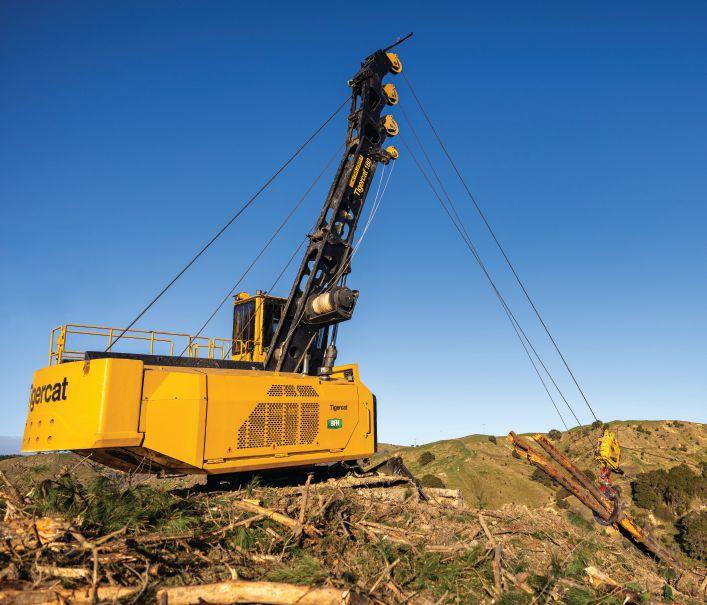
Tigercat also recently released its 180 Swing Yarder for cable logging.
“It’s an innovation in yarding. It’s kind of a cross between an excavator and a yarder with simple controls,” McMillan says. “The old yarders were a sea of le-
TIGERCAT
vers and mechanical winches with breaks and clutches, where this is just basically two joysticks. So, it’s very easy to get an operator in there and train them as well.”
The company also released its fully remote-controlled 120 Winch Assist machine for steep slope harvesting, which has been picking up in demand in Chile and other countries, McMillan notes.
JOHN DEERE
For both veterans and less experienced operators on steep slopes, John Deere added operator assistance features into its machines.
“Operator assistance features can help to increase efficiency and reduce operator fatigue. These features also help inexperienced operators become more efficient, making for a more productive jobsite,” O’Halloran says. “Focusing on specific solutions, the John Deere automated leveling system allows operators to level the machine with a single button press. This feature reduces the need for manual adjustments, helping operators maintain focus on harvesting tasks and reducing fatigue.”
A direct result of the continued growth of the steep slope and soft ground logging conditions, the John Deere 959M
Feller Buncher and 959ML Shovel Logger are designed to boost productivity even in the most challenging of conditions, O’Halloran says.
“The 959M and 959ML models are well-suited for the specific challenges faced in steep slope logging due to their advanced boom geometry and slope monitoring systems,” he says. “In addition, these models provide operators with the tools they need to work efficiently and enable exceptional cut below grade reach for downhill work.”
PONSSE
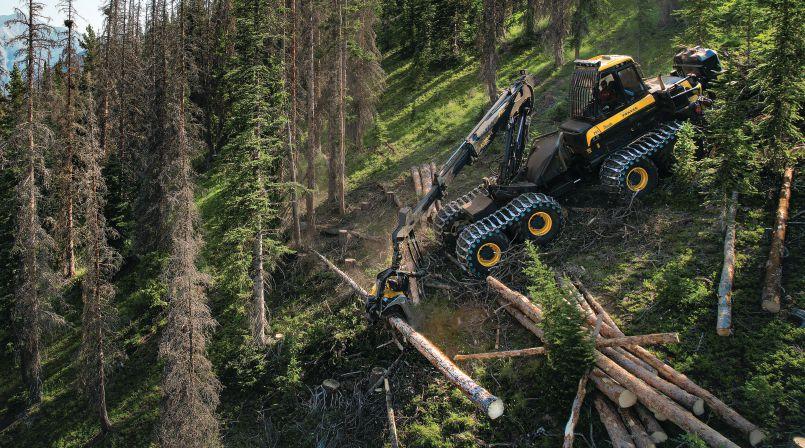
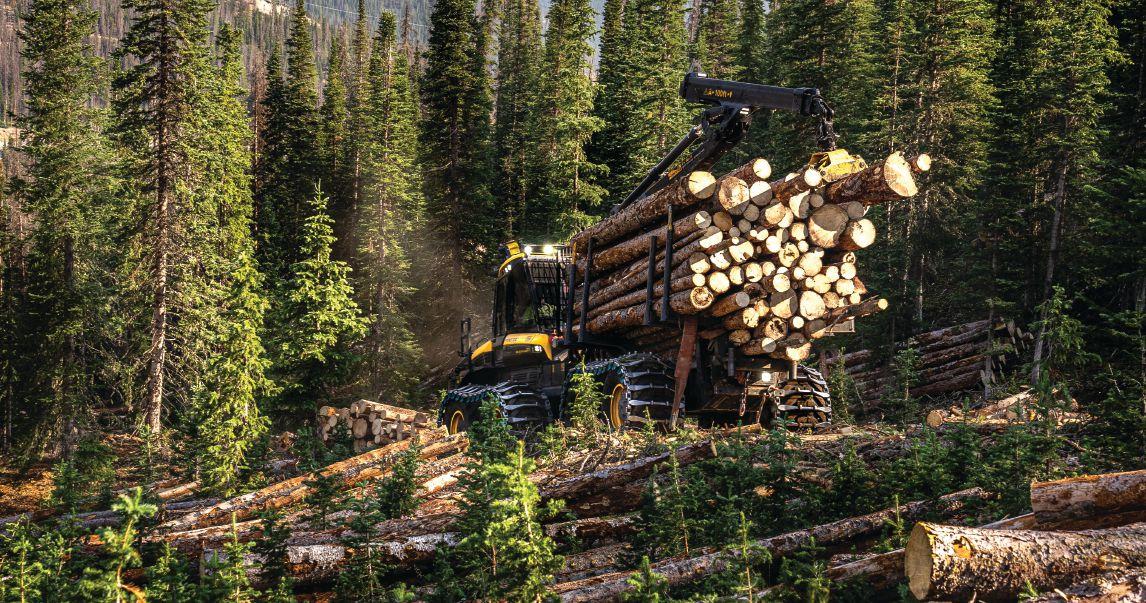
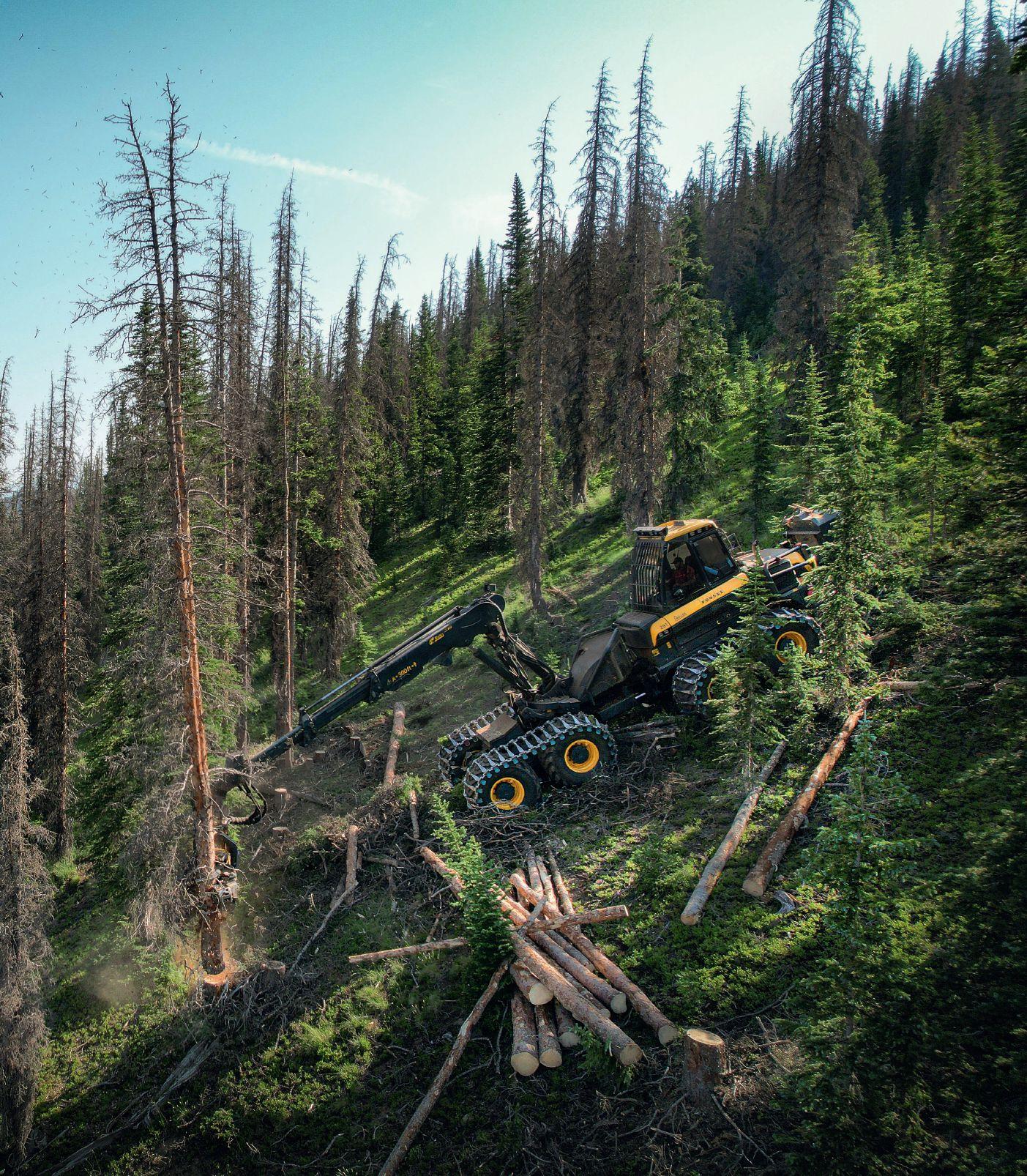
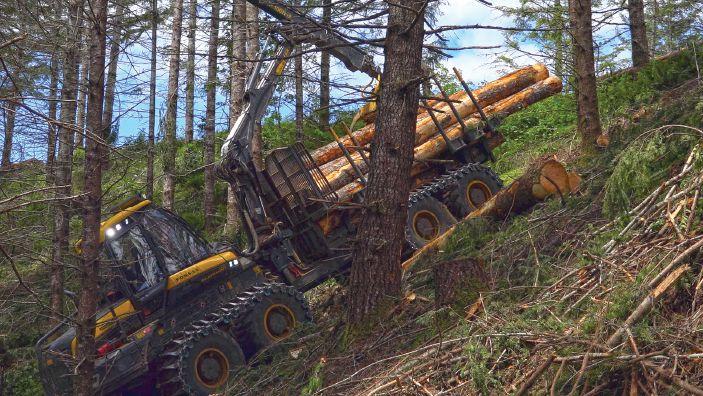
PONSSE’s Synchrowinch system has been available in the steep slope harvesting market for several years and is available for the PONSSE Cobra, Ergo 8-wheeler and Bear harvesters and Buffalo, Elephant and Elephant King forwarders.
“We can go over 30 degrees or above slopes with these Synchrowinch machines,” says Anne Härkönen, CTL and TCO specialist at PONSSE.
When compared to using traditional harvesting equipment, Härkönen says the Synchrowinch systems excel at reducing soil erosion.
“If we compare this to operations without winches, it is reducing the soil
damages. When the pulling power is correctly set, the machine can move without slipping, and when it is moving without slipping, it is not rooting the soil,” Härkönen explains, adding that the Synchrowinch can also reduce stress on drive transmission components. “Because it is helping the machine move smoothly, it is also more fuel economical compared to a machine without the winch.”
The winch speed for the PONSSE Synchrowinch is automatically synchronized to the machine’s driving speed so the operator doesn’t need to operate or adjust it during normal work. Cable tension can be set, and the winch can be operated from a remote-controlled unit, making it easy to hook the cable to a tree or a stump uphill. Tiltable crane base options makes harvesting and forwarding more efficient on slopes.
For harvesters, the Synchrowinch is installed in front of the engine, while for the forwarders it is a fixed installation inside the machine’s rear frame. The traction assistance winch helps to maintain high productivity in steeper terrain because forwarding is possible in both directions without a need to travel a separate route with full loads. The machines are equipped with tiltable seats so the driver TIMBERMAX
JOHN DEERE
can keep a relaxed sitting position while working on steep slopes.
The machines are also equipped with an Automatic Steep Slope Brake (ASSB) operator assistive function, designed to improve jobsite efficiency by keeping the machine in place, even on steep slopes, so the operator can focus on efficient harvesting.
TIMBERMAX
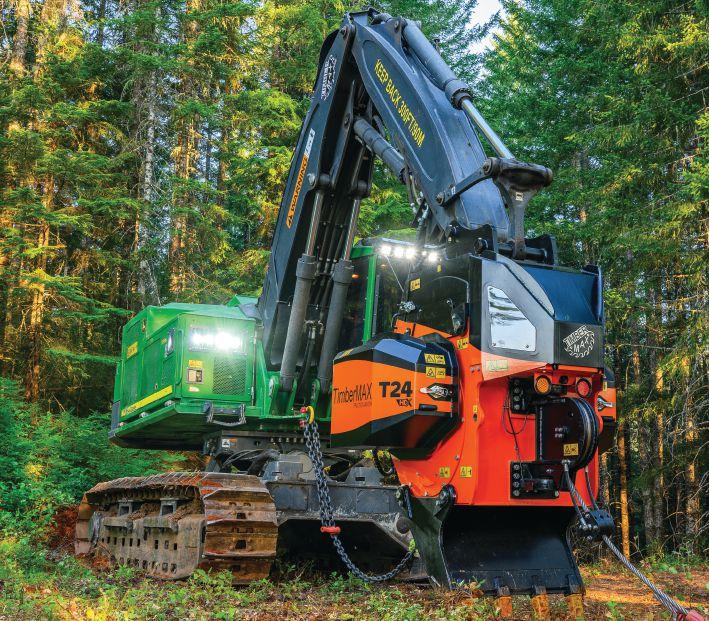
TimberMAX released the third generation of its traction winch attachment branded the HDX series. The HDX series can be installed on equipment from all the major logging equipment manufac-
turers, says TimberMAX founder and CEO Mathieu Lavoie.
“This year we are coming with that full range available,” Lavoie says. “It is the widest range of winch products that we cover.”
The HDX Series is available in a range of models from the 8-ton to 24-ton pulling force range, including the T8Light, T10, T15, T20 and T24.
The HDX Series offers a variety of features including both ADVANCED and SMART mode operating modes, which allow to work without travel signal from the slope vehicle, a customized bolt-on lid adapter to maximize compatibility
with winch carriers; top hood porthole for easy inspection; top mount for reducing operating weight and enhancing stability; the load cell delivers precision tension measurements; a pivoting sheave camera for enhancing wire rope hazard visibility and safety; oversized pivoting sheave for extending durability and lifespan of the wire rope; an automated greasing system; a wire rope cleaner to improve winch dirt management; a heavy-duty hood and hood latch designed for easy inspection access with no tools required; and more.
The HDX Series iWiNCH Control System features a rope capacity indicator; line counter; communication signal; manual spooling function; pre-set tension settings; movement sensor; carrier alarms; carrier engine control; tethered machine gradient tracker; intuitive service menu; active events and error codes in real-time; live camera access through three feeds; drum speed indictor; and tethered machine configuration.
“In terms of increasing rope lifetime, increasing reliability with the automated grease system, and all the features in increasing pull and more travel speed… it’s really the evolution of everything we’ve been doing and learning on the last year,” Lavoie says.
PONSSE
TIGERCAT
LOGGING profile
ALWAYS EVOLVING
Wadlegger invests in latest harvesting technologies
BY ANDREW SNOOK
The evolution of Wadlegger Logging & Construction was decades in the making. The company’s journey began when Josef Wadlegger immigrated from Austria in the early 1960s and found a job working in the forest industry in Central Alberta. Shortly after joining the company, it was approached by the Government of B.C. with the offer of a forest license in exchange for moving to B.C. and building a sawmill – a common practice at the time by the provincial government to create jobs.
The company moved to Clearwater, B.C. and set up Clearwater Timber Products. Josef decided to move there to work in the company’s logging operations. He worked with them until in the late 1970s, when the B.C. government started the Small Business Forest Enterprise Program (now BC Timber Sales, also known as BCTS). At that time, he saw an opportunity to do build his own business, so he quit logging for Clearwater Timber Products and started bidding through the Small Business Forest Enterprise Program on
courtesy of Wadlegger Logging & Construction.
timber to harvest from Crown lands and started up his own sawmill and harvesting operations.
The sawmill operated until about seven years ago when the second generation of owners of the Wadlegger family business, Hans Wadlegger and his brother, Sepp Wadlegger, decided to focus on the harvesting side of the business along with growing the construction segment of the business. On the logging side of operations, the company harvests timber for various forest products companies in the area, including Interfor; Gilbert Smith Forest Products; Simpcw Resource Group, Tolko Industries; Wells Gray Community Forest, West Fraser; BCTS; and others. When harvesting is slow, having the construction side of the business helps mitigate the ebbs and flows of the industry.
“What happens often with forest companies is they will be overcapacity in inventory, or markets are slow, so they shift us to focus on development – road construction, block development, drainage upgrades, bridge installs, etc. So, we can shift some of our capacity over to that side and keep everyone rolling. It’s worked well,” Hans explains.
Wadlegger Logging & Construction has 25 employees and is always looking to keep them busy.
“Our guys work year-round. None of them get time off, except for holidays. You’re always looking ahead to lock in the next project.” Hans says. “The key is to have well-rounded employees that can do it all well.”
The company provides road maintenance, roadbuilding, blasting and drilling services to its clients in addition to its harvesting operations, and operates its own gravel pit. Staying diversified has been a key to the success of the second-generation family business.
“None of it can really stand on its own, but put it together, and it seems to work,” Hans says, adding that the company also operates a cattle farm.
Like most family-run harvesting operations, Hans and Sepp were both immersed in the sector at a young age.
“We both worked in the industry our whole lives. Sepp went to school and received his RPF then came back to the business,” Hans says.
Hans acknowledges that increasing costs are the No. 1 challenge right now in the forestry sector including the cost of equipment, maintenance, repairs and wages. On a positive note, recruitment and retention of employees has not been an issue.
“All of our employees are long-term. We’ve had very few issues retaining, and when you’re staying stable in the industry, it’s usually not too difficult to hire good people. For the few that you
may need, if you’re not pressed by time constraints, you can keep your eyes open and find the right person,” Hans says. “For us, it’s important to pay the guys well, have them in good equipment, maintain steady employment, treat them with respect, and get them home at nights. If you can do those things, you’ll be successful when it comes to retaining your people.”
Investing millions of dollars in the latest logging equipment requires having good employees in the operator seats, Hans adds. When it comes to keeping employees in good harvesting equipment, Wadlegger Logging & Construction’s harvesting fleet is almost entirely comprised of
WADLEGGER LOGGING & CONSTRUCTION HAS BEEN ACTIVE IN THE STEEP SLOPE HARVESTING SPACE FOR ABOUT 8 YEARS.
Hans Wadlegger says Tigercat machinery is especially needed for operations in places like the B.C. Interior and B.C. Coast where the grounds can be unforgiving.
Tigercat equipment.
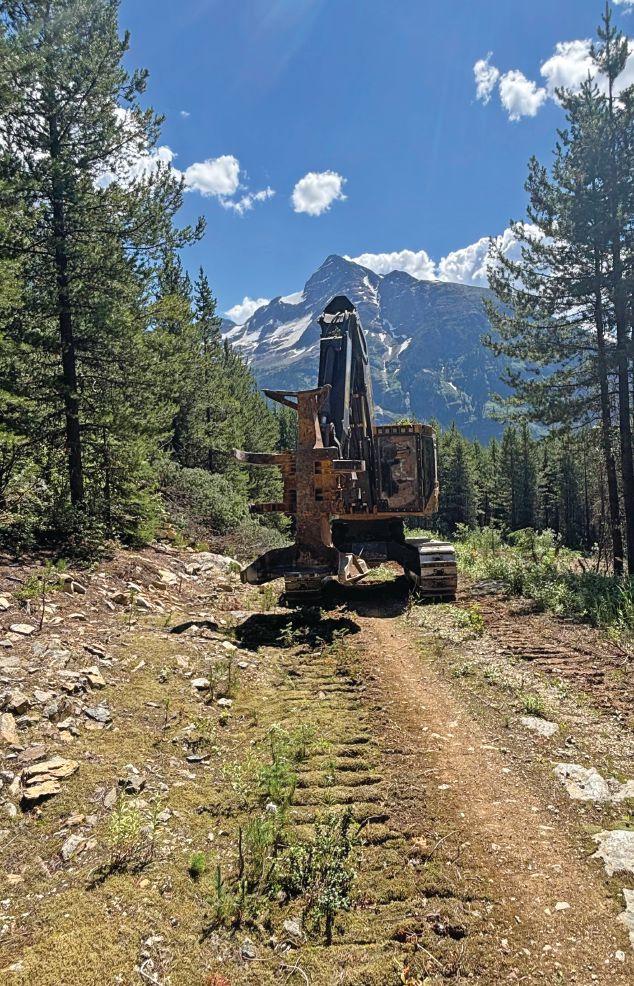
For feller bunchers, the company’s current fleet consists of a recently purchased brand-new Tigercat 877 LX Feller Buncher, an LX870D Feller Buncher, and an 870C Feller Buncher. On the processor side, the company has two Tigercat 855E Harvesters – one equipped with a Tigercat 568 Harvesting Head and the other a Waratah HTH623. The company’s skidder fleet consists of two Tigercat 635H Skidders and one 630G Skidder. The fleet also has two Tigercat 875 Loggers equipped with Tigercat grapples, and an LS855e Shovel Logger designed for steep slope operations.
When asked why the company’s forestry fleet is almost entirely comprised of Tigercat equipment (with the exception of a Caterpillar log loader), Hans had two answers.
“A big one is that it’s made in Canada. But the simplest way to put it is that it’s the best,” he says. “They’re very productive. They cycle fast. They multi-function very well. They come with the best guarding package. Their fuel economy is excellent. The cooling capacity is excellent. I really can’t say anything negative about it. There’s no doubt that our operators truly believe that it’s the best equipment.”
Hans adds that Tigercat machinery is especially needed for operations in places like the B.C. Interior and B.C. Coast where the grounds can be unforgiving.
“We’re in really tough ground and you need the strongest machines for that,” he says. “They also hold value well at resale. Nothing gets shinier out in the bush, but Tigercat equipment takes the abuse well.”
Hans also appreciates that Tigercat’s team is always receptive to feedback to continue making improvements on the equipment.
“On the new buncher, there are some little things that we think can improve it, and that feedback goes straight back to Tigercat immediately, and there’s a discussion happening. It doesn’t sit. They’re already trying to figure it out. That’s really encouraging,” he says.
STEEP SLOPES
Wadlegger Logging & Construction has been active in the steep slope harvesting space for about eight years. The biggest challenge in this space has been the financial aspect of purchasing the specialized
equipment and then understanding how to utilize it in the most efficient way.
“When we look back at what we did to get a log to the landing, as opposed to what we will do now, it has changed dramatically. You quickly learn what doesn’t work. You start recognizing the various safety risks on those slopes, and what you thought was a high priority at first, may not be the biggest risk after all,” Hans says. “It’s not just about the slope. Slope is only one of the concerns. Sometimes it can more about the rock
or saturated soils, snow, anchor points, things like that.”
A GREAT COMMUNITY
Hans says his family is very fortunate to be able to work with so many different companies in the North Thompson Valley.
“We enjoy a lot of support from our community. At the end of the day, living well includes work and play, and we’re so fortunate that we live in a great place that we can do both of those things. This is one of the best places on the planet.”
A LONG WAY TOGETHER
FORESTECH
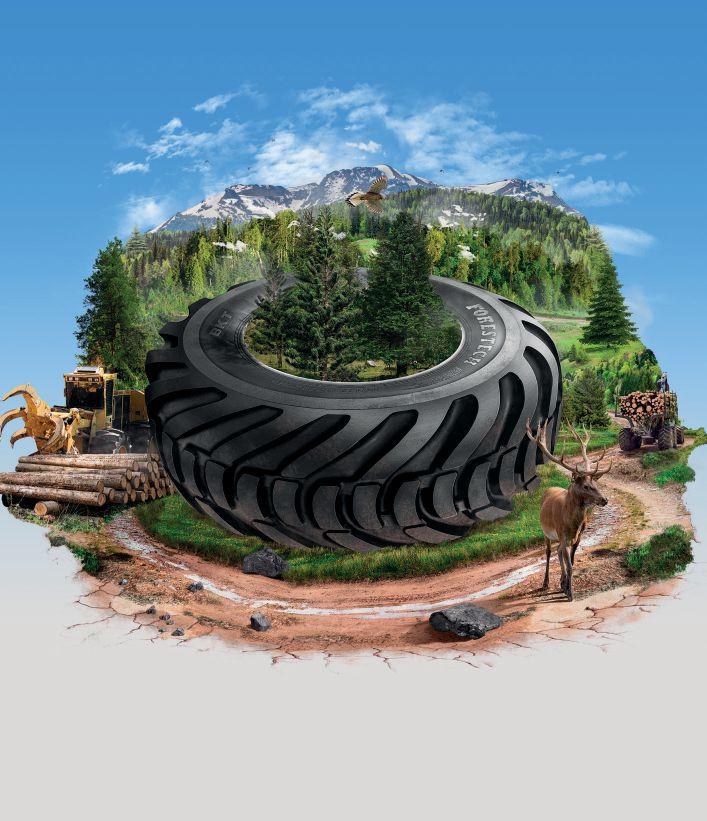
FORESTECH is a BKT bias steel-belted tire, suitable for forestry applications with forwarders. It provides excellent traction even in heavy-duty service and applications. Its strong bead and shoulder area ensure high puncture resistance as well as a longer tire life cycle. As a result, you can deal with the toughest working conditions in the forest without concern.
Choose the BKT range for forestry applications!
Eastern Zone Manager
BKT
Cell: 514-792-9220
Web: www.bkt-tires.com
Keeping fleets connected
Telematics services continuing to evolve
BY ANDREW SNOOK
Since the advent of telematics in 1978, these systems have evolved in many different forms. In the forest products sector, telematics systems have been assisting logging contractors in the optimization of fleet maintenance, fuel management, job planning, and more.
One of the companies that have been extremely active in the telematics space is John Deere, which has more than 15,000 forestry machines connected to JDLink telematics globally.
“Tools like the John Deere Operations Center and Forestry TimberManager enable detailed job planning, real-time job site monitoring, and reporting that scales to different industry needs,” says Sami Törmä, aftermarket and digital solutions
sales manager for John Deere.
Törmä says these tools help customers optimize the use of their machines and enhance overall operations, allowing for more informed business and operational decisions.
“John Deere’s telematics solution allows dealers to connect to machine monitors remotely for diagnosing an issue or simply helping operators utilize the latest features. This reduces downtime and eliminates unnecessary travel. Dealers can also monitor machine health and performance indicators, ensure continuously productive equipment and enable fast corrective actions,” he says.
Niko Solopuro, product marketing manager for John Deere, says there has been a noticeable
shift in how contractors interpret and prioritize data.
“While traditional metrics like cubic metres or tons per hour remain important, there’s growing recognition that efficiency-based metrics – such as cubic metres or tons per litre of fuel – are even more critical for profitability,” he says.
Solopuro adds that idle time monitoring is another emerging focus for contractors.
“Contractors are increasingly aware that excessive idle time not only drives up fuel costs but also contributes to unnecessary machine wear and reduced warranty lifespan. Reducing idle time has become a key performance indicator, directly linked to cost control and operational sustainability,” he says.
While managing fuel costs and preventive maintenance are two of the biggest factors that contractors look for in telematics systems, the most important one is production reporting capability, says Petteri Tuomisto, sales manager for digital solutions at PONSSE.
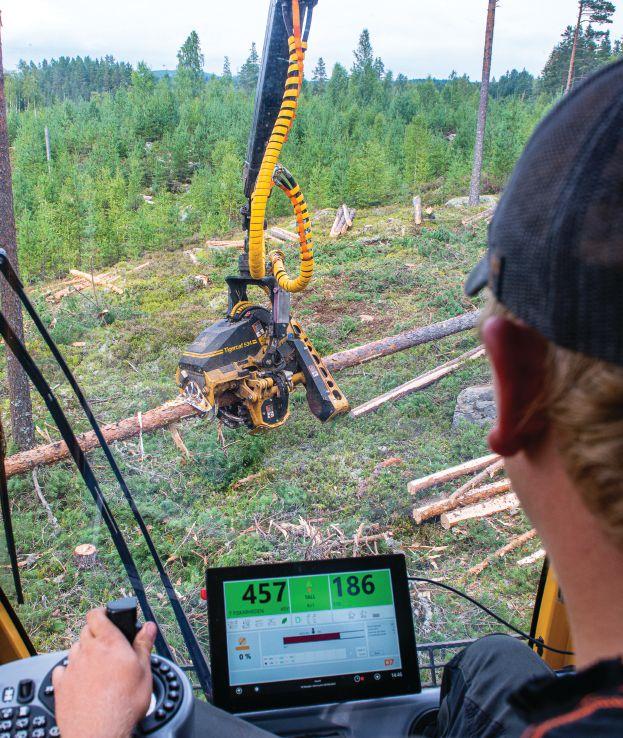
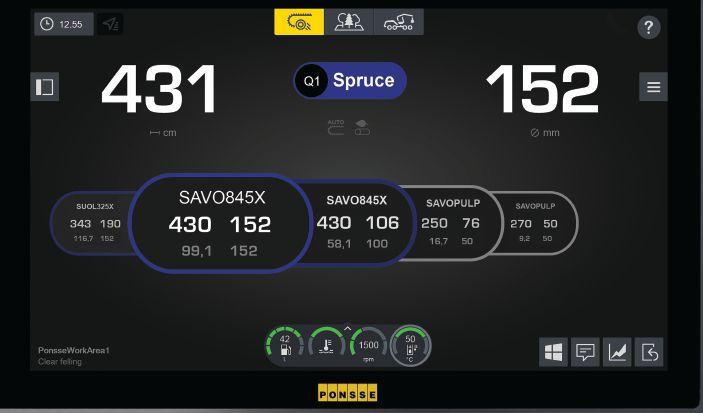
“Compared to a lot of other heavy machinery, the measurement system in forest machines is really sophisticated. We measure every single log that we cut, and then, the operator also can tell what tree species you are cutting. This means that we can really give a comprehensive view of the production,” Tuomisto says.
The ability to know in real time the different species being cut, the length and diameter of logs, and the total volume available, gives contractors the ability to communicate with sawmills more efficiently.
“Sawmills want to know what types of wood are available,” Tuomisto says. “The contractor can check from the system if it is available, what they have cut, what they have forwarded to the roadside, so they can immediately see that.”
Having access to this kind of data is becoming a growing requirement for some sawmills.
“The sawmills are starting to be aware of what kind of data is available. I have heard from many places that the big forest companies are starting to require that the contractor share these files with them,” Tuomisto says.
Using software like PONSSE Manager, contractors can download each machine’s data to Excel and choose what they want to share with the sawmills.
“It’s really quick and easy, and then you can decide what do you want to share or not,” Tuomisto says.
CONSTANT COMMUNICATION
Tigercat Industries has been focused on enhancing communications between machines in the forests and beyond with its RemoteLog telematics system, which works well with the company’s D7 Control System and F30 Product Monitoring System via the
easy access to mechanical parameters, fuel economy, performance and production metrics, and activity charts.
“It’s a telematics system right at the machine. So, if you’re within a 30-feet radius of the machine, the machine puts out its own Wi-Fi signal and you open LogOn, and you go in and you’ve got a lot of the same things that you can see on RemoteLog,” McMilland says.
In addition to the timeline with the
newly developed LogOn send app.
“You can be out there with your harvesting head, harvesting trees, and that list is sent to the forwarder. The forwarder operator knows where those stack of trees are, goes there, picks them up, and puts them in their bunks,” explains Chris McMillan, marketing technical writer for Tigercat Industries.
He adds that Tigercat’s bunks can be equipped with load scales so the mill can know exactly which types of logs are headed to their yard.
“You know what the weight is on the back of the bunks, you know the log lengths, species, the weight, everything like that. So, everything is connected,” McMillan says. “A lot of people want all their systems talking to each other, so that’s what we’ve done with our systems.”
Tigercat Industries has also developed LogOn for phones, tablets, and any device with WiFi and a web browser, an onboard information system that gives contractors data to help optimize machine performance and reduce downtime. The app allows for
work that’s been completed, operators can access engine and aftertreatment diagnostic features.
“Say you’re logging and you get an error code on your machine, and it’s an SPN number. You go into LogOn in your machine, and you can see the list of any error codes, just like you would have on your car. You can tap on that, and it will open a troubleshooting guide. It will tell you what led to that error, and it’ll even walk you through troubleshooting and finding out what the actual problem is,” McMillan explains. “We’re trying to get operators and technicians to get back up and running as soon as possible. You don’t want to be sitting out there in the woods waiting for someone to come out there.”
Tigercat Industries also offers satellite messaging, which is helpful for operators who are working outside of cell range.
“They can send satellite messages from LogOn, using the satellite connection for the RemoteLog, and you can have the operator, owner, and technician, all be on there. Then you can just satellite message those
Telematics systems give contractors the ability to communicate with sawmills more efficiently.
people and check up on them,” McMillan says. “It’s another safety feature so the loggers aren’t left out in the middle of nowhere with no communication.”
PREDICTABILITY IS KEY
Greg Alcock, senior telematics analyst for DEVELON, says predictability is currently the top priority for logging contractors.
“People really want to try and prevent as much machine downtime as possible from their end, because machine downtime obviously costs them money. So, if there’s a way to predict what might happen when on the machine, that’s a big thing they really want to focus on,” Alcock says.
Machine owners also want to use the data to analyze the day-to-day performances of how the machines are operating, including by operator.
“If you can pull telematics data on how certain people are operating machines, you can get a better idea of what that day looks like in terms of what hours they’re working; idle time; how much load weight they’re putting on the machines; and get a better idea of how you want to format your day to day when individual operators might be working from a machine standpoint,” Alcock says.
ROLE OF AI
Like in most sectors, artificial intelligence (AI) is continuing to evolve to play a greater role in telematics systems, especially when it comes to managing the massive amounts of data being generated and collected.
“On average, a harvester sends 15 to 20 megabytes of data per day. It creates a huge amount of data. And whenever you have a huge amount of data, then if you want to track that manually, it’s extremely hard. So, that’s where the AI really comes to the stage,” Tuomisto says.
Being able to request specific data from AI will offer significant time savings and reduce contractors’ frustrations when attempting to comb through the data.
“Instead, you can figure out that what kind of report you need, and you will ask directly from the AI, ‘Hey, please tell me that which machine has consumed the most fuel,’” Tuomisto says, as an example.
Solopuro says AI is becoming an integral part of John Deere’s forestry technology roadmap; and is being used to streamline machine maintenance and servicing, enabling operators and technicians to get quick answers to technical questions. He adds that this has the potential to replace the need to consult traditional manuals.
“Additionally, AI is enhancing advanced map layers generated from LiDAR data, providing more detailed and actionable insights into terrain and stand characteristics. These capabilities are paving the way for smarter, more autonomous forestry operations in the near future,” he says.
Törmä adds that by leveraging advanced AI technologies, John Deere aims to enhance predictive maintenance, optimize machine performance, and improve operational efficiency.
“This is likely to benefit telematics and forestry solutions specifically, allowing for better data analysis and decision-making, ultimately leading to more informed and efficient operations in the field,” he says.
TRAINING OPPORTUNITIES
One benefit of telematics systems that is sometimes overlooked is the opportunity to identify areas where operators might benefit from additional training.
“Instead of giving training that’s one size fits most, we can really give individual training for each operator and understand where they actually need to improve,” Tuomisto says.
Even if the personalized training sheds only a few seconds off harvesting times, it can add up to big savings.
“If you can start to save one or two seconds per tree, at the end of the year, the
sum is actually quite big. It’s some serious money, serious improvement on the productivity side,” Tuomisto says.
Törmä says John Deere’s Forestry TimberManager offers operator-specific information that is increasingly visualized for quick review, even through mobile devices.
“With John Deere’s analytics capabilities, dealers’ support specialists can dive much deeper,” he says. “The results from operator training projects globally are extremely positive when utilizing John Deere’s simulators and the TimberSkills learning environment. Learning systematic working methods with immediate feedback is valuable for both beginners and experienced operators.”
By analyzing metrics such as machine idle time, fuel consumption, and jobsite mapping data, contractors can pinpoint inefficiencies that may stem from operator habits or knowledge gaps, Solopuro adds.
“This data-driven approach allows for targeted training interventions, helping operators improve their techniques and boosting productivity,” he says. “John Deere actively encourages customers to leverage these insights to reduce downtime, enhance operational consistency, and manage costs more effectively.”
SAFETY AND SECURITY
Telematics systems continue to play an important role in improving jobsite safety and security. Systems like TimberMatic Maps contribute to jobsite safety and security by providing real-time spatial awareness, Solopuro says, adding that operators can receive visual alerts about points of interest, lines of interest, or areas of interest; such as overhead electric lines or environmentally sensitive zones.
“This proactive alerting system helps operators avoid hazards and navigate complex terrain more safely, reducing the risk of accidents and equipment damage,” he says.
Alcock sees a big push coming for telematics to play a role in improving safety in logging operations in the future.
“From a telematics standpoint of remoting in and being able to work on a machine, or shut a machine down if the operator’s not able to do that for whatever reason, or lock out a machine if something’s unsafe and they don’t want anybody operating it, there’s a lot of different paths you can go down in terms of making sure people are safe on the jobsite,” he says.
Digital platforms such as MY DEVELON are becoming more commonly used by contractors for assisting with fleet management.
OPTIMIZING DUST SAFETY
BY ANDREW SNOOK
When many sawmills and planer mills operated in the past, finding homes for their residuals outside of the mills was common practice. This may have meant sending green wood chips to a nearby pulp mill and sawdust to a medium-density fibreboard (MDF) manufacturer, or simply burning the residuals in beehive burners. But as sawmills and other wood products manufacturers across Canada identified the additional value in using 100 per cent of the log – both monetary and societal – they’ve also acknowledged the additional precautions needed to ensure operations remain safe.
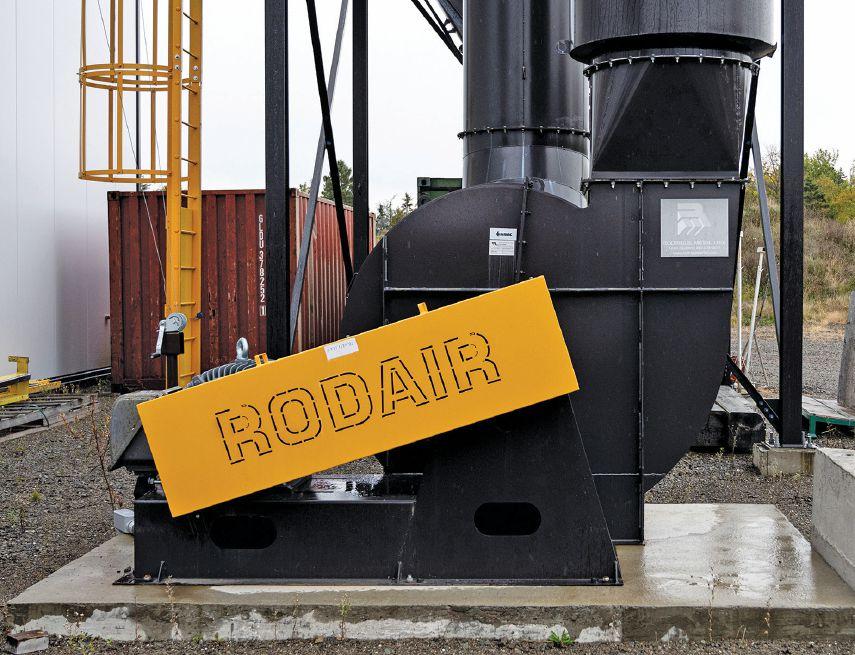
“A lot of the sawmills are now using those residuals to add value to their process, whether it’s consolidating the material and using it as fuel in their biomass burners or creating wood pellets. I believe the mills are realizing the additional danger in the manipulation of those products,” says Neill Gibson, director of business development, sales and marketing for Rodrigue Métal Ltée. “When you think about a planer mill, obviously the lumber, the material, is dry, so they’ve got dry sawdust. They’ve got dry chips and wood shavings. In the past, those would be shipped off to other users and there wouldn’t necessarily
be a whole lot of danger. Now with the integration of what they’re doing, all of a sudden they’re forced to look at the notion of dust extraction, the control of spark detection, sprinkler systems, etc.”
Dust mitigation and spark detection systems have come to the forefront for even the smallest of mill owners and operators.
“Instead of major industrial complexes producing pellets, or sawdust going to producers of MDF, now you’re getting mills taking these byproducts and doing something with it themselves on a smaller scale, and this means that they have to consider these productions differently than they would a traditional sawmill,” Gibson says.
Francis Petit, director of engineering for VETS’ Industrial, Mechanical & Ventilation Division, says the types of dust and explosion mitigation technologies have not trended to anything specific in recent years, but safety testing has been evolving.
“We see similar tech used; however, the safety testing for the technology has improved. Only vendors that work towards functional testing are being considered as NFPA compliant equipment, and we are replacing older pieces of equipment with similar, but tested ones,” Petit says.
FIRST STEPS
When mills are deciding on the types of protection systems they require, they should first focus on the content of their
materials.
“With sawmills, you generally have material that’s still wet, higher moisture content, so the risk of an explosion is much lower, but fire threat is still there. When you get to the point after material has been dried – whether it’s being used for biomass purposes or even for MDF plants – when that wood dust is dry, there is substantial explosion potential,” explains David Grandaw, vice-president of sales for IEP Technologies.
As a first step, Grandaw says companies should be looking at their facilities and identifying where the ignition points are, as well as the areas where they could have mechanical breakdown and some friction risks that could cause some smoldering or burning materials. This is where they should start to address detection and prevention measures.
“Then you consider an upset condition, do you occasionally discover burning or smoldering materials, and how do you stop this material from turning into an explosion?” he says.
One of the common ways this can be done is through the use of a spark detection and suppression system.
“Spark detection and suppression systems are based on detection in the form of an infrared detector, or detectors, depending on the duct size, looking for a hot spot, typically a spark or burning ember traveling through a duct or on a conveyor, detecting it, and then, X
amount of metres downstream based on conveying velocity, inject a water spray to suppress that burning ember before it gets into the downstream receiving vessel where it might find the right dust-air mix to start an explosion,” Grandaw explains.
There are a wide variety of technology suppliers in the dust and spark detection and suppression space, so selecting the right technologies for a plant requires the consideration of multiple factors.
“Like with any other technology, there are a number of considerations you have to look at when you put in one of these systems: What is the scale of the detection and protection required? What are your airflow velocities? Is the application outside where you must heat trace the water pipes, since in the wintertime up in Canada, we don’t want pipes to freeze and break,” Grandaw says.
INCREASED INTEGRATION
In sawmills in Canada and the U.S., dust collection systems are always located outside, so people tend not to consider them when they’re talking about the automation within a facility, Gibson notes.
“It’s almost secondary. So very often, there’ll be maximum two inspections annually where you’re going to be looking inside the system to see if there’s any escaping material, to see if there’s any gap in pressure, or anything like that. But the systems are standalone, and they operate on their own,” he says.
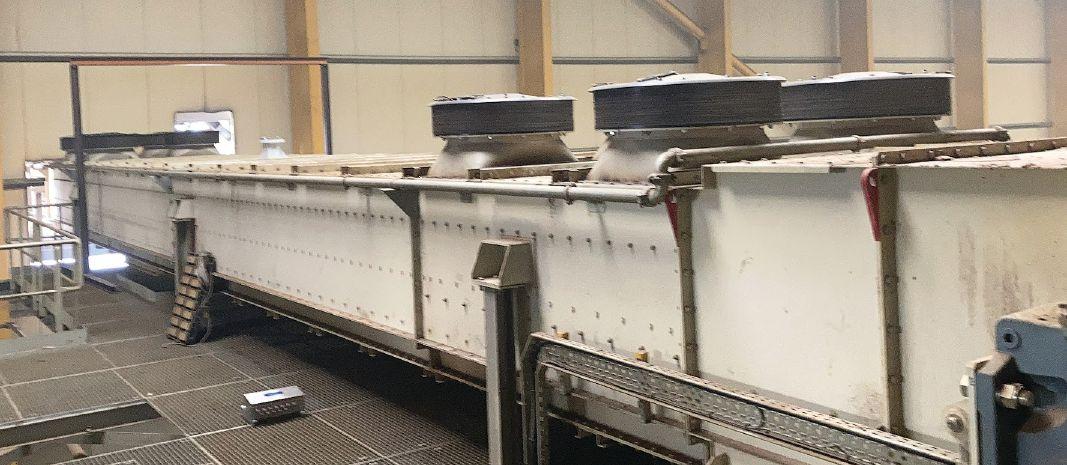
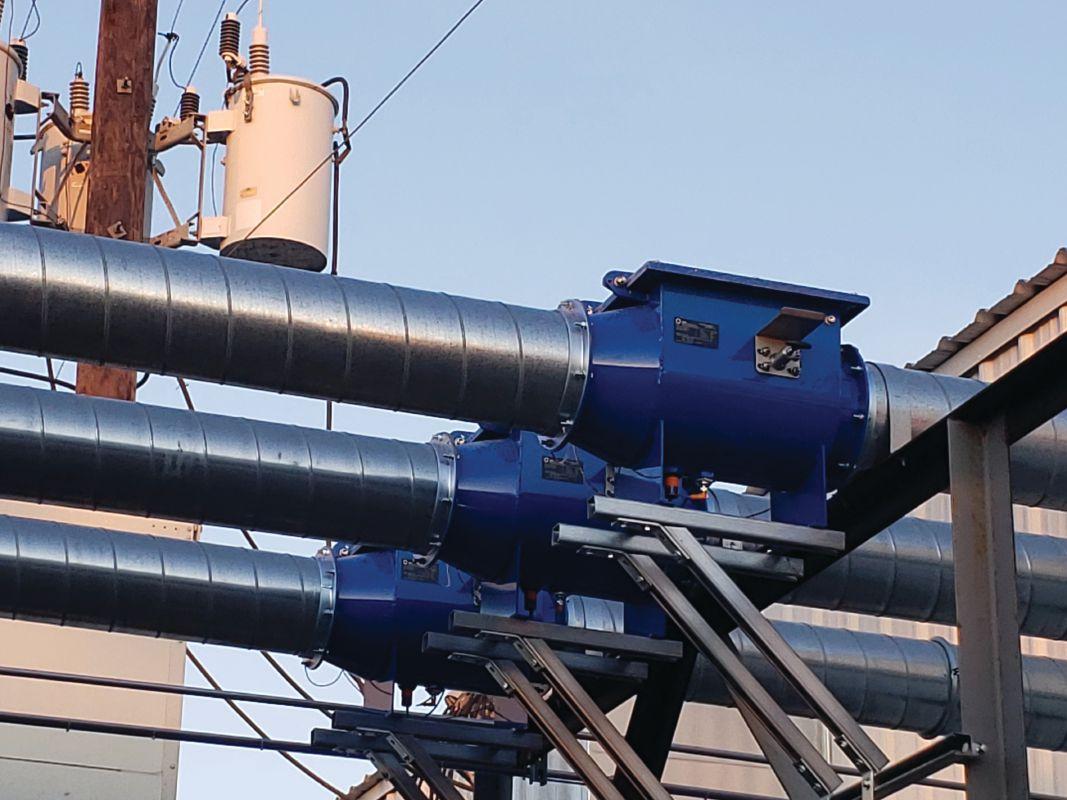
EVN flameless vents on conveyors. Photo: IEP Technologies.
In the majority of European mills, the dust collection systems have been integrated into the main control centre of the mills and are treated more like part of the production line than as a secondary system, Gibson notes.
“That’s something that we need to look at on our end, moving towards an integrated system, having that data be collected within the same systems, and to be able to include that within all of the maintenance packages that exist for sawmills as a whole,” he says.
AIR RECIRCULATION
While cleaning up the air in closed-off production facilities is vital for the health of employees, mill owners also want to be able to recirculate the air back into their facilities as much as possible to reduce energy costs.
“Here in the north with colder climates in the winter, it’s one thing to clean the air, but that heated air, you don’t want to just exhaust it outside. You want it to be clean enough to reintroduce it back into those buildings. That brings in a whole other series of rules and reg-
ulations, because it’s people’s health. So, it’s interesting to see how the systems are evolving,” Gibson says.
His company has been offering these systems for over 60 years to their customers in Quebec due to the colder climates, and it’s something that is increasing in demand for mills in the north and south.
“Sometimes it’s not even keeping the heat in, it’s keeping the cool to recirculate the air,” Gibson says, referring to mills in the southern U.S. “Planer mills, especially the high-production planer mills, they’re all closed systems. You’ve got dust collection in there. You want to keep any cool air in that you can. Therefore, you’re cleaning the air, removing the particles, so that you can reintegrate that cooler air.”
The systems for cleaning and recirculating heated air or cooled air back into a building are largely the same. The key factor to consider for both is moisture management.
“Condensation within the piping is one of those things that you’re having to deal with. So, you’re insulating the
pipes here in the north to keep the heat in and to avoid condensation, and the same thing in the south, but it’s cold air on the inside versus the outside,” Gibson says. “The systems exist in terms of open systems, where they’re venting directly outside. It’s less expensive because it’s less piping. But when you’re looking at energy costs, when you’re looking at what’s going out into the environment, sometimes having that closed system and bringing the air back into the building is the best way to go. We’re seeing more and more customers going for the idea of closed systems to keep that heat or cool inside the building.”
EXPLOSION VENTING OPTIONS
When it comes to explosion venting options, there are standard and flameless options. A flameless explosion vent consists of a vent panel surrounded by a metal mesh or other means to act as a heat sink to absorb the heat from the flames, so all that is released to the outside during an explosion event are hot gasses with no flames.
“That’s a very common technique that
can be used in areas where standard explosion vents aren’t suitable,” Grandaw explains.
Standard explosion venting is a much less expensive option than flameless vents, so has historically been the preferable protection measure for a customer in the wood products industry. However, flameless venting is a good option for plants that cannot redirect potential fireballs to a safe area.
“In those cases, the flameless venting makes a good alternative,” Grandaw says. “I did a calculation on a vessel once that indicated 114 feet was needed for flame ejection distance. That was unusual, as that was for a very large vessel. But 30 or 40 or 50 feet is not unusual.”
The NFPA 68 Standard offers a formula for measuring safe flame ejection distance. Additional thermal effects must also be considered, as the heat generated from an explosion can travel farther than the fire and can still be hot enough for someone to be injured or worse.
CURRENT CHALLENGES
One of the biggest challenges for some wood products manufacturers keeping current with the
latest dust and explosion mitigation technologies has been a misinterpretation of the standards that results in plants using the wrong technology for the goals of the safety standard, Petit notes.
“We have seen plenty of spark detection systems as the only line of defence, in place of explosion isolation,” he says. “Catching up with the current standards is not incredibly hard; as in, we are not seeing any drastic changes of the methods of mitigation being changed drastically with each revision.”
Some companies want to continue using legacy systems instead of purchasing new systems, but this can be an issue as older standards may have been originally misinterpreted and were always deficient, Petit adds.
Luc Cormier, explosion protection consultant for Fike, says Canadian facilities are probably less protected than the U.S. facilities overall due to there being less requirements in Canadian standards relating to combustible dusts compared to the U.S.
“Most sawmills would need traditional explosion protection (e.g., venting or suppression) on some vessels handling their dry materials, spark
detection and extinguishing systems where saws, mills or sanding equipment are tied to dust collection systems, and deflagration isolation on any vessel having an explosion hazard. This along with housekeeping procedures to limit dust accumulation inside the facility would go a long way. However, in most cases, I see one or two of these safeguards provided, with some equipment having no protection at all where there should be protection,” Cormier says.
Another major challenge can be the age of the mills, and the cost involved in retrofitting the equipment.
“A lot of these facilities tend to have older equipment which might be difficult to retrofit, and cost of upgrading to a fully compliant facility may be prohibitive for a lot of these sawmills, which is probably one of the biggest obstacles they face,” Cormier says.
Grandaw says price is a major factor for wood products plants when looking at whether to install passive or active dust and explosion mitigation and suppression systems.
“Not only initial cost, but long-term cost of ownership, because passive systems do not typically require the maintenance that an active system would. Active systems need to be inspected, just like any other process area of the plant,” he says. “Usually, since these are specialized sys-
tems, you would have the manufacturer send their own field technicians to do that inspection. So, the cost is much higher to maintain the active systems than the most passive systems. Passive systems are
things such as the flap valves, standard and flameless vents. Those require mostly visual inspections so they can be done at the plant level. So, the long-term cost of ownership is less.”
Combustible Dust Specialists
Allied brings 49 years experience to help you meet current NFPA Standards with: system design/documentation, spark detection, isolation, grounding, PLC, venting, blast path management, clean-up systems and duct audits — CWB certified and member SMACNA.
Sawmill – Biomass – Boardplants – Pulp & Paper – Power Generation – Mining 50 years of Industrial Air Systems www.alliedblower.com
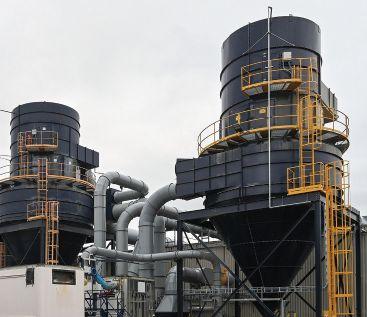
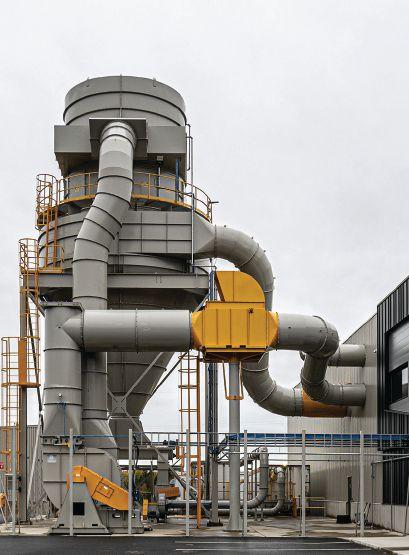
LEFT: Cyclofilter Series Dust Collector.
Photo: Rodrigue Métal Ltée.
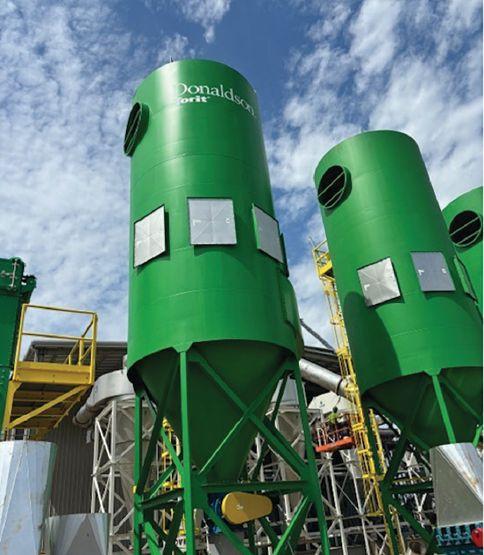
RIGHT: Donaldson RF Series Baghouse with KER vents.
Photo: IEP Technologies.
WOODPRODUCTS CANADIAN
COMING INTO ITS OWN
When I accepted the voluntary role of president of the Ontario Woodlot Association (OWA) this year, it was a great honour; and also somewhat sobering in that the position has evolved over the past decade to include an increased level of responsibility and leadership. The OWA has experienced significant program growth, as well as a substantial increase in human resources capacity and annual budget. I also quickly came to realize that taking on the presidency is an opportunity that has exciting benefits, both personally – as I am a life-long learner – and with respect to the potential to further advance the profile and recognition of our province’s important private land forest sector.
Woodlots (privately owned forests) contribute significantly to maintaining Ontario’s diverse ecosystems, biodiversity, wildlife habitat, clean air, and water, and in providing wood fibre for many products needed by our society. With 180,000 private landowners managing close to 5,000,000 hectares of forest, it is understandable why, collectively, we make a strong contribution to the province’s greater forest sector. Approximately 15 per cent of Ontario’s wood is harvested annually on privately owned forests; and therefore, it is essential that these lands are managed sustainably, using best forest management practices and an applied philosophy of good stewardship. What is not well understood is how much more positive contribution, in all respects, could be realized through an increase in active forest management on these woodlots.
A key part of the OWA’s mandate is encouraging anyone owning a woodlot to enrol in the province’s Managed Forest Tax Incentive Program (MFTIP), and that they employ a reputable forest service provider to help them to develop and obtain approval for a managed forest plan. With about 20,000 MFTIP participants, a little more than 10 per cent of the province’s landowners are currently enrolled in the program. The potential for achieving much more active forest management represents a wonderful opportunity, one that the OWA is very actively
pursuing. While MFTIP does provide a tax break of up to 75 per cent annually for participating forest owners, it is interesting to note that for many of our members their purpose in developing and adhering to a managed forest plan is to promote a healthy, productive, and more biologically diverse woodlot. The economic benefit of active management is often of secondary importance; although many managed forest plans do indeed work toward bringing about sustainable harvesting and resulting economic benefit, over time.
The OWA generally supports increasing the sustainable harvest of wood from private land, and we have been a partner with the provincial government in helping to develop and implement components of Ontario’s Forest Sector Strategy, and the Biomass Action Plan. Several of our programs, including producing up-to-date forest inventory for all private land in Ontario by 2027, look to more accurately defining sustainability within the private land forest sector, and to better informing management planning and practices for individual landowners and forest managers.
It is an exciting time for Ontario’s private land forest sector, and we at the OWA are proud to be making contributions that increase its relevance and grow its prominence. There is no doubt that wood harvested sustainably from private land is vitally important to regional bio-economies and will become increasingly so in the years ahead; and by default, the commerce associated with this wood will become ever more important to the provincial economy as well. A recent project in which we partnered, used red pine harvested from Limerick Forest in eastern Ontario to create a unique engineered wood structure, now installed on its nature trails. This underscores the exciting opportunities to use local wood from privately owned forests for both traditional and innovative products. Projects like this herald that Ontario’s Private Land Forest Sector is indeed coming into its own. I am proud to help lead the OWA in making this happen.
COLLEEN drew-baehre
president of the Ontario Woodlot Association
WOODPRODUCTS CANADIAN
A PIONEER IN MASS TIMBER
BY ANDREW SNOOK
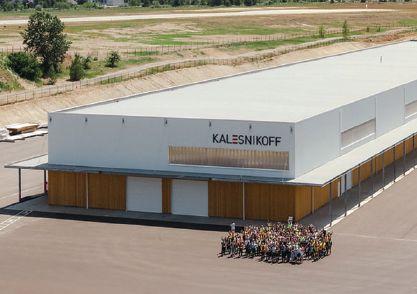
Kalesnikoff Mass Timber made history on June 5 when the company opened its 100,000-sq.-ft. modular mass timber facility in Castlegar, B.C.
Located near the West Kootenay Regional Airport, the facility will allow the company to expand its mass timber products for use in multi-storey housing structures, schools, daycares, commercial buildings and other types of infrastructure.
Chris Kalesnikoff, Chief Operating Officer of Kalesnikoff Mass Timber and the fourth generation of the family-owned business, says the grand opening of the company’s new venture was a fun milestone to celebrate.
“When we opened our mass timber plant, it was right around COVID, so we never did a grand opening. So, I think this is the first time we’ve done a grand opening event in probably 40 years – the last one was in the 1980s. It’s cool to have another good milestone in the in the history of our company,” Chris says.
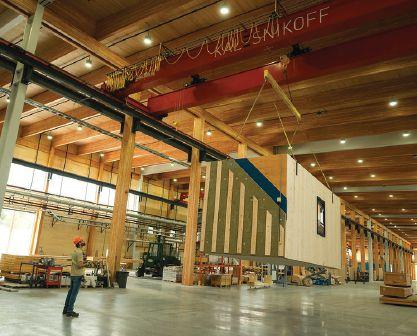
Kalesnikoff Mass Timber’s new plant is specialized towards pre-manufacturing and componentization. The facility is not pressing additional mass timber products. It is taking the mass timber products already being created and making new products with them – an efficient
way to optimize the use of products already being produced.
“As we grew into mass timber in 2019 and 2020, we saw a lot of great success and were able to supply a variety of different types of building types,” Chris says. “Along the way, we continue to see opportunity to provide additional products to these buildings to help with speed of construction and also utilize more of our own fibre.”
The company is taking a combination of its mass timber and lumber products that are not being utilized at its nearby facility in South Slocan, B.C. to create new product lines.
“We have our panelization system there where we’re able to use either stick frame wall systems or CLT wall systems, and create open wall, closed wall, and passive house wall assemblies,” Chris says. “We’re able to ship those to the job site in parallel with our CLT that’s maybe used as the floor system, or glulam that’s used as the structure of the building. So now, we’re providing additional products to help with those buildings.”
The ability to further utilize its own products generates a healthy level of diversity to help the company weather various types of market turbulence.
“We’re still in sawmilling, where we’re selling
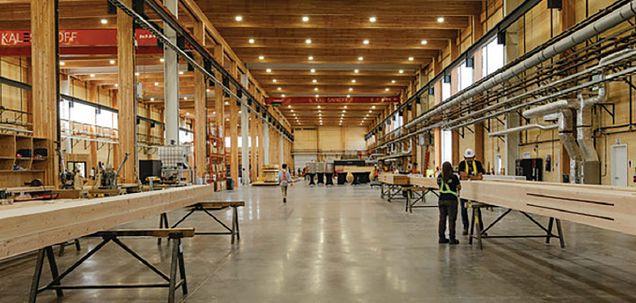
The new facility is not pressing additional mass timber products. It is taking the mass timber products already being created and making new products with them. Photos: Kalesnikoff Mass Timber.
high-grade products and low-grade products in lumber form. We still sell external lumber, but now we utilize a large portion of our own lumber to build mass timber. And now in our mass timber, we still sell externally our CLT and our glulam, but now we also keep a portion of that to create new products, and so we’re just able to kind of continue to feed the markets, or that customer base that is in that market, but then utilize that product further downstream,” Chris explains.
Equally important, if not more so, is the company’s ability to optimize its own fibre supply.
“It’s allowing us to be really costeffective and utilize as much of the fibre as we can, which is such a critical strategy in B.C. Fibre supply is such a
limitation. That’s part of what really drove our strategy of how to continue to push the limited fibre supply we have,” Chris says.
Kalesnikoff Mass Timber also identified the niche opportunity to supply volumetric modular products.
“Volumetric is not always the right solution, but there are a lot of great advantages of being able to produce that product complete within the factory,” Chris says. “When you look at being able to control your costs, cost surety to the end user, the quality, limiting the waste, everything’s built in a controlled environment, there are a lot of opportunities. In this new plan, we’re able to provide three or four different types of new components or products out of mass timber, as well as light frame lumber to feed the construction industry that we’re already supplying now.”
The key to success in this niche sector starts in the design stage with the use of 3D modeling. Since Kalesnikoff Mass Timber was already invested in the BIM processes (building information modeling), it made sense to optimize it to expand the company’s product offerings.
“We’re 3D modeling the building and now we can utilize that to create the additional products. But if you don’t have that technology or that skill set within your company, that is something that’s very critical. It’s not common place in normal construction across Canada that everything is being 3D digitally designed before it hits the construction site. That
was a skill set that we had grown from when we first entered mass timber, and I think once you have that skill set, it’s definitely a valuable tool,” Chris says.
Another vital component for the successful completion of the new plant was getting the facility built in a timely fashion.
“I think the most important part is we were able to purchase the land and go from a greenfield operation to fully operational in 12 months,” Chris says. “June of last year is when we closed on the land and we first started clearing, and we held our grand opening on the June 6 this year. I think that’s pretty incredible. The City of Castlegar deserves a ton of credit for their support and their engagement to help us achieve this. We hear from so many of our customers in some of the different regions on how challenging it is for them in the permitting process. We’re really fortunate that our municipality here was really supportive and that we worked together on this.”
MASS TIMBER MARKETS
The company has a healthy split for the markets where it supplies its mass timber products, which with the current economic climate with the U.S. is more important than ever.
“On mass timber, we’re pretty evenly split. I’d say maybe we’re 60 per cent Canadian based and 40 per cent U.S.,” Chris says, noting that having access to the U.S. market is still very critical. “I think in the volumetric modular mass
Kalesnikoff Mass Timber’s new plant will generate about 100 new jobs in the Castlegar, B.C. area.
timber, that should have a really strong opportunity in B.C. We’re leaning into the Western Canadian market a little bit harder. But ultimately, we have a strong customer base and a loyal customer base on both sides of the border, and we’re excited to continue to offer both groups the new product lines.”
A SIZABLE INVESTMENT
The investment in the new modular mass timber facility was $39.725 million with $30 million invested by Kalesnikoff. The Province of British Columbia’s Manufacturing Jobs Fund offered $6.725 million in funding, while the remaining $3 million was funded in infrastructure and equipment provided by Natural Resources Canada’s Investments in Forest Industry Transformation (IFIT) program. The new Castlegar plant is expected to generate about 100 new jobs – news that was celebrated at all levels of government.
“Canada’s innovative, sustainable forest sector creates good jobs, supports communities in British Columbia and across the country, and provides the material that we can use to build our country,” stated Minister of Energy and Natural Resources Canada Tim Hodgson. “Our natural resources
are Canada’s power, and I congratulate Kalesnikoff Mass Timber for the groundbreaking opening of North America’s first prefabricated mass timber modular facility, proudly supported by the federal government.”
“We are working to increase the supply of much-needed housing across British Columbia by partnering with sustainable mass-timber manufacturers like Kalesnikoff. Through the BC Manufacturing Jobs Fund, we’re growing B.C.’s advanced wood manufacturing sector, supporting local economies and creating long-term, sustainable jobs,” added B.C. Minister of Jobs, Economic Development and Innovation Diana Gibson.
Over the past six years, Kalesnikoff Mass Timber’s mass timber business has grown significantly. Chris is excited to continue to build on that momentum and expand the company’s product offerings.
“That business has been doing well, and it’s continued to grow. All of a sudden now, you’re adding additional product lines and a new business to that. So, the constant growth is something that’s always a pretty good challenge to work through. It’s exciting,” he says.
COLUMN final cut
High Production Forestry in Nova Scotia
From seedling to success
In the evolving landscape of Canadian forestry, Nova Scotia is carving a bold path with the implementation of High Production Forestry (HPF) management zones. These zones are a cornerstone of the province’s Triad model of ecological forestry—a strategy designed to harmonize environmental stewardship with economic viability. As Nova Scotia sets its sights on the long-term, sustainable production of timber forest products, HPF zones are emerging as vital tools to meet both conservation and industry needs.
So, what exactly is a High Production Forestry management zone? At its core, it is a designated area within the broader forested landscape where intensive silvicultural practices are applied to maximize timber yield. By focusing timber production within these defined zones, Nova Scotia is better positioned to protect ecological values in conservation and mixed-use zones, while still ensuring a steady supply of wood for industry. HPF zones rely on advanced forestry techniques and data-driven decision-making to produce high-value wood, and they are rapidly becoming a model for sustainable productivity in Canada’s forest sector.
This October, the Canadian Woodlands Forum (CWF) invites forestry professionals, landowners, and stakeholders to join the conversation on this important topic at the CWF Fall Meeting 2025, “Seedling to Success: Sustaining Timber Production in the HPF Management Zone of the Triad Model”, taking place in Truro, Nova Scotia. The two-day conference, hosted in partnership with the Nova Scotia Department of Natural Resources, BioApplied Innovation Pathways, Forest Nova Scotia, and the Association of Sustainable Forestry, offers a unique opportunity to explore the full cycle of High Production Forestry—from planning and planting to operations and regeneration.
The program kicks off by setting the stage with a focus on the role of managed forests within the broader context of ecological forestry. As Nova Scotia embraces ecological forestry principles, intensively managed forests have a crucial role to play. Attendees will explore why reforestation efforts, including planting trees, are fundamental to this approach, and how landowner engagement and accountability are critical to long-term success. From there, the agenda moves into the technical heart of HPF with a session on Effective Silviculture Planning. Presentations will provide a comprehensive look at how tactical planning— rooted in science and operational know-how— can be used to identify suitable sites and determine the best treatment and timing. Factors such as climate change impacts, pest pressures like the seedling debarking weevil, and the application of modern planning tools will be discussed in detail.
The theme of precision continues with “Best Tree-Best Place: Establishing Successful Plantations.” This session identifies the operational aspects of plantation establishment, emphasizing how success depends on matching the right tree species with the right site conditions. Topics include advances in nursery production, genetic improvement of tree stock, and efficient site preparation and planting logistics. These discussions will provide practical insights into optimizing growth potential, survival rates, and overall plantation performance.
The knowledge gained in the classroom will come to life during the Field Tour on day two. Participants will visit recently harvested and regenerated HPF sites to see how the principles of high production forestry are implemented on the ground. The tour offers a firsthand look at site preparation, planting techniques, and equipment used in Nova Scotia’s high-yield forestry operations.
BECKYgeneau
Becky Geneau is the executive director of the Canadian Woodlands Forum.
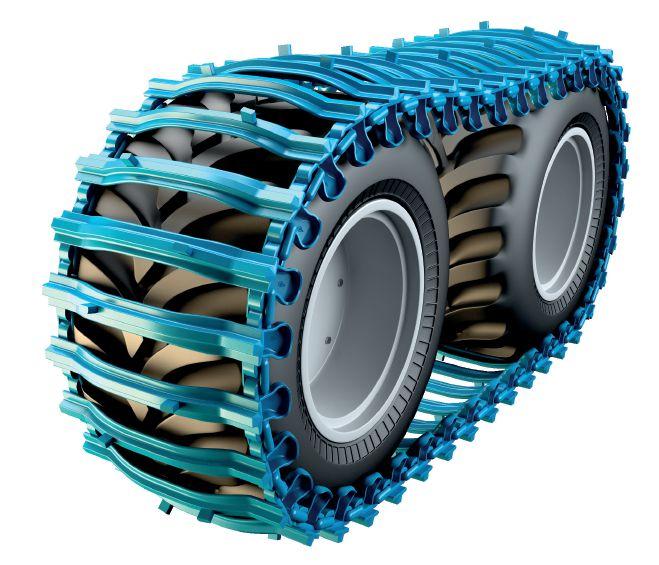
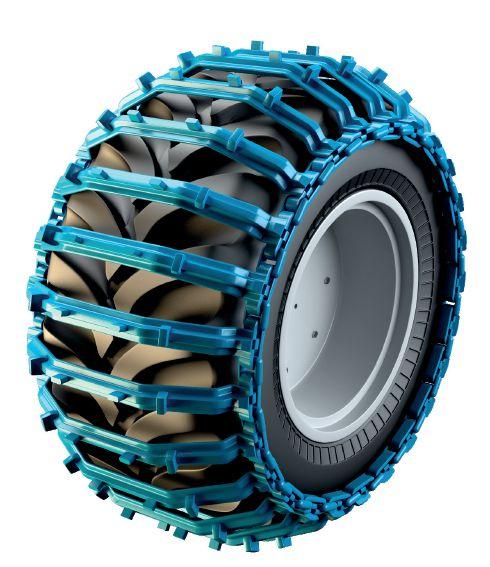
Olofsfors is the market leader in bogie tracks for CTL machinery and wheel tracks for skidders and wheeled feller bunchers. Under the brand names, ECO-Tracks and ECO-Wheel Tracks, Olofsfors offers the widest range of track models and linkage systems for various machine configurations and ground conditions. Superior quality, performance and a proven track record for increased productivity and durability.
NO MATTER THE CONDITIONS - OLOFSFORS HAS YOU COVERED!