DELPHI
BY MOTOR TO DELPHI
ONE day, after a week of hectic “Farewell” dinners and dances, I came to breakfast in a somewhat chastened frame of mind.
“What is the matter ?” remarked F., seeing that I toyed languidly with a bit of toast. “You don’t seem to be a particularly hearty or boisterous eater this morning.”
It was, I thought, a brutal manner of expressing sympathy — but I let it pass.
“Qh, nothing particular,” I answered. “I’m not ‘in my plate,’ as the French say. Too much gaiety has gone to my head!”
“If that’s all,” replied F., glancing up from a generous helping of eggs and bacon, “why not decide to go to Delphi? It would do you a world of good to get away for a bit.”
At this suggestion I brighten up considerably, for Delphi, once the Mecca of the classic world, had long been the goal of my ambitions.
Here is the famous Omphalos stone that marks the spot at which two eagles met sent by Zeus from east to west to determine the exact of the globe.
Delphi was the magnet that drew all men to her. Apollo and the Muses inspired the art and poetry of the ancient world, and dominated the great thinkers of Greece —Delphi, it is said, gave the strong impulses— but not the thoughts... the enthusiasms, the “spiritual voices,” they came from the souls of men like Socrates, Aristotle and others — who translated “the Oracle of Delphi ” into immortal words.
Nevertheless, many Greeks do not hold with this theory, but maintain that the great thinkers of Greece seldom mentioned the Oracle in their writings. Pindar, perhaps, was the only one who did so, and he but vaguely in a somewhat poetical manner.
Delphi is now dead and belongs to a world of shadows, but it is still the magnet that draws many people to Greece, and there are many ways by which it can be reached; for instance, one can take the railway to Branlo, or the boat to Itea, or, if preferred, motor the whole way.
One morning in early February we decided to visit Delphi, and punctually at 10.30 were off by car, 180 kilometres over some vile roads, but through some delightful scenery.
We were a congenial little party of four — just our two selves, the American Consul-General, Mr. Garrels, and his charming wife. These latter had already visited Delphi, but their enthusiasm to do so again was great, thereby adding much to our enjoyment.
It was a trip to which we had long looked forward, entailing some forethought, for, in order to see the ruins thoroughly, it was necessary to spend a couple of nights at Delphi. This in early February was something of an undertaking. The one and only hotel (which had been closed for the winter) was but just open, and we feared the worst in the way of heating. The weather, too, was still uncertain; and the tourist season had not yet begun.
It was not, therefore, the best time to visit Delphi, but unfortunately it was the only time we could spare; so regardless of consequences we determined to venture.
Alas! grey clouds floated in a grey sky and slight showers of rain fell as we left Athens. Our spirits began to droop, but later in the day joy came to us, for some angel rent the clouds at intervals and sent down darts of sunlight, just to show us the full delights of hills, windblown and green, with the tender green of early spring...
Miles and miles we motored, past orchards of olives, past pine and fir trees and valleys, where patches of red, brown and green unfolded before us, blurred in the distance, like colours on an old Persian carpet.
By and by grey hills leapt up against a sombre sky, with houses clinging like swallows’ nests to their rocky walls... On, still on... flashing past women with distaffs and women laden, animals, with brushwood, and once our eye gladdened by the sight of a peasant in full national dress.
What a hero he looked with his blue and red jacket, open sleeves and white fustannelas. Round his waist was a leathern girdle bristling with weapons, and upon his head a modern straw hat—rather resembling a sou’-wester! He might have stepped from a pageant or a play.
Still racing wheels carried us on, till at last we stopped at Thebes, our first halting-place... and there thankfully descending, I stretched cramped limbs.
THE LION OF THEBES
ΒOTH Thebes in Egypt and Thebes in Greece were, I understood, originally Phoenician colonies, though which came first I do not know.
The museum is well kept; here are tombstones of Peloponnesian times, dating from the eleventh century, also relics from Oeta.
At this place the cult of Hercules was kept. From here he is supposed to have ascended to heaven. Annual celebrations were formerly held at Oeta in his honour. These consisted of bonfires, into which were thrown all sorts of statues and models, especially sacrifices of animals. Even today —after the lapse of thousands of years— these bones are still discovered.
Leaving Thebes behind, all unexpectedly one comes upon its great memorial lion, twenty feet high and surrounded by cypresses. It was erected by comrades long since dead, who fought at the battle of Chaeronea under Philip of Macedonia against the Athenians.
The expression on the face of the lion is savage, yet strong... “There he sits on his haunches above the ordinary walks of men-a monument testifying to the courage of those lion-hearted Thebans who died and lost all but their honour.”
The statue is made of marble, now worn and weather-beaten. For years it lay broken in fragments, and only in 1902 was pieced together for the soul of Greece to gaze upon—lest it forget.
After Bralo, the way was good for motoring, thanks to the roads which the British Salonica army made during the war.
All about us now the scenery was romantic; a grey and mountainous land with the spring green and dark olive groves of the Crisean Plain, “cursed long ago in the name of the god, but today flourishing more joyously than when Apollo controlled it.”
Between a dip in the hills we caught a glimpse of the Gulf of Corinth, and behind those hills one began to feel the presence of Delphi.
I felt keyed up... should we ever reach it? At last the car stopped, and then all weariness left me. This was Delphi. Up from the winding road I looked to where, against a rock mountain, the ruins rose sharply cut against a sombre background.
A great sweep of hills silhouetted themselves about a valley at my feet, and I could follow the outline of the coast to the shores of the Gulf of Corinth, where, legend says, a golden dolphin sported long ago and
led some Cretan merchants to discover the site of Delphi. This bright and glittering object hovered near their ships, enticing the men on and until ot reached the Gulf of Corinth. There it sprang ashore and, lo! a beautiful youth stood before them-none other than the golden god himself. Leading them to the site of Delphi, he told them to build there a Temple in his honour, and vanished from their sight.
Thus the Cretans say they were the first to discover Delphi.
Pausanias gives the history of that Temple. It was built of laurel wood, fetched from the sacred vale of Temple-laurel in memory of Daphne, whom Apollo loved.
Eventually this Temple was destroyed, but the second erected to the god was even more poetical — it was built of birds’ feathers and bees-wax!
There are many Cretan influences at Delphi; For instance, the Delphic calendar is Cretan, and in oldest stratum of remains are found Cretan objects, such as Rhythons (drinking strainers, or funnels in the shape of a horn). Many are the gods who have had shrines erected in their honour, but was there ever, I wonder a more inspiring site for a Temple than Delphi, lying as it does at the foot of Parnassus, 8000 feet high. I was glad to have seen it with storm-clouds brooding over it —grim and forbidding— a world all grey; It seemed more in keeping with the awful majesty of its surroundings.
Close to the ruins a great rock is rent from top to bottom, forming a deep gorge, where, in winter, a torrent pours down to the crystal stream of Castalia. Those who drink of these waters are said to be inspired to poetry, but as it was here the initiates washed before consulting the oracle, the inspiration could scarcely have been poetical!
The original name of Delphi was Pytho, and because of that the games were called Pythian games, though some say it came from the word Delph, meaning hollow —the hollow mountainside, where Delphi is situated, but I imagine the former is correct.
Unfortunately it was too late to see the ruins that evening, so we strolled back to the hotel, and later, “sleepy as a little old owl” (as children say), I crept into bed.
ΑΤ THE SHRINE OF THE ORACLE
ΤHE next morning we woke to a sun-bathed, rain-kissed Delphi, gleaming white against purple mountains in a blue-green valley stretching to the sea.
Outside my window an almond tree was coming on bravely, bursting into bloom... It was spring! But, oh! what a cold spring. T shuddered, as with chattering teeth Ι hurriedly dressed and emerged from an icy bedroom. Then breakfast near a delicious stove; a sumptuous breakfast specially prepared for Anglo-Saxon appetites... coffee and rolls, with eggs and bacon.
Thus warmed and fed and cheered, in a mellow “after-breakfast mood,” we felt ready to explore Delphi!
And so my hopes were realised. At last I stood amidst those classic ruins and let my mind play like a picture pageant through scenes once enacted here... * * *
Over there, down the slope, was the threshing floor, where women danced while minstrels swept the lyre and played the flute. Further up was the Athenian Treasury, the most conspicuous and beautiful thing of all; it is a marvel of reconstruction, pieced together bit by bit from fragments found in the houses and walls of the village of Kastri (once on this site).
Some of the slabs, I believe, were used as tombstones for Christian graves of the sixth century. This Treasury was the Athenian trophy for Marathon, and shows the Athenian art midway between the archaic priestesses of the Acropolis and the Pheidias work on the Parthenon.
Originally, I believe, these monuments at Delphi only commemorated triumphs of Greeks over barbarians, but later there were statues for triumphs of Greek over Greek, and still later for athletics and victories in sport; even statues of women crept into the Treasury after a while! The two famous courtesans, Phryne and Lais, were here immortalised—their gilded statues pl aced between generals and kings in the Treasury.
My eyes wander on... Yonder by the rock of the Sibyl lies a big Ionic column, dating from 550 b.c. It came from the island of Naxos,
where once sat the Naxian Sphinx whose body shone like gold when the sun’s rays touched it.
In the far distance I could just discern the crystal pool of Castalia... Was it only a trick of imagination, captivated by the atmosphere and glamour of those classic days, that made me for a moment think I saw the pilgrims washing in its sacred waters... saw the long procession of priests carrying olive branches, winding up the slope to the Temple, where was the rock upon which the Pythia took her seat?... Was it, I wonder, some inner vision that made me see her standing by the laurel tree, whose boughs were filled with the mystery of the place? An old woman, yet clad as a young girl in festal attire, and now, before she takes her seat upon the tripod, a goat is brought into the open, and over its head water is poured; the people press forward.
“A sign,” they ask, “a sign!”
If the animal stands unmoved or only quivers in the head, the god is averse to being consulted. But no, the god’s ears are opened, for see, it trembles in every limb.
“The sign... it is the sign!”
Then the Sibyl moves forward ready for the divine frenzy to seize her. She has chewed the laurel leaves, thus freeing her soul from the burden of earth, and seating herself upon the tripod, inhales the intoxicating vapour which rises from a mysterious chasm at her feet.1 It envelops her. This is the breath of the great Earth Mother that inspires her child. “Now the Oracle will speak!”
I rub my eyes, for suddenly it is gone... Nothing remains but a wisp of passing cloud—that is all. Am I dreaming? I look again. There is the tripod, but where is the Sibyl? She has vanished; only a butterfly poises where once the Sibyl sat, flutters a second and melts into the atmosphere, illusive, intangible as the voice of the Oracle years ago.
“Come,” said F., “and see the Stadium.” I laugh.
“Yes, come,” I reply, “I want to see something normal again. I want to see the birds and the flowers; this place is full of ghostly vapours.”
So we clambered up to the great Stadium and to the Athena Treasury, now called by the painful name of the Marble Quarry, showing
1 The old cleft in the precinct gives no vapour now, but the vapour arises at another point in the village, for this is a district subject to earthquakes, hence originally called the home of Poseidon (the earth shaker) and the shrine of the Earth Mother.
how it was served. Here was the training quarters for competitors in the Pythian games, and one can trace the colonnades of full two hundred yards in length, giving the Stadium run under cover, the wrestling school and the bathing tank. It seems the competitors were oiled all over, and then wrestled in a loose, sandy arena, so that a bath after the exercise was an obvious necessity.
Here, says tradition, long before the wrestling school was formed, there was good cover for wild boar... here Ulysses went hunting in his time, getting his thigh ripped open by the boar, the scar remaining by which his old nurse, years afterwards, recognised the wanderer on his return.
The mystery of the Oracle was still spinning in my brain as we strolled back to the hotel.
“How long did the Sibyl prophesy, I wonder, and how long did men consult her?” I turned to my companions, “Could any one tell me?”
“Yes,” replied F., “I believe the Oracle spoke with no uncertain voice up to the year A.D. 400, and the last important man to consult her was the pagan Emperor Julian the Apostate. Of course now, I remember, he had learned to hate Christianity; it was forced upon him by his cousin the Emperor Constantine, after having foully murdered his parents. Julian was then obliged to profess Christianity, but later he turned to his pagan gods, for, to him, they seemed kinder than the Christian. So he came to Delphi while the shrine was still in its glory, came not to ask anything for himself, but to inquire what he should do to restore the old gods, more especially the golden god Apollo, whom he loved.
“And this is what the Oracle answered: ‘The glorious House is fallen—tell the King, Apollo has no longer any shelter. His stream of prophecy has ceased to flow. Gone dry the talking water.’”
“Well, it was to the credit of the priests,” F. broke in, “that they replied honestly, for a lie would have been easy and Julian could have paid well. He was rather a pathetic figure, don’t you think, and the last to believe in the old gods.”
All throughout that day the sun shone in bits and pieces; alas! slight bits, and long pieces. Still, nothing daunted, we sallied forth later to the museum. Here much has been recovered from Delphi.
Into this tranquil habitation of the gods and goddesses we entered, and leaving all traces of the modern world behind us stepped into the region of “long ago.” There, among statues with calm, unruffled faces —graceful columns and relics of the past— we spent a happy afternoon.
The first to greet us was the famous charioteer taken from the Athenian Treasury. He stood facing us with the copper in his eyes, one hand still grasping a broken rein, vivid and vital as the day he drove to victory in the chariot race for his master, a Sicilian prince (Diglon). This is the most remarkable full-length bronze figure of the fifth-century Greek art the world possesses.
By and by, in a room to the left of the entrance, we found ourselves before two statues identically the same. These are the Delphian twins. Archeologists, having no imagination, say they are just archaic statues of Apollo; but they were shown to Pausanias (that patron saint of Baedeker and Murray) as the twins Cléobis and Biton, the two virtuous youths of Argos. This is their story...
* * *
One day the mother of the twins, being High Priestess to Hera, was summoned to attend a festival at Heraeum (between Argos and Mycenae). No sooner had she started in her ceremonial cart, drawn by two oxen, than the animals began to jib.
Fearing to be late, and so incur the wrath of the goddess, the twins offered to harness themselves to the cart and draw her to the Temple, which they did.
Having reached her destination, the High Priestess immediately prayed Hera to bestow a reward upon her sons — in fact, to give them “the greatest blessing mortals could receive.” Whereupon Hera replied that she would, for the greatest blessing she could bestow on man was Eternal Rest. That night the twins slept, never to wake again.
* * *
Alas! so many gods I find with broken noses — so many goddesses
with half an arm. I am sorry for them, especially Diana the Huntress; she looked so battered after the chase.
But they interested me, these women of long ago, with their coldly regular features, their proud calm air, exquisitely poised heads and shapely limbs... Were they happy, I wonder, with their slaves and perfumed baths... their jewels and their lovers — long ago? They look so calmly at me from out their marble eyes... Were they always calm, and always proud? I wonder — thousands of years ago?
Here are philosophers, orators, poets, warriors, and here the head of a laughing child. A baby face with dimples round its lips, and laughter in its eyes. I smile to myself and pause, through the ages I can hear its laughter... It was graven yesterday, I think... not thousands of years ago!
The high gods on Parnassus were not kind next morning; they were in a malicious mood, and all the elements were in league against us. Zeus sent thunder, Boreas wind—and Poseidon, I know, was grumbling somewhere. Rain, rain, great sheets of rain kept leaping like furies on the ground as we motored home; never ending seemed the road back. Miles and miles of road with nothing to see, the great old hills had no language for us. A white mysterious vapour enveloped Delphi, blotting it out.
Half-way we halted for luncheon, while stinging gusts of rain continued to swirl past us. What matter now; we did not care—let it rain! Dry and warm inside the car, we munched sandwiches and defied the gods!
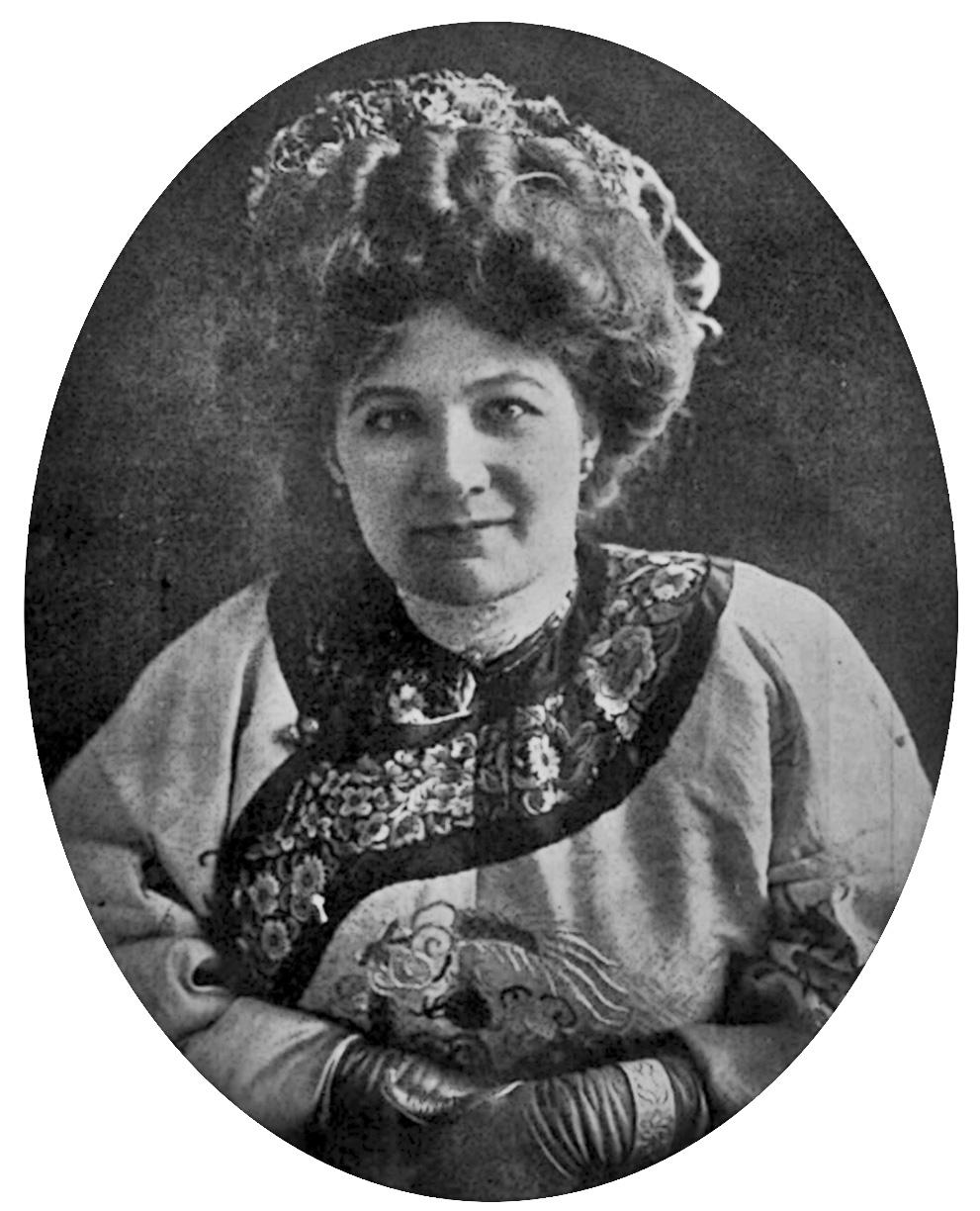
Betty Cunliffe-Owen (1896-1934)
An American author, singer and keen observer of Greek society in the early 20th century. She was married to Sir Hugo Cunliffe-Owen, who first became acquainted with Greece while serving as Military Attaché in Athens during World War I.
Betty and her husband lived in Greece between 1923 and 1926, witnessing the profound social and political changes brought by the influx of refugees and the revolutionary change in Athens. Her experiences during this turbulent period are documented in her book Silhouettes of Republican Greece, which offers intimate and vivid sketches of Greek life, blending personal impressions with historical context.
Sir Hugo Cunliffe-Owen’s involvement with the Refugee Settlement Commission under the League of Nations provided her with unique insight into the challenges facing Greece at the time. Her writing preserves the memory of a nation in transition — confronting war aftermath, displacement, and rapid social change.