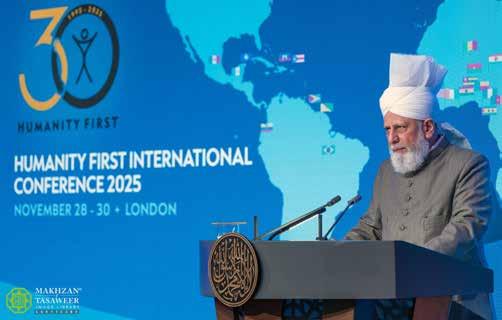
Keynote address by Hazrat Khalifatul Masih V at the Humanity First International Conference 2025
Humanity First is a charitable trust established to promote and safeguard human life and dignity. Since its foundation in the UK in 1995 by Hazrat Mirza Tahir Ahmad, Khalifatul Masih IVrh, it has assisted more than 16.7 million people and operates in 67 countries, with projects in many more. Humanity First’s programmes include Disaster Relief, Community Care, Orphan Care, Food Security, Knowledge for Life, Water for Life, Global Health, Gift of Sight, and much more.
30 years of Humanity First: In numbers
In the past 30 years, Humanity First has responded to over 284 disaster events in 111 countries across six continents, and assisted over 2.9 million victims of earthquakes, floods, droughts, conflict and other types of disaster events. It assisted over a million people during the Covid-19 pandemic across 78 countries.
When it comes to “Community Care”, Humanity First operates an elder home in Sao Tome, a clothes bank in Nigeria, and operates in 57 cities, supporting homeless people and refugees. Overall, this project has seen over 197,000 beneficiaries. It has also established three orphanages in Benin, Uganda and Indonesia and assisted over 13,000 orphans with shelter,
healthcare, education, clothing and food.
Many people around the world lack food security; Humanity First aims to make a difference. As such, it operates 11 food banks and meal points in Canada, Georgia, Greece, South Africa, Sweden, Mexico, the UK and the USA. It has over 50 crop processing machines deployed to process cassava, maize, rice, cous and palm oil, and distributes meat from Muslim animal sacrifices in 67 countries. In total, 6.3
million people have been helped under this programme.
With its “Knowledge for Life” programme, Humanity First has built or runs 100 schools across the world, and has 56 training centre projects covering IT, tailoring, languages, construction trades, hair dressing, and livestock management. The aim is to get people to work for themselves, and thus, Humanity First has helped over 289,000 students, and over
72,000 people have graduated from its training centres.
The “Water for Life” programme has done over 6,100 water installation projects, including wells, hand pumps, and solar boreholes, serving over 5.9 million people. The programme offers a range of clean water solutions for villages and small towns in low-income countries, as well as proper sanitation facilities.
Humanity First also runs 11 hospitals and clinics in Bangladesh, Benin, Cambodia, Congo Republic, Guatemala, Indonesia, Mali, Nigeria, Senegal, with 2 more hospitals under construction in Côte d’Ivoire and Tanzania. It has held medical outreach clinics in 27 countries and treated over 880,000 patients. Its “Gift of Sight” programme operates in 25 countries, where over 65,000 patients have been treated. It also operates two mobile surgical units in Benin, Burkina Faso and Togo.
The conference
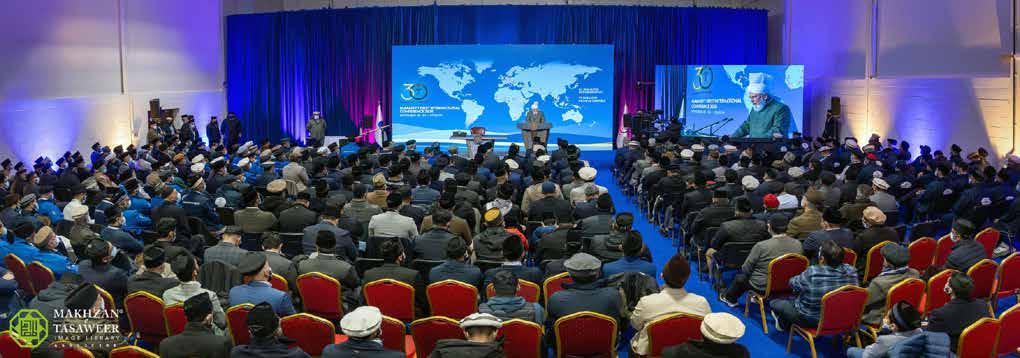
This year’s conference celebrated 30 years of service to humanity, and was held on 28-30 November 2025 at the Baitul Futuh mosque in Morden. Approximately 45 delegates from over 50 countries were in attendance. The theme for this year’s conference was “Peace, Compassion & Humanity.”
This Week in History
A glimpse into the rich history of the Ahmadiyya Muslim Jamaat
5-11 December
5 December
5 December 2003: During his Friday sermon on this day, Hazrat Khalifatul Masih Vaa instructed that every Ahmadi must attain at least an FA degree (similar to the UK A Levels). Before this, Hazrat Khalifatul Masih IIIrh had instructed the Ahmadis in Pakistan to at least pass matriculation (equivalent to UK GCSE).
5 December 2008: During his Friday sermon on this day, delivered from the Baitul Hadi Mosque in Delhi, India, Hazrat Khalifatul Masih Vaa stated that there was a change of plan in his ongoing tour due to some law and order issues within the country and instructed the members of the Jamaat to cancel their plans of travel to attend the Jalsa Salana Qadian.
6 December
6 December 1953: Hazrat Muslehe-Maudra inaugurated the newly constructed building of Talim-ul-
Friday prayer at Masjid Bait-ul-Hadi in Delhi. In his Friday sermon, he encouraged Jamaat members to pray for protection from trials and hardships. Huzooraa also met various guests and attended meetings on this last day. (Al Fazl Intl., 30 January 2009, p. 9)
7 December
7 December 1892: On this day, the Promised Messiahas published
8 December
8 December 1979: Mentioning the contributions of Dr Salam since the late 1950s, Nobel Laureate Sheldon Lee Glashow stated during his Nobel Lecture delivered on this day, “Another electroweak synthesis without neutral currents was put forward by Salam and Ward in 1959,” and “in a continuation of their work in 1961, they suggested a gauge theory of strong, weak and electromagnetic interactions based on the local symmetry group SU(2) x SU(2). This was a remarkable portent of the SU(3) x SU(2) x U(1) model, which is accepted today.”
On 3 June 2006, Queen Beatrix of the Netherlands visited the Mubarak Mosque to commemorate the building’s 50th anniversary. (Al Fazl International, 2 June 2012, p. 9)
To learn more about this historic milestone, see: “Documentary Release: The remarkable story of Netherlands’ first purpose-built mosque, the Mubarak Mosque” at alhakam.org (18 November 2024).
10 December
10 December 1901: Amidst the devastating plague claiming countless lives across the Indian subcontinent, the Promised Messiahas, out of profound concern and sympathy for the masses, issued a written announcement on this day. To ensure his message reached a wide audience. The announcement was published in Arabic, Urdu and Persian, with a supplementary version in Pashto, guiding people on safeguarding themselves against the growing pandemic. (Majmua-e-Ishtiharat, Vol. 2, pp. 537-553)
11 December
11 December 1936: On this day, Hazrat Musleh-e-Maudra instructed members of the Jamaat to engage in fervent prayers and seek forgiveness from God Almighty. Whilst giving advice regarding prayer and repentance, Huzoorra said:
To read more about the biography, success story and false allegations raised against Dr Salam, see: “From disowned to being ‘undeserving’: The painful story of Nobel Laureate Dr Abdus Salam” www.alhakam.org (14 June 2024, pp. 6-11).
9 December
9 December 1955: On this day, Hazrat Sir Chaudhry Muhammad Zafrulla Khanra inaugurated the Mubarak Mosque, the first purpose-built mosque in the Netherlands. This mosque, with three minarets and a capacity of 500 worshippers, was designed by Frits Beck and was completed with funds collected from Lajna Imaillah.
“At least one day in a year, you ought to shed tears before God Almighty for your sins as opposed to merely asking Him to fulfil your desires.” (Tarikh-e-Ahmadiyyat, Vol. 7, p. 324)
11 February 2014: On this day, Hazrat Khalifatul Masih Vaa delivered the keynote address at the Conference of World Religions, which was organised by Jamaat UK as part of its centenary celebrations at the famous Guildhall in the City of London. Around 500 delegates attended the conference. The conference also received messages of support from the late Queen Elizabeth II, the Dalai Lama, David Cameron and several other dignitaries. (“Historic Conference of World Religions Held at Guildhall, London”, www.pressahmadiyya. com)
Continued from page 1
After Jumuah prayers at Masjid Mubarak in Islamabad, the first day of the conference officially began after the Maghrib & Isha prayers on Friday, 28 November 2025. In the first session, Ahmad Yahya Sayed Sahib, Chairman of Humanity First International, reflected on the past 30 years and spoke about the strategy for the next five years. During the session, the chairmen of various countries spoke about some of Humanity First’s projects around the world, including the Gaza Relief Mission in Palestine. There was a panel discussion, after which awards were distributed.
The second day of the conference featured many speeches and presentations of interest, including several panel discussions for men and women. Speakers included Atif Mian, Professor of Economics at Princeton University, USA, Dr Gabriela Mota, Medical Director at the Nasir Hospital in Guatemala, and Dr Charles Bouchard, MD, Chairman of the Department of Ophthalmology at Loyola University in Chicago, USA. In the evening, another session took place, as well as a meeting of all the chairmen and several breakout sessions.
After the morning session took place on day 3 of the conference, the delegates prepared to transfer to Islamabad for the final session.
Final session
On Sunday, 30 November 2025, the concluding session of Humanity First International’s 2025 Conference was presided over by Hazrat Khalifatul Masih Vaa at Islamabad, UK. Hazrat Amirul Momineenaa arrived in the Masroor Hall in Islamabad at 17:22 GMT, and the concluding session commenced.
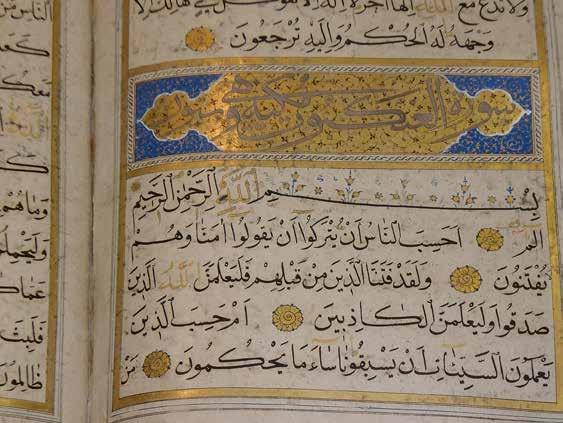
Huzooraa invited Dr Shabir Bhatti Sahib to recite a portion of the Holy Quran. He recited a verse from Surah al-Baqarah (Ch.2: V.178), after which Dr Habib Yaqeen presented its English translation. Ahmad Yahya Sayed Sahib was then invited to present a report of the conference.
He thanked Huzooraa for gracing the event with his attendance at the Humanity First International Conference 2025, which celebrates 30 years of service to humanity. He mentioned that this year, approximately 500 delegates from over 50 countries had participated, and members from over 20
countries had joined virtually.
After this report, a video summarising the 30 years of Humanity First was shown. The video presentation detailed highlights from the charity organisation’s journey and what it has achieved so far, starting from helping those in need in Bosnia in the late ’90s, all the way to the current crisis in Gaza.
Following the video presentation, Hon Stephen Lecce, member of Provincial Parliament in Ontario, Canada, took to the podium to thank Humanity First for all their work as a long-standing volunteer of the organisation. Afterwards, a video message from Sir Ed Davis was also played, who highlighted the important work that the organisation was doing all over the world. After this, many of those who volunteer for the organisation were recognised and given awards and certificates by Huzooraa
Huzooraa then took to the podium to deliver the concluding address. After reciting tashahhud and ta’awwuz, Huzooraa said that the attendees had gathered not just to celebrate 30 years of service, but to express their deep gratitude to Allah the Almighty.
Huzooraa said that the members should never lose sight of the noble objective with which the organisation was established.
Service to humanity was a core objective of the advent of the Promised Messiahas. He repeatedly emphasised helping those in need, and stated that kindness and compassion must be shown to everyone without discrimination, as this is the teaching of the Holy Quran. Huzooraa quoted the Holy Quran:
“And they feed, for love of Him, the poor, the orphan, and the prisoner.” (Surah ad-Dahr, Ch.76: V.9)
Elaborating on this verse, the Promised Messiahas explained that a true believer does not only help his own, but rather serves all those in need to the highest possible degree, noting that this was an unparalleled extent of Islam’s compassion for all people. (Malfuzat [English], Vol. 7, pp. 94-95)
Huzooraa affirmed that the perfect moral teaching has been granted to only Islam. Huzooraa presented the example of the Holy Prophetsa, who was always ready to help those in need, regardless of which faith they followed. In this era, the Promised Messiahas was sent to revive and uphold this example, and it was to further this objective that
Humanity First was established. Huzooraa said that every Ahmadi must consider it his sacred duty to personify these benevolent teachings and tirelessly strive to alleviate human suffering.
Huzooraa stated:
“Do not consider Humanity First to be just another charity or aid agency. Rather, directly underpinning its mission are the commands of Allah, the blessed practice of the Holy Prophetsa and the teachings of the Promised Messiahas. Unlike worldly organisations, Humanity First does not serve humanity to garner fame or recognition. Rather, its every act of service rises purely from a devotion to Allah the Almighty and is inspired by His command to tend to the wounds of His creation.”
Huzoorsa reminded that unless Humanity First remained firmly attached to the Jamaat, nothing would distinguish it from other aid agencies. Instead, Huzooraa said:
“The reality is, and always shall be, that Humanity First’s direct association with the Jamaat is a source of divine blessings and a means of pride and honour for it. Accordingly, never discard or sever your link with the Jamaat of the Promised Messiahas, as our objective is one and the same: to serve humanity without distinction of caste, creed or colour.”
Huzooraa said that, “Be in no doubt that as long as you maintain this link and prize your association with the Jamaat, and continue to seek the guidance and instruction of Khilafat, your work and efforts will continue to be blessed, inshaAllah.”
Huzooraa said that Humanity First had progressed by leaps and bounds from its humble beginnings, recalling that its initial projects were greatly limited in scope. Whereas its budget was a few thousand pounds at its inception, today, the annual budget of the branches of Humanity First in some countries alone is now in the millions. Huzooraa emphasised that this was purely due to the grace and mercy of Allah.
The achievements of Humanity First are also due to the fact that the sole objective of those who serve in this organisation is to gain the nearness and rewards of Allah, and to be the inheritors of the prayers of the Holy Prophetsa. Far bigger charities and organisations approach Humanity First and
Every hardship erases sins Hazrat Abu Hurairahra narrated that the Holy Prophetsa said, “No fatigue, nor illness, nor anxiety, nor grief, nor hurt, nor distress befalls a Muslim –even the prick of a thorn that pricks him – except that Allah, through it, wipes away some of his sins.”
(Sahih al-Bukhari, Kitab al-marda, Bab ma ja’a fi kaffarati l-mard, Hadith 5641)
Hazrat Mirza Ghulam Ahmadas, In His Own Words
The capacity to be influenced It should also be borne in mind that listeners are influenced according to their capacity in a manner that is commensurate with the nature and power of the teacher himself—so long as their capacity has potential. Those people who have a greater affinity with God Almighty and have a fear for Him will be influenced more than others. The proof of this is that the soul makes haste and races uncon- trollably towards God Almighty so that it may be purified. If one has a stronger connection with the soul that incites one to commit evil and is ruled by it, the dis- position feels an anxiety, strain and aversion to listening to the words of a divine reformer. Such people do not feel comfortable sitting with them and listening to their words, and even feel disturbed. When an individual feels such restlessness and discontent in listening to the words of a divine preacher, it is crucial for them to begin worrying about their soul, for such a soul has reached the edge of the pit of destruction.
(Malfuzat [English], Vol. 2, p.117)
Hadith-e-Rasul – Sayings of the Holy Prophet Muhammadsa
wonder how they achieve their objectives or gain access to places where they could not go. Huzooraa reminded them that their every success flows directly from the boundless grace of Allah the Almighty, and because they are supported by the prayers of the Khalifa of the time and Ahmadis worldwide. As long as the organisation remains attached to the guidance of Khilafat and continues to work with an earnest desire to serve others for the sake of Allah, it will keep progressing.
Huzooraa noted the organisation’s many programmes and projects worldwide to help others, and noted that the UK, Germany, Canada and the United States have made particularly significant contributions over the years.
Noting the hospitals that Humanity First has built, Huzooraa said, “Far more importantly than the bricks and steel are the compassionate hearts that serve within them – the doctors, nurses, staff and volunteers.”
Huzooraa emphasised that the doctors and staff must not just be professionally competent but must also hold a heartfelt commitment to serving humanity and easing human suffering. Huzooraa said that Humanity First does not have the resources to build large state-of-the-art hospitals everywhere, and advised that Humanity First should focus on maximising impact by building smaller hospitals or clinics to minimise costs. This strategy would ensure a broader reach into local communities, where they could access primary care and
be referred to larger facilities if needed.
Over the past two years, Humanity First UK has provided excellent care in those areas which are most affected by the war in Gaza. Huzooraa recognised that the local team on the ground in Gaza were most deserving of our gratitude and prayers, since they had set aside their own comfort for those in need with remarkable dignity and courage, driven by a profound desire to demonstrate the mercy and compassion at the heart of Islamic teachings.
Huzooraa remarked that he had witnessed those on the ground physically weaken over the course of the disaster in Gaza for the sake of others. Huzooraa affirmed that, “Every penny spent by Humanity First in Gaza has reached the people on the ground, bringing them desperately needed comfort and relief.” Thus, other well-known aid agencies and organisations have commended Humanity First’s efforts in this regard.
Huzooraa also recognised the work done by the women serving in Humanity First UK, and prayed that Allah should enable them to increase their services in the future.
Huzooraa said: “Irrespective of finances, it is essential that all members of Humanity First always manifest an unwavering passion and commitment for serving others. Serving humanity is not a fleeting objective that comes and goes like the wind. Rather, it is a lifelong challenge, one that requires consistency and unshakeable steadfastness.”
Huzooraa emphasised that all their work must be conducted with humility and prayers. Instead of worldly praise, the only
motivation should be gaining the nearness of Allah and His pleasure, and fulfilling the commands of the Holy Prophetsa and the Promised Messiahas
Huzooraa urged that their humanitarian services should increase exponentially in the years ahead. Addressing them, he stated, “Now is the time to plan for the next three decades. Now is the time to develop a clear vision for the future and to set ambitious goals. Now is the time to take Humanity First to the next level.”
Towards the end, Huzooraa mentioned that as conflicts are erupting all around the world, a world war could be nigh,
100 years ago...
A letter of protest to His Majesty over cartoons of the Prophet and the early Ahmadiyya mission in Sumatra, 1925
Editor’s Note: The following letter, published in the November 1925 issue of The Review of Religions, was submitted to His Majesty’s Secretary for Home Affairs by Hazrat Abdur Rahim Dardra, MA, in response to the cartoon of the Most Holy Prophetsa printed in ‘The Star’ newspaper. In subsequent correspondence, The Star publicly expressed its regret regarding the publication.
Letter to His Majesty
“Your Excellency,
“In my capacity as the head of a very big section of the Muslim community in England, I deem it necessary to convey to Your Excellency on their behalf, and on behalf of many Egyptian, Indian and
African Muslims who have approached me for that purpose, the feelings of fierce indignation and deep mortification that a cartoon printed in The Star, dated 18/8/25 (of which a copy is attached herewith) has aroused.
“The cartoon depicts Mr. Jack Hobbs as a colossal figure. At his feet are shown to stand some very reputed historical personages, including among them Adam[as] and Mohammad, the Holy Prophet of Islam, may peace and the blessings of God be upon him. Like all others, they are made to look at Mr. Hobbs apparently in astonishment and bewilderment at the latter scoring so many centuries in cricket. This ignominiously disgraceful cartoon has inflicted a deep wound on the religious susceptibilities of the Muslims.
“The Holy Prophet Mohammad, peace and blessings of God be upon him, is the
most sacred personage for the Muslims. The love they bear towards him and the veneration with which they cherish his holy memory, transcends all barriers of colour, caste, and country. Of all earthly things, the most revered in their eyes is the honour of their Spiritual Master, for whose sake every Muslim, young or old, high or low, man or woman, is ready to sacrifice his life and his all. A Muslim can bear anything but an affront offered to the name of his beloved and revered Master.
“Your Excellency can, therefore, only imagine the intensity and the depth of the feelings that this manifold insult has stirred. Words cannot adequately express it. The greatest Monarch, of unequalled spiritual glory, the most perfect manifestation of God, the Cynosure of all eyes, the Prince of Peace, and a Mercy unto all mankind, painted as a pigmy lost in amazement, and
and resources will be scarce. Money and valuables will be of little value. Thus, Humanity First should prepare accordingly and make a comprehensive plan for how it will function and provide aid for those in war zones and affected areas, as the fallout from the war would be unprecedented. The priority should remain saving lives and alleviating suffering.
Thereafter, Huzooraa led everyone in du‘a (silent prayer), and the conference formally came to a close.
(Report prepared by Al Hakam)
as a monster of bloodshed and carnage with a drawn sword in his hand! No art could degenerate so low.
“Nothing could be more mischievous, on the part of a paper, than to play with the religious susceptibilities of a people. It is a disgrace to journalism. Could not the admiration of a cricketer be complete without heaping unmerited and unprovoked disgraces on the name of one who takes his stand in the first row of the greatest reformers of humanity?
“Surely this is the most malicious and insidious form of comparison. I need not draw Your Excellency’s attention to the storm of indignation and hatred which this cartoon would raise in India and all other Muslim countries.
“I protest, therefore, most emphatically, against this despicable indignity loaded on our Holy Prophet, may peace and blessings of God be upon him, and request Your Excellency to give your most earnest attention to this very serious matter and set the law in motion against the offenders, so that the world may know that England is justly proud of her traditional fairness and impartiality.
“Your Excellency’s most obedient servant, “AR DARD MA.”
West Africa
The Nigerian Spectator writes in its editorial notes:
“The Ahmadiyas seem destined to work out a revolution in Mohammedan life in Nigeria. Started only a few years ago, the movement is working remarkable changes in the life and outlook of young Mohammedans not only in Lagos, but throughout Nigeria. And there is no doubt that the movement has come to stay.
“Among the local Ahmadiyas, professional men are springing up. They have already produced one lawyer and with two or three more to come in a year or two.
“In a few years, Mohammedan qualified medical practitioners will be arriving, and all these enlightened activities are traceable to the influence of the local Ahmadiyas. [...]”
A prophecy fulfilled
Hazrat Mirza Ghulam Ahmadas of Qadian published a prophecy in 1906 to the following effect:
“The Palace of the Shah of Persia shall be shaken.”
At the time when this revelation was published, nobody could imagine that such a strong wave of democracy would sweep over Persia. God’s words, however, are comprehended only when on being fulfilled, they manifest the Power and Might of God Almighty.
Sumatra
We learn with pleasure from the Al Fazl Qadian that our new missionary has reached Sumatra safely, and within a week of his stay there, eight persons have joined the fold of Hazrat Ahmadas. May the number increase! Amin
Mysticism and Ahmadiyyat
The Rev. WW Cash writes in his latest book:
“Mysticism long ago found a home among Moslems, and in 1879 Mirza Ghulam Ahmad[as], of the village of Qadian, in the Punjab, began to propound his new mysticism to his Moslem brethren. His teaching was chiefly based upon his personal claims. He declared himself to be the Christian Messiah, the Muhammadan Mahdi, and the final [avatar] expected by the Hindus.
“His claim at once brought him into conflict with orthodox Islam. The Mahdi (the final successor of the Prophet) was to be a man of blood; how, then, could Mirza Ghulam Ahmad[as] combine in his own person the character of Jesus, a man of peace, not war.
“The Ahmadiyya Movement is remarkable for the way it turned the attention of Mohammadans to the study of Jesus Christ.”
Dr Zwemer, reviewing his book, remarks in connection with the above passage as follows:
“We regret, where all is so good, to point out one important inaccuracy. The Ahmadiyya Movement is in no sense connected with Muhammadan mysticism, but is rather an attempt to rationalise Islam by a forced exegesis of the Koran and by going back to the swoon theory regarding the Crucifixion, to put Jesus Christ in an unknown grave in Kashmir, so that the Caliph of their new Promised Messiah may
carry on propaganda in a literary bureau at Qadian, in the Punjab!
“Both the branches of the Ahmadiyya Movement now have a mosque in or near London, but neither dream of zikrs or mysticism in their worship or philosophy.”
We agree with Dr Zwemer in saying that the Ahmadiyya movement is not an order of howling and dancing Dervishes; nor is their mysticism a dreamy contemplation on ideas that have no foundation in human experience.
But we do not think the Rev. WW Cash means any of these conceptions by his words, “new mysticism.” He may, however, have confused it with Sufism, which in its truest sense means Islam pure and simple.
We regret to say that Dr Zwemer calls the tomb of Jesus[as] in Kashmir as “Unknown,” and our interpretation of the Holy Quran as “forced exegesis.” A glance at the photo of the tomb of Jesus[as] published in our previous issue and a cursory perusal of “The True Islam” will convince our readers that it is a wilful misrepresentation.
Why missionaries from the East
The East has been looked upon as being uncivilised and missionaries have been up till now sent from the West to educate it.
Why is it that the East now sends its missionaries to the West? What has caused this wonderful change?
A similar question was put to a Companion of the Holy Prophetsa in the Court of the Persian Chosroe. And the answer which he gave at that time applies in our case as well:
“The vices and iniquities that were ascribed to us did actually prevail amongst us. We were as weak as we were looked upon. But God, by raising a prophet amongst us, has wrought a great change in us and has elevated our hopes and aspirations. We are not now what we were before and the things that used to satisfy us before cannot satisfy us now.”
We have undergone a similar change. Thirty-four years before the condition of Islam was such that its devoted votaries could scarcely defend it, God then sent a prophet amongst us whose advent was foretold under different names; some called him the Messiah, by others he was known as the Mahdi, Krishna, or Masio Dar Bahmi.
He quickened the dead by the Divine Elixir of life that God sent from Heaven, and thousands who had been dead for years, left their tombs and scattered in the cities to bear witness to the glory of God and His sublime attributes that know no decline.
All our endeavours and movements, therefore, are regulated by the will of God. We are like a musical instrument, a flute, which gives out the voice of One who plays upon it.
We convey the voice of God to the world, and our mission is a mission of amity and goodwill and our sole object is that we have found out our Creator. Our fellow brethren should also see His face and should not lead a life of estrangement from Him.
We have come to the West to proclaim the second advent of the Messiah. Blessed are those who cast aside all prejudices and give ears to the voice of One who says that he has been raised by God.
(Transcribed and edited by Al Hakam from the original English, published in the November & December 1925 issue of The Review of Religions)
13th
ijtema held by Majlis Ansarullah Niger
Muhammad Jamal Niger Correspondent
The 13th National Ijtema of Majlis Ansarullah Niger was held on 7-9 November 2025 in Mohamadabad, Guidan Roumdji Region. A total of 563 members participated from across the country.
Members began arriving in Mohamadabad on 7 November, welcomed by Sadr Majlis Ansarullah Niger, M Souleymane Mahamane Sahib.
The first day began with Tahajjud and Fajr prayers, followed by a dars of the Holy Quran. After the flag-hoisting ceremony, the opening session began with a recitation from the Holy Quran, followed by the Ansar pledge and an address by Amir Jamaat Niger, Asad Majeeb Sahib, who spoke on the fundamental responsibilities of Majlis Ansarullah, reminding members of their duty to remain steadfast in service to the Jamaat. The session concluded with a silent prayer.
The remainder of the day featured the preliminary rounds of sports and academic competitions, which were conducted with great enthusiasm and active participation
from members across various regions. After Maghrib and Isha prayers, a lively questionand-answer session took place, during which members actively engaged with the presenters, asking a wide range of questions related to religious, moral and practical matters.
The second day also began with Tahajjud and Fajr prayers, followed by additional sports competitions.
The closing session was attended by the Secretary Generals of the Mayor’s Office and the Prefecture. The programme began with a recitation from the Holy Quran, followed by the ijtema report presented by Nazim-e-A‘la, Mahamane Bello Sahib. Prizes were then distributed to the winners of the various competitions. The guests also expressed their views and shared that they were very impressed by the well-organised and spiritually uplifting atmosphere. In the end, Amir Jamaat Niger delivered the concluding address, encouraging all to maintain a living bond with Khilafat and to dedicate themselves to the progress of the Jamaat with sincerity and sacrifice. The ijtema ended with a silent prayer.
Nau-muba‘ieen get-together held in Dudley, UK
Shah Danial
Additional Secretary Tarbiyat & Waqf-eJadid for New Ahmadis, Jamaat Dudley
Jamaat-e-Ahmadiyya Dudley, UK, hosted a nau-muba‘ieen (new converts) get-together on 26 October 2025, at the Baitul Ghafoor Mosque, welcoming individuals from Dudley, Wolverhampton and Birmingham West who have recently embraced the fold of Islam Ahmadiyyat.
This event aimed to provide a place for new Ahmadis to strengthen their connection with faith whilst engaging in meaningful discussions and sharing experiences that enrich their spiritual journey within the Jamaat.
The programme commenced with a recitation from the Holy Quran, followed by a poem and a welcome address by Qalb-EWaseem Shah Sahib.
The first speech was delivered by the
missionary, Imran Khalid Sahib, who offered guidance and encouragement to the new converts, emphasising the importance of spiritual steadfastness and the blessings of belonging to the Jamaat of the Promised Messiahas. The second speech was given by Jalees Khan Sahib, another missionary, who spoke about nurturing one’s relationship with Allah and remaining active within the Jamaat.
Following the formal session, attendees participated in an interactive personal dialogue session, allowing for short introductions and stories of joining Islam Ahmadiyyat. The atmosphere was filled with sincerity, brotherhood and the spirit of unity.
The programme concluded with silent prayer, followed by Zuhr and Asr prayers and lunch. The programme was attended by 15 men and 13 ladies.
Answers to Everyday Issues
Tabarruk, Satan, angels, Eid al-Adha rituals and reciting the names of Surahs, ta‘awwuz and basmalah
Guidance regarding basic Islamic issues that Hazrat Amirul Momineen, Khalifatul Masih Vaa, has given on various occasions in his written correspondence and during MTA programmes is being published officially below for everyone’s benefit.
What is ‘tabarruk’? How are blessings understood to be transmitted and why isn’t it considered ‘shirk’?
Someone from Canada wrote to Hazrat Amirul Momineen, Khalifatul Masih Vaa, mentioning various matters in the context of tabarruk [seeking blessings through sacred relics] and asked how tabarruk works and at what point it might fall into the category of shirk [associating partners with Allah].
In his letter dated 27 August 2023, Huzoore-Anwaraa provided the following guidance on this question:
“In the Arabic language, the meaning of barakah is the presence of divine goodness in a thing. Thus, the true source of blessing and goodness is the Being of God the Exalted. It is for this reason that when Allah the Exalted sends His Prophets and chosen ones into the world for the welfare of creation, He makes the person of these holy beings blessed and also creates the means for blessing in the items associated with them. Accordingly, in the Holy Quran, this subject of blessing has been elucidated in the mention of various Prophets. For instance, regarding the household of Prophet Abrahamas, it is stated:
“‘They said, ‘Dost thou wonder at Allah’s decree? The mercy of Allah and His blessings are upon you, O people of the House. Surely, He is Praiseworthy, Glorious.’ (Surah Hud, Ch.11: V.74)
“Then, concerning Prophet Jesusas, it is stated:
“‘And He has made me blessed wheresoever I may be.’ (Surah Maryam, Ch.19: V.32)
“Then, regarding the Word revealed to our lord and master, the Most Holy Prophet Muhammad al-Mustafasa, i.e., the Glorious Quran, it is stated:
“‘And this is a Book which We have revealed, full of blessings.’ (Surah al-An‘am, Ch.6: V.9)]
“Similarly, in the ahadith, one finds an abundance of such incidents where Allah the Exalted granted healing to the sick through the blessing of the Holy Prophetsa Accordingly, Hazrat Aishara narrates that when a person complained of some ailment, the Holy Prophetsa would mix some soil with his own saliva and (while applying it to the sick person) would pray: ‘With the soil of our earth and the saliva of some of us, may our sick be healed by the command of our Lord.’ (Sunan Abi Dawud, Kitab at-tib, Bab kayfa r-ruqa) During a military expedition, the shin of Hazrat Abdullah bin Atikra was broken; he presented himself before the Holy Prophetsa and the Holy Prophetsa prayed and passed his hand over it, whereupon the shin was healed as if it had never suffered any injury. (Sahih al-Bukhari, Kitab al-maghazi, Bab qatli abi rafi‘in…) On the occasion of the Battle of Khaybar, Hazrat Alira suffered from an eye ailment; the Holy Prophetsa applied his saliva to Hazrat Ali’sra eyes and prayed for him and his eyes became healthy as if they had never had any ailment. (Sahih al-Bukhari, Kitab al-maghazi, Bab ghazwati khaybar)
“Likewise, on various occasions, through the blessing and prayer of the Holy Prophetsa, Allah the Exalted increased a meagre amount of something to such an extent that it fulfilled the needs of all those in want. Thus, on the occasion of the Battle of the Trench, at a meal invitation at the house of Hazrat Jabir bin Abdullahra, the Prophetsa prayer over one sa‘ of flour and the meat of a young goat increased these items so much that a thousand people ate to their fill from that small amount of food. (Sahih al-Bukhari, Kitab al-maghazi, Bab ghazwati l-khandaqi wa hiya l-ahzab) On the occasion of the Battle of Khaybar, when provisions ran out, the Prophetsa prayed over a small amount of food items and Allah the Exalted bestowed such blessing in it that people filled their sacks with these items. While drawing people’s attention to this favour of God Almighty – that this was no personal excellence of his but rather the grace of Allah alone, which He had bestowed upon His servants through one of His Messengers – he stated: ‘I bear witness that there is no god but Allah and I am a Messenger of that very Allah.’ (Sahih al-Bukhari, Kitab al-jihad
wa s-siyar, Bab hamli z-zadi fi l-ghazw)
“Furthermore, the Companions of the Messengersa of Allah used to derive blessings from the blessed personage of the Holy Prophetsa and from the items associated with him and they would also preserve these things as tabarruk. Accordingly, Hazrat Anasra relates that when the Holy Prophetsa shaved his head, Hazrat Abu Talhara was the first person to keep some of the Holy Prophet’ssa hair as tabarruk. (Sahih alBukhari, Kitab al-wudu’, Bab al-ma’i lladhi yughsalu bihi sha‘aru l-insan)
“The Promised Messiahas has also written in his various works about these spiritual graces received by the Prophets and saints from Allah the Exalted. Thus, at one place, he states:
“‘Because of his being completely lost in God, his tongue is the tongue of God at all times and his hand is the hand of God […] Similarly, their hands, their feet and their entire body are granted a blessing, as a result of which even the garment they wear becomes blessed. Oftentimes, their touching or placing a hand on someone causes the eradication of that person’s spiritual or physical maladies. Similarly, the Lord of Honour and Glory bestows a blessing upon the houses wherein they dwell. Such a house remains safe from calamities and the angels of God guard it. Similarly, a blessing and distinction is granted to their town or village. Likewise, even the dust upon which
they tread receives a share of that blessing.’ (Haqiqatul-Wahi, Ruhani Khazain, Vol. 22, pp. 18-19)
“Therefore, in view of the aforementioned matters and also considering the glad tiding that Allah the Exalted granted to the Promised Messiahas that ‘
[‘Kings shall seek blessings from your garments.’], and the fact that a ring of the Promised Messiahas was made with his revelation
[Is not
sufficient for His servant?] in mind; for these reasons, it is my conviction that Allah the Exalted has surely placed blessings in this ring and his other items. Thus, when people ask for prayers and I sometimes give them something as tabarruk, or touch someone for the sake of blessing, I touch this ring of the Promised Messiahas to that person or that item while praying. And I do this when Allah the Exalted puts this thought in my heart or when someone insists very much that I do so. And many times, I also do this because the thought comes forcefully into my heart from Allah the Exalted that there is no harm in doing so. Moreover, I do not do this for everyone, but for those regarding whom Allah the Exalted puts the thought in my heart. So, my intention is not of any kind of shirk, nor should it be the intention of the one taking the tabarruk. To benefit from the grace [faiz] that Allah the Exalted has initiated among us in this age through the Promised
Messiahas is, in reality, to benefit from the reward and favour of Allah the Exalted and to attain blessing. Yes, if the thought of any kind of shirk arises in someone’s heart, then that is wrong. May Allah the Exalted protect us from every kind of shirk Amin.”
[...]
Is Satan (Shaytan) really a created being like humans and angels?
Someone from Pakistan wrote to Hazrat Amirul Momineen, Khalifatul Masih Vaa, asking whether Satan is actually a creation like humans and angels.
In his letter dated 30 August 2023, Huzoor-e-Anwaraa provided the following guidance on this matter:
“The Holy Quran has made various statements regarding the creation and natures of angels, humans and Satan. Concerning angels, it states that they do not possess the power to disobey the command of God Almighty and they carry out whatever command God Almighty gives them. (Surah at-Tahrim, Ch.66: V.7) Concerning humans, it states that their creation is from an extract of clay. (Surah al-Mu’minun, Ch.23: V.13) And Satan, while disobeying the command of Allah the Exalted and declaring himself superior to man, said, ‘Thou hast created me of fire while him hast Thou created of clay.’ (Surah al-A‘raf, Ch.7: V.13) Thus, all three are indeed the creation of Allah the Exalted, but they are three creations of distinct natures; neither are angels like humans, nor is Satan. Allah the Exalted placed the faculty of choice in man and left him free, such that if he follows the commandments of Allah the Exalted, he can attain a station in the nearness of Allah higher than all creation; but if he disobeys the commandments of Allah the Exalted, he will reach the station of ‘asfal as-safilin’ [the lowest of the low]. In connection with the choice to adopt the path of good or evil, Allah the Exalted also attached to man the inspirations of good in the form of angels and the suggestions of evil in the form of Satan. The Promised Messiahas, elucidating this subject, states:
“‘There are two attractors present for every human being; that is, those who pull. One is the attractor of good, which pulls him towards piety; the second is the attractor of evil, which pulls him towards vice. As is empirically observed and felt, oftentimes thoughts of vice fall into a person’s heart, and at that time, he is so inclined towards vice as if someone is pulling him towards evil. And then, sometimes thoughts of piety fall into his heart, and at that time, he is so inclined towards piety as if someone is pulling him towards good. And oftentimes, a person commits a vice and then becomes inclined towards piety and is extremely ashamed as to why he committed the evil deed. And sometimes it happens that a person verbally abuses and strikes someone and then becomes remorseful and says in his heart that ‘I did this deed very wrongly,’ and he treats him with some kindness or asks for forgiveness. So, both these types of faculties are found in every human being and the Islamic sharia has named the faculty of good the lammah or inspiration of the angel and has termed the faculty of evil […] the lammah or suggestion of Satan. The philosophers only acknowledge to this extent that these two faculties are certainly present in every human being; but God,
Who reveals secrets from the Beyond of the Beyond [wara’ al-wara’] and gives news of profound and hidden matters, He has declared these two faculties to be created beings. The one who casts the inspiration [ilqa’] of good, He has named the Angel and the Holy Spirit; and the one who whispers the suggestion of evil, He has declared to be Satan and Iblis.’ (Chashma-e-Ma‘rifat, Ruhani Khazain, Vol. 23, pp. 293-294)”
Cutting hair & clipping nails before qurbani and udhiyah: Does this include underarm and other private body hair and is there any kaffarah or expiation if one fails to remove them?
Someone wrote to Hazrat Amirul Momineen, Khalifatul Masih Vaa, asking whether the instruction for one who intends to offer a sacrifice not to cut their hair and nails after the sighting of the moon of DhulHijjah includes only the beard and the hair of the head, or whether it also includes the hair of the armpits and the pubic hair. Also, if a person cuts their hair, is there any expiation [kaffarah] for this mistake? Similarly, in extraordinary circumstances, can this sacrifice of Eid be performed even after three days and will the person offering the sacrifice decide this themselves, or is it necessary to obtain permission from Huzoor-e-Anwaraa?
In his letter dated 31 August 2023, Huzoor-e-Anwaraa provided the following instructions on this matter:
“For one who intends to offer a sacrifice, not cutting hair, etc., after the sighting of the moon of Dhul-Hijjah until the sacrifice is performed is not obligatory, but rather a commendable or mustahabb act. Therefore, if a person who intends to offer a sacrifice cuts their hair or nails, etc., it does not affect their sacrifice.
“However, if someone wishes to act upon this commendable matter for the sake of attaining reward, then in that case, they should abstain from cutting every kind of hair. This is because in one hadith, the Holy Prophetsa, in the context of sacrifice, has included the moustache and pubic hair along with the hair of the head and the nails. (Sunan Abi Dawud, Kitab ad-dahaya, Bab ma ja’a fi ijabi l-adahi)”
Can the Eid al-Adha sacrifice be performed after the third day of Eid?
“In normal circumstances, the sacrifice should be performed within three days. However, if there is a compelling reason, the sacrifice can be performed throughout the entire month of Dhul-Hijjah. Accordingly, Hazrat Musleh-e-Maudra states:
“‘Sacrifice can be performed today, tomorrow and the day after tomorrow; but if there is a journey or some other difficulty, then it is the view of Hazrat Sahib [the Promised Messiahas] and also of some other elders that sacrifice can be performed throughout this entire month.’ (Al Fazl, Qadian Dar-ul-Aman, No. 13, Vol. 10, 17 August 1922)
“As for the rest, if a directive concerns the entire Jamaat and includes administrative matters, then its permission will be formally sought from the Khalifa at that time. However, if a compelling situation arises for someone individually, then they should decide this themselves, looking at their own situation and any compelling circumstances.”
Should one say the Surah name out loud while reciting the Holy Quran?
Someone from Syria wrote to Hazrat Amirul Momineen, Khalifatul Masih Vaa, asking whether one should recite the name of the Surah aloud during recitation, or repeat it in one’s heart, or if casting a glance at it is sufficient. Also, when starting recitation from the middle of a Surah, should both ta‘awwuz and tasmiyah [i.e., the basmalah] be recited, or should the basmalah not be recited in such a case? Similarly, in audible [jahri] prayers, can Ta‘awwuz also be recited aloud before Al-Fatihah?
In his letter dated 1 September 2023, Huzoor-e-Anwaraa provided the following guidance on this matter:
“Reciting the name of the Surah, repeating it in the heart, or looking at it during recitation is neither a matter of sharia nor is it necessary. We do not find any such instruction in the Holy Quran or the Prophetic traditions.”
If one starts reciting from the middle of a Surah, should they say taʿawwudh and basmalah or only taʿawwudh?
“Whether the recitation of the Holy Quran is done from the middle of a Surah or from the beginning of a Surah, reciting ta‘awwuz before it is mandatory, because the command of the Holy Quran is:
“‘And when thou recitest the Qur’an, seek refuge with Allah from Satan the rejected.’ (Surah an-Nahl, Ch.16: V.99)
“However, reciting the basmalah is not necessary when starting recitation from the middle of a Surah. Nevertheless, there is a saying of the Holy Prophetsa that any important work begun without the basmalah is devoid of blessing. (Tafsir ar-Razi, Surah al-Fatihah, under the verse, ‘Sirata lladhina an‘amta ‘alayhim…’) Therefore, if the basmalah is also recited in compliance with this saying of the Holy Prophetsa after reciting ta‘awwuz in accordance with the Quranic command before the recitation of the Holy Quran, then this act is a source of blessing and reward. Similarly, if recitation is started from the beginning of a Surah, since the basmalah is a part of every Surah, the basmalah will also be recited after ta‘awwuz at the beginning of the Surah.”
In audible (jahri) prayers (Fajr, Maghrib and Isha), should the taʿawwudh be recited out loud before Surah al-Fatihah?
“As for prayers in which the recitation is audible, it is not necessary to recite ta‘awwuz and tasmiyah aloud before Surah al-Fatihah; rather, it is proven from the continuous sunnah [sunnat-e-mutawatirah] of the Holy Prophetsa that he used to recite them silently. Accordingly, it is narrated from Hazrat Anasra that whenever the Messengersa of Allah, Hazrat Abu Bakrra and Hazrat Umarra started the prayer, they would start with ‘
(Sahih al-Bukhari, Kitab al-adhan, Bab ma yaqulu ba‘da t-takbir)”
(Compiled by Zaheer Ahmad Khan, Head of Records Department, Private Secretariat, London and translated by Al Hakam)
Archives
The London Mosque’s imam represents Islam at the 1950 ‘World Convention of Religions’
Ata-ul-Haye Nasir Ahmadiyya Archive & Research Centre
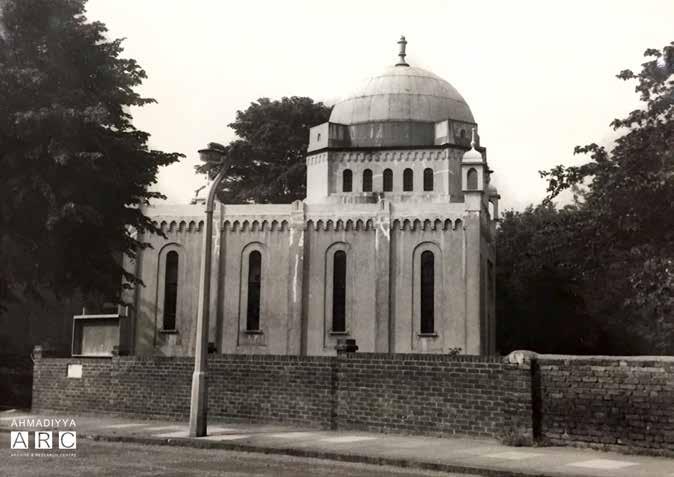
October is a month which has great significance in relation to the Fazl Mosque – the first mosque in London – as its foundation was laid in October 1924 and the inauguration took place in October 1926.
Since its inception, the Fazl Mosque of London has served as a great means for the spread of Islam Ahmadiyyat, not only in England, but around the world.
Focusing on the London mission’s impact in Europe, we find that the missionaries serving there would get invitations to attend various conferences and interfaith gatherings as the representatives of Islam where they would highlight the beautiful and peaceful teachings of Islam.
The influx of such invitations increased manifold following the foundation-laying ceremony of the mosque in October 1924.
Just a few weeks after this ceremony, the head of the London mission was invited to deliver lectures in Amsterdam.1 The London mission continued to raise its voice to defend the honour of Islam and its Holy Foundersa, for instance, responding to the disrespectful cartoon by The Star of London in 1925 and the subsequent apology from the said newspaper.2 It was the same year when the London mission organised a protest meeting against the inhumane killings of Ahmadis in Kabul and it was covered by the press globally.3
This all happened in 1925 alone, exactly a hundred years ago, and one can assess the Fazl Mosque’s impact even prior to its inauguration.
In the coming years, the Ahmadi missionaries stationed at the London Mosque continued to receive invitations as Islam’s representatives. For instance, to represent Islam at the Universal Religious Peace Conference of Geneva in 1928 and the World Fellowship of Faiths of London in the 1930s.
World Convention of Religions on the Foundations of Peace
Another such event where the Ahmadi missionary was invited to represent Islam, was the “World Convention of Religions on the Foundations of Peace” in 1950, i.e. 75 years ago.
The Ahmadiyya Archive & Research Centre has been able to uncover historical documents related to this convention which provide significant details about this interfaith event.
This article will present some details of this event that was held from 18 to 24 August 1950, at the Denison House, 296 Vauxhall Bridge Road, London, SW1.4
In this convention, Islam Ahmadiyyat was represented by Zuhoor Ahmad Bajwa Sahib, the then imam of the Fazl Mosque, London.
The invitation was originally received by Mushtaq Ahmad Bajwa Sahib, who served as the imam of the Fazl Mosque before Zuhoor Sahib. Mushtaq Bajwa Sahib not only participated in the preparatory events of this convention, but also sent the “Message of Goodwill” for the convention.5
Official records of this convention suggest that it aimed at the coordination of the moral and spiritual forces of the world in order to strengthen the foundations of peace. It was organised on the initiative of the Vedanta Movement –started by Swami Vivekananda who represented Hinduism at the 1893 Parliament of Religions in Chicago. The aim of this movement was to foster mutual understanding between all religions, races and nations.6
In 1949, The Civil and Military Gazette of Lahore reported about a “pacifist convention” in London, which was termed as the “prelude to a world convention of religions on the foundations of peace, to be held in London in a few months’ time.”7
According to the official report of this convention, this preliminary conference was held “with the moral support of the following sponsors: Ronald Allen, M.A., Rev. Alexander
Amias, Rev. W. M. Andrew, Swami Avyaktananda, Imam M. A. Bajwa, Dr. S. P. Bhatia, Dame Elizabeth Cadbury [...].”8
The committee of this convention included Swami Avyaktananda (Chairman), Vyvyen Jenkins (Secretary) and George Smith (Assistant Secretary).9
More than 300 delegates, members and visitors from 25 countries, consisting of representatives of nine religions, and 50 religious, cultural and political organisations, assembled in London, from 18 to 24 August 1950, to discuss the problems of peace, and to devise means for constructive peace-activities throughout the world.10
As stated above, the invitation was originally received by Mushtaq Ahmad Bajwa Sahib, hence, the official records of the convention mention the following “Message of Goodwill” that was sent by him:
“We, the representatives of the Ahmadiyya Movement under the guidance of the Hazrat Khalifatul Masih, the present Head of the Community, are trying to inculcate and develop the spiritual attitude all over the world. You have embarked upon the noble task of holding a World Convention of Religions on the Foundations of Peace. I have great pleasure in associating myself with it, as Imam of the London Mosque, and am offering full support and sympathy. I trust it will evoke quick response from the leaders and followers of great religions of the world and advance the cause of universal brotherhood and peace.”11
An announcement about this convention stated that an appeal was made to “Mr. Truman, Marshal Stalin, Mr. Attlee, Nehru and other world leaders to solve the world’s economic and political problems. The leaders of the great faiths should preach peace, and the United Nations should be developed into a world federal Government.”12
We learn from its schedule in the official records that Mushtaq Ahmad Bajwa Sahib was to deliver a speech on 20 August 1950 during the evening session of the convention, titled “Islam and World Peace”.13
However, Mushtaq Ahmad Bajwa Sahib had to return to the Markaz in Pakistan, as we read in the South Western Star’s report about the 1950 Eid-ul-Fitr reception at the Fazl Mosque that “the present Imam, Mr. M. A. Bajwa, who has been in this country for five years, is returning to Pakistan.”14
Hence, a report of Al Fazl tells us that Mushtaq Ahmad Bajwa Sahib reached Rabwah on 16 August 1950.15
The official report of the World Convention of Religions on the Foundations of Peace makes it clear that Zuhoor Ahmad Bajwa Sahib – the missionary who reached London in June 1950 to replace Mushtaq Ahmad Bajwa Sahib –represented Islam Ahmadiyyat at this convention.16
Endnotes
1 De Tempel, 15 May 1925
2 The Star, 9 September 1925
3 Harrow Observer, 13 March 1925
4 League of Nations Records, UNO Archives, File WILPF/072_05
5 Ibid., File G.XIV 01/02/143
6 Ibid., File WILPF/072_05
7 The Civil and Military Gazette, 23 August 1949, p. 12
8 League of Nations Records, UNO Archives, File WILPF/072_05
9 Ibid.
10 Ibid.
11 Ibid., File G.XIV 01/02/143
12 Belfast News-Letter, 19 August 1950, p. 6
13 League of Nations Records, UNO Archives, File G.XIV 01/02/143
14 South Western Star, 21 July 1950, p. 5
15 Al Fazl, 16 August 1950
16 League of Nations Records, UNO Archives, File G.XIV 01/02/143
I have seen their faces: Echoes of the past in a modern age
Today, I no longer wonder what those companions of truth looked like – I see them. I see them in the quiet dignity of young and old Ahmadis in Pakistan who walk to attend a prayer at a mosque, knowing the risk of attack, yet smiling with resolve. I see them in the men and women who donate their wealth for the cause of Islam, remembering the legacy of sacrifice left by the companions of the Holy Prophetsa and followers of the Promised Messiahas. I see them in the Khulafa of the Ahmadiyya Muslim Community – towering examples of patience, prayer and purpose who guide the world with spiritual clarity amid a storm of confusion.
I see them in the lives of those whose names we hear during Friday Sermons and funeral prayers. Ordinary men and women whose extraordinary devotion is remembered by the beloved Khalifa. When he describes their sacrifices, their love for Khilafat, their quiet endurance under persecution, it feels like listening to the stories of the Companions of the Prophetsa Their lives echo the same sincerity and unwavering faith. Just as early Muslims were honoured in Medina for giving everything in the way of Allah, today Ahmadis across the world are honoured not only by their Khalifa but, God willing, by the angels themselves.
I see them, too, in those Christians who shelter Muslims in war-torn regions, in those Jews who march for justice for Muslims despite backlash, and in those Hindus who speak out against injustice at the cost of their social standing. They are the spiritual descendants of Mosesas and Jesusas, of Asiyaas and Maryas, of Abu Bakrra, Umarra and Uthmanra, and of Alira and Fatimara I have seen descendants of Bilalra among the martyrs of Burkina Faso, saying “Ahad Ahad”. They are living proof that the noble spirits of the past are reborn in every age.
But just as the righteous walk among us, so do the enemies of truth. I used to imagine them with dark cloaks and snarling expressions, like villains from ancient pages. But now I see them far more clearly, and more subtly. Some wear suits and hold microphones; others sit behind social media accounts, spreading falsehood, mockery and fear. Their tactics are more refined, but their essence is unchanged. The Holy Quran warns:
“And thus have We made for every prophet an enemy from among the sinful…” (Surah al-Furqan, Ch.25: V.32)
Bakrra, provided stability in a fragile moment after the Promised Messiah’sas death. Hazrat Mirza Bashid-ud-Din Mahmud Ahmadra, like Hazrat Umarra, expanded the mission of Islam across continents with unmatched administrative insight and spiritual clarity. Hazrat Mirza Nasir Ahmadrh, much like Hazrat Uthmanra, played a significant role in preserving and spreading the Holy Quran. Just as Hazrat Uthmanra ensured the unity and consistency of the Quranic text by compiling authorised copies for the Muslim world, Hazrat Mirza Nasir Ahmadrh began important efforts to translate the Holy Quran into numerous languages. He spread them worldwide, making the message accessible to people across continents. These translations, carried out with care and scholarship, allowed the universal message of Islam to reach new audiences and strengthened the foundation for the Community’s future global outreach.
Hazrat Mirza Tahir Ahmadrh, like Hazrat Alira, led the community during turbulent times with wisdom, foresight and spiritual strength. He established MTA (Muslim Television Ahmadiyya), which became a lifeline for Ahmadis worldwide and a means of spreading the peaceful message of Islam in countless languages.
And today, in Hazrat Mirza Masroor Ahmadaa, I see the reflection of all of them. Under his leadership, the community continues to thrive despite growing opposition. In his voice, I hear not just sermons, but echoes of the same truth spoken in Medina centuries ago. In his prayers, I see the living continuation of a divine promise.
The story of faith and opposition is not just a tale of the past; it’s a reality we live today. The Quran declares:
“Truth has come, and falsehood has perished. Surely, falsehood is bound to perish.” (Surah Bani Isra‘il, Ch.17: V.82)
This promise inspires hope but also challenges us to examine our own roles. Are we among those who uphold truth with courage, or do we, even unintentionally, enable division through silence or apathy?
As a child, I often imagined the people who stood by the great spiritual leaders of history – those who followed prophets and reformers in times of immense challenge. What kind of courage, conviction and clarity of heart did they possess to support a message that defied the norms of their time? Were they poor or wealthy? Were their voices trembling or strong? And, what did their adversaries look like – those who jeered at the truth and plotted in the shadows to silence light?
These questions lingered in my heart like whispers through time. I used to wonder, if I had lived in those moments, would I have recognised them?
As I grew older, I realised something profound: history doesn’t just repeat events,
it repeats people. It echoes the same spirits, the same moral choices and the same human archetypes. The sacred texts of many faiths point to this pattern. The Holy Quran speaks of future generations who embody the spirit of early believers: “And among others from among them who have not yet joined them.”
(Surah al-Jumu‘ah, Ch.62: V.4)
Tests and triumphs of faith are never confined to one time – they unfold in every generation, including our own. And now, I no longer need to imagine how those people looked because I can see them. I have seen the faces of the faithful and the faces of the enemies of truth. They are not hidden in dusty history books, but are living among us. They walk into mosques, into parliaments, onto screens, into prisons. Some inspire and some deceive.
The echoes of the past now have names and faces.
These enemies do not always come with swords – they come with satire, with biased headlines and with policies that erode religious freedom and demonise belief.
Just as I see those who carry the torch of truth today, I also see, in our time, spiritual leadership that mirrors the Golden Age of Islam. The first four caliphs of Islam –Hazrat Abu Bakrra, Hazrat Umarra, Hazrat Uthmanra and Hazrat Alira – faced immense trials. They endured civil strife, external attacks, false allegations and betrayal, yet they upheld justice, guided with wisdom and preserved the unity of the Muslim ummah
Today, I see the same noble qualities in Khilafat-e-Ahmadiyya, the divinely guided successors of the Promised Messiah, Hazrat Mirza Ghulam Ahmadas
Hazrat Hakim Maulana Noor-udDeenra, the first Khalifa, like Hazrat Abu
The Holy Prophet Muhammadsa once said, “A time will come when holding onto faith will be like holding onto burning coal.” (Sunan al-Tirmidhi, Hadith 2260) That time is now. In a world where faith is often scorned, where belief is considered backwards, and where devotion is tested in subtle and severe ways, those who cling to spiritual truth do so with blistered hands and unyielding hearts.
We live in an era where the trials of the past are re-lived, but so are the triumphs. Every act of kindness, every stand for justice, every moment of unwavering faith writes a new chapter in this timeless story. The question is not just whether we can recognise these modern heroes or their adversaries. It’s whether we will join them.
Let us honour those who carry the torch of truth, regardless of their background or creed. Let us celebrate the unsung heroes who build bridges, serve communities and hold fast to their beliefs. And most importantly, let us ask ourselves: where do we stand in this eternal struggle between truth and falsehood?
The choice is ours, and the echoes of the past call us to act.
Masood Ashraf USA
The recent campaign to declare Ahmadis
‘Non-Muslim’ in Bangladesh
Shahood Asif
Lecturer Jamia Ahmadiyya International, Ghana
Divine opposition to the righteous has always served as a testament to their truth. The Holy Quran declares:
“Thus did We make for every Prophet an enemy from among the sinners.” (Surah al-Furqan, Ch.25: V.32)
It further reminds believers that faith is not without trial:
“Do men think that they will be left alone because they say, ‘We believe,’ and that they will not be tested?” (Surah al-‘Ankabut, Ch.29: V.3)
Like other divine communities, the Ahmadiyya Muslim Jamaat’s 136-year history is filled with trials and tribulations. Yet, as time has passed, the signs of Divine support and favour have become ever clearer and more radiant.
Across the world, the seeds of this Jamaat are taking root and, by the grace of God, flourishing into strong and steadfast trees. Despite the relentless conspiracies and schemes of its opponents, Divine help continues to accompany the community at every turn.
At the same time, those whose hearts are filled with malice and envy have expanded their circles of hostility. This opposition has not reached the intensity and legal nature as is prevalent in Pakistan, but it is inching closer towards it.
Brief history of Ahmadiyyat in Bangladesh
Bangladesh is a fortunate land whose many inhabitants had the honour of pledging allegiance to Hazrat Mirza Ghulam Ahmadas, the Promised Messiah and Imam Mahdi. Some even had the blessed opportunity to visit Qadian.
reuters.com, 8 August 2024)
Jamaat-e-Islami is the third-largest political party in Bangladesh and is at the forefront of opposition to Ahmadiyyat. It was founded by Maulana Maududi in 1941 in Lahore. (“Jamaʿat-i Islami”, britannica. com, accessed on 24 November 2025)
After the creation of Pakistan, Jamaat-eIslami established a branch in East Pakistan (now Bangladesh). During the 1971 war, Jamaat-e-Islami took a position in favour of Pakistan’s unity and aided the Pakistani military.
After Bangladesh’s independence, Jamaat-e-Islami was declared “traitorous” and was banned. Later, following the assassination of Sheikh Mujibur Rahman and the advent of military rule, restrictions on political parties were lifted. (“Mujibur Rahman”, britannica.com, accessed on 24 November 2025)
Thus, from 1979 the group reorganised and began participating in Bangladesh’s politics. In 2004, it had the opportunity to form an allied government with the Bangladesh Nationalist Party.
Campaigns and violent actions against the Ahmadiyya Jamaat Bangladesh is a Muslim-majority country. Organisations like Jamaat-e-Islami and other hardline Muslim groups find sympathies among simple-minded Muslims by invoking the slogan of Khatm-e-Nubuwwat
From time to time, extremist clerics have incited violence against Ahmadis by spreading slander, accusations of disbelief and by calling for aggression. Several Ahmadi mosques, meeting halls and homes have been attacked. Details of some recent incidents are as follows.
• On 7 April 2025, during a rally expressing solidarity with the Palestinians, demonstrators identified and demolished an Ahmadi mosque in Bahadurpur (“Ahmadiyya prayer centre vandalised during pro-Palestine rally in Rajbari”, bdnews24.com, 9 April 2025)
At the time of his claim, Bengal was part of India and under British rule. Because of the efforts of the early companions, many people accepted Ahmadiyyat. By the time of Hazrat Khalifatul Masih Ira, the number of Ahmadis in Bangladesh had reached in the hundreds. In 1913 the first Ahmadiyya mosque was constructed at Brahmanbaria. (“Coming from every distant track – Maulvi Syed Abdul Wahid Sahib of Brahmanbaria visits Qadian”, alhakam.org, 3 September 2021)
Since this area had a Muslim majority, opposition to Ahmadiyyat took various forms from the beginning. After the creation of Pakistan, West Bengal became part of Pakistan, and eventually, in 1971, Bangladesh emerged as an independent country. Today, the number of Ahmadis in Bangladesh has reached into the many thousands, alhamdulillah
Opposition to the Ahmadiyya Muslim Jamaat
There are three major political parties in Bangladesh:
1. The Awami League
2 The Bangladesh Nationalist Party (BNP)
3. Jamaat-e-Islami
In addition, there are several other political and hardline religious parties. In 2009, the Awami League formed the government following elections and Sheikh Hasina Wajid became Prime Minister. After 15 consecutive years in power, in August 2024 Sheikh Hasina Wajid had to step down amid public protests. Since then, a caretaker government led by Mohammad Yunus has been in place. (“Bangladesh’s Sheikh Hasina forced to resign: What happened and what’s next?”, aljazeera.com, 5 August 2024; “Bangladesh Nobel laureate Yunus named chief adviser of interim government”,
Because of historical reasons, the Awami League and Sheikh Hasina are staunch opponents of Jamaat-e-Islami. When Sheikh Hasina returned to power in 2009, investigations into alleged war crimes of 1971 were restarted. Leaders of Jamaat-eIslami faced trials; some were sentenced to death or life imprisonment, and executions of a few leaders were carried out. (“Bangladesh Jamaat-e-Islami chief given death sentence”, aa.com, 29 October 2024)
In 2013, the Supreme Court cancelled Jamaat-e-Islami’s registration. However, in June 2025 the Supreme Court’s Appellate Division ordered that the party’s registration be restored and directed the Election Commission to re-register the party. (“Jamaat loses registration”, bdnews24. com, 1 August 2013; “Bangladesh Supreme Court lifts ban on Jamaat-e-Islami party”, aljazeera.com, 1 June 2025)
That decision reopened the path for the group’s return to electoral politics. Its student wing, Islami Chhatra Shibir, remains active among youth.
Besides Jamaat-e-Islami, the leading organisations vehemently opposed to Ahmadiyyat in Bangladesh are as follows:
1. International Majlis Tahaffuz Khatm-eNubuwwat (Bangladesh): They have long demanded that Ahmadis be declared non-Muslims. They are allied with other religious organisations.
2. Khatm-e-Nubuwwat Center (Bangladesh): This organisation works in the name of protecting the belief in finality of Prophethood and calls itself a body campaigning against the “Qadiani fitna [chaos].” They mention this “Qadiani fitna” on their website and organise specific programs.
3. Khatm-e-Nubuwwat Andolon Bangladesh (KNAB): This is a subsidiary branch of the International Majlis Tahaffuz Khatm-e-Nubuwwat and has been found involved in attacks on Ahmadi mosques and homes.
4. Hefazat-e-Islam (Protection of Islam Movement): This organisation has also recently been involved in attacks against the Ahmadiyya Community and other minorities.
• In August 2024, during nationwide unrest against the government, Ahmadi mosques and Ahmadi homes in various parts of the country were targeted. Four mosques and one prayer center were attacked, vandalised, and set on fire; in some places, the Imam’s quarters were also torched.
Overall, attacks occurred at five locations: 1) Ahmadnagar Jamaat – mosque, Jamia Ahmadiyya Bangladesh, a meeting hall, and over 80 homes were set ablaze; 2) Rangtia Jamaat – mosque, the Imam’s quarters, and eleven homes were burned and looted; 3) Bam Nail, a circle of Rajshahi Jamaat – mosque vandalised and looted; 4) Charaikhola Jamaat – mosque burned; 5) Taraganj Jamaat – prayer center and Imam quarters burned and an Ahmadi was injured, due to which he eventually attained martyrdom. (Daily Al Fazl International, 26 November 2024, p. 1)
• In 2023, an attack took place during the Jalsa Salana in Ahmadnagar in the northern district of Panchagarh. More than 200 houses were burnt to the ground, and an Ahmadi was martyred. (“Annual Ahmadiyya Muslim convention attacked”, csw.org.uk, 7 March 2023)
• On 12 February 2019, rioters attacked the central mosque in Ahmadnagar and Ahmadi homes: seven Ahmadi homes and four shops were looted and set on fire, while 19 houses were vandalised. More than 21 people were injured in the incident. That same year, attackers assaulted an Ahmadi center in the town of Netrokona. (“Persecution in Bangladesh”, alhakam.org, 1 March 2019)
• In 2005, when Jamaat-e-Islami was part of a coalition government, anti-Ahmadi riots resulted in attacks on several mosques In two significant incidents: in Joyti Diriya Nagar, Satkhira district, an Ahmadi mosque was attacked and homes looted; and in Brahmanbaria, an Ahmadi mosque was attacked during Friday prayers, leaving eleven Ahmadis seriously injured. (“Breach of Faith”, hrw.org, 15 June 2005)
• During the same government in 2004, a complete ban was imposed on Ahmadi publications (books, literature & magazines), which the High Court suspended in December 2004. (ibid.)
Recent campaign to declare Ahmadis non-Muslim
For a long time clerics have sought to amend
the constitution in the manner of Pakistan to declare the Ahmadiyya Jamaat non-Muslim. Jamaat-e-Islami leads this effort.
From 2001 to 2006, the group was a partner in the government. In 2005 clerics demanded that the government officially declare Ahmadis non-Muslim and threatened action if it did not. That year, many processions and rallies were held against the Jamaat and Ahmadi mosques and homes were attacked, as evidenced above.
Before the recent political change, Sheikh Hasina Wajid’s party was in power and was relatively moderate. Additionally, because of her strong opposition to Jamaate-Islami, clerics were not freely permitted to incite unrest.
However, after the change of government in August 2024 the situation changed drastically. The influence of Jamaat-e-Islami and other religious organisations has been increasing.
One clear example is the results of university student elections in Bangladesh in September 2025. According to the student union election results at Dhaka University and Jahangirnagar University, the student wing of Jamaat-e-Islami won an overwhelming majority. Analysts say these results could influence the general elections scheduled for the following year. (“Jamaat student wing wins Dhaka University election in political upset”, anews.com, 10 September 2025)
At the same time, echoes of constitutional amendments are being heard in Bangladesh. Seizing these opportunities, opposing clerics have announced a movement demanding that Ahmadis be declared non-Muslims at the state level in the manner of Pakistan. (“Bangladeshi Islamist group calls Dhaka rally in November to demand Ahmadis be declared non-Muslims”, bdnews24.com, 19 September 2025)
In March 2023, Jamaat-e-Islami’s deputy secretary-general said in a statement: “Bangladesh is a Muslim-majority country where 90 percent of people are Muslim. In this country the Qadiani (Ahmadi) group is engaging in careless activities against Islam. People who love Islam will not accept them. The government’s role in this matter is questionable.” (“Jamaat demands the govt declare Ahmadiyyas ‘non-Muslim’”, unb. com, 6 March 2023)
In the same statement he demanded that the government officially declare Ahmadis non-Muslim. (ibid.)
After the change in government, Jamaat-e-Islami has repeatedly reiterated this demand in its statements. Interim leader Mohammad Yunus met with several Jamaat-e-Islami leaders on 31 August 2025 to discuss potential constitutional changes and the upcoming elections. (“Yunus holds talks with Jamaat leaders”, jagonews24.com, 31 August 2025)
The International Majlis Tahaffuz Khatm-e-Nubuwwat (Bangladesh) announced at a rally held in September that a large demonstration would be held in Dhaka on 15 November 2025 demanding that Ahmadis be declared “non-Muslim.” The announcement stated: “The Qadiani community is destroying the faith and belief of Muslims in our country. Scholars and believers have long demanded that they be declared non-Muslim at the state level.” (“Bangladeshi Islamist group calls Dhaka
rally in November to demand Ahmadis be declared non-Muslims”, bdnews24.com, 19 September 2025)
Clerics from other countries, India, Pakistan, and the Arab world are also being invited for this gathering. Numerous rallies, meetings, and advertisements are being organised for this event.
The July 2025 report published by the United States Commission on International Religious Freedom referred to the hardline group Hefazat-e-Islam and reported that it has presented thirteen demands regarding Ahmadis, including that they be declared non-Muslim and that action be taken against them under blasphemy laws. (“United States Commission on International Religious Freedom”, uscirf.gov, July 2025)
Recently, India’s well-known newspaper Hind Samachar also wrote about attacks on Ahmadis and Hindus in Bangladesh, stating:
“Since Mohammad Yunus came to power in August 2024, attacks on Hindus and Ahmadi Muslims in Bangladesh have consistently increased. Extremists have been given free rein, and the government sits silently.
“The assaults on religious minorities have reached the point of open threats. Renowned Bangladeshi cleric Mufti Inayatullah Abbasi recently said publicly: wherever you find a Qadiani (Ahmadi), kill them. He said that if the government does not declare Ahmadis non-Muslim, then through occupation of parliament – not just through the streets –this law would be enacted.
“According to India Today, clerics from Darul Uloom Deoband, Pakistani Maulanas, and several extremist Bangladeshi leaders will participate in the November 15 rally. They will pressure the Yunus government to excommunicate Ahmadi Muslims from Islam. This movement, under the guise of ‘protecting religion,’ is an attempt to spread hatred, much like in Pakistan.” (“Bangladesh on the path to Pakistan, a threat looming over Ahmadiyya Muslims - Mufti’s religious scholar orders that wherever Qadianis are met, they should be killed”, hindsamachar. in, 27 October 2025)
All the statements, events, and trends outlined above clearly point to the fact that the principles of religious tolerance and freedom of thought in Bangladesh are increasingly at risk.
It appears the country is gradually
Science and religion: A bittersweet relationship
A summary of the struggle between scientific progress and religious authority in the West, contrasted with Islam’s encouragement of learning and discovery.
Read the full article at: www.alhakam.org
moving along the same trajectory Pakistan took in 1974 when the Ahmadiyya Jamaat was declared non-Muslim. After that decision, there was an increase in social division, religious extremism, and state weakness.
The tendencies now emerging in Bangladesh, organised hatred campaigns against the Ahmadiyya Jamaat, religious edicts, processions and official silence suggest that history may be on the dangerous brink of repeating itself.
This situation is a stern test for the government, political leadership and state institutions. They are obliged to act with wisdom, foresight and broad-mindedness to curb the influence of religious groups and extremist elements determined to destroy social peace in the name of religion.
If the state chooses to bow to them for expediency or political gain, it will not only be a flagrant violation of human rights and religious freedom but also seriously tarnish Bangladesh’s international reputation.
What is needed now is for the government to demonstrate the rule of law, respect for civil liberties, and the principles of communal harmony in practice. If Bangladesh truly aspires to be a democratic and moderate state, it must free itself of these religious extremist elements who wish to confine the country within circles of hatred, violence, and narrow-mindedness. Otherwise future generations will be crushed under the burden of the same prejudice and division whose cost many countries in the region are paying today.
Prayers for the Ahmadiyya Jamaat
The Ahmadiyya Jamaat’s claim and its firm conviction are that there is one God who hears our prayers and supplications. Hazrat Khalifatul Masih Vaa urged the Jamaat on numerous occasions to pray for the Ahmadis in Bangladesh. In a recent Friday sermon on 31 October 2025, Huzooraa said:
“Pray for the Ahmadis of Bangladesh as well. There the opponents seem to have great ill intentions. May God protect every Ahmadi there.” (Daily Al Fazl International, 31 October 2025, p. 2)
Earlier, on 4 October 2024, during his Friday sermon, Huzooraa had similarly launched a call for prayers for the situation of Ahmadis in Bangladesh. (Al Hakam, 1 November 2024)
Huzooraa again mentioned the need for prayers for the Ahmadis in Bangladesh and Pakistan during his Friday sermon on 14 November 2025.
Therefore, Ahmadis across the world should humbly fall before God in heartfelt prayers, especially for those facing hardship and persecution. With sincere and tearful supplication, they must call upon their Lord. The time is not far when God will send His angels to assist us, and every storm of hostility and persecution will be completely swept away. The Promised Messiahas said:
“These people should remember that their hostility cannot hurt Islam. They will perish like insects, but the light of Islam will grow with every passing day. God has wished that the radiance of Islam should spread throughout the world. The blessings of Islam cannot be contained by the prating of these ill-intentioned priests. Allah has addressed me in these clear words:
“Meaning that, ‘I am the One Who grants victory – I shall give you victory. A wondrous aid will you behold. The disbelievers, i.e., those of them in whose fate lies guidance, will fall in prostration saying, ‘Forgive us our sins, we were in error.’
“These are the manifestations of truth that will be seen. So be steadfast, as you have been told. Miracles are shown at the height of steadfastness. Be you all for God and with God. God shall exalt you to a station where you will be praised.
“In another revelation, with a few repetitions and some variation of words, God said, ‘I shall grant you honour and shall multiply you. I shall invest your relics with blessings, such that kings shall seek blessings from your garments.’ Now, O Maulawis, O people of mean nature, try if you can and avert these Divine tidings. Employ every deceit and spare no stratagem, then see if it is God’s hand that prevails or yours.’
“The warner and well-wisher, “Mirza Ghulam Ahmad of Qadian.” (Heavenly Decree [Aasmani Faislah], 2006 pp. 59-60)
Khilafat: Wisdom that transcends time, culture, and age
Allah the Almighty has blessed us with a leadership that carries wisdom beyond human understanding. This wisdom offers perfect guidance in accordance with Islamic principles and the needs of the age. It is neither bound by culture nor by temporary trends. In this article, we will look at examples that show how this unique guidance brings clarity and direction to our lives.
Upbringing of children
A lady asked Hazrat Khalifatul Masih Vaa for
advice regarding her children. She explained that she encouraged her children to only play with Muslim children. Before she could elaborate, Huzooraa immediately pointed out that she should encourage them to play with all children instead, since one can never be sure whether all Muslim children always follow Islamic principles.
The mother then explained that that’s exactly what has happened, that when she asks her children now to offer Salat, they often respond that other Muslim children are still playing. Remarkably, Huzooraa had immediately foreseen this issue before she even mentioned it.
The very first instruction Huzooraa gave
learned, how the atmosphere was, who they played with and what they played. Take part in their activities, encourage them in the good things they do, and appreciate them. In this way, they will develop a friendship with you, they will tell you everything, and they will also listen to you.” (“This Week With Huzoor – 26 November 2021”, youtube.com)
We see that some parents are too strict, while others let their children do whatever they want. Huzoor’saa guidance represents a perfect balance, and this also reflects modern psychological research. For example, in the book Atomic Habits, it is noted that “motivation is overrated; environment often matters more,” meaning that our surroundings strongly shape our behaviour.
In the same way, Huzooraa often reminds parents to build a friendly and supportive home environment, so that good habits naturally develop in children without force.
Resolving family conflicts
“Think of yourself as inferior to everyone else; Perchance, thereby, you may enter the Place of Union.” (Barahin-e-Ahmadiyya Part V [2018], p. 26)
was that we must instil in our children’s minds that they are Ahmadi Muslims. Huzooraa has repeated this guidance many times. In psychology and behavioural science, this is known as identity-based habit formation. The idea is that our habits are shaped by the identity we hold in our minds.
For example, it is harder for a smoker to think, “I have stopped smoking,” as this still connects to the old identity. But if they say, “I am not a smoker,” their actions naturally follow that new identity. In the same way, when children are raised with a strong sense of being Ahmadi Muslims, their behaviour is more likely to reflect that identity.
Huzooraa further explained that young children can often be careless or even tease others. For example, if they tell their friends that they are going to pray, their playmates might make fun of them out of ignorance. Because of this, he emphasised that parents should make their children confident and teach them not to worry about such reactions or feel embarrassed.
He then went into detail about how parents should raise their children. He said:
“So, spend some time at home with your children, even half an hour, and focus on their moral upbringing while also creating a friendly environment, so that they listen to what you say and implement it as well. All of this depends on the relationship you have with your children. If you only give them something to eat and then tell them to go to bed, or you only scold them, or sit with them for a very short time, this will not benefit them.
“When you sit with them, it is the parents’ duty to have a friendly conversation – ask what they did at school, what they
Often, when we read this couplet written by the Promised Messiahas, we think it only refers to developing our spirituality. But when a Khadim from the USA asked Huzooraa about how one can resolve family conflicts, Huzooraa answered by quoting this couplet and explained that since many conflicts within families are often small and trivial, we should meet such situations with humility. By practising gentleness and putting aside pride, even minor disagreements can be resolved. (“This Week With Huzoor – 21 February 2025”, youtube. com)
This advice is especially valuable, since many conflicts in reality stem from ego and a lack of humility. In social psychology, many conflicts are explained through something called “ego threat.” This is when people react defensively because they feel their self-image or status is challenged. Even small disagreements can then escalate.
By practising humility, a person reduces the role of the ego, which lowers defensiveness and makes resolution easier.
Following parents’ wishes about future careers
Many parents have their own desires for how they want to see their children develop, and they therefore try to control both what their children do and what profession they choose. Sometimes parents can be so strict that they expect their children to always obey without question.
A Khadim asked Huzooraa whether one should follow their parents’ wishes regarding career choice, or whether one can choose for themselves. Huzooraa replied:
“I believe one should decide for oneself. This does not mean that if your parents tell you to be a decent person, but you insist on becoming a bad person, then that is not acceptable. But if your parents want you to become a doctor, while you yourself want to be a lawyer, engineer, economist, or another
Abdul Hadi Masood Missionary, Norway
profession you are more interested in and feel more inclined towards, then you should follow what you are interested in.
“Whenever anyone asks me which career they should choose out of their available options, I say that they should choose the one they are most interested in. One cannot force anyone into this.” (“This Week with Huzoor – 1 April 2022”, youtube. com)
Meeting spouses alone after nikah but before rukhsati
A Lajna member from Canada asked Huzooraa about the significance of rukhsati and whether it was permissible to meet one’s spouse after nikah but before rukhsati Huzooraa answered:
“What you have said is correct. You are absolutely right that Islam instructs us to perform nikah. Rukhsati [when the bride formally leaves her home to move into the groom’s home] is a traditional ceremony. Once nikah has been performed, you are free as husband and wife.
“From an Islamic perspective, you are married. At that point, whether a rukhsati ceremony is held or, after nikah in the mosque, the husband takes his wife’s hand and brings her home, the parents have no right to stop him. What you said is correct.
“Because of our traditions, and especially because of the influence of Indian, Hindu, or other cultural customs in India and Pakistan, people hold on to the Rukhsati ceremony. But in reality, nikah is the actual requirement. And it is better not to spend [excessively] on wedding functions.”
Huzoor-e-Anwaraa further explained the different cultural ceremonies and how they often lead families to spend excessively. He also shared examples from the time of the Holy Prophet Muhammadsa to illustrate the Islamic approach to marriage and simplicity.
Huzooraa not only clearly distinguished between cultural ceremonies and Islamic teachings but also explained the wisdom of the Islamic perspective in a logical and practical way. (“This Week With Huzoor –16 June 2023”, youtube.com)
Strengthening our relationship with Khilafat
While worldly leaders often try to impress their followers with knowledge and wisdom, time and again we see that the leadership of Huzooraa is unique. One never gets the impression that Huzooraa is concerned with impressing people. Instead, he emphasises more than anyone else the importance of prayer and having a strong connection with Allah.
Once, an Arab Ahmadi asked how he could strengthen his relationship with Khilafat. Before saying anything else, Huzooraa simply replied: “Pray.”
This example shows how unique and spiritual Khilafat is. While other leaders are preoccupied with their own popularity and how they are perceived by people, we see that Huzooraa is solely concerned with guiding us closer to Allah. (“This Week With Huzoor – Jalsa Salana UK 2025 Special”, youtube.com, 1 August 2025)
Role of in-laws in a marriage
A Lajna member from Denmark asked Huzooraa for his guidance on the
responsibilities of a daughter-in-law and whether she is obligated to serve her inlaws. Huzooraa answered:
“Last Friday, when someone raised this issue, I explained that when parents marry off their children, they should not interfere, but act with wisdom. Allah the Almighty has commanded you to respect, serve, and not even say ‘uff’ to your parents. But He has not commanded that if the parents treat the couple harshly, then the husband should also be harsh towards his wife instead of speaking to his parents about it.
The way forward is first and foremost to pray to Allah the Almighty before getting married. You should also ask your parents to pray. Both the boy and the girl should pray themselves, and if they marry, the parents should not interfere and force the marriage to break. The first step is prayer. You should also perform istikhara and seek what is best for you from Allah the Almighty.” (“This Week With Huzoor – 24 February 2023”, youtube.com)
This advice shows how strong and independent of culture Huzoor’s guidance is. If people truly followed this, many marriages could be saved.
Advice for married couples
In Western culture, children are often taught from a young age that they have full freedom to choose their partner, and this often creates expectations that lead to many problems in these societies. During a Waqfe-Nau Lajna class, a member asked what should be done about the expectations that spouses have of each other. Huzooraa replied:
“If both have expectations of each other, then both are crazy. You should not look for an ideal. You must understand the reality of this world: no human being is perfect. Women have weaknesses, and men also have weaknesses. So when couples come to me after marriage and ask for advice, I say to them: ‘Be mindful of your eyes, tongue, and ears by overlooking the faults you hear, see, or find in one another. In this way, many problems between you will disappear.’” (“Gulshan-e-Waqfe Nau Lajna – 23 April 2017”, youtube.com, 19 October 2017)
Guidance regarding despair and depression
A Khadim from Australia asked what one should do in situations where one fails and feels depressed. This subject is very relevant, especially because we see two extreme approaches in different cultures.
Some cultures promote an attitude where depression has almost become a normalised part of everyday life, with more and more people reporting that they are depressed. While this reduces stigma, it can also unintentionally amplify depressive symptoms. Psychologists explain this through social contagion and self-fulfilling prophecy: when people frequently hear that feeling depressed is “normal,” they may start interpreting ordinary stress or low mood as a serious problem, reinforcing negative thought patterns and making symptoms worse.
On the other hand, some cultures completely dismiss mental health issues, denying the existence of depression or treating it as a weakness. This approach can be equally harmful. Ignoring depression often prevents people from seeking help,
which can worsen symptoms over time.
Huzooraa gave a balanced answer, in line with Islamic principles and the need of the time. He said:
“It is natural to feel disappointment, and one can even be psychologically affected by it. But to become so desperate in such a state that you give up everything, sit at home, lock yourself in your room, and fall into depression – that is not right. At such a time, one should show courage, have a willpower, and pray to Allah the Almighty.
“If someone has reached a critical state of depression, then they should go to a doctor and get treatment, because then it can develop into an illness. At that point, it should be treated as a disease, and one should take medication to recover from the state of depression. Otherwise, one should fall in prostration before Allah the Almighty, invoke Him, remember Him, and strive to get through that phase.” (“This Week With Huzoor - 1 July 2022”, youtube.com)
Members who do not make a promise to tehrikat but still contribute actively
A Lajna member asked Huzooraa what should be done about members who do not make promises to tehrikat like Tehrike-Jadid or Waqf-e-Jadid, but still actively contribute. Huzooraa replied:
“Lajna members already contribute one-third of the Jamaat’s total contribution, and that is enough. You cannot force them. You should not overburden them. This is okay – I am happy with this. The only thing [that is important] is that every member should participate in this scheme. But those who are already participating should not be forced to give more. You can only see their capacity, their capability, their potential, and resources, and then you may ask them.”
(“This Week With Huzoor – 20 December 2024”, youtube.com)
When the Lajna member emphasised her question by saying that some do not make promises, Huzooraa responded:
“If they do not make promises, then that is fine. Sometimes people do not write down promises because then they are bound by them. But if they contribute a substantial amount, then it is okay.” (Ibid.)
This guidance once again demonstrates how Huzooraa combines principle with wisdom and gentleness. He reminds us that contributions should come from the heart, not through compulsion. He further emphasised to the Lajna member who asked the question that the focus should be on the Nasirat, the young girls.
This highlights that Huzooraa is less concerned with the amount of money collected and more focused on the spiritual training of both the Nasirat and Lajna. Naturally, the Nasirat would not be expected to contribute large sums, but the key is nurturing their sense of responsibility and devotion from an early age.
Khuddam discussing marriage with their parents
A Khadim asked this question during the virtual Mulaqat with members of Khuddamul Ahmadiyya and students from Canada held on 3 October 2021. He explained that some Khuddam feel ready for marriage, but their parents discourage them.
When I first heard this question, I thought Huzooraa would encourage him to get married immediately, since it has been a long-standing custom, and many problems arise when children do not marry young.
However, Huzooraa immediately asked the Khadim how old he was. When he replied that he was 18, Huzooraa gave guidance that shows how carefully he considers every individual situation. Huzooraa said:
“If you are an irresponsible boy and your behaviour shows irresponsibility, which your parents can clearly observe, then obviously they will say that you are not ready to take on such a big responsibility. But if you show responsible behaviour, they will not say this.
“The key point is: who would be ready to marry you? Obviously, the girl would want a husband who is working, earning money, and able to manage household affairs. If you are ready to do this without relying on your parents, then my advice is that you should get married now. In the olden days, boys got married young because they could earn their own money and manage their households independently.
“But if your resources are limited, you are still studying, and you rely on your parents even for pocket money, then it is not practical. After marriage, your wife may also need support, and you might end up asking your parents for more money.
“So, if you are studying or financially dependent, wait until you complete your studies and find a job. Then, you should get married as early as possible.” Huzooraa also mentioned that in special cases, a Khadim can write to him for guidance. (“Huzoor’s Mulaqat With Khuddam Students, Canada, 3 October 2021”, youtube.com, 26 March 2022)
This guidance highlights several points:
1. Huzooraa understands the perspective of both the parents and the young person.
2. Readiness for marriage depends on responsibility, maturity, and financial independence.
3. Marriage should not be delayed unnecessarily once a person is ready.
4. Special cases can be discussed directly with him.
5. The circumstances are no longer what they were in the past.
Conclusion
Of course, there are many other examples like these that we see all the time, but these few have been compiled to give us a glimpse of the blessings of Khilafat. We can clearly see that, despite having lived most of his life in Pakistan, Huzoor’saa guidance is not influenced by modern culture or trends that lead people away from religious values. This wisdom, illuminated by God, is perfectly balanced and suited to the needs of the time. While we observe that elders are often bound by cultures and traditions, and youngsters are easily influenced by contemporary trends, Khilafat guides us through every phase of life, teaching Islamic principles and how to apply them in today’s world.
Moreover, it is clear from these examples that Khilafat is unlike worldly leadership, which often pursues its own interests. Khilafat always focuses on prayer and humility, drawing us closer to Allah.
Friday Sermon
Mubarak Mosque, Islamabad, Tilford, UK
7 November 2025
Tahrik-e-Jadid 2025: The power of sacrifice
After reciting the tashahhud, ta’awwuz and Surah al-Fatihah, Hazrat Khalifatul Masih Vaa said:
The translation of this verse is as follows: “The similitude of those who spend their wealth for the cause of Allah is like the similitude of a grain of corn which grows seven ears, in each ear a hundred grains. And Allah multiplies [it] further for whomsoever He pleases; and Allah is Bountiful, All-Knowing.” (The Holy Quran, Surah al-Baqarah, Ch.2: V.262)
By the grace of Allah the Almighty, as of 1 November, the Jamaat’s new financial year of Tahrik-e-Jadid commences. As such, the new year of Tahrik-e-Jadid is formally announced, and the financial sacrifices made by various Jamaats in the financial year that has passed are mentioned as well. Similarly, the importance of making financial sacrifices is briefly mentioned as well.
Before mentioning the importance of offering financial sacrifices, I will briefly mention the background of Tahrik-e-Jadid. Tahrik-e-Jadid was established in 1934 – I will mention this history since there are some new Ahmadis, youths and children, who may not be aware of it. As I said, Tahrik-eJadid was started in 1934 by Hazrat Muslehe-Maudra. The need for this arose as the Ahrar movement started opposition against the Jamaat at that time. They had raised an uproar, creating a storm of opposition and claimed that they would eradicate
Ahmadiyyat from the face of the earth, nothing would be left of Qadian and that they would completely destroy it. Similarly, they intended to desecrate the Bahishti Maqbarah [Heavenly Graveyard], where the blessed grave of the Promised Messiahas is located; this is typical behaviour for such people. At that time, the government was not protecting the Jamaat as it should have. In fact, it would be appropriate to say that it was supporting the opponents. At such a time, Hazrat Musleh-e-Maudra encouraged the Jamaat to establish a fund so that they may propagate the message of Islam and Ahmadiyyat to the corners of the earth and strengthen the organisational structure of the Jamaat in order to counter the mischief and uproar of the opponents and refute the propaganda being spread against the Jamaat. Moreover, not only refute the propaganda, rather, to also fulfil the due rights of Tabligh [propagating the message of Islam Ahmadiyyat], because up until that time, the Jamaat had not effectively fulfilled the due rights of Tabligh as it should have.
With this intention, Hazrat Musleh-eMaudra announced the scheme of Tahrik-eJadid. He also said that we must propagate the message of Islam and Ahmadiyyat within the country and throughout the world so that the opponents do not try to bring harm to our efforts in any place. If there is opposition in one place, then progress should be seen in another, and the administrative and organisational structure of Jamaat should continue to expand.
By the grace of Allah the Almighty, today
we can see that the message of Ahmadiyyat – the true Islam – has reached every corner of the world, and our missionaries are actively serving across the globe. In various countries, we have built mosques; our schools are running; our hospitals are operational; and our missionaries are being granted the opportunity to serve the faith. Literature is being published, MTA studios have been established in many countries in addition to the central studio, which broadcasts worldwide, and radio stations have also been established.
Although the expenses for all these efforts are partly met through other funds as well, Tahrik-e-Jadid plays a vital role in supporting them. It is under Tahrik-e-Jadid that missionaries are trained throughout the world, and by the grace of Allah the Almighty, Jamias have been established in almost six or seven countries around the world. From there, missionaries are trained and then are sent throughout the world, conveying the message of Islam and Ahmadiyyat.
As for the Ahrar movement’s claim –that they would destroy Qadian brick by brick and wipe Ahmadiyyat off the face of the earth – our opponents continue to raise the same slogans even today. Just recently, they held their conferences in Rabwah, and they repeated these same slogans yet again. But every year, the response to these slogans is given through the Jamaat’s progress and advancement – through the manifest blessings of Allah the Almighty.
Those who are pledging allegiance and
joining the Jamaat serve as an answer to these opponents. And today, the expansion of the Jamaat spread across 220 countries also serves as an answer. They should realise that while they claimed that they would erase Ahmadiyyat from existence, Allah the Almighty’s grace continues to cause the Jamaat to flourish and progress ever further. Thus, the practical support and help of Allah the Almighty is itself proof that the claim of the Promised Messiahas was and remains true. Ahmadiyyat, by the grace of Allah the Almighty, is not a tree planted by any man, nor by any organisation, nor by any government. It is a tree planted by God Himself – a mighty, flourishing tree whose branches have spread across the entire world, and Allah the Almighty continues to expand it and cause it to bear fruit. This movement continues and grows ever stronger.
In the verse I recited, Allah the Almighty states that the example of those who spend their wealth in His cause is like a grain – just as the translation was given earlier – that grows ten ears, and each ear contains a hundred grains; in fact, Allah the Almighty multiplies it even more. Allah the Almighty has promised that whatever you spend in His way, will never go unrewarded. Rather, He has the power to increase your sacrifice seven hundredfold, or even more.
Through this declaration, Allah the Almighty has inspired the hearts of believers to open their hearts and spend freely in His cause – to spend for the propagation of His religion. The very mission that was entrusted to the Promised Messiah and Mahdias in this
age, and is now entrusted to his Jamaat. When we spend for this purpose, Allah the Almighty will bestow His blessings in our wealth.
We witness this every year, and I continue to mention such examples. This year too, there are countless instances of how Allah the Almighty opens people’s hearts – and in many places, people continue to sacrifice selflessly, without any worry for material constraint. In return, Allah the Almighty provides for them, or grants them contentment of the heart, so that even if the results of their sacrifice are not immediately visible, they still feel happiness in having offered it. And soon after, Allah the Almighty fulfils the very desires they had sacrificed in order to make financial sacrifices instead.
Allah the Almighty states that such people will be rewarded in this world as well as in the next. Many indeed experience the fruits of their sacrifices in this very life, while the reward of the hereafter is beyond measure. The early scholars have also interpreted this verse in the same way.
For instance, Imam Razi, in his commentary, writes that Allah the Almighty has promised to return one’s wealth many times over. He writes that Allah the Almighty has presented arguments for His power to give life and to cause death. If this divine power did not exist, then the command to spend in His cause would carry no weight, for if there were no Being to reward or punish, spending in His way would be meaningless. If there were no reward or punishment, Allah Almighty would not say, “Spend in My way, and I will grant you in return.” It means that He alone grants reward to those who sacrifice in His cause, and likewise, He punishes those who commit sin.
In this context, he wrote that, in other words, Allah the Almighty says to those who spend: “Do you not know that I created you and completed My favours upon you? You are aware of My power to reward and recompense. Therefore, this knowledge of yours should inspire you to spend your wealth.” For God Almighty alone grants an abundance in return for little, and He illustrates this by saying that for the one who sows a single grain, He brings forth seven ears, and in every ear there are a hundred grains.
Further explaining this, he says that the verse:
“They spend their wealth in the way of Allah”, noting that “the cause of Allah” means religion. (Imam Fakhr al-Din Razi, Al-Tafsit Al-Kabir, Vol. 4, p. 39, Dar AlKotob Al-Ilmiyah, Beirut)
Indeed, in the Ahmadiyya Jamaat we continuously witness how Allah the Almighty fulfils His promise and this divine assurance.
Hazrat Musleh-e-Maudra also explained this verse:
“If you spend your wealth for the sake of the faith, then just as Allah the Almighty brings forth seven hundred grains from a single seed, He will similarly increase your wealth many times over and grant you even greater progress – as is indicated in the words:
[“and Allah multiplies for whom He pleases.”]
History bears witness that this has always been the case. Hazrat Abu Bakrra indeed offered great sacrifices, yet when Allah the Almighty made him the first Khalifah of the Holy Prophetsa, his sacrifices had no comparison to the immense reward He was granted. Similarly, Hazrat Umarra gave abundantly, yet he was rewarded to a much greater degree. Whatever Hazrat Uthmanra did, he was granted it, in return, thousands of times over in this world.
If we look at the circumstances of the Companions individually, we find the same treatment from God Almighty. Take the example of Hazrat Abdur Rahman bin Aufra – it is recorded that at the time of his passing, he possessed three million [dirhams], yet throughout his life, he had spent hundreds of thousands in charity. Likewise, when the Companions left their homelands, Allah the Almighty granted them better homes; when they left behind brothers and sisters, He granted them better brothers and sisters; when they were separated from their parents, they found in the Holy Prophetsa a being more loving than any parent.
In short, one who sacrifices in the way of Allah the Almighty is never deprived of a noble reward.” (Tafsir-e-Kabir, 2004, Vol. 2, p. 604)
In the previous sermons, I have been speaking about the Companions of Badr. In the current series of sermons that mention the accounts from the life of the Holy Prophetsa in relation to the various expeditions and battles, the righteous deeds and sacrifices of the Companions also come to light. Reflect on how Allah the Almighty continued to reward them, and we observe from history that Allah the Almighty never abandoned them to waste away, but instead blessed them abundantly. Thus, Allah the Almighty has mentioned countless times about spending in His cause; Allah says in some places to spend out of the wealth which you love; if you spend from this, He shall reward you, He shall continue to expand your wealth, and He shall continue to bless you with His bounties. And we continue to witness these blessings of Allah the Almighty. Even today, every Ahmadi who sincerely sacrifices from the heart feels this. Those who make sacrifices also write their own experiences to me. It is astonishing to see how Allah the Almighty enabled them to offer sacrifices and how He strengthened their faith. I shall present some examples, but before that, I shall first mention some scholarly and historical references, and from the Ahadith as well.
Hazrat Musleh-e-Maudra explained the following statement of Jesusas and said:
“‘But store up for yourselves treasures in heaven, where moths and vermin do not destroy, and where thieves do not break in and steal.’ (This is the teaching of Jesusas in the Gospels). However, the Holy Quran says if you deposit your wealth in the treasury of Allah, then not only will no one steal it, but you shall receive at least seven hundred in return for one, and there is no limit against receiving more than this. Then, Jesusas says that in heaven, the grain cannot be eaten by insects; however, the Holy Quran states that it is not merely protected from insects, but rather it is returned seven hundredfold.
Surely, Allah the Almighty is not in need of any man’s assistance, but out of His mercy
upon His servants, when He grants them the opportunity to perform a deed, He desires to raise their ranks by way of this.” (Tafsir-eKabir, 2004, Vol. 2, pp. 604-605)
In reality, Allah the Almighty can multiply the reward of their works seven hundred times even in this world, but He shall bestow the recompense of these good deeds manifold more in the next life. Thus, it is the promise of Allah the Almighty that He increases by seven hundredfold, not only for this world; rather, He continues to increase both in this world and in the next life.
This has also been explained by Hazrat Khalifatul Masih Ira. He states:
“Bear well in mind that when the Prophets ask for financial contributions, it is not for themselves, but rather, it is to grant benefit to those who offer the contributions. That is, when the contributors make sacrifices, it is for their own benefit that they are told to offer financial sacrifice, so that Allah the Almighty may bestow His grace upon them and increase their wealth.”
Hazrat Khalifatul Masih Ira said that there are many paths to attain nearness to Allah the Almighty, and this is also one of those ways, as mentioned at the beginning of the chapter (that is, Surah al-Baqarah) in the fourth verse:
[“They spend out of what We have provided for them”]
Then,
[“And spends his money for love of Him”]
is also a verse in Surah al-Baqarah. Then, in the same part, it is stated:
[“Spend out of what We have bestowed on you”]
This too a verse of Surah al-Baqarah.
Then Hazrat Khalifatul Masih Ira states that now the subject of spending in the way of Allah is elucidated in detail. In the Gospel, there is a phrase: “Whoever asks of you, give to him.” But observe how the Holy Quran encompasses this subject in five sections – it explained this in great detail. The first question is: to whom and why should one give? So, it is stated to give in order to propagate the word of God. One example of this is of someone who sows a seed in the earth – for instance, a millet – and many ears begin to emerge from it. Then Allah the Almighty says:
And Allah multiplies for whomsoever He wills. That is, in some places, the mention is of one being rewarded tenfold, and in others, one to seven hundredfold. This difference depends upon the need, the time, and the circumstance. For example, a man is by the riverbank; it is winter, and rain is falling. If, in such a situation, someone asks him for water, and he gives him a glass of water when there is already water everywhere, then this is no great deed. But if a person gives water to another who is in the jungle at midday, burning with thirst, close to death, afflicted with fever and inflammation, and the person gives him water, then that is a magnificent deed. Thus, based on such distinctions, Allah
the Almighty has allotted differences in rewards. Some sacrifices are much greater due to the demand, and thus, because the need is so great, Allah the Almighty increases the reward seven hundredfold or even more; whereas, at other times, the sacrifice is not as great, yet, since sacrifice is still required, Allah the Almighty does not leave it unrewarded. Rather, even there, He grants a reward double or tenfold.
These examples were given by Hazrat Khalifatul Masih Ira regarding the spending of wealth. In this context, he also related another incident concerning Hazrat Rabi’ah Basri. One day, some guests visited Hazrat Rabi’ah Basri while she was at her home. There were only two pieces of bread in the house, and she told her maid to give those two pieces of bread in charity. The maid replied, “It is strange that guests have come to the house, yet you are saying that even this little bit of bread should be given to the poor?”
Shortly afterwards, a voice was heard from outside. A woman came and said that a wealthy lady who lived in the neighbourhood had sent some food. When the food arrived, Hazrat Rabi’ah Basri counted and found that it contained eighteen pieces of bread. Her relationship with Allah the Almighty and her faith in Him were such that she was certain Allah would surely grant acceptance to what she had done; she had given two pieces of bread, and so there should be more in return, at least double or ten times more. She said, “These eighteen pieces of bread are not meant for me. I have twenty guests, and so I should have received twenty pieces of bread from Allah. These are not for me.” She said, “I will not accept this; send them back.” Her maid implored her to keep them, as they had been sent as a blessing from Allah; however, Rabi’ah insisted, saying, “No, these have not been sent for me.” Just then, the same wealthy neighbour called out to her maid, saying, “Where have you gone? I had prepared some other food for Rabi’ah Basri.” When that food arrived, it contained exactly twenty pieces of bread. Hence, this was the manner in which saintly people had firm faith in Allah the Almighty, and Allah the Almighty would fulfil their trust.
In this regard, the Hazrat Khalifatul Masih Ira explained why one should spend in the way of Allah. He said that firstly, it should be purely for the sake of seeking Allah’s pleasure. In other words, one should not give it as if they are doing a favour; rather, it should be to attain the pleasure of Allah and His happiness. Spend because Allah the Almighty has bestowed countless favours upon us. Then, spend for the sake of His religion, for it is necessary to give for the sake of His established faith. And how should one give? It should be purely for Allah’s pleasure. As mentioned before, it should not be for one to feel as if they are doing a favour. (Haqaiqul Furqan, Vol. 1, pp. 420-421)
One who sacrifices for the sake of the Jamaat is not doing any sort of favour upon the Jamaat; rather, it is Allah the Almighty’s favour that when a person spends sincerely in His path, He multiplies it manifold.
The Promised Messiahas states:
“Those who spend their wealth in the way of God find that God blesses their wealth just as when a single grain is sown in the earth, though it is only one seed, yet God brings forth seven ears from it,
and in each ear a hundred grains. In other words, He grants more in return than what was initially given (the fundamental principle is that God increases that which was originally given). God has the power to do so; in fact, all of us live only by virtue of this very power of God. If God were not capable of increasing things by His will, the entire world would perish, and not a single living creature would remain on the face of the earth.” (Chashma-e-Ma’rifat, Ruhani Khazain, Vol. 23, pp. 170-171)
The Promised Messiahas also writes:
“In the science of the interpretation of dreams, wealth is represented by one’s liver. (If one sees a dream in which they have removed their liver, it means that they have spent their wealth). This is why giving alms is equivalent to giving away one’s life, as it were, meaning offering financial sacrifices is of great importance. When a person gives charity, they exhibit an immense degree of sincerity and steadfastness. However, the fact of the matter is that mere words are of no use until they are supported by practice. The reason charity is called ‘sadaqah’ in Arabic is that it is the hallmark of the Truthful (Sadiqin).” (Taken from Mafluzat, 1984, Vol. 1, p. 238)
It is narrated in a Hadith that the Holy Prophetsa said, “Shall I not tell you who is the most generous among all those who are generous?” The people said, “Certainly, O Messengersa of Allah.” The Holy Prophetsa said, “Allah the Almighty is the most Generous of all who show generosity.” Then, with reference to himself, the Holy Prophetsa said, “Among all mankind, I am the most generous.” (Majma’ al-Zawa’id, Vol. 1, Kitab al-Ilm, Bab Fi man Nashar Ilma…, Hadith 760, p. 224)
Then, the Holy Prophetsa drew attention towards prayer, fasting, and financial sacrifice. In another narration, the Holy Prophetsa said. “Prayer, fasting, and remembrance of Allah increase the reward of wealth spent in the way of Allah seven hundred times.” (Sunan Abi Dawud, Kitab al-jihad, Bab fi tad’ifi dh-dhikri fi sabilillah, Hadith 2498)
Hence, this serves as guidance for those who offer financial sacrifices to also increase the standard of their worship. They should not think that merely giving financial sacrifice is enough; rather, they must elevate the standard of their prayers and worship as well. One should not think that after financial sacrifice, they are absolved of worship. The Holy Prophetsa said that prayer and fasting are also necessary alongside financial sacrifices, as mentioned in the Hadith cited. These are the very deeds that draw one nearer to Allah the Almighty, and then Allah the Almighty blesses them and continues to increase their wealth.
There are many people who offer sacrifices. Even today, we witness many examples of people who, despite being in need, spend in the way of Allah the Almighty, with the hope that spending in Allah the Almighty’s cause will earn His pleasure and that their sacrifice will not go in vain. And indeed, Allah the Almighty does not let such sacrifices go to waste.
The Holy Prophetsa said in a Hadith that a man once came to him and asked, “O Messengersa of Allah, which charity earns the greatest reward?” The Holy Prophetsa replied, “The greatest charity is that which you give while you are healthy, in need of
wealth, desirous of wealth, fearful of poverty, and hopeful for prosperity. When you are in this state, do not delay giving in charity.” One should give charity and alms in the way of Allah despite having worldly desires. The Holy Prophetsa continued, “Let it not be that you are approaching your death, at which time you say, ‘Give this much to soand-so, and that much to so-and-so,’ for by then, that wealth no longer belongs to you; it has already passed to your heirs.” (Sahih al-Bukhari, Kitab al-wasaya, Bab as-sadaqah ‘inda l-mawt, Hadith 2748)
Hence, the Holy Prophetsa taught that true sacrifice is to spend in the way of Allah while in good health and while in need. If you do so, Allah the Almighty will grant you more in this world and in the next.
The examples of the elders in our Jamaat were also similar. They never calculated their wealth when spending it in the way of Allah; rather, they gave freely and generously. Similarly, we find examples from among the Companions of the Holy Prophetsa. It is narrated that once the Holy Prophetsa advised his sister-in-law, Hazrat Asma bint Abu Bakrra, “Do not calculate when spending in the way of Allah; otherwise, Allah will also calculate what He gives to you in return.” The Holy Prophetsa further said, “Do not tie shut your money pouches out of miserliness. (Sahih al-Bukhari, Kitab z-zakah, Bab t-tahridi ‘ala s-sadaqah, Hadith 1433)
In other words, wherever one has stored their money should not remain closed off or hoarded out of miserliness; otherwise, it will always remain closed, and no wealth will enter it. Thus, the Holy Prophetsa taught that if wealth is spent for the sake of Allah, then more will be received in return. Therefore, one should spend with an open heart.
We have many examples from the Jamaat before us. First and foremost, during the era of the Promised Messiahas, Hazrat Khalifatul Masih Ira made remarkable sacrifices. During that era, Hazrat Khalifatul Masih Ira spent generously in order to fulfil the mission of the Promised Messiahas and to assist him in every possible way. The Promised Messiahas himself mentioned this on one occasion and said regarding him that had he granted permission, he would give away everything.
That is, Hazrat Hakeem Noor-ud-Deen, Khalifatul Masih Ira, would have sacrificed all that he possessed for this cause. Just as he had shown complete spiritual devotion, he also fulfilled the right of physical companionship and constant attendance. The Promised Messiahas did not give him permission, otherwise, he would have given everything away. The Promised Messiahas then said that he would reproduce a few lines from some of his letters as an example. Hazrat Khalifatul Masih Ira, Maulana Noorud-Deen Sahibra, wrote to the Promised Messiahas:
“May I be sacrificed for you. Whatever I possess is not mine – it is yours. O my guide and mentor, I submit with utmost sincerity that if my entire wealth and property were to be spent in the service of faith, I would have attained my true purpose.” (ath-eIslam, Ruhani Khazain, Vol. 3, pp. 35-36)
Observe how Allah the Almighty granted the Holy Prophetsa Companions, such as Abu Bakrra, Umarra and Uthmanra and others who made financial sacrifices. Similarly, owing to the Promised Messiah’sas
complete servitude to his master granted him such devoted servants who were ever ready to sacrifice everything – who reflected the very example of Abu Bakr al-Siddiqra
The Promised Messiahas states:
“These promises are also from Allah the Almighty – that whoso gives in the way of Allah, ‘I shall bless him manifold. He shall be granted abundance in this very world, and after death he shall behold the reward of the Hereafter, seeing how much peace and comfort are granted to him.’”
The Promised Messiahas further said:
“Hence, at this time I draw your attention towards spending your wealth for the progress of Islam.” (Malfuzat, 1984, Vol. 8, p. 394)
One shall receive blessings both in this world and in the next. These are not mere words; in fact, we find examples of this at the time of the Promised Messiahas and witness this even today. Even in this age, many people write to me expressing how Allah the Almighty blesses their wealth after they spend it in His cause – how He removes difficulties from their lives and strengthens their faith. I will mention a few accounts.
A missionary from Albania writes about an Albanian friend, Bilal Yusuf Sahib, a very simple and humble man of limited means. During the Jalsa there, he served every day for a week – from 8 am to 4 pm, without any remuneration, purely for the sake of Allah the Almighty’s pleasure.
Many volunteers around the world render similar service at Jalsas – some despite such personal constraints, and others without any constraints and whose needs are met. In Bilal Sahib’s case, after offering his services, he would then go to his regular job at 4 pm.
One day, he came with an envelope containing 75 euros as his Tahrik-eJadid contribution. Albania is a poor country in Eastern Europe. He said, “I have collected this sum for many days to offer as my contribution.”
On the envelope, he had written in Albanian: “Presented to the Jamaat with great joy.”
Some may say that 75 euros may seem insignificant, but the missionary writes that this amount represented 15% of his income, though he also needed to pay rent for his home. A worldly person may say, “How can these people possibly spread Islam with a meagre 75 euros? How will a few euros help spread Islam, whereas the organisations and governments that are against Islam possess billions upon billions of pounds? They are spending this money on Islam’s opposition.” Yet Allah the Almighty bestows so much grace upon these small sacrifices that through them, the Ahmadiyya Muslim Jamaat is able to establish missions. There are many such people – he is not the only one who offered 75 euros; there are others who give even less. But the Jamaat, through Allah the Almighty’s grace, continues to accomplish its tasks across the world with these very small amounts. Through these seemingly humble sums, it is spreading the message of Islam throughout the world. Its progress, by Allah’s bounty, far exceeds that of those who spend billions of dollars against Islam.
Likewise, in some countries that are even poorer, we witness scenes of sacrifice reminiscent of the early days of Islam – or of the time when the Promised Messiahas
first called for financial sacrifices – or of that period when Hazrat Musleh-e-Maudra launched Tahrik-e-Jadid and said, “Today, the enemy is fully prepared and has attacked us; therefore, spend in the cause of Allah.” Upon this appeal, the people made great sacrifices. Poor women sold their hens and the eggs of those hens to make their financial contributions. These were seemingly small sacrifices.
At that time, Hazrat Musleh-e-Maudra had said that 27,000 rupees should be collected within three years throughout India. Yet, due to the spirit of sacrifice, the Jamaat gathered one hundred thousand rupees within a single year. Even today, such examples of sacrifice can be seen, especially in poorer countries.
In Indonesia, there is a member, Jadi Muzaffar Sahib, who relates that one day, an elderly lady from the Jamaat came to his wife. She brought with her a few bundles of firewood, with the intention that they might purchase them from her. He says that they did not need any firewood, as they had already purchased firewood. They live in a small town or village. In such towns or underdeveloped countries, residents burn wood for cooking. Gas is not available there. Perhaps they use small kerosene stoves for their needs. In any case, firewood is still used.
He says that since they already had other means to utilise as well, they did not use much firewood, and so he told her that they did not need any more. Yet, seeing that the poor elderly woman had carried the bundles upon her head and brought them herself, his wife took pity on her and decided to buy the wood. The value of the Indonesian currency is very low, and figures are usually in the hundreds of thousands, so they bought that bundle of firewood for one hundred thousand rupees – which equals only a few Pakistani rupees.
He says that when they purchased it and offered her the payment, the elderly woman said, “I have not brought these so that I might take money from you and spend it on myself. I brought them so that I might offer my contribution for Tahrik-e-Jadid. Please count this amount as my Tehrik-eJadid contribution.”
His wife was also a Lajna office-bearer, and she handed over the entire amount right there and left without taking even a single penny for herself.
Similarly, another member from Indonesia, Sisila Sahiba, relates that a few years ago, her financial circumstances were extremely poor. She had a seven-yearold son, and the expecting another child. When the second child was born, Eid was approaching, and the amount that had been pledged for all three for Tahrik-eJadid – which was 12 lakh rupees – was still outstanding. As I have already mentioned, the value of the currency there is very low, but we find the same spirit that we have seen in the earlier elders.
She says that although their pledge was 1.2 million rupees, they wished to pay their Tahrik-e-Jadid contribution and write to the Khalifa for prayers. They made every effort, but due to their poverty, it seemed impossible. Her bank account had a very small amount in it, but one day, when she checked her account, to her surprise, there were twelve and a half lakh rupees in it.
She says that if they had given it all, they
would be left with nothing – yet she decided to pay 1.2 million [rupees] on behalf of her husband, her, and their eldest child, and the remaining 50,000 on behalf of our newborn baby. Thus, they paid the entire amount, leaving them with absolutely nothing. Yet they felt no regret; instead, they experienced joy in their hearts that they had fulfilled their promise and included their newborn in it as well.
They say that Allah the Almighty bestowed His grace in such a manner that within a week, they received an income of 12 million rupees. Seeing this, they were convinced that Allah the Almighty had fulfilled His promise of granting tenfold in return. Allah fulfilled His promise instantly.
Similarly, the missionary from Ghana writes that when faith-inspiring incidents from the sermons of Khalifatul Masih were narrated to the members, a Ghanaian member, who was deeply moved by these accounts, donated the very last amount he possessed in the way of Allah. He relates that as soon as he stepped out of the mosque, he received two phone calls that would change the course of his life; two potential clients contacted him, each offering lucrative opportunities through which he earned more than twenty times the amount he had just contributed. This extraordinary incident serves as a powerful reminder of how Allah the Almighty swiftly and magnificently rewards those who sacrifice in His cause. It also greatly strengthened his faith.
Likewise, the wife of a local missionary from Kenya writes that when she was expecting her first child, many complications arose, which caused great anxiety. The doctors expressed grave concern. She says, “I shared all my worries with my husband and told him how worried I was.” Her husband replied, “Pray to Allah the Almighty, He alone is our Helper. But what we can do immediately is offer a sacrifice; as the year of Tahrik-e-Jadid is about to end, let us pay whatever remains of our pledge and entrust the matter to Allah. He will surely bless us.” The condition of these people’s faith is extraordinary. She did as he advised. A few days later, she saw the Promised Messiahas in a dream. He was wearing a black coat, a turban and was holding a staff in his hand. He said to her, “Do not worry. The delivery will be safe and sound, though it shall be from your side.” In due course, she gave birth to her child safely through an operation performed from one side of her abdomen, and no complications arose whatsoever. She firmly believes that this was purely the grace of Allah the Almighty bestowed upon her as a result of her sacrifice. She says this was despite the fact that whilst she was expecting, the doctors had raised many concerns. Thus, Allah the Almighty strengthens the faith of Ahmadis living in distant lands through such experiences and at the same time manifests signs in support of the truth of the Promised Messiahas.
The Missionary-In-charge from GuineaConakry writes that he was narrating faithinspiring accounts from the sermons of Khalifatul Masih and drawing attention towards making greater sacrifices in financial contributions, especially as the Tahrik-e-Jadid year was nearing its end. He reminded the members that the budget had not yet been met and that they ought to strive to achieve the target. That same evening, a man came to the mission house
and handed over an envelope, saying it was sent by Mr Muhammad al-Hasan Koubi. When the envelope was opened, it contained three hundred euros, amounting to nearly three million Guinean francs. Upon calling Koubi Sahib to confirm, he explained, “After listening to your sermon that our target had not yet been met, I returned to my office and found this amount lying in my drawer along with a long list of pending expenses which were to be paid for through this sum. I immediately threw that list into the bin and sent you this sum for Tahrik-e-Jadid.” He had already paid his Tahrik-e-Jadid contribution for that year in full, and it was a substantial amount. These are truly remarkable and extraordinary incidents of sacrifice from the people living in Africa. Undoubtedly, these deeds fill their hearts with faith and such acts are inspired by Allah the Almighty alone, as this cannot be the work of any human. Through these experiences, they personally witness how Allah the Almighty abundantly blesses their sacrifice, which in turn inspires them to make even more sacrifices. There are countless incidents, and it is not possible to mention all of them. I am not able to even mention all the ones I have selected. Nonetheless, I shall mention a few of them.
The Inspector of Tahrik-e-Jadid in India writes about a man from Telangana, Hyderabad, who had pledged 7,000 rupees, but due to losing his job, he could not fulfil his promise. Yet for the next year, he increased his pledge to 10,000 rupees. When asked why he had raised it despite not having paid the previous amount, he replied with firm conviction, “Allah Himself will provide the means, for I am giving in His cause.” Within a few days, he found employment which was better than before; he managed to pay off two years of arrears and, for the new year, raised his pledge from 7,000 rupees to 20,000 rupees, which he also fulfilled. Thus, Allah the Almighty rewarded him for his positive thinking.
Similarly, there is another account from Indonesia. These are truly remarkable incidents, and they are, by no means, mere coincidences, for those who experience them are fully aware of the circumstances under which they make their sacrifices, the conditions in which the thought of sacrifice first arises in their hearts and the manner in which they subsequently witness the power of Allah the Almighty manifest before their very eyes.
Nonetheless, he writes that some time ago, a very devoted and sincere Ahmadi, Bahadur Jan, purchased a car from a taxi company in order to continue his work as a taxi driver. He says that after buying the vehicle, he went to the traffic police office to get it registered. They informed him that the court had prohibited the registration of this car. He writes, “When I had purchased the car, I had verified every detail carefully, and everything was in accordance with the law. However, I later discovered that the taxi company from which I had bought the car was under heavy debt, and for this reason, the court had issued an injunction preventing the company from selling any of its vehicles.”
At that time, the company owned 35 cars, all of which had been placed under a legal ban. The former owners of the company said, “We have filed a case in court; please wait until the verdict is announced, insha-
Allah, you will receive the car once the matter is resolved, and everything will be fine.”
He continues, “At that time, my pledge for Tahrik-e-Jadid was due. I thought to myself that I should pay it, before I become preoccupied with these worldly concerns.” Thus, he immediately paid his dues towards both Tahrik-e-Jadid and Waqf-e-Jadid.
He says, “Only a few days later, I happened to check the company’s website, and to my astonishment, I discovered that the restriction on the car I had purchased had been lifted. I could hardly believe it and thought perhaps I had made a mistake. Therefore, I went to the [traffic] inspector, who verified the record and confirmed that out of the 35 cars, the ban had been lifted from only one. The removal of restrictions from the remaining 34 vehicles was dependent upon the outcome of the court verdict. It was the very car that I had purchased for which the restriction was lifted. By the grace of Allah the Almighty, the immediate blessing of spending in His cause was that Allah the Almighty bestowed His grace upon me.” He expressed that indeed, these are the blessings of Allah which his eyes have personally witnessed for themselves at how Allah the Almighty blesses Ahmadis.
Then, from the Sikasso region in Mali, the missionary writes that Allah the Almighty manifests wondrous ways for the moral training of new converts and inclines their hearts toward financial sacrifice. One of the new converts from the city, Musa Sahib, came with a sum of one million CFA francs and said that out of this amount, five hundred thousand should be counted as Hissa Jaidad for his house, four hundred thousand as contributions towards Wasiyyat, and one hundred thousand for Tahrik-e-Jadid and Waqf-e-Jadid.
When he was asked regarding this contribution and the reason behind it, he explained that he had been saving money for a long time for various worldly projects. His attention and prayers were entirely devoted to the fulfilment of these material plans. However, during the previous night, after offering Tahajjud [pre-dawn voluntary prayer], as he lay down, he saw in a dream that three men dressed in white garments came to him. The first of them addressed him and said, “Despite being an Ahmadi, your attention is focused entirely on worldly pursuits. (Reflect upon how Allah the Almighty morally and spiritually trains the believers) It is better for you to turn your concern towards the Hereafter.” Then the second person said, “You have not yet paid your Hissa Jaidad for your house – so fulfil this due.” Afterwards, the third person said to him, “You have four million francs in your account; immediately discharge the amount you had pledged for Wasiyyat.” Therefore, after having received this clear guidance from Allah the Almighty, he did not consider it permissible for him as an Ahmadi to use this money for any other purpose. He requested that the relevant amounts for the various funds be deducted from his account.
Such incidents not only strengthen the faith of these new converts, but also serve to reinvigorate the faith of long-standing Ahmadis. We, too, must reflect upon how Allah the Almighty guides these people.
Our opponents allege that the Promised
Messiah’sas claim is false and that this is mere propaganda or a form of moneymaking business. Yet, observe how Allah the Almighty Himself guides those who live in far-off lands – people who have only recently entered the fold of Ahmadiyyat, who have even joined the institution of Wasiyyat, though perhaps they have never met or even seen the Khalifah of the time, except through MTA. Many of them may not yet have read much of the Jamaat’s literature beyond the basics, and yet Allah the Almighty continues to strengthen their faith in that when they make sacrifices, Allah the Almighty accepts their sacrifices and continues to guide them further.
There are many more incidents like these – a long list – but for now I will leave them. I will briefly mention some of the divine favours and blessings which Allah the Almighty has bestowed upon the Jamaat during this year through the spirit of sacrifice shown by its members and the reports of the sacrifice which have come through from the Jamaats. These are indeed the blessings of Allah the Almighty, and we must ponder how Allah the Almighty inspires both new and old Ahmadis alike to develop such sentiments and passion in terms of their moral and spiritual training and thereby inclines their hearts towards offering sacrifices.
According to the annual reports received from various countries of the world:
Firstly, last year marked the 91st year of Tahrik-e-Jadid, which has now reached its completion, and today, I am announcing the commencement of the 92nd year. By the grace of Allah the Almighty, the Jamaat had the opportunity to present a sacrifice of £19.55 million, which is an increase from the previous year of approximately £1.564 million. In terms of the position for overall contribution from around the world – aside from Pakistan, as they are not included in this ranking – Germany is currently number one, followed by the UK. The UK has made a significant contribution in the previous year and has reached very close to Germany. I feel that if they continue in their efforts like this, they may surpass Germany next year. Similarly, the USA has also made a significant increase; likewise, Canada has also made a significant increase from the previous year. India, Australia, Indonesia, the Middle Eastern Jamaats, and Ghana have likewise made notable increases. Mauritius and the Netherlands are also among those that have shown a significant improvement. Among other countries that have made a notable effort in terms of their overall contribution, though they may not have attained any position but nonetheless have done well, are Belgium, Sweden, France, Holland (which has already been mentioned), Kababir, Bangladesh, Burkina Faso, New Zealand – the conditions in Burkina Faso are really dire – then there is Sierra Leone, Benin, Mali (the conditions in Mali are also very bad and the terrorists continue to carry out attacks), Niger, Turkey, Georgia, and the jamaats in the Middle East and Australia.
In Africa, the top five jamaats in terms of their overall contribution are:
Ghana
Mauritius
Nigeria
Burkina Faso
Tanzania
The list then continues.
The total number of participants in Tahrik-e-Jadid this year has reached 1.7 million. According to the reports, 43,586 members joined Daftar Shashum [the Sixth Register], which was announced two years ago. Jamaats should note that all new participants in Tahrik-e-Jadid should be recorded under Daftar Shashum [Sixth Register] and then submit their reports to Wakalat Mal.
The top ten jamaats of Germany are as follows: Rodgau, Osnabrück, Pinneberg, Nidda, Flörsheim, Rödermark, Bremen, Neu Wied, Friedberg Mitte, and Koblenz.
As for the top ten Amarats, they are: Hamburg, Frankfurt, Gross-Gerau, Wiesbaden, Riedstadt, Mannheim, Dietzenbach, Mörfelden-Walldorf,
Among the smaller jamaats which have done notably well are Leamington Spa, Spen Valley, Keighley, Bruntwood, and Jamia UK.
In the USA, the top ten jamaats in terms of contributions are:
North Virginia
Maryland
Los Angeles
Seattle
Chicago
Dallas
Silicon Valley
North Jersey
South Virginia
Central Jersey
Baltimore
Detroit.
In Canada, the leading local Amarats are:
Vaughan
Calgary
Peace Village
Vancouver
Toronto West
Brampton East
Mississauga.
The noteworthy jamaats of Canada in terms of contributions are Hamilton Mountain, Hamilton, Edmonton West, Hadiqah Ahmad, Ottawa East, Ottawa West, Winnipeg, Regina, Vaudreuil, and Yellowknife.
In Pakistan, based on overall contributions, the leading jamaats are:
Lahore
Rabwah
Karachi
At the district level:
Islamabad
Faisalabad
Sialkot
Sargodha
Umarkot
Narowal
Mirpur Khas
Rahim Yar Khan
Toba Tek Singh
Layyah.
Among the jamaats in the cities of Pakistan that have offered the notable sacrifices are: Amarat Township Lahore, Amarat Defence Lahore, Amarat Darul Zikr Lahore, Amarat Allama Iqbal Town Lahore, Amarat Baitul Fazl Faisalabad, Bahawalnagar, Quetta, Bahawalpur, Lodhran, and Sahiwal.
Kerang Kolkata
Kerolai.
From Australia, the top ten jamaats are:
Melbourne Langwarrin
Melbourne Berwick
Marsden Park
Penrith
Melbourne West
Castle Hill
Adelaide West
Melbourne Clyde
Perth
Melbourne East
Regarding the various years [of registers] of Tahrik-e-Jadid, as mentioned earlier, the 92nd has now commenced. The previous accounts of each register continue as follows:
Daftar Awwal (First Register) has entered its 92nd year,
Daftar Daum (Second Register) its 82nd year,
Daftar Saum (Third Register) its 61st year, Daftar Chaharum (Fourth Register) its 41st year, and Daftar Panjam (Fifth Register) 22nd year Daftar Shasham (Sixth Register) is in its third year.
As mentioned before, all new participants in Tahrik-e-Jadid should be included under Daftar Shashum [Sixth Register].
The Promised Messiahas states:
“My dear friends! I assure you that Allah the Almighty has bestowed upon me a heartfelt zeal to show compassion to you, and He has granted me true cognisance of the Divine in order to increase your faith and divine cognisance. This insight is something you and your progeny are in great need of. Therefore, I stand ready to call upon you to assist with your pure wealth in the service of faith. Each person, according to the means and capacity bestowed upon him by Allah the Almighty, should contribute to this path and not show any reluctance in this cause and not give precedence to his wealth over Allah and His Messengersa. Then, to the best of my ability, I shall, through my writings and literature, spread in the countries of Asia and Europe those insights which Allah the Almighty has bestowed upon me.” (Izala-e-Auham, Ruhani Khazain, Vol. 3, p. 516)
Rüsselsheim, and Darmstadt.
In the United Kingdom, the top five regions are:
Islamabad
Baitul Futuh
Fazl Mosque
Baitul Ihsan
North East Region
The ten large local jamaats of the UK are:
Islamabad
Ash
Worcester Park
South Cheam
Walsall
Farnham North
Aldershot South
Fazl Mosque
Farnham South
Ewell
In India, the top ten provinces are:
Kerala
Tamil Nadu
Telangana
Odisha
Jammu & Kashmir
Karnataka
Punjab
Bengal
Maharashtra
Delhi.
Among the top ten local jamaats of India in terms of financial sacrifice are:
Hyderabad
Coimbatore, Tamil Nadu
Qadian
Calicut
Melapalayam
Manjeri, Kerala
Bangalore
It is our duty now to fulfil the mission which was entrusted to the Promised Messiahas by Allah the Almighty. Through these financial sacrifices, Allah the Almighty is enabling us to convey the message of Islam everywhere across Asia, Europe, America, Africa, Arab nations, South America and the Pacific Islands. It is not just the financial sacrifices presented by those living in Europe; in fact, people in other parts of the world, just as I mentioned, are coming forward and excelling in their financial sacrifices. May Allah the Almighty accept their sacrifices and bless them and their wealth. And may He grant manifold blessings to our efforts and bring about their best results. May we quickly witness the rule of the One God established across the whole world, and the flag of the Holy Prophetsa raised aloft in the world.
(Official Urdu transcript published in the Daily Al Fazl International, 28 November 2025, pp. 1-8. Translated by The Review of Religions.)