A stern warning against lying about the Holy Prophetsa
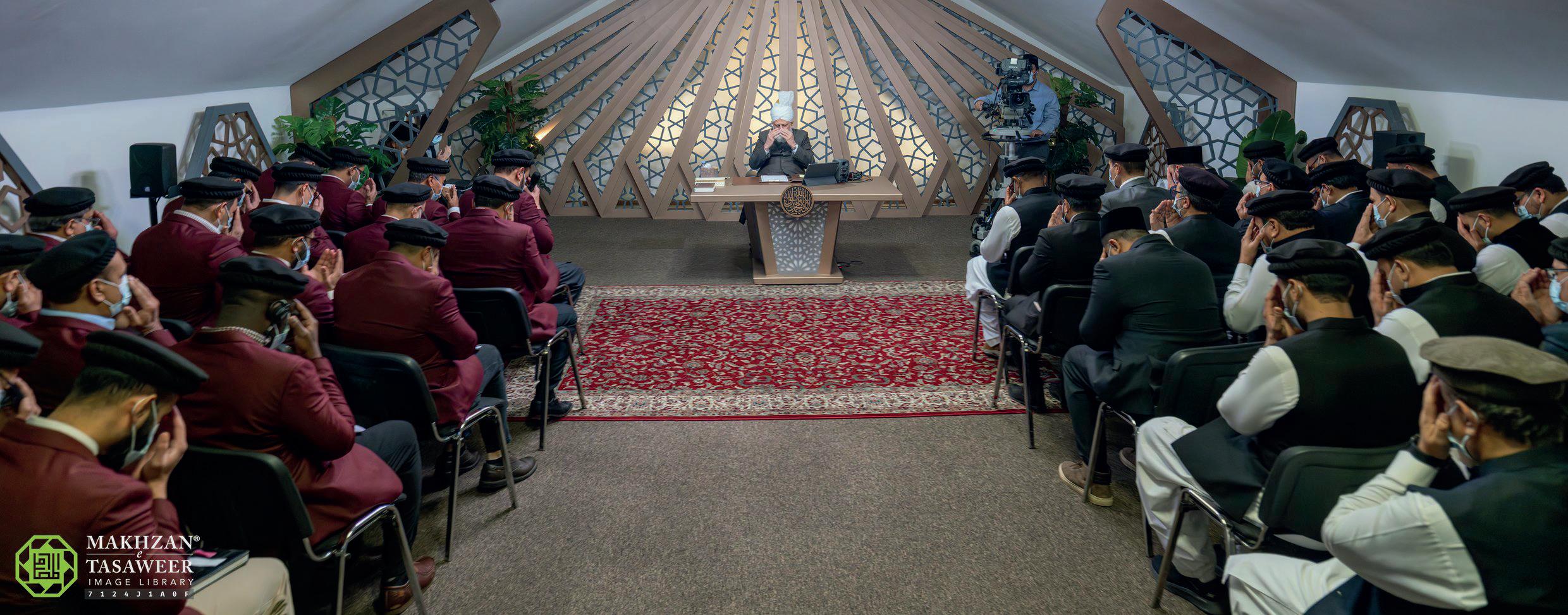
Islamabad, Tilford, 31 January 2026: Members of two local amilas from Canada – Hamilton and Hamilton Mountain – were blessed with a joint mulaqat with Hazrat Mirza Masroor Ahmad, Khalifatul Masih Vaa
Huzooraa arrived at the MTA studio and greeted the attendees before leading everyone in a silent prayer. The seating arrangement was organised to distinguish the two delegations; the amila of Hamilton Jamaat was seated on one side, while the amila of Hamilton Mountain Jamaat was seated on the other. Huzooraa first addressed the Hamilton Jamaat, followed by the Hamilton Mountain Jamaat.
Hamilton Jamaat
Huzooraa invited the Sadr Jamaat Hamilton to introduce himself. The Sadr mentioned that the amila had prepared a gift for Huzooraa. Huzooraa thanked the president but graciously remarked that gifts could wait and that the focus should be on the work being done.
The Naib Sadr, who also serves as Secretary Wasaya, reported next.
The General Secretary introduced himself and reported that the total membership of Hamilton Jamaat was 515. Regarding the salat centre, he confirmed there was one centre where women offered prayers in the basement and men on the upper floor. Huzooraa recalled visiting the location in the past.
The Secretary Tabligh reported a target of reaching 87,000 households. He stated that pamphlets had been distributed to all these homes. When asked about the outcome, he mentioned receiving eight phone calls, four of which sought further details. Huzooraa
Hazrat Mughirahra narrated: “I heard the Prophetsa say, ‘Indeed, ascribing falsehood to me is not like ascribing falsehood to anyone else. Whoever deliberately attributes a lie to me, let him take his seat in the Fire.’”
(Sahih al-Bukhari, Kitab al-jana’iz, Hadith 1291)
Hazrat Mirza Ghulam Ahmadas, In His Own Words
Emotion, weeping and lamentation
Such people deem that the satisfaction and comfort of the soul lies in shedding a few tears and letting out a few cries. Often, when reading a novel, a person will reach a painful turn in the plot, and even though they know that this is a made-up tale of fiction, they are unable to control their emotions, and at times they will burst into tears. This demonstrates that mere weeping and crying also, in itself, has no value. I have heard that during the reign of the Chughtai Kings, there were people who would wager on the fact that they would certainly make their audience cry or laugh. Now we have a clear example in countless sorts of novels. On reading certain novels, a person will be unable to contain their laughter, while certain others uncontrollably move a person’s heart to feel pain, even though the readers know that these are made-up stories and tales of fiction. This evidently demonstrates that man is susceptible to deception, and
6 February
6 February 1938: On this day, Hazrat Musleh-e-Maudra spoke to a gathering organised by the Ahmadiyya Intercollegiate Association in the hostel of Jamia Ahmadiyya Qadian. Huzoor’sra blessed and important speech continued for three hours. This association, based in Lahore, had arranged a three-day trip to Qadian with its 56 members, along with some non-Ahmadi fellow students.
(Al Fazl, Qadian, 8 February 1938, p. 2)
7-8 February
7 February 2016: On this day, Hazrat Khalifatul Masih Vaa inaugurated the ‘Voice of Islam’ radio station. Huzooraa also delivered a historic on-air message to launch the radio station and said, “The purpose of the Voice of Islam is to inform people of the true teachings of Islam and to make it abundantly clear that Islam’s teachings perfectly conform and relate to the needs of every era and every person. God-willing, the listeners of this radio station will come to recognise that Islam’s
This Week in History
teachings are of peace, love and compassion for all of mankind.”
On the same day, Huzooraa also inaugurated and launched the new Makhzan-e-Tasaweer website (www. makhzan.org) and the exhibition, located at the Tahir House complex in South West London. Makhzane-Tasaweer, in its current form, has been working since 2006 to collect and archive historical images of the Ahmadiyya Muslim Community. (‘‘Head of Ahmadiyya Muslim Community launches ‘Voice of Islam’ radio to spread the peaceful teachings of Islam’’ and ‘‘World Head of Ahmadiyya Muslim Community inaugurates new Makhzan-e-Tasaweer website.” www.pressahmadiyya.com)
8 February 1914: On this day, Hazrat Khalifatul Masih Ira announced he received glad tidings from Allah regarding the spread of the Ahmadiyya Muslim Jamaat’s message in Africa. (Tarikh-eAhmadiyyat, Vol. 3, p. 502)
8 February 1974: To commemorate 100 years since the founding of the Ahmadiyya Muslim Jamaat in 1889, Hazrat Khalifatul Masih IIIrh started a jubilee fund on this day and said it would be a spiritual plan to commemorate the 100-year anniversary of the Jamaat. Huzoorrh said in his Friday sermon:
Ahmadra, who had recently passed away. He was the great-grandson of the Promised Messiahas and brother-in-law of Hazrat Khalifatul Masih Vaa.
He completed his MA in political science from Government College, Lahore and then passed the exam for the Public Service Commission (CSS). He devoted his life to the service of Jamaat in 1962.
He had the opportunity to serve the Jamaat in various capacities, such as managing editor of The Review of Religions, Nazir Talim (director of education), additional Nazir Islah-o-Irshad Muqami, Nazir Diwan and Sadr Majlis Karpardaz (president of the committee for the Bahishti Maqbarah) and Nazire-Aala.
For more details, see: www. ahmadipedia.org
the conference, including faith leaders from various countries, politicians, government officials, members of the diplomatic corps, academics and representatives of various NGOs. The conference also received messages of support from the late Queen Elizabeth II, the Dalai Lama, David Cameron, the then-prime minister of the UK and several other dignitaries.
Huzooraa said:
“The urgent and critical need of the world today is to establish peace and faith in God. If the world understood this reality, then all countries, large or small, would not, in the name of defence spending, allocate millions and billions of dollars to expand their military capabilities. Rather, they would spend that wealth to feed the hungry, provide universal education and improve the living standards of the developing world.” (Historic Conference of World Religions Held at Guildhall, London, www.pressahmadiyya. com)
12 February
“This plan is to win the hearts of humanity, through which it will establish an unbreakable relationship with God. This is a plan to inculcate the love of the Holy Prophet Muhammad Khutbat-e-Nasir
human’s heart.” ( , Vol. 5, p. 413)
9-11 February
During his Friday sermon on this day, Hazrat
Khalifatul Masih V
Sahibzada Mirza Ghulam
Ahmad Sahib, son of Hazrat
Sahibzada Mirza Aziz
10 February 1900: Amidst the ongoing war in South Africa, British forces faced great difficulties against the local Boer commandos. In response to the situation, the Promised Messiahas issued an appeal for funds to support orphans, widows and the wounded. 500 rupees were immediately collected and on this day, sent to the chief secretary of the Punjab Government. Later, the lieutenant governor expressed gratitude to the Promised Messiahas on behalf of the government for this donation. Life of Ahmad by AR Dardra, 2008, pp. 720-721)
11 February 2014:
12 February 1946: On this day, the Arya Samaj’s Delhi chapter convened an interfaith conference where Hazrat Maulana Abul Ata Jalandhari also delivered a speech. The Tej newspaper published a summary of his speech. The title for this conference was “My religion is not an obstacle to the development of the country.”
(Tarikh-e-Ahmadiyyat, Vol. 9, p. 619)
On this day, Hazrat Khalifatul Masih Vaa delivered the keynote address at the ‘Conference of World Religions’, which was organised by Jamaat-eAhmadiyya UK, as part of its centenary celebrations, at the famous Guildhall in the City of London. The theme of the much-anticipated event was ‘God in the 21st Century’. Around 500 delegates attended
12 February 1988: On this day, Hazrat Khalifatul Masih IVrh delivered a Friday sermon at Saltpond, Ghana, during his visit to Africa. In his sermon, Huzoorrh highlighted the history of Ghana, advised the people of Ghana on economic self-reliance and assured them of the Jamaat’s support and cooperation. (Khutbat-e-Tahir, Vol. 7, pp. 83-90)
observed that receiving only eight responses from 87,000 households was a very small percentage and questioned the effectiveness of the current method.
The Secretary Sami-o-Basari stated that events were held almost every weekend, for which he managed audio and visual arrangements.
The Secretary Ishaat introduced himself, stating he had accepted Ahmadiyyat five years ago. Huzooraa observed that within five years, he had progressed to such an extent that he had been appointed as a secretary and commended this progress. Huzooraa then enquired whether he had read Jamaat literature. He replied that he had read Noah’s Ark, Islam’s Response to Contemporary Issues and The Philosophy of the Teachings of Islam, which he was re-reading for the third time, in addition to the Holy Quran.
Huzooraa then asked what the duty of the Secretary Ishaat was and specifically enquired whether anything was being published, such as a weekly or monthly Jamaat news bulletin. He replied that they were trying to prepare flyers digitally and physically in order to spread awareness of Jamaat activities. Huzooraa further asked whether any publishing work was being carried out – any magazine or any other material – and he replied that it was not. Huzooraa then repeated the question as to what the role of the secretary was.
replied that about 90% of members live within a 10-minute drive from the mosque; Huzooraa therefore stressed that attendance – especially at the evening prayers – should be higher and noted that 40 at Fajr is only about 20%, so further improvement efforts are needed. The secretary also reported on his portfolios for Ansarullah and Tahrik-eJadid, noting the Jamaat stood second in the latter.
The Secretary Umur-e-Kharija mentioned he ran a dry-cleaning business. Regarding external relations, he reported contacts with the local Mayor and MP. Huzooraa advised him to maintain contact with politicians from all parties, including the opposition and provincial government, rather than leaning towards any single group.
figure, Huzooraa emphasised that if every amila member participated, the numbers would be much more promising. Huzooraa strongly advised the secretary to begin by encouraging participation among the amila members first, starting with himself, to set an example.
The Secretary Sanat-o-Tijarat introduced himself as a health and life coach.
The Muhasib and Ameen introduced themselves. The Internal Auditor mentioned receiving the audit plan from the Centre, which was yet to be implemented.
The Assistant General Secretary (for Tajnid) clarified the breakdown of the membership numbers. The Assistant General Secretary (for IT) introduced himself. The Qaid Majlis reported having 92 khuddam
The Additional Secretary Maal spoke about collection efforts. Huzooraa enquired if all amila members were paying their chanda at the prescribed rate and instructed the concerned secretary to verify the matter.
Continued from page 1 this happens when a person is unable to distinguish between the cravings of the baserself and spiritual objectives. There is a very large number from among the people of this world who are bereft of the true signs of spirituality. Although their speech has nothing to do with divine insights and verities, yet they are able to make the people weep. The people do not weep because these speakers are blessed with knowledge of divine insights and verities, or because they are coloured in the hue of servitude to God, and fearful and in awe of the greatness and glory of God’s divinity when they speak. In fact, at the depth of this phenomenon is what I have just mentioned in the context of novels and stories. These people themselves are enthralled by their baser desires, and mere weeping in this manner has no benefit.
The Secretary Umur-e-Aammah reported next. Huzooraa reminded him that the department’s scope was not limited to disputes but included helping new arrivals settle, finding lawful employment, their tarbiyat in this regard and providing career guidance too and directing members towards vocations or business ventures that align with their aptitude.
The Secretary Ziafat mentioned that breakfast was arranged every Sunday after Fajr. The Secretary Maal reported next.
The Secretary Ishaat explained that his duty was to encourage members to read books and to promote publications, including books printed by the Centre. Huzooraa asked whether he encouraged members to acquire those books and read them. He replied in the affirmative, adding that they were working on an online-based ordering system to encourage members not only to buy books but to read them as well. Huzooraa advised that he should also encourage members to try to become regular visitors to the Al Islam website and regular readers of the Jamaat books available there.
The Secretary Talim reported that they ran the Nasir Academy for children up to age 14. He mentioned he was a doctor in Pakistan but was currently working as a mental health clinician in Canada. Huzooraa enquired about his background and qualifications in psychology.
The Secretary Tarbiyat stated his primary focus was mosque attendance. When Huzooraa asked about distance, he
The Secretary Ziraat reported that the Jamaat had two farms and maintained flower beds at the mosque.
The Secretary Waqf-e-Nau reported a total of 62 Waqf-e-Nau members (24 boys and 38 girls). Huzooraa enquired whether regular classes for the children were being held and if the Lajna Imaillah were also conducting classes for the girls. The secretary mentioned classes were held four times a month.
The Secretary Jaidad stated they were looking for a larger property for a mosque and asked for prayers.
The Secretary Talim-ul-Quran & Waqfe-Arzi, originally from Ghana, stated he was an accountant. Huzooraa asked if he recited the Quran daily, to which he replied in the affirmative. Huzooraa encouraged him to collect data on how many members recited the Quran daily and to aim for tangible results (“Masha-Allah”) rather than just intentions (“Insha-Allah”). Huzooraa enquired about the participation in Waqfe-Arzi, to which the secretary reported that only nine khuddam attended the UK Jalsa last year for this purpose. Observing the low
The Secretary Waqf-e-Jadid noted that members had paid in excess of their promises. The Assistant Secretary Talimul-Quran and Waqf-e-Arzi admitted he had not done Waqf-e-Arzi himself this year; Huzooraa advised him to do so. The Assistant Secretary Tahrik-e-Jadid also introduced himself.
Hamilton Mountain Jamaat
Huzooraa then turned his attention to the Hamilton Mountain amila
The Sadr of Hamilton Mountain introduced himself. He explained that “mountain” referred to an elevated area between the two Jamaats, though not a proper mountain. The Jamaat comprises 588 members.
The Naib Sadr, who also serves as Additional Secretary Maal, mentioned his work involved focusing on those who had not paid chanda
The missionary then introduced himself.
The General Secretary stated that members were regularly contacted via phone and visits. He confirmed most members lived within a 10 to 15-kilometre radius of the centre.
The Assistant Secretary Tabligh reported distributing 12,000 flyers, covering 10% of the population. Huzooraa remarked that the instruction to cover 10% was given
Continued from page 1
20 years ago and that by now, the coverage should have reached 100%.
The Secretary Sami-o-Basari and the Secretary Ishaat introduced themselves. The latter mentioned the Ahmadiyya Gazette website launched by the Canada Jamaat.
The Secretary Talim and Tahrik-e-Jadid reported that they stood first in Tahrik-eJadid. Regarding Talim, he noted there were 10 university students and seven college students. Huzooraa then enquired about the number of students in grades 11 and 12 (secondary school), stressing the need for personal contact with them. He observed that this is the stage where they can still be guided and kept within the fold, warning that otherwise, they might drift away.
The Secretary Tarbiyat, who also serves as Zaeem Majlis Ansarullah, explained that due to distance and snow in winter, two additional salat centres were established. Attendance at the mosque was 20-25, with smaller numbers at the centres. Huzooraa also drew attention to the need to regularly send reminders to members about the recitation of the Holy Quran and other matters of Tarbiyat.
The Assistant General Secretary (for
(Malfuzat [English], Vol. 2, pp.123-124)
Tajnid) reported that records were updated, barring a few members.
The Secretary Umur-e-Kharija was advised by Huzooraa to maintain broad contact with MPs, councillors, mayors and even the potential candidates from all political parties.
The Secretary Umur-e-Aammah and Rishta Nata introduced themselves. Huzooraa noted that these two departments – resolving disputes and arranging matches – could be seen as having opposing natures. Huzooraa advised him to guide new immigrants on settlement and employment. Huzooraa emphasised dealing with people personally and gaining their confidence rather than just handling disputes.
The Secretary Ziafat and the Assistant General Secretary (for IT) introduced themselves.
The Secretary Wasaya reported 180 musian. When asked about the percentage of earning members who were musian, he did not have the exact figure. Huzooraa reiterated the target that at least 50% of earning members should be musian, not of the total membership of the Jamaat.
The Secretary Talim-ul-Quran and Waqf-e-Arzi reported that four members participated in Waqf-e-Arzi last year. Huzooraa encouraged the amila to participate as well.
The Secretary Waqf-e-Jadid and the Secretary Nau-Mubai’een introduced themselves. The latter mentioned one new convert, a retired Canadian professor, who was making financial contributions and also increasing his knowledge of Islam Ahmadiyyat.
The Secretary Jaidad, the Qaid Majlis, the Secretary Waqf-e-Nau, the Internal Auditor, the Ameen and the Muhasib also introduced themselves.
Next, the Secretary Ziraat introduced himself. He reported planting flowers and motivating members to plant flowers and vegetables at home. Huzooraa advised him to regularly visit members and guide them in planting.
Next, the Secretary Maal introduced himself. Huzooraa asked whether all those who were paying chanda, were paying at the prescribed rate or whether some were on a concession. The secretary replied that some members were paying at a reduced rate. Huzooraa then enquired whether these concessions were taken openly with approval or quietly. The secretary admitted that some were doing so quietly. Huzooraa advised that any concession should be taken with permission and the process should be properly streamlined.
Huzooraa further observed that some people contribute to other schemes and consequently reduce the amount of their chanda payments. Huzooraa explained that if Chanda Aam and Chanda Wasiyyat are being paid at the correct rate, the need for other drives is reduced because the required funds are met through these contributions.
Conclusion
Following the introductions, both amilas had the honour of separate group photographs with Huzooraa. Huzooraa then distributed pens to the members. At the conclusion of the meeting, Huzooraa briefly enquired about their accommodation arrangements before taking leave.
(Summary prepared by Al Hakam)
Women in early Islam: The Holy Prophet’s daughter reminded about tahajjud
This series will highlight incidents from early Islam related to the sahabiyaat of the Holy Prophet (sa) and other women in early Islamic history. Extracts of incidents from the Friday Sermons of Hazrat Khalifatul Masih V (aa) have been collected and compiled.
Collected by Amtushakoor Tayyaba Ahmed
Included in the comprehensive series of Friday Sermons delivered over the past few years by Hazrat Khalifatul Masih Vaa, there are many incidents relating to the family of the Holy Prophetsa. Reading or hearing about these incidents gives us insight into the dealings of the Holy Prophetsa with his wives, daughters and other female relatives. It puts into practice, in the best possible manner, the teachings of the Holy Quran, and it gives many of us comfort to see how Allah the Almighty would like our families to be. The discussion of these events by Hazrat
Khalifatul Masihaa clarifies many allegations made against Islam, especially those relating to early Islamic history, and, in this series of collections, regarding women.
The Holy Prophet’s reminder to Hazrat Ali and Hazrat Fatima about tahajjud
Hazrat Khalifatul Masihaa explained in the Friday Sermon of 27 October 2023:
An incident of the Holy Prophetsa drawing the attention of his daughter and son-in-law towards the tahajjud prayer is recorded in Sahih al-Bukhari as follows:
“Hazrat Alira relates that one day the
NEWS
Holy Prophetsa visited him and his own daughter, Hazrat Fatimara, and said: ‘Do both of you not offer the prayer?’ I replied: ‘O Messengersa of Allah! Our lives are in the hands of Allah. He wakes us whenever He desires to do so.’ (This is in relation to the tahajjud prayer.) Hazrat Alira says that the Holy Prophetsa did not respond to this and left. While the Holy Prophetsa was leaving, I heard him saying the following whilst striking his thigh with his hands:
‘But of all things man is most contentious’ (Surah al-Kahf, Ch.18: V.55).” (Sahih al-Bukhari, Kitab at-tahajjud, Hadith 1127)
Jamaat-e-Ahmadiyya Philippines’ auxiliaries hold ijtemas
Zaki Ahmed National President, Jamaat-e-Ahmadiyya Philippines
2nd National Ijtema of Majlis Ansarullah Philippines
Majlis Ansarullah Philippines held its 2nd National Ijtema on 23-24 December 2025 at the Bait-ul-Ahad Mosque in Zamboanga. The ijtema formally commenced with a recitation from the Holy Quran, followed by a poem and the Ansar Pledge. Thereafter, Abdul Mukhlis Sahib, Sadr Majlis Ansarullah Philippines, delivered a welcome address, followed by a speech by my humble self wherein I introduced the objectives and organisational structure of Majlis Ansarullah.
Various academic and sports activities were organised during the ijtema. On 24 December, prizes were distributed among those who secured positions in various competitions.
The concluding address was delivered by my humble self. The total attendance was 33.
6th
National Tarbiyat Class and 7th Ijtema of MKA Philippines
Majlis Khuddam-ul-Ahmadiyya Philippines held its 6th National Tarbiyat Class and 7th Annual Ijtema on 25-28 December 2025 at the Bait-ul-Ahad Mosque. The Tarbiyat Class began with an opening ceremony.
The daily routine began with Tahajjud prayer, followed by Fajr prayer and a dars from the Holy Quran. Formal lectures were
arranged after breakfast.
In previous years in the Philippines, it had been customary for only teachers and missionaries to deliver lectures. However, this year, several khuddam also delivered lectures. After the lectures, sports activities were organised daily, including engaging competitions.
Question-and-answer sessions were held daily, during which members asked questions related to contemporary issues. Furthermore, my humble self addressed all participants on the importance of establishing a personal bond with the Khalifa of the time. All participants were then guided in writing letters to Huzooraa The letters were collected to be sent together. The total number of participants in the ijtema was 154.
Hazrat Musleh-e-Maudra has recorded the details of this incident in the following manner :
“One evening, the Holy Prophetsa visited his son-in-law, Hazrat Alira, and his daughter, Hazrat Fatimara, and said: ‘Do you offer the tahajjud prayer? Hazrat Alira replied: ‘O Messengersa of Allah! We try to offer it. However, if, by the will of Allah, we remain asleep, then it is missed.’ The Holy Prophetsa said: ‘You should offer the tahajjud prayer!’ He then stood up and returned to his home, and on his way out, he repeatedly said:
[“But of all thing,s man is most contentious.” (Surah al-Kahf, Ch.18: V.55)]
Prophetsa being upset or displaying anger, he responded in such a subtle manner, that perhaps Hazrat Alira enjoyed the beauty of these words until the very last days of his life. Moreover, it was his due right to derive pleasure from it. Even today, whenever a wise person learns of how exquisitely the Holy Prophetsa expressed his displeasure, it leaves them astounded.
“Hazrat Alira relates, ‘One evening, the Holy Prophetsa visited me and Fatimat alZahrara, the daughter of the Holy Prophetsa, and said: ‘Do you not offer the tahajjud prayer?’ I replied: ‘O Messengersa of Allah! Our lives are in the hands of Allah the Almighty and whenever He desires to wake us, we wake up.’ Upon hearing this, the Holy Prophetsa returned without saying anything to me. Then, whilst he turned to leave, he struck his own thigh and said, ‘But of all things, man is most contentious.’
“Glory be to Allah! How extraordinary was the way in which the Holy Prophetsa explained to Hazrat Alira that he should not have responded in this manner. If it were someone else [responding], they first would have started arguing, that ‘look at my position and status and look at your answer; do you have any right to dismiss my words in such a fashion?’ If this were not the case, then, at the very least, they would have argued, ‘your claim is completely false, which is that a human is compelled in that all their actions are in Allah’s control; and that He forces you to act however He wills, and if He wishes, He either enables you to pray or He does not.’ The Holy Prophetsa could have said that the question of compulsion is completely against the Holy Quran. The Holy Prophetsa could have said all of this. But he did not adopt these two methods; neither did he get upset at him, nor did he argue with Hazrat Alira to highlight his mistake. Rather, he moved to one side and expressed shock at his answer, saying, ‘people are very strange: they take a particular point which benefits them and begin to argue over it.’
“In reality, this simple statement of the Holy Prophetsa was so impactful that even a hundred arguments of another person are no match in comparison. We can learn many things from this hadith.” (Sirat-unNabi, Anwar-ul-Ulum, Vol. 1, pp. 588-590)
Hazrat Musleh-e-Maudra further analyses this and states:
“Different aspects of the Holy Prophet’ssa morals come to light through this, and it is appropriate to mention them here.
for which he would test them and teach them. Moral reformation of one’s relatives is an outstanding trait, and if this quality was not found within the Holy Prophetsa, there would be a significant deficiency in his morals. But since he possessed the most excellent of morals, that is why this trait was found within him in abundance.
“The second point we understand is that the Holy Prophetsa had complete conviction in the teachings which he presented to the world, and he did not doubt these teachings for even a moment. Some people allege –God forbid – that in order to deceive the entire world and establish his kingdom, the Holy Prophetsa created this whole enterprise. Otherwise, he did not receive any revelations (some orientalists used to write this, and the disbelievers in the Holy Prophet’ssa time used to say this as well.) This was not the case; rather, the Holy Prophetsa had such firm conviction in his prophethood and appointment by God that we find no parallel of this in the entire world. Because it can be assumed that the Holy Prophetsa may have acted with pretence in order to prove his truthfulness to the people, but it cannot be imagined that a person goes to his daughter and son-in-law, especially at night, and enquires as to whether they engage in this form of worship as well; a prayer which has not been made mandatory, but rather the observance of which God has left to the choice of the believer as to whether one wakes up in the middle of the night to observe.
“For the Holy Prophetsa to go out and encourage his daughter and son-in-law to also offer the tahajjud prayers is a testament to his complete conviction in the teaching he wished to impart to the people. Otherwise, a liar who knows that following or rejecting his teaching is inconsequential could never advise his children to adhere to it, and that too at such a hidden time [of night]. (It would be the same result in either case. Such a person would not be able to advise his children to follow his teachings.) This can only occur if a person’s heart is convinced that excellence cannot be achieved without adhering to the teaching.
“This is a verse of the Holy Quran which means that a person is often afraid to admit their mistake and covers their flaw by presenting various excuses. What it meant was that instead of Hazrat Alira and Hazrat Fatimara saying that they err at times, instead they said that ‘when Allah desires for us not to wake up, we remain asleep.’ They attributed their weakness to Allah the Almighty.” (Dibacha Tafsir-ul-Quran, Anwar-ul-Ulum, Vol. 20, pp. 389-390)
Expounding on this incident further, in one instance, Hazrat Musleh-e-Maudra says:
“Hazrat Alira relates an incident of his, which mentions that on one occasion, he responded to the Holy Prophetsa in a manner which carried a tone of argumentation and confrontation, but instead of the Holy
“Firstly, we see how much the Holy Prophetsa cared for the spiritual well-being of those close to him, in that he would visit them at night [to advise them]. There are many people who are pious themselves and exhort others to be pious as well, but the condition of their own homes is dire. They do not even have the ability to reform the people of their own households. There is a well-known idiom regarding such people that ‘there is darkness underneath the lamp.’
“This means that just as a lamp illuminates everything in its surroundings, but darkness remains below it, in the same way, these people go around advising others, but they do not worry about whether the people in their own houses are benefitting from their light. But the Holy Prophetsa was mindful of the fact that his relatives should be illuminated by the light which he wished to spread throughout the world. He vowed to take on this responsibility,
“The third matter is the very reason why this incident has been presented, which is that the Holy Prophetsa explained everything with incredible patience. Instead of quarrelling, he would point out the errors of others with love and tenderness. On this particular occasion, Hazrat Alira sought to avert the Holy Prophet’ssa question by saying that after a person falls asleep, he has no control over when he will wake up; whilst a person is sleeping, he is unaware of the time for completing any task. If Allah the Almighty causes him to wake up, he offers prayer. (They had no other choice, as in that era, there were no alarm clocks.) It was no surprise that upon hearing this answer, the Holy Prophetsa was taken aback; the faith in his heart would never allow him to become so neglectful and heedlessly miss the time to offer the tahajjud prayers. It was for this reason that the Holy Prophetsa turned away and simply said, ‘Man is disobedient and quarrelsome.’ In other words, Hazrat Alira ought to have not wasted any opportunity by presenting this excuse.
“Thus, Hazrat Alira subsequently said, ‘After that, I never missed offering the tahajjud prayer.’” (Sirat-un-Nabi, Anwar-ulUlum, Vol. 1, pp. 588-590)
When one falls, the family feels it: Accountability in Islam
Dania Daud Student Journalist, Canada
Family life is like a web. Pull on one strand and the whole structure changes. Islam teaches us that accountability is individual: every soul answers for itself alone. The Holy Quran says: “And no burdened [soul] can bear the burden of another [...]” (Surah Fatir, Ch.35: V.19).
Yet the same scripture and tradition also acknowledge that a person’s wrongdoing generally leaves a mark far beyond themselves.
Family and faith
Take the story of Prophet Noahas, for example. Despite being a messenger of Allah, his own son rejected the message of truth and perished in the flood. The Holy Quran narrates Noah’sas heartbreaking plea:
“And Noah cried unto his Lord and said: ‘My Lord, verily, my son is of my family, and surely, Thy promise is true, and Thou art the Most Just of judges.’” (Surah Hud, Ch.11: V.46)
Prophet Noah’sas words reflect the deep pain of a father, and a prophet no less, watching his child slip away from faith. The grief is unmistakable.
But Allah replied:
“O Noah, he is surely not of thy family; he is indeed a man of unrighteous conduct.” (Surah Hud, Ch.11: V.47)
This was a redefinition of what truly holds a family together. The promise of protection had never been about blood relations alone, but about faith and righteousness.
The book Hazrat Nuhas explains that the flood was confined to Noah’sas people who rejected him. When Allah told Noahas his family would be saved, He referred only to those who believed. His wife and son, despite being closest to him by blood, were excluded because they denied Allah’s message. (Surah at-Tahrim, Ch.66: V.11)
The hard truth is that blood ties cannot protect anyone from the consequences of wrongdoing. For Muslim families, it is a lesson in both humility and responsibility: we cannot take faith for granted, even within our own households.
The best person
The Holy Prophetsa also placed great emphasis on accountability within the family. He said:
“The best of you is he who is best to his family and I am the best among you to my family.” (Mishkat al-Masabih, Kitab alnikah, Hadith 3252)
This hadith reminds us that faith and goodness must begin at home. Treating family members with kindness, care and guidance shapes how we are judged in the sight of Allah.
Ahmadi Muslims, under the leadership of Hazrat Mirza Masroor Ahmad, Khalifatul Masih Vaa, consistently hear reminders that while faith begins in the home, it must be nurtured. In the address at the 2016 National Ijtema of Waqifaat-e-Nau UK, Huzooraa emphasised that mothers who pledged their children as Waqf-e-Nau have greatly increased responsibilities. (“Address at the National Waqf-e-Nau Ijtema for Lajna and Nasirat 2016”, alislam.org, 27 February
New Year Waqar-e-Amal session held in Huddersfield
Jamaat-e-Ahmadiyya Huddersfield, UK, began the New Year with special prayers, seeking peace and stability for the world. Following the prayers, more than 50 volunteers, including elders, youth and children, gathered at Huddersfield Town Centre to take part in a large-scale community clean-up initiative.
The volunteers were joined by local councillor Tyler, whose presence and support were warmly appreciated. Despite the severe cold weather, the volunteers
worked with remarkable energy and enthusiasm, clearing a significant amount of rubbish from the town centre.
In addition to the clean-up, volunteers distributed food to homeless individuals, provided free transportation and meals to those less fortunate and visited hospitals and care homes to offer support and companionship.
We also expressed sincere thanks to the local council, particularly Councillor Tyler, for providing essential equipment such as litter pickers and refuse bags and for their continued cooperation.
2016)
If proper moral and spiritual training is neglected, parents will be answerable before Allah.
The way forward
Wrongdoing does not only leave legal or moral consequences; it can damage trust, break communication and even weaken a family’s collective bond with faith. The Holy Quran acknowledges this but also shows a way forward. It says:
“And those who, when they commit a foul deed or wrong themselves, remember Allah and implore forgiveness for their sins.”
(Surah Aal-e-Imran, Ch.3: V.136)
Repentance, forgiveness and prayer are the pathways to repairing not just an individual soul but the bonds of a family.
This vision places the family at the heart of Islamic society: each wrongdoing matters because of the cracks it may open in the wider circle. Parents who neglect justice or faith risk raising children who see injustice as normal. Children who rebel or turn away from their faith bring grief that weighs tremendously on their parents.
But the Muslim perspective is not one of despair. It is one of responsibility and of hope. Families can rise again when they turn back to Allah together. Even if one member loses strength, others can support through guidance and sincere prayer. Islam encourages this spirit of hope, teaching Muslims to never cut off family ties and to always return to mercy.
So when one falls, the family feels it.
But through patience, forgiveness and prayer, the family can also rise together.
The story of wrongdoing in Islam is more than punishment. It is about recognising how much our lives are connected. Every action, every choice, every repentance – it all affects the family around us. Because in the end, no one falls entirely alone.
Celebrating the impact of Ahmadiyyat in Africa
Dr Salman Ahmed Karim Sheffield
On 24 January 2026, African members of Jamaat-e-Ahmadiyya Sheffield organised an event to highlight the impact of Ahmadiyyat in Africa, attended by 130 Ahmadis. Ahmed Owusu-Konadu Sahib, Vice President of PAAMA UK, travelled all the way from Glasgow.
The programme commenced with a recitation from the Holy Quran, followed by speeches where members shared personal experiences in relation to the theme. Very informative videos on the spread of Ahmadiyyat in Africa and the contribution of the Jamaat in welfare projects, hospitals and schools were shown.
Clips from a video of the Atfal trip to Ghana in October 2025 highlighted their visit to the Ahmadiyya Mission Headquarters in Osu, Asafo Ahmadiyya Mosque in Kumasi, Techiman Hospital in Kumasi, Jamia Ahmadiyya in Kumasi and Akrafu Mosque, among other places visited. They experienced a strong sense of brotherhood and the hospitality from members of local jamaats in Africa extended towards them.
At the end, an address was delivered by Ahmed Owusu-Konadu Sahib, who emphasised the importance of brotherhood, inclusivity and the benefits of financial sacrifices. This meeting concluded with a silent prayer.
Misusing Allah’s name: The quiet crisis of justifying sin
Maryam Hussain Canada
In today’s religious narrative, many people have forgotten the real meaning of the word “sin”.
In this modern society, many individuals engage in sinful actions either out of ignorance, indifference or even with full awareness. The treatment of sin has become trivial simply because it has become widespread, which brings me to one of the most pressing moral concerns of our time: the quiet crisis of justifying sin.
Justifying sin
In contemporary discourse surrounding personal accountability and faith, an alarming trend has emerged – the casual invocation of Allah’s name to justify personal choices that clearly contradict Islamic principles.
Human imperfection is a given and sin is part of every believer’s journey, as the Holy Prophetsa is reported to have said:
“By Him in Whose Hand is my life, if you were not to commit sin, Allah would sweep you out of existence and He would replace (you by) those people who would commit sin and seek forgiveness from Allah, and He would have pardoned them.” (Sahih Muslim, Kitab at-taubah, Hadith 2749)
However, the act of justifying committing sin as “divine will” is both
Nietzsche, morality and the question of motives: A theist’s perspective
Hassan Minhas Missionary, Canada
One common challenge posed by atheists to theists is this: when a religious person performs a good deed, they do so for God and His pleasure, and thus there is an incentive behind their action. By contrast, atheists often claim they perform good deeds purely for their own sake, without seeking any external reward or incentive.
At first glance, this seems to grant the atheist the moral high ground: they appear selfless, while the theist appears motivated by a heavenly bargain.
However, Friedrich Nietzsche, in aphorism 57 of his work Human, All Too Human, challenges this very assumption. (Friedrich Nietzsche, Human, All Too Human: A Book for Free Spirits, 1924, p. 75)
Nietzsche’s perspective
Nietzsche observes that even when a person believes they are acting selflessly, their action is always tied to a desire, an inclination or a longing within themselves.
For example, a mother who sacrifices her health and comfort for her child is not acting without motive; rather, her love and desire for her child’s well-being is the motive. The soldier who risks his life in battle is moved by his desire for victory and honour. Even the most selfless act is rooted in a human want or longing.
From this perspective, the atheists’ claim of pure selflessness collapses. Nietzsche reveals that no act is free of desire. The desire may not be material, but it exists nonetheless: the desire for meaning, for love, for belonging, for peace of mind or even the satisfaction of living according to
theologically inaccurate and deeply dangerous. There is a profound difference between acknowledging one’s shortcomings and actively reshaping religion to accommodate them.
Yet, increasingly, we hear phrases such as, “Allah made me this way” or “if He didn’t want me to do it, He wouldn’t have let it happen.” These statements reflect a subtle but insidious form of spiritual gaslighting –not only of the self, but of those who genuinely seek to uphold Islamic teachings with humility.
As Allah the Almighty states in the Holy Quran:
“And when they commit a foul deed, they say: ‘We found our fathers doing it, and Allah has enjoined it upon us.’ Say, ‘Allah never enjoins foul deeds. Do you say of Allah what you know not?’” (Surah al-A‘raf, Ch.7: V.29)
for personal satisfaction in being moral, the theist is moved by a transcendent desire for divine nearness. Both are motivated, but the object of the theist’s desire carries eternal weight.
one’s ideals.
Thus, the atheist who says, “do good purely for goodness’ sake” is in reality still acting out of a personal desire – the desire to be good, to feel good or to uphold a value.
All actions spring from desires
Consider a practical example: when an atheist donates to charity, they may believe they act without incentive. Yet they still feel satisfaction, pride or peace of conscience afterward. This is itself the hidden desire that drives the act. The same principle applies across all so-called selfless deeds.
For the theist, then, doing good for the sake of God is not a lower motivation but rather the highest expression of this universal human truth. The believer acknowledges openly what the atheist denies: that all actions spring from desires.
That is why, according to Prophet Muhammadsa, our rewards are dependent on these very desires (or in other terms, intentions):
“The reward of deeds depends upon the intentions and every person will get the reward according to what he has intended.”
(Sahih al-Bukhari, Kitab bad al-wahy, Hadith 1)
When one considers that Imam Bukharirh decided to place this hadith at the very beginning of his collection, it becomes clear that all the following narrations, whether they deal with deeds or words, are bound by that very first narration, where intention is the key ingredient.
Hence, a true believer directs this desire not toward fleeting earthly satisfactions; rather toward the Eternal – God and His pleasure.
If the atheist is moved by a hidden desire
Therefore, when atheists argue that religious morality is tainted by incentive while theirs is not, Nietzsche’s insight shows this to be a flawed argument.
The object of desire
Everyone acts from desire. The question is not whether desire exists, but what it is directed toward.
The believer directs it toward God, the highest good, and this does not diminish morality but elevates it beyond the narrow scope of human ego. This is precisely in accordance with the teachings of Hazrat Mirza Ghulam Ahmadas, the Promised Messiah and Imam Mahdi, who said:
“Those people whose deeds are solely for the sake of Allah do not allow for their deeds to be seen by others. It is these who are the righteous […] A righteous person wars with their inner self that incites to evil in order to veil and conceal their good deeds […] A truly righteous person desires to remain hidden […] In this relation, I have stated above the example of ostentation, which must be fought against by a righteous person throughout the day.” (Malfuzat [English], Vol. 1, 2018, pp. 21-22)
“It is my faith and belief that until a person becomes a true believer, their acts of virtue, irrespective of how magnificent they may be, cannot be free from the gild of ostentation.” (Ibid., p. 220)
Similarly, this matter was addressed by Hazrat Khalifatul Masih Vaa in his Friday Sermon on 24 April 2015, in which he explained that giving primacy to worldly values without spiritual grounding leads to moral decay, as can be seen from the Western world which is morally bankrupt. Thus, morality without God is not free of incentive – it is only incentive without transcendence.
Sin and repentance
Islam never expected perfection. Prophet Muhammadsa taught us that all of the children of Adam sin – and the best of them are those who repent. (Jami’ at-Tirmidhi, Kitab sifatul qiyamah, Hadith 2499)
But repentance requires recognition, not rationalisation.
To suggest that one’s sinful behaviour is pre-approved by Allah under the guise of “divine intention” is to misunderstand both free will and divine decree.
Allah is All-Knowing, but He does not force His creation into disobedience. Rather, He grants us the autonomy to choose – and with that choice comes responsibility.
The Promised Messiahas once said:
“Whatever man does in opposition to the command of Allah Almighty becomes the cause of rebellion. If a low-ranking police officer comes with an order from the government, the one who disobeys him is declared a criminal and punished. If this is the case with illusory mundane rulers, then how great a violation would it be of the commands of Almighty Allah to dishonour and disrespect the one who comes from Ahkamul-Hakimin [i.e., God – the Greatest of all rulers]? God Almighty is very jealous [in point of love or honour]. In accordance with the urgency of the occasion, He sent a man at the head of the corrupt century at the exact time of need that he might call the people to guidance. It is a great sin to trample all His prudent measures underfoot.” (Malfuzat [English], Vol. 8, 2024, pp. 31-32)
This pattern of moral deflection, disrespect toward divine guidance and the normalisation of sin is especially troubling when cloaked behind a spiritual excuse.
Invoking Allah’s name to excuse personal choices regarding your lifestyle that are explicitly discouraged in the Quran and sunnah does not make those actions pious – it makes them manipulative. It transforms sin from a personal struggle into a public display of selective religiosity.
True accountability
What must be acknowledged is that individuals who think like this often use this mindset as a shield – a shield from criticism and internal reflection. Which leads them to manipulate themselves into believing they are spiritually protected and safe, while they actively escape self-accountability.
Ultimately, this replaces taqwa (righteousness) with entitlement. We must be cautious not to blur the lines between spiritual comfort and spiritual neglectfulness. To sin is human, to repent is divinely favoured.
However, to continuously place the weight of our sins on Allah, using Him as a justification for our choices while claiming moral high ground, is a distortion of Islam and its purpose.
May we all be granted the humility to recognise our mistakes, the sincerity to correct them and the wisdom to never speak on Allah’s behalf for the sake of our own ego.
Belief in God isn’t blind faith – it’s a rational choice that develops into certainty
Tamseel Mushtaq
Graduate, Jamia Ahmadiyya UK
Muslims may reach a point where they think that reason, i.e. the ability to think and make judgments, may not be able to prove all aspects of faith. There are very clear limitations of reason. However, the teachings of Islam, in particular, can bring us closer to an absolute and objective reality, thereby surpassing the limitations of reason. This claim may unsettle the modern secular mind, so before dismissing it as a blind, medieval or irrational belief, hear me out.
First, it must be made clear that Islam is not opposed to reasoning at all. In fact, Islam encourages its followers to ground their beliefs and doctrines in clear evidence and sound reasoning, in accordance with the laws of nature and shariah. Beliefs are not meant to rest solely on hearsay or unexamined tradition.[1] The English dictionary defines reason as: the ability of a healthy mind to think and make judgments, especially based on practical facts.[2] This is precisely the kind of reasoning that Islam promotes, as the Islamic faith is aligned with the very nature of man.[3]
Historically, religious and political ideologies have opposed reason through the absolute authority of clerics and those in power. This oppression contributed to the rise of movements such as the Enlightenment.[4] The Enlightenment gave society the capacity to reason and to critique religious beliefs, among other things. Consequently, it led many laypeople to believe that faith and reason cannot coexist and gave rise to a popular mindset: “I don’t believe in God, I believe in science.”[5]
However, Islam actually praises the ability to reason. The Promised Messiahas said that the power of reason is the very crown of humanity; its proper use makes a person truly human and opens the door to excellence and limitless progress.[6]
It was Galileo’s use of reason that led to the development of the advanced telescope. Galileo’s observations proved that the sun is the centre of our universe and not the planet Earth. Despite the Inquisition’s suppression of his arguments and proofs for heliocentrism, Galileo’s reasoning eventually overcame these obstacles.[7]
Marie Curie’s commitment to rational inquiry led her to endure extreme fatigue, working long hours in the laboratory to achieve groundbreaking results.[8] Her dedicated scientific approach led to the
discovery of Polonium and Radium. Two very important elements for the use of medical treatments and nuclear weapons. The results of her reasoning earned her two Nobel Prizes, lasting recognition and the title “Mother of modern physics.”[9]
Likewise, Prophet Ibrahim’sas ability to reason led him to challenge his own people and even stand in opposition to his own paternal uncle. He defied convention and opposed idolatry. His reasoning made him break all the idols except the chief of them. When the people inquired what happened, his response made the so-called believers ultimately use their minds. He said, “[...] Somebody has surely done this. Here is their chief. But ask them if they can speak.”[10]
The first two sources of knowledge (out of three)
The Promised Messiahas has shed light on the manner in which human reasoning arrives at conclusions in his magnum opus, Barahin-e-Ahmadiyya. He explains that reason is deeply dependent on external factors. Upon closer analysis, our reasoning can be narrowed down to three main stages, which we will refer to as our sources of knowledge. Any example of reasoning ultimately falls within one of the first two categories, while the third will be discussed later:
(1) Historical testimony and established facts
(2) Physical observation and repeated experimentation
To understand the first source of knowledge, we must travel back to our school desks. The structure of teaching and learning is based on this very first stage. In the early phases of acquiring knowledge, a student believes what has been taught with trust and confidence. If this weren’t the case, then intellectual and academic advancement wouldn’t be possible.
A student of geography believes with no further questions that a river is a natural watercourse, whereas canals are artificial channels constructed by man. A student of biology readily learns that the cell is the fundamental building block of all living organisms.
In the same manner, a student of the Islamic faith begins with the foundational belief that the Holy Quran is the word of God, revealed to His messenger, Prophet Muhammadsa
As our knowledge expands, the human mind naturally begins to question and
recognise gaps in understanding. We realise that there is more than what we know. Our reasoning feels the need to rely on a higher stage or seek another source of knowledge. This leads to the second stage: physical observation and repeated experimentation. Through this stage, discoveries emerge. Whenever a discovery is verified, it is preserved as a fact for future generations to build upon.
To rephrase it even more clearly, it is not wrong to say that all the historical testimonies and established facts belonging to the first source of knowledge are, in essence, the outcomes and results of people who acquired that knowledge through the second stage, namely, physical observation and repeated experimentation.
David Julius, equipped with foundational knowledge of the nervous system, hypothesised that there must be specific molecules for detecting heat, cold and pain. He was able to identify the specific protein receptors by conducting experiments involving capsaicin and menthol. Concluding how physical sensations are biologically experienced through the skin.[11]
Paul Berg’s case follows the same pattern. Building upon his prior knowledge of DNA, he laid the foundation for modern genetic engineering. He developed safe methods for recombining DNA, enabling future scientific breakthroughs that were previously impossible.[12]
These examples illustrate how our reasoning operates through two principal sources. Both have driven humanity to several sociological, technological and economic advancements.
Conversely, certain discoveries appeared to contradict past religious doctrines, leading many to distance themselves from faith.[13] Humanity began to assume that perfect certainty, i.e. having a belief where no room for doubt is left, can be achieved through our reasoning.[14]
Yet, this way of thinking is itself a form of blindness. The unquestioning trust once placed in religious authority was simply transferred to human intellect. In doing so, society mirrored the very medieval clerical behaviour it sought to escape, not by suppressing reason, but by opposing religion altogether. Reason was merely a gifted tool to understand reality, and reality, on the other hand, is not limited to the boundaries of reasoning. Because reason holds independently not that much value, it
is very dependent on external factors.
Conclusions reached through reasoning are based on existing facts and experiments and cannot anticipate all possible outcomes. Further evidence may always emerge through new experimentation under varying conditions. Even great people who mastered the art of reasoning far better than other people suffered from its limitations. If reason had been sufficient to grant absolute certainty, Galileo would have foreseen the damage caused by the sunbeams. He would not have lost his eyesight by prolonged solar observations undertaken in defence of heliocentrism. [15] Likewise, if reason alone had been sufficient, Marie Curie’s understanding would have enabled her to determine the deadly exposure to her discovered elements. She would not have died from exposure to radiation in the course of her scientific work.[16]
This clarifies an important principle, which the Promised Messiahas defines as follows: “[...] Perfect certainty means a true and positive belief whereby no room for doubt is left, and one’s heart is fully convinced of, and satisfied with, the matter that was to be ascertained. Any belief that falls short of this criterion cannot be called perfect certainty.”[17]
Similarly, how can reason alone explain why a mother would be able to jump in front of a rushing car to save her young baby? How can reason alone validate why someone would give a portion of their hardearned wealth to help strangers in distant countries whom they have never met? How can reason alone justify why soldiers would be willing to surrender their own lives and the future of their families out of love for their country?
A similar problem arises among those philosophers who attempt to comprehend the being of God through the lens of human reasoning alone. This approach has resulted in the gradual abandonment of belief in God altogether. They tried their best to fit religion within the limited boundaries of reason. Why?
Philosophers have defended their positions, which Time magazine summarises as follows: “God? Wasn’t he chased out of heaven by Marx, banished to the unconscious by Freud and announced by Nietzsche to be deceased? Did not Darwin drive him out of the Empirical world?”[18]
This reflects a broader failure in human learning: an unwillingness to take the first
step toward experiential engagement. We try to adopt a secular framework and place undue confidence in the inherited claims of philosophers and their intellectual authority.
Earlier, I praised the very logical and reasonable stance of Prophet Ibrahimas, challenging the norms of his time. What we do need to understand, however, is that Prophet Ibrahimas was divinely guided.[19] His perception of reality exceeded that of other individuals who claim intellectual brilliance.
Otherwise, how could someone explain that the same Prophet Ibrahimas who urged his own people to ask their idols to respond, allowed himself to be thrown into the fire because he believed in God’s protection?[20] How could someone explain that the same prophet who told King Nimrod that if he were really God, he should make the sun rise from the west, that very same prophet would leave his wife and child behind in a barren desert to survive? Such things clearly oppose reason. [21]
This demonstrates that the chosen people, like Prophet Ibrahimas, have another source of knowledge which gives more, if not absolute, certainty than the abovementioned two stages commonly relied upon by mankind.
Because our historical testimonies and human experiences would show that when a human body is thrown into fire, the skin would burn and split, body fat would fuel the flames for hours, muscles would contract, and the skeleton would be left charred and exposed.[22] Likewise, our historical testimonies and our human experience would indicate that “abandoning one’s family” constitutes a grave moral betrayal that causes profound and immediate emotional distress, often resulting in lasting psychological and existential harm.[23]
But were these the outcomes of Prophet Ibrahim’sas actions? No, certainly not. The Holy Quran bears witness that when Prophet Ibrahimas was thrown into the fire, God commanded it to become cool and harmless, an outcome that human reason could not have anticipated. [24] Likewise, when Prophet Ibrahimas left his family in the desert to survive, that very land was transformed into a sacred centre from which generations of prophets emerged and which later became the heart of the Islamic faith. Again, an event entirely beyond the predictive reach of human reasoning.
What is the source of absolute knowledge and certainty?
Thus, we arrive at the central question of this discussion: What is the source of absolute knowledge and certainty? The answer lies in the third and highest stage of knowledge, which the Promised Messiahas identifies as revelation. Even if one does not immediately grasp the full depth of revelation, this in no way diminishes its completeness or perfection as a source of knowledge.
Islam claims that its book, the Holy Quran, is the ultimate revealed guidance for humanity towards truth, morality and salvation.[25] Since God is presented as the All-Knowing and the All-Wise, His revelation must be free from error as well. [26] The Quran offers numerous signs for its readers, giving assurance that if the Quran contains these statements, which are independently verified by non-Islamic
people, the credibility of the remaining claims must be regarded profoundly as well. History shows that people abandon religion when its sacred text contains contradictions, inaccuracies or even falsehoods. From this, we may conclude that a defining quality of a true divine book is that it contains only verities.
Paul Berg was awarded the Nobel Prize in Chemistry in 1980 for opening the door to genetic engineering and the manipulation of DNA.[27] Yet, God Almighty warned us
through His illiterate prophet that He will incite us, and we will try to alter Allah’s creation.[28]
David Julius got his Nobel Prize in physiology in 2021 for identifying the receptors for sensing pain through our skin. [29] Remarkably, the All-Wise God declared through His polyvalent verses that the skin feels the pain more than the flesh.[30]
In the early days of learning, a student accepts what he was taught without hesitation. This trust establishes a stable
foundation upon which further academic and scientific progress is built. In the same manner, a student of Islam begins his spiritual journey by accepting the Holy Quran with conviction, and as his spiritual understanding expands, new doors of verities and certainties open.
Although the Holy Book of Islam is a moral and spiritual guide rather than a scientific manual, it contains numerous concepts that the modern world is only now beginning to discover. Are all these signs not
a valid proof that revelation is the source of knowledge beyond our intellectual needs?
A student of biology learns the fundamental components of organisms. Yet, how could the Holy Quran, while illustrating the natural and instinctive state of man that acquires reflection for moral progress, remarkably describe the stages and development of human embryology?[31] Is elaborating an unseen biological process without any scientific tool not evidence of divine knowledge?
A student of geography understands that canals are man-made channels. Yet, how could the Holy Quran, while unfolding the conscience and making man comprehend the high moral qualities within us, foretell the formation of the Suez Canal?[32] How could the Holy Quran foretell us the meeting of the Red Sea and the Mediterranean from which pearls and coral emerge? This phenomenon, now called Lessepsian migration, directly reflects the Quranic description.[33] Is pointing to such a big phenomenon before humanity acquired the means for it, not a proof of our God’s revelation?
All the above-mentioned Quranic concepts have already been confirmed by human reasoning and scientific discovery, demonstrating that God revealed these truths 1400 years ago, long before modern humanity understood them. Logically, this also implies that revelation contains additional truths that we have not yet discovered, because our limited reasoning has not grasped them. While human reason can comprehend some aspects of reality, revelation encompasses all truths, including those beyond our current understanding. This is referred to in Islamic terminology as belief in the unseen.[34]
European philosophers, working with limited knowledge, could not fully comprehend divine revelation. As a result, their philosophical ideas about God Almighty and religion in general were incomplete and relied more on human imagination than on evidence or proof. What they failed to understand is that the laws of nature do not depend upon human understanding. Our understanding, however, does depend on the laws of nature. [35]
Darwin’s limited understanding led him to conclude that human existence occurred purely through chance or through his theory of natural selection.[36] Yet our Omnipotent God revealed that, in the latter days, a man (the Mahdi) would appear to bring humanity back to its Creator. The sign of this coming would be a sign that never occurred before: lunar and solar eclipses in the same month, occurring not once but twice. History records that these signs were fulfilled in 1894 and 1895 exactly as foretold. [37] Could Darwin’s imagination of random chance ever account for such precise events?
Marx offered a different perspective, claiming that God is the product of dialectical materialism.[47] In doing so, he reformulated Darwin’s theory of the struggle for existence. He understood the necessity of morals for a functioning society, yet his framework contradicted itself because morals ultimately depend on God. Compare his human theory with God’s revelation: one book, revealed over 23 years, consisting of 30 parts, 114 chapters, and 6348 verses, yet perfectly consistent and
free from contradictions.
God challenged humanity to produce even a single chapter like it.[38] A challenge that no one, not Darwin, Nietzsche, Freud, or Marx, has ever met. Their reasoning is limited; God’s knowledge is infinite.
Revelation and reason are two ways of understanding the world, both from God. The Quran, God’s word, reveals truths beyond our full comprehension, while science, God’s work, uncovers creation through observation and experiment.
Human understanding is limited; therefore, saying “I don’t believe in God, I believe in science” is misguided, as science itself points to divine order. Just as the Quran revealed truths before they were observable, science gradually uncovers the wonders of creation. The proper approach is to recognise the Quran as God’s word and science as God’s work: both reflecting the same ultimate truth.[39]
[4] “Enlightenment”, www.britannica.com, 16 January 2026
[5] Hess, J. & Black, J., Nacho Libre, 2006, Mexico; United States: Paramount Pictures.
[6] Hazrat Mirza Ghulam Ahmad, Brahin-eAhmadiyya Part I and II [English Translation], 2012, pp. 109, footnote
[7] Sara Bonechi, How they make me suffer… A short biography of Galileo Galilei, 2008, pp. 52
[8] Eve Curie [Translated by Vincent Sheea], Madame Curie, 1937, pp. 355
[9] “Personal effects of ‘the mother of modern physics’ will be radioactive for another 1500 years, www.businessinsider.com, 24 August 2015
[10] Surah al-Anbiya, Ch.21: V.59-68
[11] “David Julius - Biographical”, www. nobelprize.org, 2023
[12] “Paul Berg - Biographical”, www.nobelprize. org, March 2004
[13] “Does the Empirical Nature of Science Contradict the Revelatory Nature of Faith?”, www.edge.org, 21 January 2009
[14] “Rational religion?”, www.theguardian.com, 27 August 2000
[15] “Galileo: the Telescope & the Laws of Dynamics”, www.pas.rochester.edu
[16] Eve Curie [Translated by Vincent Sheea], Madame Curie, 1937, pp. 193
[17] Hazrat Mirza Ghulam Ahmad, Brahin-eAhmadiyya Part III [English Translation], 2014, pp. 40
[18] “Religion: Modernizing the Case for God”, time.com, 7 April 1980
[19] Surah al-Anbiya, Ch.21: V.52
[20] Surah al-Anbiya, Ch.21: V.69
[21] Surah al-Baqarah, Ch.2: V.259; Sahih AlBukhari, Kitab Ahadith al-Anbiyah, Bab yazifun an-naslanu fi’l mashyi, Hadith 3364
[22] “Body burners: The forensics of fire”, www. newscientist.com, 20 May 2009
[23] “The Moral Injury of Wife Abandonment”, www.psychologytoday.com, 5 January 2026
[24] Surah al-Anbiya, Ch.21: V.70
[25] Surah Bani Isra’il, Ch.17: V.10
[26] Hazrat Mirza Bashir-ud-Din Mahmud Ahmad, Introduction to the Study of the Holy
New Year dinner organised by Glasgow North Jamaat
Arshad Mehmood Khan Glasgow
Building on its long-standing tradition of fostering solidarity, building peace and strengthening community cohesion, Jamaat-e-Ahmadiyya Glasgow, Scotland, hosted the New Year Dinner on 18 January 2026, at the Bait ur Rahman Mosque.
Under the chairmanship of Ahmed Owusu-Konadu Sahib, the event brought together a diverse group of faith and non-faith leaders, politicians, police representatives and many organisations to discuss the most pressing issues facing the world today and Scottish society in particular.
The session commenced with a recitation from the Holy Quran, followed by a welcome address by Mubasher Ahmed Sahib, President of Jamaat Glasgow North,
Jalsa Seerat-un-Nabi held by Finland Jamaat NEWS
Basharat ur Rehman
Secretary Tarbiyat, Jamaat Finland
Jamaat-e-Ahmadiyya Finland organised a Jalsa Seerat-un-Nabisa on 18 January 2026, at the Nur Mosque in Vantaa.
The formal proceedings began with a recitation from the Holy Quran, followed by selected ahadith and an Urdu poem. Thereafter, my humble self presented a tarbiyat plan prepared for Jamaat Finland in light of the recent guidance from Hazrat Khalifatul Masih Vaa
The plan emphasised the study of the books of the Promised Messiahas to enhance effectiveness in the departments of Tabligh and Tarbiyat. Furthermore, in compliance with the instruction of Huzooraa that the Ten Conditions of Bai‘at should be displayed in
Quran, 2016, pp. 20
[27] “Paul Berg - Facts”, www.nobelprize.org
[28] Surah an-Nisa, Ch.4: V.120
[29] “David Julius - Facts”, www.nobelprize.org
[30] Surah an-Nisa, Ch.4: V.57
[31] Hazrat Mirza Tahir Ahmad, Revelation, Rationality, Knowledge and Truth, 1998, pp. 287
[32] Surah ar-Rahman, Ch.55: V.20-23
[33] “Lessepsian migration in the Mediterranean Sea in an era of climate change: Plague or boon”, www.sciencedirect.com, March 2025
[34] Hazrat Mirza Bashir-ud-Din Mahmud
highlighting the Jamaat’s commitment to “Love for All, Hatred for None.” Thereafter, Muhammad Ahmad Khurshid Sahib, Missionary-In-Charge of Jamaat Manchester and North West, delivered an address focusing on the impact of war and poor governance on children in today’s world and on Islamic solutions to these problems.
A dedicated question-and-answer session allowed guests, including legal professionals and local politicians, to engage in transparent discussions on community issues and interfaith harmony.
The guest speakers included the councillor of Anderston/City/Yorkhill Ward, the MP for Mid Dunbartonshire, the SNP councillor for Pollockshields Ward, the chief inspector of Glasgow North West, the fundraising manager from Macmillan Cancer Support and a representative from the Beatson Cancer Charity, Glasgow.
The event concluded with closing remarks and a vote of thanks from Ahmed Owusu-Konadu Sahib, after which guests enjoyed a complimentary dinner. Around 100 guests from all walks of life attended the event.
every home, the department of Tarbiyat has published posters in both Urdu and Finnish and distributed them to all families so they may display them in their homes.
An address was delivered by Missionary-In-Charge Finland, Shahid Mahmood Kahlon Sahib, who highlighted some aspects of the moral excellence of the Holy Prophetsa. At the conclusion of the programme, the National President of Jamaat Finland, Ata ul Ghalib Sahib, addressed the audience, stressing the importance of studying Jamaat literature. The programme concluded with dinner, followed by Maghrib and Isha prayers in congregation. More than 140 people attended the programme. Members from jamaats outside the Helsinki region joined via an internet link.
Ahmad, Tasfir-e-Kabir, Vol. 1, pp. 147-148
[35] Surma-e-Chashm-e-Arya, Ruhani Khazain, Vol. 2, pp. 72-73
[36] “Philosophy of Science”, joelvelasco.net, June 1984
[37] “The Advent of the Promised Messiah as Vindicated by the Signs of the Lunar and Solar Eclipses”, www.alislam.org, 1998
[38] Surah al-Baqarah, Ch.2: V.24
[39] Inqilab-e-Haqiqi, Anwar-ul-Ulum, Vol. 15, pp. 78
The annual gathering of the Ahmadiyya Muslim Community in Qadian and Mahatma Gandhi’s views on Islam (1926)
Jalsa Salana Qadian
The annual gathering of the Ahmadiyya Muslim Community was held on 26, 27, and 28 December [1925] at Qadian, the headquarters of the Jamaat. Members from all parts of India and from Mauritius and East Africa flocked to hear the illuminating and educative speeches of His Holiness, Hazrat Khalifatul Masih II[ra], [then] head of the Ahmadiyya Muslim Jamaat. The lowest computation places the number present at 11111 souls.
Opening
Hazrat Khalifatul Masih II[ra] opened the meeting with a brief address followed by prayer. The welcome address was read by KS Farzand Ali Sahib on behalf of Mir Muhammad Ishaq Sahib, the chairman of the reception committee.
Speeches
Speeches were made by Messrs Qasim Ali Sahib, Muhammad Yusuf Sahib, Sarwar Shah Sahib, Muhammad Sadiq Sahib, Abdur Rahman Sahib, Fatih Sayal Sahib, AR Nayyar Sahib, Khalil Ahmad Sahib, Roshan Ali Sahib, Zafrulla Khan Sahib (Barrister-at-Law), and Mirza Sharif Ahmad Sahib, on various subjects.
Hazrat Khalifatul Masih’s[ra] lecture
Hazrat Khalifatul Masih II[ra] spoke on 27 and 28 [December 1925] consecutively, each day for four hours, on “The Way of the Seekers,” in which he dwelt at length on the ways by treading which a seeker can acquire complete immunity from sins and can attain to perfect realisation of God and close communion with Him. The speech was listened to with rapt attention as usual.
Bai‘at and management
Around 400 persons joined the fold of Hazrat Ahmadas on this occasion The management was vested in Mir Muhammad Ishaq Sahib. The anniversary was a complete success in every way.
Lajna address
Ahmadi ladies held their separate gatherings under the auspices of the central women’s association, which is known as Lajna Imaillah. Hazrat Khalifatul Masih II[ra] delivered a three-hour speech in the Lajna as well. Around 8000 ladies took part in the meetings. Some 350 ladies joined the Ahmadiyya Movement.
Religion and science
“The time has come”, says the Modern Review, “when religion should shake hands with science in a spirit of fellowship. The feeling of enmity and quarrel that has created today a yawning gulf separating the one from the other must give way to one of mutual confidence, and they should unite as friends and help each other towards the realisation of a common end, which is Truth. So far as we understand, the whole conflict is due to a misconception that is bound to disappear with a better knowledge and understanding of each other’s function and province.”
We do not think there ever was or there can ever be any conflict between science and religion. The function of science is to fathom the secrets of nature, which is the work of God. Religion, on the other hand, raises man to the highest pinnacles of moral eminence and enables him to attain to real and true communion with the Supreme Being. Science makes us masters of natural forces; religion gives man the power to know God,
to respond to Him, to live in Him.
International friendship
Sir Willoughby Dickinson, speaking at St Mark’s Church, Kennington, on “The promotion of international friendship between the Churches”, said the most important thing people were working for was to find a means to prevent war, and for this purpose the League of Nations had been established, and was doing valuable work. But even the League of Nations would be helpless unless the relations between the various races could be made more friendly. That was the object which the Association for Promoting International Friendship through the Churches had in view.
Who can solve this issue?
But the question is whether the politician or the priest or the philosopher can solve the complicated racial, economic and colour problems that are undermining the foundations of the peace of the world. The dawn of the millennium requires a Messiah to come.
He is Ahmadas of Qadian, Punjab, India.
Mahatma Gandhi and Islam
Speaking in the Indian National Congress, Mr Gandhi said:
“Someone has said (I do not know where, but only recently), that Europeans in South Africa dread the advent Islam –Islam that civilised Spain, Islam that took the torchlight to Morocco and preached to the world the Gospel of brotherhood. The Europeans of South Africa dread the advent of Islam, for they are afraid of the fact that if the native races embrace Islam, they may claim equality with the white races. They may well dread it. If brotherhood is equality of coloured races that they dread, then that dread is well-founded. For I have seen that any Zulu embracing Christianity does not ipso facto come on a level with all Christians, whilst immediately he embraces Islam, he drinks from the same cup and eats from the same dish as a Mussalman. That is what they dread.”
Islam’s distinction
The power of Islam lies in the fact that it knows no caste nor colour. The Islamic Brotherhood transcends all barriers of country or nationality. It is all-comprehensive. Therein lies its superiority over other religions.
Toleration in Islam
According to Tabari, when Jerusalem submitted to the Muslim armies, the terms granted by Hazrat Umarra, the second Successor of the Holy Prophet Muhammad, peace and blessings of Allah be upon him, in which the inhabitants of the city were allowed protection of life and property and the free and undisturbed exercise of their religion, were as follows:
“In the name of God, the Compassionate, the Merciful!
“This is the security which Umar, the servant of God, the commander of the faithful, grants to the people of Aelia. He grants to all, whether sick or sound, security for their lives, their possessions, their churches and their crosses, and for all that concerns their religion. Their churches shall not be changed into dwelling places, nor destroyed, neither shall they nor their appurtenances be in any way diminished, nor the crosses of the inhabitants, nor aught of their possessions, nor shall any constraint be put upon them in the matter of their faith, nor shall any one of them be harmed.”
(Transcribed and edited by Al Hakam from the original English, published in the February 1926 issue of The Review of Religions)
Friday Sermon
Mubarak Mosque, Islamabad, Tilford, UK
9 January 2026
Financial sacrifice and true righteousness: Waqf-e-Jadid 2026
After reciting the tashahhud, ta‘awwuz and Surah al-Fatihah, Hazrat Khalifatul Masih Vaa recited verse 93 of Surah Aal-e-Imran and stated:
The translation of the verse recited is: “Never shall you attain to righteousness unless you spend out of that which you love; and whatever you spend, Allah surely knows it well.”
Under the commentary of this verse, Hazrat Khalifatul Masih Ira has written that “in Surah al-Baqarah, where the first ruku’ begins in the Holy Quran, with regards to the righteous it is mentioned:
“In other words, they spend out of whatever Allah has given them. This is mentioned in the first ruku’. Furthermore, spending in the cause of Allah has been greatly emphasised on various occasions in this chapter. […] As such, you will never attain to true righteousness until you spend out of your wealth.”
He further says that “According to me, the meaning of:
‘out of that which you love’ is wealth, because Allah the Almighty says:
“‘And surely, he is very keen for the love of wealth.’ (Ch. 100: V. 9) Thus, in order to attain true righteousness, it is necessary to spend out of that which you hold dear; out of your wealth.” (Haqaiq-ul-Furqan, Vol. 1, p. 500)
The Promised Messiahas has also expounded on this on various occasions. At one place, he says: “You should not be in love with wealth. Allah the Almighty says:
“‘Never shall you attain to righteousness
unless you spend out of that which you love in the way of Allah.’”
The Promised Messiahas further states:
“No one can claim to have performed a virtue by spending out of something useless and worthless. The door to righteousness is narrow. Thus, bear in mind that no one can enter it by spending out of that which is worthless. The reason for this is that it has clearly been stated in the Holy Quran:
“That is, until you spend out of your most dear and precious things, you will not be able to attain the status of being beloved and honoured. If you do not wish to face difficulties and attain true righteousness, how then can you succeed and prosper?”
(Tafsir Hazrat Masih-e-Maudas, Vol. 2, pp. 130-131)
Hence, there are those who have a good income, but in terms of their financial sacrifices, are not on the same level as those Ahmadis who earn an average income. Such people should remember that Allah the Almighty says that true sacrifice is to spend in His cause out of that which you most love. Only then will you be able to gain the pleasure of Allah the Almighty and become recipients of His blessings. Allah the Almighty has not only mentioned spending in the cause of Allah once or twice, but has done so on multiple occasions throughout the Holy Quran. For example, at one place, Allah the Almighty says:
“And spend for the cause of Allah, and
cast not yourselves into ruin with your own hands, and do good; surely, Allah loves those who do good.” (Ch. 2: V. 196)
Thus, at times, not spending in the way of Allah leads to ruin. On the one hand, there is the claim that we have accepted the Imam of the Age, that we are those who fulfil the prophecy of the Holy Prophetsa, and that, in accordance with his prophecy, we have entered the Jamaat of the Promised Messiahas. On the other hand, at times, there is reluctance to make financial sacrifices. This is not right. Generally speaking, the Jamaat pays great attention to this matter, but among some people – especially those whom Allah the Exalted has granted great financial capacity – this attitude sometimes develops.
It is by the grace of Allah the Almighty that the majority of the Jamaat participates in financial sacrifices with great happiness, but as I mentioned, there are some in whom this reluctance is found. Such people should keep in mind this injunction of Allah the Almighty: that spending wealth in the way of Allah is essential.
Indeed, among those who earn more, there are some who take part in various [Jamaat] schemes and do so generously. However, I would also like to mention in reference to this that some of them do not pay their obligatory chanda – such as their Hissa Amad [prescribed contribution based on income] – at the correct rate, nor do they do so regularly. Such people ought to assess themselves.
Then Allah the Almighty states elsewhere in the Holy Quran:
“[O people], Believe in Allah and His Messenger, and spend in the way of Allah out of that to which He has made you heirs. And those of you who believe and spend will have a great reward.” (Ch. 57: V. 8)
Thus, Allah the Almighty has promised a great reward for those who spend in His way. Likewise, Allah the Exalted says:
“And why is it that you spend not in the way of Allah, while to Allah belongs the heritage of the heavens and the earth?” (Ch. 57: V. 11)
That is, whatever a person holds in his hands from this material world, in the end, he will leave it behind and die, and it will come into the possession of Allah alone. Nothing remains in a person’s possession. Even inheritance gets distributed, and if the heirs are not righteous, they squander it. In the end, nothing remains in his hands – neither in this world nor in the Hereafter. Therefore, one should fear Allah and spend for His sake; then Allah the Almighty places blessing in it and also safeguards future generations.
Similarly, Allah the Exalted says elsewhere in the Holy Quran:
“So fear Allah as best you can, and listen, and obey, and spend in His cause; it will be good for yourselves. And whoso is rid of the covetousness of his own soul – it is such
who shall be successful.” (Ch. 64: V. 17)
Thus, Allah the Almighty has declared that miserliness and stinginess are not right. If one wishes to become a recipient of the favours of Allah, one must spend in His way. In the same manner, there are countless other verses in the Holy Quran that urge us to spend from our wealth in the way of Allah the Almighty. And in this age, as the Promised Messiahas has repeatedly stated, wealth is required for the propagation of religion, for expanding religious works, and for the propagation of Islam – and it is from this that you should spend.
It should also be remembered that those who spend their wealth for the sake of religion, as I have explained through the verse, do not benefit only themselves; rather, the entire nation benefits. Therefore, our compassion for the nation and our compassion for humanity necessitates that we spend in the way of Allah – spending that helps people and also serves the propagation of Islam.
The ahadith also contain many instances in which the Holy Prophetsa exhorted people to make financial sacrifices. It is narrated from Hazrat Hasanra – and this is a Hadith Qudsi – that the Holy Prophetsa said, conveying Allah’s words:
“O son of Adam, deposit your treasure with Me and be content. There will be no fear of it being burned by fire, nor of it being drowned in water, nor of it being stolen by a thief. The treasure that is kept with Me, I shall return to you in full on the day when you will need it the most.” (Al-Jami‘ Li Shu‘ab Al-Iman, Vol. 5, Hadith 3071, Maktaba AlRushd, p. 45)
Thus, this is the promise of Allah the Almighty – that if you spend in the way of Allah, Allah will return the wealth in full. Allah the Almighty also says in the Holy Quran:
“And whatever of wealth you spend, it shall be paid back to you in full, and you shall not be wronged.” (Ch. 2: V. 273)
Elsewhere, it is also stated that it will be returned many times over. These, then, are the ways in which Allah the Almighty gives to those who spend in His way.
We are fortunate today, as I have mentioned earlier, that the majority of Ahmadis have understood this reality. They spend abundantly in the way of Allah. There were similar examples of such spending even in the time of the Promised Messiahas. In fact, upon witnessing this, he once remarked that he was astonished at how people who were poor were making such great sacrifices for the sake of religion. (Malfuzat, Vol. 10. p. 263)
The same condition exists today. Generally, a large number of Ahmadis understand very well that they must spend in the way of Allah the Almighty. They are well aware of this. I have observed that many among the poor or those from the middleincome group make very great sacrifices, because they have the understanding that Allah the Almighty will return this wealth to them, or that they will become the recipients of the blessings of Allah. How this will happen – Allah knows best, but they will be granted in this world and in the next.
The fact of the matter is that in the Hereafter, Allah the Almighty will return it in the form of a reward, and will include
it in their recompense, and these sacrifices will become a means for the elevation of their ranks.
Then, in another hadith, the Holy Prophetsa said that whoever gives even a single date in the way of Allah from pure earnings – and Allah accepts only that which is pure – Allah accepts that date with His right hand and continues to increase it, until it becomes like a mountain. The Holy Prophetsa gave the example that just as one of you nurtures a small calf until it grows into a large animal, in the same way, your wealth continues to grow if you give it in the way of Allah. (Sahih al-Bukhari, Vol. 3, Hadith 1410, Nazarat-e-Ishaat, Rabwah, pp. 28-29)
However, the condition is that the wealth must be pure. It should not be that it was earned through wrongful means, or that savings were accumulated through unlawful methods and then given as chanda. No, rather, only when the wealth is pure does Allah the Exalted accept it.
Then, it is mentioned in a hadith that the Holy Prophetsa said: “On the Day of Judgement, until the judgement is completed, those who spend in the way of Allah will remain under the shade of the wealth that they spent.” (Musnad Ahmad bin Hanbal, Vol. 5, Hadith 17466, Maktaba Aalam Al-Kutub, Beirut, p. 895)
Thus, even on the Day of Judgement, financial sacrifices – provided they are offered with good intentions and are from pure wealth – become a means of attracting and drawing the grace of Allah the Almighty. As I have said earlier, the members of the Jamaat understand this matter, because Allah the Almighty has stated that the financial sacrifices of those who tread on the path of righteousness are accepted, and thereafter Allah the Almighty abundantly bestows them.
Most members of the Jamaat try to act upon this. Allah the Almighty states at one place in the Holy Quran:
then they are no longer worried about how their needs will be fulfilled, or how their expenses will be covered. Allah the Almighty continues to create a means for them.
The Promised Messiahas states: “Allah the Almighty creates for him a way out from every hardship and creates for them such provisions that they cannot even comprehend.” (Malfuzat, Vol. 1, 2022, pp. 10-11)
Then in another place, the Promised Messiahas states: “Allah the Almighty protects those who sacrifice for His sake and those who walk upon righteousness from calamities.” He continues, “those for whom Allah the Almighty becomes a Guardian are saved from the pains of the world, (they are saved from difficulties and hardships) and enter into a life of true comfort and tranquillity. For them is the promise of Allah the Almighty:
a message from the National Secretary Sahib that my pledge of Rs 130,000 was still outstanding. The only amount I had saved aside was to start a small business.”
She had the amount equal to that of her promise, but she had kept it for personal use. She says that “at first I felt conflicted in my heart, but then I placed my trust in Allah, and I gave the entire amount that I had in Waqf-e-Jadid. Thereafter, Allah the Almighty blessed me, and I unexpectedly received a bonus from the school, which I was in dire need of. And along with this, I also received the good news that my name had been included among those receiving government subsidies.” She says, “I had not even been able to fully express my gratitude to Allah the Almighty for fulfilling my needs, when, during this same time, my teacher registration number was also issued, for which I had been waiting for years.” She says that “I am convinced that this grace of Allah the Almighty occurred due to the significance of my chanda.”
“And he who fears Allah – He will make for him a way out, And will provide for him from where he expects not. And he who puts his trust in Allah – He is sufficient for him. Verily, Allah will accomplish His purpose. For everything has Allah appointed a measure.” (Ch. 65: V.3-4)
The Promised Messiahas states: “We should always remember as to how far we have progressed in righteousness and purity. The yard stick for this is the Quran. Allah the Almighty has also given one sign among the signs of a righteous person, that Allah the Almighty frees the righteous one from the disliked matters of the world and Himself becomes the Guarantor of his affairs, as He has said:
“That is, ‘Whoever fears Allah the Almighty, Allah the Almighty creates for him a way out from every hardship.’ (Ch. 65: V. 3-4)”
The ones who sacrifice for the sake of Allah the Almighty can only be those who fear Allah the Almighty and who make sacrifices for His sake. When they do so,
“That is, ‘Whoever adopts righteousness, Allah the Almighty – through His grace – delivers him from every calamity and suffering. He Himself becomes responsible for his provision and provides for him in ways that he cannot even comprehend.’”
(Malfuzat, Vol. 6, 2022, p. 217)
Similarly, in one place, the Promised Messiahas also stated: “Those who place their trust in, and incline towards God Almighty never go to waste.” He continues, “God Almighty is the real Provider. The person who places trust in Him can never remain deprived of providence. He (meaning Allah the Almighty) provides provision in every manner and from every place for the person who places trust in Him. God Almighty states that the one who relies on Me and puts his trust upon Me, I cause provision to rain upon him from the heavens and bring it forth from beneath his feet. Thus, every person should place their trust in God Almighty.” (Malfuzat, Vol. 9, 2022, pp. 240241)
Similarly, the Promised Messiahas has imparted advice on various occasions and has also explained the commentary of this verse. It is the special grace of Allah the Almighty that the members of the Jamaat understand this matter. They are those who offer sacrifices for the Jamaat, and they are also those who witness the manifestations of Allah the Almighty’s grace. We find countless examples every year from around the world. Since at this time I am speaking in relation to Waqf-e-Jadid, therefore I will present some examples of those people who gave donations for Waqf-e-Jadid and whom Allah the Almighty blessed, or those who had such certainty and faith in Allah the Almighty that if they offered sacrifices, they believed Allah the Almighty would fulfil their needs.
As I have also said earlier, the spirit of sacrifice is very strong among those people who are of average or low income and it is their examples that are usually presented before us.
There is a local Jamaat in Indonesia called Pangir. Tahira Sahiba is a member of the Jamaat and says, “I was a part-time teacher; my salary was very low. At the end of the financial year of Waqf-e-Jadid, I received
Kenya, which is a country in eastern Africa. There are thousands of miles between Indonesia and Kenya, but the mentality and attitude of members by God Almighty’s grace is one and the same everywhere.
Listen to how God Almighty blesses them as well. The Amir Jamaat of Kenya has written that a local mu‘allim details the story of a woman who regularly makes financial contributions despite the fact that she does not have any real regular income. In such difficult circumstances, there is a great need for money and a great love for it, and so, to spend out of one’s wealth in such a state is the equivalent of carving out one’s own heart, or cutting out one’s liver as the Promised Messiahas has detailed.
In any case, he writes that the woman had set her pledge for Waqf-e-Jadid at 400 shillings for the year, which she paid in full, saying that this is all the money that she had. She explained that she is going back with nothing else to her name. But look at how God Almighty responded, as He says that “I grant provisions from sources where you cannot even imagine.”
God Almighty did not leave her emptyhanded. When she mentioned that she no longer has anything to her name, God Almighty declared that “I shall not leave you with nothing.” A few days later, she received an amount totalling 1400 shillings from her daughter, with a note that she wanted her mother to use the amount to fulfil her pledged contribution and to spend the rest on personal needs.
After this, her son-in-law called. It is a custom there that the dowry money is made over to the parents of the girl after marriage. Thus, he sent her two cows, which were valued at 90,000 shillings. And that was not all.
She says that she only contributed 400 shillings, but God Almighty blessed her in return in extraordinary and amazing ways –He blessed her from places that she had no expectation to receive anything from. Then, in the most unexpected way, she started receiving cash amounts and gifts – various other items of need – from her children and family members. She expressed gratitude to God Almighty and explained that this transformed her faith into conviction that this was the result of the blessings of financial contributions.
Such sacrifices in God’s way not only garner blessings of God but also increase the faith of those who witness this.
Guinea-Conakry is another country in Africa. The missionary there writes that a woman in a village in the Kundya region pledged Fr. 150,000. And while this may sound like a large amount, the currency there has very little value, so this is actually a small amount.
In any case, he writes that at the end of the year, our local missionary went to her village to collect financial contributions from people. When he arrived there, she had gone out to the market to sell some vegetables. Since time was short, the local missionary went to meet her in the marketplace.
He reminded her of the pledge she had made that remained to be paid. The woman said – with great pain in her voice – that she does not have anything to fulfil her pledge with at this time.
The woman told the local missionary to go on his way for now and that she would certainly fulfil her pledge. Now, look at how this woman, who has joined Islam and has become an Ahmadi – how her faith has progressed. She did not try to evade her duty by telling the person to be on his way by saying that she didn’t have anything. Rather, she said, “I don’t have anything at this moment, but I will – as soon as possible – arrange for something and give the amount to you.”
In any case, our local missionary went on to collect in the next town. Once he was done there, he returned to this town and returned to the woman.
She presented him with Fr. 100,000 and explained that this is my entire day’s earnings, which I am spending in the way of God Almighty. She explained that no special food had been made in the home for several days, and for the last many days, the children had been eating very simple food.
She had intended that whatever money she made today, she would try to give her children something special, but she said to the mu‘allim, “as you have also explained, and I have also experienced, that wealth spent out of that which one loves never goes to waste. God Almighty provides for His servants out of that which they cannot even imagine. This is exactly what I have also borne in mind – that my sacrifice will certainly not go in vain, and that is why I am giving this all to you today.”
The local missionary recounts that he was still standing there when the woman received a phone call. It was her son saying, “I have some things that I need to hand over to you. Please, can you meet me at such and such place and get it from me?” The woman went to meet her son, and he gave her Fr. 500,000, saying that he was giving this to her for her household expenditures.
The woman came back jubilant and had only begun explaining what had happened when her phone rang again. The call was from her other son, who lives in another town, but he was nearby and explained that he could not come to her because he was only passing through. And so, he asked her to come to him, saying that he had a gift for her.
When she went to him, he also gave Fr. 300,000 to his mother, saying that this was for her household expenses. She came back and started to explain that “this is not just a grace of God Almighty that I have witnessed,
but it is also a means of uplifting my faith and fortifying my conviction that God Almighty has blessed me for spending in the way of His Jamaat. This has demonstrated to me that this Jamaat is true. (Thus, in this way, God Almighty Himself strengthens people’s faith), and she said that the sacrifices that we are making in the way of God Almighty are certainly finding acceptance by Him.”
She says, “I spent 100,000 in God’s way, but He multiplied it many times over for me and returned it.”
Then there is an account of a sincere member named Ali Baig Sahib in a village called Aktau situated in Kazakhstan. He is very regular in making contributions and makes sure that he pays every month on time. For some time, due to difficult circumstances, he was not able to make financial contributions. This continued until the financial year for obligatory contributions, and Waqf-e-Jadid had come to an end, and he had still not been able to make any payments.
He was extremely worried, and one day after Friday prayer, he began explaining that some large debts had accrued, which had caused the banks to close his accounts, and that is why he could not make his financial contributions.
He says that he was just praying that God Almighty causes his grace to descend upon him. He says that one day, one of the senior members in the company for which he worked gave him a handsome bonus, which they had been waiting for a year, but which did not seem like it would actually materialise. By the grace of God, with this bonus, he was able to pay off his debts and fulfil his pledges for financial contributions. Ali Baig Sahib writes that he has full conviction that this all transpired so that he could fulfil the pledge that he had made.
Another incident detailing how God Almighty does not keep a loan for Himself but rather blesses a person in unexpected ways comes from Australia, where the Amir Jamaat has shared an account.
Now there are many incidents from different countries, but they are all very similar.
He writes that there is a member from the Gold Coast who had already fulfilled his pledge of $1000. Amir Sahib writes that he brought his attention to the importance of this matter and requested him to increase his contribution.
Generally, not only those who are very affluent but even those who are slightly affluent often also do not make sacrifices the way they should. But then there are some people who do like this individual.
Although they do not have the same standard of sacrifice that the poorer members possess, they do end up making good sacrifices. In any case, I’m narrating the example from amongst those people who are living in relatively better conditions, who do make sacrifices. This person had made a pledge of $1000 and already fulfilled that pledge. When he was asked to increase the amount, he contributed another $6000 in addition to the thousand from before, totalling $7000 as his contribution. The very next day, he called to inform that his wife received a phone call from her insurance company telling her about a claim that had been in process for some time, which they were not even aware of and that they were going to receive an amount of $12,000 as
a refund. He explains that he had made a contribution of $6000 and within two days God Almighty had doubled it and returned it to him, and He granted it to him from a place that he had absolutely no expectation for.
Then the missionary of Guinea-Bissau relates an incident describing a manifestation of Allah’s help that came unexpectedly. He writes that a sincere Ahmadi, Abu Thaniyah Sahib, was living abroad. He had not been able to find suitable employment for a long period of time, as a result of which he was under great financial pressure. (One can well imagine the condition of a person living away from home, without employment and under financial strain; and at such a time, if any wealth comes into one’s hands, it would become dearest to him, and he would spend it upon himself. Yet observe the state of these sincere individuals. He states that during this very period, a chanda appeal was launched by the Jamaat. Responding to this appeal, Abu Thaniyah offered a sacrifice in the way of Allah the Almighty and gave whatever he had. Although he did not possess any significant amount at that time, and whatever he did have was most dear to him, he nevertheless gave it in the way of Allah.
In any case, Allah the Almighty accepted his sacrifice soon after. Hardly a week had passed since the payment of chanda when he received a telephone call from a company informing him that he was being employed without any interview. He had already submitted an application, but they said that there was no need for an interview and that he should come and start work. Abu Thaniyah Sahib relates that this was the blessing of the sacrifice made in the way of Allah the Almighty and a practical fulfilment of His promise of help, in that Allah the Almighty grants back manifold, and that He bestowed it in such an unexpected manner as he had not even anticipated it.
The Missionary-In-Charge of Russia writes that Ikram Jan Sahib is a sincere member. He states that last month he sent his chanda and expressed, in a very heartfelt manner, that for the past two months he had not been able to pay his chanda and had been greatly distressed at being deprived of the opportunity to make a sacrifice in the way of Allah the Almighty. Observe that these are new Ahmadis, living in remote areas, yet how deep is their yearning to offer financial sacrifices, for they are convinced that it is through these sacrifices that the blessings of Allah the Almighty descend upon them.
He says, “I was praying a great deal”. People pray for their businesses, but if he had any concern regarding wealth, it was solely for the purpose of paying his chanda He further states, “I prayed profusely that Allah the Almighty may help me so that I do not remain deprived of this blessed opportunity and am not denied the chance to make a sacrifice in the way of Allah.” One day, while on the way to the office, he again prayed earnestly before God that he might receive his salary soon. (The circumstances there are that at times, salaries are often delayed.) He prayed so that he could pay his chanda. He says that when he reached the office, he received his salary unexpectedly on that very day. He immediately paid his chanda and expressed gratitude to Allah the Almighty that he had not been deprived of
the opportunity to make a sacrifice.
From India, the Inspector of Waqf-eJadid writes that in one Jamaat there is an individual whom they visited and he had an outstanding amount of Rs 16,000 for his Waqf-e-Jadid chanda. He had to pay an essential instalment for a particular matter, for which he had set this amount aside. Upon their arrival, he said, “The instalment that I am required to pay will be managed; I will pay it later. Since my chanda is outstanding and you have come to me, I will first pay you the outstanding chanda.” They told him that he was in difficult circumstances and that at this time he should pay half and the remainder later. He replied, “One must first pay what is due for Allah the Almighty; as for the remaining matters, Allah the Almighty will, insha-Allah, make better arrangements. If I act with righteousness and place my trust in Allah, Allah the Almighty will create better means.”
Later, he informed them by telephone that a sum of money which had been withheld for quite some time, and which he had not expected to receive so soon, had suddenly been released. Thus, Allah the Almighty, through the blessings of chanda, fulfilled all his needs. He said, “My faith was also strengthened, and I witnessed how Allah the Almighty treats those who make sacrifices.”
Guadeloupe is a country in South America. There is a young new convert there named Jermy Dedans. He is 28 years old and is still a student. Alongside his studies, he also does part-time work. It is a poor country. He was informed of the importance and blessings of Waqf-eJadid. Generally, it is said that in order to cultivate the habit of chanda among new converts, they should be included in Waqfe-Jadid and Tahrik-e-Jadid schemes and be encouraged in this regard. Accordingly, when he was informed, he said, “I have the desire to participate in this, but at present I have absolutely no money, nor do I know how I will get through the month.” In such a condition, to harbour a desire when there is nothing in one’s hand, and when one does not even know how the month will pass, is very difficult. [In such circumstances], when a person does receive some money, usually one would first spend it upon oneself. But after accepting Ahmadiyyat, the conduct of these people becomes remarkable.
The missionary said to him, “You are a student; there is no need for a very large sacrifice. You may give even one or two Euros, according to your capacity. Allah the Almighty grants reward according to intentions.” He states that after one week, he came to the mission house and paid 160 Euros as Waqf-e-Jadid chanda. He said, “The very week in which I resolved to make the sacrifice of Waqf-e-Jadid, Allah the Almighty placed blessings in my circumstances. The place where I was working part-time gave me my salary before it was due, and even gave me more than usual, without any apparent reason. I myself could not understand why they gave me more.”
He further relates that after a few days, he again informed them that another extraordinary occurrence had taken place. He said, “On the day I paid 160 Euros, I wanted to give more, but I did not have the means. However, only a few days after
paying the chanda, I unexpectedly received a fairly substantial amount. I was owed some money from a training centre, which, despite repeated requests, I had not been able to obtain. Yet Allah the Almighty, through the blessing of chanda, enabled me to receive that amount as well.” Accordingly, he paid a further 140 Euros towards Waqfe-Jadid. On the one hand, he was in a state whereby he was struggling to even find food for himself and on the other hand, he was able to give 300 Euros as chanda
Similarly, there are many other such incidents. Some people received amounts in an extraordinary way.
From the Jamaat of Kyrgyzstan, Yulia Govanova Sahiba states: “At the place where I work, I asked whether an increase in my salary was possible. They informed me that it was only possible in the form of a bonus, and it was not known how much the bonus would be.” She further says, “In any case, as soon as I received a portion of my salary in the month of October, the first thing I did was to pay my Waqf-e-Jadid chanda, even though we had many personal expenses.”
This itself is a sign of the promise of Allah the Almighty; indeed, this is the essence of sacrifice, and a sign of Allah’s promise: i.e., to spend in the way of Allah out of that which one holds dear. “At that time, this amount was dear to me because I needed it and had many expenses. Yet for me, it was essential first to fulfil the pledge I had made to the Jamaat.” At the very end of that same month, she was informed that her salary had been increased by 40% and that, in addition, she could also receive an extra bonus based on the quality of her work.
She says: “I was greatly astonished, for I had absolutely no expectation that my salary could be increased to such an extent. Just a day earlier, while calculating my expenses, I had realised that an additional amount roughly equal to this was necessary. I had already paid my Waqf-e-Jadid chanda, but the shortfall in those expenses was made up through this increase.” She states, “I am most grateful to Allah, and I firmly believe that this extraordinary and unexpected favour granted by Allah the Almighty was due to the blessings of chanda.”
She further states, “I will mention another matter as well. I had another business which I had been running for some time, but there was no progress in it. However, this year in November, when I fulfilled my pledge, after fulfilling that pledge, in December, the profit of that business doubled.”
Similarly, from Bandung Jamaat in Indonesia, there is a member, Rahma Sahiba. She is a freelance writer associated with Indonesia’s national media and is a well-educated lady. She states that through this work, she meets her personal needs. This year, due to the rejection of some of her articles and the poor sales of her books, she was unable to fulfil her pledge for Waqf-eJadid. As a result, she was deeply concerned and anxious.
Placing her trust in Allah, she paid part of the outstanding amount from her personal savings and prayed, saying, “O Allah, everything belongs to You. Remove from my heart this anxiety as to how my expenses will be met.” She relates that she had not even folded her prayer mat after
offering the prayer when she received a phone call from a friend who urgently required her assistance with a translation. Upon completion of the task, that friend gave her an envelope containing an amount exactly equal to what she needed to fulfil her pledge for Waqf-e-Jadid. She immediately paid that amount towards Waqf-e-Jadid.
Thereafter, Allah the Almighty bestowed His grace in such a manner that she received a message from her editor informing her that her book had been accepted at an international level. Instead of the previous 10 per cent, she would now receive a royalty of 30 percent. Furthermore, through the blessings of her sacrifice, Allah the Almighty also paved the way for her son’s admission to a medical college, something which had appeared impossible.
She states that it is her personal experience that ever since she began setting aside contributions first from her income, Allah the Almighty Himself continues to resolve all her worldly affairs. This is a promise of Allah the Almighty, and this is how Allah the Almighty fulfils it.
I will leave out some of the accounts, and will now present some details from this year’s Waqf-e-Jadid reports that have been received from the various Jamaats with regard to their collection. Although the reports are not complete – especially in view of the present circumstances, particularly in Africa, where full reports cannot be received – nevertheless, whatever reports have been received will be presented.
This is the 69th year of the Waqf-e-Jadid scheme, and the 68th year has just concluded, and the new [Waqf-e-Jadid] year has now commenced. By the grace of God Almighty, members have made a total sacrifice of 14.97 million Pounds, close to 15 million Pounds. This is an increase of 1.3 million Pounds as compared to last year; all praise belongs to Allah. The UK and Canada have come first and second, respectively. Though the UK has attained first position in terms of its overall contribution, Canada has made a huge effort and has come very close to the UK this year in second position. Number three is Germany, followed by the USA, India, Australia, a Jamaat from the Middle East, Indonesia, a Jamaat from the Middle East and in 10th position is Belgium.
The top 10 countries in Africa in terms of their overall contribution are as follows: Ghana, Mauritius, Burkina Faso, Tanzania, Nigeria, Liberia, The Gambia, Sierra Leone, Benin and Mali.
By the grace of Allah the Almighty, the total number of participants is more than 1.5 million.
Those countries that have made a notable effort are: Nigeria, Niger, the Gambia, Guinea-Bissau, Congo Brazzaville, Ivory Coast, Central Africa, and Congo Kinshasa. These jamaats have made a significant effort to increase participants.
In terms of overall contribution, the top 10 large jamaats of the UK are as follows: Islamabad, Worcester Park, Ash, Walsall, Aldershot South, Farnham North, Bordon, Farnham South, Gillingham and Aldershot North.
The top five regions [of the UK] are as follows:
Islamabad, Baitul Futuh, Fazl Mosque,
Baitul Ehsan and West Midlands.
The Daftar Atfal has its separate records for Waqf-e-Jadid, and the positions are as follows:
Aldershot South, Aldershot North, Bordon, Ash, Cheam South, Farnham South, Islamabad, Roehampton Vale, Mitcham Park and Walsall.
In second position was Canada in the overall position, and their top jamaats are as follows:
Vaughan, Peace Village, Calgary, Brampton West, Vancouver, Toronto West, Mississauga, Brampton East and Toronto.
The top 10 large jamaats of Canada are as follows:
Hamilton, Edmonton West, Hadiqa Ahmad, Hamilton Mountain, Ottawa West, Regina, Airdrie, Innisfil, Vaudreuil and Sudbury.
In relation to the collection from Atfal, their positions are as follows: Vaughan, Toronto West, Peace Village, Calgary, Brampton West, Brampton East, Vancouver, Mississauga and Toronto.
In terms of the top jamaats for collection from Atfal, the positions are as follows:
Hadiqa Ahmad, London South (they also have an area called London), Hamilton, Innisfil, Montreal West, Baitul Ehsan, Saskatoon South-West, Durham East, Woodstock, Abbotsford and Burlington.
The top five local Amarats of Germany are as follows:
Hamburg, Frankfurt, Wiesbaden, Riedstadt and Gross-Gerau.
Wiesbaden, Hamburg, Hessen SouthEast, Mannheim and Westphalia.
The top 10 jamaats of the USA are as follows:
North Virginia, Maryland, Los Angeles, Chicago, Seattle, Silicon Valley, Dallas, Detroit, South Virginia, and GeorgiaCarolina.
The position for the collection from Atfal are as follows:
Maryland, Albany, Los Angeles, North Virginia, Seattle, Chicago, GeorgiaCarolina, Dallas, Oshkosh and Houston.
With regards to the positions of Pakistan, although they have attained 5th position in terms of the overall positions, because the value of the currency has dropped, despite their challenging circumstances there, their standard of sacrifice has greatly increased by the grace of Allah the Almighty.
The top jamaats in Pakistan are as follows:
Lahore, Rabwah and Karachi.
The position in terms of the districts for the collection by adults is as follows: Islamabad, Faisalabad, Rawalpindi, Gujrat, Sargodha, Umarkot, Multan, Narowal, Mirpur Khas and Dera Ghazi Khan.
The top 10 jamaats are as follows:
Islamabad City, Township Lahore, Defence Lahore, Dar-ul-Zikr Lahore, Samanabad Lahore, Allama Iqbal Town Lahore, Baitul Fazl Faisalabad, Mughalpura Lahore, Multan City and Delhi Gate Lahore.
The top position for the jamaats in Pakistan for the collection from Atfal is as follows: Lahore, Rabwah and Karachi.
The position of the districts is as follows: Islamabad, Faisalabad, Narowal, Rawalpindi, Umarkot, Sargodha, Gujrat, Mirpur Khas, Layyah and Toba Tek Singh.
For the positions in India, the top provinces are as follows:
Kerala, Tamil Nadu, Jammu Kashmir, Telangana, Karnataka, Odisha, Punjab, West Bengal, Maharashtra and Uttar Pradesh.
The position of the jamaats in Australia in terms of collection is as follows:
Melbourne Langwarrin, Marsden Park, Castle Hill, Melbourne Berwick, Melbourne Clyde, Penrith, Perth, Melbourne West, Logan East and Melbourne East.
The position of the top 10 jamaats for collection amongst adults is as follows:
Melbourne Langwarrin, Marsden Park, Castle Hill, Melbourne Berwick, Melbourne Clyde, Penrith, Melbourne East, Perth, Melbourne West and Adelaide West.
The position of the jamaats for the collection from Atfal is as follows:
Logan East, Melbourne Langwarrin, Adelaide South, Melbourne West, Logan West, Melbourne Berwick, Castle Hill, Perth, Plumpton and Penrith.
May Allah the Almighty bestow His innumerable blessings upon all those who have rendered sacrifices, and also in their wealth. The reason I have read out all the names of the jamaats is that the jamaats want to know their positions. Therefore, it is a tradition to read out all the positions of the Jamaat. The Promised Messiahas states:
“I truly believe that miserliness and faith cannot coexist in the same heart. A person who wholeheartedly believes in God Almighty does not consider their wealth to be confined to what is locked in their money chest, but rather considers all of God Almighty’s treasures as their own. Miserliness departs from them (meaning stinginess departs from him) just as darkness is dispelled by light.” (Majmu‘ah-eIshtiharat, Vol. 3, p. 324)
Thus, it is the grace of Allah the Almighty, and we have experienced this for ourselves in how Allah the Almighty continues to bestow His grace upon people. This is because they know that all treasures belong to God Almighty. It is also mentioned in a hadith that to God Almighty belong all treasures, and He shall grant them in the Hereafter, but He also grants them in this life as well. Allah the Almighty has mentioned this in the Holy Quran as well. One is left astounded as to how God Almighty continues to bestow His blessings, and people are experiencing this for themselves, just as I related some accounts earlier. May Allah the Almighty enable us that whilst we continue to offer financial sacrifices, may He also increase our faith and conviction.
(Official Urdu transcript published in the Daily Al Fazl International, 30 January 2026, pp. 1-8.