Answers to Everyday Issues
The blessed physical appearance and character of the Holy Prophet
Adam, Iblis and the meaning of jinn
Part 100
Page 5
A
Uzbekistan isn’t quite the tourist hotspot – but here’s why every Muslim should visit
Page 12
Page 9
Page 4
THE WEEKLY
www.alhakam.org AL HAKAM | Friday 16 January 2026 | Issue CDIX Ahmadiyya Archive & Research Centre (ARC), 22 Deer Park Road, London, SW19 3TL, UK info@alhakam.org | ISSN 2754-7396
‘Never give up; do not lose hope’ which Huzooraa graciously responded with prayers. After the introductions, the khuddam were granted permission to ask questions.
Finding hope after loss
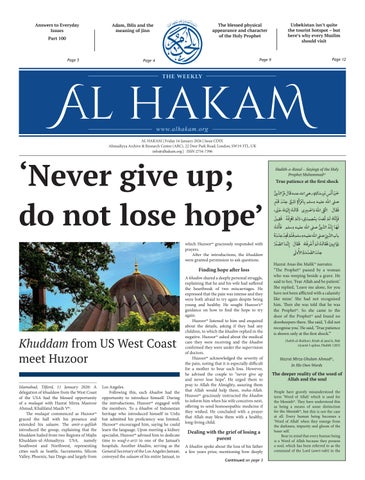
Khuddam from US West Coast meet Huzoor Islamabad, Tilford, 11 January 2026: A delegation of khuddam from the West Coast of the USA had the blessed opportunity of a mulaqat with Hazrat Mirza Masroor Ahmad, Khalifatul Masih Vaa. The mulaqat commenced as Huzooraa graced the hall with his presence and extended his salaam. The amir-e-qafilah introduced the group, explaining that the khuddam hailed from two Regions of Majlis Khuddam-ul-Ahmadiyya USA, namely Southwest and Northwest, representing cities such as Seattle, Sacramento, Silicon Valley, Phoenix, San Diego and largely from
Los Angeles. Following this, each khadim had the opportunity to introduce himself. During the introductions, Huzooraa engaged with the members. To a khadim of Indonesian heritage who introduced himself in Urdu but admitted his proficiency was limited, Huzooraa encouraged him, saying he could learn the language. Upon meeting a kidney specialist, Huzooraa advised him to dedicate time to waqf-e-arzi in one of the Jamaat’s hospitals. Another khadim, serving as the General Secretary of the Los Angeles Jamaat, conveyed the salaam of his entire Jamaat, to
A khadim shared a deeply personal struggle, explaining that he and his wife had suffered the heartbreak of two miscarriages. He expressed that the pain was intense and they were both afraid to try again despite being young and healthy. He sought Huzoor’saa guidance on how to find the hope to try again. Huzooraa listened to him and enquired about the details, asking if they had any children, to which the khadim replied in the negative. Huzooraa asked about the medical care they were receiving and the khadim confirmed they were under the supervision of doctors. Huzooraa acknowledged the severity of the pain, noting that it is especially difficult for a mother to bear such loss. However, he advised the couple to “never give up and never lose hope”. He urged them to pray to Allah the Almighty, assuring them that Allah would help them, insha-Allah. Huzooraa graciously instructed the khadim to inform him when his wife conceives next, offering to send homoeopathic medicine if they wished. He concluded with a prayer that Allah may bless them with a healthy, long-living child.
Dealing with the grief of losing a parent A khadim spoke about the loss of his father a few years prior, mentioning how deeply Continued on page 3
Hadith-e-Rasul – Sayings of the Holy Prophet Muhammadsa
True patience at the first shock
ََ ْ َ ُ َ� َ� َ َ َ �� ﺲ ْبْ ِﻦ َُمال ِﻚٍ رﺿﻰ ا��� َعنُه ﻗال الن ِِب �ي ِ �َعﻦ َأ َ َْ َ َ ْ �ٰ �ٍ �ﺻﻠﻰ ا��� �ﻠيُه وﺳﻠﻢ ْبِا� َ�َأ ٍة ﺗ ْﺒ ِ�� َِع ْنﺪ ﻗ ٰ َ� َ ََ �َ َ َ ْ َ َ ْ ا��� َ� َو ،اﺻ ِ� ِ�ي� ﻗالﺖ ِإل ْيﻚ َع ِني ��ِ فﻘال � اﺗ َ َ ُ ْ َْ َ َ َ� َ َ ﻚ ل َ ْﻢ ﺗ ُ َﺼ ْب ْب ُﻤ ِﺼ ف ِﺈُن َول ْﻢ ﺗ� ِ�فُه� ف ِﻘيﻞ،يﺒ ِ�ي ِ �ٰ ْ ََ َ ُ� َ� ُ َ� َ َ ��ا ِإُنُه الن ِِبي ﺻﻠﻰ ا��� �ﻠيُه وﺳﻠﻢ� فﺄﺗﺖ َ� �ٰ ْ َ ََ َُ الن ِِب ِ�ي ﺻﻠﻰ ا��� �ﻠيُه وﺳﻠﻢ فﻠ ْﻢ � ِ�ﺪ َِع ْنﺪه ْباب َ َ َ ْ َ َ َ َ ْ َ� َ � َ َ ْ ْ َ َ َ� َ ین فﻘالﺖ ل ْﻢ َأَع َِرفﻚ� فﻘال� ِإُنﻤا �ُ �الﺼ ِْبﻮاْب ُ َ َ َ ْ � َِع ْنﺪ �الﺼﺪ َُم ِﺔ ا��ولﻰ Hazrat Anas ibn Malikra narrates: “The Prophetsa passed by a woman who was weeping beside a grave. He said to her, ‘Fear Allah and be patient.’ She replied, ‘Leave me alone, for you have not been afflicted with a calamity like mine.’ She had not recognised him. Then she was told that he was the Prophetsa. So she came to the door of the Prophetsa and found no doorkeepers there. She said, ‘I did not recognise you.’ He said, ‘True patience is shown only at the first shock.’” (Sahih al-Bukhari, Kitab al-jana’iz, Bab ziyarati l-qubur, Hadith 1283)
Hazrat Mirza Ghulam Ahmadas, In His Own Words
The deeper reality of the word of Allah and the soul People have gravely misunderstood the term ‘Word of Allah’ which is used for the Messiahas. They have understood this as being a means of some distinction for the Messiahas, but this is not the case at all. Every human being becomes a ‘Word of Allah’ when they emerge from the darkness, impurity and gloom of the baser self. Bear in mind that every human being is a Word of Allah because they possess a soul, which has been referred to as the command of the Lord (amri-rabi) in the
Friday 16 January 2026 | AL HAKAM
2
This Week in History
16-17 January
A glimpse into the rich history of the Ahmadiyya Muslim Jamaat
16 January 1936: On this day, Haji Ahmad Khan Ayaz, a missionary to Europe, departed Qadian for Hungary. He reached Budapest on 21 February 1936. (Tarikh-eAhmadiyyat, Vol. 7, p. 290) 17 January 1905: On this day, the Promised Messiahas received a letter in English from someone in Europe. In the letter, the gentleman stated that he and his wife had read the English parts of the books of the Promised Messiahas that they had available. He added that his affiliation was with a small sect of Christianity, which had abandoned the belief in the godship of Christ and believed him to be a pious person who guided people. He further said that he would like to read about Hazrat Ahmad’sas beliefs regarding Prophet Jesusas and that he desired to read about the evidence proving his grave to be in Kashmir. (Malfuzat, 1988, Vol. 4, pp. 226-227) 17 January 1914: Hazrat Hakim Maulvi Noor-ud-Din, Khalifatul Masih I’sra health took a turn for the worse. However, despite the intensity of his deteriorating health, on this day, he delivered lectures on the Holy Quran and Sahih alBukhari. Huzoorra even said, “Due to my frailty, sometimes when I must work while lying down, if I find a new book, I cannot set it aside without finishing it.” (Tarikh-eAhmadiyyat, Vol. 3, p. 501)
16-22 January expressed his targets regarding the amount of Chanda and the number of mosques and missionaries needed in future. (Khutbat-eMahmud, Vol. 37, pp. 23-24) To read more about this, see: ‘‘Hazrat Musleh-e-Maud’s ‘American dream’’’ at www.alhakam.org (5 March 2021, p. 19).
21 January
18 January 8 January 1889: Hazrat Mirza Bashir-ud-Din Mahmud Ahmadra was born on 12 January 1889. Thus, for the next nineteen years, he enjoyed the nearness and affection of Hazrat Ahmadas. After the birth of the promised son, the Promised Messiahas carried out the sunnah of ‘aqiqah on this day. (Maktubat-eAhmadiyya, Vol. 5, p. 163) To read more about this, see: ‘‘Unique Relationship of a Father and Son’’ at www.alhakam.org (15 February 2019). 18 January 2014: On this day, Hazrat Khalifatul Masih Vaa inaugurated the Noor Mosque in Crawley, UK. (“New Mosque Opened by World Muslim Leader in Crawley”, www.pressahmadiyya. com)
19 January 19 January 1954: On this day, a court of inquiry for the investigation of the disturbances against the Jamaat in Punjab took the statement of Hazrat Sir Chaudhry Muhammad Zafrulla Khanra. In this statement, he dispelled many misconceptions spread in the country about Jamaat-e-
Ahmadiyya. Essential parts of this statement can be read on pages 420 to 432 of volume 15 of Tarikhe-Ahmadiyyat. 19 January 1999: On this day, Hazrat Khalifatul Masih IVrh urged members during his Eid-ul-Fitr sermon to celebrate Eid with the less fortunate. Members of the Jamaat responded enthusiastically, and a large number of gifts were distributed to the needy in various countries around the world on the occasion of Eid. (Silsila Ahmadiyya, Vol. 4, p. 897)
20 January 20 January 1954: During his Friday sermon on this day, Hazrat Musleh-e-Maudra urged members of the Jamaat to study the books of the Promised Messiahas carefully. Huzoorra also directed Sadr Anjuman Ahmadiyya to take suitable measures to ensure the preservation and protection of the clothes and relics [[tabarrukat] that belonged to the Promised Messiahas. (Tarikh-e-Ahmadiyyat, Vol. 17, p. 385) 20 January 1956: On this day, during his Friday sermon, Hazrat Musleh-e-Maudra talked about Jamaat’s mission in the USA and
21 January 1886: On this day, the Promised Messiahas went for a chillah (a 40-day retreat specifically for worship) to Hoshiarpur on a small, ox-drawn, two-wheeled vehicle. During this journey, Huzooras crossed the Beas River. (Tarikh-e-Ahmadiyyat, Vol. 1, p. 275) For more details, see “Forty nights of seclusion”, at www.alhakam.org (19 February 2021, pp. 35-36). 21 January 1909: On this day, Hazrat Khalifatul Masih Ira asked Jamaat members to pay special attention to helping orphans, people in need, and students with insufficient resources. (Badr Qadian, 21 January 1909, p. 1)
22 January 22 February 1920: Hazrat Muslehe-Maudra delivered his famous lecture Sadaqat-e-Islam aur zara’i taraqqi-e-Islam (i.e., The truth of Islam and the means of progress of Islam) about the truthfulness of Islam and the way to spread its teachings. This historic speech was delivered at the famous Vande Mataram Hall in Amritsar, India. (Tarikh-e-Ahmadiyyat, Vol. 4, p. 255) 22 January 1982: On this day, Hazrat Khalifatul Masih IIIrh, observing the needs of the Jamaat, urged young individuals who had completed their BA, BSc, MA, or MSc degrees to dedicate their lives to the service of Islam. (Khutbate-Nasir, Vol. 9, pp. 369–373)
AL HAKAM | Friday 16 January 2026
connected his father was to the Jamaat, even during illness. He expressed that he missed him dearly and often wished he could ask him questions. He asked how to navigate these feelings of sadness. Huzooraa advised him to reflect on his father’s character, his service to the Jamaat and his conduct with people, all of which the khadim admired. He reminded him that he knew his father’s desires and wishes for his children. Therefore, the best way to comfort his father’s soul in Paradise is to try to fulfil those pious wishes and follow in his footsteps of good character and conduct. Huzooraa also advised him to continue praying for his father.
Overcoming shyness and gaining confidence A 15-year-old khadim stated that being an introvert, he finds it difficult to interact with people at school and at the mosque. Huzooraa encouraged him to build confidence. He explained that the issue was not a dislike for interaction, but rather shyness. Huzooraa stressed that an Ahmadi must be confident. Without confidence and proper exposure, one cannot interact effectively with people, which hinders the duty of tabligh and preaching. Huzooraa advised him to specifically pray during his salat that Allah removes this weakness and grants him the confidence to speak to people properly.
Wisdom of Prophets vs intellect of scientists A question was raised regarding whether the wisdom of Prophets or the Khulafa could be compared to the IQ of scientists like Albert Einstein and how one can prove the superiority of spiritual wisdom. Huzooraa explained that there is a fundamental difference. Prophets are guided by Allah the Almighty in every respect. The Khulafa, while guided, can sometimes make minor errors in judgement; however, Allah ensures that such mistakes do not harm the Jamaat and ultimately brings about a good end or rectifies the matter. Regarding scientists, Huzooraa noted that their intellect and capacity for hard work are also blessings from Allah. Through
3
the law of nature, anyone, religious or not, who uses their God-given mind and strives will achieve results. However, there are also scientists who are religious, such as the Nobel Laureate Dr Abdus Salam, who stated that he found guidance for his research in the hundreds of verses of the Holy Quran. Huzooraa explained that two laws are at work: the law of nature, which rewards effort with results and the law of sharia, which brings both religious blessings and the fruits of one’s labour.
Judgement after death A khadim asked if a person is judged immediately upon death or if they must wait until the Day of Judgement. Huzooraa clarified that judgement begins immediately. A person who does good deeds enters a state of Paradise upon death, though not the ultimate station, while those who do evil enter a state of punishment. Huzooraa explained that on the Day of Judgement, Allah will call the souls again for the final decision. Those who were already rewarded will be granted a higher status. For those who have received their punishment, Allah may choose to forgive some and admit them into Paradise, while others may require further punishment in another stage of Hell. Huzooraa referred the khadim to The Philosophy of the Teachings of Islam by the Promised Messiahas for a detailed understanding, noting that he had also answered this question in detail in a previous issue of Al Hakam.
The joy of children’s letters A khadim asked what aspect of the letters Huzooraa receives from children brings him the greatest joy. Huzooraa smiled and remarked that sometimes he does not even fully understand what the very young children are trying to say, as they have only scribbled some lines on the paper, but he appreciates them by praying for them. He expressed happiness that so many children write to him to share their sentiments. Even when a child writes just a few lines and the parents provide an interpretation – whether accurate or their own – Huzooraa feels joy that the children are attached to the Jamaat, have respect for it, ask for prayers and believe in Allah. He
reiterated his advice to parents to maintain a close, interactive relationship with their children, especially as they reach the age of 15 or 16, to ensure they remain connected to the Jamaat.
Parenting through difficult ages Huzooraa was asked which age of his own children he found most difficult to handle as a parent. Huzooraa replied that he did not find any situation particularly difficult. He explained that if parents have a good relationship with their children, the children will follow their guidance. Children should have the confidence that their parents are their friends who will listen to them and help overcome their challenges. If this confidence is established, training them is not difficult at any age. However, Huzooraa noted that after the age of 15, the environment can cause children to deviate from basic Islamic morality. At this stage, parents should keep a closer watch while maintaining a friendly relationship.
Staying away from evil as a teenager A young teenager asked how he could avoid the evils that are easy to fall into and remain steadfast in faith. Huzooraa stated that since the khadim already knows the difference between good and bad, he can try to avoid the bad. He advised him to read the Holy Quran, study Jamaat literature and listen to the Friday sermons to reinforce this knowledge. Huzooraa emphasised that offering the five daily prayers sincerely is the key protection, as Allah promises that prayer saves one from indecency. Satan has vowed to mislead people, but by praying, “O Allah, keep me on the right path,” Allah will َ � protect َ ۡ them. This is why we recite “الِص ََراط ِ اَِه ِﺪُنا َ��ۡ ”ال ۡ ُﻤ ۡﺴ َت ِﻘrepeatedly in Surah al-Fatihah. Huzooraa also advised using one’s intellect, avoiding bad company – especially friends involved in addictions – and not wasting time on screens.
Career guidance for waqifeen-enau A waqif-e-nau khadim asked what career
Continued from page 1 Holy Quran. However, on account of his foolishness and ignorance, as man does not give due importance to the soul, he essentially chains it in fetters and shackles, blinding its vision and blackening its pure state with perilous darkness and evil, marring the soul to such an extent that it becomes so dim that it can hardly be perceived. But when man repents and turns towards Allah the Exalted, and removes the cloak of his impure life of darkness, the heart begins to shine, and the journey to the original source—which is God—begins, until finally, when a person reaches the highest state of righteousness, all of their dirt and filth is removed and what remains of man is Allah’s Word. This is a subtle point of knowledge and wisdom. All people do not have the ability to attain to the depth of this matter. (Malfuzat [English], Vol. 2, pp.121-122)
path he should pursue if not becoming a murabbi and which career allows one to serve the Jamaat the most. Huzooraa reiterated that waqifeen-e-nau can enter any field – medicine, teaching, engineering, law – that they find appropriate. When the khadim asked which career best serves the Jamaat, Huzooraa explained that one can serve the Jamaat in any capacity and field, provided one has the determination to do so. One should not later use their career as an excuse to say they are too busy for Jamaat work. Upon learning that the khadim was better at computer science than science subjects, Huzooraa advised him to pursue computer science.
Conclusion At the conclusion of the mulaqat, the amire-qafilah expressed gratitude to Huzooraa for his kindness and hospitality towards the khuddam from the US. He then requested, beloved Huzooraa, to also visit America so that they may have the honour of hosting him. Huzooraa responded with a smile. The group then had the honour of a photograph with Huzooraa, after which Huzooraa took his leave. (Summary prepared by Al Hakam)
Friday 16 January 2026 | AL HAKAM
4
Adam, Iblis and the meaning of jinn is a physical material. Thus, in the same case, “created from fire” refers to temperament, not substance.
Jalees Ahmad Al Hakam
The story of Prophet Adamas and Iblis, the jinn who rejected him out of arrogance, is a well-known story among Muslims and nonMuslims alike. Iblis, who was among the jinn, refused to acknowledge Adamas, while the angels submitted to God’s command and bowed in prostration. (Surah al-Baqarah, Ch.2: V.31-35; Surah al-A‘raf, Ch.7: V.12-19) Iblis claimed that, because he was created from fire while Adamas was created from clay, he was superior:
Why did Allah call them ‘ins’ and ‘jinn’ instead of ‘believers’ and ‘disbelievers’?
ۡ َ َ َ َ� ََۡ ۡ َخَلۡق ََتِنِ ۡۡی ِِم ۡۡن َّنا ٍٍر �َّوَخَلۡق ََت ٗٗہ ِِم ۡۡن ِِطۡی ٍٍن
“He said, ‘I am better than he. Thou hast created me of fire and him hast Thou created of clay.’” (Surah Sad, Ch.38: V.77) The Holy Quran also states that jinn were created from a fire: “And the jinn He created from the flame of fire” (Surah arRahman, Ch.55: V.16), and that they existed before humankind: “We created man from dry ringing clay, from black mud wrought into shape. And the jinn We had created before from the fire of hot wind.” (Surah alHijr, Ch.15: V.27-28) This story of Adamas and Iblis, cited in several passages of the Holy Quran, raises important questions. What, or who, are jinn? What does it mean that they were created from fire and that humans were created from clay? And what does the jinn existing before Adamas signify?
Who and what are ‘jinn’? Until we understand the true meaning of the word jinn; and since it’s an Arabic term, until we grasp its linguistic roots and the words derived from it, this subject will remain veiled to us. The Holy Quran affirms the existence of jinn, but the central question we now need to address is: what exactly are they? The term jinn, as understood linguistically, is both a proper noun and a generic term. Linguistically, anything that conceals another thing, casts a veil over it or obscures it is considered a jinn. Likewise, anything that dwells in darkness or becomes hidden from sight is also considered a jinn. It must be remembered that the word jinn does not always have only one fixed meaning. For example, in Arabic, the root j-n-n indicates concealment. Thus, the following words are derived from this very root, and all have a connotation of concealment: (i) junnah: a shield that hides a person. (ii) janin: an unborn child hidden in the womb. (iii) junun: a condition that hides one’s intellect. (iv) jinn: a creature hidden from the human eye. (Haqaiq-ulFurqan, Surah al-Jinn, Ch.72: V.2) “The word jinn,” as explained by Hazrat Khalifatul Masih Vaa “is also used for veiled women. It is also used for such chieftains and the elite who do not mix with the public. It is also used for people of nations that live in geographically remote areas and are cut off from the rest of the world.” (“Who or what are jinn?”, alhakam.org, 10 March 2023)
If we look towards the Holy Quran, we find that the word jinn appears in over 20 places, though it does not always carry the same meaning each time. In summary, the Holy Quran uses the term jinn in several senses. (Note: To keep this article focused on its main topic, Adamas, Iblis and the surrounding narrative, any discussion of jinn is kept brief here. A separate, in-depth article exploring jinn, its meanings, and its connection to those mentioned in Surah alJinn will be written at a later date.)
Who were the ‘jinn’ before Prophet Adamas? Now, we shall delve into the jinn as preAdamic humans. The Holy Quran says: “And the jinn We had created before” (15:28). The Holy Quran also uses jinn for ancient humans who lived before Adam’sas civilisation. These individuals lived like animals, without law, culture or any social order, hiding in caves and forests. When Adamas introduced moral and social structure, these primitive people were collectively called jinn, i.e., hidden, uncivilised humans. (Tafsir-e-Kabir, Vol. 5, p. 297) Early humans, because of wild beasts, could not freely move on the surface of the earth. According to their condition, they were given the name jinn (hidden, uncivilised humans). These are the very same people whom modern historians call “cavemen”. When the human mind advanced and humans became adept at receiving divine revelation, God chose a man who was fit to live upon the earth’s surface. He was granted the title Adamas because he had become suitable for settled life, and insan (human) because he was capable of receiving God’s love on the one hand and, on the other hand, capable of compassion and sacrifice for his fellow beings. Thus, God selected him for His revelation. Those among the earlier cavemen who accepted Adam’sas system, joined him, came out of their caves and accepted the discipline of a social order – they were called human beings (insan). Those, however, who rejected abandoning a wild life and regarded cave-living as freedom were called jinn on account of their mode of life.
And so, in the early stage of human development, the term jinn applied to those individuals who were devoid of civilisation and incapable of accepting an ordered system. And the term insan applied to the group that chose mutual cooperation and obedience to a law. From that point onwards, these two names became associated with two traits: those who rejected order and authority were called the offspring of the jinn, and those who submitted to a system of discipline were called the offspring of Adamas. The names became descriptive, and therefore it sometimes happened that the children of jinn, by reforming themselves, became human; and sometimes the children of human beings, becoming corrupt and disorderly, turned into jinn. (Ibid.)
What is the meaning of ‘created from fire’ and ‘created from clay’? When the Holy Quran states: “And the jinn We had created before from the fire of hot wind” (Surah al-Hijr, Ch.15: V.28), it means that these people had fiery dispositions and were quick to anger. Before Adamas, this was indeed the condition of early humanity. Adamas was the first man who reached moral and social excellence; therefore, revelation relating to living in a civilised way, and morals and ethics, first descended upon him. Those people who joined his social order then engraved obedience upon their hearts; they were therefore called, as Hazrat Musleh-e-Maudra has explained, “ ”طينيwhich means made of clay, because clay accepts impression. Those who favoured unrestrained freedom and refused discipline were called “fiery”, like flames that cannot be controlled. Such people, who were living in caves, were called jinn. (Tafsir-e-Kabir, Vol. 5, pp. 297-298) Although it could be objected that God says He created the jinn from fire and so it must be this, the answer is that elsewhere God says: “Man is made of haste.” (Surah al-Anbiya, Ch.21: V.38) No scholar understands this to mean that “haste” is a physical substance. It means that haste is deeply rooted in human nature. Similarly, God says Allah created you from weakness ( Surah ar-Rum, Ch.30: V.55). This means that a child is created weak, not that “weakness”
Now, as it has been established that those who accepted Adamas came to be known as ins, while those who rejected him and chose to live in their own hidden ways were known as jinn, one might ask why God referred to them by these names (ins and jinn) rather than simply calling them believers and disbelievers. The answer to this is that for ordinary people, the simple terms “believer” and “disbeliever” suffice, but for them, the appropriate terms were “Adam” and “Iblis” or ins (humans) and jinn. At that time, human intellect was not developed enough to understand the intricate matters of divine law; they could only grasp the basics. (Saire-Ruhani, p. 32) Hence, instead of “believer” and “disbeliever”, they were called ins and jinn so that the distinction in their civilisation and conduct could be communicated in a way they could understand. Today, human intellect is advanced enough that when someone is called a believer or disbeliever, they understand the meaning of these terms. But in that era, if someone had been told they were a disbeliever because they did not accept Adam’sas message, they would not have understood the connection between disbelief and rejecting Adamas. Thus, those who accepted Adamas and embraced civilised life were called ins, while those who rejected Adamas and decided to hide in caves were called jinn. This distinction was easily understood by them because they knew that some lived on the surface of the Earth while others lived in caves. When they were called jinn, they understood that they preferred to stay in the caves. When others were called ins, they recognised that they lived on the surface and thus could not be called jinn. Modern European archaeologists are amazed that, after extensive research in the nineteenth century, they discovered that humans initially lived in caves. Yet, over thirteen hundred years ago, the Holy Quran distinguished such people by calling them jinn. (Ibid.)
Conclusion Just as in the present day, humans are distinguished by the terms “believer” and “disbeliever”, in that era, humans were distinguished by the terms ins and jinn because the basis of difference was civilisation. The terms ins and jinn were used to show who followed divine guidance and adopted civilised life, and who rejected it. Those who embraced civilised life and lived on the earth’s surface were called ins. Those who refused civilised life and chose to stay in caves were called jinn.
AL HAKAM | Friday 16 January 2026
5
Answers to Everyday Issues Part 100
Making vows (nazr), friendship with disbelievers, death of Lekh Ram, sunnah prayers, self-defence and the family of Prophet Jesus Guidance regarding basic Islamic issues that Hazrat Amirul Momineen, Khalifatul Masih Vaa, has given on various occasions in his written correspondence and during MTA programmes is being published officially below for everyone’s benefit. Is making a vow (nazr/mannat) permissible in Islam? Someone from the UK wrote to Hazrat Amirul Momineen, Khalifatul Masih Vaa, asking whether it is permissible to make a vow, i.e., nazr or mannat, in Islam. Huzoor-e-Anwaraa, in his letter dated 16 October 2023, provided the following answer to this question: “It is proven from ahadith that the Holy Prophetsa did not view the making of vows [nazr] with much favour. (Sahih Muslim, Kitab an-nazr, Bab an-nahyi ‘ani n-nazri wa annahu la yaruddu shay’an) He also prohibited making vows regarding sinful acts, unnecessary and vain things and matters beyond one’s capacity. Accordingly, Hazrat Aishara narrates that the Holy Prophetsa said, ‘Whoever vows to obey Allah, let him obey Him; and whoever vows to disobey Allah, let him not disobey Him.’ (Sunan Abi Dawud, Kitab al-ayman wa n-nuzur, Bab an-nazri fi l-ma‘siyah) Similarly, it is narrated by Hazrat Ibn Abbasra that while the Holy Prophetsa was delivering a sermon, his gaze fell upon a man who was standing in the sun. He enquired about him and the people replied, ‘This is Abu Isra’il; he has vowed that he will remain standing and not sit, nor will he come into the shade, nor will he speak, but he will fast.’ The Holy Prophetsa said, ‘Command him to speak, to come into the shade and to sit, but let him complete his fast.’ (Sunan Abi Dawud, Kitab al-ayman wa n-nuzur, Bab man ra’a ‘alayhi kaffaratan iza kana fi ma‘siyah) “Hazrat Musleh-e-Maudra states regarding vows: “‘It is evident from ahadith concerning vows that the Holy Prophetsa did not approve of them. (Sahih Muslim, Kitab annazr, Bab an-nahyi ‘ani n-nazr) Yes, if a vow is made, then it is obligatory to fulfil it. The Holy Prophetsa disapproved of vows because they become a sort of contract with God
Almighty and making a contract with God Almighty is not a desirable act. Instead of this, one should resort to charity [sadaqah] and prayers. However, if a person makes a vow as a token of gratitude [shukranah] along with charity and prayers, there is no harm in it. I deduce this from a practice of the Promised Messiahas. Sometimes, he would say to those who requested him for prayers, ‘I shall pray. You should determine a certain amount in your heart for the service of the faith, which you will give in the way of Allah upon the fulfilment of this task.’ This shows that if a vow is made as a token of gratitude, there is no harm in it, so long as the vow is accompanied by prayers, heartfelt entreaty with tears [before God] and acts of charity.’ (Tafsir-e-Kabir, Vol. 3, UK, 2023, pp. 488-489)”
What is the meaning of ‘bringing the living out of the dead’ mentioned in the Quran? A lady from the UK wrote to Hazrat Amirul Momineen, Khalifatul Masih Vaa, regarding verse 28 of Surah Aal-e-‘Imran, “Thou bringest forth the living from the dead and bringest forth the dead from the living,” and verse 29, “Let not the believers take disbelievers for friends in preference to believers.” She asked about the meaning of the first verse and, regarding the second verse, whether Allah the Exalted completely forbids friendship with disbelievers and whether “disbelievers” refers to those who do not believe in the Holy Prophetsa or those who do not believe in Allah the Exalted. Huzoor-e-Anwaraa, in his letter dated 17 October 2023, provided the following guidance regarding this: “Several meanings have been ascribed to verse 28 of Surah Aal-e-‘Imran, that Allah the Almighty is the Being Who brings forth the living from the dead and the dead from the living. Here, the spiritually living and
dead are also meant. One meaning given for this verse is that Allah brings forth a believer from a disbeliever and a disbeliever from a believer. Accordingly, it is written in Quranic commentaries that the Holy Prophetsa came to his family and found a woman sitting there. Upon the Holy Prophet’ssa enquiry, the blessed wives informed him that she was Khalidah bint al-Aswad bin Abd Yaghuth. Upon this, the Holy Prophetsa said:
َ� َ َ ْ ُ ْ ْ ْ اَّن ال ِِذي َيُْخ ُِر ُُج ال َ� �يَ ِِم َۡن ال ََم �َِي ُِت سَبَح
“‘Holy is Allah, Who is free from all defects, Who brings forth the living from the dead.’ “Hazrat Khalidah bint al-Aswad bin Abd Yaghuth was a pious and righteous woman, whereas her father was a disbeliever. (Tafsir al-Qurtubi, under the above-mentioned verse) “In other words, a believer is spiritually alive, whereas a disbeliever is spiritually dead. Similarly, a righteous person is spiritually alive and an evil person is equivalent to the spiritually dead. Thus, interpreting this verse, Hazrat Khalifatul Masih Ira states: “‘If He wills, He makes good people out of bad ones and bad people out of good ones.’ (Haqaiq-ul-Furqan, Vol. 1, p. 460) “So, several meanings have been given for this verse, but the essence is to make humans understand that the Being of Allah the Almighty is the Owner of everything in the universe and everything in this entire
universe is within His grasp of power. He can do whatever He wills. If He wishes, He can turn gold into dust and if He wishes, He can turn dust into gold. In effect, the subject َ َ � ُ ٰ �ٰ َ of ‘‘[ ’ا �ِن ا�� َ� َ��� � ِﻞ � ۡي ٍء ﻗ ِﺪﻳۡ ٌَرSurely, Allah has the power to do all that He wills’] has been expressed in this verse in another manner.”
Does the Quran forbid friendship with non-Muslims? “As for verse 29 of Surah Aal-e-‘Imran, if you read it carefully, you will find the answer to your question within it: “‘Let not the believers take disbelievers for friends in preference to believers.’ “It means, do not make disbelievers your friends against the interests of believers. This commandment specifically concerns such disbelievers who were staunch enemies of Islam, who were constantly at war against Muslims and Islam and who were bent on causing harm to the Holy Prophetsa. Regarding such enemies of the truth, the advice was given not to make them friends but to make believers friends instead. Otherwise, in Mecca as well as in Medina, there were many such noble-natured people who, although not Muslims, did not oppose the Muslims; hence, the Holy Prophetsa and the Companions maintained relations with them. “Thus, in this verse, Muslims have not been forbidden from having relations with non-Muslims; rather, they have been forbidden from forming intimate friendships
Friday 16 January 2026 | AL HAKAM
6
with disbelievers who are enemies of Islam, so that they may not cause harm to Muslims under the guise of ‘friendship’.”
Did an angel or a human kill Lekh Ram? Someone from Rabwah wrote to Hazrat Amirul Momineen, Khalifatul Masih Vaa, stating that in the book Deeni Ma‘lumat [Basic Religious Knowledge] published by Khuddam-ul-Ahmadiyya, it is written regarding the murder of Lekh Ram that Allah the Almighty made him the prey of the “Sword of Muhammadsa” through an angel. Similarly, an Ahmadi friend wrote a narration on the internet stating that Lekh Ram’s killer murdered him, went into a room, which was bolted from the outside. There was only a small vent in that room and when the room was opened, the killer had vanished. However, in light of the writings of the Promised Messiahas, it is my view that Lekh Ram’s killer was a human being and not an angel. I request guidance from Huzoor. Huzoor-e-Anwaraa, in his letter dated 17 October 2023, provided the following answer to this question: “Your point is correct. Regarding the murder of Lekh Ram, it is absolutely not the belief of the Ahmadiyya Muslim Jamaat that he was killed by an angel. Rather, the belief of the Ahmadiyya Jamaat in this regard is that this was a mighty divine sign which Allah the Almighty manifested out of His protective zeal [ghayrat] for the Holy Prophetsa and to demonstrate the truthfulness of his spiritual son, the Promised Messiahas. He granted the Promised Messiahas news of this beforehand and then fulfilled it exactly in accordance with this prophecy. Thus, the Promised Messiahas writes regarding this sign: “‘Second, there was the promise in these revelations in Barahin-e-Ahmadiyya, that He would manifest those Signs which would involve the actions of human beings. So, the prophecy related to Lekh Ram occurred in accordance with this because this Sign was manifested by means of someone who killed Lekh Ram. It is apparent that for this prophecy, God roused the heart of someone to want to murder him and created every opportunity for him to be able to complete his task.’ (Siraj-e-Munir, Ruhani Khazain, Vol. 12, p. 32) “Similarly, mentioning this sign in Malfuzat, Huzooras states: “‘In the matter of Lekh Ram, the hidden hand of God can clearly be seen at work. The fact that the murderer had come to be made a Hindu; the fact that Lekh Ram trusted him to the extent that he took him home without hesitation; the fact that on the evening of the murder, all of Lekh Ram’s other guests returned to their homes and he was left alone with the assailant; the fact that the murderer resolved to do the deed on exactly the second day of Eid; the fact that Lekh Ram stopped writing and stretched his arms, thus exposing his stomach; the fact that a clean strike was made with the knife; the fact that God silenced Lekh Ram such that despite being conscious and despite knowing that I had made a prophecy against him, his not expressing even for a moment that: ‘I am suspicious of Mirza Sahib’; furthermore, the fact that to this day, the whereabouts of his murderer are unknown; all of these are the actions of God Almighty, which shed light
on His awe-inspiring power and strength.’ (Malfuzat, Vol. 1, p. 257, Published 1988) “I am writing to Khuddam-ulAhmadiyya for the correction in Deeni Ma‘lumat. However, if someone has written such a narration on the internet that is not in accordance with the Jamaat’s belief, it cannot, in any case, be called the stance of the Jamaat.”
Which 12 rak‘ats lead to a house in Paradise? A lady from the USA wrote to Hazrat Amirul Momineen, Khalifatul Masih Vaa, regarding his address to the ladies at Jalsa Salana Germany, wherein he said that whoever offers 12 voluntary prayers every day builds a house in Paradise. He also drew the attention of women towards becoming brave and learning self-defence. In this regard, she asked whether the voluntary prayers of tahiyyat-ul-wudu are included in these 12 voluntary prayers and whether learning to shoot a gun can attain the pleasure of Allah the Exalted. Huzoor-e-Anwaraa, in his letter dated 1 November 2023, provided the following guidance regarding this issue: “In my speech to Lajna at Jalsa Germany, when I spoke about the one who offers 12 voluntary prayers entering Paradise, it was based on the saying of the Holy Prophetsa narrated by Hazrat Aishara that whoever perseveres in offering 12 rak‘ats of sunnah during the day and night, Allah the Exalted builds a house for him in Paradise: four rak‘ats before Zuhr, two rak‘ats after it, two rak‘ats after Maghrib, two rak‘ats after Isha and two rak‘ats before Fajr. (Sunan atTirmidhi, Kitab as-salah, Bab ma ja’a fiman salla fi yawmin wa laylatin thintay ‘ashrata rak‘atan mina s-sunnah) “Thus, the 12 rak‘ats mentioned in the aforementioned Hadith are called sunnah mu’akkadah or the emphasised sunnah, which are performed before and after the obligatory or fardh prayers and which the Holy Prophetsa always performed except when travelling. Abandoning these sunnah mu’akkadah without reason is blameworthy because the perpetual observance of our Master and Lordsa upon them is proven. Whereas Tahiyyat-ul-Wudu, etc., fall under the category of non-emphasised or ghair mu’akkadah sunnahs and nawafil. Their
performance is at a person’s own discretion; there will be a reward for offering them and there will be no sin for omitting them. “Furthermore, regarding nawafil, one should also keep in view the saying of the Holy Prophetsa wherein he stated that Allah says, ‘My servant draws so near to Me through constant nawafil that I begin to love him. Then, when I love him, I become his ear with which he hears and I become his eye with which he sees and I become his hand with which he grasps and I become his foot with which he walks. And if he asks Me for something, I give it to him and if he seeks refuge with Me, I grant him refuge.’ (Sahih al-Bukhari, Kitab ar-riqaq, Bab at-tawadu‘) “Therefore, along with the performance of obligatory prayers and sunnah mu’akkadah, a person should also pay attention to offering nawafil to the best of their ability and capacity, for they are the best means of attaining nearness to Allah.”
What does bravery mean for women in Islam? “As for becoming brave, it does not only mean that a person knows how to use a bow and arrow, a sword, or a gun and pistol and is therefore brave. Rather, true bravery is that fear should be removed from the heart and one should resolutely combat the evils spreading in society. One should always remember that it is contrary to the dignity of a believer to fall into evil by being overawed by anyone without reason. Yes, if you wish to learn how to shoot a gun, it is a good thing; courage is also instilled through these things. However, to attain the pleasure of Allah the Exalted, it is necessary to follow all His commandments. A believer should strive for this.”
Did Prophet Jesusas marry and have children? A lady from Canada enquired from Hazrat Amirul Momineen, Khalifatul Masih Vaa, whether Prophet Jesusas had a family. Huzoor-e-Anwaraa, in his letter dated 2 November 2023, provided the following answer to this question: “Due to the Israelites repeatedly breaking the covenants made with Allah the Exalted, constantly denying the signs of Allah the Exalted and unjustly and
vehemently opposing the Prophets, Allah the Exalted, under His special wisdom, caused Prophet Jesusas to be born from the womb of Mary without a father to give them a final warning. However, Prophet Jesusas had four brothers and two sisters from Hazrat Mary and her husband, Joseph the Carpenter. Accordingly, it is written in the Gospel regarding Prophet Jesusas: ‘“Is not this the carpenter’s son? is not his mother called Mary? and his brethren, James, and Joses, and Simon, and Judas? And his sisters, are they not all with us?’ (KJV, Matthew 13:55-56) “The Promised Messiahas, who was commissioned by Allah the Almighty as the Just Arbiter [Hakam ‘Adl] for this latter age, states regarding the siblings of Prophet Jesusas: “‘Christ the Messiah had four brothers and two sisters who were related to Christ by blood and were the children of Joseph and Mary. The names of his four brothers are (1) Judas, (2) James, (3) Simon and (4) Justus. The names of his two sisters are (1) Assia and (2) Lydia. See Apostolic Records by Father John Allen Giles, London, 1886, pp. 159, 166.’ (Noah’s Ark, Ruhani Khazain, Vol. 19, p. 18, footnote) “As for the marriage and children of Prophet Jesusas, there are two different opinions. One is that Mary Magdalene, who is frequently mentioned in the Gospels, was the wife of Prophet Jesusas and that Prophet Jesusas also had children from her. However, no proof of his marriage and children is found in the Quran, Hadith, or the Gospels. Although a claim made by some later researchers is also that when Prophet Jesusas migrated from Palestine towards Srinagar, he married upon arriving there and also had children. Accordingly, a resident of Srinagar named Sahibzada Basharat Saleem claims to be a descendant of Prophet Jesusas and the genealogical tree he possesses to this day traces his lineage back to Prophet Jesusas. (Times of India, 6 November 1977) “Whereas the second opinion is that the Mosaic Messiah, Prophet Jesusas, neither married nor had any children. That is why when the Holy Prophetsa gave news of his spiritual son and the Muhammadan Messiah commissioned after him, he also gave the following glad tidings regarding him:
َََ َ َف ََيُّت� �َّو ُُج ََّو َيُوْل َ ُُد ل َ ٗٗہ
“‘He shall marry and have children too.’ (Mishkat al-Masabih, Kitab al-fitan, Bab nuzuli ‘Isa ‘alayhissalam) “One interpretation of this hadith is that it does not mean Prophet Jesusas did not marry and did not have children; rather, this hadith actually gave the glad tiding of the extraordinary marriage of the coming Muhammadan Messiahas and his high-ranking, prophesied children. This was fulfilled in the person of the Promised Messiah’sas illustrious son, Hazrat Sahibzada Mirza Bashir-ud-Din Mahmud Ahmad, alMusleh al-Maw‘ud, Khalifatul Masih IIra. “In any case, both opinions exist regarding the marriage and children of Prophet Jesusas.” (Compiled by Zaheer Ahmad Khan, Head of Records Department, Private Secretariat, London and translated by Al Hakam)
AL HAKAM | Friday 16 January 2026
7
Faith & technology: pathways to one divine truth Dr. Nasim Rehmatullah Chairman Markazi Al Islam Team, USA The Descent of the Messiah is a profound and far-reaching discourse on one of the most awaited events in history: the advent of the Promised Messiahas, whose appearance is being awaited by the majority of the world’s religions. In this remarkable work, the Promised Messiahas presents evidence for the divinely inspired claim that he is the same figure raised by God in the Latter Days for the salvation of mankind. This account details how faith and technology are converging toward one divine truth.
Evolution, science & technology Artificial Intelligence (AI) powerfully embodies the convergence of modern knowledge, drawing together diverse disciplines into a unified expression of intelligence. Like a prism that receives many colours and produces a single spectrum, AI has integrated fields of mathematics, computer science, physics, biology, and ethics into a single, dynamic discipline. This convergence of diverse sciences reflects nature’s own pattern, in which all things ultimately point back to a single Creator and Originator. “The seven heavens and the earth and all
that is therein extol His glory; and there is not a thing but glorifies Him with His praise, but you do not understand their glorification.” (Surah Bani Isra’il, Ch.17: V.45). This verse shows that the entire universe with its order and coherence testifies, both in its vastness and in every part, to the unity and perfection of its Creator. The Holy Quran parallels cosmic unity with human evolution: Adamas was not the first human, but the first with intellect fit for divine law, marking the shift from instinct to moral agency. Humanity thus began its journey to intellectual and ethical maturity, culminating in the “Perfect Man”, Prophet Muhammadsa. This aligns with both contemporary science and the Quranic view of purposeful, divinely guided evolution. Just as the sciences converge in AI, religion, too, has moved toward unity. Divine prophets such as Krishna, Abraham, Moses, Zoroaster, Buddha, Confucius, and Jesus,peace be upon them, all brought guidance across cultures, each adding to humanity’s spiritual legacy. These diverse lights pointed to one universal faith, culminating in Islam, which synthesised and completed previous revelations.
Advent of the Promised Messiahas This convergence reached its final stage with the advent of Hazrat Mirza Ghulam Ahmadas
of Qadian (1835-1908), the Promised Messiahas, a metaphorical second coming of Jesus, sent to unite faith, restore worship of the One God, and revive peace and reason through Islam. A new era of spiritual and technological progress has begun. Chaos and fragmentation can serve as the necessary precursors to unity, a principle concisely expressed in the Quran as “Surely, there is ease after hardship.” (Surah alInshirah, Ch.94: V.6) It is a divine design that forges the character of humanity. The evolution of man precedes the evolution of technology. Man is the master and AI the servant. Guided by human intention, AI stands as a beacon, illuminating the path to truth and enabling its wide and effective spread. The convergence in religion with the Promised Messiahas and in science with AI has appeared close together in modern times. This is a profound sign, as the Quran declares, “‘Truth has come and falsehood has vanished away. Falsehood does indeed vanish away [fast].’” (Surah Bani Isra’il, Ch.17: V.82) We are on the path to the realisation of prophesied order and truth, witnessed today as religious revival in Islam Ahmadiyyat and technological integration in AI. From Adam’sas awakening of intellect, through the unification of faiths by the Promised Messiahas, to the advances of
AI, one theme persists: unity. Humanity’s progress in spirit and science reveals that diversity leads us back to the oneness of the Creator. The Perfect Man, Prophet Muhammadsa fulfilled all capacities bestowed by God, but man cannot transcend his created nature to become divine. Despite millennia of computation, a machine is still a machine. No spark of consciousness has emerged. Consciousness cannot be manufactured by sheer iteration. It must be bestowed by God, just as proximity to Him at the highest station of the Prophetsa required God’s descent, not just man’s ascent. (Surah anNajm, Ch.53: V.9)
NEWS Khatm-e-Nabuwwat conference held by Jamaat-e-Ahmadiyya Calgary, Canada Syed Mukarram Nazeer Canada Correspondent On 13 December 2025, Jamaat-e-Ahmadiyya Calgary, Canada, hosted a Khatm-eNabuwwat conference. The conference focused on presenting the true Islamic understanding of Khatamun-Nabiyyeen (the Seal of the Prophets), highlighting the unparalleled dignity, supremacy and exalted rank of the Holy Prophet Muhammadsa, and affirming Islam as the perfect and living religion. The background In May 2025, a non-Ahmadi Muslim organisation in Calgary held a conference on the same topic and publicly invited Ahmadi Muslims to attend and participate through questions and discussion. A delegation from the Jamaat Calgary attended the event and engaged with them. Following the programme, the nonAhmadi Muslim organisation expressed
interest in pursuing a structured and scholarly dialogue with the Jamaat on this subject. Correspondence took place to establish mutually acceptable terms for such a dialogue. Despite Jamaat-e-Ahmadiyya Calgary accommodating several unreasonable conditions in good faith, the other party continued to introduce new restrictions, ultimately abstaining totally from proceeding with the dialogue. With the approval of Amir Jamaat-eAhmadiyya Canada, Lal Khan Malik Sahib, it was decided that, regardless of the outcome of the proposed terms for the dialogue, Jamaat Calgary would independently host a public conference to educate Muslim brothers and sisters on the authentic Quranic and scholarly understanding of this vital doctrine. It was named ”Khatm-eNabuwwat Conference.” The conference was promoted through a multi-platform outreach strategy that included community engagement, social media and broadcast media. A printed invitation letter was distributed among Jamaat members to personally invite nonAhmadi contacts and friends, with a digital version shared across Jamaat Calgary’s local communication groups. In addition, advertisements were placed on Facebook, while unpaid promotional content was shared on social media platforms. A radio
interview was also conducted on a local Urdu-language radio station to raise awareness of the event. Furthermore, the event poster and invitation were shared online within a large Pakistani community group of over 90,000 members, where they received significant online engagement. Proceedings of the conference The conference was held at the Genesis Centre, a prominent community venue in Calgary. The programme commenced with lunch, followed by the Zuhr prayer. The formal proceedings began with a recitation from the Holy Quran, followed by Urdu and Arabic poetry of the Promised Messiahas, expressing profound love and reverence for the Holy Prophet Muhammadsa and the perfection of Islam. The first address, delivered in English, was presented by a missionary, Hafiz Attaul Wahab Sahib and the second address, delivered in Urdu, was by Naib Amir Jamaat Canada, Hadi Ali Chaudhary Sahib. Both speakers comprehensively addressed the concept of Khatamun-Nabiyyeen, drawing upon Quranic evidence, linguistic analysis, authentic ahadith, historical precedents and classical Islamic scholarship. Their presentations powerfully demonstrated that the Ahmadiyya understanding of this title in no way diminishes, but rather magnifies and exalts the status of the Holy Prophet
Muhammadsa. This was followed by a question-andanswer session, where audiences asked questions on the topic. Closing remarks were delivered by the Local Amir of Jamaat Calgary. Silent prayer brought the session to an end, followed by the Asr prayer. The event also featured an exhibition showcasing the Holy Quran in multiple translations, as done by Ahmadiyya Muslim Jamaat. In addition, the exhibition also highlighted the life of the Holy Prophet Muhammadsa. Finally, a well-organised bookstall offered books and literature to all attendees of the conference. It is noteworthy that despite efforts by certain individuals from the nonAhmadi Muslim community in Calgary to discourage Muslims from attending the conference through social media campaigns, the event saw a strong turnout. Just before the conference started, one non-Ahmadi individual was observed holding a placard near the entrance of the venue in an attempt to dissuade attendees. A total of 111 non-Ahmadi guests, along with 456 members of the Ahmadiyya Muslim Jamaat, attended the conference. Additionally, the event was live-streamed. The conference also received media coverage, including reporting by a Bengali news outlet.
Friday 16 January 2026 | AL HAKAM
8
Part 22
P oneer
Missionaries Hazrat Sufi Abdul Qadeer Niaz, Companion of the Messiah and pioneer missionary in the land of the rising Sun A series looking at pioneer missionaries and devotees of the Ahmadiyya Muslim Jamaat who gave precedence to faith over the world. Awwab Saad Hayat Al Hakam On 30 October 1978, the pioneer missionary and scholar of Jamaat, Hazrat Sufi Abdul Qadeer Niazra, son of Hazrat Maulvi Abdullah Sanaurira, passed away after being ill for five months. His funeral prayer was led by Hazrat Khalifatul Masih IIIrh.
Who was Hazrat Sufi Abdul Qadeer Niazra Hazrat Sufi Abdul Qadeer Niazra, born in 1899, led a pious life, full of devotion to Islam Ahmadiyyat. As his father was present in Qadian, in the blessed company of the Promised Messiahas, it is reported that the Promised Messiahas himself arranged for the newborn’s aqeeqah. Hazrat Sufi Abdul Qadeer Niazra had the opportunity to serve the Jamaat in various capacities from an early age. During the Shuddhi movement days in 1922-23, he had the blessed opportunity to serve under the supervision of Hazrat Musleh-e-Maudra to protect Muslims from apostasy. In his missionary career, he first served as the deputy Imam of the Fazl Mosque, London, for three years when Hazrat Maulana Farzand Alira was the Imam. When Sufira Sahib was back in India, he worked tirelessly for the Kashmir Committee to support the oppressed people of Kashmir. Hazrat Sufi Abdul Qadeer Niazra had special proficiency and capability in the English language. He translated several essays and poems of the Promised Messiahas. After the formation of Pakistan, his articles continued to be published in various English journals and newspapers. (Al Fazl, 1 November 1978, p. 6)
First missionary to Japan In the year 1935, Hazrat Sufi Abdul Qadeer Niazra was sent to Japan, where he served as the first missionary of the Ahmadiyya Muslim Jamaat. In Japan, he also regularly contributed articles to Al Fazl. He was also fortunate enough to serve as the private secretary to Hazrat Musleh-e-Maudra and then as the editor of The Review of Religions for many years. On 4 June 1935, Ahmadiyya Mission Japan was formally established through Hazrat Sufi Abdul Qadeer Niazra. He remained engaged in spreading the message
of truth for three years and returned to Qadian on 2 July 1938. (Tarikh-eAhmadiyyat, Vol. 25, p. 329) The journey of a Companion of Hazrat Masih-e-Maudra as a missionary in Japan was an extraordinary event. On one occasion, regarding this, Hazrat Musleh-eMaudra stated that our duty is to establish Ahmadiyya communities in every country while the Companions of the Promised Messiahas are still alive so that people can say that although we didn’t see the Promised Messiahas, we at least saw those who had seen him. (Friday Sermon, 8 November 1935)
Departure of missionaries As reported in Jamaat history, the departure of the first group of missionaries under Tahrik-e-Jadid from Qadian to foreign countries was a very faith-inspiring and grand day. 6 May 1935 holds special importance in the history of Ahmadiyyat, as on this day, the first group comprising the following pioneer missionaries of the Jamaat departed from Qadian: 1) Hazrat Sufi Abdul Qadeer Niazra – Japan. 2) Hazrat Maulvi Ghulam Hussain Ayyazra – Singapore. 3) Hazrat Sufi Abdul Ghafoorra – China. (Tarikh-e-Ahmadiyyat, Vol. 7, p. 201) Further, 4 June 1935 will always be remembered in the history of Ahmadiyyat in Japan as a special day holding the desire of the Promised Messiahas to preach Islam and the determination to deliver the message of the Holy Prophet Muhammadsa to the corners of the earth. Hazrat Sufi Abdul Qadeerra reached the coastal city of Japan after approximately a month-long journey. (Daily Al Fazl, 7 June 1935, p. 2) Initially, Hazrat Sufi Abdul Qadeer Niazra spent much time learning the Japanese language, but gradually, he succeeded in creating influence in various circles of the country. He delivered lectures at Kobe College of Commerce, Canadian Academy, Osaka English Speaking Society, and several other societies, and established connections with many Japanese personalities. Through him, an educated Japanese person also accepted Ahmadiyyat. Due to his arrival from India, the Japanese government initially suspected that he might be a spy for Britain or the allied
countries. In November 1937, Japanese police began strict surveillance of him. He was taken into custody but was released after investigations were completed.
Hazrat Musleh-e-Maudra mentions Hazrat Sufi Abdul Qadeer Niazra in his sermon While mentioning Hazrat Sufi Abdul Qadeer Niaz’sra imprisonment, Hazrat Musleh-eMaudra stated in his Friday sermon on 5 November 1937 that he had just received a telegram informing him that the Japanese government had imprisoned Hazrat Sufi Abdul Qadeer Niazra. Huzoorra urged the Jamaat to pray for him. Huzoorra added that at the beginning of the fourth year (referring to the fourth year after the launch of Tahrik-e-Jadid), this incident serves as a kind of warning from Allah the Almighty. We must reflect, Huzoorra said, on all circumstances and understand that such difficulties will also arise in the path of preaching. Huzoorra further said that an order for Hazrat Sufi Abdul Qadeer Niaz’sra return had already been issued, as another missionary, Maulvi Abdul Ghafoor Sahib – brother of Maulvi Abu’l-Ata Sahib – had already arrived there. If an Ahmadi travelling for commercial purposes faces such challenges, then one can imagine how severe the difficulties would be for those travelling for the purpose of preaching. Huzoorra then remarked that, as far as he had learnt, the accusation against Hazrat Sufi Abdul Qadeer Niazra was that he was opposed to the Japanese government. This presents the Jamaat with a new experience. The British say to us that we are against them, while other governments claim that we are well-wishers of the British. Nevertheless,
these are new experiences the Jamaat is encountering, and through them, we can understand the types of obstacles that will arise in our path. (Khutbat-e-Mahmud, Vol. 18, p. 503)
Hazrat Sufi Abdul Qadeer Niazra, pioneering the message of Islam for generations Although during his stay in Japan, Hazrat Sufi Abdul Qadeer Niazra also began writing a book covering the biography of the Holy Prophet Muhammadsa, Islamic teachings, acts of worship, and their wisdom. A rough translation of approximately 1,300 pages had already been completed in Japanese, and discussions were underway with a publisher regarding the sale of publishing rights when he was called back. He arrived back in Qadian on 12 July 1938. Historically, the Ahmadiyya Muslim Jamaat continued its efforts to convey the message of truth to the people of Japan. This was also in fulfilment of a prophecy of the Promised Messiahas, in which he desired that Allah create in the pure-hearted people of Japan a desire for Islam. (Malfuzat, Vol. 7, p. 385, Edition 1985, Published in the UK) A manifestation of this truth was seen in 2015, when, after the inauguration of the first Ahmadiyya mosque in Japan, Hazrat Khalifatul Masih Vaa stated: “All praise belongs to Allah that today, along with the translation of the Holy Quran, thousands of pieces of literature are being prepared in the Japanese language by the Jamaat. Moreover, with this mosque, Allah has opened such doors to fulfil the desire of the Promised Messiahas that now the message of Islam is reaching millions.” (Friday Sermon, 27 November 2015)
AL HAKAM | Friday 16 January 2026
9
The blessed physical appearance and character of the Holy Prophet Sheharyar Bajwa Student, Jamia Ahmadiyya UK
The Holy Prophet, peace and blessings of Allah beَ upon him, had a blessed face which � َ َْ was “ َأْزَه ََر َالَّل ْْونradiant in complexion” and ْ ُ “ َأْبْ ََيُض ُُمْش ََربwhite with a reddish tinge.” His eyes were large and dark with long lashes, and his brows were finely curved and naturally separate. His cheeks were smooth, his mouth beautifully wide and his teeth were “ أفلج الثنّيّ تینslightly spaced and
shining.” When he smiled, it lit his whole face with a softness that the Companionsra never forgot. (Shamail al-Tirmidhi, Hadith 7-14)
would part it on some occasions and leave it unparted on others. His beard was thick and full, dignifying his appearance. A Companionra is reported to have said:
“When he spoke, it was as if light came out between his front teeth.” (Mishkat alMasabih, Hadith 5797) His hair was naturally wavy, neither straight nor tightly curled. At times it reached his earlobes and at times his shoulders. He
“His neck was as if it were the neck of a finely crafted statue in the purity of silver.” (Shamail al-Tirmidhi, Hadith 7)
َ� َ َ َ ْ ُ� َ ََ ْ ِِإَذا َتَكَّل ََم ُُرِئِ ََي َكالُّنوِرِ َيَْخ ُُر ُُج ِِم ْْن َبَْي ِِن َثَناَيَاه
َ� ْ َ ُ َكََأ َ �ََّن ُُع ُُنَقَ ُُه ِج يُد ُُد ْْم ََي ٍٍة ِفِي ََصَفا ِِء اْل ِِفَّضة ِ
ُ ْ ْ َ َ َ ْ ُْ َ َتلْأُل ََؤ اْلَق ََمِرِ َل َ ْْيَلَة اْل ََب ْْدر،َيَ ََتلْألُأ ََو ْْج ُُه ُُه
“His face shone with the radiance of the moon on the night of the full moon.” (Ibid.) Hazrat Abu Hurairara said:
Hadith 4101) Rukanah ibn Abd Yazid, may Allah be pleased with him, a renowned wrestler of the Quraish, was famed in Mecca for his unmatched strength and wrestling skills. Once, Rukanah challenged the Holy Prophetsa to a wrestling contest. The result? َ� ُ َ َ َ الَّن ِِبي “ – َصَرَعُهthe Prophetsa wrestled him to the ground.” (Sunan Abi Daud, Hadith 4078) This did not happen once, but to Rukanah’s astonishment, the Holy Prophetsa threw him down three times. This left Rukanah deeply impressed by the strength and skill of the Holy Prophetsa, leading him to accept Islam. The endurance and physical prowess of the Holy Prophetsa are also reflected by how he would regularly hike up to the cave of Hira for prayers. This hike is roughly three miles from the Ka‘bah at an elevation of 600 meters, which, at a time when the terrain was undeveloped and extremely rocky, would have required an extremely strong and healthy physique.
His majesty and presence Many could not even fully look at him out of reverence and awe. On his deathbed, Hazrat Amrra bin al-Aas said:
َ� َ� َ� َ َ َ َ� َ ٌ َ َ ولا،سوِل الل ِِه ََصَّلى الَّل ُُه عليه وسَّل ََم ِ ما كاَن أَحٌد أَحَّب إَل �َّي ِِمن َُر ُ ُ وما ُك ْْن ُُت ُأِط،أَج �ََّل في ََع ْْيِني منه ْ يُق ْ أْملَأَ ََع ْْيَن َ �َّيَ منه ْ أْن َ إْجلاًلًا ِ ِ َ� ْ َ ُ ْ ْ ُ ْ َ � َ ُ ْ َ ُ َ ْ ُ ْ ُ َ ِ ولو ُس ِِئْلُت أْن،له “I did not see anyone more handsome أِصَفُه ما أَطْقُت؛ لَأِّنِي َلْم أُكْن أْملُأ َعْيَنَّي منه
َ� َْ ً َ ُ ََْ َ َُ وِل الَّل ِِه صلى الله عليه وسلم ِ َما َرَأْيُت َش ْْيًئا َأْح ََس ََن ِِم ْْن َرُس
than the Messengersa of Allah, peace and blessings of Allah be upon him.”
َ� َ َ َ َ َكَأ �َّن الَّش ْْم ََس َت ْْجِرِي ِفِي ََو ْْج ِِهه
“It was as if the brightness of the sun had shone from his auspicious face.” He continued: “I never saw anyone walk faster than the Messengersa of Allah. It was as if the earth was folded up for him. We would tire ourselves out (trying to keep up), while he did not seem concerned in the least.” (Jami at-Tirmidhi, Hadith 3648) Hazrat Alira said the Holy Prophetsa “walked as if going downhill, energetically. He was neither short nor tall. I have never seen anyone like him before or since.” (Musnad Ahmad, Hadith 1122) When walking, the Holy Prophetsa did not drag his feet, nor did he lift them harshly. When he turned, he turned his whole body. When he spoke to someone, he faced them entirely, giving them his full attention. His gait, his posture, and the calmness with which he sat all carried a quiet majesty – a humility that neither diminished his presence nor allowed it to overwhelm. (Shamail al-Tirmidhi, Hadith 7) He stood with balanced, natural height – “neither conspicuously tall nor short.” His chest was broad, his shoulders strong and his limbs well-built. His palms were wide and firm, and his joints powerful. (Ibid.) His physical strength can be gathered from many incidents, two of which are as follows: During the digging of the trench before the Battle of the Ditch, the Companionsra came across a huge rock that none of them could break. They struck it repeatedly but their blows made no difference. The Holy Prophetsa descended into the trench, took the pickaxe and struck the rock himself. With each strike, a spark flashed, and a portion of the boulder shattered until it broke completely. (Sahih al-Bukhari,
“No one was more beloved to me than the Messengersa of Allah, and no one was greater in my eyes than him. Out of reverence for him, I could not gather enough courage to look fully at his face. If I were asked to describe him, I would not be able to, for I never filled my eyes with a full glimpse of him.” (Sahih Muslim, Hadith 121) After accepting Islam, addressing the Holy Prophetsa, Hazrat Thumamahra ibn Uthal declared:
َ َ َ َ َ َ� َ ُ َ� َ ُ َ َ َ َ َْ ِض ََو ْْج ٌٌه َأْبَغَض ِِإَل َ �ََّى ِِم ْْن ََو ْْج ِِهَك اَن ََعَلى الَأ ْْر َيا ُمَحَّمُد َوالَّل ِِه َما َك ِ ْ َ� َ َ َ ُ ْ َ َ َ ْ َ ْ َ َ ُ ُ َفَقْد َأْصَبَح َوْجُهَك َأَحَّب اْلُوُجوه
“O Muhammadsa, by Allah! There was no face on the face of the Earth that was more hateful to me than your face, not now your face has become the most beloved of all faces to me.” (Sahih al-Bukhari, Hadith 4372)
Bravery and courage The Messengersa of Allah was the epitome of bravery and courage, embodying steadfastness and valour without any arrogance. In Sahih al-Bukhari, the Holy Prophetsa is reported to have described five unique distinctions that set him apart from all other ْ ُ� ُ ْ ُ prophets. The first was: الُّرْعب ِ“ ُن ِِصْرُت ِبI have been reinforced with awe” (Sahih alBukhari, Hadith 335). This means that whenever an enemy stood before the Holy Prophetsa, Allah would instill fear and awe into their hearts. In battle, he always led from the heart of the war. The Companionsra would seek protection behind the Prophetsa during war, as reported by Hazrat Bara’ bin Azibra:
َ� َ� َ َ ُ� َ� َ َ� َ ْ ْ ْ َ . اَع ِِمَّنا َلََّل ِِذي ُيُ ََحا ِِذي ِِب ِِه اْح ََم �َّرَ اْل ََبْأ ُُس َنَّت ِِقي ِِب ِِه َو ِِإَّن الُّشَج ِِإَذا َ� ْ َ َ � َيْعِنِي الَّن ِِبَّي صلى الله عليه وسلم
“When the battle grew fierce, we, by
Friday 16 January 2026 | AL HAKAM
10
َ� ُ ُ النبُّيُ لا ََك ِِذ ْْب َأََنَا � َأََنَا الُمَّط ِِلب عبِد ِ ابُن
“I am the Prophet; that is no lie. I am the son of Abd al-Muttalib.” (Sahih al-Bukhari, Hadith 4315) He did not stop there. He dismounted from his mule, took a handful of sand and hurled it into the faces of the enemy. The enemy’s eyes filled with dust and they turned and fled. (Sahih Muslim, Hadith no. 1777) The Holy Prophetsa embodied not only intense awe but also immense humility. He accepted no praise for himself, reminded others of his servitude to Allah and carried authority without arrogance. Once a man came to the Holy Prophetsa
shaking and awe-struck. The Holy Prophetsa said to him:
َ ْ ُ ْ َ َ ْ ُ ْ َ َ َ َ� َ ُ ْ َ � َ َ ْ َ َ ْ � َ اْمَرََأ ٍٍة َتْأُك ُُل اْلَق ِِديد َه ِِّوْن َعَلْيَك َف ِِإِّنِي َلْسُت ِِبَم ِِل ٍٍك ِِإَّنَما َأَنا اْبُن
“Be calm, for I am not a king. Verily, I am only the son of a woman who ate dried meat.” (Sunan Ibn Majah, Hadith 3312) Hazrat Alira, who was raised by the Holy Prophetsa, provides a beautiful description summarising the characteristics of the Holy Prophetsa: “He was the best of the people in generosity, the most truthful of the people in speech, the gentlest of them in temperament and the noblest of them in social speech. If someone saw him unexpectedly, he was awestruck by him, and if someone came to know him, he loved him. His describer says: ‘I have never seen the like of him neither before him nor after him.’” (Shamail alTirmidhi, Hadith 6) Hazrat Anasra bin Malik, who served the Holy Prophetsa for ten years, said:
َ� َ َ� َ� َ� ُ ُ َ َ َ َ َ� ُ ْ َ ْ َ َ َ� َ وُل الَّل ِِه ََصَّلى الَّل ُُه ََعَل ْْي ِِه ََو ََسَّل ََم يِه َرُس ِ َِلَّما َكاَن اْلَيْوُم اَّل ِِذي َدَخَل ِف َ َ َ� ُ ْ َ ْ َ َ َ� َ َ ْ َ ُ� ُ َ ْ َ َ َ َ َ َ ْ يِه اْلَم ِِديَنَة َأَضاَء ِِمْنَها ُكُّل َشْي ٍٍء َفَلَّما َكاَن اْلَيْوُم اَّل ُ ِِذي َم ِ ِاَت ِف َ� َ � َ َ َ ْ َ َ ْ َ َ َ َ ْ َ ُ� ُ َ ْ َ َ ْ َ اِب ََو ِِإَّنا َل َ ِِفي ِ َأْظَلَم ِِمْنَها ُكُّل َشْي ٍ ٍْء َوَما َن ََفْض ََنْاَ َأْي َ ِِد َُي َُنا ََع ِِن الُّتَر � ََدْف ِِن ِِه ََحَّتى َأْنَك ْْرَنا ُقُلوبَنا
“When the day came on which God’s Messengersa entered Medina, everything in it shone; but when the day came on which he died, everything in it was dark. We did not brush the earth off our hands when we were engaged in burying him, and we felt sore at heart.” (Mishkat al-Masabih, Hadith 5962)
NEWS First Quran Seminar held by Jamaat Kosovo Jinahuddin Saif National President, Jamaat Kosovo Jamaat-e-Ahmadiyya Kosovo held its first Quran Seminar at the Jamaat Centre in Pristina, on 21 December 2025. Members and guests from different regions of Kosovo participated in this spiritually enriching gathering, which focused on the importance of reciting, understanding and practically applying the teachings of the Holy Quran. The seminar began with a recitation from the Holy Quran, followed by a speech by Shkelqim Bytyqi Sahib on “Introduction – The Miracle of the Eloquence of the Holy Quran.” He explained that the Holy Quran is the final and divinely protected Word of God, preserved both in its text and meaning. The second presentation was delivered by Besmir Sahib, National Secretary Ishaat, on “The Contribution of the Worldwide Ahmadiyya Muslim Jamaat Regarding the Holy Quran.” He outlined the extensive services rendered by the Jamaat to
100 years
ago...
God, would seek protection by his side, and the bravest among us was he who confronted the onslaught – and it was the Holy Prophetsa.” (Sahih Muslim, Hadith 1776b) At the Battle of Uhud, when the enemies launched a sudden attack and exposed the Muslim army, the Holy Prophetsa, sword in hand, stood facing the enemy attack and endured severe injuries. A rock struck his face and his tooth was broken. Another blow caused his helmet to jam into his cheek. He also fell unconscious. Yet he rose again and continued fighting and leading the Companions to safety. When the Muslims faced the ambush of the archers in the Battle of Hunayn and the enemy shower of arrows overwhelmed the army, many of the new converts to Islam fled – the Holy Prophetsa , on the other hand, stood firmly facing the enemy and declared:
the Holy Quran under the blessed guidance of Khilafat. The final address was delivered by my humble self, on the theme, “Let us Read the Quran, Understand it and Put it into Practice.” In his address, he emphasised that a believer’s relationship with the Holy Quran must go beyond mere recitation. Citing ahadith, he explained that true benefit from the Quran lies in reciting it thoughtfully, reflecting upon its meanings and acting upon its guidance. The formal programme concluded with a silent prayer. A meal was then served, followed by an interactive question-andanswer session, during which participants engaged thoughtfully with the speakers and reflected on the themes discussed. Approximately 30 participants, including men, women, children and guests, attended the seminar. Participants travelled from Mitrovica, Pristina, Peja and Fushë Kosova, reflecting a growing interest in gaining a deeper and more meaningful understanding of the Holy Quran.
‘Spread of Islam in the world’: Qadian sends its first telegram (1926) First telegram from Qadian Friends have already been informed that a telegraph facility has been installed at the post office in Qadian and that it will commence operations within a few days. It is now announced that the telegraphic apparatus has been fully installed, operations have begun and the very first
telegram – sent by Hazrat Khalifatul Masih II[ra] – was dispatched to the secretaries of the Ahmadiyya Jamaat in Peshawar, Lahore, Delhi, Lucknow, Calcutta, Madras, Bombay (now Mumbai), Karachi, Rangoon, Quetta, Hyderabad Deccan and Patna. The text of the telegram is as follows: “[We] are grateful to Allah the Almighty for this divine favour that, with the arrival
AL HAKAM | Friday 16 January 2026 of the telegraph at the Ahmadiyya Jamaat’s centre in Qadian, its connection with the outside world has now been established. The coming of the telegraph here also constitutes the fulfilment of those prophecies of the Promised Messiahas which he made regarding the progress and prosperity of Qadian. Taking advantage of this occasion, I exhort all those who are called Ahmadis to devote all their efforts and energies to the spread of Islam in the world and to the swift fulfilment of that singular objective for which God the Almighty sent Hazrat Ahmadas into this world.” – Khalifatul Masih Henceforth, friends should send telegrams directly to Qadian. Such developments in Qadian constitute clear and compelling proof of the truthfulness of the Promised Messiahas. There was a time when flour itself was not available for purchase to prepare a single meal in this place; yet today, by virtue of the Promised Messiahas, this town has attained such remarkable progress that the need for a telegraph arose – and, by the grace of God Almighty, the telegraph has indeed been installed.
Nazarat Da‘wat-o-Tabligh Although all the activities of the Ahmadiyya Jamaat and the present administrative structure – namely, the various directorates – are by no means of lesser importance, the distinctive significance accorded to this department (Da‘wat-o-Tabligh) is nonetheless profound, in view of the very purpose for which the Promised Messiahas appeared, the urgent spiritual thirst of the age and the era of the completion of the worldwide spread of faith. The magnificent achievement accomplished by the Promised Messiahas through his advent and the foundational principle which his Khulafa upheld and fulfilled in the most befitting manner, may – if expressed briefly and in summary – be encapsulated in a single word: tabligh [preaching and propagation of Islam]. In other words, if Islam Ahmadiyyat possesses a very lifeblood, it is tabligh. It therefore becomes the duty of every individual who is called an Ahmadi to be ready, in every possible way, to assist in the fulfilment of this objective. In order to accomplish, in the best possible manner, the purpose underlying the advent of the Promised Messiahas, it was essential that this work be carried out in an organised form – so that time, financial resources and labour might be economised, while the objective itself be effectively realised. With these benefits in view, just as other directorates were established to administer different functions, this directorate (Da‘wato-Tabligh) was likewise constituted. By the grace of Allah, this department has, during the year (1925), undertaken several endeavours that are distinguished both in quality and in scope. As is evident, its sphere of activity is not confined merely to the length and breadth of India; rather, extending beyond its borders, it now encompasses London, America, Hong Kong, Mauritius, Australia, Damascus, Sumatra, Africa, Iran, Turkestan and other foreign lands. Everywhere, solely through the grace, mercy and divine succour of God, the work of the complete spread of the true faith of Islam is being carried out. The accounts of
11
the London Mission are presented first.
London Mission The construction of the London Mosque has commenced. While it may not be the first house of God in the midst of the temples of idols of the world at large, it certainly stands as the first house of God in London. It is hoped, God willing, that this house of God will be completed by March of the coming year and will thereafter serve as a guiding proof for the people of that area. As friends are aware, Maulvi Abdul Rahim Sahib Dard[ra] MA and Maulvi Ghulam Farid[ra] MA – two capable young men – are engaged there with complete devotion and steadfast perseverance. In addition to the construction of the mosque, strong protest meetings were held in response to the martyrdom of Hazrat Maulvi Nimatullahrh Sahib Shaheed of Kabul and other Ahmadi martyrs. Thereafter, through the press, concerted efforts were made to absolve Islam of the blame which ignorant Afghan clerics, by their own actions, sought to attach to it. Among such endeavours was the raising of a strong voice of protest against a cartoon published – deliberately or otherwise – by The Star newspaper of London, in which blasphemy was committed against the Holy Prophetsa through pictorial representation. In addition to missionary correspondence, this mission successfully delivered lectures on various aspects of Islam in different cities and societies. For instance, besides lectures held at their own residence and in Hyde Park, successful lectures were delivered in cities such as Manchester, Harrow, Chatham, Portsmouth and others, which proved to be an effective means of drawing people towards Islam. Some European converts to Islam had, owing to certain weaknesses, adopted apostasy; however, through the dedicated efforts of Ahmadi missionaries, they were once again brought under the banner of Islam. The Review of Religions magazine, which was previously published in the English language from Qadian, has now been permanently transferred to London and is being published there with renewed vigour and prominence.
American Mission This mission, too, is a successful one. After Mufti Muhammad Sadiq Sahib[ra], Maulvi Muhammad Din Sahib[ra] was deputed there; having completed his term of service, he has now returned. In his place, Muhammad Yusuf Khan Sahib has been appointed as the person in charge of the mission. The mission owns a building of its own, named Al-Masjid, on which a sum of thirty thousand rupees has been expended, the greater part of which was met through contributions from America.
Australian Mission Maulvi Hassan Musa Khan Sahib[ra] serves as its in-charge. Despite his advanced age, he continues to work with the vigour and energy of a young man. In addition to his other efforts in propagation and struggle, his most notable achievement of the year (1925) was lodging a protest against a businessman’s advertisement which
declared: “The mountain would not go to Muhammad, so Muhammad must perforce go to the mountain.” Upon being protested against, the businessman issued an apology.
Damascus Mission This mission has been established only recently. Syed Zain-ul-Abidin Waliullah Shah Sahib[ra] and Maulvi Jalal-ud-Din Shams Sahib[ra] are serving there and by the grace of God Almighty, a jamaat has also been formed. Our missionaries are conveying the message of truth to the people through both speech and writing and are also publishing articles in newspapers. This, as it were, constituted the completion of the divine argument, after which divine chastisement manifested itself in the form of war, leading to widespread disorder in Syria. Having rendered gratitude to God Almighty, we also consider the British Government deserving of thanks for the care it took of our missionaries during this period of turmoil and arrests and for ensuring their protection to the fullest possible extent.
Sumatra Mission For the islands of Sumatra and Java, Maulvi Rahmat Ali Sahib[ra] (Maulvi Fazil), was deputed during the year (1925). He has been undertaking preaching tours in various regions, wherein, by the grace of God Almighty, he has met with success and several individuals have entered the Ahmadiyya Jamaat. It is hoped, God willing, that very soon a jamaat will be established there which will assist Maulvi Sahib[ra] in the work of the spread of the message of God Almighty. Some students from these islands are currently receiving education in Qadian; upon completion of their studies, they will, God willing, render valuable service in carrying out this work in that region.
African Mission Although the light of Islam Ahmadiyyat is spreading throughout the entire African continent – and the time is not far when its mirage-like deserts will, through the surging waves of the River of Unity, be transformed into ever-green oases – certain regions of this continent hold the distinction of having been the first to lend attentive ears to the call of truth, thus standing in the rank of the foremost pioneers. Among the most prominent of these regions are the Gold Coast, Northern Nigeria and Southern Nigeria. It is in these very areas that not merely hundreds but thousands of African souls [...] have entered the Ahmadiyya Muslim Jamaat and the majority of them are now themselves actively engaged in the work of tabligh. With regard to these regions, it is also noteworthy that, by the blessings of Islam Ahmadiyyat, not only is their spiritual condition being reformed, but their physical and material circumstances are also improving. Just as their religious standing has been rectified, their worldly condition has likewise begun to flourish. Thus, while individuals devoted to traversing spiritual ranks – saints, righteous missionaries, steadfast in prayer and fasting – have emerged, personalities pursuing worldly attainments have also appeared;
they are becoming doctors, barristers and the like. This comprehensive progress is solely a blessing of Islam Ahmadiyyat: an unenlightened people advancing, in full measure, not only in religion but also in civilisation and thereafter exerting themselves in the work of spreading and preaching [of Islam]. Accordingly, as a result of their preaching and outreach, a magnificent building valued at thirty thousand rupees has now been established in the Gold Coast, serving as a central hub for missionary activity. The missionary there, Maulvi Fazlur Rahman Sahib Hakim, also undertook a tour to Ashanti during his travels and conveyed the message of truth to the local ruler, King Prempeh. In this region, Chief Mahdi had served as amir; however, following his demise, the young amir Yahya was appointed to the position. He had previously received training under Maulvi Abdul Rahim Nayyar Sahib[ra]. The condition of Northern Nigeria is similarly reassuring. On land acquired from the government at Kano, construction of a mosque has commenced and has, in all likelihood, already been completed. The local imam of this jamaat, Shams-ud-Din Sahib, will, during his missionary tour in January, also visit essential centres such as Ebo. In Southern Nigeria, too, the condition of the people continues to improve and they have achieved success in a legal case concerning the mosque. By the grace of Allah, all missionary activities there are being conducted under the supervision of imam Ijo, who is working with diligence and sincerity.
Mauritius Mission In Mauritius, Sufi Ghulam Muhammad Sahib[ra] BA is engaged in missionary work. This is the very land that bears within its soil the body of the young Ahmadi missionary, Maulvi Obaidullah Sahib and will continue to bear it until the Day of Judgement. In recent days, certain well-known lecturers of the Arya Samaj have made this region the field of their extensive travels and have initiated their propagandist activities. However, thanks be to God, the commendable efforts of Sufi Ghulam Muhammad Sahib[ra] and other Ahmadi friends are continually neutralising their harmful effects. The time is not distant when, in accordance with the prophecy of the Messiah of God, Arya Samaj will everywhere breathe its last and become permanently extinguished. Overall, the work in this region is also satisfactory and steadily progressing.
Several other regions In addition to the above, there are many other regions which, for fear of undue length, cannot be mentioned here. They, too, are advancing towards progress and the friends serving as missionaries in those areas are exerting themselves in this cause with their full strength and dedication. (Translated by Al Hakam from the original Urdu, published in the 12 January 1926 issue of Al Fazl)
Friday 16 January 2026 | AL HAKAM
12
Uzbekistan isn’t quite the tourist hotspot – but here’s why every Muslim should visit
Samarkand and Bukhara in Uzbekistan were international trade routes and the intersection of the famous Silk Road, where the East would meet the West. Once major hubs of secular learning and Islamic knowledge, these cities hold great significance in Islamic history. Atif Rashid recounts his journey to the country and reflects on the significance of these lands for Muslims in an era of Islamophobia, the decline of Muslim geopolitical power and the renaissance of Islam through the Ahmadiyya Muslim Jamaat. Atif Rashid UK
There’s a saying that the world is littered with the ruins of empires that thought they would last forever. Indeed, we’re living in the 21st Century where the ruins of mighty empires stand before us, replaced by independent nation-states and the lessons of the past. Few empires were as great as the Islamic Empire in the Middle Ages, spanning almost half a century. In the West, we’re taught about the European Renaissance and the Western world’s contributions to culture, the arts, and sciences, but there’s little in terms of how the Islamic world revolutionised learning,
education, and intellectual pursuits – both in the secular and spiritual spheres. A short visit to Uzbekistan and you’ll rediscover Islam’s lost heritage. “May we soon come to witness the dawn of a new Islamic golden age of intellectual progress and advancement, led by Ahmadi Muslims across the world,” Hazrat Mirza Masoor Ahmadaa urged Ahmadi Muslim researchers in 2019. To reignite this new Islamic Golden Age, deriving inspiration from visiting, or at least learning about, Uzbekistan is vital. The land from which the Promised Messiah’sas ancestors came, now known as Uzbekistan, gained independence from the Soviet Union after it collapsed in 1991. In the 19th Century, it was taken over by the Russian Empire. Before that, it was ruled by the Timurid Empire under Amir Timur (known as Tamerlane in the West) in the 14th Century. Timur is renowned as one of history’s greatest conquerors and is revered in Uzbekistan. The Promised Messiahas was a descendant of an uncle of Amir Timur from the Barlas tribe. Since its independence, Uzbekistan has strived to gain ascendancy and is making rapid efforts to claim its national heritage
and pave its own future. You can see that with the rapid investment in museums and monuments about Uzbekistan’s Islamic heritage. Whether it’s statues of Amir Timur or the renovations of Medieval mosques and madrassas, the country is reclaiming its Islamic past.
Islamic heritage in Uzbekistan “Muslims created a society that in the Middle Ages was the scientific centre of the world,” wrote Dennis Overbye in the New York Times in 2001. You can certainly see remnants of this in Uzbekistan. The cities of Bukhara and Samarkand were the heart of Islamic learning and culture during the Islamic Golden Age, spanning from the 8th to the 13th Century and beyond. These lands produced the likes of Imam Bukhari, Ibn Sina, and AlKhwarizmi, known as the ‘father of algebra’. The Timurid Sultan Ulugh Beg in the 15th Century was also an astronomer and mathematician, notable for his interest in trigonometry and geometry. “With the Qur’an as a motivating factor, Muslim astronomers were the first to truly develop this science,” writes historian Firas
Alkhateeb in Lost Islamic History. (Lost Islamic History, Firas Alkhateeb, p. 81) Ulugh Beg founded the Ulugh Beg Observatory and Madrasah in Samarkand, an important centre of astronomical study in Central Asia at the time. The two sites can still be visited today. “The observatory produced unequalled astronomical observations,” notes Stanford University. In the capital Tashkent, the very first Quran is preserved at the Hazrati Imam Complex. Authenticated by UNESCO, this was one of the six Qurans which Hazrat Uthmanra ordered to be formed into a book and standardised for the first time in Islamic history. He sent 5 of them across the Muslim world and kept this copy. It still has the traces of his blood as he was martyred in his home whilst reciting from this very book. It is perhaps the greatest proof that the Quran at the time of the Holy Prophetsa and his Khulafa-e-Rashideen has been preserved to this day as foretold in the Holy Quran itself. “Verily, it is We Who have sent down this Exhortation, and most surely We are its Guardian.” (Surah al-Hijr, Ch.15: V.10) Samarkand is the place where a close companion of the Holy Prophetsa is buried. Hazrat Qutham ibn Abbasra was a cousin of the Prophetsa and the first Muslim missionary in the territory of modernday Uzbekistan. His tomb is located inside the Shah-i-Zinda necropolis. Outside his tomb, it is written on a plaque that the Holy Prophetsa is reported to have said about him: “Qutham ibn Abbas is similar to me in looks and character more than any other person.” Visiting the graves of the pious and holy people of the past inspires one to follow in their footsteps and continue their legacy of godliness and spirituality. Indeed, the Holy Prophetsa instructed his followers to visit graveyards often, as it reminds one of the Hereafter. The Promised Messiahas would visit the graves of the pious and saintly people and stated that the soul has a connection to its grave. It is difficult to describe the atmosphere when you enter the room of Hazrat Qutham ibn Abbas’ tomb. Many people climb the many steps to visit it and pray there. One recalls the sacrifices the companions made in the cause of Islam and in the support of the Holy Prophetsa when Islam was at its most vulnerable state; this kindles the urge to pray for them fervently.
Enduring Islamic inspiration The Madrassa complex in Registan Square, Samarkand, is a sight to behold. Grand gates with profound Quranic quotes await each visitor. Beautifully written on top of one of the walls of the Madrassa is the inspiring Quranic verse: “He grants wisdom to whom He pleases, and whoever is granted wisdom has indeed been granted abundant good” (Surah alBaqarah, Ch.2: V.270). Needless to say, the education centres of the time were built in such a way as to inspire awe and passion for the pursuit of knowledge and learning. On top of another small door is written the Hadith: “The scholars of my Ummah are like the Prophets of Bani Israel.” The land of Uzbekistan has been home to numerous Islamic scholars, saints, and sages throughout history; the impact of their teachings and examples has endured. The hospitality of the Uzbeki people is second to
AL HAKAM | Friday 16 January 2026 none. They smile, greet you with assalamu alaikum and ask where you are from. In the hotels, there isn’t just professionalism, there is genuine kindness and eagerness to assist you. The Hijab is worn by most women, and while Mosques aren’t always quite full, there are always people praying there. The spirit of Islam seems to have been sustained in the country despite centuries of communist rule. Many a time, taxi drivers or waiters in restaurants would be shocked at getting a tip, rather than expecting it like other Muslim countries I have visited. They would return extra money even though they could have easily pocketed it without me knowing. Of course, tourist traps exist everywhere, but this was my overall impression.
Hazrat Imam Bukharirh Bukhara is the birthplace of Hazrat Imam Bukharirh, author of the most authentic and authoritative book after the Holy Quran, known as Sahih al-Bukhari. This book of Hadith, or narrations of the Holy Prophetsa, holds about 4,000 Hadith, more than 7,000 if you include repetitions from different sources. At the age of 16, he travelled to Mecca for Hajj with his mother and stayed behind to seek knowledge. He narrowed down 600,000 narrations, which he collected and memorised over the course of 16 years of meticulous research and investigation. Before writing down any Hadith, he would offer two rakat of nafl prayer and do istikhara. Only then would he record it in his final compilation. He travelled the length and breadth of the Islamic world, including present-day Syria, Iraq, Iran, Yemen and Egypt, to not just collect each narration, but to meticulously verify them through a chain of trustworthy narrators. His principle was that to avoid misinterpretations of Hadith, he would include a relevant Quranic verse at the head of the chapter. (Sahih al-Bukhari, Vol. 1, Islam International Publications,
13
2025) This is the approach which the Promised Messiahas has also taught – that the ahadith are subservient to the Holy Quran and not the other way around, as some Muslims believe. He spent his last 24 years teaching the ahadith he had collected. When he returned to Bukhara after his travels, the governor demanded that he only teach his children the Ahadith. However, Imam Bukhari replied that such knowledge should be public, and he could not restrict his teaching to the ruler’s family. Due to this and other factors, Imam Bukhari left his hometown and settled in Samarkand in exile, where he is buried today. His tomb lies in the Imam Bukhari Mausoleum to the north of Samarkand. In 1998, it was restored after centuries of neglect and disrepair. The complex now consists of his tomb, a beautiful mosque, and a library. It is undergoing intense renovation works and, as of November 2025, remains closed to the public, but one can view it and pray from afar. Again, visiting the tomb of such a great figure of Islamic history generates love for them and the Holy Prophet Muhammadsa and instils a sense of honour and pride for Islam. In a time when many Muslims themselves look to Islam with disdain and reject its teachings, visiting such sites is necessary to learn one’s history and reclaim one’s heritage.
Lessons from the ruins of empires Walking in the Old City of Bukhara feels as though you have stepped into the past. The hustle and bustle of markets, the debates and discussions at renowned Madrassas and the call to prayer at the beautified mosques. All that remains today, though, is mere walls and relics. Seeing the ruins of once great empires puts everything into perspective. You remember your own mortality. You’re immediately humbled, and while there is sadness that once-great empires, centres of
learning, and international trade routes are now relics of the past and only ruins, they hold out vital lessons for us as we work to rebuild a world fractured by division, greed, and inequality. This is why the Holy Quran tells us to “travel in the earth” so that we may gain perspective and witness that all mighty empires that thought they were the heart of civilisation and greatness, had their downfalls when they committed inequities and rejected the Messengers of God. The Holy Quran states: “Have they not travelled in the earth that they could see what was the end of those before them? They were mightier than these in the power that they wielded and more skilled as witnessed by the remains that they have left in the earth; but Allah seized them with ruin because of their sins, and there was none who could shield them against Allah’s wrath.” (Surah al-Mu‘min, Ch.40: V.22) Whether it was the Byzantine Empire, the Roman Empire, the British Empire, the Soviet Union, or indeed the Islamic Empire, little remains except ruins and relics in museums. When inequities dominated the affairs of such nations and they became unjust, their downfall soon followed. It’s almost as if Allah was speaking to the nations of today, reminding them that you may think you are the most powerful and advanced civilisation in history, yet many empires before you were more powerful, wealthier, vast and advanced than you. However, all had their downfall and became tales of the past, serving as lessons from which to derive. The Quran states: “Do you build monuments on every high place seeking vain glory?” (Surah ash-Shu‘ara, Ch.26: V.129) The Burj Khalifa in Dubai is the tallest freestanding tower ever built. There is a race to construct the tallest building in the world, with the current one standing at 828
metres. In response, Saudi Arabia is rushing to build the “Jeddah Tower” at a height of 1km by 2028. It is a word-by-word fulfilment of the Hadith that one of the signs of the hour of the final days would be, “When you see the barefoot, naked, destitute shepherds competing in constructing tall buildings.” (Sunan Ibn Majah, Kitab al-Muqaddimah, Hadith 63). At the time of this Hadith, people of these nations were indeed simple shepherds; now they compete in building the tallest towers in the world. Rather than competing in intellectual pursuits, scientific advancements, and theological discussions and following the paths of their forefathers, they are content with building lavish mosques and tall skyscrapers. The Holy Prophetsa foretold of this: “There will come a time upon the people when nothing will remain of Islam except its name only and nothing will remain of the Quran except its inscription. Their mosques will be splendidly furnished but destitute of guidance. Their divines will be the worst people under the heaven and strife will issue from and avert to them.” (Mishkatul Masabih, Hadith 276) At that time, as the Hadith literature and Quranic verses foretell, Allah would raise the Messiah and his Jamaat in the Latter Days, who would walk alongside the companions of the Holy Prophetsa, revive the spirit of love and sacrifice and restore Islam’s honour. When you visit these sites in Uzbekistan, you realise the prominence the earlier Muslims reached and the heights expected of those who have come after them. To see those who attribute themselves to the Holy Prophetsa regress should pain every Muslim. The Promised Messiahas had such pain that Allah revealed the following prayer to him: “Lord, reform the people of Muhammadsa.” (Tadhkirah [English], 2009, UK, Revelation of 1882) At a time when Islamic political power is at its lowest point in history, when Islamophobia is soaring and ignorance about Islam is widespread, seeing the historical centres of Bukhara and Samarkand puts the work of restoring Islam’s lost heritage into perspective. Whilst the Islamic Golden Age has ended and nothing remains but the memories and ruins of those great scholars and centres of learning, now is a time for a new Golden Era of Islam.
Friday 16 January 2026 | AL HAKAM
14
Friday Sermon Mubarak Mosque, Islamabad, Tilford, UK
19 December 2025
Muhammadsa: The excellent exemplar – Uswatun Hasanatun After reciting the tashahhud, ta‘awwuz and Surah al-Fatihah, Hazrat Khalifatul Masih Vaa recited verse 22 of Surah al-Ahzab.
�ٰ َ َ َلََقَ ْْد َك َ َ اَن َل َ ُُك ْْم ِف ْْي ََر ُُسْوِْل ال ٰ�ّٰل ِِہ ُاُ ْْسَوَ ٌٌۃ ََح ََس ََن ٌٌۃ ِّل� ََّم ْْن َك اَن َيَ ْْر ُُجوا الّٰل ََہ ِ ِ ٰ َ َ ٰ � َ ْ ْ ََواْل ََيْوْ ََم اْلْٰاِخ ََِر ََوَذَك ََر الّٰل ََہ َك ِِثْي ًًرا Allah the Almighty states: “Verily you have in the Prophet of Allah an excellent model, for him who fears Allah and the Last Day and who remembers Allah much.” Someone once asked Hazrat Aishara to share something in relation to the excellent morals and the noble character of the Holy Prophetsa. Upon this, Hazrat Aishara replied, “Have you not read the Holy Quran?” Allah the Almighty has Himself testified to his excellent character, as Allah the Almighty says:
ُُ َ َ� ََو ِِاَّنَك َل َ ََع ٰٰلى ُخُل ٍٍق ََع ِِظ ْْي ٍٍم
“And thou dost surely possess high moral excellences.” (The Holy Quran, Ch.68: V.5; Musnad Ahmad bin Hanbal, Vol. 8, Alam Al Kotob, Beirut, pp. 144-145) Only those can serve as a model for others in any given quality, who possess an excellence in that very quality. As far as the Holy Prophetsa is concerned, whether it is in relation to the rights due to Allah the Almighty, or the rights due to His creation, the Holy Prophetsa held such a lofty status in regard to both virtues that Allah the Almighty Himself testified to it. Hence, Allah the Almighty has stated that the Holy Prophetsa is a model for you. Do not merely listen to his words, but also act in accordance with them; merely professing belief is not sufficient. When you act in accordance [with these teachings], then surely you will be able to obtain that rank for which Allah the Almighty sent his Messengersa. Hence, this is the responsibility of every Muslim, every believer. There are people in the world who perform a few good deeds, or they do something which becomes widely known and as a result, they become renowned and receive accolades and rewards. Some receive the Nobel Prize, whereas others receive other types of rewards. Nevertheless, this reward is given by a committee or the government, who are appointed for this task. However, it has never been the case that an entire nation has agreed upon something so unanimously. The true reward is that which was bestowed upon the Holy Prophetsa even
before his prophethood, in his youth, when people called him Sadiq (the Truthful) and Amin (the Trustworthy). (Ibn Hisham, Al-Sirah al-Nabawiyyah, Dar Al-Kotob AlIlmiyah, Beirut, p. 155; Sahih al-Bukhari, Kitab at-tafsir, Hadith 4792) Though he was not in need of any accolade, yet, in the eyes of the people, he had reached a station that was unparalleled, and the entire nation gave him this title. Hence, this is the lofty rank of the Holy Prophetsa and he himself said that “you should follow my sunnah and practice.” (Sunan Abi Dawud, Kitab as-sunnah, Hadith 4607) Because Allah the Almighty has sent me for your reformation. The Holy Prophetsa stated that he had been sent to perfect the high moral qualities. (Al-Bayhaqi, Al-Sunan al-Kubra, Vol. 10, Kitab ash-shahadah, Hadith 21379, Maktabat-ul-Rushd, Riyadh, p. 310) Thus, only the one who personally possesses all these qualities can be said to have perfected his morals and possess all such attributes. As I have mentioned, Allah the Almighty Himself has said that the Holy Prophetsa is an excellent model for us. Therefore, we must give his life such great importance so that we act in accordance with every word of his. Furthermore, every word of his is in accordance with the teachings of the Holy Quran and it comes from Allah the Almighty. As such, the Holy Prophetsa is a perfect model for every moral quality a person possesses, or should possess, and also in demonstrating the attributes of Allah the Almighty. In the Introduction to the Study of the Holy Quran, Hazrat Khalifatul Masih IIra has also presented certain aspects of the morals and character of the Holy Prophetsa and they are also mentioned in books of sirah [biographical accounts of the Holy Prophetsa]. I will briefly mention some of these today, and whenever future opportunities arise, I shall continue to shed light on them. The first aspect is the rights that are owed to God Almighty – i.e., the rights owed to His worship. What do we learn about this within the example of the Holy Prophetsa? We find that his entire life was immersed in the love of God. Despite the fact that he was
made to shoulder enormous responsibilities – he had to disseminate the new religious law and morally train the people – just like the Promised Messiahas said, he turned savages into humans, then civilised humans and then ultimately transformed them into godly people. (Lecture Sialkot, Ruhani Khazain, Vol. 20, p. 206) Despite the fact that this was such a heavy task, he never once forgot the rights owed to Allah the Almighty, which was to worship Him. This is a point of vital importance. During this time, he was made to endure a great many difficulties as well. He had to participate in wars, and enemies attacked him. But he never wavered in fulfilling rights that were due to the worship of Allah. Thus, this is the shining example that we have before us – that we always keep God Almighty at the forefront of our affairs, for if we prioritise God Almighty in every situation, then all of our personal difficulties will be resolved naturally. People often mention that they have this problem and that problem; that they have prayed in such and such manner – mentioning that they pray for their various difficulties – but the truth is that we do not fulfil the rights of God Almighty. This is why, then, people remain deprived. God Almighty says you should also fulfil the rights that you owe to Him. And what was the standard of worship of the Holy Prophetsa? When night would fall, the Messengersa of Allah would stand up for prayer, meaning that after half the night had passed, he would rise for prayer, and God Almighty himself has testified to this. Hazrat Aishara narrates that on one occasion, when the Holy Prophetsa was standing for prayer at night, “I asked him, ‘O Messengersa of Allah, you are already the beloved of God Almighty. Why, then, do you subject yourself to such difficulties – spending a majority of the night worshipping and continuously weeping before God Almighty?’ He replied, ‘O Aisha:
ُ َ َُ ََ َاَفَلَا َاُکْوْ ََن ََع ْْب ًًدا َشُکْوْ ًًرا
(Dibacha Tafsir-ul-Quran, Anwar-ulUlum, Vol. 20, p. 382) While it is true that I am a beloved of God
and that out of His grace, He has bestowed this station of nearness to me, is it not my responsibility then to express my gratitude to Him? After all, gratitude is expressed in response to benevolence. Thus, look at how, as a result of being made the final law-bearing Prophet and having been given the final book of religious law by God Almighty through Divine grace, he responded by asking, “Shall I not be grateful?” There are many blessings that God Almighty has bestowed upon every human being. And it is incumbent upon us to express our gratitude and to strive to raise our standards of worship. People ask at times, especially the youth, who come and ask, “How can we worship God Almighty? What need does God Almighty have for our worship?” Affected by the prevailing environment of modernity, youngsters ask this question. The answer is: God Almighty does not stand in need of our worship. But do not the spiritual and worldly blessings that He has bestowed upon you demand that you then fulfil the right of expressing gratitude to Him in exchange for His favours upon you and that you become His grateful servants? Similarly, it is also recorded in the biographies of the Holy Prophetsa that when he would hear the word of Allah being recited, his eyes would well with tears, especially upon hearing those verses which emphasised the great duties and responsibilities he had been given. Thus, it is recorded that one day, the Holy Prophetsa asked Hazrat Abdullah bin Mas‘udra to recite some portion of the Holy Quran to him. Hazrat Abdullahra responded, “The Holy Quran has been revealed upon you directly, O Messengersa of Allah. How could I recite a portion to you?” The Holy Prophetsa stated, “I like to have others recite the Holy Quran to me so that I may listen to it.” Hazrat Abdullah bin Mas‘udra says that upon this, I began to recite Surah an-Nisa to him. When, while reciting, I reached this verse:
ََ َ َُ ُ َۡ َ َ َۡ َ َفَک ۡۡی ََف ِِاَذا ِِجۡئَنا ِِم ۡۡن ُک ِ �ِّل ُا �َّم ٍۭۭۃ ِِبَش ِِہ ۡۡی ٍٍد �َّو ِِجۡئَنا ِِبَک ََعٰلٰی ٰۤۤہ ُُؤَلَٓا ِِء َ َش ِِہ ۡۡی ًًدا
Meaning, “What will be the condition
AL HAKAM | Friday 16 January 2026 when We will bring forth from every nation their prophet, and stand him before his people and pass judgement on that nation, and We will also stand you before your nation and take them to account.” Then the Holy Prophetsa said, “Enough, enough.” The Companion says, “I looked towards him, and tears were flowing from his eyes.” (The Holy Quran, Ch.4: V.42) Such fear of God had overtaken him, and at that moment, he was surely also concerned about his people, lest they should commit such an act that becomes a cause of Allah the Almighty’s displeasure, and then he be required to give testimony against them. Thus, one aspect also emerges from this: that where there are many matters whereby the Holy Prophetsa shall testify in our favour, at the same time, we should also fear, lest the testimony of the Holy Prophetsa be against us, lest such truths become apparent that would expose our sins, so that we become deserving of Allah the Almighty’s punishment. Thus, this is something to greatly fear. We too should fulfil the due rights of worship, and we should possess such a love for Allah the Almighty which the Holy Prophetsa instructed us to have and which Allah the Almighty has commanded us in the Holy Quran. Take the example of the observance of prayer: the Holy Prophetsa was so mindful of it that even during severe illness – in the final days when permission was granted to lie down whilst offering prayer – it is recorded in history that he went to the mosque by using others as support. And one day, when he could not come, he instructed Hazrat Abu Bakrra to lead the prayer. During this time, when he felt some improvement in his health, taking the support of two men, he immediately set out towards the mosque. Hazrat Aishara states that even in that condition, the situation was such that both his feet were dragging on the ground. (Dibacha Tafsir-ul-Quran, Anwar-ul-Ulum, Vol. 20, p. 383) But the importance of congregational prayer was his main objective. He bore that hardship because he wished to show its importance to the Muslims. Dragging his feet, he reached there. He went into the mosque, showing no concern about his illness. This was the state of his love for Allah the Almighty, and regarding this, he would morally train people as well. On the one hand, there is his attention to the observance of prayers, and on the other, how he would instil the greatness and grandeur of Allah the Almighty in the hearts of people. It was a custom among the Arabs to clap in order to draw attention, and this custom was common at that time. But the Holy Prophetsa abolished this custom and said that in its place there should be the remembrance of Allah. In this regard, it is written that once the Holy Prophetsa was occupied in some matter, when the time for prayer arrived. He said, “Tell Abu Bakr to lead the prayer.” In the meantime, he finished the task and immediately proceeded towards the mosque. When he reached the mosque, Hazrat Abu Bakrra was leading the prayer. When the people came to know that he had arrived in the mosque, those offering the prayer began clapping in worry. On the one hand, the intent of this was to show that their hearts had become extremely joyful due to the Holy Prophet’ssa arrival, and on the other hand, they wanted
15
to draw Hazrat Abu Bakr’sra attention, that now your leading of the prayer has ended, because the Holy Prophetsa has arrived. Hazrat Abu Bakrra stepped back and left the place of the Imam for the Holy Prophetsa. After the prayer, the Holy Prophetsa said, “Abu Bakr, when I had instructed you to lead the prayer, why did you move back?” Hazrat Abu Bakrra stated with such sincerity, “In the presence of Allah’s Messengersa, what status does the son of Abu Quhafah have that he should lead the prayer?” Then the Holy Prophetsa turned towards the Companions and said, “What was your purpose in clapping? In the remembrance of God, clapping is not appropriate. When such a matter arises during the prayer to which it is necessary to draw attention, then instead of clapping, one should loudly proclaim the name of God. One should say ‘SubhanAllah’ [Holy is Allah]. When you do this, then the attention of others will automatically turn towards that matter.” Similarly, the Holy Prophetsa did not like the habit of undue and unnecessary hardship and trouble. Despite drawing attention to so much worship, he said that there should be no undue hardship or trouble in one’s practice. Once, the Holy Prophetsa went into a house and saw that a rope was hanging between two pillars. He asked, “Why is this rope tied?” People informed him, “This is the rope of Hazrat Zainabra. When she becomes tired while worshipping, she takes support by holding this rope.” The Holy Prophetsa said, “This should not be done. Untie this rope. Every person should worship only for as long as their heart remains inclined towards it. When they become tired, they should sit down. This kind of strain-filled worship cannot bring any benefit.” (Dibacha Tafsir-ul-Quran, Anwar-ul-Ulum, Vol. 20, p. 384) On the one hand, this demonstrates that under the influence of his moral training, the female Companions as well as members of his household and family, possessed a great desire for worship and would even subject themselves to hardship. On the other hand, he also stated that there is no need to impose hardship; rather, worship should be performed with ease. However, I should also clarify for people that this does not mean what some people have begun to say nowadays, that since there is no need to impose hardship, one should offer the prayer hastily, merely to fulfil an obligation, discharging it as if it is a burden, and be done with it. This is, in fact, a complete reversal of the true meaning of this guidance, whereby people have started to interpret it as creating personal convenience. Nowadays, some of the people who come for worship, offer the prayer and finish within a few minutes; or if they pray at home, they are done within a few minutes. On many occasions, people even ask me how the prayer should be offered. The prayer should be offered with care and in a befitting manner. In this regard, there is a Hadith of the Holy Prophetsa in which he instructed a Companion to offer the prayer again, three or four times. That Companion had arrived late to the gathering of the Holy Prophetsa. The Holy Prophetsa was seated in the gathering after offering the prayers. The congregational prayer was finished, and there was a gathering underway. Each time the Companion offered the prayer and returned to him, the Holy Prophetsa would
say, “Go back and offer the prayer again.” He would return after offering the prayer, and the Holy Prophetsa would again say, “Go back and offer the prayer again.” In this manner, he instructed him to offer the prayer three or four times. When the Companion submitted that he did not know a better way of offering the prayer and asked him to explain how it should be offered, the Holy Prophetsa said: “Offer the prayer calmly and with composure; remember Allah, recite the Durood, and remember His Oneness and praise Him. The bowing and prostration should also be performed properly.” (Sahih al-Bukhari, Kitab al-adhan, Hadith 793) Therefore, keep this matter in mind as well. It is not that offering the prayer with ease means offering it hastily just because there is a narration which states that one should offer the prayer with ease. It does not mean that if one feels sleepy, one should quickly offer the prayer in merely a few minutes. In fact, offering the prayer in a state of intoxication is, in any case, forbidden. This is not permissible. Rather, when one offers the prayer, one must fulfil its due right. This, too, has been emphatically enjoined. The Holy Prophetsa detested shirk [associating partners with Allah] to such an extent that even at the time of his demise, when he was in pain during his final moments, he would at times lie on his right side and at times on his left, and would repeatedly say: “May Allah curse those Jews and Christians who turned the graves of their prophets into places of worship.” (Dibacha Tafsir-ul-Quran, Anwar-ul-Ulum, Vol. 20, p. 385) That is, they prostrated before the graves of their prophets and supplicated to them. By this, he meant that if my community, after me, were to commit such an act, they should not think that they would thereby become deserving of my prayers; rather, I would be completely dissociated from them. As has already been mentioned, Allah the Almighty will take testimony [from the Prophets]. One can observe that in Medina the authorities have imposed strict restrictions at the blessed grave of the Holy Prophetsa; for this very reason, no one is allowed to prostrate there or even get too close. However, in many Muslim countries, prostrations are made at the shrines of saints and leaders of religious groups, and vows and supplications are made to those saints. This practice is shirk, the very thing which the Holy Prophetsa forbade, and which he forbade even with regard to his own person. Then what right does any other saint or religious leader or elder have that prostration should be made at his grave? It is by the grace of God Almighty that, by accepting the Promised Messiahas, we have safeguarded ourselves from these practices; nevertheless, we must still strive to reach the proper standards of worship. Among others, i.e. the rest of the Muslims, this practice is widespread. May Allah the Almighty have mercy on them as well and grant them reason and understanding so that they may desist from this shirk. The extent of the Holy Prophet’ssa humility before Allah the Almighty was such that when people said to him, “O Messengersa of Allah, through the strength of your deeds you will surely attain the grace of Allah, for Allah the Almighty has granted you a certification, praised your morals and
has established your example as a standard of conduct for the Muslims. This means that your deeds are such that Allah the Almighty will forgive you, or has already forgiven you.” He replied, “No, no; I too shall be forgiven only by the grace of Allah.” Accordingly, Hazrat Abu Hurairahra relates that one day he heard the Messengersa of Allah say: “No person will enter Paradise by virtue of his deeds alone.” I submitted, “O Messengersa of Allah, will you also not enter Paradise by virtue of your deeds?” He replied, “I too cannot enter Paradise on the strength of my deeds; rather, the only means is if I am covered in the mantle of Allah’s grace and mercy.” This is a narration from Sahih al-Bukhari. (Dibacha Tafsir-ul-Quran, Anwar-ul-Ulum, Vol. 20, pp. 386-387; Sahih al-Bukhari, Kitab al-marda, Hadith 5673) Thereafter, he advised us, saying: “Ensure your actions are in line with righteousness and seek the paths that draw you closer to Allah the Almighty”. He further said: “None of you should ever wish for death. If a person is righteous, then by remaining alive he will increase further in righteousness; and if he is sinful, then by remaining alive he will be granted the opportunity and could incline towards repentance of his sins.” (Sahih alBukhari, Kitab at-tamanni, Hadith 7235) This is very important guidance which we must bear in mind: one should never desire death. He explained the reason for this by saying that if one does so because of hardship – for it is always due to some hardship or pain that a person wishes for death – and if one has some good deeds, then Allah the Almighty will grant further ability to perform good deeds and will make better arrangements for them in the Hereafter and forgive their sins. And if they have committed sins, then they will be granted the opportunity to seek repentance and forgiveness if their attention has been drawn towards it, and thus they will be saved from sins and will attain the nearness of Allah the Almighty. And when the time of their demise approaches, then Allah the Almighty may even provide the means for their forgiveness. The standard of worship that he himself maintained has already been observed; however, he also consistently drew the attention of others towards it. It is related in a tradition that on one occasion, during the night, he went to the house of his son-inlaw, Hazrat Alira, and his daughter, Hazrat Fatimara, and asked them whether they observed the Tahajjud prayer. Hazrat Alira submitted, “O Messengersa of Allah, we do try to offer it, but when, according to the will of God Almighty, our eyes remain closed at times, then the Tahajjud is missed.” Upon this, he said, “Observe the Tahajjud prayer,” and then stood up and proceeded towards his home. While returning, he repeatedly recited the words:
َ ََْ ُ َ ْ ْ َ ََ اُن َاْکَث ََر َش ْْی ٍٍء ََج ََدًلًا َوَکاَن اْلِاِْنَس
That is, “But of all things man is most contentious.” (The Holy Quran, Ch.18: V. 55). In other words, a person hesitates to acknowledge his own shortcomings and instead conceals his faults by advancing various arguments. Thus, the Holy Prophetsa advised them directly and explained the matter to them, and even while returning, he continued to repeat this point so that others too might
Friday 16 January 2026 | AL HAKAM
16
convey its meaning to Hazrat Alira. Through this, he taught the lesson that what Hazrat Alira should have stated is, “At times we err and do not wake up,” rather than attributing it to God Almighty and saying, “If God Almighty had so willed, we would have awakened; otherwise, we remained asleep.” His purpose was to explain why one should not ascribe one’s own shortcomings to God Almighty. As has already been stated, the Holy Prophetsa did not approve of any kind of pretence or undue hardship in worship. On one occasion, when he saw ropes hanging in the house, he instructed that they be removed. His principle was that the faculties which God Almighty has bestowed upon man should be utilised correctly, and this alone constitutes true worship. To close one’s eyes despite having them, or to deliberately disable them, is not worship; rather, it is an act of irreverence. Misuse of these faculties, however, is indeed sinful. In the present age, one may observe that there are numerous attractions and desires in the world that draw people towards themselves. If one becomes inclined towards them, watches inappropriate programmes on television, views improper material on the internet, or looks at anything indecent, then this constitutes sin. He taught that safeguarding oneself from such sin is the essential matter, and it is this restraint that becomes a source of reward. Similarly, blocking one’s ears is not a virtue. God Almighty has granted a faculty; why then should it be suppressed? Rather, this too is irreverence, for God Almighty has bestowed a blessing which one is wasting. Yes, listening to backbiting and speaking ill of others is sinful. There are many who both engage in backbiting and listen to it, who hear false and harmful things about others, and even derive pleasure from it, laughing while listening to people’s weaknesses and faults. Such conduct is wrong and sinful, and with regard to this, he instructed that such actions should be avoided. The Holy Prophetsa stated that moral excellence means the proper use of one’s natural faculties. To suppress these faculties is foolishness; to employ them in unlawful pursuits is immorality; and their correct and rightful use is virtue. This is a concise summary of his teachings, and indeed, this is the very essence of the life of the Holy Prophetsa. It is for this reason that God Almighty has commanded us to adopt the life of the Holy Prophetsa as a perfect model. Regarding his conduct, Hazrat Aishara states at one place that there never arose an occasion in the life of the Messengersa of Allah where two options were presented to him and he did not choose the easier of the two, provided that there was no trace of sin in choosing the easier path. Thus, when two paths were available – one easy and one difficult – his effort was always to adopt the easier course, for God Almighty does not wish to place people under unnecessary hardship. However, whenever there was even the slightest suspicion that the easier path might lead to sin, he would avoid it entirely and adopt the longer or more difficult path. Indeed, it may be said that even the faintest doubt would cause him to distance himself from it to an extent unmatched by any other human being. One may observe in the world that, at times, people deliberately place themselves
in hardship in order to deceive others and to display supposed extraordinary qualities, claiming that they have performed great spiritual struggles. So-called spiritual leaders also relate such tales. However, the Holy Prophetsa sought the path of ease, for those who engage in such ostentation merely subject themselves to hardship to proclaim their own greatness or to solicit praise. They do not act for the sake of God Almighty, for God Almighty derives no benefit from their suffering, nor do they earn any reward from it. Such acts are performed to deceive people, and when a person acts with the intention of deception, God Almighty, due to this ill-intent of theirs, grants sin rather than reward. Some people engage in exaggerated displays in order to conceal their own faults, attempting in one way or another to draw a veil over their weaknesses, while loudly proclaiming their supposed virtues and the hardships they endured for them. Concerning such conduct, God Almighty declares that these deeds will not draw one nearer to Him; rather, they will become a cause of His displeasure, because the intention is not pure. Such actions are undertaken to win the favour of people, in the hope that public display may incline others in their favour. Thus, these subtle yet profound lessons were imparted by the Holy Prophetsa through both his practical example and verbal admonition. As far as his relations with fellow humankind are concerned, we can observe the example of the Holy Prophetsa in his own home and his treatment of his wives. The Holy Prophetsa treated his wives with great compassion and justice. If people of the present age were to understand this, many domestic disputes and conflicts would be resolved. At times, his wives would speak sternly or express displeasure, yet he would calmly smile and overlook it. On one occasion, he said to Hazrat Aishara, “O Aisha, I always know when you are displeased with me.” She asked how he perceived this. He replied, “When you are pleased with me, and the occasion arises to take an oath, you say, ‘By the Lord of Muhammadsa, it is so’; but when you are displeased with me and need to take an oath, you say, ‘By the Lord of Ibrahimas, it is so.’” Upon hearing this, Hazrat Aishara laughed and affirmed that he had understood correctly. Then there are the accounts relating to Hazrat Khadijara, who was his first and eldest amongst his wives, and who made immense sacrifices for his sake. After her demise, the Holy Prophetsa married younger wives, yet he never forgot his bond with Hazrat Khadijara. Whenever her friends visited, he would stand to receive them, and whenever any item prepared by her came before him, tears would flow from his eyes. During the incident of the Battle of Badr, one of his sons-in-law, who had not yet accepted Islam, was brought as a prisoner and possessed no wealth with which to pay his ransom. When his wife – the daughter of the Messengersa of Allah – saw that there was no other means to secure her husband’s release, she sent to Medina her mother’s final keepsake, a necklace, as ransom. When this necklace was presented before the Holy Prophetsa, he recognised it, and his eyes welled up with tears. He addressed the Companions, saying, “I do not command
you, for I have no right to issue such a command, but I know that this necklace is Zainab’s last memento of her mother. If you are willing to do so of your own accord, I recommend that the daughter not be deprived of her mother’s final keepsake.” The Companions replied, “O Messengersa of Allah, what greater source of joy could there be for us than this?” Accordingly, they returned the necklace to Hazrat Zainabra. The kindnesses shown to him by Hazrat Khadijara had such a profound effect upon the Holy Prophetsa that he would frequently mention her in the presence of his wives. On one occasion, as is related, that, at times, there can be some feelings of unhappiness or jealousy amongst the wives if one of the wives is praised more, even if she has passed away. As such, on one occasion, the Holy Prophetsa praised Hazrat Khadijara before Hazrat Aishara, whereupon she said, “O Messengersa of Allah, why do you continue to mention that elderly woman? Let the matter rest now. God Almighty has granted you younger and more beautiful wives in her place.” Upon hearing this, the Holy Prophetsa was deeply moved and said, “Aisha, you do not know how greatly Khadija served me.” (Dibacha Tafsir-ul-Quran, Anwar-ul-Ulum, Vol. 20, pp. 389-393) What was the standard of the Holy Prophet’ssa excellent morals? If we look back at history, we observe that even before the Holy Prophet’ssa birth, his father passed away, and his mother passed away when the Holy Prophetsa was a child. He spent the first eight years of his life under the care of his grandfather. Thereafter, the Holy Prophetsa was raised under the care of his uncle Abu Talib. On account of being related by blood, and also because Abu Talib’s father had especially advised him at the time of his demise regarding the Holy Prophetsa, Abu Talib had a special love for the Holy Prophetsa and took great care of him. However, Abu Talib’s wife did not possess the same kindness, nor a sense of fulfilling familial duties. If ever something came to the home, Abu Talib’s wife would often give it to her own children first and would remain unmindful of the Holy Prophetsa at a time when he was only just a child. When Abu Talib would return home, rather than seeing his young nephew crying or complaining, he would observe his own children eating something, while his young nephew remained a pillar of dignity as he sat to one side. In other words, from his very childhood, the Holy Prophetsa endured everything with great patience. Abu Talib would be overcome with the love of an uncle and with fulfilling familial responsibilities, and so he would run to his nephew, take him in his embrace and say, “Take care of this child of mine as well, take care of this child of mine as well.” This was a frequent occurrence. Citing this narration, Hazrat Musleh-eMaudra has written at one instance: “Those who were witnesses to this have testified that the Holy Prophetsa never complained or expressed any displeasure or expressed any stubbornness as a result of this, nor expressed any ill feeling towards his cousins. Later in life when his circumstances completely changed, he took upon himself the care and upbringing of two of his uncle’s sons, Hazrat Alira and Hazrat Ja‘farra, and discharged this responsibility in the most excellent manner.” (Dibacha Tafsir-ul-Quran, Anwar-ul-Ulum,
Vol. 20, p. 393) You can see that today, even in their adulthood, people hold on to grievances from their childhood and seek revenge. However, the Holy Prophetsa always extended kind treatment. These days, we observe that even after becoming older and reaching an age of maturity – if some people have to go and live with their relatives even to the age of 14 or 15 because they do not have a father or due to some other reason – if there is some sort of ill treatment committed by those relatives, then such things are never forgotten and they seek to exact revenge whenever the opportunity presents itself. However, the Holy Prophetsa never retaliated; to the contrary, when the time came, the Holy Prophetsa took his family members into his embrace, tended to their moral training and bestowed them with rank. With regards to the Holy Prophet’ssa excellent moral character, observe yet another example of his patience: once, a woman whose son had passed away was mourning over his grave. The Holy Prophetsa passed by and said, “O woman, be patient. Everyone is subject to God’s will.” The woman did not recognise the Holy Prophetsa, and she said in response, “If ever one of your children were to die as mine has died, then you would know what patience really means.” As the Holy Prophetsa walked away, he said, “Not one, in fact, seven of my children have passed away.” (Dibacha Tafsirul-Quran, Anwar-ul-Ulum, Vol. 20, p. 394) At such instances, this was the extent of what the Holy Prophetsa would say about difficulties he had previously endured; he never expressed anything more than this. He would never let his grief hinder his service to humanity. The standard of the Holy Prophet’ssa forbearance was such that when God Almighty granted him rule and authority, even then, the Holy Prophetsa would pause to hear what everyone had to say. Even if someone acted in a harsh manner, the Holy Prophetsa would remain silent and never respond to a harsh person with harshness. It is recorded in history that rather than calling the Holy Prophetsa by his name, Muslims would address him by his spiritual rank; in other words, they would address him by saying “O Messengersa of Allah”. In accordance with their traditions and the customs of the time, non-Muslims would show respect by addressing him as “Abu al-Qasim” rather than addressing him as “Muhammad”, as Abu al-Qasim was his filial appellation, meaning “Father of Qasim”. This was because one of the Holy Prophet’ssa sons was named Qasim, who passed away. Once, a Jewish person visited Medina and started arguing with the Holy Prophetsa. During his argument, he constantly said, “O Muhammad, the matter is such that […]” The Holy Prophetsa would respond to him without any reservation; however, the Companions grew restless upon observing the Jewish man’s audacity. Eventually, one Companion could not bear to see this any longer, and he said to the Jewish person, “Do not dare address him by his name whilst speaking to him. If you find yourself unable to say, ‘Messenger of Allah,’ then at least address him as ‘Abu al-Qasim.’” The Jewish person said, “I will use the name which his parents gave him.” The Holy Prophetsa smiled and said to the Companion, “Look,
AL HAKAM | Friday 16 January 2026 what he says is true. My parents named me Muhammad. Let him use the name he is calling me by, do not express any sort of anger.” The Holy Prophet’ssa forbearance was such that sometimes, when he would go out for a certain task, some people would stop him along his way and start expressing their needs to him. The Holy Prophetsa would remain standing there until they had completed what they wished to say, and then the Holy Prophetsa would go along his way. Then, some people have the habit that when they shake hands, they continue holding on to the other person’s hand for a while; when this happened, the Holy Prophetsa would also hold on to the other person’s hand as well. Although this is not preferable, the Holy Prophetsa never moved his hand away from another’s. (Dibacha Tafsir-ul-Quran, Anwar-ul-Ulum, Vol. 20, pp. 394-395) People with all sorts of needs would present their needs before him. At times, the Holy Prophetsa would grant them something to fulfil their need. However, compelled by their greed, they would ask for more, and the Holy Prophetsa would fulfil their desire. Sometimes people would continue making requests, and every time, the Holy Prophetsa would grant them something. In these circumstances, when the Holy Prophetsa saw someone to be particularly sincere, he would grant what that person requested, after which he would only say to the sincere person, “It would be better if you placed your trust in Allah.” Once, a Companion continually persisted in requesting the Holy Prophetsa for money in order to fulfil his needs. The Holy Prophetsa fulfilled his request; however, in the end, he also said, “The best position is for one to place his complete trust in God.” The Companion was sincere and was also respectful. Out of respect, he did not return that which he had received; however, regarding the future, he said, “O Messengersa of Allah, this is the last time I will do this. From now on, under no circumstances will I make a request to anyone.” There is an incident recorded regarding the same Companion, in which a battle was ongoing, and the condition on the battlefield was extremely precarious. Spears were being thrown, swords were being wielded, and arrows were being fired. Soldiers were fighting soldiers, and people were being killed. In the very midst of this, as the Companion was surrounded by opponents, his whip fell from his hand. A fellow Muslim soldier who was on foot thought that if the commanding officer were to dismount, it could lead to him being harmed; he bent down to pick up the whip and hand it back to him. That Companion saw this soldier and said, “My brother, by God, do not touch the whip.” Upon saying this, he jumped down from his horse and picked up the whip himself. Then he said to his comrade, “I vowed to the Holy Prophetsa that I would never make a request to anyone. Had I let you pick up the whip then, though I did not make a verbal request, there is no doubt that owing to the current circumstances, it would appear as though I am asking from you, and doing so would have made me act contrary to my oath. Though this is a battlefield, I will carry out my own tasks.” Even under those
17
dangerous circumstances, he remembered his oath. (Dibacha Tafsir-ul-Quran, Anwarul-Ulum, Vol. 20, pp. 395-396) These and many other accounts from the life of the Holy Prophetsa exhibit his justice, his regard for the sentiments of others, and his care for the poor, all of which are examples for us. His protection of the wealth of the poor and kind treatment of women – earlier I mentioned his treatment of his wives at home – but he generally treated women very kindly as well. There are countless examples found in the blessed life of the Holy Prophetsa regarding service to humanity, kindness towards neighbours and good treatment of relatives. His life is full of lessons about how he strove to protect the property of others, how he concealed their faults, how he taught cooperation, and how he himself acted upon it. He exemplified how he forgave others and how he concealed the shortcomings of people. He imparted guidance on truthfulness, avoiding suspicion and thinking ill of others. He warned against despair, enjoined kindness even towards animals, and spoke of religious tolerance. All these are examples that form a perfect model for us. As I have said before, insha-Allah, I will continue to mention such examples in the future as occasions arise. For now, I conclude this part here and will read out an excerpt from the writings of the Promised Messiahas. He states: “That man who, through his own person, through his attributes, through his deeds, through his actions, and through the powerful river of his spiritual and pure life, manifested perfect excellence in knowledge and practice, in truthfulness and steadfastness, and who was called the Perfect Man – he is that blessed Prophet, the Seal of the Prophets, the Leader of the Chosen Ones, the Pride of the Messengers, our Master Muhammadsa. O Allah, O Beloved God, send such blessings and peace upon this beloved Prophet as Thou hast never sent upon anyone since the beginning of the world.” (Itmam-ul-Hujjah, Ruhani Khazain, Vol. 8, p. 308) May Allah the Almighty enable us to follow the example of the Holy Prophetsa and to strive to become true Muslims. May He also grant us the ability to spread his message throughout the world so that we may bring mankind under his banner. May Allah the Almighty enable us to do so.
َ َ َ َ� َ ُ َ َ َ َ� ُ َ� َ َ� ْ َ َ ْ َ َ َ� َ ُ ّلّْم ِِإَّنَك آِل ُمَحَّم ٍٍد َوَباِرِْك َوَس ِ الَّلُهَّم َصّلّ َعَلى ُمَحَّم ٍٍد َوَعَلى ٌ يٌد ََمِج ٌ ََحِم يٌد ِ ِ
[O Allah, send blessings upon Muhammadsa and upon the followers of Muhammadsa. Grant blessings and peace. Surely, You are Praiseworthy, Exalted.] After the prayer, I shall also lead a funeral prayer. [Huzooraa enquired whether the funeral had arrived.] There is one present funeral, that is of Laiq Ahmad Tahir Sahib, who served as a missionary in the United Kingdom. He recently passed away at the age of 83.
ۤ َ� �ٰ َ� ِِاَّنا ِلِّٰل ِِہ ََو ِِاَّنۤا ِِاَل َ ۡۡی ِِہ ٰٰر ِِج ُُعۡوۡ ََن
[“Surely, to Allah we belong and to Him shall we return.”] The deceased was a musi. He is survived
by one daughter and three sons. Laiq Tahir Sahib was born in Qadian to Hazrat Sheikh Fazl Ahmad Batalvira, a Companion of the Promised Messiahas. His father had taken the Bai‘at in 1907. After matriculation, Laiq Sahib devoted his life in 1959 and enrolled in Jamia Ahmadiyya Rabwah. He graduated from Jamia in 1966. During his Jamia studies, he also completed FA, Adeeb Fazil and Arabic Fazil qualifications, and after graduating, he earned a BA degree from the Punjab University. In July 1967, he was sent as a missionary to England, where he served as Naib Imam of the Fazl Mosque, London. In 1970, he returned to Pakistan and continued his service under the Department of Islah-o-Irshad as a missionary in various regions. Later, he was transferred to the Tasnif Department. He was the son-in-law of Maulana Abul Munir Noor-ul-Haq Sahib. During his service, he was appointed as a lecturer at Jamia and taught for about 10 years. In 1982, he was appointed as Naib Wakil-ut-Tabshir in the Wakalat-e-Tabshir office. During his Jamia years and his time as a missionary in Pakistan, he also rendered services in Khuddam-ul-Ahmadiyya and other auxiliary organisations. In 1986, he was posted as a missionary to the United States, but later that same year, Hazrat Khalifatul Masih IVrh called him to the United Kingdom and appointed him to Glasgow, where he served as a missionary and muballigh. In 2005, when Jamia Ahmadiyya UK was established, he was appointed its first principal. His lifetime of service spanned approximately 59 years. Ataul Mujeeb Rashed Sahib, Imam of the Fazl Mosque, London, writes: “The late Laiq Ahmad Tahir Sahib was a devotee of Islam, a loyal servant of Khilafat, and one who fulfilled the demands of Waqfe-Zindagi in an exemplary manner. He was a highly successful missionary who served the faith for a long period with utmost devotion. His recitation of the Holy Quran was melodious and deeply moving. He would speak on matters of moral training in a most captivating and effective manner. Wherever he served, he left behind lasting and fond memories. He was a beloved servant of the faith who showed love and affection towards members of the Jamaat. He also rendered many services in the field of writing. He was particularly devoted to prayer. His home was adorned with inscriptions of prayers written on its walls. He possessed many excellent qualities.” Mubarak Siddiqi Sahib writes: “I have known him since the days in Rabwah. He was very cheerful and possessed a noble and dignified nature. His devotion to Khilafat and the administrative system of the Jamaat was deep and sincere. He would always advise others to show absolute obedience to the Khalifa of the time. He always kept a small notebook in his pocket, in which he would immediately note down any good thing he heard or observed, wherever it came from. He did not distinguish whom he would take guidance from, but anywhere he heard a good word, he would write it down. From his student days, he had made it a habit to sit in the company of the elders of the Jamaat. He
remembered many sayings of Hazrat Hafiz Mukhtar Ahmad Shahjahanpuri Sahibra and would often recount them in his gatherings.” His daughter, Qurratul Ain, says: “One quality of my father that stood out most prominently was the way he prayed. His prayers were filled with passion, humility, reliance on God and a loving pleading before Allah. It often felt as though he would not stop praying until he received an answer from God. And indeed, Allah the Almighty treated him with special grace. On many occasions, Allah the Almighty would inform him beforehand through dreams about various matters. He used to remind us of a saying of the Promised Messiahas: ‘He who asks dies a death, so die and then ask.’ This is the real point – that the one who asks should be in such a state, as though he has died; and when you ask in that condition, Allah the Almighty indeed listens.” May Allah the Almighty grant him His forgiveness and have mercy upon him. May He elevate his station. His funeral is present, and I shall go outside to lead the funeral prayer after the Jumuah prayer. The second funeral is in absentia. It is for respected Sega Jalloh Sahib, Naib Sadr of the Segou Region in Mali. He too recently passed away.
ۤ َ� �ٰ َ� ِِاَّنا ِلِّٰل ِِہ ََو ِِاَّنۤا ِِاَل َ ۡۡی ِِہ ٰٰر ِِج ُُعۡوۡ ََن
[“Surely, to Allah we belong and to Him shall we return.”] The deceased was also a musi. The missionary, Ta’sir Sahib, writes that the late Sega Jalloh Sahib accepted Ahmadiyyat in 2016 after listening to a radio programme and that he made great progress in faith. He was a devoted and active Ahmadi, always at the forefront of Jamaat programmes and financial sacrifices. He would attend the mosque daily for Fajr, Maghrib and Isha prayers, even though it was far from his home. His love and devotion for Khilafat were immense. In 2018, he was blessed to join the Wasiyyat scheme and continued to pay his Wasiyyat contributions regularly at the beginning of every month until his passing. Once, for six months, he did not receive his salary due to certain local circumstances in Africa, yet he was deeply troubled that he could not make his payments. When Allah granted ease, and he received his salary, the very first thing he did was pay his chanda Wasiyyat and other contributions. He is survived by his wife and three sons. He would preach to his family, and by the grace of Allah, two of his sons accepted Ahmadiyyat, although his wife and one son did not, which caused him deep concern. His faith in Ahmadiyyat was strong and unwavering. His views regarding nonAhmadis and clerics were clear and firm; he would say that they can never succeed unless they accept the Promised Messiah and Mahdias. He was a devoted preacher and an active servant of the Jamaat. May Allah the Almighty grant him His forgiveness and have mercy upon him. (Official Urdu transcript published in the Daily Al Fazl International, 9 January 2026, pp. 1-8. Translated by The Review of Religions.)
Editor-in-Chief: Qaasid Muin Ahmad | Associate Editor: Aqeel Ahmed Kang | Current Affairs Editor: Romaan Basit | Faith & Religion Editor: Jazib Mehmood | Science & Technology Editor: Daniyal Mahmood Ahmad | Society & Lifestyle Editor: Ataul Fatir Tahir | Proofreaders: Ata-ul-Haye Nasir, M Adam Ahmad | Design: Jalees Ahmad, Tahmeed Ahmad | Research: Awwab Saad Hayat | Jamaat News: Ata-ul-Haye Nasir | Social Media: Romaan Basit, M Adam Ahmad | © Al Hakam 2025