Answers to Everyday Issues Part 99
Page 5
A
The overwhelming news: A study of Surah al-Ghashiyah
US strikes Venezuela and ‘captures’ President Nicolas Maduro – A playbook of despots, oil reserves and destruction
Page 6
Page 8
How to attain Allah’s grace (fadhl): Opening the skylight of faith to receive His light
Page 13
THE WEEKLY
www.alhakam.org AL HAKAM | Friday 9 January 2026 | Issue CDVIII Ahmadiyya Archive & Research Centre (ARC), 22 Deer Park Road, London, SW19 3TL, UK info@alhakam.org | ISSN 2754-7396
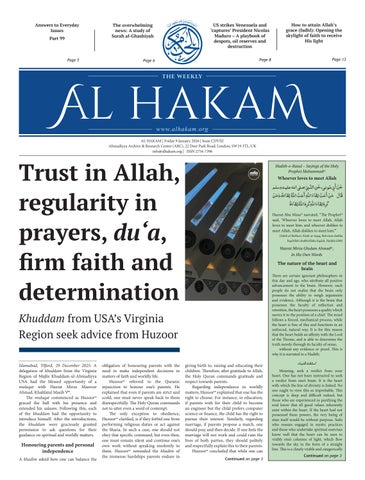
Trust in Allah, regularity in prayers, du‘a, firm faith and determination
Hadith-e-Rasul – Sayings of the Holy Prophet Muhammadsa
Whoever loves to meet Allah
َ� َ َ ُ َ ْ َ ِع ِِن،ۡوﺳَى اِلَن ِ� ِ�� ْصلَى الّٰلَہ ًعلَيﻪ َوﺳلﻢ ِعِن أ�ِۡی َم َ َ َ َ َ َ َ َ � � َ َ َ اء الّٰل َِہ أ َْح �ﺐ الّٰل َُہ ِل ِﻘ َ ال� ََم ِْن أ َْح �ﺐ ِل ِﻘ ََو ََم ِْن،اء ُٖہ ﻗ ُ َ َ ُ َ� َ َ َ� َ َ َ َ �ﻛ ِِرٖہ ِل ِﻘاء الّٰل َِہ ﻛ ِِرٖہ الّٰلَہ ِل ِﻘاءٖہ Hazrat Abu Musara narrated, “The Prophetsa said, ‘Whoever loves to meet Allah, Allah loves to meet him; and whoever dislikes to meet Allah, Allah dislikes to meet him.’” (Sahih al-Bukhari, Kitab ar-riqaq, Bab mun ahabba liqa’Allahi ahabbAllahu liqa’ah, Hadith 6508)
Hazrat Mirza Ghulam Ahmadas, In His Own Words
The nature of the heart and brain There are certain ignorant philosophers in this day and age, who attribute all positive advancement to the brain. However, such people do not realise that the brain only possesses the ability to weigh arguments and evidence. Although it is the brain that possesses the faculty of reflection and retention, the heart possesses a quality which moves it to the position of a chief. The mind follows a forced, mechanical process, while the heart is free of this and functions in an unforced, natural way. It is for this reason that the heart holds an affinity with the Lord of the Throne, and is able to determine the truth merely through its faculty of sense, without any evidence or proof. This is why it is narrated in a Hadith:
Khuddam from USA’s Virginia Region seek advice from Huzoor Islamabad, Tilford, 29 December 2025: A delegation of khuddam from the Virginia Region of Majlis Khuddam-ul-Ahmadiyya USA had the blessed opportunity of a mulaqat with Hazrat Mirza Masroor Ahmad, Khalifatul Masih Vaa. The mulaqat commenced as Huzooraa graced the hall with his presence and extended his salaam. Following this, each of the khuddam had the opportunity to introduce himself. After the introductions, the khuddam were graciously granted permission to ask questions for their guidance on spiritual and worldly matters.
Honouring parents and personal independence A khadim asked how one can balance the
obligation of honouring parents with the need to make independent decisions in matters of faith and worldly life. Huzooraa referred to the Quranic injunction to honour one’s parents. He explained that even if parents are strict and scold, one must never speak back to them disrespectfully. The Holy Quran commands not to utter even a word of contempt. The only exception to obedience, Huzooraa clarified, is if they forbid one from performing religious duties or act against the Sharia. In such a case, one should not obey that specific command, but even then, one must remain silent and continue one’s own work without speaking insolently to them. Huzooraa reminded the khadim of the immense hardships parents endure in
giving birth to, raising and educating their children. Therefore, after gratitude to Allah, the Holy Quran commands gratitude and respect towards parents. Regarding independence in worldly matters, Huzooraa explained that one has the right to choose. For instance, in education, if parents wish for their child to become an engineer but the child prefers computer science or finance, the child has the right to pursue their interest. Similarly, regarding marriage, if parents propose a match, one should pray and then decide. If one feels the marriage will not work and could ruin the lives of both parties, they should politely and respectfully explain this to their parents. Huzooraa concluded that while one can Continued on page 3
اۡسَتُفْت قَلَبَک Meaning, seek a verdict from your heart. One has not been instructed to seek a verdict from one’s brain. It is the heart with which the line of divinity is linked. No one ought to view this as improbable. This concept is deep and difficult indeed, but those who are experienced in purifying the soul know that all good values inherently exist within the heart. If the heart had not possessed these powers, the very being of man itself would be without purpose. Sufis who remain engaged in mystic practices and those who undertake spiritual exercises know well that the heart can be seen to visibly emit columns of light, which flow towards the sky in the form of a straight line. This is a clearly visible and categorically Continued on page 3
Friday 9 January 2026 | AL HAKAM
2
This Week in History A glimpse into the rich history of the Ahmadiyya Muslim Jamaat
9-15 January 9 January
10 - 11 January
9 January 1908:
10 January 1997:
On this day, Al Badr, published the glimpses of Jalsa Salana Qadian 1907, which proved to be the final Jalsa Salana in the blessed life of the Promised Messiahas.
On this day, Hazrat Khalifatul Masih IVrh delivered a Friday sermon at Masjid Fazl London, urging members of the Jamaat to offer special prayers in connection with Ramadan and Friday the 10th. He also issued a challenge to the opponents of the Jamaat, asking them to pray to Allah that whichever party is false and persists in falsehood, may the curse of Allah be upon them. (Khutbat-e-Tahir, Vol. 16, p. 19)
To read more about the engagements of this historic gathering, see “The first and last Jalsa Salanas in the time of the Promised Messiah” at alhakam.org (25 December 2020, pp. 15-17). 9 January 1970: On this day, while delivering his Friday sermon, Hazrat Khalifatul Masih IIIrh expressed his desire for the Jamaat to establish a state-ofthe-art printing press and a radio station. (Khutbat-e-Nasir, Vol. 4, pp. 11-29) 9 January 2015: During his Friday sermon on this day, Hazrat Khalifatul Masih Vaa categorically condemned the Charlie Hebdo attacks that had taken place in France and prayed for peace in the world. To read this press release, see: ‘‘Head of Ahmadiyya Muslim Community condemns Terrorist Attacks in France,’’ www. pressahmadiyya.com)
11 January 1935: During his Friday sermon on this day, Hazrat Khalifatul Masih IIra urged the Ahmadi youth – particularly the students of Madrasa-e-Ahmadiyya and Jamia Ahmadiyya – to make a habit of reading newspapers. Huzoorra said that the Promised Messiahas would also read newspapers regularly, and he then mentioned his routine of reading some newspapers before going to sleep. Huzoorra continued by saying that reading newspapers was essential for effective tabligh – preaching. (Khutbat-e-Mahmud, Vol. 16, pp. 36-37)
12 - 13 January
into the Punjab Disturbances, which were caused by agitations against the Jamaat. On this date, Huzoor’sra statement started being recorded, which was completed by 15 January. This statement was transcribed by the court in English, while its Urdu text can be read in Tarikh-e-Ahmadiyyat, volume 15 (pp. 371-413). 13 January 2003: On this day, Hazrat Khalifatul Masih IVrh encouraged Ahmadis to visit African countries and meet with new converts during a meeting with French-speaking members, broadcast on MTA. (Silsila Ahmadiyya, Vol. 4, p. 916)
14 January 14 January 1906: The Promised Messiahas received the following revelations on this day: “I shall die in Mecca or in Medina.” ((Tadhkirah, 2009, p. 784) To learn the meaning of demise in Mecca or Medina, see: ‘‘Prophecies of the Promised Messiah a.s. – Demise in Mecca or Medina: A legacy fulfilled’’ at www.alhakam.org (1 November 2019, pp. 10-11). 14 January 1929:
12 January 1889: The Promised Messiahas laid out the ten conditions of bai‘at, on this day. These conditions are also elucidated by Hazrat Khalifatul Masih Vaa on different occasions. These conditions are the lifeline of an Ahmadi Muslim; they are the code of conduct and the path to victory over the evils of this world. To read the text of these explanations, see: new.alislam.org. 13 January 1954: Hazrat Musleh-e-Maud went to Lahore, where a court of inquiry was established to look ra
On this day, Hazrat Khalifatul Masih IIra was in Lahore, In the first part of the day, Sir Geoffrey Fitzhervey de Montmorency, Governor of Punjab, met with Hazrat Khalifatul Masihra. After this meeting, Huzoorra proceeded to the Ahmadiyya Mosque located outside Delhi Gate, Lahore, and delivered a speech of approximately one hour on the insights of the Holy Quran. The aforementioned governor of Punjab was highly impressed with the educational progress of the Ahmadiyya Jamaat. Consequently, either during this meeting or on
another occasion, he remarked: “A Community that is relatively small in number and has limited financial resources has achieved remarkable progress in the field of education. This, in itself, is an astonishing example for the entire Muslim Ummah as a collective. I do not have sufficient words to express my admiration for those who have led this great movement and for those who have supported and assisted it.” (Tarikh-eAhmadiyyat, Vol. 5, p. 124)
15 January 15 January 1931: Friedrich Wagner, a German Christian, visited Qadian on 29 November 1930 and remained there till 15 January in 1931. During his stay in Qadian, he was fortunate enough to attend the Jalsa Salana and had the opportunity to meet with Hazrat Musleh-e-Maudra on various occasions. To read more about his stay and comments, see: ‘‘Coming from every distant track – Qadian is ‘a centre of peace’: Friedrich Wagner, a German Christian, visits Qadian’’ at www.alhakam.org (29 April 2022, p. 9-11). 15 January 1934: The 1934 Nepal-Bihar earthquake was one of the worst earthquakes in the history of Nepal and Bihar, India. This 8.0 magnitude earthquake occurred on this day at 2:28 pm and caused widespread damage in northern Bihar and Nepal. Hazrat Mirza Bashir Ahmadra wrote an article about this sad calamity, highlighting the scores of prophecies about heavenly signs in favour of the Promised Messiah’sas claims. The Jamaat took part in humanitarian efforts conducted after the earthquake. (Tarikh-eAhmadiyyat, Vol. 6, pp. 174-176)
AL HAKAM | Friday 9 January 2026 Continued from page 1 established phenomenon. I cannot explain this with any specific examples, but indeed, those who have had to engage in exercises in spirituality, or who have sought to traverse the stages of the spiritual quest, have found this spectacle and experience to be true. It is as though a thin line exists between the heart and the throne of God, and the heart experiences a pleasure in whatever command it receives from the Lord’s throne. The heart is not in need of external evidence or proofs; in fact, it receives revelation from God and is enlightened by God from within, whereafter it gives a verdict. It is a fact, however, that until a heart becomes a heart in the true sense, it may be aptly described by the following verse:
َ َ ُ َ َ� ُ َ َ� ُ ۡ َ� ۡلَۡوۡ ﻛَنا َّن َۡس ََمﻊ ا ُۡو � َۡع ِِق ُۡل ََما ﻛَنا ِف ِ ۡیۤ ا ِۡص ُٰح ٌِب ا ِ��ۡلَس َِع
If we had but listened or possessed sense, we should not have been among the inmates of the blazing Fire. To further explain, man experiences a time when both the heart and mind do not possess any faculties or powers at all. Then a time comes when the brain begins to grow and develop. Then a stage arrives when the faculties and powers of the heart are developed, after which the heart becomes enlightened, ignited and il- luminated. When the heart arrives at this point, a human being reaches the stage of spiritual maturity, and the brain becomes subservient to the heart, and the faculties of the mind no longer control the qualities and faculties of the heart. It should also be remembered that these various states of the mind are not specific to believers alone. Hindus and people from among the scheduled classes all make use of the brain. Moreover, those who are engaged in worldly affairs and business, all make use of their brains. The mental faculties of such people have grown and developed fully, and it is through these faculties that they come up with new and innovative ideas to further their business. Look at Europe and the New World, and you will see how its people make use of their mental faculties, and the pace at which they invent new technologies. The work of the heart begins when a person becomes devoted to God. At such a time, all the inner faculties and authorities of man cease to exist and the rule of the heart gains a power and strength. It is then that a human being may be deemed complete. It is this very state in which a human being becomes an embodiment of the verse:
ۡ ََ ُ �ُفﺨ ُْت َفِ َۡی ِٖہ َِم ۡۡن �َّر ُۡو�ِ َۡی
I have breathed into him of My Spirit. It is in this very state that even the angels prostrate before such a person. At this time, the individual in question becomes a new person altogether, and their soul becomes fully absorbed in pleasure and joy. It must also be remembered that this pleasure cannot be likened to the pleasure that an impulsive evil-doer feels in fornication, or to the enjoyment that an admirer of good voices experiences on hearing a melodious person sing—not in the least; one must not be deceived. The soul experiences pleasure when a human being melts and begins to flow towards God in the likeness of water, due to fear and awe of Him. At this stage, the person in question becomes the ‘Word of God’ and the following verse begins to show its effects in them:
ُ َ ُ ُ َ� َ ً َ َ ۤ َ ۤ َ ۤ َ� ِاَّن ََما ا َۡمُرُ ٌٗہ ِاَذا ا ََّر َاِد ِش َۡیَئا ا َّۡن ُیِقۡوۡ َِل ۡل َ ٖٗہ ﻛ ۡۡن َف ََیُکۡوۡ َُّن
Verily His command, when He intends a thing, is only that He says to it, ‘Be!,’ and it is. (Malfuzat [English], Vol. 2, pp.119-121)
3
Welcoming the New Year with prayers for Aseeran-e-Rah-e-Maula During his Friday sermon, delivered on 2 January 2026, Hazrat Mirza Masroor Ahmad, Khalifatul Masih Vaa, welcomed the New Year by emphasising the need for spiritual reflection and a deeper love for Allah the Almighty. He called upon the Jamaat to intensify their prayers, especially for the release of those unjustly imprisoned for Allah’s sake and for all the oppressed across the world. He said: “As people know, the new year [2026] began yesterday and people are congratulating one another. Pray that this year becomes a year of countless blessings for us. May Allah the Almighty bring the plans of opponents and enemies to nothing Continued from page 1
make independent decisions within the bounds of Islamic teachings, the manner of addressing parents must always be filled with dignity, respect and politeness.
Balancing secular education with religious study A khadim sought guidance on how to manage reading Jamaat books alongside his secular studies and which should be prioritised. Huzooraa broke down the 24 hours of a day to illustrate that time management is entirely possible. He calculated that if one allocates six hours for sleep, two hours for meals and two hours for offering the five daily prayers with due attention, this amounts to 10 hours. Huzooraa noted that even with a one-hour commute and six hours spent at university, followed by two to three hours of study at home, a person is still left with approximately four hours of free time. Huzooraa asked if it was not possible to set aside even one hour from this remaining time for religious knowledge. Huzooraa advised the khadim to recite at least three or four rukus of the Holy Quran after the Fajr prayer on time. If time permits, he should spend 15 to 20 minutes reading religious literature then; otherwise, he should make it a habit to read for half an hour before going to sleep. This could include books of the Promised Messiahas, Hadith or the commentary of the Holy Quran. Huzooraa remarked that if one claims they are too tired from their secular studies to read religious books, it implies that their preference is the world rather than faith. He reminded the khadim of his recent sermons emphasising the importance of setting priorities. To regulate one’s life, Huzooraa advised creating a proper chart or planner. Even dedicating a small amount of time daily will gradually develop an interest. Furthermore, weekends offer additional time where one can dedicate a couple of hours to studying Jamaat literature.
and bestow upon the Jamaat even greater progress than before. “Those of us who live abroad – especially in free countries – are free and are partaking in the joys of the new year; indeed, people are celebrating even in Pakistan and elsewhere. At such a time, remember our imprisoned brothers in your prayers as well. In Pakistan’s prisons – as I mentioned in recent days – there is Mubarak Sani Sahib, who has been sentenced to life imprisonment and there are other detainees too, who are in the state of incarceration. Even in this condition, they are entering the new year while thanking Allah the Almighty; they have no complaint. For the sake of Allah
the Almighty’s pleasure, they have worn iron ‘bangles’. May Allah the Almighty soon create the means for their release. “May Allah grant us and these prisoners and all those Ahmadis who are unjustly detained in hardship, an even greater realisation of the love of Allah the Almighty than before. May it be that, rather than our love for Allah the Almighty diminishing because of hardships, it increases even more than before. “Pray for the oppressed as well. May Allah the Almighty deliver all the oppressed of the world from the clutches of the oppressors and may peace be established in the world. [Amin]”
Serving the Jamaat through history
Dignity in labour
A khadim mentioned his interest in history and asked how he could use this interest to serve the Jamaat. Huzooraa appreciated the subject, noting that a good grasp of history allows one to serve the Jamaat effectively. He advised the khadim to study Islamic history and conduct research in archaeology. History is an interesting subject that connects one to the past, the advent of Islam, Muslim periods, kings, conquerors and the history of Khilafat. Alongside general Islamic history, Huzooraa advised him to learn the history of the Ahmadiyya Muslim Jamaat (Tarikh-e-Ahmadiyyat), reading whatever is available in English.
The legacy of a devoted lifedevotee A khadim, who is the grandson of the late Maulana Attaullah Kaleem Sahib, asked Huzooraa to share a memory of his grandfather and sought advice on how to follow in his footsteps as a devoted servant of Islam Ahmadiyyat. Huzooraa stated that although he did not work directly with Maulana Attaullah Kaleem Sahib – as he had already left Ghana when Huzooraa arrived – he had heard and seen that he was a deeply devoted waqif-ezindagi. He served with great dedication in Ghana, Germany and everywhere he was posted. Huzooraa highlighted that Maulana Attaullah Kaleem Sahib was regular in Tahajjud and would pray fervently for the Jamaat, the people and his work. He possessed a firm belief and sincerity. Huzooraa noted that despite the deteriorating economic conditions in Ghana at the time, he never complained and always spoke with a smile, placing his complete trust in Allah. This trust and dedication are the reasons for the blessings seen in his progeny today. Huzooraa advised the khadim that if he wishes to follow in those footsteps, he must cultivate trust in Allah, regularity in salat, du‘a, firm faith and determination.
The Regional Nazim Waqar-e-Amal asked how to instil the spirit of waqar-e-amal (dignity of labour) in khuddam who try to avoid hard labour or tasks that might dirty their hands. Huzooraa pointed out that the very English translation of the department is “Dignity of Labour.” He advised the nazim to tell the khuddam that this work is their dignity. The Holy Prophetsa was the most refined and cleanliness-loving person, yet when the situation demanded, he performed hard labour. Huzooraa gave the example of one of the battles, where the Holy Prophetsa dug the trench and carried stones alongside his Companions to the extent that his body and hair were covered in dust. (Sahih alBukhari, Hadith 2837) Huzooraa stated that if the Holy Prophetsa could do this, then who are we to shy away? As Muslims, we must follow his blessed example. Such work brings honour and earns reward from Allah and the physical exertion is also good for one’s health.
The character of an Ahmadi doctor A student who intends to become a doctor asked for guidance on how to maintain a strong bond with Allah alongside professional success. Huzooraa stated that there are many Ahmadi doctors who are exemplary in their prayers and Tahajjud while also serving the faith. He gave the example of Hazrat Dr Syed Abdus Sattar Shahra, the maternal grandfather of Hazrat Khalifatul Masih IVrh, who was a Companion of the Promised Messiahas. He would preach the message of Islam Ahmadiyyat while working at the hospital. Huzooraa narrated an incident where Dr Sahibra was preaching in his area when a man, in a fit of rage, threw a heavy clay pot at him, breaking his head. Dr Sahibra went to the hospital, had his wound dressed and returned. He found the man waiting, apologising profusely and fearing police action. Dr Sahibra forgave him immediately and invited him to listen to the message. The man was so moved by this high moral character that he accepted Ahmadiyyat,
Friday 9 January 2026 | AL HAKAM
4
saying that the display of character had proved the truth of the Jamaat to him. Huzooraa also mentioned Hazrat Dr Khalifa Rashid-ud-Dinra, another Companion and a civil surgeon. Despite a high salary for that time, he would donate generously whenever the Promised Messiahas made an appeal for funds to publish literature, often sacrificing his own needs for the sake of the faith. Huzoorra then gave a similar example of Hazrat Khalifatul Masih Ira, who generously served both the faith and the poor patients who visited him. Huzooraa advised the khadim that a doctor should be humble and polite. A doctor’s kind and smiling demeanour is half the cure, whereas an intimidating attitude can worsen the patient’s condition. He instructed him to treat poor patients with special care and compassion, while charging fees from those who can afford it. This behaviour constitutes silent tabligh, which pleases Allah and serves humanity.
Raising a voice against political injustice A khadim asked how one can raise a voice against political injustice and support human rights globally. Huzooraa replied that we must do whatever is within our reach. Huzooraa mentioned that he speaks on these matters
wherever he has the opportunity, such as during his address at Capitol Hill in the USA. He recalled that a senator later admitted to him that while Huzoor’saa words were true and appealing, they could not act upon them due to vested political interests. Huzooraa noted that powerful lobbies and financial investments currently drive policy. He mentioned how certain groups invest heavily to invite politicians and professionals to specific countries to sway their opinions. In the face of this, true justice cannot be established easily. However, Ahmadis must continue to raise their voices for absolute justice and equality, demanding that double standards be abandoned. One should strive to promote these values within their own environment and circle of influence as much as possible.
Addressing Shia objections regarding Khilafat A khadim sought guidance regarding the Shia view that gives preference to the Ahl-eBait (family of the Holy Prophetsa) over the institution of Khilafat. Huzooraa explained that the divergence goes deep, with some extreme groups even holding incorrect views regarding the transmission of Prophethood. Regarding the Khulafa-e-Rashideen (i.e., the Rightly Guided Caliphs), Ahmadi Muslims believe that Hazrat Abu Bakrra, Hazrat Umarra and
Hazrat Uthmanra were equally rightful Khulafa, contrary to the Shia view that Khilafat should have gone directly to Hazrat Alira. This dissension was started by rebels and mischief-makers. Huzooraa affirmed that we hold all four Rightly Guided Khulafa in high esteem and also revere Imam Hassanra and Imam Hussainra. The Promised Messiahas condemned the cruelty of Yazid against the Prophet’ssa grandson, calling him “Yazid the wretched” [paleed], but this does not invalidate the status of the first three Khulafa. Huzooraa advised reading the books Islam Mein Ikhtalafat Ka Aghaz [The Outset of Dissension in Islam] and Khilafat-e-‘Alawi Ke Waqi‘aat [Jang-e-Jamal: The Battle of the Camel] by Hazrat Musleh-e-Maudra to understand the basics of the history of these conflicts. He also َ noted that the Quranic َ �ٰ َ verse “( ”َلا َت ۡۡح ََز ۡۡن ِا �َِّن الّٰل ََہ ََم ََع ََناGrieve not, for Allah is with us. [Surah at-Taubah, Ch.9: V.40]) refers to Hazrat Abu Bakrra accompanying the Holy Prophetsa in the cave, serving as a powerful argument for his status. One can explain these points gently to those who are willing to listen.
Becoming an exemplary role model A khadim asked how Ahmadis can become excellent role models for the world so that
others are inspired to follow them. Huzooraa began with a humorous anecdote about a man who listened to the entire story of Yusufas and Zulaikha all night, only to ask in the morning if Zulaikha was a man or a woman. Huzooraa remarked that he has been answering this very question in his sermons for years: the way to become a role model is to act upon the Conditions of Bai‘at. Huzooraa stated that many people write to him saying they accepted Ahmadiyyat not by reading literature initially, but by observing the high moral conduct of Ahmadis. The Promised Messiahas emphasised that mere words are of no value without action. Huzooraa gave an example of a cleric who delivered a fiery sermon on sacrifice. When his wife, moved by the speech, offered her gold bangles, the cleric refused to give them, admitting his speech was for others, not for himself. Such hypocrisy has no effect. To inspire the world, Ahmadis must ensure their actions match their words and show practical examples of sacrifice and high morals. The mulaqat concluded with the khuddam having the honour of a group photograph with Huzooraa and each attendee was graciously gifted a pen. (Summary prepared by Al Hakam)
NEWS 38th West Coast Jalsa Salana held in USA Ahsan Mahmood Khan Afsar Jalsa Gah The 38th West Coast Jalsa Salana USA was held on 26-28 December 2025, at the Baitul Hameed Mosque in Chino, California, located approximately 30 miles east of Los Angeles. Nearly 2,300 Ahmadi Muslims from across the country, primarily representing the 11 chapters of the Western States, attended this annual gathering. This year marked the highest attendance in the history of the West Coast Jalsa Salana. The theme of the 2025 Jalsa Salana was “Wahdaniyyat – The Oneness of God,” emphasising the unity of Allah in all aspects of a Muslim’s life. After the flag-hoisting ceremony, the Jalsa Salana formally commenced. Dr Sahibzada Mirza Maghfoor Ahmad, Amir Jamaat USA, delivered the opening address and emphasised the recognition of the Oneness of Allah as the foundation of Islamic belief. This was followed by a speech on “The Holy Prophet Muhammadsa: A Life Devoted to Tawhid”, by Faran Rabbani Sahib. Anwer Mahmood Khan Sahib, Naib Amir Jamaat USA, then spoke on “The Strength of the Nizam (system) of the Jamaat.” The Saturday morning sessions covered a wide range of topics, including “Allah as the One True Friend in the Age of Digital Illusions” by Qasid Sadiq Sahib; “The Importance of Congregational Salat” by
Zakaria Sayed Sahib; “The Sacrifices of the Youth in Upholding God’s Unity” by Intisar Malhi Sahib and a biographical address on Hazrat Maulvi Ghulam Rasul Rajekira, delivered by Anas Chaudry Sahib. This year’s Jalsa included an additional combined afternoon session for men and women – with arrangements of purdah – featuring two addresses: “Unity Cannot Exist without Purity of Heart” by Ahmad Salman Khurshid Sahib and “When the World Becomes an Idol – Lessons for a Muwahhid” by Usman Jamil Sahib. The evening guest session welcomed nearly 100 non-Ahmadi guests, including local and state government officials, members of law enforcement, professors, university students and representatives of interfaith congregations. A presentation, “Teachings from the Holy Quran on Peace and Unity”, was delivered by Abdul Lateef Balanta Sahib, National Secretary NauMubai‘een. Several dignitaries also gave brief remarks, with the session moderated by Amjad Mahmood Khan Sahib, National Public Affairs Secretary. This session also featured a special presentation of the “Jalsa Cares” service initiative in partnership with the local food donation non-profit God’s Pantry, recognising the organisers for their service. Volunteers from the Jamaat assisted with food packaging the day prior to the start of Jalsa. Guests later enjoyed dinner at Zahir Basketball Court, toured the Voices
for Peace exhibition and participated in interviews conducted by MTA USA. The ladies’ separate session also had speeches, including “Unity of God and High Moral Values” by Amtul Rehman Ahmed Sahiba, “Carrying the Torch of Islam to the Corners of the Earth” by Nicole Williams Sahiba, “An Ahmadi Woman – A Guardian of Faith for the Next Generation” by Misbah Rashid Amjad Sahiba and “Khilafat – Empowering Ahmadi Women” by Daniya Chowdhury Sahiba. A message from Sadr Lajna Imaillah USA, Dhiya Bakr Sahiba, was then read out by Naib Sadr Lajna USA, Aziza Rahman Sahiba, to close the session. The closing session on Sunday included an Urdu address by Musa Chaudhry Sahib on “Practising One’s Faith as a Means of Tabligh.” Naib Amir Jamaat USA, Bilal Rana Sahib, followed with a speech on “Khilafat – The Living Reflection of Divine Unity.” Missionary-In-Charge, Azhar Haneef Sahib, then delivered an address entitled “Zikre-Habib, Ta‘alluq Billah – The Promised Messiah’s Relationship with Allah.” The highlight of this Jalsa Salana was the closing address of Jalsa Salana Qadian, delivered by Hazrat Khalifatul Masih Vaa, which was recorded earlier in the day and presented during the closing session. The Jalsa Salana concluded with a silent prayer, led by Amir Jamaat USA. MTA USA conducted live on-site interviews, both roaming and in the studio, throughout the
Jalsa. The entire event was live-streamed on YouTube and the official Jalsa Salana website. Live translations in Spanish, Urdu and Pashto were provided for all sessions. Additional programmes were organised by the Waqf-e-Nau and Sanat-o-Tijarat Departments, along with the Ahmadiyya Muslim Medical Association. An Amin ceremony, formally recognising the completion of the first reading of the Holy Quran, was conducted by the National Talim-ul-Quran Department, with several boys and girls participating. The National Rishta Nata Department once again hosted a Meet and Greet programme to facilitate family introductions, with several families introduced over the three days. Majlis Khuddam-ul-Ahmadiyya USA hosted the MKA Hub, providing games, food and inspirational talks for members, while a Lajna Hub and Nasirat Hub were similarly arranged on the ladies’ side. The handicraft and snack stalls were also arranged on the ladies’ side for the National Lajna Conference Center fundraising. The Jalsa also featured a bookstall showcasing the latest Jamaat publications and a stall hosted by Humanity First USA. The 2025 Jalsa Salana welcomed 123 international guests, 77 non-Ahmadi guests and representation from 13 countries. Four newspapers covered the Jalsa and published news reports.
AL HAKAM | Friday 9 January 2026
5
Answers to Everyday Issues
Part 99
Tattoos, music in religious videos, qasr of salat, rape and adultery Guidance regarding basic Islamic issues that Hazrat Amirul Momineen, Khalifatul Masih Vaa, has given on various occasions in his written correspondence and during MTA programmes is being published officially below for everyone’s benefit. Is getting a tattoo haram in Islam? Someone from Türkiye asked Hazrat Amirul Momineen, Khalifatul Masih Vaa, whether getting a tattoo is haram. He also asked whether it is permissible to include photographs of the Promised Messiahas and his Khulafa in videos that also feature music. Huzoor-e-Anwaraa, in his letter dated 12 October 2023, provided the following guidance regarding this matter: “To make or get a tattoo is not permissible. It has been prohibited in ahadith, where Allah the Exalted has condemned, in very strong terms, those who practise tattooing and those who get themselves tattooed for the sake of beauty. (Sahih al-Bukhari, Kitab al-libas, Bab almutafallijati li l-husn) “The objective behind getting a tattoo is to show it off or to beguile the opposite sex in an impermissible manner. That is why people usually get tattoos on body parts that they may then expose and exhibit to the public. However, even if someone gets a tattoo on parts of the body that must be covered, the mindset behind it is the same: to display the tattoos made on these hidden parts to the opposite gender at the time of committing evil deeds and immorality. Both of these methods are impermissible, as they are contrary to Islamic teachings. “Furthermore, tattoos have also been linked to a host of physical and health issues. For instance, the sweat glands under the skin are badly affected in the areas of the body that have tattoos; that is, having a tattoo reduces the sweating in the concerned parts of the body, which is harmful to one’s health. Similarly, since tattoos become permanent features on the skin, sometimes as the body grows or shrinks, so does the shape of the tattoo, which makes the tattoo look ugly instead of ‘beautiful’. Then such individuals begin to think of them as a plague that they cannot get rid of. Thus, for these reasons alone, it is futile and absurd to get a tattoo.”
Can we use photos of the Promised Messiah or his Khulafa in videos with music? “The answer to your second question is that it is absolutely not permitted to include photographs of the Promised Messiahas or his Khulafa in videos where music, etc., is playing. Music is considered among vain or laghw things and Allah the Exalted mentions in the Holy Quran as a sign of the believers that they shun vain acts and frivolous matters (Surah al-Mu’minun, Ch.23: V.4) Thus, how can it be permissible to mix something good with something vain?”
Should one perform qasr prayer when visiting one’s son’s or parents’ house? Someone from Germany wrote to Hazrat Amirul Momineen, Khalifatul Masih Vaa, stating: “I live in a city in Germany and one of my sons has a home in another city. When I visit that son’s home, should I shorten [qasr] the salat and when my son visits my home, should he offer the full salat or shorten it?” Huzoor-e-Anwaraa, in his letter dated 14 October 2023, replied to this question as follows: “In my view, these are one’s own homes; there is no need to shorten the salat in them. However, as you have written that you have a separate home and your son also has a separate home, in such a situation, according to some Islamic jurists, a person would be considered a traveller and would shorten the salat. Whereas, according to the Ahmadiyya jurisprudence, in such a case, a person has the choice to either shorten the salat or offer it in full. Accordingly, it is written in Fiqh-eAhmadiyya that if a person is staying at the home of such a relative, which he considers his own home – such as the parents’ home, the in-laws’ home, or a religious centre like Mecca, Medina, Qadian, Rabwah, etc. – then during a stay of less than 15 days, he may
choose to avail himself of this concession and offer two rak‘ats, or he may choose to offer the full salat, i.e., four rak‘ats. (Fiqh-eAhmadiyya, ‘Ibadaat, p. 189)” […]
What is the punishment for adultery in Islam? Someone wrote to Hazrat Amirul Momineen, Khalifatul Masih Vaa, asking whether the punishment for adultery [zina] mentioned in the Holy Quran is only for premarital intercourse, or if the same punishment applies if a man or woman commits adultery with someone other than their spouse during marriage. Furthermore, if the one who committed adultery realises their sin, can they hope that Allah will forgive them? Huzoor-e-Anwaraa, in his letter dated 16 October 2023, provided the following guidance regarding this issue: “Where the punishment for adultery is mentioned in the Holy Quran, no such distinction has been made as to whether this punishment is for premarital adultery or for adultery committed after marriage. Rather, the punishment for adultery has been stated generally: that whether the adulterer is a man or a woman, when their sin is proven through four witnesses in accordance with the conditions of testimony established
by Islam, they should be administered 100 lashes. Regarding the punishment for adultery, Hazrat Khalifatul Masih Ira states: “‘When the charge of adultery is proven against a man and a woman, their punishment is that the man should be given 100 lashes and the woman should also be given 100 lashes.’ (Haqaiq-ul-Furqan, Vol. 3, p. 200) “Hazrat Musleh-e-Maudra states with reference to verse 3 of Surah an-Nur: “‘It is manifestly proven from this verse of the Holy Quran that the punishment for an adulterous man and an adulterous woman is 100 lashes.’ (Tafsir-e-Kabir, Vol. 8, UK, 2023, p. 423) “Thus, whether a person is married or unmarried, when they commit a heinous act like adultery, in both cases, their punishment is 100 lashes. However, this punishment is for such a habitual criminal who has become so involved in this evil that there exist witnesses against him, for whose testimony Islam has set extremely strict conditions (Sunan Abi Dawud, Kitab al-hudud, Bab fi rajmi l-yahudiyyain); or [it is for one who] commits this lewd act so publicly as to outrage public decency and thus encourages its spread in society. Accordingly, explaining this matter with reference to verse 3 of Surah an-Nur, Hazrat Musleh-e-Maudra states:
Friday 9 January 2026 | AL HAKAM
6
“Thus, by al-zaniyah and al-zani, a perfect [complete] adulterer is meant, who is either habitual in adultery or has become so fearless that he commits this act openly or is muhsan, i.e., married, or elderly and yet commits adultery. Regarding all such people, the Holy Quran states the same: Upon their crime being proven, administer 100 lashes to them.” (Tafsir-e-Kabir, Vol. 8, UK, 2023, p. 435) “The answer to your second question is that in the Holy Quran and the ahadith of the Holy Prophetsa, there is abundant mention of God Almighty’s mercy with reference to His attributes of Rahman [Gracious], Rahim [Merciful], ’Afuww [The Effacer of Sins], Ghafoor [Most Forgiving], Ghafir [Forgiver] and at-Tawwab [Oft-Returning with Compassion], etc. Just as Allah the Exalted states in the Holy Quran: ‘O ye who believe! Turn to Allah in sincere repentance. It may be that your Lord will remove the evil [consequences] of your deeds and make you enter Gardens through which rivers flow.’ (Surah at-Tahrim, Ch.66: V.9) Similarly, the Holy Prophetsa stated that the one who sincerely repents after committing a sin is like one who has not committed the sin at all. (Sunan Ibn Majah, Kitab az-zuhd, Bab zikri t-tawbah) “Hazrat Ubadah bin Samitra narrates that, ‘On one occasion, the Holy Prophetsa said to the Companions present around him: ‘Take a pledge of allegiance with me that you will not associate anything with Allah, will not commit theft, will not commit adultery, will not kill your children, will not bring any calumny which you have deliberately forged and will not disobey in any good matter. Thus, whoever among you fulfils [this pledge], his reward is with Allah; and whoever becomes involved in any of these [evils] and receives its punishment in this world, that punishment will be an expiation [kaffarah] for him. And whoever becomes involved in any of these [evils] and Allah veils his sin in this world, then his matter is with Allah; He may forgive him if He wills, or punish him if He wills.’’ (Hazrat Ubadah bin Samitra says,) ‘So we all pledged allegiance to the Holy Prophetsa on these matters.’ (Sahih al-Bukhari, Kitab al-iman, Bab ‘alamati l-imani hubbu l-’ansar) “Thus, when Allah the Almighty, Who is the Master of everything, continues to overlook the sins of His weak servants, if any party among a husband and wife falls prey to such an evil and subsequently repents – and they are granted sincere repentance such that they never turn back to this evil again – then the other party should also overlook the one who has repented and leave the matter to Allah the Almighty.” [Note: The above response is provided for theological understanding only and is not legal advice. It must not be construed as endorsing any private enforcement, accusation, coercion or punishment, nor as encouraging conduct contrary to the laws of the land. Any discussion of prescribed punishments in classical Islamic law pertains to lawful judicial authority and due process, not individual action. —Editor, Al Hakam] (Compiled by Zaheer Ahmad Khan, Head of Records Department, Private Secretariat, London and translated by Al Hakam)
The overwhelming news: A study of Surah al-Ghashiyah Jalees Ahmad Al Hakam Surah al-Ghashiyah – chapter 88 of the Holy Quran – is, like many of the surahs in part 30 of the Quran, a warning and bearer of good news. It was one of the Holy Prophet’ssa favourite surahs to recite often, especially during Friday prayers and Eid prayers, which shows he desired for it to remain present in the minds of Muslims. This fact alone stresses its importance. One of the most striking verses in it is: “Admonish, therefore, for thou art but an admonisher.” (Surah al-Ghashiyah, Ch.88: V.22) The lessons of this surah, and the message it holds, are ones we should always hold present in our minds. From the style of its words and language, to its description of the two categories of people, to the warnings of Hell and the promises of Paradise, this is truly a chapter every Muslim must memorise and remember. Just as this surah opens with a question, I would also like to begin this article with a question, or rather, a reminder. Though we recite this surah from time to time, have we truly paused to reflect on the depth of its meaning?
Has the news reached you? A reminder, not an inquiry The chapter begins with a strong question:
َۡ ُ َ َٰ َ اِش ََی ِِۃ ِ َہ ۡۡل َاٰتَک ََح ِِدۡیُۡث اۡلَغ
“Has there come to thee the news of the overwhelming [calamity]?” (88:2) When we ask a question, it’s usually because we don’t know the answer; however, when God asks a question, it’s not because He needs an answer. In fact, He is reminding us. It’s a divine rhetorical question meant to grab attention and awaken the listener. Hazrat Musleh-e-Maudra has stated that when the word hal comes before a verb, it often carries the meaning of qad (which means indeed/surely), though generally it is used for asking a question that expects an affirmative answer. So usually hal introduces a question where the expected reply is confirmation, unless it is followed by illaa, in which case it conveys negation. Therefore, the verse can mean: “Has the news of the overwhelming event come to you?” And in this case, implying: Yes, it has come. (Tafsir-e-Kabir, 2023, Vol.12, p.101)
What is the meaning of ghashiyah?
َ The root of ghashiyah (اِش ََية ِ )َغis the Arabic َ verb ( َغ ِِش ََىgha-shi-ya), meaning to cover or to overwhelm. In the Holy Quran, aُ similar َ َ َ word appears in the verse: ََوِاَِذا َغ ِِش ََیُہ ۡۡم �َّم ۡۡو ٌٌج meaning, “And when waves engulf them” (Surah Luqman, Ch.31: V.33). Further, the ٌ َ َ word اَوٌۃ ِِغَشhas appeared in the Holy Quran, meaning “covering”. And in the context, it
means “Allah has set a seal on their hearts and their ears, and over their eyes is a covering” (Surah al-Baqarah, Ch.2: V.8), referring to something that conceals or envelops. Thus, al-Ghashiyah describes the Day of Judgement as an event that will cover and overwhelm everyone. As we further read this surah, God then divides mankind into two groups: (1) the losers, those whose faces shall be humiliated, and (2) the blessed, those whose faces are bright and joyful.
Who are the first category of people? This group is described as having downcast faces, their worldly efforts wasted. The surah then details their punishment, including the food and drink they will receive in Hell. (i) Downcast faces
ٌ َ َ ۡ َ� ٌ ۡ ُ ُ اِش ََعٌۃ ِ ُوُجۡوٌہ َّیۡوَم ِِئ ٍٍذ َخ
“[Some] faces on that day will be downcast” (88:3). The word used for faces in this verse is wujuh, which is the plural of wajh, meaning “face”. The description of people through their faces paints a vivid image. Our faces reflect our inner state; fear, sadness, joy, or peace are all visible on our faces. Allah says some faces will be khashi‘ah, meaning downcast, humbled, still, or subdued. (See: Dictionary of the Holy Quran, p. 232) Interestingly, the word khashi‘ah is from the same root as khushu, which we often use when speaking about prayer. The root conveys humility, stillness, and being subdued. In a positive sense, khushu refers to calm, humble devotion in prayer. However, here, khashi‘ah describes faces humbled and drained out of terror; faces
NEWS Health seminar held in Bondoukou, Ivory Coast Shahid Ahmad Masud Regional Missionary, Ivory Coast On 6 December 2025, Jamaat-e-Ahmadiyya Bondoukou, Ivory Coast, held its second health seminar at the regional library of Bondoukou. The seminar was attended by 50 people, including non-Ahmadis. Dr Coulibaly Ahmad, a gastroenterologist, was invited as a special guest from the University Hospital Centre
of Cocody, Abidjan. The seminar started with a recitation from the Holy Quran and after this, Dr Coulibaly Ahmad explained in detail about recommended practices during the month of Ramadan and gave a dietary chart to participants, which is beneficial in daily life. A question-and-answer session was held at the end. The seminar concluded with sa ilent prayer.
Interfaith symposium held by Lajna Imaillah Bradford East, Canada Durr-E-Rehman Student, Aisha Academy Canada On 23 November 2025, Lajna Imaillah Bradford East, Canada, held an Interfaith Symposium. The event united representatives from Judaism, Christianity and Islam to discuss the theme, “The Coming of the Messiah.”
The event began with a recitation from the Holy Quran. The speakers expressed thoughts on the common themes of mercy, guidance and moral reform found in all faiths. This inspired attendees to seek interfaith understanding, harmony and our collective efforts toward a more compassionate and spiritually conscious world.
AL HAKAM | Friday 9 January 2026 frozen by fear and despair. When someone experiences intense trauma, their expression collapses, leaving the face motionless and empty. Hazrat Musleh-e-Maudra gave the َ ُ َ َ َ َ example of: َخَشَع َل ٗٗہ ُخَش ْْو ًًعا, which means: “he became subdued before it”, “he was َ َ َ humbled”, or “he was forced to bow.” َخَشَع َ َ ـِر ٖٖہ ِ ِبَِبَصmeans: “he lowered his gaze”, or “his eyes fell in humiliation”, i.e., out of disgrace, he could not raise his eyes. ُ َ َْْ َ َ َ َ� اُت ِل ِت اْلَاْصَو Similarly, ِلَّر ْْح ٰٰم ِِن ِ َخَشَعmeans that voices became still and subdued before ٌ the God. And so, in the verse: ُُو ُُج ۡۡوٌہ ٌ َ Gracious َ َ ۡ َ� اِشَعٌۃ ِ َّیۡوَم ِِئ ٍٍذ َخmeans that on that day, some people, once considered dignified or leaders, will be utterly humiliated, and their voices will be silenced. (Tafsir-e-Kabir, 2023, Vol. 12, pp. 105-106) (ii) Their efforts in vain The next phrase is:
ٌ َ� ٌ َ َ اِص ََبٌۃ ِ َعا ِِمَلٌۃ َّن
“Toiling, weary.” (88:4) The Arabic word for “Toiling” used in this verse is aamilah, which derives from amal, meaning “to work” or to act. These are people who worked hard, but for the wrong purpose. They believed their efforts were good and meaningful; however, since they weren’t done for the sake of God, they were ultimately in vain (Hazrat Mirza Tahir Ahmadrh, Urdu Tarjamatul Quran Class, #302). Their toil and struggles lead to no reward, only regret.ً God describes their ً َ [“ َت َ ۡۡصٰلٰی َنThey] “reward” with irony: اًرا ََحا ِِم ََیًۃ shall enter a burning Fire” (88:5). The word hamiyah means intensely hot, like a burning fever. It conveys extreme heat, not just ordinary fire. God is displaying the futility of their effort: all that hard work, yet it only leads to the heat of punishment. (iii) Their food and drink “[And] will be made to drink from a boiling spring;” (88:6) Take a second to think about this. The previous verse stated that they will be in intense, scorching heat. In such a condition, the first thing anyone desires is water, but
7
here, their drink itself is boiling. Meaning that what they will be given will only intensify the punishment they are in. Then, God says: “They will have no food save that of dry, bitter and thorny herbage” (88:7). The Quran describes this food as َ َض ِِرۡیۡ ٍٍع. This is a plant which is thorny and useless as food. It neither nourishes nor satisfies hunger: “Which will neither fatten, nor satisfy hunger.” (88:8) Normally, we eat for strength or pleasure, but this “food” does neither. It is a punishment, not sustenance.
striving brings forth rida, contentment of the heart. And this teaches a powerful life lesson: one simply cannot chase happiness directly, because happiness comes when the heart is content. After all, happiness is a byproduct of meaningful living. If you do your best and accept what God gives, contentment brings happiness naturally. And thus, in just two words, the Quran has summarised a lifetime of wisdom.
Who are the people of the second category? The blissful faces
After describing the second category, Allah goes on to explain the reward these fortunate souls shall receive: Paradise. Starting with the area and environment, flowing springs are mentioned, a stark difference to the boiling water of Hell and the comfort found within. Their reward is described as elevated َ gardens: “ ِف ِ ۡۡی ََج �َّن ٍٍۃ ََعاِل ََِی ٍٍۃIn a lofty Garden” (88:11). High places symbolise honour, beauty, and the best view, like choosing the top floor of an apartment for the scenery. Thus, God, from the beginning, describes Paradise as the ultimate prime location. Further, He says that in this lofty Garden, there is no idle or harmful talk whatsoever: “Wherein thou wilt hear no idle talk” (88:12). Just as in real life, we value not only where we live but also who we live around. Paradise provides a pure and peaceful environment where speech is clean. Then, God says: “Therein is a running spring” (88:13). Water in motion symbolises life and relief. In this garden, we find: “Therein are raised couches” (88:14). These are like thrones, elevated and dignified, not low cushions on the floor. The design reflects honour, comfort, and luxury. To top it off, a sense of abundance without waiting is given: “And goblets properly placed” (88:15). Cups are ready and waiting, meaning abundance and instant service. Next are beautifully set cushions and elegant carpets spread out: “And cushions beautifully ranged, and carpets tastefully
Here, as we read the next couple of passages, we should pray that God makes us among this blissful group, those whose faces shine with joy, who are content with their efforts, and who receive the beautiful rewards of Paradise. Since no eye has seen Heaven, we can only understand its description through the imagery Allah gives us, allowing our minds to picture, in a limited way, what is otherwise unimaginable for the human mind. (i) Faces full of bliss After describing the miserable faces of the first group, the surah turns to the second category, those whose on that Day will ٌ َ� faces ٌَ ُ shine with joy: اِع ََمٌۃ ِ [“ ُُوُج ۡۡوٌہ َّی� ۡۡو ََم ِِئ ٍٍذ َّنAnd some] faces on that day will be joyful” (88:9). This describes faces that are soft, smooth, and full of bliss. The root of na‘imah carries meanings of both softness and pleasure, implying a face untouched by hardship. Their expressions reflect peace and comfort. (Tafsir-e-Kabir, 2023, Vol. 12, p. 122) (ii) Content with their efforts The verse continues by saying they are َ ۡ َ� pleased ٌ َ َ with the efforts they made: ِّل َّسۡع ِِیَہا اِضَیٌۃ ِ “ َرWell pleased with their labour” (88:10). Unlike the first group, whose striving led to exhaustion and regret, these people feel satisfaction and contentment. When hearing the word sa‘y, which is also done during Hajj, what may come to mind is the walking between Safa and Marwah. Naturally, we understand that this form of
Descriptions of Paradise
spread.” (88:16-17) These create a scene of perfect comfort and elegance. Altogether, this paints a single unified image of Paradise: Perfect location, pure environment, refreshing nature, royal comfort, and effortless abundance.
The call to observe creation After describing the two groups, God returns the attention of the people of Mecca, and you, the reader, to the everyday signs around them. He asks: “Do they not then look at the camel, how it is created? “And at the heaven, how it is raised high? “And at the mountains, how they are set up? “And at the earth, how it is spread out?” (88:18-21) The surah points to the sky raised without pillars, holding clouds, the Sun, and the Moon in perfect order. Then, He turns their attention to the mountains, firmly rooted like pegs, stabilising the earth. And finally, the Earth; spread out and made smooth. God highlights what is above, beneath, and around them. Emphasising the fact that none of this is random; everything is designed in perfect order. And, most importantly, they are surrounded by signs of a living God.
The Prophet’s mission: To remind, not force After addressing the people for whom the Quran was revealed, Allah then addresses the one to whom it was revealed: The Holy Prophetsa. Reminding him that his task is to admonish. “Admonish, therefore, for thou art but an admonisher; thou hast no authority to compel them.” (88:22-23) Guidance is in Allah’s hands. The messenger’s job, and by extension, ours, is to deliver the reminder, not to dictate outcomes. Whoever turns away, Allah will deal with them: “But whoever turns away and disbelieves, Allah will punish him with the greatest punishment.” (88:24-25)
The final message and our task Finally, the surah concludes:
َۤ َ ِِا �َّن ِِاَل َ ۡۡیَنۤا ِِاَیَاَبَ ُُہ ۡۡم
َ َ َ َُ ُث �َّم ِِا �َّن ََعَل ۡۡیَنا ِِح ََساَبَ ُُہ ۡۡم “Unto Us surely is their return, then, surely, it is for Us to call them to account.” (88:26-27) The word iyabahum means returning back home, the place where we originally belong. It reminds us that our journey both begins and ends with God. And so, what lesson do we learn, and what task do we find ourselves in? The final lesson in the entire surah circles back to one central message: We will fall into one of two categories on the Day of Judgement, either faces humiliated or faces blissful. The world around us, the example of camels and how they were created, fixed mountains, suspended sky, and the balanced Earth all point to a wise designer. Our task is simple: Remember, reflect, and remind. Strive to be among the blissful faces.
Friday 9 January 2026 | AL HAKAM
8
Opinion US strikes Venezuela and ‘captures’ President Nicolas Maduro – A playbook of despots, oil reserves and destruction Daniyal Mahmood Ahmad In the early hours of Saturday, 3 January 2026 – hardly after the new year even began and two days after Trump announced his New Year’s resolution to establish world peace – social media was flooded with news of US airstrikes on military targets in Venezuela. This initial shock was followed by an even greater shock; US President Donald Trump announced that Venezuelan President Nicolas Maduro and his wife had been “captured and flown out of the country”. The charge: Narco-terrorism (“Maduro and wife charged with narco-terrorism”, telegraph. co.uk, 3 January 2026). Trump went on to share an image on his platform – Truth Social – of Maduro being transported to the US. This has been followed by mixed sentiments across social media, depending on the algorithms and how your feed might be curated. Whilst some Venezuelans are celebrating the removal of Maduro, the “despot”, others are vehemently denouncing Trump as the “despot” and his actions as illegal. With regard to international law – or whatever is left of it since its double standards were exposed during the IsraelGaza conflict and the Russia-Ukraine war – many are calling this an act of terror and an illegal operation waged against a sovereign country. There is no doubt that a portion of the Venezuelan people were unhappy with Maduro, and of course, there were many who supported him, but whether he was the right leader for the country or not can often turn into an unfruitful debate. What can be done, however, is study and investigate the past to learn what might be in store for Venezuela, the US and potentially even the international community.
Iran: When a leader tries to nationalise A look through history can give us some interesting parallels to what might be unfolding in front of our very eyes. In 1951, Iran elected its first democratically elected prime minister, Mohammad Mosaddegh. Due to Iran being rich in oil reserves, the UK and the West had a vested interest in the country, since they were extracting that oil and filling their coffers. When Mosaddegh decided to nationalise Iran’s oil, it all came crashing down for the new democracy. The whole situation, as well as the domino effect that it caused, has been summarised by Harvard Business School: “Many of the West’s political problems in the Middle East and in Iran in particular can be traced to the overthrow of Prime Minister
Mohammad Mossadegh by military forces supported by the American CIA and the British MI6 in August 1953. Mossadegh, at the head of a newly-elected nationalist government, had nationalized the Iranian oil industry that had been controlled by the Anglo-Iranian Oil Company (AIOC), now known as BP. “Since 1908, the AIOC had been producing enormous revenue for London, and control of Iranian oil was essential to the British Empire. In order to gain Washington’s assent to the coup, the Americans had to be convinced that Mossadegh represented a geopolitical threat, not merely an economic one. “Ever since, the overthrow of Mossadegh has been seen as evidence of the extent of the supposed neo-imperialist motivations of the West in the post-colonial world.” (“Mossadeq’s Gambit: The US, UK, and Iranian Oil Nationalization”, hbs.edu, accessed on 3 January 2026)
ruins. (“Post-9/11 wars have contributed to some 4.5 million deaths, report suggests”, washingtonpost.com, 15 May 2023) Was Saddam the right leader for his people? That depends on who you ask, but there are many Iraqis (especially those who died as a result of the invasion) who might have preferred to sort out their problems with Saddam in-house, rather than having the US invade. Needless to say, Saddam was executed. Coincidentally, Iraq has a lot of oil, which is an important common factor throughout these historical examples.
Mossadegh was assassinated. The democratically elected leader of a sovereign state – for the sake of oil companies and their profits – and this is causing the nation to spiral into whatever it is now. And since respected institutions like Harvard Business School admit that Western intervention is what caused today’s problems in that region, you’d expect Western leaders to learn from those mistakes and not repeat them.
But he wasn’t aligned with the West, so he had to go. And go he did, as many would have seen in videos circulating on social media in those days. The result of the freedom brought by the US and its Western allies? Well, a free country where elections could take place. Also, destroyed infrastructure, poverty, hunger and amongst many other things, amongst the chaos, a newly established slave market. The sweet smell of “freedom”. (“The Scandal of a Slave Market in Libya”, humanrightsresearch.org, 26 March 2025) Another dead leader, another major oil reserve (9th largest in the world) given “freedom”. Another destroyed civilisation.
Iraq: A repeated mistake Only a few decades later, news headlines raged on about Saddam Hussein and his WMDs (weapons of mass destruction). And so, the US and its Western allies felt obliged to rid the country of the despot and bring freedom to its people and the region in general from that threat. The resulting freedom: Millions of people dead, whether directly or indirectly, and a country and its infrastructure in
Libya: Never again, surely Then came Libya’s turn. General Muammar Gaddafi had been ruling Libya with an iron fist, not allowing any democratic elections and providing free housing, free electricity, free land, free education, free health care and much more to his people.
Venezuela’s future In light of these atrocious results of such “freedom” based operations and wars, one can only be so optimistic about Venezuela’s future. The playbook is the same, so why shouldn’t the result be? Maduro, just like the
others, was a sovereign leader of a sovereign nation which just happened to be sitting on large oil reserves. Was he the right person? That is for the Venezuelans to decide. With regard to Venezuela’s oil reserves, its future seems to be set in stone as Trump announces that the US will be “strongly involved” in the industry. (“US will be ‘strongly involved’ in Venezuela oil industry, Trump says after Caracas attacked and Maduro captured”, theguardian.com, 3 January 2026) In any case, this act of aggression, whether right or wrong, clearly goes against Trump’s claim to have ended wars and not to begin any new ones. (“What eight wars has Trump claimed to have ended?”, news.sky.com, 26 October 2025; “After Trump promised ‘no new wars,’ Venezuela escalation could test MAGA’s tolerance, analysts say,” nbcnews.com, 18 December 2025) And since Maduro has been captured, Trump has declared that the US will “run” the country temporarily. He went on to say that US oil companies will fix Venezuela’s “broken infrastructure” and “start making money for the country” and that if needed, a second, much larger strike will be carried out on the country if needed. This is obviously being disputed by the Vice President of Venezuela, Delcy Rodriguez who claims that Maduro is the country’s only president. (“Trump says US will ‘run’ Venezuela until ‘safe transition can take place’”, bbc.co.uk, 3 January 2026) It is only a matter of time before we see how the country responds. Will it give up its sovereignty and oil for “freedom”? And what about the opposition leader, the Nobel Peace Prize winner who has repeatedly declared her intentions to foster warmer relations with Israel? Where does this fall in all of the chaos? In any case, it would be interesting to see whether the “international community” that vehemently defended Israel’s “right to defend itself ” also keeps the same stance regarding Venezuela, or will the double standards and hypocrisy be exposed once again? Justice, which has remained elusive for decades and has allowed the injustices of powerful nations to escalate to a critical point, may still prove to be the force that saves countless lives and safeguards their futures. This is what the Holy Quran teaches: “O ye who believe! be steadfast in the cause of Allah, bearing witness in equity; and let not a people’s enmity incite you to act otherwise than with justice. Be always just, that is nearer to righteousness. And fear Allah. Surely, Allah is aware of what you do.” (Surah al-Maidah, Ch.5: V.9)
AL HAKAM | Friday 9 January 2026
9
Technology as a spiritual sign The prophecy “when the people are brought together,” speaks to a profound metamorphosis in human connectivity. For centuries, oceans segregated civilisations, and communication across continents was sluggish, expensive, and dependent on tangible media. But in the era of the Promised Messiahas, this barrier was decisively dismantled. Marconi’s signal was not merely a scientific milestone – it was a literal manifestation of Quranic prophecy. For the first time, human voices and messages could traverse vast distances invisibly, uniting people instantaneously. This technological leap did not occur in isolation – it was part of a divinely orchestrated epoch, wherein the physical convergence of people mirrored the spiritual mission of the Promised Messiahas: to unite mankind under the banner of Islam and the love of God.
Newfoundland: A land of fulfilment
The wireless signal that echoed a 1,400-year-old prophecy: How a Quranic prophecy came to life on Signal Hill, Newfoundland Arsalan Ahmed Missionary, Newfoundland Today, we rely on cellphones, the internet, and satellite communication to connect with people across the globe in mere seconds. Yet few pause to consider: Was this unprecedented connectivity foretold in divine scripture? The answer is a resounding yes. The Holy Quran, more than 1,400 years ago, prophesied the advent of an era in which human souls would be brought together – an age of global interconnection and spiritual renaissance. This prophecy is found in Surah atTakwir:
ُ ُ ُ ُ� َ َ وُس ُز �ِِّو ََج ْْت َو ِِإَذا الُّنُف
“And when the people are brought together.” (Ch.81: V.8) According to the explanation of Hazrat Mirza Ghulam Ahmadas, the Promised Messiah and the founder of the Ahmadiyya Muslim Jamaat, this verse refers to the advent of the Promised Messiah in the Latter Days, when novel modes of communication and transportation would unify humanity. Remarkably, the foundation of longdistance wireless communication – the very technology that underpins our mobile devices today – was established during his lifetime. The Arabic word “zuwwijat” connotes “paired” or “joined.” While classical
exegetes often interpret this in the context of resurrection or spiritual coupling, the Promised Messiahas offers a more expansive and profound elucidation. He asserted that this verse heralds a time when people would be interconnected through technological innovations, particularly in the realm of communication. He wrote: “This refers to the relations between various nations and countries. It means that owing to the opening up of new routes, the availability of mailing services and the telegraph, mutual communication between people will increase. One nation will meet another and build far-reaching relationships and trade alliances, and friendly relationships between distant countries will be fostered.” (Testimony of the Holy Quran, pp. 33-34) This interpretation aligns seamlessly with the sweeping transformations that unfolded during his lifetime – railways, telegraphs, and eventually wireless communication revolutionised the way humans interacted across the globe.
A historic fulfilment in Newfoundland 124 years ago, on 12 December 1901, the Italian inventor Guglielmo Marconi received the first transatlantic wireless signal at Signal Hill, St John’s, Newfoundland, transmitted from Cornwall, England. This marked the first instance in human history
where a message traversed the ocean without any physical conduit – no wires, no ships, no paper. This moment signified the genesis of long-distance wireless communication, laying the groundwork for radio, television, and ultimately the internet and mobile phones. It was a technological watershed – but for those who contemplate the Quran, it was also a spiritual vindication. Hazrat Mirza Ghulam Ahmadas was alive during this epochal event and had already proclaimed that such signs would distinguish the age of the Promised Messiah. The fact that this historic signal was received in Newfoundland, where I now serve as a missionary, imbues this prophecy’s fulfilment with a deeply personal resonance. Before Marconi’s breakthrough, transoceanic communication necessitated physical conveyance – letters ferried by ships or messages transmitted via undersea cables. But with this innovation, the world began to contract. People could now connect across continents in real time, actualising the Quranic vision of a unified humanity. Indeed, wireless communication has been the foremost catalyst for bringing people together. Today, with just a few taps on our cellphones, we can see and speak with our loved ones – no matter where they are in the world. What once seemed miraculous is now routine, yet its spiritual significance remains profound.
As a missionary in Newfoundland, I perceive this land not merely as a place of residence but as a terrain of prophecy. Signal Hill is more than a historical landmark – it is a testament to the truthfulness of the Promised Messiahas and a living miracle of the Holy Quran. It is profoundly moving to contemplate that this remote corner of the world played a pivotal role in fulfilling a divine promise. The soil of Newfoundland bore witness to the moment when humanity was first “brought together” through wireless communication, just as the Quran had foretold.
A call to reflection Today, we take global communication for granted. But behind every cellphone call, every internet message, and every satellite broadcast lies a spiritual reality: the Quran prophesied this age, and it was fulfilled in the lifetime of the Promised Messiahas. Let us reflect upon these signs and recognise the divine wisdom that continues to unfold around us. The prophecy of Surah at-Takwir is not a relic of antiquity – it is a living testament. Its fulfilment through Marconi’s wireless signal in Newfoundland is a reminder that the Quran speaks to every age, and that Hazrat Mirza Ghulam Ahmadas was indeed the one foretold by Allah and His Messengersa. Today, thousands of tourists visit Signal Hill each year, drawn by its panoramic vistas, military heritage, and the story of Marconi’s groundbreaking wireless transmission. But few discern the deeper truth – that this hill is not merely a monument to scientific ingenuity, but a silent witness to the fulfilment of a divine prophecy. And it was on this very hilltop in Newfoundland that the foundation of long-distance wireless communication was laid during the lifetime of the Promised Messiahas. While tourists marvel at the brilliance of Marconi, they remain unaware that this technological leap was also a spiritual milestone, echoing the words of the Quran and affirming the truth of a prophet sent by God.
Friday 9 January 2026 | AL HAKAM
10
Zikr-e-Habib A beloved remembered Hazrat Mufti Muhammad Sadiq Sahibra (1872–1957) was a devoted companion of the Promised Messiahas and the first Ahmadi missionary to America. He spread the message of Islam Ahmadiyyat in the West, founded The Moslem Sunrise, served Islam in England, and held key administrative roles in the Jamaat. Out of deep love for the Promised Messiahas, he authored Zikr-e-Habib, sharing rare and moving accounts of his blessed life. Join this series to explore the life, sacrifices, and legacy of this remarkable servant of Islam.
Read this special series on our website: alhakam.org
Emergence of Generative AI: A fulfillment of the prophecy of the Latter Days
Lawal Ibraheem Olaniyi Mechanical Engineer, Nigeria “Attention is all you need!” These were the words that revolutionised the modern AI era, ushering in a new chapter in
technological innovation. In recent years, we have witnessed some of the most mindboggling inventions of the 21st century. Every day, new scientific papers are published that continuously push the boundaries of what we know about technology.
One such revolutionary contribution was a 2017 paper authored by Google scientists, which introduced the world to a groundbreaking concept in Generative AI – the “Transformer Architecture.” The paper, “Attention Is All You Need,” unveiled a new deep learning architecture that became the foundation for modern Generative AI. This architecture, known as the Transformer, was the “secret sauce” behind those incredible innovations like ChatGPT, one of the many large language models that have since reshaped how we interact with technology. For many, the capabilities of Generative AI seemed almost supernatural. How could a computer generate thousands of lines of code, solve complex problems, or even create high-quality quality realistic videos? These were the questions that baffled the average person when ChatGPT was first released. Interestingly, the Holy Quran, through its verses, has prophesied humanity’s progress, the mysteries of creation, and even
the evolution of future technologies, and when studied from a certain perspective potentially even the emergence of Generative AI! This article aims to unravel the concept of Generative AI, explore its history, and shed light on a profound Quranic prophecy that speaks volumes about this extraordinary invention.
What is Generative AI? Before stepping into its history, it is important that we first define in simple terms what Generative AI is. According to the dictionary, Generative Artificial Intelligence (AI) refers to the subset of AI that uses machine learning models to create new and original content. This content can include text, images, audio, videos, or other types of data. (“Generative AI”, dictionary.cambridge.org, accessed on 6 November 2025) These models learn the patterns and structures of their training data and use them to generate entirely new outputs that
AL HAKAM | Friday 9 January 2026
almost match human creativity. Unlike traditional AI, which analyses data and makes predictions based on what it learns from training data (like a popcorn machine that takes raw corn and produces popcorn), Generative AI goes further. It processes inputs and creates new, original outputs that resemble human creativity. At the core of Generative AI is the transformer architecture, a deep learning framework that processes and understands data structures and patterns. By employing “attention mechanisms,” transformers can choose to focus on the most relevant parts of the input data, enabling the AI to generate contextually relevant and coherent responses. You can picture the operation of the attention mechanism as a person trying to pay attention to a particular paragraph in a book to grasp its context. Generative AI has transformed both academia and industries alike, from assisting in creative writing and automating coding tasks to generating photo-realistic images and designing life-like virtual environments.
A brief history of Generative AI To better understand how we arrived at the marvels of modern AI, let’s take a look through its history. i) The early days: ELIZA The journey of Generative AI began in the 1960s with the introduction of ELIZA,
11
a chatbot designed to simulate the role of a psychotherapist. ELIZA could respond to human speech in natural language, laying the foundation for conversational AI. (“World’s first chatbot ‘Eliza’ revived using original 1960s computer code from MIT”, interestingengineering.com, 15 May 2025) ii) The rise of neural networks The birth of modern Generative AI is deeply tied to the development of neural networks, a type of machine learning model inspired by the human brain. Neural networks consist of interconnected layers of artificial neurons trained to recognise complex patterns in data. Once trained, these networks can make predictions or generate outputs based on the patterns they’ve learned. (“Artificial Neural Networks: Deeper Learning”, historyofdatascience.com, 26 August 2021) iii) Variational Autoencoders (2013) In 2013, the Variational Autoencoder (VAE) was introduced. This algorithm used an encoder-decoder architecture to compress input data into a “latent space” and then reconstruct it. This innovation allowed AI systems to learn and reproduce complex data patterns (“Variational AutoEncoders”, geeksforgeeks.org, 9 October 2025) In simple terms, latent space is like a compressed summary of the input data that captures its essence. iv) Generative Adversarial Networks (2014) The breakthrough moment for modern Generative AI came in 2014 with the introduction of Generative Adversarial Networks (GANs). GANs are machine learning models that can generate synthetic data by pitting two networks – a generator and a discriminator – against each other. This adversarial approach resulted in incredibly realistic outputs. (“2014: Generative Adversarial Nets”, aitoday.dev, accessed on 6 November 2025) v) Large language models and GPT series Recent advances have brought us large language models (LLMs), which are capable of generating human-like text, solving problems, and creating complex content. These models, including OpenAI’s GPT series, have set a new standard for what AI can achieve. GPT-1 (2018): OpenAI took a big leap in the field of Generative AI with the release of the first stage of their Generative Pretrained Transformer (GPT) series in June 2018, based on their paper “Improving Language Understanding by Generative PreTraining”. This first series was trained on BookCorpus, a dataset consisting of 7000 unpublished books and 117 million parameters. (“Improving language understanding with unsupervised learning”, openai.com, 11 June 2018) GPT-2 (2019): The success of this initial model was soon overshadowed by GPT-2, the second version of the GPT-n series, with the number of parameters growing to 1.5 billion and number of training data growing to about 8 million webpages. The release of this version followed a paper published in 2019, “Language Models are Unsupervised Multitask Learners.” (“Language Models are Unsupervised Multitask Learners”, openai. com, accessed on 6 November 2025)
GPT-3 (2020): This release was a major milestone and laid a foundation for its successor, the GPT3 featured about 175 billion parameters and 300 billion tokens! (“OpenAI Presents GPT-3, a 175 Billion Parameters Language Model”, developer.nvidia.com, 7 June 2020) GPT-4 (2023): In 2023, OpenAI released the next version of the GPT series, the GPT-4. Although OpenAI did not give specific details on its number of parameters or training dataset at the time. But estimates suggest the GPT-4 to contain about 1.8 trillion parameters and approximately 13 trillion tokens. (“Number of Parameters in GPT-4 (Latest Data)”, explodingtopics.com, 17 June 2025) For the purpose of our dear readers, an AI token is roughly the same as threequarters of an English word. AI parameters are what determine how an AI model can process these tokens. As an example, ChatGPT-4 can process as much as 32,000 tokens at one time. (Ibid.) In other words, parameters are like dials in the model that the AI adjusts to improve its performance. GPT-5 (2025): Recently, OpenAI launched its GPT-5 version, the best and most technologically advanced yet. https://lifearchitect.ai/gpt-5/ that it uses up to 80 trillion parameters, with training tokens reaching an awe-inspiring 50 trillion! Needless to say, the performance of this latest update provides users with far better and richer context conversations, documents and creative tasks. (“GPT-5 (2025)”, lifearchitect. ai, accessed on 7 November 2025)
Generative AI: A Quranic prophecy? The Holy Quran, being a book of divine wisdom, has since over 1400 years ago prophesied the invention of modern technology, including potentially the rise of Generative AI and large language models (LLMs). For instance, Allah the Almighty states:
ۡ ُ ُ� َ َ الُّص ُُح ُُف ُن ِِش ََرۡت َو ِِاَذا
“And when books are spread abroad.” (Surah at-Takwir, Ch. 81: V.11) In The Five Volume Commentary, it is stated: “The reference clearly seems to be to the vast circulation of newspapers, journals, and books and to the system of libraries and reading rooms and such other places and means of spreading knowledge in the latter days – in the time of the Promised Messiah and Mahdi.” (The Five Volume Commentary [2018], Vol.5, p. 3323) This verse can be interpreted as a prophecy about the continuous exploration of knowledge and the unveiling of novel innovations. By extension, this prophecy can relate to the breakthroughs in technology like Generative AI, which are trained on vast repositories of textual and visual data containing thousands or even millions of books. The immense data-processing capabilities of Generative AI and large language models perfectly align with the Quranic prophecy of the widespread dissemination and availability of knowledge.
Moreover, narrations from the Holy Prophetsa emphasise the pursuit of knowledge. He is narrated to have said: “Seeking knowledge is a duty upon every Muslim, and he who imparts knowledge to those who do not deserve it, is like one who puts a necklace of jewels, pearls and gold around the neck of swines.” (Sunan Ibn Majah, Kitaabul muqaddimah, Hadith 224) Generative AI, which thrives upon the gathering and synthesis of information aligns well with this prophetic vision to increase intellectual development and advance human understanding. Furthermore, in this modern age, Muslims ought to be at the forefront of technological innovation like they were during the scientific “Golden age of Islam”. Muslim scholars laid the foundation for the progress of numerous scientific and intellectual disciplines that continue to shape our modern technology. Luminaries like Al-Khawarizmi, the father of Algebra, Ibn Al-Haytham, the pioneer of optics and Professor Abdus Salam, Nobel Laureate in theoretical physics have all set exemplary standards for progress of science and innovation. Today, the rise of Generative AI, large language models and other novel technologies present an opportunity for Muslims to deeply ponder upon the wisdom of the Holy Quran in order to reclaim their legacy of intellectual leadership. By spending more time pondering over the meaning of the Holy Quran, the hidden treasures of its verses are unlocked and new discoveries unfold. In addition, Muslims can contribute to the ethical development of technology by engaging with these growing fields and ensuring that these advancements align with the teachings of equity and justice as presented by the Holy Quran.
Conclusion Generative AI presents an extraordinary leap in the world of technology. From engineering and medicine through arts and law, the abilities of human creativity are almost limitless. Therefore, it is imperative that we continue to utilise our God-given ability towards the progress of the human race while ensuring we do not trespass the ethical boundaries. Hazrat Khalifatul Masih Vaa advised that in order to save ourselves from the potential misuse of this Generative AI, we need to develop a way to counter this, so that others should not be able to present our information wrongly. (“Campaign for ethical use of artificial intelligence surges”, alhakam.org, 7 July 2023) As we continue to unravel the mysteries of nature and unveil new technologies, it is also worthy that we reflect upon the wisdom of the Holy Quran and its continuous relevance even in the modern age. Could the emergence of Generative AI be a fulfillment of our pursuit for knowledge as foretold in the Quran? Or Could it be that there are still a lot more prophecies which the Quran points to that we have not paid attention to? Only time will tell. Dear readers, it is important that we reflect upon the verses of the Quran. In other words, to unlock the hidden treasures of the Holy Quran, “Attention is all you need”!
Friday 9 January 2026 | AL HAKAM
12
ago...
100 years The year 1925 in review: Sacrifices, global expansion of the Jamaat, and signs of a changing world Martyrdoms in Afghanistan and international reaction Early in February (1925), two of our brothers, Maulvi Abdul Halim and Mir Ali, may they rest in peace, were stoned to death in Afghanistan, at which the whole civilised world was shocked and sympathised with us. Very soon, however, the Afghan government met with condign punishment at the hands of Italy.
Missionary expansion across India Then, missionaries were sent from Qadian to all parts of India, who trumpeted forth the advent of the Promised Messiahas and shook the country all over to awaken it from its deep sleep.
Establishment of missions in Persia, Java and Syria Missions were opened in Persia, Java, and Syria, where Ahmadiyya jamaats are now established.
Defence of the Holy Prophet’sas honour in the press August was marked by the ignominious cartoon published in The Star, against which a strong protest was immediately made to make the paper apologise. The whole world of Islam was indignant and The Morning Post had to warn its contemporaries by saying: “There is no doubt whatever that, quite unwittingly, the cartoon has committed a serious offence which, had it taken place in this country (India), would almost certainly have led to bloodshed.”
Commencement of the first London Mosque England cannot forget September, in which the building of the first London mosque was commenced. The Abbey of Glastonbury, the first church in England, it is said, was built by Joseph of Arimathea and his eleven
companions. The foundation of this (Ahmadiyya London) mosque was also laid by a “Joseph of Arimathea” – the Khalifatul Masih II, whom God has given the name of Joseph. The word “Arimathea” is derived from “Rama”, which signifies “an eminence.” Hazrat Khalifatul Masih II[ra] is no doubt an eminent personality. He came from the East with the same number of companions, and it is a strange coincidence that the building of this Mosque was also begun by the same number of disciples of the Promised Messiahas. We believe, therefore, that the time is coming when this mosque will truly “be reckoned the source and origin of all religion in England” by kings, as the Abbey of Glastonbury was declared by Henry II in a charter of 1184.
Amalgamation of Sadar Anjuman Ahmadiyya and Nazarat The most important change which has taken place during the year (1925), however, is the amalgamation of the Sadar Anjuman Ahmdiyya and the Nazarat. It was really overdue for a long time. It marks an epoch in the history of our Jamaat.
Change in the political and religious world In the outside world, we notice the gathering together of the Jews in Palestine, “the shaking of the palace of the Shah of Persia” and “the calamity of Damascus.” In the religious world, we find “the old order changeth, yielding place to new.” The expulsion of Sh. Abdul Rarzag from Azhar and the over zealousness of Mustapha Kemal Pasha are no doubt a sign of the disintegration of the faith of presentday Muslims. To take advantage of this, Christian missionaries are concentrating their attention upon Islam. A large number of books have been published to show that there is a great opportunity for Christianity. Missionary societies have held special
meetings all over the world to lay special stress on the need for better organised work among [what they call] “Muhammadans”. But curiously enough, side by side with all these activities of the missionaries against Islam, we have heard repeated cries from Christendom, “Christianity has been killed by its own adherents.” In spite of the efforts made at Stockholm, Oxford and Eastbourne to simplify reforms and unify Christianity, the churches are declared to be crumbling. People revolt and refuse to believe in the dogmas of Christianity. The evolution trial of America has completely shaken the belief of Christendom in the Bible. The coming mysterious change in the minds of the British people has been amply demonstrated through the pages of The Daily Express. The open and most unreserved avowal of the greatest writers of England against Christianity has been fitly called “a very striking sign of the times.” It has no parallel in history. Let us then hope for the best and welcome the New Year.
Divine revelation and communion with God Dr Rufus Jones says: “The most striking effect of such experience (the mystical experience of communion) is not new fact-knowledge, not new items of empirical information, but new moral energy, enlarged spiritual vision, and an unusual radiant power of life.” We agree with Dr Jones in saying that communion with God is necessarily characterised by the moral and spiritual elevation of the person enjoying such a communion, but it is not quite true to say that “new fact-knowledge” is not revealed by God. The gift of prophecy is not unknown. God has revealed many a future event to the prophets of all ages. Even now, Prophet Ahmadas of Qadian has shown to the world on a great many occasions that new fact-knowledge is no
doubt granted by God to His chosen ones. Rather, it is a gift which is the distinguishing feature of a Prophet, in which none else can equal him.
Chicago mission The Rev. John E Merrill, PhD, Principal of Boys High School, Aleppo, formerly President of Central Turkey College, Aintab, says: “No doubt ignorance of the language of the country and difference in religion have contributed greatly to the peculiar isolation of the Moslem in America. Without doubt, also, many Christians could be found ready to extend a sincere and hearty welcome if the need were understood and the necessary opportunity provided. Yet it remains true that the Ahmadiyya Movement, with its missionary centre for America in Chicago, is able to conduct among the [black] population of that city an effective propaganda for Islam, based upon the racial inequality which characterises Christian civilisation, as compared with the brotherhood of Islam, which knows no colour line.”
The Muslim Sunrise Dr. Zwemer writes: The first magazine published by Muslims in the English language in the United States of America bears the title of “The Moslem Sunrise.” This quarterly represents the Ahmadiyya Movement. Its first number contained a New Year greeting, a prayer for all its readers, followed by a transliteration and translation of Surah 31:13-20, the thirteen Commandments of Luqman to his son. There follow some sayings of Mohammad[sa]. An Australian Muslim tells how “Prohibition is prohibited” in the United States. […] The magazine has a large circulation outside of the United States. On the inside cover, a list of its agents abroad is printed, and in a recent issue, two pages are devoted Continued on page 13
AL HAKAM | Friday 9 January 2026
13
How to attain Allah’s grace (fadl): Opening the skylight of faith to receive His light Sheharyar Bajwa Student, Jamia Ahmadiyya UK
Allah reminds us of His fadhl – often translated as “grace”, “favour” and “bounty” – over 84 times in the Holy Quran, instructing believers to seek it. For example, Allah says:
Baqarah, Ch.2: V.199) Therefore, as believers, we should be mindful of and constantly pray for Allah’s fadhl (grace and bounty).
This analogy shows that while our actions have value, salvation itself is a gift of Divine grace and ultimately comes from Allah’s mercy.
How to attain Allah’s grace: Drawing light Divine grace (fadhl) plays an essential َ ۡ ََفَاَ �ََّما اَّل�َِذۡیۡ ََن ٰٰا ََم ُُنۡوۡا ِبال ٰ�ّٰل ِِہ ََو ُُ ۡ َ ٌ ََوَلَا َتَ ََت ََم �ََّنۡوۡا ََما ََف �ََّض ََل ال ٰ�ّٰل ُُہ ِب ٖٖہ َبَ ۡۡع ََض ُُک ۡۡم ََعٰلٰی َبَ ۡۡعٍض� ِل �ِلِّر ََجاِل َن َ ِِص ۡۡیٌبrole in attaining paradise. Without Allah’s اۡعَت ََص ُُمۡوۡا ِِب ٖٖہ َف ََس ُُیۡد ِِخُلُہ ۡۡم ِف ِ ۡۡی ََر ۡۡح ََم ٍٍۃ ِ ِ ِ ُ ِ ٍ ِ � َ �ِّم ۡۡن ُُہ ََو ََف ۡۡضٍل �ََّوَیَ ۡۡہِدۡیِۡہ ۡۡم ِاَل َ ۡۡیِہ ِص ََر ًاًطا �ُُّم ۡۡس ً ۡ ٰ ۡ ۡ َ َ َ � َ ۡ َ َ ا ًم ۡی ِق َت َ grace, it is impossible to achieve salvation. ِ ِ ِ ِ ِ ِ ِ ٍ ِلِّن ََسٓا ِِء َن ِِص ۡۡی ٌٌب �ِِّم �َّما اۡکَت ََسۡبَن� ََو ۡۡسَئُلوا الّٰل ََہ ِِم ۡۡن ِ �ِِّم �َّما اۡکَت ََس ُُبۡوۡا� ََوِل We commit sins and make mistakes َ َ ََف ۡۡض ِِل ٖٖہ� ِِا �ََّن ال ٰ�ّٰل ََہ َک ًاَن ِبُک ُ �ِّل ََش ۡۡی ٍٍء ََع ِِل ۡۡیًما “So, as for those who believe in Allah ِ ِ daily, whether knowingly or unknowingly;
“And covet not that whereby Allah has made some of you excel others. Men shall have a share of that which they have earned, and women a share of that which they have earned. And ask Allah of His bounty. Surely, Allah has perfect knowledge of all things.” (Surah an-Nisa, Ch.4: V.33) In Surah al-Jumuah, Allah says:
ُ �ٰ ۡ َ ِم ۡۡن َفۡض ِِل الّٰل ِِہ ِ ََو ۡاۡب ََتُغۡوۡا
“[…] and seek of Allah’s grace […]” (Surah al-Jumuah, Ch.62: V.11) At another place, Allah says:
ُ َ � ً َۡ َُۡ َۡ َۡ ٌ َ ُ ۡ ُ ََۡ َ َۡ ِّم ۡۡن �َّر �ِِّبُک ۡۡم ا ِ َتۡبَتُغۡوا َفۡضًل َاۡن َلۡیَس َعَلۡیُکۡم ُجَناٌح
“It is no sin for you that you seek the bounty of your Lord. […]” (Surah al-
Continued from page 12
to lists of converts made in the United States.
Our missionaries The Rev. Murray T Titus BL (Barrister-atLaw), District Superintendent, Methodist Episcopal Church, North India Conference, Moradabad District, says: “It is with this (the duty of Islamic India to take the lead in advancing Islamic learning) same conviction of responsibility for the Faith that the Ahmady missionary goes to the ends of the earth.” We thank the Rev. gentleman for the compliment which he has paid to our missionaries, but we must point out that the zeal of the Ahmadi missionaries is not based upon any national feeling. They are enthused and inspired by the second advent of Jesusas. He has quickened the dead and thousands have left their tombs and scattered in the cities to bear witness to the Glory of God.
Audacity of missionaries The Rev. James L Barton, DD, LLD, Senior Foreign Secretary, American Board of Commissioners for Foreign Missions, writes: “The Ahmadiyya Movement has absorbed some of the principles of Christianity, especially upon the side of
Why is it essential to attain Allah’s grace?
by the measure of deeds alone, we fall short of the requirements needed to enter paradise. It is Allah’s grace that overlooks these shortcomings and grants salvation. To explain this concept, Hazrat Muslehe-Maudra gives the example of “an employer who contracts a laborer on a fixed wage.” It is up to the worker how diligent or lax he is, but “no matter how hard his exertions, he would not have the right to ask for a greater wage.” That being the case, if the employer were to reward the worker’s efforts through a bonus, such a reward would “emanate from the grace and mercy of the employer.” It would not be a direct result of the worker’s actions, nor would the employer be compelled to grant it. (The Truth About Salvation, 2019, pp. 8-9)
ethics. It is a sign of progress in the direction of intellectual emancipation.” And another Rev. from Cairo writes: “The Ahmadiyya Movement particularly, both in its organisation and in its publications, follows closely the Christian model.” Is it not sufficient to make an Ahmadi laugh? This is how some of our wellinformed Christian evangelists try to throw dust in the eyes of the Western people. To cut the ground from beneath their feet, we quote here a passage from an article by Mr James Douglas (in the Daily Express), who is investigating the present beliefs of Christendom. He writes: “Many men and many women tell me that they cannot live the spiritual life as it is taught by Jesus. They say it is not possible or practicable in the world as it is to secure peace of mind at so great a price. They declare that the Sermon on the Mount is a counsel of perfection which would disintegrate and destroy society. No man and no nation, they maintain, could put the Beatitudes into practice without ruin and disaster.” Is this the Christian model in organisation and ethics? (Transcribed and edited by Al Hakam from the original English, published in the January 1926 issue of The Review of Religions)
and hold fast to Him, He will surely admit them to His mercy and grace and will guide them on a straight path leading to Himself.” (Surah an-Nisa, Ch.4: V.176) While commenting on the above Quranic verse, Hazrat Khalifatul Masih Ira beautifully explains the Islamic concept of fadhl in relation to one’s level of faith and their salvation. “The relationship between salvation, grace, and faith may be illustrated in this way: Imagine a person with sound eyes sitting inside a completely sealed room into which no light can enter. He longs to behold a dearly beloved friend who is also present in that abode. It is obvious that without light he cannot see his friend’s face, nor can his heart and soul find comfort in that sight until the light reaches him. “There are many ways for light to enter: he might open a skylight or use a lamp. Unless there is something that draws or receives the light, the light cannot aid him in beholding his friend – even though light is, in reality, the very instrument of sight. But once he opens a skylight or lights a lamp, then through that illumination he may behold his friend and find peace in that sight. “In this example, the vision and the peace gained from that sight is salvation; the light is the grace and mercy of the Lord; and faith is like the skylight or the lamp that draws in the light of grace. And the Holy Quran also attests that faith attracts Allah’s grace [fadhl]:
ُ� َ َ ُ ُ� َ � ُ ُ ْ ُ ُ َ َ َ� ُ� َ ُ َ� ِ الَّلُه َوِلُِّي اَّل ِِذيَن آَمُنوا ُيْخ ِِرُجُهم ِِّمَن الُّظُلَم ِاِت ِِإَلى الُّنوِر
[“Allah is the friend of those who believe: He brings them out of every [kind of] darkness into light.” (Surah al-Baqarah, Ch.2: V.258)] “So, in whatever measure a person’s faith increases, in that very measure he draws Divine grace (fadhl) towards himself. And he obtains fadhl in the same way that the more a skylight or opening is widened, the more light will reach inside.” (Haqaiq-ulFurqan, Vol. 3, online edition, p. 564) In this explanation, Huzoorra presents the concept of fadhl (Allah’s grace) in a simple and logical manner: The light represents the grace and mercy
of Allah that we strive to attain. Our faith (iman) is like the skylight or lamp through which this light enters and draws in God’s grace – the greater the opening for light (or the greater our level of faith), the more light (God’s grace, fadhl) is drawn. Hazrat Khalifatul Masih Ira then raises a question that could arise: “Now if someone asks: when salvation comes from fadhl, then what is the need for deeds? What will deeds accomplish? Should a person become lazy and neglect good actions?” (Ibid.) Huzoorra responds: “The answer is that the questioner has not understood the connection between faith and deeds – because good deeds are necessary and required alongside true faith. And true faith produces good actions. […] A good seed naturally bears a good fruit. […] “Is there any doubt that a tree is recognised by its fruits? It is perfectly clear true faith is the result of good and righteous deeds; and disbelief is the cause of various kinds of immorality, making a person commit sins. […] (Haqaiq-ul-Furqan, Vol. 3, online edition, pp. 564-565) As Hazrat Khalifatul Masih Ira explains above, genuine faith naturally produces righteous actions, just as a good seed yields good fruit and a tree is known by its fruits. True faith leads to good works, while faithlessness or ingratitude gives rise to immoral behaviour and sin.
Not losing hope Having understood the relationship between faith, grace, and salvation, one might still wonder: what hope remains for those who feel distant from God’s grace? Allah’s grace is all-encompassing, and it holds authority over everything. Irrespective of our past, there is always hope of entering paradise under the umbrella of Allah’s compassion, mercy and grace. The Promised Messiahas states: “The gates of the grace and benevolence of God Almighty are never closed. If a person turns to Him with a true heart and in sincerity, then He is Forgiving and Merciful and accepts repentance. It is great impertinence and disrespect to speculate how many sinners will God Almighty forgive. The treasures of His mercy are unlimited. He lacks nothing and His doors are not shut upon. All those who arrive before God shall attain high ranks. This is a sure promise. The one who despairs of God Almighty, and his last moment arrives in a state of heedlessness, is most unfortunate and ill-fated because at that time the door is closed.” (Essence of Islam [2004], Vol. 2, p. 246)
Friday 9 January 2026 | AL HAKAM
14
Friday Sermon Mubarak Mosque, Islamabad, Tilford, UK
12 December 2025
The art of spiritual invitation: Quranic guidance After reciting the tashahhud, ta‘awwuz and Surah al-Fatihah, Hazrat Khalifatul Masih Vaa recited verse 126 of Surah an-Nahl:
ۡ ۡ َ ُ َ ۡ َ ۡ ۡ ُا ۡۡد ُُع ِِاٰلٰی ََس ِِب ۡۡی ِِل ََر �ِِّبَک ِِباۡل ِِحۡک ََم ِِۃ ََواۡل ََمۡوۡ ِِعَظ ِِۃ اۡل ََح ََسَن ِِۃ ََو ََجا ِِدۡل ُُہ ۡۡم َ َ َ َ َ � َ َ َ َِِباَّلِتِ ۡۡی ِِہَیَ َا ۡۡح ََس ُُن� ِِا �َّن ََر �َّبَک ُُہَوَ َا ۡۡعَل ُُم ِِب ََم ۡۡن َض �ََّل ََع ۡۡن ََس ِِب ۡۡی ِِل ٖٖہ ََو ُُہَو ۡ َ َ َا ۡۡعَل ُُم ِِباۡل ُُم ۡۡہ ََت ِِدۡیۡ ََن
The translation of this verse is: “Call unto the way of thy Lord with wisdom and goodly exhortation, and argue with them in a way that is best. Surely, thy Lord knows best who has strayed from His way; and He knows those who are rightly guided.” (The Holy Quran, 16:126) In this verse and in various other verses of the Holy Quran, wherever Allah the Almighty has instructed us to do tabligh [propagating the true message of Islam], He has guided us to preach in the best manner, and He has instructed us to advise people so that it may impact and benefit them. The efforts of those who propagate the message in accordance with this always bear fruit and yield results. By the grace of Allah the Almighty, they achieve success to a great extent. Thus, you should always remain mindful of this principle. Nowadays, due to social media, people assume that propagation has become very easy. Those who are passionate about preaching, try to engage in it with great enthusiasm. There are others who even go to public places in countries where this is permitted – it is not permitted in Pakistan, etc., where we are not allowed to engage in any tabligh activity. These individuals, who are passionate about propagating the message, go to these places and fulfil their desire. This is a good thing; however, tabligh also has certain conditions and etiquettes that you should always bear in mind. Otherwise, it can be counterproductive, just as Allah the Almighty has also outlined in this verse. Therefore, you must understand this
before preaching, because some individuals leave a negative impact through their preaching. Instead of having a positive impact, it has a negative impact, and at times, non-Ahmadis are given the opportunity to raise objections against the Jamaat and its teachings – objections that are completely baseless. Then there are some who are new to the field of preaching and believe that they possess strong arguments. But when they are unable to present any strong arguments and are unable to convince the opponents, they fall into despair. However, there is no need for despair. By the grace of Allah the Almighty, we have all the arguments. It is another matter whether a person himself does not understand them or is unable to articulate them. By the grace of Allah the Almighty, the Ahmadiyya Muslim Jamaat speaks with wisdom and reason, and it does so in accordance with the teachings of Allah the Almighty, which He bestowed upon the Holy Prophetsa in the Holy Quran and upon which the Holy Prophetsa acted himself. Thus, you should always remain mindful of the fact that if we are going to engage in preaching, we must do so in the best manner. On one occasion, the Promised Messiahas gave very important guidance regarding tabligh. He states: “I was asked: What should be done to spread the teachings of Islam in America and Europe? Is it appropriate for some English-speaking Muslims to go to Europe and America and, through preaching and public speaking, make the objectives of Islam known to the people there?” If a person knows the language, should they go out and preach? The Promised Messiahas continues, “Generally, I will never
answer this question with a simple ‘yes.’” This is a very important point. The Promised Messiahas explained that merely knowing English – or any other language – does not in itself give one religious knowledge. There are many other essential requirements. One must increase their knowledge, as I have already stated. Even in various places here, people do engage in preaching, but they are not always able to give complete, knowledgeable and detailed answers to the objections raised by opponents. The same issue appears on social media, as I have already mentioned. Thus, before any caller unto Allah or anyone who has a passion for propagating the message sets out in this endeavour, they must increase their own knowledge. Gather the common objections that are raised, the answers to which can generally be found in the Jamaat’s literature. If an answer is not there, then contact the tabligh team operating in that country and learn from them. Among them are people who possess knowledge, from whom assistance can be sought. As the Promised Messiahas said: “I will never answer this with a simple ‘yes.’” Then he further states: “I do not consider it appropriate at all that such people who are not fully acquainted with the teachings of Islam, who are completely unaware of its highest excellences, who are not thoroughly equipped to answer the critiques and objections of this era, and who are not taught by the Holy Spirit […].” This, too, is a very essential requirement: that a person who preaches should be taught by the Holy Spirit and should have a living connection with Allah. The Promised Messiahas states: “How
can such people go as our representative?” This is not acceptable. The Promised Messiahas states that his preachers must have a special relationship with Allah the Almighty so that Allah may support them. He states: “In my opinion, the harm of such an endeavour is nearer and more likely than its benefit, except that which Allah desires.” (Izala-e-Auham, Ruhani Khazain, Vol. 3, pp. 516-517) This means that if we proceed in this way, the benefits will be limited while the harms will be greater, except for what is willed by Allah. Certainly, there might be occasions of one or two isolated examples of benefit, but overall, the negative impact is more likely. Thus, a preacher and a caller unto Allah must always keep in mind that when we engage in propagating the message, there are many requirements that must be fulfilled. Only when these are met can we preach effectively and correctly. Regarding tabligh, the very first thing we must remember is that Islam is the only religion and the Holy Prophetsa is the only Prophet who brought that message from Allah, which is intended for the entire world. Allah sent the Holy Prophetsa as a bearer of glad tidings and a warner, as a prophet for all people, all nations and the whole world. Yet, even today, if you look at history up to this day, the total Muslim population of the world is still less than a quarter of the world’s population. Why is this? The reason is that the message of Islam has not been delivered with wisdom and has not been conveyed properly. Muslims assume that they will spread the message of Islam through jihad, whereas jihad [with the sword] is permitted only in the case of the enemy attacking first. When
AL HAKAM | Friday 9 January 2026 Muslims were permitted to fight and raise the sword, it was only at a time when the disbelievers and non-Muslims attacked Islam and sought to destroy it. At that time, Allah stated in Surah alHajj of the Holy Quran:
ُُاُ ِِذ ََن ِل ِ �ََّل ِِذۡیۡ ََن ُیُ ٰٰق ََت ُُلۡوۡ ََن ِِبَاََّن�َ ُُھ ۡۡم ُُظ ِِل ُُمۡوۡا ََو ِِا �ََّن ال ٰ�ّٰل ََہ ََعٰلٰی َن َ ۡۡص ِِر ِِھ ۡۡم َلََقَ ِِدۡیُۡر
(The Holy Quran, 22:40) “Permission to fight is given to those against whom war is made, because they have been wronged – and Allah indeed has power to help them.” This is the most significant point. Then, history bears witness that Allah the Almighty helped the Muslims and showed His power and might. Thus, when Allah the Almighty granted permission for war, He granted it because injustices were taking place. However, the present age is not one which calls for this type of jihad; there is no war taking place for the sake of religion. Though various excuses are made under which Muslims are oppressed, it is not done in the name of religion. Allah the Almighty and the Holy Prophetsa have declared the jihad of the Quran to be the greater jihad. (The Holy Quran, 25:53) Thus, this is the general condition of Muslims, because of which even today, Muslims are less than a quarter of the world’s population. We should always keep this in mind and understand our responsibilities: that we, who have pledged allegiance to the Promised Messiahas must act upon this and develop a relationship with Allah the Almighty, learn His teachings, and, while acting upon them, convey this message to the world. As I said in the beginning, some people work with good intentions, but they do not have adequate knowledge, or their relationship with Allah is not to the standard of a true caller unto Allah. As a result, they become disappointed. It should always be remembered that the Holy Prophetsa also gave commandments and instructions regarding preaching. Many narrations are found in this regard. One narration is from Hazrat Ibn Abbasra that, “We were commanded to speak to people according to their intellect.” (Kanz alUmmal, Vol. 5, Hadith 29268, Dar al-Kutub al-Ilmiyyah, Beirut, p. 105) The foremost point in this narration is that people should speak to others according to their knowledge, intellect, temperament and religion. For example, if you wish to tell Muslims about the advent of the Promised Messiahas, then they should be informed through the Quran, sayings of the Holy Prophetsa and the books of their scholars. Another point which the Holy Prophetsa has advised to those who preach – this is part of a longer narration – is that one should save oneself from the curse of the oppressed. This is another necessary point for those who engage in tabligh. Their own morals should always be righteous and exemplary, and the standard of the rights given to humanity should be such that they should never incur the curse of someone who is oppressed. Instead, they should always be the recipients of the prayers of the oppressed. When they become those who receive such prayers, then Allah the Almighty will place blessings in their efforts. The Holy Prophetsa further stated, “One should save himself from this, because there
15
is no barrier between the oppressed and Allah.” (Sahih al-Bukhari, Translated, Vol. 4, Kitab al-Mazalim wa al-Ghasab, Bab alIttiqa’ wa al-Hazar min Da’wah al-Mazlum, Hadith 2448, Noor Foundation, p. 449) This point should always be kept in mind. While explaining the meaning of “goodly exhortation” mentioned in the verse that I recited, the Promised Messiahas states: “God has made it incumbent upon us to remove false accusations with wisdom and goodly exhortation. God knows I never cease from civility and politeness in response to the opponents.” The Promised Messiahas always employed gentle speech. Describing his own condition, the Promised Messiahas states that he would respond gently and politely. That was always his principle, and Allah the Almighty is witness to it. The Promised Messiahas states, “I have always used soft and polite words.” Thus, this is the method of preaching that we should adopt. Therefore, those who, while preaching, begin to use language similar to that of the opponents out of anger should remember that our preaching must remain within the limits of morality. The opponents have no arguments, which is why they use foul language. However, if we also use foul language, then this would mean that we also have no argument. Some people say that the Promised Messiahas also spoke in a stern manner. Firstly, as I have mentioned, the Promised Messiahas did not act with harshness. With regard to any occasion where he spoke in a stern manner, the Promised Messiahas explains: “Only in instances of extremely harsh and seditious words from the opponents am I forced to recourse to a small measure of judicious harshness so that my fellow Muslims might find their solace in it and suppress their ferocious anger (the Promised Messiahas had pure intentions in doing so). This harshness was not due to any selfish passion or provocation, but was used as a strategy purely in compliance with the verse:
َ� ۡ َ ََو ََجا ِِدۡل ُُھ ۡۡم ِِباَّلِتِ ۡۡی ِِھَیَ َا ۡۡح ََس ُُن
“[‘And respond to them by a means that is most suitable for them.’]” The Promised Messiahas states that any harshness from him was not as a result of personal malice. It was only to convey a lesson and to help simmer the frustrations of those Muslims who were quick to anger. Furthermore, the Promised Messiahas did so to suppress the emotions of those Muslims who were prone to becoming quickly impassioned. If the Promised Messiahas responded to the detractors, then the Muslims would not be susceptible to having any missteps or causing mayhem. The Promised Messiahas continues, “And that too when blasphemy, insult and abuse by the opponents reached its limits.” Any instance where the Promised Messiahas responded in a harsh manner was at a time when blasphemy, insult and abuse towards Islam and the Holy Prophetsa had exceeded all bounds. The Promised Messiahas states: “They used such foul and malicious words against our Lord and Master – the Chief of Creation, the Crown of Creationsa – as were likely to lead to a law and order situation. In such circumstances I made use of this strategy.” (Al-Balagh, Ruhani
Khazain, Vol. 13, p. 385) Thus, the Promised Messiahas, in his various writings, has actually forbidden the members of his Jamaat from using harsh language and has explained that wherever he has used certain words, it was out of absolute necessity. However, he has warned that we, the members of the Jamaat, must always remain kind in speech and never use harsh language. In fact, rather than using foul and abusive language like the opponents, the Promised Messiah’sas firmness denoted that he exposed certain aspects of their own history. Then, presenting the commentary for this same verse, the Promised Messiahas states: “The Holy Quran has given us the following commandment:
َ� َ� َ ۡ َ ُۤ ُ ََو َلَا ُت ََجا ِِدُلۤۡو�ا َا ۡۡھ ََل اۡل ِِک ٰٰت ِِب ِِاَّلا ِِباَّلِتِ ۡۡی ِِھَیَ َا ۡۡح ََس ُُن
This is a verse from Surah al-Ankabut, and it means: “And argue not with the People of the Book except with what is best.” The Promised Messiahas continues, “At another instance, God commands:
ۡ ۡ َ ُ َ ۡ َ ۡ ۡ ُا ۡۡد ُُع ِِاٰلٰی ََس ِِب ۡۡی ِِل ََر �ِِّبَک ِِباۡل ِِحۡک ََم ِِۃ ََو اۡل ََمۡوۡ ِِعَظ ِِۃ اۡل ََح ََسَن ِِۃ ََو ََجا ِِدۡل ُُھ ۡۡم َ� َ ِِباَّلِتِ ۡۡی ِِھَیَ َا ۡۡح ََس ُُن
“This means that one should converse with Christians in a manner that is marked by piety and proves beneficial; adopting a method that is marked by wisdom and sincere counsel in a way that actually benefits them.” This is also the same method that should be reflected in our approach to speaking to people from all kinds of religious backgrounds – whether Jewish, Christian, Hindu, or those Muslims today who have rejected the Promised Messiahas. One should use an approach which is both wise and invites them in a graceful manner. The Promised Messiahas further states: “But this route – that we should use the backing of the government or God forbid express rage and provocation – is (wrong and) counterproductive to our true objective. These are merely tactics of worldly conflicts and feuds; true Muslims and those acquainted deeply with Islamic teachings do not like them at all, for the conditions which are truly conducive to the guidance of humanity can never be brought about through them.” (Kitabul Bariyyah, Ruhani Khazain, Vol. 13, pp. 317-318) In Tafsir-e-Kabir, Hazrat Musleh-eMaudra has also elaborated the verse
ۡ ۡ َ ُ ُا ۡۡد ُُع ِِاٰلٰی ََس ِِب ۡۡی ِِل ََر �ِِّبَک ِِباۡل ِِحۡک ََم ِِۃ
He has explained the meaning of “wisdom” from various dictionaries. Hazrat Musleh-e-Maudra states that one meaning of hikmah [wisdom] is forbearance, or to speak to someone rationally and in a soft manner. Allah the Almighty has said this because a person who does not act in this manner will quickly become enraged and emotional. They will never be able to convey anything to another person. Similarly, another meaning for hikmah is prophethood. In light of this, the meaning of the verse would be “to call towards faith using the Divine Word.” Thus, one should present arguments from the Holy Quran – the Word bestowed by Allah the Almighty. One should not present futile arguments which they create themselves. Hazrat Musleh-e-Maudra states
with a great sense of longing that if Muslims were to understand this principle, they would overcome Judaism and Christianity. Our sole weapon is the Holy Quran, regarding which God Almighty states:
ََو ََجا ِِھ ْْد ُُھ ْْم ِ ِبہ
[“And fight against them by means of it (the Quran).] Take up the sword in the form of this Quran and go forth in the world for jihad. But it is a matter of regret that today, Muslims or the wealthy Muslim nations possess every worldly means; yet the only thing missing is this very “sword”, which Allah the Almighty has commanded to take up. That is to go forth with the arguments of the Holy Quran for the purpose of propagating the message. There are many Muslims countries that possess oil wealth and operate countless businesses. There are 54 Muslim countries, but the jihad that ought to have been waged with the teachings of Islam has not been carried out in the manner it should have been. Then Hazrat Musleh-e-Maudra further states that another meaning of hikmah is that which restrains one from ignorance. In light of this, the meaning of the verse would be, “You should speak in such a manner that the other person can understand, and through which their misunderstanding may be removed.” In other words, the discourse should be such that it eradicates ignorance and is something that the addressee can comprehend. Thus, it is recorded in a Hadith:
�ٰ �ٰ ٰ نکِلم الناس ِ لیِہ وٰاِل ِہ وسلم ان ِ امرنا رسول الّٰل ِِہ صلی الّٰلہ ََع عقولِھم ِ ِعلی قدِر
“The Messengersa of Allah commanded us to speak to people according to the level of their understanding and intellect.” I have mentioned this narration earlier as well. When delivering a lecture, some people use complex words and terminology in order to impress others. Such speeches may well overawe the ignorant, but no one benefits from such speeches. This is what happens here as well. When we speak with non-Ahmadis, or at times with certain scholars, they too adopt this style; but if we were to speak in this manner, it is unclear whether they would benefit, but the general public will certainly fail to grasp the essence of what is being said. They become engrossed in using complex words. When matters are explained in simple language, it may be that among the listeners, there are many who, through plain speech, understand the point, and instead of listening to those who are engrossed in using such terminologies, they may prefer to listen to you and pay greater attention. Hazrat Musleh-e-Maudra further states that speech in accordance with truth is also termed hikmah; this too is recorded in the lexicon. According to this meaning, the verse would imply that one should speak in a manner that is truthful and in accordance with reality. Whilst believing that they are calling people to the true religion, some also state things which are incorrect. At times, people use exaggeration in their preaching, whereas there is no need for exaggeration in tabligh. One should keep the teachings of the Holy Quran before them, keep in mind the sayings of the Holy Prophetsa and the writings of the Promised Messiahas, and then go to preach. Thereafter, they should
Friday 9 January 2026 | AL HAKAM
16
leave the matter to Allah. Hazrat Musleh-e-Maudra states that it is wrong to present incorrect things. When facing an opponent, say only that which is true. Whilst giving guidance to others, do not fall into error yourselves. As Allah the Almighty states:
َ َ َ ُُ َُ َلَا َيُض �ُّرُك ْْم �َّم ْْن َض �ََّل ِِاَذا ْاْھ ََت ََدْيْ ُُت ْْم
(The Holy Quran, 5:106) That is, if you remain firm upon guidance, then do not concern yourselves whether another goes astray or not; another’s misguidance will not harm you in any way. Safeguard yourselves. That is, do not commit any such act that is sinful or wrong under the impression that through it you will guide another. When your own guidance and the guidance of another come into conflict, then at such a time give precedence to safeguarding your own guidance, and leave the guidance of the other to God, for Allah the Almighty does not desire that a believer become a disbeliever and a disbeliever become a believer. He Himself desires to grant guidance to others. Then, while further expounding upon the word hikmah based on the lexicons, Hazrat Musleh-e-Maudra says that hikmah also refers to speech that is appropriate according to the time and occasion. According to this meaning, the verse would imply that whilst preaching, one should speak in a manner suited to the moment. If, through certain arguments, there is a risk of the opponent becoming provoked and angered, and there is a danger that in such a state he will not listen to your words, then it is not appropriate that you needlessly incite him. Present other arguments before him which he can listen to calmly. In other words, before speaking, first assess the temperament of the other person. If you provoke them unnecessarily, there will be no benefit in such preaching. Merely to proclaim one’s own greatness and to assert without presenting any argument that “we are truthful, the Promised Messiahas is true, Islam is true, and the Holy Prophetsa is indeed a Prophet for all mankind” will only cause agitation. Speak with wisdom so that people may also grasp the meaning of these matters. Thus, this is a great excellence that Allah the Almighty has, in a few words, set forth all the fundamental principles of preaching. Indeed, this is the very method which, if we as preachers adopt and act upon, will – insha-Allah – lead us to success. “Goodly exhortation” refers to such discourse as softens hearts and leaves a deep impression upon them. Through this injunction, Muslims have been directed that mere dry argumentation is not sufficient. Today, it is the responsibility of the Ahmadiyya Muslim Jamaat to convey this message of Islam to the world. Whosoever is engaged in discussion, whether with an opponent or a counterpart, should be made to understand that religion does not consist solely of dry argumentation, but that there are various aspects of exhortation which ought to be practised. Furthermore, it has been commanded that speech which appeals to the sentiments should also be employed, while wisdom and “goodly exhortation” should always remain integral. By the use of the word hasanah [good], it has been clarified that false zeal should not be incited, as ignorant clerics
in our time unjustifiably provoke people against righteousness. Then Allah the Almighty says:
َ� ۡ َ ََو ََجا ِِدۡل ُُھ ۡۡم ِِباَّلِتِ ۡۡی ِِھَیَ َا ۡۡح ََس ُُن
[“And argue with them in a way that is best.”] This teaches that even while engaging in debate, one must remain mindful of the fact that among the various arguments available, the strongest argument should be established as the foundation and central point, and all other arguments should be kept subordinate to it. For if a supporting argument collapses, it does not weaken the principal argument; whereas if the central argument itself is weak, even the strongest supporting arguments prove of no use. Thereafter, Allah the Almighty declares:
َ َ َ َ َ َ ْ َ َ ِِا �َّن ََر �َّبَك ُُھَوََا ْْعَل ُُم ِِب ََم ْْن َض �ََّل ََع ْْن ََسـ ِِب ْْي ِِل ٖٖہ ََو ُُھَوََا ْْعَل ُُم ِِباْل ُُم ْْھ ََت ِِدْيْ ََن
“Surely, thy Lord knows best who has strayed from His way; and He knows those who are rightly guided.” Through this, it has been made clear that you should continue to preach in an excellent manner; yet if people do not accept, you should not fall into despair by concluding that you do not know how to preach. It is possible that there is no deficiency in your preaching, but rather that the heart of the addressee has become so rusted due to his sins that Allah the Almighty does not open the door of guidance for him. In short, one must remain fully engaged in preaching; this is the essential matter. Our duty is to continue conveying the message, whereas drawing results and creating acceptance in hearts is the work of Allah the Almighty. (Tafsir-e-Kabir, Vol. 4, pp. 271-274) The Promised Messiahas states: “Many so-called Muslim clerics and scholars stand on pulpits and preach to others, declaring themselves to be representatives of the Holy Prophetsa and the heirs of the Prophets. They exhort people to refrain from arrogance and safeguard themselves from evil deeds, but one can gauge the quality of their own actions and behaviour by the degree to which their words have an influence on you.” Those who are pious in nature would never be affected by such people. If the preaching of those clerics has no impact on your heart, then you should also assess your own condition. If you speak in a like manner, what impact will your speech carry? You can use this to assess yourself: If you are preaching, you should first reform your own actions and form a relationship with God. Only when you achieve this will your preaching become correct, successful and fruitful. The Promised Messiahas continues: “If these people also possessed the power of action and first acted upon the things that they preach to others, what need was there for the Quran to say:
ُ َۡ ُ َُ ِل ََِم َتُقۡوُۡلۡوۡ ََن ََما َلَا َتۡف ََعُلۡوۡ ََن
[“Why do you say what you do not do?”] (The Holy Qur’an, 61:3) “This verse itself demonstrates that there have always been such people in the world who do not act in accordance with the counsel they give others. Such people exist even today and shall exist in the future.” Thus, this is proof that there will be people who will – at times – convince with their arguments whilst preaching, but when
observing their practical examples, the same people will turn away. If, however, you desire to preach, then ensure that your words and actions align. Only then will your preaching bear fruits and become blessed. The Promised Messiahas continues: “Take heed of my words and remember well that a person’s speech can never influence others if it does not spring from a sincere heart and if it is bereft of the power of action. This is a great proof in favour of the truthfulness of our Noble Prophet, peace and blessings of Allah be upon him. The success and influence that he commanded over the hearts is unparalleled in the history of the children of Adam. All of this was achieved because there was perfect harmony between the words and actions of the Holy Prophetsa.” (Malfuzat [English], Vol. 1, pp. 65-66) Thus, if we are to undertake the task of preaching and conveying the message, we must adopt this very method. We must act upon the teachings of the Holy Prophetsa and establish a special bond with Allah the Almighty. Elaborating further upon the verse:
ُ َۡ ُ َُ ِل ََِم َتُقۡوُۡلۡوۡ ََن ََما َلَا َتۡف ََعُلۡوۡ ََن
[“Why do you say what you do not do?”], the Promised Messiahas states elsewhere that “A believer must not act duplicitously. Always keep your words and actions in order and exhibit harmony in both. Just as the companions manifested in their own lives, you too must follow in their footsteps and demonstrate examples of truth and loyalty.” (Malfuzat [English], Vol. 2, p. 88) Only then will your preaching endeavours be blessed. Merely assuming that the availability of modern media alone will enable effective preaching cannot produce true results. Explaining the verse:
َ� ْ َ ََو ََجا ِِدْل ُُھ ْْم ِِباَّلِتِ ْْي ِِھ ََى َا ْْح ََس ُُن
[“And argue with them in a way that is best,”] the Promised Messiahas once stated: “One who is to be admonished should be advised through speech. (It is important to advise with words.) The same message, when expressed in one manner, can turn a person into an enemy, and when conveyed in another manner, can turn him into a friend. (The words may be the same and the message identical, yet if delivered in a certain manner, they can create hostility, whereas when expressed with gentleness, it fosters friendship.) Therefore, conduct yourselves in accordance with ‘and argue with them in a way that is best.’ It is precisely this style of discourse that God has named ‘wisdom’. Hence, He says:
ُ ُیُ ۡۡؤِتی اۡل ۡ ِِح ۡۡک ََم ََۃ ََم ۡۡن �َّیَ ََش ٓاُء ِ
(Malfuzat, 1984, Vol. 5, p. 127) That is, “He grants wisdom to whomsoever He pleases.” (The Holy Quran, 2:270) The Promised Messiahas further states: “To protect Islam and manifest its truth, the foremost aspect is that you become exemplary true Muslims.” (Malfuzat [English], Vol. 8, p. 237) This is the first and most essential point. There is no merit in merely saying that we have preached or conveyed the message. Alongside delivering the message, we must also see what transformation we have brought about within ourselves. Simply
conveying the message is not enough, nor should one feel pride merely in the fact that we are Ahmadis, or that we have conveyed the message, or that our names are listed among those who invite toward Allah – no. The Promised Messiahas said that the first and most important aspect is that you must become living examples of true Muslims. The second aspect is that you spread its beauties and excellences worldwide. Indeed, when you become such examples, then spread the message. Thereafter, you will witness revolutionary changes; such revolutionary changes, which even the wealthy could never bring about, will come about through you. Regarding those who preach for a few days and then complain that no results are visible, the Promised Messiahas said: “Think before you speak and say useful things concisely. Lengthy arguments are of no benefit. Say something brief sometimes that should go straight into a person’s ear, and then if the chance arises again, do so again (this is the way of preaching with perseverance). “In short, slow and steady delivery of the Message should continue, and you should not tire of it.” Our task is never to tire. It should not be that we put up a camp or a stall for a day, preach a little and then consider the work finished. The Promised Messiahas states, “These days, the love of Allah and a connection with Him is considered by people to be a sign of insanity. If the Companionsra of the Holy Prophetsa, were to be present these days, people would call them insane, and they would consider these people to be infidels. Spending day and night engrossed in vain discourses and all manner of heedlessness, preoccupied with worldly affairs, makes one hard-hearted. The spoken word takes time to have an effect.” The world today is even more deeply drowned in materialism than it was in the Promised Messiah’sas time. Such people, immersed in worldly concerns, are hard to impact. Therefore, do not think that our purpose is only to argue with this cleric or that scholar and convince him through debate. Nor is our purpose to preach Islam to those who raise allegations or argue. Our aim is that the true message of Islam reaches the world and that the world becomes convinced that in this age, the Promised Messiahas who was to come, has indeed come. We must strive for this, not by engaging in endless arguments or lengthy questionand-answer sessions, but through preaching by finding effective ways to convey the message of truth to as many as possible and to reform them. This was also the method of the Noble Companions. They preached, but with wisdom. Since people today are so absorbed in worldly concerns that getting through to them has become difficult, it requires great wisdom to reach their hearts. When our practical examples reflect the same message we proclaim, then attention will naturally be drawn towards us. The Promised Messiahas gave an example from his own life of a government revenue officer who used to argue with him. The Promised Messiahas gave him some advice. He says: “He began making fun of me, but I said in my heart that I too will not leave
AL HAKAM | Friday 9 January 2026 you.” He remained persistent in counselling him. Perhaps the Promised Messiahas saw in him some trace of a receptive nature. In any case, the Promised Messiahas said, “I persisted and at last, after ongoing talk, the time came when the same person who was laughing at my expense began to weep and wail.” The Promised Messiahas says, “Sometimes a righteous person appears to be callous.” Such a person may seem unfortunate, yet he is inwardly blessed. If you persist with him, addressing him according to his understanding and with wisdom, he will eventually comprehend.” The Promised Messiahas continues: “Remember that every lock has a key. And there is a key for speech as well, and that is to speak appropriately. Just as I said concerning medicines, that some medicine is of benefit to someone and another is of benefit to someone else, similarly, every statement can be of benefit to a specific person when said in a particular way. It should not be the case that one should talk in the same way with everyone. The speaker should not mind someone calling him bad, but rather keep discharging his duty without getting tired. The rich have very delicate dispositions, and they are also apathetic to the world and cannot bear to listen to too many things. They should be admonished on some occasion in some way with great care and gentleness.” (Malfuzat [English], Vol. 10, pp. 152-153) One must preach to every class, both to the rich and the poor. For the rich, the approach to preaching mentioned by the Promised Messiahas is this: when the occasion is suitable, speak a word of counsel softly and wisely. The Promised Messiahas then gave the example of Ibn Arabi, saying that he wrote: “God Almighty admonished Mosesas to be gentle in dealing with Pharaoh. The reason for this, indeed, was that Allah the Exalted knew that he would ultimately come to believe. Accordingly, the word ‘[ آمنتI believe’] issued forth from his own mouth.” (Malfuzat [English], Vol. 10, pp. 290-291) When he was drowning, he uttered that very word, saying ‘[ آمنتI believe’].” Hazrat Musleh-e-Maudra also explained the wisdom of preaching through the example of the Prophet Josephas. He writes that when the Prophet Josephas was imprisoned, two other men were also confined with him. He displayed remarkable wisdom in turning their attention towards himself. Fearing that they might become restless if he preached to them, he first reassured them, saying that he would not take much of their time and would finish before their food arrived. He did this so that they would not grow uneasy and would listen attentively. It seems that the Prophet Josephas rarely got the chance to preach, so when those two prisoners asked him for the interpretation of their dreams, he saw it as a precious opportunity. He thought, “If I deliver my message before fulfilling their request, they will be compelled to listen.” Hazrat Musleh-e-Maudra then mentions another example, which is of the Holy Prophetsa. The first example was of the Prophet Josephas, and the second example
17
was of the Holy Prophetsa. In the early days of his claim, when the Holy Prophetsa wished to convey the message of Islam to the people of Mecca, they would avoid him and refuse to listen. So he arranged a meal and invited them, intending to preach during the gathering. However, they got up and left without hearing him. The next time, the Holy Prophetsa devised another plan. He invited them again, but this time, before the food was served, he announced his claim and conveyed his message. Since they were waiting for the meal, they were compelled to remain seated, so he was able to convey his message. From this verse, we also learn about the method of admonition employed by the Prophets. Thus, in following them, one must always bear in mind that when delivering exhortation and counsel, the point should indeed be conveyed, yet it should not be burdensome upon others. In other words, a principle has been established whereby one should speak the truth but express it in such a way that it does not become a burden for others. Therefore, one should speak with wisdom and always keep this principle in mind. (Tafsir-e-Kabir, Vol. 3, pp. 312-313) At a time when the very notion of Europe accepting Islam could not even be imagined, the Promised Messiahas had his writings translated into English and distributed throughout Europe. And when Allah the Almighty granted him a Jamaat, the Promised Messiahas instructed its members that jihad is an essential part of Islam and can never be abandoned. Just as prayers, fasting, Hajj and Zakat are commandments of Islam that must be acted upon in every age, so too is jihad among those deeds that are necessary in every era, and which must always be implemented. Thus, this is the true manner of jihad. What does that look like in this era? Ahmadis are accused of neglecting jihad. Indeed, we do undertake jihad, but the manner in which it is carried out has changed. There are many debates in this regard. Non-Ahmadi Muslims accuse us of abandoning jihad, alleging that we deny it, whereas in reality, the work we are carrying out is in fact jihad. We are doing so by preaching and conveying the message, by propagating Islam and Ahmadiyyat throughout the world, and by informing people of the true teachings of Islam through Ahmadiyyat. We have missions in Africa, Europe, South America, [North] America, Australia, and the islands. What is the purpose of all of this? This is, in fact, the jihad that we are undertaking. Therefore, it is incorrect to say that we do not believe in jihad. Indeed, as I have said, the manner in which jihad is carried out has changed. The Promised Messiahas stated that now your jihad is through the pen. The tips and nibs of your pens are the tips of the swords which you must use to undertake jihad. This is the era of spreading the faith, and this is the form of jihad that is necessary for it. Thus, engage in jihad through the pen in this manner. This principle must always be kept in mind, and we must explain to the world that their arguments against us, that the person who claimed to be the Promised Messiah is not true, or that the Promised Messiah was not meant to come in this way,
are all false arguments. We must properly explain to them what has been stated in the Holy Quran and the Hadith. On the one hand, they accept that the Messiah and Mahdi is destined to come, yet on the other hand, they reject him. If we allow ourselves to be drawn into their lexical debates and disputes, there will be no benefit. We should tell them that our true objective is to establish the supremacy of Islam throughout the world, because the Holy Prophetsa came as a Prophet and Messenger for the entire world. Today, we make up less than a quarter of the world’s population. Until we bring the world under the banner of Islam, how can we claim to have accomplished anything significant? Today, it is our task to undertake this form of jihad and only then will our jihad be successful. Otherwise, what benefit can come from the type of jihad desired by other Muslims? Has it yielded any results? Certainly not. Thus, every Ahmadi must undertake the jihad which has been explained by the Promised Messiahas, not the jihad of the sword from which the Muslims of today are deriving no benefit and on account of which they are suffering humiliation at every turn. Instead, one must proceed with wisdom, intelligence, and with the various other aspects which I have mentioned. One must employ wise methods of preaching and establish a living relationship with Allah. Missionaries must also tend to the moral training of the members of the Jamaat and thus prepare an army that will undertake this jihad. And I say to the missionaries that a great responsibility rests upon them. Their duty is not only to tend to the moral training of the Jama‘at, but along with that training, they must connect the members of the Jamaat with Allah the Almighty. Where they instil this connection, they must also increase their knowledge and prepare them for this jihad. Only when missionaries do so will they fulfil their pledge. Once, whilst advising missionaries, Hazrat Musleh-e-Maudra explained how one should go about preaching and what the qualities of a missionary ought to be. In fact, Hazrat Musleh-e-Maudra imparted such guidance to missionaries on two or three occasions; those discourses are quite lengthy, and I will mention them if an opportunity arises. For now, I will present a brief summary of the essential points. The first point is that a missionary must purify himself. He should strive for his own purification and then strive to bring about the same in the Jamaat. He should make it a habit to offer the pre-dawn voluntary prayer (Tahajjud), and he should direct the Jamaat toward worship. He should study the Holy Quran deeply and engage the members of the Jamaat in its study as well. If one wishes to prepare those who call unto Allah, then one’s own conduct should be such that he engages in the remembrance of Allah and urges members of the Jamaat towards it as well. Hazrat Musleh-e-Maudra also drew attention to the fact that having a personal library is very important, because it instils a passion for reading. Today, although the trend of reading physical books has decreased, there are many books and a vast amount of Jamaat literature available on the
Alislam website. Those who are not able to purchase books or who do not naturally develop such an interest in this regard should at least take advantage of this resource and allocate specific time for reading. Likewise, a missionary should have complete and utter trust in Allah. One should not be overly confident in their own self. One must regard Allah the Almighty as the source of all things, for indeed it is through Him alone that we attain everything. A missionary’s relationships with people should also be improved. Our public relations are often weak, and because of this, our scope for propagating the message narrows. We must give attention to this as well. Very few people pay attention to building relationships with others. When we grow in this regard and encourage our teams to grow as well, our avenues for preaching will continue to expand. Then, one must also possess the courage to boldly refute falsehood. This, too, is a great quality that a missionary should have and one which he must then instil within the Jamaat as well. One must develop consistency. It should not be the case that a person performs virtuous deeds and displays enthusiasm for preaching or worship only for a few days and then forgets about these things. No. Instead, not only should a missionary remain steadfast upon these matters, but he should also develop the same spirit within the Jamaat. When missionaries act upon these things themselves, this spirit will surely take root among members of the Jamaat as well. Only then will such callers unto Allah be prepared who can respond to people in the correct manner, and those who will not incur humiliation. (Nasa’ih Muballighin by Hazrat Mirza Bashir-u-Ddin Mahmud Ahmadra, Khalifatul Masih II, pp. 1-13 and 20) As the Promised Messiahas has stated, having learned a language is not enough to know how to properly propagate the message; the true essence is knowledge. Furthermore, a missionary must develop the habit of deep reflection. A missionary must also have a living relationship with Allah the Almighty. These are the various qualities that a missionary should not only possess himself, but he should also strive to teach the same qualities to the Jamaat as well. If this is achieved, then we can bring about a great revolutionary change. It is then that we will be able to raise the flag of the Holy Prophetsa throughout the world; and only then can we acquaint the Muslims with the reality of the Promised Messiah and Mahdi’sas advent and invite them to pledge allegiance to him. Thus, there are many responsibilities which we must focus on fulfilling, and there is a great need for this. Our missionaries have a very important role to play in this regard. May Allah the Almighty grant everyone the ability to fulfil this responsibility, and may He enable the callers unto Allah to acquire true knowledge, establish a relationship with Allah the Almighty and convey the message of Islam and Ahmadiyyat to every corner of the world. (Official Urdu transcript published in the Daily Al Fazl International, 2 January 2026, pp. 1-8. Translated by The Review of Religions.)
Editor-in-Chief: Qaasid Muin Ahmad | Associate Editor: Aqeel Ahmed Kang | Current Affairs Editor: Romaan Basit | Faith & Religion Editor: Jazib Mehmood | Science & Technology Editor: Daniyal Mahmood Ahmad | Society & Lifestyle Editor: Ataul Fatir Tahir | Proofreaders: Ata-ul-Haye Nasir, M Adam Ahmad | Design: Jalees Ahmad, Tahmeed Ahmad | Research: Awwab Saad Hayat | Jamaat News: Ata-ul-Haye Nasir | Social Media: Romaan Basit, M Adam Ahmad | © Al Hakam 2025