Don’t sleep on obedience: The difference between questioning and asking questions
Page 8
Ahmadiyya Archive & Research Centre (ARC), 22 Deer Park Road, London, SW19 3TL, UK info@alhakam.org | ISSN 2754-7396
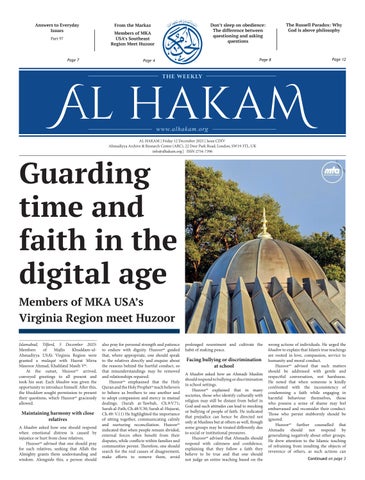
Guarding time and faith in the digital age
Members of MKA USA’s Virginia Region meet Huzoor
Islamabad, Tilford, 5 December 2025: Members of Majlis Khuddam-ulAhmadiyya USA’s Virginia Region were granted a mulaqat with Hazrat Mirza Masroor Ahmad, Khalifatul Masih Vaa
At the outset, Huzooraa arrived, conveyed greetings to all present and took his seat. Each khadim was given the opportunity to introduce himself. After this, the khuddam sought permission to present their questions, which Huzooraa graciously allowed.
Maintaining harmony with close relatives
A khadim asked how one should respond when emotional distress is caused by injustice or hurt from close relatives.
Huzooraa advised that one should pray for such relatives, seeking that Allah the Almighty grants them understanding and wisdom. Alongside this, a person should
also pray for personal strength and patience to endure with dignity. Huzooraa guided that, where appropriate, one should speak to the relatives directly and enquire about the reasons behind the hurtful conduct, so that misunderstandings may be removed and relationships repaired.
Huzooraa emphasised that the Holy Quran and the Holy Prophetsa teach believers to behave as brothers to one another and to adopt compassion and mercy in mutual dealings. (Surah at-Tawbah, Ch.9:V.71; Surah al-Fath, Ch.48:V.30; Surah al-Hujurat, Ch.49: V.11) He highlighted the importance of sitting together, communicating calmly and nurturing reconciliation. Huzooraa indicated that when people remain divided, external forces often benefit from their disputes, while conflicts within families and communities persist. Therefore, one should search for the real causes of disagreement, make efforts to remove them, avoid
prolonged resentment and cultivate the habit of making peace.
Facing bullying or discrimination at school
A khadim asked how an Ahmadi Muslim should respond to bullying or discrimination in school settings.
Huzooraa explained that in many societies, those who identify culturally with religion may still be distant from belief in God and such attitudes can lead to mocking or bullying of people of faith. He indicated that prejudice can hence be directed not only at Muslims but at others as well, though some groups may be treated differently due to social or institutional pressures.
Huzooraa advised that Ahmadis should respond with calmness and confidence, explaining that they follow a faith they believe to be true and that one should not judge an entire teaching based on the
wrong actions of individuals. He urged the khadim to explain that Islam’s true teachings are rooted in love, compassion, service to humanity and moral conduct.
Huzooraa advised that such matters should be addressed with gentle and respectful conversation, not harshness. He noted that when someone is kindly confronted with the inconsistency of condemning a faith while engaging in harmful behaviour themselves, those who possess a sense of shame may feel embarrassed and reconsider their conduct. Those who persist stubbornly should be ignored.
Huzooraa further counselled that Ahmadis should not respond by generalising negatively about other groups. He drew attention to the Islamic teaching of refraining from insulting the objects of reverence of others, as such actions can
This Week in History
A glimpse into the rich history of the Ahmadiyya Muslim Jamaat 12-18 December
12 December
12 December 1911: On this day, to address Bengali sentiments, Lord Hardinge announced the reunification of Bengal, reversing the 1905 partition. This decision was a response to widespread protests led by the Swadeshi movement and growing concerns among Hindus about East Bengal having separate courts and policies. Years before this development, the Promised Messiahas had foretold this event in a prophecy. (Tarikh-e-Ahmadiyyat, Vol. 4, pp. 383-384)
12 December 1935:Hazrat Sufi Muti-ur-Rahman returned to Qadian on this day; he was sent to America to propagate the message of Islam Ahmadiyyat.
To read more about this remarkable story, see: ‘‘Pioneer Missionaries: Part 2 – Serving till their last days’’ at www.alhakam.org (16 September 2022, p. 9).
13 December
of Ahmadiyyat were carrying out conspiracies, spreading lies and spreading hatred, which eventually led to the infamous and notorious anti-Ahmadiyya riots of 1953 in which the lives of Ahmadis were taken and their properties destroyed. (Tarikh-e-Ahmadiyyat, Vol. 14, p. 448)
meeting Hazrat Musleh-e-Maudra. For more details of this meeting, see ‘‘Coming from every distant track: David Samuel Margoliouth, English orientalist, visits Qadian’’ at www.alhakam.org (2 April 2021, pp. 19-21).
17 December
17 December 1892: Alluding to an edict issued by Maulvi Rahim Bakhsh of Lahore, the Promised Messiahas published an ishtihar (announcement) on this day, titled A Sign of the Day of Resurrection
In this announcement, the Promised Messiahas responded to allegations raised by maulvis who said that the Jalsa Salana was an innovation. (Majmua-e-Ishtiharat, Vol. 1, p. 372)
For more details, see “Is Jalsa Salana an innovation?” at www. alhakam.org (2 August 2019, p. 9).
15 December
15 December 1900: On this day, the Promised Messiahas wrote and published a lengthy announcement in which he invited Pir Mehar Ali Shah to write a commentary on Surah al-Fatihah. (Majmua-eIshtiharat, Vol. 3, p. 147)
13 December 1991: On this day, Hazrat Khalifatul Masih IVrh instructed that every country where the Jamaat is established should have a tabligh with a fully equipped library of Jamaat literature and other related necessary reference books. ( , Vol. 4, p. 867)
14 December
14 December 1912: Hazrat Khalifatul Masih I the attention of Ahmadi scholars to prepare a new book for the interpretation of dreams in light of new topics that emerged as a result of technological advancements. ( , 14 December 1912, p. 6)
14 December 1936: connect Qadian with other large cities, telephone lines were set up. On this day, the installation work was completed. At the request of the Government of India, Hazrat inaugurated the installation. Huzoor first call to Hazrat Chaudhry Sir Zafrulla Khan 16 December 1936)
To read more, see: ‘‘All prophets are rejected and questioned on their sanity – Part II’’ at www. alhakam.org (12 June 2020, pp. 12-13).
17 December 1965: On this day, Hazrat Khalifatul Masih IIIrh urged Ahmadis to create such an environment of brotherhood around them that any impecunious Ahmadi may not have to sleep hungry at night. Huzoorrh directed that the presidents of local jamaats should oversee this important campaign. (Khutbat-eNasir, Vol. 1, p. 45)
18 December
15 December 1926: On this day, the Ahmadi women’s auxiliary organisation, Lajna Imaillah, started publishing their magazine, Misbah. Its first editor was Qazi Zuhuruddin Akmalra. (Tarikh-eAhmadiyyat, Vol. 4, p. 566)
15 December 2006: During his Friday sermon on this day, Hazrat Khalifatul Masih Vaa instructed Ahmadis to participate in humanitarian works with more zeal and urged Ahmadi doctors to devote themselves for 3-5 years or for a lifetime to serve in the Jamaat hospitals in Pakistan and Africa.
18 December 1913: Owing to an article published in the Badr newspaper about Christianity, it was censored and had to cease its circulation on this day. (Tarikhe-Ahmadiyyat, Vol. 3, p. 484) The newspaper Badr had been out of publication since then. On 20 December 1951, the historic paper was relaunched from Qadian and Maulvi Barkaat Ahmad Rajeki Sahib was appointed as editor. By March 1952, Badr had begun its publication on a regular basis. (Tarikh-e-Ahmadiyyat, Vol. 13, p. 394)
16 December
16 December 1916: Famous English orientalist David Samuel Margoliouth travelled from England for various engagements in India and visited Qadian on this day. He had the opportunity of
18 December 2009: During his Friday sermon on this day, delivered from the Noor Mosque in Frankfurt, Hazrat Khalifatul Masih Vaa said it was his first Friday sermon from this mosque and that 50 years had passed since the mosque’s construction. This was the second Ahmadiyya mosque in Germany; the first was built in Hamburg.
On this day,
about the Jamaat in front of the highest civil authorities of the province.
In those days, all the opponents centre,
Silsila On this day, a light Al Hakam In order to Musleh-e-Maud ,
Akmal
Continued from page 1
provoke further hostility and worsen the situation. (Surah al-An‘am, Ch.6:V.109) He reassured the khadim that maturity, selfcontrol and dignified conduct, coupled with a clear presentation of Islamic values, form the best response in such circumstances.
A cherished memory of Huzoor’saa grandmother
A khadim requested Huzooraa to share memories of his time with his grandmother.
Huzooraa recalled that when she was alone, he would sometimes sleep in her room, not only in his childhood but into his teenage years as well. He described her as a sincere and warm-hearted elder who harboured no ill feelings for anyone and treated children with tenderness and affection.
Huzooraa also remembered observing her devotion in prayer during the night. He related that she would rise for Tahajjud and repeatedly implore Allah the Almighty for mercy, grace and goodness. He added that her general counsel and nurturing manner reflected the loving guidance typically shown by caring grandmothers.
The observance of Eid Milad-unNabi
A khadim asked whether Eid Milad-unNabi should be observed and, if so, in what manner.
Huzooraa explained that this practice was not observed in the earliest centuries of Islam and remains absent in many Muslim lands, while it became more common, particularly in parts of South Asia. He stated that when hostile propaganda against Islam intensified, Hazrat Khalifatul Masih IIra initiated gatherings in which the life and noble character of the Holy Prophetsa were to be presented and defended.
Huzooraa emphasised that the Companionsra and the era of Khilafat-eRashidah did not observe such a celebration as a formal religious occasion.
He further explained that the true objective of even what Hazrat Musleh-eMaudra initiated is not limited to a single day of speeches or outward displays. Rather, the sirah of the Holy Prophetsa should be studied, taught and practised throughout the year.
Huzooraa further indicated that if
any observance becomes an occasion for hostility, abuse or neglect of the Holy Prophet’ssa actual teachings – as has been observed at some of the recent gatherings of the non-Ahmadis – it loses its purpose. Therefore, he advised that Ahmadis should focus on continuously presenting the beautiful and practical model of the Holy Prophetsa and striving to embody those virtues in daily life.
Guidance for Ahmadis interested in public service
A khadim asked, in view of political polarisation, what guidance exists for Ahmadis who wish to pursue public service and how commitment to Ahmadiyyat can be balanced with responsibilities towards those they serve.
Huzooraa observed that certain political currents in the West, particularly forces aligned with anti-Islam sentiment, often operate within broader networks of influence. He stressed that the effective response is to spread awareness of Islam’s true teachings of love, harmony, peace and justice.
Huzooraa reminded the khuddam that he had long encouraged, especially those in the United States, to systematically convey these teachings within their circles of influence, yet many people still remain unfamiliar with Ahmadiyyat and the peaceful message of Islam. He highlighted that Islam commands care for the poor, support for orphans, the resolution of disputes and the establishment of absolute justice and that these principles should be presented clearly to society.
Huzooraa guided that Ahmadis should emphasise the shared citizenship and loyalty owed to one’s country, reminding them that love for one’s homeland is an integral moral principle within Islamic teaching. He explained that while any state may act against those who violate laws or undermine constitutional order, it is unjust to target peaceful and constructive citizens – whether they are professionals, workers, scientists, businesspeople or others who contribute positively to national progress.
Huzooraa described the promotion of Islam’s authentic message as a collective responsibility for Khuddam, Ansar, Lajna and the entire Jamaat. He also noted that in some contexts, negative perceptions of migrants are compounded when individuals seek benefits without striving to work
and contribute. He therefore urged that Ahmadis should be exemplary in diligence, lawful conduct and civic responsibility.
Huzooraa said:
“Those who belong to the right wing are, in reality, opposed to Islam [...]
“To counter this, we must spread the true teachings of Islam. It was for this reason that, some 15 or 18 years ago, I said to all countries – and in particular I said to the Americans – that the Islamic teaching, the message of Islam, the message of love, harmony and peace, should be conveyed to the whole world. I said that each year this message ought to reach a further five to ten per cent of the people. But you did not carry out this task. Even now, many people do not know about Ahmadiyyat.
“So, wherever your circle extends, within that you should explain the teachings of Islam – what the teachings of Islam are. What are the teachings of Islam? Islam says: take care of the poor; take care of the orphans; bring disputes to an end; there must be absolute justice. And only recently, at the Humanity First conference, I spoke a little about what Islam desires. In the mosques, I continually speak about what Islam desires. In recent days, when the Cardiff mosque was inaugurated, I explained these matters there as well. Listen to those two addresses; in them I have set these points out. And on countless occasions I have travelled to different places and explained the teachings of Islam – what you worldly people do, and what Islam says. These teachings I have been explaining everywhere. So read those. [...]
“Nowadays, there are already those who are opposed to Islam, as before – they exist – but those who are being further turned against Islam, we can still stop them. Many of my various addresses have been published under the title World Crisis and the Pathway to Peace, have they not? You will find many points in that. Take those, and on that basis explain Islam’s basic teaching of peace and love.
“At this stage, there is no need to preach to them that they should come towards the religion. Rather, tell them that Islam gives this teaching, yet you speak against it. And we too, who were born here, are also citizens of this country, and the teaching of Islam is precisely that love of one’s country is part of faith. [...]
“Therefore, to say, ‘We are right wing; expel the foreigners,’ and so on [...] All right,
Hadith-e-Rasul – Sayings of the Holy Prophet Muhammadsa
Allah is the True Creator
Hazrat Abu Hurairahra narrated that he heard the Holy Prophetsa say, “Allah, the Exalted and Majestic, said, ‘Who is more unjust than the one who sets out to create like My creation? Let them create an ant, or let them create a grain, or even a barley grain.”
Hazrat Mirza Ghulam Ahmadas, In His Own Words
The Cure for Spiritual Maladies
What could be more destructive in this world than feeling an aversion or distaste in listening to God’s teachings? What is the cure to such feelings? The cure is to seek forgiveness from Allah and to turn towards God, and pray for one’s sins to be forgiven, and then to continue in this without fail. If this remedy is employed, I can say with surety that their displeasure will turn into a pleasure and their distaste will turn into a liking. Then, the same soul that would flee from God’s presence and was averse to listening to God’s teachings, will race towards Him in the likeness of a rolling ball.
as for those people who are breaking the law, who do not respect the law and constitution of the country – by all means, remove them. But those who are living peacefully and contributing to the progress of your country – and among them are engineers, doctors, businesspeople and scientists – they are benefiting you, so why do you expel them?
“In reality, the background to this is precisely that there is an anti-Islamic agenda. To counter this anti-Islamic agenda, we shall have to raise people’s awareness of what the true teachings of Islam are. We must strive for this. This is our great challenge. Therefore, Majlis Khuddam-ul-Ahmadiyya must also do this, Majlis Ansarullah must also do this, the Jamaat must do this, and Lajna Imaillah must do this. The rest is all politics. [...]
“Then there are also certain mistakes in some countries: some immigrants who come here wish to take social help from these countries and do not work. If they were to work, be hard-working and become taxpayers, then these questions would not even arise.”
A suitable age for mobile phone use
A khadim asked what age is appropriate
(Sahih al-Bukhari, Kitab at-tawhid, Bab qawlillahi
(Malfuzat [English], Vol. 2, p.118)
for Ahmadi boys and girls to have mobile phones, especially as children often observe their peers using devices in schools and mosques.
Huzooraa reiterated that he has long cautioned against excessive screen time. He highlighted that prolonged and unnecessary use of mobile phones, tablets and similar devices can affect eyesight and mental development. He also noted the growing trend in educational systems where, at certain ages, schools themselves provide or require digital devices for classwork and homework, complicating the issue for parents.
Huzooraa pointed out that some countries, such as Australia, have begun taking legislative or policy measures to restrict mobile phone use for children under a certain age, illustrating a broader realisation of harm associated with early and unregulated exposure. He advised that parents should explain to children that the harms often outweigh the benefits and that any necessary use should be limited and purposeful. He also suggested that daily screen time should be kept within a sensible limit of an hour, rather than becoming a routine source of distraction.
Recognising the acceptance of prayers
A khadim asked how one can know whether Allah the Almighty has heard prayers offered for personal problems.
Huzooraa explained that when a difficulty is removed, or a matter is resolved by Allah the Almighty, this provides reassurance that prayers have been heard. However, if an answer is not immediately apparent, one should continue supplicating with perseverance. He drew attention to the principle that Allah the Almighty has invited believers to obey Him, worship Him and observe His commandments.
In this regard, Huzooraa advised that a young person should begin by praying for steadfastness in offering the five daily prayers regularly and on time, especially ensuring discipline in Fajr and maintaining punctuality in all salat. He explained that salat regulates life and nurtures the spiritual state through which prayers become more meaningful.
Huzooraa also emphasised that effort must accompany prayer. He recalled an incident from his student years when he feared failure after a poor examination. He described how he prayed consistently over an extended period until the result was announced and that the outcome was eased in a way that allowed him to pass. Through this example, Huzooraa illustrated that sincere prayer, coupled with perseverance and personal effort, becomes a means for Allah’s help and comfort.
Overcoming social media addiction and protecting family life
A khadim asked how one can address the growing problem of social media addiction and remain focused, as much beneficial time is being lost.
Huzooraa indicated that a person already recognises this as a moral and practical harm. He explained that when someone knowingly persists in a damaging habit, it reflects a lack of resolve rather than a lack
From the markaz
‘An Ahmadi Muslim should be a perfect Muslim’
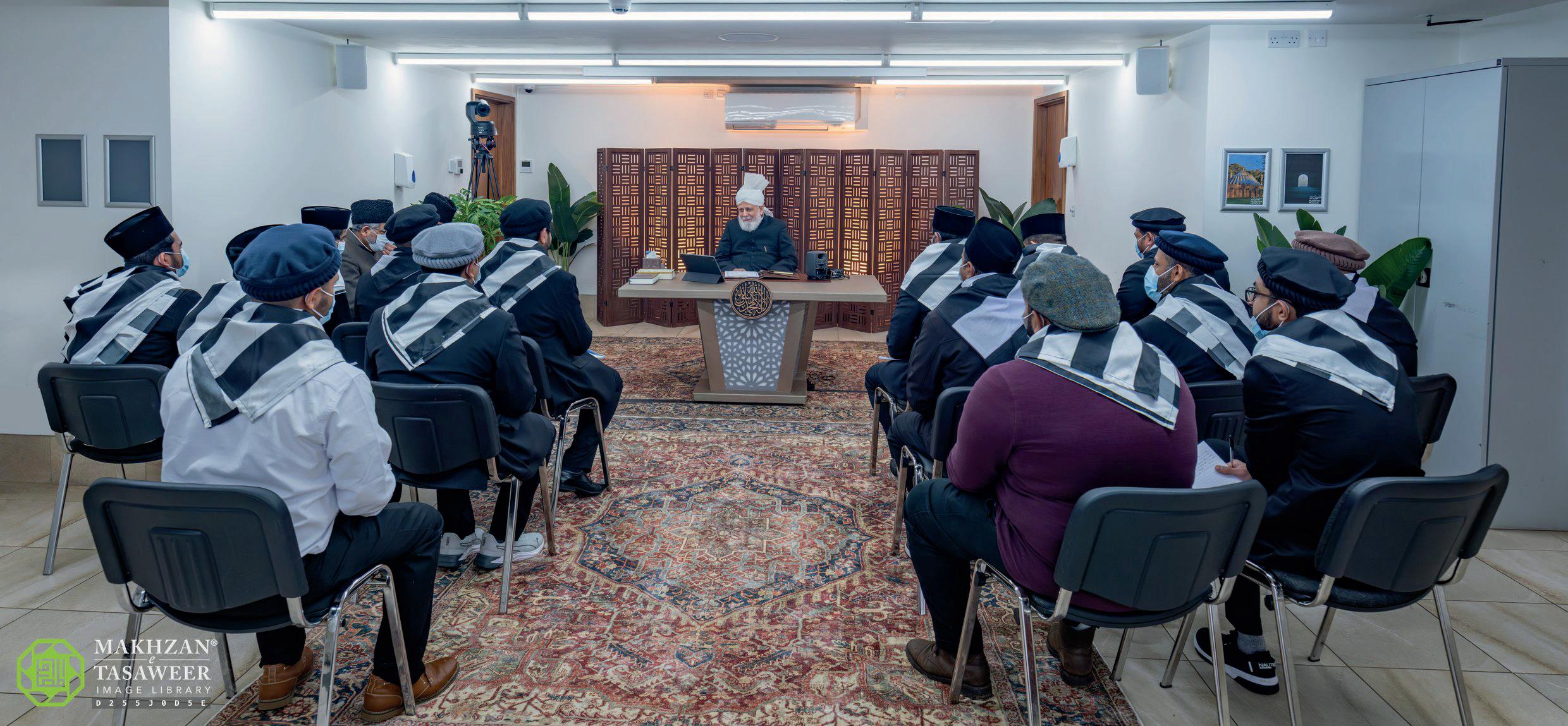
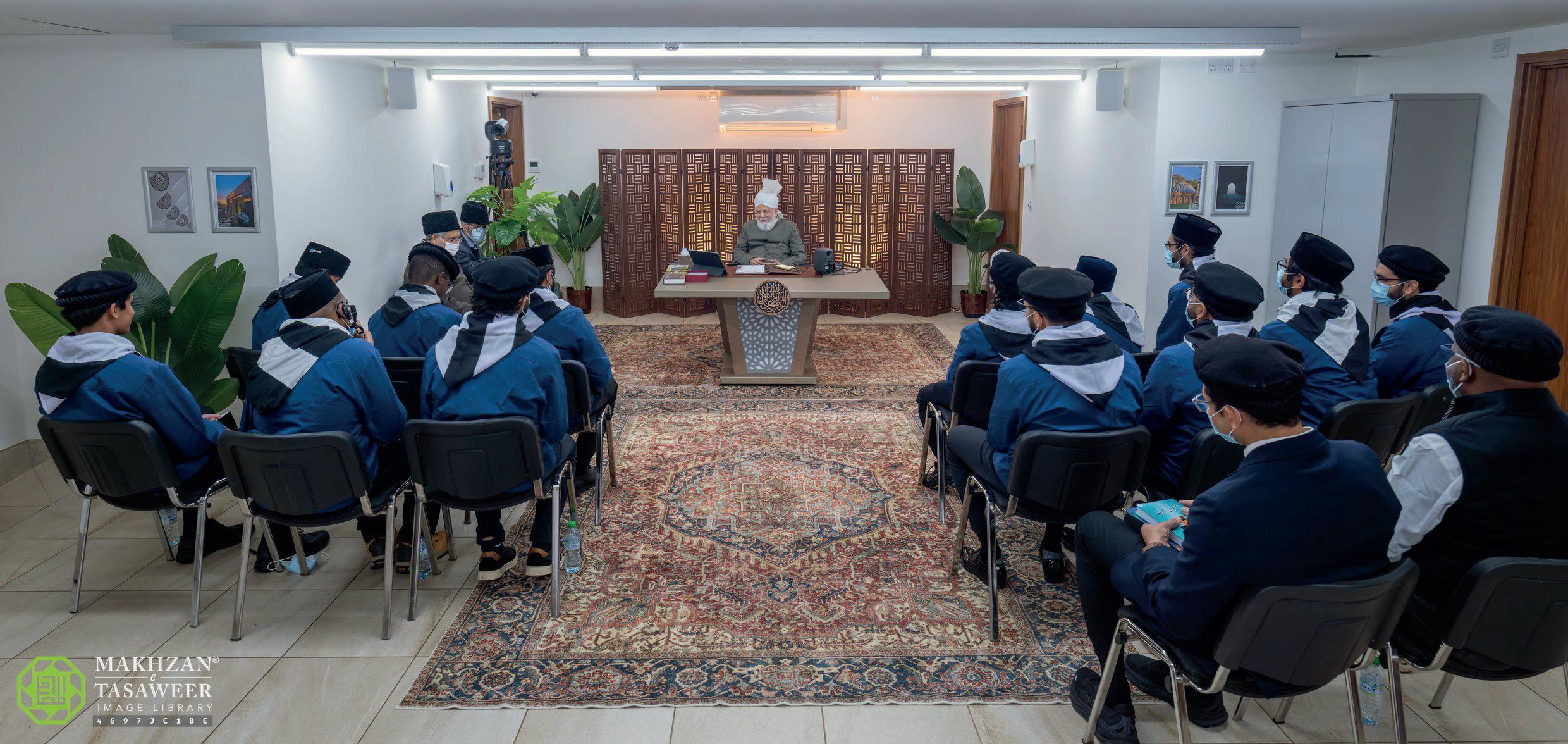
Members of MKA USA’s Southeast Region Meet Huzoor
Islamabad, Tilford, 29 November 2025: A delegation of khuddam from the Southeast Region of Majlis Khuddam-ul-Ahmadiyya USA had the blessed opportunity of a mulaqat with Hazrat Mirza Masroor Ahmad, Khalifatul Masih Vaa.
The meeting commenced as Huzooraa graced the hall with his presence and extended his salaam. Huzooraa first addressed the amir-e-qafilah, who is currently pursuing studies in archaeology.
of awareness. He used a humorous anecdote to illustrate how people sometimes pretend to be heedless while actually being fully conscious of what they are doing.
Huzooraa highlighted that social media addiction damages family bonds, social relationships and professional productivity. He noted that instead of thinking creatively about improvement in work, business or personal growth, people often waste hours consuming trivial or harmful content. He explained that the structure of digital platforms is intentionally designed to encourage endless scrolling from one item to the next, pulling a person deeper into time-wasting and, at times, morally corrosive material.
Huzooraa further warned that even when one opens beneficial content, adjacent temptations and inappropriate material can appear, gradually harming the mind and spiritual state. He advised that one should adopt the Quranic principle of turning away from vain and useless pursuits and that believers must develop firm willpower and a clear determination to avoid such distractions. (Surah al-Mu’minun, Ch.23: V.4)
Huzooraa recommended seeking Allah’s help through istighfar and regular prayer, asking to be protected from futile
Following this, each of the khuddam had the opportunity to introduce himself. After the introductions, the khuddam were graciously granted permission to ask questions for their guidance on spiritual and worldly matters.
The duty of a new khadim
A young man who had just joined Khuddam-ul-Ahmadiyya at the start of the month asked for advice.
and harmful engagements. He also urged parents to reflect on their own habits, as children naturally imitate what they observe at home. He noted that when family members sit together yet remain absorbed in their separate screens, meaningful conversation disappears and relationships weaken. This can eventually deprive parents of opportunities for moral guidance and tarbiyat
Huzooraa advised that families should foster shared interaction, respectful social etiquette and purposeful use of technology. He stressed that if one intends to view a specific beneficial programme, one should limit oneself to that purpose and avoid wandering into unrelated and damaging content. Through discipline, prayer and consistent family examples, this modern challenge can be gradually overcome.
Strengthening and safeguarding faith
A khadim asked how one can effectively correct and strengthen faith.
Huzooraa guided that faith is strengthened through turning to Allah the Almighty with humility and prayer. He advised repeatedly praying for steadfastness and for an increase in faith and drawing
Huzooraa advised him to be regular in his five daily prayers, to read the Holy Quran and to strictly avoid negative content on social media and the internet, nurturing a hatred for such things. Huzooraa reminded him that Allah promises in the Quran that prayer protects one from indecency and evil. (Surah al-‘Ankabut, Ch.29: V.46) If he honestly strives in this, Allah will protect him.
Huzooraa cautioned against the mindset
spiritual help from the supplications taught in Surah al-Fatihah, seeking guidance on the straight path.
Huzooraa stressed the importance of safeguarding the five daily prayers and reciting the Holy Quran with a conscious effort to understand its meaning. He explained that merely identifying as Muslim or Ahmadi Muslim without understanding Islamic teachings does not nurture faith. Therefore, one should study the Quran attentively and also read Jamaat literature.
Huzooraa added that those who are not comfortable with Urdu should benefit from English translations and collections of the writings of the Promised Messiahas on various topics, including compilations such as The Essence of Islam. He stated that through prayer, religious knowledge and consistent worship, faith grows stronger and more stable.
Conclusion
At the conclusion of the mulaqat, the khuddam were granted the honour of a group photograph with Huzooraa. Thereafter, Huzooraa took leave, bringing the mulaqat to an end.
(Summary prepared by Al Hakam)
that sometimes develops at the age of 16, where youth feel they are now mature and free to disregard the wisdom of their parents and elders. Instead, he should maintain the good habits he had as a tifl. The simple teaching, Huzooraa stated, is to be pious, refrain from bad deeds, offer the five daily prayers on time and in congregation if possible and recite the Quran daily. Regardless of whether one is a waqif-e-nau or not, every Ahmadi Muslim should strive to be a perfect Muslim.
Researching cures for cancer
A khadim asked for advice for Ahmadi students wishing to research cancer cures, specifically enquiring if the Quran and Hadith provide guidance on foods like honey.
Huzooraa affirmed that the Quran instructs us to consume pure, i.e., tayyib and lawful, i.e., halal, foods. (Surah al-Baqarah, Ch.2: V. 169) Regarding honey, Allah states that it contains healing for mankind. (Surah an-Nahl, Ch.16: V.70) Huzooraa noted that several Ahmadi scientists are already researching the medicinal properties of honey and encouraged the khadim to do so as well. He explained that since bees tend to visit specific types of flowers, different honeys have unique properties; one type might be effective for stomach ailments, while another might aid in treating blood diseases or cancer.
Huzooraa narrated an incident from the life of the Holy Prophetsa where a man complained of a stomach ailment. The Holy Prophetsa advised him to take honey. The man returned twice, claiming it had worsened his condition. On the third visit, the Holy Prophetsa declared that God’s word is true and the man’s stomach was false; eventually, the man was cured. (Sahih alBukhari, Kitab at-tibb, Bab ad-dawa’i bi l-‘asl, Hadith 5684) This illustrates that while honey has healing properties, research is needed to identify the specific types suitable for specific diseases.
Finding motivation to get closer to Allah
A khadim asked how one who lacks motivation can self-motivate to become closer to Allah.
Huzooraa asked the khadim if he desired a good future and success in his studies. When the khadim replied in the affirmative, Huzooraa explained that just as one is motivated to work hard for worldly success, if one loves Allah, they should be motivated to strive for His nearness. Allah commands us to struggle hard in His path and promises guidance to those who do. (Surah al-Hajj, Ch.22: V.79) The fundamental method is to pray fervently in the five daily prayers for guidance and for Allah to instil the desire for His love in one’s heart. Just as effort is required for academic targets, spiritual closeness requires hard work and obedience to Allah’s commandments.
Huzooraa said, “For getting nearness to Allah, you will have to work hard, as you are working hard for achieving your worldly targets, like your studies and other things. See, the same thing – you will have to struggle hard. Allah the Almighty says in the Holy Quran, ‘If you work hard, I will show you the right path.’ So, this is the only way. Pray to Allah the Almighty in your five daily prayers; never leave your prayer. If you
are obeying Allah’s commandments, then Allah will guide you.”
Balancing waqf with family obligations
A question was asked regarding waqifeen-enau who wish to dedicate their lives but face external pressures, such as family financial problems or parental expectations.
Huzooraa advised that if one has a true desire to do waqf or devote one’s life, they should place their trust in Allah, as He is the One who feeds everyone, not we ourselves. (Surah al-An‘am, Ch.6: V.152) However, if one is double-minded or hesitant, it is better to seek permission to work and support the family. Huzooraa clarified that the Jamaat does not accept every waqf; there are specific needs for missionaries, doctors and engineers. Therefore, at present, he may pursue his studies or job while fulfilling his duties as a waqif-e-nau: being regular in prayer, reading the Holy Quran with meaning, studying Jamaat literature and the books of the Promised Messiahas and listening to the Khalifa-e-Waqt. Dedicating spare time to the Jamaat is also a form of waqf that allows one to support their family simultaneously.
Avoiding greed while pursuing a career
A khadim asked how one can pursue a successful, high-earning career without becoming greedy.
Huzooraa explained that if one earns wealth but follows Allah’s command to spend not only on oneself but also on orphans and the needy, then that wealth becomes a means of attaining Allah’s pleasure. Allah blesses such wealth manifold. This act of giving prevents greed because it keeps one connected to the pain of others. If one meets their own expenses but also sacrifices for the Jamaat and charity, Allah appreciates this and protects the heart from greed.
Reconnecting with distant khuddam
Guidance was sought on how to help khuddam who were once active but have become distant, specifically citing a case where personal grievances were involved.
Huzooraa advised that beyond official contact, there should be a personal connection. A friend of the same age should reach out to the distant khadim to remove misunderstandings with the same concern one would have for a brother. Huzooraa noted that sometimes people develop grudges against office-bearers – whether a Murabbi, President, or Secretary – and then distance themselves from the faith. He stressed that office-bearers must be extremely humble to avoid causing such stumbling blocks.
He mentioned that sometimes even members from well-established families drift away because they hold an idealised view of how office-bearers should be and when reality falls short, they blame the entire Jamaat. Huzooraa pointed out that even in the time of the Holy Prophetsa, there were hypocrites, but that did not falsify the message of Islam. Such individuals should be counselled with love and understanding, helping them realise that the Jamaat truly cares for them.
Moving to established jamaats vs. pioneering
A khadim asked if Ahmadis should move to places where the Jamaat is not yet established to spread the message, or stay where there is an established jamaat
Huzooraa guided that families with young children should prioritise living near a mosque and an established jamaat to ensure their children’s moral upbringing. However, those whose children are grown, or who are single, can and should move to new areas to establish the Jamaat and do tabligh. The decision depends on the individual circumstances of each family and one must use their own judgement to decide what is best for their spiritual well-being.
Strengthening faith amidst distractions
A question was raised about how Ahmadi youth, facing modern distractions, can strengthen their bond with Allah and Khilafat despite their passion for service.
Huzooraa identified the root cause as the consumption of worldly distractions like social media, TV and useless games. Spending hours on these things after work or school ruins time and spiritual focus. The Tarbiyat Department must educate youth that these are vain pursuits [laghw] which the Quran forbids. (Surah al-Mu’minun, Ch.23: V.4)
Secondly, for those who have a genuine passion and fear of Allah, the remedy is worship. Allah promises that prayer keeps one on the right path. (Surah al-‘Ankabut, Ch.29: V.46) Therefore, the habit of prayer must be instilled. If someone is distracted, they should not be defamed but treated like a brother whose shortcomings are concealed. They should be lovingly reminded that their actions will cause them trouble. Huzooraa said, “This is a very big challenge; those working in Khuddam-ul-Ahmadiyya and the office bearers of the Jamaat and other auxiliary organisations should take this on as a personal challenge and take care of others as though they are their relatives. If you do so then you will see results. Explain things to them and bring them closer.”
Huzooraa observed that many youth come to the UK, get emotional and even cry during meetings, but revert to old habits months later because they lack the right environment. It is the duty of active khuddam to create that supportive environment for them.
The best Surah to recite
A khadim asked which Surah of the Quran is the best to recite.
Huzooraa stated that Surah al-Fatihah is the best. It contains the comprehensive
“Guide us in the right path”, which covers all aspects of moral training and spiritual guidance. Huzooraa advised reading its translation and the commentary available in the Jamaat’s Tafsir to fully understand its depth and importance.
Responding to anti-Islam sentiment
The final question addressed how to respond to rising anti-Islam sentiment and the mocking of Muslims on social media, specifically those praying in public.
Huzooraa advised ignoring abusive language, as we cannot compete in vulgarity.
Regarding praying in public, he stated that there is no need to offer prayers on footpaths or roads where it disturbs others or blocks pathways. Prayers should be offered in mosques or at home. If one is out and time is short, they should find a secluded corner or an isolated place, not a public thoroughfare. However, Ahmadis must be firm in their faith and not care about people’s mockery regarding their beliefs. The best response to anti-Islam sentiment is to practise true Islam. When people see the good behaviour of Ahmadis and their message of peace, love and harmony, they will naturally be curious and respectful.
Huzooraa stressed that opponents exploit the actions of terrorists to defame Islam; our duty is to counter this by spreading the true, peaceful message through our own conduct and by distributing literature.
Huzooraa said, “When they are using abusive language, we cannot compete with them [...], so ignore it. And why should we pray in public? We have mosques; you should go to the mosque or offer your prayers in your homes. And if you are bound and short of time to pray the Zuhr or Asr prayer on time, then you try to find a corner and pray there. And if you are in a group, then you should also go to an isolated place and offer your prayer there, not that you start offering your prayer on the footpaths or on the roads; that is not advisable. [Otherwise, you may be] breaking the rules and regulations of that society or that country. You are disturbing the convenience of the people there, right? You are destroying their peace. So why should you offer your prayer in public places? So avoid that, but be firm in your faith. Be determined that you have to offer your five daily prayers on time. And don’t bother about what the people say.
“Try to learn more about your religion. What is Islam? What is the practice and sunnah of the Holy Prophetsa? Why do we Ahmadis claim that we are Ahmadi Muslims? Only a claim is not enough until and unless we practice the true teaching of Islam. So when we are portraying our good behaviour and conveying the true message of Islam to the people and practising what we say, then people will obviously ask you, ‘Why are you different from other people?’ And they will try to learn more about Islam. In this way, you will open more doors to preaching. Right? So in this way, you should also try to explore more avenues for preaching. To let the people know, because people are ignorant. They don’t know much about Islam. Only those who are opponents of Islam have exploited this thing, that Muslims are not good. And you see, they will take the examples of terrorists or militants and tell the people that this is the behaviour of Muslims. So, actually, tell the people that this is not the true teaching, which these people are doing. The true teaching of Islam is peace, love, and harmony, and to respect each other. And that is what we pray, we practise, and we convey. It’s a great challenge. This is why I say that you should try to spread the true message of Islam through pamphlets and through your own behaviour. And this is how you can overcome this situation.”
The mulaqat concluded with the khuddam having the honour of a group photograph with Huzooraa.
(Summary prepared by Al Hakam)
A life in balance: Emotions, faith, and humanity
Zafir Ahmad Ahmadiyya Archive & Research Centre
Living a balanced life is a central theme in all major religions and well beyond them. People seek ways to understand and regulate their emotions, aiming to live in harmony with their surroundings. In the process, it becomes clear that human emotions – ranging from joy and love to fear and sorrow – follow similar patterns across all cultures and faiths.
In interfaith dialogue, humans experience a wide range of emotions. The various religions can help us to comprehend these emotions better and deal with them constructively. All the major faiths – whether Christianity, Islam, Judaism, Hinduism, or Buddhism – urge compassion and mercy, respect for others, and the cultivation of an inner equilibrium.
This idea is universal and can, among other places, be found in various verses of the Quran as well as in the sayings of the Prophet Muhammadsa. In Islam, emphasis is placed on developing and practising compassion and mercy. In the Quran, God Himself is frequently described as “the Gracious, the Merciful.”
Faith also instructs us to examine and manage negative emotions, such as anger or hatred, and to channel them constructively. This means that living a balanced life is not just about piety but also about psychological health and social cohesion. Humanity’s task is to bring emotions together under the lens of morality, reason, and spirituality.
In the following sections, we will take a closer look at what this balance entails, observe examples found in the Holy Quran
individual. Islam views human beings as possessing both physical and spiritual needs. Neither aspect should be neglected. Thus, Islam highly values a mindful view of the inner emotional world, linking it closely to the goal of achieving a harmonious society.
The role of forgiveness and mercy
Forgiveness is a central theme in all religions, particularly Islam. Forgiveness helps us let go of negative feelings such as resentment or bitterness and relieves our own souls. In the Quran, believers are instructed to “take to forgiveness, and enjoin kindness, and turn away from the ignorant.”
(Surah al-A‘raf, Ch.7: V.200) This command places great importance on pardon and refraining from overly harsh judgment.
The Sunnah similarly prioritises forgiveness as a key element of Godconscious behaviour. The Holy Prophetsa said: “Whoever is not merciful to others will not be treated mercifully.” (Sahih alBukhari, Kitab al-adab, Hadith 5997) In this way, a cycle of mutual kindness emerges. Thus, when we experience insults or hurt in our personal life, it is good to acknowledge the pain we feel but also to avoid hindering the healing process by clinging to negative emotions.
Forgiveness does not imply trivialising wrongdoing. Rather, it prevents us from remaining permanently bound – both emotionally and mentally – to an injustice once committed. It also signifies that even those who have erred always have the opportunity to turn back.
could escalate tension. The Quran frequently warns against repaying wrongdoing with wrongdoing, urging instead a calm and principled approach to conflict resolution. Rather than indulging in anger, a measured and respectful conversation is more beneficial. Qualities like patience and gentleness are crucial here. These examples illustrate that the principles of Islam, as laid out in the Quran and the Sunnah, are not confined to an abstract realm but can be integrated into daily life.
Emotional intelligence and spiritual growth
Contemporary psychological concepts, such as emotional intelligence, are also significant. Emotional intelligence involves recognising, understanding, and influencing emotions, both in oneself and in others. People who are unaware of their emotions often struggle to express themselves, leading to conflict or exhaustion at having to cope with overwhelming feelings. However, when emotions are guided responsibly and purposefully, relationships, workplace atmospheres, and personal contentment can all benefit.
and the Sunnah (the practical example of the Holy Prophetsa), and explore everyday logical examples that can help us recognise and achieve balance.
Emotions in Islam: Examples from the Quran and the Sunnah Islam, as a way of life, devotes considerable attention to the spectrum of human emotion. The Quran contains numerous verses encouraging believers to guide their feelings.
At one instance, God informs the Holy Prophet Muhammadsa how important it is to act with gentleness and leniency. We learn that by the mercy of God, the Prophetsa possessed gentleness and that people would turn away from harsh and unjust behaviour.
(Surah Aal-e-‘Imran, Ch.3: V.160)
At another place, Allah states that “the servants of the Gracious God” are those who walk on the earth humbly and remain peaceful when dealing with the ignorant. Even if they are addressed in a reproachful tone, they respond with words of peace.
(Surah al-Furqan, Ch.25: V.64) Such conduct requires a deliberate and mindful control of emotions.
The Holy Prophetsa, the greatest role model for humanity, was known for maintaining composure in the face of criticism, hostility, and worry. He explained that true strength lies not in physical prowess but in controlling oneself while angry. (Sahih al-Bukhari, Kitab al-adab, Bab al-hadhar min al-ghadab, Hadith 6114)
All these examples show that emotions should not be suppressed but rather channelled in ways that serve the good of the community and the inner peace of the
The Quran powerfully conveys this concept of mercy: “O My servants who have committed excesses against their own souls! despair not of the mercy of Allah, surely Allah forgives all sins. Verily He is Most Forgiving, Merciful.” (Surah az-Zumar, Ch.39: V.54) From the perspective of inner equilibrium, this means that we can hope to receive mercy ourselves and learn not to condemn or punish others with our negative emotions.
Practical examples: Guiding emotions in everyday life
Let us now examine some straightforward, logical, everyday examples that demonstrate how Islamic principles can be concretely applied:
1. Conflict within the family: Suppose a family member criticises us in front of others. Instinctively, we may feel hurt and react with defensiveness or anger. A balanced approach could involve pausing, registering the anger we feel, and accepting it before we speak. Instead of retaliating impulsively, one can calmly and factually state how one feels, then ask how the other person intended their remark. This measured approach ultimately promotes mutual understanding.
2. Stress at work: We are often under time pressure, aiming for faultless performance, and we become easily overwhelmed. Here, reflecting on these words of the Holy Quran could help: “Surely there is ease after hardship.” (Surah ash-Sharh, Ch.94: V.6-7) With this, we can focus on taking one step at a time instead of descending into panic. This shows a link between spiritual trust and practical emotional regulation.
3. Misunderstandings in one’s neighbourhood: Everyone is familiar with situations in which conflict or annoyance
In Islam, spiritual growth involves becoming more aware of the state of one’s heart and engaging in self-examination. The Quran mentions the term “qalb” (heart) several times and distinguishes between a heart that is closed and one that is open to divine guidance. This metaphor highlights that spiritual progress is not found solely in ritual practices (important though they are), but also in how we nurture our feelings and shape our character.
The Holy Prophetsa stressed the importance of a good character. He said: “The Muslims with the most perfect faith are those who have the best character.” (Sunan at-Tirmidhi, Kitab ar-Radaʿ, Hadith 1162) Good character is reflected in friendly, patient, and compassionate behaviour. When someone remains composed in a situation that might otherwise spark anger, they can help both themselves and others. Islam links the religious aim – drawing closer to God – with good conduct towards fellow human beings.
Practical paths to balance: Prayer, supplication, and community
Which practical steps can we derive from the Quran and the Sunnah to reinforce this balance? First, the canonical prayer is a central pillar of the Islamic tradition, performed five times a day. These prayers structure the daily routine and provide believers with opportunities for quiet reflection, praising God, and turning inward. In a state of sincere concentration, burdens, stress, or negative emotions can momentarily be set aside, making one mindful of the presence of God, which transcends all worldly concerns.
Second, supplication is important. When we turn to God in difficult moments, open our hearts, and share our fears and wishes, we connect with Him. This fosters comfort and hope. The certainty that one is heard and can trust in divine mercy strengthens emotional stability. The Quran states that when God’s servants ask about Him, He says that He is close and that He answers the call of the caller when they call
Answers to Everyday Issues
Forgiveness and reformation, recruitment fees, conjugal rights and gender equality in reward or punishment
Guidance regarding basic Islamic issues that Hazrat Amirul Momineen, Khalifatul Masih Vaa, has given on various occasions in his written correspondence and during MTA programmes is being published officially below for everyone’s benefit.
What is the Islamic principle for forgiving mistakes according to the Holy Quran?
Someone wrote to Hazrat Amirul Momineen, Khalifatul Masih Vaa, asking, “Should one forgive if an apology is asked for or not? Is it correct to take money to get someone a job? If a man commits adultery, raises his hand against a woman, does not respect her parents and taunts the woman, he has no sin and will be forgiven; but a woman must remain silent in every situation and say nothing, because she will go to Hell in any case due to her tongue? If a wife desires intimacy and the husband makes an excuse of being tired every time, there is no sin on the husband; but if the woman refuses, there is sin on her and the angels curse the woman but not the man? It seems as if the woman is bad in every respect and the man is right in every respect? I request guidance on this matter.”
“In his letter dated 5 September 2023, Huzoor-e-Anwaraa provided the following guidance on this matter:
“To forgive someone for their mistake is very pleasing to Allah the Exalted and His Messengersa and the Holy Quran and the Prophetic traditions are replete with this subject. However, the Holy Quran has attached only one condition to forgiveness: that the person being forgiven should reform themselves through this forgiveness. Accordingly, it is stated:
“‘And the recompense of an injury is an injury the like thereof; but whoso forgives and [his act] brings about reformation, his reward is with Allah.’ (Surah ash-Shura, Ch.42: V.41)
“The Promised Messiahas, interpreting this verse, states:
“‘This verse shows that the Quran does not teach non-resistance to evil on all occasions, or that mischief makers and wrongdoers should never be punished. Its teaching is that one must consider whether the occasion calls for forgiveness or punishment
and to adopt the course which would be best in the interests of both the offender and the public. Sometimes an offender turns away from wrongdoing in consequence of being forgiven and sometimes forgiveness incites him to further wrongdoing. Therefore, God Almighty directs that we should not develop the habit of forgiving blindly on all occasions, but should consider carefully whether forgiveness or punishment would be most appropriate and, therefore, a virtue, in each particular case and should adopt that course.’ (Islami Usul ki Falasafi, Ruhani Khazain, Vol. 10, pp. 351-352)”
Is it permissible in Islam to charge a fee for finding someone a job?
“The answer to your second question is that to take money from someone illegitimately to get them a job is by no means correct; this falls under the category of bribery. However, if someone has made an effort with honesty to get another brother a job and in this effort some of his own expenses have been incurred, then there is no harm in recovering his amount in accordance with those expenses. Similarly, if someone’s business is that they arrange employment by charging a fee etc. in the name of administrative charges or commission and the person seeking employment is aware of all these matters beforehand and then, knowing all this, obtains employment through that person, then, since this is the other person’s business, there is no harm in receiving such fees etc.”
Does Islam differentiate between men and women in matters of sin and reward?
“Regarding your question about the difference between men and women, it is written that Islam has made no distinction between men and women in the matter of sin and reward. Accordingly, Allah the Exalted states:
The Holy Quran has attached only one condition to forgiveness: that the person being forgiven should reform themselves through this forgiveness. “
“‘Whoso does evil will be requited only with the like of it; but whoso does good, whether male or female and is a believer — these will enter the Garden; they will be provided therein without measure.’ (Surah al-Mu’min, Ch.40: V.41)
“Therefore, your assertion is not correct that if a man commits a mistake, he is forgiven and if a woman commits a mistake, she is not forgiven. In the matter of reward and punishment, there is no difference between men and women. However, if a husband or wife commits an excess against their partner in this world and causes them unjustified suffering and for some reason they are not seized for it in this world, the party committing the excess will, in any
case, be answerable before God the Exalted on the Day of Judgement.”
Does the hadith about angels cursing a wife who refuses intimacy apply to husbands, too?
“As for what you have written regarding the marital relations of husband and wife, mention of this has also come in a hadith that when a husband calls his wife to his bed and the wife refuses due to some grievance, the angels send curses upon her all night long. (Sahih al-Bukhari, Kitab bad’i l-khalq, Bab dhikri l-mala’ikah). But remember that the application of this hadith is not only on the wife; rather, in the converse situation, this hadith will also apply to the husband.
“In reality, the meaning of this hadith
is that the Holy Prophetsa has apparently admonished the wife for refusing without any valid excuse due to the husband’s impatience for sexual desire. Otherwise, just as it is incumbent upon the wife to fulfil the husband’s sexual need along with his other rights, similarly, it is also the husband’s duty to fulfil the wife’s sexual rights along with her other needs. Therefore, if a husband does not fulfil his wife’s sexual rights upon her desire without any compelling circumstances, he too will be liable to be seized by Allah the Exalted in the same way as a wife deserves the displeasure of Allah the Exalted in the case of refusing the fulfilment of her husband’s sexual need without any valid excuse.
“Accordingly, it is narrated from Hazrat Abu Musa al-Ash‘arira that once the wife of Hazrat Uthman bin Maz‘unra came to the wives of the Holy Prophetsa. Upon seeing her dishevelled state, the pure wives asked her what had happened to her, for there was no man among the Quraish wealthier than her husband. Upon this, she said, ‘We derive no benefit from that, for my husband’s day is spent in fasting and his night in praying.’ Then, when the Holy Prophetsa came to his wives, the pure wives mentioned this matter to the Holy Prophetsa. The narrator says that the Holy Prophetsa met Hazrat Uthman bin Maz‘unra and said to him [expressing displeasure], ‘Is my person not a model for you?’ At this, Hazrat Uthman bin Maz‘unra submitted, ‘May my father and mother be your ransom; what is the matter?’ The Holy Prophetsa said, ‘You spend the night praying and the day fasting, whereas your family also has a right upon you and your body also has a right upon you. Therefore, pray, but also sleep; and sometimes fast and
sometimes leave it.’ The narrator says that after some time, the same woman came again to the pure wives; she had applied perfume liberally and was adorned like a bride. Seeing her, the pure wives expressed their joy and said, ‘What is the matter?’ Upon which she told them, ‘Now we too have available to us all that other people have.’ (Majma‘ az-Zawa’id, Kitab an-nikah, Bab haqqi l-mar’ati ‘ala z-zawj)
“Furthermore, with reference to the hadith under consideration mentioned above, this point should also be remembered: that in the case of refusing this act on the basis of a valid excuse or compulsion, neither party becomes the recipient of Allah the Exalted’s displeasure. As it comes in a hadith that when the Holy Prophetsa set out for the Battle of Tabuk, a Companion who had gone on a journey returned to Medina after the Holy Prophetsa had marched out for the battle. And when he advanced towards his wife to show affection, the wife pushed him back, saying, ‘Do you not feel ashamed that the Holy Prophetsa has gone out to fight the enemy in such heat and you are concerned with showing affection and coming to me?’ (Dibacha Tafsir-ul-Quran, 1948, pp. 343-344)
“Thus, if either party refuses due to some excuse or compulsion, they will not be deserving of any punishment. However, if a husband or wife comes close to the other party and, after inflaming their emotions, moves away from them with the intention of distressing them, then the one doing so will certainly be the recipient of the displeasure of Allah the Exalted.”
(Compiled by Zaheer Ahmad Khan, Head of Records Department, Private Secretariat, London and translated by Al Hakam)
Don’t sleep on obedience: The difference between questioning and asking questions
Around 3,700 infants pass away unexpectedly in their sleep each year in the US alone.¹ These babies are gently tucked in by loving parents and kissed goodnight – never to wake up again. Each of these tragedies is uniquely heart-wrenching for parents and loved ones alike.
In response, hospitals emphasise a simple but powerful safety guideline called the ABCs of safe sleep: “Alone, on their Back, in a Crib.” This mnemonic is a part of a campaign to combat what is known as Sudden Unexpected Infant Death Syndrome (SUIDS).
In 1994, a concerted “Back to Sleep” public health campaign in the US waged a war against infants sleeping in the prone position (on their stomachs) – the greatest risk factor identified for SUIDS 2 The campaign’s immediate impact reduced SUIDS cases by over 53% 3
Remarkably, this modern health campaign is unwittingly the latest iteration of 1,400-year-old, divine guidance. Centuries ago, the Holy Prophetsa had already forbidden sleeping in the prone position. Ya’ish bin Tikhfahra reports:
“My father said: ‘While I was lying on my stomach because of pain in the lung, a man began to shake me with his foot and then said: This is a method of lying which Allah hates. I looked and saw that he was the Messengersa of Allah.” (Sunan Abi Dawud, Kitab al-Adab, Hadith 5040)
Even beyond infancy, the dangers of prone sleeping persist. Sleep research reveals that prone sleeping flattens the lower spine’s natural curve and strains the upper back and neck These findings led orthopedic experts at the Keck Medicine University of Southern California to conclude:
“Sleeping on your stomach is the worst position for your spine.”4
The fact that the Holy Prophetsa would single out the very sleep position now condemned by modern science is nothing short of compelling evidence of divine inspiration.
‘From the first drop’
Such alignment between Islam and modern science is not isolated. There are
many commandments whose wisdom only became clear with modern discovery. Another equally compelling example is that of the prohibition of alcohol.
The scientific community has long grappled with the question of safe levels of consumption. In the 1990s, moderate consumption was in fact recommended for heart health 5
Then, through the early 2000s, public health officials promoted “drink responsibly” messaging as data mounted against them. Only in 2023 did the World Health Organisation (WHO) release the following statement:
“No level of alcohol consumption is safe for our health” and it “doesn’t matter how much you drink – the risk to the drinker’s health starts from the first drop of any alcoholic beverage.”6
Despite this long overdue position, incalculable harm continues on unabated as a direct result of alcohol in the form of addiction, violence, drunk driving, date rape, suicide, multiple forms of cancer (as a designated level one carcinogen) – and the list goes on and on. Or, as the Hazrat Uthmanra bin ‘Affan succinctly stated:
“Stay away from wine, for it is the mother of wickedness.” (Sunan an-Nasa’i, Kitab al-Ashriba, Hadith 5666)
Here again, an Islamic instruction preceded scientific discovery by over a millennium. Islam, too, could have appeased the masses and promoted moderation, but the fact that it went against the tide and forbade alcohol altogether is striking and perfectly aligned with the eventual conclusion of modern science.
We understand and we obey?
These examples are awe-inspiring in their own right, but they do more than simply validate our faith from secular discovery. It is easy to follow the injunction prohibiting prone sleep now that the wisdom behind it has been uncovered, but imagine how arbitrary this injunction must have seemed prior to these discoveries. It is easy to condemn alcohol consumption entirely now that the World Health Organization has condemned it, but imagine how monumental of a task rooting out alcohol from 7th century Arabia must have been. One doesn’t need to look
Sohaib Awan USA
far, just think what it would take to put an end to alcohol consumption today despite categorical evidence against it.
Many Quranic injunctions and aspects of the sunnah can appear arbitrary, inconsequential, or even counterintuitive, and we fail to discern any wisdom behind them. For example, why did the Holy Prophetsa instruct us to sit when drinking water or prohibit blowing on food?
To a disbeliever, all these acts seem like personal quirks or superstitious rituals. Even allegations of – God forbid, obsessivecompulsive disorder have been entertained – a modern twist to the age-old accusation of being “a madman” (Surah al-Hijr, Ch.15: V.7).
Among other examples, the structured method of performing ablution is often cited in which believers are instructed to wash each limb in a precise sequence and frequency. What is the wisdom behind these detailed injunctions? We may or may not know. Yet, obedience is required. In fact, the Promised Messiahas emphatically proclaimed:
“I tell you truly that anyone who disregards even a small injunction of the seven hundred commandments of the Quran shuts upon himself the door of salvation.” (Our Teaching, 2018, p. 20)
Furthermore, every injunction of the Holy Prophetsa is also obligatory and a
prerequisite for attaining Allah’s pleasure. The Holy Prophetsa is commanded in the Holy Quran to proclaim:
“Say, ‘If you love Allah, follow me; [then] will Allah love you and forgive you your faults.” (Surah Aal-e-Imran Ch.3: V.32)
But in truth, even these seemingly arbitrary details of Islam are deeply intentional and full of profound wisdom.
While seeking out their explanations is a noble pursuit that uncovers hidden pearls of wisdom, it can never be a prerequisite to our obedience.
We obey the commandments of Allah the Almighty and the Holy Prophetsa, first and foremost, because they are their commandments. Alluding to this, the Quran quotes the believers as those who proclaim:
“We hear and we obey.” (Surah alBaqarah Ch.2: V.286)
Distinctly not, “We hear, we question, we seek to understand, and then do we obey.”
This often draws criticism from modern “question everything” intellectuals who, God forbid, assert that Islam demands blind obedience. However, Islam asks for a trusted obedience instead. And this is a distinction every rational mind accepts in practice.
For example, if we require surgery, we choose a reputable institution, an experienced surgeon, and we may even ask a few questions for peace of mind. And then we are willing to put our lives into
I tell you truly that anyone who disregards even a small injunction of the seven hundred commandments of the Quran shuts upon himself the door of salvation.” “
their trusted hands. We do not, however, “question everything.”
Why, then, would we adopt a more distrusting approach when it comes to the prescriptions of the Quran and the Prophetsa for our spiritual ailments?
Of course, this level of trust presupposes that we have already verified and accepted their truthfulness. Once this is established, it follows that human understanding cannot be the standard by which absolute truth is measured.
Why should we be so arrogant as to believe that we must personally – or even collectively – have the capacity to understand the wisdom behind every commandment anyway? After all, divine guidance should assuredly be far superior to our limited individual and collective human comprehension:
“And they encompass nothing of His knowledge except what He pleases.” (Surah al-Baqarah Ch.2: V.256)
Furthermore, man’s understanding is constantly evolving. Once, man held the Earth to be flat, then “proved” it to be spherical, and now purports that it was in fact ellipsoid after all. Who knows how many further iterations our collective understanding might undergo?
Yet, true and certain knowledge will always be with Allah who is Al-Haqq – the Lord of absolute truth.
Thus, when we come across commandments from the Quran, the sunnah, the Promised Messiahas, or Khalifatul Masihaa, we must reflect on our truly insignificant state. We are less than a speck in the vast cosmos, whereas these commandments come from the Creator of the Heavens and the Earth. Their grandeur, and our insignificance, dictate that we hear and immediately obey. There is room for questions and clarifications, but for believers, that comes only after willing submission – not before.
Questioning vs asking questions
This humility was what the Children of Israel lacked, as they arrogantly questioned rather than humbly ask questions. The Quran recounts:
“And [remember] when Moses said to his people, ‘O my people, why do you vex and slander me and you know that I am Allah’s Messenger unto you?’” (Surah as-Saff Ch.61: V.6)
As if to say that now that you have already recognised that I am commissioned by Allah, what room do you have left to question my authority or disobey me?
In stark contrast, we find Abrahamas, the “paragon of virtue and obedience” (Surah an-Nahl Ch.16: V.121). He asks:
“‘My Lord, show me how Thou givest life to the dead.’ He said, ‘Hast thou not believed?’ He said, ‘Yes, but [I ask this so] that my heart may be at rest.’” (Surah alBaqarah Ch.2: V.261)
Here, we see the difference between questioning divine authority and asking questions to quench our thirst for understanding. The key difference being the rebellion that is implicit in the former and the obedience that is part and parcel of the latter.
The power of obedience
Returning to the prohibition of alcohol, how
was it that Islam was able to root it out so completely that even now, centuries later, majority Muslim countries continue to have the least alcohol consumption per capita in the world 7
How was this remarkable feat achieved in a society deeply entrenched in alcohol and liquor? It was due to perhaps the most extraordinary display of collective obedience in the history of mankind. Anas bin Malikra relates:
“I was the servant of the people in the house of Abu Talha, and in those days drinks were prepared from dates. Allah’s Messengersa ordered somebody to announce that alcoholic drinks had been prohibited. Abu Talha ordered me to go out and spill the wine. I went out and spilled it, and it flowed in the streets of Medina.” (Sahih al-Bukhari, Kitab al-Mazalim, Hadith 2464)
Immediately upon hearing the prohibition – without seeking confirmation, without asking questions, and without hesitation – the companions poured out their half-empty glasses of wine and broke their wine cellars.
It was their spirit of obedience that achieved what no other institution can even dream of achieving. They required neither reason nor explanation – only the command.
Similarly, the believers who followed the injunction against prone sleeping for centuries without explanation – purely out of love and obedience to the Holy Prophetsa – protected themselves and their children from its harmful effects. Perhaps they were labeled “blind” in their obedience, but modern science vindicates them today. Those who preferred their own intellect and dismissed the injunction as inconsequential, or who demanded an explanation went on suffering from its ill effects. And those who never took the time to study the sunnah of the Holy Prophetsa and were unaware of this guidance, fared no better – unwittingly confirming the truth of the proverb:
“The man who does not read has no advantage over the man who cannot read.”
Let us, by Allah’s grace, be those believers who seek out divine guidance and explore its wisdom – but never make understanding a condition for obedience. Rather, may we humbly submit our limited intellect before the All-Knowing and commit to unwavering obedience – even in sleep.
References:
1. “Data and Statistics for SUID and SIDS”, cdc. gov, 17 September 2024
2. “Sudden Infant Death Syndrome”, ncbi.nlm. nih.gov, 24 July 2023
3. “Trends in SUID Rates by Cause of Death, 1990—2022”, cdc.gov, 17 September 2024
4. “The Best – and Worst – Sleep Positions for Back Pain”, keckmedicine.org, 3 January 2019
5. “Wine, alcohol, platelets, and the French paradox for coronary heart disease”, pubmed. ncbi.nlm.nih.gov, 20 June 1992
6. “No level of alcohol consumption is safe for our health”, who.int, 4 January 2023
7. “Global-Relocate ranking: Alcohol consumption per capita”, global-relocate.com, accessed on 10 November 2025
Continued from page 6
upon Him. (Surah al-Baqarah, Ch.2: V.187) Community is also crucial. Attending the mosque, observing the communal Friday prayer, fasting during Ramadan, and celebrating festivals like ’Id al-Fitr or ’Id al-Adha all reinforce unity. Within the Ahmadiyya Muslim Jamaat, there are numerous programmes such as Jalsa Salana or Ijtema’at of the auxiliary organisations. When people with similar interests come together to study and worship God, a sense of unity is created. This can reduce negative feelings like loneliness, envy or resentment. An active community provides a social network that offers care, understanding and support.
Additionally, studying the lives of the Prophets in the Holy Quran can give individuals contentment and help them through difficult times. Building a good relationship with the Khalifa of the time allows believers to seek blessings and spiritual uplift. It is also beneficial to seek the company of wise mentors who have gained recognition in religion and can share their knowledge and experience.
Finally, one’s overall quality of life greatly influences emotional and spiritual wellbeing. Taking care of physical health – by eating nourishing foods, exercising regularly, and considering natural remedies when appropriate – can strengthen the body and alleviate stress. By nurturing both spiritual and physical aspects of life, believers can more easily maintain the balance that the Quran, the Sunnah, and Islamic tradition all encourage.
Interreligious common ground:
Compassion, respect, and universal values
Although Islamic examples have been given here, a glance at other religions shows just how universal these values are: in Christianity, charity and forgiveness are highly valued (see Matthew 5:5-7); in Judaism, the command to “love your neighbour as yourself” is central (Leviticus 19:18); in Buddhism, the focus is on overcoming distressing emotions; while in Hinduism, the concept of Ahimsa (non-
violence) shapes communal life.
Despite different cultural influences and traditions, humanity shares a common aspiration for peaceful coexistence. Whether we call it compassion, neighbourly love, or mercy, the core idea remains the same: we want those around us to fare well, recognising our own pain mirrored in the sufferings of others. This insight can serve as the basis for cultivating similarities rather than distancing ourselves over differences.
Religions also emphasise respect: a mindset that refrains from condemning others simply because they believe or feel differently. The Islamic principle that there should be “no compulsion in religion” is significant. (Surah al-Baqarah, 2:257) While it primarily addresses freedom of belief, it can also be understood as promoting mutual respect. Emotions are relevant here too: if we learn not to respond to those who are alien to us with fear or rejection, we can overcome prejudice and forge new bridges.
Challenges in an imperfect world
Yet a life in balance does not guarantee a problem-free existence. We face numerous trials: illnesses, the passing of loved ones, financial worries, or disasters affecting our community. The Quran repeatedly emphasises that earthly life is a test in which faith and character are displayed. (Surah alMulk, Ch.67: V.2)
Although testing is underscored, it need not be viewed as punishment; rather, it is an opportunity to learn, a chance to develop patience, perseverance, and trust. Especially in times of suffering or doubt, faith can be a powerful support that helps us maintain emotional balance. People who possess a higher awareness of a transcendent purpose often exhibit greater psychological resilience, since they can place negative events within a broader worldview.
If one endures a grave misfortune, solace can be found in prayer. One can receive support from the community. And by reflecting upon divine words, one may gain a perspective beyond the merely material. This trust does not equate to passivity: again and again, the Quran reminds us that we must exert our own efforts to improve
our circumstances. We read in the Quran: “Surely, Allah changes not the condition of a people until they change that which is in their hearts.” (Surah ar-Ra‘d, Ch.13: V.12)
Inner devotion as the key to equilibrium
One of the most vital messages for living a balanced life is that human beings must recognise where their control ends and where they should place their trust in God. This holds true in both joyful and sorrowful moments. Emotional balance requires that we not be entirely ruled by every whim of everyday life. Instead, we should clearly feel our emotions, yet not act them out without reflection.
In Islamic practice, the concept of “rida” (satisfaction with God’s decree) plays a part. It teaches us that we should not rebel against every unwelcome twist in our lives, but rather exercise gratitude. This helps us see the good within hardship, preventing us from being consumed by disappointment and enabling us to recognise strengths and opportunities in new circumstances.
Spiritual reflection can lead to greater mindfulness. If we view every moment as a gift, we become more sensitive to our emotions. If we utilise each prayer to take a brief stock of the emotions we encountered during the day and how we dealt with them, our capacity for self-regulation will steadily increase. It is a lifelong learning process involving patience, self-honesty, and a profound desire for closeness to God.
A universal call to humanity
Ultimately, living a balanced life does not mean never experiencing negative feelings or existing in a perpetual state of bliss. Rather, it involves recognising, understanding, and channelling each emotion in such a way that benefits both ourselves and our surroundings.
The major religions – and in particular Islam, with its clear emphasis on compassion, forgiveness, and community – agree that despite our differences, humans share the same basic emotional needs. We long for peace, security, and understanding. These
commonalities constitute the bedrock of any interfaith dialogue that expands horizons and fosters peace.
If we learn to recognise our emotions and place them within a moral and spiritual framework, our personal lives grow calmer, our society becomes more just, and our interpersonal relationships are more fulfilling. The verses of the Quran and the examples from the Sunnah offer sound guidance: curb anger, release grudges, practise mercy, and be grateful to God, whether experiencing joy or hardship.
At the same time, they present us with practical approaches to incorporating emotional management into everyday life: taking a moment’s pause in an argument before reacting, structuring our approach to stress, communicating honestly in conflicts, and bearing in mind the transience of all that is worldly.
In a world shaped by globalisation, cultural diversity, and rapid technological change, the importance of such an internal compass is growing. Those who reflect on their feelings avoid snap decisions and are more aware of the responsibility resting in their own hands. We are not mere playthings of our passions; through our choices, we help shape the social climate within our families, neighbourhoods, workplaces, and society at large.
Indeed, the essence of living in balance lies in maintaining both heart and mind: we are neither to think rigidly nor be driven blindly by emotion. By affirming the human nature that Islam proclaims, we are guided to unfold our potential for good.
Striving for emotional and spiritual equilibrium is not merely an idealised image but a tangible path that can shape our everyday life. In every challenge, in every worry, and in every moment of happiness, this knowledge can be our guide.
At the same time, therein lies our responsibility: those who know much bear a greater obligation to practise what they have learned. By striving to fashion our emotions according to the principles of mercy and justice, we carry the light of this knowledge into our relationships. Society benefits from people who act thoughtfully, respectfully, and lovingly.
Interfaith symposium held by Lajna Imaillah, Alberta, Canada NEWS
Secretary Ishaat,
Edmonton East, Canada
On 6 October 2025, Lajna Imaillah Alberta hosted its annual interfaith symposium, bringing together women from Edmonton, Lloydminster and surrounding communities. Over 200 attendees, including community members and guests of diverse faith backgrounds, gathered for an afternoon of connection, reflection and meaningful dialogue.
The symposium featured a series of exhibitions that highlighted Islamic history,
service and scholarship. Guests were welcomed by an Islamic Heritage Month display, celebrating 1,500 years of Islamic tradition and honouring the contributions of women from the era of the Holy Prophet Muhammadsa to Ahmadi Muslim women.
Exhibitions highlighted the Jamaat’s humanitarian work through Humanity First, including donations for local shelters and care packages for those in need. A Holy Quran display featuring translations in over 200 languages invited guests to explore authentic Islamic teachings, including on women’s rights and hijab. Alongside it, a “Promised Messiahas Exhibition” showcased the life, mission and writings of Hazrat
Mirza Ghulam Ahmadas and the prophecies regarding his advent.
The symposium focused on “The Coming of the Messiah”. It opened with a recitation from the Holy Quran, followed by remarks by moderator Amna Sahar Sahiba and introductions to speakers from Buddhist, Christian, Jewish and Ahmadi Muslim communities. A video showcased the Ahmadiyya Muslim Jamaat’s humanitarian work in Alberta and the leadership of Hazrat Khalifatul Masih Vaa, emphasising unity, compassion and the revival of true Islamic teachings.
Four speakers shared perspectives from Buddhism, Christianity, Judaism
and Islam. Ven Dhamma Chintha offered Buddhist insights rooted in decades of teaching and counselling. Reverend Britt Aerhart spoke from a Christian lens, emphasising compassion in faith. Netta Phillet represented the Jewish community, highlighting interfaith harmony and women’s roles in faith traditions. Nadia Mahmood Sahiba, Sadr Lajna Imaillah Canada, presented the Islamic perspective, emphasising women’s leadership in fostering peace and unity.
The event concluded with a questionand-answer session, followed by closing remarks from Regional Sadr, Samina Mian Sahiba, and a silent prayer.
Barayah Khawaja
Lajna Imaillah,
100 years
ago...
Imam of the London Ahmadiyya Mosque challenges the Bishop of London, 1925
Recently, the renowned London newspaper The Daily Express published a series of articles on “Religion,” featuring the views of 10 leading writers in England. With the exception of one, all of them wrote critically against Christianity.
In response, various Christian clergy began issuing rebuttals. One [author] had argued that Christianity rests solely upon the Bible, yet modern research has demonstrated that the Bible is not historically reliable.
In reply, the Lord Bishop of London, [Arthur Winnington-Ingram] wrote that Christianity does not rest on the Bible alone but also upon the authority of the Church.
Response of the Ahmadi missionary
Upon reading the Bishop’s remarks, Maulvi Abdul Rahim Sahib[ra] MA, missionary of the Ahmadiyya Muslim Community, wrote to him requesting an in-person meeting. On the morning of 28 October [1925], he met the Bishop of London.
Aware that people in England are often extremely occupied, Maulvi Sahib[ra] had
written down all that he wished to convey so that he could hand the document directly to the Bishop of London.
After an introduction of the Ahmadiyya Jamaat, the letter was formally presented. The Bishop of London read it and remarked that, due to other pressing commitments, he would forward it to his deputy, who would respond on his behalf. Maulvi Sahib[ra] replied:
“My task was simply to place this before you. You have now read it; how you choose to proceed is entirely your prerogative.”
The Bishop of London then attached his own letter and forwarded the document to his deputy. Should any response be received, it will, in due course, be published.
Powerful challenge
A reading of Maulvi Sahib’s[ra] letter makes it evident how powerfully a humble servant of Islam, representing the Ahmadiyya Muslim Community, invited the Bishop of London – [stationed] in the heart of Christianity –to a religious contest. Whether the Bishop of London accepts this invitation or not, the very existence of such a challenge testifies
to the manifest truth of Islam – truth that shines as clearly as daylight. Such conviction is the natural fruit of belief in Islam’s divine authenticity, a quality unmatched in any other faith. No other religion today possesses such living certainty, for no religion besides Islam remains truly alive. Below is the full text of the letter as reproduced:
“Dear Sir,
“I wish to inform you of the greatest glad-tidings: the very personage for whom both Christians and Muslims had long been awaiting; the one for whom rich and poor alike yearned with the depths of their hearts; the one for whom countless souls looked towards the heavens in sighs of longing, praying that this radiant being might manifest in their lifetime so that they, too, could be blessed by his presence.
“That exalted personage has indeed appeared upon the stage of the world. He has illuminated this darkened age with his [divine] light and filled the earth with the majesty of his presence.
“Nation has risen against nation; kingdom has advanced against kingdom. Famine has struck in various lands, and earthquakes have shaken the earth. Wars rage, disease spreads, and corruption proliferates in every direction. The sun has been darkened, the moon has lost its radiance, and the stars of heaven are falling. The heavenly powers have been shaken, and the sign of the son of man has appeared in the skies.
“Just as lightning flashes from the East and is seen even unto the West, so too has the son of man appeared. And this holy ‘son of man’ appeared in the land of India – a region situated precisely in the East, renowned since antiquity as a seat of knowledge and wisdom.
“The teachings of this holy son of man spread, in the twinkling of an eye, to the far corners of the world. Today, his followers are not only found throughout the continent of Asia, but beyond Asia as well – in Europe, America, and other regions.
“The divinely commissioned Ahmad[as], who appeared in Qadian, came in the very spirit and power of the Messiah – just as John the Baptist came in the spirit and power of Elijah. Every prophecy recorded in the Bible has been fulfilled to the letter, including even the return of the Jewish people to the land of Palestine.
“To further assure you of the truth that has manifested in our age with full glory and splendour, I present a criterion established in the Gospels for discerning the authenticity of any claimant or movement.
Jesus Christ states:
“‘A good tree cannot bear bad fruit, and a bad tree cannot bear good fruit.’ [Matt. 7:18]
“‘By their fruit you will recognise them. Are grapes gathered from thornbushes, or figs from thistles?’ [Ibid. 7:16]
“He further declares:
“‘For truly I tell you, if you have faith the size of a mustard seed, you can say to this
mountain, “Move from here to there,” and it will move. Nothing will be impossible for you.’ [Ibid. 17:20]
“And again, he says:
“‘If you believe, you will receive whatever you ask for in prayer.’ [Ibid. 21:22]
“Dear Sir,
“The mark of a living religion is that it manifests living signs. We, the devoted followers of Hazrat Ahmad[as], firmly believe that Islam is such a living faith.
“We are absolutely convinced that if anyone sincerely agrees to examine, side by side, Islam and present-day Christianity – testing which faith is spiritually alive and which is spiritually dead – God will assuredly cause the good tree to yield good fruit. He will not give a stone to His beloved child who asks for bread; nor will He hand him a serpent when he requests a fish. Rather, He will grant him precisely what he asks for, open the doors of ease for him, and answer his prayers.
“We have, time and again, extended this challenge to the leading Christian clergy. Yet to this day, not a single one has had the courage to step forward.
“In your recent reply to Mr Arnold Bennett published in The Daily Express, you rightly emphasised the importance of the Church by asserting that Christianity rests not only on the Bible but also on the Church. If so, then it is incumbent upon the Church to demonstrate – according to the very criterion proposed by Jesus himself – that the signs of spiritual life still reside within it.
“For this reason, I submit before you, and through you to all other Christian leaders, a proposal. Let both sides pray over a profoundly challenging case. For example: Let us select a number of patients whom physicians have declared incurable. By drawing lots, these patients may be divided equally between us. The Christian Church may pray for the recovery of those allotted to it; and we shall pray for those allotted to us.
“Then we shall witness whose prayers God hears, and upon whom the gates of the Heavenly Kingdom remain closed.
“In conclusion, I most respectfully request that you reflect upon this matter with sincerity and deep contemplation. The glad tidings of the Kingdom of Heaven that I have conveyed to you arise from the profound affection I hold for you. For before God, all are equal – great or humble, ruler or subject.
“Just as we stand in need of eternal life, so do you. And attaining God’s pleasure is as essential for you as it is for us. Therefore, I entreat you to consider my submission with care, for this is a message of the Kingdom of Heaven that I proclaim to you.” – AR Dard
(Translated by Al Hakam from the original Urdu, published in the 1 December 1925 issue of Al Fazl)
The Russell Paradox: Why God is above philosophy
Muhammadul-Fareed Ajimoti & AlFawaz Ajimoti
Graduate, Philosophy, Nigeria & Student, Jamia Ahmadiyya International Ghana
If you’ve ever heard of Russell’s Paradox, then you already understand why this article demands your full attention. If you haven’t, let us ask you a simple yet mind-bending question: “If a set is defined as the set of all sets that do not contain themselves, is that set part of itself?”
Confused? You’re not alone. Here’s a little context to help you out. The truth is, the sentence above – short as it is – is one of the most profound paradoxes in the world of philosophy, if not the intellectual world at large. But what makes it especially significant is that it exposes the limitations of human logic – an important realisation for anyone seeking ultimate truth.
The origin of Russell’s Paradox
As the name suggests, the paradox is attributed to Bertrand Russell, a British Philosopher and Mathematician. The paradox arises from an attempt to construct a logically sound definition of sets – one that is free from contradictions and paradoxes. A set is simply a collection of distinct elements. For example, the set of all even numbers or the set of all books in a
library. In the early 20th century, Gottlob Frege, a German logician, was working on formalising mathematics. Part of his goal was to define sets in a way that avoided paradoxes and contradictions.
However, just as he neared the completion of the second volume of his work, Grundgesetze der Arithmetik (The Basic Laws of Arithmetic), Russell sent him a letter asking a simple, yet groundbreaking question. He asked: “Consider the set of all sets that do not contain themselves. Does this set contain itself?”
Recognising the severity of the problem,
Frege famously acknowledged that it completely shattered the very foundations upon which he had based his entire work. He was thus forced to quickly prepare an appendix to his book, admitting to the error. Frege was, in his own words, “thunderstruck,” and he never fully recovered from the blow.
(“Russell’s Paradox”, plato.stanford.edu, 8 December 1995)
In other words, Russell’s single logical paradox had dismantled years of Frege’s philosophical research. And, although several reformative theories have been since proposed to address the issue, the paradox
remains a glaring proof that reason, when left on its own, is inherently vulnerable to contradiction.
The Barber Paradox
Because Russell’s Paradox is highly abstract, many find it difficult to understand – or even realise that something is logically wrong. To make it easier to grasp, philosophers often explain it using a simpler version – the Barber Paradox.
Imagine a barber in a town where he follows one simple rule: He shaves all and only those who do not shave themselves. Now, ask yourself – should the barber shave himself?
Although at first glance, this seems like a simple yes/no question. The problem is, it is not. If the barber shaves himself, that means he belongs to the group of people who shave themselves – so he shouldn’t shave himself. And if he does not shave himself, that means he belongs to the group of people who do not shave themselves – so he should shave himself.
In both cases, an unresolvable contradiction is created – a logical dead end. This is exactly what happened to Russell’s set theory.
What this means for philosophy
While paradoxes like these may seem like
mere intellectual curiosities, they expose a critical flaw in philosophy: it cannot lead to absolute certainty. No doubt, philosophy is a powerful tool for reasoning, questioning, and refining thought. In fact, it often deals with questions that cannot be directly observed or experimentally tested, and its nature also allows for a depth and breadth of inquiry that is unparalleled in other disciplines.
However, there is a fundamental problem. Philosophy, by its very nature, is limited. As the Promised Messiahas often said, reason can only take us to the realm of what should be, but it cannot establish with certainty what is. It constantly evolves, contradicts itself, and corrects its past mistakes, leaving its followers with uncertain and half-baked knowledge. (See, for example, Tafsir Hazrat Masih-e-Maud [2015], Vol. 4, pp. 159ff and Malfuzat [English], Vol. 10, pp. 455-456)
Imagine if Russell had never pointed out this paradox, and Frege’s work had been published without question. For decades, millions would have accepted a faulty system as the ultimate truth. This highlights a key problem: if human reason alone is relied upon, it will always be vulnerable to errors and paradoxes.
The problem with mere logic
No doubt, relying solely on logic inevitably leads to problems – the greatest of which is, whose logic should we follow?
Logic is used to argue both for and against the existence of God. Some claim it proves God exists, while others “logically” argue that there’s neither a need nor evidence for God’s existence.
Similarly, logic has been used to argue that God is one. Using the same logic, some others claim that He is more than one. Even absurd claims – like the Earth being flat, the moon landing being fake are all based on some people’s logic. Now, if logic can differ this much on almost all important issues, to what extent can we rely on it to guide us to the ultimate truth – one that is meant to be eternal, objective, and unchanging?
The need for a Higher Source of Truth
If we have agreed that reason alone cannot satisfactorily lead to a point of certainty, where does that leave us then? The Promised Messiahas beautifully explains:
“I have repeatedly stated that it is absolutely impossible that reason should be able to attain the stage of perfect certainty by just piling up hypothetical needs and mere conjecture [...] In short, reason cannot consistently conclude anything with certainty on its own unless it is paired with a companion. Without such a companion, it cannot remain safe and immune from mistake and error. (Barahin-e-Ahmadiyya [English], Part 4, p. 76)
He further clarifies:
“Hence, the Ever-Merciful and Noble God, who desires to lead man to the level of absolute certainty, has fulfilled this need by providing human reason with many allies. He has opened the path to certainty so that man may not be deprived of his most cherished goal of bliss and salvation, which is only possible through perfect conviction, and so that he may quickly cross the perilous bridge of ‘should be’—which
his reason has built on the dangerous river of doubt and conjecture—and reach the impregnable castle of ‘is’ where he finds peace and security.” (Barahin-e-Ahmadiyya [English], Part 2, p. 93, footnote 4)
The companions of reason, as postulated by the Promised Messiahas
1) If the testimony of reason relates to perceptible objects that can be seen, heard, smelled or touched, the ally that helps it to reach the stage of certainty is called observation or experience.
2) If the testimony of reason relates to events that happen or have happened in various ages and places, it finds another ally in the form of historical books, writings, letters and other records. (Ibid.)
3) If the testimony of reason relates to scientific truths or the hidden qualities of things, it requires the ally of experiment to attain certainty. Reason must therefore rely on experiments to verify claims about the natural world. (Barahin-e-Ahmadiyya [English], Part 4, p. 76)
He then explains that although these three companions are sure panaceas for all logical deficiencies, they are limited to matters of this world, the intricacies of which do not even reach a thousandth of those of the hereafter. Unlocking the secrets of the metaphysical world, therefore, demands a fourth companion – revelation.
Logic and revelation
Let’s be clear: everything stated above is not meant to undermine or discourage the usage of logic and reasoning altogether. In fact, unlike most religions, Islam strongly emphasises the usage of logic and reasoning, and sternly warns its followers against blind following. The Holy Quran and other Islamic sources repeatedly advocate tadabbur (deep meditation) and tafakkur (intellectual contemplation).
Over the centuries, countless Islamic scholars have employed philosophy to understand and explain Quranic teachings. However, there is a borderline – a limit that philosophy simply cannot cross, no matter how advanced it becomes. While philosophy can address certain intellectual enquiries, it provides absolutely no solution to existential problems.
Ask a philosopher: What is the reality of the soul? How and when does it enter or leave the body? What happens after death? What is the true purpose of our existence? Despite centuries of debate, philosophy has not, nor will it be able to, provide flawless, satisfactory answers to these questions.
However, divine revelation has already provided clear, unwavering answers to them.
Philosophy versus theology
At this juncture, philosophers often counter the theological argument by pointing out that, despite having revelation as the same knowledge source, religious scholars are divided into different sects and schools of thought based on differing interpretations.
The simple answer to this is that though certainty and ultimate truth – which is delivered through revelation – may be profound and complex, it is by its very nature, eternal, unchanging, and objective – otherwise, it wouldn’t be “ultimate” at all.
Therefore, any variation in interpretation
is a reflection of human limitations, and not a flaw in the divine source itself. Revelation is thus like a life-giving rain that revives the dead land of logic. While reason can help us understand and apply divine truth, it cannot replace it. And if we rely solely on philosophy, we are left to navigate an endless cycle of contradictions and uncertainties.
Conclusion
Russell’s Paradox is not just an abstract mathematical or philosophical dilemma. It is a clear demonstration of why human reason alone is never sufficient. Philosophy, no doubt, when used correctly, can refine our understanding, but it should never be the foundation of our quest for truth.
Ultimately, the truth is not something we construct through reason alone, but
rather something that is revealed to us. And our job as seekers after truth is to seek the balance between reason and revelationusing the former to understand and apply the latter, but never making it the final judge of truth itself.
We conclude with a beautiful Persian poem of the Promised Messiahas:
“See through reason, reflection, and logic, [and you will discover that] the foundation of reason is not solid. Until it is joined by a companion, it will not know the way towards certainty.” (Barahine-Ahmadiyya [English], Part 4, p. 134, footnote 11)
NEWS
6th Shura held by Majlis Ansarullah New
Zealand
Saqib Ahmad
Qaid Tabligh, Majlis Ansarullah New Zealand
The 6th Majlis-e-Shura of Majlis Ansarullah New Zealand was held on 7 November 2025, at the Bait-ul-Muqeet Mosque, Auckland, and attended by 50 delegates from nine majalis across the country.
The opening session was presided over by Muhammad Yaseen Chaudhry Sahib, Sadr Majlis Ansarullah New Zealand. The ceremony commenced with a recitation from the Holy Quran, followed by the Ansar pledge and a brief opening address by the Sadr Majlis. Then, Missionary-in-Charge New Zealand, Shafiq ur Rahman Sahib, delivered a speech on the importance and etiquette of Shura. This was followed by the
formation of the subcommittees, which had their meetings for half an hour followed by dinner and combined Maghrib and Isha prayers.
The second session began at 8:40 pm with a recitation from the Holy Quran. The Sadr Majlis then invited the presidents of the committees, one by one, to present their recommendations before the Shura members for approval.
In his closing remarks, Sadr Majlis Ansarullah expressed his gratitude to the Shura members who had travelled from distant places for the sake of Allah. This year, elections for the office-bearers were also held. The Majlis-e-Shura concluded with silent prayer.
Tri-border peace conference unites Brazil, Paraguay and Argentina
Mishaal Baten Paraguay Correspondent
On 25 October 2025, a historic event took place in the city of Foz do Iguaçu, a Brazilian town situated at the meeting point of Argentina and Paraguay. A delegation of 22 people travelled by bus from Asunción, Paraguay, to attend the conference.
The seven-hour journey from Asunción to Foz do Iguaçu proved to be very beneficial for the local Paraguayan members and offered a valuable bonding opportunity among international Ahmadis and tabligh contacts. The Peace Conference received widespread coverage, including
by Paraguayan journalist Richard Moreira, who attended the event.
Missionaries from Brazil, Paraguay and Argentina participated in the conference. Missionary Wasim Zafar Sahib of Brazil spoke on “Introduction to Islam Ahmadiyyat”. Missionary Abdun Nur Baten Sahib of Paraguay delivered a speech on “The Life and Example of the Holy Prophetsa” and missionary Marwan Gill Sahib of Argentina spoke on “The World Crisis and Pathway to Peace”.
This event was the first of its kind in South America. A Quran exhibition and a bookstall were set up, and refreshments were served to all attendees.
Friday Sermon
Mubarak Mosque, Islamabad, Tilford, UK
14 November 2025
Muhammadsa: The great exemplar
After reciting the tashahhud, ta’awwuz and Surah al-Fatihah, Hazrat Khalifatul Masih Vaa said:
The expeditions of the Holy Prophetsa and his blessed conduct during these expeditions were mentioned in the previous sermons. In this regard, the details of the Battle of Tabuk were being mentioned. Further details of this are as follows.
It is recorded that on this occasion, a lady expressed her earnest zeal and passion [to participate in the battle]. It is recorded in the following manner that, for battles, even women did not refrain from offering sacrifices in some way or form. They remained at the forefront in offering financial sacrifices as well, for which they took off their jewellery and presented it to the Holy Prophetsa. (Kitab al-Maghazi, Vol. 2, Ghazwah Tabuk, Dar Al-Kotob AlIlmiyah, 2013, pp. 380-381)
We also find in the books of history an incident with regards to sacrificing one’s sentiments. Mentioning this incident, Hazrat Musleh-e-Maudra states:
“Since the army was heading towards Syria, and the scenes from the Battle of Mu’tah were still before them, the thought of every Muslim to protect the life of the Holy Prophetsa prevailed over all other thoughts. Even women could sense this danger and encouraged their husbands and sons to participate in the battle. This sincerity and zeal can be gauged by the following: a Companion who had left home for work returned when the Holy Prophetsa had already departed from Medina along with his army.
“Having been away [from home] for a while, he entered his home with the thought of seeing his wife and rejoicing. He saw his wife sitting in the courtyard and advanced affectionately (in order to demonstrate his love). When he approached his wife, she pushed him away with both hands. This
Companion looked at the face of his wife in astonishment and asked: ‘Having met after so long, what is the reason for this treatment?’ The wife replied: ‘Are you not ashamed that the Messengersa of God is heading towards this dangerous place and you dare to be affectionate to your wife? First go and fulfil your obligations, and after that, we can see to such matters.’ The Companion immediately left the house, saddled his mount and met with the Holy Prophetsa after a three-day journey.” (Dibacha Tafsir-ul-Quran, Anwarul-Ulum, Vol. 20, pp. 361-362)
Hazrat Musleh-e-Maudra has related this incident on another occasion as well. The first [extract] has been mentioned in the Introduction to the Study of the Holy Quran, and the second mention was made during a speech at the ijtema of Khuddam-ulAhmadiyya. Hazrat Musleh-e-Maudra states:
“Once, the Holy Prophetsa sent a Companion away from home for some work. Following that, the Battle of Tabuk occurred. This was an extremely dangerous area. At that time, the Roman Empire was as powerful as the United States and Russia are today. Yet, the Holy Prophetsa had to encounter such a powerful empire with an insignificant army. There were very few Muslims in Medina, and the people in the surrounding areas were not united either. However, even if they were united, they would be insignificant in comparison to the Emperor of Rome. As such, the Holy Prophetsa instructed that everyone should join the battle. When the Muslim army had departed, this Companion, whom the Holy Prophetsa had sent away from home for some work, returned. He was a young man, newly married. After a long separation, when he entered his home, he saw his wife sitting in the courtyard. He went straight towards her
and wished to embrace her, but instead of responding to his affection, she struck his chest firmly with both hands, pushed him back, and said:
“‘The Messengersa of Allah is out on the battlefield, and you are thinking of showing affection to your wife? By God, until Muhammad, the Messengersa of Allah, returns safely, I will not even look at your face!’
“That Companion immediately left the house and travelled until he caught up with the Muslim army at a distance of a threeday journey from Medina. He only returned home once the Holy Prophetsa himself returned to Medina along with his other Companions. Such were those people who, at every moment of danger, unhesitatingly put their lives at risk. No hardship or pain ever came upon them that they considered too great; rather, whenever an opportunity for service arose, they joyfully offered their lives.” (Majlis Khuddam-ul-Ahmadiyya Markaziyyah Ke Salana Ijtema Se Khitab, Anwar-ul-Ulum, Vol. 26, pp. 214-215)
In any case, further details mention that after stopping at 15 – or, according to some narrations, 19 – different stations, the Holy Prophetsa and his Companions reached the place of Tabuk. The specific details of the locations where the army halted during this journey are not recorded, but later, mosques were built at those sites and named after those locations. From this, historians deduced that the Holy Prophetsa likely stayed at those spots. The names of these places are also recorded in books, ranging from 15 to 22 locations.
In Sirat Ibn Ishaq and Ibn Hisham, seventeen places are mentioned where mosques were constructed. These are:
Dhu Khushub, Faifa’, Dhu al-Marwah, Ruqqa‘, Wadi al-Qura, Sa‘id, Hijr, Sadr Hawda, Dhu al-Jifah, Shiqq Tara, al-Batra’, Ala’, Dhat al-Khitmi, Akhdar, Dhat al-Zirab, Thaniyyat Madran, and Tabuk. (Al-Lu’lu’ al-Maknun Sirat Encyclopaedia, Vol. 9, Dar al-Salam, p. 499; Da’irah Ma’arif Sirat Muhammad Rasulullahsa, Vol. 9, Bazm Iqbal, Lahore, p. 485; Ibn Hisham, Al-Sirah alNabawiyyah, Vol. 2, Part 3-4, Dar Al-Kotob Al-Ilmiyah, Beirut, 2000, pp. 449-450; Ibn Ishaq, Al-Sirah al-Nabawiyyah, Vol. 2, Dar Al-Kotob Al-Ilmiyah, Beirut, 2004, p. 609; Wafa Al-Wafa Bi Akhbar Dar-ul-Mustafa, Vol. 3, Al-Maktabat-ul-Asriyah, 2011, pp. 174-176)
In one narration, it is related that Hazrat Uqbah bin Amirra reported: “We set out with the Messengersa of Allah during the Expedition of Tabuk. One night, the Messengersa of Allah fell asleep. (The journey was long, and there was exhaustion from travel.) He only awoke when the sun had risen high, about the height of a spear. The Holy Prophetsa said, ‘O Bilal, did I not tell you to stay awake for us (to wait for the Fajr prayer and awaken us)?’ Hazrat Bilal submitted, ‘O Messenger of Allah, sleep overtook me just as it overtook you. (I was overcome with sleep as well.)’”
The narrator states, “The Messengersa of Allah ordered the army to resume their journey. After travelling some distance, he dismounted, offered the Sunnah prayers, and then led the Companions in the (Fajr) prayer. Thereafter, the Holy Prophetsa continued travelling the entire day and night until the next morning, he reached Tabuk. Although it is not explicitly written,
naturally, the prayers would have been offered at their respective times during this period.
“Upon arriving at Tabuk, the Holy Prophetsa addressed his Companions. He praised and glorified Allah and then said:
“‘O people, the truest word is the Book of Allah, and the strongest bond is the bond of righteousness. The best religion is the religion of Abraham, and the best guidance is the guidance of Muhammadsa. The loftiest matter is the remembrance of Allah. The best story is this Quran. The best of deeds are those performed with firm resolve. The worst of affairs are harmful innovations. The best guidance is the guidance of the prophets. The most excellent form of death is martyrdom. After guidance, the greatest blindness is misguidance. The best deeds are those that are beneficial. The best guidance is that which is followed. The worst blindness is the blindness of the heart (not the eyes, but the heart being blind when one fails to understand the words of Allah).’
“Then he said:
“‘The upper hand is better than the lower hand. A little that suffices is better than an abundance that leads to heedlessness. The worst apology is the apology made at the time of death. The worst shame will be the shame on the Day of Resurrection. Some people come very late for the Friday prayer, and some only remember Allah intermittently. Among the greatest sins is a lying tongue. The best form of wealth is the wealth of the heart.’ (Meaning: the Holy Prophetsa did not approve of those who pray intermittently or come late – he said it is a very bad habit.)
“He continued:
“‘Among the greatest sins is a lying tongue. The best form of wealth is the wealth of the heart. The best provision is righteousness. The height of wisdom is fear of Allah. The best word is that which instils certainty in the hearts. Doubt is part of disbelief. Wailing over the dead is an act of ignorance. Betrayal is a spark of the Fire of Hell. Evil poetry is inspired by the Devil. Wine contains all sins. Women can become snares of Satan. Youth contains a portion of madness. The worst earnings are earnings gained through usury. The worst food is the devouring of an orphan’s property. Blessed is the one who learns a lesson from others. Wretched is the one who is wretched even from his mother’s womb.
“Every one of you will ultimately reach four cubits of earth’ – meaning every person must eventually die and enter the grave. ‘Matters depend on the Hereafter, and actions are judged by their end. The worst narrators are the liars. Everything that is coming is near. To abuse a believer is wrong. To fight a believer is disbelief. To backbite a believer is disobedience to Allah. The sanctity of his wealth is like the sanctity of his blood. Whoever swears by Allah falsely will be denying Him. Whoever seeks forgiveness from Him, He will forgive him. Whoever forgives his brother, Allah will forgive him. Whoever restrains his anger, Allah will reward him. Whoever remains patient in trial, Allah will grant him its reward. Whoever desires fame, Allah will grant him that. Whoever is patient, Allah will double his reward. And whoever disobeys Allah, Allah will punish him.’
“Then he continued:
“‘O Allah, forgive me and my Ummah. O
Allah, forgive me and my Ummah. O Allah, forgive me and my Ummah.’
“He repeated this three times.
“Then he said: ‘I seek forgiveness from Allah for myself and for all of you.’” (Ibn Kathir, Al-Bidayah Wa Al-Nihayah, Vol. 5, Dar Al-Kotob Al-Ilmiyah, Beirut, 2001, pp. 14-15; Kitab al-Maghazi, Vol. 3, Alim-ulKotob, 1984, pp. 1015-1016; Subul al-Huda wa al-Rashad, Vol. 5, Dar Al-Kotob AlIlmiyah, Beirut, 1993, p. 451)
During the journey to Tabuk, the Holy Prophetsa also gave advice to the Companions. On the journey to Tabuk, the Holy Prophetsa gave advice to the Companions on numerous occasions, either individually or collectively, from which some are mentioned as follows.
Hazrat Abu Sa’id Khudrira narrates, “During the year in which Tabuk occurred, the Holy Prophetsa addressed the people whilst leaning on his mount. He said, ‘Shall I not tell you about the best and the worst of people? Surely, the best person among the people is he who – while riding on the back of his horse or camel, or even on foot –strives in the way of Allah until death comes to him. And surely, the worst person among the people is that sinful person who reads the Book of Allah, but does not leave aside his ignorance nor turn towards any of its words [to heed them].’” (Sunan Nisai, Kitab al-jihad, Hadith 3108)
We find that there are many people nowadays who claim to read the Holy Quran, but they don’t apply it.
It is narrated from Hazrat Ibn Abbasra, “The Holy Prophetsa addressed the Companions during Tabuk and said, ‘Among the people, that man is unparalleled who, whilst mounted on his horse, performs Jihad in the way of Allah the Almighty, and remains safe from the evil of the people. And the second man who is incomparable, is he who is exemplary in his generosity and open-heartedness, and is hospitable and respectful to his guest, and grants the guest their due right.’” (Musnad Al-Imam Ahmad bin Hanbal, Vol. 1, Musnad Abdullah bin Abbas, Hadith 1987, Alim-ul-Kotob, Beirut, Lebanon, 1998, p. 602)
On this occasion, the letter to Heraclius inviting him to Islam is also mentioned. When the Holy Prophetsa reached Tabuk, Heraclius, i.e., the Caesar of the Roman Empire (Heraclius was his name), was in Homs at that time. The Holy Prophetsa said, “Whoever takes my letter to Caesar, Paradise is guaranteed for him.” A man submitted, “Even if he does not accept the letter?” He said, “Even then, so go and deliver it.”
So that man took the Holy Prophet’ssa letter and went and gave it to Heraclius. Heraclius read it and said, “Go back to your Prophet and tell him that I am his follower, but I do not want to abandon my kingship.”
[Heraclius] also sent some dinars to be presented to the Holy Prophetsa
The man returned and informed the Holy Prophetsa about it, upon which the Holy Prophetsa said, “He has lied.” [Meaning] he has not spoken truthfully, and the Holy Prophetsa distributed the dinars among the people. (Subul al-Huda wa al-Rashad, Vol. 5, Dar Al-Kotob Al-Ilmiyah, Beirut, 1993, p. 457)
This letter was taken to Heraclius by Hazrat Dihyah. This is besides the other letter which the Holy Prophetsa had sent through Hazrat Dihyah at the end of 6 AH,
which Heraclius received in Muharram, 7 AH. (Sharh Al-’allamah Al-zarqani ‘ala Almawahib Al- Ladunniyyah, Vol. 4, Dar AlKotob Al-Ilmiyah, Beirut, 1996, p. 94)
Imam Ibn Hajar has – with reference to the narrations within biographies and books detailing these battles – expressed the view that when the Holy Prophetsa was in Tabuk, he wrote letters to Caesar and others for a second time. (Fath al-Bari, Vol. 8, Qadimi Kutub Khanah, p. 161)
The confirmation of his view is also established from these letters, which were published in book form in 1941. The collection of these letters, meaning the name of this book, is Majmu‘ah alWatha’iq al-Siyasiyyah li al-‘Ahd al-Nabawi wa al-Khilafah al-Rashidah. Its author is Dr Hamidullah.
In this, the historical and political documents are mentioned from the time of the Holy Prophetsa to the era of the Rightly Guided Caliphsra. This book was first published in Egypt in 1941. Nonetheless, this is a reference from that book, and according to it, two letters were sent to the Roman Emperor. In the first letter, it stated that he should not become a barrier in the acceptance of Islam by his subjects, otherwise the burden of the sins of his subjects would also fall upon him; this letter was sent to Caesar at the end of 6 AH through Dihyah Kalbi, while it was written in the second letter, “Accept Islam, otherwise if you refuse, Jizyah must be offered.” The Holy Prophetsa also sent this letter through Hazrat Dihyah to Caesar at the time of the Battle of Tabuk. (Majmu‘ah al-Watha’iq al-Siyasiyyah li al‘Ahd al-Nabawi wa al-Khilafah al-Rashidah, Vol. 1, Dar-ul-Nafais, 1987, pp. 107-110; Muhammad Hameedullah, Rasool-eAkramsa Ki Siyasi Zindagi, Dar-ul-Isha’at, Karachi, 2003, pp. 158 and 166)
In history, treaties with the people of Ailah are mentioned. It is detailed regarding this that when the Holy Prophetsa reached Tabuk, the Christian rulers of the surrounding areas became frightened, and Allah the Almighty cast such awe upon them, that those who were planning conspiracies against the Muslims only a short while earlier, now became worried about their survival, and began presenting themselves in the service of the Holy Prophetsa and began asking for peace. The first person among them to present himself was the ruler of Ailah.
Ailah is a small city situated on the coast of the Red Sea near Syria. It is the last boundary of Hijaz and is located at the beginning of Syria. During the stay in Tabuk, the ruler of Ailah, Yuhanna bin Ruba, presented himself in the presence of the Holy Prophetsa. With him came the people of Syria, the people of Yemen, the people of the [Red] Sea, and the people of Jarba and Azruh, and they also requested peace treaties. The Holy Prophetsa wrote a treaty of protection for them. The Holy Prophetsa wrote, “In the name of Allah, the Gracious, the Merciful. This is a treaty of protection on behalf of Allah the Almighty and His Prophet and Messenger, Muhammadsa, for Yuhanna bin Ruba and for the people of Ailah, their boats that travel in the sea, and their caravans that travel on land. They are granted complete security from Allah the Almighty and from Muhammad, the Messengersa of Allah. In this way, complete security will also be granted to the people
of Syria, the people of Yemen, and the people of the [Red] Sea. Whoever commits any violation, it will be permissible to seize his property. Whoever takes the property of such a person (meaning of the one who rebels), it will be lawful for him. Neither will anyone be stopped from using the water of any spring or well, nor will they be prevented from any route of sea or land.” (Ibn Sa’d, AlTabqat Al-Kubra, Vol. 1, Dar Al-Kotob AlIlmiyah, Beirut, 1990, p. 221; Da’irah Ma’arif Sirat Muhammad Rasulullahsa, Vol. 9, Bazm Iqbal, Lahore, 2022, pp. 542-543; Furhang-eSirat, Zawar Academy Publications Karachi, 2003, p. 50)
This treaty of protection for the people of Ailah and for Yuhanna bin Ruba was transcribed by Hazrat Juhaim bin Salt and Hazrat Shurahbil bin Hasanah under the command of the Holy Prophetsa. (Ibn Sa’d, Al-Tabqat Al-Kubra, Vol. 1, Dar Al-Kotob Al-Ilmiyah, Beirut, 1990, p. 221)
Yuhanna presented a white mule as a gift to the Holy Prophetsa and presented a garment for him to wear. (Sahih al-Bukhari, Kitab-ul-Zakat, Hadith 1481)
The Holy Prophetsa garbed him in a Yemeni cloth and instructed him to stay with Hazrat Bilal. (Sharh Al-’allamah Alzarqani ‘ala Al-mawahib Al- Ladunniyyah, Vol. 4, Dar Al-Kotob Al-Ilmiyah, Beirut, 1996, p. 91)
Then, a treaty of peace was established with the people of Maqna. The people of Maqna were Jews, and this settlement was located near the coast of the sea, close to Ailah. (Furhang-e-Sirat, Zawar Academy Publications Karachi, 2003, p. 283; Subul alHuda wa al-Rashad, Vol. 5, Dar Al-Kotob Al-Ilmiyah, Beirut, 1993, p. 494)
They too came before the Holy Prophetsa The Holy Prophetsa granted them a written covenant of security which stated:
“They are in the protection of Allah and in the protection of Muhammadsa, and they are liable to pay as Jizyah one-fourth of their spun yarn and woven cloth, and onefourth of their fruits.” (Ibn Sa’d, Al-Tabqat Al-Kubra, Vol. 1, Dar Al-Kotob Al-Ilmiyah, Beirut, 1990, p. 221)
Similarly, a covenant of protection was also granted to the people of Jarba’ and Adhruh. These were two towns in the district of Balqa, in the region of Syria, situated very near to each other – at a distance of only three miles, while according to another narration, even less than a mile apart. (Mu’jam-ul-Buldan, Vol. 1, Dar Al-Kotob Al-Ilmiyah, p. 157; Sharh Al-’allamah Alzarqani ‘ala Al-mawahib Al- Ladunniyyah, Vol. 4, Dar Al-Kotob Al-Ilmiyah, Beirut, 1996, p. 91)
The Holy Prophetsa granted the people of Jarba’ and Adhruh a written covenant, which read:
Guarantor.” (Ibn Sa’d, Al-Tabqat Al-Kubra, Vol. 1, Dar Al-Kotob Al-Ilmiyah, Beirut, 1990, p. 221)
In connection with the Battle of Tabuk, a particular expedition is also mentioned –the expedition of Hazrat Khalid bin Walid, which was directed against Ukaidir bin Abd al-Malik.
The Holy Prophetsa dispatched Hazrat Khalid bin Walid during his stay at Tabuk, in Rajab 9 AH, with a contingent of four hundred and twenty cavalrymen, towards Ukaidir bin Abd al-Malik, who resided in Dumat al-Jandal.
Dumat al-Jandal was a fortified town located between Syria and Medina, approximately 15 to 16 days’ journey from Medina. (Furhang-e-Sirat, Zawar Academy Publications Karachi, 2003, p. 123)
And roughly 400 kilometres from Tabuk. (Al-Lu’lu’ al-Maknun Sirat Encyclopaedia, Vol. 9, Dar al-Salam, p. 526)
Ukaidir belonged to the tribe of Banu Kindah and was the ruler of that region. He was a Christian. (Ibn Sa’d, Al-Tabqat AlKubra, Vol. 2, Dar Al-Kotob Al-Ilmiyah, Beirut, 1990, pp. 125-126)
The Holy Prophetsa said to Hazrat Khalid:
“You will see him at night when he goes out to hunt wild cattle. When you see him in that state, capture him.”
That is, Allah the Almighty had shown this vision to the Holy Prophetsa that Ukaidir would be seen in that condition, and the Holy Prophetsa instructed that when that moment came, he should then be seized.
He further said:
“Allah the Almighty will grant you victory over Dumat al-Jandal. When you overpower him [Ukadir], do not kill him; bring him to me. But if he resists and fights, then you may kill him.”
It is written regarding Hazrat Khalid’s departure that he set out in that direction until he reached so near the fortress that it became visible before him. It was a bright moonlit night. Ukaidir was on the roof of his palace with his wife, Ribab bint Naif alKindiyyah, when suddenly a wild cow came near and began striking the fortress gate with its horns. Ukaidir’s wife said to him, “Have you ever seen such a sight before –that a cow should come from the wilderness and strike the palace gate with its horns?” Ukaidir replied, “By Allah, I have never seen anything like this!” She said, “Who could let it escape?” He said, “No one!” Then the king said, “I will go and hunt it right now.”
So he came down and ordered his horse to be saddled. A group from his household also mounted with him – among them was his brother Hassan. They all rode out together, pursuing the wild cow without hesitation.
Suddenly, from the opposite direction, the cavalry of Hazrat Khalid appeared. They surrounded and captured them. Ukaidir was taken prisoner, but Hassan refused to be captured and resisted. A skirmish ensued, and he was killed. (Subul al-Huda wa alRashad, Vol. 6, Dar Al-Kotob Al-Ilmiyah, Beirut, 1993, pp. 220-221)
Beirut, 1987, p. 185)
Further detail is given that after Ukaidir had been captured and his brother Hassan slain, Hazrat Khalid said to Ukaidir, “Shall I not grant you protection on the condition that I present you before the Holy Prophetsa, and that you surrender Dumat al-Jandal to us?” Ukaidir said, “Yes.”
Thus, Hazrat Khalid took him along until they came close to the fortress. Ukaidir then called out to his family to open the gate.
When they intended to open it, Ukaidir’s brother Muzad refused, saying they had seen the shackles upon Ukaidir’s hands. Ukaidir said to Hazrat Khalid: “You see, they are not opening the gate because they have seen the chains you have bound me with. Release me, and I swear by Allah the Almighty and by honour and trust that I will open the fortress for you – provided you make peace with me concerning my family.”
Hazrat Khalid replied, “I shall make peace with you.” Ukaidir said, “If you wish, I will make you the arbiter, or if you prefer, make me the arbiter.” Hazrat Khalid said, “We shall accept from you whatever you offer.”
Then Hazrat Khalid released him. Ukaidir opened the gate of the fortress, and his brother Muzad was also captured. All the items agreed upon in the terms of the covenant for peace were obtained. (Subul al-Huda wa al-Rashad, Vol. 6, Dar Al-Kotob Al-Ilmiyah, Beirut, 1993, p. 221)
In this campaign, the Muslims gained two thousand camels, eight hundred slaves, four hundred coats of mail, and four hundred spears. One-fifth of the spoils was set aside for Allah and His Messengersa, and the rest was distributed among the soldiers who had participated in the expedition.
It is also recorded that Ukaidir and his brother were later presented before the Holy Prophetsa. Hazrat Jabirra relates:
“When Hazrat Khalid brought Ukaidir, I saw him wearing a golden cross and a garment of silk. When he met the Holy Prophetsa, he fell down in prostration before him. The Holy Prophetsa said twice, ‘No, no – this is not a prostration that is permissible.’
“Ukaidir then presented some gifts –among them a decorated cloth and a few mules. The Holy Prophetsa made peace with him on the payment of Jizyah.”
proper time and pay the full Zakat. This is Allah’s covenant upon you, and truthfulness and faithfulness are binding upon you. Allah and every Muslim are witnesses to this.” (Ibn Sa’d, Al-Tabqat Al-Kubra, Vol. 2, Dar Al-Kotob Al-Ilmiyah, Beirut, 1990, p. 126; Subul al-Huda wa al-Rashad, Vol. 6, Dar Al-Kotob Al-Ilmiyah, Beirut, 1993, pp. 221-222)
There is also mention about the demise of a Companion and of his burial on the occasion of Tabuk. Upon seeing this, some elder Companions expressed the wish that they themselves had been in the place of the one being buried.
Hazrat Abdullah bin Mas‘ud relates, “I was with the Holy Prophetsa during the Battle of Tabuk. On one occasion, in the middle of the night, I awoke and saw light emanating from a fire which had been lit on one side of the army. I went toward it to see what it was. When I arrived, I saw the Holy Prophetsa, Hazrat Abu Bakrra, and Hazrat Umarra. I also saw that Hazrat Abdullah Dhu al-Bijadain Muzani had passed away, and they had dug his grave. The Holy Prophetsa was standing inside the grave while Hazrat Abu Bakrra and Hazrat Umarra were lowering the body to him as the Holy Prophetsa said, ‘Bring your brother closer to me.’ Thus, they both handed the body of Hazrat Abdullah Dhu al-Bijadain to the Holy Prophetsa. The Holy Prophetsa placed the body into the grave with his own hands and then prayed:
“This is a letter from Muhammad, the Prophetsa of Allah, to the people of Jarba’ and Adhruh. They are in the protection of Allah and in the protection of Muhammadsa. It is incumbent upon them to pay one hundred dinars of pure gold every year in the month of Rajab as Jizyah. And Allah is their
Hassan, who was killed, was wearing upon his head a robe of dibaj – a thick silk cloth interwoven with golden threads. Hazrat Khalid sent this robe to the Holy Prophetsa as a gift, and then he departed, bringing Ukaidir along in captivity. (Tarikh al-Tabari, Vol. 2, Dar Al-Kotob Al-Ilmiyah,
According to Ibn al-Athir, the amount of his Jizyah was three hundred dinars. The Holy Prophetsa pardoned both him and his brother and set them free. He instructed that a written covenant of security be prepared, recording the terms of peace. The covenant read: “In the name of Allah, the Gracious, the Merciful. This is a document from Muhammad, the Messengersa of Allah, for Ukaidir, issued through Hazrat Khalid. He has renounced idolatry and severed all ties with the worship of idols, and he has accepted Islam. (According to this letter, he had also accepted Islam.) This decree applies to the people of Dumat al-Jandal and its surrounding areas. For us shall be the land that is barren and uncultivated, the unknown and unclaimed tracts, the weapons, the camels, and the fortresses (these were the things the Muslims received); and for you shall be the inner date-groves of the city, the irrigated lands with springs, and the inhabited areas. Separate livestock shall not be counted among the spoils. You shall not be prevented from grazing your animals therein. You shall establish prayer at its
“‘O Allah, I have spent this evening in a state of being pleased with him; may You also be pleased with him.’” Hazrat Abdullah bin Mas‘ud states, “At that moment, I wished that it was I who was being lowered into that grave and receiving such prayers.” (Ibn Hisham, Al-Sirah al-Nabawiyyah, Dar AlKotob Al-Ilmiyah, Beirut, 2001, p. 822) Hazrat Abdullah Dhu al-Bijadain belonged to the Banu Muzainah tribe. He was still young when his father passed away and he received nothing in inheritance. His uncle was wealthy and took him into his care until he himself became wealthy and they both began a business together. Abdullah Dhu al-Bijadain accepted Islam after the Conquest of Mecca. Once he accepted Islam, his uncle took everything away from him, to the point that he snatched away his lower garment. His mother then came and divided her sheet into two parts; Hazrat Abdullah used one part as a lower garment and covered himself with the other. He then went to Medina and lay down in the mosque and then offered the morning prayer with the Holy Prophetsa
He says that when the Holy Prophetsa would complete the morning prayer, he would look attentively at the people to see who they were, and if there was anyone new present. The Holy Prophetsa looked at Hazrat Abdullah and, finding him unfamiliar, asked, “Who are you?” Hazrat Abdullah replied by mentioning his lineage. In one narration, it is mentioned that he said, “My name is ‘Abd al-Uzza.” Upon this, the Holy Prophetsa said, “You are Abdullah Dhu alBijadain”, meaning the one with two sheets. Then he said, “Stay near me.” Thus, he joined the guests of the Holy Prophetsa, and he would teach him the Holy Quran until he memorised a large portion of it.
When the Holy Prophetsa set out toward Tabuk, Hazrat Abdullah submitted, “O
Messengersa of Allah, pray that I attain martyrdom.” The Holy Prophetsa prayed, “O Allah, I make his blood forbidden upon the disbelievers.” He said, “O Messengersa of Allah, this was not what I intended.”
The Holy Prophetsa said, “If you go forth to perform jihad in the cause of Allah and you are afflicted with fever causing your death, you will be a martyr. And if your mount throws you and your neck breaks, you will be a martyr. Do not be concerned with the manner in which martyrdom is attained.”
A few days after reaching Tabuk, he passed away due to illness. (Usd al-Ghabah, Vol. 3, Dar Al-Kotob Al-Ilmiyah, Beirut, 2003, p. 229; Subul al-Huda wa al-Rashad, Vol. 5, Dar Al-Kotob Al-Ilmiyah, Beirut, 1993, pp. 459-460)
There is also mention of the funeral prayer of Hazrat Mu‘awiyah bin Mu‘awiyah Muzani during this journey. Hazrat Anas bin Malik relates: “The Holy Prophetsa was in Tabuk when Gabriel came and said, ‘O Messengersa of Allah, Mu‘awiyah Muzani has passed away in Medina (Allah the Almighty informed the Holy Prophetsa through Gabriel.) Offer his funeral prayer.’ Then, the Holy Prophetsa was shown a vision in which the bed upon which his body lay was being raised into the air until it was eye-level with the Holy Prophetsa. Then, the Holy Prophetsa offered his funeral prayer, and rows of angels stood before him. The Holy Prophetsa asked Gabriel how Mu’awiyah attained this rank, whereby he was brought before him in this manner, and he was instructed to offer his funeral prayer. Gabriel replied that it was because of his love for the chapter of the Holy Quran [which states:], ‘Say He is Allah the One…’ Whether sitting, standing, riding on a mount, or walking, he would always be reciting it. (Usd al-Ghabah, Vol. 5, Dar Al-Kotob Al-Ilmiyah, Beirut, 2003, pp. 206-207; Subul al-Huda wa al-Rashad, Vol. 5, Dar Al-Kotob Al-Ilmiyah, Beirut, 1993, p. 456)
It is also mentioned that after reaching Tabuk, the Holy Prophetsa consulted the Companions about advancing further. The details are that the Holy Prophetsa sought consultation from the Companions about proceeding forward. Hazrat Umarra submitted, “O Messengersa of Allah, if you have been commanded to advance, then certainly proceed, and we will go with you.” The Holy Prophetsa replied, “If I had been commanded by Allah to advance, I would not be consulting you.” Upon this, Hazrat Umarra said, “O Messengersa of Allah, the Byzantines have vast armies, and none among them are from among the Muslims. We have drawn close to them, and your presence alone has struck fear into them. Let us return this year until an opinion becomes clear, or Allah the Almighty procures some circumstance.” (Subul al-Huda wa alRashad, Vol. 5, Dar Al-Kotob Al-Ilmiyah, Beirut, 1993, pp. 461-462)
After hearing this, the Holy Prophetsa decided to leave Tabuk after staying there for 20 days. (Sunan Abi Daud, Kitab-ulSalat, Hadith 1235)
According to another narration, the Holy Prophetsa remained in Tabuk for less than twenty days. These two narrations have been reconciled as follows: in the narration mentioning twenty days, the two days of
arrival at Tabuk and preparing to depart are included, whereas the other narration does not include these two days. (Sharh Al-’allamah Al-zarqani ‘ala Al-mawahib Al- Ladunniyyah, Vol. 4, Dar Al-Kotob AlIlmiyah, Beirut, 1996, p. 96)
The time between the Holy Prophet’ssa departure from and return to Medina was two months or more. According to Ibn Sa’d, the Holy Prophetsa set out for this expedition in Rajab 9 AH and returned to Medina in Ramadan 9 AH, between which lies the month of Sha’ban. Thus, the Holy Prophetsa remained away from Medina for two months or more. Allah knows best. (Ibn Sa’d, Al-Tabqat Al-Kubra, Vol. 2, Dar Al-Kotob Al-Ilmiyah, Beirut, 1990, pp. 125126)
Hazrat Musleh-e-Maudra has also explained this, saying:
“When the Holy Prophetsa reached Tabuk, which is near Syria, he stopped and sent his men in different directions to report on the state of affairs. The men returned and unanimously reported there were no Syrian concentrations anywhere. (This is what Hazrat Umarra had referred to – no one was stepping forward for battle, and the surrounding areas were frightened, so there was no need for a battle.) The Holy Prophetsa decided to return, but stayed for a few days during which he signed agreements with some of the tribes on the border. There was no war and no fighting. The journey took the Holy Prophetsa about two and a half months.” (Dibacha Tafsir-ul-Quran, Anwarul-Ulum, Vol. 20, p. 362)
Further explanations and details of the return journey to Medina will be mentioned in the future, insha-Allah
I have previously drawn attention towards prayers for Bangladesh; the clerics there and those who are opposed to Ahmadiyyat are creating great disorder. It seems they have also planned a rally for tomorrow. Pray especially that may Allah the Almighty keep every Ahmadi safe and protect them from their evil.
Likewise, pray for Ahmadis in Pakistan; may Allah the Almighty keep them safe as well. Indeed, greater prayers are needed. Whenever opponents are suppressed in any way, even through legal measures, Ahmadis ultimately become the target of their frustration. Therefore, Ahmadis must turn more toward prayers and take caution.
Similarly, pray for the Palestinians; despite agreements and despite the ceasefire, they are still being massacred just the same. May Allah the Almighty have mercy.
Likewise, pray for Ahmadis in Africa; in some places, governments are persecuting them, and in other places, terrorists carry out attacks, and at times, Ahmadis are also affected.
May Allah the Almighty establish peace and security throughout the world.
After the prayers, I will also lead a funeral prayer in absentia. It is for Muhammad Husain Sahib, son of Muhammad Ismail Sahib of Rabwah, who passed away a few days ago at the age of eighty.
[“Surely, to Allah we belong and to Him shall we return.”]
The deceased was a musi, and he had
paid his Hissa Jaidad during his lifetime. He is survived by his wife, three daughters and four sons. One of his sons, Muhammad Imran Sahib, is serving as a missionary of the Jamaat in Niger, West Africa, and due to being in the field of service, he was unable to attend his father’s funeral. Another son is also a life-devotee, Muhammad Luqman Sahib, who is serving as a mu‘allim Ahmadiyyat entered their family in 1956 through their father, Muhammad Ismail Sahib, and the family moved to Rabwah two years later. The deceased was regular in fasting and prayers. He recited the Quran daily, offered Tahajjud, and was a pious, sincere and prayerful person.
Mu‘allim Sahib, Mohsin Tayyib, writes: “I had the opportunity to serve in his neighbourhood for five years. One prominent quality I observed in him was his great zeal for financial sacrifice. Whenever
a new year began, he would always strive to ensure that the first receipt issued for any scheme would be his. At times, he would bring his contribution even before the formal announcement was made. Likewise, whenever extra contributions were encouraged near the end of a financial year, he would, according to his capacity, offer additional sacrifice again.”
May Allah the Almighty bestow His forgiveness and mercy upon him. May He grant patience and strength to the bereaved family, especially his sons who are away from home. May Allah the Almighty grant them steadfastness and enable them to continue the deceased’s good deeds.
(Officially published in the Daily Al Fazl International, 5 December 2025, pp. 2-7. Translated by The Review of Religions.)