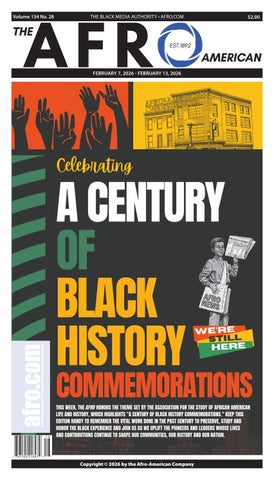
FEBRUARY 7, 2026 - FEBRUARY 13, 2026


![]()

FEBRUARY 7, 2026 - FEBRUARY 13, 2026


By Dr. Kaye Whitehead
In 1926, during the nadir of Black history, Dr. Carter G. Woodson—the founder of the Association for the Study of African American Life and History (ASALH), the son of formerly enslaved parents, a former sharecropper and miner, and the second Black person to receive a doctorate from Harvard University—launched the first Negro History Week. He intentionally chose February because the Black community had already set aside the birthdays of Abraham Lincoln (Feb. 12) and Frederick Douglass (Feb. 14) to recognize and celebrate their contributions to emancipation and abolition.
The goal of Negro History Week was to study, teach and promote the significant contributions that Black people had made to American society. From our writers to our inventors, our politicians to our teachers, our artists to our musicians, it was designed to document our lives from American slavery to freedom and to fill the historical gaps deliberately overlooked to miseducate our children. In 1976, Negro History Week, which by then had evolved into Black History Month, was officially recognized and proclaimed by President Gerald Ford. We are now at a moment where

Dr. Karsonya “Dr. Kaye” Wise Whitehead is the 30th national president of the Association for the Study of African American Life and History. She is the eighth woman to lead the organization. Today, she speaks to the meaning of Black History Month and its 2026 theme of “A Century of Black History Commemorations.”

Your History • Your Community • Your News
The Afro-American Newspapers
Baltimore Office • Corporate Headquarters
233 E. Redwood Street 6th Floor, Suite 600G Baltimore, Maryland 21202
410-554-8200
Customer Service, Home Delivery and Subscriptions: 410-554-8200 customerservice@afro.com
Founded by John Henry Murphy Sr., August 13, 1892
Chairman of the Board/Publisher - Frances Murphy Draper
(Publisher Emeritus - John J. Oliver Jr.)
President - Benjamin Murphy Phillips IV
VP of Marketing and Technology - Kevin E. Peck
Director Digital Solutions - Dana Peck
Receptionist - Wanda Pearson - 410-554-8200, ext. 246
Director of Operations
Andrè Draper - 410-554-8200
Director of Finance
Bonnie Deanes - 410-554-8242
Executive Director/Director of Advertising
Lenora Howze - 410-554-8271 - lhowze@afro.com
Director of Community & Public Relations
Diane W. Hocker - 410-554-8243
Editorial
Managing Editor - Alexis Taylor - 410-554-8257
Editorial Assistant - Ama Brown-Parson Evening / Weekend Editor - Zenitha Prince
Archivist - Savannah Wood - 410-554-8277
Baltimore Circulation/Distribution Manager
Andrè Draper - 410-554-8200
Creative Design and Content
Matthew McDonald
Washington Office 1140 3rd Street, N.E., 2nd Floor Washington, D.C. 20002-6723 202-332-0080
(Washington Publisher Emerita - Frances L. Murphy II)
Director of Operations - Andrè Draper - 410-554-8200

we are celebrating a century of Black History Commemorations—50 years of Negro History Week and 50 years of Black History Month. America is a complicated place. It is, as Dr. Charles H. Long once asserted, a “hermeneutical situation,” in that it is diverse and complex. Its history is both beautiful and bloody. The study of it requires constant and continuous interpretation, upkeep, meaning-making and evaluation. The understanding of it requires us, as Black people, to see ourselves and our history only through our eyes and not, as W.E.B. DuBois argued,
simultaneously through our eyes and through the eyes of an oppressive, dominant White culture. We must move beyond both the White gaze and the fragmentation (the idea of “two souls, two thoughts, two unreconciled strivings” fighting to exist in one body) that comes from double consciousness and into a space where we fully recognize who we are and what we have contributed to this country.
We built this country. We tamed the land, and we cultivated the crops. Our unpaid labor and the buying and selling of our bodies are the cornerstone of America and of American capitalism. Our blood is mixed with the soil, and the wind carries forward our tears of both sorrow and joy. We fought in the wars for democracy abroad and at home. James Baldwin once wrote, in an open letter to Bishop Desmond Tutu, that the fight for Black freedom makes White freedom possible. “Indeed,” he notes, “our freedom, which we have been forced to buy at such a high price, is the only hope of freedom that they have.” To celebrate America at this moment requires us to fully situate ourselves within the narrative, not as a footnote, but as main characters who have helped shape this American experience and the American story.
Black history is American history, and as we have done every year since 1926, we will proclaim and celebrate Black History Month.
Our 2026 theme is “A Century of Black History Commemorations,” and it is fitting for this moment that we take time to look back so we can push

back and push forward. We stand in the House of Woodson, and just as he did, with the work of so many others, we will uplift our history. We will protect it. We will promote it. And we will preserve it. We will plant our trees of truth, the ones that tell our story, right beside where they are planting their trees of lies, the ones that seek to erase and distort our story. We will teach our children, future generations, how to choose the path of truth and how to stand tall in moments of adversity, how to bring clarity in moments of confusion, and how to choose and embrace love instead of hate.
Black History Month belongs to us—we do not celebrate because they see us, we celebrate because we see ourselves. We do not ask for

permission to center ourselves; we write the stories where we are centered, and then we tell that story. We do not sing songs of freedom because they are playing the music; we sing because we are the music makers, and we carry the songs of our ancestors and bring that music to our people. We do not wait for anyone to write our story; our history has already been written, as we are the history seekers and the truth speakers. We invite you to join us as we once again claim this space, proclaim this February 2026 as Black History Month, and celebrate and center the incredible contributions that we have made and are making as we continue to survive and thrive in this beautiful, imperfect union.
WHEREAS Dr. Carter G. Woodson launched Negro History Week in February 1926 and set it aside as a time to study, teach, and celebrate the significant contributions that Black people had made to American society;
WHEREAS Negro History Week later expanded into a month-long celebration and became known as Black History Month, and was officially recognized in 1976 by President Gerald Ford, who urged all Americans to honor the historic contributions that Black people had made to America during the nation's Bicentennial;
WHEREAS Black History Month, which originated in America, is celebrated (but observed differently) around the world from Canada in February to the United Kingdom, the Netherlands, and Ireland in October; from Australia in July (with Blak History Month coinciding with National Aboriginal & Islander Day Observance Committee week) to various Latin American nations celebrating specific days, including Colombia’s Afro-Colombian Day on May 21, Panama’s Black Ethnicity Day on May 30, and Brazil's Black Consciousness Day on November 20;
WHEREAS the Association of African American Life and History (ASALH), founded in 1915 by Dr. Carter G. Woodson, has faithfully kept the tradition set forward by Dr. Woodson of setting the yearly Black History Month theme, working with ASALH local branches to host Black History Month celebrations, and hosting an annual Black History Month Luncheon;
WHEREAS 2026 marks one hundred years of Black history commemorations 50 years of Negro History Week and 50 years of Black History Month and is thereby officially noted in the 2026 Black History Month theme: A Century of Black History Commemorations; NOW THEREFORE, I, KARSONYA WISE WHITEHEAD, National President of the Association for the Study of African American Life and History, on behalf of the Executive Council and the ASALH members, do hereby acknowledge and recognize FEBRUARY 2026 AS BLACK HISTORY MONTH and urge everyone to recognize and observe this month by hosting and/or participating in Black History Month activities, and by taking up the shared work of protecting, promoting, and preserving Black History as a significant part of the American story


By
Within the chronicles of African-American history, particularly within the last 100 years, many names come to the forefront: Ida B. Wells, Frederick Douglass, Booker T. Washington, W.E.B. DuBois and more.
But based on the intellectual prowess and academic and professional achievements of two leading Black scholars, Dr. Daryl Michael Scott and Dr. Lionel Kimble, one name that must be included in the pantheon of great minds is Dr. Carter G. Woodson.
Woodson, born Dec. 19, 1875, in New Canton, Va., as the son of former slaves, refused to allow his circumstances to define his future. His parents were illiterate, and his family was poor. But lessons learned from his father gave rise to a spirit of self-sufficiency that Woodson never abandoned.
“Woodson’s family owned a small plot of land, about five acres, which provided little more than the food you’d get from a small garden and is probably why he often talked about being hungry when he was a child,” said Scott, who retired from Howard University after 20 years of distinguished service. Scott is currently a professor of U.S. history at Morgan State University and chair of the
“Upon closer inspection, we find that Woodson was a man who persevered, no matter what he faced, throughout his entire life. We cannot prove it, but it’s believed that at one point he wrote most of the articles that were published in the Journal of Negro History by himself, under a pen name. And he was a teacher at his core.”
Woodson was a member of Omega Psi Phi Fraternity, Inc., and used the organization to spread information on Black history. A strong call to action from the historian led the fraternity to create Negro History and Literature Week in 1924. Today, Woodson is widely recognized as the “Father of Black History” and the founder of Negro History Week in 1926, which later expanded to Black History Month in February to align with the birthdays of Douglass and Abraham Lincoln.
As an accomplished histo rian and the second Black to earn a Ph.D. in history from Harvard University, Woodson dedicated his life to correcting the omission and distortion of Black history in academic and public discourse, insisting that history should focus on the accomplishments of African Americans rather than just their enslavement.
But Woodson had a zeal for knowledge that could not be quenched, leading him to establish the Association for

it’s not difficult to understand how he succeeded.
“Woodson was the ultimate autodidact, a self-taught man who was able to earn degrees
emphasized that to acquire knowledge, we need to follow a systematic approach and study both our past and our present. For some peo
is too painful. But it’s like a child who touches a hot iron and burns their finger. You can learn a lot through pain and trauma.”
embrace the pain as a way of adapting,” Kimble concluded. “Like Woodson and Wells, Black Americans must realize that we cannot run from the


By Kendra Bryant Special to the AFRO
Though Negro History Week was started by Dr. Carter G. Woodson in 1926, 100 years later the tradition of learning about Black leaders and legends in February continues strong. Now known as Black History Month, the 28 precious days set aside are packed with opportunities to understand Black history, Black culture and the people who keep pushing the race forward.
Dr. Michial Gill, a member of the BookButler Publishing Company events team, said “It should be noted that his (Woodson’s) idea was not to celebrate Black history, but to encourage and motivate not only Black people, but all people to realize, acknowledge and keep in the forefront the contributions of Blacks.”
Black History Month is recognized internationally.
Canada observes the holiday in February, while Australia celebrates in July. In Maryland, the holiday takes various forms.
This year’s theme, set by the Association for the Study of African American Life and History (ASALH), focuses on “A Century of Black History Commemorations.” Church services, classes, conferences, festivals, luncheons, oratorical and essay competitions are all among the ways Black History Month has been honored in the past. The BookButler Publishing Company continues to host its annual BLK Roots and Culture Expo and BLK Author Expo in the Baltimore community. The event will take place at the Randallstown Community Center, located at 3505 Resource Drive, on Feb. 7 from 11 a.m. to 3 p.m.
“There are so many Black authors, poets and creatives who never get their work off the shelf,” said Gill.
“Be a part of the village. Pass on the history, the culture, educating our youth so we don’t make the same mistakes of the past. Build upon which our forefathers worked so hard to excel.”
“By seeing so many Black entrepreneurs hopefully will inspire others to use their creativity, their talents to also contribute to the welfare of people.”
Gill said it’s important to contribute to how people learn about Black history.
“We know that Blacks have invented, created and molded excellence in so many fields that are the foundation of not only America but the world,” said Gill. “We already have so many that do not realize Black achievements and Black excellence. Many of our young Black children are not cognizant of the contributions made by Blacks. It is incumbent upon us to make sure that Black history is taught to them.”
Preserving African American history extends beyond the classroom through archival and museum work.
Baltimore is the home of several historical institutions, including the Maryland State Archives, the AFRO Archives, the National Great Blacks in Wax Museum and The Reginald F. Lewis Museum.
“Knowing this historical information raises the esteem and confidence of our young brothers and sisters,” said Gill. “In this political climate, as in the history taught in schools, there is an attempt to whitewash Black achievement. We see from what is happening in

the present administration, there is an attempt to not only water down the accomplishments of Blacks and people of color but erase it entirely.”
Each year, ASALH works
At a moment when public memory and historical truth are being contested, archives aren’t simply about the past — they’re tools for understanding the present.
I am an archivist by instinct, long before I ever claimed the title. I collect what was never meant to survive: old deeds, wills with Black names misspelled, faded church minutes, letters written carefully because paper itself was a risk. I document not because I love the past, but because I know what happens when records disappear. Silence is never neutral. It always benefits power. That is why my recent book, “The Bequest of John T. Ward,” matters right now.
When moments like this arise, people ask why we keep digging into history. Why look backward when everything feels urgent in the present? My answer is simple: because what we are seeing is not new. It is familiar. And without documentation, familiarity becomes inevitability.
Long before emancipation, freedmen gathered and studied Revolutionary War records to learn how liberty had been fought for and how it might be claimed again. Knowledge was strategy. Archives were survival tools.
The machinery of the State
As I researched nineteenth-century Black life in so-called “free states,” I kept returning to the Fugitive Slave Act of 1850. On paper, it was
federal law. In practice, it deputized ordinary citizens, erased due process, overrode local protections, and turned entire regions into hunting grounds. Free states did not become safe because slavery was outlawed; they became compliant. What struck me most was not only the violence, but the paperwork. Warrants issued without evidence. Affidavits signed by men who never met the people they condemned. Ledgers recording human beings as recoverable property. The machinery of the state moved efficiently, bureaucratically, and without moral pause. History makes this clear: oppression rarely announces itself as chaos. It presents as an order.
The present is not new
When I watch modern footage of federal enforcement deployed into communities today, I feel the same chill I felt when opening those old files. The uniforms change, the language changes. The logic does not. Broad authority. Minimal accountability. A presumption that certain bodies are inherently suspect. When people say, “This isn’t America,” I hear what Black communities have always known: this is an America we have been documenting for centuries.
Archival work strips away the comfort of surprise.
A family archive reveals political truth
My own family history taught me that lesson. I grew up knowing my great-great-grandfather, John T. Ward, as an Underground Railroad
conductor, a landowner, a recipient of a Civil War contract, and the founder of what is now the oldest Black-owned business still operating in America, E.E. Ward Moving and Storage. Those facts alone felt extraordinary. What was missing, what had been buried, was the fact that his life was actually deliberately political.
Through archival fragments and scholarship such as “The Colored Conventions Movement,” I learned that John T. Ward was part of a national network of Black leaders who organized, debated law, built institutions, and asserted citizenship decades before emancipation. The records showed meetings, correspondence, and planning. These were not passive figures waiting for freedom. They were designing it.
The most haunting discovery was the will long buried in legal filings that granted manumission to members of my family. Not a legend. Not oral history. A document. Folded, filed, nearly erased. Proof that freedom, when it came, was fought for line by line, signature by signature.
Documentation as resistance
Black Americans have long recognized that laws are not merely words. They are behaviours backed by force. We have lived through eras when being “in the wrong place” was a crime, when helping someone else was treated as treason, and when compliance did not guarantee safety. The records clearly show that, if you are willing to look.
But preservation is not only about trauma. It is about resistance. For
to honor Black history year round– but especially in February. This year’s annual brunch will be held on Saturday, Feb. 28, 2026, 12:00 p.m. – 3:00 p.m. EST at the JW Marriott, located in the 1300 block of Pennsylvania Ave. in Washington, D.C. This year’s event will include notable speakers and the reveal of two new United States Postal Service stamps in honor of Black icons.


By Megan Sayles AFRO Staff Writer msayles@afro.com
For generations, Black artists have played a critical role in documenting Black life—often filling gaps left by traditional historical institutions that overlooked or erased Black experiences. Whether through visual art, music, performance or storytelling, their work can preserve personal and collective memory, presenting interpretations of history that are grounded in lived experience.
For Jerrell Gibbs, a painter from Baltimore, Black art does not merely accompany Black history, it defines it.
“Black artists have always been historians, even when we weren’t labeled as such. When official records ignore us or flatten our stories, art steps in to fill the gaps,” said Gibbs.
“Through imagery, symbolism and storytelling, we document everyday life, joy, grief, resistance and survival. A painting can hold emotional truth in a way textbooks can’t. It captures how something felt, not just what happened.”

“Black art and Black culture are our immune system. When we don’t have it, we don’t know who we are. We lose ourselves.”

In his own work, Gibbs said he focuses on human moments—universal experiences, subtle expressions, quiet scenes and charged stillness. He paints Black men in moments of rest and reflection, often adorned with flowers, and draws from his family archive.
With his art, Gibbs intentionally counters dominant portrayals of Black men rooted in violence, trauma and pain.
“I’m interested in honoring Black people as full individuals, not just as symbols of struggle. I focus on capturing the real-life experiences that myself, my friends and family experience on a day to day,” said Gibbs. “My paintings act like visual archives, preserving not just events, but emotions, identity and presence.”
Sharayna Christmas, a Baltimore-based cultural worker, sees her art as a way to preserve memory, honor ancestors and connect the community to its history. With her nonprofit, Muse 360, she’s built an intergenerational incubator where young people and community members can come together to make art and explore historical books, artifacts and archives.
Through dance, film and multidisciplinary projects, Christmas draws


on African spirituality, futurism and diasporic traditions to depict Black life and identity. For Christmas, Black art is inseparable from Black history.
“Black art and Black culture are our immune system,” said Christmas. “When we don’t have it, we don’t know who we are. We lose ourselves.”
Christopher “kolpeace” Johnson, a multidisciplinary artist born in Columbia, S.C., draws on his Southern upbringing to document Black life through painting, performance and public art. He creates portraits, murals and live paintings that capture ordinary moments, family rituals and community life—using imagery like indigo, pine straw and animals to
evoke safety, cultural memory and ancestral connection.
He emphasized that Black artists have long acted as historians, illustrating the nuances of daily life, culture and struggle.
“My goal is to reveal these stories to people who may have been oppressed, segregated or dealing with harsh realities in their own lives. My story is just one of many that can share that intimate value,” said Johnson. “My work creates that cultural connection that I was inspired by—from our predecessors who are Black, but who are also proud to be Black, and I’m very proud to be Black in the space that I make my work in.”


Walk into a mainstream bookstore, and you’ll likely see books by a handful of well-known Black authors — Toni Morrison, Colson Whitehead and Octavia Butler — highlighted during Black History Month or after an Oprah nod. But head into a Black-owned bookstore, and Black stories aren’t seasonal. They’re everywhere. These spaces are wall-to-wall Black books, 24 hours a day, seven days a week. They’re go-to spots for purchasing work by internationally celebrated Black authors, as well as by writers White people are less familiar with — folks like Eric Jerome Dickey, Sister Soulja, Jawanza Kunjufu, Denene Millner and Kiara Imani. Fiction, nonfiction, Black perspectives on mental health and healing trauma, or gender inequality, and the effects of systemic racism — you want it, they’ve got it, or they’ll order it for you.
But in addition to being spaces where Blackness is centered and literary voices are welcomed and valued, the nearly 140 Black-owned independent bookstores across the United States are about more than the latest bestseller. They’re vital beacons of liberation and hope — places where we discover ourselves, gain a greater appreciation for our culture, and learn.
“It’s more costly to deal with a society being uneducated than educated,” says Malik Muhammad, the co-founder and owner of Malik

Books in Los Angeles. “We have to be very selective in what is being educated because — and this is why critical race theory exists — two things can’t occupy the same space at the same time. It’s either this or it’s that. We live in a society where White is ‘beautiful,’ and Black is ‘evil.’ We have to change that narrative. It’s our responsibility to write our history, write our narrative, and to teach and cultivate our youth to love themselves and be true to themselves.”
Indeed, since opening the doors to Malik Books in 1990, Muhammad says he remains dedicated to being a Black bookstore owner despite the challenges because he believes Black people deserve access to
“having a knowledge of self.”
A tradition of literary liberation
The first Black bookstore was founded in 1834 by abolitionist and writer David Ruggles, who converted his New York City grocery shop into a space where Black folk could gather to discuss fights against colonization and movements for equal rights.
Abolitionist and feminist publications written by or featuring Black voices were available in the shop. Ruggles’ bookstore was even used as a temporary haven for Frederick Douglass.
Douglass wrote of Ruggles, who became his mentor, “He was
a whole-souled man, fully imbued with a love of his afflicted and hunted people, and took pleasure in being to men as … eyes to the blind and legs to the lame.”
The bookstore served as a stop on the Underground Railroad and as a gathering place for anti-slavery activists until it was burned down in September 1835 by a White mob.
After Emancipation, attacks on independent Black bookstores didn’t end.
Oakland-based Marcus Books, the nation’s oldest independent Black bookstore, opened its doors in 1960. It is named after Marcus Garvey, founder of the Black Nationalist Movement. And it’s well-documented that the federal government deliberately targeted Black bookstores with the intent to diminish their impact.
In 1968, FBI Director J. Edgar Hoover ordered the FBI to identify and study Black bookstores because he feared their ability to progress the Civil Rights and Black Power movements.
“Determine the identities of the owners; whether it is a front for any group or foreign interest; whether individuals affiliated with the store engage in extremist activities; the number, type, and source of books and material on sale; the store’s financial condition; its clientele; and whether it is used as a headquarters or meeting place,” Hoover demanded.
“Everyone has a shelf in their mind of the collection of books that they have read,” Muhammad says, “and those books influence your thoughts and the decisions that
you’ve made. We like to curate and select books that are positive and uplifting, but in the process, we address real issues.”
Blanche Richardson, whose parents, Julian and Ray Richardson, founded Marcus Books, told PBS Newshour that her mom and dad “would really scour the country looking for books about Black people. At that time, very few Black people were being published. My parents saw the need for Black people to have a source of information about themselves.”
Blanche Richardson, who runs the bookstore now, said the bookstore was “a meeting place for many organizations, but also a place that appreciated you, welcomed you, did not follow you around the store with mirrors on the walls, you know?”
Why do we need to support Black bookstores right now?
Black authors are often, and deliberately, kept out of mainstream bookstores, which means it’s still difficult to find Black-centered literature. Terri Hamm, the founder of Kindred Stories in Houston, recently told The New York Times that she opened the bookstore because there was nowhere else selling books for her 14-year-old daughter.
“It dawned on me that she didn’t have a space in Houston to discover and explore all the amazing works in the market that are written by Black voices,” Hamm said. “There wasn’t a space curated with her in mind.”

As Johns Hopkins prepares to celebrate its 150th anniversary on Feb. 22, its role as Baltimore’s largest anchor institution has never been more pronounced.
Johns Hopkins—the largest private employer in the city and state—delivered a $40 billion economic impact across Maryland last year, including supporting 149,000 jobs, according to an independent analysis by Econsult Solutions Inc.
In Baltimore, Johns Hopkins’ annual economic impact was estimated at $19.4 billion—including university and health system operations that supported one in every five jobs in the city, according to the independent analysis.
“Johns Hopkins is a vital engine of economic growth and regional vitality in every community it serves,” according to the report and the Johns Hopkins Committed to Community website.
The decade-long HopkinsLocal program has powered a significant portion of the benefits that have accrued in Baltimore. Since 2015, Johns Hopkins University and Johns Hopkins Health System have combined to spend more than $1 billion with local businesses—prioritizing inclusive hiring of city residents, extensive procurement with local companies, and investments in neighborhoods and community organizations.
“Johns Hopkins goes out of its way to make sure that local companies participate in their projects,” said Jeffrey Hargrave, president of Mahogany Inc., a Baltimore-based commercial construction firm that evolved from a subcontractor to a general contractor thanks to work from Hopkins.
Such local inclusion has been the university’s vision for more than a decade.
“Our success as an institution is inextricably tied to that of the city that we call home,” Johns Hopkins University President Ron Daniels said. “Johns Hopkins has a unique obligation and opportunity as an anchor institution in Baltimore and Maryland to ensure our spending decisions help our communities flourish, and we are working with our neighbors and partners to make a meaningful impact in our city and state.” Research alone generates a $10 billion economic cascade across the state, including nearly 38,000 jobs, according to the analysis.
Johns Hopkins Technology Ventures, which helps commercialize discoveries, has helped create more than 130 startups through fiscal year 2024 that have raised $4.4 billion in venture capital—43% of which has remained in Baltimore.
In Baltimore, the daily operations of Johns Hopkins University—which employ more than 22,000 people in the city—generated a direct annual impact of $5.4 billion and an indirect impact of an additional $1 billion in fiscal year 2024.
Johns Hopkins Health System operations—which employ nearly 20,000 people in Baltimore—drive a direct impact of $5.7 billion and produce $2.4 billion in indirect benefits. In addition, other Hopkins-affiliated health entities generated $2.3 billion in economic activity.
Additionally, in fiscal year 2024, the Johns Hopkins Health System provided $597 million in community benefits throughout Maryland and Washington—with the majority, $491 million, delivered in Baltimore. Such benefits include direct health services, screenings, free clinics, community building, workforce development, free and reduced medical care, and more.
Capital investments in buildings and infrastructure produce annual direct and indirect economic benefits of nearly $1.3 billion and nearly 6,700 jobs in Baltimore. Over the past decade, Johns Hopkins has committed $490 million with local companies involved in design and construction projects.

By Terry Tang
For academics, historians and activists, the past year has been tumultuous in advocating the teaching of Black history in the United States.
Despite last year proclaiming February as National Black History Month, President Donald Trump started his second term by claiming some African American history lessons are meant to indoctrinate people into hating the country. The administration has dismantled Black history at national parks, most recently removing an exhibit on slavery in Philadelphia last month. Black history advocates see these acts and their chilling effect as scary and unprecedented.
“States and cities are nervous about retribution from the White House,” said DeRay Mckesson, a longtime activist and executive director of Campaign Zero, an organization focused on police reform. “So even the good people are just quieter now.”
In the 100th year since the nation’s earliest observances of Black History Month — which began when scholar Carter G. Woodson pioneered the first Negro History Week — celebrations will go on. The current political climate has energized civil rights organizations, artists and academics to engage young people on a full telling of America’s story. There are hundreds of lectures, teach-ins and even new books — from nonfiction to a graphic novel — to mark the milestone.
“This is why we are working with more than 150 teachers around the country on a Black History Month curriculum to just ensure that young people continue to learn about Black history in a way that is intentional and thoughtful,” Mckesson said about a campaign his organization has launched with the Afro Charities organization and leading Black scholars to expand access to educational materials.
New graphic novel highlights history of Juneteenth
About three years ago, Angélique Roché, a journalist and adjunct professor at Xavier University of Louisiana, accepted a “once-in-a-lifetime” invitation to be the writer for a graphic novel retelling of the story of Opal Lee, “grandmother of Juneteenth.”
Lee, who will also turn 100 this year, is largely credited for getting federal recognition of the June 19 holiday commemorating the day when enslaved people in Texas learned they were emancipated.
Under Trump, however, Juneteenth is no longer a free-admission day at national parks.
Juneteenth helped usher in the first generation of Black Americans who, like Woodson, was born free. “First Freedom: The Story of Opal Lee and Juneteenth,” the graphic novel, comes out Feb. 10. It is the culmination of Roché’s assiduous archival research, phone chats and visits to Texas to see Lee and her granddaughter, Dione Sims.
“There is nothing ‘indoctrinating’ about facts that are based on primary sources that are highly researched,” said Roché, who hopes the book makes it into libraries and classrooms. “At the end of the day, what the story should actually tell people is that we’re far more alike than we are different.”
While Lee is the main character, Roché used the novel as a chance to put attention on lesser known historical figures like William “Gooseneck Bill” McDonald, Texas’ first Black millionaire, and Opal Lee’s mother, Mattie Broadous Flake.
She hopes this format will inspire young people to follow Lee and her mantra—“make yourself a committee of one.”
“It doesn’t mean don’t work with other people,” Roché said. “Don’t wait for other people to make the changes you wanna see.”
Campaign aims to train new generation of Black historians
When Trump’s anti-DEI executive orders were issued last year, Jarvis Givens, a professor of African and African American Studies at Harvard, was thousands of miles away teaching in London, where Black History Month is celebrated in October. He had already been contemplating writing a book for the centennial.
Watching Trump’s “attack” cemented the idea, Givens said.
“I wanted to kind of devote my time while on leave to writing a book that would honor the legacy that gave us Black History Month,” Givens said.
The result is “I’ll Make Me a World: The 100Year Journey of Black History Month,” a book with four in-depth essays that comes out Feb. 3. The title is a line from the 1920s poem “The Creation” by James Weldon Johnson, whose most famous poem, “Lift Ev’ry Voice and Sing,” is known as the “Black National Anthem.”
Givens examines important themes in Black history and clarifies misconceptions around them.
The book and the research Givens dug up will tie into a “living history campaign” with Campaign Zero and Afro Charities, Mckesson said. The goal is to teach what Woodson believed — younger generations can become historians who can discern fact from fiction.
“When I grew up, the preservation of history was a historian’s job,” Mckesson said, adding his group’s campaign will teach young students how to record history.
How the ‘Father of Black history’ might feel today
Born in 1875 to formerly enslaved parents, Woodson was among the first generation of Black Americans not assigned to bondage at birth. He


grew up believing that education was a way to self-empowerment, said Robert Trent Vinson, director of the Carter G. Woodson Institute at the University of Virginia in Charlottesville, Virginia.
The second Black man to earn a doctorate at Harvard University — W.E.B. Du Bois was the first — Woodson was disillusioned by how Black history was dismissed. He saw that the memories and culture of less educated Black people were no less valuable, Vinson said.
When Woodson established Negro History Week in 1926, he was in an era where popular stereotypes like blackface and minstrelsy were filling in for actual knowledge of the Black experience, according to Vinson. This sparked the creation of Black history clubs and Woodson began inserting historical lessons “on the sly” in publications like the “Journal of Negro History” and the “Negro History Bulletin.”
“Outside the formal school structure, they’re having a separate school like in churches or in study groups,” Vinson said. “Or they’re sharing it with parents and saying, ‘you teach your young people this history.’ So, Woodson is creating a whole educational space outside the formal university.”
Read more on AFRO.com
APPLIED BIOTECHNOLOGY & MOLECULAR BIOLOGY (M.S.)
Master lab techniques to innovate in biotech and molecular science.
ENGLISH FOR SPEAKERS OF OTHER LANGUAGES (M.Ed.)
Prepare students to succeed in English-language environments.
INTERNET OF THINGS & INTERNET TECHNOLOGIES (M.S)
Design smart, connected systems for real-world applications.

By Tashi McQueen AFRO Staff Writer tmcqueen@afro.com
The Maryland House of Delegates, on Feb. 2, passed a controversial mid-cycle congressional redistricting plan designed to reshape the state’s eight U.S. House districts.
The aim of the map is to significantly alter the lone Republican-held congressional seat, the 1st District. House Bill (HB) 488 passed by a 99-37 vote, which was achieved primarily along party lines.
House Speaker Joseline Peña-Melnyk (D-Md.-21) pressed that now is the time to pass and implement this redistricting initiative.
“We are not here because we want to be here,” said Peña-Melnyk in a statement.
“We are here because the times call for it.”
She highlighted that since the 47th president directed Texas to redistrict in order for the party to gain more seats in the United States House of Representatives, five states have followed suit.
“The House passed a map to strengthen community representation, comply with traditional districting criteria, and ensure Maryland’s representatives maintain a fair opportunity to elect the next Speaker of the House in Washington, D.C.,” she said. “I am proud of the work the House put in to pass this critical piece of legislation. This is Maryland’s response to the Trump Administration’s attempts to derail democracy and we must ensure the people’s voices are heard loud and clear.”

Maryland Gov. Wes Moore (D) echoed those sentiments in his statement on the matter, which was released shortly after the bill passed.
“The House took an important step to strengthen our democracy and ensure Maryland’s representation reflects the will of the people,” said Maryland Gov. Wes Moore (D) in a statement shortly after the bill passed. “Republican leaders are already moving aggressively to further redraw maps ahead of 2026. And with the U.S. Supreme Court poised to issue rulings that could weaken key voting rights protections, we cannot afford to sit on the sidelines.”
“Now it’s time for the Maryland State Senate to do what Marylanders expect and democracy demands: take up this map, debate it, improve it if needed—and vote,” he added.
After the bill passed the House it crossed over to

the Senate, where it would normally get assigned to a committee, receive another hearing, and come back to the Senate for a vote by the full chamber before it could be sent to the governor’s desk.
Though the Senate did not address HB 488 on the Senate floor during their Feb. 3 meeting, the bill was assigned to the Senate Rules Committee. The committee currently has no official hearings on their calendar and will likely not schedule one for this bill at all.
“The Senate has been in the same place really since October 2025, after analyzing the impact of the state constitution on this question,” State Senate President William “Bill” Ferguson (D-Md.-46) told the AFRO Ferguson said “there is a fundamental agreement that we are all unbelievably concerned about what the Trump administration is
doing to Marylanders and the harms that are being caused in Maryland. The Maryland Senate is just as outraged as our colleagues.”
Ferguson said what’s important in this moment is prioritizing.
“We have to focus our limited time and energy on prioritizing things we know can best protect Marylanders,” he said. “We’re focusing on making sure that we can find ways to make Maryland more affordable when it comes to energy, healthcare and housing. We’re trying to find ways to grow our economy to get more people to work, and then also make sure that we’re protecting with real policies that have tangible impact against the Trump administration.”
“That’s where we are focusing our time,” added Ferguson. “Redistricting…that window has been closed.”

By Megan Sayles AFRO Staff Writer msayles@afro.com
The 2026 tax season is underway, and the Creating Assets, Savings and Hope (CASH) Campaign of Maryland will continue its tradition of delivering free tax preparation to local households who earn less than $69,000 annually. The program is designed to ensure eligible Maryland families do not miss out on valuable tax credits— such as the Earned Income Tax Credit (EITC)— or the larger tax refunds they are entitled to receive.
This year, services for Baltimore City residents will be available at: the Central Enoch Pratt Free Library; University of Baltimore; the University of Maryland, Baltimore’s Community Engagement Center; the Center for Urban Families; Loyola University Maryland; The Weinberg Y in Waverly; Morgan State University, the Baltimore City Department of Social Services and We Are CASA. Baltimore County residents can seek appointments at the Baltimore County Public Library’s Randallstown
By Tashi McQueen AFRO Staff Writer tmcqueen@afro.com
On Jan. 30 protestors gathered in downtown Baltimore, Minneapolis and cities nationwide to oppose the violent immigration raids and recent deaths at the hands of agents from U.S. Immigration and Customs Enforcement (ICE), U.S. Border Patrol and other federal agencies.
“We’ve seen the horrible conditions that immigrants in Baltimore are being held in, in this building right here,” said Kenya Levy, 27, standing outside the federal building at 31 Hopkins Plaza. “We’ve seen the horrific killings in Minneapolis, and we’re out here to protest that we are not okay with it. We are not okay with ICE in our streets and we want to protect our communities.”
By Victoria Mejicanos
In Baltimore, the march and rally came as legislators and residents voiced concern about the alleged sub-par living conditions inside the George H. Fallon Federal Building, where those arrested in the immigration raids are being held. A leaked viral video of the ICE detention facility at the building in downtown Baltimore fueled outrage. The video showed dozens of men crammed into one room, many lying on the floor.
Braving the cold, hundreds of protesters called for accountability and reforms to federal immigration enforcement.
The AFRO reached out to the Department of Homeland Security for comment on the conditions of the facility but has not received a response.
Several legislators were denied access to the facility after the video emerged, but U.S. Rep. April McClain Delaney (D-Md.-06) was allowed in on the day of the protest.
“While I am relieved to be granted access after requesting this tour nearly two months ago, it’s clear that ICE gave us a highly sanitized portrayal of this facility,” Delaney said in a statement, confirming what the video depicted.
Upon her visit to the


Baltimore ICE facility, the Congresswoman found that the five holding rooms intended for short-term detention are being used for multiday confinement. People there are forced to live in dirty conditions with no privacy and limited access to food and water.
“What remains unknown is what conditions look like when I’m not there,” Delaney said. “I made clear to all the ICE officials I met in Baltimore that I expect better for the people of this country, and I will hold ICE and staff accountable for any and all unlawful actions carried out in Maryland.”
Levy highlighted the unity behind the protest.
“We really want to make it clear that we stand with each other,” she said. “We’re stronger when we’re united.”
Protesters also addressed an ongoing debate within the Black community about whether immigration should be considered a Black issue.
“I would say that these issues affect everyone, even if you’re not an immigrant. We see
and Towson branches; Towson University and University of Maryland Baltimore County.
“What we know is that this works. The Earned Income Tax Credit and other tax credits help put money back in people’s pockets, and it helps people and families out of poverty,” said Sara Johnson, co-founder and chief operating officer for the CASH Campaign, during a Jan. 30 press event. “With this money, we know that families know what to do with it. They pay their bills, they pay their rent and hopefully for fun things to do with their families.”
A statewide coalition, the CASH Campaign of Maryland has delivered free tax preparation to over 308,000 households, assisting them in gaining nearly $455 million in tax refunds and credits. Last year in Baltimore, the organization served more than 8,000 families who secured over $19 million in tax refunds and credits. In total,


that people are arrested because they look Brown or Black, not necessarily because they know their immigration status or where they were born,” Levy said. “We see an attack on
the CASH Campaign saved Maryland taxpayers $6.8 million in unnecessary fees.
Congressman Kweisi Mfume (D-Md.07) gave remarks at the CASH Campaign’s announcement, thanking the CASH Campaign for its efforts to support Maryland households.
“It’s a lot of families, and it’s a lot of children who benefit from what you do. They can’t vote for themselves, they don’t protest, they don’t picket, but they are with us every day,” said Mfume. “Every time we can find a way, through programs like this, to make sure something trickles back down to the family and the children, it’s essential.”
Eric Morrissette, deputy secretary of the Governor’s Office for Children (GOC), also gave remarks at the announcement.
“We can only meet them if all of us as a community are working with the advantages that we have before us. Among those advantages are the Earned Income Tax Credit,” said Morrissette. “The EITC is so important, as is the Child Tax Credit, in lifting children
one community as an attack on all of us, and we see that if we don’t stand together, they’ll eventually come for all of us. We don’t want that.”
and families out of poverty and pulling them into opportunity.”
Morrissette noted that the state’s “EarnedIt” Campaign has been working to ensure that Maryland families are informed about tax credits, like the EITC, through mailings, social media, radio advertising and word of mouth.
“Last year, we saw a lot of families who were eligible for the Earned Income Tax Credit truly claim that credit. We saw an uptake at a rate where we realized that we have to keep on doing this,” said Morrissette. “We have to push harder and stronger against the lack of awareness to ensure that everyone is able to pull themselves up through this credit.”
This is the 25th anniversary of the CASH Campaign’s free tax preparation services for Maryland families. Those seeking assistance can call 410-234-8008 Monday through Friday from 9 a.m. to 2 p.m. to book an appointment, or schedule one online at bmorefreetaxes.org.
expand access to education is through her experience having been in both public and private school systems. Having attended public school prior to Bryn Mawr, Gray says she felt called to return to those spaces and support students who have limited resources.
“After I got my education from Bryn Mawr, I was really inclined to go back to the public schools and help them out,” said Gray. “Whether it’s to tutor them or mentor them, anything like that.”
The four-day in-person immersive program brings together students from across the country for mentorship and career exploration in an all expenses paid trip to Walt Disney World Resort in Florida.
Throughout the program, students engage in interactive workshops and seminars led by Disney executives, educators and celebrities, designed to strengthen communication, leadership and networking skills.
Gray describes herself as “built on service” and when she’s not studying or serving her community, she’s an avid student athlete participating in volleyball and track and field. She also is a passionate photographer and acts as her school’s yearbook photographer and editor.
Her father Derris Gray, who will accompany her to the program in March, says the recognition represents more than another academic milestone.
“I’m more ecstatic about her effect on her immediate community and the people around her,” he said.
Both father and daughter expressed gratitude for Baltimore-based organizations that have supported Gray throughout her academic journey. Gray participates in the Baltimore Education Scholarship and Trust, or B.E.S.T., a program that recruits and supports Black students with demonstrated academic ability and financial need. Through the program, Gray is able to attend Bryn Mawr.
Her father says programs like these, and others she has participated in throughout her childhood acted as “catalyst” to many of her achievements.
Gray is completing her senior year of high school and plans to pursue a pre-med track in college. While she is still exploring her options, she said she has a strong interest in cardiology.


By D. Kevin McNeir
Hundreds of students from Howard University (HU) walked out of classes on Jan. 30 to demand an end to the immigration raids across the country and the brutality of federal agents in charge of rounding up illegal immigrants.
The demonstration was a carefully planned, peaceful and constitutionally protected march through the streets of Washington, D.C., to the White House.
As the trio of students who conceived and organized the
event said, their goal was to protest the violence and harm inflicted by federal Immigration and Customs Enforcement (ICE) agents and to stand in solidarity with individuals and families who have been murdered, detained, displaced or traumatized by immigration enforcement.
One of the organizers, Philadelphia, Pa., native Zahir Kalam Id-Din, 20, said after watching a group of students take the lead in a march and protest on YouTube, he was convinced that Howard students should get more involved in similar fashion.
“Watching students just like
me get involved sparked a lot of emotion in me,” Kalam Id-Din said. “That was the beginning of what happened today. The logistics came easily which was surprising and in six days our plans were complete. We were shocked to see nearly 500 HU students participate and as we marched through the streets of D.C., students from other colleges, including American University and Georgetown joined us.”
He adamantly stated that his generation should not be discounted by federal or local political officials.
“We are determined to convince more young adults
By Victoria Mejicanos
Staff Writer
AFRO
vmejicanos@afro.com
The Kennedy Center will close July 4 to undergo renovations for two years, according to a post on the 47th president’s social media account. The move comes after a Dec. 18 vote by the Kennedy Center board to change the name of the center to honor both the current president and former president John F. Kennedy. According to the president, the two-year closure is “the fastest way to bring The Trump Kennedy Center to the highest level of success, beauty, and grandeur.” He wrote that the quality of construction “would not be nearly as good” and take more time if the center was to not close for these renovations. The president also said that funding is fully in place for this project.
This announcement comes after a range of cancellations of established performances by artists. In 2025, the Kennedy Center faced public backlash after its board voted to make Trump the board chair. The Washington National Opera announced it would cut ties to the institution in early January 2026.


By Jonathan Forney Special to the AFRO
The Washington Wizards honored the career and community impact of former star John Wall on Jan. 29 at Capital One Arena as they took on the Milwaukee Bucks. Fans were shown highlights of Wall’s achievements on and off the court for the city.
Attendees were given special bobble heads commemorating Wall’s game-winning three-pointer in the 2017 National Basketball Association (NBA) playoffs, where he stood atop the scorer’s table and hyped up the crowd. A special “John Wall of Fame” was set up to allow fans to check out awards, game-worn shoes and photos from his career in Washington.
to join us and combine forces so we can become a powerful voice for change,” he said. “So much harm is going on especially with ICE agents which we can no longer ignore. We are America’s future teachers, doctors, lawyers, even construction workers and road builders, and it’s our responsibility to take control of our future and to rewrite history –one that we can be proud of.”
Kalam Id-Din’s colleagues included Kalia Bain, who spearheaded communications, and Mahoro Amani, a 19-year-old from Miami, Fla.,
By AFRO Staff
The AFRO is deeply saddened to learn of the death of Pierpont Morgan Mobley.
Mobley, the first Black person to work in the White House’s Personnel Office, served a total of four administrations and later went on to detail his experiences in his book, “The Black Side of the White House.”
Mobley was a champion for equal opportunities in employment and had a passion for politics.He was 88 years old when he died from a heart attack in January 2026.
A viewing will be held at Second New St. Paul Baptist Church, located at 2400 Franklin St. in Northeast, Washington, D.C. from 12 p.m. to 3 p.m. on Feb. 26.
A celebration of life will take place on Dec. 27 at 19th St. Baptist Church, located at 4606 16th St. in Northwest, Washington, D.C. The service will begin at 10 a.m. after a viewing.
the Raleigh native was projected onto the court. Wall was also honored for his impact in the D.C. community. He was surprised to learn that the next renovation to the Randall Recreation Center basketball court in Ward 6 will bear the name the “John Wall Court.” Wall was actively involved in community outreach during his career and continues to be in retirement. He helped pay residents’ rent, donated to various organizations and volunteered in the D.C. community.
“The most important thing for me was not just basketball, but what you do off the court,” Wall said.
“I love y’all,” Wall said to the team and his fans. “This is still my city. This is still my house.”
Fans were able to submit their favorite memories of the All-Star’s career as a Wizard through a QR code. There was plenty of dancing in the crowd as footage looped of Wall hitting his signature “Dougie” dance. The speakers also blasted Troop 41’s “John Wall” song to hype up the fans.
Wall retired in August 2025 after 11 seasons in the NBA. During halftime, a special tribute to
When he was awarded the NBA’s season-long Community Assist Award for the 2015–2016 season, he called the outreach that he did “the most rewarding part of being an NBA player.” Zach Leonsis, Monumental Sports’ president of media and new enterprises, presented a $25,000 check to the John Wall Foundation in recognition of their continuing work in the region. Wall was joined in accepting the check by his sons, Ace and Amir Wall.
The foundation provides mentorship, education and opportunities to exercise to

disadvantaged families and at-risk youth.
The Wizards went on to defeat the Bucks 109-99, led by sophomore guard Kyshawn George’s 23 points. George is a part of the Wizards’ young roster that didn’t play alongside Wall, but his impact on the team is still being felt.
“I know he was a big leader in D.C. Not only for the team, but for the community,” George said, adding that it’s important to see an example of a great basketball player that can also impact the community.
“You try to model yourself after [them],” said George.
Wizards’ big man, Alex Sarr, echoed the sentiment.
“He’s done so much here,” Sarr said. “I was just happy to see the love that the city gave him.”
Continued from B3

Zach Leonsis (left), Monumental Sports’ president of media and new enterprises, presents a $25,000 check to John Wall in efforts to help his organization, the John Wall Foundation, grow in its capacity to positively impact children and families in disadvantaged communities. Wall was joined in accepting the check by his sons, Ace (second from left) and Amir Wall.
who led a pep rally of sorts on the steps of the Black-owned Sankofa Video, Books and Café, a popular meeting place located just off the campus grounds.
The program featured a pouring of libations to the ancestors whose presence students invoked for the march that would follow, the singing of the Black National Anthem, a provocative spoken word performance and a fiery speech.
Students reflect on why they marched and next steps
“I’m concerned about the economy, the global economy, which seems to be set up to fail most of the world’s citizens,” Amani said. “For centuries, people in search of a better life have moved to America. But now, we’re told to hate them, and to hate one another – even those who are now legal citizens. It shows up in everything and everywhere.”
Kalam Id-Din said he has become overwhelmed by the numerous distractions and the surge of anxiety and uncertainty that continue to impact more Americans each day.
“My classmates and I are finding it harder to focus on our studies with all that’s happening in the U.S. and around the world,” said Kalam Id-Din, who added he’s worried about the future. “We don’t know what tomorrow will bring, but we do know that today our education is at risk, and we feel vulnerable. We should be focused on learning, not worrying about our right to vote, to protest, or to voice our concerns freely being taken away from us.”
Several students pointed to the unlawful detention of immigrants, surveillance of communities, and the normalization of state violence against Black, Brown and immigrant people as reasons that they are demanding a future in which communities are supported rather than targeted.
“It’s time for young people to show that

from B3 Continued from B3 $1,000,000

Richard Grenall who was recently appointed as the center’s president, posted a statement of support on social media Feb. 1 thanking Trump for the decision as well as Congress for the $257 million it appropriated for the Center’s repairs and restorations in last year’s “Big Beautiful Bill” spending package. There have been several lawmakers, artists and members of the Kennedy family speaking out against the decision to close the center.
Congresswoman Joyce Beatty (D-Ohio-03) released a statement in response to the announcement of the closure, criticizing the president’s lack of consideration for Congress.
“Once again, Donald Trump has acted with total disregard for Congress,” wrote Beatty. “The Kennedy Center is congressionally
we’re angry over what’s happening, and we did that today by marching and chanting,” said Ytinu McDonald, 17, an HU student from Savannah, Ga. “It’s time for us to speak up and speak out if we want to see change occur. We’re here to make a difference.”
Howard University student and Columbus, Ohio native, Zion Randall, 18, said he’s against what ICE is doing.
“It’s too much – I had to get involved and I plan to continue to do whatever I can to support other protests and actions led by young adults. Americans are being hurt and killed and that’s wrong.”
Reflections shared by Namiah Phillips, 18, were more emotional for reasons that soon became obvious.
“I am very sad,” said Phillips, who instead of marching, took refuge in the Sankofa bookstore because of an upcoming calculus exam.
“People, some with families, have been in the U.S. for many years and now, they’re being harassed and arrested by ICE. I am half
funded, and Congress should have been consulted on any decision to shut down its operations or undertake major renovations, especially for a two-year period.”
She also expressed support for artists.
“America’s artists are rejecting this attempted takeover, and the administration knows it,” said Beatty. “That is why they are now scrambling for cover.”
Jack Schlossberg, the only grandson of the late president John F. Kennedy shared his reaction on X.
“Trump can take the Kennedy Center for himself,” Schlossberg wrote. “He can change the name, shut the doors, and demolish the building. He can try to kill JFK. But JFK is kept alive by us now rising up to remove Donald Trump, bring him to justice, and restore the freedoms generations fought for.”
Mexican and I’m proud that my parents immigrated to America and gained their citizenship,” she said. “They even have a letter from President Reagan which they keep with their green cards. This is all very close to me – too close – and I’m worried about my friends and family in my hometown, Las Vegas, Nev., and in other parts of the U.S., like California.”
While the march was originally scheduled to conclude at the White House, the route was extended to Chinatown after marchers met up with another rally led by the Party for Socialism and Liberation. Amani said no plans have been discussed or made about future protests. But she’s sure this is just the beginning.
“There’s so much energy and so many positive suggestions that we’re excited to move things forward,” Amani said. “We had such a huge turnout – much larger than we imagined. And it came together in such a short amount of time. We believe it’s our responsibility to do something more, something bigger. And we will.”
Do you dream of owning a home, but have limited funds for a down payment and closing costs? United Bank’s Welcome Home Grant* may be the answer to your home buying dreams.
FOR DOWN


is a licensed minister, social commentator, youth advocate and certified community health worker. This week, he speaks on abolishing ICE and how restoring federal investigations to agencies bound by warrants and courts is an act of constitutional repair, not radicalism.
By Rev. Stacy Swimp
The call to “Abolish ICE”—the federal agency known as U.S. Immigration and Customs Enforcement— is often dismissed as a radical demand for disorder, but for those who recognize the moral arc of the universe, it is a necessary response to a legacy of weaponized law enforcement. Established in 2003, ICE has increasingly functioned as a paramilitary force that bypasses the judicial norms expected of American police. While we speak of foundational principles, we must confess these ideals have frequently been betrayed.
A nation built upon the systemic denial of Black humanity suffers from a deep-seated “groupthink”—a spiritual blindness regarding who is entitled to divine
protection and who is subject to state violence. This hypocrisy targets our Black and Brown brothers and sisters—including African and Caribbean immigrants— applying an enforcement culture that defies the biblical command to love the sojourner as yourself (Leviticus 19:33-34). As the patriarch of the family and a voice for the Igbo perspective, I see how this disregard for life tears at the very fabric of our community.
The terminal dangers of an agency operating without judicial oversight have been laid bare by the recent bloodletting in Minneapolis. On Jan. 7, 2026, Renee Good—a mother and teacher—was gunned down in her vehicle by a masked ICE agent. Barely two weeks later, federal agents killed Alex Pretti, a 37-year-old intensive

care nurse at the Minneapolis Veterans Affairs Medical Center.
Pretti, a servant who spent his career caring for veterans, was acting as a peaceful observer when he was tackled and shot in the back while pinned to the ground. In the wake of these tragedies, we have witnessed a shameful display of government deception and backpedaling. Officials initially branded these victims as “domestic terrorists,” attempting to smear their characters to justify state-sponsored homicide. When undeniable video evidence emerged showing Pretti was shot in the back, the administration pivoted, making light of the loss by calling it a “protocol” issue while continuing to obstruct state investigators.
From an industrial-organizational (I/O) psychological
perspective, this behavior is a textbook example of organizational narcissism and a lack of psychological safety. When an organization’s culture is rooted in absolute authority without external accountability, it develops a “fortress mentality” where the preservation of the agency’s image is prioritized over human life or truth. This leads to “moral decoupling,” where agents separate their professional actions from their personal moral compasses, justified by a toxic organizational identity.
Scripture warns that a house divided cannot stand. A system that bypasses constitutional protections inevitably targets the “other,” eroding justice for all. Peer-reviewed research confirms that punitive enforcement creates a “chilling effect,” fostering deep distrust in legal authorities. A practical, redemptive solution involves transferring Homeland Security Investigations (HSI) to the FBI. The FBI is a legacy agency bound by established judicial protocols and warrant requirements that ICE historically bypasses. Moving these investigators to the Bureau forces federal power back into a framework of transparency and probable cause. This ensures the “sword” of the state is used only for its rightful purpose: pursuing genuine threats like human trafficking, rather than executing nurses in the street. Abolishing ICE is an act of constitutional restoration. It removes the temptation of a paramilitary force and subjects all federal action to the scrutiny of the courts, respecting the dignity of all as children of God.
“And the angel said unto them, Fear not for, behold, I bring you good tidings of great joy, which shall be to all people.
“For unto you is born this day in the city of David a Saviour, which is Christ the Lord.”
– Luke 2:10–11 (KJV)
The angel does not announce that everything is resolved.
The angel says, “Fear not.”
Which tells us this: Joy is not rooted in certainty.Joy does not require stability.Joy does not wait for full clarity. Joy shows up in the middle of disruption and announces that God is still moving.
The shepherds were not looking for good news. They were doing ordinary work in an occupied land when heaven interrupted them with an announcement that reframed their
future. This is the joy we speak of today–not joy that denies discomfort or avoids the truth but joy that looks forward and trusts what God confirms even when our eyes cannot yet see.
A posture of readiness
We stand in a moment of reckoning. Christian faith gives us language for moments like this not to bypass loss or complexity but to hold tension without losing hope. Joy that looks forward does not deny how we feel. It fuels holy anticipation for what God will do next.
Anticipation is not the same as expectation. Expectation demands outcomes we can predict, manage, or control. Anticipation is a posture of readiness and preparation not demand. It prepares us to move faithfully without scripting the future.
Courage and clarity
Joy that looks forward requires
You actually don’t care where Jill Stein is…
By Dayvon Love
When people sarcastically ask the question “where is Jill Stein” it denotes a desire to deflect their complicity in the exploitative relationship between working class Black people and the Democratic Party.
The “lesser of two evils” analysis is often the pushback that liberals give to those of us who are committed to more radical approaches to electoral politics. The argument they make is that we need to be serious about who can actually win and develop an astute political approach that can deliver concrete results for our community. Additionally, not voting for Democrats–even if they are imperfect–just empowers the Make America Great Again (MAGA) movement.
One of the critiques I have of people who share my perspective on the need for more radical approaches to electoral politics is that they often don’t have a serious answer to the concern of ceding political power to Republicans who have no incentive to do anything meaningful for Black people. Both parties are instruments of the White settler colonialism, even when there are non-White people at the helm. But they are not the same, and the differences matter.
The electorate that is necessary for Democrats to be politically viable

base that can drive the trajectory of the party. While it may be objectively better to have a generic Democrat in office than a generic Republican, if we don’t simultaneously do the work to build the capacity to build credible electoral threats to the left of the Democratic Party establishment, then we are in effect co-signing a perpetual exploitative relationship to them.
are largely people of color. We are a captured electorate of the Democratic Party that are mostly pandered to, instead of being treated like a power
Democrats have generally supported symbolic measures on police reform (i.e. body cameras, training) and rejected more radical policies like community control of law enforcement. Democrats will market their policies of making public investments in social programs, but oppose progressive taxes on corporations. The Democratic Party is interested in minimal changes to White corporate domination of the world, while wanting to appear to have engaged in the maximum amount of social change. The only way that Democrats have delivered any meaningful progressive/radical policies is with radical political forces outside (to the left) of the party. If the Democratic Party is not challenged by electoral forces to its left, it has no incentive to deliver anything to Black people besides watered down policies.
In a state like Maryland, that will go into the 2026 election cycle with a gubernatorial election that is
essentially a one party race, there is an opportunity to test the effectiveness of developing credible electoral threats to the left of the Democratic Party. There is zero chance of Wes Moore losing to any of the other candidates who are running for governor. This means that if Marylanders vote in large numbers for a Green Party candidate it will send a message to Democratic Party that they need to run candidates with more progressive/radical policy platforms.
The leverage from folks voting for the Green Party candidate for governor of Maryland (which is the party on the ballot that is left of the Democratic Party) will be helpful in moving stronger policies that protect immigrants from ICE; the policy recommendations from the Maryland Reparations Commission; taking a stance against the genocide in Gaza; progressive taxation to make corporations in Maryland pay their fair share and other important policies that serve the interest of our community. Again, it is extremely unlikely that the Green Party candidate will win, but a 4 percent or 5 percent showing would be enough to send a signal to the Democratic Party that we are not satisfied with liberal reform, but instead we want revolutionary policies that can transform our community. Individual candidates that run for office as
courage. It calls us into motion. It is not passive optimism but faithful forward momentum. This joy brings clarity not because the path is simple but because God is present in it. Emmanuel. God with us. Clarity that says I know who goes before me. I know who walks with me. I will take the next faithful step.
The angel announces joy while the empire still stands. Power has not yet shifted. Oppression has not yet vanished. But joy arrives because God has entered the story in a new way. Joy looks forward not because everything is fixed but because God is faithful and already at work in what comes next.
As we journey through 2026, we do so with holy anticipation. Not grasping but knowing beyond knowing. Not controlling but humbly tending what has been entrusted to us. Ready. Preparing. Grounded. Confident because our ancestors have been here before. Joy has arrived, and it knows the way forward. This article was originally published by Word in Black.
a Democrat will have an incentive to run on a more progressive policy platform if they see stronger than normal numbers of people who vote for the Green Party.
Leaders of a Beautiful Struggle and many other organizations are working during the Maryland General Assembly to pass HB 101. The legislation would require any entity that receives public funding and hosts statewide general election debates (like Maryland Public Television) to invite every candidate that appears on the ballot to participate. This will provide the general public with an opportunity to hear political ideas that typically fall outside of the frame of the corporate duopoly, and provide an opportunity to directly hold Democrats accountable publicly. This would help to put public pressure on the Democratic Party to move further left, while also helping to build radical electoral forces outside of the Democratic Party that can go beyond the watered down policies of the Democratic Party establishment.
For those who are asking “Where is Jill Stein?,” I say if you are serious about a political environment where Black people are more than just figures of incorporated resistance into the American mainstream, then you should be looking to support the Butch Wares and Andy Ellises of the world who are running to build electoral political power beyond the Democratic Party.

SUPERIOR COURT OF THE DISTRICT OF COLUMBIA PROBATE DIVISION 2026FEP000004 FEBRUARY 27, 2025 Date of Death
CLARETTA JACKSON NILES Name of Decedent
NOTICE OF APPOINTMENT OF FOREIGN
PERSONAL REPRESENTATIVE AND NOTICE TO CREDITORS
TERESA WOODRUFF whose address is 9001 MOR-
RISSETT COURT, CLINTON, MD 20735 was appointecd representative of the estate of CLARETTA JAKSON NILES deceased, by the ORPHAN’S Court for PRINCE GEORGES County, State of MARYLAND , on MARCH 3, 2025. Service of process may be made upon WILLIAM A. BLAND, ESQUIRE, 80 M STREET SE SUITE 330, WASHINGTON DC 20003 whose designation as District of Columbia agent has been filed with the Register of Wills, D.C. The decedent owned the following District of Columbia real property: 1307
BUCHANAN STREET NW. The decedent owned District of Columbia personal property. Claims against the decedent may be presented to the undersigned and filed with the Register of Wills for the District of Columbia, Building A, 515 5th Street, N.W., 3rd Floor, Washington, D.C. 20001 within 6 months from the date of first publication of this notice.
Date of first publication: JANUARY 23, 2026
Name of newspaper, and/or periodical: Daily Washington Law Reporter AFRO-American
TERESA WOODRUFF Personal Reperesenative
SUPERIOR COURT OF THE DISTRICT OF COLUMBIA PROBATE DIVISION
ADMINISTRATION NO. 2025ADM001314
BENNIE LEE BRUNTON SR AKA
BENNIE LEE BRUNTON AKA
BENNIE L. BRUNTON AKA
BENNIE L BRUNTON SR AKA
BENNIE BRUNTON Name of Decedent JUNE HATTON BARR ESQUIRE 9762 PENNSYLVANIA AVENUE
UPPER MARLBORO 20772 Attorney Notice of Appointment, Notice to Creditors and Notice to Unknown Heirs
YVONNE GARNER BRUNTON, whose address is 511 25TH PLACE, NE, WASHINGTON DC 20002 was appointed Personal Representative of the estate of BENNIE LEE BRUNTON SR aka BENNIE LEE BRUNTON aka BENNIE L. BRUNTON aka BENNIE L BRUN-
TON SR, BENNIE BRUNTON who died on MARCH 5, 2025 without a Will and will serve without Court supervision. All unknown heirs and heirs whose whereabouts are unknown shall enter their appearance In this proceeding. Objections to such, appointment shall be filed With the Register of Wills, D.C., Building A, 515 5th Street, N.W., 3rd Floor, Washington, D.C. 20001, on or before JULY 23, 2026 . Claims against the decedent shall be presented to the undersigned with a copy to the Register of Wills or filed with the Register of Wills with a copy to the undersigned, on or before JULY 23, 2026 , or be forever barred. Persons believed to be heirs or legatees of the decedent who do not receive a copy of this notice by mail within 25 days of its publication shall so inform the Register of Wills, including name, address and relationship. Date of first publication: JANUARY 23, 2026 Name of newspaper and/or periodical: Daily Washington Law Reporter AFRO American Newspapers
YVONNE G. BRUNTON Personal Representative TRUE TEST COPY REGISTER OF WILLS 01/23, 01/30,
SUPERIOR COURT OF
TRUE TEST COPY REGISTER OF WILLS 01.23, 01.30,02.06.26
SUPERIOR COURT OF THE DISTRICT OF COLUMBIA PROBATE DIVISION ADMINISTRATION NO. 2026ADM000005
DELOIS GIBSON VANDERHALL Name of Decedent Notice of Appointment, Notice to Creditors and Notice to Unknown Heirs MITCHELL VANDERHALL SR. whose address is 5623 8TH ST., NW, WASHINGTON DC, 20011 was appointed Personal Representative of the estate of DELOIS GIBSON VANDERHALL who died on SEPTEMBER 4, 2022 without a Will and will serve without Court supervision. All unknown heirs and heirs whose whereabouts are unknown shall enter their appearance In this proceeding. Objections to such, appointment shall be filed With the Register of Wills, D.C., Building A, 515 5th Street, N.W., 3rd Floor, Washington, D.C. 20001, on or before JULY 30, 2026. Claims against the decedent shall be presented to the undersigned with a copy to the Register of Wills or filed with the Register of Wills with a copy to the undersigned, on or before JULY 30, 2026 , or be forever barred. Persons believed to be heirs or legatees of the decedent who do not receive a copy of this notice by mail within 25 days of its publication shall so inform the Register of Wills, including name, address and relationship.
Date of first publication: JANUARY 30, 2026 Name of newspaper and/or periodical: Washington Law Reporter AFRO American Newspapers
MITCHELL VANDERHALL SR. Personal Representative TRUE TEST COPY REGISTER OF WILLS 01.30, 02.06,02.13.26
SUPERIOR COURT OF THE DISTRICT OF COLUMBIA PROBATE DIVISION
ADMINISTRATION NO. 2025ADM001389
JOSIE MEEKS AKA
JOSIE WINIFRED MEEKS Name of Decedent
CHARLES E. WALTON ESQ. 10905 FORT WASHINGTON ROAD, SUITE 201 FORT WASHINGTON, MD 20744 Attorney Notice of Appointment, Notice to Creditors and Notice to Unknown Heirs
LESLIE BRANSON whose address is 9301 IVANHOE ROAD, FORT WASHINGTON, MARYLAND 20744 was appointed Personal Representative of the estate of JOSIE MEEKS AKA JOSIE WINIFRED MEEKS who died on APRIL 25, 2022 without a Will and will serve without Court supervision. All unknown heirs and heirs whose whereabouts are unknown shall enter their appearance In this proceeding. Objections to such, appointment shall be filed With the Register of Wills, D.C., Building A, 515 5th Street, N.W., 3rd Floor, Washington, D.C. 20001, on or before JULY 30, 2026. Claims against the decedent shall be presented to the undersigned with a copy to the Register of Wills or filed with the Register of Wills with a copy to the undersigned, on or before JULY 30, 2026 , or be forever barred. Persons believed to be heirs or legatees of the decedent who do not receive a copy of this notice by mail within 25 days of its publication shall so inform the Register of Wills, including name, address and relationship. Date of first publication: JANUARY 30, 2026 Name of newspaper and/or periodical: Washington Law Reporter AFRO American Newspapers LESLIE C. BRANSON Personal Representative TRUE TEST COPY REGISTER OF WILLS 01.30, 02.06,02.13.26
SUPERIOR COURT OF THE DISTRICT OF COLUMBIA
PROBATE DIVISION 2026FEP000004
FEBRUARY 27, 2025 Date of Death
CLARETTA JACKSON NILES Name of Decedent
NOTICE OF APPOINTMENT OF FOREIGN
PERSONAL REPRESENTATIVE AND NOTICE TO CREDITORS
TERESA WOODRUFF whose address is 9001 MORRISSETT COURT, CLINTON, MD 20735 was appointecd representative of the estate of CLARETTA JACKSON NILES deceased, by the ORPHAN’S Court for PRINCE GEORGES County, State of MARYLAND , on MARCH 3, 2025. Service of process may be made upon WILLIAM A. BLAND, ESQUIRE, 80 M STREET SE SUITE 330, WASHINGTON DC 20003 whose designation as District of Columbia agent has been filed with the Register of Wills, D.C. The decedent owned the following District of Columbia real property: 1307 BUCHANAN STREET NW. The decedent owned District of Columbia personal property. Claims against the decedent may be presented to the undersigned
SUPERIOR COURT OF THE DISTRICT OF COLUMBIA PROBATE DIVISION ADMINISTRATION NO. 2025ADM001428 GERTRUDE BENJAMIN Name of Decedent LEONARD W. JONES, ESQ. 5827 ALLENTOWN ROAD CAMP SPRING, MD 20746 Attorney Notice of Appointment, Notice to Creditors and Notice to Unknown Heirs
GINA BENJAMIN whose address is 1629 E STREET, NE, #1, WASHINGTON, DC 20002 was appointed Personal Representative of the estate of GERTRUDE BENJAMIN who died on JUNE 28, 2023 without a Will and will serve without Court supervision. All unknown heirs and heirs whose whereabouts are unknown shall enter their appearance In this proceeding. Objections to such, appointment shall be filed With the Register of Wills, D.C., Building A, 515 5th Street, N.W., 3rd Floor, Washington, D.C. 20001, on or before JULY 30, 2026. Claims against the decedent shall be presented to the undersigned with a copy to the Register of Wills or filed with the Register of Wills with a copy to the undersigned, on or before JULY 30, 2026 , or be forever barred. Persons believed to be heirs or legatees of the decedent who do not receive a copy of this notice by mail within 25 days of its publication shall so inform the Register of Wills, including name, address and relationship. Date of first publication: JANUARY 30, 2026 Name of newspaper and/or periodical: Washington Law Reporter AFRO American Newspapers
GINA BENJAMIN Personal Representative
TRUE TEST COPY REGISTER OF WILLS 01.30, 02.06,02.13.26
SUPERIOR COURT OF THE DISTRICT OF COLUMBIA PROBATE DIVISION ADMINISTRATION NO. 2025ADM001362 JOHN MAULL HERITAGE Name of Decedent Notice of Appointment, Notice to Creditors and Notice to Unknown Heirs JOHN DOWN HERITAGE whose address is 13 E. WASHINGTON ST. COLORADO SPRINGS, CO 80907 was appointed Personal Representative of the estate of JOHN MAULL HERITAGE who died on MARCH 8, 2022 without a Will and will serve without Court supervision. All unknown heirs and heirs whose whereabouts are unknown shall enter their appearance In this proceeding. Objections to such, appointment shall be filed With the Register of Wills, D.C., Building A, 515 5th Street, N.W., 3rd Floor, Washington, D.C. 20001, on or before JULY 30, 2026. Claims against the decedent shall be presented to the undersigned with a copy to the Register of Wills or filed with the Register of Wills with a copy to the undersigned, on or before JULY 30, 2026 , or be forever barred. Persons believed to be heirs or legatees of the decedent who do not receive a copy of this notice by mail within 25 days of its publication shall so
SUPERIOR COURT OF THE DISTRICT OF COLUMBIA PROBATE DIVISION ADMINISTRATION NO. 2025ADM001369 HERBERT L. SAMUELS Name of Decedent RASHIDA I SIMS 1629 K ST. NW, SUITE 300 WASHINGTON, DC 20006 Attorney Notice of Appointment, Notice to Creditors and Notice to Unknown Heirs HERBERT W. SAMUELS whose address is 2044 NORTH ANVIL LANE, TEMPLE HILLS, MD, 20748 was appointed Personal Representative of the estate of HERBERT L. SAMUELS who died on NOVEMBER 28, 1991 without a Will and will serve with Court supervision. All unknown heirs and heirs whose whereabouts are unknown shall enter their appearance In this proceeding. Objections to such, appointment shall be filed With the Register of Wills, D.C., Building A, 515 5th Street, N.W., 3rd Floor, Washington, D.C. 20001, on or before AUGUST 06, 2026. Claims against the decedent shall be presented to the undersigned with a copy to the Register of Wills or filed with the Register of Wills with a copy to the undersigned, on or before AUGUST 06, 2026 , or be forever barred. Persons believed to be heirs or legatees of the decedent who do not receive a copy of this notice by mail within 25 days of its publication shall so inform the Register of Wills, including name, address and relationship. Date of first publication: FEBRUARY 06, 2026 Name of newspaper and/or periodical: Washington Law Reporter AFRO American Newspapers
HERBERT W. SAMUELS Personal Representative TRUE TEST COPY REGISTER OF WILLS 02.06,02.13,02.20.26
SUPERIOR COURT OF THE DISTRICT OF COLUMBIA PROBATE DIVISION 2026FEP000001 NOVEMBER 18, 2024 Date of Death JOHN D CHARLES Name of Decedent NOTICE OF APPOINTMENT OF FOREIGN PERSONAL REPRESENTATIVE AND NOTICE TO CREDITORS VALERIE CHARLES whose address is 7108 VICTORIA PL., UPPER MARLBORO MD 30773 was appointecd representative of the estate of JOHN D. CHARLES deceased, by the PROBATE Court for PRINCE GEORGES County, State of MARYLAND , on MAY 29, 2025. Service of process may be made upon JONNI D. CHARLES, AGENT whose designation as District of Columbia agent has been filed with the Register of Wills, D.C. The decedent owned the following District of Columbia real property: 1389 QUINCY ST, UNIT 2, NW WASHINGTON DC 20011. 3801 14TH ST., NW WASHINGTON DC 20011, GARAGE; 2619 11TH

CHARLES


proposals addressed to the Board of Estimates of Baltimore will be Received until, but not later than 11:00 am local time on the following dates for the stated requirements.
April 1, 2026
*BACKGROUND CHECK SERVICES RFQ-000777
*ENVELOPE ASSESSMENT, AIR SEALING, INSULATION and AIR-TIGHTNESS for MUNICIPAL BUILDINGS RFQ-000780 ENTIRE SOLICITATION CAN BE VIEWED AND DOWNLOADED
HOUSING AUTHORITY OF BALTIMORE CITY REQUEST FOR PROPOSALS MOVING SERVICES RFP NUMBER: B-2054-26
The Housing Authority of Baltimore City (“HABC”) will issue a Request for Proposals (“RFP”) to request proposals from qualified firms (“Responder”) to provide a full range of moving services. The selected moving company will be contracted to move tenant’s belongings from their current unit to the designated newly renovated unit on site.
PROPOSALS WILL BE DUE no later than 2:00 p.m. Eastern Time on Friday, March 13, 2026
A non-mandatory pre-proposal conference will be held on Wednesday, February 25, 2026 at 10:00 a.m., which will be scheduled as a virtual meeting.
The entire RFP can be viewed and downloaded by visiting https:// habc.bonfirehub.com/projects on or after Monday, February 16, 2026.
Questions regarding the RFP should be directed in writing to the address and individual indicated below and must include the reference: HABC RFP Number B-2054-26.
Housing Authority of Baltimore City Division of Fiscal Operations, Procurement Department
Attention: Mary Kate Gagliardi, Senior Buyer Tel: (410) 396-3105 mary.gagliardi@habc.org


SUPERIOR COURT OF THE DISTRICT OF COLUMBIA PROBATE DIVISION 2026FEP000010 MARCH 15, 2025 Date of Death LINDA V. HENDRICKS AKA LINDA VICTORIA HENDRICKS Name of Decedent NOTICE OF APPOINTMENT OF FOREIGN
PERSONAL REPRESENTATIVE AND NOTICE TO CREDITORS
VANESSA EDWARDS whose address is 5309 1/2
WAKEFIELD STREET, PHILADELPHIA, PA 191442311 was appointecd representative of the estate of LINDA V. HENDRICKS AKA LINDA VICTORIA
HENDRICKS deceased by the ORPHAN’S Court for PRINCE GEOREGE’S County, State of MARYLAND, on OCTOBER 15, 2025, Service of process may be made upon DAVID DIXON 336 N. 16TH STREET, NE, WASHINGTON, DC 20002 whose designation as District of Columbia agent has been filed with the Register of Wills, D.C. The decedent owned the following District of Columbia real property 214 OKLAHOMA AVENUE, NE, WASHINGTON DC 20002.The decedent owned District of Columbia personal property. Claims against the decedent may be presented to the undersigned and filed with the Register of Wills for the District of Columbia, Building A, 515 5th Street, N.W., 3rd Floor, Washington, D.C. 20001 within 6 months from the date of first publication of this notice.
Date of first publication: FEBRUARY 06, 2026 Name of newspaper, and/or periodical: Daily Washington Law Reporter AFRO-American
VANESSA EDWARDS Personal Reperesenative
TRUE TEST COPY REGISTER OF WILLS 02.06,02.13,02.20.26
SUPERIOR COURT OF THE DISTRICT OF COLUMBIA PROBATE DIVISION ADMINISTRATION NO. 2025ADM1417
LARRY C. LELAND Name of Decedent
NATALIE S.WALKER ESQ 1101 CONNETICUT AVENUE, NW, SUITE 402 WASHINGTON, DC 20036
Attorney Notice of Appointment, Notice to Creditors and Notice to Unknown Heirs
DANIEL LELAND whose address is 7352 THOMAS GRANT DRIVE, ALEXANDRIA, VA 22315 was appointed Personal Representative of the estate of LARRY C. LELAND who died on JUNE 12, 2013 without a Will and will serve without Court supervision. All unknown heirs and heirs whose whereabouts are unknown shall enter their appearance In this proceeding. Objections to such, appointment shall be filed With the Register of Wills, D.C., Building A, 515 5th Street, N.W., 3rd Floor, Washington, D.C. 20001, on or before JULY 30, 2026. Claims against the decedent shall be presented to the undersigned with a copy to the Register of Wills or filed with the Register of Wills with a copy to the undersigned, on or before
SUPERIOR COURT OF THE DISTRICT OF COLUMBIA PROBATE DIVISION ADMINISTRATION NO. 2025ADM001388 LOLA DODSON AKA LOLA MAE DODSON Name of Decedent CHARLES E. WALTON, ESQ 10905 FORT WASHINGTON ROAD, SUITE 201 FORT WASHINGTON, MARYLAND 20744 Attorney Notice of Appointment, Notice to Creditors and Notice to Unknown Heirs MATTHEW A. RICHBURG whose address is 3921 26TH AVENUE, TEMPLE HILLS, MD 20748 was appointed Personal Representative of the estate of LOLA DODSON AKA LOLA MAE DODSON who died on JULY 30, 2021 without a Will and will serve without Court supervision. All unknown heirs and heirs whose whereabouts are unknown shall enter their appearance In this proceeding. Objections to such, appointment shall be filed With the Register of Wills, D.C., Building A, 515 5th Street, N.W., 3rd Floor, Washington, D.C. 20001, on or before JULY 30, 2026. Claims against the decedent shall be presented to the undersigned with a copy to the Register of Wills or filed with the Register of Wills with a copy to the undersigned, on or before JULY 30, 2026 , or be forever barred. Persons believed to be heirs or legatees of the decedent who do not receive a copy of this notice by mail within 25 days of its publication shall so inform the Register of Wills, including name, address and relationship. Date of first publication: JANUARY 30, 2026 Name of newspaper and/or periodical: Washington Law Reporter AFRO American Newspapers
MATTHEW A. RICHBURG Personal Representative TRUE TEST COPY REGISTER OF WILLS 01.30, 02.06,02.13.26
SUPERIOR COURT OF THE
OF COLUMBIA PROBATE DIVISION ADMINISTRATION NO. 2026ADM000003 RICKY PAGE Name of Decedent
EARLINE PATTERSON 6710 OXON HILL ROAD, SUITE 210 OXON HILL, MD 20745 Notice of Appointment, Notice to Creditors and Notice to Unknown Heirs JANELL DAVIS whose address is 2230 MARION BARRY AVE., #722, WASHINGTON, DC 20020 was appointed Personal Representative of the estate of RICKY