afro.com
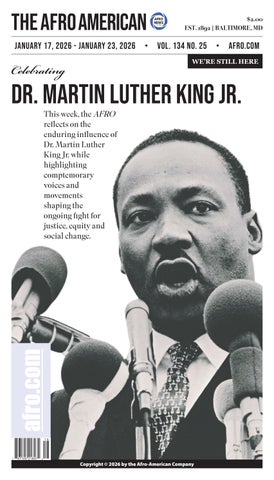
This week, the AFRO reflects on the enduring influence of Dr. Martin Luther King Jr. while highlighting comptemorary voices and movements shaping the ongoing fight for justice, equity and social change.
Copyright © 2026 by the Afro-American Company
A2 The Afro-American January 17, 2026 - January 23, 2026
AP Photo
As events commemorating the legacy of Rev. Dr. Martin Luther King Jr. occur across the nation, many event organizers are reflecting on what his legacy means today.
Remembering the fight for Martin Luther King Jr. Day By Victoria Mejicanos AFRO Staff Writer vmejicanos@afro.com Nearly 60 years after the assassination of the Rev. Dr.
Martin Luther King Jr., and decades after a hard-fought campaign to make his birthday a federal holiday, organizers, city leaders and scholars are preparing to celebrate on Jan.
Your History • Your Community • Your News
The Afro-American Newspapers
Baltimore Office • Corporate Headquarters 233 E. Redwood Street 6th Floor, Suite 600G Baltimore, Maryland 21202 410-554-8200 Customer Service, Home Delivery and Subscriptions: 410-554-8200 customerservice@afro.com Founded by John Henry Murphy Sr., August 13, 1892 Chairman of the Board/Publisher - Frances Murphy Draper (Publisher Emeritus - John J. Oliver Jr.) President - Benjamin Murphy Phillips IV VP of Marketing and Technology - Kevin E. Peck Director Digital Solutions - Dana Peck Receptionist - Wanda Pearson - 410-554-8200, ext. 246 Director of Operations
Andrè Draper - 410-554-8200
Director of Finance
Bonnie Deanes - 410-554-8242
Executive Director/Director of Advertising
Lenora Howze - 410-554-8271 - lhowze@afro.com
Director of Community & Public Relations Diane W. Hocker - 410-554-8243
Editorial
Managing Editor - Alexis Taylor - 410-554-8257 Editorial Assistant - Ama Brown-Parson Evening / Weekend Editor - Zenitha Prince
Archivist - Savannah Wood- 410-554-8277
19. Though Martin Luther King Jr. Day events are festive, many are grappling with what King’s legacy means in 2026—and also with the work that is left to be done across the nation. Marva Williams, an event and production coordinator with the Mayor’s Office of Arts, Culture and Entertainment, said service remains central to the observance. “Community service is always vital,” Williams said. “That’s what he was about.” While Dr. King’s legacy is widely recognized and observed today, Morgan State University’s historian, Dr. Edwin Johnson, shared that the path to establishing the holiday was far from easy. “King remains probably one of America’s most pivotal figures when you talk about American race relations,” said Johnson. “He’s celebrated now, pretty much. A lot of the journey to getting the bill to become a federal holiday has been lost over time. But King wasn’t completely celebrated in the Black community, and he certainly was not completely celebrated in the White community. Not everyone agreed with his tactics.” Born in Atlanta on Jan. 15, 1929, Michael King Jr. was the son of Georgia-born parents, Michael King Sr. and Alberta Williams King, who were both leaders in the faith community and active in the fight for civil rights. Michael King Sr. changed his name and his son’s name to Martin Luther
King after visiting Europe in the 1930s and learning of the iconic theologian who helped ignite the Protestant Reformation in 1517. Like his father, King believed in taking action to bring true equality and freedom to America. By 1955 the Morehouse grad and man of Alpha Phi Alpha Fraternity, Inc. was leading the Montgomery Bus Boycott in Alabama. King became an international symbol for peace and nonviolent demonstration
with his work beating back the ideals of Jim Crow. At the time of his assassination on April 4, 1968, he was fighting for economic freedom with the Poor People’s Campaign. The first proposal to establish Martin Luther King Jr. Day was introduced a few days after his assassination but was repeatedly rejected for 15 years before finally being signed into law by former President Ronald Reagan in 1983. The first official observance of the holiday took place on Jan. 20, 1986. According to Johnson, it took another 15 to 17 years before it was adopted nationwide. Still today the holiday is
Production Department - 410-554-8200
(Washington Publisher Emerita - Frances L. Murphy II) Director of Operations - Andrè Draper - 410-554-8200
Bakewell spoke to the responsibility she felt to continue to honor King’s legacy, as there are attacks on Black history. “It’s no secret that we have an administration in our federal government that does not value our legacy, as Black people, as we hoped it would,” said Bakewell. “After all the things that we’ve been through as a people, through civil rights, through slavery, through things that are facts. We’re not making this up. We’re not whining or crying. We know that this is
“After all the things that we’ve been through as a people … the only way [King’s legacy] is going to stay alive is if we, as the Black Press and the Black community, keep it that way.”
Baltimore Circulation/Distribution Manager Andrè Draper - 410-554-8200
Washington Office 1140 3rd Street, N.E., 2nd Floor Washington, D.C. 20002-6723 202-332-0080 •
under attack. In 2025, the 47th president of the United States ordered the National Park Service to stop offering free admission on MLK Day and Juneteenth. Instead, the agency has added the president’s birthday as a free day. For organizers working to keep that legacy alive today, the holiday is not just a historical milestone, but a responsibility. In Los Angeles, that responsibility is being carried in part by Pamela Bakewell. Bakewell’s family-led
,GHQWLÀFDWLRQ 6WDWHPHQW
THE AFRO AMERICAN – (USPS 040-800) is published weekly by The Afro American Company, 233 E. Redwood Street, 6th Fl., Ste. 600G, Baltimore, MD 21202. 6XEVFULSWLRQ 5DWH 1 Year - $100.00 Print & Digital ($40 Digital Only) (Price includes tax). Checks for subscriptions should be made payable to: The Afro American Company, 233 E. Redwood Street, 6th Fl., Ste. 600G, Baltimore, MD 21202. 3HULRGLFDOV SRVWDJH SDLG DW %DOWLPRUH 0' DQG DGGLWLRQDO PDLOLQJ RIÀFHV POSTMASTER: 6HQG DGGUHVVHV FKDQJHV WR THE AFRO AMERICAN, 233 E. Redwood Street, 6th Fl., Ste. 600G, Baltimore, MD 21202.
Black-owned media company, Bakewell Media, owns the LA Sentinel. The company recently took over production of the city’s official Martin Luther King Jr. Day Parade. This year’s parade theme is “Reclaiming the Dream.” “We have always had an interest in uplifting the Black community,” said Bakewell. “Our background fits in with our producing it because we care. You have to care that we keep Martin Luther King’s legacy alive, especially during these trying times. And we feel that we are the right choice, and we’re excited to do it.” The parade will feature prominent guests and partners. KJLH is a local radio station in Compton, owned by Stevie Wonder, who was instrumental in campaigning for the holiday. KJLH will serve as the primary media partner for the parade. Cedric the Entertainer will also be in attendance, serving as the grand marshall of the parade. Additionally, various Disney characters will be featured in the parade.
not something that we want to see go away, and the only way it’s going to stay alive is if we, as the Black Press, the Black community, keep it that way.” For Johnson, the holiday has always been more than ceremonies and commemorations, but a moment of reflection both nationally and personally. “The most memorable speech was Martin Luther King’s ‘I Have a Dream’ speech. I just think it is very relevant each year to revisit the speech and what he said, and for us to kind of check ourselves as a country, to check ourselves as individuals,” said Johnson. “One of the things that King talked about is that we all have an opportunity to do something. We all can’t make these impassioned, you know, oratorical presentations, but we all can do something to make the part of the world that we have access to better, whether it’s your block, your neighborhood, your school, there’s some place around you that you can touch to make our world a better place.”
A3 The Afro-American January 17, 2026 - January 23, 2026
State of civil rights in America By Tashi McQueen AFRO Staff Writer tmcqueen@afro.com More than 50 years after the assassination of Dr. Martin Luther King Jr., the fight for civil rights continues to evolve, raising questions about how far the nation has come since his era and where progress has stalled. As people recognize his legacy, advocates, scholars and policymakers are assessing civil rights in areas such as voting access, economic equity, education and criminal justice. Where have we progressed, where have we regressed, and where can we go from here? “The movement of African Americans articulated through the vision of Rev. Dr. Martin Luther King Jr., in my humble opinion, is one of the
most significant social justice movements of all time,” said Dr. Richard Cooper, director of the Bachelor of Social Work Program and co-coordinator of African American Studies at Widener University. “We were looking for, in that era, more precise equality which included, voting rights, housing, opportunities for employment, access to education, the total package of African Americans having access to what was once referred to as the American Dream.” All those ideas envisioned a future where legislative and systemic roadblocks would be removed, allowing full and equitable access at last, said Cooper. From the success of the movement in the 1960s, African Americans were being employed in previously excluded sectors, with national gains in access to education
AP Photo/Jose Luis Magana, File
Though the Civil Rights Movement ended decades ago, activists of today are still fighting for equal rights, pay, healthcare and education. In the past year, protests have focused on speaking out against immigration raids, economic decisions, biased policy changes and executive orders coming from the 47th president of the United States and his administration.
and upward mobility within the military. “Not perfect, didn’t achieve all that had been hoped for, but when you compare it to the Jim Crow South or the world before that in terms of America, it’s amazing,” said Cooper. Cooper also acknowledged that certain advancements were still not fully realized and faced significant pushback, which has been renewed in recent years on the federal level. “I think what was underestimated is how vile this system is,” said Cooper. “Any overt gains, any clear access that Black people have earned and achieved, they continue to construct roadblocks. They continue that vitriol, that hatred systemically and on the individual level.” Policies continue to deny Black people access to historical opportunities, jobs and education. Cooper said what’s happening now reflects long-standing beliefs the 47th president didn’t create; it existed in the South’s refusal to dismantle statues, emblems and symbols rooted in a bigoted past and preserved to uphold false histories. “We underestimated the vitriol and the ability for them to rally again to take things back,” said Cooper. “We underestimated that, and that’s where we are now. I think this era shows us how you can paint things over and tear things down.” Cooper described the fight for civil rights as a pendulum that continues to swing back and forth, but said history
Unsplash Photo/HistoryinHD
As Dr. Martin Luther King Jr. Day approaches, advocates assess more than 50 years of civil rights progress and the challenges that persist today. Shown here, Dr. Martin Luther King Jr. and other activists on the frontlines of the March on Washington for Jobs and Freedom in Washington, D.C. on Wednesday, Aug. 28, 1963. shows Black people remain resilient and committed to pushing the struggle forward. Despite growing pushback, some federal legislators remain vigilant, continuing to advocate for civil liberties and equal opportunity as resistance intensifies nationally and within certain states. On Dec. 2, 2025, U.S. Rep. Yvette Clark, (D-N.Y.-09), and U.S. Sen. Edward J. Markey, (D-Mass.), reintroduced the “Artificial Intelligence Civil Rights Act,” a bill aimed at stopping discrimination in AI. “It is no secret that as we speak today, our nation has found itself in the heart of a new technological revolution, the age of AI,” said Clark, chair of the Congressional Black Caucus. “As we seek to innovate and drive this country forward, we have a duty to ensure that discrimination that has no place but in the past, does not become irreversibly entrenched in the technology of the future.”
The bill would prohibit AI developers and users from offering or using algorithms that discriminate or have unjustified disparate impacts based on race, sex, religion, disability, or other characteristics. It also requires developers to analyze AI systems and create federal algorithm auditors.
Clark said. The bill was first introduced on Sept. 24, 2024, by Markey and co-sponsored by Sen. Mazie Hirono, (D-Hawaii), but died in committee. The 2025 Senate and House versions await hearings in their respective committees. As people recognize MLK
“The movement of African Americans articulated through the vision of Rev. Dr. Martin Luther King Jr., in my humble opinion, is one of the most significant social justice movements of all time.” “We need to be able to trust that when we as Black Americans go to apply for a bank loan, secure employment, or even enter our own homes, we will not be denied on the basis of algorithmic bias,”
Day, Black Americans come together in community, refresh their knowledge of Black history, and learn how to support those actively fighting to uphold Black Americans’ rights and opportunities today.
What would Dr. King say? Three activists weigh in By Megan Sayles AFRO Staff Writer msayles@afro.com As African Americans across the United States face reversals of equity, diversity and inclusion initiatives, efforts to censor and erase Black history, a widening wealth gap and renewed threats to voting rights, a question has emerged: What would Dr. Martin Luther King Jr. say? More than five decades after his assassination, King’s words still shape how the nation talks about justice and equality. Three activists shared how they believe King would respond to the challenges confronting Black Americans today. “It’s important to remember that Dr. King spoke of the three evils: racism, militarism and poverty. These weren’t separate problems to him, they were interconnected expressions of the same moral crisis,” said LaTosha Brown, co-founder of Black Voters Matter (BVM). “What we’re witnessing today—DEI rollbacks, the erasure of Black history, the racial
wealth gap and police violence—are not disconnected issues. They are the same system expressing itself through different mechanisms.” Brown is an award-winning organizer, political strategist and philanthropic consultant with more than 20 years of experience working on social justice issues. With BVM, she works to expand Black political participation and power in underserved communities. Brown emphasized that voting rights remain central to addressing every issue facing the Black community. “Dr. King fought for the Voting Rights Act because he knew the ballot is the foundation of all other power,” said Brown. She recalled King’s own words during a 1957 speech given at the Prayer Pilgrimage for Freedom: “Give us the ballot, and we will transform the salient misdeeds of bloodthirsty mobs into calculated good deeds of orderly citizens.” Today, that struggle continues. Brown noted that cases like Louisiana v. Callais—now before the
Photo courtesy of Black Voters Matter
LaTosha Brown is an award-winning organizer and co-founder of Black Voters Matter, an organization dedicated to advancing Black political participation and empowerment.
Supreme Court—challenge key provisions of the Voting Rights Act designed to protect Black voters from discriminatory practices. “These current attacks aren’t about election integrity,” said Brown. “They’re about preventing the transformation of power from the few to the many.” Beyond voting rights, Brown said the same systems drive economic inequality, the rollback of diversity initiatives, censorship of Black history and police brutality. She noted that these issues reflect ongoing structural injustices that require coordinated action alongside defending the vote. “I believe Dr. King would tell us that this is our moment not to despair, but to organize, to use every tool we have: our votes, our voices, our dollars and our collective power,” said Brown. “The concentration of power in the hands of the few depends on our fragmentation. But, when we look out for each other and move as one, we become ungovernable to those who would oppress us and unstoppable in our pursuit of justice.” Yusef Jackson, chief operating officer of the Rainbow Push Coalition and son of the Rev. Jesse Jackson, also offered his take on how King might view the state of the nation today. “Dr King recognized that our great nation has the wealth and ingenuity for every American to have access to healthcare, housing, education and a fair wage,” he said. “Yet, we continue to lack the political will some six decades after his passing.” U.S. Rep. Kweisi Mfume (DMd.-07) underscored Jackson’s statement, noting that the challenges today are merely known by different names than those King confronted decades ago. In 2025, Mfume was on the frontlines of demonstrations, protesting the 47th president’s executive actions. He said he’s called on King’s
playbook in his political work. “My inspiration comes from the fact that he often reminded us that no lie lives forever, that God is still providential and that the arc of the universe always bends toward justice. I use that in my day-to-day work,” said Mfume. “Donald Trump will test that every day – trust me – but even his anger, viciousness, vindictiveness and his wicked ways of doing things can’t stop me or anyone else that holds on to those values.” Drawing on King’s example, Mfume described how the late civil rights leader might advise Black Americans who are grappling with today’s political and social pressures: “When times are dark and bleak and when hope and despair are overtaking our community, he said, ‘resist,’” said Mfume. “He would remind us to fight back as he would do, to organize our communities as was done many years ago, to protest indifferences in this society, to vote and to pray to keep our humanity together.”
Photo courtesy of Rainbow PUSH Coalition
Yusef Jackson is the chief operating officer of the Rainbow PUSH Coalition, an organization his father, the Rev. Jesse Jackson, started to fight for social justice, civil rights and economic empowerment.
Photo courtesy of Congressman Kweisi Mfume
Congressman Kweisi Mfume (D-Md.-07) is a longtime civil rights advocate and the former head of the NAACP.
A4 The Afro-American January 17, 2026 - January 23, 2026
Dr. King’s Poor People’s Campaign foretold America’s affordability crisis By Charlene Crowell As 2026 unfolds, affordability, which emerged as a critical issue last year, will become a more pressing concern for most people in America. A comment by a respondent to a recent student loan borrower survey by The Institute for College Access & Support (TICAS) summarized the complexity of the affordability problem for striving workers: “With how the economy is, I can barely afford to live. I have to choose between rent, loans, or putting food on the table. There’s no help and it feels like [the] government doesn’t care,” said the consumer.
MLK holiday begs a key question: What would Dr. King do about an unsustainable economic crisis? After riots in many urban areas in the summer of 1967, MLK planned the Poor People’s Campaign, a multi-racial effort to use mass civil disobedience as a constructive, rather than destructive, force. On Dec. 7, 1967, Dr. King announced the economic justice effort at a news conference at Atlanta’s Ebenezer Baptist Church. Although the cities of Detroit and Newark are often noted as the worst hotbeds of the nation’s summer riots in 1967, an estimated 158 riots erupted across America that year, resulting in 83 deaths and 17,000 arrests,
“Nearly 60 years later, many of the issues championed by the Poor People’s Campaign remain or have worsened, leaving working families forced to choose between rent, food and debt.” The feeling that economic realities are suffocating the aspirations of hard-working people provides a poignant backdrop leading to the Jan. 19 official celebrations to honor the life, leadership and contributions of Dr. Martin Luther King Jr. This year’s observance of the
according to a 2007 analysis of the landmark Kerner Commission report by The Journal of Economic History. In the wake of King’s April 1968 assassination, plans proceeded under the joint leadership of his widow, Coretta and the Southern
Christian Leadership Conference’s Ralph Abernathy. Their collaborative efforts led to weeks of demonstrations on the National Mall and meetings with policymakers in Washington, D.C. The organizers demanded economic justice and inclusion for Americans of all backgrounds, including well-paying jobs with living wages, as well as financial rights and fairness, full employment, guaranteed annual income, and more housing affordable to low-income people. “All of our cities are potentially powder kegs,” King said in a speech at Stanford University that was titled, “The Other America.” “I think America must see that riots do not develop out of thin air. … All of these things have brought about a great deal of despair and a great deal of desperation, a great deal of disappointment and even bitterness in the Negro communities.” For Dr. King, the nation’s lengthy and violent outrage was a clear signal that Black America would no longer tolerate its history of racial resentments and economic injustices. He also appealed for the Black community to cast aside class divisions. But today, nearly 60 years later, many of the issues championed by the Poor People’s campaign remain or have worsened. In late October, the D.C.-based Urban Institute released The American Affordability Tracker, which found that:
Library of Congress
People march and carry signs at Connecticut Ave. and L St. NW, Washington, D.C. on June 18, 1968, as part of the Poor People’s Campaign.
Library of Congress
Dr. Martin Luther King Jr. speaks at a protest. • More than half of American families – 52 percent – lack the resources to cover what it really costs to live securely in their community; • Since 2019, the average monthly cost of groceries has increased 32 percent increase while annual income increased 29 percent; and • Since 2017, annual childcare costs for two young children have risen by 40 percent, rents by 50 percent, home sale prices by 80 percent, and the lowest-priced “Silver” health care plan on the Affordable Care Act Marketplace has risen 41 percent. Trump administration changes taking effect in January 2026 will add to the ongoing financial challenges facing working people. Beginning Jan. 7, the Trump administration began sending notices to millions of student loan borrowers who are in default – 270 days past due on their payments. Those who do not or are unable to begin regular repayments face having their paychecks garnished. The Department of Education stated last April that of the nation’s 42.7 million student loan borrowers, only 38 percent are in repayment and current on their loans. “At a time when families across the country are struggling with stagnant wages and an affordability crisis, this administration’s decision to garnish wages from defaulted student loan borrowers is cruel,
unnecessary, and irresponsible,” noted Persis Yu, deputy executive director and managing counsel with the Student Borrower Protection Center. Further, if Congress does not enact spending bills for the current fiscal year by Jan. 30, another federal government shutdown will occur. Central to the budgeting crisis is whether to extend expired tax credits for the Affordable Care Act. Without these credits, many consumers will see their health insurance costs double, or even triple. According to a December 2025 poll by the KFF Foundation, 58 percent of respondents said an increase of just $300 per year in health insurance payments would significantly disrupt their household finances. An additional 20 percent say a $1,000 per year increase in health insurance payments would disrupt their finances. While King’s lifelong quest for civil rights and economic justice deserves an annual observance, his dream of a nation that fulfills its promises for all of its people still needs a diligent and ongoing effort. Lawmakers should heed the concerns expressed by its people, especially when ample research documents how people are suffering. As Dr. King stated in his autobiography, “[T]here comes a time when one must take a position that is neither safe, nor politic, nor popular, but he must do it because Conscience tells him it is right.”
AFRO spotlight on Black excellence: How Kaci Patterson advances Dr. King’s legacy through equity-driven change By Tashi McQueen AFRO Staff Writer tmcqueen@afro.com Communities across the country continue to honor Dr. Martin Luther King Jr.’s legacy in diverse and meaningful ways. From volunteer service projects and educational programs to faith-based gatherings and policy advocacy, Black Americans reflect on his legacy and highlight the ways in which people are carrying forward his vision. A key aspect of King’s message was ensuring equity for all Americans. That work continues through leaders like Kaci Patterson, founder and chief architect of Social
Good Solutions, a Black woman-owned firm in Los Angeles that supports Blackled nonprofits through equity-centered grantmaking and community-driven design. “Honoring King means preserving the legacy through action,” said Patterson. “Dr. King taught that true justice requires structural change, and that’s the core of our work at Social Good Solutions (SGS). We’ve raised more than $70 million for social justice initiatives across California, driving $335 million in economic impact and supporting thousands of jobs.” Patterson emphasized that the work of Black-led nonprofits, like the ones
“At its core, his work was a fight to redistribute power in ways that make justice permanent for Black people in America.” supported by SGS, reflect King’s vision daily by building systems of community care, developing grassroots leadership and advocating for structural opportunities that strengthen entire communities. “At its core, his work was a fight to redistribute power
in ways that make justice permanent for Black people in America,” said Patterson. “His teachings live on through our perseverance and deep belief that racial justice is love in action and must be the framework of every program and policy we are building for our future.”
Courtesy photo
Kaci Patterson, founder and chief architect of Social Good Solutions, helps Black-led nonprofits advance equitycentered initiatives that honor Dr. King’s legacy through structural change and community input.
January 17, 2026 - January 23, 2026 The Afro-American A5
Morgan State University celebrates student excellence at the annual MLK Scholarship Breakfast By Kendra Bryant Special to the AFRO The Howard L. Cornish Metropolitan Baltimore Chapter of the Morgan State University Alumni Association hosted its 41st annual Dr. Martin Luther King, Jr. Scholarship Breakfast on Jan. 10. Held at the Calvin and Tina Tyler Ballroom, the event’s theme was “Empowering the dream of growing our future.” Led by WBAL-TV 11 News co-anchor Jenyne Donaldson, the event honored the legacy of Dr. Martin Luther King Jr. and served as a time to recognize scholarship recipients, community leaders and donors. There were 21 scholarship recipients studying majors such as political science, engineering, graphic design and nursing. “We want to say congratulations for all that you have done and all that you are going to do,” said Erica M. Waters, president of the Howard L. Cornish Metropolitan Baltimore Chapter. “I wanted to remind you that you must motivate each other. We have to uplift each other. You cannot get that diploma and walk away and never come back. You have to reach out and support those who follow you.” Dr. David K. Wilson, president of Morgan State University, noted the importance of the university’s alumni community. “I want to give a huge thank you to the Howard L. Cornish Baltimore Chapter for enabling hundreds of students by investing over $1.1 million here at Morgan,” said Wilson. “The continuous support allows students to taste the magic of a Morgan State degree.” During the event a select group of students from the Morgan State University Choir, known as the Morgan Singers, performed an array of Black classic hymns, including “Lift Ev’ry Voice and Sing,” “We Shall Overcome,” “I Know I’ve Been Changed,” and “Total Praise.” Lt. Col. (Retired) Michael Bell, president of the Morgan State University Alumni Association, gave a word of advice to the students in attendance. “There are three types of people in this world: Those that make things happen, those that watch things happen, and those that wake up and say what the hell happened,” said Bell. “Don’t be that person. I encourage you to stand up and commit to making a change here at Morgan.” The Rev. Dr. Robert R.A. Turner, senior pastor of The Empowerment Temple African Methodist Episcopal (AME) Church, gave the keynote address. He delivered a timely message for 2026 that
Morgan State University hosts the annual 41st Martin Luther King, Jr. Scholarship Breakfast on Jan. 10 at the Calvin and Tina Tyler Ballroom. University alumni, sponsors and students gathered to celebrate the Howard L. Cornish Baltimore Chapter’s 21 scholarship recipients. focused on the story of the Israelites and Pharoah in Exodus 5:7. “Pharoah told the Israelites that they will no longer be given straw to make bricks. They will have to go and gather the straw for themselves,” said Turner. “What I’m saying is that we need to stop waiting for the master to supply. We’ve never been paid our dues in this nation. America wouldn’t be America and Maryland wouldn’t be Maryland without us.” U.S. Rep. Kweisi Mfume (D-Md.07) was on the list of honorees for the day, and used his time before the crowd to uplift both the legacy of Dr. King and the students who will forge change in the future. “Despite all of the black-andwhite footage that you’ve seen from years gone by, Dr. Martin Luther was a young man, which is why these students here today represent that which has not come into being yet,” said Mfume. The congressman said the recipients were the “generation to pick up and move forward and to lead us on.” Others honored at the program included leaders of the Boy Scouts of America Troop #846, Philander Wiggins and Harry Williams; Patricia D. Cole; Valerie Cherry-Jones and Anthony C. McPhail. McPhail served as the chairman of the annual Dr. Martin Luther King, Jr. Scholarship Breakfast for 38 years. He graduated from Morgan State University in 1976 and died on Dec. 6, 2025. All AFRO Photos / Nyame-kye Kondo
The Morgan Singers, a select group of students from the internationally acclaimed Morgan State University Choir, are led by Dr. Eric A. Conway in one of multiple rousing performances at the breakfast.
Shown here, musician and Morgan State University alum, Vershawn Thompson.
Vocalist KaToriae “Kissi B.” Tru steps out in style.
Along with the scholarship recipients, awards were given to leaders such as U.S. Congressman Kweisi Mfume (D-Md.-07).
WBAL co-anchor Jenyne Donaldson serves as mistress of ceremonies for the scholarship brunch.
Scholarship recipient Akeem Kaswarra introduces himself to the Morgan State University alumni community and thanks them for contributing to his education.
Erica M. Waters, president of the Howard L. Cornish Metropolitan Baltimore Chapter of the Morgan State Alumni Association, speaks the crowd.
Morgan State University President David K. Wilson addresses the crowd.
A6 The Afro-American January 17, 2026 - January 23, 2026
From the AFRO Archives
The Black Press at the heart of the Civil Rights Movement 'On Freedom Highway,' King tells Harlemites
By Megan Sayles AFRO Staff Writer msayles@afro.com When examining Dr. Martin Luther King Jr.’s strongest champions, the Black Press stands out as a loyal messenger on the frontlines of the Civil Rights Movement. During the 1950s and ‘60s, Black newspapers across the country dedicated their pages to broadcasting the African-American struggle for equality. From documenting racial terror and amplifying boycotts to educating voters and holding institutions accountable, the Black Press was a witness, as well as a weapon. “The Black Press played a very important, strategic role in the Civil Rights Movement, in particular, getting the messaging out from the Rev. Dr. Martin Luther King Jr. and the Southern Christian Leadership Conference,” said Dr. Benjamin Chavis, president and CEO of the National Newspaper Publishers Association (NNPA). “The Black Press served as a megaphone for their objectives and goals.” Chavis explained that the Black Press publicized mass meetings tied to the Civil Rights Movement—coverage the mainstream media often avoided. He also noted that the relationship between Dr. King and Black newspapers was a reciprocal one. “Dr. Martin Luther King Jr. was also a strong supporter of the Black Press,” said Chavis. “He wrote columns for the NNPA during the 1960s.” Chavis saw this support firsthand. As a young person, he served as a youth coordinator for the Southern Christian Leadership Conference (SCLC) during the 1960s, working closely with King. He said the role the Black Press played was transformational, especially in standing firm in the face of threats. “During the Civil Rights Movement, a lot of our newspapers were firebombed or dynamited to suppress the Black Press as a means of suppressing the Black freedom movement,” said Chavis. “But, I saw firsthand the courage of African-American publishers, who were vigilant and refused to be intimidated by racist repressive forces.” In his own words, King described the Black Press as a force that helped to develop the consciousness and dignity of the Black community. During Negro Press Week in 1958, Black radio stations aired a pre-recorded speech by King on the importance of Black news organizations. “Perhaps, more than any other single force, it has devoted itself
HAIRGROW, CHARLES Afro-American (1893-); Mar 31, 1956; ProQuest Historical Newspapers: Black Newspaper Collection
pg. 17 March 1956
October 1957
Labor unions support the cause The United Packinghouse Workers of America (UPWA), a precursor to today’s United Food and Commercial Workers International Union (UFCW, was an early supporter of the Civil Rights Movement. The labor union was known for paying fair wages regardless of race, gender or immigration status. Shown here, Russell R. Lasley (left), international vice president for the UPWA, giving Dr. Martin Luther King Jr. a check for $11,000 to support his voter rights crusade.
September 1960
The Montgomery Bus Boycott
Reproduced with permission of the copyright owner. Further reproduction prohibited without permission.
In the March 31, 1956, edition of the AFRO, Dr. Martin Luther King Jr. uses the pages of the Black Press to reach beyond the Harlem, N.Y., pulpit from which he spoke, inspiring the masses to keep pressing toward a “City of Equality” as they travel along the “Highway to Freedom.” At the time, the Montgomery Bus Boycott had just surpassed 120 days. In the end, the boycott would go on for 381 days.
to the achievements, ambitions, hopes and even failures of the Negro people. It has interpreted the Negro to the American people and to the world,” said King, of the Black Press, in the speech. “It has brought the American people and the world to Negroes in cities, towns, plantations and cotton fields.” The AFRO Archives details the Civil Rights Movement on a local, national and international level. Reporting legends, like Moses Newson and William Worthy, risked their lives to keep their communities informed. “The Black Press has always been an integral part of the Black social movements, like the Civil Rights Movement,” said Savannah Wood, executive director of Afro Charities, the sister organization that cares for and curates
the archive collection for AFRO News. “In the archives, we see the press used as a tool to inform and organize the public and to document its successes and setbacks from within the movement.” This Martin Luther King Jr. Day, take a look below at some of the content from the AFRO Archives, where more than three million articles, photos and ephemera prove just how vital Black journalists have been in documenting and advancing human and civil rights. All AFRO Photos
AFRO correspondent fights Jim Crow with SCLC support AFRO reporters and other employees were known for taking an active part in the struggle for change. In the Sept. 24, 1960, edition of the publication, Len Holt, a lawyer and AFRO correspondent, leads the fight to desegregate the taxi services offered in Atlanta. The Southern Christian Leadership Conference (SCLC), led by Dr. Martin Luther King at the time, worked with Holt on the case.
July 1957
August 1962
King fights voter suppression and redistricting efforts to push out Black voters Segregation must end Shown here, an Aug. 4, 1962 photo of activists with the Albany Movement, a civil rights campaign out of Georgia. Led by Dr. Martin Luther King Jr., the group was arrested for praying against segregation outside of City Hall. Albany Police Chief Laurie Pritchett (top, left in uniform), stands on the steps above the men.
Dr. Rev. M. L. King (left), president of the Montgomery Improvement Association (MIA), shakes hands with Dean G. C. Gomillion, of the Tuskegee Institute. Gomillion was president of the Tuskegee Civic Association and fighting against redistricting in his area that would disenfranchise Black voters. King informed Gomillion that 50,000 Montgomerians and MIA had voted to assist and support the Tuskegeans’ fight for the ballot and against disenfranchisement led by Alabama state Sen. Sam Engelhardt. Gomillion and King started a boycott after Tuskegee leaders successfully changed its boundaries from a four-sided square to a 28-sided, seahorse-shaped boundary to cut out a majority of its Black population.
January 17, 2026 - January 23, 2026 The Afro-American A7
From mediation to citywide strategy, Baltimore puts MLK’s nonviolence into practice By Victoria Mejicanos AFRO Staff Writer vmejicanos@afro.com Each year the King Center, the Atlanta-based nonprofit created to educate and support efforts to improve civil and human rights, sets the tone for Martin Luther King Jr. Day celebrations worldwide. The 2026 theme, “Mission Possible II: Building Community,
Screenshot courtesy Youtube / Community Mediation Maryland
Tracee Ford, deputy director at Community Mediation Maryland, does the work of uniting the nation in a nonviolent way through her work at Community Mediation Maryland. Shown here, Ford leads a session on solid mediation practices.
Uniting a Nation the Nonviolent Way,” emphasizes nonviolence as both a principle and a practical approach. Reflecting this theme, this week, the AFRO spoke with leaders who are doing the work of making Baltimore a safer place to live, work and play by teaching and promoting nonviolence in the community. Tracee Ford, deputy director at Community Mediation Maryland, spends her days training residents and organizations how to resolve conflicts collaboratively, before they escalate. Ford shared that her understanding of non-violence comes from how violence is inflicted upon communities because of traits like ethnicity, gender, sexuality and ability. “A lot of times we’re talking about physical violence, but much of how we’ve experienced violence in the United States has not necessarily been physical violence,” said Ford. “There’s financial and verbal violence, and there’s political violence, and much of how we’ve experienced it has been around policies and how policies that are created limit access to resources.” Ford shared that one of the tools she gives to people and organizations is inclusive listening. According to a study provided by Community Mediation Maryland, mediators use inclusive listening to reflect back feelings, values and topics to help build understanding between those involved in a conflict. They also use open-ended questions to gain clarity.
Ford shared an example of inclusive listening through what she calls “1-2-3 mediation.” After two women with children from the same man got into a physical altercation on a packed bus they found themselves in mediation sessions. Through mediation, they learned to communicate differently and discovered common ground: their children. Mediation changed the relationship between the two women and, in the end, they were making arrangements to have meals with each other every pay day. “Misogyny tells us that women who have children by the same man are not able to get along,” said Ford. “In a collaborative process like mediation, these women are able to overcome the misogynistic narratives that are told about themselves and told about their relationships with each other. They’re building a new dynamic for family, for themselves, in a collaborative way that’s going to create more stability for their children.” While Ford’s work can transform individual lives, Stefanie Mavronis, director of Baltimore’s Mayor’s Office of Neighborhood Safety and Engagement, oversees the city’s broader strategy to prevent violence at the community level. Mavronis said that collaboration between local organizations and the city is vital to reducing violence. She highlighted partnerships with organizations such as Challenge 2 Change, We
AP File Photo / Chick Harrity
Across Baltimore, community organizations and city agencies are working together to do the work of nonviolent conflict resolution, a core principle of Dr. Martin Luther King Jr.’s work. Our Us and Roca. “These solutions have to be owned at the community level, and government plays a role in supporting and lifting them up. That’s really how we approach the challenge here,” said Mavronis. “People who are closest to the problem are also closest to the solution, and I think that’s what our comprehensive public safety strategy reflects.”
‘Hoops, Hopes, and Dreams’: Short film unveils how basketball fueled Dr. King’s vision for change By Laura Nwogu The Atlanta Voice Sports bring people together, and it wasn’t any different for civil rights leader Dr. Martin Luther King Jr. Short documentary film, “Hoops, Hopes, and Dreams” tells the untold story about how King and a team of civil rights activists used basketball as a tool to create change, foster community, and fuel movements for years to come. The Atlanta Voice sat down with executive producer Dr. Bernice King, Martin Luther King Jr.’s youngest child and CEO of the King Center, to talk about her father’s legacy and how this film peels back the layers on an iconic figure we all know. “Hoops, Hopes, and Dreams” will premiere on Hulu on Jan. 19 under the Andscape Films banner.
The Atlanta Voice: The documentary explores the connection between activism, politics, and sports, specifically basketball and the importance of meeting people where they’re at. When you think about what your father accomplished and what, later on, former President Obama accomplished, what was it about their strategies that you think resonated with so many people? Why do you think that link between sports, activism and politics works? Dr. Bernice King: It’s kind of a rhetorical question, to a certain extent, because I think what the strategy was is that they connected to people where they were — that they went to the people. Obama essentially won because he connected with the grassroots in a way that very few people do in elected politics. A lot of people tend to go to the familiar. He reached far and wide, and he even did that with his donations. He raised the most money just by getting people to give $1, which was very powerful. So, I think that’s the same link for my father.
First of all, he was with the people. He didn’t lead the movement from an ivory tower or from a pulpit, although he used the pulpit. But he was out there amongst the people in so many different ways, and he met them wherever they were, and sometimes even on their terms. When you think about the conversation he was having with Stokely Carmichael when they were marching together, Stokely Carmichael wanted to use the word Black power, and daddy said, “I get it. We need power as a people.” He said, “But what you don’t want to do is to cause confusion, because there’s semantics involved.” Words have denotative meaning, and they have connotative meaning. And right now, there are so many connotations associated with power that can be taken out of context. And what we’re doing, will become the conversation instead of what we’re trying to accomplish. So, he was meeting him where he was. Not trying to say, “No, Stokely, you need to follow my way.” And I think the connection between the three is in the word that you used. To be effective in activism, to be effective in politics, to be effective in sports, strategy wins the day, all day. And I think in today’s society, one of the places where we still need a little bit of growth in activism is in the area of strategy and planning, and executing it. Not just collaborating, not just having teamwork, but taking that strategy and determining what to execute at what point in time.
AV: And when people hear the name Martin Luther King Jr., they often just think of his role as this iconic civil rights activist. What new perspective about your father’s legacy do you want people to take away after watching the documentary? BK: Obviously, my father introduced this nation, in a social justice way, to nonviolence. Gandhi in India is where he got his tactics from. He
said he got his inspiration from Jesus Christ. When many people think about nonviolence, and they look at all the demonstrations, they forget that it was a group of people. It was a team. Many people will say, “Well, I’m not gonna let anybody hit me upside the head.” They individualize it, not realizing that the effectiveness of the movement is that there was a group. There was a team. There was agreement amongst those that we’re going to posture ourselves this way because we are trying to expose the evil and the injustice. We don’t want to be a contributor to it, and again, confuse the issue. I want to remind people of that teamwork. But the second thing is not a new perspective; it’s just something people forget. My father was 26 years old when the movement started. He was young. Many of those who were around him were young. The power and strength of it was a movement of young people; that’s where the strength of that movement came from. So, I would say, not necessarily a new perspective, but a reminder that young people fueled the movement for social change in the ’50s and ’60s.
AV: How do you hope this film contributes to the conversation surrounding your father’s fight for civil and equal rights?
BK: First of all, I don’t want people to lose hope. The film, I think, introduces a new perspective: meeting people where they are. It also exposes the fact that ordinary people changed the world. There’s nothing supernatural or superhuman about my father. He was a normal person. He grew up very normal, faced very horrific situations growing up as a child, and being exposed to segregation, seeing sites of lynching, and being rejected because of the color of his skin. When he was with his father, they went into a store to buy some shoes, and they told his father that they would serve him if he went to
Photo courtesy of X (Twitter) / The Martin Luther King Jr. Center
Dr. Bernice King, Martin Luther King Jr.’s youngest child and CEO of the King Center, is executive producer of “Hoops, Hopes, and Dreams.” The new film tells the story of how her father and a team of civil rights activists used basketball to foster community, create change and fuel movements for years to come. It will be available on Hulu beginning Jan. 19. the back of the store. He said, “No, I want to be served right here.” And even though they wouldn’t comply, he walked out of this store and said, “I don’t care how long I have to live with this. I don’t accept it.” And I think that helped propel my father in later years, when he began studying the works of Reinhold Niebuhr, Henry David Thoreau, and many others, to talk about noncooperation with evil. He was just a kid picking up little lessons from the next generation, which I think is important. This film will hopefully provide some lessons for the next generation. All people love sports, because either we played it, or somebody that’s near and dear to our heart played some kind of sport. I know I did. I played basketball, soccer, volleyball, and tennis.
AV: Are there any stories or elements within the film that you’re excited for people to witness or learn?
BK: Yeah, the humanization of my father. I think people have sought to humanize him in other ways, but they don’t realize this is a
very human story. This was a young man who was called to an extraordinary work that I think he did well, and we get to see him in another light. We usually see him in the pulpit, “I Have a Dream,” or when he opposed the war in Vietnam. We see him in marching clothes. Daddy loved basketball. Although he was right-handed, he had a mean left hook, I understand. I’m left-handed, so that kind of resonates with me [laughs]. A lot of kids weren’t there. Obviously, they weren’t born. So they’re thinking this is somebody who’s bigger than life. And so, what it does is it brings them down to their world, and it helps them now to have curiosity to want to know more about Martin Luther King Jr., because there are so many other things. He also went into the pool halls. And you know, he could win against some of those folks that were regularly in the pool halls [laughs]. The post ‘Hoops, Hopes, and Dreams’: Short film unveils how basketball fueled Dr. King’s vision for change appeared first on The Atlanta Voice.
A8 The Afro-American January 17, 2026 - January 23, 2026
One internet price. Five years.
ZERO HESITATION
Unlimited data and equipment included. No contracts.
1-800-xfinity
xfinity.com/teamusa
Visit a store today
Restrictions apply. Not available in all areas. Select plans only. After five years, regular rates apply. Actual internet speeds vary and not guaranteed. For factors affecting speed, visit xfinity.com/ networkmanagement. For complete details, visit xfinity.com/deals. All devices must be returned when service ends. © 2026 Comcast. All rights reserved. 36 USC 220506 NPA401387-0025
January 17, 2026 - January 23, 2026 The Afro-American B1
WASHINGTON-AREA
AP Photo/Mark Schiefelbein AP Photo/Erin Hooley
D.C. Council members and residents are raising concerns about cooperation between the Metropolitan Police Department and federal immigration authorities, saying joint operations with ICE have eroded trust and fueled fear in immigrant communities. Members of the African and Caribbean community say they are wary of doing simple things like traveling to school, church and work.
D.C. Council questions District’s cooperation with ICE By Tashi McQueen AFRO Staff Writer tmcqueen@afro.com The D.C. Council’s Committee on Public Works and Operations, led by Councilmember Brianne Nadeau (D-Ward 1), is pressing Mayor Muriel Bowser (D), Interim Metropolitan Police Department (MPD) Chief Jeffery Carroll, and federal immigration authorities over local cooperation with U.S. Immigration and Customs Enforcement (ICE). Lawmakers released a report on Jan. 8 seeking to end MPD involvement in ICE operations following heightened federal immigration enforcement in the
city. Council members said masked agents and unmarked vehicles used during ICE operations have fueled fear in immigrant communities and weakened trust between residents and local law enforcement. “The most significant finding, based on the testimony and other information in this report, is that many residents have lost trust in MPD,” Nadeau said in the report. The call for action came a day after the fatal shooting of Renee Good, a U.S. citizen and mother of three, in Minneapolis on Jan. 7. Local legislators and community members are alarmed by the rise in ICE agents in D.C. and nationwide since
January 2025, citing arrests of immigrants and Latinx people, masked agents and unmarked vehicles disrupting communities. The report recommends several steps for the D.C. government to enact in response to this report. It recommends that the mayor rescind Order 2025-090, the “Safe and Beautiful Emergency Operations Center” order, which authorized indefinite local coordination with federal immigration authorities. The report asserts that the interim chief of police should end the order on immigration enforcement, which allows MPD officers to share information about people not in custody and
provide transportation for federal immigration officers. As well, the report suggests that the D.C. Council should reaffirm the “Sanctuary Values Act” and fill in any gaps that have enhanced the Bowser administration’s power to cooperate with federal immigration enforcement, including holding a hearing on B26-0549, the “Safe Community Places and Policing Amendment Act of 2025.” Lawmakers also urge that federal law enforcement officers be subject to the same restrictions imposed on MPD officers, including not wearing masks and Continued on B2
Rep. Steny Hoyer is looking forward to retirement from U.S. Congress. He made his official announcement on Jan. 8 to the cheers and accolades of his colleagues.
Rep. Steny Hoyer preps for retirement after more than 40 years of service By Megan Sayles AFRO Staff Writer msayles@afro.com Maryland Rep. Steny Hoyer (D-Md.-05) is leaving office after serving in the U.S. House of Representatives for more than four decades. Standing on the House floor on Jan. 8, the congressman announced his decision to retire at the close of the 119th Congress in 2027. Hoyer reflected on his journey into politics, noting that a convocation speech by former President John F. Kennedy
at University of Maryland in 1959 inspired him to pursue public service. “I stand here now after some 60 years in public service, including nearly 45 years as a member of this House. I’ve won elections and lost a couple, celebrated triumphs and suffered setbacks, enjoyed friendships and endured hardships. As the song says: ‘Some days are diamond, some days are stone.’ Happily, I’ve experienced more diamonds than stones,” Continued on B2
Community remembers Marckell Williams as brother, friend and skilled photographer By Ashleigh Fields Special to the AFRO
Photo courtesy of Omega Psi Phi Fraternity, Inc.
Friends and family are mourning the death of Marckell Williams, who was killed in a car accident at the age of 26 on Jan. 7. Williams died while en route to photograph a community church event.
Local journalists, church members and the broader community in the District are mourning the loss of 26 year old Marckell Williams, who was killed in a Jan. 7 car crash. Williams, an internationally known photojournalist, is remembered for frequently capturing the essence of political, religious and public events that united the broader community. At the time of his death, he was a valued member of the Black Press and worked for The Washington Informer. “Marckell lived here in Ward 8, in Anacostia, and was an incredibly gifted and talented photographer. Over the years, I ran into him often, from teen to adulthood—and he was always the same: smiling, positive, full of God’s light,” said Ward 8 Democrats Chairman Troy Donte Preswood, in a statement. Williams was a member of Omega Psi Phi Fraternity, Inc. and a graduate of the University of Miami. He held a degree in public relations and a triple minor in music business, Africana studies and art with a concentration in photography. The United Negro College Fund Scholar
served as an on campus mentor and residential assistant in addition to other roles in Florida before moving back to his hometown in Washington, D.C. “Marckell was more than a talented photographer — he was a colleague and a young man with a bright future and a love for storytelling,” said a statement from District Heights Commissioner Anthony Tilghman. “Marckell brought heart, integrity, and excellence to every assignment. As a fellow photographer, I truly enjoyed working with him and valued the conversations we shared about our craft, our journeys, and the stories we were trying to tell. He had a genuine passion for photography and for the people behind every frame,” he added. Tilghman continued, “His loss is a painful reminder of how fragile life is, and how much impact one person can make in a short time. My thoughts and prayers are with Marckell’s family, friends, and everyone who had the privilege of working alongside him.” In an official statement, Omega Psi Phi Fraternity described Williams as a “gifted photojournalist, a visual storyteller whose lens captured the dignity, culture, and lived
experiences of our people with care and intention.” Others echoed the same praise. “Heartbroken doesn’t even begin to sum up my emotions. This young brother was a talented photographer who never hesitated to get his passport stamped. We went on several missions as a team as I wrote the articles and he took the photos,” said Washington Informer writer Sam P.K. Collins on Instagram. “Along the way, I learned about his upbringing and his vision. He was solid, without question. A life gone way too soon. We don’t belong to anyone but the Most High. Not even our parents. We don’t know the day nor the hour, so until then we stay prayed up and we give thanks for this fragile thing called life. Rest in Zion Marckell. Much love and ras-pect,” said Collins. Williams was walking to
0
Past 7 days
Greater Mount Calvary Holy Church, where he was baptized a year prior, when he was struck by driver Santana Matthews, who was involved in a collision after running a red light at the intersection intersection of L and 16th streets. Matthews struck a Toyota Corolla and eventually ran into Williams, who was treated by EMS on the scene for injuries that eventually claimed his life. Three other vehicles were involved and two additional victims were transported to local hospitals for treatment of non-life-threatening injuries. Matthews has been charged with second-degree murder for Williams’ death and is currently being held without bond pending a preliminary hearing scheduled for Jan. 27, Continued on B2
0
2026 Total as of 1/14/26
B2 The Afro-American January 17, 2026 - January 23, 2026
Washington National Opera leaves Kennedy Center By Victoria Mejicanos AFRO Staff Writer vmejicanos@afro.com The Washington National Opera (WNO) announced Jan. 10 that its board of directors and staff are ending a 15-year agreement with the Kennedy Center, citing internal changes made by the organization that are “unfortunately at odds with how most not-for-profit opera companies operate,” according to a press release. Performances will be moved to new venues as WNO works to operate independently. The board and staff pointed to a variety of changes at the Kennedy Center under the leadership of President Richard Grenell, the former ambassador appointed by Trump in February. During the 15-year partnership, WNO’s marketing, multi-media
communications, development operations, education, legal, finance and HR resources were centralized within the Kennedy Center, but the center’s new approach has made it so that these positions were reduced or eliminated. According to the press release, these changes leave “an already lean group of WNO staff to take on multiple functions in addition to their own assignments, which is unfortunately not sustainable.” The WNO also noted that despite the center attracting millions of dollars in corporate sponsorships, as well as $257 million from Congress for capital repairs, maintenance and operations, the financial responsibility for individual productions still falls largely on the opera company. “In broad terms, ticket sales cover between 30 [percent] and 60 [percent] of the costs of an opera
ICE operations Continued from B1 providing identification. “The Committee heard a range of testimony from the public about what they have seen and experienced first-hand, all centered on how MPD and other D.C. government agencies have been involved with federal law enforcement in ways that may have circumvented the District’s current protocol and policies,” Nadeau said. “The Committee continues to investigate these accounts and is seeking information from and related to agencies named in witness statements and news reports.” “The Committee acknowledges that what a resident sees during an incident is often not the complete picture, and that MPD has long had cooperative agreements with numerous federal agencies under Congressional statutes,” she added. Since the 47th president’s emergency
company’s operations, with the balance provided by contributions from individuals, grants and corporate sponsorships,” the release states. “The current requirement from the Center’s management is for WNO to demonstrate that each production or event is fully underwritten through anticipated ticket sales and secured contributed revenue sources before it can be approved.” The statement added that the requirement is impractical, as opera seasons must be planned well in advance of funding opportunities and before ticket revenue can be accurately projected. The board of directors concluded their statement saying that the affiliation with the Kennedy Center was never intended to be permanent and that the separation gives both organizations room to pursue their individual goals.
Courtesy Photo / Scott Suchman
The Washington National Opera (WNO) will no longer call the Kennedy Center home. Though WNO is leaving, it says it will stay true to its mission of producing operas with meaning and supporting the Arts. Shown here, Kenneth Kellogg (left) and Aaron Crouch in “Blue,” a 2023 production. WNO’s departure from the Kennedy Center comes after repeated controversy surrounding the center. Most recently, the president renamed the center after himself without congressional approval. In response,
several artists canceled scheduled performances, including musician Chuck Redd, who ended his annual Christmas Eve jazz concert, and The Cookers, a jazz ensemble slated to perform on New Year’s Eve.
“The most significant finding, based on the testimony and other information in this report, is that many residents have lost trust in MPD.” declaration in 2025, over 40 percent of arrests in D.C. were federal civil immigration arrests, totaling 943, more than any other cause, according to the council’s report. According to the report, Carmen Daugherty, interim executive director of the Advancement Project, told the council the federal surge increased pretextual policing, where officers cite minor violations to justify invasive searches or referrals to ICE or criminal databases. Pretextual policing has long harmed Black and Brown communities, and the federal surge could worsen its impact. MPD deferred to Chief Carroll’s response to Councilwoman Brooke Pinto (D-Ward 2), chair of the Committee on the Judiciary and Public Safety, who had asked for clarity on
MPD coordination with federal authorities. “I share the values of the District government, which welcomes people from around the country and the world to make this a vibrant and safe city,” said Carroll. “Consistent with that, MPD remains committed to its longstanding policy prohibiting enforcement of civil immigration laws, absent a criminal warrant or criminal judicial order.” “MPD is not working with the U.S. Immigration and Customs Enforcement,” he added. “But many of the federal agencies MPD is working with during this period of enhanced federal partnership, and with which MPD has long established relationships, now have authority to conduct civil immigration enforcement. When MPD officers go out with
these agencies, our goal is to address crime and community concerns, not to enforce civil immigration. However, federal agents can and do exercise their own enforcement authority.” Pinto addressed his response via Facebook. “While I appreciate MPD providing a response to our letter about the general state of affairs with federal entities and their ongoing deeper review regarding crime statistics, their response does not provide the detailed information our letter requested and many questions remain unanswered,” said Pinto. “I look forward to continuing to work with MPD to get these questions addressed and we will do so during the upcoming performance oversight process and hearing we are holding in several weeks.”
Steny Hoyer Continued from B1 said Hoyer during his remarks. “Shakespeare advised us all: ‘This above all else: to thine own self be true, and it must follow as night the day, thou canst not then be false to any man, or to any woman.’ In that vein, Mr. Speaker, I have decided not to seek another term in the people’s House. I make this decision with sadness, for I love this House— an institution the framers designed to reflect the will of the American people and to serve as the guardian of their liberty and their democracy.” Hoyer was first elected to the U.S. House in 1981 during a special election and went on to become Maryland’s longest-serving member of Congress. Over his career, he held key Democratic leadership roles, including House Majority Leader and Democratic Whip. He also spearheaded the passage of landmark legislation, including the Americans with Disabilities Act in 1990. In Prince George’s County, the congressman has helped lead the restoration of Suitland Parkway, secure federal funding for infrastructure upgrades to Metro rail and for the construction of the Purple Line and fought for federal investments to support jobs at federal facilities in the county. Prince George’s County Executive Aisha Braveboy addressed Hoyer’s retirement in a Jan. 8 statement. She described the congressman’s legacy as one rooted in “principled leadership, mentorship and results” and a “deep belief that government can and must work for the people.” “Steny Hoyer embodies the very best of Prince George’s County and the promise of public service rooted in community,” said Braveboy. “Educated right here in our county’s public school system as a graduate of Suitland High School, Congressman Hoyer’s journey reflects what is possible when local investment, civic commitment and leadership align.” His departure leaves a congressional seat up
A NEW CHAPTER BEGINS: WELCOME TO BROADMEAD AT RIDGEBROOK For over 45 years, Broadmead has been more than a place to live — it’s been a warm and welcoming Life Plan Community where neighbors become friends, creativity flourishes, and every voice is valued. Now, we’re thrilled to invite you to be part of our next chapter: our first-ever off-site expansion, Broadmead at Ridgebrook.*
It’s History in the Making at Broadmead… Curious to Learn More?
* All representations of Broadmead at Ridgebrook campus and buildings shown within are pre-construction renderings and subject to change.
for grabs in Maryland’s Fifth District, which encompasses parts of Prince George’s Charles, St. Mary’s, Calvert and Anne Arundel counties. Maryland Delegate Adrian Boafo (D-District 23), who represents Prince George’s County, announced his candidacy on Jan. 12. Boafo, former mayor pro tem for Bowie, is a lifelong Marylander and began his public service career at the age of 25, winning a seat on the Bowie City Council. He later became vice mayor of Bowie. As a delegate, Boafo has advocated for the Maryland Phone Free School Act. He is also proposing the ICE Breaker Act, which would prohibit officers who joined U.S. Immigration and Customs Enforcement (ICE) as of Jan. 20, 2025, from obtaining jobs in state law enforcement, and legislation that would raise Maryland’s minimum wage to $20. “Our nation is yearning for a new generation of leadership that can tackle the challenges of today – from being able to afford basics like rent and groceries to addressing the climate crisis,” said Boafo in a Jan. 12 press release. “In Congress, I’m going to fight for an economy Marylanders deserve and defend the rights and values so many before us gave their lives to defend.”
Marckell Williams
Visit Broadmead.org/Ridgebrook, or reach out to us at information@broadmead.org or 443-578-8008. 443-578-8008 | Broadmead.org 13801 York Road ∙ Cockeysville, MD 21030
Maryland Delegate Adrian Boafo (D-District 23) is now in the running for the soon to be vacant seat in Congress left by Rep. Steny Hoyer (D-Md.-5).
Continued from B1
®
according to the Justice Department. Assistant U.S. Attorney Jamie Carter will lead the prosecution. Members of Williams’ beloved fraternity say he will surely be missed. “I cannot explain why bad things happen to good people. I have no answers for why this young man’s vibrant life, full of light, was cut
short so suddenly and randomly. I cannot fathom the immense pain felt by his father — my fraternity brother — his younger brother, and the rest of his family. Some things are simply inexplicable,” filmmaker Byron Hurt said in a statement. “Rest in peace to young Aaron Marckell Williams, Omicron Delta ‘18, the son and legacy of Anthony Maurice Williams, Gamma ‘91. May he rest in power in Omega Chapter.”
January 17, 2026 - January 23, 2026 The Afro-American B3
COMMENTARY
This is the America Black people have always known By Liz Courquet-LeSaulnier Word in Black Shortly after federal agents shot and killed an unarmed Minneapolis woman in her car on Jan. 7, Chicago Mayor Brandon Johnson posted a video on his Instagram account. Rather than rage at a seemingly unjust killing, the mayor offered a nugget of wisdom for cruel and heartless times. While the video of a masked Immigration and Customs Enforcement (ICE) agent firing point-blank at Renee Nicole Good may trigger anger, “Do not let them change the part of your soul that sees a fellow human being when you look at your neighbor,” the mayor said. “We will get through this.” As Black Americans, who have borne witness to far too many killings like Good’s, a White woman who was monitoring ICE activities in Minneapolis, we know he’s not wrong. Many of us are heartbroken by what happened. Seeing the horrific video — the officer opens fire as Good attempts to drive away, then almost casually holsters his weapon and strolls from the scene — we might even be traumatized. But we aren’t surprised. We’ve seen this playbook for centuries, and we know this is exactly how the forces of White supremacy operate. Indeed, some folks are saying to themselves that if this can happen to a White woman, none of us are safe. Which…exactly. Safety for anyone in a system steeped in anti-Black racism and use of deadly force is, and always
has been a mirage. When civic leaders and elected officials insist the circumstances around Good’s killing “isn’t the America we know,” Black folks hear something else entirely: this is the America we know — the one that justifies killing Black people just because someone suspects they’ve done something wrong. It’s the America that privilege keeps White folks from seeing. And it might be that the folks who are most shocked really want to know not what has America become but when did America start behaving like this to White people?
The price of standing in the way History tells us that White people have long paid the price for defending Black and Brown people. The government executed John Brown in 1859 for attempting to incite a slave rebellion at Harpers Ferry, West Virginia. In Alabama, a Ku Klux Klansman murdered Viola Gregg Liuzzo in 1965 for shuttling Black civil rights activists between Selma and Montgomery. And a decade hasn’t passed since a White supremacist drove over Heather Danielle Heyer, 32, in Charlottesville as she demonstrated against the “Unite the Right” rally in 2017. The lesson feeds into a larger narrative that entrenches White supremacy: stay on the sidelines, and you’ll stay alive. Fight for justice and you might end up dead. Or as Republican Rep. Wesley Hunt of Texas put it on Jan. 7, “When a federal officer gives you
instructions, you abide by them and then you get to keep your life.”
Racial violence isn’t a bug in the system Black folks know this intimately; the soil of this nation is soaked with our blood. From Jim Crow lynchings to stop-and-frisk police stops, we know racism and state-sponsored violence isn’t a bug. It’s a feature. Those arguing that Good should have complied with ICE officers on that icy Minneapolis street or shouldn’t have been there at all, are parroting a script familiar to Black folks. We heard it after the killings of Trayvon Martin, Tamir Rice, Sandra Bland, Philando Castile, and George Floyd. The dead must have done something to deserve what happened to them. But that something usually boils down to one thing: failure to instantly follow the commands of a White man with a gun.
Death gone viral
It’s traumatizing to watch footage of Good’s killing. Humans aren’t soulless, emotionless automatons who shrug when we see life snuffed out. Yet we must bear witness to the truth. That video helps combat the Trump administration’s highly questionable narrative of events. For Black Americans, though, this visibility has come at a cost. Black folks have lived with more than a decade of extrajudicial, extralegal Black killings going viral on social media.
In 2013, the now-defunct website Gawker published a photo of Trayvon Martin moments after George Zimmerman shot him, lying motionless on a patch of grass in a Florida suburb. It rocketed around the social media website formerly known as Twitter. Video footage of the 2014 killing of 12-year-old Tamir Rice as he frolicked on a Cleveland playground — still available on YouTube — will stay with many of us forever. A police officer with all the training required to obtain a badge shot the boy just seconds after arriving on the scene, looking for an adult with a gun. George Floyd was murdered by a knee on the neck from a cop not even a mile from where ICE gunned down Good. We might ask ourselves how much the heavy presence of ICE in Minneapolis has to do with the city being ground zero for America’s most recent racial reckoning. It remains to be seen whether Good’s killing will produce another.
Black America sounded the alarm
Good was killed in broad daylight, filmed by multiple cameras, by agents of the state. This didn’t have to happen. Black Americans repeatedly warned the rest of the nation what would happen if Donald Trump came back to power. We warned folks that Trump would expand the same architecture of racism and violence he’s always used, from his campaign against the Central Park Five to inciting the Jan. 6 insurrection.
Courtesy photo
Liz Courquet-LeSaulnier is managing director of Word in Black. This week, she discusses the death of Renee Nicole Good, the Minneapolis woman shot by an Immigration and Customs Enforcement agent on Jan. 7. And now that the violence has reached people who did not expect it, it does us no good to shout, “WE TOLD Y’ALL THIS WOULD HAPPEN!”
‘My focus is on Black people’
How should we respond? By continuing to take care of ourselves, building community, and loving each other. Mere hours after Good’s killing, author and expert Dr. Joy DeGruy made it clear that Black people are at the heart of her work. But don’t get it twisted: ensuring Black people are healed and loved and whole, she says, does not exclude care for others. “It’s not the limit of my compassion or my grace or my love or my interest,” she said. “And I believe that the time we’re in right now, we need everybody on board.”
A look at what equitable housing reform really requires By Nneka Nnamdi Council Bill 25-0066, otherwise known as the Housing Options and Opportunities Act, is a part of Mayor Brandon Scott’s plan to bring down housing costs by making it lawful to create two to four units in a single structure that is greater than 1,500 square feet. The logic of the bill seems to be that the cost to bring a 3,000-square-foot house to the market is more than that for bringing three 1,000-square-foot apartments to market, which would result in lower housing costs and increased accessibility. On its face this may seem like a great idea because housing affordability and accessibility are low. Of Courtesy photo renters in Baltimore “57 percent pay Nneka Nnamdi is founder and more than 30 percent of their income COO of Fight Blight Bmore, for housing and, staggeringly, 33 an initiative that mobilizes percent pay more than half.” community members to improve However, this bill misses the neighborhoods in Baltimore. This mark because while it may remove week, she speaks on a council the racist single family zoning (de bill aimed at addressing housing jure) policy, it does not address the costs. realities of owning or renting in
neighborhoods that have been targeted by slumlords, speculators and shi**y flips (de facto). One of those realities is that landlords and developers often don’t pass any savings they achieve by cutting the cost of ownership (i.e. getting a reduction in the tax assessed value) down to renters or buyers. In fact, the opposite is often true. When blockbusters were getting homes in Edmondson Village from fleeing White families for bargain prices, they routinely tripled the sale price to the Black families they steered into new homes. Even today, houses acquired by flippers via tax sale or from “We Buy Houses” for cheap are dressed up, (often with unpermitted and/or shoddy work), and offered for way above the original “market value.” Homeowners aren’t the only ones harmed in this dynamic. Landlords routinely challenge the tax assessed value of their properties. They use attorneys in Maryland Tax Court to get decisions that result in lowered assessments. They often cite low
market values as a justification though their assessments should be calculated using an income approach. Even if the market values are low it doesn’t mean the income they are generating from the rent is low. When they win reductions there is no evidence to suggest they lower the rent. To ensure that ending single family zoning benefits renters, homeowners and neighborhoods, the Housing Options and Opportunities Act must include measures that address these realities and more. Affordability and accessibility should be baked into the bill. Here are ways to do it: • Require that two-unit conversions be allowed with little (square footage and lot size) restrictions. In fact, to encourage intergenerational living (which is known to have so many benefits), if the second unit is going to be a granny or family flat it should get a tax exemption. • Require that two units and above should only be allowed if the third unit will be rented to a household making 60-80 percent of AMI and
the fourth for households making 60 percent or below AMI. The rent should be capped at 30 percent based on AMI. This will help support mixed-income neighborhoods. • Require that property owners must notify tenants who enter into leases after a single unit is converted into multiple units of the Maryland Renters Tax Credit. • Launch Charm City Roots program aimed at housing reclamation for legacy families or heirs properties with rehabilitation grants, zero interest loans and tax credits that will support their ability to rehab and convert larger family homes into multiple units. (Note: The SOS Fund has submitted a proposal to DCHD to pilot this program,) • Reform DCHD permitting and inspections departments to enable timely, rigorous and transparent inspections of construction work. A valid complaint raised by many who are opposed to any conversions is rooted in DCHD’s pattern of allowing shoddy work to fly, especially in Black neighborhoods.
Crypto firms: Wolves in banks’ clothing By Alice T. Crowe Imagine trying to take out $40 from an ATM, but the machine won’t give you cash. Instead, it’s a cryptocurrency ATM that only lets you buy bitcoin, and it charges a high fee. These machines allow you to buy or sell cryptocurrency using cash or a debit card. You have no idea that they are not connected to banks or the regular banking system. Many of these crypto ATMs are concentrated in Black neighborhoods. It’s not a coincidence. Crypto companies target Black consumers. Big crypto firms such as Circle, Coinbase, Ripple and Crypto.com are trying to become banks by applying for special permission, a national trust bank charter from the Office of the Comptroller of the Currency (OCC). While this does not appear to be problematic, it will allow these firms to offer many of the services that regular banks provide, such as accepting payments and facilitating deposits. Having a name that includes the word “bank” or “trust “can be misleading. Obtaining national trust bank status would
give these financial institutions the legitimacy and market credibility they need to gain consumers’ trust. Here’s the problem: these firms don’t have to follow the same rules as banks. For example, banks must keep customers’ money safe and help local communities, as required by the Community Reinvestment Act. Banks make loans with customer deposits for houses, businesses and schools. Crypto companies are not required to carry Federal Deposit Insurance. Crypto is a challenge to trace or freeze. There is no undoing a transaction if it is the result of a scam or theft. Banks have a dispute process and are required to provide recourse for loss or theft. Crypto banks don’t. To be sure, crypto will benefit those who can afford to take the losses. Yes, traditional financial institutions exclude, exploit, and oppress Black people in America. Redlining, loan rejection, predatory lending, and banks that overly scrutinize Black customers are real. Black people are all too ready to jump ship for something better. Crypto companies exploit this desire with the narrative that crypto is a panacea for racism and societal ills.
But crypto is a very niche market used by only a tiny fraction of Americans, as per a Federal Reserve Board study. The volatility and risk involved can devastate Black community gains. Given all the celebrity blackfaces used to promote crypto, how does crypto benefit the Black collective? Do most people have the financial ability to absorb the losses given crypto’s volatility? Especially when Black families have less wealth than White families in America. White families have six times the wealth of Black families. The wealth gap alone makes crypto a risky bet for most Black people. Crypto firms target Black customers using Black icons, celebrity partnerships, crypto ball performances at presidential inaugurations, and the placement of Bitcoin ATMs all over the hood, much like predatory payday loans and check-cashing services. Some Black celebrities promote crypto by asking for payment in bitcoin. Beware, the same predatory hands that are reaching out to save Black people may also be there to bite them.
Courtesy photo
Alice T. Crowe, a lawyer, educator and entrepreneur that has practiced law for over 25 years in New York. This week, she discusses the impact of crypto markets in Black communities.
The opinions on this page are those of the writers and not necessarily those of the AFRO. Send letters to The Afro-American ∙ 233 E. Redwood Street, Suite 600G Baltimore, MD 21202 or fax to 1-877-570-9297 or e-mail to editor@afro.com
January 17, 2026 - January 23, 2026 The Afro-American B4
BALTIMORE-AREA
Photo courtesy of Brianna Nave / Maryland Office of the Public Defender.
Maryland Public Defender Natasha Dartigue speaks at the Jan. 12 launch of the Maryland Justice Partnership at the MOPD Training Center in Linthicum Heights, Md. Photo courtesy of Flickr / Joe Andrucyk, Patric Siebert, Polly Irungu
House Speaker Joseline Peña-Melnyk (D-Md.-21) presides over the Maryland House of Delegates on Jan. 14, the first day of the 2026 legislative session in Annapolis, Md. As the first Afro-Latina to lead the chamber, she begins the 90-day session tasked with navigating a significant budget deficit.
Maryland General Assembly kicks off 2026 legislative session By Tashi McQueen AFRO Staff Writer tmcqueen@afro.com The 2026 Maryland General Assembly session kicked off on Jan. 14 in Annapolis, Md., at the Maryland State House. The new session will feature top legislative concerns around the $1.5 billion deficit projected for fiscal year 2027. Ahead of the start of the session, legislators worked to secure funding for their campaigns ahead of the 90day shut down, as they cannot raise funds during the session. This is the last opportunity they get to raise funds before the Maryland primaries in which the seats of several political figures, including the governor, will be up for grabs. During the legislative session, 47 senators and 141 delegates come together for a
90-day session to introduce, discuss and pass various potential legislation that typically go into effect—if signed by the governor—by Oct. 1. New laws can impact Marylanders in many ways, from state and local fee increases to public safety.
this call to action. State Del. Denise Roberts (D-Md.-25), chimed in on the matter as well. Roberts used to serve on the Ways and Means Committee, which handles key financial bills for the legislative body. “I can’t even begin to say
her third year in the legislature, said this year, she is focused on passing a property tax credit bill for seniors in Prince George’s County, Md. “The credit still exists, but I’m trying to raise the income cap and loosen up some of the restrictions, so our seniors
“We’re going to have to make some tough decisions, but we’re going to get it done in collaboration with the governor.” State Del. Mike Rogers (D-Md.-32) is urging Black Marylanders to monitor state budget negotiations closely this session. He warned that potential cuts and adjustments may be necessary to ensure a balanced budget. Rogers is not alone in
how we’re going to tackle it, but I know that the priority is to not raise taxes,” said Roberts. “We’re going to have to make some tough decisions, but we’re going to get it done in collaboration with the governor.” Roberts, who is going into
can continue to receive that credit,” she said. State Del. Andrea Fletcher Harrison (D-Md.-24) is prioritizing legislation to reform occupational licensing. The bill would allow Continued on B5
Maryland Public Defender launches new Maryland Justice Partnership By Tashi McQueen AFRO Staff Writer tmcqueen@afro.com The Maryland Office of the Public Defender (MOPD) on Jan. 12 announced a new initiative, the Maryland Justice Partnership (MJP). The event was held at the MOPD Training Center in Linthicum Heights, Md., with around 60 policy, community organization and state agency leaders. Through this initiative, partners will be focused on implementing the 18 justice reform recommendations that were developed by the Maryland Equitable Justice Collaborative and released on March 13, 2025. Maryland Public Defender Natasha Dartigue emphasized that the timing of the launch was intended to coincide with the beginning of the Maryland
General Assembly session on Jan. 14, where new leadership has taken position in the House of Delegates. “New leadership means new opportunities, but opportunity without coordination is wasted,” said Dartigue at the event. “We are launching MJP now to ensure that this particular legislative session also delivers results, not simply more promises.” This new initiative comes as the state continues to hold the country’s highest racial incarceration gap, where Black residents make up around 30 percent of the population but over 70 percent of those incarcerated. MJP was created to address this disparity by moving past analysis toward persistent and collaborative implementation. Continued on B5
Grassroots fridge network delivers food — and care — across Baltimore By Brandon Henry AFRO Intern
Photo courtesy of Meta (Facebook) / Bmore Community Fridge Network
The Baltimore Community Fridge Network’s neighborhood resources are working to improve food insecurity in Charm City. Shown here, a look inside the refrigerator located at 814 N. Collington St.
It started with four refrigerators provided by Marci Yankelov. But with the creation of the Baltimore Community Fridge Network (BCFN) in 2025, there are now over 20 local refrigerators as well as pet pantries dispersed throughout Charm City. Founded by Julie Kichline, Elizabeth Miller, Lila Perilloux and Yankelov, BCFN has become a resource throughout the area. Yankelov helped with the original four fridges. Miller, a friend of Yankelov before BCFN was founded, became involved when she realized that four local refrigerators were not enough for the community. “I made a post that was like ‘Who’s got fridges…who’s got locations?’” said Miller. “I was like ‘I don’t know how this works but I’m gonna figure it out as I do it.’ I don’t need to have a whole plan, I’m just gonna start figuring
out what the resources are and what I can do.” Yankelov and Miller then started to gather refrigerators, as well as a team of people that had experience within the food insecurity and food rescue areas to strengthen their plans to expand the local fridge network. The relationship between the fridge network and the community already existed, as there were already local fridges and people that supplied and used them; there was just a lack of knowledge within the general public. Julie Kichline, owner of
Kik-line Design, had cooked food put in the local fridges, and volunteers took shifts on Thanksgiving and Christmas to ensure the fridges had food for families to eat during school holiday breaks. No specific person is responsible for stocking the fridges. “When you organize things, sometimes you choke the life out of something,” said Miller. “The cooks come to the fridges and if the fridge is full they go to a different one. Rarely is a fridge completely full.”
2
4
Past 7 days
Continued on B5
2026 Total as of 1/14/26
January 17, 2026 - January 23, 2026 The Afro-American B5
West North Avenue Development Authority receives $3.75M investment; 35 homes to be rebuilt, restored By Brandon Henry AFRO Intern The West North Avenue Development Authority (WNADA) recently announced that it had secured a $3.75 million investment, allowing them to rebuild and restore 35 homes in the West North Avenue corridor, specifically within the 2700 to 2900 blocks. The houses will be priced between $250,000 and $275,000. Jared Jackson, WNADA’s housing and real estate development officer, said the organization’s aim is not just to address the area’s housing challenges, but its underlying economic stagnancy. “Our entire goal was to turn a vacancy into economic activity, and that was through targeted public investment that unlocks private investment,” said Jackson. “We had a goal of increasing property tax, sales tax and income tax along the corridor.” Jackson is also a Baltimore native, so he sees this investment as “a super exciting feeling.” “It’s not just an area that has experienced this investment. It’s also an area that shaped Black America,” said Jackson. “Securing investment here, it feels very restorative. As someone from Baltimore, I see us as reclaiming a legacy that was interrupted by folks systematically. We’re
Partnership Continued from B4 Leaders announced that the program will take place through six Implementation Hubs, including: • Community safety and crisis response • Pretrial justice and diversion • Behavioral health justice • Fair sentencing and parole reform • Community reintegration and stability
Photo Courtesy of Teresa Stephens
Shown here, West North Avenue Development Authority (WNADA) representatives and some of the developers selected to restore 35 homes in the West North Avenue corridor. From left to right (front row): Christy Turner, WNADA policy and research analyst; Sydney Dockins,of Kouture Enterprises; Donna Stevenson; Dr. Gina McKnight-Smith of Visionary Venture Partnership; Minyanna Farmer of Farmers Real Estate and Teresa Stephens, WNADA chief communications officer. From left to right (back row): Leonard Dockins, also of Kouture Enterprises; Lamontre Randall; Meldon Dickens of the Coppin Heights Development Corporation; Renny Bass for Kioba Business Ventures; Lekan ‘LA’ Oketunji with Oket Development; Chad Williams, WNADA executive director; Victor Akinnagbe, of ReBirth Development; Lamont Jackson; Phillip Stokes, WallStreet Partners LLC and Jared Jackson, WNADA housing development officer. not creating anything new.” To assist with the rebuilding and restoration of the 35 homes, 10 local, minorityand women-owned developers have been selected. Per Maryland’s government website, the Minority Business Enterprise (MBE) Program was created in 1978 to make sure that socially and
economically disadvantaged small business owners are included in the state’s procurement and contracting opportunities. The statewide goal is 29 percent, but WNADA has raised their agency goal to 31 percent, which was exceeded by 26 percentage points in fiscal year 2025. “We want our developers to
reflect the community that we serve or the neighborhoods that we serve, showing people that those who look like [them] in the communities are contributing to the work and to the restoration of West North Avenue,” said Christy Turner, WNADA’s senior policy and research analyst. Jackson said that some of the qualities they looked for in potential developers were transparency, understanding of the historical value of the project and people who cared about more than making a quick profit from the project. “Overall, we just chose developers that respect the community and understand these houses are long term assets and not just short term arbitrage,” said Jackson. ReBirth Development, Kouture Enterprises LLC and Real Estate Farmers LLC are among the 10 selected. “I see this work as a chance to directly contribute to the revitalization of neighborhoods that have shaped my own story,” said Minyanna Farmer, West Baltimore native and founder of Real Estate Farmers LLC. Leonard Dockins of Kouture Enterprises LLC said their familiarity with their mission prior to attending an event was only surface level. “We were only reading and hearing about redevelopment efforts being planned near
Coppin State College, similar to what was being explored in Park Heights, but we weren’t introduced to any tangible and executable ways to participate,” said Dockins. “This was true until we attended a WNADA event. Executive Director Chad Williams and his team was impressively thorough with articulating their mission, vision and their technical requirements.” In addition to the improvement of the 35 homes, WNADA has another $250,000 in grant funding for Coppin State University and Maryland Institute College of Art’s (MICA) faculty and staff. This also extends to Coppin Heights, Druid Heights and Maryland state employees, who are offered up to $50,000 in assistance towards a down payment for any home purchases in the 21216 and 21217 zip codes. According to Teresa Stephens, WNADA’s public affairs officer, one of the things that makes WNADA unique is that they’re not just serving the community, they’re partnering with them too. “There have been community meetings where we have more than 300 residents who are coming out from all of these 16 neighborhoods that are talking to Jared about housing, talking to Lorra [Toler] about green space transportation, what
• Youth justice and educational equity “Implementation is the hardest part of reform,” said Kirsten Downs, director of Systemic Reform at MOPD. “It requires coordination without centralization, leadership without overreach and sustained attention after long public conversations about this issue. MJP was created to address those challenges: to provide structure that supports action, accountability, and transparency, while respecting the autonomy of agencies and organizations that are already doing the work.”
Photo courtesy of Brianna Nave / Maryland Office of the Public Defender.
Kirsten Downs, director of systemic reform for the Maryland Office of the Public Defender, emphasizes the ability of the MJP to reduce mass incarceration and advance equitable justice reforms.
Fridge
Annapolis
Continued from B4
Continued from B4
Members of BCFN use their connections to ensure that refrigerators are stocked. They take food that may be edible for five more days, in addition to prepared meals and donated groceries. The organization is entirely run by volunteers, between the cooks, people that supply groceries, and even the founders. Despite this, they have had extreme growth from the beginning of the year to now. “We grew from four sites [that] were existing before we started the network,” said Miller. “I believe we are at 22 and that’s in less than nine months. We’ve done that with no money, all donations and people just loving on people with all the SNAP cuts and federal funding changing.” BCFN builds a lot of their own fridge shelters, and adjust them over time. They are covered by the Bill Emerson Good Samaritan Act Food Donation Act, which protects them from liability if any products donated in good faith later causes harm to whomever receives it. Miller is the logistics lead for launching new sites, and pushes for all new sites to receive a full-sized refrigerator. “In order to expand the network in a meaningful way that is very intentional about ‘How can we feed the most people?’ We really try to take it to the full-size if at all possible,” she said. Miller said despite the many obstacles with operating the fridge network, she focuses on two things: having a fridge available for use, and feeding people with them. “People [have] been hungry before this administration, but it certainly hasn’t gotten better,” said Miller. “We just want Baltimore to feel the love, and we have these beautiful
justice-involved individuals to request a preliminary determination from licensing boards to see if their criminal record would disqualify them from a specific profession. By confirming eligibility upfront, applicants can avoid wasting time and money on training for careers they are barred from entering. “We’re working with agencies to figure out how we can do this in a way that is not too cumbersome for the agencies, but still helps people,” said Harrison. “That is my concern … making sure that everyone has the opportunity to earn a living.” The session will likely include a redistricting process, led by Gov. Wes Moore (D), in response to Republican-led states revising congressional maps to gain additional seats ahead of this year’s midterm elections. Maryland is expected to follow the lead of California and other Democratic-led states that revisited congressional maps in 2025. Moore formed a Redistricting Advisory Commission on Nov. 4, 2025, to study Maryland’s congressional map and recommend whether the state should pursue redistricting roughly four years ahead of the next regular cycle. Congressional maps are typically redrawn every 10 years following the U.S. Census.
Photo courtesy of the Baltimore Community Fridge Network
Baltimore Community Fridge Network resources are located at more than 20 spaces throughout Charm City. conversations with food seekers when donors are coming to the fridge and we just let them know we care about them.”
specifically their master plans currently have, and how we, with the funding that the state has provided, can support that,” said Stephens. “While we are working for them, they are working in partnership with us, and we’re respecting the existing master plans that the communities have currently, so that we’re not duplicating any type of service. [Instead,] we’re trying to fill that particular request of the neighbors that haven’t had the resources, both financially or in the talent area or experience area, to do so that has been a big part of WNADA, and it really feels good [that] the neighborhoods are at the table with us.” Jackson views the investment as something that will also circulate jobs, and create a tax base, improving the community in more ways than one. “This provides stability when families move in, and a vacant property becomes a home again,” said Jackson. “That is what helps a neighborhood feel whole again. I think West Baltimoreans especially will be able to get a taste of what used to be. I think that’s a very healthy reminder to the rest of Baltimore City on what could be done when folks mobilize and essentially put our money where our mouth is at.”
Marylanders can expect this legislative session to feature a lot of leadership change, from House Speaker Joseline Peña-Melnyk (D-Md.-21), new chairs of committees and one new committee. Melnyk’s leadership is expected to bring notable shifts to the way the House of Delegates operates this session. Republican state lawmakers, in particular, continue to call into question the governor and Democratic leadership’s handling of the budget deficit last year. Last year’s budget was balanced by increasing certain taxes and fees by $1.6 billion to help eliminate the state’s $3.3 billion deficit. “When you have a $1.5 billion budget deficit, that can’t be resolved simply through accounting gimmicks and tricks,” swaid House Minority Leader Del. Jason Buckel (R-Md.-1B) during a livestreamed press conference a day ahead of the start of session. “We understand that Maryland’s government has grown well beyond our capacity to pay for it. They’ve made promises that cannot be paid for with Maryland’s economy, and it needs to be addressed.” The governor has until Jan. 21 to officially introduce his full budget bill to the legislature. For this session, Republican legislators are focused on affordability and accountability this session, according to Minority Whip Del. Jesse T. Pippy (R-Md.-4).
Harrison defended the governor’s spending priorities despite the state’s budget deficits. “He has every right to try to push forward those things that he believes are important,” she said. “It is our job, as a legislative branch, to balance that… to see how we can make all things work.” However, Harrison acknowledged that achieving that balance is not always possible. To help Marylanders stay abreast of legislative movements, throughout this legislative session, Maryland Public Television (MPT) will be livestreaming the legislative sessions throughout the 90 days. “MPT’s production services unit is partnering with the Maryland Department of Legislative Services to provide livestream coverage of floor proceedings during the 448th session of the Maryland General Assembly,” said Tom Williams, in a statement sent to the AFRO. “MPT has partnered with the Maryland Department of Legislative Services to provide livestream video coverage of House floor sessions since 2020. In 2022, these services were expanded to include both the House and Senate chambers for the entire 90-day session.” Members of the Legislature are expected to reconvene for a session on Jan. 15 at 10 a.m. The 2026 Maryland General Assembly is expected to end on April 13.
January 17, 2026 - January 23, 2026 The Afro-American B6
Payment Policy for legal notice advertisements.
Effective immediately, The Afro AmericanNewspapers will require prepayment for publication of all legal notices. Payment will be accepted in the form of checks, credit card or money order. Any returned checks will be subject to a $25.00 processing fee and may result in the suspension of any future advertising at our discretion. LEGAL NOTICES
LEGAL NOTICES
SUPERIOR COURT OF THE DISTRICT OF COLUMBIA PROBATE DIVISION ADMINISTRATION NO. 2025ADM001300 CARLEEN F AKEEM Name of Decedent Notice of Appointment, Notice to Creditors and Notice to Unknown Heirs RAHIEM AKEEM , whose address is 1507 GALLATIN STREET N.E., WASHINGTON DC 20017 was appointed Personal Representative of the estate of CARLEEN F. AKEEM who died on MARCH 10, 2025 without a Will and will serve without Court supervision. All unknown heirs and heirs whose whereabouts are unknown shall enter their appearance In this proceeding. Objections to such, appointment shall be filed With the Register of Wills, D.C., Building A, 515 5th Street, N.W., 3rd Floor, Washington, D.C. 20001, on or before JULY 16, 2026. Claims against the decedent shall be presented to the undersigned with a copy to the Register of Wills or filed with the Register of Wills with a copy to the undersigned, on or before JULY 16, 2026 , or be forever barred. Persons believed to be heirs or legatees of the decedent who do not receive a copy of this notice by mail within 25 days of its publication shall so inform the Register of Wills, including name, address and relationship. Date of first publication: JANUARY 16, 2026 Name of newspaper and/or periodical: Washington Law Reporter AFRO American Newspapers
SUPERIOR COURT OF THE DISTRICT OF COLUMBIA PROBATE DIVISION ADMINISTRATION NO. 2025ADM001419 WILLIE MAYO JR. Name of Decedent Notice of Appointment, Notice to Creditors and Notice to Unknown Heirs JENNIFER LONIECE COLEMAN , whose address is 1255 22ND ST NW, APT 405, WASHINGTON DC 20037 was appointed Personal Representative of the estate of WILLIE MAYO JR. who died on FEBRUARY 18, 2024 without a Will and will sere woithout Court supervision. All unknown heirs and heirs whose whereabouts are unknown shall enter their appearance In this proceeding. Objections to such, appointment shall be filed With the Register of Wills, D.C., Building A, 515 5th Street, N.W., 3rd Floor, Washington, D.C. 20001, on or before JULY 16, 2026. Claims against the decedent shall be presented to the undersigned with a copy to the Register of Wills or filed with the Register of Wills with a copy to the undersigned, on or before JULY 16, 2026 , or be forever barred. Persons believed to be heirs or legatees of the decedent who do not receive a copy of this notice by mail within 25 days of its publication shall so inform the Register of Wills, including name, address and relationship. Date of first publication: JANUARY 16, 2026 Name of newspaper and/or periodical: Washington Law Reporter AFRO American Newspapers
RAHIEM AKEEM Personal Representative
JENNIFER LONIECE COLEMAN Personal Representative
TRUE TEST COPY REGISTER OF WILLS 01.16, 01.23, 01.30.26
For More Information Please call the number above
PRETIREMENT
AFRO.com AFRO .com
TAKES THE FEAR OUT OF
RETIREMENT
•Your History •Your Community
Start planning at
ThisIsPretirement.org
•Your News
Scan for information on AFRO events
TRUE TEST COPY REGISTER OF WILLS 01.16, 01.23, 01.30.26
STAY IN TOUCH WITH AFRO MEDIA
Facebook.com/AfricanAmericanNews Instagram.com/AfroNews
Gun injuries are the #1 cause of death for children and teens in America. Be part of the solution at AgreeToAgree.org
Twitter.com/AfroNews
Source: Gun Violence in the U.S. 2022, Johns Hopkins Center for Gun Violence Solutions.
Q
Think that’s scary? Sharks can be terrifying. But what’s really scary, and even deadly, is distracted driving.
PLAN SO YOUR FUTURE FOLLOWS SUIT. Start building your retirement plan at
ThisIsPretirement.org Eyes forward. Don’t drive distracted.
Q
January 17, 2026 - January 23, 2026 The Afro-American B7
B8 The Afro-American January 17, 2026 - January 23, 2026
Payment Policy for legal notice advertisements.
Effective immediately, The Afro American Newspapers will require prepayment for publication of all legal notices Payment will be accepted in the form of checks, credit card or money order. Any returned checks will be subject to a $25.00 processing fee and may result in the suspension of any future advertising at our discretion. LEGAL NOTICES
For More Information Please call the number above #Dadication
City of Baltimore Department of Finance Bureau of Procurement Sealed proposals addressed to the Board of Estimates of Baltimore will be Received until, but not later than 11:00 am local time on the following dates for the stated requirements. February 4, 2026 * SESSION INITIATION PROTOCOL (SIP) TRUNKING RFQ-000776 ENTIRE SOLICITATION CAN BE VIEWED AND DOWNLOADED BY VISITING THE WEBSITE: https://wd1.myworkdaysite.com/supplier/baltimorecity/SupplierSite BOARD OF LIQUOR LICENSE COMMISSIONERS FOR BALTIMORE CITY NOTICE – JANUARY 2026 Petitions have been filed by the following applicants for licenses to sell alcoholic beverages at the premises set opposite their respective names. The real property for these applications will be posted on or about January 19, 2026. Written protests concerning any application will be accepted until and including the time of the hearing. Public hearings may be scheduled on or after January 29, 2026 at 10:30 AM in the Liquor Board Hearing Room, located at 200 St. Paul Place, Suite 2300, Baltimore, Maryland 21202. Please visit llb.baltimorecity.gov under the link for “Hearing Schedules” for confirmation of the date, time, and place for all matters being heard by the Board. 1. CLASS “A” BEER, WINE & LIQUOR LICENSE Applicant: SRR Enterprises, LLC T/a Rudie’s Liquors - Shyalaja Gudibandla and Myra Lee Sturgis Petition: Transfer of ownership Premises: 3107-11 W. North Avenue 21216 (City Council District: 7th; State Legislative District: 40th) 2. CLASS “B” BEER, WINE & LIQUOR LICENSE Applicant: Fruition at 135th, LLC T/a Trade Name Pending - Shanita Sampson Petition: New restaurant license requesting live entertainment, off premises catering, and delivery of alcoholic beverages Premises: 135 E. Baltimore Street 21202 (City Council District: 11th; State Legislative District: 46th) Applicant: Zoe’s Just Dezzerts, LLC T/a Zoe’s Just Dezzerts - Jennifer Goldszmidt Petition: New restaurant license requesting live entertainment Premises: 807 N. Calvert Street 21202 (City Council District: 12th; State Legislative District: 46th) Applicant: Fonda Don Café, LLC T/a Fonda Don Café - Anner Alexander Santos Diaz Petition: New restaurant license Premises: 3720 S. Hanover Street 21225 (City Council District: 10th; State Legislative District: 46th) Applicant: La Esquinita Del Sabor, LLC T/a Trade Name Pending - Jose Edgar Vargas Campos and Christy Ann Almony Petition: New restaurant license Premises: 3738 E. Lombard Street 21224 (City Council District: 1st; State Legislative District: 46th) Applicant: Food for Thought Hospitality, LLC T/a Marta Al Mare - Zachary Miller Petition: New restaurant license requesting live entertainment, outdoor table service, and off premises catering Premises: 1307 Point Street, R-01A 21231 (City Council District: 12th; State Legislative District: 46th) 3. PUBLIC MARKET LICENSE – BEER, WINE & LIQUOR Applicant: Lexington Market QALICB, LLC T/a Trade Name Pending Jamal McCord and Randi Norris Petition: New Public Market License requesting live entertainment, outdoor table service, and off premises catering Premises: 112 N. Eutaw Street 21201 (City Council District: 11th; State Legislative District: 46th) 4. CLASS “BD7” BEER, WINE & LIQUOR LICENSE Applicant: 413 W Baltimore Street, LLC T/a Baltimore’s Spice Restaurant & Bar - Kumar Dangal and Sapana Danpali Petition: Transfer of ownership and location of a Class “BD7” BWL license presently located at 2148-52 Vine Street, requesting off premises catering and delivery of alcoholic beverages (Amended) Premises: 413 W. Baltimore Street 21201 (City Council District: 11th; State Legislative District: 40th) Applicant: Bleu Iguana, LLC T/a Bleu Iguana - Oneeka Aretha Gregory, Dexter Gregory, and Calvin B. Davis Petition: New Class BD7 license requesting live entertainment and delivery of alcoholic beverages (Amended) Premises: 2125 Maryland Avenue 21218 (City Council District: 7th; State Legislative District: 40th)
•Your History •Your Community •Your News
fatherhood.gov
Reach out to a friend about their mental health. Find more ways to help at SeizeTheAwkward.org
Reach out to a frie their mental h
If you love them enough to sit through their favorite movies, Find more ways to help at SeizeT then surely you’ll check to make sure they’re in the right car seat.
AFRO .com
Scan for information on AFRO events
NHTSA.gov/TheRightSeat