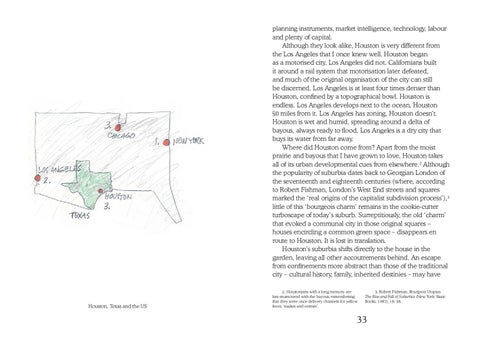
planning instruments, market intelligence, technology, labour and plenty of capital. Although they look alike, Houston is very different from the Los Angeles that I once knew well. Houston began as a motorised city, Los Angeles did not. Californians built it around a rail system that motorisation later defeated, and much of the original organisation of the city can still be discerned. Los Angeles is at least four times denser than Houston, confined by a topographical bowl. Houston is endless. Los Angeles develops next to the ocean, Houston 50 miles from it. Los Angeles has zoning, Houston doesn’t. Houston is wet and humid, spreading around a delta of bayous, always ready to flood. Los Angeles is a dry city that buys its water from far away. Where did Houston come from? Apart from the moist prairie and bayous that I have grown to love, Houston takes all of its urban developmental cues from elsewhere.2 Although the popularity of suburbia dates back to Georgian London of the seventeenth and eighteenth centuries (where, according to Robert Fishman, London’s West End streets and squares marked the ‘real origins of the capitalist subdivision process’),3 little of this ‘bourgeois charm’ remains in the cookie-cutter turboscape of today’s suburb. Surreptitiously, the old ‘charm’ that evoked a communal city in those original squares – houses encircling a common green space – disappears en route to Houston. It is lost in translation. Houston’s suburbia shifts directly to the house in the garden, leaving all other accoutrements behind. An escape from confinements more abstract than those of the traditional city – cultural history, family, inherited destinies – may have
Houston, Texas and the US
2. Houstonians with a long memory are less enamoured with the bayous, remembering that they were once delivery channels for yellow fever, ‘snakes and vermin’.
3. Robert Fishman, Bourgeois Utopias: The Rise and Fall of Suburbia (New York: Basic Books, 1987), 18–38.
33