UWC is a research-led university responsive to the needs of a changing world through excellence in learning, teaching and research, and the generation and application of new knowledge.
Firmly anchored in its local and sub-regional context and inspired by its distinctive academic role in building a more equitable and dynamic society, the University continues to empower its students, staff and partners to advance its mission of serving the greater public good and searching for humane and sustainable solutions to the challenges of our time. This is pursued through high academic standards, intellectual rigour and productive partnerships and networks beyond the confines of disciplinary and geographic boundaries.
MESSAGE FROM THE CHANCELLOR
HEADER
SUB-HEADER
Today, as we celebrate your achievements, we also recognise the determination and sacrifices that have brought you here. Take a moment to reflect on your journey, the nervous excitement of your first lecture, the long nights of study, and the challenges that tested your perseverance. There were times when the road ahead seemed uncertain, but you kept going. Now, you stand here, ready to step into the world as graduates of the University of the Western Cape (UWC).
The world you are entering holds both promise and complexity. Like much of the world, South Africa stands at a crossroads. Inequality, economic instability, and social injustice remain harsh realities for many. Yet, we are reminded that change begins when we refuse to be silent in the face of injustice. No one can be left out of the process. Too many voices in our society remain unheard, including women, children, the poor, and those pushed to the margins. The voices of the marginalised must be heard, their dreams shared, and their power reclaimed. As UWC graduates, you have not only gained knowledge but also the responsibility to be active citizens, to question, to challenge, and to lead with integrity. The true value of education is not measured by personal success alone but by how it is used to uplift others. Whether you enter boardrooms, classrooms, hospitals, or courtrooms, let your leadership create spaces where dignity and fairness prevail.
Our faith teaches us that there are no outsiders. All are welcome, regardless of race, background, gender, or identity. These are not just words; they are a call to action. In a world too often divided, let your success be defined by the inclusivity and justice you champion. Carry this commitment with you as you shape your future and the world around you. Hope has two beautiful daughters. One is anger at the way things are, and the other is the courage to change them. Let your courage be your guide. Speak out when you witness injustice, stand up for those who are silenced, and use your education to give others hope.
Wherever life takes you, remember this. Take pride in how far you have come but never lose sight of how far you can go. The world is waiting for you, not just as professionals, but as leaders who can make a difference.
Soos ons vandag u prestasies vier, erken ons ook die vasberadenheid en opofferinge wat jou tot hier gebring het. Vat ’n oomblik om op jou reis te reflekteer, die senuwees en opgewondenheid van jou eerste lesing, die laat nagte van studeer en die uitdagings wat jou deursettingsvermoë getoets het. Daar was tye wat die pad vorentoe onseker was, maar jy het aangehou. Nou staan jy hier, reg om die wêreld in te stap as ’n gegradueerde student van die Universiteit van Wes-Kaapland (UWK).
Die wêreld wat jy betree, hou beide belofte en kompleksiteit in. Soos ’n groot deel van die wêreld, staan Suid-Afrika op ’n kruispad. Onregverdigheid, ekonomiese onstabiliteit en sosiale onreg bly die harde werklikhede vir baie. Tog word ons daaraan herinner dat verandering begin wanneer ons weier om stil te bly in die aangesig van onreg. Niemand kan uit die proses gelaat word nie. Te veel stemme in ons samelewing bly ongehoord, insluitend vroue, kinders, die armes en dié wat opsy geskuif word. Die stemme van die gemarginaliseerde moet gehoor word, hul drome moet gedeel word en hul mag moet teruggeëis word. As UWK-gegradueerdes het jy nie net kennis gewerf nie, maar ook die verantwoordelikheid om ’n bydraende burger te wees, om vrae te vra, om uit te daag en om te lei met integriteit. Die waarde van onderwys word nie net alleen gemeet aan persoonlike sukses nie, maar aan hoe dit gebruik word om ander op te hef. Of jy nou raadskamers, klaskamers, hospitale of hofsale betree, laat jou leierskap ruimtes skep waar waardigheid en billikheid heers.
Ons geloof leer ons dat daar geen buitestaanders is nie. Almal is welkom, ongeag ras, agtergrond, geslag of identiteit. Dit is nie net woorde nie; dit is ’n oproep tot aksie. In ’n wêreld wat dikwels verdeeld is, laat jou sukses gedefinieer word deur die inklusiwiteit en geregtigheid wat jy bevorder. Dra hierdie verbintenis saam met jou terwyl jy jou toekoms en die wêreld rondom jou vorm. Hoop het twee pragtige dogters. Een is woede oor hoe dinge staan, en die ander is die moed om dit te verander. Laat jou moed jou gids wees. Praat uit wanneer jy onreg aanskou, staan op vir diegene wat stilgemaak word, en gebruik jou opvoeding om ander hoop te gee.
Waar ook al die lewe jou neem, onthou dit: Wees trots op hoe ver jy gekom het, maar moenie sig verloor van hoe ver jy kan gaan nie. Die wêreld wag op jou, nie net as ’n professionele mens nie, maar as leiers wat ’n verskil kan maak.
Baie geluk Klas van 2025!
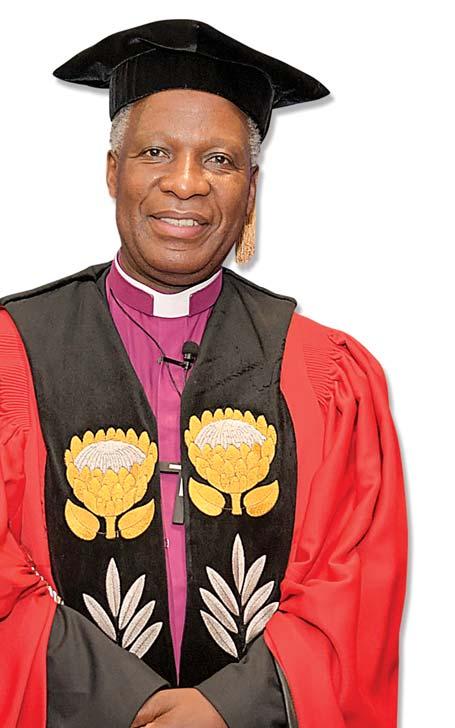
ARCHBISHOP
THABO MAKGOBA CHANCELLOR
UNIVERSITY OF THE WESTERN CAPE
Dear Graduands,
MESSAGE FROM THE RECTOR
HEADER SUB-HEADER
At the University of the Western Cape (UWC), we believe that education is about more than acquiring knowledge, it is about personal growth and the ability to make a meaningful difference in society. Graduation is a powerful reminder of the hard work and determination that have shaped your journey. Today, we celebrate your success while also reflecting on the experiences you have gained along the way.
For many, this journey has been filled with challenges, some anticipated, others unforeseen. Yet, with each obstacle, you have adapted, persevered, and emerged stronger. Struggle may be your soil, but resilience is your flower. Like the Protea on our University’s emblem, you have thrived despite adversity. This is what defines a UWC graduate.
Our graduates are stepping into a world that is both full of promise and fraught with uncertainty. In this moment of transition, I encourage you to hold fast to the values that have guided you during your time here. Take pride in how far you have come and have faith in how far you can go. Our country, our continent, and our world need critical thinkers, problem solvers, and leaders who are willing to create a more just and sustainable future. You have the knowledge and skills to do so, use them with purpose.
But remember, success is not measured by personal achievement alone. It is also found in service, lifting others as you rise and staying connected to the communities that have supported you. True academic wealth is not locked away, it is meant to be shared. The knowledge you have gained benefits you, but it is also a tool to help build a better world.
As you step into this new chapter, carry with you the integrity and sense of purpose that define a UWC graduate. No matter where life takes you, remember that you are part of a community that believes in social justice and the power of education to transform lives. Go forward with confidence, knowing that you are wellprepared to shape a future that is brighter and full of possibilities.
By die Universiteit van Wes-Kaapland (UWK) glo ons dat opvoeding meer is as net die verkryging van kennis; dit gaan oor persoonlike groei en die vermoë om ’n betekenisvolle verskil in die samelewing te maak. Gradeplegtigheid is ’n kragtige herinnering van die harde werk en vasberadenheid wat jou reis gevorm het. Vandag vier ons jou sukses, terwyl ons ook reflekteer oor die ervarings wat jy langs die pad opgedoen het.
Vir baie was hierdie reis vol uitdagings, vir party voorspelbaar, vir ander onverwags. Tog het jy, met elke hindernis, jouself aangepas, aangehou en sterker uit die stryd gekom. Struikelblokke mag jou grond wees, maar uithouvermoë is jou blom. Soos die Protea op ons Universiteit se embleem, het jy oorleef en gespruit, ondanks teenspoed. Dit is wat ’n UWKgegradueerde student definieer.
Ons gegradueerde studente stap in ’n wêreld wat vol is met beloftes en onsekerheid. In hierdie oomblik van oorgang, moedig ek jou aan om vas te hou aan die waardes wat jou gelei het gedurende jou tyd hier. Wees trots oor hoe ver jy gekom het en glo in hoe ver jy kan gaan. Ons land, ons kontinent en ons wêreld benodig kritiese denkers, probleem oplossers en leiers wat bereid is om ’n meer regverdige en volhoubare toekoms te skep. Dis ’n doel wat jy kan haal met die kennis en vaardighede wat jy bereik het.
Maar onthou, sukses word nie net gemeet deur persoonlike prestasie nie. Dit word ook gevind in diens, ander op te hef terwyl jy styg en om verbind te bly met die gemeenskappe wat jou ondersteun het. Ware akademiese rykdom is nie weggesluit nie, dit is bedoel om gedeel te word. Die kennis wat jy verwerf het, bevoordeel jou, maar dit is ook ’n hulpmiddel om ’n beter wêreld te bou.
Soos jy in hierdie nuwe hoofstuk begin, dra die integriteit en gevoel van doel wat ’n UWKgegradueerde student definieer. Maak nie saak waar die lewe jou neem nie, onthou dat jy deel is van ’n gemeenskap wat in sosiale geregtigheid en die mag van opvoeding om lewens te transformeer glo. Gaan vorentoe met selfvertroue, wetende dat jy goed voorberei is om ’n toekoms te vorm wat helderder is en vol moontlikhede.
Geluk!
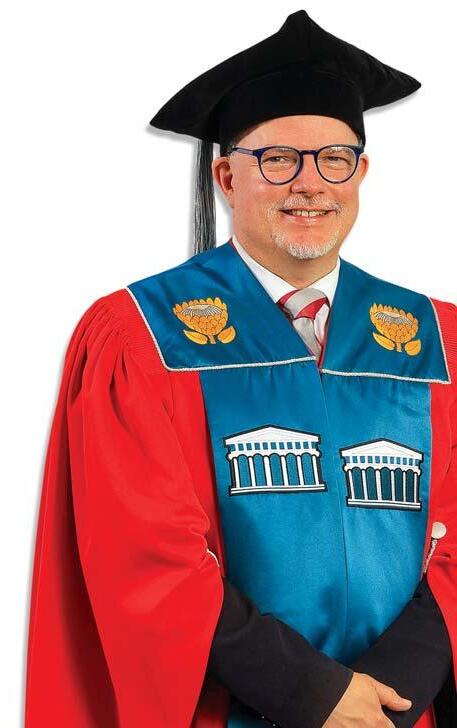
PROF ROBERT J. BALFOUR RECTOR AND VICE-CHANCELLOR UNIVERSITY OF THE WESTERN CAPE
AND FIGURES
UNIVERSITY OF THE WESTERN CAPE
TOTALSTUDENTPOPULATIONENROLMENT
SUCCESSRATE
HEADER
HISTORIC MILESTONES
UNIVERSITY OF THE WESTERN CAPE
1960: The University College of the Western Cape opens its doors.
1970: The institution gains independent university status and is allowed to award its own degrees and diplomas.
1975: Prof Richard van der Ross is appointed as UWC’s first black Rector.
1978: UWC’s Cape Flats Nature Reserve is declared a National Monument (now known as a provincial heritage site).
1987: New Rector and Vice-Chancellor, Prof Jakes Gerwel, declares UWC as the ‘university of the left’. The University deracialises and opens its doors to African students.
UWC inaugurates its longest-serving Chancellor, Archbishop Desmond Tutu, who would serve for more than 25 years.
1990: UWC becomes the first university to award the late President Mandela an honorary doctorate upon his release from prison.
1994: Many academics from UWC join President Mandela’s government and are appointed to ministerial and advisory positions, including its Rector, Prof Gerwel, who became the Director-General in the Presidency.
SUB-HEADER
1994: UWC’s leadership takes part in writing the higher education policy for the incoming government. The South African interim Constitution and final Constitution are drafted at UWC.
1995: UWC launches its first website – joining the internet age before other universities in the Mother City.
UWC launches the Institute for Poverty, Land and Agrarian Studies (PLAAS) to engage in research, training, policy development and advocacy in relation to land reform, rural governance and natural resource management.
2002: Under the leadership of Rector and Vice-Chancellor, Prof Brian O’Connell, UWC successfully resists being merged. Instead, its Dentistry Faculty is merged with that of the University of Stellenbosch, making UWC the only dentistry faculty in the Western Cape.
2010: 10 SARChI chairs awarded to UWC, the highest number awarded to any university in SA that year (as of 2018, UWC hosts 17 SARChI Chairs).
2012: UWC launches its Technology Transfer Office to help promote the development and protection of the intellectual property of the University’s research community, staff and students.
HISTORIC MILESTONES
UNIVERSITY OF THE WESTERN CAPE
2012: UWC is declared Africa’s Greenest Campus in the inaugural African Green Campus Initiative Challenge.
2013: UWC signs the Berlin Declaration on Open Access in the Sciences and Humanities, joining hundreds of institutions around the world dedicated to supporting the principles of open access and working to achieve openness in publicly funded projects.
2015: Prof Tyrone Pretorius is inaugurated as the new Rector and Vice-Chancellor.
2016: UWC’s Centre for Humanities Research is awarded the Flagship on Critical Thought in African Humanities by the NRF.
UWC is ranked number 1 in Physical Science – not just in South Africa, but for Africa as a whole – in the 2016 Nature Index.
2017: A group of UWC students, led by Prof Nico Orce, conduct the second major African-led experiment at the CERN laboratory in Switzerland.
UWC’s former Vice-Chancellor, Prof Brian O’Connell, receives the National Research Foundation’s highest honour, the NRF Lifetime Achievement Award.
2018: The Faculty of Dentistry launches a state-of-the-art video conferencing system that allows students to watch live surgeries in class or at home – a first for South Africa.
HEADER
SUB-HEADER
2018: UWC Choir made its debut at the World Choir Games. The choir came first in its category, bringing home the gold medal and the titleWorld Champions.
2019: UWC Rugby makes its historical debut in the Varsity Cup, by becoming the first team from an historically disadvantaged institution to qualify for the competition.
2020: UWC’s South African National Bioinformatics Institute (SANBI), in collaboration with researchers from the National Institute for Communicable Diseases (NICD), sequenced the first SARS-COV-2 genome in South Africa, providing a genetic “fingerprint” helped us understand - and contain - the spread of COVID-19.
UWC celebrates its 60th anniversary.
2022: Professor Russell H Kaschula is appointed as the Research Chair in Forensic Linguistics and Multilingualism – a first in Africa.
The UWC Main Hall is renamed the Jakes Gerwel Hall to honour this iconic leader.
2023: Professor Marion Keim is appointed as the UNESCO Chair for Sport, Development, Peace and Olympic Education – the first ever awarded UNESCO Chair in Sport in Africa
HISTORIC MILESTONES
UNIVERSITY OF THE WESTERN CAPE
2023: Four significant infrastructure projects are completed in 2022 and 2023, including the Education Faculty building on the main campus, the 2700-bed Unibell Residence complex in Belhar, the Centre for Humanities Research building in Woodstock, and the UWC Innovation Hub in Parow.
2024: The first year of the full implementation of the Mastercard Foundation Scholars Programme, which provides full bursaries to 250 undergraduate and 250 Master’s students as part of a seven-year agreement.
HEADER SUB-HEADER
2024: UWC is the first and only university team to compete in the inaugural CAF Women’s Champions LeagueAfrica’s premier club competition for women’s football.
2025: Prof Robert John Balfour is inaugurated as the 8th Rector and Vice-Chancellor
OFFICE BEARERS
OF THE UNIVERSITY OF THE WESTERN CAPE
CHANCELLOR
The Most Reverend Dr TC Makgoba (PhD, Doctorate of Divinity: Hon. Causa)
CHAIR OF COUNCIL
HEADER
SUB-HEADER
Ms X Mpongoshe (Dipl. Juris, B. Proc, Cert in Compliance Management, Cert. CRO (Euromoney London))
RECTOR AND VICE-CHANCELLOR
Prof R Balfour (BA, BA (Hons), HDE, MA, PhD)
VICE-RECTORS AND DEPUTY VICE-CHANCELLORS
Prof MK Ralarala (HDE (Arts), BA (Hons), MA, DLitt, PhD)
Prof J Frantz (BSc, MSc, PhD)
Prof M Madiba (BA (Paed), B.Ed (Hons), B.Ed (Hons), BA (Hons) (English), MA Linguistics (Applied Studies), PhD)
REGISTRAR
Dr N Lawton-Misra (BA, BEd, MEd (Educational Psychology), PhD (Educational Psychology))
EXECUTIVE DIRECTORS
Mr ME Magida (BProc, LLB, LLM)
Mr M Regal (BCom (Hons), CA (SA), M Dev Studies)
HEADER SUB-HEADER OF THE UNIVERSITY OF THE WESTERN CAPE
Prof F Moola (BA Hons, MA, PhD)
DEANS
Prof A Padmanabhanunni (BA Hons (Psych), MA (Counselling Psych), PhD)
Prof V Yengopal (BChD, BSc (Hons), PGDip, MChD, PhD)
Prof MV Esau (BAdmin, BAdmin (Hons), MAdmin, PhD)
Prof R Govender (BSc; BSc Honours (Mathematics); MEd and PHD (Mathematics Education))
Prof JR De Ville (BCom, LLB, LLD)
Prof D Holgate (BSc, BSc (Hons), MSc, PhD)
11 DECEMBER 2025 | 14H30
FACULTY OF COMMUNITY AND HEALTH SCIENCES
FACULTY OF LAW
FACULTY OF NATURAL SCIENCES
ORDER OF PROCEEDINGS
1. Academic Procession (THE AUDIENCE IS REQUESTED TO STAND AS THE PROCESSION ENTERS THE HALL)
2. The Chancellor / Vice-Chancellor constitutes the congregation
3. National Anthem
4. Prayer
5. Address: SRC
6. Address: Rector and Vice-Chancellor
7. Item in song
8. Presentation of Graduands to the Chancellor / Vice-Chancellor
9. The Chancellor / Vice-Chancellor dissolves the congregation
10. The Academic Procession leaves the hall
HEADER
SUB-HEADER
NB: THE AUDIENCE IS REQUESTED TO REMAIN STANDING UNTIL THE PROCESSION HAS LEFT THE HALL.
Morena boloka setjhaba sa heso, O fedise dintwa le matshwenyeho,
O se boloke, O se boloke setjhaba sa heso, Setjhaba sa South Afrika – South Afrika.
Uit die blou van onse hemel, Uit die diepte van ons see, Oor ons ewige gebergtes, Waar die kranse antwoord gee,
Sounds the call to come together, And united we shall stand, Let us live and strive for freedom, In South Africa our land.
FACULTY OF COMMUNITY AND HEALTH SCIENCES
DOCTOR’S DEGREES
DOCTOR OF PHILOSOPHY
RITA OLUWANIFESIMI ABIODUN
SCHOOL OF NURSING
Supervisor: PROF J CHIPPS
Co-supervisors: PROF F DANIELS, DR C PIMMER
Thesis:
Development of a WhatsApp programme to link, empower and professionalise (mLEAP) newly graduated nurses in the Western Cape
Description:
Ms Abiodun’s designed, implemented, and evaluated a WhatsApp transition programme for graduate nurses using an 8-study multi-method approach. She conducted a survey of digital readiness and a review of challenges of newly graduated nurses. Based on her findings she implemented a WhatsApp-based community of practice pilot programme which highlighted the need for professional support. Using the findings of the pilot and the evidence from an umbrella review of transition programmes, she implemented and evaluated a revised program (mLEAP) using a cluster randomized controlled trial. Results showed increased knowledge sharing, socio-professional connections, empowerment, and reduced burnout. Ms Abiodun’s thesis was by publication with 3 of 5 papers published, and two (2) in revision.
LORETTA ZELDA LE ROUX
SCHOOL OF NURSING
Supervisor: PROF J CHIPPS
Co-supervisor: PROF M BIMEREW
Thesis:
Developing Nursing Informatics Competencies for nurses in South Africa
Description:
Ms Le Roux developed the first set of nursing informatics competencies in South Africa using a multi- method approach with 6 studies. She investigated the perceived nursing informatics competence in computer, informatics literacy, and information management of student and practice nurses. She found generally low perceived competence, with the exception of computer literacy, which qualitative interviews confirmed was higher. She mapped the nursing informatics curriculum content in nurse training and integrated all the data with evidence on international nursing informatics competencies. Based on this, she developed 60 nursing informatics competencies, validated by experts through a Delphi study.
FACULTY OF COMMUNITY AND HEALTH SCIENCES
DOCTOR’S DEGREES DOCTOR OF PHILOSOPHY
DELPHINE AWAH SIH
SCHOOL OF NURSING
Supervisor: PROF J CHIPPS
Co-supervisors: PROF M BIMEREW, DR F KARACHI
Thesis:
Nurse Sensitive Outcome Indicators for adult intensive care units in the South African context
Description:
Ms Sih developed the first set of nurse-sensitive indicators for public and private ICUs in South Africa, using a multi method approach with 8 studies. She investigated the perceptions of resilience and self-reflective competence of nurses in ICU and the quality of nursephysician collaboration. She measured the families’ critical care needs, their perception of the competence of care in ICU, the distribution of specialist nurses and the patient dependency ratios in both public and private ICUs. To develop the indicators, she integrated the findings with data from a scoping review on global nurse-sensitive indicators and ICU experts validated 51 indicators through a Delphi Study. indicators will contribute to the monitoring of the quality of nursing care in ICU in South Africa.
SARAH MANIG
Department: PHYSIOTHERAPY
Supervisor: PROF L ENNION
Co-supervisors: PROF L DE WITTE, PROF M ROWE
Thesis:
A universal framework for the evaluation of community-based rehabilitation interventions
Description:
This thesis addresses a critical gap in community-based rehabilitation (CBR) by developing a universal evaluation framework for low- and middle-income countries. Using a four-phase, multi-method approach—including scoping and systematised reviews, Delphi consensus study, and pilot testing—the candidate identified suitable generic patient-reported outcome measures and integrated them into a standardised yet adaptable framework. Despite CBR’s widespread use, absence of consistent evaluation methods has hindered programme effectiveness assessment. The validated framework offers methodological rigour and contextual flexibility for resource-limited settings. This research provides practitioners and policymakers with an evidence-based tool to systematically evaluate CBR interventions, supporting improved service delivery and enhanced quality of life for people with disabilities.
FACULTY OF LAW
DOCTOR’S DEGREES
DOCTOR OF LAWS
JENNICA JASMINE BEUKES
Department: PUBLIC LAW AND JURISPRUDENCE
Supervisor: PROF J DE VISSER
Co-supervisor: PROF H KUMMELING
Thesis:
Coalition Governance in South Africa’s Local Government: Law and Practice
Description:
The thesis of Jennica Beukes examines coalitions in local government. She locates coalitions in the context of how councillors are elected, and the relationship between the council and the municipal executive. She analyses the advantages and disadvantages of coalitions and concludes that they have the potential to promote inclusion and stability, but that in South Africa, they are synonymous with instability. Is it all politics? Or can the law assist in stabilising coalitions? Based on a thorough analysis of international literature, local government law and an examination of caselaw, Ms Beukes makes practical suggestions. For example, she argues that coalition agreements must be public, that motions of no-confidence must be regulated, and that an electoral threshold ought to be considered to reduce the fragmentation of local politics.
THABILE CHONCO-SPAMBO
Department: PUBLIC LAW AND JURISPRUDENCE
Supervisor: PROF J DE VISSER
Co-supervisor: PROF H KUMMELING
Thesis:
One size does not fit all: An examination of the legal and policy framework for differentiated powers and functions of municipalities in South Africa
Description:
Should Cape Town run the trains? Should the City regulate Golden Arrow buses, instead of the province? Should the City generate electricity, and not just sell it? Should smaller municipalities do less? Does the one-size-fits-all approach to municipal powers work? Thabile ChoncoSpambo’s thesis uses international literature and the Constitution to answer this. She argues that the one-size-fits-all approach does not work, and that the law allows for differentiation. She formulates a ten-point normative framework for differentiation, and examines whether the approach to electricity, public transport and housing complies. She gives meaning to section 156(4) of the Constitution which forces national and provincial governments to give more powers to municipalities where appropriate. Her conclusion is that political will, not the law, is the problem in ensuring that our municipalities are fit for purpose.
FACULTY OF LAW
DOCTOR’S DEGREES
DOCTOR OF LAWS
THOKOZANI NGWIRA
Department: MERCANTILE AND LABOUR LAW
Supervisor:
Thesis:
PROF P LENAGHAN
Harmonisation of Laws Regulating Investments into the Extractive Industry in Sub-Saharan African Countries
Description:
The thesis addresses a pressing concern: although African states attract substantial miningrelated FDI, they often realise limited development gains. Niger exemplifies this, with persistently low human-development outcomes despite extensive uranium exports. Weak mining laws and investor-favoured treaties further constrain the benefits of FDI. In contrast, Botswana demonstrates how strong domestic regulation can translate mineral wealth into national progress. The research is valuable in proposing an AU-level, harmonised investment framework with effective enforcement mechanisms to help states secure fairer, developmentoriented outcomes. By tackling the structural barriers that limit the positive impact of mining FDI, such a framework could support more equitable and prosperous futures for Africa’s resource-rich nations.
FACULTY OF LAW
DOCTOR’S DEGREES
DOCTOR OF PHILOSOPHY
GERALD JEREMIAH TENDAI MANDISODZA
Department: PRIVATE LAW
Supervisor: PROF A DIALA
Thesis:
The role of forum shopping in the construction of traditional law institutions and women’s customary property rights in South Africa
Description:
Through case analysis, semi-structured interviews, and focus group discussions, this thesis examined gaps between South Africa’s constitutional commitment to gender equality and the property rights of women living under customary law in Limpopo Province. It finds that women exercise agency through their choice of dispute resolution forums, which challenges patriarchal norms and reshapes traditional institutions. The thesis developed a tripartite analytical framework comprising the concepts of legal invisibility, adaptive legal pluralism, and ambivalent adaptation. All the examiners praised its significant contribution to knowledge and passed it without requiring revision.
FACULTY OF NATURAL SCIENCES
DOCTOR’S DEGREES DOCTOR OF PHILOSOPHY
TRISHA DEEVIA BHAGA
Department: EARTH SCIENCE
Supervisor: PROF T DUBE
Co-supervisors: DR M SHEKEDE, DR C SHOKO
Thesis:
Using machine learning algorithms to develop a remotely-sensed framework for drought monitoring in different climate regions in South Africa
Description:
This doctoral research developed an advanced spatial modelling framework to assess and forecast droughts for rainfed smallholder farms across South Africa’s diverse climatic zones. By integrating satellite-derived vegetation indices with state-of-the-art machine learning, including a highly effective Transformer model, the study accurately mapped drought vulnerability and frequency. The research revealed persistent and severe droughts, particularly in Limpopo Province. Employing predictive modelling under future climate scenarios, the study forecasts a significant intensification of drought conditions, providing critical insights for building climate resilience and informing sustainable agricultural adaptation strategies for vulnerable communities.
OSVALDO ERNESTO CHACATE
Department: BIODIVERSITY AND CONSERVATION BIOLOGY
Supervisor: PROF M GIBBONS
Co-supervisors: DR B AXELSEN, PROF D AKSNES, MS J COETZEE
Thesis:
Density and distribution of the mesopelagic deep scattering layers in relation to environmental parameters from Western Indian Ocean to the Northwestern Indian Ocean
Description:
The mesopelagic realm occurs between depths of 200-1000 m: it is cold, dark and populated by weird micronektonic animals with big eyes, sharp teeth and flashing lights. Using samples collected as part of the FAO’s EAF Nansen Programme, Osvaldo’s thesis shows that deep scattering layers (DSLs) across the Indian Ocean varied in composition and density, largely as a result of differences in oxygen levels, light penetration, prey availability and fluorescence. Acoustic surveys revealed higher mesopelagic fish densities than previously estimated from trawl catches. Multifrequency acoustics effectively separated mesopelagic fish from other scatterers (squid and prawns), which allows for remote sensing of resources and contributes to ecosystem-based fisheries management in the region.
FACULTY OF NATURAL SCIENCES
DOCTOR’S DEGREES DOCTOR OF PHILOSOPHY
VERLON ETSEBETH
Department: PHYSICS AND ASTRONOMY
Supervisor: DR M LOCHNER
Thesis:
Enabling scientific discovery in astronomical data with machine learning
Description:
Mr Etsebeth’s research investigated the use of artificial intelligence for scientific discovery in large astronomical datasets. His PhD work applied a powerful machine learning based anomaly detection framework to nearly 4 million images of galaxies. He identified exotic systems, such as merging galaxies and strong lenses, where the light from distant galaxies is bent and distorted by gravity. Published in a leading international journal, this study demonstrated the potential of machine learning for rapidly exploring massive datasets. He subsequently adapted this framework for data from the South African MeerKAT radio telescope. A human-machine collaborative algorithm was trained to detect faint diffuse emission: signatures of complex physical processes in massive galaxy clusters. Etsebeth’s innovative work positions South African research at the forefront of discovery in the Square Kilometre Array era.
GASSAN ALI MOHAMED OSMAN FARAH
Department: MATHEMATICS AND APPLIED MATHEMATICS
Supervisor: DR A MUKHTAR
Co-supervisor: PROF K PATIDAR
Thesis:
Mathematical modelling and simulation of malaria models using stochastic and fractional differential equations framework
Description:
In his PhD thesis, Farah demonstrated exceptional aptitude in investigating malaria as a critical public health concern in Sudan. Through extensive qualitative and quantitative analyses using robust simulations of systems of deterministic, stochastic, and fractional differential equations, he explored the reliability of the proposed models. His research highlights the significant influence of climatic factors on the evolution of malaria vectors, their geographic distribution, and the dynamics of malaria transmission. In addressing key issues such as climate change, intervention strategies, and human mobility amid an unstable socio-political climate, Farah’s work has implications for public health strategies in combating malaria.
FACULTY OF NATURAL SCIENCES
DOCTOR’S DEGREES DOCTOR OF PHILOSOPHY
VIVIAN CHIGOZIE IKEBUDU
Department: BIOTECHNOLOGY
Supervisor: PROF T MULAUDZI-MASUKU
Co-supervisors: PROF R AJAYI, PROF S CHIVASA
Thesis:
Investigating the role of Sorghum bicolor heme oxygenase gene products in salinity stress-adaptive response
Description:
Ms Ikebudu’s doctoral study advanced understanding of climate change-induced abiotic stresses in plants, revealing key mechanisms underlying plant resilience under adverse conditions. She demonstrated that heme oxygenase–derived products, carbon monoxide (CO) and biliverdin (BV), significantly alleviated salt-induced damage in Sorghum bicolor
Exogenous application of trace amounts of CO and BV improved germination and growth by enhancing osmotic regulation and boosting antioxidant defences, thereby reducing sodium toxicity. Her findings deepen scientific knowledge of crop stress adaptation and highlight promising biotechnological strategies for improving crop performance under salinity. This research contributes valuable insights that support ongoing innovation in food security.
AARIFAH JAKOET
Department: BIODIVERSITY AND CONSERVATION BIOLOGY
Supervisor: PROF J BOATWRIGHT
Co-supervisor: DR A MAGEE
Thesis:
A systematic study of the genus Cotula (Asteraceae, Anthemideae)
Description:
Generic and species level relationships of Cotula were studied. Expanded molecular sampling, combined with studies of vegetative and reproductive morphology indicated that Cotula is not monophyletic, with C. mexicana embedded within Soliva (South American), and C. alpina embedded within Leptinella (Australasian), which was also embedded within Cotula. Options were explored to re-circumscribe a monophyletic Cotula. The best solution was an expanded concept of Cotula including Leptinella and Soliva. Cotula s.l. now comprises 81 near cosmopolitan taxa. 2 subgenera and 21 sections (12 new, 3 raised to sectional level and 6 emended) are recognised. In addition, the 39 African species (3 new) were revised, with detailed accounts of all species. Two papers have already been published, with another three in preparation.
FACULTY OF NATURAL SCIENCES
DOCTOR’S DEGREES
DOCTOR OF PHILOSOPHY
KUDZAI MPAKAIRI
Department: EARTH SCIENCE
Supervisor: PROF T DUBE
Co-supervisor: PROF O MUTANGA
Thesis:
Earth observation technologies for improved agricultural decision support systems in South Africa
Description:
This doctoral research establishes an innovative framework that integrates multi-sensor satellite remote sensing and advanced machine learning to transform agricultural management and climate resilience in Southern Africa. It introduces novel methodologies for precise, largescale cropland classification and irrigation mapping. The study further quantifies critical spatiotemporal patterns in crop water use and productivity, delivering actionable insights for resource optimization. By analysing climate impacts and identifying high-potential areas for sustainable irrigation development, this work provides a scientifically rigorous foundation for strategic policy and food security enhancement across water scarce regions.
GEOFF MURPHY
Department: PHYSICS AND ASTRONOMY
Supervisor: PROF M SANTOS
Co-supervisor: DR P BULL
Thesis:
High-dimensional Bayesian modelling approaches for 21cm cosmology
Description:
This thesis represents a significant contribution to Cosmology through the development and application of HI intensity mapping at both low and high redshifts. By addressing systematics and foreground contamination within a fully Bayesian framework, it tackles one of the central challenges in achieving high-precision measurements of cosmological power spectra. The work focuses on two state-of-the-art radio telescopes in South Africa—MeerKAT and HERA— and outlines a clear pathway toward precision cosmology enabled by modern highperformance computing. The candidate has demonstrated outstanding command of the subject matter. The thesis is exemplary in both its clarity and its scientific depth, and the results have been published in leading international journals.
FACULTY OF NATURAL SCIENCES
DOCTOR’S DEGREES DOCTOR OF PHILOSOPHY
SAMSON OSELUSI
Department: BIOTECHNOLOGY
Supervisor: PROF A MADIEHE
Co-supervisor: DR N SIBUYI
Thesis:
Evaluation of the antimicrobial and wound healing efficacy of extracts from Ehretia spp. and their silver nanoparticles
Description:
This research responded to the burden of antimicrobial resistance and chronic wounds by exploring the therapeutic potential of Ehretia rigida leaves through green nanotechnology and advanced computational methods. The study produced silver nanoparticles and demonstrated their broad-spectrum antimicrobial activity, and wound healing effect. Computational analyses identified phytochemicals with strong drug-likeness, and stable interactions with antimicrobial activity and wound healing effects. Overall, the findings provided evidence supporting E. rigida as a promising source of cost-effective wound-care interventions. The study clearly showed how integration of traditional medicinal knowledge with biotechnology and computational science can lead to innovative solutions for global health challenges. This work culminated in the publication of six manuscripts in reputable peer-reviewed journals.
BHIVEK SINGH
Department: PHYSICS AND ASTRONOMY
Supervisor: PROF S TRIAMBAK
Thesis:
The 21+ to 31+ transition in 22Na and the second class current problem
Description:
From the ancient Egyptians and classical Greeks to the present day, humans have been captivated by symmetry. This is evident in the great architectural wonders built through the ages. Symmetrical objects are also manifest in nature: from the shapes of honeycombs and snowflakes, to the spirals of the Milky Way. It is therefore not surprising that the physical laws which describe the Universe are also guided by symmetries. For his PhD, Bhivek Singh studied one such symmetry called G-parity, which is important in subatomic systems that are governed by quantum mechanics and relativity. Using gamma ray spectroscopy, extensive computer simulations and data analysis, Bhivek resolved an apparent anomaly concerning G-parity in atomic nuclei, and built new instrumentation to extend these studies.
FACULTY OF NATURAL SCIENCES
DOCTOR’S DEGREES
DOCTOR OF PHILOSOPHY
NDIVHUHO BEAUTY TAKALANI
Department: MEDICAL BIOSCIENCES
Supervisor: DR C OPUWARI
Co-supervisors: PROF T MONSEES, PROF R HENKEL
Thesis:
Determination of oxidative reduction potential and Antioxidative /Cytoprotective effects of Aspalathus linearis, Camellia sinensis, and Ascorbic acid on normozoospermia semen parameters following induction of oxidative stress using cumene hydroperoxide
Description:
Ms Takalani’s doctoral research addresses male infertility, affecting 15% of couples globally. Infertility is defined as the inability to conceive after 12 months of regular unprotected intercourse, with male factors contributing to approximately half of all cases. This groundbreaking study investigates natural antioxidants’ therapeutic potential against male oxidative stress infertility (MOSI). She examined aqueous extracts from Aspalathus linearis (rooibos) and Camellia sinensis (green, black, and white tea) on sperm function under oxidative stress. Results demonstrated these extracts effectively counteracted oxidative damage, showing comparable efficacy to ascorbic acid (vitamin C), while emphasising optimal dosing. This work contributes substantially to evidence-based therapeutic approaches for MOSI, offering accessible natural alternatives.
DIVINE TAWE TARLA
Department: MATHEMATICS AND APPLIED MATHEMATICS
Supervisor: PROF K PATIDAR
Co-supervisors: DR S NUUGULU
Thesis:
Machine learning techniques for solving a class of stochastic and fractional PDEs arising in computational finance
Description:
In his PhD thesis, Tarla presented a comprehensive study of advanced derivative pricing and volatility modelling frameworks using Machine Learning Techniques. He used purely datadriven (PDD) as well as physics-informed neural network (PINN) approaches for solving timefractional and time-space-fractional Black-Scholes PDEs and showed that PINNs, especially with optimized hyperparameters, outperform PDD and classical Black-Scholes. Further extensions include robust simulations of Heston’s volatility model, time-fractional rough volatility models involving memory effects and path-dependence, and fractional partial integrodifferential equations with fractional activation functions. The thesis ends with a hybrid econometric-deep learning model for improve volatility forecasting and value-at-risk estimation.
FACULTY OF NATURAL SCIENCES
DOCTOR’S DEGREES DOCTOR OF PHILOSOPHY
LOURENCO DOMINGOS ZACARIAS
Department: BIODIVERSITY AND CONSERVATION BIOLOGY
Supervisor: DR C VAN DER LINGEN
Co-supervisors: PROF M GIBBONS, DR P HULLEY
Thesis:
Comparing the trophic structures of mesopelagic fish communities in oceanic and coastal waters of the south Atlantic using morphometric, stable isotope and stomach content analyses
Description:
The mesopelagos or twilight zone of the world’s oceans is thought to support the largest populations of currently unexploited organisms in the sea. Their careful management requires sound information and Lourenço’s thesis uses samples collected as part of the FAO’s EAF Nansen Programme off Namibia and in the SE Atlantic to derive just such. Off Namibia, several species show zonal exclusivity, and coexistence is facilitated by differences in microhabitat use, prey size and trophic level. In the SE Atlantic, morphometric variation, spatial segregation, and trophic differentiation structure communities. Some regional comparisons reveal strong (and subtle) isotopic differences, while others exhibit more uniform ecological traits. Overall, niche partitioning emerges as the principal mechanism maintaining high mesopelagic diversity.
FACULTY OF COMMUNITY AND HEALTH SCIENCES
MASTER’S DEGREES
MASTER OF NURSING
SEOCHARAN MELITA
Thesis:
Factors contributing to student nurse absenteeism from academic and clinical learning environments in low- and middle-income countries - A qualitative systematic review
SCHOOL OF NURSING
Supervisor: PROF K MINNIE
MASTER OF SCIENCE IN PHYSIOTHERAPY
AMERICA ERIN
Thesis:
Imposter Syndrome and job satisfaction: perceptions of community service physiotherapists within the Western Cape
Department: PHYSIOTHERAPY
Supervisor: PROF T STEYL
Thesis:
Perceptions of physiotherapy students regarding the management of patients with underlying mental illness in clinical practice at a university in the Western Cape
Department: PHYSIOTHERAPY
Supervisor: MRS S GAMIET
Co-supervisor: DR D HESS
SMIT MERISA
Thesis:
The effect of a vibration intervention on the somatosensory cortex of the brain in patients with Sensory Peripheral Neuropathy secondary to Type II Diabetes Mellitus
Department: PHYSIOTHERAPY
Supervisor: PROF L ENNION
SALO MAYLENE
FACULTY OF COMMUNITY AND HEALTH SCIENCES
UNDERGRADUATE DEGREES 2025
BACHELOR OF COMMUNITY DEVELOPMENT
MKHIZE NONTOKOZO
Cum Laude
BUSO NTANDO SIMO
CEBISA ASEMAHLE
DANIELS ASHLEIGH SARA
DLAME SISANDA MBALENHLE
KEKANA KAMOGELO CUTHBERT
KOLE LESEGO TONNY
LIEBENBERG RICKY-LEE
MADINI NTOMBETHEMBA
MAKHOLISO LUKHANYISO LANDILE
BACHELOR OF NURSING
DE VILLIERS AMBER
Magna Cum Laude
AWA SONIA PRECIOUS
Cum Laude WOKWEN
CHAPMAN KIRSTY ANN
Cum Laude
DODD KAYLIN
Cum Laude
JOSHUA LAYLAH
Cum Laude
KHAN TALIA
Cum Laude
LOSPER JORDAN CLEO
Cum Laude
MBALA CHANTAL
Cum Laude
METUKO ELETHU
Cum Laude
MANYATI LUFEZO
MBOBO XABISO
MKHOMO DELICIA
MOSOME SELEKWANE DAVID
MOTILENG STEVENS
MOTSOENENG KABELO
MZEKANDABA LIZEKA REBECCA
PHUNGULA MANDISA LONDEKA
PINDA ZUBENATHI
RUITERS SHAZNI MICHE
SANTI LIHLE
VAN RHEEDE
VAN OUDTS SOPHIA
Cum Laude
ADAM IMAADH
AHMED ASMA
ALEXANDER ZANE EAGEN
BARENDS ZOE
BOLTMAN NAADHIRAH
CARELSE EMMA MEGHAN
CHIRINDA VALELIAH RUVARASHE
CLOETE MEGAN
ENGEL CASSIDY
FAYE ZANDILE
GOLIATH TÀTUM ZONIE-ANN
GOUS HANERY LEE-JAMERY
BERNICIA
HARTZENBERG JORDAN
HUMAN KEZIAH
FACULTY OF COMMUNITY AND HEALTH SCIENCES
UNDERGRADUATE DEGREES
BACHELOR OF NURSING
JEZILE YOLANDA
KOLA TUMISHI
LOMBARD ROXANNE
MABIXWANA SIMNIKIWE
MAKHUBELA PRISCILLA PRETTY
MALAMULE TERCIA PRECIOUS
MALIE KEISHA ROBYNN
MARTIN CHWAYITA
MATHEBULA SHAMEIN VUTOMI
MBESI JOY
MBULAHENI MUDINDA
MOHAMED NOSTEXO
MONDI ANAM
MTSHIKWA YONDELA
MXINWA AMAHLE
NDAKISA VIWE SAMUEL
NEMULODI WAVHUDI
NHELE NAOMI
OBIRI-YEBOAH ANELISA LETICIA
OSONDO NNENNA
PETERSEN MOGAMMAD ZAEEM
PETERSON SIPHOSETHU CINGA
ROSSOUW ANZEL
SCHROEDER MASOOD
STANFLIET LAUREN
THOBELA LWAZI SIPHOSETHU
TITUS TAMSYN MICHAELA
VAN JAARSVELDT IVANNAH-ANNE
VINJWAYO AYANDA
WENANA LUMKA
WILLEMSE AMMAARAH
XHESHIWE ELAM
ZIBAYA ZINWE
BACHELOR OF SCIENCE IN PHYSIOTHERAPY
HAMZA NAFEESAH
Cum Laude
JORDAAN ANNA
Cum Laude
KLEYNHANS CARIENA
Cum Laude
ABDULLA CARLA ROSE
ADAMS AUSTIN
ALEKER FIRDAWS
BANANGILE BUHLE
BANDERKER WASEEMAH
BIKO CHELSEA JAE
BOCK GAILYNN KYLIE
BOOYS NIKITHA LE-SHAAN
CARELSE ANGELO MICHAEL
CELE OLWETHU
CLOETE CASEY
CONRAD NABEELAH
DAMANE ASISIPHO
DYANTYI ZANDI
FAULMANN CASEY
GOLIATH CHAD
GOUWS MERIQUE
GQWABAZA ZANELE
FACULTY OF COMMUNITY AND HEALTH SCIENCES
UNDERGRADUATE DEGREES 2025
BACHELOR OF SCIENCE IN PHYSIOTHERAPY
GUMEDE NKOSIKHONA NELISWA
HERMANUS LITHÉTHAA
HOOSAIN AALIYAH
ISMAIL MUHAMMAD ZUBAIR
JOON CHANTE
KEBE AYAKHA
KHAN FATHIMA ZAHRA
LANGA LANGALAVELA
LOURENS CHLOE-ANN
LOUW ANE
LUTSEKE UNATHI
MAKDA SOFIYYAH
MAKELENI MOTLATSI DALUXOLO
MAKUSE TSHEGOFATSO KARABO
MALINGA APHIWE SIPHESIHLE
MAMANE YANELA
MANAMELA KATLEGO
MAZIBUKO NONQUBEKO BUKEKA
MFAXA ZIZIPHO
MITCHELL PAIGE
MIYAMBO MATIMU SUCCESS
MKOKO LUNATHI
MNYANDU SEBONAKALISO
SINQOBILE
MOKGABUDI NALEDI MAHLOGONOLO
MONTERO
MACHADO NICOLE KAYLE
MOSEHLA BRADLEY
MTHETHWA KHOLEKA THOBEKA
NKUNA ZANDILE
NYENZANE ATHI-ENKOSI
PETERS RAEESAH
PRETORIUS DANELLE
PRIMOE KEZIAH
RIPEPI NAADIRAH
SADIKI NDAMULELO PRESENT
SELEMELA OBONENG
SHIBURI DELANI TAFFIE
SIEBRITZ MIEKE
SIKHAKHANE SILINDILE BRIDGETH
SIMPSON CAILIN JOY
STARENBERG THAAKIRAH
TENGU MUKEINA-SUZETTE
THIBANE HLUMISA
THWALA SNCOBILE ASEMAHLE
TSHISEKA ASONELE
VAN SCHOOR LUKE CYRIL
XOKO CHUBEKILE
FACULTY OF LAW
MASTER’S DEGREES
MASTER OF LAWS
BARON CORINNE
Thesis:
An analysis of the laws which criminalise sex work in South Africa and the effects thereof
Department: CRIMINAL JUSTICE AND PROCEDURE
Supervisor: MS C SANGER
Co-supervisor: PROF A HAMMAN
MAHAMBA ZIBELE THEOPHYLUS
Thesis:
Examining the challenges and strategies of intellectual property management in technology startup companies in South Africa
Department: PRIVATE LAW
Supervisor: PROF Y MUPANGAVANHU
Co-supervisor: PROF D ORIAKHOGBA
MBANTSA PHELOKAZI
Thesis:
Inadequate representation of female attorneys in the Legal Profession in South Africa
Department: PRIVATE LAW
Supervisor: PROF A DIALA
CHOTIA RA-EESA RUWAYDA
Thesis:
An Analysis of the International Court of Justice Advisory Opinion on the Occupation of the Palestinian Territory by Israel
Department: CRIMINAL JUSTICE AND PROCEDURE
Supervisor: DR L MUSHORIWA
MARTIN NUHAAR
Thesis:
An Analysis of the Children’s Act 38 of 2005: Has it Improved the Position of Unmarried Fathers?
Department: PRIVATE LAW
Supervisor: PROF M ABDUROAF
Co-supervisor: DR A BOOLEY
SIGABI LITHA
Thesis:
Interventions in provincial government: A critical analysis
Department: PUBLIC LAW AND JURISPRUDENCE
Supervisor: PROF Y FESSHA
Co-supervisor: MS L DRAGGA
MASTER OF LAWS
PITSO PALESA
Thesis:
Recidivism in South Africa: Is the South African correctional service corrective?
Department: CRIMINAL JUSTICE AND PROCEDURE
Supervisor: MRS G MIRUGI-MUKUNDI
FACULTY OF LAW
MASTER’S DEGREES
MASTER OF LAWS IN INTERNATIONAL TRADE, INVESTMENT AND BUSINESS LAW
DE JAGER PIETER CHRISTIAN Magna Cum Laude
Thesis:
An exploration of the Conduct of Business Legal and Regulatory Frameworks for Cryptoassets in South Africa
Department: MERCANTILE AND LABOUR LAW
Supervisor: DR A PUJA
Co-supervisor: PROF V LAWACK
MASTER OF PHILOSOPHY
Thesis:
An analysis of aspects of the Consumer Protection Framework for mobile money services in Zambia
Department: MERCANTILE AND LABOUR LAW
Supervisor: PROF V LAWACK
Co-supervisor: DR A PUJA
MWENDA JOSEPH MAMBWE
FACULTY OF NATURAL SCIENCES
MASTER’S DEGREES
MASTER OF PHILOSOPHY IN POPULATION STUDIES
SINXADI LINDOKUHLE
Thesis:
The prevalence and the determinants of HIV testing among pregnant women during antenatal visit in Tanzania: insight from DHS 2022 in Tanzania
Department: STATISTICS AND POPULATION STUDIES
Supervisor: DR P NSENGIYUMVA
MASTER OF SCIENCE IN PHYSICAL SCIENCE
MAHLALELA SIFISO
Magna Cum Laude
Thesis:
Probing diffuse Galactic synchrotron emission using MeerKAT single dish
Department: PHYSICS AND ASTRONOMY
Supervisor: PROF M SANTOS
Co-supervisor: DR M IRFAN
TANCI SINOVUYO
Thesis:
An investigation of students’ approaches to solving problems using equations of motion
Department: PHYSICS AND ASTRONOMY
Supervisor: DR M HERBERT
Co-supervisor: DR C CONANA
MASTER OF SCIENCE IN BIODIVERSITY AND CONSERVATION BIOLOGY
MALINDI JABULILE
Thesis:
Systematics of Alepidea and revision of the A. longifolia and A. natalensis groups (Apiaceae: Apioideae)
Department: BIODIVERSITY AND CONSERVATION BIOLOGY
Supervisor: PROF J BOATWRIGHT
Co-supervisors: DR A MAGEE, PROF B VAN WYK
MATHEBULA XICHAVO ANDRONICA
Thesis: Systematic studies in Argyrolobium (Genisteae, Papilionoideae, Fabaceae)
Department: BIODIVERSITY AND CONSERVATION BIOLOGY
Supervisor: PROF J BOATWRIGHT
Co-supervisors: DR M LE ROUX, DR A MAGEE
FACULTY OF NATURAL SCIENCES
MASTER’S DEGREES 2025
MASTER OF SCIENCE IN BIODIVERSITY AND CONSERVATION BIOLOGY
ROACH DANIELLE CASSY
Thesis:
The impact of the 2022 KwaZulu-Natal floods on mangrove communities, and how they responded to the extreme event
Department: BIODIVERSITY AND CONSERVATION BIOLOGY
Supervisor: PROF A RAJKARAN
THERON WILMARI FRANCETTE
Thesis: Mangrove population dynamics and recruitment in relation to disturbance within selected Eastern Cape mangrove forests
Department: BIODIVERSITY AND CONSERVATION BIOLOGY
Supervisor: PROF A RAJKARAN
Co-supervisor: DR S RAMDHANI
HONORARY DEGREE AWARDEES
1983
S. Motsuenyane, Doctor Commercii
M.C. O’Dowd, Doctor Commercii
1984
E. Theron, Doctor Legum
1987
B. Breytenbach, Doctor Litterarum
R.E. van de Ross, Doctor Educationis
1989
J.C. de Villiers, Doctor Scientiae
G.A.M. Mbeki, Doctor Philosophiae
1990
N.R. Mandela, Doctor Legum
O.R. Tambo, Doctor Legum
1991
R.E. Alexander, Doctor Commercii
G.S. Machel, Doctor Legum
D. Mitterand, Doctor Litterarum
D. Zihlangu, Doctor Educationis
1993
G. Boonzaaier, Doctor Litterarum
B. Head, Doctor Litterarum (posthumous)
A. Ibrahim, Doctor Litterarum
E. Mancoba, Doctor Litterarum
1995
G.J. Gerwel, Doctor Educationis
P.M. Sonn, Doctor Legum
1996
G.H. Brundtland, Doctor Legum
T.N. Chapman, Doctor Commercii
J.J.F. Durand, Doctor Philosophiae
P. Gorvalla, Doctor Commercii
HEADER SUB-HEADER
1997
B. Davidson, Doctor Litterarum
E.L. King, Doctor Theologiae
I. Mohamed, Doctor Scientiae
F.B. Naude, Doctor Theologiae
J.N. Scholten, Doctor Legum
R. Turner, Doctor Educationis
1998
J. Derrida, Doctor Litterarum
M. Nuttall, Doctor Theologiae
M.A Oduyoye, Doctor Theologiae
J. Reddy, Doctor Educationis
2001
V.H. Faigle, Doctor Theologiae
G. ‘t Hooft, Doctor Scientiae
P.N. Langa, Doctor Legum
A. Small, Doctor Litterarum
2002
W.H. Gray III, Doctor Philosophiae
C.L.R.Hirschsohn, Doctor Philosophiae
T. Manuel, Doctor Commercii
D. Philip, Doctor Litterarum
M. Philip, Doctor Litterarum
D.M.B. Tutu, Doctor Legum
2003
K. Mokhele, Doctor Scientiae
T. D. Fredericks, Doctor Educationis
P.D. Uys, Doctor Educationis
2004
K. Asmal, Doctor Legum
E. de Keyser, Doctor Commercii
G. Fitzgerald, Doctor Litterarum
A. Omar, Doctor Legum (posthumous)
A. Sachs, Doctor Litterarum
A. Sisulu, Doctor Curationis
W. Sisulu, Doctor Legum (posthumous)
HONORARY DEGREE AWARDEES
2005
A. Achmat, Doctor Philosophiae
C.J Bundy, Doctor Philosophiae
E.K.M. Dido, Doctor Litterarum
T. Jones, Doctor Philosophiae
J. Fagan, Doctor Legum
I. Mahomed, Doctor Legum (posthumous)
2006
F. Ginwala, Doctor Administrationis
2007
E. Abrahams, Doctor Philosophiae
E. Braune, Doctor Philosophiae
A. Chaskalson, Doctor Legum
D. Jordaan, Doctor Philosophiae
R. Kadalie, Doctor Litterarum
P. Mlambo-Ngcuka, Philosophiae Doctor
Y. Mokgoro, Doctor Legum
V.G. Shubin, Doctor Philosophiae
2008
W.E. Morrow, Doctor Educationis
2009
P. Govender, Doctor Legum
2010
A. Adebajo, Doctor Philosophiae
M.S. Dien, Philosophiae Doctor (posthumous)
B.L. Fanaroff, Doctor Philosophiae
P. Olumfemi-Kayode, Doctor Philosophiae
R. Simonsen, Doctor Philosophiae
P.K. Tergat, Doctor Philosophiae
D. Tulu, Doctor Philosophiae
2011
S.B. Biko, Doctor Philosophiae (posthumous)
S.B.A. Isaacs, Doctor Educationis
P. Magrath, Doctor Litterarum
M. Shear, Doctor Philosophiae
M. Temmerman, Doctor Philosophiae
R.B. Wolf, Doctor Philosophiae
2012
B. Gawanas, Doctor Legum
E. Moosa, Doctor Legum
R.E. Reddock, Doctor Philosophiae
H. Shaper, Doctor Philosophiae (posthumous)
A. Sheiham, Doctor Philosophiae
2013
H. Howa, Doctor Philosophiae
T. Jones, Doctor Philosophiae
J. Matthews, Doctor Philosophiae
G. Merino O.P, Doctor Theologiae
2014
A. Haron, Doctor Philosophiae (posthumous)
2015
A. Jedaar, Doctor Philosophiae
2016
H. Adams, Doctor Philosophiae
F. Robertson, Doctor Philosophiae
M. Tsedu, Doctor Philosophiae
2017
M. Lapsley, Doctor Philosophiae
2018
Z Skweyiya, Doctor Philosophiae (posthumous)
2021
Z. Wicomb, Doctor Philosophiae
A.A. Boesak, Doctor Philosophiae
W. Kentridge, (jointly awarded with Vrije Universiteit Brussel and Ghent University)
2022
K.K. Prah, Doctor Philosophiae
I. Sooliman, Doctor Philosophiae
HONORARY DEGREE AWARDEES
SUB-HEADER 1983-2024
2023
C. Hani, Doctor Philosophiae (posthumous)
D.E. Moseneke, Doctor Philosophiae
S.Z. Zotwana, Doctor Philosophiae
2024
M.Y. Choi, Doctor Philosophiae
H. Kummeling, Doctor Philosophiae
C. Pauwels, Doctor Philosophiae (posthumous)
2018
Ebrahim Rhoha
2021
AB Mahomed
Derek Joubert
Peter Takelo
HEADER SUB-HEADER 2018-2024 GOLD MEDALISTS
2022
Sean Patrick Lance
Peter Wilson
Phumzile Mlambo-Ngcuka
2024
Albert Lois Sachs
UWC GRADUATION ATTIRE
MEANING AND SYMBOLISM
HEADER SUB-HEADER
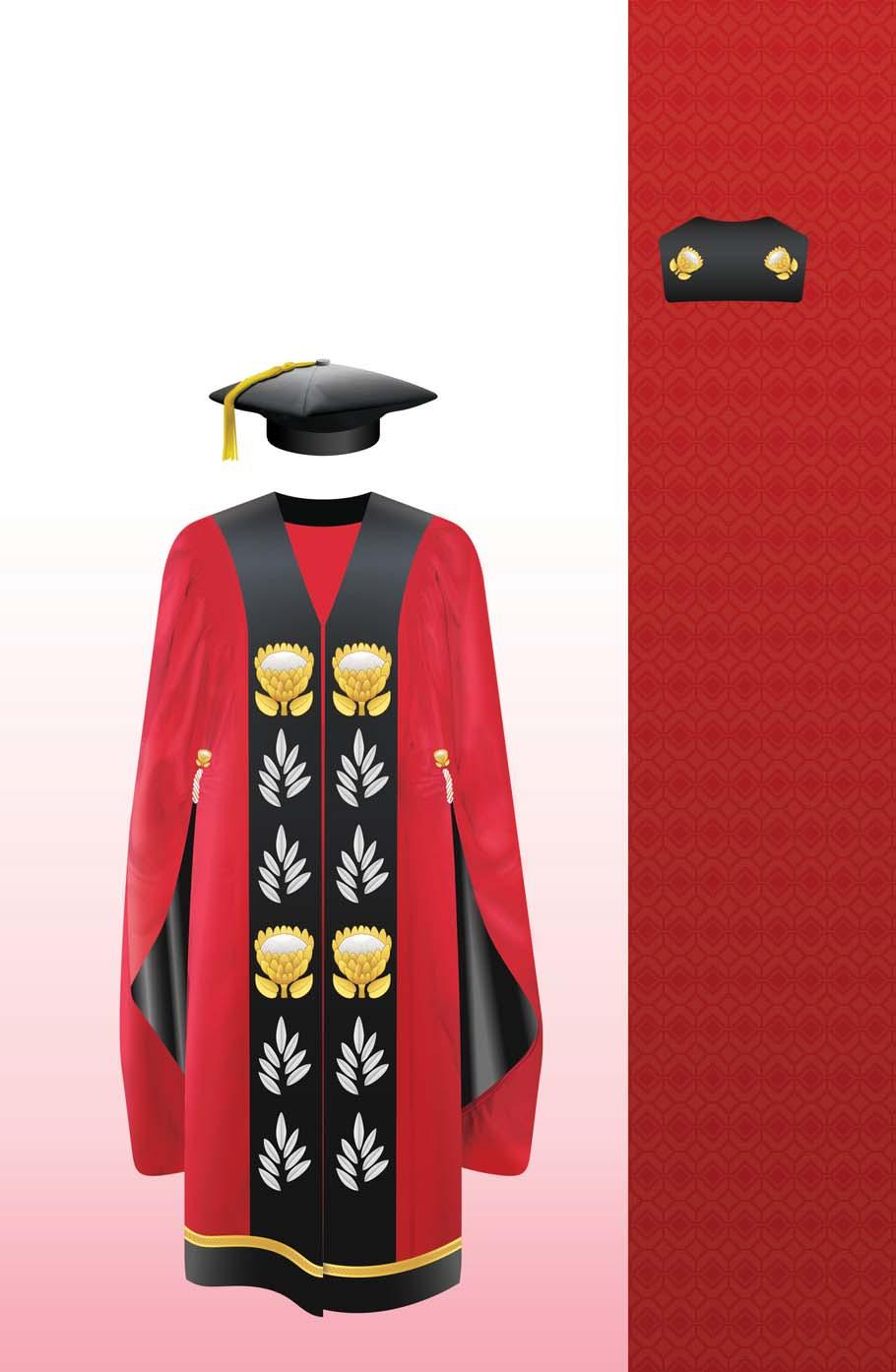
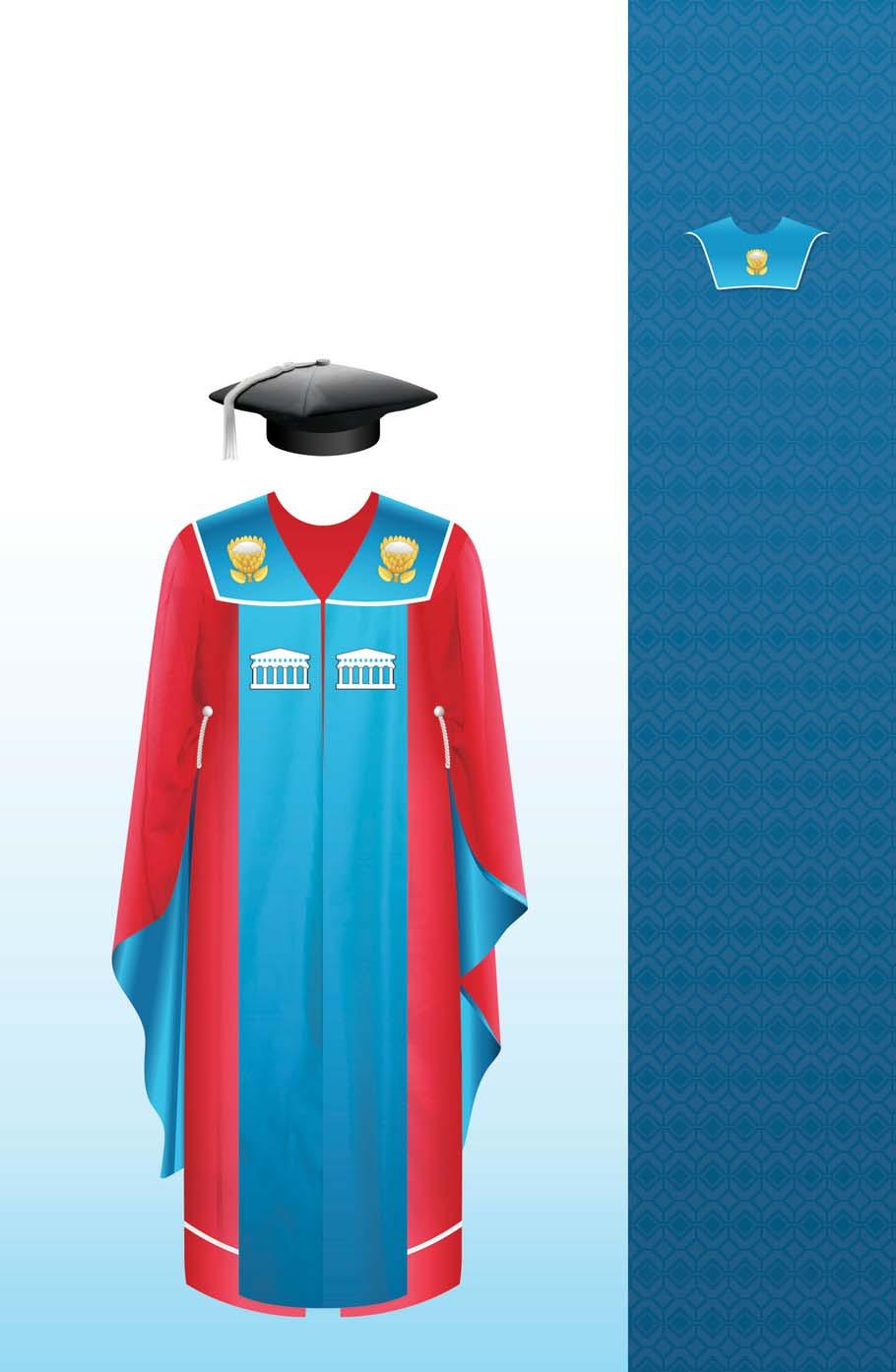
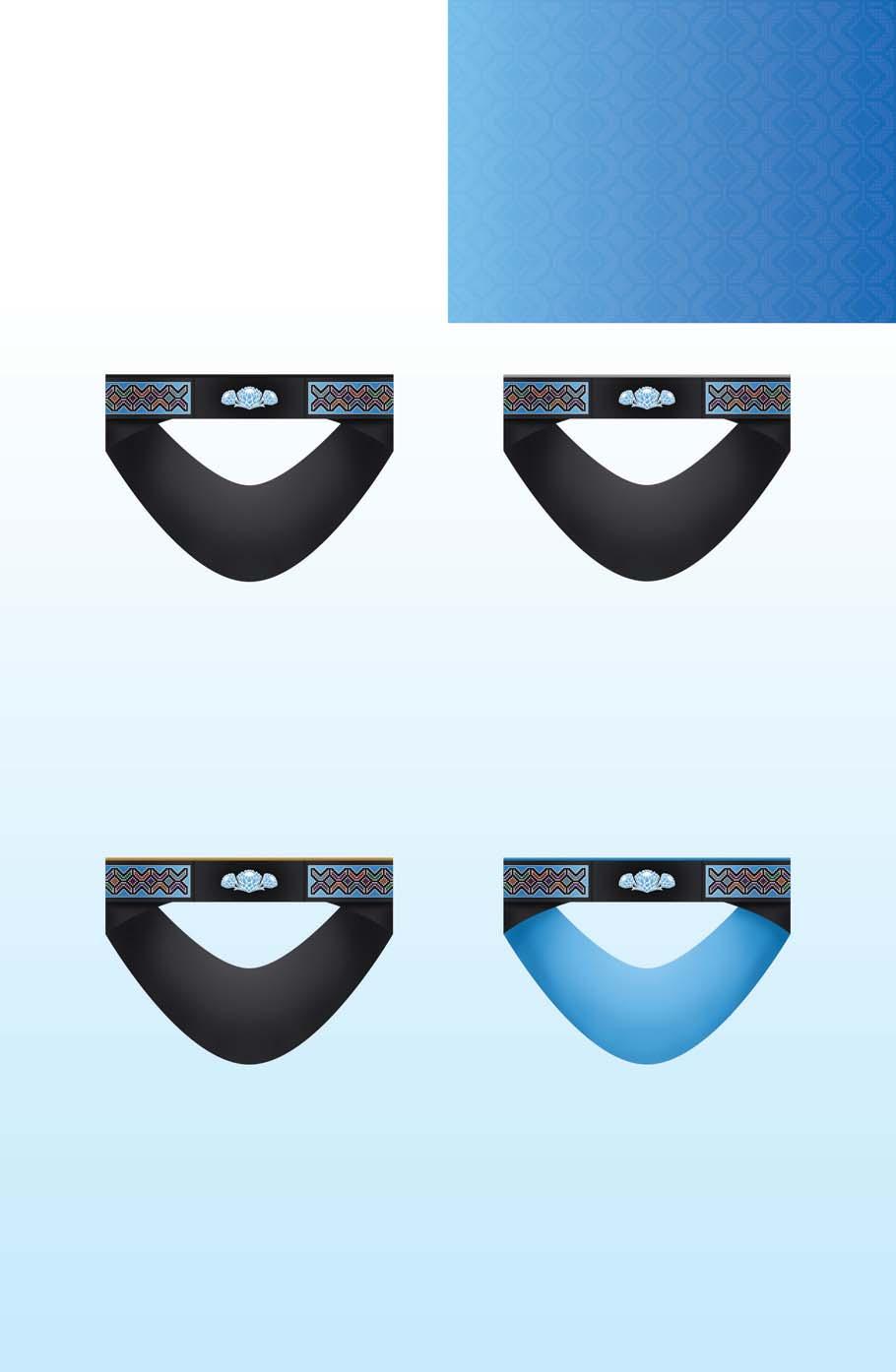
The three proteas symbolise Teaching, Culture and Education.
The stepped pattern represents the steps that lead to the Greek temple. This is the international symbol for academia and our recognition that we are a part of it.
The laurel leaves indicate competition and victory.
The diamond-shaped protea petal represents strength of character, ethics and faithfulness to oneself and others.
The continuous pattern that extends from the front to the back speaks to Respice Prospice, which means to look back, to look forward. Take what is good from the past and build the future.
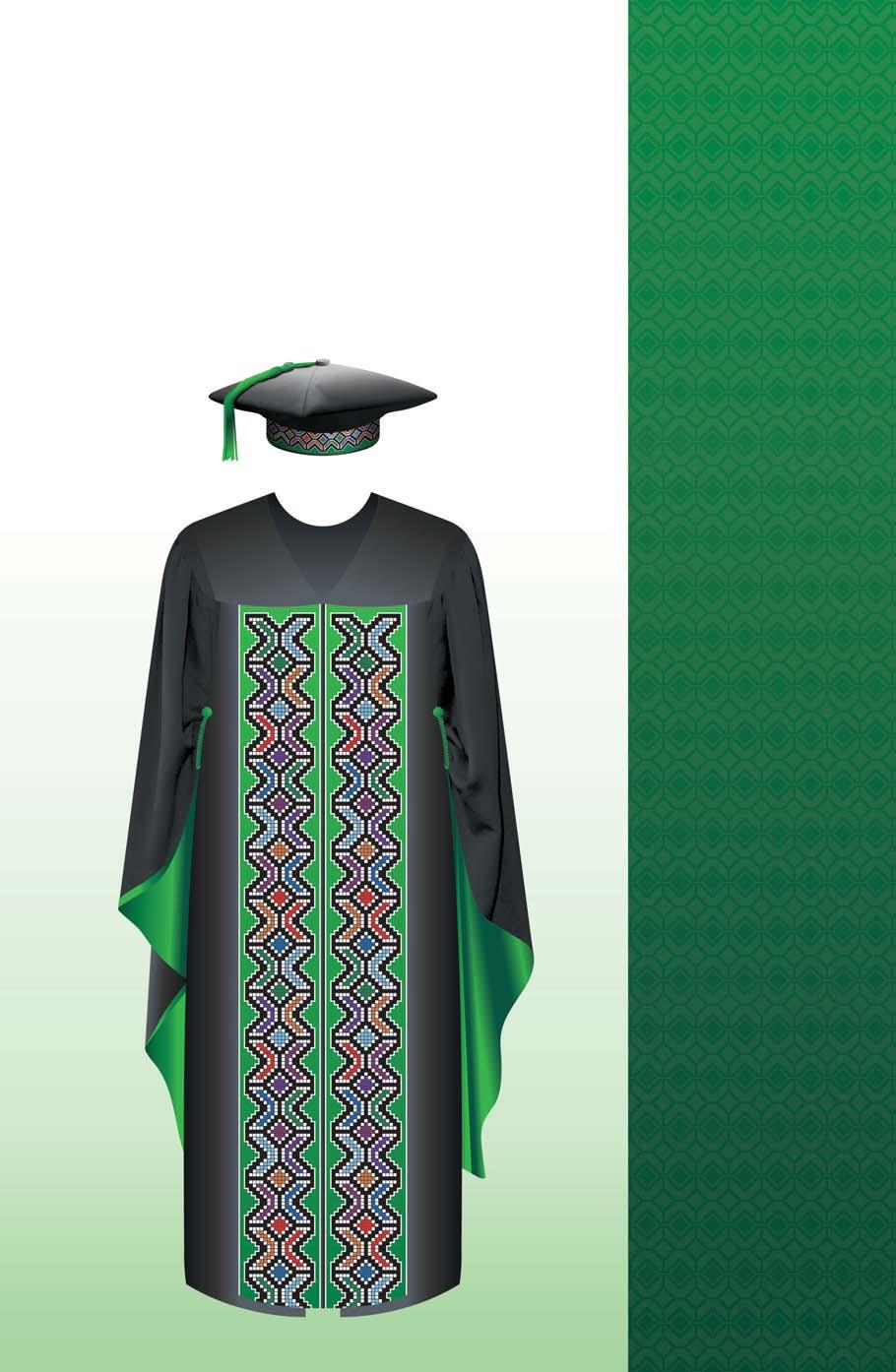
The beaded effect is meant to reflect African craft and creativity.
The colours that make up the band are derived from those that represent the seven Faculties that make up the University.
CAP Black John Knox cap with silver tassel.
Peony red edged with silver trim.
THE CAP
Black John Knox cap with gold tassel. BACK OF THE YOKE
Black edged with gold trim.
THE SLEEVE
Open sleeves, looped up with gold cord and lined with gold satin.
THE GOWN
Black with full facings of gold and trimmed yoke.
Black John Knox cap with silver tassel.
Black edged with silver trim.
SLEEVE
Open sleeves, looped up with silver cord and lined with empire blue satin.
GOWN
Black with full facings of empire blue.
GRADUATION ATTIRE
AND HOODS GOWN
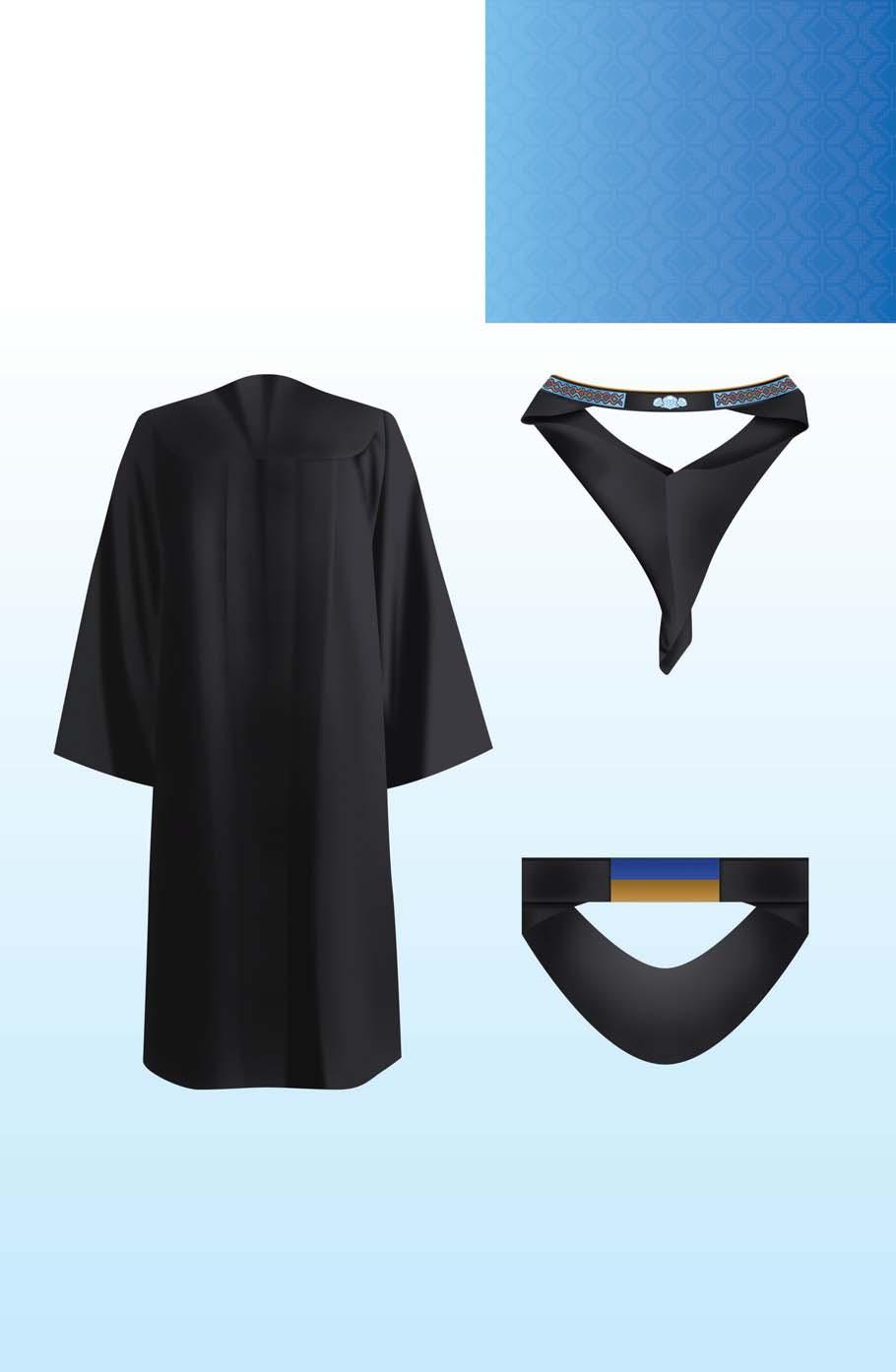
1 THE GOWN
Black (all degrees, diplomas and certificates, except Doctoral degrees)
Arts and Humanities
Community and Health Sciences
Dentistry
Economic and Management
Sciences
Education
Law
Natural Sciences
THE MOTIF
Black, edged with symbolic print in the Faculty colour.
THE COWL
Trimmed based on the type of qualification being conferred.
THE NECKBAND
The neckband emblazoned with the protea in the Faculty colour.
THE HOOD
Full hood in black.
2
CERTIFICATES AND DIPLOMAS
(NQF LEVEL 5 AND 6)
Black, with gold and blue strips.
GRADUATION ATTIRE
HOODS
3 BACHELORS
(NQF LEVEL 7)
Black, edged with symbolic print in the Faculty colour; the neckband emblazoned with the protea in the Faculty colour.
Degrees: BA, BSc, BCom, BAdmin, BA (SRES), BSc (Complementary Health Sciences), BOH, PGCE
5
ADVANCED BACHELORS
(NQF LEVEL 8)
Black, edged with symbolic print in the Faculty colour and trimmed on the cowl with cord in platinum colour; the neckband emblazoned with the protea in the Faculty colour.
Degrees and Diplomas: All Honours degrees and Postgraduate Diplomas
4
PROFESSIONAL/SENIOR BACHELORS
(NQF LEVEL 8)
Black, edged with symbolic print in the Faculty colour and trimmed on the cowl with cord in gold colour; the neckband emblazoned with the protea in the Faculty colour.
Black, lined with the Faculty colour, edged with symbolic print in the Faculty colour and trimmed on the cowl with cord in the Faculty colour; the neckband emblazoned with the protea in the Faculty colour.