11
HERITAGE
UWC Nature Reserve: Preserving Cape flora for the future
A
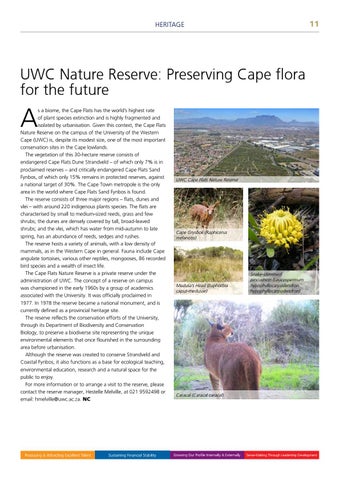
s a biome, the Cape Flats has the world’s highest rate of plant species extinction and is highly fragmented and isolated by urbanisation. Given this context, the Cape Flats Nature Reserve on the campus of the University of the Western Cape (UWC) is, despite its modest size, one of the most important conservation sites in the Cape lowlands. The vegetation of this 30-hectare reserve consists of endangered Cape Flats Dune Strandveld – of which only 7% is in proclaimed reserves – and critically endangered Cape Flats Sand Fynbos, of which only 15% remains in protected reserves, against a national target of 30%. The Cape Town metropole is the only area in the world where Cape Flats Sand Fynbos is found. The reserve consists of three major regions – flats, dunes and vlei – with around 220 indigenous plants species. The flats are characterised by small to medium-sized reeds, grass and few shrubs; the dunes are densely covered by tall, broad-leaved shrubs; and the vlei, which has water from mid-autumn to late spring, has an abundance of reeds, sedges and rushes. The reserve hosts a variety of animals, with a low density of mammals, as in the Western Cape in general. Fauna include Cape angulate tortoises, various other reptiles, mongooses, 86 recorded bird species and a wealth of insect life. The Cape Flats Nature Reserve is a private reserve under the administration of UWC. The concept of a reserve on campus was championed in the early 1960s by a group of academics associated with the University. It was officially proclaimed in 1977. In 1978 the reserve became a national monument, and is currently defined as a provincial heritage site. The reserve reflects the conservation efforts of the University, through its Department of Biodiversity and Conservation Biology, to preserve a biodiverse site representing the unique environmental elements that once flourished in the surrounding area before urbanisation. Although the reserve was created to conserve Strandveld and Coastal Fynbos, it also functions as a base for ecological teaching, environmental education, research and a natural space for the public to enjoy. For more information or to arrange a visit to the reserve, please contact the reserve manager, Hestelle Melville, at 021 9592498 or email: hmelville@uwc.ac.za. NC
Producing & Attracting Excellent Talent
Sustaining Financial Stability
UWC Cape Flats Nature Reserve
Cape Grysbok (Raphicerus melanotis)
Medusa’s Head (Euphorbia caput-medusae)
Snake-stemmed pincushion (Leucospermum hypophyllocarpodendron hypophyllocarpodendron)
Caracal (Caracal caracal)
Growing Our Profile Internally & Externally
Sense-Making Through Leadership Development