38
360º PERSPECTIVES | ISSUE 4 | 2015/2016
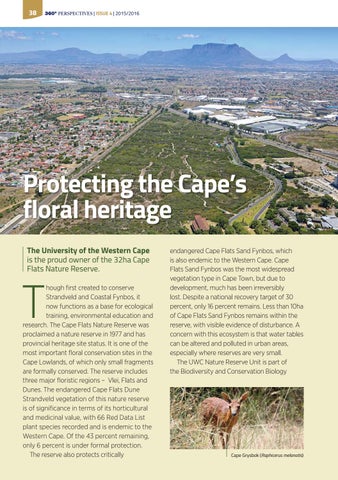
Protecting the Cape’s floral heritage The University of the Western Cape is the proud owner of the 32ha Cape Flats Nature Reserve.
T
hough first created to conserve Strandveld and Coastal Fynbos, it now functions as a base for ecological training, environmental education and research. The Cape Flats Nature Reserve was proclaimed a nature reserve in 1977 and has provincial heritage site status. It is one of the most important floral conservation sites in the Cape Lowlands, of which only small fragments are formally conserved. The reserve includes three major floristic regions – Vlei, Flats and Dunes. The endangered Cape Flats Dune Strandveld vegetation of this nature reserve is of significance in terms of its horticultural and medicinal value, with 66 Red Data List plant species recorded and is endemic to the Western Cape. Of the 43 percent remaining, only 6 percent is under formal protection. The reserve also protects critically
endangered Cape Flats Sand Fynbos, which is also endemic to the Western Cape. Cape Flats Sand Fynbos was the most widespread vegetation type in Cape Town, but due to development, much has been irreversibly lost. Despite a national recovery target of 30 percent, only 16 percent remains. Less than 10ha of Cape Flats Sand Fynbos remains within the reserve, with visible evidence of disturbance. A concern with this ecosystem is that water tables can be altered and polluted in urban areas, especially where reserves are very small. The UWC Nature Reserve Unit is part of the Biodiversity and Conservation Biology
Cape Grysbok (Raphicerus melanotis)