

BY BRODY GILKISON STAFF REPORTER
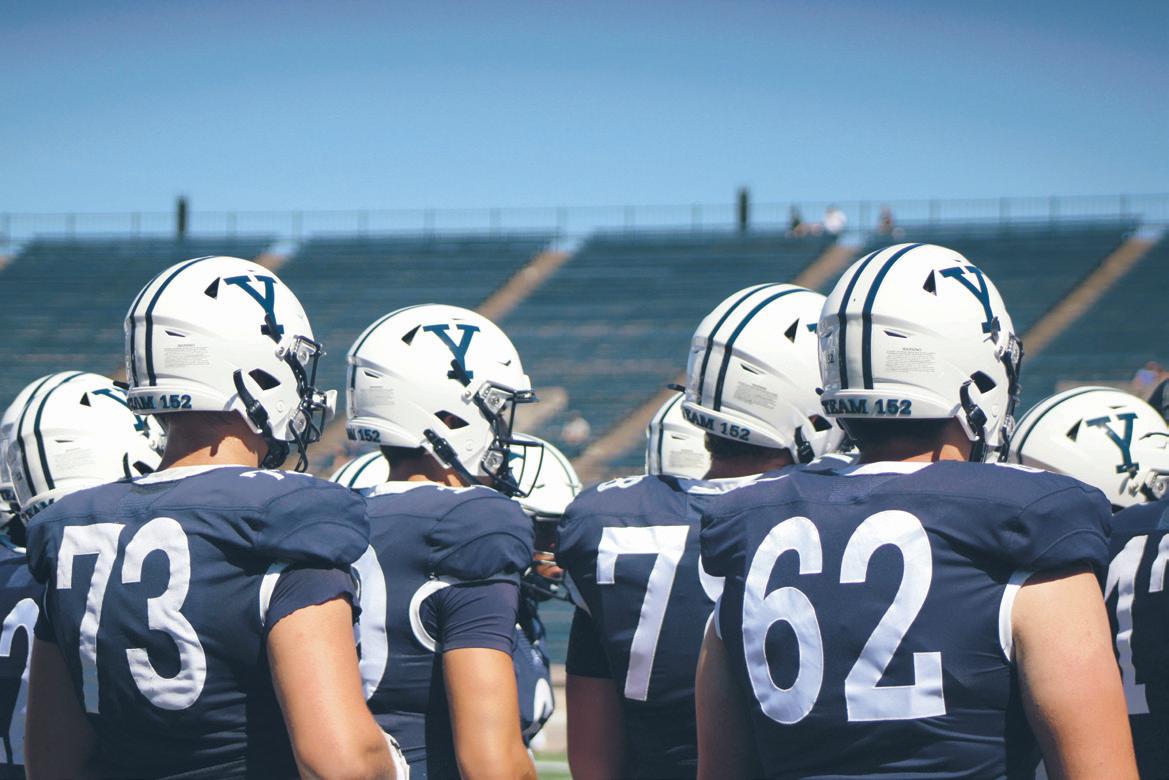
Team 152 (9–2, 6–1 Ivy) traveled to Bozeman, Montana, on Thursday to take on the No. 2-seeded Montana State Bobcats (10–2, 8–0 Big Sky) in the second round of the Football Championship Subdivision playoffs on Saturday. After defeating the No. 15-seeded Youngstown State Penguins on the road over the weekend, the football team will face yet another uphill battle as they look to take down one of the premier teams in the FCS. Montana State has played an impressive season after falling to North Dakota State last year in the national championship game.
This season, the Bobcats
BY OLIVIA WOO STAFF REPORTER
Administrators planning for the effects of an upcoming endowment tax hike on Yale’s five cultural centers said they have focused on maintaining the student experience.
While cultural centers have largely been able to maintain — and in some cases expand — their hours and programming, some centers are closely monitoring how many hours their student workers log.
“This is the first budget reduction I have experienced during my 8 years as Director of the AACC,” Asian American Cultural Center Director Joliana Yee wrote in an email to the News. “We are prioritizing preserving the student experience of accessing dynamic events at no cost even amidst the 5% budget cut.”
This summer, Yale announced a 5 percent reduction in non-salary expenses, which include student pay, across the University in anticipation of an increase next summer in the federal tax on university endowment returns.
As a result, each of Yale’s five cultural centers have experienced a 5 percent decrease in
dropped their first two games, the first to the Football Bowl Subdivision No. 5 Oregon Ducks and the second to South Dakota State in overtime. Since then, they have gone on a 10-game winning streak en route to locking up the second overall seed in the FCS playoffs, which meant a bye for the Bobcats last weekend. The current line has Montana State favored by 28.5 points, but the Bulldogs are capable of staying in the game if they can establish their rhythm early on and not get overwhelmed by their tough opponent.
Looking at the ’Cats By record alone, Montana State has been one of the best
BY ELIJAH HUREWITZ-RAVITCH STAFF REPORTER
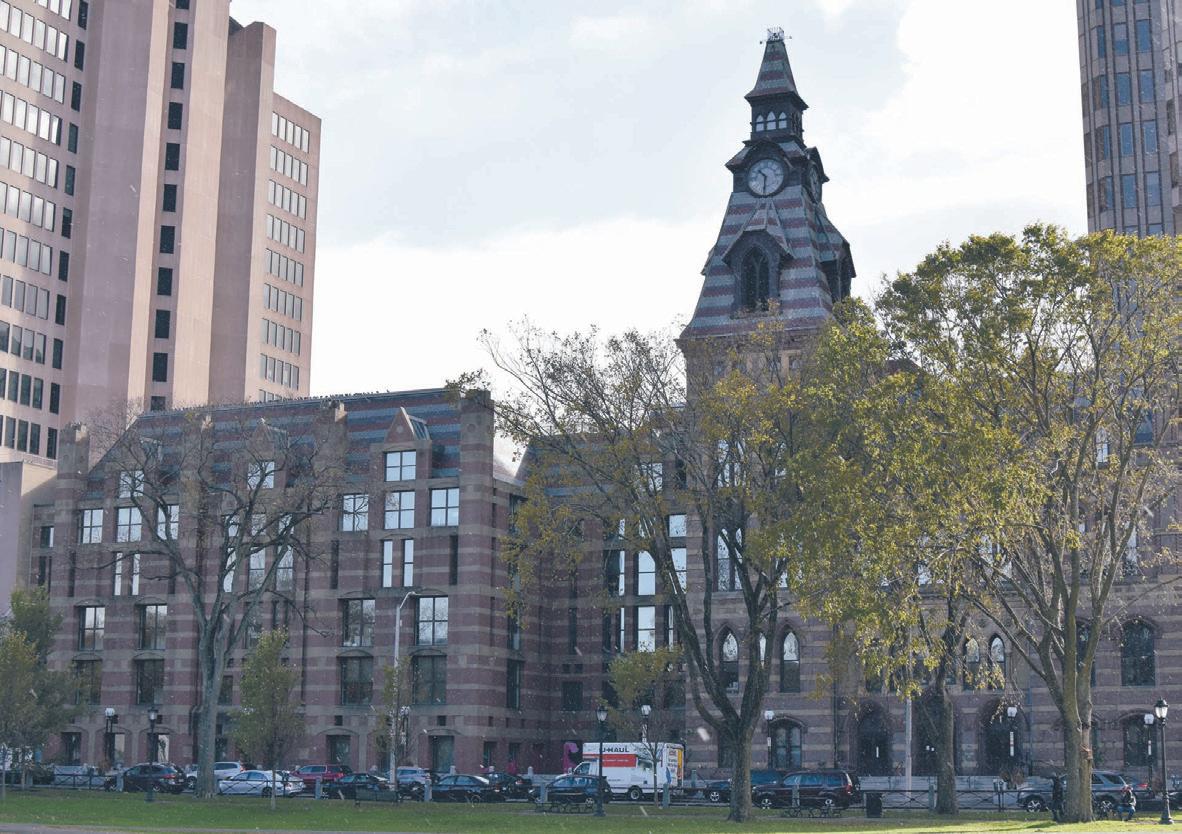
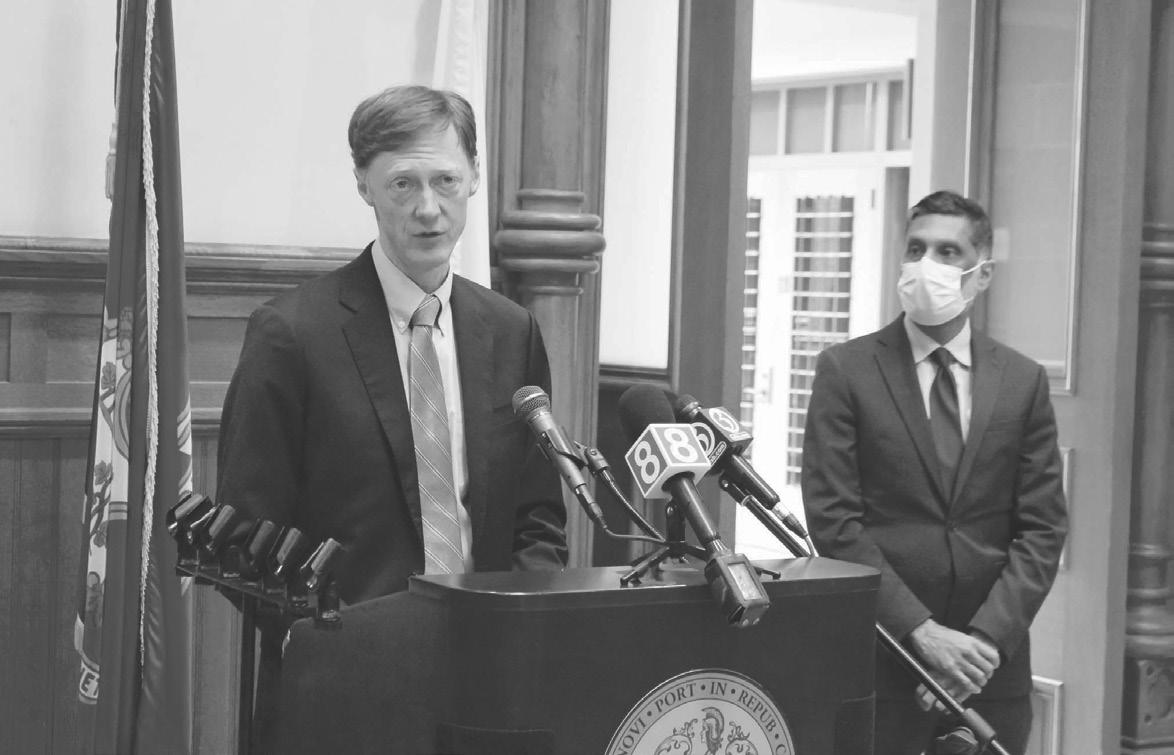
Negotiations are underway between Yale and New Haven over how much the University will contribute to the city budget Yale and New Haven leaders in 2021 reached a six-year voluntary contribution agreement, which lasts through June 2027. Under the terms of that deal, the university agreed to pay New Haven annual sums of some $23 or $24 million — except for the final year, in which Yale is slated to pay $16 million. Town-gown relations have long been tumultuous, but the issue of the university’s voluntary contribution emerged as a political flashpoint in last month’s mayoral race and the September Democratic primary for the downtown Ward 1 alder seat.
Negotiations began in early October for the next multi-year deal, Mayor Justin Elicker said. He said he hoped that the next deal would cover the 2027 fiscal year and head off the $8 million decrease in funds for the city.
“Both parties generally agree that we should not get to the point where that decrease occurs,” Elicker said in a phone interview, “and that we want to find a new deal that would cover that final year of the previous deal, so as to avoid that drop in a payment, which would be pretty devastating for the city.”
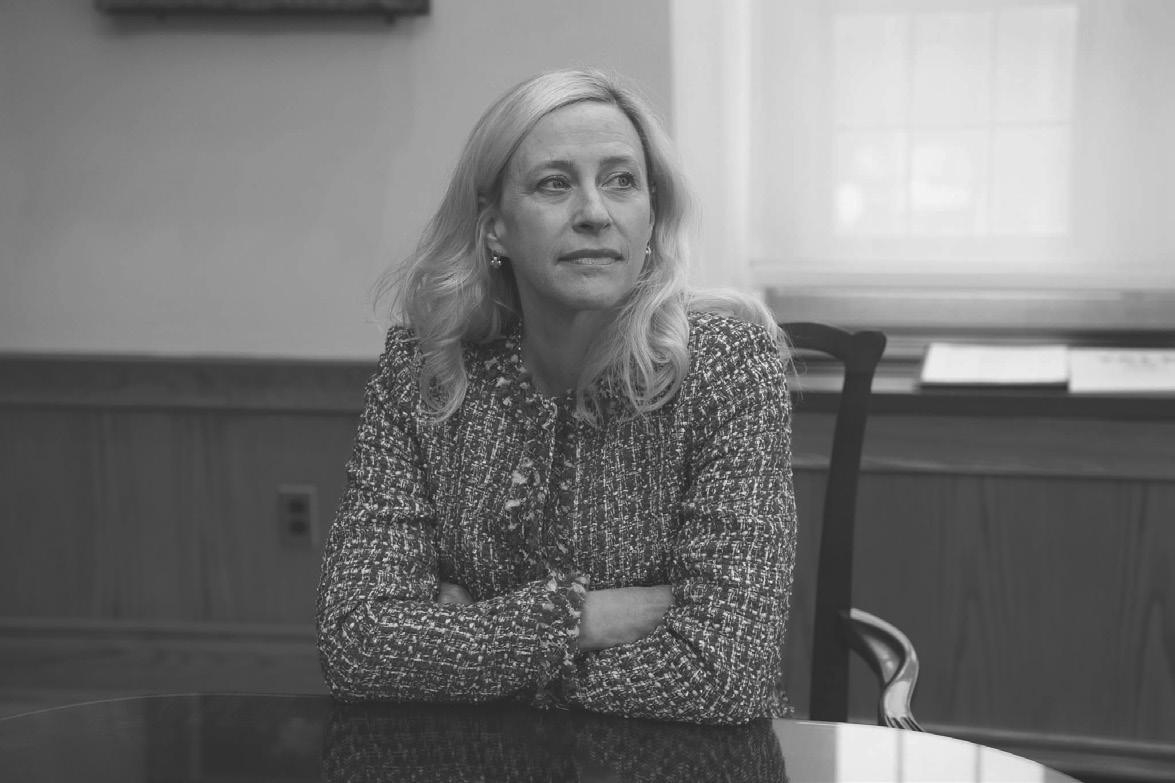
Asked Wednesday for comment on Elicker’s statement, University President Maurie McInnis said in a Zoom interview that she had “heard the mayor say those words.” She added that she is “in SEE CONTRIBUTION PAGE 4

BY SOPHIA LE CONTRIBUTING REPORTER
The scent of funnel cake, hot dogs and hot chocolate wafted across the New Haven Green as city officials lit a 50-foot Norway spruce in New Haven’s 112th annual tree lighting ceremony Thursday evening.
This year’s tree boasted over 30,000 lights, according to a post last month on Mayor Jus -
tin Elicker’s official Instagram page. Before the lighting ceremony began, members of the Trinity Church on the Green choir and the Cooperative Arts and Humanities Magnet High School band and orchestra took center stage for holiday-themed performances. Event attendees interacted with toy vendors and partic -
TREE PAGE 4 SEE CULTURAL PAGE 5
BY ISOBEL MCCLURE AND ASHER BOISKIN STAFF REPORTERS
Departments across the University may soon need to downsize or lay off employees to meet reduced budget targets as Yale cuts costs in preparation for the endowment tax hike set to take effect in July, administrators announced in a Wednesday message addressed to faculty and staff.
Since President Donald Trump in July signed a bill that will increase the tax on Yale’s endowment investment returns from 1.4 to 8 percent, the University has reduced non-salary expenses by 5 percent, delayed construction projects, lowered faculty and staff salary increases and offered a one-time retirement incentive for managerial and professional staff, and Yale implemented a 90-day hiring pause over the summer. Administrators have estimated that the tax hike will cost the University about $300 million per year.
“Nearly two-thirds of the university’s expenses relate to compensation and benefits. Unfortunately, this means several units may need to meet their budget
ELIJAH
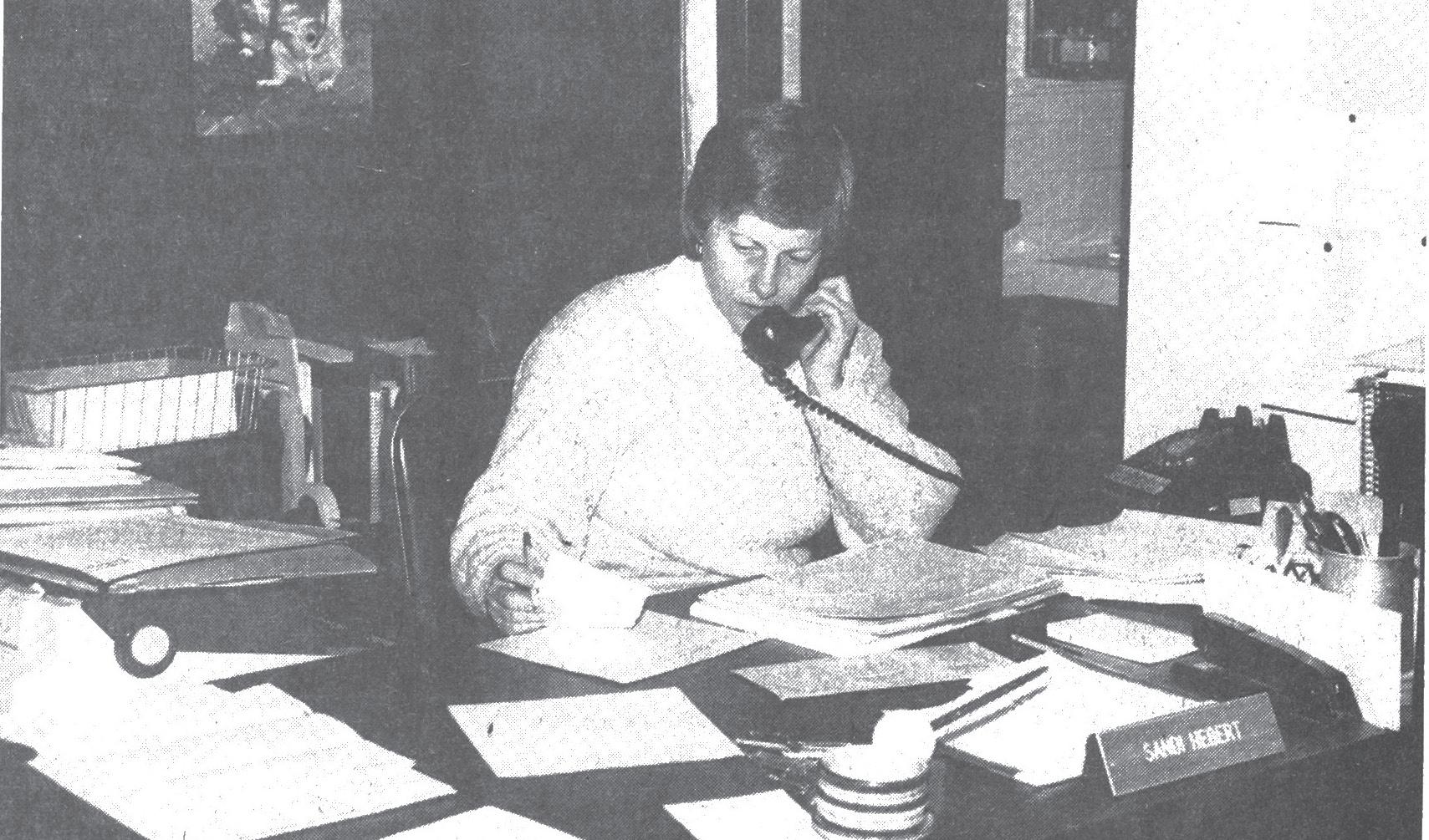
December 5, 1984 / “Workers come ‘home for the holidays;’ atmosphere is one of relief and tension”
By Lisa Pirozzolo and Crocker Coulson
Dining halls and offices across the campus were bustling yesterday as about 2000 members of the Locals 34 and 35 returned to work after a ten-week strike.
Most workers seemed glad to be back at work, but tensions arose as union members clashed with fellow workers who had crossed picket lines to continue working.
“Things were said and done during the past few weeks that will take a long time to be forgotten,” said one secretary.
By Sabrina Thaler
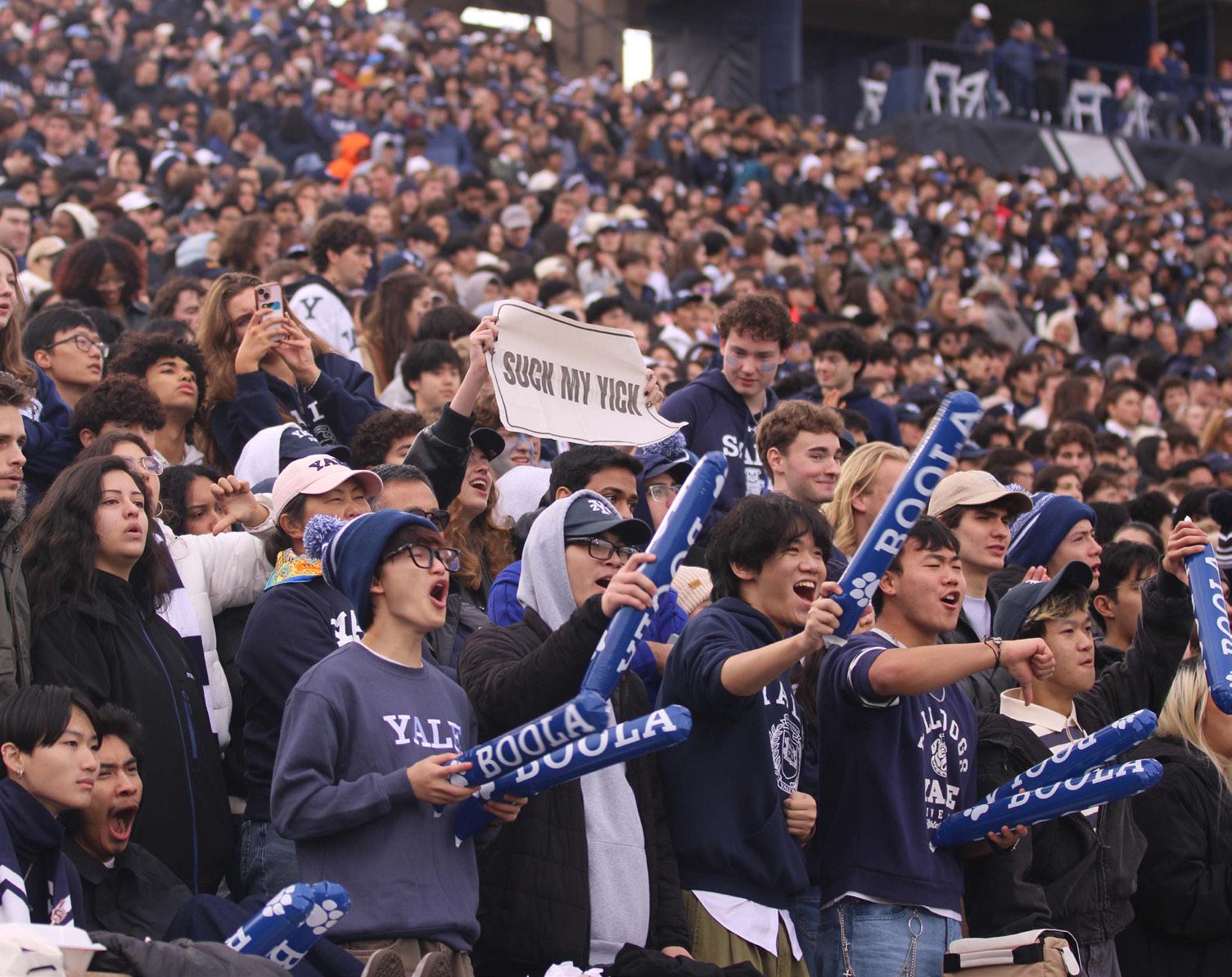
I knew very little about Yale football — and even less about Youngstown, Ohio — when the Bulldogs’ win against Harvard last week earned them their first-ever opportunity to compete in the Football Championship Subdivision playoffs. But over Thanksgiving break, I agreed to take a crash course. Alongside News photographer Christina Lee, I flew to Ohio to capture the scene at Yale’s game against the Youngstown State Penguins and learn more about the team’s host city.
After an evening poking around Youngstown, meeting locals and visiting downtown hotspots, I met family and football alumni to learn about what this historic game meant — not just for the team, but for the people who support them year-round. By the time Christina and I watched the Bulldogs surge to victory in the electric final quarter of Saturday’s game, Yale’s team, its fanbase and their unlikely hosts felt a little more familiar to me.
DAVID ADAM GIMBEL
Forgive me for writing. I’m tremendously unqualified. I’m not an art historian. I wouldn’t even call myself an art lover. Yet I felt called to write from my home in Atlanta after learning from a Morse Fellows email that the Lipstick was being permanently recalled to the Art Gallery.
Morse College is a quirky, beautifully ugly, fantastically vibrant place and part of my soul. I graduated in 2003 as Morse College Council president, a Morse College freshman counselor and the captain of the two-time undefeated Morse College intramural ice hockey team. From 2010-2017, while a neurosurgery resident, I lived in the shadow of the Lipstick as a Morse College resident fellow. In 2015, I taught a Morse College seminar. As a Morse expert, I know that the Lipstick is part of the beating heart of the college. As an art Luddite, I am sure that the Lipstick was not intended to be tucked away in the Art Gallery sculpture garden. There is a fact that I am loath to admit publicly: many incoming students are disappointed to be assigned to Morse. Yale-bound students dream of the gothic colleges with their courtyards and minicourtyards. Morse seems to me to be an architectural protest to Yale, formed in the 60s with peanut brittle walls and no right angles. It is nonconformist, and its nonconformity makes it incredibly special.
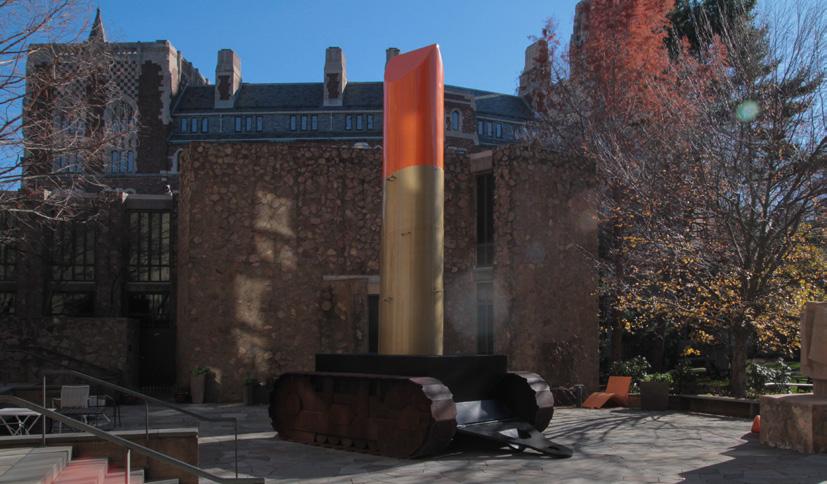
Morse and its sister, Stiles, form a unique, whimsical dyad in a sea of traditional Ivy League architecture. During my time, Heads of College Wheeler, Keil, Hungerford and Panter-Brick — along with an army of dedicated Morse students — hammered the incoming first years with the specialness of Morse. We convinced them that they were lucky. They were. If the Lipstick isn’t the beating heart of the college, it certainly is an essential appendage. You can see it from almost every room. You see it as you walk through the courtyard. You see it from Tower Parkway. You see it from the dining hall. It is a beautiful monstrosity, a giganticly comical Lipstick that arises from iron tank treads. It steamrolls wonder, creativity and amusement into those that gaze upon it.
James Ponsoldt ’01 directed “The Spectacular Now” and “The End of the Tour,” among many other great works.
Kevin Olusola ’11 put his promising medical career on permanent diversion to win multiple Grammy Awards with Pentatonix. Both are friends and responded with enthusiasm when I invited
them to college teas. I wonder what small fraction of their brilliance and creativity was inspired by the walls of Morse and its iconoclastic Lipstick. I, a South Florida public school graduate and son of an elementary school teacher, was inspired by Yale and Morse to think that I might be able to operate on a human brain.
The Lipstick is a protest sculpture by Claes Oldenburg ’50, who installed it without invitation in Beinecke Plaza in 1969, during the Vietnam War. It is meant to provide a literal platform for public speech. Oldenburg remarked that he was “for an art that is politicalerotical-mystical, that does something more than sit on its ass in a museum.”
IF THE LIPSTICK ISN’T THE BEATING HEART OF THE COLLEGE, IT CERTAINLY IS AN ESSENTIAL APPENDAGE.
Vincent Scully ’40 GRD ’47 ’49, at the time Morse’s head of college and one of Yale’s most prominent professors, worked to have the Lipstick installed in Morse. To me, that seems intuitive. One of the world’s foremost art historians worked with one of Yale’s most prominent artists to bring his work, a protest piece, into a new residential college that was itself a protest. For five decades it has stood in Morse, visible from the street, inspiring students and fulfilling the dual vision of Scully and Oldenburg.
Much like when the Lipstick arrived, we live in tumultuous times. It is ill-advised, in 2025, to move this epic protest monument to a sequestered courtyard surrounded by countless pieces of great art. Vincent Van Gogh’s “The Night Café” is a Ferrari which needs to be treated with great care and garaged. The Lipstick is a Ford Bronco. It should have dents and dings. It should be out in the open air. It should be among the people. It should be in Morse.
DAVID ADAM GIMBEL graduated from Yale College in 2003 and the Yale School of Medicine in 2010. He completed the School of Medicine’s Neurosurgery Residency program in 2017 and is currently a Morse College Fellow. He can be reached at davidadamgimbelmd@gmail.com.

GUEST COLUMNIST
GEORGE BEEVERS
Grade inflation has been a defining crisis in higher education, reshaping what academic success should look like across the globe. Top U.S. universities are feeling the effects especially intensely, with Ivy League schools receiving media attention for their rampant grade inflation problems. Before arriving at Yale, I was told that “the hardest part is getting in” and that grade inflation would make classes less challenging. But is this true?
Grade inflation is not specific to America, and is a rising concern at universities across the world. However, responses to it differ significantly. At U.S. universities, absolute grading standards tighten when average GPAs begin to creep upwards. However, as inflation approaches the GPA ceiling, grade boundary compression occurs towards the top of the spectrum. This means that the difference between grades can become only a few percentage points, making each question much higher pressure.
By contrast, in the U.K., exams are much more difficult and boundaries are calibrated downward, preserving a wider spread of results with relative grading. Fixed rules on allowed grading maintain standards, such as set 40 percent pass marks, unlike the U.S. system where grades above 90 percent are commonplace. The result is that mistakes don’t mean the end of the world for a student. Grade boundaries are forcibly broader and perfection is not the expectation. This should be the rule, not the exception.
To its credit, Yale already broadens bounds excellently in some of its larger classes by grading on a curve, but this isn’t possible in smaller classes and seminars. This was admittedly a bit of a culture shock for me when I arrived on campus. I remember getting my first French
test back and being utterly thrilled with my 85 percent — which would have been well above an A in England — before being politely informed that I had actually received a B. In the U.K., a first-class degree, considered the highest undergraduate honor, generally demands a raw score just above 70 percent. In a class titled “Intro to Ethics” I plan to take next semester, anything below 70 percent constitutes an F grade. Although Professor Shelly Kagan does an admirable job at fighting grade inflation in the class, the fact that grade compression is a necessary intervention reflects the systemic issue at hand. What might be a very impressive grade in the U.K. could quite literally be considered a failure in the U.S. Why should the expectation be that everyone achieves top marks in everything?
Exams in the U.K. are simply more difficult, and oddly, students seem to be happier that way. No one is crying over 3 missed percentage points or losing their sanity over the threshold between an A or an A minus, because it simply doesn’t make any sense to. The goal is not perfection, but understanding the material as completely as possible and improving. In the U.K., exams seem to be about getting everything you can right, whereas in the U.S., they’re about getting as little as possible wrong. Although these might sound the same, they’re in practice very different academic philosophies. Something I personally view as very culturally American is the willingness to fail again and again until success, learning from past mistakes. As admirable and valuable as this mindset is, it becomes very difficult to put into action when even small mistakes are so costly and impactful to students.
GUEST COLUMNIST MORGAN KNUESEL
As much as this hurts to say as a Yalie, Harvard seems to be on the right track in response to this. Their approach is not only to stringently and firmly enforce grading standards, but to place academic results in context and make them relative to peers. Their administration is considering limiting the number of A pluses awarded, effectively setting a quota and allowing only a certain proportion of students to achieve top grades, reintroducing differentiation. They are also considering the inclusion of median grades on academic transcripts, placing grades in context with the rest of a student’s class.
When grading classes on a curve to spread out grade boundaries isn’t always possible due to small class sizes, policies such as these to recontextualize academics can help. Many students will be incredibly disappointed and disheartened by these changes, as working at the same level will effectively earn them “lower” grades than in the inflationary period. However, in the long-term, A grades are not meant to be the norm.
Achieving a B in a class should not be a miserable experience, and the difference between a percentage point or two shouldn’t constantly be a defining moment in one’s academic career. Relative grading with greater variance between letter grades gives breathing room for students whilst preserving the value of standards like A’s and B’s. Students would be less stressed about the small things and more focused on the bigger picture of becoming well educated and informed in their area of study.
GEORGE BEEVERS is a first year in Pierson College. He can be reached at george.beevers@yale.edu.
In March, I went to one of the Buckley Institute’s firing line debates — “Should the Law Only Recognize Biological Sex?” — because the very premise of the headlining question indicated that someone would argue against laws recognizing a transgender or gender non-conforming person’s identity. I can’t say that my interest was academic. Based on the speakers’ biographies on the event website, I expected to hear the same notorious lies that attack transgender people. But the event was even worse than I expected. The so-called debate was a farce, as Ryan Anderson seemed to ignore the peer-reviewed studies and logical case that Michael Ulrich presented in favor of his prepared inflammatory disinformation and hateful rhetoric. I’ve seen firsthand the pain that such speech inflicts upon my trans and queer friends. I couldn’t believe that Yale allowed such a transphobic and heinous event to take place on its campus under the guise of “free speech.” So, what could I do about it?
I had no idea who to reach out to about this experience. Would it be possible to prevent another event like this one? I wanted to write an article like this one back in March, but I made excuses to avoid it. A graduate student is always busy, after all. But as I read the Nov. 18 issue of the Yale Daily News, I regretted my inaction. Every day that someone doesn’t stand up to the Buckley Institute is a day spent allowing its participants to think that their intolerance has a place in the world.
An article in the News on the recent Buckley Institute conference notes that on the topic of deporting international students participating in protests against Isreal’s genocide in Gaza, CNN contributor Scott Jennings earned a “spirited round of applause upon saying: “If you’re a guest in this country and we allow you to be here, it would be better if you didn’t engage in perpetual activity that was designed to bring about the downfall of this country and the
downfall of Western civilization.”
It is appalling that these proclamations are made and celebrated here in New Haven. Students protest mass murder, and you cheer on those who want to deport them? Even if you don’t agree with the student protesters, are you so far entrenched in an echo chamber that you can’t see that these protests are the very examples of free speech that you claim to cherish?
And before some of you pick up your figurative pens to tell me that what they’re protesting isn’t genocide, let me tell you that it unequivocally is: Today, over 67,000 Palestinians have been killed, another 40,000 have life-altering injuries and the overwhelming majority of these are civilians. People are starving and are killed while awaiting aid that might not arrive. Homes have been obliterated, families separated in the chaos and children orphaned, if they themselves weren’t killed or buried in the rubble. Protesting Yale’s and the United States’ complicity in this is what you claim is a threat to Western civilization? Is that how you want history to remember you?
In any case, I’m sick of hearing “free speech” be used as a blanket excuse to promote or condone hate, fear and violence. It must be possible to value free speech and be “a platform for conservative thought at Yale” while refusing to tolerate any stance that questions a person’s right to exist freely based on their identity and residence. I don’t claim that it will be easy — there will certainly be hard decisions — but the responsibility of an organization such as the Buckley Institute is to make those tough calls on what rhetoric to allow. If the goal “‘is trying to understand, really, the full range of views and critiques,’” as professor Beverly Gage told the News, then might I suggest student discussions or literature and news reviews or any of dozens of alternative academic exercises that don’t offer people
like Gov. Ron DeSantis, Douglas Murray and Anderson a stage, or condone their prewsence on said stage. Normalizing their speech permits everyday people to grip their prejudices tighter. Examining the effects of such insidious normalization is an extensive and interdisciplinary subject that I cannot do justice to. Suffice to say, studies show that inflammatory political rhetoric, like that used by President Donald Trump leading up to his presidency, correlates with an increase in hate crimes and domestic terrorism. Are we truly willing to allow any part of this in our city?
But I anticipate that the aforementioned figurative pens, though perhaps a different subset of them, will claim that I’m being hypocritical — that I’m intolerant toward the Buckley Institute’s students. In a sense, they’d be right. As long as “conservative thought at Yale” is defined by “anti-wokeness” and systems that keep white, cisgender, heterosexual men on top, not to mention disinformation and fear-mongering, I don’t see anything worth trying to tolerate. At the end of the day, I’m just one voice of thousands on this campus. I’m not an expert in the vast complexities of political polarization or in fighting for social progress. I simply can’t stand to do nothing anymore. And I know that I’m not alone in that.
To the Buckley Institute organizers and supporters, stop making your cognitive dissonance everyone else’s problem. Start learning how to dissect your own beliefs. Start actually hearing yourself. And start figuring out how to evolve past the prejudice, hate and intolerance by which you seem to have defined your organization.
MORGAN KNUESEL is a thirdyear Ph.D. student in the Graduate School of Arts and Sciences, studying high-energy particle physics at Wright Laboratory. She can be reached at morgan.knuesel@yale.edu.
“So let me hold both your hands in the holes of my sweater”
targets by reducing their workforce,” the memo — which was signed by Provost Scott Strobel, Senior Vice President for Operations Geoffrey Chatas and Chief Financial Officer Stephen Murphy — said. “In some units, even
after these reductions, layoffs may be necessary, but university leaders are working hard to minimize them wherever possible.”
According to the message, the cost-cutting measures implemented thus far have been “helpful” but do not make up for the overall anticipated reduction in
funds that will be caused by the hiked endowment tax. In their message, Strobel, Chatas and Murphy wrote that they hope to “complete any downsizing efforts by the end of calendar year 2026, provided there are no additional significant financial changes.”
“The reality is, in a univer -
TREE FROM PAGE 1
ipated in carnival games and amusement rides as they waited for the tree to light up.
As the choir sang its last notes, Jodi Longobardi, a vendor at the event, put Santa puppets she was selling back on her cart after the wind had blown them off.
Longobardi has been coming to the festival every year she has lived in New Haven. She said there was lower turnout at this year’s event because of the cold weather, which dipped below 30 degrees Fahrenheit on Thursday evening.
“It's nice,” Longobardi said of the annual event. “It gets people out.” Across from the vendors, on the other side of the Green, kids lined up to ride a carousel. 8-year-old Aiden Johnson waited in line with his mother, Meagan.
Among the activities he participated in at the festival, his favorite was “going into the military truck and just honking it a thousand times,” he said.
A military truck stood next to the carousel, with police officers assisting children up a ladder into the driver’s seat to honk the horn.
Several organizations, such as the Urban Resources Initiative of the Yale School of the Environment, had tents and booths on the Green. The initiative, partnered with the city’s Parks, Recreation and Trees Department, offers New Haveners a free tree in their front yard to promote more trees around the city.
“We are gonna get a free tree,”
10-year-old George Tinker said.
“Cherry blossom — that's what I wanted.”
Tinker emphasized his excitement about the rest of the festival.
“This is a really cool festival every year,” he said. “I like coming here.”
The New Haven Green encompasses 16 acres.
Contact SOPHIA LE at sophia.le@yale.edu.
sity, the majority of our budget is people. That is the main thing we spend money on. We already gave everybody, and we did this last spring, a 5-percent reduction on non-salary expenses,” McInnis said in a Wednesday Zoom interview, referring to the budgetary measures implemented by the University in late June.
She noted that those reduction measures were “not going to come anywhere close to 300 million,” and that the University would “have to wait to find out” the impacts of the one-time retirement incentive announced in September.
“The retirement incentive may not enable us to meet all the budget targets we need to meet, and it may be possible that some units will need to then figure out whether or not they need to do layoffs,” McInnis said.
In September, administrators asked every school and unit to submit multi-year budget plans that reduce costs for fiscal years 2027-2029. Those plans, which were finalized in mid-November after review by Yale’s Budget Advisory Group, the Wednesday memo said, may drive other cuts to services, programs and staffing.
“It is clear that budget reductions will need to continue across the university and that some areas will feel more financial strain than others,” the Wednesday message said. “These reductions will be guided by careful planning aimed at upholding academic excellence, supporting the student experience, and ensuring that Yale’s mission endures.”
Yale College Dean Pericles
Lewis wrote in an email to the News that he believes “we can meet the remaining savings in salary and benefits primarily by eliminating open staff positions and through regular turnover and retirement incentives.”
Lewis wrote that Yale College does “not anticipate closing any programs” due to budget changes, although he acknowledged that financial aid previously associated with two distinct non-competitive summer opportunities was reallocated to allow continued support for “all our financial aid obligations during the academic year.”
He wrote that the College will continue to provide “one summer of guaranteed support,” to all students on financial aid, while citing application-based “internal fellowship programs.” According to Lewis, the changes are “a direct result of the endowment tax,” which has impacted Yale College’s budget by about $20 million.
McInnis said that “we just continue to work with units” to reach the necessary reductions in costs, should a unit fail to reach budget targets. “We’re all part of a community here, and it’s all meant to be sort of supportive,” McInnis said.
As of June, Yale’s endowment is valued at $44.1 billion.
Olivia Woo contributed reporting.
Contact ISOBEL MCCLURE at reeti.malhotra@yale.edu and ASHER BOISKIN at asher.boiskin@yale.edu.
CONTRIBUTION FROM PAGE 1
conversation” with Elicker and meets with him “regularly.”
McInnis said repeatedly that the city and university “are in conversation.”
The coming increase in the federal tax on the university’s endowment returns is to figure into Yale’s financial calculus. “It factors into everything,” McInnis told the News. “We have $300 million, roughly, a year less to spend.”
Leading negotiations on Yale’s side are Alexandra Daum, the associate vice president for New Haven affairs and University properties, and Jack Callahan ’80, Yale’s former senior vice president for operations, who oversaw talks in 2021 and was succeeded by Geoffrey Chatas in November.
The pair wrote in a joint statement emailed by Callahan that Yale’s voluntary contribution to New Haven’s budget is “the most significant commitment to the local community” made by any higher education institution in the United States.
On current negotiations, they wrote that “while it is premature to discuss specifics aspects, we are optimistic that a mutually acceptable solution will be finalized in the coming months.”
Henry Fernandez LAW ’94, a CEO and nonprofit director who was once New Haven’s economic development administrator and who ran in the 2013 Democratic primary for mayor, headed the city’s negotiating delegation in 2021. Fernandez is again representing the city, though this time without a supporting committee, according to Elicker.
Fernandez did not respond to multiple requests for comment.
Elicker declined to answer questions about the status of the negotiations but said that “we’re in conversations with Yale that are productive.”
For the mayor, the clock is ticking. By March 1, Elicker must sub-
mit a proposed budget for the next fiscal year to the Board of Alders, and much will depend on where talks with Yale lie.
“We very much want to come to a completion of the conversation or the negotiations well in advance of that date,” Elicker said, adding that he was “cautiously optimistic” about the timeframe.
When asked whether the city and University could reach a new deal by March 1, McInnis said, “Yeah, I think that’s possible.”
In 2021, before that year’s agreement was announced in November, Elicker presented two budgets. One planned for an increase in Yale’s voluntary contribution — which the city ultimately secured.
The other, called the “Crisis Budget,” envisioned city spending without additional help from the University; it proposed raising taxes by nearly 8 percent and shutting down a library, a senior center and a fire station.
Elicker said that in the current negotiations, the city’s worst-case scenario planning would include both tax hikes and cuts to local programs.
“The city would definitely suffer if it had to cut a lot of money from its budget,” David Schleicher, a professor of urban law at Yale Law School, said in a phone interview. “Yale would be immediately blamed for holes in the roofs of school buildings.”
The mayor said that he is “cautiously optimistic” that the coming deal will include an increase in the university’s annual contribution. He declined to say whether or not the next deal will also last six years.
“What’s important here is for Yale to continue to build on the significant movement that Peter Salovey led,” Elicker said, referring to McInnis’ predecessor, who stepped down from the role of president during the summer of 2024.
According to Elicker, negotiations in 2021 touched on the city’s allocation
of the voluntary contribution funds.
“There was a question of whether we would follow through on our commitment to not just spend the money in a way that was not productive,” he said, “but actually work on our long-term financial liabilities.”
In the years since, Elicker said, the city has increased its yearly payment into pension funds to draw down debt and capped its annual borrowing. In September, the credit rating agencies Fitch and Moody’s each upgraded their ratings of New Haven’s bonds.
“We have a strong track record of using funds in a responsible way,”Elicker said. “My hope is that Yale will see that as an indication that their investment in the city is making a real difference, and that this is not a bottomless pit that they’re putting funds into.”
Not everyone agrees that the voluntary contribution should command so much of New Haven’s attention.
John DeStefano, who served as New Haven’s mayor from 1994 to 2013, said that the payments don’t “play a meaningful role. They’re a small part of the revenue stream.”
In the most recent fiscal year, New Haven took in around $681 million.
DeStefano said that the sometimes-heated debate over Yale’s voluntary contribution “misses the point.”
He added that after the most recent increase — heralded as “historic” in 2021 — “the city’s taxes continue to go up” and that it did not lead to “any discernible change in service levels.”
As DeStefano sees it, there are “probably more meaningful areas” for potential town-gown collaboration, such as job creation and local education.
He called the university’s investment in New Haven Promise — which as of mid-2023 had helped over 1,000 New Haveners earn bachelor’s degrees — “a tangible product that directly benefits” Elm City residents
“as opposed to a lump sum check to the general fund, which is largely consumed in funding employee salaries and benefits.”
Elicker is adamant that financial contributions from Yale should come without stipulations.
“Yale shouldn’t be dictating to the city what we spend our money on,” Elicker said. “We need fungible funds in order to address a lot of our financial challenges. And so, you know, Yale saying, ‘oh, you should spend your money on this program or that program’ is not terribly helpful, because we’re adults that run the city and have a strong track record of determining properly how to fund our budget.”
The city is not without its fair share of leverage, Schleicher said.
“The university is dependent on the city for all sorts of things,” he said. “If crime goes up in New Haven, Yale will be unhappy. It’ll be harder to recruit students.”
The University also relies on the city for fire and traffic services and land approvals for new construction projects, he said.
For now, meetings go on behind closed doors.
“The central political question,” Schleicher said, “is can Yale say to New Haven, ‘We won’t give you more because we’re in somewhat substantial, difficult financial straits,’ or ultimately, will New Haven be able to wrangle money out of Yale despite this?”
As part of the 2021 deal, Yale committed $5 million to establish the Center for Inclusive Growth.
Isobel McClure contributed reporting.
Contact ELIJAH HUREWITZ-RAVITCH at elijah.hurewitz-ravitch@yale.edu.
“The moonlight reflects from the window, Where the snowflakes, they cover the sand”
their budgets.
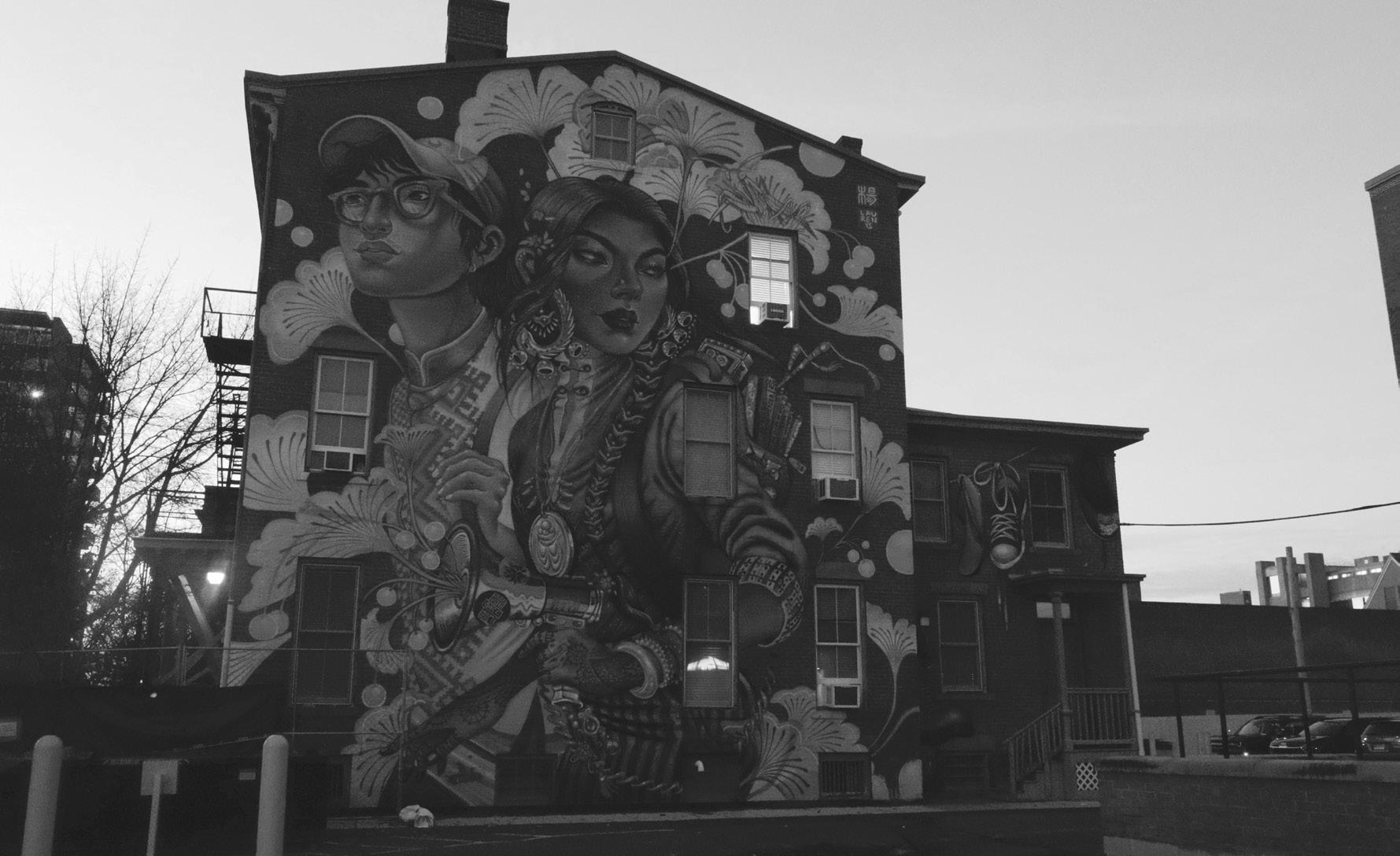
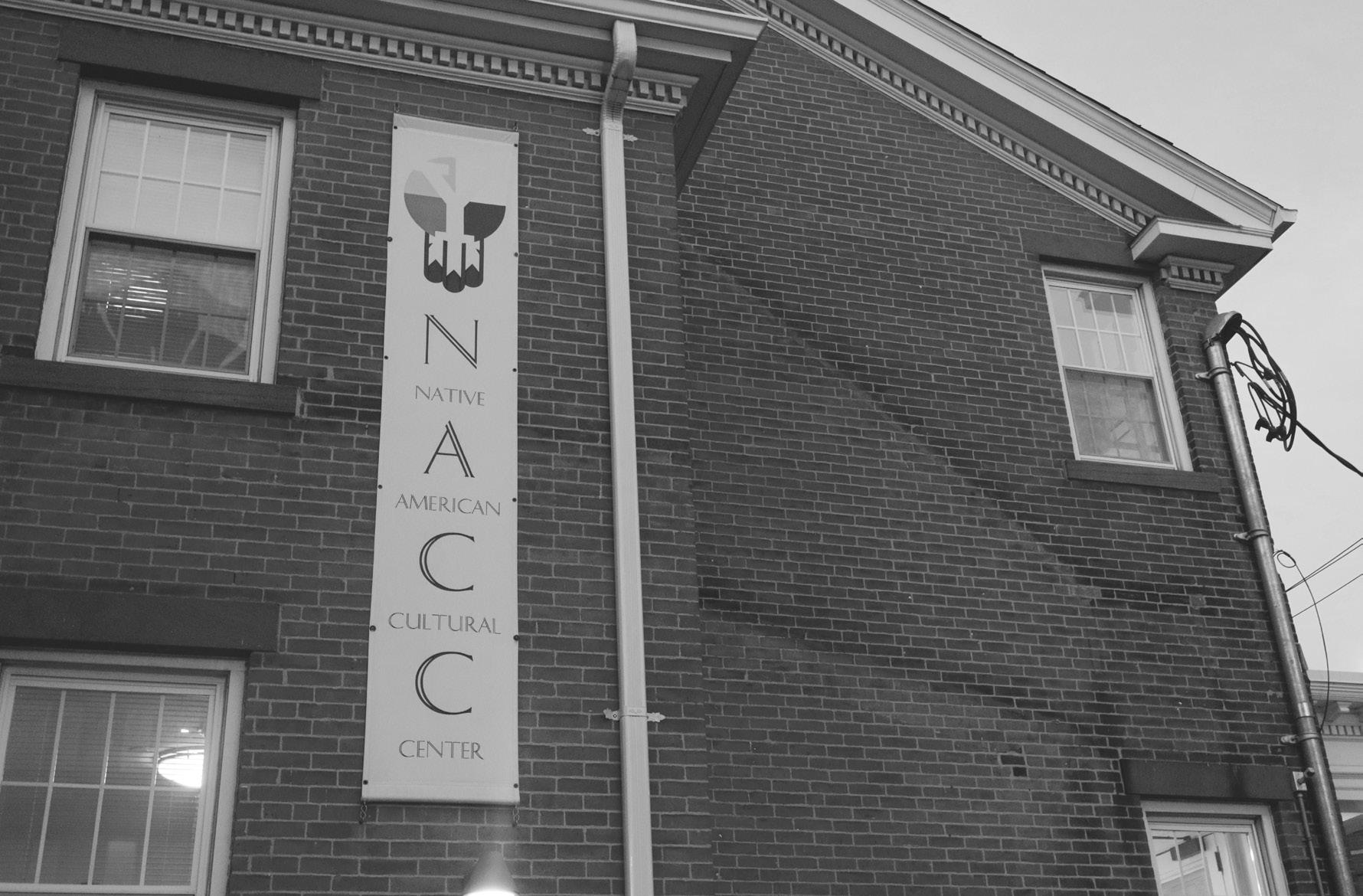
This semester, however, the Afro-American Cultural Center, Asian American Cultural Center and Native American Cultural Center were largely able to maintain the scale and number of events held in previous years. Both the Afro-American Cultural Center and Asian American Cultural Center also increased their opening hours.
At the same time, Yee told Asian American Cultural Center student workers to “continue being mindful of and efficient with” the work hours they logged, she wrote in her email to the News. Matthew Makomenaw, the director of the Native American Cultural Center, said in an interview that the center’s leadership is also “certainly paying attention to hours.”
Representatives from La Casa Cultural de Julia de Burgos and the Middle Eastern and North African Cultural Community declined to comment regarding their approach to budgetary restrictions.
Yale College Senior Associate Dean Burgwell Howard, who oversees the cultural centers, said that even though each of the five centers has taken its own approach to incorporating the five percent budget reduction, they have considered input from students, including peer liaisons.
“We were not trying to degrade the overall student experience. And so I think the directors and the assistant directors have been listening to students, their student staff,” Howard told the News in November. “We've been kind of redistributing based on student priorities.”
According to Howard, advocacy by student leaders at La Casa Cultural led the center to continue providing food at “Cena a Las Seis” programming, in what Howard called a “tradeoff” resulting in the scaling back of a Halloween event. Howard also suggested that administrators might be more “judicious” when distributing funds to student organizations affiliated with the cultural centers.
Yale College Dean Pericles
“It’s not anything huge. It's like having less money to buy food for the centers or to host events,” Lewis said, referring to the five percent reduction. “Some other non-salary expenses are harder to cut than events are. So you might see 10 percent fewer events, or each event might be 10 percent less expensive.”
Yee said that the budgetary restrictions “should have no impact on student experiences and events at the AACC.” The Asian American Cultural Center’s opening hours have expanded to seven days a week this semester, according to Yee.
To account for the tightening of this year’s budget, Yee said, undergraduate employees at the center have been asked “to continue being mindful of and efficient with the work hours logged.”
Makomenaw, the director of the Native American Cultural Center, said that the center has been able to maintain a full roster of events while making cost-conscious adjustments.
Iyanu Nafiu ’27 — a student assistant at the Afro-American Cultural Center — said that Timeica Bethel ’11, the center’s director, has pushed for “more accountability” in billing hours and reminded student work -
ers this fall about limits on hours they can log.
He said that the center’s student employees are mandated to log their hours on Jibble, a time-tracking software, to ensure that the hours they logged matched the hours they had spent working.
Bethel wrote in an email to the News that “staff clocking in and out of shifts digitally has nothing to do with the budget in any way.”
“Adding more hours ad hoc has never been at the discretion of student staff,” Bethel added. “No one’s hours have been cut and my staffers have actually worked more hours this semester than last fall.” Nafiu told the News that the frequency of events hosted at the center has not changed significantly this semester. Additionally, its opening hours have been extended one hour later, to 10 p.m. from 9 p.m. on the days that it is open, Monday to Thursday.
The Afro-American Cultural Center, Yale’s first cultural center, was founded in 1969.
Jolynda Wang contributed reporting.
Contact OLIVIA WOO at olivia.woo@yale.edu.
DOWNTOWN FROM PAGE 1
their lives in New Haven.”
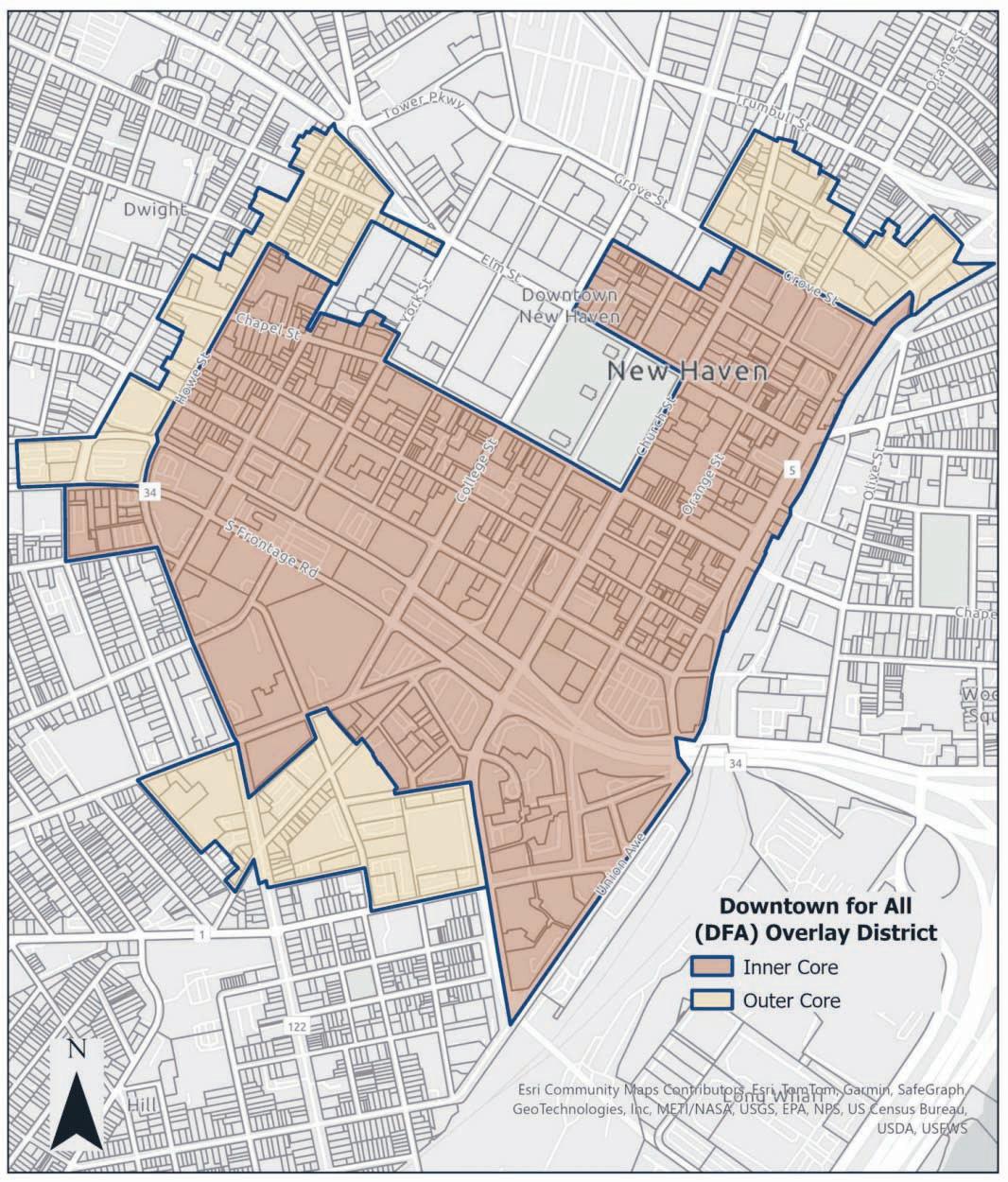
The amendment makes several major changes to the rules governing downtown development through a new “Downtown for All” district.
The district spans roughly from Howe Street to State Street between Grove Street and Howard Avenue, excluding Yale’s core campus.
Its most significant change, according to Yale professor of architecture and urban studies Elihu Rubin ’99, is increasing the maximum floor area ratio — the ratio between a building’s total floor area and the area of land it occupies — from six to 12 in the district’s “Inner Core.” The increase calls “for a lot more density and taller buildings,” Rubin said in a phone interview.
“Higher buildings might mean higher quality,” Rubin added,
explaining that taller buildings require reinforced concrete or mass timber and not the “stick frame, two by four plywood-over-concrete base” of mid-rise buildings that have proliferated around New Haven.
“The city continues to boom,” Rubin said. “We have a lot of this housing going up. Shouldn’t we get more out of the parcels that we have and make it more dense?”
The zoning amendment passed Monday also reduces required common amenity space in mixed-use and residential buildings by half and reduces minimum yard sizes.
Maximum unit density in multi-family dwellings is also set to increase from one unit per 1,000 square feet to one unit per 400 square feet, allowing for more homes per building.
Meanwhile, the amendment also
blesses rooming or boarding houses — also known as single room occupancy buildings — in the Downtown for All district.
The rezoning has been in the works since 2022, according to Sabin, and has been one of his major priorities as an alder. He said in a phone interview that it was informed by “the conversations we have all the time with our residents and constituents about how much more expensive rent and/or buying a house has gotten in the city in the last 10 or 15 years.”
Zoning, Sabin said, is “a big lever” that the city government fully controls.
Sabin said that many of the United States’ local zoning rules are decades old and “don’t fit our needs today.”
“It’s a big reason why the housing affordability crisis has
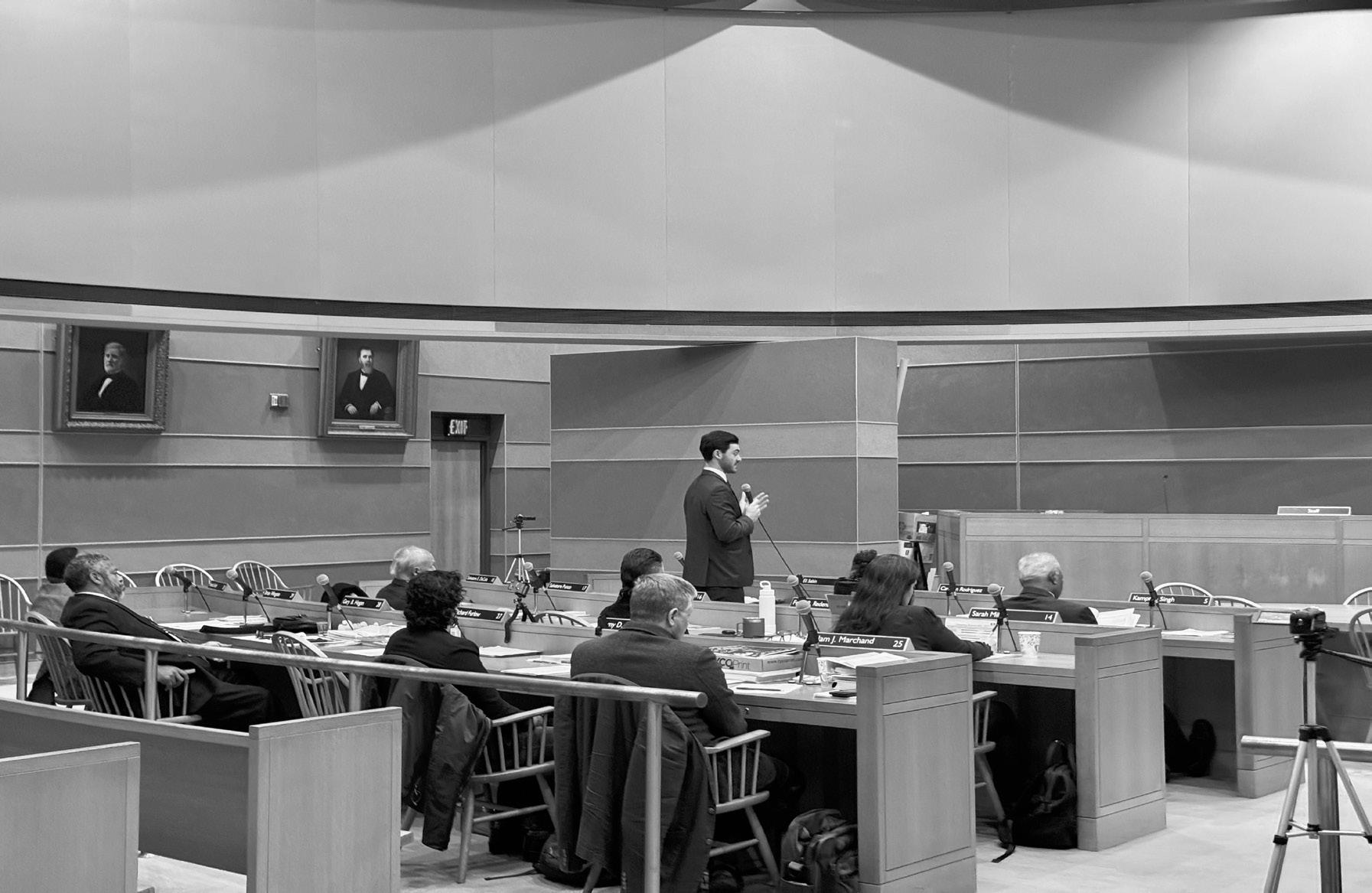
become such a big problem across the country,” he said.
Anstress Farwell GRD ’78, who runs the New Haven Urban Design League, agreed in a phone interview that downtown New Haven needs to be rezoned. But she criticized the process that led to this amendment.
“To have set this up in such a private way and not brought everything that needs to be considered into it is not the way you should rezone any part of the city, and especially downtown,” Farwell said. “This is a very, very thin and insubstantial approach to zoning, and all you can say is, it was done wrong, and it isn’t going to work.”
Approached at Monday’s meeting, Board of Alders President Tyisha Walker-Myers said, “Let us try it and see. That’s her opinion.”
“If you think you could come up with a plan much better, put a plan together and bring it to us, and let’s talk about it,” Walker-Myers added.
Sabin said that he does not expect many 15-story buildings to spring up anytime soon. Pointing to elevated steel costs, Sabin said that developers have told him building tall in New Haven is not currently financially feasible.
In the short term, Sabin expects density to increase in the new district’s “outer core,” which includes much of the area bounded by Temple, Grove, State and Trumbull Streets, the blocks between Edgewood Avenue, Howe and Park Streets and Broadway and parts of the blocks between Howe and Dwight Streets.
Outgoing Ward 1 Alder Kiana Flores ’25.5, who represents part of the new district’s “Inner Core,” was part of the five-alder team that helped craft the rezoning.
“Even Yalies feel the strain of housing near Yale’s campus,” she
said in an interview. “They understand how incredibly expensive it is to live around that area.”
Flores is confident that the rezoning will steer downtown’s growth “in the right direction.”
To be sure, the rezoning is not a silver bullet solution to New Haven’s housing crisis, Walker-Myers said.
“No one thing is, though. It takes a bunch of smaller things to make a huger impact. So this is just one piece of the puzzle,” she told the News.
Farwell, for one, is eager for a total overhaul of the city’s zoning code.
“This has been talked about for at least 20 years, that our code is so outdated and it needs to be rebuilt,” she said. “And rather than these hit and run modifications, it’s really time to get serious about it.”
It remains unclear how the market will respond.
Rubin said that there may be developers who are “ready to jump in,” but said that the amendment is “anticipatory.”
“Developers will have to decide what are the good locations,” he added. Loosened height restrictions, for example, could change their economic calculus, making once untenable developments financially viable.
Incoming Ward 1 Alder Elias Theodore ’27 said that the amendment does not represent a financial investment in downtown.
“This bill is very low risk and high reward,” he said. “If the development is slower than we hope, that’s a bummer, but it’s not like we sacrificed too much.”
The tallest building in New Haven is the Connecticut Financial Center, located at 157 Church St.
Contact ELIJAH HUREWITZ-RAVITCH at elijah.hurewitz-ravitch@yale.edu.
“In the wintertime there’s a candlelight I only get from you”
“WINTERTIME” BY NORAH JONES
BY ADELE HAEG STAFF REPORTER
“What do I always say? I’m the nice guy,” Bob Davis chuckled.
On a chilly Wednesday in October, the retired special education teacher and track coach watched as local police academy recruits walked laps in twos and threes around a track, warming up.
“I built that in,” Davis, 70, said of their warm-up. “That’s a good time for them to talk to each other.”
That night, recruits were training for a physical agility test that they must pass twice to get into any local police academy.
If and when recruits make it to the police academy, Davis said, they “get their ass kicked.” After a day or two, Davis promised, they always come back and tell him that, compared to the academy commanders, he’s the “nice guy.”
Since 2020, police departments nationwide have struggled to recruit and retain officers. Surveys and studies attribute the shift to the COVID-19 pandemic and the killing of George Floyd by a Minneapolis police officer — the latter of which Davis agreed “definitely put a damper on recruitment nationwide.”
In an effort to fill its depleted ranks, the New Haven Police Department has been looking to take more police applicants from around the city, many of whom are not prepared for academy tests, New Haven Police Chief Karl Jacobson said in an interview.
“When we set out to get more people from the city and diversify, we saw an influx of people failing the test. So we said we had to proactively do something,” Jacobson said. Davis — a Hamden resident who started volunteering for the NHPD 12 years ago when his daughter was in the academy — had been running the training sessions for free until Jacobson became chief and the department started paying him a salary in 2022. Now he’s at the track with recruits every Wednesday and Sunday, year-round.
By helping applicants get fit enough for the tests, and providing them with a team of other recruits to train with, Davis is making policing more accessible.
“I make it clear to them I am not a police officer,” Davis said. Sgt. Paul Finch, the head of NHPD recruitment, called what Davis is doing “mentorship” instead.
Police recruitment ‘more difficult’ since 2020
Last year, over 70 percent of police departments nationwide reported that police recruitment is
“more difficult now” than it was in 2020, according to a 2024 survey by the International Association of Chiefs of Police.
“When I first took over, it was tough,” Finch, who was hired to oversee NHPD recruitment in 2021, said in a phone interview. “We were working against challenges of Covid and George Floyd and just striving to really make policing popular again.”
Homicides in the city skyrocketed in 2020 and 2021, and the police couldn’t keep up, Jacobson said.
“National incidents dictate how people treat the police or feel about the police at home, right?” Jacobson said.
New Haven police finalized a new contract last year, which included a nearly $20,000 starting salary increase for officers.
“I think the contract has hit right where we needed it to,” Jacobson said, adding that it has improved officer retention rates.
As for recruitment rates, three recruits told the News the new contract would be a significant factor for them in choosing the NHPD if they were offered jobs at multiple police departments after graduating from the police academy.
“I’ve been approached to apply to Meriden as well,” Olivia Langley, 31, said. Langley chose to continue with the NHPD recruitment process because, she said, “I couldn’t be able to afford my lifestyle of living with my mortgage and my child if I were to apply to Meriden, because I think their starting salary is like 60,000.”
Even with the new contract, the NHPD is still experiencing staffing shortages, department spokesperson Officer Christian Bruckhart said in a phone interview.
As of September, there were 214 officers in the department, 49 short of what the city budgeted for this year, according to data provided to the News by Finch. By contrast, in 2014, there were over 400 officers in the department.
With staffing shortages, “call time suffers, proactivity suffers,” Bruckhart said.
The contract and the increased starting pay have been key to improving retention and recruitment rates, he said, but officers are still “underpaid and extremely busy.”
‘We need more people in this process’
To get into the police academy, recruits must be able to pass the Complete Health & Injury Prevention test, or the CHIP test. For many applicants, the test is a barrier to entry.
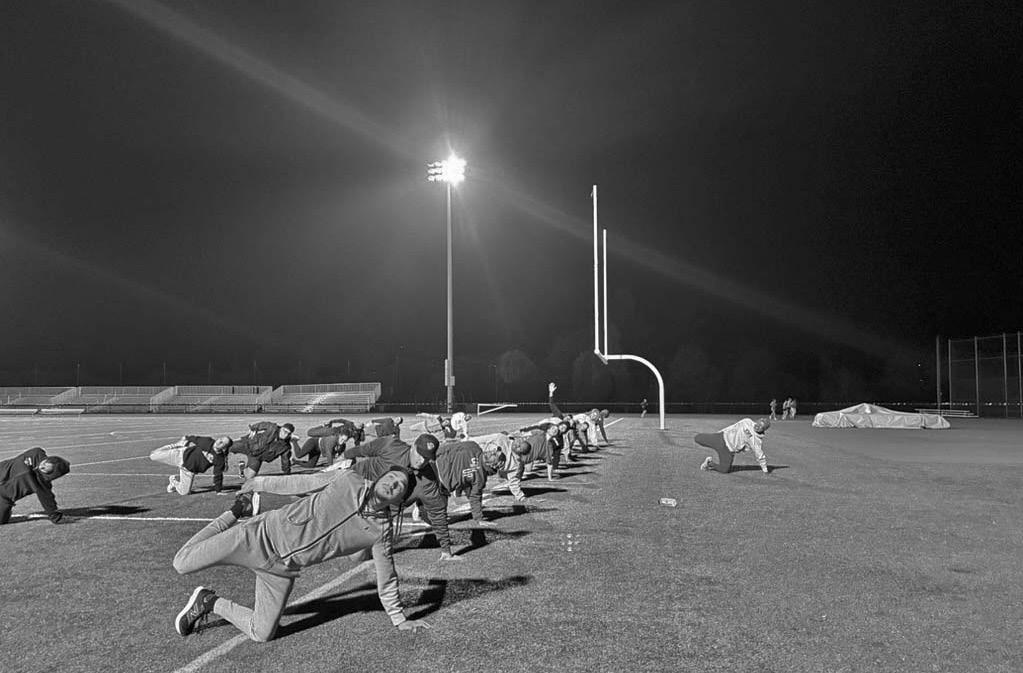
The test consists of a minute of sit-ups, another minute of push-ups, a 300-meter run and a 1.5 mile run. Required speed and push-up and sit-up counts vary based on age. For example, a man between the ages of 20 and 29 must complete 29 perfect pushups in a minute, while a woman of the same age must complete 15. Missing one push-up means failing the entire test.
Not everyone passes immediately, although a “reasonably fit person” is usually able to com
plete it with effort, according to Sean Cassidy, who administers the CHIP test out of a North Haven facility. Still, most recruits have to train for it.
“The physical fitness test is in a lot of ways a game” meant to test specific strengths, Bruckhart said. “There’s no way around it. You have to pass it,” he added, or else a recruit cannot start at the academy.
Bruckhart said many “first-generation” recruits without family in policing risk failing the test without training guidance.
“To have a coach be able to train people who may not be familiar with running and pushups” helps the department “capture” more recruits, Bruckhart said.
Davis estimated that there are three or four Yale Police Department officers who have come through his training. Others go to Hamden, North Haven and other police departments in surrounding towns.
Applicants today need extra guidance to prepare for the tests, Cassidy said, citing a recent CT Insider article that reported that only 49 percent of Connecticut students passed their physical fitness tests last year.
“We need more people in this process,” Cassidy said, noting that not all applicants have family in policing to guide them, or access to gyms or other expensive training programs. Davis described his sessions as an effective recruitment strategy for the New Haven department.
“I look at it this way,” Davis said. “We get 30 people. We know we’re probably going to lose 10 or 15 percent to other departments. But I’m okay with that,” he said, because he thinks his trainees are more likely to end up working for the NHPD.
‘The process does take time’
Finch, the NHPD’s recruitment head, said the department’s strategy for recruitment has three main elements: the latest police contract, social media recruitment campaigns and Davis’ training sessions.
Rebecca Bombero, New Haven’s deputy chief administrative officer, wrote in an email to the News that there were “more eligible candidates than vacancies” for the role of police officer for “the first time in my five years here in the CAO’s office.” She attributed the trend partly to the training sessions.
Finch confirmed that the
department has more candidates than vacancies for the first time in about five years, though he said Davis’ training sessions are just part of that success.
Regardless of the effectiveness of recent recruitment tactics, the police department still has staffing shortages because it takes months to become a police officer, Finch explained.
“Policing is not just come in for an interview and then you have the job,” he said. “There are so many steps to it.”
Finch said Davis’ sessions are “key with keeping people engaged because the process does take time.”
“We need good people, we need smart people,” Jacobson said, adding that “Bob and his training sessions have just brought a whole different diversity to our department.”
At the end of every session, recruit Jackie Marescot said, Davis has a volunteer lead an inspirational “breakdown” chant for the team.
“Everyone knows that it’s not easy coming out here,” Marescot said. “We have to lean on each other,” he said, adding that “it’s just easier to lean on each other here.”
The free training sessions take place at Bowen Field at James Hillhouse High School every Wednesday at 6 p.m. and Sunday at 3 p.m Reeti Malhotra contributed reporting.
Contact ADELE HAEG at adele.haeg@yale.edu.
BY JERRY GAO AND LEO NYBERG STAFF REPORTERS
While some Yale students dispersed across the country and the world for Thanksgiving break, low-income students who stayed in New Haven saw the eligibility requirements for Thanksgiving meal vouchers heightened. Those who did
qualify only received money for two days, instead of three.
Last year, Yale offered students on significant financial aid $40 meal vouchers on each of the three days of Thanksgiving week when the dining halls were closed — Thursday, Friday and Saturday. This year, Yale eliminated the Thanksgiving vouchers and
replaced it with a lunch buffet at the Omni New Haven Hotel.
The vouchers consist of UberEats gift cards restricted to be used within 15 miles of New Haven and on the specified day. This year, Yale College offered $40 dollar vouchers for two days for students with a family share of $5,000 for the cost of attendance — a drop
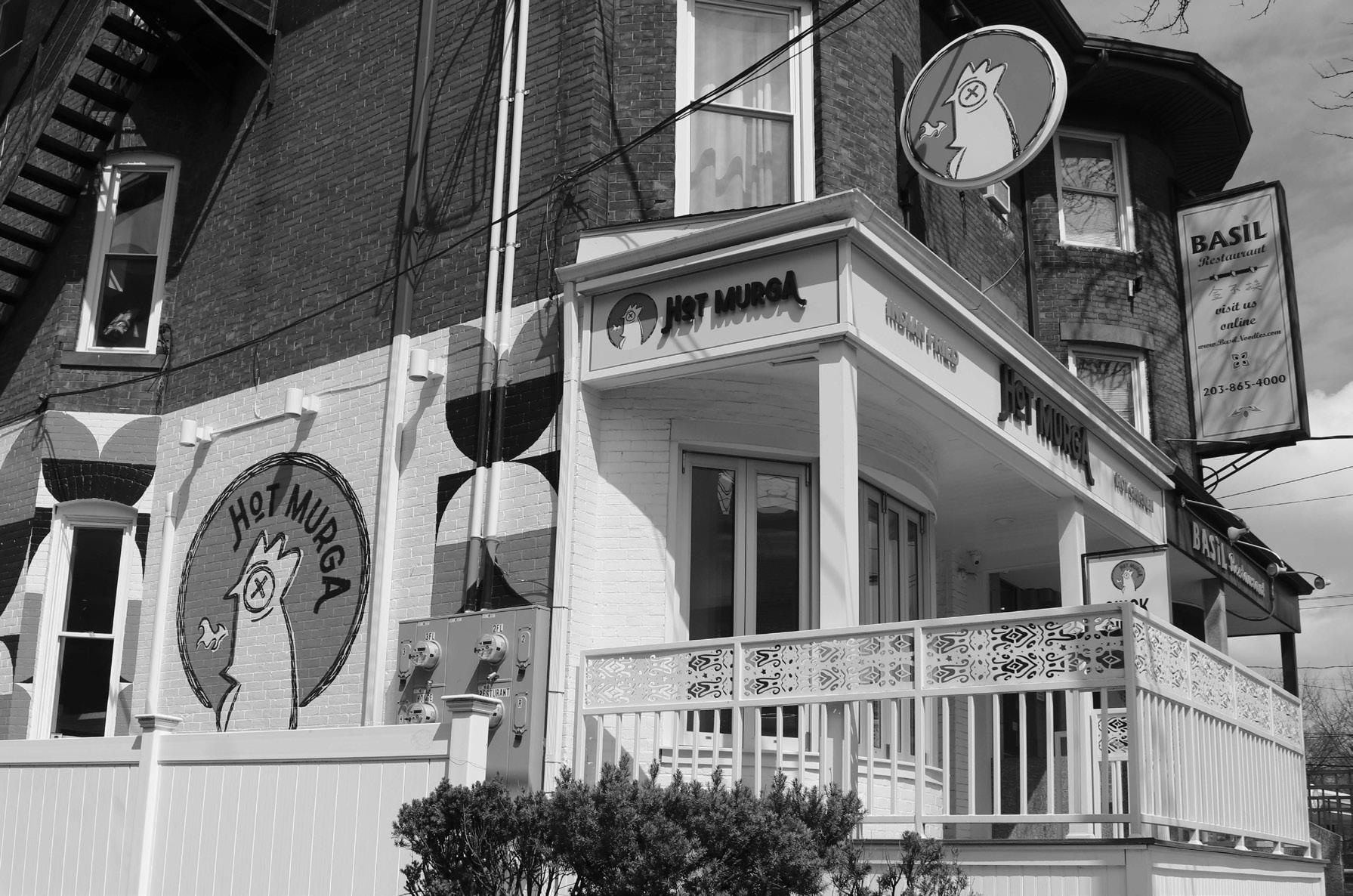
from $10,000 last year.
William Trinh ’28, who was not on campus over Thanksgiving, said some friends on campus had to combine their vouchers to share dinner that day.
“The issue is the people who are on campus, for example, the people who you’re cutting access to funding from are on like $5,000 to like $10,000 families share,” Trinh said in an interview with the News. “Those are the people who probably can’t afford to go home for Thanksgiving to begin with.”
In response to questions from the News, an anonymous email address for Yale College student resources referred to the Thanksgiving buffet at the Omni hotel from noon to 2 p.m. The email account did not respond when asked what prompted the change in policy.
The move comes as Yale has been dealing out budget cuts in anticipation of the Trump administration’s increased endowment tax. Earlier this semester, the University halved its funding support of student swipe donations for the Yale Hunger and Homelessness Action Project, as well as certain summer funding opportunities for students receiving financial aid.
The voucher program started in 2021, and initially offered for students who meet 100 percent demonstrated need — without a parent or student share. In 2023, the voucher program was $30 for each of the days when dining locations are
closed. In 2024, after Yale College Council advocacy, the vouchers increased to $40 for three days.
Three days of $40 vouchers last year added up to $120, whereas this year the two $40 vouchers totaled $80. Kari DiFonzo, the director of undergraduate financial aid, wrote in an email to the News that the financial aid office is not responsible for the voucher program’s details.
“My understanding is that vouchers are not offered on Thanksgiving Day because all Yale College students enrolled for the Fall 2025 semester who were in New Haven during Thanksgiving recess were invited to attend a Thanksgiving buffet at the Omni Hotel,” DiFonzo wrote.
Trinh said he heard from friends that the noon buffet was “not sufficient” to feed students for all of Thursday.
“I think this is the one thing that should not be targeted first. I think Yale should make an effort to ensure that people who are here on campus are not food insecure,” Trinh said. The 2025-26 term bill is $90,550.
Dani Klein and Fabeha Jahra contributed reporting.
Contact JERRY GAO at jerry.gao.jg2988@yale.edu and LEO NYBERG at leo.nyberg@yale.edu.
“Seasons
change
BY ADELE HAEG STAFF REPORTER
Eight members have been appointed to Yale’s new Public Safety Advisory Board, Yale Public Safety announced last week.
The board is now staffed for the first time since Yale Public Safety discontinued the previous iteration of the board last year, leaving the department without a body empowered to review civilian complaints.
The new board’s charter does not grant the board the power to oversee civilian complaints, which the 2024 board had the authority to do. Until a memorandum of understanding is finalized between the Yale Police Department and the New Haven Civilian Review Board, it is not clear which board will be responsible for reviewing any civilian complaints about the department.
Although a first meeting of the Public Safety Advisory Board has not yet been scheduled, new members are optimistic about the potential for the board to facilitate discussions about public safety
among students, administration and the New Haven community.
“While the board is advisory, it plays an important role in strengthening leadership’s oversight by helping to promote trust, legitimacy, transparency, accountability, and collaboration between the university community and the Office of Public Safety,” Duane Lovello, head of Public Safety and ex officio member of the board, wrote in an email to the News.
Phillip Atiba Solomon, a professor of Black studies and psychology and one of two faculty appointees to the board, said the board is “going to be about the public co-creation of safety and not about simply how to build a better mousetrap.”
“This is not about making policing a kinder, gentler version of the worst thing that it can be, it’s about making sure that we’re not asking for police to be the answer to all of our public safety issues,” he said.
Instead, Solomon wants the board to build “public health and public care systems” to support public safety.
Under the new charter, the board must have two faculty members and three student representatives — one each from the Yale College Council, the Graduate Student Assembly and the Graduate and Professional Student Senate. The board must also have a New Haven resident, two staff members and two Yale Public Safety officials as “ex officio” members.
“Faculty and staff members were appointed to the Board through a recommendation process outlined in the PSAB charter. Students submitted applications,” Lovello wrote.
The new group includes Solomon and Law School emeritus professor Tom Tyler, staff members Amy Myers and Rev. Ian Oliver, Yale College Council representative Michelle Jimenez ’28, Graduate Student Assembly representative Matthew Wang GRD ’26, Graduate and Professional Student Senate representative Ahsan Ahmad and New Haven resident Evelise Ribeiro, according to the Yale Public Safety website.
Solomon said he was excited about the possibility of the board hosting “public forums” for the Yale and New Haven communities.
“There are all kinds of opportunities for this to be an important safety valve, so the community has direct influence over how Yale keeps itself and its surrounding community safe,” Solomon said.
Jimenez, the undergraduate representative, said she wants to address safety issues she has heard from students, specifically about dysfunctional residential college gates and blue safety light malfunctions.
Jimenez said she applied for the board because she was “particularly interested in connecting New Haven and Yale.”
“I feel like there’s a lot of tension between the two, especially when it comes to crime,” she said. Jimenez wants to be a “bridge” between students and administration.
“Although it’s Yale Public Safety, you have to look beyond Yale,” Ribeiro, the board’s New Haven representative, said. She currently serves as chairperson of the New Haven Police Department’s Board of Police Commissioners.
Safety on Yale’s campus is “not only about students and faculty,” Ribeiro said, explain -
ing that the NHPD and YPD share responsibility for public safety in New Haven. “It has to be a collaboration.”
The New Haven Civilian Review Board, an advisory and police oversight board for the NHPD, has been working toward a memorandum of understanding with Yale about police oversight.
Civilian Review Board member
Alyson Heimer said the appointments to the Public Safety Advisory Board are a signal that Yale is “moving in a positive direction” towards a finalized agreement with the city.
“We’re excited for continued collaboration and partnership with Yale,” Heimer said. She declined to comment further on ongoing negotiations between Yale and the city related to the Civilian Review Board.
The Public Safety Advisory Board is supposed to meet at least three times per fiscal year, according to the Yale Public Safety website.
Contact ADELE HAEG at adele.haeg@yale.edu.
BY SABRINA THALER STAFF REPORTER
June 17 was already going to be a “heartbreaking” day for Molly Seely.
It was eighth-grade graduation day at Brennan-Rogers Magnet School in West Rock, where Seely worked as a librarian. The graduating eighth-grade students were Seely’s favorite group she had worked with, she said, and she was sad to be sending them off to “the great wild beyonds of high school.” She had been counting on the chance to say goodbye.
That was until she received an email from her school’s administration calling the staff to a last-minute meeting in the school library. The meeting coincided with dismissal, when Seely would have been able to say goodbye to departing students. Instead of wishing a “happy summer” to students at the bus loop, Seely stayed in the library.
When Seely saw officials from the school district — including Superintendent Madeline Negrón, according to another teacher who attended the meeting — walk in, she knew she would be saying goodbye to more students than just her eighth graders.
“It’s never a good sign when administration from downtown starts filing in, and I kind of knew in my heart of hearts, as soon as I saw bigwigs, I’m like, ‘Fuck, we’re closed,’” Seely recalled during a phone interview in late August.
At the meeting, according to three teachers in attendance, Negrón told the Brennan-Rogers staff that the school district was considering closing their school. Unconfirmed rumors of a potential closure — thanks in part to the K-8 school’s low enrollment of 132 students — had been swirling, the teachers said.
In early July, New Haven’s Board of Education approved its 2025-26 budget and, with it, the formal closure of BrennanRogers. The school’s closure, according to a letter Negrón sent to families in mid-June, was part of an effort to mitigate an anticipated $16.5 million budget deficit for the coming fiscal year.
The News spoke with five former Brennan-Rogers staff about transitions to their new placements — two near the start of the 2025-2026 school year and three later in the semester. The staff reflected on the challenges they have faced while transitioning into and navigating their new teaching roles, and on the community they lost at the now-shuttered school.
“It was very traumatizing,” Latrice Peterson, who worked as a special education resource teacher at Brennan-Rogers, said of the sudden closure in a phone interview. “I think it played a great deal on mine and a lot of my colleagues’ mental health.”
Seely said that staff at Brennan-Rogers had roughly two weeks during the summer
to pack up all of their classroom materials. She and three former Brennan-Rogers teachers confirmed that the staff received three hours’ worth of pay for the time spent packing up and transporting classroom material.
At the beginning of the current school year, the New Haven Federation of Teachers, the city’s teachers’ union, filed a grievance with the district to request redress and compensation for the short moving timeline, according to former Brennan-Rogers teacher and union member Ahmed Maklad.
Leslie Blatteau, the union’s president, said the union is in the midst of resolving the grievance and declined to comment on the current status of the process.
Seely said that although the district agreed to help transport furniture and curricular materials, “that is maybe 10 percent of what makes up a classroom.” She said she rented a storage unit to hold library books, classroom decorations, anchor charts and “reward seating” she had purchased for students, like gaming chairs and ottomans.
In a call the day before the 2025-26 school year began, Seely said she felt “wildly unprepared,” because many of the books she had planned to transfer to her new school library had not yet been moved, and she wasn’t sure whether the district would be able to help her.
Peterson said she did not receive help from the district for most of the packing and moving process, and had to pay four people and rent a truck using her own money to arrange her relocation to Davis Academy for Arts and Design Innovation in Amity.
“So we just had finished packing away our classrooms, only to have to go back into the building,” Peterson said. “I think there was maybe a week that we had to go in and pack our things, unpack the closets and cabinets and then repack our things and get them out of there and get them over to our new schools.”
In an email, New Haven Public Schools spokesperson Justin Harmon said that teachers received the district’s “assistance” in packing up and moving their belongings to their new schools, and that the three-hour payment was intended to provide teachers time to pack up their belongings.
Ahmed Maklad, who taught seventh- and eighth-grade students at Brennan-Rogers for two years before its closure, said that he is now responsible for teaching English to 97 eighthgrade students at Betsy Ross Arts Interdistrict Magnet School in the Hill neighborhood. He teaches classes of up to 27 students, Maklad said, whereas at BrennanRogers his largest class size was between 10 to 15 students.
NHFT’s current contract with the district, approved in 2023, sets a maximum class size of 27 pupils in grades 3 through 12.
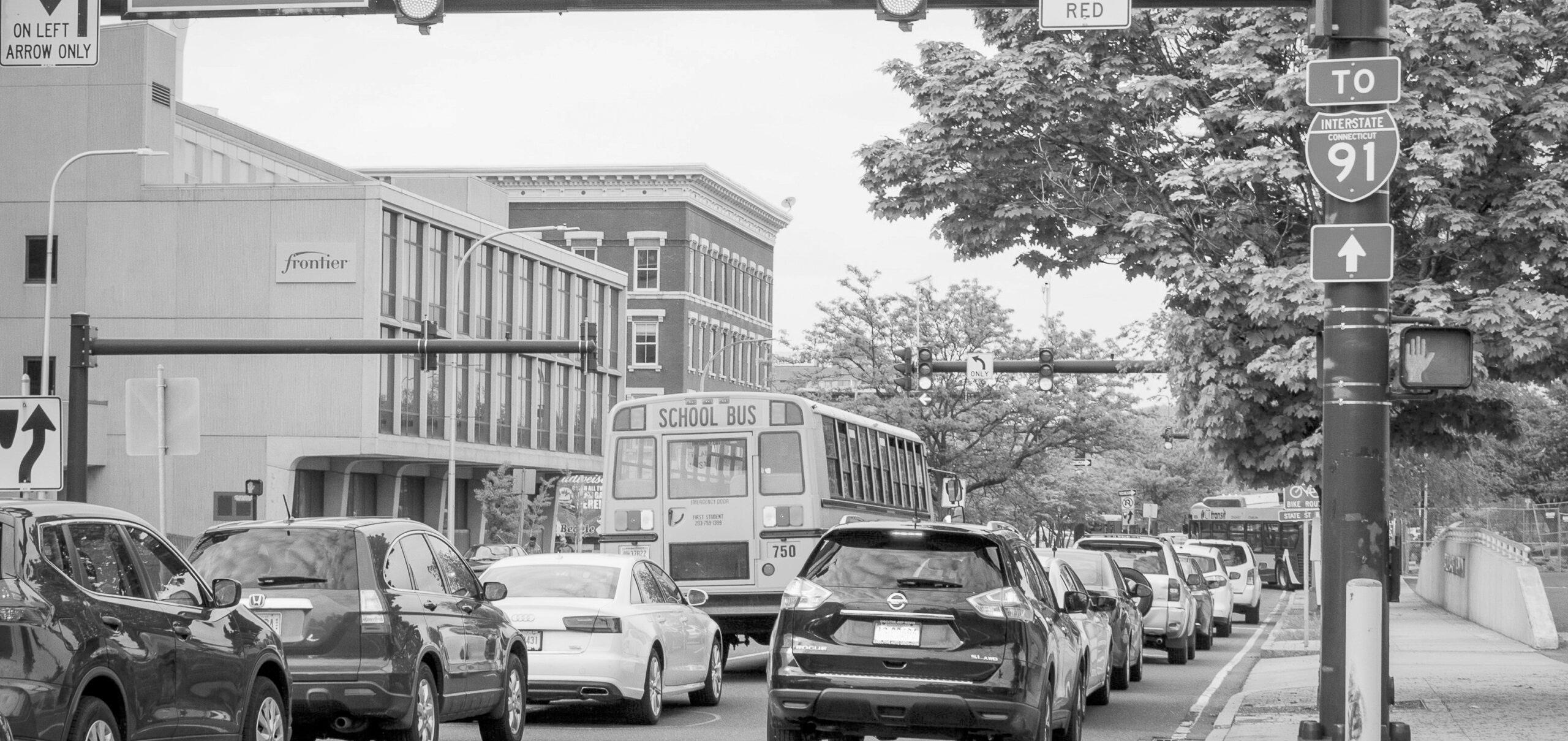
For Maklad, the adjustment to teaching more students has been a challenge, requiring him to attend to a wider range of student needs.
“When we have more one-onone instruction and we have less students in the classroom, we get more opportunity to really help the students who are really struggling,” Maklad said in a phone interview.
“With a classroom of this size, with one teacher, the level of education is not the same, because it’s turning more into a lecture hall than an actual classroom.”
According to Maklad, he chose his new place of work in late July, 30 days before the start of the school year. A representative from the district sent him four openings to choose from and 24 hours to make the selection, part of a staggered selection process in which more senior teachers had first picks for where they wanted to teach.
Maklad did not meet the principal of Betsy Ross until the first day of school, he said, and didn’t get a standard orientation for new teachers.
Maklad said the school district should have better supported teachers’ transitions. “We were really bum-rushed into this,” he said.
In his statement, Harmon cited the teachers’ contract, which provides that the reassignment process for involuntary transfers should “give preference on the basis of seniority, qualifications, convenience and wishes of the teacher applicant.”
The contract also states that teachers should be given written notice “of any changes in their school assignment, program, schedules, assignment, grades, subjects or rooms for the following school year” by the end of the current school year — except under “special conditions.”
The transition process — as well as what Maklad perceives as the district’s effort to condense classrooms and schools, rather than focus on putting more staff into buildings — has led him to believe that the district does not care about its students and teachers.
Now, he doesn’t think he’ll stay teaching in the district after this school year.
“To further mitigate the
projected deficit, the district substantially reduced vacant positions and reassigned teachers into others that needed filling,” Harmon wrote. “We avoided layoffs, but in doing so, we increased class sizes— staying within the maximum class sizes stipulated in the teachers’ contract-- and reduced the availability of high school electives. It is certainly true that teachers and students are feeling the effects of these changes.”
Paulette Bosley, who taught at Brennan-Rogers from 2010 to 2013 and again starting four years ago, transferred to sixth-grade teaching at Mauro-Sheridan Interdistrict Magnet on the west side of New Haven. She also said she was considering leaving the New Haven school system after her experience transitioning between schools, and compared the news of the school’s closure to a “hit in the stomach.”
Maklad said he thinks the closure — and its displacement of students and teachers alike — was “detrimental” to the mental health of students.
“Students are constantly being left behind to deal with the next teacher and the next teacher, without having this bond of being able to have that same teacher with you for the entire year, for the next two years, or being able to visit them,” Maklad said.
Barbara Averna, a veteran kindergarten teacher who worked at Brennan-Rogers for 20 years, said that she had a smooth transition to her new position at King/Robinson Interdistrict Magnet School in Beaver Hills. The difficult part of the move, she said, was “missing the families that I was used to being around.”
Averna recalled driving up a hill near the school to visit students’ families living in West Rock earlier in her career at Brennan-Rogers. When she knew a student needed extra help, she said she would bring a crate of books and draw with chalk on the sidewalks to help them practice reading commonly used words.
Brennan-Rogers’ status as a small, community school, Peterson noted, cultivated a sense
of “family” between students, their families and staff. She said teachers would often stay in the building helping out with afterschool activities until 6 p.m., and that most staff knew most of their students’ families.
“What do we do about the families, you know, the grandmothers who had custody of their grandkids and who depended and relied upon us for being right there in walking distance?” Peterson asked during a phone interview in September. “Or having some of our support staff walk them halfway home at the end of the day, just so that grandma could see them walking up the hill as it was getting dark during daylight saving times?”
As for the former staff of Brennan-Rogers, Bosley said they maintain a group text and are planning a Christmas get-together.
“We may not have all got along on every single day, but we knew how to have each other’s back, and we all were there for the kids,” Bosley said.
On a much smaller scale, Bosley continues to be present for former Brennan-Rogers students.
She said that one of the students who transferred from Brennan-Rogers, a secondgrader, has struggled with behavioral issues at MauroSheridan. Bosley said that there have been occasions when she has seen teachers reprimanding him in the schools’ hallways and has intervened to help.
“It usually turns it around when he sees me,” she said in a phone interview. “We have a conversation. He tells me, ‘Miss Bosley, I miss Brennan-Rogers.’ And I tell him, ‘I miss it too.’ I’ll pull my phone out and let him send a message to his old teacher, because I know her, so I’ll send a text, and he’ll do a voice text, and he’ll just say how much he misses her or stuff like that. And that kind of makes him feel a little bit better, and he goes back into class.” Brennan-Rogers Magnet School was located at 199 and 200 Wilmot Road.
Contact SABRINA THALER at sabrina.thaler@yale.edu.
“Under the winter’s night, the stars are so bright.” WINTER’S NIGHT SARAH BRIGHTMAN
BY KIVA BANK STAFF REPORTER
Robert A.M. Stern ARC ’65, a world renowned architect who served for 18 years as the dean of the Yale School of Architecture, died last Thursday at age 86.
Born in Brooklyn in 1939, Stern first came to Yale as a masters student, graduating in 1965. Four years later, he founded an architecture firm now called Robert A.M. Stern Architects, which has grown to about 300 people and designed Benjamin Franklin and Pauli Murray Colleges.
Called Bob by his colleagues and students, Stern was known for being “straight up,” like the martinis he served at his famous dinner parties, architecture professor Eeva-Liisa Pelkonen ARC ’94 said in a phone interview.
Pelkonen recalled that once, over a dinner, Stern convinced the architect Kevin Roche to donate an archival collection of Eero Saarinen’s designs to Yale, instead of the Smithsonian, for an exhibition about the famed Finnish-American architect. Stern’s efforts also led to the start of architectural archives at Yale, Pelkonen said.
“Bob was a good friend. We both loved great architecture as well as debating what that might mean,” Deborah Berke, Stern’s successor as the architecture school’s dean, wrote in an email to the News.
“Bob was also disarmingly frank and could be rather direct. He was principled, he was generous, and he was fun.”
“For him, nothing was more important than architecture and architectural education, and nothing was more fun than talking about design with a martini in hand,” Berke added.
Stern served as the dean of the School of Architecture from 1998 to 2016 and taught as a professor at the school until 2022.
George Knight ARC ’95, a senior critic at the School of Architecture, said in a phone interview that Stern always prioritized the school.
Knight was hired by Stern in 2004, teaches the Robert A.M. Stern Rome Seminar during the summer and was the Robert A.M. Stern Visiting Professor in Classical Architecture for the 2024 spring semester. Knight said he heard, before he joined
the faculty, that some faculty members had been worried — based on the work of Stern’s firm — that he might bring an exclusively traditional style of architecture to the deanship. But Stern’s own architectural tastes did not narrow his educational outlook, Knight said.
“It was just the opposite,” Knight said. “The school flourished and attracted a huge variety of professionals.”
Knight said Stern had a pluralistic vision for the school, calling him a “transformative” dean who “magnified the school in ways no one at that time could have imagined.”
Pelkonen also commended the “dramatic shift” that Stern initiated at the School of Architecture compared to what she first observed when she was initially hired in 1994.
According to Pelkonen, the school was in “disarray” when Stern was appointed dean. She said the architecture building was in “terrible shape,” and the entire faculty shared one computer and printer. Around a month into Stern’s appointment, Pelkonen said, each faculty member had a desktop computer.
“Bob always made sure that the most cutting edge resources were to the students,” Knight said.
Stern revived Perspecta, the oldest student-edited architectural journal in the country, which he had edited while he was a student at the school. He also established the school’s magazine, Constructs, which is published twice a year and provides information about visiting professors and other updates on the school.
“Bob’s deanship was marked by many great successes, one of which was building an architectural culture around the school,” Knight said.
That included increasing faculty interest in a series of guest lectures, after which Stern would host dinners for professionals and select students in his “stylish” apartment in downtown New Haven, Knight said. There, he encouraged attendees to mingle and meet new people.
For Pelkonen, one of Stern’s most memorable lessons was inviting dialogue with people whose perspectives are different from one’s own.
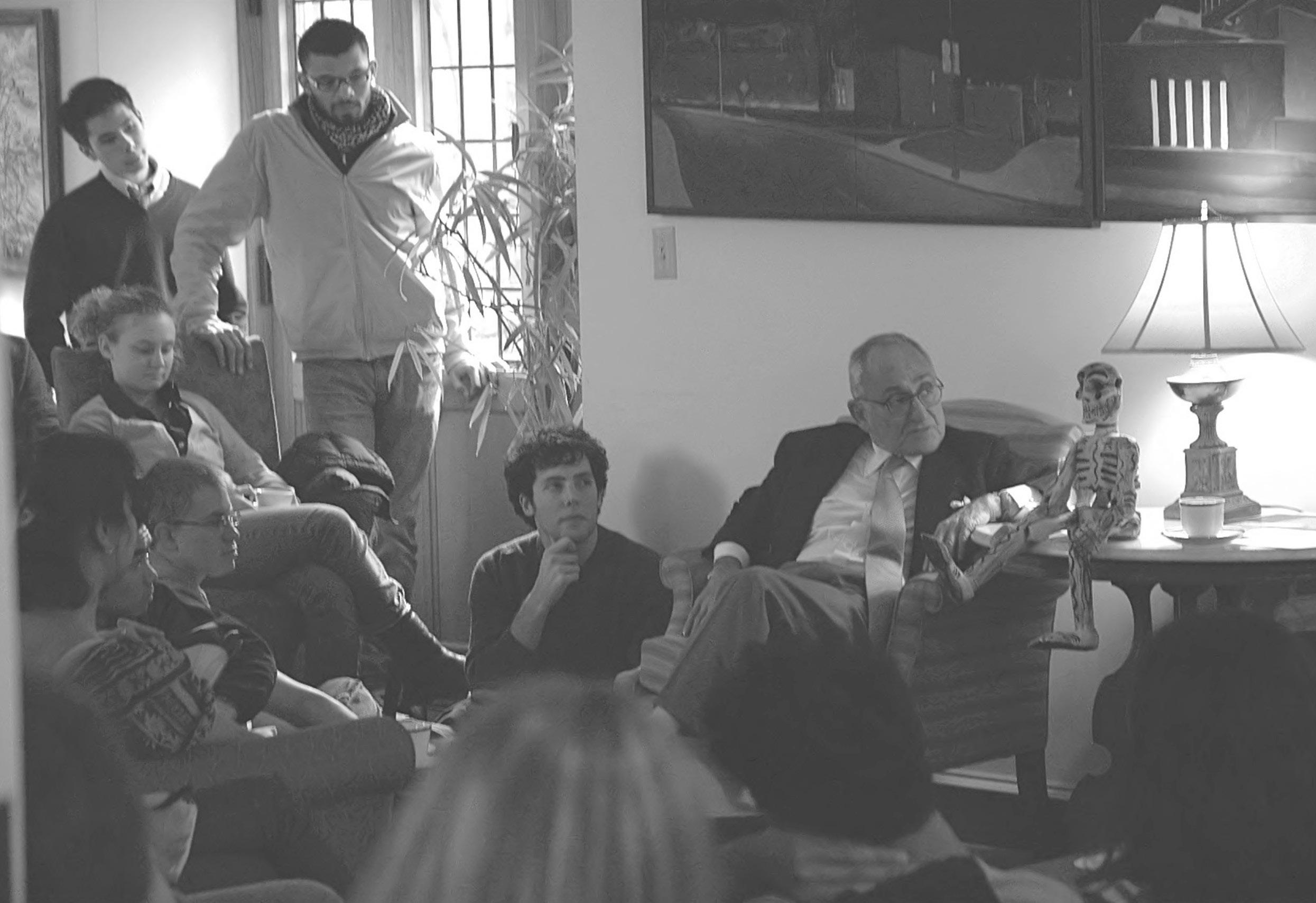
Berke wrote that Stern advised her as dean to “say what you think” in university meetings.
Before joining the Yale faculty, Stern taught at the Columbia Graduate School of Architecture, Planning and Preservation, beginning in 1970. He also served as the first director of the Temple Hoyne Buell Center for the Study of American Architecture at Columbia from 1984 to 1988.
During his tenure at Yale, Stern led the design of Yale’s newest residential colleges, Pauli Murray and Benjamin Franklin, which opened in 2017.
Knight said that Stern spent significant time and energy studying the Yale campus and the other residential colleges, ensuring the new colleges’ design aligned with the neoGothic style of most other residential colleges.
Pelkonen said that throughout his life, Stern worked through the problem of “merging past and present” in his work.
“The older he got, the more firmly he was looking back in time,” she said of his architectural designs.
“Historical precedent was
something that’s centravl to RAMSA and Bob’s approach to designing buildings,” Noah Sannes ARC ’23 said, referring to Robert A.M. Stern Architects.
Sannes was a student in Stern’s final Yale class, “After the Modern Movement: An Atlas of the Postmodern, 1945–1989,” which he taught virtually in the spring of 2022.
“I’d never before been in a class where somebody had such a brilliant way of conveying knowledge,” Sannes said. He described being “starstruck” when he met Stern for the first time in person for the final presentations, noting that Stern was one of the first architects he learned about while developing his interest in the field. Sannes grew up in the suburbs of Atlanta, where he said Stern’s projects, such as the Waldorf Astoria Atlanta Buckhead and the Federal Reserve Bank of Atlanta, stood out from the “cookie cutter neighborhoods” he was used to.
Now an architect at the firm Stern started, Sannes said Stern is most well known for designing 15 Central Park West,
a luxury building in Manhattan that was completed in 2008 and “redefined his career.”
Stern was awarded the Vincent Scully Prize by the National Building Museum in November 2008 for his leadership as a dean and in the field of historical architecture with his seminal works. He also earned the prestigious Andrée Putman Lifetime Achievement Award in January 2021.
Knight said Stern wanted the School of Architecture to produce “outstanding” professionals who understood global issues as much as local issues and maintained a sense of “panache.”
Berke wrote that, since succeeding Stern as dean, she would sometimes call him for advice and to report “good news” about the school.
“He never stopped being interested in what was going on at Yale and in architectural education across the country,” Berke wrote. Stern graduated from Columbia College in 1960.
Contact KIVA BANK at kiva.bank@yale.edu.
BY ANGEL HU STAFF REPORTER
An exhibit on campus is trying to put a finger on the importance of hands.
The exhibition, called “I hold it towards you,” is on display through Dec. 5 at the ISOVIST Gallery at the Center for Collaborative Arts and Media.
“I hold it towards you,” which opened on Oct. 24, was curated by Fabiola Alondra, a New York-based researcher, writer and curator. The title of the exhibition is taken from the final line of John Keats’ poem “This Living Hand” and explores
“the enduring power of hands through a selection of objects, images, and practices that draw on art history, anthropology, archaeology, spiritual traditions, and material culture,” according to a press release about the exhibition.
Hands “create, they destroy, they are essential, I think, to just being human,” Alondra said. Alondra recalled being drawn to the image of hand imprints in caves as a form of communication with people from the future — an image also evoked by the final line of the Keats poem.
“Here’s this person extending his hand out towards the reader, which
in a way evokes how cave painters were putting these hand imprints. It’s almost as if they’re waving or saying hello to the future viewer of these images,” Alondra said.
On Sept. 21, the center sent out an open call to Yale students and alums to submit proposals for their artworks to be featured in the exhibition. Alondra also invited some Yale students and alums directly to submit their work.
The pieces encompass a variety of themes and approaches. Some, like a sculpture by Jeff Whetstone ART ’01 composed of photos on glass plates, took an anthropological lens and were grounded

in archival material. Others, like “{FleshOfLanguage}” by Alvin Ashiatey ART ’22 and Mianwei Wang ART ’21, grappled with the role of technology in shaping the functions of the hands.
“Even though there’s many different mediums and aesthetics within each artist’s practice, once they were all in the room together, I started to see so many great connections between all of them. Some of it was intentional, and some of it just happened naturally,” Alondra said.
Alondra emphasized the importance of engaging in “dialogue” with the artists as part of “the process of putting together something.”
In an email to the News, Lauren Dubowski DRA ’14 ’23, the assistant director of the Center for Collaborative Arts and Media, described how the physical space of the ISOVIST gallery allowed the individual pieces to come together.
“‘Isovvist’ is a geometric term that defines your field of vision from the position of your body in space. In CCAM’s ISOVIST Gallery, viewers can encounter painting, sculpture, photography, video, and more simultaneously,” Dubowski wrote. “The design of this exhibition also incorporates a curtain and custom light boxes, which allowed for unique ways to display the work.”
In addition to pieces created by students and alums that are featured in the gallery, the exhibition incorporates a selection of artifacts and images related to hands taken from various Yale collections. Materials include a fragment of a hand from a statue of Ba — the soul in ancient Egyptian mythology — a painting of women at a Baptist proces -
sion and funerary fingernail covers from Indonesia. Images of these selections are displayed on a screen in the center’s Research Gallery — a hallway space next to the ISOVIST.
The opening of the exhibition on Oct. 24 was accompanied by a presentation at the Beinecke Rare Book and Manuscript Library. Working with curators Michelle Al-Ferzly and Shannon Supple, Alondra selected and displayed 14 items from the Beinecke that related to her exhibition.
“It was evident that Fabiola was drawing deeply from the collection to inform her own curatorial vision, which reminds us of the depth and diversity of the Beinecke’s holdings — it’s not just all books!” Al-Ferzly wrote in an email to the News.
Al-Ferzly noted that visitors especially enjoyed the Nuremberg Chronicle, which depicts an image of God’s hand creating the universe. Alondra also selected a letter written by Frida Kahlo to Georgia O’Keeffe, in which Kahlo praises O’Keeffe’s hands.
The archival materials “provided a deeper historical perspective to the topic of Fabiola’s exhibition, while also allowing for a broader display of different mediums,” according to Al-Ferzly.
“The biggest thing I hope people take away is that there is something that inspires them, or they want to research something, and it can lead them into their own path,” Alondra said.
The Center for Collaborative Arts and Media is located at 149 York St.
Contact ANGEL HU at angel.hu@yale.edu.
“Was
it love or fear of the cold that led us through the night?”
”WINTER WINDS” BY MUMFORD & SONS
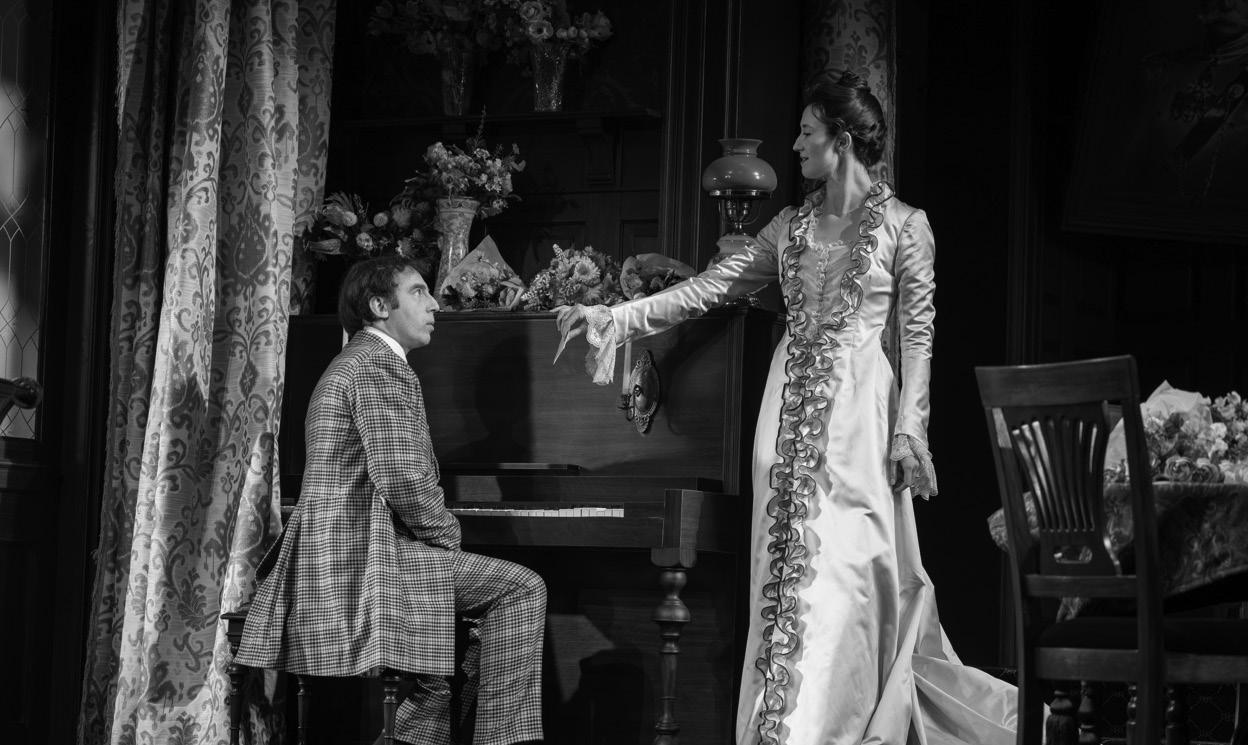
BY KIVA BANK & LENA KATIR STAFF REPORTER & CONTRIBUTING REPORTER
“Hedda Gabler” — a period drama written in 1890 by Norwegian playwright Henrik Ibsen — will open on Thursday night at the Yale Repertory Theatre.
The production will be the last one directed by James Bundy DRA ’95 before he steps down from his roles as dean of the David Geffen School of Drama and artistic director of the Yale Repertory Theatre — roles he has held for 23 years.
During his tenure as dean, Bundy has directed numerous productions, including “Hamlet” and “All’s Well That Ends Well.”
In an email to the News, Bundy wrote that he is “excited” for modern audiences to confront the questions raised by the 135-yearold “Hedda Gabler.”
“My own experience of the theater is that it’s a kind of secular church, in which questions of morality, faith, and possibility are posed in a way that exercises the imaginations and hearts of artists and audiences,” Bundy wrote. “This play can do that in surprising ways, while speaking to our capacity for self-delusion and to the cost of our inattention to the agency of women.”
Bundy said he wanted to bring together a “company of artists” who were passionate about the project. One of them, Marianna Gailus ’17, is a former student of Bundy’s class, “Acting Shakespeare.” Gailus, who plays the titular character, described the experience working with Bundy on “Hedda Gabler” as a “special kind of reunion.”
“It was really important to Bundy that everybody involved have some sort of connection to Yale,” Gailus said in a phone interview. “So it feels like a homecoming in a lot of ways.”
The production follows 29-year-old Hedda, a newlywed who is frustrated with the confines of domesticity upon returning from her honeymoon, according to the play’s synopsis. Her life is
upended when the arrival of her former lover brings back tensions from the past. Hedda’s subsequent attempts to regain control of her fate lead to disastrous consequences.
“In many ways, her emotional development and her social development has been arrested by various factors in her life,” Gailus said. “She’s trapped in more ways than one, and she’s in some ways childish.”
“Hedda Gabler” has been performed in countless theaters since it premiered in 1891 in Munich.
“There’s this beautiful tapestry of all the different Heddas throughout time, and we just get to be a little part of that great tradition,” Gailus said.
Translated by Paul Walsh, a professor of dramaturgy at the David Geffen School of Drama whose work has appeared in theatres across the country, the production reflects Walsh’s belief that “an audience should be able to experience the characters,” he said.
Walsh has translated many of Ibsen’s plays, and one of his guiding principles has been to shape language that actors can inhabit, adapting translations to best fit the production.
Walsh will be retiring from the School of Drama this year, but said that this is not his last translation. He is currently working on another one of Ibsen’s plays, Peer Gynt, which will be produced in 2027 at the Alley Theatre in Houston.
Having originally translated “Hedda Gabler” in 1998, he said he finds the play a beautiful production, one he is proud of and sees as a fitting tribute to the Yale Repertory Theatre.
“Translating for a stage is very different from translating for a novel,” he said in a phone interview. He emphasized the importance of “finding a tone that fits the original language,” but also maintains the complexity of characters’ personalities.
That commitment to experiential storytelling is shared by the cast. Walsh praised the ensemble for “engaging so deeply with the play” and described
working with Bundy as “incredibly collaborative.”
While Walsh said that some directors “imprint” their own personalities into their work, he commended Bundy for his unique ability to lead a production without intruding on its spirit.
Other cast members also reflected on their experiences working with Bundy.
Max Gordon Moore DRA ’11, who plays Hedda’s husband in the production, said he first worked under Bundy’s direction on the set of Arcadia in 2014 at the Yale Repertory Theatre.
“He’s humble in the face of his work,” Moore said of Bundy. “He’s faithful to the period that the play is set in and the rules that were in place.”
Moore said that the historical context of the play is important to understand the societal norms the characters are operating within, but he believes the story is still relevant today.
Gailus said she thinks it’s interesting to perform “Hedda Gabler” at Yale because, in the play, Hedda’s husband is an academic competing for the only professorship in Norway. She said Ibsen is “poking” at “elitism” and “conservatism” — themes that “hit home” for Yale audiences of professors and academics during the run of previews this past week.
She added that, as a former Yale student, she thinks the play is also relatable for current Yalies.
“I remember, even as an undergrad at Yale, just being so worried and so anxious of doing the right things,” Gailus said.
She said she thinks each spectator will find a different meaning within the play because the story is not “cut and dry” in which good prevails over bad, despite its initial appearance as such.
“Hedda Gabler” will be showing at the Yale Repertory Theatre until Dec. 20.
Contact KIVA BANK at kiva.bank@yale.edu and LENA KATIR at lena.katir@yale.edu.
BY ALEX GELDZAHLER STAFF REPORTER
An exhibit dedicated to the 20th-century artist Hans Hofmann opened at the Yale University Art Gallery on Nov. 7 and continues through June 28.
A Yale University Art Gallery exhibit on the influential abstract expressionist and teacher Hans Hofmann opened last month, featuring 11 works by the artist and one by his student Lee Krasner.
“Hans Hofmann,” on display until June 28, compels guests to view the trajectory of Hofmann’s style and career through the featured works.
“Hofmann is remembered for being one of the most influential teachers of art in the twentieth century in America,” Michèle Wije, the curator of the exhibit, said. “I was more interested in Hofmann as an artist than as a teacher, although in many ways the two are inseparable. To appreciate Hofmann as an artist, I needed to understand his teaching practice and philosophy and how that informed his own work.”
Born in the 19th century and inculcated in the budding tradition of major European modernists, Hofmann rose to prominence not only for his teaching but also for his decision to become a painter.
His works, theories and lessons would serve as the basis for some of the most influential figures in the world of abstract expressionism in the latter half of the 20th century.
In the middle of the 1930s, Hofmann established two schools in New England, for which he gained significant notoriety. In 1957, however, Hofmann closed both of these schools in order to focus on his own career and artistic pursuits, according to the gallery.
“Hofmann is special because his works appear so personality driven – an exuberant love of paint and process is embodied in his work almost literally,” Wije said. “Hofmann never developed a signature style. He declared that he did not wish to repeat himself, and the works that we have on view show this to be the case.”
The exhibit, which opened on Nov. 7, introduces viewers to Hofmann as an artist, featuring a diverse range of his works spanning different points in his career.
The early works of Hofmann included in the exhibit date from the 1940s, with compositions of still lifes, views of Provincetown, Massachusetts, and more abstract themes crafted in ink, watercolor and gouache.
“It’s interesting that so many people have different perspectives and different visions of how they see the art, and I think that was a part of his whole work in general, just having conversational pieces,”
Taylor Mewborn, a gallery staff member who has spent time in the exhibition, said.
Hofmann’s earliest works in the exhibit reflect his early life immersed in the European modernist tradition, echoing themes and colors found in the work of the Russian abstract painter Wassily Kandinsky. Further, in “Provincetown,” a black-and-white ink drawing by Hofmann, his composition and square-layered view of the town continues methods first attributed to Paul Cézanne, according to the exhibition’s introductory wall text.
The works in the exhibit establish Hofmann’s fluency with ongoing artistic trends and innovations, while bridging the gap with the work of his pupils and even his own works later in life.
“He explored what is possible in paintings and never held back. I also think it’s extraordinary that he closed his schools at the age of 77 to devote himself to his own painting and then his oeuvre flourished up until his death in 1966,” Wije said.
In paintings such as “Fortissimo,” which hangs centrally on the back wall of the exhibit, the vibrant, colorful works for which Hofmann became known are on full display. At first glance, the canvas seems alive with swaths of bright color — scattered and disordered yet, upon further inspection, harmonious and bursting with the life imbued by the artist.
With this work, the exhibit continues to affirm Hofmann’s propensity to draw on his background and education, having learned the violin at an early age, as the work's title hints. While “tremendously gestural and energetic,” in Wije’s words, the piece leaves a distinct impression in lieu of realistically rendered figures or subjects.
In “Art Like Love is Dedication,” created in 1965, just one year before the artist’s death, a viewer can see how Hofmann’s relationship to his work has not only changed, but grown from the earlier works spread throughout the space. Bold zones of color and thick, visible brush strokes indicate Hofmann’s reliance on and surrender to the power of color.
Further, the innovations made by many of Hofmann’s now-famous pupils, such as Lee Krasner — whose work accompanies Hofmann’s in the exhibit — Helen Frankenthaler and Robert Rauschenberg, can be observed and recognized elsewhere in the gallery.
The Yale University Art Gallery is located at 1111 Chapel St.
Contact ALEX GELDZAHLER at alex.geldzahler@yale.edu.
BY KELLY KONG
CONTRIBUTING REPORTER
Two snakes, a Buddhist monk and a pair of lovers took the stage in the Crescent Underground Theater as “Qing Bai: Innocence,” a play performed entirely in Mandarin, opened to a sold-out audience Monday night.
Written by Ophelia He ’26 and Tara P. Nyingjè, a professional actor and theater-maker based in New York city, the experimental theater piece reimagines the Legend of the White Snake, a classic Chinese folk tale about a white snake spirit, Bai Suzhen, who takes human form to marry a young man named Xu Xian after falling in love with him. It features actors from schools including Yale, Brown and the Rhode Island School of Design.
He and Nyingjè said they wanted to create an original Chinese show to introduce the ancient story from their culture to a broader audience.
“It’s also very fun to see how you can play with very traditional stuff,”
Nyingjè said. “It can be played in so many different ways and have many different understandings.”
He explained that, with Nyingjè, she translated the legend from classical Chinese to modern Chinese. Retelling and translating the story again to English would have distanced it too much from the tale’s linguistic and cultural roots, but the pair chose to incorporate design elements like music, lighting shifts and choreography to make it accessible to a wider audience.
“Sometimes you tell a story in a particular language, and it gives you a totally different vibe when you translate it into English,” Nyingjè added.
According to He, the Legend of the White Snake features themes of love, gender expectations and inner strengths that resonate with audiences of all backgrounds.
In a common version of the story, Xu Xian and Bai Suzhen meet beneath a shared umbrella and begin a transgressive romance between man and the supernatural. They eventually marry and open a medicine shop
together. Fahai, a Buddhist monk, perceives their relationship as a breach of natural order and makes several attempts to break off the marriage.
In He and Nyingjè’s retelling, the stage repeatedly returns to the scene of Bai Suzhen and Xu Xian’s encounter at the bridge. The audience repeatedly witnesses the two swearing an oath under the umbrella and then separating through external intervention, highlighting the cycle of love and loss.
“This kind of story can be applied to all different cultures. So I think that is pretty universal,” He said.
Nyingjè added that their adaptation also offers more personal development, transformation and points of growth for each character.
“And I feel like everyone goes through a different journey, and at the end of the journey, they make their own decision,” Nyingjè said.
Yale is the first stop in the production’s East Coast mini tour, which also includes performances at Brown and in New York City in the next two weeks.
“We’ve been preparing for this for
two months,” said Jerry Wang, a student at Brown who plays Fahai in the show. According to Wang, the cast primarily rehearsed at Brown.
“I’m the most nervous today, because, honestly, this my first theater show,” said William Huang, a film, animation and video major at the Rhode Island School of Design who plays Xu Xian. “Through the scripts and this whole play, I learned so many things about human relationships, love and different kinds of stuff.” Huang became involved with the production after joining a Chinese theater group at Brown. Wang, who is part of the same club, enjoys how his character of Fahai, a supposed “guardian of traditional rules,” also experiences change and growth in this adaptation.
“Even for characters like mine, there’s a development of his mentality,” Wang said. “That’s really unique for me; that’s something that I didn’t capture, watching the original show.”
Nyingjè’s favorite part of the production is a choreographed
sequence that subverts “polite and gentle” love lines from the original story with suggestive movements.
“You think of them as pure lovers, and that’s how we interpret the story,” said Nyingjè, who saw how the dialogue between Xu Xian and Bai Suzhen holds heavy sexual connotations and showcased her re-interpretation through physical movements and interactions.
He likes the show’s message at its ending, which was conveyed through its rewriting of Bai Suzhen.
“After many cycles of reverse and death, you still choose to be what you make to be, just to be true to yourself and just follow your heart,” He said. “I think that’s really brave. I think Bai Suzhen is definitely a really brave female.”
“Qing Bai: Innocence” will run at the HERE Arts Center in New York City from Dec. 12 to 14.
Contact KELLY KONG at kelly.kong@yale.edu.
BY MELISSA ADAMANTIDI CONTRIBUTING REPORTER
Spring Shakespeare classes across the English Department have drawn significant student interest, faculty members told the News.
“The numbers requesting permission to take ‘Shakespeare’s Political Plays’ are the highest I have seen and far more than I will be able to accept,” Sterling Professor of English David Bromwich wrote in an email to the News. On Wednesday, Yale’s course demand statistics indicated that he had not accepted students into the class.
For next semester, the English Department is offering three courses directly related to Shakespeare — Bromwich’s “Shakespeare’s Political Plays,” professor Nicole Sheriko’s “Shakespeare and Popular Culture” and “Acting Shakespeare,” which is cross-listed with Theater, Dance, and Performance Studies and taught by James Bundy DRA ’95, the dean of Yale’s David Geffen School of Drama.
According to Wednesday’s course demand statistics, Sheriko’s class has 17 students registered and Bundy’s 26.
Marcel Elias, the English department’s associate director of undergraduate studies, wrote in an email to the News that interest varies depending on the nature of the course, but he emphasized that large enrollments are a recurring pattern.
He commented that “newly introduced Shakespeare courses can take a year or two to gain traction” but that “well-established ones indeed tend to fill quickly during registration.” Elias pointed to recent enrollment figures as evidence and recalled that professor Catherine Nicholson’s lecture course “Shakespeare: Page, Stage, and Screen” was “so popular this semester that we had to add a section.”
He observed that lecture courses often draw non-English majors who want structured access to Shakespeare in a broad format.
He noted that both Bromwich’s and Sheriko’s courses have reputations for drawing strong early registration, reflecting established interest among students. According to Elias, the inclusion of Bundy’s performance-based course reflects the department’s commitment to showing how Shakespeare remains relevant in both scholarly and creative contexts.
According to Elias, enrollment in Shakespeare courses “has consistently been robust among majors and non-majors,” and he pointed out that their popularity persists even in semesters when course selection is especially competitive. At the same time he remarked that some students gravitate toward Shakespeare for reasons beyond academics,
including performance experience or interest in theater.
Bromwich described his course as encouraging students to engage closely with moral and political questions raised in plays such as “Julius Caesar” and “Coriolanus.” The seminar attracts English majors along with students in political theory, drama, philosophy and STEM fields, according to Bromwich.
Sheriko is set to teach two Shakespeare-related courses this spring.
For “Readings in English Poetry I,” Sheriko said the goal of the foundational course is to introduce students to early modern poetry, including Shakespeare’s work.
The other course, “Shakespeare and Popular Culture,” is a junior seminar.
“There are many ways in which Shakespeare is still with us. We read all kinds of cultural materials: Tumblr posts, manga, comics, television, film, and more — many fun and delightful things,” she said, describing the seminar’s focus.
Sheriko also emphasized the creative and adaptive dimensions of Shakespeare’s reception. His popularity persists because his works are continually transformed, Sheriko said, adding that “as people pick them up they change them and rework them and those revisions go on to have a life of their own.”
She suggested that many students take the seminar because they feel
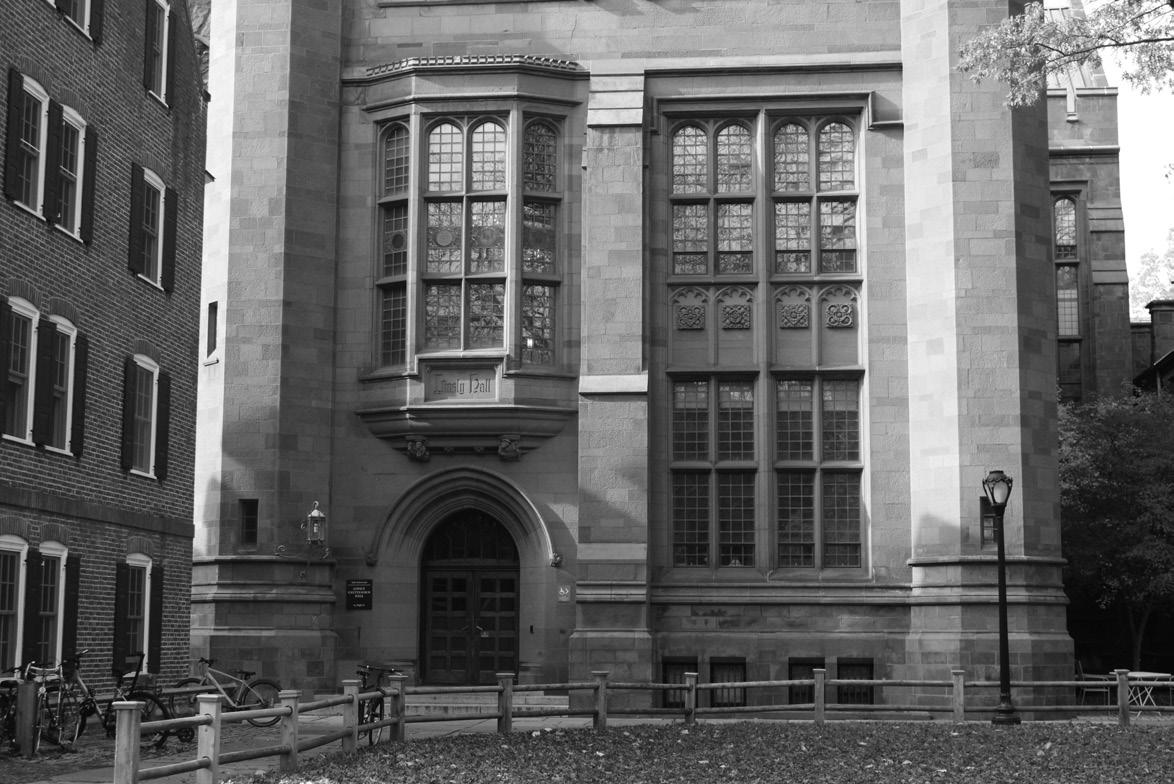
Shakespeare is something “one ought to know” before graduating. Valerie Calderon-Meyer ’27, who is registered to take Sheriko’s class this spring, told the News: “I feel like you see a lot of Shakespeare references in the media and honestly, I just wanted to be in the loop.”
Matt Letourneau ’27 wrote to the News that he wanted to take the course because his “mom and sisters love Shakespeare and his works, and I have fond memories from my childhood watching movie adaptations of his plays with them.”
Elias, the English department’s associate director of undergraduate
studies, also wrote that the department takes a broader approach to early modern literature, aiming to balance canonical courses with innovative offerings. He pointed to interdisciplinary classes such as “Black Shakespeare” — not offered in the spring semester — which examines the role of the Shakespearean canon in shaping ideas about race.
Bromwich last offered “Shakespeare’s Political Plays” in the spring of 2024.
Contact MELISSA ADAMANTIDI at melissa.adamantidi@yale.edu
BY HANA TILKSEW CONTRIBUTING REPORTER
Yale community members are taking textured hair care into their own hands, filling what they described as a void of accessible options for Black students’ hair in New Haven.
Current or recently graduated Black students interviewed by the News cited the strict policies of New Haven stylists, expensive beauty product prices and a shortage of affordable stores in close proximity to campus as obstacles to finding quality hair care.
As a Yale student, New York City-based influencer Sanaa Williams ’25 experienced difficulty finding a hairstylist that was affordable and matched her desires.
“If I ever wanted my hair in a specific style, I would usually just go back home to my stylist in New Jersey to get it done, which is kind of inconvenient,” Williams said in a phone interview.
In light of these difficulties, some have turned to student-run on-campus alternatives.
In 2024, students founded the Coily Curly Office to host workshops and give out products for curly hair. Faozia Coulibaly, daughter of Berkeley College fellow and dance instructor Lacina Coulibaly, has also been running her own braiding business through the Instagram account @yefa_hair_braiding since she moved to New Haven three years ago.
The Coily Curly Office’s Instagram page describes the group as “Yale’s only natural hair centered student org.” In the fall, the group hosted a cornrow and flat twist workshop and a wig installation workshop aimed at teaching students with textured hair to style it for themselves.
Getrude Jeruto ’26, a co-president and founding member of the Coily Curly Office, traced the organization’s roots to students’ needs.
“First of all, it was because of shared complaints about how expensive making your hair is over here and how long it takes,” she said in a phone interview.
“Everyone’s just talking about how expensive, how hard it is to take care of their hair.”
In addition to styling workshops, the organization has also partnered with hair care brands to provide free product samples for students with coils and curls. Last year, they partnered with L’Oreal. This year, they have partnered with Kinky-Curly.
While the Coily Curly Office has been able to collaborate with companies, they have had less success collaborating with local hairstylists, specifically braiders based in the New Haven area. Jeruto cited additional fees for arriving late or having thick hair as examples of “rules” that make it harder to work with some braiders.
“They’re very specific with their policies, or I think they just make it difficult and expensive as well,” Jeruto said, adding that if you bring a friend along to your appointment, some braiders may charge extra.
Even when a student with textured hair decides to do their own hair, acquiring the tools to do so can be a struggle in itself.
The upscale beauty retailer Bluemercury on Broadway sells a range of high-end products from brands that lie outside some student budgets. The Yale Bookstore has a small selection of curly hair care products, although some prices seem to have been marked up. For example, the Mielle hair oil sells for $9.99 at Target and $12.28 at the Bookstore.
Jeruto said the free samples provided by the Coily Curly Office can alleviate a financial burden. Beyond affordability, proximity is also a concern. Even when students are able to find stylists off campus, getting to the salon can be a challenge.
“As far as I know, I don’t think there was a stylist or place that people would go that was walking distance. I think people would have to take Ubers or borrow someone’s car,” Williams said.
That experience created an opportunity for Coulibaly, who
moved to New Haven from Burkina Faso three years ago.
“I started posting a lot on the Instagram and from that mouthto-mouth I started getting some customers,” Coulibaly said in a virtual interview. Her first client was a student of her father’s.
As she started braiding more clients, she would hear about their struggles concerning hair care. “Most of them was thinking about how difficult it was to find hair stylists at New Haven that was affordable for them, since they are students,” Coulibaly said.
Looking forward, Coulibaly wants to learn to install wigs for students who would like to wear them. While she does not see hairstyling as her long-term career, she is happy to provide a service for the time being that many students struggle to find elsewhere.
Beauty Plus, a beauty supply store that closed over the summer, was located at 827 Chapel St.
Contact HANA TILKSEW at hana.tilksew@yale.edu.
BY HANA TILKSEW CONTRIBUTING REPORTER
Behind the bar counter of Gordy’s Café on the third floor of Kroon Hall, School of Environment second-year Kaley Sperling ENV ’26 fills student mugs with pot coffee.
She’s part of the Brew Crew, the student-powered workforce running Gordy’s Café. For over a decade, Gordy’s has boasted affordability and sustainability, offering only vegan-friendly plant milk options and encouraging patrons to bring their own dishware.
“The price? It’s only $1.50 for
coffee and $1 for tea, which is cheaper than anywhere else on campus,” Sperling said in an interview.
Founding the cafe
When Huijia Phua ENV ’10 arrived in the United States from Singapore, she was shocked by the food scene around Kroon Hall, she said. Expecting the School of the Environment, then named the School of Forestry and Environmental Studies, to have a formal cafeteria or at least a dining area, she instead found a vending machine and food carts that would appear outside during lunch hours and disappear shortly after.
“The shock (food has always been integral to my well-being!) pushed me to find out whether other students and staff felt the need for a cafe—and not just any cafe, but one aligned with our school’s environmental and social ethos,” Phua wrote in an email to the News.
Determined to bring food to students at the school, Phua assembled a proposal for the cafe to be registered as an experientiallearning module — Environmentally and Socially Conscious Café at Yale. With six School of Management graduate students and one faculty advisor on board, the cafe launched into action.
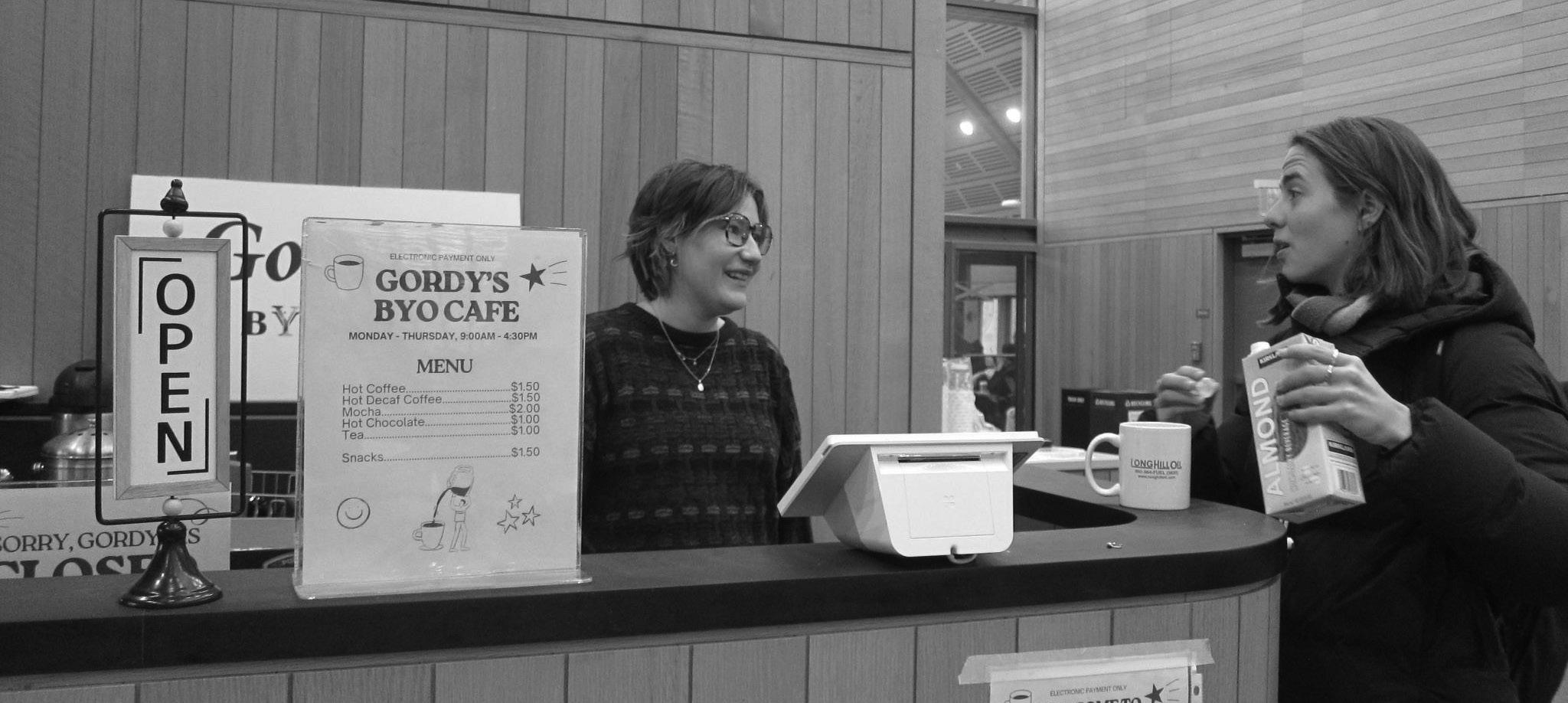
BYO — Bring Your Own —
Café had its first official twoweek trial run in 2008, attracting students from the Yale School of Environment, School of Management and Yale College, Phua wrote. The cafe composted coffee grounds, resold locally baked pastries and, true to its name, required that patrons bring their own mugs, plates and utensils.
Location was also key. Then newly built, the third floor of Kroon Hall possessed a built-in “cafe counter,” which received natural light that streamed through the building’s windows.
“Overlooking Sage Hall and walking paths, it was the kind of place where you instinctively breathe a little deeper, linger a little longer, and feel connected to the world just beyond the glass,” Phua wrote. “In other words, it was absolutely perfect to be the birthplace of a student-run cafe.”
After the first successful trial run, the cafe became a permanent fixture of the school in 2010, the News reported at the time. Student clubs regularly take over the cafe space, researchers display research posters and students use the space for between-class study breaks and socializing.
Although BYO Café was closed during COVID-19 when students were no longer available to work, it was reopened again in the fall of 2021 by Anna Feldman ENV ’23.
In 2022, the BYO Café was renamed to Gordy’s Café after Gordon Geballe GRD ’75 ’81 to recognize his contributions to the origin of the cafe.
“Gordon gave them $200 as startup funding, which was exciting,” Melanie Quigley, the associate dean of strategic initiatives, said in an interview. “With that, and support of the dean at the time, Peter Crane, and a professor who was supervising the project, Maureen Burke, they made it a reality.”
Gordy’s Café continues to encourage patrons to bring their own utensils and dishware.
Though, Sperling admits that, due to the frequency of catered events hosted around Kroon Hall, there are always spare single-use items staff incorporate into their collection should a student forget a plate or mug.
While the cafe has changed and evolved over time, the mantra and spirit of the students who run the cafe have kept it alive and running.
“I don’t think we’re going to increase the prices anytime soon,” Sperling said. “That would be really sad.”
Gordy’s Café sources its coffee from coffee roasters in Vermont, according to Sperling.
Contact MICHELLE SO at michelle.so@yale.edu.
“Take
the snow back with you where it came from on that day.”
SNOWBIRD ANNE MURRAY
BY EDIS MESIC AND DANI KLEIN STAFF REPORTERS
Morse students and fellow lipstick sculpture admirers gathered at the Morse Head of College’s house on Tuesday evening to commemorate the tank’s departure with some Lipstick trivia and light snacks.
Upon entering the house, students, alumni and friends were greeted with an array of assorted desserts and snacks — from eclairs to turkey meatballs — and a number of dogs trotting through the room.The lipstick sculpture is set to be removed by Thursday, Morse Head of College Catherine PanterBrick said, and it will be permanently relocated to the Yale University Art Gallery.
“Whether it’s the food or the Lipstick that brought people here, it’s fun to see Morse come out and to see my friends here,” Brennan Ujda ’28 said in an interview. “I’m sure I’ll go say hi to Head P-B and we’ll lament together about losing the Lipstick, but I’m happy to be here and glad that the house is full.”
The beloved Lipstick, formally named “Lipstick (Ascending) on Caterpillar Tracks,” was returned to Morse College in October following a three-month restoration project. Days later, the statue was vandalized with chalk. In an email to the News, Morse Head of College Catherine Panter-Brick said that it was being removed due to etchings reading “ATB” found in the
“underside” of the tank. The Lipstick was initially introduced to Yale’s campus in 1969 and stood in Hewitt Quadrangle until it was relocated to Morse’s courtyard in 1974 following repeated instances of vandalism. It has lived in the same spot in Morse for several decades.
While the crowd started off relatively small, eventually roughly 50 people filled the house, lining up for food and conversing about the Lipstick.
Panter-Brick initially invited students to join her for the farewell party last Wednesday, and she sent a follow-up email on Tuesday reminding the Morse community about the removal of the sculpture and the caution tape stationed around the Lipstick.
A few minutes into the event, Panter-Brick called students into the living room of her home and handed out stickers featuring the Lipstick sculpture to students who had to leave. She encouraged those who could stay to participate in a round of “lipstick trivia.”
Panter-Brick proceeded to read multiple-choice trivia questions off a television screen in front of a crowd of enthusiastic students.
The questions focused on topics such as when the lipstick was unveiled to the Yale community and what feature the original sculpture had that it no longer dons — an inflatable vinyl tip that was later replaced by metal.
Mary Christ, the campus art

collection registrar and a member of Yale’s Committee on Art in Public Spaces, said the lipstick was originally installed as a work of protest art and was always “meant to spark conversation, which it continues to do today.”
While the Lipstick will still be free to view and available to the public at the gallery, Christ said that the original artists created the Lipstick to function as a piece of art that people could engage with directly.
While the event had a lighthearted air, Rebekah Boitey ’27 said that Morse students genuinely love the sculpture and are “in mourning.”
“It’s sad to say goodbye to it,” Boitey said. “It’s nice that the Lipstick was somewhere that students got access to in their daily lives.”
“Lipstick (Ascending) on Caterpillar Tracks” was featured in the 1970 documentary “Bright College” Years by Peter Rosen. In one scene in the film, a student band performed their original song “Model City Blues” on a graffiti-covered Lipstick.
Contact EDIS MESIC at edis.mesic@yale.edu and DANI KLEIN at dani.klein@yale.edu.
BY CORINNE COWAN CONTRIBUTING REPORTER.
Yale’s Committee on Trust in Higher Education hosted former U.S. Associate Attorney General Vanita Gupta ’96, the director of the recently created Center for Law and Public Trust at the New York University law school, on Tuesday for a conversation and question session moderated by committee co-chair Beverly Gage ’94.
Gupta was the fourth speaker to participate in the committee’s conversation series, which aims to encourage debate about issues facing universities. The committee has previously hosted Harvard professor Danielle Allen, who leads a research lab focused on civic education, and NYU professor Jonathan Haidt, a social psychologist who warns about the harmful effects of social media.
On Tuesday, Gupta advocated for contending with different viewpoints while describing the connection between universities and civil rights.
“Institutions are often the best vehicle for ensuring social change and moving change forward,” Gupta said to a group of more than 25 attendees in a William L. Harkness Hall classroom.
Reflecting on her experience in policy reform, Gupta said that the widespread lack of trust in institutions undermines their ability to advance the rule of law and civil liberties.
Gupta encouraged the committee to ask questions about free speech and seek out evidence-based approaches to its mission, which includes discovering the root of public mistrust in universities and providing recommendations to University President Maurie McInnis about how to repair trust.
“One of our major goals was actually soliciting a real range of views,” committee co-chair and sociology professor Julia Adams said in an interview.
Conceding that critiques of universities and institutions are “real,” Gupta emphasized the need to resist falling into destructive solutions to public mistrust.
“I hope this committee will actually go where the evidence is, rather than using polemic and rhetoric to address what may be particular problems that are endemic to our institutions,” Gupta said.
Gupta and audience members alike pointed to a perceived limitation of free speech in academic settings as a central cause of public mistrust of higher education. Gupta identified what she views as key questions for the
committee to discuss during the conversation.
“What is free speech? And what does it mean for students to be exposed to the broader set of viewpoints out there on any particular issue, but also feel safe on campus?” she asked.
Much of Gupta’s talk was centered on how she spent much of her career working to bolster democratic norms. She called institutions such as Congress the “fora for fighting for the expansion of rights.”
“It’s important to contend with all of the arguments,” Gupta said.
Additionally, Gupta said she’s noticed in her line of work that problems related to speech and civil dialogue are spreading.
“Breakdown in civil discourse and the ability to disagree, to have a conversation, to show respect to these public servants, I think is incredibly disastrous,” she said.
Gage, said in an interview that defining the mission of Yale — of liberal arts institutions and of universities, generally — is a focus area for the committee.
“Universities over the last twenty years have come to mean so many different things to so many different constituencies,” Gage said.
Gupta also said that the public perception of the mission of universities is critical.
“Part of it is a communications problem about why should people give a damn about what happens at universities,” Gupta said.
One attendee asked a question about the connection between erosion of trust in institutions and trust in leadership of those institutions.
Gupta admitted she believes the United States is facing a crisis in ethical leadership and corruption and expressed a desire to see a “national movement” of civics and ethics education in America.
“Too few of our kids understand our government, democracy, what it needs to do, why certain things matter, why institutions were created to solve what problems, et cetera,” Gupta said.
For Black studies professor Phillip Atiba Solomon, Gupta’s visit carried significance for the future.
“Her coming here and deciding that the struggle for the rebirth or reconstruction of legitimacy in higher education is a non-trivial thing,” Solomon said.
The Committee on Trust in Higher Education will host four more conversations with guests in the spring semester.
Contact CORRINE COWAN at corinne.cowan@yale.edu.
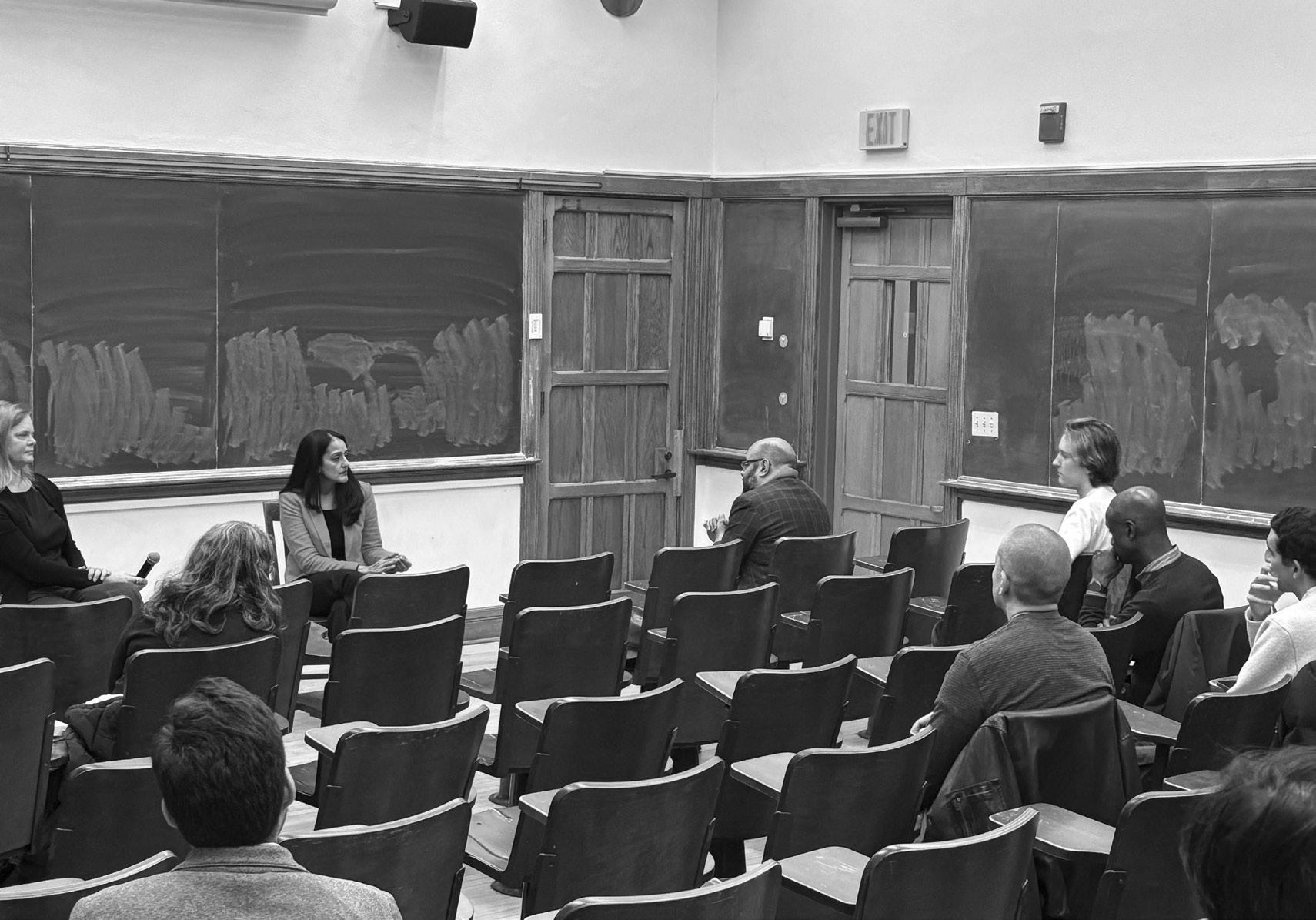

teams in college football this year. On the offensive side of the ball, they have supplemented a solid passing attack with an overwhelming ground game, thanks in part to their sizable offensive line.
Passing the ball, Justin Lamson has been efficient this year, having thrown for 2,345 yards, 20 touchdowns, and just two interceptions. He has completed 72.4 percent of his passes, making him the sixth-ranked quarterback for passing efficiency in the FCS. On the receiving end, the Bobcats have several solid passcatchers but have been led in large part by wideout Taco Dowler, who has hauled in 745 yards and five touchdowns in 12 games.
Montana State has been running wild on teams all season, having rushed for an astounding average of 233.5 yards per game. Backs Julius Davis, Adam Jones and Colson Coon have shouldered much of the load, having run for over 1,800 yards of the team’s 3000 yards as a group. Lamson has also added 589 rushing yards of his own, proving to be a serious dual threat.
The ’Dogs’ keys to victory Yale players know that they have a tough battle ahead of them this weekend. In their first year ever playing in the playoffs, they
will be traveling to the sold-out stadium of the No. 2 team in the FCS. However, beating the odds is nothing new for this group.
The Bulldogs took on No. 10 Harvard during the annual playing of The Game and wiped the floor with them. The next week, Yale was given a 0.2 percent chance of coming back against Youngstown State due to their 28-point deficit, but they fought back and ended the game in victory formation yet again.
“Yale brings in a very resilient team,” Montana State coach Brent Vigen told Montana Sports. “The type of comeback they had on Saturday doesn’t come about for the faint of heart. How they got it done and how they put it together at the core of it had to be a ton of belief. Awfully impressive for them to win that game.”
On the offensive side, it will be vital for Yale to get off to a better start this weekend to have a chance against Montana State. Last weekend, nearly every Bulldog drive in the first half resulted in a punt or turnover. While Yale clawed itself back into the game in the second half, the Bulldogs will not have as much room for error against this superb Montana State team.
Dante Reno ’28 should have wide receiver Nico Brown ’26 back on the field this week, but Reno will also have to rely on some of
his younger receivers after Jaxton Santiago ’28 went down on Saturday with a season-ending injury against Youngstown State. Working in short, quick-hitters to avoid the Bobcats’ pass rush will help to get the ‘Dogs in a good rhythm and could allow the high-tempo, star-studded offense to shine.
On defense, having passrusher Ezekiel Larry ’27 back on the field would be a huge addition
for Yale as they face Montana State’s beefed-up offensive line, possibly the best the Bulldogs have seen all season.
“They do a really good job of combining the two most important parts of a successful offensive line, tremendous size and good speed,” defensive lineman Mack Johnson ’28 said.
The Bulldogs will have a hard time directly overpowering the Bobcats’ line and will need to employ various stunts and strategies to pressure the quarterback and limit the effectiveness of Montana State’s run game.
The Bulldogs kick off against Montana State at 2 p.m. EST on Saturday in Bozeman, Montana.
Contact BRODY GILKISON at brody.gilkison@yale.edu.
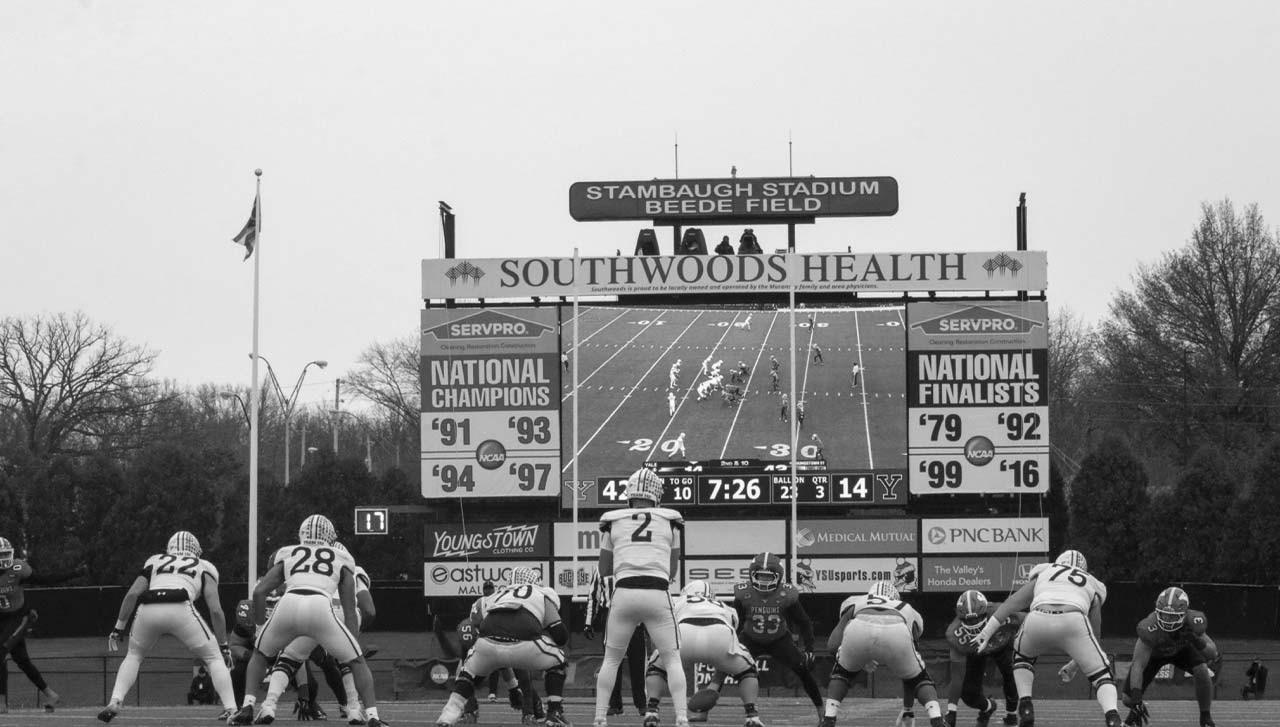
BY AUDREY KIM CONTRIBUTING REPORTER
When the Yale Bulldogs (9–2, 6–1 Ivy) face the Montana State Bobcats (10–2, 8–0 Big Sky) on Saturday in the second round of the Football Championship Subdivision playoffs, they will have to brave frigid temperatures in a hostile road environment just like they did last week in Youngstown, Ohio.
The Weather Channel predicts the temperature in Bozeman on Saturday to be between 27 and 37 degrees fahrenheit. Snow is also forecasted to fall in Bozeman Thursday through Saturday — a
weather challenge the Elis have not yet encountered this season.
“The snow makes the ball slippery so passing is more difficult. You want to ‘take the air out of the ball’ and run it more often,” offensive lineman Charlie Humphreys ’28 said. “Skill positions, receivers and defensive backs, both have a more difficult time cutting back and forth on the snowy ground. I will also say hitting in the cold hurts more, but that doesn’t affect strategy or decision making in any way, it just kind of sucks.”
Playing in the snow will require the Bulldogs to make notable adjustments, particularly for
making or defending pass plays. Receivers and defensive backs are required to constantly run across the field and keep their eyes on their opponent and the ball. However, snow in the air can decrease visibility for players, and snow on the ground can make it slippery and harder for players to maneuver.
This means that Yale will likely be relying on the run game even more than usual this weekend, and that fans can expect a large load for team captain and star running back Josh Pitsenberger ’26. Pitsenberger was named the 2025 Ivy offensive player of the year and played a key role in the Bulldogs’ victory over Youngstown
State, scoring three touchdowns and rushing for 209 yards.
The weather can also change the pressure of the ball — a change that could potentially affect the effectiveness of quarterback Dante Reno ’28.
The Bulldogs will also be playing at a higher elevation than they have all season. Bozeman has an elevation of roughly 4,800 feet, while New Haven’s recorded elevation is 59 feet.
At higher elevations, there is less oxygen in the air, which can cause altitude sickness and reduced stamina. Typically, 4,800 feet is not a high enough elevation to induce
altitude sickness, but the Elis will have to adjust to the thin air in addition to the snow.
Though players have acknowledged the unfamiliar weather and altitude, they say they aren’t dwelling on those circumstances as they embark for Bozeman.
“All we can do is focus on the things we can control,” kicker Nick Conforti ’26 told the News.
The Saturday forecast for Bozeman is cloudy with morning snow showers.
Contact AUDREY KIM at audrey.kim.ajk234@yale.edu
BY LIZA KAUFMAN STAFF REPORTER
When the Bulldogs face the Montana State Bobcats (10–2, 8–0 Big Sky) in the second round of the Football Championship Subdivision (FCS) playoffs on Saturday, the Yale football team (9–2, 6–1 Ivy) will be playing its first December game since its 28-0 victory in the 1945 YaleHarvard game.
The game marks numerous historic moments for the Bulldogs. It will be the team’s first time playing a 12th game in one season since 1903, according to a Yale Athletics news release.
Saturday’s game will also be the first meeting between the Bulldogs and Bobcats in football. While Yale has played Montana State in other sports — including when the men’s basketball team beat the Bobcats 78-65 in 1969 — this game will be the football team’s first time playing a Big Sky opponent since they beat Cal Poly 24-10 in 2013.
The Bobcats finished their regular season with a 10–2 record and a perfect 8–0 record in conference play. The Bobcats opened the 2025 season with a
devastating 59-13 loss at No. 7 Oregon (11–1, 8–1 Big Ten), a dominant Power Four school, and then fell bitterly to South Dakota State (9–4, 4–4 MVFC), the 2022 and 2023 FCS champions, 24-30 in double overtime.
However, since dropping their opening games, the Bobcats have not looked back, putting a stop to every team they have faced since.
The 10-game winning streak started with three home victories. First, the Bobcats annihilated San Diego (8–4, 6–2 PFL) 41-7, then they shut out Mercyhurst (5–7, 4–3 NEC) 17-0, and lastly, they capped off the homestand with a 57-3 victory over Big Sky conference opponent Eastern Washington (5–7, 4–4 Big Sky), where the only points scored against them came from a 63-yard field goal. Montana State then proved their road toughness, picking up a 34-10 victory against Northern Arizona (7–5, 4–4 Big Sky) in Flagstaff, Arizona. On Nov. 28, Montana State was named the Big Sky Commissioner’s team of the month following a decisive away victory over Northern Colorado (4–8, 2–6 Big Sky) 55-7, a home victory over
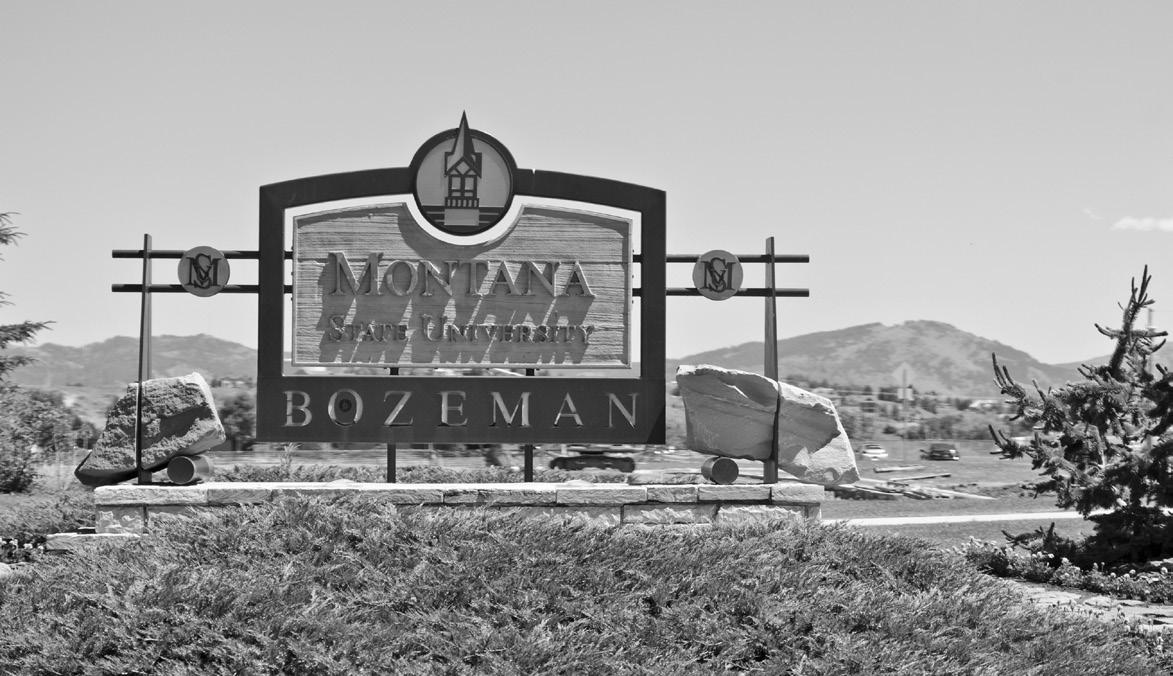
Weber State (4–8, 2–6 Big Sky) 66-14, and a 24-unanswered point comeback over No. 9 UC Davis (8–3, 6–2 Big Sky) to finish 38-17 after the Aggies took a 7-0 lead. However, their most important victory of the season came against their in-state Big Sky rival, the University of Montana Grizzlies (11–1, 7–1 Big Sky). The Bobcats edged out the Grizzlies 31-28 in Missoula, Montana, to clinch the Big Sky Conference title outright, their third conference title in the last four seasons. The University of Montana finished second in the Big Sky with a 11–1 overall record and 7–1 conference record, their sole loss coming to Montana State.
Following the close of the regular season, the Bobcats earned a bye to the second round of the FCS playoffs. Montana State, which is making its 14th playoff appearance, won the FCS championship in 1984 and was the runner up in 2021 and 2024. In both years, Montana State fell to North Dakota State (12–0, 8–0 MVFC) 10-38 in 2021 and 32-25 in 2024.
Last season, the Bobcats went 9-0 at home and 6-0 away, with the only loss of the season to North Dakota State on neutral territory in Frisco, Texas. North Dakota State has dominated the FCS since 2011, having claimed 10 championship titles and one runner-up title over the last 14 years. This season, the Bison are the No. 1 seed (12–0, 8–0 MVFC) in the FCS.
The current Montana State team pairs the Big Sky’s second-best offense with its best defense.
The offense averages 38.2 points per game, making the Bobcats one of the most explosive, efficient teams in
the FCS. The team also boasts a high points-after-touchdown efficiency with 56 extra-point conversions and typically outscores opponents by 21 points per game, combining explosive scoring with remarkable consistency.
Meanwhile, the Bobcats’ defense ranks first in the conference, having given up just 17.2 points per game. They allowed fewer touchdowns in a season than most Big Sky teams allowed in conference play alone.
Montana State recently picked up a number of conference accolades. Caden Dowler, a junior defensive back, was named the Big Sky defensive player of the year. This season, he has totaled 78 tackles and four interceptions. Freshman quarterback Justin Lamson was named newcomer of the year. Lamson has been remarkably efficient, completing 72.39 percent of his passes for 2,345 yards. On 268 spirals, he has thrown for 20 touchdowns and just two interceptions all season. Head coach Brent Vigen was also recognized as coach of the year.
Though Montana looks to be a tough team to beat, the Bulldogs have also racked up all the Ivy League football accolades this season.
Junior defensive back Abu Kamara ’27 defines the defensive line in the Ivy League and was named Ivy League defensive player of the year. Kamara is Yale’s most disruptive defensive back and leads the team with 11 pass breakups by contributing in every phase of the defense. With 70 tackles, 3.5 sacks and six tackles for loss, he’s as active defending the run and blitzing as he is in coverage. Kamara is also a Buck Buchanan Award finalist, a nomination which recognizes
him as one of the top 30 defensive players in FCS.
Team 152 Captain Josh Pitsenberger ’26, the Ivy League offensive player of the year, has anchored Yale’s offense with 1,447 rushing yards on 287 carries and 18 touchdowns. He has only lost 31 yards this season, a true testament to him as a workhorse running back.
Pitsenberger has averaged more than 120 rushing yards in eight of the 11 games this season and has six multi-touchdown games. His best performance came in last weekend’s historic 43-42 playoff victory over the Youngstown State Penguins when he had 32 carries and rushed 209 yards for three touchdowns. Pitsenberger is also a Walter Payton Award finalist. With this finalist nomination, Pitsenberger is recognized as one of the top 30 offensive players in FCS.
Head coach Tony Reno and his staff were also named the Ivy League coaching staff of the year.
Saturday’s meeting in Bozeman marks a rare moment for Yale: a December game, a cross-country trip and a chance to measure itself against one of the FCS’s premier programs. Against a Montana State team riding a ten-game winning streak and boasting award winners on both sides of the ball, the Bulldogs will need their own Ivy League honorees to deliver once again. With a berth in the FCS quarterfinals on the line, Yale enters the weekend with a chance to extend a historic season and to prove it belongs on the national football stage. The matchup between the Bulldogs and the Bobcats will be streamed on ESPN+.
Contact LIZA KAUFMAN at liza.kaufman@yale.edu
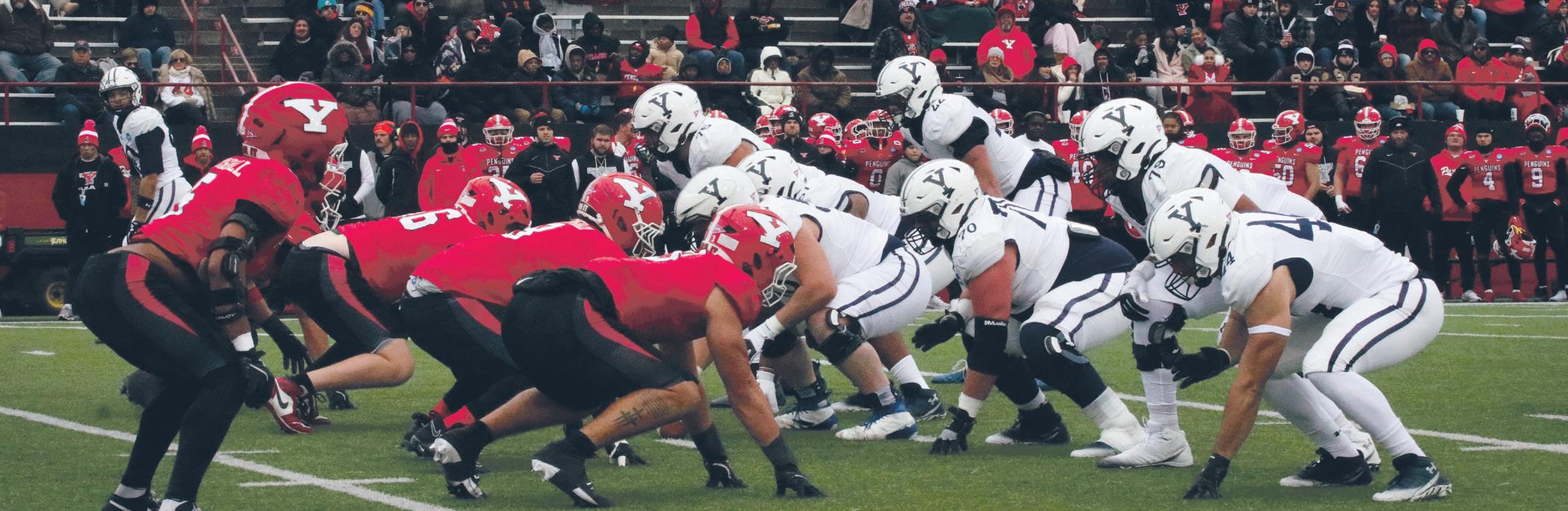

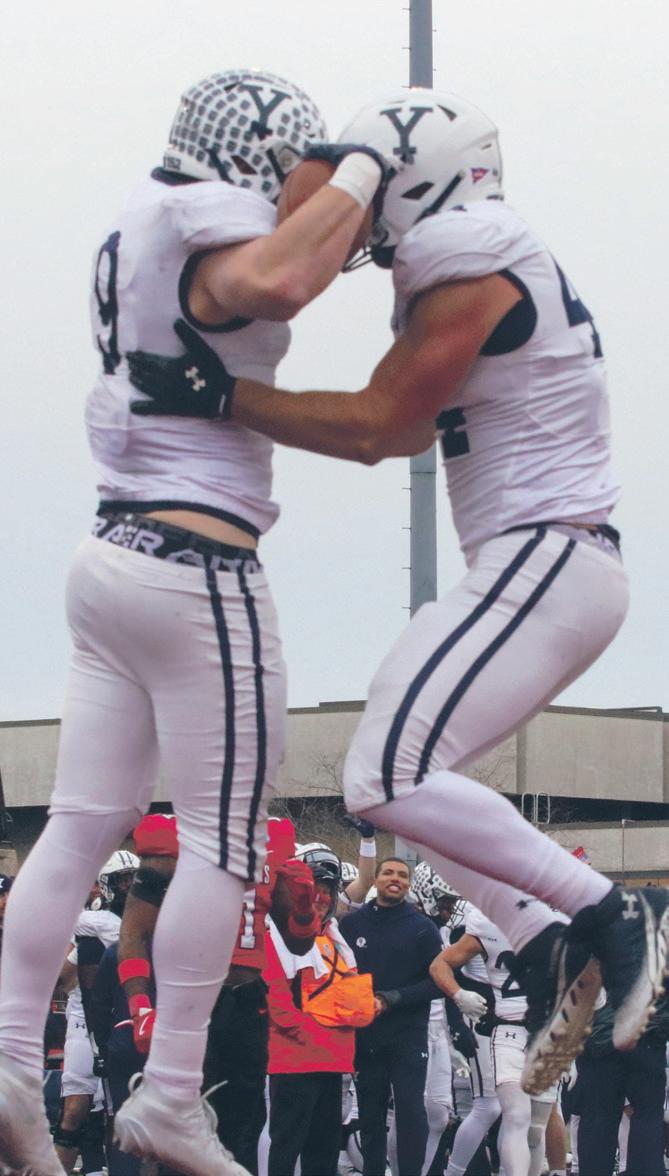
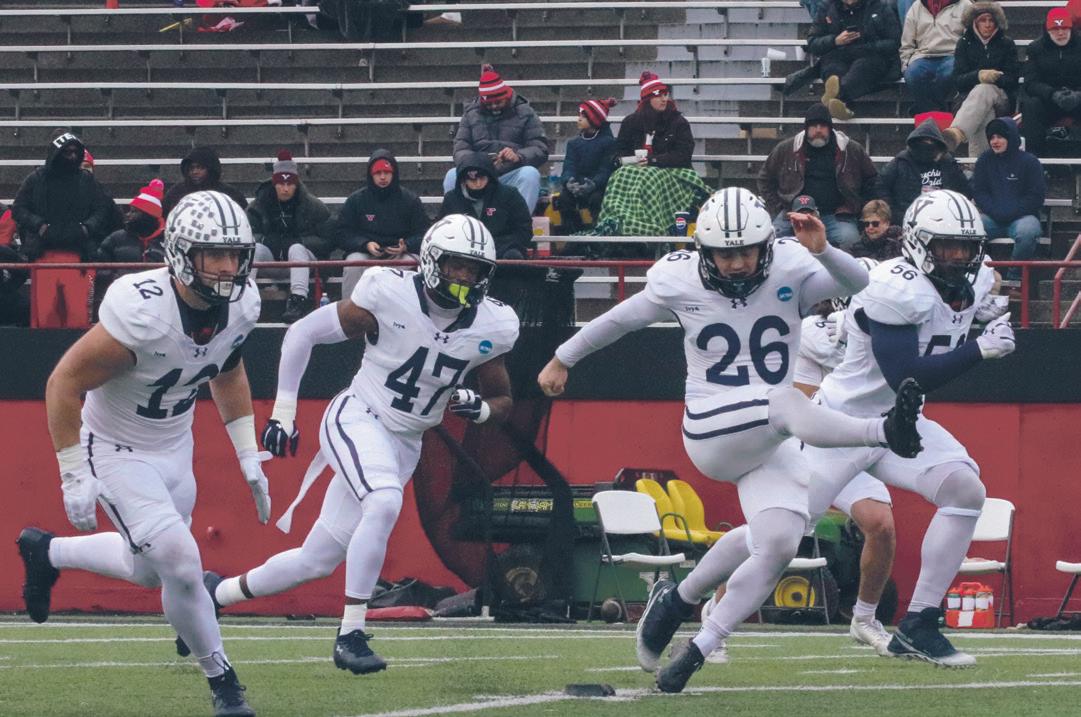
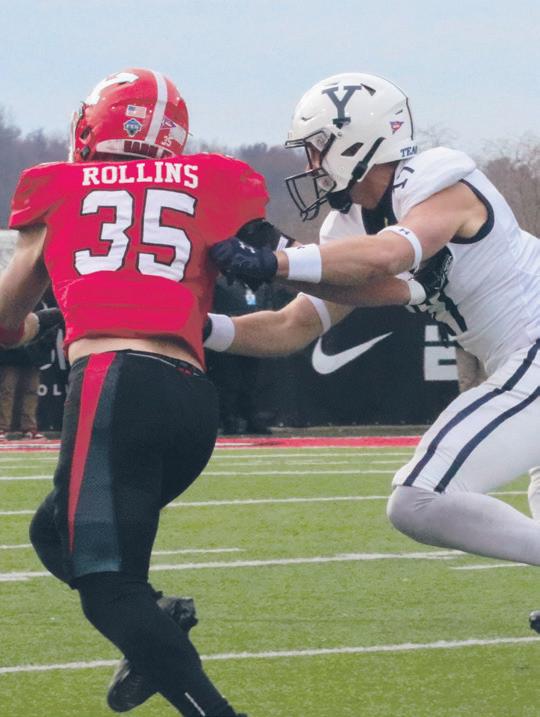
Photographs by Christina Lee Senior Photographer
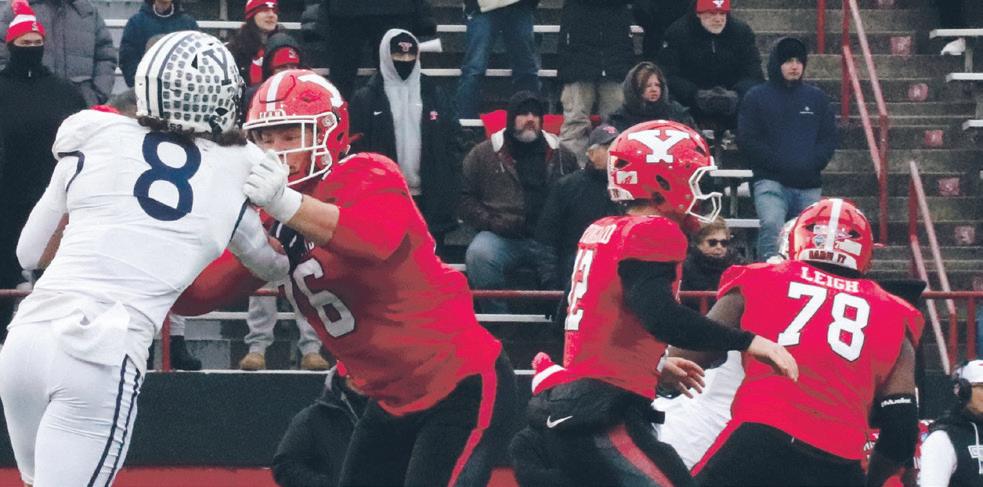
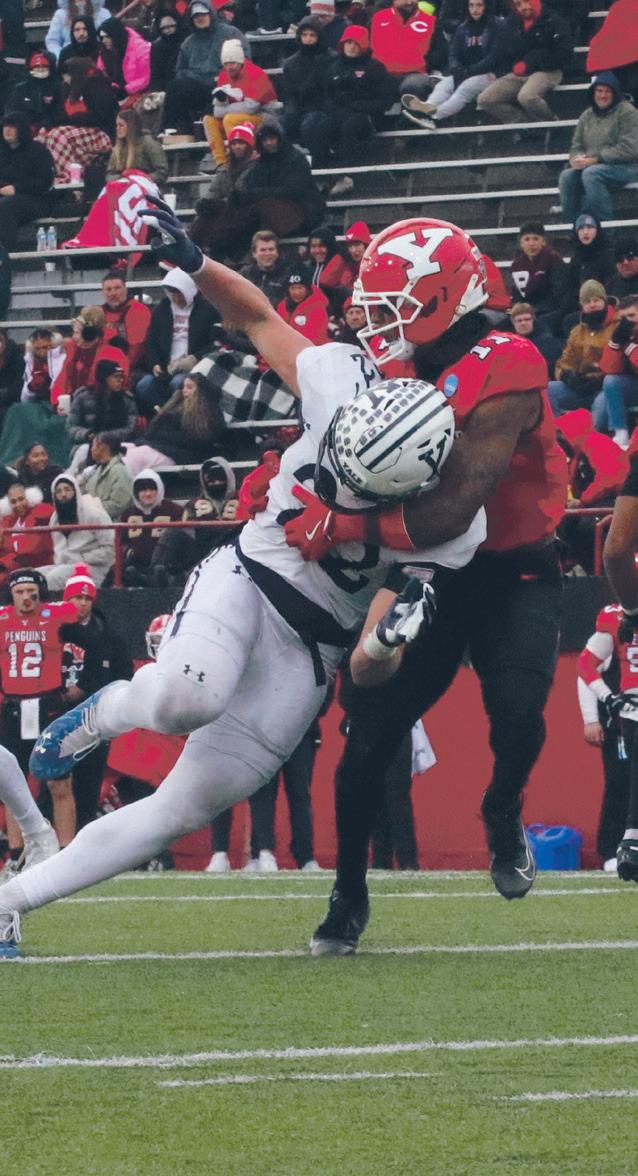
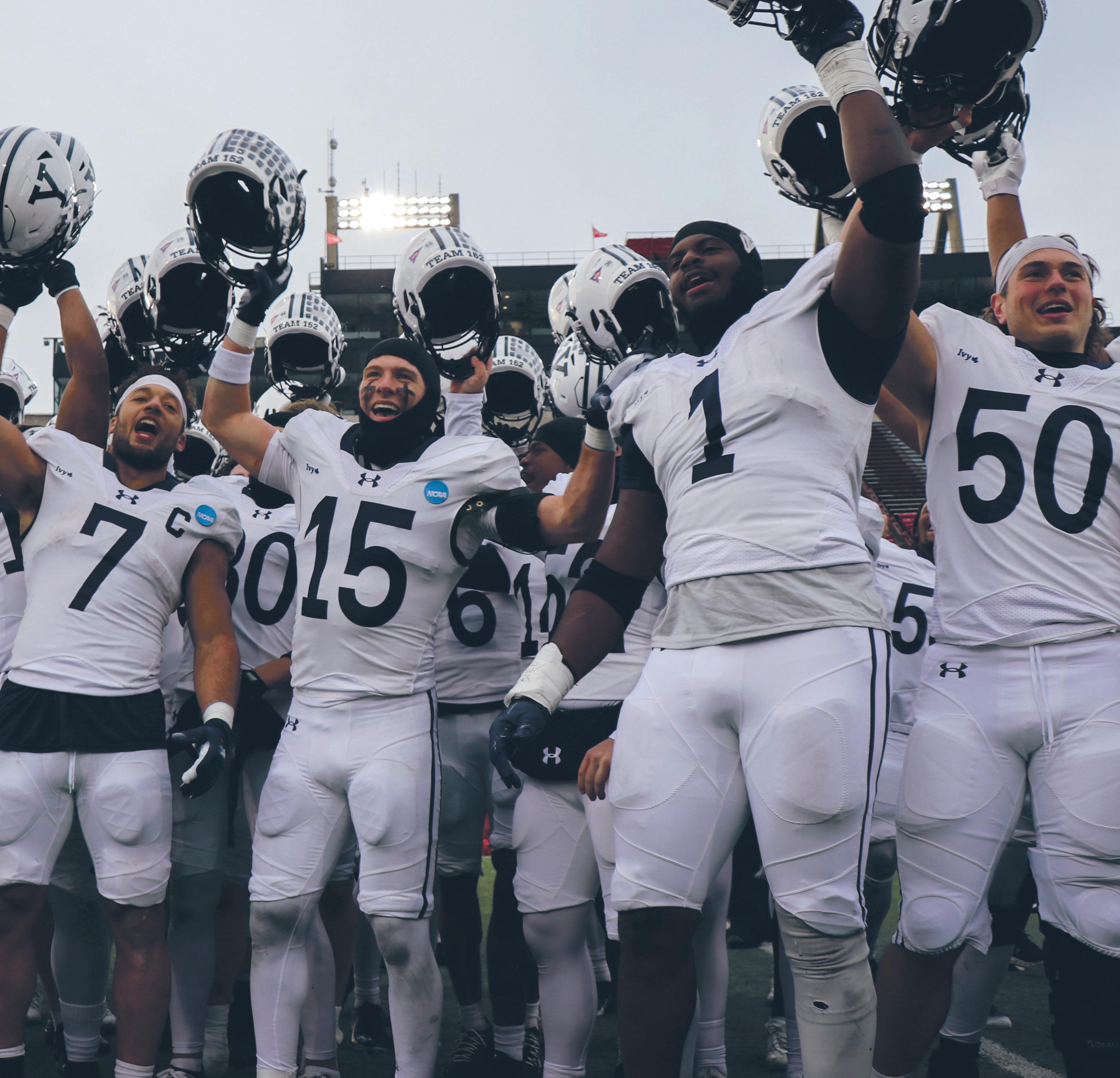
12:10 p.m. | The Penguins draw first blood with a 23-yard Beau Brungard to Max Tomczak touchdown pass, putting YSU up 7–0 with 11:35 to go in the first.
12:22 p.m. | The Bulldogs seem to have no answers for Brungard’s dynamic style of play. After bobbing and weaving his way down the field, he punched the ball in for the Penguins’ second touchdown of the day, putting YSU up 14–0.
12:59 p.m. | Brungard and Tomczak connected for their second touchdown of the day, putting YSU up 21–0. After a few solid series by the Bulldog defense, the Penguins regained control. Yale is slowly digging itself into a hole that will be tough to get out of as time ticks off the clock.
Bulldogs fans in the stands are visibly frustrated, silent and frowning as they watch the play pan out.
1:05 p.m. | Yale scored its first touchdown of the day with a Pitsenberger-rushing touchdown to cut into the Penguins’ lead. The Bulldogs found success running the ball on this drive, with Pitsenberger picking up several chunk yardage plays. In the stands, thrill and relief are palpable. A group of players’ parents high-five, cheers explode and a mother embraces her son.
1:28 p.m. | Brungard waltzes into the end zone yet again, putting the Penguins up 35–7 at the half. The Bulldogs’ first playoff game is not looking good.
2:20 p.m. | Yale quickly marches their way down the field, and Pitsenberger punches it in for his second touchdown of the day, cutting YSU’s lead to 42–21. The offense seems to have woken up.
2:30 p.m. | Abu Kamara ’27 scoops up the ball after Youngstown State fumbles, and the Bulldogs retake possession in Penguin territory. Yale’s crowd immediately jumps to their feet and erupts with cheers, and a player on the sideline picks up and starts slapping a tin trash can with “Team 152” spraypainted on its side.
2:57 p.m. | GRAHAM SMITH TOUCHDOWN! On fourth down, Reno connected with his tight end for another Bulldog score, making the score 42–36 in favor of YSU. Since halftime, the Bulldogs have narrowed the Penguins’ lede from 28 to 6.
3:04 p.m. | JOSH. PITSENBERGER. TOUCHDOWN. 43-42 ‘DOGS ON TOP WITH 2 MINUTES TO GO.
3:20 p.m. | BULLDOGS ARE HEADED TO MONTANA. 43-42 Yale.
3:40 p.m. | A group of alumni and fans break out into the Yale fight song as the team revels in their win on the field. “What a comeback,” someone comments. “What a game,” another chimes in. Players come to the stands to greet family. Marshall Howe ’26 climbs up the side of the stands to embrace his mother.
GILKISON

“Skill positions, receivers and defensive backs, both have a

BY INEZ CHUIDIAN STAFF REPORTER
This weekend marks the beginning of the competitive indoor track and field season for Yale.
Although many of the runners have already competed this year during cross country season, the team’s sprinters, throwers and jumpers will make their debuts of the school year this weekend. Competition season will officially start at the Penn Opener on Friday when multiathletes — those who participate in the heptathlon and decathlon — will compete. Athletes in all other events will begin competition at the Yale Opener on Saturday.
Members of the men’s and women’s cross country teams, who often run middle to long distances during track season, will be ready for competition. Last month, both squads took home fifth place at the NCAA cross country regionals last month. For athletes in other events, this semester has consisted of strategic preseason training to maximize performance during competition.
Track and field is a team sport as much as it is an individual one. While athletes finish within their own heats and events, their results are tallied up to produce a team score, which makes individual efforts in skill development integral to the season’s outcome.
With 23 seniors graduating last spring and 27 new recruits joining this fall, the team has seen significant change since last December.
“I feel much pride in getting to lead this team,” Andrew Farr ’26, the new men’s team captain, said in an interview. “The most meaningful part of the role has been when teammates come to me for advice. My role as captain is so much bigger than leading workouts or meeting with the coaches. It’s about building a community.”
Last season, Makayla White ’26, the new women’s team captain, competed as a multiathlete for the first time. It is within these disciplines, she says, that she learned to lead the team from within. “Stepping into this role as Captain felt like a natural next step,” she wrote to the News.
Looking ahead, the Bulldogs will be competing in several new meets that they did not attend last season. With inaugural races like the Yale-DartmouthColumbia meet and new additions such as the Boston University Distance Medley Relay Challenge, the season is stacked with opportunities for the team to dominate.
In describing recent weeks of training, Farr was confident in his team’s preparations.
“We are the most ready going into this first meet than we’ve felt in my four years here,” he wrote in a text message.
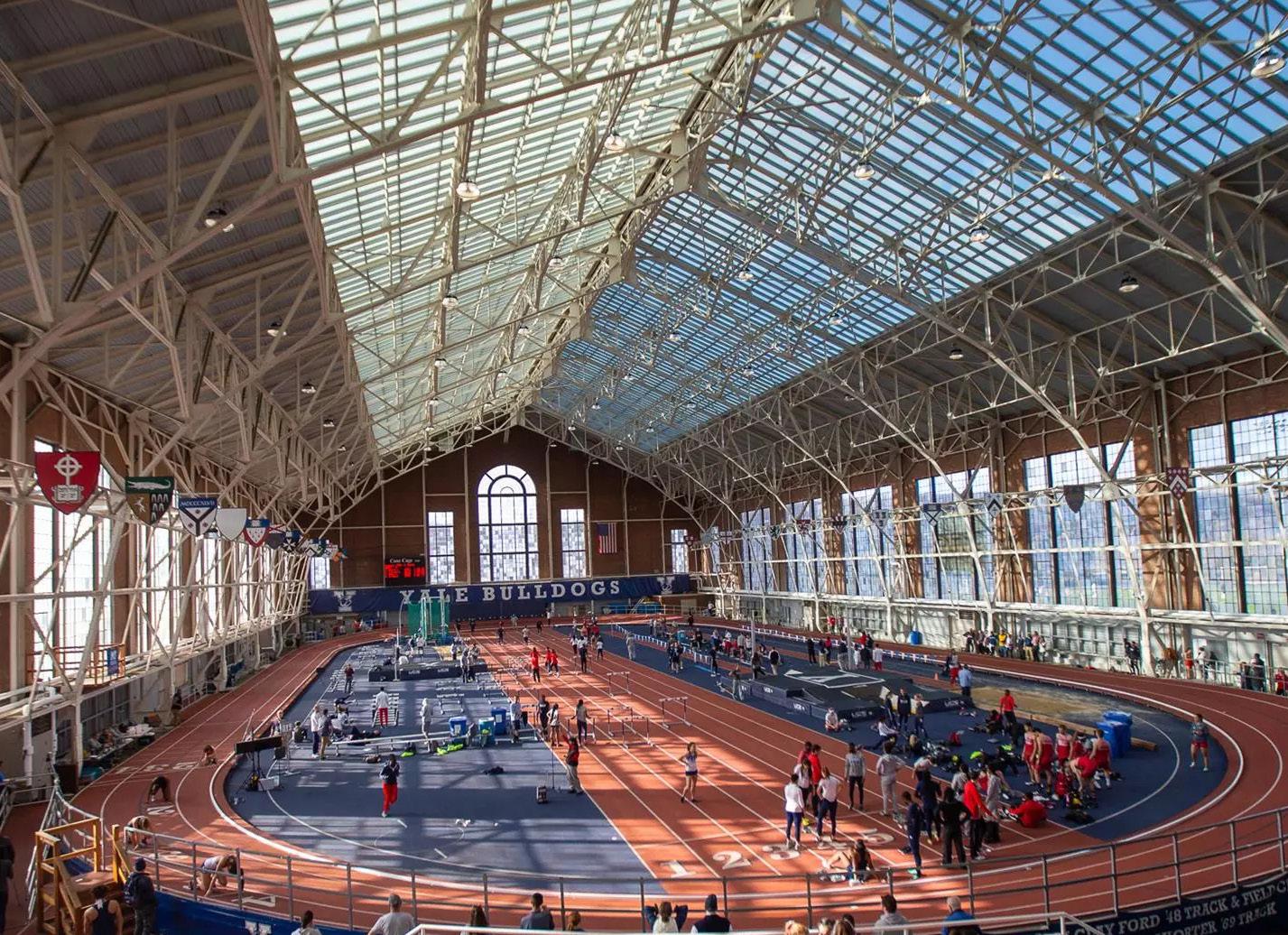
“The 2024-2025 season was plagued with injury,” former captain Jacob Kao ’25 wrote to the News. “A lot of the guys really excelled early on in the indoor and outdoor seasons, but by the end were nursing enough injuries to significantly affect overall performance.”
The Bulldogs ended last season at the Ivy League Heptagonal Championship, where the women secured fifth and the men finished sixth. This year, however, the Bulldogs have changed their gameplan.
“In my freshman and sophomore years, we undertrained. Last year,
we overtrained,” Farr said. “This year, I think we finally found that sweet spot.”
The Penn Opener will take place in Philadelphia on Friday.
Contact INEZ CHUIDIAN at inez.chuidian@yale.edu.

BY WALTER ROYAL STAFF REPORTER
The Yale men’s basketball team (9–1) extended its winning streak to five on Wednesday night, cruising past the Brandeis University Judges (3–5) at John J. Lee Amphitheater.
In the second of two back-toback exhibition games against NCAA Division III opponents, 12 different Bulldogs saw the floor once again — more than the usual eight-, nine-, or ten-man rotations Yale head coach James Jones typically employs.
“It felt really good just to get some more experience on the court. It’s definitely going to benefit us to feel more comfortable and confident when we get our number called again,” center Jack Sullivan ’29 said.
A first-year stretch big, Sullivan has looked excellent in limited time this year, shooting 42 percent from three-point range and tallying a block per game. He grabbed a career-high five rebounds against Brandeis.
BY RACHEL MAK STAFF REPORTER
The men’s (0–1, 0–0 Ivy) and women’s (0–1, 0–0 Ivy) squash teams will take on the Drexel University Dragons at home on Saturday. Last year, the teams played at Drexel, with Yale emerging victorious on both ends. The women’s team crushed the Dragons 8-1 last season, with only one match going to five games.
The one loss came from Meha Shah ’28 retiring from the match. This season, the Elis return four players who were victorious at last year’s matchup, including
The Eli offense took the better part of six minutes to get going, with just a three-point lead at the 14-minute mark. Following a subsequent 8-0 run, the score stood at 19-8 with just over 11 minutes remaining in the first half. The Bulldogs then settled in, gradually growing the lead to 37-24 by the half.
Though Yale never had less than a 99.7-percent win probability at any point in the game, per ESPN’s forecasting, Yale did not ease up in the second half.
“They had a really good game plan, and we didn’t want to get outside of ourselves by trying to change the pace of the game,” Jones said in a Yale Athletics news release.
With the absence of 6-foot11-inch center Samson Aletan ’27, 6-foot-1-inch point guard Trevor Mullin ’27 stepped up and made the play of the game on defense early in the second half, swatting a would-be layup into the bleachers.
On the other end of the court, Isaac Celiscar ’28 converted a tough and-one play two minutes later, further energizing the home crowd. Yale kept a dou -
Heng Wai Wong ’28 at the No. 1 position, Spring Ma ’28 at No. 2, Whitney Taylor ’26 at No. 5 and Layla Johnson ’27 at No. 7.
“We are more prepared and equally excited as we were for the first match,” Wong wrote to the News. “I think overall the team is more settled in going into the Drexel match, and I really want us to do well and I really want us to have a great year end.”
The men’s team has won its past five matchups against Drexel.
In the last meeting, the Bulldogs defeated the Dragons 7-2. Four of the wins came from players who have returned to this year’s roster,
including Tad Carney ’26, who is now at the No. 1 position, Rohan Gondi ’28 at No. 4, Jack O’Flynn ’27 at No. 7 and Rishi Srivastava ’28 at No. 9.
“We’re super excited to play this weekend,” Carney wrote to the News. “We’ve been working hard after the UVA match, and are looking forward to putting our best foot forward.”
Yale will face Drexel in the Brady Squash Center on Saturday at 1 p.m.
Contact RACHEL MAK at rachel.mak@yale.edu.
ble-digit lead for the duration of the half, with the score at 79-61 when time expired.
Captain Nick Townsend ’26 led the Bulldogs on the day with 18 points and 11 rebounds. Celiscar and Riley Fox ’28 also scored in double figures, with 16 and 11, respectively.
Jones had high praise for the Judges postgame. He also remarked on the difficulty of Yale’s recent schedule, in which the Elis played six games in three different states or territories over the span of 12 days.
“It’s been a very difficult stretch, with all the traveling and back-to-back games, and I’m happy that the team gets tomorrow off since they haven't had a day off this week. We’ll practice Friday and Saturday in preparation for Sunday,” Jones said. Sunday’s game will come against the University of Illinois-Chicago (4–4). Tip-off is at 2 p.m. at the John J. Lee Amphitheater.
Contact WALTER ROYAL at walter.royal@yale.edu.
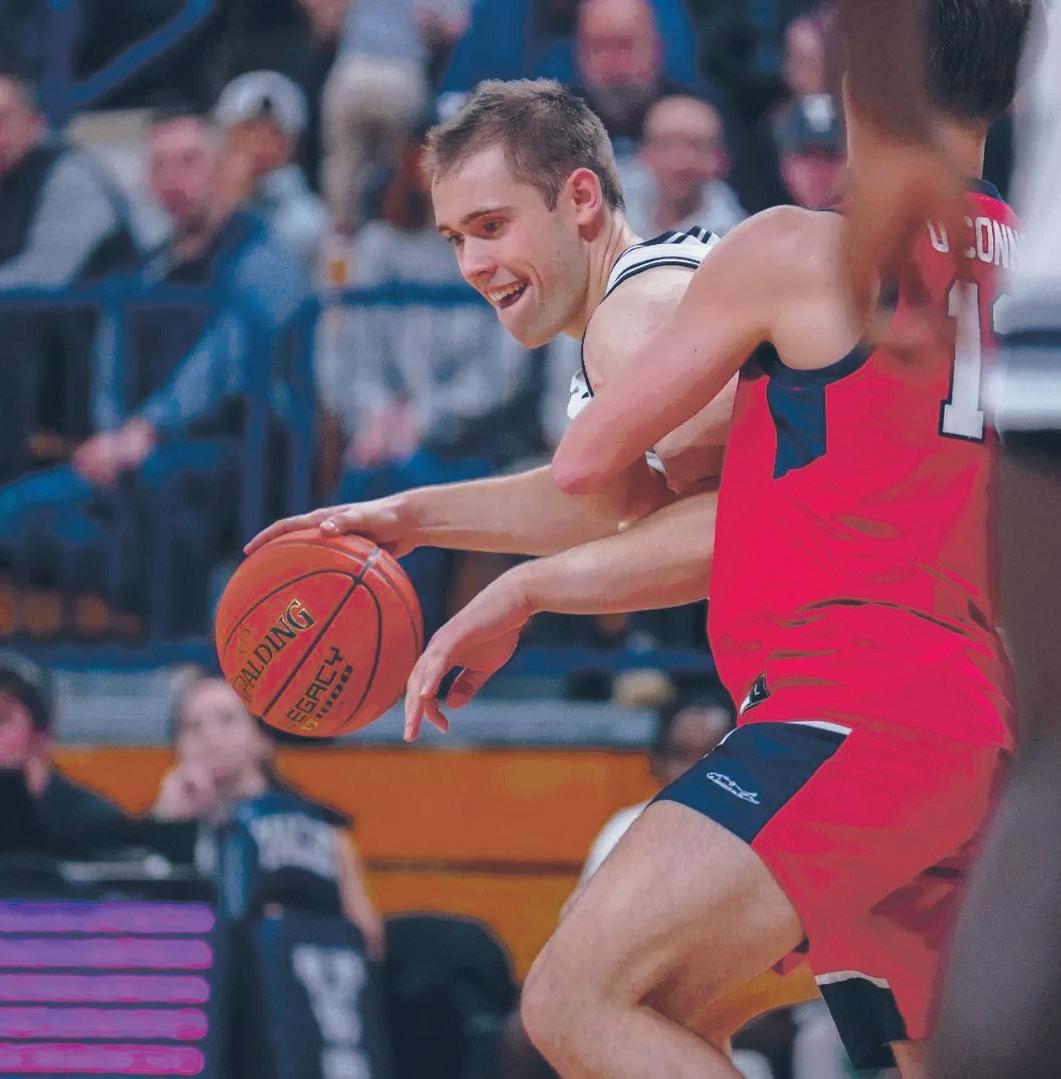


BY MADISEN FINCH
Naively, I started this semester assuming that the ominous Credit/D/Fail passes given to each Yale student would not be something I used. I assumed that because I had persevered through failed quizzes, college applications and the trials of course selection, I was safe from the safety net Yale constructed. I was, unsurprisingly, very wrong.
Yale emphasizes the transformative nature of the liberal arts environment, and that regardless of personal and academic histories, every single student has a place on campus. While this may be true, the feeling of using the help the University offers created a sense of dread within me. Coming from a group of students who so rarely fail, the idea of taking the “easier” route feels like an unacceptable personal failure.
My peers, and I, are very concerned about our futures: future successes, future jobs, even future GPAs. The passes are designed to protect these futures, but oftentimes they create a feeling of defeat. The world seems to be becoming even more cutthroat as the months and years pass, and using the out of a Credit/D/Fail feels like taking a step back from the world that is post-college life — or even stepping out of the race completely.
Sabrina Haji ’29 explained that using the passes “feels like I am letting myself down, like I am failing myself.” She says that even though she knows the feeling isn’t true, it remains. For
a group of students that are largely internally driven, this resource can clash with a student’s understanding of themselves.
This sentiment is not original to this year’s frosh. As Irene Zheng ’27 said she was “really cautious of using my Credit/Ds.” She explained that, coming from a successful academic past, potentially needing to use the provided reprieve felt like a gamble — with her grades and with her future.
In a season when academic stressors are unusually high — considering the impending doom that is finals — Credit/D’ing is just another thing to be worried about. Will using these passes shape the rest of my Yale experience? Will using this pass signal a downward spiral in my academic journey? Did I not try enough? Am I not smart enough to be here?
That being said, these internally driven worries seem to be just that — internal.
My friend Lehua Norris ’28 defended the resource, saying “They are there for a reason — normalize using them.” She said that even though it seems like an acceptance of defeat, the shame associated with asking for help is unnecessary. Yale creates these resources for highly stressed students to get the relief they need, and they are designed to be utilized.
Zheng agreed with that sentiment in conversation with Norris and me, saying “I was too nervous to use them my freshman year — I regret it.”
While this conversation didn’t necessarily make me feel better about having to use the extra help in a class I have devoted so much time to — and have also gained some white hair over — it seems that the self-engineered issue of “accepting defeat” is one that is simply imagined. It seems that part of our education is learning how to fail. This is not a bad thing. The Credit/D/Fails are not examples of failure, but rather examples of experimentation. I will never take a computer science class again — but I learned a lot about myself in the process, even if I might not have learned all that much computer science.
Credit/D’ing won’t stop us from getting that consulting job, or getting into medical school or even becoming the next great American novelist. In fact, I think accepting our failures is just as important to our success as the good grades we have grown accustomed to. Yale has amazing resources, both academic and emotional. Maybe using them feels like a personal failure, but it doesn’t have to be. I will be Credit/D’ing the class I have been complaining about all semester, but that doesn’t minimize the effort and work that I put in. It is not so much a failure as an acknowledgement that I tried.
Contact MADISEN FINCH at madisen.finch@yale.edu
// CHANEL MOHAMMAD
Microeconomics has plagued me from the moment the projectors in Marsh switched from a slide on supply and demand curves to one on Pareto-efficient scenarios. In what felt like minutes, our class has wrapped up lecture two and 22 alike. In the interim, my reaction to this information overload became relentless study and review. I did everything a “successful” student is supposed to do, but I failed to receive any exam grade that reflected such diligence. This whole class has felt like the comically awful fumble of my first semester. Despite the constant disappointment economics has caused me, and the fact that my econ journey ends with a whimper in 115, I’ve gleaned the following:
Sometimes the things we give and pour ourselves into don’t return the favor; sometimes our effort and care is unrequited. And sitting with that dissatisfaction can be a guidepost that leads us away from what we think we should pursue and towards pursuing what we actually enjoy. Econ was this guidepost for me. There is always an alternate approach to success, but you have to search for it. As the spring semester looms in the distance, I am prepared, and excited, to keep searching.
Contact CHANEL MOHAMED at chanel.mohamed@yale.edu.
BY NELLIE KENNEY
// LEONARDO CHUNG
I forgot to bring gloves from home, but instead of buying a pair online like a normal person, I decided to tough out November with sheer delusion. One rainy evening, carrying a comically large iced Americano from Common Grounds — as the eoljuka I am — I was headed to Sterling. My hands were already numb, and I lost feeling in them even more as I waited in the abnormally long line for the ID scanner.
When it was my turn, the pressure of ten silently impatient Yalies activated a kind of fight-or-flight response. With my coffee tucked next to my arm, I tried to fish my ID out of my phone wallet — but my fingers had turned into decorative twigs, and the condensation combined with the rain made it difficult for my thick coat to grip onto the cup.
The coffee slipped, lifted briefly into the air like a caffeinated spirit leaving my body, and then detonated on the Sterling floor. It splashed across the marble, under the turnstile gates, and onto the shoes of at least two innocent bystanders. A Jackson Pollock interpretative piece in coffee.
I learned two things: Bring gloves or start practicing life without fingers. Or maybe just get hot coffee.
Contact LEONARDO CHUNG at leonardo.chung@yale.edu.

// BY KIVA BANKS
It’s the most wonderful time of the year! Holiday greetings and gay happy meetings are right around the corner. Unfortunately, you have to survive the next two weeks of finals before Mariah Carey fully defrosts and unleashes the merry spirit upon us. The holly jolly hasn’t arrived just yet — right now, the only thing being unwrapped is your academic stress.
Speaking of Holly, if you’re a “Stranger Things” fan, the stars foresee that you will not be enjoying this holiday season. Be prepared to cry at family gatherings when someone asks what you’ve been watching recently on Netflix and suddenly your little cousins remind you of a beloved character who shouldn’t have died.
Alas, the cosmos, not the Duffer Brothers, will determine your fate this winter. Here is what your horoscope says about your festive future:
Aries
You procrastinated writing your final papers by spending hours shopping Black Friday deals. Too bad your new red cashmere scarf won’t help make your GPA stand out. Instead, it’ll make you blend in with every other Yalie bundled up on campus. Try adding citations to your bibliography, not items to your cart.
Taurus
You’ve been looking forward to the first-year holiday dinner, where platters of food will be served on carefully sculpted ice sleighs and Commons transforms into a frosted arena of chaos. It is the pinnacle of Christmas — a capitalistic display of excess at its finest. Unfortunately that means first come, first served. You will be left with crumbs — the only remnants of the culinary battle.
Gemini
You think you’re cool and edgy and different by trying to convince everyone around you that “Die Hard” is a Christmas movie. Yippee ki yay! No one cares. You’re arguing with yourself at this point, crafting dissertations no one asked for. Try channeling your energy into something more productive, like buying gifts for your loved ones as a thank you for dealing with your multiple personalities year-round.
Cancer
’Tis the damn season because it’s officially your favorite time of year. You can now listen to “Merry Christmas, Please Don’t Call” by Bleachers on repeat and watch sad edits of fictional couples you should not have an extreme personal attachment to. The cold may bring out your yearning, but please don’t call your ex, however tempted you may be.
Leo You are not prepared to go home for winter break. Your finals may be almost over, but your dorm room looks like the booby-trapped set from “Home Alone.” Who are you trying to capture with piles of dirty laundry and leftover pizza boxes from Est Est Est? It has certainly been unsuccessful in finding you a romantic suitor. Looks like you’ll only
be attracting the
Virgo
Cuffing season was surprisingly successful for you. Maybe a little too successful, considering the emotional chokehold your tall boyfriend with no personality now has you in. You’ve tried to persuade him to wear matching holiday pajamas, yet he refuses to budge due to his “personal aesthetic boundaries.” The red flag is shining brighter than Rudolph’s nose. At least you’ll look cute in the photos you end up taking alone.
Libra
This holiday season, get the gift that keeps on giving and support your local Etsy witch by paying her a copious amount of Bitcoin to curse your evil ex. He must pay for all the times he didn’t pay the bill for your expensive dinner dates. Get creative with it — his hairline needs to recede an inch every time he makes a dad joke.
Scorpio
It’s now socially acceptable for you to take photos on an old man’s lap and accept gifts from his sack. Unfortunately for you, the only thing coming down your chimney this year is a cold draft and the crushing realization that you are, once again, single for the holidays. At least you can still make thirst traps by the fireplace to keep yourself warm.
Sagittarius
You caught a serious case of the Yague just in time to board a plane and bring the contagion back home. You think you can survive traveling with the sniffles, but, just as your confidence is contagious, so are your symptoms. You’re not just gifting your family and friends with your presence; you are also giving them an illness of mysterious origin.
Capricorn
The only cheers you’ll spread this year are the clinks of glasses before you down a liter of spiked eggnog. Your parent’s luxurious winter condo in Aspen is not, contrary to your behavior, a frat basement. Show some restraint before you end up pulling a Gwyneth Paltrow while blackout-skiing. Add “drink less” to your New Year’s resolutions.
Aquarius
Hanukkah arrives and you suddenly feel spiritually connected to the oil that miraculously lasted eight nights — mainly because you, too, are running on fumes. Your academic burnout is biblical at this point. Don’t fret, as miracles come in many forms.
Pisces
The ghosts of situationships past, present and future will find their way to you this holiday season. Probably in your hometown grocery store. Aisle 17. Cornered between the soups and pickle jars. Good luck soldier.
Contact KIVA BANK at kiva.bank@yale.edu.










// BY FABEHA JAHRA
Winter always arrives before you’re ready for it. One day it’s crisp and golden; the next, you’re checking if it’s socially acceptable to wear a puffer or a blazer. The moment the temperature dips below 50, Cross Campus turns into a moving fashion show: wool, shearling, leather, puffers, vintage finds and floor-length silhouettes sweeping across the grass like we’re all extras in a moody New England movie.
Coming from New York, I thought I knew about good “coat culture.” NYC winters are their own fashion Olympics. Subway platforms are full of Max Mara lookalikes, thrifted fur collars, the classic black puffer uniform on literally everyone downtown. Yale has its own version of this, quieter, but just as stylish. In my opinion, you can tell a lot about a person by what they reach for once it hits December.
There’s the full-length wool coat crowd; those who glide into your WLH seminar room like they've just been cast in an old Hollywood movie. Then we have the chic puffers — cropped, belted or oversized — each styled like a personality trait. Belted is cheeky, cropped is trendy and oversized is attempted nonchalance. Vintage thrifted leather trenches, shearling coats and giant scarves show an attention to detail and concern for coziness.
Then we hit layering. Yale takes on layering like no one else. Sweaters stacked over turtlenecks and undercoats. Silk skirts paired with tights and tall black boots. It’s the mix of warmth and shape, neither sacrificed for the other. For me, winter layering is a ritual. I start with something light, then build up — ending with a coat that feels like an anchor. I love the balance of structure and softness — something fitted underneath, something heavier on top and a scarf to tie it together and make it look as if I tried even if I didn't.
What surprised me is how similar coat culture at Yale is to home. In New York and at Yale, coats are more than coats. They're your winter identity. They’re the version of you people recognize from far away. Coats do a lot of talking before you even say your first word.
Honestly, winter style here makes the cold less harsh. The right coat turns a treacherous walk up the wind tunnels of Science Hill into a moment that feels intentional instead of miserable. A good layering moment makes the gray New England morning feel like less of a fight. It’s not just about staying warm; it’s about staying yourself under all these layers.
By February, everyone's coats hold a season’s worth of memories — walks to class, late-night Ashley’s sweet treats, conversations on benches where you can see your breath. Winter is long. But with the right coat, it can make it feel like something you can carry.
Contact FABEHA JAHRA at fabeha.jahra@yale.edu.




// BY BEATRICE BARILLA
My dad was always good at pointing them out whenever we visited the beach, or a lake, or just passed by a stream on a hike. He’d look into the water and say, “Do you see it? The trout!” I would gaze into the same place and see nothing but the current. He saw a whole world of life that I didn’t, but that I have always wanted to understand.
I sat down a couple weeks ago with the head of Saybrook College — my college and the best college — to talk ichthyology. That is, the study of fish. In Saybrook, Thomas Near is our resident fish expert. I knew I could get the answers to my questions and understand the world of fish better by talking with him. What I didn’t know was that understanding fish also meant understanding humanity. Stick with me here!
further. Fish? Close to humans?
In anatomy? Apparently, “we’re more closely related to some fishes than those fishes are to other
the lungfish! So how did this come about? And what do we define as fish? These classifications come from evolutionary history,
there on the tree and are called ray-finned fishes. Now when you eat dining hall salmon, you can annoy your friends by telling them it’s a ray-finned
their limbs” — are tetrapods.
Looking at this “map,” we can see that sharks, skates and rays branch off long ago, meaning that the lungfish and the salmon are closer to us in evolution than they are to sharks, skates and rays. In Prof. Near’s words, “we all come from fish.”
Sitting down at the table, I first wanted to know: Why ichthyology?
“There’s just something inherently interesting about fish to me,” Prof. Near said. “I think it’s a combination of the fact that they’re so similar to us in biology and anatomy, but yet they’re so different in terms of their ecology.” I had to ask
fishes” on the tree of evolution! “Basically, we’re highly derived fishes.” I laughed then, imagining one of those weirdly human fish from “Shark Tales.”
But it’s true! This oddly close relationship comes from our sharing of a common ancestor.
Of the lungfish, salmon and human, the two that share a most recent common ancestor are not the two fish — it’s us and
which we can “map out.”
According to Prof. Near, there are two lineages of living, jawless vertebrates called hagfish and lampreys. Up the evolutionary tree, there are sharks, skates and rays, which have gills and no lungs. Then, there are bony fishes — that includes us!
The fish that we think of, when we think of fish, split
fish. You’re welcome! The “sister lineage” to ray-finned fishes are lobe-finned fishes, or Sarcopterygii. That includes the lungfishes, coelacanths and all of what are called tetrapods. A tetrapod is any vertebrate that has four limbs, like Handsome Dan, or the little yappy dog your grandma has. Amphibians, mammals, birds, lizards, turtles and even snakes — which “lost
But before we adjourned, I had to ask my most burning question: If you were a fish, what fish would you be? Prof. Near’s answer: “A female deep sea angler. Because I would have all these dudes attached to me, because male deep sea angler fishes never develop beyond their juvenile stage, and what they do is they bite onto her, and then they grow into her body.”
The males then lose their digestive and nervous systems, “externally fertilizing” the female. This is called “sexual parasitism.”
We agreed that the female deep sea angler was the ultimate feminist fish.
Prof. Near’s ichthyology course is offered in the spring, but if you’re scared off by the course demand statistics, you can try again next year! That is, if he doesn’t leave his job and become a female deep sea angler fish.
Contact BEATRICE BARILLA at beatrice.barilla@yale.edu.
// BY LUCAS CASTILLO-WEST
In the wake of the burgeoning and overcrowded indie pop scene, Del Water Gap has set himself apart. “Chasing the Chimera,” which was released last month, is perhaps the push he needed to leave behind his status as a small artist.
Del Water Gap is the solo project of singer-songwriter and producer Samuel Holden Jaffe, who is most known for the single “Ode to a Conversation Stuck in Your Throat” off of his selftitled album. The popularity of this song, in my opinion, plagued the artist’s subsequent album.
“I Miss You Already + I Haven’t
Left Yet” feels like 12 songs attempting to recreate the magic of his hit single in an overly
manufactured way. However, in his new album, Del Water Gap seems cured of this disease. The project sparkles with a complete sonic shift.
With the spread of Jack Antonoff-ian production, pop music seems to have dulled, with only lyrics helping pull songs out of the mediocrity of his style. However, “Chasing the Chimera” is risky in its production. Tracks four and five, “Please Follow” and “Eastside Girls,” arguably exemplify this most clearly.
“Please Follow” employs a horn motif throughout the entire song, which blends with the pop-esque production to create a sonic landscape so unique that I struggle to even focus on
the lyrics of the song. “Eastside Girls,” however, subdues the abrasive nature of the horns with soft, sparkly pop sounds, supplemented with strings. Together, the instrumentals skirt the line between jazz and pop to beautifully highlight Jaffe’s voice.
The first three songs of the album — “Marigolds,” “Small Town Joan of Arc” and “How to Live” — are reminiscent of Jaffe’s older work, but the rest of the album takes on a softer, less electronic sound. While I appreciate a fun, poppy ballad, I think Jaffe’s voice is better suited for a slower and more somber style, which the majority of this album takes. But just when you think “Chasing the Chimera” is a
beautifully melancholy, if largely monolithic, album, Jaffe sticks in a deceptively poppy song. Track nine truly stands out to me as the breakout song of this record.
“Ghost in the Uniform” starts like many of the other songs on the album: soft, slow pop. The chorus is where this song stands out. It has a catchiness that is hard to put into words and has me continuously returning to this song. The lyricism, which is intrinsic to the artistry of the album, is perhaps strongest in “Ghost in the Uniform.”
I’ve always been a sucker for poetic lyricism, and as the metaphoric title might suggest, Jaffe imbues his entire album with fresh and profound lines.
Symbolic but cheeky, Jaffe’s word choice
transcends not only the singer’s previous work but also, arguably, modern pop hegemons.
The album is rife with figurative language and prose that is raw and vulnerable in a way Jaffe had yet to be before this LP. “Ghost in the Uniform” begins with the lines “A skullsized kingdom tonight / The rot of rain in my nose.” Jaffe is trapped in his mind and sullied by the sickness of remembering a love lost to time. In “New Personality,” a song about a fading love and a partner ready to leave, Jaffe grasps the vulnerability and quirks of a messy love: “The twist in your bones like a fish in the net / And pawning me off for a man with the courage.” I find his closing track, “Eagle In My Nest,” to be the most fervent. The song is one of the slowest on the LP, but its delicate sound is unsettled by the emotionally poignant lyrics. The song reads as an ode to maternity, as Jaffe describes his desire for a daughter who would “look just like her mother.” She would provide a beacon in a life he views as so desolate: “No wonder everybody dies / Oh, it’s such a shame just getting by.” He leaves the entire album on a somber yet hopeful note, encapsulating the LP’s entire tone. With this album, Del Water Gap has cemented himself not only as an indie-pop star but also as a poet. This LP is a must-listen to, and if you enjoy it, I suggest you treat yourself to a start-of-thesemester concert at College Street Music Hall on Jan. 26. Contact LUCAS CASTILLO-WEST at lucas.castillo-west@yale.edu.