Here’s to the Entrepreneurs. You’ve Worked Hard to Build Your Business...
Specialized E&O for Today’s Legal Threats Coverage specifically for today’s litigious environment (Including Discrimination Claims).
One Hour Consultation with Trial Attorney Craig Capilla ($400+ Value) Get counsel from the foremost attorney in appraiser defense if you ever face a Regulatory Complaint. (For OREP Members)
14 Hours of Approved CE for FREE ($250+ Value) OREP Members* save over $250 on CE and learn new skills—all online! (For OREP Members) Visit OREP.org/Appraisers or Call (888) 347-5273
Mission
From the Publisher
Readers Respond
Artificial Intelligence: Friend or Foe of Appraisers? by Isaac Peck, Publisher
Building a Diversified Appraisal Business: Interview With Jason Covington by Isaac Peck, Publisher
2026 Market Update: Appraisal Volume, Waivers, and PDCs by Isaac Peck, Publisher
AI Usage in Appraisals: Trust but Verify by Jo Traut, McKissock Learning
The Power of Scatter Charts: Bringing Objectivity to Appraisals by Scott Cullen, MNAA
Cyber Insurance: Why It’s Time for Appraisers to Protect Themselves by Isaac Peck, Publisher
We Will Always Need Appraisers: Josh Walitt on Valuation, Technology, and Adaptability by Isaac Peck, Publisher
Under Pressure: What’s Driving the Appraiser Exodus and How to Fix It by David Massey
Working RE is published to help readers build their businesses, reduce their risk of liability and stay informed on important technology and industry issues.
Subscribe to Print and Receive Premium Content WorkingRE.com/Subscribe/ Subscription included with OREP Membership (Visit OREP.org).
Serving Real Estate Professionals Working RE is
Comments & letters are welcome! All stories without attribution are written by the editor.
Publisher Isaac Peck isaac@orep.org
Marketing and Design Manager Ariane Herwig ariane@orep.org
I f there’s one thing that’s become clear over the last few years, it’s that the appraisal profession is not standing still. Change is coming from multiple directions at once— and in this issue, we take a hard but balanced look at where things are headed.
Artificial intelligence is no longer a theoretical discussion. It’s here, it’s evolving quickly, and it’s already finding its way into valuation workflows. In our cover feature, Artificial Intelligence: Friend or Foe of Appraisers? (see pg. 6), we explore what AI tools can—and can’t—do today, how appraisers are beginning to use these tools, and where human judgment, market knowledge, and accountability still matter most. The goal is not to hype technology or dismiss it, but to understand it clearly so appraisers can make informed decisions about how it fits into their businesses.
At the same time, appraisal waivers, hybrid assignments, and property data collection models continue to
reshape how valuations are ordered, completed, and reviewed. These topics remain a major point of discussion and concern within the profession. Later in this issue, we examine appraisal volume trends, waivers, and the growing role of third-party data collection (see pg. 16), with a focus on how these developments impact workload, fees, liability, and long-term professional trajectories.
Amid all this change, one thing remains constant: the need for accurate information about what appraisers are actually experiencing in the field. That’s why we’re launching the 2026 Appraiser Survey: State of the Profession, and why your participation is so important.
This survey is designed to capture a clear snapshot of where the profession stands right now—across experience levels, age groups, and business models. We’re asking appraisers to weigh in on key issues like UAD 3.6, hybrid and bifurcated assignments, artificial intelligence,
qualification requirements, fees, liability concerns, and long-term career plans. These are not abstract policy questions; they go directly to how appraisers work, what risks they face, and how the profession will be evolving in the years ahead.
The results will give appraisers, regulators, educators, and industry stakeholders something that’s often missing from the conversation: real data from working professionals. Taken together, your responses will help identify trends, highlight pressure points, and show where appraisers see opportunity and value going forward.
I strongly encourage you to take a few minutes to complete the survey (Bit.ly/2026apsurvey) and make your voice heard. The more appraisers who participate, the clearer and more useful the picture becomes. As always, our goal at Working RE is to provide honest, practical insight that helps appraisers navigate change and build resilient, successful practices. WRE
Readers Respond
Appraiser Pressure: What Agents/Brokers Need to Know about Filing Complaints
Are you really fool enough to believe that appraisers are out there “blowing up deals for little to no reason?” Do you have any idea of the response that comes whenever we “blow up the deal?” It adds a week of writing responses and investigating sales which aren’t actually comps, corresponding with angry brokers, angry borrowers, angry lenders, multiple revision requests, and the possibility of having to defend against frivolous board complaints or lawsuits… No, there aren’t appraisers just out there getting their kicks out of “blowing up the deal”. Instead, maybe
look a little deeper, and see that there’s a LOT of appraisers out there TERRIFIED of “big brother” with the GSEs and HUD archiving and data mining all of our reports. Failing to “hold the line” against the OBVIOUS pressure to “just rubber stamp the deal” can be career suicide, and many of us have no other career to catch us if “big brother” decides we’ve been too cozy with the pressure. —Concerned
What you’re referring to is how appraisals are performed with an intended purpose; if an lender engages an appraiser to evaluate the property for a loan to purchase the home, unless the real estate agents are completely incompetent and the contracted purchase price is outside the bell curve of values in the neighborhood, then yes, most likely the appraised value will be the arm’s length currently contracted purchase price.
If, on the other hand, you engage with an appraiser to complete an appraisal for the purpose of a potential buy-out negotiation, then you will not only get the bell curve of values, but also a more reasoned and detailed value opinion of the real property (rather than just a report to tells the lender to go ahead and lend on this purchase transaction). Appraiser
Flooded With Change:
Appraisers Tackle a Dynamic URAR and UAD 3.6
This is going to be a mess. I have heard from fellow appraisers who have taken the “supposed” classes. They told me, “Don’t waste your time.” Doug WRE
“The bottom line is that appraisers don’t want AI to do their thinking and innovation for them. They want it to help with the rote tasks.”
Artificial Intelligence: Friend or Foe of Appraisers?
by Isaac Peck, Publisher
Artificial intelligence is everywhere.
It’s dominating headlines, boardroom conversations, and is being used in all kinds of professional and personal contexts—and appraisal is no exception.
Within the valuation community, AI has been discussed, debated, and sometimes feared for years. For some, it represents efficiency and opportunity. For others, it raises familiar concerns about automation, job displacement, and the erosion of professional judgment. The idea that “robots will replace appraisers” has become a recurring refrain even as appraiser licensing was just getting passed in the 1990s.
But setting aside the sky-is-falling rhetoric and the fearmongering, a more grounded question remains: what does the rise of AI actually mean for working appraisers?
How will AI change appraisal software? How will it alter workflow, analysis, and reporting? Where does it genuinely save time and where does it introduce new risks?
And from a more practical standpoint, can appraisers use AI today to run stronger businesses, work more efficiently, and increase profitability without sacrificing judgment, credibility, or compliance?
This article looks past the hype to examine how AI is already showing up in appraisal work, where it offers real value, where caution is essential, and what appraisers need to understand as the technology continues to evolve in 2026 and beyond.
Finding Practical Applications
“I’m using AI in every single appraisal I do.” Dustin Harris, the Appraiser Coach, was beginning his live stream Monthly Virtual Conference at TheAppraiser Coach.com, describing the current relationship between AI and appraisers. He described two factions: on the one side, he said, “some people are curious and want to know more,” and on the other side, “I’m not gonna say they’re scared of AI, but they don’t like the change. I don’t see many people in the middle.”
And that’s true. There are very few people who are neutral on this issue, inside or outside the appraiser profession.
Harris was direct about his approach to AI and how he thinks appraisers should approach it: “This is here to stay folks, and it’s going to be a big part of what we do as appraisers moving forward, honestly, whether we choose to or not.” His point is simple: AI isn’t a passing fad, it’s a permanent shift in how professional work will be done.
Getting Started
Roy Meyer, an appraiser with three decades of experience, as well as a business consultant and mentor for entrepreneurs, trains appraisers on how to use AI at www.AIforAppraisers.ai. “There’s not a single part of our appraisal business that AI doesn’t touch in some way, but it’s not replacing the appraiser. AI isn’t determining value. The appraiser is still in charge,” Meyer reports.
“Whether it’s client communication, setting up orders, market analysis, lead generation, you name it, AI can support it. Is there anything that AI doesn’t touch in how we operate? Not one thing.” Meyer’s emphasis is that
at isaac@orep.org or (888) 347-5273. CA License #4116465. page 8 8
AI is already woven into daily tasks, even if appraisers don’t always notice it.
“Appraisers who ignore AI are going to get blindsided,” Roy Meyer told me. “There’s plenty who think this is going away.” Meyer currently offers an AI training program for appraisers and consults on AI implementation with a variety of clients throughout the valuation space.
Meyer explains that the key to success with AI is learning how to have a conversation with it and using it as a strategic partner rather than an authority. “Once an appraiser understands that, there’s not a single area AI can’t help with: managing the business, marketing, diversification, building brand authority, strategic planning, streamlining workflows, creating SOPs, and more. But the analysis, judgment, and final value conclusion always stay with the appraiser.”
Meyer walked me through what it looks like to have an actual conversation with AI; to ask it questions, or to let it interview you by asking you questions, to gain clarity on your business. “You can simply tell ChatGPT what you want help with and ask it to guide you toward the outcome you want, whether you’re trying to solve a problem or accomplish a goal, while you remain the decision maker.”
Meyer went on: “Say, ‘Hey ChatGPT, I don’t know anything about prompting, and I don’t know anything about AI. Help guide me on how I can improve my AI skills. Can you put a plan together with me to improve my AI skills?’” You can have the same type of conversation with it about your business, how to lower costs, increase revenue, and so on.
From Software Efficiencies to Guardrails
While individual appraisers may experiment with AI in marketing, communication, and workflow, the way appraisal report software adapts to
“One of the most important shifts, and one which is commonly ignored in the doomsday scenarios, is the shift to appraisers being able to do more of their own mental work, since much of the busy work will go automated.”
AI carries far greater implications. Reporting software sits at the center of valuation credibility, compliance, and risk. To understand how that core function may evolve and where automation still has limits, Working RE spoke with leaders at two of the largest appraisal report software providers, Bradford Technologies and a la mode (a division of Cotality). Their perspectives highlight where automation can genuinely help appraisers, and where guardrails remain critical.
Matt Krodel, real estate tech guru and principal project manager at Cotality | a la mode, sees promise in AI. “For appraisers, we’re focused on reducing the amount of labor needed for tasks that may not require specialized appraiser skills. I’m thinking data entry and straight facts and information,” says Krodel. There are also diagnostic and exploratory functions. “Take a picture of a room and even a non-specific AI now can tell you what the walls and ceilings are made out of, how high the ceiling is, and all the things that the new URAR needs to know about that room,” he said. This is a big change from a few years ago, when appraisers “needed specially trained image analytics for this type of thing.”
One of the most important shifts, and one which is commonly ignored in the doomsday scenarios, is the shift to appraisers having more time to do higher level analysis, since much of the busy work will go automated. “Appraisers will be spending more time on analysis, analytics, and market reporting, because there won’t be so much manual work to get a report done,” said Krodel. And that’s a
scenario that reflects what is best about automation: freeing professionals to focus on judgment, insight, and expertise rather than repetitive tasks.
Jeff Bradford, founder and CEO of Bradford Technologies, says his firm is proceeding with a cautious approach to AI, but still sees potential for AI to assist appraisers in a variety of tasks. “Appraisers can be the architects of the valuation. AI is just an assistant,” Bradford said. In other words, the human expert still designs the process, but AI helps carry the load.
The conservative view, the fear of AI, is partly based on one very practical and immediate concern: AI is frequently inaccurate and misleading. Large language models (LLMs) “hallucinate,” meaning they sometimes generate information that looks convincing but is simply made up.
“We’re taking a very conservative approach to integrating AI into our software,” Jeff Bradford told me. “I was on a podcast with Dustin Harris and all the people on the Panel at the 2025 ValExpo were gung ho about AI, and I was the only one that was conservative.” Bradford’s caution reflects a broader worry: appraisers cannot afford errors in their reports.
“Because AI can hallucinate, can make things up, it may add more work for the appraiser to verify the results. What AI brings back, for the appraiser who doesn’t do the verification, could cause problems. So we’re taking a pretty conservative view. Whatever we add in, we want it to be very straightforward, where it is almost impossible for it to make something up. One example I’ve been telling people about is
having AI read the sales contract. The appraiser gets the sales contract and extracts out the contract price, date, and if there were any concessions. You can program an AI Agent to specifically look at those documents and extract the information, but then also highlight where they got the information in the PDF. Reading the contract might be a 10 to 12-minute job. If you give it to an AI, then it turns into a five-second process. That’s a big savings.”
Even then, Bradford stressed that the appraiser must verify the extracted information against the highlighted source text before it ever enters the workfile or the report.
“People are relying on that valuation. The bank wants to lend money, the borrower wants to borrow the money, Fannie Mae wants to do what it does, and you cannot have hallucinations showing up in there that get missed. It could be very damaging. Appraisers could lose their licenses or get sued.”
Krodel echoes Bradford’s concerns. “AI is not afraid to spit out wrong answers,” he said. “It always wants to give you an answer. It’s getting better all the time, but you do need to check the work.”
But the bottom line is that appraisers don’t want AI to do their thinking and innovation for them. They want it to help with the rote tasks. “We want it to do things that are very structured, simple, and with good guardrails,” Bradford said.
Understanding limits also helps: AI can process existing information, but it can’t generate new information. For appraisers, that means it’s more helpful for organizing than creating. “AI is really good at distilling down the main points of something,” Krodel said. “Those are places appraisers can use it. Some may disagree with me, but I feel the tech still has a little ways to go before it can do actual analytics.”
“Appraisers might say ‘oh, well good enough.’ Pretty soon they’re talking to the regulatory board about their
made-up comp,” Bradford warned. “I was talking to a guy who does commercial appraising. He went and asked ChatGPT to do an analysis, bring in all these sales, look at a boatload of data. Then he looked at me and said: ‘I have no idea if this is correct or not.’”
“It’s like attorneys getting flagged for citing fake cases,” Bradford said. “You don’t want fake judgments, fake data, fake analysis.”
From a risk-management standpoint, Krodel said data security is paramount. He explained how his company used AI to program their Cotality product. “With Cotality, we have our own internal instance of AI, different than a generic ChatGPT,” he said “All the stuff is secure. Anything we put up there is not going out into the universe to train other AIs.”
Hopeful Futures
While today’s tools are still imperfect, industry leaders see enormous potential for technology to reshape the way appraisers work. Their overriding belief is that AI will not replace appraisers, but rather expand their capabilities, automate routine tasks, and open new horizons for analysis and efficiency.
“Where it’s going to get really, really interesting is when AI starts to understand 3D,” Bradford said. “This is where robots come in. There is a lot of work in AI spatial analysis that is being done. Now imagine, you take a bunch of pictures, give it to AI, it’s going to draw your floor plan for you, it’s going to extract all the details of the property, it’ll select the best photos for inclusion in your report. These are the photos that best represent the property. It’s going to be a fascinating time in the future. We’re just at the very, very beginning of all this.”
He envisions a scenario where AI can triage appraisal jobs. “When an appraisal job comes up, can an AI be trained to analyze that property and determine if it’s a complex property, simple
property, condominium, two-four unit, etc. and then based on what it finds, create the steps that the appraiser should go through to determine the value? That would save everybody a lot of work.”
Just like Meyer said that experiential learning about AI should be a top priority for appraisers, Krodel advised experimentation. “Be proactive, using it in an unintegrated mode,” he said. “Run your comments from your appraisal report through it. Just to see what it says. Get a general experience with it. Try it out.”
Krodel sees future developments as dependent on which of the “different flavors of AI” professionals prefer. “Some people would consider things like AR scanning of properties as a form of AI. A lot of that automation, where you see something visually and turn that into data in a report, is going to accelerate,” he said. “There will be less translating what you see with your eyes into input. That way the appraiser can focus on analyzing it.”
“I don’t think AI is going to replace appraisers at all,” Krodel told me. “It’s just going to make appraisers’ lives a little easier by doing some of the work for you.” Companies like a la mode and Bradford are helping make that happen.
Liability
As appraisers experiment with AI, liability is one of the least discussed—but most consequential—parts of the conversation. While AI can streamline certain tasks, it also introduces new risks when appraisers rely on outputs they haven’t fully reviewed or verified. Some newer software providers are making bold claims that appraisals can be completed in “just a few minutes” using automated tools. The danger is simple: regardless of how fast the technology works, the appraiser remains responsible for every data point, every conclusion, and the risk that comes with the report.
Brianna Walker, Senior Underwriter at OREP Insurance, says that’s where claims will arise with AI. “What we see isn’t usually about the tool itself—it’s about how it’s used,” Walker explains. “AI can make it easier to move quickly, but it can also make it easier to miss errors if appraisers assume the technology is always right or is doing the thinking for them. If you’re using AI to auto-fill sections of your reports, double checking it is so important. From a liability standpoint, the appraiser is still on the hook, regardless of how the information was produced.”
As an E&O provider insuring more than 10,000 appraisers nationwide, OREP is often among the first to see how new technologies translate into real-world claims and complaints. “We have concerns that some appraisers will use AI to plug in data without checking it,” Walker says. “Verification is non-negotiable.” OREP expects to issue additional guidance as AI-assisted workflows become more common and claims patterns begin to emerge.
Where Do We Go From Here?
While the future of how AI is going to fit into the appraiser’s day-to-day remains uncertain, Meyer is adamant that ignoring it will be costly. “What I do know is that for appraisers that don’t take the opportunity to begin learning what AI is and how it can help them, they will be out of business,” Meyer said. “There’s no way around it.”
Meyer agrees that appraisers can still do the thinking, and that both sets them apart and allows them to keep control of their interactions with artificial intelligence. “One of the things appraisers ask is: how do I get better at AI? The answer is to improve your critical thinking skills. Know how to ask better questions. Appraisers are born with an innate ability to think critically. It’s part of what we do. Learn to leverage those skills they already
“If you look at history, everybody was on a typewriter at some point, then there were computers, then laser printers, then 24-hour photos, then iPhones and digital photos. Every step it gets better and faster. The same thing will happen here. Appraisers should not fear the change. It’s always going to change.”
have. Have a superpower at their fingertips.” In other words, the human role is not disappearing—it is shifting toward guiding, questioning, and interpreting what AI produces.
Learning about AI is the top priority for anyone whose field is affected by it. “For anybody, including yourself, I cannot think of a more important thing to spend time learning than AI, period,” Meyer said. “If you can learn how to leverage it, there’s no goal you can’t reach and no hurdle you can’t overcome. It’s critical you learn those skills.”
Even if you’re afraid of AI or don’t like it, Meyer adds that the guardrails will be better if appraisers know what AI actually is and does, bringing the focus back to education. “Can we build guardrails? Absolutely. When we know how to use it, it becomes much easier to put in guardrails. Be aware of what the issues are so you can put those guard rails in. I want to be at the forefront so I can protect myself as best I can.”
“Anything That Helps You” I asked Bradford if he had any other advice for appraisers. “Realize you’re in the valuation business,” he said. “Anything that helps you produce a better, faster, or cheaper valuation, you need to seriously look into and probably adopt. If you look at history, everybody was on a typewriter at some point, then there were computers, then laser printers, then 24-hour photos, then iPhones and digital photos. Every step it gets better and faster. The same thing will happen here. Appraisers should not
fear the change. It’s always going to change. They need to be on the lookout for that item that will save them time and open up opportunities for additional profits.”
Krodel agrees. “Appraisers shouldn’t be afraid of AI. It’s not going to replace their jobs,” Krodel said. “An appraiser’s job is to recognize the nuances in the market, to recognize what’s going on in the market that a computer may not see. Things that aren’t in the data all the time. Sometimes the appraiser is reading between the lines. That’s why computers have a large margin of error now, coming up with values. And that’s not going to change; you still need an appraiser to do it, but AI is going to take the busy work out of the process.”
“It’s all philosophy until it’s practice,” Harris said at his virtual AI conference. “It’s all ideas until you actually do it.”
The takeaway here is simple. AI already has real value for appraisers—but only in limited, well-defined ways. Today, it’s most effective at reducing busywork, organizing information, and speeding up routine tasks. It is not a substitute for analysis, judgment, or professional accountability. Every expert quoted here agrees on one thing: verification is non-negotiable. Appraisers are still fully responsible for the report, the conclusions, and the risk that comes with them. Used carefully, AI can give appraisers back some time and focus. Used casually, it can introduce serious errors and liability.
As always, technology isn’t the deciding factor. How appraisers choose to use it is. WRE
AI for Appraisers:
A Practical Starting Point
AI. Everyone is talking about it. The business “gurus” say if you’re not using AI, you’ll get left behind.
Most appraisers are asking a simpler question: what is a realistic place to start? If you are just getting started with AI, or maybe you’ve experimented with tools like ChatGPT, this free webinar is for you. It is designed specifically for working appraisers who want a practical entry point for using AI in their business.
Working RE Publisher Isaac Peck walks through where AI actually adds value, where it doesn’t, and what risks to watch out for.
It will include:
• Clear, plain-English examples of how appraisers can use AI today
• Common AI mistakes and risks appraisers should avoid
• How to think about AI as a tool, not a replacement
• Practical categories where AI can save time and reduce friction
If you’re AI-curious but still not sure how AI can fit into your business…This webinar is for you.
When: Tuesday, March 10, 2026, 10 am Pacific Time
Presenter: Isaac Peck
“A lot of us are great appraisers, but not necessarily great businesspeople. Running a shop takes more than just doing appraisals. It takes systems, tools, and business savvy.”
Building a Diversified Appraisal Business: Interview With Jason Covington
by Isaac Peck, Publisher
In 2015, after years of managing and growing an appraisal management company (AMC), Jason Covington made the deliberate choice to return to the field as a working appraiser. That move may have seemed counterintuitive to some, but it reflected his desire to stay directly connected to the profession and to the evolving needs of clients in the Nashville market.
“I wanted to get back to the boots on the ground kind of work,” he explained. “There’s something about being in the field, meeting people, and seeing properties firsthand that keeps you sharp and grounded.”
It was a fateful decision. Covington would go on to build Velox Valuations Nashville into a practice that balances lender assignments with a growing nonlender clientele. Covington’s expansive client portfolio now includes banks, AMCs, attorneys and other private clients, giving him a broad perspective on both conventional and unconventional valuation needs across the industry.
Covington has been able to capitalize on his diverse work experience, from construction to mortgage lending and of course appraisal. He brings a practical understanding of how properties are built, financed, and ultimately valued. His leadership extends beyond his own practice: Covington has trained and mentored appraisers, presented at national conferences, and served on the Tennessee Real Estate Appraisal Commission. Some people call that being a “thought leader,” but Jason Covington might just call it showing up for work.
Today, Covington is the owner of Velox Valuations Nashville—part of a unique franchise model that hasn’t been
seen before in the appraisal space. With 27 years in the industry and 21 years of appraisal experience, Covington brings a rare blend of entrepreneurial drive and technical expertise. Remaining boots on the ground has been essential for him, allowing a balance between business leadership and the discipline of fieldwork, making sure that his practice reflects both professional rigor and the human side of valuation.
From Staff Appraiser to Franchise Owner
Jason Covington has built his career in real estate appraisal over more than two decades, with roots that trace back to the mortgage industry. “I started out as a mortgage broker,” he said. “Through that process I discovered the appraisal world. I got trained, launched my appraisal career, and leveraged my relationships with mortgage brokers I knew to build my appraisal business.”
Mortgage brokers, he explained, “knew everybody. That network opened doors to new business and new people, and that’s how I grew my practice as a bootson-the-ground sole proprietor, one relationship at a time.”
After the passage of Dodd-Frank and the rise of AMCs, Covington launched and grew his own appraisal management company before eventually joining Accurate Group as a staff appraiser, where he excelled for several years within a national platform.
Covington recalled that pivotal moment when the staff appraisal department at Assurant, Inc. was suddenly dissolved. “We were told we were all being let go on the same day,” he said. “We woke up that morning knowing
our jobs were gone.” Yet what could have been a setback quickly became an opportunity. “The same managers who had overseen us at Assurant, Inc, were the ones who created Velox Valuations. The day we were fired, they hired us back under a new LLC, but no longer as staff appraisers, we were a firm, an appraisal firm. Some things changed, but we all kept working in our same territories. They gave us a way to keep doing what we were doing, and over the next eight years we built that model across the country, bringing in some of the best appraisers to join the team.”
Velox Valuations grew into a national presence, building a reputation for efficiency, and most importantly a direct relationship with lenders, and consistent performance. Covington transitioned into the Velox Val firm and his work during this period helped establish the credibility of the Velox brand,
which later became the foundation for its franchise model.
After several years, Covington was offered something unprecedented in the profession: an appraisal franchise opportunity. “It was the first of its kind,” he explained. “The model was strong, the vision was clear, and it gave us advantages we never had as independents. A lot of us are great appraisers, but not necessarily great businesspeople. Running a shop takes more than just doing appraisals. It takes systems, tools, and business savvy. The franchise gave me the ability to do it again, but this time with support and leverage, without reinventing the wheel,” he explained.
And so, in early 2025, Covington purchased the Nashville territory (the greater Nashville area is big: it includes Davidson, Cheatham, Dickson, Maury, Montgomery, Rutherford, and Wilson counties). In doing so, he maintained
access to Velox’s technology platforms and back end support. “I don’t think I’d be where I am now without that backend support (backbone),” he said.
The “backbone” involved several layers of support that sole proprietor appraisers have to build on their own. Covington was able to focus on the business at hand, and he certainly did. “In just 10 months I hired three employees, strategically placed east, west, and south of the city,” he recalled. “The tools showed me missed opportunities and helped me know when and where to grow. And when it came time to hire, the franchise support team handled requisitions, phone calls, and vetting candidates. That freed me to focus on appraisals and revenue.” The back-end support does not stop there. “I have support for every aspect of my business, from QuickBooks to payroll and more…”
The Velox Model Franchising changed everything. “Velox wants me to succeed, and the tools they provide make sure I know what to do and when to do it,” Covington explained.
The franchise model gave Covington new tools and support, but its strength also rested on the reputation Velox had already built with lenders and AMCs. “Part of the advantage of being a Velox appraiser came from the relationships we had built with AMCs and lenders over time,” he said. The Velox model helped them maintain preferred status with many of the largest lenders, as well as smaller ones. “That meant we often got the first crack at assignments and in some cases, lenders even allowed us to auto-accept orders directly into our queue,” he explained.
That reputation with lenders opened doors, but it also put the pressure on, placing Covington in a position where performance and accountability became the true measure of success. “When an order comes in, I have to decide whether to accept it, confirm the fee, and commit to the turn time. My scorecard was based entirely on my actions, or lack thereof. If I wanted to perform at a high level, it was up to me to deliver on that promise.”
And Covington delivers. He described his approach to building success in appraisal work as simple but disciplined. “I try to have a [workflow] system set up so that anytime someone calls, anytime someone needs something, I want to be able to say yes,” he said. “I don’t care how complex it is, I want to say yes. The more times I can say yes, the more I win. I pick up my phone, I turn my work in on time, I write copious notes when providing updates, etc. I already have an A+ grade card just because of the Velox brand. It’s up to me to maintain it. The appraisers I hire aren’t new to the business. They’ve been doing it for 20 years. That says a lot about what we
are, what we do, and the order volume we handle.”
Covington believes success in appraisal work rests on consistency and attention to detail. He described how small, everyday habits separate the top performers from the rest. “Between me and you, it’s really easy to be a 20 percenter,” he said, referring to the small group of appraisers who secure most of the work. “A lot of appraisers don’t pick up the phone when it rings, don’t update the client in a timely manner, don’t call to schedule as soon as they get the order. Treating customers the way you want to be treated is the difference.”
That approach positions him for high value assignments. “I win deals just because I pick up the phone,” he said. “Yes, I can do that. It’s $2,000. I do a lot of high-end work at $8 million or $16 million properties that not a lot of appraisers want to touch. I treat those clients right, and it’s the same people ordering again and again. I’m already on top of the list, so why wouldn’t they give me the opportunity first?”
Covington emphasized that the Velox brand amplified his own reputation. “Not only did I have my name working for me, but the Velox name carried weight,” he said. Lenders recognized both, and that combination kept orders flowing his way.
“They knew I would perform well and provide timely updates,” Covington explained. “In this business, trying to be the best, that model springboarded me to the front of the line.” The credibility of the brand gave him a competitive edge, while the franchise structure ensured he wasn’t working alone. “If I needed support, I could lean on the Velox team,” he added.
Opportunities for Non-Lender Clients
Covington has made non-lender clients a growing part of his business, and he sees that work as both a challenge and an opportunity. “It has to
be ongoing, myriad, and continued process,” he said, explaining that you need “different strategies and protocols for first and second touches, marketing materials, flyers, introductions, lunches,” and so on.
For Covington, the process begins with identifying niches. Attorneys, real estate agents, and tax appeal work all represent potential avenues, but each requires a tailored approach. He pointed out that resources and examples from other appraisers can help guide those choices, but ultimately each practitioner has to decide where to focus. At present, about 30 percent of Covington’s workload comes from non-lender assignments and he has set a personal goal of raising that to 50 percent. “Is there a shift after 50 percent?” he asked. “That’s something I want to find out. I’ve been working at this for a long time, slowly chipping away at it.”
Examples of this approach are straightforward and reflect a timeproven method of making contact, inquiring about needs, and then being able to meet them. “If I go into an attorney’s office and say I have the expertise to solve your problem, I can help you, and I perform well, they are going to tell their attorney friends,” he said. The same applies to real estate agents, who continue to call him for professional measurements despite the availability of digital tools. “Treat them right, treat them fair, do it on time,” he said. Pre-listing appraisal orders work the same way: consistent performance builds trust, and trust leads to repeat business.
Reshaping the Appraisal World
“I believe to the core of my soul that I have the best job in the world,” Covington said. “If I want to concentrate on growing and building my business and providing opportunities to my current and future employees at the highest level, that’s what I’m going
to do and this franchise model provides the opportunity and road map to achieve that goal.”
Through his leadership in Velox Valuations Nashville and his role in the franchise model, Covington has shown how appraisers can move beyond the traditional image of disconnected sole proprietors. By creating opportunities for employees, expanding non-lender work, and strengthening national networks, he is helping redefine what it means to be an appraiser today. His perspective underscores the profession’s potential to grow stronger, more collaborative, and more resilient.
Covington spoke candidly about the potential of the Velox franchise
model to reshape the appraisal profession. “I really believed this franchise opportunity has the chance to change the appraisal landscape as we know it,” he said. “For too long, appraisers had been disconnected sole proprietors, working alone in their own offices. That can be good and bad, but it meant we weren’t an adhesive group. The more appraisers who got on board with this model, the more brand recognition there was, and the more the best of the best could shine and grow.”
Covington described his own ambitions in Nashville. “Somebody asked me when I first started, February 1, if I was building a little empire in
Nashville,” he recalled. “I had just hired my third appraiser in 10 months, and I thought to myself, why not. Why couldn’t I? Why couldn’t I be the main source of appraisals in the Nashville market? Where’s the bar?”
For Covington, the franchise model was not just about efficiency or technology, but about creating a stronger, more resilient profession. “At the end of the day, this is something that can help our profession,” he said. “It gives us a way to grow together, to hire the best of the best, and to build something recognizable across the country. We value America; that’s what we do.” WRE
WE DEFEND APPRAISERS FOR A LIVING
2026 Market Update: Appraisal Volume, Waivers, and PDCs
by Isaac Peck, Publisher
“Buyer urgency has cooled, with homes spending longer on the market, which in turn demands sharper analysis and stronger justification from appraisers when making adjustments.”
For the last several years, the appraisal profession has been described as being “at a crossroads.” In reality, very little has fundamentally changed. Volume remains constrained, appraisal waivers persist, and property data collections continue to grow slowly—but not dramatically.
The housing market has cooled significantly from the pandemic-era surge. Policy changes, higher interest rates, and affordability pressures have slowed transaction volume, while automation tools like appraisal waivers and PDCs continue to expand at the margins. Appraisers are operating in a market that is more constrained, more competitive, and less forgiving than it was just a few years ago.
The question now is how the new tools being thrown into the market are
changing the way the proverbial garden is being tended. Automation and appraisal waivers are like sprinklers and shortcuts, touted as efficient, but much less hands-on. For appraisers, 2025 has not brought a meaningful rebound. Volume remains flat, while pressure from waivers and PDCs continues to build.
Appraisal Volume: Flat, Seasonal, Still Constrained
Residential appraisal activity remains well below the boom years of 2020 and 2021, as high mortgage rates continue to keep many homeowners locked into lower loans and dampen refinancing. In practical terms, 2025 looks much like 2023 and 2024: flat volume and no meaningful rebound. See Figure 1 : Appraisal Volume for a visual representation of the
Figure 1: Appraisal Volume—Number of Appraisals Per Month
last three years. Note that these numbers represent actual appraisals and do not include waivers or PDCs.
Regional patterns remain uneven: some counties posted small declines in sales, while others saw modest gains. Buyer urgency has cooled, with homes spending longer on the market, which in turn demands sharper analysis and stronger justification from appraisers when making adjustments. At the same time, AVMs and hybrid valuation products continue to gain ground, modestly reducing the share of assignments going to traditional appraisers.
The Rise (and Plateau) of Appraisal Waivers
The use of appraisal waivers by the GSEs remains elevated, but the data does not support the idea that waivers are accelerating unchecked or fundamentally displacing appraisers.
According to the AEI Housing Center’s October 2025 update, appraisal waivers were used on roughly 23 percent of GSE loans that month. (See Figure 2: Appraisal Waivers as a Percentage of Loan Volume) While that number is meaningful, it is still far below the pandemic-era peak in 2021, when waivers accounted for nearly half of all loans. In other words, waiver usage today is
elevated compared to historical norms, but well off its high-water mark.
It is also important to understand how waivers are being used. Waivers tend to cluster around lower-risk, highly standardized transactions, particularly refinances or loans with low Loan-toValue ratios where automated models and existing data give lenders more confidence. This is not a new development, nor is it evenly distributed across property types or markets.
Programs like Freddie Mac’s ACE+ Property Data Report and Fannie Mae’s Value Acceptance + Property Data have expanded the GSEs’ ability to offer waiver options. For appraisers, the takeaway is not reassurance; it is clarity. Waivers reduce demand at the margins, but they do not eliminate the need for appraisers. What they do reinforce is the importance of positioning appraisal services where automation falls short: market nuance, property complexity, adjustment support, and accountability. Complex properties, atypical markets, layered risk profiles, and loans requiring judgment continue to require full appraisals. In practice, that has not changed.
PDCs Slowly Ticking Up
Two years ago in these pages, we noted
that while property data collections were being heavily promoted, actual GSE adoption remained extremely limited. (Visit WorkingRE.com; search “Appraisal Volume, Waivers and Property Data Collections.”)
Since then, the picture has become a little more complicated—but not nearly as dramatic as some headlines suggest. See Figure 3: Waivers + PDCs (pg.18) for a graphical representation.
At the end of 2025, AEI data shows that full appraisals remain dominant. Even with slightly expanded eligibility and continued promotion by the GSEs, PDCs still represent only a small fraction of total valuations. Depending on the month, PDCs account for roughly two to three percent of GSE transactions, a meaningful increase from prior years, but far from a large-scale replacement of traditional appraisals.
It’s important to note that the data we have on PDCs is specific to when they were used in conjunction with an appraisal waiver. Right now we do not have good data on how many PDC plus appraisal desktop appraisals are being conducted every month (this is commonly referred to as a hybrid appraisal).
For appraisers, the takeaway is nuanced and cautionary. The eligi-
page 188
Figure 2: Appraisal Waivers as a Percentage of Loan Volume
bility box for PDCs is already broad, yet lender adoption has lagged well behind what many predicted. It suggests the current limits on PDC volume are less about policy restraint and more about operational friction and lender risk tolerance. Full appraisals continue to dominate not because PDCs are narrowly defined, but because many lenders are still unwilling or unable to deploy them at scale.
A Market in Slow Motion
Still, we should talk about those market shifts. The housing market was not a lush, high-growth garden in 2025, but it’s not dead. Metro cities (with some exceptions) have mostly posted declines, inflation has slightly outpaced housing gains, and affordability is not just a catch phrase: Elevated mortgage rates and high ownership costs continue to suppress demand.
The most telling statistic is that more than half of closed sales nationwide in November involved price reductions. That’s the highest share in almost four years. There’s also a grow-
“Appraisers cannot control interest rates, affordability, or broader market conditions. What they can control is how they respond: by using better data, sharpening analysis, and adapting workflows where appropriate.”
ing perceived disconnect between appraised values and actual sale prices, with lenders and borrowers complaining about “over-appraisals.” Appraisers can certainly do some things to mitigate this, like sharpening comp selection and making market condition adjustments. But this is also an opportunity to lean into real-time data that reflects what the market is doing and what buyers are willing to pay.
Economic indicators mix optimism about long - term housing demand with caution about near- term affordability. Employment remains strong, but inflation and interest rates weigh heavily on buyers.
Appraisers cannot control interest rates, affordability, or broader market conditions. What they can control is
how they respond: by using better data, sharpening analysis, and adapting workflows where appropriate. Those steps won’t restore pandemic-era volume, but they do position appraisers to remain relevant and credible in a slower, more selective market.
Waivers and PDCs are not disappearing, but the data shows they remain limited in scope and concentrated in lower-risk assignments. Full appraisals still dominate when complexity, judgment, and accountability matter most. In that environment, appraisers who understand where the market actually is—and adjust their businesses accordingly— will be better positioned to weather the cycle and compete for the work that remains.
WRE
Figure 3: Waivers + PDCs
Real learning requires human imagination and exploration. That’s why we write our own words and speak in our own voices. Our courses, podcasts, webinars, and articles are created by smart, experienced people, not chatbots. After all, AI’s just a cover band. Humans are the musicians. EDUCATION BY
appraiserelearning.com
for today’s litigious environment (including Discrimination Claims).
“Just like your math teacher required you to show your calculations, you can (and should) require AI to do the same.”
AI Usage in Appraisals: Trust but Verify
by Jo Traut, McKissock Learning
Artificial intelligence (AI) has arrived, and it’s brought some genuinely impressive capabilities across various sectors, including real estate appraisal. From analyzing comparable sales, assessing property condition and quality from photographs, and generating market trend analyses, AI tools are transforming workflow efficiency in ways that would have seemed like science fiction just a few years ago. Today, some appraisers are already leveraging AI to enhance their practice, which is not only acceptable but rapidly becoming essential for maintaining productivity.
The truth is, AI serves as a tool rather than a professional peer. It lacks certification, is not required to adhere to USPAP, and it won’t be available to clarify your approach to a review appraiser or stand before a state board to justify your work.
The question isn’t whether to embrace AI technology. The question is how to deploy it responsibly by adhering to USPAP and regulations while safeguarding your professional accountability standards.
Understanding AI’s Limitations
AI is like a top student with an eidetic memory but lacking practical judgment. AI can absorb massive amounts of data, compile property statistics, and generate polished text at an impressive speed. However, when faced with
a real appraisal challenge that needs market insight, context-based reasoning, or the ability to discern why one comparison stands out over another, it may struggle.
I’ve seen AI fixate on gross living area, even though lakefront footage is the primary value driver in that market. I’ve watched it cite Wikipedia as an authoritative source or present opinion editorials as peer-reviewed research—delivered with a confident, unquestioning tone. I’ve seen it confuse mass appraisal methodologies with single-property valuation, treating fundamentally different approaches as interchangeable.
AI knows facts like that student with the photographic memory, but it may miss the deeper meaning. It may lack practical market experience to judge what is truly realistic and sometimes can’t tell the difference between a trustworthy source and a random blog post. In appraisal work, understanding the “why” behind the data and knowing which facts matter is everything.
The Prompting Paradox
When you point out these potential flaws, AI proponents have ready responses: your prompts weren’t specific enough, you didn’t ask for source citations, you need to train the model better, or you forgot to tell it to “think like a market participant.”
Fair enough. Prompting technique does matter, and AI is inherently iterative, so you can refine outputs through multiple rounds of feedback, adjusting your prompts to get closer to what you need. Ask it to reconsider, provide more details, or approach the problem differently, and it will generate new responses.
Jo Traut is the Director of Appraisal Course & Curriculum at McKissock, and a Certified Residential Appraiser licensed in Illinois and Wisconsin. As an appraiser since 1997, Jo specializes in appraising luxury homes, valuations for lending, appraisal review, and collateral compliance. She authors and teaches appraisal courses designed to simplify complex topics with practical, real world insights. Jo holds the CDEI designation and is an AQB Certified USPAP Instructor. Previously, Jo served as Residential Chief Appraiser for the fifth largest bank in the United States.
But here’s the Catch-22: effective iteration requires you to recognize when the output is wrong or incomplete. If you don’t already know the correct answer or understand the underlying principles well enough to spot problems, how would you know what to refine? How would you recognize that the polished, confident response is potentially flawed? You wouldn’t. You’d accept it as accurate because it sounds authoritative and reads well, ending the iteration before it ever addresses the real problem.
The fundamental issue isn’t solely about perfecting your prompts. It’s about understanding that every professional tool has inherent limitations, and it’s your responsibility to know what those limitations are before you rely on that tool. You wouldn’t use a laser measuring device in bright sunlight without understanding its reduced accuracy. You wouldn’t trust a measuring wheel on steep, rocky terrain without verification. So why would you trust AI generated content without the same professional skepticism?
The Credibility Trap
If I asked AI about King Henry VIII’s wife Jane Seymour and it started describing the actress who starred in “Live and Let Die” (1973), you’d catch that error immediately. Wrong Jane Seymour, wrong century, and absurdly wrong context.
But AI doesn’t give you such obvious red flags in appraisal work. It presents information about cap rates, adjustment factors, and market conditions in the same confident, authoritative tone, regardless of whether the underlying data is solid or weak. A questionable adjustment may sound just as professional as a well-supported one.
That polished output creates a dangerous psychology. It looks credible, so we assume it is credible. We skip the verification steps we’d never skip with a human assistant’s work. We
don’t question the sources. We don’t test the logic. We copy, paste, and move on; and that’s exactly where the compliance risk lives.
Let’s talk about the elephant in the room: using AI in appraisal work comes with real responsibilities. You can’t just plug numbers into some black box algorithm, get the output, and call it a day.
USPAP Compliance
First off, Standards Rule 1-1(b) makes it clear that you can’t commit a substantial error that significantly impacts your appraisal. In addition, Advisory Opinion 37 (AO-37): “Computer Assisted Valuation Tools” offers valuable guidance on this topic. Keep in mind that Advisory Opinions are not officially part of USPAP, but they provide practical examples of how USPAP applies in certain scenarios and offer recommendations for addressing appraisal issues and challenges.
In summary, AO-37 states that when you’re using computer-assisted tools, whether it’s regression analysis software (or an AI program), you need to understand what it’s doing. You don’t need to recreate the algorithm or reproduce the data, but you do need to understand the overall process and the selection parameters being used, if applicable.
If you can’t explain the reasoning behind AI’s output to a client or peer reviewer, or if you can’t provide independent support for that conclusion, you shouldn’t be using it. AI technology should enhance the credibility of your work, not undermine it.
Practical Steps for Verifying Output
You don’t need to recreate everything AI generates, but you do need a verification strategy. Here is one practical approach to verify AI output:
1. Use Deep Research Mode
When Available
Many AI platforms now offer “deep
research” or “research mode” features that go beyond standard responses. Instead of relying solely on training data, these tools actively search the web, gather information from multiple sources, and provide citations.
Deep research typically provides clickable sources, publication dates, and more transparent methodology. You can see where the information originated and verify it directly. Check the sources it provides and confirm if they’re credible and current.
2. Use Technology and Templates to Save Time
Don’t wait to wonder where the information came from. Include source requirements in your initial prompt. If AI gives you data without sources, ask directly: “What sources did you use for this cap rate?” or “Where did this adjustment factor come from?” If it can’t provide specific, verifiable sources, the information isn’t usable.
3. Ask AI to Show Its Work
Just like your math teacher required you to show your calculations, you can (and should) require AI to do the same. Prompt it to “Show your step-by-step calculations for this adjustment” or “Show me how you calculated the depreciation amount.”
When AI must show its work, you can spot errors more easily in the math, the logic, or identify any missing steps. By seeing the work, it not only helps you verify accuracy but to know whether the approach itself is sound.
4. Test Against Your Market Knowledge and Experience
You know your market. Does the AI output pass the smell test? Does
the market area characterization match what you’ve observed? Are the trend statements consistent with your recent analysis? Does the condition and quality assessment align with your inspection observations and match the applicable definitions? If something feels off, it probably is. Your professional judgment isn’t optional just because AI suggested something different.
5. Verify Key Facts Independently
Don’t trust AI for critical data points. For instance, you should independently confirm relevant property details of comparable sales and transaction information by using your MLS, public records, parties involved, or other trusted sources.
6. Check for Internal Consistency
Does the AI generated narrative match the data? If AI says, “the market is improving,” do the comparable sales you use support that? Does the reconciliation align with the weight given to each approach or comparable sales within the
sales comparison approach? Inconsistencies may signal that AI is generating content without understanding context.
The Reality Check
Ask yourself if you could defend this report with a review appraiser or in front of a state board. Could you explain where the data came from and articulate the reasoning behind the conclusions? If your answer is “the AI tool told me so,” you haven’t verified enough.
The goal here isn’t to eliminate AI from your appraisal workflow or return to purely manual processes. AI can genuinely enhance productivity and help you deliver better service to clients. The goal is to integrate these tools strategically while maintaining the professional accountability that makes your work credible. AI is your assistant, not your replacement. You’re still the appraiser. You’re still the one signing the certification.
Verification doesn’t mean recreating everything from scratch. It means applying professional judgment to AI output, which is something you do quickly because you know your
market. Spot-checking calculations takes minutes, not hours. Testing output against your market knowledge is nearly instantaneous. Asking AI to show its work or cite sources adds seconds to your workflow, not days.
AI handles the time-consuming grunt work of compiling data, drafting descriptions, and formatting narratives. You handle what you do best— professional judgment, market expertise, and quality control. That combination is incredibly powerful. You’re producing higher quality reports in less time while maintaining the professional standards that protect your license and reputation. Used responsibly, AI isn’t a compliance risk. It’s a competitive advantage.
Sharpen your appraisal skills and keep up with the latest regulatory changes with continuing education courses from McKissock Learning ( Bit.ly/ap-learn ). Gain access to all our CE courses, including the latest national USPAP class ( Bit.ly/uspapce) and our premier suite of URAR training courses (Bit.ly/urar-ce)—all for one discounted price—when you become a McKissock CE Member (Bit.ly/ap-ce). WRE
Appraisers: Speak Up. Your Perspective Matters.
The industry is evolving—standards, technology, business models, and expectations are all shifting.
We’re asking appraisers nationwide to take part in the 2026 Appraisal Survey and help capture an honest snapshot of the profession today. Short. Anonymous. Impactful.
Your input helps:
• Create real data from real appraisers
• Clear insights into trends, pressure points, and opportunities
• A stronger, more unified voice for the profession
It only takes a few minutes. Results will help all of us understand where the profession stands and where we’re headed.
Results will be shared freely with all appraisers.
“This is not magic—it’s simply math, expressed visually. A scatter chart doesn’t show numbers; it tells a story about the relationship between two variables.”
The Power of Scatter Charts: Bringing Objectivity to Appraisals
by Scott Cullen, MNAA
$460,000 $446,000 $14,000 2500 2300 200 $70
“O bjectivity is isolating the effect of individual variables on value.”
Once upon a time, in a suburban neighborhood not so far away, an appraiser came across two homes that seemed almost identical. They shared the same neighborhood, lot size, and condition. The only real difference was their size. One house had 2,500 square feet of gross living area (GLA), and the other had 2,300. The first sold for $460,000, the second for $446,000. The difference in price was $14,000, and the difference in area was 200 square feet—producing a GLA adjustment of $70 per square foot (See Figure 1: GLA for Two Nearly Identical Homes). Traditionally, an appraiser might document this relationship in a simple table, noting the difference in sale price and living area. This is the essence of the “pure pair.” Unfortunately, pure
pairs are so rare they often seem like a fairytale—something every appraiser dreams of finding but seldom does. In the real world, properties rarely align so neatly. Markets shift, concessions appear, and location nuances creep in. Yet there is hope. By learning to use scatter charts, embracing adjusted pairs, and understanding sensitivity analysis, appraisers can move closer to true objectivity in their valuation work.
From Paired Sales to Sensitivity Analysis
The Appraisal of Real Estate, 15th Edition, defines paired data and grouped data analysis as forms of sensitivity analysis— a method used to isolate the effect of individual variables on value. Sensitivity analysis is the overarching principle that allows us to quantify how much one variable contributes to price, while holding others constant (Appraisal Institute, 2020, p. 371). Scatter charts are among the most powerful tools available to visualize and calculate these relationships. While pure pairs remain the theoretical ideal, “pairings of adjusted sales
Scott Cullen is a Certified Residential appraiser from Eagan, MN who is a partner in the development of the Solomon Adjustment Calculators, designed to quickly evaluate the tradeoffs encountered by residential appraisers, including the depreciation / site value dilemma. There is a free 14-day trial and you are welcome to contact me for a demo over the phone using live examples from your market: www.solomonappraisal.com.
Figure 1: GLA for Two Nearly Identical Homes
should only be used as an analytical tool when truly pure pairings are unavailable,” (Appraisal Institute, 2020, p. 371). Adjusted pairs—where differences are accounted for through appropriate market-based adjustments—are far more practical and far more common. The scatter chart helps reveal the relationship in those adjusted conditions.
Seeing the Math
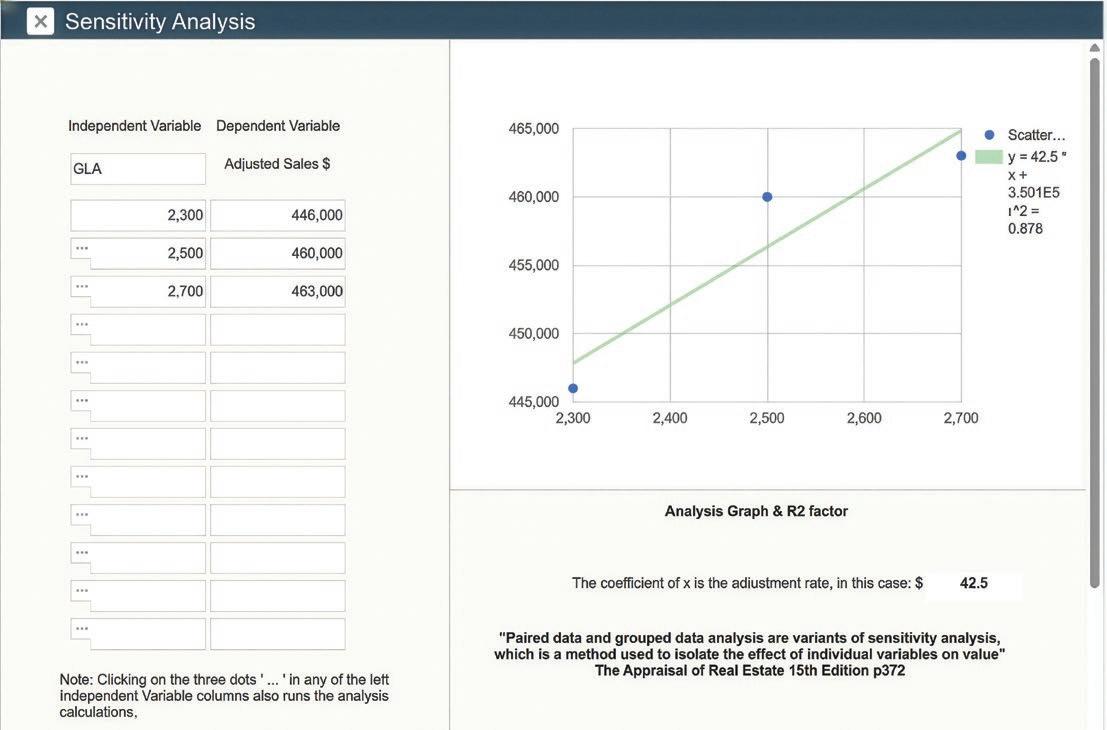
Consider a scatter chart generated in the Solomon Adjustment Calculator (though the same can be done easily in Excel). On the chart (See Figure 2 : Scatter Chart Generated in Solomon Adjustment Calculator), the independent variable (GLA) is plotted along the x-axis, and the dependent variable (adjusted sale price) is on the y-axis. Each dot represents a sale. The regression equation might read: **Y = 70x
+ 285,000**, which means that for every additional square foot of GLA, the price increases by $70. Plugging in 2,300 for x gives an adjusted sale price of $446,000—precisely matching the earlier example.
This is not magic—it’s simply math expressed visually. A scatter chart doesn’t just show numbers; it tells a story about the relationship between two variables. When paired with the regression line and its equation, the pattern becomes clear, objective, and reproducible.
As Wikipedia (accessed October 23, 2025) notes, “A variable is considered dependent if it depends on (or is hypothesized to depend on) an independent variable.” In this context, the dependent variable—sale price— depends on the independent variable— GLA. Analysts may also call these “predicted” and “predictor” variables.
Adding More Data: Adjusted Pairs in Action
Pure pairs are limited by their rarity. Most appraisers deal with imperfect data—sales that differ in time, condition, or concessions. That’s where adjusted pairs shine. Adjust each sale for its known differences and then plot them. When additional points are added to the chart, the regression line adjusts to reflect the broader trend. For example, when three pairs are analyzed together, the GLA adjustment might drop to $42.50 per square foot, representing a more reliable measure of the market’s collective behavior.
Just below the regression equation, you’ll often find **R²**, the coefficient of determination. In this example, R² = 0.878, meaning 88 percent
Figure 2: Scatter Chart Generated in Solomon Adjustment Calculator
of the variation in adjusted sale price is explained by changes in GLA. This is a remarkably strong relationship. By contrast, correlation (r) represents the square root of R²; if r = 0.6, then R² = 0.36. Generally, an R² below 0.4 suggests the data may not reliably explain the variable relationship.
Beyond GLA: Applying Scatter
Charts to Other Elements
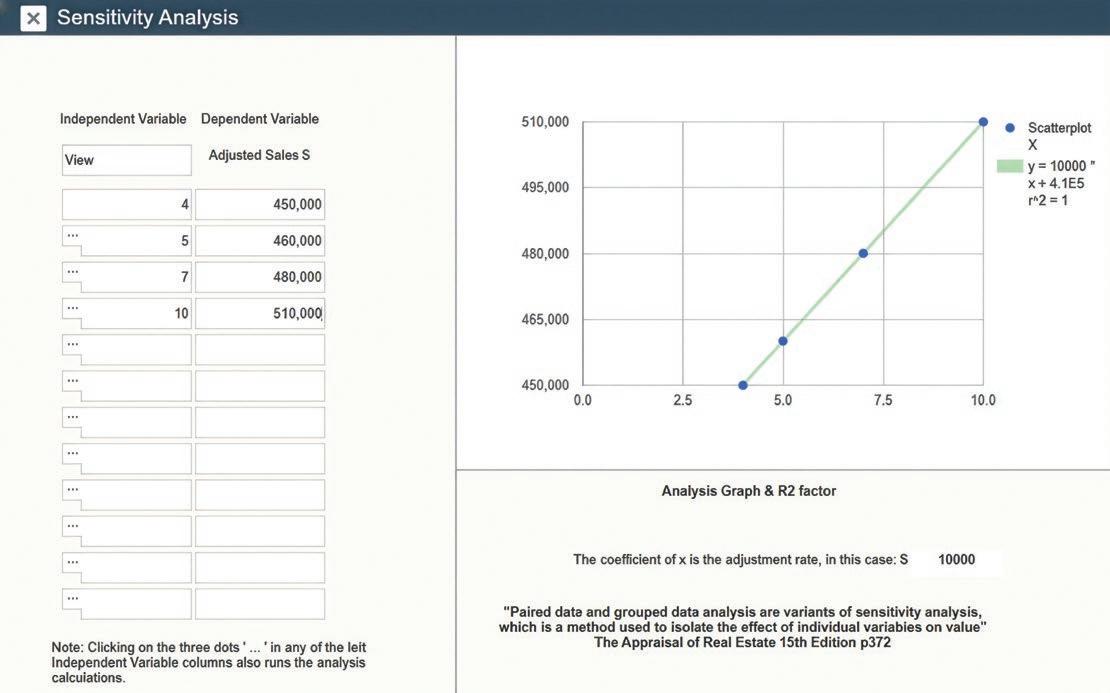
Scatter charts aren’t limited to GLA adjustments. Scatter charts can be used to quantify almost any variable— site size, view, condition, age, quality, or even design. Consider view as an example (See Figure 3: Scatter Chart Showing Views as a Variable ). Since there is no UAD-specified numeric category for view (like V4 or V5), we can use **ranking analysis**— assigning natural numbers to qualitative differences.
As The Appraisal of Real Estate, 15th Edition explains, “Ranking analysis is used to sort comparable data for differences in specific elements of comparison… to test market sensitivities” (Appraisal Institute, 2020, p. 377). In practice, this might mean assigning “3” for an average view and “4” for better than average. A scatter chart of these ranked variables might show that moving from a “3” to a “4” view corresponds to a $30,000 increase in price. A “1 to 5” or “1 to 10” ranking scale can work, as long as it’s applied consistently and adjustments are scaled accordingly. For instance, if the adjustment between ranks “5” and “6” is $10,000, the difference between ranks “5” and “7” would be $20,000.
Limitations and the Importance of Market Knowledge
Scatter charts and sensitivity analysis can yield powerful insights—but only
when the underlying data and prior adjustments are valid. Adjusted sale prices must already reflect market reality. If, for example, an appraiser uses a site size adjustment of $82.86 in a Minnesota suburb, it likely indicates that critical adjustments (like location or condition) were never properly made. Sensitivity analysis amplifies errors if the foundational adjustments are unsound.
Moreover, the assumption behind sensitivity analysis is that each combination of comparables can only be used once. Appraisers can reuse individual sales across different comparisons, but never repeat the same grouping. Strategic thinking is essential. Appraisers should reserve certain comparables for specific analyses—for instance, saving a particularly well-bracketed set for determining an age adjustment.
Figure 3: Scatter Chart Showing Views as a Variable
A Case Study: Solving for Age Adjustment
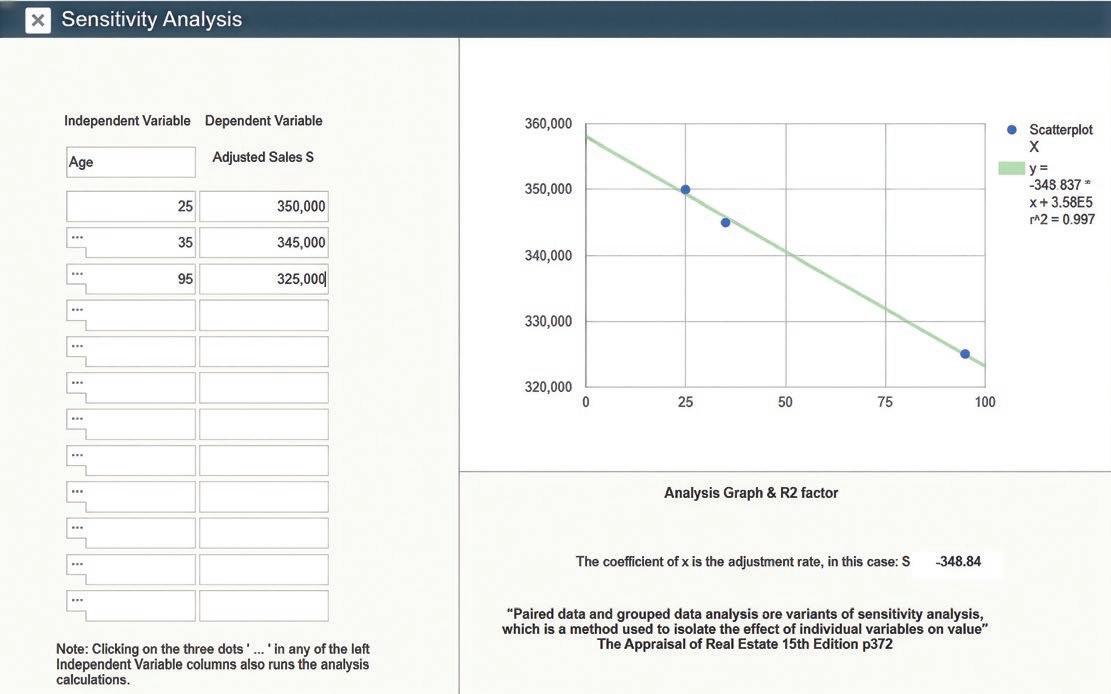
Consider a small-town market where homes range widely in age. The subject property is 30 years old, while similar sales exist at 25 and 35 years old—differences that might not warrant adjustment. But one comparable is 95 years old and located on the same street. To isolate the effect of age, the appraiser makes all other relevant adjustments first, then performs sensitivity analysis specifically for age.
By entering ages and adjusted sale prices into a scatter chart (See Figure 4: Scatter Chart Using Age as a Variable), the appraiser runs the analysis and finds an age adjustment of -$385 per year. The 65-year age gap between the 95-yearold comparable and the 30-year-old subject produces a total adjustment of $22,285. Once applied, the adjusted
sale prices align closely: $350,000, $347,685, and $325,000. This alignment confirms the credibility of the analysis and provides empirical support for the appraiser’s judgment.
Why Visualization Matters
Scatter charts do more than calculate—they communicate. They combine the precision of regression analysis with the clarity of visualization. For appraisers, this means turning abstract numbers into evidence that both clients and reviewers can see.
A well-constructed scatter chart illustrates the logic behind the adjustments and lends weight to the appraiser’s conclusions. It also reinforces transparency: others can replicate the math, verify the trendline, and confirm that the adjustments are derived from observable market behavior.
As the saying goes, “A picture is worth a thousand words.” In appraisal, it’s also worth credibility. Scatter charts bring statistical discipline to the craft of valuation, grounding professional judgment in data.
When used thoughtfully—alongside adjusted pairs and sensitivity analysis—scatter charts become the bridge between market evidence and analytical objectivity. In a field often criticized for subjectivity, tools like these remind us that objectivity is possible. It begins with isolating the effect of individual variables on value and ends with clear, visual evidence that supports sound conclusions.
Scatter charts light two lamps with one flame: accurate calculation and persuasive communication. WRE
Figure 4: Scatter Chart Using Age as a Variable
“Even when a business survives the initial hit, the operational disruption and reputational damage can linger long after systems are restored.”
Cyber Insurance: Why It’s Time for Appraisers to Protect Themselves
by Isaac Peck, Senior Broker at OREP.org
You log in, expecting to send a report or check your schedule for the coming week, only to find your system locked, client files gone, and a message blinking on the screen:
“YOUR
FILES ARE ENCRYPTED
To regain access, you must pay a ransom. Do not attempt to decrypt or modify the files yourself.
Any unauthorized action will result in permanent data loss.
Payment instructions are below. You have 72 hours.”
Directly below the words, a clock begins counting down.
You feel panic setting in. To make matters worse, you had committed to delivering a rush appraisal to the lender/ AMC this morning for a time-sensitive closing. You can’t access reports, contact clients, or meet deadlines. You’re losing money, time, and worst of all, your clients’ trust.
You thought your appraisal business was too small to be a target. But here you are.
In fact, small business owners like me (and you) frequently think: “My business is too small for me to have to worry about cyber attacks.”
This type of mentality only compounds the problem. According to recent national data, more than half of U.S. cyberattacks now target small businesses, not large corporations. Firms with fewer than 100 employees are significantly more likely to be targeted than larger companies, largely
because they lack dedicated IT staff, formal security protocols, and incidentresponse plans. In other words, they’re easier targets.
The financial fallout doesn’t have to be catastrophic to be devastating. Industry reports estimate that even modest cyber incidents routinely cost small businesses tens of thousands of dollars once downtime, data recovery, legal obligations, and lost business are factored in. For a solo appraiser or small appraisal firm, that kind of disruption can halt operations entirely.
And unlike large companies, appraisers don’t have layers of redundancy. One compromised laptop, one hijacked email account, or one ransomware event can shut down your ability to deliver reports, communicate with lenders, or access workfiles—right in the middle of pressing deadlines. The reputational hit an appraiser takes when they tell their clients they can’t turn in assignments because they’ve been hacked can be heavy.
Cyber Threats Grow
Many small business owners—including appraisers—assume cyberattacks are a problem for big companies with big budgets. That assumption is increasingly wrong.
In 2025, more than 60 percent of small businesses in the U.S. reported experiencing some form of cyberattack, and firms with fewer than 100 employees were 2.5 times more likely to be targeted than companies with 500 or more employees.
Why the shift? Cybercriminals have learned that small businesses are often easier targets. Large organizations may offer larger payouts, but they also invest heavily in cybersecurity infrastructure, monitoring, and response teams. Small firms rarely have those layers of defense. With automated tools, ransomware-as-a-service kits, and AI-generated phishing campaigns, attackers can efficiently target thousands of smaller businesses at once, knowing that even modest ransom payments add up quickly.
The financial consequences are not theoretical. According to Verizon’s 2024 Data Breach Investigations Report , small business data breaches can cost anywhere from $120,000 to over $1.2 million, depending on severity. Other industry studies released this summer put the average cost of a single cyber incident at roughly $25,000—far more than most appraisal businesses can absorb without serious disruption.
And cost is only part of the damage. Ransomware attacks now dominate the small-business threat landscape, often using double-extortion tactics: encrypting files while simultaneously threatening to release sensitive client data. Phishing emails have become more convincing, mimicking lenders, AMCs, and vendors appraisers work with every day. In some cases, attackers even use deepfake audio or video to impersonate trusted contacts.
Remote work, mobile inspections, cloud storage, and third-party platforms have expanded the attack surface even further. Each login, shared file, or connected vendor introduces another potential point of entry. For businesses without IT monitoring or incident-response plans, attacks can go undetected until systems are locked— or client data has already been compromised. This isn’t a call to panic. It is a call to acknowledge reality. Cyberattacks today are aggressive, targeted,
“Cybercriminals know that appraisers are deeply embedded in real estate transactions, often under tight deadlines and with limited tech support.”
and financially motivated. Even when a business survives the initial hit, the operational disruption and reputational damage can linger long after systems are restored.
That’s because economic damage isn’t the only kind of damage you’re going to worry about when running your firm. Compromised websites, stolen client data, and prolonged interrupted communication all disrupt operations, expose you to legal and financial fallout, and worst of all, directly threaten your trusting relationship with your clients.
As one cybersecurity expert put it: it only takes one successful attack. The question isn’t whether appraisers are too small to be targeted—it’s whether they’re prepared when it happens.
Unique Risks for Appraisers
Home appraisers face unique cyber risks that make them especially vulnerable to digital attacks. Unlike larger firms with dedicated IT teams, most appraisers operate as solo practitioners or small businesses.
Nevertheless, even the smallest appraisal offices handle highly sensitive data every day: property details, borrower information, lender communications, and access credentials all flow through their systems, often via unsecured emails or cloud-based platforms.
Cybercriminals know that appraisers are deeply embedded in real estate transactions, often under tight deadlines and with limited tech support. A well-timed phishing email or ransomware attack can severely delay closings, damage customer relationships, and quickly spread malware to the appraiser’s email contacts.
Appraisers rely heavily on mobile devices, remote access, and third-party software to stay efficient and responsive. Each of these tools introduces vulnerabilities. Tablets and smartphones used in the field lack robust endpoint protection, making them easy targets for malware or unauthorized access. A single compromised login (especially one reused across platforms) can expose sensitive client files, appraisal reports, and even financial data.
Third-party software adds another layer of risk. That vendor platform you rely on for scheduling, report-writing, or data analysis is a target. If one of your vendors suffers a breach, you could be held responsible for any client data exposed, particularly especially under strict liability privacy laws or lender contracts.
Email remains a major threat vector. Appraisers routinely communicate with lenders, agents, and homeowners, often exchanging documents and links. A hacked email account can be used to send malware to dozens of contacts, triggering reputational damage, regulatory scrutiny, and potential lawsuits.
What’s even scarier is that because home appraisers often work solo or in small teams, cyberattacks may go undetected until serious damage has already occurred. You probably haven’t scaled up to the point of having a dedicated IT team. That means malware can spread, or additional data can be stolen before an issue is even discovered.
Unlike other professions, appraisers rarely have the luxury of pausing operations to investigate a breach. Every day you’re closed means missed deadlines, frustrated clients, and loss of potential business.
The Role of Insurance
When a cyber incident hits, speed matters. For appraisers, the real damage often isn’t just the ransom demand or the technical cleanup—it’s the downtime, the missed deadlines, and the loss of client confidence that follows.
Cyber insurance exists to help businesses recover quickly and responsibly. For appraisers, that means having access to technical experts who can investigate what happened, contain the breach, and restore systems so work can resume. It also means guidance on how to communicate with lenders, clients, and other parties if sensitive information is compromised.
Notification Costs: If your appraisal files or client data are compromised, you may be legally required to notify affected parties. OREP’s cyber policy covers the cost of sending notification letters or emails, setting up a call center, and offering credit or identity monitoring. These steps help preserve client trust and meet compliance obligations.
Crisis Management Costs: A cyberattack can damage your reputation with lenders, AMCs, and homeowners overnight. This coverage helps you respond strategically, from hiring PR professionals and obtaining legal guidance to managing communications with clients, regulators, and industry partners.
Forensic Investigation Costs : After a breach, you’ll need to understand how it happened and what was affected. OREP covers the cost of cybersecurity experts to investigate the incident, assess your systems, and identify vulnerabilities.
Extortion Costs: Ransomware attacks are on the rise, and appraisers are not immune. If cybercriminals lock your files and demand payment, OREP’s policy includes support for negotiators, approved ransom payments, and technical assistance to help restore access and minimize downtime.
“When systems go down, data is compromised, or communication with clients is disrupted, the ability to respond quickly and professionally matters. In those moments, the question isn’t whether a breach should have happened—it’s how well the appraiser is prepared to deal with it.”
Technology Fraud and Theft Losses: Appraisers are frequently targeted by phishing scams and fraudulent payment schemes. This coverage protects against financial losses from fake wire transfers, spoofed emails, and other forms of digital deception that can drain your business accounts.
Third-Party Liability: If your email or appraisal software is compromised and spreads malware to clients or industry contacts, you could be held liable. OREP’s policy includes third-party coverage to help manage legal exposure and repair professional relationships.
OREP’s starter cyber policy is only $125 per year and includes up to $100,000 for cyber and technology security incidents, along with coverage for privacy fines or penalties that can arise even when the appraiser is the victim of an attack. It also addresses the real-world costs that follow a breach, including notification expenses, crisis management, forensic investigation, ransomware extortion, and technology fraud losses. (Higher limits are available for additional premium.)
For You, For Your Clients
Cyber risk is no longer a theoretical problem reserved for large corporations or tech companies. It’s an operational reality for appraisers who rely on email, cloud storage, mobile devices, and third-party platforms to do their work.
Whether a firm is large or small, client data is still client data—and protecting it is part of maintaining professional standards.
Cyber insurance doesn’t replace good practices or sound judgment, just as E&O insurance doesn’t replace competent appraisal work. What it does provide is a backstop when prevention fails. When systems go down, data is compromised, or communication with clients is disrupted, the ability to respond quickly and professionally matters. In those moments, the question isn’t whether a breach should have happened—it’s how well the appraiser is prepared to deal with it.
Appraisers spend their careers helping their clients manage risk. Protecting their own businesses is no different. Cyber insurance is simply another tool for doing that thoughtfully, deliberately, and with an eye toward long-term stability. WRE
$100,000 CYBER COVERAGE
Why Appraisers Need Cyber Coverage:
Example Scenarios
1. Hacked Emails ($100K) - Scenario: Your email account is compromised and then sends malware to your contacts. Up to $100K Third-Party Liability coverage applies.
2. Payment Data Breach ($100K) - Scenario: If you take payments for non-lender appraisals, this protects from payment data breaches. Get coverage for investigation, notification, and damages.
3. Lost/Stolen Device ($100K) - Scenario: Did you know that if your laptop/phone with client data is stolen, you could be required by law to notify clients, provide credit monitoring, and you could face fines ($500–$5,000 per record)? This coverage pays for notification and legal costs.
Coverage Highlights
• $100,000 Cyber / Technology Security Coverage
• $100,000 Aggregate Privacy Fines/ Penalties
• $25,000 for Cyber Breach Forensic Expenses
“Walitt explained that there’s a much broader range of opportunities where appraisal knowledge is valuable, even outside traditional appraisal assignments.”
We Will Always Need Appraisers: Josh Walitt on Valuation, Technology, and Adaptability
by Isaac Peck, Publisher
T o thrive in today’s appraisal landscape, adaptability matters more than ever. Markets shift, technology evolves, and clients’ needs change. Appraisers who recognize the versatility of their valuation skills—beyond traditional lender work—are better positioned to diversify, grow, and remain relevant in a changing industry.
Joshua Walitt is the very picture of adaptability and change. Originally a banker, Walitt did a mid-career jump into appraising after realizing that banking wasn’t for him. Since making that choice, Walitt hasn’t just followed his industry; he has set the pace for it.
Walitt has become a sought-after expert on compliance, real estate, and valuation, as well as a reviewer, a national speaker, an educator, and an expert witness. His company, Walitt Solutions, provides consulting services to lenders, appraisers, management companies, technology companies, education providers, and regulators. Working RE recently had the opportunity to ask Walitt what his journey has been like, and how he sees the future of the appraisal profession.
From Banker to Appraiser
In his previous life, Walitt climbed the banking ladder one step at a time, starting out as a teller for the drive-through of the bank branch he worked for in college. Over time, he became a supervisor, then a manager, then a branch manager. “And I was really just wondering in the back of my head: Am I going to do this for 40 more years? I couldn’t see myself
staying there. I probably could’ve moved up, but it just didn’t feel like the right role for me,” Walitt recalled.
After talking to a friend who was an appraiser, Walitt agreed to go on a couple of visits as a trainee. The entire experience felt like stumbling into a profession, he said, adding that he started self-educating, studying everything from compliance to the technical aspects of the appraisal profession. There was one part of the job he found particularly rewarding: “I have always enjoyed sharing information with people,” Walitt said. But he was also interested in the legal and legislative aspects of compliance. “Dodd-Frank sparked my interest in the compliance side of it. That’s when I really started digging into interagency guidelines, looking at the different layers in appraisal and lending. The layers never end,” he mused.
After a few years working as a staff appraiser for an AMC (and becoming one of the top producers at the firm), Walitt began to realize that the skills he had developed “could move beyond this one company. Maybe I could be helping appraisers. I could work with lenders, AMCs, regulators—so I made the decision to start my own consulting firm and just jumped in,” he said, adding that this happened in 2019, “right before COVID-19. So it was an interesting time to start a new business.”
As anyone who has made such a jump knows, going out on your own, particularly for a consultancy that is dependent on other businesses, can be pretty scary. But Walitt told me he launched Walitt
Solutions with some naivete. “I didn’t know it was gutsy. Maybe I was being naive about the whole thing and how I entered into it. I knew I had a few clients right away that would sustain me. I also went back to appraising for three or four months. I knew that I’d have a little bit coming in from there,” he said.
Initially marketing his services by word of mouth and social media, and unable to attend conferences because of COVID, Walitt relied on his faith that people knew who he was and what he could do. The stark contrast of being a one-person operation after so many years working in teams sparked Walitt to make phone calls and maintain his business contacts, which helped with his growth. Eventually he was able to add an assistant.
Now, Walitt Solutions is a five-person core team, along with additional contractors, offering specialized services for clients across the real estate ecosystem. “We consult with a lot of AMCs, appraisers, lenders, all these different client types. If we have a service that helps a certain type of client to perform their work more correctly, more efficiently, then the entire ecosystem is a bit more successful,” Walitt said, adding that the company does consulting on policies and procedures, and offers internal assessments and audits. “We do coaching for appraisers, technical appraisal methods, or workflow in their offices, help with bringing trainees on, or complaint assistance. I was just on the phone this afternoon with someone who had a state board complaint,” he said.
Walitt Solutions works with appraisers, state regulators, banks, AMCs, and other clients. For appraisers specifically, Walitt says his team helps with response letters, among other things, helping craft careful responses to requests for reevaluation, or other complaints. “We act as devil’s advocates,” Walitt explained. “By reviewing the report and workfile the way a regulator would,
“We’ve
we can usually identify the issues an investigator is likely to focus on before an interview ever happens.”
For regulators, Walitt Solutions helps states handle their backlog of complaints against appraisers. “There are hundreds of complaints [being investigated] in some cases. The team evaluates those and takes a look at what’s going on. Sometimes it is the full investigation piece, sometimes merely the intake,” he said. Walitt Solutions trains regulators too: his company offers training onsite or in virtual classrooms on needs like investigation, intake, disciplinary actions, and mock hearings.
Beyond Just Business
In 2018, Walitt became an AQB Certified USPAP Instructor. “I was lucky that another USPAP instructor was kind enough to let me share a few classes with her,” Walitt recalled. This allowed him to gain a reputation for teaching, as an instructor who knows his standards. Walitt said he enjoys teaching. “I had the best compliment ever in Las Vegas when someone said at the end, ‘I never thought I would use the words fun and USPAP in the same sentence. But this was fun.’ That’s really what you want—for people to learn something and to have fun,” he said.
Among the courses he teaches is valuation independence training, which educates appraisers, lenders, and AMCs on maintaining objectivity and compliance during the appraisal process. Federal regulations require that appraisers must be free from coercion, influence, or conflicts of interest. The training covers prohibited practices, permissible communication, handling reconsiderations of value, and
documentation requirements. It’s often required by lenders or AMCs as part of internal compliance programs, even if it doesn’t count for CE credit.
As an instructor, Walitt enjoys asking students what their takeaways are from his courses. “Every class isn’t going to lead to breakthroughs, but I’ve enjoyed that,” he said. He teaches non-lending classes too, classes just designed to help appraisers in their work life. “It sounds so dry, and people tell me it sounds boring, but we have a lot of fun in that class. So much discussion base. It’s a really good one.”
Technology and Diversification
When I asked Walitt what the future of appraising looks like, he did not hesitate. “Technology,” he answered. “I don’t know any way around giving an answer without technology coming into it. We’ve had inspection apps for decades. But I think now, the importance of learning and using those is really coming to the forefront. A lot more data collection will be necessary for appraisers. Technology is forcing us to change. We’ll see a lot more velocity, consistency, and repeatability. And not just in the inspection,” he said. Walitt told me that he believes technology can improve both speed and accuracy. It also allows more work to get done with fewer operators, a virtue that Walitt thinks will come in handy if retirement rates outpace the introduction of new appraisers into the market. “If people retire, there will be a lot more business opportunities,” he said. On the other hand, technology can also help appraisers find other work when they can’t find enough appraisal work.
had inspection apps for decades. But I think now, the importance of learning and using those is really coming to the forefront.” page 368
Many appraisers tend to think of their work narrowly, focused solely on completing forms like the URAR for residential mortgage lending (and today’s new UAD 3.6). Walitt explained that there’s a much broader range of opportunities where appraisal knowledge is valuable, even outside traditional appraisal assignments. “What I’m doing isn’t always appraisal work, but it’s because I’ve had experience as an appraiser,” he said. Skills in valuation, market analysis, and property assessment can be applied in consulting for investors, relocation services, assessor’s offices, or legal contexts like divorce and assessment appeals. In some cases, appraisers may serve as consultants or expert witnesses without issuing a formal appraisal report. The key is recognizing that the core skillset—critical thinking, market insight, and valuation expertise—is portable. It takes time and effort to build a presence in nonlender work, but the payoff is flexibility
and professional growth. According to Walitt, appraisers who open their minds to these possibilities often find more opportunity than they expected.
Meanwhile, Walitt is developing an exciting new platform designed to build community among appraisers. “Many appraisers are the lone wolf model. We have some appraisers that go to conferences, what happens between conferences? Some people go to physical classes. Some people attend Zoom. There’s not much connection between appraisers,” he said.
The Future of Residential Valuation
With a wide network of videos, blog posts, and human contacts, Walitt is a presence across the entire appraisal profession. Living in Colorado, he has also served on a local Board of Equalization, resolving disputes between homeowners and assessors. All of this human contact has given Walitt a different view of the future
First in Depreciated Cost First in Sensitivity Analysis
than those who see incoming technologies as more disruptive than constructive. He believes that so long as there is property, people will need human valuation experts.
Walitt told me he was “optimistic about the future of the valuation profession. There’s always a need to know how much a property is worth. At this point in time, we don’t have machines that can replace human judgment, we’ve got a good place for it. With technology, it will look different. Think about the two-minute checkup from your dentist or going to the optometrist and someone remotes in to control the equipment that works on your eyes. We never imagined that we would have that technology, but we do. It’s becoming different, and it will be different,” he said.
The tools will change, the workflows will evolve, but the need for human judgment in valuation isn’t going anywhere. WRE
“My revision requests dropped 99%” John Nadasi, Certified Residential Appraiser
“Every appraiser needs to understand what Scott teaches about the relationship between the cost approach and sales comparison approach” – Tim Andersen Florida State-Certified General Real Estate Appraiser, MAI, AQB Certified USPAP Instructor, Member of the National Association of Appraisers.
“Real Estate Appraisers have always been required to support their adjustments. Scott has the experience and methodology that is necessary for appraisers to be able to accomplish that.” - Pam Teel Texas State Certified Real Estate Appraiser, AQB Certified USPAP Instructor, Board Member of National Association of Appraisers, past President of the Association of Texas Appraisers.
“In the challenging appraisal world we live in today, supporting adjustments is imperative. I use Solomon when I teach my class ‘Supporting Land Value’, and in my practice as well ” Marty Wagar State Certified residential Appraiser in Michigan and Florida, Member of the National Association of Appraisers Honored as 2022 NAA Appraiser of the year
“Today, much of the job revolves around compliance portals, redundant uploads, and layers of review by people who have never inspected a property.”
Under Pressure: What’s Driving the Appraiser Exodus and How to Fix It
by David Massey
Ask any veteran appraiser or physician what has changed most over the past twenty years, and the answer is usually the same: paperwork. Professions once centered on skill, judgment, and service are now dominated by portals, compliance layers, and third-party control. Burnout rises, independence falls, and a quiet exodus follows.
The appraisal profession is now well into that cycle.
According to the Appraisal Institute’s 2023 Fact Sheet, the number of practicing appraisers in the United States has declined by roughly 8,000 in recent years. The Conference of State Bank Supervisors shows a longer-term drop from about 120,000 appraisers in 2008 to fewer than 96,000 by 2017, a 21 percent decline in less than a decade. IBISWorld reports another six percent employment drop between 2018 and 2023. The U.S. Bureau of Labor Statistics projects only modest growth through 2034, far short of what is needed to replace retirees.
The pipeline is shrinking while demand remains steady.
The National Association of Realtors® 2023 Appraisal Survey found that more than half of appraisers are now asked monthly, or more often, to complete assignments outside their normal geographic or property-type expertise. More telling, 54 percent cited Appraisal Management Companies as the single
greatest challenge to their business. That statistic alone explains much of what has gone wrong.
When I started in this profession, appraisal centered on analysis, interpretation, and professional opinion. I studied neighborhoods, walked properties, and applied experience to market behavior. Today, much of the job revolves around compliance portals, redundant uploads, and layers of review by people who have never inspected a property.
AMCs were created after the 2008 crisis to protect appraiser independence. The idea made sense. The execution has failed. Today, borrowers commonly pay $600 to $700 for an appraisal, while the appraiser often receives about half of that after AMC fees. Turn times lengthen. Panel depth shrinks. Geographic competency erodes. And experienced appraisers quietly step away.
What was meant to reduce pressure has become a system of control. Communication between lenders and appraisers is filtered. Pricing is dictated by algorithms. Scope interpretations are issued by third parties removed from the field. Judgment is slowly replaced by checklist compliance.
More than 60 percent of appraisers are now over the age of 51. Retirement is accelerating. Fewer trainees are entering the field. Training requirements are long, liability is high, and independence is shrinking. Younger professionals see a system heavy on oversight and light on reward. Many choose different careers.
David Massey is a state-certified general appraiser and real estate broker based in Burlington, North Carolina, with more than four decades of experience in residential and commercial valuation. He is the owner of Massey Appraisals & Real Estate and has served in multiple leadership roles at the local
That creates three direct risks for the housing market. First, longer turn times, especially in rural and complex markets. Second, rising costs as supply tightens further. Third, greater variability in valuation quality as geographic competency breaks down.
A rushed or inexperienced valuation does not impact just one loan. It ripples through underwriting confidence, pricing accuracy, and consumer trust levels.
Healthcare has already traveled this road. A 2025 Annals of Internal Medicine study showed nearly five percent of U.S. physicians left clinical practice in a single year, driven largely by burnout and administrative burden.
The American Medical Association reports that physicians now spend nearly two hours on documentation for every hour of patient care.
Appraisers now operate inside the same imbalance. More time formatting reports than analyzing markets.
More time satisfying review protocols than developing defensible opinions. Judgment yields to process.
This is not a workforce inconvenience. It is a structural market risk.
The fix is not complicated, but it does require courage.
First, appraisal fee transparency must be mandatory. If a borrower pays $650 and the appraiser receives $325, both parties deserve to know. Transparency restores accountability and allows market forces to function.
Second, the AMC model must be reformed. Filters and portals should not replace professional dialogue. Communication between those ordering the work and those producing it must be restored.
Third, training incentives must be rebuilt. Mentorship requires time, risk, and revenue loss. Without meaningful compensation and protection for mentors, the next generation will never reach scale.
Finally, technology must support judgment, not suffocate it. Automation can assist analysis, but it cannot replace local knowledge, experience, and professional interpretation.
At its core, this is not a technology problem. It is a trust problem.
Both medicine and appraisal were built on professional trust—not blind trust, but earned trust supported by education, licensing, standards, and accountability. The current system defaults to control first and judgment last. That inversion is driving professionals out.
When professionals are trusted to do the work they were trained to do, quality rises, confidence stabilizes, and risk declines. When they are reduced to checklist operators, they leave.
The appraisal shortage is not coming. It is already here.
And this is no longer just an appraiser problem. It is becoming a lending problem. WRE