Now Reaching Over 25,000 Inspectors in Print and Online—Get the latest news at workingre.com
Home Inspector Working RE
Winter/Spring 2026, Volume 30
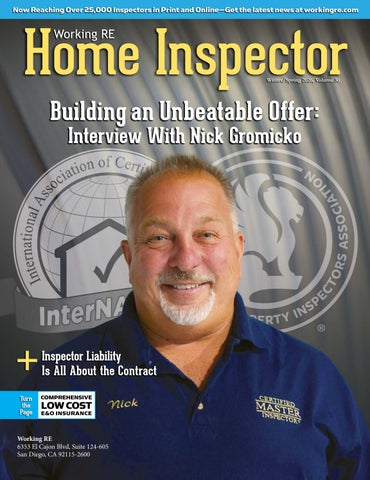
Building an Unbeatable Offer: Interview With Nick Gromicko
Inspector Liability Is All About the Contract Turn the Page
COMPREHENSIVE
LOW COST E&O INSURANCE
Working RE 6353 El Cajon Blvd, Suite 124-605 San Diego, CA 92115-2600
Home Inspectors are more likely to face a claim than any other trade or real estate professional. You Need a Team with Experience In Your Corner Specializing in Home Inspector insurance for over 24 years, OREP Members enjoy pre-claims defense from trial attorney Geoff Binney who delivers decisive response letters and shuts down frivolous claims.
Includes E&O and General Liability GET A QUOTE IN 5 MINUTES C A L I F .
L I C .
# 0 K 9 9 4 6 5
OREP.org/inspectors
(888) 347-5273
O R E P
years
Home Inspector Working RE
Advertise!
Now Reaching 25,000+ Inspectors Nationwide!
Winter/Spring 2026, Vol. 30
4 4
From the Editor
Readers Respond
6
Building an Unbeatable Offer: Interview With Nick Gromicko by Isaac Peck, Publisher
14 18 22 26
Water Quality Testing and Home Inspections: A Key Add-On Service by Johnny Pujol, SimpleLab
Recent Cases Confirm Inspector Liability Is All About the Contract by Isaac Peck, Publisher
Cyber Insurance: Why It’s Time for Inspectors to Protect Themselves by Isaac Peck, Publisher
Stronger Together: Why Inspectors Should Share Knowledge, Not Guard It by Kristine Gerber, InspectorToolbelt
28
What a Great Home Inspection Report Looks Like by Reuben Saltzman, StructureTech
30 34
Mold Testing in Real Estate: When, Why and How to Recommend It by Dylan McIntosh, CHI
Due Diligence in Disputed Dwellings: Squatter Awareness for Inspectors by Isaac Peck, Publisher
38
The Perfect Storm by Stan Bajerski
Mission Working RE Home Inspector magazine is published tri-annually to help home inspectors build their businesses, reduce their liability and risk, and stay informed on important technology and industry issues.
Published by OREP Working RE Home Inspector is published by OREP Insurance Services, LLC, a leading provider of home insp ector insurance nationwide. OREP has a low cost, broad coverage E&O and General Liability policy that includes coverage for radon, infrared, termite, pest/rodent, lead paint, mold, drone, and more. Visit OREP.org/inspectors for more information or to get a quote in only five minutes or less! OREP Insurance Services, LLC. Calif. Lic. #0K99465
2
Working RE Inspector Winter/Spring 2026
Publisher Isaac Peck: isaac@orep.org
Marketing Manager/ Senior Graphic Designer Ariane Herwig: ariane@orep.org
Working RE 6353 El Cajo n Bl vd Su i t e 124- 6 05 Sa n D iego, CA 92115 (8 8 8) 347–5273 www.workingre.com
Editor Kendra Budd: kendra@orep.org Working RE Home Inspector is published tri-annually and mailed to home inspectors nationwide. The ads and specific mentions of any proprietary products contained within are a service to readers and do not imply endorsement by Working RE. No claims, representations or guarantees are made or implied by their publication. The contents of this publication may not be reproduced either whole or in part without written consent.
From the Editor by Kendra Budd, Editor
Readers Respond Inspector Faces $6.4M Lawsuit Over Failure to Inspect Adjacent Lot So they are hopping from the appraiser to the home inspector now. This will go nowhere. You cannot trespass, and the owner’s expectation (after the fact) exceeds the scope of work signed off on. —Vaughn
With new regulations, an increase in lawsuits, and potential client roadblocks that inhibit an inspector from doing their job, it’s never been more important to safeguard your business than right now. Knowledge is power, and this copy of Working RE Home Inspector is full of actionable advice on how to protect your business. We explore how home inspectors are directly affected by the One Big Beautiful Bill Act, the rise of cases that have been dismissed due to iron-clad pre-inspection agreements, and one inspector’s stor y on the changes in the Realtor®/ home inspector relationship through the years. Over the past two years many lawsuits against home inspectors have ended with the inspector coming out on top. Why? Because these inspectors’ contracts were carefully crafted and had key language in them. This issue explores multiple cases where an inspector was favored in court due to their inspection agreement. One case was Apgood v. Plautz, where the homeowner sued both the seller and home inspector after discovering a leaky roof. However, the court sided with the inspector because of his inspection agreement and clear waivers (which the client both read and signed). To read more about these cases, as well as ways to make your contract bulletproof, go to page 18. Finally, we were able to get insight into one inspector’s experience and why he believes more homebuyers are starting to waive their right to a home inspection. Stan Bajerski discusses the selling tactics Realtors® use to push a sale forward, which often comes at the home inspector’s detriment. Bajerski shares his opinions on how to best look out for these tactics and fight against them if needed, especially to those who are newer to the field. He also details how these tactics have evolved over the years as the home inspection business began to thrive. To read about this continued tugof-war between inspectors and Realtors®, go to page 38. A home inspector’s best defense against industry changes, frivolous claims, and tumultuous working relationships boils down to gathering information. There is always something to learn, especially as the industry evolves. Working RE Home Inspector provides updates in this ever-changing profession and insightful counsel to keep you safe. WRE 4
Working RE Inspector Winter/Spring 2026
Danger Zone: When Home Inspections Get Violent Wish I knew I could at least hold the buyer responsible when her dog bit me in the groin! —Daniel Haydon We had a home inspector locally (Fayetteville, NC) get bitten by a rabid fox in a crawlspace a couple of weeks ago. —Mark A. Rhode Island Electricians Tie Home Inspectors’ Hands This law made this a homeowner’s issue, rather than the home inspector’s. They should conduct their inspection in accordance with the law. State clearly and in bold font that no electrical inspection has been performed in accordance with _# X law. Use any disclaimers needed and go on. —Vaughn WRE
Building an Unbeatable Offer: Interview With Nick Gromicko by Isaac Peck, Publisher
Most home inspectors are already members of the International Association of Certified Home Inspectors (InterNACHI), but few know the story of the man who founded and built it into the most dominant association for home inspectors across the globe: Nick Gromicko. For home inspectors, his story is not just a personality profile; it’s a case study in how to build an unbeatable offer in your own market. If there is one through-line to Gromicko’s career, it is this: build an offer so strong that saying “yes” becomes a no-brainer. InterNACHI is arguably the most power ful example in the home inspection profession of what happens when someone commits to that idea with relentless focus. When I asked Gromicko what he fears most, he didn’t blink. “The fear that I’ve run out of planets. No more worlds left to conquer.” It wasn’t a joke. In InterNACHI, Gromicko has built an association that is by far the largest, most dominant home inspector association in the United States, and around the globe. InterNACHI’s reach in the home inspection profession is profound. It has influenced the regulatory structure of inspectors across the United States, exported its standards to dozens of countries, trained tens of thousands of home inspectors, and provided a staggering array of tools—technical, legal, business, and marketing—to support home inspectors and strengthen their businesses. Starting in the early 1990s, InterNACHI has steadily grown from zero to over 30,000 home inspector members. Today,the vast majority of home inspectors who enter the profession join InterNACHI and stay members for the life of their careers. Isaac Peck is the Publisher of Working RE magazine and the Senior Broker and President of OREP.org, a leading provider of E&O insurance for savvy professionals in 50 states and DC. Over 14,000 professionals trust OREP for their E&O and liability insurance. Isaac received his master’s degree in accounting at San Diego State University. Reach Isaac at isaac@orep.org or (888) 347-5273. CA License #4116465.
6
Working RE Inspector Winter/Spring 2026
The reason is simple: InterNACHI delivers an incredible amount of value to home inspectors. The list of benefits its members enjoy is nearly inexhaustible. “You’d have to be braindead to be a home inspector and not be a member of InterNACHI,” Gromicko remarks. “You’d have to be dumb as a brick.” InterNACHI is to home inspector associations what Kleenex is to tissues—the category leader by sheer force of presence. In other words, InterNACHI is what it looks like when someone builds an offer so strong that it becomes the default choice. That’s exactly the kind of positioning every inspector should be aiming for in their local market. So who exactly is Nick Gromicko? And how did he build InterNACHI into the powerhouse that it is today? What follows is the story of the man behind the movement. Who is Nick Gromicko? I have a vivid memory of Gromicko from the 2023 InterNACHI conference in Atlantic City, New Jersey. InterNACHI’s CEO, Chris Morrell, had just wrapped up a 30-minute presentation detailing InterNACHI’s enormous accomplishments: hundreds of courses, 30,000+ members, Department of Education approval, dozens of certifications, and an ever-expanding list of member benefits. At the end of Morrell’s presentation, Gromicko grabbed the mic. “What can I say about all that? What can I say?” he said, pausing for effect. “Well … it’s a good start.” That kind of ambition is part of what defines Gromicko—never satisfied, always building, always pushing for more. He’s not just growing an organization; he’s constantly asking how to make InterNACHI’s offer to inspectors so good it feels page 8 8
7page 6 irrational to say no. The man has an unmatched ambition and an equally unmatched bravado. Gromicko is the founder of InterNACHI, his flagship project, but he also launched the International Association of Certified Indoor Air Consultants (IAC2), serves as Executive Director of the Master Inspector Certification Board, is Executive Director of the Contractors Association, and authored the International Standards of Practice for Inspecting Commercial Properties used in roughly 6 0 countries. He also curates the Inspection Museum, with exhibits like the first infrared camera used on an inspection in 1972 and the first battery-operated flashlight from 1898. And he serves as Director of Education and Training for the Certified Commercial Property Inspectors Association—a project that reflects his instinct to expand into new verticals long before others see the opportunity. Then there’s Gromicko’s nonprofit and scholarship work. He founded the 501(c)(3) Cozy Coats for Kids and is the primary funder and sole administrator of the InterNACHI Scholarship Fund. He has personally donated over $1,000,000 to charity. And when he’s not doing any of this, he’s the chief operating officer of his wife’s cosmetics firm, manages an organic farm, and works as a general contractor specializing in high-end outbuildings and heav y equipment projects. Not bad for a high school dropout. “I’ve been able to change all the legislation I wanted, the way I wanted it, almost everywhere,” Gromicko says. “I sued the governor of Kentucky around 10 years ago for trying to make inspectors buy, I think it was a million-dollar insurance policy to do a radon test. So I sued the governor’s office and after that bill, they reversed it. You know, I called first and asked him to change it and they didn’t change it. So what do you want me to do?” But as much as he’s surrounded himself with community and service, his bar for success is high even in his closest circles. “My wife has four degrees, two international business degrees, a marketing degree and an MBA. She writes and reads six languages and speaks a seventh. I barely speak English and have no high school diploma.” Aiming up is just what Gromicko does. He told me he thinks about a well-known interview with Tiger Woods when the golfer first began to attract attention, in which Woods said “second place sucks, and third place is worse.” “I would’ve said the same thing with a straight face,” he told me. “I’m not interested in being number two at anything in life. What’s the purpose? Number two is worse than not playing at all.” That unapologetic determination and confidence is a reminder that professions are often led by personalities. Gromicko has 8
Working RE Inspector Winter/Spring 2026
“I needed something that had low capital requirements. A pen and a paper sounded good to me, so I became a home inspector, and started to do really well in that.”
had the confidence to found and lead a trade organization for home inspectors in part because he has absolute confidence in his own skills as a businessman as well as a marketer. “Let’s say you blindfolded me, put me on a plane, gave me a parachute, and dropped me somewhere. I’d pull the cord and land in that town, and in thirty days, I’ll have all the home inspection business I want. I’ll just take everything away, and you could have 1,000 inspectors in that town, and 994 of them are not going to make it. I would take all their work from them.” Early Days of InterNACHI In the late 198 0 s, the Gromicko brothers—Nick and Ben—were building houses. Ben was a bank inspector, and in the title of “inspector” Nick saw potential. Gromicko was working as a real estate agent at the time. Familiar with both the insides of homebuilding and the dynamics of the housing market, he decided he wanted to be a home inspector. “I was looking for a business that was related to contracting,” says Gromicko. “I’d been a contractor since I was 12,” referring to the wide array of jobs that his young entrepreneurial mind had helped him create. “I needed something that had low-capital requirements. A pen and a paper sounded good to me, so I became a home inspector, and started to do really well in that.” Gromicko recalls that he quickly realized that home inspectors didn’t have a trade association—at least not one that delivered real, tangible value to its members. That realization turned out to be timely. The housing market was getting more complicated, and inspectors were often left to navigate liability risks, unclear standards, and a lack of professional support on their own. There was no central body to advocate for them or offer consistent training, Gromicko argues. Gromicko saw that a trade association could fill that gap, giving inspectors both credibility and connection, a shared identity and the tools to build sustainable careers. “So we built that,” Gromicko says. InterNACHI’s birth year was 199 0, and its goal was to be a nonprofit that offered rigorous, accessible training while reinforcing inspector autonomy and long-term business success. In its earliest days, “we had to use snail mail, no internet,” Gromicko remembers. In Valley Forge, Pennsylvania, the group began with restaurant meetings. “Five guys came, then page 10 8
7page 8 10 guys. We opened our first Chapter in New York, and we drove to those meetings.” Much of the organization’s initial growth came from word of mouth and online forums, where inspectors shared resources and helped shape the curriculum. That collaborative, connection-based approach would continue to define InterNACHI’s development, as the team focused on building practical, low-cost training that could be accessed remotely, a novel approach at the time. Once internet technology increased in functionality, the group started online forums, then put videos on Yo uTu b e, and soon created “NACHI TV,” with streaming video. Their first online exam had three test-takers. Eventually there would be millions of posts on their forum and thousands taking the tests. In the early 2000s, InterNACHI launched a comprehensive online platform that made certification and continuing education available to inspectors across North America and beyond, removing geographic and financial barriers to entry. The Certified Professional Inspector (CPI) designation became a cornerstone of the organization’s credibility, requiring members to pass exams, submit inspection reports for review, and commit to a strict code of ethics and standards of practice. As the industry evolved, InterNACHI expanded its offerings to include legal templates, marketing tools, business development resources, and peer-to-peer support systems. By the 2010 s, membership had surged into the tens of thousands, and the organization began hosting live training events and building physical facilities to complement its online reach. For home inspectors, the lesson in these early years is clear: InterNACHI grew by identifying gaps in education, standards, business tools, community and filling them before anyone else did. InterNACHI didn’t just create some resources and then call it a day either—they continually add to the benefits their members enjoy—overdelivering on value on a daily basis.
“By the 2010s, membership had surged into the tens of thousands, and the organization began hosting live training events and building physical facilities to complement its online reach.” From coursework, to certifications like InterNACHI’s Certified Master Inspector® certification, to websites, logo design, and inspection contracts, InterNACHI is continuously developing tools and benefits that help its members grow and succeed. Every new tool—whether technical, marketing, or business-related—adds one more layer to the offer, making membership increasingly difficult to replace or compete with. On the topic of education, Gromicko is especially proud of the fact that InterNACHI is an accredited university. “I get lucky a lot. At the time I was fighting for InterNACHI to become a university, there was a wave in this country where people on late-night talk shows were making fun of people with worthless degrees. While that’s going on, providing political pressure on one side, we’ve developed 400 practical courses in the trades. So, make us a university!” Gromicko says. That boldness earned InterNACHI a coveted “.edu” domain and an accreditation as a university by the United States Department of Education. In this effort, Gromicko’s InterNACHI team was guided by a vision: “I wanted us to get to the point of inspectors being like engineers or architects,” Gromicko said. “I wanted home inspectors to be at that level. An engineer has a degree from a university. When an architect takes courses, they take university courses. So that’s why we had to become a University. We could bestow bachelor’s degrees if we wanted to. We’ll be able to do associates degrees in Home Inspection. Our courses transfer into University classes.”
How InterNACHI Dominated I asked Gromicko about the keys to the success of InterNACHI. “There’s no competition,” he answered. “Imagine if you were on a racetrack and you had to run a race, and you [didn’t] have anybody racing against you.”
In addition to its extensive coursework, InterNACHI’s forums are 20,0 0 0 members strong and serve as a vast, searchable archive of inspection knowledge, with thousands of threads covering technical, business, legal, and regulatory issues. From tool recommendations to report-writing tips and unusual defects, the forums are active daily. They are a living extension of the unbeatable offer—immediate support, shared expertise, and a community inspectors can rely on.
Underneath the bravado, Gromicko has a philosophy of overdelivering for his target market. Or in business terms, building an unbeatable offer. For example, InterNACHI hasn’t just developed a couple of courses for home inspectors. They’ve developed over 400 courses.
Gromicko says he is always thinking about what home inspectors need next and then having InterNACHI work to deliver it to them. “It’s not the duty of the home inspector to know what he needs next. His job is to do inspections. My job is to figure out what he needs next and to provide it. Most of the stuff we
10 Working RE Inspector Winter/Spring 2026
have, no one knew they needed it. No one knew 20 years ago they’d need a course on mold inspections that they could take online from their house, while watching videos and answering quiz questions,” remarks Gromicko. Gromicko’s approach here is clear: anticipate what his “customer” wants and needs, deliver it to them before they even ask for it, and stack the deck with so much value that it’d be comical for them to say no. Lessons for Home Inspectors “I’m not Dear Abby,” Gromicko answers when I ask whether he had specific advice for home inspectors. But two books he’s written, STACKS and Scale Up, give some insight into Gromicko’s business philosophy and approach. The key takeaway of STACKS: A Home Inspector’s Guide to Increasing Gross Revenue is that inspectors should think beyond base inspection fees and offer additional services like radon testing, sewer scopes, and energy audits. Revenue growth, Gromicko argues in the book, is about working smarter, not more hours, and about communicating your value clearly to your clients.
Scale Up: 100+ Steps to Growing and Systemizing Your Multi-Inspector Firm is Gromicko’s guide to transitioning from solo operator to managing a scalable inspections business. Covering hiring, marketing systems and legal compliance, among other things, its key meta-message is that scaling up is systemic; rather than just adding inspectors, you’re making the whole system bigger. You’re expanding your own concept of leadership. After having a moment to think it over, Gromicko did have some advice, saying that home inspectors ought to look at their clients “the same way InterNACHI looks at home inspectors. What are they looking for?” Clients don’t always know exactly what they’re looking for, but whatever it is, Gromicko says they will pick the first inspector that they think will satisfy their needs. “As soon as they find it, they stop looking.” This means that if you’re selling a service, you have very little time to do your marketing. He likened it to a boxing match where you have about five seconds from the time the bell rings to avoid getting knocked out. “Throw your best punch,” he says. It’s a stark reminder for home inspectors: You must be clear, concise, and be prepared to communicate value. page 12 8
Working RE Inspector Winter/Spring 2026 11
7page 11 Commercial Inspections Next Gromicko ultimately saw a limit in residential inspections— home inspectors could only grow so far before demand plateaued. That realization hit him hard. “It actually came from a horrible story that my RE/MAX broker told me,” Gromicko relates. “My broker told me a residential real estate deal is like a carcass of an antelope laying out in the middle of the field. The RE agents are like the lions, ripping out their six percent and getting their bellies full. Then everybody else comes in: the appraiser, bank, title companies, like hyenas, maybe make a couple thousand bucks, everybody is eating. Then along comes the home inspector, and there’s not much left, a little meat on the bones. The inspector comes in like a little vulture and takes his $40 0 -$500.” Commercial properties such as outside malls, warehouses, and office buildings, offered a way to break through that ceiling. He wanted to equip inspectors with the training and credibility needed to move into that space. So he created the Certified Commercial Property Inspectors Association (CCPI A) to support inspectors transitioning into commercial property work. As with InterNACHI, members receive specialized training, resources, and standards tailored to the unique demands of inspecting non-residential buildings. CCPI A became, in effect, a second unbeatable offer—this time aimed at helping inspectors escape the revenue ceiling of residential work. The focus shifted from refining technique to broadening scope. Commercial inspections required different tools and standards, but the same core principle applied: understand what the client needs, and be ready to deliver. For inspectors looking to scale without adding endless hours, commercial work opened a lane that was less saturated and often more lucrative. So far, it seems to have been a good idea. “We just topped 2,000 dues paying members, and we’re a monopoly with no other trade association in our space,” Gromicko says. “We have all the courses, SOPs, checklists, everything from how to inspect accessibility, to how to inspect commercial air conditioners.” This is where you realize that what sets Nick Gromicko apart from other players in the business isn’t that he makes more money, sells more products, or grows the largest firm. It’s that he finds his success in helping others find theirs. No matter where the dominant market forces are taking the profession, Gromicko will get out in front of it first, and light the pathway for everyone else. When you stay out in front like that, of course you’re going to create monopolies, but they are ultimately helpful ones: Countless inspectors owe large parts of their success to this 12 Working RE Inspector Winter/Spring 2026
“For inspectors in today’s shifting market, that may be the most actionable lesson of all: stay adaptable, stay curious, and keep stacking value until your services become the obvious choice.”
hard-driven entrepreneur who will tell you to your face that you’re as dumb as a brick for not listening to him. For inspectors, the message is straightforward: diversification isn’t a luxury—it’s a strategic advantage. Adding commercial inspections to your service mix expands your earning potential and positions you in a less crowded market. That’s how you build an unbeatable offer that grows with you, not against you. Staying Focused in an Uncertain World In an increasingly uncertain world, Nick Gromicko is a guy who carries a lot of certainty. He looks at the future with a combination of realism and hope, whether assessing the role of artificial intelligence (“I use it to make sure I haven’t forgotten something,” he said, “but AI can’t do what I do.”) to deciding what new services his trade groups should offer. That forward-looking mindset—always scanning the horizon for what inspectors will need next—is the final ingredient in how he continues building an unbeatable offer. While InterNACHI has grown incredibly over the last 35 years, developing into the dominant association for home inspectors nationwide, Gromicko is far from done. From talking to him, it’s clear that the home inspector is still top of mind for Gromicko, even with all his other projects and aspirations. Even his interest in commercial inspections with CCPIA, while it is a completely separate association, offers a way for his existing InterNACHI members to branch out, diversify, and grow their businesses through commercial inspections. Both InterNACHI and CCPIA ultimately reinforce the same philosophy: inspectors succeed when they expand their value, anticipate client needs, and build service offerings stronger than the competition. For inspectors in today’s shifting market, that may be the most actionable lesson of all: stay adaptable, stay curious, and keep stacking value until your services become the obvious choice. “The Second Law of Thermodynamics says that everything is constantly moving from order to chaos. God created a law of the universe that makes inspectors necessary, forever,” he told me. “We are doing God’s work.” WRE
Water Quality Testing and Home Inspections: A Key Add-On Service by Johnny Pujol, SimpleLab
Walk into almost any inspection today and the conversation will eventually drift beyond the roofline, electrical panels, and HVAC systems into a different kind of territory—what’s in the water. Buyers who once took their tap for granted are increasingly asking about what they’re drinking, cooking with, and bathing in. Some have specific concerns; others have seen enough headlines to want assurance. Either way, inspectors are finding themselves at the center of water-related questions with surprising regularity. What’s interesting is that this shift isn’t driven by visible defects. It’s driven by uncertainty. Wells that haven’t been tested in years, municipal systems that only monitor water up to the street, and older plumbing that raises questions buyers don’t know how to parse—all of it lands in the inspector’s lap on inspection day. And because inspectors are already the most trusted voice in the entire transaction, clients naturally look to them for clarity. Many inspectors have responded by adding a simple water test to their lineup, not as a sales tactic, but as a practical way to answer the question before it spirals into post-inspection worry. The test takes minutes. The results offer reassurance or a clear next step. And in a process defined by deadlines and moving parts, that clarity has become surprisingly valuable. Why Water Testing Has Become Increasingly Relevant A telling pattern has emerged: most buyers only realize during the inspection that no one has ever tested the home’s water. Wells can go unmonitored for years. Homeowners on municipal supply assume water entering their house is the same water coming out of their faucet. Then when a buyer mentions a metallic taste, a rotten-egg smell, or just a general discomfort, inspectors often become the first person to point out that water testing is straightforward and advisable. John Pujol, CEO of SimpleLab and Tap Score, holds a Master’s Degree in Engineering from UC Berkeley. He is a water quality expert with a background in the commercialization and development of electrochemical arsenic remediation, off-grid water treatment and UV LED technology for pathogen and pharmaceutical inactivation. Visit GoSimpleLab.com to start offering water testing to your clients.
14 Working RE Inspector Winter/Spring 2026
Real estate-oriented water panels tend to focus on a handful of contaminants that repeatedly come up in transactions: coliform and E. coli bacteria, lead, arsenic, and nitrate/nitrite. These are the substances buyers ask about most often, and uncoincidentally, they’re also the ones lenders look for when FHA, VA, or USDA loans require water documentation. In other words, a small set of analytes covers the majority of real-world concerns. For inspectors, this isn’t an expansion of scope, it’s an acknowledgment of what the job already demands: reducing uncertainty. Fitting Testing Into an Inspector’s Workflow The appeal of water testing for inspectors has a lot to do with its practicality. Sampling is quick, non-invasive, and doesn’t require specialized equipment. The lab handles the analysis, the report shows up digitally, and the inspector remains firmly within their role as an independent observer. There’s also a regulatory advantage. Many lending programs require that water samples be collected by someone unconnected to the sale. Inspectors often check that box by default, which means their involvement can keep the transaction moving rather than add friction. One nuance that experienced inspectors point out is timing. Offering the option at booking, rather than on site, leads to smoother conversations and better expectations. Clients get time to think through what they need; inspectors avoid the on-thespot decision-making that can derail the pace of the inspection. The Broader Rise of Environmental Testing Water testing might be leading the charge, but inspectors are fielding more questions about invisible environmental conditions across the board. And the same principle applies: if a simple test can provide certainty, clients want it. Radon in water is a common example for homes with private wells. Many inspectors who already offer radon testing in the page 16 8
7page 14 air find that clients want to understand whether their water contributes to indoor levels. A quick water sample fills that gap.
can give clients the option to get an answer while they still have access to the home and time to negotiate if needed.
Mold swab testing serves a similar purpose. When a client points to discoloration or mentions a history of moisture, they often want something more concrete than “it might be mold.” A surface sample gives them a laboratory answer without stretching the inspector’s scope into diagnostics or remediation.
Most importantly, it strengthens trust. Buyers don’t expect inspectors to know ever ything, but they do appreciate when inspectors provide a path to clarity. Offering environmental testing—particularly water testing—signals that you’re thinking about the full picture of the home, not just what’s visible during the walk-through.
Lead paint and asbestos sampling are more regulated, but still have a place when done correctly. In many states, inspectors can collect a small paint chip or material sample as long as they are clear that the analysis is informational and not a full inspection or risk assessment. For buyers staring down a renovation or raising young kids, even basic confirmation can make a world of difference. Across all these tests, the common thread is that inspectors stay in familiar territory: document, sample, report. Nothing more. What Testing Adds to the Client Relationship Environmental sampling has gained traction because it reinforces something inspectors already do well—ground buyers in facts. When questions arise about water, mold, lead, or asbestos, inspectors often find that offering a simple test diffuses concerns before they build into something larger. It also helps manage expectations. Instead of adding another “recommend further evaluation” line to a report, inspectors
16 Working RE Inspector Winter/Spring 2026
A Low-Effort, High-Impact Addition For inspectors looking to add value without complicating their day, water quality testing has emerged as one of the most meaningful add-ons. It aligns with the questions clients are already asking, requires minimal time to execute, and delivers objective information that helps buyers feel more confident in their decisions. The same is true for the broader category of environmental lab testing. Mold, lead, asbestos, and radon are all issues that buyers increasingly want answers about. By integrating environmental testing into their offerings, suggesting them when relevant and staying within the bounds of informational sampling, inspectors can elevate their service without expanding their liability. The industr y is changing, and so are client expectations. Inspectors who can meet those expectations with clarity, efficiency, and objectivity will be well-positioned for the next chapter of the profession. WRE
Recent Cases Confirm Inspector Liability Is All About the Contract by Isaac Peck, Publisher
“Laws, like houses, lean on one another,” Edmund Burke wrote a long time ago, not realizing it might have special meaning for home inspectors. At least where laws are concerned, we can see patterns in court decisions around the country, and from those patterns, take away important lessons for risk management. In the last two years, a lot of what we’ve assumed to be true about home inspector-related liability has been proven correct—the foundations of risk management are clearly understood agreements and clearly delineated responsibilities. Contracts Allocate Risk Recent court decisions from the states of Washington, New Jersey, and Delaware offer a clear message to the real estate ecosystem in general, and home inspectors particularly: the way risk is allocated in contracts, especially inspection agreements and purchase documents, can make or break a legal claim. In Apgood v. Plautz (Washington Court of Appeals, March 2024), a homebuyer named Robert Apgood sued both the sellers and the home inspector after discovering serious roof leaks post-purchase. The inspector’s report had noted the roof was “more than 20 years old,” but the report didn’t identify any water damage. Apgood claimed fraud on the part of the owners and negligence by the home inspector. The court, however, was not persuaded. Why? Because the purchase agreement and inspection addendum included clear waivers. Apgood had expressly waived further inspection rights and acknowledged he wasn’t relying on seller or agent representations. The court also found that the inspector didn’t owe Apgood a legally recognized duty under the circumstances. The paperwork ruled the day, and the court affirmed dismissal of all claims. About a year later in Delaware, the Superior Court decided Willey v. Scott (Delaware Superior Court, April 2025), where buyers had sued over undisclosed defects and tried to include the home inspector in their claims. But the inspection contract had two key provisions: a one-year claim limit and a binding arbitration clause. The plaintiffs didn’t dispute the contract’s existence, and the court found no reason to override it. Allegations that Realtors® had steered the buyers to the inspector weren’t enough to keep the inspector in the suit; even if such behavior on the Realtor’s® part was suspect, plaintiffs’ 18 Working RE Inspector Winter/Spring 2026
relationship with the inspector was governed by the signed agreement, and so unless the inspector breached that agreement or committed some independent wrongdoing, there was no reason to override that contract. Around the same time, a somewhat different decision came out of the New Jersey Appellate Division in Ruiz v. Bourke (March 2025), a case that highlights the limits of inspection reports and the challenges of proving liability without clear contractual or legal duties. In this instance, a second-floor railing collapsed and injured a painter. The homeowners had received a home inspection report before purchase that flagged the railing as a “safety concern” and recommended further evaluation, but they hadn’t acted on it. After the injury, the plaintiffs argued that the report put the owners “on notice” of the danger. The court disagreed. It excluded the plaintiff’s expert report as a “net opinion,” meaning it lacked a solid factual basis, and found no evidence the owners had actual or constructive notice of the defect. Summary judgment was upheld. Three decisions, two of which take inspectors off the hook and one that says an inspection report doesn’t constitute notice of defects. What do these tell us? They offer further evidence that in most jurisdictions: 1. Courts are leaning heavily on the language of contracts to sort out responsibility. 2. If the buyer signs off on waivers and disclaims reliance, courts are likely to enforce those terms even if defects show up later. Inspectors should ensure their reports are clear and their contracts spell out the scope and limits of their duty. 3. Courts will enforce inspection contracts as written, especially when plaintiffs don’t challenge contract terms. Inspectors should make sure clients understand these provisions upfront. 4. Even when risks are flagged, courts won’t impose liability unless there’s a clear duty and persuasive evidence of knowledge or neglect. For inspectors, this reinforces the importance of clearly stating what is and isn’t covered;
for property owners, it shows the risks (a close call on liability in the New Jersey case) of ignoring recommendations.
what was promised, what wasn’t, and where the inspector’s responsibility begins and ends.
Judicial Economy is Your Friend For home inspectors, these decisions show that risk is mostly controlled by the written contract and what you put in your report. If your contract is clear and enforceable, it can remove or sharply limit a buyer’s or third party’s ability to sue you. If your report is vague or your expert opinions are conclusory, a court can exclude them and that also defeats claims. In short: contract first, clear reporting second.
This does not mean a contract gets you out of trouble if you’ve breached it, and there are always exceptional cases and decisions. But cases like Apgood, Wiley and Ruiz suggest that scope of responsibility matters, and parties who protect themselves when drafting and signing agreements, and understand their liability, are practicing good risk management. For home inspectors and others in the real estate world, this reinforces the value of clear, well-drafted contracts. They’re your first line of defense when a dispute lands in front of a judge who’s seen it all.
Courts are busy, and judges don’t have much patience for parties who try to stretch a case beyond what the contract says. Courts are built to favor efficiency (called “judicial economy” in legalese) and that means they’re often looking for the cleanest, most straightforward path to resolution. When a contract clearly allocates risk, judges are inclined to stick to it. They don’t want to untangle what could have been clarified in writing. In fact, they can get a little cranky when litigants ask them to read between the lines or infer duties that weren’t spelled out. A st rong, proactive cont ract gives the court a roadmap. A well-drafted inspection agreement tells the judge exactly
When inspectors include clear disclaimers, scope limitations, timeframes for filing claims, dispute resolution clauses like arbitration, and indemnification provisions, it tells courts that cases can be resolved quickly and cleanly. In a system that rewards clarity, and in a world where lawsuits can spiral, a well-constructed contract is premium content. Judicial economy, in this sense, becomes the inspector’s greatest legal ally. But that’s only true if you do some work up front. If the written agreements are vague and inconsistent, or page 20 8
Working RE Inspector Winter/Spring 2026 19
7page 19 missing key terms, courts are more likely to let a case proceed, even if the inspector ultimately prevails. That means more time, more stress, and more expense. But when the contract is solid, courts have every incentive to enforce it and move on. The inspector who’s taken the time to define their role, limit their liability, and document the client’s acknowledgments is far more likely to be dismissed early, just like in Willey and Apgood. In both cases, the inspectors were let out of the lawsuit not because the facts were perfect, but because the contracts were. That’s the power of judicial economy working in your favor, just so long as you give the court something solid to work with. Practical Goals The recent decisions in Apgood v. Plautz, Ruiz v. Bourke, and Willey v. Scott offer a clear message to home inspectors: courts are increasingly focused on what’s written, signed, and documented. Judges are relying on contractual allocation of risk, and they’re not inclined to entertain claims that stretch beyond the scope of a well-drafted agreement. Here’s what that looks like in practice: you Use a clear engagement 1. Make the contract work for you: agreement that includes scope of work, limitation of liability, a one‑year claims period, and an arbitration clause. Require client signature and keep records proving they received and signed the contract before inspection.
“... When the contract is solid, courts have every incentive to enforce it and move on.” impatience. Apgood, Wiley and Ruiz show how courts are leaning hard on written agreements to determine liability. Inspectors who lack clear contracts, defined scopes of work, or professional support are more vulnerable when disputes arise. That means inspectors aren’t left exposed when a client tries to stretch a claim beyond the inspection’s scope. In Willey, for example, the inspection company’s contract included a one-year claim limit and an arbitration clause, both of which the court enforced. OREP encourages inspectors to use similar provisions and helps them understand how to do so effectively. That’s why OREP provides its inspector insureds with attorney prepared, state-specific agreements that have the key contractual clauses they need, including limitations of liability, statute of limitations, attorney’s fees, and more. In Ruiz, the court excluded an inspection report as a “net opinion” and found no evidence the homeowners had actual or constructive notice of the defect despite a prior inspection flagging a safety concern. Through Working RE Home Inspector magazine, OREP’s guidance on report writing and documentation helps inspectors stay within their professional lane while still providing clients with actionable and defensible observations.
reports Describe observations, 2. Write careful, defensible reports: conditions, and limitations factually; avoid broad causation statements unless you can support them with data or testing. If you are in doubt, recommend a qualified specialist rather than asserting a definitive expert conclusion.
Protect yourself first with a strong, signed contract; protect your report second by being factual, cautious about opinions, and documenting everything. We’re here to help! WRE
3. Avoid net opinions: opinions If you or someone you rely on will later give expert testimony, ensure opinions are tied to facts, methods, and data, not just conclusions.
Contracts + Disclaimers
4. Document everything: everything Keep photos, checklists, client communications, and the signed contract. Timestamp files and preserve originals. Log scope changes, additional requests, and any on‑site constraints. 5. Train staff and agents: agents Make sure booking and sales staff never steer customers in a way that could be later characterized as coercion or conflict; document independence. 6. Get insurance and counsel: counsel Maintain appropriate E&O coverage sized to exposure and aligned with contract limits. Include indemnification for legal costs, claims arising from third-party reliance, and disputes that fall outside the scope of your inspection agreement. OREP Will Help You OREP offers home inspectors more than just insurance: we provide a strategic safety net in a legal landscape that’s increasingly shaped by contracts, disclaimers, and judicial 20 Working RE Inspector Winter/Spring 2026
OREP offers its Members FREE, Attorney-Prepared Inspection Contract templates, plus an Indemnification Agreement to use with your subcontractors and Specific Service Waivers if you offer mold and your client declines it (for example).
E&O and GL for Inspectors
Isn’t It Time You Shopped OREP? OREP.org/inspectors Member benefits provided as part of the OREP Risk Purchasing Group, Minimum Member fee of $60. | Calif. Lic. #0K99465
Cyber Insurance: Why It’s Time for Inspectors to Protect Themselves by Isaac Peck, Publisher
You log in, expecting to send a report or check your schedule for the coming week, only to find your system locked, client files gone, and a message blinking on the screen: “YOUR FILES HAVE BEEN ENCRYPTED To regain access, you must pay a ransom. Do not attempt to decrypt or modify the files yourself. Any unauthorized action will result in permanent data loss. Payment instructions are below. You have 72 hours.” Below the words, a countdown clock. You feel panic setting in. You can’t access reports, contact clients, or meet deadlines. You’re losing money, time, and worst of all, your clients’ trust. You thought your inspection business was too small to be a target. You were wrong. In fact, small business owners like me (and you) frequently think: “My business is too small for me to have to worry about cyber attacks.” This type of mentality only compounds the problem. In fact, according to Dataversity, in September over six in 10 small businesses in the U.S. reported experiencing some form of cyberattack in the year 2 025. And small businesses were targeted more heavily than larger companies, with firms that have fewer than 10 0 employees now being 2.5 times more likely to be targeted than those with over 50 0 employees. Solo entrepreneurs and small firms (under 10 employees) accounted for 18 percent of all reported cyber attacks in 2025. As cyber attacks increase and cyber insurance premiums continue to rise, here’s why it’s time for home inspectors to start thinking about cyber protection. Cyber Threats Grow In today’s digital landscape, cyber threats have become an existential risk for small and mid-sized businesses. Despite the perception that hackers only go after large corporations, recent data 22 Working RE Inspector Winter/Spring 2026
shows that 43 percent of all cyber attacks now target small businesses. In 2024, Verizon issued a Data Breach Investigations Report concluding that small business data breaches can cost between $120,000 and $1. 24 million, depending on the size of the business and severity of the breach. A report from this Summer puts an average cost-per-incident at $25,0 0 0—far more than most inspectors can absorb. You can’t fly under the radar. Cybercriminals are increasingly shifting their focus to smaller targets. While big companies may offer larger payouts, they also tend to have stronger defenses, dedicated IT teams, and incident response plans. In contrast, small firms, sole proprietorships, and boutique operations often lack the resources to detect, prevent, or respond to attacks, making them easier and faster to exploit. Automation and AI tools, including ransomware-as-a-service kits, make it worth it for thieves to target any business with data, clients, and a little money. The rise of remote work and interconnected vendor networks further compounds exposure, making it easier for attackers to move laterally across systems. The most common threats include malware, phishing, credential theft, and ransomware. Ransomware has evolved into a dominant threat, now accounting for most data breaches at small and mid-sized firms. Attackers increasingly use AI-generated phishing emails, deepfake audio and video calls, and double-extortion tactics (thieves encrypt your info and also threaten to share it; you get to pay them twice). Additionally, since January 2025, the Trump administration has implemented significant staffing and budget reductions across federal cybersecurity programs, including CISA and related advisory bodies. While CISA officials have emphasized that the agency remains committed to its mission and continues to provide threat intelligence and support to critical infrastructure sectors, some cybersecurity experts have expressed concern that these cuts may weaken federal coordination and response capabilities at a time when cyber threats are rapidly evolving.
This isn’t a call to panic, but it’s a call to prepare. We are not just talking about technical glitches. They are aggressive attacks, as hostile as physical burglary or embezzlement. They create crises for the businesses they hit, even if those businesses can absorb the cost. That’s because economic damage isn’t the only kind of damage you’re going to worr y about when r unning your firm. Compromised websites, stolen client data, and prolonged interrupted communication all disrupt operations, expose you to legal and financial fallout, and worst of all, directly threaten your trusting relationship with your clients. As one expert put it, “It only takes one successful attack.” But with the right safeguards, that attack doesn’t have to be catastrophic. Unique Risks for Inspectors Home inspectors face unique cyber risks that make them especially vulnerable to digital attacks. Unlike larger firms with dedicated IT teams, most inspectors operate as solo practitioners or small businesses. Nevertheless, even the smallest home inspection offices handle highly sensitive data every day: property details, client information, agent communications, and access credentials all flow through their systems, often via unsecured emails or cloudbased platforms. Cybercriminals know that inspectors are deeply embedded in real estate transactions, often under tight deadlines and with limited tech support. A well-timed phishing email or ransomware attack can derail an entire deal, creating pressure to pay quickly and quietly. Inspectors rely heavily on mobile devices, remote access, and third-party software to stay efficient and responsive. Each of these tools introduces vulnerabilities. Tablets and smartphones used in the field lack robust endpoint protection, making them easy targets for malware or unauthorized access. A single compromised login (especially one reused across platforms) can expose sensitive client files, inspection reports, and even financial data. Third-party software adds another layer of risk. That vendor platform you rely on for scheduling, report-writing, or data analysis is a target. If one of your vendors suffers a breach, you could be held responsible for any client data exposed, especially under strict liability privacy laws or lender contracts. Email remains a major threat vector. Inspectors routinely communicate with agents and homeowners, often exchanging documents and links. A hacked email account can be used to send
“As one expert put it, ‘It only takes one successful attack.’ But with the right safeguards, that attack doesn’t have to be catastrophic.” malware to dozens of contacts, triggering reputational damage, regulatory scrutiny, and potential lawsuits. What’s even scarier is that because home inspectors often work solo or in small teams, cyber attacks may go undetected until serious damage has already occurred. You probably haven’t scaled up to the point of having a dedicated IT team. That means malware can spread, or additional data can be stolen before an issue is even discovered. Unlike other professions, inspectors rarely have the luxury of pausing operations to investigate a breach. Every day you’re closed means missed deadlines, frustrated clients, and loss of potential business. The Role of Insurance Fast recovery is vital. OREP’s Cyber Insurance is designed to help your inspection operation recover fast. Besides covering the technical cleanup, we also take care of you through your recovery from any reputational and financial fallout that might follow. Whether you’re dealing with ransomware, phishing, or a compromised email account that spreads malware to your clients, this policy offers comprehensive protection tailored to real-world risks. Notification Costs: Costs If your inspection files or client data are compromised, you may be legally required to notify affected parties. OREP’s cyber policy covers the cost of sending notification letters or emails, setting up a call center, and offering credit or identity monitoring. These steps help preserve client trust and meet compliance obligations. Crisis Management Costs: Costs A cyberattack can damage your reputation with real estate agents and homeowners overnight. This coverage helps you respond strategically, from hiring PR professionals and obtaining legal guidance to managing communications with clients, regulators, and industry partners. It’s about protecting your credibility while navigating a high-stakes disruption. Forensic Investigation Costs: Costs After a breach, you’ll need to understand how it happened and what was affected. OREP covers the cost of cybersecurity experts to investigate the incident, assess your systems, and identify vulnerabilities. This helps you recover and strengthen your digital infrastructure moving forward. page 24 8 Working RE Inspector Winter/Spring 2026 23
7 page 23 Extortion Costs: Costs Ransomware attacks are on the rise, and inspectors are not immune. If cybercriminals lock your files and demand payment, OREP’s policy includes support for negotiators, approved ransom payments, and technical assistance to help restore access and minimize downtime. Technology Fraud and Theft Losses: Losses Inspectors are frequently targeted by phishing scams and fraudulent payment schemes. This coverage protects against financial losses from fake wire transfers, spoofed emails, and other forms of digital deception that can drain your business accounts. Third-Party Liability: Liability If your email or home inspection software is compromised and spreads malware to clients or industr y contacts, you could be held liable. OREP’s policy includes thirdparty coverage to help manage legal exposure and repair professional relationships. For You, For Your Clients It’s quite a perilous time we live in. Cyber attacks aren’t going away. We can’t promise you’ll never b e targeted, but we can help make sure a breach doesn’t become a businessending event. OREP’s Cyb er Insurance is designed for solo
24 Working RE Inspector Winter/Spring 2026
inspectors, small firms, and client-based businesses that carry real responsibility but can’t afford the digital armor of larger organizations. You’ve worked hard to build trust with real estate agents, and referral partners. In today’s threat landscape, protecting that trust means preparing for the unexpected. Cyber insurance isn’t a luxury. You owe it to yourself, and to the people who rely on you, to be protected. Client-based businesses like yours are especially vulnerable. The damage is preventable, but only if you’re prepared. OREP Insurance can get you prepared. OREP’s new Cyber Insurance coverage includes $10 0,000 for both cyber/technology security coverage and for privacy fines or penalties your business might incur from the government (even though you’re the victim!). Also covered are $25,000 for costs of notification, $25,000 for crisis costs, $25,000 for cyber breach forensics expenses, and $10,000 each for extortion expenses (paying off the ransomware) and technology fraud theft loss. This is the comprehensive coverage home inspectors need and deserve. All this for only $125! (Higher limits available.) WRE
$100,000 CYBER COVERAGE For Only $125 Why Home Inspectors Need Cyber Coverage: Example Scenarios
1. Hacked Emails ($100K) - Scenario: Your email account is compromised and then sends malware to your contacts. Up to $100K Third-Party Liability coverage applies. 2. Payment Data Breach ($100K) - Scenario: Your Point of Sale (POS) Square® reader is compromised by malware, skimming clients’ credit card data. Coverage includes investigation, notifications, and damages. 3. Lost/Stolen Device ($100K) - Scenario: Did you know that if your laptop/phone with client data is stolen, you could be required by law to notify clients, provide credit monitoring, and you could face fines ($500–$5,000 per record)? This coverage pays for notification and legal costs.
Coverage Highlights • $100,000 Cyber / Technology Security Coverage • $100,000 Aggregate Privacy Fines/ Penalties • $25,000 for Cyber Breach Forensic Expenses
Visit OREP.org/inspectors to Protect Your Business Calif. Lic. #0K99465
Stronger Together: Why Home Inspectors Should Share Knowledge, Not Guard It by Kristine Gerber
In the competitive world of home inspection, it can be tempting to view fellow inspectors as rivals rather than colleagues. After all, we’re often working in overlapping markets, chasing the same clients, and trying to stand out in a crowded field. But clinging to that “every inspector for themselves” mindset might be doing more harm than good—not just to individual businesses, but to the industry as a whole. Sharing knowledge, tips, and experiences with other home inspectors, whether through online forums, social media groups, or local meetups—isn’t giving away your edge. It’s investing in the strength, credibility, and future of our entire profession. 1. Lifting the Industry Standard When inspectors exchange insights, it raises the bar for everyone. Imagine a newer inspector struggling to recognize signs of a poorly installed roof system. If a more experienced inspector shares photos, checklists, or real-world examples in a forum, that’s not giving away trade secrets—it’s equipping another professional to do the job right. And when more inspectors are doing high-quality, thorough inspections, the reputation of the whole industry improves. A strong industry standard builds trust with real estate professionals and homeowners alike. It leads to fewer complaints, fewer missed issues, and a more educated public that values the work we do. Helping others improve their craft ultimately reinforces your own credibility. 2. Learning Goes Both Ways Even the most seasoned inspector has something to learn. Technologies evolve, building codes change, and regional Kristine Gerber is part of the Customer Success team at Inspector Toolbelt Home Inspection Software. She helps home inspectors across the US and Canada become more proficient with Inspector Toolbelt and in their business. You can reach Kristine via email at info@inspectortoolbelt.com.
26 Working RE Inspector Winter/Spring 2026
practices differ. Engaging with other inspectors creates an opportunity for ongoing education and a wider perspective. That Facebook thread you contributed to about moisture meters? It might turn into a conversation where someone introduces a new inspection tool you’ve never heard of. Or maybe you share a tip about testing water pressure and someone else shows you a faster, more accurate way. These exchanges often reveal blind spots or new approaches that strengthen our own business. If you’re open to giving, you’re more likely to be on the receiving end of valuable insights as well. 3. Networking That Pays Off Sharing knowledge also helps build genuine connections. You never know when business relationships will come in handy. Maybe you’re booked solid and need to refer a client to someone you trust. Maybe a local inspector retires and recommends you as their replacement. Maybe you end up collaborating on a training course or getting invited to speak at a conference. People tend to remember those who were generous with their time and expertise. The more you share, the more likely you are to become known as a go-to resource—someone who’s respected in the field and viewed as a leader, not just a competitor. 4. Breaking the Scarcity Mindset At the heart of the “keep it to yourself” mentality is fear—fear that helping someone else will somehow take something away from you. But the truth is, there’s enough work to go around. In fact, when the industry improves and consumers become more aware of the value of inspections, it can lead to more business for everyone. Sharing your knowledge doesn’t shrink your piece of the pie. It grows the pie.
Instead of viewing each other as competition to beat, we can view each other as teammates working to ensure homeowners get the safest, smartest home-buying experience possible. That shift in mindset opens the door to real progress and innovation. 5. Becoming a Better Communicator When you explain a concept to another inspector—whether it’s about HVAC systems, crawlspace hazards, or how to handle a difficult client—you’re also sharpening your own communication skills. And that skill transfers directly to your daily work. Clear, confident communication (Bit.ly/inspectorcomms) is what separates a good inspector from a great one. Whether it’s explaining findings to a nervous first-time buyer or writing a report that’s easy to understand, your ability to clearly share information is crucial. Practice through peer discussions only makes you better. Sharing Helps Everyone Succeed At the end of the day, being a home inspector is about more than just pointing out problems in houses—it’s about being a
“Instead of viewing each other as competition to beat, we can view each other as teammates working to ensure homeowners get the safest, smartest home-buying experience possible. That shift in mindset opens the door to real progress and innovation.” trusted expert, a clear communicator, and someone who helps protect one of the biggest investments people make. By choosing to share your knowledge instead of hoarding it, you’re helping build an industry that’s more skilled, more respected, and more connected. You’re not weakening your position—you’re reinforcing your legacy. So next time you have a helpful tip, interesting case study, or a hard-learned lesson, don’t keep it to yourself. Share it. Someone out there will benefit—and chances are, you will too. WRE
RESOLVE TO STOP WASTING MONEY on yearly software repurchases
Learn about affordable payment options and low renewal rates at 3dinspection.com
Working RE Inspector Winter/Spring 2026 27
What a Great Home Inspection Report Looks Like by Reuben Saltzman, StructureTech
I recently had another home inspection company owner ask me what an ideal home inspection report should look like. I gave him a fairly lengthy answer via text message, but I think this is a great question that deserves an even more detailed explanation. I’ve been in the home inspection game since 1997, and I’ve seen a lot of reports. We started with the notorious carbon-copy handwritten triplicate form, and today we deliver HTML reports with embedded videos. Between then and now, we’ve done everything in between. To d ay, I believe the vast majority of home inspectors deliver digital reports that look similar to any other report at a glance. But what’s the difference between a great home inspection report and a mediocre report? Here goes. Professionally Written There should be no typos, spelling errors, grammatical issues, or incomplete sentences. Perhaps the worst offender of an incomplete sentence is when a home inspector writes “Recommend repair …” That grinds my gears. The home inspector is literally telling someone to make a recommendation for repairs; they’re not making the recommendation themselves. Sure, we all know what they mean … but get it right! Half of your job is to write this stinking report. Confident Observations A well-written report will clearly state facts with confidence. “The front door was rotted” is a good example. It’s clearly stated, concise, and confident. A weak report might say “The front door appeared to be rotted” or “The front door was observed to show evidence of rotting”. Now I’m giving you less information and I’m using more words to do it. Confident Recommendations A well-written report gives straightforward advice. “Have the front door replaced” is a good example. Again, it’s clearly Reuben Saltzman is a second-generation home inspector with a passion for his work. He grew up remodeling homes and learning about carpentry since he was old enough to hold a hammer. He worked for Structure Tech since it was purchased in 1997 and is now the owner and CEO of the company. To connect with him, visit https://structuretech.com/.
28 Working RE Inspector Winter/Spring 2026
stated, concise, and confident. The opposite might sound like this: “Recommend contacting a licensed contractor to have the front door further inspected for possible corrective action, which may reveal additional concealed defects.” The more recommendations for further inspection you find in a home inspection report, the weaker the home inspector’s confidence in their own work. Concise A home inspection report should only contain the necessary information. I don’t like 10 0-page reports that take hours to read. That’s clearly in the territor y of a home maintenance manual. It’s a lot of information to digest for someone trying to use the home inspection report to guide their buying decision. On the other hand, it’s nice for home inspectors to provide buyers with a home maintenance manual. We used to compile our own custom manuals, then we started giving our clients a printed Owner’s Manual (Bit.ly/htoyh-manual). By 20 09, I had written a diverse range of blog posts, and we began including direct links to my blog posts within our inspection reports. Here’s how this might look: “Winterize all exterior faucets every Fall to help prevent freeze damage.” For instructions, go to: Bit.ly/winterize-faucets. To d ay, I believe this is the ideal balance between providing a concise report and giving my clients access to critical home maintenance information. Fluffy Stuff Out of the Way Home inspection standards of practice require us home inspectors to describe a lot of stuff in our reports. I’m not talking about reporting on defects; this is about documenting how a house is built. For example, I need to describe how a roof is framed. It’s almost always conventional wood framing or wood trusses, and I don’t think anyone really cares … but I need to put this information in my report.
This information should be displayed as fine print at the bottom of the page, pushed to the back of the report, or on a secondary tab in an HTML report to keep it out of the way. It’s in the report if anyone needs to look it up, but most people don’t care. The same goes for describing home inspection standards of practice. If a home inspector is going to include their SOP in the report, this information shouldn’t get in the way of the “meat” of the report. A Summary at the Beginning A home inspection report summar y should include the big stuff. Is the roof toast? Is the electrical panel hazardous? Do you have a wet finished basement? That all goes in the summary. It’s big expensive stuff that might affect someone’s decision to buy the house. It should also include immediate hazards, such as live wires protruding from a box or a disconnected furnace vent. It’s not expensive to repair this equipment, but it’s essential to have these items fixed immediately.
A summary report should not include anything else. My summary reports used to include every recommendation I put in my report. I used to deliver 30–50–point summaries, but at that stage, it’s hardly a summary. It’s just a condensed version of the whole report without photos. Some home inspectors don’t include summary reports because they want to force their clients to read the entire report, but I say that’s insulting to the client. Let the client choose whether to read or not. They can do with the report as they please. Give People What They Want What all of this comes down to is delivering a product people want. Make it easy for homebuyers and real estate agents to digest the information you’re providing them with. If a home inspector has established a strong reputation by consistently delivering 100–page reports, good for them. They’ve found a niche, but this isn’t what most people want. Most people want the stuff I listed above. WRE
120-DAY
Home Inspection Warranties Everyone Wins
YOUR CLIENTS RECEIVE • 24x7 Customer Service & Claims Support • No Age Restrictions on Covered Items • No Deductible or Copay on Service Call • No Limit on Mechanical Repairs
YOU BENEFIT FROM
• Quality Sleep, Complaints Handled by Pros • Extra Line of Defense Against Claims • FREE Marketing Collateral (with Purchase of 10 or More Warranties) (With Purchase of Inspector Saver Pack; • Buy 10, Get 10 FREE 1st time customers; one time only)
“The 120-Day Warranty has been a great value add for my business, and my clients appreciate the peace of mind that the warranty provides.” - Stuart (Home Inspector)
Start Backing Up Your Home Inspections with a 120-Day Warranty on Major Mechanical Systems at OREP.org/Warranty or Call (888) 347-5273 CP™ 120-Day Warranty not available in California or Wisconsin. Terms and Conditions apply. See website for details. Calif. Lic. #0K99465
Working RE Inspector Winter/Spring 2026 29
Mold Testing in Real Estate: When, Why and How to Recommend It by Dylan McIntosh, CHI
Mold has become one of the most frequently discussed and frequently misunderstood topics in the home inspection profession. While many inspectors know that mold is ubiquitous in the natural environment, clients often perceive it as a binary issue: either a home “has mold” or it “doesn’t.” The truth is far more nuanced. It is true that mold spores are present almost everywhere, indoors and outdoors, but their mere presence does not necessarily indicate a problem. Inspectors often face a difficult question: When should I recommend a mold test? The answer isn’t always straightforward. Visible mold warrants investigation, but what about situations where no visible signs exist? What about high humidity? What about a home where the seller discloses past issues, but everything “looks fine” today? What about a family with a newborn or someone immunocompromised? This article aims to help inspectors make informed, defensible recommendations for mold testing, focusing on conditions, risk factors, and professional standards rather than fear or speculation. The goal is not to pressure inspectors to upsell services, but to help them provide clear, evidence-based guidance to clients. Understanding What Mold Testing Can and Cannot Do Before diving into specific scenarios, it’s important to ground the conversation in what mold testing truly offers. A mold test can help: • Determine whether indoor mold spore levels are elevated relative to outdoor levels. • Confirm the presence and classification of airborne spores or surface growth. • Provide documentation for medical providers when occupants have sensitivities, allergies, or health concerns. • Support due diligence during real estate transactions. However, mold testing does not: • Diagnose medical conditions. Dylan McIntosh is a Certified Industrial Hygienist (CIH) who has performed hundreds of mold assessments in residential, commercial, and healthcare settings. He is also a PAACB Certified Spore Analyst who has analyzed thousands of airborne and surface mold samples. Dylan is currently the Director of Operations for Sporecyte, the leading AI platform for fungal analysis.
30 Working RE Inspector Winter/Spring 2026
• Guarantee mold-free conditions (at present or in the future). • Replace the need for a professional moisture evaluation. • Automatically determine the severity of mold exposure. Understanding these limitations helps inspectors remain objective and avoid implying performance or health claims outside the scope of their profession. When Suspected Mold Growth Is Present The most straightforward scenario is when the inspector identifies potential mold-like substances during the inspection. Many home inspectors have been trained to use the term “suspected microbial growth” because inspectors are not mycologists, and untrained visual identification is rarely definitive. This is a model situation where an inspector can suggest testing to gain more insight. When testing is appropriate: • Staining or growth that cannot be conclusively identified. • Surface discoloration on materials in attics, crawlspaces, basements, or around HVAC systems. • Active moisture sources nearby include leaks, intrusion, or condensation. • Evidence of mold-friendly materials (wood, drywall, cellulose insulation) showing suspicious discolored patches. Testing in these cases helps determine whether the observed substance is indeed mold and whether growth is limited to localized areas or potentially airborne. Water Damage Found Indoors Water intrusion is one of the strongest indicators that mold growth may already be occurring, even before visible signs appear. Mold can begin growing within 24–48 hours under the right conditions and is often hidden in wall cavities, under flooring, or inside HVAC components. Common scenarios where testing is recommended: • A roof leak that has left water stains or damage. page 32 8
7page 30 • Plumbing failures: slow leaks, burst pipes, dishwasher, or washing machine failures. • Flooding or standing water, even if extracted quickly. • Basement seepage, foundation cracks, or signs of chronic dampness. • Past repairs where the cause of the moisture was corrected, but no documentation of remediation exists. The challenge with water damage is that ‘dry’ does not always mean ‘safe’. Wall cavities can trap moisture longer than surface materials. Even if water issues were resolved, residual mold growth may still be present. A mold test can help determine whether hidden growth is influencing indoor air quality. High Humidity and Condensation Mold thrives in environments with elevated humidity. Even without active leaks, elevated indoor humidity can create enough moisture on surfaces for mold to colonize. Indicators that justify recommending testing: • Consistent condensation on windows, HVAC supply registers, or toilet tanks. • A damp sensation when entering certain rooms. • Poor ventilation in bathrooms, kitchens, or basements. • Musty odors without visible staining. • Homes with oversized or poorly maintained HVAC systems can cause airflow imbalance. Humidity-driven mold growth can remain completely hidden while still affecting indoor air quality. Attics, closets, and inside ductwork are particularly vulnerable. Musty or “Earthy” Odors A musty smell usually indicates microbial volatile organic compounds (MVOCs), which can signal active growth behind walls, under flooring, or in hidden cavities. Because odors alone cannot conclusively prove mold, a mold test is one of the few tools inspectors can use to help determine whether airborne spores indicate hidden growth. If the odor comes and goes, this may indicate intermittent moisture conditions, another justification for recommending testing. Health Sensitivities Inspectors cannot and should not give medical advice. However, inspectors can consider the needs of households with known sensitivities or vulnerabilities when offering informational recommendations. Groups that may benefit from testing for precautionary reasons include: • Infants (especially newborns) • Elderly occupants 32 Working RE Inspector Winter/Spring 2026
• Individuals with asthma or allergies • People with chronic respiratory conditions • Immunocompromised individuals Even if the home shows no clear signs of mold, these populations may desire a higher level of certainty. Mold testing provides an additional data point, helping homeowners make informed decisions about their indoor environment. Seller Disclosures Real estate contracts often require sellers to disclose: • Prior mold issues • Past water damage • Historical flooding • Repairs due to moisture intrusion • Previous remediation efforts When such disclosures appear, but the home currently looks clean and dry, buyers often wonder whether past issues were fully resolved. Because mold can remain hidden long after moisture events, testing can help confirm whether the environment is currently impacted. A disclosure is not proof that mold is present today, but it is a reasonable factor in recommending additional due diligence. Homes With a History of Moisture Some homes simply show patterns: a damp basement every spring, occasional seepage after heavy storms, historical roof issues, or rooms that seem “humid” no matter the season. Even if the inspector cannot find present moisture, these contextual clues may justify a recommendation for testing. This is especially important in: • Older homes with poor insulation or no vapor barriers • Homes built before modern moisture-control standards • Properties in coastal, humid, or flood-prone regions • Homes where prior repairs are undocumented or incomplete Testing in these cases provides objective data that the inspector cannot obtain from visual inspection alone. Hidden Mold A percentage of mold problems are completely hidden from view. Mold commonly grows in: • Wall cavities behind drywall • Beneath flooring materials • Inside HVAC systems or ductwork • Behind sealed shower enclosures • Above ceilings or in the attic sheathing • Under carpets or padding • Behind kitchen cabinets or appliances • Inside crawlspace rim joists
The absence of visible mold does not guarantee the absence of mold overall. If the inspector encounters any signs of long-term moisture, odors, staining, or humidity issues—even without growth—testing becomes a reasonable recommendation. Seasonal and Environmental Conditions That Justify Testing Certain times of year or environmental situations can increase moisture intrusion or humidity: • Heavy rainfall or storms • Spring thaw in colder regions • Prolonged periods of high humidity • HVAC failures or extended vacancy • Homes sealed tightly for winter without ventilation These conditions may cause temporary but substantial environmental changes that lead to mold growth, sometimes long before visual evidence forms. When NOT to Recommend Testing An unbiased approach also includes recognizing when mold testing may not add value. Testing may be unnecessary when: • The home is under active renovation with open walls and exposed materials. (Wait until conditions stabilize.) • Widespread mold is visible, and it clearly needs professional remediation regardless of spore counts. • Client expectations exceed the limits of mold testing (e.g., health diagnosis). • The indoor environment is undergoing major airflow changes that could skew results (e.g., during HVAC installation). In these rare cases, the inspector should explain why waiting or pursuing remediation first may be more appropriate. Communicating Recommendations to Clients The key to staying unbiased is language. Recommendations should be: • Informational • Neutral • Aligned with documented conditions • Free of fear-based wording • Focused on moisture, not illness A typical phrasing might be: “Based on the presence of [water damage/musty odor/high humidity/previous disclosures], you may want to consider mold testing to help determine whether hidden mold growth is influencing indoor air quality.” This keeps the inspector within scope while clearly outlining the reason for the recommendation.
Even Without Visible Signs, Mold Testing Can Still Be Valuable One reality that inspectors and clients often overlook is that mold doesn’t have to be visible to be present. A home can look clean, dry, and well-maintained on the surface while hidden growth is occurring behind walls, inside flooring systems, within HVAC components, or in other concealed areas. Because a visual inspection cannot access these spaces, and because moisture problems aren’t always obvious, there are situations where recommending a mold test is reasonable even when no clear indicators are present. This doesn’t mean every home “has a mold problem,” nor does it mean inspectors should use fear-based language. Rather, it reflects a practical truth: mold testing is one of the few tools that can reveal hidden issues a visual inspection can’t. A test simply compares indoor spore levels to outdoor levels and provides data that the inspector cannot obtain otherwise. For clients, testing provides: • Peace of mind during a major financial decision • Objective data instead of guesswork • Documentation that can support negotiations or remediation • Insight into hidden issues that visual inspections cannot reveal While inspectors should never oversell testing or imply health conclusions, it’s fair and within scope to explain that mold can exist in concealed locations and that a mold test is a safe, non-invasive way to gather additional information. In that sense, offering a mold test is never a bad idea, because whether the results are normal or elevated, the client gains clarity. Conclusion There is no one-size-fits-all answer to when mold testing should be recommended. Inspectors must rely on the observable conditions they can evaluate, such as moisture indicators, odors, past water issues, and client concerns, while remembering that testing simply provides data by comparing indoor spore levels to the outdoor environment. It’s also important to address a common misconception in the industry: the belief that mold testing will “kill a deal.” In reality, finding mold rarely stops a sale from closing. Most results fall within normal, manageable ranges, and when issues are found, testing usually helps buyers and agents understand the problem. Mold testing gives buyers clarity and the opportunity to negotiate repairs if needed. And in the rare case where mold is significant enough to influence a sale, that information protects the family and allows them to make an informed decision. Inspectors shouldn’t hesitate to recommend mold testing when the situation warrants it. Providing clear, unbiased information empowers clients, strengthens trust with agents, and ensures that hidden issues aren’t overlooked. In the end, mold testing isn’t a deal-killer; it’s a due diligence tool that helps everyone involved make smarter decisions. WRE Working RE Inspector Winter/Spring 2026 33
Due Diligence in Disputed Dwellings: Squatter Awareness for Inspectors by Isaac Peck, Publisher
You push open the front door, clipboard in hand, expecting dust and silence. Instead, the air is thick with the scent of instant noodles and damp laundry. There’s a mattress on the living room floor and a phone charger plugged into the wall. Someone’s living here. Nobody told you this; the agents and seller must have all been unaware. Heart pounding, your eyes scan for movement. Then you hear footsteps, slow and deliberate, coming from upstairs. You’re not alone. This inspection just became something else entirely. The Reality of Squatters and the Coming Increase in Squatting Squatters are an uncomfortable but increasingly common reality in the real estate landscape—and home inspectors are often the last professionals to discover them. As housing costs continue to rise and vacancy rates climb, squatting is poised to become more frequent, especially in areas with high foreclosure rates, slow property turnover, or ambiguous ownership records. For inspectors, this means more surprise encounters, more complicated site visits, and a greater need for calm, informed responses. The reasons behind this trend are structural, not sensational. Economic instability, housing shortages, and a growing population of unhoused or precariously housed individuals have created conditions where occupying an empty home—illegally or semi-legally—can feel like the only viable option. At the same time, many properties sit vacant due to probate delays, investor neglect, or stalled renovations. In some jurisdictions, laws governing adverse possession or tenant protections can make it difficult for owners to quickly remove unauthorized occupants, especially if utilities are active or mail is being delivered. And with increasing mass-purchases of vacant properties by financial firms and companies that are often far away from those properties, those rows of empty homes will present a golden opportunity for illicit occupation. 34 Working RE Inspector Winter/Spring 2026
While several states have recently passed legislation aimed at streamlining the removal of squatters, the practical impact of these laws remains uncertain. Enforcement varies widely, and legal definitions of “squatter” versus “tenant” can be murky. For home inspectors, this legal gray area underscores the importance of preparation, not panic. Squatters may be present during inspections, and their existence doesn’t necessarily mean danger—but it does mean inspectors should know how to document, report, and proceed according to best practices. This article explores what inspectors need to understand about squatting: why it’s increasing, how it affects inspections, and what best practices can help inspectors stay safe, ethical, and effective. The goal isn’t to vilify squatters or dramatize encounters, but rather to equip inspectors with the knowledge and mindset to navigate a shifting housing landscape with confidence. Many Causes Squatting arises from a complex web of economic, legal, social, and psychological factors. For home inspectors, understanding this landscape is key to approaching squatter-related inspections with professionalism and not alarm. At the forefront is the housing affordability crisis. In many regions, rents and home prices have outpaced wages for years, leaving thousands unable to secure stable housing. When shelters are full and rental applications routinely denied, occupying a vacant property—especially one that appears abandoned— can feel like the only option. Vacancy itself is a major driver. Homes left empty due to foreclosure, probate delays, stalled renovations, or speculative investment often sit unmonitored for months. These properties may have working utilities, unsecured entrances, or signs of neglect that make them attractive to squatters seeking shelter or a foothold.
Legal ambiguity adds another layer. In some states, laws around adverse possession, tenant protections, or eviction procedures can unintentionally incentivize squatting. If someone occupies a property long enough, receives mail there, or pays utility bills, they may gain temporary legal standing that complicates removal, particularly in jurisdictions where law enforcement won’t intervene without a court order (Some jurisdictions allow law enforcement or landlords to evict without a court order, often under emergency or administrative rules. Others require formal judicial proceedings to protect due process, ensuring tenants receive notice, a hearing, and legal recourse before removal). Although often overlooked, psychological factors also play a role in homelessness and squatting. Mental illness, trauma, and substance-use disorders can contribute to housing instability and make it difficult for individuals to navigate traditional housing systems. Squatting may be a survival strategy for those who’ve fallen through institutional cracks. Finally, squatting is sometimes a social or political statement. Some occupants are part of organized groups reclaiming unused space for collective living or protest. These situations are likely to be legally complex or emotionally charged. As a home inspector, you aren’t responsible for people’s economic insecurity, mental instability, or political radicalism. You’re responsible for your client getting what they are paying you for, and your own safety and security. But understanding these many causes of squatting will help you recognize and understand the situations you encounter. You are, in fact, increasingly likely to encounter such situations. Several sources point to immanent increases in unauthorized occupation of properties, including reports from metro areas in several parts of the country. One of the clearest indicators that squatting is likely to persist and increase is the rising number of cost-burdened renters: those spending more than 30 percent of their income on housing. According to Harvard’s Joint Center for Housing Studies, high rent and stagnant wages have pushed more households into financial precarity, contributing to a sharp rise in homelessness and informal housing arrangements. Combined with elevated home prices, tight inventory, and legal ambiguity, this trend suggests squatting will remain a growing challenge. Squatters and the Law Squatting presents a legal paradox: while property rights are foundational to U.S. law, enforcement against unauthorized occupants is often slow, inconsistent, or ineffective. Property owners rely on legal tools like trespass laws and eviction proceedings, but these mechanisms are rarely swift. Police may hesitate to intervene without a court order, and civil processes
can take weeks or months. For squatters, this delay can feel like protection; for owners and inspectors, it can feel like futility. The law is used to manage squatting, but rarely to prevent it, and most of the time it lags behind the realities on the ground. Adverse possession is one of several legal frameworks that intersect with squatting, although it’s often misunderstood. Originating in 13th-century England and formalized by the 1500s, adverse possession was designed to encourage stewardship of neglected land, not to legitimize informal shelter. It rewards individuals who can afford to settle in, make improvements, and treat the property as their own over many years. In the U.S., adverse possession laws vary by state but generally require continuous, open, and unauthorized occupancy for a set period (typically five to 20 years), along with payment of property taxes and upkeep. It’s a high bar. We occasionally hear wild stories like Steven DeCaprio, who moved into a long-abandoned home in Oakland, California, then made extensive repairs, paid taxes, and eventually won legal ownership. But most squatters lack the resources, legal knowledge, or time to meet these conditions. Many properties aren’t truly abandoned, and owners or municipalities intervene long before a claim can be made. For those facing housing insecurity, adverse possession is more myth than solution. Squatters’ rights have a separate, global history. In medieval Europe, landless peasants sometimes settled on unused land during depopulation crises. In the industrial era, urban squatters built homes on neglected lots. In the 20th century, movements like Brazil’s MTST and South Africa’s shack dwellers used squatting as a form of housing justice. Some countries now allow organized squatters to negotiate legal title or offer temporary protections. In the U.S., however, squatter tolerance has been limited. While some states once had occupant-friendly adverse possession laws, recent trends show a tightening of enforcement. As housing prices continue to rise and public frustration grows, states are getting tougher. In the summer of 2025, governors in Texas and Florida signed laws focused on streamlining the eviction process for property owners, primarily targeting unauthorized occupants. Mississippi Governor Tate Reeves signed similar legislation in April. Even California, with its liberal reputation, has extended protection for owners of vacant properties, allowing them to file no-trespass notices. Yet unauthorized occupants still can’t be forcibly removed without formal eviction proceedings, and police may be unable to intervene without a court order. This legal bottleneck has led some property owners to seek alternative page 36 8 Working RE Inspector Winter/Spring 2026 35
7page 35 solutions. like hiring the Squatter Squad, a private company that offers “fast and effective squatter removal and prevention services throughout California,” sometimes using tactics like posing as home inspectors. You Will Need a Plan Let’s read that again: private security firms dedicated to removing squatters are posing as you. This raises an important risk management question for inspectors, but it isn’t the only one. Home inspectors operate in a profession built on trust, neutrality, and clear documentation. When third parties impersonate inspectors, whether to intimidate squatters or gain access to a property, it undermines trust and exposes legitimate inspectors to potential risks. Inspectors should be aware of impersonation scams and consider carrying visible credentials, notifying clients before arrival, and documenting any suspicious activity. Another risk involves unexpected encounters. Squatters may be present during inspections, and while many are nonviolent, inspectors should never assume a property is empty. Inspectors should follow safety protocols: announce their presence, avoid entering alone, and retreat if they feel unsafe. Consider including squatter awareness in your training for others you bring on board, emphasizing withdrawal and documentation over confrontation. Legal ambiguity is also a concern. As an inspector, you must document what you see and what you do on the property, but this means you may be asked to testify in eviction proceedings. Sticking to factual observations and avoiding making your own legal judgments about tenancy or ownership will help. Clear, objective reporting protects both you and your clients. There’s also the risk of property damage or liability. If squatters have altered the home’s systems, left hazardous materials, or created unsafe conditions, inspectors could be exposed to injury or claims. Inspectors should treat such properties as high-risk environments and consider adjusting their scope or requiring waivers. And as we’ll say more than once, you should not get drawn into any disputes. Clients may ask for opinions on how to remove squatters or interpret local laws. Inspectors should refer such questions to legal professionals and stay in your lane. Even if you have a personal opinion, there’s no reason to share it. Safety Tips Being prepared, planning for the unexpected, and prioritizing your own safety are hopefully already things you know how to do as a home inspector. It helps to consider the possibility of unexpected inhabitants on a property the same way you would consider other possible material facts about the property when 36 Working RE Inspector Winter/Spring 2026
planning your visit. That means thinking ahead about entry procedures, communication protocols, and how to document anything out of the ordinary. A little foresight can help you stay safe, protect your work, and avoid surprises that could complicate the inspection or your liability. On top of all that, you should always prioritize your own safety. Remember that you can turn around and walk out the door. You can leave if you know it’s not safe, and even if you just feel like it’s not safe. You’re a business operator and party to a contract, not the knight of some order pledged to reckless loyalty. Be conscious of your surroundings. Stay alert from the moment you arrive. Signs like broken locks, covered windows, or unexpected noise can indicate unauthorized occupancy—and may require you to pause the inspection for safety. Make sure someone knows where you are and for how long. Share your location and estimated inspection time with a colleague, friend, or supervisor. If something goes wrong, having someone aware of your schedule can make all the difference in getting help quickly. If you receive information beforehand indicating a situation might be dangerous, don’t go in. Talk to your clients about it. If a listing agent, neighbor, or prior inspector flags concerns, from aggressive behavior to illegal activity, and particularly signs of forced or unauthorized entry, pause and consult with your client before proceeding. Safety should never be compromised for the sake of a deadline. Be mindful of property disputes and avoid them whenever possible. Just as disputes among family members can threaten the safety of home inspectors, squatters may claim legal rights or present documents that appear legitimate. Don’t engage or attempt to resolve these disputes. Leave the property, document what you observe, and refer the issue to your client or legal professionals. Remember that you are in charge of your business and practices. You have the right and responsibility to set boundaries, decline work offers, reschedule inspections, or refuse entry when conditions feel unsafe. And transparency with your clients will lead many of them to appreciate your firm boundaries rather than resent them. OREP is here to help. At OREP, we like to remind inspectors that safety and professionalism go hand-in-hand. That’s why we offer more than just insurance: we also provide tools to help you stay informed and protected. Our risk management articles cover emerging issues like squatter encounters, property disputes, and liability pitfalls, so you’re never caught off guard. We also partner with trusted educators to offer continuing
education courses on safety, legal compliance, and inspection standards tailored to your region.
it creates a kind of squatter infrastructure, an open invitation for occupation.
Squatters Aren’t Going Anywhere Squatting remains a stubborn reality in housing, driven by legal gaps, market neglect, inconsistent enforcement, and the myriad systemic causes of homelessness. Vacant or distressed homes, especially in areas popular with flippers and rehabbers, tend to attract squatters. Real estate blogs sometimes sensationalize these cases, reinforcing stereotypes about addiction or criminal behavior. The unpleasant reality is that some squatters will behave violently or otherwise unstably, and there’s no reason you should ever need to be or find yourself getting involved with them once you realize they’re on the property. But squatting isn’t just about those individuals; it’s about properties being left empty, unmonitored, or poorly maintained. It’s about opportunities.
Anti-squatter laws do not address all issues and may contain certain loopholes. For example, Georgia’s 2024 anti-squatter law allows police to remove squatters within three days, but requires a signed affidavit from the owner to do so. If the owner has died, there are no provisions for executors, and no enforcement is possible. And although squatting thrives where ownership is distant and oversight weak, it can also happen when owners are nearby, and agents and sellers are doing the best they can to keep an eye on the property.
Homes owned by big firms are especially vulnerable. In DeKalb County, Georgia, neighbors recently reported squatters occupying homes owned by large firms like Invitation Homes. These properties were boarded up, visibly neglected, and easy to access. When dozens of homes sit vacant in one neighborhood,
We began with a scenario where a routine walkthrough turns into a squatter encounter. What happens next depends a lot on how you handle it, including how you’ve planned for it. And that’s just it: treat unauthorized occupation as part of the home’s condition like any other unexpected condition you find. Like any other condition, it calls for steady judgment, solid documentation, and a clear heads-up to your client about how it affects your work. That kind of response protects your report and reputation while also giving your client what they need to move forward. Stay safe out there! WRE
OREP Members enjoy this software for FREE. For more information, visit OREP.org/inspectors.
Member benefits provided as part of the OREP Risk Purchasing Group, Minimum Member fee of $60. | Calif. Lic. #0K99465
Working RE Inspector Winter/Spring 2026 37
The Perfect Storm by Stan Bajerski
Right now, we are in the most unusual real estate market that I have ever experienced in 37 years as a home inspector. I have been through two stock market crashes, several waves of foreclosures and a pandemic. Yet here we are. Many areas of the countr y have low inventor y. That, combined with high interest rates, multiple bids, and lots of buyers—havoc is running amuck in the real estate market, especially for home inspectors—creating the “perfect storm”. It’s not a perfect storm for the buyers—they get involved in bidding wars where they offer over the asking price. It’s not good for the home seller even though their home value has risen, because now they have to enter the same crazy market. It’s certainly not good for home inspectors either. So, who benefits from this perfect storm? Real estate agents. How can that be if they sell fewer houses? Through the waiving of the home inspection. It is the real estate profession driven under the guise of supply and demand. It has been estimated that at a minimum one out of every four buyers is waiving their inspection. It all boils down to an addition to the real estate tactics to maintain control and run interference and counter offensives to combat the home inspection profession as it’s developed over time. First, I need to set up a history of my experiences in the home inspection profession to shed some light on what’s now going on and how it developed over the years. Folklore has it that the first fee paid for a home inspection performed in Connecticut was in the late 60s. A friend of a contractor was buying a house, and he asked his contractor friend, we will call him JG, to come walk through the home and tell him his thoughts. I guess we can call that the first “walk and talk”. After a cursory evaluation of the home, JG gave the thumbs up, and the friend purchased the home. He was so happy with JG’s walk through; he began telling friends who were purchasing homes about him. Not too long after, JG performed the first fee-paid home inspection. This first home inspection changed the real estate industry. For the years before its inception, a homebuyer was on their own when purchasing a home. They chose a Realtor® and found a home that they thought would meet their needs. Most often, Stan Bajerski has been inspecting homes in Connecticut for 37 years. He is the President of Houseworks Home Services, Inc. He is a sixteen-year board member and six-time president of the Connecticut Association of Home Inspectors (CAHI), as well as the Co-owner of Cornerstone Home Inspector Education Center, LLC.
38 Working RE Inspector Winter/Spring 2026
they really had no idea what condition it was in. The home would be appraised by a bank or mortgage company, and the buyer would secure a loan. The deal would move forward smoothly. The Realtors®, who were in complete control, would get their commission checks for marketing a home and shuffling papers and the buyer was cleared to move in. Soon after that, a roof could leak, a heating system or water heater could fail, or the basement could flood, and the expense would fall squarely on the shoulders of the new homeowner. The Realtors® didn’t care; they got their commission and were moving on to the next sale. I can only imagine what went through Realtor’s® minds the first time they heard the term “home inspection”. There was likely a buzz in every office within the distance of a local phone call. The real estate industry must have waited with bated breath to see how the scenario would develop. Early home inspection appointments were made by the inspector with the owner of the home. Neither the buyer nor the Realtor® was in attendance. A written report was issued after several days. It was written on a typewriter and delivered by “snail mail”. Reading about defects in a report and not being there to see the actual problem or condition could minimize or over dramatize a concern. Sometimes buyers accepted defects that were major because they did not understand the severity of the comments. Others would panic over every detail in the report and would pull out of the deal. Prior to the first home inspection, if your bid was accepted and you were able to secure financing, you were legally bound to purchase the home. No cold feet allowed. Now people have reasons to back out. The real estate profession was not happy because they were going to lose some of their control. My first encounter with the term “home inspection” was during the purchase of my home in 1988. My wife of four months and I stumbled across a house that we both fell in love with. We called the agent and there were no pressure tactics, she let the house sell itself. On our first visit, she led us to the rear entrance of the home, I noticed the oversized two car garage, and my wife noticed the oversized kitchen addition. We wanted to put a bid in right then and there. But, before we got any further, she told us that there was another couple interested in the home.
This little tidbit of information created panic, although unwarranted, and caused us to think a little harder about our bid. This was a Realtor® tactic even back then! As you may have guessed, our bid was higher than we first intended it to be. Was there really another couple interested in our home? We couldn’t care less after hearing the good news that our bid was accepted. We jumped for joy and celebrated the victory. When we calmed down, we heard the words that changed my life forever, “Now you must schedule a home inspection.” Our Realtor® told us there were companies out there that would check the conditions of the home and then issue a report to us. If we had a problem, we had the opportunity to renegotiate the price based on the findings. After the brief explanation of the process, our Realtor® gave us several names of home inspectors she had worked with over the years—another tactic; control who inspects. However, as much as we liked our Realtor®, I asked my good friend, who recently purchased a home, who he used. He told me of a local company that performed his inspection. It was a multi-inspector company, and I called them and made an appointment. It just happened to be the company that was started by our contractor friend, JG, years prior. Small world, isn’t it? The inspection of our small, vacant Cape Cod home lasted about 45 minutes. At the end the inspector handed us some preprinted propaganda, asked for his fee, and was in his car and driving off before the ink on the check had dried. A four-page type written report followed in the mail about three days later. The report was general in nature, pointed out the items in need of attention, and made some routine maintenance recommendations. There were some small issues, so we negotiated $5000 off the price and bam, we were homeowners! Wow, it sounds like things were simple back then. The entire process intrigued me. Having a carpentry background and currently working in the mechanical trades, I immediately saw home inspections as something I could be good at. One job a month in the afternoon as a part-time income after my “real” job and I could pay off my truck loan. So, I began the mission and started gathering information on home inspections. With the help of my Realtor®, who passed my name around, I began my home inspection business. It was easy back then. There were no regulations, no licensing, no formal training needed— Just think up a name, get yourself some business cards and brochures and you’re in business. Anybody could be an inspector. When I began my business back in the late eighties, the going rate for a home inspection was based on 1/10 of a percent of the sales price. An inspection of a home that sold for $150,0 0 0 cost $150. An inspection for the same home would cost at least three to four times that nowadays. Still working my fulltime job, I began inspecting homes in 1989. It was then that
I realized just how much Realtors® controlled. The first time I got past the front desk at a Real Estate office, I saw a small nook where the brochures and business cards of the office’s favorite service providers, including inspectors, were kept. Since most people never even heard of a home inspection before they bid on a home, the Realtor® could easily finagle the inspectors they felt worked in their best interest. Yes, that’s right, in their best interest, not their client’s. “Alarmist” type home inspectors were not welcomed at home inspections. Realtors® thought alarmists celebrated finding a defect and would over dramatize them and therefore were avoided like the plague. Realtors® instead would endorse the inspectors they found soft-hearted and sugar-coated everything. However, when the internet became a marketing tool for inspectors, Realtors® began to lose control over who was inspecting the homes they were selling. When I entered the home inspection arena it was still a small cottage industry. But it grew fast. When I first started my business, there were many homes for sale and not a lot of buyers—commonly referred to as a “buyers” market. The inspection profession was still being figured out by the Realtors®, and honestly, by home inspectors as well. A problem emerged—buyers would receive their reports in the mail and mysteriously back out of a deal. However, to the Realtor® the home appeared to be in good shape, and the inspection should have gone well. This facilitated the presence of the Realtor® at home inspections—the “interference” tactic. Realtors® began participating in the inspection to see the issues for themselves and to attempt to get back in control by qualifying what these inspectors were saying. They began developing “counter offensives.” They set conditions for the sale to fight the home inspector as the inspection became more refined and detailed. “As is” became a battle cry for homeowners. The term means you are welcome to inspect the home and determine if there are any problems, but we will fix nothing. “The price is based upon the condition of the home” was also frequently uttered by the listing agents. This means yes, the home needs a roof and a furnace, but the price would have been higher had the sellers replaced them before putting the house on the market. When a buyer tried to negotiate an old component, the seller’s agent would respond, “this is an older home, and the price reflects that it needs work”. However, the exact work that was needed was never disclosed ahead of time. I remember the first time I heard the term “as is” applied to a home sale. I pulled in the driveway of the home I was about to inspect and the listing agent said, “Hi Stan, you know that this is an ‘as is’ sale right?” I said, “Sure, and I will inspect it just as it is.” I don’t think she was very happy with that response. The home inspection process continued to grow and become more refined over the 37 years of my career. What started out as a short and cursory walk-through developed into a longer, page 40 8 Working RE Inspector Winter/Spring 2026 39
7page 39 more precise, and sometimes technical, adventure. Every time a complaint was lodged against an inspector, they would add something to the report to try and prevent a future complaint. As more inspections were performed, more people became interested in becoming home inspectors. Home inspection entrepreneurs began to develop and market report forms, handouts, software, tools, schools and more. One would think the process of buying a home was relatively simple. In most cases buyers would get compensated for the findings of a home inspection by reducing the price, getting repairs done, or getting credit for repairs. Win-win, right? No way! I had lunch with a Realtor® early on in my career that I personally liked. I wanted to bounce a few ideas off him, get some insight from the other side of the aisle. During our lunch conversation he stated, “I do not feel that a home inspection should be a means of opening a second round of negotiations”. Jaw-drop moment. I asked him “what was the first round?” He said that they first had to negotiate the sales price, which obviously happens before the home inspection. I asked what that was based on, and he said the good faith seller’s disclosure and a visual walk-through. He also stated that the home inspection was only to determine the condition of the home. As you can see, the real estate profession developed its own perception of the home inspection and how it fit into the home buying process. Another agent, back in 2014 stated in her opinion that the “subjective” nature of inspections left the door open for buyers to walk away from a contract and get their money returned. The inspection process can be abused. The buyer can simply change their mind and will not be penalized. When a buyer chooses to bail on a contract due to an inspection, the seller should (at the very least) get a copy of the report. Further, she suggested, perhaps it’s time to tighten up the language in the response document. When buyers change their mind, the penalty should be the loss of their binder money. Interference tactics once again. They still were looking to cut us off at the pass. Here in Connecticut, prior to the passing of the licensing law for home inspectors in 2001, Realtors® were complaining about the inconsistency of home inspectors. For example, some inspectors were removing electrical panel covers, some were not. Some were getting on roofs, others were not. Some inspections were 45 minutes; others were five hours. So, the Realtor® Association petitioned the state and pushed for regulation and licensing. If they themselves could not get complete control, let’s get the state to control them. The state, in its infinite wisdom, knuckled under to the powerful Realtors® Association and their lobbyists and instead of doing the heavy lifting and developing a standard of practice of their own, they adopted the ASHI standards. However, after all that, there was still inconsistency because the standards were thin, vague and open to interpretation. 24 years later they still are. 40 Working RE Inspector Winter/Spring 2026
The home inspection process got even more detailed. Inspectors equipped with drones, infrared cameras, laser levels and sewer line cameras were trying to find things that were never dealt with before. The Realtors® continued to push the term “as is” to circumvent the laundry lists that some inspectors were preparing. “As is” turned into “health and safety” which turned into “for informational purposes only” which turned into “walk and talks” and now “waiving home inspections”. Even if Realtors® are telling you they don’t advise the waiving of a home inspection, they are. To earn a living, they will continue to do so in this market. We went backwards, all the way to the first walk and talk performed by JG in the 60s. This practice, as well as the waving of the home inspection, is dumbing down our profession. Testing for radon, water testing and other ancillary services are becoming difficult to sell. If these walk and talks and waiving home inspections continue, they may become the norm when the market changes and we may never get back to selling a full inspection with ancillary services and testing. Today in Connecticut, we are working with buyers who are being asked to or advised to waive the inspection contingency, refuse, and ultimately lose bids, as others desperate to buy a home will. They find a Realtor® who will work with them to have a home inspection. However, they wind up purchasing less desirable, picked over homes that need work. We are also inspecting homes “post-sale” for buyers who waived inspections. After they paid more than the asking price, we find they end up needing roof repairs or replacements, termite problems, septic issues, etc. I have a friend who was a home inspector for nineteen years whose numbers were down so low, he closed his business and went back to a full-time job. Another 10year veteran has stripped down his operation cost to a minimum, closed his website and is on the verge of closing shop. The smarter we become, or think we are as home inspectors, the harder they push back. There is a “changing of the guard” in our profession right now. Most of the dinosaurs who were instrumental in forming and shaping this profession are either gone or on the verge of extinction. The only connection between what was and what is will soon be gone and it will all become hearsay. I would venture to say that besides a couple of lifers like me sprinkled here and there across the country, those with 20 years in are the new veteran inspectors. To the “new guard”, there has always been this invisible tug-of-war between Realtor® and home inspector. Many old timers viewed the Realtor® as an adversary, the enemy. In many cases that could appear to be true. My advice: stop, look around you, connect the dots, take a deep breath and fight for your profession. I realize that when you’re hungry, a half a loaf of bread is better than no loaf. What we don’t want to do is be forced to learn how to live on half a loaf. WRE
Here’s to the Entrepreneurs...
You’ve Worked Hard to Build Your Business
We Built OREP to Protect It.
Industry-Leading Insurance for Home Inspectors Coverage E&O and General Liability in single policy. Coverage includes Mold, Lead, Carbon Monoxide, Termite/WDI/WDO, Drone, Pool/Spa, EIFS/Stucco, and much more. $50,000 in Licensing Complaint Coverage.
FREE Attorney Claims Assist Geoff Binney, one of the nation’s foremost inspector attorneys, shuts down frivolous claims with decisive response letters.
Proven, State-Specific Contracts
Rest easy with attorney-prepared, time tested, state-specific contracts that will maximize your protection.
Apply Online in 5 Minutes OREP.org | (888) 347-5273 Member Benefits part of OREP Membership. Insurance provided through the OREP Risk Purchasing Group. Calif. Lic. #0K99465