Here’s to the Entrepreneurs. You’ve Worked Hard to Build Your Business...
Editor’s Note by Kendra Budd, Editor
Contributors
Getting Confessions in Civil Cases by Kelly E. Riddle, Kelmar Global
From Scene to Settlement: Fire Investigation Experts Aid Personal Injury Cases by Aaron Johnson, CFEI, CVFI
5 Bills That Can Kill: Legislation That May Harm the Private Investigator by Matthew Spaier, President of Satellite Investigations
Specialization vs. the “Jack of All Trades”: Why Focusing Your PI Business Matters by Jim Nanos, VSM, BS, LPI / Owner, ThePICoach.com
COVER STORY: Imprinted in Time: The (Abridged) History of Private Investigators by Isaac Peck, Publisher
Testing Virginia’s Public Surveillance Footage by Jeff Schwaner, Executive Editor of Cardinal News
Interview and Interrogation Techniques for Private Investigators by Jody O’Guinn, CEO/Founder of Calabash Investigative Consultants, LLC
Nationwide Death Investigations: Criminal and Civil Aspects by John M. Gaspar and Anthony Luizzo
Mission
Working PI is published to help readers build their businesses, reduce their risk of liability and stay informed on important technology and industry issues.
Write Us at Working PI
Comments and letters are welcome. All stories without attribution are written by the Editor.
Working PI 6353 El Cajon Blvd., Suite 124-605 San Diego, CA 92115 (888) 347-5273 subscription@workingpimag.com WorkingPImag.com Linkedin.com/Company/working-pi Facebook.com/workingpi
Working PI is published by OREP Insurance Services, LLC (Calif. Lic. #0K99465) and mailed to 25,000+ private investigators nationwide. The ads and specific mention of any proprietary product contained within are a service to readers and do not imply endorsement by Working PI. No claims, representations or guarantees are made or implied by their publication. The contents of this publication may not be reproduced either in whole or in part without written consent.
The Evolution of Private Investigation
The tradecraft of private investigation has a long history—longer than most might think. Not only does it have an extensive and storied history, but it also has evolved significantly, as have the practices and techniques used in the profession. Why does it matter to delve into the past of private investigation? Well, as the age-old adage says, “Those who don’t learn from history are doomed to repeat it.” Which is why it is imperative for PIs to soak up as much knowledge, both past and present, about the profession as possible.
This issue of Working PI explores the history of private investigation, its evolution over the years, and many of the different niches present in private investigation today.
Private investigation as a discipline can be traced all the way to ancient Mesopotamia. Scribes often worked as informants in exchange for gold by uncovering plots against the royal family. However, it wasn’t until the 1800s that private investigation became a commercial service, with EugèneFrançois Vidocq, Charles Field, and Ignatius Paul “Paddington” Pollaky leading the charge. In fact, private investigation (formerly known as spy work) was paramount in winning the Revolutionary and Civil wars by smuggling information from opposing sides. It wouldn’t be for another century that private investigation would become a licensed profession, starting off by assisting clients in civil court cases. To read all about the history of private investigation, go to page 20.
Another feature in this issue examines the importance of specialization in the modern PI business. In “Specialization vs. the ‘Jack of All Trades,’” veteran investigator and trainer James Nanos makes a strong case for narrowing your focus rather than trying to “do it all.” Nanos explains that investigators who attempt to offer every possible service—from surveillance to accident reconstruction— often spread themselves too thin and dilute their expertise. By contrast, those who choose one or two disciplines to master not only develop deeper skills but also build stronger reputations, command higher rates, and create more sustainable businesses. To learn why focus is one of the smartest strategies for long-term success, turn to page 16.
This issue also explores the use of written confessions in the private investigation sphere, and why it may not be as helpful as it once was. When you watch TV, detectives often celebrate when they convince their suspect to agree to a written confession. However, many PIs know that nowadays it’s not always the best idea when it comes to investigating civil cases that don’t directly involve law enforcement. Others might be shaking their heads, because it goes against the natural order of what an investigation traditionally involves. However, PI work differs from law enforcement. In fact, PIs with a police background may know from experience that signed confessions from a PI often only provide short-term satisfaction to the client. To learn more about the pros and cons of written confessions, read on at page 6.
The practice of private investigation remains a vast and varied field—with myriad niches and specializations that seem to continue to multiply as the years pass. We can learn a lot from history, and it can serve as an invaluable tool when making decisions as a private investigator. However, it’s especially important to keep up with the latest technology and techniques of the trade, even as we reflect on the genesis of the discipline. We prepare for the future even as we learn from the past. Stay safe out there!
Kendra Budd
Kendra Budd Editor of Working PI
CONTRIBUTORS
Kelly E. Riddle
Kelly E. Riddle is the President of Kelmar Global Investigations and has more than 41 years of investigative experience. He earned a Bachelor of Science degree in Criminal Justice from the University of North Alabama. He was chosen as the “PI of the Year” by the National Association of Investigative Specialists, while PI Magazine named Mr. Riddle the #1 PI in the U.S. Kelly is the past President of the Texas Association of Licensed Investigators and is on the Florida Association of Private Investigators Advisory Board. He founded the PI Institute of Education in 1989, which provides online learning. Kelly has published 16 books, over 40 articles, and spoken at over 650 events.
Aaron Johnson
Aaron Johnson is a fire protection consultant, certified fire investigator, and licensed private investigator working with criminal defense and personal injury clients. He has extensive experience in fire code compliance and origin and cause analysis. He can be contacted at www.aaronj.org
Jody O’Guinn
Jody O’Guinn is a retired police chief with 34 years of law enforcement leadership, serving as Deputy Chief in Alton and Chief of Police in Carbondale and Freeman Spur, Illinois. A veteran SWAT and Regional WMD SRT Commander, he also held key roles with the DEA and MEGSI narcotics task forces. A graduate of the FBI National Academy and LEEDS program at Quantico, he has an MPA from Southern Illinois University. He pioneered the world’s first board-certified cryptocurrency forensic investigator course and now serves as Director of Law Enforcement Operations at Baker Group International.
Isaac Peck
Isaac Peck is the Publisher of Working PI magazine and the President and Senior Broker of OREP.org, a leading provider of E&O insurance for the PI profession. Working PI is the most widely read print magazine for investigators nationwide, reaching over 25,000 PIs. PIs who become OREP Members enjoy two CE courses (15 hours) at no charge (Visit OREP. org/PI-Members for details). Reach Isaac by email at isaac@orep.org or by phone at (888) 347-5273. CA License #4116465.
John M. Gaspar
John Gaspar, B.S, M.S, CFE, BAI CSI is the Immediate Past President of the Florida Association of Private Investigators (FAPI), Former President of the Society of Professional Investigators, Past Chairperson of Board Accredited Investigators (BAI), Retired NYP Major Case Squad Detective, and Retired FCSO Detective Supervisor of the Economic Crime Division.
Anthony Luizzo
Anthony Luizzo has a long distinguished career in law enforcement with the NYPD, as a senior security executive with the NYC Mayor’s Office of Economic Development and the NYC Health & Hospitals Corporation, and is President of his PI firm.
Kendra Budd
Kendra Budd is the Editor of Working PI magazine and the Marketing Coordinator for OREP Insurance. Kendra also assists the Education Division at OREP as Education Coordinator. She graduated with a BA in Theatre and English from Western Washington University, and an MFA in Creative Writing from Full Sail University.
Jim Nanos
Jim Nanos is a licensed private investigator in New Jersey and Senior Contributor to Working PI magazine. He offers training on ChatGPT and AI assistance in 2-, 4-, and 8-hour classes, including live use of the tool. Nanos can be contacted for conferences and speaking engagements by visiting The PI Coach website, www.ThePICoach.com, or through his private investigations firm, Apple Investigations, www.Apple Investigations.com.
Jeff Schwaner
Jeff Schwaner has been a storytelling coach and editor with Gannett’s Virginia papers for more than nine years, and executive editor at Cardinal News since September 2024. Jeff and the reporters he’s coached have won dozens of first place awards from the Virginia Press Association for in-depth and investigative reporting, data reporting and feature writing. Jeff won the 2017 Freedom of Information Award from the Virginia Coalition for Open Government for an investigative story about Virginia pharmacies. He can be reached at jeffrey@ cardinalnews.org.
Matthew Spaier
Matthew Spaier is the Region 2 Director for NCISS. He is also the Chairman of the Associated Licensed Detectives of New York State. He is President of Satellite Investigations and does business development for Conflict International. Matthew is the Host of PI-Perspectives Podcast and is the CEO of Investigators-toolbox.com.
Getting Confessions in Civil Cases
by Kelly E. Riddle, Kelmar Global
“During the initial interview with the client, you should have also agreed as to the procedures should a verbal confession be obtained .”
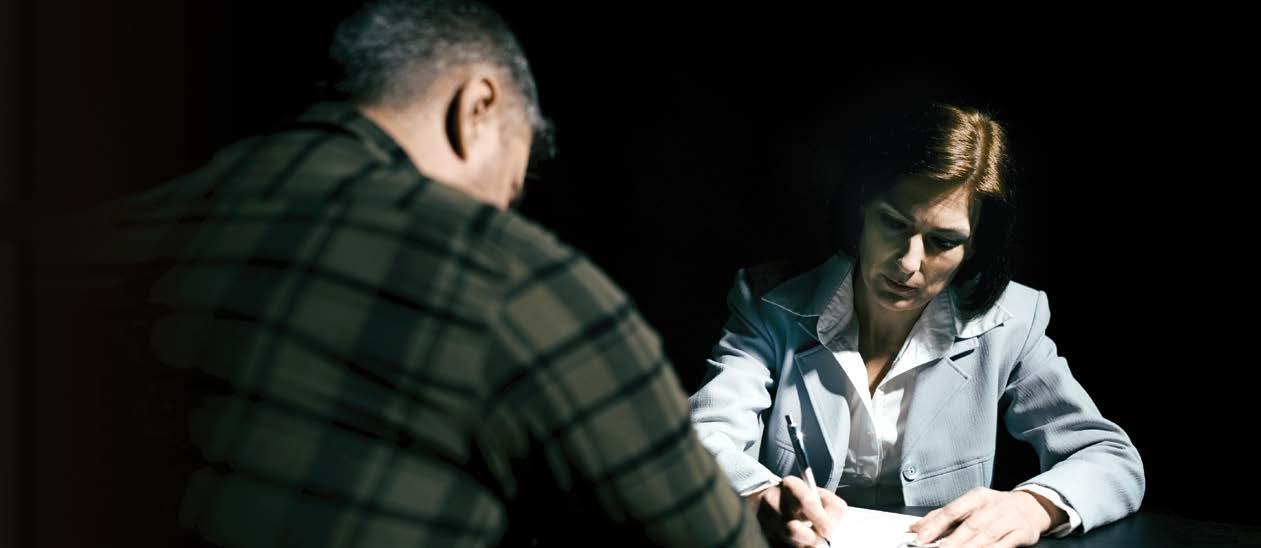
Getting a written confession in a civil case seems like a good idea, until it isn’t. Those of us with law enforcement backgrounds were taught the standard processes of investigations that included getting signed confessions when you could. However, in civil cases this is not always the best rule to follow. Communicating with the client before interviews are conducted is imperative. In fact, you should understand the client’s direction at the beginning of the case. Your goal to solve the case, get confessions and wrap the case in a nice bow may not be in the client’s best interest.
Private investigators are often brought into corporate cases involving the disappearance of inventory, misappropriation of funds, sexual harassment, written or verbal threats, and similar circumstances. It is also common for individuals to hire investigators to look into estate and executor misconduct, contractual issues with contractors, missing relatives, harassment and many other circumstances. While many
of these may start off just trying to confirm if the client’s suspicions appear to have merit, they can quickly develop into criminal violations. How these are handled may be beneficial or not in the best interest of your client.
During the initial consultation with the client, you need to determine if they do in fact want to prepare the findings for criminal proceedings, should the circumstances be present. This is important as it prepares the investigator for the methods they can use during the investigation. For instance, if your client had $500,000 misappropriated from their company, the return of the money may be a secondary concern to the client if they have stockholders. In these situations, the potential for investors to become aware of internal issues could drive the stock down by millions of dollars and have longer lasting reputational impacts. Knowing this ahead of time allows the investigator to adjust their tactics during the interview process. The threat of prosecution can be a valu-
able tool during an interview and can still be used. However, this information allows the investigator to advise the subject that if they cooperate, the investigator may be able to convince the client not to prosecute, knowing full well that is the case. This line of communication should always be one that is done with careful consideration as you never want to tell the subject 100 percent that they will not be prosecuted. Even if they confess, you may subsequently determine they are guilty of many more violations.
The use of a written confession is almost always frowned upon by law enforcement because they have to conduct their own investigation. In doing so, they will need to follow the tenants of the law, including advising them of their rights. Additionally, should you get the person to sign a confession, you probably didn’t have the law enforcement credentials or jurisdiction required which again, requires law enforcement to conduct their own investigation.
Clients often push the investigator to have an employee sign a confession during the investigative interview so they can follow this up with a promissory note to repay the funds. This is not good for several reasons, including the risk that this could be considered coercion and intimidation. While many clients “know the person embezzled $500,000,” they may not have acted alone. An initial audit by the client usually is not the final figure and an in-depth evaluation may determine that they took three times that amount.
If they sign a confession admitting to embezzling $500,000, good luck getting anything more than that amount. In fact, good luck getting them to repay any of the funds. If they did not have financial issues, they most likely would not be stealing funds in the first place. Should law enforcement become involved, you very well could have nullified the ability to prosecute for the actual amount taken.
I have had some Human Resources personnel request a signed confession be obtained to help deter any potential wrongful termination lawsuits. My first question is related to whether the employee was a model employee or if they had any previous issues. It is very possible that the employee was a problem throughout their employment, and they had ample reasons for termination prior to this event. Regardless, the investigator’s written report, affidavit and testimony would offset this concern.
Some clients are persistent in wanting a signed confession. This is where you can educate your client about short-term emotional satisfaction versus long-term success. Using the client’s knowledge of their business and employees certainly can help by providing the investigator with their opinion of who they suspect and who the good employees are. I have found that interviewing the good employees first helps to identify the cliques, things “everyone knows”, and who they believe may have been involved in the situation. As you work through the good employees, this allows you to tell the suspects that according to the information you developed, you have put the pieces together. They will know that you did interviews and will be unsure of what was stated during the interviews.
Another useful tactic for the investigator to use is the RICO statute, also known as the organized crime statute. This is utilized by law enforcement when a conspiracy can be proven with multiple perpetrators involved. When conducting interviews with suspects who are on the fence about confessing, you can ask them if they know what the RICO statute is and how it could apply to the situation at hand. Without threatening, you can simply explain how law enforcement can initiate a RICO case if they find there are multiple subjects involved in the commission of a crime. If successful, the punishment for the perpetrators can be much more severe and a petition to seize their assets to repay the victims can be applied.
The investigator should also use psychological enhancements during the interview. Criminals in general don’t think they are a bad person so during the questioning you can allude to that characteristic by telling them they appear to be a good person who just took advantage of an opportunity or the company’s lack of proper security protocols.
During the initial interview with the client, you should have also agreed to the procedures should a verbal confession be obtained. In most circumstances, it is better to advise the subject that they are not to return to the property and trespassing charges could be initiated if they do. The name and telephone number for a company contact person should be provided and they should be instructed to only contact that point of contact should they need anything. Any belongings in their desk or locker should be gathered and shipped, or a time should be arranged for them to pick them up. You should not allow them access to the computer where they could delete information or to a desk or locker where they could have a weapon. The person should then be escorted to their vehicle by security.
The process of interviewing and obtaining confessions in civil cases are similar to those in criminal cases. However, civil cases may not result in criminal charges based on the client’s circumstances. The client may consider the fact that you were able to solve their issue with minimal disruption or reputational liability a resounding success.
From Scene to Settlement: Fire Investigation Experts Aid Personal Injury Cases
by Aaron Johnson, CFEI, CVFI
“By connecting legal teams with qualified fire investigation experts, or by incorporating these experts into their own investigative workflow, the investigator becomes indispensable.”
When flames ignite more than just buildings—when they injure, displace, or even kill—there’s often more than a charred structure left behind. There’s a case to be built, and private investigators are increasingly becoming pivotal players in that process. Fire scenes are complex and emotionally charged environments. They carry with them not only physical damage but also layers of legal, financial, and human implications. For personal injury attorneys, the ability to accurately determine how and why a fire started, and how the structure or circumstances contributed to a death or injury, can mean the difference between a dismissed case and a multimillion-dollar settlement. That’s where subject matter experts (SMEs) in fire investigation, fire protection systems, and fire and building codes can come into play.
In the realm of personal injury litigation, causation is everything. Attorneys must not only prove that their clients were harmed but also demonstrate that someone—or something—was responsi-
ble for the harm in a legally actionable way. Questions quickly arise: Was the fire truly responsible for the injury, or was there a pre-existing condition? Did the victim contribute to their own harm, or was someone else negligent? Was it a product failure, a code violation, or even intentional misconduct? Outside of origin and cause investigations, fire investigators can bring clarity to these cases. They can do this through case review, property records, and code compliance determinations. This in-depth analysis of the entire product or space, not just the isolating incident, will help to establish not just what happened, but who is responsible and why.
Understanding the investigative process is vital for both attorneys and the private investigators who assist them. Investigators examine all available documentation: fire department reports, police interviews, building permits, inspection reports, witness statements, photographs, surveillance footage, and insurance records. During this review, the investigator is looking for incon-
sistencies in witness accounts, indicators of prior code violations, past complaints about faulty systems, patterns of deferred maintenance, or missing life safety features such as smoke alarms or fire doors. The goal is to begin forming a timeline of events, identify potentially responsible parties, and flag areas where further physical or forensic investigation is needed. For instance, a building permit that doesn’t match the actual construction could suggest unpermitted work, while an inspection report noting violations that were never corrected could demonstrate negligence.
These real-world case examples highlight how impactful a thorough and welldocumented fire investigation can be in uncovering the truth and in shaping the legal strategy that follows. A tenant living in a multi-family apartment complex suffered severe burns in a kitchen fire. The subsequent investigation revealed that the property owner had not only disabled the smoke detector but had also ignored repeated complaints about a known electrical issue. These findings
clearly established the landlord’s negligence and shifted liability in a way that led to a favorable settlement for the tenant. In another case, a child was seriously injured when a portable space heater exploded. While initial reports pointed to user error, a fire expert’s analysis uncovered a critical defect in the heater’s thermal cutoff switch—a safety mechanism that should have shut the unit down before it overheated. This discovery transformed what appeared to be a routine insurance claim into a successful product liability lawsuit. In a third case involving a structure fire with an injured occupant, the fire investigator conducted a thorough review of the building’s history, code compliance records, and witness testimony. The expert determined that several exit doors had been illegally boarded up, leaving the structure with fewer than the coderequired amount of means of egress. This violation was a key factor in the injury and provided the attorney with powerful evidence to bring to the bargaining table.
The SME in fire protection, code compliance, and fire investigations can be called upon to provide other types of support for the legal team. This can include helping attorneys understand
technical data, creating visual aids or models, and providing testimony at trial or deposition. For private investigators working in personal injury cases, understanding this workflow is key to integrating the expert’s findings into the broader case narrative. The PI serves as a bridge between the expert and the legal team, translating complex findings into actionable intelligence that attorneys can use. By connecting legal teams with qualified fire investigation experts, or by incorporating these experts into their own investigative workflow, the investigator becomes indispensable.
When selecting an expert to work with, the private investigator should ask questions about their training, investigation methods, previous testimony, and familiarity with applicable codes. Fire experts hold credentials from one of two certifying bodies. The National Association of Fire Investigators (NAFI) provides the Certified Fire and Explosion Investigator (CFEI) and the Certified Vehicle Fire Investigator (CVFI) designations. The International Association of Arson Investigators (IAAI) issues three primary certifications: the Certified Fire Investigator (IAAI-CFI), Fire Investigation Technician (IAAI-FIT), and the Evi-
dence Collection Technician (IAAI-ECT). These certifications signify that the expert has met rigorous standards and is well-versed in investigative methodology. In many cases, fire investigators are also licensed private investigators, which expands their scope and authority in casework. Experience as a fire marshal or fire or building code official adds weight to their opinions—particularly when code compliance and safety regulations are in question.
Fire investigation is no longer a niche service reserved for arson or insurance cases. In today’s litigation environment, especially in personal injury, it’s a strategic asset. For private investigators, embracing collaboration with fire experts is a professional imperative. Doing so not only improves outcomes for clients but also elevates the reputation and results of the investigator involved.
For those looking to sharpen their edge in personal injury cases, now is the time to build relationships with credible fire investigators and understand how their work can complement your own. With the right partnership, you’ll not only uncover the facts, but you will also provide added value to your personal injury attorneys and clients.
5 Bills That Can Kill: Legislation That May Harm the Private Investigator
by Matthew Spaier, President of Satellite Investigations
“If d ata retention periods are extended too long or access to this data becomes restricted, private investigators may face delays in obtaining essential digital records.”
Over 25 years ago, I started my career in this industry in the city that never sleeps. The mid-90s saw a considerable jump in technological advances that enabled people to operate their businesses using the latest equipment and software to gather intelligence. The industry boom brought the birth of third-party data vendors like Experian, ChoicePoint, and Merlin. These databases helped the average gumshoe refine their locating skills and helped us add to our abilities to do Open-Source Investigations through public records. Soon after, legislation was passed that began the regulation of this sector. The implementation of the Gramm–Leach–Bliley Act (GLBA), the Driver’s Privacy Protection Act (DPPA), and the Fair Credit Reporting Act (FCRA) helped shape the industry and how information is disseminated.
The private investigator and security industry is one that operates at the crossroads of privacy, protection, and access to critical information. While private investigators play an important
role in assisting individuals, businesses, and law firms in gathering necessary data to solve cases, there are several proposals for legislative bills making their way through Congress that could severely limit our ability to do so. Below are five potential pieces of legislation that could harm the private investigator and security industry, followed by a discussion on the benefits of having the National Council of Investigation and Security Services (NCISS) represent the industry’s interests, and the role a lobbyist can play in protecting these interests. But first, let’s discuss five potential bills that can kill.
1. National Data Privacy Legislation
As concerns over data privacy continue to rise, lawmakers have begun introducing national data privacy bills aimed at regulating how companies and organizations handle personal data. These legislative efforts often center on limiting access to, and use of, personal information. While privacy is critical, national data privacy laws could create signifi-
cant obstacles for private investigators, who depend on access to public records, databases, and personal information to perform their work.
Currently, no national data privacy bills are up for a vote in the U.S. Congress. The most recent significant development was in July 2022, when the House Energy and Commerce Committee advanced the American Data Privacy and Protection Act (ADPPA) with a bipartisan vote of 53 to two. This bill aimed to establish a national standard for how tech companies collect and use Americans’ data.
However, the ADPPA did not proceed to a full House vote, and no similar comprehensive data privacy legislation has been introduced or scheduled for a vote since then. While there have been discussions and proposals, including the Consumer Online Privacy Rights Act (COPRA) introduced by Senator
Maria Cantwell in 2019, these have not advanced to the voting stage.
In the meantime, various states have enacted their own data privacy laws, leading to a patchwork of regulations nationwide. Efforts to create a unified federal standard continue, but no national data privacy legislation is up for vote.
To conduct thorough investigations, PIs rely on public records such as criminal history, driving records, property records, and other data bases. If national data privacy laws restrict access to this information or impose overly restrictive requirements for obtaining consent from individuals before accessing their data, it could make it much harder for PIs to do their jobs effectively. These limitations may force investigators to spend more time and resources searching for legally accessible data or hinder the timely delivery of critical information needed for legal proceedings.
2. PIs as Independent Contractors
Private investigators often work as independent contractors or operate their own small businesses. A proposed change in how independent contractors are classified under federal labor law could severely impact the flexibility and profitability of many in the industry. Under the ABC Test (recently adopted in some states), independent contractors must meet strict criteria to remain classified as such. If a federal law is passed that enforces similar classification criteria, many private investigators would no longer be able to work independently.
This shift could require private investigators to become full-time employees of a larger company, reducing their flexibility, income potential, and autonomy. Moreover, hiring firms may become less willing to hire investigators on a contractual basis due to the added burden of ensuring compliance with new classification rules. This could also increase operational costs for investigative firms, limit flexibility for independent PIs, and reduce opportunities for freelance or contract work in the industry.
Currently, no national bills are up for a vote in the U.S. Congress specifically addressing the classification of independent contractors using the “ABC test.” The “ABC test” is a standard used to determine whether a worker is an independent contractor or an employee, and its application varies by state.
In California, the “ABC test” was codified into law by passing Assembly Bill 5 (AB 5) in 2019. This legislation expanded the “ABC test” application to a broader range of workers, aiming to provide greater protection to individuals previously classified as independent contractors. Subsequent amendments, such as As sembly Bill 2257 (AB 2257) in 2020, modified certain exemptions to the “ABC test,” particularly for creative and artistic industries. These changes were intended to balance worker protection with the flexibility needed in specific sectors.
At the federal level, the Department of Labor introduced a rule in March 2024 that makes it more challenging for businesses to classify workers as independent contractors. This rule has faced legal challenges, and as of January 2025, a federal judge in New Mexico upheld the rule, dismissing a lawsuit that sought to overturn it. While there is ongoing discussion and legal activity regarding the classification of independent contractors, no national legislation specifically adopting the “ABC test” is currently up for a vote in Congress.
3. Public Records Restrictions
Private investigators depend on public records to verify information and conduct background checks. However, several states have already begun to limit access to these records, citing privacy concerns or government transparency. In some areas, legislators are pushing for more stringent restrictions on public records, making it harder for PIs to access criminal history, financial records, and other critical information.
If federal lawmakers impose nationwide restrictions on public records access, private investigators will face consider-
able challenges in gathering information to support their clients. Public records are often one of the only reliable sources of information for investigators working in areas such as insurance fraud, background checks, missing persons cases, criminal defense, litigation support, and more. Limiting access to these records could significantly hinder the industry’s ability to perform thorough investigations, not to mention the public’s right to access records.
No national bills are up for a vote in the U.S. Congress explicitly restricting access to public records under the Freedom of Information Act (FOIA). Recent legislative efforts have focused on enhancing transparency and public access to government information.
For instance, in January 2025, the Michigan Senate passed a bipartisan bill package that would significantly expand the state’s FOIA, making both the governor’s office and state legislature subject to public records requests for the first time since the law’s inception nearly five decades ago. Similarly, in Arkansas, the General Assembly passed public records legislation to increase transparency, though some debates centered around the bill’s scope and potential exemptions.
While these developments pertain to state-level legislation, they reflect a broader trend toward enhancing public access to government records. At the federal level, no current bills propose restrictions on FOIA access. It’s important to note that legislative priorities can change, and new bills may be introduced. For the most current information, monitoring official congressional records and reputable news sources is advisa ble.
4. Federal Data Retention Laws
Federal data retention laws are being introduced to increase accountability, particularly for tech companies. These laws could require private companies to retain user data for extended periods under the premise that such data is needed for national security, law enforcement, or litigation purposes.
These laws could present significant challenges for private investigators when accessing critical information on individuals, businesses, or organizations. If data retention periods are extended too long or access to this data becomes restricted, private investigators may face delays in obtaining essential digital records. Additionally, certain records or communications may no longer be accessible if they are deleted after the retention period expires. These restrictions could significantly reduce the scope and quality of investigative work. Investigators often rely on historical data to uncover evidence and track information. Restricting the availability of this data could hinder investigations and limit the effectiveness of private security services.
Currently, no national bills are up for a vote in the U.S. Congress specifically requiring federal data retention laws. However, existing federal regulations and policies govern the retention and management of records by federal agencies.
Management of Federal Records:
• Federal Records Act (FRA): The FRA mandates that federal agencies establish and maintain records management programs to ensure the proper creation, maintenance, and disposition of records—including guidelines on the retention and disposal of records.
• National Archives and Records Administration (NARA): NARA oversees the management of federal records, providing policies and guidance on records creation, maintenance, and disposition. This includes the development of records retention schedules and ensuring compliance with records management requirements.
• Office of Personnel Management (OPM): OPM offers guidance on records management for federal agencies, including compliance with records retention requirements.
Recent Legislative Developments:
In April 2024, the Senate introduced the
“Strengthening Oversight of Federal Records Act of 2024” (S.4042). This bill aims to enhance the management and preservation of federal records, including provisions related to electronic records retention. Key aspects of the bill include:
• Proactive Disclosure of Records Retention Schedules: The bill proposes that the Archivist of the United States proactively disclose records retention schedules approved for federal agencies, thereby promoting transparency and public access to information.
• Preservation of Electronic Records: The bill seeks to strengthen requirements for the preservation of electronic records, including those created or received through non-official electronic messaging accounts. It outlines specific conditions under which such records must be preserved and the responsibilities of federal employees in this regard.
As of now, S.4042 has been introduced in the Senate and is under consideration. It has not yet been passed into law. It is advisable to monitor official congressional records and reputable news sources for the most current information on this bill and any related legislative developments.
5. Restrictions on the Use of Surveillance Techniques
Surveillance technologies, including drones, GPS tracking devices, and hidden cameras, are vital tools for private investigators to carry out their work. However, legislative bills could be proposed at both the state and federal levels to limit the use of these technologies. In particular, laws aimed at regulating or outright banning the use of surveillance tools on private property or without consent from individuals being monitored are gaining traction.
While some regulations are necessary to ensure the ethical use of surveillance technologies, overly restrictive laws could make it difficult for private investigators
to gather critical evidence or track down subjects. For instance, laws that severely limit the use of GPS tracking devices could prevent investigators from per forming vital tasks, such as tracking a missing person’s vehicle or monitoring the activities of a subject suspected of fraud. Currently, no national bills are up for a vote in the U.S. Congress to restrict surveillance technologies. Recent legislative developments have expanded surveillance capabilities.
Expansion of Surveillance Powers:
• National Defense Authorization Act (NDAA): In December 2024, Congress passed the NDAA, which expanded Section 702 of the Foreign Intelligence Surveillance Act (FISA). This expansion grants the government broader authority to mandate companies to assist in wiretapping international communications, potentially increasing surveillance of private communications, including those of U.S. citizens. Legal experts have expressed concerns that these changes could lead to vague and expansive surveillance powers, bypassing federal judicial review.
Legislative Developments:
• RESTRICT Act: In March 2023, Senators Mark Warner and John Thune introduced the Restricting the Emergence of Security Threats that Risk Information and Communications Technology (RESTRICT) Act. This bipartisan legislation aims to empower the Department of Commerce to review, prevent, and mitigate information communications and technology transactions that pose undue risks to national security. While the bill addresses national security concerns related to foreign technologies, it doesn’t specifically focus on restricting surveillance technologies. Currently it is based on Governmental oversight, but it has the potential to stretch into private commerce and affect our industry.
Recent Legislative Actions:
• Drone Surveillance Bill: In January 2025, Senate Majority Leader Chuck Schumer attempted to advance a bill
page 13
that would enable local law enforcement to track aerial drones. The bill was blocked by Senator Rand Paul, who cited concerns over Americans’ privacy and civil liberties under the Fourth Amendment. This incident highlights ongoing debates regarding the balance between security measures and individual privacy rights.
The Role of NCISS and
Lobbyists
in Protecting the Industry
As these legislative threats loom, the National Council of Investigation and Security Services (NCISS) plays an essential role in representing the interests of private investigators. NCISS is a nonprofit organization dedicated to advocating for the rights of private investigators and security professionals. Through its work, NCISS helps shape policies and regulations that impact the industry, ensuring that investigators’ access to critical information and tools is not unduly restricted.
NCISS works tirelessly to:
• Monitor Legislation: NCISS tracks legislation that may affect the pri-
vate investigator industry and responds quickly with appropriate lobbying efforts.
• Advocate for Fair Regulations: NCISS lobbies lawmakers to ensure that new laws protect privacy rights without limiting the essential tools private investigators need to do their jobs.
• Support Investigators’ Rights: NCISS fights for policies that protect the professional rights of private investigators, ensuring that they can continue their work while adhering to ethical standards.
The Importance of a Lobbyist
A lobbyist can be an invaluable resource for private investigators and security professionals, especially when influencing legislation. Lobbyists work closely with lawmakers to advocate for the industry’s interests. Here are several ways a lobbyist can help protect private investigators and security professionals:
1. Expert Advocacy: Lobbyists are experienced in the legislative process
and can ensure that the concerns of the PI community are heard.
2. Strategic Influence: Lobbyists can help shape bills before they become law, offering input on provisions that could harm the industry.
3. Networking and Alliances: Lobbyists maintain relationships with key lawmakers and government officials, increasing the chances of favorable outcomes for the industry.
By working with NCISS, PIs and security professionals can ensure that their industry’s needs are considered in the face of harmful legislation. NCISS advocates for our profession year-round and is also a national association that brings together experts and colleagues from across the country. NCISS offers ongoing training, professional development, discounts, and a robust national member listserv for ongoing referrals and case support. Joining NCISS is a great benefit to all in
vestigators in the country.
Take Your Business to the Next Level Toolkit for Professional Investigators
Hone New Skills Expand Your Business Increase Your Income 1 2 3
OREP is more than just another Insurance Agency. As an OREP Member, you get access to an unrivaled training suite of products to help you build your skills and grow your business (at no additional cost).
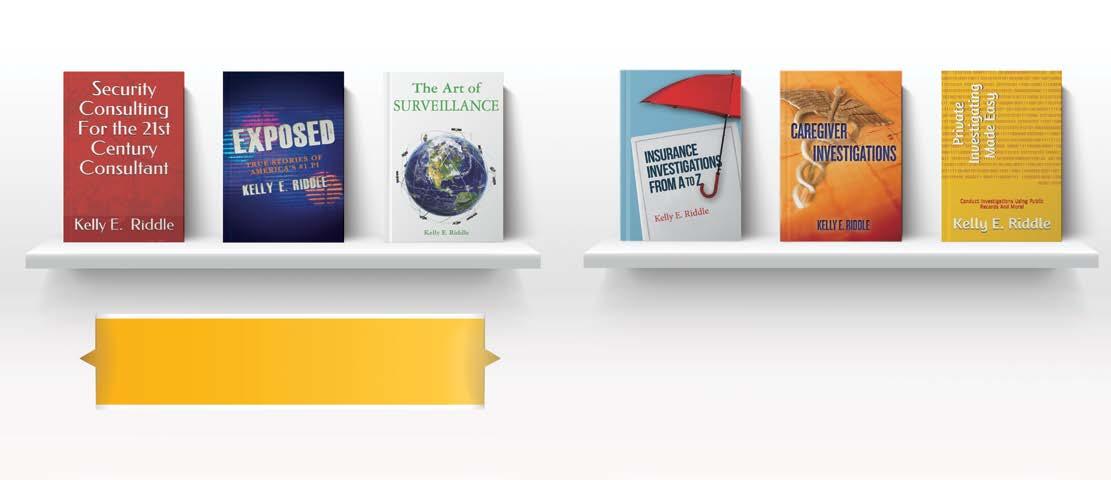
Learn from the Best Training, eBooks, and Contracts from experienced attorneys and industry-leading private investigators (Kelly Riddle and Mark and Wendy Murnan).
The Art of Surveillance
Conducting surveillance correctly is truly an art. This eBook shows you how to avoid common mistakes, use proper equipment and different concealment techniques; includes a section on international investigations.
Secrets of a PI Agency:
Marketing and Management
Good investigation techniques will only get you so far. Learn from one of the leading investigators in the nation on how to grow your agency like any other business by utilizing savvy marketing techniques and business skills.
Marketing to Plaintiff Attorneys
Learn valuable strategies and techniques for marketing your agency to plaintiff attorneys! Many PIs ignore this high-value niche that pays higher hourly rates.
Subcontractor Manual
Step up your game when it comes to dealing with subcontractors. Set clear expectations on how subcontractors should handle confidential information, interact with clients, and navigate insurance requirements.
Things They Didn’t Tell You (About Starting a PI Business)
Why struggle to get your business up and running when you can rely on the experience of someone who has been in business for more than 40 years? This book is a road map for anyone serious about starting a PI business.
Investigator Procedures Manual
Shorten the learning curve and increase your own (or your new hire’s) productivity, as well as your agency’s profits! This pre-formatted procedure template helps you build business processes for success.
Business Plan Template
Use this as a template for the growth of your PI business. Kelly E. Riddle shows you how to set your services apart from others, define what market you serve, the types of services you provide, how you will market the business, its financial history, business expansion, and more.
8 Hour CE Class: “Surveillance Strategies for Success”
Learn key strategies and tips to successfully execute surveillance operations as a private investigator.
Engagement Letter
Enjoy a templated Engagement Contract prepared by an attorney and former FBI agent.
Subcontractor Agreement
Prepared by an attorney and former FBI agent.
Specialization vs. the “Jack of All Trades”:
Why Focusing Your PI Business Matters
by Jim Nanos, VSM, BS, LPI/Owner, ThePICoach.com
“Specialization doesn’t limit your business—it expands it. By narrowing your focus, you create a brand that clients can understand and remember.”
In every profession, there’s a temptation to try to be all things to all people. Private investigators are no different. The range of services offered under the PI banner is wide—surveillance, criminal defense, background checks, accident reconstruction, digital forensics, insurance fraud, intellectual property, skip tracing, executive protection, and more. A newly licensed investigator might assume that in order to succeed, they must check every one of these boxes and be able to deliver every service that any prospective client could possibly request.
In my experience, the “jack of all trades” approach is one of the most common mistakes new investigators make. Instead of building a strong reputation, they stretch themselves too thin, offer-
ing too many services and really not excelling at any.
When clients are deciding who to trust with sensitive and high-stakes investigations, they usually want the best—the person who is known for a specific skillset and has a track record to prove it.
That’s why I argue for focus. Choosing one or two disciplines to specialize in— and working to become recognized as the best in that area—is not only more sustainable, it’s also a stronger business model for long-term success.
Why Specialization Wins
Think about how attorneys work. You wouldn’t hire a real estate lawyer to defend you in a criminal case. While both are licensed attorneys, the skills,
knowledge, and strategies needed in each discipline are vastly different. The same principle applies in our field.
When you specialize in just one or two disciplines, you gain:
1. Deep Expertise. Repetition breeds mastery. Handling case after case in a specific discipline gives you the opportunity to refine your craft. Over time, you’ll notice details, anticipate challenges, and spot patterns that a generalist might miss.
2. Reputation. When colleagues, attorneys, or clients think of surveillance in your area, is your name the first that comes to mind? If so, you’ve done it right. Specialization builds that type of recognition, which leads to referrals and repeat business. For
page 18
from the Best + Develop Your Skills
page 16
example, In New Jersey when a PI needs high level remote access surveillance systems—I want them to think of me first.
3. Efficiency. Focus your energy so you can streamline your equipment, training, and processes. You don’t need to own every gadget or software program under the sun. Instead, you invest in what makes you more effective at your chosen discipline.
4. Stronger Marketing. A clear niche makes it easier to brand your business. “We are the go-to firm for highlevel surveillance in New Jersey” is a sharper and more compelling message than “We do everything under the PI umbrella.”
5. Premium Rates. Specialists are now seen and compensated at a higher level and are viewed as experts. Clients expect to pay more for someone who is recognized as the best in a given field, and a focused practice often commands a higher hourly rate than a generalist offering a little bit of everything.
6. Professional Confidence. When you know your lane, you project confidence to your clients. They sense they’re hiring someone who is not dabbling, but rather an expert at their craft.
A Personal Example
In my own practice, I focus on high level surveillance and remote access camera systems, as well as criminal defense work. These are the two disciplines where I’ve invested decades of training, equipment, and real-world experience. Because of that, attorneys and clients know me as someone who can deliver consistently in those areas.
When I’m contacted for other types of cases—say, a motor vehicle accident reconstruction—I don’t turn the work away with a simple “I don’t do that.” Instead, I position myself as the point of contact and project manager. I’ll tell the attorney:
“I have someone who specializes in accident reconstruction. I’ll bring
“ The attorney gets the best of both worlds: my established trust and oversight, plus the expertise of a specialist.”
them into the case, oversee the work, and make sure it’s handled to the standard you’re used to when working with me.”
This approach does two things:
1. It preserves the client relationship by assuring them I’ll still be their primary contact.
2. It ensures the work is handled by a true expert, rather than me trying to learn accident reconstruction on the fly.
The attorney gets the best of both worlds: my established trust and oversight, plus the expertise of a specialist. While it may be true that I will not earn or net the same amount on this case because I’ve brought another expert in, I will maintain that level of confidence with my attorney and will continue to be the “go-to” person for him or her. No need to shop around to other PIs—Jim is our man.
Professional Associations
Here’s where relationships matter. None of us can be experts in everything, but all of us can build a network of other investigators who are experts in the areas we don’t cover.
State associations, regional groups, and national organizations provide excellent opportunities to connect with fellow PIs. The investigator you meet at a training day, conference, or monthly meeting might be the exact professional you’ll later call upon for a case outside your lane.
These relationships are not just professional courtesy—they’re business tools. They allow you to expand your service offerings without diluting your brand. You remain the specialist in your discipline, but you also become a connec-
tor who can solve broader problems for your clients.
Avoiding Pitfalls of Being a Generalist
Let’s look at what happens when a private investigator tries to be everything to everyone:
• Shallow Knowledge. By spreading yourself across many disciplines, you never get enough repetition in any one area to truly master it.
• Equipment Overload. You end up buying gear for accident recon, computer forensics, executive protection, and more—much of which sits unused. That’s money wasted.
• Diluted Marketing. Your website, business cards, and elevator pitch read like a laundry list, which weakens your professional image. Surveillance, criminal defense, accident reconstruction, backgrounds, computer forensics, taxidermy, small engine repair—where does it stop!
• Client Doubt. If you claim to do everything, clients may wonder if you are truly skilled in the area they are looking to hire for.
It’s far better to be the investigator who says, “I specialize in X,” than the one who says, “I do it all.”
Building Your Niche
For new investigators trying to decide where to specialize, here are some steps:
1. Assess Your Strengths. What did you excel at during training or your early cases? Do you have prior career experience (law enforcement, military, legal, IT) that gives you an edge in a particular area?
2. Look at Market Demand. In your geographic area, what services are consistently in demand? Matrimonial surveillance may dominate in
one region, while insurance defense is stronger in another.
3. Invest in Training. Once you pick a discipline, pursue advanced training. Certifications, seminars, and continuing education distinguishes you from competitors.
4. Brand Around It. Make your specialization the central theme of your marketing. Build your website, brochures, and online presence around your core disciplines.
5. Say No (Strategically). Don’t be afraid to decline work that doesn’t fit your niche—but whenever possible, redirect it to someone in your network. Clients will remember that you solved their problem, even if you weren’t the one doing the work.
Long-Term Payoff
Specialization doesn’t limit your business—it expands it. By narrowing your
focus, you create a brand that clients can understand and remember. You build depth of expertise that sets you apart from competitors. And through your professional network, you can still say “yes” to a wide range of client needs without stretching yourself too thin.
Over time, this approach builds a reputation of reliability, expertise, and professionalism. Attorneys and clients want to know that when they call you, they’re hiring someone who is among the best in the field not someone who is trying to cover every possible investigative service at once.
Final Thoughts
The private investigation profession is full of opportunities, but also full of pitfalls for those who try to do too much. By focusing your business on one or two disciplines, you create clar-
ity—for yourself, for your clients, and for your peers.
Your reputation will grow stronger, your work will be more efficient, and your business will stand out in a crowded market. And when those calls come in for services outside your lane, your network of fellow investigators becomes an invaluable resource—allowing you to say “yes” to the client while still delivering work at the highest level.
Specialization is not about doing less— it’s about doing better. And in our line of work, better is what counts.
Jim Nanos can be contacted for mentoring, conferences and speaking engagements by visiting The PI Coach website, www.ThePICoach.com or through his private investigations firm, Apple Investigations, www.AppleInvestigations.com
IMPRINTED IN TIME: The (Abridged) History of Private Investigation
by Isaac Peck, Publisher
“PIs have always been innovators in using the technology of their day. As technologies have accelerated in the last century, so too have investigative tools expanded at an exponential pace.”
The history of private investigation as a discipline is so vast and varied that even a rudimentary summary in a trade publication like Working PI risks being superficial. Still, what follows is an attempt to trace some of the building blocks and turning points that shaped the profession we know today.
While private investigators were not oficially licensed in the United States until 1915—starting with California—the genesis of the profession has far deeper roots. The culture, tactics, and role of intelligence gathering in human society long predates licensing or even any formal recognition of “private investigators” as a profession. At its core, investigation reflects a timeless truth: accurate information has always carried immense value in human societies. The collection, trade, and use of information is as old as civilization itself, with it often meaning the difference between success and failure, and life and death.
Long before words like “investigator” or “detective” were conceived, societies relied on spies, informants, scouts, and information brokers. Empires, tribes, rebels, churches, organizations, and private citizens alike sought intelligence; sometimes desperately so. “Knowledge is power” has always rung true—and those who controlled information have routinely sold it, traded it, or wielded it as leverage to advance their interests. Today’s private investigators stand on a foundation that has existed for centuries: the essential human demand for information.
By the 1800s, the practice of gathering and selling information began to evolve from an informal tradecraft into a more recognizable commercial service. A century before professional licensing, this period marked the emergence of dedicated agencies and individuals who treated investigation as a vocation, and a business.
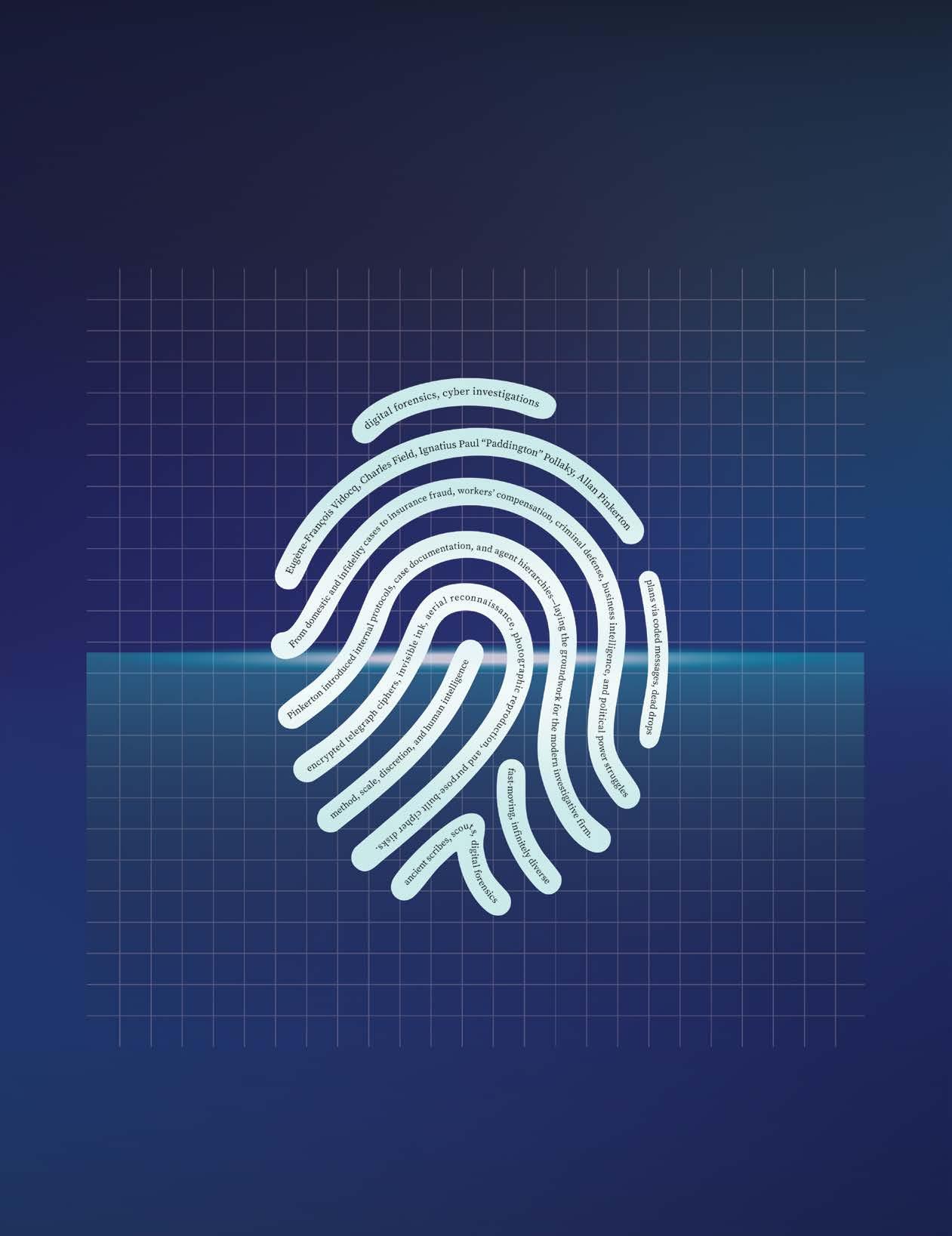
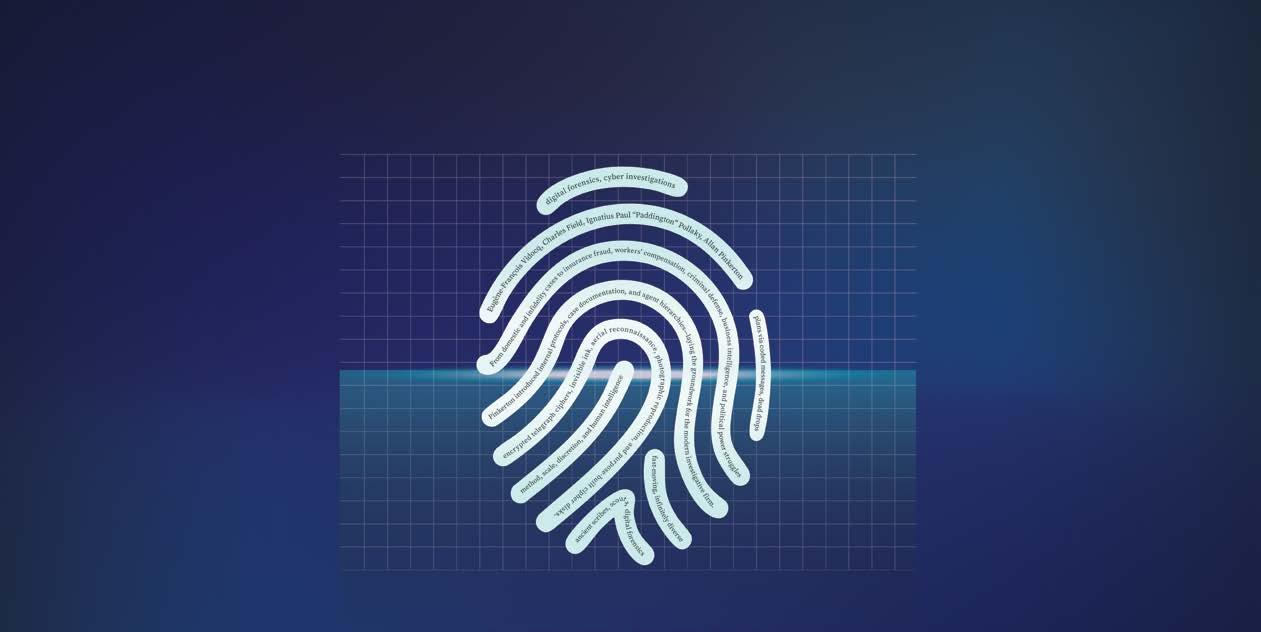
In Europe, figures such as EugèneFrançois Vidocq, Charles Field, and Ignatius Paul “Paddington” Pollaky established themselves as trailblazers for private investigation, initiating recognizable PI practices like systematic record-keeping, assurances of client confidentiality, and publicizing services. Meanwhile in the United States, Allan Pinkerton and the founding of the North American Detective Agency set the stage for what would become the American model of the profession.
In the century that followed, investigators in the United States and abroad expanded into nearly every arena of civic and commercial life: from domestic and infidelity cases to insurance fraud, workers’ compensation, criminal defense, business intelligence, and political power struggles. In the last few decades specifically, the profession has expanded
page 22
and diversified even further, moving into digital forensics, cyber investigations, and even cryptocurrency tracing.
The modern private investigation profession rests on centuries of innovation and necessity, but its driving force has never changed: information is power, and there will always be someone willing to pay for it.
From Ancient Intelligence Agents to the Revolutionary War
Long before private detectives roamed city streets, rulers relied on human networks to collect secrets. In ancient Sumer, temple scribes and palace officials hired merchants, artisans, and servants as informers. In the wilderness of Canaan, Moses is said to have sent scouts to size up fortified cities and local resources. Such scouts were adept at mapping, getting information from locals, and preparing risk assessments; these are things private investigators still do for their clients. When Alexander the Great marched into Persia, he used scouts to gather intelligence on enemy troop movements, measure the loyalty of towns, and send coded reports back to camp.
Later, in medieval Europe, feudal lords relied on bailiffs to collect rents, deal with poachers, and put down peasant revolts (the latter a preview of one of Pinkerton’s best-known services). Crown runners crisscrossed dirt roads with royal orders but also kept an eye out for heretics and criminals. Necessity is the mother of invention when the king’s paying.
Spycraft also played a role in the revolts against kings. During the Revolutionary War, the Culper Ring operated as a covert spy network under George Washington’s direction, relaying British troop movements and plans via coded messages, dead drops, and invisible ink. Their intelligence, specifically Agent 355, helped thwart Benedict Arnold’s treason and secure American victories.
For many millennia prior to the professionalization of PIs, it’s clear some peo-
ple had a knack for information retrieval, giving paying clients—or governments— the upper hand in spying and security.
The Modern PI Pioneers
Four individuals laid the groundwork for the modern private investigator. Each brought a key innovation that endures in today’s tradecraft.
Eugène François Vidocq (1775-1857) is often called the first private detective. The Parsian ex-convict turned criminal inspector pioneered systematic recordkeeping, introduced plaster casts for shoeprints, and used indelible ink to track repeat offenders. Vidocq is remembered as the maker of method: he treated investigations as reproducible processes.
Allan Pinkerton (1819-1884) was the master of scaling up and then assigning down. He founded the North American Detective Agency in 1850 under the motto “We Never Sleep.” Pinkerton built a vast network of undercover agents who unearthed espionage plots during the Civil War and protected railroads during labor conflicts. His emphasis on organized surveillance teams and national manhunts set the template for large-scale, cross-jurisdictional work. His founding of the Pinkerton National Detective Agency in 1850 marked a turning point: no longer was investigative work the domain of lone operators or informal networks. Pinkerton introduced internal protocols, case documentation, and agent hierarchies— laying the groundwork for the modern investigative firm. Although he probably influenced large-scale police work more than individual PIs, his creation of large agencies provided a business template for later investigative firms.
Pinkerton’s legacy was a mindset: investigative work could be principled and procedural. Success came not from
“Four individuals laid the groundwork for the modern private investigator. Each brought a key innovation that endures in today’s tradecraft.” page 24
improvisation, but from replicable systems and disciplined craft. Whenever you coordinate multi-agent surveillance, log evidence with timestamps, work out client confidentiality agreements, or reach out with different services to different kinds of clients, you can thank Pinkerton. He also developed the use of mugshot archives, centralized criminal records, and informant networks, which remain foundational in both public and private sector investigating. His agency was among the first to offer scalable services across jurisdictions, from corporate security to personal protection, and even presidential detail. Pinkerton’s emphasis on methodical fieldwork and administrative rigor helped elevate the profession’s credibility and reach.
Meanwhile, two Londoners played critical roles: ex-cop Charles Frederick Field (1805-1874) opened a “civilian inquiry” office in 1852, selling his expertise to businesses and rich patrons, assuring them discretion as part of the package; while Ignatius Paul “Paddington” Pollaky (1828-1918) was a showboating self-promoter and skilled informant manager who became so famous that Gilbert and Sullivan wrote him into one of their operas, while the public devoured rumors of his exploits.
Together, Vidocq’s systems, Pinkerton’s networks, Field’s client relationships, and Pollaky’s informant-driven hustle created the four pillars of private investigation: method, scale, discretion, and human intelligence. PIs still build on this legacy.
The Civil War and the Birth of Technological Spycraft
Between 1861 and 1865, the American Civil War became the proving ground for modern espionage. Behind the roar of musket volleys, both the Union and
v Tax Evasion Information Reward Program
(1) Key Information: Specific and credible evidence of violation of the South Korea tax laws.
(2) Rewards: 5%-20% of the recovered taxes, up to 4 billion KRW (USD 2.8M), based on your contribution.
v Foreign Financial Account Information Reward Program
(1) Key Information: All available documents, including account holder names, account numbers, and account balances.
(2) Rewards: 5%-15% of the recovered penalties, up to 2 billion KRW (USD 1.4M)
Confederacy raced to build spy networks, encrypt messages, steal documents, and plot kidnappings and assassinations. In doing so, they forged a template of clandestine tradecraft that private investigators would refine and repurpose for the next two centuries.
Before the U.S. government had its own intelligence service, it leaned on Allan Pinkerton’s National Detective Agency. Hired in 1861 by General George B. McClellan, Pinkerton, under the alias “Major E.J. Allen,” organized the Army of the Potomac’s first Secret Service. He intercepted Confederate dispatches, ran undercover missions deep into Southern territory, and even recruited Kate Warne, America’s first female detective.
Pinkerton stumbled at times, inflating his troop estimates and prompting McClellan to delay vital offensives. Still, Pinkerton’s centralized, civilian-staffed framework, with its surveillance teams and coded correspondence, became the blueprint for the Secret Service, the FBI, and the corporate-security industry.
Harriet Tubman, best known for the Underground Railroad, emerged as the Civil War’s most effective field operative, mapping hostile terrain, guiding the Combahee River Raid that liberated over 700 enslaved people, and using her intimate knowledge of Southern networks to supply Union commanders with actionable intelligence.
Meanwhile, detective Kate Warne foiled an assassination plot against Presidentelect Lincoln in Baltimore. Disguised first as a Southern socialite and later as “Mrs. Lincoln,” she infiltrated secessionist circles, uncovered a staged riot plan, and personally shepherded Lincoln through a secret night transfer, afterwards sending Pinkerton the triumphant telegram: “Plums has Nuts.”
Other agents included analyst John Babcock who turned interviews into battlefield intelligence, and the unbelievably brave operative Mary Richards Bowser, who penetrated the Confederate inner
“Often compared to Steve Jobs, Lipset revolutionized investigative technology and challenged conventional norms.”
circle by going deep undercover in CSA President Jefferson Davis’s home, disguised as a servant.
Both sides in the Civil War also pioneered tools still in use today: encrypted telegraph ciphers, invisible ink, aerial reconnaissance, photographic reproduction, and purpose-built cipher disks. These innovations, born of battlefield necessity, cemented a legacy of espionage that would scale down into the privateinvestigation profession.
Criminal Defense
While popular history often celebrates investigators as crime-fighters, an equally important legacy comes from those workin g for criminal defense attorneys—ensuring that those charged with a crime in this country are given a fair shot at justice.
By the mid-20th century, defense attorneys began increasingly relying on private investigators to challenge expert testimony, reconstruct crime scenes, and identify inconsistencies in police reports. These professionals evolved from mere fact-gatherers into analysts, technologists, and strategic thinkers. Surveillance, undercover operations, and forensic analysis became standard tools in countering prosecution narratives.
Over time, trade journals and legal literature began to recognize the defense investigator as “the eyes and ears of the defense attorney,” responsible for gathering all pertinent information—favorable and adverse. Criminal defense work also shaped the business dynamics of the PI profession, introducing retainer models, specialization, and agency structures tailored to legal clients.
One of the most transformative figures in this evolution was Harold “Hal” Lipset (1919-1997). Often compared to Steve Jobs, Lipset revolutionized investiga -
tive technology and challenged conventional norms. Active in San Francisco, he worked with high-profile clients like Angela Davis and Jim Jones and even inspired the character Harry Caul in Francis Ford Coppola’s The Conversation Lipset’s innovations in miniature surveillance—such as the iconic bug hidden in a martini olive—redefined covert operations and raised ethical questions about privacy.
Lipset recruited intellectual operatives, including former philosophy professor Josiah Thompson (born in 1935), who later became a respected defense investigator. Thompson’s work helped free wrongfully convicted Chol Soo Lee and exposed systemic flaws in law enforcement’s approach. Together, Lipset and Thompson helped redefine private investigation as a sophisticated, strategic, and ethically engaged profession. While Lipset is a famous investigator for myriad reasons, he once opined that there was “no greater thrill in the world” than defending accused criminals and proving them innocent.
There’s another reason why private investigators have leaned into criminal defense. The Sixth Amendment to the U.S. Constitution guarantees the right to legal counsel for criminal defendants, and for over 50 years, the prevailing opinion has been that fulfilling this right includes giving criminal defendants access to private investigative work. This was made clear by several legal opinions and scholarly articles that came up after Gideon v. Wainwright (1963), the case where the Supreme Court ruled that states must provide legal counsel to indigent defendants in felony cases.
For example, in a 1970 Cornell Law Review (Volume 55, Issue 4) article, law professor Craig Bowman warned that denying defendants investigative resources risks
undermining the very idea of equality before the law. The government, he argued, should not “allow poverty to create an imbalance in the administration of criminal justice.” Instead, Bowman concluded, “to ensure balance, the government should provide the indigent defendant with the services of investigators and experts to develop, prepare, and present his defense.”
Beginning in the mid-to-late 20th century, the business of criminal defense investigation received a boost from a series of state court decisions that greatly expanded the government’s mandate to aid poor and indigent criminal defendants. These included Louisiana’s finding in State v. Madison (1977) that the right to an investigator may “in many cases be an adjunct to the right to counsel” and that “when an indigent defendant shows that his attorney is unable to obtain existing evidence crucial to the defense, the means to obtain it should be provided for him, and if the indigent defender system cannot defray the expense, the State ought to supply the funds.” California issued strong judicial opinions concerning “a criminal defendant’s right to ancillary defense services,” and providing for affidavits specifying the necessity of “funds for the specific payment of investigators, experts, and others for the preparation or presentation of the defense.”
Other states reached similar conclusions, resulting in a rare consensus on defendants’ rights that hasn’t required the U.S. Supreme Court to pronounce. Since prosecutors enjoy far easier access to things like forensic laboratory work, a defendant’s access to investigative expertise is vital, making it necessary for defense attorneys to hire PIs with experience in criminal investigation.
Fault-Based Divorce: Beginning of Domestics
As fault-based laws dominated at the turn of the 20th century, PIs became courtroom linchpins, determining whether a marriage could legally dissolve or not—becoming a lucrative business. The evolution of private investigative work
owes much to this era, which required petitioners to prove misconduct—typically adultery, abandonment, or cruelty— to obtain a legal separation. In a legal landscape where personal dissatisfaction was insufficient grounds for divorce, concrete evidence was paramount. This evidentiary burden created a niche for PIs, whose ability to uncover actionable proof became indispensable.
PIs refined specialized techniques to meet these demands for their clients that are still used to this day. Surveillance, covert photography, document retrieval, and witness interviews became standard tools of the trade. Investigators tracked suspect spouses, documented extramarital affairs, and traced hidden assets, ensuring that their findings could withstand judicial scrutiny. Divorce, once considered an “exceptional remedy” governed by religious and cultural taboos, required rigorous proof—something only skilled professionals could reliably provide. Divorce cases opened a lucrative and emotionally charged frontier, offering a steady stream of clients desperate for evidence.
In 1969, California became the first state to enact a no-fault divorce law, allowing couples to cite irreconcilable differences rather than proving fault. By the early 1980s, most states had adopted similar statutes, fundamentally transforming American family law.
The rise of no-fault divorce laws transformed the investigative landscape. Courts no longer required proof of wrongdoing to grant a divorce, shifting the focus to financial, custodial, and reputational concerns. Investigators adapted by mastering digital forensics, asset tracing, and child custody documentation. While discovering adultery remains central to what PIs today refer to as “domestics,” PI work in ongoing divorce work is even more varied and includes asset locates, surveillance, character backgrounds, and more.
Insurance Related Work
it goes way back: in 300 B.C. a Greek sea merchant named Hegestratos accidentally drowned himself post-escape after his crew caught him trying to execute a scheme to sink his ship and sell the cargo he’d borrowed money against.
But the twentieth century brought a vast leap in financial activity, and capitalism spread on a mass scale. The insurance industry grew extensively after the Second World War. The postwar economic expansion created a need for consumer insurance policies covering everything from automobiles to life and property. The growing popularity of life insurance during the early 20th century meant that PIs were frequently called upon to do background investigations—and the foundation of the major credit reporting agencies was set.
PIs were also regularly employed to investigate staged accidents, falsified damage reports, and inflated claims. Such cases are often complicated, but as the early wave of fraud detection focused largely on property and casualty insurance, investigators would photograph damaged vehicles, interview witnesses, and track claimants whose stories didn’t quite add up. As the insurance landscape evolved, so did the nature of fraud, including in Workers’ Compensation, which emerged as a concern beginning in the 1970s. Companies were paying billions of dollars annually for disability and medical benefits, and needed help verifying the legitimacy of workplace injuries. PIs surveilled claimants to see if they were truly incapacitated, or if outside of work they were magically running, lifting, etc. Longterm surveillance, public records research, and accident reconstruction all emerged from this period.
Today, such investigations cover everything from disability claims to employment verification. In fact, insurance-related investigations remain one of the most stable and specialized sources of PI work, a multibillion-dollar phenom-
An entire article (or even a book) could be written about the history of insurance and financial fraud, and unsurprisingly page 26
page 25
enon requiring specialists to uncover deception and protect insurers from financial loss. What began as a reactive measure has become a cornerstone of investigative practice.
Corporate Clients
Beginning in the 1950s, private investigators increasingly found themselves enlisted not just by individuals or attorneys, but by corporations seeking to protect their assets, outmaneuver competitors, and root out internal threats. As the postwar economy surged and industries expanded, so did the stakes of proprietary information, from trade secrets to client lists, manufacturing processes to strategic plans. In this climate, PIs became the investigative arm of corporate America.
Private investigators weren’t just chasing cheating spouses and insurance fraudsters but were now uncovering employee embezzlement, sniffing out information on competitors, and doing deep background work on executives. Rival companies sometimes planted insiders, and investigators were hired to find them. This sometimes involved pushing the limits of what was legally allowed. Legal or not, these tools gave companies new ways to track internal communications and stop information leaks.
Since then, the rise of digital infrastructure and globalization have made corporate espionage even more complex. Developments in cyber-forensics, data recovery, and network infiltration have followed, as methods and techniques have hurried to keep up with new scenarios.
New Technology, Old Values
Private investigators have always been innovators in using the technology of their day. As technologies have accelerated in the last century, so too have investigative tools expanded at an exponential pace. The transition from analog and paper to digital and electronic, the introduction of GPS, and countless other advances, while often intended for other fields, fundamentally shifted the possibilities of investigative work.
“What
has not changed is the enduring truth that information is power— and society will always need those willing to uncover it.”
By the 1970s and ’80s, PIs were already employing portable audio recorders, sophisticated telephoto lenses, tiny bugs, and vehicle tracking systems. Then came a breakthrough from the U.S. Department of Defense: the 1978 launch of the Block-I GPS satellite. Initially restricted to military use, GPS became available to investigators after President Bill Clinton’s 1996 directive opening the technology up to civilian use. This was a watershed moment for the profession.
Consumer electronics also played their part. Camcorders, pagers, and early mobile phones enabled real-time coord ination, instant research, and more accurate documentation. As these technologies developed, PIs learned how to use them, and sometimes how to hack them. In the 2010s, PIs in New York and San Francisco made headlines getting busted for hacking Skype, stealing email passwords, and breaking into databases while seeking classified information on police officers.
What distinguishes the modern era, however, is not just new tools but the sheer breadth of arenas where investigators now work. From insurance claims and divorce cases to cryptocurrency tracing, cyber intrusions, personal brand protection, corporate due diligence, and international asset recovery, today’s profession spans a digital landscape that is global, fast-moving, and infinitely diverse. If earlier generations of investigators were bound by geography and manpower, today’s PIs operate across networks, currencies, and continents— meeting new challenges with the same ingenuity their predecessors brought to locks, ledgers, and footprints in the mud.
Conclusion
Private investigation has never been about tools alone. From ancient scribes and scouts to Vidocq, Pinkerton, and today’s digital forensic experts, the pro -
fession has always adapted to new technologies and new demands. What has not changed is the enduring truth that information is power—and society will always need those willing to uncover it.
Today’s investigators inherit not only technological advancements, but also a lineage of grit: ingenuity, discretion, and resilience that stretches back thousands of years. Heirs to the spies, scouts, and informants of generals and kings, as well as pioneers who professionalized the craft, today’s PIs now deal with the seemingly unlimited scope of information and technology: evidence may be hidden in a blockchain wallet, a cloud database, a corporate server on another continent, or a social media post.
As we look to the future, one thing is certain: the need for investigation endures, and so will those who answer it.
Stay Informed
Working PI is the only magazine available to all PIs at no charge in print and online!
Receive every print issue AND get the latest PI news via email.
Opt-In for the Digital News at WorkingPIMag.com
The latest news—delivered right to your inbox twice a month.
NATIONWIDE SURVEY for Private Investigators
Participate in the most comprehensive survey ever conducted for PIs. Your voice matters—now more than ever!
We need your input! Participation is anonymous and everyone in the industry will benefit from the results. The results will be accessible for FREE in 2026.
Spearheaded by industry-veteran Kelly Riddle, this survey will capture key metrics for private investigators nationwide, including use of subcontractors, fees for services, continuing education, and more. Once published, you can use the results to benchmark your business and inspire growth.
The value of the survey depends on the participants, so please encourage participation from your friends and colleagues in the industry.
Testing Virginia’s Public Surveillance Footage
by Jeff Schwaner, Executive Editor of Cardinal News
“Public-facing LRP cameras like Flock’s, on the other hand, capture vast amounts of data unrelated to any criminal activity. And there’s zero oversight outside of the law enforcement communit y.”
Two police officers walked into a doughnut shop. It’s not the opening line of a joke; it’s what I saw as I was working on an early draft of this story in March at the Staunton Dunkin’, about a quarter mile from where my vehicle was captured on a Flock camera in January and February coming back from my trips to Cardinal’s Roanoke office.
Their eyes may have strayed to the racks of Boston creme, lemon-filled and coconut-covered doughnuts as they strode to the counter with purpose, but they were here for something else. Surveillance footage.
The research for State of Surveillance (Bit.ly/public-surveillance) showed that you can’t drive anywhere without going
through a town, city or county that’s using public surveillance of some kind, mostly license plate reading cameras. I wondered how often I might be captured on camera just driving around to meet my reporters. Would the data over time display patterns that would make my behavior predictable to anyone looking at it?
So I took a daylong drive across Cardinal Country and asked 15 law enforcement agencies, using Freedom of Information Act requests, to provide me with the Flock LPR footage of my vehicle. My journey took me over 300 miles through slices of the communities those agencies serve, including the nearly 50 cameras they employ. And this journey may take me to one more place: an
April Fool’s Day hearing in a courtroom in Roanoke (Bit.ly/foia-hearing). There, a judge will be asked to rule on a motion to declare the footage of the public to be beyond the reach of the public.
But while Roanoke and Botetourt and two other police agencies denied my request for that footage, nine agencies complied and searched their data for signs of me passing through. Here’s what I found.
February 13, 2025, I left Staunton around 7:30 in the morning to head toward Roanoke. Richmond Avenue, on the outskirts of the city, is probably the way most people make their way out of town to interstates 64 and 81. It’s a significant page 30
crossroad of the region’s major east-west and north-south highways.
Staunton maintains at least one of its six Flock cameras on a local intersection just shy of the cluster of on- and offramps. It makes surveillance-sense to position cameras to see who’s coming in and who’s leaving your town at such a singular crossroad. I was not captured by a Flock camera there, though.
As part of its services, Flock advises police on where to place its tech. The top priority appears to be places of entry and exit around the community, notably near the main highways. It’s possible that Staunton doesn’t have a camera taking pictures of who is leaving town; it’s also possible my vehicle’s plate was blocked by heavy morning traffic and so no photo could be taken.
It was a cold morning, but truckers and car drivers were behaving on the morning commute. Staying on I-81, I passed through Augusta, Rockbridge and Botetourt counties, which between them have at least eight Flock cameras. I didn’t think any would be pointed at the main highway because currently Flock can’t place its cameras on state property.
Ninety uneventful minutes later, I pulled into Roanoke to go to the Cardinal office and visit my Roanoke members of our own Cardinal team—which, in an unintentional irony in this story, we refer to as The Flock.
I got into town just after 9:15 a.m. I know that because a Roanoke Police Department Flock camera captured my car traveling southbound down Williamson Road near the Salem Avenue intersection at 9:16:09 a.m. (That photo, as well as another, were provided by the Staunton police, as part of their arrangement to access other agencies’ data in their Flock searches.)
You can see from the image on page 28 exactly what Flock technology captures: a decent shot of the back of any vehicle that passes, a readable image of the license plate.
Part of Flock’s proprietary tech determines the make and model of the vehicle and also notes if there are bumper stickers, bike racks, any other unique markings that would help identify that vehicle. That generates a “vehicle fingerprint” for every car or truck, which none of the agencies I FOIA’d would provide me. That fingerprint could prove helpful in the case where a witness or other camera captured some non-licenseplate information about a vehicle, like specific bumper stickers or a roof rack.
I parked my car on Church Avenue, walked to the office and logged in to our morning news meeting. Some of our reporters were there in person; others began popping up on the screen from their beats in Danville, Martinsville and Bristol. We talked about our day’s work. Afterward, I drove around town just to see if I’d be picked up in a residential area. I started in Gainsboro. Snow covered the ground around the homes on Gilmer Avenue. I did not notice any cameras.
I crossed town to Marshall Avenue and a neighborhood within a few blocks of the YMCA, and then on to another neighborhood sitting next to Interstate 581, which reaches across the town like a tight belt of loud traffic. Looking between homes, I saw the Roanoke Star, perched over trees frosted with ice not yet melted.
Each of these neighborhoods had different backstories and histories you could see in the architecture of their homes, in the cars that parked on their streets. One thing they had in common on that cold morning: They were all very quiet. And I did not see any surveillance cameras.
Later, I received no images of my car in those places. Flock can be used to monitor public space in suspected highcrime areas, which has earned it the wrath of rights organizations including the ACLU. Because Roanoke has only five cameras, according to contracts we received from the city, it’s my guess they are not yet focusing on specific populations or neighborhoods.
After those brief stops, I left town midmorning. I can’t tell you exactly when, and I’ll tell you why that’s relevant.
When I eventually received data from the Staunton Police about my trip, I noticed that Flock cameras had photographed my vehicle in similar locations within both Staunton and Roanoke at similar times on another day, January 29th. If you asked me today if I knew whether I had made a trip to the Roanoke office on Jan. 29, I would hesitate before I could answer. I would have to check my calendar and emails to be able to say that I was there, with certainty.
But the police would have known, if they wanted to, without asking for any kind of warrant or court order.
Franklin County does have four Flock cameras, but my vehicle’s image was not captured by any of them. Until I came into town, I was staying on routes 220 and 57.
U.S. 220 was a misty spectacle on Feb. 13. Ice made trees sag. Thick limbs and branches crashed under the weight, closing the right lane of the highway in some places. Snow covered shaded places around buildings, but the roads were mostly clear, and traffic moved along. Nearing noon, milder temps had caused fog to rise up from the hollers. As I drove south past Boones Mill and Trump Town USA, I knew I would not trigger that town’s lone operational Flock camera. It’s set up to catch northbound traffic.
I entered Martinsville via Fayette Street. Martinsville has dozens of Flock cameras, 48 according to the contracts Cardinal News gathered, so I expected to be picked up multiple times. However, my vehicle was detected only once.
Even the police chief, Rob Fincher, was surprised. He was open to running the test again, but I wasn’t trying for statistical accuracy; I wanted this to be a
• $100,000 Cyber / Technology Security Coverage
Example Scenarios
Why Private Investigators Need Cyber Coverage: Coverage Highlights
• $100,000 Aggregate for Privacy Fines or Penalties
Company Direct Expenses Insuring Clauses:
• $25,000 for Costs of Notification
• $25,000 for Crisis Costs
• $25,000 for Cyber Breach Forensic Expenses
• $10,000 for Extortion Expenses
• $10,000 for Technology Fraud Theft Loss
1. Hacked Emails ($100K) - Scenario: Your email account is compromised and then sends malware to your contacts. Up to $100K Third-Party Liability coverage applies.
2. Ransomware ($10K) - Scenario: Ransomware locks your files until the ransom is paid. This essential coverage helps with costs and file recovery.
3. Payment Data Breach ($100K) - Scenario: If you require a retainer fee for an upfront payment from clients, this protects from payment data breaches. Get coverage for investigation, notification, and damages.
4. Lost/Stolen Device ($100K) - Scenario: Did you know that if your laptop/phone with client data is stolen, you could be required by law to notify clients, provide credit monitoring, and you could face fines ($500–$5,000 per record)? This coverage pays for notification and legal costs.
5. Wire Fraud ($10K) - Scenario: A hacker impersonates a trusted vendor and sends you a fraudulent invoice. Your office sends payment, thinking the invoice is legitimate. This coverage helps recover the funds and protects against financial loss.
page 30
record of a single day. There are lots of things that can get in the way of taking a clear picture, including glare and shadow and other things (cars in this case) getting between your camera and your subject. Some of those things may have been at play on that particular day.
A Martinsville Flock camera did spot my vehicle at 12:11 p.m. eastbound on the way into town from its perch near the corner of West Church Street and South Memorial Boulevard.
22 minutes later I was spreading cream cheese on a bagel and coffee at the Ground Floor. (I know the time because I took my own photo, not because of a surveillance camera timestamp.)
The place was bustling. On most tables stood a little rubbery Jesus toy. On one wall hangs a long roll of brown paper where people casually write their prayers. I was reminded that some people believe you’re being watched 24/7 by a higher power, though I’d argue there’s likely a pretty high trust factor about how that surveillance might be utilized. I touched base with our Martinsville reporter Dean-Paul Stephens, and then headed for Danville.
Speaking of trust and ethics: two weeks later, Lt. Greg Jones called me at the Roanoke office. The Amherst County Sheriff’s Office had a question about my request for data about my vehicle.
“You weren’t trying to spy on a cheating wife or something like that, were you?” he asked.
I assured him that I wasn’t. As Cardinal Executive Director Luanne Rife points out in her column on Sunshine Week, public agencies don’t have to agree with why you’re asking for their public information. The idea is that it belongs to you already. They are under legal obligation to provide it to you.
Not to say this question didn’t cause some thought and conversation in the
newsroom. Public surveillance data like this could indeed be used to stalk an ex; it could also be used by a person suspicious their ex is stalking them to see if their ex’s vehicle actually could be found on the same roads as theirs and at the same times, which could then be used to secure a protective order or even open a criminal investigation. It could be used by private investigators to find bail jumpers and missing persons. Now imagine all those requests coming in to the local police agency …
The only reason it hadn’t happened yet was because people really didn’t know they could do that. Suddenly the cops could be in the position to find themselves spending hours looking up public surveillance for citizens with all sorts of reasons to utilize the data.
So was this a fool’s errand I was on? I didn’t think so. The police in over 80 of our local communities had chosen to start photographing citizens in their vehicles in public and sharing this with other agencies in our region and beyond, even out of state. I wasn’t the one running over 500 searches a month on its citizens, as the Roanoke police were doing. And who knows who they were running those searches on, and why? * * *
By the time I reached Danville, the weather was almost warm. The sun was out and glancing through the empty trees along Craghead Street and in through the plate glass windows of Links Coffee House.
I found out after requesting data from Danville that while they did have a contract with Flock, they had not yet installed the Flock cameras, according to Matt Bell, the city’s PR specialist.
The coffee was good. The casual conversation surveillance was rich with interesting dialogues. But I had miles to go. It was just before 2 p.m. Time to get moving again.
* * *
Traffic in Lynchburg was heavy around 3:30 p.m. as I drove north along U.S. 29 Business. I figured there might be at least some of Lynchburg’s Flock cameras along the very busy Business 29, also known in that area as Wards Road.
Just south of Liberty University, a Flock camera picked up my car near Wards Ferry Road. Lynchburg has at least a dozen Flock cameras, according to contracts we got from them during our reporting for our first State of Surveillance story. I figured one might be on this stretch of road.
By this point in the afternoon, the novelty of the day was wearing off. I got back on main route 29 and headed north.
Along the rest of the way, I passed through Amherst County, which has four Flock cameras; Nelson County, which has none; and Augusta County, with two cameras. Since I stuck to the main roads, U.S. 29 and then I-64, the chances of running into a camera were low. If I’d pulled off onto a main county road, things might have been different.
In March, Amherst would conduct a search and be unable to find my vehicle. Same with Augusta County.
At 4:59 p.m., I exited the highway onto Richmond Avenue in Staunton. This time a Flock camera spotted my vehicle and got a clear picture. I went home and ordered pizza.
Which brings me back to the cops in the coffee shop, a few weeks later.
* * *
As I mentioned, the two police officers were not interested in doughnuts, or even coffee. They asked to speak to the manager. The counter person explained that the manager was at the other store across town. They asked if they could speak to that person on the phone. It was then I noticed that a person who had come in with them was part of this conversation.
From what I could gather, because I didn’t pull out my press badge and start asking questions, the young woman with them had been in some kind of incident; and that the police had determined that maybe some of the video footage that Dunkin takes of its drivethrough may have caught the other car as it passed on the road beyond; or maybe the offending vehicle had come through the drive-through.
In a few minutes, the officers and the woman were guided behind the counter to review footage.
This scene somehow made me feel optimistic about how we’re already using such technology. It still operates under the notion that not all data belongs to the police. They have to ask, or convince a judge to give them a court order.
Yet just glancing at the footage I have included in this story, it’s also a lit-
tle creepy to see how as few as four to six pictures, properly time- and datestamped, can establish patterns that could enable someone to know with some likelihood how they could intercept me on my way to work one morning.
There are two differences between police use of other visual data (like a store’s security video) and Flock’s gathering of public footage (such as my car). In that first case, there’s a crime involved. And the privately captured video is granted to police voluntarily and for a good reason. It’s not theirs to take and examine at their leisure.
Public-facing LRP cameras like Flock’s, on the other hand, capture vast amounts of data unrelated to any criminal activity. And there’s zero oversight outside of the law enforcement community. This goes back to the idea that footage taken of me in public, non-investigative in nature,
can be considered investigative and not subject to a public information request, and concerns me.
The idea that a law enforcement agency will claim the images that we see in this story are “investigative” in nature—and need to be protected from me—tells me that they are worried about something else. What is it?
It’s a paradigm shift where we go from having an expectation of privacy even in public spaces to its inverse. Not only do we not have a right to privacy in public; we don’t even have a right to see ourselves as the government and police might see us—a set of still moments in place and time from which they, not us, can decide what our story is.
Republished with permission from Cardinal News. The original story and footage can be found at Bit.ly/surveillance-footage
Interview and Interrogation Techniques for Private Investigators
by Jody O’Guinn, CEO/Founder of Calabash Investigative Consultants, LLC
“By mastering these techniques, PIs can improve their investigative outcomes, enhance credibility, and ensure their findings withstand legal scrutiny.”
Effective interview and interrogation skills are essential for private investigators (PIs) seeking to uncover the truth, whether for corporate investigations, insurance fraud cases, or personal matters. While law enforcement techniques are traditionally used in criminal investigations, many can be adapted for the private sector to ensure ethical and legally sound fact-finding. This article explores key techniques—including the Reid Technique, cognitive interviewing, and strategic rapport-building—to help private investigators elicit truthful information while adhering to ethical and legal standards.
Adapting Law Enforcement Techniques for the Private Sector
In the world of private investigations, verifying truth and uncovering possible deception is both an art and a science. Private investigators rely on interviews
and interrogations to extract critical information when working on corporate fraud, insurance claims, infidelity investigations, or personal disputes. But unlike law enforcement, PIs operate without the power of arrest or subpoena, making their ability to elicit honest, voluntary disclosures all the more vital. The challenge lies in adapting proven investigative techniques—such as the Reid Technique, cognitive interviewing, and strategic rapport-building—to a setting where cooperation is often voluntary, and legal boundaries must be carefully navigated.
This article explores how private investigators can ethically and effectively apply these methods to gather reliable information while maintaining professionalism and integrity. By mastering these techniques, PIs can improve their investigative outcomes, enhance cred-
ibility, and ensure their findings withstand legal scrutiny.
The Reid Technique: Controversial but Effective
Developed in the 1940s, the Reid Technique remains a widely used method in law enforcement. It follows a structured nine-step approach that involves behavioral analysis, psychological persuasion, and structured questioning. While some aspects of the technique have been criticized for their potential to elicit false confessions, private investigators can apply its core principles responsibly:
1. Behavior Analysis Interview (BAI): This involves observing verbal and nonverbal cues to assess truthfulness. It involves evaluating eye contact, body language, hesitation in
page 36
Do you struggle with the “cash flow” part of your business?
Are you ready to grow your business but don’t know the mechanics of working with subcontractors or employees?
Want to develop a more consistent work product?
Want to market your business to attorneys but not sure how to go about it?
responses, and inconsistencies in subject statements.
2. Theme Development: Presenting a narrative that allows the subject to rationalize their actions. For example, in a fraud case, an investigator might suggest that financial struggles led to poor decision-making rather than malicious intent.
3. Minimization & Maximization: Using persuasion techniques to encourage admissions of wrongdoing by either downplaying the severity of the act or emphasizing the potential consequences.
4. Alternative Questions: Providing two options—both implying guilt—to guide the subject toward a confession, such as asking if they made a mistake under pressure or deliberately committed the act.
For private investigators, the ethical adaptation of the Reid Technique is crucial. It should be used to encourage honest disclosure rather than coercion, ensuring that admissions hold up under scrutiny in civil or corporate cases. Given its controversial nature, PIs must be cautious to avoid leading questions or using pressure tactics that could result in unreliable statements.
Cognitive Interviewing: Unlocking Memory and Detail
Unlike the Reid Technique, which focuses on confrontation, cognitive interviewing aims to enhance memory recall without leading the subject. This method is particularly useful for witness interviews and insurance fraud investigations. Key components include:
• Context Reinstatement: Encouraging the interviewee to mentally reconstruct the environment where the event took place. This might involve asking them to visualize specific details, such as weather conditions or background noises.
• Change Perspective: Asking the subject to describe the event from different viewpoints, such as what another person in the scene might have seen.
“Cognitive interviewing is particularly effective because it aligns with how memory works, retrieving stored information without distortion.”
• Reverse Order Recall: Having the interviewee recount events in reverse order to expose inconsistencies in deceptive accounts. For example, a suspect who fabricates a story may struggle to recall details backward.
• Open-Ended Questions: Using broad questions to allow for free recall without suggestive influence. Instead of asking, “Did you see a blue car?” a PI might ask, “Can you describe the vehicles you saw?”
Cognitive interviewing is particularly effective because it aligns with how memory works, retrieving stored information without distortion. Private investigators using this method can obtain more reliable testimony from subjects while reducing the likelihood of memory contamination.
Rapport-Building Strategies for Private Investigators
Building rapport is a cornerstone of successful interviews. Whether dealing with a reluctant witness or a potential suspect, private investigators can benefit from techniques that establish trust and encourage cooperation:
• Mirroring & Matching: Subtly mimicking the subject’s body language and speech patterns to create subconscious rapport.
• Empathy & Active Listening: Demonstrating understanding and validating emotions to lower psychological barriers. A phrase like, “I understand why this situation is difficult for you,” can help relax an interviewee.
• Strategic Silence: Allowing pauses to encourage the interviewee to fill in the gaps with additional information.
• Incentivized Cooperation: Framing the benefits of honesty, such as mitigating consequences or aiding an important cause.
• Storytelling & Common Ground: Sharing relevant anecdotes or experiences with a subject to create a sense of shared understanding.
These rapport-building techniques can be particularly useful in corporate investigations where cooperation is often voluntary. The ability to build trust quickly can lead to more candid responses and greater success in gathering accurate information.
Ethical and Legal Boundaries
Unlike law enforcement, PIs do not have the authority to detain or compel testimony. Thus, ethical adherence is paramount. Best practices include:
• Avoiding Deceptive Tactics: Misrepresentation or coercion can lead to legal consequences and unreliable statements. PIs should never present themselves as law enforcement or use intimidation.
• Ensuring Voluntary Participation: Subjects should never feel forced to provide information. A well-conducted interview should feel like a conversation rather than the subject feeling like it is an interrogation.
• Documenting Interviews Accurately: Maintaining detailed notes and recordings (where legally permissible) helps protect the integrity of the investigation and provides evidence of proper procedures.
• Understanding Legal Constraints: Different jurisdictions have varying laws regarding private investigations, including privacy rights and permissible questioning techniques. PIs must familiarize themselves with laws to avoid ethical breaches.
Case Studies: Applying Techniques in Real-World Scenarios
To illustrate these techniques consider the following hypothetical case studies:
Case Study 1:
Workplace Theft Investigation
A private investigator is hired to determine the source of the missing inventory at a retail company. Using cognitive interviewing, the PI interviews employees, asking them to recall unusual activity near the stockroom. One employee remembers seeing a colleague acting suspiciously but had initially dismissed it as unimportant. This key detail leads to identifying the party responsible.
Case Study 2: Insurance Fraud
An insurance company hired a private investigator to investigate a suspicious injury claim. The investigator interviews the claimant using rapport-building techniques, emphasizing understanding and con-
cern. By fostering trust, the claimant inadvertently contradicts their earlier statement, leading to evidence of fraud.
Case Study 3: Corporate Espionage
A private investigator is hired to investigate a data breach within a tech company. During interviews with employees, the private investigator applies the Reid Technique responsibly, carefully watching for behavioral cues that could indicate deception while avoiding coercion. Through strategic questioning, an employee admits to sharing sensitive information under pressure from a competitor.
Conclusion
Adapting law enforcement techniques for the private sector requires balanc-
ing effectiveness and ethical considerations. By leveraging structured methods such as the Reid Technique (with caution), cognitive interviewing, and rapport-building strategies, PIs can enhance their ability to elicit truthful information while maintaining professional integrity. Additionally, understanding legal boundaries and ethical standards ensures that investigative findings hold up under scrutiny.
As the profession of private investigation continues to evolve, mastering these interview and interrogation techniques will be essential for uncovering the truth in a manner that is both legally sound and ethically responsible. The ability to navigate human psychology, memory, and trust-building will remain a cornerstone of successful investigative work.
CRIMINAL DEFENSE INVESTIGATIONS—
Nationwide Death Investigations: Criminal and Civil Aspects
by John M. Gaspar and Anthony Luizzo
“Mastery of autopsy interpretations, forensic evidence, and statutory obligations is critical for law enforcement and private investigators handling these cases.”
Death investigations encompass both criminal and civil aspects, requiring investigators to follow strict legal protocols and forensic procedures. This article outlines key considerations for handling homicides, suicides, unattended deaths, and wrongful death civil actions.
The statutes and regulations governing these investigative approaches help to determine the causes and circumstances surrounding these deaths. Detectives selected to work on homicide cases are highly skilled in peeling back the onion on people, places and things, and play a crucial role in these very specialized investigations. One of the authors of
this article previously worked on homicide cases, as a NYPD Detective, Flagler County, Florida Detective, and as a licensed private detective.
The Checklist
A skilled homicide investigator knows that a problem well laid out is a problem half-solved. The journey from concept to implementation to completion is a long winding road, but the genius of having a checklist to guide you helps to reduce the complicated to the simple.
The checklist begins with the various roles that agencies play in the investigative puzzle:
Federal and National Guidelines
☐ National Association of Medical Examiners (NAME) sets standards
☐ Centers for Disease Control and Prevention (CDC) offers guidelines and resources on death investigations
☐ Federal Bureau of Investigation (FBI) become involved in certain death cases (e.g., terrorism-related deaths)
☐ The medical examiner conducts forensic autopsies & determines the cause and manner of death. The medical examiner has legal control over the body as per jurisdictional statutes
☐ Autopsy findings serve as crucial evidence in criminal prosecutions and civil litigation
Criminal Death Investigation
☐ Types of Cases handled: Homicides, suicides, unattended deaths, and undetermined deaths
Investigation and Responsibilities
☐ Florida Department of Law Enforcement (FDLE) Guidelines
☐ Securing the crime scene
☐ Controlling access to the victim
☐ Documentation & evidence collection
Florida State Statute 406.14 - Defines the role of medical examiners during investigation into the cause of death.
Death Investigation Checklist
☐ Crime scene security
☐ Document environmental conditions
☐ Establish Time of Death:
☐ Livor Mortis (post-mortem lividity)
☐ Rigor Mortis (stiffening of muscles)
☐ Algor Mortis (body cooling)
☐ Collect photographic evidence
☐ Examination of the body and of the immediate surroundings
Forensic Disciplines Involved
☐ Forensic Autopsy – Internal and external examination of the body
☐ Forensic Entomology – Use of insect activity to estimate time of death
Training Requirements for Detectives in the United States
1. Minimum Qualifications
☐ Be at least 19 years old
☐ Be a U.S. citizen
☐ Possess a high school diploma or an equivalent credential
☐ Have a clean criminal record without felony convictions or misdemeanors involving perjury or false statements
☐ Attend advanced training and attend specialized training
2. Required Training
☐ Successfully complete a Commissionapproved Basic Recruit Training Program at a certified training school
☐ Pass the State Officer Certification Examination (SOCE)
☐ Obtain employment with a law enforcement agency
3. Additional Training for Detectives (Varies by State)
☐ Four years of sworn law enforcement experience, with at least two years in criminal investigations
☐ Continuous professional development, including mandatory retraining topics such as mental health, misuse of electronic databases, and juvenile sexual offender investigations
Wrongful
Death Investigations (Civil)
1. Preponderance of Evidence Standard
☐ Lower burden of proof compared to criminal cases
2. Florida Wrongful Death Act
☐ Found in Florida Statutes Sections (FSS) 768.16-768.26
☐ Allows family members to seek monetary compensation for wrongful deaths
3. Civil Actions and Settlements
☐ Investigation of negligence or misconduct leading to death
☐ Determining liable parties and potential compensation
4. Key Investigative Documents
☐ Autopsy Reports
☐ Medical Examiner Reports
☐ Toxicology Reports
☐ Police Reports
☐ Investigation Supplements
5. Crime Scene Support in Civil Cases
☐ Reviewing forensic evidence
☐ Consulting expert witnesses
☐ Assisting legal teams with forensic interpretations for investigations
☐ Crime Scene Investigation (CSI) Photos and Sketches
6. Effectiveness of Wrongful Death Investigations
☐ Bringing Civil Justice – Even if a criminal conviction isn’t possible, civil lawsuits can hold responsible parties financially accountable.
☐ Uncovering Criminal Acts – Many homicide cases start as wrongful death investigations, leading to criminal charges such as manslaughter or murder.
☐ Preventing Future Incidents – Holding companies or individuals accountable for negligence (e.g., unsafe workplaces, defective products) can lead to policy changes and increased safety measures.
7. Challenges in Wrongful Death Investigations
☐ Lack of Evidence – If key evidence is destroyed, lost, or mishandled, proving negligence or intent can be difficult.
☐ Statute of Limitations – In Florida, wrongful death lawsuits must be filed within two years from the date of death, making timely investigations crucial.
☐ Corporate or Institutional Resistance – In cases involving powerful entities, legal teams often attempt to suppress evidence or settle quickly.
8.
High-Profile Cases Demonstrating Effectiveness
☐ O.J. Simpson Civil Case – Although acquitted in criminal court, Simpson was found liable in a civil wrongful death case and ordered to pay damages.
☐ Medical Malpractice Cases – Investigations into wrongful deaths due to surgical errors, misdiagnoses, or medical negligence have led to significant legal victories for victims’ families
☐ Product Liability Cases – Companies have faced lawsuits after wrongful death investigations exposed dangerous defects in cars, pharmaceuticals, and consumer goods.
9. Medical Examiners
In the U.S., the structure of death investigation systems vary by state, with some utilizing medical examiners, others coroners, and some a combination of both. Below is a list of states with links to their respective medical examiner or coroner organizations (please note that links may change after publishing):
☐ Alabama – Alabama Department of Forensic Sciences (Bit.ly/alabama-dept)
☐ Alaska – Alaska State Medical Examiner’s office (Bit.ly/alaska-dept)
☐ Arizona – Arizona Medical Examiner System (Bit.ly/arizona-dept)
page 40
page 39
☐ Arkansas – Arkansas State Crime Laboratory - (Bit.ly/arkansas-dept)
☐ California – California Bureau of Forensic Services (Bit.ly/california-dept)
☐ Colorado – Colorado Coroners Association (Bit.ly/colorado-dept)
☐ Delaware – Delaware Division of Forensic Science (Bit.ly/delaware-dept)
☐ Florida – Florida Medical Examiners Commission (Bit.ly/florida-dept)
☐ Georgia – The Georgia Bureau of Investigation Medical Examiner’s Office (Bit.ly/georgia-dept)
☐ Hawaii – Department of the Medical Examiner Honolulu (Bit.ly/hawaii-dept)
☐ Idaho – Idaho State Police Forensic Services (ISPFS) (Bit.ly/idaho-dept)
☐ Illinois – Illinois Coroners & Medical Examiners Association (Bit.ly/illinois-dept)
☐ Indiana – Indiana Coroners Association (Bit.ly/indiana-dept)
☐ Iowa – Iowa Office of the State Medical Examiner (Bit.ly/iowa-dept)
☐ Kentucky – Office of the Medical Examiner (Bit.ly/kentucky-dept)
☐ Louisiana – Louisiana State Coroner’s Association (Bit.ly/louisiana-dept)
☐ Maine – Office of Chief Medical Examiner (OCME) (Bit.ly/maine-dept)
☐ Maryland – Office of the Chief Medical Examiner (Bit.ly/maryland-dept)
☐ Massachusetts – Office of Chief Medical Examiner (Bit.ly/massachusetts-dept)
☐ Michigan – Michigan Association of Medical Examiners (Bit.ly/michigan-dept)
☐ Minnesota – Minnesota Coroners’ & Medical Examiners’ Association - (Bit.ly/ minnesota-dept)
☐ Mississippi – State Medical Examiner’s Office (Bit.ly/mississippi-dept)
☐ Missouri – Missouri Coroners and Medical Examiners Association (Bit.ly/ missouri-dept)
☐ Montana – Montana Medical Examiner Office (Bit.ly/montana-dept)
☐ Nebraska – Nebraska Association of County Officials (Bit.ly/nebraska-dept)
☐ Nevada – Nevada State Board of Medical Examiners (Bit.ly/nevada-dept)
☐ New Hampshire – Office of the Chief Medical Examiner (OCME) (Bit.ly/newhampshire-dept)
☐ New Jersey – Office of the Chief State Medical Examiner (OCSME) (Bit.ly/newjersey-dept)
☐ New Mexico – Office of the Medical Investigator State of New Mexico (Bit.ly/ new- mexico-dept)
☐ New York – New York State Association of County Coroners & Medical Examiners (Bit.ly/new-york-dept)
☐ North Carolina – N.C. Office of the Chief Medical Examiner (OCME) (Bit.ly/ north-carolina-dept)
☐ North Dakota – ND State Forensic Examiner (Bit.ly/north- dakota-dept)
☐ Ohio – Ohio State Coroners Association (Bit.ly/ohio-dept)
☐ Oklahoma – Oklahoma Office of the Chief Medical Examiner ( Bit.ly/ oklahoma-dept)
☐ Oregon – Oregon State Medical Examiner (Bit.ly/oregon-dept)
☐ Pennsylvania – State Coroners’ Association (Bit.ly/pennsylvania-dept)
☐ Rhode Island – State Center for the Office of Medical Examiners ( Bit.ly/ rhode-island-dept)
☐ South Carolina - Coroner’s Association (Bit.ly/ south-carolina-dept )
☐ South Dakota - South Dakota Board of Medical and Osteopathic Examiners (SDBMOE) (Bit.ly/ south-dakota-dept )
Conclusion
Death investigations in the United States require a structured approach, whether for criminal or civil cases. Investigators must understand forensic principles, legal statutes, and procedural requirements to ensure thorough and legally sound findings. Mastery of autopsy interpretations, forensic evidence, and statutory obligations is critical for law enforcement and private investigators handling these cases. While wrongful death investigations may not always result in criminal convictions, they often provide financial compensation and closure for grieving families. Their effectiveness depends on thorough investigation, strong legal strategy, and timely action.
This checklist serves as a structured guide to ensure thorough and effective death investigations nationwide, aligning with best practices in both criminal and civil cases. We hope that this checklist will help you tiptoe through the troubled investigative hurdles to get you to a successful criminological conclusion.
References
• Geberth, V. J. (2006). Practical Homicide Investigation (3rd ed.). CRC Press. Bit.ly/practical-homicide-investigation
• Eliopulos, L. N. (2005). Death Investigator’s Handbook (Vols. 1-3). CRC Press. ISBN 1-58160-497-1.
Professional Investigators
Industry-Leading Insurance for
Few Programs truly specialize in Investigator Insurance.
We Do. It Matters.
Whether you’re out in the field, or doing background research from your office, OREP’s got you covered.
General Liability and E&O Coverage in a Single Policy
Includes 25K in Business Personal Property Coverage
Includes Independent Contractors at no extra cost
Comes with Blanket Additional Insured
Includes Security Consulting and Executive Protection
Over 14,000 Professionals Trust OREP with Their Insurance