De-growth: A misunderstanding turns into a political agenda
De-growth: A misunderstanding turns into a political agenda
Since the beginning of the 19th century, global economic growth has lifted a large and growing part of humankind out of poverty. This success story of market-coordinated economies has led to a sizeable increase of income and life expectancy, coupled with a shortening of working hours and various other intangible positive spill-over effects. The negative ecological, including climate-related consequences of this historically unique economic upswing, have spawned an academic as well as socio-political movement that gathers under the keywords “de-growth”, “zero growth” or “post-growth economics”.
Text: Christian Helmenstein
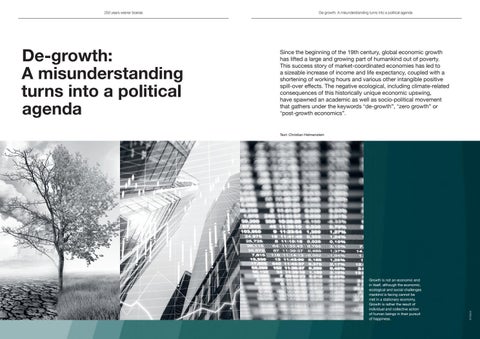
Growth is not an economic end in itself, although the economic, ecological and social c hallenges mankind is facing cannot be met in a stationary economy. Growth is rather the result of individual and collective action of human beings in their pursuit of happiness.
© iStock
250 years wiener boerse
250 years wiener boerse
De-growth: A misunderstanding turns into a political agenda
“There is no guarantee that once a society leaves the path of prosperity, it will return to it within a short time, not even within a couple of generations.”
Niko Paech is a German economist. He teaches and researches at the University of Siegen. Niko Paech coined the term “post-growth economics” in Germany and is considered a vehement advocate of the critique of growth.
A real economic experiment of unimagined magnitude opened the third decade of the 21st century: COVID-19. Addressed for many years by epidemiologists in academic papers and by security experts in strategic analyses,1 the risk of a pandemic, based on initial infection findings
Christian Helmenstein
economic history, with global real GDP falling by 3.5 per cent in 2020.2 As such, the COVID-induced recession even dwarfs the economic plunge in the wake of the Lehman Brothers’ insolvency and the financial market crisis it triggered in 2008/2009. Not in its scale, but in its speed, the COVID-driven collapse of economic activity even surpassed the Great Depression following the crash on New York’s Wall Street in the autumn of 1929.
of growth critics,3 which is, however, characterised by different levels of growth critique based on various motives, which can be of an ecological, social or even ideological nature.4 Among e conomists in the German-speaking world, Niko Paech is currently one of the leading representatives of the post-growth economy who propagates an economic system that is not dependent on economic growth.5 He sees the necessity for a stationary economy in what he considers the failed decoupling of environmental damage and the consumption of raw materials from value creation. Nicholas Georgescu-Roegen is counted among the global “forefathers” of the movement with his main work “The Law of Entropy and the Economic Process”,6 in which he predicted that an ever-increasing use of resources must lead to an exhaustion of the Earth’s capacities. The various forms of de-growth/no-growth/ post-growth economics are united in their goal of overcoming growth orientation, especially in practical terms, in order to achieve a stationary economy.
in China at the year-end quarter of 2019, has become striking. COVID-19 and the regulatory restrictions put in place to contain it triggered the most severe global economic downturn in modern
Since the 1970s, a relatively broad de-growth movement has emerged from a small circle
© Federation of Austrian Industries
Nicholas Georgescu-Roegen
Despite the successful economic management of COVID-19, a mood of crisis prevails in much of the media public reporting and in political discussion forums. The effects of climate change, rhetorically (over-)elevated as a “climate crisis” or even as a “climate catastrophe”, have been moving markedly into the foreground. Thus it seems to support the arguments of the “de-growth“ proponents that economic growth is detrimental to the future of planet Earth and would also change the world climate to the lasting perdition of future generations.
© Wikimedia Commons
Unlike post-Lehman, but above all in contrast to the state of the world economy in the 1930s, the global economy has been recovering from the C OVID-19 recession with an extremely high momentum. Global real economic growth is expected in a magnitude of around 6 per cent by the World Bank and the International Monetary Fund for 2021, which represents the strongest upswing in almost half a century. The last time the global economy grew more strongly was before the first oil price shock in 1973.
So, has the market economy – and with it the financial markets – reached the end of its story? Even in an eco-social form? An eco-social market economy represents the ambition to combine an efficient with a just and sustainable economic and social order. It was a successful model that acted as the key to the “economic miracle” in both Germany and Austria. Within the framework of a social market economy, enormous prosperity has become possible. In Austria, incomes have increased far more than a hundredfold since 1948. In the same period, the price level has also markedly risen. In fact, it has increased more than
tenfold. In real terms, Austrian real income today is more than thirteen times what it was in 1948. That is why, 70 years after its debut in 1948, the social market economy, in its eco-social manifestation, may still be no less attractive today. The social market economy was not only a catalyst of domestic prosperity, but it was also a passe-partout for development worldwide: As a coordination mechanism, the market economy has been historically successful, so that even former socialist countries have turned into state capitalist actors who use it like a blueprint for the development of their own countries. In striking contrast to this impressive track record, confidence in the market economy’s ability to find solutions has profoundly eroded. Throughout human history, prosperity has been a transient phenomenon. This finding is illustrated by an unusual indicator of prosperity, namely global lead production.7 Of course, lead production is no longer a reliable indicator of prosperity, if only because of the toxicity of the material. But in earlier centuries, it was different. This was due to the main uses of lead apart from its military use. It was applied for tubes, for reservoirs to store goods and as a sealing material. Such uses represented considerable wealth at the time of the Roman Empire. After its heyday and later collapse, it took 1,700 years to regain the former output level of lead. And that also means that it took roughly just as long for E urope to re-reach the prosperity level of the Roman Empire. So, there is no guarantee whatsoever that once a society leaves the path of prosperity, it will automatically return to it within a
250 years wiener boerse
De-growth: A misunderstanding turns into a political agenda
Joseph Stiglitz is an American economist and Professor at Columbia University. He was Chief Economist of the World Bank from 1997 to 2000. Stiglitz is a representative of New Keynesianism and received the Alfred Nobel Memorial Prize in Economics in 2001 for his work on the relationship between information and markets, together with George A. Akerlof and Michael Spence.
Christian Helmenstein
When the topic of economic growth comes up, the discussion often seems to suffer from a fundamental misunderstanding.8 What is the economic discipline actually about? Economics is the science of rational decision-making to increase the utility of human beings. It is therefore about human happiness. What does happiness (the left side of the “happiness equation”) depend on? From an economist’s point of view, it depends on three factors: first, on securing material needs, represented by a bundle of consumer goods, which of course includes services as well, also taking into account environmental and other forms of damage. A second factor that drives happiness is leisure/recreation time. These two factors should be enough to describe Robinson Crusoe as a happy man on his lonely island. In fact, however, he was in a state of deep unhappiness in the days leading up to the appearance of a certain man called Friday. That is, happiness requires a third element, social context. It is these three pillars that create utility and happiness. That is what economics is essentially about. Consequently, growth is not an end in itself. If it were, growth would have to appear in the utility function. But this is not the case. A reverse conclusion follows immediately: Anyone propagating stagnation or even shrinkage, “de-growth”, is a false prophet, because this will not benefit people. What does growth stand for from the perspective of an economist? The expansion (contraction) of GDP describes, in approximate terms, the positive (negative)
change in (national) income over time. Now, there is undoubtedly a link between the utility function – especially in terms of the first pillar – consumption possibilities and the income level. But directly, as a policy-making goal, growth in itself does not p rovide any direct benefit. A policy goal can only be what is on the left side of the happiness e quation: the increase of utility. The ways to a chieve this are found on the right side of the h appiness equation, i.e. consumption opportunities (net and in the broadest sense), leisure and social context.
ppreciation, there is nothing to prevent its a use, as long as it remains clear what is meant. In terms of human capital, we find quantitative growth in terms of h eadcount and qualitative growth in terms of abilities and c apabilities as a result of education and training. As far as the quantitative component is c oncerned, population growth, a stationary p opulation, i.e., one that is no longer growing, would spare us the consumption of (limited) a dditional natural resources. The sooner world population growth comes to a halt, the better the prospects of overcoming the overexploitation of the planet’s resources. The world population is currently growing by about the population of A ustria every month and by more than the population of Germany every year. All these newly-born human beings need additional r esources, even if it is only for the bare necessities. And who among us would want to d eprive them of a higher standard of living? But that puts even more strain on the planet’s resources. So the focus of the first pillar
Remarkably, every doubling of disposable income is still accompanied by an increase in life satisfaction. The global society is not yet “rich enough” that a doubling of income would not still contribute to higher life satisfaction. This finding is actually not surprising because if we were richer as a society, we would be able to afford the currently more expensive emission-free mobility sooner and the most promising of the downright astronomically expensive “targeted therapies” in oncology would spread more rapidly, to name just two examples. There are only three main drivers of growth, one of which breaks down into a q uantitative and a qualitative component. The most important driver is the accumulation of human capital.9 To avoid semantic irritation at this point, human capital is a terminus technicus of the e conomic discipline, which does not re duce people to the function of a mere factor of production. Economists value “ capital”; it has positive connotations. If a nother term such as “human capital” is better able to e xpress this
© Jérémy Barande
short period of time, and worse, not even within a couple of generations.
Joseph Stiglitz
is not about quantitative growth but qualitative growth through the accumulation of human capital as a result of investment in education and training. The second growth driver is the accumulation of p hysical capital and the third is innovation. Against this background, the question of what is meant by GDP growth can now be answered materially, not just technically. Growth is not a goal in itself but growth is an indicator of creative freedom.10 It is even the most singularly important indicator, despite all the shortcomings of the concept in detail, which, however, may hardly be relevant for the usefulness of the indicator in the end.11 In this regard, Joseph Stiglitz et al. have explicitly acknowledged that “ measuring production – a variable which among other things determines the level of employment – is essential for the monitoring of economic activity.”12 In addition, the flow concept of growth as represented by GDP should definitely be
250 years wiener boerse
De-growth: A misunderstanding turns into a political agenda
Dani Rodrik is the Ford Foundation Professor of International Political Economy at Harvard’s John F. Kennedy School of Government. Professor Dani Rodrik’s research focuses on globalisation, economic growth and development, and political economy. He is the recipient of numerous
s upplemented by a stock concept in national accounting. For companies, this has been a matter of course for centuries, not just decades, but not yet for public entities like regions or countries. Especially in times of increasing digitalisation, conventional national accounting is likely to miss important welfare elements since the creation and use of network capital, among other things, is currently not recorded for by and large. The protagonists of de-growth envision a stationary economy – just as Plato conceived a perfect polis with its stationary society. If Plato’s ideal had been realised, the world would have remained in antiquity. From today’s perspective, this is an absolutely non-ideal state. Even worse, the economic, ecological and social challenges humankind are facing cannot be met in a stationary economy. Harvard economist Dani Rodrik projected the situation for a post-COVID-19 world: “COVID-19 reinforces economic dualism
Christian Helmenstein
reversed in the short term without enormous sunk costs.
within nations, the gap between technologically advanced and globally integrated parts of the economy/society and the companies, sectors and regions that lag behind. This creates inequality, economic insecurity within countries, a backlash against hyper-globalisation [and] premature de- industrialisation.”13
In this context, there is yet another relationship to consider. In the long run, economic growth and productivity growth go hand in hand, even independently of the prevailing e conomic s ystem. As Bouscasse et al. (2021)14 have recently shown, productivity growth already set in around the year 1600, about two centuries before the industrial revolution, and hence long before m odern capitalism established itself. Their fi ndings support the notion that productivity-driven e conomic growth preceded institutional reforms and p ropelled history forward. And conversely, Tokic (2012) showed that a de-growth policy would crash the stock market, trigger further de-leveraging in all sectors and thus massive deflation.15 As a result, the entire economy would implode. As an e conomic policy strategy option, de-growth is therefore e cologically, economically and socially unsustainable.
If growth does not happen, it could mean there has been a failure to provide better education and training for the population. Where growth cannot be observed, access to health care may have become so difficult for large parts of the population that even average height and average life expectancy are already decreasing. Where growth is absent, there may be a lack of trust in the reliability of legal, environmental and social framework conditions with the result of investment reluctance because investing means commitment to a location, at least for a couple of years. Once committed, an investment cannot be
By implication, where growth does not take place, individuals or society as a whole have not been able to realise their creative and innovative potential. Because if there were better products, more efficient processes, new business models and better institutions, growth would inevitably be the result. So, where we observe little or no growth over a period of several years, there is something fundamentally wrong because those societies fail to unleash their growth drivers. Thus, “the good old days”, at any rate, were only ever old on closer examination, but in comparison to the present in almost every utility-relevant respect they were actually inferior. Upon proper information about the implications and consequences of a permanent de-growth-induced economic depression, the vast majority of people would probably not want to participate in such an experiment.
© Federation of Austrian Industries
Dani Rodrik
© Andrzej Barabasz
Please see references on pages 96–97.
Christian Helmenstein is Chief Economist of the Federation of Austrian Industries and Professor of economics at Seeburg Castle University in Salzburg as well as founder and Head of the Cognion Research Group.