Please note that the following is a digitized version of a selected article from White House History Quarterly, Issue 80, originally released in print form in 2026. Single print copies of the full issue can be purchased online at Shop.WhiteHouseHistory.org
No part of this book may be reproduced or distributed in any form or by any means, electronic or mechanical, including photocopying, recording, or by any information storage and retrieval system, without permission in writing from the publisher.
All photographs contained in this journal unless otherwise noted are copyrighted by the White House Historical Association and may not be reproduced without permission. Requests for reprint permissions should be directed to rights@whha.org. Contact books@whha.org for more information.
© 2026 White House Historical Association.
All rights reserved under international copyright conventions.
Celebrating the Nation’s Birthdays
as the nation’s semiquincentennial year begins, this issue of White House History Quarterly celebrates the 250th birthday of America’s independence with a look back at milestone national anniversaries in the context of White House history. As we travel through time we make stops in the eighteenth, nineteenth, twentieth, and twenty-first centuries, at semicentennial, centennial, and bicentennial celebrations, not only of Independence Day but also of the presidency and the White House itself.
We begin in the present day by exploring the meaning and making of the recently launched Official White House Christmas Ornament. The forty-sixth in the series, the 2026 ornament fittingly pictures a facsimile of the original Declaration of Independence now preserved in the National Archives. The ornament, destined to hang on perhaps a million or more Christmas trees in the United States and abroad for years to come, is in keeping with the intention of the Second Continental Congress, which, immediately following the formal signing of the document, ordered that it be reproduced, read publicly, and distributed widely.
Charlotte Seale takes us back to the eighteenth century and shares the reaction of a “stranger in America” to one of the earliest Independence Day celebrations. She explains that Charles Janson, an Englishman who happened to arrive in Boston in 1793 on the eve of the nation’s seventeenth anniversary, had hoped to avoid the public festivities but instead witnessed flags flying, guns firing, drums beating, and a military parade. Janson’s 1807 book would ultimately preserve not only this scene but would present the first known published image of the President’s House.
Historian Alan Capps takes us into the nineteenth century to July 4, 1826, the nation’s fiftieth anniversary. The date was consequential not only for marking a half century of independence but also for the deaths of two Signers of the Declaration, second President John Adams and third President Thomas Jefferson—an astonishing coincidence.
Jennifer Wojeck reminds us that the nation would never forget the significance of not only July 4, 1776, but also of other milestone dates such as April 30, 1789. She
such 1789.
Birthdays
takes us to New York City on the centennial of George Washington’s first Oath of Office, following President Benjamin Harrison as he traces Washington’s steps to Federal Hall in a days-long celebration filled with naval reviews, balls, parades, a worship service, and speeches. Journalist Ann Compton brings the narrative into the twentieth century, sharing her own memories of traveling with President Gerald R. Ford on July 4, 1976, the nation’s two hundredth birthday. It was a day, Compton explains, that America was ready to celebrate its success story. Compton witnessed Ford complete an ambitious seven page itinerary, which began with prayer at St. John’s Church and continued with events in Valley Forge, Philadelphia, and New York Harbor, before culminating with a viewing of fireworks from the Truman Balcony.
of President
The first-person accounts continue with memories of two White House bicentennials. Former White House Chief Usher Gary Walters details events hosted by President and Mrs. George H. W. Bush in 1992 when the bicentennial of the White House cornerstone was memorialized with the installation of a time capsule on the South Grounds. Then artist Jamie Wyeth shares his experience on the South Grounds in 2000, when he was cleared in at 5:00 a.m. to make preparatory sketches for his painting, Dawn, The White House, 2000. Wyeth had been commissioned by the White House Historical Association to celebrate the two hundredth anniversary of life in the White House, which began on November 1, 1800, when President John Adams took up residence. With this special account of how he created his painting, Wyeth publishes his preparatory sketches for the first time.
Joel Kemelhor takes us out to sea to explore the U.S. Navy’s traditions for celebrating national anniversaries and the role played by carriers named for presidents.
The named
For our Presidential Sites Feature, James H. Johnston takes us to his hometown, Independence, Missouri. Founded in 1827 and named for the Declaration of Independence, Independence is described by Johnston as the “quintessential American small town.” He remembers growing up there at the time when President Harry S. Truman was a neighbor and sitings of the president were both commonplace and unforgettable.
Truman was a neighbor and sightings of the president
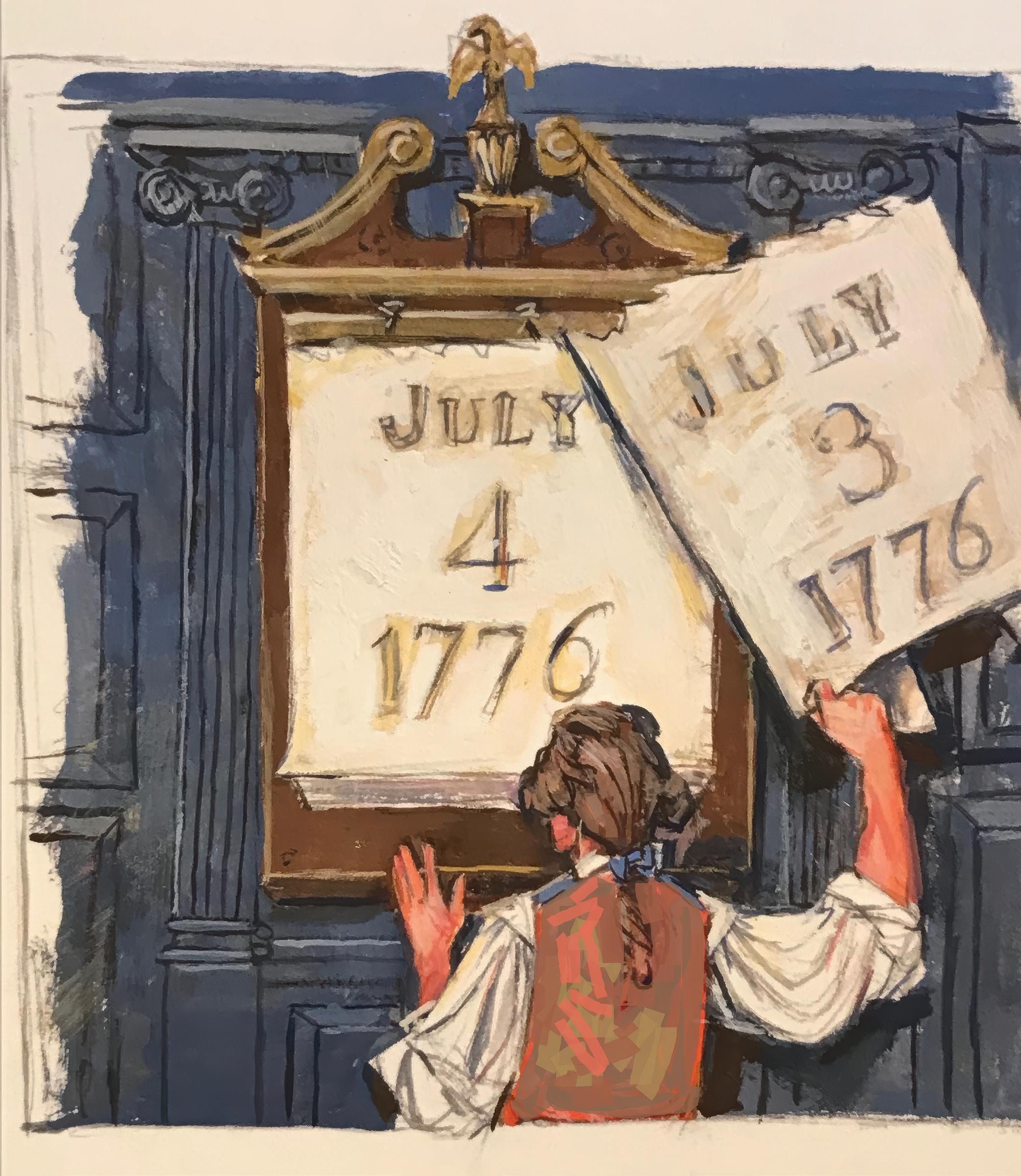
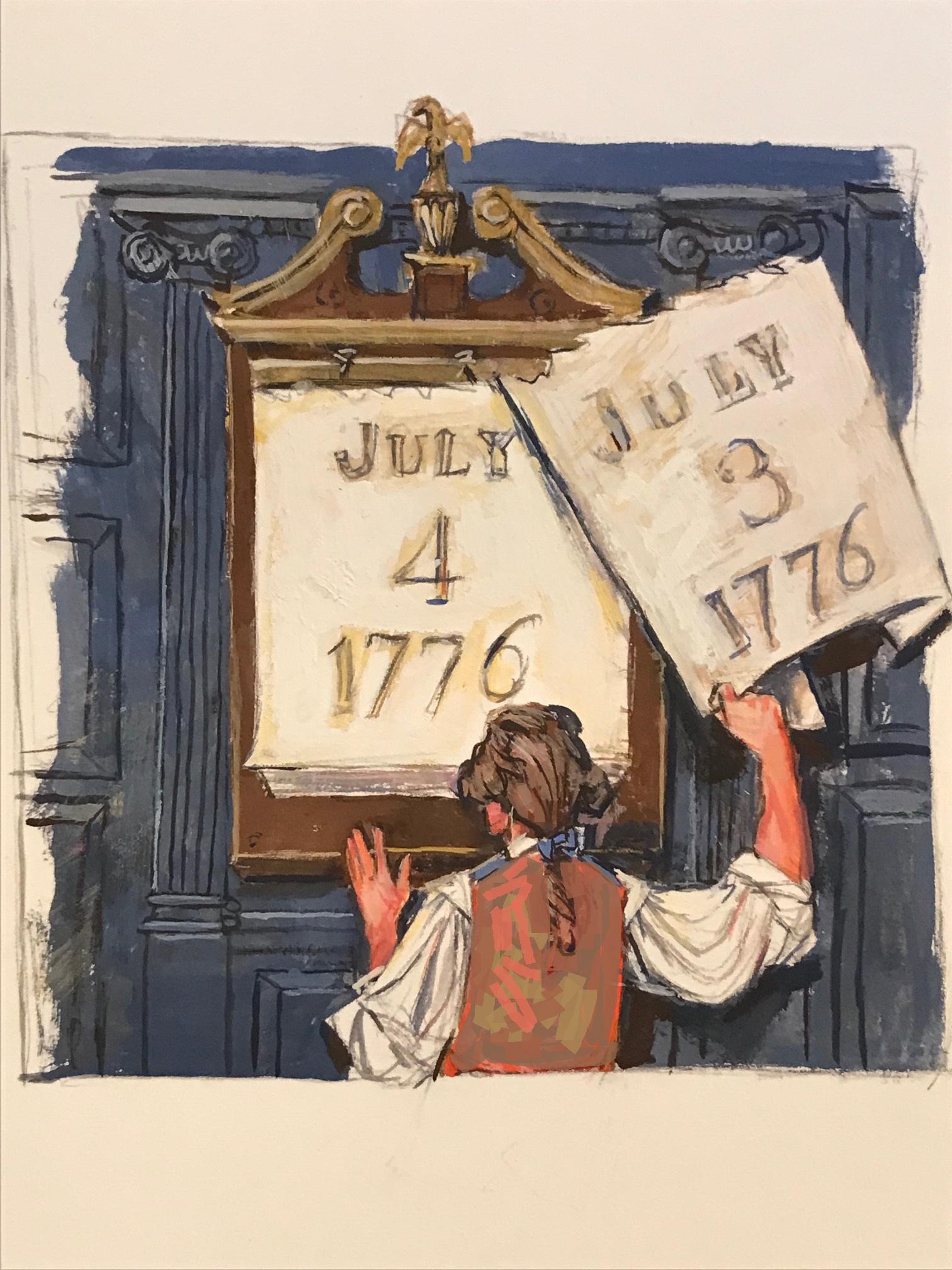
Artist John Hutton imagines the moment the page in the calendar is turned to July 4, 1776, in the Assembly Room of the Pennsylvania State House, now known as Independence Hall, in Philadelphia where the Second Continental Congress debated and ultimately signed the Declaration of Independence.
Artist John Hutton imagines the moment the page in the calendar is turned to July 4, 1776, in the Assembly Room of the debated and ultimately signed the Declaration of Independence.