DESIGN IN HEALTH
Redesigning clinical work spaces Ronald Tabaksblat*
Drivers such as cost pressure in healthcare systems, together with advances in technology, rising patient volumes and demands from engaged patients in their own healthcare, are transforming the way care is delivered, creating a shift in what is required in clinical spaces.
32
T
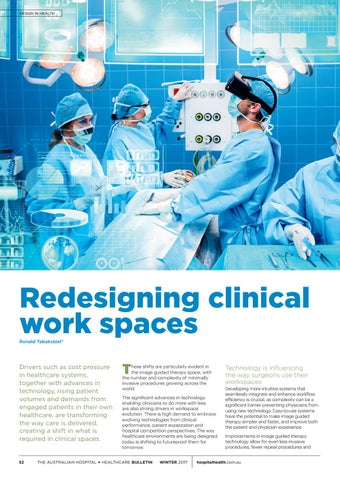
hese shifts are particularly evident in the image guided therapy space, with the number and complexity of minimally invasive procedures growing across the world. The significant advances in technology enabling clinicians to do more with less are also strong drivers in workspace evolution. There is high demand to embrace evolving technologies from clinical performance, patient expectation and hospital competition perspectives. The way healthcare environments are being designed today is shifting to futureproof them for tomorrow.
THE AUSTRALIAN HOSPITAL + HEALTHCARE BULLETIN
WINTER 2017
Technology is influencing the way surgeons use their workspaces
Developing more intuitive systems that seamlessly integrate and enhance workflow efficiency is crucial, as complexity can be a significant barrier preventing physicians from using new technology. Easy-to-use systems have the potential to make image guided therapy simpler and faster, and improve both the patient and physician experience. Improvements in image guided therapy technology allow for even less invasive procedures, fewer repeat procedures and
hospitalhealth.com.au