Impact and Reflections from the Intergenerational Climate
Dialogues
Hosted by Wellington College Students
Publication Compiled by Ana Romero, Head of Sustainability, Wellington College International Dr. Clare Sisisky, Executive Director, Institute for Global Learning September, 2025
Table
of Contents
1. Foreword by Wellington College’s Head of Sustainability
2. Research Findings on Impact: A Summary of the Findings from the Institute for Global Learning
3. Importance of Intergenerationality: Reflection from an Educator at Wellington College International Pune (India)
4. Student Leadership: Reflections from Student Leaders at Wellington College (UK)
5. Inspired by Dialogue: Climate Action Projects in Sustainable and Creative Design at Wellington College International Tianjin (China)
6. Conclusion
Foreword
At Wellington College, our belief in the transformative power of education extends beyond classrooms and curricula it is about nurturing young people who will shape a more sustainable, compassionate, and interconnected world. In 2024, this belief took new life through the Global Intergenerational Sustainability and Climate Dialogues Series, a pioneering, student-led initiative designed to elevate intergenerational equity and collective climate action.
The dialogues grew from our ongoing commitment to Action for Climate Empowerment (ACE), which calls on education systems worldwide to inspire understanding, participation, and action toward a sustainable future. Led by our Sustainability Ambassadors, Jessy Banzoulou and Rosie Walker, the series brought together students and teachers of all ages from around the world to share their stories, hopes, and ideas for addressing the climate crisis.
Over the course of six months, the series reached 280 participants, including 202 students from Years 7–13, 78 teachers and educators, and 25 schools across 10 countries. We even featured a special session for the Wellington College family of schools. Each gathering demonstrated the remarkable potential of dialogue to connect generations, inspire empathy, and spark creative solutions to shared challenges.
To help bring this vision to life, Wellington partnered with the Institute for Global Learning (IGL) to provide a group of eight student leaders with advanced training in intercultural dialogue facilitation. Through this experience, students honed their skills in listening, empathy, and cross-cultural communication skills essential not only for leading global conversations but for shaping thoughtful, responsible leadership in any context. These trained student facilitators then guided three global sessions, each centered on a core theme:
● Connecting with Nature (January–February): Participants reflected on their earliest memories of nature and how those moments shaped their care for the environment.
Learning about Sustainability and Climate (March–April): The group explored how formal and informal education influence environmental awareness and action across generations.
● Taking Climate Action (May–June): This final dialogue turned reflection into forward motion, with participants sharing the challenges and opportunities they encountered in leading sustainable change.
The richness of these conversations, woven from hundreds of voices across continents, has inspired this publication, Voices for a Sustainable Future: Reflections Across Generations. In these pages, readers will find not only the results of a research study that identified the key insights and impact areas that emerged from the dialogues but also the personal reflections and shared determination that made this intergenerational program so powerful.
This initiative stands as a testament to the leadership of young people and to Wellington’s commitment to learning that is grounded in openness, curiosity, and respect. Most importantly, it shows that when students and adults come together to listen deeply and act collaboratively, they create the kind of hope that can drive real change.
As we look ahead, we remain dedicated to empowering our students and all participants in this growing global network to lead with empathy, to engage in meaningful dialogue, and to act with purpose for a more sustainable and just world.
Ana Romero Head of Sustainability, Wellington College International
Introduction to the Initiative and Research Study
Learning from the experiences of those who came before us while empowering younger generations to take action is at the heart of intergenerational climate justice. But how and where do generations come together around climate issues? This research study investigates the impact of a series of low-commitment virtual dialogues that provided students and educators across schools and generations the opportunity to share perspectives, engage in reflection, and explore pathways for collective climate action.
Hosted by Wellington College in partnership with the Institute for Global Learning, the three -part Intergenerational and Intercultural Dialogue Series aimed to foster timely and essential conversations among global participants. The sessions focused on three core themes: our connection with nature, sustainability education, and climate action. Participants ranging from secondary students to experienced educators joined from across the world to discuss how to better bridge the past, present, and future in the shared effort to safeguard our planet.
This report explores participant data and reflections on the experience, with the aim of better understanding the role and value of intergenerational virtual dialogue in global education and climate engagement. This research study was conducted by Dr. Clare Sisisky, Executive Director, Institute for Global Learning, between January-June, 2025 for Wellington College.
Research Context and Questions
Dialogue Series Overview
Between February and April 2025, participants joined a series of three virtual dialogues designed to foster intergenerational and intercultural exchange on key climate-related topics. Participants included students and educators from multiple countries and schools, who attended one, two, or all three sessions depending on their availability.
Each 60-minute dialogue was conducted via Zoom, featuring short introductions, student-led facilitation, and structured discussion questions. Student facilitators received training in intercultural dialogue methods.
Dialogue 1: Connecting with Nature (February 2025)
This session focused on early memories of nature and personal experiences with the environment. Participants reflected on how their upbringing shaped their relationship with nature, shared stories across generations and geographies, and explored how nature access has shifted over time.
Dialogue 2: Learning About Sustainability and Climate (March 2025)
This session explored how different generations were taught or not taught about sustainability and environmental issues. Participants discussed formal and informal learning experiences and how intergenerational knowledge-sharing might help bridge existing gaps.
Dialogue 3: Taking Climate Action for a More Sustainable Future (April 2025)
The final session shifted from learning to action. Participants shared personal and community efforts, considered what climate action looks like in different contexts, and reflected on how to translate conversation into meaningful, collective impact.
Research Questions
In the context of escalating climate concerns, educational institutions are increasingly seeking meaningful, inclusive, and action-oriented approaches to prepare students for the future. This research study contributes to that effort by exploring whether virtual intergenerational dialogues are impactful, skill-building, and meaningful for the participants involved.
The overall research question guiding this study was:
Are intergenerational virtual dialogues on issues related to climate change impactful, skill-building, and/or meaningful to student and educator participants?
To explore this question more deeply, the study investigated four sub-questions:
1. What skills, if any, were participants able to practice through participating in the dialogues?
2. What, if anything, did participants report as impactful about the dialogue experience?
3. What meaning, if any, did participants report about their experience in the dialogues?
4. What impact, skills, or meaning did participants report, if anything, related specifically to the intergenerational nature of the dialogues?
Research Methodology and Participant Profile
A mixed-methods approach was used to gather both quantitative and qualitative data to answer the research questions. Immediately after each dialogue, participants were invited to complete a survey that included both multiple-choice and open-ended questions. This self-reported data focused on what participants found meaningful or impactful and which skills they practiced during the dialogues.
Survey Response Overview
● Total responses: 115
● Participant roles: Secondary students, educators, and school staff
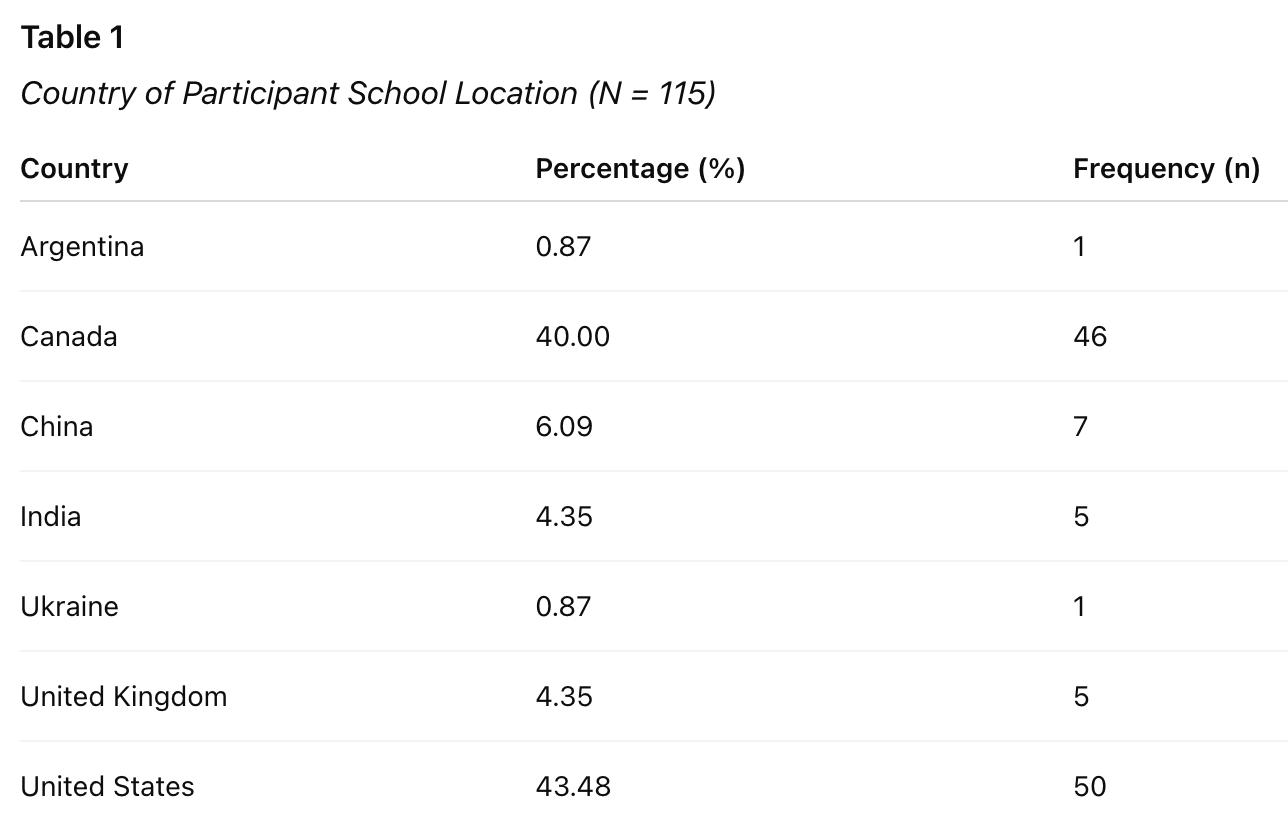
● Geographic diversity: Participants represented a wide range of countries, with a majority of participants coming from North America (US and Canada)
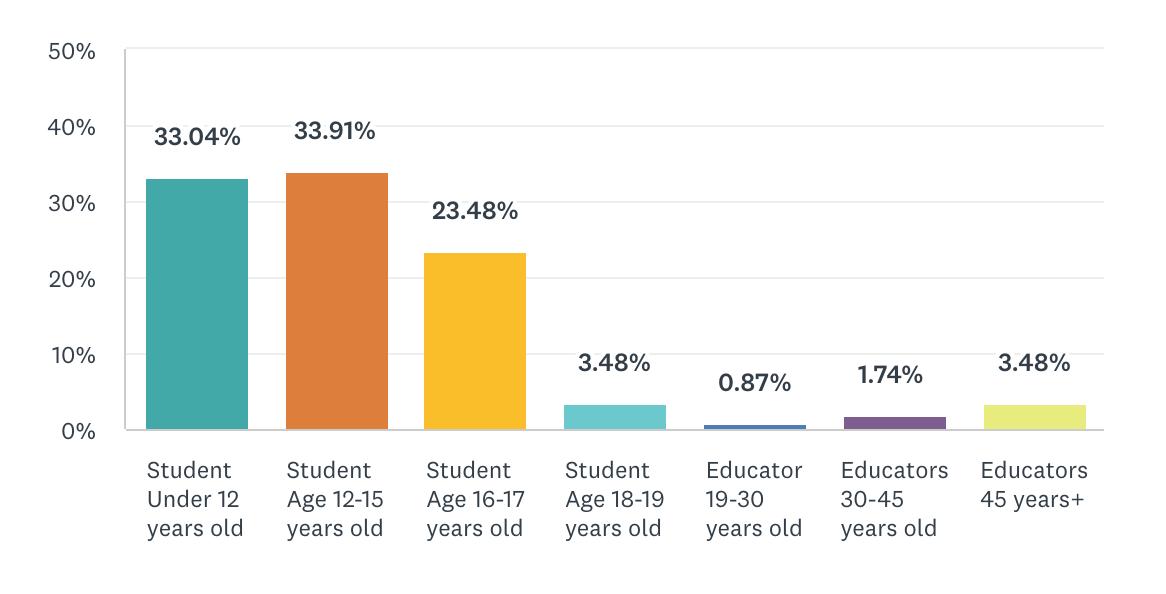
● Age range: Participants were school-aged youth and adult educators who spanned multiple generations, with a majority of participants being 12-17 years old
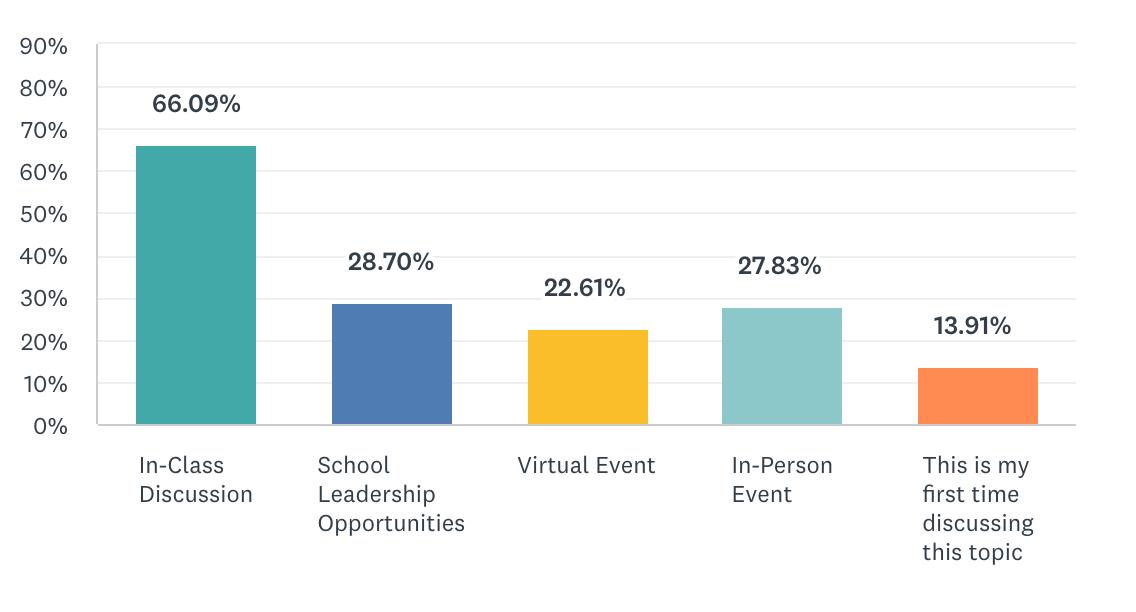
The participants reported a variety of previous experiences engaging with climate dialogue through their school (either as a student or educator), ranging from in-class discussions to student leadership opportunities to specific events. While a majority (86%) reported having some previous form of previous experience, most participants (61%) had no previous experience engaging in dialogue with participants from schools located in different countries.
The tables and figures below provide an overview of participant demographics and prior experience with climate dialogue.
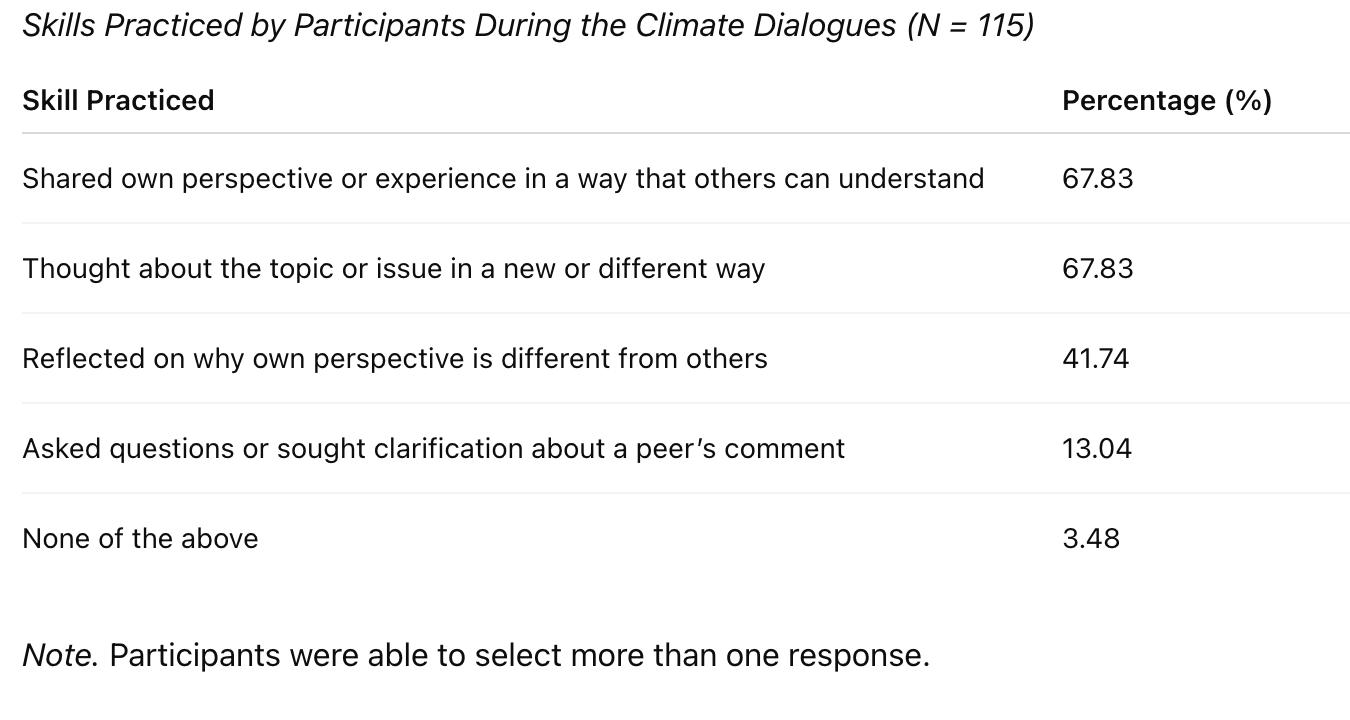
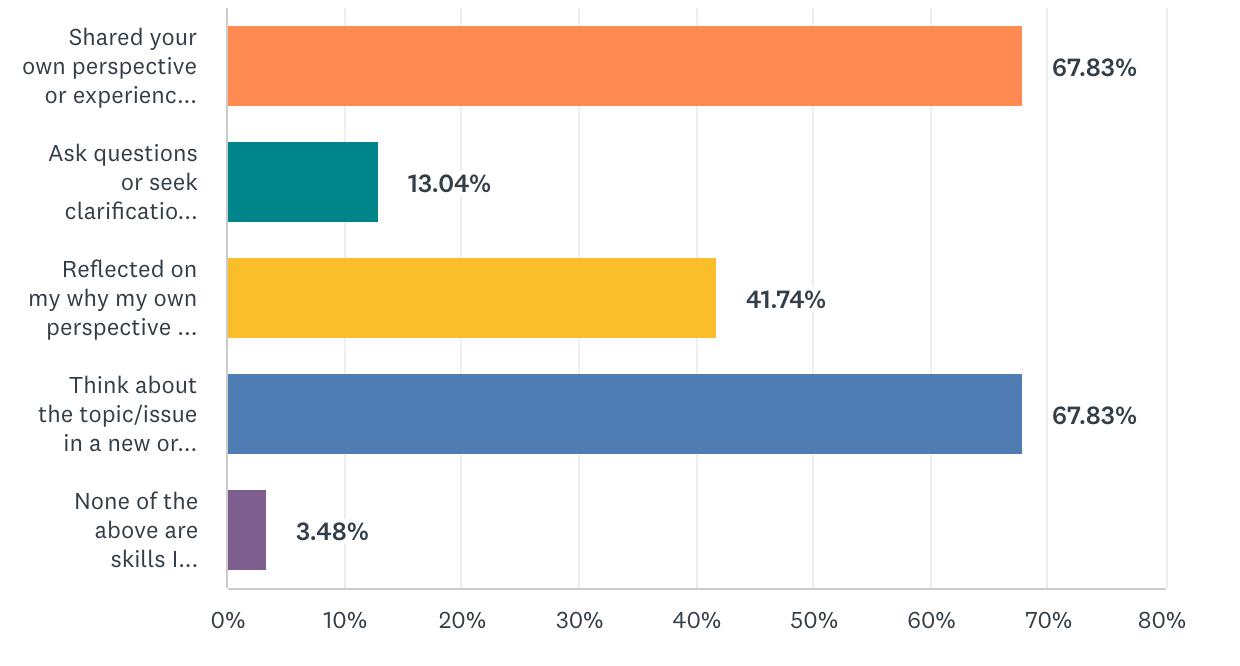
Participants were asked to identify the specific communication, reflection, or cognitive skills they practiced during the virtual dialogues. The data suggests that the dialogues successfully engaged participants in both perspective-sharing and critical thinking. A majority (68%) of respondents reported that they shared their own perspective or experience in a way that others could understand and 41.74% reflected on why their own perspective might differ from others, both indicating a high level of perspective-taking skills being practiced even during relatively short dialogue sessions (1 hour). A majority (68%) also reported that the dialogues helped them think about the topic or issue in a new or different way and a smaller but notable 13.04% reported that they actively asked questions or sought clarification about a peer's comment, both indicating that participants engaged in critical thinking during the dialogue. Only 3.48% stated that they did not practice any of the listed skills.
Table 2
Figure 3: Two Skills Practices Most Frequently during the Dialogue
n=115
These findings point to a dialogue environment that fostered both expression and reflection. The majority of participants engaged in outward communication (sharing perspectives) and inward critical thinking (rethinking their views or understanding differences). While the relatively low number of participants who asked questions suggests that cross-examination or live interaction could be an area for further development, the high levels of reported reflection and conceptual shift signal that the dialogues succeeded in creating a thought-provoking and introspective space.
Moreover, the fact that over two-thirds of participants left the dialogue with a new way of thinking about the topic indicates that intergenerational dialogue can stimulate deeper cognitive engagement a key goal in climate and sustainability education.
Reported Impact of the Dialogues
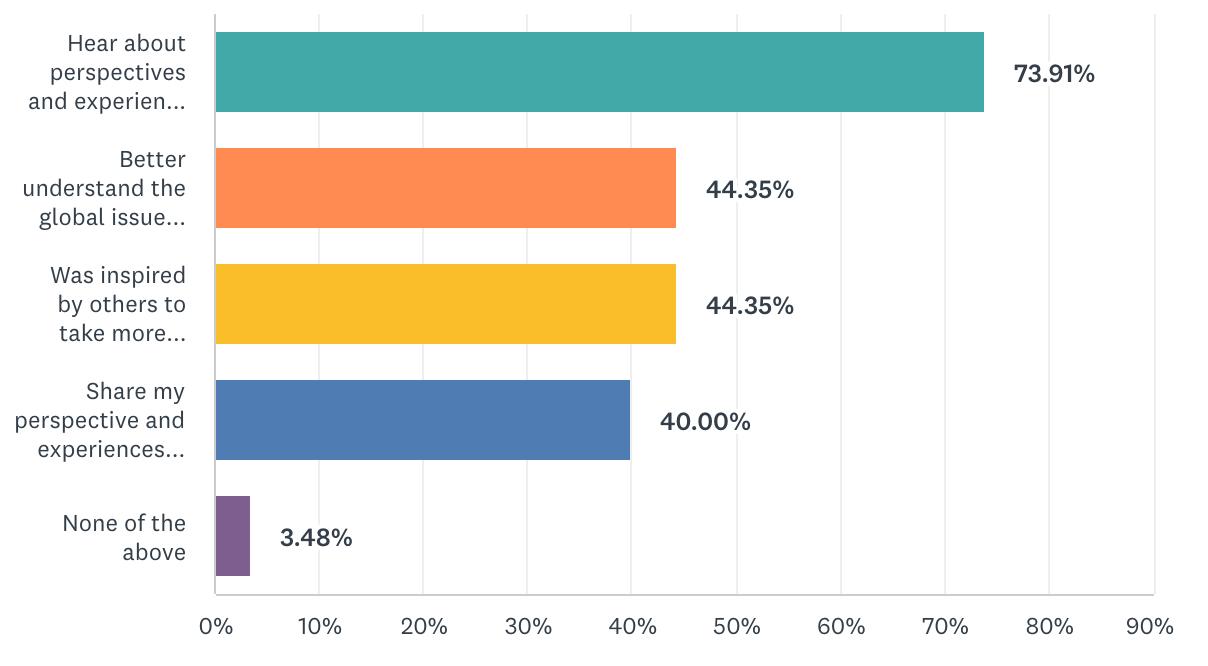
In addition to skills practiced, participants were asked to reflect on the personal impact of the dialogue sessions. The most commonly identified impactful component of the dialogues was hearing different perspectives, with 73.91% of respondents indicating this as having an impact on them during the experience. When asked to identify up to two impactful components of the dialogue experience, participants reported in the following way.
Table 3
Participant-Reported Impactful Components of the Climate Dialogues (N = 115)
Impactful Component Percentage
Heard about perspectives and experiences different from their own
Gained a better understanding of the global issue being discussed
Were inspired by others to take more action on climate issues
Shared their own perspectives and experiences with others
Reported that none of these aspects were impactful
Note. Participants were able to select more than one response.
Figure 4: Participant-Reported Impactful Components of the Climate Dialogues n=115
This data underscores the dialogues' success in fostering intercultural and intergenerational awareness, a critical component of global citizenship education. For nearly three-quarters of participants, the exposure to diverse experiences across countries, cultures, and age groups stood out as a key takeaway.
Interestingly, nearly half of respondents indicated both a deepened understanding of climate issues and a renewed motivation to act. This suggests that personal narrative exchange may have a catalytic effect, not only raising awareness but also prompting commitment. These reflections highlight the potential of virtual dialogue to serve as both an educational intervention and a motivational catalyst especially in the realm of climate justice, where urgency, empathy, and agency must converge.
Qualitative Findings: Themes from Participant Reflections
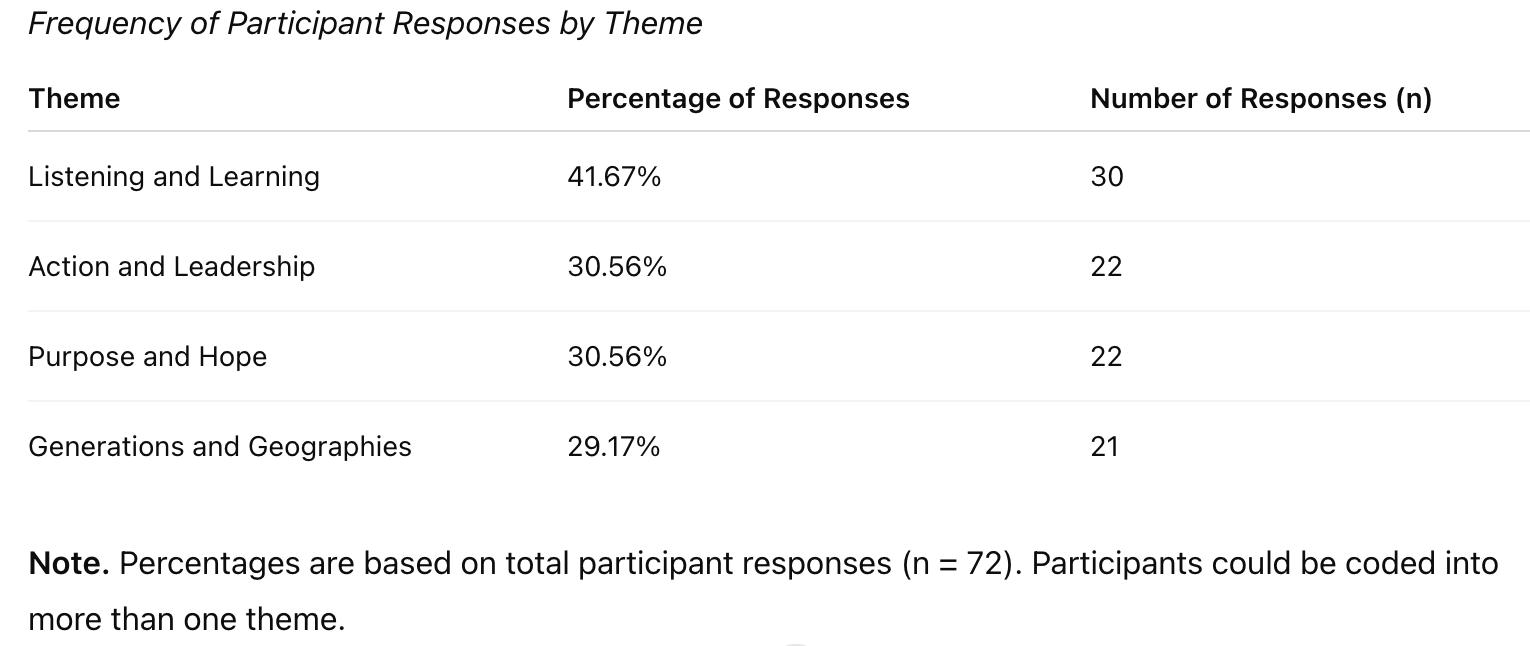
The qualitative data, drawn from open-ended survey responses, revealed four overarching themes related to the participant experience of the intergenerational climate dialogues. Each theme consisted of two sub-themes, capturing the nuances of how participants described the dialogue’s impact. Across the themes, participants emphasized the emotional, intellectual, and motivational dimensions of engaging with peers and educators across generations and geographies. Below the table contains a summary of the themes and aub-themes, and then exemplary participant quotes with some analysis for each theme follows.
Table 4
Themes and Sub-themes from Participant Descriptions of What they Found Meaningful
Theme
Listening and Learning
Sub-Theme 1
Active listening for understanding and empathy
Sub-Theme 2
Deeper learning through diverse ideas
Generations and Geographies Different generations Different geographies
Purpose and Hope
Shared purpose in community Hope and inspiration from others
Theme 1: Listening and Learning
Active listening for understanding and empathy
Many participants described the dialogue as an opportunity to listen deeply to others, emphasizing how hearing from peers fostered greater empathy and connection. One participant noted, “We got to hear other experiences and make connections between our perspectives.” Another added, “I really enjoyed listening to [the student facilitator] speak to the students.” These reflections suggest that listening itself was a meaningful form of engagement, valued not only for its informational content but also for the relational awareness it generated.
Deeper learning through diverse ideas
Participants frequently mentioned that the dialogues prompted them to engage more deeply with climate issues by considering perspectives they had not encountered before. “It was great to understand lots of different perspectives to think about the question more deeply,” one student wrote. Others echoed this, saying, “I learned a lot! Other people's views on the topic helped me see a new side of this topic,” and “It helped look at climate change in a different way.” A particularly striking comment captured the transformative nature of this learning: “I was amazed by a phrase someone said: to have a symbiotic relationship with nature... I keep reflecting on this statement.”
Theme 2: Generations and Geographies
Different generations
Several participants expressed that hearing from peers and adults across age groups enhanced the dialogue’s value. One participant shared, “I found this dialogue meaningful because I got to hear perspectives from different ages.” Another observed, “This dialogue offered new and interesting perspectives on climate issues around the globe and through different generations.” Participants appreciated how cross-generational interactions enriched the conversation: “It was inspiring to see many different ages wanting to work together to improve the climate.”
Different geographies
Participants also reflected on the power of connecting with people from different parts of the world. “I found it interesting to hear perspectives from everyone from all over, and it just reminded me that we are all in this together,” wrote one student. Others emphasized how these global conversations created a sense of shared humanity: “This dialogue was extremely meaningful as it was for students worldwide, and we had many similarities.” Another participant added, “It truly helped me learn more about… how others from other countries are impacted and feel about the topic.”
Theme 3: Purpose and Hope
Shared purpose in community
Many participants expressed a strong sense of belonging and unity with others in the dialogue. “I feel like there is a much bigger community that agrees with me and that WE ARE ALL IN THIS TOGETHER!” said one. Another commented, “It was eye-opening that people from all around the world were in the room… we all came to care about the environment even though the methods were different.” These statements underscore the emotional resonance of finding shared purpose across difference.
Hope and inspiration from others
The dialogues also sparked a hopeful outlook, especially through hearing about others’ commitment to climate issues. One participant shared, “It was impactful seeing people from different parts of the world come together and talk about this issue it gave me hope.” Others echoed this feeling: “I thought that it was very inspiring to know that others care from many places worldwide,” and “We discussed effective, yet realistic, ways to tackle climate change. It gave me hope.”
Theme 4: Action and Leadership
Recommended actions
Participants reported that the exchange of ideas during the dialogues inspired them to take action or consider new approaches to climate challenges. “It was really refreshing to hear people from other countries also taking action on climate change,” one educator noted. A student shared, “Many had great experiences that I wanted to start doing.” This highlights the catalytic role of intergenerational storytelling in motivating climate action.
Student leadership
Finally, participants both students and adults reflected on the impact of student leadership in the dialogues. As one student noted, “This was useful because it made me realize even if I'm young I can make a difference.” Adult participants, too, were moved by student voices: “So many fantastic ideas and positive contributions from all the students on the call it was inspiring and I am inspired to take my own small climate actions!”
Table 5
Study Limitations
This study has several limitations to consider. First, all data collected were self-reported by participants immediately following the dialogue sessions, which may introduce response bias or limit the ability to measure long-term impact. The sample was also limited to individuals who chose to participate in the dialogues and complete the survey, which may not represent the broader population of students and educators. Additionally, although the dialogues aimed to be intergenerational and intercultural, the sample size from some regions and age groups was small, which may limit the generalizability of findings across diverse contexts. Lastly, the virtual nature of the dialogues and data collection may have influenced participants’ engagement and responses in ways that differ from in-person interactions.
Conclusion and Implications
This study explored the impact of a series of virtual, intergenerational dialogues focused on climate-related issues. Through both quantitative and qualitative data, it is clear that participants found these conversations to be meaningful, skill-building, and impactful. Most notably, participants reported developing key dialogue skills such as sharing perspectives, reflecting on differing viewpoints, and thinking about climate topics in new ways. The opportunity to engage across generations and geographies was particularly valuable, with many participants expressing appreciation for the diversity of ideas and experiences represented.
Qualitative data further revealed four central themes Listening and Learning, Generations and Geographies, Purpose and Hope, and Action and Leadership that emerged consistently in participant responses. These themes highlight not only the educational value of the dialogues but also the emotional and motivational resonance they had. Participants described feeling a sense of
global community, being inspired by others’ experiences and actions, and developing a renewed sense of purpose and possibility in the face of climate challenges.
The implications of this study point to the unique power of structured, low-barrier intergenerational dialogue as a pedagogical and community-building tool. Virtual spaces, when intentionally designed and skillfully facilitated, can bridge generational and geographic divides, allowing for shared reflection, mutual learning, and collaborative visioning for a more sustainable future. For educators, schools, and organizations committed to climate justice and global citizenship, this model offers a replicable, accessible, and meaningful strategy to engage youth and adults alike in critical conversations about the future of the planet.
Looking ahead, future iterations of this work could benefit from longitudinal tracking to understand sustained impact over time and broadened outreach to increase participation from underrepresented regions or age groups. Nonetheless, this initiative provides compelling evidence that when generations come together in thoughtful dialogue, they create the conditions for deeper understanding, inspired action, and collective hope.
Importance of Intergenerationality
A central goal of the intergenerational climate dialogue series was to create meaningful opportunities for students and educators from different age groups to share, reflect, and learn from one another’s experiences and perspectives. The research report highlights findings from both quantitative and qualitative data that show that this intergenerational component was not only well-received but also deeply impactful for participants.
Participants highlighted how hearing from individuals of different ages broadened their understanding of climate issues, helped them connect across generational lines, and reinforced a shared sense of purpose. The intergenerational nature of the conversations brought unique insights to the table particularly when contrasting how different age groups have encountered sustainability education, engaged in climate action, or connected with nature across time and place.
One participant remarked,
“This dialogue offered new and interesting perspectives on climate issues around the globe and through different generations. It was really interesting to have a discussion with new people. It was something I have never previously been a part of.”
This quote encapsulates a recurring sentiment: that intergenerational dialogue fostered learning not just about the topic at hand, but also about the values, hopes, and lived experiences of others across age groups. These conversations helped participants feel less isolated in their climate concerns and more united in their desire to contribute to a more sustainable future together.
Reflections on Intergenerationality
Kasthoorie Kumanan Teacher, Wellington College International, Pune, India
Being part of a student-designed and student-led project like the Sustainability and Climate Dialogues was both refreshing and inspiring. As an educator, I often see students respond to structures created for them, but this time the structure and direction came from the students themselves.
Experiencing the outcomes of their vision highlighted the creativity, independence, and sense of purpose that young people bring when they are trusted with leadership. It was a privilege to contribute within that framework and to experience a different kind of collaboration - one that placed student voice firmly at the centre.
Engaging in conversation with students from around the world was both humbling and inspiring. The range of perspectives - from different contexts, cultures, and lived experiences - brought an authenticity and urgency to discussions about sustainability and climate. It felt less like a formal dialogue and more like a global exchange of ideas, where each voice carried weight and relevance. The energy, passion, and creativity of the students underscored the reality that climate action is not a distant concern, but an immediate and shared responsibility.
Student-led projects like this carry particular benefits: they cultivate ownership, empower agency, and build confidence in young people to see themselves as leaders and changemakers. When students are trusted to guide, they approach problems with innovation and a clarity that is sometimes less visible in adult-led structures. For educators, this creates a powerful reminder that leadership is not something students grow into “later,” but something they can exercise meaningfully right now.
The fact that this project was led by students rather than educators profoundly shaped my experience. Instead of being a facilitator, I was a participant - learning alongside others, contributing my perspective while being guided by their vision. That role reversal created a dynamic of genuine intergenerational dialogue, where I was as much a learner as I was a mentor. It affirmed my belief that student leadership matters not only for the development of young people but also for the enrichment of educators and the wider community.
Ultimately, the Sustainability and Climate Dialogues exemplify what can happen when young people are trusted to take the lead: the result is a project that is inclusive, forward-looking, and deeply human. I am grateful to have been invited into this journe y, and I carry with me both the hope and the conviction that empowering student leadership is one of the most meaningful ways we can address the challenges of our time.
Student Leadership
One relatively unusual aspect of this dialogue series is that educators and students of different ages all participated as peers. Additionally, as noted in the educator reflection in the previous section, the students led and facilitated the dialogues (and received training in intercultural dialogue design and facilitation from the Institute for Global Learning). Participants both students and adults reflected on the impact of student leadership in the dialogues. As one student noted, “This was useful because it made me realize even if I'm young I can make a difference.” Another educator shared that student leadership inspired her: “So many fantastic ideas and positive contributions from all the students on the call it was inspiring and I am inspired to take my own small climate actions!”
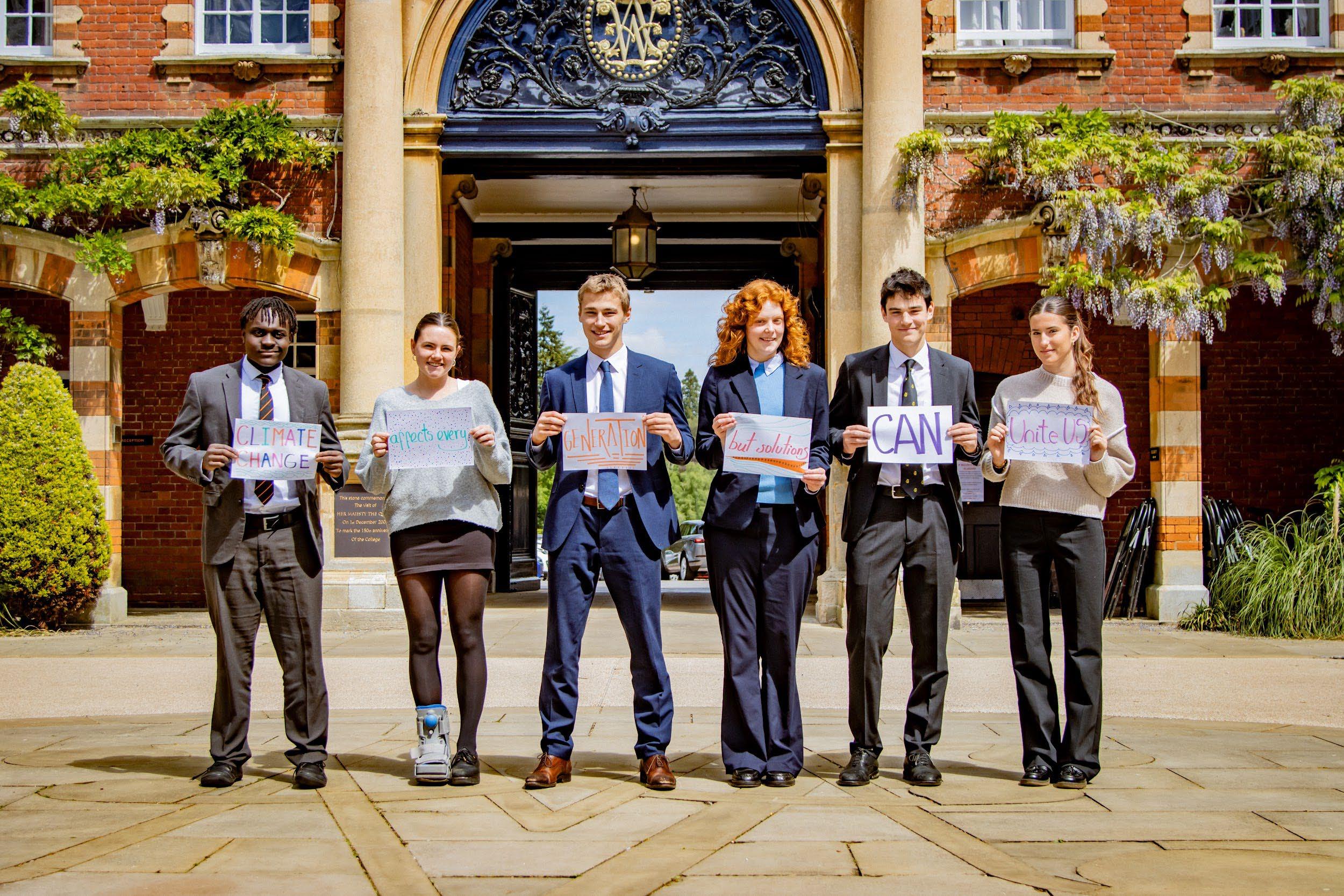
Wellington College (UK) Student Leaders of the Intergenerational Climate Dialogues
Reflections from Wellington College’s Student Leaders
As part of Wellington College’s Global Intergenerational Sustainability and Climate Dialogues Series, four student leaders Sasha Visiukov, Joelle Moser, Jessy Banzoulou, and Oliver Kellett shared their reflections on leading global discussions on climate change, sustainability, and intergenerational action.
Supported by the Institute for Global Learning, these students received professional training in intercultural dialogue facilitation before designing and hosting virtual dialogues that brought together more than 280 participants from 25 schools across 10 countries.
Student leaders reflected on their experiences, the challenges they faced, and what they discovered about leadership, empathy, and the power of youth-driven change.
What was meaningful for you about participating in and leading the program?
Jessy:
Being given the opportunity to participate in a student-led, studentdesigned project was both exciting and transformative. It challenged me to step outside my comfort zone especially when I took on the role of facilitator. That experience strengthened my confidence and communication skills, and it taught me how to lead meaningful conversations with people across generations. What made it truly meaningful was that it wasn’t just about sustainability it was about human connection.
Joelle:
This project was one of the most rewarding experiences I’ve had at Wellington. I’ve always been passionate about sustainability, but this gave me a new way to engage with it through dialogue and collaboration. It pushed me to try something I’d never done before and gave me the confidence to lead real conversations about change. Being trusted to lead made it feel empowering; it showed that our ideas as students matter.
Sasha:
I think student leadership was essential for this project. We, as young people, are the ones who will face the harsher effects of climate change. That gives us both urgency and authenticity when leading these conversations. When students take charge, we bring new ideas, optimism, and innovation that can inspire real change.
Oliver:
For me, the most meaningful part was feeling a genuine sense of ownership. Because it was studentled, we were not just following instructions we were shaping the program ourselves. It made the work feel personal and relevant. Knowing that our voices were being taken seriously in conversations about such critical global issues was both validating and motivating.
What did you learn from your intercultural dialogue facilitation training?
Sasha:
The training was eye-opening. I learned how to make sure every voice in a conversation is heard and respected. It was the first time I was on the other side of a discussion leading rather than participating which taught me the value of listening deeply and creating space for others. It also gave me tools for guiding discussions productively, even when participants came from very different cultural or generational perspectives.
Jessy:
The facilitation training completely changed how I think about communication. It gave me the tools to truly listen not just to words, but to perspectives. I learned to appreciate differences, ask thoughtful questions, and help others feel comfortable expressing their views. Those are skills that I know will serve me well far beyond this project.
Joelle:
Before this project, I didn’t even know “intercultural dialogue facilitation” was something you could train for! It taught me practical ways to connect across cultures to build understanding,
even when people start from very different places. It was fascinating, and it really helped me feel more confident leading international conversations.
What was it like leading conversations with students and educators from around the world?
Oliver:
It was both humbling and inspiring. Each dialogue was unique, shaped by the people in the virtual room. I was struck by how much we could learn from one another especially when people of different generations shared their perspectives. Despite our differe nces, we often found common ground in our shared concern for the planet.
Sasha:
Leading these conversations was a challenge and a privilege. Every group was different sometimes we had mostly younger students, sometimes more adults and I had to adapt my approach each time. What stood out most was how participants inspired each other. Seeing students gain confidence, share ideas, and keep talking even after the session ended that’s when I knew we were making an impact.
Jessy:
I loved seeing how engaged everyone was. The energy and curiosity of the students were contagious. When people from all over the world come together to talk about sustainability, you realize how universal this issue is and how much hope there is when youn g people lead those conversations.
Tell us a little more about the design process for the dialogues. How did you create the prompt questions and prepare for the sessions?
Joelle:
We wanted the prompts to invite reflection rather than just gather opinions. I spent time researching key issues in climate education and sustainability, then crafted questions that would open up personal storytelling and new perspectives. I wanted participants to feel that every answer was valuable, that there wasn’t a “right” one.
Sasha:
Our teams worked in pairs to design each dialogue. We’d research current sustainability topics and brainstorm prompts that would guide the discussion naturally. Those prompts became our “maps” a reminder of what we wanted to cover while still leaving space for organic conversation. We always rehearsed together before the live sessions, making sure everything felt seamless.
Jessy:
Rosie Walker, who co-led with me, had this brilliant idea to include short videos related to our themes. The visuals helped spark discussion and got people thinking creatively. It made the dialogues feel dynamic and grounded in real-world context.
Oliver:
I found that simplicity worked best. Our goal was to design questions that were open-ended but clear enough to keep people focused. I practiced how to guide the flow of conversation, stay flexible, and respond to whatever direction the group took it.
Can you share any thoughts on the significance of this being a student-led initiative rather than one run by educators?
Jessy:
That aspect made all the difference. When students lead, it creates an environment of relatability and openness. Participants saw us not as authority figures but as peers which encouraged honest and authentic dialogue. It showed that young people can lead serious, impactful discussions on global issues.
Joelle:
Being student-led gave us freedom and responsibility. It showed that we don’t need to wait for adults to give us permission to take action we can do it ourselves. That trust from our teachers was empowering, and I think it made the whole experience more genuine for everyone involved.
Oliver:
It also changes the dynamic. People tend to open up more when they’re speaking with students it feels less formal and more collaborative. This experience proved that student leadership isn’t just symbolic; it’s powerful. It can move people, build community, and shape the kind of future we all want to live in.
Looking Ahead
Through their participation in the Global Intergenerational Sustainability and Climate Dialogues, these four students discovered that leadership is as much about listening as it is about speaking. They learned that empathy and curiosity are the foundation for collaboration and that youth-led initiatives can unite people across generations in meaningful ways.
Their reflections remind us that the future of sustainability depends not only on innovative solutions but also on the courage to start conversations that matter. And sometimes, those conversations begin with students who are willing to take the lead.
Inspired by Dialogue: Climate Action Projects in Sustainable
and Creative Design
Student and Teacher Projects from Wellington College International Tianjin
At Wellington College International Tianjin (WCIT), sustainability has become both a creative challenge and a personal mission. Inspired by the Global Intergenerational Sustainability and Climate Dialogues, students have transformed reflection turning waste into wearable art and awareness into action.
Under the mentorship of Mrs. Ksenija Jakic Markovic, DT & Textiles Teacher at Wellington College International Tianjin, students across Years 10–12 explored how fashion and design can express environmental consciousness and climate action. Inspired by the prompts from the intergenerational dialogues, students responded to three different themes:
1. Rooted in Nature: Our First Connections
2. Lessons Learned (and Unlearned): Education for a Sustainable Future
3. From Awareness to Action:
Their works were featured at various school and community events including the Eco-Friendly Fashion Exhibition, Challenge 23 showcase, and the school plays. The community response to their thought provoking creations reveals how design can inspire both beauty and responsibility. The following are highlights from student and teacher works created in response to the themes.
“Woven
Into Nature” — by Sophia (Jiajie) Sun (Year 10)
Medium: Mixed media sculpture with natural textures and organic motifs
In Woven Into Nature, Sophia visualizes the profound interconnectedness between the human body and the natural world. Her design juxtaposes organic patterns leaves, flowers, and cellular textures to reveal how the structures of nature mirror those within ourselves. The piece evokes a quiet revelation: that humanity is not separate from nature but an inseparable part of it.
“The intricate patterns of the natural world reflect our own internal systems,” Sophia explains. “When we harm the environment, we harm ourselves; when we nurture it, we nurture our own existence.” Through this harmony of form and message, her work becomes both a meditation and a call to action reminding viewers that caring for the planet is an act of self-preservation.
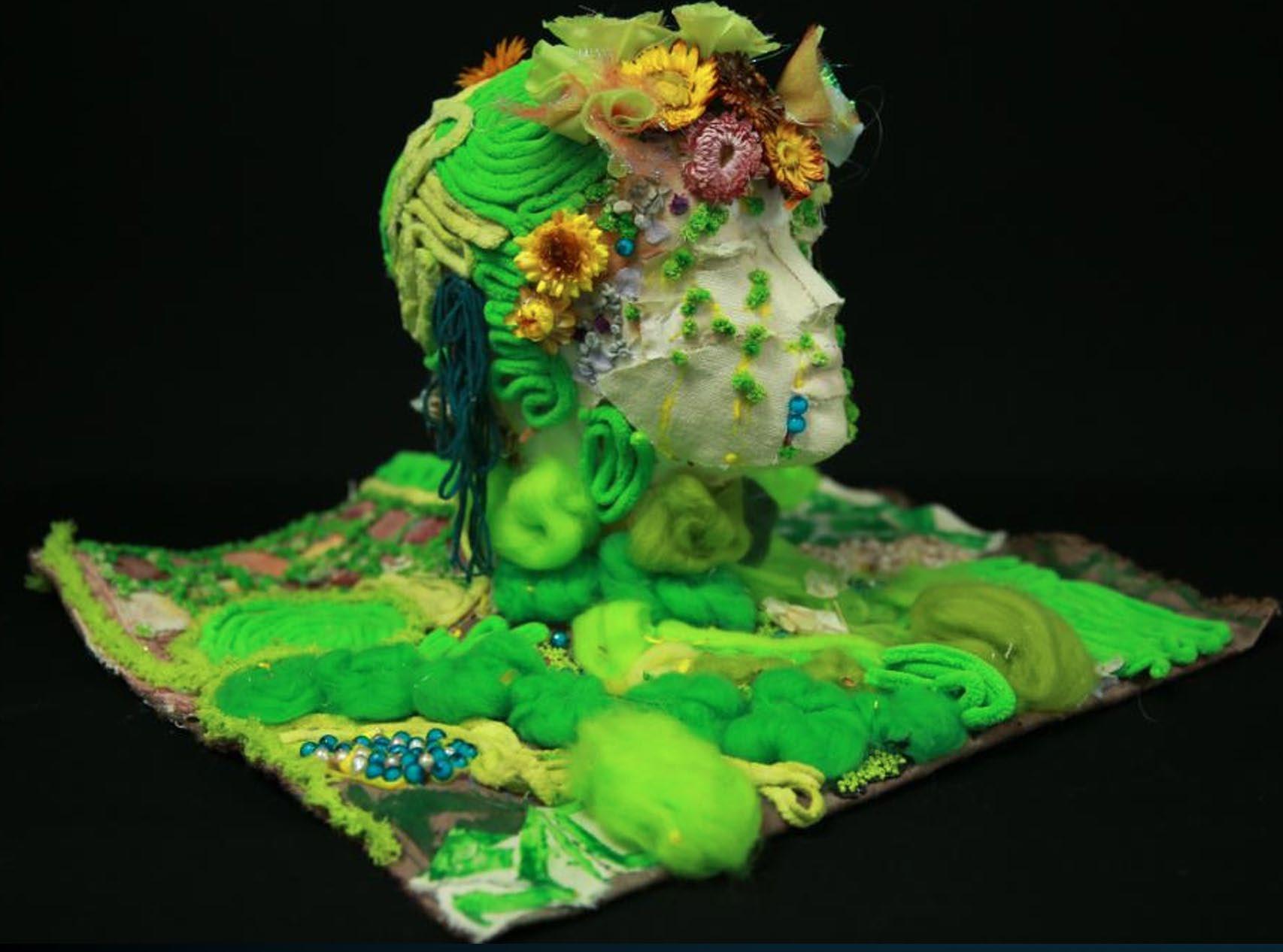
“Harmony Mask” — by Angelina (Qiluo) Jia (Year 11)
Medium: Mixed media mask with natural materials and floral adornments
In Harmony Mask, Angelina captures the essence of humanity’s unity with the natural world. Her design features a face adorned with vibrant flowers and greenery, symbolizing growth, renewal, and the joy of life. The human-like mask bridges the boundary between person and planet inviting viewers to see themselves as part of nature’s living fabric rather than separate from it.
“The colors and textures express vitality,” Angelina explains. “The greens represent renewal, while the yellows and other blossoms stand for diversity and joy.” Through its rich palette and organic detail, Harmony Mask becomes both a celebration and a reminder: that preserving the beauty of our world begins with recognizing our place within it.
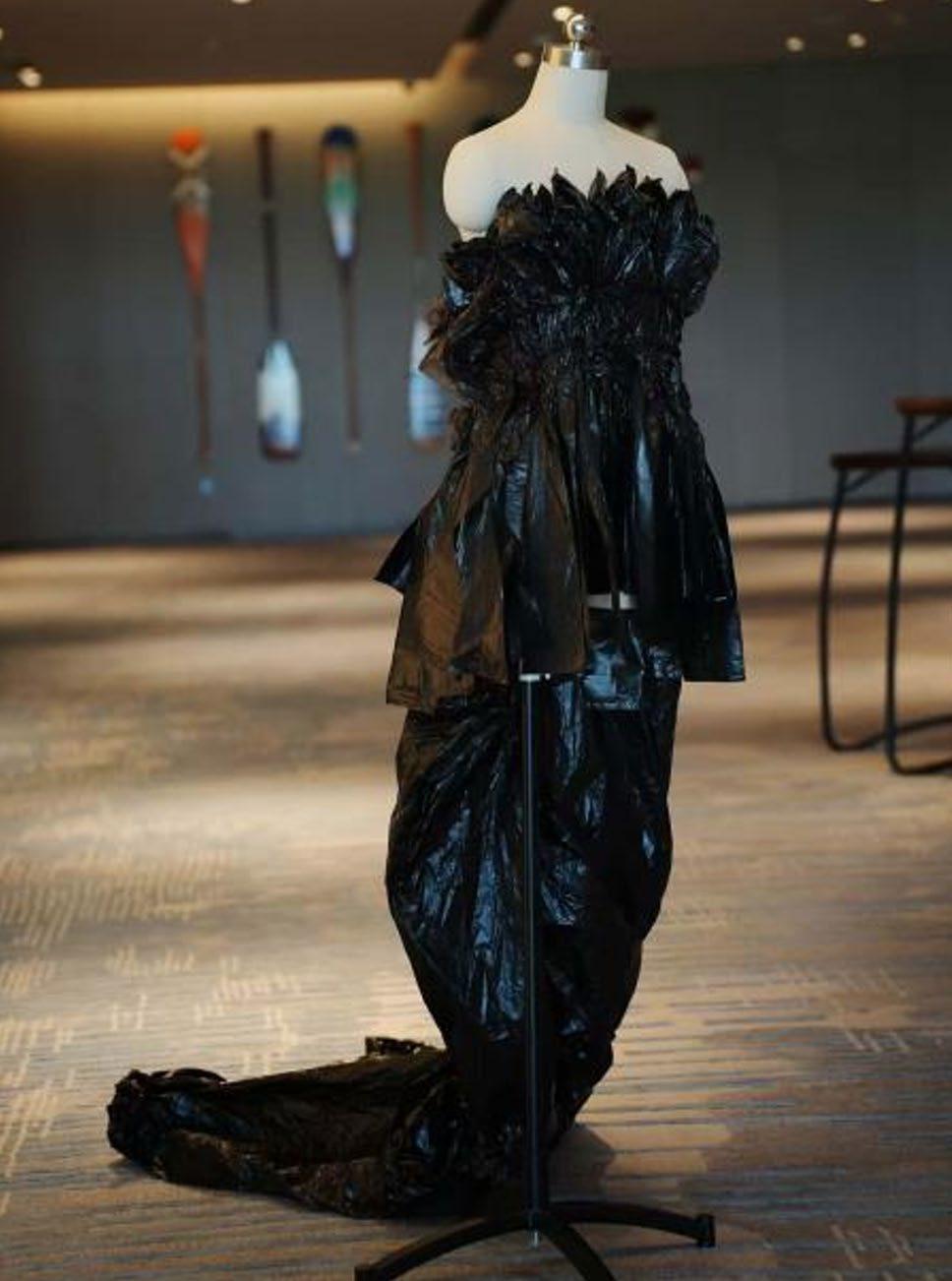
“Garbage
Queen” — by Sixu (Jessica) Hou (Year 11)
Medium: Recycled bin bags and mixed plastics
“Blue
Jessica’s Garbage Queen redefines what is discarded. By constructing a full gown from bin bags, she challenges the viewer to reconsider the value of waste. Her design is both playful and provocative a reminder that creativity can emerge from what we throw away. This piece was featured in the EcoFriendly Fashion Exhibition at the Tianjin Marriott Hotel.
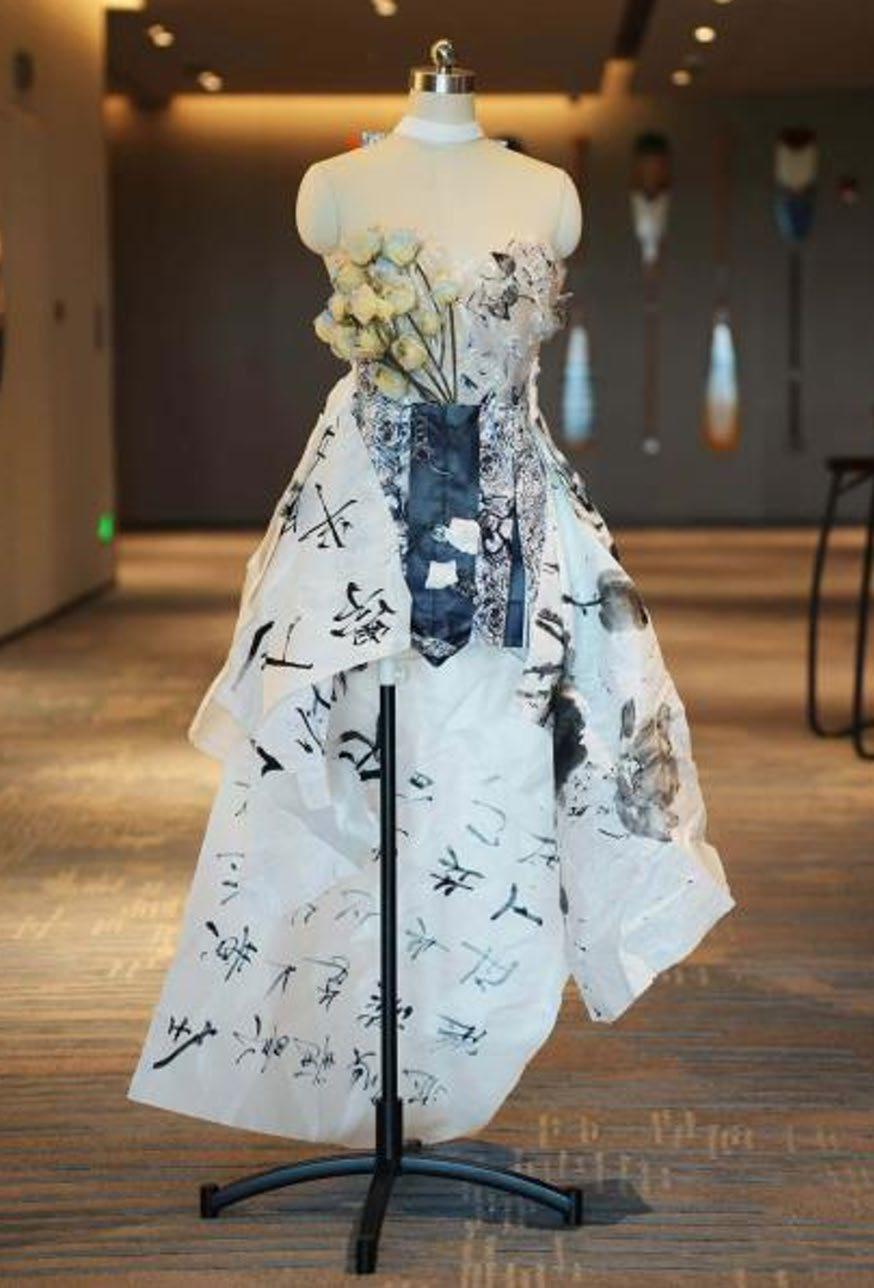
and Ziyi Ren (Year 12)
Medium: Hand-painted textiles and calligraphy ink (Image: Close-up of intricate brushwork on fabric inspired by porcelain)
Drawing from traditional Chinese motifs, the students combine sustainability with cultural heritage. Their design pays tribute to classic blue-and-white porcelain, integrating hand-painted calligraphy into modern fashion. “We wanted to show that honoring tradition can also mean reimagining it sustainably,” they write. This piece was featured in the EcoFriendly Fashion Exhibition at the Tianjin Marriott Hotel.
& White Porcelain” — by Xiaoyi Yu
“Emergence” — by Henrietta Lewis (Year 11)
Medium: Recycled plastics, organza, and found materials
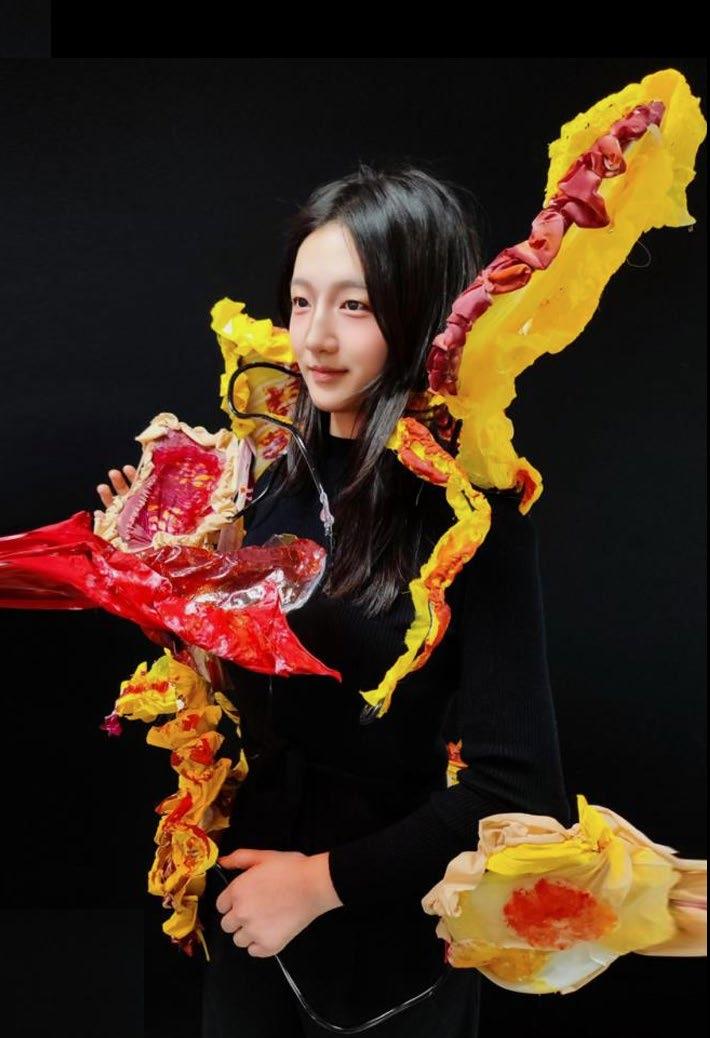
In Emergence, Henrietta Lewis transforms discarded waste into a haunting tribute to the ocean. The design mimics humanity rising from polluted waters, wrapped in the very plastic that chokes marine life. Inspired by the fragile beauty and suffering of jellyfish entangled in debris, Henrietta crafted her piece entirely from salvaged materials items collected from friends, family, and her own household to give new life to what others had thrown away.
“This piece is a homage to the ocean,” Henrietta reflects. “I wanted to capture the suffocating struggle of sea life ensnared in waste and force viewers to confront our shared responsibility. The ocean’s suffering is, ultimately, our own reflection.”
Debuted at the 5th Wellington Design Week Fashion Show during the 2025 Summer Fair, Emergence extended its message beyond the classroom to the wider community. On the runway, its flowing, translucent layers shimmered like water, simultaneously beautiful and unsettling. Through this work, Henrietta demonstrates how fashion can challenge, provoke, and inspire change turning discarded plastics into a living statement of environmental awareness and empathy.
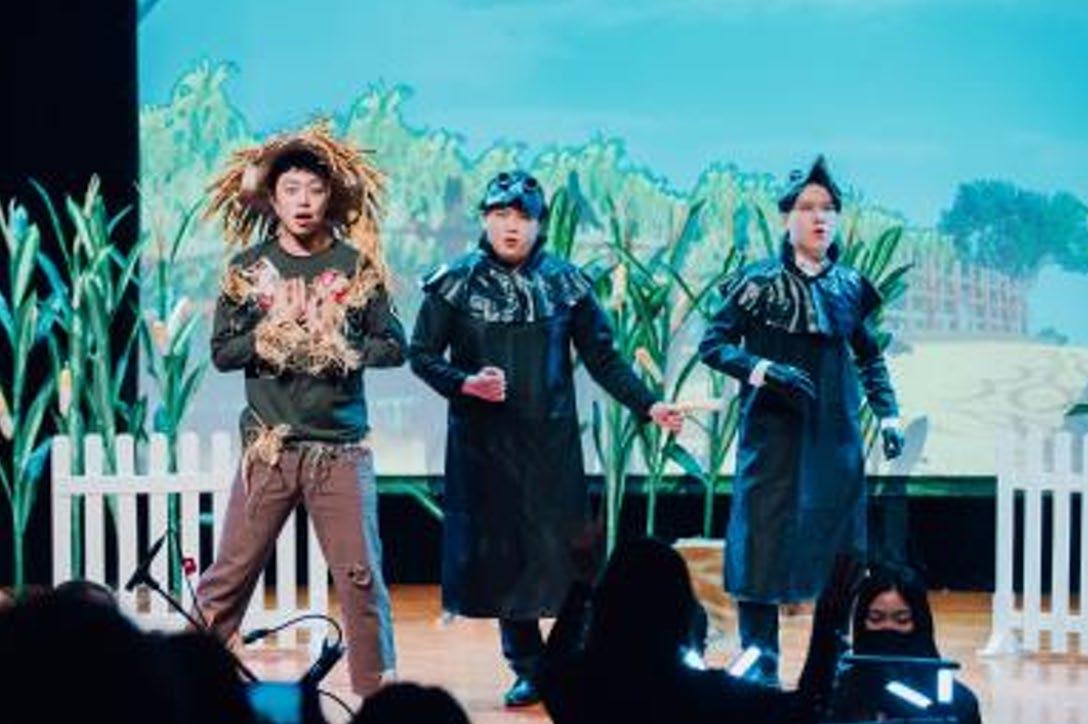
“Creative Recycling on Stage” — by Educator Mrs. Ksenija Markovic, with Students and Parent Volunteers
Medium: Upcycled costume design for school musical productions
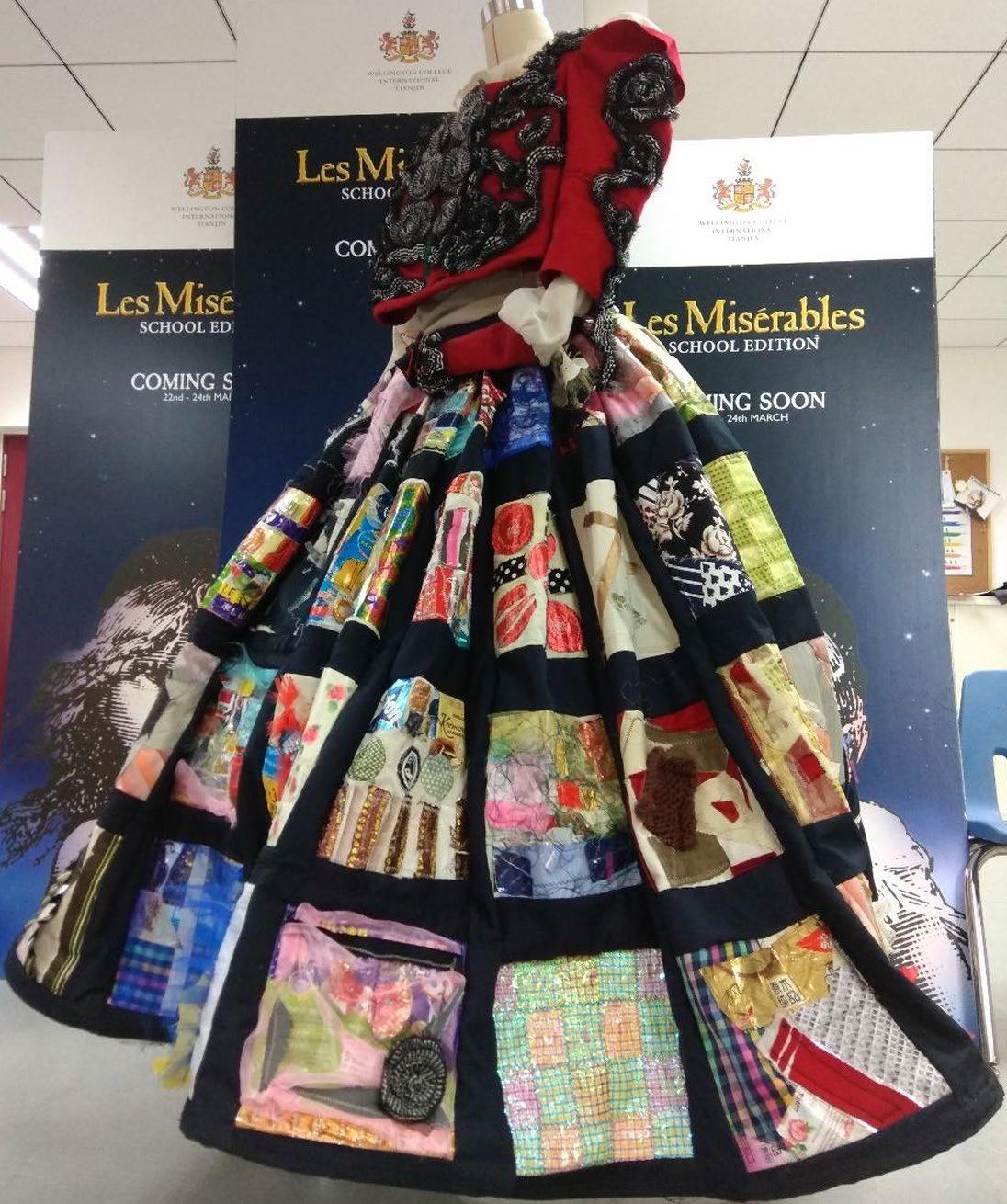
In Creative Recycling on Stage, Mrs. Ksenija Markovic DT & Textiles Teacher at Wellington College International Tianjin joined forces with parent volunteers from Friends of Wellington (FOW) and a group of student designers to create sustainable costumes for the school’s musical productions of Les Misérables and The Wizard of Oz. The project became a community effort in both artistry and environmental awareness, blending craftsmanship with conscience.
“I have been thinking about creative recycling for a long time,” Mrs. Markovic reflects. “I’m deeply concerned about how we can protect the environment, reduce waste, and use what we already have. For me, discarded materials are a constant invitation to think, to imagine, and to create.”
Using repurposed fabrics, bottles, and household materials, the team crafted costumes that were as resourceful as they were theatrical. “By creatively using two or a hundred used bottles, we won’t solve the global waste problem,” she notes, “but we will inspire reflection. That reflection among both young and old is where change begins.”
Through this collaboration, students and parents alike learned that sustainability and creativity are not opposing forces but partners in storytelling. Each costume became a visible reminder that innovation often starts with what we already hold in our hands.
From Dialogue to Design
Each piece began as a conversation inspired by the dialogues about nature, waste, and intergenerational responsibility and became a tangible act of creation. Together, these projects illustrate what happens when sustainability education moves from awareness to artistry and action.
Through design, WCIT students prove that change can be both beautiful and bold: a dialogue translated into fabric, color, and form. These creative reflections from the intergenerational dialogues transformed into climate empowerment and action, sparking reflections and thinking across all who engaged with the pieces - from fellow students and teachers to family and community members. - continuing the intergenerational impact.
Conclusion
This research study investigated the impact of the Global Intergenerational Sustainability and Climate Dialogues Series, a pioneering, student-led initiative hosted by Wellington College in partnership with the Institute for Global Learning (IGL). Designed as lowcommitment virtual dialogues, the series successfully brought together 280 participants, including students and educators from 25 schools across 10 countries, focusing on core themes such as connecting with nature, sustainability education, and climate action.
Key Findings on Impact and Skill Development
The findings, gathered through a mixed-methods approach, demonstrated compelling evidence that participants found the conversations to be meaningful, skill-building, and impactful.
• Skills Practiced: Participants reported actively practicing crucial dialogue skills. A majority (68%) shared their own perspective or experience in a way that others could understand, and 41.74% reflected on why their own perspective might differ from others. Furthermore, 68% reported that the dialogues helped them think about the topic or issue in a new or different way, suggesting deeper cognitive engagement.
• Reported Impact: The single most impactful component identified by participants was the opportunity to hear about perspectives and experiences different from their own (73.91%). This exposure to diverse narratives across countries, cultures, and age groups was a key takeaway. Significantly, nearly half of respondents (44.35%) reported being inspired by others to take more action on climate issues and simultaneously gained a better understanding of the global issue being discussed.
The Value of Intergenerationality and Student Leadership
The study confirmed the central goal that the intergenerational component was deeply impactful, broadening participants' understanding and reinforcing a shared sense of purpose.
Qualitative analysis revealed four central themes that captured the experience: Listening and Learning, Generations and Geographies, Purpose and Hope, and Action and
Leadership. These themes highlight that the dialogues generated a sense of global community and sparked a hopeful outlook through hearing about others’ commitment to climate issues.
A distinguishing feature of the series was its student-led nature. Student facilitators received advanced training in intercultural dialogue facilitation from the IGL, which built their confidence and communication skills. Participants, both students and adults, noted that the fact that students were leading created an environment of relatability and openness that encouraged honest and authentic dialogue. This structure affirmed that student leadership is not merely symbolic but cultivates ownership, empowers agency, and builds confidence in young people to be changemakers right now.
From Reflection to Action
The dialogues served as a catalytic role in motivating climate action. This inspiration translated into tangible action projects, such as the Sustainable and Creative Design initiatives at Wellington College International Tianjin (WCIT). Students transformed dialogue reflections into wearable art and awareness into action, exemplified by striking creations like "Garbage Queen," a gown constructed from recycled bin bags, and "Emergence," which used salvaged plastics to reflect on ocean pollution. These projects illustrate how sustainability education can transition from abstract awareness to artistry and action, sparking reflections across the wider community.
Implications
The implications of this study strongly support the power of structured, low-barrier intergenerational dialogue as a pedagogical and community-building tool. When virtual spaces are intentionally designed and skillfully facilitated, they successfully bridge generational and geographic divides, allowing for shared reflection and mutual learning. Ultimately, this initiative provides compelling evidence that bringing generations together in thoughtful dialogue creates the necessary conditions for deeper understanding, inspired action, and collective hope in addressing climate challenges It is expected that this project continues on a yearly basis.