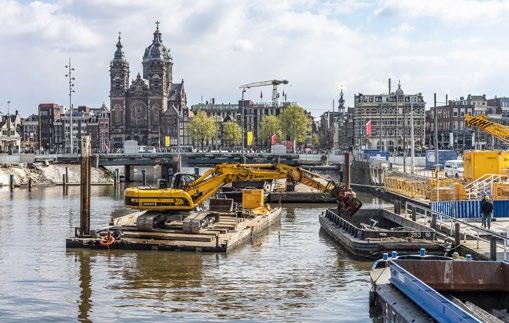
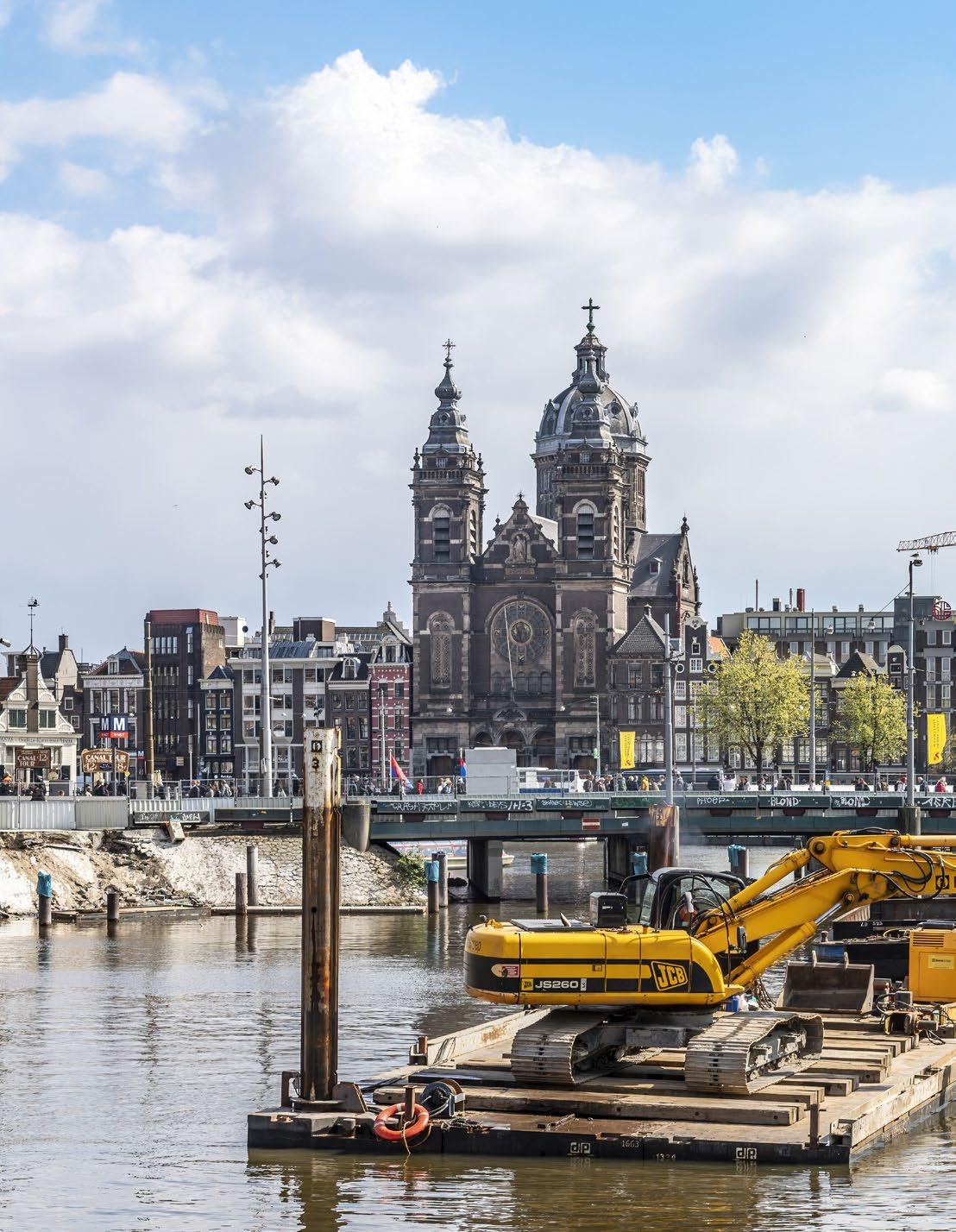
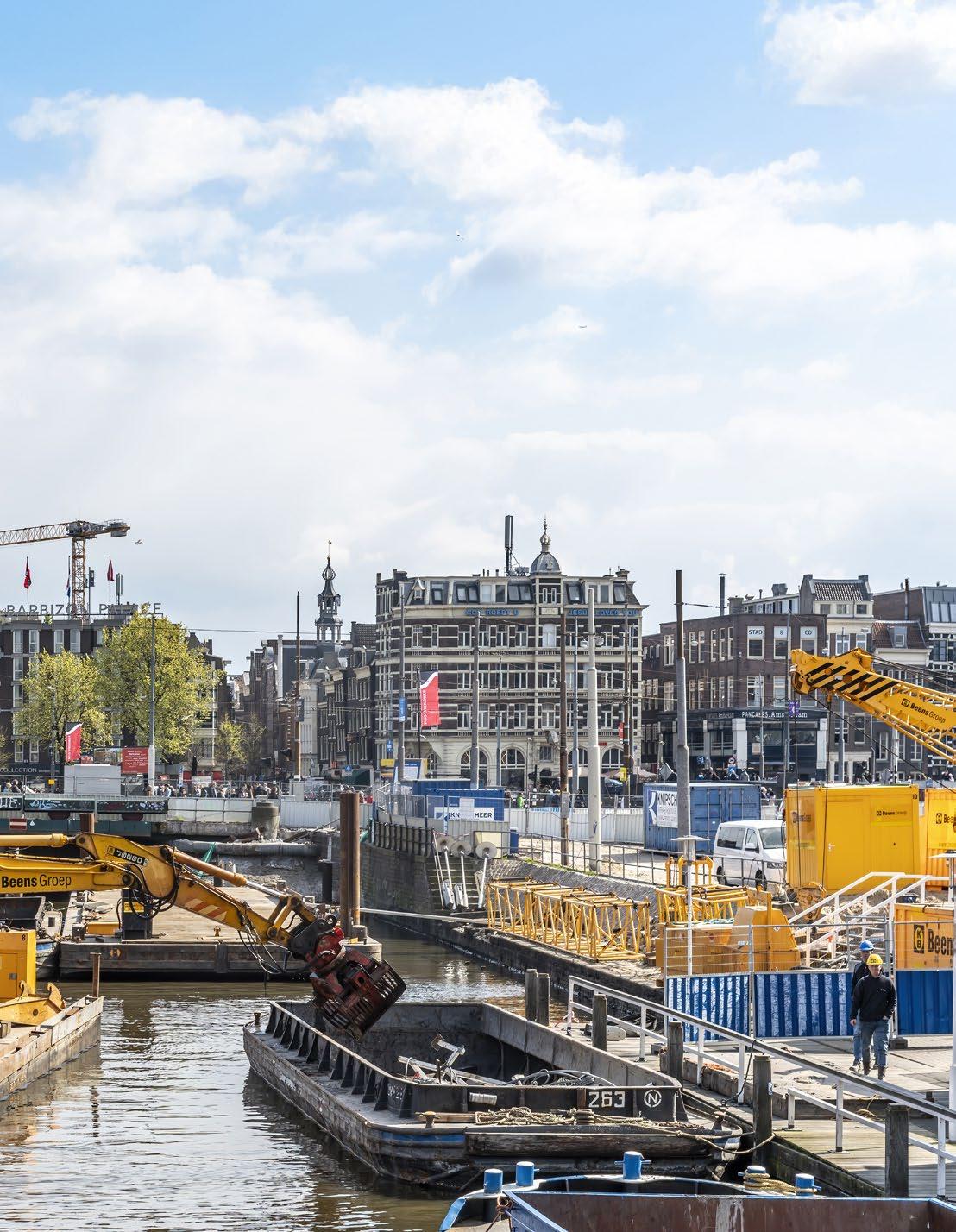
For more than a decade, AMS Institute has been helping to resolve urban problems faced by Amsterdam, from waste collection and repairs of quayside walls to energy poverty. Scientific expertise is rapidly put to practical use.
‘PROTECTION
NEEDS TO BE MUCH BETTER’
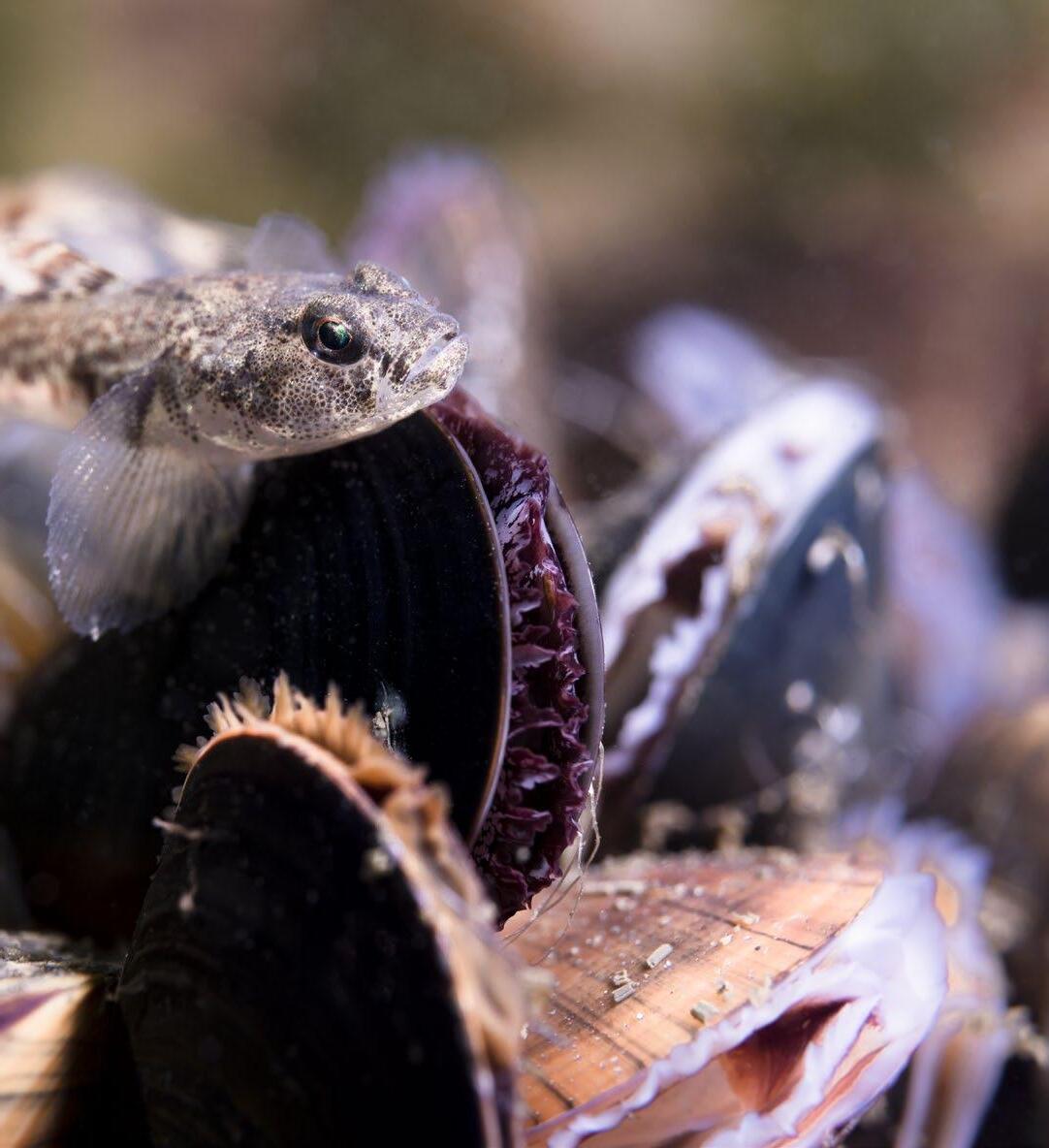
Huge mussel beds and large numbers of flatfish have surprised the researchers studying underwater life in the Wadden Sea over the past year. The area needs some good news for a change, as numbers of migratory fish have been declining for years.
Wageningen World is the biannual magazine for associates and alumni of Wageningen University & Research
Miranda Bettonville
Nijland
Chermin Cover picture Yoeri van Es Overall design Hemels
Tessera Translations S.L
&
Printer Tuijtel, Werkendam ISSN 2212-9928
DECIPHERING THE ROLE OF GUT BACTERIA
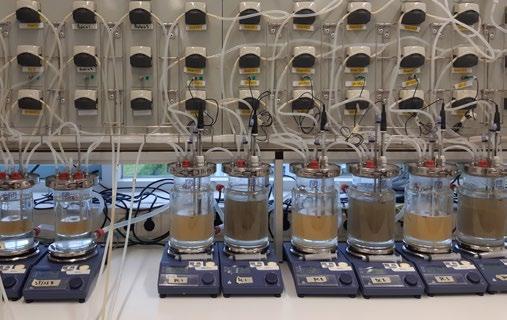
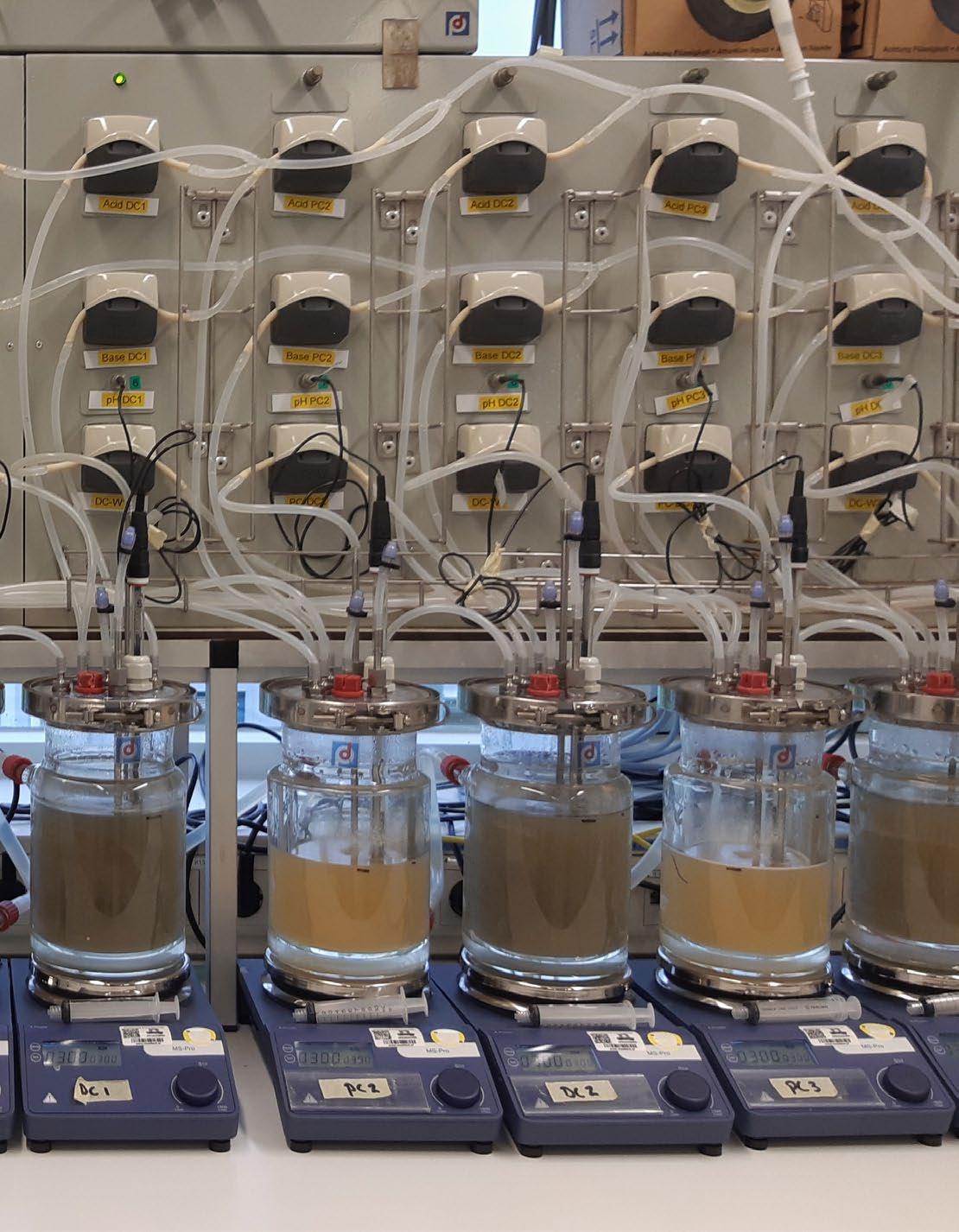
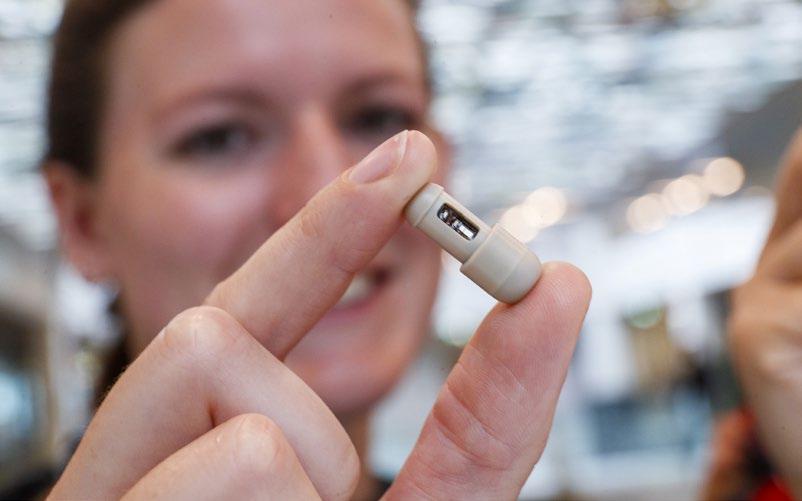
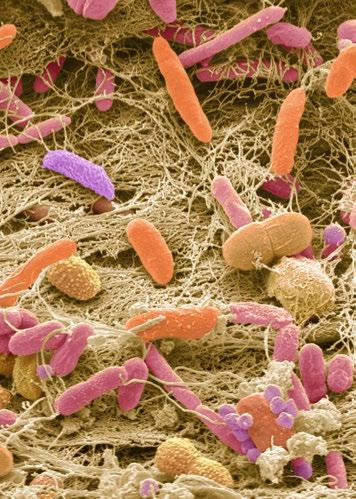
The mix of bacteria in the intestines affects human and animal health. With the help of artificial intestines – aka the poo machine – scientists are trying to figure out how that relationship functions.
&
Wageningen Campus, Droevendaalsesteeg 4, 6708 PB Wageningen, telephone +31 317 48 40 20, wageningen.world@wur.nl Change of address alumni alumni@wur.nl Change of address associates wageningen.world@wur.nl, mentioning code on address label Change of career details alumni@wur.nl
The mission of Wageningen University & Research is “To explore the potential of nature to improve the quality of life”. Under the banner Wageningen University & Research, Wageningen University and the specialized research institutes of the Wageningen Research Foundation have joined forces in contributing to finding solutions to important questions in the domain of healthy food and living environment. With its roughly 30 branches, 7,900 employees (7,100 fte), 2,500 PhD and EngD candidates, 12,700 students and over 80,000 participants in WUR’s Life Long Learning, Wageningen University & Research is one of the leading organizations in its domain. The unique Wageningen approach lies in its integrated approach to issues and the collaboration between different disciplines.
WAGENINGEN WORLD ONLINE Wageningen World is also available online; the editions can be found in browsable PDF form at www.wur.eu/wageningen-world. Digital subscribers receive the magazine two times a year by email. Reading online is better for the environment and the climate. To switch from a paper to a digital subscription, go to: www.wur.eu/ww-subscription
UPDATE
News in brief about research and development at Wageningen University & Research.
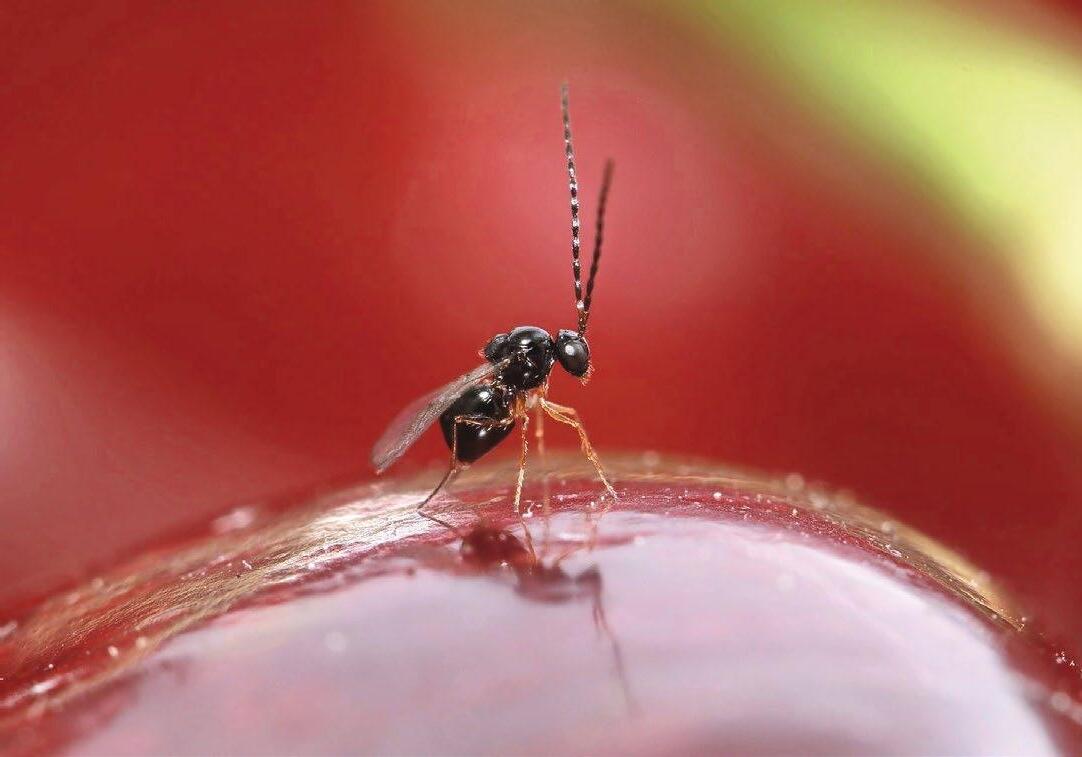
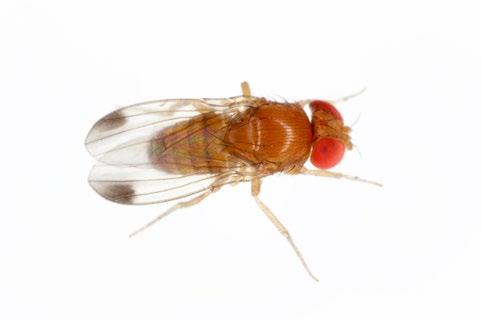
PARASITIC WASP TO TACKLE FRUIT FLIES
The spotted wing drosophila, an exotic fruit fly species, is a devastating pest in cherry orchards. Another exotic insect, the Asian parasitic wasp, has been brought in to fight it.
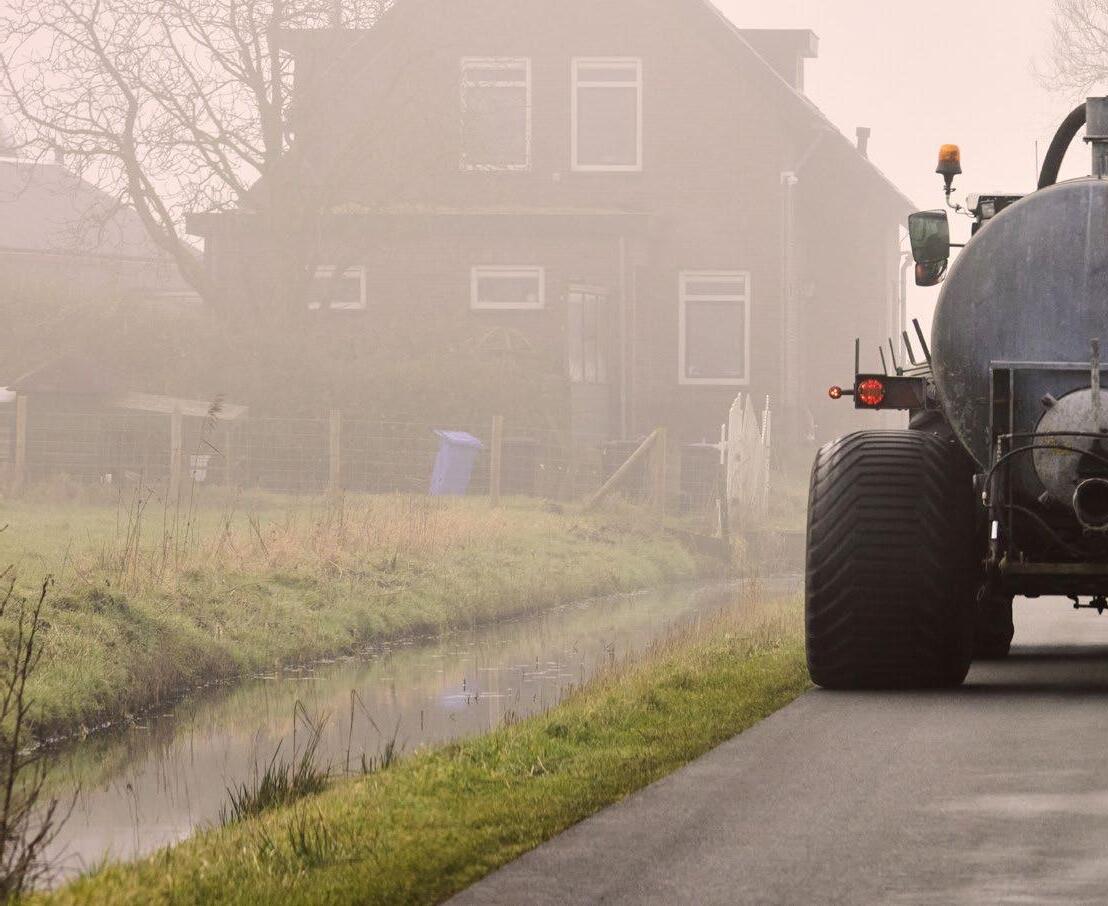
PEDDLING MANURE
Now that the exception to EU rules that allowed Dutch dairy farmers to spread more manure is being phased out, the amount of manure traded on the market has increased further still.
INTERVIEW: NICO CLAASSENS
Nico Claassens wants to help bring about a circular bio-economy in which bacteria use CO2 as an input to produce bioplastics and proteins.
TALKING TO THE DIGITAL ASSISTANT
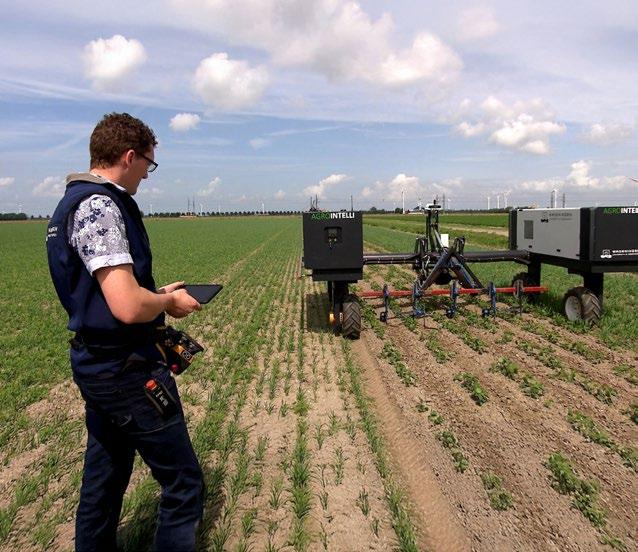
Farmers consult their digital assistant about the right time to harvest potatoes, after which their smart robots get down to work — this could become a reality within five years.
FEATURES
LIFE AFTER WAGENINGEN
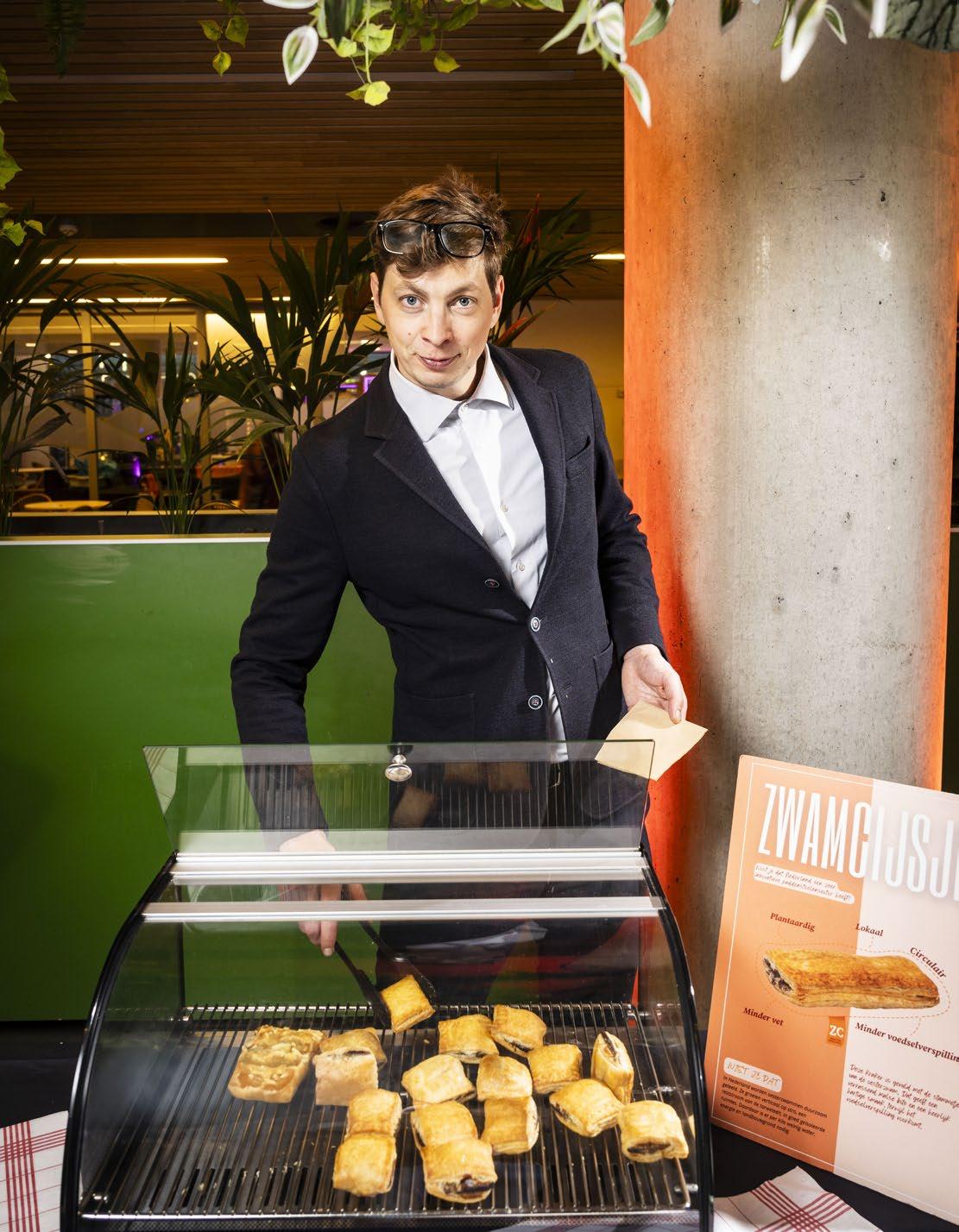
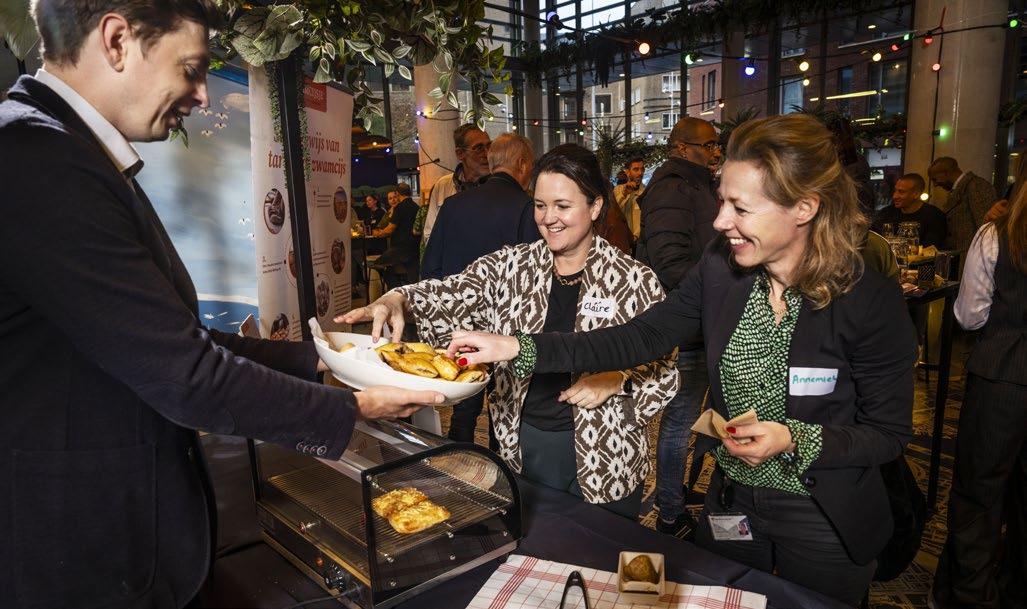
Mendelt Tillema has become famous for his fully vegan sausage roll – the Zwamcijsje – made using the stalks of oyster mushrooms.
UNIVERSITY FUND WAGENINGEN
The Farm of the Future in Lelystad received 2.5 million euros from a legacy this year – one of the biggest donations to WUR ever.
ALUMNI
News for and about Wageningen alumni.
Information about
Wageningen graduates.
After
Curiosity
‘December naturally invites us to pause and reflect on the past year. Reading through this edition of Wageningen World, I was once again struck by the power of curiosity. Curiosity is the essence of what we stand for: exploring the potential of nature to improve the quality of life.
‘This issue takes us below the surface – literally – into the Wadden Sea, where Wageningen scientists reveal the simultaneous fragility and resilience of this unique ecosystem. We then travel to another hidden universe: the microbiome. The latest insights demonstrate the close intertwining of our health –humans and animals alike – with the microbes living within us. The development of a ‘sensor pill’ opens new horizons.
‘We learn about solutions for everyday challenges on our farms. Like the manure market, where a decadesold puzzle connects nitrogen, soil health, and economics. New technology is making circular solutions on the farm more accessible. We can read how robotics is accelerating the transition to precision agriculture. And sometimes progress comes from surprising places: an Asian parasitic wasp is helping fruit growers protect their crops from an invasive species.
‘Urban environments are also coming into focus. AMS Institute shows us what sustainable, climateresilient city development looks like in practice. And WUR scientists are also working towards a circular and climate-positive society. A new generation of scientists, such as Nico Claassens, is developing ways to transform CO₂ into valuable products.
‘In this issue, we also celebrate a very special gift, namely the bequest from Mrs Visser-Stokhuijzen. She made a very large donation to the Farm of the Future.
‘If I may offer one wish for the year ahead, it is this: that we carry this determined curiosity with us as this is where our strength lies and where our mission comes to life.’
Sjoukje Heimovaara, President of the Executive Board of Wageningen University & Research
Lifestyle advice for children with cancer
In 2025, researchers from Wageningen and the Princess Máxima Centre started a large-scale study on the influence of nutrition and exercise in the treatment of children with cancer. ‘Parents would like to do something to help, but there is a lack of sound, evidence-based advice in this area,’ says Dieuwertje Kok of the Human Nutrition & Health department.
Five hundred young patients will be monitored for two years following their diagnosis. The study will collect data on exercise, nutritional habits, muscle and fat mass and gut flora, among other things. By measuring a range of variables at the same time, the researchers hope to get information that they can translate into practical lifestyle recommendations. The study is being funded by the World Cancer Research Fund and will be followed up in southern European countries. Info: dieuwertje.kok@wur.nl
ORGANIZATION
Peter Ploegsma joins Executive Board
Peter Ploegsma has been appointed a member of the Executive Board of Wageningen University & Research as of 1 November 2025. He succeeds Rens Buchwaldt, who had to give up his position in July for medical reasons, and will take over the Finance, Business & Services portfolio. Ploegsma previously worked for elderly care organization Aafje and has also been the financial director for the Rotterdam transport company RET and the Employee Insurance Agency UWV. His appointment is for four years. Info: janwillem.bol@wur.nl
Asian elephant has four subspecies
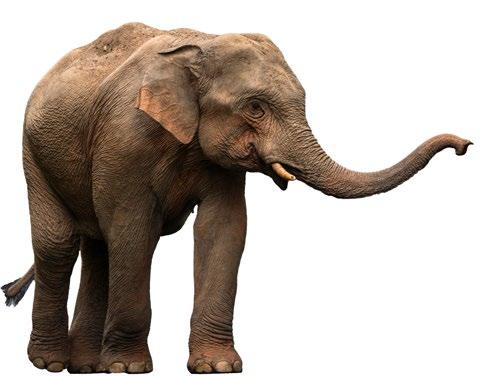
The Asian elephant has four genetically distinct subspecies. This finding comes from PhD research by Jeroen Kappelhof of the Animal Breeding and Genomics chair group. That is useful information for protecting this endangered animal species.
The Asian elephant is on the IUCN Red List as an endangered species. If nature conservationists know about the genetic
VIROLOGY
differences, they can develop more effective strategies, such as restricting inbreeding or managing populations separately. Kappelhof analysed the DNA of 27 elephants, a dataset covering the entire area in which the species is found. He found four genetically distinct clusters located on Borneo, Sumatra, Sri Lanka and the Asian continent. Many of the DNA samples in the study came from European zoos, which turn out to have high genetic diversity. ‘That offers opportunities for conservation,’ says Kappelhof, ‘as long as breeding is done carefully.’ Kappelhof’s findings were published in August in
Info: jeroen.kappelhof@wur.nl
A single vaccine for Ebola and Marburg
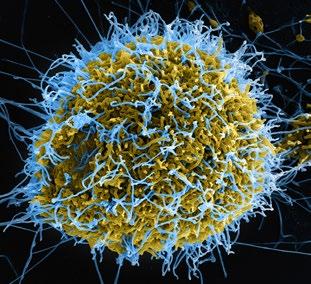
Virologists at Wageningen University & Research are helping to develop a vaccine that will offer protection against various filoviruses, including Ebola and Marburg. Filoviruses are among the most deadly viruses and few vaccines exist for them. The international project, headed by the Danish biotech company AdaptVac, has secured 10.5 million euros in funding from the European Union and CEPI, an international platform for vaccine development. ‘We want to protect high-risk groups against various filoviruses with a single vaccine,’ explains Wageningen virologist Gorben Pijlman. WUR is developing several candidate vaccines, with the first results expected in spring 2026. Partners will then test them for safety and effectiveness.
CEPI’s aim is to be able to test an all-purpose vaccine on humans in about three years.
Info: gorben.pijlman@wur.nl
PHOTO ALAMY
Rice on peatland reduces CO2 emissions
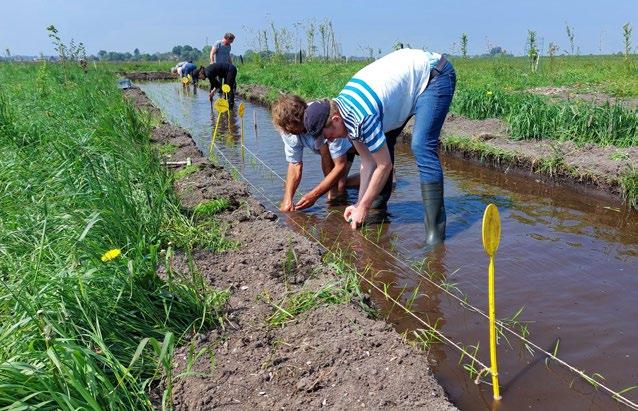
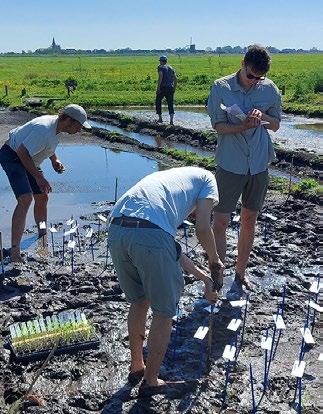
Researchers at Wageningen and Leiden University harvested rice from Dutch peatland for the first time this year. This rice cultivation could counter the effects of soil subsidence.
Two years ago, Wageningen researchers planted rice in a peatland polder near Leiden to see whether rice cultivation could be an alternative to cattle farming on peatland. The soil in the reclaimed peatland fields is subsiding because the peat is decaying, which is releasing large amounts of CO2. When rice is grown, the soil is flooded again. That prevents the CO2 emissions and rice cultivation could also be an alternative source of income for the livestock farms that
now have grazing cattle.
This year, the rice fields yielded harvestable amounts of rice for the first time. Seventeen of the 33 rice varieties tested on the Dutch peatland turned out to do well. ‘The higher water levels will let the peat recover and retain more CO2,’ explains project manager Tom Schut of the Plant Production Systems chair group. The fields also function as a buffer for rainwater and as a water reservoir. PhD candidates are now investigating which
WAGENINGEN ACADEMY
varieties and cultivation methods give the best results, including in terms of biodiversity and the impact on greenhouse gases. Trials on a bigger scale will start in early 2026 in fields near Leiden and Woerden. These trials will run for six years. They will include a new element: introducing fish as a natural form of crop protection. This method has been practised in continental Asia for two centuries. In the Netherlands, African catfish will be swimming amongst the rice plants. They eat insects, larvae and weeds and will also provide fertilizer.
Info: tom.schut@wur.nl
Worldwide growth thanks to customized training
Cargill had one key question: how do we make sure our teams around the world don’t just learn something but also apply that know-how immediately? The answer lay in customized in-company training in partnership with Wageningen Academy.
Wageningen experts worked with Cargill to develop a practical programme using real-life cases dealing with animal and feed technology that tied in with Cargill’s strategy. Cargill teams were now seeing tangible change within a few weeks, for example with new frameworks, improved processes
and a common language of communication between the teams in Asia, Europe and South America.
‘We were able to apply the new insights immediately in our practice,’ says Elke van Gelderen, Global Category Lead at Cargill. ‘The collaboration with Wageningen Academy has strengthened our approach worldwide.’
For those who want to future-proof their organization or take a career step as an individual, check out the professional training on offer at www.wur.nl/academy
BIOBASED
Boost worth millions for algae research
AlgaePARC, part of WUR, has got funding of 17.7 million euros for four research projects on microalgae. One is an EU project for industrializing algae cultivation and launching new algal products on the market, such as proteins and omega-3 fatty acids. There is also funding for carbon sequestration, production of oils and research on microorganisms that live in extreme conditions.
Info: maria.barbosa@wur.nl
Scientists in the marketplace
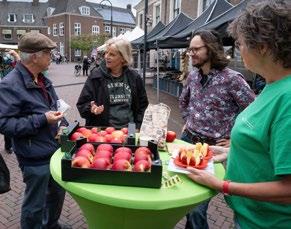
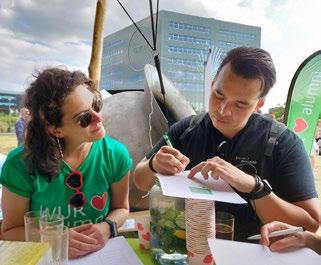
In early September, various scientists from Wageningen University & Research were at Wageningen’s weekly market to mark the start of the new academic year by presenting their research. For example, René Smulders of Wageningen Plant Research let people taste two new apple varieties that are resistant to apple scab and mildew: the fresh-tasting ‘Kick’ and a sweet variety that doesn’t yet have a name. Visitors to the market could also look at seeds germinating under a microscope, let their dog solve a puzzle or share their ideas for the Wageningen of the future in 2120. The Vallei bread roll, launched this autumn with sustainable regional ingredients, was popular, as were the healthy nutrition tips from emeritus professor Harry Wichers: eat plant-based food, a wide range of fruit and vegetables and lots of dietary fibre.
Info: nikolien.vangelderen@wur.nl
MANAGEMENT
Chemical fingerprint helps combat timber fraud
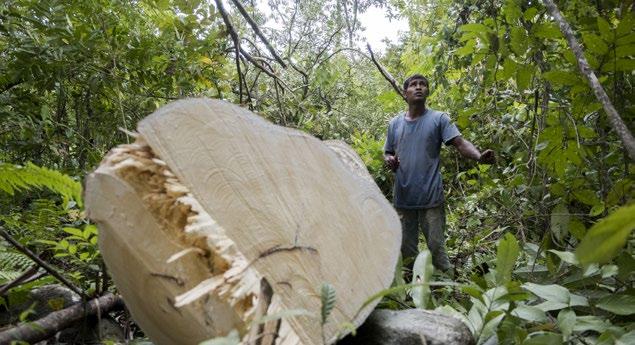
Research in the Timtrace project shows that researchers can determine the origin of tropical hardwood down to a radius of 100 kilometres with 94 per cent certainty. That can help in the fight against the illegal timber trade.
Timtrace is a collaborative venture between Wageningen, other European universities and science institutions in Cameroon, Congo, Gabon and Indonesia, with funding from the Dutch Research Council. The researchers studied wood samples from nearly one thousand trees in Central Africa and Borneo. They analysed chemical elements such as magnesium and calcium and discovered there was considerable variation in the composition of three important wood types: Red Meranti, used a lot for window frames, and the African woods Azobé and Tali, used in the construction of waterworks.
They then used machine learning to find a relationship between the wood composition and the geographical origin. The chemical composition, combined with genetic differences, reveals the place of origin of felled trees. The research results could help in the fight against illegal timber trading and efforts to protect tropical forests. New EU rules require timber traders to give proof of the origin of their products. ‘Independent methods for verifying the origin will be hugely important in enforcing this legislation,’ says PhD candidate Laura Boeschoten.
Info: pieter.zuidema@wur.nl
Robots for mixed cropping
A consortium consisting of Wageningen University & Research and Danish universities will spend the next five years working on developing robots for mixed cropping. In the Robotic Intercropping project, Wageningen will study the combination of crops and clover. This form of mixed cropping is good for the soil and
biodiversity, but the clover needs frequent mowing to get good crop yields. Light autonomous robots could take over such time-consuming tasks, say the researchers. The project is getting over 10 million euros in funding from the Novo Nordisk Foundation.
Info: dirk.vanapeldoorn@wur.nl
Bees reveal pesticide use
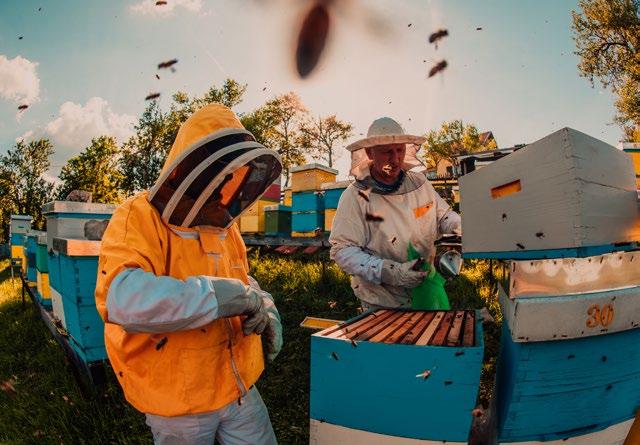
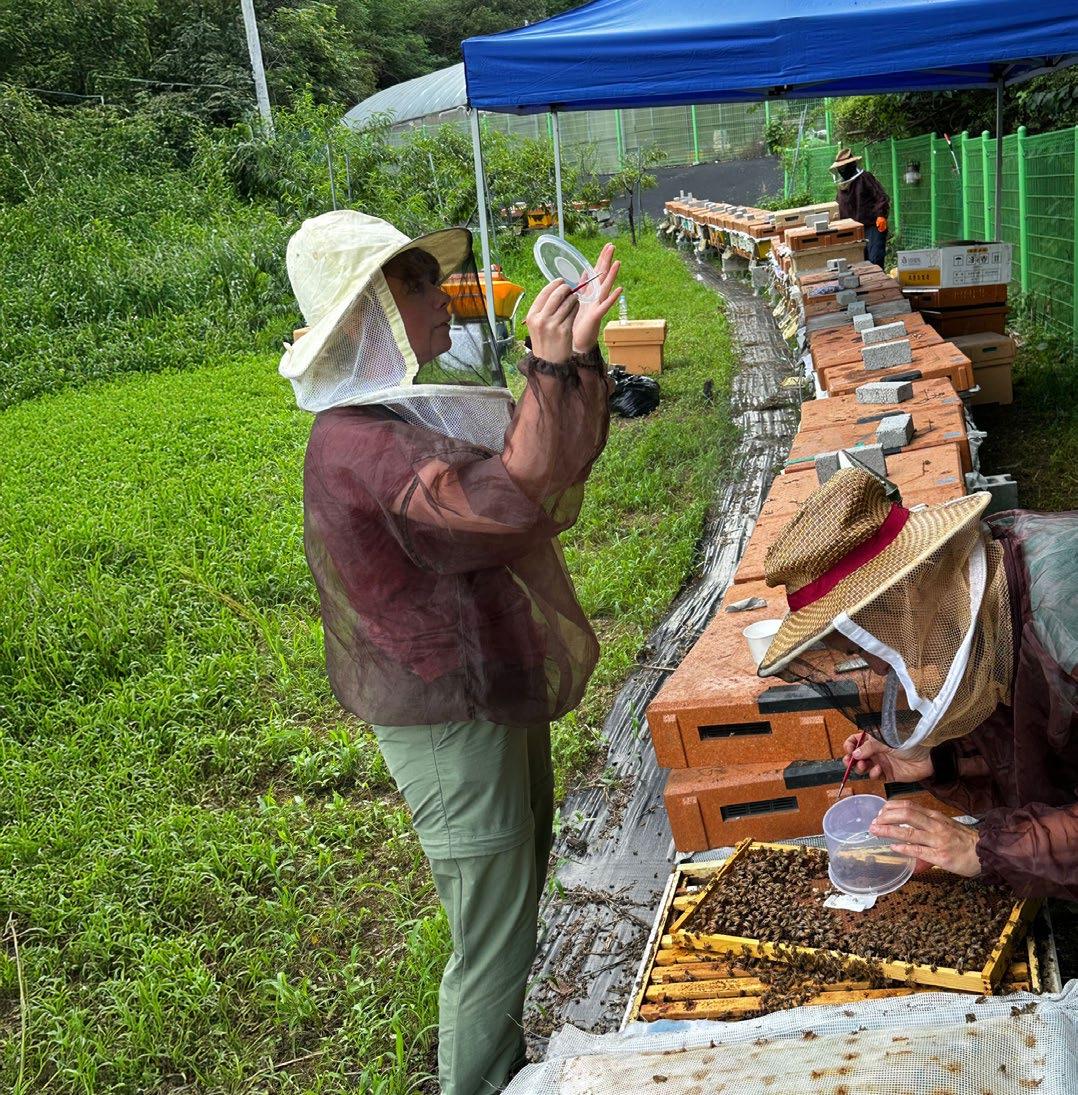
Bees inadvertently collect other substances in the environment when going for pollen. That makes them good indicators of the presence of pesticides, according to a Wageningen study. Wageningen researchers looked at 315 beehives from all over Europe and detected 188 pesticides, including the banned insecticide imidacloprid.
The beehives were sampled in summer 2023 and screened for over 400 different pesticides. All the hives had some traces of pesticides. To demonstrate the presence of the substances in the beehives, plastic strips covered with a layer of material that binds volatile compounds were suspended in the hives for two weeks.
The principle that bees could be used as biomonitors had already been demonstrated nine years ago by the Wageningen bee researcher Sjef van der Steen. His method formed the basis for this European monitoring project.
‘To a large extent, the products we found match what is used in agriculture,’ says Ivo Roessink, a researcher at Wageningen Environmental Research. But the pesticide imidacloprid was found in one in three hives, despite having been banned from
ENVIRONMENT
use in field crops for the past ten years. Imidacloprid is still used in pet flea products. Other banned insecticides, such as thiacloprid and chlorpyrifos, were also found. Even residues of the notorious DDT were detected in one in four hives, albeit in very low concentrations. That product has been banned for nearly 40 years.
The bee monitor shows whether a pesticide is present in the environment, but not
in what concentrations. Roessink: ‘That substance comes from the surrounding area and could have been brought in by a couple of bees or thousands. So you can’t deduce from this what the exposure is in the environment.’ The bee monitor provides qualitative information, which Roessink says can supplement the existing monitoring projects.
Info: ivo.roessink@wur.nl
Too much plastic in fulmar stomachs
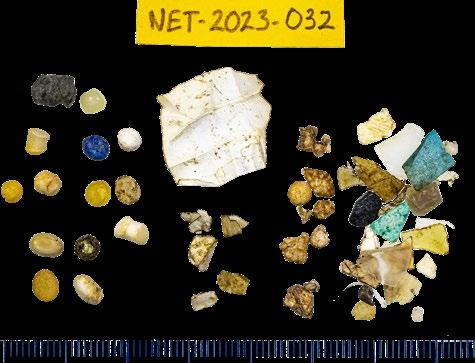
More than half of the Northern fulmars that wash up along the Dutch coast have more plastic in their stomachs than the European threshold value of 0.1 grams. The birds that were examined have an average of 24 pieces of plastics in their stomach, weighing 0.28 grams in total. This is shown by examinations by Wageningen Marine Research of 228 fulmars in the period 2020–2024. The study was carried out to obtain a better understanding of changes in plastic litter in the sea.
There has been no significant decline in this figure in the past ten years. The European target of a maximum of 10 per cent of fulmars with more plastic than the threshold value will probably only be achieved in 50 years’ time.
Info: susanne.kuehn@wur.nl
Students make town centre greener
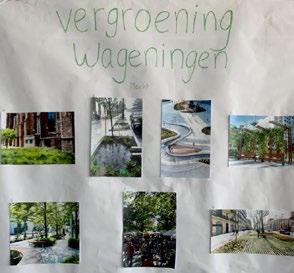
Six Landscape Architecture & Spatial Planning students have designed a plan to make Wageningen’s town centre greener. Part of their design has now been implemented in Markt square – with paving that lets water through and plant beds around the church.
‘Wageningen town centre is all brickwork. On a summer’s day, the temperature in the Markt can feel ten degrees warmer than in the surrounding countryside,’ says student Fleur Bastings. Her team selected nine elements that could make the streets and squares greener, from plant beds and green facades to arches over the shopping streets. The students carried out this assignment for the Wageningen Businesses Foundation as part of the Academic Consultancy Training module. Robert Frijlink, the town centre manager at Wageningen municipality, says the project brought businesspeople, local residents, the municipality and the university together.
Info: societybasededucation@wur.nl
Healthy population of wolves needs 50 packs
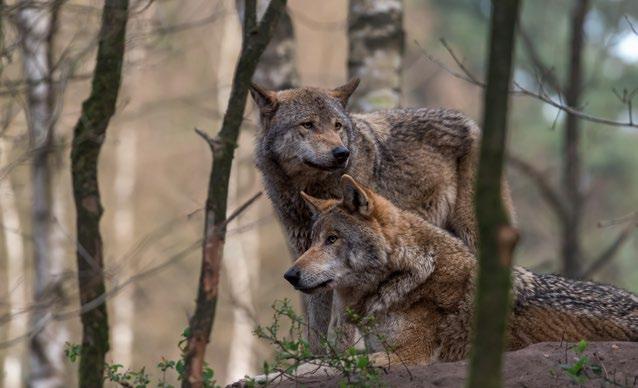
At least 50 packs are needed to sustain a wolf population in the Netherlands. That is shown by a research report compiled by Wageningen University & Research, Tilburg University and the Nature and Forest Research Institute (INBO) in Belgium.
The wolf population in the Netherlands has grown over the past ten years from one individual to 13 packs. Given the available habitat, such as woods and heathland, and the amount of space a pack needs, the Netherlands has room for between 23 and 56 wolf packs. A population of at least 50 packs is needed to keep the population healthy and prevent inbreeding, shows the report, which was commissioned by the Ministry of Agriculture, Fisheries, Food Security and Nature.
The report comes after a recent ruling by
the European Court of Justice stating that member states must contribute to the conservation of protected species in their territories.
The numbers cited do not take into account the consequences for the economy or society of more wolves in the Netherlands, for example the effects on agriculture, recreation and residential areas. WUR has been asked by the Ministry of Agriculture to look at the economic impact on the agricultural and tourist sectors.
Info: fabrice.ottburg@wur.nl
Right food keeps you alert for night shifts
Doing night shifts disrupts the biological clock. After a night-time meal, the body has to work unnaturally hard to keep blood sugar levels where they should be. That increases the risk of obesity and diabetes. Perdana Suyoto, a PhD candidate in Human
Nutrition & Health, looked at how nutrition could mitigate this effect.
His study among nursing staff showed that food with slow-release sugars – such as pulses and dairy produce – keep the blood sugar level stable at night whereas fast-release sug-
ars, for example in white bread or cornflakes, cause big fluctuations. Those fluctuations also make you less alert, discovered Suyoto. ‘It’s better not to eat meals with fast-release sugars during a night shift,’ he concludes. Info: perdana1.suyoto@wur.nl
Pollinators mainly need space
Increasing the size of the suitable habitat for pollinating insects in farming countryside is more important than improving the quality of the habitat. This is shown by an international study led by Wageningen that was published in Science in September.
Increasing the size of ‘semi-natural habitats’ such as hedgerows, the sides of ditches and copses turns out to have much more effect on pollinator numbers than increasing the quality with more flowers. The group headed by Professor of Plant Ecology David Kleijn, one of the paper’s co-authors, developed a statistical method for distinguishing between the effects on insects of the size and quality of a habitat. ‘Normally, when comparing habitats, we look at differences in insect density,’ explains Kleijn. ‘We forget about the size of the habitat, but this study now shows that it’s the size that is most important, up to a certain turning point. Solitary
BIOTECHNOLOGY
bees, for example, only benefit from better flower quality once 16 per cent of the land is semi-natural habitat. The turning point for butterflies is 37 per cent, a percentage that is never achieved
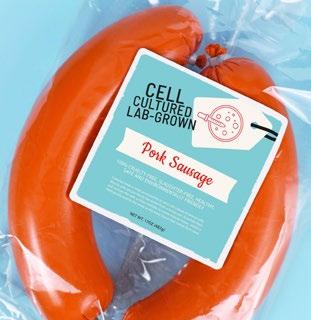
The world’s first cultured meat farm
An international consortium will be building the world’s first cultured meat farm in the Netherlands. It is hoped the experimental farm will demonstrate how the production of cultured meat can be incorporated in
existing farms to give farmers a new business model and involve them in new food production methods.
The international CRAFT consortium, which includes Wageningen University & Research, RespectFarms and Kipster, is behind the construction of this farm where meat will be cultured from animal cells. The project is co-funded by EIT Food and has received a grant worth two million euros.
According to the consortium, production of cultured meat is much more efficient than conventional livestock farming, with 95 per cent less land used, 78 per cent less water usage and far lower greenhouse gas emissions. CRAFT believes cultured meat production can be combined with traditional livestock and arable farming to create a resilient and sustainable food system. rene.wijffels@wur.nl
in practice in farming countryside.’ The study offers pointers for the most effective measures for boosting biodiversity in agricultural areas.
Info: david.kleijn@wur.nl
CONSUMPTION
Organic food up to twice as expensive
Organic products can be twice as expensive than regular variants. That finding comes from the first BioMarktMeter, published in June. This new monitor tracks developments in the market for organic products in the Netherlands.
The report reveals that only 2.8 per cent of supermarket promotions are for organic products. The monitor is an initiative of the Ministry of Agriculture, Fisheries, Food Security and Nature, and is carried out by Wageningen University & Research. The BioMarktMeter is part of the nationwide campaign ‘Growth in Organic Production and Consumption, 2022–2030’.
Info: marleen.onwezen@wur.nl
BENEATH THE SURFACE OF THE WADDEN SEA:
‘Protection still needs to
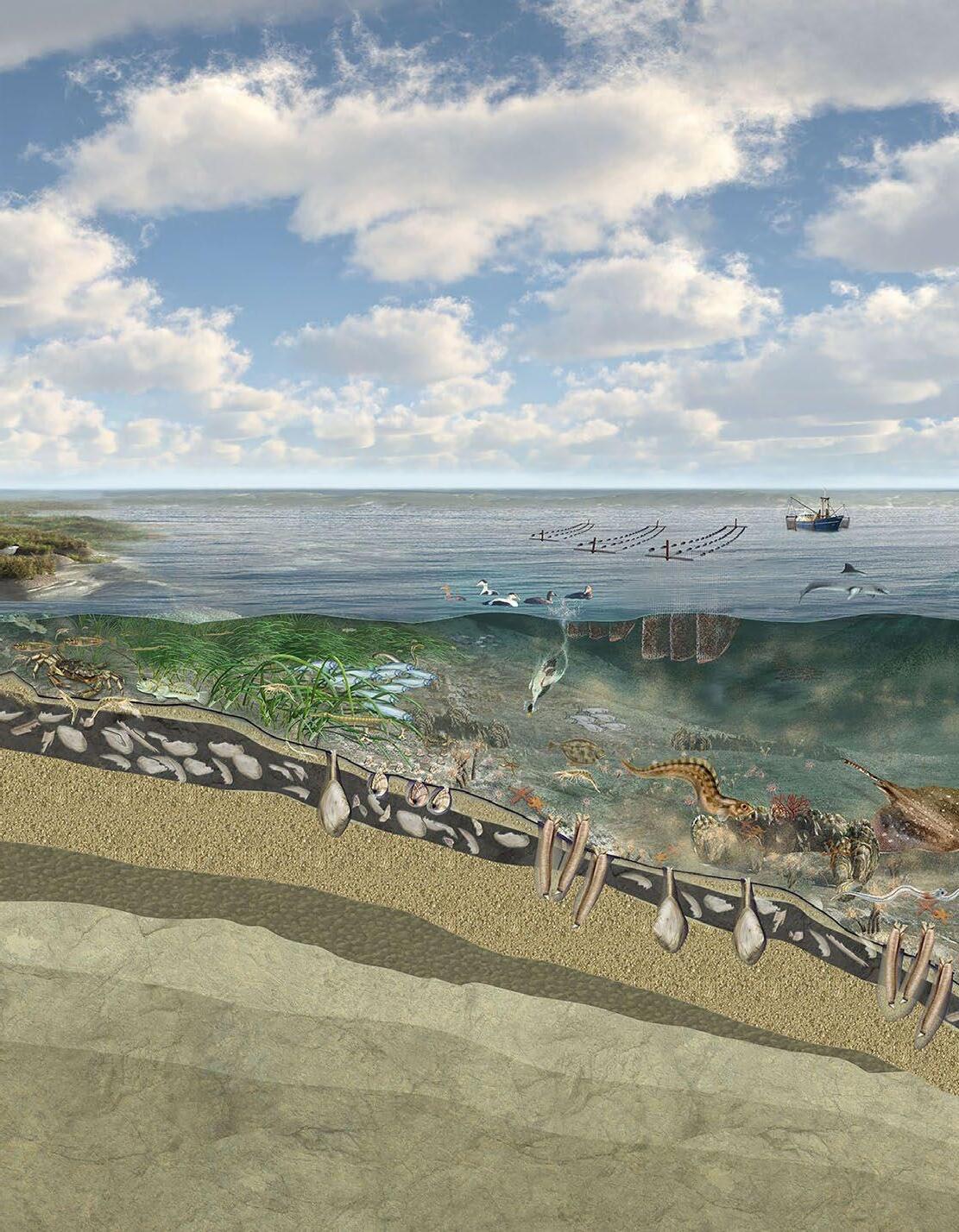
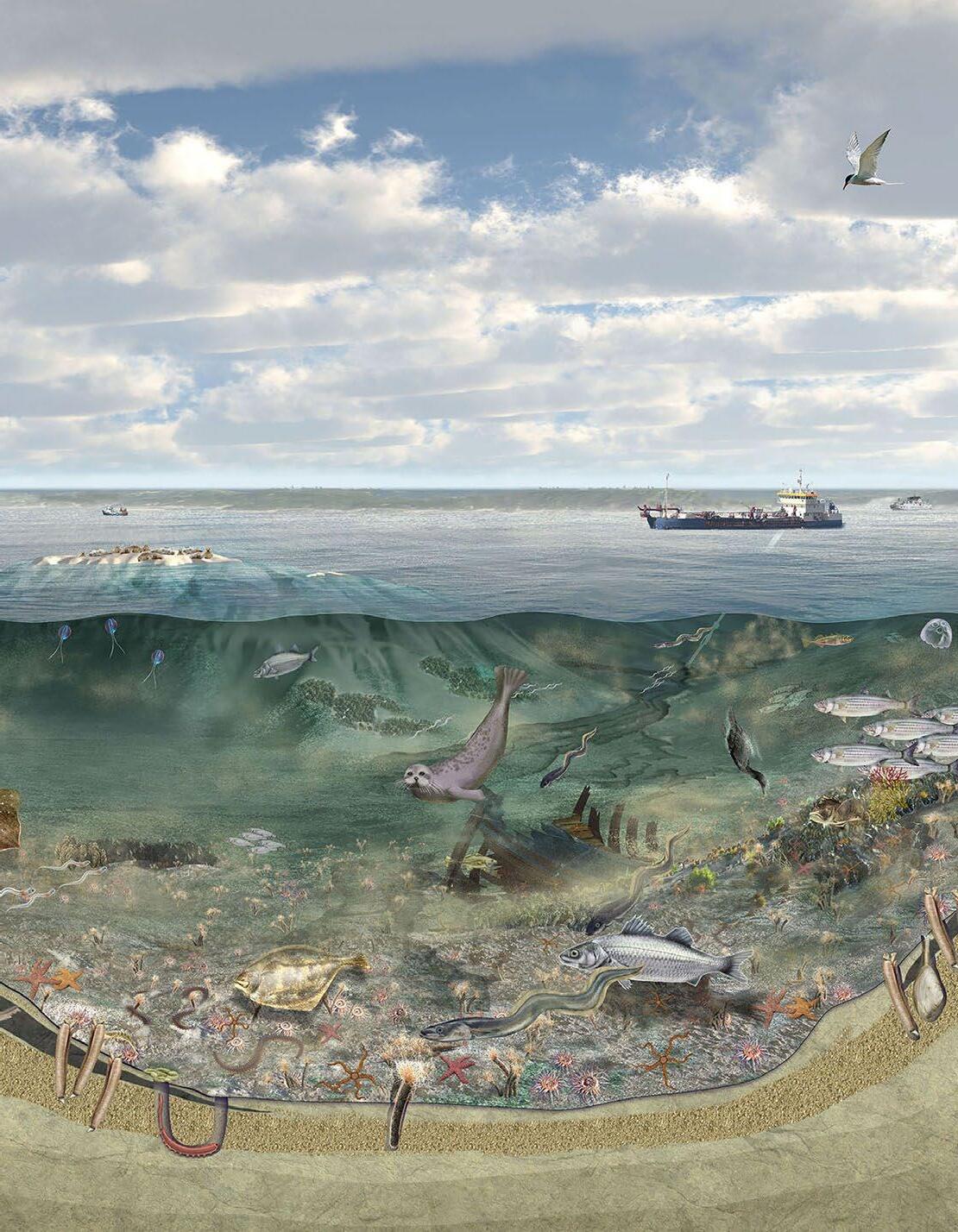
Huge mussel beds and large numbers of flatfish have surprised the researchers studying underwater life in the Wadden Sea over the past year. The area needed some good news for a change. Numbers of migratory fish have been declining for years, and the impact of climate change and human activities remains significant.
TEXT KOEN JANSSEN ILLUSTRATION NICOLLE FULLER, SAYOSTUDIO
to be made much better’
‘Iwent out onto the Wadden Sea with two divers recently, just off the coast of Texel,’ says marine ecologist Martin Baptist. He wanted to learn more about how well-established Sabellaria is, a rare underwater worm that builds reefs. ‘The divers were complaining a bit. “Do we really have to dive in the Wadden Sea, Martin? The water’s murky and almost nothing lives there.” They came back up a bit later with broad smiles on their faces. They’d seen some beautiful sponges, sea squirts and sea anemones. They were full of how great it was down there.’
Baptist and his colleagues from Wageningen Marine Research can be found regularly in the waters of the Wadden Sea, gathering as much information as possible about the state of nature in the area. They monitor parameters such as the number of fish, shellfish and seals. Some of those counts have been running since the 1960s, giving researchers a broad picture of how populations and habitats are developing.
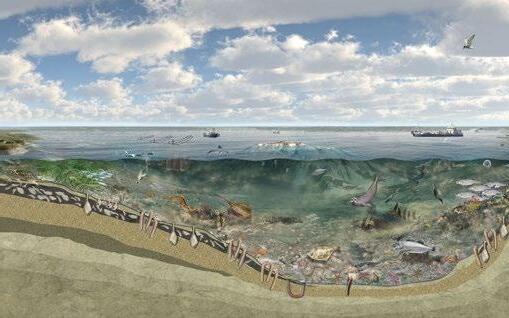
Much of the life in the Wadden Sea is invisible to us, beneath the surface of the waters. That raises the question of what the actual status of the underwater life is and how we can find out.
‘I’d say things are going better than in the past,’ says Baptist. ‘Fifty years ago, the situation here was really awful. Pesticides like DDT and PCBs were affecting the reproduction of birds and seals. There was much more pollution with heavy metals and chemicals, in part due to factories discharging potato starch. There were even plans for reclaiming the area and using it for agriculture
and industry. Fortunately, the protection has been improved a lot since then.’
The area’s ecological value is unique thanks to natural factors such as tides, storms and the interaction between fresh and salt water, as well as the unusual mixed landscape of salt marshes, dunes and tidal mud flats. The high productivity of shellfish and crustaceans provides a plentiful food supply for fish, birds and seals. The Wadden Sea is vitally important to many animals. It is a Natura 2000 area and it was granted UNESCO World Heritage status in 2009.
‘But the protection still needs to be made much better,’ continues Baptist. There are species of migratory fish, breeding birds and migratory birds whose numbers have been falling steeply for decades. ‘Other species have migrated to the Wadden Sea from warmer regions and are doing well. Is that a good thing, though? Not really, because the warming is the result of human activities.’
RECOVERY OF FLATFISH
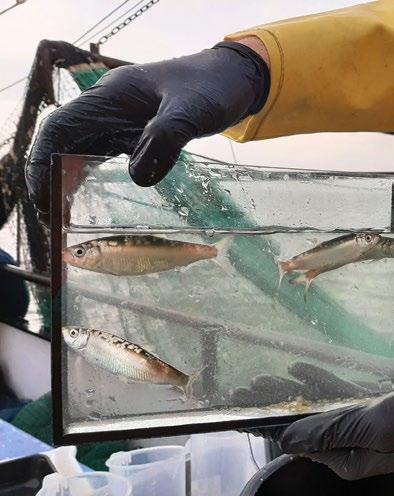
Ingrid Tulp, an ecologist from Wageningen Marine Research, was pleasantly surprised by the underwater life in the Wadden Sea this year. ‘I’ve been going there with colleagues for 20 years to monitor the growth of tongue, sole, plaice and other marine animals. I was genuinely astonished by what I saw at the end of this year. We’d almost lost the plaice and dab here, like other flatfish, but this time we saw lots of fish. Dab were actually the commonest species!’
The Wadden Sea could use some good news, given that
Research in the Swimway project on how fish use different areas in the Wadden Sea.
the Quality Status Report (QSR, a report published every four to six years on the ecological status of the Wadden Sea) also shows that fish stocks have been plummeting over the past few decades. This research is carried out jointly by Wageningen with partners from Germany and Denmark, the other two countries that border the Wadden Sea. For years, the QSR has been showing that numbers of migratory fish are declining, as are the populations of lesser-known creatures such as the armed bullhead and the seasnail. Plaice, dab and red gurnard have recently shown cautious signs of recovery.
Tulp believes that climate change is one of the reasons why many species are struggling: ‘Fish are cold-blooded; their energy metabolism is directly affected by the temperature. The warmer the water gets, the more energy they need. And therefore the more food. Other possible causes include bycatch in shrimp fishing, as well as the effects of sand extraction and dredging. However, we don’t know enough about that yet.’ It is also unclear as yet why some populations have been on the rise again in recent years. ‘That poses a puzzle for us because it doesn’t seem to correspond to the rising temperature.’
EXPENSIVE FIELDWORK
Fish research has often been neglected in science, Tulp reckons. ‘It’s technically trickier because it’s done underwater, which means expensive fieldwork using boats. Using volunteers, as is commonplace in bird research, is also more awkward. On top of that, fish are more difficult to track than bottom-dwelling creatures, and visibility in the Wadden Sea is pretty limited.’
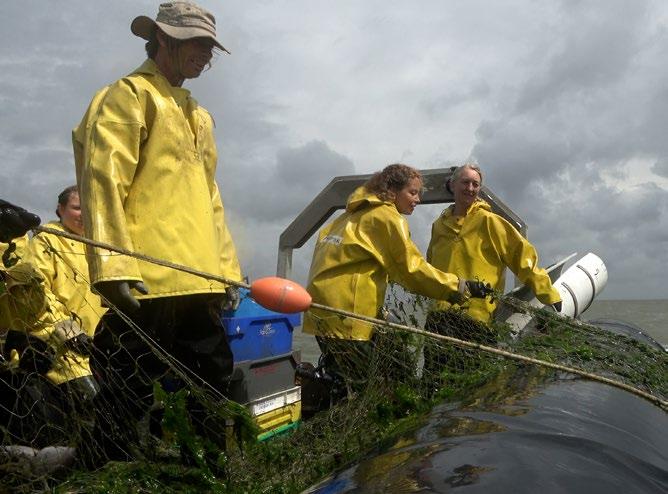
The last while, Wageningen researchers have bridged some of the knowledge gaps through the five-year Swimway research project. Five PhD candidates were involved in this project, which also included the University of Groningen (RUG), the Royal Netherlands Institute for Sea Research (NIOZ), the Wadden Association, the Dutch Angling Association and the Directorate-General for Public Works and Water Management. The PhD candidates each had their own research project, for instance on the functioning of natural salt marshes and shell banks for the lifecycles of fish, or the movement of schooling species such as herring and sprat.
‘In one of the studies, we tracked large fish species
‘Some populations are increasing, which is a mystery to us’
such as sea bass and mullet,’ says Tulp. ‘We implanted acoustic transmitters in fish and fitted receivers to buoys at around 120 locations in the Wadden Sea. If that fish went near a receiver, its location was detected. As well as our Wadden Sea network, there are also networks outside the Netherlands, for instance off the Belgian coast and near the south coast of England.’ Knowledge about where fish are and how they use their habitat is important for spatial planning measures, according to Tulp. ‘It lets us determine the periods when particular parts of the Wadden Sea are important and gives us a better understanding of how fish utilize different habitats. That’s important information for management issues such as dredging or fishing.’
7,000 HECTARES OF MUSSELS
Karin Troost, a marine ecologist from Wageningen Marine Research, was also pleasantly surprised by what she found during the annual shellfish inventory in the spring of 2025. She made the national news when she counted 7,000 hectares of mussel beds on the tidal mudflats. This was a huge increase over previous years, when the area fluctuated at around 2,000 hectares. ‘In the summer of 2024, we had already noted that a significant amount of seed mussels had settled. The whole place turned black with these teeny mussels – it was like asphalt.’
Troost and her fellow researchers have been keeping track of mussels, cockles, Japanese oysters and other shellfish for years, but they have no instant explanation for the rising mussel numbers. ‘It’s always pretty complex with shellfish. It depends on various factors, such as temperature, food and predators. When all conditions are at the optimum, one species can suddenly peak. Mussel larvae are often eaten by predators such as shrimps after they settle on the seabed, and there weren’t many shrimps in 2024. Which might in turn be due to lots of whiting off the coast, as that fish species enjoys eating shrimp. But why were there so many whiting? It is very difficult to determine the exact cause of such a change.’
Moreover, conditions in the Wadden Sea are changing because of climatic effects. Whereas it used to be severe winters that had a major impact on cockle numbers,
>
Marine ecologist, Wageningen Marine Research
nowadays mortality is more common during hot summers. ‘The rules that applied in the past are less relevant now,’ says Troost.
In addition to climate change, other human activities can have disruptive roles in the ecosystem, including gas and salt extraction, tourism and fishing. ‘The fishing industry is sometimes a bit of an easy target,’ says Troost. ‘I’m not going to say that it has no impact on the Wadden Sea, but it’s one particular activity that governments happen to find easy to impose restrictions on. Dredging and salt or gas extraction often involve bigger social and financial interests.’
Mechanical cockle harvesting, in which cockles are sucked from the seabed using a kind of gouge, has been banned since 2005. Since then, cockles have only been collected manually. Mussel fishing on the tidal mudflats has been phased out since the 1990s, after almost all the mussel beds had disappeared due to storms, fishing and a lack of new growth. In 2008, a Mussel Covenant was signed in which mussel farmers, the government and nature conservation organizations agreed to phase out the fishing of seed mussels – the young mussels measuring one to two centimetres in size – from the seabed and to catch them using alternative methods instead. Ropes, known as mussel seed collectors, are hung out that the drifting larvae attach themselves to. This seed is then cultivated elsewhere in the Wadden Sea and in the Eastern Scheldt. ‘So far, they’ve managed to cut bottomdisturbing mussel seed fishing by half,’ says Troost. ‘The aim is 100 per cent, but mussel farming has to remain viable. And enough space needs to be found for those collector set-ups.’
DUMPED BYCATCH
In addition, there is shrimp fishing in the Wadden Sea. Its ecological effects have been a hot topic of debate in recent years among nature conservation organizations, fishermen and other stakeholders. These discussions have focused largely on bycatch that is dumped overboard, the impact of seabed disturbance caused by dragnets and the disruption of bird life.
In collaboration with researchers from NIOZ, RUG and the Wadden Academy, WUR conducted a major study in 2023 into the ecological effects of shrimp fishing on the seabed and life on the seabed. This showed that the
MARTIN BAPTIST
Marine ecologist, Wageningen Marine Research
KARIN TROOST
Marine ecologist, Wageningen Marine Research
INGRID TULP
impact on seabed animals is minor in sandy areas but much greater in silt zones. Shrimp fishing also leads to the shrimp being smaller, a decline in plaice stocks due to bycatch, and disturbance of the common scoter, a duck. ‘There are therefore good arguments for regulation, both in the interests of the fishing sector itself and with a view to reducing ecological pressure,’ concludes the research report.
ECOLOGICAL PATIENCE
Since the 1990s, the authorities’ focus has shifted increasingly towards active nature restoration, as well as reducing disturbance. A recurring point of discussion here is whether to introduce structures such as pipes, concrete blocks and dead pear trees with the aim of giving underwater life a boost and thus increasing biodiversity. Tulp: ‘You can’t simply say the more species, the better, though. You create a new habitat and see that various species are drawn to it. That’s then seen as nature restoration, when in fact you have added a new type of habitat. What’s the added value of that?’ Tulp advocates ‘ecological patience’: not being too quick to make artificial interventions and giving nature a chance to recover.
Troost agrees. ‘The Wadden Sea sometimes gets compared to coral reefs, but that’s unjustified. It is quite an extreme zone really, with shallow waters, tides and storms. It’s not at all rich in species, but the production of the species that do live there is very high. If you focus on biodiversity, you’ll be tackling an issue that isn’t a problem in the Wadden Sea.’ Tulp: ‘That high level of food production is precisely what makes it such an important migration area for birds and fish.’
SPRAYING TO RAISE THE MUDFLATS
Baptist would prefer it if intervention was not necessary: ‘As an ecologist, you prefer to leave an area undisturbed – or at most, remove disruptive factors. But we know that won’t work here.’ He refers to the consequences of climate change, for example. The mudflats are currently still rising in step with sea levels, but it is expected that many mudflats will be unable to keep pace any longer from 2050 onwards. As a result, they will be underwater for more of the time and wading birds will have less time to forage. Marshes are becoming vulnerable too,
‘You can’t simply say the more species, the better’
says Baptist: ‘The nests of birds breeding on those salt marshes will therefore get flooded more often. We’re already seeing it happening with oystercatchers and plovers, for instance. Rising sea levels are an anthropogenic problem, which means we have a duty to intervene to protect nature. In this case, we’ll be spraying material onto the mudflats to raise them.’
However, Baptist also has reservations about using artificial concrete reefs. ‘They don’t belong in the Wadden Sea, intrinsically. Ideally, you’d want natural hard substrates such as mussel beds or reefs made by Sabellaria sandworms.’ These worms once built huge reefs of interlinked sand tubes, particularly in the German part of the Wadden Sea. They are no longer there, and there are too few larvae to form new reefs. If it was up to Baptist, that would change: ‘You’d introduce a source population that produces lots of larvae, but there’s no project for that yet.’
THE BOAT TO AMELAND
In retrospect, the Wageningen ecologists argue that preventing and curbing human activities in the Wadden Sea has been shown to be the most effective way of protecting underwater life. Important pressure factors have been eliminated, for instance through remediation of polluters, establishing strictly protected nature reserves and banning seal hunting.
This suggests it would therefore be beneficial to make conscious choices about how we use the Wadden Sea, an area where tourism, fishing and dredging all take up a lot of space, according to Tulp. ‘Cruise ships are being built on the Ems, which has to be dredged regularly for them. Should that be what we want? And huge numbers of tourists take the ferry to Ameland. You could also say that we’ll take fewer cars over, so that we don't have to keep dredging the channel. Or we could adjust the sailing schedule to fit the tides.’ Troost: ‘Whenever humans intervene, you have to ask yourself whether it’s too much.’ W
Parasitic wasp flown in to tackle fruit flies
The spotted wing drosophila, an invasive fruit fly from Asia, is a devastating pest in cherry orchards. To combat this exotic species, another exotic insect has been flown in: the Asian parasitic wasp. It lays its eggs in the larvae of the fruit fly. If this exotic parasitic wasp can settle in the Netherlands, that may mean less insecticide is needed in future.
‘It only takes a few flies to cause enormous damage’
This year, cherry growers were granted permission once again to use insecticides to tackle the spotted wing drosophila (Drosophila suzukii, commonly referred to by the abbreviation SWD). Such tough measures are needed to control the tiny fly, originally from Asia, as it can destroy a complete harvest. But if the experiments being carried out by Herman Helsen of Wageningen Plant Research are a success, it might be possible to phase out the use of insecticides in future. In mid-August, Helsen released one of the fruit fly’s natural enemies, the parasitic wasp Ganaspis kimorum, which is also from Asia, at experimental locations in the Netherlands. The parasite lays its eggs in the larvae of SWD.
HUNDRED EGGS
SWD arrived in Europe from South-East Asia in 2008, reaching the Netherlands in 2012. The females lay up to a hundred eggs with their saw-shaped ovipositor in ripening soft fruits such as cherries and strawberries. The larvae then eat the fruit from the inside. Cherry orchards are particularly badly affected by the fruit fly: because cherries take a long time to ripen, a new generation of fruit flies has already appeared before the fruit is harvested. In the case of other fruit crops, the affected fruits can sometimes be removed to stop the insect spreading.
‘The fruit fly can live on more than 50 species of plants that are found in the Netherlands, so the pest can reproduce and spread everywhere,’ says Helsen. The mild and humid Dutch climate is also ideal for the invasive species, allowing up to seven generations of flies in a ‘good’ year. At first, the Netherlands Food and Consumer Product Safety Authority recommended forbidding insecticides in cherry
orchards in 2025 because of the risk of dispersion and harm to other organisms. But in the end, cherry growers were given permission after all because of the lack of alternatives. Meanwhile, growers are looking for other pest control methods. Most now cover their orchards with fine-meshed insect netting. ‘But a few fruit flies always manage to get through somehow,’ says Helsen. ‘And it only takes a few flies to cause enormous damage.’
Biological pest control using the pest’s natural enemies is a tried and tested method in greenhouse horticulture. For example, parasitic wasps are used against whitefly. What is unusual in the case of SWD is that one exotic species is being used against another. European parasitic wasps are not up to the task, explains Helsen. They look for their prey on the ground, where ordinary fruit flies lay their eggs in the rotting fruit, rather than in the trees where the drosophila eggs are laid. And even if the European parasitic wasps were to lay their eggs in SWD larvae, they would not grow into adult parasitic wasps because the larva’s immune system can recognize the eggs from European parasitic wasps and deal with them.
OVIPOSITOR
Asian parasitic wasps are more successful. They use their antennae to detect the drosophila larvae in the ripening cherries. Then they pierce the cherry skin with their ovipositor and lay their eggs inside the larvae. Those cherries are still unusable because of the hatching parasitic wasp eggs, but this method does stop the rapid reproduction of the destructive fruit flies. The Asian wasp therefore seems to be the ideal enemy, but there is still the question of whether there are risks attached to introducing a new species.
In 2024, Swiss researchers demonstrated that the Asian parasitic wasp exclusively targets SWD. Helsen: ‘It leaves indigenous insects alone.’ In that same year, Wageningen submitted an extensive dossier to the Netherlands Enterprise Agency asking permission to release this parasitic wasp in the Netherlands.
BREEDING PARASITIC WASPS
Helsen got the go-ahead this year. A couple of thousand wasps that had been bred in the WUR lab were released in the central Netherlands. The hope is that the species will settle there. Helsen expects to come across the wasps again in 2026 when he investigates the sites where they were released. ‘It will probably take a couple of more years after that before they have adapted to the local conditions and spread.’
Once a healthy population has formed, they should be capable of putting a halt to the spread of SWD. ‘It will relieve the pressure on the growers but it won’t solve the problem completely,’ says Helsen. Introducing the parasitic wasp directly in the orchards would combat the pest more effectively, but to do that, it needs to be possible to breed the Asian parasitic wasp in a way that is efficient and affordable. Wageningen is investigating the options in partnership with the company Koppert, which develops natural crop protection solutions. It is not just the orchards that are suffering from the exotic fruit fly. ‘SWD is everywhere in the Netherlands,’ says Helsen. ‘I used to be able to pick blackberries or elderberries when out on a walk, but these days they are almost all spoilt.’ The introduction of the Asian parasitic wasp won’t stop that entirely. ‘The spotted wing drosophila will remain a serious problem for soft fruit.’ W
Peddling manure
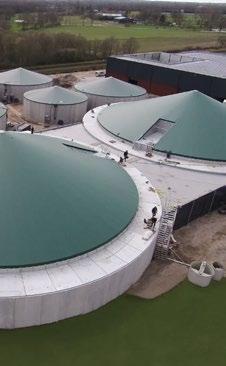
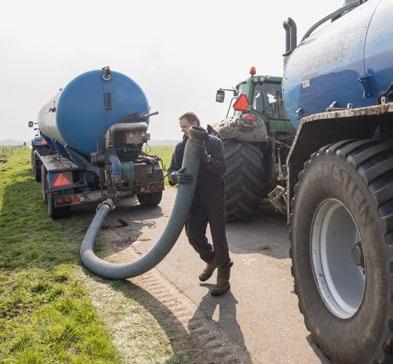
The exception for Dutch dairy farmers to spread more manure than the EU allows is being phased out, and as a result the amount of manure on the market has increased still further. Livestock farmers not only pay large sums to offload their manure, they also have to buy more artificial fertilizer to give their land the nutrients it needs.
TEXT ALBERT SIKKEMA PHOTO ANP/NICO GARSTMAN
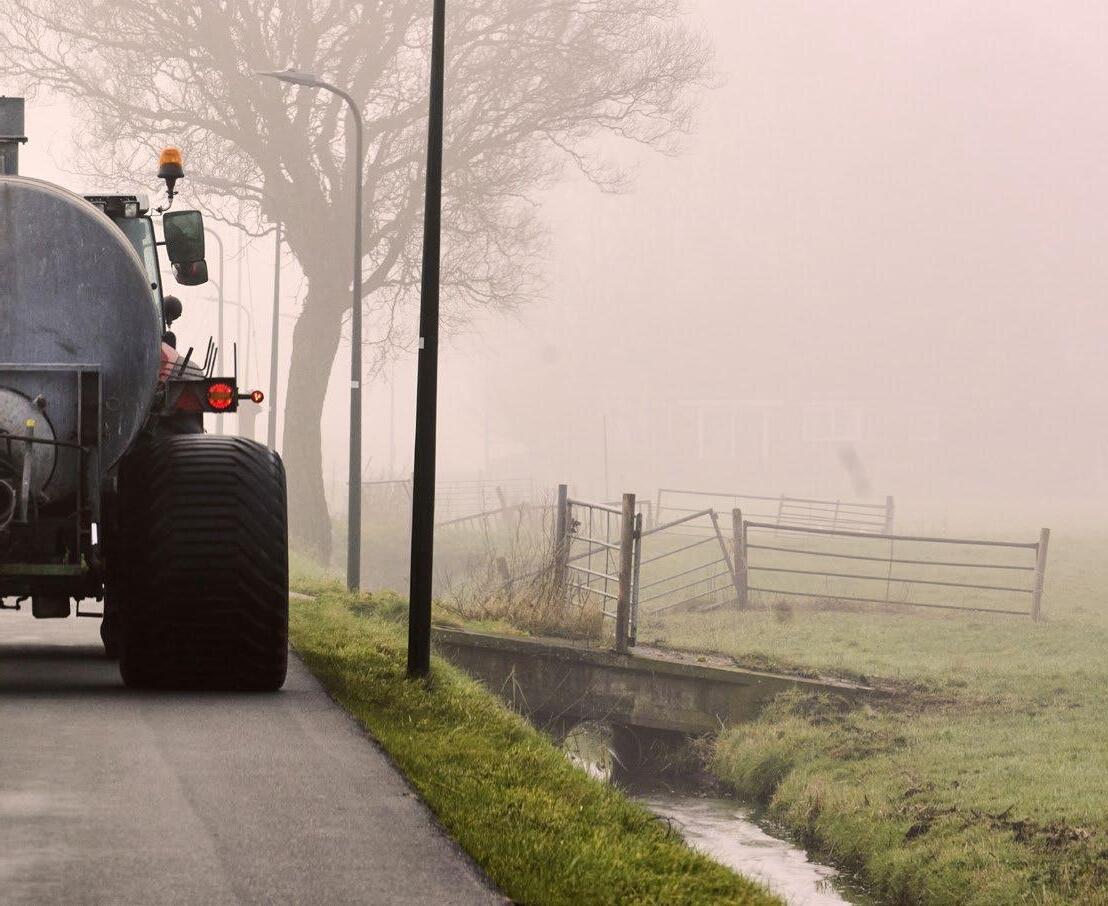
For more than 40 years now, the pigs, cows and chickens farmed in the Netherlands have been producing more manure than livestock and arable farmers are allowed to spread on their land under environmental rules. For decades, pig and chicken manure has been exported, mainly to arable regions in Germany and France where there is a demand for more manure. Dairy farmers with plenty of land could still use most of their manure on their own or neighbouring fields. But last year saw a sudden ‘manure crisis’. The EU decided to phase out the derogation – the exemption that allowed Dutch dairy farmers to spread more manure on their land than was al-
lowed by the rules. The nitrogen applied per hectare would have to decrease in steps from a maximum of 230-250 kilos in 2022 to a maximum of 170 kilos by 2026. This meant the amount of manure dairy farmers could spread on their land was 15 per cent less in 2024 and they had to trade the excess manure. That led to an even bigger supply of manure on the market. It’s an unusual market because the surplus means that rather than being paid for their manure, livestock farmers have to pay the arable farmers to take the manure off them. Last year, livestock farmers were paying 30 euros per cubic metre to offload their manure, twice as much as in
2022. Arable farmers joke that manure is an extra crop as they can earn good money by taking it in.
BURNING CHICKEN MANURE
The manure market varies depending on the farm animal. Intensive pig farms have been exporting their manure for years. Manure dealers often have sales channels abroad. The poultry sector has its own distribution channels. Most poultry manure is processed. A proportion is dried and then sold to garden centres or exported. Some of the manure is incinerated in a power plant in Moerdijk; the poultry farmers pay for this.
The ash, which contains phosphate and valuable minerals, is then exported.
In 2024, the markets had to deal with the additional surplus manure from dairy farmers as well. As a result, Dutch manure exports increased in 2025: data from the Netherlands Enterprise Agency shows manure exports were up by 30 per cent in the first half of 2025 compared with the same period in 2024. Pig and cattle manure is separated into solid and liquid fractions before exporting it. The solid fraction, which contains phosphate, makes up most of the export. The liquid fraction is also valuable as a fertilizer as it contains nitrogen and potassium. The liquid
The phasing out of the derogation meant the amount of manure dairy farmers could spread on their land was 15 per cent less in 2024 and so they had to trade the excess manure.
is often evaporated off or concentrated before transport – mainly to destinations within the Netherlands – to avoid having tankers transporting mostly water. The price paid to offload the manure is primarily determined by the transport and processing costs.
BUYOUT SCHEME
The derogation phase-out is already affecting Dutch livestock numbers and manure production. The extra costs of offloading the manure led to a big drop in income for many livestock farmers in 2024, according to calculations by Wageningen Economic Research. That was an extra incentive for farmers to take part in the buyout scheme, organized by the government as a way of tackling the nitrogen crisis. The scheme applies to about 1,500 farms.
In July, Statistics Netherlands announced that the pig population had fallen below 10 million for the first time in 45 years; as recently as 2018, the Netherlands still had 12.4 million pigs. The number of cows also fell last year, by 3.3 per cent. The smaller livestock numbers also meant a fall in manure production, which was lower than it has been in the past 30 years, according to Harm Smit, Emissions & Manure Valorisation project manager at Wageningen Livestock Research. ‘I expect the decline to continue in the next few years.’ This is already having a noticeable effect in certain regions. For example, ammonia emis-
sions in the Gelderse Vallei area have fallen by 30 per cent because livestock farms have been bought up.
Despite the falling manure production, the Netherlands still has a manure problem. That is because as the derogation is phased out, the application standard for manure has been reduced at a faster rate than the manure production (with the buyout schemes). ‘We are still in a situation where farmers have to pay to offload their manure,’ says Gerard Ros, an environmental researcher in the Earth Systems & Global Change group and a researcher at the Nutrients Management Institute. ‘In 2024, 87 per cent of dairy farms produced more manure than they could use, as did 94 per cent of pig and poultry farms. That’s a problem.’
NUTRIENT-CONTAMINATED
The manure problem is going to get bigger in the years ahead, not smaller, thinks Ros. That is particularly likely in the areas designated as ‘nutrient-contaminated’ by the government because there is too much nitrogen and phosphate in the surface water. The manure norms are being tightened up even further in those areas – covering much of Brabant, Limburg, the Achterhoek and Twente. The amount of fertilizer that farmers are allowed to apply on their land has been reduced to improve the water quality. In these areas, farmers are once again hav-
ing to figure out how to optimize crop yields using various fertilizers. Grassland needs 350 kilos of nitrogen per hectare per year to grow well. Before the derogation phase-out started, farmers could apply 230 to 250 kilos of nitrogen in the form of manure and then add 100 to 120 kilos of artificial fertilizer. Now that they need to reduce the application of manure to 170 kilos, they will have to use more artificial fertilizer to give the land the remaining nutrients it needs.
Farmers complain that the current scheme forces them to purchase more artificial fertilizer. Why can’t they simply use the manure from their own farms as in the past? Ros: ‘We know that 70 per cent of the nitrogen in animal manure becomes available to the plants but the remaining 30 per cent ends up in the soil and wider environment.’ Most of the nutrients in artificial fertilizers can be absorbed directly by the plants.
But there is a development that can help farmers to limit the nitrogen losses from livestock manure. In September, the EU’s Nitrates Committee, which consists of soil and fertilizer experts from EU countries, agreed to admit ‘Renure’ as a substitute for artificial fertilizer. Renure stands for ‘recovered nitrogen from manure’; it is manure that has been processed so that nutrients such as nitrogen become available in a more usable form. Smit: ‘Farmers will then be able to make more use of the nitrogen in
‘There is still a manure problem despite smaller livestock numbers’
manure and more of the manure can be used in the region.’ To make Renure, farmers can choose between processing their manure on the farm and sending their manure to processing plants, possibly in combination with the production of biogas.
ISSUES
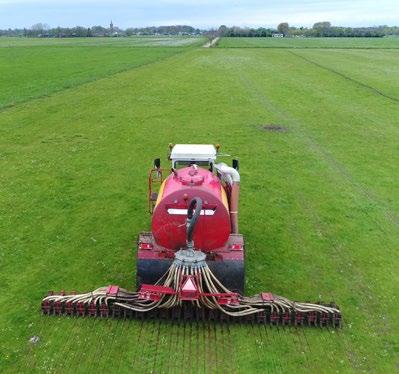
The approval of Renure will reduce the pressure on the manure market because livestock farmers can use more of their nitrogen on their own farms. But there are still issues with this solution. Research shows Renure is slightly less effective than artificial fertilizer, which means emissions may get into the air or water. That is why the EU’s proposal to allow Renure is subject to conditions. For example, the Renure must contain more than 90 per cent mineral nitrogen – nitrogen that is directly available to the plant – and farmers cannot use more than 80 kilos of Renure per hectare per year. In addition, the fertilizer has to be applied using low-emission technology. All in all, livestock farmers will have to make substantial investments to be able to use
Renure. Nor does it mean an end to the manure problem. The derogation is still being phased out, with the maximum falling to 170 kilos of nitrogen in 2026. There could therefore be another manure crisis in spring 2026, says Ros. ‘Farmers are not allowed to spread manure from 1 September to 15 February, but manure production continues during that period so all the slurry pits are full by the end of the winter. Farmers are therefore kee to get rid of their manure as soon as possible in the spring. Spring 2024 was very wet, so farmers were unable to drive their heavy machinery onto the fields to spread the manure – and a crisis arose. Last spring (2025) was dry and the farmers were therefore able to spread manure, but they will be panicking again if next spring is wet for manure spreading.’
SOLUTIONS
To conclude, manure is still costing Dutch farmers money. What can be done about this? Ros and Smit see a future in a combination of three solutions. First, livestock numbers should be reduced further. This is
currently being achieved mainly through the government’s buyout scheme for farms near nature areas that are vulnerable to nitrogen. Second, improve the processing and export of manure. There was already a big increase in manure exports this year, but the Ministry of Agriculture believes further expansion is possible. In 2025, it visited Germany, France, Poland and Romania in efforts to promote manure products. There could also be more manure processing for domestic use now that products such as Renure are being allowed. A third solution is to reduce the protein content of animal feed. High-protein animal feed gives manure with a lot of nitrogen. Lowering the protein content to levels that are safe for animal health will help tackle the nitrogen problem too. Applied research at Wageningen with dairy farmers shows that they can still achieve good milk production if the nitrogen content in the feed is less. If the lessons from these practical experiments are adopted on a large scale, this measure could have a considerable impact on the nation’s nitrogen production. W
BIOTECHNOLOGY SCIENTIST NICO CLAASSENS:
‘Building
a living cell is a bizarre challenge’
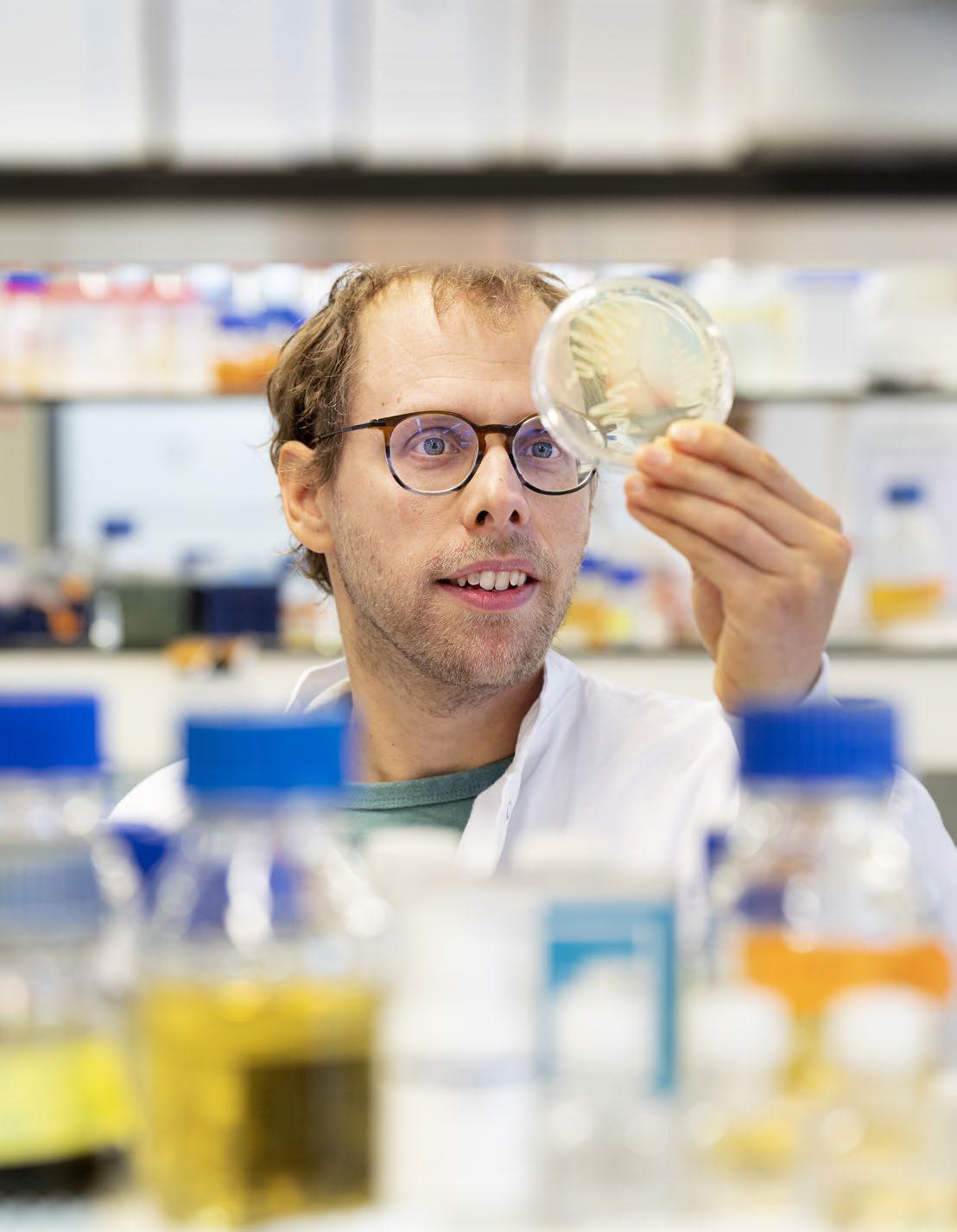
Nico Claassens’ aim is to help bring about a circular bio-economy in which bacteria use CO2 as an input to produce the raw materials for bioplastics and proteins. He is also involved in efforts to build a living cell. ‘Sometimes, you simply need to give ambitious ideas a try.’
TEXT PAULINE VAN SCHAYCK PHOTOGRAPHY RUBEN ESHUIS
Nico Claassens has spent his entire working life at Wageningen University & Research, except for a brief stint of two and a half years at the Max Planck Institute in Potsdam. He started at Wageningen 18 years ago as an Environmental Sciences student. After a Master’s in biotechnology, a PhD and postdoctoral research, he has spent the past five years putting together his own research team in the Microbiology chair group. They are working on designing new synthetic routes in bacteria.
In 2019, he was awarded a Veni grant, a personal grant in the Dutch Research Council Talent Programme. He wanted to get bacteria to grow on a substrate of molecules containing just one carbon atom. ‘Bacteria such as the well-known E. coli use sugars – with six carbon atoms – to grow and to make various substances.
We utilize that fact in biotechnology to produce nutrients, medicines, biofuels and bioplastics. But if we can get the bacteria to grow on a diet of CO2 – with one carbon atom – rather than sugars, we’ll be able to produce all those substances in a more environmentally friendly way, without CO2 emissions. In my Veni project, we first tried using a different molecule with only one carbon atom, namely formic acid. It contains a small amount of energy and is easier for bacteria to use than CO2. We then built the instructions for metabolizing this into E. coli by genetically modifying the bacterium.’
Did that work?
‘It did work, but the bacteria grew very slowly. The doubling time was eight hours, which is far too long for industrial production. E. coli has a doubling time of
20 minutes if you give the bacteria enough sugars and amino acids and make their life really cushy.
‘Suzan Yilmaz, one of my PhDs, discovered that one specific enzyme was very slow and the cell needed huge amounts of that enzyme. So we started a search for faster versions of that enzyme. We succeeded eventually by modifying five genes in the bacterium. We followed this with evolution to get the process to work even better. That let us get down to four hours instead of eight, which is much more acceptable for industry.’
You followed this with evolution?
‘Essentially, we let evolution do some of the work. We make major genetic changes to a bacterium, but it can’t cope with that very well to start with and doesn’t function optimally. Natural selection can then >
improve the bacteria. For example, we can give them formic acid only and any cells with a small, favourable mutation then grow faster and gradually take over the population. That process is fast enough in bacteria for us to make use of it. You don’t have to wait for months or years.’
In 2024, you were given a Vidi grant and an ERC Starting Grant for setting up your own research group. What did you do next?
‘We’d got it working with formic acid, so we started on converting CO2. Almost all plants and bacteria that use photosynthesis to generate energy do so using a process that we call the Calvin cycle. Put briefly, this turns CO2 into sugars. But that process uses energy, so we looked for different ways of converting CO2. It turns out there are seven alternative processes in nature, one of which was discovered in Wageningen in 2020. But we are also trying to figure out for ourselves how a process to take up CO2 might go. You could then use enzymes that have a different function in nature but that could still play a role in the process we have thought up.’
How do you test these processes in practice?
‘We use a different bacterium, a soil bacterium called Cupriavidus necator. It normally fixes CO2 via the Calvin cycle, but we were able to build in an alternative to the Calvin cycle through a lot of genetic modification plus some evolution. Then the bacterium suddenly started growing better and producing more. That was great evidence supporting the idea that the Calvin cycle can be circumvented.’
Why isn’t there something like that in nature?
‘That’s because of how evolution works, namely in small steps that improve a process. A completely new process is a very big step. Of course that’s possible too, but it is far less likely. That is why the Calvin cycle is found in so many places on Earth, in so many plant species and in some bacteria. Alternative processes have only developed in certain bacteria that live in unusual places such as in the depths of the ocean where there is hardly any oxygen – in other words, in extreme conditions. We simulate extreme conditions such as 10 per cent CO2 in the lab
too; in nature, that figure is 0.04 per cent. Our bacteria probably wouldn’t survive outside the reactor where they are kept now.’
So your bacteria live in a reactor where the main input is CO2. What is the output?
‘Bacterial cells produce all kinds of basic molecules for their metabolism, for example alcohol, acetic acid and various proteins. Those also end up in the medium that the bacteria are growing in. If you extract these molecules, you have the building blocks for making a wide range of other substances. ‘There are also interesting substances inside the cell. The Cupriavidus bacterium, for example, makes little pieces of plastic; you can see them under the microscope. To extract that material, you first need to break open the cell. Extracting the products from the medium or the cells requires a lot of energy, which is why you need a high concentration to make it worthwhile for industry.’
What do you eventually hope to be able to produce on an industrial scale?
‘We are working on replacing animal proteins, for example by using bacteria to
‘We are trying to break down life into pieces’
produce the milk protein casein. If we’re successful, fewer farm animals will be needed. That would bring substantial benefits in terms of lower emissions of CO2, methane and nitrogen compounds and less deforestation. But it’s extremely difficult to get bacteria to produce milk proteins and then use the proteins to make cheese.
You are also working on bioplastics?
‘Yes, I have high expectations there. Bacteria were already being used to produce bioplastics back in the 1980s, but that often turned out not to be economically viable. Also, there is more of a focus on sustainability and ending our reliance on fossil fuels now than there was in the 1980s. On top of that, these days we have new genetic techniques such as sequencing that let us determine the DNA code. That makes this research much faster and cheaper.’
You are also closely involved in a major Dutch project that aims to build a living cell. Why would you want to do that?
‘I agree it’s a bizarre challenge, but we are incredibly curious to see whether it’s possible. I don’t know whether we will achieve this in the next ten years, but we will learn a lot from this endeavour. For example, someone in the consortium will discover something new and we’ll be able to use that for our research into converting CO2. That’s why we’re doing it.
‘That synthetic cell will consist of extremely simple biological modules, as simple as possible, such as components for copying DNA, making proteins and producing energy. So we’re trying to break down life into pieces, with each function as a separate component. Imagine you replace a complex process for producing the energy storage molecule ATP with a simpler process, maybe one that works better too. Then you use
evolution to improve that process further and get a better understanding of how it works. Those modules eventually end up in the synthetic cell we’re building.’
How do you feel about the ethics of intervening so extensively in how a cell functions?
‘Of course people sometimes get a bit worried about what we are doing, but we are just using natural processes. People have been combining genetic properties in agriculture for a long time, but now we have the tools to do it faster and to understand what is happening better. What matters is what it’s used for. If a company used techniques developed in our research to be able to sell more pesticides, I would be opposed to that.’
You set ambitious goals in your research; as you say yourself, ‘bizarre challenges’. Where do you get your motivation?
‘My dream is to have such a thorough understanding of biology that we can say we need this bacterium to make that product, order the genes we need, insert them in the bacterium and get something that works. I’m optimistic we will achieve that one day. To get there, sometimes you simply need to give ambitious ideas a try and not give up too easily. I’ve seen a PhD candidate toil away for two years trying to get a bacterium to grow on methanol. He kept looking more and more downcast because nothing worked. But he went on holiday and when he came back, one test tube of his culture was completely full of bacteria. A chance mutation had arisen and the bacteria were then able to grow on methanol after all. Those are nice results. Sometimes you need perseverance combined with a dash of luck to achieve a breakthrough in your research.’ W
NICO CLAASSENS
Microbiologist with a focus on the design of new metabolic routes in microorganisms.
2023: Associate professor, Laboratory of Microbiology, Wageningen University & Research (WUR)
2020: Assistant professor, WUR
2017: Postdoc researcher, Max Planck Institute of Molecular Plant Physiology. Potsdam
2016: PhD in Microbiology, WUR
2013: MSc in Biotechnology, WUR
2010: BSc in Environmental Sciences, WUR
AMSTERDAM INSTITUTE FOR ADVANCED METROPOLITAN SOLUTIONS
How Wageningen expertise helps
tackle urban challenges
From waste collection and repairs of quayside walls to energy poverty: for over a decade, AMS Institute has been helping to resolve problems faced by cities. The collaboration between scientists, the municipality and businesses ensures academic knowledge is rapidly put to practical use.
‘LEVELINE VAN LEEUWEN
AMS
Institute’s scientific director and professor of Urban Economics at WUR
‘AMS Institute is a unique partnership between universities and a city municipality’
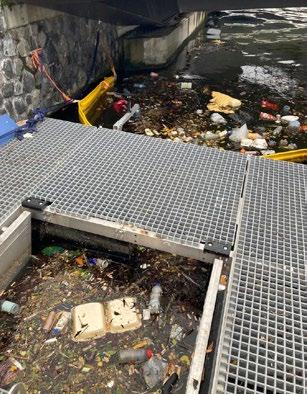
ook, that’s the catch from the past two days.’ Joppe van Driel stands on the banks of the IJ canal in Amsterdam, close to the main train station. He points to a steel cage in the water in which dozens of plastic bottles, packages, foil wrappers, cups, biros and cigarette filters are floating. A brazen grebe tries in vain to get at a plastic bag. The cage is a trap in a kind of curtain that extends the whole width of the canal, from 50 centimetres below the water’s surface to 20 centimetres above. The curtain prevents the urban plastic soup from floating out to the North Sea via the IJ and the North Sea Canal. This Canal Cleaner is one of the plastic traps that the start-up Noria in Delft developed. ‘Thanks to Wageningen research, we know 3.67 plastic items a minute flow into the IJ due to the current that arises when the city’s canals are flushed clean every day,’ says Van Driel, programme developer at Amsterdam Institute for Advanced Metropolitan Solutions (AMS Institute). ‘Natural forces such as wind and rain can speed up the rate at which the plastic is carried to the IJ via the city canals. That research also told us that this is one of the main outflow points for all the Amsterdam waterways.’
The plastic soup trap epitomizes AMS Institute’s approach. In this institute, Wageningen scientists work together with researchers from Delft University of Technology, Massachusetts Institute of Technology (MIT) and the municipality of Amsterdam. Master’s students, businesses and project partners in the public sector are also involved in the effort to find solutions for the problems faced by cities. The result is scientific research that is soon put into practice in urban policies. In the 11 years since AMS Institute was founded, it has conducted more than 250 projects, tackling urban problems in six key areas: waste & the circular economy; mobility; climate adaptation; the energy transition; food; and digitalization. AMS Institute also has its own Master’s programme, which has produced around 250 ‘metropolitan engineers’. Moreover, it has nurtured over 100 start-ups.
COSTS WILL FALL
‘Now, we are studying how to scale up plastic waste capturing,’ says Van Driel. As one of the AMS Institute programme developers, he relays issues raised by the city of Amsterdam to the universities. The municipality currently spends 3.2 million
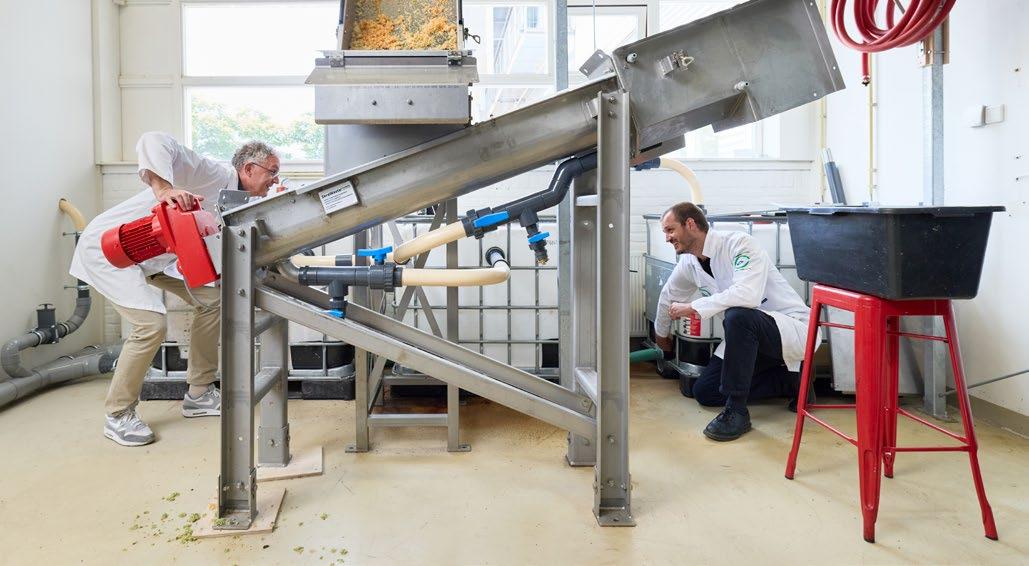
Willie van den Broek of Wageningen Food & Biobased Research is working with PhD candidate Yannick Schrik on a food grinder for organic waste in high-rise flats.
‘Students work on concrete products and policy recommendations’
euros a year on fishing plastic waste out of the canals, often by using boats to clean up hot spots. Those costs will now fall thanks to this study. Other cities with lots of canals will also be able to make use of these results, says Van Driel.
Furthermore, AMS Institute is working on tackling plastic waste at the source. ‘We are in discussions with Amsterdam snack-bar companies on how to prevent and reduce litter. We are also working with biotechnologists in the group headed by the Delft professor (and Wageningen alumnus) Mark van Loosdrecht on biobased alternatives to plastic using organic waste streams from wastewater.’
‘Our institute is unique in the world in being a collaborative venture between universities and an urban municipality,’ says Eveline van Leeuwen. She became AMS Institute’s scientific director in 2020 and is also a professor of Urban Economics at Wageningen. In AMS Institute’s first five years, the scientists and government officials were still ‘sounding each other out’, says Van Leeuwen. ‘We were doing something completely new and had to learn to speak one another’s language, develop trust and build up a reputation.’ They have succeeded, says Van Leeuwen. ‘We have become a “friendly critic” for the municipality.
The AMS building on the Navy site in Amsterdam – which is still partly in use by the Ministry of Defence but is evolving into the city’s innovation district – houses about 30 principal researchers, who are affiliated with either Delft or Wageningen, along with some 20 PhD candidates and postdocs, half of whom come from Wageningen University & Research. They all collaborate with around 100 researchers at the two universities in the various projects. A further 70 or so people work in teams dealing with programme development, the living lab coordination, prototyping, entrepreneurship, communications and support, among other things.
Once a fortnight, Van Leeuwen and her colleague Zwanet van Lubek, AMS Institute’s managing director as of 2024, meet with the Chief Technology Officer of Amsterdam municipality. They also get visits from the heads of the municipal policy departments. ‘They come spontaneously to us with questions, for example on how to generate renewable energy in the city centre without solar panels as those panels would detract from the historical character of the houses along the canals. Aquathermal energy – generating energy from the water in the canals – is one of the options we are investigating.’
FOOD GRINDER
Willie van den Broek, a programme developer at AMS Institute who is affiliated with Wageningen Food & Biobased Research, is working on tackling another common problem for Western cities: collecting organic waste. It is very difficult to collect food leftovers and fruit and vegetable waste separately in densely populated cities. A million people live in Amsterdam, says Van den Broek. ‘They produce about 86 kilograms of organic waste per person per year.’ He is working with a PhD candidate on organic waste collection for high-rise buildings. He has built a food grinder in partnership with Rotterdam, The Hague, Utrecht, Haarlem and the Directorate-General for Public Works. ‘People living in high-rise buildings get a second kitchen sink in which they can shred their banana skins, peel, leftovers, and so on just by pressing a button.’ Water then flushes the organic puree down to an installation in the building’s basement. ‘The waste is dewatered there,’ explains Van den Broek. ‘What remains can be collected by a waste processing company for digestion and composting. We are also looking into more high-grade options, such as using it to make biobased plastics and ingredients for plant food. In Amsterdam, as in many >
EDUCATING ‘METROPOLITAN ENGINEERS’
‘We have educated some 250 “metropolitan engineers” over the past eleven years,’ says AMS Institute managing director Zwanet Van Lubek. ‘They completed our two-year interdisciplinary Master’s programme Metropolitan Analysis, Design and Engineering (MADE).’ In this programme, students learn how to come up with sustainable, innovative solutions for highly urbanized areas like Amsterdam. ‘They receive a joint degree, with the names of both WUR and Delft University of Technology on the certificate.’
‘The students with a Wageningen background contribute their ecological, technological and social science knowledge. They don’t just look at the greenery but also how systems work, from the soil to policy, and how they could become more sustainable,’ says Van Lubek. ‘Half the students come here with a technical qualification, often a BSc from Delft. The rest have a Wageningen background or studied something completely different, such as maths or sociology.’
The students work in small groups in a living lab where they research and tackle a current urban problem, explains Van Lubek. They learn how to collaborate in an interactive and interdisciplinary way. ‘They have to come up with a concrete product – a prototype, policy recommendation or digital product such as a website.’ She gives the example of a biobased bench made from elephant poo that is now in Artis zoo; it was made by five MADE students from Wageningen. ‘The bench is sturdy and weatherproof.’
OVER 100 START-UPS
AMS Institute has nurtured a total of over 100 start-ups and helped them to grow, including the CanalCleaner (photo). Another example is right in front of the door to the AMS building in Amsterdam. Droppie is the name of the company. It provides collection points where local residents can drop off their plastic, textile or electronic waste and get money for doing so via an app. ‘Cash your trash’ says the sign on the door. ‘Droppie now has ten collection points in the Netherlands’ four biggest cities and it aims to grow to 70. It’s only been going a year and already employs 80 people,’ says Zwanet Van Lubek, AMS Institute’s managing director.
Another successful start-up is geoFluxus, founded by Delft PhD candidates at AMS Institute. The company uses data on rubbish to show what waste streams there are and where waste could be recycled sustainably. Van Lubek: ‘They now have more than 50 clients, including municipalities, provincial authorities, builders and ports. The company helps them reduce industrial waste and recycle residual streams into high-grade products.’
‘We have become a “friendly critic” for the municipality’
other cities, most new buildings are highrise flats, so we will be able to install this system in those buildings straight away.’ However, one more problem needs to be resolved before this can be applied at scale. ‘We want to discharge the water extracted from the waste into the sewer system, but that isn’t allowed under the current regulations.’ AMS Institute is now therefore investigating what exactly is in the water in order to find a solution. Van den Broek: ‘In addition, we are looking at ways of reusing this wastewater locally, for example for irrigating or spraying market gardens in and around Amsterdam or for restaurants that grow their own vegetables and herbs in a greenhouse.’
QUAYSIDES AND BRIDGES
Melanie van der Horst, the Amsterdam municipal executive member with responsibility for Public Spaces, Greenery and Water, sees AMS Institute as a place ‘that translates research into practical applications’. ‘First, we look at what the city needs and then we test solutions directly in the urban setting. If something works, we take it further. If it doesn’t work, we go back to the drawing board and try again.’
In this regard, she praises the collaboration with companies. ‘It means innovative ideas get put into practice more quickly. It isn’t just Amsterdam that benefits; this is invaluable for cities throughout the country and beyond.’ She cites the example of the maintenance of quaysides and bridges. ‘How can we find a smart way to combine sustainability, liveability and biodiversity when upgrading or renovating quaysides? Researchers from various disciplines are working on this together with designers, policymakers and other partners.’ It is one of the fields of expertise of Henk Wolfert, who is affiliated with Wageningen Environmental Research and has been a programme manager at AMS Institute since it was founded in 2014. After a commis-
sion reported in 2019 that Amsterdam’s quays were suffering from a severe shortfall in maintenance and then a quayside wall on Grimburgwal canal collapsed in 2020, Wolfert saw a role for AMS Institute in helping tackle the issue. ‘Five per cent of the quaysides and bridges were unsafe and five per cent were safe, but the alarming news was that the municipality had no idea about the remaining ninety per cent,’ recalls Wolfert. ‘In fact, that applies to the quaysides and bridges in all of Europe’s cities, whether that is Hamburg or Venice. That infrastructure was built over a hundred years ago and its maintenance is likely to get forgotten in the hectic day-to-day routine. As a result, there’s also not much expertise on how to maintain a quay or bridge and how to deal with the pipes and sewers that have been laid over the past hundred years.’
TIMELESS CANALS
Wolfert’s involvement led to a spectacular test with a collapsing quay in 2022. Pressure was exerted on this quay, which dated back to 1905 and was due for demolition anyway, by filling containers with more and more water. Sensors recorded detailed measurements of the quay’s movements. The quay was pushed down 15 centimetres. The test cost more than two million euros but has saved well over that amount thanks to the new predictive models for the state of the quays. ‘For example, the municipality was able to remove nearly four kilometres from the expected 200 kilometres of quayside requiring restoration work in 2024,’ explains Wolfert. ‘When you think that building a new quay costs up to 50,000 euros per metre, that could save them 200 million. So the research is definitely worthwhile. In the Timeless Canals project, we are sharing this knowledge with cities such as The Hague, Utrecht, Leiden and Delft. The AMS research budget has increased by a factor of five since the start, partly thanks to
the involvement of bodies such as the Dutch Research Council and companies, for example in the building industry.’
When redesigning the canals, AMS Institute and Amsterdam municipality came up with the concept of ‘multifunctional quays’.
‘These new quays also need to last for a hundred years, so we should take into account climate adaptation, the energy transition, water quality and biodiversity,’ says Wolfert. Biodiversity isn’t just about keeping the trees but also about having different species of trees that attract more insects and are better able to cope with both extremely wet and very dry conditions. Wageningen is helping by providing 3D visualizations of how the tree roots grow. Wolfert: ‘Other ways of promoting biodiversity are ferns on the quay walls, water plants that have a purifying effect and 3D-printed concrete tiles that provide shelter and spawning grounds for fish.’ In addition, the researchers are looking at whether heat exchangers in the quayside walls could transfer the energy from the canal water to the pumped water that provides heating and cooling in homes, a solution termed aquathermal energy. That is Delft’s field of expertise. Wolfert: ‘The recurring theme is that we have different disciplines
joining forces here in AMS Institute and collaborating in a transdisciplinary way. We all work here on one blueprint, where the energy people say how many houses need to be heated and the aquatic ecologists and plant scientists make sure biodiversity is taken into account.’
The knowledge acquired and the specific solutions could also be applied in other cities with a lot of waterways, stresses Wolfert. ‘Wageningen is often associated with knowledge relevant to the countryside and farmers, but we also have something to contribute to a city like Amsterdam with its power, money, technology and innovation.’
FOSTERING INCLUSION
Where possible, AMS Institute also works on projects aimed at improving inclusion in the city. ‘Inclusion is one of the seven key political ideals that can be identified when studying 30 years of municipal coalition agreements,’ says Van Leeuwen. All Amsterdam’s residents (with 175 different nationalities) should feel involved and safe in the city, regardless of their origins and income. A researcher and energy coach at AMS Institute is therefore looking at how smart technology can be used to reduce en-
ergy poverty in the city.
The ‘World Vegetable Gardens’ – in a greenhouse that used to belong to a rose nursery on the western edge of Amsterdam – is a good example of inclusion in a food context. Amsterdam folk with Surinamese, Turkish or Moroccan roots grow vegetables they would otherwise have to pay a lot of money for at ethnic grocery stores. Wageningen scientists select the seeds that will do well in an unheated greenhouse in the Netherlands. They are also investigating the question of whether culinary heritage can play a role in encouraging healthier diets.
Another nice example, says Van Leeuwen, is the reuse of solar panels. ‘We are researching whether second-hand solar panels still function after being dismantled and transported to a new place,’ says Van Leeuwen.
‘Work-study programmes for young people have been designed to tie in with this in the Amsterdam Zuidoost district. The secondhand panels are installed on the roofs of sports club premises, for instance. They are also connected to the Energy Bank, and housing corporations lease them to households with energy poverty.’ W
www.ams-institute.org
In the World Vegetable Gardens, in a greenhouse previously used for roses, Amsterdam folk with Surinamese, Turkish or Moroccan roots grow vegetables – such as okra, bitter gourds and yardlong beans – they would otherwise have to pay a lot of money for at ethnic grocery stores.
TALKING TOT THE DIGITAL ASSISTANT:
‘What is the best time to harvest the potatoes?’
Farmers consult their digital assistant about the right time to irrigate or harvest potatoes, and their smart robots then get down to work. It may sound like science fiction, but Wageningen researchers think it could become a reality within five years.
TEXT KOEN JANSSEN
Harmen, a farmer, wakes up at 6 AM. He makes the coffee and sits down at the kitchen table. His smartphone tells him that his autonomous tractors have done a lot of work that night. They have removed weeds and identified sick plants. Harmen asks his virtual assistant whether it would be wise to irrigate the crop today.
He gets into his tractor and heads out onto the land. In the meantime, he tells his virtual assistant to send the autonomous tractors to another field. Those robots know exactly what they need to do there: spread fertilizer on the land in a very precise pattern. A drone takes off ahead of him to look for birds’ nests so that the robots can avoid them.
SOWING AND MOWING
Harmen’s high-tech farm is not a reality yet, but advanced robots are increasingly being used in agriculture, says Paul van Zoggel, the precision agriculture programme manager at Wageningen. ‘Robots can already do a great deal:
sowing seed, weeding, mowing the grass and so on. All arable sectors are relying more and more on smart robots.’ Many farmers need to use robots because of the sector’s ageing population profile. Only ten per cent of Dutch farmers are under 40, according to data from Statistics Netherlands (CBS). It is also becoming harder to find people who are willing to do physical work in all weathers, says Van Zoggel. Robots can fill the gaps. They don’t need breaks – and they are more precise, which reduces the
‘The challenge is how to manage all the tech’
amounts of fertilizers and crop protection agents that are required.
DATA AND SOFTWARE
The robotization of agriculture is also bringing new challenges, though. ‘They aren’t easy for farmers to work with,’ says Van Zoggel. ‘Farmers have to have an affinity for technology and data and software. The challenge is about how to manage all the technological equipment.’
Van Zoggel would like to progress towards a system where all the technologies used by a farmer can be combined so that the devices can communicate with each other and with the farmer. The system would be well informed about local conditions and regulations and could help the farmer come up with solutions. ‘We eventually want to get to a situation where a farmer might tell their virtual assistant to spread fertilizer, for instance, and it responds by asking if he’s sure because it’s about to rain.’
Ard Nieuwenhuizen is one of the researchers working on developing this type of interface at WUR. ‘Farmers currently have
to go to their computer and log into a web application. Each robot is a different make and uses a different application, so they don’t communicate with each other well.’ Farmers should be able to talk to their systems like they talk to their workers. This might have sounded like science fiction 30 years ago but today, in 2025, millions of people ask Alexa and Google Assistant to turn the lights on or order some washing powder. Language models such as ChatGPT are improving the options for communicating with computers and robots.
THE CHATBOT BOTATO
There is the chatbot Botato, developed by Wageningen Plant Research, for instance. ‘Growers can ask the chatbot questions,’ says Nieuwenhuizen. ‘Things like “Can you predict my potato harvest?” and “What if I harvest one week later?”’ To develop Botato, it was trained using crop growth models that calculate potato yields. The interface also needs to be fed with information to prevent it from hallucinating,
says Paul van Zoggel. ‘Otherwise the model will make up answers. We need to make sure that it bases its answers on scientific knowledge. Knowledge of the agronomic, economic, ecological and social aspects of agriculture is currently very fragmented; we need to gather that knowledge together and store it in AI models.’
While Van Zoggel works on collating Wageningen’s knowledge about agriculture, Nieuwenhuizen is focusing on the technical side of the interface. ‘The robots
need to become even more intelligent: they need to gather information and then make it available digitally.’
So a lot of work is required before farmers will actually be able to discuss the weather, potato harvests and nitrogen emissions with their robots. Nieuwenhuizen expects that kind of communication to become possible within five years. ‘If farmers can chat with these systems in the future and get decent answers, that would be a major advance for agriculture.’ W
TRYING OUT ROBOTS
New agricultural technology is tested in the National Precision Agriculture Living Lab (NPPL), a large-scale collaborative venture between farmers, technology vendors and Wageningen University & Research. November 2024 saw the start of NPPL-R, which focuses specifically on robotization. Around 50 farmers are taking part in study groups or trying out robots, whether for a day or a growing season. This yields insights that can for example help the government to assess whether a particular technology is promising enough to promote.
The use of robots does not necessarily make work easier for farmers: each robot is a different brand and uses a different app.
The ‘poo machine’ reveals the link between gut bacteria and health
Our intestines probably have an influence on Alzheimer’s and Parkinson’s, as well as depression and stress. With the help of artificial intestines – aka the poo machine – scientists are trying to figure out how that relationship functions in humans and animals.
TEXT PAULINE VAN SCHAYCK PHOTO WUR
The laboratory still smells like a sewer even when the poo machine is switched off. When it is switched on, the jars the size of biscuit tins bubble away. They simulate the various parts of the intestines, complete with the associated bacteria. Those microorganisms make up the most influential group populating the intestinal microbiome: the collection of bacteria, fungi, yeasts and viruses. The poo machine, which is actually called SHIME, has been in the lab of Jurriaan Mes, senior Nutrition & Health researcher at Wageningen Food & Biobased Research, for five years now and he has got used to the smell.
The solution of bacteria and food particles in each jar is pumped through to the next jar after a set time. The conditions – the acidity, temperature, presence of cer-
tain enzymes and so on – correspond successively to the situation in the stomach, the small intestine and three sections of the large intestine. The artificial intestines are fed from an apparatus that simulates the chewing and digestion of food in the mouth.
Scientists are using the artificial intestines to study how nutrition affects the composition of the organisms inhabiting the gut. That is because it is becoming increasingly clear that this composition in turn influences the development of diseases, recovery and general well-being in humans and animals. It might therefore be possible to boost the health of humans and animals by steering the microbiome in the right direction.
Mes examines the artificial intestines on the computer.
‘You can change the speed at which the food particles >
‘After a change of diet, the microbiome changes too within three weeks’
pass through the apparatus, you can alter the conditions or you can make it simulate the intestines of a baby.’
A key difference with real intestines is that the artificial intestines don’t have intestinal cells that absorb the nutrients from the mixture. ‘We take what remains of the food particles in the various pots and feed this to intestinal cells in another part of our lab. That is where we study the uptake into the bloodstream,’ explains Mes.
ACIDITY AND TEMPERATURE
To be able to use the poo machine for research, it first needs to have the right gut bacteria. Mes: ‘If we take the microbiome from some excrement and put it in the machine, its composition will gradually shift under the influence of the conditions.’ For example, certain bacteria grow better than others in the small intestine with its particular combination of acidity, temperature and enzymes. The composition of bacteria in that particular pot therefore increasingly looks like the microbiome typically found in that part of the intestines. The availability of new DNA techniques is making it easier to work out exactly what organisms are living in an individual’s intestines. According to Mes, it is even possible to identify all the genes and all the proteins in a microbiome within one day. ‘Initially, we were only able to look at groups of bacteria at a broad level, but now we know which bacteria are involved and what substances they make.’
Even so, the interrelationships between the billions of microbiome inhabitants remain complex. ‘What happens in this population is called cross-feeding,’ explains Mes. ‘One bacterium nibbles something off a nutrient and the next continues with that piece, turning it into something new. In other words, it’s all about combinations of bacteria. If your diet changes, for example because you start eating and drinking more dairy products, the microbiome will change accordingly within one to three weeks,’ says Mes. It adapts to cope with the food in the new diet, but the changes also affect your metabolism. The metabolites, as the products of the chemical reactions in the bacteria are known, are used by other bacteria and by cells in the intestines and elsewhere. This, it transpires, has all kinds of connections with your health and well-being.
‘We now have a fairly clear idea of which bacteria cause the complaints in intestinal infections, but the situation is much more complex in the case of irritable bowel syndrome or brain diseases,’ says Mes. ‘They are not caused by one single bacterial species. It can be a combination of multiple species that jointly produce certain metabolites.’
It is also possible for substances created in the intestines to activate the immune system. These substances may end up in the brain. Mes: ‘This is sometimes called the gut-brain axis. There is often a lack of hard evidence, but it is increasingly accepted that there are links between the microbiome and the development of brain diseases. Alzheimer’s and Parkinson’s are probably linked to the digestive system, and autism, ADHD, depression and even stress could perhaps be influenced by our intestines.’
For example, less healthy microbiomes often contain a lot of bacteria that make lipopolysaccharides. These large molecules (consisting of a lipid and a polysaccharide) are known as endotoxins. They are substances that can trigger a strong immune response. Studies with the artificial intestines show these molecules adhere easily to fat particles and are thereby carried through the intestinal wall into the bloodstream. ‘The fat particles are not broken down in the liver immediately, so they end up in the lymphatic system and the bloodstream. We also find them high up in the neck, close to the brain, where they may contribute to an increased risk of Alzheimer’s,’ says Mes.
MENTAL HEALTH
Mes and his colleagues are also involved in different kinds of studies on the association between the gut microbiome and health. One is a study of people with risk factors for Alzheimer's disease, such as high cholesterol, obesity and type 2 diabetes. They are investigating the influence of lifestyle on the composition of the microbiome, in partnership with other universities and research institutes.
Last summer saw the start of the three-year research project Food4Mood, in collaboration with VU University Amsterdam. It is looking at young adults with mild mental health issues such as sombre feelings and concentration problems. Some of the participants are on a plant-based diet high in dietary fibre, with the aim of testing the influence this has on well-being and gut health.
Their excrement gives a picture of the microbiome to a certain extent, but it mainly only tells you about the final section of the large intestine. It would be better to study the content throughout the intestines to get a complete, realistic picture of the gut microbiome. However, looking deep into the intestines is not easy: it requires a distressing internal examination with a metres-long tube.
SMART PILL
An alternative solution is the sensor pill developed by the OnePlanet Research Centre – a collaborative venture between the company Imec, Radboud University, Radboud University Medical Centre and WUR. This smart pill, no bigger than a multivitamin tablet, can be swallowed and then travels through the body, including the intestines, performing measurements and gathering data. The pill sends the data to a separate device, outside the body. Last summer, PhD candidate Roseanne Minderhoud and assistant professor Guido Hooiveld of the Human
Nutrition and Health chair group published an article in the journal Nature Electronics on the first tests with the sensor pill in humans. It turns out that the tiny sensor can measure variables such as the acidity, temperature and redox balance (the equilibrium between oxidants such as free radicals and antioxidants that neutralize them). A disrupted redox balance is a sign of inflammation in the intestines.
‘The pill worked as we had hoped,’ says Minderhoud. ‘The pH value, for example, tells you how active the gut bacteria are. The more they ferment, the more acidic it gets.’ After trying out the sensor pill, the consortium is now testing a ‘sampling pill’. This mini device collects fluid containing bacteria and various other substances from the intestines. The reactions between those substances and the bacteria are halted immediately so that it is possible to determine what was going on in that specific part of the intestines when the pill finally leaves the body hours later. >
PhD candidate Roseanne Minderhoud with the sensor pill for endoscopic research on people.
‘The most resilient animals have diverse microbiomes’
The sensor pill has also been used in studies of animals, including cows, pigs and chickens. The diseases the animal studies focus on are different to the diseases in the human studies. ‘Animals don’t live so long and the diseases associated with old age are therefore not seen in animals,’ explains Dirkjan Schokker, a researcher at Wageningen Bioveterinary Research. ‘Anyway, we can’t ask them how they are feeling.’ Schokker is looking for other indicators of the association between the microbiome and well-being, such as behaviour and susceptibility to infections.
For example, pigs that are reared in a more stimulating environment have a different microbiome than pigs that have less to do. Schokker: ‘Greater exposure to natural products such as peat and behaviours such as rooting and play result in a more diverse mix of bacteria. The immune system “learns” the difference between harmless and harmful microbes. Piglets with a more stimulating environment subsequently became less sick or recovered faster from a respiratory tract infection. The underlying mechanism is not yet clear, but there is definitely an association.’
COLONIZATION
The first few weeks of an animal’s life are crucial as that is when the colonization of the previously ‘empty’ intestines starts. It is also a period when a lot happens in the lives of farm animals. ‘Piglets are weaned and taken away from the mother at four weeks, switching from milk to solids,’ says Schokker. ‘That has economic benefits, but it is stressful for the piglets in a period in which the microbiome is still developing. The piglets are particularly vulnerable to infections at that time. Research in Belgium shows that weaning later is better for the piglets’ microbiome and health. Calves too are subject to stress in their first few weeks: they are moved to a new place with a lot of other calves. Some then begin to cough a lot or get diarrhoea. It looks as if the
microbiome plays a role here too, as the most resilient calves have diverse microbiomes.’
‘But an animal’s genes also determine how the microbiome develops,’ explains Schokker. Selecting specific breeds of cows, pigs and chickens has let them zoom in on the other factors that affect the mix of bacteria, such as nutrition and the environment. ‘If we can discover what effect a certain feed composition has, for example, we can use that information to improve the well-being of these animals.’ That could, for instance, mean they do not need antibiotics as much in future.
NUDGES IN THE DESIRED DIRECTION
Eventually, the researchers want to know the details of a particular relationship between the intestines and health. For example, which mixes of bacteria in which parts of the intestine cause damage to which parts of the brain via which substances? That could be the starting point for targeted changes to the gut microbiome.
About ten years ago, ‘faecal transplants’ looked as if they might be a promising solution to various disorders linked to gut bacteria. In these transplants, the microbiome from the faeces of a healthy person is inserted in the patient using a tube through the nose, an enema via the anus or a capsule that is swallowed. Mes: ‘That worked well for pathogenic bacteria that couldn’t easily be removed from the intestines but not for diseases where the relationship between the intestines and health is more complex.’
Mes and Schokker are looking for ways to influence the bacterial mix in a positive sense, and often for preventive purposes. It all starts with a healthy diet. ‘In general, for humans that means not much sugar and lots of vegetables, fruit, nuts, wholemeal products and fermented products such as yoghurt,’ lists Mes. ‘But I want to be able to give customized advice for specific groups of people, for example recommending they eat food with an antimicrobial effect such as garlic. We will be investigating this further over the next few years, using the artificial intestines and studies with test subjects.’
Schokker is investigating the relationship between the feed composition for farm animals and well-being, the environment and production. How does animal feed made from residual products from the food industry affect animals’ microbiomes, immune systems, health and well-being? And how much does the animal then
produce in terms of milk, eggs or meat? In a recently completed study, pigs were fed the remains from confectionery bakers and the pulp of sugar beets. ‘Sugar beet pulp changes the pig’s microbiome a lot, with more microorganisms that specialize in complex sugars,’ says Schokker. ‘That didn’t really happen at all with the waste products from the bakery. We didn’t see any adverse effects for the pigs’ behaviour or well-being in either group. The next step will be to investigate whether the changes to the microbiome actually have benefits.’
PRE-, PRO- AND POSTBIOTICS
The microbiomes of both humans and animals can be altered by nutritional supplements. Probiotics – live bacteria – can become established alongside the existing gut bacteria if they reach the intestines in sufficient numbers. Probiotics in the form of pills and drinks have been around for a while and can help some people suffering from irritable bowel syndrome or diarrhoea after taking antibiotics, for instance.
Newer variants of these supplements are prebiotics and postbiotics. Prebiotics provide nutrients used by specific beneficial bacteria in the intestines. They either boost the growth of these bacterial populations or they let the bacteria produce substances that are good for health. Dietary fibre is the best-known prebiotic. ‘Some pieces of dietary fibre look like pieces from the cell walls of specific bacteria,’ says Mes. ‘That acts as a positive trigger for the microbiome, and therefore also the immune system.’ He will soon also start investigating the effects of postbiotics – compounds produced by bacteria or pieces of dead bacteria that stimulate the immune system in the intestines. Meanwhile, Schokker is playing with the idea of designing a microbiome. ‘New-born animals, such as chicks, start off with empty intestines. We can give them a helping hand in the first stage of life. For example, perhaps we could make chicks more resilient to diseases by giving them ten beneficial bacteria.’ He is already able to design a microbiome with the aid of software and scientific knowledge. That could be administered as an aerosol after the birth, or even earlier by injecting the yolk. ‘Vaccines are already being injected into the egg, so the gut bacteria could be added,’ says Schokker. It doesn’t matter if that microbiome changes later. ‘Giving the animal a good start makes such a big difference in terms of the chances of survival and well-being. ’ W
THE POSTBIOTIC AKKERMANSIA
Wageningen emeritus professor of Microbiology Willem de Vos discovered a new gut bacterium in 2004. The microorganism was named Akkermansia muciniphila, after his former colleague, the microbiologist Anton Akkermans. De Vos and his team showed that the bacterium helps reduce intestinal inflammation, which is beneficial for people with obesity, type 2 diabetes or cardiovascular diseases. De Vos applied for a patent and in 2016 he founded the company A-Mansia Biotech (which became The Akkermansia Company). In 2021, the company received approval from the European Food Safety Authority (EFSA) for the use of pasteurized Akkermansia as an ingredient in food. The postbiotic has been available on the market in Europe, Asia and the US since 2023. The company was taken over by the Danone food group in July 2025.
PHOTO
ANP
BUSINESSMAN MENDELT TILLEMA:
‘It is healthier than a
classic sausage roll’
Mendelt Tillema has become famous for his fully vegan sausage roll – Zwamcijsje – made from the stalks of oyster mushrooms.
‘I can be an entrepreneur and make the world a better place.’
TEXT TANJA SPEEK PHOTOGRAPHY BRAM BELLONI
Our interview with Mendelt Tillema (33) about his vegan sausage roll starts with a little trip outdoors on Wageningen campus. ‘The advantage of working in the Plus Ultra II innovation and incubation hub is that it also has storage areas,’ he says. Tillema walks round the corner and enters a large container. ‘The chaos on that side isn’t me, by the way,’ he notes. On the other side are boxes containing serviettes and trays for serving the rolls. A large freezer is full of more boxes with the oyster-mushroom sausage rolls wrapped in plastic. The pale pastry is folded around a hidden filling. When we get back inside, the oven is switched on to heat the vegan sausage rolls, which have been placed on a sheet of baking paper.
The roll was conceived four years ago, says Tillema, when he and a fellow student got an assignment to come up with a product using oyster mushroom stalks during evening classes in meat processing technology and alternative proteins at HAS Den Bosch. ‘Brabant is real mushroom country. A grower told us the oyster mushroom stalks were leftovers. They make up 20 per cent of the biomass. We decided to use them to make a vegan sausage roll. My classmate came up with the name Zwamcijsje (a portmanteau of the Dutch words for the mushroom and sausage, ed.).’
SEAWEED
By then, Tillema already had experience setting up a food company – with seaweed-
based products – which he had then discontinued. Even so, he was willing to embark again in 2022 on an endeavour to develop a new product and launch it on the market. ‘Entrepreneurship gives me an outlet for my creativity and lets me help make the world a better place.’
He was not destined to become an entrepreneur, as it happens. ‘After secondary school, I wanted to discover the ultimate elixir of life,’ he says. He looked at medical biology university courses, but he was soon talked out of his rather naive ambitions. ‘A professor advised me to take a broader approach and consider biology. Although the plant modules sounded rather boring, I did eventually go to Utrecht to do biology. I had a really fun year, but I didn’t get enough >
MENDELT TILLEMA
2022 – foundation of Zwamcijsje
2021 – evening course in meat processing technology and alternative proteins at HAS Den Bosch
2019 – founded UmaMeats
2017 – co-founded Healthy Greens
2012 – degree in Plant Sciences at WUR (did not graduate)
2011 – degree in Biology at Utrecht University (did not graduate)
‘I love seeing how my company develops’
study credits. However, I did discover how fascinating plants are during that year –all the amazing things they can do while staying put in that one place. That’s why I decided to do a degree in Plant Sciences at Wageningen.’
YOUNG ENTREPRENEURS
It was then that Tillema grew interested in the question of how to feed the world. And in entrepreneurship, which he took a course in. ‘But as I was getting to the end of my Bachelor’s degree, I developed eye problems. Reading gave me terrible headaches, so I had to stop with my studies and do something else. After a period of rest, I ended up at StartHub Wageningen, which nurtures young entrepreneurs at WUR.’
He met someone there who wanted to start a seaweed cultivation business but wasn’t managing to sell his product. With the support of StartHub, Tillema set up the company Healthy Greens to market the seaweed as food.
‘I found it an interesting challenge, in part from a sustainability perspective. At this point, my mother was working on ways to foster a healthy and happy life for the people in my home village of Bakkeveen in Friesland. She wanted to turn the place into a Blue Zone.’ Tillema and his fellow entrepreneur conceived the seaweed & bean burger as the ultimate healthy, sustainable product. ‘We tested the burger in Bakkeveen but it was a complete flop. They didn’t like either the idea or the taste. That taught us to take a different approach, based more on what works in the market. So we came up with the combination of meat and seaweed, which we called enriched meat. Nowadays, you often hear the term hybrid meat, but that’s not so sexy and it emphasizes what’s not there, whereas adding seaweed actually has plus points. Beef tends to get dry, but it
stays juicy longer when you add seaweed. And the seaweed contains a lot of healthy nutrients.’
This change to the business concept led to a corresponding change in the company name: it became UmaMeats. ‘Things really took off when we got the Ministry of Defence as a client. They want to promote the health of their staff with good food. Our motto became “Nutrition is your best ammunition”. That taught me how important it is in the food industry to find a client willing to buy your product. That lets you get a foot in the door with wholesalers and then you can start delivering to other parties.’
And yet you closed your UmaMeats business.
‘COVID came, all our clients had to close and things went wrong between me and my business partner. I had to think about what to do next. I took part in a programme run by the Slow Food Youth Network, which is for young people who want to get involved in promoting healthy, sustainable and ethical food. That was a deep dive into the Dutch food system in its entirety. I also decided to do the evening classes in meat processing technology and alternative proteins at the HAS Den Bosch university of applied sciences. That was where the plan for my company Zwamcijsje originated.’
Is entrepreneurship something that’s in your family?
‘No, not really. As a child, I used to grow lettuce and sell it locally, but that’s about it.’
Do you make the rolls entirely yourself?
‘No, I get the various components made elsewhere. I don’t run the company on my own either. That’s the setup that suits me best. The food system has so many facets!
StartHub has also given me access to what you could call the Wageningen ecosystem – all the knowledge about production systems, consumer science and so on. I already learned to think in terms of systems and look at the bigger picture when I was doing my plant sciences degree. For example, if you decide to maximize yields, that can exhaust the soil. I prefer to use ingredients that have a future in Europe and that I expect us to remain self-sufficient in.’
Is the savoury roll produced sustainably as well?
‘The stalks are a waste product and the straw the oyster mushrooms grow on is too. But our aim isn’t to source all the sausage roll components really locally: it’s much more efficient to have a central location for production, storage and transport. That saves a lot of energy and keeps prices lower.’
Do oyster mushroom growers produce enough left-over stalks?
‘That would be a great goal: a situation where I have to look beyond the Brabant region to get my stalks. We’re not that far yet, though.’
Can you call the roll plant-based, given that fungi aren’t actually plants?
‘I think that’s nit-picking. All it does is make the protein transition more difficult. The advantages oyster mushrooms have over plant-based alternatives are the bite and the taste. The flavour is already savoury. If you use soya beans, you first have to disguise the soya aftertaste before you can work on getting an appealing flavour. Plus the combination of oyster mushrooms and puff pastry works really well.
‘I once spoke to a chef who was “forced” to try the oyster mushroom roll because a colleague had been so enthusiastic about it. He said beforehand that he wasn’t keen on trying some fungal roll with fake butter. I like that: people who are the most reluctant to taste are also often the most pleasantly surprised. He had to admit he found it much better than expected.’
Halfway through the interview, the rolls are ready. A bite in the crispy, golden pastry of what looks like a classic sausage roll releases the full flavour – savoury and herby – of the oyster mushroom ‘sausage’. The mush-
room roll tastes noticeably less greasy than regular sausage rolls. The serviette doesn’t have the grease marks you normally get with a sausage roll either. ‘That’s right,’ confirms Tillema. ‘The mushroom roll has between 30 and 40 per cent less fat than a regular sausage roll.’
But it’s still not genuinely healthy, though, is it?
‘That’s a good point, and it’s definitely an issue for hospitals. But it’s a healthier alternative to the classic sausage roll. Patients in hospitals are often going through tough times and they want the occasional treat.’
Do you eat the mushroom roll a lot yourself?
‘I’m quite certain no one in the world consumes more of these rolls than I do. I love seeing how my company develops. You can now get the Zwamcijsje at the Van der Valk restaurants, at a lot of hospitals and in the Wageningen canteens. Everywhere I go for meetings, I take the savoury rolls with me for people to taste. And I still find it hard not to eat them all myself.’ W
Mendelt Tillema presents his Zwamcijsjes at a tasting session at Amsterdam University of Applied Sciences
LEGACY FOR THE FARM OF THE FUTURE
‘A really nice token of appreciation’
Wageningen
University
& Research received 2.5 million euros from a legacy this year – one of the biggest donations ever. This sum is earmarked for the Farm of the Future in Lelystad, which intends to use it in part for research into underground water storage.
TEXT KOEN JANSSEN PHOTO: ANP
Ottoline Visser-Stokhuijzen passed away in June 2023 in Delden (Overijssel). The widow, who reached the ripe old age of 93, had chosen to leave large sums of money to science. In addition to Wageningen, the universities of Tilburg, Twente and VU Amsterdam each received 2.5 million euros.
Pieter de Wolf, project manager of the Farm of the Future, remembers very well how he got the news of the legacy. ‘It was a Friday and I was here in Lelystad when Lies Boelrijk from the University Fund Wageningen called me to tell me. I was absolutely staggered – someone finding our work that valuable seems a wonderful token of appreciation to me.’
EXPERIMENTAL LOCATIONS
The Farm of the Future carries out applied research into solutions for the challenges in agriculture. The first location was set up in Lelystad in 2020, with funding from the Ministry of Agriculture and the province of
Flevoland. Three more Farms of the Future have now been added, in the south-eastern sandy area, the peat colonies and the southwestern delta. In Lelystad, innovations and new agricultural systems are tested, such as strip cropping and sustainable crop protection. But there are also practical trials with tractors driving along fixed tracks to reduce soil compaction. Not only are the fields spared, but the tracks become rock hard, letting farmers get out onto the land in wetter weather. ‘My colleagues went there last week to harvest potatoes, and they were very enthusiastic,’ says De Wolf. ‘The soil looked to be in great condition. The calculations show it could boost yields by at least five per cent.’
‘We also think it’s very important to put future bottlenecks on the agenda,’ continues De Wolf. ‘Growing onions, for instance, is getting more complicated every year. The onion plants in our fields are suffering from diseases, weeds and pests, and none of those are easy to control.
Onions are also very sensitive to drought. Every year, the yield is disappointing. We shared these issues with colleagues who were working with the onion sector on proposals for new research projects.’
WISE MANAGEMENT
De Wolf feels a great responsibility to spend Mrs Visser-Stokhuijzen’s legacy wisely.
‘People don’t leave bequests just so that we can use the cash to plug gaps in the budget.’ Together with colleagues, he drew up a framework showing how the Farm of the Future could use the bequest.
‘Two and a half million euros is a lot of money,’ he says, ‘but one big investment can use it up in an instant. That’s why we want every expenditure to have a kind of multiplier effect, so that you can achieve a great deal even with a small portion of the legacy. When we invest in projects, for example, at least half of the money is going to have to come from other sources.’
The research carried out by the Farm of
the Future currently depends heavily on short-term government grants. These are often for four years, whereas a cultivation cycle usually lasts eight. ‘We actually need a different kind of financing,’ says De Wolf, ‘So in that sense, the bequest was a really pleasant surprise.’
WATER STORAGE
The Farm of the Future will be able to use the money to stay involved in research projects and PhD programmes, for instance about new circular fertilizers. Furthermore, they very much want to continue a research project into underground water storage. A preliminary study into this innovation had previously been made possible by an anonymous donation that later transpired to be from Mrs Visser-Stokhuijzen too. De Wolf expects underground water storage to be an interesting idea for many Dutch farmers. ‘Climate change means we’re getting droughts more frequently, which is causing significant crop losses.
Whereas in winter, there’s actually too much precipitation, enough that you could irrigate the land with it in summer. Farmers can store surplus water in large aboveground basins, but they take up valuable space.’
The Farm of the Future wants to investigate whether it is possible to store water at a depth of 20 metres in a layer of sand between two impermeable layers of clay. A
drainage system would then need to pump rainwater into the ground in winter, so that it can be pumped back up again in summer. ‘There are lots of things we want to learn about underground storage. One aspect we need to consider carefully is the effect on the underground water quality, as well as the practical feasibility.’ Constructing the system could begin in 2026, with a contribution from the bequest. W
LEAVING MONEY TO SCIENCE
Through the University Fund Wageningen people can contribute to research on a sustainable future and help provide funds for talented individuals. One of the options for this is leaving something in your will, as either testamentary disposition or bequest. A bequest can stipulate that the money is to be used for a specific purpose, such as research or scholarships.
For more information about leaving money to WUR, see www.universityfundwageningen.eu Or ask for the brochure about wills and donations from harry.verwaaijen@wur.nl
The Farm of the Future in Lelystad tries out innovations and new farming systems.
4TU.ALUMNI
Network launched for international alumni
The 4TU.Alumni Netherlands Network was launched at the end of May. It aims to give the ever larger group of Dutch-based foreign alumni of the Netherlands’ four technical universities more opportunities to meet up.
‘There are an estimated 20,000 foreign alumni now living in the Netherlands who have degrees in a technical or agricultural domain – including some 3,500 Wageningen graduates,’ says Denise Spiekerman of Alumni Relations. For them, Wageningen University & Research has launched a new alumni network together with the other three technical universities that make up 4TU. ‘This complements the existing alumni communities, which tend to be mainly Dutch-language.’
Wageningen alumnus Ibrahim ElZahabi (Bio-informatics 2024) was at the launch. He sees the new network as a place where
internationals can help one another navigate Dutch culture and the Dutch labour market. ‘Not just by sharing experiences but also for example by practising job interviews together.’
The launch took place at the offices of the Witteveen+Bos engineering consultancy and was attended by about 100 internationals. The event included a panel session with four inspirational alumni, including Wageningen alumnus Juliana Romero Guzmán (Food Technology 2015). Juliana, who is originally from Mexico, talked about her start-up Cano-ela, which produces sustainable nutritional ingredients from oil-rich seeds.
Let the soil sing
The Singing Soil art project gives a musical interpretation of the relationship between soil organisms in three different soil types. The KLV Fund made a financial contribution to the project.
PhD candidate Doina Mani (Biology 2020) provided input for the audio installation, which translated data from her research on soil organisms into music. Singing Soil lets you hear how different from one another various soils can be. Mani worked with the artists of Studio Metaform. Mani’s project involved studying the soil
Ena Voûte, Deputy Vice-Rector of International Affairs at Delft University of Technology, referred in her speech to a recent report by Nuffic, the Dutch organization for internationalization in education. It found that 57 per cent of internationals were still in the Netherlands one year after graduating in 2023, compared with 40 per cent in 2017. Eighty per cent of them had well-paid jobs, often in technology or education. ‘They clearly play a key role in our economy,’ concludes Spiekerman. The aim of the 4TU. Alumni Netherlands Network is to give this growing group of alumni opportunities to meet, both online and in person, for example via a LinkedIn group and events. ‘But we want to encourage them to start their own initiatives too,’ says Spiekerman. Info: denise.spiekerman@wur.nl
life in a maize field, a pasture and an area of natural grassland. ‘The chords in the composition were based on the complexity of the food web, for instance. A soil with only bacterial life sounds less rich than a soil where the food web also includes groups of nematodes. Natural grassland has broad, harmonious chords, while the maize field sounds much simpler.’
The installation could be heard on campus on 8 October, during a listening and debate session. Later that month, Singing Soil was on show at the Dutch Design Week in Eindhoven.
The KLV Fund supports initiatives by alumni that complement and are not covered by the regular alumni policy at Wageningen University & Research. Applications can be submitted year-round to www.universityfundwageningen.eu/klvfund
Summervibes – for alumni too!
On 19 June, the Summervibes festival was held on Wageningen campus to mark the end of the academic year. This festival, organized for the third time by WUR, was open to everyone who worked or studied on campus or had studied there in the past – in other words, alumni were welcome too.
In a summer atmosphere, there was music from FissABBAband and DJ DansMaar, researchers provided 15-minute science podcasts, and guest speakers such as Harm Edens and Teun van de Keuken enlivened the ‘Inspiration Square’ with their stories. Alumni could meet up at the special ‘Get Connected’ square. Head of Alumni Relations Maarten van Schaik: ‘It was great to be able to discuss ideas with students, staff and alumni in a relaxed setting about how they can stay involved in the future.’ Diary of alumni activities: www.wur.eu/alumnievents
LABOUR MARKET
Slight rise in unemployment among young alumni
Unemployment among recent Wageningen graduates has risen slightly, according to the National Alumni Survey (NAE).
Universities use this survey to analyse the alignment between Master’s programmes and the labour market.
Unemployment among WUR alumni who graduated between October 2022 and September 2023 was 7 per cent. The figure for the unemployment rate one year earlier was 4 per cent. Graduates also took slightly longer to get their first job: 3.3 months compared with 3.0 months before.
‘Seven per cent is still not bad,’ says Silvia
Blok, an Education and Labour Market policy officer at Wageningen University & Research. ‘We often had rates of over 10 per cent in the 1990s. But it does show we need to keep monitoring the alignment between the degree programmes and the labour market. Indeed, we use the results of this survey to start discussions with the programme organizers.’
Alumni who graduated between October 2023 and September 2024 will have received an invitation to complete the 2025 NAE survey.
Info: www.nae2025.nl
Wageningen alumni form a worldwide network of 70,000 Bachelor’s, Master’s and PhD graduates. There are various ways to keep in touch:
LinkedIn
Over 17,000 people belong to the LinkedIn group Alumni @ Wageningen University & Research, which puts the spotlight on individual alumni, among other things. They include Joline Wierda, Nutrition and Health 2018, who obtained her PhD this summer. In 2024, she was included in the Food100 list of change-makers who devote themselves to a better food system.
www.linkedin.com/groups/39958/
Helping WUR
Alumni can help WUR achieve its mission through their knowledge and experience. For example, alumni are wanted to help students close to graduation through JobTalks. www.wur.eu/alu-engagement
Networks
The alumni community has 14 independent study circles and networks. They include the Dutch Zootechnics Society, founded 95 years ago. www.wur.eu/alumnievents
Alumni newsletter
The quarterly alumni newsletter keeps you informed about interesting developments at Wageningen, plus activities and stories.
To subscribe, go to www.wur.eu/alumninewsletter
Moved or new job?
To notify us of changes in your work or contact details, go to www.wur.eu/changecontactinfo
PHOT0S
Anita Bake MSc, Nutrition & Health 2015, has been awarded the 2025 Marina van Damme Grant. The grant of 9,000 euros supports talented female alumni in their careers. Bake wants to work with agribusiness to change food systems for children under five. 24 July 2025
Guido Bosch PhD, Animal Sciences 2004, WUR associate professor of Animal Nutrition, has received the Corbin Award in Companion Animal Biology from the American Society of Animal Science for his research on the nutritional health of dogs and cats. July 2025
Mirte Bosse PhD, WUR PhD 2015, has received the 2025 Wayfinder Award from the National Geographic Society, an annual award for innovative thinkers. Bosse studies the genomics of farm animals, at WUR and VU University Amsterdam. 5 June 2025
Prof. Sytze de Bruin, Soil Science 1989, has been appointed professor of Geographical Information Science at WUR. 1 June 2025
Nico Claassens PhD, Biotechnology 2012, WUR associate professor of Microbiology, has received the Jay Bailey Young Investigator Award for his research on microbial metabolism. 17 June 2025
Rienke Groot MSc, Land Use Planning Sciences 2001, secretary of the Board of Government Advisors, has received the PONL Cup from Platform Ontwerp NL, a collaborative venture that aims to foster public debate about spatial quality in the Netherlands. 3 July 2025
Tim van Hattum MSc, Environmental Protection 1998, WUR Climate programme leader, has received an honorary doctorate from the Open Universiteit for his services as a climate researcher and advocate of naturebased climate solutions. 25 September 2025
Jolanda Jansen PhD, Animal Sciences 2010, owner of the communications agency St. Anna Advies, has received the Anne Veenbaas medallion (along with her colleague Roeland Wessels) for work on communications within the veterinary sector. 15 July 2025
Wageningen Silver Medal for ‘AID Sjef’
Sjef Moling PhD, Biotechnology 2007, made sure the annual General Introduction Days (AID) were a success for 25 years in a row. In August, he received the Wageningen Honorary Silver Medal from the deputy mayor, Maud Hulshof. Moling’s involvement in organizing the introduction week started one year after he took part in AID as a first-year. Ten years later, when Moling was a PhD candidate, he became the event’s project manager. ‘It was so much fun that I’ve been involved ever since,’ says Moling. After 25 years, he is handing over the baton to Maartje Kragtwijk MSc, Management & Consumer Studies 2018.
Prof. Ernst van der Maaten, Forest & Nature Conservation 2008, professor of Forest Growth & Woody Biomass Production at Dresden University of Technology, has received the 2025 Deutsche Forstwissenschaftspreis for his research on the growth dynamics of trees and their sensitivity to the climate. The prize is worth 50,000 euros. 30 September 2025
Prof. Sijmen Schoustra, Food Technology 1997, has been appointed professor holding a personal chair in Microbial Ecosystems at WUR. 2 July 2025
Scientific autobiography
Dedde Smid MSc, Zootechnics 1988, received the Wageningen Honorary Silver Medal on his departure as managing director of the Belmonte Arboretum Foundation. 3 July 2025
Prof. Chris Zevenbergen, Biology 1985, was appointed Knight of the Order of the Netherlands Lion on his departure as professor of Delta Urbanism at Delft University of Technology. 24 June 2025
Jacques van Rensen MSc, Virology 1964, published his scientific autobiography this spring in the journal Photosynthetica. Van Rensen was an associate professor at the Laboratory for Plant Physiology until 2002. In the article, he describes more than 50 years spent studying and working in Wageningen, with a focus on his research in photosynthesis. Van Rensen published his final paper in 2011, when he was aged 70.
PHOTO
Entrepreneurship prize for bee hotels
Florence van Haastrecht MSc, Management, Economics and Consumer Studies 2022., and Zoe van Helvoirt MSc, Nutrition and Health 2022, won the Future Planet Award of 25,000 euros in May 2025, a Wageningen Entrepreneurship Grant. The founders of the BeeGrateful start-up produce bee hotels that can be fitted to lampposts. Citizen scientists monitor the species and numbers of insects visiting the bee hotels, thereby collecting data on the state of biodiversity. BeeGrateful now has over 35 partnerships with businesses and municipalities (including Wageningen) and has provided more than 925,000 nesting sites for pollinators.
Biologists meet up after 50 years
Biologists who started their degree in 1975 met up in early October to swap memories of the past half century. To mark the occasion, Pieter Reijbroek MSc, Biology 1982, put together a yearbook for which 66 of the 80 alumni supplied stories and photos. Job prospects were poor at the start of the 1980s and not everyone went on to have a career in biology. While this group photo does include a specialist on land snails at Naturalis, it also has a walking coach and numerous teachers, IT professionals and government policy officers.
IN MEMORIAM
Alumni and current and former employees of Wageningen University & Research who have recently passed away.
Mr L. Aardema MSc, Rural Economics 1967. 29 January 2025.
Mr H.J. Beltman MSc, Forestry 1970. 9 October 2025.
Mr G.K. Berghuijs MSc, Farming Technology 1978. 31 March 2025.
Mr F.W. Berkers MSc, Aquaculture and Marine Resource Management 2014. 11 July 2025.
Mr S. Bosch MSc, Soil, Water and Atmosphere 1999. 19 February 2025.
Mr J.A.J. Faber PhD, Tropical Forestry 1963. 25 April 2025.
Mr M.J.W. Foeken MSc, Zootechnics 1973. 17 May 2025.
Mr T. de Gelder MSc, Forestry 1982. 14 January 2025.
Mr A. Grijns MSc, Rural Economics 1971. 27 December 2024.
Mr P. Hamers MSc, Rural Economics 1968. 26 April 2025.
Prof. J.G.A.J. Hautvast, emeritus professor of Human Nutrition, 17 November 2025.
Mr A. van der Heide MSc, Food Technology 1973. 11 January 2025.
Mr H.N. Hes MSc, Dairy Production 1964. 21 December 2024.
Mr F.P.A. Hoorweg MSc, Rural Sociology of the Western Regions 1972. 29 June 2025.
Mr M.J. de Jong PhD, Rural Sociology of the Western Regions 1972. 20 December 2024.
Mr B. Kloosterman MSc, Horticulture 1955. 30 July 2025.
Ms M.E. Koops-Veth MSc, Horticulture 1964. 18 September 2025.
Mr W.J. Lecluse MSc, Food Technology 1969. 1 June 2025.
Ms E.R. ’t Mannetje-Baruch MSc, Horticulture 1964. 12 June 2025.
Mr A.F. in ’t Veld MSc, Farming Technology 1971. 3 July 2025.
Mr M.M. Visser MSc, Plant Breeding 1967. 4 June 2025.
Mr A.W.H. van Weelderen MSc, Forestry 1966. 8 January 2025.
Mr W. Westerhuis MSc, Horticulture 1991. 10 May 2025.
Mr J.B.R. Witsenboer MSc, Rural Economics 1973. 6 October 2025.
If you would like to inform us of the death of a fellow former student or relative, you can email alumni@wur.nl or send a deathannouncement to the Alumni Department, Wageningen University & Research, Droevendaalsesteeg 4, 6708 PB Wageningen,The Netherlands.
BOOKS BY ALUMNI
Easter next year...
Jan Siemonsma PhD, Tropical Plant Breeding 1974, writes short stories about his day trips in the Netherlands and beyond. In his latest book, he takes 65 trips to places ranging from Kampina and Strabrechtse Heide to Fochteloërberg and Leenderbos. He cycles around Vlieland and along the military defence canal at Mill, and he explores the history of Villa Sanoer in Wageningen. Bookmundo, 18.55 euros
The turning point
A radical turnaround is needed to save the world, argues Prof. Marten Scheffer, Professor of Aquatic Ecology. Scheffer carries out research at Wageningen into tipping points in complex systems such as lakes and ecosystems. He believes the world is fast approaching such a tipping point: social unrest is increasing, tensions are rising and climate change is exacerbating. But Scheffer is hopeful. ‘We can let the fundamental changes flow smoothly in the direction of a better future. We already have the ingredients for that, such as technology and knowledge of the past.’ Athenaeum, 26.99 euros
Mastering Food Innovation
The innovation strategist Mary van Hoek-Hendriks MSc, Food Technology 2004, has written a guide to innovation in the food industry. This book (in English) offers practical and strategic advice to food industry professionals, from start-up entrepreneurs to innovators working in multinational companies. Van Hoek-Hendriks uses examples from the food industry to show how to make the innovation process quicker, smarter and more effective. www.startafoodstory.com, 79 euros
Hotel De Wereld
As a student, Frank Westerman MSc, Tropical Land Development 1989, wanted to build water wells in the desert. He got his jabs in Hotel de Wereld and set off into the world. It all went somewhat differently to what he had expected, he writes in this ‘chronicle of the derailment of the development train’. The book contains travel reports on the mass suicide of 913 cult members in Guyana and the failed venture of the Nicaragua Grand Canal. The apotheosis takes place in the other Wageningen, a rice-growing village in Suriname that was founded by Wageningen scientists.
Querido Fosfor, 22.50 euros
Mesoamerica overland
Leon van Seeters MSc, Landscape Architecture 1993, spent over four months travelling across Central America with his Mexican girlfriend, from Mexico to Costa Rica and back. In this travel book, he describes all their ups and downs and the many unexpected turns of events. He covers the stunning scenery and Maya ruins, as well as car breakdowns, bureaucracy and crime. Almost everything that could go wrong did. Even so, Seeters found it an amazing experience thanks to the incredible wildlife and jungle and the exciting adventures. Boekscout, 23.50 euros
Badgers: habits and protection
Jaap Schröder PhD, Agricultural Plant Breeding 1983, and Ton Meijer MSc, Biology 1989, were unhappy with the ‘arbitrary, lax interpretations’ of the legislation aimed at protecting badgers among ecological consultancies, government bodies and law courts. They thought it was time for an up-to-date account of badgers and the law. The book explains what badgers need in their habitat and how such habitats should be protected.
KNNV, 29.95 euros
Among the farmers
Roelof van Til MSc, Plant Breeding 1988,, and his wife Remke van Til MSc, Biology 1988, have lived in north-eastern Congo since January 2019. They live among farming families and work to combat poverty, protect the rainforest and savannah and make farming methods more sustainable. In this book, they share their experiences – not just the warm moments and quiet triumphs but also the setbacks and loneliness.
Bookmundo, 14.48 euros
Navigating Foreignerness
How can managers better understand and change a company’s culture? Egbert Schram MSc, Forest & Nature Management 2004, spent years working as a consultant for multinationals including Unilever and Airbus. In this book (in English), Schram shows how genuine cultural change starts with the individual because personal values and convictions can shape entire organizations. According to Schram, the power of culture is not just important for organizations but can also foster personal growth. The Culture Factor Group, 15.91 euros
‘The touching helps people take their minds off things’
Antine Breimer, foot reflexologist
Human Nutrition, 1999
‘As a farmer’s daughter, I thought I should study something related to livestock farming, but at the open day I got interested in what people eat and why they become ill. In fact, when I look back I already see signs pointing towards my path to natural medicine. For example, as a child I was given a herbal remedy for my hay fever. And when I was a student, I was interested immediately when Iteke Weeda introduced the Spirituality & Science module.
‘After graduating, I eventually worked at TNO for ten years, doing risk assessments on new chemical compounds. Over time, I was given a more coordinating role. That was what I enjoyed most: working with other people. A reorganization gave me the opportunity to go back to studying and pursue new interests.
‘The use of physical contact was something I developed from a young age. My sister and I used to stroke cows to calm them when they were scared, and I’d also done courses in massage, purely out of interest. Even so, I didn’t start the foot reflexology training with the aim of making it my job. A try-out year turned into four years of study – I was constantly trying to get a better understanding.
‘Foot reflexology as a therapy is about more than massage; it is about people. I take time to talk to my clients about their complaints, about diet and medicines, as well as about their lives, past and present. The touching helps people take their minds off problems and focus on their bodies.’
Research on harmful bee parasites in South Korea
The honey bee parasite Tropilaelaps, the Tropi mite for short, is advancing from Asia towards Europe. It is considered even more harmful than the notorious Varroa mite. The mites feed on bee brood – the developing larvae and pupae – spread viruses and leave behind deformed, weakened bees.
Two of the four Tropilaelaps species switched hosts during the last century, jumping from the giant honey bee in tropical Asia to the Western honey bee. Since then, they have been steadily expanding their range.
The mite has now been recorded in Russia and Georgia. Wageningen bee experts Delphine Panziera and Heather Graham spent last summer in South Korea, working with Professor Chuleui Jung of Gyeongguk National University in Andong to study the parasite’s life cycle. The main questions here are how long can the mites survive in the absence of brood and where do they go. For a long time, researchers assumed that a long, broodless winter would stop the mite. But in South Korea, Tropi
mites were found in the very first brood cycle after the winter. That suggests they are better at surviving than previously thought.
The fieldwork in Korea is part of the project ‘Understanding Tropilaelaps’ Life Cycle: Survival under Broodless Colony Conditions’, commissioned by the Dutch Ministry of Agriculture. The data is fed into risk models and used to design control strategies – from rapid tests to practical protocols for beekeepers, policymakers and regulators. Info: delphine.panziera@wur.nl