ExtraNOW big winter issue + An interviewexclusive with Board about Gaza
Critical and warm
Anneke Valk, the new Teacher of the Year, overcame a stutter (p. 15). Carel Peeters grew up in a Travellers’ community and became a professor (p. 28). ‘Dr Firelady’ Cathelijne Stoof is pushing the boundaries of the academic system with her transdisciplinary research but got an Impact Award in recognition that she is doing the right thing (p. 16). Sometimes we put together an issue and only realize the connections afterwards. This December issue has got a nice end-of-year vibe with inspiring stories of persevering WUR folk. Another connection can be found between two articles about Wageningen science that could change the future (p. 22 on cultivated meat and p. 32 on photosynthesis).
Finally, a message for our readers. After WUR’s new website was launched, there was criticism of the result, including from us (p. 4). There have been other occasions this year where people were not sparing in their comments online, the Gaza debate being a good example (p. 12). It’s part of the game, and we too regularly receive criticism (p. 6). That’s fine, but do try to be nice to one another as we enter the holiday season. Which shouldn’t be a problem at WUR. As Peeters said, ‘Wageningen feels different to my previous workplaces warmer above all.’
Willem Andrée Editor-in-chief
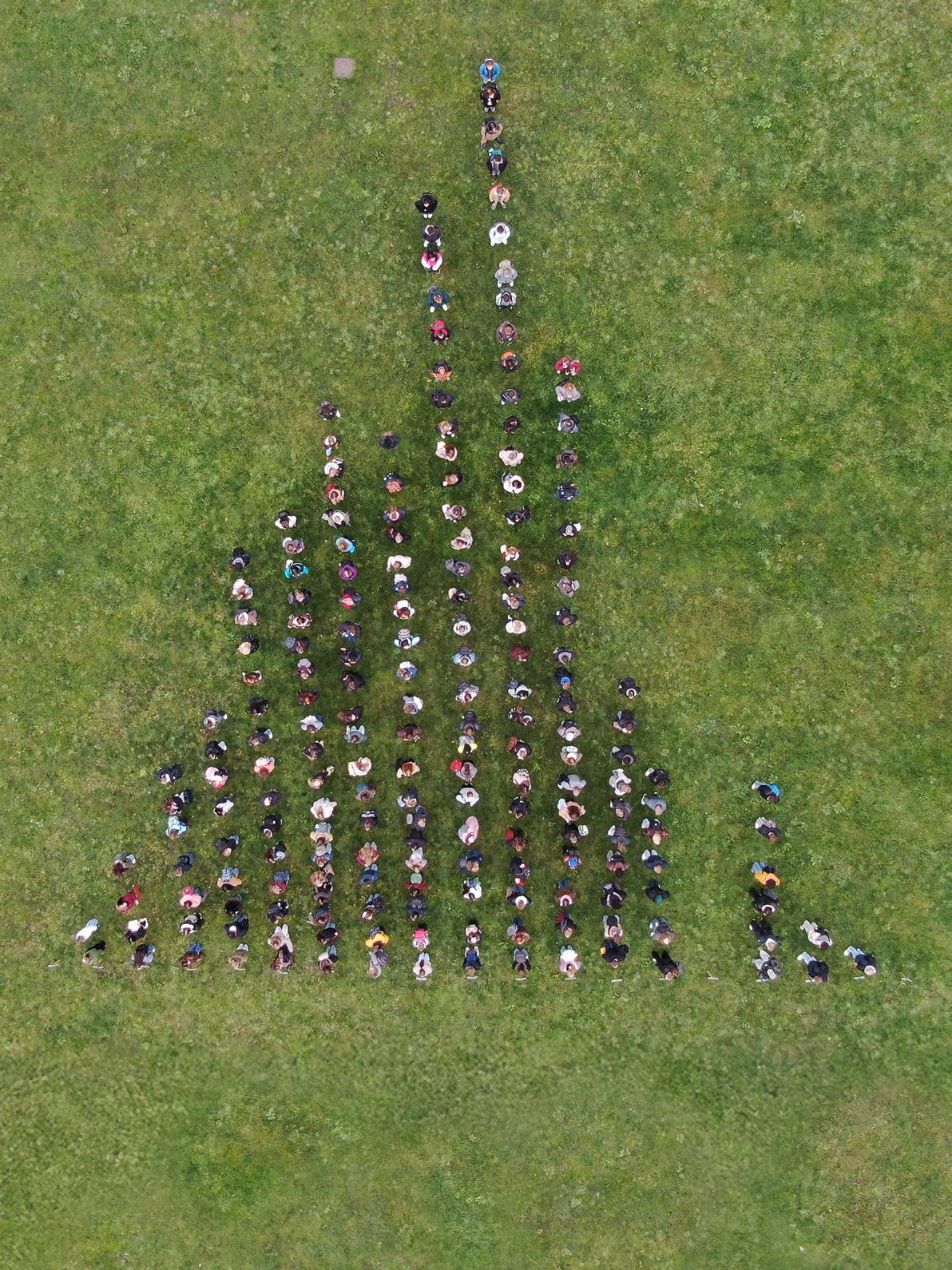
MEASURING 237 STUDENTS
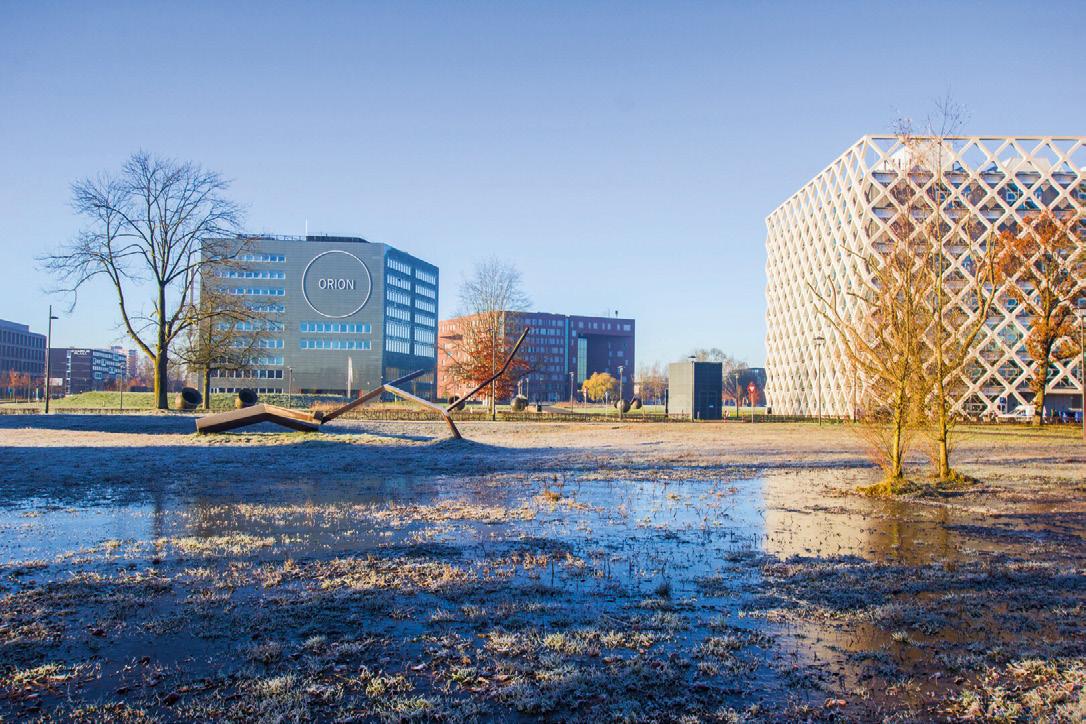
Every year, a striking event — the living histogram — takes place on the lawn between Atlas and Forum. This year, 237 students were mobilized for this practical activity in the Fundamentals of Genetics course. Genetics teacher Sijmen Schoustra: ‘The distribution peak was around 175 centimetres this year.’ Duur Aanen, a professor in the Genetics chair group, adds: ‘Average heights in the Netherlands were increasing steadily up to five years ago. Heights are now plateauing, which we see reflected in this annual measurement.’ wa
Photo Bas Jonkers
Comment Fact & fiction
WUR’s new website had been live less than one hour on Wednesday last week when the first comments started to appear on Engage (the new intranet). WUR staff were agreed the form was a major improvement on the old website, but... There is indeed a major ‘but’. Researchers, other staff and students immediately started testing the search engine, which uses artificial intelligence. The results were disappointing. It produces errors and misleading information or finds nothing at all.
WUR has launched a search engine that doesn’t know its scientists, can’t find its buildings and sends users on a wild goose chase. Schoolchildren looking for a degree programme are quite likely to get the wrong information. In other words, this is a search engine that is (currently) unreliable, mixing fact and fiction. For example, the tool tells you WUR doesn’t have binding study advice (BSA) for its BSc degrees whereas it does. That should be a cause for concern for an organization that takes its role as science institution seriously. Because each erroneous search result damages the reputation of WUR as a place for research and education. A reputation that needs to be defended robustly now more than ever.
WUR does not seem to share the concerns of its employees. The organization’s initial response on Resource-online was to call on everyone to inform communications staff of the correct information if they saw any errors. And above all to trust in the self-learning capability of the search engine. It will be all right in the end. Maybe, but putting your scientific reputation in the hands of a flawed large language model from the US is hardly worth this self-learning experiment.
Wageningen SURI-NL wants WUR involved
The new Wageningen SURI-NL foundation wants WUR involved in restoring links with Suriname. The links between the Dutch agricultural university town and the Surinamese rice-growing village of the same name were broken after Suriname gained independence 50 years ago. ‘Given WUR’s past in Wageningen, I would really like it if WUR investigated how to get involved as a partner in our foundation,’ says lecturer and International Land & Water Management programme director Bert Bruins. ‘Let’s start by listening properly to their experiences in the colonial era. And then we can look at how we could restart collaboration.’
Rice is still cultivated on a smaller scale in and around the tropical Wageningen. Bruins sees options there for WUR to provide knowledge. ‘I also think it is interesting to look into what we could learn from the historical model village of Wageningen.’ rk
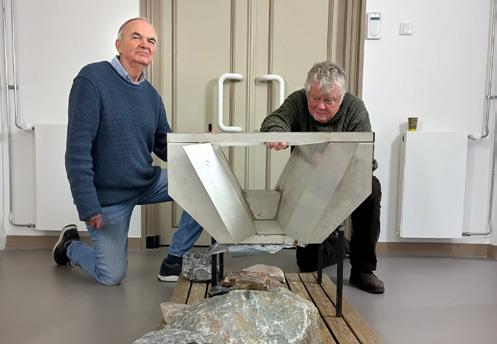
Home wanted for prototype
This Comment presents the views and analyses of the editorial board, formulated following a discussion among the editors.
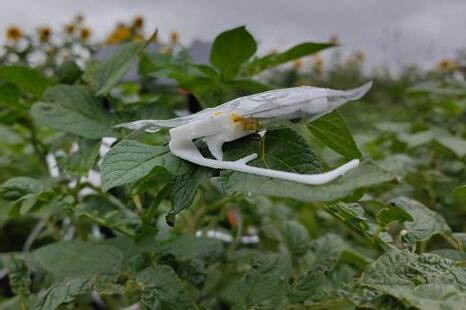
The device in the photo is a flume. Former WUR employees Henk Ritzema and Herbert Diemont are looking for a new home on campus to display the instrument, which was designed in the 1980s by Professor Rien Bos, former head of the irrigation institute ILRI (now part of WUR). The device gives a simple way of measuring the flow rate of a water course and is still widely used. Bos’s widow is donating this prototype to WUR. At least, if a new location can be found for this heritage object. Ideas are welcome; please contact h.p.ritzema@planet.nl. rk
Photo Resource
15
The traditional end-of-year gift for staff from the Executive Board is worth 15 euros this year, which is 40 euros less than in previous years. The reduction in the amount will save over 300,000 euros, which is necessary to meet WUR’s cost-cutting target. Staff will be able to spend the 15 euros on a product or service from an ‘organization with a social purpose’. rk
Silver after 20 years of gold
The Open University (OU) has overtaken WUR to take top position in the 2026 edition of the Dutch University Guide. Last year, both WUR and the OR scored 68.5, sharing first place. But now the Open University has increased its score to 72.5 (+4) while WUR’s dropped to 67.5 (-1). It means Wageningen is still the best ‘normal’ university, as the OU is a non-traditional university with a focus on flexible distance learning.
Dean of Education Dick de Ridder says there is no reason to panic. ‘These are small annual fluctuations. The scores are also relative with respect to other universities. They too are working on improving the education they deliver and are getting closer to us.’ lz
ALMOST ONE THIRD OF PROFS ARE WOMEN
The share of female professors at Dutch universities was 29.9 per cent at the end of 2024. That means the symbolic threshold of 30 per cent — often seen as the critical mass for genuine change — has essentially been achieved. These results come from the Monitor published last Tuesday by the Dutch Network of Women Professors (LNVH).
The Monitor is based on figures from the national association of Dutch universities for the end of 2024 — so slightly older data than Resource recently used to show WUR had achieved its own target of 30 per cent. The proportion of women among Wageningen professors was still 28.5 per cent at the end of 2024, putting it in tenth position in the Monitor. WUR has made huge progress since 2014, when targets were first set for the share of female professors. With women making up only 7.6 per cent of professors, WUR scored worst of all the Dutch universities. In the current ranking, Delft University
of Technology brings up the rear (18.6 per cent). Delft is also the only Dutch university to see a fall in the proportion of female professors over the past year. The best performers in the Monitor are the Open University (42.8 per cent), Maastricht University (36.2 per cent) and Leiden University (34.2 per cent).
LEAKY PIPELINE
In addition to the m/f breakdown, the Monitor also looks at where professors are from. There are more academic staff from abroad, but their share
declines the further up the career ladder you look: there is a ‘leaky pipeline’. Internationals make up 58.1 per cent of PhD candidates but only 24.1 per cent of professors. The leaky pipeline is a problem for women too. That is particularly evident in the step from assistant professor to associate professor (from 47.6 per cent women to 36.6 per cent) and the following step up to professor (from 36.6 per cent women to 29.9 per cent).
Big increase in past ten years in share of female professors at WUR: from 7.6 per cent to 28.5 per cent.
Now that the target for 2025 has been achieved, LNVH has asked the universities to come up with new targets for 2030. WUR has gone for 40 per cent, which is slightly more than the sector average (36.9 per cent). me
Illustration Valerie Geelen
letter to the editor
Wageningen’s awkward colonial legacy
There is another town called Wageningen, located in Suriname. The two towns with the same name share entangled roots in the history of Dutch colonialism. We were pleased to see Resource reporting about this history (‘Tragedy of a rice-growing village’ (Resource, November 2025)). Unfortunately, the article has many factual errors and lacks nuance. What’s worse, a Wageningen student’s thesis is misused in the story. Colonialism is a sensitive topic that requires attention to historical complication and the sentiments it evokes today. The Resource article fails in both. The opening line is the best illustration. The rice-growing village of Wageningen in Suriname was not a colonial project of the Agricultural College but of the Dutch government, nor was it a successful colonial project. Presenting the rice scheme as a technologically superior colonial intervention that failed after decolonization is far from the truth. The rice scheme was an ongoing technical trial plagued by persistent problems. Structural financial losses could only be reduced due to import measures that privileged ‘Dutch’
In brief
WUR continues to support elite-athlete students
WUR students who play sports at the highest level can continue to rely on support from the university. At the end of November, WUR signed the Flexible Education and Elite Sport Agreement. In this agreement, universities undertake to offer structural support for the next eight years to students who combine a degree with elite sport.
For example, universities have to offer flexible education that lets top
athletes combine their degree studies with training and matches or races, and provide forms of financial support that make doing a degree financially feasible for elite sportspeople. dv
Francerious Request
KSV Franciscus raised almost 6,500 euros with this year’s edition of their annual three-day charity radio marathon. This year, the money will go to AED Wageningen, a foundation that wants to reduce the number of people dying from heart attacks. The
rice from Suriname in the European market. In the end, the project never succeeded in its original goals. Yes, some Surinamese continue to praise the project, but to suggest these are the only voices present is a gross misrepresentation of this history.
The article ends by suggesting that ‘colonial’ is an opinion. Kleis writes: ‘Nowadays, we would call the rice-growing village of Wageningen a colonial venture.’ Well, we have news for you; when the project was designed and implemented, Suriname was a colony of the Netherlands. How can this project not be colonial? Even more problematic is how this ahistorical interpretation is used to discredit a Wageningen student. The student was not even asked for a response. This is unacceptable in a university magazine. With the topic of (de-)colonization gaining increased attention, let's have dialogues based on solid research and arguments!
Harro Maat (KTI), Emmanuel Adu-Ampong (GEO) and Birgit Boogaard (KTI)
money is enough to buy six new AEDs, which cost about 1,000 euros each. The cash could also be used for training courses so more people know what to do if someone has a cardiac arrest. Most frequently requested song? Staying Alive by the Bee Gees. lz
More toad pools
Three toad pools will be created on the north side of Dassenbos wood. It means toads in the wood will no longer have to cross the bus lane to get to the pond on the other side to
reproduce. They can still go there if they want as the two habitats will be connected by a tunnel under the bus lane and adjoining new road. The new pools will be in a secluded field on the edge of campus, near Noordwest residential district. This plot of land is currently overgrown with brambles. rk
Read more at resource-online.nl
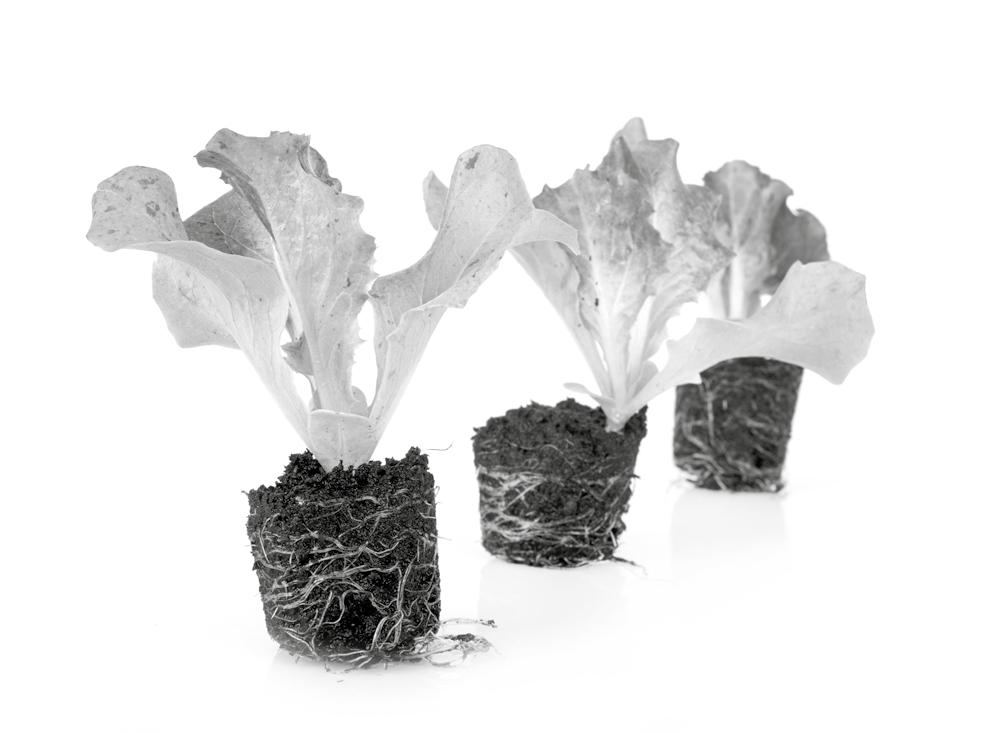
Rested lettuce grows faster
Everything in nature has its own rhythm. The circadian (day-night) rhythm is perhaps the most prominent example. If you resist that natural urge, you will eventually run into problems. The same applies to plants, shows research by Cèlia Anton Sales.
Text Roelof Kleis Photo Shutterstock
The PhD candidate from Barcelona investigated the internal clock of lettuce plants. Does the modern, cultivated lettuce have the same internal clock as wild variants? Does that affect the plant’s growth and, if so, should you keep the plant happy by adapting the surrounding day-night pattern? The answers to those questions are no, yes and yes.
These questions are being asked for good reason. Anton Sales’s study, for which she received a PhD with distinction, is part of the Dutch Research Council’s Sky High programme, which aims to improve vertical agriculture. Lettuce is an important crop in vertical agriculture, where plants are grown in strictly controlled conditions. Yes, the internal clock of commercial lettuce plants differs a lot from that of their wild ancestors. ‘The retardation is as much as five hours in some plants,’ says Anton Sales. ‘The average for the lettuces I studied was almost three hours.’ She discovered this by tracking the movement of the lettuce leaves using time-lapse images.
Theatre
taken from the collection of the Centre for Genetic Resources (CGN). Lettuce plants were domesticated 4,500 years ago in the Caucasus. Many varieties
The internal clock of commercial lettuces differs a lot from that of their wild ancestors
The leaves move rhythmically up and down during the day. Photos of this (taken every 20 minutes for seven days) can be used by a trained computer to figure out the lettuce’s internal clock accurately. ‘My lettuce theatre’ is Anton Sales’ tongue-in-cheek name for the experimental setup: a camera on the stage and lettuces as the audience. Anton Sales tested 234 lettuce varieties
were developed as a result of adaptation and breeding as the plant gradually spread to the Netherlands. CGN actually has a thousand varieties.
The delay in the internal clock is an unintended side effect of the breeding.
this changed the internal clock. Development processes in plants are always related to time.’
Getting rest
However, Anton Sales made her most important discovery when she let the lettuce plants grow with their own 27-hour day. That resulted in a spectacular increase in growth of up to 30 per cent. But only if the night was made longer. In other words, if the plant got enough rest. There is an obvious explanation for this.
‘The plant produces a lot of sugar and stores energy during the day,’ says Anton Sales. ‘At night, that is slowly used up for the growth processes. The better you use those resources, the more you grow. The limiting factor for growth isn’t the energy production during the day: it’s the use of that energy at night. You do your growing at night.’
Live&Learn
A botched experiment, a rejected paper: such things are soon labelled as failures in academia. As for talking about them — not the done thing! But that is just what WUR scientists do in this column. Because failure has its uses. This time, we hear from Dora Schouten, a Master’s student in Animal Sciences. Text Nicole van ’t Wout Hofland
Illustration Mathijs Megens/SeaBleuBird Studio
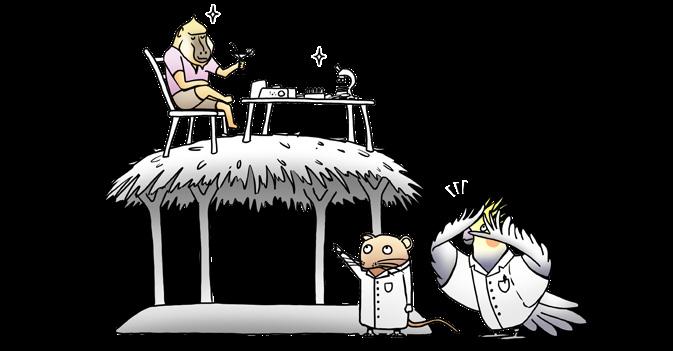
‘Last year, I went to a remote research station in Kenya for my graduation project to analyse the diet of hyenas. Together with four other students, I worked in an improvised lab consisting of a single-room wooden building with posts and a thatched roof, where we were surrounded by baboons. A large table was used as a lab table. There were no materials, so I brought a suitcase with me from the Netherlands with a portable PCR lab, pipettes and test tubes. I’d calculated precisely how much I would need of each material. Everything was neatly arranged in bags.
‘Towards the end of my research, my fellow students and I skipped a couple of hours of fieldwork to watch a local football match. When we got back, I found “my” lab in complete disarray. The books and papers that had been on the top shelves were now on the floor, my bags of materials had been opened and the contents scattered over the floor. I looked at my fellow students in amaze-
ment. Who’d been at our things? The station was so remote that normally there would be nobody around. It was only when we saw one bag high up on a post that it twigged: the baboons had been inside and played with our things.
‘When we got back, I found “my” lab in complete disarray’
‘Fortunately, 70 of my DNA samples were stored away safely, but the equipment the monkeys had got hold of was no longer sterile and therefore unusable. Even though it cost me some of my analyses, we could still laugh about it. It was also a valuable lesson in fieldwork practice. A thatched roof doesn’t provide enough protection in the African wilderness and inquisitive animals are simply part and parcel of the work. A new group of students will be going to the same research site in March and I’m helping them prepare. I already know what my first recommendation will be: whatever you aren’t using should be locked securely away.’
Looking for oddballs
There is no place on Earth without life in some form. Microorganisms can survive the most extreme conditions. Scientists call these microorganisms extremophiles. WUR heads a consortium that will be searching in Europe, the Arctic and Antarctic for such life forms — to learn from them.
‘We want to know how the microalgae manage it,’ says the research manager Iago Teles. ‘These organisms are unique because most other organisms can’t survive in such conditions. What substances and mechanisms let them do that? Once you have that fundamental knowledge, you discover new applications.’ The consortium is called Xtremolife. The European Union is funding the research to the tune of 4.5 million euros. WUR is coordinating the research. The researchers will be looking for examples in the Tabernas desert in Spain, in volcanic environments on the Canary Islands and in the Arctic and Antarctic.
Viking Cruises
‘These organisms are unique because most other organisms can’t survive there’
The microorganisms that survive in those environments are able to cope with extreme temperatures, high salinity or acidity, or very dry conditions. Those extreme conditions are also the reason why relatively little is known about this life: it is hard and therefore expensive to collect specimens. Xtremolife is dealing with this by making use of the existing infrastructure, says Teles. That includes the ships of the company Viking Cruises, where Norwegian scientists have access to a laboratory. ‘They have a FerryBox for transporting water samples. We are adapting that for use in the extreme locations. Some of the work on board can be done by passengers who lend a helping hand.’ Teles hopes to join the expedition to the Spanish desert. ‘And perhaps to Antarctica. As well as coordinating everything, our main role is in discovering new metabolic mechanisms and how we can use them and scale them up at AlgaePARC, Wageningen.’ rk
GETTING TEENS TO EAT HEALTHILY AND SUSTAINABLY
What do young people need if they are to eat healthily and sustainably? PhD candidate Anouk Mesch asked experts and the young people themselves. ‘They need autonomy, but they can’t solve it on their own – and don’t want to either.’
Text Dominique Vrouwenvelder
In November, Anouk Mesch obtained her PhD for her research into ways of helping and encouraging adolescents (ages 10-19) to eat healthily and sustainably in the secondary school setting. She consulted experts in fields such as healthcare, public health, nutrition, sustainability, developmental psychology and educational sciences — and the young people themselves.
In general, experts and young people listed the same factors as influencing their food choices. ‘The need for autonomy, the social side of eating, and the influence of food availability and prices,’ explains Mesch. ‘They just treat those factors a bit differently.’ Young people ‘enjoy doing things with friends’, says Mesch, and they like to get away from the school environment for a while.
‘Experts call this phenomenon peer pressure, which has a more negative connotation.’
OWN CHOICES
Adolescents want to make their own choices. Mesch: ‘If you impose things on them, they resist. But if you get them involved, they’re much more open to healthy and sustainable food choices.’
At the same time, many adolescents think that providing healthy and sustainable food is their parents’ or carers’ responsibility. ‘That’s the weird thing about that age: they want to do a lot themselves, but don’t want to feel responsible for it.’ According to Mesch, we
therefore need to be careful: ‘Involving young people in the solution doesn’t mean that they will be responsible for it.’
POCKET MONEY
At school, young people want healthy and sustainable options that are affordable. ‘The pupils said that they get smaller portions and have to pay more if they choose the healthy and/or sustainable options. School canteens are expensive and the youngsters get better value for money at the supermarket.’ The price to quality ratio is important for this target group, as they often only have limited budgets with cash from pocket money and (sometimes) parttime jobs.
Many pupils also said that they do eat healthily and sustainably at home, which they feel gives them a free hand to choose whatever they want when eating out.
Mesch: ‘I also noticed that the pupils initially struggled to articulate what sustainable eating is. Saying what’s healthy is fine – fruit and veg – but if you give them a specific task to work on, they eventually turned out to have some great ideas about sustainability too.’
For adolescents, walking to the supermarket is mainly a social activity they do with their friends. Photo Shutterstock
PhD theses in a nutshell
Hippo grass fertilizer
Invasive species such as hippo grass and water hyacinth are clogging up rivers in Zambia and other tropical areas. Chindi Kapembwa investigated whether you could make a virtue of a necessity by turning the plants into fertilizer. The answer is yes. It works very well, in fact. Compost from these water plants improves the soil and yields better sorghum containing more protein. But you have to make sure not to use water plants that grow close to industrial areas. The plants absorb heavy metal pollution from the water, and you don’t want that in your soil or crops. rk
Exploring the potential of invasive aquatic weeds to supply N to tropical soils.
Chindi Kapembwa Supervisors Gerlinde de Deyn and Sijmen Schoustra
CRISPR-Cas from the soil
CRISPR-Cas doesn’t always do well in applications in plants. Lisa Olijslager wondered whether that was because the proteins used are specially evolved to work at the body temperatures of mammals. She searched for (and found) CRISPR proteins in bacteria that live in the soil. She tested them on plants. That produced new enzymes that make cuts in new, unique positions in the DNA. As expected, they do so at lower temperatures than the usual CRISPR proteins, but unfortunately they are not any faster or more efficient. A shame, but the idea was brilliant rk
From Defence to Design. Lisa Olijslager Supervisor Dolf Weijers
THE PROPOSITION
PhD candidates explain their most thought-provoking proposition. This time it’s Jessica Ruijsch, who received her PhD on 25 September for research on the impact of land restoration projects on the local climate.
Text Ning Fan
Cheese
G ouda cheese can take up to two years to mature. Time is money, so could this be speeded up, for example by starting the process with different bacteria? Hans Brandsma studied the option and has come up with a new set of starter bacteria. The development of flavour in cheeses is a complex process that involves a lot of factors. So that takes a lot of time. Brandsma himself took 20 years (!) to write his doctoral thesis. He admits in his acknowledgements that it could have gone faster. You certainly need supervisors with perseverance. But it’s worth it for the end result rk Designing starter cultures to enhance flavour development in Gouda Cheese Johannes Bernhard Brandsma Supervisors Marcel Zwietering and Eddy Smid
‘To overcome procrastination, one should stop thinking and start writing’
‘Many students struggle with writing and tend to postpone getting started. I once read an article saying you don’t need to have the full picture in your head before you start writing. This resonated with me because procrastination often comes from wanting to think everything through first, while the act of writing itself can help you clarify your ideas.
‘This is especially relevant for a PhD thesis, which is a large document that gets reviewed repeatedly and takes a lot of time. It’s understandable that PhD candidates feel overwhelmed, especially because they don’t fully know from the start what direction their project will take.
‘As regards my own experience, I usually create some initial figures to see what my main results look like, and then just start writing. During writing, sometimes I realize I’m missing a figure or result needed to communicate the article properly.
‘Starting to write is a good way to overcome procrastination. Your draft doesn’t need to be perfect; through writing, you form your thoughts, see what is already there and identify what is still missing. Each sentence moves your ideas forward and makes the article clearer.’
The sound of silence
‘We resignedly endured the torture’
I have to give two tutorials in Room 63 in Leeuwenborch. I turn on the system on the teachers’ PC: Projector On. The computer screen appears behind me — and we immediately hear an insistent noise coming from above. It sounds like the rattle of a dodgy fan. With a bit of imagination, you could think of it as rats running back and forth in the space above the ceiling. The sound is unbearable. What on earth can I do to stop it? Set the volume to zero?
Reboot the computer? Nothing I try works. Fortunately, a student comes up with a solution. ‘You should attach a microphone to it.’ A microphone? The classroom is not big enough for me to need a microphone and there isn’t one lying around. But I have to do something so I go to the reception desk. ‘That’s right,’ says the receptionist, ‘a microphone helps!’ Back in the classroom, I optimistically turn on the wireless microphone. The rattling sound continues. ‘No good,’ I say apologetically to the students
Sjoukje Osinga
and I put the microphone to one side. It didn’t seem a likely solution, to be honest. ‘We’ll just have to put up with the noise,’
I say and we start the coding assignment, resignedly enduring the torture.
Then the next group of students arrive and they too recommend plugging in a microphone. ‘I already tried that and it doesn’t help.’ ‘No, really,’ insists one student. I sigh and go back to the receptionist to ask her again what to do. ‘We’ve investigated everything and we don’t why but the microphone does do the trick!’ she says. ‘Did you turn off the mute?’ No, that didn’t seem a logical thing to do given that I wasn’t actually using the microphone. But when I get back to the classroom, I slide the mute button to the other side... and a wonderful silence descends on us. The moral of this story is threefold. 1. Students know more than you think. 2. Embrace the unlikely: unmuting can deliver silence.
3. Even at university, you don’t always have to understand why something works.
Sjoukje Osinga (58) is an assistant professor of Information Technology. She sings alto in the Wageningen chamber choir Musica
Vocale, has three sons who are students and enjoys birdwatching with her husband in the Binnenveldse Hooilanden.
An interview about Gaza
‘It is a constant dilemma’
There may finally be a ceasefire in Gaza with Israel and Hamas negotiating a peace, but that has not brought an end to the debate — at WUR and elsewhere.
Resource has been asking the Executive Board for an interview about the Gaza issue for months. We never got an outright ‘no’, but we didn’t get a ‘yes’ either. Until now: the rector magnificus Carolien Kroeze has agreed to an interview. ‘On behalf of the whole board,’ she stresses. ‘We coordinate matters intensively on this issue.’
The Executive Board has been relatively quiet on this issue over the past few months compared with the activists, who regularly made themselves heard.
A deliberate choice?
‘No. I find it painful to hear or read sometimes that we — the Executive Board — don’t want to talk. That is just not true. We discuss Gaza a lot. I’ve discussed it with the activists a dozen times or more and recently we’ve talked about it a lot in our regular meetings with various university bodies, such as the Academic Board not so long ago. We share our thoughts openly then. These are valuable discussions that also help me to understand why people feel as they do.’
‘When people say “nothing is happening”, they mean what’s happening is not what they want’
‘We discuss Gaza a lot’
Text Marieke Enter
But it seems like silence because the outside world doesn’t hear about those discussions.
‘Perhaps it’s a deliberate choice not to publicize them.’
Why not?
‘Why should we?’
For example, so as not to give the impression that WUR is not doing anything about the Gaza issue, which is the criticism being made?
‘Often, when people say “nothing is happening”, they mean that what’s happening isn’t what they want. They may be right — we make our own choices and don’t always do what people ask of us. But that doesn’t mean nothing is happening; in fact, lots is happening.
That false impression is one of the reasons I’m here now, to share with Resource what we are doing. Although I realize we won’t be able to please everyone, given the many opinions on this issue.’
Some harsh accusations have been levelled at the Executive Board: for example that you have blood on your hands and are complicit in genocide. How does that make you feel?
‘Every time, I remind myself this is about the rector as a role, not about me as a person. It’s not nice, but to some extent it’s part of activism; you see the harshest
words on social media, banners and posters. It has never stopped us from engaging in talks with people. The tone is usually quite a bit milder then. About 1,500 people signed the petition for WUR to break its institutional links with Israeli institutes. I think all those people, like me, are genuinely concerned about the inhuman conditions in Gaza and other conflict zones. We can relate to one another in our feelings of concern, impotence and anger.’
Other universities have broken those links or issued statements condemning Israel’s conduct in Gaza. Do the universities discuss this with one another?
‘We talk about this a lot together. We all have the same concerns about armed conflicts and geopolitical developments. However, we differ in how we deal with the issue. Some universities elect to break the institutional links, in part because of the context in which they operate and the kind of research they do — I won’t mention any examples. Incidentally, we are surprised time and time again by how the media exaggerate the differences, whereas we feel we all stand up for the same values. The differences aren’t actually that big.’
Really? In Erasmus Magazine, for example, Annemarie Bredenoord said ‘academic freedom has limits when basic human rights are at stake’. Surely that is quite different to what WUR says?
‘I don’t think it’s that different. Our “Principles of Collaboration”, the criteria everyone at WUR is supposed to keep to, literally mention the endorsement of fundamental human rights. I often refer to those Principles when people ask me why WUR hasn’t broken the institutional links. A lot of things didn’t happen thanks to those Principles that might have been started otherwise.’
Could the positions adopted by other organizations make WUR review its own position? The Royal Netherlands Academy of Arts and Sciences recently noted the academic consensus on genocidal violence in Gaza, for example. And Radboud University has decided it won’t be starting any new collaborations that include Israeli science institutions.
‘We don’t think it is for WUR to make statements about geopolitical issues, but it is absolutely not the case that we are ignoring the situation in Gaza. Every time something new happens, we discuss it and make a new assessment. We are not just board members: we’re also human beings and we share the feelings
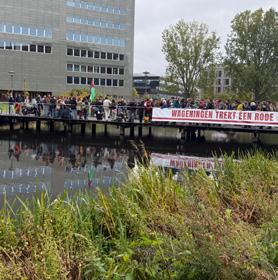
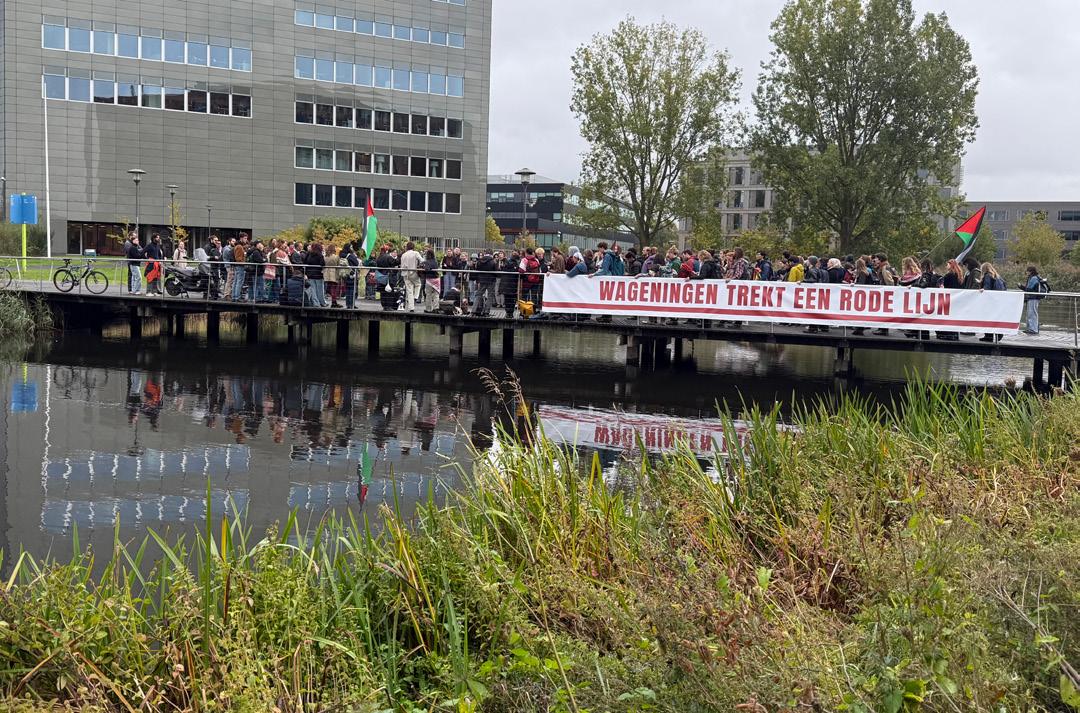
Protesters have regularly made themselves heard over the past few months, including in this demo last October. Photo Resource
‘We don’t think it is for WUR to make statements about geopolitical issues’
of anger and powerlessness in the face of the terrible situation in Gaza. Even so, as the rector, I still completely endorse WUR’s position of not making geopolitical statements.’
What’s wrong with that?
‘WUR carries out independent research and provides education at an open, safe campus where everyone can say what they want. People are allowed to demonstrate if they want to fight for a better world or disagree with something. That freedom is incredibly important and something we should cherish. But you restrict that freedom once WUR starts making geopolitical statements.’
Why? After all, WUR has made statements criticizing the destruction of rainforests or the haggling over nitrogen norms, say, without it damaging our freedom.
‘But those are statements about substantive issues that are clearly within our domain. We should definitely let our scientific voice be heard. It’s a different story if WUR were to start making geopolitical statements. They have consequences for the scope for carrying out research and providing education on topics that we choose freely, with methods that we choose freely and with scientific partners who we choose freely. In short, that restricts our academic freedom.’
Doesn’t the board ever wrestle with the urge to stand up to the suffering in Gaza and at the very least to make WUR’s voice heard?
‘Constantly! I can totally understand why people take to the streets about this. It is no coincidence that Sjoukje (Heimovaara, President of the Executive
Board; ed.) mentioned the starvation of the Gazans explicitly during the opening of the academic year — and that of people in Sudan, Tigray and Yemen as well. She literally said, “That has to stop — we all agree on this. We only differ in our opinions about the role of the university.” That difference of opinion is mainly on whether or not to break institutional links. The activists think we should do that, whereas our opinion is that it’s better to apply the Principles of Collaboration. I personally think it is much better to hold everyone to account individually for their personal responsibility, which is what happens with the Principles, rather than us saying what is and is not allowed in a top-down way.’
The criticism of the Principles is that it places responsibility very much on the individual but doesn’t really give people enough support for that. Several chair groups are therefore now considering developing their own extra decision framework. How do you feel about that?
‘I applaud people discussing the Principles with one another. The interpretation and application of the Principles are not cast in stone. However, it is crucial to keep the Principles as the starting point, while allowing everyone the freedom to make individual assessments on that basis. Everything is constantly changing in this world; each and every one of us needs to figure out again each time how to treat the situation.’
Talking about the world around us, does the Executive Board get approached much by lobby groups such as the CIDI (Centre for Information and Documentation Israel)?
‘We relate to one another in our concern, impotence and anger’
(Surprised) ‘No. Of course, we deal with stakeholders who have their own particular interests, but we never get lobbied from one specific side or group. And the Principles help us to weigh up all those interests carefully. Let me put it this way: our strategic plan is entitled Shape Responsible Change, and our vision on teaching states that we want to educate responsible change makers. WUR wants to bring about change and contribute to transitions in the context of improving the quality of life. We aim to do this responsibly, which means we do it independently.’ ■
Teacher of the Year 2025: Anneke Valk
Anneke Valk has been chosen as Teacher of the Year (TOTY) 2025. The biology teacher in Experimental Zoology has been nominated several times before but this is the first time she has been able to take the prize for best teacher home with her. The student jury calls Valk ‘an outstanding teacher with a mission to reconnect people with life’s wonders’. Text Luuk Zegers
‘She is passionate about everything life encompasses, from plants and animals to microbes,’ says the jury in its report. The jury also praises Valk for her perseverance. ‘Her teaching career began by overcoming a significant personal challenge: a severe stutter.’ It took her a long time to get a teaching position and she faced
numerous challenges. ‘But her passion for sharing knowledge led her to persist.’
Valk’s approach to teaching is student-centred in various ways, says the jury. She views her student assistants as worth their weight in gold and calls them ‘her “tentacles in the classroom”, using informal chats to get the most authentic feedback.’ Her
MCB-34303: Commodity Futures & Options Markets
Always wondered about what is happening at the trading floor of exchanges like the ones in Amsterdam, Paris, Frankfurt, London and Chicago? Wondered about how (agribusiness) companies manage their risks and improve their financial performance using commodity futures and options markets? Wondered about how it would be if you were trading commodity futures in Amsterdam, Chicago, London, Frankfurt and Paris?
The Marketing & Consumer Behavior Group organizes a unique course that will introduce students to commodity futures and options markets. Students will develop an understanding of the markets and how they work, gain knowledge about the theory behind futures and options markets, identify their economic functions, and develop an analytical capability to evaluate their economic usefulness. This course is taught by Prof. dr ir Joost M.E. Pennings (Marketing & Consumer Behavior Group, Wageningen University). There are only 40 seats available. If you are interested in taking this course (3 Credits) please register in Osiris or contact Ellen Vossen, e-mail: Ellen.Vossen@wur.nl, tel. 0317-483385. Lecturers are on Fridays in period 5 (one lecture is on Thursday), 0,5 day a week, please check schedule in TimeEdit for time and location. Prerequisites: None.
interest in genuine inclusion also gets praise. ‘She actively reads up on neurodiversity to ensure all learning styles are supported.’
Theatre
Valk believes it is important to learn certain practical skills ‘in real life’, such as the dissection of animals. She thinks replacing such dissection practicals with a computer program ‘cannot replicate the experience of feeling the immense value and fragility of an organ’. However, she also always offers dissectionfree practicals because she doesn’t want to force any student to dissect an animal. Outside the classroom, Valk is involved in sharing knowledge in various ways. In Amsterdam, she is working on a theatre show on hormones and the menstrual cycle, and in De Bongerd sports centre, she teaches Pilates.
Teachers’ Day
The prize was handed over on Tuesday 9 December — Teachers’ Day — but the
voting started last summer. WUR students were able to vote for their favourite teacher. That resulted in a top ten. All the teachers in the top ten were interviewed by a student jury, who then chose the top five and selected the winner.
Valk follows Hannie van der Honing (who teaches Cell Biology), who won last year and ended up in the top five again this year. The other teachers in the top five were Carlos Serrano Fajardo (Bioprocess Engineering), Giuseppe Olivieri (Bioprocess Engineering) and Wim Bosschaart (Spatial Planning). ■
her will be published in the next issue (22 January 2026).
We were unable to ask Anneke Valk for a reaction because Resource was being sent to the printer’s just as the award ceremony took place. A long interview with
Advert
PRIZE FOR FIRE WORK
‘Dr Fire-lady’ – Cathelijne Stoof – has won the Dutch Research Council Stairway to Impact Award for her efforts to help the Netherlands handle fires better. A welcome boost for transdisciplinary research.
Text Roelof Kleis
‘That's a typical journalist’s question,’ laughs Cathelijne Stoof. No, her research into integrated fire management is not based on a childish fascination with fire. ‘But experiencing a fire in the countryside is really quite something,’ she acknowledges, ‘and for my work, it is important to see fires regularly. So I go along every winter and spring to be present at controlled burns. You always learn new things.’
Her interest in fire arose during her PhD studies. After completing her degree in Soil, Water and Atmosphere, she was given the opportunity to carry out research as part of a large EU project on desertification. ‘The proposal also mentioned something about fire. I thought that sounded interesting. Fire hadn’t been covered in my degree. Of the four traditional elements – earth, wind, water and fire – the first three were in my study programme, but not fire. Which is a bit weird, in fact. In Portugal, I studied why floods and erosion occur after forest fires. That was what got me started.’ But that was in Portugal; there were no wildfires in the Netherlands. ‘It may
sound a bit silly, but I wasn’t aware of that at all.’ Her ideas about fire and combustion continued to smoulder during a postdoc at Cornell University (in New York state). Back at WUR, she developed PyroLife, an EU programme in which 15 European PhD students were trained as experts in integrated fire management.
Her ideas developed as she progressed, not least thanks to her many appearances in the media. This resulted not only in a lot of inventor mail (‘I get emails two to three times a month from inventors who’ve found a solution to a fire problem’), but above all in an extensive network of people with practical experience who are involved in wildfires. ‘That shaped my ideas about fire management, my line of research, and how we collaborate in transdisciplinary research.’
Living with fire
Creating connections between the stakeholders at different levels plus what she set in motion as a result have now earned her the impact award from the Dutch Research Council. The jury report
praised her influence on national and European policy on wildfires and her commitment to making landscapes and communities more fire-resistant. ‘The impact I had is that I set up Integrated Fire Management as a discipline in the Netherlands and north-western Europe. I don’t want people to be killed in wildfires, so we must learn to live with them. As a scientist, I can see that we have a problem: there are fires and we’re not well prepared for them.’
She has been saying that in the media for years now. Initially without much result. ‘Early on, my most critical comments were simply edited out. I noticed that this made me express myself more and more forcefully. There was one moment when I said on the current affairs programme Een Vandaag that it wasn’t a question of whether there’d be a disaster, but when. Not of whether there’d be fatalities, but how many. And that was broadcast.’
The real momentum for change came five years ago when the nature reserve De Peel was hit by a major fire. ‘That fire
really set the wheels in motion. There weren’t any fatalities, but it was a disaster for the province.’ Thanks to the efforts of the King’s Commissioner Ina Adema, the topic of wildfires was then put on the national agenda.
Since early 2022, students have been able to enrol in the Master’s course on Integrated Fire Management (initially called Pyrogeography). An average of 40 students take it every year. Stoof explicitly brings in practitioners and people in the arts in order to ‘teach students to look at the subject matter differently’. She believes that this transdisciplinary approach is essential. ‘I believe wholeheartedly that you can make science better and more relevant
if you work closely – on an equal footing – with people who have practical experience in the field. The social problems we are facing require that kind of approach to research.’
A critical note
However, this approach also has its limitations. ‘The things that let me have an impact aren’t what scientists could use in the old tenure track system to get promoted. Impact is generally seen as a nice-to-have “extra”. In theory, this will be taken into account within the new Recognition & Rewards career system. We’ll see. However, the system also expects you to be involved in the university’s governance, participating in committees and consultations. As a transdisciplinary researcher who works closely with people in the field and invests a lot
‘Early on, my most critical comments were simply edited out’
of time in impact, you can’t fulfil that expectation. You simply need that time to invest it in relationships and building trust. I can only spend each hour once.’ Stoof thinks that Recognition & Rewards is essentially a good system. ‘However, if we’re to see impact as an integral part of a researcher’s work, the culture has to change as well as the system. A university is a place for innovation. So make sure there’s a structure in place that encourages innovation and lets you develop new areas of expertise. Transdisciplinary researchers connect disciplines together, both within the sciences and beyond. Collaborations are difficult to get going, though. Setting up research so that it has an impact requires a shift in the culture. People who approach science differently come up against the limitations of the system. That’s demotivating. Winning a prize like this is something to celebrate, but I’m expressing this critical note nevertheless, now that I have this platform.’ ■
There was a large wildfire on the heathland near Ede in April 2025. It was caused by a mistake when letting off a hand grenade during a military exercise.
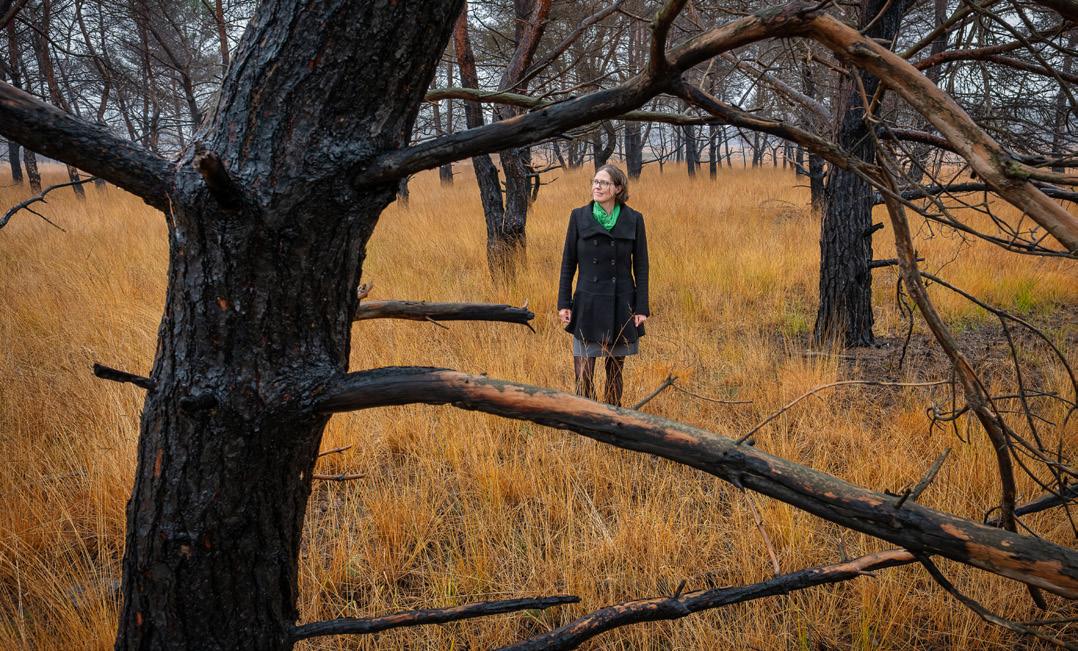
Cathelijne Stoof: ‘We’re still not well enough prepared for wildfires.’ Photo Guy Ackermans
Report: emergency kits in student houses
‘A TRUMPET RATHER THAN A WHISTLE’
The Dutch government wants everyone to be prepared for possible disasters by having an emergency kit at home. How well prepared for an emergency are Wageningen student houses? To find out, Resource called on ten randomly chosen student houses and went through the emergency kit checklist with them.
Text Luuk Zegers
Photo Guy Ackermans
‘Ithere’s a power cut, first we would eat our way through the fridge and freezer. Then there’d still be nonperishable stuff like pasta and rice. If we collected up the food, we would definitely last three days.’
These are the words of Meike from Huize Grafzicht on Generaal Foulkesweg, one of the ten student houses Resource surveyed. She goes through the emergency kit checklist with housemates Maurice and Marit. OK, they might not have a radio but at least they would be able to eat, concludes Maurice. ‘We use gas to cook, which should work even if there’s a power cut. If that’s not possible, we have a barbecue and charcoal. We’d cope.’
Water shortage
Food is not a problem in most of the other houses either, we discover. Water is a different matter: none of the houses has enough water in stock. The emergency kit checklist says you need three litres per person per day. ‘There are ten of us and we have a total of three litres of water,’ says Maurice. ‘So that’s rather less than the 90 litres we’re supposed to have according to the checklist...’ Meike: ‘But we do have five crates of
‘AS A HOUSE, WE ARE NOT TOO WORRIED ABOUT A DISASTER’
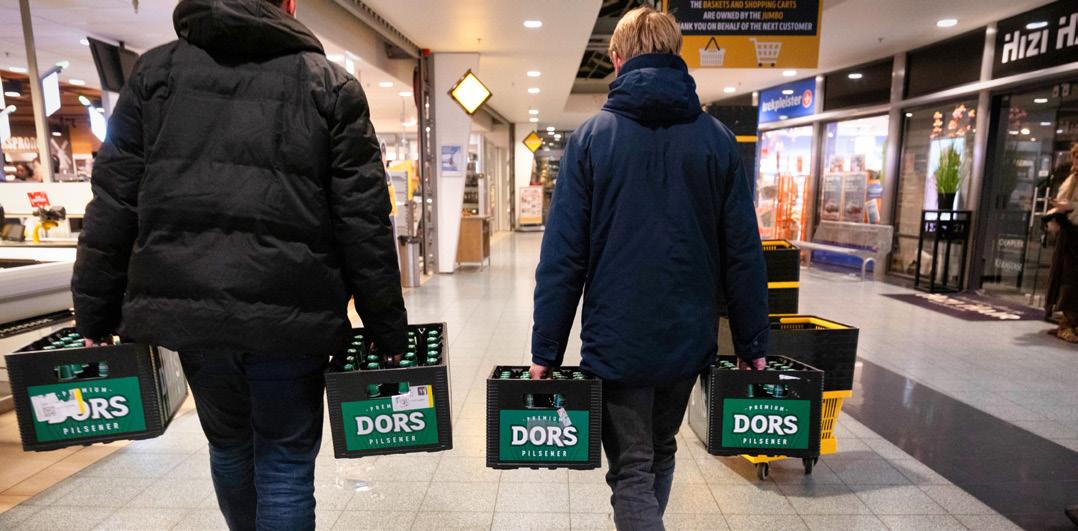
beer and some soft drinks. And we live close to SSRW, so we could probably get something to drink there.’ Faye’s house, with 14 occupants in the student complex M20, doesn’t have enough water either. ‘Water is really important, but there’s no room to store nine litres per person. We won’t do that unless there is a specific threat.’
Droevendaal residents discovered recently how useful it is to have supplies of water, says Diego. ‘When work started on the sewers next door, they damaged the water pipes, which meant the tap water was contaminated. At first we couldn’t use the water supply at all, not even to shower. Then we were allowed to start using it again, but only after we’d boiled it for ten minutes.’ The problem took ten days to resolve, he says. ‘We are considering always having bottled water in the house from now on.’
Diego and his housemates had also experienced a situation in which the heating broke down in the middle of the winter. ‘We have blankets and we were given an electric heater. That helped, but what if there’s an emergency where you don’t have heating because there’s a power cut and no gas? Then we’d have a real problem.’
His house is quite well prepared in other respects, says Diego as he goes through the checklist. ‘We have enough food, candles, matches, torches, a First Aid kit, blankets, toilet paper, toothpaste, tools, spare keys... We don’t have a radio, but I’m sure someone in
Droef will have one. And thanks to the checklist, we’re now thinking of making a list of everyone’s important phone numbers.’
Whistling for money
In addition to water, student houses score poorly for radios (only two of the ten student houses had one) and cash. Each person should have 70 euros in cash, according to the checklist. ‘One housemate happens to have 50 euros lying about in his room, but that’s it,’ says Vera (Churchillweg). No one at Mila’s place (Rijnveste) has any cash. They don’t manage 70 euros per person at the Ceres house H6 either, says Gijs. ‘We all have 15 to 20 euros at most, I suspect.’
Most houses don’t have the list of important phone numbers or the whistle you can use to let the emergency services know your whereabouts either. ‘But we do have a trumpet,’ says Gijs. ‘I reckon that would let us attract attention too.’
Not worried
Apart from the water, radio, cash and whistle, the students score quite well, in their own opinion. ‘We are certainly better prepared than we were expecting,’ says Marit from Grafzicht. Jurre, who lives in a Mouterij house, agrees. ‘We discovered we have almost
Jori Kalkman, associate professor of Crisis Management and Disaster Response, is critical of the government’s focus on the emergency kit. ‘Study after study shows that social cohesion is much more important in surviving a disaster than individual preparation.’ You can read what he has to say here.
EMERGENCY KIT
Everyone needs to be able to cope on their own for 72 hours in the event of an emergency such as a major power cut, digital attack or floods. You need to be able to survive without electricity, running water or the internet. The diagram below shows the main items in the checklist and how many of the 10 student houses had those items in stock.
everything already except for the water. And it simply isn’t realistic to have 90 litres of water in stock at all times. As a house, we aren’t too worried about a disaster happening. If something does happen, we’ll get in the car and figure something out.’
That neatly sums up the attitude of the student houses Resource visited. Although the checklist did make some students start to think about possibly making a list of emergency contacts or keeping spare keys and stocks of water, the predominant attitude seemed to be that they would always cope somehow. ■
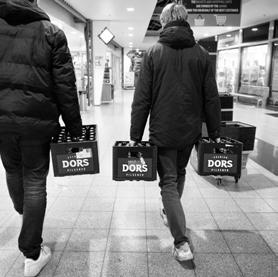
Most student houses have more plentiful stocks of beer than of water.
2025
A tongue-in-cheek news quiz
Along with all the news going on in the world last year, there was plenty happening on campus too. Things that might raise a laugh or make you frown, depending on your point of view. Resource takes a less than entirely serious look back at 2025 in 20 questions. Text Roelof Kleis
See page 39 for the answers.
1
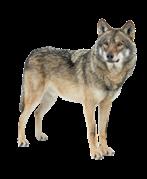
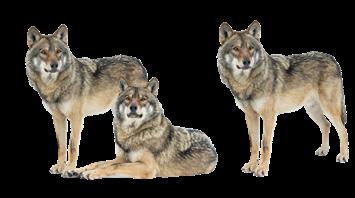
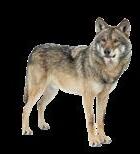
WUR researchers fitted five wolves with transmitters in the Hoge Veluwe nature park. Why?
A To make it easier for visitors to spot the wolves.
B To figure out how the wolves managed to get through the fence around the park.
C To see whether the wolves were bothered by the visitors.
D To pass on messages if they got too close to any sheep.
2
The course Farming and learning with the hidden half of nature was cancelled before it even started. Why?
A The Board President Sjoukje Heimovaara was dead against it.
B It would be looking at dowsing.
C The curriculum included the healing effect of magnetic fields.
D The course would include alternative techniques for sustainable agriculture.
3
The Resource ‘Seriously?’ feature reported on a controversial Dutch proposal to include animalus lingus in the BioBlitz that angered internationals. Which international was not quoted in the article?
A Kitty Swift.
B Robin Lamb.
C Jay Finch.
D Buck Fox.
4 Who said what?
‘I have been here all my life. Doing something else is fun.’
‘I am a worrier by nature.’
5
Dassenbos, the wood to the west of the campus, has been granted protected status to...
A cultural and historical significance.
B Better protect the wood’s badger colony.
C Make sure the campus ring road never gets built.
D Compensate for the construction of Aurora and the bus lane.
6
Typically Wageningen, except for this one.
A Worm charming
B Soil drilling
7
C Cattle inspections
D Veluwe run
On his departure, the Dean of Education Arnold Bregt was honoured with...
A A tile in the Walk of Fame at Impulse.
B The Arnold Bregt Fund for innovative education initiatives.
C A room named after him in Aurora.
D A royal honour.
‘I want to go back to my first love: research on cats.’
‘Size, size, size.’
B C D
1 Professor of Plant Ecology
David Kleijn
2 Ecologist Patrick Jansen
3 Teacher of the Year
Hannie van de Honing
4 Dean of Science Wouter Hendriks
8
WUR student and Dutch cattle assessment champion Arjen Peters got to inspect some fine cows. Which did he not inspect?
A Hennie 162
B Aaltje 213
9
C Gri 1
D Fanta 61
The Wageningen Dolle Minas held a demo on campus. Why?
A To argue the case for the availability of menstrual products.
B To offer a counterweight to the anti-abortion propagandists.
C To show their support for women in Gaza.
D Because they were fed up of the unfair treatment of women.
10
The European Commission approved a novel food developed by WUR. Which one?
A Water sponge.
B Seaweed.
C Gelderse Vallei bread roll.
D Duckweed.
11
The Brabant Student Guild celebrated its centenary with a marathon session of...
A Raving
B Binge drinking
12
C Cards
D Pole sitting
Activist group WURbleeding is worried about...
A The far-reaching impact of the cuts on higher education.
B The big increase in the sports pass costs.
C The availability of menstrual products.
D Dangerous crossings on campus.
13
Wageningen Technical Solutions designed a smart placemat for nutritional research. What is it called?
A The TRAYlor Swift.
B The Liz TRAYlor.
C The MAT Damon.
D The TRAYlor trash.
Outdoor workstation The Birdbox was dismantled because...
A The internet connection was awful.
B People were using it to smoke rather than work.
C No one was using it.
D It had been completely vandalized.
15
Who was NOT Education minister in the past year?
A Gouke Moes B Sophie Hermans
C Eppo Bruins D Robbert Dijkgraaf
16
Which WUR book was the inspiration for a musical that will be touring the Netherlands next year?
A The Turning Point by Marten Scheffer.
B Only Planet by Tim van Hattum.
C The Secret Fish Thief by students at the Future for Nature Academy.
D Pathways to African Food Security by Ken Giller and Michiel de Haas.
18 Who said what?
A ‘When things go wrong, I stay calm; that’s in my nature.’
B ‘Advertising should be illegal.’
C ‘It feels a little like winning the jackpot.’
D ‘I simply don’t thrive in an environment with a lot of fixed procedures and structures.’
1 Marten Scheffer, visionary
2 Roel Dijksma, lecturer
3 Lies Boelrijk, fundraiser
4 Emely de Vet, comeback professor
19
The artwork Light Applause in the Omnia room for PhD ceremonies is a gift from...
A WUpodium.
B The PhD Network Netherlands
C Alumni network KLV.
D Departing professor and artist Marten Scheffer
20
WUR is having to tighten its belt due to the cutbacks. What has gone as a result?
A The silver badge for MSc graduates.
B The certificate for PhDs.
C The Dies Natalis cake.
D The gold watch for employees celebrating 25 years at WUR.
17
The Student Council has started its own catering service, the Student’s Kitchen in Aurora. Why?
A To provide cheap hot meals for students.
B To earn some extra cash.
C To promote diversity at WUR.
D Because they think they are better cooks than the other caterers.
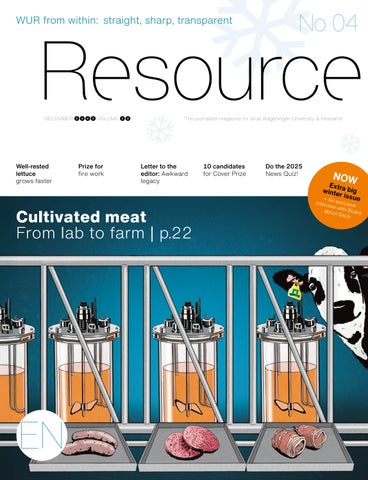
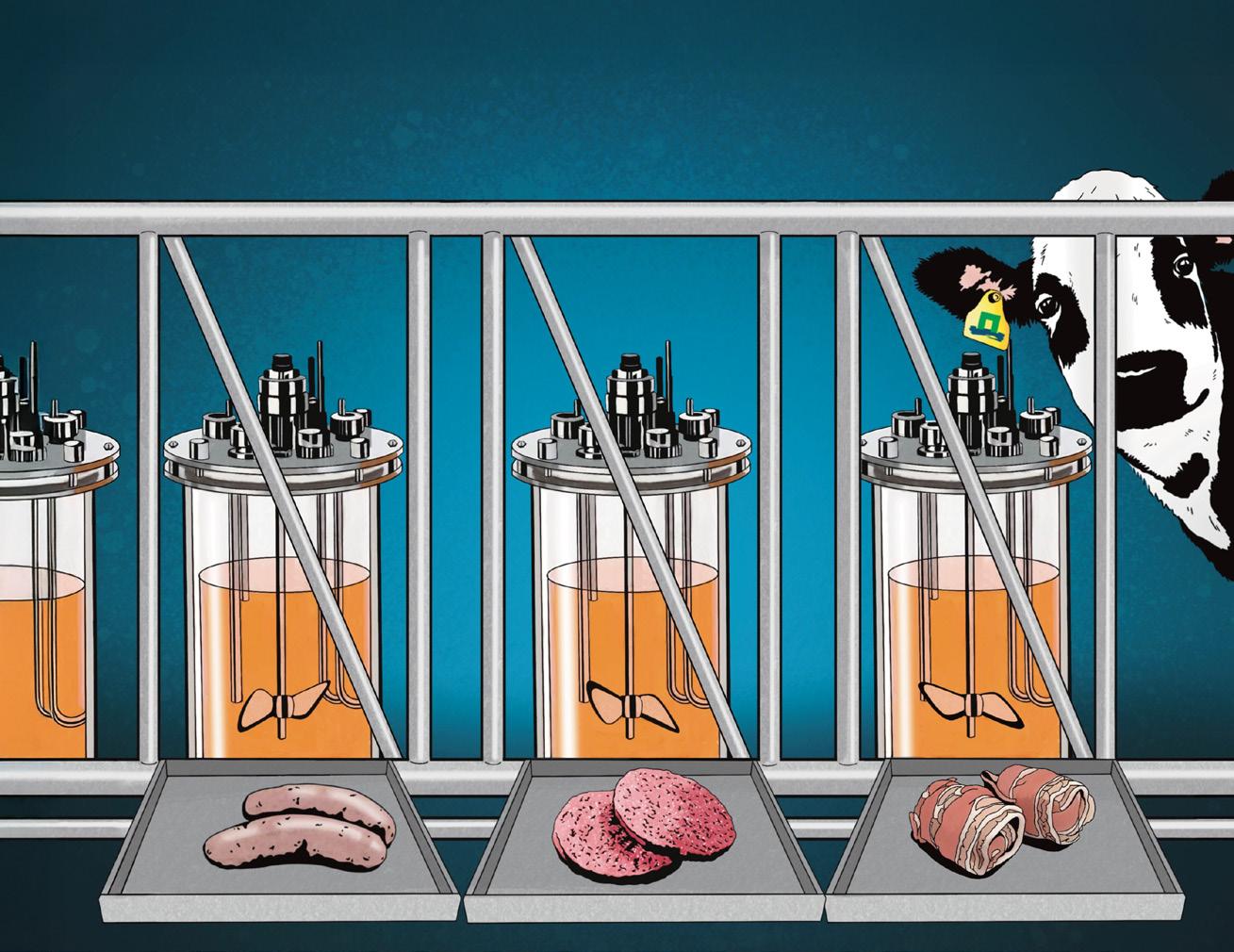
Cultured meat: from lab to farm
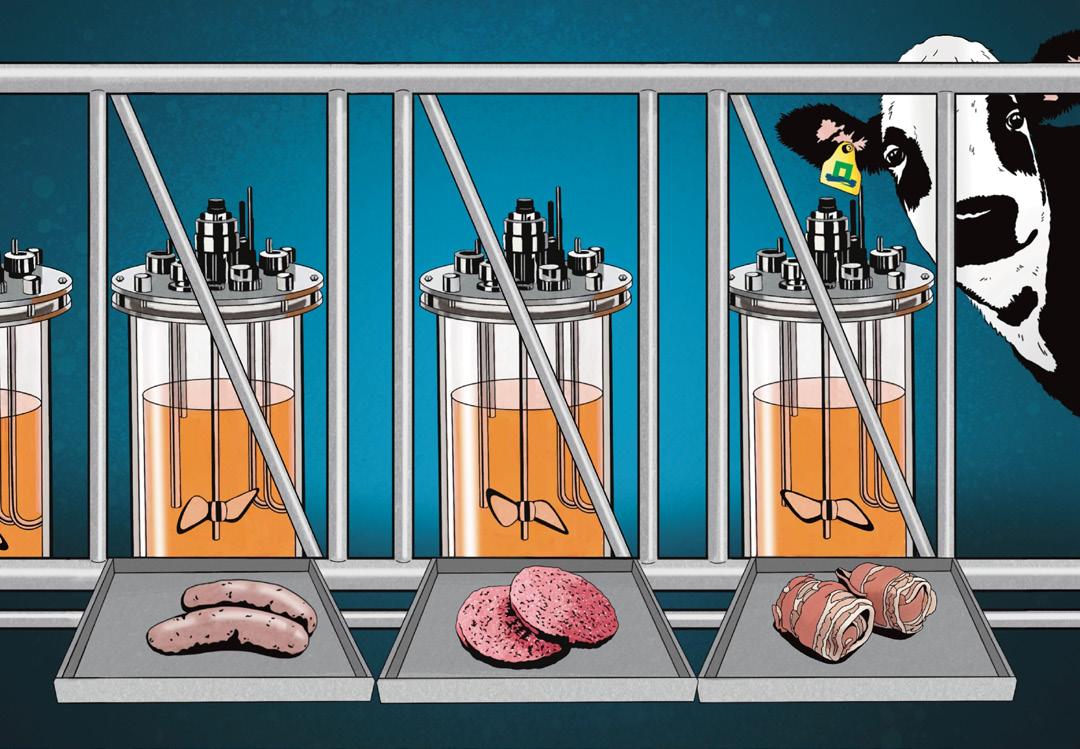
Radix recently acquired a small bioreactor for growing meat. If all goes well, an identical bioreactor will soon start operation on a farm in Schipluiden. Does that mean we will be eating cultured meat for Christmas dinner next year?
Text Marieke Enter and Dominique Vrouwenvelder Illustration Valerie Geelen
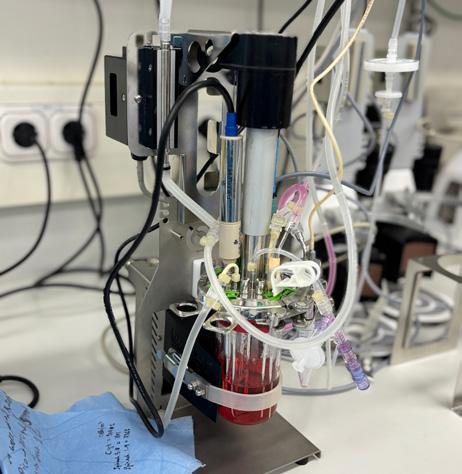
The new bioreactor looks a bit like an outsized microwave: a rectangular white metal unit with glass in the door that lets you see inside. The label reads CELL-tainer, but the researchers affectionately call the machine Isabella.
Isabella is rather bulky, especially when compared with the transparent mini-reactors nearby, which are filled with a pink liquid and have a tangle of tubes attached. Although the two types of bioreactor look very different, they essentially do the same thing: create the right conditions for animal cells to grow and multiply. However, unlike the mini-reactors with their delicate spaghetti of tubing, Isabella can handle up to 20 litres of product. This machine is also robust and foolproof enough for use on a farm; farmers won’t need a PhD in cell culture to operate it.
Porcine fat cells
Isabella is used by the Cellular Agriculture team, part of the Bioprocess Engineering chair group. They are currently using the device to grow porcine
fat cells. The chair group is a member of the CRAFT consortium, which aims to demonstrate that cultured meat can be produced on a small scale directly on farms. A bioreactor exactly like Isabella has been delivered to a farm in Schipluiden.
‘The concept is relatively simple,’ explains CRAFT project manager Affif Grazette. ‘We take a biopsy from an animal and mix the animal cells with a growth medium and other nutrients to get them to grow and multiply in a bioreactor.’ The researchers in Radix are working on optimizing the protocol for growing these specific porcine fat cells. If all goes well, the Isabella bioreactor will be able to produce about 60 to 80 grams of cultured meat from one batch of 20 litres in around seven to ten days.
That is as much, or rather as little, as two slices of ham. Grazette: ‘That doesn’t sound impressive, but we are not aiming to make a product made entirely of cultured meat. We want to make a hybrid product, in this case made partly from cultured fat cells and partly from plant-based proteins. The fat cells allow us to give the final product the same taste
‘In theory, cultured cells are identical to traditional meat but more environmentally friendly’
and mouthfeel that you would get with traditional pork meatballs. Colleagues from the Food Quality & Design group will determine the composition of the final product. I am expecting one portion from our bioreactor to be enough to make about four to six hybrid meatballs.’
Business model
Interestingly, cultivated fat cells and cultivated muscle cells require different nutrients, have different growth rates and their proliferation process is different. The porcine fat cells come from the UK company Roslin Technologies, one of the other partners in the CRAFT consortium. ‘We have been given their cells, their growth medium formulation and their protocol for scaling up. Once we get that process working, we need to transfer it to this type of bioreactor,’ Grazette explains. ‘And if that works, we will pass on the instructions to the dairy farmer in Schipluiden so that he can use his bioreactor to produce cultivated meat on his own farm.’ Further research will be conducted to scale up the production process from 20 litres to 200 litres. Initially, the idea is to use cultured meat production as a form of diversification in farmers’ business models. But in the long run, cultured meat could take on other roles too,
‘Who are we developing this technology for?’
for example as an element in a circular agriculture approach.
Grazette emphasizes that cultured meat is not fake meat,. Cultivated fat cells or muscle cells are exactly the same as their ‘natural’ counterparts. The same applies for cultured seafood: a cold incubator in the same Radix lab contains octopus cells, which prefer low temperatures. However, to date they have proven harder to multiply than bovine or porcine cells. In theory, cultured cells are identical to traditional meat but they are more environmentally friendly because you only cultivate the specific parts you need rather than the entire organism. That means less waste, for example in the form of bones, which are not suitable for human consumption. Cultured meat also requires less land and water. In addition, methane
‘Some farmers were open to the idea early on: cultivated meat can be an opportunity’
emissions are lower because cultured meat requires far fewer animals. A single 1 cm3 biopsy can provide enough cells for multiple bioreactor batches. So what are we waiting for?
Market
Cultured meat already has market approval in Singapore, the United States and Israel, but that is not yet the case in the Netherlands. Cultivated meat is still a confusing concept for consumers, explains associate professor Arnout Fischer (Marketing & Consumer Behaviour). ‘Is cultivated meat actually meat? What exactly is the definition of meat? The way cultivated meat is positioned will determine whether consumers embrace it,’ says Fischer.
‘For many people, trying cultivated meat will initially be a bucket-list thing. Convenience, taste and price will determine whether consumers buy the product again.’
Fischer doesn’t think cultivated meat has the potential to replace traditional meat. He sees it primarily as a way to make plant-based meat substitutes taste better and not so dry. ‘Fat cells
contribute flavour and prevent a product from drying out or sticking to the pan. That could significantly improve the current plant-based meat substitutes. A hybrid product – partly cultivated meat, partly plantbased – could compete with meat in terms of price, taste and convenience.’
Frog’s leg
Emeritus professor of Philosophy Cor van der Weele has studied consumers’ attitudes to cultivated meat in detail. She was involved in the early days of research on cultivated meat at WUR. She first encountered the idea about 20 years ago, through an artist who exhibited a live frog alongside a cooked frog’s leg grown from cells taken from that same animal.
‘In my research, I was interested not only in wellargued opinions about cultivated meat, but also in the questions people raise and the point at which things start to feel uncomfortable. Talking about it makes people reflect on what they take for granted and what not. After an hour and a half of discussion, people often became more used to the idea of cultivated meat and a little more alienated from conventional meat. There was a lot of ambivalence about both.’
That ambivalence runs through much of our food system. Acknowledging that can lead to new solutions,
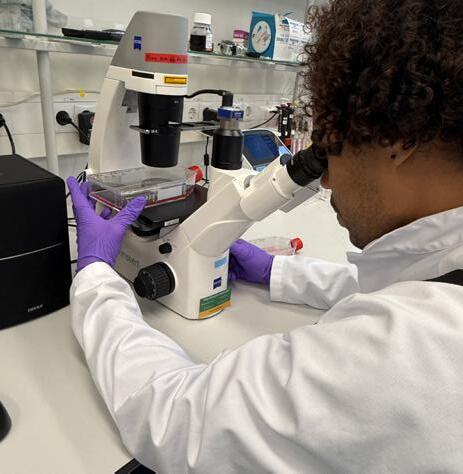
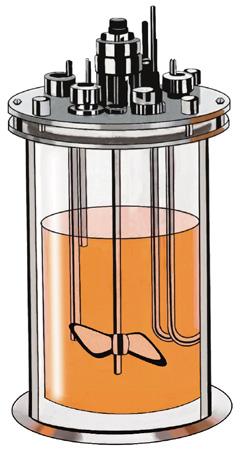
Left: mini-bioreactor with growth medium and other nutrients. A propeller in the reactor makes sure everything is mixed properly so the cultured meat cells can grow and multiply. Right: project manager Affif Grazette studies cultivated cells under the microscope. Photos Resource
‘The danger is that cultured meat reinforces power structures that are already problematic’
‘Is cultured meat really meat?’
argues Van der Weele. ‘Imagine being able to keep pigs in your own backyard or at a nearby petting farm, occasionally taking a few cells from them and growing cultivated meat in a small local factory to be sold in a neighbourhood shop. In the focus groups, this idea resonated with people who had ambivalent feelings around meat: they love eating it, but have concerns about animal welfare and sustainability, and worries about how we are increasingly becoming alienated from food and about our dependence on large companies.’
Keeping pigs in backyards may not be a realistic idea, but small-scale production of cultivated meat by farmers is a possibility. Van der Weele: ‘For a long time, cultivated meat was purely hypothetical. Now it is getting close to becoming feasible. But how will it work, who will be producing it and where? I think it is important to consider carefully who will be affected by this new technology and how we can deal with it as responsibly as possible. Some farmers were open to the idea early on: cultivated meat is not necessarily a threat for them but can also be an opportunity. Small-scale cultured meat production on farms may be less profitable than industrial production, but not everything can be measured in terms of money. It could make the protein transition much more attractive from a societal point of view.’
Sarah Kunze worked closely with Van der Weele on this topic and became so intrigued that she is now doing a PhD within the Philosophy and Cultural Geography chair groups on cultivated meat and other forms of cellular agriculture from a ‘more-than-human’ perspective. ‘In my research, I ask whether cultured meat could be a de-growth technology and help shift how we think about livestock farming, to seeing non-human animals as subjects rather than objects,’ she explains. ‘Cultivated meat comes with a lot of big promises,’ she continues. ‘It is supposedly going to end world hunger,
address food insecurity and free all animals. And the promises keep changing over time. As researchers and as a society, we should think carefully about how cultivated meat can deliver on these promises. The danger is that cultivated meat may not change anything and only add to what already exists, or even reinforce power structures that are already highly problematic.’
Animal ethics
Kunze acknowledges that no other development has been as promising in addressing the growing demand for animal protein in a more ethical way. ‘From a utilitarian point of view, cultivated meat might be the most ethical way of eating meat because fewer animals are needed for the production. But if you look at cultivated meat from the ethics of care, which emphasizes relations, it is still problematic because it may involve harm to the animals, such as when taking biopsies, or even killing them.’
But perhaps there are alternatives. ‘I recently met Juliana Olegario, a PhD candidate from Paraná University in Brazil who is currently on an exchange in Wageningen in the Bioprocess Engineering group. She is investigating the production of cultivated meat using cells from the umbilical cord of pigs. That means you don’t need a biopsy from a live animal: the umbilical cord is neither part of the mother nor of the new-born piglet.’
According to Kunze, it is ultimately about one crucial question: who are we developing this technology for? ‘Especially in a world with such unequal power dynamics, we need to look at these new technologies from a system perspective. A lot depends on who is involved, who owns the technology and who makes the choices. We are investing heavily in rethinking animal proteins, yet there are still countries where people lack even basic access to food.’ ■
A longer interview with Sarah Kunze can be found at resource-online.nl.
Tips for the Christmas holiday
Sure, it’s cold and dark but it is also the festive season. People are meeting up, there are lights everywhere, and you have music and feel-good series and podcasts. The regular and student Resource editors have come up with the best tips for the coming holiday. Illustration Marly Hendricks
Evening ‘light’ walks
‘As an international Master’s student, I like to do various things to make the festive season feel warm and welcoming. I love wandering around Christmas markets to take in the lights, music, and cheerful atmosphere. Frequent potlucks among friends are a great chance for me to share simple Indian snacks and connect with people from different cultures. Christmas is also a lovely occasion for baking, and I especially enjoy baking cakes — the whole process makes the season feel cosy. I also love taking relaxed evening walks to admire the Christmas lights around town. Together, these small traditions create a cheerful and meaningful holiday break.’
Arohi Natu, Food Technology Master’s student from India
Christmas markets
‘Checking out Christmas markets in the Netherlands or other countries in Europe is something I look forward to every year. I get to plan a trip to a new place I have never been to, plus that place will be cosy and delightful with lights and the Christmas spirit. There will be so many activities going on throughout the day as well, from music to performances. This year's potential stop is Bourtange Christmas Market in Groningen; it seems like a beautiful historical village from a Dickens story. The bridges and access roads to this fortified town are decorated with thousands of lights and there are dozens of illuminated Christmas trees.’
Hazel Htun, Food Technology Master’s student from Myanmar
Hjem Til Jul (Home for Christmas)
‘This Norwegian Netflix series is about Johanne, a nurse who has never brought a boyfriend home for Christmas dinner. Her friends and family have decided this needs to change. And so an effort starts to find a suitable partner in time. It’s a heart-warming series full of bad dates, dry humour, romanticism and a Christmas vibe. The first two seasons have been available on Netflix for a while and the long-awaited third season will appear in December. So curl up on the sofa with a hot chocolate or Glühwein and enjoy some binge-watching!’
Luuk Zegers, Resource editor
DIY citrus garlands
‘A simple and fun holiday craft is making your own citrus garlands. All you need are a couple of oranges, a knife and some twine. Slice the oranges, dry them in the oven at a low temperature until they’re no longer sticky, and then thread them onto the twine. You can hang them as a small garland on the Christmas tree, or turn them into ornaments. They add a bit of warm colour and a light, fresh scent. It’s an easy, calming activity for a quiet afternoon and a nice way to decorate the place without spending much.’
Caroline Siraki, Atmospheric Sciences/Climate Studies exchange student from Austria
Night at the zoo
‘Ouwehands Zoo comes to life at night during these dark, cold days. The zoo changes into an outdoor exhibition of light-emitting, mobile artworks by Chinese artists. The theme is different every year, but I’m always amazed by the artists’ ability to create luminescent images of pandas, dinosaurs and flowers. A visit to the Light Nights has become a tradition among my group of friends and more people join the club each year. It’s the perfect trip to get a break from your stressful uni life and score some great photos with your friends.’
Kayla Delvers, Biology Bachelor’s student from the Netherlands
Lost in Starlight
‘If you regularly watch animation films or simply want to try something new, my tip for the holidays is Lost in Starlight. It is the first South Korean animated feature film released by Netflix. What I really like is the way it tells a totally believable love story in a futuristic setting. Unlike much apocalyptic science fiction, the world in this film is really peaceful. The film presents a version of the future that looks very inviting! The animation style is also so amazing. There are a lot of inspiring messages that really set you thinking. Enjoy!’
Linda Hesseling, Rural Development & Innovation Master’s student from the Netherlands
Dancing
‘Family squabbles and dark days don’t always make for a well-deserved, relaxing break during the Christmas holidays in the Netherlands. An evening of ecstatic dance is the perfect remedy. You dance to pulsating beats until you feel a blissful emptiness. Talking, smartphones, drink and drugs are banned. That creates a safe space where you can express yourself. You can move around the place like a wild animal or catch your breath and enjoy the music lying on the floor. Odessa in Amsterdam is the biggest venue for ecstatic dance. In Wageningen, you can do it at De Wilde Wereld. Check out websites like hipsy.nl for more options. If it sounds scary, go the first time with someone familiar with the scene. They’re bound to know which DJ plays the best beats.’
Marte van der Veen, Climate Studies Master’s student from the Netherlands
Off Menu podcast
‘We may love our families but there always comes a time during the festive season when you’ve had enough of the endless discussions about the chance of snow or the umpteenth tuneless rendition of Silent Night. That’s when I recommend taking a break and tuning in to the ultimate pointless podcast: Off Menu, in which two British comedians interview a celebrity about their dream meal. The conversation usually starts about food but soon goes off on hilarious tangents. They always release two Christmas specials during the festive season, which I love. You still get the meaningless Christmas drivel, but with two witty comics rather than your boring uncle or batty aunt.’
Linde Klop, International Land & Water Management Master’s student from the Netherlands
From first-generation student to professor
BETWEEN CAMP AND CAMPUS
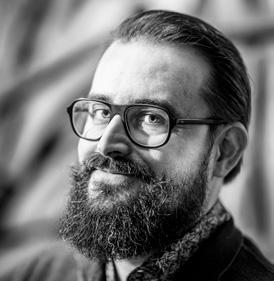
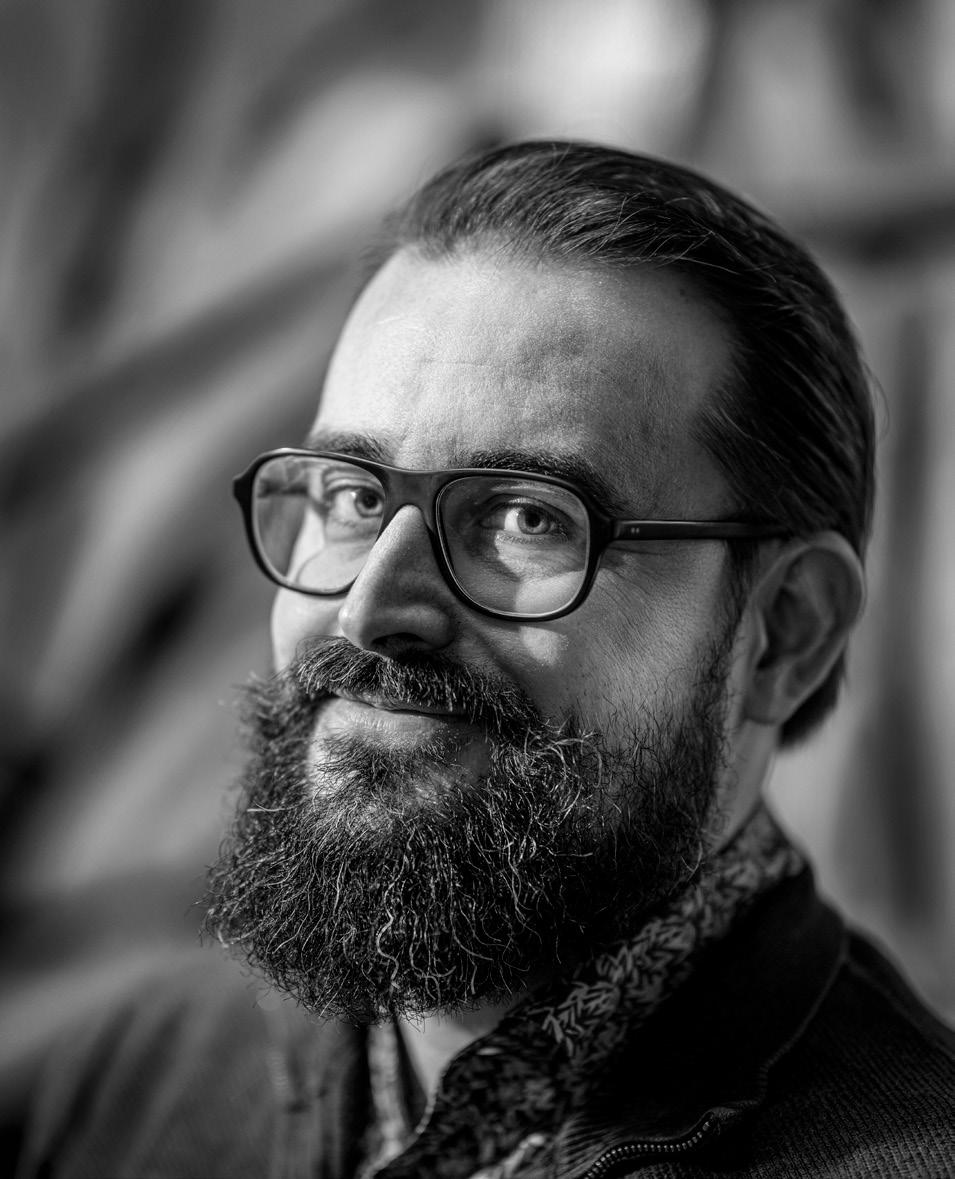
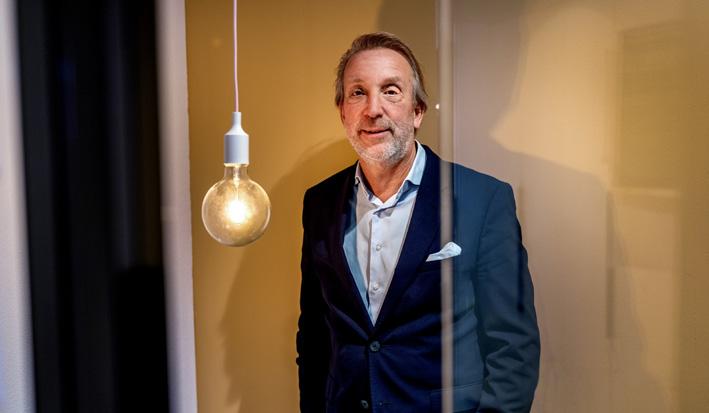
Carel Peeters was appointed professor in the chair of Applied Statistics in early September. As a first-generation student from the Traveller community, his journey has been tough and lonely at times.
‘I
kept quiet about my background for a long time, but I will never hide my roots again.’
Text Marieke Enter Photo Ruben Eshuis
‘Icome from a nomadic community, a Traveller family.
Gypsy is rather a controversial term, although some people embrace it with pride — like “campers”. The community itself mainly uses the term “Travellers”.
It’s a lovely, warm community but a misunderstood group that lives on the margins of Dutch society as a whole for various reasons.’
‘At primary school, lots of children weren’t allowed to play with me. Even at secondary school, classmates were often forbidden from doing their homework at my place — and if I went to their place, I usually had to leave as soon as their father or mother came home.
At university, initially I didn’t give anyone a chance to exclude me because I kept quiet about my background for a long time. Until I finally decided I didn’t want this any more, I’d had enough. I will never hide my roots again.’
‘I’ve always very much gone my own way. I also married someone from outside the community. That was accepted, but it was still an issue indirectly. At the moment, I’m living in an “ordinary” house. My wife wouldn’t easily be able to live in the Traveller community. The social norms of how people treat one another are very different to what she’s used to
‘I finished my PhD thesis while working. That was tough’
and I’m not sure it would always go well. Plus there’s the problem that there aren’t any trailer pitches because of the government’s phase-out policy. But do I miss it? Would I like to move back into a trailer? Yes, definitely.’ ‘The press release announcing my appointment as professor deliberately mentions that I was a first-generation student. Lots of people fit that definition, even students with family who went to HBO institutions, the universities of applied sciences. But the gap between university and background is particularly large in my case. Many people in my family are on the illiteracy scale. Some can’t read or write at all and some only a little. As far as I know, only one person from the Traveller community had ever completed a university degree before I did. I am the second, and I think I’m the first to get a doctorate. I’m certainly the first to become a professor.’
Subtle
‘A problem for a lot of first-generation students, and for me as well, is the feeling you don’t belong anywhere. You end up in a different social environment than the one you grew up in. All kinds of subtle things play a role that you don’t pick up on properly because that isn’t your social background. Greetings were an issue for me, for example. At university, we shook hands with one another whereas I was used to more physical greetings, where even men hug one another. Equally, at family parties sometimes I had to run an algorithm in my mind of “how to talk about football” — a topic that doesn’t interest me remotely —so I wouldn’t run
out of conversation after two minutes. With one foot in each world, you can end up doing a balancing act that can get quite lonely.’
‘When I was growing up, I didn’t know what university was. My mother claims I was saying “I’m going to be a professor” from the age of six, but as a teenager I thought I would leave school early and work in the
car trade. That outlook changed thanks to my first girlfriend from outside the community. She was from quite an academic family and that made me curious about the university world. When she went to university in Amsterdam, I thought perhaps I too should do a degree. I enrolled in Political Sciences because that was what her father did; he was my only point of reference at that time. When I had my first course in statistics, I thought wow, this is it! So I studied philosophy of science and later mathematical statistics.’
‘I really started to feel enthusiastic once I was at university. So many new things, so much knowledge — I was like a sponge. In my second year, a statistics course teacher saw potential in me and encouraged me to apply for a student assistant position. Although my hand-written CV stood out compared with everyone else’s neatly formatted CVs — I had never touched a computer and did everything by hand — he decided to take me on anyway. His name was Leo Huberts and his confidence in me was incredibly important for me.’
‘I still write a lot by hand. I’m quite a physical person and the connection between thinking and doing something physical works well for me. I write all my articles by hand and then type them out — using two fingers.’
Imposter syndrome
‘What made me feel less of an outsider in academia was the confidence that I was good enough. Many firstgeneration students struggle with this because there isn’t a point of reference in your familiar, warm home environment. How do you know whether what you’re doing is good enough? Personal improvement has become my own point of reference. If the next article is better than the previous one I wrote, if my supervision of a student or colleague is better and richer in some way than the previous time I did it, I’m satisfied. For me, that personal awareness of growth is the most important thing. It then automatically becomes less important what other people think and whether it’s good enough in the grand scheme of things. And it keeps imposter syndrome in check.’
‘It’s not good if the gap between how you behave and how you are feeling is too big for a long time. I can thank my wife for teaching me that personal leadership also means aligning those two aspects better. I have a lot to thank her for anyway. She really encouraged me to fight my way back into academia after I had to leave following a conflict with my PhD supervisor — I’m not going to mention names, and he didn’t remain my supervisor. A difference of opinion got completely out of hand and ended in “either you do what I say or you leave”. Well, I left! That whole idea of “if I say jump, you ask how high” isn’t something you should try with me — that’s not the way to treat people. I finished my PhD thesis while working. That was tough. I returned to the scientific world a few years later as a postdoc, thanks in part to
‘At primary school, children weren’t allowed to play with me’
‘When I was growing up, I didn’t know what university was’
the support of my wife.’
‘Wageningen feels very different to my previous workplaces — warmer above all. It is also a lot more international, which means there’s a kind of basic sensitivity in how people treat one another. I think it’s incredibly important to pay attention to diversity, although the debate gets reduced too much to labels such as men/women and people of colour/not of colour. I realize that might have been necessary in the past, but we have now got to the point where more nuancing should be possible. We should talk much more in terms of intersectionality; diversity about a wide range of aspects.’
Not pleasing
‘I believe WUR is one of the few universities without structured assistance for first-generation students. I’d like to see Wageningen do something about that. I know how difficult it can be to make your way in the academic world. Give students that extra bit of help so that they realize they too belong here. Sometimes all you need as a first-generation student is someone to talk to. In my own supervision of first-generation students or colleagues, I don’t just discuss the research details. We also regularly have a chat about how they’re feeling and whether they realize how well they are performing. You can make a difference on a small scale too.’
‘The message I want to send to students, whether firstgeneration or not, is that the fact you made it this far is sufficient proof you are good enough. Don’t aim to please others or demonstrate you can get better grades than the rest. Get your motivation from your intrinsic personal development. If you can do that, you will never lose.’ ■
WUR’s new director
of finance
‘WORK HARD TO STAY AT THE TOP WORLDWIDE’
Peter Ploegsma started three weeks ago as the Executive Board member in charge of finance at WUR — which is in the midst of restructuring with major cutbacks. ‘We should see the changing world as a mirror.’
Text Willem Andrée Photo Duncan de Fey
Early in the summer of 2025, a headhunter called. WUR had a vacancy. ‘The organization is in the middle of an 80 million-euro cost-cutting operation and they need someone urgently. Would you like to apply?’ Ploegsma recalls he didn’t need long to think about his answer. That could be because of his family background: his grandfather was a farmer and he lives in rural Krimpenerwaard surrounded by dairy farmers. ‘My wife Gerda and I keep sheep, horses and hens.’ It might also be because two of his four children are students at WUR. Ploegsma himself feels he fits in at WUR. ‘There was a reason I decided to do a degree in Public Administration: I wanted to work in the public sector, and that has been the case ever since. It’s also a question of your individual make-up.’
Under pressure
He is certainly starting at a difficult time. The WUR world has changed dramatically in a short period. Student numbers are falling, WUR is facing more competition both in the Netherlands and abroad, and Wageningen is no longer necessarily the obvious choice for Dutch and international students who want to study subjects in Wageningen’s domains. There is also pressure on the market: WUR expects the Ministry of Agriculture to invest less in research and is also expecting to get less contract research from the private sector. One degree programme has already been
abolished and more may follow. There are plans for reorganizations. Ploegsma is clear about this: ‘The fact that high-quality education is being delivered in our domains elsewhere in the world should make us take a good look at ourselves. We are world-renowned but we need to put in the effort to keep our reputation. In fact, that may require hard work and choices to an even greater extent than in the past.’ Can he make the required hard choices? The initial impression when meeting Ploegsma is of a friendly man — you could even say mild-mannered. ‘I do see myself as an approachable kind of director. I am always available if my colleagues want to have a chat with me. As to the question of whether I can make the necessary tough choices, the answer is “yes”. We want to
Ploegsma (57) had been a member of the executive board of elderly care organization Aafje in Rotterdam since 2014. Prior to that, he was financial director at the transport company RET and CFO at the Employee Insurance Agency (UWV). Ploegsma studied Public Administration & Policy at the University of Twente and did an MBA at SDA Bocconi in Milan and the London Business School. His appointment at WUR is for four years.
be working on socially relevant issues in a hundred years’ time. If you want to get through this phase, you have to be able to take tough decisions such as stopping activities or letting people go. I have experience of that in my previous jobs.’ ■
The holy grail of more efficient photosynthesis
Doing more with sunlight
The
Jan IngenHousz Institute
on Droevendaalsesteeg is initiating a new era in the study of photosynthesis with sensors it developed in-house.
Text Roelof Kleis
They look rather like clothes pegs, little white clips attached to the leaves of a potato plant. The field of potatoes behind Unifarm on the campus has hundreds of them. The pegs occasionally light up red, like fireflies. Is it a potato disco? No, it’s the new generation of photosynthesis measuring instruments. This experiment carried out in the summer — the setup has since been dismantled — is about trying out the latest sensors for large-scale measurement of photosynthesis.
The mini-instruments were developed by researchers and tech experts at the Jan IngenHousz Institute and Michigan State University. The devices are the first tangible step — and perhaps the most important one — taken by the institute, which was founded two years ago.
The sensors are crucial in the approach that the institute is taking to improve photosynthesis in key food crops.
To improve the plant, start with its photosynthesis. That in a nutshell is the Jan IngenHousz Institute’s
PHOTOSYNTHESIS IN FIELDS IS MORE DYNAMIC THAN IN GREENHOUSES
‘MAKING THE DEVICE INVOLVED BLOOD, SWEAT AND TEARS’
mission. The process of photosynthesis in plants, which converts water and carbon dioxide into sugar and oxygen under the influence of light, is the basis for all growth and development. Plants only use a small fraction of the incident light (about one per cent). That offers scope for improvement, in theory at any rate. More efficient photosynthesis is the holy grail for foodcrop breeding organizations.
Complex
Photosynthesis is a hugely complex process with many steps that utilizes the energy in light to make sugars. It involves dozens of enzymes and hundreds of genes. Scientists have figured out this process down to the fine details. That is quite an achievement, says geneticist Tom Theeuwen, but it’s still not enough to understand how a plant in a field deals with photosynthesis and how that affects the yield. ‘Photosynthesis in a field is a very dynamic process. There are hundreds, or even thousands, of subprocesses, each with its own timescale. That makes it difficult, but also fun and challenging.’
‘Take an average summer’s day with some clouds,’ continues Theeuwen. ‘The plant only uses some of the sunlight and rejects the rest. Then a cloud comes along and all of a sudden the plant only gets one tenth as much sunlight. So the plant has to change tack to make optimum use of what sunlight there is. Once the cloud has passed, the plant has to switch back quickly. That passage may only take a minute. If it’s windy, the leaves are blown past one another. That creates shade, which
the plant has to respond to, but it only lasts a fraction of a second. Other variables such as temperature, air humidity and droughts also play roles on a range of timescales. Photosynthesis responds to all this in a hugely dynamic way.’
You can measure lots of things in the controlled conditions of climate chambers, like the NPEC ones on campus. Banks of cameras and sensors measure how the plants are doing in a continuous, fully automated process. ‘But that’s not possible in a field,’ says Theeuwen. ‘So you don’t get to see that dynamic aspect. But now we have found a solution with these new sensors.’
The institute’s director David Kramer gave up his prestigious position as a distinguished professor
JAN INGENHOUSZ
The town of Breda will be celebrating Jan IngenHousz Year in 2030. The Dutch ‘father of photosynthesis’ was born there in 1730. His experiments proving that light is essential for a plant’s growth took place 250 years ago. ‘He should really be included in the official Canon of the Netherlands,’ says Alexander Laarman, the institute’s director of operations. ‘Or discussed in schoolbooks at the very least.’ The Jan IngenHousz Institute was founded two years ago following a donation of 50 million euros by three generous donors. WUR provided a further 12 million euros.
at Michigan State University for this job. Kramer is a renowned professor of Photosynthesis and Bioenergetics. ‘My expertise is in the physical side of photosynthesis, the way electrons and protons move through the system.’ It is an interesting topic, but he started to wonder whether he could really make an impact with this work. ‘From that point on, I changed my approach. My research became more about what was happening outside in the field rather than focusing on photosynthesis measurements in the lab. That’s a really big difference.’ Kramer developed a mobile device for measuring photosynthesis in the field. This device –the size of a walkie-talkie – lets you manually measure the photosynthesis in a leaf every few minutes.
Phone call
That was a step in the right direction but it wasn’t nearly enough. ‘We couldn’t get any further,’ says Kramer, reflecting on that time. ‘We needed to make a big advance. I even got to the point where I was thinking OK, this will be a task for the next generation. Perhaps I should go back to my art; I studied art as a Bachelor’s before switching to science. And then I got that call for the Jan IngenHousz Institute job.
The Jan IngenHousz Institute investigates photosynthesis with the aim of improving important food crops. The photo is of rye. Photo Shutterstock
The pitch was promising, but I thought a key element was missing. We don’t know when photosynthesis is the limiting factor for growth in a field. We don’t have large-scale measurements and an understanding of which genes play a role when, in which crops and genotypes. So let’s focus on that with this institute.’
The key step of progressing to large-scale measurements has now been taken. The white clothes pegs — called Ambits (see inset) — are a prototype.
‘Students have spent a year 3D-printing them,’ says the operations director, Alexander Laarman. ‘That was a major effort — blood, sweat and tears. We now have about 500 of them.’ The little devices have been tested extensively, not only in the Netherlands but also in Australia, Africa and the Amazon, regions where the institute has projects with local partners. The meters cost only a fraction of the 2,500-euro measuring device that Kramer developed in Michigan. Although they are not for sale. ‘In the past few days, I’ve been talking to companies about producing them. That isn’t something we’ll be doing,’ says Kramer. ‘We design equipment that can link photosynthesis to genetics. To then make this genetic breakthrough, that equipment needs to be easily available. We will make sure that happens, providing both the equipment and the platform where data and technology will be available.’
NEW BUILDING
The Jan IngenHousz Institute is currently housed on the second floor of Radix, but that will probably change. Plans for a separate building, together with the Dutch Centre for Genetic Resources (CGN), are at an advanced stage. The idea is to have a three-storey building on Bornsesteeg, next to the car park near Radix. The Centre for Genetic Resources will occupy the ground floor and the Jan IngenHousz Institute the two floors above plus the roof terrace. The Executive Board will shortly take a decision on the provisional design. The researchers will be able to move into the building in 2027.
CLOTHES PEG
Ambit, the Jan IngenHousz Institute’s photosynthesis meter, has sensors on the upper side that measure the intensity and composition of the incident light. Tiny LED lights on the underside shine an identical light on the leaf to measure the photosynthesis. This design deals with the problem of the disruptive shadow from the actual meter. ‘The device also measures the air humidity and temperature,’ says researcher Tom Theeuwen. ‘That lets us place the photosynthesis we measure in the context of the conditions.’ The Ambit gets its energy from a little solar panel connected to it. Photosynthesis is measured once a second. ‘We also add extra light pulses from time to time, which lets us measure different parts of the system. Those pulses are the red lights that are going on and off. This lets us get a picture of many different photosynthetic processes at the same time.’
The Jan IngenHousz Institute’s photosynthesis meter Ambit (shown attached to a potato plant) has sensors on the upper side that measure the intensity and composition of the incident light. Photo Resource
According to Laarman, the platform is the institute’s other important focal point alongside the research. ‘We will be publicizing that more broadly in January. We have built an open-science platform for data development in relation to photosynthesis. Everyone in the world who generates such data can upload it to the platform through an app. The data will be visible for everyone. That’s how we’re aiming to set things in motion and build a community of academics and plant breeders. We don’t just carry out research, we also function as a network organization and photosynthesis hub. WUR is our partner, but we’re separate from WUR, we have our own funding and we can go our own way. That means we can operate fast, more quickly than is possible in the academic world.’
Choice of plant
The question remains: is it possible to make photosynthesis more efficient? ‘Am I sure it’s possible? No,’ says Kramer candidly. ‘But I’m very confident we will be able to identify the genetic components that play a role in this. All the processes in photosynthesis are linked. Trade-offs play a role there. The plant is constantly making economic choices based on genetics. Photosynthesis might not be such a crucial process in wild plants. Wild plants don’t care about photosynthesis; they just want to survive. But it’s different in agriculture.’
Theeuwen too points out this difference. ‘Photosynthesis is never the limiting factor for your average plant in nature, but it may be for crops. Photosynthesis is expensive for plants in terms of the energy used. They can’t do without it, though, so they try to find an optimum given the circumstances. Not too much, not too little. That optimum has undoubtedly been found in nature thanks to evolution, but more could be possible to get a maximum.’ ■
2025 COVER PRIZE
One of the ten PhD thesis covers on this page will win the 2025 Resource Cover Prize. The winner will be announced on Monday 5 January. Starting today, you can vote at resource-online.nl. The general public and an expert jury will determine the result. The ten nominated covers were selected by the Resource science editors, with the EngD theses competing as well for the first time this year. The winning cover will get plenty of attention as a magnified version will be displayed for the next four years on the wall of the Omnia PhD ceremony room. Text Roelof Kleis
Limelight
If you have ever been in Orion on a Tuesday evening, you may have heard the Wageningen Student Choir and Orchestra Society (WSKOV), because that is where they rehearse for their concerts. They are hoping for a full house in the Grote Kerk for their winter concert on 12 and 13 December. Text Coretta Jongeling
WSKOV’s winter concert
WSKOV, which was founded in 1919, gives two concerts a year, one in the summer and one in the winter. They also tour abroad every couple of years. The society actually consists of two sections: the orchestra and the choir. They perform together on the stage during concerts but usually rehearse separately.
‘That’s a question of efficiency,’ says violinist and board member Alicia Ngo.
‘The whole concert lasts 2.5 hours.
That’s far too long to rehearse together.
The winter preparation period is short
too, from September to December, and we need to prepare a full-length concert during that time.’
The orchestra and choir each play their own pieces plus at least one joint piece each season. ‘I love doing that. You end up with about 80 people all making music together. This year, our joint piece is one of Sibelius’s lesser-known works.’
The programme also includes more
12 & 13 December
Grote Kerk
20:00 to 22:30
Tickets 15 euros, students 7 euros
well-known works by Mozart and Beethoven. Ngo: ‘My personal favourite is Schubert’s Eighth Symphony. It sounds lovely and has the perfect degree of difficulty, giving me enough of a challenge but still letting me enjoy the music.’ Two conductors (the only non-students) will lead the choir and orchestra. An interesting feature this year is that the orchestra’s conductor will play a percussion instrument as well in one piece.
Is she getting nervous yet? ‘No, actually. I’ve been playing in orchestras for more than ten years. I got nervous the first couple of times, but not now. You practise so much that you know the music really well by the end.’
Tickets are on sale at wskov.nl.
TIPS
Saturday 20 December
Wageningen celebrates Christmas • Christmas concert • Grote Kerk
Sunday 21 December
Bingo Bitch Christmas show • Drag/bingo • Junushoff
Tuesday 20 January
Aseo Trio (jazz) • Lunch concert • Impulse
WSKOV in Lyon during its ‘Tour de France’ last summer. Own Photo
LOOK!
You can spot great-looking people and cool outfits on Wageningen campus. This column highlights some of them. This time, meet Nana Braam, Landscape Architecture & Spatial Planning Bachelor’s student. Text and photo Eva Hamers
‘My style stands out and I get a wide range of reactions: some people think it’s super-cool and others feel a need to hurl abuse at me. I haven’t experienced that yet in Wageningen, but sometimes I get hassled back home in Zeist by random 13-year-old kids. They shout stuff like, ‘ugh, emo!’ But I only get positive comments in Wageningen. For example, strangers in the supermarket say ‘Hey, you look great!’ That makes me feel good.
‘I also tend to keep my outfits monochrome. For example, I’m currently going through a red phase. What outfit I choose and how extravagant it is depends mainly on my mood at the time and things like the weather. I enjoy wearing outfits that show my personal style, although there are also days when I don’t have the energy for something extrovert. I painted the back of this coat myself. I’m trying more and more to make or decorate my own clothes. I’ve also started knitting, as it happens.
‘When I discovered that acrylic paint works on clothing, I thought: cool! I’m now painting on clothes I’m not so keen on as a kind of upcycling, because I hardly ever find items that please me completely.’
You find all the flavours of the world in Wageningen. Caroline Siraki (25), an Atmospheric Sciences exchange student from Austria, shares a recipe for sweet dumplings.
Flavours of WUR
Germknödel
‘Germknödel — dumplings with yeast — always remind me of snowy mountains and long days skiing. They’re a beloved winter classic in alpine huts and ski resorts, offering soft, comforting warmth on cold days. Served with hot vanilla sauce, this dish is the perfect blend of nostalgia and cosiness.’
1 Heat the milk until it is lukewarm. Mix it with the dry yeast and sugar in a bowl and let it sit for about 10 minutes until bubbles form on the surface. Meanwhile, melt the butter and let it cool until just lukewarm. Add the flour, melted butter and salt to the milk mixture. Knead the dough until smooth and elastic.
2 Cover and let it rise in a warm place for about 1 hour, until doubled in size.
3 Divide the dough into four equal pieces. Knead each piece briefly, flatten it, and place 1–2 tablespoons of plum jam in the centre. Seal the dough and shape into smooth, round dumplings. Cover and let it rest for 15–20 minutes.
4 Fill a pan with enough water to cover the bottom. Place a steamer insert inside. Steam one dumpling at a time over medium heat for about 12 minutes. Don’t open the lid during steaming, as the steam will escape.
Vanilla sauce:
5 Whisk together the milk, vanilla pudding powder and sugar in a small pan until smooth. Bring to a boil while stirring continuously until the sauce thickens. Adjust to taste and set aside.
Ingredients (for 4 portions):
For the Germknödel
• 160 ml plant-based milk (e.g. oat milk)
• 4g dry yeast
• 30g sugar
• 40g vegan butter
• 300g wheat flour
• 1 pinch of salt
• 50g plum jam
For the vanilla sauce
• 500 ml plant-based milk (e.g. oat milk)
• 2–3 tbsp vanilla pudding powder
• 2 tbsp sugar
For the topping
• 2 tbsp finely ground poppy seeds
• 1 tbsp powdered sugar
6 Grind the poppy seeds and roast them in a frying pan. Pour the warm vanilla sauce over the finished dumplings and garnish with the poppy seeds and powdered sugar. Serve immediately.
On Instagram, Caroline demonstrates how to make Germknödel.
WUR is incredibly diverse, with hundreds of internationals working and studying here. In the Meanwhile in column, we ask one of them to comment on events in their home country. This time, Soil, Water & Atmosphere Bachelor’s student Renyviëndrick Maria (24) from Curacao talks about his country qualifying for the football World Cup in 2026. Text Philip Timmers
‘None of the four languages spoken on the island has a word for this feeling. Curacao, Aruba and Bonaire have become united: all our differences of opinion have been replaced by joy.
‘In addition to Curacao’s matches, I like to watch Real Madrid at the weekends. I’ve been a fan of that team since I was a kid.
Real Madrid has won lots of prizes, but the pride and joy I feel now that Curacao has got through is something I’ve never felt for Real Madrid. It’s our island!
‘I didn’t dare hope for this, but after the last preliminary round for the World Cup I did start to dream about us qualifying. I reckoned we should be able to beat Bermuda and Trinidad & Tobago. Jamaica would be harder, but not impossible because we beat them in the final of the Caribbean Cup in 2017.
‘I
was so happy, I couldn’t sleep all night’
‘When Curacao beat Bermuda and Jamaica drew with Trinidad & Tobago, we knew we would have to get at least a draw in the match against Jamaica to be sure of a place in the World Cup. The match was tense down to the last minute. Jamaica hit the post three times and in the final minute they almost got a penalty, but fortunately it was overturned by the VAR. At the final whistle it was nil-nil, which meant we would be qualifying for the World Cup. I was so happy, I couldn’t sleep all night.
‘I’m really proud of Curacao. I can hardly believe my island has qualified for the World Cup. I hope it inspires young lads to take up football and to declare for Curacao. The Netherlands is often the first choice for adult Curacao players at the moment, but hopefully that will now change.’
WEEKLY UPDATES ON STUDENT LIFE AND WORKING AT WUR?
Go to resource-online.nl
(Subscription page) and subscribe to our digital newsletter.
Resource is the independent medium for students and staff at Wageningen University & Research. Resource reports and interprets the news and gives the context. New articles are posted daily on resource-online.nl. The magazine is published once a month on a Thursday.
Contact Questions and comments for the editors: resource@wur.nl | www.resource-online.nl
Editorial staff Willem Andrée (editor-in-chief), Helene Seevinck (managing editor), Roelof Kleis (editor), Luuk Zegers (editor), Marieke Enter (editor), Coretta Jongeling (online coordinator), Dominique Vrouwenvelder (editor).
Translations Tessera Translations S.L.
Design Alfred Heikamp, Larissa Mulder
Overall design Marinka Reuten
Cover illustration Valerie Geelen
Printing Damen Drukkers BV, Werkendam
Subscription A subscription to the magazine for one academic year costs 59 euros (135 euros if abroad). Cancellations before 1 August.
ISSN 1874-3625
Publisher Corporate Communications & Marketing, Wageningen University & Research
SEARCH FUNCTION’S DISAPPEARING ACT
French philosopher Descartes famously said ‘I think, therefore I am.’ Many WUR employees, who spend a lot of time thinking, are also under the impression they exist. But they are wrong, as the new WUR website makes quite clear. The Discover WUR search function with AI-generated answers denies the existence of numerous employees.
Ayear was spent preparing for the new website, which went live last Wednesday. This festive occasion was celebrated by providing staff with apples packed in boxes sporting the message ‘Get your teeth into the new WUR.nl’.
But many employees are not happy because the search function can’t find them. Take Roelof K. (name known to the editors), who was told: ‘There is no specific information about you in the provided WUR content. There are no details about who you are or your role in the organization.’
‘After I’ve been writing articles for Resource for 17 years,’ he complains in bewilderment. ‘And when you then ask about Resource, you are told the university doesn’t have its own magazine! It does make you wonder what was the point of all those years of work. Escrito ergo non sum Did the search engine actually do any searching at all?’ ‘Or,’ he continues, ‘does AI know more than I do? Is this the next step in WUR’s cost-cutting operation?’ When inquir-
ies are made with Board President Houkje Sjeimovaara, it turns out the problem is more entrenched. ‘I searched for Sjeimovaara and she doesn’t exist either according to the site,’ she replies. ‘We’re in this together.’
‘It does make you wonder what the point was of those years of work’
Website builder Andy Ides puts the disappearing act down to teething problems. ‘The system needs time. AI means artificial intelligence, which involves self-learning.’ K. is not convinced. ‘The clue is in the word artificial. What we want is real information, not some self-taught amateur dishing up fake results. And while I’m here, could I wish everyone happy holidays on behalf of all my colleagues?’