Puerto Rico and the Caribbean
www.theweeklyjournal.com
>Archive
Wednesday, August 18-24, 2021 - // no. 121
UPR’s Role in Economic Development P6 High Hopes for the Plan of Adjustment P7 Triple-S: Utilization Trends Fully Normalize P9
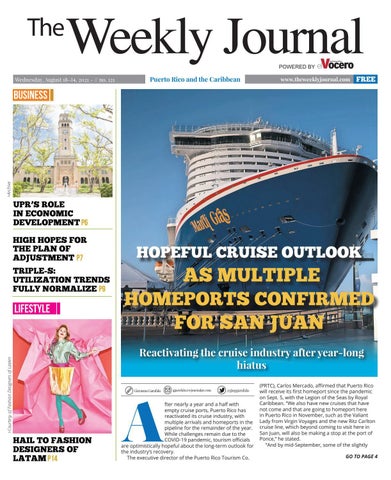
Hopeful Cruise Outlook
as Multiple Homeports Confirmed for San Juan
>Courtesy of Fashion Designers of LatAm
Reactivating the cruise industry after year-long hiatus
A Giovanna Garofalo
Hail to Fashion Designers of LatAm P14
ggarofalo@wjournalpr.com
@giopgarofalo
fter nearly a year and a half with empty cruise ports, Puerto Rico has reactivated its cruise industry, with multiple arrivals and homeports in the pipeline for the remainder of the year. While challenges remain due to the COVID-19 pandemic, tourism officials are optimistically hopeful about the long-term outlook for the industry’s recovery. The executive director of the Puerto Rico Tourism Co.
(PRTC), Carlos Mercado, affirmed that Puerto Rico will receive its first homeport since the pandemic on Sept. 5, with the Legion of the Seas by Royal Caribbean. “We also have new cruises that have not come and that are going to homeport here in Puerto Rico in November, such as the Valiant Lady from Virgin Voyages and the new Ritz Carlton cruise line, which beyond coming to visit here in San Juan, will also be making a stop at the port of Ponce,” he stated. “And by mid-September, some of the slightly GO TO PAGE 4
The Weekly Journal > Wednesday, August 18, 2021 >
2
presented by
friday
aug 20
Shot gun: 9:00am Registration: 7:30am Format: Four Man Scrambl At St. Regis Bahia Beach Resort & Golf Club in Rio Grande.
Prensented by
3
/ Wednesday, August 18, 2021
a week in review Puerto Rico Requires Vaccinations in Food, Drink Sector
>AP/Jim Mone
>Brandon Cruz González
Gov. Pedro Pierluisi announced that customers of dining venues will now have to show vaccination cards or negative virus tests. The new rules take effect on Aug. 23. Those who do not comply face up to six months in jail or up to a $5,000 fine. Customers at other enclosed places including theaters, coliseums and convention centers also will have to present proof of vaccination or a negative test. The same rules apply to guests staying at hotels, inns and short-term rentals.
Medtronics Invests $50 Million in Juncos Facility With an investment of $50 million and the creation of 700 jobs - 200 in the construction phase and 500 permanently - Medtronic, a medical device company, announced the second phase of the expansion of its facilities in Juncos, which began in 2019 with a similar investment in equipment and machinery to increase productivity and expand manufacturing capacity in the region. Medtronic will launch a new version of a glucose sensor, after converting the office spaces of the Juncos plant into an 11,000-square-foot manufacturing plant.
Powered BY El Vocero de Puerto Rico, 1064 Ave Ponce de León 2nd floor San Juan, PR Postal Address: PO Box 15074, San Juan, PR 00902
President Salvador Hasbún shasbun@elvocero.com Vp of Marketing and Business Operations Michelle Pérez Miperez@elvocero.com
P.R. Supreme Court: Provisional Transportation Rates Null and Void The Supreme Court of Puerto Rico denied the petition for Certiorari requested by the Transportation Bureau in a lawsuit filed by the Puerto Rico Chamber of Commerce against a provisional rate increase for truckers. As a result, the Circular Letter issued by the Transportation Bureau that unilaterally increased rates for some truckers was declared null and void. Legal cases on a permanent rate increase are still ongoing.
VP of Accounting Félix A. Rosa frosa@elvocero.com
Human Resources Director Arlene Rolón, PHR arolon@elvocero.com
VP of Editorial Content Juan Miguel Muñiz Guzmán jmuniz@elvocero.com
VP of Production Eligio Dekony edekony@elvocero.com
Traffic Director Ilia M. Pérez Centeno iperez@elvocero.com
Managing Editor Rosario Fajardo rfajardo@wjournal.com
Multi-Platform Graphic and Technology Director Héctor L. Vázquez hvazquez@elvocero.com
Phone: 787-622-2300, 787-721-2300
Multi-Plataform Digital Director María Arce marce@elvocero.com
Customer Service: 787-622-7480
4
/ Wednesday, August 18, 2021
CONTINUED FROM PAGE 1 smaller lines will be incorporated to what is the regular itinerary. We project that the activity will increase significantly in October and November because both companies - that is, Carnival and Royal Caribbean - already announced that they will be adding more cruises to their offers, and the same is going to be done by Norwegian,” Mercado told THE WEEKLY JOURNAL. Moreover, “this is going to increase and we understand that the month that is going to experience a significant increase” will be November, he added. The gradual reactivation of this sector is expected to reach levels comparable to those before the pandemic by January 2022. “We are now in negotiations to recover some of the homeports that we had before the pandemic and we understand that this will begin to gradually increase when we begin to restore operations. We even project that for the months of February and March, we will have more activity regarding homeports here in Puerto Rico,” Mercado reported. Asked about economic projections concerning all confirmed stops and homeports, Mercado said that “usually, we do the projection based on what we already have agreed, everything else would be conjecture.” However, “if we look at it from the comparative point of view of 2019, which was our record year with 1.9 [million] passengers who came by cruise ships and we multiplied that by $80, which is the average expense for each of them [when disembarking for the day], we know that this operation - only with that factor - [will bring in] between $180 million and $200 million.”
At least 95 percent of cruise passengers who are fully vaccinated against COVID-19 are expected to venture - and spend - on the island when their ships dock in Old San Juan. >Carlos Rivera Giusti
was,” he responded. The official said that when local agencies met with cruise lines individually they highlighted that Puerto Rico is making strides towards achieving herd immunity and has been more successful in Puerto Rico Ahead of Competitors inoculating its population than other competitors Per the local Health Department’s online coronavirus dashboard, 67.8 percent of the island’s in the market. “If we add that the health system has not suffered any collapse eligible population has been and [COVID] has been kept fully vaccinated as of press time, under control - and it is under representing 58.7 percent of control at the moment - these the total population. Compared are quite significant factors when to some other Caribbean they expose their... clients to a destinations, Puerto Rico is miles Carnival Cruise Line’s destination,” he added. ahead in its vaccination progress. confirmed visits to For instance, Puerto Rico’s Puerto Rico in the sister U.S. territory has a Rigorous Health Protocols coming years are COVID-19 vaccination of 37 The current guidelines for the estimated to bring in percent, according to Google’s cruise industry, as decreed by more than 300,000 Our World in Data website. the Centers for Disease Control visitors total, with an Jamaica’s vaccination progress is and Prevention (CDC), in effect economic impact of lagging with only 4.5 percent of until Nov. 1, say that cruise lines $28 million for the the total population, Barbados can sail again with confirmation tourism value chain with 28.8 percent, Panama with that at least 95 percent of during FY 2022 and 19.4 percent, Saint Kitts and Nevis passengers and crew have been 2023. with 37.9 percent, Dominica with vaccinated. Moreover, the PRTC, 27.4 percent, Saint Lucia with 14.3 Ports Authority and local Health percent, Saint Marteen with 54.1 Department informed last month percent, The Bahamas with 12.2 that all cruise passengers must be percent, the British Virgin Islands fully inoculated against COVID-19 with 38.1 percent, and the Dominican Republic to be able to go ashore. Even then, those who can with 41.2 percent, as of press time. walk around San Juan must wear face masks and “Would you attribute Puerto Rico’s inoculation carry their proof of vaccinations to visit restaurants success to cruise line’s interest in Puerto and bars. Rico?” THE WEEKLY JOURNAL asked Mercado. “As part of the conversations we have had and “Not only do I think [it was a key factor], it definitely the agreement we have reached with Carnival
In fact,
as a result of the conditional order to sail issued by the [CDC], Ports, Health and Tourism have implemented safeguards to allow the entry of cruise ships in the safest way possible,” said Ports Executive Director Joel Pizá Batiz. “Before docking, the cruise ship must send a statement to certify the percentage of people vaccinated inside the ship, as well as a manifest of the unvaccinated. Those ships that do not comply will not be able to dock at our ports.” Because the Federal Drug Administration (FDA) has not yet approved the COVID-19 vaccine for children under the age of 12, these passengers must stay on board. Asked about this limitation’s impact on the traveler experience, Mercado said that “it is a requirement that at this time sounds austere and strict, and the reality is that perhaps Carnival may have that challenge because of the families [on board]. For example, Royal Caribbean and others are more aimed at couples. “Perhaps at the beginning, the negotiations and requirements sound drastic, but the reality is that it is done with the intention of having commitments and guarantees that work is being done in a responsible and diligent manner,” the executive director added.
Maiden Voyage for the Mardi Gras
Recently, Puerto Rico welcomed Carnival’s Mardi Gras cruise as the ship’s first port of call in its maiden voyage. The seven-day Caribbean cruise departed Port Canaveral on July 31 and arrived in San Juan’s Pier 3 on Aug. 3. “We are beyond delighted to begin our Mardi Gras sailings and to have Puerto Rico be our first
/ Wednesday, August 18, 2021
5
We project that the activity will increase significantly in October and November because both companies - that is, Carnival and Royal Caribbean - already announced that they will be adding more cruises to their offers, and the same is going to be done by Norwegian. -PRTC Executive Director Carlos Mercado
port of call on our maiden voyage. It is an honor to offer our guests the opportunity to experience all of the beauty that Puerto Rico has to offer while providing a much-needed boost to the local economy,” said Christine Duffy, president of Carnival Cruise Line, who added that “the restart of cruising in Puerto Rico has such a dramatic, widereaching impact.” The PRTC executive director explained that the cruise has a passenger capacity of 6,500, but due to pandemic-related precautions, this arrival brought 4,500 passengers, or 70 percent of the ship’s capacity. He said that of these, 95 percent explored Old San Juan, “while 5 percent - which really should be lower, around 3.5 percent - of the remaining people were mostly kids under the age of 12,” who cannot leave the ship due to health regulations.
A local performer greets passengers as they step out of the Carnival Mardi Gras to explore the historic Old City. >Carlos Rivera Giusti
Mercado said that the average expense per passenger who disembark at the capital’s ports is $80 per day. With that in mind, the official estimated that the Mardi Gras arrival resulted in $360,000 in passenger spending. “This does not include the value chain around the cruise ship’s operations. From there, [we have] the carriers, security, supplies, suppliers of the cruise line, some type of technical or maintenance evaluation, and the price that the line pays per passenger to the
A Puerto Rican merchant showcases his handmade cigars to cruise passengers. >Carlos Rivera Giusti
Puerto Rico Ports Authority,” he asserted. As informed, the Mardi Gras will continue visiting Pier 4 every fortnight. “The first official stop of the maiden voyage of the most important cruise right now for what is the Carnival line was the port of San Juan and there is a commitment that every two weeks they will be visiting us,” Mercado said. In other words, in the [ship’s] three stops that are going to take place this month [in San Juan], the projection is that the impact in terms of average direct spending per passenger will be $1.2 million, Mercado added that the average passenger spending is projected to reach $10 million in terms of the 22 consecutive stops in Puerto Rico. According to Gov. Pedro Pierluisi, Carnival Cruise Line affirmed that during fiscal year (FY) 2023, the island will have visits from both the Mardi Gras cruise and the Carnival Celebration, considered sister ships. These confirmed visits are estimated to bring in more than 300,000 visitors to Puerto Rico and will reportedly yield an economic impact of $28 million for the tourism value chain during FY 2022 and 2023. “After a year and a half fighting the COVID-19 pandemic with extremely strict health and safety measures, we received the Mardi Gras cruise from Carnival Cruise Line and passengers who comply with the security measures against COVID-19. With the arrival of this cruise, our economy will continue to grow and Puerto Rico will continue to shine before the whole world for the excellent quality of service that each of the tourists will find in our artisans, shops, and direct services,” Pierluisi affirmed. - The Associated Press contributed to this story.
6
/ Wednesday, August 18, 2021
UPR’s flagship campus in Río Piedras >Josian E. Bruno Gómez
The Link Between UPR and Economic Development
CNE analyzes UPR’s budget crisis
A Rosario Fajardo
rfajardo@wjournalpr.com
@RosarioWJournal
n analysis by the Center for a New Economy (CNE) has found that the University of Puerto Rico’s (UPR) continuing crisis is due to chronic budget cuts and the inability of the university’s administration to properly manage its budget woes. Some would even add the administration’s inability to attract external funding and students from outside the island, as Puerto Rico continues to deal with the long-term effects of a decreasing and aging population. According to CNE, during the five-year period from fiscal year (FY) 2017 to FY 2022, UPR has suffered a 48 percent drop in its General Fund income, going from $911 million to $466 million. Yet the university is essential to Puerto Rico’s economic development, researchers said, not only for its important role in higher education, but also “ensuring social mobility” for many people. The proposed budget cuts at the UPR, as outlined in the university’s Fiscal Plan, would hinder all research and development (R&D) activity in Puerto Rico, according to Raúl Santiago-
Bartolomei, a CNE research associate & assistant professor at the UPR’s Graduate School of Planning. He indicated that by 2019, 82 percent of total investment for R&D by higher education institutions in Puerto Rico was made by the UPR, while the university itself financed a fifth of the total invested by these institutions. In addition, he said the UPR has several research centers and facilities that are unique in Puerto Rico, such as those focused on coastal research and the Caribbean Primate Research Center. On the other hand, total investment in R&D in Puerto Rico reached 0.54 percent of the Gross Domestic Product (GDP) in 2017, a figure that pales in comparison to the United States (2.79 percent of GDP) and the leading countries, South Korea (4.3 percent of GDP) and Japan (3.2 percent of GDP). For another fellow academic, the UPR as an institution has been seriously damaged, both by the magnitude of the budget cuts “imposed” by the Financial Oversight and Management Board (FOMB) and by the university’s administrators’ lack of imagination in handling the crisis: together they have created an institutional paralysis, according to Jorge L. Giovannetti-Torres, an associate professor of Sociology at UPR. He said that the budget cuts have been enforced without rethinking or restructuring the UPR as a system. One of the detrimental effects of this situation is that the faculty has seen its opportunities for research and publication reduced. Both are essential elements to increase
prestige and attract external funds and students to the UPR, which in turn are critical to reverse the current situation. The UPR should have a central role in shaping the future of the island and be the main referent for public policy and social discussions on issues ranging from global warming and crime to economic and sociocultural development, Giovannetti said. “The need for institutional reforms at the UPR is urgent, but these should be aimed at creating a research university, capitalizing on the prestige and strengths of the institution, rethinking the campuses, seeking academic and administrative synergies, and strengthening the spaces for the creation of knowledge, research and international projection.” These were the main points of discussion in the August issue of the CNE Review, which focuses on the impact of the central government’s bankruptcy on the island’s main public university and other aspects of the institution’s crisis. Among the issues addressed in the publication are: how the FOMB, an unelected body, has radically and unilaterally changed the terms of the Puerto Rican social contract; the relationship between higher education, investment and economic growth; and some of the research projects that have been put at risk by budget cuts. The administrative, financial and operational challenges of the UPR are also analyzed, as well as the role that public universities have in promoting R&D in other countries around the world.
7
/ Wednesday, August 18, 2021
FOMB Touts Plan of Adjustment in its FY 2021 Report
First step towards a ‘new era of growth’ for Puerto Rico Rosario Fajardo
rfajardo@wjournalpr.com
W
@RosarioWJournal
Editor’s note: Second in a series on the FOMB’s FY 2021 Annual Report ith the U.S. District Court scheduled to hold hearings later this fall on the Plan of Adjustment to restructure billions of dollars in Puerto Rico government debt, the Financial Oversight and Management Board (FOMB) said it hopes the court will confirm the plan by the end of the year so that the island can exit bankruptcy and move on to a new “era of stability and prosperity.” The Plan of Adjustment is among the highlights of the FOMB’s 232-page Fiscal Year Annual Report. “The proposed Plan of Adjustment is a milestone on this path towards reducing Puerto Rico’s debt to sustainable levels and enabling economic growth,” said FOMB Executive Director Natalie Jaresko, adding that the plan comprises a series of agreements with a very diverse group of stakeholders, such as bondholders, unsecured creditors, retirees and unions. Puerto Rico’s bankruptcy is not only the largest public debt restructuring in the history of the United States, but also extraordinarily complex, Jaresko noted. Puerto Rico’s $72 billion in debt was spread over more than a dozen public entities. The average debt service the government alone had to pay each year was $2.7 billion, and without PROMESA would have reached as much as $4.2 billion. “In addition, the government owed retirees more than $55 billion in pension liabilities. Puerto Rico’s largest government pension system was about 1 percent funded – there was virtually no money left to pay retired government employees and pensions are now paid from the government budget rather than the insolvent pension trust,” she said. The Plan of Adjustment for the central government is the largest part of Puerto Rico’s debt restructuring, with about $35 billion in claims by bondholders and creditors, and more than $55 billion in pension liabilities. By the time COVID-19 hit in early 2020, the Oversight Board had already restructured
In addition, the Oversight Board agreed with the Public Servants United of Puerto Rico (SPU)/ AFSCME Council 95 to provide up to $1.2 billion to restore employee contributions to the Sistema 2000 retirement plan that contributors lost because the money the government withdrew from employee paychecks never ended up in their retirement accounts. The Plan of Adjustment also includes a $2,600 deposit per employee to defined contribution accounts of members hired before the implementation of Sistema 2000 who were also affected by the 2013 freeze of accrued interest. In addition, the Plan makes teachers and judges for the first time eligible for Social Security. “Meanwhile, holders of general obligation bonds and Public Building Authority bonds face cuts of more than 25 percent. Holders of bonds issued by the Employee Retirement System face a greater than 80 percent cut. Creditors who filed an unsecured claim against the government, for example vendors who have not been paid as well as other pending litigations against the government, could see the value of their claim reduced by about 80 percent,” Jaresko said.
Protects Small Claims
Still, she noted that the FOMB also included terms that protect those with only very small Natalie Jaresko of the FOMB >Carlos Rivera Giusti, Archive claims. “Individual claims lower than $20,000, or if multiple claims are filed by the same COFINA’s debt, reducing it by $6 billion, from claimant, below $40,000 in aggregate, will receive $18 billion to $12 billion and saving Puerto Rico payment in full as part of the $17.5 billion in total debt service ‘convenience class.’ Someone payments, and reduced the who claims their vehicle was Government Development Bank wrongfully confiscated by the debt by $3 billion, from $5 billion government and filed a claim to $2 billion, she explained. for $5,000, for example, would The Plan of According to the FOMB, the be fully reimbursed. Certain Adjustment lifts a terms of the Plan of Adjustment Puerto Rico residents who filed weight off future provide the largest recovery of claims for unpaid pensions or generations by all claims classes to government back pay, or missing income reducing $35 billion retirees. The Oversight Board and tax refunds will be paid in full of existing claims by the Official Committee of Retirees once the claim is validated almost 80 percent, also agreed to take several steps through an Administrative Claims to $7.4 billion of to strengthen the pension system Reconciliation (ACR) process” she new debt, as per the going forward. “For example, explained. FOMB. under the Plan of Adjustment, the Overall, the Plan of Government would establish a Adjustment lifts a weight off pension reserve fund to support future generations by reducing payment of pensions in any $35 billion of existing claims by economic or political environment. In addition, if almost 80 percent, to $7.4 billion of new debt. “The in any given year the Government budget surplus Oversight Board firmly believes that this is the is larger than projected in the Certified Fiscal best plan we could achieve under the legal and Plan, the reductions in retirement benefits can be fiscal circumstances within which Puerto Rico finds reversed,” Jaresko said. itself,” Jaresko affirmed.
In fact,
8
/ Wednesday, August 18, 2021
Triple-S: Utilization Trends ‘Fully Normalize’
Company has nearly 446,000 Medicaid members rfajardo@wjournal.com
@RosarioWJournal
riple-S Management Corp. reported double-digit revenue growth for the second quarter (Q2) of 2021, driven largely by strong Medicaid results. Company officials also said that utilization trends have fully normalized, as the island, mainland U.S. and the rest of the world continue to battle the COVID-19 pandemic. “We had another solid quarter and are pleased with our overall performance for the first half of 2021 as utilization trends fully normalize. We once again generated double-digit revenue growth yearover-year driven by our Medicaid offering and bolstered by another quarter of solid growth at our Life (insurance) and P&C (Property & Casualty) segments,” said Roberto García Rodríguez, president and CEO of the healthcare services company. “We are also making steady progress on our integrated healthcare strategy, with plans to introduce team-based, integrated chronic care management programs in the next few months. We remain confident in our expectations for the full year,” he added. Total operating revenue for the quarter increased 15 percent from the prior year period to $1.01 billion as Triple-S benefited again from higher Medicaid membership and average premium rates. Adjusted net income was $10.5 million. This is $0.44 per diluted share compared with $1.76 per share in the second quarter of 2020. “As you’ll recall, adjusted earnings per share in the same quarter of last year was significantly boosted by much lower utilization due to the pandemic,” García said to participants of the earnings conference call. As expected, second quarter utilization of services has almost fully normalized compared to last year’s unusually low levels as the economy is reopening and more Puerto Ricans are fully vaccinated. “Despite this increase in utilization, we remain confident in our outlook for the full year,” he reported. “Our Medicaid segment continued its healthy top line growth. We added another 9,000 members in the second quarter and continued to benefit from
>Brandon Cruz González
T Rosario Fajardo
And recently, the Puerto Rico Health Insurance Administration notified us of its decision to extend the current Vital contract for an additional year through September 2022. Subject to the negotiation of rates over the next months, we have agreed to this extension. -Roberto García Rodríguez, president and CEO of Triple-S
the premium rate increases we received last year. We now have nearly 446,000 members, reinforcing our position as the leading Medicaid provider on the island,” he said. “And recently, the Puerto Rico Health Insurance Administration notified us of its decision to extend the current Vital contract for an additional year through September 2022. Subject to the negotiation of rates over the next months, we have agreed to this extension.” With regard to Life, the company earned $196
million in premiums last year and expects to reach this amount in 2021. With over 672,000 contracts in force, the market share for Triple-S on the island is 21 percent for life policies and 27 percent for cancer policies. The Triple-S chief reiterated that the island is open for business. “In terms of the overall environment in Puerto Rico, we remain optimistic, despite recent news concerning the Delta variant. [Some] 2.2 million Puerto Ricans, or approximately two-thirds of the island’s total population, have received at least one vaccine dose. [An estimated] 93 percent of the population older than 65 is fully vaccinated and 56 percent of the total population is fully vaccinated. This ranks Puerto Rico number 11 among all U.S. states and territories for full vaccination rates,” García noted. For full-year 2021, Triple-S is reaffirming its guidance based on the current economic environment, the continued impacts of COVID-19 and the investment in and initial benefits from the company’s strategic initiatives. “We expect consolidated operating revenue to be between $3.98 billion and $4.02 billion, which includes Managed Care premiums earned net between $3.58 billion and $3.62 billion,” he said. A few weeks ago, the central government also reached a “verbal understanding with two bond insurers that should hopefully pave the way for a final approved debt restructuring and the emergence to Puerto Rico from bankruptcy by the end of the year,” he added.
9
/ Wednesday, August 18, 2021
While the overall population of Puerto Rico dropped in all municipalities, 24 of these saw a rise in their 18+ demographic. >Carlos Rivera Giusti
Rincón’s bohemian beach vibes are popular with locals and visitors alike. >Archive
2020 Census: Rincón, Culebra Show Smallest Population Drops
Guánica lost nearly 30% of its local residents
T
The Weekly Journal Staff
he U.S. Census Bureau revealed more details of Puerto Rico’s official population trends in the 2020 Decennial Census, which showcased that all of Puerto Rico’s 78 municipalities experienced population declines. Compared to the 2010 Census, the 2020 Census results indicate that in percentage terms, all municipalities reflected losses of their local populations, with percentage changes ranging from -0.1 percent to 29.0 percent. The municipalities with the greatest losses were Guánica, with 29 percent; Maricao with 24 percent, Loíza with 21 percent, and Yabucoa with 20 percent. By contrast, the municipalities with the lowest population losses were Rincón with -0.1 percent, Culebra with 1 percent, and Naranjito and Barranquitas with nearly 4 percent. In the metropolitan area, San Juan’s population narrowed from 395,326 to 342,259 (-13.4%) during the 10 year period; while Guaynabo dropped in this regard from 97,924 to 89,780 (-8.3%); Carolina from 176,762 to 154,815 (-12.4%); Bayamón from 208,116 to 185,187 (-11%); Cataño from 28,140
to 23,155 (-17.7%); and Trujillo Alto from 74,842 to 67,740 (-9.5%). Moreover, Dorado’s population declined from 38,165 to 35,879, or -6%. All in all, 74 municipalities - representing 95 percent - reflected a reduction in their local populations of at least 5% in the past decade. In addition, the population 18 years of age or older in Puerto Rico changed between the decennial censuses. The 2010 Census revealed that this demographic consisted of 2,822,494 residents, while the 2020 Census reported 2,724,903. This means that, islandwide, this demographic dropped by 97,591 people or -3.5%. Meanwhile, 24 municipalities reflected an increase in this population group, which fluctuated between 0.1% and 9.2%. The remaining 54 municipalities reflected population reductions of this demographic from -0.1% to -21.3%. The biggest population reductions occurred in Guánica (21%), Maricao (17%), Mayagüez (13%), Loíza (12%), and Yabucoa and Yauco with 10%. Regarding housing units, the results published at the Puerto Rico level showcased 1,598,159 housing units. Of these, 1,598,159 were occupied and 257,625 were vacant.
Importance of Data for Decision Makers
“Broadly speaking, population changes in municipalities range from slight or moderate reductions to drastic reductions, with population losses of 10% or more, in most municipalities, in a single decade. The new publication of the 2020
Census results begins to specify changes that have occurred during the past decade. The data, in turn, gives way to the beginning of a number of possible analyses and comparisons that should be considered in the socioeconomic decisionmaking of Puerto Rico, its regions, and within the municipalities,” said Alberto Velázquez Estrada, Statistical Projects manager at the Puerto Rico Statistics Institute. The published data is related to the information necessary to begin the work of electoral redistribution in the jurisdictions of the states, Washington D.C., and Puerto Rico. These contain a bit more detail compared to the total population data released last April. The data includes the total population, by characteristics of race and Hispanic origin at the level of states, municipalities, by age - 18 years or older - and for more specific geographic areas such as census tracts, among others. The results are effective as of April 1, 2020, which is the reference date of the Decennial Census. As part of the Red State Data Center of the U.S. Census Bureau in Puerto Rico, the Puerto Rico Statistics Institute presented various initial findings from the 2020 Census results. As the leading entity of the State Data Center (CDC) of Puerto Rico, the Statistics Institute manages the SDC portal, which contains the main statistical reports and publications of the U.S. Census Bureau on Puerto Rico. The Puerto Rico SDC portal can be accessed at censo.estadisticas.pr.
10
/ Wednesday, August 18, 2021
An estimated 110,000 car units are projected to be sold in Puerto Rico by the end of the year. >Archive
Business Leaders Bet on Auto Industry’s Stability
Once pandemic-related federal aid stops flowing in Puerto Rico
T Ileanexis Vera Rosado
ivera@elvocero.com
@iverarosado
he federal economic injections that have entered Puerto Rico for the past year and a half estimated at about $20 billion - have significantly boosted the sale of new and used cars on the island, which has generated concern about the industry’s future once the aid ends. Economist Gustavo Vélez does not rule out that the current supply and demand could last for at least 20 more months. But he raised red flags over the possibility of a slowdown in the sector, given the significant sales of the moment. This concern has been voiced by Ricardo García, president of the United Group of Automobile Importers (GUIA by its Spanish acronym), who acknowledged that for the first half of the year, sales are no longer at the historic pace they had been, “which confirms to us what we expected, that growth margins would begin to shrink and their levels are going down.” Data provided by GUIA, which represents the automotive industry in Puerto Rico, shows that up to the month of June, over 60,000 new units had been sold, with a sales projection of around 110,000 units by the end of the year. Likewise, the Puerto Rico Automobile Dealers Association (PRADA) confirmed that in the first half of 2021,
the island experienced a 10 percent increase in the sale of new cars and over 32 percent for used cars. According to the two organizations, the auto industry represents over 30,000 direct and indirect jobs on the island, and contributes over $500 million in taxes annually, in addition to the positive impact on many other industries. PRADA President Julio Ortiz said there is still a lot of money on the streets in Puerto Rico and that the government continues to receive federal funds that should be converted into employment opportunities. “The challenge is for the government to carry out or continue to carry out sustainable economic development on the island. This will allow the auto industry to continue to remain stable,” he opined. As reported by THE WEEKLY JOURNAL, the microchip shortage worldwide remains a cause for concern in the industry. Ortiz noted that this issue has “significantly” impacted inventory amid large demand, resulting in skyrocketing prices for both new and used vehicles. “Consumers are paying 15 percent to 30 percent above regular prices for used units because there are no cars available either on the island or abroad. Interest rates are still low and we do not expect this car shortage situation to stop until next summer,” he stated. The car shortage problem intensifies when car rental companies enter the competition to purchase units. As explained by accountant Eduardo González Green, historically, car rental businesses go to auctions to sell their used cars and use the proceeds to purchase new units. Given the shortage of vehicles, rental car companies are now going to auctions to purchase units, further reducing their availability. “Today, they are paying $3,000 to $4,000 more than the actual value of the car on the books. They are buying at
a premium. As the inventory is reduced, prices continue to increase, a situation that I do not think will improve for at least the next two years,” Ortiz added.
Market Bubble Ruled Out
With the suspension in September of federal funds destined to alleviate the COVID-19 pandemic’s economic impact, there are concerns about a possible increase in the delinquencies of car loan payments. However, Zoimé Álvarez Rubio, executive vice president of the Puerto Rico Banking Association, explained that commercial banks have established, organized and regulated processes to evaluate and approve credit applications. “In our jurisdiction, there is extensive regulation at the federal level that requires a careful analysis of the applicant’s ability to pay their loan, precisely to prevent the debtor from being subject to a foreclosure process,” Álvarez said. “This means that anyone who has been able to buy a car or property, has had to go through a strict qualification and approval process.” She also emphasized that the credit approvals that have been given so far are not due to the financial aid granted during the pandemic. She said that although clients have benefited from these funds, they are not part of the monthly payment calculations that each person is obliged to pay. Likewise, González said that in the absence of effective public transportation, people now prioritize paying for their cars. He also assured that the borrowing rules have not changed, nor have they been made more flexible. “Today, consumers’ credit scores have improved and those who have stayed on the island have good credit. Once the aid ends, people have to go back to work and there are jobs to meet the demand,” he said.
11
< The Weekly Journal > Wednesday, August 18, 2021
12
/ Wednesday, August 18, 2021
Diana Plazas-Trowbridge
X
Chief Sales & Marketing Officer, Caribbean & Latin America, for Marriott International
O
ne of the most successful advertising campaigns of the 20th century was for the U.S. Navy, and at its core was
this tagline: It’s not just a job, it’s an adventure. It’s a sentiment that I believe applies to the hospitality industry today. Whether working for a Marriott property – like our lovely The St. Regis Bahia Beach Resort on the beautiful east coast of Puerto Rico – or in one of the amazing restaurants in Old San Juan, jobs are plentiful in the hospitality field as tourists and business travelers flock back to the Island. The problem is that many people in the labor market only see openings at our hotels as a “job,” and not the career adventure it can become. While some may consider working as a dishwasher in a café or a front desk clerk as low entry level jobs, I see nothing but opportunity. So did many of my colleagues and bosses. Last year, one of my bosses retired from Marriott after a 35year career; and while I have just recently celebrated six years with the company, it is stories like this that inspire me and help me lead my team. My boss rose to the level of President of our Caribbean & Latin America division, after many jobs at our Global Headquarters, but do you know what his first job was in the industry? As a bus boy and server in a hotel restaurant. Through hard work, dedication and a sense of adventure, he took advantage of the opportunities that came his way and rose to higher and higher positions of responsibility. And – if you want it – so can you. Based on my own experience, and those of many of my colleagues, hospitality jobs are plentiful and many can lead to exciting careerlong journeys that can transform your life. A member of my Caribbean
X
Take a Job in Hospitality, and an Adventure Surely Awaits & Latin America team here at Marriott, Kerstin Sachl, did just that. After several years working in communications for the automotive industry, she made the move to hospitality communications – and loves it. During a recent conversation, she said she had developed many skills in other jobs that were easily transferable to hospitality, which made the transition easier and fruitful for her. The point is: you don’t necessarily have to have a background in hospitality to forge a rewarding career in the industry. For those of you who may be considering launching a career in hospitality, let me encourage you with some advice I’ve learned in my 15 years in this industry (after a few years working for dot-coms): 1. Embrace variety. The beauty of the hospitality industry, especially in the global hotel segment, is the
The St. Regis Bahia Beach Resort >Archive
vast array of job possibilities. I’ve had the privilege of opening hotels or launching brands in China, the Middle East, Eastern Europe and the Americas. Even though I didn’t have a sales background, that’s now one of my responsibilities. The variety of jobs, and locations, is endless. 2. Dream big … and follow your dreams. If you have your eye on a position outside of your current set of responsibilities, fear not. If you display eagerness, talent and willingness to pursue your dreams, there’s a good chance you’ll achieve them. Also, be open to stretch opportunities into other areas of the business. 3. Pursue infinite opportunities. Whether you work for a large hospitality company or a boutique brand, you’ll have the chance to work in properties around the globe or in corporate positions at headquarters or regional offices. If you get weary
of one assignment, raise your hand when another emerges. You don’t have to stay put for long, unless you want to. Thanks to the resiliency of the Puerto Rican people, and the nonstop promotional efforts of Discover Puerto Rico and others who work to promote the Island, tourists are returning in unprecedented numbers. In fact, according to third party data reported by Discover Puerto Rico, room nights sold in recent months have surpassed 2019, which had been the Island’s best year to date; and meetings and convention leads have generally outpaced 2019, as well. Hospitality job openings are on the rise. And so can the careers of those who choose to take them. What may seem like just a job today can turn into the adventure of a lifetime. Come and join us. It can be quite an exciting ride!
13
/ Wednesday, August 18, 2021
Photos courtesy of Getty Images
Friends and Money: A Difficult Subject
How to successfully handle a loaded subject
A
NerdWallet via AP
s the country reopens, you’re likely seeing more of your friends. Out with the video chatting and in with the highfiving, hugging and... spending. For every dinner, there’s a check to pay; for every wedding, a gift to buy; and for every concert, a ticket to enter. You may notice that you and your friends handle these kinds of expenses differently. Maybe one of you sees an $80 night out as nothing, while others are wondering to get the money for rent. Here’s how to re-enter the world of socializing and spending while keeping friendships and finances intact.
If You’re the Friend Who Earns Less
Reflect on your finances and priorities, as well as how they may have changed during the pandemic. “This is an opportunity for everyone to be more mindful about where they want to spend their time, money and resources,” said Kathleen Burns Kingsbury, a Waitsfield, Vermont-based wealth psychology expert and host of the “Breaking Money Silence” podcast. Consider what’s important to you, she said, as well as the experiences you want to invest in and
those you’d rather skip to save money. “Then you can decline invitations a little easier because you feel more solid in your decision.” Say you realize that during quarantine you didn’t mind PB&J for most meals, but you craved live music. Skip the fancy dinner plans and, if your finances allow, buy the concert ticket. Or make your own plans if you’re simply longing to catch up with friends. Host a potluck, movie night, bike ride or another more affordable hangout. With this kind of intention, you’re empowering yourself to make strategic financial decisions. Doesn’t that sound better than not seeing your friends because money is tight? As Kingsbury puts it: “Instead of saying, ‘I can’t, I can’t, I can’t,’ it’s more about saying, ‘This is what I’m going to do.’” As you reflect on financial priorities, consider creating a budget to match them, recommends New York-based financial therapist Aja Evans. The key word is “plan.” And know how much money you have available if you are invited to a wedding that implies travel or an expensive meal. If you the event is out of your reach, trust that your friends will understand. “I would imagine that, after COVID, people really understand financial stress no matter their level of income or assets,” Kingsbury said.
If You’re The Friend Who Earns More
If you can afford dinners and concerts, then do it, Evans said. But try to understand that your friends can’t always join you. Be “empathetic and compassionate and -- here’s
the hard part -- not judgmental,” Kingsbury said. You may not know your friend’s circumstances. Many people don’t share when they’re financially stressed, Kingsbury said, “because they feel ashamed.” So give your friends the benefit of the doubt when they decline an invitation And give your friend something else: time. As soon as you plan an outing or learn about a pricey event, tell them so they can try to plan for it, Evans said. Even with that time, “be prepared that some people might not be able to participate,” Evans said. Allow friends to opt out or even participate in an alternative plan. If you invite friends to a wedding in another city, for example, explain that you know it’s an expensive request and understand if they can’t join. Maybe you and your friends who can’t make the trip can go out to dinner at another time.
How to Talk About Finances with Friends
These become easier when you and your friends can talk openly about money. If your friend already knows you’re saving for a down payment for a house or supporting your parents, for example, he/she is more likely to understand when you pass on a winery. And if you discuss finances with friends, you may be able to get a nice surprise. Maybe your friend knows of a first-time homebuyer program for that house. But, of course, money can be a loaded subject. To keep the conversation casual, avoid having it while you’re already out spending money, Evans said. (Or while you’re drinking.)
>AP/David Zalubowski
14
/ Wednesday, August 18, 2021
Three Tips for Preventing Heat Stroke The dog days of summer are here
A
Dr. Gabriel Neal, Texas A&M University
s a primary care physician who often treats patients with heat-related illnesses, I know all too well how heat waves create spikes in hospitalizations and deaths related to “severe nonexertional hyperthermia,” or what most people call “heat stroke.” Heat stroke is when a person’s core body temperature rises too high – often more than 104 F (40 C) – because high environmental temperatures and humidity prevent the body from cooling itself through sweating and breathing. As heat stroke develops, a patient experiences rapid heart rate, ragged breathing, dizziness, nausea, muscle cramps and confusion. Eventually the patient may lose consciousness entirely. Without medical intervention, heat stroke is often fatal. On average, about 658 Americans die each year from heat stroke, according to the Centers for Disease Control and Prevention. Victims of heat stroke can be any age, but most often it strikes the elderly – particularly those over the age of 70 – because our bodies’ ability to cool off declines with age. Additionally, many common medications used to control blood pressure, seizures and psychological disorders reduce a person’s ability to regulate temperature. Those
• Taking a cool bath or shower risks increase even more when an elderly person • Placing a cold pack on your neck, armpit or doesn’t have awareness of the dangerous heat head wave, doesn’t have working air conditioning in • Contacting your local health department about their home and doesn’t have anyone to check on local heat-relief shelters them. Fans help – not by lowering the air temperature Do experts have something to add to public but by causing air movement over the skin, debate? resulting in evaporation of sweat, which lowers the We think so. body temperature. Even though fans are useful, In addition to advancing age, other factors air conditioning is better in high humidity because that increase the risk for heat stroke are obesity, it produces drier air that allows your body to cool diabetes and heart disease. itself more readily. Here are three tips on how to In a heat wave, take time prevent this potentially deadly to check in with your elderly condition: neighbors, family and friends to 1. Stay hydrated. In hotter make sure they have the means weather, increase your water to stay cool. If you encounter intake and avoid sugary drinks In addition and alcohol. If your doctor someone having the symptoms to advancing of heat stroke, call 911 to get has limited your daily water age, particularly them to an emergency room for intake because of heart failure those over the age evaluation and treatment. or another diagnosis, stay in of 70, other factors Perhaps the Lovin’ Spoonful communication with them during that increase said it best in their hit song a heat wave to avoid medical the risk for heat “Summer in the City.” complications. stroke are obesity, “Hot town, summer in the city 2. Rest. Don’t exercise during diabetes and heart Back of my neck getting dirty the hottest hours of the day – disease. and gritty typically between 10 a.m. and 5 Been down, isn’t it a pity p.m. – and expect longer recovery Doesn’t seem to be a shadow time after exercise when heat and in the city” humidity are elevated. The song’s next line “All around, people looking 3. Find a cool environment. If you don’t have half-dead” doesn’t have to describe you if you learn an air conditioned home or car, try: to avoid heatstroke. Just stay cool, rest and stay • Wearing light, breathable clothing hydrated. Simple, right? • Avoiding time in direct sunlight • Spraying yourself with water and sitting in -This article is republished from The Conversation front of a fan under a Creative Commons license.
In fact,
/ Wednesday, August 18, 2021
15
Fashion Designers of LatAm Returns to New York Fashion Week
Live shows return but only with vaccinated guests
F
The Weekly Journal Staff
>All photos are courtesy of Fashion Designers of Latin America
ashion Designers of Latin America (FDLA) has announced the official schedule and participating fashion designers for the upcoming FDLA season during New York Fashion Week (NYFW) for its LIVE shows in September. The Fall schedule for Spring-Summer/2022 FDLA shows will take place during NYFW at its new location, Lavan541, an iconic, exceptional and luxury event venue, located in the heart of Chelsea at 541 W 25th St, New York, NY 10001. The event is produced in adherence to New York State Health Guidelines. The fashion festivities will kick off with a virtual press conference taking place on Tuesday Sept. 7 at 6 p.m., followed by an up-close in-person showcase featuring the best of Latin-American Fashion Designers with FDLA honorary president Agatha Ruiz de La Prada and special guest Custo Barcelona.
Spanish designer Agatha Ruiz de la Prada
With current progress in the pace of vaccinations and the reopening of New York City, FDLA anticipates the week to feature a return to traditional in-person runway shows and a continuation of digital shows produced in adherence to New York State Health Guidelines. Fashion Designers of Latin America will require all participating staff, designers, models and all guests to be fully vaccinated. “Anyone attending our shows will be asked to show proof of vaccination as we encourage and support the broader industry to follow suit and protect the wellbeing of our fashion community this season during the shows. We look forward to a strong coming back this fashion season and to celebrate the best of Latin American fashion in both physical and digital presentations,” said Albania Rosario, founder of FDLA. Fashion Designers of Latin America is showcasing emergent designers Dante Luxury Footwear - Mexico, Dayana Leon - Venezuela Giannina Azar - Dominican Republic, Glenkora Comte - Ecuador, Indira & Isidro - Mexico, Jose Ventura - Dominican Republic, Leti Faviani - Chile, Paris Rodriguez - Colombia, Rosita Hurtado Bolivia, Samantha Telfair - Puerto Rico, Yirko Sivirich - Peru, Yas Gonzalez - Cuba.
Constant updates online 24/7. TheWeeklyJournal.com
Visit us for updated content on our 24/7 platform.
WeeklyJournal
The