Puerto Rico and the Caribbean
www.theweeklyjournal.com
>Carlos Rivera Giusti
Wednesday, June 23-29, 2021 - // no. 113
EMPLOYERS CAN REQUIRE COVID SHOTS P6 FLOODING A CHRONIC PROBLEM P9
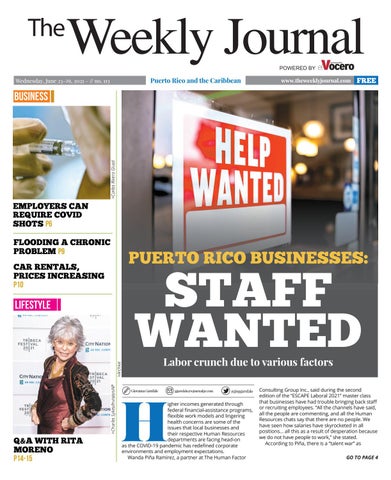
PUERTO RICO BUSINESSES:
STAFF WANTED Labor crunch due to various factors
>Charles Sykes/Invision/AP
>Archive
CAR RENTALS, PRICES INCREASING P10
Q&A WITH RITA MORENO P14-15
H Giovanna Garofalo
ggarofalo@wjournalpr.com
@giopgarofalo
igher incomes generated through federal financial-assistance programs, flexible work models and lingering health concerns are some of the issues that local businesses and their respective Human Resources departments are facing head-on as the COVID-19 pandemic has redefined corporate environments and employment expectations. Wanda Piña Ramírez, a partner at The Human Factor
Consulting Group Inc., said during the second edition of the “ESCAPE Laboral 2021” master class that businesses have had trouble bringing back staff or recruiting employees. “All the channels have said, all the people are commenting, and all the Human Resources chats say that there are no people. We have seen how salaries have skyrocketed in all positions... all this as a result of desperation because we do not have people to work,” she stated. According to Piña, there is a “talent war” as GO TO PAGE 4
The Weekly Journal > Wednesday, June 23, 2021 >
2
s e n e i t Tú
e t r e u s a l
tu
nen e i t s o l l pero e
e t e l l Bi
! s o l a c s ú ¡B
Con más de 3 millones $
todas las semanas 100% libre de impuestos. ¡Busca a tus agentes y vendedores de billetes para que pruebes tu suerte ya! Advertencia: Los juegos de azar pueden crear adicción. Si jugar le causa problemas económicos, familiares u ocupacionales, llame al proveedor de salud mental ASSMCA 1-800-981-0023.
3
/ Wednesday, June 23, 2021
A WEEK IN REVIEW HEWLETT PACKARD ENTERPRISE GRANTED EXTENSION TO BOOST RESILIENCE The Economic Development Department granted Hewlett Packard Enterprise a tax exemption for the production, sale and operation of Highly Efficient Energy, including combined heat and power systems operated by liquefied natural gas or renewable liquefied natural-gas on a commercial scale. The incentive was granted in disaster resiliency at the site, with the company investing a reported $13 million. >Courtesy
SEGUROS MÚLTIPLES BUILDING NEW BRANCH IN SAN JUAN Cooperativa de Seguros Múltiples began the construction of its new branch in the premises of its central office, located in Río Piedras, San Juan. The project, which will be carried out with an investment of nearly $3 million, will result in the creation of 40 direct jobs and 30 indirect and induced jobs. The new branch should open its doors in the first quarter of 2022. >Courtesy
Powered BY El Vocero de Puerto Rico, 1064 Ave Ponce de León 2nd floor San Juan, PR Postal Address: PO Box 15074, San Juan, PR 00902
President Salvador Hasbún shasbun@elvocero.com Vp of Marketing and Business Operations Michelle Pérez Miperez@elvocero.com
ANOTHER POWER OUTAGE HITS 337K IN PUERTO RICO A sudden power failure left more than 337,000 customers in the dark across Puerto Rico on June 16, affecting many who were recovering from a massive outage that hit the island a few days earlier. LUMA Energy, a private company that took over the island’s power transmission and distribution system on June 1, said three units were knocked offline for reasons that were not immediately known. LUMA had warned that services would be interrupted nightly for the next three days, given pre-scheduled maintenance at one plant and interruptions in power generation by the P.R. Electric Power Authority.
VP of Accounting Félix A. Rosa frosa@elvocero.com
Human Resources Director Arlene Rolón, PHR arolon@elvocero.com
VP of Editorial Content Juan Miguel Muñiz Guzmán jmuniz@elvocero.com
VP of Production Eligio Dekony edekony@elvocero.com
Traffic Director Ilia M. Pérez Centeno iperez@elvocero.com
Multi-Platform Graphic Director Héctor L. Vázquez hvazquez@elvocero.com
Multi-Platform Digital Director María Arce marce@elvocero.com
Phone: 787-622-2300, 787-721-2300
Assistant Editor/ Reporter Rosario Fajardo rfajardo@wjournal.com
Customer Service: 787-622-7480
4
/ Wednesday, June 23, 2021
People line up outside the Labor Department to file unemployment claims amid the pandemic. >Brandon Cruz González/Archive
CONTINUED FROM PAGE 1 a result of COVID-19, unemployment, and the additional Pandemic Unemployment Assistance (PUA) and federal financial benefits. By September, when classes will be given inclassroom and PUA benefits will end, individuals who are currently unemployed are expected to reenter the workforce. However, Piña raised the question of whether they would actually want to return or if they can be relied to do so. There’s also the fact that some workers reinvented themselves during the pandemic and are now operating their own businesses, implying there is less talent available. “Therefore, we can’t put our hopes up for September; we have to place hope in what we have today and work with the reality of a new work system, a new way of seeing it ,where we manage risks and are spokespersons at all times of positivism and a new morale,” she asserted. Until then, businesses must outline their policies on resuming regular operations, such as asking employees to return to the office or keep a remote or hybrid model. “If we say what is sought, what is expected, it is greater flexibility. From now on, we will not be able to bring all those models that we have seen over time,” Piña explained, adding that “upskilling” and “reskilling” would also be useful tools to aid staff and bolster efficiency. Since the gradual reactivation of the economy, there have been various job fairs in hopes of boosting Puerto Rico’s historically low labor-force participation rate, but companies and entities
reported low attendance at these events. Given the panorama of greater federal financial assistance available, Labor Secretary Carlos Rivera Santiago asserted that many people have declined to join the labor market because “when they add and subtract, they do not see a benefit.” The secretary reiterated that it is not right to reject a job offer to continue receiving unemployment benefits. “I believe that welfare benefits have a purpose and I believe that they should also be put to proper use. That is, there is no fraud and that it is real when people need it. Unfortunately, fraud situations continue to arise. A person who continues to declare under oath that he is unemployed and was called to work and stayed at home is committing fraud,” he stated. Concerning the labor participation rate, Rivera
If the labor force is inserted to recover the country, I am fully convinced that the market will organically improve the salary conditions [for low-income workers] that we need to improve so much. - DDEC Secretary Manuel Cidre
said that “it has practically been at 40 percent all this time and it is the people who work. It is 60 percent [in the U.S. mainland] and in other countries of the world, it is 65 percent. That lets us see that we have a problem in Puerto Rico about how we get people to enter the labor market. We are not doing something right for people to move, so we have to reexamine the governmental apparatus and how social aid works. Also, how can we make the labor market profitable.” Meanwhile, there is the issue of handling workers who are averse to the COVID-19 vaccine. Although by federal law, employers are allowed to require their staff to get the vaccinations, Piña recommended assessing the situation in a way that those employees who haven’t or don’t want to get vaccinated “don’t feel like we are violating their rights.” “Whatever decision we make, how we communicate it, how we handle it, is very important. Our supervisors are going to have to learn to answer questions they were not used to, and this is risk management. We have to prepare our supervisors and all those who supervise companies for this constant risk management when an employee arrives with fear, arrives with apprehension…” she stated.
The PUA Effect
The most recent data compiled by the Puerto Rico Statistics Institute from the U.S. Department of Labor - corresponding to the week of May 29 and filed on June 6 - indicates that there were 3,029 initial unemployment claims and 28,563
5
/ Wednesday, June 23, 2021
continued claims, bringing the island’s insured unemployment rate (IUR) to 3.47. By contrast, the same data corresponding to May 30, 2020, revealed an IUR of 21.11, as there were still tough restrictions on businesses and residents due to the pandemic. However, the IUR remains higher than before the pandemic hit; for example, on May 25, 2019, the island’s IUR was 1.65. By mid-April, roughly 77,000 residents were under the local Labor Department’s unemployment benefits program, while more than 100,000 individuals received the PUA. A person eligible for both benefits can receive up to $540 per week, which amounts to $2,160 a month. In other words, if a person who worked full time for $7.25 an hour before the pandemic is currently receiving the full extent of both benefits, they are now earning $1,000 more each month, or nearly double his/her initial salaries. In order to gain the same income from working, they would need to earn $13.50 an hour. As such, several industries and sectors have experienced staff shortages, as Since the gradual in many cases, reactivation of the the federal economy, there government have been various is providing a job fairs in hopes higher income of boosting Puerto (through PUA) Rico’s historically than their former low labor-force or would-be participation rate, employers. For but companies and instance, earlier entities reported this year, the low attendance at local Agriculture these events. Department warned that there were farmers needed to pick tomatoes, but residents denounced that the pay - about $10 an hour - was not worth the effort. Even with that salary, higher than the minimum wage offered by many other businesses, they would fall short by $560 a month compared to the maximum benefits offered by current unemployment programs. As a result, many foreign workers from the Caribbean and Latin America were allowed to legally come to Puerto Rico and pick the tomatoes. Likewise, three Uber drivers who spoke on the condition of anonymity assured THE WEEKLY JOURNAL that there is a shortage of drivers, even speculating that some workers have opted to receive the increased federal financial assistance instead. This has reportedly resulted in longer wait times and higher fares for customers, an issue heightened when demand exceeds the number of drivers available. Even in tourist zones like Condado or Isla Verde, customers who would normally wait a few minutes for their drivers to arrive may often wait nearly half an hour or more, or pay several times more than their usual fares. As of press time, Uber officials could not be reached to comment.
In fact,
Minimum Wage Debate
Economic Development Secretary Manuel Cidre was asked at a press conference if his agency would
Economic Development Secretary Manuel Cidre >Archive
Labor Secretary Carlos Mercado said that workers who have been asked to return to their jobs can’t receive unemployment benefits while they are technically employed. >Josian E. Bruno Gómez.
tackle the problem of the insufficient number of available workers in Puerto Rico, to which he responded that “it is everyone’s problem. It is the same in the United States as well, not just in Puerto Rico.” In fact, The Associated Press reported that in March, the number of new jobs in the U.S. mainland rose 8 percent, a record 8.1 million, but the hiring of new staff rose just 4 percent. If people want to reinsert themselves back in the labor market once PUA ends in September, “they run the risk that the job they have had they may lose, but more than anything, they run the risk that by not having a job they will not be able to enjoy the Tax Income Credit, which starts in January, which is the work credit,” Cidre warned. “Puerto Rico is going to receive millions of dollars. If the labor force is inserted to recover the country, I am fully convinced that the market will organically improve the salary conditions that we need to improve so much. In fact, you know that if we talk about $7.25 [an hour], people no longer want to work for $7.25 because $7.25 is not fair,” he added. Regardless, he noted that small and midsize
businesses are “the largest job creators” in Puerto Rico, but many of these companies cannot afford to pay higher salaries for their personnel. “Thus, among the things that we are analyzing at the Minimum Wage Committee appointed by the governor is how we can coexist with social assistance,” Cidre said. As an example, the secretary mentioned that currently, a family of four with a total income of more than $750 per month (equivalent to $9,000 a year) loses the right to receive social assistance. “Why don’t we raise that to $20,000 (a year) so that you can receive welfare and a [better] salary at the same time? When you weigh that $20,000 with [the federal] Section 8 program, with the government health plan, and with the government coupons, well maybe we possibly help them to work. We contribute to reducing poverty and inequality, and we bring to the workforce those that the country needs,” he affirmed. - Reporters Yaritza Rivera and Ayeza Díaz contributed to this story.
6
/ Wednesday, June 23, 2021
Tough Workplace Vaccine Demands in Puerto Rico
Applicable requirement based on federal law
D Rosario Fajardo
rfajardo@wjournalpr.com
In fact,
@RosarioWJournal
>Carlos Rivera Giusti
ata from the U.S. Census Bureau reveals that Puerto Rico has the highest percentage of employers that require their personnel to be vaccinated against the COVID-19 infectious disease before they go back to the office. Puerto Rico leads all U.S. states in small businesses requiring proof that their employees are vaccinated against COVID-19 before returning to work, according to the U.S. Census Bureau’s newest Phase 5 results of the Small Business Pulse Survey says it plans to continue to release data every (SBPS). Thursday through July 22. The survey shows that 19.0 percent of employers The SBPS measures the effect of the coronavirus in the U.S. territory required the vaccine compared pandemic on the nation’s small businesses, with a national average of 4.4 percent based on complementing existing Census Bureau data responses collected May 31 – June 6 and released collections by providing high-frequency, detailed last week. information on the challenges small businesses are The national average for vaccination facing. requirements has slowly ticked up during the spring The survey includes information about small of 2021, going from 2.5 percent as of April 18 to business operations and finances, requests and the current 4.4 percent, although the figure has not receipt of assistance, COVID-19 vaccinations and changed significantly testing and measures for Puerto Rico. of overall well-being Conversely, the and expectations for national average for recovery. testing requirements What Federal has dropped slightly over the same time Law States period, going from According to the 7.5 percent to 5.3 U.S. Equal Employment percent, although the Opportunity figure has not changed Commission (EEOC), significantly for Puerto employers across Rico. the nation can legally Based on the require workers to current data, the receive the vaccine -U.S. Equal Employment Opportunity top-three states that against the coronavirus Commission have small businesses before returning to the requiring the vaccines office. Companies can against the coronavirus provide “ incentives” to are California and New York, with both at 7.7 their employees to promote getting the vaccines. percent; followed by New Jersey with 6.6 percent. A person could be exempt from the requirement, At the bottom rung are three states that have the based on the Americans with Disabilities Act (ADA), fewest number of small businesses requiring the Title VII of the Civil Rights Act and other federal COVID-19 vaccine: Georgia at 2.5 percent; Ohio at laws. In these cases, the employer must provide “ 2.8 percent and Florida with 2.9 percent. reasonable accommodations” to their staff. The newest phase of the Small Business Pulse On May 28, the EEOC clarified several points on Survey, known as 5.0, began May 17 and initial the federal Equal Employment Opportunity (EEO) on results were released May 27. The Census Bureau COVID-19 vaccinations in the employment context.
Federal Equal Employment Opportunity laws do not prevent an employer from requiring all employees physically entering the workplace to be vaccinated for COVID-19...
The Census Bureau survey shows that 19.0 percent of employers in Puerto Rico required the vaccine compared with a national average of 4.4 percent.
The key points are as follows: • Federal EEO laws do not prevent an employer from requiring all employees physically entering the workplace to be vaccinated for COVID-19, so long as employers comply with the reasonable accommodation provisions of the ADA and Title VII of the Civil Rights Act of 1964 and other EEO considerations. Other laws, not in EEOC’s jurisdiction, may place additional restrictions on employers. From an EEO perspective, employers should keep in mind that because some individuals or demographic groups may face greater barriers to receiving a COVID-19 vaccination than others, some employees may be more likely to be negatively impacted by a vaccination requirement. • Federal EEO laws do not prevent or limit employers from offering incentives to employees to voluntarily provide documentation or other confirmation of vaccination obtained from a third party (not the employer) in the community, such as a pharmacy, personal health care provider, or public clinic. If employers choose to obtain vaccination information from their employees, employers must keep vaccination information confidential pursuant to the ADA. • Employers that are administering vaccines to their employees may offer incentives for employees to be vaccinated, as long as the incentives are not coercive. Because vaccinations require employees to answer pre-vaccination disability-related screening questions, a very large incentive could make employees feel pressured to disclose protected medical information. In general, federal law overrides state law. But it should be noted that some governors have signed their own Executive Orders in an effort to trump federal law. This is the case of the Republican governors of Alaska, Florida, South Carolina and Texas.
7
/ Wednesday, June 23, 2021
Local Insurance Industry Remains Solid
Premium growth outpaces nominal gross product
P Giovanna Garofalo
ggarofalo@wjournalpr.com
@giopgarofalo
uerto Rico’s insurance industry has been flourishing despite the challenges in the overall economy, showing more growth in premiums than even its counterpart in the U.S. mainland. The Association of Insurance Companies (ACODESE by its Spanish acronym), recently held a summit to reveal the findings of a study on the industry’s progress over the past few years, as well as recommendations to boost it further. Gustavo Vélez, founder of Inteligencia Económica, which conducted the study for ACODESE, revealed that while the industry has experienced contractions of 3.9 percent in 2016 and 3.4 percent in 2018, written premiums have increased by nearly $3.7 billion, or 35 percent. According to the study, between 2013 and 2019, total written premiums in Puerto Rico increased from $10.5 billion to $14.2 billion. “Premium growth has outpaced nominal gross product. In other words, in this period of time, the industry has grown higher than the growth of the economy, which is something that is also positive. There has been a reduction in players, but in all industries there has been a reduction in players,” Vélez detailed. In terms of written premiums, Puerto Rico’s sector experienced an increase of 18 percent between 2015 and 2019. By comparison, Colombia grew by 16 percent, Spain and Chile by 13 percent
each, and the U.S. mainland by 6 percent. “Puerto Rico was able to grow more than countries with economies larger than ours, such as Spain and Chile, and even the North American economy itself,” he underscored. He also noted that the three types of premiums - health and disabilities, property and contingency, and life - are “highly capitalized and very stable.” The ‘health and disabilities’ category continues to lead with 73 percent of written premiums, while ‘property and contingency’ make up 16.6 percent, and life premiums with 10.2 percent.
ACODESE President Agnes Suárez affirmed that “the insurance industry has a multiplier effect on jobs and income by joining more than 20 [other] industries in the rest of the economy, which fills us with satisfaction because we know that with this relevance in the market, we are prepared to boost the island’s economy.”
Challenges and Solutions
In his presentation, Vélez outlined that the island’s estimated 15-year economic depression, natural disasters like hurricanes and earthquakes, and so-called “slow diligence” from the Office Multiplier Effect of the Insurance Commissioner, are the biggest As reported, in 2020, the insurance sector challenges affecting the industry. accounted for 64,000 direct “A public policy must be and indirect jobs on the island. created that recognizes the Vélez informed that for every job relevance of the insurance generated in the industry, 3.3 are industry for the economy and created indirectly. Meanwhile, for promotes strategic actions every dollar of production added to strengthen the three lines According to this sector, $2.01 is generated of business. It is necessary to to the study of the forward; and for every dollar of review all the current rates and insurance industry, income that is generated in the tax measures that reduce the between 2013 and industry, almost $2 is created for competitiveness of the industry,” 2019, total written the rest of the economy. “When he suggested. premiums in Puerto viewed in terms of millions of Moreover, the economist Rico increased from dollars, it gives you insight into recommended lower taxes and $10.5 billion to $14.2 the macroeconomic dimension operational costs, automated billion. of the insurance industry in the processes, initiatives to foster economic growth, diverse workplace,” he stated. business lines, and improved “This is important because ease of doing business overall. As there is a perception that this is such, Vélez urged a discussion between industry a small, encapsulated sector... and that there is no leaders and the Puerto Rico government, including external impact. We validate the public narrative for [insurance] to be recognized as a sector that the Financial Oversight and Management Board has many implications for the rest of the economy that is tasked with overseeing the island’s budget and clearly, for the rest of consumers,” he added. and other fiscal obligations.
In fact,
8
/ Wednesday, June 23, 2021
Bar Industry on a Long Road to Recovery Bartenders scarce as many changed professions during pandemic
E Giovanna Garofalo
ggarofalo@wjournalpr.com
@giopgarofalo
ven though bars were allowed to reopen under the current executive order addressing the COVID-19 pandemic, the industry is on a long road to recovery after spending over one year shut down. José Raúl Aponte, president of the Puerto Rico Bartenders Association (PRBA), explained that many bartenders had to reinvent themselves professionally, causing a rampant shortage of trained personnel that is affecting these businesses. “The industry is not really prepared because so many bartenders had to learn to do something else or change their profession, and now that bars are reopening, bartenders have taken a liking to their other jobs and there are no bartenders to work,” he explained to THE WEEKLY JOURNAL. “Different business owners write to me at least three times a week asking if I can get them bartenders because they are short-staffed,” Aponte said. “There is a big shortage of bartenders. Today (Monday) they called me from the Sheraton at the Convention Center to see if I could get bartenders for activities at the hotel. What I tell everyone is to make a flyer-type ad and I can publish it on our platforms, but I can’t dedicate myself to calling bartenders,” he stated, although he added that every Monday from 5 p.m. to 8 p.m. he attends calls from bartenders to guide them on requesting government incentives. Another issue holding back bartenders from reentering the industry is their below-minimum wage salaries, as they rely on tips to make ends meet. Aponte asserted that some of these professionals have found daytime jobs with aboveminimum pay, for which returning to their previous jobs amid economic uncertainty seems like a high-risk move. Some, he said, even started their own businesses, such as food trucks or handyman services. Moreover, tips are not a surefire means of income, considering that many other residents have
also been economically affected by the pandemic. For example, even when restaurants were allowed to serve alcoholic beverages, bartenders relied on tips earned by waiters because they couldn’t service customers directly, yet waiters themselves were not generating enough tips. However, Aponte noted that some establishments have taken notice and are offering higher salaries, such as El Conquistador, which is offering $15 an hour plus tips, yet they have had issues attracting staff. “That is something well above what a bar pays in Puerto Rico. A bar in Puerto Rico tends to pay bartenders in hotels $8 or $9 an hour plus tips, so $15 plus tips is super good, but they still don’t get bartenders,” he stated, adding that small bars are also reeling under the economic impact. The most affected regions to date, according to Aponte, are the Metro and Western areas -particularly San Juan - given that they typically receive a higher influx of tourists and there are more bars per capita. But while the industry is already suffering, the impact of this workforce shortage won’t be fully perceived by other sectors until the island returns to pre-pandemic operations. “When the pandemic is really controlled and the population is almost completely vaccinated, plus the governor decides to open fully as it was before the
pandemic, that is when they will feel the impact,” Aponte explained. “In fact, there are bars that are closing early because they do not have staff to work more hours. When the economy opens full blast, that’s when you will see the hole in the industry, when there is no one who wants to work for you after 10 or 11 p.m.”
A Ray of Hope
Because professional bartenders are scarce, the industry is seeking ways to attract new blood. An optimistic outlook is provided by waiters and other restaurant workers, some of whom are presently enrolled in bartending classes offered by the PRBA. “What is moving now is that many waiters are beginning to study bartending. These are people who are already in the industry and know that bartenders are more likely to have better earnings or a higher salary than waiters because being a waiter does not require studies. Being a bartender requires some studies and the bartender is supposed to earn a little more per hour than the waiter,” Aponte affirmed. That is, with time, the industry is expected to recover and have enough bartenders to serve growing demand, but it is more likely to do so with new talent who are currently in their formative phase.
9
/ Wednesday, June 23, 2021
Puerto Rico Flood Planning
Needs Major Overhaul Scientists: Climate change already here Rosario Fajardo
rfajardo@wjournalpr.com
M
@RosarioWJournal
ore than three years after Hurricane Maria devastated Puerto Rico, many areas of the island still suffer from recurrent flooding whenever heavy rains arrive. A case in point are the heavy rains being experienced this month that has left many areas of the San Juan metro area underwater, affecting residents and businesses alike. Puerto Rico is not ready for another hurricane season, let alone the effects of climate change, according to a new study by scientists from The University of Texas at Austin that shows the island’s susceptibility to record-breaking floods and triggering major landslides. The latest research, appearing in the journal Hydrology, builds on three prior studies led by hydrologist Carlos Ramos-Scharrón at The University of Texas at Austin, whose team began
investigating the devastating impact of tropical cyclones on the island after Hurricane Maria in 2017. The first compared the 2017 hurricane as a rainstorm event to more than a century of tropical storms that came before it, finding that Maria produced the highest islandwide daily rainfall amount ever recorded (similar to Hurricane Harvey’s impact on Houston, also in 2017). The second found that Maria’s rainfall triggered one of the highest number of rainfallinduced landslides ever reported worldwide in similarly sized areas. And the third identified landslides as the main source of the sediment infilling the already limited water storage capacity of the island’s main reservoirs. “We need to stop talking about climate change in future tense. It’s already here,” said RamosScharrón, associate professor in the Department of Geography and Environment and the Teresa Lozano Long Institute of Latin American Studies. “Climate change projections for the Caribbean suggest longer dry periods interrupted by more intense storms. These storms release large quantities of sediment by landslides, and many of those end up reducing the island’s capacity to store water. The combined effect of these climate change projections is for a higher propensity for water scarcity,” they said in a statement.
The latest paper, which focused on streamflow levels, draws attention to another glaring issue — Puerto Rico is not prepared to handle the severe flooding sure to come its way. Flood management and the design of vital infrastructure, such as bridges, largely rely on a calculation of the likelihood that an event of a given magnitude is going to occur. For a particular region, that calculation depends on the history of flooding. In Puerto Rico, the most current method to make such calculations relies on data collected only up to 1994. Since then, Hurricanes Hortense (1996), Georges (1998) and Maria surpassed both 100-year and 500-year flood marks across the island, with Maria surpassing 500-year levels in five locations, according to the study. Five other tropical storms matched or surpassed 100- and 500-year levels in some specific locations, particularly near the central-eastern end of Puerto Rico, which is most vulnerable due to the westward trajectory of most tropical storms and hurricanes, and the island’s hilly topography. “Events with these 100- and 500-year metrics just cannot be that common,” Ramos-Scharrón said. “If this is not what climate change is supposed to be, then I do not know what it is. It can creep up on you. Puerto Rico needs to adapt its planning tools to the reality of what the island has experienced and scientists are documenting.”
10
/ Wednesday, June 23, 2021
The local market can’t keep up with the growing demand for cars, whether they are new, used or rentals. >Archive
Car Sales and Rental Prices on the Rise
Daily rental prices of $30 and $40 have risen to $100 and $135 in June
T
Brenda A. Vázquez Colón
bvazquez@elvocero.com
he lack of cars for sale due to high consumer demand and low production worldwide - caused by a shortage of electronic parts and labor - has increased the costs of new and used cars, while prices for rental units have also risen, auto industry leaders told THE WEEKLY JOURNAL. José Martínez, president of Charlie Car Rental, reported that “at the beginning of the COVID-19 pandemic, the strongest spending had to be eliminated. In my case, from 750 cars, it dropped to 550. Other companies reduced their fleet between 30 percent and 40 percent. This has caused prices to go up. For example, for June the daily rentals of $30 and $40 has risen to $100 to $135.” The problem, he explained, is that at this time, it is impossible to recover the numbers of motor vehicle fleets, due in part to high demand from local customers and tourists for rental units, which is reflected in the ‘sold out’ status that the company has had for the past weekends. “Now that credit lines have been re-established, we find there are no vehicles to buy. There is a shortage of electronic chips and a shortage of staff
that is affecting the production of cars,” Martínez added. “It is impossible to get the cars to replace the fleet, and in the face of shortages, prices rise. People line up looking for cars; there are calls one after the other.” In the case of Popular Auto, although it was not forced to reduce the fleet last year - units are regularly changed between nine months and 2.5 years after acquiring them - it has seen the effect of the shortage and increase in prices. “We did not have our inventory, but we have cars ready to be replenished and we cannot do it because there are none. Prices have also increased; they are being sold at a premium price, no discount,” said Antolín Velasco, president of Popular Auto. The executive also confirmed the increase in motor vehicle rentals, although the price varies by location. “Prices are much higher than the regular rates for this time, although for summer, rates are more expensive. They can start over $40 a day and are now going up to $85 or more, depending on the sector because airport rentals are more expensive,” Velasco added. Eduardo González Green, a CPA who has among his clients dealers from the Island and has carried out studies on the automotive industry, confirmed the lack of inventory that Puerto Rico faces, even though it has had historical sales in the past five months. “There’s a huge shortage of new cars; dealers ask for 120 cars and they get 20,” he said. For his part, Julio Ortiz, president of the Puerto Rico Car Distributors and Dealers Association stated that the price of new cars has increased by roughly 6 percent, while used cars have had a 32 percent increase versus May 2020.
González agreed, assuring that “the car shortage has caused used cars sold at auctions to increase in price between $3,000 and $4,000. Regarding the value of the units, Martínez agreed that the cost of used cars is higher. “I have seen a rise in price in used cars, but not as high as $4,000.”
Concern Over Lack of Inventory
Ricardo García, president of the United Group of Automobile Importers, acknowledged the rise in prices experienced by new cars, but does not know the percentage of growth “because that will depend on each local dealer or distributor.” He reported that according to global estimates, the lack of cars will mean that in 2021, close to 3.9 million units will not be sold, which represents a decrease in revenue of $60 billion. “What is coming in from inventory is leaving and there is not much variety. We are concerned about this shortage because we could be much better off in Puerto Rico. We are seeing high demand from customers and I estimate that this situation will carry on to 2022. We are grateful for the sales boom we have had and this shortage may hinder the potential growth of the industry,” García underscored. He added that the government’s collections are also affected by the lack of inventory of cars for sale, since it receives an average of $4,500 per unit in excise taxes. From January to May 2021, over 55,000 new cars have been sold on the island, a historical figure that is projected to continue increasing until reaching 120,000 units by the end of the year, according to their estimates.
11
< The Weekly Journal > Wednesday, June 23, 2021
12
/ Wednesday, June 23, 2021
Vanessa Figueroa
Destination Support-Services Director at Discover Puerto Rico
O
rlando. Phoenix. Hawaii. Other Caribbean islands. These are among Puerto Rico’s competitors for organizations and businesses across the globe seeking to hold their most important events. And my job is to help ensure that Puerto Rico wins in this beauty contest for travel. The Meetings, Incentives, Conferences and Events (MICE) segment of the tourist industry represents over half a billion dollars in economic impact to Puerto Rico annually, and there is room for further growth. Since unique local restaurants, attractions and venues create the memorable experiences that can make a MICE activity amazing for an organization, Puerto Rico is uniquely positioned to excel. For Discover Puerto Rico, I lead a team focused on “wowing” event planners who choose where a group’s gathering will take place. Our job is to engrave Puerto Rico in their hearts – and when we get them to visit on a familiarization trip to explore what the Island has to offer, they almost always choose us for their meeting or event. Why? Because they see first-hand that no other destination, in the Caribbean or elsewhere, is like Puerto Rico. Our rich culture, heritage, natural wonders and amazing people differentiate us. And when meeting planners visit, we work hand-inhand with local businesses and tourism directors to ensure they are immersed in everything that makes our Island special. Since our inception, we have hosted 839 meeting planners and travel advisors for site inspections and familiarization trips. And when our Support Services team executes a site inspection, 70% of them select Puerto Rico – a remarkable conversion rate. One favorite example of the work we do is the time we brought some decision-makers to Fajardo.
What Brings Events to Puerto Rico? Culture, Culture and More Culture!
Journalists and influencers on a recent familiarization trip to Puerto Rico. >Courtesy of Discover Puerto Rico
They rode in chili boats to a beach and took a short walk through a majestic forest to arrive at a secluded hideaway. Waiting for them was a talented chef who prepared an amazing meal they enjoyed by candlelight, as the sun set. It was magical. And it helped make their decision to choose Puerto Rico a no-brainer. Another time, we invited planners to a private dinner at El Morro, an experience very few ever have at San Juan’s historic fort. During a glorious evening under the stars, they were treated to a private tour by representatives dressed as 18th century soldiers, followed by dinner at a gorgeous table graced by candles and flowers. Musicians serenaded
them in several Puerto Ricans styles. All of that in one evening… how could they say no? (They didn’t!) By integrating Puerto Rico’s culture into these experiences, event planners see how we’ll do the same when they bring their function to the Island. And when event planners couldn’t come during the pandemic, we went to them by sending them packets of Puerto Rican coffee, so they could enjoy the flavor of our Island while stuck at home. One common theme in these examples is one of Puerto Rico’s finest assets: food. When someone brings up Puerto Rican food, my eyes glow. From rum to roasted pig to mofongo, our gastronomy is more amazing than at other destinations.
I’ve worked in hospitality throughout my career and few destinations have the attractions Puerto Rico can offer. That’s because three words define our Island: culture, culture and culture! My colleagues and I at Discover Puerto Rico love our jobs, and 79% of us are natives. We believe in our hearts that our efforts to bolster tourism give us a unique purpose. Puerto Rico has suffered quite a lot in recent years, and growing tourism through corporate outings bolsters our economy. With the help of our incredible chefs, musicians, rummeliers and tour guides, we’ll keep wowing event planners. And they’ll keep making Puerto Rico their destination of choice.
13
/ Wednesday, June 23, 2021
From Patio Lights to Colorful Planters: Easy Ways to Upgrade Your Outdoor Space
W
The Home Entertainer
Adding lighting outside is one of the easiest ways to turn your space into an entertainment area. If you’re looking to make a bold statement, choose patio lights that incorporate elements of nature and are décor in and of themselves, like chandeliers. If you’re looking for something innovative that doubles as a Bluetooth speaker, try a portable LED lantern. You’ll have a stylish centerpiece on your patio table that also serves as entertainment for your guests. For the biggest effect, add lighting not only on the patio itself but throughout the yard, as well. Solar lights placed strategically around your space will give depth and interest to your yard, even at night.
Seating
Updating your outdoor seating makes a big impact on your space. While many people have patio tables and chairs, adding a bench or outdoor sofa can take your patio from dull to warm and inviting. Choose furniture made specifically for outdoor areas, and make sure to store or cover your cushions when necessary, such as when it rains. You can also create several smaller seating areas in your outdoor space to encourage guests to enjoy some solo or small-group time. Many furniture stores have three-piece sets that are comfortable and practical; some side tables and chairs can also easily fold up for storage when not needed.
Water Feature
Adding a water feature to your outdoor space is a great way to bring some interest to the area. Freestanding units are easy to install and can offer both water and light as an additional feature. In the morning and evening, the sound of trickling water will help you relax, while the cooling splashes at midday will help attract birds and other local wildlife. If you choose a solar-powered fountain, you can place the structure anywhere in your outdoor space without worrying whether you can connect it to a power source.
>Courtesy of Airbnb
Lighting
>vgajicvia/gettyimages.com
e are lucky in Puerto Rico. The tropical Caribbean climate allows us to enjoy outdoor spaces in our homes all year long. After a year of the pandemic and being forced to stay at home for many months, you may notice that your patio and yard space need a few updates. Fortunately, there are easy ways to take your space from simply functional to inviting and stylish. Here are five updates that you should start with for the most noticeable upgrade to your outdoor space.
Statement Planters Outdoor Rug
Many people overlook the dramatic improvement that an outdoor rug can have in their space. If you choose the right color and design, the extra dirt that tends to end up on the patio won’t even be noticeable. Consider adding a rug under your patio table as well as a long runner in the space leading back into your home. You can coordinate colors with your furniture cushions or have some fun and use vibrant greens and florals to match the yard space that’s all around.
Even if you have a yard full of flowers and shrubs, incorporating some statement planters will add color, texture and surprise to your outdoor space. You can add two large planters on either end of the patio for a symmetrical look, or designate an area of your outdoor space to highlight a group of these extra-large planters. Fill them with a combination of trailing greenery (so that it drapes down the side) and florals for the biggest impact. Any of these easy updates will go a long way towards turning your outdoor space into a real entertainment area!
14
/ Wednesday, June 23, 2021
This image shows Rita Moreno in a scene from the documentary, “Rita Moreno: Just a Girl Who Decided to Go for It.” >Roadside Attractions via AP
Rita Moreno attends the premiere of “Rita Moreno: Just A Girl Who Decided To Go For It” during the 20th Tribeca Festival on June 12, 2021, in New York. >Charles Sykes/Invision/AP
Q&A: Rita Moreno
on Finding Self-Worth and Never Giving Up Puerto Rico’s own screen legend
N
The Associated Press
EW YORK — Rita Moreno emigrated with her mother from Puerto Rico at age five. By six, she was dancing at Greenwich Village nightclubs. By 16, she was working full time. By 20, she was in “Singin’ in the Rain.” In the documentary “Rita Moreno: Just a Girl Who Decided to Go for It,” Norman Lear says: “I can’t think of anyone I’ve ever met in the business who lived the American dream more than Rita Moreno.” In the decades that followed, Moreno won a Tony, Grammy, Emmy and Oscar, for “West Side Story.” (Her entire acceptance speech: “I can’t believe it.” ) With seemingly infinite spiritedness,
she has epitomized the best of show business while also being a victim to its cruelties. That has made Moreno, who co-stars in Steven Spielberg’s upcoming “West Side Story remake, a heroic figure to Latinos and others. “I have never given up,” she said in a recent interview by Zoom from her home in Berkeley, Calif. The reason for the conversation was Mariem Pérez Riera’s intimate and invigorating documentary, which is now in theaters after playing virtually at the Sundance Film Festival and in an outdoor premiere at the Tribeca Festival. The film opens with Moreno preparing a Cuban themed party for her 87th birthday. “And I demand costumes,” the screen legend says with a smile. But as upbeat as Moreno remains, “Just a Girl Who Decided to Go for It” also deals frankly with the many turbulences of Moreno’s life: being positioned as the “Spanish Elizabeth Taylor” and the stereotyped casting that followed; a long and painful relationship with Marlon Brando; the abuse of her agent; a confining marriage. Moreno, 89, said she learned early on in life that swimming is preferable to sinking.
AP: How early did you learn that? MORENO: The first test, I think, was learning English in kindergarten when I didn’t know a word, not a word. That’s the first thing that happened to me literally when I came to this country. Children are impressively resilient. And then, in a way, they’re also extremely tender and fragile. I think the reason I ending up having such a hard time in life is that I ran into a racial bias very early on. When you’re young — I mean 5, 6, 7 — and people call you bad names like “spic” or “garlic mouth” or “gold tooth,” like in “West Side Story,” you’re tender, you’re a child. You believe these things. You believe that you’re not worthy. You don’t know why, but you know that there’s something wrong with you. AP: Do you remember the first time you performed? MORENO: Oh, yeah. It was for my grandpa in Puerto Rico to a rumba record. Shaking my little booty. And he loved it. He was clapping in time to the music. And I was thinking: Wow, this is fun. And he’s loving this. I like this a lot. I mean, I was born to be a performer. I think some people are
/ Wednesday, June 23, 2021
15
just wired that way. I was just born to perform and please people — and that got out of hand, too. AP: In watching what has and hasn’t changed in that time, what stands out to you? You were there when Martin Luther King Jr. gave his “I Have a Dream” speech. MORENO: I feel extremely fortunate that I’m still around to see the sea changes that are taking place. I’ll be 90 in December and I don’t think I’m going to see the women’s movement really progress more because I won’t be around. But I’ve seen it change. I’ve seen a change in such meaningful ways and I’m grateful for that. What still concerns me mightily and profoundly
We tend in this country to silo ourselves. We are Puerto Rican and then we are also Mexican. We are also Argentinian. We are Spanish Spain. And somehow those twains haven’t really met and coalesced the way we need to. That may be the answer. But it’s very complicated. People forget that we’re not just Hispanic. We are from other countries. -Screen legend Rita Moreno
is that Hispanics haven’t gotten their hold on our profession, I don’t know what the hell is wrong. I don’t know what is not working right. The Black community has done incredibly and I have nothing but the deepest admiration for the Black professional community. They’ve done it and I think we can take some lessons from them. But where is our “Moonlight”? Why are we not advancing? AP: Do you have any answers? MORENO: We tend in this country to silo ourselves. We are Puerto Rican and then we are also Mexican. We are also Argentinian. We are Spanish Spain. And somehow those twains haven’t really met and coalesced the way we need to. That may be the answer. But it’s very complicated. People forget that we’re not just Hispanic. We are from other countries. Maybe the answer, or the beginning of the answer, lies in a summit, some kind of summit. I’m not going to see that. My age forbids it. But I sure as hell hope something happens. I can’t believe we’re still struggling the way we are. And when we do something that’s Latino, it doesn’t do as well. “One Day at a Time” (a Netflix sitcom begun in 2017) was hilarious. It was marvelous. It was no accident because it had Norman Lear who chose the writers. And we lasted three and a half seasons. You wonder: Why didn’t that happen? AP: Many would attribute it to the entrenched biases in Hollywood.
This image shows Rita Moreno in a scene from the documentary “Rita Moreno: Just a Girl Who Decided to Go for It.” >MGM Media Licensing/Roadside Attractions via AP
MORENO: It’s one of the very few things about my career that really makes me sad. A lot of the reviews for this documentary were fabulous. A number of the critics said something to the effect of: It’s sad to think that this woman might have had a real career in films had she not had this career when she had it. And I think that’s true. I think it’s very, very true. I want to say I’ve been robbed. But you know, what good does that do? AP: After “West Side Story,” you’ve said you were offered only similar, stereotypical roles for years. MORENO: Those were brutal. Brutal! When I got the Oscar and the Golden Globe, I thought: “OK, finally.” And that’s not what happened at all. In fact, it was the opposite. I was offered more Anita-type roles when I was offered something, which was not that frequent. I made a decision not to accept any more of those kinds of roles. It was a lot of coffee pourers, housewives and stuff. I said I’m not going to do them anymore. Ha-ha, I showed them. I didn’t make a movie for seven years. I mean, how stubborn can you get? AP: You recently revisited “West Side Story” with Spielberg. How was that? MORENO: It was just grand. I’ve been a fan of Steven’s work for years. When he called, he offered me a part in “West Side Story.” I nearly peed my pants because this is Steven Spielberg, one of my
idols. I said to him that I would love to do a cameo, but I said, “You don’t really want me to do that, do you?” And he said, “Oh, no, no. It’s a part. It’s a real part. Tony Kushner wrote it for you.” First of all, Tony Kushner’s writing the script? What! I was thrilled. I was excited the way a child would be excited. Tony kept adding to the part. It’s a wonderful part. It was one of the best experiences of my life. AP: I don’t imagine you do, but do you have any regrets? MORENO: If I can’t have all the movies I always wanted to be in — which are all the Meryl Streep movies, I wanted to be her — but if I can’t do that, I’ve done pretty well, considering. And I think I’ve left an important legacy in a very, very meaningful sense and that is: That I have never gave up. I have never given up. I just cling and hang on to what is important to me. A great deal of that has to do with self-respect and earning respect. AP: I know it’s early, but have you picked out a theme for your 90th birthday in December? MORENO: I think it’s going to be Puerto Rico. (Laughs.) It means the food. It means people have to dress a certain way. I’m probably going to say Puerto Rico in the ‘30s. I’ll make them wear Panama hats. -Editor’s note: This article has been edited for space as well as clarity and brevity.
This image shows Rita Moreno as Valentina, left, and Ansel Elgort as Tony in a scene from “West Side Story.” >20th Century Studios via AP
Constant updates online 24/7. TheWeeklyJournal.com
Visit us for updated content on our 24/7 platform.
WeeklyJournal
The