Puerto Rico and the Caribbean
Wednesday, June 9-15, 2021 - // no. 111
www.theweeklyjournal.com
Economy Bounces Back From COVID P6 Direct Relief Helps Health Centers P9
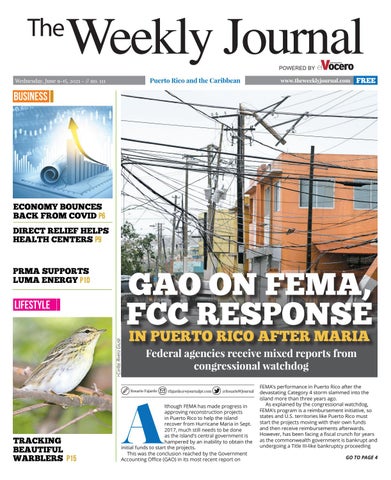
GAO on FEMA, FCC response >Carlos Rivera Giusti
PRMA Supports Luma Energy P10
in Puerto Rico after Maria Federal agencies receive mixed reports from congressional watchdog
A Rosario Fajardo
Tracking Beautiful Warblers P15
rfajardo@wjournalpr.com
@RosarioWJournal
lthough FEMA has made progress in approving reconstruction projects in Puerto Rico to help the island recover from Hurricane Maria in Sept. 2017, much still needs to be done as the island’s central government is hampered by an inability to obtain the initial funds to start the projects. This was the conclusion reached by the Government Accounting Office (GAO) in its most recent report on
FEMA’s performance in Puerto Rico after the devastating Category 4 storm slammed into the island more than three years ago. As explained by the congressional watchdog, FEMA’s program is a reimbursement initiative, so states and U.S. territories like Puerto Rico must start the projects moving with their own funds and then receive reimbursements afterwards. However, has been facing a fiscal crunch for years as the commonwealth government is bankrupt and undergoing a Title III-like bankruptcy proceeding GO TO PAGE 4
The Weekly Journal > Wednesday, June 9, 2021 > 2
3
/ Wednesday, June 9, 2021
a week in review New Executive Order Reopens Bars, Nightclubs
>Archive
>Brandon Cruz González
Gov. Pedro Pierluisi announced the new executive order to be in effect from June 7 to July 14, to continue addressing the COVID-19 pandemic. The directives include: People who have been fully vaccinated against the coronavirus will not be required to wear masks in public. Unvaccinated individuals must continue wearing masks. Bars and nightclubs are allowed to reopen after over a year since they were forced to close, at 50 percent capacity. Outdoor bars will not have a limit on occupancy, but clients must keep social distancing of six feet between groups.
PRHTA: Increase Room Tax for Short-term Rentals to 11 Percent The Chairman of the Board of the Puerto Rico Hotel and Tourism Association (PRHTA), Joaquín Bolívar III, recommended that the room tax for short-term rentals be increased to 11 percent. Currently, the room tax for all lodgings in 7 percent. “We want to establish for the record that the PRHTA understands that short-term rentals are a model of lodging that adds to the tourism industry and we are not against them. However, our position since the proliferation of this type of leasing began has been the same: An egalitarian regulatory field to protect the tourist and destination,” he said to lawmakers.
Powered BY El Vocero de Puerto Rico, 1064 Ave Ponce de León 2nd floor San Juan, PR Postal Address: PO Box 15074, San Juan, PR 00902
President Salvador Hasbún shasbun@elvocero.com Vp of Marketing and Business Operations Michelle Pérez Miperez@elvocero.com
Online Spending Gains Momentum Last year, 79 percent of Puerto Ricans made internet purchases, placing the island among the five places with the highest incidence of online spending. The data was compiled in the preliminary results of the 2021 Consumer Snapshot by the Puerto Rico Chamber of Food Marketing, Industry & Distribution. In 2020, 30 percent of local consumers used digital tools to buy food, while 48 percent bought food through online apps so far this year, representing an 18 percent increase.
VP of Accounting Félix A. Rosa frosa@elvocero.com
Human Resources Director Arlene Rolón, PHR arolon@elvocero.com
VP of Editorial Content Juan Miguel Muñiz Guzmán jmuniz@elvocero.com
VP of Production Eligio Dekony edekony@elvocero.com
Traffic Director Ilia M. Pérez Centeno iperez@elvocero.com
Multi-Platform Graphic Director Héctor L. Vázquez hvazquez@elvocero.com
Multi-Platform Digital Director María Arce marce@elvocero.com
Phone: 787-622-2300, 787-721-2300
Assistant Editor/ Reporter Rosario Fajardo rfajardo@wjournal.com
Customer Service: 787-622-7480
4
/ Wednesday, June 9, 2021
CONTINUED FROM PAGE 1 under the so-called Promesa federal law. As of January 2021, the latest dates available as per the GAO report, FEMA has obligated $23.8 billion through Public Assistance funds to help Puerto Rico recover from the 2017 hurricanes, 2019 and 2020 earthquakes, and the COVID-19 pandemic. “Because Public Assistance is a reimbursement program, Puerto Rico must provide the initial funding for projects and seek reimbursement afterwards. However, Puerto Rico’s agencies have had trouble getting the initial funding to start recovery projects. Consequently, Puerto Rico has only spent $4.7 billion of the $23.8 billion,” the GAO stated in its May 2021 report. As of January 15, 2021, FEMA obligated $23.8 billion in Public Assistance funds to Puerto Rico for the 2017 hurricanes ($23.5 billion), 2019 and 2020 earthquakes ($243.8 million) and 2020 COVID-19 response ($59.7 million). “To help expedite obligations, FEMA changed how it implemented the Public Assistance program in Puerto Rico by, among other things, focusing on obligations for critical services like electricity and water. However, significant work for the recovery remains. FEMA and Puerto Rico are working to develop and obligate about 6,100 more projects. “Further, Puerto Rico’s fiscal condition has made it difficult for Puerto Rico agencies to access funds to start construction, thus work for many obligated projects has not started. Because Public Assistance is a reimbursement program, these agencies must provide the initial funding for the work and seek reimbursements afterwards. As such, of the $23.8 billion obligated, Puerto Rico has only spent $158 million for long-term rebuilding projects, such as rebuilding schools, the power grid, water systems and other damaged infrastructure,” according to the GAO. Among the congressional watchdog’s recommendations are that FEMA should identify or assess the risks that could affect the success of the remainder of Puerto Rico’s recovery. “For example, FEMA and Puerto Rico officials said that Puerto Rico agencies’ staff lack the expertise to develop thousands of projects, which presents risks of delays. Further, Puerto Rico will have to start construction on thousands of projects, presenting risks such as lack of construction funding and capacity to procure labor, equipment and materials.” Still, the GAO noted that FEMA is already in the process of implementing an “enterprise riskmanagement framework,” an approach that federal agencies use to identify and assess risks to their mission. “FEMA officials said that they could use this framework, or other methods, to identify and assess the risks to Puerto Rico’s recovery. Given the time elapsed since the 2017 hurricanes and the work remaining, urgent and diligent action is needed to help ensure the recovery’s success. “Identifying and assessing risks to the recovery, jointly with Puerto Rico and relevant federal agencies, could help FEMA monitor emerging risks and identify potential actions to manage them. Further, continuously monitoring risks could help ensure that FEMA’s response to risks remain
Restoring power to the whole island was a top priority after Maria. >Archive
current and relevant,” stated the GAO.
and a community center in Mayagüez. “Our goal is to complete all earthquake-related inspections this year to facilitate the recovery FEMA and COR3’s Response of the southern area. It is our FEMA and the Puerto Rico priority to help repair the Central Office for Recovery, structures that were damaged Reconstruction and Resilience by last year’s earthquakes,” (COR3) have stressed their said Federal Disaster Recovery continuing efforts to move Coordinator for Puerto Rico, José reconstruction projects as quickly The GAO G. Baquero. as possible. Recently, for example, issued its findings To date, over $916,000 has the two offices announced that more than three been awarded to the municipality nearly $6.5 million in FEMA funds months after an of Ponce for earthquake-related had been obligated for the José inspector general projects. Miguel Agrelot Coliseum and report found that “The [Mayagüez] projects are Bahía Urbana venue, both in San the administration close to entering the proposals Juan, to restore them to their preof former U.S. phase to begin the contracting Maria conditions. President Donald process, complying with all Meanwhile, FEMA and COR3 Trump was applicable laws, rules and officials said $277 million in FEMA responsible for regulations. We are grateful funds are moving 168 projects stalling about $20 for the diligence in obtaining underway in the southern region billion in federal these funds that will have an to rehabilitate the areas and funds to help Puerto impact on our communities,” structures that were affected by Rico recover from said Olga López de Krumhansl, the 2020 earthquakes. Projects Maria and also a spokesperson from the include allocations for the obstructed a probe Municipality of Mayagüez. municipalities of Mayagüez and into the delay. COR3 Executive Manuel A. Ponce. Laboy Rivera said that they For example around $185,000 continue working with FEMA to from FEMA are earmarked to maximize the resources destined repair the Castillo Serrallés, the to the reconstruction of the areas affected by last Salazar Museum and a senior citizen center in year’s earthquakes. “These projects in the southern Ponce, as well as the Casa de Pilar Defilló Museum
In fact,
5
/ Wednesday, June 9, 2021
Because Public Assistance is a reimbursement program, Puerto Rico must provide the initial funding for projects and seek reimbursement afterwards. However, Puerto Rico’s agencies have had trouble getting the initial funding to start recovery projects. Consequently, Puerto Rico has only spent $4.7 billion of the $23.8 billion. - The GAO in its May 2021 report on FEMA’s work in Puerto Rico
and western areas of Puerto Rico, which are carried out under the Public Assistance Program and include risk mitigation works, are a positive step to ensure the preservation of part of Puerto Rican history and above all will strengthen the structures for the safety of those who frequent those spaces,” he said.
GAO on the FCC’s Actions After Maria
Meanwhile, another GAO report found that while the Federal Communications Commission
Many reconstruction projects are now moving forward, including $1.6 million in FEMA funds allocated to repair Bahía Urbana in San Juan. >Courtesy of FEMA
(FCC) helped to restore telecommunications networks after Maria, “abstract” emergency response guidelines could have caused confusion and delays for both Puerto Rico and the U.S. Virgin Islands (USVI). The Category 4 storm destroyed 96 percent of telecommunication cell sites in Puerto Rico after slamming into the island in September 2017, leaving people with no way to call for help, apply for federal assistance or make financial transactions, according to the GAO report. It stated that the Department of Homeland Security did not specifically outline what actions the FCC should take to help restore
Restoring telecom services was another top priority after Maria.
communications infrastructure, and that the agency obtained only limited public input and did not share its actions or findings. The report said such information could help officials build more resilient telecommunication networks and better prepare for future disasters. “As citizens and first responders are increasingly dependent on telecommunications, ensuring the resiliency and reliability of telecommunications networks in U.S. territories may prevent future loss of life,” stated the GAO. It noted that Maria, along with Hurricane Irma -- which hit the USVI as a Category 5 storm about two weeks before Maria – damaged more than 90 percent of power lines above ground in the U.S. territory. The report said the FCC collected information on network outages in Puerto Rico for six months, the longest period in the agency’s history. It also issued nearly 900 special temporary authority licenses to allow radio facilities to operate. But nearly four years after the storms hit, the FCC has not issued a report on its actions or findings or a full account of its response to Hurricane Maria, the GAO found. It added that FCC officials said they were dealing with limited resources, given the multiple disasters that occurred in 2017 and 2018. The GAO called on the Department of Homeland Security to define specific emergency response roles and responsibilities for the FCC to avoid confusion in those moments. “During a disaster, there is little time to learn about such technologies and their appropriate use when critical sectors require telecommunications services immediately,” the report stated. The GAO issued its findings more than three months after an inspector general report found that the administration of former U.S. President Donald Trump was responsible for stalling about $20 billion in federal funds to help Puerto Rico recover from Maria and also obstructed a probe into the delay. - The Associated Press contributed to this report.
6
/ Wednesday, June 9, 2021
Puerto Rico Economy Continues to Bounce Back Economic Activity Index for April: 4 percent y-o-y growth
P Rosario Fajardo
rfajardo@wjournalpr.com
@RosarioWJournal
uerto Rico’s Economic Activity Index (EAI) increased by 4.0 percent during April when compared to the preceding year, though it waned by -0.3 percent on a month-over-m basis, reported the Economic Development Bank. The EAI reached to 119.1 points in April, a 4.0 percent year-over-year (y-o-y) growth when compared to April 2020, when the strict lockdown was in full effect due to the coronavirus emergency. This is the first increase after 12 y-o-y consecutive decreases followed by a stagnant growth rate during March 2021, due to the COVID-19 pandemic.
To reach pre-pandemic levels, economic activity will require a consistent multi-sector recovery pace. “The numbers are encouraging. This analysis includes the large injection of federal funds, a variable that should not go unnoticed. Even so, we are observing industries that must improve to maintain sustainable economic growth, “said the president of the EDB, Luis Alemañy González. “These [federal] funds contribute to the retention and creation of jobs, and enhance commercial capacity through the purchase of equipment and materials. All this benefits the consumer to acquire better goods and services,” he added. The EAI is composed of four components. (1) Total non-farm payroll employment averaged 849,900 employees in April. This represents a rise of 0.1 percent when compared against the previous month and increased by 10.8 percent on a y-o-y basis. (2) Electric power generation for April 2021 totaled 1,588.3 million kilowatt-hours; a 0.5 percent increase on a m-o-m basis, and an annual growth
Maali Corp.
(Aguadilla, PR) is looking for a Sales Manager
rate of 4.6 percent. (3) Gasoline consumption for April 2021 was 67.3 million gallons, or 1.9 percent above the previous month, while the annual change waned by 4.3 percent. (4) Cement sales totaled 1.3 million of 94 lb. bags; a decrease of 5.4 percent on a m-o-m basis for April 2021, whereas the annual change surged by 193.9 percent. As Puerto Rico’s economy continues to move forward, with restrictions being lifted on a regular basis, the EDB said that “to achieve sustainable economic growth, the employment sectors most affected by the pandemic crisis (that is: services, commerce and tourism, among others) need to recover. Alternatively, the resulting job losses would need to be absorbed by other industries.” The EAI is highly correlated to Puerto Rico’s real gross national product (GNP) in both level and annual growth rates, and is a reliable instrument to monitor current trends in Puerto Rico’s economy. During fiscal year 2020, when the pandemic was in full force and restrictions were the strictest, the EAI decreased by 1.9 percent when compared to fiscal year 2019, and fell by 3.5 percent during the July – April period of fiscal year 2021. A 5.0 percent reduction was registered during calendar year 2020, the first annual decrease after two years of growth. During the first four months of calendar year 2021 (Jan-April), the EAI contracted by 0.4 percent.
Maali Corp. (Aguadilla, PR)
is looking for a Business and Marketing Manager.
Must have a Bachelor’s Degree in Service Management and Marketing and Master’s degree in Business Administration (or a foreign equivalent). Fluent in English and Russian. 7 years experience in sales, including at least 6 months in a managerial position.
Fluent in English and Spanish. Fluency in Russian is preferred. Must have a Bachelor’s Degree in Economics. 3 years experience in business and financial consulting.
Please send resume to maalihr@yahoo.com
Please send resume to maalihr@yahoo.com
7
/ Wednesday, June 9, 2021
A view of the UPR campus in Río Piedras >Josian E. Bruno Gómez
A Closer Look at the UPR’s FY2022 Budget
Two different views from the FOMB and UPR President
W Rosario Fajardo
rfajardo@wjournalpr.com
@RosarioWJournal
hile the University of Puerto Rico (UPR) decried a budget cut of $94 million in its fiscal year (FY) 20212022 budget, the Financial Oversight and Management Board (FOMB) reminded university officials that the institution has received $246 million in federal CARES Act and other COVID-19 pandemic funds, which is an opportunity to enact needed reforms under the UPR’s Certified Fiscal Plan. On Tuesday, Gov. Pedro Pierluisi assigned $94 million in federal American Rescue Plan funds to UPR to offset the budget cut. “The 2021 UPR Fiscal Plan includes prudent measures to supplement revenues through nontuition measures (e.g., monetizing intellectual property, increasing revenue from services), which serve to limit the need to increase tuition. “The 2021 UPR Fiscal Plan also includes considerations to limit the impact of tuition increases on students with demonstrated financial need (e.g., increasing scholarship expenditures, capping tuition below the maximum Pell Grant). Finally, expenditure reductions are calibrated to prevent the loss of teaching staff and researchers; savings are achieved through non-personnel cuts as much as possible and faculty are not subject to the same benefit reductions and attrition as non-faculty personnel,” states the UPR’s 66-page Certified Fiscal Plan. For example, there are several “revenue
enhancing measures” called for in UPR’s Certified $94 million budget cut “imposed” by the FOMB Fiscal Plan. These include “reasonable increases and warned that it will have “adverse effects” on in both undergraduate and graduate tuition to the university system, puts at risk new federal move UPR more in line with funds and delays the institution’s the tuition receipts generated “transformation.” by its mainland peers without According to Haddock, “the putting accessibility for lowFOMB does not understand income students at risk. The plan that the UPR does not operate There are also requires changes to the as a government agency due several “revenue University’s tuition exemption to its internal procedures and enhancing measures” policy. governance bodies with decisioncalled for in UPR’s “These initiatives are making authority. Determinations Certified Fiscal expected to ramp up from $90 are not made unilaterally. As in Plan. These include to $127 million in additional many organizations, especially “reasonable revenue a year between FY2021 academia, these processes increases in both and FY2026… Concurrently, require time and resources.”’ undergraduate and offsets, such as increasing He called the budget cut “too graduate tuition to the University’s needs-based aggressive” and “too accelerated.” move UPR more in scholarship expenditures, are The UPR has received budget line with the tuition put in place to ensure tuitioncuts totaling over $300 million in receipts generated related measures do not impact the fast few years, he indicated. by its mainland peers the ability of students with Regardless, Haddock said, “we without putting demonstrated financial need to implemented 76 percent of the accessibility for lowafford a UPR education. Even measures set forth in the Fiscal income students at after implementation of these Plan with empathy and sensitivity; risk.” measures UPR will still be the no closure of premises, or most affordable higher education dismissals of employees. option on the Island and among On the cutback in the midst the most affordable universities of the pandemic, Haddock said in the United States,” according to the FOMB “leaves the university UPR’s Certified Fiscal Plan. without money for important measures: $40 Although UPR has made progress on million to capitalize the Retirement System, implementing needed measures, much more one of our priorities as an administration; $10 needs to be done, according to the FOMB. “For million to address the mitigation of the impact example, UPR has not implemented graduate of the pandemic; $20 million to carry out the tuition measures or pension reform, and the indispensable and obligatory pairing of federal implementation reports suggest that UPR is funds; $20 million to cover the liquidity of behind schedule on capturing the milestones the Emergency Reserve fund; and $4 million, required as part of the administrative to support the revision of the classification transformation process.” and remuneration plan for our non-teaching UPR President Jorge Haddock has decried a employees.”
In fact,
8
/ Wednesday, June 9, 2021
Hemp Business Opportunities in Puerto Rico Industry could bolster agriculture revenues by 25 percent
P Giovanna Garofalo
ggarofalo@wjournalpr.com
@giopgarofalo
uerto Rico has multiple factors to its advantage to developing a topnotch hemp industry, according to leaders in this economic sector. Irving Rodríguez, director of the Office of Licensing and Inspection of Hemp, told THE WEEKLY JOURNAL that Puerto Rico has the capacity to harvest 5,000 to 10,000 “cuerdas” of hemp that could add $200 million annually to gross agricultural income, which currently stands at $800 million - in other words, a 25 percent increase. “It could become the third most important agricultural industry in Puerto Rico after milk and plantains,” he explained. In Puerto Rico, both farmers and the government use “cuerda” as a unit of measurement in agriculture, which is equivalent to 3,930 square meters or 4,700 square yards. According to the local Department of Agriculture, the average investment in a hemp farm is $8,000 per cuerda and the return of investment can reach
up to $25,000 per cuerda. That is, farmers could gain thrice their original investment. “This is a great business opportunity, as there are unique local incentives on the island for registered farmers, government-owned land and manufacturing facilities available for rent, and highly skilled farmworkers,” Rodríguez said. Ingrid Schmidt, senior consultant at Puerto Rico HempBiz, added that the island has unique advantages over competitors because of its tropical climate, which allows for year-round cannabis crops, as well as a number of incentives. “One of the important differentiators that we have in Puerto Rico is that hemp has been included in basically most of the incentive segments… There are export and manufacturing incentives, among others. This is a great differentiator so that Puerto Rico can position itself in an important way as a good hemp exporter, and for it to boost the industry in a significant way,” she stated. In September 2020, Puerto Rico received the approval of its state plan from the U.S. Department of Agriculture, paving the way for the commercialization of hemp in all its forms. Since then, Puerto Rico has been gradually immersing itself into a market that is projected to grow dramatically in the next five years. According to a 2021 research report by Facts and Factors, the global Industrial Hemp Market
Maali Corp. (Aguadilla, PR)
is looking for a Business Expansion and Development Manager.
was estimated at $5 billion in 2019 and is expected to reach $36 billion by 2026. Furthermore, the global Industrial Hemp Market is expected to grow at a compound annual-growth rate of 34 percent from 2019 to 2026. The North America region is projected to have the largest share in the market, owing to the surging demand for industrial hemp products in various industries such as textile, food, cosmetics and personal care.
A Versatile Resource
At the most recent Puerto Rico HempBiz - a conference where key players and professionals discuss the opportunities in the island’s nascent hemp industry - experts discussed the myriad economic sectors and industries that can benefit from using hemp in their products. Noemí Pérez, president of Puerto Rico MedCannBiz and Puerto Rico HempBiz, explained that the cannabis plant, where hemp is obtained, has vastly more uses than simply recreational or medicinal marijuana, which can be incorporated in various industries. For instance, the plant’s fiber can be used to replace fiberglass, a type of plastic used anywhere from manufacturing to food processing. “Hemp is already being used to replace plastic,” Pérez said, noting its positive ecological impact.
Maali Corp. (Aguadilla, PR)
Is looking for a District Stores Manager.
Must have a Bachelor’s Degree in Business or Services (or a foreign equivalent). 4 years’ experience in a growth or expansion manager position.
Must have a Bachelor’s Degree in Law or Business (or a foreign equivalent). Being fluent in Russian is a plus. 5 years’ experience in managing retail stores.
Please send resume to maalihr@yahoo.com
Please send resume to maalihr@yahoo.com
9
/ Wednesday, June 9, 2021
The organization has installed solar panels and batteries in multiple health centers and communal spaces for emergency use if the electricity infrastructure collapses. >Courtesy of Direct Relief
Puerto Rico Better Poised for Recovery Direct Relief discusses hurricane preparedness
N Giovanna Garofalo
ggarofalo@wjournalpr.com
@giopgarofalo
early four years after Hurricane Maria wrought historical devastation in Puerto Rico and one week into the Atlantic hurricane season, nonprofit Direct Relief assured that the island is more resilient and better suited today to recover from a natural disaster. Thomas Tighe, CEO of Direct Relief, explained that statistically, “very few people” die or suffer from an actual atmospheric event. Instead, the deathly aspect of a natural disaster is lack of access to medication and healthcare for individuals with chronic health conditions like diabetes, hypertension or asthma. “All of the research for the past 20 years has shown... that the unavailability of those things is what ends in these hospitalizations,” he stated. After the 2017 storm and thanks largely to a $50 million donation by Abbvie, Direct Relief Puerto Rico has established multiple health centers in different municipalities to provide primary services, as well as 39 mobile medical units that can access communities affected by natural disasters or other emergencies. “In addition, we donated about $2 million in a telehealth and telemedicine program, which provides centers with the equipment and platform to be able to access communities and individuals who are not able to reach community centers, so that they can continue the proper care,” informed
Ivonne Rodríguez-Wiewall, executive advisor for Direct Relief Puerto Rico, adding that these initiatives are contained in the entity’s Hurricane and Emergency Preparedness program. Moreover, another key component is energy infrastructure and telecommunications, both of which were battered by the Category 4 storm. Rodríguez-Wiewall said the entity is currently working on a radio system that would connect all the health centers, hospitals, the Department of Health and the organization’s main offices in Puerto Rico. This is in addition to various solar energy projects designed to assist communities and health centers. “Not only are health centers better equipped and better prepared, but we have also learned how to work as a team and as a network. A couple of years ago, or even before Maria, yes, we were connected, but not like now,” she said. THE WEEKLY JOURNAL asked, given these investments, plus other projects in the pipeline, if Puerto Rico is poised for a speedier recovery than in the wake of Maria. “We are better prepared, our infrastructure is stronger,” said Ana Umpierre, program coordinator for Direct Relief Puerto Rico. “We have been becoming emergency response experts. We have been through natural disasters, earthquakes and now the coronavirus emergency, and with the support from Direct Relief, I honestly have to say that we are ready to rumble.”
Investing in Resilient Energy Projects
Rodríguez-Wiewall stated that “in terms of electricity, which was the other thing that was lost after Maria, we have been looking for other sources of renewable energy, and we have been installing solar panels and battery backups in health centers across the island.” The entity
has developed 12 renewable energy projects islandwide and there are six more resilient power projects for health centers underway in the following municipalities: Barranquitas, Ciales, Florida, Ponce, Trujillo Alto and Vieques. For the projects in development, Direct Relief Puerto Rico announced an allocation of $3 million as part of a $5 million commitment to install solar power generation and battery storage at critical sites across the island. These initiatives include a 139 kilowatt (kW) solar photovoltaic and 114kW/464 kilowatt-hour (kWh) Tesla energy storage system for Prymed Medical Care in Ciales; a 64.35 kW photovoltaic and 60 kW/162kWh Tesla energy storage system for Neomed Center in Trujillo Alto; and a 139 kW solar photovoltaic & 114kW/464 kWh Tesla energy storage system for the Primary Health Services Center in the municipality of Florida, among others. These are slated to be completed between late 2021 and early 2022. “Based on lessons learned from Hurricane Maria, Direct Relief has focused its efforts on emergency preparedness with sustainable and resilient solutions to improve response to future disasters in the short and long term. Projects such as the installation of renewable energy systems, infrastructure repairs, donations of mobile units and all-terrain vehicles that facilitate access to health services, are some of the initiatives that allowed primary health centers to take a leading role in emergency response to the 2020 earthquakes and the COVID-19 pandemic,” Rodríguez-Wiewall affirmed.
10
/ Wednesday, June 9, 2021
Private Sector Supports Luma Energy Transformation
Affirms that resilient energy will improve ease of doing business
P Giovanna Garofalo
ggarofalo@wjournalpr.com
@giopgarofalo
uerto Rico’s manufacturing sector is optimistic about LUMA Energy’s takeover of the energy transmission and distribution from the P.R. Electric Power Authority (PREPA), with hopes that the proper implementation of the provisions contained in the public-private partnership (PPP) contract will improve the ease of doing business on the island. Yandia Pérez, the executive VP of the Puerto Rico Manufacturers Association (PRMA), asserted that the industry has made multimillion-dollar investments to establish their own generators and backup systems because the island’s energy infrastructure is not reliable, a problem exacerbated by the hurricanes of 2017. “You cannot stop a drug production line, for example, so the manufacturing sector has seen the need to have an alternate plan for them to keep their plants open,” she explained. Pérez expressed confidence that LUMA will take the necessary steps to improve this infrastructure and pave the way toward renewable energy sources. “Basically, understanding that this is an important contract for Puerto Rico and that there is already a transition process, we understand that this transition process has to take place in the best possible way to ensure that all the conditions that were established there are met,” she told THE WEEKLY JOURNAL. Asked whether this transformation is expected to result in more prosperity for the industry, the executive said that “this factor is an important one within the considerations that exist in the sector regarding investing in Puerto Rico or expanding. It is an important cost for companies, any type of company. And not just the cost, but the reliability... If the existing plan is properly implemented, Puerto Rico will have a better [electrical] system and it will definitely make companies feel safer doing business here, or those that want to come.” Pérez was echoed by Tomás Ramírez, VP of the Puerto Rico Parador Owners Association, who said that the island needs a more “efficient, agile and effective” energy sector, which is why he supports
LUMA reported that it has restored electricity to 674,000 customers in its first week of operations. >Courtesy of LUMA Energy
privatizing PREPA. However, he added that “despite the support for privatization, I have serious concerns about how the transition process has been carried out.” Meanwhile, Iván Báez, president of the Retail Trade Association (Acdet by its Spanish acronym) and director of Public Affairs at Walmart Puerto Rico, said that Acdet sent a letter to LUMA executives requesting a meeting to discuss how the new PPP deal benefits or affects the commercial sector. “We need to clarify several doubts and we do not have a formed opinion of how efficient or effective the service is until we meet with them. We are in the middle of the hurricane season and our stores help to stabilize the population in times of crisis, so we need to know what the work plan for emergency management is,” he added.
Defends LUMA Amid Protests
Moreover, Pérez defended the agreement that led to LUMA’s control of PREPA’s transmission and distribution system. While various sectors continue protesting against the contract, claiming that it will have detrimental effects on clients and PREPA union workers, she observed that the government accepted several proposals to transform Puerto Rico’s energy system in accordance with the Puerto Rico Energy Public Policy Act of 2019. “The necessary process was taken for [the government] to conclude that LUMA was the
company that could best offer or meet the requirements that were made. Therefore, if that process has already been endorsed, that process has already concluded and LUMA was chosen, then it is very important for us that this contract is fulfilled and implemented. “Our expectation is that LUMA can comply with the plan, the proposal and the requirements that it said it could meet in that contract, and ensure that there is communication with all the agencies that prevent this contract from being fulfilled. This, plus the metrics necessary for the contract to work, results in us having a stable and economically viable electricity system for all consumers and users in Puerto Rico,” Pérez added. Some arguments from opponents are that LUMA would raise the energy rates and impose a “solar tax” on clients who generate their own power through solar energy. However, Pérez said that any increase needs to be approved by the Puerto Rico Energy Bureau and is likely to be susceptible to factors such as rising fuel costs. Meanwhile, LUMA had stated that it would raise rates to handle litigations related to the utility’s bankruptcy process but denied arbitrary hikes. As for the solar tax, this measure had been proposed by the Financial Oversight and Management Board as part of PREPA’s Restructuring Support Agreement, before LUMA took over transmission and distribution. -Reporter Christian Ramos contributed to this story.
11 < The Weekly Journal > Wednesday, June 9, 2021
Constant updates online 24/7. TheWeeklyJournal.com
Visit us for updated content on our 24/7 platform.
WeeklyJournal
The
12
/ Wednesday, June 9, 2021
By Ricardo Álvarez-Díaz,
Licensed Architect, and Co-founder of Álvarez-Díaz & Villalón www.advfirm.com
R
Resilient Placemaking for Communities and Cities
esilient placemaking is an essential design and planning tool to build smarter, resilient city infrastructure, and enhance disaster preparedness and crisis management. As Puerto Rico finally begins the true phase of reconstruction, it is important to do so with a resilient placemaking-design focus. Placemaking is a people-centric approach to the planning, design and management of public spaces to create areas that promote health, well-being and happiness. It capitalizes local assets and resources to strengthen communities and improve the resilience of cities. Placemaking focuses on the needs of the people who live, work and play in an area, using the public spaces in a development or neighborhood to encourage greater social interaction, foster healthier relationships and improve the economic viability of the community. Public spaces can bring different people, activities and events together where everyone can see them, interact with them, and play a part in their community’s story. Placemaking bridges the gap between person and public space, transforming disconnected neighbors into booming human and civic networks and disorganized neighborhoods into resilient, thriving cities. Community spaces can also establish and maintain support networks between residents and those from other communities, as well as service providers, city officials, churches and volunteers, thus elevating the resilience of the city. Among these places are community centers, dining rooms, parks and playgrounds, gardens, game courts and meeting rooms. Spaces that support social gatherings and facilitate the exchange of information among residents are fertile ground for growing meaningful relationships and building community resilience. During a disaster or
In Old San Juan, plazas serve as important public spaces that support social gatherings and facilitate the exchange of information among residents and visitors. >Josian E. Bruno Gómez
emergency, your community resilience space can serve as a neighborhood hub where members of your surrounding communities can receive critical information, potable water, food and medical services. We cannot create resilient cities without building resilient communities, and we cannot build
resilient communities without employing good placemaking techniques to create spaces where communities can grow and prosper. Applying these design principles to any new development allows residents to cope with challenges like the persistence of economic struggle, the dangerous inconsistencies of
Salty urbanism envisions urban design that adapts to rising sea levels by promoting eco-friendly structures that are resilient, as well as creating green spaces for pedestrians that promote interactions between people. >Courtesy of Brooks + Scarpa
a changing climate, the impacts of urban violence and the menace of dysfunctional governance. It can also serve as a platform for the development of positive social systems, employment opportunities, education, security, transportation and access to vital resources that enrich residents’ lives and improve city resiliency. The key to a true resilient placemaking plan is its community. When you include people in the process of creating their own public spaces, you help establish and foster person-place relationships that produce resilient cities capable of adapting to change and recover from natural and man-made disasters. People who feel like they “belong” and that they have a say in how their city is shaped are more likely to put the time and effort involved in protecting it from disaster and helping each other during the aftermath. At the core of every resilient city is a connection between people and space. Without this bond, people do not feel compelled to invest in the place where they live or work. By using placemaking principles to create quality public places, architects, developers and urban planners can influence the way people connect, live and thrive.
13
/ Wednesday, June 9, 2021
>Courtesy of The St. Regis Bahía Beach Resort
How Are You Feeling?
healthy habits. • Manage stress by getting enough sleep, exercising regularly and having a social support network. • Strengthen social connections by spending positive time with family and friends; take a class to learn something new, join a book club or volunteer at a local nonprofit. Full of aspirational practices and goals for emotional wellness in areas like social relationships and sleep, a checklist can help you focus on one or two items each day. Start your morning by reading through the checklist; choose one or two that you can direct your energy towards for the remainder of the day. You may be surprised how much your checklist changes from day to day!
Tips to help you check-in with your mind and body
C
Women’s Wellness
hecking in with your mental, emotional, spiritual and physical self is an important way to purposefully direct your attention during the day - if you don’t know where you’re starting, how can you mindfully move forward? The more you intentionally check-in with yourself as part of a routine, the easier it will become – you’ll eventually perform these checkins without even knowing it! If you’re new to these routines, here are five simple ways to start incorporating them into your day.
Morning or Evening Journal
Having too many thoughts swirling around in your head can make focusing on a specific one difficult. It’s hard to identify your goals for the day and check-in on your mental state when you have so much on your mind. A great way to disarm this overwhelming feeling and check-in with yourself is to establish a morning journaling routine. First thing every morning, sit down and write three pages; there isn’t a structure to these pages or thoughts, just whatever comes to mind gets written on the page. After you’ve finished, read back through your notes and highlight or circle words that seem to appear frequently (common ones might be emotions, specific tasks, etc.). These repetitive ideas give you some insight into your current mental state for the day and will allow you to develop a focus.
Affirmation List Be mindful of the beauty around us. >Courtesy of Bacardi
Alternatively, write a journal at the end of the day. Review how your day went, your state of mind, and your emotions, as above. You could even jot down your goals for the next day to help you wake up with a renewed focus and a fresh start.
Emotional Wellness Checklist
Checking in on your emotional state throughout the day is an integral part of mindfulness, and knowing what feelings are most prevalent can allow you to focus your time and effort in a way that works with those feelings rather than against them. If you’d like some structure in your emotional checklist, think about these issues and write about them in your journal: • Develop a positive outlook by remembering your good deeds; forgiving yourself and developing
Using affirmations in your mindfulness practice is a great way to intentionally direct your energy and start your day from a position of strength. Affirmations can also be used to check-in with your mental, emotional, and spiritual states. Begin by writing/choosing a set of affirmations that you’ll repeat daily (For example: I believe in myself. I choose to be happy. I am at peace.). Practice saying them to yourself with a calm, positive resolve – the most important part of an affirmation is that you believe it! Every day, notice which affirmation(s) is hardest for you to believe; perhaps you speak one more quietly than the others or catch yourself mentally rolling your eyes as you say it. That affirmation will give you a clue into your current state of mind and allow you to direct your energy to rebuild that belief throughout the day. With these exercises, you’ll be able to easily check-in with your entire self every day so that you can mindfully move towards personal success!
14
/ Wednesday, June 9, 2021
18th Century Graveyard Found at Former Caribbean Plantation
Remains of slaves on the Dutch island of St. Eustatius
A
The Associated Press
n 18th century burial ground has been discovered at a former sugar plantation on the Dutch Caribbean island of St. Eustatius, officials said, and archaeologists said it likely contains the remains of slaves and could provide a trove of information on the lives as enslaved people. Government officials said 48 skeletons had been found at the site so far, most of them males, but also some females and infants. Alexandre Hinton, the director of the St. Eustatius Center for Archaeological Research, said many more remains were expected to lie in the graves at the former Golden Rock Plantation. “We are predicting that the number of individuals buried here will surpass the burial site discovered at Newton Plantation on Barbados, where 104 enslaved Africans were excavated. This is one of the largest sites of its kind ever discovered in the Caribbean,” she said. Authorities said the site was found while archeologists checked an area needed for expansion of an airport. “We knew the potential for archaeological discoveries in this area was high, but this cemetery exceeds all expectations,” Hinton said. Given the location near the former plantation, Hinton said the graves most likely contain the remains of enslaved people. “Initial analysis indicates that these are people of African descent,” she said. “To date, we have found two individuals with dental modification that is a West African custom. Typically plantation owners did not allow enslaved persons to do this. These individuals are thus most likely first generation enslaved people who were shipped to St. Eustatius.” The majority of the burials contain remnants of coffins, coffin nails and objects that were buried with the deceased, such as several intact tobacco pipes, beads and ceramic plates. A coin from 1737 depicting King George II of England was found resting on a coffin lid. Experts at several universities around the world will analyze the remains to learn more about the lives of the buried individuals. Hinton said Leiden University in the Netherlands will conduct “stable isotope analysis” to determine the peoples’ diets as well as whether they were born on the island. Harvard will do DNA analysis to
Archaeologists excavate in the former Golden Rock plantation west of the international Airport in Oranjestad, on the Dutch Caribbean island of St. Eustatius, on the Leeward Islands. >AP Photo/Tim van Dijk
An archaeologist shows a coin found on top of the remains of an enslaved man, dated 1737, at the former Golden Rock plantation on the Dutch Caribbean island of St. Eustatius. >AP Photo/Tim van Dijk
find where the people came from, and England’s Northumbria University will do protein studies to discover what diseases they might have suffered. One of the most important outcomes of the research will be a more thorough understanding of the lives of slaves in the Caribbean. Most of what is known about their lives comes from the writings of people in power, such as colonial administrators and plantation owners, sources that can be biased or incomplete. St. Eustatius, which lies in northeastern part of the Caribbean, was colonized by the Dutch in 1636 and became an important transit port for the regional trade in sugar and slaves from West Africa.
The skull of what is believed to be an enslaved man sits in the ground at an excavation in the former Golden Rock plantation on the Dutch Caribbean island of St. Eustatius. According to specialists, the filed teeth are an indication that this man belonged to the first generation of slaves from Africa, because filing teeth was forbidden by slave owners. >St. Eustatius Center for Archaeological Research via AP
15
/ Wednesday, June 9, 2021
A “reinita” or bananaquit >Inter News Service
A blackpoll warbler >William H. Majoros/CC BY-SA 3.0
Puerto Rico Monitoring the Health, Sex of Migratory Birds
That occasion stimulated additional collaboration, with Vanessa Rivera Amill and microbiologist Pablo López Colón, both from the Research Resource Center of the Ponce School of Medicine, and who evaluated a novel way to more accurately determine the sex of captured birds, revealed López.
Novel study will allow for international research
T
The Weekly Journal Staff
hroughout the years, the Department of Natural and Environmental Resources (DNER) has been monitoring native and migratory birds in Puerto Rico. Between 2008 and 2012, surveillance was established in the state forests of Boquerón and Guánica, capturing birds in mist nets during different seasons of the year. However, the complexity of nature observation and preservation efforts requires more than just the desire to do so: it must be supported by resources and the best scientific methods and technological advances. By virtue of the research, “The short-term establishment of a monitoring station for neotropical warblers (resident and migratory) in ecotones between the dry forest and the wetland in two tropical wildlife protected areas (T-8),” funded by DNER and the U.S. Fish and Wildlife Service (USFWS), several species documented in the 2005 Puerto Rico’s Comprehensive Wildlife Conservation Strategy were studied. “The idea was that the new information would be useful to update the population status of these birds in the ‘Puerto Rico’s State Wildlife Action of 2015,’” explained Katsí Ramos Álvarez, DNER biologist and bird specialist, and co-author of the neotropical warblers study. Since then, DNER scientists assigned to the study have also been collaborating in monitoring these birds using mist nets every winter in the Guánica State Forest, a project led by John Faaborg
Key Scientific Research
A black-throated blue warbler >Jean Potter
of the University of Missouri and Wayne Arendt of the U.S. Forest Service (USFS). Through this project, information has been collected for bird surveillance for more than 47 years, along with academics, volunteers and USFS officials, among others. Ricardo López Ortiz, director of the DNER’s Fisheries Research Laboratory, highlighted that “the last time this collaboration was achieved was in the winter of 2019 because the 2020 sampling was suspended due to the precaution of the earthquake that shook the area of Guánica. This last sampling was achieved despite the federal government shutdown period and the lack of a federally approved budget, which greatly limited the response time to get volunteers.” During this period there was the collaboration of organizations from other countries, and also the essential collaboration of the Ponce School of Medicine, which opened a new dimension to scientific research. The recent effort was coordinated by Judith Toms of the Canadian Wildlife Service, Ramos Álvarez, and López.
DNER Secretary Rafael Marchago highlighted the importance of this initiative. “Being able to accurately determine the sex, age, provenance and habits of the species is important to be able to monitor that the populations remain healthy. For example, a shortage of fertile females can result in a significant population reduction. However, determining sex in species without sexual dimorphism can be very difficult,” he stated. The term sexual dimorphism implies different forms for each sex, referring to variations in external characteristics, such as shape, coloration, or size between males and females of the same species, the DNER explained. According to Rivera Amill, the novelty of the work is that the determination of the sex of the birds sampled in Puerto Rico is carried out by examining the DNA of much less than a drop of blood extracted. This blood is obtained from the calamus of carefully chosen feathers so that they do not affect the survival of the specimen. The procedure is minimally invasive because birds shed their feathers regularly. The genetic sequences are then submitted to GenBank, a database of genetic sequences from the National Health Institute. According to López, by submitting the genetic sequences, researchers from anywhere in the world can use them for their studies. The scientists involved in this research are in the process of writing a scientific publication with the results.
2021
17 DE JUNIO DE 2021 9:00 am. - 12:30 pm.
Evento único en su clase, desde estudio de televisión, en alta definición.
RECURSOS: Lcdo. Alfredo Hopgood Jovet Lcdo. Jorge Pizarro García Lcdo. Reynaldo Quintana Latorre Lcdo. Víctor Rivera Hernández Wanda Piña Ramírez, CCC Lcdo. Yldefonso López Morales 100% fondos a beneficio de
INVERSIÓN: $110 (más IVU) Incluye acceso a la plataforma virtual y materiales de las presentaciones.
TEMAS: Estrategias avanzadas de investigación ante hostigamiento laboral, sexual o discriminatorio ¿Estás en cumplimiento con la ley y la reglamentación en el pago de salarios y beneficios? Hostigamiento y acoso laboral: un análisis comparativo Libertad religiosa y el lugar de trabajo Recursos Humanos post- Pandemia, PUA y Desempleo Sesgos inconscientes: un peligro en el lugar de trabajo Últimos desarrollos legislativos y jurisprudenciales Política de cancelación: No se aceptarán cancelaciones.
REGISTRO: 787 287 6161 / escapelaboral@escapepr.org