Puerto Rico and the Caribbean
www.theweeklyjournal.com
>Josian E. Bruno Gómez
Wednesday, May 12-18, 2021 - // no. 107
Expecting Busy Summer Travels P6 Good News on Economic Activity P7
Census Bureau:
>Carlos Rivera Giusti
New Vaccination Data Center P9
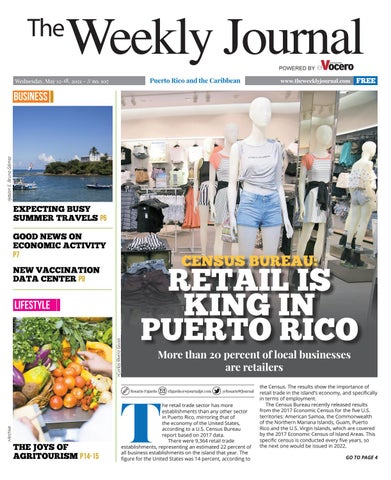
Retail is King in Puerto Rico More than 20 percent of local businesses are retailers
T
>Archive
Rosario Fajardo
The Joys of Agritourism P14-15
rfajardo@wjournalpr.com
@RosarioWJournal
he retail trade sector has more establishments than any other sector in Puerto Rico, mirroring that of the economy of the United States, according to a U.S. Census Bureau report based on 2017 data. There were 9,364 retail trade establishments, representing an estimated 22 percent of all business establishments on the island that year. The figure for the United States was 14 percent, according to
the Census. The results show the importance of retail trade in the island’s economy, and specifically in terms of employment. The Census Bureau recently released results from the 2017 Economic Census for the five U.S. territories: American Samoa, the Commonwealth of the Northern Mariana Islands, Guam, Puerto Rico and the U.S. Virgin Islands, which are covered by the 2017 Economic Census of Island Areas. This specific census is conducted every five years, so the next one would be issued in 2022. GO TO PAGE 4
The Weekly Journal > Wednesday, May 12, 2021 > 2
3
/ Wednesday, May 12, 2021
a week in review Pierluisi Vetoes Measure Seeking to Postpone LUMA Contract
>Courtesy
>Josian E. Bruno Gómez
>Carlos Rivera Giusti
After calling it unconstitutional, Gov. Pedro Pierluisi issued an express veto on House Joint Resolution 88, which, among other issues, sought to postpone LUMA Energy’s contract with the Puerto Rico Electric Power Authority that comes into effect on June 1. The governor said the measure undermines current contractual obligations and is significantly inconsistent with the government’s fiscal plans.
MetalMax Caribe to Open Manufacturing Plant in Naranjito MetalMax Caribe, a Puerto Rican company, reached an agreement with the Economic Development and Commerce Department (DDEC by its Spanish acronym) to open a manufacturing plan in Naranjito, with an investment of $1.26 million and the creation of 10 jobs in 18 months. The company manufactures and distributes products made with metals, such as aluminum, galvalume, stainless steel and galvanized steel, for the construction industry, among others.
Powered BY El Vocero de Puerto Rico, 1064 Ave Ponce de León 2nd floor San Juan, PR Postal Address: PO Box 15074, San Juan, PR 00902
President Salvador Hasbún shasbun@elvocero.com Vp of Marketing and Business Operations Michelle Pérez Miperez@elvocero.com
New Executive Order Narrows Curfew, Expands Business Schedules Gov. Pedro Pierluisi announced minor changes in the next executive order addressing the COVID-19 pandemic, which are in effect from May 10 to May 23. The curfew has been cut by two hours, to be enforced from 12 a.m. to 5 a.m. Businesses may now operate until 11 p.m. instead of 9 p.m. They must still only operate at 30 percent capacity.
VP of Accounting Félix A. Rosa frosa@elvocero.com
Human Resources Director Arlene Rolón, PHR arolon@elvocero.com
VP of Editorial Content Juan Miguel Muñiz Guzmán jmuniz@elvocero.com
VP of Production Eligio Dekony edekony@elvocero.com
Traffic Director Ilia M. Pérez Centeno iperez@elvocero.com
Multi-Platform Graphic Director Héctor L. Vázquez hvazquez@elvocero.com
Assistant Editor/ Reporter Rosario Fajardo rfajardo@wjournal.com
Phone: 787-622-2300, 787-721-2300 Customer Service: 787-622-7480
4
/ Wednesday, May 12, 2021
CONTINUED FROM PAGE 1 The Census said data for Puerto Rico also includes metropolitan areas and Planning Regions. However, it should be noted that Puerto Rico’s economy was greatly affected by Hurricane Maria, which slammed the island in Sept. 2017 and has had a long-term effect on local economic activity and performance. According to Census Bureau economist Andrew Hait, the retail trade sector was the top employer in Puerto Rico, with a work force of 132,033 people, or 20.3 percent of the island’s total employment. Total retail trade reported was $25.5 billion in this area, representing 13.5 percent of the island’s total, based on Census data. No surprise: San Juan led the island in terms of the number of retail establishments, sales and employment. The capital city was followed by Bayamón, Caguas, Ponce, Guaynabo and Carolina. As many retail establishments are small and midsize businesses, Manuel Cidre, the designated secretary of Economic Development and Commerce (DDEC by its Spanish acronym) also has highlighted the importance of the business community in Puerto Rico. Cidre himself is a successful businessman who is the founder of Los Cidrines, a local bakery and restaurant chain that has expanded to the United States in recent years. Noting that baking bread has a long history going back to ancient times, to more than 5,000 years ago. “Be innovative, be different and be relevant… Be daring, be passionate,” was the message he gave to a group of entrepreneurs when he spoke during a DDEC roundtable with reporters. “Think about what distinguishes you from any other competitor,” he said, when talking about the road to “success,” which he added is much more than financial success.
Looking for something special for a particular occasion? Try the local fashion-retail website, “Guilty.” >Carlos Rivera Giusti
more and more retail businesses now sell their wares online. A Success Story: ‘Guilty’ During the event, she noted One person who left her how today, much of what comfort zone, as Cidre described, consumers use is by “renting” was Suhaiy Sepúlveda, who coan item, whether it is a car or a founded an innovate retail space home – so why not fashion? “Why called “Guilty,” literally less than According not use our closet in a similar two months after Maria hit. to Census Bureau way? The demand is there. She and her business partner economist Andrew Fashion items can be used for Armando Sánchez developed a Hait, the retail trade specific events… giving access web platform for Puerto Rican sector was the top to those who need them,” she fashionistas who can either employer in Puerto said. The idea is to make one’s buy or rent clothing for specific Rico, with a work fashion choices more dynamic, events, such as attending a gala force of 132,033 innovative and accessible. or wedding. “Guilty” was officially people, or 20.3 Her advice to other founded on Nov. 1, 2017, in percent of the island’s entrepreneurs? “Discipline, Sepúlveda’s apartment, starting total employment. consistency and focus. Discipline with 50 different fashion items. Total retail trade is required to dedicate long Today, “Guilty” has an inventory reported was $25.5 hours at the company, sacrificing of more than 10,000 fashion items billion in this area, personal and family time. and moves more than 2 thousand representing 13.5 Consistency and focus on the fashion items every month. percent of the island’s consumer’s need is fundamental The store now has a total of 10 total. to keep the company going in the employees: six full timers and right direction, even in the most four part-timers. difficult times,” Sepúlveda said. Sepúlveda’s brain child also As reported by THE WEEKLY showcases how retail trade has changed in recent JOURNAL, retail trade is among the sectors times, particularly after the pandemic started, as that has been most hard-hit by the coronavirus
In fact,
pandemic. In calendar year 2020, retail sales saw a drop of $2 billion, as many businesses were hit by the government lockdown and other business restrictions. With the majority of local residents receiving the latest federal stimulus checks of $1,400 for qualifying adults, the retail industry has been buoyed by better news in recent months, for example during the recent Mother’s Day weekend, which is a major shopping day for many people. “Customer traffic continues to be healthy thanks to the injection of federal funds, different from last year when there was a lockdown and [businesses] were operating with very limited capacity. General merchandise is being sold. A lot of electronic items, household appliances, perfumes, clothes, shoes, beauty products, etc.,” said Iván Báez, president of the Retail Trade Association, who was expecting a good Mother’s Day in retail sales. Another area where retail continues to grow is online. For example, eBay has seen a double-digit percentage growth in Puerto Rican sellers who represent a wide variety of product categories, some of which didn’t have as a strong presence in the marketplace platform before the pandemic. From Jan. to Dec. 2020, the top-three items that were sold the most from Puerto Rico were: auto and motor parts, men’s footwear, and plants and seeds. To date so far in 2021, the top-two
/ Wednesday, May 12, 2021
5
categories have maintained their positions, while basketball trading cards are now in third place. The category of plants and seed moved to sixth place. The four countries where Puerto Ricans exported the most on eBay.com during 2020 were the continental United States, the United Kingdom, Canada and China. This year, however, Mexico substitutes China in fourth place. “2020 changed our entire way of living, consuming and doing business, and the increase in sales for these Puerto Rican businesses is just a proof of it. They have seen in eBay an effective way to expand their customer base by overcoming the challenges that pose the distance, regardless of product or category,” said Ilya Kretov, general manager for Global Emerging Markets at eBay.
Business Highlights for Puerto Rico
According to the Census Bureau report, the manufacturing sector was the top sector in terms of sales, shipments or revenue in Puerto Rico, reporting $85.3 billion, which represented 45.2 percent of the island’s total. “Wholesale Trade” was the top sector in revenue in the United States, but this sector was smaller in Puerto Rico ($19.1 billion, or 10.1 percent of the total), ranking third in sales behind manufacturing and retail trade. Meanwhile, accommodation and food services represented 12.7 percent of total employment in Puerto Rico, with 82,815 employees. The sector reported $4.3 billion in terms of sales, shipments or revenues. This data highlights the importance of
the visitor economy for the island. In the United States, the Health Care and Social Assistance sector employed the most people in 41 states in 2017, with over 2 million workers in this sector in California alone. In Puerto Rico, this sector accounted for a smaller share of all employment, ranking second in employment on the island with 84,933 workers. However, the sector was first in terms of growth
The biggest retail space under one roof in Puerto Rico is Plaza Las Américas in San Juan. >Archive
in the number of establishments in Puerto Rico, up from 7,014 in 2012 to 7,738 in 2017. As reported by THE WEEKLY JOURNAL, other noteworthy findings relate to average salaries. The Utilities sector reported the highest average annual payroll per employee ($62,400) in Puerto Rico. The Information sector reported the highest increase in the average annual payroll per employee in Puerto Rico, from $23,997 to $42,370.
6
/ Wednesday, May 12, 2021
Forecasting a Busy Summer Travel Season
Cruise lines allowed to start trial runs with volunteer passengers
W Rosario Fajardo
rfajardo@wjournalpr.com
@RosarioWJournal
ith more than half of U.S. travelers surveyed reporting that they were fully vaccinated, a nationwide poll has found that Americans are expecting a busy summer season this year, with many expecting travel prices to stay relatively low. That is good news for the visitor economy in Puerto Rico, which is in the midst of recovery after the more than year-long coronavirus epidemic. The key takeaway is that 77 percent of those surveyed said they are already traveling or are ready to travel, with either no hesitation or some hesitation, according to the weekly U.S. national survey of more than 1,200 adults by Destination Analysts. Another 16 percent said they needed a little more time to travel and the remaining 7 percent said they needed a lot more time before traveling. This particular survey was conducted between April 30 and May 2. An estimated 46 percent also said they were confident or very confident about traveling now. Another 20 percent said they were not very confident or not at all confident about traveling now. The remaining 34 percent said they were somewhat confident about traveling. In terms of various activities, 51 percent of those surveyed said they would feel safe traveling on a cruise line; 50 percent traveling outside the U.S.; 46 percent on inter-city bus travel; and 45 percent on bus or tour groups. Interestingly, the lowest level of safety felt by travelers was taking a road trip (11 percent), as well as visiting friends and relatives, and non-team outdoor recreation such as biking or hiking (both receiving 12 percent). In Puerto Rico, the demand trends are being seen in leisure travel, with hotel occupancy rates hovering at around 76 percent since mid-March, which is about three points short of the same time periods in 2019, before the pandemic. The demand trends are also being seen in the meetings, incentive, conventions and events (MICE) segment. From January 2021 to April 3, Discover
Happy days for cruise lines, before the COVID-19 pandemic >Archive
Puerto Rico, the island’s destination marketing organization (DMO) has generated a total of 171,535 group room leads and confirmed more than 9,500 definite rooms for roughly $8.1 million in economic impact for the island. “Seeing these results keeps us hopeful that we are seeing the light at the end of the tunnel, and that the tourism sector of the island will revive stronger than ever,” said Brad Dean, the DMO’s CEO.
CDC Sets Rules for Trial Cruises
The higher degree of confident that travelers reported about cruising bodes well for the recovery of the cruise industry, which has been severely battered by the pandemic. Cruising on U.S. waters, including Puerto Rico and the U.S. Virgin Islands are still not allowed, but cruise lines can soon begin trial voyages in U.S. waters with volunteer passengers helping test whether the ships can sail safely during a pandemic. The Centers for Disease Control (CDC) has given ship operators final technical guidelines for the trial runs. The CDC action is a step toward resuming cruises in U.S. waters, possibly by July, for the first time since March 2020. Some cruise lines are slowly resuming trips in other countries in the Caribbean as well as the Mediterranean, and requiring that all passengers on those cruises be vaccinated. Several cruise companies are pushing the CDC
to let them return the U.S. this summer, although none of the major companies — Norwegian, Royal Caribbean Group and Carnival Corp. — have announced any specific U.S. cruise dates so far. A spokeswoman for the cruise industry’s trade group said the group was reviewing the CDC instructions. Each practice cruise — they’ll run two to seven days — must have enough passengers to meet at least 10 percent of the ship’s capacity. Volunteers must be 18 or older and either fully vaccinated or free of medical conditions that would put them at high risk for severe COVID-19. The ship operator must tell passengers that they are simulating untested safety measures “and that sailing during a pandemic is an inherently risky activity,” the CDC guidelines state. Passengers must be examined for COVID-19 symptoms before and after the trip, and at least 75 percent must be tested at the end. Restrictions on board will include face masks and social distancing. The CDC will allow guided shore excursions — no wandering about on their own — if tour operators follow certain standards. Ships must make at least one practice run before resuming regular cruises in U.S. waters, although operators will be able to avoid the requirement if they vouch that 98 percent of crew and 95 percent of passengers are vaccinated. -The Associated Press contributed to this story.
7
>Courtesy of Reliable Construction
/ Wednesday, May 12, 2021
Economic Activity Stable After One Year of COVID-19
Cement sales, electric power generation report strong numbers
P Rosario Fajardo
rfajardo@wjournalpr.com
@RosarioWJournal
uerto Rico’s Economic Activity Index (EAI) reached 119.4 points in March 2021, representing a slight uptick of 0.1 percent compared to the previous month. While the uptick is quite small, the Economic Development Bank (EDB) reported that this is the “first trend change after 12 months in a downward path due to the COVID-19 pandemic.” To reach pre-pandemic levels, the EDB said the island’s economic activity will “require a consistent multi-sector recovery pace… To achieve a sustainable economic growth, the employment sectors most affected by the pandemic crisis (that is: services, commerce and tourism, among others) have yet [sic] to recover. Alternatively, the resulting job losses would need to be absorbed by other industries.” During fiscal year 2020, Puerto Rico’s EAI decreased by 1.9 percent when compared to fiscal year 2019, and fell by 4.2 percent during the July – March period of fiscal year 2021. A 5.0 percent reduction was registered during calendar year 2020, the first annual decrease after two years of growth. During the first trimester of calendar year 2021 (Jan-Mar), the EAI contracted by 1.9 percent.
The EAI is an indicator of general economic activity that is composed of four indicators: total payroll employment; total electric power generation; cement sales and gasoline consumption. As per the latest report, total non-farm payroll employment averaged 849,000 jobs in March; which means a decline of 0.5 percent in March on a month-to-month basis, and an annual decrease of 4.1 percent. Electric power generation for March 2021 totaled 1,579.8 million kilowatt-hours, an increase of 2.9 percent on a month-to-month basis, and an annual upturn of 5.5 percent. The preliminary estimate for gasoline consumption in March totaled 66.0 million gallons, showing a decrease of 3.5 percent with respect to February, and a 12.1 percent decline when compared to March 2020. Cement sales totaled 1.4 million of 94 lb. bags for March 2021, with a growth of 2.2 percent on a month-to-month basis, and a 194.3 percent increase when compared to March 2020. “It should be noted that this comparison is with respect to the beginning of the lockdown period that took place in March 2020 as a measure to contain the COVID-19 pandemic,” said the report. During March 2021, two of the EAI’s four components registered monthly growth: cement sales (2.2 percent) and electric energy generation (2.9 percent). Meanwhile, the other two components declined: total non-farm payroll employment (-0.5 percent) and gasoline consumption (-3.5 percent). When compared against the same month from the previous year (March 2020), two components
increased: cement sales (194.3 percent) and electric power generation (5.5 percent), while non-farm payroll employment and gasoline consumption showed reductions of 4.1 percent and 12.1 percent, respectively. The annual comparison analysis exhibit the effects of the pandemic lockdown, according to the EDB.
Health Manufacturing Boosts the Industry
Meanwhile, thanks in large part to pharmaceuticals and the fact that the sector was never forced to shut down due to the COVID-19 pandemic, manufacturing in Puerto Rico has reached levels of activity that have not been experienced since 2018. According to the Purchasing Management Index (PMI), in March, manufacturing stood at 61.1, suggesting positive performance in the industry. For the manufacturing sector to be at appropriate levels, activity needs to remain above 50. Although the PMI reflected a slight decrease of 1.7 points compared to the 62.8 reported in February, the index still remains above 60. The industry did not report numbers higher than that figure since June 2018 when it registered manufacturing activity of 61.1 points. “Healthcare manufacturing does not respond to the economy’s cyclical reaction. Puerto Rico is a specialized health manufacturing jurisdiction. We have several factories of medical and pharmaceutical devices operating which, in turn, have a whole supply chain that requires and benefits other manufacturing segments,” said Rodrigo Masses, director of the Alliance for the Economic Development of Puerto Rico.
8
/ Wednesday, May 12, 2021
Liberty Focused on Maintaining and Building on Momentum
Posts strong growth in Q1 2021
L Rosario Fajardo
rfajardo@wjournalpr.com
@RosarioWJournal
iberty Puerto Rico closed the first quarter of the year with strong growth in revenue generating unit (RGU) additions, subscribers and income as it continues to integrate its mobile operations. The numbers were reported by Liberty Puerto Rico’s parent company Liberty Latin America in its first quarter (Q1) 2021 results. “We are very happy with the way the transition is going. The numbers for this quarter show we are headed in a good direction,” said Naji Khoury, president and CEO of Liberty Puerto Rico. Liberty Puerto Rico reported a total combined >Courtesy revenue of $361.3 million for Q1 2021. Reported growth benefited from the inclusion of AT&T’s operations. Overall, our markets are beginning to wireless and wireline operations in Puerto Rico and recover from the worst impacts of the pandemic, the U.S. Virgin Islands (USVI). however, the operating environment remains The company also reported challenging given reduced that fixed RGU additions tourism and government momentum continued with imposed lockdowns and 25,000 additions in the quarter, restrictions continuing during the more than double the prior-year quarter,” said CEO Balan Nair. period and taking additions over “Fixed subscribers grew Continued the past 12 months to 136,000. across all of our markets, with broadband demand Broadband RGU additions drove particularly strong performance drove record Q1 2021 the increase in both periods as in Puerto Rico where we RGU additions of Liberty increased penetration of maintained momentum from 25,000 in Puerto Rico, its high-speed data connectivity 2020 and saw close to three which was more than solutions. In its first full quarter, times as many RGU additions in double the prior year Liberty Mobile saw an increase in the first quarter as compared period. postpaid subscribers, keeping a to the prior-year period. There flat subscriber base with over one remains a significant broadband million mobile subscribers. penetration opportunity across Liberty is continuing to focus our region and during the first on deploying and expanding quarter we added or upgraded its 5G service, which covers over 95 percent of approximately 130,000 homes using fiber the population in all Puerto Rico and the USVI. technologies to bring high-speed connectivity According to Khoury, there are 1,300 projects to to more customers. Mobile additions were also increase capacity, coverage and 5G running since particularly strong for the first quarter, driven by January. over 60,000 adds in Panama,” he added. Liberty Latin America reported $1.2 billion in revenue and $178 million of operating income for Puerto Rico Shines in the Region The report by Liberty Latin America showed that Q1 2021, as well as “a record Q1” in terms of cash flow from operations and Adjusted Free Cash Flow, Puerto Rico continues to shine in the region. posting $204 million and $58 million, respectively. “We had a strong start to the year as our focus “As part of our proactive balance sheet on volume resulted in record Q1 RGU additions management, we successfully refinanced over of 76,000, over 25 percent higher than the prior $1 billion of our debt across Puerto Rico and year, as well as continued recovery in our mobile
In fact,
Liberty Puerto Rico’s Naji Khoury >Courtesy
Chile in March. These financings improved our average debt tenor, reduced our borrowing costs, and added $250 million of incremental capital to our corporate balance sheet,” Nair said. “Overall, we started the year well and anticipate that the regional operating environment will improve as vaccination rates increase and local economies recover in the coming months and quarters… We created an operating momentum in the first quarter and are focused on maintaining and building upon it.”
9
/ Wednesday, May 12, 2021
Direct Relief donated equipment for VOCES staff to update coronavirus-related data in real time. >Courtesy
Nonprofits and Companies Join Forces
to Launch Vaccination Data Center
Highlights the importance of collaboration during the pandemic
U Giovanna Garofalo
ggarofalo@wjournalpr.com
@giopgarofalo
nderstanding the importance of consistently updating Puerto Rico’s vaccination progress against the coronavirus pandemic, nonprofit organizations Direct Relief and VOCES launched a new Data Center, featuring a collaboration with AbbVie, a pharmaceutical company with manufacturing plants on the island. Some 40 AbbVie employees recently assisted in the opening of the Data Center, located on the second floor of the Plaza Las Américas shopping mall in San Juan, where the store BOSE used to be. Given Puerto Rico’s ongoing efforts to inoculate its population against COVID-19 and VOCES’ partnership with the local Health Department in curbing the pandemic, the local nonprofit identified the need for office space where its workers and volunteers, such as AbbVie’s staff, can keep up with the process and provide the most accurate vaccination information in real time. Lilliam Rodríguez Capó, CEO and founder of the VOCES Puerto Rico Immunization and Health Promotion Coalition, affirmed to THE WEEKLY JOURNAL that they have the responsibility to operationalize much of these efforts, with some weeks vaccinating 8,000 and even 20,000 residents. “We bring this all to our Data Center and
we have trained staff or trained volunteers who sign a confidentiality and compliance agreement so that they can help us enter this data. So, if we are generating this amount of data, we need a lot of people helping us to enter it,” she explained. The launch of this establishment was facilitated by equipment donations by Direct Relief, which has been assisting VOCES with resources and equipment in its multiple COVID-related endeavors. “Direct Relief has been an instrumental ally for VOCES in our mission to reach every corner in times of emergency in solidarity with our country. Today, their contribution of equipment makes possible the agility of this data center and optimizes the logistics necessary to make the entry of information feasible,” Rodríguez said. Ivonne Rodríguez-Wiewall, the executive advisor of Direct Relief Puerto Rico, explained that the entity’s mission “is to improve the quality of health services for people who are affected by both poverty and emergencies, and we arrived after the passage of Hurricane Maria. Since that moment, since 2017, we have been supporting VOCES in its entire vaccination mission, which now we know how important it is.” The new Data Center is operating extended hours from 9 a.m. to 9 p.m. Monday through Saturday, by people duly trained by the VOCES team, Rodríguez informed.
Private and Third Sectors Working Together
Annette Rodríguez, manager of Communications and Public Affairs at AbbVie Puerto Rico, stated that the company has worked extensively with various organizations throughout the pandemic. For this latest venture, she underscored that AbbVie fosters “a culture of volunteering” that
encourages its personnel to participate in activities like these that contribute to the health and overall well-being of the island’s residents. “We collaborate in different projects constantly, as part of our culture as a company, with the different organizations,” she said, adding that she expects more volunteering activities to assist the Data Center. Moreover, Alejandro Drevón, general manager of AbbVie’s local operations, asserted that “for all of us at AbbVie, the commitment to support local communities is of great importance, including lending a hand with vaccination efforts in Puerto Rico.” Meanwhile, the spokespersons for Direct Relief and VOCES both extended their gratitude to Plaza Las Américas’ administration for providing the space with all expenses covered. “As part of our commitment to the community, we joined Direct Relief in assigning them the use of this space to ensure that the results of the vaccination efforts in Puerto Rico can quickly reach the central data systems of the federal government. We urge the entire community in Puerto Rico to get vaccinated as soon as possible for their own well-being and for the well-being of all Puerto Ricans,” said Franklin Domenech, general manager of Plaza Las Américas. Rodríguez-Wiewall noted that the mission that drives nonprofits has been identified in companies like Plaza Las Américas and AbbVie. “We are in Puerto Rico thanks to the donation we received from AbbVie, which was $50 million in 2018, and that’s when we were able to open offices here in Puerto Rico,” she stated. “AbbVie has done its part and is an example of local companies that maintain that sense of social responsibility and should be an example for all others.”
10
/ Wednesday, May 12, 2021
Government Incentives ‘Not Enough’ to Mitigate COVID’s Impact on Restaurants
62 percent of establishments reported year-on-year sales losses in 2021
A Giovanna Garofalo
ggarofalo@wjournalpr.com
In fact,
@giopgarofalo
study commissioned by the Puerto Rico Restaurant Association (Asore by its Spanish acronym), revealed that, despite millions of dollars in federal economic incentives to mitigate the negative impact of COVID-19, the local industry still faces a dire predicament. José Vázquez, president of the Asore, explained that Puerto Rico restaurants still haven’t received relief funds from the Coronavirus Aid Relief and Economic Security Act (CARES), which contains allocations of between $400 million and $500 million for the most affected economic sectors. Moreover, while a $28.6 million package was activated from the Restaurant Revitalization Fund and the U.S. Small Business Administration, Vázquez is concerned that these do not cover the needs of restaurants in all U.S. jurisdictions, including Puerto Rico. “All sectors have received some type of relief mechanism except restaurants. The local government has prioritized other industries to disburse the aid. At Asore, we are committed to [pushing] the effort at the local level and we invite the government to also extend a helping hand to restaurants,” he denounced. The study was conducted by Inteligencia Económica and concluded that restaurants have been some of the most affected businesses throughout the coronavirus pandemic on the island. Per the report, this industry employs roughly 60,000 workers, thus raising concern over its current state. According to the findings, gathered through surveys, the pattern of restaurant sales fell sharply between January and April 2020, from $157 million to $50 million, representing a drop of 68.15 percent. Moreover, approximately 37 percent of restaurants have already reported sales equal to or higher
exorbitant energy costs, an inconsistent and “highly bureaucratic” If the pandemic permitting continues its toll on process, among the restaurant sector, other factors. In 19.8 percent of addition, the U.S. survey respondents Census Bureau said they would recently informed file for bankruptcy, that Puerto 56.2 percent said Rico’s population they would reduce contracted in work hours for the past decade their staff, 55.1 by 11.8 percent percent would lay to 3.3 million, off some employees, leaving commercial and 31 percent establishments would consolidate with fewer operations. potential workers and clients. Gustavo Vélez, who is the head of Inteligencia Económica, affirmed that restaurants are “an important pillar” in the local economy. Given the difficult situation afflicting the industry, Asore identified a need to measure, in the short term, the impact of business closures due to COVID-19 and how it would affect the industry.
About 53.4 percent of restauranteurs reduced expenses in the first quarter of 2021. >Archive
than those registered in early 2020. However, an estimated 62 percent have reported year-onyear sales losses so far. Meanwhile, despite the integration of new technologies in their businesses —such as courier apps and other services—53.4 percent of restaurants surveyed said that they haven’t experienced big gains in online sales. Other key insights revealed that in the first quarter of 2021, 29.6 percent had to reduce their staff, 35.2 percent narrowed work hours for employees, 38.6 percent had to decrease marketing spending, 32.9 percent had to raise or drop their prices, 28.4 percent had to lower their investments, and 53.4 percent were forced to reduce other expenses. Furthermore, if the pandemic continues its toll on this sector, 19.8 percent said they would file for bankruptcy, 56.2 percent said they would reduce work hours for their staff, 55.1 percent would lay off some employees, and 31 percent would consolidate operations. Vázquez and the study acknowledged that the restaurant industry had been facing challenges even before the pandemic. Specifically, they pointed to the island’s 15-year economic recession,
About the Report
To carry out the study for Asore, Inteligencia Económica surveyed 88 participants, including owners, operators, managers and employees in the restaurant sector, a set that includes 762 establishments. The sample is representative of the industry because it takes into account businesses of all sizes, from small venues with fewer than three employees to larger companies with multiple locations and hundreds of employees. Of the participants, 38.6 percent were casual dining establishments, 33 percent were “quick service restaurants” (QSRs), 13.6 percent were bakeries, 9.1 percent were cafeterias, and 5.7 percent were fine dining establishments. The report has a confidence level of 95 percent and the margin of error for this survey was ± 3.2 percent.
11
MCS Classicare te ofrece
6,640
$
hasta
anuales en beneficios incluidos MCS Classicare Platino Ideal (OSS D-PNE)
¡Dímelo de nuevo! Ahorro en la Prima de la Parte B
$
900
anual ($75 mensual)
Dental
2,500
$
anual
Tarjeta Te Paga*
640
$
anual ($160 trimestral)
Espejuelos
400
$
anual
OTC
200
$
anual ($50 trimestral)
Sobre 1,200 artículos
Audífonos
2,000
$
anual
LLAMA AHORA
1.833.522.8627 1.866.627.8182 (Libre de Costo)
TTY (Audioimpedidos)
Endoso pagado. MCS Classicare es un producto suscrito por MCS Advantage, Inc. MCS Classicare es un plan OSS con un contrato Medicare y con un contrato con el programa Medicaid de Puerto Rico. La afiliación en MCS Classicare depende de la renovación del contrato. Para la tarjeta Te Paga, usted tiene una aportación trimestral, para ser utilizados en la compra de alimentos saludables, pago de electricidad, agua, teléfono, internet residencial y gasolina a través de suplidores participantes. Para Te Paga y OTC, si usted no utiliza la cantidad completa en el trimestre, el balance restante no se acumulará para usarlo durante el próximo trimestre. Para espejuelos y audífonos, el afiliado deberá pagar la diferencia si el costo es mayor de lo que el plan cubre. Ciertas restricciones aplican*. H5577_1627S0321_M
www.mcsclassicare.com
@MCSPuertoRico
< The Weekly Journal > Wednesday, May 12, 2021
Beneficiario de Medicare Platino
12
/ Wednesday, May 12, 2021
Ricardo Álvarez-Díaz
Licensed Architect and Co-founder of Álvarez-Díaz & Villalón www.advfirm.com
True Leadership: Expectations vs. Reality Leadership is a process of social influence which maximizes the efforts of others towards the achievement of a goal. - Kevin Kruse, entrepreneur and author
L
eadership can be a powerful word. Its etymology can be traced back over 5,000 years. The word itself means the ability to see one’s own way, and even though the word carries great significance today, its definition is often misused and misconstrued. So, what is leadership? There are many different styles and paths to be an effective leader, nevertheless it always requires including a group and how the person leading the group maximizes other people’s talents, not by authority but through social influence. Leadership works towards the achievement of a clear and focused goal. Leadership has nothing to do with the social, hierarchical or corporate position of an individual. Nor with any specific personality traits, attributes and titles. It is not management or personnel administration nor manipulation. Can we learn to be leaders? Yes… we can. Studies indicate that leadership can be learned. It is not something you necessarily are born with. The first step in learning how to be a leader is to identify someone that has the virtues of true leadership and make them your role model. The person can be anyone, including someone you personally know; the key is to take the common leadership characteristics of the people you admire and make a conscious effort to master their habits, characteristics and attitudes. The most successful leaders have surprising similar qualities. Leaders have a positive attitude; they are
True leaders create a life of meaningful contribution through trust, loyalty, a positive attitude, selfless qualities and behaviors. honest and good listeners. They are open to change, to new ideas and new people, plus they are also available to try new and different things. Leaders develop reliability by staying true to their word. They develop loyalty by being at the service of others. They stand firm in their decisions, have a sense of urgency and use their authority moderately and only when its necessary. More importantly, leaders are humble, vulnerable, transparent and empathetic. Actions speak louder than words.
A leader’s behavior is what makes the leader a leader. If a “leader” does not act in a way that other people can look up to, then that person is not a true leader. Here’s how true leaders behave: They maintain a vision. True leaders know what to achieve, how to achieve it and why it needs to be achieved. The reasons behind every leader’s vision are what drives the team and the company. They develop teams and staff. True leaders care about each team member and give the team the tools and opportunities to push their abilities to optimal performance. They put the team or company first. They care. True leaders genuinely respect and care about people and society, and strive to make the world a better place. They motivate others. True leaders inspire the team to reach their personal and professional goals. They accept responsibility. True leaders know that they are accountable for their actions and accept when they are wrong or when they make a mistake. They plan for long-term success.
True leaders create a roadmap of what they want to accomplish in the future and prepare for situations or bumps that may arise along the way. They establish a framework. True leaders build an organized framework that lets people work efficiently in teams. They share and request knowledge. True leaders share their learning experiences with others and encourage team members to use that knowledge to their advantage. They also request support from people who have the talents and knowledge that they do not have. They are not focused on appeal. True leaders are not necessarily “celebrities” and they are not focused on being liked by everyone. What makes a leader is not necessarily the number of followers they have or how much money they make. It has nothing to do with charisma. Leadership encompasses much more. True leaders create a life of meaningful contribution through trust, loyalty, a positive attitude, selfless qualities and behaviors.
13
/ Wednesday, May 12, 2021
New U.S. Climate Normals are Here
One Celsius degree hotter than 20 years ago
E
The Weekly Journal Newsroom
Virginia, Indiana, Arizona, Oregon, Arkansas, Maryland, Florida, North Carolina and Alaska. New normals are warmer because the burning of fossil fuels is making the last decade “a much hotter time period for much of the globe than the decades” before, said Cornell University climate scientist Natalie Mahowald. For Phoenix, the biggest change in normal came in precipitation. The normal annual rainfall for Phoenix dropped 10% down to 7.2 inches (18.2 centimeters). Rainfall in Los Angeles dropped 4.6%. At the same time, Asheville saw a nearly 9% increase in rainfall, while New York City’s rainfall rose 6%. Seattle’s normal is 5% wetter than it used to be. Climate scientists are split about how useful or misleading newly calculated normals are. Mahowald and University of Oklahoma meteorology professor Jason Furtado said updating normal calculations helps city and regional planners to prepare for flooding and drought, farmers to decide what and when to plant, energy companies to meet changing demands and doctors to tackle public health issues arising from climate change. But Pennsylvania State University climate scientist Michael Mann said he prefers a constant baseline such as 1951 to 1980, which is what NASA uses. Adjusting normal every 10 years “perverts the meaning of ‘normal’ and ‘normalizes’ away climate change,” he said to the AP. North Carolina’s state climatologist Kathie Dello said, “It seems odd to still call them normals because 1991-2020 was anything but normal climate-wise.”
very 10 years, National Oceanic and Atmospheric Administration (NOAA) releases an analysis of U.S. weather of the past three decades that calculates average values for temperature, rainfall and other conditions. The results are in and they show that the new normal,” said Michael Palecki, NOAA’s normals normal temperature is one Celsius degree hotter project manager. than it was just two decades ago. Fargo, North Dakota, where the new normal Scientists have long talked about climate change is a tenth of a degree cooler than the old one, is — hotter temperatures, changes in rain and an exception, but more than 90% of the U.S. has snowfall and more extreme weather — being the warmer normal temperatures now than 10 years “new normal.” Data released by NOAA put hard ago, Palecki said. figures on the cliché. In Chicago and Asheville, North Carolina, the The new U.S. normal is not just hotter, but new yearly normal temperature wetter in the eastern and jumped 1.5 degrees in a decade. central parts of the nation and Seattle, Atlanta, Boston and considerably drier in the West Phoenix had their normal annual than just a decade earlier. temperature rise by at least Meteorologists calculate half a degree in the last decade, New normals are climate normals based on 30 according to AP. warmer because years of data to limit the random Charlottesville, Virginia, saw the burning of fossil swings of daily weather, reported the biggest jump in normal fuels is making The Associated Press (AP). It’s temperatures among 739 major the last decade a standard set by the World weather stations. Other large “a much hotter Meteorological Organization. changes were in California, Texas, time period for Every 10 years, NOAA updates much of the globe normal for the country as a than the decades” whole, states and cities — by before, said Cornell year, month and season. University climate For the entire nation, the yearly scientist Natalie normal temperature is now 53.3 Mahowald. degrees (11.8 degrees Celsius) based on weather station data from 1991 to 2020, nearly half a degree warmer than a decade ago. Twenty years ago, normal was 52.3 degrees (11.3 degrees Celsius) based on data from 1971 to 2000. The average U.S. temperature for the 20th century was 52 degrees (11.1 degrees Celsius). The new normal annual U.S. temperature is 1.7 degrees (0.9 Celsius) hotter than the first normal calculated for 1901 to 1930. “Almost every place in the U.S. has warmed Rising temperatures are having a deadly effect on coral reefs across the Caribbean and the rest of the world. from the 1981 to 2010 normal to the 1991 to 2020
In fact,
>Courtesy of Discover Puerto Rico
>Archive
14
/ Wednesday, May 12, 2021
Enjoying Agritourism in Puerto Rico:
Unforgettable Experiences Green tourism at its best
A Yaira Solís Escudero
ysolis@elvocero.com
@yairasolis
gritourism, which is part of the green tourism or ecotourism sector, is becoming increasingly popular with locals and visitors. On the island, the Sustainable Tourism Division of the Puerto Rico Tourism Company (PRTC) is responsible for certifying agritourism companies and lodgings. The priority is to align them with initiatives to promote sustainability in the industry and the development of tourism in Puerto Rico. The Agritourism Program is part of the PRTC’s Green Certification Program, which also includes the certification of Ecotourism facilities and Sustainable Tourism, among others. Through the Sustainable Tourism Program, the PRTC grants Green Certifications to small and midsize enterprises (SMEs), such as sustainable tourism, agritourism and ecotourism facilities and operators. To support this program, the PRTC’s chief, recently gave economic incentives of $5,000 each to the 25 companies certified under the Agritourism Program.
View from the HidrOrgánica farm >Facebook HidrOrgánica
15
/ Wednesday, May 12, 2021
Viva la Cosecha also sells boxes with farm products. >Facebook Viva la Cosecha
HidrOrgánica is located in Río Grande. >Facebook HidrOrgánica
Agritourism allows local and off-island visitors to experience Puerto Rico’s culture and traditions first-hand through contact with nature, and represents an additional income to existing agricultural activities. San Juan Artisan Distillers is a distillery located in Vega The economic incentive given to the 25 Alta, which is dedicated to the production of artisan rum under the Tres Clavos and Ron Pepón brands. certified companies may be used to pay for costs >Facebook San Juan Distillers of purchasing essential equipment, inventory, promotional expenses and materials, among experiences they offer to the visitor under normal others, that make it possible to reopen and circumstances. continue their operations and tourist offerings. • San Juan Artisan Distillers is a distillery Services that have been affected after hurricanes dedicated to the production of artisan rum under Irma and Maria in 2017, the earthquakes in early the brands Tres Clavos and Ron Pepón. The 2020 and the ongoing COVID-19 pandemic. project is in Vega Alta, offer tours by appointment Agritourism SMEs are an integral part of the of the sugar cane area and the processing plant, promotion of the island as a Green Destination, as well as a tasting session of their products. The and each business provides a different and president of the company, José “Pepe” Alvarez and educational alternative to the visitor, while their José Alvarez Jr., vice president products contribute to the of operations and master rum growth of the agricultural sector, maker, use fruits from local the generation of jobs, and the producers from the towns of development of the regional Barranquitas, San Sebastian, economy. Manatí and Lajas to produce their Some of the companies that Agritourism variety of fruit-flavored rums are certified as an agritourism allows local and such as: Bili Quenepa, Coco Loco, project are: Hacienda San Pedro off-island visitors to Rumba Mango, Passion Parcha, in Jayuya; Hacienda La Mocha experience Puerto Ginger Spice, Sweet Pineapple in Ponce; Distillery Coquí in Rico’s culture and and Tutti Fruits (787-222-1633). Mayagüez; the Agrotourism traditions first-hand • HydrarOrgánica, located in Circuit of Bees, Honey, Coffee and through contact Río Grande, is an agri-ecological Art in Yauco; Jeanmarie Chocolat with nature, and farm dedicated to the cultivation in Aguada; Hacienda Iluminada represents an and sale of products such as in Maricao; Río Peninsula in additional income to legumes, fruits, lettuces, tobacco Guayanilla; Hacienda Cascada existing agricultural and agri-ecological seeds, among in Aguas Buenas; Vaca Negra activities. others. Cristina González, a coCheese, in Guánica; Native Coffee owner of the farm, explained that in Jayuya; Hacienda Lealtad in during normal circumstances, Las Marías; Fruits of Guacabo in her tours include visits to the Manatí; San Juan Artisan Destillers different growing areas with agriin Vega Alta; HydrarOrgánica ecology guides, visits to the tobacco cultivation in Río Grande; Siempre Verde in Cayey; Viva La areas, the tobacco leaf drying house, a butterfly Cosecha in Aguas Buenas; and Cosecha Don Juan area, the cigar brewing workshop under the Turro in San Juan. brand, and a tasting of fresh juice made with their The last five companies received their farm products (787-598-0240). certifications in 2020 and we detail below the
In fact,
• Siempre Verde in the Beatriz neighborhood of Cayey is an educational farm committed to the protection of the planet and the conservation of the environment. In their facilities—during normal circumstances—they educate on best practices for sustainability, whether through the collection and use of rainwater, solar panels, food sustainability and economics. In addition, visitors can appreciate the complete process of agri-ecology techniques and permaculture, from seed to harvest during their one-hour tour, which can end with a hot chocolate tasting at La Chocolatera, the farm’s small restaurant. Siempre Verde is a nonprofit organization that focuses on offering agri-ecology workshops to children with special needs and was established by Donna Durán (787-603-7986). • Viva La Cosecha is located in the Sumidero neighborhood of Aguas Buenas and offers educational tours, where visitors can learn about agriculture, food security and conservation of natural resources such as the Aguas Buenas cave system. The interpretive route integrates elements of the planting of polycultures, bird watching within its nature reserve and enjoys connecting spaces for the development of ‘mindfulness’ and the popular culinary concept of farm-to-table (787616-9291). • Cosecha Don Juan, founded in 2016 and located on Highway 176, just minutes from the capital city of San Juan, is a family business engaged in the cultivation, harvesting and distribution of fresh produce to shops and people in various regions of the island. As an agritourism, the venue offers visitors a guided tour around the farm to appreciate the diversity of crops that can be worked on about four acres of land. Visitors can also learn about agricultural practices implemented on the farm, enjoy beautiful views, observe the hen-raising process, participate in educational workshops and taste local food or drinks, made with products available on the farm, according to the season. The company also delivers boxes that combine fruits and vegetables from its organic harvest, ranging from culantro, coriander, pickles, bananas, chilies, bakeries, bananas, pumpkin, papaya, lettuce and eggplant, among others. Tours are currently made by reservation only (787-473-4906). Enjoy the great outdoors and what Puerto Rico has to offer!
Constant updates online 24/7. TheWeeklyJournal.com
Visit us for updated content on our 24/7 platform.
WeeklyJournal
The