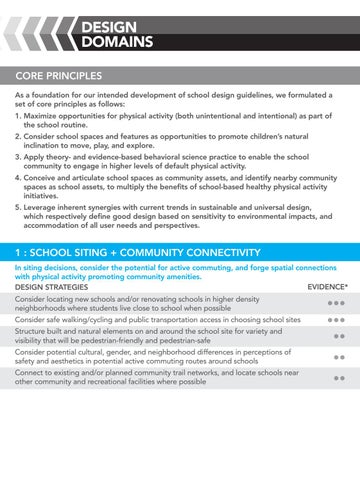
DESIGN DOMAINS CORE PRINCIPLES As a foundation for our intended development of school design guidelines, we formulated a set of core principles as follows: 1. Maximize opportunities for physical activity (both unintentional and intentional) as part of the school routine. 2. Consider school spaces and features as opportunities to promote children’s natural inclination to move, play, and explore. 3. A pply theory- and evidence-based behavioral science practice to enable the school community to engage in higher levels of default physical activity. 4. C onceive and articulate school spaces as community assets, and identify nearby community spaces as school assets, to multiply the benefits of school-based healthy physical activity initiatives. 5. L everage inherent synergies with current trends in sustainable and universal design, which respectively define good design based on sensitivity to environmental impacts, and accommodation of all user needs and perspectives.
1 : SCHOOL SITING + COMMUNITY CONNECTIVITY In siting decisions, consider the potential for active commuting, and forge spatial connections with physical activity promoting community amenities. EVIDENCE* DESIGN STRATEGIES Consider locating new schools and/or renovating schools in higher density neighborhoods where students live close to school when possible Consider safe walking/cycling and public transportation access in choosing school sites Structure built and natural elements on and around the school site for variety and visibility that will be pedestrian-friendly and pedestrian-safe Consider potential cultural, gender, and neighborhood differences in perceptions of safety and aesthetics in potential active commuting routes around schools Connect to existing and/or planned community trail networks, and locate schools near other community and recreational facilities where possible