




EDITORIAL
EDITOR-IN-CHIEF: Caden Dyer
PRINT MANAGING EDITOR: Emily Hurst
DIGITAL MANAGING EDITOR: Ansley Graves
COPY CHIEF: Lauren Holladay
NEWS EDITOR: Patrick Busch
ARTS & CULTURE EDITOR: Harper Brabson
SPORTS EDITOR: Trevor McGee
ASSISTANT SPORTS EDITOR: Alex Sarkis
OPINIONS EDITOR: Natalie Dripchak
PHOTO EDITOR: Jackson Clavier
DESIGN EDITOR: Lindsay Favre
ENGAGEMENT EDITOR: Sarah Portanka
AUDIENCE DEVELOPMENT EDITOR: Sophie Mehta
COVER DESIGN: Lindsay Favre
PAGE DESIGNERS: Emma Fingeret, Ashley Cammarota, Renee Allen, Maya Williams, SaraJane Weber, Ava Balducci, Ava Edwards, Kate Wims, Lili Ellis
GRAPHICS BY: Lindsay Favre, Emma Fingeret, Ashley Cammarota
ADVERTISING MANAGER: Abigail Cheslock
ADVERTISING REPRESENTATIVE: Joe Slott
TO REPORT A NEWS ITEM OR SUBMIT A PRESS RELEASE, please email editorinchief@utdailybeacon.com or call (865) 974-2348
TO PLACE AN AD, please email admanager@utk.edu.
LETTERS POLICY: Letters to the Editor must be exclusive to The Daily Beacon and cannot have been submitted to or published by other media. Letters should not exceed 400 words and can be edited or shortened for space. Letters can also be edited for grammar and typographical errors, and Letters that contain excessive grammatical errors can be rejected for this reason. Anonymous Letters will not be published. Authors should include their full name, mailing address, city of residence, phone number and e-mail address for verification purposes. Letters submitted without this information will not be published. The preferred method to submit a Letter to the Editor is to email the Editor-in-Chief.
CORRECTIONS POLICY: It is the Daily Beacon’s policy to quickly correct any factual errors and clarify any potentially misleading information. Errors brought to our attention by readers or staff members will be corrected and printed on page two of our publication. To report an error please send as much information as possible about where and when the error occurred to managingeditor@utdailybeacon. com, or call our newsroom at (865) 974-5206.
The Daily Beacon is published by students at The University of Tennessee on Wednesday during the fall and spring semesters. The offices are located at 1345 Circle Park Drive, 11 Communications Building, Knoxville, TN 37996-0314. The newspaper is free on campus and is available via mail subscription for $200/year or $100/semester. It is also available online at: www.utdailybeacon.com
TREVOR MCGEE Sports Editor
Everybody has a story.
At the root of every story is a journalist who has the platform to tell it. As the connector piece between athlete and civilian, my job is to be curious. I am to seek out stories that otherwise go unspoken. At the end of the day, everyone is human, and one of my goals is to bridge the human side of sports.
I recently stepped outside my realm and competed in a feature writing competition at the Southeast Journalism Conference. It was not a sports competition, and the prompt invited me to provide a piece centered around the conference.
My task was to find someone to talk to. I received a hard rejection and a soft rejection before I found a quiet office in a random second-floor building. He was another journalism school graduate who transitioned into a university media
relations role. He admitted that he had never been the one interviewed before — and proceeded to tell me a story that gave me a third-place finish in the competition.
I was curious, eager and excited to sit down and learn more about somebody I met mere minutes ago. Someone whose Friday workday I crashed into and asked to tell me about his life.
In the thick of spring sports, there are plenty of buried voices who just need the platform to talk. That’s what you’ll find in the 2026 spring sports edition from The Daily Beacon.
This paper is an atypical edition. Rather than being filled with generic team previews, I sought to make this paper more about the stories that should be told — and less about the stories that you’ll see us unfold as the season plays out.
Each spring is an opportunity to load my schedule with countless events and tell countless stories where I am the only media member there to ask a question. It may mean I’m freelancing a local high school district tournament game, traveling to Melton Hill Lake for championship rowing or, next month, traveling to Italy to cover the Milano Cortina 2026 Paralympic Winter Games. My role as a storyteller is keen on curiosity, and the spring sporting
season allows me to search high and low for what hasn’t been told.
As you flip through each page, you’ll find someone’s story. I hope these stories spark your curiosity, and I welcome you to reach out if you have a story you want told — because I, too, want to tell it.
Thanks for being an avid reader here. I hope you’re curious to follow the stories we’re ecstatic to share with you.
To great endeavors,
Trevor McGee
tmcgee5@vols.utk.edu

ALEX SARKIS
If there’s anything that’s been a constant in my life, it’s baseball.
It’s the game I grew up playing in my backyard with my brothers, soaking in the warm Pittsburgh weather while pursuing my short-lived dreams of making it to the big leagues. It’s the game that signals the return of my favorite time of year — longer days filled with the sounds of cracking lumber, glove pops and walk-up songs. It’s the game that feels most like home.
Last season was my first covering Tennessee baseball and my first exposure to my favorite sport at the college level. It quickly became my favorite sport to cover as well. Why would I be surprised anyway? It’s more time for me to talk about baseball.
A year ago, I attended 22 MLB games, spending most of my time 21 feet up atop the Clemente Wall inside PNC Park, suffering through another Pirates campaign. I didn’t care. There’s no other way I’d want to spend my summer.
I looked on as Paul Skenes dominated his way to a Cy Young Award, witnessed the electric Liam Doyle roll his way to an SEC Pitcher of the Year-caliber season, and even dragged sports editor Trevor McGee to Truist Park to see the Bucs lose one last time to the Braves in the final game of the 2025 season. The message is simple. Wherever I am this time of year, baseball is with me.
I will never forget covering former Vols’ head coach Tony Vitello’s historic move to the managerial position of the San Francisco Giants, attending one of his final practices as he said goodbye to the Tennessee faithful. It gave me my most exhilarating experience in student media thus far.
It’s my dream job to cover baseball for a living. It’s the sole reason why I decided to enter this field as a freshman, and I’m lucky enough to get more reps as the
Vols enter a new era under Josh Elander in a new-look Lindsey Nelson Stadium. Whether I’m at my writing post along the banks of the Tennessee River or sitting in

ALEX SARKIS Asst. Sports Editor
When former Tennessee baseball head coach Tony Vitello departed for the big leagues, current and former players alike knew who should replace him.
The raucous reaction from the Vols assembled in the team meeting room as Director of Athletics Danny White introduced Josh Elander as the new head coach summed things up perfectly. Since that day in late October, the longtime Tennessee assistant hasn’t felt the need to change much now that he holds the keys. Aside from bringing in some new staff members, keeping the same pillars of the program around is the focus.
“Obviously, we’re very happy with how things have gone over the years over here,” Elander said in a virtual press conference on Feb. 5. “We always want to continue to get a little bit better in every facet. So, we’re not trying to go in here and try to redo this thing. We’re confident with the people and the players we have on the roster. Just making sure we’re over-communicating with the players if there is a change, but for the most part, just kind of sticking with what has worked for us over the years.” Elander possesses a strong idea of what

Tennessee baseball players visit Josh Elander’s introductory press conference as the new head coach of the program. Oct. 27, 2025. David Smith / The Daily Beacon
he must do to make things work, helping lead Tennessee to six NCAA Tournament berths during his eight-year tenure with the Vols. On top of helping engineer Tennessee’s 2024 national championship roster, the 34-year-old’s time spent under the tutelage of Vitello goes a long way in building an understanding of what it takes to have success.
When the gates of Lindsey Nelson Stadium unlock for opening weekend,
Elander’s approach to how he’ll manage his lineup and rotation will echo that of his big-league predecessor. With a slough of new arms to sort through on the mound in particular, it’s going to take some experimenting before the Austin, Texas, native settles on a set group of guys.
“Regardless of how we go opening weekend, just looking at it over the years, the rotation is never the same the
first weekend as is the middle or then obviously the end of the year as well,” Elander said. “So, that competition will continue throughout the entire year, but confident we’ll be able to match them up. We’ll see what’s best for the team next weekend.”
Tennessee will begin its 2026 campaign with a weekend set against Nicholls and will have to deal with some chilly Knoxville weather. This period before conference play acts as an unofficial spring training for many teams around college baseball, a developmental period where a group looks to mesh while improving as a unit.
For a team like the Vols with plenty of fresh faces on the field and in the dugout, these next couple of weeks against a majority of inferior opponents still serve as a crucial period.
“We’re excited. I know our guys are ready to play,” Elander said. “There’s so much competition and versatility on the roster, I think really Opening Day will be the first lineup, and there’ll be changes from there. But I think at this point, we all maybe have those thoughts where we want a little bit more practice time, but I know our players are getting to the point where they want to play a different uniform across the way.”
TYLER EDMANDS Staff Writer
Tennessee pitcher Karlyn Pickens enters her senior season with a résumé few in college softball can match.
The superstar senior has already pitched on college softball’s biggest stage twice, helping lead the Lady Vols to the Women’s College World Series in both her sophomore and junior campaigns. Along the way, she’s become the centerpiece of Tennessee’s pitching staff and the most reliable arm in the SEC.
While the two-time SEC Pitcher of the Year has enjoyed her success in Knoxville, Tennessee, head coach Karen Weekly said that Pickens’ approach has remained the same as her final collegiate season begins.
“What I want for Karlyn is to enjoy the experience,” Weekly said. “When you start thinking about outcomes, that’s when pressure shows up.”
Pickens’ numbers certainly back up her status as Softball America’s reigning Pitcher of the Year.
Over the past two seasons, she has been Tennessee’s go-to starter, leading the staff in innings pitched by over
300. She’s been the cornerstone of the Lady Vols’ on-field success, drawing assignments against top-10 opponents and starting all four of Tennessee’s World Series games last season. Pickens’ career 1.73 ERA is the fifth-lowest in Lady Vols softball history, and that consistency in the circle has been key in Tennessee’s recent deep postseason runs.
Though she has one of the most illustrious careers in Knoxville, her role will expand beyond just performance this season.
The two-time All-SEC first-teamer has taken on a role as a vocal leader for a young Tennessee roster. Among the nine new faces in Tennessee’s program, experienced transfers and talented freshmen will be expected to take on large roles this season.
“I think this team is not satisfied at all,” Weekly said about last season’s trip to the College World Series. “They’re pretty hungry, and a lot of that hunger starts with our seniors, especially Karlyn.”
While she led primarily through preparation and consistency earlier in her career, Pickens has taken up the responsibility of being a vocal leader. As the
most experienced player on the roster, she has taken on the role of holding herself and her teammates to the program’s standards.
“First, you have to hold yourself accountable, and then you have to hold each other accountable,” she said. “I’m taking a different approach this year to just being more vocal in how I'm leading. Rather than just being supportive, I’m taking on that role of holding people accountable as well as myself.”
That accountability has been especially important for a pitching staff that returns significant depth. Tennessee brings back two more arms that pitched in the College World Series, giving the Lady Vols flexibility to manage Pickens’ workload early in the season by dipping into its deep pitching staff.
“We know what our goal is this year,” Pickens said about Tennessee’s pitchers. “Everyone is super dialed into that and is willing to do whatever it's gonna take and whatever role they're asked to do. I've seen a lot of great things in practice, and I'm super excited about what this year is gonna look like, as far as pitching goes.”
Beyond college softball, Pickens’
development continued during the offseason.
She competed with the U.S. National team in Australia, facing international competition and training alongside some of the best players in the world, while most collegiate players are limited to individual workouts.
“An athlete can only benefit from something like that,” Weekly said. “Watching how people go about their business, how they prepare, watching how they handle adversity. I think that's good for her to see.”
With Pickens’ senior season underway, Weekly has avoided framing her last season in terms of legacy. Instead, the 25th-year head coach emphasized that she wants her to enjoy her final ride.
As Tennessee gears up for another tough SEC schedule, Pickens’ veteran presence provides stability, experience and leadership from the circle. For a program eyeing national goals, her ability to lead the Lady Vols may prove just as valuable as any on-field statistic.
“When you make the game too big, doubts can come in,” she said. “When you play free, that’s when you’re at your best.”
ANNA REIFFER Contributor
This spring, the Vols will return to Lindsey Nelson Stadium to reawaken the hope that was lost during the Fayetteville Super Regional in June 2025.
Ahead of the 2026 season, the Vols are viewed as a top-15 program, with certain polls, such as D1Baseball, ranking them in the top five. After losing a substantial amount of their roster to the MLB Draft and transfer portal in the offseason, the Vols are looking to bounce back with significant additions to the team via the transfer portal and freshman class.
These new additions, along with a brand new coaching staff led by head coach Josh Elander, will mark a new era of Vols baseball.
Here’s a look at the 2026 slate as the season begins to take shape.
Vols have unfinished business
The strong core of veterans is led by senior Reese Chapman, who is the only player entering his fourth consecutive season with the Vols. The talented outfielder recorded a perfect fielding percentage with 89 putouts in right field while being an extra-base threat, with 40% of his hits being extra-base hits.
Versatile sophomores Manny Marin and Chris Newstrom will also return for their second season. Marin hit .283 in his freshman season, notably coming up clutch in high-pressure situations like his walk-off grand slam against St. Bonaventure in March. Marin also recorded a .949 fielding percentage across the infield, providing the Vols with defensive reliability. Similarly, Newstrom produced a .351 average in the batter’s box, while splitting his fielding between the infield and outfield, with his throwing velocity reaching 92 mph.
Ariel Antigua and Jay Abernathy will help maintain a strong core in the Vols’ ever-changing program. While Antigua struggled at the plate in 2025, hitting just .192, he had a breakout summer in the Appalachian League with an average of .442. Abernathy, largely a utility player in 2025, is known for his speed, swiping four bases in a single game against UNC Asheville.
“I think on the position side, we have more versatility than we have in the past, where traditionally we’ve had kind of some bombers, right, and we’d work around and be a little bit more station-
ary,” Elander said. “But with this group, I think we have a lot more confidence going into mix and match.”
Sophomore pitchers Tegan Kuhns and Brayden Krenzel find themselves as two of five key returning pitchers this season due to a significant offseason overhaul. A current top-50 prospect for the 2026 MLB Draft, Kuhns is known for his 98 mph fastball and fast-spin curveball in 2025. Kuhns went on to play with the Cape Cod Baseball League last summer, where he recorded a 1.35 ERA with 21 strikeouts in his limited 13.1 innings pitched.
Likewise, Krenzel was also a strikeout machine in 2025, striking out 41 batters over 32.2 innings as a core member of the bullpen.
Incoming transfers to bolster the roster
This offseason, the Vols drew in talent from various programs across the country, adding depth to their roster and ranking them as the No. 6 transfer class ahead of the 2026 season by D1Baseball.
This talented group includes sluggers Blaine Brown, Garrett Wright and Tyler Myatt.
Rice two-way player Brown led the Owls in all major batting statistics as a freshman. While his fastball tops out around 98-99 mph, Brown’s initial focus with the Vols is expected to be hitting.
“I think he’s got a chance to hit 20 homers in this league for a couple years, and then he can get up on the mound and run up to 95 to 98 (mph) from the left side,” Elander said. “And again, we’ve been kind of blending the two in the fall. When Frank (Anderson) was here, we were kind of stretching him out a little bit. We’ve kind of condensed that a little bit because I think he’s going to be that special offensively, but it’s a premier talent, and we’re thankful he’s wearing the orange this year.”
Coming to the Vols from Bowling Green, Wright started 54 out of 55 games for the Falcons, reaching base safely in 52 out of the 54. He recorded the highest average in the MAC at .406 while claiming a BGSU program record with 20 doubles on the season. Wright will miss the start of the season due to a lingering hand injury, but is expected to return in 3 to 6 weeks and be a significant contributor during conference play.
Myatt picked up the junior college triple crown with a .484 average, 31 home runs and 110 RBIs at Walters
State. He is expected to take on the designated hitter role should he not find a starting spot in the field.
A pair of transfers from Virginia are also looking to make a dif ference for plate mound.
With between and the posi player Hen Ford started all 50 games for Virginia, batting .362 with 11 home runs and 48 RBI’s. On the rubber, left-handed pitcher Evan Blanco posted an 8-3 record and 3.62 ERA across 18 starts for the Cavaliers. With his low walk rate of 4.8%, the Vols are likely to place Blanco in a consistent weekend starting role.
Also providing depth on the mound for the Vols will be right-handed pitchers Brady Frederick and Landon Mack.
While at ETSU, Frederick posted a .183 opponent average with 76 strike outs over 77.2 innings, earning him the Southern Conference Pitcher of the Year award. He is expected to be an essential part of the Vols’ bullpen.
Coming from Rutgers, Mack projects to be a starter for the Vols this season because of his exceptional com mand and low walk rate of just 17 bat ters over 80.1 innings of work.
For the second consecutive year, the Vols have signed the top recruiting class in the nation, according to Perfect Game, com prising eight pitchers and six top-100 prospects.
This group of six is composed of osition players Hutson Chance, Taylor Tracey, Trent Gridlinger and Ethan Moore, along with pitchers Ethan Baiotto and the highly-touted lefty Cam Appenzeller.
Hailing from Chatham, Illinois, Appenzeller was drafted in the 19th round of the 2025 MLB Draft by the Seattle Mariners before opting to play for Tennessee instead. Tennessee has previously started the likes of Kuhns, Drew Beam and Blade Tidwell as true freshmen, and Appenzeller could be the next to take a weekend slot.
especially by way of pitchers, it wouldn’t be surprising to see new names appear as

Other key signees include Jackson Estes, Evan Hankins and Cash Williams.
With a stacked freshman class,
Manny Marin (4) throws the ball to first base during a game against Kentucky in Lindsey Nelson Stadium. April 18, 2025. Jayden Randolph / The Daily Beacon
CONNOR WHITNEY Contributor
Tennessee softball is back, and this year’s roster features some familiar fac es and some talented new players.
The Lady Vols fell short in their quest to win the program’s maiden national title, falling in the semis of the Women’s College World Series to the eventual champions: Texas. That team saw numerous key players, like So phia Nugent, McKen na Gibson and Laura Mealer, depart after graduation. Fur ther, sophomore Taylor Pan nell, who led the Lady Vols in batting average, RBIs and slugging percentage, trans ferred to Texas Tech just days after the season ended.
Despiate the tal ent loss in the off season, head coach Karen Weekly and her staff added through the transfer portal and saw the arrival of a freshman recruiting class that On3.com rated as the second best in the na tion. Altogether, Tennessee will field a roster with an intriguing balance of youth and experience.
Sophia Knight, Gabby Leach, Alannah Leach, Zoie Shuler, McCall Sims, Saviya Morgan, Taelyn Holley
Kinsey Fiedler is the big name that graduated from this group, but there are some key additions. One of the fac es that will play a major role in the new-look outfield is Knight, who transferred in from Boise State. The junior transfer hit .486 and stole 27 bases for the Broncos last season.
“She’s a classic slapper, a triple threat,” Weekly said. “She can drop a bunt, she can slap it on the ground, find a defensive weakness, she can drive a ball in the gap, and she’s got blazing speed.”
The incoming freshmen are talented, with Holley being rated as the second-best outfield-
er and the seventh overall player in last year’s high school recruiting rankings from
who was twice named firstteam all-state and was the fifth ranked player to come out of Tennessee.

vital role to fill for the Lady Vols.
Ella Dodge (25) celebrates a home run during an NCAA Super Regional game against Nebraska at Sherri Parker Lee Stadium. Sunday, May 25, 2025. David Smith / The Daily Beacon
Morgan returns after hitting .340, getting on base at a .427 clip, and stealing 25 bases across her 59 starts. Gabby Leach spent most of last year as the outfield’s third cog, driving in 21 runs and putting up a respectable .546 slugging percentage.
Also returning are Shuler, who stole four bases in six attempts, and Gabby Leach’s twin sister, Alannah Leach, who recorded 13 RBIs.
Meredith Barnhart, Bella Faw, Emma Clarke, Camryn Sarvis, Amayah Doyle, Makenzie Butt, Maddi Rutan*
The infield will be quite different with the departures of Pannell, Mealer and Gibson. Still, this year’s group has some very interesting pieces that could spark the lineup.
Butt, who joins Knight from Boise State, has tremendous power and potential, as demonstrated by the 22 home runs, 77 RBIs and .821 slugging percentage she put up as a freshman. Rutan is quite fascinating because of her status as a two-way player. As a hitter with 143 at-bats, she slugged at a .790 clip and put up a .559 on-base percentage, which adds up to a 1.349 OPS.
Barnhart is a freshman with plenty of potential as a four-time state champion out of Parker, Colorado. Her career high school batting average was .537, and she amassed a 1.077 slugging percentage, so her hitting profile could be very important as the season goes on.
Regarding the returnees, Clarke hit just .211 in her 90 at-bats as a freshman, but she wields tremendous power. Doyle hit three home runs last season in limited action, while Faw recorded a .391 on-base percentage. Though Sarvis appeared in just three games last season, Weekly said she is a leader for this team.
“She’s a senior who I just have such admiration for because she does a tremendous job of leading while not being on the field, and I think that’s a really hard thing to do,” the head coach
Elsa Morrison, Jackie Kirkpatrick, Emma Clarke*
The graduation of Nugent leaves a
A Knoxville-native, Morrison enters her freshman campaign as a very well-regarded catching prospect. She was rated as the second-best catching recruit in last year’s player rankings by On3.com, and the best overall prospect from the state of Tennessee.
Kirkpatrick is a senior with just three hits in 17 career at-bats entering the season. She spelled Nugent at various times last year, but her veteran experience could be important, specifically to the development of Morrison.
Clarke did spend time catching last year, and such versatility in her skill set could prove valuable depending on how things play out during the season.
Ella Dodge, Aubrey Barnhart
One of the leaders of the clubhouse, Dodge is in the midst of her redshirt sophomore year, looking to build off a season where she hit .244 with seven home runs and 15 RBIs. She was also a very reliable fielder, putting up a .984 fielding percentage in 123 chances.
Aubrey Barnhart did not appear in any games last season after transferring to Tennessee, utilizing her redshirt to buy one more year of eligibility.
Karlyn Pickens, Sage Mardjetko, Erin Nuwer, Kailey Plumlee, Peyton Hardenburger, Maddi Rutan*
This group should be the strength of the roster, and coach Weekly knows it.
“I think that is the part of our team that has the most experience and depth combined,” Weekly said.
Pickens headlines as the ace of the staff, having twice been named first-team All-SEC and entering this year as a pre-season All-American. Mardjetko returns off a strong season in which she put up a 2.50 ERA with 118 strikeouts in 95.1 innings. Nuwer, a sophomore, threw four shutouts as a freshman and appeared in 18 games for Tennessee last season. She kicked off the 2026 season with a condensed no-hitter against BYU
When she took the circle, Rutan amassed 227 strikeouts in 176 innings pitched for Eastern Kentucky, and her versatility should prove valuable to coach Weekly throughout the season.



1 Matches, as a wager 5 Gambling, e.g. 9 Lacquer ingredient 14 Teen's torment 15 Ticks off
Preface
17 Gives a headsup
19 Kind of number
20 Upper crust 21 Timeless
23 Burton or Gere
25 Void's companion
26 Medal-worthy
28 Experience again
32 "Grand" hotel in Vegas
34 Rode the wind
36 Novelist Bagnold
37 Greek god of war 62 Nashville NFLer 8 German steel
by Margie E. Burke
____ St. Vincent
39 No longer fresh 63 It may be bright city Millay
40 Genesis setting 64 Miami's county 9 Tiny wave 32 Pac-Man feature
41 Bluish-white 65 Prophets 10 Course taker 33 Pleased look metal 66 Puts two and 11 Culinary direc- 35 Stretched out
42 Choir section two together? tive 38 Curved sword
44 "Surfin'___" 67 Disparaging 12 "___ la Douce"
Campfire treat (1963 hit) remark (1963 film)
Church
45 Lure 13 Playwright doctrines
47 Cleansing DOWN Coward
Oscar and Tony remedies 1 Less risky 18 Becomes frayed
Caribbean
49 Clay-rich soil 2 Dangerous 22 The 'who' in a island: Saint
51 Warts and such bacteria whodunit
54 Florida, mostly 3 Fertilizer's pur- 24 Barnyard
58 ____' to go pose rousers
a
during a game
Like Gandhi
Nasty look (eager) 4 Fume 27 Construction
59 Justice since 5 By way of site sight
Butter bits
Nobelist Wiesel 2006 6 Light up 29 ____ Revolution
Evening, infor-
60 Renee's 7 Word on a 30 Goes head-to- mally "Chicago" co- penny head
Alan or Diane star

Solution to Crossword:

‘I want to win the whole thing’: Aulia sisters look to make
NATHAN MILES
Contributor
Just past noon on a wintry Saturday, a lull began to come over the crowd at the Goodfriend Tennis Center.
Tennessee women’s tennis had just lost the doubles point to Clemson, and the Lady Vols had dropped five first sets in singles. The Tigers had quieted the crowd, save for one faithful voice from the stands.
“Go, Fran! Go, Vanesa! Go, Saray!”
The voice called out to each of the six Lady Vols, encouraging them to keep fighting in their singles matches.
“Go, Elim! Go, Leyla! Go, Cat!”
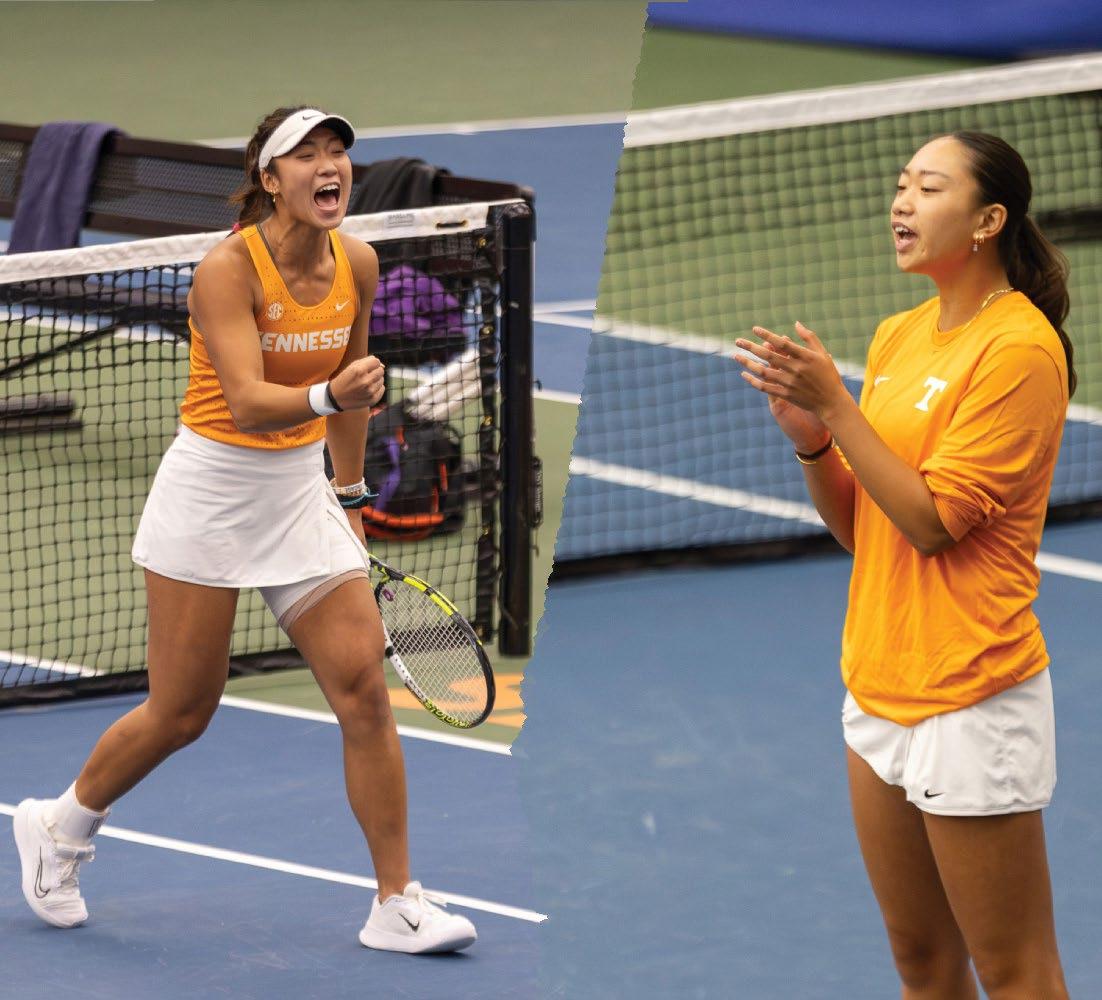
The final name was shouted with a little extra strength, and it makes sense why. The voice belonged to Audrey Aulia, a Tennessee freshman and new member of Lady Vols tennis this spring. Her sister, senior Catherine Aulia, was the recipient of the encouragement down on Court 3.
“The coach was telling me to be really loud, and I also wanted to be really loud because I was really nervous as well,” Audrey said, laughing.
The Aulias are the first siblings to play for Lady Vols tennis since Paula and Peta Kelly, twins who played from 1978 to 1982 and set program records as a doubles pairing. Catherine and Audrey have something else in common with the Kelly twins as well: they are from Australia.
Tennis wasn’t Catherine’s first sport. She was a swimmer at a young age, and neither of her parents played tennis. But they were big fans of the Australian Open, and Catherine grew an interest in the sport as she watched players like Roger Federer and Maria Sharapova.
Once Catherine had started to play tennis, it wasn’t long until Audrey got involved, partly because she was bored with sitting around at the tennis facility during her sister’s practices. Besides, the two had done everything together until then, from swimming to piano lessons.
“Everything Cat did, I think I honestly just ended up doing,” Audrey said. “She’s a good role model.”
That included coming to Knoxville. When Catherine arrived at Tennessee as a freshman, in a whole new country, great teammates and coaches helped her settle into the new environment. The same is true for Audrey, but having her sister around was a bonus.
“It’s very family-like, and obviously Cat is here, so I just knew I’d
get less homesick and she would also be able to help me fit in,” Audrey said.
Catherine and Audrey never got the chance to play in a match against each other when they were younger because of their age difference. But now they get to compete for a title together as Lady Vols.
“I just want to win a championship so bad,” Catherine said. “And the last three years have really, like, been leading up to it.”
Tennessee women’s tennis has never won a national title, but in Catherine’s sophomore season, the Lady Vols took a huge step toward that goal. They upset top-ranked Oklahoma State in the NCAA tournament, ending the Cowgirls’ 29-match winning streak that had lasted over a year. The Lady Vols went on to defeat UCLA en route to the Final Four before losing to the eventual champion Texas A&M.
Catherine was instrumental in both victories, winning a crucial singles match in each.
“I’ll never forget that year and that run,” she said. “It was obviously very special to beat an unbeaten team.”
More than just a semifinals run, though, Catherine remembers her sophomore season for the family-like nature of the team.
“I made some literally lifelong friendships,” Catherine said. “Our team was so close.”
Coming into the 2025 spring season, the team looked very different, with five freshmen and seven newcomers overall. Catherine was one of just three returning players for the Lady Vols.
“When we started off, we had a lot of talent, but we didn’t know how to use it,” she said. “We had to show all the new people how the program worked.”
As a junior, Catherine took on a leadership role in that process.
“Once they bought into that, we were honestly like this, uphill the whole way,” Catherine said, gesturing with her hand sloping upwards.
That played out during the season, culminating in a run to the quarterfinals before again falling to Texas A&M. The Lady Vols finished at No. 9 in the final ITA poll, and Cat earned first-team All-SEC honors.
Head coach Alison Ojeda is the common denominator for all this success. She was instrumental in the Lady Vols’ only two semifinal appearances in program history, as a former All-American player in 2002 and as the ITA Coach of the Year in
2024.
Now the Lady Vols are entering their 10th season under Ojeda as a rising program in women’s tennis.
“We want to be one of the best teams in the country,” Ojeda said after the Clemson match. “In order to be one of the best teams in the country, you’ve got to go against the best ones.”
There will be plenty of opportunities to do just that. Tennessee shares a conference with the last two national champions, Georgia and Texas A&M, as well as many other ranked opponents. The Lady Vols are facing the challenge of SEC play head-on.
“There’s opportunities every single time we play,” Ojeda said.
Tennessee’s conference slate alone features eight top 25 matchups, including road dates with teams like Texas, Auburn and the reigning champion, Georgia.
“It’s obviously tough, but we love it,” Catherine said. “It’s always fun to play in an atmosphere where there’s people cheering both for and against you.”
As Catherine enters her senior season and Audrey begins her time with Tennessee, the Aulias are keenly aware of the chance that this season
provides them and their team.
“There’s a real, like, buzz about the year, I feel,” Catherine said. “That’s how I felt in that Final Four year, so I’m excited.”
Ojeda’s Lady Vols are a family. The Aulia sisters’ relationship is just a manifestation of that dynamic. They use the word “we” to describe the legacy they want to leave at Tennessee.
“Honestly, individual results don’t really mean much to me,” Catherine said. “I want to win the whole thing.”
Back at the Goodfriend Tennis Center, about two hours had passed, and the crowd that had formerly been in a lull was now totally engaged. Tennessee had made a comeback to tie the match at 3-3, and it had all started with Catherine Aulia winning her singles match to give the Lady Vols their first point as her sister cheered her on.
Now both sisters stood with their teammates, eyes fixed on Court 1 as Vanesa Suarez and Jade Groen battled for the match.
As Suarez emerged victorious for the Lady Vols, Catherine and Audrey Aulia rushed the court the same way they’ve done everything: together.
CONNOR WHITNEY Contributor
Change is a natural part of life. Things grow stale, repetition grows tiresome or perhaps a chapter of life simply comes to its natural conclusion.For senior Tennessee men’s tennis athlete Ethan Muza, change was necessary.
“I loved Baylor, I loved my time there, I love the program, I’m still close with a lot of the guys still on the team there,” Muza said. “But I just felt like I needed a fresh start. I needed to start over somewhere new.”
After three seasons at Baylor, a place where he went 37-22 in singles and 2014 in doubles, Muza entered the transfer portal.
“I just felt that I wasn’t gonna get everything I wanted to out of my tennis at Baylor,” Muza said. “I felt that it was time for both parties to move on, and I just felt I was in a place where I needed somewhere new, I needed new faces, new place.”
But why depart as a senior?
“I just think we had our differences, and we both felt that it’s probably better for me to move on somewhere else,” Muza said.
No hate, no ill will, no resentment lingered. But his time in Waco had run its course, and he needed to choose a new home where he could end his college career on his terms. For Muza, that process was quite brief.
“Tennessee reached out to me pretty quickly, and I was committed within a few days, honestly,” Muza said. “I spoke to a few different schools, but I really only took a few days after Tennessee reached out, spoke with coach (Chris) Woodruff, coach (Matt) Lucas, coach (Jaime) Barajas, and I kind of knew at that moment, like, that’s the place to move forward with.”
For some, the allure of the SEC calls their name in the same way a candy store attracts the attention of anyone with a sweet tooth.
For Muza, it wasn’t just about the prestige of the conference — it was about the culture that he had witnessed firsthand with Baylor.
“We had played Tennessee in the past when I was at Baylor, and they compete really hard,” Muza said. “When you sign up, you’re playing against the Tennessee Volunteers, you know that all their guys are gonna die out there for the team to help everyone win, so that is definitely something that I really wanted to be a part of.”
Still, making the change is half the battle. The other half is settling into the
new environment. Fortunately for the new transfer, the transition was smooth.
“All the guys on the team are really, really good guys, I’m really close with everyone,” Muza. “We got a bunch of characters on the team.”
While Muza is a character off the court, his on-court demeanor seems to take on a life of its own.
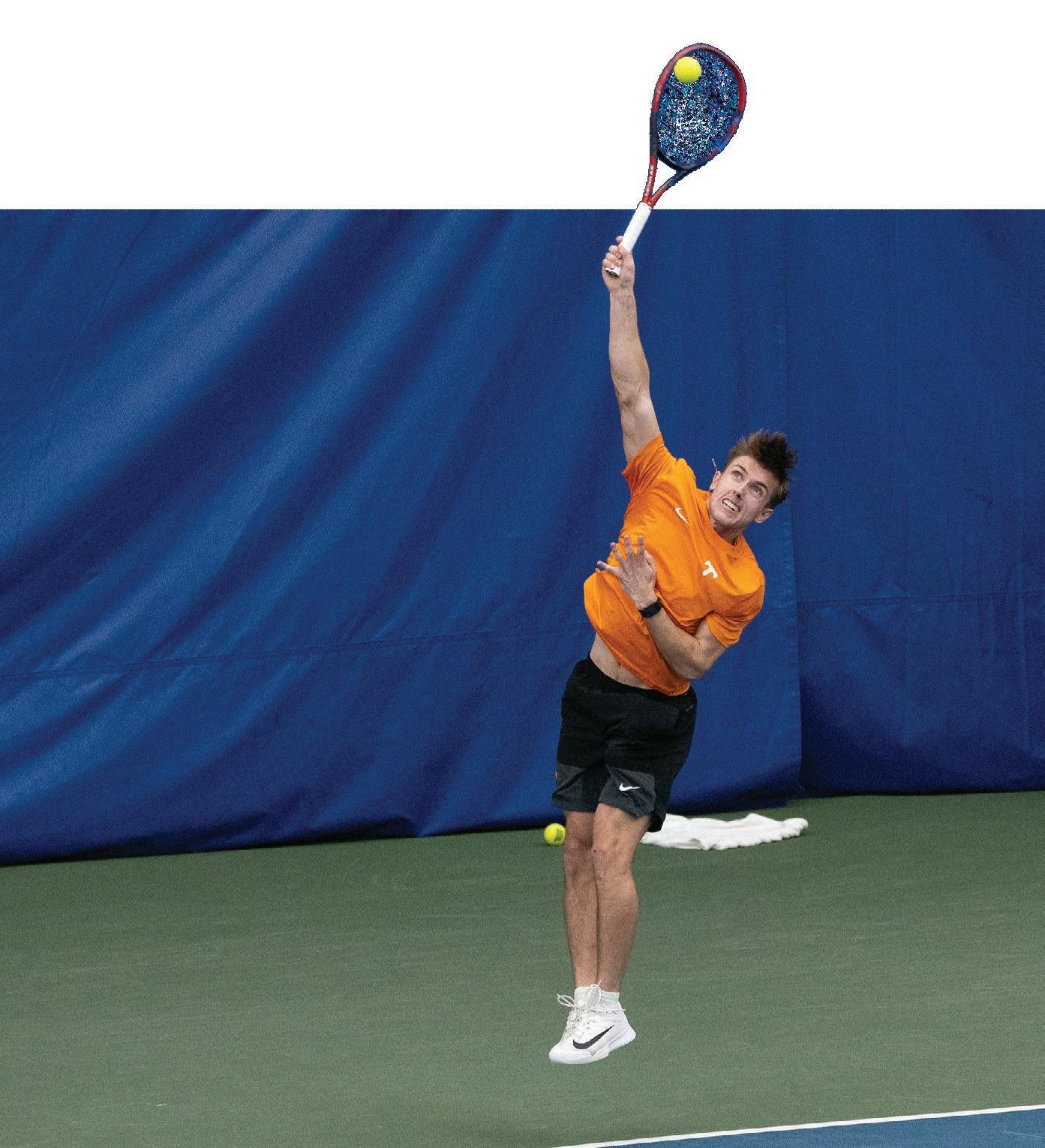
“It’s pretty obvious, but I’m a little crazy,” Muza said. “If anyone watches us play and they see a 5-foot-9 dude jumping around, screaming, like ‘Who’s that?’ If you have to ask yourself that, you’re probably like, ‘Oh, it’s probably Ethan out there.’”
His energy is quickly felt by his teammates and strikingly visible to the casual observer. Senior Alejandro Moreno experienced that flare up close as his doubles partner early on in the season, and the chemistry they developed emerged rapidly.
“Together as a team, we’re super, super close,” Moreno said. “I just think that togetherness, that friendship that we’ve created makes it very easy to get along on court.”
Such energy can permeate through other courts, and his energy is a microcosm of what makes college tennis so different from other sports like football or basketball, or even from different levels of tennis.
“It’s a lot more emotionally driven, it’s a lot louder, it’s a lot more energy than you grow up playing junior tennis and even on the professional circuit. It’s just not the same,” Muza said. “I think just being a part of a team in college and being able to expend more energy, get all my teammates into it, I think, is just something I love.”
The team dynamic, the desire to win and the passion created by the environment can galvanize a group and sway a match on a dime. Such was the case early in the season when Tennessee played host to the defending national champions, Wake Forest.
“You try not to distract yourself by looking around, but you can definitely feel the momentum shifting,” Muza said. “All of a sudden, you got a different feel in the building. It went from, ‘Oh, they might run away with this one,’ to ‘Yeah, this is a real dog fight here.’”
He and Moreno partnered for doubles that day, bringing the energy early and elevating their game, each other and the crowd.
“We were just very energetic the whole time, but at the same time, we were calm,” Moreno said. “When we would do something positive, we wouldn’t get
too high. When we would do something negative, we wouldn’t get too low … We believed in ourselves — win, lose or die — that we could win.”
While focusing on the goal in front of you is paramount, Muza said that everyone in that moment is aware of what is going on, everyone needs to lean in, and everyone needs to step up.
That day did not end with the result the team wanted, but the vibrant atmosphere shifted the momentum of the match and gave the team a belief that they could turn things in their favor — a dynamic that did not go unnoticed.
“We had a lot of people there, and it really did make a difference,” Muza said. “I mean, the atmosphere was everything for us, and we’re really appreciative to everyone who comes out.”
Experience brings perspective, and Muza understands what matters. Winning and losing matter little — the people around you matter more, and the way you bond with them and fight for them is everything.
Such a perspective is how he will dictate whether or not this is a successful season
for him.
“Really being able to ask myself, after the season’s over, ‘Did I give it my all? Did I try everything I could to help the team win?’” Muza said. “And if I can answer ‘Yes’ at that time, I gave everything, tried everything I could, I tried to help the team win, I want everyone to be successful, I’ll be able to look in the mirror come May and say that it was a success regardless of any results we had about the year.”
Change is a natural part of life. Too much change breeds chaos, while too little creates stagnation. For Muza, his address and his jersey changed, but his personality and goals remain constant.
“I hope to just gain more of the bonds and friendships that I had at Baylor as well,” Muza said. “A lot of the time, people get caught up in the winning and losing, and they don’t really enjoy the process. They don’t really appreciate the day-by-day grind of playing college tennis. And I think people realize it a little too late, is that, that’s what you’re gonna remember, that’s what you’re gonna take with you.”
Contributor
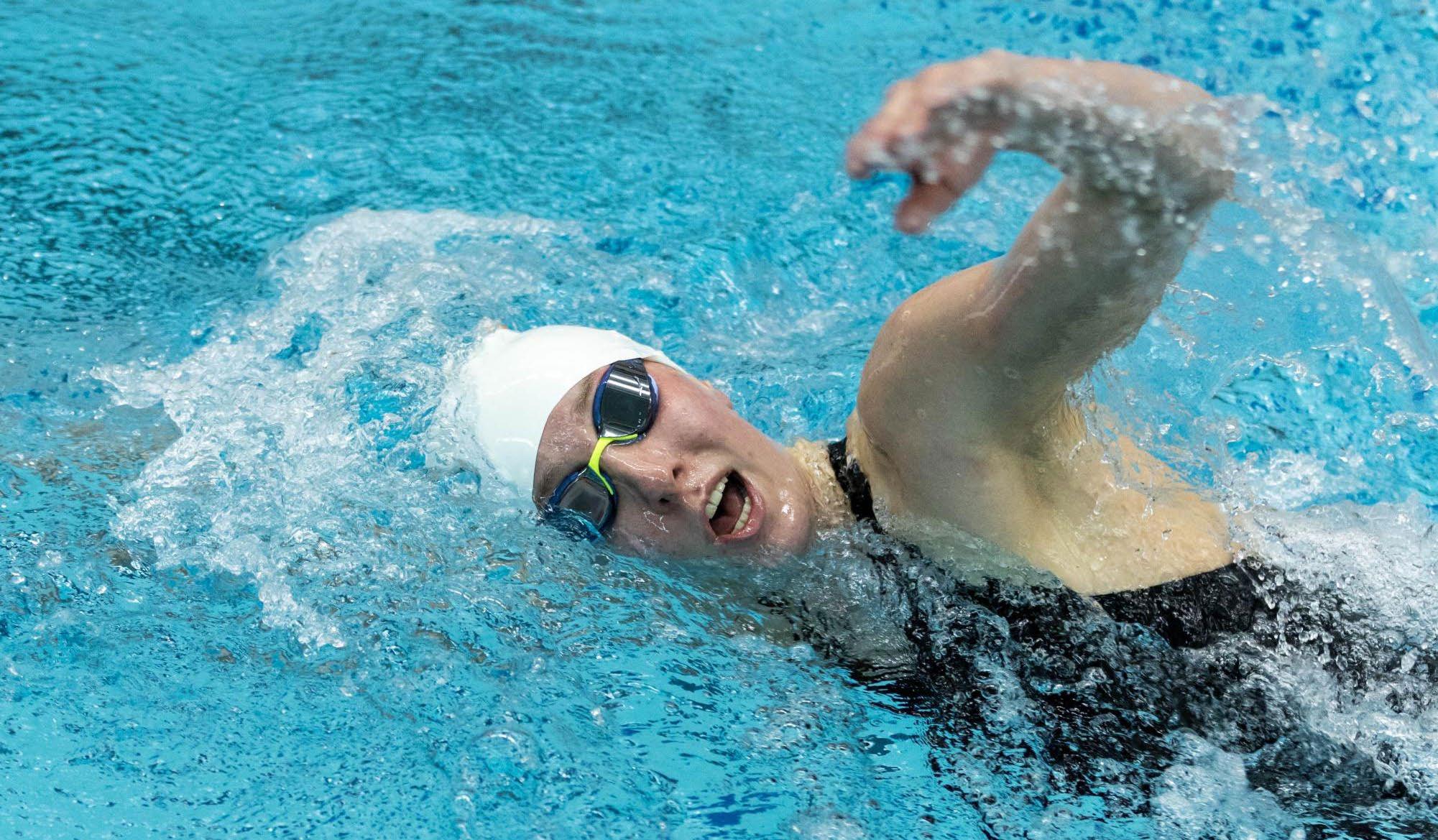
Avery Luedke was first to the wall, splashing past her Duke competition.
She led the pack for the first half of the race and kept her pace through the finish. Luedke boasted a mile time of 16:36.44, a first-place finish for the newcomer. The performance capped an impressive regular season for the true freshman.
Luedke is a backstroke and distance freshman from Chicago, Illinois. Even though the Vols have had a spectacular recruiting year, Luedke has managed to stand out early in her career. And she has had a sparkling beginning to her collegiate campaign.
She has an extensive background with a consistent drive for challenging events, such as the 500-yard free and the mile. Though her versatility cannot be ignored, the freshman came in with impressive performances in both the 100-yard freestyle and the 200-yard backstroke.
As a distance specialist, Luedke naturally had many programs reaching out to her. Luedke had over 20 programs to choose from, but narrowed her search down to Arizona State, Alabama and Tennessee. As she explored the recruiting process, she felt drawn to Tennessee’s spirited atmosphere.
“I would just say the thing that made me choose Tennessee was the feeling of family here,” Luedke said. “(Tennessee) is so welcoming no matter your background.”
The coaching staff at Tennessee was thrilled with the new addition, furthering its already stellar lineup for the 2025-26 season. Even though the staff recruits high-end athletes, the freshman classes’ improvement still surprised the coaches.
“I think one of the things that’s really impressed me this year was the development of our freshman class, both men and women,” head coach Matt Kredich said. “They came in after we lost a massive senior class last year. So the change in the team was enormous.”
Kredich has an extensive history of coaching and has made a great impact in Tennessee, especially in women’s swimming. Kredich has won nine coach of the year titles and helped the Lady Vols achieve the SEC title in both 2020 and 2022. He has taken a great interest in this year’s freshman class and their improvement.
“They spent a while trying to absorb the culture, and figure out, orient themselves,” Kredich said. “And second semester, they’ve been really aggressive and assertive, and really starting to create their own identity. So I’ve been really impressed with them.”
Luedke has shown significant improvement since the start of her college career. She’s quickly emerged as a reliable, consistent addition.
Although her club’s coaching focused on
many different strokes and distances, the focused training in Tennessee has allowed her to flourish. Tennessee assistant coach Caleb Lawrence captures the intensity of her training.
“She swims for really long, unbroken chunks that get a little bit faster as the workout goes on,” Lawrence said. “Also helps with the rhythm building, but it helps her to set a steady pace and then find ways to subtly change speeds, exactly like she’s going to do in the mile.”
Lawrence has experience coaching for multiple national-level swimmers, as well as high-level collegiate programs such as Richmond and Notre Dame. He uses his experience and translates it into Luedke’s training, especially with the ever-changing world of college swimming.
“Trying to make sure that she gets training in different strokes and at different speeds throughout the week is really important,” Lawrence said. “In terms of like, just the distance stuff, I would say that there’s really three main workouts that are kind of targeted through the week. So Monday afternoon, which is her first primary workout of the week, for the first half of the year, it’s a lot of aerobic capacity building.”
Although Luedke is accustomed to swimming long and strenuous events, several different aspects come into play while swimming. One of the most important is her mentality.
Luedke has mastered the strategic aspect of
the race, particularly in translating her training experience into the actual race.
“The training is just preparation, and you’re practicing your race plan,” Luedke said. “When you dive in, you don’t have to think.”
As of recently, there has been a rise in distance swimming, with legends like Katie Ledecky and Bobby Finke still surpassing the competition and smashing records. Ledecky has broken the 1500-meter freestyle six times since 2013.
The arena is growing more and more each year. With the ever-evolving world of collegiate swimming, it’s important to expand horizons and set new goals.
“I would say a big goal for me is to be a scorer at NCAAs,” Luedke said. “Just to be able to score points for NCAAs and stay a top-five team.”
Both the NCAAs and conference championships are pinnacles of college swimming. With the end of the dual-meet season, the Vols have taken many of their foes already. But Luedke and the rest of her teammates still have a lot left to take on.
“We’re more on a path towards trying to be the best we could be at SECs,” Kredich said. “And the same thing for NCAAs.”
As the end of the season approaches, swimmers are rushing to collect themselves to prepare for the SEC Championships. With the championships taking place in Knoxville this year, the Vols are especially focused on succeeding.
“I think this team has done a great job at every phase of the season, taking stock of what the next challenge is and meeting it head on,” Kredich said. “It’s like nothing else that we do on our schedule, and we’re gonna need all of our resources for it, so that one of the main goals is to rest while we continue to sharpen and prepare.”
There are a lot of stressors that come with being a Division I program, especially for one as academically rigorous as Tennessee. Luedke has learned how to balance being a student and an athlete.
“The first semester was definitely a learning curve,” Luedke said. “Once you find a routine, it gets a lot easier. We have so many resources here.”
Overall, Luedke still has a lot to learn over the course of her collegiate career. She’s managed to shred the course and pass the competition with grace, edge and strength. She already managed to gain a great deal from her collegiate experience.
“Give yourself some grace,” Luedke said. That grace is extended by the coaching staff, too.
“You do not have to be perfect on any given day. You don’t have to walk into a performance practice or a competition and match what you did the time before,” Lawrence said. “You just have to move through it the same way that you do.”
‘One of the toughest individuals I’ve ever met’:
ALLIE CAMPBELL Contributor
Calvin Wetzel is a 25-year-old student athlete, but not because of an NCAA loophole.
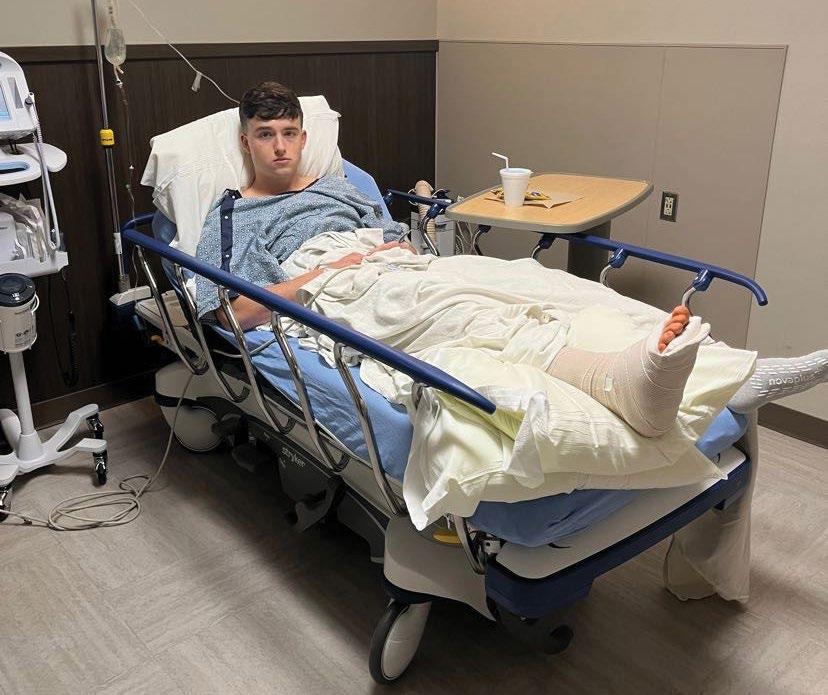
The Pittsburgh native arrived at the University of Tennessee in August 2021, but didn’t actually compete for the university until 2025. Calvin Wetzel suffered a stress fracture in his foot in November 2021. An injury that could sometimes take just a few weeks to heal took three years.
The surgery that he required is difficult, and success is not certain. Not to mention, determining success takes patience.
“About a year into it, you find out, OK, was this successful?” Wetzel said. “And, unfortunately, that was not the case, so I had to get a second surgery. Went through the process, you literally start right over again.”
A year after his first surgery, Wetzel could finally begin to jog again. That’s when he found out that the screw was too long, causing discomfort. Wetzel had his second surgery in January 2023.
Following another eight months of physical therapy, Wetzel refractured his foot in his first practice back in August 2023. His third surgery came in September 2023, and finally, the surgery was a success. In August 2024, he returned to the track for the first time in three years.
Prior to Tennessee, Wetzel ran at Army West Point for two years. Student-athletes are able to transfer before their junior year without owing any military service after graduation. He took that opportunity to change direction, but his career ahead was even more unconventional than his time as a cadet.
Tennessee track and field sports administrator Marcus Hilliard has known Wetzel since he first joined the team in 2021. Hilliard credits much of his mental strength to his experience at West Point.
“With his background having the ties of the military academy formally and then just how mature he was and his approach, it was almost like he was Superman,” Hilliard said. “Every time, you know, he either got hurt or there was a setback, it almost kind of made him stronger.”
Along the way, Wetzel continued to cheer on his team and remain a positive influence despite all that he was going through.
“A lot of people face injuries and adversity, and there’s a couple different ways you can take it,” Hilliard said. “And you could let it kind of consume you, and ‘woe is me.’ But that was never Calvin’s ap-
proach.”
Wetzel focused on his education throughout the three-year injury. He earned a bachelor’s degree in electrical engineering, a master’s in computer science and held three internships, including a graduate fellowship with the U.S. government, all while in recovery.
As if that wasn’t enough, Wetzel made the decision to pursue a doctorate degree in computer science. He approached his professor, Dr. Hector Santos, with the idea in Spring 2024.
“I see a student that is performing super well in the classroom,” Santos said. “But also is an athlete — is a high-performing athlete. I knew that he’d be a unicorn. He’d be someone that I would like to have on my team.”
There’s a lot of work that goes into being a good teammate in both the classroom and on the track. Wetzel spends six to eight hours working and another three to four hours at practice every day.
When does he sleep? Saturday, sometimes.
“I try to leave Saturdays for myself if I can, but sometimes we’re traveling,” Wetzel said. “But that’s also a lot of fun.”
Hilliard is pursuing his Ph.D. while working with the track and field team, but had no idea that Wetzel was doing the same. He noticed Wetzel studying on trips, but with no impact on his attitude or performance, Hilliard didn’t think twice.
“I never got a sense of how much and how heavy his workload was,” Hilliard said.
“I’m a working professional, and I’m working on mine, and I’m complaining about all the reading and all the writing I’m having to do and this kid has no complaints at all.”
Not only was it unnoticeable in his athletic performance, but it was also separate from academic research. Wetzel was the first student athlete that Santos has ever seen pursue a Ph.D., and yet, there is no difference in his effort or product.
“Even when he has all these pressures, he excels,” Santos said. “He’s so effective that for him having those commitments, I don’t see an impact on what he delivers.”
Consistent with the rest of his life, Wetzel likes to challenge himself on the track. He runs the 400-meter hurdles, generally regarded as one of the most challenging events in track and field.
“You feel quite a lot of pain,” Wetzel said.
The 400-meter is the longest distance for hurdle events, requiring a strong rhythm and resiliency to bounce back after each of the ten hurdles and manage fatigue.
In last year’s SEC Championships and his first year back competing, Wetzel ran the 400-meter hurdles and finished
with a top-six time of 50.21. Last season, Tennessee’s 400-meter hurdle group finished as the fastest 400-meter hurdle group in NCAA history.
The expectations are high for this group this year. Wetzel has seen a lot of change in the program over the last five years, including the arrival of head coach Duane Ross at Tennessee in 2022. He cites this team’s veteran presence as the difference maker this year.
“We have several returners that have been at the world’s biggest stage,” Wetzel said. “People that have really competed at the highest level, and now they’re coming back with that experience, and they can share all that with us.”
For his last year of eligibility, Wetzel wants to compete. He spent three years rehabbing so he wouldn’t have any regrets.
“Every battle and every challenge that’s been thrown his way, he’s overcoming,” Hilliard said. “I can’t wait to see how he finishes as a student athlete on the competitive side, but also in the classroom. I’m just jumping for joy — can’t wait for him to finish.”
In every facet of his life, Wetzel is a good teammate. He showed up and encouraged his team during a very discouraging time in his life. He does any research or coding that’s required of him and then more. He doesn’t make excuses, even when they may
be valid.
“I think it takes a special person to just be a hurdler,” Hilliard said. “Then you add to the adversity from the injury standpoint. You add his academic journey on this Ph.D. grind. From top to bottom, Calvin Wetzel’s got to be one of the toughest individuals I’ve ever met in my life.”

TREVOR
MCGEE Sports Editor
Randy Duffy has his hands full with a Craftsman I-beam level, spring clamps and a hex key tucked behind his ear.
It is 2 p.m. on a Sunday, 40 degrees, with rowers finishing up a mile-long warmup jog before practice begins. In the back of Wayne G. Basler Boathouse, Tennessee rowing’s secret weapon is in his element.
He’s calibrating the boats, installing equipment to track the athlete’s speed and power, while ensuring precision. Duffy is Tennessee’s boathouse director — a key component of the Lady Vols’ nationally ranked program.
“The people are the greatest, and I love what I do,” Duffy told The Daily Beacon. “And so that’s why I never looked elsewhere since I got into the sport. I love sports, and being able to work in it is not something that I expected — not something that I was pursuing.”
Introduction to the water Duffy’s journey began far away from the sport. His background comes from a love of sports, with a degree of knowledge in putting things together. That’s because of a geoscientist license he earned after working in the drilling field — a stint that began during his time as a student at the University of Texas.
He spent 18 years working for Geoprojects International Inc. in Austin, Texas, earning a project manager title before leaving in 2012. When family matters arose, he decided to move to Dallas without a clear plan for what came next.
That was until his brother-in-law, then-SMU rowing coach Doug Wright, needed some help in 2016.
“I had zero background in rowing,” Duffy said. “I’ve never rowed, but I’ve always grown up around boats and water sports, and I’m kind of a jack-of-alltrades type of person.”
His work for Geoprojects International made the transition into the water seamless. He already had extensive knowledge of how to “MacGyver” problematic situations, as troubleshooting machinery and inciting perfection were already some of his previous responsibilities.
In fact, Duffy calls it a great pleasure to be involved in the aquatic environment rather than the drilling field.
“Sometimes you just kind of follow the path and end up where you didn’t expect, but happier than you thought you would be,” Duffy said.
A staff change occurred at SMU, and Kim Cupini was named head rowing coach June 17, 2017. Just a year removed from being
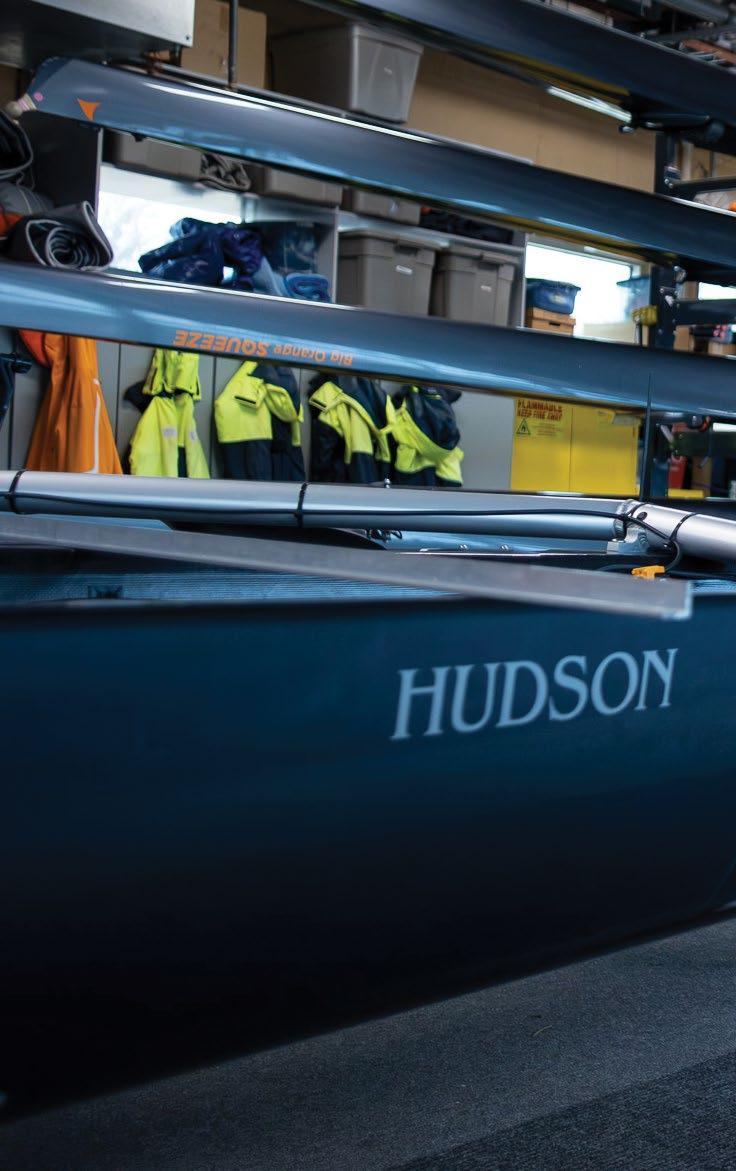
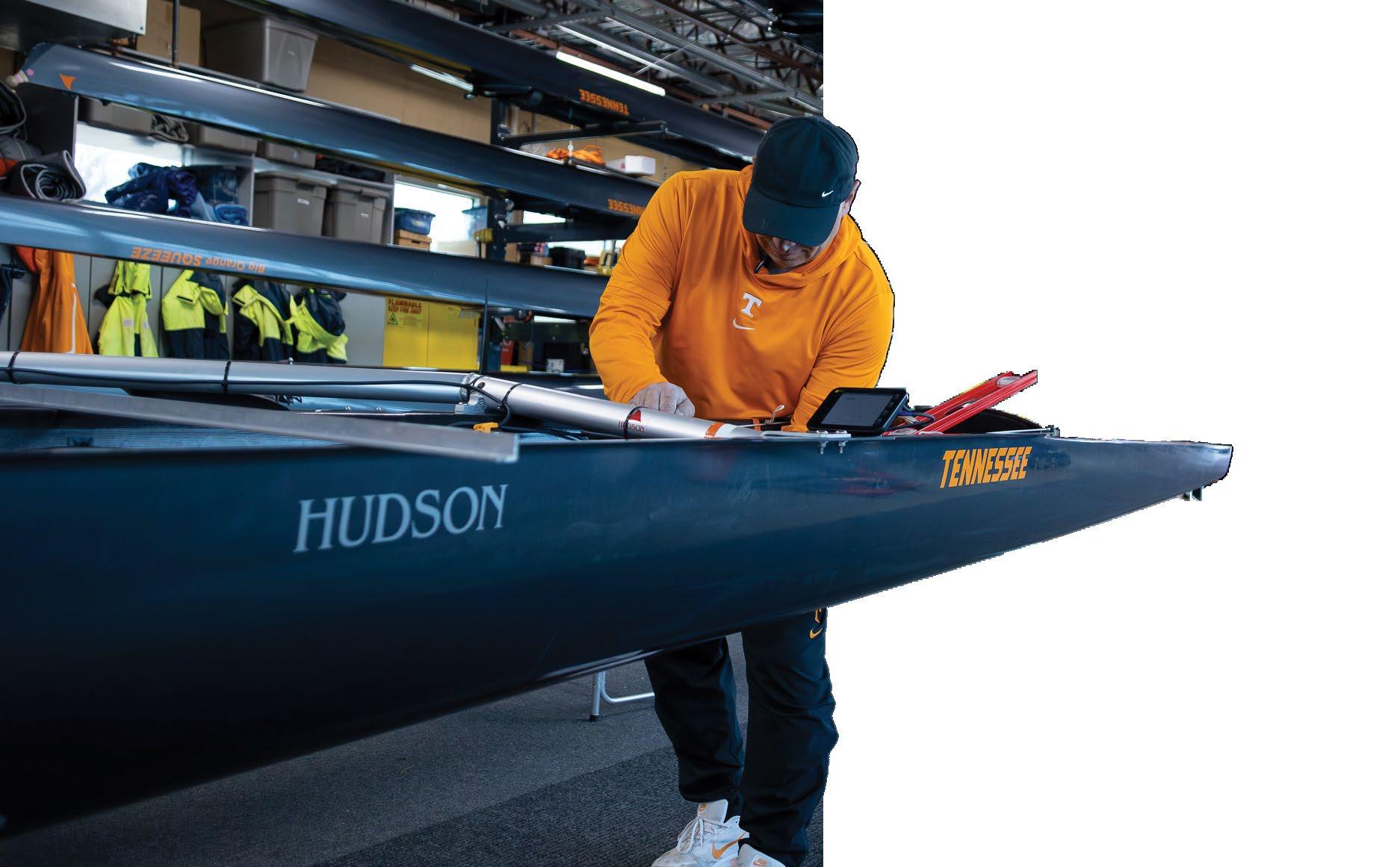
Tennessee boathouse director Randy Duffy calibrates a boat before practice at Wayne G. Basler Boathouse. Sunday, Feb. 8, 2026. Cambree Gliessner / The Daily Beacon
hired as boatman of the Mustangs, Cupini decided to keep Duffy on staff.
“He’s definitely like a MacGyver that could fix anything and work on anything,”
Cupini said. “We didn’t have the most resources there at SMU, and we needed a lot of stuff that was fixed, and so he definitely jumped in and really was able to do some things that a lot of people can’t do with equipment.”
Cupini and Duffy achieved three consecutive AAC titles, earning three NCAA Championship bids. SMU finished 11th in 2021, 12th in 2022 and ninth in 2023.
Duffy’s highest-pressure moment came in the 2022 AAC Championship race in Oak Ridge. The First Varsity Eight boat had damage that needed to be fixed. The boat had been knocked out by a big log in the water, damaging the mechanism that holds the skeg in the rudder, the device that steers the boat and keeps it on a linear path.
After a slight delay, he pieced it back into racing condition, and the Mustangs raced for a 6:36.063 time — eight seconds ahead of second-place UCF — claiming the AAC Championship.
“We needed to win that race to lock up the championship,” Duffy said. “ ... If they wouldn’t have gone down the course, we wouldn’t have won the conference that year. And they went down the course, and
to get equipment ready. Other times, it means staying until 1 a.m. to finish up a
“When we get into the meat of the season, from now until Memorial Day weekend, it’s possible that I only get a couple of days off between now and then,”
He must maintain training equipment, like indoor rowing and biking ergs. He also
Duffy is responsible for getting all equipment to each race site too, which calls for a 12-hour road trip to Florida for a spring training meet against Louisville on Feb. 14.
“It’s always a priority to have everything ready the way the coaches want it for the next practice,” Duffy said. “The next practice is always the most important thing. And it’s a driving force for everything that happens here.
“When practice starts, and practice ends, and boats come in, and nobody reports anything, that’s a great day for me,” Duffy said. “Because that means I can see my family a little sooner.”
they won the race.”
Accomplished in the Southeast
When Cupini took the job at Tennessee in 2023, she brought Duffy with her.
That meant another move for his family. Each of the Duffys bought in on the move to join Cupini’s staff with the Lady Vols rowing program.
“I wouldn’t want to work for a coach this long that didn’t fight to win,” Duffy said. “And that’s something that you can count on with Kim as your head coach. She doesn’t take her foot off the pedal.”
It’s a two-way street. Cupini brings success on the coaching side, while Duffy keeps the equipment in pristine condition. The behind-the-scenes work allows the athletes to focus on the race itself, rather than the equipment.
“We’re pretty lucky to be able to show up and just get in a boat that’s perfectly set up for you,” Madelynn Long, a graduate assistant and former rower at SMU and Tennessee, said. “And any adjustments you need are quick, and Randy’s always on call.”
His always-on-call workload means the workday is inconsistent. The Lady Vols practice six times a week, leaving Wednesdays for the athletes to be students first.
Some mornings, it is a 4 a.m. call time
Duffy’s abilities go beyond saving the coaches’ time. Cupini credits his know-it-all nature to saving the program money as well.
It is important for a non-revenue program that received $897,960 of institutional support but operated with $6,925,730 in expenses in 2025.
“When you have someone that knows how to repair the boat, you’re not paying other people to do the work,” Cupini said. “It’s all in-house, which is really nice.”
He and Cupini have achieved two top-five marks at Tennessee, including a program-best third-place finish in 2024. Their successes together are what Duffy notes as personal success in a behind-the-scenes gig. His competitive nature is what keeps him going.
“I’ve won a lot of things on a personal level from my career in the past, just on a different measure,” Duffy said. “But nobody puts it in a win-loss column. They’re just personal victories, or a project victory or just a life victory. But when you get to have that measure of a win-loss column, and we’re mostly in the win, that’s something that I really enjoy about it.
“I could go get a job doing something somewhere else,” Duffy said. “But I don’t think I’ll ever find one that has the reward of winning.”