


EDITOR-IN-CHIEF: Caden Dyer
PRINT MANAGING EDITOR: Emily Hurst
DIGITAL MANAGING EDITOR: Ansley Graves
COPY CHIEF: Lauren Holladay
NEWS EDITOR: Patrick Busch
ARTS & CULTURE EDITOR: Harper Brabson
SPORTS EDITOR: Trevor McGee
ASSISTANT SPORTS EDITOR: Alex Sarkis
OPINIONS EDITOR: Natalie Dripchak
PHOTO EDITOR: Jackson Clavier
DESIGN EDITOR: Lindsay Favre
ENGAGEMENT EDITOR: Sarah Portanka
AUDIENCE DEVELOPMENT EDITOR: Sophie Mehta
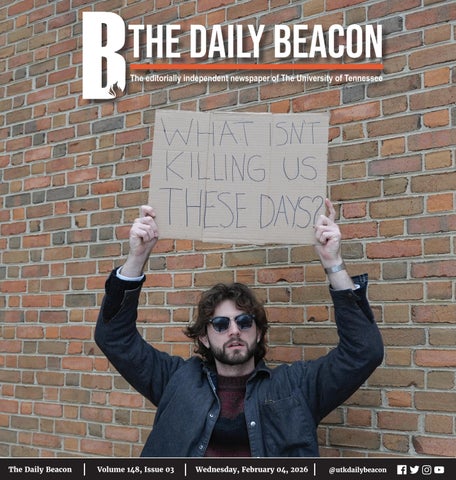
COVER DESIGN: Lindsay Favre
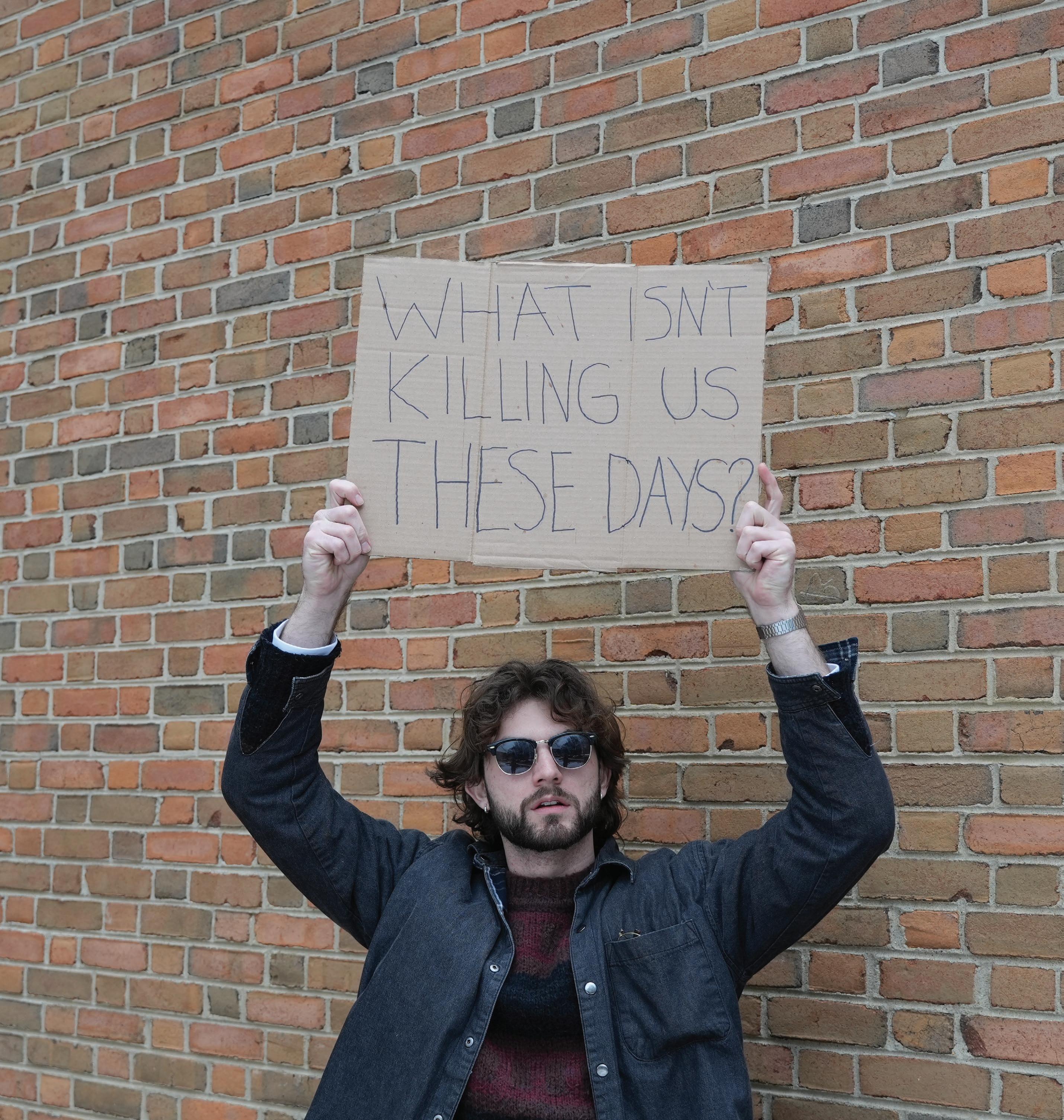
COVER MODEL: Tom Fortner
PAGE DESIGNERS: Emma Fingeret, Ashley Cammarota, Renee Allen, Maya Williams, Lili Ellis Ava Balducci, Ava Edwards
GRAPHICS BY: Lindsay Favre, Soma Fulwiler, Maya Williams, Emma Fingeret, Olivia Burden
ADVERTISING MANAGER: Abigail Cheslock
ADVERTISING REPRESENTATIVE: Joe Slott
TO REPORT A NEWS ITEM OR SUBMIT A PRESS RELEASE, please email editorinchief@utdailybeacon.com or call (865) 974-2348
TO PLACE AN AD, please email admanager@utk.edu.
LETTERS POLICY: Letters to the Editor must be exclusive to The Daily Beacon and cannot have been submitted to or published by other media. Letters should not exceed 400 words and can be edited or shortened for space. Letters can also be edited for grammar and typographical errors, and Letters that contain excessive grammatical errors can be rejected for this reason. Anonymous Letters will not be published. Authors should include their full name, mailing address, city of residence, phone number and e-mail address for verification purposes. Letters submitted without this information will not be published. The preferred method to submit a Letter to the Editor is to email the Editor-in-Chief.
CORRECTIONS POLICY: It is the Daily Beacon’s policy to quickly correct any factual errors and clarify any potentially misleading information. Errors brought to our attention by readers or staff members will be corrected and printed on page two of our publication. To report an error please send as much information as possible about where and when the error occurred to managingeditor@utdailybeacon. com, or call our newsroom at (865) 974-5206.
The Daily Beacon is published by students at The University of Tennessee on Wednesday during the fall and spring semesters. The offices are located at 1345 Circle Park Drive, 11 Communications Building, Knoxville, TN 37996-0314. The newspaper is free on campus and is available via mail subscription for $200/year or $100/semester. It is also available online at: www.utdailybeacon.com

ALLIE CAMPBELL Contributor
A water main break occurred on the corner of 12th street and Highland Avenue in Fort Sanders early Monday morning. The first report of the incident came from senior political science major Caroline Gray who woke up to the sound of trash cans toppling over. She looked out her window to find the cause of the noise: water rushing down the street.
“It was going for at least two hours,” Gray said. “When I called them it seemed like they didn’t know.”
Gray said that her first worry pertained to how her water supply would be affected.
Cortney Harris, a communications representative for the Knoxville Utilities Board, has confirmed that there should not be any customer impacts related to water service.
The same cannot be said about the
state of students’ cars. Water at high levels in the streets moved Gray’s roommate's car and damaged its bumper.
Knoxville Polive Department has asked students parked on the affected section of 12th Street to move their vehicles. Parking is already limited in Fort Sanders, and the house of six girls relies on that street parking. Winter weather conditions make the situation even more challenging with some spots being too icy to safely use.
When asked what the affected students should do about parking, Gray said, “Pray.”
After Gray’s phone call early this morning, KUB sent crews to “valve off the water main” and stop the flow of water. Once that is repaired, KUB said, they can begin to get the level back open. Crews on the ground are working quickly to minimize the impact.
Harris shared that as temperatures rise above freezing, ground shifts can
occur.
“So anytime you have an extended period of extremely cold weather that causes the ground to shift … and damage to customer pipes can happen, and especially today, as we get into above freezing temperatures, those ground shifts are going to happen,” Harris said. “But we expect those will happen again, and so that's when these things can continue to happen.”
“We expect that the roadways, everything will be complete and the roadways will be back open tomorrow,” Harris said.
To remain safe until then, Harris recommends that inhabitants of Fort Sanders take the appropriate route around the area and not get too close to the site. The current road closures include 12th Street between Forest and Highland avenues and Highland Avenue between 11th and 13th streets. Anyone with further questions can call KUB at 865-524-2911.

PATRICK BUSCH News Editor
The email arrived on a Wednesday night in January just before 10 p.m. It caught Jackson Dendy, an aerospace engineering junior, by surprise.
“I got the email on my phone, ‘Winners, congratulations, you’ve been selected!’ and I started jumping up and down in the shop,” Dendy said.
After many long nights designing hypersonic vehicles in a nondescript building on the west side of campus, University of Tennessee undergraduates saw their work finally pay off.
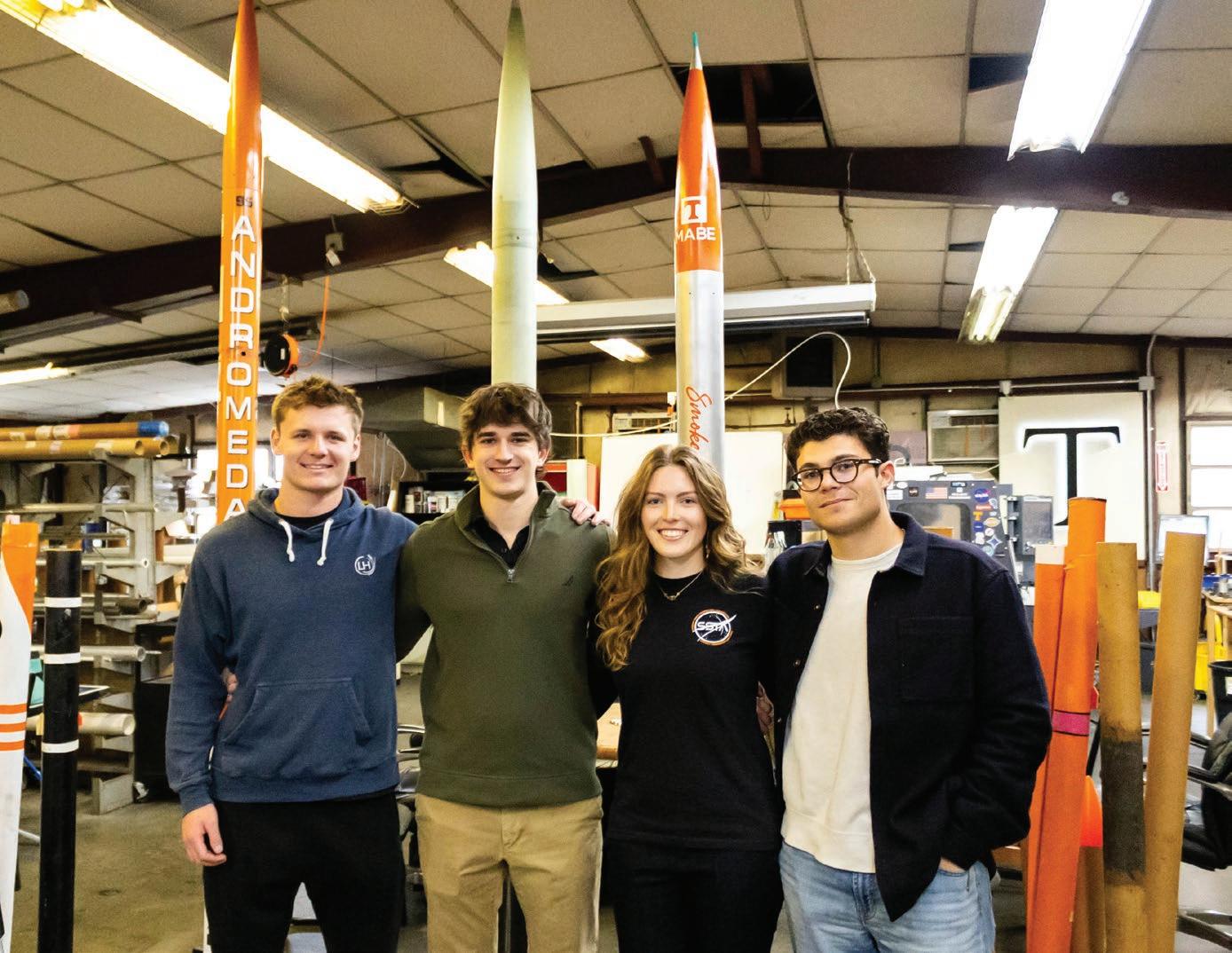
Founded in 2015, UT organization Student Space Technology Association is focused on bringing practical experience to students across many disciplines as it relates to the space frontier. One of its teams recently competed in the 2025 Undergraduate Hypersonic Flight Design Competition — and won.
The University Consortium for Applied Hypersonics and the Joint Hypersonics Transition Office jointly held the competition, representing the dual intentions of the competition: to develop the workforce of future hypersonic aerospace engineers and to propose a design for the Department of Defense’s hypersonic acquisition program.
The competition is set up in an online portal, and Dendy, who serves as the club’s chief engineer and the team’s hypersonic lead, began working on it in February.
“We just assembled the team from there,” Dendy said. “The goal of the project was to design an unpowered hypersonic glide vehicle, which pretty much means … (it) flies above Mach 5, and glide vehicle, highly maneuverable. … The design we went with was meant to be shot out of a rail gun at Mach 8 and then fly pretty much as far as possible.”
The hypersonics team did not consist of seniors, so its members had not taken classes in compressible flow yet, a critical part of hypersonic engineering.
“The people that did persist through the project were pretty incredible, that we were able to put this together with 10 people in four months,” Dendy said. “I think it’s unprecedented for the university, and given the praise we received from JHTO, it was pretty unprecedented for the competition, especially considering the fact that our team has no seniors. It was only sophomores and juniors. This was actually designed to be a senior capstone project.”
The team met weekly throughout that period to discuss progress and receive feedback from their mentors John Schmissuer, associate dean of the Tickle College of Engineering and executive director
of the UT Space Institute, and project advisor Stefen Lindorfer, a research scientist at the UT Space Institute.
“I’m extremely proud of the effort and enthusiasm the SSTA Hypersonics team invested in their winning submission … UT is fortunate to have the SSTA to support student extracurricular professional development, and from what I have seen the SSTA leadership has the group ready to produce championship-level work across the boards,” Schmissuer said.
“I am extremely impressed by how thorough their work was, and I am proud that they won the competition as a bunch of sophomores and juniors when most of their competition entered as a senior design team,” Lindorfer said. “As winners, they will now have the opportunity to perform additional wind tunnel tests at full-scale in the Calspan-University of Buffalo Research Center (CUBRC) 48-inch hypersonic Large Energy National Shock (LENS) tunnel and flight tests at the Army Research Lab (ARL) at Aberdeen Proving Grounds”
All members of the team cited the significant input and support of their faculty mentors as a key component of their success.
The team moved through several rounds, including the semifinals and a final 30-minute presentation to prominent figures across public and private elements of the hypersonic engineering community.
The competition functioned as a mock Department of Defense contract process. In real practice, the DOD will issue a request and private contractors will submit proposals.
The winner of this competition will have their design prototype produced and tested by the Department of Defense, utilizing their staff and resources to bring the concept to life.
“Now they’re actually going to build the thing and we’re actually going to do full scale testing,” Aaron Matheny, an aerospace engineering junior and the team’s analysis lead, said.
When Dendy learned of their win, he rushed to share the news with the rest of the team and the wider SSTA organization.
“It was very exciting we were awake for several more hours out of excitement,” Isaac Smith, an aerospace engineering junior and the team’s test and instrumental lead, said. “We talked to our mentors Dr. Lindorfer and Dr. Schmisseur they were both very excited for us.”
The success of the hypersonics team is just the latest victory for SSTA. The members see SSTA as an advancement of the capabilities and notoriety of Tennessee’s aerospace program.
“We’ve been operating behind the scenes for a few years,” Zach Marano, a junior studying aerospace engineering and the club’s president, said. “The school, on an
administrative level, has, in, parallel been operating behind the scenes, pushing space research.”
Marano sees SSTA as an opportunity to provide invaluable experience to UT undergraduates.
“We want to give as many undergraduate students the opportunity to pursue deeply technical projects they can’t get their hands on anywhere else,” Marano said.
In September of 2025, U.S. Space Command moved its headquarters to Redstone Arsenal in Huntsville, Alabama. Marano seeks to take advantage of this regional opportunity.
“What are the implications of that for the Southeast, right?” Marano said.
He wants the organization to keep pursuing the edge of development and research in all fields related to space.
“Space as an economic and commercial domain is brand new,” Marano said. “So when you look at what economic policy look like in space or what international relations look like in space, there’s absolutely no precedent. There’s nothing to base it off of. So all the legislation and regulation around the space economy is totally new.”
Marano spoke to the club’s wide representation of over 15 majors across its 200 members.
“Step one was expanding the scope of the club and breadth,” Marano said. “Then once you start getting big laterally, you realize that you need kids who do accounting, you need kids who know how to do social media and marketing. If you want to keep this
engine churning you start adding kids from the communication school and then Haslam … you end up with a super intellectually diverse group of kids.”
SSTA operates as an umbrella organization, the core of which provides financial and logistical support to several different teams focused on developing different prototypes and projects.
Caroline Czarnecki, a first year graduate student in systems engineering and the club’s vice president of business development, believes that the mission is to facilitate undergraduates getting hands-on experience in the field.
“There are very few opportunities as an engineering student to actually get your hands on a project like this without necessarily having a step-in at a great internship or co-op experience,” Czarnecki said. “This is essentially a student-run R&D lab. The unique thing about this location and the people in this club is that you’ll find them here all hours of the day, and that just speaks to the passion that they have.”
Marano hopes that the wider community takes note of what’s occurring in their program.
“If admin hasn’t seen that yet, in the next six months we’re going to make it very known to them,” Marano said.
Czarnecki sees the sky, literally and figuratively, as the limit to what SSTA can achieve.
“We want to push the envelope for what’s possible for Tennessee Aerospace and that is SSTA’s mission,” Czarnecki said.
‘We
CHAPMAN WORD Contributor
Local Knoxville artist Meidi Karampour has witnessed terror firsthand.
While living in the southern port of Iranian city Bushehr, he ran an underground art school focused on giving students access to processes seen as indecent or blasphemous by the government, particularly the use of nude models.
Karampour’s school grew in popularity. As Iranians traveled to learn from his teaching, government scrutiny increased. In 2017, authorities found his parent’s address and sent six masked men to ransack their home and search for anything that could be used as evidence against him. Authorities arrested Karampour shortly after, at one point interrogating him for six hours. His trial — which lasted over a year — ended with a prison sentence and lashing.
Two years later, Meidi secured a fully paid graduate student and teacher’s assistant position at Missouri State University. He left Iran after battling bureaucracy for 18 months in order to secure a visa. Authorities denied his wife a visa, so Karampour had to make the hard decision to leave her behind.
“She got rejected for her visa because she was from Iran. … Because she was seen as an Iranian living under the Islamic regime, rather than the people, rather than the person,” Karampour said.
Karampour now resides in Knoxville. After his wife eventually obtained a visa, she enrolled in the University of Tennessee’s Master of Fine Arts program. He relocated his studio from Missouri to Knoxville where he has continued his work painting portraits in a style known as Contemporary Realism. Mostly centered around transferring the intricacies and beauty of the human body, Karampour is able to focus on and openly display the same type of art that he endured punishment for in Iran.
Karampour wants to break the idea of an Iranian people who are in lockstep with the ideology and actions of Iran’s regime. Instead, he wants people to be aware that the history of the Iranian people rivals that of Greece in its longevity and impact on the wider

world. Karampour noted that many Iranians living outside of Iran are often in academic, medical or engineering fields, believing that an Iran free from theocratic rule would be immensely prosperous.
“You can just imagine how flourished this country could be, and how much dedication they can add to the world of knowledge and technology,” Karampour said.
His feelings are heightened in the

wake of recent internal Iranian conflict. Protests broke out across Iran in December. They began largely in response to economic issues — specifically the hyperinflation of the national currency — but the nature of the protestor’s concerns swiftly shifted toward wider anti-government sentiments, calling for an end to the theocratic rule of the Islamic Republic.
These are far from the first protests to occur in Iran since the 1979 Revolution that overthrew the ruling monarchy under Mohammad Reza Pahlavi.
“This isn’t the first time that we are taking it to the streets to dismantle the government. It’s been a battle going on for almost 50 years now, unfortunately,” said Karampour.
In January, the Iranian government cracked down on demonstrators with at least 5,000 confirmed dead and estimates of potentially more than 30,000 massacred on the streets.
As footage from those harrowing days and nights slowly trickles out of Iran, and a lengthy internet blackout imposed by authorities comes to an end, the movement continues to gain significant political support and attention from Western countries like the United States. However, the broader public’s awareness of the reality on the ground has dwindled. That is why Karampour knew he had to speak out despite the dangers criticizing the regime can produce, even 7,000 miles from Tehran.
“They just don’t care. They’re pure evil. We have to, we have to make sure people know this,” Karampour said. “Since my adult life started as an Iranian, I knew I was going to be in danger for so many things I have been doing. That is what my responsibility as a world citizen is giving me, and I should be ready to face any danger.”
For Karampour and University of Tennessee anthropology professor Dr. Karim Alizadeh, the movement is of particular importance.
Alizadeh is also familiar with the authoritarian nature of the Iranian regime. Though he was born and raised in the capital of Iran, his family traces their roots to the mountainous northwestern province of Iranian Azerbaijan. The region is home to the country’s largest population of nonPersian ethnicities, including Alizadeh’s family.
This connection to an area of such rich culture and history led him to pursuing both his bachelors and masters degrees in archaeology from the University of Tehran, and a Ph.D. from Harvard in archaeological anthropology, a study much more developed in North America than Iran.
“In most universities in the United States and Canada, archaeology is housed within departments of anthropology. By contrast, in much of the rest of the world, archaeology is institutionally separate from anthropology and is typically situated within the humanities, closer to history,” Alizadeh said.
Through his studies, he has discovered just how impactful archaeology and history can be when it comes to constructing national narratives. Specifically, Alizadeh has realized how the official histories of Iran largely exclude and misrepresent the experiences of marginalized communities such as the Azerbaijani Turks, Kurds, Arabs, Baluchis and Turkmen to the benefit of the Persian majority.
“Despite this diversity, the modern Iranian state — first under the Pahlavi monarchy and
later under the Islamic Republic — has pursued a homogenizing national project centered on the Persian language and Shia Islam,” Alizadeh said.
Given the regional history of oppression under the Iranian government, the population of northwestern Iran became immediately involved in the most recent protests.
The Azerbaijani population has taken a more conditional stance in the protests, demanding the inclusion of ethnic rights as part of the larger movement’s goals. In contrast, the neighboring Kurds have taken a more active and often militant role.
“Yet, both groups share a deep skepticism toward Persian-dominated political movements that fail to address ethnic inequality. … Iran’s democratization is fundamentally constrained by its longstanding failure to address ethnic inequality,” Alizadeh said.
Karampour firmly believes that the movement cannot succeed without external help. He hopes that through continual awareness being brought to the plight of Iran’s people, the regime will back down for fear of reprisal, and that President Trump will stick to his promise of aiding the protests.
“We Iranians don’t have guns,
and if we take it to a street and we are slaughtered very easily, like a game, there’s almost no way we can overthrow this government, unless there’s … another country intervene,” Karampour said.
Recent intelligence obtained by the New York Times reports a belief that the Iranian regime is at its weakest since the overthrow of the Shah in the 1979 Islamic Revolution. In the past two weeks there has been a surge of American and some British assets to the region, including an aircraft carrier strike group centered around the USS Abraham Lincoln.
Although it appears the American build-up of forces in the region indicates a potential strike, the future of both the anti-regime movement and Iran more broadly are still uncertain.
Alizadeh sees three potential outcomes to a hypothetical collapse of the Islamic Republic. Firstly, a federal democratic system that is largely supported by the minority ethnic groups.
“This is the most widely supported vision among ethnic activists. It would include mother tongue education, cultural and administrative autonomy, local control over

resources, recognition of ethnic identities. This aligns with the Azerbaijani slogan ‘National Government,’” Alizadeh said.
They just don’t care. They’re pure evil. We have to, we have to make sure people know this. Since my adult life started as an Iranian, I knew I was going to be in danger for so many things I have been doing.”
MEIDI KARAMPOUR
A new centralized state that continues the Persian-centricity of the current government is the second possible outcome.
“For many minority communities, this is the most concerning trajectory. A post-Islamic Republic government that retains a centralized, Persian-centric model of governance would almost certainly exacerbate existing ethnic tensions,” Alizadeh said.
The third possibility is a volatile and likely violent fragmentation of Iran along ethnic lines.
“If the state collapses entirely, some Azerbaijani groups may push for independence, others may advocate unification with the Republic of Azerbaijan (or they often call it North Azerbaijan), and Kurdish regions may pursue autonomy or independence. Such outcomes would draw in regional powers — Turkey, Russia, Azerbaijan,” said Alizadeh.
The coming weeks, months and years will tell the fate of Iran’s people.
There is still hope for a bright future among people like Karampour and Alizadeh — hope for both the ability to re-visit the country of their birth. They believe that growing global understanding of the issue is important and awareness should continue to be spread.
“I am hoping to see Iran as a free and secular country, in which people have the freedom of expression in art, literature, journalism and lifestyle. I also hope for a country that is economically thriving, and people can contribute their potentials in all the fields at their fullest to make Iran a country that makes its residences proud of living in,” Karampour said.
SAMANTHA WHITLEY Staff Writer
Some college students chose to participate in Dry January, a health trend aimed at cleansing the body and mind by abstaining from alcohol for 31 days. But what happens to those who suddenly stop drinking?
Evan Basting, a fifth-year clinical psychology doctoral student, said that abruptly cutting out alcohol can be harmful for those who have heavy drinking patterns.
“Alcohol is one of the only substances where severe withdrawal can be lifethreatening,” Basting said.
While withdrawal symptoms vary per person and depend on their alcohol use, someone who cuts alcohol “cold turkey” may experience symptoms such as “anxiety, headaches, upset stomach and increased heart rate,” according to Basting.
“In severe cases, people might experience tremors, hallucinations, delirium or seizures,” Basting said. “These symptoms occur over several days or weeks after quitting alcohol if they were using alcohol heavily and frequently, and may coincide with intense craving.”
Basting encourages people to reduce alcohol intake gradually when trying to stop drinking.
“If alcohol is used to self-medicate mental health problems, and someone quits abruptly without having any other adaptive coping strategies to lean on, they might be at higher risk for maladaptive replacement behaviors,” Bast-
ing said. “This could include using other substances, binge eating, compulsive sexual behavior, excessive shopping or other compulsive behaviors.”
He said it’s important to have a plan on how to cope with withdrawal symptoms and cravings, “adaptive replacement behaviors such as hobbies, exercise and routines,” and a support system during this process.
Basting recommends anyone concerned about their drinking or wishing to reduce or stop, to do so under healthcare professionals.
Giving up or decreasing alcohol intake can be challenging, especially on a college campus.
Stella Son, a third-year doctoral student in the clinical psychology program, compares UT’s drinking culture to her alma mater, the University of Iowa.
“We were another known ‘party school,’ so I would say it’s pretty similar to other SEC and Big Ten universities,” Son said.
Basting added that an “abstinencebased approach will likely not be very successful or effective on college campuses, because it is so deeply interwoven in drinking culture.”
It can be difficult to distinguish between social use and self-medicating behavior.
Son proposed a hypothetical. Imagine a student passed a class that they nearly failed and that student’s friends suggested going out for drinks to celebrate. Meanwhile, if that student did not pass that class, those same friends might suggest going out for drinks “to make it

better,” Son said.
“Now, imagine that this entire semester has been extremely stressful,” Son said. “Are you drinking because you are trying to socialize with others after a stressful semester, or are you trying to cope with the stress?”
Son saw firsthand what some underrepresented people go through because her mother is a retired social worker. Most of these people, some unhoused or immigrants, experienced trauma, ranging from child abuse to intimate partner violence.
“What I noticed, at the time, was that two people can experience the same trauma, but they can have drastically different ways of coping,” Son said.
Son explained that two people with the same background and traumatic childhood could use different coping mechanisms. One person might handle trauma with alcohol and the other may use exercise, indicating “psychosocial factors that can influence people’s behaviors in dealing with difficult events.”
Drinking to cope in a college setting can look like a student who drinks to help with anxiety and numb intrusive thoughts after experiencing sexual violence. Drinking might provide short term relief, leading to a habit of drinking before bed every night, building a dependent relationship with alcohol.
“When we drink, especially in small doses, our body releases dopamine and serotonin, two neurotransmitters known as feel-good chemicals,” Son said. “These are responsible for activating the brain’s reward centers and pro-


ducing a short-term boost in mood.”
Alcohol is also a central nervous system depressant, meaning that alcohol declines brain activity and ultimately reduces the amount of dopamine and serotonin when repeated.
“Over time, this can lead to lower mood, increased anxiety and depression, memory issues and reliance on alcohol, ultimately leading to worse physical and mental health outcomes,” Son said.
These alcohol-related effects and hypothetical scenarios are not only reflected in Son and Basting’s clinical work, but in research from UT’s Relationship Aggression and Addictive Disorders Lab, where both are active members. The RAAD lab is a clinical psychology research lab that primarily focuses on alcohol use and intimate partner violence.
RAAD members occasionally present their research to courses and meetings, “helping people gain a better understanding of substance use among college students,” Son said.
“A lot of our study data comes from UTK students, meaning the results are at least generalizable to the UTK student population, which makes it all the more exciting and meaningful to deliver to the student body,” Son said.
The Center for Health Education and Wellness’ Alcohol Education Program is an additional resource for students, where they can learn more about their alcohol consumption and assess their level of intake.
If you are experiencing a mental health emergency, do not hesitate to contact the suicide lifeline at 988 or 911.


The University of Tennessee Bass Fishing Team is a club, not a varsity sport.
Competing with other collegiate bass fishing programs requires the club to not only supply its own gear and boats, but to prepare its own season schedule, to raise awareness on its popular Instagram page and to manage its 21 sponsorships. This season, the club’s membership is its highest ever, according to club president Cody Domingos.
Through the challenges of facilitating a competitive team — and qualifying for the Bassmaster College Series national championship just last week — student executives are learning how to build a brand while sharing their love of the sport.
“It can be a lot, and it can be stressful at times,” Domingos, a senior marketing major, said. “But it’s also an invaluable experience.”
The executive team’s behind-thescenes functions make the club unique among college fishing teams. At other universities, coaches handle executive duties, according to Domingos.
“While there’s benefits to that, I see the benefits on my side of it as now I actually understand how to make all this happen,” Domingos said.
For example, running a competitive collegiate bass fishing team costs a lot of money: for food, for lodging at tournaments, and for gas to travel to and from tournament sites. Thus, the executive team must cultivate relationships with almost two dozen sponsors.
“The biggest thing that I’ve learned is how to professionally deal with all these sponsors, and how to make good business deals, as well as keep your business in good standing with those companies that are supporting you,” Domingos said.
Sponsors have fully reimbursed the team’s travel costs since 2023, according to Mason Thompson, team social media manager. Plus, sponsors enable the team to send more boats to tournaments.
“The numbers used to be a lot smaller,” Thompson, a junior business management major, said. “And now we can send a strong eight to 10 boats down to a tournament and be confident that people are going to go and they’re going to get reimbursed, and it’s not a financial strain and allows you to focus on the fishing and competing more.”
Thompson said that being club treasurer last school year gave him his first experience with entrepreneurship. After UT’s baseball team won the 2024 NCAA Division 1 Baseball championship, he capitalized on their success by creating

a shirt displaying a cartoon bass fish in a Volunteers jersey.
“I saw people posting about it on Twitter, and it was definitely blowing up. And thinking on a basic level like that, of supply and demand, what people want, and ‘can we give it to them?’ That was definitely a learning experience,” Thompson said.
Joey Bissing, president of the UT Bass Fishing Team from 2023-24, remembered making a phone call to pitch the CEO, CFO and other executives at Bridgford on sponsoring their team.
“It was kind of terrifying,” Bissing said, “but then it taught me to not be afraid to ask for the moon. You might get the moon.”
The phone call led to a dinner and a meeting between team leadership and Bridgford in Chicago, which Bridgford flew them out for, according to Bissing.
Bridgford became the club’s title sponsor — the biggest name on their custom jerseys, the logo displayed on their boats — and received priority recognition among other sponsors on the club’s social
into fishing. People will DM us and ask us for advice on bass fishing, and it doesn’t take any time out of my day to respond, so I try to always help out with that,” Thompson said.
“People tag us in their posts. They’re taking what we tell them and actually using it and catching fish. There’s nothing better than that,” Thompson added.
Domingos said it’s important to him to share his love of the sport.
“I always try to remember that you too were once the kid with all these questions. And, you know, a lot of these kids look up to us, look up to the college guys, just because of what we’ve done with the team,” Domingos said. “... So especially when the youth of the sport is talking to me, I want to try to give my all back to them.”
In the long term, Domingos said that he wants the Bass Fishing Team to become a varsity sport at UT. For example, he said, other colleges provide their collegiate bass fishing programs with boats and transportation to and from competitions.
“We’re right around 50 members right now. This is the biggest the club’s ever been, and with that obviously comes a lot more expenses, traveling expenses, lodging expenses, all of those things,” Domingos said. “So my long-term vision is that we do become a sport with the university and just work hand in hand, trying to promote each other better.”
media posts.
The members of the executive team are not the only ones learning. Parents, children and fans are learning from the team through social media content such as the team’s regular “tackle tip” posts.
“A lot of our viewers who are engaging with those posts are either parents of young children and trying to get their kids
Domingos said that the best time for prospective members to join is in the fall, which is when the team plans logistics for the year. He invites interested fishers to reach out to any member of the executive team, whose contacts are on the team’s Instagram.
The club will compete again from Feb. 12 to 14 at the Bassmaster College Series National Championship at Lake Murray in Columbia, South Carolina.

47
slogan word 6 ____ Vallarta
56 Pizza topping 7 Airport screen-
57 Sour-tasting ing org.
59 Sheep's genus 8 In a calm way Jeter
60 Toms and bucks 9 Like a sleeping 34 Strips in a
61 Translucent gem baby darkroom
Solution to Crossword:


Shelby Wilson Staff Writer
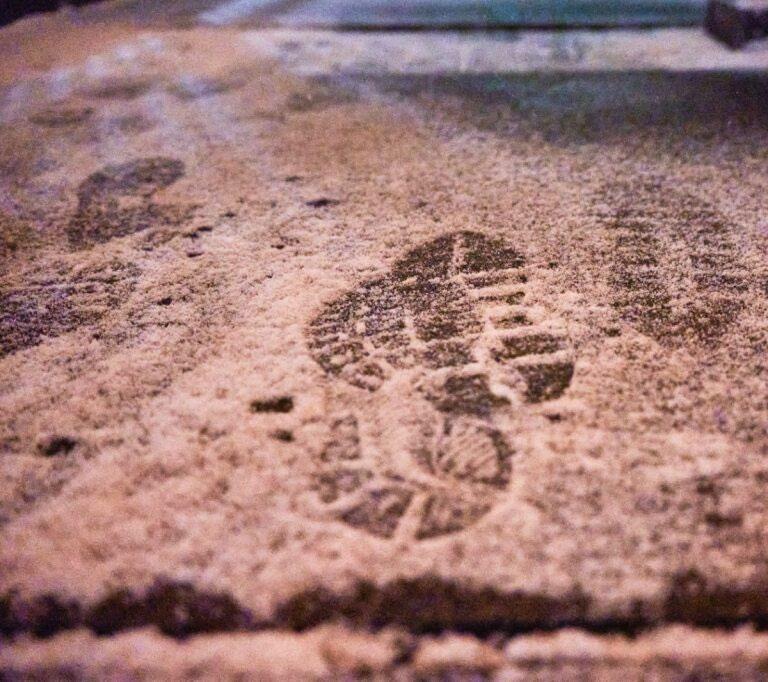
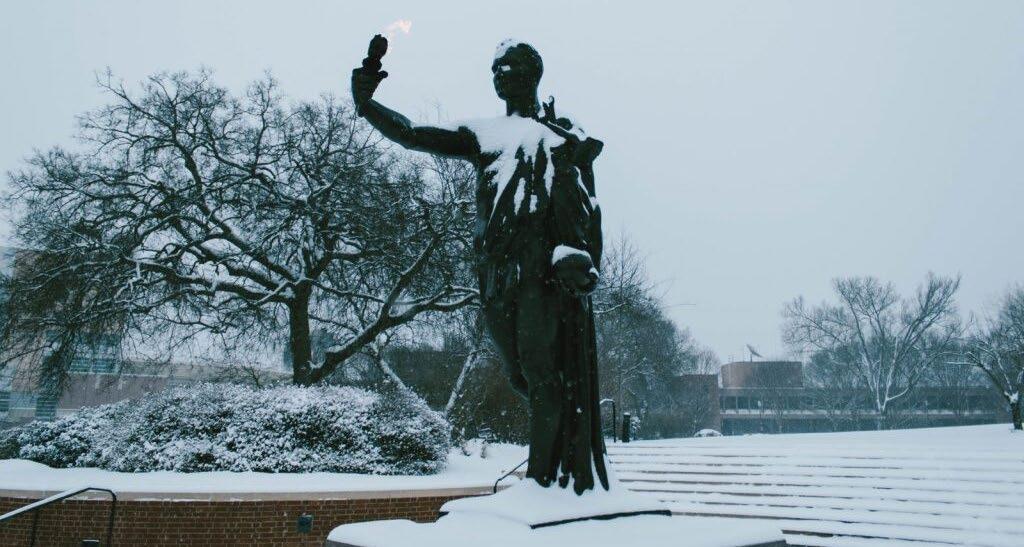
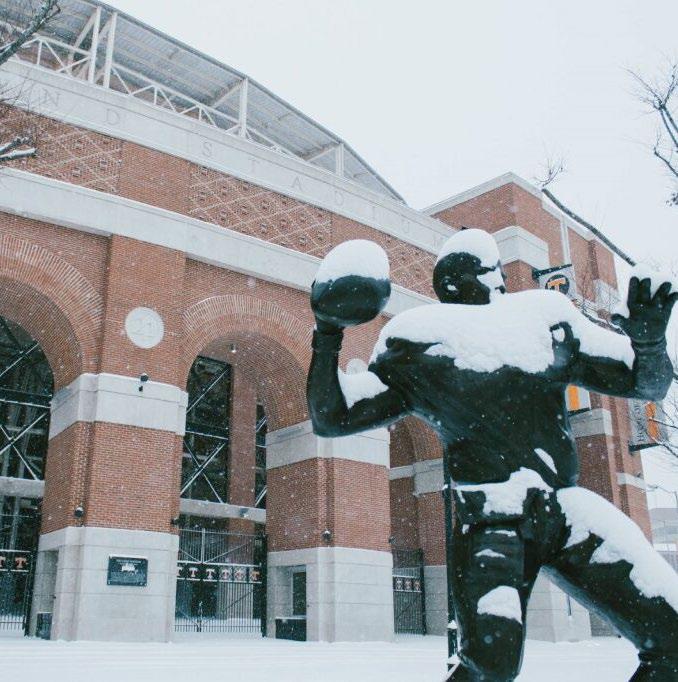
Just over 60 years ago, the University of Tennessee and the surrounding Knoxville area made national headlines because of a snowball fight.
While it sounds unusual, the incident ended in the deaths of three people: one a student, the other two civilians. The excitement of a snowball fight turned into a riot of sorts, disrupting traffic heavily along Cumberland Avenue.
The weather forecast for Knoxville on Feb. 1, 1965 predicted only a small amount of snow, but as the day progressed, it fell more than expected.
Students quickly began to flock Cumberland Avenue, and a snowball fight erupted. While it started as lighthearted fun, the snowballs started being thrown at passing vehicles.
Madness ensued as hundreds of students aimed snowballs at each other and random cars. Many people complained of broken windows and damage from the hard-packed snow and police received an abundance of complaints.

The riot ended in the tragic passing of three people. One of them, student Marnell Goodman, suffered a shot to the head by a truck driver. The driver, William Douglas Willet Jr., claimed he acted out of self-defense after being pulled from his vehicle.
The police chief at that time, Fred Scruggs, told reporters “many versions” of the story existed, making it difficult to find whether Willet Jr. had been forced from his car or voluntarily exited the vehicle.
Another man drove through the scene on Cumberland Avenue on his way home from work and suffered from a heart attack moments later, passing away. His story remains cloudy, as no one recalls seeing him at the scene. While he claimed to be hit in the head by a snowball containing rocks, police had trouble believing this after seeing he had a criminal record, as well as false witness claims prior. Officials labeled his cause of death as medical problems, not a snowball.
UT had seen an incident like this before. Five years prior, police arrested 14 students during another
snowball fight that led to tear gas being dispersed. The two occurrences hold striking similarities, with hundreds of students gathering on Cumberland Avenue and disrupting traffic.
Students retold these stories for years, believing them to be the reason for the rarity of campus closures due to
winter weather.
While Andy Holt, UT’s president at the time, did create a new weather policy after the incidents in the 1960s, it is hard to say whether these events still affect campus decisions. UT has closed for snow since, such as in 2015 during an ice storm.



The indescribable bittersweet envy that rushes over me after each episode of “Sex and the City” needs to be studied. I mean, seriously, has anyone ever watched this show without being almost just enough convinced to pack up their things and move to New York City?
I started to think, what’s really the difference between being a female student at UT and being a part of the cast in NYC?
In many ways, Knoxville is turning into a full-blown city of its own. I won’t deny, they have us by the huge skyline, but we have more in common than we realize — the questionable romance, the walkable city, the friendships, the drama and the endless possibilities.
I mean, I’m sure they aren’t throwing a goal post into the Hudson River, but then
again, who really knows what they are doing?
We can even go into the everyday details like the man yelling “hot dogsssss, come get your hot dogsssss” outside of Half Barrel. This sound is a little too familiar to me, as my apartment window has a straight view of Half, and I could go on for hours about how obnoxious it gets, just like how it would be if I lived in New York.
After all these similarities, I couldn’t help but wonder ... are we all longing for a life we already have? Let’s find out — UT student life vs. SATC:
In our day and age, a date party is less formal than a dinner date, but it still carries the same connotations.
Instead of a dimly lit restaurant, you might be in a dimly lit frat house. Sure, instead of a candle giving a romantic vibe, it may be strobe lights, but there is still a planned nature to
the event. You’re still socializing with a drink. You’re still getting dressed up. You’re still hoping the pregame washes away the nerves. Just like a first date, it might be awkward at first, but it usually turns out fine … although I have heard some crazy horror stories.
Big’s phone call vs. “… is typing”
If you are unfamiliar with Big, he is Carrie’s toxic, on-and-off ‘thing,’ who is the definition of an emotionally unavailable, walking red flag. Carrie, the helpless romantic she is, keeps going back to him even when she knows it’s no good for her. Her selfsabotaging behavior feeds the problematic relationship in hopes of finding the love she has always longed for.
The only difference now is the reliance on social media apps for communication. A Snapchat from someone couldn’t make your heart race back then, and there was no such thing as an Instagram soft launch — though if there had been, Carrie would have definitely participated (no shame, I did too). But ask yourself, is your “… is typing” much different than Big’s half-hearted phone call? Is it just convenient? I don’t know — that’s up for you to decide.
Instead of walking down the streets of Manhattan in heels, you might be walking along Cumberland Avenue or making your way to Frat Row in sneakers. You’re still walking hand in hand with your girlfriends on your way to socialize, just more comfortably. The shoe attire might look a little different,
CLAIRE THATCHER Staff Writer
Crack. Pshhh.
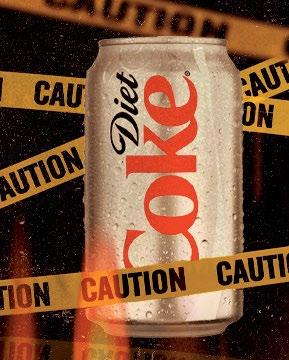
Ahhh. The familiar sound of a crisp can of Diet Coke. When poured over ice with a lime slice, it’s the perfect afternoon pick-me-up. Sure, it tastes delicious — but the best thing about Diet Coke is that it’s guilt-free. No sugar, no calories.
And if a Diet Coke isn’t enough, I’ll crack open an Alani Nu. Each can of the wildly popular energy drink contains a whopping 200 milligrams of caffeine. Not only are Alani’s deliciously sweet and refreshingly energizing, but they are also zero-sugar and only contain 10 to 15 calories.
According to theWorld Health Organization, the average person should not consume more than 40 grams of sugar per day, with less than 10% coming from added sugars.
For comparison, a full-fat Coke has 140 calories and 39 grams of sugar. A Grande iced caramel latte from Starbucks has around 200 calories, 30 grams of sugar and only 150 milligrams of caffeine. When you lay it all out like that — how could you go back to fullfat soda? Why would you ever drink a caramel
latte from Starbucks ever again? I mean ... I know what I’m picking.
While Diet Coke is a familiar staple, first launched in 1982, Alani Nu is much newer — the brand founded in 2018. Billions of dollars later, the company was bought by Celsius Holdings in 2025 — yes, that Celsius.
Celsius, another zero-sugar, low-calorie beverage phenom, grossed almost$1.8 billion at the end of last year. Needless to say, the world has responded to the prospect of a healthier alternative to its favorite sinfully sugary drinks.
But I’d be lying if I said I haven’t seen TikTok videos of 20-something, Lululemon set-wearing girls being carted off in an ambulance, diagnosed with heart failure and headlines citing the cause as their penchant for Orange Kiss Alani.
Now, most of the time, when something sounds too good to be true, it is. So what’s the catch with diet soda and energy drinks — and should you care?
I think I speak for most of us when I say nutrition labels confuse me. When I try to read the ingredient list of any processed food, I get lost. The first couple of ingredients I can understand, but the list tends to trail off into
but let’s be real, your adorable heels don’t belong in a frat house — and those designated frat sneakers hold a lot more memories than any heel ever could.
Sunday brunch vs. Sunday debrief
Sunday brunch in SATC is like the Super Bowl, although it happens every Sunday. As they sip mimosas, they make each other feel better about how poorly, or astonishingly well, their date from the night before went.
When you wake up with the Sunday scaries after a long weekend, where do you run?
I still remember the Sunday I walked into Just Love Coffee Cafe feeling so anxious it made me physically sick — when I walked out, I had tears in my eyes from my girlfriends making me laugh so hard.
You might not be able to stomach a mimosa, but you are still designating time to recap the night before, and I’ve always preferred my blue Gatorade anyway.
Cosmopolitians vs. Hill Pink Drink
That counts ... right?
Continue reading Veronica’s analysis at utdailybeacon.com.
a language I don’t speak, and I’m transported back to chemistry class, sophomore year. Then a wave of trauma washes over me, so I just close my eyes, hope for the best and eat it anyway.
I’m tired of wondering — wondering if I’ll wake up in 20 years with cancer. Or drop dead tomorrow of heart failure. Does the government want to poison me? Will I be infertile by 25 if I keep eating Oreos?
Do you want me to buy your meal plan, or are you genuinely concerned for my wellbeing? I am not knowledgeable enough to distinguish what health-based content on the internet is fearmongering and what is factual.
It’s time to face the music. What are these mysterious, foreign-sounding ingredients that I’m ingesting daily?
I currently have a 40-ounce Stanley full of Diet Coke sitting right next to me. I’ll let you know if I feel like dumping it down the sink by the end of this.
THEO COLLI Senior Staff Writer
Tennessee softball’s 2025 season consisted of many highs, with the team reaching 47 wins along with a trip to the Women’s College World Series.
With the season beginning Feb. 5, the Lady Vols understand that, while they can be proud of what the team had achieved last season, they still can’t become complacent and expect the same results without putting in the work.
It’s not an easy thing to achieve consistent success at any level of sports, which Lady Vols softball head coach Karen Weekly understands better than most.
“I think what’s really cool about this team is we’re young, but we have some players who got some really, really great experience last year,” Weekly said. “So when I say young, you think of some of our sophomores and juniors that (had) the opportunity to play in the postseason and to get to Oklahoma City and be on that stage and have success on that stage, and have success getting there, I think that’s gonna bode really well for us.”
Weekly is entering her 24th season with the team. She coached the first 19 seasons of her career with the Lady Vols alongside her husband, Ralph Weekly, before Ralph retired in 2021.
Since Weekly has taken over full-time head coaching duties, the team reached the NCAA Regional round every season, while making the Women’s College World Series twice, including their most recent trip last season.
The schedule is filled to the brim with challenge, which is just what the Lady Vols are looking for.
The Lady Vols’ preseason ranking, according to Softball America, stands at No. 4 in the nation, behind Texas Tech, Texas and Oklahoma.
Before taking the field at Sherri Parker Lee Stadium on Feb. 27, the team will spend the first three weeks playing three neutral-site tournaments against some of the nation’s top talent.
Among the matchups are four ranked teams according to Softball America, including No. 5 Oregon, which squares off against the Lady Vols to conclude the National Fastpitch Coaches Association Leadoff Classic alongside other matchups against BYU, Liberty, Boston College and Rutgers.
Following the first tournament, the final three ranked matchups during the tournament run include No. 9 Nebraska, No. 7 Florida State, and No. 10 UCLA.
“I told them yesterday, the one thing
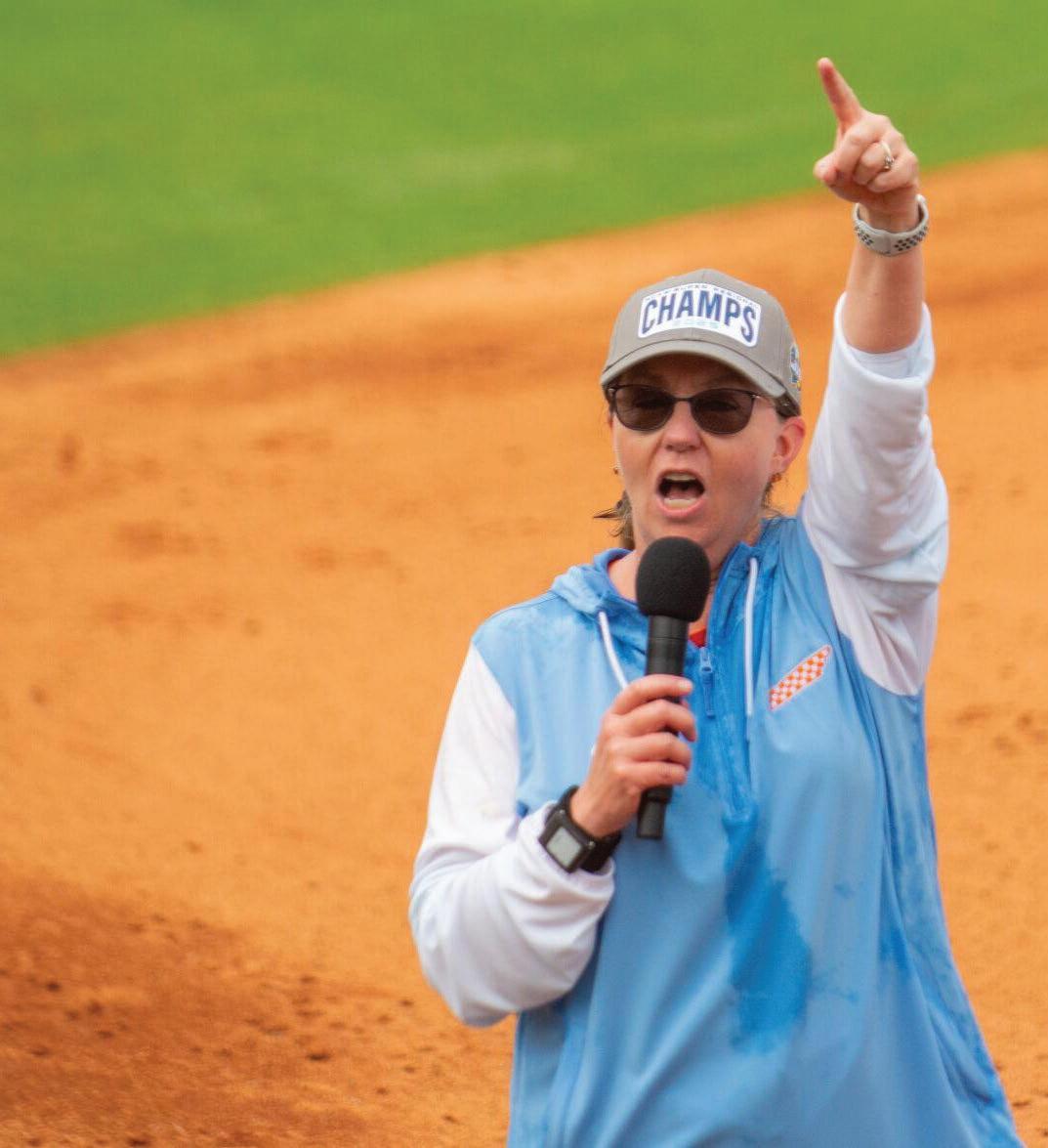
that I want to be able to say after the weekend or during the weekend, is that I have to say, ‘Whoa, not go,’” Weekly said.
“I just want us to get out there and get after it.”
It’s clear that Weekly wants to set a tone that, in order to be the best, you need to beat the best. While they will have plenty of opportunities to do so against their fellow conference opponents once SEC play begins, it’s apparent that Weekly wants her team battle-ready from the jump.
The Clearwater Invitational isn’t the first of the cycle, but it does feature the toughest tests on paper.
“Everybody’s gonna have a little bit of fear and nervousness, but how do you manage it?” Weekly said. “Do you manage that by getting on your heels, or do you manage that by staying on your toes and attacking? And I want us to be in an attack mode where maybe I have to rein something in, but certainly not light a fire under, under somebody.”
sophomores. Pickens notices the value in using her position on the team more to influence the team in ways she hadn’t known possible as an undergraduate.
Not only has Pickens seen growth in herself from a leadership perspective, but she has also seen the group of underclassmen that continues to push the envelope.
“Ella Dodge, Emma Clarke and Amayah Doyle, all of them have just had super impactful roles not only on the playing field, but also just as leaders,” Pickens said. “It’s something that you have to have a group to be able to do, and they’ve really stepped up making sure that everyone’s on the same page.”
The group, headlined by Pickens’ dominance in the circle, is impactful on the field, too. Dodge also made noise in her redshirt freshman season with an .827 OPS, tallying 15 RBIs with seven home runs.
“We are all very like-minded when it comes to competing and what we want to see this season,” Pickens said. “So I think having such a strong net group of those types of leaders, it’s really impactful.”
With 12 teams from the SEC ranked in the preseason top 25 poll, there’s no question the conference remains one of the best in the nation, and the Lady Vols will be right in the thick of it all yet again. But first, a trip to Clearwater, Florida, is on deck.
After the first two tournaments, the Lady Vols will travel up to Birmingham, Alabama, for the UAB Tournament. The Lady Vols square up against Missouri State, UAB, Mercer and Southern Illinois in the final neutral-site tournament.
That marks 14 games away from home before Weekly’s squads take the field at their home stadium, which comes on Feb. 27 against Appalachian State.
It’s all been about shaping the leadership of the locker room over the offseason for Weekly’s team, and the “leadership council,” as Weekly called it, is headlined by Karlyn Pickens, Amayah Doyle, Emma Clarke and Ella Dodge.
“All four have done a tremendous job stepping up with their voices,” Weekly said.
Only one of them enters the season as a senior, which is a testament to the maturity inside the locker room.
Dodge enters her redshirt sophomore year, while Clarke and Doyle are true
“We’re very excited to hit the field down in Clearwater,” Weekly said. “It’s not gonna be the warmest Clearwater, but it’s gonna be warmer than it is here in Knoxville. Spend our first two weekends down there, back-to-back tournaments with some of the best competition in the country, and I think at this point in time in our preparation, every team is just excited to see somebody else. It’s been a good January, but by this time it’s kind of long, and I know our girls are fired up to get out there and compete and see what we’re made of.”
TREVOR MCGEE
Sports Editor
Matt Kredich feels like he won the lottery.
The director of swimming and diving went from world-record holder Jordan Crooks to national champion Gui Caribe, a tandem that did the coaching job for him. But the remaining senior class is just as special to a Tennessee swim and dive program that splashed Duke, winning 25 of 32 events on Senior Day.
“I will never take for granted what they have achieved and how good they are, how good they’ve become,” Kredich said. “Because what they’ve done is kind of extraordinary.”
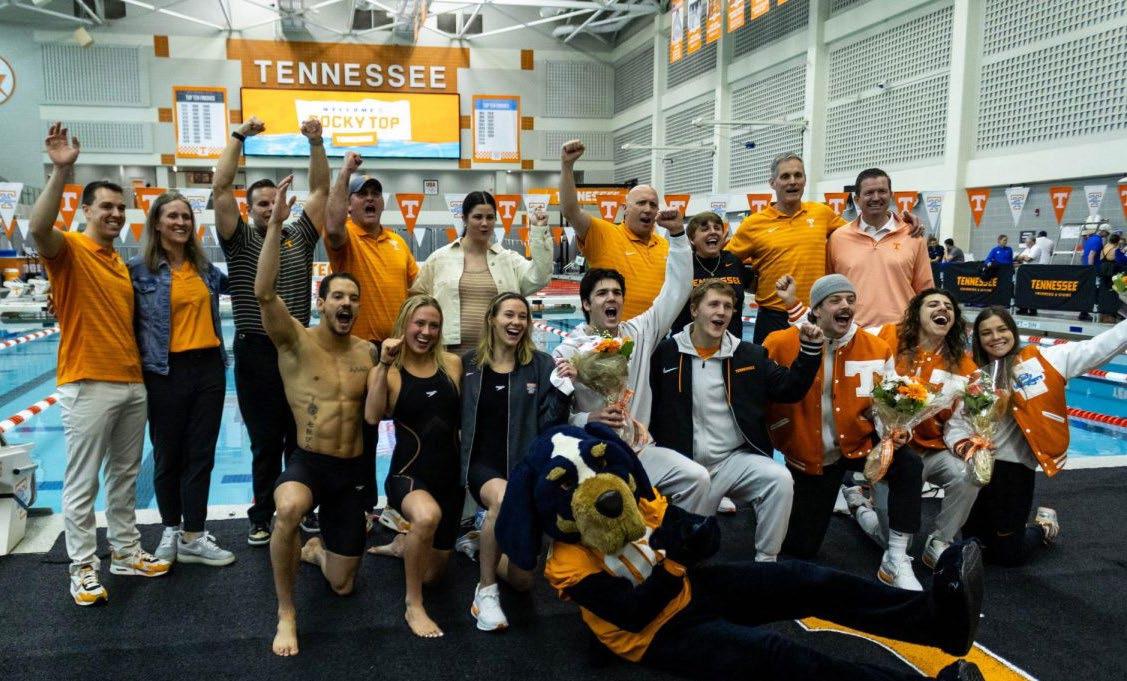
Alongside Caribe, seniors Julia Burroughs, Bailey Davenport, Martin Espernberger, Regan Rathwell, Owen Redfearn, Nick Simons and Nick Stone partook in Senior Day festivities on Friday, Jan. 30. It’s a group that has accomplished Olympic nods, NCAA event titles and multiple broken records.
Most importantly, it is one that has learned to overcome. Kredich credits the way they’ve overcome personal challenges, including tragedy, ultimately choosing the right path for growth and development.
He has seen pay off from the moment he began recruiting some of them as juniors in high school.
“This is a really resilient class, and I think our team has become more resilient because of them,” Kredich said.
Caribe is the guiding member of the class. The Brazilian swimmer is the fourth-fastest person to ever swim the 100-yard freestyle, but fell in the shadows of the fastest to ever do it. He learned behind Crooks for three years, and the sprint duo became one of the greatest one-two punches in NCAA history.
His legacy, instead, will be left the same way Crooks left his with Caribe.
“The amazing thing to watch this year is he’s brought others along with him,” Kredich said. “So the way he and Jordan helped each other, he’s also helping the kind of the younger generation.
“I’m confident that two or three years down the line, I’ll still see Gui’s fingerprints all over the development of our young male sprinters.”
Caribe’s final regular-season meet had wins in all four events he entered. The NCAA Champion relay swimmer took first place in the 200-yard medley relay and 200-yard freestyle relay. Individually, Caribe came away with first in the 100 butterfly and 50 freestyle, the latter being his seventh consecutive win in the event.
Espernberger’s development has been one Kredich has seen best. The Austrian electrical engineer came in as a proclaimed “OK recruit,” and is leaving four years later as an SEC Champion, Olympic finalist, SEC Scholar Athlete of the Year and two-time AllAmerican with a program record in the 200 butterfly.
“It’s impossible to separate the talent from the hard work, because he has done everything he could to become great,” Kredich said. “And that is, to me, such a strong and shining example of how to approach your sport.”
Espernberger did not compete in an event Friday, nor did fellow senior Burroughs.
As for the other swimming seniors, Simons took second place in the 100 butterfly and 200 freestyle. His fourthplace finish in the 50 freestyle clocked in at 20.03 seconds, marking a personal best. Simons also served as the opening leg of the 200 freestyle relay, which posted a second-place finish too.
Rathwell claimed a pair of top-three finishes, earning second in the 200 back and third place in the 100 back.
“It’s really hard to say goodbye,” Kredich said. “They’ve made a huge impact.”
Redfearn led the way on the diving side. He posted two podium finishes and personal bests, taking second place in the 3-meter dive (387.55) and third place in the 1-meter (327.05). Stone brought forth a podium finish of his own in the 1-meter.
Davenport did not compete in any events Friday.
“Owen and Nick are sort of the pinnacle of this team,” diving coach Jane Figueiredo said. “And they welcomed me in. We have a lot of love for each other. I’m gonna miss them a lot.”
Though it was the final regular-season meet for the seniors, it is not the last time they’ll get to compete — nor will it be the last in their home pool. Tennessee hosts the SEC Championships beginning Feb. 16 in Allan Jones Aquatic Center.
The conference last held its swim and dive championships in Knoxville in 2022. That season, the Lady Vols took the championship crown, while the Vols tied for second place.
“The associations that we as a coaching staff, and really in the team DNA, have with this building and the facility are all really positive,” Kredich said. “So we’re thrilled to be hosting.”