7/14/10
10:29 AM
Page 1
July 19, 2010
www.usedcarnews.com
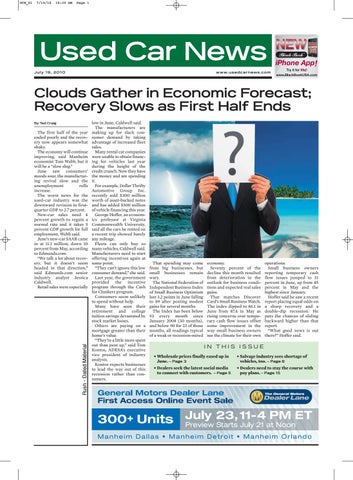
Clouds Gather in Economic Forecast; Recovery Slows as First Half Ends By Ted Craig
The first half of the year ended poorly and the recovery now appears somewhat shaky. The economy will continue improving, said Manheim economist Tom Webb, but it will be a “slow slog.” June saw consumers’ moods sour, the manufacturing revival slow and the unemployment rolls increase. The worst news for the used-car industry was the downward revision in firstquarter GDP to 2.7 percent. New-car sales need 4 percent growth to regain a normal rate and it takes 5 percent GDP growth for full employment, Webb said. June’s new-car SAAR came in at 11.1 million, down 10 percent from May, according to Edmunds.com. “We talk a lot about recovery, but it doesn’t seem headed in that direction,” said Edmunds.com senior industry analyst Jessica Caldwell. Retail sales were especially
Rush - Dated Material
UCN_01
low in June, Caldwell said. The manufacturers are making up for slack consumer demand by taking advantage of increased fleet sales. Many rental car companies were unable to obtain financing for vehicles last year during the height of the credit crunch. Now they have the money and are spending it. For example, Dollar Thrifty Automotive Group Inc. recently sold $300 million worth of asset-backed notes and has added $500 million of vehicle financing this year. George Hoffer, an economics professor at Virginia Commonwealth University, said all the cars he rented on a recent trip showed barely any mileage. Fleets can only buy so many vehicles, Caldwell said. Manufacturers need to start offering incentives again at some point. “They can’t ignore this low consumer demand,” she said. Last year, the government provided the incentive program through the Cash for Clunkers program. Consumers seem unlikely to spend without help. Many have seen their retirement and college tuition savings devastated by stock market losses. Others are paying on a mortgage greater than their home’s value. “They’re a little more spent out than pent up,” said Tom Kontos, ADESA’s executive vice president of industry analysis. Kontos expects businesses to lead the way out of this recession rather than consumers.
That spending may come from big businesses, but small businesses remain wary. The National Federation of Independent Business Index of Small Business Optimism lost 3.2 points in June falling to 89 after posting modest gains for several months. The Index has been below 93 every month since January 2008 (30 months), and below 90 for 23 of those months, all readings typical of a weak or recession-mired
economy. Seventy percent of the decline this month resulted from deterioration in the outlook for business conditions and expected real sales gains. That matches Discover Card’s Small Business Watch. The index dipped to 86.1 in June from 87.4 in May as rising concerns over temporary cash flow issues offset some improvement in the way small business owners see the climate for their own
operations. Small business owners reporting temporary cash flow issues jumped to 51 percent in June, up from 45 percent in May and the highest since January. Hoffer said he saw a recent report placing equal odds on a sharp recovery and a double-dip recession. He puts the chances of sliding backward higher than that report. “What good news is out there?” Hoffer said.
IN THIS ISSUE • Wholesale prices finally eased up in June. – Page 3
• Salvage industry sees shortage of vehicles, too. – Page 8
• Dealers seek the latest social media to connect with customers. – Page 5
• Dealers need to stay the course with pay plans. – Page 15